WO2017195813A1 - ポリビニルアルコール系フィルム、およびその製造方法、ならびにそのポリビニルアルコール系フィルムを用いた偏光膜 - Google Patents
ポリビニルアルコール系フィルム、およびその製造方法、ならびにそのポリビニルアルコール系フィルムを用いた偏光膜 Download PDFInfo
- Publication number
- WO2017195813A1 WO2017195813A1 PCT/JP2017/017649 JP2017017649W WO2017195813A1 WO 2017195813 A1 WO2017195813 A1 WO 2017195813A1 JP 2017017649 W JP2017017649 W JP 2017017649W WO 2017195813 A1 WO2017195813 A1 WO 2017195813A1
- Authority
- WO
- WIPO (PCT)
- Prior art keywords
- film
- polyvinyl alcohol
- polarizing film
- alcohol film
- polarizing
- Prior art date
- Legal status (The legal status is an assumption and is not a legal conclusion. Google has not performed a legal analysis and makes no representation as to the accuracy of the status listed.)
- Ceased
Links
Classifications
-
- C—CHEMISTRY; METALLURGY
- C08—ORGANIC MACROMOLECULAR COMPOUNDS; THEIR PREPARATION OR CHEMICAL WORKING-UP; COMPOSITIONS BASED THEREON
- C08J—WORKING-UP; GENERAL PROCESSES OF COMPOUNDING; AFTER-TREATMENT NOT COVERED BY SUBCLASSES C08B, C08C, C08F, C08G or C08H
- C08J5/00—Manufacture of articles or shaped materials containing macromolecular substances
- C08J5/18—Manufacture of films or sheets
-
- B—PERFORMING OPERATIONS; TRANSPORTING
- B29—WORKING OF PLASTICS; WORKING OF SUBSTANCES IN A PLASTIC STATE IN GENERAL
- B29C—SHAPING OR JOINING OF PLASTICS; SHAPING OF MATERIAL IN A PLASTIC STATE, NOT OTHERWISE PROVIDED FOR; AFTER-TREATMENT OF THE SHAPED PRODUCTS, e.g. REPAIRING
- B29C41/00—Shaping by coating a mould, core or other substrate, i.e. by depositing material and stripping-off the shaped article; Apparatus therefor
- B29C41/24—Shaping by coating a mould, core or other substrate, i.e. by depositing material and stripping-off the shaped article; Apparatus therefor for making articles of indefinite length
- B29C41/26—Shaping by coating a mould, core or other substrate, i.e. by depositing material and stripping-off the shaped article; Apparatus therefor for making articles of indefinite length by depositing flowable material on a rotating drum
-
- B—PERFORMING OPERATIONS; TRANSPORTING
- B29—WORKING OF PLASTICS; WORKING OF SUBSTANCES IN A PLASTIC STATE IN GENERAL
- B29C—SHAPING OR JOINING OF PLASTICS; SHAPING OF MATERIAL IN A PLASTIC STATE, NOT OTHERWISE PROVIDED FOR; AFTER-TREATMENT OF THE SHAPED PRODUCTS, e.g. REPAIRING
- B29C41/00—Shaping by coating a mould, core or other substrate, i.e. by depositing material and stripping-off the shaped article; Apparatus therefor
- B29C41/34—Component parts, details or accessories; Auxiliary operations
- B29C41/46—Heating or cooling
-
- B—PERFORMING OPERATIONS; TRANSPORTING
- B29—WORKING OF PLASTICS; WORKING OF SUBSTANCES IN A PLASTIC STATE IN GENERAL
- B29C—SHAPING OR JOINING OF PLASTICS; SHAPING OF MATERIAL IN A PLASTIC STATE, NOT OTHERWISE PROVIDED FOR; AFTER-TREATMENT OF THE SHAPED PRODUCTS, e.g. REPAIRING
- B29C41/00—Shaping by coating a mould, core or other substrate, i.e. by depositing material and stripping-off the shaped article; Apparatus therefor
- B29C41/34—Component parts, details or accessories; Auxiliary operations
- B29C41/52—Measuring, controlling or regulating
-
- C—CHEMISTRY; METALLURGY
- C08—ORGANIC MACROMOLECULAR COMPOUNDS; THEIR PREPARATION OR CHEMICAL WORKING-UP; COMPOSITIONS BASED THEREON
- C08L—COMPOSITIONS OF MACROMOLECULAR COMPOUNDS
- C08L29/00—Compositions of homopolymers or copolymers of compounds having one or more unsaturated aliphatic radicals, each having only one carbon-to-carbon double bond, and at least one being terminated by an alcohol, ether, aldehydo, ketonic, acetal or ketal radical; Compositions of hydrolysed polymers of esters of unsaturated alcohols with saturated carboxylic acids; Compositions of derivatives of such polymers
- C08L29/02—Homopolymers or copolymers of unsaturated alcohols
- C08L29/04—Polyvinyl alcohol; Partially hydrolysed homopolymers or copolymers of esters of unsaturated alcohols with saturated carboxylic acids
-
- G—PHYSICS
- G02—OPTICS
- G02B—OPTICAL ELEMENTS, SYSTEMS OR APPARATUS
- G02B5/00—Optical elements other than lenses
- G02B5/30—Polarising elements
-
- B—PERFORMING OPERATIONS; TRANSPORTING
- B29—WORKING OF PLASTICS; WORKING OF SUBSTANCES IN A PLASTIC STATE IN GENERAL
- B29K—INDEXING SCHEME ASSOCIATED WITH SUBCLASSES B29B, B29C OR B29D, RELATING TO MOULDING MATERIALS OR TO MATERIALS FOR MOULDS, REINFORCEMENTS, FILLERS OR PREFORMED PARTS, e.g. INSERTS
- B29K2029/00—Use of polyvinylalcohols, polyvinylethers, polyvinylaldehydes, polyvinylketones or polyvinylketals or derivatives thereof as moulding material
- B29K2029/04—PVOH, i.e. polyvinyl alcohol
-
- C—CHEMISTRY; METALLURGY
- C08—ORGANIC MACROMOLECULAR COMPOUNDS; THEIR PREPARATION OR CHEMICAL WORKING-UP; COMPOSITIONS BASED THEREON
- C08J—WORKING-UP; GENERAL PROCESSES OF COMPOUNDING; AFTER-TREATMENT NOT COVERED BY SUBCLASSES C08B, C08C, C08F, C08G or C08H
- C08J2329/00—Characterised by the use of homopolymers or copolymers of compounds having one or more unsaturated aliphatic radicals, each having only one carbon-to-carbon double bond, and at least one being terminated by an alcohol, ether, aldehydo, ketonic, acetal, or ketal radical; Hydrolysed polymers of esters of unsaturated alcohols with saturated carboxylic acids; Derivatives of such polymer
- C08J2329/02—Homopolymers or copolymers of unsaturated alcohols
- C08J2329/04—Polyvinyl alcohol; Partially hydrolysed homopolymers or copolymers of esters of unsaturated alcohols with saturated carboxylic acids
Definitions
- the present invention relates to a polyvinyl alcohol film, in particular, a polyvinyl alcohol film having an excellent stretchability, a polarizing film having a high degree of polarization and little color unevenness, a method for producing the same, and the polyvinyl alcohol system
- the present invention relates to a polarizing film using a film.
- a polarizing film is used as the polarizing film.
- a film obtained by adsorbing and orienting iodine or a dichroic dye on a polyvinyl alcohol film is mainly used.
- screens have become higher in definition, higher in brightness, larger in size, and thinner, there is a need for a polarizing film that is superior in polarization degree, has no color unevenness, and has a wide, long and thin thickness.
- the polarizing film in this invention is also called a polarizing film or a polarizer.
- a polarizing film is a dichroic material such as iodine after a polyvinyl alcohol film as a raw material is unwound from a roll and swollen with water (including warm water) while being conveyed in the flow direction (MD direction). It is manufactured by dyeing with a dye and drawing.
- This stretching step is a step of stretching the dyed film in the flow direction (MD direction) and highly orienting the dichroic dye in the film.
- the polyvinyl alcohol film used as a raw fabric needs to have good stretchability in the flow direction (MD direction).
- the polyvinyl alcohol film which is the raw fabric, is swollen with water (including warm water), stretched, and dyed with a dichroic dye such as iodine.
- a dichroic dye such as iodine.
- the polyvinyl alcohol film needs to have good stretchability in the flow direction (MD direction). For example, when the stretching tension is too high, the film cannot be stretched to a predetermined stretching ratio, and the dichroic dye is not sufficiently oriented, so that the degree of polarization tends not to improve.
- the stretching tension is too small, the orientation of the dichroic dye is not stable even if the stretching is performed up to a predetermined stretching ratio, and color unevenness tends to occur in the polarizing film.
- a polyvinyl alcohol film as a raw material is generally produced from an aqueous solution of a polyvinyl alcohol resin as a raw material by a continuous casting method. Specifically, a film formed by casting an aqueous solution of a polyvinyl alcohol resin onto a cast mold such as a cast drum or an endless belt is peeled off from the cast mold, and then the flow direction (MD direction) using a nip roll or the like. It is manufactured by drying using a heat roll while being conveyed and heat-treating using a floating dryer or the like if necessary.
- the polyvinyl alcohol film has also been thinned to reduce the thickness of the polarizing film.
- the thickness of the polyvinyl alcohol film was about 60 ⁇ m, but now the thickness is about 45 ⁇ m. It is expected to be 30 ⁇ m in the near future.
- Such a thin polyvinyl alcohol-based film has a problem in productivity, such as being broken by stretching when the polarizing film is produced.
- a technique for improving the stretchability of the polyvinyl alcohol film for example, a technique in which the ratio between the speed of the cast drum and the final film winding speed is set to a specific ratio when the polyvinyl alcohol film is formed (for example, a patent document) 1), a method of floating a film after film formation with a cast drum (for example, refer to Patent Document 2), and a method for controlling the tension in a drying process of a polyvinyl alcohol film (for example, refer to Patent Document 3). Proposed.
- the polyvinyl alcohol system film (for example, refer patent document 4) which reduced in-plane phase difference, and the polyvinyl alcohol system manufactured by making the tensile elongation of a flow direction (MD direction) and a width direction (TD direction) equivalent.
- a film see, for example, Patent Document 5
- a polyvinyl alcohol film see, for example, Patent Document 6) whose Young's modulus (tensile elastic modulus) is reduced to 20 MPa or less by electromagnetic wave irradiation, and the like have also been proposed.
- Patent Document 1 specifies the degree of stretching (stretching) in the flow direction (MD direction) when producing a polyvinyl alcohol-based film, but it does not take into account drying conditions or heat treatment conditions. The stretchability of the polyvinyl alcohol film is not sufficiently improved.
- the film after film formation can be dried uniformly, but the tensile elastic modulus cannot be controlled, and the stretchability of the polyvinyl alcohol film during the production of the polarizing film is not sufficiently improved.
- Patent Document 4 can reduce the in-plane retardation of the film, there is room for improvement in terms of controlling the tensile elastic modulus and improving the stretchability of the polyvinyl alcohol film during the production of the polarizing film. Further, in the manufacturing method of the disclosed technology, the film after drying (70 ° C.) or heat treatment (120 ° C.) is once cooled to 50 ° C. or lower and heated again at 50 to 100 ° C. before being wound on a roll film. The heating process is complicated, and there is room for improvement in terms of productivity.
- the tensile elastic modulus can be reduced, in the examples, it is 13.8 to 17.8 MPa, and in the comparative example in which no electromagnetic wave irradiation is performed, it is 27 MPa, and further reduction of the tensile elastic modulus is desired. .
- Patent Documents 1 to 6 only a polyvinyl alcohol film having a thickness of 50 ⁇ m or more is described, and further improvement is required to meet the recent demand for thinning. .
- the present invention is a polyvinyl alcohol film that is excellent in stretchability at the time of manufacturing a polarizing film, and can obtain a polarizing film having a high degree of polarization and little color unevenness.
- a polyvinyl alcohol film that does not break when producing a thin polarizing film even when a thin film having a thickness of 25 ⁇ m or less is produced, a method for producing the same, and a polarizing film using the polyvinyl alcohol film To do.
- the present inventors have found that the length in the flow direction (MD direction) is equal to or greater than a specific length, and the tensile elasticity in the flow direction (length direction, MD direction).
- the present inventors have found that a polyvinyl alcohol film whose rate is controlled within a specific range is excellent in stretchability at the time of producing a polarizing film and can produce a thin polarizing film with a high yield.
- the polarizing film obtained using this polyvinyl-alcohol-type film has a high degree of polarization, and becomes a polarizing film with few color nonuniformity.
- the first gist of the present invention is a polyvinyl alcohol film having a length of 4 km or more, and the tensile modulus X (in the MD direction) in the state where the moisture content of the film is 9% by weight (MD direction).
- MPa is a polyvinyl alcohol film characterized in that it is 5 to 12 MPa.
- the second gist of the present invention is that a film forming process for forming an aqueous solution of a polyvinyl alcohol resin by a continuous casting method, a drying process for drying the formed film, and a heat treatment for the dried film.
- the 3rd summary of this invention is a polarizing film characterized by using the polyvinyl-alcohol-type film of the said 1st summary.
- the polyvinyl alcohol film according to the first aspect of the present invention has a tensile modulus X in the length direction (MD direction) of 5 to 12 MPa in a state where the moisture content is 9% by weight. In the case of producing a thin polarizing film, it is possible to prevent breakage from occurring.
- the thickness D of the film is 5 to 25 ⁇ m and the thickness D ( ⁇ m) and the tensile elastic modulus X (MPa) satisfy the following formula (1), There is an effect that the resistance to breakage can be improved. 0.4 ⁇ X / D ⁇ 0.6 (1)
- MPa tensile elastic modulus
- the tensile strength F in the length direction (MD direction) is 100 MPa or more, there is an effect that it is possible to prevent breakage when manufacturing a thin polarizing film.
- the refractive index in the length direction (MD direction) is nx
- the refractive index in the width direction (TD direction) is ny
- the refractive index in the thickness direction is nz
- the thickness is D ( ⁇ m)
- the retardation Rth in the thickness direction calculated in (3) is 80 to 140 nm
- the swelling property in the thickness direction can be optimized and the stretchability in manufacturing the polarizing film can be optimized. There is an effect that can be done.
- Rth ⁇ (nx + ny) / 2 ⁇ nz ⁇ ⁇ 1000 ⁇ D (3)
- the method for producing a polyvinyl alcohol film according to the second aspect of the present invention includes a specific drying step and a heat treatment step, the method according to the first aspect is excellent in stretchability and rupture resistance during the production of the polarizing film. There exists an effect that a polyvinyl-alcohol-type film can be manufactured.
- the polarizing film according to the third aspect of the present invention has the effect of exhibiting a high degree of polarization and less color unevenness because the polyvinyl alcohol film according to the first aspect is used. .
- the polyvinyl alcohol film of the present invention is a polyvinyl alcohol film having a length of 4 km or more, and has a tensile modulus X in the length direction (MD direction) measured in a state where the moisture content of the film is 9% by weight. 5 to 12 MPa.
- the said polyvinyl alcohol-type film is formed in a polarizing film through a swelling process, an extending process, etc., being conveyed in the length direction (MD direction).
- MD direction the length direction measured in a state where the polyvinyl alcohol film has a specific length (4 km or more) and the moisture content of the polyvinyl alcohol film is 9% by weight is specified. Therefore, the polyvinyl alcohol film has excellent stretchability when producing a polarizing film and does not break even when a thin polarizing film is produced.
- the obtained polarizing film exhibits a high degree of polarization and has little color unevenness.
- the tensile elastic modulus in the present invention is a value measured in an environment of 20 ° C. and 65% RH according to JIS K7127: 1999.
- the tensile elastic modulus is also called Young's modulus and tensile elastic modulus.
- the moisture content in the present invention is a value calculated from the weight before and after the polyvinyl alcohol film is dried at an atmospheric temperature of 105 ° C. for 16 hours with a dryer, and the weight before drying is A, after drying.
- the weight of B B
- the following formula is used.
- the polyvinyl alcohol film is stretched after swelling, but it is difficult to accurately and stably measure the tensile elastic modulus after swelling.
- the tensile modulus at a moisture content of 9% by weight which can be easily controlled by humidity control, is used as an index. .
- the method of conditioning the humidity is not particularly limited.
- a relatively dry polyvinyl alcohol film immediately after production is conditioned in an environment of 20 ° C. and 65% RH for several hours to several tens of hours.
- the moisture content can be stabilized at 9% by weight, which is close to the equilibrium moisture content.
- the “water content 9% by weight” means “including a water content of 9.0% by weight ⁇ 0.5% by weight”, and within that range, the tensile modulus of elasticity is included. Is almost unchanged.
- the moisture content in the film changes to an equilibrium moisture content that depends on the environmental humidity, the specimen whose moisture content has been adjusted to 9% by weight is quickly subjected to measurement of the tensile modulus. .
- the in-plane deflection ⁇ Y (MPa) of the tensile elastic modulus Y (MPa) in the TD direction is preferably 5 MPa or less, particularly preferably 3 MPa or less, and further preferably 2 MPa or less. If the in-plane deflection ⁇ X and the in-plane deflection ⁇ Y are too large, stretching unevenness occurs during the production of the polarizing film, and color unevenness tends to occur in the polarizing film.
- the method for producing a polyvinyl alcohol film of the present invention includes a film forming step (A) for forming an aqueous solution of a polyvinyl alcohol resin by a continuous casting method, and a drying step (B) for drying the formed film.
- a method for producing a polyvinyl alcohol film comprising a heat treatment step (C) for heat-treating the dried film, wherein the film-forming film is dried at a temperature of 100 ° C. or higher in the drying step (B).
- the heat treatment step (C) the dried film is cooled to 50 ° C. or lower and then heated at 60 to 99 ° C.
- an unmodified polyvinyl alcohol resin that is, a resin produced by saponifying polyvinyl acetate obtained by polymerizing vinyl acetate is usually used. If necessary, a resin obtained by saponifying a copolymer of vinyl acetate and a small amount (usually 10 mol% or less, preferably 5 mol% or less) of a copolymerizable component with vinyl acetate may be used. it can.
- components copolymerizable with vinyl acetate include unsaturated carboxylic acids (including salts, esters, amides, nitriles, etc.), and olefins having 2 to 30 carbon atoms (eg, ethylene, propylene, n-butene). , Isobutene, etc.), vinyl ethers, unsaturated sulfonates and the like.
- the modified polyvinyl alcohol-type resin obtained by chemically modifying the hydroxyl group after saponification can also be used.
- a polyvinyl alcohol resin having a 1,2-diol structure in the side chain can be used as the polyvinyl alcohol resin.
- a polyvinyl alcohol resin having a 1,2-diol structure in the side chain includes, for example, (i) a method of saponifying a copolymer of vinyl acetate and 3,4-diacetoxy-1-butene, and (ii) acetic acid.
- the weight average molecular weight of the polyvinyl alcohol resin is preferably 100,000 to 300,000, particularly preferably 110,000 to 280,000, and more preferably 120,000 to 260,000. If the weight average molecular weight is too small, the degree of polarization of the polarizing film tends to decrease, and if it is too large, stretching of the polyvinyl alcohol film during the production of the polarizing film tends to be difficult.
- the weight average molecular weight of the polyvinyl alcohol resin is a weight average molecular weight measured by GPC-MALS method.
- the average saponification degree of the polyvinyl alcohol resin used in the present invention is usually preferably 98 mol% or more, particularly preferably 99 mol% or more, further preferably 99.5 mol% or more, and particularly preferably 99.mol%. It is 8 mol% or more. If the average degree of saponification is too small, the degree of polarization of the polarizing film tends to decrease.
- the average saponification degree in the present invention is measured according to JIS K 6726.
- polyvinyl alcohol resin used in the present invention two or more kinds having different modified species, modified amount, weight average molecular weight, average saponification degree, etc. may be used in combination.
- the method for preparing the polyvinyl alcohol-based resin aqueous solution is not particularly limited.
- the polyvinyl alcohol-based resin aqueous solution may be prepared by using a heated multi-screw extruder. The polyvinyl alcohol resin wet cake thus prepared is charged, and water vapor is blown into the can to prepare an aqueous solution having a desired concentration and dissolution.
- polyvinyl alcohol-based resin aqueous solutions include generally used plasticizers such as glycerin, diglycerin, triglycerin, ethylene glycol, triethylene glycol, polyethylene glycol, trimethylolpropane, and nonions. It is preferable from the viewpoint of the film-forming property of the polyvinyl alcohol film to contain at least one surfactant, anionic, anionic and cationic.
- a preferable plasticizer is glycerin, and the content of the plasticizer in the aqueous polyvinyl alcohol resin solution is preferably 1 to 20% by weight.
- the surfactant are polyoxyethylene alkylamine and higher fatty acid alkanolamide, and the content of the surfactant in the aqueous polyvinyl alcohol resin solution is preferably 0.01 to 1% by weight. .
- the resin concentration of the aqueous polyvinyl alcohol resin solution thus obtained is preferably 15 to 60% by weight, particularly preferably 17 to 55% by weight, and further preferably 20 to 50% by weight. If the resin concentration of such an aqueous solution is too low, the drying load increases and the production capacity tends to decrease. If it is too high, the viscosity becomes too high and uniform dissolution tends to be difficult.
- the obtained polyvinyl alcohol resin aqueous solution is defoamed.
- the defoaming method include stationary defoaming and defoaming using a multi-screw extruder having a vent.
- a multi-screw extruder having a vent a twin-screw extruder having a vent is usually used.
- the polyvinyl alcohol-based resin aqueous solution is introduced into a T-shaped slit die by a certain amount, discharged and cast on a rotating cast drum, and formed into a film by a continuous casting method.
- the temperature of the polyvinyl alcohol resin aqueous solution at the exit of the T-shaped slit die is preferably 80 to 100 ° C., particularly preferably 85 to 98 ° C. If the temperature of the aqueous polyvinyl alcohol resin solution is too low, it tends to cause poor flow, and if it is too high, it tends to foam.
- the viscosity of the polyvinyl alcohol-based resin aqueous solution is preferably 50 to 200 Pa ⁇ s, particularly preferably 70 to 150 Pa ⁇ s at the time of discharge.
- the viscosity of the aqueous solution is too low, the flow tends to be poor, and when it is too high, casting tends to be difficult.
- the discharge speed of the polyvinyl alcohol-based resin aqueous solution discharged from the T-type slit die onto the cast drum is preferably 0.1 to 3.0 m / min, particularly preferably 0.2 to 2.5 m / min. Preferably, it is 0.3 to 2.0 m / min. If the discharge speed is too slow, the productivity tends to decrease, and if it is too fast, casting tends to be difficult.
- the diameter of the cast drum is preferably 2 to 5 m, particularly preferably 2.4 to 4.5 m, and further preferably 2.8 to 4 m. If the diameter is too small, the drying length is insufficient and the speed tends not to be obtained, and if it is too large, the transportability tends to decrease.
- the width of the cast drum is preferably 4 m or more, particularly preferably 4.5 m or more, more preferably 5 m or more, and particularly preferably 5 to 6 m. If the width of the cast drum is too small, the productivity tends to decrease.
- the rotational speed of the cast drum is preferably 1 to 30 m / min, particularly preferably 2 to 25 m / min, and further preferably 3 to 20 m / min. If the rotational speed is too slow, productivity tends to decrease, and if it is too fast, dehydration tends to be insufficient.
- the surface temperature of the cast drum is preferably 40 to 99 ° C., more preferably 50 to 90 ° C., and particularly preferably 55 to 80 ° C. If the surface temperature is too low, dehydration tends to occur, and if it is too high, foaming tends to occur.
- the film forming step (A) is performed, and the formed film is peeled off from the cast drum.
- This drying step (B) is a step of heating and drying the film thus formed.
- the film peeled off from the cast drum (the film formed above) is conveyed in the flow direction (MD direction) using a nip roll or the like, and the front and back surfaces of the film are alternately brought into contact with a plurality of hot rolls. It is dried by.
- the hot roll is, for example, a roll having a diameter of 0.2 to 2 m, the surface of which is hard chrome plated or mirror-finished. Usually, 2 to 30 rolls, preferably 10 to 25 rolls are preferably used for drying.
- the drying temperature (the temperature at which the film formed above is dried) is preferably 100 ° C. or higher, particularly preferably 100 to 120 ° C., further preferably 100 to 115 ° C., and particularly preferably 100 to 110 ° C. If the drying temperature is too low, the drying tends to be poor, and if it is too high, appearance defects such as swell tend to be caused.
- the drying temperature in this invention is the surface temperature of the hottest hot roll in the hot roll used.
- the drying time is not particularly limited, but is usually 1 to 60 seconds, preferably 2 to 50 seconds, particularly preferably 3 to 40 seconds, and further preferably 4 to 30 seconds. If the drying time is too short, drying tends to be poor, and if it is too long, appearance defects such as swell tend to be caused.
- the drying time in the present invention means the contact time between the hottest hot roll and the film formed above, and when there are a plurality of hottest hot rolls, This is the integrated value of the contact time.
- the moisture content of the dried film is preferably 5% by weight or less, particularly preferably 0.1 to 4% by weight, more preferably 0.2 to 3% by weight, and particularly preferably 0.3 to 2.5% by weight. %. If the moisture content is too high, the finally obtained polyvinyl alcohol film tends to be poorly dried.
- This heat treatment step (C) is a step of heat-treating the dried film.
- Such a heat treatment step is generally an optional step performed as necessary, but in the present invention, it is an essential step for controlling the tensile elastic modulus. That is, in this heat treatment step (C), the film dried at 100 ° C. or higher in the drying step (B) is once cooled to 50 ° C. or lower (the temperature of the dried film itself), and again from 60 to 99. By heating at 0 ° C., the tensile elastic modulus is set to a desired range, and the stretchability at the time of producing the polarizing film is improved.
- Examples of the cooling method include natural cooling in which the product is left to cool naturally, a method of blowing cool air, and the like.
- Examples of the heating method include a method of blowing hot air with a floating dryer, a method of contacting with a hot roll, and the like.
- the heating temperature is preferably 65 to 95 ° C, particularly preferably 70 to 90 ° C, and more preferably 70 to 80 ° C. If the heating temperature is too low, the tensile elastic modulus tends to decrease, and if it is too high, the tensile elastic modulus tends to increase.
- the heating temperature in the present invention means the temperature of the hot air when the heating method is a method of blowing hot air with the floating dryer, and when the heating method is a method of contacting the hot roll, It means the surface temperature of the hot roll.
- the heating time is not particularly limited, but when a floating dryer is used, it is preferably 10 to 120 seconds, particularly preferably 20 to 90 seconds, and further preferably 30 to 60 seconds. If the heating time is too short, the deflection of the tensile elastic modulus tends to increase, and if it is too long, the productivity tends to decrease.
- the moisture content of the heated film is preferably 0.1 to 2% by weight, particularly preferably 0.2 to 1.7% by weight, and more preferably 0.3 to 1.5% by weight. If the moisture content is too low, water swelling during the production of the polarizing film tends to be difficult. Conversely, if it is too high, the finally obtained polyvinyl alcohol film tends to be poorly dried.
- the drying step (B) and the heat treatment step (C) have been described.
- the temperature balance between the two is important, and the drying temperature in the drying step (B) is water.
- the boiling point is preferably 100 ° C. or higher, and it is more preferable to select a relatively low temperature in such a temperature range.
- the heating temperature in the heat treatment step (C) is 100 ° C., which is the boiling point of water. It is particularly preferred that it is less than.
- Polyvinyl alcohol film Through the drying step (B) and the heat treatment step (C), the polyvinyl alcohol film of the present invention that is long in the flow direction (MD direction) is obtained.
- This polyvinyl alcohol film is slit at both ends, and is wound around a core tube in a roll shape.
- the width of the polyvinyl alcohol film of the present invention thus obtained is preferably 4 m or more from the viewpoint of improving productivity, and more preferably 4 to 6 m from the viewpoint of avoiding breakage.
- the length of the polyvinyl alcohol film of the present invention is premised on 4 km or more, and is preferably 5 km or more, particularly preferably in view of increasing the area of the polarizing film and thus the liquid crystal screen.
- the transport weight is 5 to 50 km.
- the thickness D of the polyvinyl alcohol film is preferably 30 ⁇ m or less from the viewpoint of thinning the polarizing film, particularly preferably 25 ⁇ m or less from the viewpoint of further thinning, and more preferably 5 from the viewpoint of avoiding breakage. It is ⁇ 25 ⁇ m, particularly preferably 5 to 20 ⁇ m.
- the thickness D ( ⁇ m) is adjusted by the resin concentration in the polyvinyl alcohol-based resin aqueous solution, the discharge amount (discharge speed) to the cast mold, the draw ratio, and the like.
- the polyvinyl alcohol-based film of the present invention has a thickness D ( ⁇ m) and a flow direction measured in a state where the moisture content of the film is 9% by weight ( It is preferable that the tensile modulus X (MPa) in the MD direction satisfies the following formula (1) in terms of improving the fracture resistance when manufacturing the polarizing film. 0.4 ⁇ X / D ⁇ 0.6 (1)
- the following formula (1 ′) is satisfied in terms of improving the stretchability during the production of the polarizing film. 0.45 ⁇ X / D ⁇ 0.55 (1 ′)
- the tensile modulus Y (MPa) in the width direction (TD direction) when the moisture content is 9% by weight is the following formula ( It is preferable to satisfy 2). 0.7 ⁇ Y / X ⁇ 1.3 (2)
- the following formula (2 ′) is satisfied from the viewpoint of improving the stretchability during the production of the polarizing film. 0.75 ⁇ Y / X ⁇ 1.1 (2 ′)
- the tensile strength F (MPa) in the flow direction (MD direction) with a moisture content of 9% by weight is preferably 100 MPa or more, particularly preferably 110 MPa or more. If the tensile strength F (MPa) is too small, there is a tendency that breakage tends to occur during the production of a thin polarizing film.
- the upper limit of the tensile strength F (MPa) is usually 200 MPa.
- the polyvinyl alcohol film of the present invention has a refractive index in the length direction (MD direction) of nx, a refractive index in the width direction (TD direction) of ny, a refractive index in the thickness direction of nz, and a thickness of D ( ⁇ m),
- the thickness direction retardation Rth (nm) calculated by the following formula (3) is preferably 80 to 140 nm. More preferably, it is 85 to 130 nm, and still more preferably 90 to 120 nm. If the retardation Rth (nm) in the thickness direction is too small, the swelling property in the thickness direction tends to be reduced. If the retardation Rth (nm) is too large, the surface orientation of the polymer chain is strong. Tends to decrease.
- Rth ⁇ (nx + ny) / 2 ⁇ nz ⁇ ⁇ 1000 ⁇ D (3)
- the method for producing a polyvinyl alcohol film has been described by taking as an example the case where a cast drum (drum roll) is used as a cast mold.
- a cast belt or a resin film is used as a cast mold. It is also possible to manufacture.
- the polyvinyl alcohol film of the present invention is excellent in stretchability, it is particularly preferably used as a raw material for a polarizing film.
- the polarizing film of the present invention is produced through steps such as swelling, dyeing, boric acid crosslinking, stretching, washing, and drying by feeding the polyvinyl alcohol film out of a roll and transferring it in the horizontal direction.
- the swelling process is performed before the dyeing process.
- water is usually used as the treatment liquid.
- the treatment liquid may contain a small amount of an additive such as an iodide compound, a surfactant, alcohol, and the like.
- the temperature of the swelling bath is usually about 10 to 45 ° C., and the immersion time in the swelling bath is usually about 0.1 to 10 minutes.
- the dyeing step is performed by bringing a liquid containing iodine or a dichroic dye into contact with the polyvinyl alcohol film.
- a liquid containing iodine or a dichroic dye into contact with the polyvinyl alcohol film.
- an iodine-potassium iodide aqueous solution is used.
- the iodine concentration is suitably 0.1-2 g / L, and the potassium iodide concentration is 1-100 g / L.
- the dyeing time is practically about 30 to 500 seconds.
- the temperature of the treatment bath is preferably 5 to 50 ° C.
- the aqueous solution may contain a small amount of an organic solvent compatible with water in addition to the aqueous solvent.
- the boric acid crosslinking step is performed using a boron compound such as boric acid or borax.
- the boron compound is used in the form of an aqueous solution or a water-organic solvent mixture at a concentration of about 10 to 100 g / L, and it is preferable that potassium iodide coexists in the solution from the viewpoint of stabilizing the polarization performance.
- the temperature during the treatment is preferably about 30 to 70 ° C., and the treatment time is preferably about 0.1 to 20 minutes. If necessary, the stretching operation may be performed during the treatment.
- the stretching step is preferably performed 3 to 10 times, preferably 3.5 to 6 times in a uniaxial direction [flow direction (MD direction)].
- a slight stretching may also be performed in the direction perpendicular to the stretching direction.
- the temperature during stretching is preferably 30 to 170 ° C.
- the stretching ratio may be finally set within the above range, and the stretching operation may be performed not only once but plural times in the polarizing film manufacturing process.
- tensile_strength in this extending process needs to be an appropriate range. That is, when the stretching tension is too large, the film cannot be stretched to a predetermined stretching ratio, and the dichroic dye is not sufficiently oriented, so that the degree of polarization tends not to be improved. On the other hand, when the stretching tension is too small, the orientation of the dichroic dye is not stable even if the stretching is performed up to a predetermined stretching ratio, and color unevenness tends to occur in the polarizing film. In general, in the polarizing film manufacturing process, since the stretching tension is set for each thickness, it is difficult to generalize a preferable range. However, in the comparison with the same thickness, the stretching tension is 1 It is preferable to reduce by 10% or more, particularly preferably by 10 to 30%.
- the washing step is performed, for example, by immersing the polyvinyl alcohol film in an aqueous iodide solution such as water or potassium iodide, and the precipitate generated on the surface of the polyvinyl alcohol film can be removed.
- an aqueous potassium iodide solution the potassium iodide concentration is about 1 to 80 g / L.
- the temperature during the washing treatment is usually 5 to 50 ° C., preferably 10 to 45 ° C.
- the treatment time is usually 1 to 300 seconds, preferably 10 to 240 seconds.
- the polyvinyl alcohol film is dried in the atmosphere at 40 to 80 ° C. for 1 to 10 minutes.
- the polarization degree of the polarizing film of the present invention is preferably 99.5% or more, more preferably 99.8% or more. If the degree of polarization is too low, there is a tendency that the contrast in the liquid crystal display cannot be secured.
- the single transmittance of the polarizing film of the present invention is preferably 42% or more, more preferably 43% or more. If the single transmittance is too low, it tends to be impossible to achieve high brightness of the liquid crystal display.
- the single transmittance is a value obtained by measuring the light transmittance of a single polarizing film using a spectrophotometer.
- the polarizing film of the present invention is suitable for producing a polarizing plate having excellent degree of polarization and no color unevenness.
- the manufacturing method of the polarizing plate using the polarizing film of this invention is demonstrated.
- the polarizing plate is produced by laminating an optically isotropic resin film as a protective film on one or both sides of the polarizing film of the present invention via an adhesive.
- the protective film include cellulose triacetate, cellulose diacetate, polycarbonate, polymethyl methacrylate, cycloolefin polymer, cycloolefin copolymer, polystyrene, polyethersulfone, polyarylene ester, poly-4-methylpentene, polyphenylene oxide, and the like. Or a sheet.
- the bonding method is performed by a known method. For example, after the liquid adhesive composition is uniformly applied to the polarizing film, the protective film, or both, the both are bonded and pressure-bonded. It is performed by irradiating active energy rays.
- a polarizing plate can be formed by applying a curable resin such as urethane resin, acrylic resin, urea resin or the like to one or both surfaces of the polarizing film and curing to form a cured layer. If it does in this way, the said hardened layer becomes a substitute of the said protective film, and can attain thinning.
- a curable resin such as urethane resin, acrylic resin, urea resin or the like
- Polarizing films and polarizing plates using the polyvinyl alcohol film of the present invention are excellent in polarizing performance, such as portable information terminals, personal computers, televisions, projectors, signage, electronic desk calculators, electronic watches, word processors, electronic paper, games.
- Machines, videos, cameras, photo albums, thermometers, audio, liquid crystal display devices such as automobile and machinery instruments, sunglasses, anti-glare glasses, stereoscopic glasses, wearable displays, display elements (CRT, LCD, organic EL, electronic It is preferably used for an antireflection layer for paper and the like, an optical communication device, a medical device, a building material, a toy and the like.
- the properties of the polyvinyl alcohol film (water content, tensile modulus, tensile strength, thickness direction retardation, stretching tension) and polarizing film properties (polarization degree, single transmittance) in the following examples and comparative examples , Color unevenness) was measured and evaluated as follows.
- the tensile elastic modulus X (MPa) in the flow direction (MD direction) and the tensile elastic modulus Y (MPa) in the width direction (TD direction) were measured.
- the tensile strength F (MPa) is measured.
- the composition of the used dyeing solution and boric acid solution is as follows. Staining solution: iodine 0.9 g / L, potassium iodide 30 g / L Boric acid solution: potassium iodide 30 g / L, boric acid 25 g / L
- Example 1> (Preparation of polyvinyl alcohol film) 1,000 kg of polyvinyl alcohol resin having a weight average molecular weight of 142,000 and a saponification degree of 99.8 mol%, 2,500 kg of water, and 120 kg of glycerin as a plasticizer are added, and the temperature is raised to 140 ° C. while stirring, and the resin concentration The concentration was adjusted to 25% by weight to obtain a uniformly dissolved polyvinyl alcohol resin aqueous solution. Next, the polyvinyl alcohol-based resin aqueous solution is supplied to a twin-screw extruder having a vent and defoamed, and then the aqueous solution temperature is set to 95 ° C.
- a polyvinyl alcohol film (thickness 20 ⁇ m, width 5 m, length 5 km) having a moisture content of 1% by weight was obtained. Finally, both ends of the polyvinyl alcohol film were slit and wound around the core tube in a roll shape. The characteristics of the obtained polyvinyl alcohol film are shown in Table 1 below.
- the obtained polyvinyl alcohol film was unwound from a roll and transported in the horizontal direction using a transport roll. First, it was 1.7 times in the flow direction (MD direction) in 1 minute while being immersed in a water bath at a water temperature of 25 ° C. and swollen. Stretched twice. Next, the film was stretched 1.6 times in the flow direction (MD direction) in 0.5 minutes while being immersed in a 28 ° C. aqueous solution of iodine 0.9 g / L and potassium iodide 30 g / L and dyeing. Subsequently, the film was immersed in a 55 ° C.
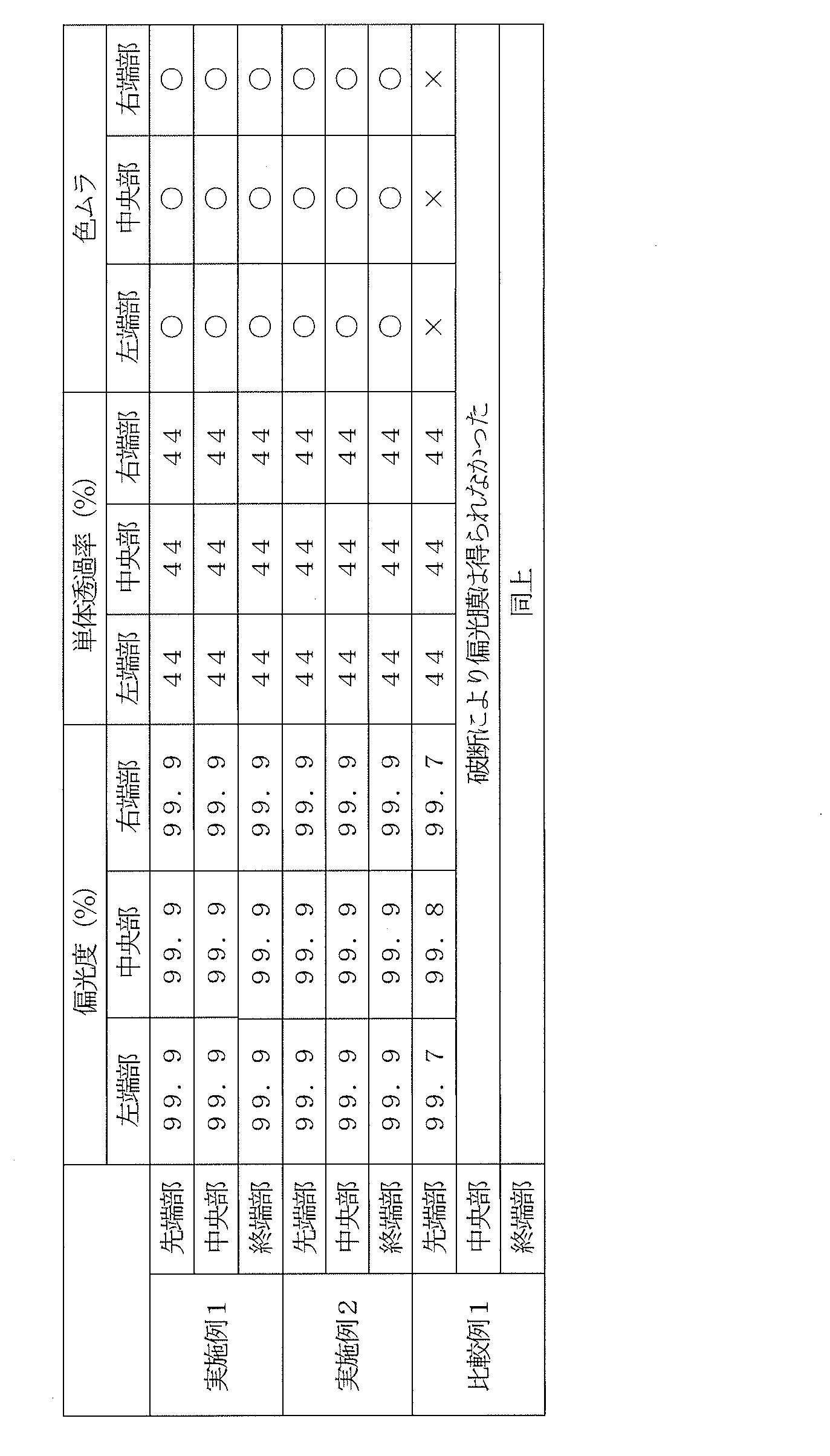
- Comparative Example 1 A polyvinyl alcohol film and a polarizing film were obtained in the same manner as in Example 1 except that the production was performed under the conditions shown in Table 1 below. The properties of the obtained polyvinyl alcohol film are shown in Table 1 below, and the properties of the obtained polarizing film are shown in Table 2 below. In Comparative Example 1, an attempt was made to produce a polarizing film in the same manner as in Example 1, but breakage occurred during stretching in the boric acid crosslinking step. The characteristics shown in Table 2 are the characteristics of the polarizing film tip obtained barely.
- the polyvinyl alcohol films of Examples 1 and 2 have a tensile modulus value within the specific range of the present invention, so that the obtained polarizing film has a high degree of polarization and no color unevenness, whereas Comparative Example 1 Since the tensile modulus of the polyvinyl alcohol film is outside the specific range of the present invention, it is easy to break, and the obtained polarizing film is inferior in the degree of polarization and has color unevenness.
- Example 2 a polyvinyl alcohol film having a length of 4 km and 10 km was produced in the same manner as in Example 1. The results showing the same tendency as in Examples 1 and 2 were obtained for the polyvinyl alcohol films of these lengths.
- Polarizing films and polarizing plates using the polyvinyl alcohol film of the present invention are excellent in polarizing performance, such as portable information terminals, personal computers, televisions, projectors, signage, electronic desk calculators, electronic watches, word processors, electronic paper, games.
- Machines, videos, cameras, photo albums, thermometers, audio, liquid crystal display devices such as automobile and machinery instruments, sunglasses, anti-glare glasses, stereoscopic glasses, wearable displays, display elements (CRT, LCD, organic EL, electronic It is preferably used for an antireflection layer for paper and the like, an optical communication device, a medical device, a building material, a toy and the like.
Landscapes
- Engineering & Computer Science (AREA)
- Chemical & Material Sciences (AREA)
- Mechanical Engineering (AREA)
- Physics & Mathematics (AREA)
- Manufacturing & Machinery (AREA)
- Organic Chemistry (AREA)
- Health & Medical Sciences (AREA)
- Chemical Kinetics & Catalysis (AREA)
- Medicinal Chemistry (AREA)
- Polymers & Plastics (AREA)
- Optics & Photonics (AREA)
- General Physics & Mathematics (AREA)
- Materials Engineering (AREA)
- Polarising Elements (AREA)
- Manufacture Of Macromolecular Shaped Articles (AREA)
- Moulding By Coating Moulds (AREA)
- Shaping By String And By Release Of Stress In Plastics And The Like (AREA)
Abstract
Description
また、面内位相差を低減したポリビニルアルコール系フィルム(例えば、特許文献4参照)や、流れ方向(MD方向)と幅方向(TD方向)の引っ張り伸度を同等にして製造されるポリビニルアルコール系フィルム(例えば、特許文献5参照)、電磁波照射によりヤング率(引っ張り弾性率)を20MPa以下に低減したポリビニルアルコール系フィルム(例えば、特許文献6参照)等も提案されている。
0.4≦X/D≦0.6 ・・・(1)
0.7≦Y/X≦1.3 ・・・(2)
Rth={(nx+ny)/2-nz}×1000×D ・・・(3)
本発明のポリビニルアルコール系フィルムは、長さ4km以上のポリビニルアルコール系フィルムであって、そのフィルムの水分率が9重量%である状態で測定した長さ方向(MD方向)の引っ張り弾性率Xが、5~12MPaであることを特徴とする。
本発明における引っ張り弾性率とは、JIS K7127:1999に準じて、20℃65%RHの環境下で測定される値である。なお、引っ張り弾性率は、ヤング率や引っ張り弾性係数とも呼ばれる。
水分率(重量%)=100×(A-B)/A
かかる面内ふれΔX、および面内ふれΔYが大きすぎると、偏光膜製造時に延伸ムラが生じ、偏光膜に色ムラが発生する傾向がある。
まず、前記製膜工程(A)について詳しく説明する。
ここで、本発明における平均ケン化度は、JIS K 6726に準じて測定されるものである。
かかるポリビニルアルコール系樹脂ウェットケーキを温水や熱水に溶解して、ポリビニルアルコール系樹脂水溶液を調製する。
上記界面活性剤として好ましいものは、ポリオキシエチレンアルキルアミン、高級脂肪酸アルカノールアミドであり、その界面活性剤の、ポリビニルアルコール系樹脂水溶液における含有量は、0.01~1重量%であることが好ましい。
次いで、前記乾燥工程(B)について詳しく説明する。この乾燥工程(B)は、上記製膜されたフィルムを加熱して乾燥する工程である。
なお、本発明における乾燥時間は、最も高温な熱ロールと上記製膜されたフィルムとの接触時間を意味するものであり、かかる最も高温な熱ロールが複数本ある場合は、それら熱ロールとの接触時間の積算値である。
次いで、前記熱処理工程(C)について詳しく説明する。この熱処理工程(C)は、上記乾燥されたフィルムを熱処理する工程である。かかる熱処理工程は、一般的には、必要に応じてなされる任意の工程であるが、本発明においては、引っ張り弾性率の制御のために必須の工程となる。すなわち、この熱処理工程(C)は、上記乾燥工程(B)において100℃以上で乾燥されたフィルムを、一旦50℃以下(上記乾燥されたフィルム自体の温度)に冷却し、再度、60~99℃で加熱することにより、引っ張り弾性率を所望の範囲とし、偏光膜製造時の延伸性を向上させる。
上記乾燥工程(B)および上記熱処理工程(C)を経て、流れ方向(MD方向)に長い本発明のポリビニルアルコール系フィルムが得られる。このポリビニルアルコール系フィルムは、その両端をスリットされ、芯管にロール状に巻き取られる。
かかる厚さD(μm)は、ポリビニルアルコール系樹脂水溶液中の樹脂濃度、キャスト型への吐出量(吐出速度)、延伸倍率等により調整される。
0.4≦X/D≦0.6 ・・・(1)
0.45≦X/D≦0.55 ・・・(1')
0.7≦Y/X≦1.3 ・・・(2)
0.75≦Y/X≦1.1 ・・・(2')
かかる厚さ方向の位相差Rth(nm)が小さすぎると、厚さ方向の膨潤性が低下する傾向があり、大きすぎると、高分子鎖の面配向が強いため、偏光膜製造時の延伸性が低下する傾向がある。
Rth={(nx+ny)/2-nz}×1000×D ・・・(3)
本発明の偏光膜は、上記ポリビニルアルコール系フィルムを、ロールから繰り出して水平方向に移送し、膨潤、染色、ホウ酸架橋、延伸、洗浄、乾燥等の工程を経て製造される。
なお、一般的に、偏光膜製造工程において、延伸張力は厚さごとに設定されるため、好ましい範囲を一般化するのは困難であるが、同じ厚さでの比較においては、延伸張力を1割以上低減することが好ましく、特に好ましくは1~3割低減することである。
なお、偏光度は、一般的に2枚の偏光膜を、その配向方向が同一方向になるように重ね合わせた状態で、波長λにおいて測定した光線透過率(H11)と、2枚の偏光膜を、配向方向が互いに直交する方向になる様に重ね合わせた状態で、波長λにおいて測定した光線透過率(H1)より、下記式にしたがって算出される。
偏光度=〔(H11-H1)/(H11+H1)〕1/2
単体透過率は、分光光度計を用いて偏光膜単体の光線透過率を測定して得られる値である。
ここで、本発明の偏光膜を用いた偏光板の製造方法について説明する。
上記偏光板は、本発明の偏光膜の片面または両面に、接着剤を介して、光学的に等方性な樹脂フィルムを保護フィルムとして貼合することにより、作製される。保護フィルムとしては、例えば、セルローストリアセテート、セルロースジアセテート、ポリカーボネート、ポリメチルメタクリレート、シクロオレフィンポリマー、シクロオレフィンコポリマー、ポリスチレン、ポリエーテルスルホン、ポリアリーレンエステル、ポリ-4-メチルペンテン、ポリフェニレンオキサイド等のフィルムまたはシートがあげられる。
〔水分率(重量%)〕
得られたポリビニルアルコール系フィルムから100mm×100mmの試験片を切り出し、初期の重量A(g)と、乾燥機により105℃の雰囲気温度で16時間乾燥した後の重量B(g)から、下記式により水分率(重量%)を算出した。
水分率(重量%)=100×(A-B)/A
得られたポリビニルアルコール系フィルムから120mm×15mmの試験片を切り出し、20℃65%RHの恒温恒湿器中で水分率が9重量%±0.5重量%となるよう調湿した後、島津製作所社製「精密万能試験機、オートグラフ(AG-IS)」を用いて、JIS K7127:1999(引っ張り速度1000mm/分、チャック間距離50mm)に準じて、20℃65%RHの環境下で、流れ方向(MD方向)の引っ張り弾性率X(MPa)と幅方向(TD方向)の引っ張り弾性率Y(MPa)を測定した。また流れ方向(MD方向)については引っ張り強度F(MPa)を測定し。
得られたポリビニルアルコール系フィルムの幅方向(TD方向)の中央部と両端部(フィルム端から10cm内側とする)から、長さ4cm×幅4cmの試験片を切り出し、リターデーション測定装置(「KOBRA-WR」王子計測機器社製)を用いて、590nmにおける、厚さ方向の位相差Rth(nm)を測定した。
<Rthの測定条件>
入射角 :50°
傾斜中心軸:遅相軸
平均屈折率:アッベ屈折率計を用いて測定した数値
得られたポリビニルアルコール系フィルムから、長さ(MD方向)50mm×幅(TD方向)35mmの試験片を切り出し、チャック間距離が20mmとなるように長さ方向(MD方向)の両端部を幅35mmのチャックで挟んだ後、25℃の温水中に60秒間浸漬しつつ、長さ方向(MD方向)に1.7倍(34mm)に延伸し、次いで28℃の染色液中にて長さ方向(MD方向)に1.6倍(54.4mm)に延伸し、最後に55℃のホウ酸液中にて長さ方向(MD方向)に2.05倍(111.5mm)に延伸した時の張力(N)をばねばかりで測定した。使用した染色液とホウ酸液の組成は下記のとおりである。
染色液:ヨウ素0.9g/L、ヨウ化カリウム30g/L
ホウ酸液:ヨウ化カリウム30g/L、ホウ酸25g/L
得られた偏光膜の幅方向(TD方向)の中央部と両側端部(偏光膜の両側端の各端から10cm内側とする)から、長さ4cm×幅4cmの試験片を切り出し、自動偏光フィルム測定装置(日本分光社製:VAP7070)を用いて、偏光度(%)と単体透過率(%)を測定した。かかる測定を、偏光膜の流れ方向(MD方向)の中央部と先端部/終端部(偏光膜の先端および終端の各端から10m内側とする)について行った。
得られた偏光膜の幅方向(TD方向)の中央部と両側端部(偏光膜の両側端の各端から10cm内側とする)から、長さ30cm×幅30cmの試験片を切り出し、クロスニコル状態の2枚の偏光板(単体透過率43.5%、偏光度99.9%)の間に45°の角度で挟んだのちに、表面照度14,000lxのライトボックスを用いて、透過モードで光学的な色ムラを観察し、以下の基準で評価した。
(評価基準)
○・・・色ムラなし
×・・・色ムラあり
かかる評価を、偏光膜の流れ方向(MD方向)の中央部と先端部/終端部(偏光膜の先端および終端の各端から10m内側とする)について行った。
(ポリビニルアルコール系フィルムの作製)
重量平均分子量142,000、ケン化度99.8モル%のポリビニルアルコール系樹脂1,000kg、水2,500kg、可塑剤としてグリセリン120kgを入れ、撹拌しながら140℃まで昇温して、樹脂濃度25重量%に濃度調整を行い、均一に溶解したポリビニルアルコール系樹脂水溶液を得た。次に上記ポリビニルアルコール系樹脂水溶液を、ベントを有する2軸押出機に供給して脱泡した後、水溶液温度を95℃にし、T型スリットダイ吐出口より、回転するキャストドラムに吐出(吐出速度0.8m/分)および流延して製膜した。その製膜したフィルムをキャストドラムから剥離し、そのフィルムの表面と裏面とを20本の熱ロールに交互に接触させながら乾燥した。乾燥温度(最も高温の熱ロールの表面温度)は120℃であり、乾燥時間(最も高温の熱ロールとフィルムの接触時間の累計)は12秒間であった。次いで、上記乾燥させたフィルムを自然冷却することにより、そのフィルム自体の温度を一旦40℃まで冷却した後、フローティングドライヤーを用いて、上記フィルム両面から75℃の熱風を60秒間吹き付けて加熱し、水分率1重量%のポリビニルアルコール系フィルム(厚さ20μm、幅5m、長さ5km)を得た。最後に、そのポリビニルアルコール系フィルムの両端部をスリットして芯管にロール状に巻き取った。得られた上記ポリビニルアルコール系フィルムの特性を下記の表1に示す。
得られたポリビニルアルコール系フィルムをロールから繰り出し、搬送ロールを用いて水平方向に搬送し、まず、水温25℃の水槽に浸漬して膨潤させながら1分間で流れ方向(MD方向)に1.7倍に延伸した。次に、ヨウ素0.9g/L、ヨウ化カリウム30g/Lよりなる28℃の水溶液中に浸漬して染色しながら0.5分間で流れ方向(MD方向)に1.6倍に延伸し、ついでホウ酸25g/L、ヨウ化カリウム30g/Lよりなる55℃の水溶液に浸漬してホウ酸架橋しながら流れ方向(MD方向)に2.0倍に一軸延伸した。最後に、ヨウ化カリウム水溶液で洗浄を行い、50℃で2分間乾燥して総延伸倍率5.6倍の偏光膜を得た。かかる偏光膜の製造中に破断は起きなかった。また、得られた偏光膜の特性を下記の表2に示す。
下記の表1に示される条件で製造する以外は、実施例1と同様にして、ポリビニルアルコール系フィルム、および偏光膜を得た。得られたポリビニルアルコール系フィルムの特性を下記の表1に、得られた偏光膜の特性を下記の表2に示す。
なお、比較例1においては、実施例1と同様にして、偏光膜の製造を試みたが、ホウ酸架橋工程における延伸中に破断が生じた。表2の特性はかろうじて得られた偏光膜先端部の特性である。

Claims (8)
- 長さ4km以上のポリビニルアルコール系フィルムであって、そのフィルムの水分率が9重量%である状態の長さ方向(MD方向)の引っ張り弾性率Xが、5~12MPaであることを特徴とするポリビニルアルコール系フィルム。
- 上記フィルムの厚さDが5~25μmであり、その厚さD(μm)と上記引っ張り弾性率X(MPa)とが、下記式(1)を満足することを特徴とする請求項1記載のポリビニルアルコール系フィルム。
0.4≦X/D≦0.6 ・・・(1) - 上記フィルムの水分率が9重量%である状態の幅方向(TD方向)の引っ張り弾性率Y(MPa)と、長さ方向(MD方向)の上記引っ張り弾性率X(MPa)とが、下記式(2)を満足することを特徴とする請求項1または2記載のポリビニルアルコール系フィルム。
0.7≦Y/X≦1.3 ・・・(2) - 長さ方向(MD方向)の引っ張り強度Fが、100MPa以上であることを特徴とする請求項1~3のいずれか一項に記載のポリビニルアルコール系フィルム。
- 長さ方向(MD方向)の屈折率をnx、幅方向(TD方向)の屈折率をny、厚さ方向の屈折率をnz、厚さをD(μm)としたときに、下記式(3)で算出される厚さ方向の位相差Rthが、80~140nmであることを特徴とする請求項1~4のいずれか一項に記載のポリビニルアルコール系フィルム。
Rth={(nx+ny)/2-nz}×1000×D ・・・(3) - 上記フィルムの幅が4m以上であることを特徴とする請求項1~5のいずれか一項に記載のポリビニルアルコール系フィルム。
- ポリビニルアルコール系樹脂の水溶液を連続キャスト法により製膜する製膜工程と、その製膜したフィルムを乾燥させる乾燥工程と、その乾燥させたフィルムを熱処理する熱処理工程とを備えた、請求項1~6のいずれか一項に記載のポリビニルアルコール系フィルムの製造方法であって、上記乾燥工程における、上記製膜したフィルムを乾燥させる温度が100℃以上であり、上記熱処理工程が、上記乾燥させたフィルムを、50℃以下に冷却後、60~99℃で加熱する工程であることを特徴とするポリビニルアルコール系フィルムの製造方法。
- 請求項1~6のいずれか一項に記載のポリビニルアルコール系フィルムが用いられていることを特徴とする偏光膜。
Priority Applications (3)
| Application Number | Priority Date | Filing Date | Title |
|---|---|---|---|
| CN201780028573.7A CN109153797B (zh) | 2016-05-12 | 2017-05-10 | 聚乙烯醇系薄膜和其制造方法、以及使用该聚乙烯醇系薄膜的偏光膜 |
| KR1020187032500A KR102365676B1 (ko) | 2016-05-12 | 2017-05-10 | 폴리비닐알코올계 필름, 및 이의 제조 방법, 및 상기 폴리비닐알코올계 필름을 사용한 편광막 |
| JP2017525636A JP6879205B2 (ja) | 2016-05-12 | 2017-05-10 | ポリビニルアルコール系フィルム、およびその製造方法、ならびにそのポリビニルアルコール系フィルムを用いた偏光膜 |
Applications Claiming Priority (2)
| Application Number | Priority Date | Filing Date | Title |
|---|---|---|---|
| JP2016-096218 | 2016-05-12 | ||
| JP2016096218 | 2016-05-12 |
Publications (1)
| Publication Number | Publication Date |
|---|---|
| WO2017195813A1 true WO2017195813A1 (ja) | 2017-11-16 |
Family
ID=60267427
Family Applications (1)
| Application Number | Title | Priority Date | Filing Date |
|---|---|---|---|
| PCT/JP2017/017649 Ceased WO2017195813A1 (ja) | 2016-05-12 | 2017-05-10 | ポリビニルアルコール系フィルム、およびその製造方法、ならびにそのポリビニルアルコール系フィルムを用いた偏光膜 |
Country Status (5)
| Country | Link |
|---|---|
| JP (1) | JP6879205B2 (ja) |
| KR (1) | KR102365676B1 (ja) |
| CN (1) | CN109153797B (ja) |
| TW (1) | TWI734782B (ja) |
| WO (1) | WO2017195813A1 (ja) |
Cited By (12)
| Publication number | Priority date | Publication date | Assignee | Title |
|---|---|---|---|---|
| JP2019194656A (ja) * | 2017-09-13 | 2019-11-07 | 日東電工株式会社 | 偏光膜、偏光板、偏光板ロール、および偏光膜の製造方法 |
| JP2019194659A (ja) * | 2017-09-13 | 2019-11-07 | 日東電工株式会社 | 偏光板および偏光板ロール |
| JP2019194661A (ja) * | 2017-09-13 | 2019-11-07 | 日東電工株式会社 | 偏光膜、偏光板、偏光板ロール、および偏光膜の製造方法 |
| JP2019194655A (ja) * | 2017-09-13 | 2019-11-07 | 日東電工株式会社 | 偏光板、偏光板ロール、および偏光膜の製造方法 |
| JP2019194660A (ja) * | 2017-09-13 | 2019-11-07 | 日東電工株式会社 | 偏光膜、偏光板、偏光板ロール、および偏光膜の製造方法 |
| JP2019194662A (ja) * | 2017-09-13 | 2019-11-07 | 日東電工株式会社 | 偏光膜、偏光板、偏光板ロール、および偏光膜の製造方法 |
| JP2019197204A (ja) * | 2019-02-12 | 2019-11-14 | 日東電工株式会社 | 偏光板および偏光板ロール |
| JP2019197205A (ja) * | 2019-02-12 | 2019-11-14 | 日東電工株式会社 | 偏光板および偏光板ロール |
| JP2019197206A (ja) * | 2019-02-12 | 2019-11-14 | 日東電工株式会社 | 偏光板および偏光板ロール |
| WO2022138720A1 (ja) * | 2020-12-23 | 2022-06-30 | 三菱ケミカル株式会社 | 偏光膜製造用ポリビニルアルコール系フィルム、偏光膜製造用ポリビニルアルコール系フィルムの製造方法、偏光膜 |
| JP2022100289A (ja) * | 2020-12-23 | 2022-07-05 | 三菱ケミカル株式会社 | 偏光膜製造用ポリビニルアルコール系フィルム、偏光膜製造用ポリビニルアルコール系フィルムの製造方法、偏光膜 |
| JP2022100290A (ja) * | 2020-12-23 | 2022-07-05 | 三菱ケミカル株式会社 | 偏光膜製造用ポリビニルアルコール系フィルム、偏光膜製造用ポリビニルアルコール系フィルムの製造方法、偏光膜 |
Families Citing this family (6)
| Publication number | Priority date | Publication date | Assignee | Title |
|---|---|---|---|---|
| TWI758546B (zh) * | 2017-10-02 | 2022-03-21 | 日商住友化學股份有限公司 | 聚乙烯醇系樹脂膜之製造方法 |
| TWI764613B (zh) * | 2021-03-10 | 2022-05-11 | 長春石油化學股份有限公司 | 聚乙烯醇薄膜及使用其之光學薄膜 |
| CN116135913B (zh) * | 2021-11-16 | 2025-11-25 | 长春石油化学股份有限公司 | 聚乙烯醇薄膜、包含其的偏光薄膜及其制造方法 |
| CN116144054A (zh) * | 2021-11-22 | 2023-05-23 | 长春石油化学股份有限公司 | 聚乙烯醇薄膜、包含其的光学薄膜及其制法 |
| TWI853226B (zh) * | 2022-03-28 | 2024-08-21 | 長春石油化學股份有限公司 | 聚乙烯醇膜、由其製造之光學薄膜及其製法 |
| CN117534930A (zh) * | 2022-08-02 | 2024-02-09 | 长春石油化学股份有限公司 | 聚乙烯醇膜、由其制造的光学膜及其制法 |
Citations (4)
| Publication number | Priority date | Publication date | Assignee | Title |
|---|---|---|---|---|
| JPH06138320A (ja) * | 1992-10-27 | 1994-05-20 | Kuraray Co Ltd | Pva系フィルム及び光学用フィルム |
| JP2006188655A (ja) * | 2004-11-02 | 2006-07-20 | Nippon Synthetic Chem Ind Co Ltd:The | ポリビニルアルコール系フィルム、およびその製造方法 |
| JP2006291173A (ja) * | 2005-03-16 | 2006-10-26 | Nippon Synthetic Chem Ind Co Ltd:The | ポリビニルアルコール系フィルムおよびその製造方法 |
| JP2015172266A (ja) * | 2014-02-21 | 2015-10-01 | 学校法人 龍谷大学 | ポリビニルアルコール延伸物およびその製造方法 |
Family Cites Families (8)
| Publication number | Priority date | Publication date | Assignee | Title |
|---|---|---|---|---|
| JP3480920B2 (ja) * | 2000-05-10 | 2003-12-22 | 株式会社クラレ | ポリビニルアルコールフィルムの製造法 |
| JP3496825B2 (ja) | 2000-05-12 | 2004-02-16 | 株式会社クラレ | ポリビニルアルコール系重合体フィルムの製造法 |
| JP3473839B2 (ja) | 2000-06-28 | 2003-12-08 | 株式会社クラレ | 偏光フィルム用ポリビニルアルコールフィルムの製造法 |
| JP3478536B2 (ja) | 2000-07-18 | 2003-12-15 | 株式会社クラレ | ポリビニルアルコール系フィルムおよび偏光フィルム |
| CN101706596B (zh) * | 2004-12-28 | 2011-07-20 | 日本合成化学工业株式会社 | 制备聚乙烯醇膜的方法 |
| JP6027312B2 (ja) | 2011-11-02 | 2016-11-16 | 株式会社クラレ | 電磁波照射されたポリビニルアルコールフィルムの製造方法 |
| WO2013146459A1 (ja) * | 2012-03-30 | 2013-10-03 | 株式会社クラレ | ポリビニルアルコール系重合体フィルム |
| EP3125276A4 (en) * | 2014-03-28 | 2017-11-22 | LINTEC Corporation | Base film for dicing sheet, dicing sheet including said base film, and process for producing said base film |
-
2017
- 2017-05-10 JP JP2017525636A patent/JP6879205B2/ja active Active
- 2017-05-10 CN CN201780028573.7A patent/CN109153797B/zh active Active
- 2017-05-10 TW TW106115388A patent/TWI734782B/zh active
- 2017-05-10 KR KR1020187032500A patent/KR102365676B1/ko active Active
- 2017-05-10 WO PCT/JP2017/017649 patent/WO2017195813A1/ja not_active Ceased
Patent Citations (4)
| Publication number | Priority date | Publication date | Assignee | Title |
|---|---|---|---|---|
| JPH06138320A (ja) * | 1992-10-27 | 1994-05-20 | Kuraray Co Ltd | Pva系フィルム及び光学用フィルム |
| JP2006188655A (ja) * | 2004-11-02 | 2006-07-20 | Nippon Synthetic Chem Ind Co Ltd:The | ポリビニルアルコール系フィルム、およびその製造方法 |
| JP2006291173A (ja) * | 2005-03-16 | 2006-10-26 | Nippon Synthetic Chem Ind Co Ltd:The | ポリビニルアルコール系フィルムおよびその製造方法 |
| JP2015172266A (ja) * | 2014-02-21 | 2015-10-01 | 学校法人 龍谷大学 | ポリビニルアルコール延伸物およびその製造方法 |
Cited By (12)
| Publication number | Priority date | Publication date | Assignee | Title |
|---|---|---|---|---|
| JP2019194656A (ja) * | 2017-09-13 | 2019-11-07 | 日東電工株式会社 | 偏光膜、偏光板、偏光板ロール、および偏光膜の製造方法 |
| JP2019194659A (ja) * | 2017-09-13 | 2019-11-07 | 日東電工株式会社 | 偏光板および偏光板ロール |
| JP2019194661A (ja) * | 2017-09-13 | 2019-11-07 | 日東電工株式会社 | 偏光膜、偏光板、偏光板ロール、および偏光膜の製造方法 |
| JP2019194655A (ja) * | 2017-09-13 | 2019-11-07 | 日東電工株式会社 | 偏光板、偏光板ロール、および偏光膜の製造方法 |
| JP2019194660A (ja) * | 2017-09-13 | 2019-11-07 | 日東電工株式会社 | 偏光膜、偏光板、偏光板ロール、および偏光膜の製造方法 |
| JP2019194662A (ja) * | 2017-09-13 | 2019-11-07 | 日東電工株式会社 | 偏光膜、偏光板、偏光板ロール、および偏光膜の製造方法 |
| JP2019197204A (ja) * | 2019-02-12 | 2019-11-14 | 日東電工株式会社 | 偏光板および偏光板ロール |
| JP2019197205A (ja) * | 2019-02-12 | 2019-11-14 | 日東電工株式会社 | 偏光板および偏光板ロール |
| JP2019197206A (ja) * | 2019-02-12 | 2019-11-14 | 日東電工株式会社 | 偏光板および偏光板ロール |
| WO2022138720A1 (ja) * | 2020-12-23 | 2022-06-30 | 三菱ケミカル株式会社 | 偏光膜製造用ポリビニルアルコール系フィルム、偏光膜製造用ポリビニルアルコール系フィルムの製造方法、偏光膜 |
| JP2022100289A (ja) * | 2020-12-23 | 2022-07-05 | 三菱ケミカル株式会社 | 偏光膜製造用ポリビニルアルコール系フィルム、偏光膜製造用ポリビニルアルコール系フィルムの製造方法、偏光膜 |
| JP2022100290A (ja) * | 2020-12-23 | 2022-07-05 | 三菱ケミカル株式会社 | 偏光膜製造用ポリビニルアルコール系フィルム、偏光膜製造用ポリビニルアルコール系フィルムの製造方法、偏光膜 |
Also Published As
| Publication number | Publication date |
|---|---|
| TW201819142A (zh) | 2018-06-01 |
| CN109153797B (zh) | 2023-04-11 |
| KR20190008213A (ko) | 2019-01-23 |
| JPWO2017195813A1 (ja) | 2019-03-07 |
| TWI734782B (zh) | 2021-08-01 |
| KR102365676B1 (ko) | 2022-02-21 |
| CN109153797A (zh) | 2019-01-04 |
| JP6879205B2 (ja) | 2021-06-02 |
Similar Documents
| Publication | Publication Date | Title |
|---|---|---|
| JP6879205B2 (ja) | ポリビニルアルコール系フィルム、およびその製造方法、ならびにそのポリビニルアルコール系フィルムを用いた偏光膜 | |
| WO2017073638A1 (ja) | ポリビニルアルコール系フィルム、およびそれを用いた偏光膜、偏光板、ならびにポリビニルアルコール系フィルムの製造方法 | |
| JP6743502B2 (ja) | ポリビニルアルコール系フィルムの製造方法 | |
| JP6881302B2 (ja) | ポリビニルアルコール系フィルム、およびその製造方法、ならびにそのポリビニルアルコール系フィルムを用いた偏光膜 | |
| JP6784142B2 (ja) | 偏光膜製造用ポリビニルアルコール系フィルムの製造方法 | |
| JP6262377B2 (ja) | ポリビニルアルコール系フィルムの製造方法 | |
| JP6883990B2 (ja) | ポリビニルアルコール系フィルム、ポリビニルアルコール系フィルムの製造方法、及び偏光膜 | |
| WO2018199141A1 (ja) | ポリビニルアルコール系フィルム、偏光膜および偏光板、ならびにポリビニルアルコール系フィルムの製造方法 | |
| JP2018010281A (ja) | ポリビニルアルコール系フィルム、およびその製造方法、ならびに偏光膜 | |
| JP2006291173A (ja) | ポリビニルアルコール系フィルムおよびその製造方法 | |
| WO2017073639A1 (ja) | 偏光膜製造用ポリビニルアルコール系フィルム、およびそれを用いた偏光膜、偏光板、ならびに偏光膜製造用ポリビニルアルコール系フィルムの製造方法 | |
| JP2017102438A (ja) | 偏光膜製造用ポリビニルアルコール系フィルム、およびそれを用いた偏光膜、偏光板、ならびに偏光膜製造用ポリビニルアルコール系フィルムの製造方法 | |
| JP6776811B2 (ja) | ポリビニルアルコール系フィルム、およびそれを用いた偏光膜、偏光板、ならびにポリビニルアルコール系フィルムの製造方法 | |
| WO2018199140A1 (ja) | ポリビニルアルコール系フィルム、偏光膜および偏光板、ならびにポリビニルアルコール系フィルムの製造方法 | |
| JP2023053968A (ja) | 偏光板、液晶表示装置およびその製造方法、ならびにポリビニルアルコール系偏光フィルム | |
| WO2018199139A1 (ja) | ポリビニルアルコール系フィルム、偏光膜および偏光板、ならびにポリビニルアルコール系フィルムの製造方法 | |
| JP2016203623A (ja) | ポリビニルアルコール系フィルムの製造方法、ポリビニルアルコール系フィルム、及び偏光膜 | |
| JP2017223941A (ja) | 偏光膜用ポリビニルアルコール系フィルム、およびその製造方法、ならびに偏光膜 | |
| JP2017083839A (ja) | ポリビニルアルコール系フィルムの製造方法、およびそれにより得られたポリビニルアルコール系フィルムを用いた偏光膜ならびに偏光板 | |
| JP2016203617A (ja) | ポリビニルアルコール系フィルムの製造方法、ポリビニルアルコール系フィルム、及び偏光膜 | |
| JP6784141B2 (ja) | 偏光膜製造用ポリビニルアルコール系フィルムの製造方法 | |
| KR102636662B1 (ko) | 폴리비닐 알코올계 필름 및 이를 사용한 편광막, 편광판 및 폴리비닐 알코올계 필름의 제조 방법 | |
| TW202400694A (zh) | 聚乙烯醇系薄膜及使用其之偏光膜、以及偏光板 | |
| WO2018199138A1 (ja) | ポリビニルアルコール系フィルム、偏光膜および偏光板、ならびにポリビニルアルコール系フィルムの製造方法 |
Legal Events
| Date | Code | Title | Description |
|---|---|---|---|
| ENP | Entry into the national phase |
Ref document number: 2017525636 Country of ref document: JP Kind code of ref document: A |
|
| ENP | Entry into the national phase |
Ref document number: 20187032500 Country of ref document: KR Kind code of ref document: A |
|
| NENP | Non-entry into the national phase |
Ref country code: DE |
|
| 121 | Ep: the epo has been informed by wipo that ep was designated in this application |
Ref document number: 17796173 Country of ref document: EP Kind code of ref document: A1 |
|
| 122 | Ep: pct application non-entry in european phase |
Ref document number: 17796173 Country of ref document: EP Kind code of ref document: A1 |