WO2017187989A1 - 長尺フィルム、長尺偏光板、液晶表示装置、及び長尺フィルムの製造方法 - Google Patents
長尺フィルム、長尺偏光板、液晶表示装置、及び長尺フィルムの製造方法 Download PDFInfo
- Publication number
- WO2017187989A1 WO2017187989A1 PCT/JP2017/015016 JP2017015016W WO2017187989A1 WO 2017187989 A1 WO2017187989 A1 WO 2017187989A1 JP 2017015016 W JP2017015016 W JP 2017015016W WO 2017187989 A1 WO2017187989 A1 WO 2017187989A1
- Authority
- WO
- WIPO (PCT)
- Prior art keywords
- directly connected
- hydroxyl group
- film
- group
- aromatic ring
- Prior art date
- Legal status (The legal status is an assumption and is not a legal conclusion. Google has not performed a legal analysis and makes no representation as to the accuracy of the status listed.)
- Ceased
Links
Classifications
-
- C—CHEMISTRY; METALLURGY
- C08—ORGANIC MACROMOLECULAR COMPOUNDS; THEIR PREPARATION OR CHEMICAL WORKING-UP; COMPOSITIONS BASED THEREON
- C08K—Use of inorganic or non-macromolecular organic substances as compounding ingredients
- C08K5/00—Use of organic ingredients
- C08K5/04—Oxygen-containing compounds
- C08K5/13—Phenols; Phenolates
-
- B—PERFORMING OPERATIONS; TRANSPORTING
- B29—WORKING OF PLASTICS; WORKING OF SUBSTANCES IN A PLASTIC STATE IN GENERAL
- B29C—SHAPING OR JOINING OF PLASTICS; SHAPING OF MATERIAL IN A PLASTIC STATE, NOT OTHERWISE PROVIDED FOR; AFTER-TREATMENT OF THE SHAPED PRODUCTS, e.g. REPAIRING
- B29C41/00—Shaping by coating a mould, core or other substrate, i.e. by depositing material and stripping-off the shaped article; Apparatus therefor
- B29C41/24—Shaping by coating a mould, core or other substrate, i.e. by depositing material and stripping-off the shaped article; Apparatus therefor for making articles of indefinite length
- B29C41/28—Shaping by coating a mould, core or other substrate, i.e. by depositing material and stripping-off the shaped article; Apparatus therefor for making articles of indefinite length by depositing flowable material on an endless belt
-
- B—PERFORMING OPERATIONS; TRANSPORTING
- B32—LAYERED PRODUCTS
- B32B—LAYERED PRODUCTS, i.e. PRODUCTS BUILT-UP OF STRATA OF FLAT OR NON-FLAT, e.g. CELLULAR OR HONEYCOMB, FORM
- B32B23/00—Layered products comprising a layer of cellulosic plastic substances, i.e. substances obtained by chemical modification of cellulose, e.g. cellulose ethers, cellulose esters, viscose
-
- C—CHEMISTRY; METALLURGY
- C08—ORGANIC MACROMOLECULAR COMPOUNDS; THEIR PREPARATION OR CHEMICAL WORKING-UP; COMPOSITIONS BASED THEREON
- C08J—WORKING-UP; GENERAL PROCESSES OF COMPOUNDING; AFTER-TREATMENT NOT COVERED BY SUBCLASSES C08B, C08C, C08F, C08G or C08H
- C08J5/00—Manufacture of articles or shaped materials containing macromolecular substances
- C08J5/18—Manufacture of films or sheets
-
- C—CHEMISTRY; METALLURGY
- C08—ORGANIC MACROMOLECULAR COMPOUNDS; THEIR PREPARATION OR CHEMICAL WORKING-UP; COMPOSITIONS BASED THEREON
- C08K—Use of inorganic or non-macromolecular organic substances as compounding ingredients
- C08K5/00—Use of organic ingredients
- C08K5/04—Oxygen-containing compounds
- C08K5/05—Alcohols; Metal alcoholates
- C08K5/053—Polyhydroxylic alcohols
-
- C—CHEMISTRY; METALLURGY
- C08—ORGANIC MACROMOLECULAR COMPOUNDS; THEIR PREPARATION OR CHEMICAL WORKING-UP; COMPOSITIONS BASED THEREON
- C08L—COMPOSITIONS OF MACROMOLECULAR COMPOUNDS
- C08L1/00—Compositions of cellulose, modified cellulose or cellulose derivatives
- C08L1/08—Cellulose derivatives
- C08L1/10—Esters of organic acids, i.e. acylates
-
- C—CHEMISTRY; METALLURGY
- C08—ORGANIC MACROMOLECULAR COMPOUNDS; THEIR PREPARATION OR CHEMICAL WORKING-UP; COMPOSITIONS BASED THEREON
- C08L—COMPOSITIONS OF MACROMOLECULAR COMPOUNDS
- C08L1/00—Compositions of cellulose, modified cellulose or cellulose derivatives
- C08L1/08—Cellulose derivatives
- C08L1/10—Esters of organic acids, i.e. acylates
- C08L1/12—Cellulose acetate
-
- C—CHEMISTRY; METALLURGY
- C08—ORGANIC MACROMOLECULAR COMPOUNDS; THEIR PREPARATION OR CHEMICAL WORKING-UP; COMPOSITIONS BASED THEREON
- C08L—COMPOSITIONS OF MACROMOLECULAR COMPOUNDS
- C08L1/00—Compositions of cellulose, modified cellulose or cellulose derivatives
- C08L1/08—Cellulose derivatives
- C08L1/10—Esters of organic acids, i.e. acylates
- C08L1/14—Mixed esters, e.g. cellulose acetate-butyrate
-
- G—PHYSICS
- G02—OPTICS
- G02B—OPTICAL ELEMENTS, SYSTEMS OR APPARATUS
- G02B1/00—Optical elements characterised by the material of which they are made; Optical coatings for optical elements
- G02B1/10—Optical coatings produced by application to, or surface treatment of, optical elements
- G02B1/14—Protective coatings, e.g. hard coatings
-
- G—PHYSICS
- G02—OPTICS
- G02B—OPTICAL ELEMENTS, SYSTEMS OR APPARATUS
- G02B1/00—Optical elements characterised by the material of which they are made; Optical coatings for optical elements
- G02B1/10—Optical coatings produced by application to, or surface treatment of, optical elements
- G02B1/18—Coatings for keeping optical surfaces clean, e.g. hydrophobic or photo-catalytic films
-
- G—PHYSICS
- G02—OPTICS
- G02B—OPTICAL ELEMENTS, SYSTEMS OR APPARATUS
- G02B5/00—Optical elements other than lenses
- G02B5/30—Polarising elements
-
- G—PHYSICS
- G02—OPTICS
- G02B—OPTICAL ELEMENTS, SYSTEMS OR APPARATUS
- G02B5/00—Optical elements other than lenses
- G02B5/30—Polarising elements
- G02B5/3025—Polarisers, i.e. arrangements capable of producing a definite output polarisation state from an unpolarised input state
- G02B5/3033—Polarisers, i.e. arrangements capable of producing a definite output polarisation state from an unpolarised input state in the form of a thin sheet or foil, e.g. Polaroid
-
- G—PHYSICS
- G02—OPTICS
- G02F—OPTICAL DEVICES OR ARRANGEMENTS FOR THE CONTROL OF LIGHT BY MODIFICATION OF THE OPTICAL PROPERTIES OF THE MEDIA OF THE ELEMENTS INVOLVED THEREIN; NON-LINEAR OPTICS; FREQUENCY-CHANGING OF LIGHT; OPTICAL LOGIC ELEMENTS; OPTICAL ANALOGUE/DIGITAL CONVERTERS
- G02F1/00—Devices or arrangements for the control of the intensity, colour, phase, polarisation or direction of light arriving from an independent light source, e.g. switching, gating or modulating; Non-linear optics
- G02F1/01—Devices or arrangements for the control of the intensity, colour, phase, polarisation or direction of light arriving from an independent light source, e.g. switching, gating or modulating; Non-linear optics for the control of the intensity, phase, polarisation or colour
- G02F1/13—Devices or arrangements for the control of the intensity, colour, phase, polarisation or direction of light arriving from an independent light source, e.g. switching, gating or modulating; Non-linear optics for the control of the intensity, phase, polarisation or colour based on liquid crystals, e.g. single liquid crystal display cells
- G02F1/133—Constructional arrangements; Operation of liquid crystal cells; Circuit arrangements
- G02F1/1333—Constructional arrangements; Manufacturing methods
- G02F1/1335—Structural association of cells with optical devices, e.g. polarisers or reflectors
-
- B—PERFORMING OPERATIONS; TRANSPORTING
- B29—WORKING OF PLASTICS; WORKING OF SUBSTANCES IN A PLASTIC STATE IN GENERAL
- B29K—INDEXING SCHEME ASSOCIATED WITH SUBCLASSES B29B, B29C OR B29D, RELATING TO MOULDING MATERIALS OR TO MATERIALS FOR MOULDS, REINFORCEMENTS, FILLERS OR PREFORMED PARTS, e.g. INSERTS
- B29K2001/00—Use of cellulose, modified cellulose or cellulose derivatives, e.g. viscose, as moulding material
- B29K2001/08—Cellulose derivatives
-
- B—PERFORMING OPERATIONS; TRANSPORTING
- B29—WORKING OF PLASTICS; WORKING OF SUBSTANCES IN A PLASTIC STATE IN GENERAL
- B29L—INDEXING SCHEME ASSOCIATED WITH SUBCLASS B29C, RELATING TO PARTICULAR ARTICLES
- B29L2031/00—Other particular articles
- B29L2031/34—Electrical apparatus, e.g. sparking plugs or parts thereof
- B29L2031/3475—Displays, monitors, TV-sets, computer screens
-
- C—CHEMISTRY; METALLURGY
- C08—ORGANIC MACROMOLECULAR COMPOUNDS; THEIR PREPARATION OR CHEMICAL WORKING-UP; COMPOSITIONS BASED THEREON
- C08J—WORKING-UP; GENERAL PROCESSES OF COMPOUNDING; AFTER-TREATMENT NOT COVERED BY SUBCLASSES C08B, C08C, C08F, C08G or C08H
- C08J2301/00—Characterised by the use of cellulose, modified cellulose or cellulose derivatives
- C08J2301/02—Cellulose; Modified cellulose
-
- C—CHEMISTRY; METALLURGY
- C08—ORGANIC MACROMOLECULAR COMPOUNDS; THEIR PREPARATION OR CHEMICAL WORKING-UP; COMPOSITIONS BASED THEREON
- C08J—WORKING-UP; GENERAL PROCESSES OF COMPOUNDING; AFTER-TREATMENT NOT COVERED BY SUBCLASSES C08B, C08C, C08F, C08G or C08H
- C08J2301/00—Characterised by the use of cellulose, modified cellulose or cellulose derivatives
- C08J2301/08—Cellulose derivatives
- C08J2301/10—Esters of organic acids
-
- C—CHEMISTRY; METALLURGY
- C08—ORGANIC MACROMOLECULAR COMPOUNDS; THEIR PREPARATION OR CHEMICAL WORKING-UP; COMPOSITIONS BASED THEREON
- C08K—Use of inorganic or non-macromolecular organic substances as compounding ingredients
- C08K5/00—Use of organic ingredients
- C08K5/04—Oxygen-containing compounds
- C08K5/13—Phenols; Phenolates
- C08K5/134—Phenols containing ester groups
-
- C—CHEMISTRY; METALLURGY
- C08—ORGANIC MACROMOLECULAR COMPOUNDS; THEIR PREPARATION OR CHEMICAL WORKING-UP; COMPOSITIONS BASED THEREON
- C08K—Use of inorganic or non-macromolecular organic substances as compounding ingredients
- C08K5/00—Use of organic ingredients
- C08K5/36—Sulfur-, selenium-, or tellurium-containing compounds
- C08K5/45—Heterocyclic compounds having sulfur in the ring
-
- C—CHEMISTRY; METALLURGY
- C09—DYES; PAINTS; POLISHES; NATURAL RESINS; ADHESIVES; COMPOSITIONS NOT OTHERWISE PROVIDED FOR; APPLICATIONS OF MATERIALS NOT OTHERWISE PROVIDED FOR
- C09K—MATERIALS FOR MISCELLANEOUS APPLICATIONS, NOT PROVIDED FOR ELSEWHERE
- C09K2323/00—Functional layers of liquid crystal optical display excluding electroactive liquid crystal layer characterised by chemical composition
-
- C—CHEMISTRY; METALLURGY
- C09—DYES; PAINTS; POLISHES; NATURAL RESINS; ADHESIVES; COMPOSITIONS NOT OTHERWISE PROVIDED FOR; APPLICATIONS OF MATERIALS NOT OTHERWISE PROVIDED FOR
- C09K—MATERIALS FOR MISCELLANEOUS APPLICATIONS, NOT PROVIDED FOR ELSEWHERE
- C09K2323/00—Functional layers of liquid crystal optical display excluding electroactive liquid crystal layer characterised by chemical composition
- C09K2323/02—Alignment layer characterised by chemical composition
-
- C—CHEMISTRY; METALLURGY
- C09—DYES; PAINTS; POLISHES; NATURAL RESINS; ADHESIVES; COMPOSITIONS NOT OTHERWISE PROVIDED FOR; APPLICATIONS OF MATERIALS NOT OTHERWISE PROVIDED FOR
- C09K—MATERIALS FOR MISCELLANEOUS APPLICATIONS, NOT PROVIDED FOR ELSEWHERE
- C09K2323/00—Functional layers of liquid crystal optical display excluding electroactive liquid crystal layer characterised by chemical composition
- C09K2323/03—Viewing layer characterised by chemical composition
-
- C—CHEMISTRY; METALLURGY
- C09—DYES; PAINTS; POLISHES; NATURAL RESINS; ADHESIVES; COMPOSITIONS NOT OTHERWISE PROVIDED FOR; APPLICATIONS OF MATERIALS NOT OTHERWISE PROVIDED FOR
- C09K—MATERIALS FOR MISCELLANEOUS APPLICATIONS, NOT PROVIDED FOR ELSEWHERE
- C09K2323/00—Functional layers of liquid crystal optical display excluding electroactive liquid crystal layer characterised by chemical composition
- C09K2323/03—Viewing layer characterised by chemical composition
- C09K2323/031—Polarizer or dye
-
- G—PHYSICS
- G02—OPTICS
- G02B—OPTICAL ELEMENTS, SYSTEMS OR APPARATUS
- G02B5/00—Optical elements other than lenses
- G02B5/30—Polarising elements
- G02B5/3025—Polarisers, i.e. arrangements capable of producing a definite output polarisation state from an unpolarised input state
-
- G—PHYSICS
- G02—OPTICS
- G02F—OPTICAL DEVICES OR ARRANGEMENTS FOR THE CONTROL OF LIGHT BY MODIFICATION OF THE OPTICAL PROPERTIES OF THE MEDIA OF THE ELEMENTS INVOLVED THEREIN; NON-LINEAR OPTICS; FREQUENCY-CHANGING OF LIGHT; OPTICAL LOGIC ELEMENTS; OPTICAL ANALOGUE/DIGITAL CONVERTERS
- G02F1/00—Devices or arrangements for the control of the intensity, colour, phase, polarisation or direction of light arriving from an independent light source, e.g. switching, gating or modulating; Non-linear optics
- G02F1/01—Devices or arrangements for the control of the intensity, colour, phase, polarisation or direction of light arriving from an independent light source, e.g. switching, gating or modulating; Non-linear optics for the control of the intensity, phase, polarisation or colour
- G02F1/13—Devices or arrangements for the control of the intensity, colour, phase, polarisation or direction of light arriving from an independent light source, e.g. switching, gating or modulating; Non-linear optics for the control of the intensity, phase, polarisation or colour based on liquid crystals, e.g. single liquid crystal display cells
- G02F1/133—Constructional arrangements; Operation of liquid crystal cells; Circuit arrangements
- G02F1/1333—Constructional arrangements; Manufacturing methods
- G02F1/1335—Structural association of cells with optical devices, e.g. polarisers or reflectors
- G02F1/133528—Polarisers
-
- Y—GENERAL TAGGING OF NEW TECHNOLOGICAL DEVELOPMENTS; GENERAL TAGGING OF CROSS-SECTIONAL TECHNOLOGIES SPANNING OVER SEVERAL SECTIONS OF THE IPC; TECHNICAL SUBJECTS COVERED BY FORMER USPC CROSS-REFERENCE ART COLLECTIONS [XRACs] AND DIGESTS
- Y02—TECHNOLOGIES OR APPLICATIONS FOR MITIGATION OR ADAPTATION AGAINST CLIMATE CHANGE
- Y02P—CLIMATE CHANGE MITIGATION TECHNOLOGIES IN THE PRODUCTION OR PROCESSING OF GOODS
- Y02P20/00—Technologies relating to chemical industry
- Y02P20/50—Improvements relating to the production of bulk chemicals
- Y02P20/582—Recycling of unreacted starting or intermediate materials
Definitions
- the present invention relates to a long film, a long polarizing plate, a liquid crystal display device, and a method for producing a long film.
- Cellulose acylate films are widely used for optical applications such as polarizing plate protective films.
- the cellulose acylate film is industrially often produced in a long form (long film) by a solution casting method (solvent casting method).
- solvent casting method a solution (dope) in which cellulose acylate and other additives as necessary are dissolved in a solvent is cast on a casting support to form a casting film called a web, and a drying step
- the process includes a step of peeling the web from the casting support and drying and winding the web until the residual solvent amount becomes a certain amount or less.
- Patent Document 1 describes a technique for suppressing curling (end curl) generated at the end of a film by devising a film transport method in a solution casting method.
- the end curl is a curl generated at the end of the long film in the width direction (direction perpendicular to the longitudinal direction) due to the difference in drying speed between the casting support side and the air interface side of the film. It is. Once the end curl is generated, the curl also remains on the film after the drying is finished, so that it is difficult to carry it in a subsequent process such as a polarizing plate processing process.
- Patent Document 2 describes a technique for improving the reworkability of a film by adjusting the temperature in a solution casting method.
- rework means that when a polarizing plate having a cellulose acylate film as a polarizing plate protective film is bonded to a glass substrate of a liquid crystal cell, the polarizing plate is glass when it cannot be bonded in a desired state. It is an operation of once removing from the substrate and reusing the glass substrate. When the cellulose acylate film does not remain on the glass substrate during the rework, it is said that the reworkability is good.
- Patent Documents 3 to 6 describe that various additives are added to the cellulose acylate film.
- Japanese Unexamined Patent Publication No. 2005-279950 Japanese Patent No. 5441995 Japanese Unexamined Patent Publication No. 2004-99631 Japanese Unexamined Patent Publication No. 2008-257220 Japanese Patent No. 5503375 Japanese Unexamined Patent Publication No. 2010-231208
- Patent Documents 1 and 2 attention is paid to the film transport method and the temperature at the time of film formation.
- the above methods (1) to (4) can be performed by other methods, in particular, additives for cellulose acylate film. Improvement methods are also simple and sought after.
- the above (1) to (4) are not studied.
- the present invention has been made in view of such circumstances, and is a long film in which end curl and foreign matter are suppressed and excellent in polarizing plate storage and reworkability, a long polarizing plate including the long film, and the long
- the object is to provide a liquid crystal display device including a film or a polarizing plate obtained from a long film or a long polarizing plate, and a method for producing the long film.
- Condition 1 Two or more aromatic rings directly connected to a hydroxyl group are contained in the molecule.
- Condition 2 The molecule has at least one carbon atom directly connected to an aromatic ring directly connected to a hydroxyl group and does not constitute an aromatic ring, and the carbon atom is directly connected to 1 to 3 aromatic rings.
- Condition 3 All the carbon atoms directly connected to the aromatic ring directly connected to the hydroxyl group and not constituting the aromatic ring do not have a bond with a hydrogen atom.
- the compound A has a structure in which at least two aromatic rings directly connected to a hydroxyl group and an aromatic ring directly connected to a hydroxyl group are bonded via one carbon atom of the above condition 2 [1] to [4 ]
- [6] The long film according to any one of [1] to [5], wherein the aromatic ring directly connected to the hydroxyl group of the compound A is a benzene ring directly connected to the hydroxyl group.
- R 1 to R 4 each independently represents an alkyl group, an aryl group, a hydroxyl group, an acyl group, an alkoxy group, or an alkyloxycarbonyl group.
- R 1 and R 2 may combine to form an alicyclic ring.
- R 3 and R 4 may combine to form an alicyclic ring.
- R 5 and R 6 each independently represents a tertiary alkyl group or an aryl group.
- a and b each independently represents an integer of 0 to 4.
- L 1 represents a single bond or a divalent linking group.
- k 0 or 1;
- [9] [1] A long polarizing plate comprising the long film according to any one of [8] and a polarizer.
- a liquid crystal display device comprising a liquid crystal cell, and a film obtained from the long film described in any one of [1] to [8] or a polarizing plate obtained from the long polarizing plate described in [9] .
- Production method Two or more aromatic rings directly connected to a hydroxyl group are contained in the molecule.
- Condition 2 The molecule has at least one carbon atom directly connected to an aromatic ring directly connected to a hydroxyl group and does not constitute an aromatic ring, and the carbon atom is directly connected to 1 to 3 aromatic rings.
- Condition 3 All the carbon atoms directly connected to the aromatic ring directly connected to the hydroxyl group and not constituting the aromatic ring do not have a bond with a hydrogen atom.
- Condition 4 All the carbon atoms that are directly connected to the aromatic ring directly connected to the hydroxyl group and do not constitute the aromatic ring are all bonded to atoms other than hydrogen atoms by a single bond.
- a long polarizing plate including the long film, the long film, or a long polarizing plate.
- a liquid crystal display device including the obtained film or polarizing plate and a method for producing a long film can be provided.
- the long film of the present invention is It is a long film containing cellulose acylate and compound A having a molecular weight of less than 1000 that satisfies all of the following conditions 1, 2, 3, and 4.
- Condition 1 Two or more aromatic rings directly connected to a hydroxyl group are contained in the molecule.
- Condition 2 The molecule has at least one carbon atom directly connected to an aromatic ring directly connected to a hydroxyl group and does not constitute an aromatic ring, and the carbon atom is directly connected to 1 to 3 aromatic rings.
- Condition 3 All the carbon atoms directly connected to the aromatic ring directly connected to the hydroxyl group and not constituting the aromatic ring do not have a bond with a hydrogen atom.
- Condition 4 All the carbon atoms that are directly connected to the aromatic ring directly connected to the hydroxyl group and do not constitute the aromatic ring are all bonded to atoms other than hydrogen atoms by a single bond.
- Cellulose acylate is an ester of cellulose and carboxylic acid, and the carboxylic acid is preferably a fatty acid having 2 to 22 carbon atoms, more preferably a cellulose acylate that is a lower fatty acid having 2 to 4 carbon atoms, Most preferred is cellulose acetate having 2 carbon atoms.
- Cellulose acylate raw material cellulose includes cotton linter and wood pulp (hardwood pulp, softwood pulp) and the like. Any cellulose acylate obtained from any raw material cellulose can be used, or a mixture thereof may be used. Detailed descriptions of these raw material celluloses can be found in, for example, “Plastic Materials Course (17) Fibrous Resin” (by Marusawa and Uda, Nikkan Kogyo Shimbun, published in 1970) and JSIA Open Technical Report 2001-1745 7 to 8) can be used, and the cellulose acylate film of the present invention is not particularly limited.
- Cellulose acylate is obtained by substituting an acyl group for the hydroxyl group of cellulose, and the acyl group preferably has 2 to 22 carbon atoms.
- the acyl group having 2 to 22 carbon atoms may be an aliphatic group or an aryl group and is not particularly limited, and may be a single group or a mixture of two or more types. They are, for example, alkyl carbonyl esters, alkenyl carbonyl esters, aromatic carbonyl esters, or aromatic alkyl carbonyl esters of cellulose, each of which may further have a substituted group.
- acyl groups include acetyl, propionyl, butanoyl, heptanoyl, hexanoyl, octanoyl, decanoyl, dodecanoyl, tridecanoyl, tetradecanoyl, hexadecanoyl, octadecanoyl I-butanoyl group, t-butanoyl group, cyclohexanecarbonyl group, oleoyl group, benzoyl group, naphthylcarbonyl group, cinnamoyl group and the like.
- acetyl group, propionyl group, butanoyl group, dodecanoyl group, octadecanoyl group, t-butanoyl group, oleoyl group, benzoyl group, naphthylcarbonyl group, cinnamoyl group and the like are preferable, and acetyl group, propionyl group, butanoyl group are preferable.
- Groups are more preferred. Further preferred groups are an acetyl group and propionyl, and the most preferred group is an acetyl group.
- the degree of polymerization of cellulose acylate is preferably 180 to 700 in terms of viscosity average degree of polymerization. In the case of cellulose acetate, 180 to 550 is more preferred, 180 to 400 is still more preferred, and 180 to 350 is particularly preferred.
- the viscosity average degree of polymerization can be measured by the intrinsic viscosity method of Uda et al. ⁇ Kazuo Uda, Hideo Saito, "Journal of the Textile Society", Vol. 18, No. 1, pp. 105-120 (1962) ⁇ . This method is also described in detail in JP-A-9-95538.
- the molecular weight distribution of cellulose acylate was evaluated using gel permeation chromatography (GPC-8020 (trade name) manufactured by Tosoh Corporation) using N-methylpyrrolidone as a solvent, and its polydispersity index Mw / Mn (Mw is weight average) It represents a molecular weight, Mn represents a number average molecular weight), and preferably has a narrow molecular weight distribution.
- Mw / Mn is preferably 1.0 to 4.0, more preferably 2.0 to 4.0, and most preferably 2.3 to 3.4. preferable.
- Cellulose acylate is obtained by acylating the hydroxyl group of cellulose.
- substitution degree of the acyl group with the hydroxyl group of cellulose acetic acid and / or a fatty acid having 3 to 22 carbon atoms substituted for the hydroxyl group of cellulose is used.
- the degree of substitution can be obtained by measuring the degree and calculating it. As a measuring method, it can be carried out according to ASTM D-817-91.
- the average acyl substitution degree of cellulose acylate is preferably 1.8 to 3.0, more preferably 2.0 to 2.9, and still more preferably 2.3 to 2.9.
- the cellulose acylate content in the long film of the present invention is preferably 50 parts by mass or more and less than 100 parts by mass, and 65 parts by mass or more and less than 100 parts by mass with respect to 100 parts by mass of the long film. More preferably, the amount is 80 parts by mass or more and less than 100 parts by mass.
- the long film of the present invention contains a compound A having a molecular weight of less than 1000 that satisfies all of the following conditions 1, 2, 3, and 4.
- Condition 1 Two or more aromatic rings directly connected to a hydroxyl group are contained in the molecule.
- Condition 2 The molecule has at least one carbon atom directly connected to an aromatic ring directly connected to a hydroxyl group and does not constitute an aromatic ring, and the carbon atom is directly connected to 1 to 3 aromatic rings.
- Condition 3 All the carbon atoms directly connected to the aromatic ring directly connected to the hydroxyl group and not constituting the aromatic ring do not have a bond with a hydrogen atom.
- Condition 4 All the carbon atoms that are directly connected to the aromatic ring directly connected to the hydroxyl group and do not constitute the aromatic ring are all bonded to atoms other than hydrogen atoms by a single bond.
- Condition 1 of Compound A is that the molecule contains two or more aromatic rings directly connected to the hydroxyl group.
- the number of aromatic rings is considered as the number of aromatic rings.
- the number of aromatic rings contained in naphthalene, which is a condensed ring compound is counted as two
- the number of aromatic rings contained in fluorene is counted as two. Even if a plurality of hydroxyl groups are directly connected to one aromatic ring, the number of “aromatic rings directly connected to hydroxyl groups” is one.
- the inventors of the present invention satisfy the condition 1 so that the hydroxyl group of Compound A interacts with the carbonyl group of cellulose acylate to form a strong hydrogen bond. It is considered that the film can be formed and hardly curled.
- Condition 2 of Compound A is that the molecule has one or more carbon atoms that are directly connected to an aromatic ring directly connected to a hydroxyl group and do not constitute an aromatic ring, and this carbon atom is directly connected to 1 to 3 aromatic rings. It is that.
- a carbon atom that does not constitute an aromatic ring is a carbon atom that is not a member atom of the aromatic ring.
- the compound is excellent in flexibility and easily interacts with cellulose acylate.
- a compound having a structure in which aromatic rings are directly connected to each other has low flexibility as a compound, so that the brittleness of the film deteriorates and the end curl and reworkability of the film are inferior. Conceivable.
- the carbonyl group of cellulose acylate and the hydroxyl group of Compound A are moderately formed because the carbon atom of Condition 2 is directly connected to 1 to 3 aromatic rings. It is considered that the film can interact with each other to prevent curling without deteriorating brittleness.
- the number of aromatic rings directly connected to the carbon atom of Condition 2 is 4, the flexibility as a compound is lowered, it becomes difficult to interact with cellulose acylate, and the performance is thought to be reduced.
- the carbon atom of the above condition 2 is preferably directly connected to two aromatic rings.
- the carbon atom of the above condition 2 is preferably a quaternary carbon atom.
- Compound A preferably has 2 to 4 aromatic rings in the molecule directly linked to a hydroxyl group. It is preferable that the number of aromatic rings directly bonded to the hydroxyl group of the compound A is 4 or less because the moisture content of the film does not increase and the dimensional change of the film due to moisture absorption and desorption is suppressed.
- the compound A preferably has a carbon atom of the above condition 2 between at least two aromatic rings directly bonded to a hydroxyl group and an aromatic ring directly bonded to a hydroxyl group. It is more preferable to have a structure in which at least two aromatic rings directly connected to a hydroxyl group and aromatic rings directly connected to a hydroxyl group are bonded through one carbon atom of the above condition 2.
- Compound A may contain a monocyclic or polycyclic aromatic hydrocarbon ring, and may contain a monocyclic or polycyclic aromatic heterocycle.
- the aromatic hydrocarbon ring is preferably an aromatic hydrocarbon ring having 6 to 14 carbon atoms, and more preferably an aromatic hydrocarbon ring having 6 carbon atoms.
- Specific examples of the aromatic hydrocarbon ring include a benzene ring and a naphthalene ring, and a benzene ring is particularly preferable.
- the aromatic heterocycle include an aromatic heterocycle containing a sulfur atom, a nitrogen atom, or an oxygen atom, preferably an aromatic heterocycle having 5 to 14 carbon atoms, and an aromatic heterocycle having 5 to 6 carbon atoms. More preferably, it is a heterocycle.
- aromatic heterocycle examples include a thiophene ring, a furan ring, a pyrrole ring, and a pyridine ring, and a thiophene ring or a furan ring is preferable.
- Compound A preferably contains an aromatic hydrocarbon ring from the viewpoint of compatibility with cellulose acylate.
- Compound A preferably contains a monocyclic aromatic hydrocarbon ring or a monocyclic aromatic heterocycle from the viewpoint of solution solubility. Most preferably, compound A contains a benzene ring.
- the aromatic ring directly connected to the hydroxyl group of Compound A is preferably a benzene ring directly connected to the hydroxyl group.
- Conditions 3 and 4 of Compound A are that all carbon atoms that do not constitute an aromatic ring directly connected to an aromatic ring directly connected to a hydroxyl group are not bonded to a hydrogen atom and bonded to atoms other than hydrogen atoms with a single bond. Is.
- condition 3 that is, when a hydrogen atom is directly connected to a carbon atom directly connected to an aromatic ring directly connected to a hydroxyl group, this hydrogen atom is stabilized by resonance, and therefore an anion, cation, or radical is It is easy to generate, and it is thought that the polarizing plate storage property is deteriorated by causing an undesirable side reaction.
- Compound A satisfies conditions 3 and 4 for all carbon atoms that do not constitute an aromatic ring directly linked to an aromatic ring directly linked to a hydroxyl group, but all carbons that do not constitute an aromatic ring directly linked to all aromatic rings It is preferable to satisfy conditions 3 and 4 for the atoms.
- Compound A is preferably a compound represented by any one of the following general formulas (1) to (3), and more preferably a compound represented by the following general formula (1).
- R 1 to R 4 each independently represents an alkyl group, an aryl group, a hydroxyl group, an acyl group, an alkoxy group, or an alkyloxycarbonyl group.
- R 1 and R 2 may combine to form an alicyclic ring.
- R 3 and R 4 may combine to form an alicyclic ring.
- R 5 and R 6 each independently represents a tertiary alkyl group or an aryl group.
- a and b each independently represents an integer of 0 to 4.
- L 1 represents a single bond or a divalent linking group.
- k represents 0 or 1;
- R 1 , R 7 and R 8 each independently represents an alkyl group, an aryl group, a hydroxyl group, an acyl group, an alkoxy group, or an alkyloxycarbonyl group.
- R 7 and R 8 may combine to form an alicyclic ring.
- R 5 , R 6 and R 9 each independently represents a tertiary alkyl group or an aryl group.
- a, b and c each independently represents an integer of 0 to 4;
- L 1 represents a single bond or a divalent linking group.
- R 5 , R 6 , R 9 and R 10 each independently represents a tertiary alkyl group or an aryl group.
- a, b, c and d each independently represents an integer of 0 to 4;
- L 2 represents a single bond or a divalent non-aromatic linking group.
- s and t each independently represent an integer of 1 or more.
- R 1 to R 4 each independently represents an alkyl group, an aryl group, a hydroxyl group, an acyl group, an alkoxy group, or an alkyloxycarbonyl group.
- R 1 to R 4 represent an alkyl group, it preferably represents an alkyl group having 1 to 5 carbon atoms, more preferably represents an alkyl group having 1 to 3 carbon atoms, and further preferably represents a methyl group.
- R 1 to R 4 represent an aryl group, it preferably represents a phenyl group or a naphthyl group, and more preferably represents a phenyl group.
- R 1 to R 4 represent an acyl group, it preferably represents an acyl group having 2 to 5 carbon atoms, and more preferably represents an acetyl group.
- R 1 to R 4 represent an alkoxy group, it preferably represents an alkoxy group having 1 to 5 carbon atoms, and more preferably represents an alkoxy group having 1 to 3 carbon atoms.
- R 1 to R 4 represent an alkyloxycarbonyl group, it preferably represents an alkyloxycarbonyl group having 2 to 5 carbon atoms, and more preferably represents a methyloxycarbonyl group. It is particularly preferable that R 1 to R 4 each independently represents an alkyl group.
- R 1 and R 2 may combine to form an alicyclic ring, or R 3 and R 4 may combine to form an alicyclic ring.
- the alicyclic ring is preferably a cycloalkane ring having 5 to 7 carbon atoms, and more preferably a cycloalkane ring having 5 or 6 carbon atoms.
- R 1 and R 2 are bonded to form an alicyclic ring, or an embodiment in which R 3 and R 4 are bonded to form an alicyclic ring is also preferable.
- R 5 and R 6 each independently represents a tertiary alkyl group or an aryl group.
- R 5 and R 6 represent a tertiary alkyl group
- a tertiary alkyl group having 4 to 7 carbon atoms is preferable, and a t-butyl group is particularly preferable.
- R 5 and R 6 represent an aryl group, it is preferably an aryl group having 6 to 12 carbon atoms, particularly preferably a phenyl group.
- R 5 and R 6 preferably each independently represent a tertiary alkyl group.
- a and b each independently represents an integer of 0 to 4, preferably 0 or 1.
- L 1 represents a single bond or a divalent linking group.
- L 1 represents a divalent linking group
- an alkylene group preferably having 1 to 5 carbon atoms
- an arylene group preferably having 6 to 12 carbon atoms
- a carbonyl group preferably having 1 to 5 carbon atoms
- a carbonate group preferably having 1 to 5 carbon atoms
- An ether group is preferable, and an alkylene group or an arylene group is more preferable.
- K represents 0 or 1, and preferably represents 0.
- R 1, R 5, R 6, a, b and L 1 have the same meanings each R 1 in the general formula (1), R 5, R 6, a , and b and L 1
- the preferable range is also the same.
- R 7 and R 8 have the same meaning as R 1 , and the preferred range is also the same.
- R 9 has the same meaning as R 5 and R 6 , and the preferred range is also the same.
- c is synonymous with a and b, and its preferable range is also the same.
- R 5, R 6, R 9, a, b and c are each R 5 in the general formula (2), R 6, R 9, a, synonymous with b and c, preferably The range is the same.
- R 10 has the same meaning as R 5 , R 6 and R 9 , and the preferred range is also the same.
- d is synonymous with a, b, and c, and its preferable range is also the same.
- L 2 represents a single bond or a divalent non-aromatic linking group. When L 2 represents a divalent non-aromatic linking group, an alkylene group (preferably having 1 to 5 carbon atoms) is preferable.
- s and t each independently represent an integer of 1 or more, preferably an integer of 1 to 3, and more preferably 1 or 2.
- the molecular weight of Compound A is less than 1000 from the viewpoint of end curl and reworkability, and is preferably 800 or less, more preferably 700 or less, from the viewpoint of compatibility with cellulose acylate. It is considered that a compound having a lower molecular weight has a smaller molecular size and can easily interact with cellulose acylate. Further, from the viewpoint that it is difficult to volatilize when heated and the inside of the process is hardly contaminated, the molecular weight of Compound A is preferably 200 or more, and more preferably 300 or more.
- the content of Compound A in the long film of the present invention is preferably 1 to 30 parts by mass, more preferably 1 to 20 parts by mass, with respect to 100 parts by mass of cellulose acylate.
- the amount is more preferably part by mass, and particularly preferably 7 to 12 parts by mass.
- the width of the long film of the present invention is preferably from 1000 mm to 2500 mm, and the length is preferably from 1000 m to 10000 m from the viewpoint of ease of transportation and ease of processing during polarizing plate processing.
- Re ( ⁇ ) and Rth ( ⁇ ) each represent in-plane retardation and retardation in the thickness direction at a wavelength ⁇ (nm). Unless otherwise specified, the wavelength ⁇ is 550 nm. In the present invention, Re ( ⁇ ) and Rth ( ⁇ ) are values measured at a wavelength ⁇ in AxoScan OPMF-1 (manufactured by Optoscience).
- the film of the present invention can be used for various display-type liquid crystal display devices, but is particularly preferably used for a VA (Vertical Alignment) -type or IPS (In-Plane Switching) -type liquid crystal display device.
- VA Vertical Alignment
- IPS In-Plane Switching
- the film of the present invention can be used as a retardation film by controlling optical characteristics, and is used for a retardation film for a VA liquid crystal display device or an IPS liquid crystal display device. It is preferable to use it as a phase difference film.
- the number of aromatic rings per 100 molecular weight of Compound A contained in the film of the present invention is 0.75 or more, it is preferable as a retardation film for a VA liquid crystal display device. Further, when the number of aromatic rings per 100 molecular weight of Compound A contained in the film of the present invention is less than 0.75, it is preferable as a retardation film for an IPS liquid crystal display device.
- the film thickness of the film of the present invention is preferably 20 ⁇ m or more and 100 ⁇ m or less, and more preferably 25 ⁇ m or more and 80 ⁇ m or less. In particular, when used in a VA liquid crystal display device, it is more preferably 25 ⁇ m or more and 45 ⁇ m or less. Further, when used in an IPS liquid crystal display device, it is more preferably 25 ⁇ m or more and 45 ⁇ m or less.
- the layer structure of the film of the present invention is not particularly limited, and may be a single layer or may have a plurality of layers including a core layer and a skin layer, for example.
- the thickness of the skin layer is preferably from 0.3 to 5 ⁇ m, more preferably from 0.3 to 3 ⁇ m, still more preferably from 0.3 to 2 ⁇ m.
- the thickness of the skin layer is measured using FE3000 (manufactured by Otsuka Electronics Co., Ltd.).
- the thickness of the core layer is calculated by measuring the thickness of all layers with a stylus thickness meter and subtracting the thickness of the skin layer.
- the preferable thickness of the core layer matches the value obtained by subtracting the preferable skin layer thickness from the preferable total layer thickness.
- a functional layer may be separately laminated on the film of the present invention, and examples of the functional layer include a retardation layer, a hard coat layer, an antiglare layer, and an antireflection layer.
- additives can be used as film additives.
- retardation control agents retardation adjusting agents, deterioration inhibitors, UV inhibitors, peeling accelerators, plasticizers, infrared rays Examples include absorbents and matting agents.
- the production method of the long film of the present invention is a solution produced using a solution obtained by dissolving cellulose acylate and a compound A having a molecular weight of less than 1000 that satisfies all of the following conditions 1, 2, 3, and 4 in a solvent. It is a manufacturing method of a long film formed into a film by the membrane method.
- Condition 1 Two or more aromatic rings directly connected to a hydroxyl group are contained in the molecule.
- Condition 2 The molecule has one or more carbon atoms that are directly connected to the aromatic ring and do not constitute the aromatic ring.
- Condition 3 All the carbon atoms directly connected to the aromatic ring directly connected to the hydroxyl group and not constituting the aromatic ring do not have a bond with a hydrogen atom.
- Condition 4 All the carbon atoms that are directly connected to the aromatic ring directly connected to the hydroxyl group and do not constitute the aromatic ring are all bonded to atoms other than hydrogen atoms by a single bond.
- Cellulose acylate and compound A are as described above.
- a solution in which cellulose acylate and compound A are dissolved in a solvent is also referred to as a dope.
- the production method of the polarizing plate protective film of the present invention is preferably produced by a solvent cast method.
- a film can also be produced by co-casting using a core layer forming dope and a skin layer forming dope.
- the organic solvent is selected from ethers having 3 to 12 carbon atoms, ketones having 3 to 12 carbon atoms, esters having 3 to 12 carbon atoms, and halogenated hydrocarbons having 1 to 6 carbon atoms. It is preferable to include a solvent.
- the ether, ketone and ester may have a cyclic structure.
- a compound having two or more functional groups of ether, ketone and ester can also be used as the organic solvent.
- the organic solvent may have another functional group such as an alcoholic hydroxyl group.
- the number of carbon atoms may be within the specified range of the compound having any functional group.
- ethers having 3 to 12 carbon atoms include diisopropyl ether, dimethoxymethane, dimethoxyethane, 1,4-dioxane, 1,3-dioxolane, tetrahydrofuran, anisole and phenetole.
- ketones having 3 to 12 carbon atoms include acetone, methyl ethyl ketone, diethyl ketone, diisobutyl ketone, cyclohexanone and methylcyclohexanone.
- esters having 3 to 12 carbon atoms include ethyl formate, propyl formate, pentyl formate, methyl acetate, ethyl acetate and pentyl acetate.
- organic solvent having two or more kinds of functional groups include 2-ethoxyethyl acetate, 2-methoxyethanol and 2-butoxyethanol.
- the number of carbon atoms of the halogenated hydrocarbon is preferably 1 or 2, and most preferably 1.
- the halogen of the halogenated hydrocarbon is preferably chlorine.
- the proportion of halogen atoms in the halogenated hydrocarbon substituted with halogen is preferably 25 to 75 mol%, more preferably 30 to 70 mol%, and more preferably 35 to 65 mol%. More preferably, it is most preferably 40 to 60 mol%.
- Methylene chloride is a representative halogenated hydrocarbon.
- the dope can be prepared using a dope preparation method and apparatus in a normal solvent cast method.
- the dope can be prepared by stirring the polymer and the organic solvent at room temperature (0 to 40 ° C.).
- the high concentration dope may be stirred under pressure and heating conditions. Specifically, the polymer and the organic solvent are put in a pressure vessel and sealed, and stirred while heating to a temperature not lower than the boiling point of the solvent at normal temperature and in a range where the solvent does not boil.
- the heating temperature is usually 40 ° C. or higher, preferably 60 to 200 ° C., more preferably 80 to 110 ° C.
- Each component may be coarsely mixed in advance and then placed in a container. Moreover, you may put into a container sequentially.
- the container needs to be configured so that it can be stirred.
- the container can be pressurized by injecting an inert gas such as nitrogen gas. Moreover, you may utilize the raise of the vapor pressure of the solvent by heating. Or after sealing a container, you may add each component under pressure.
- heating it is preferable to heat from the outside of the container.
- a jacket type heating device can be used.
- the entire container can also be heated by providing a plate heater outside the container and piping to circulate the liquid. It is preferable to provide a stirring blade inside the container and stir using this.
- the stirring blade preferably has a length that reaches the vicinity of the wall of the container.
- a scraping blade is preferably provided at the end of the stirring blade in order to renew the liquid film on the vessel wall.
- Instruments such as a pressure gauge and a thermometer may be installed in the container. Each component is dissolved in a solvent in the container. The prepared dope is taken out of the container after cooling, or taken out and then cooled using a heat exchanger or the like.
- each layer (two layers or more) of each layer forming dope may be simultaneously extruded from another slit or the like on a drum or band, and the dope may be extruded from the casting giesa to simultaneously flow each layer.
- It is a casting method in which a film is formed by stretching, peeling off from a support at an appropriate time, and drying. Further, sequential co-casting may be performed.
- the surface of the drum or band is preferably finished in a mirror state.
- a method for producing a long film having a core layer and a skin layer A step of co-casting a dope for forming a core layer containing cellulose acylate and a dope for forming a skin layer containing cellulose acylate, It is a method for producing a long film, wherein compound A is contained in at least one of the core layer forming dope and the skin layer forming dope.
- the solid content concentration of the core layer forming dope is preferably 12 to 25% by mass, and more preferably 15 to 25% by mass.
- the solid content concentration of the dope for forming the skin layer is preferably 12 to 25% by mass, and more preferably 12 to 20% by mass.
- solid content shows components other than a solvent.
- the film of the present invention can be preferably used as a polarizing plate protective film.
- the long polarizing plate of the present invention includes the long film of the present invention and a polarizer.
- a known polarizer can be used as the polarizer, and it is typically a polyvinyl alcohol film dyed with iodine.
- the long polarizing plate can be cut into an appropriate size and used in a liquid crystal display device or the like.
- the liquid crystal display device of this invention contains the polarizing plate obtained from the liquid crystal cell and the film obtained from the elongate film of this invention, or the elongate polarizing plate of this invention. Moreover, it is a liquid crystal display device including a liquid crystal cell and two polarizing plates arranged on both sides thereof, and at least one of the polarizing plates is a polarizing plate obtained from the long polarizing plate of the present invention. Is more preferable.
- the liquid crystal cell a liquid crystal cell in various display modes can be used.
- the liquid crystal cell is preferably a VA liquid crystal cell or IPS liquid crystal cell, and particularly preferably a VA liquid crystal cell.
- Example 1 preparation of dope for first skin layer and dope for second skin layer
- the following composition was put into a mixing tank, stirred while heating to dissolve each component, and a dope for the first skin layer and a dope for the second skin layer were prepared.
- Cellulose acylate A1 100 parts by mass Silica particle dispersion (average particle size 20 nm) 0.078 parts by mass (AEROSIL® R972, manufactured by Nippon Aerosil Co., Ltd.
- a casting die As a casting die, an apparatus equipped with a feed block adjusted for co-casting so that a film having a three-layer structure can be formed was used.
- the first skin layer dope, the core layer dope, and the second skin layer dope are cooled to ⁇ 7 ° C. from a casting die on a 3 m diameter drum (mirror surface stainless steel support).
- the web held by the pin tenter was conveyed to the drying zone.
- a 45 ° C. drying air was blown for 1 minute, and then dried at 110 ° C. for 5 minutes.
- the web was transported while being stretched at a stretch ratio of 10% in a direction (TD direction) perpendicular to the transport direction.
- the draw ratio of TD direction is calculated
- required by a following formula. Stretch ratio in TD direction (film width after stretching ⁇ film width before stretching) / film width before stretching ⁇ 100 (%)
- the portion held by the pin tenter was continuously cut out and dried at 145 ° C. for 10 minutes while applying a 210 N tension in the MD direction.
- the width direction edge part is continuously cut off so that the web has a desired width, and a 10 ⁇ m high unevenness with a width of 15 mm is provided at both ends of the width direction of the web, and a film with a film thickness of 40 ⁇ m and a width of 1980 mm.
- a film with a film thickness of 40 ⁇ m and a width of 1980 mm. was formed into a continuous film of 4000 m to obtain a long film of Example 1.
- Example 2 and 3 and Comparative Example 1 In Examples 2 and 3, and Comparative Example 1, the compound C1 added to the core layer forming dope in Example 1 was changed to the compounds described in Table 3 below. Further, in Example 3 and Comparative Example 1, the core layer A long film was produced in the same manner as in Example 1, except that 2.4 parts by mass of Compound U1 was added to 100 parts by mass of cellulose acylate (A1) in the forming dope.
- Example 4 (Preparation of dope for core layer)
- Cellulose acylate A2 100 parts by mass
- compound C6 10 parts by mass
- the solvent a mixed solvent in which methylene chloride / methanol was mixed at a mass ratio of 87/13 was used, and the solid content concentration of the core layer forming dope was adjusted to 20% by mass.
- Cellulose acylate A1 was put into a mixing tank together with a solvent, stirred and dissolved to prepare cellulose acylate solution 1.
- a solvent a mixed solvent in which methylene chloride / methanol was mixed at a mass ratio of 87/13 was used, and the solid content concentration of the cellulose acylate solution 1 was adjusted to 16% by mass.
- matting agent dispersion M1 preparation of matting agent dispersion M1
- the following composition was charged into a disperser and stirred to dissolve each component to prepare a matting agent dispersion M1.
- 2.0 parts by mass of silica particles having an average particle size of 20 nm AEROSIL (registered trademark) R972, manufactured by Nippon Aerosil Co., Ltd.
- Methylene chloride 76.1 parts by weight
- Methanol 11.4 parts by weight
- Cellulose acylate solution 1 12.6 parts by weight
- the cellulose acylate solution 1 prepared above was mixed with the matting agent dispersion M1 at the ratio shown below to prepare a dope for the first skin layer and a dope for the second skin layer.
- Cellulose acylate solution 1 100.0 parts by mass Matting agent dispersion M1 7.1 parts by mass
- the dope prepared above was cast by a band casting machine. At this time, the co-casting was performed from the air interface side so as to be a dope for the first skin layer, a dope for forming the core layer, and a dope for the second skin layer.
- the dope was co-cast from the casting die on the traveling band.
- the core layer is made thickest.
- the ratio of the thickness of the core layer and the thickness of the skin layer of the stretched film is the first skin layer / core.
- Layer / second skin layer 1/40/1 was formed into a web that was co-cast with multiple layers at the same time.
- this web was peeled off from the casting band and dried with a crossover and a tenter to obtain a film.
- the amount of residual solvent immediately after stripping the dope was about 25% by mass.
- the film was sent to a drying chamber adjusted to 140 ° C. and dried while being wound around a number of rollers until the residual solvent amount reached 1%.
- the amount of residual solvent was calculated
- required according to the following formula. Residual solvent amount (% by mass) ⁇ (MN) / N ⁇ ⁇ 100 M is the mass of the web at an arbitrary point, and N is the mass when the web of which M is measured is dried at 120 ° C. for 2 hours.
- the film obtained by casting was grasped with a clip and stretched in the transverse direction (TD direction) under the condition of a uniaxial fixed end.
- the stretching temperature and the stretching ratio were 175 ° C. and 30%.
- the absolute humidity of the gas in the heat treatment chamber (heat treatment absolute humidity) is set to 0 g / m 3
- the temperature of each film (heat treatment temperature) is set to the same temperature as the wet heat treatment temperature, and the treatment time (2 minutes) is maintained. did.
- the film surface temperature was determined from the average value obtained by attaching a tape-type thermocouple surface temperature sensor (ST series manufactured by Anri Keiki Co., Ltd.) to the film at three points.
- each film was wound up and continuously formed into a film having a thickness of 40 ⁇ m and a width of 1980 mm to obtain a long film of Example 4 having a length of 4000 m.
- the long films of Examples 5 to 13 and Comparative Examples 2 to 9 were obtained in the same manner except that the core layer dope formulation (cellulose acylate and additives) was changed as shown in Table 3 and the stretching temperature was corrected. .
- the stretching temperature was corrected by measuring the glass transition temperature (Tg) of each film and correcting the stretching temperature so that the difference between the Tg of the film and the stretching temperature was constant.
- Tg represents a glass transition temperature (unit: ° C.), and means a temperature at which tan ⁇ exhibits a peak when the dynamic viscoelasticity tan ⁇ of the film when the residual solvent amount is 0% is measured.
- the curl value of the film can be measured according to a measurement method (ANSI / ASC PH 1.29-1985, Method-A) defined by the American National Standards Institute. Specifically, the end curl value of the film is set on the curl plate after cutting the film to a size of 35 mm in the width direction and 2 mm in the longitudinal direction from the 200 mm portion from the end in the width direction of the film. The value obtained by reading the curl value after adjusting the humidity for 6 hours in an environment of a temperature of 25 ° C. and a relative humidity of 10% is defined as an end curl value.
- the curl value is represented by a radius of curvature (cm). The smaller the radius of curvature, the worse the transportability.
- the counter film 101 was prepared in the same manner as in Example 1 except that the formulations of the dope for the first skin layer, the dope for the second skin layer, and the dope for the core layer were changed as follows, and the film thickness after completion was changed to 60 ⁇ m. A long film was prepared.
- composition of dope for first skin layer and dope for second skin layer Cellulose acylate (acetyl substitution degree 2.86) 100 parts by mass Sugar ester compound S1 3 parts by mass Sugar ester compound S2 1 part by mass Compound U1 2.4 parts by mass Silica particle dispersion (average particle size 20 nm) 0.078 parts by mass (AEROSIL (registered trademark) R972, manufactured by Nippon Aerosil Co., Ltd. Methylene chloride 339 parts by mass Methanol 74 parts by mass Butanol 3 parts by mass
- composition of dope for core layer Cellulose acylate (acetyl substitution degree 2.86) 100 parts by mass Sugar ester compound S1 7.7 parts by mass Sugar ester compound S2 2.3 parts by mass Compound U1 2.4 parts by mass Methylene chloride 266 parts by mass Methanol 58 parts by mass Butanol 2 .6 parts by mass
- a long polyvinyl alcohol film having a thickness of 60 ⁇ m made of polyvinyl alcohol having an average polymerization degree of about 2400 and a saponification degree of 99.9 mol% or more is fed out and immersed in pure water at 30 ° C., followed by iodine / potassium iodide / water.
- the polarizer produced as described above was saponified in the examples, the comparative example film and the saponified counter film 101 so as to be sandwiched and continuously bonded. It was made to dry at 80 degreeC and the elongate polarizing plate was obtained. At this time, the long polarizing plate was laminated so that the longitudinal direction of the polarizer and the longitudinal direction of the film sandwiching the polarizing plate were aligned.
- the obtained polarizing plate pieces were bonded to a glass substrate through SK2057 (Sheken Chemical Co., Ltd. sheet-like pressure sensitive adhesive) so that the films of Examples and Comparative Examples were placed on the glass substrate side, and the temperature was 25 ° C. and relative humidity. After humidity conditioning at 60% for 24 hours, it was peeled off from the glass substrate in an environment of a temperature of 25 ° C. and a relative humidity of 60%.
- a long polarizing plate including the long film, the long film, or a long polarizing plate.
- a liquid crystal display device including the obtained film or polarizing plate and a method for producing a long film can be provided.
Landscapes
- Chemical & Material Sciences (AREA)
- Physics & Mathematics (AREA)
- Chemical Kinetics & Catalysis (AREA)
- Medicinal Chemistry (AREA)
- Polymers & Plastics (AREA)
- Organic Chemistry (AREA)
- Health & Medical Sciences (AREA)
- Engineering & Computer Science (AREA)
- General Physics & Mathematics (AREA)
- Optics & Photonics (AREA)
- Manufacturing & Machinery (AREA)
- Mechanical Engineering (AREA)
- Nonlinear Science (AREA)
- Materials Engineering (AREA)
- Crystallography & Structural Chemistry (AREA)
- Mathematical Physics (AREA)
- Polarising Elements (AREA)
- Liquid Crystal (AREA)
- Compositions Of Macromolecular Compounds (AREA)
- Manufacture Of Macromolecular Shaped Articles (AREA)
Abstract
本発明により、セルロースアシレートと、条件1~4を満たす分子量1000未満の化合物Aとを含有する長尺フィルム、長尺偏光板、上記長尺フィルム又は長尺偏光板から得られたフィルム又は偏光板を含む液晶表示装置、及び長尺フィルムの製造方法が提供される。 条件1:ヒドロキシル基と直結した芳香環を分子内に2つ以上含む。 条件2:ヒドロキシル基と直結した芳香環と直結し、かつ芳香環を構成しない炭素原子を分子内に1つ以上有し、この炭素原子が1~3つの芳香環と直結している。 条件3:ヒドロキシル基と直結した芳香環に直結し、かつ芳香環を構成しない全ての炭素原子は、水素原子との結合を持たない。 条件4:ヒドロキシル基と直結した芳香環に直結し、かつ芳香環を構成しない全ての炭素原子は、全て水素原子以外の原子と単結合で結合されている。
Description
本発明は、長尺フィルム、長尺偏光板、液晶表示装置、及び長尺フィルムの製造方法に関する。
セルロースアシレートフィルムは、偏光板保護フィルムなど光学用途に広く用いられている。セルロースアシレートフィルムは、工業的には、溶液製膜法(ソルベントキャスト法)により、長尺状の形態(長尺フィルム)として製造されることが多い。
溶液製膜法は、セルロースアシレートと必要に応じてその他の添加剤を溶媒に溶かした溶液(ドープ)を、流延支持体上に流延しウェブと呼ばれる流延膜を形成し、乾燥工程等を経て、ウェブを流延支持体から剥ぎ取り、残留溶媒量が一定量以下になるまで乾燥して巻き取るという工程を含む場合が多い。
溶液製膜法は、セルロースアシレートと必要に応じてその他の添加剤を溶媒に溶かした溶液(ドープ)を、流延支持体上に流延しウェブと呼ばれる流延膜を形成し、乾燥工程等を経て、ウェブを流延支持体から剥ぎ取り、残留溶媒量が一定量以下になるまで乾燥して巻き取るという工程を含む場合が多い。
特許文献1には、溶液製膜法において、フィルムの搬送方法を工夫することにより、フィルムの端部に発生するカール(端部カール)を抑制する技術が記載されている。ここで、端部カールは、フィルムの流延支持体側と空気界面側で乾燥速度が異なることに起因して、長尺フィルムの幅方向(長手方向に直交する方向)の端部に発生するカールである。一度、端部カールが発生すると乾燥終了後のフィルムにもカールが残留するため、偏光板加工工程などの後工程での搬送が困難になる。
特許文献2には、溶液製膜法において、温度を調節することで、フィルムのリワーク性を改善する技術が記載されている。ここで、リワークとは、セルロースアシレートフィルムを偏光板保護フィルムとして有する偏光板を液晶セルのガラス基板と貼り合せる際に、所望の状態に貼り合わせることができなかった場合に、偏光板をガラス基板から一旦剥がして、ガラス基板を再利用する操作のことである。リワークの際に、セルロースアシレートフィルムがガラス基板上に残らずに、きれいに剥がれる場合、リワーク性が良いという。
また、特許文献3~6にはセルロースアシレートフィルムに種々の添加剤を添加することが記載されている。
近年、液晶パネルのコストダウンを実現するために、偏光板保護フィルムのコストダウン要求が非常に高まっている。
偏光板保護フィルム及び液晶パネルのコストダウンのためには、(1)偏光板保護フィルムの生産速度の向上、(2)偏光板保管性(温湿度を管理せずに保管、輸送等を行っても性能が変わらない性質)の向上、(3)リワーク性の向上(液晶パネルの得率が向上し、コストダウンにつながる)、及び(4)フィルム製造時に発生する異物(フィルム製造中に添加剤が揮散し、フィルム製造工程内を汚染し、フィルムに不純物が付着して異物となり視認性低下につながるため、異物が発生した部分は偏光板保護フィルムとして使用できず、フィルムの得率又は生産性が低下する)の抑制が重要である。
上記特許文献1及び2の技術ではフィルムの搬送方法及び製膜時の温度に着目されているが、これら以外の方法、特にセルロースアシレートフィルムの添加剤により、上記(1)~(4)を改善する方法も簡便であり、求められている。
上記特許文献3~6では上記(1)~(4)については検討されていない。
偏光板保護フィルム及び液晶パネルのコストダウンのためには、(1)偏光板保護フィルムの生産速度の向上、(2)偏光板保管性(温湿度を管理せずに保管、輸送等を行っても性能が変わらない性質)の向上、(3)リワーク性の向上(液晶パネルの得率が向上し、コストダウンにつながる)、及び(4)フィルム製造時に発生する異物(フィルム製造中に添加剤が揮散し、フィルム製造工程内を汚染し、フィルムに不純物が付着して異物となり視認性低下につながるため、異物が発生した部分は偏光板保護フィルムとして使用できず、フィルムの得率又は生産性が低下する)の抑制が重要である。
上記特許文献1及び2の技術ではフィルムの搬送方法及び製膜時の温度に着目されているが、これら以外の方法、特にセルロースアシレートフィルムの添加剤により、上記(1)~(4)を改善する方法も簡便であり、求められている。
上記特許文献3~6では上記(1)~(4)については検討されていない。
本発明は、このような事情に鑑みなされたもので、端部カール及び異物が抑制され、偏光板保管性及びリワーク性に優れる長尺フィルム、上記長尺フィルムを含む長尺偏光板、上記長尺フィルム又は長尺偏光板から得られたフィルム又は偏光板を含む液晶表示装置、及び長尺フィルムの製造方法の提供を目的とするものである。
本発明者らは鋭意検討し、下記構成により上記課題を解決できることを見出した。
[1]
セルロースアシレートと、下記条件1、条件2、条件3及び条件4を全て満たす分子量1000未満の化合物Aとを含有する長尺フィルム。
条件1:ヒドロキシル基と直結した芳香環を分子内に2つ以上含む。
条件2:ヒドロキシル基と直結した芳香環と直結し、かつ芳香環を構成しない炭素原子を分子内に1つ以上有し、この炭素原子が1~3つの芳香環と直結している。
条件3:ヒドロキシル基と直結した芳香環に直結し、かつ芳香環を構成しない全ての炭素原子は、水素原子との結合を持たない。
条件4:ヒドロキシル基と直結した芳香環に直結し、かつ芳香環を構成しない全ての炭素原子は、全て水素原子以外の原子と単結合で結合されている。
[2]
上記条件2の炭素原子が4級炭素原子である[1]に記載の長尺フィルム。
[3]
上記化合物Aが、ヒドロキシル基と直結した芳香環を分子内に2~4つ有する[1]又は[2]に記載の長尺フィルム。
[4]
上記化合物Aが、少なくとも2つの、ヒドロキシル基と直結した芳香環とヒドロキシル基と直結した芳香環との間に、上記条件2の炭素原子を有する[1]~[3]のいずれか1項に記載の長尺フィルム。
[5]
上記化合物Aが、少なくとも2つの、ヒドロキシル基と直結した芳香環とヒドロキシル基と直結した芳香環とが1つの上記条件2の炭素原子を介して結合している構造を有する[1]~[4]のいずれか1項に記載の長尺フィルム。
[6]
上記化合物Aのヒドロキシル基と直結した芳香環が、ヒドロキシル基と直結したベンゼン環である[1]~[5]のいずれか1項に記載の長尺フィルム。
[7]
上記化合物Aが、下記一般式(1)で表される化合物である[1]に記載の長尺フィルム。
セルロースアシレートと、下記条件1、条件2、条件3及び条件4を全て満たす分子量1000未満の化合物Aとを含有する長尺フィルム。
条件1:ヒドロキシル基と直結した芳香環を分子内に2つ以上含む。
条件2:ヒドロキシル基と直結した芳香環と直結し、かつ芳香環を構成しない炭素原子を分子内に1つ以上有し、この炭素原子が1~3つの芳香環と直結している。
条件3:ヒドロキシル基と直結した芳香環に直結し、かつ芳香環を構成しない全ての炭素原子は、水素原子との結合を持たない。
条件4:ヒドロキシル基と直結した芳香環に直結し、かつ芳香環を構成しない全ての炭素原子は、全て水素原子以外の原子と単結合で結合されている。
[2]
上記条件2の炭素原子が4級炭素原子である[1]に記載の長尺フィルム。
[3]
上記化合物Aが、ヒドロキシル基と直結した芳香環を分子内に2~4つ有する[1]又は[2]に記載の長尺フィルム。
[4]
上記化合物Aが、少なくとも2つの、ヒドロキシル基と直結した芳香環とヒドロキシル基と直結した芳香環との間に、上記条件2の炭素原子を有する[1]~[3]のいずれか1項に記載の長尺フィルム。
[5]
上記化合物Aが、少なくとも2つの、ヒドロキシル基と直結した芳香環とヒドロキシル基と直結した芳香環とが1つの上記条件2の炭素原子を介して結合している構造を有する[1]~[4]のいずれか1項に記載の長尺フィルム。
[6]
上記化合物Aのヒドロキシル基と直結した芳香環が、ヒドロキシル基と直結したベンゼン環である[1]~[5]のいずれか1項に記載の長尺フィルム。
[7]
上記化合物Aが、下記一般式(1)で表される化合物である[1]に記載の長尺フィルム。
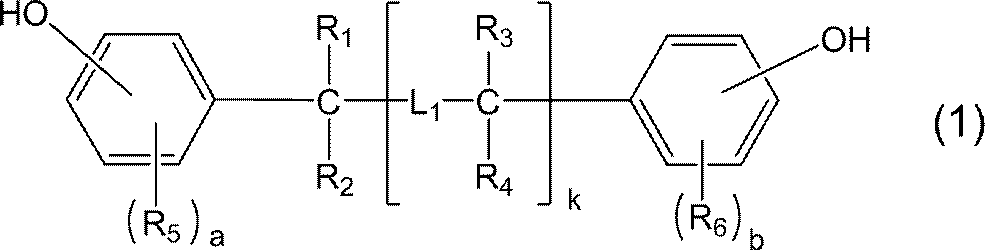
一般式(1)中、
R1~R4は各々独立にアルキル基、アリール基、ヒドロキシル基、アシル基、アルコキシ基、又はアルキルオキシカルボニル基を表す。
R1とR2とが結合して脂環を形成してもよい。
R3とR4とが結合して脂環を形成してもよい。
R5及びR6は各々独立に第三級アルキル基又はアリール基を表す。
a及びbは各々独立に0~4の整数を表す。
L1は単結合又は2価の連結基を表す。
kは0又は1を表す。
[8]
上記セルロースアシレートの100質量部に対して上記化合物Aを1~30質量部含有する[1]~[7]のいずれか1項に記載の長尺フィルム。
[9]
[1]~[8]のいずれか1項に記載の長尺フィルムと偏光子とを含む長尺偏光板。
[10]
液晶セル、及び、[1]~[8]のいずれか1項に記載の長尺フィルムから得られたフィルム又は[9]に記載の長尺偏光板から得られた偏光板を有する液晶表示装置。
[11]
セルロースアシレートと、下記条件1、条件2、条件3及び条件4を全て満たす分子量1000未満の化合物Aとを溶媒に溶解した溶液を用いて、溶液製膜法により製膜する、長尺フィルムの製造方法。
条件1:ヒドロキシル基と直結した芳香環を分子内に2つ以上含む。
条件2:ヒドロキシル基と直結した芳香環と直結し、かつ芳香環を構成しない炭素原子を分子内に1つ以上有し、この炭素原子が1~3つの芳香環と直結している。
条件3:ヒドロキシル基と直結した芳香環に直結し、かつ芳香環を構成しない全ての炭素原子は、水素原子との結合を持たない。
条件4:ヒドロキシル基と直結した芳香環に直結し、かつ芳香環を構成しない全ての炭素原子は、全て水素原子以外の原子と単結合で結合されている。
R1~R4は各々独立にアルキル基、アリール基、ヒドロキシル基、アシル基、アルコキシ基、又はアルキルオキシカルボニル基を表す。
R1とR2とが結合して脂環を形成してもよい。
R3とR4とが結合して脂環を形成してもよい。
R5及びR6は各々独立に第三級アルキル基又はアリール基を表す。
a及びbは各々独立に0~4の整数を表す。
L1は単結合又は2価の連結基を表す。
kは0又は1を表す。
[8]
上記セルロースアシレートの100質量部に対して上記化合物Aを1~30質量部含有する[1]~[7]のいずれか1項に記載の長尺フィルム。
[9]
[1]~[8]のいずれか1項に記載の長尺フィルムと偏光子とを含む長尺偏光板。
[10]
液晶セル、及び、[1]~[8]のいずれか1項に記載の長尺フィルムから得られたフィルム又は[9]に記載の長尺偏光板から得られた偏光板を有する液晶表示装置。
[11]
セルロースアシレートと、下記条件1、条件2、条件3及び条件4を全て満たす分子量1000未満の化合物Aとを溶媒に溶解した溶液を用いて、溶液製膜法により製膜する、長尺フィルムの製造方法。
条件1:ヒドロキシル基と直結した芳香環を分子内に2つ以上含む。
条件2:ヒドロキシル基と直結した芳香環と直結し、かつ芳香環を構成しない炭素原子を分子内に1つ以上有し、この炭素原子が1~3つの芳香環と直結している。
条件3:ヒドロキシル基と直結した芳香環に直結し、かつ芳香環を構成しない全ての炭素原子は、水素原子との結合を持たない。
条件4:ヒドロキシル基と直結した芳香環に直結し、かつ芳香環を構成しない全ての炭素原子は、全て水素原子以外の原子と単結合で結合されている。
本発明によれば、端部カール及び異物が抑制され、偏光板保管性及びリワーク性に優れる長尺フィルム、上記長尺フィルムを含む長尺偏光板、上記長尺フィルム又は長尺偏光板から得られたフィルム又は偏光板を含む液晶表示装置、及び長尺フィルムの製造方法を提供することができる。
以下において、本発明について詳細に説明する。以下に記載する構成要件の説明は、本発明の代表的な実施態様に基づいてなされることがあるが、本発明はそのような実施態様に限定されるものではない。
本明細書において、数値範囲を「(数値1)~(数値2)」という記載で表す場合、この記載は「(数値1)以上(数値2)以下」の意味を表す。
本明細書において、数値範囲を「(数値1)~(数値2)」という記載で表す場合、この記載は「(数値1)以上(数値2)以下」の意味を表す。
[長尺フィルム]
本発明の長尺フィルムは、
セルロースアシレートと、下記条件1、条件2、条件3及び条件4を全て満たす分子量1000未満の化合物Aとを含有する長尺フィルムである。
条件1:ヒドロキシル基と直結した芳香環を分子内に2つ以上含む。
条件2:ヒドロキシル基と直結した芳香環と直結し、かつ芳香環を構成しない炭素原子を分子内に1つ以上有し、この炭素原子が1~3つの芳香環と直結している。
条件3:ヒドロキシル基と直結した芳香環に直結し、かつ芳香環を構成しない全ての炭素原子は、水素原子との結合を持たない。
条件4:ヒドロキシル基と直結した芳香環に直結し、かつ芳香環を構成しない全ての炭素原子は、全て水素原子以外の原子と単結合で結合されている。
本発明の長尺フィルムは、
セルロースアシレートと、下記条件1、条件2、条件3及び条件4を全て満たす分子量1000未満の化合物Aとを含有する長尺フィルムである。
条件1:ヒドロキシル基と直結した芳香環を分子内に2つ以上含む。
条件2:ヒドロキシル基と直結した芳香環と直結し、かつ芳香環を構成しない炭素原子を分子内に1つ以上有し、この炭素原子が1~3つの芳香環と直結している。
条件3:ヒドロキシル基と直結した芳香環に直結し、かつ芳香環を構成しない全ての炭素原子は、水素原子との結合を持たない。
条件4:ヒドロキシル基と直結した芳香環に直結し、かつ芳香環を構成しない全ての炭素原子は、全て水素原子以外の原子と単結合で結合されている。
<セルロースアシレート>
本発明の長尺フィルムはセルロースアシレートを含有する。
セルロースアシレートは、セルロースとカルボン酸のエステルであり、カルボン酸としては、炭素原子数が2~22の脂肪酸が好ましく、炭素原子数が2~4の低級脂肪酸であるセルロースアシレートが更に好ましく、炭素原子数が2のセルロースアセテートが最も好ましい。
本発明の長尺フィルムはセルロースアシレートを含有する。
セルロースアシレートは、セルロースとカルボン酸のエステルであり、カルボン酸としては、炭素原子数が2~22の脂肪酸が好ましく、炭素原子数が2~4の低級脂肪酸であるセルロースアシレートが更に好ましく、炭素原子数が2のセルロースアセテートが最も好ましい。
セルロースアシレート原料のセルロースとしては、綿花リンタや木材パルプ(広葉樹パルプ、針葉樹パルプ)などがあり、いずれの原料セルロースから得られるセルロースアシレートでも使用でき、場合により混合して使用してもよい。これらの原料セルロースについての詳細な記載は、例えば「プラスチック材料講座(17)繊維素系樹脂」(丸澤、宇田著、日刊工業新聞社、1970年発行)や発明協会公開技報2001-1745(7頁~8頁)に記載のセルロースを用いることができ、本発明のセルロースアシレートフィルムに対しては特に限定されるものではない。
セルロースアシレートは、セルロースの水酸基にアシル基が置換したものであり、アシル基の炭素数は2~22が好ましい。炭素数2~22のアシル基としては、脂肪族基でもアリール基でもよく特に限定されず、単一でも2種類以上の混合物でもよい。それらは、例えばセルロースのアルキルカルボニルエステル、アルケニルカルボニルエステル、芳香族カルボニルエステル、又は芳香族アルキルカルボニルエステルなどであり、それぞれさらに置換された基を有していてもよい。これらの好ましいアシル基としては、アセチル基、プロピオニル基、ブタノイル基、へプタノイル基、ヘキサノイル基、オクタノイル基、デカノイル基、ドデカノイル基、トリデカノイル基、テトラデカノイル基、ヘキサデカノイル基、オクタデカノイル基、i-ブタノイル基、t-ブタノイル基、シクロヘキサンカルボニル基、オレオイル基、ベンゾイル基、ナフチルカルボニル基、シンナモイル基などを挙げることができる。これらの中でも、アセチル基、プロピオニル基、ブタノイル基、ドデカノイル基、オクタデカノイル基、t-ブタノイル基、オレオイル基、ベンゾイル基、ナフチルカルボニル基、シンナモイル基などが好ましく、アセチル基、プロピオニル基、ブタノイル基がより好ましい。更に好ましい基はアセチル基、プロピオニルで基あり、最も好ましい基はアセチル基である。
セルロースアシレートの重合度は、粘度平均重合度で180~700であることが好ましく、セルロースアセテートにおいては、180~550がより好ましく、180~400が更に好ましく、180~350が特に好ましい。粘度平均重合度は、宇田らの極限粘度法{宇田和夫、斉藤秀夫、「繊維学会誌」、第18巻第1号、105~120頁(1962年)}により測定できる。この方法は特開平9-95538号公報にも詳細に記載されている。
セルロースアシレートの分子量分布は、ゲル浸透クロマトグラフィー(東ソー社製GPC-8020(商品名))を用い、N-メチルピロリドンを溶剤として評価され、その多分散性指数Mw/Mn(Mwは重量平均分子量を表し、Mnは数平均分子量を表す)が小さく、分子量分布が狭いことが好ましい。具体的なMw/Mnの値としては、1.0~4.0であることが好ましく、2.0~4.0であることがさらに好ましく、2.3~3.4であることが最も好ましい。
セルロースアシレートの分子量分布は、ゲル浸透クロマトグラフィー(東ソー社製GPC-8020(商品名))を用い、N-メチルピロリドンを溶剤として評価され、その多分散性指数Mw/Mn(Mwは重量平均分子量を表し、Mnは数平均分子量を表す)が小さく、分子量分布が狭いことが好ましい。具体的なMw/Mnの値としては、1.0~4.0であることが好ましく、2.0~4.0であることがさらに好ましく、2.3~3.4であることが最も好ましい。
(セルロースアシレートのアシル置換度)
セルロースアシレートはセルロースの水酸基がアシル化されたものであり、セルロースの水酸基へのアシル基の置換度の測定については、セルロースの水酸基に置換する酢酸及び/又は炭素数3~22の脂肪酸の結合度を測定し、計算によって置換度を得ることができる。測定方法としては、ASTM D-817-91に準じて実施することができる。
セルロースアシレートの平均アシル置換度は1.8~3.0であることが好ましく、2.0~2.9であることがより好ましく、2.3~2.9であることが更に好ましい。
セルロースアシレートはセルロースの水酸基がアシル化されたものであり、セルロースの水酸基へのアシル基の置換度の測定については、セルロースの水酸基に置換する酢酸及び/又は炭素数3~22の脂肪酸の結合度を測定し、計算によって置換度を得ることができる。測定方法としては、ASTM D-817-91に準じて実施することができる。
セルロースアシレートの平均アシル置換度は1.8~3.0であることが好ましく、2.0~2.9であることがより好ましく、2.3~2.9であることが更に好ましい。
本発明の長尺フィルム中におけるセルロースアシレートの含有量は、長尺フィルム100質量部に対して、50質量部以上100質量部未満であることが好ましく、65質量部以上100質量部未満であることがより好ましく、80質量部以上100質量部未満であることがさらに好ましい。
<化合物A>
本発明の長尺フィルムは、下記条件1、条件2、条件3及び条件4を全て満たす分子量1000未満の化合物Aを含有する。
条件1:ヒドロキシル基と直結した芳香環を分子内に2つ以上含む。
条件2:ヒドロキシル基と直結した芳香環と直結し、かつ芳香環を構成しない炭素原子を分子内に1つ以上有し、この炭素原子が1~3つの芳香環と直結している。
条件3:ヒドロキシル基と直結した芳香環に直結し、かつ芳香環を構成しない全ての炭素原子は、水素原子との結合を持たない。
条件4:ヒドロキシル基と直結した芳香環に直結し、かつ芳香環を構成しない全ての炭素原子は、全て水素原子以外の原子と単結合で結合されている。
本発明の長尺フィルムは、下記条件1、条件2、条件3及び条件4を全て満たす分子量1000未満の化合物Aを含有する。
条件1:ヒドロキシル基と直結した芳香環を分子内に2つ以上含む。
条件2:ヒドロキシル基と直結した芳香環と直結し、かつ芳香環を構成しない炭素原子を分子内に1つ以上有し、この炭素原子が1~3つの芳香環と直結している。
条件3:ヒドロキシル基と直結した芳香環に直結し、かつ芳香環を構成しない全ての炭素原子は、水素原子との結合を持たない。
条件4:ヒドロキシル基と直結した芳香環に直結し、かつ芳香環を構成しない全ての炭素原子は、全て水素原子以外の原子と単結合で結合されている。
化合物Aの条件1は、ヒドロキシル基と直結した芳香環を分子内に2つ以上含むというものである。本発明においては、芳香環の数は、芳香性を有する環の数として考える。例えば、縮環式化合物であるナフタレンに含まれる芳香環の数は2つと数え、フルオレンに含まれる芳香環の数は2つと数える。また、1つの芳香環に複数のヒドロキシル基が直結している場合であっても、「ヒドロキシル基と直結した芳香環」の数は1つとする。
本発明者らは、芳香環に直結したヒドロキシル基は酸性度が高いため、条件1を満たすことで、化合物Aのヒドロキシル基が、セルロースアシレートのカルボニル基と相互作用して強固な水素結合を形成し、カールが発生しにくいフィルムとすることができると考えている。
本発明者らは、芳香環に直結したヒドロキシル基は酸性度が高いため、条件1を満たすことで、化合物Aのヒドロキシル基が、セルロースアシレートのカルボニル基と相互作用して強固な水素結合を形成し、カールが発生しにくいフィルムとすることができると考えている。
化合物Aの条件2は、ヒドロキシル基と直結した芳香環と直結し、かつ芳香環を構成しない炭素原子を分子内に1つ以上有し、この炭素原子が1~3つの芳香環と直結しているというものである。芳香環を構成しない炭素原子とは、芳香環の環員原子となっていない炭素原子のことである。条件2を満たすことで、化合物としての柔軟性に優れ、セルロースアシレートと相互作用しやすくなる。
条件2を満たさない場合、例えば、芳香環同士が直結している構造の化合物は、化合物としての柔軟性が低いため、フィルムの脆性が悪化し、フィルムの端部カール、及びリワーク性に劣ると考えられる。
端部カール及びリワーク性の観点から、化合物Aにおいて、上記条件2の炭素原子が1~3つの芳香環と直結していることで、セルロースアシレートのカルボニル基と化合物Aのヒドロキシル基が適度に相互作用して、脆性を悪化させずにカールが発生しにくいフィルムとすることができると考えられる。条件2の炭素原子に直結する芳香環の数が4つであると、化合物としての柔軟性が低下し、セルロースアシレートと相互作用しにくくなり、性能が目減りすると考えられる。
化合物Aは、上記条件2の炭素原子が、2つの芳香環と直結していることが好ましい。
条件2を満たさない場合、例えば、芳香環同士が直結している構造の化合物は、化合物としての柔軟性が低いため、フィルムの脆性が悪化し、フィルムの端部カール、及びリワーク性に劣ると考えられる。
端部カール及びリワーク性の観点から、化合物Aにおいて、上記条件2の炭素原子が1~3つの芳香環と直結していることで、セルロースアシレートのカルボニル基と化合物Aのヒドロキシル基が適度に相互作用して、脆性を悪化させずにカールが発生しにくいフィルムとすることができると考えられる。条件2の炭素原子に直結する芳香環の数が4つであると、化合物としての柔軟性が低下し、セルロースアシレートと相互作用しにくくなり、性能が目減りすると考えられる。
化合物Aは、上記条件2の炭素原子が、2つの芳香環と直結していることが好ましい。
リワーク性の観点から、化合物Aにおいて、上記条件2の炭素原子が4級炭素原子であることが好ましい。
化合物Aが、ヒドロキシル基と直結した芳香環を分子内に2~4つ有することが好ましい。化合物Aが有する、ヒドロキシル基と直結した芳香環の数が4つ以下であると、フィルムの含水率が高くならず、吸脱湿によるフィルムの寸法変化が抑制されるため好ましい。
端部カール、リワーク性の観点から、化合物Aが、少なくとも2つの、ヒドロキシル基と直結した芳香環とヒドロキシル基と直結した芳香環との間に、上記条件2の炭素原子を有することが好ましく、少なくとも2つの、ヒドロキシル基と直結した芳香環とヒドロキシル基と直結した芳香環とが1つの上記条件2の炭素原子を介して結合している構造を有することがより好ましい。
化合物Aは、単環又は多環の芳香族炭化水素環を含んでいてもよいし、単環又は多環の芳香族ヘテロ環を含んでいてもよい。
芳香族炭化水素環としては、炭素数6~14の芳香族炭化水素環であることが好ましく、炭素数6の芳香族炭化水素環であることがより好ましい。芳香族炭化水素環としては、具体的にはベンゼン環、ナフタレン環が挙げられ、ベンゼン環が特に好ましい。
芳香族ヘテロ環としては、硫黄原子、窒素原子、又は酸素原子を含む芳香族ヘテロ環が挙げられ、炭素数5~14の芳香族ヘテロ環であることが好ましく、炭素数5~6の芳香族ヘテロ環であることがより好ましい。芳香族ヘテロ環としては、具体的にはチオフェン環、フラン環、ピロール環、又はピリジン環が挙げられ、チオフェン環、又はフラン環が好ましい。
化合物Aは、セルロースアシレートとの相溶性の観点から芳香族炭化水素環を含むことが好ましい。
化合物Aは、溶液溶解性の観点から単環の芳香族炭化水素環又は単環の芳香族ヘテロ環を含むことが好ましい。
化合物Aは、ベンゼン環を含むことが最も好ましい。
芳香族炭化水素環としては、炭素数6~14の芳香族炭化水素環であることが好ましく、炭素数6の芳香族炭化水素環であることがより好ましい。芳香族炭化水素環としては、具体的にはベンゼン環、ナフタレン環が挙げられ、ベンゼン環が特に好ましい。
芳香族ヘテロ環としては、硫黄原子、窒素原子、又は酸素原子を含む芳香族ヘテロ環が挙げられ、炭素数5~14の芳香族ヘテロ環であることが好ましく、炭素数5~6の芳香族ヘテロ環であることがより好ましい。芳香族ヘテロ環としては、具体的にはチオフェン環、フラン環、ピロール環、又はピリジン環が挙げられ、チオフェン環、又はフラン環が好ましい。
化合物Aは、セルロースアシレートとの相溶性の観点から芳香族炭化水素環を含むことが好ましい。
化合物Aは、溶液溶解性の観点から単環の芳香族炭化水素環又は単環の芳香族ヘテロ環を含むことが好ましい。
化合物Aは、ベンゼン環を含むことが最も好ましい。
リワーク性の観点から、化合物Aのヒドロキシル基と直結した芳香環が、ヒドロキシル基と直結したベンゼン環であることが好ましい。
化合物Aの条件3及び4は、ヒドロキシル基と直結した芳香環に直結する芳香環を構成しない全ての炭素原子は、水素原子と結合せず、かつ水素原子以外の原子と単結合で結合するというものである。
条件3を満たさない場合、すなわち、ヒドロキシル基と直結した芳香環に直結する炭素原子に水素原子が直結している場合、この水素原子は共鳴による安定化を受けるため、アニオン、カチオン、又はラジカルを発生させやすく、望まない副反応を引き起こすことで、偏光板保管性を悪化させると考えられる。
条件4を満たさない場合、すなわち、二重結合などの多重結合を有する場合、化合物の平面性が向上し、化合物の柔軟性が低下するため、フィルムの脆性が悪化し、リワーク性が低下する。
化合物Aは、ヒドロキシル基と直結した芳香環に直結する芳香環を構成しない全ての炭素原子について条件3及び4を満たすものであるが、全ての芳香環に直結する芳香環を構成しない全ての炭素原子について条件3及び4を満たすことが好ましい。
条件3を満たさない場合、すなわち、ヒドロキシル基と直結した芳香環に直結する炭素原子に水素原子が直結している場合、この水素原子は共鳴による安定化を受けるため、アニオン、カチオン、又はラジカルを発生させやすく、望まない副反応を引き起こすことで、偏光板保管性を悪化させると考えられる。
条件4を満たさない場合、すなわち、二重結合などの多重結合を有する場合、化合物の平面性が向上し、化合物の柔軟性が低下するため、フィルムの脆性が悪化し、リワーク性が低下する。
化合物Aは、ヒドロキシル基と直結した芳香環に直結する芳香環を構成しない全ての炭素原子について条件3及び4を満たすものであるが、全ての芳香環に直結する芳香環を構成しない全ての炭素原子について条件3及び4を満たすことが好ましい。
化合物Aは、下記一般式(1)~(3)のいずれかで表される化合物であることが好ましく、下記一般式(1)で表される化合物であることがより好ましい。
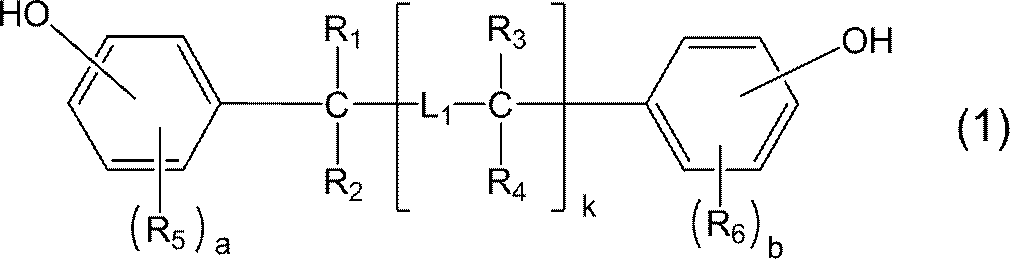
一般式(1)中、
R1~R4は各々独立にアルキル基、アリール基、ヒドロキシル基、アシル基、アルコキシ基、又はアルキルオキシカルボニル基を表す。
R1とR2とが結合して脂環を形成してもよい。
R3とR4とが結合して脂環を形成してもよい。
R5及びR6は各々独立に第三級アルキル基又はアリール基を表す。
a及びbは各々独立に0~4の整数を表す。
L1は単結合又は2価の連結基を表す。
kは0又は1を表す。
R1~R4は各々独立にアルキル基、アリール基、ヒドロキシル基、アシル基、アルコキシ基、又はアルキルオキシカルボニル基を表す。
R1とR2とが結合して脂環を形成してもよい。
R3とR4とが結合して脂環を形成してもよい。
R5及びR6は各々独立に第三級アルキル基又はアリール基を表す。
a及びbは各々独立に0~4の整数を表す。
L1は単結合又は2価の連結基を表す。
kは0又は1を表す。

一般式(2)中、
R1、R7及びR8は各々独立にアルキル基、アリール基、ヒドロキシル基、アシル基、アルコキシ基、又はアルキルオキシカルボニル基を表す。
R7とR8とが結合して脂環を形成してもよい。
R5、R6及びR9は各々独立に第三級アルキル基又はアリール基を表す。
a、b及びcは各々独立に0~4の整数を表す。
L1は単結合又は2価の連結基を表す。
R1、R7及びR8は各々独立にアルキル基、アリール基、ヒドロキシル基、アシル基、アルコキシ基、又はアルキルオキシカルボニル基を表す。
R7とR8とが結合して脂環を形成してもよい。
R5、R6及びR9は各々独立に第三級アルキル基又はアリール基を表す。
a、b及びcは各々独立に0~4の整数を表す。
L1は単結合又は2価の連結基を表す。
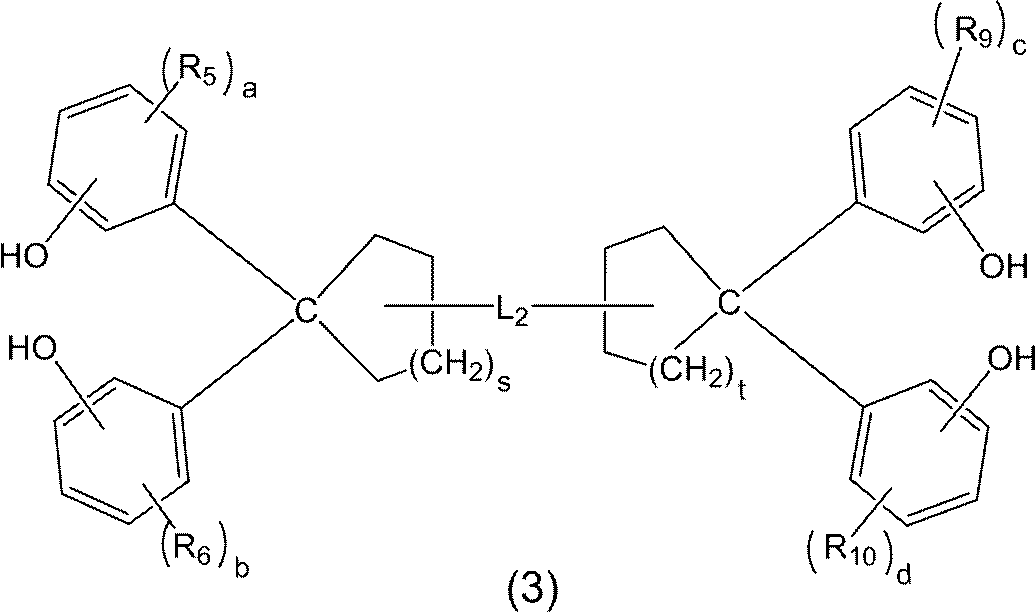
一般式(3)中、
R5、R6、R9及びR10は各々独立に第三級アルキル基又はアリール基を表す。
a、b、c及びdは各々独立に0~4の整数を表す。
L2は単結合又は2価の非芳香族連結基を表す。
s及びtは各々独立に1以上の整数を表す。
R5、R6、R9及びR10は各々独立に第三級アルキル基又はアリール基を表す。
a、b、c及びdは各々独立に0~4の整数を表す。
L2は単結合又は2価の非芳香族連結基を表す。
s及びtは各々独立に1以上の整数を表す。
上記一般式(1)について説明する。
一般式(1)中、R1~R4は各々独立にアルキル基、アリール基、ヒドロキシル基、アシル基、アルコキシ基、又はアルキルオキシカルボニル基を表す。
R1~R4がアルキル基を表す場合、炭素数1~5のアルキル基を表すことが好ましく、炭素数1~3のアルキル基を表すことがより好ましく、メチル基を表すことが更に好ましい。
R1~R4がアリール基を表す場合、フェニル基又はナフチル基を表すことが好ましく、フェニル基を表すことがより好ましい。
R1~R4がアシル基を表す場合、炭素数2~5のアシル基を表すことが好ましく、アセチル基を表すことがより好ましい。
R1~R4がアルコキシ基を表す場合、炭素数1~5のアルコキシ基を表すことが好ましく、炭素数1~3のアルコキシ基を表すことがより好ましい。
R1~R4がアルキルオキシカルボニル基を表す場合、炭素数2~5のアルキルオキシカルボニル基を表すことが好ましく、メチルオキシカルボニル基を表すことがより好ましい。
R1~R4は各々独立にアルキル基を表すことが特に好ましい。
一般式(1)中、R1~R4は各々独立にアルキル基、アリール基、ヒドロキシル基、アシル基、アルコキシ基、又はアルキルオキシカルボニル基を表す。
R1~R4がアルキル基を表す場合、炭素数1~5のアルキル基を表すことが好ましく、炭素数1~3のアルキル基を表すことがより好ましく、メチル基を表すことが更に好ましい。
R1~R4がアリール基を表す場合、フェニル基又はナフチル基を表すことが好ましく、フェニル基を表すことがより好ましい。
R1~R4がアシル基を表す場合、炭素数2~5のアシル基を表すことが好ましく、アセチル基を表すことがより好ましい。
R1~R4がアルコキシ基を表す場合、炭素数1~5のアルコキシ基を表すことが好ましく、炭素数1~3のアルコキシ基を表すことがより好ましい。
R1~R4がアルキルオキシカルボニル基を表す場合、炭素数2~5のアルキルオキシカルボニル基を表すことが好ましく、メチルオキシカルボニル基を表すことがより好ましい。
R1~R4は各々独立にアルキル基を表すことが特に好ましい。
R1とR2とが結合して脂環を形成してもよく、R3とR4とが結合して脂環を形成してもよい。脂環としては、炭素数5~7のシクロアルカン環であることが好ましく、炭素数5又は6のシクロアルカン環であることがより好ましい。
化合物Aは、R1とR2とが結合して脂環する態様、又はR3とR4とが結合して脂環を形成する態様も好ましい。
化合物Aは、R1とR2とが結合して脂環する態様、又はR3とR4とが結合して脂環を形成する態様も好ましい。
R5及びR6は各々独立に第三級アルキル基又はアリール基を表す。
R5及びR6が第三級アルキル基を表す場合、炭素数4~7の第三級アルキル基であることが好ましく、t-ブチル基であることが特に好ましい。
R5及びR6がアリール基を表す場合、炭素数6~12のアリール基であることが好ましく、フェニル基であることが特に好ましい。
R5及びR6は各々独立に第三級アルキル基を表すことが好ましい。
R5及びR6が第三級アルキル基を表す場合、炭素数4~7の第三級アルキル基であることが好ましく、t-ブチル基であることが特に好ましい。
R5及びR6がアリール基を表す場合、炭素数6~12のアリール基であることが好ましく、フェニル基であることが特に好ましい。
R5及びR6は各々独立に第三級アルキル基を表すことが好ましい。
a及びbは各々独立に0~4の整数を表し、0又は1を表すことが好ましい。
L1は単結合又は2価の連結基を表す。
L1が2価の連結基を表す場合、アルキレン基(好ましくは炭素数1~5)、アリーレン基(好ましくは炭素数6~12)、カルボニル基、炭酸エステル基、アミド基、ウレタン基、又はエーテル基が好ましく、アルキレン基、又はアリーレン基であることがより好ましい。
L1が2価の連結基を表す場合、アルキレン基(好ましくは炭素数1~5)、アリーレン基(好ましくは炭素数6~12)、カルボニル基、炭酸エステル基、アミド基、ウレタン基、又はエーテル基が好ましく、アルキレン基、又はアリーレン基であることがより好ましい。
kは0又は1を表し、0を表すことが好ましい。
上記一般式(2)について説明する。
一般式(2)中、R1、R5、R6、a、b及びL1は各々一般式(1)中のR1、R5、R6、a、b及びL1と同義であり、好ましい範囲も同様である。
一般式(2)中、R7及びR8はR1と同義であり、好ましい範囲も同様である。
一般式(2)中、R9はR5及びR6と同義であり、好ましい範囲も同様である。
一般式(2)中、cはa及びbと同義であり、好ましい範囲も同様である。
一般式(2)中、R1、R5、R6、a、b及びL1は各々一般式(1)中のR1、R5、R6、a、b及びL1と同義であり、好ましい範囲も同様である。
一般式(2)中、R7及びR8はR1と同義であり、好ましい範囲も同様である。
一般式(2)中、R9はR5及びR6と同義であり、好ましい範囲も同様である。
一般式(2)中、cはa及びbと同義であり、好ましい範囲も同様である。
上記一般式(3)について説明する。
一般式(3)中、R5、R6、R9、a、b及びcは各々一般式(2)中のR5、R6、R9、a、b及びcと同義であり、好ましい範囲も同様である。
一般式(3)中、R10はR5、R6及びR9と同義であり、好ましい範囲も同様である。
一般式(3)中、dはa、b及びcと同義であり、好ましい範囲も同様である。
一般式(3)中、L2は単結合又は2価の非芳香族連結基を表す。L2が2価の非芳香族連結基を表す場合、アルキレン基(好ましくは炭素数1~5)が好ましい。
一般式(3)中、s及びtは各々独立に1以上の整数を表し、1~3の整数を表すことが好ましく、1又は2を表すことがより好ましい。
一般式(3)中、R5、R6、R9、a、b及びcは各々一般式(2)中のR5、R6、R9、a、b及びcと同義であり、好ましい範囲も同様である。
一般式(3)中、R10はR5、R6及びR9と同義であり、好ましい範囲も同様である。
一般式(3)中、dはa、b及びcと同義であり、好ましい範囲も同様である。
一般式(3)中、L2は単結合又は2価の非芳香族連結基を表す。L2が2価の非芳香族連結基を表す場合、アルキレン基(好ましくは炭素数1~5)が好ましい。
一般式(3)中、s及びtは各々独立に1以上の整数を表し、1~3の整数を表すことが好ましく、1又は2を表すことがより好ましい。
化合物Aの分子量は端部カール及びリワーク性の観点から、1000未満であり、更にセルロースアシレートとの相溶性の観点から、800以下であることが好ましく、700以下であることがより好ましい。分子量が小さい化合物のほうが、分子サイズが小さくなり、セルロースアシレートと相互作用しやすくなると考えられる。また、加熱した際に揮散しにくく、工程内を汚染しにくいという観点から、化合物Aの分子量は200以上であることが好ましく、300以上であることがより好ましい。
化合物Aの具体例を以下に示すが、これらに限定されない。
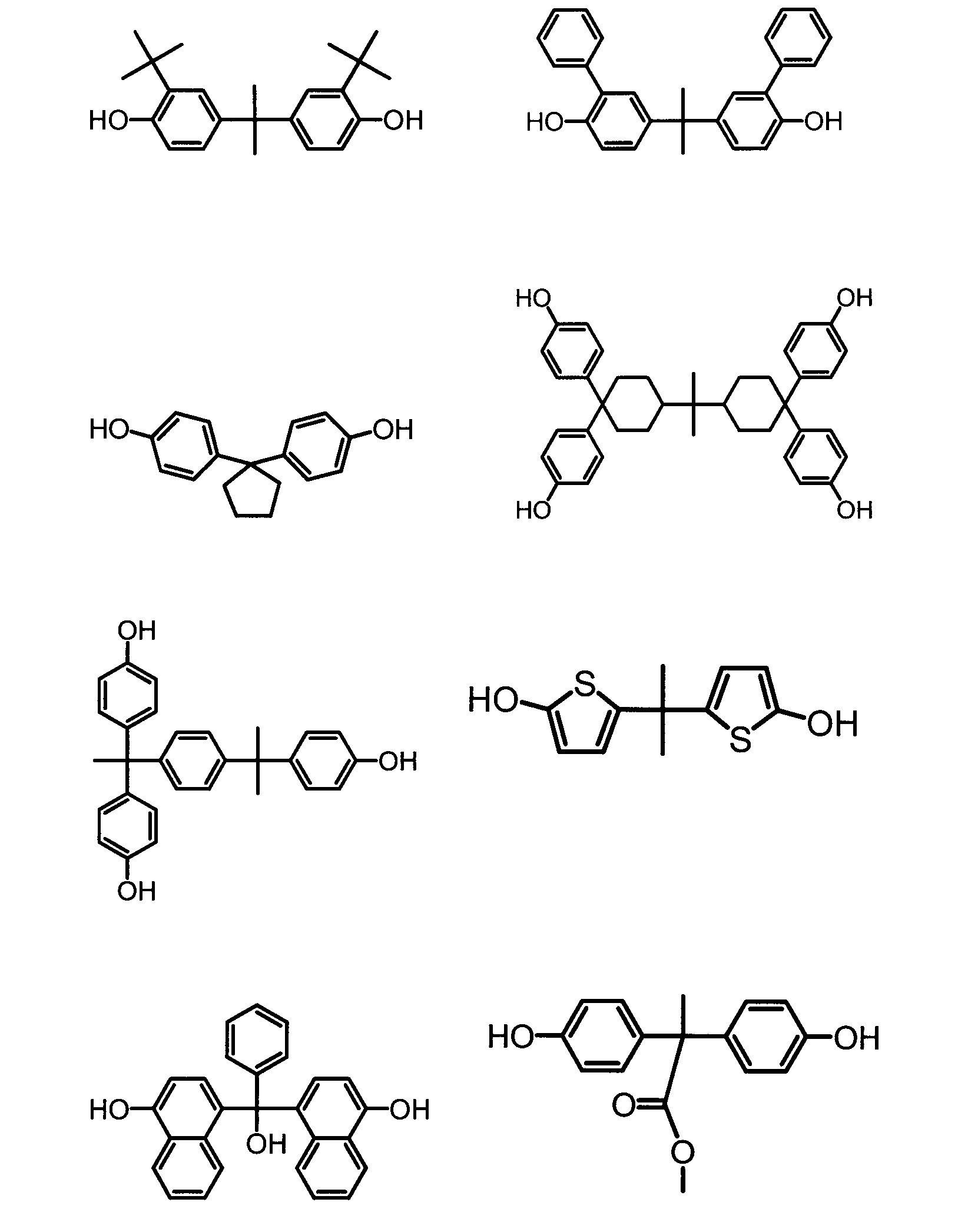
本発明の長尺フィルム中の化合物Aの含有量は、セルロースアシレート100質量部に対して1~30質量部であることが好ましく、1~20質量部であることがより好ましく、4~15質量部であることが更に好ましく、7~12質量部であることが特に好ましい。
本発明の長尺フィルムの幅は1000mm~2500mmで、長さは1000m~10000mであることが輸送のしやすさ、偏光板加工時の加工のしやすさの観点で好ましい。
(レターデーション)
本発明において、Re(λ)、及びRth(λ)は各々、波長λ(nm)における面内のレターデーション、及び厚さ方向のレターデーションを表す。特に記載がないときは、波長λは、550nmとする。
本発明において、Re(λ)、Rth(λ)はAxoScan OPMF-1(オプトサイエンス社製)において、波長λで測定した値である。AxoScanにて平均屈折率((Nx+Ny+Nz)/3)と膜厚(d(μm))を入力することにより、
遅相軸方向(°)
Re(λ)=(Nx-Ny)×d
Rth(λ)=((Nx+Ny)/2ーNz)×d
が算出される。Nxはフィルムの遅相軸方向の屈折率であり、Nyはフィルムの進相軸方向の屈折率であり、Nzはフィルムの厚み方向の屈折率である。
本発明において、Re(λ)、及びRth(λ)は各々、波長λ(nm)における面内のレターデーション、及び厚さ方向のレターデーションを表す。特に記載がないときは、波長λは、550nmとする。
本発明において、Re(λ)、Rth(λ)はAxoScan OPMF-1(オプトサイエンス社製)において、波長λで測定した値である。AxoScanにて平均屈折率((Nx+Ny+Nz)/3)と膜厚(d(μm))を入力することにより、
遅相軸方向(°)
Re(λ)=(Nx-Ny)×d
Rth(λ)=((Nx+Ny)/2ーNz)×d
が算出される。Nxはフィルムの遅相軸方向の屈折率であり、Nyはフィルムの進相軸方向の屈折率であり、Nzはフィルムの厚み方向の屈折率である。
本発明のフィルムは、様々な表示方式の液晶表示装置に用いることができるが、特に、VA(Vertical Alignment)方式又はIPS(In Plane Switching)方式の液晶表示装置に用いることが好ましい。
VA方式の液晶表示装置に用いる場合には、温度を25℃、相対湿度を60%、測定波長を550nmとして測定したRe(550)が20nm以上80nm以下であり、Rth(550)が80nm以上300nm以下であることが好ましい。
IPS方式の液晶表示装置に用いる場合には、温度を25℃、相対湿度を60%、測定波長を550nmとして測定したRe(550)が-20nm以上20nm以下であり、Rth(550)が-20nm以上20nm以下であることが好ましい。
上述の通り、本発明のフィルムは、光学特性を制御することにより、位相差フィルムとしても用いることができ、VA方式の液晶表示装置用の位相差フィルム、又はIPS方式の液晶表示装置用の位相差フィルムとして用いることが好ましい。
特に、本発明のフィルムに含まれる化合物Aの分子量100あたりの芳香環の数が0.75以上である場合は、VA方式の液晶表示装置用の位相差フィルムとして好ましい。
また、本発明のフィルムに含まれる化合物Aの分子量100あたりの芳香環の数が0.75未満である場合は、IPS方式の液晶表示装置用の位相差フィルムとして好ましい。
VA方式の液晶表示装置に用いる場合には、温度を25℃、相対湿度を60%、測定波長を550nmとして測定したRe(550)が20nm以上80nm以下であり、Rth(550)が80nm以上300nm以下であることが好ましい。
IPS方式の液晶表示装置に用いる場合には、温度を25℃、相対湿度を60%、測定波長を550nmとして測定したRe(550)が-20nm以上20nm以下であり、Rth(550)が-20nm以上20nm以下であることが好ましい。
上述の通り、本発明のフィルムは、光学特性を制御することにより、位相差フィルムとしても用いることができ、VA方式の液晶表示装置用の位相差フィルム、又はIPS方式の液晶表示装置用の位相差フィルムとして用いることが好ましい。
特に、本発明のフィルムに含まれる化合物Aの分子量100あたりの芳香環の数が0.75以上である場合は、VA方式の液晶表示装置用の位相差フィルムとして好ましい。
また、本発明のフィルムに含まれる化合物Aの分子量100あたりの芳香環の数が0.75未満である場合は、IPS方式の液晶表示装置用の位相差フィルムとして好ましい。
本発明のフィルムの膜厚は20μm以上100μm以下であることが好ましく、25μm以上80μm以下であることがより好ましい。特にVA液晶表示装置に用いられる場合は25μm以上45μm以下であることが更に好ましい。また、IPS液晶表示装置に用いられる場合は25μm以上45μm以下であることが更に好ましい。
また、本発明のフィルムの層構成は特に限定されず、単層でもよいし、たとえばコア層とスキン層からなる複数の層を有していてもよい。
スキン層の厚みは0.3~5μmであることが好ましく、0.3~3μmであることがより好ましく、0.3~2μmであることが更に好ましい。
スキン層の厚みは、FE3000(大塚電子株式会社製)を用いて測定する。
コア層の厚みは、触針式膜厚計で全層の厚みを測定し、スキン層の厚みを差し引いて算出する。コア層の好ましい厚みは上記好ましい全層厚みから好ましいスキン層厚みを差し引いた値と一致する。
また、本発明のフィルムには、別途、機能性層を積層してもよく、機能性層としては、たとえば位相差層、ハードコート層、防眩層、反射防止層などが挙げられる。
また、本発明のフィルムの層構成は特に限定されず、単層でもよいし、たとえばコア層とスキン層からなる複数の層を有していてもよい。
スキン層の厚みは0.3~5μmであることが好ましく、0.3~3μmであることがより好ましく、0.3~2μmであることが更に好ましい。
スキン層の厚みは、FE3000(大塚電子株式会社製)を用いて測定する。
コア層の厚みは、触針式膜厚計で全層の厚みを測定し、スキン層の厚みを差し引いて算出する。コア層の好ましい厚みは上記好ましい全層厚みから好ましいスキン層厚みを差し引いた値と一致する。
また、本発明のフィルムには、別途、機能性層を積層してもよく、機能性層としては、たとえば位相差層、ハードコート層、防眩層、反射防止層などが挙げられる。
〔添加剤〕
本発明ではフィルムの添加剤として、公知の添加剤を用いることができ、具体的には、レターデーション制御剤、レターデーション調整剤、劣化防止剤、紫外線防止剤、剥離促進剤、可塑剤、赤外線吸収剤、マット剤等を挙げることができる。
本発明ではフィルムの添加剤として、公知の添加剤を用いることができ、具体的には、レターデーション制御剤、レターデーション調整剤、劣化防止剤、紫外線防止剤、剥離促進剤、可塑剤、赤外線吸収剤、マット剤等を挙げることができる。
[長尺フィルムの製造方法]
本発明の長尺フィルムの製造方法は、セルロースアシレートと、下記条件1、条件2、条件3及び条件4を全て満たす分子量1000未満の化合物Aとを溶媒に溶解した溶液を用いて、溶液製膜法により製膜する、長尺フィルムの製造方法である。
条件1:ヒドロキシル基と直結した芳香環を分子内に2つ以上含む。
条件2:芳香環と直結し、かつ芳香環を構成しない炭素原子を分子内に1つ以上有する。
条件3:ヒドロキシル基と直結した芳香環に直結し、かつ芳香環を構成しない全ての炭素原子は、水素原子との結合を持たない。
条件4:ヒドロキシル基と直結した芳香環に直結し、かつ芳香環を構成しない全ての炭素原子は、全て水素原子以外の原子と単結合で結合されている。
本発明の長尺フィルムの製造方法は、セルロースアシレートと、下記条件1、条件2、条件3及び条件4を全て満たす分子量1000未満の化合物Aとを溶媒に溶解した溶液を用いて、溶液製膜法により製膜する、長尺フィルムの製造方法である。
条件1:ヒドロキシル基と直結した芳香環を分子内に2つ以上含む。
条件2:芳香環と直結し、かつ芳香環を構成しない炭素原子を分子内に1つ以上有する。
条件3:ヒドロキシル基と直結した芳香環に直結し、かつ芳香環を構成しない全ての炭素原子は、水素原子との結合を持たない。
条件4:ヒドロキシル基と直結した芳香環に直結し、かつ芳香環を構成しない全ての炭素原子は、全て水素原子以外の原子と単結合で結合されている。
セルロースアシレート及び化合物Aについては前述のとおりである。
(ドープの調製)
セルロースアシレートと化合物Aとを溶媒に溶解した溶液をドープとも呼ぶ。
本発明の偏光板保護フィルムの製造方法は、ソルベントキャスト法により製造することが好ましい。ソルベントキャスト法では、コア層形成用ドープ及びスキン層形成用ドープを用いて共流延によりフィルムを製造することもできる。
有機溶剤としては、炭素原子数が3~12のエーテル、炭素原子数が3~12のケトン、炭素原子数が3~12のエステル及び炭素原子数が1~6のハロゲン化炭化水素から選ばれる溶剤を含むことが好ましい。エーテル、ケトン及びエステルは、環状構造を有していてもよい。エーテル、ケトン及びエステルの官能基(すなわち、-O-、-CO-及びCOO-)のいずれかを2つ以上有する化合物も、有機溶剤として用いることができる。有機溶剤は、アルコール性水酸基のような他の官能基を有していてもよい。2種類以上の官能基を有する有機溶剤の場合、その炭素原子数は、いずれかの官能基を有する化合物の規定範囲内であればよい。
セルロースアシレートと化合物Aとを溶媒に溶解した溶液をドープとも呼ぶ。
本発明の偏光板保護フィルムの製造方法は、ソルベントキャスト法により製造することが好ましい。ソルベントキャスト法では、コア層形成用ドープ及びスキン層形成用ドープを用いて共流延によりフィルムを製造することもできる。
有機溶剤としては、炭素原子数が3~12のエーテル、炭素原子数が3~12のケトン、炭素原子数が3~12のエステル及び炭素原子数が1~6のハロゲン化炭化水素から選ばれる溶剤を含むことが好ましい。エーテル、ケトン及びエステルは、環状構造を有していてもよい。エーテル、ケトン及びエステルの官能基(すなわち、-O-、-CO-及びCOO-)のいずれかを2つ以上有する化合物も、有機溶剤として用いることができる。有機溶剤は、アルコール性水酸基のような他の官能基を有していてもよい。2種類以上の官能基を有する有機溶剤の場合、その炭素原子数は、いずれかの官能基を有する化合物の規定範囲内であればよい。
炭素原子数が3~12のエーテル類の例には、ジイソプロピルエーテル、ジメトキシメタン、ジメトキシエタン、1,4-ジオキサン、1,3-ジオキソラン、テトラヒドロフラン、アニソール及びフェネトールが含まれる。
炭素原子数が3~12のケトン類の例には、アセトン、メチルエチルケトン、ジエチルケトン、ジイソブチルケトン、シクロヘキサノン及びメチルシクロヘキサノンが含まれる。
炭素原子数が3~12のエステル類の例には、エチルホルメート、プロピルホルメート、ペンチルホルメート、メチルアセテート、エチルアセテート及びペンチルアセテートが含まれる。
2種類以上の官能基を有する有機溶剤の例には、2-エトキシエチルアセテート、2-メトキシエタノール及び2-ブトキシエタノールが含まれる。
ハロゲン化炭化水素の炭素原子数は、1又は2であることが好ましく、1であることが最も好ましい。ハロゲン化炭化水素のハロゲンは、塩素であることが好ましい。ハロゲン化炭化水素の水素原子が、ハロゲンに置換されている割合は、25~75モル%であることが好ましく、30~70モル%であることがより好ましく、35~65モル%であることがさらに好ましく、40~60モル%であることが最も好ましい。メチレンクロリドが、代表的なハロゲン化炭化水素である。
炭素原子数が3~12のケトン類の例には、アセトン、メチルエチルケトン、ジエチルケトン、ジイソブチルケトン、シクロヘキサノン及びメチルシクロヘキサノンが含まれる。
炭素原子数が3~12のエステル類の例には、エチルホルメート、プロピルホルメート、ペンチルホルメート、メチルアセテート、エチルアセテート及びペンチルアセテートが含まれる。
2種類以上の官能基を有する有機溶剤の例には、2-エトキシエチルアセテート、2-メトキシエタノール及び2-ブトキシエタノールが含まれる。
ハロゲン化炭化水素の炭素原子数は、1又は2であることが好ましく、1であることが最も好ましい。ハロゲン化炭化水素のハロゲンは、塩素であることが好ましい。ハロゲン化炭化水素の水素原子が、ハロゲンに置換されている割合は、25~75モル%であることが好ましく、30~70モル%であることがより好ましく、35~65モル%であることがさらに好ましく、40~60モル%であることが最も好ましい。メチレンクロリドが、代表的なハロゲン化炭化水素である。
ドープの調製は、通常のソルベントキャスト法におけるドープの調製方法及び装置を用いて実施することができる。
ドープは、常温(0~40℃)でポリマーと有機溶剤とを攪拌することにより調製することができる。高濃度のドープは、加圧及び加熱条件下で攪拌してもよい。具体的には、ポリマーと有機溶剤とを加圧容器に入れて密閉し、加圧下で溶剤の常温における沸点以上、かつ溶剤が沸騰しない範囲の温度に加熱しながら攪拌する。加熱温度は、通常は40℃以上であり、好ましくは60~200℃であり、さらに好ましくは80~110℃である。
ドープは、常温(0~40℃)でポリマーと有機溶剤とを攪拌することにより調製することができる。高濃度のドープは、加圧及び加熱条件下で攪拌してもよい。具体的には、ポリマーと有機溶剤とを加圧容器に入れて密閉し、加圧下で溶剤の常温における沸点以上、かつ溶剤が沸騰しない範囲の温度に加熱しながら攪拌する。加熱温度は、通常は40℃以上であり、好ましくは60~200℃であり、さらに好ましくは80~110℃である。
各成分は予め粗混合してから容器に入れてもよい。また、順次容器に投入してもよい。容器は攪拌できるように構成されている必要がある。窒素ガス等の不活性気体を注入して容器を加圧することができる。また、加熱による溶剤の蒸気圧の上昇を利用してもよい。あるいは、容器を密閉後、各成分を圧力下で添加してもよい。
加熱する場合、容器の外部より加熱することが好ましい。例えば、ジャケットタイプの加熱装置を用いることができる。また、容器の外部にプレートヒーターを設け、配管して液体を循環させることにより容器全体を加熱することもできる。
容器内部に攪拌翼を設けて、これを用いて攪拌することが好ましい。攪拌翼は、容器の壁付近に達する長さのものが好ましい。攪拌翼の末端には、容器の壁の液膜を更新するため、掻取翼を設けることが好ましい。
容器には、圧力計、温度計等の計器類を設置してもよい。容器内で各成分を溶剤中に溶解する。調製したドープは冷却後容器から取り出すか、あるいは、取り出した後、熱交換器等を用いて冷却する。
加熱する場合、容器の外部より加熱することが好ましい。例えば、ジャケットタイプの加熱装置を用いることができる。また、容器の外部にプレートヒーターを設け、配管して液体を循環させることにより容器全体を加熱することもできる。
容器内部に攪拌翼を設けて、これを用いて攪拌することが好ましい。攪拌翼は、容器の壁付近に達する長さのものが好ましい。攪拌翼の末端には、容器の壁の液膜を更新するため、掻取翼を設けることが好ましい。
容器には、圧力計、温度計等の計器類を設置してもよい。容器内で各成分を溶剤中に溶解する。調製したドープは冷却後容器から取り出すか、あるいは、取り出した後、熱交換器等を用いて冷却する。
(共流延)
共流延法は、ドラム又はバンド上に、各層(2層あるいはそれ以上でもよい)各々の層形成用ドープを別のスリットなどから同時に押出して流延用ギーサからドープを押出して、各層同時に流延し、適当な時期に支持体から剥ぎ取って、乾燥しフィルムを成形する流延法である。また、逐次共流延してもよい。
ドラム又はバンドの表面は、鏡面状態に仕上げておくことが好ましい。ソルベントキャスト法における流延及び乾燥方法については、米国特許2336310号、同2367603号、同2492078号、同2492977号、同2492978号、同2607704号、同2739069号、同2739070号、英国特許640731号、同736892号の各明細書、特公昭45-4554号、同49-5614号、特開昭60-176834号、同60-203430号、同62-115035号の各公報に記載がある。
共流延法は、ドラム又はバンド上に、各層(2層あるいはそれ以上でもよい)各々の層形成用ドープを別のスリットなどから同時に押出して流延用ギーサからドープを押出して、各層同時に流延し、適当な時期に支持体から剥ぎ取って、乾燥しフィルムを成形する流延法である。また、逐次共流延してもよい。
ドラム又はバンドの表面は、鏡面状態に仕上げておくことが好ましい。ソルベントキャスト法における流延及び乾燥方法については、米国特許2336310号、同2367603号、同2492078号、同2492977号、同2492978号、同2607704号、同2739069号、同2739070号、英国特許640731号、同736892号の各明細書、特公昭45-4554号、同49-5614号、特開昭60-176834号、同60-203430号、同62-115035号の各公報に記載がある。
本発明の長尺フィルムの好ましい態様としては、
コア層とスキン層を有する長尺フィルムの製造方法であって、
セルロースアシレートを含有するコア層形成用ドープと、セルロースアシレートを含有するスキン層形成用ドープとを共流延する工程を有し、
上記コア層形成用ドープ及び上記スキン層形成用ドープのいずれか少なくとも一方に、化合物Aを含有する、長尺フィルムの製造方法である。
コア層とスキン層を有する長尺フィルムの製造方法であって、
セルロースアシレートを含有するコア層形成用ドープと、セルロースアシレートを含有するスキン層形成用ドープとを共流延する工程を有し、
上記コア層形成用ドープ及び上記スキン層形成用ドープのいずれか少なくとも一方に、化合物Aを含有する、長尺フィルムの製造方法である。
コア層形成用ドープの固形分濃度は12~25質量%が好ましく、15~25質量%がより好ましい。
スキン層形成用ドープの固形分濃度は12~25質量%が好ましく、12~20質量%がより好ましい。
なお、固形分とは溶剤以外の成分を示す。
スキン層形成用ドープの固形分濃度は12~25質量%が好ましく、12~20質量%がより好ましい。
なお、固形分とは溶剤以外の成分を示す。
本発明のフィルムは偏光板保護フィルムとして好ましく用いることができる。
[長尺偏光板]
本発明の長尺偏光板は、本発明の長尺フィルムと、偏光子とを含む。偏光子としては公知の偏光子を用いることができ、典型的にはヨウ素により染色されたポリビニルアルコールフィルムである。
長尺偏光板は適当な大きさに裁断して液晶表示装置等に用いることができる。
本発明の長尺偏光板は、本発明の長尺フィルムと、偏光子とを含む。偏光子としては公知の偏光子を用いることができ、典型的にはヨウ素により染色されたポリビニルアルコールフィルムである。
長尺偏光板は適当な大きさに裁断して液晶表示装置等に用いることができる。
[液晶表示装置]
本発明の液晶表示装置は、液晶セル、及び、本発明の長尺フィルムから得られたフィルム又は本発明の長尺偏光板から得られた偏光板を含む。また、液晶セル及びその両側に配置された2枚の偏光板を含む液晶表示装置であって、上記偏光板のうち少なくとも1枚が本発明の長尺偏光板から得られた偏光板であることがより好ましい。
液晶セルとしては、様々な表示モードの液晶セルを用いることができ、例えば、TN(Twisted Nematic)、IPS(In-Plane Switching)、FLC(Ferroelectric Liquid Crystal)、AFLC(Anti-ferroelectric Liquid Crystal)、OCB(Optically Compensatory Bend)、STN(Supper Twisted Nematic)、VA(Vertically Aligned)及びHAN(Hybrid Aligned Nematic)のような様々な表示方式が提案されている。
本発明の液晶表示装置は、液晶セルが、VA方式又はIPS方式の液晶セルであることが好ましく、VA方式の液晶セルであることが特に好ましい。
本発明の液晶表示装置は、液晶セル、及び、本発明の長尺フィルムから得られたフィルム又は本発明の長尺偏光板から得られた偏光板を含む。また、液晶セル及びその両側に配置された2枚の偏光板を含む液晶表示装置であって、上記偏光板のうち少なくとも1枚が本発明の長尺偏光板から得られた偏光板であることがより好ましい。
液晶セルとしては、様々な表示モードの液晶セルを用いることができ、例えば、TN(Twisted Nematic)、IPS(In-Plane Switching)、FLC(Ferroelectric Liquid Crystal)、AFLC(Anti-ferroelectric Liquid Crystal)、OCB(Optically Compensatory Bend)、STN(Supper Twisted Nematic)、VA(Vertically Aligned)及びHAN(Hybrid Aligned Nematic)のような様々な表示方式が提案されている。
本発明の液晶表示装置は、液晶セルが、VA方式又はIPS方式の液晶セルであることが好ましく、VA方式の液晶セルであることが特に好ましい。
以下に実施例を挙げて本発明をさらに具体的に説明する。以下の実施例に示す材料、使用量、割合、処理内容、処理手順等は、本発明の趣旨を逸脱しない限り、適宜、変更することができる。従って、本発明の範囲は以下に示す具体例に限定されるものではない。
[実施例1]
(第一スキン層用ドープ及び第二スキン層用ドープの調製)
下記の組成物をミキシングタンクに投入し、加熱しながら攪拌して、各成分を溶解し、第一スキン層用ドープ及び第二スキン層用ドープを調製した。
セルロースアシレートA1 100質量部
シリカ粒子分散液(平均粒径20nm) 0.078質量部
(AEROSIL(登録商標)R972、日本アエロジル(株)製
メチレンクロライド 339質量部
メタノール 74質量部
ブタノール 3質量部
(第一スキン層用ドープ及び第二スキン層用ドープの調製)
下記の組成物をミキシングタンクに投入し、加熱しながら攪拌して、各成分を溶解し、第一スキン層用ドープ及び第二スキン層用ドープを調製した。
セルロースアシレートA1 100質量部
シリカ粒子分散液(平均粒径20nm) 0.078質量部
(AEROSIL(登録商標)R972、日本アエロジル(株)製
メチレンクロライド 339質量部
メタノール 74質量部
ブタノール 3質量部
(コア層用ドープの調製)
下記の組成物をミキシングタンクに投入し、加熱しながら攪拌して、各成分を溶解し、コア層用ドープを調製した。
セルロースアシレートA1 100質量部
化合物C1 10質量部
メチレンクロライド 266質量部
メタノール 58質量部
ブタノール 2.6質量部
下記の組成物をミキシングタンクに投入し、加熱しながら攪拌して、各成分を溶解し、コア層用ドープを調製した。
セルロースアシレートA1 100質量部
化合物C1 10質量部
メチレンクロライド 266質量部
メタノール 58質量部
ブタノール 2.6質量部
(共流延による製膜)
流延ダイとして、共流延用に調整したフィードブロックを装備して、3層構造のフィルムを成形できるようにした装置を用いた。第一スキン層用ドープ、コア層用ドープ、及び第二スキン層用ドープを流延ダイから-7℃に冷却した直径3mのドラム(鏡面ステンレス支持体)上に、第一スキン層用ドープが空気界面側になるように共流延し、ドラム上で34℃の乾燥風を270m3/分で10秒当てた。このとき、厚さの比が第一スキン層/コア層/第二スキン層=5/53/2となるように各ドープの流量を調整した。
そして、流延部の終点部から50cm手前で、流延して回転してきたセルロースアシレートフィルム(ウェブ)をドラムから剥ぎ取った後、両端をピンテンターでクリップした。剥離の際、搬送方向(MD方向)に5%の延伸倍率で延伸を行った。
なお、MD方向の延伸倍率(%)は、以下の式により求められる。
MD方向の延伸倍率(%)=100×{(延伸後の長さ)-(延伸前の長さ)}/延伸前の長さ
流延ダイとして、共流延用に調整したフィードブロックを装備して、3層構造のフィルムを成形できるようにした装置を用いた。第一スキン層用ドープ、コア層用ドープ、及び第二スキン層用ドープを流延ダイから-7℃に冷却した直径3mのドラム(鏡面ステンレス支持体)上に、第一スキン層用ドープが空気界面側になるように共流延し、ドラム上で34℃の乾燥風を270m3/分で10秒当てた。このとき、厚さの比が第一スキン層/コア層/第二スキン層=5/53/2となるように各ドープの流量を調整した。
そして、流延部の終点部から50cm手前で、流延して回転してきたセルロースアシレートフィルム(ウェブ)をドラムから剥ぎ取った後、両端をピンテンターでクリップした。剥離の際、搬送方向(MD方向)に5%の延伸倍率で延伸を行った。
なお、MD方向の延伸倍率(%)は、以下の式により求められる。
MD方向の延伸倍率(%)=100×{(延伸後の長さ)-(延伸前の長さ)}/延伸前の長さ
ピンテンターで保持されたウェブを乾燥ゾーンに搬送した。初めの乾燥では45℃の乾燥風を1分送風し、次に110℃で5分乾燥した。このとき、ウェブを搬送方向に直交する方向(TD方向)に延伸倍率10%で延伸しながら搬送した。
なお、TD方向の延伸倍率は下記式で求められる。
TD方向の延伸倍率=(延伸後のフィルム巾-延伸前のフィルム巾)/延伸前のフィルム巾×100(%)
ピンテンターからウェブを離脱させたあと、ピンテンターで保持されていた部分を連続的に切り取り、MD方向に210Nのテンションをかけながら145℃で10分乾燥した。さらに、ウェブが所望の幅になるように幅方向端部を連続的に切り取り、ウェブの幅方向両端部に15mmの幅で10μmの高さの凹凸をつけて、膜厚40μm、幅1980mmのフィルムを作製し、4000m連続製膜して、実施例1の長尺フィルムとした。
なお、TD方向の延伸倍率は下記式で求められる。
TD方向の延伸倍率=(延伸後のフィルム巾-延伸前のフィルム巾)/延伸前のフィルム巾×100(%)
ピンテンターからウェブを離脱させたあと、ピンテンターで保持されていた部分を連続的に切り取り、MD方向に210Nのテンションをかけながら145℃で10分乾燥した。さらに、ウェブが所望の幅になるように幅方向端部を連続的に切り取り、ウェブの幅方向両端部に15mmの幅で10μmの高さの凹凸をつけて、膜厚40μm、幅1980mmのフィルムを作製し、4000m連続製膜して、実施例1の長尺フィルムとした。
[実施例2及び3、並びに比較例1]
実施例2及び3、並びに比較例1は、実施例1においてコア層形成用ドープに添加した化合物C1を下記表3に記載した化合物に変更し、さらに実施例3及び比較例1では、コア層形成用ドープに化合物U1をセルロースアシレート(A1)100質量部に対して2.4質量部添加した以外は実施例1と同様に、長尺フィルムを作製した。
実施例2及び3、並びに比較例1は、実施例1においてコア層形成用ドープに添加した化合物C1を下記表3に記載した化合物に変更し、さらに実施例3及び比較例1では、コア層形成用ドープに化合物U1をセルロースアシレート(A1)100質量部に対して2.4質量部添加した以外は実施例1と同様に、長尺フィルムを作製した。
実施例及び比較例で使用したセルロースアシレート及び添加剤を以下に示す。
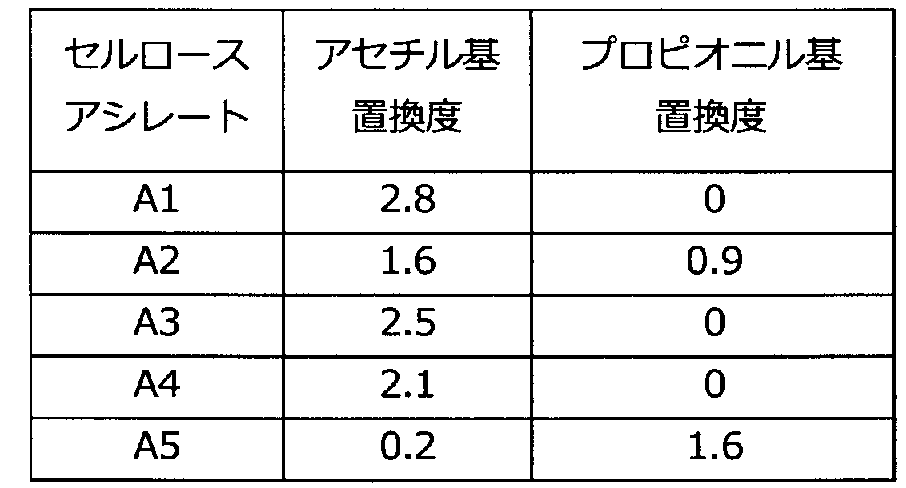
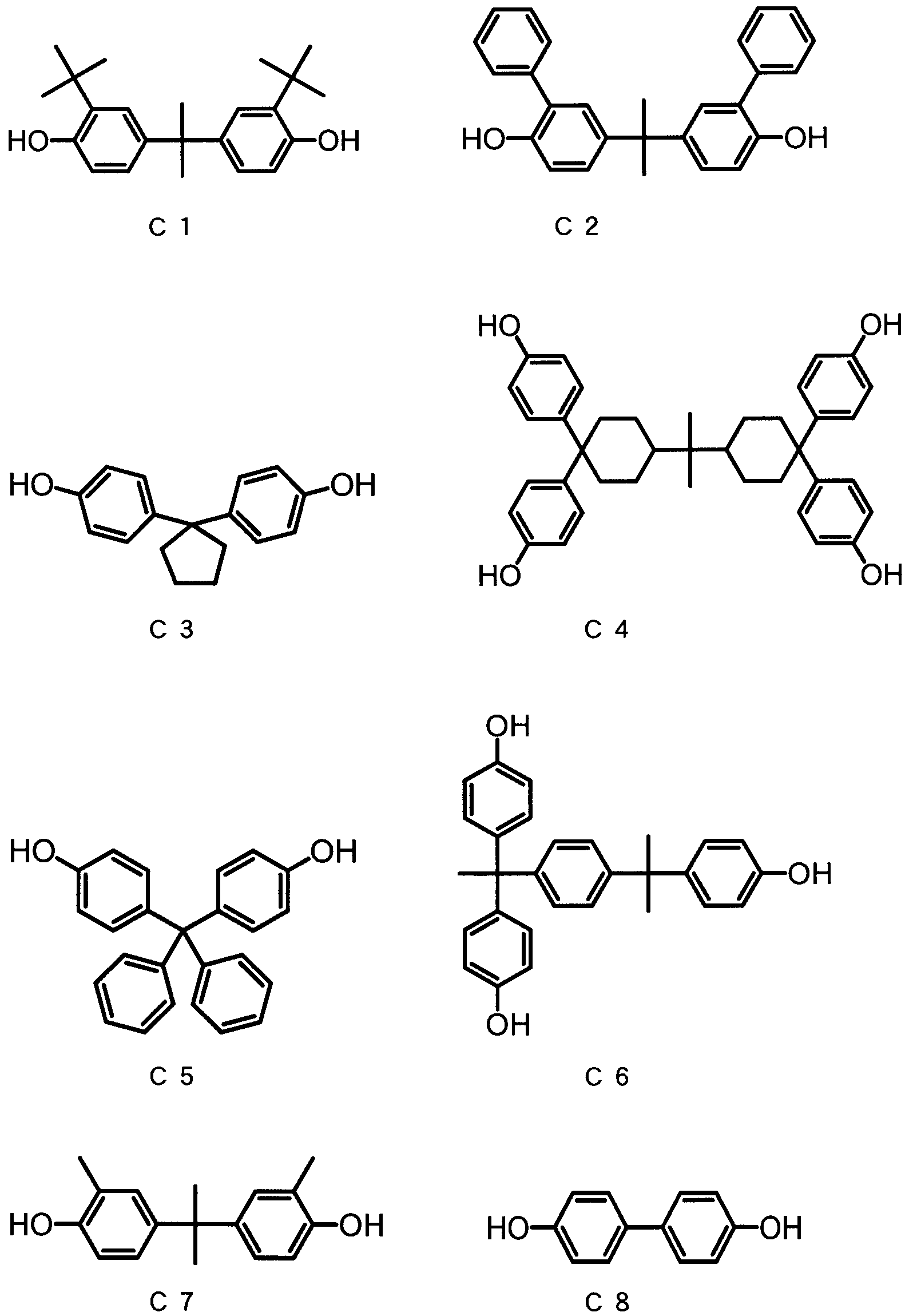


[実施例4]
(コア層用ドープの調製)
セルロースアシレートA2(100質量部)と化合物C6(10質量部)とを溶剤とともにミキシングタンクに投入し、攪拌して、各成分を溶解し、コア層用ドープを調製した。溶剤としては、メチレンクロライド/メタノールを質量比で87/13で混合した混合溶剤を用い、コア層形成用ドープの固形分濃度が20質量%になるように調製した。
(コア層用ドープの調製)
セルロースアシレートA2(100質量部)と化合物C6(10質量部)とを溶剤とともにミキシングタンクに投入し、攪拌して、各成分を溶解し、コア層用ドープを調製した。溶剤としては、メチレンクロライド/メタノールを質量比で87/13で混合した混合溶剤を用い、コア層形成用ドープの固形分濃度が20質量%になるように調製した。
(第一スキン層用ドープ及び第二スキン層用ドープの調製)
セルロースアシレートA1を溶剤とともにミキシングタンクに投入し、攪拌して、溶解し、セルロースアシレート溶液1を調製した。溶剤としては、メチレンクロライド/メタノールを質量比で87/13で混合した混合溶剤を用い、セルロースアシレート溶液1の固形分濃度が16質量%になるように調整した。
セルロースアシレートA1を溶剤とともにミキシングタンクに投入し、攪拌して、溶解し、セルロースアシレート溶液1を調製した。溶剤としては、メチレンクロライド/メタノールを質量比で87/13で混合した混合溶剤を用い、セルロースアシレート溶液1の固形分濃度が16質量%になるように調整した。
(マット剤分散液M1の調製)
下記の組成物を分散機に投入し、撹拌して各成分を溶解し、マット剤分散液M1を調製した。
平均粒子サイズ20nmのシリカ粒子 2.0質量部
(AEROSIL(登録商標)R972、日本アエロジル(株)製)
メチレンクロライド 76.1質量部
メタノール 11.4質量部
セルロースアシレート溶液1 12.6質量部
下記の組成物を分散機に投入し、撹拌して各成分を溶解し、マット剤分散液M1を調製した。
平均粒子サイズ20nmのシリカ粒子 2.0質量部
(AEROSIL(登録商標)R972、日本アエロジル(株)製)
メチレンクロライド 76.1質量部
メタノール 11.4質量部
セルロースアシレート溶液1 12.6質量部
上記にて調製したセルロースアシレート溶液1に、マット剤分散液M1を以下に示した割合で混合し、第一スキン層用ドープ及び第二スキン層用ドープを調製した。
セルロースアシレート溶液1 100.0質量部
マット剤分散液M1 7.1質量部
セルロースアシレート溶液1 100.0質量部
マット剤分散液M1 7.1質量部
<偏光板保護フィルムの製膜>
(流延)
上記で調製したドープを、バンド流延機により流延した。この際、空気界面側から、第一スキン層用ドープ、コア層形成用ドープ、第二スキン層用ドープとなるように共流延した。
ドープを流延する際は、走行するバンドの上に、流延ダイからドープを共流延した。ここで、各ドープの流延量を調整することにより、コア層を最も厚くし、結果的に延伸後のフィルムのコア層の厚さ及びスキン層の厚さの比が第一スキン層/コア層/第二スキン層=1/40/1に示す値となるように同時多層共流延したウェブを形成させた。
(流延)
上記で調製したドープを、バンド流延機により流延した。この際、空気界面側から、第一スキン層用ドープ、コア層形成用ドープ、第二スキン層用ドープとなるように共流延した。
ドープを流延する際は、走行するバンドの上に、流延ダイからドープを共流延した。ここで、各ドープの流延量を調整することにより、コア層を最も厚くし、結果的に延伸後のフィルムのコア層の厚さ及びスキン層の厚さの比が第一スキン層/コア層/第二スキン層=1/40/1に示す値となるように同時多層共流延したウェブを形成させた。
次に、このウェブを流延バンドから剥ぎ取り、渡り部及びテンターで乾燥させてフィルムとした。ドープを剥ぎ取った直後の残留溶媒量は約25質量%であった。フィルムを140℃に温調した乾燥室に送り、多数のローラに巻き掛けながら搬送している間に残留溶媒量が1%になるまで乾燥させた。
残留溶媒量は下記の式に従って求めた。
残留溶媒量(質量%)={(M-N)/N}×100
Mはウェブの任意時点での質量、NはMを測定したウェブを120℃で2時間乾燥させた時の質量である。
残留溶媒量は下記の式に従って求めた。
残留溶媒量(質量%)={(M-N)/N}×100
Mはウェブの任意時点での質量、NはMを測定したウェブを120℃で2時間乾燥させた時の質量である。
(延伸)
流延して得られたフィルムを、クリップで把持し、固定端一軸の条件で横方向(TD方向)に延伸した。延伸温度及び延伸倍率は175℃及び30%であった。
流延して得られたフィルムを、クリップで把持し、固定端一軸の条件で横方向(TD方向)に延伸した。延伸温度及び延伸倍率は175℃及び30%であった。
(湿熱処理)
延伸処理を経た各フィルムに、結露防止処理、湿熱処理(水蒸気接触処理)及び熱処理を順次行った。
結露防止処理では、各フィルムに乾燥空気をあてて、フィルム温度Tf0を120℃に調節した。
湿熱処理(水蒸気接触処理)では、湿潤気体接触室内の湿潤気体の絶対湿度(湿熱処理絶対湿度)が250g/m3となるように、そして、湿潤気体の露点は、各フィルムの温度Tf0よりも10℃以上高い温度となるように調節し、各フィルムの温度(湿熱処理温度)が100℃となる状態を、処理時間(60秒)だけ維持しながら、各フィルムを搬送した。
延伸処理を経た各フィルムに、結露防止処理、湿熱処理(水蒸気接触処理)及び熱処理を順次行った。
結露防止処理では、各フィルムに乾燥空気をあてて、フィルム温度Tf0を120℃に調節した。
湿熱処理(水蒸気接触処理)では、湿潤気体接触室内の湿潤気体の絶対湿度(湿熱処理絶対湿度)が250g/m3となるように、そして、湿潤気体の露点は、各フィルムの温度Tf0よりも10℃以上高い温度となるように調節し、各フィルムの温度(湿熱処理温度)が100℃となる状態を、処理時間(60秒)だけ維持しながら、各フィルムを搬送した。
熱処理では、熱処理室内の気体の絶対湿度(熱処理絶対湿度)を0g/m3とし、各フィルムの温度(熱処理温度)を湿熱処理温度と同じ温度に設定して、処理時間(2分)だけ維持した。フィルム表面温度は、テープ型熱電対表面温度センサー(安立計器(株)製STシリーズ)をフィルムに3点貼り付け、それぞれの平均値から求めた。
(巻き取り)
その後、23℃まで冷却した後で各フィルムを巻き取り、膜厚40μm、幅1980mmで連続製膜して、長さ4000mの実施例4の長尺フィルムを得た。
その後、23℃まで冷却した後で各フィルムを巻き取り、膜厚40μm、幅1980mmで連続製膜して、長さ4000mの実施例4の長尺フィルムを得た。
コア層用ドープの処方(セルロースアシレートと添加剤)を表3のように変え、延伸温度を補正した以外は同様にして実施例5~13、比較例2~9の長尺フィルムを得た。延伸温度の補正方法は各フィルムのガラス転移温度(Tg)を測定し、フィルムのTgと延伸温度の差が一定となるように延伸温度を補正した。Tgはガラス転移温度(単位:℃)を表し、残留溶媒量0%のときのフィルムの動的粘弾性tanδを測定した際にtanδがピークを示す温度を意味する。
[フィルムの特性]
実施例及び比較例のフィルムについて、膜厚、波長550nmにおける面内方向のレターデーション(Re(550))及び波長550nmにおける厚さ方向のレターデーション(Rth(550))を測定した。
実施例及び比較例のフィルムについて、膜厚、波長550nmにおける面内方向のレターデーション(Re(550))及び波長550nmにおける厚さ方向のレターデーション(Rth(550))を測定した。
[端部カール]
フィルムのカール値は、アメリカ国家規格協会の規定する測定方法(ANSI/ASC PH1.29-1985、Method-A)に従い測定できる。具体的には、フィルムの端部カール値は、フィルムの幅方向端部から200mmの部分から幅方向に35mm、長手方向に2mmの大きさにフィルムを切り取った後、カール板に設置する。これを温度25℃、相対湿度10%の環境下に6時間調湿後カール値を読みとった値を端部カール値としている。カール値は、曲率半径(cm)で表しており、曲率半径が小さいほうが搬送性は悪化する。流延時に支持体側であった面を内側にしてカールする場合をプラス、流延時に空気側であった面を内側にしてカールする場合をマイナスと定義するが、本発明で端部カールはカール値の絶対値を指す。以下の基準に基づいて端部カールを評価した。以下の基準で、1~3は実用上問題ないレベルである。
1:(カール値の絶対値)≧30cm
2:30cm>(カール値の絶対値)≧20cm
3:20cm>(カール値の絶対値)≧10cm
4:10cm>(カール値の絶対値)
フィルムのカール値は、アメリカ国家規格協会の規定する測定方法(ANSI/ASC PH1.29-1985、Method-A)に従い測定できる。具体的には、フィルムの端部カール値は、フィルムの幅方向端部から200mmの部分から幅方向に35mm、長手方向に2mmの大きさにフィルムを切り取った後、カール板に設置する。これを温度25℃、相対湿度10%の環境下に6時間調湿後カール値を読みとった値を端部カール値としている。カール値は、曲率半径(cm)で表しており、曲率半径が小さいほうが搬送性は悪化する。流延時に支持体側であった面を内側にしてカールする場合をプラス、流延時に空気側であった面を内側にしてカールする場合をマイナスと定義するが、本発明で端部カールはカール値の絶対値を指す。以下の基準に基づいて端部カールを評価した。以下の基準で、1~3は実用上問題ないレベルである。
1:(カール値の絶対値)≧30cm
2:30cm>(カール値の絶対値)≧20cm
3:20cm>(カール値の絶対値)≧10cm
4:10cm>(カール値の絶対値)
(対向フィルムの作製)
第一スキン層用ドープ、第二スキン層用ドープ、及びコア層用ドープの処方を下記のように変え、完成後の膜厚を60μmとした以外は実施例1と同様にして、対向フィルム101の長尺フィルムを作製した。
第一スキン層用ドープ、第二スキン層用ドープ、及びコア層用ドープの処方を下記のように変え、完成後の膜厚を60μmとした以外は実施例1と同様にして、対向フィルム101の長尺フィルムを作製した。
(第一スキン層用ドープ及び第二スキン層用ドープの組成)
セルロースアシレート(アセチル置換度2.86) 100質量部
糖エステル化合物S1 3質量部
糖エステル化合物S2 1質量部
化合物U1 2.4質量部
シリカ粒子分散液(平均粒径20nm) 0.078質量部
(AEROSIL(登録商標)R972、日本アエロジル(株)製
メチレンクロライド 339質量部
メタノール 74質量部
ブタノール 3質量部
セルロースアシレート(アセチル置換度2.86) 100質量部
糖エステル化合物S1 3質量部
糖エステル化合物S2 1質量部
化合物U1 2.4質量部
シリカ粒子分散液(平均粒径20nm) 0.078質量部
(AEROSIL(登録商標)R972、日本アエロジル(株)製
メチレンクロライド 339質量部
メタノール 74質量部
ブタノール 3質量部
(コア層用ドープの組成)
セルロースアシレート(アセチル置換度2.86) 100質量部
糖エステル化合物S1 7.7質量部
糖エステル化合物S2 2.3質量部
化合物U1 2.4質量部
メチレンクロライド 266質量部
メタノール 58質量部
ブタノール 2.6質量部
セルロースアシレート(アセチル置換度2.86) 100質量部
糖エステル化合物S1 7.7質量部
糖エステル化合物S2 2.3質量部
化合物U1 2.4質量部
メチレンクロライド 266質量部
メタノール 58質量部
ブタノール 2.6質量部
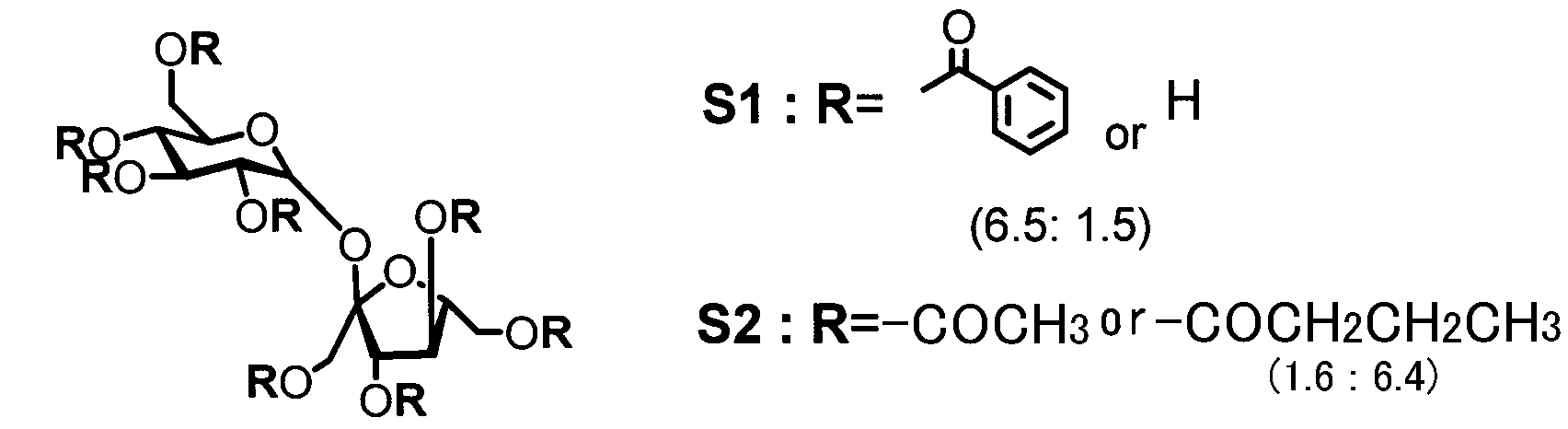
(実施例、比較例の長尺フィルムを含む長尺偏光板の作製)
〔偏光板保護フィルムの鹸化処理〕
各実施例及び比較例で作製した長尺フィルムを連続的に送り出し、2.3mol/Lの水酸化ナトリウム水溶液に、55℃で30秒浸漬した。さらに連続的に、25℃純水浴槽中で2分洗浄し、さらに100℃の温風で乾燥し、鹸化処理した偏光板保護フィルムを得た。対向フィルム101も同様にして鹸化処理を行った。
〔偏光板保護フィルムの鹸化処理〕
各実施例及び比較例で作製した長尺フィルムを連続的に送り出し、2.3mol/Lの水酸化ナトリウム水溶液に、55℃で30秒浸漬した。さらに連続的に、25℃純水浴槽中で2分洗浄し、さらに100℃の温風で乾燥し、鹸化処理した偏光板保護フィルムを得た。対向フィルム101も同様にして鹸化処理を行った。
〔偏光子の作製〕
平均重合度約2400、ケン化度99.9モル%以上のポリビニルアルコールからなる厚み60μmの長尺のポリビニルアルコールフィルムを送り出して、30℃の純水に浸漬した後、ヨウ素/ヨウ化カリウム/水の質量比が0.02/2/100の水溶液に30℃で浸漬した。その後、ヨウ化カリウム/ホウ酸/水の質量比が12/5/100の水溶液に56.5℃で浸漬した。引き続き、8℃の純水で洗浄した後、65℃で乾燥して、ポリビニルアルコールフィルムにヨウ素が吸着配向された偏光子を得た。延伸は、主に、ヨウ素染色及びホウ酸処理の工程で長手方向に行ない、トータル延伸倍率は5.3倍であった。
平均重合度約2400、ケン化度99.9モル%以上のポリビニルアルコールからなる厚み60μmの長尺のポリビニルアルコールフィルムを送り出して、30℃の純水に浸漬した後、ヨウ素/ヨウ化カリウム/水の質量比が0.02/2/100の水溶液に30℃で浸漬した。その後、ヨウ化カリウム/ホウ酸/水の質量比が12/5/100の水溶液に56.5℃で浸漬した。引き続き、8℃の純水で洗浄した後、65℃で乾燥して、ポリビニルアルコールフィルムにヨウ素が吸着配向された偏光子を得た。延伸は、主に、ヨウ素染色及びホウ酸処理の工程で長手方向に行ない、トータル延伸倍率は5.3倍であった。
〔偏光子と偏光板保護フィルムとの貼り合わせ〕
ポリビニルアルコール系接着剤を用いて、上記のようにして製造した偏光子を鹸化処理した実施例、比較例フィルムと鹸化処理した対向フィルム101で挟持するように送り出して、連続的に貼合し、80℃で乾燥させて長尺偏光板を得た。
この際、長尺偏光板が得られるように、偏光子の長手方向とそれを挟持するフィルムの長手方向が一致するように配置して貼合を行った。
ポリビニルアルコール系接着剤を用いて、上記のようにして製造した偏光子を鹸化処理した実施例、比較例フィルムと鹸化処理した対向フィルム101で挟持するように送り出して、連続的に貼合し、80℃で乾燥させて長尺偏光板を得た。
この際、長尺偏光板が得られるように、偏光子の長手方向とそれを挟持するフィルムの長手方向が一致するように配置して貼合を行った。
[偏光板保管性]
上記のようにして得られた長尺偏光板より40mm角で偏光板小片を裁断した。得られた偏光板小片を、実施例及び比較例で作製したフィルムがガラス基板側に配置されるようにガラス基板にSK2057(綜研化学社製シート状粘着剤)を介して貼り合わせて、温度25℃、相対湿度60%で24時間調湿後に、温度25℃、相対湿度60%環境下でAxoScan OPMF-1(オプトサイエンス社製)を用いて、550nmで光学特性(初期Rth)を測定した。その後、温度85℃、相対湿度85%の環境下で500時間保管し、全てのサンプルを再び温度25℃、相対湿度60%で24時間調湿後、温度25℃、相対湿度60%環境下で光学特性(高温高湿保管後のRth)を測定し、下記式に表されるβを求めた。なお、上述のように実施例及び比較例のフィルムのRth(波長550nm)を分離計測した。以下に示す高温高湿保管後の光学特性変化量βが1又は2であれば、実用上問題ないと判断することができる。
(高温高湿保管後の光学特性変化量βの評価基準)
β=(高温高湿保管後のRth)-(初期Rth)
1:βが25nm以下
2:βが25nmより大きく50nm以下
3:βが50nmより大きい
上記のようにして得られた長尺偏光板より40mm角で偏光板小片を裁断した。得られた偏光板小片を、実施例及び比較例で作製したフィルムがガラス基板側に配置されるようにガラス基板にSK2057(綜研化学社製シート状粘着剤)を介して貼り合わせて、温度25℃、相対湿度60%で24時間調湿後に、温度25℃、相対湿度60%環境下でAxoScan OPMF-1(オプトサイエンス社製)を用いて、550nmで光学特性(初期Rth)を測定した。その後、温度85℃、相対湿度85%の環境下で500時間保管し、全てのサンプルを再び温度25℃、相対湿度60%で24時間調湿後、温度25℃、相対湿度60%環境下で光学特性(高温高湿保管後のRth)を測定し、下記式に表されるβを求めた。なお、上述のように実施例及び比較例のフィルムのRth(波長550nm)を分離計測した。以下に示す高温高湿保管後の光学特性変化量βが1又は2であれば、実用上問題ないと判断することができる。
(高温高湿保管後の光学特性変化量βの評価基準)
β=(高温高湿保管後のRth)-(初期Rth)
1:βが25nm以下
2:βが25nmより大きく50nm以下
3:βが50nmより大きい
[リワーク性]
長尺偏光板の幅方向の中央部から幅方向に±160mm、長手方向に±120mmの、320mm×240mmの大きさの偏光板小片を裁断した。得られた偏光板小片を実施例及び比較例のフィルムがガラス基板側に配置されるようにガラス基板にSK2057(綜研化学社製シート状粘着剤)を介して貼り合わせ、温度25℃、相対湿度60%で24時間調湿した後、温度25℃、相対湿度60%環境下でガラス基板から剥がした。ガラス基板上における、実施例、比較例のフィルム剥げ残りの程度について目視で確認し、以下の基準に基づいてリワーク性を評価した。以下の基準で、1及び2は実用上問題ないレベルである。
1:剥げ残りが全く確認されない。
2:わずかに剥げ残りはある。
3:剥げ残りが多くある。
長尺偏光板の幅方向の中央部から幅方向に±160mm、長手方向に±120mmの、320mm×240mmの大きさの偏光板小片を裁断した。得られた偏光板小片を実施例及び比較例のフィルムがガラス基板側に配置されるようにガラス基板にSK2057(綜研化学社製シート状粘着剤)を介して貼り合わせ、温度25℃、相対湿度60%で24時間調湿した後、温度25℃、相対湿度60%環境下でガラス基板から剥がした。ガラス基板上における、実施例、比較例のフィルム剥げ残りの程度について目視で確認し、以下の基準に基づいてリワーク性を評価した。以下の基準で、1及び2は実用上問題ないレベルである。
1:剥げ残りが全く確認されない。
2:わずかに剥げ残りはある。
3:剥げ残りが多くある。
[異物評価]
長尺フィルムの異物評価は、面検印字法により行った。面検印字法は、レーザー光の散乱強度を分析して数値化することにより異物を認識するものである。異物の形状は様々だが、異物をちょうど囲むことができる最小の長方形を描き、そのうち一辺が50μm以上のものをカウントした。製膜中に搬送されているフィルムを連続的に検査し、1000m2検査した異物の個数で評価した。以下の基準で、1及び2は実用上問題ないレベルである。
1:0個以上30個未満/1000m2
2:30個以上50個未満/1000m2
3:50個以上/1000m2
長尺フィルムの異物評価は、面検印字法により行った。面検印字法は、レーザー光の散乱強度を分析して数値化することにより異物を認識するものである。異物の形状は様々だが、異物をちょうど囲むことができる最小の長方形を描き、そのうち一辺が50μm以上のものをカウントした。製膜中に搬送されているフィルムを連続的に検査し、1000m2検査した異物の個数で評価した。以下の基準で、1及び2は実用上問題ないレベルである。
1:0個以上30個未満/1000m2
2:30個以上50個未満/1000m2
3:50個以上/1000m2
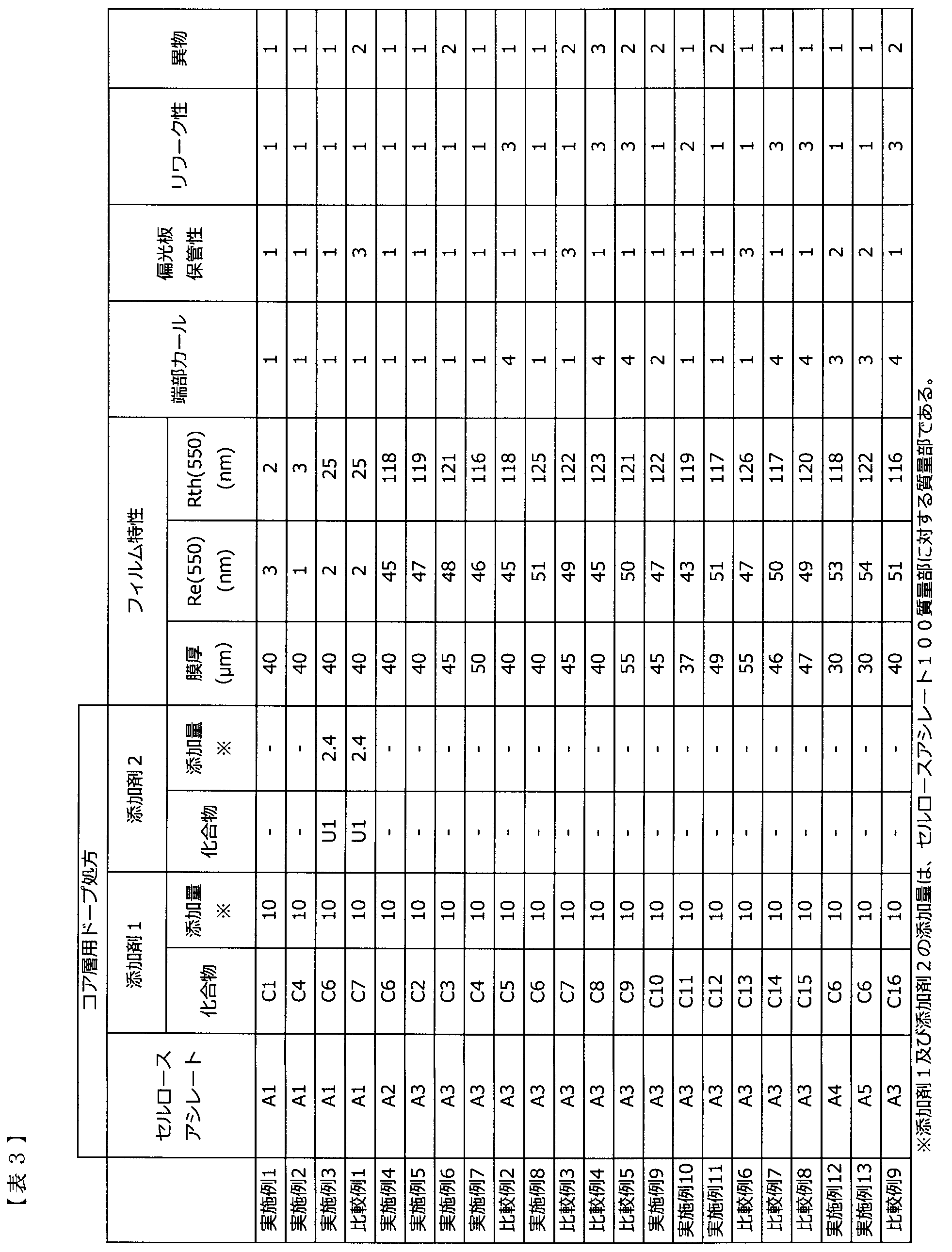
上記結果より、実施例の長尺フィルムは端部カール及び異物が抑制されており、実施例の長尺フィルムを用いた偏光板は偏光板保管性及びリワーク性に優れていた。
本発明によれば、端部カール及び異物が抑制され、偏光板保管性及びリワーク性に優れる長尺フィルム、上記長尺フィルムを含む長尺偏光板、上記長尺フィルム又は長尺偏光板から得られたフィルム又は偏光板を含む液晶表示装置、及び長尺フィルムの製造方法を提供することができる。
本発明を詳細にまた特定の実施態様を参照して説明したが、本発明の精神と範囲を逸脱することなく様々な変更や修正を加えることができることは当業者にとって明らかである。
本出願は、2016年4月27日出願の日本特許出願(特願2016-089786)に基づくものであり、その内容はここに参照として取り込まれる。
本出願は、2016年4月27日出願の日本特許出願(特願2016-089786)に基づくものであり、その内容はここに参照として取り込まれる。
Claims (11)
- セルロースアシレートと、下記条件1、条件2、条件3及び条件4を全て満たす分子量1000未満の化合物Aとを含有する長尺フィルム。
条件1:ヒドロキシル基と直結した芳香環を分子内に2つ以上含む。
条件2:ヒドロキシル基と直結した芳香環と直結し、かつ芳香環を構成しない炭素原子を分子内に1つ以上有し、この炭素原子が1~3つの芳香環と直結している。
条件3:ヒドロキシル基と直結した芳香環に直結し、かつ芳香環を構成しない全ての炭素原子は、水素原子との結合を持たない。
条件4:ヒドロキシル基と直結した芳香環に直結し、かつ芳香環を構成しない全ての炭素原子は、全て水素原子以外の原子と単結合で結合されている。 - 前記条件2の炭素原子が4級炭素原子である請求項1に記載の長尺フィルム。
- 前記化合物Aが、ヒドロキシル基と直結した芳香環を分子内に2~4つ有する請求項1又は2に記載の長尺フィルム。
- 前記化合物Aが、少なくとも2つの、ヒドロキシル基と直結した芳香環とヒドロキシル基と直結した芳香環との間に、前記条件2の炭素原子を有する請求項1~3のいずれか1項に記載の長尺フィルム。
- 前記化合物Aが、少なくとも2つの、ヒドロキシル基と直結した芳香環とヒドロキシル基と直結した芳香環とが1つの前記条件2の炭素原子を介して結合している構造を有する請求項1~4のいずれか1項に記載の長尺フィルム。
- 前記化合物Aのヒドロキシル基と直結した芳香環が、ヒドロキシル基と直結したベンゼン環である請求項1~5のいずれか1項に記載の長尺フィルム。
- 前記化合物Aが、下記一般式(1)で表される化合物である請求項1に記載の長尺フィルム。

一般式(1)中、
R1~R4は各々独立にアルキル基、アリール基、ヒドロキシル基、アシル基、アルコキシ基、又はアルキルオキシカルボニル基を表す。
R1とR2とが結合して脂環を形成してもよい。
R3とR4とが結合して脂環を形成してもよい。
R5及びR6は各々独立に第三級アルキル基又はアリール基を表す。
a及びbは各々独立に0~4の整数を表す。
L1は単結合又は2価の連結基を表す。
kは0又は1を表す。 - 前記セルロースアシレートの100質量部に対して前記化合物Aを1~30質量部含有する請求項1~7のいずれか1項に記載の長尺フィルム。
- 請求項1~8のいずれか1項に記載の長尺フィルムと偏光子とを含む長尺偏光板。
- 液晶セル、及び、請求項1~8のいずれか1項に記載の長尺フィルムから得られたフィルム又は請求項9に記載の長尺偏光板から得られた偏光板を有する液晶表示装置。
- セルロースアシレートと、下記条件1、条件2、条件3及び条件4を全て満たす分子量1000未満の化合物Aとを溶媒に溶解した溶液を用いて、溶液製膜法により製膜する、長尺フィルムの製造方法。
条件1:ヒドロキシル基と直結した芳香環を分子内に2つ以上含む。
条件2:ヒドロキシル基と直結した芳香環と直結し、かつ芳香環を構成しない炭素原子を分子内に1つ以上有し、この炭素原子が1~3つの芳香環と直結している。
条件3:ヒドロキシル基と直結した芳香環に直結し、かつ芳香環を構成しない全ての炭素原子は、水素原子との結合を持たない。
条件4:ヒドロキシル基と直結した芳香環に直結し、かつ芳香環を構成しない全ての炭素原子は、全て水素原子以外の原子と単結合で結合されている。
Priority Applications (3)
| Application Number | Priority Date | Filing Date | Title |
|---|---|---|---|
| JP2018514256A JP6615327B2 (ja) | 2016-04-27 | 2017-04-12 | 長尺フィルム、長尺偏光板、液晶表示装置、及び長尺フィルムの製造方法 |
| CN201780026074.4A CN109071879A (zh) | 2016-04-27 | 2017-04-12 | 长条薄膜、长条偏振片、液晶显示装置及长条薄膜的制造方法 |
| US16/170,732 US10934414B2 (en) | 2016-04-27 | 2018-10-25 | Long film, long polarizing plate, liquid crystal display device, and method for manufacturing long film |
Applications Claiming Priority (2)
| Application Number | Priority Date | Filing Date | Title |
|---|---|---|---|
| JP2016089786 | 2016-04-27 | ||
| JP2016-089786 | 2016-04-27 |
Related Child Applications (1)
| Application Number | Title | Priority Date | Filing Date |
|---|---|---|---|
| US16/170,732 Continuation US10934414B2 (en) | 2016-04-27 | 2018-10-25 | Long film, long polarizing plate, liquid crystal display device, and method for manufacturing long film |
Publications (1)
| Publication Number | Publication Date |
|---|---|
| WO2017187989A1 true WO2017187989A1 (ja) | 2017-11-02 |
Family
ID=60161577
Family Applications (1)
| Application Number | Title | Priority Date | Filing Date |
|---|---|---|---|
| PCT/JP2017/015016 Ceased WO2017187989A1 (ja) | 2016-04-27 | 2017-04-12 | 長尺フィルム、長尺偏光板、液晶表示装置、及び長尺フィルムの製造方法 |
Country Status (5)
| Country | Link |
|---|---|
| US (1) | US10934414B2 (ja) |
| JP (1) | JP6615327B2 (ja) |
| CN (1) | CN109071879A (ja) |
| TW (1) | TW201741702A (ja) |
| WO (1) | WO2017187989A1 (ja) |
Citations (7)
| Publication number | Priority date | Publication date | Assignee | Title |
|---|---|---|---|---|
| US6596354B1 (en) * | 1998-07-02 | 2003-07-22 | Acordis Acetate Chemicals Limited | Plastics film, use of dyestuffs therein and process for testing the authenticity of packaged goods |
| JP2007168419A (ja) * | 2005-11-22 | 2007-07-05 | Fujifilm Corp | セルロースエステルフィルムおよびその製造方法、偏光板、光学補償フィルム、反射防止フィルム、並びに液晶表示装置 |
| JP2007313754A (ja) * | 2006-05-25 | 2007-12-06 | Fujifilm Corp | セルロースエステルフィルムおよびその製造方法、並びに、偏光板、光学補償フィルム、反射防止フィルム、および、液晶表示装置 |
| JP2008089855A (ja) * | 2006-09-29 | 2008-04-17 | Fujifilm Corp | 光学補償フィルム、偏光板、及び液晶表示装置 |
| JP2008089860A (ja) * | 2006-09-29 | 2008-04-17 | Fujifilm Corp | 透明保護フィルム、光学補償フィルム、偏光板、及び液晶表示装置 |
| JP2014164304A (ja) * | 2013-02-27 | 2014-09-08 | Sk Innovation Co Ltd | 光学フィルム |
| KR20150003419A (ko) * | 2013-06-26 | 2015-01-09 | 에스케이이노베이션 주식회사 | 셀룰로오스 아실레이트 필름 |
Family Cites Families (7)
| Publication number | Priority date | Publication date | Assignee | Title |
|---|---|---|---|---|
| JP2004099631A (ja) | 2002-09-04 | 2004-04-02 | Fuji Photo Film Co Ltd | セルロースアシレートフィルム及びその製造方法、並びに該フィルムを用いた光学フィルム、液晶表示装置及びハロゲン化銀写真感光材料 |
| JP2005279950A (ja) | 2004-03-26 | 2005-10-13 | Fuji Photo Film Co Ltd | 溶液製膜方法 |
| JP2008257220A (ja) | 2007-03-14 | 2008-10-23 | Konica Minolta Opto Inc | 光学フィルム、光学フィルムの製造方法、偏光板、及び液晶表示装置 |
| JP5503375B2 (ja) | 2009-03-31 | 2014-05-28 | 大阪瓦斯株式会社 | セルロース誘導体の可塑剤 |
| JP2010231208A (ja) | 2010-03-29 | 2010-10-14 | Konica Minolta Opto Inc | 位相差フィルムの製造方法 |
| JP5441995B2 (ja) | 2011-03-29 | 2014-03-12 | 富士フイルム株式会社 | 溶液製膜方法 |
| CN103278877B (zh) * | 2013-06-15 | 2015-08-19 | 佛山纬达光电材料有限公司 | 一种耐高温偏光片的制造方法 |
-
2017
- 2017-04-12 JP JP2018514256A patent/JP6615327B2/ja not_active Expired - Fee Related
- 2017-04-12 WO PCT/JP2017/015016 patent/WO2017187989A1/ja not_active Ceased
- 2017-04-12 CN CN201780026074.4A patent/CN109071879A/zh active Pending
- 2017-04-27 TW TW106114039A patent/TW201741702A/zh unknown
-
2018
- 2018-10-25 US US16/170,732 patent/US10934414B2/en not_active Expired - Fee Related
Patent Citations (7)
| Publication number | Priority date | Publication date | Assignee | Title |
|---|---|---|---|---|
| US6596354B1 (en) * | 1998-07-02 | 2003-07-22 | Acordis Acetate Chemicals Limited | Plastics film, use of dyestuffs therein and process for testing the authenticity of packaged goods |
| JP2007168419A (ja) * | 2005-11-22 | 2007-07-05 | Fujifilm Corp | セルロースエステルフィルムおよびその製造方法、偏光板、光学補償フィルム、反射防止フィルム、並びに液晶表示装置 |
| JP2007313754A (ja) * | 2006-05-25 | 2007-12-06 | Fujifilm Corp | セルロースエステルフィルムおよびその製造方法、並びに、偏光板、光学補償フィルム、反射防止フィルム、および、液晶表示装置 |
| JP2008089855A (ja) * | 2006-09-29 | 2008-04-17 | Fujifilm Corp | 光学補償フィルム、偏光板、及び液晶表示装置 |
| JP2008089860A (ja) * | 2006-09-29 | 2008-04-17 | Fujifilm Corp | 透明保護フィルム、光学補償フィルム、偏光板、及び液晶表示装置 |
| JP2014164304A (ja) * | 2013-02-27 | 2014-09-08 | Sk Innovation Co Ltd | 光学フィルム |
| KR20150003419A (ko) * | 2013-06-26 | 2015-01-09 | 에스케이이노베이션 주식회사 | 셀룰로오스 아실레이트 필름 |
Also Published As
| Publication number | Publication date |
|---|---|
| US20190062526A1 (en) | 2019-02-28 |
| CN109071879A (zh) | 2018-12-21 |
| JPWO2017187989A1 (ja) | 2019-03-07 |
| JP6615327B2 (ja) | 2019-12-04 |
| TW201741702A (zh) | 2017-12-01 |
| US10934414B2 (en) | 2021-03-02 |
Similar Documents
| Publication | Publication Date | Title |
|---|---|---|
| TW201016757A (en) | Cellulose acylate film and method for producing same, retardation film, polarizing plate, and liquid crystal display device | |
| KR20090119729A (ko) | 셀룰로오스 에스테르 필름, 위상차 필름, 편광판 및 액정 표시 장치 | |
| US20060222786A1 (en) | Cellulose acylate, cellulose acylate film, and method for production and use thereof | |
| JP4147584B2 (ja) | セルロースアシレートフィルム、偏光板及び液晶表示装置 | |
| JP4186063B2 (ja) | セルロース組成物、セルロースフィルム、およびセルロースフィルム用の改質剤 | |
| CN101405632A (zh) | 纤维素酰化物薄膜及其制备方法、以及包含该薄膜的延迟膜、偏振片和液晶显示设备 | |
| JP2002249599A (ja) | セルロースエステルフィルム及びその製造方法 | |
| JP4594131B2 (ja) | セルロースアシレートフィルム、位相差板、偏光板、液晶表示装置およびセルロースアシレートフィルムの製造方法 | |
| JP2011112842A (ja) | 位相差フィルム | |
| JP2002363342A (ja) | 微粒子分散液、ドープの調製方法、セルロースエステルフィルム、偏光板用保護フィルム、偏光板及び画像表示装置 | |
| US8597551B2 (en) | Optical film | |
| JP2005139263A (ja) | セルロース溶液、セルロースフイルム、偏光板および液晶表示装置 | |
| JP2009241397A (ja) | セルロースアシレートフィルムとその製造方法、位相差フィルム、偏光板および液晶表示装置 | |
| CN101321613A (zh) | 透明聚合物膜及其制造方法、光学补偿膜、层合膜和液晶显示装置 | |
| JP6615327B2 (ja) | 長尺フィルム、長尺偏光板、液晶表示装置、及び長尺フィルムの製造方法 | |
| JP4150605B2 (ja) | 偏光板 | |
| JP4912009B2 (ja) | セルロースアシレートフィルムおよびその製造方法、並びに、それを用いた位相差フィルム、偏光板および液晶表示装置 | |
| JP4667047B2 (ja) | セルロース体組成物、セルロース体フイルム、セルロース体フイルム用改質剤、偏光板保護膜、液晶表示装置、ハロゲン化銀写真感光材料 | |
| JP4705006B2 (ja) | 透明ポリマーフィルムおよびその製造方法、並びに、それを用いた光学補償フィルム、積層フィルムおよび液晶表示装置 | |
| JP6110737B2 (ja) | セルロースアセテートフィルム、偏光板および液晶表示装置 | |
| JP5039763B2 (ja) | セルロースアシレートフィルムの製造方法 | |
| JP5993328B2 (ja) | セルロースアシレートフィルム、偏光板および液晶表示装置 | |
| JP4269868B2 (ja) | セルロース組成物、セルロースフィルム、およびセルロースフィルム用改質剤 | |
| KR20150141466A (ko) | 셀룰로오스 에스테르 필름 및 이를 포함하는 광학 필름, 화상표시장치 | |
| JP4953668B2 (ja) | セルロースアシレートフィルムおよびその製造方法、並びに、それを用いた位相差フィルム、偏光板および液晶表示装置 |
Legal Events
| Date | Code | Title | Description |
|---|---|---|---|
| DPE1 | Request for preliminary examination filed after expiration of 19th month from priority date (pct application filed from 20040101) | ||
| ENP | Entry into the national phase |
Ref document number: 2018514256 Country of ref document: JP Kind code of ref document: A |
|
| NENP | Non-entry into the national phase |
Ref country code: DE |
|
| 121 | Ep: the epo has been informed by wipo that ep was designated in this application |
Ref document number: 17789276 Country of ref document: EP Kind code of ref document: A1 |
|
| 122 | Ep: pct application non-entry in european phase |
Ref document number: 17789276 Country of ref document: EP Kind code of ref document: A1 |