WO2017170940A1 - 液晶配向剤、液晶配向膜、及び液晶表示素子 - Google Patents
液晶配向剤、液晶配向膜、及び液晶表示素子 Download PDFInfo
- Publication number
- WO2017170940A1 WO2017170940A1 PCT/JP2017/013415 JP2017013415W WO2017170940A1 WO 2017170940 A1 WO2017170940 A1 WO 2017170940A1 JP 2017013415 W JP2017013415 W JP 2017013415W WO 2017170940 A1 WO2017170940 A1 WO 2017170940A1
- Authority
- WO
- WIPO (PCT)
- Prior art keywords
- liquid crystal
- solvent
- aligning agent
- crystal aligning
- mass
- Prior art date
- Legal status (The legal status is an assumption and is not a legal conclusion. Google has not performed a legal analysis and makes no representation as to the accuracy of the status listed.)
- Ceased
Links
- 0 C*Oc(cc1)ccc1Oc1ccc(C)cc1 Chemical compound C*Oc(cc1)ccc1Oc1ccc(C)cc1 0.000 description 3
- CDJJKTLOZJAGIZ-UHFFFAOYSA-N CC(Oc1ccc(C)cc1)=O Chemical compound CC(Oc1ccc(C)cc1)=O CDJJKTLOZJAGIZ-UHFFFAOYSA-N 0.000 description 2
- QSSJZLPUHJDYKF-UHFFFAOYSA-N Cc(cc1)ccc1C(OC)=O Chemical compound Cc(cc1)ccc1C(OC)=O QSSJZLPUHJDYKF-UHFFFAOYSA-N 0.000 description 2
- OXCHCYYHWJRQJA-UHFFFAOYSA-N Cc(cc1)ccc1C(Oc(cc1)ccc1OC(c1ccc(C)cc1)=O)=O Chemical compound Cc(cc1)ccc1C(Oc(cc1)ccc1OC(c1ccc(C)cc1)=O)=O OXCHCYYHWJRQJA-UHFFFAOYSA-N 0.000 description 2
- AWWVEDVHXOHUFI-UHFFFAOYSA-N CC(CC1)=CC=C1C(CC1)=CC=C1OC(C(CC1)CCC1C(O)Oc(cc1)ccc1-c1ccc(C)cc1)O Chemical compound CC(CC1)=CC=C1C(CC1)=CC=C1OC(C(CC1)CCC1C(O)Oc(cc1)ccc1-c1ccc(C)cc1)O AWWVEDVHXOHUFI-UHFFFAOYSA-N 0.000 description 1
- RTUJLHHTFPHXGJ-UHFFFAOYSA-N CC1C=CC(C(OCC(C(COC(c2ccc(C)cc2)O)(N)N)(N)N)=O)=CC1 Chemical compound CC1C=CC(C(OCC(C(COC(c2ccc(C)cc2)O)(N)N)(N)N)=O)=CC1 RTUJLHHTFPHXGJ-UHFFFAOYSA-N 0.000 description 1
- PZVRCDMOYUFTDH-UHFFFAOYSA-N Cc(cc1)cc(cc2)c1cc2C(Oc(cc1)ccc1OC(c(cc1)cc2c1cc(C)cc2)=O)=O Chemical compound Cc(cc1)cc(cc2)c1cc2C(Oc(cc1)ccc1OC(c(cc1)cc2c1cc(C)cc2)=O)=O PZVRCDMOYUFTDH-UHFFFAOYSA-N 0.000 description 1
- BWOJXRDOEQHGHR-UHFFFAOYSA-N Cc(cc1)ccc1-c(cc1)ccc1OC(CCC(Oc(cc1)ccc1-c1ccc(C)cc1)=O)=O Chemical compound Cc(cc1)ccc1-c(cc1)ccc1OC(CCC(Oc(cc1)ccc1-c1ccc(C)cc1)=O)=O BWOJXRDOEQHGHR-UHFFFAOYSA-N 0.000 description 1
- XOGHUKBCGNLXOX-UHFFFAOYSA-N Cc(cc1)ccc1OC(c(cc1)ccc1C(Oc1ccc(C)cc1)=O)=O Chemical compound Cc(cc1)ccc1OC(c(cc1)ccc1C(Oc1ccc(C)cc1)=O)=O XOGHUKBCGNLXOX-UHFFFAOYSA-N 0.000 description 1
- FKRLZXYFFYMGEN-UHFFFAOYSA-N Cc(cc1)ccc1OC(c1cccc(C(Oc2ccc(C)cc2)=O)c1)=O Chemical compound Cc(cc1)ccc1OC(c1cccc(C(Oc2ccc(C)cc2)=O)c1)=O FKRLZXYFFYMGEN-UHFFFAOYSA-N 0.000 description 1
- AALQUOHYAMXZRQ-UHFFFAOYSA-N Cc(cc1)ccc1Oc(cc1)ccc1OC Chemical compound Cc(cc1)ccc1Oc(cc1)ccc1OC AALQUOHYAMXZRQ-UHFFFAOYSA-N 0.000 description 1
- PRELWCYEOIVLBQ-JYFOCSDGSA-N Cc1ccc(/C=C/C(Oc(cc2)ccc2OC(/C=C/c2ccc(C)cc2)=O)=O)cc1 Chemical compound Cc1ccc(/C=C/C(Oc(cc2)ccc2OC(/C=C/c2ccc(C)cc2)=O)=O)cc1 PRELWCYEOIVLBQ-JYFOCSDGSA-N 0.000 description 1
- XIAAMHCLUJRZGF-JYFOCSDGSA-N Cc1ccc(/C=C/C(Oc2ccc(/C=C/C(Oc3ccc(C)cc3)=O)cc2)=O)cc1 Chemical compound Cc1ccc(/C=C/C(Oc2ccc(/C=C/C(Oc3ccc(C)cc3)=O)cc2)=O)cc1 XIAAMHCLUJRZGF-JYFOCSDGSA-N 0.000 description 1
- XCGIDGRJPRURKS-UHFFFAOYSA-N Cc1ccc(N(CC2)CCN2c2ncc(C)cc2)nc1 Chemical compound Cc1ccc(N(CC2)CCN2c2ncc(C)cc2)nc1 XCGIDGRJPRURKS-UHFFFAOYSA-N 0.000 description 1
- DRVIPZJZGKGMPJ-UHFFFAOYSA-N Cc1nccc(N(CC2)CCN2c2cc(C)ncc2)c1 Chemical compound Cc1nccc(N(CC2)CCN2c2cc(C)ncc2)c1 DRVIPZJZGKGMPJ-UHFFFAOYSA-N 0.000 description 1
Classifications
-
- C—CHEMISTRY; METALLURGY
- C08—ORGANIC MACROMOLECULAR COMPOUNDS; THEIR PREPARATION OR CHEMICAL WORKING-UP; COMPOSITIONS BASED THEREON
- C08G—MACROMOLECULAR COMPOUNDS OBTAINED OTHERWISE THAN BY REACTIONS ONLY INVOLVING UNSATURATED CARBON-TO-CARBON BONDS
- C08G73/00—Macromolecular compounds obtained by reactions forming a linkage containing nitrogen with or without oxygen or carbon in the main chain of the macromolecule, not provided for in groups C08G12/00 - C08G71/00
- C08G73/06—Polycondensates having nitrogen-containing heterocyclic rings in the main chain of the macromolecule
- C08G73/10—Polyimides; Polyester-imides; Polyamide-imides; Polyamide acids or similar polyimide precursors
-
- C—CHEMISTRY; METALLURGY
- C09—DYES; PAINTS; POLISHES; NATURAL RESINS; ADHESIVES; COMPOSITIONS NOT OTHERWISE PROVIDED FOR; APPLICATIONS OF MATERIALS NOT OTHERWISE PROVIDED FOR
- C09K—MATERIALS FOR MISCELLANEOUS APPLICATIONS, NOT PROVIDED FOR ELSEWHERE
- C09K19/00—Liquid crystal materials
- C09K19/52—Liquid crystal materials characterised by components which are not liquid crystals, e.g. additives with special physical aspect: solvents, solid particles
- C09K19/54—Additives having no specific mesophase characterised by their chemical composition
- C09K19/56—Aligning agents
-
- C—CHEMISTRY; METALLURGY
- C08—ORGANIC MACROMOLECULAR COMPOUNDS; THEIR PREPARATION OR CHEMICAL WORKING-UP; COMPOSITIONS BASED THEREON
- C08G—MACROMOLECULAR COMPOUNDS OBTAINED OTHERWISE THAN BY REACTIONS ONLY INVOLVING UNSATURATED CARBON-TO-CARBON BONDS
- C08G73/00—Macromolecular compounds obtained by reactions forming a linkage containing nitrogen with or without oxygen or carbon in the main chain of the macromolecule, not provided for in groups C08G12/00 - C08G71/00
- C08G73/06—Polycondensates having nitrogen-containing heterocyclic rings in the main chain of the macromolecule
- C08G73/10—Polyimides; Polyester-imides; Polyamide-imides; Polyamide acids or similar polyimide precursors
- C08G73/1003—Preparatory processes
- C08G73/1007—Preparatory processes from tetracarboxylic acids or derivatives and diamines
-
- C—CHEMISTRY; METALLURGY
- C08—ORGANIC MACROMOLECULAR COMPOUNDS; THEIR PREPARATION OR CHEMICAL WORKING-UP; COMPOSITIONS BASED THEREON
- C08G—MACROMOLECULAR COMPOUNDS OBTAINED OTHERWISE THAN BY REACTIONS ONLY INVOLVING UNSATURATED CARBON-TO-CARBON BONDS
- C08G73/00—Macromolecular compounds obtained by reactions forming a linkage containing nitrogen with or without oxygen or carbon in the main chain of the macromolecule, not provided for in groups C08G12/00 - C08G71/00
- C08G73/06—Polycondensates having nitrogen-containing heterocyclic rings in the main chain of the macromolecule
- C08G73/10—Polyimides; Polyester-imides; Polyamide-imides; Polyamide acids or similar polyimide precursors
- C08G73/1003—Preparatory processes
- C08G73/1007—Preparatory processes from tetracarboxylic acids or derivatives and diamines
- C08G73/1028—Preparatory processes from tetracarboxylic acids or derivatives and diamines characterised by the process itself, e.g. steps, continuous
- C08G73/1032—Preparatory processes from tetracarboxylic acids or derivatives and diamines characterised by the process itself, e.g. steps, continuous characterised by the solvent(s) used
-
- C—CHEMISTRY; METALLURGY
- C08—ORGANIC MACROMOLECULAR COMPOUNDS; THEIR PREPARATION OR CHEMICAL WORKING-UP; COMPOSITIONS BASED THEREON
- C08L—COMPOSITIONS OF MACROMOLECULAR COMPOUNDS
- C08L79/00—Compositions of macromolecular compounds obtained by reactions forming in the main chain of the macromolecule a linkage containing nitrogen with or without oxygen or carbon only, not provided for in groups C08L61/00 - C08L77/00
- C08L79/04—Polycondensates having nitrogen-containing heterocyclic rings in the main chain; Polyhydrazides; Polyamide acids or similar polyimide precursors
- C08L79/08—Polyimides; Polyester-imides; Polyamide-imides; Polyamide acids or similar polyimide precursors
-
- C—CHEMISTRY; METALLURGY
- C09—DYES; PAINTS; POLISHES; NATURAL RESINS; ADHESIVES; COMPOSITIONS NOT OTHERWISE PROVIDED FOR; APPLICATIONS OF MATERIALS NOT OTHERWISE PROVIDED FOR
- C09D—COATING COMPOSITIONS, e.g. PAINTS, VARNISHES OR LACQUERS; FILLING PASTES; CHEMICAL PAINT OR INK REMOVERS; INKS; CORRECTING FLUIDS; WOODSTAINS; PASTES OR SOLIDS FOR COLOURING OR PRINTING; USE OF MATERIALS THEREFOR
- C09D11/00—Inks
- C09D11/30—Inkjet printing inks
- C09D11/36—Inkjet printing inks based on non-aqueous solvents
-
- C—CHEMISTRY; METALLURGY
- C09—DYES; PAINTS; POLISHES; NATURAL RESINS; ADHESIVES; COMPOSITIONS NOT OTHERWISE PROVIDED FOR; APPLICATIONS OF MATERIALS NOT OTHERWISE PROVIDED FOR
- C09D—COATING COMPOSITIONS, e.g. PAINTS, VARNISHES OR LACQUERS; FILLING PASTES; CHEMICAL PAINT OR INK REMOVERS; INKS; CORRECTING FLUIDS; WOODSTAINS; PASTES OR SOLIDS FOR COLOURING OR PRINTING; USE OF MATERIALS THEREFOR
- C09D179/00—Coating compositions based on macromolecular compounds obtained by reactions forming in the main chain of the macromolecule a linkage containing nitrogen, with or without oxygen, or carbon only, not provided for in groups C09D161/00 - C09D177/00
- C09D179/04—Polycondensates having nitrogen-containing heterocyclic rings in the main chain; Polyhydrazides; Polyamide acids or similar polyimide precursors
- C09D179/08—Polyimides; Polyester-imides; Polyamide-imides; Polyamide acids or similar polyimide precursors
-
- G—PHYSICS
- G02—OPTICS
- G02F—OPTICAL DEVICES OR ARRANGEMENTS FOR THE CONTROL OF LIGHT BY MODIFICATION OF THE OPTICAL PROPERTIES OF THE MEDIA OF THE ELEMENTS INVOLVED THEREIN; NON-LINEAR OPTICS; FREQUENCY-CHANGING OF LIGHT; OPTICAL LOGIC ELEMENTS; OPTICAL ANALOGUE/DIGITAL CONVERTERS
- G02F1/00—Devices or arrangements for the control of the intensity, colour, phase, polarisation or direction of light arriving from an independent light source, e.g. switching, gating or modulating; Non-linear optics
- G02F1/01—Devices or arrangements for the control of the intensity, colour, phase, polarisation or direction of light arriving from an independent light source, e.g. switching, gating or modulating; Non-linear optics for the control of the intensity, phase, polarisation or colour
- G02F1/13—Devices or arrangements for the control of the intensity, colour, phase, polarisation or direction of light arriving from an independent light source, e.g. switching, gating or modulating; Non-linear optics for the control of the intensity, phase, polarisation or colour based on liquid crystals, e.g. single liquid crystal display cells
- G02F1/133—Constructional arrangements; Operation of liquid crystal cells; Circuit arrangements
- G02F1/1333—Constructional arrangements; Manufacturing methods
- G02F1/1337—Surface-induced orientation of the liquid crystal molecules, e.g. by alignment layers
-
- G—PHYSICS
- G02—OPTICS
- G02F—OPTICAL DEVICES OR ARRANGEMENTS FOR THE CONTROL OF LIGHT BY MODIFICATION OF THE OPTICAL PROPERTIES OF THE MEDIA OF THE ELEMENTS INVOLVED THEREIN; NON-LINEAR OPTICS; FREQUENCY-CHANGING OF LIGHT; OPTICAL LOGIC ELEMENTS; OPTICAL ANALOGUE/DIGITAL CONVERTERS
- G02F1/00—Devices or arrangements for the control of the intensity, colour, phase, polarisation or direction of light arriving from an independent light source, e.g. switching, gating or modulating; Non-linear optics
- G02F1/01—Devices or arrangements for the control of the intensity, colour, phase, polarisation or direction of light arriving from an independent light source, e.g. switching, gating or modulating; Non-linear optics for the control of the intensity, phase, polarisation or colour
- G02F1/13—Devices or arrangements for the control of the intensity, colour, phase, polarisation or direction of light arriving from an independent light source, e.g. switching, gating or modulating; Non-linear optics for the control of the intensity, phase, polarisation or colour based on liquid crystals, e.g. single liquid crystal display cells
- G02F1/133—Constructional arrangements; Operation of liquid crystal cells; Circuit arrangements
- G02F1/1333—Constructional arrangements; Manufacturing methods
- G02F1/1337—Surface-induced orientation of the liquid crystal molecules, e.g. by alignment layers
- G02F1/133711—Surface-induced orientation of the liquid crystal molecules, e.g. by alignment layers by organic films, e.g. polymeric films
- G02F1/133723—Polyimide, polyamide-imide
Definitions
- the present invention relates to a liquid crystal aligning agent suitable for an ink jet film forming method and having high dimensional stability when applied, and a liquid crystal aligning film obtained from the liquid crystal aligning agent.
- liquid crystal alignment film As the liquid crystal alignment film, a so-called polyimide-based liquid crystal alignment film, which is obtained by applying and baking a liquid crystal alignment agent mainly composed of a polyimide precursor such as polyamic acid (also called polyamic acid) or a soluble polyimide solution, is widely used.
- a liquid crystal alignment agent mainly composed of a polyimide precursor such as polyamic acid (also called polyamic acid) or a soluble polyimide solution
- spin coating, dip coating, flexographic printing, and the like are known as film forming methods for such a liquid crystal alignment film.
- a coating method by flexographic printing has been used so far.
- flexographic printing requires various types of resin plates due to the different types of liquid crystal panels, the plate replacement in the manufacturing process is complicated, and film formation on a dummy substrate is necessary to stabilize the film formation process. There are problems such as the necessity of manufacturing the plate and the production cost of the liquid crystal display panel.
- an inkjet method has attracted attention as a method for forming a liquid crystal alignment film without using a printing plate.
- the ink jet method is a method in which fine droplets are dropped on a substrate and a film is formed by wetting and spreading of the liquid. Not only the printing plate is not used, but also the printing pattern can be set freely, so that the manufacturing process of the liquid crystal display element can be simplified. In addition, there is an advantage that the waste of the coating liquid is reduced because the film formation on the dummy substrate which is necessary for flexographic printing is not necessary.
- the inkjet method is expected to reduce the cost of liquid crystal panels and improve production efficiency.
- the liquid crystal alignment film formed by the ink jet method is required to have small film thickness unevenness inside the coating surface and high film forming accuracy in the periphery of the coating.
- a liquid crystal alignment film formed by an ink-jet method has a trade-off relationship between the uniformity of the film thickness in the coating surface and the film forming accuracy in the periphery of the coating. That is, a material with high in-plane uniformity usually has low dimensional stability at the periphery of the coating, and the film protrudes from the set dimensions. On the other hand, the material in which the coating peripheral portion is a straight line has low uniformity in the coating surface.
- Patent Documents 1 to 3 In order to improve the film forming accuracy in the periphery of the coating, a method of confining the alignment film within a predetermined range with a special structure has been proposed (see Patent Documents 1 to 3). However, these methods have the disadvantage that special structures need to be used.
- a contact hole also referred to as C / H
- C / H a contact hole
- the spread of the liquid tends to be hindered during the application of the liquid crystal aligning agent due to the influence of the wiring structure and C / H.
- unevenness in the thickness of the alignment film such as dot-like unevenness and streaky unevenness, occurs around the C / H and other portions, and the display on the liquid crystal display element may become uneven.
- the liquid crystal aligning agent used in the ink jet method is required to have low viscosity in order to stably discharge the aligning agent from the ink jet nozzle, and accordingly, the resin component ratio in the liquid crystal aligning agent is set to be small.
- the resin component ratio in the liquid crystal aligning agent is set to be small.
- problems such as deterioration in shape stability and film thickness uniformity in the periphery of the coating film, and prolonged application time for obtaining the desired film thickness are likely to occur. For this reason, it is desired to reduce the viscosity while maintaining the resin component ratio.
- the present invention can suppress the formation failure of the liquid crystal alignment film caused by the influence of the wiring structure and C / H and the failure that the display of the liquid crystal display element is non-uniform, and the resin component.
- An object of the present invention is to provide a liquid crystal aligning agent capable of reducing the viscosity of the liquid crystal aligning agent while maintaining the ratio and the molecular weight of the resin component, a liquid crystal alignment film using the liquid crystal aligning agent, and a liquid crystal display element.
- the gist of the present invention includes at least one polymer selected from the group consisting of a polyimide precursor and polyimide which is an imidized product thereof, and a solvent containing the following solvent A, solvent B, and solvent C. It is in the liquid crystal aligning agent characterized by the above-mentioned.
- Solvent A at least one selected from the group consisting of N-methyl-2-pyrrolidone, N-ethyl-2-pyrrolidone, ⁇ -butyrolactone and dimethylimidazolidinone.
- Solvent B Dipropylene glycol dimethyl ether
- Solvent C At least one selected from the group consisting of diethylene glycol diethyl ether and diacetone alcohol.
- heterogenous can be suppressed, and resin component ratio and resin Since the liquid crystal aligning agent can have a low viscosity while maintaining the molecular weight of the components, a polyimide-based liquid crystal aligning agent suitable for film formation by an inkjet method, a liquid crystal aligning film using the same, and a liquid crystal display element can be obtained.
- the liquid crystal aligning agent of the present invention includes at least one polymer selected from the group consisting of a polyimide precursor and a polyimide that is an imidized product thereof (also referred to as a specific polymer), a solvent A, a solvent B, and A solvent containing solvent C (also referred to as a specific solvent).
- the solvent contained in the liquid crystal aligning agent of the present invention contains the solvent A, the solvent B, and the solvent C, and the liquid crystal aligning agent of the present invention is influenced by the wiring structure and C / H due to the inclusion of the combined solvent. It is possible to suppress the formation failure of the alignment film that occurs, to suppress the defect that the display of the liquid crystal display element is non-uniform, and to further reduce the viscosity of the liquid crystal alignment agent while maintaining the content ratio of the resin component and the molecular weight of the resin component. Can be lowered.
- Solvent A is selected from the group consisting of N-methyl-2-pyrrolidone (NMP), N-ethyl-2-pyrrolidone (NEP), ⁇ -butyrolactone (GBL), and 1,3-dimethylimidazolidinone (DMI). At least one solvent. This solvent A dissolves the polymer in the liquid crystal aligning agent. Among these, N-methyl-2-pyrrolidone, N-ethyl-2-pyrrolidone, or ⁇ -butyrolactone is preferable, and N-methyl-2-pyrrolidone or ⁇ -butyrolactone is more preferable.
- the content of the solvent A is preferably 20 to 80% by mass, more preferably 30 to 80% by mass, and particularly preferably 50 to 80% by mass with respect to the total mass of the liquid crystal aligning agent.
- Solvent B is dipropylene glycol dimethyl ether (DME).
- the solvent B is a solvent that contributes to improving the application uniformity of the liquid crystal aligning agent and reducing the viscosity.
- the solvent B is preferably 1 to 30% by mass, more preferably 5 to 30% by mass, and particularly preferably 10 to 30% by mass with respect to the total mass of the liquid crystal aligning agent.
- the solvent C is at least one selected from the group consisting of diethylene glycol diethyl ether (DGDE) and diacetone alcohol (DAA).
- DGDE diethylene glycol diethyl ether
- DAA diacetone alcohol
- the solvent C is a solvent that contributes to lowering the viscosity of the liquid crystal aligning agent of the present invention.
- the solvent C is preferably 5 to 30% by mass, more preferably 10 to 30% by mass, and particularly preferably 10 to 20% by mass with respect to the total mass of the liquid crystal aligning agent of the present invention.
- the polyimide precursor which is a specific polymer contained in the liquid crystal aligning agent of this invention has a structure represented by following formula (1).
- X 1 is a tetravalent organic group derived from a tetracarboxylic acid derivative.
- Y 1 is a divalent organic group derived from diamine.
- R 1 is a hydrogen atom or alkylene having 1 to 5 carbon atoms.
- R 1 is preferably a hydrogen atom, a methyl group, or an ethyl group, more preferably a hydrogen atom or a methyl group, from the viewpoint of easy progress of the imidization reaction during heating.
- a 1 and A 2 are each independently a hydrogen atom, an alkyl group having 1 to 5 carbon atoms, an alkenyl group having 2 to 5 carbon atoms, or an alkynyl group having 2 to 5 carbon atoms. From the viewpoint of liquid crystal alignment, A 1 and A 2 are preferably a hydrogen atom or a methyl group.
- each component which is a raw material which manufactures the polyimide precursor which is a specific polymer is demonstrated.
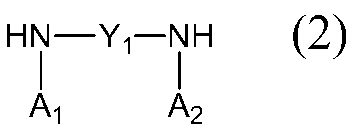
- ⁇ Diamine> Although the diamine component used for manufacture of a polyimide precursor is not specifically limited, The diamine which is a raw material of the polyimide precursor represented by the said Formula (1) is represented by following formula (2).
- a 1 and A 2 are the same definitions as A 1 and A 2 in the above formula (1), including preferred examples.
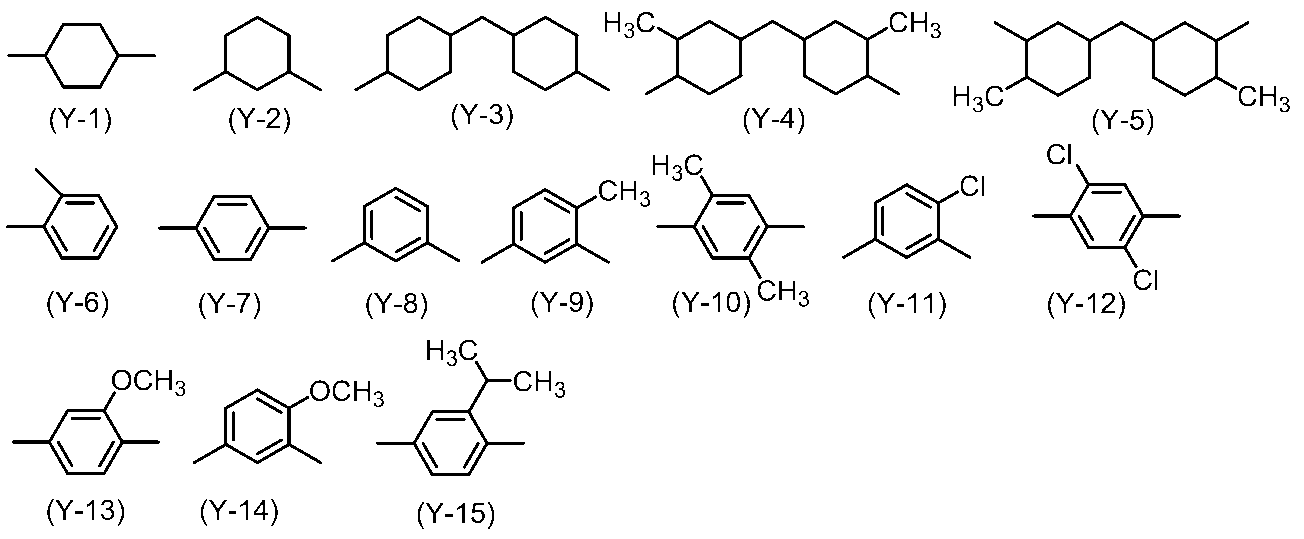
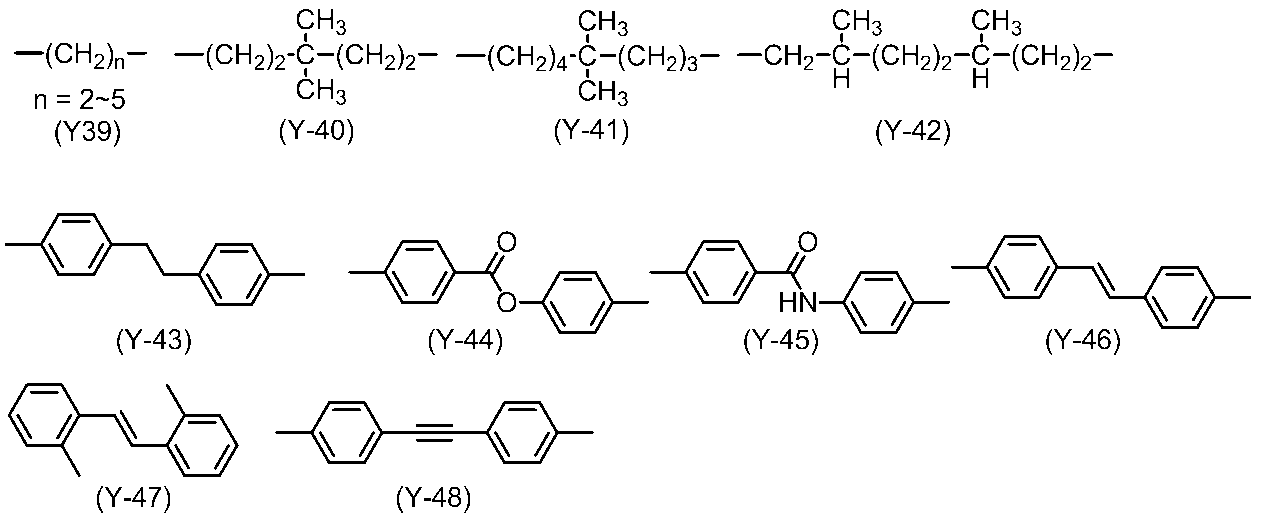
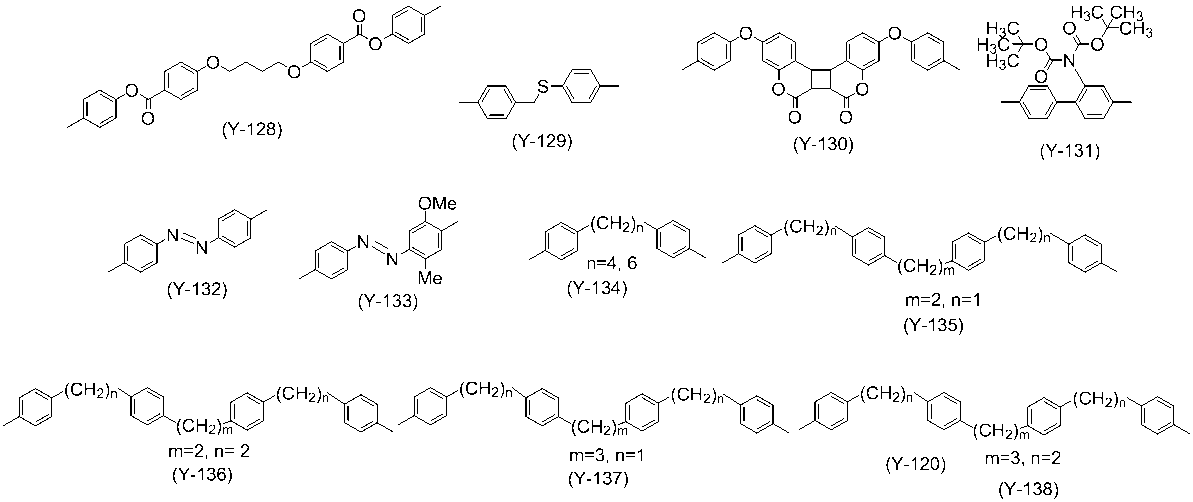
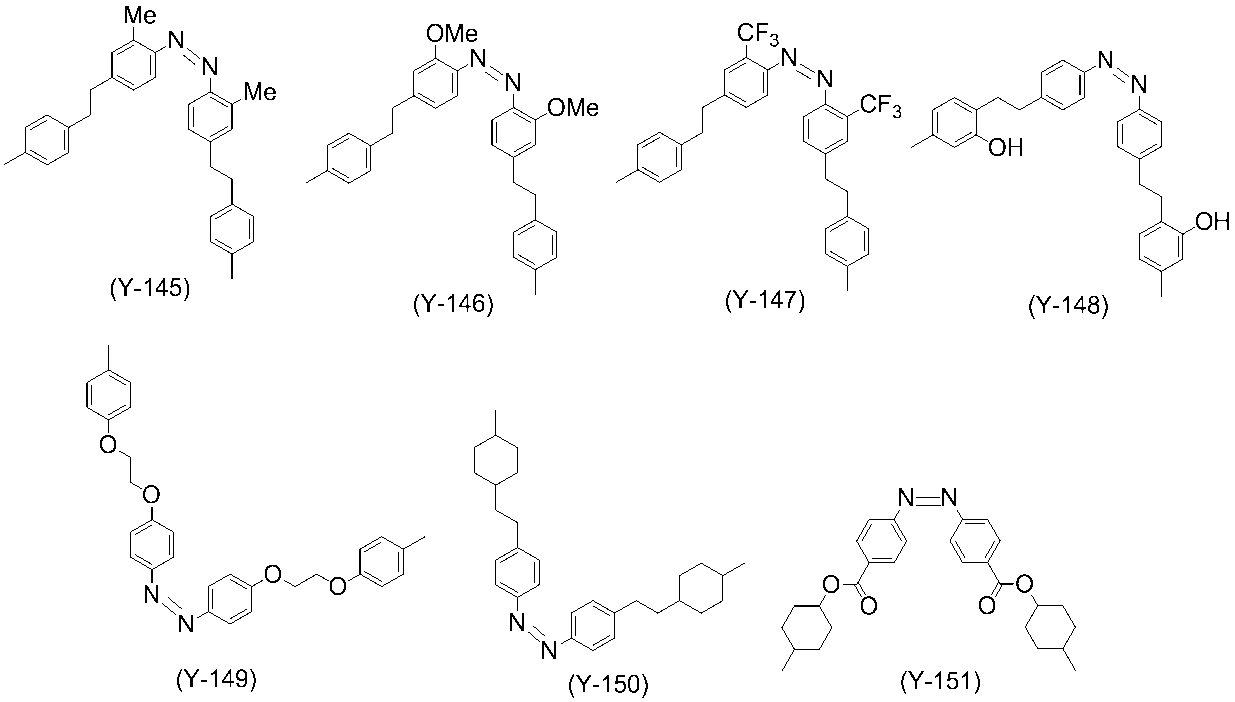
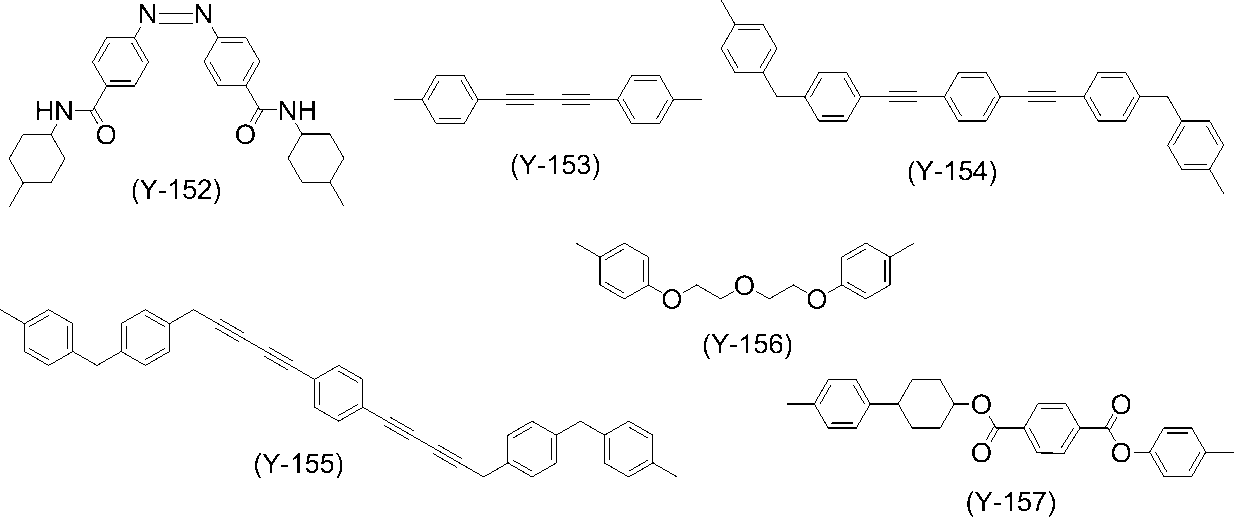
- Y 1 include the following (Y-1) ⁇ (Y -170).
- Me represents a methyl group
- n represents an integer of 1 to 6.
- Y 1 is, (Y-7), ( Y-8), (Y-16), (Y-17), (Y-18), (Y-20), (Y-21), (Y-22), (Y-28), (Y-35), (Y-38), (Y-43), (Y-48), (Y-64), (Y-66), (Y -71), (Y-72), (Y-76), (Y-77), (Y-80), (Y-81), (Y-82), (Y-83), (Y156), (Y-159), (Y-160), (Y-161), (Y-162) (Y-168), (Y-169), or (Y-170) are preferred.
- tetracarboxylic acid derivative used for manufacture of a polyimide precursor is not specifically limited, As a tetracarboxylic acid derivative component which is a raw material of the polyimide precursor represented by the above formula (1), only tetracarboxylic dianhydride is used.
- the derivatives thereof include tetracarboxylic acid, tetracarboxylic acid dihalide, tetracarboxylic acid dialkyl ester, and tetracarboxylic acid dialkyl ester dihalide.
- tetracarboxylic dianhydride or derivatives thereof those represented by the following formula (3) are preferable.
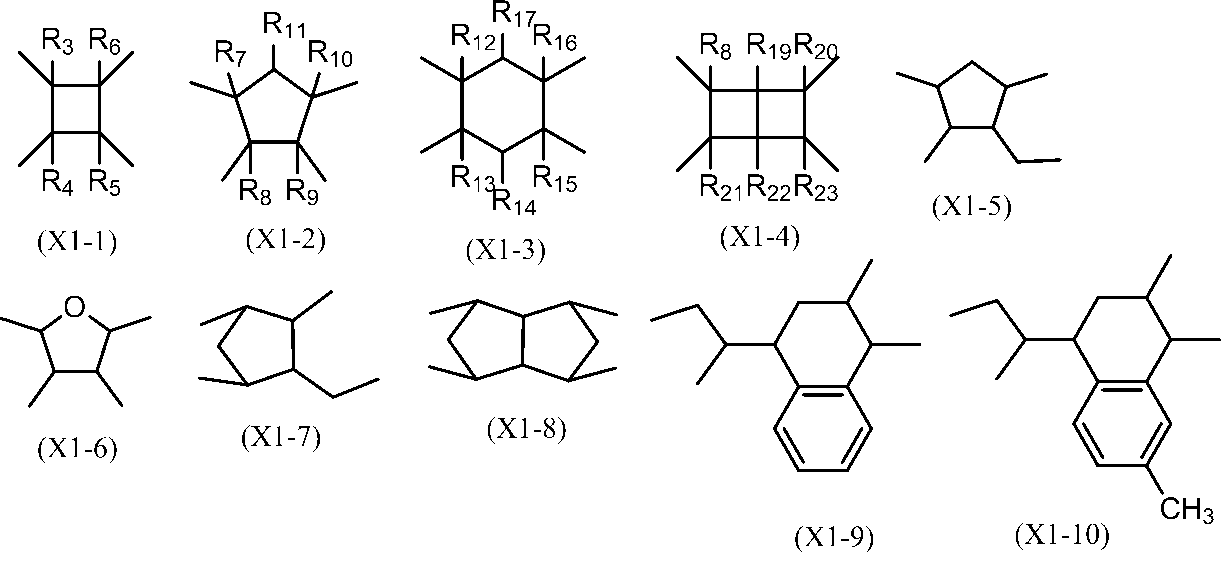
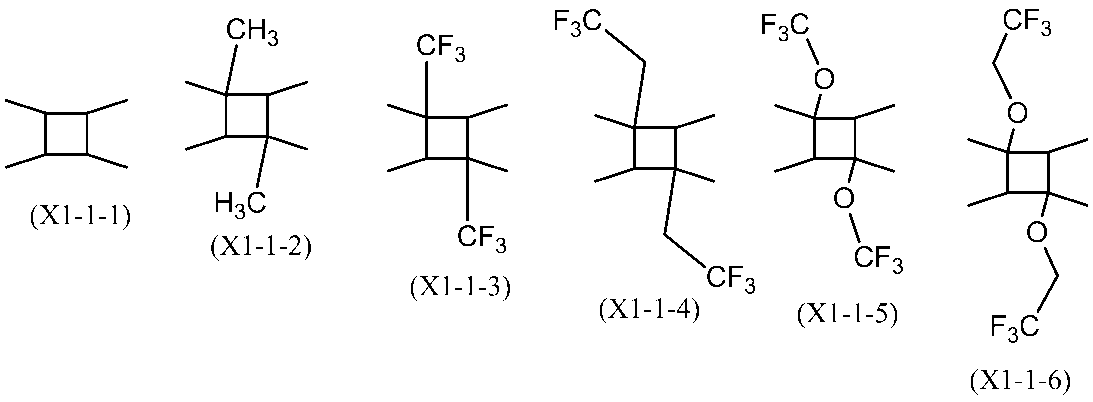
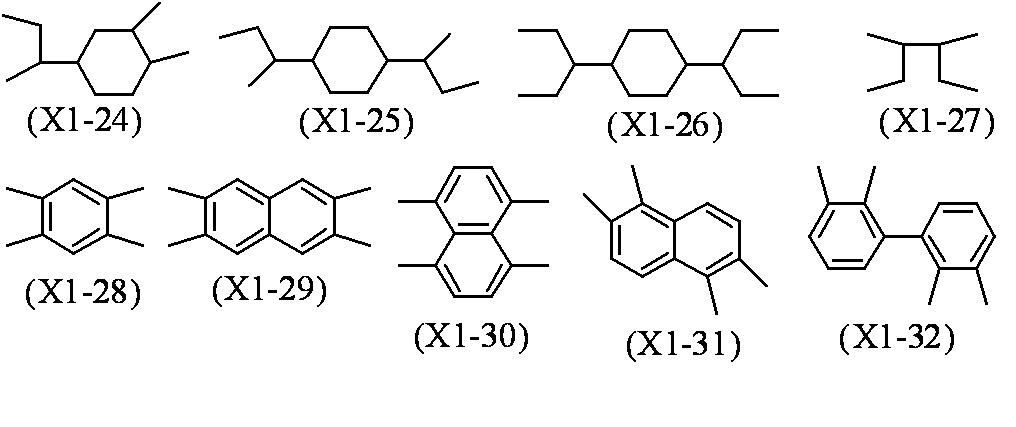
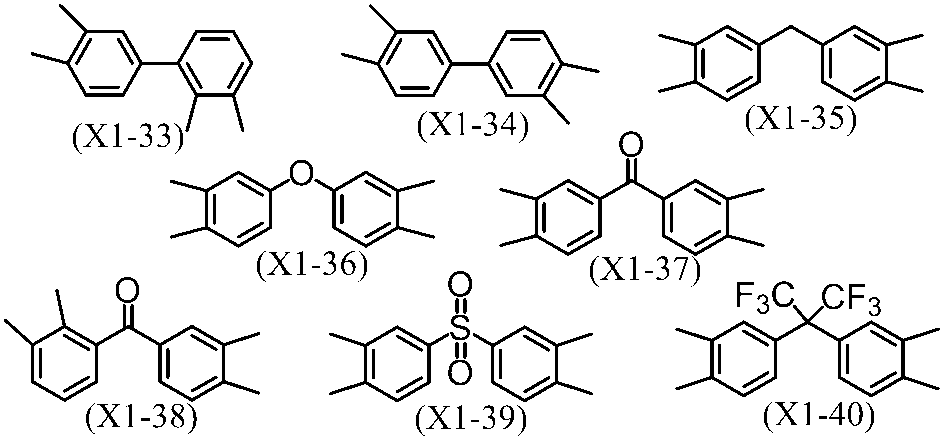
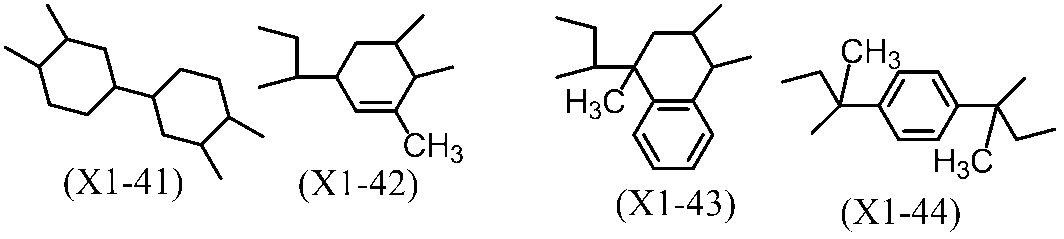
- X 1 is a tetravalent organic group having an alicyclic structure, and the structure is not particularly limited. Specific examples thereof include the following formulas (X1-1) to (X1-44).
- R 3 to R 23 each independently represents a hydrogen atom, a halogen atom, an alkyl group having 1 to 6 carbon atoms, an alkenyl group having 2 to 6 carbon atoms, An alkynyl group having 2 to 6 carbon atoms, a monovalent organic group having 1 to 6 carbon atoms containing a fluorine atom, or a phenyl group.
- R 3 to R 23 are preferably a hydrogen atom, a halogen atom, a methyl group, or an ethyl group, and more preferably a hydrogen atom or a methyl group.
- Specific examples of the formula (X1-1) include the following formulas (X1-1-1) to (X1-1-6). (X1-1-1) is particularly preferred from the viewpoints of liquid crystal orientation and photoreaction sensitivity.
- the tetracarboxylic dianhydride or derivative thereof which is the polyimide precursor or polyimide raw material of the present invention, is represented by the above formula (3) with respect to 1 mol of all tetracarboxylic dianhydrides or derivatives thereof. It is preferable to contain 60 to 100 mol% of carboxylic dianhydride or a derivative thereof. In order to obtain a liquid crystal alignment film having good liquid crystal alignment properties, it is more preferably 80 to 100 mol%, and further preferably 90 to 100 mol%.
- the polyamic acid ester which is one of the polyimide precursors used for this invention can be manufactured by the method of (1), (2) or (3) shown below.
- (1) When manufacturing from a polyamic acid A polyamic acid ester is compoundable by esterifying the polyamic acid obtained from tetracarboxylic dianhydride and diamine. Specifically, the polyamic acid and the esterifying agent are reacted in the presence of an organic solvent at ⁇ 20 ° C. to 150 ° C., preferably 0 ° C. to 50 ° C., for 30 minutes to 24 hours, preferably 1 to 4 hours. Can be synthesized.
- the esterifying agent is preferably one that can be easily removed by purification, and N, N-dimethylformamide dimethyl acetal, N, N-dimethylformamide diethyl acetal, N, N-dimethylformamide dipropyl acetal, N, N-dimethylformamide Dineopentyl butyl acetal, N, N-dimethylformamide di-t-butyl acetal, 1-methyl-3-p-tolyltriazene, 1-ethyl-3-p-tolyltriazene, 1-propyl-3-p -Tolyltriazene, 4- (4,6-dimethoxy-1,3,5-triazin-2-yl) -4-methylmorpholinium chloride and the like.
- the amount of the esterifying agent used is preferably 2 to 6 molar equivalents per 1 mol of the polyamic acid repeating unit.
- the solvent used in the above reaction is preferably N, N-dimethylformamide, N-methyl-2-pyrrolidone, or ⁇ -butyrolactone in view of polymer solubility. These may be used alone or in combination of two or more. Good.
- the concentration of the polymer in the reaction solution is preferably 1 to 30% by mass and more preferably 5 to 20% by mass from the viewpoint that polymer precipitation is difficult to occur and a high molecular weight product is easily obtained.
- Polyamic acid ester can be manufactured from tetracarboxylic-acid diester dichloride and diamine. Specifically, tetracarboxylic acid diester dichloride and diamine in the presence of a base and an organic solvent at ⁇ 20 ° C. to 150 ° C., preferably 0 ° C. to 50 ° C., for 30 minutes to 24 hours, preferably 1 to 4 hours. It can be synthesized by reacting.
- a base pyridine, triethylamine, 4-dimethylaminopyridine and the like can be used, but pyridine is preferable because the reaction proceeds gently.
- the amount of the base used is preferably 2 to 4 times the molar amount of the tetracarboxylic acid diester dichloride from the viewpoint of easy removal and high molecular weight.
- the solvent used in the above reaction is preferably N-methyl-2-pyrrolidone or ⁇ -butyrolactone in view of the solubility of the monomer and polymer, and these may be used alone or in combination.
- the polymer concentration in the reaction solution is preferably 1 to 30% by mass, and more preferably 5 to 20% by mass from the viewpoint that polymer precipitation is unlikely to occur and a high molecular weight product is easily obtained.
- the solvent used for the synthesis of the polyamic acid ester is preferably dehydrated as much as possible, and it is preferable to prevent mixing of outside air in a nitrogen atmosphere.
- Polyamic acid ester can be manufactured by polycondensing tetracarboxylic-acid diester and diamine. Specifically, tetracarboxylic acid diester and diamine in the presence of a condensing agent, a base, and an organic solvent at 0 ° C. to 150 ° C., preferably 0 ° C. to 100 ° C., for 30 minutes to 24 hours, preferably 3 to 15 It can be produced by reacting for a period of time.
- condensing agent examples include triphenyl phosphite, dicyclohexylcarbodiimide, 1-ethyl-3- (3-dimethylaminopropyl) carbodiimide hydrochloride, N, N′-carbonyldiimidazole, dimethoxy-1,3,5-triazide.
- Nylmethylmorpholinium O- (benzotriazol-1-yl) -N, N, N ′, N′-tetramethyluronium tetrafluoroborate, O- (benzotriazol-1-yl) -N, N , N ′, N′-tetramethyluronium hexafluorophosphate, (2,3-dihydro-2-thioxo-3-benzoxazolyl) phosphonate diphenyl, and the like.
- the addition amount of the condensing agent is preferably 2 to 3 times the molar amount of the tetracarboxylic acid diester.
- tertiary amines such as pyridine and triethylamine can be used.
- the amount of the base used is preferably 2 to 4 times the molar amount of the diamine component from the viewpoint of easy removal and high molecular weight.
- the reaction proceeds efficiently by adding Lewis acid as an additive.
- Lewis acid lithium halides such as lithium chloride and lithium bromide are preferable.
- the addition amount of the Lewis acid is preferably 0 to 1.0 times mol with respect to the diamine component.
- the production method of (1) or (2) is particularly preferable.
- the polyamic acid ester solution obtained as described above can be polymerized by pouring into a poor solvent while stirring well. Precipitation is performed several times, and after washing with a poor solvent, a purified polyamic acid ester powder can be obtained at room temperature or by heating and drying.
- a poor solvent is not specifically limited, Water, methanol, ethanol, hexane, butyl cellosolve, acetone, toluene etc. are mentioned.
- the polyamic acid which is a polyimide precursor used in the present invention can be produced by the method shown below. Specifically, tetracarboxylic dianhydride and diamine are reacted in the presence of an organic solvent at ⁇ 20 ° C. to 150 ° C., preferably 0 ° C. to 50 ° C., for 30 minutes to 24 hours, preferably 1 to 12 hours. Can be synthesized.
- the organic solvent used in the above reaction is preferably N, N-dimethylformamide, N-methyl-2-pyrrolidone, or ⁇ -butyrolactone in view of the solubility of the monomer and polymer. These may be used alone or in combination of two or more. It may be used.
- the concentration of the polymer is preferably 1 to 30% by mass, and more preferably 5 to 20% by mass from the viewpoint that polymer precipitation is difficult to occur and a high molecular weight body is easily obtained.
- the polyamic acid obtained as described above can be recovered by precipitating the polymer by pouring into the poor solvent while thoroughly stirring the reaction solution. Moreover, the powder of polyamic acid refine
- a poor solvent is not specifically limited, Water, methanol, ethanol, hexane, butyl cellosolve, acetone, toluene etc. are mentioned.
- the polyimide used in the present invention can be produced by imidizing the polyamic acid ester or polyamic acid.
- chemical imidization in which a basic catalyst is added to a polyamic acid solution obtained by dissolving the polyamic acid ester solution or the polyamic acid ester resin powder in an organic solvent is simple.
- Chemical imidization is preferable because the imidization reaction proceeds at a relatively low temperature and the molecular weight of the polymer does not easily decrease during the imidization process.
- Chemical imidation can be performed by stirring the polyamic acid ester to be imidized in an organic solvent in the presence of a basic catalyst.
- the solvent used at the time of the polymerization reaction mentioned above can be used.
- the basic catalyst include pyridine, triethylamine, trimethylamine, tributylamine, trioctylamine and the like. Of these, triethylamine is preferred because it has sufficient basicity to allow the reaction to proceed.
- the temperature during the imidation reaction is ⁇ 20 ° C. to 140 ° C., preferably 0 ° C. to 100 ° C., and the reaction time can be 1 to 100 hours.
- the amount of the basic catalyst is 0.5 to 30 moles, preferably 2 to 20 moles, of the amic acid ester group.
- the imidation ratio of the resulting polymer can be controlled by adjusting the amount of catalyst, temperature, and reaction time. Since the added catalyst or the like remains in the solution after the imidation reaction, the obtained imidized polymer is preferably recovered and redissolved in an organic solvent to obtain the liquid crystal aligning agent of the present invention. .
- Chemical imidation which adds a catalyst to the solution of the said polyamic acid obtained by reaction with a diamine component and tetracarboxylic dianhydride is simple. Chemical imidization is preferable because the imidization reaction proceeds at a relatively low temperature and the molecular weight of the polymer is unlikely to decrease during the imidization process. Chemical imidation can be performed by stirring a polymer to be imidized in an organic solvent in the presence of a basic catalyst and an acid anhydride. As an organic solvent, the solvent used at the time of the polymerization reaction mentioned above can be used.
- Examples of the basic catalyst include pyridine, triethylamine, trimethylamine, tributylamine, trioctylamine and the like. Of these, pyridine is preferable because it has an appropriate basicity for proceeding with the reaction.
- Examples of the acid anhydride include acetic anhydride, trimellitic anhydride, pyromellitic anhydride and the like. Among them, use of acetic anhydride is preferable because purification after completion of the reaction is facilitated.
- the temperature for carrying out the imidization reaction is ⁇ 20 ° C. to 140 ° C., preferably 0 ° C. to 100 ° C., and the reaction time can be 1 to 100 hours.
- the amount of the basic catalyst is 0.5 to 30 mol times, preferably 2 to 20 mol times the amic acid group, and the amount of the acid anhydride is 1 to 50 mol times, preferably 3 to 30 mol times the amic acid group. Is double.
- the imidation ratio of the resulting polymer can be controlled by adjusting the amount of catalyst, temperature, and reaction time.
- the liquid crystal aligning agent of the present invention is preferable.
- the polyimide solution obtained as described above can be polymerized by pouring into a poor solvent while stirring well. Precipitation is performed several times, and after washing with a poor solvent, a purified polyamic acid ester powder can be obtained at room temperature or by heating and drying.
- the poor solvent is not particularly limited, and examples thereof include methanol, acetone, hexane, butyl cellosolve, heptane, methyl ethyl ketone, methyl isobutyl ketone, ethanol, toluene, and benzene.
- the liquid crystal aligning agent of this invention has the form of the solution in which the polymer containing a specific polymer was melt
- the molecular weight of the polyimide precursor and polyimide described in the present invention is preferably 2,000 to 500,000 in weight average molecular weight, more preferably 5,000 to 300,000, and still more preferably 10,000 to 100. , 000.
- the number average molecular weight is preferably 1,000 to 250,000, more preferably 2,500 to 150,000, and still more preferably 5,000 to 50,000.
- the concentration of the polymer of the liquid crystal aligning agent used in the present invention can be appropriately changed depending on the setting of the thickness of the coating film to be formed, but it is 1 weight from the viewpoint of forming a uniform and defect-free coating film. % Or more is preferable, and 10% by weight or less is preferable from the viewpoint of storage stability of the solution.
- the solvent in the liquid crystal aligning agent of this invention can contain solvents (henceforth other solvent) other than the solvent A, B, C which comprises the said specific solvent.
- solvents include a solvent that dissolves the polyimide precursor and polyimide (also referred to as a good solvent), and a solvent that improves the coating properties and surface smoothness of the liquid crystal alignment film when a liquid crystal aligning agent is applied (also referred to as a poor solvent). May be included). Specific examples of other solvents are shown below, but the invention is not limited to these examples.
- Examples of good solvents include N, N-dimethylformamide, N, N-dimethylacetamide, dimethyl sulfoxide, methyl ethyl ketone, cyclohexanone, cyclopentanone, 3-methoxy-N, N-dimethylpropanamide or 4-hydroxy-4-methyl.
- -2-Pentanone can be mentioned.
- the poor solvent include ethanol, isopropyl alcohol, 1-butanol, 2-butanol, isobutyl alcohol, tert-butyl alcohol, 1-pentanol, 2-pentanol, 3-pentanol, 2-methyl-1- Butanol, isopentyl alcohol, tert-pentyl alcohol, 3-methyl-2-butanol, neopentyl alcohol, 1-hexanol, 2-methyl-1-pentanol, 2-methyl-2-pentanol, 2-ethyl-1 -Butanol, 1-heptanol, 2-heptanol, 3-heptanol, 1-octanol, 2-octanol, 2-ethyl-1-hexanol, cyclohexanol, 1-methylcyclohexanol, 2-methylcyclohexanol, 3-methylcyclo Hexanol 1,2-ethanediol, 1,2-propanedi
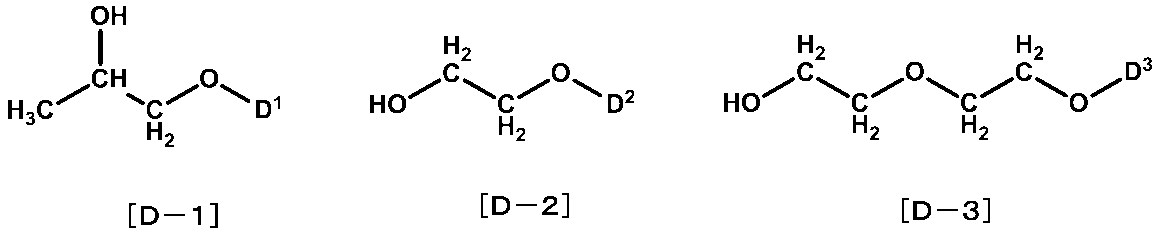
- solvents represented by the following [D-1] to [D-3] are preferable.
- D 1 represents an alkyl group having 1 to 3 carbon atoms
- D 2 represents an alkyl group having 1 to 3 carbon atoms
- D-3 represents an alkyl group having 1 to 4 carbon atoms.
- the liquid crystal aligning agent of the present invention has at least one substituent selected from the group consisting of a crosslinkable compound having an epoxy group, an isocyanate group, an oxetane group or a cyclocarbonate group, a hydroxyl group, a hydroxyalkyl group and a lower alkoxyalkyl group.
- the crosslinkable compound which has or the crosslinkable compound which has a polymerizable unsaturated bond may be included. It is necessary to have two or more of these substituents and polymerizable unsaturated bonds in the crosslinkable compound.
- crosslinkable compound having an epoxy group or an isocyanate group examples include bisphenolacetone glycidyl ether, phenol novolac epoxy resin, cresol novolac epoxy resin, triglycidyl isocyanurate, tetraglycidylaminodiphenylene, tetraglycidyl-m-xylenediamine, tetra Glycidyl-1,3-bis (aminoethyl) cyclohexane, tetraphenyl glycidyl ether ethane, triphenyl glycidyl ether ethane, bisphenol hexafluoroacetodiglycidyl ether, 1,3-bis (1- (2,3-epoxypropoxy)- 1-trifluoromethyl-2,2,2-trifluoromethyl) benzene, 4,4-bis (2,3-epoxypropoxy) octafluorobiphenyl Triglycidyl-p-amin
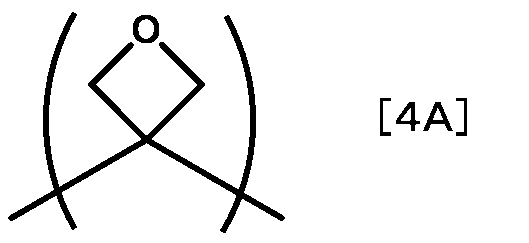
- the crosslinkable compound having an oxetane group is a compound having at least two oxetane groups represented by the following formula [4A]. Specific examples include crosslinkable compounds represented by the formulas [4a] to [4k] published on pages 58 to 59 of International Publication No. WO2011 / 132751 (published 2011.10.27).
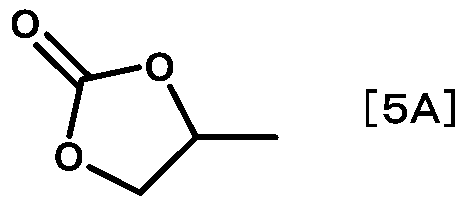
- the crosslinkable compound having a cyclocarbonate group is a crosslinkable compound having at least two cyclocarbonate groups represented by the following formula [5A]. Specifically, crosslinkable compounds represented by the formulas [5-1] to [5-42] described on pages 76 to 82 of International Publication No. WO2012 / 014898 (published on 2012.2.2). It is done.
- Examples of the crosslinkable compound having at least one substituent selected from the group consisting of a hydroxyl group and an alkoxyl group include an amino resin having a hydroxyl group or an alkoxyl group, such as a melamine resin, a urea resin, a guanamine resin, and a glycoluril.
- a melamine resin, a urea resin, a guanamine resin, and a glycoluril such as a melamine resin, a urea resin, a guanamine resin, and a glycoluril.
- a melamine derivative, a benzoguanamine derivative, or glycoluril in which a hydrogen atom of an amino group is substituted with a methylol group, an alkoxymethyl group, or both can be used.
- the melamine derivative or benzoguanamine derivative may be a dimer or a trimer. These preferably have an average of 3 to 6 methylol groups or alkoxymethyl groups per
- Examples of the melamine derivative or benzoguanamine derivative include MX-750, which has an average of 3.7 substituted methoxymethyl groups per triazine ring, and an average of 5.8 methoxymethyl groups per triazine ring.
- glycoluril examples include butoxymethylated glycoluril such as Cymel 1170, methylolated glycoluril such as Cymel 1172, methoxymethylolated glycoluril such as Powderlink 1174, and the like.
- examples of the benzene or phenolic compound having a hydroxyl group or an alkoxyl group include 1,3,5-tris (methoxymethyl) benzene, 1,2,4-tris (isopropoxymethyl) benzene, 1,4-bis ( sec-butoxymethyl) benzene or 2,6-dihydroxymethyl-p-tert-butylphenol. More specifically, the crosslinkable compounds of the formulas [6-1] to [6-48] described on pages 62 to 66 of International Publication No. WO2011 / 132751 (published 2011.10.27) can be mentioned. It is done.
- crosslinkable compound having a polymerizable unsaturated bond examples include trimethylolpropane tri (meth) acrylate, pentaerythritol tri (meth) acrylate, dipentaerythritol penta (meth) acrylate, and tri (meth) acryloyloxyethoxytrimethylol.
- Crosslinkable compounds having three polymerizable unsaturated groups in the molecule such as propane or glycerin polyglycidyl ether poly (meth) acrylate, ethylene glycol di (meth) acrylate, diethylene glycol di (meth) acrylate, tetraethylene glycol di (Meth) acrylate, polyethylene glycol di (meth) acrylate, propylene glycol di (meth) acrylate, polypropylene glycol di (meth) acrylate, butylene glycol Rudi (meth) acrylate, neopentyl glycol di (meth) acrylate, ethylene oxide bisphenol A type di (meth) acrylate, propylene oxide bisphenol type di (meth) acrylate, 1,6-hexanediol di (meth) acrylate, glycerin Di (meth) acrylate, pentaerythritol di (meth) acrylate, ethylene glycol diglycidyl
- E 1 represents a group selected from the group consisting of a cyclohexane ring, a bicyclohexane ring, a benzene ring, a biphenyl ring, a terphenyl ring, a naphthalene ring, a fluorene ring, an anthracene ring and a phenanthrene ring.
- E 2 represents a group selected from the following formula [7a] or [7b], and n represents an integer of 1 to 4.
- the crosslinkable compound used for the liquid crystal aligning agent of the present invention may be one kind or a combination of two or more kinds.
- the content of the crosslinkable compound in the liquid crystal aligning agent of the present invention is preferably 0.1 to 150 parts by mass with respect to 100 parts by mass of all polymer components. Of these, 0.1 to 100 parts by mass is preferable and 1 to 50 parts by mass is more preferable in order for the crosslinking reaction to proceed and to achieve the desired effect.
- the liquid crystal aligning agent of this invention can contain the compound which improves the uniformity and the surface smoothness of the film thickness of the liquid crystal aligning film at the time of apply
- examples of the compound that improves the film thickness uniformity and surface smoothness of the liquid crystal alignment film include fluorine-based surfactants, silicone-based surfactants, and nonionic surfactants.
- F-top EF301, EF303, EF352 (above, manufactured by Tochem Products), MegaFuck F171, F173, R-30 (above, manufactured by Dainippon Ink), Florard FC430, FC431 (above, Asahi Guard AG710, Surflon S-382, SC101, SC102, SC103, SC104, SC105, SC106 (above, manufactured by Asahi Glass Co., Ltd.) and the like.
- the amount of the surfactant used is preferably 0.01 to 2 parts by mass, more preferably 0.01 to 1 part by mass with respect to 100 parts by mass of all the polymer components contained in the liquid crystal aligning agent.
- the liquid crystal aligning agent is disclosed in International Publication No. WO2011 / 132751 (published 2011.10.27) on pages 69 to 73 as a compound that promotes charge transfer in the liquid crystal alignment film and promotes charge release of the device.
- Nitrogen-containing heterocyclic amines represented by the formulas [M1] to [M156] can also be added. This amine may be added directly to the liquid crystal aligning agent, but it is preferable to add it after making a solution having a concentration of 0.1 to 10% by mass, preferably 1 to 7% by mass.
- the solvent is not particularly limited as long as the specific polymer is dissolved.
- the alignment A silane coupling agent for the purpose of improving the adhesion between the film and the substrate an imidization accelerator for the purpose of efficiently proceeding imidization by heating of the polyimide precursor when the coating film is baked may be included.
- the liquid crystal alignment film of the present invention is a film obtained by applying the above liquid crystal aligning agent to a substrate, drying and baking.
- the substrate to which the liquid crystal aligning agent of the present invention is applied is not particularly limited as long as it is a highly transparent substrate, and a glass substrate, a silicon nitride substrate, a plastic substrate such as an acrylic substrate or a polycarbonate substrate, or the like can also be used. At that time, it is preferable to use a substrate on which an ITO electrode or the like for driving the liquid crystal is used in terms of simplification of the process.
- an opaque material such as a silicon wafer can be used as long as it is only on one side of the substrate, and a material that reflects light such as aluminum can be used for the electrode in this case.
- the application method of the liquid crystal aligning agent is industrially generally performed by screen printing, offset printing, flexographic printing, or an inkjet method, and other coating methods include a dipping method, a roll coater method, and a slit coater. Methods, spinner methods, spray methods, and the like are known. Among them, the liquid crystal aligning agent of the present invention can reduce the viscosity of the liquid crystal aligning agent while maintaining a high content ratio of the polymer and the molecular weight of the polymer as described above. Can be suitably used.
- the solvent can be evaporated by a heating means such as a hot plate, a thermal circulation oven, or an IR (infrared) oven to form a liquid crystal alignment film.
- a heating means such as a hot plate, a thermal circulation oven, or an IR (infrared) oven to form a liquid crystal alignment film.
- Arbitrary temperature and time can be selected for the drying and baking steps after applying the liquid crystal aligning agent.
- a condition of baking at 50 to 120 ° C. for 1 to 10 minutes and then baking at 150 to 300 ° C. for 5 to 120 minutes is mentioned in order to sufficiently remove the contained solvent.
- the thickness of the liquid crystal alignment film after baking is too thin, the reliability of the liquid crystal display element may be lowered, and thus it is preferably 5 to 300 nm, and more preferably 10 to 200 nm.
- the liquid crystal aligning agent of the present invention can be used as a liquid crystal aligning film without applying an alignment treatment in a vertical alignment application or the like after being applied and baked on a substrate, followed by a rubbing treatment or a photo-alignment treatment.
- a known method or apparatus can be used.
- a liquid crystal display element having a passive matrix structure As an example of a method for manufacturing a liquid crystal cell, a liquid crystal display element having a passive matrix structure will be described as an example.
- an active matrix liquid crystal display element in which a switching element such as a TFT (Thin Film Transistor) is provided in each pixel portion constituting the image display may be used.
- a transparent glass substrate is prepared, a common electrode is provided on one substrate, and a segment electrode is provided on the other substrate.
- These electrodes can be ITO electrodes, for example, and are patterned so as to display a desired image.
- an insulating film is provided on each substrate so as to cover the common electrode and the segment electrode.
- the insulating film can be, for example, a SiO 2 —TiO 2 film formed by a sol-gel method.
- a liquid crystal alignment film is formed on each substrate, the other substrate is overlapped with one substrate so that the liquid crystal alignment film faces each other, and the periphery is bonded with a sealant.
- a spacer is usually mixed in the sealant, and it is preferable to spray a spacer for controlling the substrate gap on the in-plane portion where no sealant is provided.
- a part of the sealant is provided with an opening that can be filled with liquid crystal from the outside.
- a liquid crystal material is injected into the space surrounded by the two substrates and the sealing agent through the opening provided in the sealing agent, and then the opening is sealed with an adhesive.
- a vacuum injection method may be used, or a method utilizing capillary action in the atmosphere may be used.
- the liquid crystal material may be either a positive liquid crystal material or a negative liquid crystal material, but a negative liquid crystal material is preferred.
- a polarizing plate is installed. Specifically, a pair of polarizing plates is attached to the surfaces of the two substrates opposite to the liquid crystal layer.
- DA-1 1,5-bis (4-aminophenoxy) pentane
- DA-2 4,4′-diaminodiphenylmethane
- DA-3 4,4′-diaminodiphenylamine
- CA-1 pyromellitic dianhydride
- CA-2 1,2,3,4-cyclobutanetetracarboxylic dianhydride
- CA-3 3,4-dicarboxy-1,2,3,4-tetrahydro- 1-naphthalene succinic dianhydride
- NMP N-methyl-2-pyrrolidone
- GBL ⁇ -butyllactone
- DME dipropylene glycol dimethyl ether
- DPM dipropylene glycol monomethyl ether
- DAA diacetone alcohol
- DEDG diethylene glycol diethyl
- ⁇ Measurement of viscosity> The viscosities of polyamic acid and liquid crystal aligning agent were measured with an E-type viscometer (manufactured by Toki Sangyo Co., Ltd.) at a temperature of 25 ° C.
- ⁇ Measurement method of solid content concentration> The solid content concentration in a solution such as a polyamic acid solution was adjusted. 1.0 g of the solution was measured in an aluminum cup and heat-treated at 200 ° C. for 2 hours, then the amount of solid remaining in the cup was measured, and the solid content concentration of the solution was measured.
- Example 3 A mixed solution of 33.3 g of 12 wt% polyamic acid (A2) solution and 106.6 g of 15 wt% polyamic acid (B2) solution was stirred for 30 minutes, and then 11.1 g of NMP, By adding 20.0 g of NMP solution containing 1.0% by weight of 3-glycidoxypropyltriethoxysilane, 204.0 g of GBL, 75.0 g of DME and 50.0 g of DAA, and stirring at room temperature for 3 hours.
- Example 5 A mixed solution of 33.3 g of a 12 wt% polyamic acid (A2) solution and 106.6 g of a 15 wt% polyamic acid (B2) solution was stirred for 30 minutes, and then 5.1 g of NMP, 20.0 g of NMP solution containing 1.0% by weight of 3-glycidoxypropyltriethoxysilane, 6.0 g of NMP solution containing 10% by weight of AD-1, 204.0 g of GBL, and 75.0 g of DME And DAA (50.0 g) was added, and the mixture was stirred at room temperature for 3 hours.
- the polymer solid content ratio of A2 and B2 was 2: 8, and AD-1 was contained by 3.0% by weight with respect to the polymer solid content.
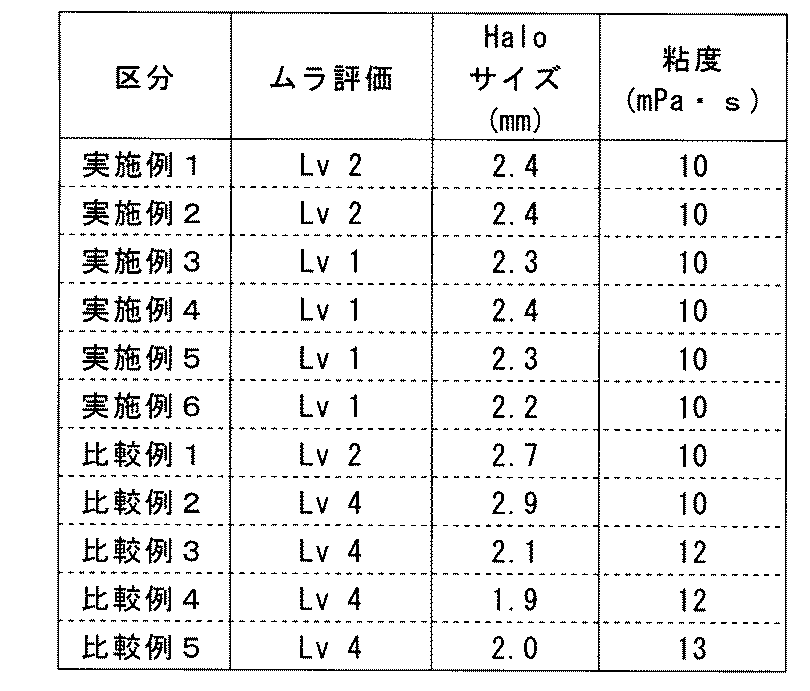
- liquid crystal aligning agents of Examples 1 to 6 and Comparative Examples 1 to 5 were filtered through a filter having a pore diameter of 1 ⁇ m, and the viscosity thereof was measured and shown in Table 2. When the viscosity is low, it can be said that the liquid crystal aligning agent is better. Moreover, the following application
- Examples 1 and 2 and Comparative Examples 1 to 4 prepared above were coated on a TFT substrate using an inkjet coating apparatus (manufactured by Ishii Notation Co., Ltd.).
- the coating conditions were a nozzle pitch of 127 ⁇ m, a coating speed of 250 mm / sec, a dispensing amount of 70 pL, and a coating area of 36 ⁇ 36 mm.
- the coating film was applied on the condition that the thickness was 120 nm when baked in an IR oven at 230 ° C. for 15 minutes after temporarily drying on a hot plate at 110 ° C. for 1 minute.
- the coating film obtained by temporarily drying the coated substrate at 110 ° C. was evaluated in four stages by comparing the degree of dot and streak-like unevenness generated by the influence of contact holes and wiring.
- Lv4 is the one where significant unevenness can be confirmed on the entire surface
- Lv3 is the one where the unevenness is partially confirmed
- Lv2 is the one where the unevenness cannot be visually observed
- Lv1 is the one where no unevenness is visible even with the optical microscope.
- a halo size is a favorable coating film, so that a value is small.
Landscapes
- Chemical & Material Sciences (AREA)
- Physics & Mathematics (AREA)
- Organic Chemistry (AREA)
- Chemical Kinetics & Catalysis (AREA)
- Polymers & Plastics (AREA)
- Medicinal Chemistry (AREA)
- Health & Medical Sciences (AREA)
- Nonlinear Science (AREA)
- Engineering & Computer Science (AREA)
- Materials Engineering (AREA)
- Crystallography & Structural Chemistry (AREA)
- Life Sciences & Earth Sciences (AREA)
- Wood Science & Technology (AREA)
- Optics & Photonics (AREA)
- General Physics & Mathematics (AREA)
- Mathematical Physics (AREA)
- Spectroscopy & Molecular Physics (AREA)
- Liquid Crystal (AREA)
- Macromolecular Compounds Obtained By Forming Nitrogen-Containing Linkages In General (AREA)
- Compositions Of Macromolecular Compounds (AREA)
Abstract
Description
かかる液晶配向膜の成膜法としては、一般に、スピンコート、ディップコート、フレキソ印刷などが知られている。なかでも、これまでフレキソ印刷による塗布法が多く使用されている。しかし、フレキソ印刷では液晶パネルの品種違いにより様々な樹脂版が必要となること、製造工程ではその版交換が煩雑であるということ、成膜工程を安定させるためにダミー基板への成膜をしなければならないこと、版の製作が液晶表示パネルの製造コスト上昇の一因になるなどの問題がある。
本発明の要旨は、ポリイミド前駆体及びそのイミド化物であるポリイミドからなる群から選ばれる少なくとも1種の重合体と、下記の溶媒A、溶媒B、及び溶媒Cを含有する溶媒と、を含有することを特徴とする液晶配向剤にある。
溶媒A:N-メチル-2-ピロリドン、N-エチル-2-ピロリドン、γ-ブチロラクトン及びジメチルイミダゾリジノンからなる群から選ばれる少なくとも1種。
溶媒B:ジプロピレングリコールジメチルエーテル
溶媒C:ジエチレングリコールジエチルエーテル及びジアセトンアルコールからなる群から選ばれる少なくとも1種。
本発明の液晶配向剤に含有される溶媒は、溶媒A、溶媒B、及び溶媒Cを含有し、かかる組み合わせた溶媒の含有により本発明の液晶配向剤は、配線構造やC/Hの影響で生じる配向膜の成膜不良を抑制でき、かつ液晶表示素子の表示が不均一となる不良を抑制でき、更には、樹脂成分の含有比率及び樹脂成分の分子量を維持しながら液晶配向剤の粘度を低くすることができる。
溶媒Aは、N-メチル-2-ピロリドン(NMP)、N-エチル-2-ピロリドン(NEP)、γ‐ブチロラクトン(GBL)、及び1,3-ジメチルイミダゾリジノン(DMI)からなる群から選ばれる少なくとも1種の溶媒である。こ溶媒Aは、液晶配向剤中の重合体を溶解させるものである。
なかでも、N-メチル-2-ピロリドン、N-エチル-2-ピロリドン、又はγ‐ブチロラクトンが好ましく、より好ましくはN-メチル-2-ピロリドン又はγ‐ブチロラクトンである。
溶媒Aの含有量は、液晶配向剤の全質量に対し、20~80質量%が好ましく、30~80質量%がより好ましく、50~80質量%が特に好しい。
溶媒Bは、ジプロピレングリコールジメチルエーテル(DME)である。溶媒Bは、液晶配向剤の塗布均一性の向上と低粘度化に寄与する溶媒である。
溶媒Bは、液晶配向剤の全質量に対し、1~30質量%が好ましく、5~30質量%がより好ましく、10~30質量%が特に好ましい。
溶媒Cは、ジエチレングリコールジエチルエーテル(DGDE)及びジアセトンアルコール(DAA)からなる群から選ばれる少なくとも1種である。溶媒Cは、本発明の液晶配向剤の低粘度化に寄与する溶媒である。
溶媒Cは、本発明の液晶配向剤の全質量に対し、5~30質量%が好ましく、10~30質量%がより好ましく、10~20質量%が特に好ましい。
本発明の液晶配向剤に含有される特定重合体であるポリイミド前駆体は、下記の式(1)で表わされる構造を有することが好ましい。
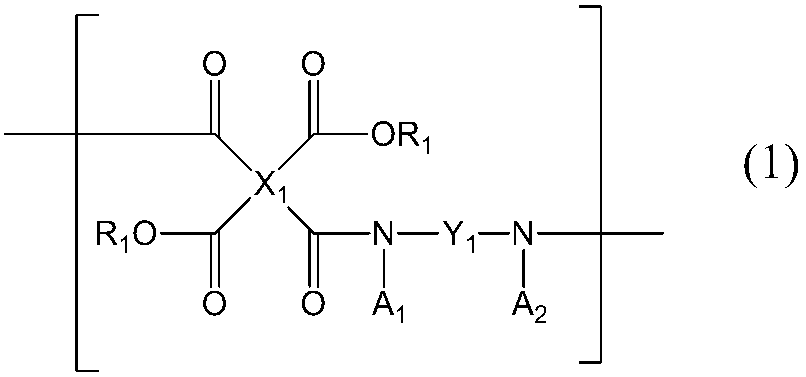
A1及びA2は、それぞれ独立して、水素原子、又は炭素数1~5のアルキル基、炭素数2~5のアルケニル基、又は炭素数2~5のアルキニル基である。液晶配向性の点から、A1及びA2は水素原子、又はメチル基が好ましい。
<ジアミン>
ポリイミド前駆体の製造に用いられるジアミン成分は特に限定されないが、上記式(1)で表されるポリイミド前駆体の原料であるジアミンは、下記式(2)で表わされる。


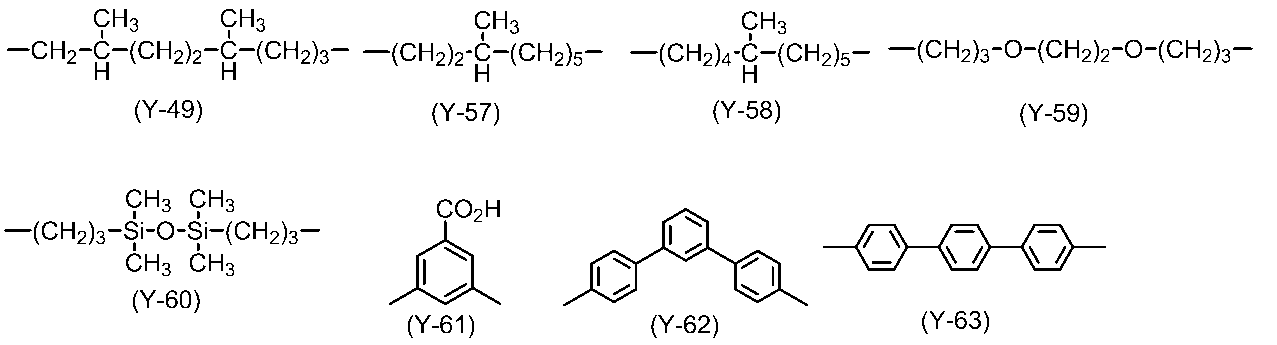
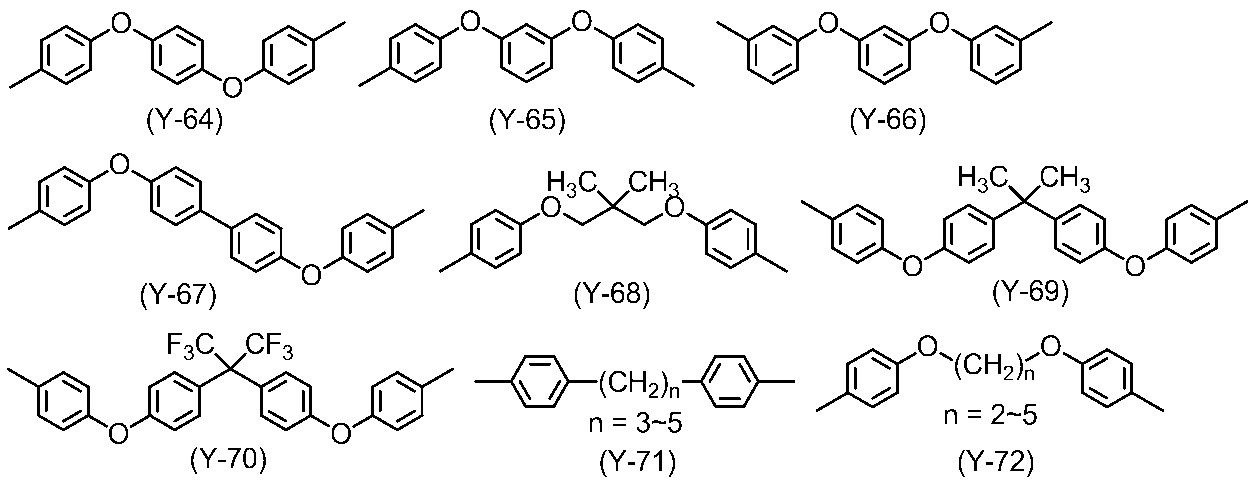



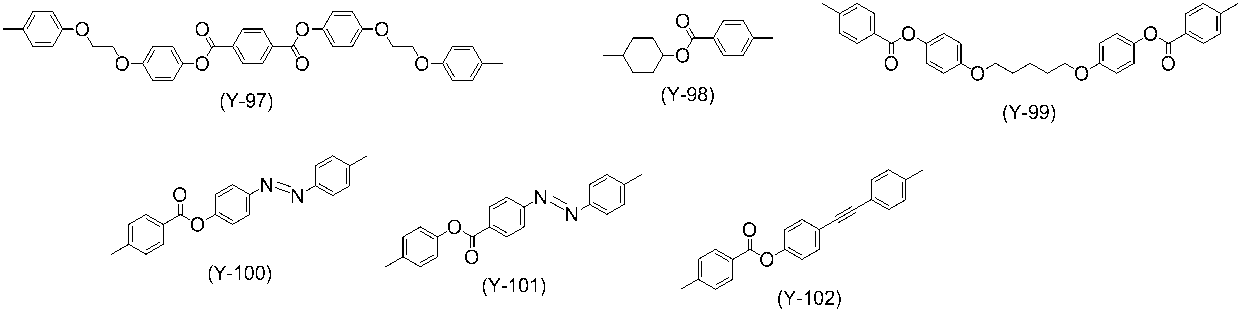


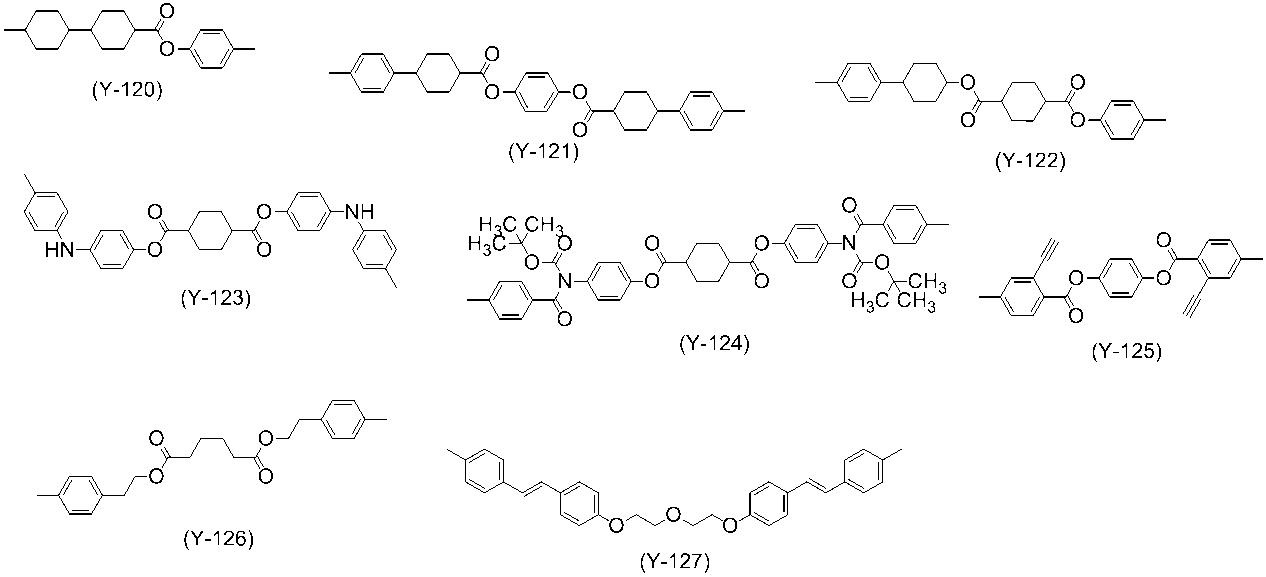


ポリイミド前駆体の製造に用いられるテトラカルボン酸誘導体は特に限定されないが、上記式(1)で表されるポリイミド前駆体の原料であるテトラカルボン酸誘導体成分としては、テトラカルボン酸二無水物だけでなく、その誘導体である、テトラカルボン酸、テトラカルボン酸ジハライド、テトラカルボン酸ジアルキルエステル、テトラカルボン酸ジアルキルエステルジハライドが挙げられる。
テトラカルボン酸二無水物又はその誘導体としては、なかでも、下記式(3)で表されるものが好ましい。

なお、式(X1-1)の具体例としては、下記式(X1-1-1)~(X1-1-6)が挙げられる。液晶配向性及び光反応の感度の点から、(X1-1-1)が特に好ましい。


<ポリアミック酸エステルの製造方法>
本発明に用いられるポリイミド前駆体の一つであるポリアミック酸エステルは、以下に示す(1)、(2)又は(3)の方法で製造できる。
(1)ポリアミック酸から製造する場合
ポリアミック酸エステルは、テトラカルボン酸二無水物とジアミンから得られるポリアミック酸をエステル化することによって合成できる。具体的には、ポリアミック酸とエステル化剤を有機溶剤の存在下で-20℃~150℃、好ましくは0℃~50℃において、30分~24時間、好ましくは1~4時間反応させることによって合成できる。
上記の反応に用いる溶媒は、ポリマーの溶解性からN,N-ジメチルホルムアミド、N-メチル-2-ピロリドン、又はγ-ブチロラクトンが好ましく、これらは1種又は2種以上を混合して用いてもよい。反応液中のポリマーの濃度は、ポリマーの析出が起こりにくく、かつ高分子量体が得やすいという観点から、1~30質量%が好ましく、5~20質量%がより好ましい。
ポリアミック酸エステルは、テトラカルボン酸ジエステルジクロリドとジアミンから製造できる。具体的には、テトラカルボン酸ジエステルジクロリドとジアミンとを塩基と有機溶剤の存在下で-20℃~150℃、好ましくは0℃~50℃において、30分~24時間、好ましくは1~4時間反応させることによって合成することができる。
前記塩基には、ピリジン、トリエチルアミン、4-ジメチルアミノピリジンなどが使用できるが、反応が穏和に進行するためにピリジンが好ましい。塩基の使用量は、除去が容易な量で、かつ高分子量体が得やすいという観点から、テトラカルボン酸ジエステルジクロリドに対し、2~4倍モルが好ましい。
ポリアミック酸エステルは、テトラカルボン酸ジエステルとジアミンを重縮合することにより製造できる。具体的には、テトラカルボン酸ジエステルとジアミンを縮合剤、塩基、及び有機溶剤の存在下で0℃~150℃、好ましくは0℃~100℃において、30分~24時間、好ましくは3~15時間反応させることによって製造できる。
また、上記反応において、ルイス酸を添加剤として加えることで反応が効率的に進行する。ルイス酸としては、塩化リチウム、臭化リチウムなどのハロゲン化リチウムが好ましい。ルイス酸の添加量はジアミン成分に対して0~1.0倍モルが好ましい。
上記のようにして得られるポリアミック酸エステルの溶液は、よく撹拌させながら貧溶媒に注入することで、ポリマーを析出させることができる。析出を数回行い、貧溶媒で洗浄後、常温あるいは加熱乾燥して精製されたポリアミック酸エステルの粉末を得ることができる。貧溶媒は、特に限定されないが、水、メタノール、エタノール、ヘキサン、ブチルセロソルブ、アセトン、トルエン等が挙げられる。
本発明に用いられるポリイミド前駆体であるポリアミック酸は、以下に示す方法により製造ができる。具体的には、テトラカルボン酸二無水物とジアミンとを有機溶媒の存在下、-20℃~150℃、好ましくは0℃~50℃で、30分~24時間、好ましくは1~12時間反応させることによって合成できる。
上記の反応に用いる有機溶媒は、モノマー及びポリマーの溶解性からN,N-ジメチルホルムアミド、N-メチル-2-ピロリドン、又はγ-ブチロラクトンが好ましく、これらは1種又は2種以上を混合して用いてもよい。ポリマーの濃度は、ポリマーの析出が起こりにくく、かつ高分子量体が得やすいという観点から、1~30質量%が好ましく、5~20質量%がより好ましい。
本発明に用いられるポリイミドは、前記ポリアミック酸エステル又はポリアミック酸をイミド化することにより製造できる。ポリアミック酸エステルからポリイミドを製造する場合、前記ポリアミック酸エステル溶液、又はポリアミック酸エステル樹脂粉末を有機溶媒に溶解させて得られるポリアミック酸溶液に塩基性触媒を添加する化学的イミド化が簡便である。化学的イミド化は、比較的低温でイミド化反応が進行し、イミド化の課程で重合体の分子量低下が起こりにくいので好ましい。
化学的イミド化は、イミド化させたいポリアミック酸エステルを、有機溶媒中において塩基性触媒存在下で撹拌することにより行うことができる。有機溶媒としては前述した重合反応時に用いる溶媒を使用できる。塩基性触媒としてはピリジン、トリエチルアミン、トリメチルアミン、トリブチルアミン、トリオクチルアミン等を挙げることができる。中でもトリエチルアミンは反応を進行させるのに充分な塩基性を有するので好ましい。
化学的イミド化は、イミド化させたい重合体を、有機溶媒中において塩基性触媒と酸無水物の存在下で攪拌することにより行うことができる。有機溶媒としては前述した重合反応時に用いる溶媒を使用することができる。塩基性触媒としてはピリジン、トリエチルアミン、トリメチルアミン、トリブチルアミン、トリオクチルアミン等を挙げることができる。中でもピリジンは反応を進行させるのに適度な塩基性を持つので好ましい。また、酸無水物としては無水酢酸、無水トリメリット酸、無水ピロメリット酸等を挙げることができ、中でも無水酢酸を用いると反応終了後の精製が容易となるので好ましい。
ポリアミック酸エステル又はポリアミック酸のイミド化反応後の溶液には、添加した触媒等が残存しているので、以下に述べる手段により、得られたイミド化重合体を回収し、有機溶媒で再溶解して、本発明の液晶配向剤とすることが好ましい。
前記貧溶媒は、特に限定されないが、メタノール、アセトン、ヘキサン、ブチルセルソルブ、ヘプタン、メチルエチルケトン、メチルイソブチルケトン、エタノール、トルエン、ベンゼン等が挙げられる。
本発明の液晶配向剤は、特定重合体を含む重合体が、特定溶媒を含む有機溶媒中に溶解された溶液の形態を有する。本発明に記載のポリイミド前駆体及びポリイミドの分子量は、重量平均分子量で2,000~500,000が好ましく、より好ましくは5,000~300,000であり、さらに好ましくは、10,000~100,000である。また、数平均分子量は、好ましくは、1,000~250,000であり、より好ましくは、2,500~150,000であり、さらに好ましくは、5,000~50,000である。
本発明に用いられる液晶配向剤の重合体の濃度は、形成させようとする塗膜の厚みの設定によって適宜変更することができるが、均一で欠陥のない塗膜を形成させるという点から1重量%以上が好ましく、溶液の保存安定性の点からは10重量%以下が好ましい。
本発明の液晶配向剤における溶媒は、上記特定溶媒を構成する溶媒A、B、C以外の溶媒(以下、他の溶媒ともいう。)を含有できる。他の溶媒としては、ポリイミド前駆体及びポリイミドを溶解する溶媒(良溶媒ともいう)や、液晶配向剤を塗布した際の液晶配向膜の塗膜性や表面平滑性を向上させる溶媒(貧溶媒ともいう)を含有させても良い。下記に、その他の溶媒の具体例を挙げるが、これらの例に限定されるものではない。
良溶媒としては、例えば、N,N-ジメチルホルムアミド、N,N-ジメチルアセトアミド、ジメチルスルホキシド、メチルエチルケトン、シクロヘキサノン、シクロペンタノン、3-メトキシーN,N-ジメチルプロパンアミド又は4-ヒドロキシ-4-メチル-2-ペンタノンなどを挙げることができる。
ヒドロキシル基又はアルコキシル基を有するベンゼン又はフェノール性化合物としては、例えば、1,3,5-トリス(メトキシメチル)ベンゼン、1,2,4-トリス(イソプロポキシメチル)ベンゼン、1,4-ビス(sec-ブトキシメチル)ベンゼン又は2,6-ジヒドロキシメチル-p-tert-ブチルフェノールが挙げられる。
より具体的には、国際公開公報WO2011/132751号(2011.10.27公開)の62~66頁に掲載される、式[6-1]~式[6-48]の架橋性化合物が挙げられる。


本発明の液晶配向剤は、液晶配向剤を塗布した際の液晶配向膜の膜厚の均一性や表面平滑性を向上させる化合物を含有することができる。
液晶配向膜の膜厚の均一性や表面平滑性を向上させる化合物としては、フッ素系界面活性剤、シリコーン系界面活性剤、ノ二オン系界面活性剤などが挙げられる。
界面活性剤の使用量は、液晶配向剤に含有される全ての重合体成分100質量部に対して、好ましくは0.01~2質量部、より好ましくは0.01~1質量部である。
本発明の液晶配向膜は、上記の液晶配向剤を基板に塗布し、乾燥、焼成して得られる膜である。本発明の液晶配向剤を塗布する基板としては透明性の高い基板であれば特に限定されず、ガラス基板、窒化珪素基板、アクリル基板やポリカーボネート基板などのプラスチック基板等を用いることもできる。その際、液晶を駆動させるためのITO電極などが形成された基板を用いると、プロセスの簡素化の点から好ましい。また、反射型の液晶表示素子では、片側の基板のみにならばシリコンウエハーなどの不透明な物でも使用でき、この場合の電極にはアルミニウムなどの光を反射する材料も使用できる。
なかでも、本発明の液晶配向剤は、上記したように、重合体の含有成分比率や重合体の分子量を高く維持しながら液晶配向剤の低粘度にできるため、インクジェット法による塗布、成膜法が好適に使用できる。
本発明の液晶配向剤は、基板上に塗布、焼成した後、ラビング処理や光配向処理などで配向処理し、また、垂直配向用途などでは配向処理無しで、液晶配向膜として使用できる。ラビング処理や光配向処理などの配向処理では、既知の方法や装置が使用できる。
具体的には、透明なガラス製の基板を準備し、一方の基板の上にコモン電極を、他方の基板の上にセグメント電極を設ける。これらの電極は、例えばITO電極とすることができ、所望の画像表示ができるようパターニングされている。次いで、各基板の上に、コモン電極とセグメント電極を被覆するようにして絶縁膜を設ける。絶縁膜は、例えば、ゾル-ゲル法によって形成されたSiO2-TiO2の膜とすることができる。
DA-1:1,5-ビス(4-アミノフェノキシ)ペンタン
DA-2:4,4’-ジアミノジフェニルメタン
DA-3:4,4’-ジアミノジフェニルアミン、
CA-1:ピロメリット酸二無水物
CA-2:1,2,3,4-シクロブタンテトラカルボン酸二無水物
CA-3:3,4-ジカルボキシ-1,2,3,4-テトラヒドロ-1-ナフタレンコハク酸二無水物
NMP:N-メチル-2-ピロリドン、 GBL:γブチルラクトン
DME:ジプロピレングリコールジメチルエーテル
DPM:ジプロピレングリコールモノメチルエーテル
DAA:ダイアセトンアルコール
DEDG:ジエチレングリコールジエチルエーテル
NEP:N-エチル-2-ピロリドン
ポリアミック酸や液晶配向剤などの粘度は、E型粘度計(東機産業社製)で温度25℃において測定した。
<固形分濃度の測定法>
ポリアミック酸溶液などの溶液中の固形分濃度をそくていした。溶液1.0gをアルミニウム製カップに測りとり、200℃で2時間の条件で加熱処理した後、カップに残存している固体量を計測し、溶液の固形分濃度を測定した。
撹拌装置付き及び窒素導入管付きの2000mlフラスコにDA-1を171.8g入れ、NMP1676gを加え、窒素を送りながら撹拌し溶解させた。このジアミン溶液を水冷下で撹拌しながらCA-1を113.8g加え、さらに固形分濃度が12重量%になるようにNMPを加え、窒素雰囲気下、50℃に加熱しながら20時間撹拌し、ポリアミック酸(A1)の溶液(粘度:90mPa・s、固形分濃度:11.2重量%)を得た。
ポリアミック酸(A1)溶液535.7gに対して、NMPを264.3g、及びDME200.0g加え、固形分濃度が6.0重量%のポリアミック酸溶液(a1)を得た。
[ポリアミック酸a2の製造]
ポリアミック酸(A1)溶液535.7gに対して、NMPを264.3g、及びDAA200.0g加え、固形分濃度が6.0重量%のポリアミック酸溶液(a2)溶液を得た。
[ポリアミック酸溶液a3の製造]
ポリアミック酸(A1)溶液535.7gに対して、NMPを264.3g、及びDPM200.0g加え、固形分の濃度が6.0重量%のポリアミック酸溶液(a3)を得た。
撹拌装置付きおよび窒素導入管付きの2000mlフラスコにDA-1を100.8g及びDA-5を34.9g入れ、NMP1337gを加え、窒素を送りながら撹拌し溶解させた。このジアミン溶液を水冷下で撹拌しながらCA-1を92.2g加え、さらに固形分濃度が12重量%になるようにNMPを加え、窒素雰囲気下、50度で加熱しながら20時間撹拌し、ポリアミック酸(A2)の溶液(粘度:520mPa・s)を得た。
撹拌装置付き及び窒素導入管付きの2000ml四つ口フラスコにDA-3を87.7g入れ、NMPとGBLが各50重量%の比率でブレンドされた溶媒(以下溶媒1)1052.5gを加え、窒素を送りながら撹拌し溶解させた。このジアミン溶液を水冷下で撹拌しながらCA-2を70.1gと溶媒1を382.7g加えて、窒素雰囲気下、水冷下で3時間攪拌した。
その後、DA-2を21.8gと溶媒1を191.3g加えて攪拌した。DA-2が溶解した後、CA-3を33.0gと溶媒1を287.0g加えて、再び窒素雰囲気下、水冷下で3時間攪拌することで、固形分濃度が9.8重量%のポリアミック酸(B1)の溶液(粘度:65mPa・s)を得た。
撹拌装置付きおよび窒素導入管付きの2000ml四つ口フラスコにDA-3を95.6g及びDA-4を18.2g入れ、NMPを967g加え、窒素を送りながら撹拌し溶解させた。このジアミン溶液を水冷下で撹拌しながらCA-2を54.8gとNMPを276g加えて、窒素雰囲気下、水冷下で3時間攪拌した。その後、CA-4を75.0gと、固形分濃度が15重量%となるようにNMPを加えて、窒素雰囲気下、50度で加熱しながら、12時間攪拌した。このポリアミック酸(B2)溶液(粘度:302mPa・s)であった。
撹拌装置付きおよび窒素導管付きの2000ml四つ口フラスコにDA-3を87.7g入れ、NMPとNEPが各50重量%の比率でブレンドされた溶媒(以下溶媒1)1052.5gを加え、窒素を送りながら撹拌し溶解させた。このジアミン溶液を水冷下で撹拌しながらCA-2を70.1gと溶媒1を382.7g加えて、窒素雰囲気下、水冷下で3時間攪拌した。その後、DA-2を21.8gと溶媒1を191.3g加えて攪拌した。DA-2が溶解した後、CA-3を33.0gと溶媒1を287.0g加えて、再び窒素雰囲気下、水冷下で3時間攪拌することで、固形分濃度が9.8重量%のポリアミック酸(B3)の溶液(粘度:65mPa・s)を得た。
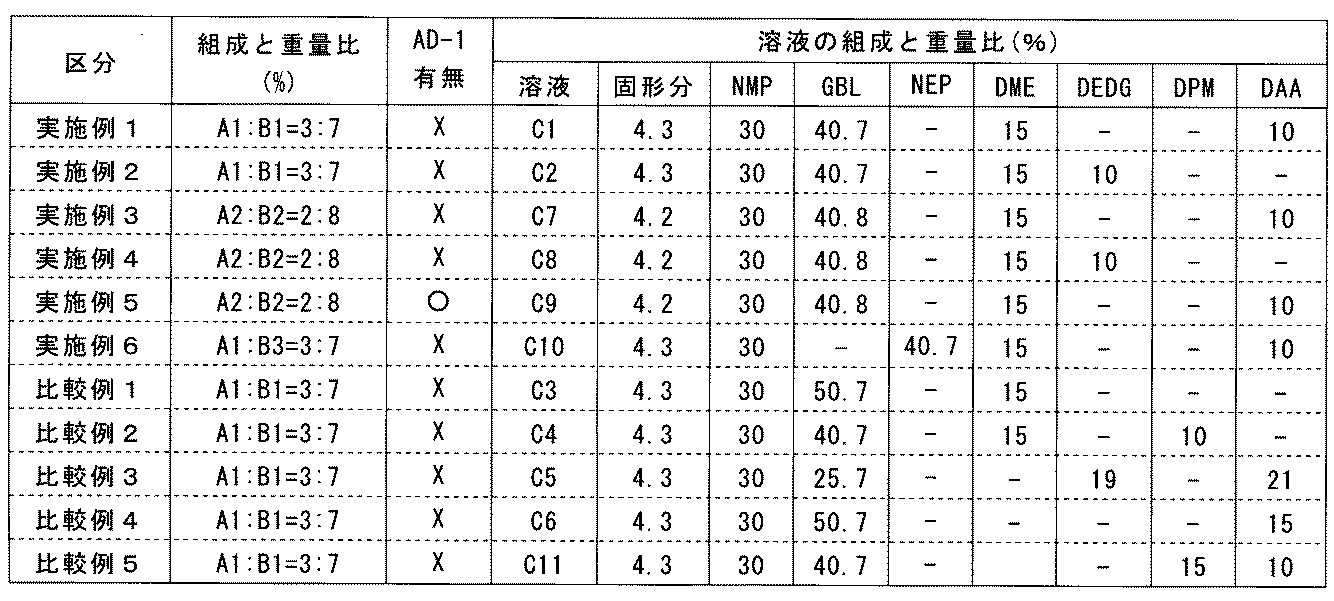
ポリアミック酸(B1)溶液153.4gを測りとり、その溶液へ、NMPを1.3g、3-グリシドキシプロピルトリエトキシシランが1.3重量%入ったGBL溶液を38.5g、GBLを95.9g、DME53.5g及びDAA50.0gを加え、室温で1時間撹拌した。次いで、上記ポリアミック酸溶液(a1)を107.5g加えて、さらに1時間撹拌することにより、重量%の比率で、固形分:NMP:GBL:DME:DAA=4.3:30:40.7:15:10の溶液(C1)からなる液晶配向剤を500.0g得た。
ポリアミック酸(B1)溶液153.4gに対して、NMPを1.3g、3-グリシドキシプロピルトリエトキシシランが1.3重量%入ったGBL溶液を38.5g、GBLを95.9g、DME53.5g及びDEDG50.0gを加え、室温で1時間撹拌した。次いで、上記ポリアミック酸溶液(a1)を107.5g加えて、さらに1時間撹拌することにより、重量%の比率で、固形分:NMP:GBL:DME:DEDG=4.3:30:40.7:15:10の溶液(C2)からなる液晶配向剤を500.0g得た。
12重量%のポリアミック酸(A2)溶液33.3gと、15重量%のポリアミック酸(B2)溶液106.6gとの混合溶液を30分撹拌した後、これに対して、NMPを11.1g、3-グリシドキシプロピルトリエトキシシランが1.0重量%入ったNMP溶液20.0g、GBLを204.0g、DMEを75.0g及びDAAを50.0g加え、室温で3時間撹拌することで、A2とB2のポリマー固形分比が2:8であり、重量%の比率で、固形分:NMP:GBL:DME:DAA=4.2:30:40.8:15:10の溶液(C7)からなる液晶配向剤を500.0g得た。
12重量%のポリアミック酸(A2)溶液33.3gと、15重量%のポリアミック酸(B2)溶液106.6gとの混合溶液を30分撹拌した後、これに対して、NMPを11.1g、3-グリシドキシプロピルトリエトキシシランが1.0重量%入ったNMP溶液20.0g、GBLを204.0g、DMEを75.0g及びDEDGを50.0g加え、室温で3時間撹拌することで、A2とB2のポリマー固形分比が2:8であり、重量%の比率で、固形分:NMP:GBL:DME:DEDG=4.2:30:40.8:15:10の溶液(C8)からなる液晶配向剤を500.0g得た。
12重量%のポリアミック酸(A2)溶液33.3gと、15重量%のポリアミック酸(B2)溶液106.6gとの混合溶液を30分撹拌した後、これに対して、NMPを5.1g、3-グリシドキシプロピルトリエトキシシランが1.0重量%入ったNMP溶液20.0g、AD-1が10重量%入ったNMP溶液を6.0g、GBLを204.0g、DMEを75.0g及びDAAを50.0g加え、室温で3時間撹拌することで、A2とB2のポリマー固形分比が2:8であり、ポリマー固形分に対してAD-1が3.0重量%含まれた、重量%の比率で、総固形分:NMP:GBL:DME:DAA=4.2:30:40.8:15:10(重量%)の溶液(C9)からなる液晶配向剤を500.0g得た。
ポリアミック酸(B3)溶液153.4gを測りとり、その溶液へ、NMPを1.3g、3-グリシドキシプロピルトリエトキシシランが1.3重量%入ったNEP溶液を38.5g、NEPを95.9g、DME53.5g及びDAA50.0gを加え、室温で1時間撹拌した。その後、a1を107.5g加えて、さらに1時間撹拌することで、重量%の比率で、固形分:NMP:NEP:DME:DAA=4.3:30:40.7:15:10の溶液(C10)からなる液晶配向剤を500.0g得た。
ポリアミック酸(B1)溶液153.4gを測りとり、その溶液へ、NMPを1.3g、3-グリシドキシプロピルトリエトキシシランが1.3重量%入ったGBL溶液を38.5g、GBLを145.9g及びDME53.5gを加え、室温で1時間撹拌した。次いで、上記ポリアミック酸溶液(a1)を107.5g加えて、さらに1時間撹拌することにより、重量%の比率で、固形分:NMP:GBL:DME=4.3:30:50.7:15の溶液(C3)からなる液晶配向剤を500.0g得た。
ポリアミック酸(B1)溶液153.4gを測りとり、その溶液へ、NMPを1.3g、3-グリシドキシプロピルトリエトキシシランが1.3重量%入ったGBL溶液を38.5g、GBLを95.9g、DME53.5g及びDPM50.0gを加え、室温で1時間撹拌した。次いで、上記ポリアミック酸溶液(a1)を107.5g加えて、さらに1時間撹拌することにより、重量%の比率で、固形分:NMP:GBL:DME:DPM=4.3:30:40.7:15:10を有するの溶液(C4)からなる液晶配向剤を500.0g得た。
ポリアミック酸(B1)溶液153.4gを測りとり、その溶液へ、NMPを1.3g、3-グリシドキシプロピルトリエトキシシランが1.3重量%入ったGBL溶液を38.5g、GBLを20.9g、DAA83.5g及びDEDG95.0gを加え、室温で1時間撹拌した。次いで、上記ポリアミック酸溶液(a2)を107.5g加えて、さらに1時間撹拌することにより、重量%の比率で、固形分:NMP:GBL:DAA:DEDG=4.3:30:25.7:21:19を有する溶液(C5)からなる液晶配向剤を500.0g得た。
ポリアミック酸(B1)溶液153.4gを測りとり、その溶液へ、NMPを1.3g、3-グリシドキシプロピルトリエトキシシランが1.3重量%入ったGBL溶液を38.5g、GBLを145.9g及びDAA53.5gを加え、室温で1時間撹拌した。その後、a2を107.5g加えて、さらに1時間撹拌することにより、重量%の比率で、固形分:NMP:GBL:DAA=4.3:30:50.7:15を有する溶液(C6)からなる液晶配向剤を500.0g得た。
ポリアミック酸(B1)溶液153.4gを測りとり、その溶液へ、NMPを1.3g、3-グリシドキシプロピルトリエトキシシランが1.3重量%入ったGBL溶液を38.5g、GBLを95.9g、DPM53.5g及びDAA50.0gを加え、室温で1時間撹拌した。その後、a3を107.5g加えて、さらに1時間撹拌することで、重量%の比率で、固形分:NMP:GBL:DPM:DAA=4.3:30:40.7:15:10(重量%)の溶液(C11)からなる液晶配向剤を500.0g得た。
上記で調製した実施例1、2及び比較例1~4について、インクジェット塗布装置(石井表記社製)を用いて、TFT基板上に塗布した。塗布条件は、ノズル間ピッチ127μm、塗布速度250mm/sec、ディスペンス量70pL、塗布面積36×36mmで行った。塗膜は、110℃のホットプレート上で1分仮乾燥を行った後、230℃15分の条件で、IRオーブンで焼成した際に、厚みが120nmとなる条件で塗布した。
塗布された基板を110℃で仮乾燥した塗膜について、コンタクトホールや配線の影響で発生するドットやスジ状のムラの程度を比較して、4段階で評価した。全面に顕著なムラが確認できるものをLv4、部分的にムラが確認できるものをLv3、ムラが目視では見えないものをLv2、光学顕微鏡でもムラが全く見えないものをLv1とした。
また、クロムが表面に蒸着されたガラス基板上にも塗布を行い、塗膜端部の色調変化(膜厚ムラ)がある部分の幅を、ノギスで測長し、Haloサイズとして評価した。なお、Haloサイズは値が小さいほど良好な塗膜である。
Claims (12)
- ポリイミド前駆体及びそのイミド化物であるポリイミドからなる群から選ばれる少なくとも1種の重合体と、下記の溶媒A、溶媒B、及び溶媒Cを含有する溶媒と、を含有することを特徴とする液晶配向剤。
溶媒A:N-メチル-2-ピロリドン、N-エチル-2-ピロリドン、γ‐ブチロラクトン及びジメチルイミダゾリジノンからなる群から選ばれる少なくとも1種。
溶媒B:ジプロピレングリコールジメチルエーテル
溶媒C:ジエチレングリコールジエチルエーテル及びジアセトンアルコールからなる群から選ばれる少なくとも1種。 - 溶媒Aが、N-メチル-2-ピロリドン又はγ‐ブチロラクトンである請求項1に記載の液晶配向剤。
- ポリイミド前駆体が、下記の式(1)で表わされる構造を有する請求項1又は2に記載の液晶配向剤。

- 溶媒Aが、液晶配向剤の全質量に対して、20~80質量%含有される請求項1~3のいずれかに1項に記載の液晶配向剤。
- 溶媒Bが、液晶配向剤の全質量に対して、1~30質量%含有される請求項1~4のいずれかに1項に記載の液晶配向剤。
- 溶媒Cが、液晶配向剤の全質量に対して、1~30質量%含有される請求項1~5のいずれかに1項に記載の液晶配向剤。
- 液晶配向剤の全質量%に対して、溶媒Aの合計が、50~80質量%であり、溶媒Bが10~30質量%であり、溶媒Cが1~20質量%含有される請求項1~6のいずれかに1項に記載の液晶配向剤。
- 溶媒B及び溶媒Cの合計が、液晶配向剤の全質量に対して、10~60質量%含有され、かつ溶媒Bが、溶媒Cよりも多く含有される請求項1~7のいずれか1項に記載の液晶配向剤。
- 溶媒Bが、溶媒Cよりも1~20質量%多く含有される請求項8に記載の液晶配向剤。
- インクジェット法による成膜用である請求項1~9のいずれか1項に記載の液晶配向剤。
- 請求項1~10のいずれか1項に記載の液晶配向剤から得られる液晶配向膜。
- 請求項11に記載の液晶配向膜を具備する液晶表示素子。
Priority Applications (4)
| Application Number | Priority Date | Filing Date | Title |
|---|---|---|---|
| KR1020187031210A KR102275486B1 (ko) | 2016-03-31 | 2017-03-30 | 액정 배향제, 액정 배향막, 및 액정 표시 소자 |
| JP2018509471A JP6798550B2 (ja) | 2016-03-31 | 2017-03-30 | 液晶配向剤、液晶配向膜、及び液晶表示素子 |
| CN201780033835.9A CN109313367A (zh) | 2016-03-31 | 2017-03-30 | 液晶取向剂、液晶取向膜、以及液晶表示元件 |
| CN202511705788.0A CN121674086A (zh) | 2016-03-31 | 2017-03-30 | 液晶取向剂、液晶取向膜、以及液晶表示元件 |
Applications Claiming Priority (2)
| Application Number | Priority Date | Filing Date | Title |
|---|---|---|---|
| JP2016-072566 | 2016-03-31 | ||
| JP2016072566 | 2016-03-31 |
Publications (1)
| Publication Number | Publication Date |
|---|---|
| WO2017170940A1 true WO2017170940A1 (ja) | 2017-10-05 |
Family
ID=59965996
Family Applications (1)
| Application Number | Title | Priority Date | Filing Date |
|---|---|---|---|
| PCT/JP2017/013415 Ceased WO2017170940A1 (ja) | 2016-03-31 | 2017-03-30 | 液晶配向剤、液晶配向膜、及び液晶表示素子 |
Country Status (5)
| Country | Link |
|---|---|
| JP (1) | JP6798550B2 (ja) |
| KR (1) | KR102275486B1 (ja) |
| CN (2) | CN121674086A (ja) |
| TW (1) | TWI747894B (ja) |
| WO (1) | WO2017170940A1 (ja) |
Cited By (3)
| Publication number | Priority date | Publication date | Assignee | Title |
|---|---|---|---|---|
| CN109722259A (zh) * | 2017-10-30 | 2019-05-07 | 捷恩智株式会社 | 液晶取向剂、液晶取向膜的形成方法及显示元件的制法 |
| CN111263913A (zh) * | 2017-10-25 | 2020-06-09 | 日产化学株式会社 | 液晶取向剂、液晶取向膜及液晶表示元件 |
| WO2022054850A1 (ja) * | 2020-09-09 | 2022-03-17 | Kjケミカルズ株式会社 | 樹脂合成用溶媒及び該溶媒を用いた合成樹脂の製造方法 |
Citations (3)
| Publication number | Priority date | Publication date | Assignee | Title |
|---|---|---|---|---|
| JPH095753A (ja) * | 1995-06-26 | 1997-01-10 | Sumitomo Bakelite Co Ltd | 液晶配向剤 |
| JP2011180577A (ja) * | 2010-02-08 | 2011-09-15 | Jsr Corp | 液晶表示素子の製造方法 |
| WO2013125595A1 (ja) * | 2012-02-22 | 2013-08-29 | 日産化学工業株式会社 | 組成物、液晶配向処理剤、液晶配向膜及び液晶表示素子 |
Family Cites Families (7)
| Publication number | Priority date | Publication date | Assignee | Title |
|---|---|---|---|---|
| JP4156445B2 (ja) | 2003-06-04 | 2008-09-24 | 株式会社 日立ディスプレイズ | 液晶表示装置の製造方法 |
| JP4869892B2 (ja) | 2006-12-06 | 2012-02-08 | 株式会社 日立ディスプレイズ | 液晶表示装置 |
| KR100851787B1 (ko) * | 2007-04-11 | 2008-08-13 | 제일모직주식회사 | 3,4-디카르복시-1,2,3,4-테트라하이드로-6-터셔리부틸-1-나프탈렌숙신산이무수물 및 그를 이용하여 제조한 폴리이미드중합체를 포함하는 액정 배향제 |
| JP5553531B2 (ja) | 2009-06-03 | 2014-07-16 | 株式会社ジャパンディスプレイ | 液晶表示装置 |
| TWI626259B (zh) * | 2012-08-06 | 2018-06-11 | Nissan Chemical Ind Ltd | Liquid crystal alignment agent, and liquid crystal alignment film using the same |
| JP5930239B2 (ja) * | 2012-10-18 | 2016-06-08 | 日産化学工業株式会社 | 組成物、液晶配向処理剤、液晶配向膜および液晶表示素子 |
| KR102159410B1 (ko) * | 2013-03-14 | 2020-09-23 | 제이엔씨 주식회사 | 액정 배향제 및 액정 표시 소자 |
-
2017
- 2017-03-30 JP JP2018509471A patent/JP6798550B2/ja active Active
- 2017-03-30 CN CN202511705788.0A patent/CN121674086A/zh active Pending
- 2017-03-30 WO PCT/JP2017/013415 patent/WO2017170940A1/ja not_active Ceased
- 2017-03-30 CN CN201780033835.9A patent/CN109313367A/zh active Pending
- 2017-03-30 KR KR1020187031210A patent/KR102275486B1/ko active Active
- 2017-03-31 TW TW106111193A patent/TWI747894B/zh active
Patent Citations (3)
| Publication number | Priority date | Publication date | Assignee | Title |
|---|---|---|---|---|
| JPH095753A (ja) * | 1995-06-26 | 1997-01-10 | Sumitomo Bakelite Co Ltd | 液晶配向剤 |
| JP2011180577A (ja) * | 2010-02-08 | 2011-09-15 | Jsr Corp | 液晶表示素子の製造方法 |
| WO2013125595A1 (ja) * | 2012-02-22 | 2013-08-29 | 日産化学工業株式会社 | 組成物、液晶配向処理剤、液晶配向膜及び液晶表示素子 |
Cited By (7)
| Publication number | Priority date | Publication date | Assignee | Title |
|---|---|---|---|---|
| CN111263913A (zh) * | 2017-10-25 | 2020-06-09 | 日产化学株式会社 | 液晶取向剂、液晶取向膜及液晶表示元件 |
| CN111263913B (zh) * | 2017-10-25 | 2023-03-28 | 日产化学株式会社 | 液晶取向剂、液晶取向膜及液晶表示元件 |
| CN109722259A (zh) * | 2017-10-30 | 2019-05-07 | 捷恩智株式会社 | 液晶取向剂、液晶取向膜的形成方法及显示元件的制法 |
| CN109722259B (zh) * | 2017-10-30 | 2023-08-15 | 捷恩智株式会社 | 液晶取向剂、液晶取向膜的形成方法及显示元件的制法 |
| WO2022054850A1 (ja) * | 2020-09-09 | 2022-03-17 | Kjケミカルズ株式会社 | 樹脂合成用溶媒及び該溶媒を用いた合成樹脂の製造方法 |
| JP7104456B1 (ja) * | 2020-09-09 | 2022-07-21 | Kjケミカルズ株式会社 | 樹脂合成用溶媒及び該溶媒を用いた合成樹脂の製造方法 |
| US20230406986A1 (en) * | 2020-09-09 | 2023-12-21 | Kj Chemicals Corporation | Solvent for resin synthesis and method for producing synthetic resin using said solvent |
Also Published As
| Publication number | Publication date |
|---|---|
| TWI747894B (zh) | 2021-12-01 |
| CN109313367A (zh) | 2019-02-05 |
| JP6798550B2 (ja) | 2020-12-09 |
| JPWO2017170940A1 (ja) | 2019-03-07 |
| KR102275486B1 (ko) | 2021-07-08 |
| TW201809074A (zh) | 2018-03-16 |
| KR20180132746A (ko) | 2018-12-12 |
| CN121674086A (zh) | 2026-03-17 |
Similar Documents
| Publication | Publication Date | Title |
|---|---|---|
| CN110023826B (zh) | 液晶取向剂、液晶取向膜和液晶表示元件 | |
| WO2017061575A1 (ja) | 液晶配向剤、液晶配向膜、及び液晶表示素子 | |
| JP2022140484A (ja) | 液晶配向剤、液晶配向膜、及び液晶表示素子 | |
| JP7188381B2 (ja) | 液晶配向剤、液晶配向膜、及び液晶表示素子 | |
| JP6798550B2 (ja) | 液晶配向剤、液晶配向膜、及び液晶表示素子 | |
| JP7052721B2 (ja) | 液晶配向剤、液晶配向膜、及び液晶表示素子 | |
| JPWO2018122936A1 (ja) | 液晶配向剤、液晶配向膜、及び液晶表示素子 | |
| JP6866892B2 (ja) | 液晶配向剤、液晶配向膜、及び液晶表示素子 | |
| JP7093058B2 (ja) | 液晶配向剤、液晶配向膜、及び液晶表示素子 | |
| JP7256472B2 (ja) | 液晶配向剤、液晶配向膜及び液晶表示素子 | |
| CN121991346A (zh) | 液晶取向剂、液晶取向膜、以及液晶表示元件 |
Legal Events
| Date | Code | Title | Description |
|---|---|---|---|
| WWE | Wipo information: entry into national phase |
Ref document number: 2018509471 Country of ref document: JP |
|
| NENP | Non-entry into the national phase |
Ref country code: DE |
|
| ENP | Entry into the national phase |
Ref document number: 20187031210 Country of ref document: KR Kind code of ref document: A |
|
| 121 | Ep: the epo has been informed by wipo that ep was designated in this application |
Ref document number: 17775474 Country of ref document: EP Kind code of ref document: A1 |
|
| 122 | Ep: pct application non-entry in european phase |
Ref document number: 17775474 Country of ref document: EP Kind code of ref document: A1 |