WO2017170473A1 - 光重合開始剤組成物及び感光性組成物 - Google Patents
光重合開始剤組成物及び感光性組成物 Download PDFInfo
- Publication number
- WO2017170473A1 WO2017170473A1 PCT/JP2017/012517 JP2017012517W WO2017170473A1 WO 2017170473 A1 WO2017170473 A1 WO 2017170473A1 JP 2017012517 W JP2017012517 W JP 2017012517W WO 2017170473 A1 WO2017170473 A1 WO 2017170473A1
- Authority
- WO
- WIPO (PCT)
- Prior art keywords
- group
- carbon atoms
- bond
- alkyl
- represented
- Prior art date
- Legal status (The legal status is an assumption and is not a legal conclusion. Google has not performed a legal analysis and makes no representation as to the accuracy of the status listed.)
- Ceased
Links
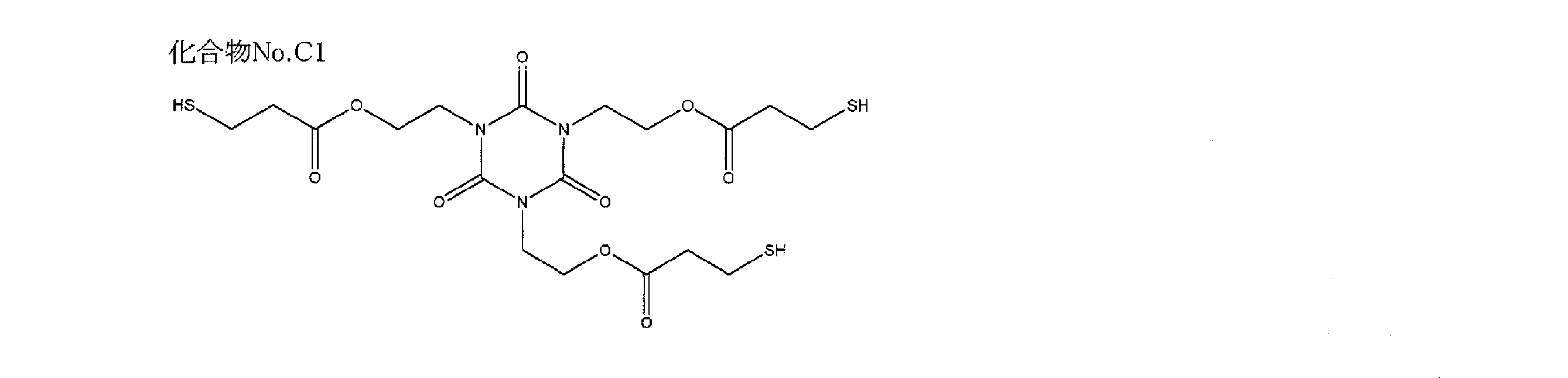
- 0 *CCC(OCCN(C(N(CCOC(CCS)=O)C(N1CCOC(CCS)=O)=O)=O)C1=O)=O Chemical compound *CCC(OCCN(C(N(CCOC(CCS)=O)C(N1CCOC(CCS)=O)=O)=O)C1=O)=O 0.000 description 1
Classifications
-
- G—PHYSICS
- G03—PHOTOGRAPHY; CINEMATOGRAPHY; ANALOGOUS TECHNIQUES USING WAVES OTHER THAN OPTICAL WAVES; ELECTROGRAPHY; HOLOGRAPHY
- G03F—PHOTOMECHANICAL PRODUCTION OF TEXTURED OR PATTERNED SURFACES, e.g. FOR PRINTING, FOR PROCESSING OF SEMICONDUCTOR DEVICES; MATERIALS THEREFOR; ORIGINALS THEREFOR; APPARATUS SPECIALLY ADAPTED THEREFOR
- G03F7/00—Photomechanical, e.g. photolithographic, production of textured or patterned surfaces, e.g. printing surfaces; Materials therefor, e.g. comprising photoresists; Apparatus specially adapted therefor
- G03F7/004—Photosensitive materials
- G03F7/027—Non-macromolecular photopolymerisable compounds having carbon-to-carbon double bonds, e.g. ethylenic compounds
- G03F7/028—Non-macromolecular photopolymerisable compounds having carbon-to-carbon double bonds, e.g. ethylenic compounds with photosensitivity-increasing substances, e.g. photoinitiators
- G03F7/031—Organic compounds not covered by group G03F7/029
-
- C—CHEMISTRY; METALLURGY
- C08—ORGANIC MACROMOLECULAR COMPOUNDS; THEIR PREPARATION OR CHEMICAL WORKING-UP; COMPOSITIONS BASED THEREON
- C08F—MACROMOLECULAR COMPOUNDS OBTAINED BY REACTIONS ONLY INVOLVING CARBON-TO-CARBON UNSATURATED BONDS
- C08F2/00—Processes of polymerisation
- C08F2/46—Polymerisation initiated by wave energy or particle radiation
- C08F2/48—Polymerisation initiated by wave energy or particle radiation by ultraviolet or visible light
- C08F2/50—Polymerisation initiated by wave energy or particle radiation by ultraviolet or visible light with sensitising agents
-
- G—PHYSICS
- G03—PHOTOGRAPHY; CINEMATOGRAPHY; ANALOGOUS TECHNIQUES USING WAVES OTHER THAN OPTICAL WAVES; ELECTROGRAPHY; HOLOGRAPHY
- G03F—PHOTOMECHANICAL PRODUCTION OF TEXTURED OR PATTERNED SURFACES, e.g. FOR PRINTING, FOR PROCESSING OF SEMICONDUCTOR DEVICES; MATERIALS THEREFOR; ORIGINALS THEREFOR; APPARATUS SPECIALLY ADAPTED THEREFOR
- G03F7/00—Photomechanical, e.g. photolithographic, production of textured or patterned surfaces, e.g. printing surfaces; Materials therefor, e.g. comprising photoresists; Apparatus specially adapted therefor
- G03F7/004—Photosensitive materials
-
- G—PHYSICS
- G03—PHOTOGRAPHY; CINEMATOGRAPHY; ANALOGOUS TECHNIQUES USING WAVES OTHER THAN OPTICAL WAVES; ELECTROGRAPHY; HOLOGRAPHY
- G03F—PHOTOMECHANICAL PRODUCTION OF TEXTURED OR PATTERNED SURFACES, e.g. FOR PRINTING, FOR PROCESSING OF SEMICONDUCTOR DEVICES; MATERIALS THEREFOR; ORIGINALS THEREFOR; APPARATUS SPECIALLY ADAPTED THEREFOR
- G03F7/00—Photomechanical, e.g. photolithographic, production of textured or patterned surfaces, e.g. printing surfaces; Materials therefor, e.g. comprising photoresists; Apparatus specially adapted therefor
- G03F7/004—Photosensitive materials
- G03F7/0042—Photosensitive materials with inorganic or organometallic light-sensitive compounds not otherwise provided for, e.g. inorganic resists
-
- G—PHYSICS
- G03—PHOTOGRAPHY; CINEMATOGRAPHY; ANALOGOUS TECHNIQUES USING WAVES OTHER THAN OPTICAL WAVES; ELECTROGRAPHY; HOLOGRAPHY
- G03F—PHOTOMECHANICAL PRODUCTION OF TEXTURED OR PATTERNED SURFACES, e.g. FOR PRINTING, FOR PROCESSING OF SEMICONDUCTOR DEVICES; MATERIALS THEREFOR; ORIGINALS THEREFOR; APPARATUS SPECIALLY ADAPTED THEREFOR
- G03F7/00—Photomechanical, e.g. photolithographic, production of textured or patterned surfaces, e.g. printing surfaces; Materials therefor, e.g. comprising photoresists; Apparatus specially adapted therefor
- G03F7/004—Photosensitive materials
- G03F7/027—Non-macromolecular photopolymerisable compounds having carbon-to-carbon double bonds, e.g. ethylenic compounds
Definitions
- the present invention includes a photopolymerization initiator composition useful as a photopolymerization initiator component used in a photosensitive composition, and a polymerizable compound having an ethylenically unsaturated bond in the photopolymerization initiator composition. To a photosensitive composition.
- the photosensitive composition is obtained by adding a photopolymerization initiator to a polymerizable compound having an ethylenically unsaturated bond, and can irradiate energy rays (light). Therefore, a photocurable ink, a photosensitive printing plate It is used for various photoresists.
- Patent Documents 1 to 7 listed below propose using oxime ester compounds.
- each of these conventional photopolymerization initiators has insufficient sensitivity, and when used in an alkali-developable photosensitive resin composition or the like, the resolution is not satisfactory.
- an object of the present invention is to provide a photopolymerization initiator composition capable of imparting excellent sensitivity and resolution to the photosensitive composition, and a photosensitive composition using the photopolymerization initiator composition. It is in.
- the present inventors have used an oxime ester compound having a specific ether structure in combination with an oxime ester compound having a specific cycloalkyl structure, thereby achieving excellent sensitivity and resolution.
- the present invention comprises 1 to 99 parts by mass of the following component (A) and 1 to 99 parts by mass of the following component (B) (provided that the total of the components (A) and (B) is 100 parts by mass).
- a polymerization initiator composition is provided.
- R 1 , R 2 and R 6 are each independently an alkyl group having 1 to 20 carbon atoms, an alkoxy group having 1 to 20 carbon atoms, carbon Represents an aryl group having 6 to 30 atoms, an aryloxy group having 6 to 30 carbon atoms, an aralkyl group having 7 to 30 carbon atoms, a heterocyclic group having 2 to 20 carbon atoms, or a cyano group.
- Group, aryl group, aryloxy group, aralkyl group and heterocyclic group are further represented by OR 11 , COR 11 , SR 11 , NR 12 R 13 , —NCOR 12 —OCOR 13 , CN, halogen atom, —CR 11.
- R 3 , R 4 and R 5 are each independently an alkyl group having 1 to 20 carbon atoms, an alkoxy group having 1 to 20 carbon atoms, an aryl group having 6 to 30 carbon atoms, or 6 to 30 carbon atoms.
- the hydrogen atom of the heterocyclic group is further OR 14 , COR 14 , SR 14 , NR 15 R 16 , —NCOR 15 —OCOR 16 , CN, halogen atom, —CR 14 ⁇ CR 15 R 16 or —CO—CR 14 ⁇ may have been replaced by CR 15 R 16, R 14, R 15 and R 16 each independently represent a hydrogen atom, an alkyl group having 1 to 20 carbon atoms, an aryl group having 6 to 30 carbon atoms, 7-30 carbon atoms
- a 1 is represented by the above general formula (3).
- R 7 , R 8 and R 9 each independently represents a hydrogen atom or an alkyl group having 1 to 20 carbon atoms
- the hydrogen atom of the alkyl group may be substituted with a halogen atom
- the methylene group of the alkylene part of the alkyl group is 1 by an unsaturated bond, an ether bond, a thioether bond, an ester bond, a thioester bond, an amide bond or a urethane bond.
- R 21 and R 22 each independently represents an alkyl group having 1 to 20 carbon atoms, an alkoxy group having 1 to 20 carbon atoms, or 6 carbon atoms.
- an alkyl group, an alkoxy group, an aryl group Group, aryloxy group, aralkyl group and heterocyclic group are further represented by OR 31 , COR 31 , SR 31 , NR 32 R 33 , —NCOR 32 —OCOR 33 , CN, halogen atom, —CR 31 ⁇ CR 32 R 33 or —CO—CR 31 ⁇ CR 32 R 33 may be substituted, and R 31 , R 32 and R 33 are each independently a hydrogen atom, an alkoxy group having 1 to 20
- R 23 and R 24 are each independently an alkyl group having 1 to 20 carbon atoms, an alkoxy group having 1 to 20 carbon atoms, an aryl group having 6 to 30 carbon atoms, or an aryloxy group having 6 to 30 carbon atoms.
- the hydrogen atom of OR 34 , COR 34 , SR 34 , NR 35 R 36 , —NCOR 35 —OCOR 36 , CN, halogen atom, —CR 34 ⁇ CR 35 R 36 or —CO—CR 34 ⁇ CR 35 R may have been replaced by 36, R 34, R 35 and R 36 each independently represent a hydrogen atom, an alkyl group having 1 to 20 carbon atoms, an aryl group having 6 to 30 carbon atoms, carbon atoms 7-30 a It represents alkyl group, or a heterocyclic group having 2 to 20 carbon atoms, alkylene moiety of the substituents represented by R 23,
- Ar represents an aryl group or a heterocyclic group selected from the following structures
- L 1 represents a hydrogen atom or a benzoyl group
- X 1 represents a direct bond or a carbonyl group
- G 1 represents a group of the general formula (4).
- n is an integer of 1 to 5
- m is an integer of 1 to 6.
- the present invention also provides a photosensitive composition comprising the above photopolymerization initiator composition in a polymerizable compound having an ethylenically unsaturated bond. Moreover, this invention provides the said photosensitive composition which further contains an inorganic compound.
- the present invention also provides an alkali development comprising the photopolymerization initiator composition in an alkali developable compound that may have an ethylenically unsaturated bond and a polymerizable compound that has an ethylenically unsaturated bond.
- a photosensitive photosensitive tree composition is provided.
- this invention provides the said alkali-developable photosensitive resin composition which contains an inorganic compound further.
- the present invention also provides a colored alkali-developable photosensitive resin composition obtained by further adding a coloring material to the alkali-developable photosensitive resin composition. Moreover, this invention provides the hardened
- the photopolymerization initiator composition of the present invention will be described.
- the oxime ester compound used as the component (A) in the photopolymerization initiator composition of the present invention is represented by the above general formulas (1-1) to (1-3) and represented by the above general formula (3). It has an ether structure.
- the oxime ester compound used as the component (A) has geometric isomers due to the double bond of oxime, but these are not distinguished from each other.
- the above general formulas (1-1) to (1-3) and those described later These exemplified compounds represent a mixture of both or one of them, and are not limited to structures showing isomers.
- the component (A) in the present invention contains one or more oxime ester compounds represented by the above general formulas (1-1) to (1-3), and only one or more of the oxime ester compounds. Preferably it consists of.
- Examples of the alkyl group having 1 to 20 carbon atoms represented by 16 include methyl, ethyl, propyl, isopropyl, butyl, isobutyl, s-butyl, t-butyl, amyl, isoamyl, t-amyl, hexyl, heptyl.
- Octyl isooctyl, 2-ethylhexyl, t-octyl, nonyl, isononyl, decyl, isodecyl, undecyl, dodecyl, tetradecyl, hexadecyl, octadecyl, icosyl and the like.
- Examples of the alkoxy group having 1 to 20 carbon atoms represented by R 1 , R 2 , R 3 , R 4 , R 5 and R 6 in the general formulas (1-1) to (1-3) include The thing corresponding to an alkyl group is mentioned.
- Examples of the aryl group having 6 to 30 carbon atoms represented by 16 include phenyl, tolyl, xylyl, ethylphenyl, chlorophenyl, biphenylyl, naphthyl, anthryl, phenanthrenyl, and phenyl or biphenylyl substituted with one or more of the above alkyl groups. , Naphthyl, anthryl and the like.
- Examples of the aralkyl group having 7 to 30 carbon atoms represented by 16 include benzyl, chlorobenzyl, ⁇ -methylbenzyl, ⁇ , ⁇ -dimethylbenzyl, phenylethyl and the like.
- Examples of the heterocyclic group having 2 to 20 carbon atoms represented by 16 include pyridyl, pyrimidyl, furyl, thienyl, tetrahydrofuryl, dioxolanyl, benzoxazol-2-yl, tetrahydropyranyl, pyrrolidyl, imidazolidyl, pyrazolidyl, And 5- to 7-membered heterocycles such as thiazolidyl, isothiazolidyl, oxazolidyl, isoxazolidyl, piperidyl, piperazyl, morpholinyl and the like.
- oxime ester compounds of component (A) those represented by the general formulas (1-1) to (1-3), wherein R 1 is an alkyl group having 1 to 20 carbon atoms from the viewpoint of sensitivity and resolution.
- R 1 is an alkyl group having 1 to 20 carbon atoms from the viewpoint of sensitivity and resolution.
- the alkyl group having 1 to 4 carbon atoms is more preferable, and the methyl group is still more preferable.
- R 2 is preferably an alkyl group having 1 to 20 carbon atoms, and preferably having 1 to 8 carbon atoms. What is an alkyl group is more preferable, and an ethyl group is still more preferable.
- R 3 a of the general formulas (1-1) to (1-3), a is preferably 0 or 1, and more preferably 0 from the viewpoint of sensitivity and resolution.
- R 3 is preferably an alkyl group having 1 to 20 carbon atoms, and more preferably an alkyl group having 1 to 4 carbon atoms.
- R 4 is preferably 0 or 1, and more preferably 0 from the viewpoint of sensitivity and resolution.
- R 4 is preferably an alkyl group having 1 to 20 carbon atoms, and more preferably an alkyl group having 1 to 4 carbon atoms.
- R 5 d is preferably 0 or 1, and more preferably 1, in terms of sensitivity and resolution.
- R 5 is preferably an alkyl group having 1 to 20 carbon atoms, more preferably an alkyl group having 1 to 4 carbon atoms, and even more preferably a methyl group.
- R 6 is preferably an alkyl group having 1 to 20 carbon atoms, and an alkyl group having 1 to 4 carbon atoms from the viewpoint of sensitivity and resolution. Is more preferable, and a methyl group is even more preferable.
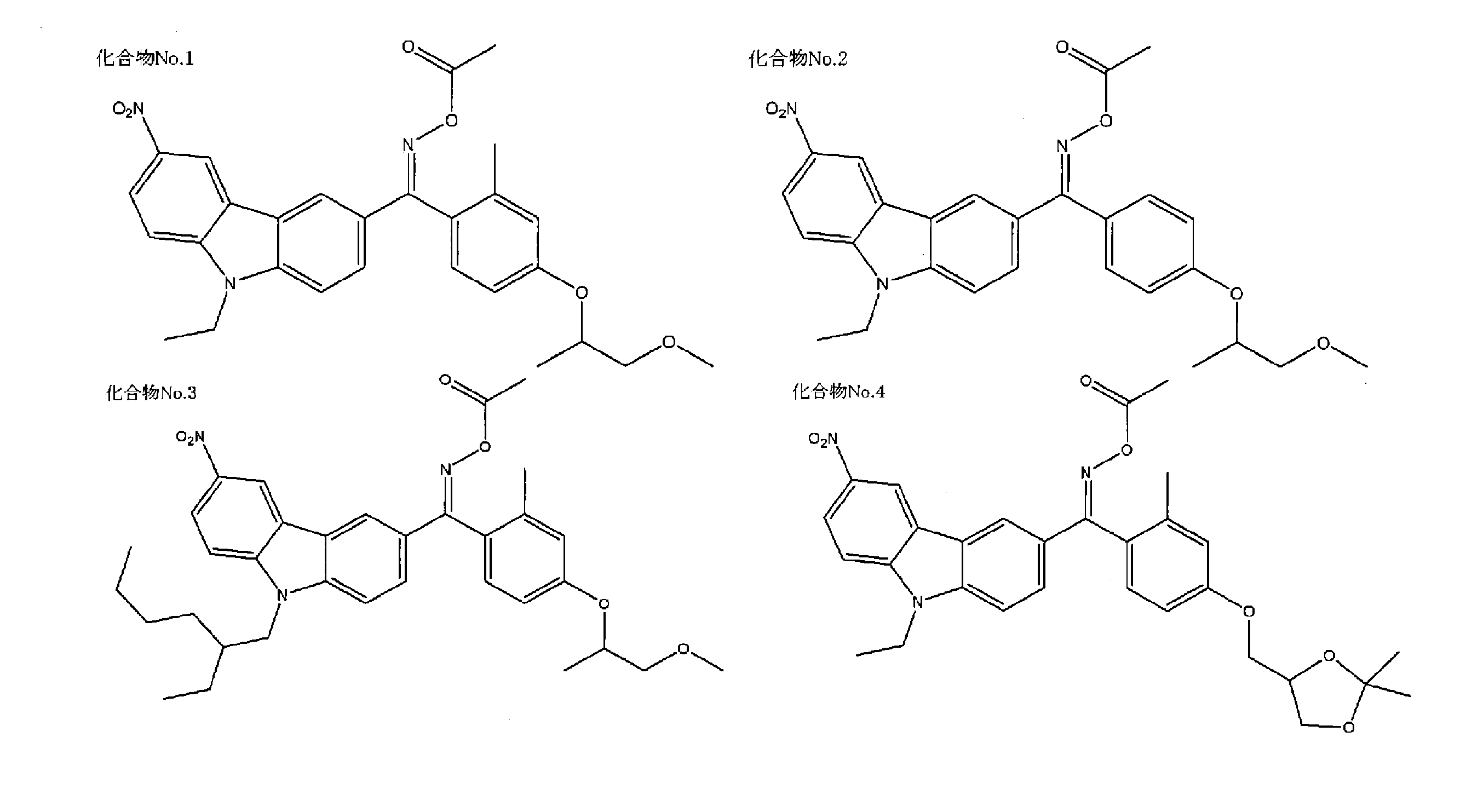
- the oxime ester compound of component (A) has an ether structure of A 1 represented by the general formula (3). Thereby, it has the outstanding sensitivity and resolution by using together with (B) component.
- R 9 is preferably a hydrogen atom or an alkyl group having 1 to 20 carbon atoms, more preferably a hydrogen atom or an alkyl group having 1 to 4 carbon atoms, Atoms or methyl groups are even more preferred.
- R 8 is preferably a hydrogen atom or an alkyl group having 1 to 4 carbon atoms.
- R 7 is preferably a hydrogen atom or an alkyl group having 1 to 4 carbon atoms.
- R 7 and R 8 are preferably combined to form a ring, and preferably have an ether bond in the ring.
- a preferred specific example of the ring formed by R 7 and R 8 together is a dimethyldioxolane ring.
- oxime ester compound represented by the general formula (1-1) of the component (A) the following compound No. 1-4.
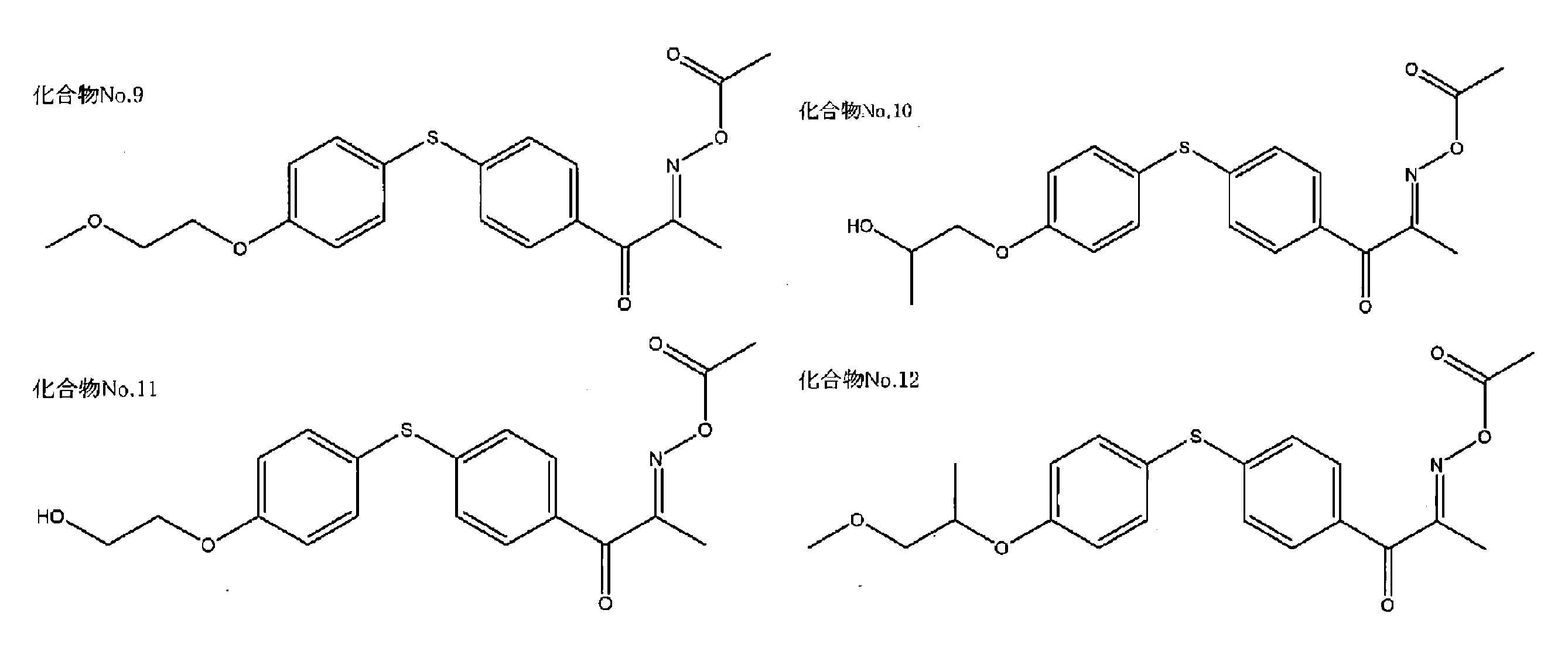
- oxime ester compound represented by the general formula (1-2) of the component (A) As preferred specific examples of the oxime ester compound represented by the general formula (1-2) of the component (A), the following compound No. 5-No. 8 is mentioned.
- the oxime ester compound used as the component (B) in the photopolymerization initiator composition of the present invention is represented by the general formula (2-1) or (2-2), and represented by the general formula (4). It has a cycloalkyl structure.
- the oxime ester compound used as the component (B) has geometric isomers due to the double bond of oxime, but these are not distinguished, and the above general formula (2-1) or (2-2) and those described later These exemplified compounds represent a mixture of both or one of them, and are not limited to structures showing isomers.
- the component (B) in the present invention contains one or more oxime ester compounds represented by the above general formula (2-1) or (2-2), and only one or more of the oxime ester compounds. Preferably it consists of.
- Examples of the alkyl group having 1 to 20 atoms include methyl, ethyl, propyl, isopropyl, butyl, isobutyl, s-butyl, t-butyl, amyl, isoamyl, t-amyl, hexyl, heptyl, octyl, isooctyl, 2 -Ethylhexyl, t-octyl, nonyl, isononyl, decyl, isodecyl, undecyl, dodecyl, tetradecyl, hexadecyl, octadecyl, icosyl and the like.
- the alkoxy group having 1 to 20 carbon atoms represented by R 21 , R 22 , R 23 , and R 24 in the general formula (2-1) or (2-2) corresponds to the above alkyl group. Things.
- aryl group having 6 to 30 atoms include phenyl, tolyl, xylyl, ethylphenyl, chlorophenyl, biphenylyl, naphthyl, anthryl, phenanthrenyl, and phenyl, biphenylyl, naphthyl, and anthryl substituted with one or more of the above alkyl groups. Can be mentioned.
- the aryloxy group having 6 to 30 carbon atoms represented by R 21 , R 22 , R 23 and R 24 in the general formula (2-1) or (2-2) corresponds to the above aryl group. Things.
- Examples of the aralkyl group having 7 to 30 atoms include benzyl, chlorobenzyl, ⁇ -methylbenzyl, ⁇ , ⁇ -dimethylbenzyl, phenylethyl and the like.
- heterocyclic group having 2 to 20 atoms include pyridyl, pyrimidyl, furyl, thienyl, tetrahydrofuryl, dioxolanyl, benzoxazol-2-yl, tetrahydropyranyl, pyrrolidyl, imidazolidyl, pyrazolidyl, thiazolidyl, isothiazolidyl, oxazolidyl, And 5- to 7-membered heterocycles such as isoxazolidyl, piperidyl, piperazyl, morpholinyl and the like.
- R 21 is an alkyl group having 1 to 20 carbon atoms or a carbon atom from the viewpoint of sensitivity and resolution. Those having 6 to 30 aryl groups are preferred, those having 1 to 4 carbon atoms or aryl groups having 6 to 8 carbon atoms are more preferred, and methyl or phenyl groups are even more preferred.
- R 22 is preferably an alkyl group having 1 to 20 carbon atoms, and an alkyl group having 1 to 8 carbon atoms. More preferred is an ethyl group.
- u is preferably 0 or 1, and more preferably 0 from the viewpoint of sensitivity and resolution.
- R 23 is preferably an alkyl group having 1 to 20 carbon atoms, and more preferably an alkyl group having 1 to 4 carbon atoms.
- v is preferably 0 or 1 and more preferably 0 from the viewpoint of sensitivity and resolution.
- R 24 is preferably an alkyl group having 1 to 20 carbon atoms, and more preferably an alkyl group having 1 to 4 carbon atoms.
- X 1 is preferably a direct bond from the viewpoint of sensitivity and resolution.
- Ar is preferably an aryl group or a heterocyclic group selected from the following structures from the viewpoint of sensitivity and resolution.
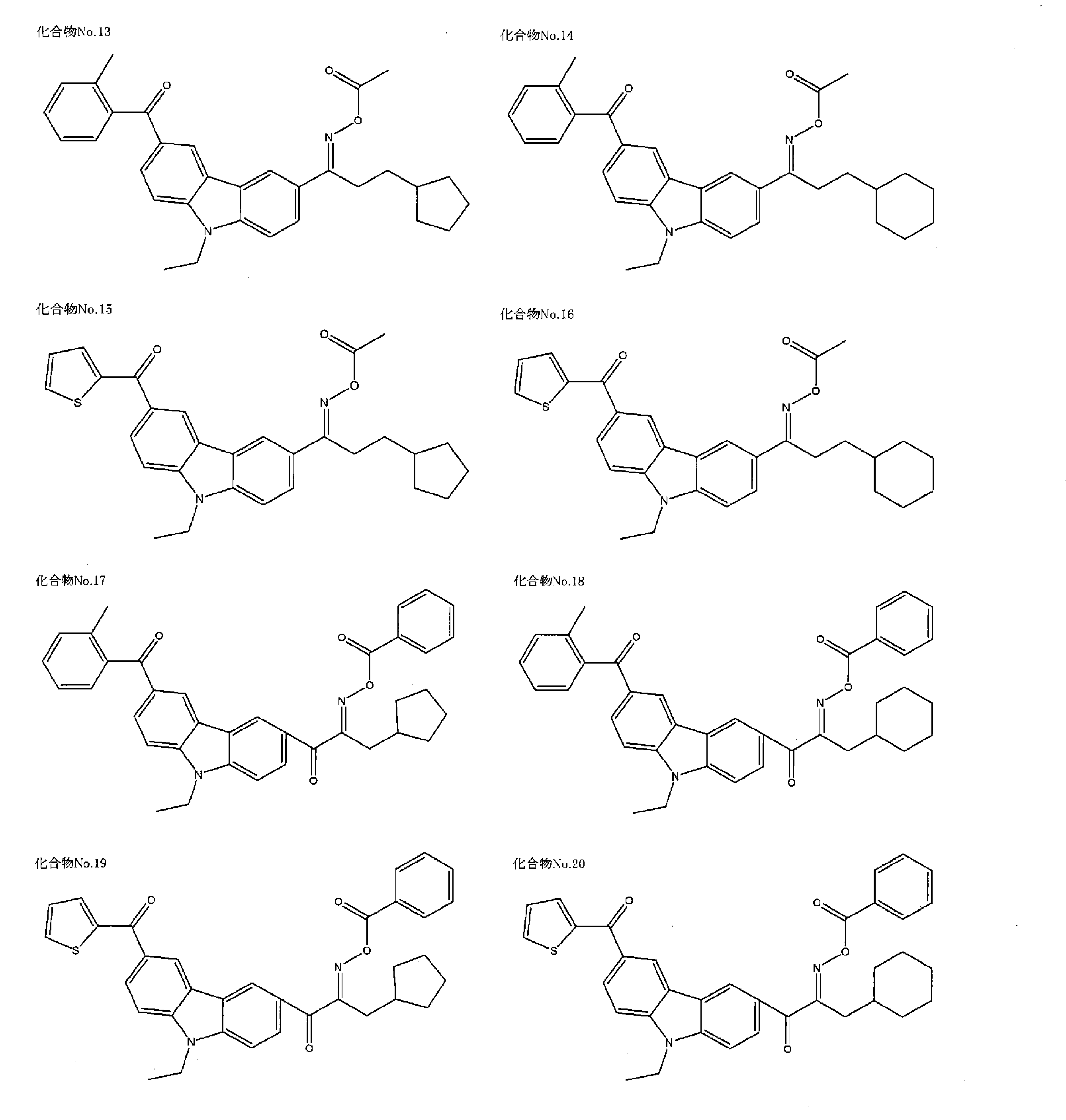
- the oxime ester compound as the component (B) has a cycloalkyl structure represented by G 1 represented by the general formula (4). Thereby, it has excellent sensitivity and resolution when used in combination with component (A).
- n is preferably 1 or 2 in terms of sensitivity and resolution.
- m is preferably 3 or 4 from the viewpoint of sensitivity and resolution. In this case, it has a cyclopentane ring and a cyclohexane ring, respectively.
- Preferred specific examples of the oxime ester compound represented by the above general formula (2-1) of the component (B) include the following compound Nos. 13-No. 20 is mentioned.
- oxime ester compound represented by the general formula (2-2) of the component (B) the following compound No. 21-No. 26.
- the total content of the component (A) and the component (B) is 100 parts by mass, and the content of the component (A) is 1 part by mass to 99 parts by mass.
- the content of component B) is 1 to 99 parts by mass.
- the content of component (A) is preferably 20 to 80 parts by mass, more preferably 40 to 60 parts by mass, and the content of component (B) is preferably 20 to 80 parts by mass, 60 parts by mass is more preferable.
- the photopolymerization initiator composition of the present invention includes other photopolymerization initiators such as Irgacure 369 (manufactured by BASF), Irgacure 907 (BASF).
- Irgacure OXE-01 manufactured by BASF
- Irgacure OXE-02 manufactured by BASF
- Lucyrin TPO manufactured by BASF
- Irgacure 819 manufactured by BASF
- 2,2-bis (2-chlorophenyl)- 4,5,4 ′, 5′-tetraphenyl-1-2′-biimidazole and the like can be contained.
- the description about these components in the photosensitive composition of this invention mentioned later can be applied suitably.
- the photosensitive composition of the present invention contains, as essential components, the photopolymerization initiator composition of the present invention and a polymerizable compound having an ethylenically unsaturated bond, and contains optional components such as inorganic compounds, coloring materials, and solvents. To do.
- the polymerizable compound having an ethylenically unsaturated bond is not particularly limited, and those conventionally used in photosensitive compositions can be used.
- those conventionally used in photosensitive compositions can be used.
- ethylene, propylene, butylene, isobutylene, vinyl chloride can be used.
- Unsaturated aliphatic hydrocarbons such as vinylidene chloride, vinylidene fluoride, tetrafluoroethylene; (meth) acrylic acid, ⁇ -chloroacrylic acid, itaconic acid, maleic acid, citraconic acid, fumaric acid, highmic acid, crotonic acid, Isocrotonic acid, vinyl acetic acid, allylic acetic acid, cinnamic acid, sorbic acid, mesaconic acid, succinic acid mono [2- (meth) acryloyloxyethyl], phthalic acid mono [2- (meth) acryloyloxyethyl], ⁇ - Carboxypolycaprolactone has a carboxy group and a hydroxyl group at both ends, such as mono (meth) acrylate Polymer mono (meth) acrylate; having hydroxyethyl (meth) acrylate malate, hydroxypropyl (meth) acrylate malate, dicycl
- A4 methyl (meth) acrylate, butyl (meth) acrylate, isobutyl (meth) acrylate, (t-butyl) (meth) acrylate, cyclohexyl (meth) acrylate, n-octyl (meth) acrylate, ( Isooctyl (meth) acrylate, isononyl (meth) acrylate, stearyl (meth) acrylate, lauryl (meth) acrylate, methoxyethyl (meth) acrylate, dimethylaminomethyl (meth) acrylate, dimethyl (meth) acrylate Aminoethyl, aminopropyl (meth) acrylate, dimethylaminopropyl (meth) acrylate, ethoxyethyl (meth) acrylate, poly (ethoxy) ethyl (meth) acrylate, butoxyethoxyethyl (
- a mono (meth) acrylate of a polymer having a carboxy group and a hydroxyl group at both ends a polyfunctional (meth) acrylate having one carboxy group and two or more (meth) acryloyl groups, an unsaturated one
- the photopolymerization initiator composition of the present invention is suitable for esters of basic acids and polyhydric alcohols or polyhydric phenols.
- polymerizable compounds can be used alone or in admixture of two or more, and when used in admixture of two or more, they are copolymerized in advance and used as a copolymer. You can also.
- an alkali developable compound having an ethylenically unsaturated bond may be used to make the photosensitive composition of the present invention an alkali developable photosensitive resin composition. it can.
- Examples of the alkali-developable compound having an ethylenically unsaturated bond include acrylic ester copolymers, phenol and / or cresol novolac epoxy resins, polyphenylmethane type epoxy resins having polyfunctional epoxy groups, epoxy acrylate resins, A resin obtained by allowing an unsaturated monobasic acid to act on an epoxy compound such as an epoxy compound represented by the following general formula (5) and further causing a polybasic acid anhydride to act thereon can be used. Among these, a resin obtained by allowing an unsaturated monobasic acid to act on an epoxy compound such as an epoxy compound represented by the following general formula (5) and further causing a polybasic acid anhydride to act thereon is preferable.
- the alkali-developable compound having an ethylenically unsaturated bond preferably contains 0.2 to 1.0 equivalent of an unsaturated group.
- X 2 is a direct bond, a methylene group, an alkylidene group having 1 to 4 carbon atoms, an alicyclic hydrocarbon group having 3 to 20 carbon atoms, O, S, SO 2 , SS, SO, CO, OCO or a substituent represented by the following general formula (6), formula (7) or general formula (8), wherein the alkylidene group may be substituted with a halogen atom, R 41 , R 42 , R 43 and R 44 each independently represent a hydrogen atom, an alkyl group having 1 to 5 carbon atoms, an alkoxy group having 1 to 8 carbon atoms, an alkenyl group having 2 to 5 carbon atoms or a halogen atom.
- alkyl group, alkoxy group and alkenyl group may be substituted with a halogen atom, t is an integer of 0 to 10, and the optical isomer present when t is not 0 is any isomer. Good.
- Z 1 is a hydrogen atom, a phenyl group which may be substituted by an alkyl group having 1 to 10 carbon atoms or an alkoxy group having 1 to 10 carbon atoms, or 1 to A cycloalkyl group having 3 to 10 carbon atoms which may be substituted by 10 alkyl groups or an alkoxy group having 1 to 10 carbon atoms
- Y 1 is an alkyl group having 1 to 10 carbon atoms, carbon atom An alkoxy group having 1 to 10 carbon atoms, an alkenyl group having 2 to 10 carbon atoms or a halogen atom, wherein the alkyl group, alkoxy group or alkenyl group may be substituted with a halogen atom, and w is 0 to 5 (It is an integer.)
- Y 2 and Z 2 may each independently be substituted with a halogen atom or an alkyl group having 1 to 10 carbon atoms that may be substituted with a halogen atom.
- the alkylene moiety in the alkyl group and arylalkyl group is an unsaturated bond, —
- Examples of the unsaturated monobasic acid that acts on the epoxy compound include acrylic acid, methacrylic acid, crotonic acid, cinnamic acid, sorbic acid, hydroxyethyl methacrylate / malate, hydroxyethyl acrylate / malate, hydroxypropyl methacrylate / malate, hydroxypropyl Acrylate / malate, dicyclopentadiene / malate and the like can be mentioned.
- the polybasic acid anhydride to be acted after the unsaturated monobasic acid is allowed to act is biphenyltetracarboxylic dianhydride, tetrahydrophthalic anhydride, succinic anhydride, biphthalic anhydride, maleic anhydride, Trimellitic anhydride, pyromellitic anhydride, 2,2'-3,3'-benzophenone tetracarboxylic anhydride, ethylene glycol bisanhydro trimellitate, glycerol tris anhydro trimellitate, hexahydrophthalic anhydride , Methyltetrahydrophthalic anhydride, nadic anhydride, methylnadic anhydride, trialkyltetrahydrophthalic anhydride, hexahydrophthalic anhydride, 5- (2,5-dioxotetrahydrofuryl) -3-methyl-3-cyclohexene -1,2-dicarboxylic an
- the reaction molar ratio of the epoxy compound, the unsaturated monobasic acid and the polybasic acid anhydride is preferably as follows. That is, in an epoxy adduct having a structure in which 0.1 to 1.0 carboxyl groups of the unsaturated monobasic acid are added to one epoxy group of the epoxy compound, the hydroxyl group 1 of the epoxy adduct is It is preferable that the ratio of the acid anhydride structure of the polybasic acid anhydride is 0.1 to 1.0.
- the reaction of the epoxy compound, the unsaturated monobasic acid and the polybasic acid anhydride can be performed according to a conventional method.
- the alkali-developable photosensitive resin composition of the present invention which is one of the embodiments of the photosensitive composition of the present invention, comprises the photopolymerization initiator composition of the present invention and an ethylenically unsaturated bond as essential components. It contains a polymerizable compound having, and an alkali developable compound that may have an ethylenically unsaturated bond, and optionally contains components such as an inorganic compound, a coloring material, and a solvent in combination. .
- those containing a coloring material are also referred to as the colored alkali-developable photosensitive resin compositions of the present invention.
- the polymerizable compound having the ethylenically unsaturated bond and the alkali developable compound that may have the ethylenically unsaturated bond may be the same compound or may be different. Moreover, when using individually, 2 or more types may be used together.
- a monofunctional or polyfunctional epoxy compound can be used.
- the alkali-developable compound that may have an ethylenically unsaturated bond preferably has a solid content acid value in the range of 5 to 120 mgKOH / g, and uses a monofunctional or polyfunctional epoxy compound. The amount is preferably selected so as to satisfy the acid value.
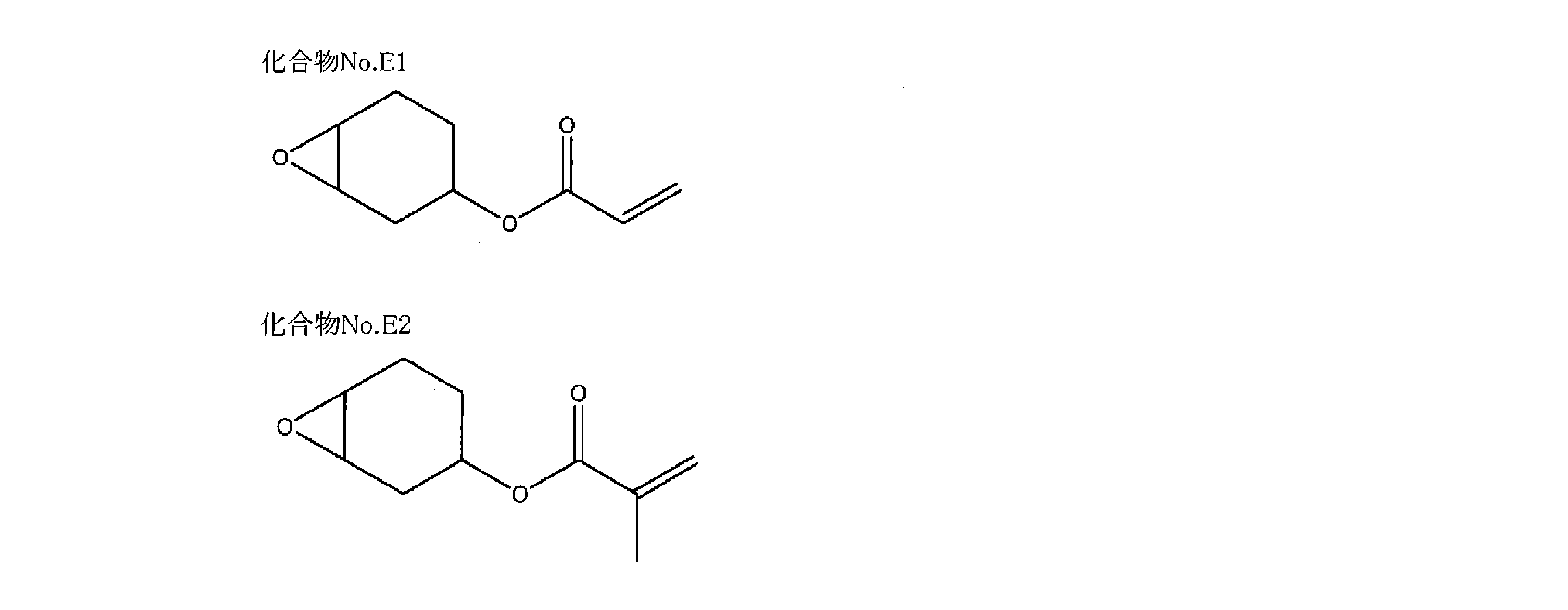
- Examples of the monofunctional epoxy compound include glycidyl methacrylate, methyl glycidyl ether, ethyl glycidyl ether, propyl glycidyl ether, isopropyl glycidyl ether, butyl glycidyl ether, isobutyl glycidyl ether, t-butyl glycidyl ether, pentyl glycidyl ether, hexyl glycidyl ether, heptyl Glycidyl ether, octyl glycidyl ether, nonyl glycidyl ether, decyl glycidyl ether, undecyl glycidyl ether, dodecyl glycidyl ether, tridecyl glycidyl ether, tetradecyl glycidyl ether, pentadecy
- polyfunctional epoxy compound when one or more compounds selected from the group consisting of bisphenol-type epoxy compounds and glycidyl ethers are used, a (colored) alkali-developable photosensitive resin composition having better characteristics can be obtained. Is preferable.
- the epoxy compound represented by the general formula (5) can be used, and for example, a bisphenol type epoxy compound such as a hydrogenated bisphenol type epoxy compound can also be used.
- glycidyl ethers examples include ethylene glycol diglycidyl ether, propylene glycol diglycidyl ether, 1,4-butanediol diglycidyl ether, 1,6-hexanediol diglycidyl ether, and 1,8-octanediol diglycidyl ether.
- novolac epoxy compounds such as phenol novolac epoxy compounds, biphenyl novolac epoxy compounds, cresol novolac epoxy compounds, bisphenol A novolac epoxy compounds, dicyclopentadiene novolac epoxy compounds; 3,4-epoxy-6-methyl Cycloaliphatic epoxy such as cyclohexylmethyl-3,4-epoxy-6-methylcyclohexanecarboxylate, 3,4-epoxycyclohexylmethyl-3,4-epoxycyclohexanecarboxylate, 1-epoxyethyl-3,4-epoxycyclohexane Compound: Glycidyl esters such as phthalic acid diglycidyl ester, tetrahydrophthalic acid diglycidyl ester, dimer acid glycidyl ester; Glycidylamines such as diphenylmethane, triglycidyl P-aminophenol and N, N-diglycidylaniline; heterocyclic epoxy compounds
- the photopolymerization initiator composition of the present invention is prepared beforehand by preparing a photopolymerization initiator composition from the component (A) and the component (B), which is then ethylenically unsaturated.
- a polymerizable compound having a bond and other optional components can be blended, and the component (A) and the component (B) are separately blended with the polymerizable compound and other optional components, respectively, You can also
- the content of the photopolymerization initiator composition of the present invention is not particularly limited, but the polymerizable compound having the ethylenically unsaturated bond (or the ethylenically unsaturated bond) is not limited. Is preferably 0.1 to 70 parts by weight, more preferably 0.3 to 50 parts by weight, and most preferably 0.5 to 30 parts by weight with respect to 100 parts by weight of the alkali-developable compound having the above.
- the photosensitive composition of the present invention is a (colored) alkali-developable photosensitive resin composition
- the content of the photopolymerization initiator composition of the present invention is the (colored) alkali-developable photosensitive composition of the present invention.
- the solid content of the resin composition all components other than the solvent
- 0.3 to 20% by mass, particularly 0.8 to 12% by mass is preferable.
- a solvent can be further added to the photosensitive composition of the present invention.
- a solvent capable of dissolving or dispersing each of the above components the photopolymerization initiator composition of the present invention and a polymerizable compound having an ethylenically unsaturated bond
- a solvent capable of dissolving or dispersing each of the above components the photopolymerization initiator composition of the present invention and a polymerizable compound having an ethylenically unsaturated bond
- methyl ethyl ketone Ketones such as methyl amyl ketone, diethyl ketone, acetone, methyl isopropyl ketone, methyl isobutyl ketone, cyclohexanone, 2-heptanone
- ketones, ether ester solvents, etc. particularly propylene glycol-1-monomethyl ether-2-acetate, cyclohexanone, and the like are preferable because the compatibility between the resist and the photopolymerization initiator is good in the photosensitive composition.
- the amount thereof used is preferably such that the concentration of solids (components other than the solvent) is 5 to 85% by mass from the viewpoint of handling and the like.
- the photosensitive composition of the present invention can further contain a coloring material to give a colored (alkali-developable) photosensitive composition.
- a coloring material include pigments, dyes, and natural pigments. These color materials can be used alone or in admixture of two or more.
- the pigment examples include nitroso compounds; nitro compounds; azo compounds; diazo compounds; xanthene compounds; quinoline compounds; anthraquinone compounds; coumarin compounds; phthalocyanine compounds; isoindolinone compounds; Compound; perylene compound; diketopyrrolopyrrole compound; thioindigo compound; dioxazine compound; triphenylmethane compound; quinophthalone compound; naphthalene tetracarboxylic acid; azo dye, metal complex compound of cyanine dye; lake pigment; Carbon black obtained by the method, or carbon black such as acetylene black, ketjen black or lamp black; Prepared by coating or coating with an epoxy resin, carbon black previously dispersed with a resin in a solvent and adsorbed with 20 to 200 mg / g of resin, carbon black treated with an acidic or alkaline surface, average Graphite having a particle size of 8 nm or more and a DBP oil absorption of 90
- Graphite Graphitized carbon black, activated carbon, carbon fiber, carbon nanotube, carbon microcoil, carbon nanohorn, carbon aerogel, fullerene; aniline black, pigment black 7, titanium black; chromium oxide green, miloli blue, cobalt green, cobalt blue, manganese series , Ferrocyanide Organic or inorganic such as phosphate ultramarine, bitumen, ultramarine, cerulean blue, pyridian, emerald green, lead sulfate, yellow lead, zinc yellow, red bean (red iron (III) oxide), cadmium red, synthetic iron black, amber Pigments can be used. These pigments can be used alone or in combination.
- pigments can also be used as the pigment, for example, Pigment Red 1, 2, 3, 9, 10, 14, 17, 22, 23, 31, 38, 41, 48, 49, 88, 90, 97, 112, 119, 122, 123, 144, 149, 166, 168, 169, 170, 171, 177, 179, 180, 184, 185, 192, 200, 202, 209, 215, 216, 217, 220, 223, 224, 226, 227, 228, 240, 254; Pigment Orange 13, 31, 34, 36, 38, 43, 46, 48, 49, 51, 52, 55, 59, 60, 61, 62, 64, 65, 71; Pigment Yellow 1, 3, 12, 13, 14, 16, 17, 20, 24, 55, 60, 73, 81, 83, 86, 93, 95, 9 98, 100, 109, 110, 113, 114, 117, 120, 125, 126, 127, 129, 137, 138, 139, 147, 148,
- dyes As the above dyes, azo dyes, anthraquinone dyes, indigoid dyes, triarylmethane dyes, xanthene dyes, alizarin dyes, acridine dyes stilbene dyes, thiazole dyes, naphthol dyes, quinoline dyes, nitro dyes, indamine dyes, oxazine dyes, phthalocyanine dyes And dyes such as cyanine dyes. These may be used in combination.
- the content of the colorant is preferably 50 to 350 parts by mass, more preferably 100 to 250 parts by mass, with respect to 100 parts by mass of the polymerizable compound having an ethylenically unsaturated bond. Part.
- the photosensitive composition of the present invention can further contain an inorganic compound.
- the inorganic compound include metal oxides such as nickel oxide, iron oxide, iridium oxide, titanium oxide, zinc oxide, magnesium oxide, calcium oxide, potassium oxide, silica, and alumina; lamellar clay mineral, miloli blue, calcium carbonate, Magnesium carbonate, cobalt, manganese, glass powder (especially glass frit), mica, talc, kaolin, ferrocyanide, various metal sulfates, sulfides, selenides, aluminum silicate, calcium silicate, aluminum hydroxide, platinum, Gold, silver, copper, etc. are mentioned.
- glass frit, titanium oxide, silica, layered clay mineral, silver and the like are preferable.
- the content of the inorganic compound is preferably 0.1 to 1000 parts by mass, more preferably 10 to 10 parts by mass with respect to 100 parts by mass of the polymerizable compound having an ethylenically unsaturated bond. 800 parts by mass.
- These inorganic compounds can be used alone or in combination of two or more. These inorganic compounds are used, for example, as fillers, antireflection agents, conductive agents, stabilizers, flame retardants, mechanical strength improvers, special wavelength absorbers, ink repellents, and the like.
- a dispersant for dispersing a colorant and / or an inorganic compound can be added.
- the dispersing agent is not limited as long as it can disperse and stabilize a coloring material or an inorganic compound, and a commercially available dispersing agent such as BYK series manufactured by BYK Chemie Corporation can be used.
- another photopolymerization initiator can be used in combination with the oxime ester compound as the component (A) and the oxime ester compound as the component (B).
- Conventionally known compounds can be used as other photopolymerization initiators that can be used in combination.
- R 1 , R 2 and R 6 are the same as those in the general formula (1-2), R 51 represents a halogen atom or an alkyl group, and e is an integer of 0 to 5. is there.)
- the photosensitive composition of the present invention includes, if necessary, a thermal polymerization inhibitor such as p-anisole, hydroquinone, pyrocatechol, t-butylcatechol, phenothiazine; a plasticizer; an adhesion promoter; a filler; Conventional additives such as a foaming agent, a leveling agent, a surface conditioner, an antioxidant, an ultraviolet absorber, a dispersion aid, a coagulation inhibitor, a catalyst, an effect accelerator, a cross-linking agent, and a thickener can be added.
- an optional component other than the polymerizable compound having the ethylenically unsaturated bond and the photopolymerization initiator composition of the present invention (however, the other photopolymerization initiator, ethylenically unsaturated).
- the amount of the alkali-developing compound that may have a group, an inorganic compound (filler), a coloring material and a solvent is excluded) is appropriately selected according to the purpose of use and is not particularly limited. Is 50 parts by mass or less in total with respect to 100 parts by mass of the polymerizable compound having an ethylenically unsaturated bond.
- cured material can also be improved by using another organic polymer with the polymeric compound which has the said ethylenically unsaturated bond.
- the organic polymer include polystyrene, polymethyl methacrylate, methyl methacrylate-ethyl acrylate copolymer, poly (meth) acrylic acid, styrene- (meth) acrylic acid copolymer, (meth) acrylic acid-methyl methacrylate.
- Copolymer ethylene-vinyl chloride copolymer, ethylene-vinyl copolymer, polyvinyl chloride resin, ABS resin, nylon 6, nylon 66, nylon 12, urethane resin, polycarbonate polyvinyl butyral, cellulose ester, polyacrylamide, saturated
- polyester phenol resin, phenoxy resin, polyamideimide resin, polyamic acid resin, epoxy resin, etc.
- polystyrene, (meth) acrylic acid-methyl methacrylate copolymer, and epoxy resin are preferred. Arbitrariness. When other organic polymer is used, the amount used is preferably 10 to 500 parts by mass with respect to 100 parts by mass of the polymerizable compound having an ethylenically unsaturated bond.
- a chain transfer agent a sensitizer, a surfactant, a silane coupling agent, a melamine compound and the like can be further used in combination.
- a sulfur atom-containing compound is generally used.
- Alkyl compounds trimethylolpropane tris (3-mercaptoisobutyrate), butanediol bis (3-mercaptoisobutyrate), hexanedithiol, decanedithiol, 1,4- Methyl mercaptobenzene, butanediol bisthiopropionate, butanediol bisthioglycolate, ethylene glycol bisthioglycolate, trimethylolpropane tristhioglycolate, butanediol bisthiopropionate, trimethylolpropane tristhiopropionate , Trimethylolpropane tristhioglycolate, pentaerythritol tetrakisthiopropionate, pentaerythritol tetrakisthioglycolate, trishydroxyethyltristhiopropionate, diethylthioxanthone, diisopropyl
- the surfactant examples include fluorine surfactants such as perfluoroalkyl phosphates and perfluoroalkyl carboxylates; anionic surfactants such as higher fatty acid alkali salts, alkyl sulfonates, and alkyl sulfates; higher amines Cationic surfactants such as halogenates and quaternary ammonium salts; Nonionic surfactants such as polyethylene glycol alkyl ethers, polyethylene glycol fatty acid esters, sorbitan fatty acid esters, and fatty acid monoglycerides; amphoteric surfactants; silicone surfactants Surfactants such as agents can be used, and these can also be used in combination.
- fluorine surfactants such as perfluoroalkyl phosphates and perfluoroalkyl carboxylates
- anionic surfactants such as higher fatty acid alkali salts, alkyl sulfonates, and alkyl sulfates
- silane coupling agent examples include alkenyl group-containing silane coupling agents such as vinyltrimethoxysilane, vinyltriethoxysilane, vinyltriacetoxysilane, vinyltris (2-methoxyethoxy) silane, vinylmethyldimethoxysilane, octene. Tenyltrimethoxysilane, allyltrimethoxysilane, p-styryltrimethoxysilane, and the like.
- silane coupling agent having an acrylic group examples include 3-acryloxypropyltrimethoxysilane, 3-acryloxypropyltriethoxysilane, and the like.
- silane coupling agents having a methacryl group examples include 3-methacryloxypropylmethyldimethoxysilane, 3-methacryloxypropyltrimethoxysilane, and 3-methacryloxypropylmethyl. Examples include diethoxysilane, 3-methacryloxypropyltriethoxysilane, methacryloxyoctyltrimethoxysilane, and the like.
- silane coupling agent having an epoxy group 2- (3,4-epoxycyclohexyl) ethyltrimethoxysilane, 3 -Glycidoxypropylmethyldimethoxysilane, 3-glycidoxypropyltrimethoxysilane, 3-glycidoxypropylmethyldiethoxysilane, 3-glycidoxypropyltriethoxysilane, glycidoxyoctyltrimethoxysilane, etc.
- silane coupling agents having an amino group N-2- (aminoethyl) -3-aminopropylmethyldimethoxysilane, N-2- (aminoethyl) -3-aminopropyltrimethoxysilane, 3-aminopropyl Trime Xysilane, 3-aminopropyltriethoxysilane, 3-triethoxysilyl-N- (1,3-dimethyl-butylidene) propylamine, N-phenyl-3-aminopropyltrimethoxysilane, N, N′-bis [3 -(Trimethoxysilyl) propyl] ethylenediamine, hydrochloride of N- (vinylbenzyl) -2-aminoethyl-3-aminopropyltrimethoxysilane and the like, and silane coupling agents having an isocyanurate group include tris- (Trimethoxysilylpropyl)
- Ureido group examples of the silane coupling agent having 3-ureidopropyltrimethoxysilane, 3-ureidopropyltriethoxysilane and the like, and examples of the silane coupling agent having a sulfide group include bis (triethoxysilylpropyl) tetrasulfide, Examples of the silane coupling agent having a thioester group include 3-octanoylthio-1-propyltriethoxysilane, and examples of the silane coupling agent having an isocyanate group include 3-isocyanatopropyltriethoxysilane, 3-isocyanatopropyltrimethoxysilane, and the like. Is mentioned.
- silane coupling agent for example, as vinyltrimethoxysilane, KBM-1003 manufactured by Shin-Etsu Chemical Co., Ltd., manufactured by Montive Performance Materials Japan LLC. No. A-171, Z-6300 manufactured by Toray Dow Corning Co., Ltd., GENIOSIL XL10 manufactured by Asahi Kasei Wacker Silicone Co., Ltd., Silaace S210 manufactured by Nimi Shoji Co., Ltd., etc.
- KBE-1003 manufactured by Shin-Etsu Chemical Co., Ltd., A-151 manufactured by Montive Performance Materials Japan G.K., Z-6519 manufactured by Toray Dow Corning Co., Ltd., GENIOSIL manufactured by Asahi Kasei Wacker Silicone Co., Ltd. GF56, Sila Ace manufactured by Nimi Shoji Co., Ltd.
- vinyl triacetoxy silane GENIOSIL GF62 manufactured by Asahi Kasei Wacker Silicone Co., Ltd.
- vinyl tris (2-methoxyethoxy) silane manufactured by Montive Performance Materials Japan GK
- examples of the vinylmethyldimethoxysilane include A-2171 manufactured by Montive Performance Materials Japan GK, GENIOSIL XL12 manufactured by Asahi Kasei Wacker Silicone Co., Ltd., and octenyltrimethoxysilane.
- KBM-1083 manufactured by Shin-Etsu Chemical Co., Ltd. can be cited.
- allyltrimethoxysilane Z-6825 manufactured by Toray Dow Corning Co., Ltd.
- KBM-1403 manufactured by Shin-Etsu Chemical Co., Ltd. KBM-5103 is exemplified as 3-acryloxypropyltrimethoxysilane
- Shin-Etsu Chemical Co., Ltd. is exemplified as 3-methacryloxypropylmethyldimethoxysilane
- KBM-502 manufactured by Toray Dow Corning Co., Ltd., etc., and 3-methacryloxypropyltrimethoxysilane include KBM-503 manufactured by Shin-Etsu Chemical Co., Ltd.
- Examples include KBM-402 manufactured by Koshi Chemical Industry Co., Ltd., Z-6044 manufactured by Toray Dow Corning Co., Ltd., and Silaace S520 manufactured by Himi Shoji Co., Ltd., and examples of 3-glycidoxypropyltrimethoxysilane KBM-403 manufactured by Shin-Etsu Chemical Co., Ltd., A-187 manufactured by Montive Performance Materials Japan GK, Z-6040 manufactured by Toray Dow Corning Co., Ltd., manufactured by Asahi Kasei Wacker Silicone Co., Ltd.
- GENIOSIL GF80, Nylon Corporation Silaace S510, and the like, and 3-glycidoxypropylmethyldiethoxysilane include Shin-Etsu Chemical Co., Ltd. KBE-402, 3-glycidoxy Examples of propyltriethoxysilane include Shin-Etsu Chemical Co., Ltd. KBE-403, Montive Examples include A-1871 manufactured by Forance Materials Japan GK, GENIOSIL GF82 manufactured by Asahi Kasei Wacker Silicone Co., Ltd., and glycidoxyoctyltrimethoxysilane is KBM manufactured by Shin-Etsu Chemical Co., Ltd.
- N-2- (aminoethyl) -3-aminopropylmethyldimethoxysilane includes KBM-602 manufactured by Shin-Etsu Chemical Co., Ltd. and A manufactured by Montive Performance Materials Japan LLC. -2120, GENIOSIL GF-95 manufactured by Asahi Kasei Wacker Silicone Co., Ltd., Silaace S310 manufactured by Nimi Shoji Co., Ltd., and the like.
- N-2- (aminoethyl) -3-aminopropyltrimethoxysilane Shin-Etsu KBM-603 manufactured by Chemical Industry Co., Ltd., Montive A-1120 manufactured by Forance Materials Japan GK, A-1122 manufactured by Montive Performance Materials Japan GK, Z-6020 manufactured by Toray Dow Corning Co., Ltd., Toray Dow Corning Co., Ltd. ) Z-6094 manufactured by Asahi Kasei Wacker Silicone Co., Ltd. GENIOSIL GF-91, Silami Ace S320 manufactured by Nimi Shoji Co., Ltd., and the like.
- As 3-aminopropyltrimethoxysilane Shin-Etsu Chemical Co., Ltd.
- KBM-903 manufactured by Montive Performance Materials Japan GK, Z-6610 manufactured by Toray Dow Corning Co., Ltd.
- Sila Ace S360 manufactured by Nimi Shoji Co., Ltd.
- Examples of-(1,3-dimethyl-butylidene) propylamine include KBE-9103, Silaace S340 manufactured by Nimi Shoji Co., Ltd., and N-phenyl-3-aminopropyltrimethoxysilane includes Shin-Etsu Chemical Co., Ltd. KBM-573 manufactured by Co., Ltd., Y-9669 manufactured by Montive Performance Materials Japan GK, Z-6883 manufactured by Toray Dow Corning Co., Ltd. and the like, N, N'-Bis [3 -(Trimethoxysilyl) propyl] ethylenediamine is Silaace manufactured by Nimi Shoji Co., Ltd.
- N- (vinylbenzyl) -2-aminoethyl-3-aminopropyltrimethoxysilane hydrochloride includes KBM-575 manufactured by Shin-Etsu Chemical Co., Ltd., manufactured by Toray Dow Corning Co., Ltd.
- Z-6032, Silaace S350 manufactured by Nimi Shoji Co., Ltd., and tris- (trimethoxysilylpropyl) isocyanurate include KBM-9659 manufactured by Shin-Etsu Chemical Co., Ltd., and 3-mercapto As propylmethyldimethoxysilane, KBM-802 manufactured by Shin-Etsu Chemical Co., Ltd., Z-6852 manufactured by Toray Dow Corning Co., Ltd., and 3-mercaptopropyltrimethoxysilane manufactured by Shin-Etsu Chemical Co., Ltd.
- KBM-803, A-189 manufactured by Montive Performance Materials Japan GK Examples include Z-6062 manufactured by Toray Dow Corning Co., Ltd., Silaace S810 manufactured by Nimi Shoji Co., Ltd., etc.
- 3-mercaptopropyltriethoxysilane A manufactured by Montive Performance Materials Japan GK -1891, Z-6911 manufactured by Toray Dow Corning Co., Ltd., and 3-ureidopropyltriethoxysilane include A-1160 manufactured by Montive Performance Materials Japan GK
- Examples of ureidopropyltrialkoxysilane include KBE-585 manufactured by Shin-Etsu Chemical Co., Ltd., and examples of bis (triethoxysilylpropyl) tetrasulfide include KBE-846 manufactured by Shin-Etsu Chemical Co., Ltd.
- 3-Octanoylthio-1-propyltriethoxy The run includes A-LINK599 manufactured by Montive Performance Materials Japan GK, and the 3-isocyanatepropyltriethoxysilane includes KBE-9007 manufactured by Shin-Etsu Chemical Co., Ltd. and Montive Performance Materials. A-1310 manufactured by NZ Japan Ltd., etc., and as 3-isocyanatopropyltrimethoxysilane, Y-5187 manufactured by Montive Performance Materials Japan KK, GENIOSIL manufactured by Asahi Kasei Wacker Silicone Co., Ltd. GF40 etc. are mentioned.
- silane coupling agents a silane coupling agent having a methacryloyl group, an epoxy group or an isocyanate group is preferably used.
- Examples of the melamine compound include all or part of active methylol groups (CH 2 OH groups) in nitrogen compounds such as (poly) methylol melamine, (poly) methylol glycoluril, (poly) methylol benzoguanamine, and (poly) methylol urea.
- Examples include compounds in which (at least two) are alkyl etherified.
- examples of the alkyl group constituting the alkyl ether include a methyl group, an ethyl group, and a butyl group, and they may be the same or different.
- methylol groups that are not alkyl etherified may be self-condensed within one molecule, and may be condensed between two molecules, resulting in the formation of an oligomer component.
- hexamethoxymethyl melamine, hexabutoxymethyl melamine, tetramethoxymethyl glycoluril, tetrabutoxymethyl glycoluril and the like can be used.
- alkyl etherified melamines such as hexamethoxymethyl melamine and hexabutoxymethyl melamine are preferable.
- the photosensitive composition of the present invention is a known method such as spin coater, roll coater, bar coater, die coater, curtain coater, various printing, dipping, soda glass, quartz glass, semiconductor substrate, metal, paper, plastic. It can be applied on a supporting substrate such as. Moreover, after once applying on support bases, such as a film, it can also transfer on another support base
- an ultrahigh pressure mercury lamp used for curing the photosensitive composition of the present invention, an ultrahigh pressure mercury lamp, a high pressure mercury lamp, a medium pressure mercury lamp, a low pressure mercury lamp, a mercury vapor arc lamp, a xenon arc lamp, High electromagnetic wave energy, electron beam, X-ray, radiation, etc. having a wavelength of 2000 angstrom to 7000 angstrom obtained from carbon arc lamp, metal halide lamp, fluorescent lamp, tungsten lamp, excimer lamp, germicidal lamp, light emitting diode, CRT light source, etc.
- energy rays can be used, preferably, an ultra-high pressure mercury lamp, a mercury vapor arc lamp, a carbon arc lamp, a xenon arc lamp, and the like that emit light having a wavelength of 300 to 450 nm are exemplified.
- the laser direct drawing method that directly forms an image from digital information such as a computer without using a mask improves not only productivity but also resolution and positional accuracy.
- the laser light light having a wavelength of 340 to 430 nm is preferably used, but excimer laser, nitrogen laser, argon ion laser, helium cadmium laser, helium neon laser, krypton ion laser.
- lasers that emit light in the visible to infrared region such as various semiconductor lasers and YAG lasers, are also used. When these lasers are used, a sensitizing dye that absorbs the region from visible to infrared is added.
- the photosensitive composition of the present invention can also be used to create patterns with different steps and different heights using a halftone mask.
- the photosensitive composition of the present invention comprises a photocurable paint or varnish; a photocurable adhesive; a printed circuit board; a color filter in a color display liquid crystal display element such as a color television, a PC monitor, a personal digital assistant, a digital camera; Color filter of image sensor; Electrode material for plasma display panel; Powder coating; Printing ink; Printing plate; Adhesive; Dental composition; Gel coat; Photoresist for electronics; Electroplating resist; Solder resists; resists for manufacturing color filters for various display applications or for forming structures in the manufacturing process of plasma display panels, electroluminescent display devices, and LCDs; compositions for encapsulating electrical and electronic components Material; Solder resist; Magnetic recording material; Micro machine part Optical waveguide switch; plating mask; etching mask; color test system; glass fiber cable coating; stencil for screen printing; material for manufacturing three-dimensional objects by stereolithography; holographic recording material; A fine electronic circuit; a bleaching material; a bleaching material for an image recording material; a bleaching
- the photosensitive composition of the present invention can also be used for the purpose of forming a spacer for a liquid crystal display panel and for forming a protrusion for a vertical alignment type liquid crystal display element.
- it is useful as a photosensitive composition for simultaneously forming protrusions and spacers for a vertical alignment type liquid crystal display element.
- the spacer for a liquid crystal display panel includes (1) a step of forming a coating film of the photosensitive composition of the present invention on a substrate, and (2) irradiation of the coating film with radiation through a mask having a predetermined pattern shape. (3) a baking step after exposure, (4) a step of developing the coating after exposure, and (5) a step of heating the coating after development.
- the (colored) photosensitive composition of the present invention to which an ink repellent agent is added is useful as a partition-forming resin composition for an inkjet system, and the composition is used for a color filter, and particularly has a profile angle of 50 ° or more. It is preferably used for a partition for an inkjet color filter.
- the ink repellent agent a composition comprising a fluorosurfactant and a fluorosurfactant is preferably used.
- An optical element is formed by a method in which a partition formed from the photosensitive composition of the present invention partitions an image to be transferred, and droplets are applied to the recessed portions on the partitioned image to be transferred by an ink jet method to form an image region. Manufactured. At this time, it is preferable that the droplet contains a colorant and the image region is colored, and a pixel group composed of a plurality of colored regions and at least a partition wall separating the colored regions of the pixel group on the substrate. And an optical element produced by the above-described optical element manufacturing method is preferably used.
- the photosensitive composition of the present invention is also used as a composition for a protective film or an insulating film, and is a monofunctional or bifunctional compound containing an ultraviolet absorber, an alkylated modified melamine and / or an acrylic modified melamine, and an alcoholic hydroxyl group in the molecule.
- a photosensitive composition for the protective film and insulating film for example, (I) a carboxyl group-containing resin obtained by reacting a diol compound and a polyvalent carboxylic acid, having a weight average molecular weight of 2,000 to 40,000 and an acid value of 50 to 200 mgKOH / g; (II) an unsaturated compound containing at least one photopolymerizable ethylenically unsaturated bond in one molecule, (III) an epoxy compound, and (IV) a photopolymerization initiator component, a resin composition comprising as a main component,
- the component (III) is contained in an amount of 10 to 40 parts by weight
- the component (IV) is contained in an amount of 0.01 to 2.0 parts by weight
- the resin composition using the photopolymerization initiator composition of the present invention is used as the photopolymerization initiator component.
- the insulating film is used for the insulating resin layer in a laminate in which an insulating resin layer is provided on a peelable support substrate, and the laminate can be developed with an alkaline aqueous solution.
- the film thickness is preferably 10 to 100 ⁇ m.
- the photosensitive composition of the present invention can be used as a photosensitive paste composition by containing an inorganic material (inorganic compound).
- the photosensitive paste composition is used to form a fired product pattern such as a partition pattern, a dielectric pattern, an electrode pattern, and a black matrix pattern of a plasma display panel.
- Example 1 The photopolymerization initiator composition No. 1 with the compounding ratio shown in Table 1. 1 was prepared. As the component (A) and the component (B), those shown below were used. Furthermore, SPC-1000 (acrylic resin; Showa Denko) 55.46 parts by mass, Aronix M-450 (polyfunctional acrylate; Toagosei Co., Ltd.) 12.91 parts by mass, KBE-403 (silane coupling agent; Shin-Etsu) (Made by Silicone) 0.58 parts by mass, 3.23 parts by mass of 1% cyclohexanone solution of FZ-2122 (surfactant; manufactured by Nihon Unicar) and 27.48 parts by mass of propylene glycol-1-monomethyl ether-2-acetate And photopolymerization initiator composition No.
- SPC-1000 acrylic resin; Showa Denko
- Aronix M-450 polyfunctional acrylate
- Toagosei Co., Ltd. 12.91 parts by mass
- KBE-403
- Example 2 to 13 The photopolymerization initiator composition No. 1 with the compounding ratio shown in Table 1. 2 to No. 13 was prepared. As the component (A) and the component (B), those shown below were used. Furthermore, the photopolymerization initiator composition No. used in Example 1 was used. 1 except that these photopolymerization initiator compositions were used in the same manner as in Example 1 except that the alkali-developable photosensitive resin composition No. 1 was used. 2 to No. 13 was obtained. About the obtained alkali-developable photosensitive resin composition, the sensitivity was evaluated by the following sensitivity evaluation method, and the resolution was evaluated by the following resolution evaluation method. The results are shown in Table 1.
- 1-No. 15 was prepared.
- the photopolymerization initiator composition No. used in Example 1 was used.
- the comparative alkali-developable photosensitive resin composition No. 1 was used in the same manner as in Example 1 except that these comparative photopolymerization initiator compositions were used in place of 1.
- 1-No. 15 was obtained. About the obtained alkali-developable photosensitive resin composition, the sensitivity was evaluated by the following sensitivity evaluation method, and the resolution was evaluated by the following resolution evaluation method. The results are shown in Table 2.
- Component (A) As the component (A), the following compound No. 1, compound no. 6 and compound no. 11 was used.
- Comparative photopolymerization initiator The following comparative photopolymerization initiator-1 and comparative photopolymerization initiator-2 were used in the comparative examples.
- the sensitivity evaluation of the obtained alkali-developable photosensitive resin composition and comparative alkali-developable photosensitive resin composition was performed as follows. That is, the alkali-developable photosensitive resin composition was spin coated on a glass substrate, prebaked at 90 ° C. for 90 seconds using a hot plate, and exposed through a mask using a high-pressure mercury lamp as a light source. After developing using a 2.5% by mass aqueous sodium carbonate solution as a developing solution, it was washed thoroughly with water and post-baked at 230 ° C. for 30 minutes using an oven to fix the pattern.
- the pattern for an exposure amount of 40 mJ was observed with an electron microscope, and the line width of the mask opening of 20 ⁇ m was measured.
- the line width was 21 ⁇ m or more as A, 20 to 21 ⁇ m as B, 19 to 20 ⁇ m as C, and 19 or less as D.
- A has the highest sensitivity, then B and C, and D has the lowest sensitivity.
- the resolution evaluation of the obtained alkali-developable photosensitive resin composition and comparative alkali-developable photosensitive resin composition was performed as follows. That is, the alkali-developable photosensitive resin composition was spin coated on a glass substrate, prebaked at 90 ° C. for 90 seconds using a hot plate, and exposed through a mask using a high-pressure mercury lamp as a light source. After developing using a 2.5% by mass aqueous sodium carbonate solution as a developing solution, it was washed thoroughly with water and post-baked at 230 ° C. for 30 minutes using an oven to fix the pattern.
- a difference between the mask opening and the line width is A or less, 0.5 A or less, B is a difference between 0.5 to 1.0 ⁇ m, C is a difference between 1.0 to 2.0 ⁇ m, and D is 2.0 ⁇ m or more.
- A has the highest resolution, then B and C, and D has the lowest resolution.
- a photopolymerization initiator composition capable of imparting excellent sensitivity and resolution to a photosensitive composition. Moreover, according to this invention, the photosensitive composition excellent in the sensitivity and the resolution can be provided.
Landscapes
- Physics & Mathematics (AREA)
- Chemical & Material Sciences (AREA)
- General Physics & Mathematics (AREA)
- Organic Chemistry (AREA)
- Spectroscopy & Molecular Physics (AREA)
- Health & Medical Sciences (AREA)
- Chemical Kinetics & Catalysis (AREA)
- Medicinal Chemistry (AREA)
- Polymers & Plastics (AREA)
- Materials For Photolithography (AREA)
- Polymerisation Methods In General (AREA)
Abstract
Description
しかしながら、これら従来の光重合開始剤のそれぞれは、感度が十分ではなく、また、アルカリ現像性感光性樹脂組成物等に使用した場合、解像度においても十分満足できるものではなかった。

R3、R4及びR5は、それぞれ独立に、炭素原子数1~20のアルキル基、炭素原子数1~20のアルコキシ基、炭素原子数6~30のアリール基、炭素原子数6~30のアリールオキシ基、炭素原子数7~30のアラルキル基、炭素原子数2~20の複素環基、シアノ基又はハロゲン原子を表し、アルキル基、アルコキシ基、アリール基、アリールオキシ基、アラルキル基及び複素環基の水素原子は、更にOR14、COR14、SR14、NR15R16、-NCOR15-OCOR16、CN、ハロゲン原子、-CR14=CR15R16又は-CO-CR14=CR15R16で置換されている場合があり、R14、R15及びR16は、それぞれ独立に、水素原子、炭素原子数1~20のアルキル基、炭素原子数6~30のアリール基、炭素原子数7~30のアラルキル基又は炭素原子数2~20の複素環基を表し、上記R3、R4、R5、R14、R15及びR16で表される置換基のアルキレン部分は、不飽和結合、エーテル結合、チオエーテル結合、エステル結合、チオエステル結合、アミド結合又はウレタン結合により1~5回中断されている場合があり、上記置換基のアルキル部分は分岐側鎖がある場合があり、環状アルキルである場合があり、上記置換基のアルキル末端は不飽和結合である場合があり、a、b及びdは、それぞれ独立に、0~3の整数である。
A1は、上記一般式(3)で表され、一般式(3)中、R7、R8及びR9は、それぞれ独立に、水素原子又は炭素原子数1~20のアルキル基を表し、アルキル基の水素原子はハロゲン原子で置換されている場合があり、アルキル基のアルキレン部分のメチレン基は、不飽和結合、エーテル結合、チオエーテル結合、エステル結合、チオエステル結合、アミド結合又はウレタン結合により1~5回中断されている場合があり、アルキル部分は分岐側鎖がある場合があり、環状アルキルである場合があり、アルキル末端は不飽和結合である場合があり、R7とR8は、一緒になって環を形成している場合がある。

R23及びR24は、それぞれ独立に、炭素原子数1~20のアルキル基、炭素原子数1~20のアルコキシ基、炭素原子数6~30のアリール基、炭素原子数6~30のアリールオキシ基、炭素原子数7~30のアラルキル基、炭素原子数2~20の複素環基、シアノ基又はハロゲン原子を表し、アルキル基、アルコキシ基、アリール基、アリールオキシ基、アラルキル基及び複素環基の水素原子は、更にOR34、COR34、SR34、NR35R36、-NCOR35-OCOR36、CN、ハロゲン原子、-CR34=CR35R36又は-CO-CR34=CR35R36で置換されている場合があり、R34、R35及びR36は、それぞれ独立に、水素原子、炭素原子数1~20のアルキル基、炭素原子数6~30のアリール基、炭素原子数7~30のアラルキル基又は炭素原子数2~20の複素環基を表し、上記R23、R24、R34、R35及びR36で表される置換基のアルキレン部分は、不飽和結合、エーテル結合、チオエーテル結合、エステル結合、チオエステル結合、アミド結合又はウレタン結合により1~5回中断されている場合があり、上記置換基のアルキル部分は分岐側鎖がある場合があり、環状アルキルである場合があり、上記置換基のアルキル末端は不飽和結合である場合があり、u及びvは、それぞれ独立に、0~3の整数である。
Arは下記の構造から選ばれるアリール基又は複素環基を表し、

X1は、直接結合又はカルボニル基を表し、
G1は、一般式(4)の基を表し、一般式(4)中、nは1~5の整数であり、mは1~6の整数である。
また、本発明は、更に無機化合物を含有させてなる上記感光性組成物を提供するものである。
また、本発明は、更に無機化合物を含有させてなる上記アルカリ現像性感光性樹脂組成物を提供するものである。
また、本発明は、上記感光性組成物、上記アルカリ現像性感光性組成物又は上記着色アルカリ現像性感光性樹脂組成物にエネルギー線を照射してなる硬化物を提供するものである。

本発明の光重合開始剤組成物で(B)成分として用いられるオキシムエステル化合物は、上記一般式(2-1)又は(2-2)で表され、上記一般式(4)で表されるシクロアルキル構造を有することを特徴とする。


本発明の感光性組成物は、必須成分として、本発明の光重合開始剤組成物及びエチレン性不飽和結合を有する重合性化合物を含有し、無機化合物、色材、溶媒等の任意成分を含有するものである。




即ち、上記エポキシ化合物のエポキシ基1個に対し、上記不飽和一塩基酸のカルボキシル基が0.1~1.0個で付加させた構造を有するエポキシ付加物において、該エポキシ付加物の水酸基1個に対し、上記多塩基酸無水物の酸無水物構造が0.1~1.0個となる比率となるようにするのが好ましい。
本発明の感光性組成物において、溶剤を使用する場合、その使用量は、ハンドリング等の観点から、固形分(溶剤以外の成分)の濃度が5~85質量%になる量が好ましい。
これら無機化合物は、例えば、充填剤、反射防止剤、導電剤、安定剤、難燃剤、機械的強度向上剤、特殊波長吸収剤、撥インク剤等として用いられる。

他の有機重合体を使用する場合、その使用量は、上記エチレン性不飽和結合を有する重合性化合物100質量部に対して、好ましくは10~500質量部である。
ここで、アルキルエーテルを構成するアルキル基としては、メチル基、エチル基又はブチル基が挙げられ、互いに同一である場合があり、異なる場合もある。また、アルキルエーテル化されていないメチロール基は、一分子内で自己縮合している場合があり、二分子間で縮合して、その結果オリゴマー成分が形成されている場合もある。
これらの中でも、ヘキサメトキシメチルメラミン、ヘキサブトキシメチルメラミン等のアルキルエーテル化されたメラミンが好ましい。
(I)ジオ-ル化合物と多価カルボン酸類とを反応させて得られ、重量平均分子量が2,000~40,000、酸価が50~200mgKOH/gであるカルボキシル基含有樹脂、
(II)光重合可能なエチレン性不飽和結合を一分子中に少なくとも1つ以上含む不飽和化合物、
(III)エポキシ化合物、及び
(IV)光重合開始剤成分、を主成分とする樹脂組成物であって、
(I)成分と(II)成分の合計100重量部に対して、(III)成分が10~40重量部、(IV)成分が0.01~2.0重量部含有され、且つ、(IV)成分の光重合開始剤成分として本発明の光重合開始剤組成物を用いた樹脂組成物が使用される。
表1記載の配合比で、光重合開始剤組成物No.1を調製した。(A)成分及び(B)成分は、下記に示すものを使用した。
さらに、SPC-1000(アクリル樹脂;昭和電工社製)55.46質量部、アロニックスM-450(多官能アクリレート;東亜合成社製)12.91質量部、KBE-403(シランカップリング剤;信越シリコーン社製)0.58質量部、FZ-2122(界面活性剤;日本ユニカー社製)のシクロヘキサノン1%溶液3.23質量部及びプロピレングリコール-1-モノメチルエーテル-2-アセテート27.48質量部を混合し、光重合開始剤組成物No.1の0.34質量部を配合し合計量が100質量部となるようにし、この混合液をよく撹拌し、本発明の感光性組成物であるアルカリ現像性感光性樹脂組成物No.1を得た。
得られたアルカリ現像性感光性樹脂組成物No.1について、下記感度評価方法で感度を評価し、下記解像度評価方法で解像度を評価した。それぞれの結果を表1に示す。
表1記載の配合比で、光重合開始剤組成物No.2~No.13を調製した。(A)成分及び(B)成分は、下記に示すものを使用した。さらに、実施例1で使用した光重合開始剤組成物No.1の代わりに、これら光重合開始剤組成物を使用した以外は、実施例1と同様にしてアルカリ現像性感光性樹脂組成物No.2~No.13を得た。得られたアルカリ現像性感光性樹脂組成物について、下記感度評価方法で感度を評価し、下記解像度評価方法で解像度を評価した。それぞれの結果を表1に示す。
表2記載の配合比で、比較光重合開始剤組成物No.1~No.15を調製した。比較光重合開始剤-1及び-2として、下記に示すものを使用した。
さらに、実施例1で使用した光重合開始剤組成物No.1の代わりに、これら比較光重合開始剤組成物を使用した以外は、実施例1と同様にして比較アルカリ現像性感光性樹脂組成物No.1~No.15を得た。得られたアルカリ現像性感光性樹脂組成物について、下記感度評価方法で感度を評価し、下記解像度評価方法で解像度を評価した。それぞれの結果を表2に示す。
(A)成分として、下記化合物No.1、化合物No.6及び化合物No.11を使用した。
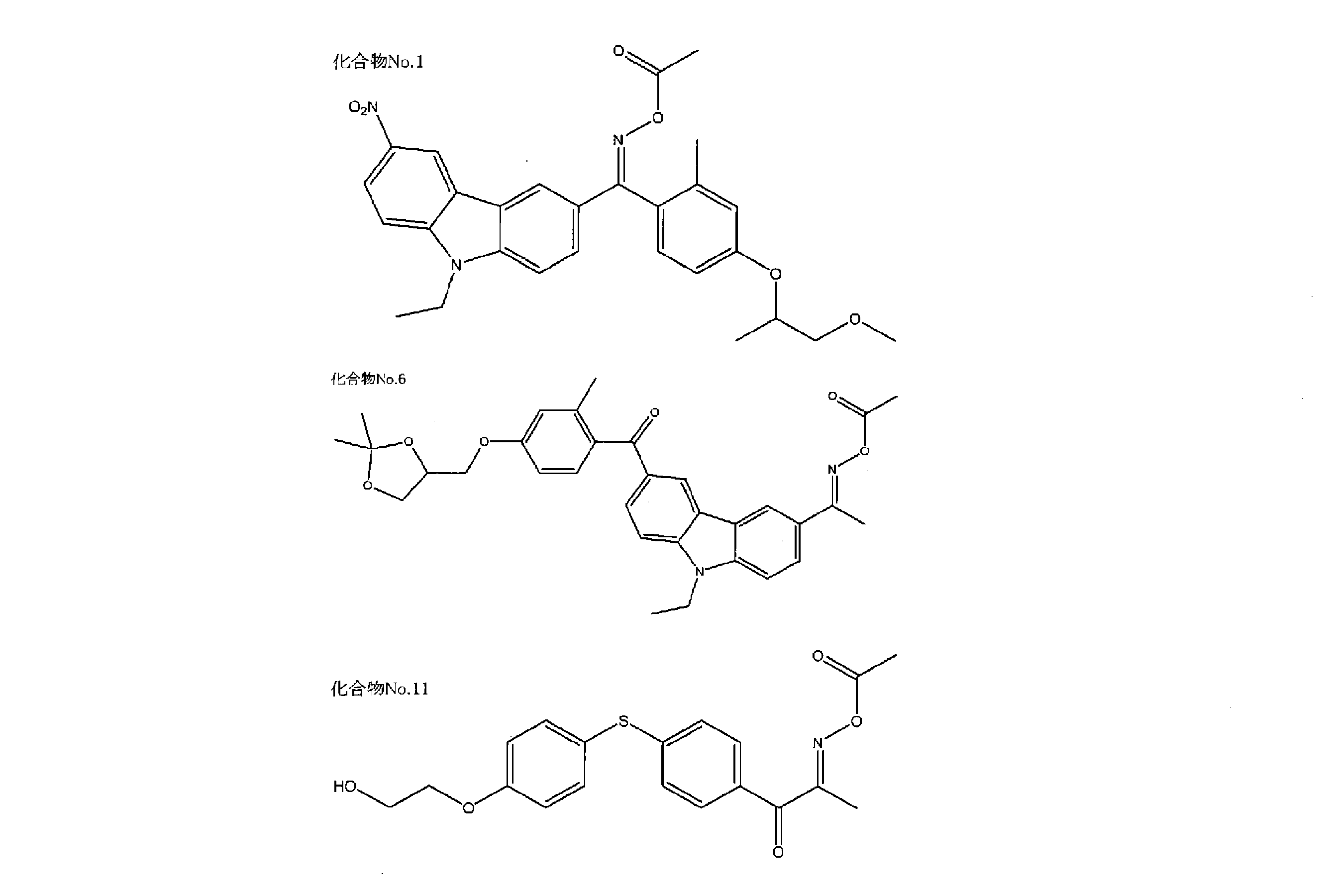
(B)成分として、下記化合物No.13、化合物No.15及び化合物No.21を使用した。
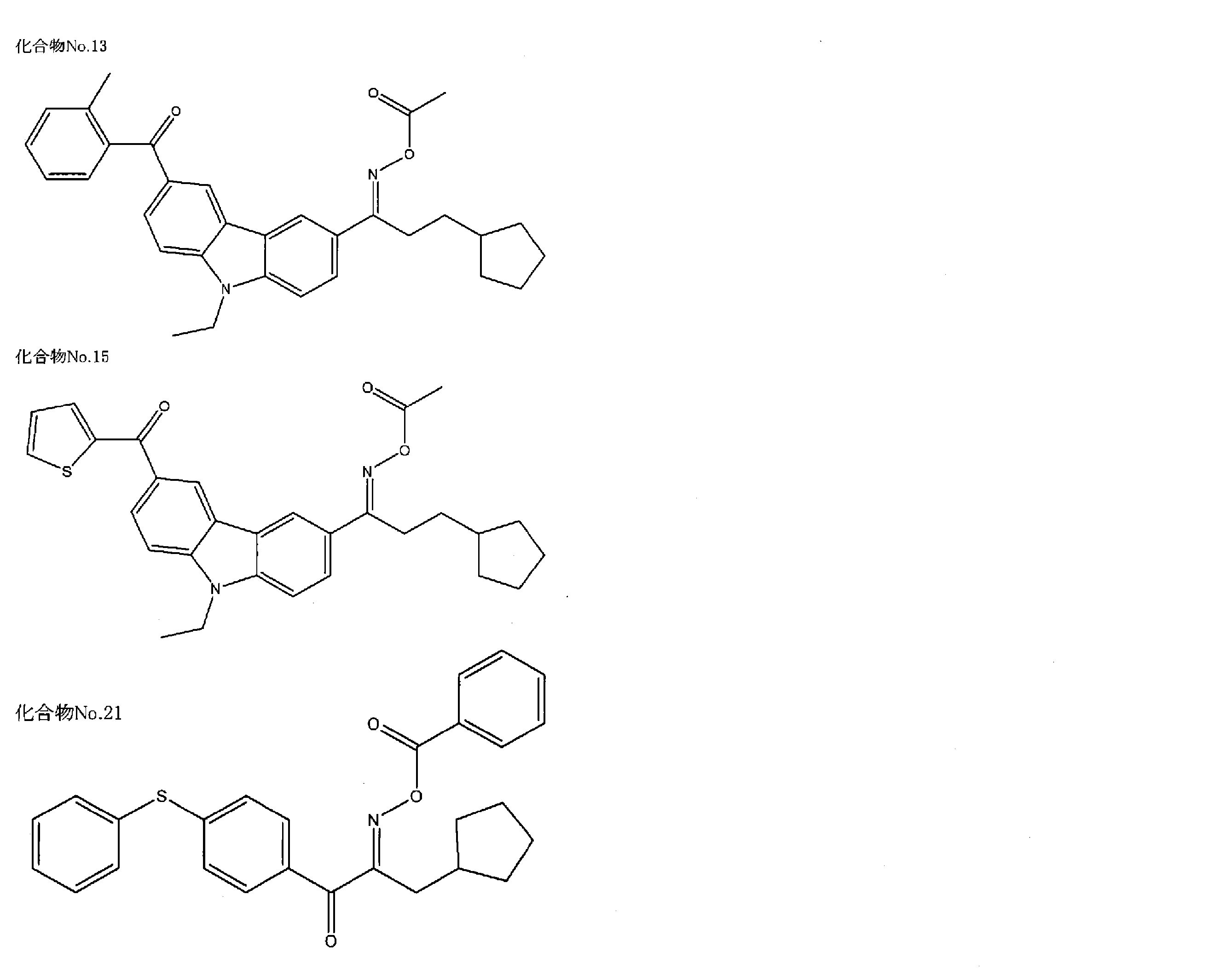
下記比較光重合開始剤-1及び比較光重合開始剤-2を比較例で使用した。
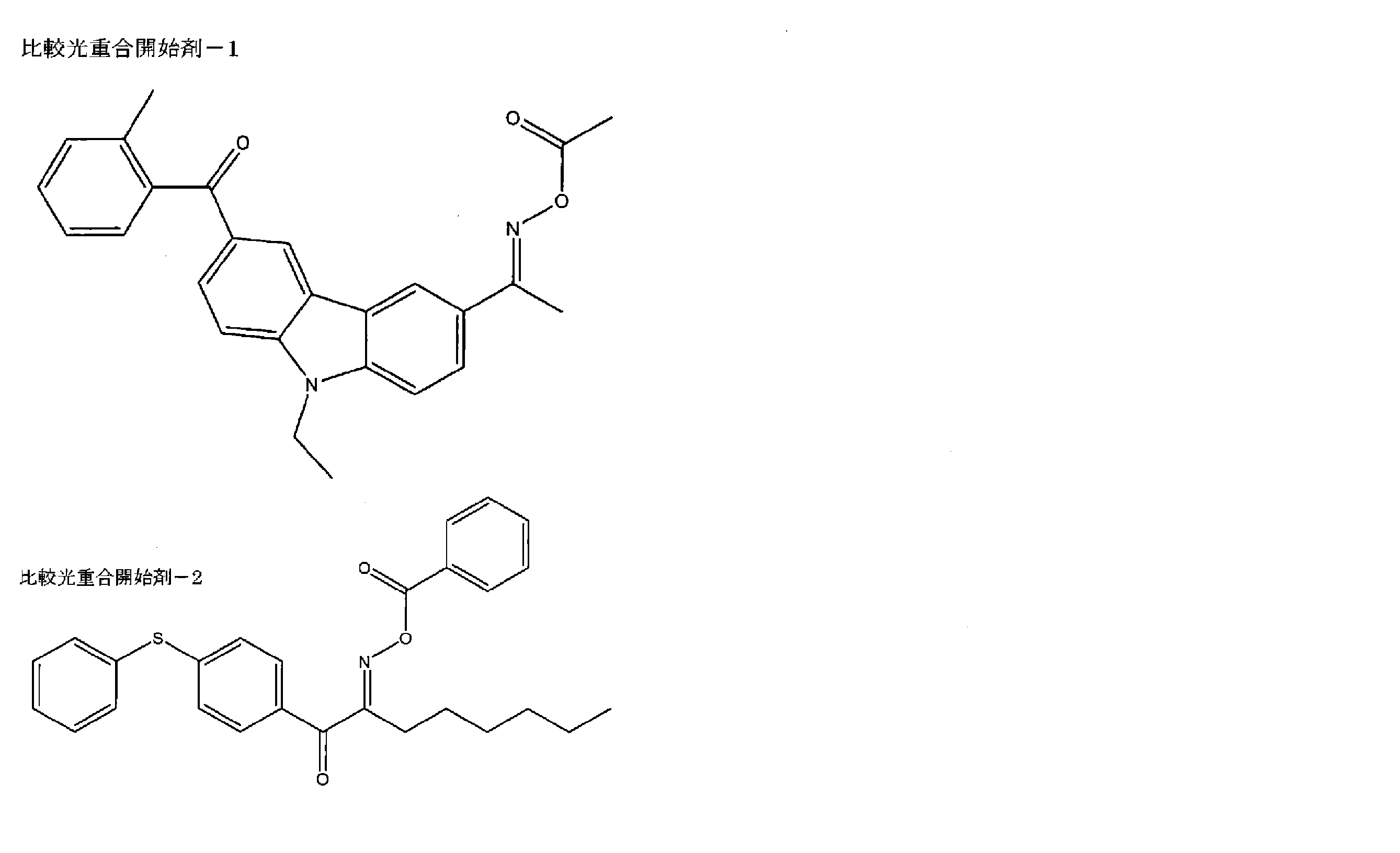
得られたアルカリ現像性感光性樹脂組成物及び比較アルカリ現像性感光性樹脂組成物の感度評価を以下のようにして行った。
即ち、ガラス基板上にアルカリ現像性感光性樹脂組成物をスピンコートし、ホットプレートを用いて、90℃で90秒間プリベークを行い、光源として高圧水銀ランプを用いてマスクを介して露光した。現像液として2.5質量%炭酸ナトリウム水溶液を用い現像後、よく水洗し、オーブンを用いて、230℃で30分ポストベークを行い、パターンを定着させた。40mJの露光量に対するパターンを電子顕微鏡で観察し、マスク開口20μmの線幅を測定した。線幅が21μm以上をA、20~21μmをB、19~20μmをC、19μm以下をDとした。Aが最も感度に優れ、次いでB、Cとなり、Dが最も感度に劣ることになる。
得られたアルカリ現像性感光性樹脂組成物及び比較アルカリ現像性感光性樹脂組成物の解像度評価を以下のようにして行った。
即ち、ガラス基板上にアルカリ現像性感光性樹脂組成物をスピンコートし、ホットプレートを用いて、90℃で90秒間プリベークを行い、光源として高圧水銀ランプを用いてマスクを介して露光した。現像液として2.5質量%炭酸ナトリウム水溶液を用い現像後、よく水洗し、オーブンを用いて、230℃で30分ポストベークを行い、パターンを定着させた。残膜感度(残膜率75%)を合わせたときのパターンを電子顕微鏡で観察し、マスク開口20μmの線幅を測定した。マスク開口と線幅の差が0.5μm以下をA、差が0.5~1.0μmの差をB、1.0~2.0μmの差をC、2.0μm以上をDとした。Aが最も解像度に優れ、次いでB、Cとなり、Dが最も解像度に劣ることになる。


Claims (7)
- 下記(A)成分を1~99質量部、下記(B)成分を1~99質量部(但し(A)成分と(B)成分の合計は100質量部)含有する光重合開始剤組成物。
(A)成分:下記一般式(3)で表されるエーテル構造を有することを特徴とする下記一般式(1-1)~(1-3)で表されるオキシムエステル化合物の一種以上からなる光重合開始剤。

R3、R4及びR5は、それぞれ独立に、炭素原子数1~20のアルキル基、炭素原子数1~20のアルコキシ基、炭素原子数6~30のアリール基、炭素原子数6~30のアリールオキシ基、炭素原子数7~30のアラルキル基、炭素原子数2~20の複素環基、シアノ基又はハロゲン原子を表し、アルキル基、アルコキシ基、アリール基、アリールオキシ基、アラルキル基及び複素環基の水素原子は、更にOR14、COR14、SR14、NR15R16、-NCOR15-OCOR16、CN、ハロゲン原子、-CR14=CR15R16又は-CO-CR14=CR15R16で置換されている場合があり、R14、R15及びR16は、それぞれ独立に、水素原子、炭素原子数1~20のアルキル基、炭素原子数6~30のアリール基、炭素原子数7~30のアラルキル基又は炭素原子数2~20の複素環基を表し、上記R3、R4、R5、R14、R15及びR16で表される置換基のアルキレン部分は、不飽和結合、エーテル結合、チオエーテル結合、エステル結合、チオエステル結合、アミド結合又はウレタン結合により1~5回中断されている場合があり、上記置換基のアルキル部分は分岐側鎖がある場合があり、環状アルキルである場合があり、上記置換基のアルキル末端は不飽和結合である場合があり、a、b及びdは、それぞれ独立に、0~3の整数である。
A1は、上記一般式(3)で表され、一般式(3)中、R7、R8及びR9は、それぞれ独立に、水素原子又は炭素原子数1~20のアルキル基を表し、アルキル基の水素原子はハロゲン原子で置換されている場合があり、アルキル基のアルキレン部分のメチレン基は、不飽和結合、エーテル結合、チオエーテル結合、エステル結合、チオエステル結合、アミド結合又はウレタン結合により1~5回中断されている場合があり、アルキル部分は分岐側鎖がある場合があり、環状アルキルである場合があり、アルキル末端は不飽和結合である場合があり、R7とR8は、一緒になって環を形成している場合がある。
(B)成分:下記一般式(4)のシクロアルキル構造を有することを特徴とする下記一般式(2-1)又は(2-2)で表されるオキシムエステル化合物の一種以上を含有する光重合開始剤。

R23及びR24は、それぞれ独立に、炭素原子数1~20のアルキル基、炭素原子数1~20のアルコキシ基、炭素原子数6~30のアリール基、炭素原子数6~30のアリールオキシ基、炭素原子数7~30のアラルキル基、炭素原子数2~20の複素環基、シアノ基又はハロゲン原子を表し、アルキル基、アルコキシ基、アリール基、アリールオキシ基、アラルキル基及び複素環基の水素原子は、更にOR34、COR34、SR34、NR35R36、-NCOR35-OCOR36、CN、ハロゲン原子、-CR34=CR35R36又は-CO-CR34=CR35R36で置換されている場合があり、R34、R35及びR36は、それぞれ独立に、水素原子、炭素原子数1~20のアルキル基、炭素原子数6~30のアリール基、炭素原子数7~30のアラルキル基又は炭素原子数2~20の複素環基を表し、上記R23、R24、R34、R35及びR36で表される置換基のアルキレン部分は、不飽和結合、エーテル結合、チオエーテル結合、エステル結合、チオエステル結合、アミド結合又はウレタン結合により1~5回中断されている場合があり、上記置換基のアルキル部分は分岐側鎖がある場合があり、環状アルキルである場合があり、上記置換基のアルキル末端は不飽和結合である場合があり、u及びvは、それぞれ独立に、0~3の整数である。
Arは下記の構造から選ばれるアリール基又は複素環基を表し、

X1は、直接結合又はカルボニル基を表し、
G1は、一般式(4)の基を表し、一般式(4)中、nは1~5の整数であり、mは1~6の整数である。 - 請求項1に記載の光重合開始剤組成物を、エチレン性不飽和結合を有する重合性化合物に含有させてなる感光性組成物。
- 更に無機化合物を含有させてなる請求項2に記載の感光性組成物。
- 請求項1に記載の光重合開始剤組成物を、エチレン性不飽和結合を有している場合があるアルカリ現像性化合物及びエチレン性不飽和結合を有する重合性化合物に含有させてなるアルカリ現像性感光性樹脂組成物。
- 更に無機化合物を含有させてなる請求項4に記載のアルカリ現像性感光性樹脂組成物。
- 請求項4又は5に記載のアルカリ現像性感光性樹脂組成物に、更に色材を含有させてなる着色アルカリ現像性感光性樹脂組成物。
- 請求項2若しくは3に記載の感光性組成物、請求項4若しくは5に記載のアルカリ現像性感光性組成物又は請求項6に記載の着色アルカリ現像性感光性樹脂組成物にエネルギー線を照射してなる硬化物。
Priority Applications (3)
| Application Number | Priority Date | Filing Date | Title |
|---|---|---|---|
| KR1020187013288A KR20180124831A (ko) | 2016-03-29 | 2017-03-28 | 광중합개시제 조성물 및 감광성 조성물 |
| JP2018508029A JP6936215B2 (ja) | 2016-03-29 | 2017-03-28 | 光重合開始剤組成物及び感光性組成物 |
| CN201780004383.1A CN108368191A (zh) | 2016-03-29 | 2017-03-28 | 光聚合引发剂组合物及感光性组合物 |
Applications Claiming Priority (2)
| Application Number | Priority Date | Filing Date | Title |
|---|---|---|---|
| JP2016-066889 | 2016-03-29 | ||
| JP2016066889 | 2016-03-29 |
Publications (1)
| Publication Number | Publication Date |
|---|---|
| WO2017170473A1 true WO2017170473A1 (ja) | 2017-10-05 |
Family
ID=59965662
Family Applications (1)
| Application Number | Title | Priority Date | Filing Date |
|---|---|---|---|
| PCT/JP2017/012517 Ceased WO2017170473A1 (ja) | 2016-03-29 | 2017-03-28 | 光重合開始剤組成物及び感光性組成物 |
Country Status (5)
| Country | Link |
|---|---|
| JP (1) | JP6936215B2 (ja) |
| KR (1) | KR20180124831A (ja) |
| CN (1) | CN108368191A (ja) |
| TW (1) | TW201802128A (ja) |
| WO (1) | WO2017170473A1 (ja) |
Cited By (2)
| Publication number | Priority date | Publication date | Assignee | Title |
|---|---|---|---|---|
| KR20190078315A (ko) * | 2017-12-26 | 2019-07-04 | 삼성에스디아이 주식회사 | 감광성 수지 조성물, 이를 이용한 감광성 수지막, 컬러필터 및 디스플레이 장치 |
| JPWO2020004601A1 (ja) * | 2018-06-29 | 2021-08-02 | 株式会社Adeka | オキシムエステル化合物およびこれを含有する光重合開始剤 |
Citations (6)
| Publication number | Priority date | Publication date | Assignee | Title |
|---|---|---|---|---|
| WO2008078678A1 (ja) * | 2006-12-27 | 2008-07-03 | Adeka Corporation | オキシムエステル化合物及び該化合物を含有する光重合開始剤 |
| WO2008078686A1 (ja) * | 2006-12-27 | 2008-07-03 | Adeka Corporation | オキシムエステル化合物及び該化合物を含有する光重合開始剤 |
| JP2009086414A (ja) * | 2007-10-01 | 2009-04-23 | Taiyo Ink Mfg Ltd | 感光性樹脂組成物及びその硬化物 |
| JP2010015025A (ja) * | 2008-07-04 | 2010-01-21 | Adeka Corp | 特定の光重合開始剤を含有する感光性組成物 |
| JP2011141413A (ja) * | 2010-01-07 | 2011-07-21 | Toppan Printing Co Ltd | 青色感光性樹脂組成物ならびにカラーフィルタ |
| JP2011170369A (ja) * | 2006-11-15 | 2011-09-01 | Taiyo Holdings Co Ltd | 光硬化性・熱硬化性樹脂組成物、硬化物及びプリント配線板 |
Family Cites Families (10)
| Publication number | Priority date | Publication date | Assignee | Title |
|---|---|---|---|---|
| CN101565472B (zh) * | 2009-05-19 | 2011-05-04 | 常州强力电子新材料有限公司 | 酮肟酯类光引发剂 |
| JP4914972B2 (ja) * | 2010-06-04 | 2012-04-11 | ダイトーケミックス株式会社 | オキシムエステル化合物、オキシムエステル化合物の製造方法、光重合開始剤および感光性組成物 |
| JP2012058728A (ja) * | 2010-08-10 | 2012-03-22 | Sumitomo Chemical Co Ltd | 感光性樹脂組成物 |
| CN101923287B (zh) * | 2010-08-31 | 2011-11-30 | 常州强力电子新材料有限公司 | 一种含有二苯硫醚基酮肟酯类光引发剂的感光性组合物及其应用 |
| JP5916361B2 (ja) * | 2011-12-01 | 2016-05-11 | 株式会社Adeka | 染料及び着色感光性組成物 |
| JP6026757B2 (ja) * | 2012-03-12 | 2016-11-16 | 東京応化工業株式会社 | 感光性樹脂組成物、カラーフィルタ、表示装置、光重合開始剤、及び化合物 |
| JP6206028B2 (ja) * | 2013-09-19 | 2017-10-04 | 日立化成株式会社 | 導電パターンの製造方法、その方法により製造された導電パターンを備える導電パターン基板、その導電パターン基板を含むタッチパネルセンサ、及び感光性導電フィルム |
| JP6401529B2 (ja) * | 2014-07-15 | 2018-10-10 | 東京応化工業株式会社 | 感光性組成物 |
| WO2016024596A1 (ja) * | 2014-08-12 | 2016-02-18 | 株式会社Dnpファインケミカル | 色材分散液、カラーフィルタ用着色樹脂組成物、カラーフィルタ及び表示装置 |
| CN106574999B (zh) * | 2014-08-12 | 2019-03-22 | Dnp精细化工股份有限公司 | 彩色滤光片用着色树脂组合物、彩色滤光片及显示设备 |
-
2017
- 2017-03-28 WO PCT/JP2017/012517 patent/WO2017170473A1/ja not_active Ceased
- 2017-03-28 TW TW106110337A patent/TW201802128A/zh unknown
- 2017-03-28 JP JP2018508029A patent/JP6936215B2/ja active Active
- 2017-03-28 CN CN201780004383.1A patent/CN108368191A/zh active Pending
- 2017-03-28 KR KR1020187013288A patent/KR20180124831A/ko not_active Withdrawn
Patent Citations (6)
| Publication number | Priority date | Publication date | Assignee | Title |
|---|---|---|---|---|
| JP2011170369A (ja) * | 2006-11-15 | 2011-09-01 | Taiyo Holdings Co Ltd | 光硬化性・熱硬化性樹脂組成物、硬化物及びプリント配線板 |
| WO2008078678A1 (ja) * | 2006-12-27 | 2008-07-03 | Adeka Corporation | オキシムエステル化合物及び該化合物を含有する光重合開始剤 |
| WO2008078686A1 (ja) * | 2006-12-27 | 2008-07-03 | Adeka Corporation | オキシムエステル化合物及び該化合物を含有する光重合開始剤 |
| JP2009086414A (ja) * | 2007-10-01 | 2009-04-23 | Taiyo Ink Mfg Ltd | 感光性樹脂組成物及びその硬化物 |
| JP2010015025A (ja) * | 2008-07-04 | 2010-01-21 | Adeka Corp | 特定の光重合開始剤を含有する感光性組成物 |
| JP2011141413A (ja) * | 2010-01-07 | 2011-07-21 | Toppan Printing Co Ltd | 青色感光性樹脂組成物ならびにカラーフィルタ |
Cited By (6)
| Publication number | Priority date | Publication date | Assignee | Title |
|---|---|---|---|---|
| KR20190078315A (ko) * | 2017-12-26 | 2019-07-04 | 삼성에스디아이 주식회사 | 감광성 수지 조성물, 이를 이용한 감광성 수지막, 컬러필터 및 디스플레이 장치 |
| KR102216426B1 (ko) * | 2017-12-26 | 2021-02-16 | 삼성에스디아이 주식회사 | 감광성 수지 조성물, 이를 이용한 감광성 수지막, 컬러필터 및 디스플레이 장치 |
| JPWO2020004601A1 (ja) * | 2018-06-29 | 2021-08-02 | 株式会社Adeka | オキシムエステル化合物およびこれを含有する光重合開始剤 |
| EP3819291A4 (en) * | 2018-06-29 | 2022-04-27 | Adeka Corporation | OXIMESTER COMPOUND AND PHOTOPOLYMERIZATION INITIATOR CONTAINING IT |
| JP7394759B2 (ja) | 2018-06-29 | 2023-12-08 | 株式会社Adeka | オキシムエステル化合物およびこれを含有する光重合開始剤 |
| US12013637B2 (en) | 2018-06-29 | 2024-06-18 | Adeka Corporation | Oxime ester compound and photopolymerization initiator containing same |
Also Published As
| Publication number | Publication date |
|---|---|
| KR20180124831A (ko) | 2018-11-21 |
| JPWO2017170473A1 (ja) | 2019-02-07 |
| CN108368191A (zh) | 2018-08-03 |
| TW201802128A (zh) | 2018-01-16 |
| JP6936215B2 (ja) | 2021-09-15 |
Similar Documents
| Publication | Publication Date | Title |
|---|---|---|
| JP6595983B2 (ja) | オキシムエステル化合物及び該化合物を含有する光重合開始剤 | |
| JP4818458B2 (ja) | オキシムエステル化合物及び該化合物を含有する光重合開始剤 | |
| JP6000942B2 (ja) | オキシムエステル化合物及び該化合物を含有する光重合開始剤 | |
| JP6417323B2 (ja) | 着色感光性組成物及び新規化合物 | |
| JP2010015025A (ja) | 特定の光重合開始剤を含有する感光性組成物 | |
| WO2017169819A1 (ja) | 黒色感光性樹脂組成物 | |
| JP6572213B2 (ja) | 新規重合開始剤及び該重合開始剤を含有するラジカル重合性組成物 | |
| WO2015133649A1 (ja) | 新規化合物及び着色感光性組成物 | |
| JP2019168654A (ja) | 感光性組成物 | |
| JP6530902B2 (ja) | 新規重合開始剤及び該重合開始剤を含有するラジカル重合性組成物 | |
| JP2015093842A (ja) | オキシムエステル化合物及び該化合物を含有する光重合開始剤 | |
| JP6181491B2 (ja) | 着色感光性組成物 | |
| JP2016196437A (ja) | オキシムエステル化合物及び該化合物を含有する光重合開始剤 | |
| JP6936215B2 (ja) | 光重合開始剤組成物及び感光性組成物 | |
| JP6778108B2 (ja) | 感光性組成物 | |
| JP2016090797A (ja) | 硬化性組成物 | |
| KR102229653B1 (ko) | 착색 감광성 조성물 | |
| JP2016079157A (ja) | 新規重合開始剤及び該重合開始剤を含有するラジカル重合性組成物 | |
| JP6688087B2 (ja) | 化合物、組成物及び光重合開始剤 | |
| JP5916361B2 (ja) | 染料及び着色感光性組成物 |
Legal Events
| Date | Code | Title | Description |
|---|---|---|---|
| ENP | Entry into the national phase |
Ref document number: 2018508029 Country of ref document: JP Kind code of ref document: A |
|
| ENP | Entry into the national phase |
Ref document number: 20187013288 Country of ref document: KR Kind code of ref document: A |
|
| NENP | Non-entry into the national phase |
Ref country code: DE |
|
| 121 | Ep: the epo has been informed by wipo that ep was designated in this application |
Ref document number: 17775010 Country of ref document: EP Kind code of ref document: A1 |
|
| 122 | Ep: pct application non-entry in european phase |
Ref document number: 17775010 Country of ref document: EP Kind code of ref document: A1 |