WO2017169415A1 - 衛生薄葉紙の製造装置及び衛生薄葉紙の製造方法 - Google Patents
衛生薄葉紙の製造装置及び衛生薄葉紙の製造方法 Download PDFInfo
- Publication number
- WO2017169415A1 WO2017169415A1 PCT/JP2017/007308 JP2017007308W WO2017169415A1 WO 2017169415 A1 WO2017169415 A1 WO 2017169415A1 JP 2017007308 W JP2017007308 W JP 2017007308W WO 2017169415 A1 WO2017169415 A1 WO 2017169415A1
- Authority
- WO
- WIPO (PCT)
- Prior art keywords
- powder
- paper
- sanitary thin
- base paper
- thin paper
- Prior art date
- Legal status (The legal status is an assumption and is not a legal conclusion. Google has not performed a legal analysis and makes no representation as to the accuracy of the status listed.)
- Ceased
Links
Images


Classifications
-
- A—HUMAN NECESSITIES
- A47—FURNITURE; DOMESTIC ARTICLES OR APPLIANCES; COFFEE MILLS; SPICE MILLS; SUCTION CLEANERS IN GENERAL
- A47K—SANITARY EQUIPMENT; ACCESSORIES THEREFOR, e.g. TOILET ACCESSORIES
- A47K10/00—Body-drying implements; Toilet paper; Holders therefor
- A47K10/16—Paper towels; Toilet paper; Holders therefor
-
- D—TEXTILES; PAPER
- D21—PAPER-MAKING; PRODUCTION OF CELLULOSE
- D21H—PULP COMPOSITIONS; PREPARATION THEREOF NOT COVERED BY SUBCLASSES D21C OR D21D; IMPREGNATING OR COATING OF PAPER; TREATMENT OF FINISHED PAPER NOT COVERED BY CLASS B31 OR SUBCLASS D21G; PAPER NOT OTHERWISE PROVIDED FOR
- D21H21/00—Non-fibrous material added to the pulp, characterised by its function, form or properties; Paper-impregnating or coating material, characterised by its function, form or properties
- D21H21/14—Non-fibrous material added to the pulp, characterised by its function, form or properties; Paper-impregnating or coating material, characterised by its function, form or properties characterised by function or properties in or on the paper
Definitions
- the present invention relates to a thin paper containing a chemical solution containing a humectant and the like.
- tissue paper As a sanitary thin paper is generally used to bite the nose.
- the frequency of use increases, the oil content of the nasal epidermis is lost and rubbed. I feel pain.
- lotion containing glycerin which is a moisturizing component, has been applied, and tissue papers that are smooth and have a smooth feel have been distributed (see, for example, Patent Document 1).
- tissue papers having a smoother quality than before by adding powder to the lotion has also been proposed (for example, see Patent Document 2).
- a tissue paper to which a lotion is applied is applied to the base paper of the tissue paper using a printing technique such as gravure printing.
- a mineral powder is mixed in a conventional lotion chemical
- the powder precipitates over time due to the difference in specific gravity, which causes a problem that the storage period of the lotion chemical is shortened.
- plant powder such as wheat flour
- the physical properties of the lotion chemical change due to the swelling of the powder, which has a problem of affecting the product quality.
- powder adheres to the piping and parts in the coating device using printing technology, making it difficult to clean. Therefore, when changing the type of tissue in the tissue paper manufacturing process, switch the powder. The work required time and effort, and there was a problem that productivity decreased.
- the above-mentioned problem is not limited to tissue paper, but can be a problem that can occur with respect to the entire sanitary thin paper.
- the object of the present invention is to provide a manufacturing method and a manufacturing apparatus for sanitary thin paper that can prolong the life of the lotion solution applied to the sanitary thin paper and can stabilize the product quality of the sanitary thin paper.
- the invention according to claim 1 is a sanitary thin paper manufacturing apparatus, A liquid applicator for applying a lotion chemical to a sanitary thin paper base; A powder application device for applying powder to a sanitary thin paper base; And a fixing device for fixing the powder onto the surface of the base paper.
- the invention according to claim 2 is the sanitary thin paper manufacturing apparatus according to claim 1,
- the powder coating apparatus applies the powder to the base paper by electrostatic coating.
- the invention according to claim 3 is the sanitary thin paper manufacturing apparatus according to claim 1 or 2
- the liquid coating apparatus is a gravure printing apparatus.
- the invention according to claim 4 is the sanitary thin paper manufacturing apparatus according to any one of claims 1 to 3,
- the powder coating apparatus is characterized in that the powder is applied to a base paper coated with a lotion chemical by the liquid coating apparatus.
- the invention according to claim 5 is a method for producing sanitary thin paper, A liquid application process for applying a lotion chemical to sanitary thin paper, A powder application process for applying powder to the base paper of sanitary thin paper; A fixing step of fixing the powder onto the surface of the base paper.
- the invention according to claim 6 is the method for producing sanitary thin paper according to claim 5,
- the powder coating step is characterized in that the powder is applied to the base paper by electrostatic coating.
- the invention according to claim 7 is the method for producing sanitary thin paper according to claim 5 or 6,
- the liquid application process is performed by a gravure printing method.
- Invention of Claim 8 is a manufacturing method of the sanitary thin paper as described in any one of Claim 5-7, The powder coating process is performed after the liquid coating process.
- the sanitary thin paper manufacturing apparatus or manufacturing method of the present invention it is not necessary to mix the powder into the lotion chemical, and therefore the powder of the lotion cannot be precipitated. It becomes possible to do. Further, since it is not necessary to mix powder into the lotion chemical, it is possible to prevent changes in physical properties of the lotion chemical and stabilize the product quality. Furthermore, since no powder is mixed into the lotion chemical solution, it is possible to avoid adhesion and adhesion of powder to piping and parts in the equipment for executing the liquid coating apparatus or the liquid coating process, and cleaning becomes easy. Further, this makes it possible to easily and quickly perform the switching operation even when the production type is switched in the manufacturing process of the sanitary thin paper, and the productivity can be improved.
- FIG. 1 It is a schematic block diagram of the manufacturing apparatus of the sanitary thin paper which is embodiment of this invention. It is a block diagram which shows the detail of the powder coating device of the manufacturing apparatus of FIG. It is explanatory drawing which shows the paper supply process in the manufacturing method of a sanitary thin paper. It is explanatory drawing which shows a liquid application process. It is explanatory drawing which shows a powder application
- FIG. 1 is a schematic configuration diagram of a sanitary thin paper manufacturing apparatus according to an embodiment of the present invention.
- This sanitary thin paper manufacturing apparatus 10 is a manufacturing apparatus whose main purpose is to apply a lotion chemical and powder to a sanitary thin paper base paper.
- the base paper of the sanitary thin paper of the present invention is preferably a two-ply laminate of crepe paper having a basis weight of 10 to 18 g / m 2 according to JIS P 8124 (1998).
- the dial thickness gauge (thickness measuring instrument) “PEACOCK G type” manufactured by Ozaki Seisakusho
- the paper thickness measured in the above is desirably 80 to 250 ⁇ m, preferably 100 to 200 ⁇ m, more preferably 130 to 180 ⁇ m.
- the longitudinal direction of dry tensile strength (hereinafter also referred to as dry paper strength) specified in JIS P 8113 (1998) is 200 to 700 cN / 25 mm, preferably 250 to 600 cN / 25 mm, particularly preferably 300 to 600 cN with 2 plies.
- the lateral direction is 50 to 250 cN / 25 mm, preferably 80 to 220 cN / 25 mm, particularly preferably 100 to 200 cN / 25 mm with 2 plies. If the dry tensile strength is too low, troubles such as paper breakage and elongation at the time of production and use are likely to occur, and if it is too high, the touch becomes stiff during use.
- tissue paper, toilet paper, paper towel, etc. are mentioned.
- the pulp raw material is preferably composed of NBKP and LBKP.
- Waste paper pulp may be blended as appropriate, but it is preferably composed only of NBKP and LBKP of virgin pulp because it is compatible with an aqueous lotion solution and desirable in terms of the resulting texture.
- the lotion chemical is applied to the base paper of the sanitary thin paper.
- the application of the lotion chemical is preferably performed on both sides of the base paper laminated on the plurality of plies, but may be performed only on one side.
- the application amount of the lotion chemical in the present invention is preferably in the range of 20 to 30% by weight of the base paper weight (basis weight).
- the lotion chemical solution contains water and a polyol. In particular, those containing 70 to 90% polyol and 10 to 20% water, particularly preferably 0.01 to 22% further containing a functional drug.
- Such an aqueous chemical solution has an action of extending the crepe of the base paper, and improves the smoothness of the surface of the sanitary thin paper as well as the moisture retention.
- the polyol includes polyhydric alcohols such as glycerin, diglycerin, propylene glycol, 1,3-butylene glycol, polyethylene glycol, and derivatives thereof, and saccharides such as sorbitol, glucose, xylitol, maltose, maltitol, mannitol, and trehalose. .
- Functional agents include softeners, surfactants, inorganic and organic fine particle powders, oily components, and the like.
- Softeners and surfactants have the effect of imparting flexibility to the sanitary thin paper and smoothing the surface, and anionic surfactants, cationic surfactants and zwitterionic surfactants are applied.
- Inorganic and organic fine particle powders have a smooth surface.
- the oil component has a function of improving lubricity, and higher alcohols such as liquid paraffin, cetanol, stearyl alcohol, and oleyl alcohol can be used.
- one or more of a hydrophilic polymer gelling agent, collagen, hydrolyzed collagen, hydrolyzed keratin, hydrolyzed silk, hyaluronic acid or a salt thereof, ceramide, etc. are optionally selected as agents that maintain the moisture retention of polyol.
- a moisturizer such as a combination of the above can be added.
- emollients such as fragrances and various natural extracts, vitamins, emulsifiers that stabilize compounding ingredients, antifoaming agents, antifungal agents, organic acids, etc., that suppress foaming of lotion chemicals and stabilize application as functional agents. Can be blended.
- the main component is a polyhydric alcohol such as glycerin or propylene glycol, it is preferable from the viewpoint of application in terms of stabilizing the viscosity and application amount of the lotion chemical.
- the powder is applied to the base paper separately from the lotion chemical.
- the coating amount of the powder is preferably 0.01 to 1.0 [g / m 2 ] with respect to 1 [m 2 ] of sanitary thin paper. If the coating amount is less than 0.01 [g / m 2 ], the effect on the touch will be low, and if it exceeds 1.0 [g / m 2 ], the powder will easily fall off, and the roughness will be reduced. This is not preferable.
- the powder of the present invention is preferably suitable for electrostatic coating by the powder coating apparatus 40 of the sanitary thin paper manufacturing apparatus 10 described later.
- powders produced from natural or synthetic fibers such as cellulose nanofiber, nylon powder and silk powder, powders obtained by pulverizing minerals such as talc and kaolin, and mixtures thereof are preferred.
- the average particle size of the powder of the present invention is preferably 8 to 20 ⁇ m, particularly preferably 8 to 16 ⁇ m, with respect to the average particle size. This average particle diameter is determined by a laser diffraction / scattering method. This laser diffraction / scattering measurement can be performed using, for example, Shimadzu SALD-2000J.
- the sanitary thin paper manufacturing apparatus 10 includes a base paper supply device 20 that holds a roll of base paper P and feeds the base paper, a liquid application device 30 that applies a lotion chemical to the base paper P, A powder coating device 40 that applies a powder made of a surface modifier to the base paper P, a fixing device 50 that presses the base paper P, and a stacking device 60 that stacks the base paper P while being folded are provided.
- the base paper P of sanitary thin paper as a pre-stage of the production apparatus 10, first, a thin paper is made from pulp fibers (preferably 100% virgin pulp fiber not containing waste paper pulp) in a paper making apparatus, and crepe is applied if necessary. After the calendar treatment, this is wound up to produce a primary raw roll (generally also referred to as a jumbo roll). Then, although not shown, this primary raw roll is set in a known ply machine, The primary continuous sheet fed from the primary raw roll is superposed and wound, and is cut into a plurality of pieces (divided into a plurality of parts in the width direction) to produce a secondary raw roll made of a plurality of plies.
- pulp fibers preferably 100% virgin pulp fiber not containing waste paper pulp
- the base paper supply device 20 rotatably holds two secondary raw rolls 21 manufactured by a ply machine, and feeds a secondary continuous sheet from each secondary raw roll as base paper P.
- the base paper supply device 20 includes a transport roller 22 that individually transports the base paper P fed from each secondary raw roll 21, and a tension roller 23 provided in the middle of each transport path formed by each transport roller 22. And.
- the tension roller 23 is for controlling the tension applied to the base paper P transported by the transport roller 22.
- the liquid coating apparatus 30 has a configuration as a gravure printing type gravure printing apparatus, and a ply bonding portion 31 that individually nips two ply base papers P individually supplied from two routes of the base paper supply apparatus 20; And a transfer device 32 that applies a lotion chemical to the base paper P that has passed through the ply bonding portion 31.
- Each ply joint portion 31 includes an emboss roller and a receiving roller, and nips the base paper P passing between them by pressing.
- the transfer device 32 includes a gravure roller which is immersed in a chemical liquid pan (not shown) and carries a lotion chemical liquid in an outer circumferential groove, and a pressure roller which presses the base paper P against the gravure roller. Apply lotion solution. Note that the transfer device 32 is provided with one for applying to the front surface and one for applying to the back surface of each base paper P conveyed by two routes.
- the powder coating apparatus 40 applies the powder to the base paper P without mixing it in the lotion chemical solution, and applies the powder to the front surface and back surface of each base paper P conveyed by two routes.
- a total of four coating units 41 are provided for performing powder coating.
- each coating unit 41 has a powder reservoir 42 filled with powder, and an upper portion of the outer peripheral surface exposed to the powder placed and filled below the powder reservoir 42.
- the lower part of the powder storage part 42 is wide open, and the spraying roller 43 is arranged so as to close the opening.
- the upper part of the outer peripheral surface of the spraying roller 43 is exposed to the powder filled in the powder reservoir 42, and the spraying roller 43 rotates to rotate the powder around the entire outer periphery.
- the body adheres.
- the doctor blades 44 are respectively provided on the upstream side and the downstream side in the conveying direction of the base paper P with respect to the spreading roller 43, and the powder adhering to the outer peripheral surface of the rotating spreading roller 43 is rotated to a uniform thickness. Thin layer.
- the two anti-scattering rollers 45 rotate in sliding contact with the spraying roller 43. Under the spraying roller 43, a powder spraying region surrounded by the spraying roller 43 and the two scattering prevention rollers 45 is formed. And the base paper P is conveyed in the state which left a little clearance gap with respect to the lower part of the outer periphery of the two scattering prevention rollers 45. At this time, the discharge lines 46 slidably in contact with the spray roller 43 and the two scattering prevention rollers 45 in the powder spraying area perform static elimination, so that the powder can be removed from the outer peripheral surfaces of the spreading roller 43 and the two scattering prevention rollers 45. It is scraped off and falls to the base paper P side. Further, since the charger 47 disposed on the lower side of the base paper P is in a charged state, the powder in the powder spraying region is attracted to the base paper P side. Application can be performed.
- the fixing device 50 includes, for example, a roller pair composed of a first roller 51 formed of a steel roller and a second roller 52 coated with silicon rubber on the outer peripheral surface of the steel roller in two routes. It is provided for each base paper P to be conveyed. Then, by passing the base paper P between the first roller 51 and the second roller 52, the applied lotion chemical is spread uniformly and the applied powder is fixed.
- the laminating apparatus 60 includes two embossing rollers 61 that individually emboss each base paper P conveyed by two routes, and a stacking unit 62 that stacks the base papers P while being folded. Since these are the same as well-known ones, detailed description thereof is omitted.
- FIG. 3 is an explanatory view showing the manufacturing process of sanitary thin paper in order.
- a method for manufacturing sanitary thin paper using the manufacturing apparatus 10 will be described with reference to FIGS.
- each base paper P is nipped by the ply bonding portion 31 in the liquid application device 30, and the lotion chemical is applied to both sides thereof by the respective transfer devices 32 arranged on both sides of the transported base paper P (see FIG. FIG. 3B: Liquid application step).
- the applied lotion solution penetrates inside the base paper P.
- symbol 1 in FIG. 3B shows a lotion chemical
- each base paper P is coated with powder by the individual coating unit 41 on the front and back surfaces in the powder coating device 40. Since the powder coating apparatus 40 performs electrostatic coating, the powder adheres to the plane of the base paper P due to the moisture and electrostatic force of the lotion chemical (FIG. 3C: powder coating process).
- symbol p in FIG. 3C shows powder.
- each base paper P is pressure-bonded to the first roller 51 and the second roller 52 in the fixing device 50, and the applied lotion chemical is uniformly distributed over the entire surface, and the applied powder is fixed to the front and back surfaces ( FIG. 3D: fixing process). Further, the surface of the base paper P is processed smoothly.
- each base paper P is embossed by each embossing roller 61 in the laminating apparatus 60, and further folded and stacked by the laminating unit 62 (lamination process).
- the base paper P folded and laminated in this manner is finally cut at an interval of the same width as the product width in the subsequent equipment, and becomes a product (sanitary thin paper) through processing such as boxing and packaging. .
- the sanitary thin paper manufacturing apparatus 10 includes a liquid application device 30 that applies a lotion chemical to the base paper P, and a powder application device 40 that applies powder to the base paper P in a process different from the liquid application device 30. Therefore, the liquid application process and the powder application process are performed in separate processes. For this reason, unlike the case where the powder is mixed with the lotion chemical solution and applied, the powder of the lotion chemical solution cannot be precipitated, so that the lotion chemical solution can be stored for a long period of time. Further, since it is not necessary to mix powder into the lotion chemical, it is possible to prevent changes in physical properties of the lotion chemical and stabilize the product quality.
- the coating unit 41 includes the discharge wire 46 and the charger 47, and the powder is coated on the base paper P by electrostatic coating. It can be performed by coating. This makes it possible to effectively suppress the powder from becoming dust and diffusing to the surroundings at the time of powder application, while making it unnecessary to mix the powder into the lotion chemical.
- the liquid application apparatus 30 of the manufacturing apparatus 10 is a gravure printing apparatus
- the lotion chemical can be applied by a gravure printing method in the liquid application process.
- the gravure printing method it is easy to apply the entire flat surface of the base paper P, and uniform quality can be obtained.
- the powder coating device 40 is arranged on the downstream side in the transport direction of the base paper P with respect to the liquid coating device 30, and the powder is applied to the base paper P after the application of the lotion chemical liquid is completed. Is supposed to be done. That is, the powder coating process is performed after the liquid coating process. As a result, the powder easily adheres to the flat surface of the wet base paper P, and the coating can be performed satisfactorily.
- liquid application process by the liquid application apparatus 30 of the manufacturing apparatus 10 is not limited to the gravure printing method.
- other liquid application methods such as a flexographic printing method, a roll transfer method, an ink jet method, a spray method, and a rotor dampening method may be used.
- the powder coating process by the powder coating apparatus 40 is not limited to electrostatic coating.
- other powder coating methods such as electrostatic spraying and spraying may be used.
- electrostatic spraying and spraying may be used.
- the powder is not limited to those suitable for electrostatic coating, and a wider range of types of powder can be used.
- the surface modifier is exemplified as the powder, the present invention is not limited thereto, and other powder having some function may be applied to the sanitary thin paper.
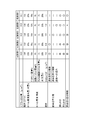
- Examples 1 to 3, Comparative Example 1 and Conventional Example 1 Various two-ply tissue papers (Examples 1 to 3, Comparative Example 1 and Conventional Example 1) shown in the chart of FIG. 4 are manufactured, and the lotion chemicals and powders shown in the table are applied to evaluate operability and sensory evaluation. went.
- the lotion chemical solution was applied at 5.6 g / m 2
- the powder was applied at 0.8 to 1.0 g / m 2 (average particle size 10 ⁇ m) of nylon powder.
- Example 1 powder application is performed after application of the lotion chemical, and in Example 3, application of lotion chemical is performed after the powder application. In Comparative Example 1, these are applied in a state where the powder is mixed with the lotion chemical, and in Conventional Example 1, only the lotion chemical is applied, and the powder is not applied.
- Example 1 and Example 2 according to the present invention show superior softness and smoothness compared to the other examples, and Examples 1 to 3 have a longer chemical solution switching time. We were able to shorten it dramatically.
- the present invention can be suitably used in the field of manufacturing thin paper.
Landscapes
- Health & Medical Sciences (AREA)
- Public Health (AREA)
- Sanitary Thin Papers (AREA)
- Paper (AREA)
Applications Claiming Priority (2)
| Application Number | Priority Date | Filing Date | Title |
|---|---|---|---|
| JP2016-071947 | 2016-03-31 | ||
| JP2016071947A JP6684134B2 (ja) | 2016-03-31 | 2016-03-31 | 衛生薄葉紙の製造装置及び衛生薄葉紙の製造方法 |
Publications (1)
| Publication Number | Publication Date |
|---|---|
| WO2017169415A1 true WO2017169415A1 (ja) | 2017-10-05 |
Family
ID=59964206
Family Applications (1)
| Application Number | Title | Priority Date | Filing Date |
|---|---|---|---|
| PCT/JP2017/007308 Ceased WO2017169415A1 (ja) | 2016-03-31 | 2017-02-27 | 衛生薄葉紙の製造装置及び衛生薄葉紙の製造方法 |
Country Status (2)
| Country | Link |
|---|---|
| JP (1) | JP6684134B2 (https=) |
| WO (1) | WO2017169415A1 (https=) |
Citations (4)
| Publication number | Priority date | Publication date | Assignee | Title |
|---|---|---|---|---|
| JPS5822196A (ja) * | 1981-08-01 | 1983-02-09 | Mitsubishi Paper Mills Ltd | マイクロカプセル組成物 |
| JP2003064393A (ja) * | 2001-08-29 | 2003-03-05 | Toppan Forms Co Ltd | 香料を担持した高吸水性ポリマー微粒子を含む香料組成物およびその製法 |
| JP2003325372A (ja) * | 2002-05-14 | 2003-11-18 | Crecia Corp | 衛生用紙 |
| JP2004159761A (ja) * | 2002-11-11 | 2004-06-10 | Japan Vilene Co Ltd | 皮膚用あぶらとりシート |
-
2016
- 2016-03-31 JP JP2016071947A patent/JP6684134B2/ja active Active
-
2017
- 2017-02-27 WO PCT/JP2017/007308 patent/WO2017169415A1/ja not_active Ceased
Patent Citations (4)
| Publication number | Priority date | Publication date | Assignee | Title |
|---|---|---|---|---|
| JPS5822196A (ja) * | 1981-08-01 | 1983-02-09 | Mitsubishi Paper Mills Ltd | マイクロカプセル組成物 |
| JP2003064393A (ja) * | 2001-08-29 | 2003-03-05 | Toppan Forms Co Ltd | 香料を担持した高吸水性ポリマー微粒子を含む香料組成物およびその製法 |
| JP2003325372A (ja) * | 2002-05-14 | 2003-11-18 | Crecia Corp | 衛生用紙 |
| JP2004159761A (ja) * | 2002-11-11 | 2004-06-10 | Japan Vilene Co Ltd | 皮膚用あぶらとりシート |
Also Published As
| Publication number | Publication date |
|---|---|
| JP6684134B2 (ja) | 2020-04-22 |
| JP2017176683A (ja) | 2017-10-05 |
Similar Documents
| Publication | Publication Date | Title |
|---|---|---|
| JP5395101B2 (ja) | トイレットペーパーの製造方法 | |
| KR101757505B1 (ko) | 티슈페이퍼 및 티슈페이퍼의 제조방법 | |
| JP5931390B2 (ja) | トイレットロールの製造方法 | |
| CN102711571B (zh) | 薄页纸制品用的二次纸卷的制造方法 | |
| JP6034004B2 (ja) | トイレットペーパー | |
| JP5844079B2 (ja) | トイレットロールの製造方法 | |
| JP5425867B2 (ja) | 家庭用衛生薄葉紙の製造方法 | |
| KR101299538B1 (ko) | 약액 함유 박엽지 | |
| JPWO2011080940A1 (ja) | ティシュペーパー及びティシュペーパーの製造方法 | |
| WO2011092880A1 (ja) | ティシュペーパー製品用二次原反ロールの製造方法及びティシュペーパー製品の製造方法 | |
| JP6684135B2 (ja) | 衛生薄葉紙の製造装置及び衛生薄葉紙の製造方法 | |
| JP6684134B2 (ja) | 衛生薄葉紙の製造装置及び衛生薄葉紙の製造方法 | |
| JP2006007218A (ja) | 繊維ウエブへの薬液塗布方法および薬液塗布装置 | |
| WO2012131889A1 (ja) | トイレットペーパーロール | |
| JP5812652B2 (ja) | ティシュペーパーの製造方法 | |
| AU2004297148B2 (en) | Method for changing the orientation of the plies within a multi-ply product | |
| JP4171483B2 (ja) | 家庭用衛生薄葉紙の製造方法及びその製造設備 | |
| KR101533522B1 (ko) | 다중 프린트 유닛을 포함한 기능성 화장지 제조장치 및 이를 이용한 제조 방법 | |
| JP2012011170A (ja) | ティシュペーパー及びティシュペーパーの製造方法 |
Legal Events
| Date | Code | Title | Description |
|---|---|---|---|
| NENP | Non-entry into the national phase |
Ref country code: DE |
|
| 121 | Ep: the epo has been informed by wipo that ep was designated in this application |
Ref document number: 17773960 Country of ref document: EP Kind code of ref document: A1 |
|
| 122 | Ep: pct application non-entry in european phase |
Ref document number: 17773960 Country of ref document: EP Kind code of ref document: A1 |