WO2017164409A1 - 疾患の要因となる生体内タンパク質を標的とするコンジュゲートワクチン - Google Patents
疾患の要因となる生体内タンパク質を標的とするコンジュゲートワクチン Download PDFInfo
- Publication number
- WO2017164409A1 WO2017164409A1 PCT/JP2017/012187 JP2017012187W WO2017164409A1 WO 2017164409 A1 WO2017164409 A1 WO 2017164409A1 JP 2017012187 W JP2017012187 W JP 2017012187W WO 2017164409 A1 WO2017164409 A1 WO 2017164409A1
- Authority
- WO
- WIPO (PCT)
- Prior art keywords
- amino acid
- acid sequence
- seq
- peptide
- osk
- Prior art date
- Legal status (The legal status is an assumption and is not a legal conclusion. Google has not performed a legal analysis and makes no representation as to the accuracy of the status listed.)
- Ceased
Links
Images


Classifications
-
- A—HUMAN NECESSITIES
- A61—MEDICAL OR VETERINARY SCIENCE; HYGIENE
- A61K—PREPARATIONS FOR MEDICAL, DENTAL OR TOILETRY PURPOSES
- A61K39/00—Medicinal preparations containing antigens or antibodies
- A61K39/385—Haptens or antigens, bound to carriers
-
- A—HUMAN NECESSITIES
- A61—MEDICAL OR VETERINARY SCIENCE; HYGIENE
- A61K—PREPARATIONS FOR MEDICAL, DENTAL OR TOILETRY PURPOSES
- A61K39/00—Medicinal preparations containing antigens or antibodies
- A61K39/39—Medicinal preparations containing antigens or antibodies characterised by the immunostimulating additives, e.g. chemical adjuvants
-
- A—HUMAN NECESSITIES
- A61—MEDICAL OR VETERINARY SCIENCE; HYGIENE
- A61K—PREPARATIONS FOR MEDICAL, DENTAL OR TOILETRY PURPOSES
- A61K39/00—Medicinal preparations containing antigens or antibodies
-
- A—HUMAN NECESSITIES
- A61—MEDICAL OR VETERINARY SCIENCE; HYGIENE
- A61K—PREPARATIONS FOR MEDICAL, DENTAL OR TOILETRY PURPOSES
- A61K39/00—Medicinal preparations containing antigens or antibodies
- A61K39/0005—Vertebrate antigens
-
- A—HUMAN NECESSITIES
- A61—MEDICAL OR VETERINARY SCIENCE; HYGIENE
- A61K—PREPARATIONS FOR MEDICAL, DENTAL OR TOILETRY PURPOSES
- A61K39/00—Medicinal preparations containing antigens or antibodies
- A61K39/0005—Vertebrate antigens
- A61K39/0011—Cancer antigens
- A61K39/001136—Cytokines
- A61K39/00114—Interleukins [IL]
-
- A—HUMAN NECESSITIES
- A61—MEDICAL OR VETERINARY SCIENCE; HYGIENE
- A61K—PREPARATIONS FOR MEDICAL, DENTAL OR TOILETRY PURPOSES
- A61K39/00—Medicinal preparations containing antigens or antibodies
- A61K39/395—Antibodies; Immunoglobulins; Immune serum, e.g. antilymphocytic serum
- A61K39/39533—Antibodies; Immunoglobulins; Immune serum, e.g. antilymphocytic serum against materials from animals
-
- A—HUMAN NECESSITIES
- A61—MEDICAL OR VETERINARY SCIENCE; HYGIENE
- A61P—SPECIFIC THERAPEUTIC ACTIVITY OF CHEMICAL COMPOUNDS OR MEDICINAL PREPARATIONS
- A61P37/00—Drugs for immunological or allergic disorders
- A61P37/02—Immunomodulators
- A61P37/04—Immunostimulants
-
- C—CHEMISTRY; METALLURGY
- C07—ORGANIC CHEMISTRY
- C07K—PEPTIDES
- C07K14/00—Peptides having more than 20 amino acids; Gastrins; Somatostatins; Melanotropins; Derivatives thereof
- C07K14/435—Peptides having more than 20 amino acids; Gastrins; Somatostatins; Melanotropins; Derivatives thereof from animals; from humans
- C07K14/43504—Peptides having more than 20 amino acids; Gastrins; Somatostatins; Melanotropins; Derivatives thereof from animals; from humans from invertebrates
- C07K14/43513—Peptides having more than 20 amino acids; Gastrins; Somatostatins; Melanotropins; Derivatives thereof from animals; from humans from invertebrates from arachnidae
- C07K14/43522—Peptides having more than 20 amino acids; Gastrins; Somatostatins; Melanotropins; Derivatives thereof from animals; from humans from invertebrates from arachnidae from scorpions
-
- C—CHEMISTRY; METALLURGY
- C07—ORGANIC CHEMISTRY
- C07K—PEPTIDES
- C07K14/00—Peptides having more than 20 amino acids; Gastrins; Somatostatins; Melanotropins; Derivatives thereof
- C07K14/435—Peptides having more than 20 amino acids; Gastrins; Somatostatins; Melanotropins; Derivatives thereof from animals; from humans
- C07K14/52—Cytokines; Lymphokines; Interferons
- C07K14/54—Interleukins [IL]
-
- C—CHEMISTRY; METALLURGY
- C07—ORGANIC CHEMISTRY
- C07K—PEPTIDES
- C07K16/00—Immunoglobulins [IG], e.g. monoclonal or polyclonal antibodies
- C07K16/18—Immunoglobulins [IG], e.g. monoclonal or polyclonal antibodies against material from animals or humans
- C07K16/28—Immunoglobulins [IG], e.g. monoclonal or polyclonal antibodies against material from animals or humans against receptors, cell surface antigens or cell surface determinants
- C07K16/2896—Immunoglobulins [IG], e.g. monoclonal or polyclonal antibodies against material from animals or humans against receptors, cell surface antigens or cell surface determinants against molecules with a "CD"-designation, not provided for elsewhere
-
- C—CHEMISTRY; METALLURGY
- C07—ORGANIC CHEMISTRY
- C07K—PEPTIDES
- C07K16/00—Immunoglobulins [IG], e.g. monoclonal or polyclonal antibodies
- C07K16/40—Immunoglobulins [IG], e.g. monoclonal or polyclonal antibodies against enzymes
-
- C—CHEMISTRY; METALLURGY
- C07—ORGANIC CHEMISTRY
- C07K—PEPTIDES
- C07K16/00—Immunoglobulins [IG], e.g. monoclonal or polyclonal antibodies
- C07K16/42—Immunoglobulins [IG], e.g. monoclonal or polyclonal antibodies against immunoglobulins
- C07K16/4283—Immunoglobulins [IG], e.g. monoclonal or polyclonal antibodies against immunoglobulins against an allotypic or isotypic determinant on Ig
- C07K16/4291—Immunoglobulins [IG], e.g. monoclonal or polyclonal antibodies against immunoglobulins against an allotypic or isotypic determinant on Ig against IgE
-
- C—CHEMISTRY; METALLURGY
- C07—ORGANIC CHEMISTRY
- C07K—PEPTIDES
- C07K19/00—Hybrid peptides, i.e. peptides covalently bound to nucleic acids, or non-covalently bound protein-protein complexes
-
- C—CHEMISTRY; METALLURGY
- C12—BIOCHEMISTRY; BEER; SPIRITS; WINE; VINEGAR; MICROBIOLOGY; ENZYMOLOGY; MUTATION OR GENETIC ENGINEERING
- C12Y—ENZYMES
- C12Y304/00—Hydrolases acting on peptide bonds, i.e. peptidases (3.4)
- C12Y304/14—Dipeptidyl-peptidases and tripeptidyl-peptidases (3.4.14)
- C12Y304/14005—Dipeptidyl-peptidase IV (3.4.14.5)
-
- C—CHEMISTRY; METALLURGY
- C12—BIOCHEMISTRY; BEER; SPIRITS; WINE; VINEGAR; MICROBIOLOGY; ENZYMOLOGY; MUTATION OR GENETIC ENGINEERING
- C12Y—ENZYMES
- C12Y304/00—Hydrolases acting on peptide bonds, i.e. peptidases (3.4)
- C12Y304/21—Serine endopeptidases (3.4.21)
- C12Y304/21061—Kexin (3.4.21.61), i.e. proprotein convertase subtilisin/kexin type 9
-
- A—HUMAN NECESSITIES
- A61—MEDICAL OR VETERINARY SCIENCE; HYGIENE
- A61K—PREPARATIONS FOR MEDICAL, DENTAL OR TOILETRY PURPOSES
- A61K39/00—Medicinal preparations containing antigens or antibodies
- A61K2039/555—Medicinal preparations containing antigens or antibodies characterised by a specific combination antigen/adjuvant
- A61K2039/55511—Organic adjuvants
- A61K2039/55516—Proteins; Peptides
-
- A—HUMAN NECESSITIES
- A61—MEDICAL OR VETERINARY SCIENCE; HYGIENE
- A61K—PREPARATIONS FOR MEDICAL, DENTAL OR TOILETRY PURPOSES
- A61K39/00—Medicinal preparations containing antigens or antibodies
- A61K2039/555—Medicinal preparations containing antigens or antibodies characterised by a specific combination antigen/adjuvant
- A61K2039/55511—Organic adjuvants
- A61K2039/55522—Cytokines; Lymphokines; Interferons
- A61K2039/55527—Interleukins
-
- A—HUMAN NECESSITIES
- A61—MEDICAL OR VETERINARY SCIENCE; HYGIENE
- A61K—PREPARATIONS FOR MEDICAL, DENTAL OR TOILETRY PURPOSES
- A61K39/00—Medicinal preparations containing antigens or antibodies
- A61K2039/60—Medicinal preparations containing antigens or antibodies characteristics by the carrier linked to the antigen
- A61K2039/6031—Proteins
-
- A—HUMAN NECESSITIES
- A61—MEDICAL OR VETERINARY SCIENCE; HYGIENE
- A61K—PREPARATIONS FOR MEDICAL, DENTAL OR TOILETRY PURPOSES
- A61K39/00—Medicinal preparations containing antigens or antibodies
- A61K2039/60—Medicinal preparations containing antigens or antibodies characteristics by the carrier linked to the antigen
- A61K2039/6031—Proteins
- A61K2039/6081—Albumin; Keyhole limpet haemocyanin [KLH]
-
- A—HUMAN NECESSITIES
- A61—MEDICAL OR VETERINARY SCIENCE; HYGIENE
- A61K—PREPARATIONS FOR MEDICAL, DENTAL OR TOILETRY PURPOSES
- A61K39/00—Medicinal preparations containing antigens or antibodies
- A61K2039/62—Medicinal preparations containing antigens or antibodies characterised by the link between antigen and carrier
- A61K2039/627—Medicinal preparations containing antigens or antibodies characterised by the link between antigen and carrier characterised by the linker
-
- C—CHEMISTRY; METALLURGY
- C07—ORGANIC CHEMISTRY
- C07K—PEPTIDES
- C07K2317/00—Immunoglobulins specific features
- C07K2317/30—Immunoglobulins specific features characterized by aspects of specificity or valency
- C07K2317/34—Identification of a linear epitope shorter than 20 amino acid residues or of a conformational epitope defined by amino acid residues
Definitions
- the present invention relates to a conjugate vaccine that targets an in vivo protein that causes disease.
- a site that causes immunity induction such as antibody induction against a target protein may be used by binding to a carrier protein.
- carrier proteins KLH (Keyhole limpet hemocyanin), OVA (Ovalbumin), BSA (Bovine serum albumin) and the like are known.
- SLE systemic lupus erythematosus
- Non-Patent Document 2 KLH, OVA, BSA, etc. have antigenicity per se, and the antigenicity of the carrier protein itself may become a problem when immunizing by conjugating an epitope that is not highly antigenic.
- the present inventors have disclosed that a conjugate of an epitope peptide of DPP4 and KLH is used for the prevention or treatment of diabetes (Patent Document 1).
- the present inventors also developed a DNA vaccine comprising a polynucleotide encoding an IL-17A epitope peptide and a polynucleotide encoding a hepatitis B virus core antigen polypeptide as a disease involving IL-17A as an exacerbation factor. It is disclosed for use in the prevention or treatment of (systemic lupus erythematosus (SLE), rheumatoid arthritis, etc.) (Patent Document 2).
- SLE systemic lupus erythematosus
- rheumatoid arthritis etc.
- the present invention relates to a vaccine containing a complex in which a carrier protein is linked to an epitope of an in vivo protein that is a cause of a disease, wherein the vaccine protein has a low antigenicity and has an antibody-producing ability effective as a vaccine.
- the issue is to provide.
- a vaccine comprising a complex of a peptide consisting of an amino acid sequence identical or substantially identical to the amino acid sequence shown in SEQ ID NO: 1 and an in vivo protein epitope that causes disease.
- the in vivo protein is one selected from the group consisting of DPP4, IL-17A, IgE, S100A9 and PCSK9.
- a peptide consisting of an amino acid sequence in which the epitope of S100A9 is the amino acid sequence shown in SEQ ID NO: 13 or a peptide consisting of the amino acid sequence shown in SEQ ID NO: 13 with one or two amino acids deleted, substituted or added The vaccine according to [2] above.
- An effective amount of a complex of a peptide consisting of an amino acid sequence identical or substantially identical to the amino acid sequence shown in SEQ ID NO: 1 and an epitope of an in vivo protein causing a disease is administered to an animal.
- a method for preventing or treating a disease caused by the in vivo protein is administered to an animal.
- a peptide comprising an amino acid sequence identical or substantially identical to the amino acid sequence shown in SEQ ID NO: 1 for producing a medicament for preventing or treating a disease caused by an in vivo protein, and the in vivo protein Of complex with other epitopes.
- FIG. 5 is a view showing the results of evaluating the antibody production effect of an OSK-1-DPP4 conjugate in which an OSK-1 peptide (SEQ ID NO: 1) and a mouse DPP4 epitope peptide (SEQ ID NO: 17) are linked using ⁇ -Acp as a linker. . It is a figure which shows the result of having compared the antibody production effect of OSK-1-DPP4 conjugate, and the antibody production effect of conjugate (KLH-DPP4) of KLH and the epitope peptide (sequence number 17) of mouse
- FIG. It is a figure which shows the result of having evaluated the antibody production effect by an OSK-1-IL-17A conjugate. It is a figure which shows the result of having evaluated the medicinal effect of OSK-1-IL-17A conjugate with the skin state of the imiquimod-induced psoriasis like dermatitis model mouse.
- FIG. 6 is a view showing the results of F4 / 80 staining of the skin on the 12th day from the initiation of psoriasis induction in an imiquimod-induced psoriasis-like dermatitis model mouse administered with OSK-1-IL-17A conjugate or KLH-IL-17A conjugate. is there.
- FIG. 6 is a view showing the results of F4 / 80 staining of the skin on the 12th day from the initiation of psoriasis induction in an imiquimod-induced psoriasis-like dermatitis model mouse administered with OSK-1-IL-17A conjugate or KLH-IL-17A conjugate. is there.
- FIG. 3 is a graph showing the result of Gr-1 staining of the skin on the 12th day from the initiation of psoriasis induction in an imiquimod-induced psoriasis-like dermatitis model mouse administered with OSK-1-IL-17A conjugate or KLH-IL-17A conjugate. is there. It is a figure which shows the result of having measured the blood IL-17 density
- the present invention provides a conjugate vaccine that targets in vivo proteins that cause disease.
- the vaccine of the present invention is a vaccine comprising a complex of a peptide consisting of the same or substantially the same amino acid sequence as the amino acid sequence shown in SEQ ID NO: 1 (ELKLIFLHRLKRLRKRLRKRK) and an epitope of an in vivo protein causing a disease. I just need it.
- the peptide consisting of the amino acid sequence represented by SEQ ID NO: 1 may be referred to as OSK-1 peptide or OSK-1.
- conjugate and “complex” are used synonymously.
- vaccine means a composition comprising an immunogen that causes an immune response when administered to an animal. Therefore, the vaccine of the present invention can be rephrased as an immunogenic composition.
- the vaccine of the present invention is not limited to those administered prophylactically, and may be administered therapeutically after the onset of a disease.
- amino acid sequence substantially the same as the amino acid sequence shown in SEQ ID NO: 1 examples include an amino acid sequence in which 1 to 4 amino acids are deleted, substituted or added in the amino acid sequence shown in SEQ ID NO: 1. It is done. Preferably, it is an amino acid sequence in which 1 to 3, more preferably 1 to 2, and still more preferably 1 amino acid is deleted, substituted or added.
- the peptide consisting of the amino acid sequence substantially the same as the amino acid sequence shown in SEQ ID NO: 1 is preferably a peptide having substantially the same quality of activity as the peptide consisting of the amino acid sequence shown in SEQ ID NO: 1.
- the antibody producing ability by a complex with an epitope of an in vivo protein is equivalent to the antibody producing ability by a complex of the same in vivo protein epitope and a peptide comprising the amino acid sequence shown in SEQ ID NO: 1. (For example, about 0.5 to 2 times).
- the in vivo protein causing the disease is not particularly limited, and examples thereof include DPP4, IL-17A, IgE, S100A9, and PCSK9.
- in vivo protein means an endogenous protein.
- DPP4 (Dipeptidyl Peptidase-4) is an enzyme that degrades incretin involved in insulin secretion.
- Incretin is a gastrointestinal hormone that promotes insulin secretion during high blood sugar levels such as after meals and lowers blood glucose levels. Therefore, if the function of DPP4 is inhibited to suppress the degradation of incretin, the concentration of incretin is increased, insulin secretion is promoted, and diabetes symptoms can be improved. Therefore, many DPP4 inhibitors have been developed and approved as antidiabetic agents. Therefore, it can be expected to treat diabetes with a vaccine that induces anti-DPP4 antibodies.
- the epitope of human DPP4 used in the OSK-1-DPP4 conjugate is not particularly limited as long as it is an epitope capable of producing an antibody that inhibits the function of DPP4 (neutralizing antibody). It can be used suitably.
- ENSTFDEFG SEQ ID NO: 2)
- NKRQLITEE SEQ ID NO: 3
- -KTNYRLKLYS SEQ ID NO: 4
- YSDESLQYPK SEQ ID NO: 5
- PHFDKSKKY SEQ ID NO: 6
- GLPTPEDDNLD SEQ ID NO: 7
- FSKEAKYYQ SEQ ID NO: 8
- NSSVFLENSTFDEFG accession numbers of the amino acid sequence of human DPP4 and the base sequence of the gene encoding human DPP4 are NP_001926 (NCBI) and NM_001935 (NCBI), respectively.
- the peptide consisting of the amino acid sequence shown in any of SEQ ID NOs: 2 to 9 has an amino acid sequence in which one or two amino acids are deleted, substituted or added, and produces an antibody that inhibits the function of DPP4. Possible peptides are also suitable as epitopes of human DPP4 for use in OSK-1-DPP4 conjugates.
- IL-17A is a homodimeric glycoprotein and is also simply referred to as IL-17.
- IL-17A is mainly produced from activated T cells and acts on a wide range of cells such as fibroblasts, epithelial cells, vascular endothelial cells, and macrophages to produce various factors such as inflammatory cytokines, chemokines, and cell adhesion factors. It is known to induce inflammation.
- Human anti-human IL-17A monoclonal antibody (secukinumab) has been used as a treatment for psoriasis vulgaris and psoriatic arthritis.
- IL-17A is also involved in various cancers such as rheumatoid arthritis, multiple sclerosis, inflammatory bowel disease, non-small cell lung cancer, colon cancer, pancreatic cancer, arteriosclerosis, etc. It has been reported to do. Therefore, it can be expected that these IL-17A-related diseases are treated with vaccines that induce anti-IL-17A antibodies.
- the epitope of human IL-17A used in the OSK-1-IL-17A conjugate is not particularly limited as long as it is an epitope capable of producing an antibody that inhibits the function of IL-17A (neutralizing antibody).
- a peptide consisting of an amino acid sequence can be preferably used.
- RSSDYYNR (SEQ ID NO: 10) PKRSSDYYNRSTSPW (SEQ ID NO: 11) CPNSEDKNFPR (SEQ ID NO: 29) RNEDPERYPS (SEQ ID NO: 30) NRSTSPW (SEQ ID NO: 31) ⁇ LHRNEDP (SEQ ID NO: 32) RYPSVIWEA (SEQ ID NO: 33) PKRSSDYYNR (SEQ ID NO: 34) -TNPKRSSDYYNR (SEQ ID NO: 35) -TNTNPKRSSDYYNR (SEQ ID NO: 36)
- accession numbers of the amino acid sequence of human IL-17A and the base sequence of the gene encoding human IL-17A are NP_002181 (NCBI) and NM_002190 (NCBI), respectively.
- a peptide capable of producing an antibody that inhibits can also be suitably used as an epitope of human IL-17A used in the OSK-1-IL-17A conjugate.
- a peptide consisting of a partial sequence containing the amino acid sequence at positions 3-10 of the amino acid sequence shown in SEQ ID NO: 11 is also suitable as an epitope of human IL-17A used for the OSK-1-IL-17A conjugate. is there.
- allergens are caused by specific substances (allergens).
- allergens enter the body, the immune system is activated and IgE is produced.
- the produced IgE antibody is retained in a state of binding to mast cells and basophils.
- chemical mediators such as histamine and leukotriene are released to cause allergic symptoms.
- an allergic reaction has occurred for a certain allergen, specific IgE for that allergen is excessively produced, and this causes allergic symptoms to worsen.
- anti-human IgE antibody omalizumab
- it can be expected to treat allergic diseases such as bronchial asthma, hay fever, allergic conjunctivitis, and atopic dermatitis with a vaccine that induces anti-IgE antibodies.
- the epitope of human IgE used in the OSK-1-IgE conjugate is not particularly limited as long as it is an epitope capable of producing an antibody that inhibits the function of IgE (neutralizing antibody). It can be used suitably.
- YQCRVTHPHLP SEQ ID NO: 12
- accession numbers of the amino acid sequence of the human immunoglobulin ⁇ chain constant region and the base sequence of the gene encoding the human immunoglobulin ⁇ chain constant region are P01854 (UniProtKB) and NG_001019 (NCBI), respectively.
- peptide consisting of the amino acid sequence shown in SEQ ID NO: 12, a peptide comprising an amino acid sequence in which one or two amino acids are deleted, substituted or added, and capable of producing an antibody that inhibits the function of IgE, It is suitable as an epitope of human IgE used in OSK-1-IgE conjugate.
- the S100 protein is a calcium-binding protein having two EF-hands that are expressed specifically in cell types, and 20 types of subfamilies have been confirmed so far.
- S100A9 (also referred to as MRP14) belongs to the low molecular weight calcium binding S100 protein and is known to be associated with various inflammatory diseases. In patients with numerous inflammatory diseases including cellular arteritis, cystic fibrosis, rheumatoid arthritis, skin disease, chronic inflammatory bowel disease, chronic bronchitis, some malignant tumors, and autoimmune diseases, S100A9 serum levels have been shown to increase. Further, it has been reported that blocking S100A9 may prevent thrombus without increasing the risk of bleeding. Therefore, it can be expected that the anti-S100A9 antibody-inducing vaccine prevents thrombus formation in atherothrombosis, myocardial infarction or cerebral infarction.
- the epitope of human S100A9 used in the OSK-1-S100A9 conjugate is not particularly limited as long as it is an epitope capable of producing an antibody (neutralizing antibody) that inhibits the function of S100A9, but a peptide comprising the following amino acid sequence: It can be used suitably.
- GHHHKPGGLGE SEQ ID NO: 13
- accession numbers of the amino acid sequence of human S100A9 and the base sequence of the gene encoding human S100A9 are NP_002956 (NCBI) and NM_002965 (NCBI), respectively.
- a peptide consisting of an amino acid sequence in which one or two amino acids are deleted, substituted or added, and capable of producing an antibody that inhibits the function of S100A9 It is suitable as an epitope of human S100A9 used in the OSK-1-S100A9 conjugate.
- PCSK9 prote convertase subtilisin / kexin type 9
- PCSK9 degrades the LDL receptor expressed on the surface of hepatocytes and Have been shown to reduce the ability to take up LDL-C in the blood.
- Anti-human PCSK9 monoclonal antibody ebolocoumab
- RNAi drugs that inhibit the function of PCSK9 have been developed. Therefore, it can be expected to treat hypercholesterolemia with a vaccine that induces anti-PCSK9 antibody.
- the epitope of human PCSK9 used in the OSK-1-PCSK9 conjugate is not particularly limited as long as it can produce an antibody (neutralizing antibody) that inhibits the function of PCSK9. It can be used suitably.
- -LRPRGQPNQC SEQ ID NO: 14
- -SRHLAQASQ SEQ ID NO: 15
- SRSGKRRRGER SEQ ID NO: 16
- accession numbers of the amino acid sequence of human PCSK9 and the base sequence of the gene encoding human PCSK9 are NP_777596 (NCBI) and NM_174936 (NCBI), respectively.
- the peptide consisting of the amino acid sequence shown in any of SEQ ID NOs: 14 to 16 above, comprising an amino acid sequence in which one or two amino acids are deleted, substituted or added, and producing an antibody that inhibits the function of PCSK9 Possible peptides are also suitable as epitopes for human PCSK9 used in OSK-1-PCSK9 conjugates.
- the epitope sequence of the experimental animal corresponding to the above human epitope sequence.
- the corresponding epitope sequence of the experimental animal to be used can be designed by obtaining the amino acid sequence of the target protein using a known database (NCBI or the like) and aligning it with the corresponding human amino acid sequence.
- Table 1 shows mouse epitope sequences corresponding to the human epitope sequences of SEQ ID NOs: 2 to 16 above.
- the full length amino acid sequence of human DPP4 is NP_001926
- the full length amino acid sequence of mouse DPP4 is AAH22183
- the full length amino acid sequence of human IL-17A is NP_002181
- the full length amino acid sequence of mouse IL-17A is NP_034682
- the full length amino acid sequence of human IgE P01854 mouse IgE full length amino acid sequence P06336, human S100A9 full length amino acid sequence NP_002956, mouse S100A9 full length amino acid sequence CAC14292, human PCSK9 full length amino acid sequence NP_777596, mouse PCSK9 full length amino acid sequence NP_705793 Based on the amino acid sequence registered by session number.
- the size of the epitope of the in vivo protein used in the vaccine of the present invention is not particularly limited, but is preferably 20 amino acids or less, more preferably 15 amino acids or less, further preferably 13 amino acids or less, further preferably 12 amino acids or less, 11 Amino acids or less are more preferred, and 10 amino acids or less are more preferred. Although a minimum is not specifically limited, 3 or more amino acids are preferable, 4 or more amino acids are more preferable, 5 or more amino acids are more preferable, and 6 or more amino acids are more preferable.
- the complex of the OSK-1 peptide and the epitope of the in vivo protein may be linked directly or via a linker (synonymous with spacer).
- the linker is not particularly limited as long as it can link the epitope of OSK-1 peptide and in vivo protein.
- aminocarboxylic acids such as ⁇ -aminoalanine, ⁇ -aminobutyric acid, ⁇ -aminocaproic acid, 7-aminoheptanoic acid, 12-aminolauric acid, glutamic acid, and p-aminobenzoic acid can be used.
- L-amino acids existing in natural proteins and their D-amino acids can also be used.
- ⁇ -aminocaproic acid is used as a linker, but it is not limited thereto.
- the order of ligation in the complex of the OSK-1 peptide and the epitope of the in vivo protein is not particularly limited.
- the N-terminal side may be the OSK-1 peptide and the C-terminal side may be the in vivo protein epitope, and conversely the N-terminal side is the in vivo protein.
- the OSK-1 peptide may be used on the C-terminal side.
- the N-terminal side is the OSK-1 peptide and the C-terminal side is the epitope sequence of the in vivo protein.
- the N-terminal amino acid is preferably acetylated.
- the C-terminal amino acid of the complex is preferably amidated. More preferably, the N-terminal amino acid of the complex is acetylated and the C-terminal amino acid is amidated.
- a complex of an OSK-1 peptide and an epitope of an in vivo protein can be produced as a fusion protein.
- a fusion gene encoding a fusion protein of an epitope of OSK-1 peptide and in vivo protein is prepared, and a recombinant expression vector in which the gene is inserted is constructed, It can be produced by introducing it into a suitable host cell, expressing it as a recombinant protein, and purifying it.
- the complex between the OSK-1 peptide and the in vivo protein epitope uses the above fusion gene and a known in vitro transcription / translation system (for example, a cell-free protein synthesis system derived from rabbit reticulocyte, wheat germ or Escherichia coli). Can be manufactured.
- a cell-free protein synthesis system derived from rabbit reticulocyte, wheat germ or Escherichia coli.
- the complex is expressed on the phage surface without isolation and purification. It is also possible to administer the subject animal as it is.
- a complex of an OSK-1 peptide and an epitope of an in vivo protein can be produced by a solid phase synthesis method (Fmoc method, Boc method) or a liquid phase synthesis method according to a known general peptide synthesis protocol. it can.
- the complex is a direct link between the OSK-1 peptide and the in vivo protein epitope, or the complex is the link between the OSK-1 peptide and the in vivo protein epitope via an appropriate amino acid.
- epitopes of OSK-1 peptide and in vivo protein may be synthesized separately, and then the two peptides may be linked using an appropriate linker.
- the linker can be introduced by a method well known in peptide synthesis chemistry.
- a peptide fragment up to the linker position is prepared by a standard method, and the linker is used with a condensing agent that is used in peptide synthesis chemistry under standard conditions using an appropriately protected amino group of an aminocarboxylic acid used as a linker.
- the desired amino acid at the next position may be introduced.
- a solid phase peptide synthesis method often used in an automatic peptide synthesizer is an example.
- aminocarboxylic acid protecting group used in such an operation examples include a tBOC (tert-Butyl OxyylCarbonyl) group, FMOC (Fluorenyl-MethOxy-Carbonyl) group, and the like.
- condensing agent examples include carbodiimide compounds such as DCC (N, N'-Dicyclohexylcarbodiimide) and EDC ((N- (3-Dimethylaminopropyl) propyl-N'-ethylcarbodiimide), CDI (1,1'- carbonyldiimidazole) and the like.
- Imidazole compounds such as BOP (benzotriazol-1-yloxytris (dimethylamino) phosphonium hexafluorophosphate), HBTU (O- (Benzotriazol-1-yl) -N, N, N ', N'-tetramethyluronium hexafluorophosphate)
- Uronium salt compounds such as HCTU (O- (6-Chlorobenzotriazol-1-yl) -N, N, N ', N'-tetramethyluronium hexafluorophosphate) can be used.
- the vaccine of the present invention is useful in that it can induce an antibody that inhibits the function of a protein in a living body that causes a disease without including an adjuvant.
- the vaccine of the present invention may contain one or more adjuvants.
- the vaccine of the present invention contains an adjuvant, it can be appropriately selected from known adjuvants.
- aluminum adjuvant for example, aluminum salt such as aluminum hydroxide, aluminum phosphate, aluminum sulfate or a combination thereof), Freund's adjuvant (complete or incomplete), TLR ligand (for example, CpG, Poly (I : C), Pam3CSK4, etc.), BAY, DC-chol, pcpp, monophosphoryl lipid A, QS-21, cholera toxin, formylmethionyl peptide and the like.
- it is an aluminum adjuvant, a TLR ligand, or a combination thereof.
- the compounding amount of the adjuvant is not particularly limited, and may be appropriately selected depending on the type of the adjuvant.
- an aluminum adjuvant aluminum hydroxide
- CpG calcium phosphate
- about 1 to 100 times the amount of aluminum adjuvant and about 1 to 50 times the amount of CpG may be added to the fusion protein of the present invention in a mass ratio. preferable.
- the vaccine of the present invention can be administered by oral administration or parenteral administration.
- parenteral administration include intraperitoneal administration, subcutaneous administration, intradermal administration, intramuscular administration, intravenous administration, intranasal administration, transdermal administration, transmucosal administration, sublingual administration, and inhalation administration.
- parenteral administration and more preferred is intradermal administration, subcutaneous administration or intramuscular administration.
- the means for parenteral administration includes microneedle injection, needleless injection, stamping and the like.
- the vaccine of the present invention can be formulated by appropriately combining a complex of an OSK-1 peptide and an in vivo protein epitope, a pharmaceutically acceptable carrier, and an additive.
- preparations for oral administration such as tablets, coated tablets, pills, powders, granules, capsules, solutions, suspensions, emulsions; parenterals such as injections, infusions, suppositories, ointments, patches It can be set as the formulation for administration. What is necessary is just to set suitably about the mixture ratio of a carrier or an additive based on the range normally employ
- Carriers or additives that can be blended are not particularly limited.
- various carriers such as water, physiological saline, other aqueous solvents, aqueous or oily bases; excipients, binders, pH adjusters, disintegrants, absorption
- Various additives such as an accelerator, a lubricant, a colorant, a corrigent, and a fragrance are included.
- additives used in solid preparations for oral administration include excipients such as lactose, mannitol, glucose, microcrystalline cellulose, and corn starch; binders such as hydroxypropylcellulose, polyvinylpyrrolidone, and magnesium aluminate metasilicate Dispersing agents such as corn starch; disintegrating agents such as calcium calcium glycolate; lubricants such as magnesium stearate; solubilizing agents such as glutamic acid and aspartic acid; stabilizers; hydroxypropylcellulose, hydroxypropylmethylcellulose, methylcellulose, etc.
- excipients such as lactose, mannitol, glucose, microcrystalline cellulose, and corn starch
- binders such as hydroxypropylcellulose, polyvinylpyrrolidone, and magnesium aluminate metasilicate Dispersing agents such as corn starch
- disintegrating agents such as calcium calcium glycolate
- lubricants such as magnesium stearate
- solubilizing agents such as
- Water-soluble polymers such as cellulose, polyethylene glycol, polyvinyl pyrrolidone, polyvinyl alcohol, etc .; sucrose, powdered sugar, sucrose, fructose, glucose, lactose, reduced maltose water candy, powder returned Maltose water syrup, glucose fructose liquid sugar, fructose glucose liquid sugar, honey, sorbitol, maltitol, mannitol, xylitol, erythritol, aspartame, saccharin, sodium saccharin, etc., white sugar, gelatin, hydroxypropylcellulose, hydroxypropylmethylcellulose phthalate, etc. Coating agents and the like.
- Liquid preparations for oral administration are prepared by dissolving, suspending or emulsifying in commonly used diluents.
- the diluent include purified water, ethanol, a mixed solution thereof and the like.
- this liquid agent may contain a wetting agent, a suspending agent, an emulsifier, a sweetening agent, a flavoring agent, a fragrance, a preservative, a buffering agent and the like.
- additives used for injections for parenteral administration include isotonic agents such as sodium chloride, potassium chloride, glycerin, mannitol, sorbitol, boric acid, borax, glucose, propylene glycol; phosphate buffer Buffers such as acetate buffer, borate buffer, carbonate buffer, citrate buffer, Tris buffer, glutamate buffer, epsilon aminocaproate buffer; methyl paraoxybenzoate, ethyl paraoxybenzoate, paraoxybenzoic acid Preservatives such as propyl, butyl paraoxybenzoate, chlorobutanol, benzyl alcohol, benzalkonium chloride, sodium dehydroacetate, sodium edetate, boric acid, borax; hydroxyethyl cellulose, hydroxypropyl cellulose, polyvinyl alcohol, polyethylene glycol Thickeners such as sodium hydrogen sulfite, sodium thiosulfate, sodium edetate, sodium citrate, ascor
- solubilizers for injections, suitable solubilizers, for example, alcohols such as ethanol; polyalcohols such as propylene glycol and polyethylene glycol; nonionic surfactants such as polysorbate 80, polyoxyethylene hydrogenated castor oil 50, lysolecithin, and pluronic polyol You may mix
- Liquid preparations such as injections can be stored after removing moisture by freezing or lyophilization. The freeze-dried preparation is used by adding distilled water for injection at the time of use and re-dissolving it.
- the vaccine of the present invention can be administered to any animal (human or non-human) having an immune system.
- mammals such as humans, monkeys, cows, horses, pigs, sheep, goats, dogs, cats, guinea pigs, rats and mice; and birds such as chickens, ducks and geese.
- the vaccine of the present invention is useful as an animal drug, it is preferable to target human children and adults.
- the number of administrations and the administration interval of the vaccine of the present invention are not particularly limited.
- a single dose may be administered, or multiple doses may be administered at intervals of about 2 days to about 8 weeks.
- the dose of the vaccine varies depending on the administration subject, administration method, etc., but the single dose is preferably about 0.01 ⁇ g to about 10 mg, more preferably about 0.1 ⁇ g to about 1 mg, more preferably about 1 ⁇ g to More preferably, it is about 0.1 mg.
- the present invention includes a method for preventing or treating a disease caused by a target biological protein, comprising administering an effective amount of the vaccine of the present invention to an animal.
- the present invention also includes the vaccine of the present invention for use in the prevention or treatment of diseases caused by in vivo proteins.
- the present invention includes the use of the vaccine of the present invention for producing a medicament for the prevention or treatment of diseases caused by in vivo proteins.
- OSK-1 used as a carrier protein for an epitope of an in vivo protein causing a disease is a peptide consisting of 20 amino acids, and since the antigenicity of OSK-1 itself is very low, the carrier Undesirable effects and side effects derived from the antigenicity of the protein can be reduced. On the other hand, since OSK-1 has a strong adjuvant effect despite being a short peptide, it can confer an antibody-producing ability effective as a vaccine.
- antibodies produced by the complex of OSK-1 and an epitope of an in vivo protein contain not only Th2 type IgG1, but also Th1 type IgG2a, IgG2b, and IgG3, so there are side effects such as allergic reactions. This is very useful in that it can be reduced. Further, when a carrier protein derived from a natural product such as KLH is used, a problem of impurities occurs. However, since OSK-1 can be produced by synthesis, such a problem can be avoided. In addition, since OSK-1 is a short peptide, it is advantageous in that the production cost can be suppressed.
- This crude peptide was purified using a reverse phase HPLC column (ODS) by elution with a gradient of 0.1% TFA-H 2 O / CH 3 CN. Fractions containing the desired product were collected and lyophilized to obtain the desired peptide.
- the amino acid sequence of the synthesized peptide was confirmed using an amino acid sequencer G1000A (Hewlett Packard), PPSQ-23A (Shimadzu Corporation) or ProcisLC (ABI), and the N-terminal of the obtained peptide was acetylated.
- Example 1 Examination of antibody production by OSK-1-DPP4 conjugate 1
- An OSK-1-DPP4 conjugate (Ac-ELKLIFLHRLKRLRKRLKRK-X-ENSTFESFG) in which an OSK-1 peptide (SEQ ID NO: 1) and an epitope peptide of mouse DPP4 (SEQ ID NO: 17) are linked (conjugated) using ⁇ -Acp as a linker.
- the antibody production effect by X ⁇ -Acp)) was evaluated.
- the group composition was 2 groups (6 mice / group): saline group and OSK-1-DPP4 conjugate group (100 ⁇ g / mouse).
- Balb / c mice were intradermally administered 3 times at 2-week intervals. Blood was collected before administration and every 2 weeks after administration until 8 weeks later, and the antibody titer against the DPP4 epitope peptide was measured by ELISA.
- Example 2 Examination of antibody production by OSK-1-DPP4 conjugate 2
- Antibody production by the same OSK-1-DPP4 conjugate as in Example 1 was confirmed by the antibody (KLH-DPP4) conjugate of KLH (Keyhole limpet hemocyanin) and the epitope peptide of mouse DPP4 (SEQ ID NO: 17). Comparison with production effect.
- the group composition is KLH-DPP4 conjugate group (20 ⁇ g / mouse), OSK-1-DPP4 conjugate group (100 ⁇ g / mouse), OSK-1-DPP4 conjugate (100 ⁇ g / mouse) + Alum (Alhydrogel 2% (InvivoGen) 1 mg / mouse) was used in 3 groups (2 animals / group).
- Balb / c mice were intradermally administered 3 times at 2-week intervals. Blood samples were collected before administration, every 2 weeks until 6 weeks and after 12 weeks, and the antibody titer against the DPP4 epitope peptide was measured by ELISA.
- the results are shown in FIG.
- the OSK-1-DPP4 conjugate was found to have the same antibody production ability as the KLH-DPP4 conjugate.
- a synergistic effect was observed in the combination group of OSK-1-DPP4 conjugate and Alum.
- Example 3 Analysis of IgG subclass of produced antibody
- the IgG subclass of IgG antibody produced by the same OSK-1-DPP4 conjugate as in Examples 1 and 2 was compared to the IgG subclass of IgG antibody produced by the same KLH-DPP4 conjugate as in Example 2.
- the group composition was OSK-1-DPP4 conjugate group (100 ⁇ g / mouse), KLH-DPP4 conjugate (20 ⁇ g / mouse) + Alum (Alhydrogel 2% (InvivoGen) 1 mg / mouse) combination group, KLH-DPP4 conjugate ( 20 ⁇ g / mouse) + OSK-1 (100 ⁇ g / mouse) combined group.
- mice were intradermally administered 3 times at 2-week intervals and once 9 weeks after the start of administration, for a total of 4 times, and blood was collected 11 weeks after administration, and the antibody titer of IgG antibody against the DPP4 epitope peptide was determined as IgG subclass. Each was measured by ELISA.
- IgG1 which is a Th2-type IgG
- OSK-1-DPP4 conjugate group high production was also observed in IgG2a and IgG2b, which are Th1 type IgG.
- the antibody titers of Th1 type IgG2b and IgG3 were high.
- the group composition was saline group, WT1 peptide (100 ⁇ g / mouse) + poly (I: C) (InvivoGen; Poly (I: C) HMW VacciGrade, 50 ⁇ g / mouse) group, WT1 peptide (100 ⁇ g / mouse) + OSK ⁇
- the vaccine was administered to C57BL / 6J mice once a week for four times, and B16F10 melanoma cells (1 ⁇ 10 5 cells / mouse) were transplanted into the back skin one week after the fourth administration. The vaccine was administered again one week after cell transplantation. After cell transplantation, body weight and tumor diameter were measured twice a week. The tumor diameter was measured using a digital caliper, and the major axis ⁇ minor axis 2 was defined as the tumor volume.
- the tumor volume results are shown in FIG. 4, and the survival rate results are shown in FIG.
- the OSK-1 peptide was administered as an adjuvant together with the WT1 peptide vaccine, no tumor growth inhibitory effect or life prolonging effect was observed.
- the SK-1-WT1 conjugate group a tumor growth inhibitory effect and a life prolonging effect were observed.
- C57BL / 6J mice were transplanted with B16F10 melanoma cells (3 ⁇ 10 5 cells / mouse) into the dorsal skin, and the vaccine was administered intradermally on the same day.
- the day of cell transplantation was Day 0, and the vaccine was administered to Day 7, 14, 21, 28, 35.
- the tumor diameter was measured twice a week using a digital caliper, and the major axis ⁇ minor axis 2 was taken as the tumor volume.
- the results of tumor volume are shown in FIG. 6, and the results of survival rate are shown in FIG.
- the tumor growth inhibitory effect of the OSK-1-WT1 conjugate is weak, but the tumor volume is lower than that of the physiological saline administration group (negative control) until Day 32. It changed.
- the OSK-1-WT1 conjugate showed a life-prolonging effect equivalent to that of the WT1 peptide + poly (I: C) group and the cisplatin group.
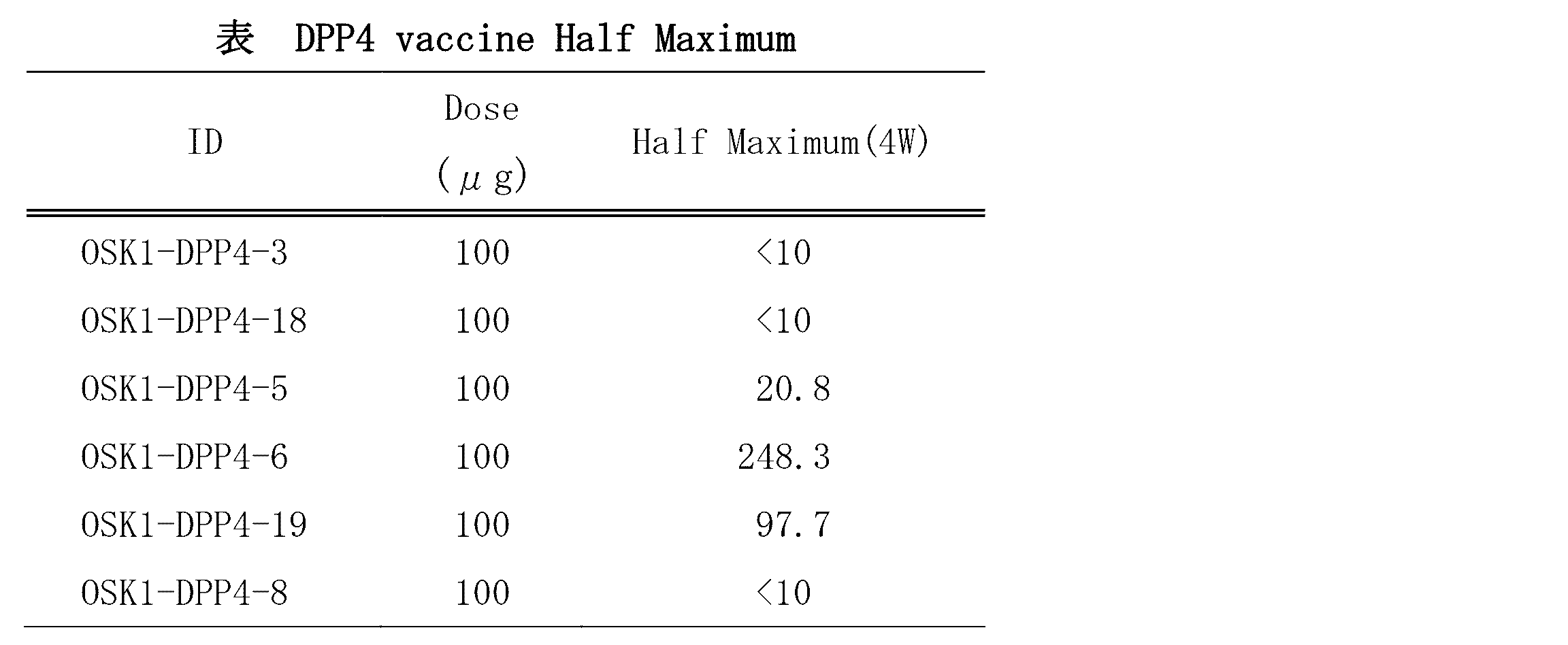
- OSK-1-DPP4 conjugate 3 OSK-1 peptide (SEQ ID NO: 1), 7 types of epitope peptides of mouse DPP4 (SEQ ID NO: 3, 5, 6, 8, 18, 19, 20) and 1 type of epitope peptide of human DPP4 (SEQ ID NO: 9) Eight kinds of OSK-1-DPP4 conjugates each conjugated with ⁇ -Acp as a linker were produced. Hereinafter, each OSK-1-DPP4 conjugate is represented by “OSK1-DDP4-SEQ ID NO”.
- OSK-1-DPP4 conjugate containing 6 kinds of mouse DPP4 epitope peptides (SEQ ID NOs: 3, 5, 6, 8, 18, 19) at a dose of 100 ⁇ g / mouse to Balb / c mice every 2 weeks was administered intradermally three times.
- blood was collected every 2 weeks from administration, and the antibody titer against each epitope peptide was measured by ELISA.
- Table 2 shows antibody titers 4 weeks after the first administration.
- Antibody titers are shown as half maximum values. The half maximum value is a dilution ratio of serum showing half the maximum absorbance in the measuring instrument, and was calculated by creating a sigmoid curve of serum dilution ratio and absorbance.
- OSK-1-DPP4 conjugates OSK1-DDP4-6, OSK1-DDP4-9 and OSK1-DDP4-12, were skinned 3 times at 2-week intervals in Balb / c mice at a dose of 250 ⁇ g per animal. It was administered internally. Blood was collected 4 weeks, 9 weeks and 13 weeks after the first administration, and the antibody titer against each epitope peptide was measured by ELISA. The results are shown in Table 3. Antibody titers are shown as half maximum values.
- Example 5 Evaluation of OSK-1-DPP4 conjugate by HbA1c value
- the OSK-1 peptide (SEQ ID NO: 1) and the DPP4 epitope peptide (SEQ ID NO: 6) were combined with ⁇ -Acp as a linker, and the OSK-1-DPP4 conjugate was administered at a dose of 100 ⁇ g per fat.
- DIO SERIES DIET D12492, CLEA Japan, Inc. was administered intradermally to Balb / c mice that were ingested ad libitum 3 times every 2 weeks.
- a portion of blood collected 57 days after the first administration was quickly dispensed into an EDTA-treated tube and mixed by inversion to prepare EDTA-treated blood.
- HbA1c value (%, NGSP) of the OSK-1-DPP4 conjugate group showed an improvement of -0.4% compared to the HbA1c value of the control group (KLH administration group).
- Example 6 Evaluation of OSK-1-DPP4 conjugate by oral glucose tolerance test (OGTT)]
- An OSK-1 peptide (SEQ ID NO: 1) and two kinds of DPP4 epitope peptides (SEQ ID NO: 6 and SEQ ID NO: 9) were respectively conjugated with two kinds of OSK-1-DPP4 conjugates using ⁇ -Acp as a linker, Balb / c mice that received a high fat diet (DIO SERIES DIET D12492, CLEA Japan, Inc.) at a dose of 250 ⁇ g per mouse were intradermally administered 3 times every 2 weeks. Further, on day 63 after the initial administration, 250 ⁇ g of OSK-1-DPP4 conjugate was intradermally administered per animal.
- ⁇ -Acp high fat diet
- an oral glucose tolerance test (OGTT) was performed. Fasting was performed for about 16 hours from the day before the OGTT was performed, and the fasted state was maintained during the OGTT. A 20% glucose solution was orally administered once at a dose of 5 mL / kg. Blood sampling and blood glucose level measurement were performed without anesthesia. The tail of the animal was lightly scratched with a razor, and the sugar concentration in the leaking blood was measured with a blood glucose self-monitoring device (Nipro Freestyle Freedom).
- the blood glucose level was measured before and after glucose loading at a total of 5 points in time at 30, 60, 90 and 120 minutes, and the area under the blood glucose increase curve AUC (time * mg / dl) of each administration group from the change in concentration over time. was calculated.
- AUC time * mg / dl
- Example 7 Examination of IgE production by OSK-1-DPP4 conjugate
- the production of IgE against the target protein by OSK1-DPP4-17 was compared with KLH-DPP4-17 in which the carrier protein was changed to KLH.
- KLH-DPP4-17 group KLH-DPP4-17 was mixed and administered intradermally so that 20 ⁇ g / mouse and Alum (Alhydrogel 2% (InvivoGen)) were 1 mg / mouse.
- the OSK-1-DPP4-17 group was administered intradermally at 100 ⁇ g / mouse.
- Balb / c mice were intradermally administered 3 times at 2-week intervals, and then the fourth administration was performed at 11 weeks. Blood was collected on week 21, and the amount of IgE antibody against DPP4 in the serum was measured by ELISA.
- OSK-1-IL-17A conjugate (1) Production of OSK-1-IL-17A conjugate OSK-1 peptide (SEQ ID NO: 1) and 10 kinds of epitope peptides of mouse IL-17A (SEQ ID NOs: 21, 22, 31-33, 37-41) Ten types of OSK-1-IL-17A conjugates each conjugated with ⁇ -Acp as a linker were produced.
- OSK1-IL-SEQ ID NO As representative examples of these conjugates containing four types of epitope peptides (SEQ ID NOs: 21, 31, 32, and 40), FIGS. 9 to 12 show (A) amino acid analysis results and (B) HPLC analysis results, respectively. Other conjugates gave substantially similar analysis results.
- Example 9 Evaluation of OSK-1-IL-17A conjugate by imiquimod-induced psoriasis-like dermatitis model mouse (1)
- the imiquimod-induced psoriasis-like dermatitis model was used as the psoriasis model.
- 6 weeks old BALB / c mice were given 3 kinds of OSK-1-IL-17A conjugates (OSK1-IL-31, OSK1-IL-32, OSK1-IL-40) at a dose of 500 ⁇ g per mouse, Intradermal administration was performed 3 times every 2 weeks.
- the skin condition (erythema, thickness, symptom range of white scale) was observed every day for 8 days (0-7 days) from the start of psoriasis induction, and each of 5 stages (0: none, 1: mild, 2) : Moderate, 3: severe, 4: very severe). Ear thickness was measured daily using digital calipers for 8 days (day 0-7) from the beginning of psoriasis induction. The result of the skin condition is shown in FIG. 14, and the result of the ear thickness is shown in FIG. The four OSK-1-IL-17A conjugates used were shown to inhibit imiquimod-induced psoriasis-like dermatitis.
- Example 10 Evaluation of OSK-1-IL-17A conjugate by imiquimod-induced psoriasis-like dermatitis model mouse (2)]
- OSK1-IL-21 as an OSK-1-IL-17A conjugate
- Balb / c mice were treated every 3 weeks at a dose of 100 ⁇ g, 300 ⁇ g or 1000 ⁇ g every 2 weeks. It was administered intradermally.
- KLH-IL-21 in which the carrier protein was changed to KLH was intradermally administered to Balb / c mice 3 times every 2 weeks at a dose of 20 ⁇ g per animal.
- FIG. 17 shows changes in the skin state during the psoriasis-like dermatitis induction period (day 0 to 12), and FIG. 18 shows changes in the ear thickness during the psoriasis-like dermatitis induction period (day 0 to 7). It was shown to.
- the keratinization tendency was stained by involucrin staining, which is the final marker of keratinization, with F4 / 80, which is a macrophage marker, and Gr-1, which is a granulocyte marker, to detect immune cells.
- RNA in skin tissue was extracted using RNeasy Fibros Tissue Mini Kit.
- Messenger RNAs of IL-17A, IL-17F, IL-22 and IL-23 inflammation-related factors were measured by real-time PCR using Taqman Gene Expression Assays primers and probes.
- messenger RNA of various factors increased in mice not administered with OSK-1-IL-17A conjugate, but the expression of messenger RNA of each factor was suppressed in the OSK-1-IL-17A conjugate administration group. It was.
- Examples 9 and 10 imiquimod-induced psoriasis-like dermatitis model mice were used.
- W. Jiang et al. (“A Toll-Like Receptor 7, 8, and 9 Antagonist Inhibits Th1 and Th17 Responses and Inflammasome Activation in a Model of IL-23-Induced Psoriasis” W. Jiang, et , 1784 Journal of Investigative Dermatology (2013), Volume 133).
- mice using C57BL / 6 mice aged 6 to 8 weeks, 0.5 mg of mouse IL-23 was dissolved in 20 mL of PBS, and the test was performed on days 0, 2, 4, 6, 10, 12, and 14, for example.
- Dermatitis is induced by intradermal injection in the animal's left ear. Mice that have induced dermatitis are randomly grouped and administered a test substance or a control substance (eg, PBS).
- the test substance or control substance is administered subcutaneously on days 3, 6, 9, 12, and 15.
- the thickness of the pinna is measured with a digital caliper.
- the pinna is collected and used for histopathological examination.
- Example 11 Investigation of antibody production by OSK-1-IgE conjugate
- An OSK-1-IgE conjugate in which an OSK-1 peptide (SEQ ID NO: 1) and a mouse IgE epitope peptide (SEQ ID NO: 23) are conjugated using ⁇ -Acp as a linker was prepared, and a dose of 100 ⁇ g or 250 ⁇ g per animal was produced. Then, the Balb / c mice were intradermally administered 3 times at 2-week intervals. Blood was collected every 2 weeks from the administration, and the antibody titer against each epitope peptide was measured by ELISA. The antibody titers after 8 weeks are shown in Table 5. Antibody titers are shown as half maximum values.
- Example 12 Examination of antibody production by OSK-1-PCSK9 conjugate
- An OSK-1 peptide (SEQ ID NO: 1) and three kinds of mouse PCSK9 epitope peptides (SEQ ID NO: 25, 26, 27) were respectively conjugated with three kinds of OSK-1-PCSK9 conjugates each having ⁇ -Acp as a linker.
- the antibody titers after 8 weeks are shown in Table 6. Antibody titers are shown as half maximum values.
- Example 13 Evaluation of OSK-1-PCSK9 conjugate by PCSK9 concentration in blood
- concentration of PCSK9 in serum collected from mice (OSK-1-PCSK9 conjugate administration group) administered with OSK1-PCSK9-27 at a dose of 250 ⁇ g was measured before administration and 2, 4, and 6 weeks after administration. It was measured.
- an OSK-1 administration group was provided, administration and blood collection were performed according to the same schedule, and the PCSK9 concentration in serum was measured.
- Mouse Protein Convert 9 / PCSK9 Quantikine ELISA Kit R & D systems
- mice in the KLH administration group were administered KLH in an amount equal to KLH contained in the conjugate administered to the conjugate administration group.
- KLH-PCSK9 conjugate or KLH alone was mixed with an equal volume of Freund's adjuvant (Wako Pure Chemical Industries) and administered subcutaneously. Freund's complete adjuvant was used for the first time, and Freund's incomplete adjuvant was used for the second and subsequent times. A total of 3 times (Days 0, 14, and 28), the conjugate was administered, and blood was collected 24 weeks after the final administration to measure lipid levels.
- the values of CM (chylomicron) and VLDL were reduced to about half
- TG neutral fat
Landscapes
- Health & Medical Sciences (AREA)
- Chemical & Material Sciences (AREA)
- Life Sciences & Earth Sciences (AREA)
- Immunology (AREA)
- General Health & Medical Sciences (AREA)
- Medicinal Chemistry (AREA)
- Organic Chemistry (AREA)
- Public Health (AREA)
- Animal Behavior & Ethology (AREA)
- Pharmacology & Pharmacy (AREA)
- Veterinary Medicine (AREA)
- Microbiology (AREA)
- Epidemiology (AREA)
- Mycology (AREA)
- Biochemistry (AREA)
- Genetics & Genomics (AREA)
- Molecular Biology (AREA)
- Biophysics (AREA)
- Proteomics, Peptides & Aminoacids (AREA)
- Bioinformatics & Cheminformatics (AREA)
- Engineering & Computer Science (AREA)
- Zoology (AREA)
- General Chemical & Material Sciences (AREA)
- Chemical Kinetics & Catalysis (AREA)
- Oncology (AREA)
- Nuclear Medicine, Radiotherapy & Molecular Imaging (AREA)
- Toxicology (AREA)
- Insects & Arthropods (AREA)
- Gastroenterology & Hepatology (AREA)
- General Engineering & Computer Science (AREA)
- Wood Science & Technology (AREA)
- Tropical Medicine & Parasitology (AREA)
- Peptides Or Proteins (AREA)
- Medicines Containing Antibodies Or Antigens For Use As Internal Diagnostic Agents (AREA)
- Medicinal Preparation (AREA)
- Medicines That Contain Protein Lipid Enzymes And Other Medicines (AREA)
Abstract
Description
[1]配列番号1に示されるアミノ酸配列と同一または実質的に同一のアミノ酸配列からなるペプチドと、疾患の要因となる生体内タンパク質のエピトープとの複合体を含むワクチン。
[2]生体内タンパク質が、DPP4、IL-17A、IgE、S100A9およびPCSK9からなる群より選択される1種である前記[1]に記載のワクチン。
[3]IL-17Aのエピトープが、配列番号10、11、29~36のいずれかに示されるアミノ酸配列、または配列番号10、11、29~36のいずれかに示されるアミノ酸配列からなるペプチドにおいて1または2個のアミノ酸が欠失、置換または付加されたアミノ酸配列からなるペプチドである前記[2]に記載のワクチン。
[4]DPP4のエピトープが、配列番号2~9のいずれかに示されるアミノ酸配列、または配列番号2~9のいずれかに示されるアミノ酸配列からなるペプチドにおいて1または2個のアミノ酸が欠失、置換または付加されたアミノ酸配列からなるペプチドである前記[2]に記載のワクチン。
[5]IgEのエピトープが、配列番号12に示されるアミノ酸配列、または配列番号12に示されるアミノ酸配列からなるペプチドにおいて1または2個のアミノ酸が欠失、置換または付加されたアミノ酸配列からなるペプチドである前記[2]に記載のワクチン。
[6]S100A9のエピトープが、配列番号13に示されるアミノ酸配列、または配列番号13に示されるアミノ酸配列からなるペプチドにおいて1または2個のアミノ酸が欠失、置換または付加されたアミノ酸配列からなるペプチドである前記[2]に記載のワクチン。
[7]PCSK9のエピトープが、配列番号14~16のいずれかに示されるアミノ酸配列、または配列番号14~16のいずれかに示されるアミノ酸配列からなるペプチドにおいて1または2個のアミノ酸が欠失、置換または付加されたアミノ酸配列からなるペプチドである前記[2]に記載のワクチン。
[8]配列番号1に示されるアミノ酸配列からなるペプチドと生体内タンパク質のエピトープが、ε-アミノカプロン酸を介して連結されている前記[1]~[7]のいずれかに記載のワクチン。
[9]前記複合体のN末端のアミノ酸がアセチル化されている前記[1]~[8]のいずれかに記載のワクチン。
[10]前記複合体のC末端のアミノ酸がアミド化されている前記[1]~[9]のいずれかに記載のワクチン。
[11]配列番号1に示されるアミノ酸配列からなるペプチドと、疾患の要因となる生体内タンパク質のエピトープとの複合体を含む免疫原性組成物。
[12]生体内タンパク質が、DPP4、IL-17A、IgE、S100A9およびPCSK9からなる群より選択される1種である前記[11]に記載の免疫原性組成物。
[13]配列番号1に示されるアミノ酸配列と同一または実質的に同一のアミノ酸配列からなるペプチドと、疾患の要因となる生体内タンパク質のエピトープとの複合体の有効量を、動物に投与することを含む、前記生体内タンパク質が要因となる疾患の予防または治療方法。
[14]生体内タンパク質が要因となる疾患の予防または治療に用いるための、配列番号1に示されるアミノ酸配列と同一または実質的に同一のアミノ酸配列からなるペプチドと、前記生体内タンパク質のエピトープとの複合体。
[15]生体内タンパク質が要因となる疾患の予防または治療用医薬を製造するための、配列番号1に示されるアミノ酸配列と同一または実質的に同一のアミノ酸配列からなるペプチドと、前記生体内タンパク質のエピトープとの複合体の使用。
・ENSTFDEFG(配列番号2)
・NKRQLITEE(配列番号3)
・KNTYRLKLYS(配列番号4)
・YSDESLQYPK(配列番号5)
・PPHFDKSKKY(配列番号6)
・GLPTPEDNLD(配列番号7)
・FSKEAKYYQ(配列番号8)
・NSSVFLENSTFDEFG(配列番号9)
なお、ヒトDPP4のアミノ酸配列およびヒトDPP4をコードする遺伝子の塩基配列のアクセッション番号は、それぞれNP_001926(NCBI)およびNM_001935(NCBI)である。
・RSSDYYNR(配列番号10)
・PKRSSDYYNRSTSPW(配列番号11)
・CPNSEDKNFPR(配列番号29)
・RNEDPERYPS(配列番号30)
・NRSTSPW(配列番号31)
・LHRNEDP(配列番号32)
・RYPSVIWEA(配列番号33)
・PKRSSDYYNR(配列番号34)
・TNPKRSSDYYNR(配列番号35)
・TNTNPKRSSDYYNR(配列番号36)
なお、ヒトIL-17Aのアミノ酸配列およびヒトIL-17Aをコードする遺伝子の塩基配列のアクセッション番号は、それぞれNP_002181(NCBI)およびNM_002190(NCBI)である。
・YQCRVTHPHLP(配列番号12)
なお、ヒト免疫グロブリンε鎖定常領域のアミノ酸配列およびヒト免疫グロブリンε鎖定常領域をコードする遺伝子の塩基配列のアクセッション番号は、それぞれP01854(UniProtKB)およびNG_001019(NCBI)である。
・GHHHKPGLGE(配列番号13)
なお、ヒトS100A9のアミノ酸配列およびヒトS100A9をコードする遺伝子の塩基配列のアクセッション番号は、それぞれNP_002956(NCBI)およびNM_002965(NCBI)である。
・LRPRGQPNQC(配列番号14)
・SRHLAQASQ(配列番号15)
・SRSGKRRGER(配列番号16)
なお、ヒトPCSK9のアミノ酸配列およびヒトPCSK9をコードする遺伝子の塩基配列のアクセッション番号は、それぞれNP_777596(NCBI)およびNM_174936(NCBI)である。

経口投与用の液体製剤は、一般的に用いられる希釈剤に溶解、懸濁又は乳化されて製剤化される。希釈剤としては、例えば、精製水、エタノール、それらの混液等が挙げられる。さらにこの液剤は、湿潤剤、懸濁化剤、乳化剤、甘味剤、風味剤、芳香剤、保存剤、緩衝剤等を含有していてもよい。
また、本発明には、生体内タンパク質が要因となる疾患の予防または治療に用いるための、本発明のワクチンが含まれる。
さらに、本発明には、生体内タンパク質が要因となる疾患の予防または治療用医薬を製造するための、本発明のワクチンの使用が含まれる。
文献「Solid Phase Peptide Synthesis,Pierce(1984)、Fmoc solid synthesis:a practical approach,Oxford University Press(2000)」および「第5版 実験化学講座16 有機化合物の合成IV」等に記載の方法に従い、全自動固相合成機を用いて、保護ペプチド樹脂をFmoc法で合成した。得られた保護ペプチド樹脂にトリフルオロ酢酸(TFA)とスカベンジャー(チオアニオール、エタンジチオール、フェノール、トリイソプロピルシラン、水等の混合物)を加えて、樹脂から切り出すとともに脱保護して、粗ペプチドを得た。この粗ペプチドを、逆相HPLCカラム(ODS)を用いて、0.1%TFA-H20/CH3CNの系でグラジエント溶出し、精製を行った。目的物を含む画分を集め凍結乾燥して、目的のペプチドを得た。合成したペプチドのアミノ酸配列は、アミノ酸シーケンサーG1000A(Hewlett Packard)、PPSQ-23A(島津製作所)またはProciscLC(ABI社)を用いて確認し、得られたペプチドのN末端をアセチル化した。
OSK-1ペプチド(配列番号1)とマウスDPP4のエピトープペプチド(配列番号17)を、ε-Acpをリンカーとして連結(コンジュゲート)したOSK-1-DPP4コンジュゲート(Ac-ELKLIFLHRLKRLRKRLKRK-X-ENSTFESFG (X = ε-Acp))による抗体産生作用を評価した。群構成は、生理食塩水群およびOSK-1-DPP4コンジュゲート群(100μg/mouse)の2群とした(6匹/群)。Balb/cマウスに2週間隔で3回皮内投与した。投与前、投与から2週間おきに8週後まで採血し、DPP4エピトープペプチドに対する抗体価をELISAにより測定した。
実施例1と同じOSK-1-DPP4コンジュゲートによる抗体産生作用を、KLH(Keyhole limpet hemocyanin:スカシガイヘモシアニン)とマウスDPP4のエピトープペプチド(配列番号17)とのコンジュゲート(KLH-DPP4)の抗体産生作用と比較した。群構成は、KLH-DPP4コンジュゲート群(20μg/mouse)、OSK-1-DPP4コンジュゲート群(100μg/mouse)、OSK-1-DPP4コンジュゲート(100μg/mouse)+Alum(Alhydrogel 2%(InvivoGen)1 mg/mouse)併用群の3群とした(2匹/群)。Balb/cマウスに2週間隔で3回皮内投与した。投与前、投与から2週間おきに6週後までと、12週後に採血し、DPP4エピトープペプチドに対する抗体価をELISAにより測定した。
実施例1および2と同じOSK-1-DPP4コンジュゲートにより産生されたIgG抗体のIgGサブクラスを、実施例2と同じKLH-DPP4コンジュゲートにより産生されたIgG抗体のIgGサブクラスと比較した。群構成は、OSK-1-DPP4コンジュゲート群(100μg/mouse)、KLH-DPP4コンジュゲート(20μg/mouse)+Alum(Alhydrogel 2%(InvivoGen)1 mg/mouse)併用群、KLH-DPP4コンジュゲート(20μg/mouse)+OSK-1(100μg/mouse)併用群の3群とした。Balb/cマウスに2週間隔で3回および投与開始から9週後に1回、合計4回皮内投与した後、投与後11週に採血し、DPP4エピトープペプチドに対するIgG抗体の抗体価をIgGサブクラスごとにELISAにより測定した。
OSK-1ペプチド(配列番号1)とWT1ペプチド(配列番号28)を、ε-AcpをリンカーとしてコンジュゲートしたOSK-1-WT1コンジュゲート(Ac-ELKLIFLHRLKRLRKRLKRK-X-RMFPNAPYL (X = ε-Acp))による抗腫瘍効果を評価した。また、WT1ペプチドワクチンの抗腫瘍効果に対するOSK-1ペプチドのアジュバント効果について検討した。群構成は、生理食塩水群、WT1ペプチド(100μg/mouse)+ポリ(I:C)(InvivoGen;Poly(I:C) HMW VacciGrade、50μg/mouse)群、WT1ペプチド(100μg/mouse)+OSK-1ペプチド(100μg/mouse)群、SK-1-WT1コンジュゲート(350μg/mouse)群の4群とした(6匹/群)。C57BL/6Jマウスにワクチンを週に1回、4回投与し、4回目の投与から1週間後にB16F10メラノーマ細胞(1×105cells/mouse)を背部皮内に移植した。細胞移植から1週間後に再度ワクチンを投与した。細胞移植後、週に2回体重および腫瘍径を測定した。腫瘍径はデジタルノギスを用いて測定し、長径×短径2を腫瘍体積とした。
参考例1と同じOSK-1-WT1コンジュゲートによる抗腫瘍効果を評価した。群構成は、生理食塩水群、WT1ペプチド(100μg/mouse)+ポリ(I:C)(InvivoGen;Poly(I:C) HMW VacciGrade、50μg/mouse)群、SK-1-WT1コンジュゲート(350μg/mouse)群、シスプラチン(5mg/kg)群の4群とした(10匹/群)。C57BL/6JマウスにB16F10メラノーマ細胞(3×105cells/mouse)を背部皮内に移植し、同じ日にワクチンを皮内投与した。細胞移植日をDay0とし、Day7、14、21、28、35にワクチンを投与した。細胞移植後、週に2回、デジタルノギスを用いて腫瘍径を測定し、長径×短径2を腫瘍体積とした。
OSK-1ペプチド(配列番号1)と7種類のマウスDPP4のエピトープペプチド(配列番号3,5,6,8,18,19,20)および1種類のヒトDPP4のエピトープペプチド(配列番号9)を、それぞれε-Acpをリンカーとしてコンジュゲートした8種類のOSK-1-DPP4コンジュゲートを製造した。以下、各OSK-1-DPP4コンジュゲートを「OSK1-DDP4-配列番号」で表記する。
初回投与から4週後の抗体価を表2に示した。抗体価はhalf maximum値で示した。Half maximum値は、測定機における最大吸光度の半分の吸光度示す血清の希釈倍率であり、血清希釈倍率と吸光度のシグモイド曲線を作成して算出した。
結果を表3に示した。抗体価はhalf maximum値で示した。

OSK-1ペプチド(配列番号1)とDPP4のエピトープペプチド(配列番号6)を、ε-AcpをリンカーとしてコンジュゲートしたOSK-1-DPP4コンジュゲートを、1匹あたり100μgの用量で、高脂肪食(DIO SERIES DIET D12492、日本クレア株式会社)を自由摂取させたBalb/cマウスに2週間おきに3回皮内投与した。初回投与後57日に採取した血液の一部を速やかにEDTA処理済みチューブに分注し、転倒混和させて、EDTA処理血液を調製した。HbA1c測定用に約20μLをマイクロチューブに分注し、HbA1c測定機器クオラボ(ニプロ)を用いて測定した。その結果、OSK-1-DPP4コンジュゲート群のHbA1c値(%、NGSP)はコントロール群(KLH投与群)のHbA1c値と比較して、-0.4%の改善を示した。
OSK-1ペプチド(配列番号1)と2種類のDPP4のエピトープペプチド(配列番号6および配列番号9)を、それぞれε-Acpをリンカーとしてコンジュゲートした2種類のOSK-1-DPP4コンジュゲートを、1匹あたり250μgの用量で、高脂肪食(DIO SERIES DIET D12492、日本クレア株式会社)を自由摂取させたBalb/cマウスに2週間おきに3回皮内投与した。さらに初回投与後63日目に1匹あたり250μgのOSK-1-DPP4コンジュゲートを皮内投与した。初回投与後77日目に経口ブドウ糖負荷試験(OGTT)を実施した。OGTT実施前日から約16時間の絶食を行い、OGTT実施中は絶食状態を維持した。20%グルコース液を5mL/kgの用量で単回経口投与した。採血および血糖値測定は無麻酔下で行った。動物の尾を軽く剃刀にて傷付け、漏出する血液中の糖濃度を血糖自己測定器(ニプロフリースタイルフリーダム)にて測定した。血糖値は、糖負荷前、糖負荷後30、60、90および120分の計5時点で測定し、経時的な濃度推移より各投与群の血糖上昇曲線下面積AUC(time*mg/dl)を算出した。その結果、2種類のOSK-1-DPP4コンジュゲート投与群のAUCは、どちらもコントロール群(KLH投与群)のAUCと比較して低下した。
OSK1-DPP4-17による標的タンパクに対するIgE産生を、キャリアタンパク質をKLHに変更したKLH-DPP4-17と比較した。KLH-DPP4-17群は、KLH-DPP4-17が20μg/mouseおよびAlum(Alhydrogel 2%(InvivoGen))が1mg/mouseになるように混合し皮内投与した。OSK-1-DPP4-17群は100μg/mouseで皮内投与した。Balb/cマウスに2週間隔で3回皮内投与し、さらに11週目に4回目の投与を行った。21週目に採血し、血清中のDPP4に対するIgE抗体量をELISAにより測定した。
(1)OSK-1-IL-17Aコンジュゲートの製造
OSK-1ペプチド(配列番号1)と10種類のマウスIL-17Aのエピトープペプチド(配列番号21,22,31~33,37~41)を、それぞれε-Acpをリンカーとしてコンジュゲートした10種類のOSK-1-IL-17Aコンジュゲートを製造した。以下、各OSK-1-IL-17Aコンジュゲートを「OSK1-IL-配列番号」で表記する。これらの代表例として4種類のエピトープペプチド(配列番号21,31,32,40)を含むコンジュゲートについて、図9~12にそれぞれ(A)アミノ酸分析結果および(B)HPLC分析結果を示した。他のコンジュゲートも実質的に同様の分析結果を得た。
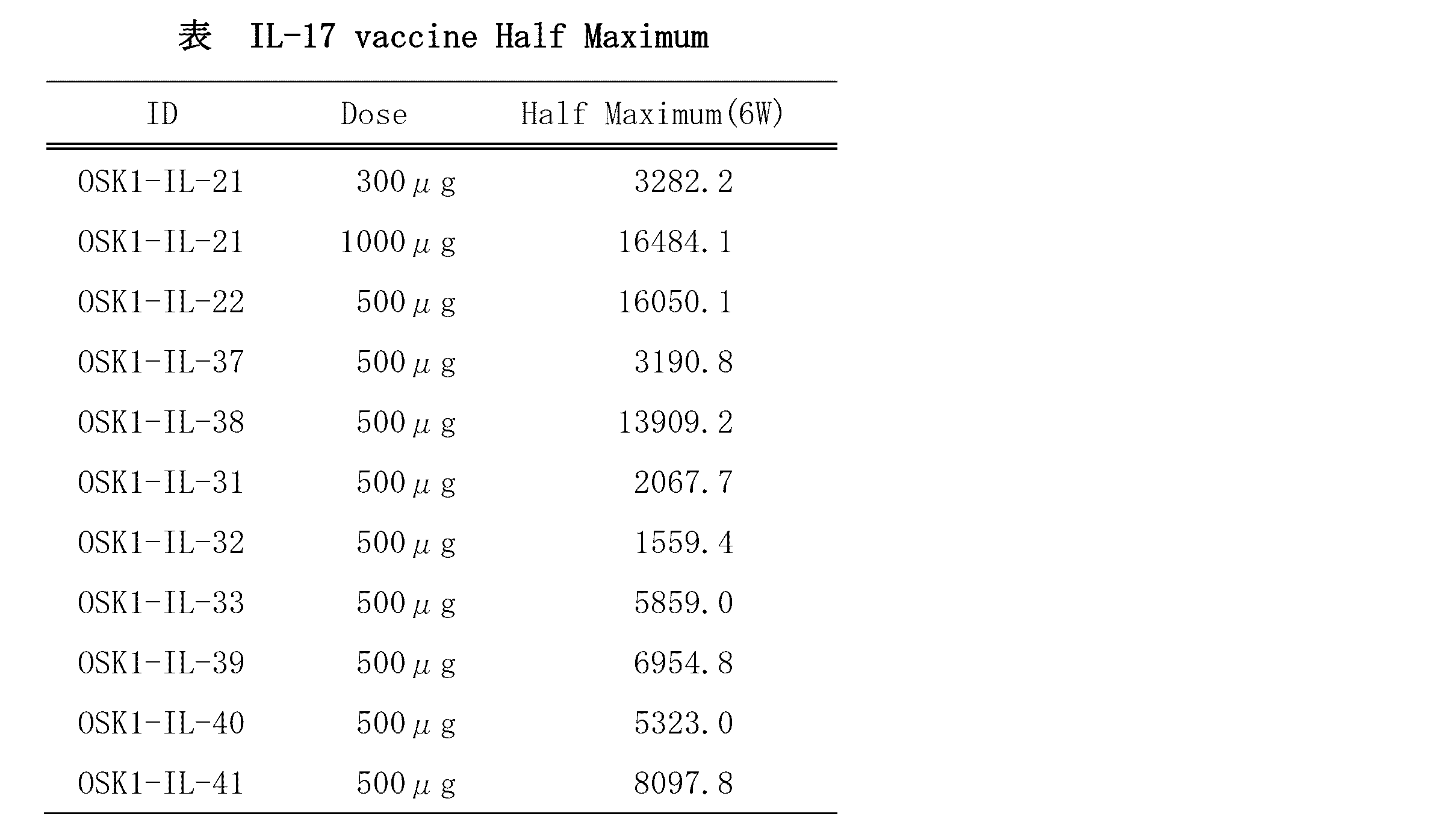
10種類のOSK-1-IL-17Aコンジュゲートを表4に記載の用量で、Balb/cマウスに2週間隔で3回皮内投与した。投与前、投与から2週間おきに6週後まで採血し、各エピトープペプチドに対する抗体価をELISAにより測定した。
初回投与から6週後の結果を表4に示した。また、2,4,6週後の抗体価の変化を図13に示した。抗体価はhalf maximum値で示した。
乾癬モデルとして、イミキモド誘発乾癬様皮膚炎モデルを使用した。6週齢のBALB/cマウスに3種類のOSK-1-IL-17Aコンジュゲート(OSK1-IL-31、OSK1-IL-32、OSK1-IL-40)を、1匹あたり500μgの用量で、2週間おきに3回皮内投与した。3回目のワクチン投与から2週間後に背中を剃毛し、さらに脱毛クリームを用いて脱毛した皮膚に、1日あたりイミキモド62.5mg分のベセルナクリーム5%(商品名、持田製薬)を、8日間毎日塗布することにより乾癬を誘導した。耳に塗布する場合は、片耳につき1日あたりイミキモド0.35mg分のベセルナクリーム5%を、8日間毎日塗布することにより乾癬症状を誘導した。
(1)皮膚状態および耳の厚さ
OSK-1-IL-17AコンジュゲートとしてOSK1-IL-21を用い、1匹あたり100μg、300μgまたは1000μgの用量で、Balb/cマウスに2週間おきに3回皮内投与した。また、キャリアタンパク質をKLHに変更したKLH-IL-21を、1匹あたり20μgの用量で、Balb/cマウスに2週間おきに3回皮内投与した。KLH-IL-21については、1回目の投与ではフロイント完全アジュバント(SIGMA)50μL/mouseを、2回目および3回目の投与ではフロイント不完全アジュバント(SIGMA)50μL/mouseを、アジュバントとして混合し投与した。用いたワクチンおよびベセルナクリーム5%を13日間毎日塗布したこと以外は、上記実施例9と同じ手順で行った。
イミキモド塗布により乾癬様皮膚炎を誘導した際に皮膚に存在している免疫細胞およびインボルクリンの発現を免疫組織化学染色により検出した。
乾癬誘導開始から12日目の背部皮膚および耳介を採取し、4%PFAで固定後、パラフィン包埋を行った。切片作成後、脱パラフィン、抗原賦活化処理を行い、非特異反応ブロッキング、一次抗体反応、標識二次抗体反応を行った。角化の最終マーカーであるインボルクリン染色により角化傾向を、マクロファージのマーカーであるF4/80および顆粒球のマーカーであるGr-1でそれぞれ染色し、免疫細胞を検出した。
乾癬誘導開始前(0日目)および乾癬誘導開始から12日目に採血し、血清中のIL-17濃度を、Mouse IL-17A/F Heterodimer Quantikine ELISA Kit(R&D systems社)を用いて測定した。
結果を図22に示した。(A)はイミキモドを塗布していないマウス(0日目)の結果であり、(B)はイミキモドを塗布したマウス(12日目)の結果である。(B)に示したように、OSK-1-IL-17Aコンジュゲート投与群はKLH-IL-17Aコンジュゲート投与群に比べ、IL-17A/Fの血中濃度が低かった。また、(A)に示したように、コンジュゲート投与後イミキモド塗布開始前の血中IL-17A/Fは、KLH-IL-17Aコンジュゲート投与群のみ上昇が認められた。
乾癬誘導開始から12日目に乾癬部位の皮膚を採取し、RNeasy Fibrous Tissue Mini Kitを使用して皮膚組織中のRNAを抽出した。Taqman Gene Expression Assaysのプライマーおよびプローブを使用し、リアルタイムPCR法によって、IL-17A、IL-17F、IL-22およびIL-23の炎症関連因子のメッセンジャーRNAを測定した。
その結果、OSK-1-IL-17Aコンジュゲート非投与のマウスでは各種因子のメッセンジャーRNAが上昇したが、OSK-1-IL-17Aコンジュゲート投与群では、各因子のメッセンジャーRNAの発現は抑制されていた。
OSK-1ペプチド(配列番号1)とマウスIgEのエピトープペプチド(配列番号23)を、ε-AcpをリンカーとしてコンジュゲートしたOSK-1-IgEコンジュゲートを製造し、1匹あたり100μgまたは250μgの用量で、Balb/cマウスに2週間隔で3回皮内投与した。投与から2週おきに採血し、各エピトープペプチドに対する抗体価をELISAにより測定した。
8週後の抗体価を表5に示した。抗体価はhalf maximum値で示した。

OSK-1ペプチド(配列番号1)と3種類のマウスPCSK9のエピトープペプチド(配列番号25,26,27)を、それぞれε-Acpをリンカーとしてコンジュゲートした3種類のOSK-1-PCSK9コンジュゲートを製造し、1匹あたり100μgまたは250μgの用量で、Balb/cマウスに2週間隔で3回皮内投与した。投与から2週おきに採血し、各エピトープペプチドに対する抗体価をELISAにより測定した。
8週後の抗体価を表6に示した。抗体価はhalf maximum値で示した。

実施例12において、OSK1-PCSK9-27を250μgの用量で投与したマウス(OSK-1-PCSK9コンジュゲート投与群)から、投与前および投与2、4、6週後に採取した血清中のPCSK9濃度を測定した。コントロールとして、OSK-1投与群を設け、同じスケジュールで投与および採血を行い、血清中のPCSK9濃度を測定した。測定には、Mouse Proprotein Convertase 9/PCSK9 Quantikine ELISA Kit(R&D systems)を使用した。ここで、PCSK9抗体を投与すると血中PCSK9濃度の上昇が認められることが報告されている。この現象は抗体によりPCSK9タンパクが安定化し体内からの消失が遅くなるためだと考えられている。このことから、ワクチン投与による血中PCSK9値の上昇は、ワクチン投与により産生された抗体が標的タンパクと作用していることを示す現象のひとつであると考えられる(Peptide-Based Anti-PCSK9 Vaccines - An Approach for Long-Term LDLc Management, PLoS One. 2014; 9(12), An Anti-PCSK9 Antibody Reduces LDL-Cholesterol On Top Of A Statin And Suppresses Hepatocyte SREBP-Regulated Genes; Int.J.Biol.Sci.2012, 8(3):310-327) 。
KLHとマウスPCSK9のエピトープペプチド(配列番号26)をコンジュゲートしたKLH-PCSK9コンジュゲートを使用した。7週齢のApoE欠損マウスを日本チャールズリバーから購入した。KLH-PCSK9コンジュゲート低用量群(5μg(PCSK9ペプチド)/mouse)、KLH-PCSK9コンジュゲート高用量群(50μg(PCSK9ペプチド)/mouse)、KLH投与群およびコントロールとして生理食塩水投与群を設けた。KLH投与群のマウスには、コンジュゲート投与群に投与したコンジュゲートに含まれるKLHと等量のKLHを投与した。投与前にKLH-PCSK9コンジュゲートまたはKLH単独を等容積のフロイントアジュバント(和光純薬)と混合し、皮下投与した。初回はフロイント完全アジュバントを使用し、2回目以降はフロイント不完全アジュバントを使用した。合計3回(0、14および28日目)コンジュゲートを投与し、最終投与の24週後に採血して脂質量を測定した。その結果、KLH-PCSK9コンジュゲート投与群では、CM(カイロミクロン)、VLDLの値が約半分に低下し、TG(中性脂肪)の値が約3分の2に低下した。
Claims (15)
- 配列番号1に示されるアミノ酸配列と同一または実質的に同一のアミノ酸配列からなるペプチドと、疾患の要因となる生体内タンパク質のエピトープとの複合体を含むワクチン。
- 生体内タンパク質が、DPP4、IL-17A、IgE、S100A9およびPCSK9からなる群より選択される1種である請求項1に記載のワクチン。
- IL-17Aのエピトープが、配列番号10、11、29~36のいずれかに示されるアミノ酸配列、または配列番号10、11、29~36のいずれかに示されるアミノ酸配列からなるペプチドにおいて1または2個のアミノ酸が欠失、置換または付加されたアミノ酸配列からなるペプチドである請求項2に記載のワクチン。
- DPP4のエピトープが、配列番号2~9のいずれかに示されるアミノ酸配列、または配列番号2~9のいずれかに示されるアミノ酸配列からなるペプチドにおいて1または2個のアミノ酸が欠失、置換または付加されたアミノ酸配列からなるペプチドである請求項2に記載のワクチン。
- IgEのエピトープが、配列番号12に示されるアミノ酸配列、または配列番号12に示されるアミノ酸配列からなるペプチドにおいて1または2個のアミノ酸が欠失、置換または付加されたアミノ酸配列からなるペプチドである請求項2に記載のワクチン。
- S100A9のエピトープが、配列番号13に示されるアミノ酸配列、または配列番号13に示されるアミノ酸配列からなるペプチドにおいて1または2個のアミノ酸が欠失、置換または付加されたアミノ酸配列からなるペプチドである請求項2に記載のワクチン。
- PCSK9のエピトープが、配列番号14~16のいずれかに示されるアミノ酸配列、または配列番号14~16のいずれかに示されるアミノ酸配列からなるペプチドにおいて1または2個のアミノ酸が欠失、置換または付加されたアミノ酸配列からなるペプチドである請求項2に記載のワクチン。
- 配列番号1に示されるアミノ酸配列からなるペプチドと生体内タンパク質のエピトープが、ε-アミノカプロン酸を介して連結されている請求項1~7のいずれかに記載のワクチン。
- 前記複合体のN末端のアミノ酸がアセチル化されている請求項1~8のいずれかに記載のワクチン。
- 前記複合体のC末端のアミノ酸がアミド化されている請求項1~9のいずれかに記載のワクチン。
- 配列番号1に示されるアミノ酸配列と同一または実質的に同一のアミノ酸配列からなるペプチドと、疾患の要因となる生体内タンパク質のエピトープとの複合体を含む免疫原性組成物。
- 生体内タンパク質が、DPP4、IL-17A、IgE、S100A9およびPCSK9からなる群より選択される1種である請求項11に記載の免疫原性組成物。
- 配列番号1に示されるアミノ酸配列と同一または実質的に同一のアミノ酸配列からなるペプチドと、疾患の要因となる生体内タンパク質のエピトープとの複合体の有効量を、動物に投与することを含む、前記生体内タンパク質が要因となる疾患の予防または治療方法。
- 生体内タンパク質が要因となる疾患の予防または治療に用いるための、配列番号1に示されるアミノ酸配列と同一または実質的に同一のアミノ酸配列からなるペプチドと、前記生体内タンパク質のエピトープとの複合体。
- 生体内タンパク質が要因となる疾患の予防または治療用医薬を製造するための、配列番号1に示されるアミノ酸配列と同一または実質的に同一のアミノ酸配列からなるペプチドと、前記生体内タンパク質のエピトープとの複合体の使用。
Priority Applications (10)
| Application Number | Priority Date | Filing Date | Title |
|---|---|---|---|
| EP17770449.1A EP3434279B1 (en) | 2016-03-25 | 2017-03-24 | Conjugate vaccine targeting disorder-causing in vivo protein |
| AU2017238817A AU2017238817B2 (en) | 2016-03-25 | 2017-03-24 | Conjugate vaccine targeting a disease-causing biological protein |
| CN201780019328.XA CN108883166B (zh) | 2016-03-25 | 2017-03-24 | 以成为疾病主要原因的生物体内蛋白质为靶标的结合疫苗 |
| US16/087,799 US10980876B2 (en) | 2016-03-25 | 2017-03-24 | Conjugate vaccine targeting a disease-causing biological protein |
| KR1020187028257A KR102468907B1 (ko) | 2016-03-25 | 2017-03-24 | 질환의 요인이 되는 생체내 단백질을 표적으로 하는 컨쥬게이트 백신 |
| JP2018507461A JP6941321B2 (ja) | 2016-03-25 | 2017-03-24 | 疾患の要因となる生体内タンパク質を標的とするコンジュゲートワクチン |
| EP22204662.5A EP4194007B1 (en) | 2016-03-25 | 2017-03-24 | Conjugate vaccine targeting disorder-causing in vivo protein |
| ES17770449T ES2934129T3 (es) | 2016-03-25 | 2017-03-24 | Vacuna conjugada dirigida a una proteína biológica causante de enfermedad |
| CA3018482A CA3018482A1 (en) | 2016-03-25 | 2017-03-24 | Conjugate vaccine targeting a disease-causing biological protein |
| US17/200,552 US12070498B2 (en) | 2016-03-25 | 2021-03-12 | Conjugate vaccine targeting a disease-causing biological protein |
Applications Claiming Priority (2)
| Application Number | Priority Date | Filing Date | Title |
|---|---|---|---|
| JP2016062872 | 2016-03-25 | ||
| JP2016-062872 | 2016-03-25 |
Related Child Applications (2)
| Application Number | Title | Priority Date | Filing Date |
|---|---|---|---|
| US16/087,799 A-371-Of-International US10980876B2 (en) | 2016-03-25 | 2017-03-24 | Conjugate vaccine targeting a disease-causing biological protein |
| US17/200,552 Division US12070498B2 (en) | 2016-03-25 | 2021-03-12 | Conjugate vaccine targeting a disease-causing biological protein |
Publications (1)
| Publication Number | Publication Date |
|---|---|
| WO2017164409A1 true WO2017164409A1 (ja) | 2017-09-28 |
Family
ID=59899566
Family Applications (1)
| Application Number | Title | Priority Date | Filing Date |
|---|---|---|---|
| PCT/JP2017/012187 Ceased WO2017164409A1 (ja) | 2016-03-25 | 2017-03-24 | 疾患の要因となる生体内タンパク質を標的とするコンジュゲートワクチン |
Country Status (9)
| Country | Link |
|---|---|
| US (2) | US10980876B2 (ja) |
| EP (2) | EP4194007B1 (ja) |
| JP (3) | JP6941321B2 (ja) |
| KR (1) | KR102468907B1 (ja) |
| CN (1) | CN108883166B (ja) |
| AU (1) | AU2017238817B2 (ja) |
| CA (1) | CA3018482A1 (ja) |
| ES (2) | ES3044918T3 (ja) |
| WO (1) | WO2017164409A1 (ja) |
Cited By (8)
| Publication number | Priority date | Publication date | Assignee | Title |
|---|---|---|---|---|
| WO2018155457A1 (ja) * | 2017-02-21 | 2018-08-30 | 国立大学法人大阪大学 | S100a9を標的とする免疫原性組成物 |
| CN110128539A (zh) * | 2018-02-02 | 2019-08-16 | 中国药科大学 | 抗二肽基肽酶4的单克隆抗体及其制备方法和用途 |
| WO2022265091A1 (ja) | 2021-06-18 | 2022-12-22 | 住友ファーマ株式会社 | ヒトαシヌクレインのエピトープペプチド及び該ペプチドを含む医薬組成物 |
| WO2023106319A1 (ja) * | 2021-12-08 | 2023-06-15 | 国立大学法人大阪大学 | 抗il-23抗体誘導用ワクチン組成物 |
| JP2023105112A (ja) * | 2016-03-25 | 2023-07-28 | 国立大学法人大阪大学 | 疾患の要因となる生体内タンパク質を標的とするコンジュゲートワクチン |
| WO2023234376A1 (ja) | 2022-05-31 | 2023-12-07 | 旭化成株式会社 | ヒアルロン酸誘導体、医薬組成物、及び医薬組成物の製造方法 |
| WO2024019127A1 (ja) | 2022-07-20 | 2024-01-25 | 旭化成株式会社 | ヒアルロン酸誘導体医薬組成物及び医薬組成物の製造方法 |
| WO2025100514A1 (ja) * | 2023-11-09 | 2025-05-15 | 株式会社ファンペップ | 抗IgE抗体誘導用ワクチン組成物 |
Families Citing this family (3)
| Publication number | Priority date | Publication date | Assignee | Title |
|---|---|---|---|---|
| US11421025B2 (en) | 2013-12-27 | 2022-08-23 | Osaka University | Treatment of IL-17A diseases |
| WO2022021000A1 (zh) * | 2020-07-27 | 2022-02-03 | 深圳华大生命科学研究院 | 一种抗体结合的特征性表位及其应用 |
| EP4486389A1 (en) | 2022-02-28 | 2025-01-08 | Tridem Bioscience GmbH & Co KG | A conjugate comprising at least a beta-glucan |
Citations (5)
| Publication number | Priority date | Publication date | Assignee | Title |
|---|---|---|---|---|
| WO2010089940A1 (ja) * | 2009-02-05 | 2010-08-12 | 国立大学法人大阪大学 | 粘膜ワクチン |
| WO2014157485A1 (ja) * | 2013-03-29 | 2014-10-02 | 国立大学法人大阪大学 | 抗老化作用を有するペプチドおよびその利用 |
| WO2015033831A1 (ja) | 2013-09-04 | 2015-03-12 | 国立大学法人 大阪大学 | Dpp-4を標的とした糖尿病治療用ワクチン |
| WO2015099167A1 (ja) | 2013-12-27 | 2015-07-02 | 国立大学法人大阪大学 | Il-17aを標的とするワクチン |
| WO2016047763A1 (ja) * | 2014-09-26 | 2016-03-31 | 国立大学法人大阪大学 | 新規ペプチドおよびその用途 |
Family Cites Families (8)
| Publication number | Priority date | Publication date | Assignee | Title |
|---|---|---|---|---|
| US9340577B2 (en) | 1992-08-07 | 2016-05-17 | Epimmune Inc. | HLA binding motifs and peptides and their uses |
| EP2162540A2 (en) * | 2007-05-22 | 2010-03-17 | Amgen Inc. | Compositions and methods for producing bioactive fusion proteins |
| ES2602610T3 (es) * | 2007-05-31 | 2017-02-21 | Medigene Ag | Proteína estructural mutada de un parvovirus |
| WO2010137594A1 (ja) * | 2009-05-25 | 2010-12-02 | アンジェスMg株式会社 | 血管新生誘導活性及び抗菌活性を有するポリペプチドおよびそれを含有する創傷治療剤 |
| WO2011027257A2 (en) * | 2009-09-03 | 2011-03-10 | Pfizer Vaccines Llc | Pcsk9 vaccine |
| US20130064788A1 (en) * | 2009-10-10 | 2013-03-14 | Eleven Biotherapeutics, Inc. | Il-17 family cytokine compositions and uses |
| WO2015123291A1 (en) * | 2014-02-11 | 2015-08-20 | The Usa, As Represented By The Secretary, Dept. Of Health And Human Services | Pcsk9 vaccine and methods of using the same |
| ES3044918T3 (en) * | 2016-03-25 | 2025-11-27 | The Univ Of Osaka | Conjugate vaccine targeting disorder-causing in vivo protein |
-
2017
- 2017-03-24 ES ES22204662T patent/ES3044918T3/es active Active
- 2017-03-24 ES ES17770449T patent/ES2934129T3/es active Active
- 2017-03-24 CN CN201780019328.XA patent/CN108883166B/zh active Active
- 2017-03-24 EP EP22204662.5A patent/EP4194007B1/en active Active
- 2017-03-24 WO PCT/JP2017/012187 patent/WO2017164409A1/ja not_active Ceased
- 2017-03-24 CA CA3018482A patent/CA3018482A1/en active Pending
- 2017-03-24 JP JP2018507461A patent/JP6941321B2/ja active Active
- 2017-03-24 US US16/087,799 patent/US10980876B2/en active Active
- 2017-03-24 AU AU2017238817A patent/AU2017238817B2/en active Active
- 2017-03-24 EP EP17770449.1A patent/EP3434279B1/en active Active
- 2017-03-24 KR KR1020187028257A patent/KR102468907B1/ko active Active
-
2021
- 2021-03-12 US US17/200,552 patent/US12070498B2/en active Active
- 2021-08-26 JP JP2021137656A patent/JP2021183638A/ja active Pending
-
2023
- 2023-06-06 JP JP2023093490A patent/JP2023105112A/ja active Pending
Patent Citations (5)
| Publication number | Priority date | Publication date | Assignee | Title |
|---|---|---|---|---|
| WO2010089940A1 (ja) * | 2009-02-05 | 2010-08-12 | 国立大学法人大阪大学 | 粘膜ワクチン |
| WO2014157485A1 (ja) * | 2013-03-29 | 2014-10-02 | 国立大学法人大阪大学 | 抗老化作用を有するペプチドおよびその利用 |
| WO2015033831A1 (ja) | 2013-09-04 | 2015-03-12 | 国立大学法人 大阪大学 | Dpp-4を標的とした糖尿病治療用ワクチン |
| WO2015099167A1 (ja) | 2013-12-27 | 2015-07-02 | 国立大学法人大阪大学 | Il-17aを標的とするワクチン |
| WO2016047763A1 (ja) * | 2014-09-26 | 2016-03-31 | 国立大学法人大阪大学 | 新規ペプチドおよびその用途 |
Non-Patent Citations (15)
| Title |
|---|
| "Fmoc Solid Synthesis: A Practical Approach", 2000, OXFORD UNIVERSITY PRESS |
| "NCBI", Database accession no. NG_001019 |
| "NCBI", Database accession no. NM_002965 |
| "NCBI", Database accession no. NM_174936 |
| "NCBI", Database accession no. NP 002956 |
| "NCBI", Database accession no. NP_777596 |
| "Peptide-Based Anti-PCSK9 Vaccines - An Approach for Long-Term LDLc Management", PLOS ONE, vol. 9, no. 12, 2014 |
| "Solid Phase Peptide Synthesis", 1984, PIERCE |
| "Synthesis of Organic Compounds IV", vol. 16, article "The Fifth Series of Experimental Chemistry (Jikken Kagaku Kouza" |
| "UniProtKB", Database accession no. P01854 |
| ARTHRITIS & RHEUMATISM, vol. 65, 2 February 2013 (2013-02-02), pages 447 - 456 |
| INT. J. BIOL. SCI., vol. 8, no. 3, 2012, pages 310 - 327 |
| N.E. VAN HOUTEN; M.B. ZWICK; A. MENENDEZ; J.K. SCOTT, VACCINE, vol. 24, no. 19, 8 May 2006 (2006-05-08), pages 4188 - 4200 |
| See also references of EP3434279A4 |
| W. JIANG ET AL.: "A Toll-Like Receptor 7, 8, and 9 Antagonist Inhibits Th1 and Thl7 Responses and Inflammasome Activation in a Model of IL-23-Induced Psoriasis", 1784 JOURNAL OF INVESTIGATIVE DERMATOLOGY, vol. 133, 2013 |
Cited By (13)
| Publication number | Priority date | Publication date | Assignee | Title |
|---|---|---|---|---|
| JP2023105112A (ja) * | 2016-03-25 | 2023-07-28 | 国立大学法人大阪大学 | 疾患の要因となる生体内タンパク質を標的とするコンジュゲートワクチン |
| JPWO2018155457A1 (ja) * | 2017-02-21 | 2020-01-16 | 国立大学法人大阪大学 | S100a9を標的とする免疫原性組成物 |
| US11020464B2 (en) | 2017-02-21 | 2021-06-01 | Osaka University | Immunogenic composition targeting S100A9 |
| JP7216965B2 (ja) | 2017-02-21 | 2023-02-02 | 国立大学法人大阪大学 | S100a9を標的とする免疫原性組成物 |
| WO2018155457A1 (ja) * | 2017-02-21 | 2018-08-30 | 国立大学法人大阪大学 | S100a9を標的とする免疫原性組成物 |
| CN110128539A (zh) * | 2018-02-02 | 2019-08-16 | 中国药科大学 | 抗二肽基肽酶4的单克隆抗体及其制备方法和用途 |
| WO2022265091A1 (ja) | 2021-06-18 | 2022-12-22 | 住友ファーマ株式会社 | ヒトαシヌクレインのエピトープペプチド及び該ペプチドを含む医薬組成物 |
| WO2023106319A1 (ja) * | 2021-12-08 | 2023-06-15 | 国立大学法人大阪大学 | 抗il-23抗体誘導用ワクチン組成物 |
| EP4445910A4 (en) * | 2021-12-08 | 2026-04-01 | Univ Osaka | VACCINE COMPOSITION TO INDUCE AN ANTI-IL-23 ANTIBODY |
| WO2023234376A1 (ja) | 2022-05-31 | 2023-12-07 | 旭化成株式会社 | ヒアルロン酸誘導体、医薬組成物、及び医薬組成物の製造方法 |
| WO2024019127A1 (ja) | 2022-07-20 | 2024-01-25 | 旭化成株式会社 | ヒアルロン酸誘導体医薬組成物及び医薬組成物の製造方法 |
| WO2025100514A1 (ja) * | 2023-11-09 | 2025-05-15 | 株式会社ファンペップ | 抗IgE抗体誘導用ワクチン組成物 |
| JP7678465B1 (ja) * | 2023-11-09 | 2025-05-16 | 株式会社ファンペップ | 抗IgE抗体誘導用ワクチン組成物 |
Also Published As
| Publication number | Publication date |
|---|---|
| KR20180123064A (ko) | 2018-11-14 |
| JP2021183638A (ja) | 2021-12-02 |
| CN108883166B (zh) | 2023-06-02 |
| CN108883166A (zh) | 2018-11-23 |
| EP3434279A4 (en) | 2019-11-06 |
| JPWO2017164409A1 (ja) | 2019-01-31 |
| AU2017238817A1 (en) | 2018-10-04 |
| CA3018482A1 (en) | 2017-09-28 |
| US20210205446A1 (en) | 2021-07-08 |
| US10980876B2 (en) | 2021-04-20 |
| EP3434279B1 (en) | 2022-11-23 |
| ES2934129T3 (es) | 2023-02-17 |
| JP6941321B2 (ja) | 2021-09-29 |
| KR102468907B1 (ko) | 2022-11-18 |
| US20190105388A1 (en) | 2019-04-11 |
| EP4194007A1 (en) | 2023-06-14 |
| ES3044918T3 (en) | 2025-11-27 |
| AU2017238817B2 (en) | 2023-12-21 |
| EP3434279A1 (en) | 2019-01-30 |
| US12070498B2 (en) | 2024-08-27 |
| EP4194007B1 (en) | 2025-08-13 |
| JP2023105112A (ja) | 2023-07-28 |
Similar Documents
| Publication | Publication Date | Title |
|---|---|---|
| US12070498B2 (en) | Conjugate vaccine targeting a disease-causing biological protein | |
| JP2019206548A (ja) | 膵炎を治療するための薬剤の製造におけるil−22二量体の使用 | |
| JP7216965B2 (ja) | S100a9を標的とする免疫原性組成物 | |
| CN101835483B (zh) | 动脉粥样硬化的治疗 | |
| WO2020096046A1 (ja) | 老化関連t細胞を標的とした糖代謝異常の予防または治療用ワクチン | |
| US20230173049A1 (en) | Fusion proteins and methods of use thereof | |
| Galle et al. | Vaccination with IL-6 analogues induces autoantibodies to IL-6 and influences experimentally induced inflammation | |
| JP7202662B2 (ja) | ワクチン組成物 | |
| EP4445910A1 (en) | Vaccine composition for inducing anti-il-23 antibody | |
| KR102829639B1 (ko) | c-Met의 에피토프를 포함하는 암 백신 및 이의 용도 | |
| WO2025103205A1 (en) | Pharmaceutical compositions and methods for preventing or treating kras-associated diseases or conditions | |
| CN107106672B (zh) | 用于预防和治疗免疫介导性疾病的针对胞壁酰肽的单克隆抗体 | |
| JP2022131943A (ja) | ワクチン、医薬及び糖尿病合併症治療薬 | |
| WO2023081861A9 (en) | Enhanced expression via autotransporters | |
| CN101460180B (zh) | 与白喉毒素免疫相关的蛋白质分子的药物应用 | |
| JPH10120591A (ja) | 免疫寛容誘導剤 | |
| WO2021207303A1 (en) | Immune stimulation against coronavirus infections | |
| US20100143291A1 (en) | Inactivated pepsin fragments for modulating immune system activity against human malignant tumor cells | |
| WO2010065157A2 (en) | Inactivated pepsin fragments for modulating immune system activity against human malignant tumor cells | |
| HK1145634B (en) | Treatment of atherosclerosis |
Legal Events
| Date | Code | Title | Description |
|---|---|---|---|
| WWE | Wipo information: entry into national phase |
Ref document number: 2018507461 Country of ref document: JP |
|
| ENP | Entry into the national phase |
Ref document number: 3018482 Country of ref document: CA |
|
| NENP | Non-entry into the national phase |
Ref country code: DE |
|
| ENP | Entry into the national phase |
Ref document number: 20187028257 Country of ref document: KR Kind code of ref document: A |
|
| ENP | Entry into the national phase |
Ref document number: 2017238817 Country of ref document: AU Date of ref document: 20170324 Kind code of ref document: A |
|
| WWE | Wipo information: entry into national phase |
Ref document number: 2017770449 Country of ref document: EP |
|
| ENP | Entry into the national phase |
Ref document number: 2017770449 Country of ref document: EP Effective date: 20181025 |
|
| 121 | Ep: the epo has been informed by wipo that ep was designated in this application |
Ref document number: 17770449 Country of ref document: EP Kind code of ref document: A1 |