WO2017159656A1 - 化粧料組成物 - Google Patents
化粧料組成物 Download PDFInfo
- Publication number
- WO2017159656A1 WO2017159656A1 PCT/JP2017/010126 JP2017010126W WO2017159656A1 WO 2017159656 A1 WO2017159656 A1 WO 2017159656A1 JP 2017010126 W JP2017010126 W JP 2017010126W WO 2017159656 A1 WO2017159656 A1 WO 2017159656A1
- Authority
- WO
- WIPO (PCT)
- Prior art keywords
- group
- carbon atoms
- compound
- formula
- salt
- Prior art date
- Legal status (The legal status is an assumption and is not a legal conclusion. Google has not performed a legal analysis and makes no representation as to the accuracy of the status listed.)
- Ceased
Links
Images

Classifications
-
- A—HUMAN NECESSITIES
- A61—MEDICAL OR VETERINARY SCIENCE; HYGIENE
- A61K—PREPARATIONS FOR MEDICAL, DENTAL OR TOILETRY PURPOSES
- A61K8/00—Cosmetics or similar toiletry preparations
- A61K8/18—Cosmetics or similar toiletry preparations characterised by the composition
- A61K8/30—Cosmetics or similar toiletry preparations characterised by the composition containing organic compounds
- A61K8/40—Cosmetics or similar toiletry preparations characterised by the composition containing organic compounds containing nitrogen
- A61K8/44—Aminocarboxylic acids or derivatives thereof, e.g. aminocarboxylic acids containing sulfur; Salts; Esters or N-acylated derivatives thereof
-
- A—HUMAN NECESSITIES
- A61—MEDICAL OR VETERINARY SCIENCE; HYGIENE
- A61Q—SPECIFIC USE OF COSMETICS OR SIMILAR TOILETRY PREPARATIONS
- A61Q17/00—Barrier preparations; Preparations brought into direct contact with the skin for affording protection against external influences, e.g. sunlight, X-rays or other harmful rays, corrosive materials, bacteria or insect stings
- A61Q17/04—Topical preparations for affording protection against sunlight or other radiation; Topical sun tanning preparations
-
- C—CHEMISTRY; METALLURGY
- C07—ORGANIC CHEMISTRY
- C07C—ACYCLIC OR CARBOCYCLIC COMPOUNDS
- C07C233/00—Carboxylic acid amides
- C07C233/01—Carboxylic acid amides having carbon atoms of carboxamide groups bound to hydrogen atoms or to acyclic carbon atoms
- C07C233/45—Carboxylic acid amides having carbon atoms of carboxamide groups bound to hydrogen atoms or to acyclic carbon atoms having the nitrogen atom of at least one of the carboxamide groups bound to a carbon atom of a hydrocarbon radical substituted by carboxyl groups
- C07C233/46—Carboxylic acid amides having carbon atoms of carboxamide groups bound to hydrogen atoms or to acyclic carbon atoms having the nitrogen atom of at least one of the carboxamide groups bound to a carbon atom of a hydrocarbon radical substituted by carboxyl groups with the substituted hydrocarbon radical bound to the nitrogen atom of the carboxamide group by an acyclic carbon atom
- C07C233/47—Carboxylic acid amides having carbon atoms of carboxamide groups bound to hydrogen atoms or to acyclic carbon atoms having the nitrogen atom of at least one of the carboxamide groups bound to a carbon atom of a hydrocarbon radical substituted by carboxyl groups with the substituted hydrocarbon radical bound to the nitrogen atom of the carboxamide group by an acyclic carbon atom having the carbon atom of the carboxamide group bound to a hydrogen atom or to a carbon atom of an acyclic saturated carbon skeleton
Definitions
- the present invention relates to a composition containing an acylamino acid polyhydric alcohol ester compound and a hardly soluble substance, and a cosmetic containing the composition.
- insoluble active ingredients are blended in cosmetics in order to impart various functions.
- a poorly soluble ultraviolet absorber that absorbs ultraviolet rays is blended (Patent Document 1)
- inorganic powder that efficiently scatters ultraviolet rays is blended. (Patent Document 2).
- a base having high solubilizing ability and dispersibility and excellent in feeling of use and safety is required.
- a base capable of improving the dispersibility of the powder is required.
- oil agents with high solubilizing ability of poorly soluble molecules and high dispersibility of inorganic powders include oil agents such as isopropyl myristate (IPM) and lauroyl sarcosine isopropyl (SL-205) (Patent Documents 3 and 4), suncare cosmetics.
- IPM isopropyl myristate
- SL-205 lauroyl sarcosine isopropyl
- suncare cosmetics A widely used alkyl benzoate (C 12 -C 15 ) and the like are known.
- these oil agents having high solubilizing ability and dispersibility simultaneously have a strong squeaky feeling, and there remain problems in use.
- R 1 is an alkyl group having 4 to 26 carbon atoms or an alkenyl group having 4 to 26 carbon atoms
- R 2 is an alkyl group having 1 to 6 carbon atoms or an alkenyl group having 2 to 6 carbon atoms
- n is an integer of 1 to 5
- X is a hydrocarbon group having 3 or more carbon atoms
- a and b are each independently an integer of 1 or more.
- a composition comprising at least one compound selected from the group consisting of a compound represented by the formula: and a salt thereof, or a salt thereof, and (B) a hardly soluble substance.
- R 1 is an alkyl group having 4 to 26 carbon atoms.
- R 1 is an alkyl group having 7 to 17 carbon atoms.
- R 2 is an alkyl group having 1 to 6 carbon atoms.
- R 5 is a methyl group.
- n is 1 or 2.
- X is a hydrocarbon group having 3 to 9 carbon atoms.
- (B) is a substance having a solubility of 1% by weight or less in water at 25 ° C.
- R 1 is an alkyl group having 4 to 26 carbon atoms or an alkenyl group having 4 to 26 carbon atoms
- R 2 is an alkyl group having 1 to 6 carbon atoms or an alkenyl group having 2 to 6 carbon atoms
- n is an integer of 1 to 5
- X is a hydrocarbon group having 3 or more carbon atoms
- a and b are each independently an integer of 1 or more.
- R 1 is an alkyl group having 4 to 26 carbon atoms or an alkenyl group having 4 to 26 carbon atoms
- R 2 is an alkyl group having 1 to 6 carbon atoms or an alkenyl group having 2 to 6 carbon atoms
- n is an integer of 1 to 5
- X is a hydrocarbon group having 3 or more carbon atoms
- a and b are each independently an integer of 1 or more.
- a method for solubilizing a hardly soluble substance comprising causing a hardly soluble substance to coexist with at least one compound selected from the group consisting of a compound represented by the formula:
- a hardly soluble substance can be solubilized, it can be applied to various cosmetics. According to the present invention, it is possible to alleviate the squeaky feeling of cosmetics containing hardly soluble substances and the like, and therefore it is possible to provide cosmetics with a good feeling of use. According to the present invention, it is possible to provide a cosmetic having ultraviolet blocking ability in a wide range (UV-A and UV-B region).
- FIG. 1 is a graph showing the results of measuring transmittance at wavelengths between 280 nm and 600 nm when the compositions of Examples 3-1 and 3-2 and Comparative Examples 3-1 and 3-2 are added to inorganic pigments. It is.
- the vertical axis represents the transmittance (% T), and the horizontal axis represents the wavelength ( ⁇ ).
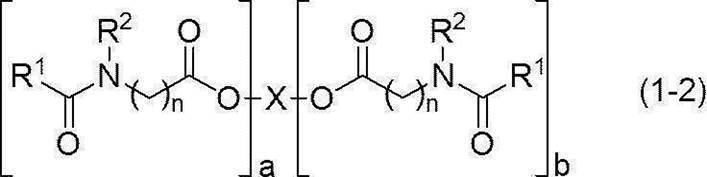
- composition of the present invention comprises: (A) Formula (1-1):
- R 1 is an alkyl group having 4 to 26 carbon atoms or an alkenyl group having 4 to 26 carbon atoms
- R 2 is an alkyl group having 1 to 6 carbon atoms or an alkenyl group having 2 to 6 carbon atoms
- n is an integer of 1 to 5
- X is a hydrocarbon group having 3 or more carbon atoms
- a and b are each independently an integer of 1 or more.
- each symbol has the same meaning as defined above.
- It contains at least one compound selected from the group consisting of a compound represented by the above and a salt thereof, or a salt thereof, and (B) a poorly soluble substance.
- alkyl group having 4 to 26 carbon atoms means straight or branched chain having 4 to 26 carbon atoms.
- alkyl group having 7 to 17 carbon atoms means a linear or branched alkyl group having 7 to 17 carbon atoms, and includes, for example, a heptyl group, an isoheptyl group, a neoheptyl group, an octyl group, Examples include isooctyl, nonyl, isononyl, decyl, isodecyl, undecyl, dodecyl, tridecyl, tetradecyl, pentadecyl, hexadecyl, heptadecyl and the like.
- the “alkyl group having 1 to 6 carbon atoms” means a linear or branched alkyl group having 1 to 6 carbon atoms, such as a methyl group, an ethyl group, a propyl group, an isopropyl group, Examples thereof include a butyl group, an isobutyl group, a sec-butyl group, a tert-butyl group, a pentyl group, and a hexyl group.
- the “alkenyl group having 4 to 26 carbon atoms” means a linear or branched alkenyl group having 4 to 26 carbon atoms, specifically, a 1-butenyl group, a 2-butenyl group.
- 3-butenyl group pentenyl group, hexenyl group, heptenyl group, octenyl group, nonenyl group, decenyl group, undecenyl group, dodecenyl group, tridecenyl group, tetradecenyl group, pentadecenyl group, hexadecenyl group, heptadecenyl group, octadecenyl group, nonadecenyl group , Icosenyl group, henecocenyl group, dococenyl group and the like.
- alkenyl group having 4 to 16 carbon atoms means a linear or branched alkenyl group having 4 to 16 carbon atoms, specifically, a 1-butenyl group, a 2-butenyl group.
- Examples include 3-butenyl group, pentenyl group, hexenyl group, heptenyl group, octenyl group, nonenyl group, decenyl group, undecenyl group, dodecenyl group, tridecenyl group, tetradecenyl group, pentadecenyl group, hexadecenyl group and the like.
- alkenyl group having 2 to 6 carbon atoms means a linear or branched alkenyl group having 2 to 6 carbon atoms, and specifically includes an ethenyl group, a 1-propenyl group, 2 -Propenyl group, 2-methyl-1-propenyl group, 1-butenyl group, 2-butenyl group, 3-butenyl group, pentenyl group, hexenyl group and the like can be mentioned.
- the “hydrocarbon group having 3 or more carbon atoms” means a divalent or more straight chain or branched hydrocarbon group having 3 or more carbon atoms (preferably a divalent or more hydrocarbon group having 3 or more carbon atoms. Linear or branched saturated hydrocarbon group), specifically, the following formula
- hydrocarbon group having 4 or more carbon atoms refers to a divalent or more straight chain or branched hydrocarbon group having 4 or more carbon atoms (preferably a divalent or more hydrocarbon group having 4 or more carbon atoms).
- Linear or branched saturated hydrocarbon group specifically, the following formula
- R 1 is an alkyl group having 4 to 26 carbon atoms or an alkenyl group having 4 to 26 carbon atoms.
- R 1 is preferably an alkyl group having 4 to 26 carbon atoms, more preferably an alkyl group having 7 to 17 carbon atoms, still more preferably a linear alkyl group having 7 to 17 carbon atoms, particularly preferably. Is an undecyl group.
- R 2 is an alkyl group having 1 to 6 carbon atoms or an alkenyl group having 2 to 6 carbon atoms.
- R 2 is preferably an alkyl group having 1 to 6 carbon atoms, and more preferably a methyl group.
- n is an integer of 1 to 5. n is preferably 1 or 2, more preferably 1.
- X is a hydrocarbon group having 3 or more carbon atoms.
- X is preferably a hydrocarbon group having 3 to 9 carbon atoms, more preferably a hydrocarbon group having 4 to 6 carbon atoms, and more preferably a hydrocarbon group having 4 or 5 carbon atoms.
- a and b are each independently an integer of 1 or more. a and b are preferably each independently an integer of 1 to 3, and a + b is an integer of 2 to 5, more preferably a and b are both 1.
- R 1 is an alkyl group having 4 to 26 carbon atoms or an alkenyl group having 4 to 16 carbon atoms
- X is A compound which is a hydrocarbon group having 4 or more carbon atoms is preferred.
- Preferred examples of the compound represented by formula (1-1) or formula (1-2) include the following compounds.
- R 1 is an alkyl group having 4 to 26 carbon atoms
- R 2 is an alkyl group having 1 to 6 carbon atoms
- n is 1 or 2
- X is a hydrocarbon group having 3 to 9 carbon atoms
- R 1 is an alkyl group having 7 to 17 carbon atoms
- R 2 is an alkyl group having 1 to 6 carbon atoms
- n is 1 or 2
- X is a hydrocarbon group having 4 to 9 carbon atoms
- R 1 is an undecyl group
- R 2 is a methyl group
- n is 1
- X is a hydrocarbon group having 4 or 5 carbon atoms
- Examples of the salt of the compound (1-1) and the compound (1-2) in the present invention include alkali metal salts such as lithium salt, sodium salt and potassium salt; alkaline earth metal salts such as calcium salt and magnesium salt; ammonium salt ; Methylamine, diethylamine, trimethylamine, triethylamine, ethanolamine, diethanolamine, triethanolamine, ethylenediamine, tris (hydroxymethyl) methylamine, dicyclohexylamine, N, N'-dibenzylethylenediamine, guanidine, pyridine, picoline, choline, cinchonine And salts with organic amine bases such as meglumine.
- alkali metal salts such as lithium salt, sodium salt and potassium salt
- alkaline earth metal salts such as calcium salt and magnesium salt
- ammonium salt ; Methylamine, diethylamine, trimethylamine, triethylamine, ethanolamine, diethanolamine, triethanolamine, ethylenediamine, tri
- the method for producing the compounds (1-1) and (1-2) in the present invention is not particularly limited, and can be produced by combining known methods. Specifically, it can be synthesized by the following method, but is not limited thereto.
- N-acyl-N-alkylamino acid (i) and alcohol (ii) are present in the presence of an acid catalyst such as paratoluenesulfonic acid, sulfuric acid, hydrochloric acid, methanesulfonic acid, hydrogen fluoride and the like.
- an acid catalyst such as paratoluenesulfonic acid, sulfuric acid, hydrochloric acid, methanesulfonic acid, hydrogen fluoride and the like.
- it can be obtained by condensation in the absence.
- each symbol has the same meaning as described above.
- 0.1 to 1 equivalent, preferably 0.5 to 0.55 equivalent of alcohol (ii) is used with respect to N-acyl-N-alkylamino acid (i).
- the alcohol (ii) is preferably 0.2 to 5 equivalents, preferably the N-acyl-N-alkylamino acid (i). 0.7 to 2 equivalents are used.
- the ratio of compound (1-1) and compound (1-2) in the final product obtained was changed.
- the reaction can also be carried out in a suitable solvent, and examples of the solvent to be used include benzene, toluene, xylene and the like.
- the reaction time is usually 2 to 12 hours, preferably 3 to 6 hours.
- the reaction temperature is usually 80 to 160 ° C., preferably 115 to 140 ° C.
- the N-acyl-N-alkylamino acid (i) has a so-called Schotten-Baumann reaction (special characteristic) in which a carboxylic acid halide (iii) is reacted with an amino acid (iv) under basic conditions as shown in the following formula, for example. It can be produced by a known method such as Japanese Patent Publication No. 51-38681).
- Hal represents a halogen atom such as a chlorine atom, and other symbols are as defined above.
- (A) is at least one compound selected from the group consisting of compound (1-1), compound (1-2), and salts thereof, or a salt thereof, and comprises compound (1-1) and a salt thereof.
- a mixture of at least one selected from the group and at least one selected from the group consisting of the compound (1-2) and a salt thereof is preferable.
- the content of the compound (1-1) or a salt thereof is usually 0 to 10 parts by weight, preferably 1 part by weight of the compound (1-2) or a salt thereof. Is 0.01 to 1 part by weight, more preferably 0.05 to 0.25 part by weight.
- the content of (A) is usually 1 to 90% by weight, preferably 3 to 50% by weight, more preferably 5 to 20% by weight, based on the total amount of the composition. If it is content of this range, (B) can be solubilized or disperse
- “solubilization” means increasing the solubility of a substance that is hardly soluble or insoluble in a solvent to form a uniform solution.
- “dispersion” means that a hardly soluble or insoluble substance is finely dispersed in a solvent and uniformly dispersed in the solvent.
- the hardly soluble substance in the present invention includes not only a substance hardly soluble in a solvent but also an insoluble substance, and has a solubility of 1% by weight or less with respect to water at 25 ° C. and / or Those having a solubility of 5% by weight or less with respect to liquid paraffin at 25 ° C. Preferably having a solubility of 0.0000001 to 1% by weight in water at 25 ° C. and / or having a solubility of 0.0000001 to 5% by weight in liquid paraffin at 25 ° C., more preferably in water at 25 ° C.
- UV absorbers having poorly soluble or insoluble properties, ceramides, gelling agents, perfumes, self-tanning agents, bactericides, inorganic pigments and the like.
- UV absorber examples include the following.
- Benzoic acid type ultraviolet absorbers As benzoic acid type ultraviolet absorbers, paraaminobenzoic acid, ethyldihydroxypropylparaaminobenzoic acid, glycerylparaaminobenzoic acid, octyldimethylparaaminobenzoic acid, paradimethylaminobenzoic acid amyl, paradimethylamino Examples include 2-ethylhexyl benzoate, 2- [4- (diethylamino) -2-hydroxybenzoyl] benzoic acid hexyl ester, and the like.
- anthranilic acid ultraviolet absorbers examples include homomenthyl-N-acetylanthranilate and methyl anthranilate (also known as methyl-O-aminobenzoate).
- Salicylic acid ultraviolet absorbers examples include amyl salicylate, menthyl salicylate, homomenthyl salicylate, octyl salicylate, phenyl salicylate, benzyl salicylate, p-isopropanol phenyl salicylate, and triethanolamine salicylate.
- Benzophenone ultraviolet absorbers As benzophenone ultraviolet absorbers, 4- (2- ⁇ -glucopyranosyloxy) propoxy-2-hydroxybenzophenone, dihydroxydimethoxybenzophenone, dihydroxydimethoxybenzophenone sodium disulfonate, 2-hydroxy- 4-methoxybenzophenone, hydroxymethoxybenzophenonesulfonic acid and its trihydrate, sodium hydroxymethoxybenzophenonesulfonate, 2-hydroxy-4-methoxybenzophenone-5-sulfate, 2,2′-dihydroxy-4-methoxybenzophenone, 2, 4-dihydroxybenzophenone, 2,2'4,4'-tetrahydroxybenzophenone, 2,3,4,4'-tetrahydroxybenzophenone, 2,2'-dihydroxy-4 4'-dimethoxyphenyl benzophenone, 2-hydroxy -4-N-octoxybenzophenone and the like.
- Cinnamic acid UV absorbers include 2-methoxyhexyl paramethoxycinnamate (also known as octyl paramethoxycinnamate) and mono-2-ethyl diparamethoxycinnamate.
- Glyceryl hexanoate methyl 2,5-diisopropylcinnamate, ethyl 2,4-diisopropylcinnamate, methyl 2,4-diisopropylcinnamate, 2,4,6-tris [4- (2-ethylhexyloxycarbonyl ) Anilino] -1,3,5-triazine, methyl bis (trimethylsiloxy) silylisopentyl trimethoxycinnamate, isopropyl dimethoxycinnamate ester mixture, ferulic acid, p-methoxyhydrocinnamic acid Diethanolamine salt, 3-methyl-4- [3,4,5-trimethoxycinnamate And methylbis (trimethylsiloxy) silyl] butyl.
- benzoylmethane ultraviolet absorbers examples include 2-phenyl-benzimidazole-5-sulfuric acid, 4-isopropyldibenzoylmethane, 4-tert-butyl-4'-methoxydibenzoylmethane, etc. Is mentioned.
- Triazine-based UV absorbers examples include bisresorcinyl triazines. Specifically, 2,4-bis-[ ⁇ 4- (2-ethylhexyloxy) -2-hydroxy ⁇ -Phenyl] -6- (4-methoxyphenyl) -1,3,5-triazine (also known as bisethylhexyloxyphenol methoxyphenyltriazine), 2,4,6-tris ⁇ 4- (2-ethylhexyloxycarbonyl) ) Anilino ⁇ 1,3,5-triazine, 2,4,6-tris (4-biphenylyl) -1,3,5-triazine (1,3,5-triazine, 2,4,6-tris [1, 10-biphenyl] -4-yl) and the like.
- Benzotriazole ultraviolet absorbers As benzotriazole ultraviolet absorbers, 2,2′-hydroxy-5-methylphenylbenzotriazole, 2- (2′-hydroxy-5′-t-octylphenyl) benzotriazole 2- (2′-hydroxy-5′-methylphenylbenzotriazole, 2,2′-methylenebis (6- (2H-benzotriazol-2-yl) -4- (1,1,3,3-tetramethyl) Butyl) phenol) (also known as methylenebisbenzotriazolyltetramethylbutylphenol) and the like.
- benzotriazole ultraviolet absorbers 2,2′-hydroxy-5-methylphenylbenzotriazole, 2- (2′-hydroxy-5′-t-octylphenyl) benzotriazole 2- (2′-hydroxy-5′-methylphenylbenzotriazole, 2,2′-methylenebis (6- (2H-benzotriazol-2-yl) -4- (1,1,3,3-tetramethyl) But
- Pyridazine derivative ultraviolet absorbers examples include pyridazine derivatives such as dimorpholinopyridazinone.
- organic ultraviolet absorbers include phenylbenzimidazole sulfonic acid, drometrizole trisiloxane, terephthalylidene dicamphulsulfonic acid, dimethoxybenzylidene dioxoimidazolidinepropionate 2-ethylhexyl, 1- (3,4-Dimethoxyphenyl) -4,4-dimethyl-1,3-pentanedione, Polysilicone-15 (dimethicodiethylbenzalmalonate), Synoxate, 2-cyano-3,3-diphenylprop -2-Enoic acid 2-ethylhexyl ester (also known as octocrylene), 5- (3,3-dimethyl-2-norbornylidene) -3-pentan-2-one, dianisoylmethane, methyl-O-aminobenzoate, 2- Ethylhexyl-2-cyano-3,
- UV absorbers 4-tert-butyl-4′-methoxydibenzoylmethane, octyl salicylate, bisethylhexyloxyphenol methoxyphenyltriazine, methylenebisbenzotriazolyltetramethylbutylphenol, phenylbenzimidazolesulfonic acid, poly Silicone-15, octocrylene, homomenthyl salicylate, 2- [4- (diethylamino) -2-hydroxybenzoyl] benzoic acid hexyl ester, 2-ethylhexyl paramethoxycinnamate, octyl triazone, 2-hydroxy-4-methoxybenzophenone Hydroxymethoxybenzophenonesulfonic acid and its trihydrate are preferred, such as 4-tert-butyl-4′-methoxydibenzoylmethane, 2-methoxyparacinnamic acid 2-e
- the ceramide is a compound in which a sphingosine base is bonded with a long-chain saturated or monounsaturated fatty acid at its amino group to an acid amide, for example, ceramide 1, ceramide 2, ceramide 3, ceramide 4, ceramide 5, ceramide 6-II, Ceramide 7 etc. are mentioned.
- gelling agent examples include dibutyl lauroyl glutamide, dibutyl ethyl hexanoyl glutamide, dextrin palmitate, 12-hydroxystearic acid and the like.
- fragrances examples include ⁇ -isomethylionone, linalool, butylphenylmethylpropanal, benzyl salicylate, hexylcinnamal and the like.
- Examples of the self-tanning agent include 3-hydroxy-4,5-dimethyl-5 (2H) -furanone.
- bactericides include isopropylmethylphenol, chlorhexidine hydrochloride, benzethonium chloride, methylparaben, propylparaben, and the like.
- inorganic pigments include colored pigments, extender pigments, pearlescent pigments, special functional pigments and special pigments.
- colored pigments, extender pigments, pearlescent pigments and special functional pigments are preferred.
- the inorganic pigment surface-treated with the surface modifier etc. may be sufficient.
- Specific examples include N ⁇ -lauroyl lysine, perfluoroalkyl phosphate diethanolamine, sodium metaphosphate, amino acids, acylated collagen, lecithin, metal soaps, acyl amino acid salts, methylhydrogenpolysiloxane and other silicon, polyacrylic acid, Examples thereof include inorganic pigments coated with chitosan, nylon powder, coloring pigments and the like. These inorganic pigments may be used alone or in combination of two or more depending on the purpose of use.
- titanium dioxide zinc oxide
- iron oxide Bengara
- titanium oxide coated mica titanium oxide coated bismuth oxychloride
- titanium oxide coated talc colored titanium oxide coated mica
- fish scale foil aluminum powder
- N ⁇ ⁇ Lauroyllysine is preferred.
- the content of (B) is usually 0.1 to 60% by weight, preferably 1 to 30% by weight, more preferably 5 to 25% by weight, based on the total amount of the composition.
- an ultraviolet absorber it is usually 0.1 to 60% by weight, preferably 1 to 30% by weight, more preferably 5 to 25% by weight, based on the total amount of the composition.
- inorganic pigments it is usually 0.1 to 50% by weight, preferably 1 to 30% by weight, more preferably 3 to 20% by weight, based on the total amount of the composition. When the content is in this range, a hardly soluble substance can be blended in the composition at a high concentration.
- an ultraviolet absorber or an inorganic pigment a wide range (UV-B region (290 to 320 nm) and UV-A) can be used. High ultraviolet blocking ability can be exhibited in the region (320 to 400 nm).
- the weight ratio of (B) to (A) [(A) :( B)] is usually 1: 0.005 to 1:20 parts by weight, preferably 1: 0.01 to 1:10, More preferably, it is 1: 0.05 to 1: 5. Within this range, (B) can be solubilized or dispersed stably and uniformly.
- composition of the present invention can be used as it is, but it can be produced by a conventional method by mixing known additives as required.
- Additives include water-soluble ingredients, oil-based ingredients, powder ingredients, polymer ingredients, thickeners, tackifiers, film formers, pH adjusters, antioxidants, antiseptics, bactericides, preservatives, preservatives. Molds, moisturizers, skin protectants, refreshing agents, fragrances, coloring agents, pigments, chelating agents, lubricants, anti-inflammatory agents, antipruritic agents, blood circulation promoters, astringents, tissue repair promoters, antiperspirants, A penetrant, an amino acid, a nucleic acid, an organic acid, an inorganic salt, an animal or plant extract component, an enzyme, a vitamin, a pearling agent, a wetting agent, and the like can be appropriately blended as long as the effects of the invention are not inhibited.
- composition of the present invention is not particularly limited, and examples thereof include cream, emulsion, lotion, powder, powder solid, oily solid, oily liquid, and paste.
- the present invention also relates to a cosmetic containing the composition of the present invention.
- the cosmetic of the present invention is not particularly limited, but an ultraviolet protective cosmetic is preferable.
- basic cosmetics eg, lotion, milky lotion, makeup base, beauty liquid, night cream, pack, makeup remover (cleansing gel, etc.), lip balm, nail cream, etc.
- makeup cosmetics eg, Foundation (solid, cream, liquid, etc.), sunscreen cream, BB cream, CC cream, concealer, lipstick, lip gloss, eye shadow, eyeliner, teak, mascara, bronzer, etc.
- hair care cosmetics hair treatment ( E.g. hair treatment, out bath treatment, hair essence, split hair coat, etc.), hair styling agent (e.g.
- shaving products for example, shaving cream, after-shave lotion, etc.
- make-up cosmetics sunscreen cream, BB cream, CC cream, bronzer is preferable.
- Cosmetic dosage forms include creams, solutions, lotions, emulsions, tinctures, aqueous gels, oily gels, aerosols, powders and the like.
- composition of the present invention and a cosmetic containing the composition can be produced according to a conventional method.
- Solubilizing agents are also included in the present invention.
- the “solubilizing agent” of the present invention means a substance that increases the solubility in addition to a hardly soluble substance to make a uniform solution.
- the solubilizer of the present invention can be produced according to a conventional method by appropriately blending only the compound or a salt thereof, or the above additives.
- the content of the above-mentioned compound or a salt thereof in the solubilizer of the present invention is usually 1 to 90% by weight, preferably 5 to 50% by weight.
- solubilizer of the present invention varies depending on the kind of the hardly soluble substance, it is usually 0.05 to 200 parts by weight, preferably 0.1 to 100 parts by weight, more preferably based on 1 part by weight of the hardly soluble substance.
- the definitions of the above formulas (1-1) and (1-2) and hardly soluble substances are the same as described above.
- the compound represented by the formula (1-1) and a salt thereof, and at least one compound selected from the group consisting of the compound represented by the formula (1-2) and a salt thereof, or a salt thereof, are sparingly soluble.
- a method for solubilizing a hardly soluble substance including a step of coexisting a substance is also included in the present invention.
- the method of the present invention varies depending on the kind of the hardly soluble substance, but usually 0.05 to 200 parts by weight, preferably 0.1 to 100 parts by weight of the above compound or a salt thereof with respect to 1 part by weight of the hardly soluble substance. Part, more preferably 0.2 to 20 parts by weight, can be solubilized.
- the definitions of the above formulas (1-1) and (1-2) and hardly soluble substances are the same as described above.
- a pigment dispersant is also included in the present invention.
- the dispersant for inorganic pigments of the present invention can be produced according to a conventional method by appropriately blending only the compound or a salt thereof or the above additives.
- the content of the compound or salt thereof in the inorganic pigment dispersant of the present invention is usually 1 to 90% by weight, preferably 5 to 50% by weight.
- the dispersant for inorganic pigments of the present invention varies depending on the type of inorganic pigment, but is usually 0.05 to 200 parts by weight, preferably 0.1 to 100 parts by weight, more preferably based on 1 part by weight of the inorganic pigment. By mixing 0.2 to 20 parts by weight, the inorganic pigment can be uniformly and stably dispersed.
- the dispersion method of the inorganic pigment including the step of allowing the inorganic pigment dispersant and the inorganic pigment to coexist is also included in the present invention.
- the method of the present invention varies depending on the type of inorganic pigment, but the above compound or salt thereof is usually 0.05 to 200 parts by weight, preferably 0.1 to 100 parts by weight, based on 1 part by weight of the inorganic pigment. More preferably, it is possible to disperse uniformly and stably by coexisting 0.2 to 20 parts by weight.
- the definitions of the above formulas (1-1) and (1-2) and the inorganic pigment are the same as described above.
- the instrument used for the measurement of a compound is as follows. 1 H-NMR measurement: Bruker AVANCE III HD NMR Spectrometer ESI-MS measurement: LC-MS 2010 A (manufactured by Shimadzu Corporation)
- Production Example 1 Production of 2LmbA-bg
- Production Example 4 Production of a mixture of 2LmbA-bg and LmbA-bg (N-lauroyl-N-methyl- ⁇ -alanine 1,3-butylene glycol monoester)
- the organic phase was collected and concentrated by vacuum decompression to obtain the desired product (yield 92%).
- Production Example 5 Production of a mixture of 2LmbA-npg and LmbA-npg (N-lauroyl-N-methyl- ⁇ -alanine neopentyl glycol monoester)
- the organic phase was collected and concentrated by vacuum decompression to obtain the desired product (yield 95%).
- Production Example 6 Production of 2LS-bg Sulfuric acid (0.98 g, 0.01 mol) was added to a mixture of N-lauroylsarcosine (27.14 g, 0.1 mol) and 1,3-butylene glycol (4.96 g, 0.055 mol), and argon was added. The mixture was stirred at a bath temperature of 132 ° C. for 10 hours under an air stream. The product was diluted with ethyl acetate (50 mL) and washed twice with saturated aqueous sodium hydrogen carbonate (30 mL). The organic phase was further washed twice with ultrapure water (40 mL). The organic phase was collected and concentrated by vacuum under reduced pressure to give a crude product.
- N-lauroylsarcosine 27.14 g, 0.1 mol
- 1,3-butylene glycol 4.96 g, 0.055 mol
- Production Example 7 Production method of 2LS-npg
- Production Example 9 Production of a mixture of 2LS-bg and LS-bg (N-lauroyl sarcosine 1,3-butylene glycol monoester)
- the compound was identified by a mass spectrometer (LC-MS) connected to liquid chromatography.
- Condition column for liquid chromatography YMC-Pack ODS-A, flow rate: 1 mL / min, temperature: 40 ° C, solvent: 30 mM aqueous solution of methanol / formic acid (9/1) ESI-MS (positive) m / z 619.3 [2LS-bg + Na] + , m / z 366.5 [LS-bg + Na] +
- Production Example 10 Production of a mixture of 2LS-npg and LS-npg (N-lauroyl sarcosine, neopentyl glycol monoester)
- Production Example 11 Mixture of 3LS-tmp (N-lauroyl sarcosine trimethylol propane triester), 2LS-tmp (N-lauroyl sarcosine trimethylol propane diester) and LS-tmp (N-lauroyl sarcosine trimethylol propane monoester) Manufacturing
- Production Example 12 3LmbA-pent (N-lauroyl-N-methyl- ⁇ -alanine pentaerythritol triester), 2LmbA-pent (N-lauroyl-N-methyl- ⁇ -alanine pentaerythritol diester) and LmbA-pent (N -Lauroyl-N-methyl- ⁇ -alanine pentaerythritol monoester)
- P-Toluenesulfonic acid monohydrate (1.9 g, 0.01 mol) was added to a mixture of N-lauroyl-N-methyl- ⁇ -alanine (28.52 g, 0.1 mol) and pentaerythritol (7.5 g, 0.055 mol). The mixture was stirred at a bath temperature of 130 ° C. for 4 hours under an argon stream. The product was diluted with ethyl acetate (50 mL) and washed twice with saturated aqueous sodium hydrogen carbonate (30 mL). The organic phase was further washed twice with saturated brine (40 mL) and then once with ultrapure water (40 mL).
- Production Example 14 Production of 3LmbA-tmp (N-lauroyl-N-methyl- ⁇ -alanine trimethylolpropane triester)
- the compound was identified by a mass spectrometer (LC-MS) connected to liquid chromatography.
- Production Example 17 Production of 2C10mbA-bg (N-decanoyl-N-methyl- ⁇ -alanine 1,3-butylene glycol diester)
- the numerical value obtained by dividing the amount of liquid paraffin added at this time by 100 is defined as the flow point (FP) of the oil or compound. Since the smaller the difference between the flow point and the wet point, the better the dispersibility (Industrial and Engineering Chemistry, 1946, 18 (1), 26-31), the pigment dispersibility is determined by the difference between the flow point and the wet point. The difference was evaluated. That is, in Table 1 below, when the difference between the flow point and the wet point is less than 10, ⁇ (very preferable), ⁇ (preferred) when 10 or more and less than 22 ⁇ (less preferable) when 22 or more and less than 30; X (not preferable) when 30 or more Displayed.
- the oil agents in the table are SL-205: Lauroyl sarcosine isopropyl (Ajinomoto Co., Inc.), Finsolv TN: Alkyl benzoate (C12-15) (Innospec Active Chemicals LLC), Neosol MP: Dine neopentanoic acid methylpentanediol (Nippon Seiki) And TCG-M: tri (caprylic acid / capric acid) glyceryl (manufactured by Higher Alcohol Industry Co., Ltd.).
- Test Example 2 Evaluation of solubilization ability In order to investigate the solubilizing power of the compounds or oils listed in Table 2, 50 mg of poorly soluble molecule 4-tert-butyl-4′-methoxydibenzoylmethane (Parsol 1789) was added to 100 mg of various compounds or oils. And stirred at room temperature for 24 hours. Thereafter, insoluble matters were precipitated by a centrifuge (20 minutes, 13000 rpm), and the supernatant was collected. 3 mg of the collected supernatant was dissolved in 1 mL of an organic solvent (methanol) and analyzed by HPLC.
- an organic solvent methanol
- Test Example 3 Evaluation of squeaky feeling during use About the squeaky feeling of various compounds or oils in Table 2 in which Parsol 1789, which is a poorly soluble UV absorber, was dissolved at 10 wt%, the specialized panelists (5 persons) Evaluation was performed. Based on the average evaluation score of panelists, the squeaky feeling during use was evaluated as follows.
- the average score of professional panelists is 2.4 or higher. 1.5 to less than 2.4 ⁇ , 0.5 to less than 1.5 Less than 0.5 x It was. The results are shown in Table 2.
- Test Example 4 Evaluation of Improvement of UV Blocking Ability of Inorganic Pigment by Addition of Compound or Oil Agent
- inorganic pigments titanium dioxide, TTO-55N, manufactured by Ishihara Sangyo Co., Ltd.
- TTO-55N titanium dioxide
- the powder mixed with the compound was added to liquid paraffin (Molesco White P-55, manufactured by Moresco) at a ratio of 1 wt%, vortexed for 1 minute, further shaken by hand for 15 seconds, and then vortexed for 15 seconds.
- the sample thus obtained was transferred to a quartz cell having an optical path length of 1 mm, and the transmittance at a wavelength between 280 nm and 600 nm was measured.
- FIG. 1 shows the UV blocking ability of inorganic pigments when various compounds or various oils are added.
Landscapes
- Health & Medical Sciences (AREA)
- Life Sciences & Earth Sciences (AREA)
- Animal Behavior & Ethology (AREA)
- General Health & Medical Sciences (AREA)
- Public Health (AREA)
- Veterinary Medicine (AREA)
- Birds (AREA)
- Epidemiology (AREA)
- Dermatology (AREA)
- Cosmetics (AREA)
Abstract
本発明は、(A)式(1-1):で表される化合物及びその塩、ならびに 式(1-2):で表される化合物及びその塩からなる群から選択される少なくとも一種の化合物又はその塩[式中、各記号は明細書に記載の通りである。]、及び(B)難溶性物質を含有する組成物であって、難溶性物質を可溶化又は安定的に分散させて含み、きしみ感が抑制され使用感に優れた組成物、特に化粧料組成物を提供する。
Description
本発明は、アシルアミノ酸多価アルコールエステル化合物及び難溶性物質を含有する組成物及び該組成物を含む化粧料に関する。
従来化粧品には様々な機能を付与するために不溶性の有効成分を配合することが知られている。例えば、紫外線防止用化粧品には、紫外線を効率的に防ぐため、紫外線を吸収する難溶性の紫外線吸収剤を配合(特許文献1)、紫外線を効率的に散乱する無機粉体を配合することなどが行われている(特許文献2)。いっぽう難溶性分子を配合の際には化粧品等に溶解又は分散させる必要があり、可溶化能や分散能が高く、かつ使用感・安全性に優れる基剤が求められ、特に不溶性の粉体等を化粧品に配合する場合には、凝集を防ぐため、粉体の分散性を向上しうる基剤が求められている。
例えば難溶性分子の可溶化能や無機粉体の分散能が高い油剤としては、ミリスチン酸イソプロピル(IPM)やラウロイルサルコシンイソプロピル(SL-205)等の油剤(特許文献3、4)、サンケア化粧品に汎用されている安息香酸アルキル(C12-C15)等が知られている。しかし、高い可溶化能と分散能を同時に持つこれらの油剤はきしみ感が強く使用面の課題が残っている。
本発明は、難溶性物質を可溶化又は安定的に分散させて含む組成物であって、きしみ感が抑制され使用感に優れた組成物、特に化粧料組成物を提供することを目的とする。
本発明者らは、上記目的を達成するため鋭意検討を重ねた結果、(A);下記式(1-1)で示される化合物又は式(1-2)で示される化合物(以下、「化合物(1-1)又は化合物(1-2)」ともいう)又はそれらの塩を、難溶性物質に添加するだけで、当該化合物を可溶化又は均一に分散することができ、さらに使用時のきしみ感が抑制されることを見出し、本発明を完成するに至った。
すなわち、本発明は以下の通りである。
[1](A)式(1-1):
[1](A)式(1-1):

[式中、
R1は、炭素数4~26のアルキル基又は炭素数4~26のアルケニル基であり、
R2は、炭素数1~6のアルキル基又は炭素数2~6のアルケニル基であり、
nは、1~5の整数であり、
Xは、炭素数3以上の炭化水素基であり、
a及びbは、それぞれ独立して、1以上の整数である。]
で表される化合物及びその塩、ならびに
式(1-2):
R1は、炭素数4~26のアルキル基又は炭素数4~26のアルケニル基であり、
R2は、炭素数1~6のアルキル基又は炭素数2~6のアルケニル基であり、
nは、1~5の整数であり、
Xは、炭素数3以上の炭化水素基であり、
a及びbは、それぞれ独立して、1以上の整数である。]
で表される化合物及びその塩、ならびに
式(1-2):

[式中、各記号は前記定義と同義である。]
で表される化合物及びその塩からなる群から選択される少なくとも一種の化合物又はその塩、及び
(B)難溶性物質
を含有する組成物。
[2]R1が炭素数4~26のアルキル基である、[1]に記載の組成物。
[3]R1が炭素数7~17のアルキル基である、[1]に記載の組成物。
[4]R2が炭素数1~6のアルキル基である、[1]~[3]のいずれかに記載の組成物。
[5]R2がメチル基である、[1]~[3]のいずれかに記載の組成物。
[6]nが1又は2である、[1]~[5]のいずれかに記載の組成物。
[7]Xが炭素数3~9の炭化水素基である、[1]~[6]のいずれかに記載の組成物。
[8]a及びbがそれぞれ独立して1~3の整数であり、かつa+bが2~5の整数である、[1]~[7]のいずれかに記載の組成物。
[9]a及びbが共に1である、[1]~[8]のいずれかに記載の組成物。
[10](B)が、25℃で水に対して1重量%以下の溶解度を有するもの、および/または25℃で流動パラフィンに対して5重量%以下の溶解度を有する物質である[1]~[9]のいずれかに記載の組成物。
[11](B)が、紫外線吸収剤、セラミド、ゲル化剤、香料、セルフタンニング剤、殺菌剤及び無機顔料からなる群から選択される少なくとも一種である[1]~[10]のいずれかに記載の組成物。
[12](A)に対する(B)の重量比が1:0.005~1:20である[1]~[11]のいずれかに記載の組成物。
[13][1]~[12]のいずれかに記載の組成物を含む化粧料。
[14]式(1-1):
で表される化合物及びその塩からなる群から選択される少なくとも一種の化合物又はその塩、及び
(B)難溶性物質
を含有する組成物。
[2]R1が炭素数4~26のアルキル基である、[1]に記載の組成物。
[3]R1が炭素数7~17のアルキル基である、[1]に記載の組成物。
[4]R2が炭素数1~6のアルキル基である、[1]~[3]のいずれかに記載の組成物。
[5]R2がメチル基である、[1]~[3]のいずれかに記載の組成物。
[6]nが1又は2である、[1]~[5]のいずれかに記載の組成物。
[7]Xが炭素数3~9の炭化水素基である、[1]~[6]のいずれかに記載の組成物。
[8]a及びbがそれぞれ独立して1~3の整数であり、かつa+bが2~5の整数である、[1]~[7]のいずれかに記載の組成物。
[9]a及びbが共に1である、[1]~[8]のいずれかに記載の組成物。
[10](B)が、25℃で水に対して1重量%以下の溶解度を有するもの、および/または25℃で流動パラフィンに対して5重量%以下の溶解度を有する物質である[1]~[9]のいずれかに記載の組成物。
[11](B)が、紫外線吸収剤、セラミド、ゲル化剤、香料、セルフタンニング剤、殺菌剤及び無機顔料からなる群から選択される少なくとも一種である[1]~[10]のいずれかに記載の組成物。
[12](A)に対する(B)の重量比が1:0.005~1:20である[1]~[11]のいずれかに記載の組成物。
[13][1]~[12]のいずれかに記載の組成物を含む化粧料。
[14]式(1-1):

[式中、
R1は、炭素数4~26のアルキル基又は炭素数4~26のアルケニル基であり、
R2は、炭素数1~6のアルキル基又は炭素数2~6のアルケニル基であり、
nは、1~5の整数であり、
Xは、炭素数3以上の炭化水素基であり、
a及びbは、それぞれ独立して、1以上の整数である。]
で表される化合物及びその塩、ならびに
式(1-2):
R1は、炭素数4~26のアルキル基又は炭素数4~26のアルケニル基であり、
R2は、炭素数1~6のアルキル基又は炭素数2~6のアルケニル基であり、
nは、1~5の整数であり、
Xは、炭素数3以上の炭化水素基であり、
a及びbは、それぞれ独立して、1以上の整数である。]
で表される化合物及びその塩、ならびに
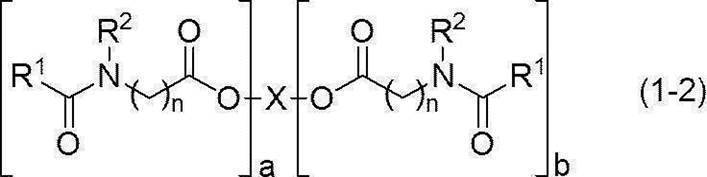
式(1-2):
[式中、各記号は前記定義と同義である。]
で表される化合物及びその塩からなる群から選択される少なくとも一種の化合物又はその塩
を含有する可溶化剤。
[15]式(1-1):
で表される化合物及びその塩からなる群から選択される少なくとも一種の化合物又はその塩
を含有する可溶化剤。
[15]式(1-1):

[式中、
R1は、炭素数4~26のアルキル基又は炭素数4~26のアルケニル基であり、
R2は、炭素数1~6のアルキル基又は炭素数2~6のアルケニル基であり、
nは、1~5の整数であり、
Xは、炭素数3以上の炭化水素基であり、
a及びbは、それぞれ独立して、1以上の整数である。]
で表される化合物及びその塩、ならびに
式(1-2):
R1は、炭素数4~26のアルキル基又は炭素数4~26のアルケニル基であり、
R2は、炭素数1~6のアルキル基又は炭素数2~6のアルケニル基であり、
nは、1~5の整数であり、
Xは、炭素数3以上の炭化水素基であり、
a及びbは、それぞれ独立して、1以上の整数である。]
で表される化合物及びその塩、ならびに
式(1-2):
[式中、各記号は前記定義と同義である。]
で表される化合物及びその塩からなる群から選択される少なくとも一種の化合物又はその塩
と、難溶性物質を共存させることを特徴とする難溶性物質の可溶化方法。
で表される化合物及びその塩からなる群から選択される少なくとも一種の化合物又はその塩
と、難溶性物質を共存させることを特徴とする難溶性物質の可溶化方法。
本発明によれば、難溶性物質を可溶化することができるので様々な化粧料に応用することができる。
本発明によれば、難溶性物質等を含む化粧料のきしみ感を緩和させることができるので、使用感のよい化粧料を提供することができる。
本発明によれば、広い範囲(UV-A及びUV-B領域)で紫外線遮断能を有する化粧料を提供することができる。
本発明によれば、難溶性物質等を含む化粧料のきしみ感を緩和させることができるので、使用感のよい化粧料を提供することができる。
本発明によれば、広い範囲(UV-A及びUV-B領域)で紫外線遮断能を有する化粧料を提供することができる。
本発明の組成物は、
(A)式(1-1):
(A)式(1-1):

[式中、
R1は、炭素数4~26のアルキル基又は炭素数4~26のアルケニル基であり、
R2は、炭素数1~6のアルキル基又は炭素数2~6のアルケニル基であり、
nは、1~5の整数であり、
Xは、炭素数3以上の炭化水素基であり、
a及びbは、それぞれ独立して、1以上の整数である。]
で表される化合物及びその塩、ならびに
式(1-2):
R1は、炭素数4~26のアルキル基又は炭素数4~26のアルケニル基であり、
R2は、炭素数1~6のアルキル基又は炭素数2~6のアルケニル基であり、
nは、1~5の整数であり、
Xは、炭素数3以上の炭化水素基であり、
a及びbは、それぞれ独立して、1以上の整数である。]
で表される化合物及びその塩、ならびに
式(1-2):
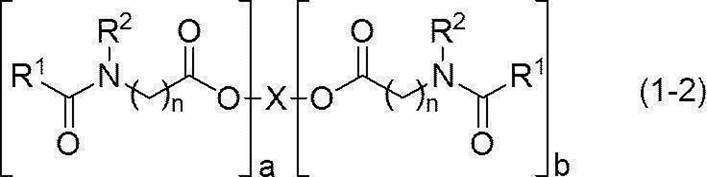
[式中、各記号は前記定義と同義である。]
で表される化合物及びその塩からなる群から選択される少なくとも一種の化合物又はその塩、及び
(B)難溶性物質
を含有することを特徴とする。
で表される化合物及びその塩からなる群から選択される少なくとも一種の化合物又はその塩、及び
(B)難溶性物質
を含有することを特徴とする。
1.(A):式(1-1)及び式(1-2)の化合物又はその塩
本明細書において「炭素数4~26のアルキル基」とは、炭素原子数4~26の直鎖又は分岐状のアルキル基を意味し、例えば、ブチル基、イソブチル基、sec-ブチル基、tert-ブチル基、ペンチル基、イソペンチル基、ネオペンチル基、ヘキシル基、イソヘキシル基、ネオヘキシル基、ヘプチル基、イソヘプチル基、ネオヘプチル基、オクチル基、イソオクチル基、ノニル基、イソノニル基、デシル基、イソデシル基、ウンデシル基、ドデシル基、トリデシル基、テトラデシル基、ペンタデシル基、ヘキサデシル基、ヘプタデシル基、オクタデシル基、ノナデシル基、イコシル基、ヘンエイコシル基、ドコシル基、トリコシル基、テトラコシル基、ペンタコシル基、ヘキサコシル基等が挙げられる。
本明細書において「炭素数7~17のアルキル基」とは、炭素原子数7~17の直鎖又は分岐状のアルキル基を意味し、例えば、ヘプチル基、イソヘプチル基、ネオヘプチル基、オクチル基、イソオクチル基、ノニル基、イソノニル基、デシル基、イソデシル基、ウンデシル基、ドデシル基、トリデシル基、テトラデシル基、ペンタデシル基、ヘキサデシル基、ヘプタデシル基等が挙げられる。
本明細書において「炭素数1~6のアルキル基」とは、炭素原子数1~6の直鎖又は分岐状のアルキル基を意味し、例えば、メチル基、エチル基、プロピル基、イソプロピル基、ブチル基、イソブチル基、sec-ブチル基、tert-ブチル基、ペンチル基、ヘキシル基等が挙げられる。
本明細書において「炭素数4~26のアルケニル基」とは、炭素原子数4~26の直鎖又は分岐状のアルケニル基を意味し、具体的には、1-ブテニル基、2-ブテニル基、3-ブテニル基、ペンテニル基、ヘキセニル基、ヘプテニル基、オクテニル基、ノネニル基、デセニル基、ウンデセニル基、ドデセニル基、トリデセニル基、テトラデセニル基、ペンタデセニル基、ヘキサデセニル基、ヘプタデセニル基、オクタデセニル基、ノナデセニル基、イコセニル基、ヘンエイコセニル基、ドコセニル基等が挙げられる。
本明細書において「炭素数4~16のアルケニル基」とは、炭素原子数4~16の直鎖又は分岐状のアルケニル基を意味し、具体的には、1-ブテニル基、2-ブテニル基、3-ブテニル基、ペンテニル基、ヘキセニル基、ヘプテニル基、オクテニル基、ノネニル基、デセニル基、ウンデセニル基、ドデセニル基、トリデセニル基、テトラデセニル基、ペンタデセニル基、ヘキサデセニル基等が挙げられる。
本明細書において「炭素数2~6のアルケニル基」とは、炭素原子数2~6の直鎖又は分岐状のアルケニル基を意味し、具体的には、エテニル基、1-プロペニル基、2-プロペニル基、2-メチル-1-プロペニル基、1-ブテニル基、2-ブテニル基、3-ブテニル基、ペンテニル基、ヘキセニル基等が挙げられる。
本明細書において「炭素数3以上の炭化水素基」とは、炭素原子数3以上の2価以上の直鎖又は分岐状の炭化水素基(好ましくは、炭素原子数3以上の2価以上の直鎖又は分岐状の飽和炭化水素基)を意味し、具体的には、下記式
本明細書において「炭素数4~26のアルキル基」とは、炭素原子数4~26の直鎖又は分岐状のアルキル基を意味し、例えば、ブチル基、イソブチル基、sec-ブチル基、tert-ブチル基、ペンチル基、イソペンチル基、ネオペンチル基、ヘキシル基、イソヘキシル基、ネオヘキシル基、ヘプチル基、イソヘプチル基、ネオヘプチル基、オクチル基、イソオクチル基、ノニル基、イソノニル基、デシル基、イソデシル基、ウンデシル基、ドデシル基、トリデシル基、テトラデシル基、ペンタデシル基、ヘキサデシル基、ヘプタデシル基、オクタデシル基、ノナデシル基、イコシル基、ヘンエイコシル基、ドコシル基、トリコシル基、テトラコシル基、ペンタコシル基、ヘキサコシル基等が挙げられる。
本明細書において「炭素数7~17のアルキル基」とは、炭素原子数7~17の直鎖又は分岐状のアルキル基を意味し、例えば、ヘプチル基、イソヘプチル基、ネオヘプチル基、オクチル基、イソオクチル基、ノニル基、イソノニル基、デシル基、イソデシル基、ウンデシル基、ドデシル基、トリデシル基、テトラデシル基、ペンタデシル基、ヘキサデシル基、ヘプタデシル基等が挙げられる。
本明細書において「炭素数1~6のアルキル基」とは、炭素原子数1~6の直鎖又は分岐状のアルキル基を意味し、例えば、メチル基、エチル基、プロピル基、イソプロピル基、ブチル基、イソブチル基、sec-ブチル基、tert-ブチル基、ペンチル基、ヘキシル基等が挙げられる。
本明細書において「炭素数4~26のアルケニル基」とは、炭素原子数4~26の直鎖又は分岐状のアルケニル基を意味し、具体的には、1-ブテニル基、2-ブテニル基、3-ブテニル基、ペンテニル基、ヘキセニル基、ヘプテニル基、オクテニル基、ノネニル基、デセニル基、ウンデセニル基、ドデセニル基、トリデセニル基、テトラデセニル基、ペンタデセニル基、ヘキサデセニル基、ヘプタデセニル基、オクタデセニル基、ノナデセニル基、イコセニル基、ヘンエイコセニル基、ドコセニル基等が挙げられる。
本明細書において「炭素数4~16のアルケニル基」とは、炭素原子数4~16の直鎖又は分岐状のアルケニル基を意味し、具体的には、1-ブテニル基、2-ブテニル基、3-ブテニル基、ペンテニル基、ヘキセニル基、ヘプテニル基、オクテニル基、ノネニル基、デセニル基、ウンデセニル基、ドデセニル基、トリデセニル基、テトラデセニル基、ペンタデセニル基、ヘキサデセニル基等が挙げられる。
本明細書において「炭素数2~6のアルケニル基」とは、炭素原子数2~6の直鎖又は分岐状のアルケニル基を意味し、具体的には、エテニル基、1-プロペニル基、2-プロペニル基、2-メチル-1-プロペニル基、1-ブテニル基、2-ブテニル基、3-ブテニル基、ペンテニル基、ヘキセニル基等が挙げられる。
本明細書において「炭素数3以上の炭化水素基」とは、炭素原子数3以上の2価以上の直鎖又は分岐状の炭化水素基(好ましくは、炭素原子数3以上の2価以上の直鎖又は分岐状の飽和炭化水素基)を意味し、具体的には、下記式
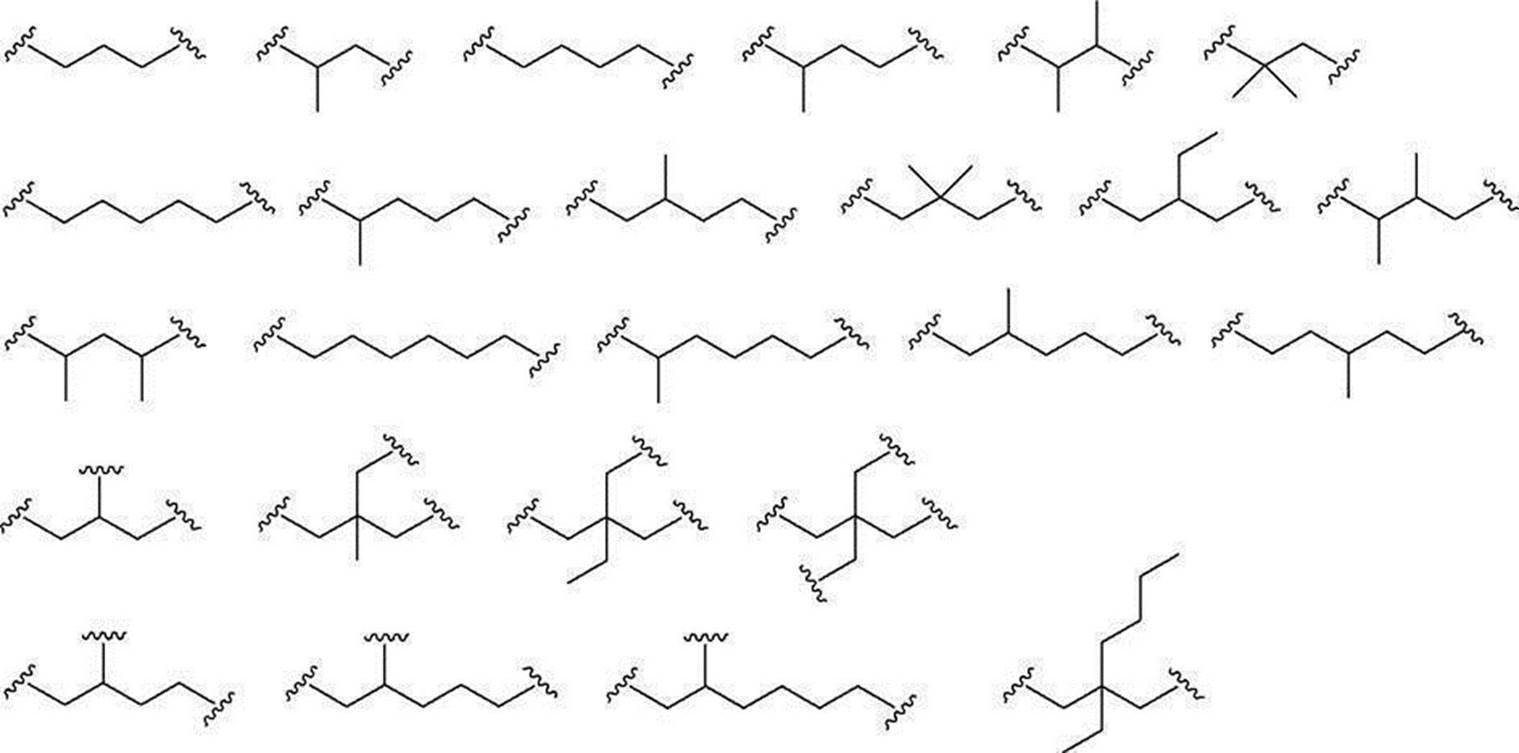
で表される基等が挙げられる。
本明細書において「炭素数4以上の炭化水素基」とは、炭素原子数4以上の2価以上の直鎖又は分岐状の炭化水素基(好ましくは、炭素原子数4以上の2価以上の直鎖又は分岐状の飽和炭化水素基)を意味し、具体的には、下記式
本明細書において「炭素数4以上の炭化水素基」とは、炭素原子数4以上の2価以上の直鎖又は分岐状の炭化水素基(好ましくは、炭素原子数4以上の2価以上の直鎖又は分岐状の飽和炭化水素基)を意味し、具体的には、下記式
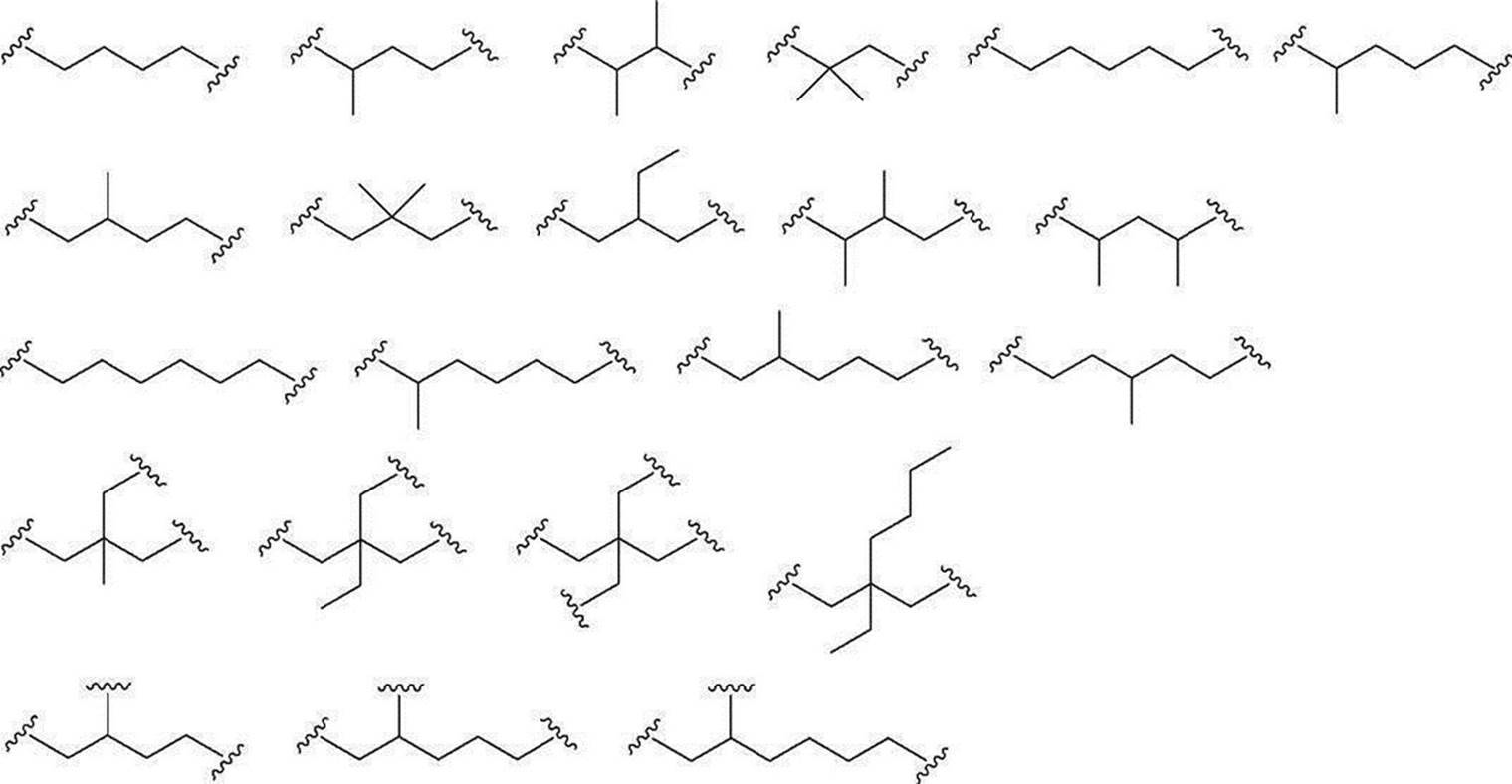
で表される基等が挙げられる。
以下に、式(1-1)又は式(1-2)中の各記号の定義について詳述する。
R1は、炭素数4~26のアルキル基又は炭素数4~26のアルケニル基である。
R1は、好ましくは炭素数4~26のアルキル基であり、より好ましくは炭素数7~17のアルキル基であり、さらに好ましくは炭素数7~17の直鎖のアルキル基であり、特に好ましくはウンデシル基である。
R1は、好ましくは炭素数4~26のアルキル基であり、より好ましくは炭素数7~17のアルキル基であり、さらに好ましくは炭素数7~17の直鎖のアルキル基であり、特に好ましくはウンデシル基である。
R2は、炭素数1~6のアルキル基又は炭素数2~6のアルケニル基である。
R2は、好ましくは炭素数1~6のアルキル基であり、より好ましくはメチル基である。
R2は、好ましくは炭素数1~6のアルキル基であり、より好ましくはメチル基である。
nは、1~5の整数である。
nは、好ましくは1又は2であり、より好ましくは1である。
nは、好ましくは1又は2であり、より好ましくは1である。
Xは、炭素数3以上の炭化水素基である。
Xは、好ましくは炭素数3~9の炭化水素基であり、より好ましくは炭素数4~6の炭化水素基であり、より好ましくは炭素数4又は5の炭化水素基である。
Xは、好ましくは炭素数3~9の炭化水素基であり、より好ましくは炭素数4~6の炭化水素基であり、より好ましくは炭素数4又は5の炭化水素基である。
a及びbは、それぞれ独立して、1以上の整数である。
a及びbは、好ましくはそれぞれ独立して1~3の整数であって、かつa+bが2~5の整数であり、より好ましくはa及びbは共に1である。
a及びbは、好ましくはそれぞれ独立して1~3の整数であって、かつa+bが2~5の整数であり、より好ましくはa及びbは共に1である。
式(1-1)で表される化合物において、a及びbが共に1のとき、R1は、炭素数4~26のアルキル基又は炭素数4~16のアルケニル基であり、かつXは、炭素数4以上の炭化水素基である化合物が好ましい。
式(1-1)又は式(1-2)で表される化合物として、好ましくは、以下の化合物が挙げられる。
(化合物A又はA’)
R1が、炭素数4~26のアルキル基であり、
R2が、炭素数1~6のアルキル基であり、
nが、1又は2であり、
Xが、炭素数3~9の炭化水素基であり、
a及びbが、それぞれ独立して1~3の整数であって、かつa+bが2~5の整数である化合物。
(化合物A又はA’)
R1が、炭素数4~26のアルキル基であり、
R2が、炭素数1~6のアルキル基であり、
nが、1又は2であり、
Xが、炭素数3~9の炭化水素基であり、
a及びbが、それぞれ独立して1~3の整数であって、かつa+bが2~5の整数である化合物。
(化合物B又はB’)
R1が、炭素数7~17のアルキル基であり、
R2が、炭素数1~6のアルキル基であり、
nが、1又は2であり、
Xが、炭素数4~9の炭化水素基であり、
a及びbが、それぞれ独立して1~3の整数であって、かつa+bが2~5の整数である化合物。
R1が、炭素数7~17のアルキル基であり、
R2が、炭素数1~6のアルキル基であり、
nが、1又は2であり、
Xが、炭素数4~9の炭化水素基であり、
a及びbが、それぞれ独立して1~3の整数であって、かつa+bが2~5の整数である化合物。
(化合物C又はC’)
R1が、ウンデシル基であり、
R2が、メチル基であり、
nが、1であり、
Xが、炭素数4又は5の炭化水素基であり、
a及びbが、共に1である化合物。
R1が、ウンデシル基であり、
R2が、メチル基であり、
nが、1であり、
Xが、炭素数4又は5の炭化水素基であり、
a及びbが、共に1である化合物。
式(1-1)及び式(1-2)で表される化合物の具体例としては、下記の製造例1~17に記載の化合物が挙げられる。
本発明における化合物(1-1)及び化合物(1-2)の塩としては、リチウム塩、ナトリウム塩、カリウム塩等のアルカリ金属塩;カルシウム塩、マグネシウム塩等のアルカリ土類金属塩;アンモニウム塩;メチルアミン、ジエチルアミン、トリメチルアミン、トリエチルアミン、エタノールアミン、ジエタノールアミン、トリエタノールアミン、エチレンジアミン、トリス(ヒドロキシメチル)メチルアミン、ジシクロヘキシルアミン、N,N’-ジベンジルエチレンジアミン、グアニジン、ピリジン、ピコリン、コリン、シンコニン、メグルミン等の有機アミン塩基との塩等が挙げられる。
本発明における化合物(1-1)及び(1-2)の製造方法は、特に限定されるものではなく、既知の方法を組み合わせることにより製造することができる。具体的には、下記方法により合成することができるが、これらに限定されるものではない。
例えば、以下の式に示すように、N-アシル-N-アルキルアミノ酸(i)及びアルコール(ii)をパラトルエンスルホン酸、硫酸、塩酸、メタンスルホン酸、フッ化水素等の酸触媒の存在下又は非存在下で縮合させることにより得ることができる。
例えば、以下の式に示すように、N-アシル-N-アルキルアミノ酸(i)及びアルコール(ii)をパラトルエンスルホン酸、硫酸、塩酸、メタンスルホン酸、フッ化水素等の酸触媒の存在下又は非存在下で縮合させることにより得ることができる。

(式中、各記号は前記と同義である。)
化合物(1-2)のみを得る場合は、N-アシル-N-アルキルアミノ酸(i)に対してアルコール(ii)を0.1~1当量、好ましくは0.5~0.55当量使用する。一方、化合物(1-1)及び化合物(1-2)の混合物を得る場合は、N-アシル-N-アルキルアミノ酸(i)に対してアルコール(ii)を0.2~5当量、好ましくは0.7~2当量使用する。このように、N-アシル-N-アルキルアミノ酸(i)に対するアルコール(ii)の使用量を変えることにより、得られる最終生成物における化合物(1-1)及び化合物(1-2)の割合を任意に調整することができる。
反応は適当な溶媒中で行うこともでき、使用する溶媒としては、ベンゼン、トルエン、キシレン等が挙げられる。
反応時間は、通常2~12時間、好ましくは3~6時間である。
反応温度は、通常80~160℃、好ましくは115~140℃である。
化合物(1-2)のみを得る場合は、N-アシル-N-アルキルアミノ酸(i)に対してアルコール(ii)を0.1~1当量、好ましくは0.5~0.55当量使用する。一方、化合物(1-1)及び化合物(1-2)の混合物を得る場合は、N-アシル-N-アルキルアミノ酸(i)に対してアルコール(ii)を0.2~5当量、好ましくは0.7~2当量使用する。このように、N-アシル-N-アルキルアミノ酸(i)に対するアルコール(ii)の使用量を変えることにより、得られる最終生成物における化合物(1-1)及び化合物(1-2)の割合を任意に調整することができる。
反応は適当な溶媒中で行うこともでき、使用する溶媒としては、ベンゼン、トルエン、キシレン等が挙げられる。
反応時間は、通常2~12時間、好ましくは3~6時間である。
反応温度は、通常80~160℃、好ましくは115~140℃である。
因みに、N-アシル-N-アルキルアミノ酸(i)は、例えば下記式に示すように、塩基性条件下にカルボン酸ハライド(iii)とアミノ酸(iv)とを反応させるいわゆるショッテン・バウマン反応(特公昭51-38681号公報等)等の公知の方法により製造することができる。
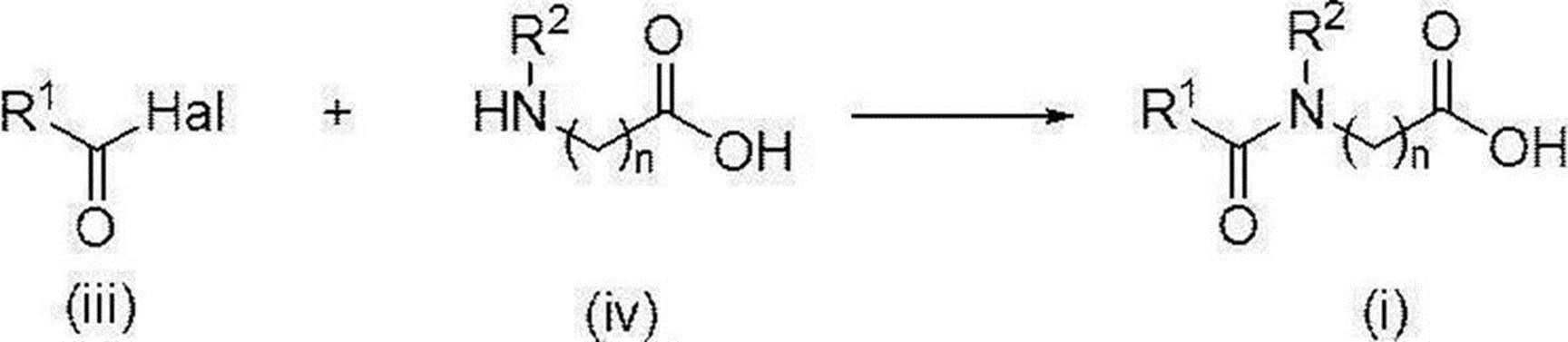
(式中、Halは塩素原子等のハロゲン原子を示し、その他の各記号は前記と同義である。)
(A)は、化合物(1-1)、化合物(1-2)及びそれらの塩からなる群から選択される少なくとも一種の化合物又はその塩であり、化合物(1-1)及びその塩からなる群から選択される少なくとも一種、ならびに化合物(1-2)及びその塩からなる群から選択される少なくとも一種との混合物が好ましい。(A)が混合物の場合は、化合物(1-2)またはその塩の1重量部に対して、化合物(1-1)またはその塩の含有量は、通常0~10重量部であり、好ましくは0.01~1重量部であり、より好ましくは0.05~0.25重量部である。
(A)の含有量は、組成物全量に対して通常1~90重量%、好ましくは
3~50重量%、より好ましくは5~20重量%である。この範囲の含有量であれば、(B)を可溶化又は分散化させて組成物を均一にし、きしみ感の緩和された組成物を得ることができる。
3~50重量%、より好ましくは5~20重量%である。この範囲の含有量であれば、(B)を可溶化又は分散化させて組成物を均一にし、きしみ感の緩和された組成物を得ることができる。
本明細書において、「可溶化」とは、溶媒に難溶又は不溶の物質の溶解度を上げて均一な溶液にすることを意味する。
本明細書において、「分散化」とは、溶媒中に難溶又は不溶の物質を微粒子状にして溶媒中に均一に散在させることを意味する。
本明細書において、「分散化」とは、溶媒中に難溶又は不溶の物質を微粒子状にして溶媒中に均一に散在させることを意味する。
2.(B):難溶性物質
本発明における難溶性物質は、溶媒に難溶性の物質だけでなく不溶性の物質を含み、25℃で水に対して1重量%以下の溶解度を有するもの、および/または25℃で流動パラフィンに対して5重量%以下の溶解度を有するものが挙げられる。好ましくは25℃で水に対して0.0000001~1重量%の溶解度を有するもの、および/または25℃で流動パラフィンに対して0.0000001~5重量%の溶解度を有するもの、より好ましくは25℃で水に対して0.0000001~0.5重量%の溶解度を有するもの、および/または25℃で流動パラフィンに対して0.0000001~3重量%の溶解度を有するものが挙げられる。
具体的には、難溶性ないし不溶性の性質を有する紫外線(UV)吸収剤、セラミド、ゲル化剤、香料、セルフタンニング剤、殺菌剤および無機顔料などから選択することができる。
本発明における難溶性物質は、溶媒に難溶性の物質だけでなく不溶性の物質を含み、25℃で水に対して1重量%以下の溶解度を有するもの、および/または25℃で流動パラフィンに対して5重量%以下の溶解度を有するものが挙げられる。好ましくは25℃で水に対して0.0000001~1重量%の溶解度を有するもの、および/または25℃で流動パラフィンに対して0.0000001~5重量%の溶解度を有するもの、より好ましくは25℃で水に対して0.0000001~0.5重量%の溶解度を有するもの、および/または25℃で流動パラフィンに対して0.0000001~3重量%の溶解度を有するものが挙げられる。
具体的には、難溶性ないし不溶性の性質を有する紫外線(UV)吸収剤、セラミド、ゲル化剤、香料、セルフタンニング剤、殺菌剤および無機顔料などから選択することができる。
UV吸収剤としては以下が挙げられる。
(1)安息香酸系紫外線吸収剤
安息香酸系紫外線吸収剤としては、パラアミノ安息香酸、エチルジヒドロキシプロピルパラアミノ安息香酸、グリセリルパラアミノ安息香酸、オクチルジメチルパラアミノ安息香酸、パラジメチルアミノ安息香酸アミル、パラジメチルアミノ安息香酸2-エチルヘキシル、2-[4-(ジエチルアミノ)-2-ヒドロキシベンゾイル]安息香酸ヘキシルエステル等が挙げられる。
(1)安息香酸系紫外線吸収剤
安息香酸系紫外線吸収剤としては、パラアミノ安息香酸、エチルジヒドロキシプロピルパラアミノ安息香酸、グリセリルパラアミノ安息香酸、オクチルジメチルパラアミノ安息香酸、パラジメチルアミノ安息香酸アミル、パラジメチルアミノ安息香酸2-エチルヘキシル、2-[4-(ジエチルアミノ)-2-ヒドロキシベンゾイル]安息香酸ヘキシルエステル等が挙げられる。
(2)アントラニル酸系紫外線吸収剤
アントラニル酸系紫外線吸収剤としては、ホモメンチル-N-アセチルアントラニレート、アントラニル酸メチル(別名:メチル-O-アミノベンゾエート)等が挙げられる。
アントラニル酸系紫外線吸収剤としては、ホモメンチル-N-アセチルアントラニレート、アントラニル酸メチル(別名:メチル-O-アミノベンゾエート)等が挙げられる。
(3)サリチル酸系紫外線吸収剤
サリチル酸系紫外線吸収剤としては、アミルサリシレート、メンチルサリシレート、ホモメンチルサリシレート、サリチル酸オクチル、フェニルサリシレート、ベンジルサリシレート、p-イソプロパノールフェニルサリシレート、サリチル酸トリエタノールアミン等が挙げられる。
サリチル酸系紫外線吸収剤としては、アミルサリシレート、メンチルサリシレート、ホモメンチルサリシレート、サリチル酸オクチル、フェニルサリシレート、ベンジルサリシレート、p-イソプロパノールフェニルサリシレート、サリチル酸トリエタノールアミン等が挙げられる。
(4)ベンゾフェノン系紫外線吸収剤
ベンゾフェノン系紫外線吸収剤としては、4-(2-β-グルコピラノシロキシ)プロポキシ-2-ヒドロキシベンゾフェノン、ジヒドロキシジメトキシベンゾフェノン、ジヒドロキシジメトキシベンゾフェノンジスルホン酸ナトリウム、2-ヒドロキシ-4-メトキシベンゾフェノン、ヒドロキシメトキシベンゾフェノンスルホン酸及びその三水塩、ヒドロキシメトキシベンゾフェノンスルホン酸ナトリウム、2-ヒドロキシ-4-メトキシベンゾフェノン-5-硫酸、2,2’-ジヒドロキシ-4-メトキシベンゾフェノン、2,4-ジヒドロキシベンゾフェノン、2,2’4,4’-テトラヒドロキシベンゾフェノン、2,3,4,4’-テトラヒドロキシベンゾフェノン、2,2’-ジヒドロキシ-4,4’-ジメトキシベンゾフェノン、2-ヒドロキシ-4-N-オクトキシベンゾフェノン等が挙げられる。
ベンゾフェノン系紫外線吸収剤としては、4-(2-β-グルコピラノシロキシ)プロポキシ-2-ヒドロキシベンゾフェノン、ジヒドロキシジメトキシベンゾフェノン、ジヒドロキシジメトキシベンゾフェノンジスルホン酸ナトリウム、2-ヒドロキシ-4-メトキシベンゾフェノン、ヒドロキシメトキシベンゾフェノンスルホン酸及びその三水塩、ヒドロキシメトキシベンゾフェノンスルホン酸ナトリウム、2-ヒドロキシ-4-メトキシベンゾフェノン-5-硫酸、2,2’-ジヒドロキシ-4-メトキシベンゾフェノン、2,4-ジヒドロキシベンゾフェノン、2,2’4,4’-テトラヒドロキシベンゾフェノン、2,3,4,4’-テトラヒドロキシベンゾフェノン、2,2’-ジヒドロキシ-4,4’-ジメトキシベンゾフェノン、2-ヒドロキシ-4-N-オクトキシベンゾフェノン等が挙げられる。
(5)ケイ皮酸系紫外線吸収剤
ケイ皮酸系紫外線吸収剤としては、パラメトキシケイ皮酸2-エチルヘキシル(別名;パラメトキシケイ皮酸オクチル)、ジパラメトキシケイ皮酸モノ-2-エチルヘキサン酸グリセリル、2,5-ジイソプロピルケイ皮酸メチル、2,4-ジイソプロピルケイ皮酸エチル、2,4-ジイソプロピルケイ皮酸メチル、2,4,6-トリス[4-(2-エチルヘキシルオキシカルボニル)アニリノ]-1,3,5-トリアジン、トリメトキシケイ皮酸メチルビス(トリメチルシロキシ)シリルイソペンチル、パラメトキシケイ皮酸イソプロピル・ジイソプロピルケイ皮酸エステル混合物、フェルラ酸、p-メトキシハイドロケイ皮酸ジエタノールアミン塩、3,4,5-トリメトキシケイ皮酸3-メチル-4-[メチルビス(トリメチルシロキシ)シリル]ブチル等が挙げられる。
ケイ皮酸系紫外線吸収剤としては、パラメトキシケイ皮酸2-エチルヘキシル(別名;パラメトキシケイ皮酸オクチル)、ジパラメトキシケイ皮酸モノ-2-エチルヘキサン酸グリセリル、2,5-ジイソプロピルケイ皮酸メチル、2,4-ジイソプロピルケイ皮酸エチル、2,4-ジイソプロピルケイ皮酸メチル、2,4,6-トリス[4-(2-エチルヘキシルオキシカルボニル)アニリノ]-1,3,5-トリアジン、トリメトキシケイ皮酸メチルビス(トリメチルシロキシ)シリルイソペンチル、パラメトキシケイ皮酸イソプロピル・ジイソプロピルケイ皮酸エステル混合物、フェルラ酸、p-メトキシハイドロケイ皮酸ジエタノールアミン塩、3,4,5-トリメトキシケイ皮酸3-メチル-4-[メチルビス(トリメチルシロキシ)シリル]ブチル等が挙げられる。
(6)ベンゾイルメタン系紫外線吸収剤
ベンゾイルメタン系紫外線吸収剤としては、2-フェニル-ベンズイミダゾール-5-硫酸、4-イソプロピルジベンゾイルメタン、4-tert-ブチル-4’-メトキシジベンゾイルメタン等が挙げられる。
ベンゾイルメタン系紫外線吸収剤としては、2-フェニル-ベンズイミダゾール-5-硫酸、4-イソプロピルジベンゾイルメタン、4-tert-ブチル-4’-メトキシジベンゾイルメタン等が挙げられる。
(7)トリアジン系紫外線吸収剤
トリアジン系紫外線吸収剤としては、ビスレゾルシニルトリアジンが挙げられ、具体的には、2,4-ビス-[{4-(2-エチルヘキシルオキシ)-2-ヒドロキシ}-フェニル]-6-(4-メトキシフェニル)-1,3,5-トリアジン(別名;ビスエチルヘキシルオキシフェノールメトキシフェニルトリアジン)、2,4,6-トリス{4-(2-エチルヘキシロキシカルボニル)アニリノ}1,3,5-トリアジン、2,4,6-トリス(4-ビフェニリル)-1,3,5-トリアジン(1,3,5-トリアジン,2,4,6-トリス[1,10-ビフェニル]-4-イル)等が挙げられる。
トリアジン系紫外線吸収剤としては、ビスレゾルシニルトリアジンが挙げられ、具体的には、2,4-ビス-[{4-(2-エチルヘキシルオキシ)-2-ヒドロキシ}-フェニル]-6-(4-メトキシフェニル)-1,3,5-トリアジン(別名;ビスエチルヘキシルオキシフェノールメトキシフェニルトリアジン)、2,4,6-トリス{4-(2-エチルヘキシロキシカルボニル)アニリノ}1,3,5-トリアジン、2,4,6-トリス(4-ビフェニリル)-1,3,5-トリアジン(1,3,5-トリアジン,2,4,6-トリス[1,10-ビフェニル]-4-イル)等が挙げられる。
(8)ベンゾトリアゾール系紫外線吸収剤
ベンゾトリアゾール系紫外線吸収剤としては、2,2’-ヒドロキシ-5-メチルフェニルベンゾトリアゾール、2-(2’-ヒドロキシ-5’-t-オクチルフェニル)ベンゾトリアゾール、2-(2’-ヒドロキシ-5’-メチルフェニルベンゾトリアゾール、2,2’-メチレンビス(6-(2H-ベンゾトリアゾール-2-イル)-4-(1,1,3,3-テトラメチルブチル)フェノール)(別名;メチレンビスベンゾトリアゾリルテトラメチルブチルフェノール)等が挙げられる。
ベンゾトリアゾール系紫外線吸収剤としては、2,2’-ヒドロキシ-5-メチルフェニルベンゾトリアゾール、2-(2’-ヒドロキシ-5’-t-オクチルフェニル)ベンゾトリアゾール、2-(2’-ヒドロキシ-5’-メチルフェニルベンゾトリアゾール、2,2’-メチレンビス(6-(2H-ベンゾトリアゾール-2-イル)-4-(1,1,3,3-テトラメチルブチル)フェノール)(別名;メチレンビスベンゾトリアゾリルテトラメチルブチルフェノール)等が挙げられる。
(9)ピリダジン誘導体系紫外線吸収剤
ピリダジン誘導体系紫外線吸収剤としては、ジモルホリノピリダジノンなどのピリダジン誘導体等が挙げられる。
ピリダジン誘導体系紫外線吸収剤としては、ジモルホリノピリダジノンなどのピリダジン誘導体等が挙げられる。
(10)その他の有機紫外線吸収剤
その他の有機紫外線吸収剤としては、フェニルベンズイミダゾールスルホン酸、ドロメトリゾールトリシロキサン、テレフタリリデンジカンフルスルホン酸、ジメトキシベンジリデンジオキソイミダゾリジンプロピオン酸2-エチルヘキシル、1-(3,4-ジメトキシフェニル)-4,4-ジメチル-1,3-ペンタンジオン、ポリシリコーン-15(ジメチコジエチルベンザルマロネート)、シノキサート、2-シアノ-3,3-ジフェニルプロパ-2-エン酸2-エチルヘキシルエステル(別名;オクトクリレン)、5-(3,3-ジメチル-2-ノルボルニリデン)-3-ペンタン-2-オン、ジアニソイルメタン、メチル-O-アミノベンゾエート、2-エチルヘキシル-2-シアノ-3,3-ジフェニルアクリレート、3-(4-メチルベンジリデン)カンフル、3-ベンジリデン-d,l-カンフル、オクチルトリアゾン、2-フェニル-5-メチルベンゾキサゾール、これらの高分子誘導体、及びシラン誘導体等が挙げられる。
その他の有機紫外線吸収剤としては、フェニルベンズイミダゾールスルホン酸、ドロメトリゾールトリシロキサン、テレフタリリデンジカンフルスルホン酸、ジメトキシベンジリデンジオキソイミダゾリジンプロピオン酸2-エチルヘキシル、1-(3,4-ジメトキシフェニル)-4,4-ジメチル-1,3-ペンタンジオン、ポリシリコーン-15(ジメチコジエチルベンザルマロネート)、シノキサート、2-シアノ-3,3-ジフェニルプロパ-2-エン酸2-エチルヘキシルエステル(別名;オクトクリレン)、5-(3,3-ジメチル-2-ノルボルニリデン)-3-ペンタン-2-オン、ジアニソイルメタン、メチル-O-アミノベンゾエート、2-エチルヘキシル-2-シアノ-3,3-ジフェニルアクリレート、3-(4-メチルベンジリデン)カンフル、3-ベンジリデン-d,l-カンフル、オクチルトリアゾン、2-フェニル-5-メチルベンゾキサゾール、これらの高分子誘導体、及びシラン誘導体等が挙げられる。
上記紫外線吸収剤のなかでも、4-tert-ブチル-4’-メトキシジベンゾイルメタン、サリチル酸オクチル、ビスエチルヘキシルオキシフェノールメトキシフェニルトリアジン、メチレンビスベンゾトリアゾリルテトラメチルブチルフェノール、フェニルベンズイミダゾールスルホン酸、ポリシリコーン-15、オクトクリレン、ホモメンチルサリシレート、2-[4-(ジエチルアミノ)-2-ヒドロキシベンゾイル]安息香酸ヘキシルエステル、パラメトキシケイ皮酸2-エチルヘキシル、オクチルトリアゾン、2-ヒドロキシ-4-メトキシベンゾフェノン、ヒドロキシメトキシベンゾフェノンスルホン酸及びその三水塩が好ましく、4-tert-ブチル-4’-メトキシジベンゾイルメタン、パラメトキシケイ皮酸2-エチルヘキシル、オクトクリレン、ホモメンチルサリシレート、サリチル酸オクチル、ビスエチルヘキシルオキシフェノールメトキシフェニルトリアジン、メチレンビスベンゾトリアゾリルテトラメチルブチルフェノール、フェニルベンズイミダゾールスルホン酸、ポリシリコーン-15、2-[4-(ジエチルアミノ)-2-ヒドロキシベンゾイル]安息香酸ヘキシルエステル、ヒドロキシメトキシベンゾフェノンスルホン酸及びその三水塩等がより好ましい。
セラミドとしては、スフィンゴシン塩基がそのアミノ基で長鎖飽和又は一不飽和脂肪酸と酸アミド結合した化合物であり、例えば、セラミド1、セラミド2、セラミド3、セラミド4、セラミド5、セラミド6-II、セラミド7等が挙げられる。
ゲル化剤としては、ジブチルラウロイルグルタミド、ジブチルエチルヘキサノイルグルタミド、パルミチン酸デキストリン、12-ヒドロキシステアリン酸等が挙げられる。
香料としては、α-イソメチルイオノン、リナロール、ブチルフェニルメチルプロパナール、サリチル酸ベンジル、ヘキシルシンナマル等が挙げられる。
セルフタンニング剤としては、3-ヒドロキシ-4,5-ジメチル-5(2H)-フラノン等が挙げられる。
殺菌剤としてはイソプロピルメチルフェノール、塩酸クロルヘキシジン、塩化ベンゼトニウム、メチルパラベン、プロピルパラベン等が挙げられる。
無機顔料としては、着色顔料、体質顔料、真珠光沢顔料、特殊機能性顔料及び特殊顔料などが挙げられるが、本発明においては、着色顔料、体質顔料、真珠光沢顔料、特殊機能性顔料が好ましい。
具体的には、二酸化チタン、酸化亜鉛、酸化鉄(ベンガラ)、チタン酸鉄、γ-酸化鉄、黄酸化鉄、黄土、黒酸化鉄、カーボンブラック、低次酸化チタン、マンゴバイオレット、パルトバイオレット、酸化クロム、水酸化クロム、チタン酸コバルト、群青、紺青、酸化チタン被覆マイカ、酸化チタン被覆オキシ塩化ビスマス、酸化チタン被覆タルク、着色酸化チタン被覆マイカ、オキシ塩化ビスマス、魚鱗箔、アルミニウム粉、銅粉、金粉、マイカ、タルク、カオリン、絹雲母(セリサイト)、白雲母、金雲母、合成雲母、紅雲母、黒雲母、リチア雲母、パーミキュライト、炭酸カルシウム、炭酸マグネシウム、ケイ酸アルミニウム、ケイ酸バリウム、ケイ酸カルシウム、ケイ酸マグネシウム、ケイ酸ストロンチウム、タングステン酸金属塩、シリカ、ゼオライト、硫酸バリウム、焼成硫酸カルシウム(焼きセッコウ)、リン酸カルシウム、フッ素アパタイト、ヒドロキシアパタイト、セラミックパウダー、金属石鹸(ミリスチン酸亜鉛、パルミチン酸カルシウム、ステアリン酸アルミニウムなど)、窒化ホウ素、ホトクロミック顔料等が挙げられる。また、表面改質剤等で表面処理した無機顔料であってもよい。具体例としては、Nε-ラウロイルリジン、パーフルオロアルキルリン酸ジエタノールアミン、メタリン酸ナトリウム、アミノ酸、アシル化コラーゲン、レシチン、金属石鹸、アシルアミノ酸塩、メチルハイドロジェンポリシロキサン等のシリコン、ポリアクリル酸、キトサン、ナイロンパウダー、着色顔料等で被覆した無機顔料等が挙げられる。これらの無機顔料は、使用する目的に応じて各々単独で用いてもよく、2種以上を併用して用いてもよい。なかでも二酸化チタン、酸化亜鉛、酸化鉄(ベンガラ)、酸化チタン被覆マイカ、酸化チタン被覆オキシ塩化ビスマス、酸化チタン被覆タルク、着色酸化チタン被覆マイカ、オキシ塩化ビスマス、魚鱗箔、アルミニウム粉、Nε-ラウロイルリジンが好ましい。
具体的には、二酸化チタン、酸化亜鉛、酸化鉄(ベンガラ)、チタン酸鉄、γ-酸化鉄、黄酸化鉄、黄土、黒酸化鉄、カーボンブラック、低次酸化チタン、マンゴバイオレット、パルトバイオレット、酸化クロム、水酸化クロム、チタン酸コバルト、群青、紺青、酸化チタン被覆マイカ、酸化チタン被覆オキシ塩化ビスマス、酸化チタン被覆タルク、着色酸化チタン被覆マイカ、オキシ塩化ビスマス、魚鱗箔、アルミニウム粉、銅粉、金粉、マイカ、タルク、カオリン、絹雲母(セリサイト)、白雲母、金雲母、合成雲母、紅雲母、黒雲母、リチア雲母、パーミキュライト、炭酸カルシウム、炭酸マグネシウム、ケイ酸アルミニウム、ケイ酸バリウム、ケイ酸カルシウム、ケイ酸マグネシウム、ケイ酸ストロンチウム、タングステン酸金属塩、シリカ、ゼオライト、硫酸バリウム、焼成硫酸カルシウム(焼きセッコウ)、リン酸カルシウム、フッ素アパタイト、ヒドロキシアパタイト、セラミックパウダー、金属石鹸(ミリスチン酸亜鉛、パルミチン酸カルシウム、ステアリン酸アルミニウムなど)、窒化ホウ素、ホトクロミック顔料等が挙げられる。また、表面改質剤等で表面処理した無機顔料であってもよい。具体例としては、Nε-ラウロイルリジン、パーフルオロアルキルリン酸ジエタノールアミン、メタリン酸ナトリウム、アミノ酸、アシル化コラーゲン、レシチン、金属石鹸、アシルアミノ酸塩、メチルハイドロジェンポリシロキサン等のシリコン、ポリアクリル酸、キトサン、ナイロンパウダー、着色顔料等で被覆した無機顔料等が挙げられる。これらの無機顔料は、使用する目的に応じて各々単独で用いてもよく、2種以上を併用して用いてもよい。なかでも二酸化チタン、酸化亜鉛、酸化鉄(ベンガラ)、酸化チタン被覆マイカ、酸化チタン被覆オキシ塩化ビスマス、酸化チタン被覆タルク、着色酸化チタン被覆マイカ、オキシ塩化ビスマス、魚鱗箔、アルミニウム粉、Nε-ラウロイルリジンが好ましい。
(B)の含有量は、組成物全量に対して通常0.1~60重量%、好ましくは1~30重量%、より好ましくは5~25重量%である。
具体的には、例えば紫外性吸収剤の場合には、組成物全量に対して通常0.1~60重量%、好ましくは1~30重量%、より好ましくは5~25重量%である。
また無機顔料の場合には、組成物全量に対して通常0.1~50重量%、好ましくは1~30重量%、より好ましくは3~20重量%である。
この範囲の含有量であれば、高い濃度で難溶性物質を組成物に配合することができ、紫外線吸収剤や無機顔料の場合は広い範囲(UV-B領域(290~320nm)及びUV-A領域(320~400nm))で高い紫外線遮断能を発揮することができる。
具体的には、例えば紫外性吸収剤の場合には、組成物全量に対して通常0.1~60重量%、好ましくは1~30重量%、より好ましくは5~25重量%である。
また無機顔料の場合には、組成物全量に対して通常0.1~50重量%、好ましくは1~30重量%、より好ましくは3~20重量%である。
この範囲の含有量であれば、高い濃度で難溶性物質を組成物に配合することができ、紫外線吸収剤や無機顔料の場合は広い範囲(UV-B領域(290~320nm)及びUV-A領域(320~400nm))で高い紫外線遮断能を発揮することができる。
本発明において、(A)に対する(B)の重量比[(A):(B)]は、通常1:0.005~1:20重量部、好ましくは1:0.01~1:10、より好ましくは1:0.05~1:5である。この範囲であれば(B)を可溶化又は安定的かつ均一に分散することができる。
本発明の組成物はそのまま用いることも可能であるが、必要に応じて公知の添加剤などを混合して常法により製造することができる。
添加剤としては、水溶性成分、油性成分、粉末成分、高分子成分、増粘剤、粘着性改良剤、被膜形成剤、pH調整剤、抗酸化剤、防腐剤、殺菌剤、保存剤、保型剤、保湿剤、皮膚保護剤、清涼化剤、香料、着色剤、色素、キレート剤、潤沢剤、抗炎症剤、鎮痒剤、血行促進剤、収斂剤、組織修復促進剤、制汗剤、浸透剤、アミノ酸、核酸、有機酸、無機塩、動植物抽出成分、酵素、ビタミン、パール化剤、湿潤剤等を、発明の効果を阻害しない範囲で適宜配合することができる。
本発明の組成物の形状としては、特に限定されないが、クリーム状、乳液状、ローション状、粉末状、粉末固形状、油性固形状、油性液状、ペースト状等が挙げられる。
本発明は、また、前記本発明の組成物を含有する化粧料に関する。
本発明の化粧料としては、特に限定されないが、紫外線防御用化粧料が好ましい。具体的には、基礎化粧品(例、化粧水、乳液、化粧下地、美容液、ナイトクリーム、パック、メイク落とし製品(クレンジングジェル等)、リップクリーム、爪用クリーム等)、メイクアップ化粧品(例、ファンデーション(固形、クリーム状、液状等)、日焼け止めクリーム、BBクリーム、CCクリーム、コンシーラー、口紅、リップグロス、アイシャドウ、アイライナー、チーク、マスカラ、ブロンザー等)、ヘアケア化粧料(ヘアトリートメント剤(例、ヘアトリートメント、アウトバストリートメント、毛髪用美容液、枝毛コート剤等)、ヘアスタイリング剤(例、ブラッシングローション、カーラーローション、ポマード、チック、セット用ヘアスプレー、ヘアミスト、ヘアリキッド、スタイリングフォーム、ヘアジェル、ウォーターグリース等)、髭剃り用製品(例、シェービングクリーム、アフターシェーブローション等)等が挙げられる。なかでもメイクアップ化粧品、日焼け止めクリーム、BBクリーム、CCクリーム、ブロンザーが好ましい。
化粧料の剤形としては、クリーム剤、液剤、ローション剤、乳剤、チンキ剤、水性ゲル剤、油性ゲル剤、エアゾール剤、パウダー剤などが挙げられる。
本発明の組成物及び該組成物を含む化粧料は、常法に従って製造することができる。
上記式(1-1)で表される化合物及びその塩、ならびに上記式(1-2)で表される化合物及びその塩からなる群から選択される少なくとも一種の化合物又はそれらの塩を含有する可溶化剤も本発明に含まれる。
本発明の「可溶化剤」とは、難溶性物質に加えてその溶解度を増し、均一な溶液にするものを意味する。
本発明の可溶化剤は、前記化合物又はその塩のみ、又は上記添加物を適宜配合し、常法に従って製造することができる。
本発明の可溶化剤中の上記化合物又はその塩の含有量は、通常1~90重量%であり、5~50重量%が好ましい。
本発明の可溶化剤は、難溶性物質の種類によっても異なるが、通常、難溶性物質1重量部に対して、0.05~200重量部、好ましくは0.1~100重量部、より好ましくは0.2~20重量部を配合することにより難溶性物質を可溶化することができる。
上記式(1-1)及び(1-2)及び難溶性物質の定義等は既述に準じる。
本発明の「可溶化剤」とは、難溶性物質に加えてその溶解度を増し、均一な溶液にするものを意味する。
本発明の可溶化剤は、前記化合物又はその塩のみ、又は上記添加物を適宜配合し、常法に従って製造することができる。
本発明の可溶化剤中の上記化合物又はその塩の含有量は、通常1~90重量%であり、5~50重量%が好ましい。
本発明の可溶化剤は、難溶性物質の種類によっても異なるが、通常、難溶性物質1重量部に対して、0.05~200重量部、好ましくは0.1~100重量部、より好ましくは0.2~20重量部を配合することにより難溶性物質を可溶化することができる。
上記式(1-1)及び(1-2)及び難溶性物質の定義等は既述に準じる。
また上記式(1-1)で表される化合物及びその塩、ならびに上記式(1-2)で表される化合物及びその塩からなる群から選択される少なくとも一種の化合物又はその塩と難溶性物質を共存させる工程を含む難溶性物質の可溶化方法も本発明に含まれる。
本発明の方法は、難溶性物質の種類によっても異なるが、難溶性物質1重量部に対して、上記化合物又はその塩を、通常0.05~200重量部、好ましくは0.1~100重量部、より好ましくは0.2~20重量部を共存させることで可溶化することができる。
上記式(1-1)及び(1-2)及び難溶性物質の定義等は既述に準じる。
本発明の方法は、難溶性物質の種類によっても異なるが、難溶性物質1重量部に対して、上記化合物又はその塩を、通常0.05~200重量部、好ましくは0.1~100重量部、より好ましくは0.2~20重量部を共存させることで可溶化することができる。
上記式(1-1)及び(1-2)及び難溶性物質の定義等は既述に準じる。
上記式(1-1)で表される化合物及びその塩、ならびに上記式(1-2)で表される化合物及びその塩からなる群から選択される少なくとも一種の化合物又はその塩を含有する無機顔料用分散剤も本発明に含まれる。
本発明の無機顔料用分散剤は、前記化合物又はその塩のみ、又は上記添加物を適宜配合し、常法に従って製造することができる。
本発明の無機顔料用分散剤中の上記化合物又はその塩の含有量は、通常1~90重量%であり、5~50重量%が好ましい。
本発明の無機顔料用分散剤は、無機顔料の種類によっても異なるが、通常、無機顔料1重量部に対して、0.05~200重量部、好ましくは0.1~100重量部、より好ましくは0.2~20重量部を配合することにより、無機顔料を均一に安定に分散させることができる。
本発明の無機顔料用分散剤は、前記化合物又はその塩のみ、又は上記添加物を適宜配合し、常法に従って製造することができる。
本発明の無機顔料用分散剤中の上記化合物又はその塩の含有量は、通常1~90重量%であり、5~50重量%が好ましい。
本発明の無機顔料用分散剤は、無機顔料の種類によっても異なるが、通常、無機顔料1重量部に対して、0.05~200重量部、好ましくは0.1~100重量部、より好ましくは0.2~20重量部を配合することにより、無機顔料を均一に安定に分散させることができる。
上記無機顔料用分散剤と無機顔料を共存させる工程を含む無機顔料の分散方法も本発明に含まれる。
本発明の方法は、無機顔料の種類によっても異なるが、無機顔料1重量部に対して、上記化合物またはその塩を、通常0.05~200重量部、好ましくは0.1~100重量部、より好ましくは0.2~20重量部を共存させることで均一に安定的に分散することができる。
上記式(1-1)及び(1-2)及び無機顔料の定義等は既述に準じる。
本発明の方法は、無機顔料の種類によっても異なるが、無機顔料1重量部に対して、上記化合物またはその塩を、通常0.05~200重量部、好ましくは0.1~100重量部、より好ましくは0.2~20重量部を共存させることで均一に安定的に分散することができる。
上記式(1-1)及び(1-2)及び無機顔料の定義等は既述に準じる。
次に製造例及び実施例により、本発明を具体的に説明する。なお、本発明は以下の製造例及び実施例に限定されるものではない。なお本明細書中「%」は特に断りのない限り「重量%」を意味する。
化合物の測定に用いた機器は、以下の通りである。
1H-NMR測定:Bruker社 AVANCE III HD NMR Spectrometer
ESI-MS測定:LC-MS 2010 A (島津製作所製)
1H-NMR測定:Bruker社 AVANCE III HD NMR Spectrometer
ESI-MS測定:LC-MS 2010 A (島津製作所製)
製造例1:2LmbA-bgの製造

N-ラウロイル-N-メチル-β-アラニン(28.52 g、0.1 mol)及び1,3-ブチレングリコール(4.96 g、0.055 mol)の混合物に硫酸(0.98 g、0.01 mol)を添加し、アルゴン気流下、バス温132℃で6時間撹拌した。生成物を酢酸エチル(50 mL)で希釈し、飽和重曹水(30 mL)で2回洗浄した。有機相をさらに超純水(40 mL)で2回洗浄した。有機相を集めて真空減圧により濃縮し粗生成物を得た。これをシリカゲルカラムクロマトグラフィー(展開溶媒:ヘキサン/酢酸エチル=4/1から1/4のグラデーション)にて精製し、目的の化合物N-ラウロイル-N-メチル-β-アラニン 1,3-ブチレングリコールジエステル(2LmbA-bg)を得た(収率60%)。
1H-NMR(400 MHz, CD3OD, r.t.):δ4.97-5.06 (1H, m), 4.09-4.15 (2H, m), 3.62(4H, t, J = 7.02 Hz), 2.92-3.04 (6H, m), 2.57 (4H, t, J = 6.8 Hz), 2.28-2.33 (4H, m), 1.86-1.91 (2H, m), 1.62 (4H, sex, J= 7.6 Hz), 1.26-1.30 (35H, m), 0.88 (6H, t, J = 6.8 Hz) ppm.
ESI-MS(positive) m/z 625.8 [M+H]+, 647.3 [M+Na]+
1H-NMR(400 MHz, CD3OD, r.t.):δ4.97-5.06 (1H, m), 4.09-4.15 (2H, m), 3.62(4H, t, J = 7.02 Hz), 2.92-3.04 (6H, m), 2.57 (4H, t, J = 6.8 Hz), 2.28-2.33 (4H, m), 1.86-1.91 (2H, m), 1.62 (4H, sex, J= 7.6 Hz), 1.26-1.30 (35H, m), 0.88 (6H, t, J = 6.8 Hz) ppm.
ESI-MS(positive) m/z 625.8 [M+H]+, 647.3 [M+Na]+
製造例2:2LmbA-npgの製造

N-ラウロイル-N-メチル-β-アラニン(28.52 g、0.1 mol)及びネオペンチルグリコール(5.72 g、0.055 mol)の混合物に硫酸(0.98 g、0.01 mol)を添加し、アルゴン気流下、バス温132℃で6時間撹拌した。生成物を酢酸エチル(50 mL)で希釈し、飽和重曹水(30 mL)で2回洗浄した。有機相をさらに超純水(40 mL)で2回洗浄した。有機相を集めて真空減圧により濃縮し粗生成物を得た。これをシリカゲルカラムクロマトグラフィー(展開溶媒:ヘキサン/酢酸エチル=4/1から1/4のグラデーション)にて精製し、目的の化合物N-ラウロイル-N-メチル-β-アラニン ネオペンチルグリコールジエステル(2LmbA-npg)を得た(収率67%)。
1H-NMR(400 MHz, CD3OD, r.t.):δ3.86-3.90 (4H, m) 3.65 (4H, t, J = 6.8 Hz), 2.92-3.04 (6H, m), 2.61 (4H, t, J = 7.2 Hz), 2.28-2.35 (4H, m), 1.57-1.62 (4H,m), 1.26-1.30 (32H, m), 0.97 (6H, d, J = 4.8 Hz), 0.88 (6H, t, J = 7.2 Hz) ppm.
ESI-MS(positive) m/z 639.7 [M+H]+, 661.3 [M+Na]+
1H-NMR(400 MHz, CD3OD, r.t.):δ3.86-3.90 (4H, m) 3.65 (4H, t, J = 6.8 Hz), 2.92-3.04 (6H, m), 2.61 (4H, t, J = 7.2 Hz), 2.28-2.35 (4H, m), 1.57-1.62 (4H,m), 1.26-1.30 (32H, m), 0.97 (6H, d, J = 4.8 Hz), 0.88 (6H, t, J = 7.2 Hz) ppm.
ESI-MS(positive) m/z 639.7 [M+H]+, 661.3 [M+Na]+
製造例3:2LmbA-pgの製造
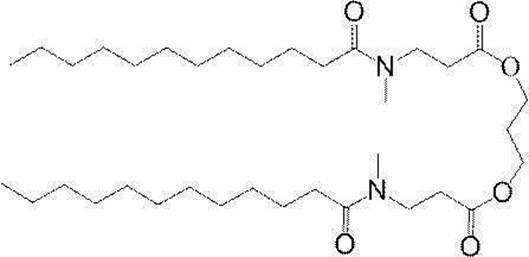
N-ラウロイル-N-メチル-β-アラニン(28.52 g、0.1 mol)及び1,3-プロピレングリコール(4.18 g、0.055 mol)の混合物に硫酸(0.98 g、0.01 mol)を添加し、アルゴン気流下、バス温132℃で6時間撹拌した。生成物を酢酸エチル(50 mL)で希釈し、飽和重曹水(30 mL)で2回洗浄した。有機相をさらに超純水(40 mL)で2回洗浄した。有機相を集めて真空減圧により濃縮し粗生成物を得た。これをシリカゲルカラムクロマトグラフィー(展開溶媒:ヘキサン/酢酸エチル=4/1から1/4のグラデーション)にて精製し、目的の化合物N-ラウロイル-N-メチル-β-アラニン 1,3-プロピレングリコールジエステル(2LmbA-pg)を得た(収率71%)。
1H-NMR(400 MHz, CD3OD, r.t.):δ4.15-4.20 (4H, m), 3.64 (4H, t, J = 6.8 Hz), 2.92-3.04 (6H, m), 2.60 (4H, t, J = 7.2 Hz), 2.29-2.35 (4H, m), 1.87 (2H, sex, J = 6.0 Hz), 1.59-1.66 (4H, m), 1.29 (32H, s), 0.90 (6H, d, J = 6.8 Hz) ppm.
ESI-MS(positive) m/z 611.7 [M+H]+, 633.3 [M+Na]+
1H-NMR(400 MHz, CD3OD, r.t.):δ4.15-4.20 (4H, m), 3.64 (4H, t, J = 6.8 Hz), 2.92-3.04 (6H, m), 2.60 (4H, t, J = 7.2 Hz), 2.29-2.35 (4H, m), 1.87 (2H, sex, J = 6.0 Hz), 1.59-1.66 (4H, m), 1.29 (32H, s), 0.90 (6H, d, J = 6.8 Hz) ppm.
ESI-MS(positive) m/z 611.7 [M+H]+, 633.3 [M+Na]+
製造例4:2LmbA-bg及びLmbA-bg(N-ラウロイル-N-メチル-β-アラニン 1,3-ブチレングリコールモノエステル)の混合物の製造

N-ラウロイル-N-メチル-β-アラニン(28.52 g、0.1 mol)及び1,3-ブチレングリコール(18.03 g、0.2 mol)の混合物に硫酸(0.39 g、0.004 mol)を添加し、アルゴン気流下、バス温120℃で6時間撹拌した。生成物を酢酸エチル(50 mL)で希釈し、飽和重曹水(30 mL)で2回洗浄した。有機相をさらに飽和食塩水(40 mL)で2回洗浄した後、超純水(40 mL)で1回洗浄した。有機相を集めて真空減圧により濃縮し目的物を得た(収率92%)。
液体クロマトグラフィーと接続された質量分析装置(LC-MS)により化合物の同定を行った。また、液体クロマトグラフィーにより210 nmにおける吸光度を観測することで、それぞれの化合物の割合を算出した(それぞれの化合物のピーク面積比 2LmbA-bg:LmbA-bg=27:73)。
液体クロマトグラフィーの条件
カラム:YMC-Pack ODS-A、流速:1 mL/min、温度:40℃、溶媒:メタノール/ギ酸の30mM水溶液(9/1)
ESI-MS(positive) m/z 647.3 [2LmbA-bg+Na]+, 380.5 [LmbA-bg+Na]+
液体クロマトグラフィーと接続された質量分析装置(LC-MS)により化合物の同定を行った。また、液体クロマトグラフィーにより210 nmにおける吸光度を観測することで、それぞれの化合物の割合を算出した(それぞれの化合物のピーク面積比 2LmbA-bg:LmbA-bg=27:73)。
液体クロマトグラフィーの条件
カラム:YMC-Pack ODS-A、流速:1 mL/min、温度:40℃、溶媒:メタノール/ギ酸の30mM水溶液(9/1)
ESI-MS(positive) m/z 647.3 [2LmbA-bg+Na]+, 380.5 [LmbA-bg+Na]+
製造例5:2LmbA-npg及びLmbA-npg(N-ラウロイル-N-メチル-β-アラニン ネオペンチルグリコールモノエステル)の混合物の製造
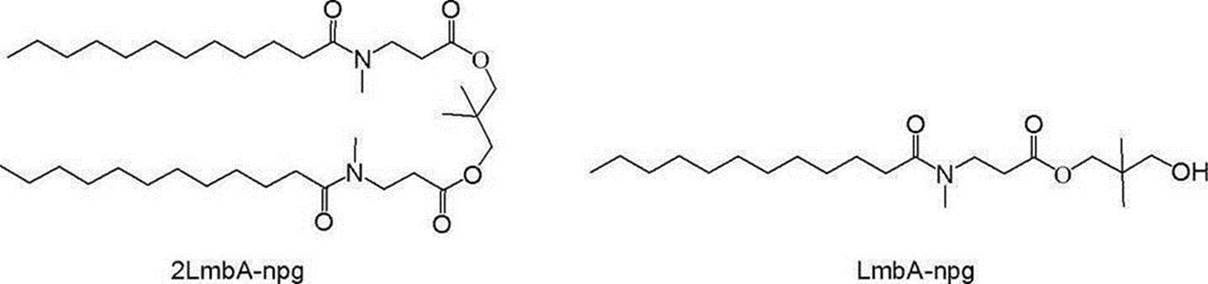
N-ラウロイル-N-メチル-β-アラニン(28.52 g、0.1 mol)及びネオペンチルグリコール(20.83 g、0.2 mol)の混合物に硫酸(0.39 g、0.004 mol)を添加し、アルゴン気流下、バス温120℃で6時間撹拌した。生成物を酢酸エチル(50 mL)で希釈し、飽和重曹水(30 mL)で2回洗浄した。有機相をさらに飽和食塩水(40 mL)で2回洗浄した後、超純水(40 mL)で1回洗浄した。有機相を集めて真空減圧により濃縮し目的物を得た(収率95%)。
液体クロマトグラフィーと接続された質量分析装置(LC-MS)により化合物の同定を行った。また、液体クロマトグラフィーにより210 nmにおける吸光度を観測することで、それぞれの化合物の割合を算出した(それぞれの化合物のピーク面積比 2LmbA-npg:LmbA-npg=23:77)。
液体クロマトグラフィーの条件
カラム:YMC-Pack ODS-A、流速:1 mL/min、温度:40℃、溶媒:メタノール/ギ酸の30mM水溶液(9/1)
ESI-MS(positive) m/z 661.3 [2LmbA-npg+Na]+, m/z 394.5 [LmbA-npg+Na]+
液体クロマトグラフィーと接続された質量分析装置(LC-MS)により化合物の同定を行った。また、液体クロマトグラフィーにより210 nmにおける吸光度を観測することで、それぞれの化合物の割合を算出した(それぞれの化合物のピーク面積比 2LmbA-npg:LmbA-npg=23:77)。
液体クロマトグラフィーの条件
カラム:YMC-Pack ODS-A、流速:1 mL/min、温度:40℃、溶媒:メタノール/ギ酸の30mM水溶液(9/1)
ESI-MS(positive) m/z 661.3 [2LmbA-npg+Na]+, m/z 394.5 [LmbA-npg+Na]+
製造例6:2LS-bgの製造
N-ラウロイルサルコシン(27.14 g、0.1 mol)及び1,3-ブチレングリコール(4.96 g、0.055 mol)の混合物に硫酸(0.98 g、0.01 mol)を添加し、アルゴン気流下、バス温132℃で10時間撹拌した。生成物を酢酸エチル(50 mL)で希釈し、飽和重曹水(30 mL)で2回洗浄した。有機相をさらに超純水(40 mL)で2回洗浄した。有機相を集めて真空減圧により濃縮し粗生成物を得た。これをシリカゲルカラムクロマトグラフィー(展開溶媒:ヘキサン/酢酸エチル=4/1から1/4のグラデーション)にて精製し、目的の化合物N-ラウロイルサルコシン 1,3-ブチレングリコールジエステル(2LS-bg)を得た(収率49%)。
1H-NMR(400 MHz, CD3OD, r.t.):δ5.02-5.13 (1H, m), 4.03-4.21 (6H, m), 2.95-3.09 (6H, m), 2.22-2.39 (4H, m), 1.90-1.95(2H, m), 1.64 (4H, m), 1.29-1.32 (35H, m), 0.90 (6H, t, J = 6.8 Hz) ppm.
ESI-MS(positive) m/z 597.3 [M+H]+, 619.3 [M+Na]+
N-ラウロイルサルコシン(27.14 g、0.1 mol)及び1,3-ブチレングリコール(4.96 g、0.055 mol)の混合物に硫酸(0.98 g、0.01 mol)を添加し、アルゴン気流下、バス温132℃で10時間撹拌した。生成物を酢酸エチル(50 mL)で希釈し、飽和重曹水(30 mL)で2回洗浄した。有機相をさらに超純水(40 mL)で2回洗浄した。有機相を集めて真空減圧により濃縮し粗生成物を得た。これをシリカゲルカラムクロマトグラフィー(展開溶媒:ヘキサン/酢酸エチル=4/1から1/4のグラデーション)にて精製し、目的の化合物N-ラウロイルサルコシン 1,3-ブチレングリコールジエステル(2LS-bg)を得た(収率49%)。
1H-NMR(400 MHz, CD3OD, r.t.):δ5.02-5.13 (1H, m), 4.03-4.21 (6H, m), 2.95-3.09 (6H, m), 2.22-2.39 (4H, m), 1.90-1.95(2H, m), 1.64 (4H, m), 1.29-1.32 (35H, m), 0.90 (6H, t, J = 6.8 Hz) ppm.
ESI-MS(positive) m/z 597.3 [M+H]+, 619.3 [M+Na]+
製造例7:2LS-npgの製造法
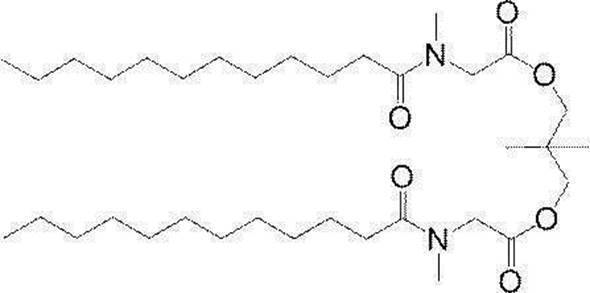
N-ラウロイルサルコシン(27.14 g、0.1 mol)及びネオペンチルグリコール(5.72 g、0.055 mol)の混合物に硫酸(0.98 g、0.01 mol)を添加し、アルゴン気流下、バス温132℃で10時間撹拌した。生成物を酢酸エチル(50 mL)で希釈し、飽和重曹水(30 mL)で2回洗浄した。有機相をさらに超純水(40 mL)で2回洗浄した。有機相を集めて真空減圧により濃縮し粗生成物を得た。これをシリカゲルカラムクロマトグラフィー(展開溶媒:ヘキサン/酢酸エチル=4/1から1/4のグラデーション)にて精製し、目的の化合物N-ラウロイルサルコシン ネオペンチルグリコールジエステル(2LS-npg)を得た(収率53%)。
1H-NMR(400 MHz, CD3OD, r.t.):δ4.13 (2H, s) 4.10 (2H, d, J = 14.72 Hz), 3.96 (2H, d, J = 11.88 Hz) 3.93 (2H, s), 2.95-3.09 (6H, m), 2.22-2.39 (4H, m), 1.65 (4H, m), 1.27-1.31 (32H, m), 0.97 (6H, d, J = 6.4 Hz), 0.89 (6H, t, J = 6.8 Hz) ppm.
ESI-MS(positive)m/z 611.7 [M+H]+, 633.3 [M+Na]+
1H-NMR(400 MHz, CD3OD, r.t.):δ4.13 (2H, s) 4.10 (2H, d, J = 14.72 Hz), 3.96 (2H, d, J = 11.88 Hz) 3.93 (2H, s), 2.95-3.09 (6H, m), 2.22-2.39 (4H, m), 1.65 (4H, m), 1.27-1.31 (32H, m), 0.97 (6H, d, J = 6.4 Hz), 0.89 (6H, t, J = 6.8 Hz) ppm.
ESI-MS(positive)m/z 611.7 [M+H]+, 633.3 [M+Na]+
製造例8:2LS-pgの製造
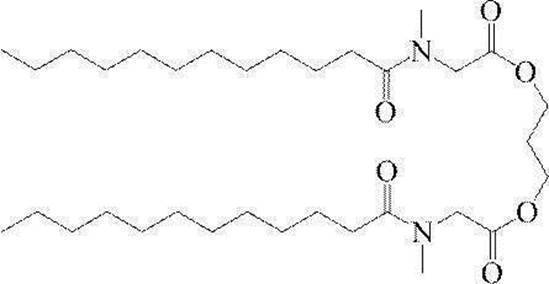
N-ラウロイルサルコシン(27.14 g、0.1 mol)及び1,3-プロピレングリコール(4.18 g、0.055 mol)の混合物に硫酸(0.98 g、0.01 mol)を添加し、アルゴン気流下、バス温132℃で10時間撹拌した。生成物を酢酸エチル(50 mL)で希釈し、飽和重曹水(30 mL)で2回洗浄した。有機相をさらに超純水(40 mL)で2回洗浄した。有機相を集めて真空減圧により濃縮し粗生成物を得た。これをシリカゲルカラムクロマトグラフィー(展開溶媒:ヘキサン/酢酸エチル=4/1から1/4のグラデーション)にて精製し、目的の化合物N-ラウロイルサルコシン 1,3-プロピレングリコールジエステル(2LS-pg)を得た(収率55%)。
1H-NMR(400 MHz, CD3OD, r.t.):δ4.07-4.21 (8H, m), 2.95-3.09 (6H, m), 2.22-2.39 (4H, m), 1.87 (2H, sex, J = 6.0 Hz), 1.64 (4H, m), 1.27-1.31 (32H, m), 0.89 (6H, t, J = 6.8 Hz) ppm.
ESI-MS(positive) m/z 583.8 [M+H]+, 605.3 [M+Na]+
1H-NMR(400 MHz, CD3OD, r.t.):δ4.07-4.21 (8H, m), 2.95-3.09 (6H, m), 2.22-2.39 (4H, m), 1.87 (2H, sex, J = 6.0 Hz), 1.64 (4H, m), 1.27-1.31 (32H, m), 0.89 (6H, t, J = 6.8 Hz) ppm.
ESI-MS(positive) m/z 583.8 [M+H]+, 605.3 [M+Na]+
製造例9:2LS-bg及びLS-bg(N-ラウロイルサルコシン 1,3-ブチレングリコールモノエステル)の混合物の製造

N-ラウロイルサルコシン(27.14 g、0.1 mol)及び1,3-ブチレングリコール(18.03g、0.2 mol)の混合物に硫酸(0.39 g、0.004 mol)を添加し、アルゴン気流下、バス温130℃で6時間撹拌した後、更に140℃で4時間撹拌した。生成物を酢酸エチル(50 mL)で希釈し、飽和重曹水(30 mL)で2回洗浄した。有機相をさらに飽和食塩水(40 mL)で2回洗浄した後、超純水(40 mL)で1回洗浄した。有機相を集めて真空減圧により濃縮し目的物を得た(収率85%)。
液体クロマトグラフィーと接続された質量分析装置(LC-MS)により化合物の同定を行った。また、液体クロマトグラフィーにより210 nmで吸光度を観測することで、それぞれの化合物の割合を算出した(それぞれの化合物のピーク面積比 2LS-bg:LS-bg=20:80)。
液体クロマトグラフィーの条件
カラム:YMC-Pack ODS-A、流速:1 mL/min、温度:40℃、溶媒:メタノール/ギ酸の30mM水溶液(9/1)
ESI-MS(positive) m/z 619.3 [2LS-bg+Na]+, m/z 366.5 [LS-bg+Na]+
液体クロマトグラフィーと接続された質量分析装置(LC-MS)により化合物の同定を行った。また、液体クロマトグラフィーにより210 nmで吸光度を観測することで、それぞれの化合物の割合を算出した(それぞれの化合物のピーク面積比 2LS-bg:LS-bg=20:80)。
液体クロマトグラフィーの条件
カラム:YMC-Pack ODS-A、流速:1 mL/min、温度:40℃、溶媒:メタノール/ギ酸の30mM水溶液(9/1)
ESI-MS(positive) m/z 619.3 [2LS-bg+Na]+, m/z 366.5 [LS-bg+Na]+
製造例10:2LS-npg及びLS-npg(N-ラウロイルサルコシン ネオペンチルグリコールモノエステル)の混合物の製造
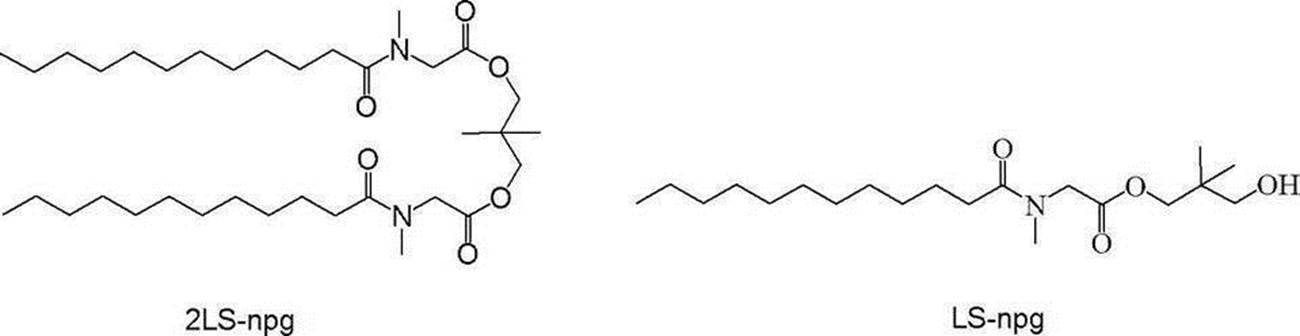
N-ラウロイルサルコシン(27.14 g、0.1 mol)及びネオペンチルグリコール(20.83 g、0.2 mol)の混合物に硫酸(0.39 g、0.004 mol)を添加し、アルゴン気流下、バス温130℃で6時間撹拌した後、更に140℃で4時間撹拌した。生成物を酢酸エチル(50 mL)で希釈し、飽和重曹水(30 mL)で2回洗浄した。有機相をさらに飽和食塩水(40 mL)で2回洗浄した後、超純水(40 mL)で1回洗浄した。有機相を集めて真空減圧により濃縮し目的物を得た(収率88%)。
液体クロマトグラフィーと接続された質量分析装置(LC-MS)により化合物の同定を行った。また、液体クロマトグラフィーにより210 nmで吸光度を観測することで、それぞれの化合物の割合を算出した(それぞれの化合物のピーク面積比 2LS-npg:LS-npg=16:84)。
液体クロマトグラフィーの条件
カラム:YMC-Pack ODS-A、流速:1 mL/min、温度:40℃、溶媒:メタノール/ギ酸の30mM水溶液(9/1)
ESI-MS(positive) m/z 633.3 [2LS-npg+Na]+, m/z 380.5 [LS-npg+Na]+
液体クロマトグラフィーと接続された質量分析装置(LC-MS)により化合物の同定を行った。また、液体クロマトグラフィーにより210 nmで吸光度を観測することで、それぞれの化合物の割合を算出した(それぞれの化合物のピーク面積比 2LS-npg:LS-npg=16:84)。
液体クロマトグラフィーの条件
カラム:YMC-Pack ODS-A、流速:1 mL/min、温度:40℃、溶媒:メタノール/ギ酸の30mM水溶液(9/1)
ESI-MS(positive) m/z 633.3 [2LS-npg+Na]+, m/z 380.5 [LS-npg+Na]+
製造例11:3LS-tmp(N-ラウロイルサルコシン トリメチロールプロパントリエステル)、2LS-tmp(N-ラウロイルサルコシン トリメチロールプロパンジエステル)及びLS-tmp(N-ラウロイルサルコシン トリメチロールプロパンモノエステル)の混合物の製造

N-ラウロイルサルコシン(27.14 g、0.1 mol)及びトリメチロールプロパン(4.42 g、0.033 mol)の混合物に硫酸(0.98 g、0.01 mol)を添加し、アルゴン気流下、バス温130℃で6時間撹拌した後、更に140℃で4時間撹拌した。生成物を酢酸エチル(50 mL)で希釈し、飽和重曹水(30 mL)で2回洗浄した。有機相をさらに飽和食塩水(40 mL)で2回洗浄した後、超純水(40 mL)で1回洗浄した。有機相を集めて真空減圧により濃縮し目的物を得た(収率93%)。
液体クロマトグラフィーと接続された質量分析装置(LC-MS)により化合物の同定を行った。また、液体クロマトグラフィーにより、210 nmで吸光度を観測することで、それぞれの化合物の割合を算出した(それぞれの化合物のピーク面積比 3LS-tmp:2LS-tmp:LS-tmp=39:45:16)。
液体クロマトグラフィーの条件
カラム:YMC-Pack ODS-A、流速:1 mL/min、温度:40℃、溶媒:メタノール/ギ酸の30mM水溶液(9/1)
ESI-MS(positive) m/z 916.3 [3LS-tmp +Na]+, 663.2 [2LS-tmp +Na]+, 410.0 [LS-tmp +Na]+
液体クロマトグラフィーと接続された質量分析装置(LC-MS)により化合物の同定を行った。また、液体クロマトグラフィーにより、210 nmで吸光度を観測することで、それぞれの化合物の割合を算出した(それぞれの化合物のピーク面積比 3LS-tmp:2LS-tmp:LS-tmp=39:45:16)。
液体クロマトグラフィーの条件
カラム:YMC-Pack ODS-A、流速:1 mL/min、温度:40℃、溶媒:メタノール/ギ酸の30mM水溶液(9/1)
ESI-MS(positive) m/z 916.3 [3LS-tmp +Na]+, 663.2 [2LS-tmp +Na]+, 410.0 [LS-tmp +Na]+
製造例12:3LmbA-pent(N-ラウロイル-N-メチル-β-アラニン ペンタエリトリトールトリエステル)、2LmbA-pent(N-ラウロイル-N-メチル-β-アラニン ペンタエリトリトールジエステル)及びLmbA-pent(N-ラウロイル-N-メチル-β-アラニン ペンタエリトリトールモノエステル)の混合物の製造

N-ラウロイル-N-メチル-β-アラニン(28.52 g、0.1 mol)及びペンタエリトリトール(7.5 g、0.055 mol)の混合物にp-トルエンスルホン酸一水和物(1.9 g、0.01 mol)を添加し、アルゴン気流下、バス温130℃で4時間撹拌した。生成物を酢酸エチル(50 mL)で希釈し、飽和重曹水(30 mL)で2回洗浄した。有機相をさらに飽和食塩水(40 mL)で2回洗浄した後、超純水(40 mL)で1回洗浄した。有機相を集めて真空減圧により濃縮し目的物を得た(収率88 %)。
液体クロマトグラフィーと接続された質量分析装置(LC-MS)により化合物の同定を行った。また、液体クロマトグラフィーにより、210 nmで吸光度を観測することで、それぞれの化合物の割合を算出した(それぞれの化合物のピーク面積比 3LmbA-pent:2LmbA-pent:LmbA-pent=74:23:3)。
液体クロマトグラフィーの条件
カラム:YMC-Pack ODS-A、流速:1 mL/min、温度:40℃、溶媒:メタノール/ギ酸の30mM水溶液(9/1)
ESI-MS(positive) m/z 938.3 [3LmbA-pent+Na]+, 693.6 [2LmbA-pent+Na]+, 426.1 [LmbA-pent+Na]+
液体クロマトグラフィーと接続された質量分析装置(LC-MS)により化合物の同定を行った。また、液体クロマトグラフィーにより、210 nmで吸光度を観測することで、それぞれの化合物の割合を算出した(それぞれの化合物のピーク面積比 3LmbA-pent:2LmbA-pent:LmbA-pent=74:23:3)。
液体クロマトグラフィーの条件
カラム:YMC-Pack ODS-A、流速:1 mL/min、温度:40℃、溶媒:メタノール/ギ酸の30mM水溶液(9/1)
ESI-MS(positive) m/z 938.3 [3LmbA-pent+Na]+, 693.6 [2LmbA-pent+Na]+, 426.1 [LmbA-pent+Na]+
製造例13:2LS-bepd(N-ラウロイルサルコシン 2-ブチル-2-エチル-1,3-プロパンジオールジエステル)及びLS-bepd(N-ラウロイルサルコシン 2-ブチル-2-エチル-1,3-プロパンジオールモノエステル)の混合物の製造

N-ラウロイルサルコシン(27.14 g、0.1 mol)及び2-ブチル-2-エチル-1,3-プロパンジオール(8.01 g、0.05 mol)の混合物に硫酸(0.28 g、0.003 mol)を添加し、アルゴン気流下、バス温130℃で4時間撹拌した。生成物を酢酸エチル(50 mL)で希釈し、飽和重曹水(30 mL)で2回洗浄した。有機相をさらに飽和食塩水(40 mL)で2回洗浄した後、超純水(40 mL)で1回洗浄した。有機相を集めて真空減圧により濃縮し目的物を得た(収率76%)。
液体クロマトグラフィーと接続された質量分析装置(LC-MS)により化合物の同定を行った。また、液体クロマトグラフィーにより210 nmで吸光度を観測することで、それぞれの化合物の割合を算出した(それぞれの化合物のピーク面積比 2LS-bepd:LS-bepd=74:26)。
液体クロマトグラフィーの条件
カラム:YMC-Pack ODS-A、流速:1 mL/min、温度:40℃、溶媒:メタノール/ギ酸の30mM水溶液(9/1)
ESI-MS(positive) m/z 690.2 [2LS-bepd+Na]+, m/z 436.8 [LS-bepd+Na]+
液体クロマトグラフィーと接続された質量分析装置(LC-MS)により化合物の同定を行った。また、液体クロマトグラフィーにより210 nmで吸光度を観測することで、それぞれの化合物の割合を算出した(それぞれの化合物のピーク面積比 2LS-bepd:LS-bepd=74:26)。
液体クロマトグラフィーの条件
カラム:YMC-Pack ODS-A、流速:1 mL/min、温度:40℃、溶媒:メタノール/ギ酸の30mM水溶液(9/1)
ESI-MS(positive) m/z 690.2 [2LS-bepd+Na]+, m/z 436.8 [LS-bepd+Na]+
製造例14:3LmbA-tmp(N-ラウロイル-N-メチル-β-アラニン トリメチロールプロパントリエステル)の製造

N-ラウロイル-N-メチル-β-アラニン(28.54 g、0.1 mol)及びトリメチロールプロパン(5.36 g、0.04 mol)の混合物に硫酸(0.98 g、0.01 mol)を添加し、アルゴン気流下、バス温120℃で8時間撹拌した。生成物を酢酸エチル(50 mL)で希釈し、飽和重曹水(30 mL)で2回洗浄した。有機相をさらに超純水(40 mL)で2回洗浄した。有機相を集めて真空減圧により濃縮し粗生成物を得た。これをシリカゲルカラムクロマトグラフィー(展開溶媒:ヘキサン/酢酸エチル=4/1から1/4のグラデーション)にて精製し、目的の化合物N-ラウロイル-N-メチル-β-アラニン トリメチロールプロパントリエステル(3LmbA-tmp)を得た(収率72%)。
ESI-MS(positive) m/z 937.4 [M+H]+, 958.3 [M+Na]+
ESI-MS(positive) m/z 937.4 [M+H]+, 958.3 [M+Na]+
製造例15:3LmbA-tmp(N-ラウロイル-N-メチル-β-アラニン トリメチロールプロパントリエステル)、2LmbA-tmp(N-ラウロイル-N-メチル-β-アラニン トリメチロールプロパンジエステル)及びLmbA-tmp(N-ラウロイル-N-メチル-β-アラニン トリメチロールプロパンモノエステル)の混合物の製造

N-ラウロイル-N-メチル-β-アラニン(28.54 g、0.1 mol)及びトリメチロールプロパン(7.4 g、0.055 mol)の混合物に硫酸(0.98 g、0.01 mol)を添加し、アルゴン気流下、バス温120℃で6時間撹拌した。生成物を酢酸エチル(50 mL)で希釈し、飽和重曹水(30 mL)で2回洗浄した。有機相をさらに飽和超純水(40 mL)で1回洗浄した。有機相を集めて真空減圧により濃縮し目的物を得た(収率70%)。
液体クロマトグラフィーと接続された質量分析装置(LC-MS)により化合物の同定を行った。また、液体クロマトグラフィーにより、210 nmで吸光度を観測することで、それぞれの化合物の割合を算出した(それぞれの化合物のピーク面積比 3LmbA-tmp:2LmbA-tmp:LmbA-tmp=39:57:4)。
液体クロマトグラフィーの条件
カラム:YMC-Pack ODS-A、流速:1 mL/min、温度:40℃、溶媒:メタノール/ギ酸の30mM水溶液(9/1)
ESI-MS(positive) m/z 958.3 [3LmbA-tmp +Na]+, 691 [2LmbA-tmp +Na]+, 423.6[LmbA-tmp +Na]+
液体クロマトグラフィーと接続された質量分析装置(LC-MS)により化合物の同定を行った。また、液体クロマトグラフィーにより、210 nmで吸光度を観測することで、それぞれの化合物の割合を算出した(それぞれの化合物のピーク面積比 3LmbA-tmp:2LmbA-tmp:LmbA-tmp=39:57:4)。
液体クロマトグラフィーの条件
カラム:YMC-Pack ODS-A、流速:1 mL/min、温度:40℃、溶媒:メタノール/ギ酸の30mM水溶液(9/1)
ESI-MS(positive) m/z 958.3 [3LmbA-tmp +Na]+, 691 [2LmbA-tmp +Na]+, 423.6[LmbA-tmp +Na]+
製造例16:3LmbA-tmp(N-ラウロイル-N-メチル-β-アラニン トリメチロールプロパントリエステル)、2LmbA-tmp(N-ラウロイル-N-メチル-β-アラニン トリメチロールプロパンジエステル)及びLmbA-tmp(N-ラウロイル-N-メチル-β-アラニン トリメチロールプロパンモノエステル)の混合物の製造
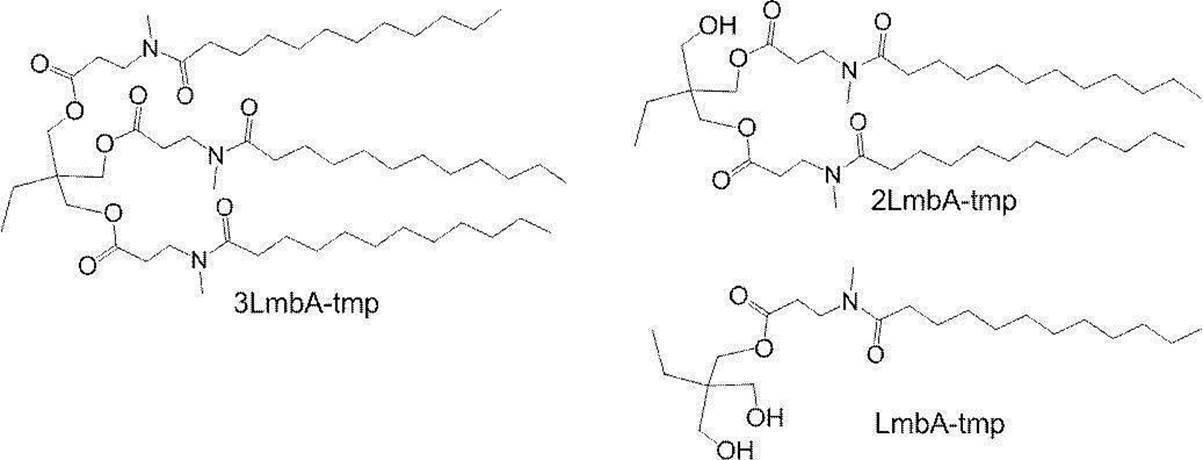
N-ラウロイル-N-メチル-β-アラニン(28.54 g、0.1 mol)及びトリメチロールプロパン(5.36 g、0.04 mol)の混合物に硫酸(0.98 g、0.01 mol)を添加し、アルゴン気流下、バス温120℃で8時間撹拌した。生成物を酢酸エチル(50 mL)で希釈し、飽和重曹水(30 mL)で2回洗浄した。有機相をさらに飽和超純水(40 mL)で1回洗浄した。有機相を集めて真空減圧により濃縮し目的物を得た(収率78%)。
液体クロマトグラフィーと接続された質量分析装置(LC-MS)により化合物の同定を行った。また、液体クロマトグラフィーにより、210 nmで吸光度を観測することで、それぞれの化合物の割合を算出した(それぞれの化合物のピーク面積比 3LmbA-tmp:2LmbA-tmp:LmbA-tmp=76:22:2)。
液体クロマトグラフィーの条件
カラム:YMC-Pack ODS-A、流速:1 mL/min、温度:40℃、溶媒:メタノール/ギ酸の30mM水溶液(9/1)
ESI-MS(positive) m/z 958.3 [3LmbA-tmp +Na]+, 691 [2LmbA-tmp +Na]+, 423.6[LmbA-tmp +Na]+
液体クロマトグラフィーと接続された質量分析装置(LC-MS)により化合物の同定を行った。また、液体クロマトグラフィーにより、210 nmで吸光度を観測することで、それぞれの化合物の割合を算出した(それぞれの化合物のピーク面積比 3LmbA-tmp:2LmbA-tmp:LmbA-tmp=76:22:2)。
液体クロマトグラフィーの条件
カラム:YMC-Pack ODS-A、流速:1 mL/min、温度:40℃、溶媒:メタノール/ギ酸の30mM水溶液(9/1)
ESI-MS(positive) m/z 958.3 [3LmbA-tmp +Na]+, 691 [2LmbA-tmp +Na]+, 423.6[LmbA-tmp +Na]+
製造例17:2C10mbA-bg(N‐デカノイル‐N‐メチル‐β‐アラニン 1,3-ブチレングリコールジエステル)の製造

N‐デカノイル‐N‐メチル‐β‐アラニン(25.7 g、0.1 mol)及び1,3-ブチレングリコール(4.96 g、0.55 mol)の混合物に硫酸(0.98 g、0.01 mol)を添加し、アルゴン気流下、バス温132℃で6時間撹拌した。生成物を酢酸エチル(50 mL)で希釈し、飽和重曹水(30 mL)で2回洗浄した。有機相をさらに超純水(40 mL)で2回洗浄した。有機相を集めて真空減圧により濃縮し粗生成物を得た。これをシリカゲルカラムクロマトグラフィー(展開溶媒:ヘキサン/酢酸エチル=4/1から1/4のグラデーション)にて精製し、目的の化合物N‐デカノイル‐N‐メチル‐β‐アラニン 1,3-ブチレングリコールジエステル(2C10mbA -bg)を得た(収率52%)。
ESI-MS(positive) m/z 569.6 [M+H]+, 592.5 [M+Na]+
ESI-MS(positive) m/z 569.6 [M+H]+, 592.5 [M+Na]+
試験例1 顔料分散性の評価
下記表1に示す種々の油剤又は化合物(0.5g)を酸化チタン粒子(4.5g;TTO-55(N);石原産業株式会社製)に加え、均一になるまで混合した。この混合粉体に更に流動パラフィンを添加し、均一になるように混合した。ある一定量の流動パラフィンを添加したところで混合粉体が凝集し始める。この時点で加えた流動パラフィンの量の100分率した数値を該油剤又は化合物のwet point(W.P.)と定義される。この凝集体に更に流動パラフィンを加えると混合物がペースト状になり、流動性を示すようになる。この時点で加えた流動パラフィンの量の100分率した数値を該油剤又は化合物のflow point(F.P.)と定義される。このflow pointとwet pointの差が小さい程、分散性がよいとされることから(Industrial and Engineering Chemistry,1946,18(1),26-31)、顔料分散性を、flow pointとwet pointの差で評価した。すなわち、下記表1において、flow pointとwet pointの差が
10未満の場合を◎(とても好ましい)、
10以上22未満の場合を○(好ましい)、
22以上30未満の場合を△(あまり好ましくない)、
30以上の場合を×(好ましくない)
で表示した。
下記表1に示す種々の油剤又は化合物(0.5g)を酸化チタン粒子(4.5g;TTO-55(N);石原産業株式会社製)に加え、均一になるまで混合した。この混合粉体に更に流動パラフィンを添加し、均一になるように混合した。ある一定量の流動パラフィンを添加したところで混合粉体が凝集し始める。この時点で加えた流動パラフィンの量の100分率した数値を該油剤又は化合物のwet point(W.P.)と定義される。この凝集体に更に流動パラフィンを加えると混合物がペースト状になり、流動性を示すようになる。この時点で加えた流動パラフィンの量の100分率した数値を該油剤又は化合物のflow point(F.P.)と定義される。このflow pointとwet pointの差が小さい程、分散性がよいとされることから(Industrial and Engineering Chemistry,1946,18(1),26-31)、顔料分散性を、flow pointとwet pointの差で評価した。すなわち、下記表1において、flow pointとwet pointの差が
10未満の場合を◎(とても好ましい)、
10以上22未満の場合を○(好ましい)、
22以上30未満の場合を△(あまり好ましくない)、
30以上の場合を×(好ましくない)
で表示した。

表中の油剤は、SL-205:ラウロイルサルコシンイソプロピル(味の素株式会社製)、Finsolv TN:安息香酸アルキル(C12-15)(Innospec Active Chemicals LLC製)、Neosolue MP:ジネオペンタン酸メチルペンタンジオール(日本精化株式会社製)及びTCG-M:トリ(カプリル酸/カプリン酸)グリセリル(高級アルコール工業株式会社製)を表す。
試験例2 可溶化能の評価:
表2に記載の化合物又は油剤の可溶化力を調べるため、50mgの難溶性分子である4-tert-ブチル-4’-メトキシジベンゾイルメタン(Parsol 1789)を100mgの各種化合物又は油剤に添加し、室温で24時間撹拌した。その後、遠心分離機(20分、13000rpm)により不溶物を沈殿させ上澄みを回収した。回収した上澄みの3mgを1mLの有機溶媒(メタノール)に溶解し、HPLCによって分析をした。HPLC分析において、難溶性分子のピーク面積を標準溶液のピーク面積と比較し、油剤中に溶解した難溶性分子の割合(wt%)を同定し、可溶可能として表2に示した。
またParsol 1789の可溶化において、
20wt%以上の可溶化能を◎
15wt%以上20wt%未満の可溶化能を○
15wt%未満の可溶化能を×
とした。結果を表2に示した。
表2に記載の化合物又は油剤の可溶化力を調べるため、50mgの難溶性分子である4-tert-ブチル-4’-メトキシジベンゾイルメタン(Parsol 1789)を100mgの各種化合物又は油剤に添加し、室温で24時間撹拌した。その後、遠心分離機(20分、13000rpm)により不溶物を沈殿させ上澄みを回収した。回収した上澄みの3mgを1mLの有機溶媒(メタノール)に溶解し、HPLCによって分析をした。HPLC分析において、難溶性分子のピーク面積を標準溶液のピーク面積と比較し、油剤中に溶解した難溶性分子の割合(wt%)を同定し、可溶可能として表2に示した。
またParsol 1789の可溶化において、
20wt%以上の可溶化能を◎
15wt%以上20wt%未満の可溶化能を○
15wt%未満の可溶化能を×
とした。結果を表2に示した。
試験例3 使用時のきしみ感の評価
難溶性のUV吸収剤であるParsol 1789を10wt%で溶解させた表2の各種化合物又は油剤のきしみ感について専門パネラー(5人)が下記の評価基準によって評価を行った。パネラーの平均評価点数に基づき、使用時のきしみ感を下記のように評価した。
難溶性のUV吸収剤であるParsol 1789を10wt%で溶解させた表2の各種化合物又は油剤のきしみ感について専門パネラー(5人)が下記の評価基準によって評価を行った。パネラーの平均評価点数に基づき、使用時のきしみ感を下記のように評価した。
<評価:使用時のきしみ感の評価>
3点:使用時にまったくきしまない
2点:使用時にほとんどきしまない
1点:使用時にかなりきしむ
0点:使用時に非常にきしむ
3点:使用時にまったくきしまない
2点:使用時にほとんどきしまない
1点:使用時にかなりきしむ
0点:使用時に非常にきしむ
専門パネラーの評価の平均点が
2.4以上を◎、
1.5以上2.4未満を○、
0.5以上1.5未満を△、
0.5未満を×
とした。結果を表2に示した。
2.4以上を◎、
1.5以上2.4未満を○、
0.5以上1.5未満を△、
0.5未満を×
とした。結果を表2に示した。

試験例4 化合物又は油剤の添加による無機顔料のUV遮断能向上の評価
表3に記載の各種化合物又は油剤を無機顔料(二酸化チタン、TTO-55N、石原産業株式会社製)に10wt%の割合で添加し、よく混ぜて均一に混合した。化合物を混合した粉体を流動パラフィン(モレスコホワイトP-55、モレスコ社製)に1wt%の割合で添加し、1分間ボルテックスし、更に手で15秒振とうした後15秒間ボルテックスした。このようにして得られた試料を光路長1mmの石英セルに移し、280nmから600nm間の波長における透過度を測定した。UV領域(280nmから400nm)における透過率が低いほどUV遮断能が高くなるため、今回の評価でUV領域(280nmから400nm)における透過率が
1)20%未満の場合のUV遮断能を◎
2)20%以上で、25%未満の場合のUV遮断能を○
3)25%以上で35%未満の場合のUV遮断能を△
4)35%以上の場合のUV遮断能を×
として評価し表3に示した。
図1に各種化合物又は各種油剤を添加した時の無機顔料のUV遮断能を示した。
表3に記載の各種化合物又は油剤を無機顔料(二酸化チタン、TTO-55N、石原産業株式会社製)に10wt%の割合で添加し、よく混ぜて均一に混合した。化合物を混合した粉体を流動パラフィン(モレスコホワイトP-55、モレスコ社製)に1wt%の割合で添加し、1分間ボルテックスし、更に手で15秒振とうした後15秒間ボルテックスした。このようにして得られた試料を光路長1mmの石英セルに移し、280nmから600nm間の波長における透過度を測定した。UV領域(280nmから400nm)における透過率が低いほどUV遮断能が高くなるため、今回の評価でUV領域(280nmから400nm)における透過率が
1)20%未満の場合のUV遮断能を◎
2)20%以上で、25%未満の場合のUV遮断能を○
3)25%以上で35%未満の場合のUV遮断能を△
4)35%以上の場合のUV遮断能を×
として評価し表3に示した。
図1に各種化合物又は各種油剤を添加した時の無機顔料のUV遮断能を示した。

きしみ感が抑えられた難溶性物質含有化粧料や紫外線遮断能の高い化粧料を提供することができる。
本出願は日本で出願された特願2016-050243を基礎としており、その内容は本明細書に全て包含されるものである。
Claims (15)
- (A) 式(1-1):

[式中、
R1は、炭素数4~26のアルキル基又は炭素数4~26のアルケニル基であり、
R2は、炭素数1~6のアルキル基又は炭素数2~6のアルケニル基であり、
nは、1~5の整数であり、
Xは、炭素数3以上の炭化水素基であり、
a及びbは、それぞれ独立して、1以上の整数である。]
で表される化合物及びその塩、ならびに
式(1-2):
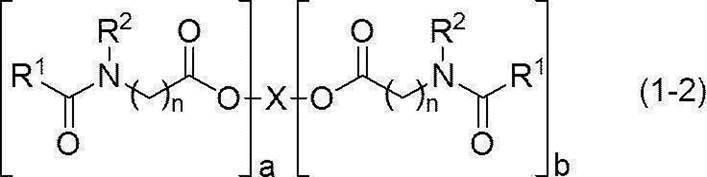
[式中、各記号は前記定義と同義である。]
で表される化合物及びその塩からなる群から選択される少なくとも一種の化合物又はその塩、及び
(B)難溶性物質
を含有する組成物。 - R1が炭素数4~26のアルキル基である、請求項1に記載の組成物。
- R1が炭素数7~17のアルキル基である、請求項1に記載の組成物。
- R2が炭素数1~6のアルキル基である、請求項1~3のいずれか1項に記載の組成物。
- R2がメチル基である、請求項1~3のいずれか1項に記載の組成物。
- nが1又は2である、請求項1~5のいずれか1項に記載の組成物。
- Xが炭素数3~9の炭化水素基である、請求項1~6のいずれか1項に記載の組成物。
- a及びbがそれぞれ独立して1~3の整数であり、かつa+bが2~5の整数である、請求項1~7のいずれか1項に記載の組成物。
- a及びbが共に1である、請求項1~8のいずれか1項に記載の組成物。
- (B)が、25℃で水に対して1重量%以下の溶解度を有する物質、および/または25℃で流動パラフィンに対して5重量%以下の溶解度を有する物質である請求項1~9のいずれか1項に記載の組成物。
- (B)が、紫外線吸収剤、セラミド、ゲル化剤、香料、セルフタンニング剤、殺菌剤及び無機顔料からなる群から選択される少なくとも一種である請求項1~10のいずれか1項に記載の組成物。
- (A)に対する(B)の重量比が1:0.005~1:20である請求項1~11のいずれか1項に記載の組成物。
- 請求項1~12のいずれか1項に記載の組成物を含む化粧料。
- 式(1-1):
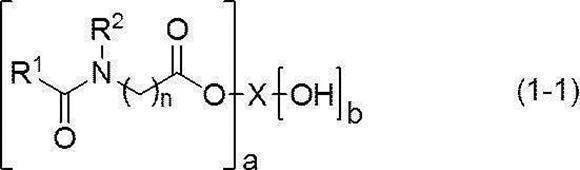
[式中、
R1は、炭素数4~26のアルキル基又は炭素数4~26のアルケニル基であり、
R2は、炭素数1~6のアルキル基又は炭素数2~6のアルケニル基であり、
nは、1~5の整数であり、
Xは、炭素数3以上の炭化水素基であり、
a及びbは、それぞれ独立して、1以上の整数である。]
で表される化合物及びその塩、ならびに
式(1-2):
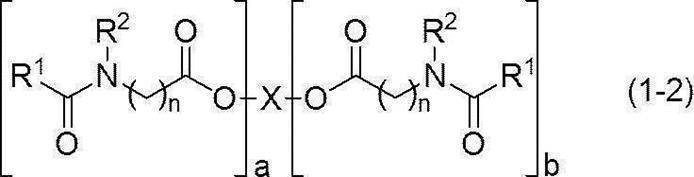
[式中、各記号は前記定義と同義である。]
で表される化合物及びその塩からなる群から選択される少なくとも一種の化合物又はその塩
を含有する可溶化剤。 - 式(1-1):
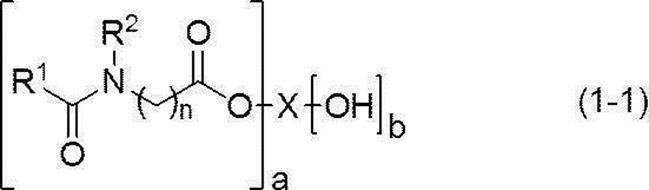
[式中、
R1は、炭素数4~26のアルキル基又は炭素数4~26のアルケニル基であり、
R2は、炭素数1~6のアルキル基又は炭素数2~6のアルケニル基であり、
nは、1~5の整数であり、
Xは、炭素数3以上の炭化水素基であり、
a及びbは、それぞれ独立して、1以上の整数である。]
で表される化合物及びその塩、ならびに
式(1-2):

[式中、各記号は前記定義と同義である。]
で表される化合物及びその塩からなる群から選択される少なくとも一種の化合物又はその塩
と、難溶性物質を共存させることを特徴とする難溶性物質の可溶化方法。
Applications Claiming Priority (2)
| Application Number | Priority Date | Filing Date | Title |
|---|---|---|---|
| JP2016-050243 | 2016-03-14 | ||
| JP2016050243 | 2016-03-14 |
Publications (1)
| Publication Number | Publication Date |
|---|---|
| WO2017159656A1 true WO2017159656A1 (ja) | 2017-09-21 |
Family
ID=59852006
Family Applications (1)
| Application Number | Title | Priority Date | Filing Date |
|---|---|---|---|
| PCT/JP2017/010126 Ceased WO2017159656A1 (ja) | 2016-03-14 | 2017-03-14 | 化粧料組成物 |
Country Status (1)
| Country | Link |
|---|---|
| WO (1) | WO2017159656A1 (ja) |
Cited By (1)
| Publication number | Priority date | Publication date | Assignee | Title |
|---|---|---|---|---|
| CN110698664A (zh) * | 2018-07-09 | 2020-01-17 | 广东华润涂料有限公司 | 固体颗粒分散剂及其制备方法以及含有该分散剂的固体颗粒的分散体 |
Citations (8)
| Publication number | Priority date | Publication date | Assignee | Title |
|---|---|---|---|---|
| JPS50105580A (ja) * | 1973-09-11 | 1975-08-20 | ||
| JPH11246841A (ja) * | 1998-02-27 | 1999-09-14 | Ajinomoto Co Inc | 紫外線吸収性組成物 |
| JP2000007942A (ja) * | 1998-04-22 | 2000-01-11 | Ajinomoto Co Inc | 無機顔料組成物 |
| WO2006120923A1 (ja) * | 2005-05-11 | 2006-11-16 | Idemitsu Kosan Co., Ltd. | 冷凍機油組成物、これを用いた圧縮機及び冷凍装置 |
| JP2008195624A (ja) * | 2007-02-08 | 2008-08-28 | Nippon Emulsion Kk | 油性基剤 |
| JP2012031216A (ja) * | 2010-06-29 | 2012-02-16 | Jx Nippon Oil & Energy Corp | 油剤組成物および加工液組成物 |
| JP2014122343A (ja) * | 2012-12-21 | 2014-07-03 | Afton Chemical Corp | 摩擦修正剤および清浄剤を含む添加剤組成物 |
| WO2016060194A1 (ja) * | 2014-10-17 | 2016-04-21 | 味の素株式会社 | アシルアミノ酸多価アルコールエステル化合物 |
-
2017
- 2017-03-14 WO PCT/JP2017/010126 patent/WO2017159656A1/ja not_active Ceased
Patent Citations (8)
| Publication number | Priority date | Publication date | Assignee | Title |
|---|---|---|---|---|
| JPS50105580A (ja) * | 1973-09-11 | 1975-08-20 | ||
| JPH11246841A (ja) * | 1998-02-27 | 1999-09-14 | Ajinomoto Co Inc | 紫外線吸収性組成物 |
| JP2000007942A (ja) * | 1998-04-22 | 2000-01-11 | Ajinomoto Co Inc | 無機顔料組成物 |
| WO2006120923A1 (ja) * | 2005-05-11 | 2006-11-16 | Idemitsu Kosan Co., Ltd. | 冷凍機油組成物、これを用いた圧縮機及び冷凍装置 |
| JP2008195624A (ja) * | 2007-02-08 | 2008-08-28 | Nippon Emulsion Kk | 油性基剤 |
| JP2012031216A (ja) * | 2010-06-29 | 2012-02-16 | Jx Nippon Oil & Energy Corp | 油剤組成物および加工液組成物 |
| JP2014122343A (ja) * | 2012-12-21 | 2014-07-03 | Afton Chemical Corp | 摩擦修正剤および清浄剤を含む添加剤組成物 |
| WO2016060194A1 (ja) * | 2014-10-17 | 2016-04-21 | 味の素株式会社 | アシルアミノ酸多価アルコールエステル化合物 |
Cited By (2)
| Publication number | Priority date | Publication date | Assignee | Title |
|---|---|---|---|---|
| CN110698664A (zh) * | 2018-07-09 | 2020-01-17 | 广东华润涂料有限公司 | 固体颗粒分散剂及其制备方法以及含有该分散剂的固体颗粒的分散体 |
| CN110698664B (zh) * | 2018-07-09 | 2022-12-09 | 广东华润涂料有限公司 | 固体颗粒分散剂及其制备方法以及含有该分散剂的固体颗粒的分散体 |
Similar Documents
| Publication | Publication Date | Title |
|---|---|---|
| JP4592820B2 (ja) | 美白剤及び皮膚外用剤 | |
| ES2676836T3 (es) | Compuestos de imino como agentes de protección contra las radiaciones ultravioleta | |
| BRPI1105655A2 (pt) | solubilizador para preparaÇÕes cosmÉticas | |
| JP2006523197A (ja) | 対称性トリアジン誘導体 | |
| KR101994863B1 (ko) | 아미드 알코올을 포함하는 화장용 기제 및 화장품 | |
| JP6851327B2 (ja) | 機能性活性化合物のための可溶化剤 | |
| WO2016104696A1 (ja) | アシル塩基性アミノ酸誘導体および無機粉体を含有する化粧料組成物 | |
| CN102448429B (zh) | 亚苄基丙二酸酯 | |
| EP2301519A1 (en) | Ultraviolet absorbing composition | |
| ES3014475T3 (en) | Compositions comprising at least one acrylic polymer and at least one insoluble organic screening agent | |
| JP5994789B2 (ja) | シワ防止化粧料 | |
| JP3844349B2 (ja) | 遮蔽剤の相乗混合物をベースにした化粧品用サンスクリーン組成物及び使用 | |
| JP6760070B2 (ja) | アシルアミノ酸多価アルコールエステル化合物 | |
| EP4642757A1 (en) | Process for treating keratin materials using at least one oil bearing acetoacetate functions and at least one crosslinking agent | |
| EP3176150B1 (en) | Medium-chain acyl basic amino acid derivative | |
| JP6105272B2 (ja) | 皮膚外用組成物 | |
| CN118871078A (zh) | 至少包含部花青和助水溶物的美容或皮肤病用组合物 | |
| WO2022034874A1 (ja) | アスコルビン酸系化合物を含む配合剤又は組成物及びアスコルビン酸系化合物の安定化方法 | |
| WO2016104693A1 (ja) | アシル塩基性アミノ酸誘導体および水溶性保湿成分を含有する化粧料組成物 | |
| JPWO2019188625A1 (ja) | 化粧料 | |
| JP2010111823A (ja) | 紫外線吸収組成物、それを用いた化粧品、医薬製剤及び、紫外線の遮断方法 | |
| EP1454896A1 (fr) | Nouveaux dérivés, amines, amides, sulfonamides et carbamates des sels de l'acide benzamalonique et compositions cosmétiques photoprotectrices contenant ces dérivés | |
| JPWO2016104695A1 (ja) | アシル塩基性アミノ酸誘導体およびアニオン性水溶性高分子を含有する化粧料組成物 | |
| EP1278718B1 (fr) | Nouveauy derives d'aminoacides, leur procede de preparation, compositions les contenant et leurs utilisations comme filtres solaires | |
| JP2012144489A (ja) | 桂皮酸ポリグリセリンエステル誘導体、紫外線吸収剤及び皮膚外用剤 |
Legal Events
| Date | Code | Title | Description |
|---|---|---|---|
| NENP | Non-entry into the national phase |
Ref country code: DE |
|
| 121 | Ep: the epo has been informed by wipo that ep was designated in this application |
Ref document number: 17766655 Country of ref document: EP Kind code of ref document: A1 |
|
| 122 | Ep: pct application non-entry in european phase |
Ref document number: 17766655 Country of ref document: EP Kind code of ref document: A1 |
|
| NENP | Non-entry into the national phase |
Ref country code: JP |