WO2017159105A1 - 使い捨ておむつ - Google Patents
使い捨ておむつ Download PDFInfo
- Publication number
- WO2017159105A1 WO2017159105A1 PCT/JP2017/003975 JP2017003975W WO2017159105A1 WO 2017159105 A1 WO2017159105 A1 WO 2017159105A1 JP 2017003975 W JP2017003975 W JP 2017003975W WO 2017159105 A1 WO2017159105 A1 WO 2017159105A1
- Authority
- WO
- WIPO (PCT)
- Prior art keywords
- disposable diaper
- main body
- waistline
- lateral
- cut
- Prior art date
- Legal status (The legal status is an assumption and is not a legal conclusion. Google has not performed a legal analysis and makes no representation as to the accuracy of the status listed.)
- Ceased
Links
Images




Classifications
-
- A—HUMAN NECESSITIES
- A61—MEDICAL OR VETERINARY SCIENCE; HYGIENE
- A61F—FILTERS IMPLANTABLE INTO BLOOD VESSELS; PROSTHESES; DEVICES PROVIDING PATENCY TO, OR PREVENTING COLLAPSING OF, TUBULAR STRUCTURES OF THE BODY, e.g. STENTS; ORTHOPAEDIC, NURSING OR CONTRACEPTIVE DEVICES; FOMENTATION; TREATMENT OR PROTECTION OF EYES OR EARS; BANDAGES, DRESSINGS OR ABSORBENT PADS; FIRST-AID KITS
- A61F13/00—Bandages or dressings; Absorbent pads
- A61F13/15—Absorbent pads, e.g. sanitary towels, swabs or tampons for external or internal application to the body; Supporting or fastening means therefor; Tampon applicators
-
- A—HUMAN NECESSITIES
- A61—MEDICAL OR VETERINARY SCIENCE; HYGIENE
- A61F—FILTERS IMPLANTABLE INTO BLOOD VESSELS; PROSTHESES; DEVICES PROVIDING PATENCY TO, OR PREVENTING COLLAPSING OF, TUBULAR STRUCTURES OF THE BODY, e.g. STENTS; ORTHOPAEDIC, NURSING OR CONTRACEPTIVE DEVICES; FOMENTATION; TREATMENT OR PROTECTION OF EYES OR EARS; BANDAGES, DRESSINGS OR ABSORBENT PADS; FIRST-AID KITS
- A61F13/00—Bandages or dressings; Absorbent pads
- A61F13/15—Absorbent pads, e.g. sanitary towels, swabs or tampons for external or internal application to the body; Supporting or fastening means therefor; Tampon applicators
- A61F13/45—Absorbent pads, e.g. sanitary towels, swabs or tampons for external or internal application to the body; Supporting or fastening means therefor; Tampon applicators characterised by the shape
- A61F13/49—Absorbent pads, e.g. sanitary towels, swabs or tampons for external or internal application to the body; Supporting or fastening means therefor; Tampon applicators characterised by the shape specially adapted to be worn around the waist, e.g. diapers, nappies
-
- A—HUMAN NECESSITIES
- A61—MEDICAL OR VETERINARY SCIENCE; HYGIENE
- A61F—FILTERS IMPLANTABLE INTO BLOOD VESSELS; PROSTHESES; DEVICES PROVIDING PATENCY TO, OR PREVENTING COLLAPSING OF, TUBULAR STRUCTURES OF THE BODY, e.g. STENTS; ORTHOPAEDIC, NURSING OR CONTRACEPTIVE DEVICES; FOMENTATION; TREATMENT OR PROTECTION OF EYES OR EARS; BANDAGES, DRESSINGS OR ABSORBENT PADS; FIRST-AID KITS
- A61F13/00—Bandages or dressings; Absorbent pads
- A61F13/15—Absorbent pads, e.g. sanitary towels, swabs or tampons for external or internal application to the body; Supporting or fastening means therefor; Tampon applicators
- A61F13/51—Absorbent pads, e.g. sanitary towels, swabs or tampons for external or internal application to the body; Supporting or fastening means therefor; Tampon applicators characterised by the outer layers of the pads
- A61F13/514—Backsheet, i.e. the impermeable cover or layer furthest from the skin
Definitions
- the present invention relates to a disposable diaper.
- Such a disposable diaper is composed of an absorbent main body having an absorbent body that absorbs excrement, a back waistline portion located on one end side of the absorbent main body, and a ventral waistline located on the other end side of the absorbent main body. And a section.
- a part of the upper end edge of the ventral waist part (front body) is cut so as to be convex downward, so that the ventral waist part is worn by a newborn's umbilical cord or the like when worn. Diapers that are difficult to hit are disclosed.
- the present invention has been made in view of the above problems, and the object of the present invention is to make a cut even in a folded state in a disposable diaper having a cut at the upper end of the belly side of the waistline portion. To make it easier to recognize.
- the main invention for achieving the above object has a longitudinal direction, a lateral direction, and a front-rear direction intersecting with each other, and a waistline portion disposed around the waist of the wearer, an absorbent main body that absorbs excrement,
- a disposable diaper comprising: an elastic member that expands and contracts in the lateral direction at an upper end portion in the longitudinal direction of the waistline portion; and a front side in the front-rear direction of the waistline portion and the upper end portion in the longitudinal direction.
- the waist portion includes a plurality of bent portions bent in the lateral direction, and the plurality of bent portions include a pair of inner bent portions formed on the innermost side in the lateral direction; A pair of outer bent portions formed on the outermost side in the lateral direction, wherein the absorbent main body is located on the front side of the front-rear direction center and on the back side of the front-rear direction center A dorsal side located on the side; The pair of inner bent portions are located on the rear side in the front-rear direction with respect to the abdominal side portion of the absorbent main body, and the pair of outer bent portions are in the lateral direction from the notches.
- Is a disposable diaper characterized by being provided outside.
- the incision in a disposable diaper having an incision at the upper end of the abdomen waist part and an incision at the abdomen (front side) upper end of the waist part, the incision can be easily recognized even in a folded state. can do.
- FIG. 4 is a schematic cross-sectional view illustrating a YY cross section of FIG. 3. It is a figure explaining the cut 45.
- FIG. 6A and 6B are diagrams for describing a modification of the shape of the cut 45.
- FIG. 8 is a schematic cross-sectional view illustrating the AA cross section of FIG. 7.
- FIG. 8 is a schematic cross-sectional view illustrating a BB cross section of FIG. 7.
- a disposable diaper having a longitudinal direction, a lateral direction, and a front-rear direction intersecting each other, and comprising a waistline part arranged around a wearer's waistline, and an absorbent main body that absorbs excrement, wherein the waistline part
- An elastic member that expands and contracts in the lateral direction at the upper end portion in the longitudinal direction, and has a notch at the front side in the front-rear direction and the upper end portion in the longitudinal direction of the waistline portion,
- a plurality of bent portions bent in the horizontal direction, and the plurality of bent portions are formed on a pair of inner bent portions formed on the innermost side in the horizontal direction and on an outermost side in the horizontal direction;
- the absorptive main body has a pair of outer bent portions, and the absorptive main body has a ventral side portion located on the front side of the center in the front-rear direction and a back side portion located on the rear side of the center in the front-rear direction.
- the pair of inner bent portions The absorptive main body is located on the rear side in the front-rear direction with respect to the abdominal side portion, and the pair of outer bent portions are provided on the outer side with respect to the cut in the lateral direction. Disposable diapers.
- the waistline portion in the natural state, is bent so as not to protrude greatly from the lateral direction of the absorbent main body, so that the disposable diaper can be made compact as a whole.
- the waistline part is folded back, and the folding part and the cut do not overlap, so that the cut itself is prevented from being folded, and the user can easily recognize the cut even in the folded state. can do.
- the pair of inner bent portions do not overlap each other in the front-rear direction.
- a disposable diaper it is possible to grasp at a glance that a predetermined gap is provided between the pair of inner bent portions, and no cut is provided in the gap. Thereby, the user can easily recognize that the notch is not provided on the back side of the disposable diaper (that is, the side where the inner bent portion is formed). Moreover, it becomes easy to distinguish the front-back direction of a disposable diaper by the presence or absence of a notch
- the lateral end of the absorbent main body is disposed outside the cut in the lateral direction.
- the notch is less likely to contract in the lateral direction due to the rigidity of the absorbent main body because the notch is arranged in the region overlapping the absorbent main body in the lateral direction.
- the shape of the cut can be easily maintained, and the cut can be recognized more easily.
- the pair of outer bent portions be disposed outside the lateral end of the absorbent main body in the lateral direction.
- the position of the upper end in the longitudinal direction of the absorbent main body is greater than the position of the lower end in the longitudinal direction of the cut in the longitudinal direction.
- the upper side is desirable.
- the lateral width of the waistline portion at the upper end in the longitudinal direction is narrower than the lateral width of the waistline portion at the lower end in the longitudinal direction.
- the lateral width at the waistline opening is reduced, and the disposable diaper can be easily packed in a compact shape.
- the lateral width of the upper end portion of the waistline portion appears to be small, the ratio of the cut in the lateral direction of the upper end portion becomes relatively large, and the cut becomes more conspicuous. Thereby, it becomes easy to guide the user's line of sight to the cut, and the cut can be more easily recognized.
- the waistline portion includes a ventral waistline portion and a back waistline portion, both lateral ends of the abdominal waistline portion, and the lateral direction of the dorsal waistline portion. Both end portions are joined to each other by a pair of locking portions, the absorbent main body has an absorbent body laminated with a liquid absorbent material, and the pair of locking portions are in the lateral direction, It is desirable to be provided outside the absorber.
- the absorbent body and the locking portion do not overlap in the front-rear direction, even when a force that compresses the disposable diaper in the front-rear direction is applied during packing or the like, the absorbent body Can be prevented from being pressed by the locking portion. Thereby, even if the disposable diaper is in a folded state, it is possible to prevent the absorption performance of excrement or the like from deteriorating or the fit at the time of wearing from deteriorating.
- the waistline portion further includes the elastic member in a region below the region where the cut is provided in the longitudinal direction, and the elastic member and the absorbent in the front-rear direction. It is desirable that at least a region on the front side of the region overlapping with the main body has a portion where the elastic force by the elastic member is not applied.
- the absorbent body is prevented from excessively contracting in the lateral direction, and the absorbent body easily fits the wearer's body when the disposable diaper is worn, and excrement leaks to the outside. It becomes easy to suppress. Furthermore, since the absorber is easily widened in the lateral direction on the front side, the incision is less likely to contract in the lateral direction, and the shape of the incision can be more easily recognized.
- At least a partial region of the edge including the outer edge of the notch on the front side of the waistline and a region around the edge on the front side of the waistline have different colors. It is desirable.
- the outer edge of the cut is easily noticeable, and the user can easily recognize that the cut is provided in the disposable diaper.
- the absorbent main body has a central portion in the lateral direction protruding from the both ends in the lateral direction to the front side in the longitudinal direction.
- the incision provided on the front side of the disposable diaper appears to protrude forward by being deformed into a mountain shape so that the absorbent main body is convex on the front side. The person can easily see the cut.
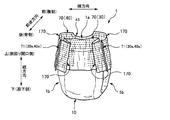
- FIG. 1 is a schematic perspective view of the diaper 1 when viewed from the front side.
- FIG. 2 is a schematic perspective view of the diaper 1 when viewed from the rear.
- FIG. 3 is a plan view of the diaper 1 in the unfolded and extended state.
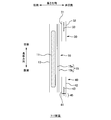
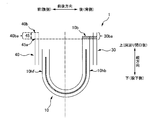
- FIG. 4 is a schematic cross-sectional view showing the YY cross section of FIG. Note that the “extended state” in FIG.
- each member constituting the diaper 1 for example, an abdominal waist part 40 described later. It means a state in which the dimensions have been extended until the dimension becomes equal to or close to that of the single member.
- FIG. 4 in order to demonstrate the cross-sectional structure of the diaper 1, the actual structure is simplified and displayed. For example, the size of each member such as the ventral waist part 40 and the number of ventral elastic members 43 may differ from those of the actual diaper 1.
- the diaper 1 is a pants-type disposable diaper mainly for newborns.
- the diaper 1 In the pant-type state shown in FIGS. 1 and 2, the diaper 1 has a vertical direction, a horizontal direction, and a front-rear direction as three directions orthogonal to each other. is doing.
- the upper side and the lower side in the vertical direction in the pants-type state are also referred to as the “trunk opening side” and the “inseam side”, respectively, and the front side and the rear side in the front-rear direction are respectively “ Also referred to as “ventral” and “dorsal”.
- the diaper 1 has a longitudinal direction and a width direction as three directions orthogonal to each other.
- the one side and the other side in the longitudinal direction in the developed state are also referred to as “abdominal side” and “back side”, respectively.
- deployment state is the same direction as said horizontal direction in a pants type state. Therefore, in the following, the width direction is also referred to as “lateral direction”.
- the longitudinal direction of the unfolded state is a direction along the longitudinal direction of the pants-type state.
- the direction perpendicular to the vertical direction (longitudinal direction) and the horizontal direction (width direction) is referred to as the “thickness direction”
- the side in contact with the skin of the wearer is referred to as “skin side”
- the opposite side is referred to as “non-skin” Side ".
- the diaper 1 according to the present embodiment is a so-called three-piece type and has three parts. That is, this diaper 1 has an absorbent main body 10 that is applied to the crotch part of the wearer and absorbs excrement such as urine as the first part, and the back side part of the wearer as the second part. It has the back side waistline part 30 to cover, and has the abdominal side waistline part 40 which covers the wearer's abdomen side part as 3rd components.
- the dorsal waist part 30 and the abdominal waist part 40 are arranged in parallel in the longitudinal direction (vertical direction in the deployed state) with an interval therebetween, and the absorbent main body 10 therebetween. Is over.
- the back side waistline part 30 is being fixed to the one end part 10a of the absorptive main body 10
- the abdominal side waistline part 40 is being fixed to the other end part 10b
- the external appearance shape has comprised the planar view substantially H shape.
- the back waistline portion 30 is located on one end side of the absorbent main body 10
- the ventral waistline portion 40 is located on the other end side of the absorbent main body 10.
- the absorptive main body 10 is folded in half with the central position (longitudinal direction center position CL in FIG. 3) of the diaper 1 in the longitudinal direction (that is, the longitudinal direction) as the folding position.
- the back waistline portion 30 and the abdominal waistline portion 40 that are opposed to each other in the folded state are joined and connected at the lateral edges 30a, 40a, whereby the annular waistline portion 70 is formed. That is, the waist part 70 of the diaper 1 is connected (joined) by the locking part 71 between the back side edges 30a in the lateral direction of the back side waist part 30 and the stomach side edges 40a in the lateral direction of the stomach side waist part 40. It is formed by being.
- the underpants type diaper 1 in which the waist opening 1a and the pair of leg openings 1b as shown in FIG. 1 are formed.
- locking part 71 is formed by the back side both edge parts 30a and the abdominal side both edge parts 40a being welded, or adhere
- the three parts will be described in the order of the absorbent main body 10, the ventral waist part 40, and the back waist part 30.
- the absorbent main body 10 corresponds to the wearer's crotch (inseam) and is intended to absorb excrement such as urine.
- the absorbent main body 10 has a rectangular shape in plan view, and is provided such that the longitudinal direction (long side direction) is along the longitudinal direction.
- the absorptive main body 10 is the absorber 11, the top sheet
- a back sheet member 15 forming an exterior.
- the absorber 11 is a member (absorbent core) formed by laminating liquid absorbent materials and can absorb excrement such as urine.
- the absorber 11 has a pulp (pulp fiber) and an absorbent polymer (SAP).
- SAP absorbent polymer
- the absorber 11 according to the present embodiment has a substantially hourglass shape in plan view.
- the absorbent body 11 in the deployed state includes a recessed portion 12 that is recessed inward in the lateral direction at the central portion in the longitudinal direction of the absorbent body 11, and the width of the absorbent body 11 is the narrowest in the recessed portion 12. ing.
- the vertical direction position of the hollow part 12 is the abdominal side waistline part 40 side rather than the longitudinal direction center position CL in FIG.
- the absorber 11 may be coat
- the top sheet member 13 is a sheet member made of, for example, a liquid-permeable nonwoven fabric having a larger planar size than the absorbent body 11.
- the back sheet member 15 is, for example, a sheet member having a larger plane size than the absorbent body 11.
- the back sheet member 15 includes a liquid-impermeable leak-proof sheet 15 a such as polyethylene or polypropylene, and an outer layer sheet 15 b such as a nonwoven fabric.
- a laminated sheet having a two-layer structure is exemplified. In the state where the absorber 11 is sandwiched between the back sheet member 15 and the top sheet member 13, the back sheet member 15 and the top sheet member 13 are framed at portions protruding outward from the four sides of the absorber 11. Thus, the absorbent main body 10 is formed.
- the back sheet member 15 may not include the outer layer sheet 15b and may be configured only by the leak-proof sheet 15a.
- a pair of leg-around members 26 are provided at portions located on both sides of the absorbent main body 10 in the lateral direction.
- Each leg member 26 is provided with leg gathers LG (leg extension / contraction parts) that extend and contract along the vertical direction.
- the leg gather LG is formed of a non-woven fabric and includes an elastic member (specifically, thread rubber. For convenience, it is referred to as LG thread rubber 26a) that extends and contracts along the vertical direction.
- LG thread rubber 26a an elastic member that extends and contracts along the vertical direction.
- the leg gather LG is comprised when the said LG thread rubber 26a provides elasticity to the leg periphery member 26. As shown in FIG.
- leg side gathers LSG three-dimensional gathers
- LG leg leg members 26
- the leg side gather LSG is provided on the skin side of the absorbent main body 10 and plays a role of preventing liquid leakage from the gap between the leg rolls.
- Leg side gather LSG is formed with the nonwoven fabric.
- the leg side gather LSG is provided with a vertex 28 at the inner end of the leg side gather LSG in the lateral direction of the absorbent main body 10, and the vertex 28 and the nonwoven fabric outside the vertex 28 rise up.
- an elastic member specifically, thread rubber; for convenience, referred to as LSG thread rubber 29
- LSG thread rubber 29 is provided at the apex 28 of the leg side gather LSG.
- the ventral waist part 40 has a sheet-like member corresponding to the wearer's abdomen.
- the ventral waist part 40 is a rectangular sheet in plan view made of a nonwoven fabric or the like, and is provided such that the longitudinal direction (long side direction) is along the lateral direction.
- the ventral waist part 40 is bonded to each other using an adhesive such as a hot melt adhesive in a state where the inner layer sheet 41 and the outer layer sheet 42 are overlapped from the skin side in the thickness direction. It is formed by.
- the inner layer sheet 41 and the outer layer sheet 42 may be a single member (the same member), and the ventral waistline portion 40 may be formed by folding and stacking a single member.
- the abdominal side waist part 40 is piled up on the other end part 10b of the absorptive main body 10, and is joined and fixed using the same adhesive.
- a portion of the abdominal waistline portion 40 overlapped with the absorbent main body 10 is provided at a central portion of the abdominal waistline portion 40 in the lateral direction.
- a notch 45 is provided in a central portion in the horizontal direction of the ventral waist part 40 and in an upper end portion 40ba in the vertical direction. This notch 45 is for preventing a wearer's navel (clip) attached to the navel from hitting the diaper 1.
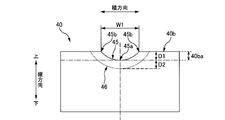
- FIG. 5 is a diagram for explaining the cut 45.
- the cut 45 according to the present embodiment is formed in an arc shape that is curved downward in the vertical direction as shown in FIG.
- the vertical depth D1 of the cut 45 is represented by the distance between the vertical upper end 40b of the ventral waist part 40 and the vertical lower end 45a of the cut 45. That is, the depth D1 is the maximum length in the vertical direction of the cut 45, and is about 15 mm, for example.
- the region D1 from the upper end 40b in the vertical direction of the ventral waist part 40 is the upper end 40ba of the ventral waist part 40.
- the width W1 in the horizontal direction of the cut 45 is represented by the distance between the two side ends 45b where the vertical upper end 40b of the ventral waist part 40 and the cut 45 intersect. That is, the width W1 is the maximum horizontal length of the cut 45. In the present embodiment, the width W1 is, for example, about 85 mm.
- the width W1 is smaller than the maximum width W11 (120 mm) of the absorbent body 11 described above, and both side edges 45b of the notches 45 are located inward in the lateral direction with respect to the widest side edge 11es of the absorbent body 11. (See FIG. 2). Note that the lengths of the depth D1 and the width W1 are lengths measured in a state where the ventral waist part 40 is extended as shown in FIG.
- the ventral waist part 40 has an edge 46 that is an area having a predetermined width including the outer edge of the cut 45.
- the edge 46 is a region indicated by a dotted line in FIG. 5, and is provided in a range of a distance D ⁇ b> 2 from the outer edge of the cut 45. That is, the edge 46 is a region having a width D2 along the shape of the cut 45.
- the width D2 of the edge 46 is a length equal to or less than the depth D1 of the cut 45, and the minimum value of the width D2 is about 2 mm (D1 ⁇ D2 ⁇ 2 mm).
- the cut 45 does not necessarily have an arc shape as shown in FIG. 5, and the shape is not limited.
- 6A and 6B are diagrams for describing a modification of the shape of the cut 45.
- the cut 45 is formed in a rectangular shape having a depth D1 and a width W1.
- the edge 46 is provided in the region having the width D ⁇ b> 2 including the outer edge of the notch 45.
- the cut 45 is formed as a linear slit having a predetermined length in the vertical direction. In this case, the edge 46 surrounds the outer edge of the cut 45 as shown by the dotted line in FIG. 6B.
- the cut 45 is a slit as shown in FIG. 6B
- the cut 45 is also in the horizontal direction as the abdominal waistline 40 is extended in the horizontal direction when the diaper 1 is worn.
- the slit is deformed into a V-shape by being pulled to both sides and opening the upper side in the vertical direction in the horizontal direction. Thereby, a wearer's navel etc. can be made not to hit the ventral side waist part 40 at the time of wearing of the diaper 1.
- the ventral waist part 40 is provided with a ventral elastic member 43 that expands and contracts in the lateral direction.
- the ventral elastic member 43 is, for example, a plurality of thread rubbers or stretchable urethanes arranged in the vertical direction, and is bonded and fixed to the ventral waist part 40 with an adhesive while being stretched in the horizontal direction. And the elastic property of a horizontal direction is provided to the waist part 70 (abdominal side waist part 40) of the diaper 1 by this.
- the abdominal elastic member 43a disposed at the upper end 40ba in the longitudinal direction of the abdominal waist part 40 has a portion that overlaps with the cut 45 at the lateral center.
- the two ventral elastic members 43 a and 43 a are arranged side by side in the vertical direction (longitudinal direction in the unfolded state) so as to overlap with the notches 45. Accordingly, the two ventral elastic members 43a and 43a are cut in a region overlapping with the notch 45, and the stretchability of the ventral elastic member 43a acts on the ventral waist part 40 in the overlapping region.
- ventral elastic member 43 that imparts stretchability to the ventral waist part 40
- a sheet member for example, a stretchable nonwoven fabric
- the inner layer sheet 41 and the outer layer sheet 42 constituting the ventral waist part 40 may be configured by a sheet member (for example, a stretchable nonwoven fabric) that can be stretched in the lateral direction.
- the back waist part 30 has a sheet-like member corresponding to the wearer's back.
- the dorsal waist part 30 is a rectangular sheet in plan view made of nonwoven fabric or the like, and is provided such that the longitudinal direction (long side direction) is along the lateral direction.
- the back waistline portion 30 is bonded to each other using an adhesive such as a hot melt adhesive in a state where the inner layer sheet 31 and the outer layer sheet 32 are overlapped from the skin side in the thickness direction. It is formed by.
- the inner layer sheet 31 and the outer layer sheet 32 may be a single member (same member), and the back waistline portion 30 may be formed by folding and stacking a single member.
- the back side waist part 30 is piled up on the one end part 10a of the absorptive main body 10, and is joined and fixed. A portion of the back side waistline 30 that is overlapped with the absorbent main body 10 is provided at the center of the back side waistline 30 in the lateral direction.
- the upper end 30ba of the back waist part 30 is not provided with a cut.
- the notch 45 is provided for the purpose of preventing the wearer's navel or the like from hitting the diaper 1, and therefore it is not necessary to provide an incision corresponding to the notch 45 on the back side. is there.
- the upper end portion 30ba is a region corresponding to the upper end portion 40ba of the abdominal waistline portion 40.
- the region from the longitudinal upper end 30b of the backside waistline portion 30 to D1 is the region of the back waistline portion 30. This is the upper end 30ba.
- the dorsal waist part 30 is provided with a dorsal elastic member 33 that expands and contracts along the lateral direction, like the ventral waist part 40 (see FIG. 3).
- the back side elastic member 33 is made of thread rubber or the like similar to that of the abdominal side elastic member 43, and is bonded and fixed to the back side waistline portion 30 with an adhesive while being extended in the lateral direction.
- the stretchability in the lateral direction is imparted to the waistline portion 70 (the back side waistline portion 30) of the diaper 1.
- the back-side elastic members 33 a and 33 a disposed at the upper end 30 ba in the vertical direction of the back-side waistline 30 are disposed across the entire lateral direction of the back-side waistline 30. ing. That is, the dorsal elastic member 33a arranged at the dorsal upper end portion 30ba does not overlap with the cut 45 unlike the ventral elastic member 43a arranged at the ventral upper end portion 40ba. Without being done, stretchability is imparted over the entire lateral direction of the back waistline 30.
- a sheet member for example, a stretchable nonwoven fabric
- thread rubber or the like a sheet member that can be stretched in the lateral direction.
- the inner layer sheet 31 and the outer layer sheet 32 themselves constituting the back waistline portion 30 may be configured by a sheet member (for example, a stretchable nonwoven fabric) that can be stretched in the lateral direction.
- the waist part 70 (the back waist part 30 and the abdomen waist part 40) of the diaper 1 is bent in the lateral direction by a plurality of bending parts 170 formed along the vertical direction. ing.
- the waistline portion 70 is bent, the waistline portion 70 is prevented from greatly projecting outward in the lateral direction of the absorbent main body 10, and the entire diaper 1 is folded compactly.
- the bent portion 170 will be described.
- FIG. 7 is a front view of the diaper 1 when viewed from the front side.
- FIG. 8 is a schematic cross-sectional view showing the AA cross section of FIG.
- FIG. 9 is a schematic cross-sectional view showing the BB cross section of FIG.
- FIG. 7 shows the shape of the diaper 1 in a natural state.
- the “natural state” is defined as follows. First, after taking out the diaper 1 packaged as a product from the package, the waistline portion 70 is pulled to both sides in the lateral direction, and the waistline portion 70 is a dimension of a single member of the back side waistline portion 30 and the abdominal side waistline portion 40. Extend until matched or close.
- FIG. 8 and 9 the portion of the absorbent main body 10 located on the front side (abdominal side) of the front-rear direction center is the abdominal side portion 10hf, and the rear side of the front-rear direction center (back). The portion located on the side) is defined as the back side portion 10hb.
- the waist portion 70 of the diaper 1 in the natural state includes a pair of outer bent portions 171 and 171 formed at the outermost side in the horizontal direction and a pair of inner sides formed at the innermost side in the horizontal direction. Bending portions 172 and 172.
- the outer bent portion 171 is disposed at a position on the outer side in the lateral direction with respect to the lateral end 10 es of the absorbent main body 10.
- the waistline portion 70 (abdomen side waistline portion 40) is bent from the outside in the lateral direction to the inside and from the front side (abdomen side) in the front-rear direction to the rear side (back side).
- the inner bent portion 172 is formed such that the waistline portion 70 (the back side waistline portion 30) bent to the rear side (back side) is folded back on the back side of the diaper 1. Accordingly, the waistline portion 70 (the back waistline portion 30) is bent in a substantially Z shape as shown in FIG. 8 on both the back side and the lateral direction of the diaper 1, and the inside bent portion 172 of the plurality of bent portions 170 is formed. It is formed at the innermost side in the lateral direction.
- the mechanism by which the outer bent portion 171 and the inner bent portion 172 are formed is as follows. On the rear side (back side) of the waistline portion 70, a force is exerted to contract the entire upper end portion 30ba of the waistline portion 70 in the lateral direction due to the elasticity of the back side elastic member 33a disposed on the upper end portion 30ba. . On the other hand, on the front side (abdomen side) of the waistline portion 70, a part of the abdomen elastic member 43a disposed in the upper end portion 40ba is cut away by the notch 45, and the upper end portion 40ba of the waistline portion 70 is cut. Among them, in the region where the cut 45 is provided, the contraction force by the ventral elastic member 43a is not acting.
- the contraction force acting on the front upper end portion 40ba of the waistline portion 70 is weaker than the contraction force acting on the rear upper end portion 30ba of the waistline portion 70.
- the waistline portion 70 is easily pulled to the rear side (back side), and the outer periphery bending portion 171 is formed by bending the waistline portion 70 to the rear side at the outermost position in the lateral direction.
- the waist part 70 bends to the rear side along the lateral end 10es of the absorbent main body 10 having a large rigidity difference.
- the waist portion 70 is bent as shown in FIG. 8 between the lateral end 10 es of the absorbent main body 10 and the outer bent portion 171, and an inner bent portion 172 is formed on the rear side of the absorbent main body 10.
- the inner bent portion 172 is located on the rear side of the back side portion 10 hb of the absorbent main body 10, but the position of the inner bent portion 172 depends on the conveyance conditions during the manufacture of the diaper 1. May be displaced from the position of FIG.
- the pair of inner bent portions 172 may be formed on the outer side in the lateral direction from the absorbent main body 10 (not shown).
- the inner bent portion 172 is located on the rear side of at least the ventral portion 10 hf of the absorbent main body 10.
- the diaper 1 can be made compact as a whole as shown in FIG.
- the waist part 70 is folded to the rear side (back side) in the front-rear direction, the cut 45 provided on the abdomen side of the waist part 70 is hidden by the folded waist part 70 (for example, the inner folding part 172). Is suppressed. Thereby, the user can visually recognize the cut 45 even when the diaper 1 is folded.
- the shape of the cut 45 is formed on the front side (belly side) of the waistline portion 70. It is maintained without significant deformation. That is, it is possible to easily grasp the entire shape of the cut 45 at a glance because a part of the cut 45 is prevented from being bent and overlapped with the bent portion 170.
- the lateral side end 10es of the absorbent main body 10 is positioned outside the cut 45. That is, the lateral width W10 of the absorbent main body 10 is larger than the lateral width W1 of the cut 45 (W10> W1).
- the waistline portion 70 is less likely to contract in the horizontal direction due to the rigidity of the absorbent main body 10. Therefore, by arranging the cut 45 in the region overlapping the absorbent main body 10 in the lateral direction, the cut 45 is also less likely to contract in the lateral direction, and the shape as shown in FIG. 5 is more easily maintained. . Thereby, visibility improves.
- the absorptive main body 10 may be bent and deform
- a part of the cut 45 (for example, both end portions in the lateral direction of the cut 45) is suppressed from being bent by the outer bent portion 171.
- the entire shape of the cut 45 in a state in which the shape is maintained can be visually recognized, and the user can determine the position and shape of the cut 45 provided in the diaper 1. Can be recognized more clearly.
- the pair of inner bent portions 172 and 172 do not overlap with each other in the front-rear direction. In other words, a predetermined interval is provided between the pair of inner bent portions 172 and 172 in the lateral direction (see FIG. 8). Since the notch 45 is not provided on the rear side of the waist part 70 of the diaper 1, the notch 45 is not visually recognized in the region between the pair of inner bent portions 172 and 172 in the lateral direction. Therefore, the user can easily confirm that the cut 45 is not provided on the rear side of the waistline portion 70 even in the folded state without unfolding the folded waistline portion 70. In addition, on the front side of the waistline portion 70, the cut 45 can be clearly seen as described above. Therefore, the user can confirm the presence or absence of the notch 45 without having to unfold the folded waist portion 70, and can easily determine the front-rear direction of the diaper 1.
- the position where the upper end 10b in the vertical direction of the absorbent main body 10 is provided on the rear side (back side) of the waist part 70 is more than the position of the lower end 45a in the vertical direction of the cut 45. It is the upper side.
- the rear side (back side) of the waistline portion 70 at least a part of the absorbent main body 10 and the upper end portion 30ba of the backside waistline portion 30 overlap.
- the upper end 10b in the vertical direction of the absorbent main body 10 and the upper end 30ba of the dorsal waist part 30 overlap in the region indicated by the hatched portion in FIG.
- the lateral width of the waistline portion 70 at the upper end in the longitudinal direction is narrower than the lateral width of the waistline portion 70 at the lower end in the longitudinal direction, and the pair of outer bent portions 171. , 171 have a substantially C-shaped appearance as shown in FIG.
- the lateral width is reduced in the vicinity of the waistline opening 1a (that is, the upper end portions 30ba and 40ba), and the diaper 1 is easily packed in a compact shape.
- the proportion of the cuts 45 occupying the lateral direction of the upper end portion 40ba becomes relatively large, and the cuts 45 are easily noticeable. Become. Thereby, it becomes easy to guide the user's line of sight to the cut 45, and the cut 45 can be more easily recognized.
- the locking portion 71 that connects the back waistline portion 30 and the abdominal waistline portion 40 with the absorber 11 in the front-rear direction in a state in which the bent portion 170 (171, 172) is formed on the waistline portion 70. Arranged in positions that do not overlap.
- the pair of locking portions 71, 71 provided on the waistline portion 70 are both positioned on the outer side in the lateral direction with respect to the absorbent body 11 (the absorbent main body 10).
- a portion where the locking portion 71 is formed has a predetermined thickness by welding or the like, and has higher rigidity than other regions of the waistline portion 70.
- locking part 71 has overlapped with the absorber 11 in the front-back direction (thickness direction), when the force which compresses the diaper 1 in the front-back direction at the time of packing etc. acts, it absorbs in an overlap part. There is a possibility that the body 11 is pressed and fixed by the locking portion 71. And when the absorber 11 is pressed and hardened, there exists a possibility that absorption performance, such as excrement, may deteriorate, or the fitting property at the time of mounting
- the diaper 1 of the present embodiment when the bent portion 170 is formed in the waistline portion 70 in the natural state, the locking portion 71 and the absorber 11 do not overlap in the vertical direction. The problem of being pressed is less likely to occur.
- the diaper 1 of this embodiment protrudes so that the center of a horizontal direction may protrude frontward rather than the both ends of the horizontal direction of the absorptive main body 10 in a natural state (refer FIG. 8). This is because the shrinkage force acting on the rear upper end 30ba of the waistline portion 70 is larger than the contraction force acting on the front upper end portion 40ba as described above, and the waistline portion 70 is pulled rearward. By being done.
- the waistline portion 70 (ventral side waistline portion 40) is joined to the waistline portion 70 in response to the action of pulling the waistline portion 70 (ventral side waistline portion 40) to both sides in the lateral direction and to the rear side in the front-rear direction.
- a similar force acts on the absorbed body 11 and both sides of the absorbent body 11 in the lateral direction are pulled rearward in the front-rear direction.
- the contraction force acting on the waist part 70 (back side waist part 30) also acts on the absorbent body 11, and both lateral sides of the absorbent body 11 are pulled rearward in the front-rear direction. It is done.
- the absorbent main body 10 is deformed into a mountain shape so as to be convex forward. Accordingly, the cut 45 provided on the front side of the diaper 1 appears to protrude forward, and the user can more easily visually recognize the cut 45.
- the outer edge of the cut 45 may be trimmed in the ventral waist part 40.
- at least a part of the edge 46 including the outer edge of the notch 45 and a region around the edge 46 in the ventral waistline portion 40 are the outer edges of the edge 46.
- the colors are different from each other.
- the edge 46 is colored by coloring the edge 46 of the ventral waistline 40 as shown by the hatched portion in FIG. 7 or by joining a member different from the ventral waistline 40 to the edge 46. And the color of the portion other than the edge 46 are made different. If it does in this way, the outer edge of the cut 45 will become conspicuous, and it will become easy for a user to recognize that the cut 45 is provided in the diaper 1 at a glance.
- the back side elastic member 33 and the abdominal side elastic member 43 provided in the waist part 70 are configured not to exhibit stretchability in a part of the region overlapping with the absorbent body 11.
- a part of the abdominal elastic member 43 is cut at the inner side in the longitudinal direction of the ventral elastic member 43 (the lower region in the vertical direction in FIG. 1) and at the center in the width direction. The elastic force by the side elastic member 43 is not acting.
- a part of the back side elastic member 33 is cut at the inner side in the longitudinal direction of the back side elastic member 33 (lower region in the vertical direction in FIG. 2) and at the center in the width direction. The elastic force by the elastic member 33 is not acting.
- the elastic members 33 and 43 may be cut at one place in the lateral direction, or may be cut at a plurality of places. Thereby, it is suppressed that the absorber 11 shrink
- the so-called three-piece type diaper 1 constituted by the three parts 10, 30, and 40 has been described as an example of the disposable diaper.
- the type of the disposable diaper is not limited to this.
- the present invention can also be applied to a pants-type disposable diaper composed of two parts, an integrated exterior member in which the abdominal waist part 40 and the back waist part 30 are integrally formed, and the absorbent main body 10. .
- a cut is provided in the central portion in the horizontal direction and the upper end portion in the vertical direction of the waist portion on the abdomen side of the integrated exterior member.
- seat member which comprises an integrated exterior member (namely, waist part) bends similarly to the above-mentioned embodiment, and can make a user recognize the notch 45 easily.
Landscapes
- Health & Medical Sciences (AREA)
- Vascular Medicine (AREA)
- Epidemiology (AREA)
- Engineering & Computer Science (AREA)
- Biomedical Technology (AREA)
- Heart & Thoracic Surgery (AREA)
- Life Sciences & Earth Sciences (AREA)
- Animal Behavior & Ethology (AREA)
- General Health & Medical Sciences (AREA)
- Public Health (AREA)
- Veterinary Medicine (AREA)
- Dermatology (AREA)
- Absorbent Articles And Supports Therefor (AREA)
- Orthopedics, Nursing, And Contraception (AREA)
Abstract
Description
本実施形態で扱う使い捨ておむつの一例として、パンツ型使い捨ておむつ1(以下、単に「おむつ1」とも呼ぶ)の基本的な構成について説明する。図1は、おむつ1を前側から見たときの概略斜視図である。図2は、おむつ1を後方から見たときの概略斜視図である。図3は、展開かつ伸長状態であるおむつ1の平面図である。図4は、図3のY-Y断面について表す概略断面図である。なお、図3における「伸長状態」とは、製品(おむつ1)を皺無く伸長させた状態、具体的には、おむつ1を構成する各部材(例えば、後述する腹側胴回り部40等)の寸法がその部材単体の寸法と一致又はそれに近い長さになるまで伸長した状態のことを言う。また、図4ではおむつ1の断面構造を説明するために、実際の構造を簡略化して表示している。例えば、腹側胴回り部40等の各部材の大きさや腹側弾性部材43の数量等は、実際のおむつ1とは異なる場合がある。
おむつ1の胴回り部70(背側胴回り部30及び腹側胴回り部40)は、図1や図2に示されるように、縦方向に沿って形成された複数の折り曲げ部170によって横方向に折れ曲がっている。胴回り部70が折れ曲がることにより、吸収性本体10の横方向外側に胴回り部70が大きく突出することが抑制され、おむつ1の全体がコンパクトに折り畳まれる。以下、折り曲げ部170について説明する。
以上、本発明の実施形態について説明したが、上記の実施形態は、本発明の理解を容易にするためのものであり、本発明を限定して解釈するためのものではない。また、本発明は、その趣旨を逸脱すること無く、変更や改良され得るとともに、本発明にはその等価物が含まれるのは言うまでも無い。例えば、以下に示すような変形が可能である。
10 吸収性本体、10a 一端部、10b 他端部(上端)、10es 側端、
10hb 背側部、10hf 腹側部、
11 吸収体、11es 側端、
12 窪み部、
13 トップシート部材、
15 バックシート部材、15a 防漏シート、15b 外層シート、
26 脚回り部材、26a LG糸ゴム、
28 頂点、29 LSG糸ゴム、
30 背側胴回り部、30a 縁部、30b 上端、30ba 上端部、
31 内層シート、32 外層シート、
33 背側弾性部材、33a 背側弾性部材、
40 腹側胴回り部、40a 縁部、40b 上端、40ba 上端部、
41 内層シート、42 外層シート、
43 腹側弾性部材、43a 腹側弾性部材、
45 切り込み、45a 下端、45b 側端、
46 縁部、
70 胴回り部、71 係止部、
170 折り曲げ部、171 外側折り曲げ部、172 内側折り曲げ部、
LG レッグギャザー、
LSG レッグサイドギャザー、
W1 幅(切り込み)、W10 幅(吸収性本体)、W11 幅(吸収体)
Claims (10)
- 互いに交差する縦方向と横方向と前後方向と、を有し、
着用者の胴回りに配置される胴回り部と、排泄物を吸収する吸収性本体と、を備える使い捨ておむつであって、
前記胴回り部の前記縦方向の上端部に、前記横方向に伸縮する弾性部材を有し、
前記胴回り部の前記前後方向の前側かつ前記縦方向の前記上端部に、切り込みを有し、
前記胴回り部は、前記横方向に折れ曲がった複数の折り曲げ部を有し、
前記複数の折り曲げ部は、前記横方向の最も内側に形成されている一対の内側折り曲げ部と、前記横方向の最も外側に形成されている一対の外側折り曲げ部を有し、
前記吸収性本体は、前記前後方向の中央よりも前側に位置する腹側部と、前記前後方向の中央よりも後側に位置する背側部と、を有し、
前記一対の内側折り曲げ部は、前記吸収性本体の前記腹側部よりも前記前後方向の後側に位置しており、
前記一対の外側折り曲げ部は、前記横方向において、前記切り込みよりも外側に設けられている、ことを特徴とする使い捨ておむつ。 - 請求項1に記載の使い捨ておむつであって、
前記一対の内側折り曲げ部は、前記前後方向において互いに重複していない、ことを特徴とする使い捨ておむつ。 - 請求項1または2に記載の使い捨ておむつであって、
前記吸収性本体の前記横方向の端部は、前記横方向において前記切り込みよりも外側に配置されている、ことを特徴とする使い捨ておむつ。 - 請求項3に記載の使い捨ておむつであって、
前記一対の外側折り曲げ部は、前記横方向において前記吸収性本体の前記横方向の端部よりも外側に配置されている、ことを特徴とする使い捨ておむつ。 - 請求項1~4のいずれかに記載の使い捨ておむつであって、
前記胴回り部の前記前後方向の後側において、前記吸収性本体の前記縦方向の上端の位置は、
前記縦方向において、前記切り込みの前記縦方向の下端の位置よりも上側である、ことを特徴とする使い捨ておむつ。 - 請求項1~5のいずれかに記載の使い捨ておむつであって、
前記縦方向の上端における前記胴回り部の前記横方向の幅は、
前記縦方向の下端における前記胴回り部の前記横方向の幅よりも狭い、ことを特徴とする使い捨ておむつ。 - 請求項1~6のいずれかに記載の使い捨ておむつであって、
前記胴回り部は、腹側胴回り部と背側胴回り部とを有し、
前記腹側胴回り部の前記横方向の両端部と、前記背側胴回り部の前記横方向の両端部とは、一対の係止部によって互いに接合されており、
前記吸収性本体は、液体吸収性素材が積層された吸収体を有し、
前記一対の係止部は、前記横方向において、前記吸収体よりも外側に設けられている、ことを特徴とする使い捨ておむつ。 - 請求項7に記載の使い捨ておむつであって、
前記胴回り部は、前記縦方向において前記切り込みが設けられている領域よりも下側の領域に前記弾性部材を更に有し、
前記前後方向において前記弾性部材と前記吸収性本体とが重複する領域のうち少なくとも前側の領域では、前記弾性部材による弾性力が作用していない部分がある、ことを特徴とする使い捨ておむつ。 - 請求項1~8のいずれかに記載の使い捨ておむつであって、
前記胴回り部の前側における前記切り込みの外縁を含む縁部の少なくとも一部の領域と、前記胴回り部の前側における前記縁部の周囲の領域とが、互いに異なる色を有している、ことを特徴とする使い捨ておむつ。 - 請求項1~9のいずれかに記載の使い捨ておむつであって、
前記吸収性本体は、前記横方向の中央部が前記横方向の両端部よりも前記縦方向の前側に出っ張っている、ことを特徴とする使い捨ておむつ。
Priority Applications (4)
| Application Number | Priority Date | Filing Date | Title |
|---|---|---|---|
| CN201780018080.5A CN109069310A (zh) | 2016-03-14 | 2017-02-03 | 一次性尿布 |
| BR112018068093-1A BR112018068093B1 (pt) | 2016-03-14 | 2017-02-03 | Fralda descartável |
| MYPI2018703068A MY185552A (en) | 2016-03-14 | 2017-02-03 | Disposable diaper |
| EA201892056A EA038498B1 (ru) | 2016-03-14 | 2017-02-03 | Одноразовый подгузник |
Applications Claiming Priority (2)
| Application Number | Priority Date | Filing Date | Title |
|---|---|---|---|
| JP2016-050305 | 2016-03-14 | ||
| JP2016050305A JP6676422B2 (ja) | 2016-03-14 | 2016-03-14 | 使い捨ておむつ |
Publications (1)
| Publication Number | Publication Date |
|---|---|
| WO2017159105A1 true WO2017159105A1 (ja) | 2017-09-21 |
Family
ID=59852203
Family Applications (1)
| Application Number | Title | Priority Date | Filing Date |
|---|---|---|---|
| PCT/JP2017/003975 Ceased WO2017159105A1 (ja) | 2016-03-14 | 2017-02-03 | 使い捨ておむつ |
Country Status (6)
| Country | Link |
|---|---|
| JP (1) | JP6676422B2 (ja) |
| CN (1) | CN109069310A (ja) |
| BR (1) | BR112018068093B1 (ja) |
| EA (1) | EA038498B1 (ja) |
| MY (1) | MY185552A (ja) |
| WO (1) | WO2017159105A1 (ja) |
Citations (7)
| Publication number | Priority date | Publication date | Assignee | Title |
|---|---|---|---|---|
| US4230113A (en) * | 1978-07-17 | 1980-10-28 | Khusal Mehta | Infant's diaper |
| WO2001001904A1 (en) * | 1999-06-30 | 2001-01-11 | The Procter & Gamble Company | Disposable, absorbent, pull-on pants |
| JP2002136545A (ja) * | 2000-10-31 | 2002-05-14 | Uni Charm Corp | パンツ型の使い捨て着用物品 |
| JP2004123171A (ja) * | 2002-10-02 | 2004-04-22 | Uni Charm Corp | おむつ収納パッケージ |
| US20100152694A1 (en) * | 2008-12-15 | 2010-06-17 | Sara Jane Wille Stabelfeldt | Absorbent article with waist relief feature |
| WO2011078051A1 (ja) * | 2009-12-25 | 2011-06-30 | ユニ・チャーム株式会社 | 着用物品 |
| WO2012043082A1 (ja) * | 2010-09-30 | 2012-04-05 | ユニ・チャーム株式会社 | 使い捨て着用物品 |
Family Cites Families (3)
| Publication number | Priority date | Publication date | Assignee | Title |
|---|---|---|---|---|
| US8506546B2 (en) * | 2005-04-20 | 2013-08-13 | Kimberly-Clark Worldwide, Inc. | Diaper with umbilical feature |
| US8486038B2 (en) * | 2006-03-03 | 2013-07-16 | The Procter & Gamble Company | Disposable pull-on garment |
| JP5790051B2 (ja) * | 2011-03-18 | 2015-10-07 | 王子ホールディングス株式会社 | 使い捨ておむつ |
-
2016
- 2016-03-14 JP JP2016050305A patent/JP6676422B2/ja active Active
-
2017
- 2017-02-03 WO PCT/JP2017/003975 patent/WO2017159105A1/ja not_active Ceased
- 2017-02-03 EA EA201892056A patent/EA038498B1/ru unknown
- 2017-02-03 CN CN201780018080.5A patent/CN109069310A/zh active Pending
- 2017-02-03 BR BR112018068093-1A patent/BR112018068093B1/pt active IP Right Grant
- 2017-02-03 MY MYPI2018703068A patent/MY185552A/en unknown
Patent Citations (7)
| Publication number | Priority date | Publication date | Assignee | Title |
|---|---|---|---|---|
| US4230113A (en) * | 1978-07-17 | 1980-10-28 | Khusal Mehta | Infant's diaper |
| WO2001001904A1 (en) * | 1999-06-30 | 2001-01-11 | The Procter & Gamble Company | Disposable, absorbent, pull-on pants |
| JP2002136545A (ja) * | 2000-10-31 | 2002-05-14 | Uni Charm Corp | パンツ型の使い捨て着用物品 |
| JP2004123171A (ja) * | 2002-10-02 | 2004-04-22 | Uni Charm Corp | おむつ収納パッケージ |
| US20100152694A1 (en) * | 2008-12-15 | 2010-06-17 | Sara Jane Wille Stabelfeldt | Absorbent article with waist relief feature |
| WO2011078051A1 (ja) * | 2009-12-25 | 2011-06-30 | ユニ・チャーム株式会社 | 着用物品 |
| WO2012043082A1 (ja) * | 2010-09-30 | 2012-04-05 | ユニ・チャーム株式会社 | 使い捨て着用物品 |
Also Published As
| Publication number | Publication date |
|---|---|
| BR112018068093B1 (pt) | 2023-04-11 |
| BR112018068093A2 (pt) | 2019-04-09 |
| MY185552A (en) | 2021-05-19 |
| JP2017164071A (ja) | 2017-09-21 |
| CN109069310A (zh) | 2018-12-21 |
| JP6676422B2 (ja) | 2020-04-08 |
| EA201892056A1 (ru) | 2019-02-28 |
| EA038498B1 (ru) | 2021-09-07 |
Similar Documents
| Publication | Publication Date | Title |
|---|---|---|
| US11660237B2 (en) | Absorbent article | |
| JP5457829B2 (ja) | 使い捨て着用物品 | |
| US12324730B2 (en) | Disposable diaper | |
| JP5866045B1 (ja) | 吸収性物品 | |
| JP7268994B2 (ja) | 使い捨ておむつ | |
| WO2013161952A1 (ja) | 使い捨ておむつ | |
| JP7145838B2 (ja) | 吸収性物品 | |
| JP6468960B2 (ja) | パンツ型使い捨ておむつ | |
| WO2013089198A1 (ja) | 使い捨て着用物品 | |
| WO2019131268A1 (ja) | 吸収性物品 | |
| WO2019131269A1 (ja) | 吸収性物品 | |
| JP6035381B1 (ja) | パンツ型使い捨ておむつ | |
| CN112869954B (zh) | 吸收性物品的包装体 | |
| WO2019131285A1 (ja) | 吸収性物品 | |
| WO2017159105A1 (ja) | 使い捨ておむつ | |
| CN209122656U (zh) | 带裙围的一次性尿布 | |
| JP7217219B2 (ja) | 吸収性物品 | |
| WO2019131265A1 (ja) | 吸収性物品 | |
| JP3930967B2 (ja) | 使い捨て紙おむつ | |
| JP6573589B2 (ja) | パンツ型使い捨ておむつ | |
| JP6427482B2 (ja) | 使い捨ておむつ | |
| CN115486993A (zh) | 吸收性物品 | |
| JP2013132536A (ja) | 吸収性物品 | |
| WO2016104722A1 (ja) | 使い捨ておむつ |
Legal Events
| Date | Code | Title | Description |
|---|---|---|---|
| NENP | Non-entry into the national phase |
Ref country code: DE |
|
| WWE | Wipo information: entry into national phase |
Ref document number: 201892056 Country of ref document: EA |
|
| REG | Reference to national code |
Ref country code: BR Ref legal event code: B01A Ref document number: 112018068093 Country of ref document: BR |
|
| 121 | Ep: the epo has been informed by wipo that ep was designated in this application |
Ref document number: 17766113 Country of ref document: EP Kind code of ref document: A1 |
|
| REG | Reference to national code |
Ref country code: BR Ref legal event code: B01E Ref document number: 112018068093 Country of ref document: BR Free format text: SOLICITA-SE ESCLARECER A DIVERGENCIA NOS DADOS DO TITULAR DA PRIORIDADE REIVINDICADA, QUE CONSTA NA DECLARACAO INCLUIDA NA PETICAO INICIAL COMO ?HONDA MOTOR CO. LTD.?, DISTINTO DO DEPOSITANTE CONSTANTE DO FORMULARIO DE ENTRADA NA FASE NACIONAL E DO PEDIDO INTERNACIONAL WO/2017/159105, DE 21/09/2017. |
|
| ENP | Entry into the national phase |
Ref document number: 112018068093 Country of ref document: BR Kind code of ref document: A2 Effective date: 20180906 |
|
| 122 | Ep: pct application non-entry in european phase |
Ref document number: 17766113 Country of ref document: EP Kind code of ref document: A1 |