WO2017150488A1 - 発泡成形品補強用不織布 - Google Patents
発泡成形品補強用不織布 Download PDFInfo
- Publication number
- WO2017150488A1 WO2017150488A1 PCT/JP2017/007628 JP2017007628W WO2017150488A1 WO 2017150488 A1 WO2017150488 A1 WO 2017150488A1 JP 2017007628 W JP2017007628 W JP 2017007628W WO 2017150488 A1 WO2017150488 A1 WO 2017150488A1
- Authority
- WO
- WIPO (PCT)
- Prior art keywords
- reinforcing
- resin
- woven fabric
- nonwoven fabric
- layer
- Prior art date
- Legal status (The legal status is an assumption and is not a legal conclusion. Google has not performed a legal analysis and makes no representation as to the accuracy of the status listed.)
- Ceased
Links
Images

Classifications
-
- B—PERFORMING OPERATIONS; TRANSPORTING
- B32—LAYERED PRODUCTS
- B32B—LAYERED PRODUCTS, i.e. PRODUCTS BUILT-UP OF STRATA OF FLAT OR NON-FLAT, e.g. CELLULAR OR HONEYCOMB, FORM
- B32B5/00—Layered products characterised by the non- homogeneity or physical structure, i.e. comprising a fibrous, filamentary, particulate or foam layer; Layered products characterised by having a layer differing constitutionally or physically in different parts
- B32B5/22—Layered products characterised by the non- homogeneity or physical structure, i.e. comprising a fibrous, filamentary, particulate or foam layer; Layered products characterised by having a layer differing constitutionally or physically in different parts characterised by the presence of two or more layers which are next to each other and are fibrous, filamentary, formed of particles or foamed
- B32B5/24—Layered products characterised by the non- homogeneity or physical structure, i.e. comprising a fibrous, filamentary, particulate or foam layer; Layered products characterised by having a layer differing constitutionally or physically in different parts characterised by the presence of two or more layers which are next to each other and are fibrous, filamentary, formed of particles or foamed one layer being a fibrous or filamentary layer
- B32B5/245—Layered products characterised by the non- homogeneity or physical structure, i.e. comprising a fibrous, filamentary, particulate or foam layer; Layered products characterised by having a layer differing constitutionally or physically in different parts characterised by the presence of two or more layers which are next to each other and are fibrous, filamentary, formed of particles or foamed one layer being a fibrous or filamentary layer another layer next to it being a foam layer
-
- B—PERFORMING OPERATIONS; TRANSPORTING
- B29—WORKING OF PLASTICS; WORKING OF SUBSTANCES IN A PLASTIC STATE IN GENERAL
- B29C—SHAPING OR JOINING OF PLASTICS; SHAPING OF MATERIAL IN A PLASTIC STATE, NOT OTHERWISE PROVIDED FOR; AFTER-TREATMENT OF THE SHAPED PRODUCTS, e.g. REPAIRING
- B29C39/00—Shaping by casting, i.e. introducing the moulding material into a mould or between confining surfaces without significant moulding pressure; Apparatus therefor
- B29C39/02—Shaping by casting, i.e. introducing the moulding material into a mould or between confining surfaces without significant moulding pressure; Apparatus therefor for making articles of definite length, i.e. discrete articles
- B29C39/10—Shaping by casting, i.e. introducing the moulding material into a mould or between confining surfaces without significant moulding pressure; Apparatus therefor for making articles of definite length, i.e. discrete articles incorporating preformed parts or layers, e.g. casting around inserts or for coating articles
-
- B—PERFORMING OPERATIONS; TRANSPORTING
- B29—WORKING OF PLASTICS; WORKING OF SUBSTANCES IN A PLASTIC STATE IN GENERAL
- B29C—SHAPING OR JOINING OF PLASTICS; SHAPING OF MATERIAL IN A PLASTIC STATE, NOT OTHERWISE PROVIDED FOR; AFTER-TREATMENT OF THE SHAPED PRODUCTS, e.g. REPAIRING
- B29C48/00—Extrusion moulding, i.e. expressing the moulding material through a die or nozzle which imparts the desired form; Apparatus therefor
- B29C48/15—Extrusion moulding, i.e. expressing the moulding material through a die or nozzle which imparts the desired form; Apparatus therefor incorporating preformed parts or layers, e.g. extrusion moulding around inserts
- B29C48/154—Coating solid articles, i.e. non-hollow articles
-
- B—PERFORMING OPERATIONS; TRANSPORTING
- B32—LAYERED PRODUCTS
- B32B—LAYERED PRODUCTS, i.e. PRODUCTS BUILT-UP OF STRATA OF FLAT OR NON-FLAT, e.g. CELLULAR OR HONEYCOMB, FORM
- B32B27/00—Layered products comprising a layer of synthetic resin
- B32B27/12—Layered products comprising a layer of synthetic resin next to a fibrous or filamentary layer
-
- B—PERFORMING OPERATIONS; TRANSPORTING
- B32—LAYERED PRODUCTS
- B32B—LAYERED PRODUCTS, i.e. PRODUCTS BUILT-UP OF STRATA OF FLAT OR NON-FLAT, e.g. CELLULAR OR HONEYCOMB, FORM
- B32B3/00—Layered products comprising a layer with external or internal discontinuities or unevennesses, or a layer of non-planar shape; Layered products comprising a layer having particular features of form
- B32B3/02—Layered products comprising a layer with external or internal discontinuities or unevennesses, or a layer of non-planar shape; Layered products comprising a layer having particular features of form characterised by features of form at particular places, e.g. in edge regions
- B32B3/08—Layered products comprising a layer with external or internal discontinuities or unevennesses, or a layer of non-planar shape; Layered products comprising a layer having particular features of form characterised by features of form at particular places, e.g. in edge regions characterised by added members at particular parts
-
- B—PERFORMING OPERATIONS; TRANSPORTING
- B32—LAYERED PRODUCTS
- B32B—LAYERED PRODUCTS, i.e. PRODUCTS BUILT-UP OF STRATA OF FLAT OR NON-FLAT, e.g. CELLULAR OR HONEYCOMB, FORM
- B32B5/00—Layered products characterised by the non- homogeneity or physical structure, i.e. comprising a fibrous, filamentary, particulate or foam layer; Layered products characterised by having a layer differing constitutionally or physically in different parts
- B32B5/02—Layered products characterised by the non- homogeneity or physical structure, i.e. comprising a fibrous, filamentary, particulate or foam layer; Layered products characterised by having a layer differing constitutionally or physically in different parts characterised by structural features of a fibrous or filamentary layer
- B32B5/022—Non-woven fabric
-
- B—PERFORMING OPERATIONS; TRANSPORTING
- B32—LAYERED PRODUCTS
- B32B—LAYERED PRODUCTS, i.e. PRODUCTS BUILT-UP OF STRATA OF FLAT OR NON-FLAT, e.g. CELLULAR OR HONEYCOMB, FORM
- B32B5/00—Layered products characterised by the non- homogeneity or physical structure, i.e. comprising a fibrous, filamentary, particulate or foam layer; Layered products characterised by having a layer differing constitutionally or physically in different parts
- B32B5/18—Layered products characterised by the non- homogeneity or physical structure, i.e. comprising a fibrous, filamentary, particulate or foam layer; Layered products characterised by having a layer differing constitutionally or physically in different parts characterised by features of a layer of foamed material
-
- B—PERFORMING OPERATIONS; TRANSPORTING
- B32—LAYERED PRODUCTS
- B32B—LAYERED PRODUCTS, i.e. PRODUCTS BUILT-UP OF STRATA OF FLAT OR NON-FLAT, e.g. CELLULAR OR HONEYCOMB, FORM
- B32B5/00—Layered products characterised by the non- homogeneity or physical structure, i.e. comprising a fibrous, filamentary, particulate or foam layer; Layered products characterised by having a layer differing constitutionally or physically in different parts
- B32B5/18—Layered products characterised by the non- homogeneity or physical structure, i.e. comprising a fibrous, filamentary, particulate or foam layer; Layered products characterised by having a layer differing constitutionally or physically in different parts characterised by features of a layer of foamed material
- B32B5/20—Layered products characterised by the non- homogeneity or physical structure, i.e. comprising a fibrous, filamentary, particulate or foam layer; Layered products characterised by having a layer differing constitutionally or physically in different parts characterised by features of a layer of foamed material foamed in situ
-
- B—PERFORMING OPERATIONS; TRANSPORTING
- B32—LAYERED PRODUCTS
- B32B—LAYERED PRODUCTS, i.e. PRODUCTS BUILT-UP OF STRATA OF FLAT OR NON-FLAT, e.g. CELLULAR OR HONEYCOMB, FORM
- B32B5/00—Layered products characterised by the non- homogeneity or physical structure, i.e. comprising a fibrous, filamentary, particulate or foam layer; Layered products characterised by having a layer differing constitutionally or physically in different parts
- B32B5/22—Layered products characterised by the non- homogeneity or physical structure, i.e. comprising a fibrous, filamentary, particulate or foam layer; Layered products characterised by having a layer differing constitutionally or physically in different parts characterised by the presence of two or more layers which are next to each other and are fibrous, filamentary, formed of particles or foamed
- B32B5/24—Layered products characterised by the non- homogeneity or physical structure, i.e. comprising a fibrous, filamentary, particulate or foam layer; Layered products characterised by having a layer differing constitutionally or physically in different parts characterised by the presence of two or more layers which are next to each other and are fibrous, filamentary, formed of particles or foamed one layer being a fibrous or filamentary layer
-
- B—PERFORMING OPERATIONS; TRANSPORTING
- B32—LAYERED PRODUCTS
- B32B—LAYERED PRODUCTS, i.e. PRODUCTS BUILT-UP OF STRATA OF FLAT OR NON-FLAT, e.g. CELLULAR OR HONEYCOMB, FORM
- B32B7/00—Layered products characterised by the relation between layers; Layered products characterised by the relative orientation of features between layers, or by the relative values of a measurable parameter between layers, i.e. products comprising layers having different physical, chemical or physicochemical properties; Layered products characterised by the interconnection of layers
- B32B7/04—Interconnection of layers
- B32B7/12—Interconnection of layers using interposed adhesives or interposed materials with bonding properties
-
- B—PERFORMING OPERATIONS; TRANSPORTING
- B32—LAYERED PRODUCTS
- B32B—LAYERED PRODUCTS, i.e. PRODUCTS BUILT-UP OF STRATA OF FLAT OR NON-FLAT, e.g. CELLULAR OR HONEYCOMB, FORM
- B32B7/00—Layered products characterised by the relation between layers; Layered products characterised by the relative orientation of features between layers, or by the relative values of a measurable parameter between layers, i.e. products comprising layers having different physical, chemical or physicochemical properties; Layered products characterised by the interconnection of layers
- B32B7/04—Interconnection of layers
- B32B7/12—Interconnection of layers using interposed adhesives or interposed materials with bonding properties
- B32B7/14—Interconnection of layers using interposed adhesives or interposed materials with bonding properties applied in spaced arrangements, e.g. in stripes
-
- B—PERFORMING OPERATIONS; TRANSPORTING
- B29—WORKING OF PLASTICS; WORKING OF SUBSTANCES IN A PLASTIC STATE IN GENERAL
- B29C—SHAPING OR JOINING OF PLASTICS; SHAPING OF MATERIAL IN A PLASTIC STATE, NOT OTHERWISE PROVIDED FOR; AFTER-TREATMENT OF THE SHAPED PRODUCTS, e.g. REPAIRING
- B29C44/00—Shaping by internal pressure generated in the material, e.g. swelling or foaming ; Producing porous or cellular expanded plastics articles
-
- B—PERFORMING OPERATIONS; TRANSPORTING
- B29—WORKING OF PLASTICS; WORKING OF SUBSTANCES IN A PLASTIC STATE IN GENERAL
- B29K—INDEXING SCHEME ASSOCIATED WITH SUBCLASSES B29B, B29C OR B29D, RELATING TO MOULDING MATERIALS OR TO MATERIALS FOR MOULDS, REINFORCEMENTS, FILLERS OR PREFORMED PARTS, e.g. INSERTS
- B29K2023/00—Use of polyalkenes or derivatives thereof as moulding material
- B29K2023/04—Polymers of ethylene
- B29K2023/08—Copolymers of ethylene
- B29K2023/083—EVA, i.e. ethylene vinyl acetate copolymer
-
- B—PERFORMING OPERATIONS; TRANSPORTING
- B29—WORKING OF PLASTICS; WORKING OF SUBSTANCES IN A PLASTIC STATE IN GENERAL
- B29K—INDEXING SCHEME ASSOCIATED WITH SUBCLASSES B29B, B29C OR B29D, RELATING TO MOULDING MATERIALS OR TO MATERIALS FOR MOULDS, REINFORCEMENTS, FILLERS OR PREFORMED PARTS, e.g. INSERTS
- B29K2105/00—Condition, form or state of moulded material or of the material to be shaped
- B29K2105/0085—Copolymers
-
- B—PERFORMING OPERATIONS; TRANSPORTING
- B29—WORKING OF PLASTICS; WORKING OF SUBSTANCES IN A PLASTIC STATE IN GENERAL
- B29K—INDEXING SCHEME ASSOCIATED WITH SUBCLASSES B29B, B29C OR B29D, RELATING TO MOULDING MATERIALS OR TO MATERIALS FOR MOULDS, REINFORCEMENTS, FILLERS OR PREFORMED PARTS, e.g. INSERTS
- B29K2105/00—Condition, form or state of moulded material or of the material to be shaped
- B29K2105/04—Condition, form or state of moulded material or of the material to be shaped cellular or porous
-
- B—PERFORMING OPERATIONS; TRANSPORTING
- B32—LAYERED PRODUCTS
- B32B—LAYERED PRODUCTS, i.e. PRODUCTS BUILT-UP OF STRATA OF FLAT OR NON-FLAT, e.g. CELLULAR OR HONEYCOMB, FORM
- B32B2250/00—Layers arrangement
- B32B2250/02—2 layers
-
- B—PERFORMING OPERATIONS; TRANSPORTING
- B32—LAYERED PRODUCTS
- B32B—LAYERED PRODUCTS, i.e. PRODUCTS BUILT-UP OF STRATA OF FLAT OR NON-FLAT, e.g. CELLULAR OR HONEYCOMB, FORM
- B32B2262/00—Composition or structural features of fibres which form a fibrous or filamentary layer or are present as additives
- B32B2262/02—Synthetic macromolecular fibres
- B32B2262/0253—Polyolefin fibres
-
- B—PERFORMING OPERATIONS; TRANSPORTING
- B32—LAYERED PRODUCTS
- B32B—LAYERED PRODUCTS, i.e. PRODUCTS BUILT-UP OF STRATA OF FLAT OR NON-FLAT, e.g. CELLULAR OR HONEYCOMB, FORM
- B32B2262/00—Composition or structural features of fibres which form a fibrous or filamentary layer or are present as additives
- B32B2262/02—Synthetic macromolecular fibres
- B32B2262/0261—Polyamide fibres
-
- B—PERFORMING OPERATIONS; TRANSPORTING
- B32—LAYERED PRODUCTS
- B32B—LAYERED PRODUCTS, i.e. PRODUCTS BUILT-UP OF STRATA OF FLAT OR NON-FLAT, e.g. CELLULAR OR HONEYCOMB, FORM
- B32B2262/00—Composition or structural features of fibres which form a fibrous or filamentary layer or are present as additives
- B32B2262/02—Synthetic macromolecular fibres
- B32B2262/0276—Polyester fibres
- B32B2262/0284—Polyethylene terephthalate [PET] or polybutylene terephthalate [PBT]
-
- B—PERFORMING OPERATIONS; TRANSPORTING
- B32—LAYERED PRODUCTS
- B32B—LAYERED PRODUCTS, i.e. PRODUCTS BUILT-UP OF STRATA OF FLAT OR NON-FLAT, e.g. CELLULAR OR HONEYCOMB, FORM
- B32B2266/00—Composition of foam
- B32B2266/02—Organic
- B32B2266/0214—Materials belonging to B32B27/00
- B32B2266/0278—Polyurethane
-
- B—PERFORMING OPERATIONS; TRANSPORTING
- B32—LAYERED PRODUCTS
- B32B—LAYERED PRODUCTS, i.e. PRODUCTS BUILT-UP OF STRATA OF FLAT OR NON-FLAT, e.g. CELLULAR OR HONEYCOMB, FORM
- B32B2307/00—Properties of the layers or laminate
- B32B2307/20—Properties of the layers or laminate having particular electrical or magnetic properties, e.g. piezoelectric
- B32B2307/208—Magnetic, paramagnetic
-
- B—PERFORMING OPERATIONS; TRANSPORTING
- B32—LAYERED PRODUCTS
- B32B—LAYERED PRODUCTS, i.e. PRODUCTS BUILT-UP OF STRATA OF FLAT OR NON-FLAT, e.g. CELLULAR OR HONEYCOMB, FORM
- B32B2307/00—Properties of the layers or laminate
- B32B2307/50—Properties of the layers or laminate having particular mechanical properties
- B32B2307/582—Tearability
- B32B2307/5825—Tear resistant
-
- B—PERFORMING OPERATIONS; TRANSPORTING
- B32—LAYERED PRODUCTS
- B32B—LAYERED PRODUCTS, i.e. PRODUCTS BUILT-UP OF STRATA OF FLAT OR NON-FLAT, e.g. CELLULAR OR HONEYCOMB, FORM
- B32B2307/00—Properties of the layers or laminate
- B32B2307/70—Other properties
- B32B2307/724—Permeability to gases, adsorption
-
- B—PERFORMING OPERATIONS; TRANSPORTING
- B32—LAYERED PRODUCTS
- B32B—LAYERED PRODUCTS, i.e. PRODUCTS BUILT-UP OF STRATA OF FLAT OR NON-FLAT, e.g. CELLULAR OR HONEYCOMB, FORM
- B32B2307/00—Properties of the layers or laminate
- B32B2307/70—Other properties
- B32B2307/748—Releasability
-
- B—PERFORMING OPERATIONS; TRANSPORTING
- B32—LAYERED PRODUCTS
- B32B—LAYERED PRODUCTS, i.e. PRODUCTS BUILT-UP OF STRATA OF FLAT OR NON-FLAT, e.g. CELLULAR OR HONEYCOMB, FORM
- B32B2601/00—Upholstery
Definitions
- the present invention relates to a nonwoven fabric for reinforcing foam molded products. More specifically, the present invention relates to a non-woven fabric optimal for reinforcing a foamed molded article having excellent mold setting properties during foaming.
- urethane foam moldings have been widely used as cushioning materials for seats and the like.
- a reinforcing nonwoven fabric integrated at the time of molding is used as the urethane foam molding.
- the reinforcing nonwoven fabric is located between the urethane foam molded body and the metal spring of the automobile seat, and evenly disperses the cushioning action of the metal spring and protects the urethane foam molded body from the friction received from the metal spring. Is responsible for.
- the reinforcing nonwoven fabric is punched or cut in accordance with the shape of the cushion to be produced, and then sewn. Furthermore, a hole for setting in a mold is made.
- a setting jig such as a protrusion or a pin attached to the mold is pierced into the hole, and a reinforcing nonwoven fabric is set in the mold. Then, urethane is foamed to produce a urethane foam molded body.
- the reinforcement nonwoven fabric set on the mold is also a load, and various ideas have been made. For example, a stapler or metal is attached to the reinforcing nonwoven fabric and a magnetic force such as a magnet attached to the mold is utilized, or an adhesive is applied to the reinforcing nonwoven fabric or mold.
- Patent Document 1 proposes a method of setting a reinforcing nonwoven fabric by providing a mounting pin in advance in a foaming mold.
- this method it is not only necessary to install a mounting pin in the mold to be produced every time the foam shape changes, but there is a possibility that the reinforcing nonwoven fabric may be damaged when removed after foaming.
- Patent Document 2 proposes a method of imparting magnetism to a reinforcing nonwoven fabric by previously mixing iron powder or sand iron in a binder used for the reinforcing nonwoven fabric.
- this method there is a possibility that the interior of the vehicle may be soiled due to dropping off of iron powder or sand iron due to contact with a metal spring, and there is a possibility of abnormal noise.
- Patent Document 3 proposes a method in which a metal wire is attached to a reinforcing non-woven fabric and is attached to a mold by adsorbing it to a permanent magnet provided in a foam molding die.
- this method not only increases the number of steps for attaching the wire to the reinforcing nonwoven fabric, but also requires a permanent magnet to be provided in the foam mold.
- the present inventors have usually raised the temperature of the mold to a temperature of 60 ° C. or higher in order to produce urethane foam molded products by foaming urethane. It is possible to set a reinforcing nonwoven fabric in a mold very easily by applying a resin that adheres the nonwoven fabric to the mold to the reinforcing nonwoven fabric in advance and using it in combination with a technology that includes a magnetic material in the nonwoven fabric.
- the headline, the present invention has been reached.
- the present invention is as follows. 1.
- a non-woven fabric for reinforcing foam molded products in which a non-woven fabric layer for reinforcement and a resin layer are laminated, and the non-continuous portion containing a magnetic material is provided in the non-woven fabric layer for reinforcement, and the softening point A of the resin used for the resin layer is 20 ° C.
- the non-woven fabric for reinforcing a foam molded product which has a temperature of 60 ° C. or lower and a permeability of the non-woven fabric for reinforcing a foam molded product of 30 cc / cm 2 / second to 300 cc / cm 2 / second. 2.
- the melting energy of the resin used for the resin layer is 30 J / g or more and 100 J / g or less, and the air permeability of the foam molded article reinforcing nonwoven fabric is 30 cc / cm 2 / second or more and 300 cc / cm 2 / second or less.
- the non-woven fabric for reinforcing foamed articles of the present invention is a laminate of a reinforcing non-woven fabric layer and a resin layer.
- the reinforcing non-woven fabric layer is provided with a discontinuous portion containing a magnetic material to improve mold setting properties and further foam.
- a resin layer that is softened at the temperature of the mold at the time is laminated as a resin layer. Furthermore, by keeping the air permeability of the foamed molded article reinforcing nonwoven fabric at a certain level or higher, the gas generated during foaming can be removed, and a good-looking cushioning material can be obtained.
- the conventional non-woven fabric for reinforcing foam-molded products that was subjected only to sewing could be efficiently set in the mold, and a non-woven fabric for reinforcing foam-molded products that could improve workability was obtained.
- This non-woven fabric for reinforcing foam molded articles has no dirt on the mold after foam molding, and does not affect the moldability of the non-woven fabric for reinforcing foam molded articles, so it can be used in exactly the same way as before. There is.
- the tear strength of the nonwoven fabric is 20 N or more
- the strength after foaming (nonwoven fabric after foaming) is 10 N / cm or more and reduces urethane exudation.
- polyester, polyolefin and polyamide are preferable, and inexpensive polyester and polyolefin are particularly preferable as general-purpose thermoplastic resins.
- the polyester include polybutylene terephthalate (PBT), polyethylene terephthalate (PET), polybutylene naphthalate (PBN), polyethylene naphthalate (PEN), polycyclohexanedimethyl terephthalate (PCHT), and polytrimethylene terephthalate (PTT).
- PET polybutylene terephthalate
- PBN polyethylene terephthalate
- PEN polyethylene naphthalate
- PCHT polycyclohexanedimethyl terephthalate
- PTT polytrimethylene terephthalate
- examples thereof include homopolyesters and copolymerized polyesters thereof.
- polyolefin include polyethylene and polypropylene.
- the manufacturing method of the nonwoven fabric used for the reinforcing nonwoven fabric layer is a long fiber nonwoven fabric by a spunbond method, a melt blow method, etc., a short fiber nonwoven fabric by a mechanical entanglement by a needle punch method, a spunlace method, etc.
- the method by a thermal bond method etc. can be illustrated. Furthermore, what combined these can also be used.
- the reinforcing nonwoven fabric layer using a nonwoven fabric obtained by the spunbond method has a basis weight of 30 to 200 g / m 2 , a bulky nonwoven fabric with a porosity of 90 to 94% and a basis weight of 20 to 100 g / m 2 .
- a dense non-woven fabric with a porosity of 87-91% is laminated and integrated by the needle punch method, or a single layer with a density difference in the thickness direction, a urethane reinforcing layer and a layer that prevents bleeding when urethane foams Made of needle-punched spunbonded non-woven fabrics that are combined with each other, and further composed of crimped long-fiber non-woven fabrics having a crimp number of 2 to 40 pieces / 25 mm and a fiber diameter of 1 to 30 ⁇ m, and a basis weight of 50 to 200 g / m 2. It is preferable to use a spunbonded nonwoven fabric having a thickness of 0.5 to 2.0 mm.
- a short fiber card web is formed on a spunbond nonwoven fabric having a fiber diameter of 1 to 23 dtex and a basis weight of 20 to 100 g / m 2.
- a composite nonwoven fabric layer in which is laminated on one side or both sides and integrated by the needle punch method is preferable.
- the part where the magnetic material is provided is preferably limited to the part corresponding to the part where the magnet of the mold exists, and it is preferably non-continuously present, and by placing several or more parts according to the shape of the mold, the effect of improving setability Can be increased. If the part where the magnetic material is provided is continuous, the moldability after foaming may deteriorate.
- the portion where the magnetic material is provided may be provided on any surface of the reinforcing nonwoven layer, but it is preferably provided on the surface opposite to the resin layer surface in order to prevent the magnetic material from falling off.
- the method for adhering the magnetic material to the nonwoven fabric is not particularly limited, but a method of sticking a seal-like material gathered with a resin or the like to prevent the magnetic material from dropping off is simple and preferable.
- the softening point A is less than 20 ° C., the tackiness is increased in a normal storage state, and when it is stored repeatedly, the handleability is deteriorated and in some cases, it may be completely adhered.
- the softening point A When the softening point A is higher than 60 ° C., the adhesiveness at the mold temperature becomes insufficient, the setability is deteriorated, and problems such as peeling during the operation occur.
- it can be obtained by using a resin having a Vicat softening temperature of 20 ° C. or higher and 60 ° C. or lower.
- the type of resin is not particularly limited, but an ethylene-vinyl acetate copolymer, an ethylene-ethyl acrylate copolymer, an ionomer resin, a urethane resin, or a derivative thereof can be preferably used.
- the resin used for the resin layer of the nonwoven fabric for reinforcing foam molded products of the present invention has a melting point of 30 ° C. or higher and 60 ° C. or lower, preferably 30 ° C. or higher and lower than 55 ° C., more preferably 35 ° C. or higher and 50 ° C., as determined by differential scanning calorimetry.
- a resin having a temperature lower than 0 ° C. mold setting properties are improved.
- the melting point is less than 30 ° C., the tackiness is increased in a normal storage state, and when it is stored repeatedly, the handleability is deteriorated and in some cases, it may be completely adhered.
- the melting point is higher than 60 ° C., the adhesiveness at the mold temperature becomes insufficient, the setability is deteriorated, and problems such as peeling during the operation occur.
- the resin used for the resin layer of the nonwoven fabric for reinforcing foam molded article of the present invention has a dissolution energy by differential scanning calorimetry of 30 J / g or more and 100 J / g or less, preferably 40 J / g or more and 80 J / g or less, more preferably.
- the mold setting property is improved by using a resin of 50 J / g or more and 70 J / g or less.
- the dissolution energy is less than 30 J / g, the tackiness increases due to environmental changes in a normal storage state, and when stored repeatedly, the handleability deteriorates, and in some cases, it may be completely adhered. If the melting energy exceeds 100 J / g, it takes time to adhere to the mold, resulting in poor workability.
- the type of the resin is not particularly limited, but ethylene-vinyl acetate copolymer, ethylene-ethyl acrylate copolymer, ionomer resin, urethane resin, or derivatives thereof Can be suitably used.
- the air permeability of the non-woven fabric for reinforcing foamed articles obtained by laminating the reinforcing non-woven fabric layer and the resin layer is preferably 30 cc / cm 2 / sec or more, more preferably 40 cc / cm 2 / sec or more and 300 cc / cm 2 / sec or less, more preferably Is 50 cc / cm 2 / sec or more and 250 cc / cm 2 / sec or less.
- the air permeability is less than 30 cc / cm 2 / sec, it is difficult for the gas generated during urethane foaming to escape and a defect occurs in the foamed urethane molded product.
- urethane may ooze out from the non-woven fabric for reinforcing a foam molded product, and there may be a problem of abnormal noise due to contact with a metal spring.
- the amount of resin used in the resin layer is not particularly limited, but is preferably 10 g / m 2 or more and 60 g / m 2 or less, more preferably 10 g / m 2 or more and 50 g / m 2 or less, and further preferably 15 g / m 2 or more and 40 g. / M 2 or less. If the resin amount is less than 10 g / m 2 , it may not be possible to obtain sufficient moldability of the nonwoven fabric for reinforcing foam molded products, and if it exceeds 60 g / m 2 , it is difficult to ensure air permeability. There is a case.
- the area ratio of the resin layer to be laminated is preferably 10% or more and 90% or less, more preferably 20% or more and 80% or less, and further preferably 30% or more and 70% or less with respect to the area of the reinforcing nonwoven fabric. It is. If the area ratio of the resin layers to be laminated is less than 10%, the setting property to the mold becomes insufficient, and if it exceeds 90%, it is difficult to ensure air permeability.
- the resin layer for imparting to the mold setting property and optimizing the air permeability it is preferable to laminate the resin in a linear or random manner, or to form a dot.
- the width of the resin is preferably 0.3 to 10 mm, and the interval between the resins is preferably 1 to 10 mm.
- the resin is preferably present discontinuously, and the resin amount is more preferably 50 g / m 2 or less.
- the dot shape is not particularly specified, and a round shape, a diamond shape, or the like can be used.
- the size is not particularly specified, but the diameter in terms of a circle is preferably 1 mm or more and 10 mm or less.
- a lattice shape, a staggered arrangement, or the like can be used.
- the mold setting property at 60 ° C. of the nonwoven fabric for reinforcing foam-molded articles obtained by laminating the reinforcing nonwoven layer and the resin layer can be determined by the method described later, preferably 1.5 N / ⁇ 22 mm or more, 2.0 N / ⁇ 22 mm More preferably, it is less than 20.0 N / ⁇ 22 mm. If the mold setting property is less than 1.5 N / ⁇ 22 mm, the reinforcing nonwoven fabric may come off in the step after the mold setting. Further, when the mold setting property is higher than 20.0 N / ⁇ 22 mm, not only the removal from the mold after foaming becomes difficult, but also the reinforcing nonwoven fabric may be peeled off from the urethane after foaming.
- the mold setting property at 30 ° C. of the nonwoven fabric is preferably 1.5 N / ⁇ 22 mm or less, more preferably 1.0 N / ⁇ 22 mm or less.
- the mold setting property at 30 ° C. is higher than 1.5 N / ⁇ 22 mm, the layers are adhered to each other when they are stacked or stored in a roll shape, and the handleability is deteriorated.
- the non-woven fabric for reinforcing foam molded products of the present invention is not limited to cushion applications, but as a non-woven fabric for reinforcing foam molded products to be molded using a mold, various interior materials for vehicles, building materials, and electrical appliances. It is also useful for applications such as surface foam moldings.
- Example and comparative example demonstrate this invention further more concretely, this invention is not limited to these at all.
- evaluation method used by the Example and comparative example of this invention was performed with the following method.
- Softening point A (° C)
- the resin layer was sampled from the reinforcing nonwoven fabric and obtained by TMA (thermomechanical analysis) using “Q400” manufactured by TA instruments.
- the probe was a needle-in probe, a load of 0.1 N, a temperature condition of ⁇ 30 ° C. ⁇ 100 ° C., a heating rate of 5 ° C./min, and an atmosphere N 2 .
- the intersection of the two tangents was defined as a softening point A.
- Air permeability (cc / cm 2 / sec) Measured in accordance with JIS L 1096 (2010) “Fabric and knitted fabric test method” 8.26.1 A method (Fragile method) ”.
- Adhesion to mold (N / ⁇ 22mm) The test piece was cut to a width of 25 mm and a length of 100 mm, and one end of a metal plate (SS400 flat bar width 30 mm, length 100 mm) was used with a “gauge mate” made by 51.6 kPa Kyowa, 2 kgf / ⁇ 22 mm terminal Compress for 10 seconds at 30 ° C. ⁇ 3 ° C. and 60 ° C. ⁇ 3 ° C. After that, set a metal plate on the upper part of the chuck of Shimadzu tensile tester and set the opposite end of the test piece to the lower part of the chuck so that the distance between chucks is 10 mm. Place the magnet sheet in a square so that it does not. A tensile test is performed at a pulling speed of 100 mm / min to obtain the maximum strength.
- Example 1 Extruded Yasuhara Chemical Co., Ltd. ethylene vinyl acetate copolymer resin (Vicat softening point 39 ° C.) from a T-die on the white side of non-woven borane “CRE3080” manufactured by Toyobo Co., Ltd. A resin amount of 20 g / m 2 was laminated linearly at an interval of 2 mm. Further, a commercially available magnet sheet was cut by 1 cm 2 at the center in the width direction on the opposite surface of the resin layer of the nonwoven fabric and pasted at 20 cm intervals.
- Example 2 Yashara Chemical Co., Ltd. Hirodine 7504 (ethylene vinyl acetate copolymer, Vicat softening temperature 42 ° C) was extruded from one side of Mitsui Chemicals' non-woven fabric tufnel "ESE444" from a T-die, and the resin width was 1 mm parallel to the longitudinal direction of the non-woven fabric. A resin amount of 30 g / m 2 was laminated linearly with a resin interval of 2 mm. Further, a commercially available magnet sheet was cut by 1 cm 2 at the center in the width direction on the opposite surface of the resin layer of the nonwoven fabric and pasted at 20 cm intervals.
- Hirodine 7504 ethylene vinyl acetate copolymer, Vicat softening temperature 42 ° C
- ESE444 tufnel
- Example 3 Yashara Chemical Co., Ltd. Hirodine 7504 (ethylene vinyl acetate copolymer, Vicat softening temperature 42 ° C.) is extruded from a T-die on one side of a non-woven fabric tufnel “ESE444” manufactured by Mitsui Chemicals, Inc., and the resin width is 2 mm parallel to the longitudinal direction of the non-woven fabric. A resin amount of 30 g / m 2 was laminated linearly with a resin interval of 2 mm. Further, a commercially available magnet sheet was cut by 1 cm 2 at the center in the width direction on the opposite surface of the resin layer of the nonwoven fabric and pasted at 20 cm intervals.
- Hirodine 7504 ethylene vinyl acetate copolymer, Vicat softening temperature 42 ° C.
- Example 4 Toyobo Co., Ltd.
- Nonwoven Borans “CRE3080” Hirodine 7504 ethylene vinyl acetate copolymer, Vicat softening temperature 42 ° C.
- the amount of resin was 20 g / m 2 .
- a commercially available magnet sheet was cut by 1 cm 2 at the center in the width direction on the opposite surface of the resin layer of the nonwoven fabric and pasted at 20 cm intervals.
- Example 5 Toyobo Co., Ltd. non-woven borane “CRE3080” Yashara Chemical Co., Ltd. Hirodine 7504 (ethylene vinyl acetate copolymer, Vicat softening temperature 42 ° C.) was randomly laminated by hot melt spraying and a resin amount of 20 g / m 2 was laminated on the white surface side. Further, a commercially available magnet sheet was cut by 1 cm 2 at the center in the width direction on the opposite surface of the resin layer of the nonwoven fabric and pasted at 20 cm intervals.
- Hirodine 7504 ethylene vinyl acetate copolymer, Vicat softening temperature 42 ° C.
- Acrylic resin ATR-1 made by Seiden Chemical Co., Ltd. was applied to the white surface of the nonwoven fabric Borans “CRE3080” manufactured by Toyobo Co., Ltd. so that the amount was 20 g / m 2 .
- the acrylic resin had a high viscosity even at room temperature (20 ° C.), a sample of the resin layer could not be taken, and the softening point A could not be measured.
- Table 1 shows the measured physical properties of the nonwoven fabrics for reinforcing foam molded articles obtained in Examples 1 to 5 and Comparative Examples 1 to 4.
- Example 7 Yashara Chemical Co., Ltd. Hirodine 7528 (ethylene vinyl acetate copolymer, Vicat softening temperature 40 ° C.) is extruded from a T-die on one side of a non-woven fabric tufnel “ESE444” manufactured by Mitsui Chemicals, Inc., and a resin width of 1 mm parallel to the longitudinal direction of the non-woven fabric. A resin amount of 20 g / m 2 was laminated linearly with a resin interval of 2 mm. Further, a commercially available magnet sheet was cut by 1 cm 2 at the center in the width direction on the opposite surface of the resin layer of the nonwoven fabric and pasted at 20 cm intervals.
- Hirodine 7528 ethylene vinyl acetate copolymer, Vicat softening temperature 40 ° C.
- Example 8 Hirodine 7504 (ethylene vinyl acetate copolymer, Vicat softening temperature 42 ° C.) manufactured by Yashara Chemical Co., Ltd. was extruded from the T-die on the white side of the non-woven bolance “CRE 3080” manufactured by Toyobo Co., Ltd., and the resin width was 2 mm parallel to the longitudinal direction of the non-woven fabric. A resin amount of 20 g / m 2 was laminated linearly at a resin interval of 2 mm. Further, a commercially available magnet sheet was cut by 1 cm 2 at the center in the width direction on the opposite surface of the resin layer of the nonwoven fabric and pasted at 20 cm intervals.
- Hirodine 7504 ethylene vinyl acetate copolymer, Vicat softening temperature 42 ° C.
- CRE 3080 manufactured by Toyobo Co., Ltd.
- Example 9 Yashara Chemical Co., Ltd. Hirodine 7528 (ethylene vinyl acetate copolymer, Vicat softening temperature 40 ° C.) was dot-formed by screen printing on the white side of the nonwoven fabric Borance “CRE3080” manufactured by Toyobo Co., Ltd., and the resin amount was 30 g / m 2 . . Further, a commercially available magnet sheet was cut by 1 cm 2 at the center in the width direction on the opposite surface of the resin layer of the nonwoven fabric and pasted at 20 cm intervals.
- Hirodine 7528 ethylene vinyl acetate copolymer, Vicat softening temperature 40 ° C.
- Example 10 Toyobo Co., Ltd. Nonwoven Borans “CRE3080” White side of Yashara Chemical Co., Ltd. Hirodine 7528 (ethylene vinyl acetate copolymer, Vicat softening temperature 40 ° C.) is randomly formed by hot melt spraying and the resin amount is 30 g / m 2 laminated. did. Further, a commercially available magnet sheet was cut by 1 cm 2 at the center in the width direction on the opposite surface of the resin layer of the nonwoven fabric and pasted at 20 cm intervals.
- Hirodine 7528 ethylene vinyl acetate copolymer, Vicat softening temperature 40 ° C.
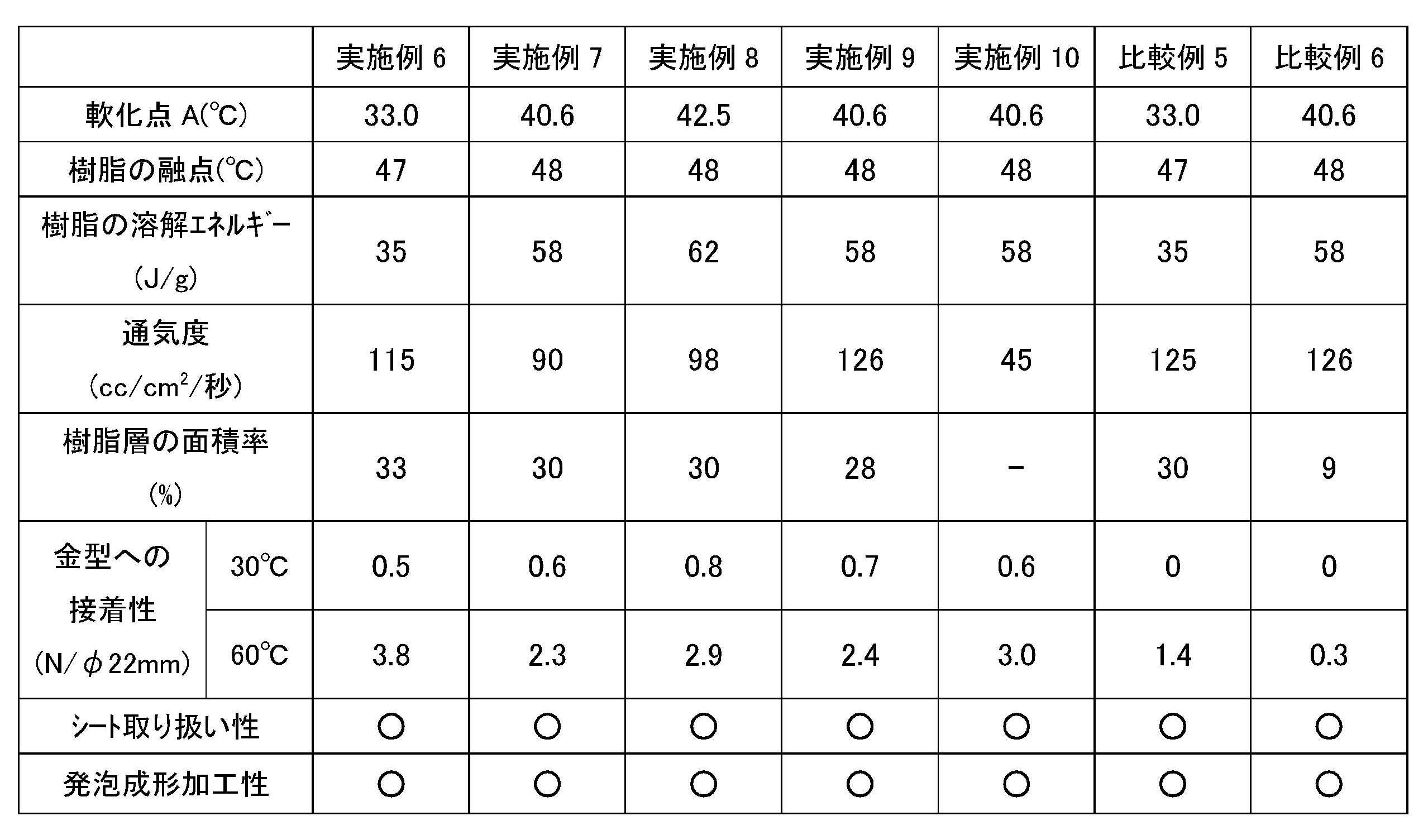
- Table 2 shows the measured physical properties of the nonwoven fabrics for reinforcing foam molded articles obtained in Examples 6 to 10 and Comparative Examples 5 and 6.
- Hirodine 7528 (ethylene vinyl acetate copolymer) manufactured by Yashara Chemical Co., Ltd. was laminated in the form of dots on the white surface side of the nonwoven fabric Borans “CRE3080” manufactured by Toyobo Co., Ltd. by screen printing. The resin amount was 20 g / m 2 laminated. Further, a commercially available magnet sheet was cut by 1 cm 2 at the center in the width direction on the opposite surface of the resin layer of the nonwoven fabric and pasted at 20 cm intervals.
- Example 15 Non-woven Borans “CRE3080” manufactured by Toyobo Co., Ltd.
- Hirodine 7528 ethylene vinyl acetate copolymer manufactured by Yasuhara Chemical Co., Ltd. was randomly laminated by hot melt spray, and the amount of resin was 20 g / m 2 .
- a commercially available magnet sheet was cut by 1 cm 2 at the center in the width direction on the opposite surface of the resin layer of the nonwoven fabric and pasted at 20 cm intervals.
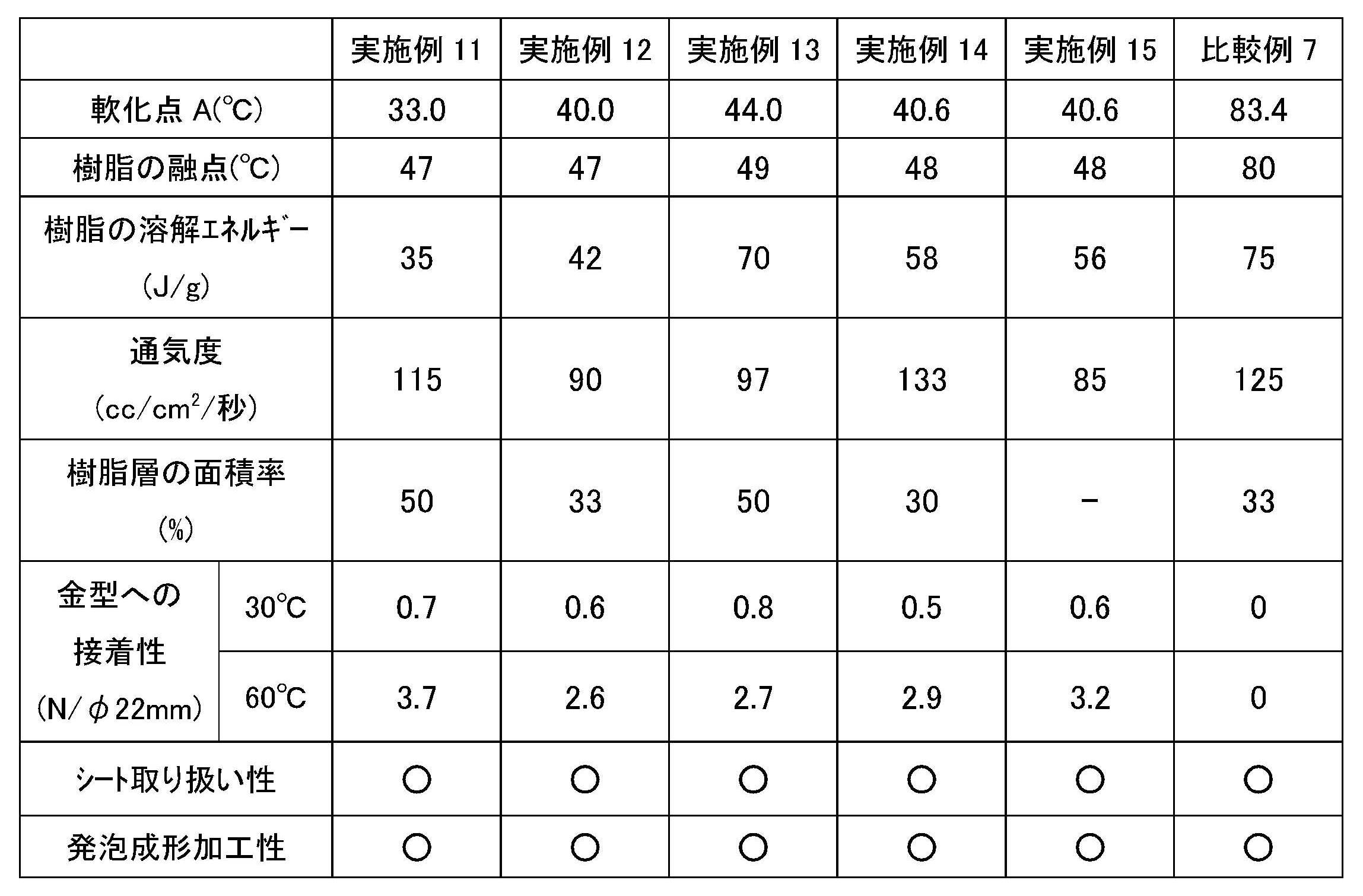
- Table 3 shows the measured physical properties of the nonwoven fabrics for reinforcing foam molded articles obtained in Examples 11 to 15 and Comparative Example 7.
- the nonwoven fabric for reinforcing foam molded articles of the present invention does not improve the mold, the conventional mold can be used, and the nonwoven fabric for reinforcing foam molded articles can be easily set in the mold without contaminating the mold.
- the process from sewing to foaming can be simplified and productivity can be greatly improved, contributing greatly to the industry.
Landscapes
- Engineering & Computer Science (AREA)
- Textile Engineering (AREA)
- Mechanical Engineering (AREA)
- Laminated Bodies (AREA)
- Casting Or Compression Moulding Of Plastics Or The Like (AREA)
Abstract
Description
1.補強用不織布層と樹脂層を積層した発泡成形品補強用不織布であって、補強用不織布層に磁性体を含む非連続部を備えており、樹脂層に使用する樹脂の軟化点Aが20℃以上60℃以下であり、発泡成形品補強用不織布の通気度が30cc/cm2/秒以上300cc/cm2/秒以下である発泡成形品補強用不織布。
2.60℃での金型とのセット性が1.5N/φ22mm以上である上記1に記載の発泡成形品補強用不織布。
3.補強用不織布層と樹脂層を積層した発泡成形品補強用不織布であって、補強用不織布層に磁性体を含む非連続部を備えており、樹脂層に使用する樹脂の融点が30℃以上60℃以下であり、樹脂層に使用する樹脂の溶解エネルギーが30J/g以上100J/g以下であり、発泡成形品補強用不織布の通気度が30cc/cm2/秒以上300cc/cm2/秒以下である発泡成形品補強用不織布。
4.樹脂層が線状またはランダム状に間隔を開けて積層されている上記1~3のいずれかに記載の発泡成形品補強用不織布。
5.樹脂層がドット状に積層されている上記1~3のいずれかに記載の発泡成形品補強用不織布。
その結果、従来の金型をそのまま使用して、縫製のみ施された発泡成形品補強用不織布を効率良く金型にセットでき、作業性を向上できる発泡成形品補強用不織布が得られた。
この発泡成形品補強用不織布は、発泡成形後の金型の汚れもなく、発泡成形品補強用不織布の成形性にも影響を与えないため、従来と全く同じ方法で使用することができるという利点がある。
線状に積層する場合、樹脂の幅は好ましくは0.3~10mmであり、樹脂間の間隔は好ましくは1~10mmである。
ランダム状に積層する場合、樹脂が非連続的に存在することが好ましく、樹脂量を50g/m2以下にすることがより好ましい。
ドット状に積層する場合は、ドット形状に特に指定はなく、丸型や菱型等を用いることができる。サイズも特に指定はないが、円換算での直径で好ましくは1mm以上10mm以下である。配置については格子状や千鳥配列等を用いることができる。
さらに不織布の30℃での金型セット性は1.5N/φ22mm以下が好ましく、1.0N/φ22mm以下がより好ましい。30℃での金型セット性が1.5N/φ22mmより高くなると、重ねてあるいはロール状での保管時に各層間で接着してしまい、取り扱い性が悪くなる。
なお、本発明の実施例および比較例で用いた評価方法は下記の方法でおこなった。
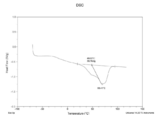
補強用不織布から樹脂層をサンプリングし、TA instruments社製「Q400」を用い、TMA(熱機械分析)により求めた。プローブは針入プローブ、荷重0.1N、温度条件-30℃→100℃、昇温速度5℃/min、雰囲気N2下で行った。図1に例示した通り、2つの接線の交点を軟化点Aとした。
発泡成形品補強用不織布から樹脂部のみを4~5mg採取した。この際、不織布が一緒に採取された場合、そのまま測定した。装置はTA instruments社製Q100を用い、-70℃から120℃まで20℃/minの速度で昇温させた。測定は窒素雰囲気下で行った。チャートより、図2に示したベースライン(20℃-95℃)と接線との交点を融点とした。図2の場合、48.62℃が融点となる。
上記(2)記載の測定により得られたチャートより、溶解エネルギーを求めた。図1の場合、58.78J/gとなる。
JIS K 7206(1999)「プラスチック-熱可塑性プラスチック-ビカット軟化温度(VST)試験方法」に準拠して測定した。
JIS L 1096(2010)「織物及び編物の生地試験方法」8.26.1 A法(フラジール形法)」に準拠して測定した。
試験片を幅25mm、長さ100mmにカットし、1端を金属板(SS400フラットバー幅30mm、長さ100mm)の1端に51.6kPa Kyowa製「ゲージメイト」を使用し、2kgf/φ22mm端子の荷重で30℃±3℃および60℃±3℃で10秒間圧縮する。その後、島津製引張試験機のチャック上部に金属板を、チャック下部に試験片の反対の1端をチャック間距離が10mmとなるようセットする(マグネット有は上記端子圧縮部の上に、はみ出さないようマグネットシートを正方形に配置する)。引張速度100mm/分で引張り試験を行い、最大強度を求める。
20cm×20cmにカットした試験片を10枚重ね、10kg/400cm2となるよう荷重を掛け、室温30℃の部屋で24時間放置する。その後、重りを除き、1枚1枚取り出すときの状況を以下の通り評価した。
○:各層で融着がなく取り出すことができた。
×:各層の一部または全部で融着が起こり、取り出すことが難しかった。
SEMにて樹脂層側から撮影し、単位当りの樹脂層の面積を求め、百分率で示した。
○:発泡ウレタン成形体の表面にガスの後がなく、きれいに発泡されていた。
×:発泡ウレタン成形体の表面にガスの後があり、痘痕状などの欠点があった。
東洋紡株式会社製不織布ボランス「CRE3080」の白色面側にヤスハラケミカル株式会社製エチレン酢酸ビニルコポリマー樹脂(ビカット軟化点39℃)をT-ダイから押し出し、上記不織布の長手方向と平行に樹脂幅1mm、樹脂間隔2mmで線状に、樹脂量は20g/m2積層した。さらに、不織布の樹脂層の反対面の幅方向中央に市販のマグネットシートを1cm2カットして、20cm間隔で貼り付けた。
三井化学株式会社製不織布タフネル「ESE444」の片面にヤスハラケミカル株式会社製ヒロダイン7504(エチレン酢酸ビニルコポリマー、ビカット軟化温度42℃)をT-ダイから押し出し、上記不織布の長手方向と平行に樹脂幅1mm、樹脂間隔2mmで線状に、樹脂量は30g/m2積層した。さらに、不織布の樹脂層の反対面の幅方向中央に市販のマグネットシートを1cm2カットして、20cm間隔で貼り付けた。
三井化学株式会社製不織布タフネル「ESE444」の片面にヤスハラケミカル株式会社製ヒロダイン7504(エチレン酢酸ビニルコポリマー、ビカット軟化温度42℃)をT-ダイから押し出し、上記不織布の長手方向と平行に樹脂幅2mm、樹脂間隔2mmで線状に、樹脂量は30g/m2積層した。さらに、不織布の樹脂層の反対面の幅方向中央に市販のマグネットシートを1cm2カットして、20cm間隔で貼り付けた。
東洋紡株式会社製不織布ボランス「CRE3080」白色面側にヤスハラケミカル株式会社製ヒロダイン7504(エチレン酢酸ビニルコポリマー、ビカット軟化温度42℃)をスクリーン印刷にてドット状に、樹脂量は20g/m2積層した。さらに、不織布の樹脂層の反対面の幅方向中央に市販のマグネットシートを1cm2カットして、20cm間隔で貼り付けた。
東洋紡株式会社製不織布ボランス「CRE3080」白色面側にヤスハラケミカル株式会社製ヒロダイン7504(エチレン酢酸ビニルコポリマー、ビカット軟化温度42℃)をホットメルトスプレーでランダム状に、樹脂量は20g/m2積層した。さらに、不織布の樹脂層の反対面の幅方向中央に市販のマグネットシートを1cm2カットして、20cm間隔で貼り付けた。
東洋紡株式会社製不織布ボランス「CRE3080」白色面側にヤスハラケミカル株式会社製ヒロダイン7536(エチレン酢酸ビニルコポリマー、ビカット軟化温度83℃)をT-ダイから押し出し、上記不織布の長手方向と平行に樹脂幅1mm、樹脂間隔2mmで線状に積層した。樹脂は20g/m2であった。
東洋紡株式会社製不織布ボランス「CRE3080」白色面側にサイデン化学株式会社製アクリル系樹脂 ATR-1を上記不織布に20g/m2となるよう塗布した。上記アクリル系樹脂は常温(20℃)でも粘性が高く、樹脂層のサンプルを取ることができず、軟化点Aは測定できなかった。
東洋紡株式会社製不織布ボランス「CRE3080」白色面側にヤスハラケミカル株式会社製ヒロダイン7528(エチレン酢酸ビニルコポリマー、ビカット軟化温度40℃)をT-ダイから押し出し、上記不織布の長手方向と平行に樹脂幅2mm、樹脂間隔0.1mmで線状に積層した。樹脂は50g/m2であった。
東洋紡株式会社製不織布ボランス「CRE3080」白色面側にヤスハラケミカル株式会社製エチレン酢酸ビニルコポリマー樹脂(ビカット軟化点=39℃)をT-ダイから押し出し、上記不織布の長手方向と平行に樹脂幅1mm、樹脂間隔2mmで線状に積層した。樹脂は20g/m2であった。

東洋紡株式会社製不織布ボランス「CRE3080」の白色面側にヤスハラケミカル株式会社製エチレン酢酸ビニルコポリマー樹脂(ビカット軟化点=39℃)をT-ダイから押し出し、上記不織布の長手方向と平行に樹脂幅1mm、樹脂間隔2mmで線状に、樹脂量は30g/m2積層した。さらに、不織布の樹脂層の反対面の幅方向中央に市販のマグネットシートを1cm2カットして、20cm間隔で貼り付けた。
三井化学株式会社製不織布タフネル「ESE444」の片面にヤスハラケミカル株式会社製ヒロダイン7528(エチレン酢酸ビニルコポリマー、ビカット軟化温度40℃)をT-ダイから押し出し、上記不織布の長手方向と平行に樹脂幅1mm、樹脂間隔2mmで線状に、樹脂量は20g/m2積層した。さらに、不織布の樹脂層の反対面の幅方向中央に市販のマグネットシートを1cm2カットして、20cm間隔で貼り付けた。
東洋紡株式会社製不織布ボランス「CRE3080」の白色面側にヤスハラケミカル株式会社製ヒロダイン7504(エチレン酢酸ビニルコポリマー、ビカット軟化温度42℃)をT-ダイから押し出し、上記不織布の長手方向と平行に樹脂幅2mm、樹脂間隔2mmで線状に、樹脂量は20g/m2積層した。さらに、不織布の樹脂層の反対面の幅方向中央に市販のマグネットシートを1cm2カットして、20cm間隔で貼り付けた。
東洋紡株式会社製不織布ボランス「CRE3080」の白色面側にヤスハラケミカル株式会社製ヒロダイン7528(エチレン酢酸ビニルコポリマー、ビカット軟化温度40℃)をスクリーン印刷にてドット状に、樹脂量は30g/m2積層した。さらに、不織布の樹脂層の反対面の幅方向中央に市販のマグネットシートを1cm2カットして、20cm間隔で貼り付けた。
東洋紡株式会社製不織布ボランス「CRE3080」の白色面側にヤスハラケミカル株式会社製ヒロダイン7528(エチレン酢酸ビニルコポリマー、ビカット軟化温度40℃)をホットメルトスプレーにてランダム状に、樹脂量は30g/m2積層した。さらに、不織布の樹脂層の反対面の幅方向中央に市販のマグネットシートを1cm2カットして、20cm間隔で貼り付けた。
東洋紡株式会社製不織布ボランス「CRE3080」の白色面側にヤスハラケミカル株式会社製エチレン酢酸ビニルコポリマー樹脂(ビカット軟化点=39℃)をT-ダイから押し出し、上記不織布の長手方向と平行に樹脂幅1mm、樹脂間隔2mmで線状に積層した。樹脂は30g/m2であった。
東洋紡株式会社製不織布ボランス「CRE3080」の白色面側にヤスハラケミカル株式会社製ヒロダイン7528(エチレン酢酸ビニルコポリマー、ビカット軟化温度点40℃)をT-ダイから押し出し、上記不織布の長手方向と平行に樹脂幅1mm、樹脂間隔9mmの間隔で線状に積層した。樹脂は5g/m2であった。
東洋紡株式会社製不織布ボランス「CRE3080」白色面側にヤスハラケミカル株式会社製エチレン酢酸ビニルコポリマー樹脂(ビカット軟化点=39℃)をT-ダイから押し出し、上記不織布の長手方向と平行に樹脂幅2mm、樹脂間隔2mmで線状に、樹脂量は20g/m2積層した。さらに、不織布の樹脂層の反対面の幅方向中央に市販のマグネットシートを1cm2カットして、20cm間隔で貼り付けた。
三井化学株式会社製不織布タフネル「ESE444」の片面にヤスハラケミカル株式会社製エチレン酢酸ビニルコポリマー樹脂(ビカット軟化点=40℃)をT-ダイから押し出し、上記不織布の長手方向と平行に樹脂幅1mm、樹脂間隔2mmで線状に、樹脂量は30g/m2積層した。さらに、不織布の樹脂層の反対面の幅方向中央に市販のマグネットシートを1cm2カットして、20cm間隔で貼り付けた。
東洋紡株式会社製不織布ボランス「CRE3080」白色面側にヤスハラケミカル株式会社製エチレン酢酸ビニルコポリマー樹脂(ビカット軟化点=44℃)をT-ダイから押し出し、上記不織布の長手方向と平行に樹脂幅2mm、樹脂間隔2mmで線状に、樹脂量は20g/m2積層した。さらに、不織布の樹脂層の反対面の幅方向中央に市販のマグネットシートを1cm2カットして、20cm間隔で貼り付けた。
東洋紡株式会社製不織布ボランス「CRE3080」白色面側にヤスハラケミカル株式会社製ヒロダイン7528(エチレン酢酸ビニルコポリマー、)をスクリーン印刷にてドット状に積層した。樹脂量は20g/m2積層した。さらに、不織布の樹脂層の反対面の幅方向中央に市販のマグネットシートを1cm2カットして、20cm間隔で貼り付けた。
東洋紡株式会社製不織布ボランス「CRE3080」白色面側にヤスハラケミカル株式会社製ヒロダイン7528(エチレン酢酸ビニルコポリマー、)をホットメルトスプレーにてランダム状に、樹脂量は20g/m2積層した。さらに、不織布の樹脂層の反対面の幅方向中央に市販のマグネットシートを1cm2カットして、20cm間隔で貼り付けた。
東洋紡株式会社製不織布ボランス「CRE3080」白色面側にヤスハラケミカル株式会社製ヒロダイン7536(エチレン酢酸ビニルコポリマー)をT-ダイから押し出し、上記不織布の長手方向と平行に樹脂幅2mm、樹脂間隔2mmで線状に積層した。樹脂量は20g/m2であった。
Claims (5)
- 補強用不織布層と樹脂層を積層した発泡成形品補強用不織布であって、補強用不織布層に磁性体を含む非連続部を備えており、樹脂層に使用する樹脂の軟化点Aが20℃以上60℃以下であり、発泡成形品補強用不織布の通気度が30cc/cm2/秒以上300cc/cm2/秒以下である発泡成形品補強用不織布。
- 60℃での金型とのセット性が1.5N/φ22mm以上である請求項1に記載の発泡成形品補強用不織布。
- 補強用不織布層と樹脂層を積層した発泡成形品補強用不織布であって、補強用不織布層に磁性体を含む非連続部を備えており、樹脂層に使用する樹脂の融点が30℃以上60℃以下であり、樹脂層に使用する樹脂の溶解エネルギーが30J/g以上100J/g以下であり、発泡成形品補強用不織布の通気度が30cc/cm2/秒以上300cc/cm2/秒以下である発泡成形品補強用不織布。
- 樹脂層が線状またはランダム状に間隔を開けて積層されている請求項1~3のいずれかに記載の発泡成形品補強用不織布。
- 樹脂層がドット状に積層されている請求項1~3のいずれかに記載の発泡成形品補強用不織布。
Priority Applications (3)
| Application Number | Priority Date | Filing Date | Title |
|---|---|---|---|
| CA3011698A CA3011698C (en) | 2016-02-29 | 2017-02-28 | Nonwoven fabric for reinforcing foam molded articles |
| MX2018010349A MX390624B (es) | 2016-02-29 | 2017-02-28 | Tela no tejida para reforzar articulos moldeados por espuma. |
| US16/078,404 US11117345B2 (en) | 2016-02-29 | 2017-02-28 | Nonwoven fabric for reinforcing foam molded articles |
Applications Claiming Priority (2)
| Application Number | Priority Date | Filing Date | Title |
|---|---|---|---|
| JP2016037037A JP6623835B2 (ja) | 2016-02-29 | 2016-02-29 | 発泡成形品補強用不織布 |
| JP2016-037037 | 2016-02-29 |
Publications (1)
| Publication Number | Publication Date |
|---|---|
| WO2017150488A1 true WO2017150488A1 (ja) | 2017-09-08 |
Family
ID=59743957
Family Applications (1)
| Application Number | Title | Priority Date | Filing Date |
|---|---|---|---|
| PCT/JP2017/007628 Ceased WO2017150488A1 (ja) | 2016-02-29 | 2017-02-28 | 発泡成形品補強用不織布 |
Country Status (5)
| Country | Link |
|---|---|
| US (1) | US11117345B2 (ja) |
| JP (1) | JP6623835B2 (ja) |
| CA (1) | CA3011698C (ja) |
| MX (1) | MX390624B (ja) |
| WO (1) | WO2017150488A1 (ja) |
Families Citing this family (1)
| Publication number | Priority date | Publication date | Assignee | Title |
|---|---|---|---|---|
| JP6658092B2 (ja) * | 2016-02-29 | 2020-03-04 | 東洋紡株式会社 | 発泡成形品補強用不織布 |
Citations (8)
| Publication number | Priority date | Publication date | Assignee | Title |
|---|---|---|---|---|
| JPS62111705A (ja) * | 1985-11-11 | 1987-05-22 | Achilles Corp | 成形装置 |
| JPH0731322U (ja) * | 1993-11-18 | 1995-06-13 | 株式会社東洋クオリティワン | モールド成形用型 |
| JP2000280272A (ja) * | 1999-03-30 | 2000-10-10 | Hamani Kasei Kk | 発泡樹脂製品及びその成型方法 |
| JP2001252930A (ja) * | 2000-03-10 | 2001-09-18 | Bridgestone Corp | 発泡樹脂成形品の製造方法 |
| JP2008126633A (ja) * | 2006-11-24 | 2008-06-05 | Bridgestone Corp | 発泡樹脂成形品の製造方法 |
| WO2011093386A1 (ja) * | 2010-01-28 | 2011-08-04 | 株式会社ブリヂストン | 発泡成形用金型及び発泡成形部材の製造方法 |
| WO2016035732A1 (ja) * | 2014-09-01 | 2016-03-10 | 東洋紡株式会社 | 発泡成形品補強用不織布 |
| JP2016036463A (ja) * | 2014-08-06 | 2016-03-22 | 東洋ゴム工業株式会社 | シートパッド及びその製造方法 |
Family Cites Families (8)
| Publication number | Priority date | Publication date | Assignee | Title |
|---|---|---|---|---|
| JPH0731322A (ja) | 1993-07-15 | 1995-02-03 | Masao Matsuo | ピース切出し方法およびピース切出し作業台 |
| ES2427639T3 (es) * | 2003-03-06 | 2013-10-31 | Vestas Wind Systems A/S | Procedimiento para preparar una preforma |
| JP3972145B2 (ja) | 2003-06-06 | 2007-09-05 | 東洋ゴム工業株式会社 | シート用パッドのための発泡成形型およびシート用パッドの製造方法 |
| DE102005037572A1 (de) * | 2005-08-09 | 2007-02-15 | Ideal Automotive Gmbh | Verkleidungsteil, insbesondere Innenverkleidungs- oder Auskleidungsteil für Kraftfahrzeuge |
| JP5189298B2 (ja) | 2007-02-13 | 2013-04-24 | 東洋ゴム工業株式会社 | シート用パッド及びその製造方法 |
| JP5349906B2 (ja) * | 2008-10-29 | 2013-11-20 | トヨタ紡織株式会社 | 車両用シートのクッション構造体 |
| US20120119558A1 (en) * | 2010-07-13 | 2012-05-17 | Mitsui Chemicals, Inc. | Multilayer nonwoven fabric for foam molding |
| US20170282490A1 (en) * | 2014-09-01 | 2017-10-05 | Toyobo Co., Ltd. | Nonwovens for reinforcing foam-molded article |
-
2016
- 2016-02-29 JP JP2016037037A patent/JP6623835B2/ja active Active
-
2017
- 2017-02-28 WO PCT/JP2017/007628 patent/WO2017150488A1/ja not_active Ceased
- 2017-02-28 CA CA3011698A patent/CA3011698C/en active Active
- 2017-02-28 MX MX2018010349A patent/MX390624B/es unknown
- 2017-02-28 US US16/078,404 patent/US11117345B2/en active Active
Patent Citations (8)
| Publication number | Priority date | Publication date | Assignee | Title |
|---|---|---|---|---|
| JPS62111705A (ja) * | 1985-11-11 | 1987-05-22 | Achilles Corp | 成形装置 |
| JPH0731322U (ja) * | 1993-11-18 | 1995-06-13 | 株式会社東洋クオリティワン | モールド成形用型 |
| JP2000280272A (ja) * | 1999-03-30 | 2000-10-10 | Hamani Kasei Kk | 発泡樹脂製品及びその成型方法 |
| JP2001252930A (ja) * | 2000-03-10 | 2001-09-18 | Bridgestone Corp | 発泡樹脂成形品の製造方法 |
| JP2008126633A (ja) * | 2006-11-24 | 2008-06-05 | Bridgestone Corp | 発泡樹脂成形品の製造方法 |
| WO2011093386A1 (ja) * | 2010-01-28 | 2011-08-04 | 株式会社ブリヂストン | 発泡成形用金型及び発泡成形部材の製造方法 |
| JP2016036463A (ja) * | 2014-08-06 | 2016-03-22 | 東洋ゴム工業株式会社 | シートパッド及びその製造方法 |
| WO2016035732A1 (ja) * | 2014-09-01 | 2016-03-10 | 東洋紡株式会社 | 発泡成形品補強用不織布 |
Also Published As
| Publication number | Publication date |
|---|---|
| CA3011698A1 (en) | 2017-09-08 |
| US20190054715A1 (en) | 2019-02-21 |
| JP2017154278A (ja) | 2017-09-07 |
| MX2018010349A (es) | 2018-11-09 |
| JP6623835B2 (ja) | 2019-12-25 |
| CA3011698C (en) | 2023-03-07 |
| US11117345B2 (en) | 2021-09-14 |
| MX390624B (es) | 2025-03-21 |
Similar Documents
| Publication | Publication Date | Title |
|---|---|---|
| JP5272315B2 (ja) | 不織布および該不織布からなる下敷き材 | |
| JP6117055B2 (ja) | ウレタン発泡成形用補強用布状物およびそれを用いたウレタン発泡成形体の製造方法 | |
| EP3284596A1 (en) | Decorative sheet | |
| JP2013132783A (ja) | 加飾成形用シート、加飾成形体、及び、加飾成形体の製造方法 | |
| WO2013183529A1 (ja) | 発泡成形品補強用不織布及びそれを用いた製品 | |
| JP6365875B2 (ja) | 発泡成形品補強用不織布 | |
| JP6372269B2 (ja) | 発泡成形品補強用不織布 | |
| JP5605148B2 (ja) | 発泡成型品補強材用不織布及びその製造方法 | |
| JP6409506B2 (ja) | 発泡成形品補強用不織布 | |
| JP2009113371A (ja) | 自動車内装材用発泡積層シートおよび自動車内装材 | |
| JP2002144976A (ja) | 車両用成形天井及びその製造方法 | |
| JP5350044B2 (ja) | 加飾成形用シート、加飾成形体、加飾成形用シート構成体、及び、加飾成形体の製造方法 | |
| JP6623835B2 (ja) | 発泡成形品補強用不織布 | |
| JP6651904B2 (ja) | 発泡成形品補強用不織布 | |
| JP6651732B2 (ja) | 発泡成形方法 | |
| WO2016035732A1 (ja) | 発泡成形品補強用不織布 | |
| EP3189966B1 (en) | Nonwovens for reinforcing foam-molded article | |
| JP2011000792A (ja) | 車両内装材用部材およびそれを用いた車両用内装材 | |
| JP6658092B2 (ja) | 発泡成形品補強用不織布 | |
| JP6563794B2 (ja) | 加飾方法、加飾シート、成形シートおよびその製造方法 | |
| WO2023190398A1 (ja) | 吸音材 | |
| JP2003221765A (ja) | スタンピング成形用ニット表皮材 | |
| JP6762152B2 (ja) | 自動車内装材用通気止め積層体、その製造方法、自動車内装材 | |
| JP2018111407A (ja) | 車両用フロアカーペット及びその製造方法 | |
| JP3773044B2 (ja) | 多孔質材料 |
Legal Events
| Date | Code | Title | Description |
|---|---|---|---|
| WWE | Wipo information: entry into national phase |
Ref document number: 3011698 Country of ref document: CA |
|
| WWE | Wipo information: entry into national phase |
Ref document number: MX/A/2018/010349 Country of ref document: MX |
|
| NENP | Non-entry into the national phase |
Ref country code: DE |
|
| 121 | Ep: the epo has been informed by wipo that ep was designated in this application |
Ref document number: 17759954 Country of ref document: EP Kind code of ref document: A1 |
|
| 122 | Ep: pct application non-entry in european phase |
Ref document number: 17759954 Country of ref document: EP Kind code of ref document: A1 |