WO2017150142A1 - ホットメルト接着剤 - Google Patents
ホットメルト接着剤 Download PDFInfo
- Publication number
- WO2017150142A1 WO2017150142A1 PCT/JP2017/004895 JP2017004895W WO2017150142A1 WO 2017150142 A1 WO2017150142 A1 WO 2017150142A1 JP 2017004895 W JP2017004895 W JP 2017004895W WO 2017150142 A1 WO2017150142 A1 WO 2017150142A1
- Authority
- WO
- WIPO (PCT)
- Prior art keywords
- glycol
- melt adhesive
- bisphenol
- hot melt
- polyol
- Prior art date
- Legal status (The legal status is an assumption and is not a legal conclusion. Google has not performed a legal analysis and makes no representation as to the accuracy of the status listed.)
- Ceased
Links
Classifications
-
- C—CHEMISTRY; METALLURGY
- C08—ORGANIC MACROMOLECULAR COMPOUNDS; THEIR PREPARATION OR CHEMICAL WORKING-UP; COMPOSITIONS BASED THEREON
- C08G—MACROMOLECULAR COMPOUNDS OBTAINED OTHERWISE THAN BY REACTIONS ONLY INVOLVING UNSATURATED CARBON-TO-CARBON BONDS
- C08G18/00—Polymeric products of isocyanates or isothiocyanates
- C08G18/06—Polymeric products of isocyanates or isothiocyanates with compounds having active hydrogen
- C08G18/28—Polymeric products of isocyanates or isothiocyanates with compounds having active hydrogen characterised by the compounds used containing active hydrogen
- C08G18/65—Low-molecular-weight compounds having active hydrogen with high-molecular-weight compounds having active hydrogen
- C08G18/66—Compounds of groups C08G18/42, C08G18/48, or C08G18/52
-
- C—CHEMISTRY; METALLURGY
- C09—DYES; PAINTS; POLISHES; NATURAL RESINS; ADHESIVES; COMPOSITIONS NOT OTHERWISE PROVIDED FOR; APPLICATIONS OF MATERIALS NOT OTHERWISE PROVIDED FOR
- C09J—ADHESIVES; NON-MECHANICAL ASPECTS OF ADHESIVE PROCESSES IN GENERAL; ADHESIVE PROCESSES NOT PROVIDED FOR ELSEWHERE; USE OF MATERIALS AS ADHESIVES
- C09J11/00—Features of adhesives not provided for in group C09J9/00, e.g. additives
- C09J11/02—Non-macromolecular additives
- C09J11/06—Non-macromolecular additives organic
-
- C—CHEMISTRY; METALLURGY
- C09—DYES; PAINTS; POLISHES; NATURAL RESINS; ADHESIVES; COMPOSITIONS NOT OTHERWISE PROVIDED FOR; APPLICATIONS OF MATERIALS NOT OTHERWISE PROVIDED FOR
- C09J—ADHESIVES; NON-MECHANICAL ASPECTS OF ADHESIVE PROCESSES IN GENERAL; ADHESIVE PROCESSES NOT PROVIDED FOR ELSEWHERE; USE OF MATERIALS AS ADHESIVES
- C09J175/00—Adhesives based on polyureas or polyurethanes; Adhesives based on derivatives of such polymers
- C09J175/04—Polyurethanes
Definitions
- the present invention relates to a hot melt adhesive containing a thermoplastic urethane resin.
- thermoplastic resin Since the resin strength of a thermoplastic resin usually decreases with an increase in temperature, heat resistance may be a problem when used. From the viewpoint of product quality stability using a thermoplastic resin, a thermoplastic resin having a small temperature dependency in a wide temperature range is desired. In addition, a thermoplastic resin having sharp melt properties (fluidity immediately appears when the melting point is exceeded) is desired for ease of handling when used.
- An object of the present invention is to provide a hot melt adhesive that is less temperature dependent, exhibits fluidity as soon as the melting point is exceeded, and has excellent tensile strength at break.
- the present invention relates to a polyol (A) having an aromatic ring, a diisocyanate (B) having symmetry, a polymethylene glycol (C1) represented by the general formula (1) and / or a polyethylene represented by the general formula (2).
- It is a hot melt adhesive containing a thermoplastic urethane resin (F) whose essential constituent monomer is glycol (C), which is glycol (C2), and polymer polyol (D).
- N is an integer of 2 to 8.
- M is an integer of 2 to 8. ]
- thermoplastic urethane resin contained in the hot melt adhesive of the present invention has little temperature dependence, so it has excellent product quality stability and stable adhesive strength when used as a hot melt adhesive. To do. Further, since it has sharp melt properties (fluidity appears relatively soon when the melting point is exceeded), it is easy to handle. Furthermore, the tensile strength at break is also excellent.
- J bisphenol compound selected from the group consisting of bisphenol A, bisphenol B, bisphenol E and bisphenol F, dihydroxybenzene Ethylene oxide adduct, dihydroxybiphenyl ethylene oxide adduct, bis (hydroxymethyl) benzene, ethylene oxide adduct of the compound, bis (hydroxymethyl) biphenyl, ethylene oxide adduct of the compound, ethylene oxide addition of phthalic acid And a mixture of two or more thereof.
- the average addition mole number of EO of the ethylene oxide (hereinafter referred to as EO) adduct is preferably 0.90 to 1.10, more preferably 0.91 to 1.09, and still more preferably 0.8. 92 to 1.08. If the EO average addition mole number of the EO adduct is 0.90 or more per hydroxyl group, the adhesive strength is improved, and if it is 1.10 or less, the tensile strength at break is improved.
- an ethylene oxide adduct (A1) of at least one bisphenol compound selected from the group consisting of bisphenol A, bisphenol B, bisphenol E and bisphenol F is preferred, and an ethylene oxide adduct (A1), there is further provided an ethylene oxide adduct (A11) having an average ethylene oxide addition mole number of 0.90 to 1.10 per hydroxyl group and a monodispersity of 80% or more represented by the following formula (1): preferable.
- Monodispersity (%) ⁇ [weight of ethylene oxide adduct (A1) having 1 mol of ethylene oxide added per hydroxyl group] / [weight of ethylene oxide adduct (A)] ⁇ ⁇ 100 (1)
- ethylene oxide adducts (A1) an ethylene oxide adduct having an average ethylene oxide addition mole number of 0.90 to 1.10 per hydroxyl group and a monodispersity of 80% or more represented by the above formula (1)
- the adhesive force can be particularly increased, and the tensile strength at break can also be increased.
- bisphenol A is particularly preferable.
- Bisphenol B is 2,2-bis (p-hydroxyphenyl) butane
- phenol E is 1,1-bis (p-hydroxyphenyl) ethane
- bisphenol F is bis (p-hydroxyphenyl) methane. It is.
- the monodispersity of (A11) represented by the above formula (1) is 80% or more, preferably 85% or more, and more preferably 90% or more. If the monodispersity of (A11) is less than 80%, the tensile strength at break is lowered, the temperature dependency is increased, and the adhesive force at high temperature is lowered.
- the monodispersity and EO average addition mole number can be confirmed by gas chromatography (GC) after pretreatment with a silylating agent.
- the measurement conditions are as follows. ⁇ Preparation method of sample> A 1 g sample is taken and then 19 g acetone is added and dissolved. To this sample, 0.1 ml of TMS-H1 (Trimethylchlorosilane silylating agent, manufactured by Tokyo Chemical Industry Co., Ltd.) is added and heated to 50 to 70 ° C. for 2 to 3 minutes to complete the silylation. 1 ⁇ l of this supernatant is sampled and measured with a gas chromatograph.
- TMS-H1 Trimethylchlorosilane silylating agent, manufactured by Tokyo Chemical Industry Co., Ltd.
- diisocyanate (B) having symmetry in the present invention polymethylene diisocyanate (B1) [for example, ethylene diisocyanate, tetramethylene diisocyanate, hexamethylene diisocyanate (HDI), octamethylene diisocyanate, decamethylene diisocyanate, dodecamethylene diisocyanate, etc.]
- polymethylene diisocyanate (B1) is preferable from the viewpoint of crystallinity, and more preferable is polymethylene diisocyanate having an even number of 6 to 10 carbon atoms (excluding carbon in the isocyanate group). .
- Glycol (C) is glycol (C) which is polymethylene glycol (C1) represented by general formula (1) and / or polyethylene glycol (C2) represented by general formula (2), from the viewpoint of crystallinity.
- the polymethylene glycol (C1) and polyethylene glycol (C2) contained in the glycol (C) preferably have an even number of carbon atoms.
- Examples of the polymethylene glycol (C1) in the present invention include ethylene glycol, 1,4-butanediol, 1,6-hexanediol, 1,8-octanediol and the like.
- Examples of the polyethylene glycol (C2) having 2 to 8 repeats include diethylene glycol, triethylene glycol, hexaethylene glycol and the like.
- (C1) is preferable, more preferable is polymethylene glycol having an even number of 4 to 8 carbon atoms, and particularly preferable is 6 to 6 carbon atoms. Polymethylene glycol having an even number of 8.
- thermoplastic urethane resin (F) in the present invention a combination of polymethylene diisocyanate (B1) and polymethylene glycol (C1) is preferable, and the number of carbon atoms excluding carbon in the isocyanate group of (B1). And (C1) preferably have the same number of carbon atoms from the viewpoint of crystallinity.
- B1 polymethylene diisocyanate
- C1 polymethylene glycol
- polymer polyol (D) examples include polyether polyol (D1), polyester polyol (D2), and other polyols (D3).
- Mn number average molecular weight of the polymer polyol (D) is preferably 400 to 10,000, and more preferably 1000 to 5,000.
- polyether polyol (D1) examples include polyalkylene glycol [polyethylene glycol, polypropylene glycol and polytetramethylene ether glycol, poly-3-methyltetramethylene ether glycol, etc.], copolymer polyoxyalkylene diol [EO / PO copolymerization]. Diol, THF / EO copolymerized diol, THF / 3-methyltetrahydrofuran copolymer diol, etc.
- AO adduct of bisphenol compound examples thereof include AO adducts of trihydric or higher polyhydric alcohols [AO adducts of glycerin and AO adducts of trimethylolpropane]; and those obtained by coupling one or more of these with methylene dichloride.
- polyester polyol (D2) examples include condensed polyester polyols, polylactone polyols, castor oil-based polyols, and polycarbonate polyols.
- Condensed polyester polyols are a combination of a low molecular weight polyol or polyether polyol (D1) having an Mn of less than 300 and a polycarboxylic acid or an ester-forming derivative thereof (such as an acid anhydride and an alkyl ester having 1 to 4 carbon atoms). Examples include condensates.
- polycarboxylic acid examples include dicarboxylic acids and trivalent to tetravalent or higher polycarboxylic acids, and specifically, saturated or saturated with 2 to 30 or more carbon atoms (preferably 2 to 12 carbon atoms).
- Unsaturated aliphatic polycarboxylic acids [dicarboxylic acids having 2 to 15 carbon atoms (oxalic acid, succinic acid, malonic acid, adipic acid, suberic acid, azelaic acid, sebacic acid, dodecanedicarboxylic acid, maleic acid, fumaric acid and itacone Acid) and tricarboxylic acids having 6 to 20 carbon atoms (tricarballylic acid and hexanetricarboxylic acid)]; aromatic polycarboxylic acids having 8 to 15 carbon atoms [dicarboxylic acids such as terephthalic acid, isophthalic acid and phthalic acid, and trimellit Tri- or tetracarboxylic acid such as acid and
- a polyether polycarboxylic acid for example, a low molecular weight polyol having an Mn of less than 300 or a carboxymethyl ether of a polyol such as a polyether polyol (D1) (obtained by reacting monochloroacetic acid in the presence of alkali)
- Polyamides and / or polyester polycarboxylic acids for example, lactams having 4 to 15 carbon atoms (such as caprolactam, enantolactam, laurolactam, undecanolactam, etc.) or carbon atoms having 4 to 15 carbon atoms using the above polycarboxylic acid as an initiator
- Polylactam polycarboxylic acids and polylactone polycarboxylic acids obtained by ring-opening polymerization of lactones ( ⁇ -butyrolactone, ⁇ -valerolactone, ⁇ -caprolactone, etc.).
- polylactone polyol examples include ring-opening adducts of lactones having 4 to 15 carbon atoms ( ⁇ -butyrolactone, ⁇ -valerolactone, ⁇ -caprolactone, etc.) that are initiated by water or a low molecular weight polyol having an Mn of less than 300. Can be mentioned.
- Castor oil-based polyols include castor oil (ricinoleic acid triglyceride), partially dehydrated castor oil, partially acylated castor oil, hydrogenated castor oil, and modified products thereof [polyether polyol (D1) or low molecular weight Mn of less than 300 Ester polyol obtained by transesterification reaction between polyol and castor oil, partially dehydrated castor oil or hydrogenated castor oil, and polyether polyol (D1) or low molecular polyol having Mn of less than 300 and castor oil fatty acid or hydrogenated castor oil Ester obtained by esterification reaction with fatty acid, etc.].
- polyether polyol (D1) or low molecular weight Mn of less than 300 Ester polyol obtained by transesterification reaction between polyol and castor oil, partially dehydrated castor oil or hydrogenated castor oil, and polyether polyol (D1) or low molecular polyol having Mn of less than 300 and castor oil fatty acid or hydrogenated castor
- Polycarbonate polyols include ring-opening addition / polycondensation products of alkylene carbonates whose initiator is a low molecular weight polyol having an Mn of less than 300, and polycondensation (transesterification) of a low molecular weight polyol having an Mn of less than 300 and diphenyl or dialkyl carbonate. Thing etc. are mentioned.
- polyols (D3) include polymer polyols, polyolefin polyols, polyalkadiene polyols and acrylic polyols.
- the polymer polyol is obtained by dispersing and stabilizing polymer particles obtained by polymerizing a vinyl monomer having 3 to 24 carbon atoms (for example, styrene or acrylonitrile) in one or more polyols in the presence of a radical polymerization initiator.
- a vinyl monomer having 3 to 24 carbon atoms for example, styrene or acrylonitrile
- examples include polyols (polymer content is, for example, 5 to 30% by weight).
- polyolefin polyol examples include polyisobutene polyol.
- polyalkadiene polyol examples include polyisoprene polyol, polybutadiene polyol, hydrogenated polyisoprene polyol, and hydrogenated polybutadiene polyol.
- acrylic polyol examples include a copolymer of an alkyl (meth) acrylate (alkyl 1 to 30 carbon atoms) ester [butyl (meth) acrylate, etc.] and a hydroxyl group-containing acrylic monomer [hydroxyethyl (meth) acrylate, etc.]. Can be mentioned.
- Mn means the number average molecular weight measured by gel permeation chromatography.
- the number average molecular weight is measured by gel permeation chromatography using N, N-dimethylformamide as a solvent and polystyrene as a standard substance.
- the sample concentration may be 0.125% by weight
- the column stationary phase may be TSKgel Guardcolumn ⁇ , TSKgel ⁇ -M (both manufactured by Tosoh Corporation), and the column temperature may be 40 ° C.
- polytetramethylene ether glycol is preferred.
- Polypropylene glycol in which 40 mol% or more, preferably 70 mol% or more of the hydroxypropyl groups located at the terminals is a group (primary OH group) represented by the following chemical formula (3) is preferable. —CH (CH 3 ) —CH 2 —OH (3)
- the weight ratio of the polyol (A) having an aromatic ring, which is an essential constituent monomer of the thermoplastic urethane resin (F), the diisocyanate (B) having symmetry, the glycol (C), and the polymer polyol (D) is ( (A) is preferably 5 to 20% by weight, more preferably 10 to 20% by weight, and (B) is preferably based on the total weight of A), (B), (C) and (D). 15 to 30% by weight, more preferably 20 to 30% by weight, (C) is preferably 1 to 15% by weight, more preferably 3 to 15% by weight, and (D) is preferably 40 to 60% by weight. %, More preferably 45 to 60% by weight.
- the urea group content of the thermoplastic urethane resin (F) is preferably 0.06 mmol / g or less, more preferably 0.03 mmol / g or less, still more preferably 0.02 mmol / g or less from the viewpoint of sharp melt properties. is there.
- thermoplastic urethane resin (F) As a production method of thermoplastic urethane resin (F), for example, polyol (A) having an aromatic ring, glycol (C), and polymer polyol (D) are uniformly mixed. Then, a method of reacting diisocyanate (B) having symmetry is exemplified.
- the water content contained in the mixture of polyol (A), glycol (C) and polymer polyol (D) having an aromatic ring which is an essential constituent monomer of the thermoplastic urethane resin (F) is (A), ( It is preferably 0.00 to 0.10% by weight, more preferably 0.00 to 0.03% by weight based on the total weight of C) and (D).
- a urethanization catalyst may be used.
- Various catalysts can be used as urethanization catalysts such as metal catalysts [tin catalysts [trimethyltin laurate, trimethyltin hydroxide, dimethyltin dilaurate, dibutyltin diacetate, dibutyltin dilaurate, stannous octoate, dibutyltin maleate].
- Etc. lead catalysts [lead oleate, lead 2-ethylhexanoate, lead naphthenate, lead octenoate, etc.], other metal catalysts [metal salts of naphthenate (cobalt naphthenate, etc.), phenylmercuric propionate, etc.] Etc.]; amine catalyst ⁇ triethylenediamine, tetramethylethylenediamine, diazabicycloalkene [1,8-diazabicyclo [5,4,0] undecene-7 [DBU (manufactured by San Apro Co., Ltd., registered trademark)]], etc., dialkyl (C1-3) Aminoalkyl (C2-4) Min [dimethylaminoethylamine, dimethylaminopropylamine, diethylaminopropylamine, dipropylaminopropylamine, etc.], heterocyclic aminoalkyl (2 to 6 carbon atoms) amine [2- (1
- the hot melt adhesive of the present invention contains a thermoplastic urethane resin (F), but according to various purposes and applications, other resin additives (E) can be arbitrarily added within a range not inhibiting the effects of the present invention. It can be included.
- F thermoplastic urethane resin
- E resin additives
- Additives for resins (E) include tackifiers, antioxidants, UV absorbers, light stabilizers, plasticizers, adsorbents, colorants, fillers, nucleating agents, lubricants, mold release agents, water, Examples include at least one additive selected from the group consisting of a flame retardant and a fragrance.
- tackifier examples include terpene resin, terpene phenol resin, phenol resin, aromatic hydrocarbon modified terpene resin, rosin resin, modified rosin resin, synthetic petroleum resin (aliphatic, aromatic or alicyclic synthetic petroleum resin, etc. ), Coumarone-indene resins, xylene resins, styrene resins, dicyclopentadiene resins, and hydrogenated products of these having hydrogenated unsaturated double bonds.
- Antioxidants include hindered phenol compounds [pentaerystyl-tetrakis [3- (3,5-di-t-butyl-4-hydroxyphenyl) propionate], octadecyl-3- (3,5-di-t. -Butyl-4-hydroxyphenyl) propionate etc.], phosphorus compound [tris (2,4-di-t-butylphenyl) phosphite etc.], sulfur compound [pentaerythryl-tetrakis (3-laurylthiopropionate) , Dilauryl-3,3′-thiodipropionate, etc.].
- ultraviolet absorbers examples include benzotriazole compounds [2- (3,5-di-t-amyl-2-hydroxyphenyl) benzotriazole, 2- (5-methyl-2-hydroxyphenyl) benzotriazole, etc.] and the like. It is done.
- Examples of the light stabilizer include hindered amine compounds [(bis-2,2,6,6-tetramethyl-4-piperidyl) sebacate and the like] and the like.
- Plasticizers include various plasticizers [for example, adhesive technology Vol. 20, (2), 21 (2000), etc.], process oil (paraffin, naphthene or aromatic compound type); liquid resin (Mn 300 to 6,000, for example, liquid polybutene, liquid polybutadiene, liquid Polyisoprene); hydrogenated product of the liquid resin; low molecular weight (Mn 300 to 10,000) polyisobutylene; and mixtures of two or more thereof.
- adsorbent examples include alumina, silica gel, molecular sieve and the like.
- colorant examples include pigments (titanium oxide, carbon black, etc.), dyes (azo, anthraquinone, indigoid, alizarin, acridine, nitroso, aniline dyes, etc.) and the like.
- fillers include talc, mica and calcium carbonate.
- nucleating agent examples include sorbitol, phosphate metal salt, benzoic acid metal salt, and phosphate metal salt.
- lubricant examples include calcium stearate, butyl stearate, oleic acid amide and the like.
- release agent examples include carboxyl-modified silicone oil and hydroxyl-modified silicone oil.
- the flame retardant examples include a halogen-containing flame retardant, a phosphorus-containing flame retardant, an antimony-containing flame retardant, and a metal hydroxide-containing flame retardant.
- Perfumes include diterpenes and limonene.
- the total content of the resin additive (E) is preferably 40% by weight or less based on the total weight of the thermoplastic urethane resin (F), and more preferably 0.002 from the viewpoint of the addition effect and adhesiveness. -30% by weight, more preferably 0.1-10% by weight.
- the hot melt adhesive of the present invention has a melting point of preferably 80 ° C. to 150 ° C., more preferably 90 ° C. to 120 ° C., from the viewpoints of temperature dependency and coating properties.
- the hot melt adhesive of the present invention preferably has a low temperature dependency of storage elastic modulus (hereinafter abbreviated as G ′) from the viewpoint of quality stability such as adhesive strength.
- G ′ storage elastic modulus
- the hot melt adhesive of the present invention is excellent in adhesive strength stability. This can be evaluated by the temperature dependence of the storage elastic modulus (G ′). Specifically, it is preferable that the temperature change rate of G ′ represented by the following formula (3) is 100 or less because the temperature dependency is low, and the temperature change rate of G ′ represented by the following formula (4) is 10 or less. More preferably.
- the method for producing the hot melt adhesive of the present invention is not particularly limited, but the components of the hot melt adhesive of the present invention are heated and melted and mixed; and the components of the hot melt adhesive of the present invention are mixed with an organic solvent.
- a method of distilling off the solvent after heating and melting together with (toluene, xylene, etc.) and uniformly mixing can be applied. Of these, the former method is industrially preferred.
- Production Example 4 Synthesis of bisphenol A EO adduct (A-4)
- the amount of EO reacted dropwise in Production Example 1 was 124.8 g (2.84 mol) and the reaction was terminated when 1 mol adduct was 0.1% or less. Reacted.
- the catalyst was neutralized with phosphoric acid, and unreacted EO was distilled off under reduced pressure at 130 to 160 ° C. to obtain an EO product (A-4) of bisphenol A.
- this (A-4) was analyzed by GC, the average added mole number of EO per hydroxyl group of the obtained (A-4) was 0.91, and the monodispersity was 88.3%.
- Production Example 7 Synthesis of bisphenol E EO adduct (A-7)
- the reaction was conducted in the same manner as in Production Example 1 except that bisphenol A used in Production Example 1 was replaced with 321.4 g (1.50 mol) of bisphenol E (“Bisphenol E” manufactured by Honshu Chemical Industry Co., Ltd.). The reaction was terminated when the 1 mol adduct was 0.1% or less. The required EO was 150.6 g (3.42 mol), and the reaction time was 7 hours. After the reaction, unreacted EO, catalyst, solvent and the like were distilled off at 130 to 160 ° C. under reduced pressure to obtain an EO adduct (A-7) of bisphenol E. When this (A-7) was analyzed by GC, the average added mole number of EO per hydroxyl group of the obtained (A-7) was 1.03, and the monodispersity was 96.4%.
- Production Example 8 Synthesis of bisphenol F EO adduct (A-8)
- the reaction was conducted in the same manner as in Production Example 1 except that bisphenol A used in Production Example 1 was replaced with 300.4 g (1.50 mol) of bisphenol F (“Bisphenol F” manufactured by Honshu Chemical Industry Co., Ltd.). The reaction was terminated when the 1 mol adduct was 0.1% or less. The required EO was 150.3 g (3.42 mol), and the reaction time was 7 hours. After the reaction, unreacted EO, catalyst, solvent and the like were distilled off at 130 to 160 ° C. under reduced pressure to obtain bisphenol F EO adduct (A-8). When this (A-8) was analyzed by GC, the average added mole number of EO per hydroxyl group of the obtained (A-8) was 1.02, and the monodispersity was 97.5%.
- Production Example 12 Synthesis of p-phthalic acid EO adduct (A-12)] The reaction was conducted in the same manner as in Production Example 1, except that bisphenol A used in Production Example 1 was replaced with 249.2 g (1.50 mol) of p-phthalic acid (manufactured by Tokyo Chemical Industry Co., Ltd.). The reaction was terminated when the 1 mol adduct was 0.1% or less. The required EO was 149.2 g (3.39 mol), and the reaction time was 6 hours. After the reaction, unreacted EO, catalyst, solvent and the like were distilled off under reduced pressure at 130 to 160 ° C. to obtain an EO adduct (A-12) of p-phthalic acid.
- Production Example 13 [Synthesis of EO adduct (A-13) of 1,4-dihydroxybenzene] The reaction was carried out in the same manner as in Production Example 1 except that bisphenol A used in Production Example 1 was replaced with 165.2 g (1.50 mol) of 1,4-dihydroxybenzene (Tokyo Chemical Industry Co., Ltd.). The reaction was terminated when the 1 mol adduct was 0.1% or less. The required EO was 151.2 g (3.44 mol), and the reaction time was 7 hours. After the reaction, unreacted EO, catalyst, solvent and the like were distilled off at 130 to 160 ° C. under reduced pressure to obtain an EO adduct (A-13) of 1,4-dihydroxybenzene.
- thermoplastic urethane resins (F-1) to (F-26) and the comparative thermoplastic resins (F′-1) to (F′-3) were reacted by maintaining for 8 hours while maintaining the temperature. Obtained. These were designated as hot melt adhesives (H-1) to (H-26) of the present invention and comparative melt adhesives (H′-1) to (H′-3).
- the moisture content (%) of the polyols [(A) + (C) + (D)] listed in Tables 1 to 3 was measured using a Karl Fischer moisture meter (volumetric titration method).
- a Karl Fischer moisture meter As the Karl Fischer moisture meter, a Karl Fischer moisture meter (MKS-500) manufactured by Kyoto Electronics Industry Co., Ltd. was used. Using methanol as a diluting solvent, about 1 g of a measurement sample was precisely weighed to 4 significant digits, put into methanol, and stirred for 1 minute. After stirring, the water content determined by titration was read. Note that (C) in this calculation includes (C ′).
- Table 1 shows the results of performance evaluation of hot melt adhesives (H-1) to (H-26) and comparative melt adhesives (H'-1) to (H'-3) by the following method. Shown in ⁇ 3.
- the evaluation method is as follows.
- the hot melt adhesives (H-1) to (H-26) and the comparative melt adhesives (H′-1) to (H′-3) are hereinafter simply referred to as adhesives.
- Melt Viscosity The viscosity at 150 ° C. was measured using a B-type viscometer (“RB-80H” manufactured by Toki Sangyo Co., Ltd.) in accordance with JIS-K7117 (1999).
- the storage elastic modulus (G ′) of the adhesive at ⁇ 20 ° C. and 70 ° C. is measured, and G ′ ( ⁇ 20 ° C.) / G ′ (70 ° C.) is calculated.
- the temperature dependence was evaluated. When this value was 100 or less, it was evaluated that the temperature dependency was small.
- the storage elastic modulus (G ′) was determined by pressing a resin film in the same manner as “(3) Tensile strength at break” and cutting out to the following sample size, and measuring viscoelasticity under the following measurement conditions.
- Measuring device Rheogel-E4000 [manufactured by UBM Co., Ltd.] Measuring jig: Solid shear Measurement temperature: -20 to 130 ° C Temperature increase rate: 5 ° C / min Measurement frequency: 10Hz Sample size: about 7mm (length) x about 6mm (width)
- Adhesive strength 80 ° C
- An adhesive was sandwiched between two PET films (thickness: 100 ⁇ m) and bonded to a thickness of 1 mm to prepare a sample.
- the sample was cut into a size of 200 mm ⁇ 25 mm, and a T-type peel strength (unit: N / 25 mm) was measured at a measurement temperature (80 ° C.) under a pulling rate of 100 mm / min using a tensile tester.
- the urea group content is calculated from the N atom content determined by a nitrogen analyzer [ANTEK7000 (manufactured by Antec)] and the ratio of urethane group and urea group determined by 1 H-NMR.
- the 1 H-NMR measurement is carried out by the method described in “Structural study of polyurethane resin by NMR: Takeda Laboratory Report 34 (2), 224-323 (1975)”.
- the urea group was calculated from the ratio of the integral amount of hydrogen derived from a urea group near a chemical shift of 6 ppm and the integral amount of hydrogen derived from a urethane group near a chemical shift of 7 ppm.
- the urethane group and the urea group content are calculated from the weight ratio, the N atom content, the allophanate group and the burette group content.
- the weight ratio of urea group and urethane group is calculated from the ratio of the integral amount of hydrogen derived from urea groups near the chemical shift of 8 ppm and the integral amount of hydrogen derived from urethane groups near the chemical shift of 9 ppm,
- the urea group content is calculated from the weight ratio and the N atom content.
- hot melt adhesives (H-1) to (H-26) have little temperature dependency, they are excellent in product quality stability. And when it uses as a hot-melt-adhesive, adhesive force is stabilized. Furthermore, the tensile strength at break is also excellent.
- the hot melt adhesive of the present invention is particularly useful for apparel use and production of various industrial materials.
Landscapes
- Chemical & Material Sciences (AREA)
- Organic Chemistry (AREA)
- Health & Medical Sciences (AREA)
- Chemical Kinetics & Catalysis (AREA)
- Medicinal Chemistry (AREA)
- Polymers & Plastics (AREA)
- Polyurethanes Or Polyureas (AREA)
- Adhesives Or Adhesive Processes (AREA)
Abstract
本発明の目的は、温度依存性が少なく、融点を超えるとすぐに流動性が発現し、かつ引張破断強度に優れるホットメルト接着剤を提供することであって、本発明のホットメルト接着剤は、芳香環を有するポリオール(A)、対称性を有するジイソシアネート(B)、一般式(1)で示されるポリメチレングリコール(C1)及び/又は一般式(2)で示されるポリエチレングリコール(C2)であるグリコール(C)、並びに高分子ポリオール(D)を必須構成単量体とする熱可塑性ウレタン樹脂(F)を含有する。
HO-(CH2)n-OH (1)
[nは2~8の整数である。]
HO-(CH2CH2O)m-H (2)
[mは2~8の整数である。]
Description
本発明は熱可塑性ウレタン樹脂を含有するホットメルト接着剤に関する。
熱可塑性樹脂は、通常温度の上昇に伴い樹脂強度が低下するため、使用する際には耐熱性が問題となることがある。熱可塑性樹脂を使用した製品の品質安定性の観点から、広い温度領域で、温度依存性の少ない熱可塑性樹脂が望まれている。また、使用する際の扱いやすさから、シャープメルト性(融点を超えると、すぐに流動性が発現)を有するような熱可塑性樹脂が望まれている。このような温度依存性の少ない熱可塑性樹脂として、対称構造を有するジイソシアネートと対称構造を有する低分子ジオールおよび/または対称構造を有する低分子ジアミン類とから構成されるハードセグメントを有するホットメルト接着剤が知られている(特許文献1)。しかし、上記ホットメルト接着剤は凝集力が低く、引張破断強度が低いという課題がある。
本発明の目的は、温度依存性が少なく、融点を超えるとすぐに流動性が発現し、かつ引張破断強度に優れるホットメルト接着剤を提供することにある。
本発明者らは、上述の状況に鑑み鋭意検討した結果、本発明に到達した。即ち、本発明は、芳香環を有するポリオール(A)、対称性を有するジイソシアネート(B)、一般式(1)で示されるポリメチレングリコール(C1)及び/又は一般式(2)で示されるポリエチレングリコール(C2)であるグリコール(C)、並びに高分子ポリオール(D)を必須構成単量体とする熱可塑性ウレタン樹脂(F)を含有するホットメルト接着剤である。
HO-(CH2)n-OH (1)
[nは2~8の整数である。]
HO-(CH2CH2O)m-H (2)
[mは2~8の整数である。]
HO-(CH2)n-OH (1)
[nは2~8の整数である。]
HO-(CH2CH2O)m-H (2)
[mは2~8の整数である。]
本発明のホットメルト接着剤に含まれる熱可塑性ウレタン樹脂は、温度依存性が少ないため、これを使用した製品の品質安定性に優れ、ホットメルト接着剤として使用した際には、接着力が安定する。また、シャープメルト性(融点を超えると比較的すぐに流動性が発現)を有するため、取り扱いが容易である。さらに、引張破断強度にも優れる。
本発明における芳香環を有するポリオール(A)としては、例えば、ビスフェノールA、ビスフェノールB、ビスフェノールE及びビスフェノールFからなる群より選ばれる少なくとも1種のビスフェノール化合物(J)のエチレンオキサイド付加物、ジヒドロキシベンゼンのエチレンオキサイド付加物、ジヒドロキシビフェニールのエチレンオキサイド付加物、ビス(ヒドロキシメチル)ベンゼン、該化合物のエチレンオキサイド付加物、ビス(ヒドロキシメチル)ビフェニール、該化合物のエチレンオキサイド付加物、フタル酸のエチレンオキサイド付加物及びそれらの2種以上の混合物等が挙げられる。
上記エチレンオキサイド(以下、EO)付加物のEO平均付加モル数は、好ましくは水酸基あたり0.90~1.10であり、より好ましくは0.91~1.09であり、さらに好ましくは0.92~1.08である。
上記EO付加物のEO平均付加モル数が水酸基あたり0.90以上であれば接着力が向上し、1.10以下であれば引張破断強度が向上する。
芳香環を有するポリオール(A)のうち、ビスフェノールA、ビスフェノールB、ビスフェノールE及びビスフェノールFからなる群より選ばれる少なくとも1種のビスフェノール化合物のエチレンオキサイド付加物(A1)が好ましく、エチレンオキサイド付加物(A1)のうち、エチレンオキサイド平均付加モル数が水酸基あたり0.90~1.10であり、下記式(1)で示される単分散度が80%以上であるエチレンオキサイド付加物(A11)がさらに好ましい。
単分散度(%)={[水酸基あたりエチレンオキサイド付加モル数が1モルであるエチレンオキサイド付加物(A1)の重量]/[エチレンオキサイド付加物(A)の重量]}×100 (1)
上記EO付加物のEO平均付加モル数が水酸基あたり0.90以上であれば接着力が向上し、1.10以下であれば引張破断強度が向上する。
芳香環を有するポリオール(A)のうち、ビスフェノールA、ビスフェノールB、ビスフェノールE及びビスフェノールFからなる群より選ばれる少なくとも1種のビスフェノール化合物のエチレンオキサイド付加物(A1)が好ましく、エチレンオキサイド付加物(A1)のうち、エチレンオキサイド平均付加モル数が水酸基あたり0.90~1.10であり、下記式(1)で示される単分散度が80%以上であるエチレンオキサイド付加物(A11)がさらに好ましい。
単分散度(%)={[水酸基あたりエチレンオキサイド付加モル数が1モルであるエチレンオキサイド付加物(A1)の重量]/[エチレンオキサイド付加物(A)の重量]}×100 (1)
エチレンオキサイド付加物(A1)のうち、エチレンオキサイド平均付加モル数が水酸基あたり0.90~1.10であり、上記式(1)で示される単分散度が80%以上であるエチレンオキサイド付加物(A11)を使用すると、接着力を特に高くすることができ、かつ、引張破断強度も高くすることができる。
ビスフェノール化合物(J)の内、特に好ましいのは、ビスフェノールAである。
なお、ビスフェノールBは、2,2-ビス(p-ヒドロキシフェニル)ブタンであり、フェノールEは1,1-ビス(p-ヒドロキシフェニル)エタンであり、ビスフェノールFはビス(p-ヒドロキシフェニル)メタンである。
上記式(1)で示される(A11)の単分散度は80%以上であり、好ましくは85%以上、さらに好ましくは90%以上である。
(A11)の単分散度が80%未満であれば、引張破断強度が低下し、温度依存性が高くなり高温での接着力が低下する。
なお、ビスフェノールBは、2,2-ビス(p-ヒドロキシフェニル)ブタンであり、フェノールEは1,1-ビス(p-ヒドロキシフェニル)エタンであり、ビスフェノールFはビス(p-ヒドロキシフェニル)メタンである。
上記式(1)で示される(A11)の単分散度は80%以上であり、好ましくは85%以上、さらに好ましくは90%以上である。
(A11)の単分散度が80%未満であれば、引張破断強度が低下し、温度依存性が高くなり高温での接着力が低下する。
単分散度、EO平均付加モル数は、シリル化剤で前処理した上でガスクロマトグラフ(GC)によって確認できる。測定条件は次の通りである。
<試料の予備調製方法>
試料1gを採取し、次いでアセトン19gを加えて溶解させる。この試料にTMS-H1(Trimethylchlorosilaneのシリル化剤、東京化成工業株式会社製)を0.1ml加え、2~3分間、50~70℃に温めシリル化を完結させる。この上澄みを1μl採取し、ガスクロマトグラフで測定を行う。
<GCの測定条件>
GC機種 :GC-14B(株式会社島津製作所製)
充填剤:シリコンGE-SE-52(4%)、担体CromosorbG(AW-DMCS);150~180μm(和光純薬工業株式会社製パックドカラム)
カラム温度 :250~350℃(昇温速度10℃/分)
検出器 :FID
溶媒 :アセトンまたはメチルエチルケトン
キャリアガス :窒素 流量50ml/分
<単分散度の計算方法>
ガスクロマトグラムにおける各モル数のEO付加物のピーク面積から、下記式(2)によって計算する。
単分散度(%)=100×水酸基あたり1モル付加物ピーク面積/(水酸基あたり0~4モル付加物ピーク面積) (2)
上記ピーク面積は各EO付加物の重量に比例する。
<試料の予備調製方法>
試料1gを採取し、次いでアセトン19gを加えて溶解させる。この試料にTMS-H1(Trimethylchlorosilaneのシリル化剤、東京化成工業株式会社製)を0.1ml加え、2~3分間、50~70℃に温めシリル化を完結させる。この上澄みを1μl採取し、ガスクロマトグラフで測定を行う。
<GCの測定条件>
GC機種 :GC-14B(株式会社島津製作所製)
充填剤:シリコンGE-SE-52(4%)、担体CromosorbG(AW-DMCS);150~180μm(和光純薬工業株式会社製パックドカラム)
カラム温度 :250~350℃(昇温速度10℃/分)
検出器 :FID
溶媒 :アセトンまたはメチルエチルケトン
キャリアガス :窒素 流量50ml/分
<単分散度の計算方法>
ガスクロマトグラムにおける各モル数のEO付加物のピーク面積から、下記式(2)によって計算する。
単分散度(%)=100×水酸基あたり1モル付加物ピーク面積/(水酸基あたり0~4モル付加物ピーク面積) (2)
上記ピーク面積は各EO付加物の重量に比例する。
本発明における対称性を有するジイソシアネート(B)としては、ポリメチレンジイソシアネート(B1)[例えば、エチレンジイソシアネート、テトラメチレンジイソシアネート、ヘキサメチレンジイソシアネート(HDI)、オクタメチレンジイソシアネート、デカメチレンジイソシアネート、ドデカメチレンジイソシアネート等]、対称性を有し環構造を有するジイソシアネート[例えば、メチレンビス(4,1-フェニレン)=ジイソシアネート、ジシクロヘキシルメタン-4,4’-ジイソシアネート等]等が挙げられる。
上記(B)のうち、イソシアネート基中の炭素を除く炭素数が、2~18の偶数であるものが好ましい。
これらの内、結晶性の観点から好ましいのは、ポリメチレンジイソシアネート(B1)であり、さらに好ましいのは炭素数(イソシアネート基中の炭素を除く)が6~10の偶数を有するポリメチレンジイソシアネートである。
上記(B)のうち、イソシアネート基中の炭素を除く炭素数が、2~18の偶数であるものが好ましい。
これらの内、結晶性の観点から好ましいのは、ポリメチレンジイソシアネート(B1)であり、さらに好ましいのは炭素数(イソシアネート基中の炭素を除く)が6~10の偶数を有するポリメチレンジイソシアネートである。
グリコール(C)は、一般式(1)で示されるポリメチレングリコール(C1)及び/又は一般式(2)で示されるポリエチレングリコール(C2)であるグリコール(C)であり、結晶性の観点からグリコール(C)に含まれるポリメチレングリコール(C1)及びポリエチレングリコール(C2)の炭素数がそれぞれ偶数であることが好ましい。
これは、グリコール(C)がポリメチレングリコール(C1)だけを含むときはポリメチレングリコール(C1)の炭素数が偶数であり、グリコール(C)がポリエチレングリコール(C2)だけを含むときはポリエチレングリコール(C2)の炭素数が偶数であり、グリコール(C)がポリメチレングリコール(C1)及びポリエチレングリコール(C2)を含むときはポリメチレングリコール(C1)の炭素数が偶数であり、かつ、ポリエチレングリコール(C2)の炭素数が偶数であることを意味する。
本発明におけるポリメチレングリコール(C1)としては、エチレングリコール、1,4-ブタンジオール、1,6-ヘキサンジオール、1,8―オクタンジオール等が挙げられる。
繰り返し数が2~8のポリエチレングリコール(C2)としては、ジエチレングリコール、トリエチレングリコール、ヘキサエチレングリコール等が挙げられる。
これら(C)の内、結晶性の観点から好ましいのは(C1)であり、更に好ましいのは炭素数が4~8の偶数を有するポリメチレングリコールであり、特に好ましいのは炭素数が6~8の偶数を有するポリメチレングリコールである。
これは、グリコール(C)がポリメチレングリコール(C1)だけを含むときはポリメチレングリコール(C1)の炭素数が偶数であり、グリコール(C)がポリエチレングリコール(C2)だけを含むときはポリエチレングリコール(C2)の炭素数が偶数であり、グリコール(C)がポリメチレングリコール(C1)及びポリエチレングリコール(C2)を含むときはポリメチレングリコール(C1)の炭素数が偶数であり、かつ、ポリエチレングリコール(C2)の炭素数が偶数であることを意味する。
本発明におけるポリメチレングリコール(C1)としては、エチレングリコール、1,4-ブタンジオール、1,6-ヘキサンジオール、1,8―オクタンジオール等が挙げられる。
繰り返し数が2~8のポリエチレングリコール(C2)としては、ジエチレングリコール、トリエチレングリコール、ヘキサエチレングリコール等が挙げられる。
これら(C)の内、結晶性の観点から好ましいのは(C1)であり、更に好ましいのは炭素数が4~8の偶数を有するポリメチレングリコールであり、特に好ましいのは炭素数が6~8の偶数を有するポリメチレングリコールである。
本発明における熱可塑性ウレタン樹脂(F)の必須構成単量体としては、ポリメチレンジイソシアネート(B1)とポリメチレングリコール(C1)の組合せが好ましく、(B1)のイソシアネート基中の炭素を除く炭素数と(C1)の炭素数は、結晶性の観点から同数であることが好ましい。例えば、テトラメチレンジイソシアネートと1,4-ブタンジオール、ヘキサメチレンジイソシアネートと1,6-ヘキサンジオール、オクタメチレンジイソシアネートと1,8―オクタンジオールの組合せ等である。
高分子ポリオール(D)としては、ポリエーテルポリオール(D1)、ポリエステルポリオール(D2)及びその他のポリオール(D3)等が挙げられる。高分子ポリオール(D)の数平均分子量(以下Mn)は400~10000であることが好ましく、1000~5000であることがさらに好ましい。
ポリエーテルポリオール(D1)としては、例えばポリアルキレングリコール[ポリエチレングリコール、ポリプロピレングリコール及びポリテトラメチレンエーテルグリコール、ポリ-3-メチルテトラメチレンエーテルグリコール等]、共重合ポリオキシアルキレンジオール[EO/PO共重合ジオール、THF/EO共重合ジオール及びTHF/3-メチルテトラヒドロフラン共重合ジオール等(重量比は例えば1/9~9/1)]及びビスフェノール系化合物のAO付加物;3官能以上のポリエーテルポリオール、例えば3価以上の多価アルコールのAO付加物[グリセリンのAO付加物及びトリメチロールプロパンのAO付加物等];並びにこれらの1種以上をメチレンジクロライドでカップリングしたもの等が挙げられる。
ポリエステルポリオール(D2)としては、例えば縮合ポリエステルポリオール、ポリラクトンポリオール、ヒマシ油系ポリオール及びポリカーボネートポリオールが挙げられる。
縮合ポリエステルポリオールとしては、Mnが300未満の低分子量ポリオール又はポリエーテルポリオール(D1)と、ポリカルボン酸又はそのエステル形成性誘導体(酸無水物及び炭素数1~4のアルキルエステル等)との重縮合物等が挙げられる。
ポリカルボン酸としては、ジカルボン酸及び3価~4価又はそれ以上のポリカルボン酸が挙げられ、具体的には、炭素数2~30又はそれ以上(好ましくは炭素数2~12)の飽和又は不飽和の脂肪族ポリカルボン酸[炭素数2~15のジカルボン酸(シュウ酸、コハク酸、マロン酸、アジピン酸、スベリン酸、アゼライン酸、セバチン酸、ドデカンジカルボン酸、マレイン酸、フマル酸及びイタコン酸等)及び炭素数6~20のトリカルボン酸(トリカルバリル酸及びヘキサントリカルボン酸)];炭素数8~15の芳香族ポリカルボン酸[テレフタル酸、イソフタル酸及びフタル酸等のジカルボン酸並びにトリメリット酸及びピロメリット酸等のトリ又はテトラカルボン酸等);炭素数6~40の脂環式ポリカルボン酸(ダイマー酸等);及びスルホ基含有ポリカルボン酸[上記ポリカルボン酸にスルホ基を導入してなるもの、例えばスルホコハク酸、スルホマロン酸、スルホグルタル酸、スルホアジピン酸及びスルホイソフタル酸及びそれらの塩(例えば金属塩、アンモニウム塩、アミン塩及び4級アンモニウム塩);並びにカルボキシ末端のポリマーが挙げられる。
カルボキシ末端のポリマーとしては、ポリエーテルポリカルボン酸[例えばMnが300未満の低分子量ポリオール又はポリエーテルポリオール(D1)等のポリオールのカルボキシメチルエーテル(アルカリの存在下にモノクロル酢酸を反応させて得られるもの等)];ポリアミド及び/又はポリエステルポリカルボン酸[例えば上記ポリカルボン酸を開始剤として炭素数4~15のラクタム(カプロラクタム、エナントラクタム、ラウロラクタム及びウンデカノラクタム等)又は炭素数4~15のラクトン(γ-ブチロラクトン、γ-バレロラクトン及びε-カプロラクトン等)を開環重合させてなるポリラクタムポリカルボン酸及びポリラクトンポリカルボン酸]が挙げられる。
ポリラクトンポリオールとしては、水又はMnが300未満の低分子量ポリオールを開始剤とする炭素数4~15のラクトン(γ-ブチロラクトン、γ-バレロラクトン及びε-カプロラクトン等)の開環付加物等が挙げられる。
ヒマシ油系ポリオールとしては、ヒマシ油(リシノール酸トリグリセリド)、部分脱水ヒマシ油、部分アシル化ヒマシ油、水添ヒマシ油及びこれらの変性物[ポリエーテルポリオール(D1)若しくはMnが300未満の低分子ポリオールとヒマシ油、部分脱水ヒマシ油若しくは水添ヒマシ油とのエステル交換反応により得られるエステルポリオール、及びポリエーテルポリオール(D1)若しくはMnが300未満の低分子ポリオールとヒマシ油脂肪酸若しくは水添ヒマシ油脂肪酸とのエステル化反応により得られるエステル等]等が挙げられる。
ポリカーボネートポリオールとしては、Mnが300未満の低分子量ポリオールを開始剤とするアルキレンカーボネートの開環付加/重縮合物及び、Mnが300未満の低分子量ポリオールとジフェニル又はジアルキルカーボネートの重縮合(エステル交換)物等が挙げられる。
その他のポリオール(D3)としては、ポリマーポリオール、ポリオレフィンポリオール、ポリアルカジエンポリオール及びアクリルポリオール等が挙げられる。
ポリマーポリオールとしては、1種以上のポリオール中で炭素数3~24のビニル単量体(例えばスチレン、アクリロニトリル)をラジカル重合開始剤の存在下で重合させた重合体粒子を分散安定化させてなるポリオール(重合体含量は例えば5~30重量%)が挙げられる。
ポリオレフィンポリオールとしては、ポリイソブテンポリオール等が挙げられる。
ポリアルカジエンポリオールとしては、ポリイソプレンポリオール、ポリブタジエンポリオール、水添化ポリイソプレンポリオール及び水添化ポリブタジエンポリオール等が挙げられる。
アクリルポリオールとしては、(メタ)アクリル酸アルキル(アルキルの炭素数1~30)エステル[ブチル(メタ)アクリレート等]と水酸基含有アクリルモノマー[ヒドロキシエチル(メタ)アクリレート等]との共重合体等が挙げられる。
上記及び以下においてMnはゲルパーミエーションクロマトグラフィーにより測定される数平均分子量を意味する。
なお、数平均分子量は、N,N-ジメチルホルムアミドを溶剤として用い、ポリスチレンを標準物質としてゲルパーミエーションクロマトグラフィーにより測定される。サンプル濃度は0.125重量%、カラム固定相はTSKgel Guardcolumn α、TSKgel α-M(いずれも東ソー株式会社製)を各1本連結したもの、カラム温度は40℃とすればよい。
なお、数平均分子量は、N,N-ジメチルホルムアミドを溶剤として用い、ポリスチレンを標準物質としてゲルパーミエーションクロマトグラフィーにより測定される。サンプル濃度は0.125重量%、カラム固定相はTSKgel Guardcolumn α、TSKgel α-M(いずれも東ソー株式会社製)を各1本連結したもの、カラム温度は40℃とすればよい。
上記高分子ポリオール(D)のうち、ポリテトラメチレンエーテルグリコールが好ましい。また、末端に位置するヒドロキシプロピル基の内の40モル%以上、好ましくは70モル%以上が下記化学式(3)で表される基(1級OH基)である、ポリプロピレングリコールが好ましい。
-CH(CH3)-CH2-OH (3)
-CH(CH3)-CH2-OH (3)
熱可塑性ウレタン樹脂(F)の必須構成単量体である芳香環を有するポリオール(A)、対称性を有するジイソシアネート(B)、グリコール(C)、高分子ポリオール(D)の重量割合は、(A)、(B)、(C)、(D)の合計重量に対して、(A)は好ましくは5~20重量%、さらに好ましくは10~20重量%であり、(B)は好ましくは15~30重量%、さらに好ましくは20~30重量%であり、(C)は好ましくは1~15重量%、さらに好ましくは3~15重量%であり、(D)は好ましくは40~60重量%、さらに好ましくは45~60重量%である。
熱可塑性ウレタン樹脂(F)のウレア基含有量としては、シャープメルト性の観点から好ましくは0.06mmol/g以下、より好ましくは0.03mmol/g以下、さらに好ましくは0.02mmol/g以下である。
熱可塑性ウレタン樹脂(F)の製造方法
熱可塑性ウレタン樹脂(F)の製造方法としては、例えば、芳香環を有するポリオール(A)、グリコール(C)、高分子ポリオール(D)とを均一に混合した後、対称性を有するジイソシアネート(B)を反応させる方法などが挙げられる。
熱可塑性ウレタン樹脂(F)の必須構成単量体である芳香環を有するポリオール(A)、グリコール(C)、高分子ポリオール(D)の混合物中に含まれる水分割合は、(A)、(C)、(D)の合計重量に対して、好ましくは0.00~0.10重量%、さらに好ましくは0.00~0.03重量%である。
熱可塑性ウレタン樹脂(F)の製造方法としては、例えば、芳香環を有するポリオール(A)、グリコール(C)、高分子ポリオール(D)とを均一に混合した後、対称性を有するジイソシアネート(B)を反応させる方法などが挙げられる。
熱可塑性ウレタン樹脂(F)の必須構成単量体である芳香環を有するポリオール(A)、グリコール(C)、高分子ポリオール(D)の混合物中に含まれる水分割合は、(A)、(C)、(D)の合計重量に対して、好ましくは0.00~0.10重量%、さらに好ましくは0.00~0.03重量%である。
ウレタン化反応に際しては、ウレタン化触媒を使用してもよい。ウレタン化触媒としては種々のものが使用でき、例えば金属触媒〔錫触媒[トリメチルチンラウレート、トリメチルチンヒドロキサイド、ジメチルチンジラウレート、ジブチルチンジアセテート、ジブチルチンジラウレート、スタナスオクトエート、ジブチルチンマレエート等]、鉛触媒[オレイン酸鉛、2-エチルヘキサン酸鉛、ナフテン酸鉛、オクテン酸鉛等]、その他の金属触媒[ナフテン酸金属塩(ナフテン酸コバルト等)、フェニル水銀プロピオン酸塩等]等〕;アミン触媒{トリエチレンジアミン、テトラメチルエチレンジアミン、ジアザビシクロアルケン〔1,8-ジアザビシクロ[5,4,0]ウンデセン-7[DBU(サンアプロ(株)製、登録商標)]等〕、ジアルキル(炭素数1~3)アミノアルキル(炭素数2~4)アミン[ジメチルアミノエチルアミン、ジメチルアミノプロピルアミン、ジエチルアミノプロピルアミン、ジプロピルアミノプロピルアミン等]、複素環式アミノアルキル(炭素数2~6)アミン[2-(1-アジリジニル)エチルアミン、4-(1-ピペリジニル)-2-ヘキシルアミン等]、およびこれらの炭酸塩および有機酸(炭素数1~3、例えばギ酸)塩等;N-メチルおよび-エチルモルホリン、トリエチルアミン、ジメチル-およびジエチルエタノールアミン等};およびこれらの2種以上の併用系が挙げられる。
本発明のホットメルト接着剤は、熱可塑性ウレタン樹脂(F)を含有するが、種々の目的および用途に応じ、本発明の効果を阻害しない範囲で他の樹脂用添加剤(E)を任意に含有させることができる。
樹脂用添加剤(E)としては、粘着性付与剤、酸化防止剤、紫外線吸収剤、光安定剤、可塑剤、吸着剤、着色剤、充填剤、核剤、滑剤、離型剤、水、難燃剤および香料からなる群から選ばれる少なくとも1種の添加剤が挙げられる。
粘着性付与剤としては、例えばテルペン樹脂、テルペンフェノール樹脂、フェノール樹脂、芳香族炭化水素変性テルペン樹脂、ロジン樹脂、変性ロジン樹脂、合成石油樹脂(脂肪族、芳香族又は脂環式合成石油樹脂等)、クマロン-インデン樹脂、キシレン樹脂、スチレン系樹脂、ジシクロペンタジエン樹脂、及びこれらの内の水素添加可能な不飽和二重結合を有するものの水素添加物等が挙げられる。
酸化防止剤としては、ヒンダードフェノール化合物〔ペンタエリスチル-テトラキス[3-(3,5-ジ-t-ブチル-4-ヒドロキシフェニル)プロピオネート]、オクタデシル-3-(3,5-ジ-t-ブチル-4-ヒドロキシフェニル)プロピオネート等〕、リン化合物[トリス(2,4-ジ-t-ブチルフェニル)ホスファイト等]、イオウ化合物[ペンタエリスチル-テトラキス(3-ラウリルチオプロピオネート)、ジラウリル-3,3’-チオジプロピオネート等]等が挙げられる。
紫外線吸収剤としては、ベンゾトリアゾール化合物[2-(3,5-ジ-t-アミル-2-ヒドロキシフェニル)ベンゾトリアゾール、2-(5-メチル-2-ヒドロキシフェニル)ベンゾトリアゾール等]等が挙げられる。
光安定剤としては、ヒンダードアミン化合物[(ビス-2,2,6,6-テトラメチル-4-ピペリジル)セバケート等]等が挙げられる。
可塑剤としては、種々の可塑剤[例えば接着の技術Vol.20,(2),21(2000)等に記載のもの]が使用でき、プロセスオイル(パラフィン、ナフテンもしくは芳香族化合物型);液状樹脂(Mn300~6,000、例えば液状ポリブテン、液状ポリブタジエン、液状ポリイソプレン);該液状樹脂の水素化体;低分子量(Mn300~10,000)ポリイソブチレン;およびこれらの2種以上の混合物等が挙げられる。
吸着剤としては、アルミナ、シリカゲル、モレキュラーシーブ等が挙げられる。
着色剤としては、顔料(酸化チタン、カーボンブラック等)、染料(アゾ、アンスラキノン、インジゴイド、アリザリン、アクリジン、ニトロソおよびアニリン染料等)等が挙げられる。
充填剤としては、タルク、マイカ、炭酸カルシウム等が挙げられる。
核剤としては、ソルビトール、ホスフェート金属塩、安息香酸金属塩、リン酸金属塩等が挙げられる。
滑剤としては、ステアリン酸カルシウム、ステアリン酸ブチル、オレイン酸アミド等が挙げられる。
離型剤としては、カルボキシル変性シリコーンオイル、ヒドロキシル変性シリコーンオイル等が挙げられる。
難燃剤としては、ハロゲン含有難燃剤、リン含有難燃剤、アンチモン含有難燃剤、金属水酸化物含有難燃剤等が挙げられる。
香料としては、ジテルペン、リモネン等が挙げられる。
樹脂用添加剤(E)の合計含有量は熱可塑性ウレタン樹脂(F)の全重量に基づいて、40重量%以下であることが好ましく、添加効果および接着性の観点からより好ましくは0.002~30重量%、さらに好ましくは0.1~10重量%である。
本発明のホットメルト接着剤は、温度依存性の観点と塗工性の観点から、融点は80℃~150℃が好ましく、90℃~120℃がさらに好ましい。
また、本発明のホットメルト接着剤は、接着力等の品質安定性の観点から、貯蔵弾性率(以下、G’と略記)の温度依存性が低いことが好ましい。
本発明のホットメルト接着剤は、接着力の安定性に優れている。これは貯蔵弾性率(G’)の温度依存性で評価することが出来る。
具体的には、下記式(3)で示されるG’の温度変化率が100以下であれば温度依存性が低いため好ましく、下記式(4)で示されるG’の温度変化率が10以下であればさらに好ましい。
G’の温度変化率(-20/70)=G’(-20℃)/G’(70℃) (3)
G’の温度変化率(0/70)=G’(0℃)/G’(70℃) (4)
[式(3)、式(4)中のG’(T℃)は、T℃におけるG’の数値を表す。]
本発明のホットメルト接着剤は、接着力の安定性に優れている。これは貯蔵弾性率(G’)の温度依存性で評価することが出来る。
具体的には、下記式(3)で示されるG’の温度変化率が100以下であれば温度依存性が低いため好ましく、下記式(4)で示されるG’の温度変化率が10以下であればさらに好ましい。
G’の温度変化率(-20/70)=G’(-20℃)/G’(70℃) (3)
G’の温度変化率(0/70)=G’(0℃)/G’(70℃) (4)
[式(3)、式(4)中のG’(T℃)は、T℃におけるG’の数値を表す。]
本発明のホットメルト接着剤の製造方法については特に限定されないが、本発明のホットメルト接着剤の各成分を加熱溶融して混合する方法;及び本発明のホットメルト接着剤の各成分を有機溶剤(トルエン又はキシレン等)と共に加熱溶融して均一混合した後に溶剤を留去する方法等が適用できる。これらのうち、工業的に好ましいのは前者の方法である。
以下、実施例により本発明を更に説明するが、本発明はこれに限定されるものではない。実施例中、部及び%は特に断りのない限り、それぞれ重量部及び重量%を示す。
製造例1
〔ビスフェノールAのEO付加物(A-1)の合成〕
ガラス製オートクレーブに、トルエン137.0g(ビスフェノール類に対して40%)、ビスフェノールA(三菱化学株式会社製「ビスフェノールA」)342.4g(1.50mol)を仕込み、窒素置換を行った後、75℃まで昇温し、ビスフェノールAをトルエンに分散させた。ここにテトラメチルアンモニウムヒドロキシド25%水溶液を2.73g添加した。
再度窒素置換を行い、EOを75~95℃、反応圧0.2MPa以下の範囲で滴下反応させた。反応中、適宜サンプリングし、GCで反応物のビスフェノールへの付加モル分布を追跡し、1モル付加物が0.1%以下になった時点で反応を終了した。要したEOは139.9g(3.18mol)であり、反応時間は7時間であった。
反応後、130~160℃、減圧下で未反応EO、触媒、溶剤等を留去し、ビスフェノールAのEO付加物(A-1)を得た。
この(A-1)をGCにて分析したところ、得られた(A-1)の水酸基あたりのEO平均付加モル数は1.02であり、単分散度は97.4%であった。
〔ビスフェノールAのEO付加物(A-1)の合成〕
ガラス製オートクレーブに、トルエン137.0g(ビスフェノール類に対して40%)、ビスフェノールA(三菱化学株式会社製「ビスフェノールA」)342.4g(1.50mol)を仕込み、窒素置換を行った後、75℃まで昇温し、ビスフェノールAをトルエンに分散させた。ここにテトラメチルアンモニウムヒドロキシド25%水溶液を2.73g添加した。
再度窒素置換を行い、EOを75~95℃、反応圧0.2MPa以下の範囲で滴下反応させた。反応中、適宜サンプリングし、GCで反応物のビスフェノールへの付加モル分布を追跡し、1モル付加物が0.1%以下になった時点で反応を終了した。要したEOは139.9g(3.18mol)であり、反応時間は7時間であった。
反応後、130~160℃、減圧下で未反応EO、触媒、溶剤等を留去し、ビスフェノールAのEO付加物(A-1)を得た。
この(A-1)をGCにて分析したところ、得られた(A-1)の水酸基あたりのEO平均付加モル数は1.02であり、単分散度は97.4%であった。
製造例2
〔ビスフェノールAのEO付加物(A-2)の合成〕
ガラス製オートクレーブに、実施例1で得られた(A-1)85.6g(後に加えるビスフェノールAに対して25重量%)を溶融させて反応系の溶媒として入れた。110℃まで加熱してこれを溶融した後、ビスフェノールA342.4g(1.50mol)を仕込み、窒素置換を行った後、95℃まで冷却し、ビスフェノールAを分散させた。ここに水酸化ナトリウム0.30gを添加した。
再度窒素置換を行い、EOを75~95℃、反応圧0.2MPa以下の範囲で滴下反応させた。反応中、適宜サンプリングし、GCで反応物のビスフェノールへの付加モル分布を追跡した。1モル付加物が0.1%以下になった時点で反応を終了した。要したEOは150.5g(3.42mol)であり、反応時間は7時間であった。
反応後、燐酸で触媒を中和し、130~160℃、減圧下で未反応EOを留去し、ビスフェノールAのEO付加物(A-2)を得た。
この(A-2)をGCにて分析したところ、得られた(A-2)の水酸基あたりのEO平均付加モル数は1.09であり、単分散度は82.5%であった。
〔ビスフェノールAのEO付加物(A-2)の合成〕
ガラス製オートクレーブに、実施例1で得られた(A-1)85.6g(後に加えるビスフェノールAに対して25重量%)を溶融させて反応系の溶媒として入れた。110℃まで加熱してこれを溶融した後、ビスフェノールA342.4g(1.50mol)を仕込み、窒素置換を行った後、95℃まで冷却し、ビスフェノールAを分散させた。ここに水酸化ナトリウム0.30gを添加した。
再度窒素置換を行い、EOを75~95℃、反応圧0.2MPa以下の範囲で滴下反応させた。反応中、適宜サンプリングし、GCで反応物のビスフェノールへの付加モル分布を追跡した。1モル付加物が0.1%以下になった時点で反応を終了した。要したEOは150.5g(3.42mol)であり、反応時間は7時間であった。
反応後、燐酸で触媒を中和し、130~160℃、減圧下で未反応EOを留去し、ビスフェノールAのEO付加物(A-2)を得た。
この(A-2)をGCにて分析したところ、得られた(A-2)の水酸基あたりのEO平均付加モル数は1.09であり、単分散度は82.5%であった。
製造例3
〔ビスフェノールAのEO付加物(A-3)の合成〕
製造例2で滴下反応させたEOの量を154.0g(3.50mol)として、1モル付加物が0.1%以下になった時点で反応を終了した以外は製造例2と同様にして反応させた。
反応後、燐酸で触媒を中和し、130~160℃、減圧下で未反応EOを留去し、ビスフェノールAのEO付加物(A-3)を得た。
この(A-3)をGCにて分析したところ、得られた(A-3)の水酸基あたりのEO平均付加モル数は1.10であり、単分散度は81.3%であった。
〔ビスフェノールAのEO付加物(A-3)の合成〕
製造例2で滴下反応させたEOの量を154.0g(3.50mol)として、1モル付加物が0.1%以下になった時点で反応を終了した以外は製造例2と同様にして反応させた。
反応後、燐酸で触媒を中和し、130~160℃、減圧下で未反応EOを留去し、ビスフェノールAのEO付加物(A-3)を得た。
この(A-3)をGCにて分析したところ、得られた(A-3)の水酸基あたりのEO平均付加モル数は1.10であり、単分散度は81.3%であった。
製造例4
〔ビスフェノールAのEO付加物(A-4)の合成〕
製造例1で滴下反応させたEOの量を124.8g(2.84mol)として、1モル付加物が0.1%以下になった時点で反応を終了した以外は製造例1と同様にして反応させた。
反応後、燐酸で触媒を中和し、130~160℃、減圧下で未反応EOを留去し、ビスフェノールAのEO付加物(A-4)を得た。
この(A-4)をGCにて分析したところ、得られた(A-4)の水酸基あたりのEO平均付加モル数は0.91であり、単分散度は88.3%であった。
〔ビスフェノールAのEO付加物(A-4)の合成〕
製造例1で滴下反応させたEOの量を124.8g(2.84mol)として、1モル付加物が0.1%以下になった時点で反応を終了した以外は製造例1と同様にして反応させた。
反応後、燐酸で触媒を中和し、130~160℃、減圧下で未反応EOを留去し、ビスフェノールAのEO付加物(A-4)を得た。
この(A-4)をGCにて分析したところ、得られた(A-4)の水酸基あたりのEO平均付加モル数は0.91であり、単分散度は88.3%であった。
製造例5
〔ビスフェノールAのEO付加物(A-5)の合成〕
製造例2で用いた水酸化ナトリウムの量を0.27gに代えた以外は製造例2と同様にして反応させた。
1モル付加物が0.1%以下になった時点で反応を終了し、要したEOは、121.8g(2.77mol)であり、反応時間は7時間であった。
反応後、燐酸で触媒を中和し、130~160℃、減圧下で未反応EOを留去し、ビスフェノールAのEO付加物(A-5)を得た。
この(A-5)をGCにて分析したところ、得られた(A-5)の水酸基あたりのEO平均付加モル数は1.03であり、単分散度は80.5%であった。
〔ビスフェノールAのEO付加物(A-5)の合成〕
製造例2で用いた水酸化ナトリウムの量を0.27gに代えた以外は製造例2と同様にして反応させた。
1モル付加物が0.1%以下になった時点で反応を終了し、要したEOは、121.8g(2.77mol)であり、反応時間は7時間であった。
反応後、燐酸で触媒を中和し、130~160℃、減圧下で未反応EOを留去し、ビスフェノールAのEO付加物(A-5)を得た。
この(A-5)をGCにて分析したところ、得られた(A-5)の水酸基あたりのEO平均付加モル数は1.03であり、単分散度は80.5%であった。
製造例6
〔ビスフェノールBのEO付加物(A-6)の合成〕
製造例1で用いたビスフェノールAをビスフェノールB(東京化成工業株式会社製)363.4g(1.50mol)に代えた以外は製造例1と同様にして反応させた。
1モル付加物が0.1%以下になった時点で反応を終了した。要したEOは150.8g(3.43mol)であり、反応時間は7時間であった。
反応後、130~160℃、減圧下で未反応EO、触媒、溶剤等を留去し、ビスフェノールBのEO付加物(A-6)を得た。
この(A-6)をGCにて分析したところ、得られた(A-6)の水酸基あたりのEO平均付加モル数は1.03であり、単分散度は96.7%であった。
〔ビスフェノールBのEO付加物(A-6)の合成〕
製造例1で用いたビスフェノールAをビスフェノールB(東京化成工業株式会社製)363.4g(1.50mol)に代えた以外は製造例1と同様にして反応させた。
1モル付加物が0.1%以下になった時点で反応を終了した。要したEOは150.8g(3.43mol)であり、反応時間は7時間であった。
反応後、130~160℃、減圧下で未反応EO、触媒、溶剤等を留去し、ビスフェノールBのEO付加物(A-6)を得た。
この(A-6)をGCにて分析したところ、得られた(A-6)の水酸基あたりのEO平均付加モル数は1.03であり、単分散度は96.7%であった。
製造例7
〔ビスフェノールEのEO付加物(A-7)の合成〕
製造例1で用いたビスフェノールAをビスフェノールE(本州化学工業株式会社製「ビスフェノールE」)321.4g(1.50mol)に代えた以外は製造例1と同様にして反応させた。
1モル付加物が0.1%以下になった時点で反応を終了した。要したEOは150.6g(3.42mol)であり、反応時間は7時間であった。
反応後、130~160℃、減圧下で未反応EO、触媒、溶剤等を留去し、ビスフェノールEのEO付加物(A-7)を得た。
この(A-7)をGCにて分析したところ、得られた(A-7)の水酸基あたりのEO平均付加モル数は1.03であり、単分散度は96.4%であった。
〔ビスフェノールEのEO付加物(A-7)の合成〕
製造例1で用いたビスフェノールAをビスフェノールE(本州化学工業株式会社製「ビスフェノールE」)321.4g(1.50mol)に代えた以外は製造例1と同様にして反応させた。
1モル付加物が0.1%以下になった時点で反応を終了した。要したEOは150.6g(3.42mol)であり、反応時間は7時間であった。
反応後、130~160℃、減圧下で未反応EO、触媒、溶剤等を留去し、ビスフェノールEのEO付加物(A-7)を得た。
この(A-7)をGCにて分析したところ、得られた(A-7)の水酸基あたりのEO平均付加モル数は1.03であり、単分散度は96.4%であった。
製造例8
〔ビスフェノールFのEO付加物(A-8)の合成〕
製造例1で用いたビスフェノールAをビスフェノールF(本州化学工業株式会社製「ビスフェノールF」)300.4g(1.50mol)に代えた以外は製造例1と同様にして反応させた。
1モル付加物が0.1%以下になった時点で反応を終了した。要したEOは150.3g(3.42mol)であり、反応時間は7時間であった。
反応後、130~160℃、減圧下で未反応EO、触媒、溶剤等を留去し、ビスフェノールFのEO付加物(A-8)を得た。
この(A-8)をGCにて分析したところ、得られた(A-8)の水酸基あたりのEO平均付加モル数は1.02であり、単分散度は97.5%であった。
〔ビスフェノールFのEO付加物(A-8)の合成〕
製造例1で用いたビスフェノールAをビスフェノールF(本州化学工業株式会社製「ビスフェノールF」)300.4g(1.50mol)に代えた以外は製造例1と同様にして反応させた。
1モル付加物が0.1%以下になった時点で反応を終了した。要したEOは150.3g(3.42mol)であり、反応時間は7時間であった。
反応後、130~160℃、減圧下で未反応EO、触媒、溶剤等を留去し、ビスフェノールFのEO付加物(A-8)を得た。
この(A-8)をGCにて分析したところ、得られた(A-8)の水酸基あたりのEO平均付加モル数は1.02であり、単分散度は97.5%であった。
製造例9
〔ビスフェノールAのEO付加物(A-9)の合成〕
製造例2で用いた水酸化ナトリウムをトリメチルアミン40%水溶液0.22gに代えた以外は製造例2と同様にして反応させた。
反応後、15時間後でも1モル付加物が13%であり、0.1%以下になるまでは相当の時間を要することが予想され、実用的ではないと判断し、反応を打ち切った。この段階までに滴下したEOは、132g(3.00mol)であった。
反応後、燐酸で触媒を中和し、130~160℃、減圧下で未反応EOを留去し、ビスフェノールAのEO付加物(A-9)を得た。
この(A-9)をGCにて分析したところ、得られた(A-9)の水酸基あたりのEO平均付加モル数は0.98であり、単分散度は78.9%であった。
〔ビスフェノールAのEO付加物(A-9)の合成〕
製造例2で用いた水酸化ナトリウムをトリメチルアミン40%水溶液0.22gに代えた以外は製造例2と同様にして反応させた。
反応後、15時間後でも1モル付加物が13%であり、0.1%以下になるまでは相当の時間を要することが予想され、実用的ではないと判断し、反応を打ち切った。この段階までに滴下したEOは、132g(3.00mol)であった。
反応後、燐酸で触媒を中和し、130~160℃、減圧下で未反応EOを留去し、ビスフェノールAのEO付加物(A-9)を得た。
この(A-9)をGCにて分析したところ、得られた(A-9)の水酸基あたりのEO平均付加モル数は0.98であり、単分散度は78.9%であった。
製造例10
〔ビスフェノールAのEO付加物(A-10)の合成〕
製造例2で用いた水酸化ナトリウムの量を0.24gに代えた以外は製造例2と同様にして反応させた。
1モル付加物が0.1%以下になった時点で反応を終了し、要したEOは、121.8g(2.77mol)であり、反応時間は7時間であった。
反応後、燐酸で触媒を中和し、130~160℃、減圧下で未反応EOを留去し、ビスフェノールAのEO付加物(A-10)を得た。
この(A-10)をGCにて分析したところ、得られた(A-10)の水酸基あたりのEO平均付加モル数は0.89であり、単分散度は80.3%であった。
〔ビスフェノールAのEO付加物(A-10)の合成〕
製造例2で用いた水酸化ナトリウムの量を0.24gに代えた以外は製造例2と同様にして反応させた。
1モル付加物が0.1%以下になった時点で反応を終了し、要したEOは、121.8g(2.77mol)であり、反応時間は7時間であった。
反応後、燐酸で触媒を中和し、130~160℃、減圧下で未反応EOを留去し、ビスフェノールAのEO付加物(A-10)を得た。
この(A-10)をGCにて分析したところ、得られた(A-10)の水酸基あたりのEO平均付加モル数は0.89であり、単分散度は80.3%であった。
製造例11
〔ビスフェノールAのEO付加物(A-11)の合成〕
製造例2で滴下反応させたEOの量を157.5g(3.58mol)として、1モル付加物が0.1%以下になった時点で反応を終了した以外は製造例2と同様にして反応させた。
反応後、燐酸で触媒を中和し、130~160℃、減圧下で未反応EOを留去し、ビスフェノールAのEO付加物(A-11)を得た。
この(A-11)をGCにて分析したところ、得られた(A-11)の水酸基あたりのEO平均付加モル数は1.12であり、単分散度は80.1%であった。
〔ビスフェノールAのEO付加物(A-11)の合成〕
製造例2で滴下反応させたEOの量を157.5g(3.58mol)として、1モル付加物が0.1%以下になった時点で反応を終了した以外は製造例2と同様にして反応させた。
反応後、燐酸で触媒を中和し、130~160℃、減圧下で未反応EOを留去し、ビスフェノールAのEO付加物(A-11)を得た。
この(A-11)をGCにて分析したところ、得られた(A-11)の水酸基あたりのEO平均付加モル数は1.12であり、単分散度は80.1%であった。
製造例12
〔p-フタル酸のEO付加物(A-12)の合成〕
製造例1で用いたビスフェノールAをp-フタル酸(東京化成工業株式会社製)249.2g(1.50mol)に代えた以外は製造例1と同様にして反応させた。
1モル付加物が0.1%以下になった時点で反応を終了した。要したEOは149.2g(3.39mol)であり、反応時間は6時間であった。
反応後、130~160℃、減圧下で未反応EO、触媒、溶剤等を留去し、p-フタル酸のEO付加物(A-12)を得た。
〔p-フタル酸のEO付加物(A-12)の合成〕
製造例1で用いたビスフェノールAをp-フタル酸(東京化成工業株式会社製)249.2g(1.50mol)に代えた以外は製造例1と同様にして反応させた。
1モル付加物が0.1%以下になった時点で反応を終了した。要したEOは149.2g(3.39mol)であり、反応時間は6時間であった。
反応後、130~160℃、減圧下で未反応EO、触媒、溶剤等を留去し、p-フタル酸のEO付加物(A-12)を得た。
製造例13
〔1,4-ジヒドロキシベンゼンのEO付加物(A-13)の合成〕
製造例1で用いたビスフェノールAを1,4-ジヒドロキシベンゼン(東京化成工業株式会社製)165.2g(1.50mol)に代えた以外は製造例1と同様にして反応させた。
1モル付加物が0.1%以下になった時点で反応を終了した。要したEOは151.2g(3.44mol)であり、反応時間は7時間であった。
反応後、130~160℃、減圧下で未反応EO、触媒、溶剤等を留去し、1,4-ジヒドロキシベンゼンのEO付加物(A-13)を得た。
〔1,4-ジヒドロキシベンゼンのEO付加物(A-13)の合成〕
製造例1で用いたビスフェノールAを1,4-ジヒドロキシベンゼン(東京化成工業株式会社製)165.2g(1.50mol)に代えた以外は製造例1と同様にして反応させた。
1モル付加物が0.1%以下になった時点で反応を終了した。要したEOは151.2g(3.44mol)であり、反応時間は7時間であった。
反応後、130~160℃、減圧下で未反応EO、触媒、溶剤等を留去し、1,4-ジヒドロキシベンゼンのEO付加物(A-13)を得た。
実施例1~26、比較例1~3
[ホットメルト接着剤(H)の調製]
攪拌機、コンデンサー、温度計を備えたフラスコに、表1に記載の配合部数の芳香環を有するポリオール(A)、グリコール(C)及び高分子ポリオール(D)を一括で投入し、105℃で均一攪拌後、80℃まで冷却して、水分を測定した。表1に記載の配合部数のジイソシアネート(B)とウレタン化触媒(日東化成株式会社製「ネオスタンU-600」)0.01部を仕込み、窒素気流下、攪拌、混合して温度を100~160℃に保ちながら、8時間反応させることで目的とする熱可塑性ウレタン樹脂(F-1)~(F-26)及び比較用の熱可塑性樹脂(F'-1)~(F'-3)を得た。これらを本発明のホットメルト接着剤(H-1)~(H-26)及び比較用のメルト接着剤(H'-1)~(H'-3)とした。
[ホットメルト接着剤(H)の調製]
攪拌機、コンデンサー、温度計を備えたフラスコに、表1に記載の配合部数の芳香環を有するポリオール(A)、グリコール(C)及び高分子ポリオール(D)を一括で投入し、105℃で均一攪拌後、80℃まで冷却して、水分を測定した。表1に記載の配合部数のジイソシアネート(B)とウレタン化触媒(日東化成株式会社製「ネオスタンU-600」)0.01部を仕込み、窒素気流下、攪拌、混合して温度を100~160℃に保ちながら、8時間反応させることで目的とする熱可塑性ウレタン樹脂(F-1)~(F-26)及び比較用の熱可塑性樹脂(F'-1)~(F'-3)を得た。これらを本発明のホットメルト接着剤(H-1)~(H-26)及び比較用のメルト接着剤(H'-1)~(H'-3)とした。
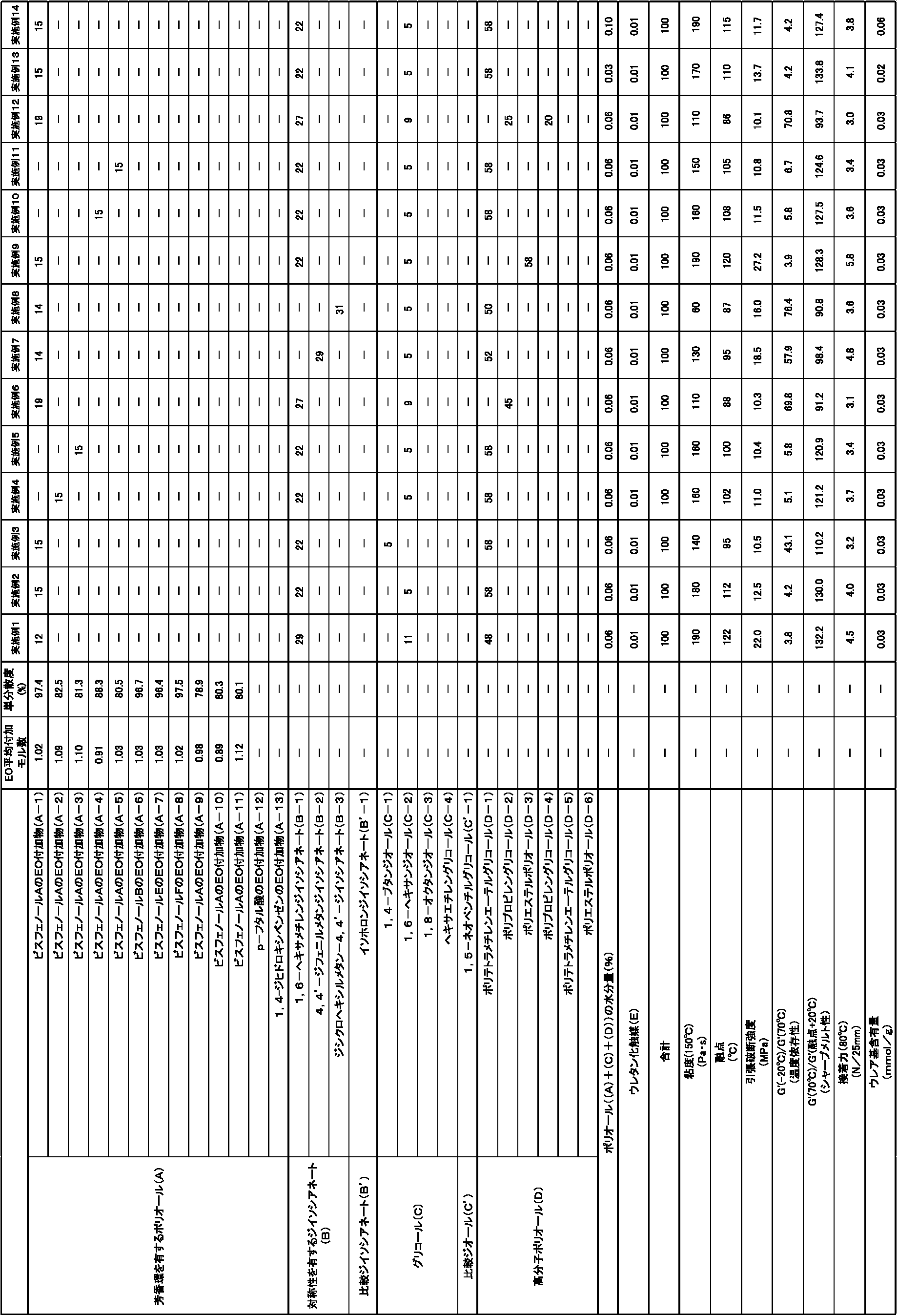
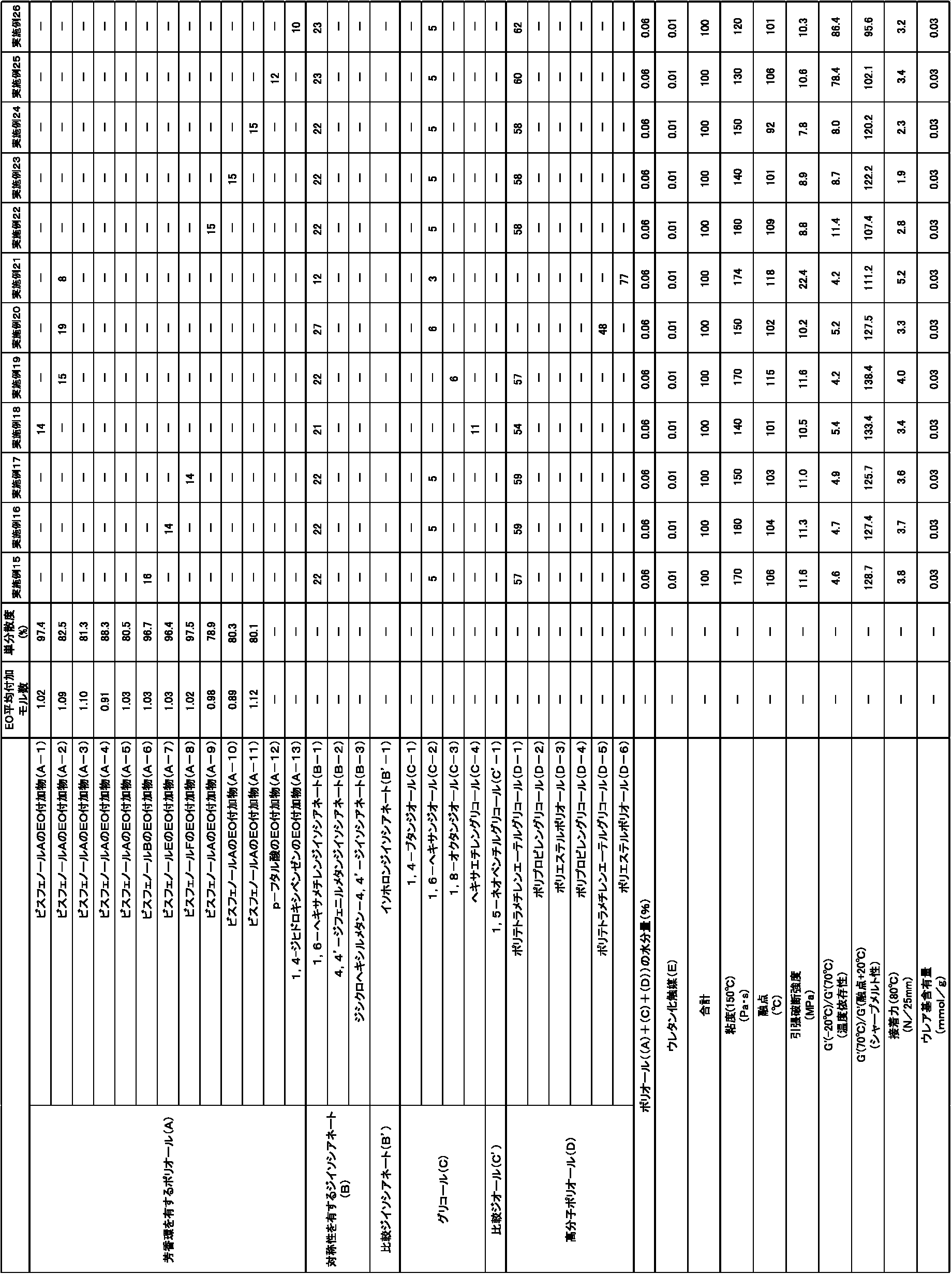
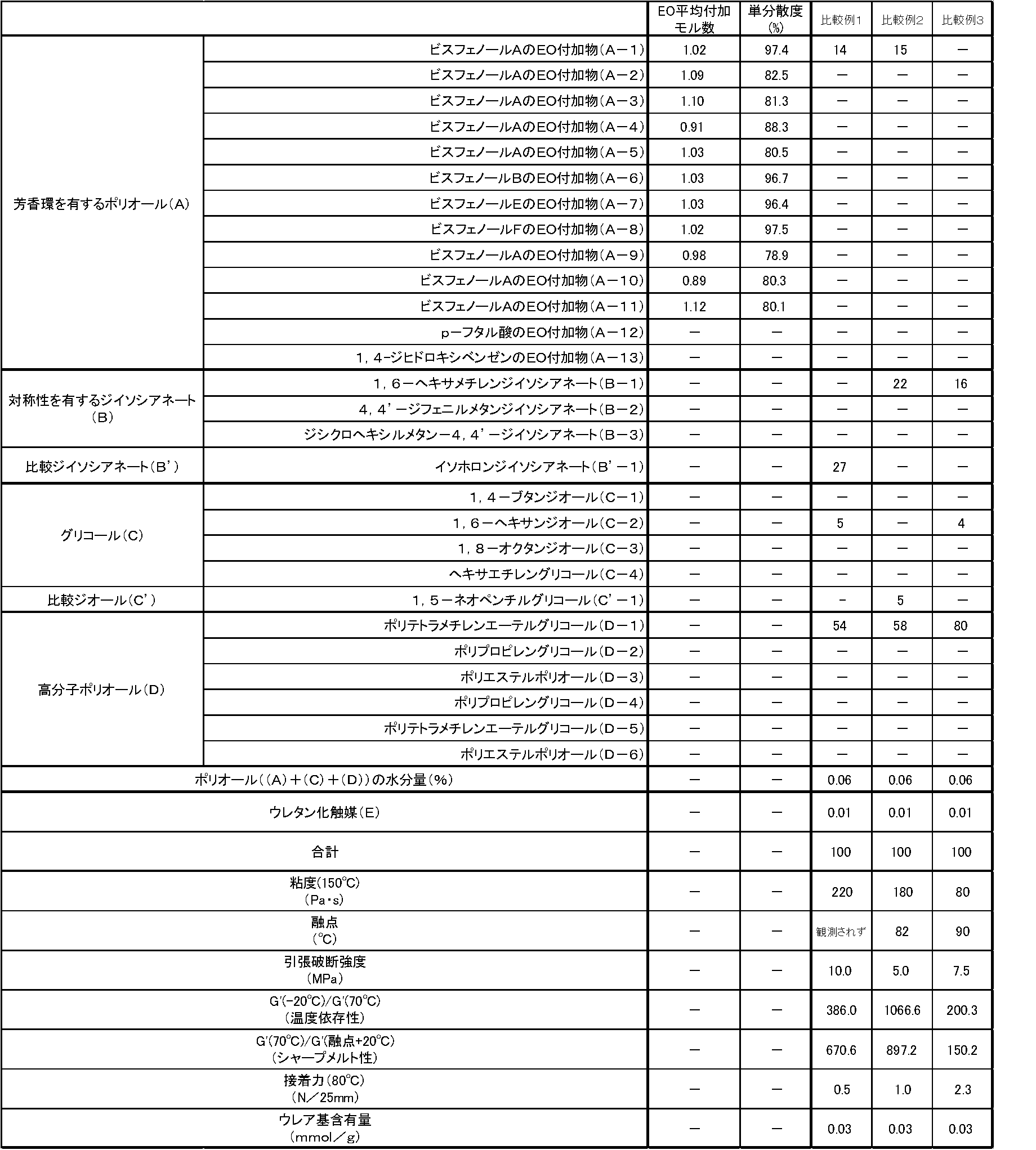
表1~3に記載の(B)、(C)、(D)、(E)、(B’)及び(C’)は以下を使用した。
1,6-ヘキサメチレンジイソシアネート(B-1):住化コベストロウレタン株式会社製「デスモジュールH」
4,4’-ジフェニルメタンジイソシアネート(B-2):東ソー株式会社製「ミリオネートMT」
ジシクロヘキシルメタン-4,4’-ジイソシアネート(B-3):住化コベストロウレタン株式会社製「デスモジュールW」
イソホロンジイソシアネート(B’-1):住化コベストロウレタン株式会社製「デスモジュールI」
1,4-ブタンジオール(C-1)::三菱化学株式会社製「14BG」
1,6-ヘキサンジオール(C-2):宇部興産株式会社製「1,6-ヘキサンジオール」
1,8-オクタンジオール(C-3):東京化成工業株式会社製
ヘキサエチレングリコール(C-4):東京化成工業株式会社製
1,5-ネオペンチルグリコール(C’-1):東京化成工業株式会社製
ポリテトラメチレンエーテルグリコール(D-1):三菱化学株式会社製「PTMG 1000」
ポリプロピレングリコール(D-2):三洋化成工業株式会社製「プライムポールPX-1000」(1級OH基率:70モル%)
ポリエステルポリオール(D-3):東ソー株式会社製「ニッポラン 164」
ポリプロピレングリコール(D-4):三洋化成工業株式会社製「サンニックスPP-1000」(1級OH基率:2モル%)
ポリテトラメチレンエーテルグリコール(D-5):三菱化学株式会社製「PTMG 650」
ポリエステルポリオール(D-6):東ソー株式会社製「ニッポラン 136」
ウレタン化触媒(E):日東化成株式会社製「ネオスタン U-600」
1,6-ヘキサメチレンジイソシアネート(B-1):住化コベストロウレタン株式会社製「デスモジュールH」
4,4’-ジフェニルメタンジイソシアネート(B-2):東ソー株式会社製「ミリオネートMT」
ジシクロヘキシルメタン-4,4’-ジイソシアネート(B-3):住化コベストロウレタン株式会社製「デスモジュールW」
イソホロンジイソシアネート(B’-1):住化コベストロウレタン株式会社製「デスモジュールI」
1,4-ブタンジオール(C-1)::三菱化学株式会社製「14BG」
1,6-ヘキサンジオール(C-2):宇部興産株式会社製「1,6-ヘキサンジオール」
1,8-オクタンジオール(C-3):東京化成工業株式会社製
ヘキサエチレングリコール(C-4):東京化成工業株式会社製
1,5-ネオペンチルグリコール(C’-1):東京化成工業株式会社製
ポリテトラメチレンエーテルグリコール(D-1):三菱化学株式会社製「PTMG 1000」
ポリプロピレングリコール(D-2):三洋化成工業株式会社製「プライムポールPX-1000」(1級OH基率:70モル%)
ポリエステルポリオール(D-3):東ソー株式会社製「ニッポラン 164」
ポリプロピレングリコール(D-4):三洋化成工業株式会社製「サンニックスPP-1000」(1級OH基率:2モル%)
ポリテトラメチレンエーテルグリコール(D-5):三菱化学株式会社製「PTMG 650」
ポリエステルポリオール(D-6):東ソー株式会社製「ニッポラン 136」
ウレタン化触媒(E):日東化成株式会社製「ネオスタン U-600」
表1~3に記載のポリオール[(A)+(C)+(D)]の水分量(%)は、カールフィッシャー水分計(容量滴定方式)を使用して測定した。カールフィッシャー水分計は、京都電子工業株式会社製:カールフィッシャー水分計(MKS-500)を用いた。希釈溶剤としてメタノールを用いて、測定試料約1gを有効数字4桁まで精秤し、メタノール中に投入し、1分間攪拌した。攪拌後、適定によって求められた水分量を読み取った。
なお、この計算における(C)には(C’)を含む。
なお、この計算における(C)には(C’)を含む。
ホットメルト接着剤(H-1)~(H-26)及び比較用のメルト接着剤(H'-1)~(H'-3)について、以下の方法で性能評価を行った結果を表1~3に示す。
評価方法は、次の通りである。
ホットメルト接着剤(H-1)~(H-26)及び比較用のメルト接着剤(H'-1)~(H'-3)について、以下では単に接着剤という。
(1)150℃溶融粘度
JIS-K7117(1999年)に準拠し、B型粘度計(東機産業株式会社製「RB-80H」)を用いて150℃での粘度を測定した。
ホットメルト接着剤(H-1)~(H-26)及び比較用のメルト接着剤(H'-1)~(H'-3)について、以下では単に接着剤という。
(1)150℃溶融粘度
JIS-K7117(1999年)に準拠し、B型粘度計(東機産業株式会社製「RB-80H」)を用いて150℃での粘度を測定した。
(2)融点
示差走査熱量測定(DSC)(ティー・エイ・インスツルメント・ジャパン株式会社製「Q20」)における吸熱ピークより求めた。
示差走査熱量測定(DSC)(ティー・エイ・インスツルメント・ジャパン株式会社製「Q20」)における吸熱ピークより求めた。
(3)引張破断強度
接着剤を厚さ1mmになるようにプレス機(テスター産業株式会社製「SA-302 卓上型テストプレス」)を使用して230℃でプレスすることで樹脂フィルムを作成し、塗膜の引張破断強度をJIS K 7311(1995年)に準拠して測定した。
接着剤を厚さ1mmになるようにプレス機(テスター産業株式会社製「SA-302 卓上型テストプレス」)を使用して230℃でプレスすることで樹脂フィルムを作成し、塗膜の引張破断強度をJIS K 7311(1995年)に準拠して測定した。
(4)温度依存性
下記の測定条件で、-20℃及び70℃での、接着剤の貯蔵弾性率(G’)を測定し、G'(-20℃)/G'(70℃)を求めて温度依存性を評価した。この数値が100以下であると温度依存性が少ないと評価した。
貯蔵弾性率(G’)は、樹脂フィルムを「(3)引張破断強度」と同じ方法でプレスし下記サンプルサイズに切り抜いて作製し、粘弾性を以下の測定条件で測定することによって求めた。
<粘弾性測定条件>
測定装置:Rheogel-E4000[株式会社UBM製]
測定治具:固体せん断
測定温度:-20~130℃
昇温速度:5℃/min
測定周波数:10Hz
サンプルサイズ:約7mm(縦)×約6mm(横)
下記の測定条件で、-20℃及び70℃での、接着剤の貯蔵弾性率(G’)を測定し、G'(-20℃)/G'(70℃)を求めて温度依存性を評価した。この数値が100以下であると温度依存性が少ないと評価した。
貯蔵弾性率(G’)は、樹脂フィルムを「(3)引張破断強度」と同じ方法でプレスし下記サンプルサイズに切り抜いて作製し、粘弾性を以下の測定条件で測定することによって求めた。
<粘弾性測定条件>
測定装置:Rheogel-E4000[株式会社UBM製]
測定治具:固体せん断
測定温度:-20~130℃
昇温速度:5℃/min
測定周波数:10Hz
サンプルサイズ:約7mm(縦)×約6mm(横)
(5)シャープメルト性
上記の測定条件で、70℃及び「(2)融点」で測定した融点+20℃での、接着剤の貯蔵弾性率(G’)を測定し、G'(70℃)/G'(融点+20℃)を求めてシャープメルト性を評価した。この数値が80以上であるとシャープメルト性が良好と評価した。
上記の測定条件で、70℃及び「(2)融点」で測定した融点+20℃での、接着剤の貯蔵弾性率(G’)を測定し、G'(70℃)/G'(融点+20℃)を求めてシャープメルト性を評価した。この数値が80以上であるとシャープメルト性が良好と評価した。
(6)接着力(80℃)
接着剤を、2枚のPETフィルム(厚さ100μm)の間に挟みこみ、厚みが1mmとなるように貼り合わせてサンプルを作製した。上記サンプルを200mm×25mmの大きさに裁断し、引張試験機を用い、測定温度(80℃)で引っ張り速度100mm/分の条件でT型剥離強度(単位:N/25mm)を測定した。
接着剤を、2枚のPETフィルム(厚さ100μm)の間に挟みこみ、厚みが1mmとなるように貼り合わせてサンプルを作製した。上記サンプルを200mm×25mmの大きさに裁断し、引張試験機を用い、測定温度(80℃)で引っ張り速度100mm/分の条件でT型剥離強度(単位:N/25mm)を測定した。
<ウレア基含有量>
ウレア基含有量は、窒素分析計[ANTEK7000(アンテック社製)]によって定量されるN原子含量と1H-NMRによって定量されるウレタン基とウレア基の比率から算出する。1H-NMR測定については、「NMRによるポリウレタン樹脂の構造研究:武田研究所報34(2)、224-323(1975)」に記載の方法で行う。すなわち1H-NMRを測定して、脂肪族イソシアネートを使用した場合、化学シフト6ppm付近のウレア基由来の水素の積分量と化学シフト7ppm付近のウレタン基由来の水素の積分量の比率からウレア基とウレタン基の重量比を測定し、該重量比と上記のN原子含量及びアロハネート基及びビューレット基含量からウレタン基及びウレア基含量を算出する。芳香族イソシアネートを使用した場合、化学シフト8ppm付近のウレア基由来の水素の積分量と化学シフト9ppm付近のウレタン基由来の水素の積分量の比率からウレア基とウレタン基の重量比を算出し、該重量比と上記のN原子含量からウレア基含有量を算出する。
ウレア基含有量は、窒素分析計[ANTEK7000(アンテック社製)]によって定量されるN原子含量と1H-NMRによって定量されるウレタン基とウレア基の比率から算出する。1H-NMR測定については、「NMRによるポリウレタン樹脂の構造研究:武田研究所報34(2)、224-323(1975)」に記載の方法で行う。すなわち1H-NMRを測定して、脂肪族イソシアネートを使用した場合、化学シフト6ppm付近のウレア基由来の水素の積分量と化学シフト7ppm付近のウレタン基由来の水素の積分量の比率からウレア基とウレタン基の重量比を測定し、該重量比と上記のN原子含量及びアロハネート基及びビューレット基含量からウレタン基及びウレア基含量を算出する。芳香族イソシアネートを使用した場合、化学シフト8ppm付近のウレア基由来の水素の積分量と化学シフト9ppm付近のウレタン基由来の水素の積分量の比率からウレア基とウレタン基の重量比を算出し、該重量比と上記のN原子含量からウレア基含有量を算出する。
ホットメルト接着剤(H-1)~(H-26)は、温度依存性が少ないため、これを使用した製品の品質安定性に優れる。そして、ホットメルト接着剤として使用した際には、接着力が安定する。さらに、引張破断強度にも優れる。
本発明のホットメルト接着剤は衣料用途や各種産業資材の芯地の製造にとくに有用である。
Claims (9)
- 芳香環を有するポリオール(A)、対称性を有するジイソシアネート(B)、一般式(1)で示されるポリメチレングリコール(C1)及び/又は一般式(2)で示されるポリエチレングリコール(C2)であるグリコール(C)、並びに高分子ポリオール(D)を必須構成単量体とする熱可塑性ウレタン樹脂(F)を含有するホットメルト接着剤。
HO-(CH2)n-OH (1)
[nは2~8の整数である。]
HO-(CH2CH2O)m-H (2)
[mは2~8の整数である。] - 上記芳香環を有するポリオール(A)がビスフェノールA、ビスフェノールB、ビスフェノールE及びビスフェノールFからなる群より選ばれる少なくとも1種のビスフェノール化合物のエチレンオキサイド付加物(A1)である請求項1に記載のホットメルト接着剤。
- 上記エチレンオキサイド付加物(A1)が、エチレンオキサイド平均付加モル数が水酸基あたり0.90~1.10であり、下記式(1)で示される単分散度が80%以上であるエチレンオキサイド付加物(A11)である請求項2に記載のホットメルト接着剤。
単分散度(%)={[水酸基あたりエチレンオキサイド付加モル数が1モルであるエチレンオキサイド付加物(A1)の重量]/[エチレンオキサイド付加物(A)の重量]}×100 (1) - 上記対称性を有するジイソシアネート(B)のイソシアネート基中の炭素を除く炭素数が、2~18の偶数である請求項1~3のいずれか1項に記載のホットメルト接着剤。
- 上記グリコール(C)に含まれる上記ポリメチレングリコール(C1)及び上記ポリエチレングリコール(C2)の炭素数がそれぞれ偶数である請求項1~4のいずれか1項に記載のホットメルト接着剤。
- 上記対称性を有するジイソシアネート(B)がポリメチレンジイソシアネート(B1)である請求項1~5のいずれか1項に記載のホットメルト接着剤。
- 上記グリコール(C)は上記ポリメチレングリコール(C1)を含み、
上記ポリメチレンジイソシアネート(B1)中のイソシアネート基中の炭素を除く炭素数が、上記ポリメチレングリコール(C1)の炭素数と同数である請求項6に記載のホットメルト接着剤。 - 上記高分子ポリオール(D)がポリテトラメチレンエーテルグリコールである請求項1~7のいずれか1項に記載のホットメルト接着剤。
- 熱可塑性ウレタン樹脂(F)のウレア基含有量が0.06mmol/g以下である請求項1~8のいずれか1項に記載のホットメルト接着剤。
Priority Applications (2)
| Application Number | Priority Date | Filing Date | Title |
|---|---|---|---|
| JP2018503000A JP6591040B2 (ja) | 2016-03-04 | 2017-02-10 | ホットメルト接着剤 |
| CN201780009827.0A CN108603088B (zh) | 2016-03-04 | 2017-02-10 | 热熔粘接剂 |
Applications Claiming Priority (2)
| Application Number | Priority Date | Filing Date | Title |
|---|---|---|---|
| JP2016042530 | 2016-03-04 | ||
| JP2016-042530 | 2016-03-04 |
Publications (1)
| Publication Number | Publication Date |
|---|---|
| WO2017150142A1 true WO2017150142A1 (ja) | 2017-09-08 |
Family
ID=59744024
Family Applications (1)
| Application Number | Title | Priority Date | Filing Date |
|---|---|---|---|
| PCT/JP2017/004895 Ceased WO2017150142A1 (ja) | 2016-03-04 | 2017-02-10 | ホットメルト接着剤 |
Country Status (3)
| Country | Link |
|---|---|
| JP (2) | JP6591040B2 (ja) |
| CN (1) | CN108603088B (ja) |
| WO (1) | WO2017150142A1 (ja) |
Cited By (1)
| Publication number | Priority date | Publication date | Assignee | Title |
|---|---|---|---|---|
| JP2025507796A (ja) * | 2022-03-09 | 2025-03-21 | シーカ テクノロジー アクチェンゲゼルシャフト | 改善された初期強度を有する湿気硬化型ポリウレタンホットメルト接着剤 |
Citations (4)
| Publication number | Priority date | Publication date | Assignee | Title |
|---|---|---|---|---|
| JPS62223285A (ja) * | 1986-03-25 | 1987-10-01 | Asahi Glass Co Ltd | ホツトメルト接着剤 |
| JPH06271830A (ja) * | 1993-03-18 | 1994-09-27 | Sekisui Chem Co Ltd | ホットメルト接着剤 |
| JPH10259369A (ja) * | 1997-01-20 | 1998-09-29 | Sanyo Chem Ind Ltd | ホットメルト接着剤 |
| JP2009286941A (ja) * | 2008-05-30 | 2009-12-10 | Henkel Japan Ltd | 湿気硬化型ホットメルト接着剤 |
Family Cites Families (1)
| Publication number | Priority date | Publication date | Assignee | Title |
|---|---|---|---|---|
| KR101004339B1 (ko) * | 2006-12-01 | 2010-12-28 | 디아이씨 가부시끼가이샤 | 습기 경화성 폴리우레탄 핫멜트 접착제 및 이것을 사용한 적층 시트 |
-
2017
- 2017-02-10 JP JP2018503000A patent/JP6591040B2/ja active Active
- 2017-02-10 WO PCT/JP2017/004895 patent/WO2017150142A1/ja not_active Ceased
- 2017-02-10 CN CN201780009827.0A patent/CN108603088B/zh active Active
-
2019
- 2019-09-17 JP JP2019168418A patent/JP6836636B2/ja active Active
Patent Citations (4)
| Publication number | Priority date | Publication date | Assignee | Title |
|---|---|---|---|---|
| JPS62223285A (ja) * | 1986-03-25 | 1987-10-01 | Asahi Glass Co Ltd | ホツトメルト接着剤 |
| JPH06271830A (ja) * | 1993-03-18 | 1994-09-27 | Sekisui Chem Co Ltd | ホットメルト接着剤 |
| JPH10259369A (ja) * | 1997-01-20 | 1998-09-29 | Sanyo Chem Ind Ltd | ホットメルト接着剤 |
| JP2009286941A (ja) * | 2008-05-30 | 2009-12-10 | Henkel Japan Ltd | 湿気硬化型ホットメルト接着剤 |
Cited By (1)
| Publication number | Priority date | Publication date | Assignee | Title |
|---|---|---|---|---|
| JP2025507796A (ja) * | 2022-03-09 | 2025-03-21 | シーカ テクノロジー アクチェンゲゼルシャフト | 改善された初期強度を有する湿気硬化型ポリウレタンホットメルト接着剤 |
Also Published As
| Publication number | Publication date |
|---|---|
| JP6836636B2 (ja) | 2021-03-03 |
| JP6591040B2 (ja) | 2019-10-16 |
| CN108603088B (zh) | 2020-12-01 |
| JP2020015918A (ja) | 2020-01-30 |
| JPWO2017150142A1 (ja) | 2018-10-18 |
| CN108603088A (zh) | 2018-09-28 |
Similar Documents
| Publication | Publication Date | Title |
|---|---|---|
| KR101691870B1 (ko) | 습기 경화형 폴리우레탄 핫멜트 수지 조성물, 접착제 및 물품 | |
| US8686076B2 (en) | Silane moisture curable hot melts | |
| KR100583926B1 (ko) | 폴리우레탄 및 폴리우레탄 함유 제제 | |
| US8383728B2 (en) | Adhesives based on polyester-graft-poly(meth)acrylate copolymers | |
| CN111433244B (zh) | 增韧的氰基丙烯酸酯组合物 | |
| EP0001166B1 (en) | Liquid polymer compositions, process for the preparation of adhesives and laminate structures | |
| US4145514A (en) | Polyurethane pressure-sensitive adhesive and laminates therefrom | |
| WO2008047562A1 (en) | Base material for adhesive and method for producing adhesive | |
| JP6591040B2 (ja) | ホットメルト接着剤 | |
| JP7654030B2 (ja) | ポリカーボネートジオール組成物 | |
| JP7295341B2 (ja) | 2液型ポリウレタン接着剤及び被着体 | |
| JP2017105992A (ja) | ホットメルト接着剤組成物及びその接着体 | |
| JP5163056B2 (ja) | 硬化性樹脂組成物 | |
| KR102671540B1 (ko) | 점착제, 점착 시트 및 광학 부재 | |
| JP2023005131A (ja) | 粘着剤組成物および粘着シート | |
| JP4232094B2 (ja) | 高温剪断接着性能に優れた軟質樹脂成形体用組成物及びそれから得られた軟質樹脂成形体 | |
| JPS63218782A (ja) | 接着剤組成物 | |
| WO2024181569A1 (ja) | カーボネート基含有ポリオール | |
| US4243789A (en) | Hydroxyl-containing liquid polymers and pressure-sensitive adhesives prepared therefrom | |
| EP0126998A2 (en) | Poly (ester-amide) hot-melt adhesives | |
| JPH02202573A (ja) | 接着剤組成物 | |
| JP2025168042A (ja) | 反応性ホットメルト接着剤、構造体、及び電子機器 |
Legal Events
| Date | Code | Title | Description |
|---|---|---|---|
| ENP | Entry into the national phase |
Ref document number: 2018503000 Country of ref document: JP Kind code of ref document: A |
|
| NENP | Non-entry into the national phase |
Ref country code: DE |
|
| 121 | Ep: the epo has been informed by wipo that ep was designated in this application |
Ref document number: 17759613 Country of ref document: EP Kind code of ref document: A1 |
|
| 122 | Ep: pct application non-entry in european phase |
Ref document number: 17759613 Country of ref document: EP Kind code of ref document: A1 |