WO2017122613A1 - 合成スギタケレクチンの親和性を向上させる方法 - Google Patents
合成スギタケレクチンの親和性を向上させる方法 Download PDFInfo
- Publication number
- WO2017122613A1 WO2017122613A1 PCT/JP2017/000418 JP2017000418W WO2017122613A1 WO 2017122613 A1 WO2017122613 A1 WO 2017122613A1 JP 2017000418 W JP2017000418 W JP 2017000418W WO 2017122613 A1 WO2017122613 A1 WO 2017122613A1
- Authority
- WO
- WIPO (PCT)
- Prior art keywords
- synthetic
- lectin
- affinity
- fucose
- phosl
- Prior art date
- Legal status (The legal status is an assumption and is not a legal conclusion. Google has not performed a legal analysis and makes no representation as to the accuracy of the status listed.)
- Ceased
Links
Classifications
-
- C—CHEMISTRY; METALLURGY
- C07—ORGANIC CHEMISTRY
- C07K—PEPTIDES
- C07K1/00—General methods for the preparation of peptides, i.e. processes for the organic chemical preparation of peptides or proteins of any length
- C07K1/02—General methods for the preparation of peptides, i.e. processes for the organic chemical preparation of peptides or proteins of any length in solution
-
- C—CHEMISTRY; METALLURGY
- C07—ORGANIC CHEMISTRY
- C07K—PEPTIDES
- C07K14/00—Peptides having more than 20 amino acids; Gastrins; Somatostatins; Melanotropins; Derivatives thereof
- C07K14/415—Peptides having more than 20 amino acids; Gastrins; Somatostatins; Melanotropins; Derivatives thereof from plants
- C07K14/42—Lectins, e.g. concanavalin, phytohaemagglutinin
-
- G—PHYSICS
- G01—MEASURING; TESTING
- G01N—INVESTIGATING OR ANALYSING MATERIALS BY DETERMINING THEIR CHEMICAL OR PHYSICAL PROPERTIES
- G01N33/00—Investigating or analysing materials by specific methods not covered by groups G01N1/00 - G01N31/00
- G01N33/48—Biological material, e.g. blood, urine; Haemocytometers
- G01N33/50—Chemical analysis of biological material, e.g. blood, urine; Testing involving biospecific ligand binding methods; Immunological testing
- G01N33/53—Immunoassay; Biospecific binding assay; Materials therefor
-
- G—PHYSICS
- G01—MEASURING; TESTING
- G01N—INVESTIGATING OR ANALYSING MATERIALS BY DETERMINING THEIR CHEMICAL OR PHYSICAL PROPERTIES
- G01N33/00—Investigating or analysing materials by specific methods not covered by groups G01N1/00 - G01N31/00
- G01N33/48—Biological material, e.g. blood, urine; Haemocytometers
- G01N33/50—Chemical analysis of biological material, e.g. blood, urine; Testing involving biospecific ligand binding methods; Immunological testing
- G01N33/53—Immunoassay; Biospecific binding assay; Materials therefor
- G01N33/531—Production of immunochemical test materials
-
- C—CHEMISTRY; METALLURGY
- C12—BIOCHEMISTRY; BEER; SPIRITS; WINE; VINEGAR; MICROBIOLOGY; ENZYMOLOGY; MUTATION OR GENETIC ENGINEERING
- C12N—MICROORGANISMS OR ENZYMES; COMPOSITIONS THEREOF; PROPAGATING, PRESERVING, OR MAINTAINING MICROORGANISMS; MUTATION OR GENETIC ENGINEERING; CULTURE MEDIA
- C12N15/00—Mutation or genetic engineering; DNA or RNA concerning genetic engineering, vectors, e.g. plasmids, or their isolation, preparation or purification; Use of hosts therefor
- C12N15/09—Recombinant DNA-technology
Definitions
- the present invention relates to a method for improving the affinity of a synthetic sugitake lectin, and more particularly to a method for improving the affinity of a synthetic sugitake lectin obtained by chemical synthesis or genetic engineering synthesis to fucose ⁇ 1 ⁇ 6 sugar chain. .
- lectins having an affinity for fucose ⁇ 1 ⁇ 6 sugar chains conventionally, lentil lectin (LCA), pea lectin (PSA), yellow chawan lectin (AAL), daffodil lectin (NPA), broad bean lectin (VFA), gonococcus Lectin (AOL) and the like are known. These lectins also show affinity for glycolipid-based sugar chains having fucose other than ⁇ 1 ⁇ 6 bonds and high mannose sugar chains not having fucose.
- LCA lentil lectin
- PSA pea lectin
- AAL yellow chawan lectin
- NPA daffodil lectin
- VFA broad bean lectin
- AOL gonococcus Lectin
- PhoSL cedar lectin extracted and purified from Sugitake, which is a kind of basidiomycete, has a property of specifically recognizing fucose ⁇ 1 ⁇ 6 sugar chains as compared with conventional lectins.
- Non-Patent Document 1 PhoSL consists of 40 amino acids and has excellent heat resistance and pH resistance. PhoSL is highly expected to be used for diagnostic agents for diseases involving fucose ⁇ 1 ⁇ 6 sugar chains, methods for detecting fucose ⁇ 1 ⁇ 6 sugar chains, methods for fractionating fucose ⁇ 1 ⁇ 6 sugar chains, and the like.
- PhoSL Since the number of constituent amino acids of PhoSL is as small as 40, chemical synthesis and genetic engineering synthesis are relatively easy (Patent Documents 1 and 2).
- the synthesized PhoSL is considered to be useful for stable supply, production cost reduction, purity improvement, activity improvement and the like.
- Patent No. 5480644 (peptide)
- Patent No. 553290 (gene)
- Synthetic PhoSL has affinity for glycoprotein, but its level is inferior to that of natural product-derived PhoSL.
- an object of the present invention is to provide a method for improving the affinity of a synthetic PhoSL obtained by chemical synthesis or genetic engineering synthesis to fucose ⁇ 1 ⁇ 6 sugar chain, and its use.
- the present invention is a method for improving the affinity of a synthetic sugitake lectin obtained by chemical synthesis or genetic engineering synthesis with fucose ⁇ 1 ⁇ 6 sugar chain, comprising polyoxyethylene sorbitan fatty acid ester, polyoxyethylene (9 )
- a method for improving the affinity of the synthetic cedar lectin comprising the step of immersing the synthetic cedar lectin in a solution containing at least one surfactant selected from the group consisting of octyl phenyl ether and octyl glucoside.
- synthetic sugitake lectin obtained by chemical synthesis or genetic engineering synthesis may be abbreviated as “synthetic PhoSL” in the present specification.
- the surfactant concentration of the solution is preferably 0.01 to 6% by weight.
- the immersion time is preferably 5 minutes to 48 hours.
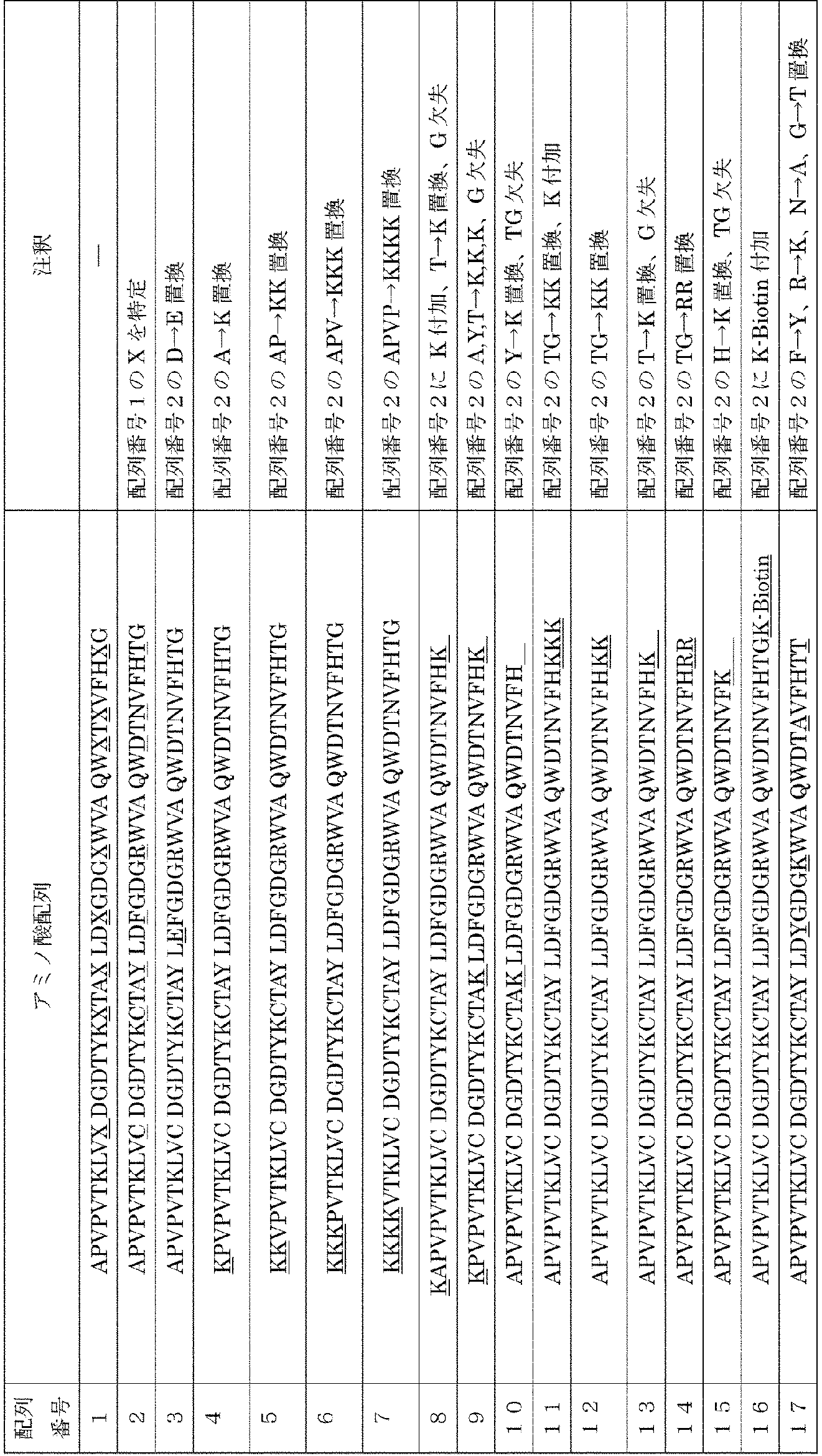
- the synthetic PhoSL is an amino acid-modified peptide having, for example, the amino acid sequence shown in SEQ ID NO: 1, or one or several amino acids in SEQ ID NO: 1 substituted, added or deleted, and having a sugar binding activity.
- the amino acid-modified peptide of synthetic PhoSL is represented by any of SEQ ID NOs: 3 to 17, for example.
- the present invention also provides use of the method for improving the affinity of the synthetic staketake lectin. That is, the present invention is a method for measuring fucose ⁇ 1 ⁇ 6 sugar chain, and is at least one surface activity selected from the group consisting of polyoxyethylene sorbitan fatty acid ester, polyoxyethylene (9) octylphenyl ether, and octyl glucoside.
- the measurement method includes the step of reacting the synthetic cedar lectin with improved affinity with the fucose ⁇ 1 ⁇ 6 sugar chain and detecting the reacted lectin.
- the fucose ⁇ 1 ⁇ 6 sugar chain is preferably immobilized on a carrier.
- the fucose ⁇ 1 ⁇ 6 sugar chain may be immobilized on the carrier via an antibody.
- the synthetic sugitake lectin is preferably labeled.
- the affinity of the synthetic PhoSL for the fucose ⁇ 1 ⁇ 6 sugar chain is improved.
- the reason for the improvement is not limited to the invention, but it is considered that the curing of the synthetic PhoSL in a specific surfactant solution brings its three-dimensional structure closer to that of the naturally derived PhoSL.
- the synthetic PhoSL having improved affinity is used for a reaction test with fucose ⁇ 1 ⁇ 6 sugar chain. Measurement sensitivity is improved. Therefore, according to the present invention, a fucose ⁇ 1 ⁇ 6 sugar chain specific binding agent, a fucose ⁇ 1 ⁇ 6 sugar chain research reagent, a detection of a tumor marker related to fucose ⁇ 1 ⁇ 6 sugar chain, and a fucose ⁇ 1 ⁇ 6 sugar chain related
- the use of synthetic PhoSL for the prognosis of a disease to be diagnosed, the determination of the therapeutic effect, and the search for a novel tumor marker related to fucose ⁇ 1 ⁇ 6 sugar chain is promoted.
- the method for improving the affinity between the synthetic PhoSL of the present invention and fucose ⁇ 1 ⁇ 6 sugar chain is at least one selected from the group consisting of polyoxyethylene sorbitan fatty acid ester, polyoxyethylene (9) octyl phenyl ether, and octyl glucoside. It is essential to include a step of immersing the synthetic PhoSL in a solution containing the surfactant.
- a solution containing the surfactant Each component will be described in detail below.
- the fucose ⁇ 1 ⁇ 6 sugar chain means a structure in which fucose is bonded to N-acetylglucosamine at the reducing end of the N-type sugar chain by ⁇ 1 ⁇ 6 bond.
- a free oligosaccharide is used. Includes all chains, glycopeptides, glycoproteins, cells and the like. Also included are those obtained by chemically modifying an oligosaccharide chain or the like like like a label.
- the N-linked sugar chain may be a high mannose type, a composite type, a hybrid type or the like.
- the sugar chain is obtained by chemically decomposing the sugar chain with acid, hydrazine or the like, sialidase, galactosidase, N-acetylhexosaminidase, ⁇ 1 ⁇ 2 fucose, ⁇ 1 ⁇ 3 fucose, ⁇ 1 ⁇
- the sugar chain may be partially degraded by using either fucosidase or mannosidase which cuts 4 fucose simultaneously or stepwise.
- a sugar such as glucose, a functional group such as an acetyl group, a sulfate group, or a phosphate group may be added to the sugar chain.
- fucose ⁇ 1 ⁇ 6 sugar chain A typical example of fucose ⁇ 1 ⁇ 6 sugar chain is shown below. [In the formula, Man means mannose, GlcNAc means N-acetylglucosamine, and Fuc means fucose]
- fucose ⁇ 1 ⁇ 6 sugar chain are tumor markers such as AFP-L3 and fucosylated haptoglobin.
- the amino acid sequence of synthetic PhoSL which is the subject of the present invention, is based on naturally-derived PhoSL extracted and purified from Sugitake (hereinafter referred to as natural PhoSL).
- the amino acid sequence of native PhoSL is shown in SEQ ID NO: 1.
- 10th and 17th Xaa of SEQ ID NO: 1 may be any amino acid residue, but is preferably Cys.
- the 20th, 23rd, 27th, 33th, 35th and 39th Xaas are Tyr / Ser, Phe / Tyr, Arg / Lys / Asn, Asp / Gly / Ser, Asn / Ala, and Thr / Gln, respectively. .
- Natural PhoSL binds more specifically to fucose ⁇ 1 ⁇ 6 sugar chain than conventional lectin (for example, AAL) having affinity for fucose ⁇ 1 ⁇ 6 sugar chain.
- the sugar recognition activity of natural PhoSL is as follows: (1)
- the binding constant (at 25 ° C.) for fucose ⁇ 1 ⁇ 6 sugar chain is usually 5.0 ⁇ 10 4 M ⁇ 1 or more, more preferably 1.0 ⁇ 10 5 M ⁇ 1 or more, and further preferably Has an affinity of 2.0 ⁇ 10 5 M ⁇ 1 or more, (2) does not substantially bind to a high mannose sugar chain not containing ⁇ 1 ⁇ 6 fucose and / or a glycolipid sugar chain not containing ⁇ 1 ⁇ 6 fucose, It is represented by
- the feature of (2) “substantially does not bind” is more specifically a binding constant for a high-mannose sugar chain that does not contain ⁇ 1 ⁇ 6 fucose and / or a glycolipid sugar chain that does not contain ⁇ 1 ⁇ 6 fucose ( At 25 ° C. is usually 1.0 ⁇ 10 3 M ⁇ 1 or less, preferably 1.0 ⁇ 10 2 M ⁇ 1 or less, particularly preferably 0.
- PhoSL further has a binding constant (at 25 ° C.) for N-linked single-, double-, triple- and / or four-chain sugar chains linked with ⁇ 1 ⁇ 6 fucose, preferably 1 0.0 ⁇ 10 4 M ⁇ 1 or more, more preferably 5.0 ⁇ 10 4 M ⁇ 1 or more, and still more preferably 1.0 ⁇ 10 5 M ⁇ 1 or more.
- the binding constant means a numerical value measured at an analysis temperature of 25 ° C. using, for example, frontal affinity chromatography (FAC method).
- a synthetic PhoSL used in the method of the present invention is produced.
- An example of specifying Xaa of SEQ ID NO: 1 for obtaining synthetic PhoSL is shown in SEQ ID NO: 2.
- Synthetic PhoSL having the same amino acid sequence as natural PhoSL has affinity for fucose ⁇ 1 ⁇ 6 sugar chain, like natural PhoSL (Patent Documents 1 and 2).
- Patent Documents 1 and 2 By pretreating synthetic PhoSL in the present invention, the affinity of synthetic PhoSL for fucose ⁇ 1 ⁇ 6 sugar chain can be improved to be equal to or higher than that of natural PhoSL.
- Synthetic PhoSL may be an amino acid-modified peptide in which one or several amino acids in SEQ ID NO: 1 are substituted, added, or deleted, and have sugar-binding activity for fucose ⁇ 1 ⁇ 6 sugar chain.
- the isoelectric point of the amino acid-modified peptide is preferably equal to or higher than the isoelectric point (4.67) of natural PhoSL, and more preferably in the range of 4.69 to 9.00.
- amino acid-modified peptide is a peptide having one or more amino acids substituted with glutamic acid or the like in the sequence of SEQ ID NO: 2 specifying Xaa of SEQ ID NO: 1 and having a sugar binding activity. Substitution with glutamic acid is thought to change the steric structure slightly by increasing the number of carbons in the side chain with a small change in isoelectric point.
- SEQ ID NO: 3 An example of such is SEQ ID NO: 3.
- amino acid-modified peptide is a peptide having one or more amino acids substituted with lysine in the sequence of SEQ ID NO: 2 specifying Xaa of SEQ ID NO: 1 and having a sugar binding activity.
- Substitution with lysine, a basic amino acid enhances the sugar binding activity and increases the isoelectric point of the peptide while maintaining the sugar binding activity. Examples of such include SEQ ID NOs: 4, 5, 6, 7, and 12.
- An increase in isoelectric point contributes to an improvement in resolution of affinity electrophoresis analysis.
- amino acid-modified peptide is a peptide having one or more amino acids substituted with arginine in the sequence of SEQ ID NO: 2 specifying Xaa of SEQ ID NO: 1 and having a sugar binding activity. Substitution of arginine, a basic amino acid, increases the isoelectric point of the peptide while maintaining sugar binding activity.
- SEQ ID NO: 14 An example of such is SEQ ID NO: 14.
- the amino acid substituted with lysine or arginine is preferably at least one selected from the group consisting of alanine, proline, valine, threonine and glycine in that the strength of sugar binding activity is changed.
- lysine When substituted with lysine, in particular, alanine (SEQ ID NO: 4-7), proline (SEQ ID NO: 5-7), valine (SEQ ID NO: 6-7) on the N-terminal side of the amino acid sequence, or C-terminal side of the amino acid sequence.
- threonine and glycine are replaced with two lysines (SEQ ID NO: 12).
- threonine and glycine on the C-terminal side of the amino acid sequence are substituted with two arginines.
- An example of such is SEQ ID NO: 14.
- the number of amino acids to be substituted in the amino acid modified peptide is one or several, preferably 1 to 4.
- lysine and / or arginine may be added to the amino acid sequence substituted with lysine and / or arginine.
- An example of such is SEQ ID NO: 11.
- amino acid-modified peptide is a peptide having a sugar-binding activity to which lysine and / or arginine is added in the sequence of SEQ ID NO: 2 specifying Xaa of SEQ ID NO: 1.
- the number of amino acids added at this time is one or several, preferably 1 to 2.
- a specific example is SEQ ID NO: 16.
- the amino acid that may be deleted is preferably at least one of threonine and glycine.
- threonine deletion include SEQ ID NOs: 8-13 and 15
- glycine deletion include SEQ ID NOs: 8-13 and 15.
- amino acids that may be substituted with lysine are threonine (SEQ ID NO: 8, 9 and 13), alanine (SEQ ID NO: 9), tyrosine (SEQ ID NO: 9 and 10), and histidine (SEQ ID NO: It is preferably at least one selected from the group consisting of 15).
- the number of amino acids to be deleted is one or several, preferably 1 to 2.
- the number of amino acids changed by at least one of substitution, deletion and addition to the amino acid sequence of SEQ ID NO: 1 is 1 to several, preferably 1 to 4.
- the chemical synthesis or genetic engineering technique for obtaining the synthetic lectin is not particularly limited, and a general-purpose method can be used.
- a peptide solid phase synthesis method and a liquid phase synthesis method are known for chemical synthesis.
- organic synthetic chemical methods such as the Fmoc (Fluorenyl-Methoxy-Carbonyl) method, the Boc (tert-Butyl Oxy Carbony) method, the Cbz (Benzyloxycarbonyl Chloride) method and the like can be mentioned.
- Genetic engineering synthesis means obtaining a recombinant artificially expressed in a known host different from the natural origin using a nucleic acid encoding the amino acid sequence of the naturally derived PhoSL.
- a method for producing genetically engineered PhoSL is described in detail in Patent Document 2.
- Patent Document 2 is incorporated herein by reference (in this document, Tsutsugitake is read as Sugitake and PTL is read as PhoSL).
- the synthetic PhoSL may be a peptide having a plurality of the same or different peptides as subunits and having a sugar binding activity.
- the association may improve sugar binding activity and hemagglutination activity.
- the number of peptide associations is usually 2 or more, preferably 2 to 10, particularly preferably 2 to 4.
- the method for associating a plurality of peptides is not particularly limited as long as the sugar binding activity is not lost.
- examples thereof include avidin-biotin reaction and a reaction with a condensing agent such as 1-ethyl-3- (3-dimethylaminopropyl) carbodiimide hydrochloride.
- the full-length cDNA of PhoSL has three types of saccharide recognition domains (CRD1, CRD2, and CRD3). These domains have more than 80% homology with native PhoSL. The synthesis may be performed so that at least two of these sugar recognition domains are expressed during genetic engineering synthesis.
- the synthetic PhoSL preferably incorporates a labeling means for enabling detection.
- a labeling means a known labeling method can be applied without particular limitation. For example, labeling with a radioisotope, binding of a labeled compound, and the like can be mentioned.
- the synthetic PhoSL may be detected via an anti-PhoSL antibody.
- the labeling compound examples include enzyme labels (horseradish peroxidase, alkaline phosphatase, etc.), biotin labels, digoxigenin labels, fluorescent labels (fluorescein isothiocyanate, CyDye (registered trademark), ethyl 4-aminobenzoate (ABEE). Aminopyridine, allophycocyanin, phycoerythrin, etc.).
- enzyme labels horseradish peroxidase, alkaline phosphatase, etc.
- biotin labels digoxigenin labels
- fluorescent labels fluorescein isothiocyanate, CyDye (registered trademark)
- ABEE ethyl 4-aminobenzoate
- Aminopyridine allophycocyanin, phycoerythrin, etc.
- biotin labeling is preferable in that it has high sensitivity and is suitable for synthesis, and examples thereof include SEQ ID NO: 16 in which biotin is bound to lys
- the measurement of the sugar binding specificity of synthetic PhoSL can be performed by a conventional method. For example, a solution to which synthetic PhoSL is added is filled in a capillary electrophoresis apparatus, and a labeled standard sugar chain is developed. After electrophoresis, detection is performed by a detection means based on the label.
- the surfactant solution used in the method of the present invention is a solution of at least one surfactant selected from the group consisting of polyoxyethylene sorbitan fatty acid ester, polyoxyethylene (9) octyl phenyl ether, and octyl glucoside.
- the polyoxyethylene sorbitan fatty acid ester has the following formula (1): [Wherein R 1 to R 3 are each an alkyl group or an alkenyl group having 11 to 17 carbon atoms, x, y, z and w are integers, and the sum of x, y, z and w is Usually, it is 1 to 50, preferably 15 to 25, particularly preferably 20. ] Represented by
- the polyoxyethylene sorbitan fatty acid ester is obtained by condensing ethylene oxide with a sorbitan fatty acid ester obtained by esterifying a part of hydroxyl groups of sorbitol and anhydrous sorbitol with a fatty acid.
- a commercially available polyoxyethylene sorbitan fatty acid ester can be used. Examples are Tween 20, 40, 60, 80, 65 and 85.
- R 1 in formula 1 is mainly lauric acid (CH 3 (CH 2 ) 10 CO—) and R 2 and R 3 are H.
- Tween 40 polyoxyethylene sorbitan monopalmitate
- R 1 in formula 1 is primarily palmitic acid (CH 3 (CH 2 ) 14 CO—), and R 2 and R 3 are H.
- R 1 in Formula 1 is primarily stearic acid (CH 3 (CH 2 ) 16 CO—) and R 2 and R 3 are H.
- Tween 80 polyoxyethylene sorbitan monooleate is such that R 1 of formula 1 is primarily oleic acid (CH 3 (CH 2 ) 7 CH ⁇ CH (CH 2 ) 7 CO—), and R 2 and R 3 are H.
- R 1 , R 2 and R 3 in Formula 1 are mainly stearic acid.
- R 1 , R 2 and R 3 in Formula 1 are mainly oleic acid.
- the fatty acid of the polyoxyethylene sorbitan fatty acid ester is lauric acid, palmitic acid, stearic acid or oleic acid, particularly preferably lauric acid.
- Polyoxyethylene (9) octylphenyl ether has the following formula (2): It is represented by
- the polyoxyethylene (9) octylphenyl ether may be a commercially available product.
- An example is NP-40 (Nonidet P-40, New England Biolab).
- Examples of the solvent for the surfactant solution include water, phosphate buffered saline (PBS), and Tris-HCl buffer. Water or PBS is preferable, and water is particularly preferable.
- the surfactant concentration of the above solution may be usually 0.01 to 6% by weight, preferably 0.01 to 5% by weight, more preferably 0.05 to 5% by weight, particularly preferably. 0.07 to 3% by weight.
- the temperature at which the synthetic PhoSL is immersed in the surfactant solution is usually 2 to 50 ° C., preferably 4 to 40 ° C., more preferably 4 to 35 ° C.
- the immersion time is usually 5 minutes to 48 hours, preferably 10 minutes to 24 hours, particularly preferably 20 minutes to 24 hours, depending on the immersion temperature.
- a method for measuring fucose ⁇ 1 ⁇ 6 sugar chain in a solution containing at least one surfactant selected from the group consisting of polyoxyethylene sorbitan fatty acid ester, polyoxyethylene (9) octylphenyl ether, and octyl glucoside, A step of obtaining the synthetic cedar lectin having an improved affinity with the fucose ⁇ 1 ⁇ 6 sugar chain by immersing a synthetic cedar lectin obtained by chemical synthesis or genetic engineering synthesis, and a synthetic sukitake lectin having improved affinity And the fucose ⁇ 1 ⁇ 6 sugar chain are reacted, and the measurement method including the step of detecting the reacted lectin is described.
- the step of obtaining the synthetic PhoSL having an improved affinity with the fucose ⁇ 1 ⁇ 6 sugar chain is as described in the method for improving the affinity of the synthetic PhoSL.
- the step of reacting the PhoSL having improved affinity with the fucose ⁇ 1 ⁇ 6 sugar chain and detecting the reacted lectin will be described below.
- the means for detecting the reaction lectin is not particularly limited.
- the detection means for example, ELISA (direct adsorption method, sandwich method, and competitive method), lectin affinity chromatography, lectin staining, lectin chip, flow cytometry (FACS) method, aggregation method, surface plasmon A resonance method (for example, Biacore (registered trademark) system), electrophoresis, beads, or the like can be used.
- a sample such as blood is added to the plate and immobilized.
- a biotin-labeled lectin is added to react the sugar chain with the lectin.
- HRP horseradish peroxidase
- HRP horseradish peroxidase
- the color developing substrate for HRP is added to cause color development, and the color intensity is measured with an absorptiometer. If a calibration curve is prepared in advance using a standard sample containing a sugar chain having a known concentration, the sugar chain can be quantified.
- unlabeled lectin can be used, and after the reaction between sugar chain and lectin, measurement can be performed by using an anti-lectin antibody.
- an antibody that binds to an antigen having fucose ⁇ 1 ⁇ 6 sugar chain is added and immobilized on a plate, and then a sample such as serum is added.
- a biotin-labeled lectin is added to react the sugar chain with the lectin.
- An HRP-labeled streptavidin solution is added as a secondary labeling compound to react biotin with streptavidin.
- the color developing substrate for HRP is added to cause color development, and the color intensity is measured with an absorptiometer. If a calibration curve is prepared in advance using a standard sample with a known concentration, fucose ⁇ 1 ⁇ 6 sugar chains can be quantified.
- Lectin affinity chromatography is affinity chromatography that utilizes the property that a lectin immobilized on a carrier specifically binds to a sugar chain. High throughput is expected when combined with HPLC.
- gel materials such as agarose, dextran, cellulose, starch, polyacrylamide and the like are generally used.
- commercially available products can be used without particular limitation, and examples thereof include Sepharose 4B and Sepharose 6B (both manufactured by GE Healthcare Bioscience).
- Columns used for lectin chromatography include those in which lectins are immobilized on microplates or nanowells.
- the concentration of the lectin to be immobilized is usually 0.001 to 100 mg / mL, preferably 0.01 to 20 mg / mL.
- the carrier is an agarose gel, it is activated with CNBr or the like and then coupled with the lectin.
- a lectin may be immobilized on a gel into which an activation spacer has been introduced. Further, the lectin may be immobilized on a gel into which a formyl group has been introduced and then reduced with NaCNBH 3 .
- a commercially available activated gel such as NHS-Sepharose (manufactured by GE Healthcare Bioscience) may also be used.
- the buffer is run for washing purposes.
- An example of the buffer is that the molarity is usually 5 to 500 mM, preferably 10 to 500 mM, the pH is usually 4.0 to 10.0, preferably 6.0 to 9.0, and NaCl.
- elution of sugar chains is performed using a desorbing agent such as sodium chloride or hapten sugar in a neutral non-denaturing buffer solution that can effectively elute sugar chains.
- This buffer may be the same as described above.
- the concentration of the desorbing agent is preferably 1 to 500 mM, particularly preferably 10 to 200 mM.
- lectin staining a specimen such as a tumor tissue is cut out thinly and the slice is attached to a glass plate. Immerse the plate in blocking buffer and mix gently at room temperature. Where appropriate, endogenous peroxidase inactivation is performed. Immerse the plate in biotin-labeled lectin solution (diluted with blocking buffer to 2-5 ⁇ g / ml) and gently agitate for 1 hour at room temperature. After washing, immerse the plate in HRP labeled avidin solution and gently stir at room temperature. Immerse the plate in the coloring solution and let it develop for several minutes at room temperature. When color development is sufficiently confirmed, wash with water to stop the reaction. The colored tissue is observed with an optical microscope. A commercially available lectin staining kit can be used for lectin staining.
- cells (specimen) are suspended in phosphate buffered saline (PBS).
- PBS phosphate buffered saline
- a 2.5 ml syringe with a 21G needle is used to loosen the cells about 10 times and loosen the cells.
- the cells are filtered through a 50 ⁇ m mesh.
- a fluorescently labeled lectin solution is added to the cells thus prepared to bind the cells and the lectin. Thereafter, the amount and ratio of lectin-bound cells are analyzed with a flow cytometer (for example, Cytomics FC 500 manufactured by Beckman Coulter, Inc.).
- the specimen used for the above detection means is not particularly limited. Examples thereof include blood, plasma, serum, tears, saliva, body fluid, milk, urine, cell culture supernatant, and secretions from transformed animals.
- the specific use of the measurement method of the present invention is not particularly limited as long as it is intended to detect fucose ⁇ 1 ⁇ 6 sugar chains. Specific examples thereof will be described below.
- AFP-L3 ⁇ -fetoprotein with metastasis of core fucose
- ⁇ Fucose in general increases in low-grade colon cancer and primary cancer.
- ⁇ 1- ⁇ 6-linked fucose tends to decrease in colon cancer with high malignancy or metastatic cancer. Therefore, it is possible to discriminate highly malignant colorectal cancer and metastatic cancer by allowing synthetic sugitake lectin to act on the tumor tissue of colorectal cancer of a person diagnosed with colorectal cancer in the primary screening and examining the amount of ⁇ 1- ⁇ 6-linked fucose. It becomes possible.
- pancreatic cancer When pancreatic cancer occurs, fucosylated haptoglobin is produced by adding core fucose to haptoglobin, a glycoprotein. This fucosylated haptoglobin increases as the stage of pancreatic cancer progresses and disappears after removal of the tumor site of pancreatic cancer.
- the detection sensitivity by the synthetic sugitake lectin can be increased.
- pancreatic cancer can be detected quickly and easily by an assay using a synthetic sugitake lectin and an anti-haptoglobin antibody.
- pancreatic cancer can be distinguished from pancreatitis by combining the antibody of pancreatic cancer marker CA19-9 and synthetic sugitake lectin.
- the measurement method of the present invention includes prostate cancer, breast cancer, stomach cancer, small intestine cancer, colorectal cancer, renal cell cancer, small cell lung cancer, non-small cell cancer, uterine cancer, ovarian cancer, in addition to the above-mentioned disease diagnosis and research.
- Thyroid cancer soft tissue sarcoma, osteosarcoma, melanoma, glioblastoma, astrocytoma, medulloblastoma, acute lymphoma, malignant lymphoma, Hodgkin's disease, non-Hodgkin's disease, acute myeloid leukemia, chronic lymphocytic leukemia, etc. It is expected to be used for diagnosis and research of tumors; allergic diseases; autoimmune diseases; and cardiovascular diseases such as emphysema.
- Example 1 Affinity improvement test by pretreatment of chemically synthesized PhoSL (1) 1.
- Material PhoSL having the amino acid sequence shown in SEQ ID NO: 2 was chemically synthesized by the Fmoc method. The resulting synthetic PhoSL was used for the ELISA test.
- Bovine thyroglobulin (bTG, manufactured by Sigma-Aldrich) was prepared as a protein to be used for ELISA.
- surfactant those shown in Table 2 were prepared.
- a buffer solution and the like were prepared as follows.
- PBS ⁇ Phosphate buffered saline
- PBS-T Polyoxyethylene (20) sorbitan monolaurate (trade name: Tween 20) (2.5 mL) was dissolved in 5 L of PBS to obtain a PBS solution of Tween 20 having a concentration of 0.05% (hereinafter referred to as PBS-T).
- BSA bovine serum albumin
- a synthetic PhoSL-containing surfactant solution (hereinafter referred to as a pretreatment liquid) prepared by mixing the diluted solution and an aqueous solution of a surfactant to form a synthetic PhoSL (concentration 100 ⁇ g / mL) and a surfactant concentration of 0.1% by weight. Prepared. The pretreatment liquid was vortexed and allowed to stand at 25 ° C. for 18 hours. After the reaction, the pretreatment liquid was subjected to an ELISA test.
- ELISA The binding test between synthetic PhoSL and bovine thyroglobulin (bTG) having an affinity thereto was measured by ELISA (direct method).
- bTG immobilization The bTG solution was quantified by the Bradford method and adjusted to 500 ng / mL with PBS. 25 ⁇ L of this bTG solution was added to a well of a 96-well microtiter plate and allowed to stand at 4 ° C. for 2 hours. Then, bTG was solid-phased by discarding an addition liquid.
- Blocking The well was washed once with 150 ⁇ L of PBS-T, and then 60 ⁇ L of 1% BSA / PBS was added to the well and allowed to stand at 37 ° C. for 1 hour.
- the signal value is the average of experimental repeat values. Signal values thus obtained, in the synthesis PhoSL pretreatment there, there pretreatment signal values, and in the case of pretreatment unexecuted, and the signal value without pretreatment. The rate of change with respect to the signal value without pretreatment of the signal values prior to treatment There are shown in Table 3.
- Table 3 shows the case where synthetic PhoSL was pretreated in a solution composed of TritonX-100 (a kind of nonionic surfactant), CTAB and SB3-14 (a kind of cationic surfactant).
- TritonX-100 a kind of nonionic surfactant
- CTAB a kind of nonionic surfactant
- SB3-14 a kind of cationic surfactant
- Example 2 to 23 Affinity improvement test by pretreatment of chemically synthesized PhoSL (2) The concentration dependency of the Tween surfactant whose effect was confirmed in Example 1 was examined. Specifically, in Example 1, an ELISA test was performed in the same manner as in Example 1 except for the items described below. 2. In the pretreatment, the surfactant and its concentration were changed as shown in Table 4. 3- (4). The primary antibody concentration was changed from 0.5 ⁇ g / mL to 0.2 ⁇ g / mL. 3- (5). The secondary antibody concentration was changed from 0.5 ⁇ g / mL to 0.2 ⁇ g / mL. 3- (7). The number of experimental repetitions was 6, and the upper and lower ones were excluded and the average value was calculated. Table 4 shows the change rate of the signal value.
- Tween 20 is preferable in that the applied concentration can be lowered.
- Example 24 to 31 Affinity improvement test by pretreatment of chemically synthesized PhoSL (3) As for surfactants other than Tween surfactants, those having an affinity improving action were searched. Specifically, in Example 1, an ELISA test was performed in the same manner as in Example 1 except for the items described below. 2. In the pretreatment, the surfactant and its concentration were changed as shown in Table 5. 2. In the pretreatment, the standing time was 1 hour. 3- (1). The solid-phased bTG concentration was changed from 500 ng / mL to 1000 ng / mL. 3- (7). The experiment was repeated 8 times, the upper and lower two were excluded, and the average value was calculated.
- the pretreatment gu PhoSL with a surfactant a value obtained by subtracting the OD 600nm from OD 450 nm and OD BTG (+), a value obtained by subtracting the OD 600nm from OD 450 nm of a synthetic PhoSL not added (surfactant only) It was set as OD PhoSL ( ⁇ ) . Then, a value obtained by subtracting OD PhoSL ( ⁇ ) from OD bTG (+) was regarded as signal value pretreatment . Similarly, the signal value in the case where PhoSL was not treated with the surfactant was defined as no signal value pretreatment . Table 5 shows the measurement result of the signal change rate.
- Example 32 to 35 Affinity improvement test by pretreatment of chemically synthesized PhoSL (4) Amino acid-modified synthetic PhoSL was prepared, and the affinity to a sugar chain when it was pretreated with a surfactant was evaluated. Specifically, in Example 1, an ELISA test was performed in the same manner as in Example 1 except for the items described below. 2. Synthetic PhoSL was changed to the amino acid modified PhoSL shown in SEQ ID NO: 3. 2. In the pretreatment, the surfactant and its concentration were changed as shown in Table 6. 2. In the pretreatment, the standing time was 1 hour. 3- (1). The solid-phased bTG concentration was changed from 500 ng / mL to 1000 ng / mL. 3- (7). The experiment was repeated 8 times, the upper and lower two were excluded, and the average value was calculated.
- the pretreatment gu PhoSL with a surfactant a value obtained by subtracting the OD 600nm from OD 450 nm and OD BTG (+), a value obtained by subtracting the OD 600nm from OD 450 nm of a synthetic PhoSL not added (surfactant only) It was set as OD PhoSL ( ⁇ ) . Then, a value obtained by subtracting OD PhoSL ( ⁇ ) from OD bTG (+) was regarded as signal value pretreatment . Similarly, the signal value in the case where PhoSL was not treated with the surfactant was defined as no signal value pretreatment . Table 6 shows the measured values of the signal change rate in the ELISA test.
- Example 36 Affinity improvement test by pretreatment of genetically engineered PhoSL
- Example 1 the same operation as in Example 1 was performed except that the following points were changed.
- synthetic PhoSL was changed to genetically modified FLAG-tagged PhoSL (SEQ ID NO: 18 shown in Table 7).
- This PhoSL with a recombinant FLAG tag is obtained by adding a His tag and a FLAG tag to SEQ ID NO: 17, and further adding M (methionine) for gene expression at the N-terminus.
- This recombinant FLAG-tagged PhoSL was expressed and purified in E. coli according to the method described in Patent Document 2 (Patent No. 553290). 2.
- Tween 20 was used and its concentration was 1.0% by weight. 2. In the pretreatment, the standing time was 1 hour. 3- (1). The immobilized bTG concentration was changed from 500 ng / mL to 1000 ng / mL. 3- (7). The experiment was repeated 8 times, the upper and lower two were excluded, and the average value was calculated.
- the pretreatment gu PhoSL with a surfactant a value obtained by subtracting the OD 600nm from OD 450 nm and OD BTG (+), a value obtained by subtracting the OD 600nm from OD 450 nm of a synthetic PhoSL not added (surfactant only) It was set as OD PhoSL ( ⁇ ) . Then, a value obtained by subtracting OD PhoSL ( ⁇ ) from OD bTG (+) was regarded as signal value pretreatment . Similarly, the signal value in the case where PhoSL was not treated with the surfactant was defined as no signal value pretreatment . Table 8 shows the measured signal change rate.
Landscapes
- Health & Medical Sciences (AREA)
- Life Sciences & Earth Sciences (AREA)
- Chemical & Material Sciences (AREA)
- Immunology (AREA)
- Molecular Biology (AREA)
- Engineering & Computer Science (AREA)
- Hematology (AREA)
- Biomedical Technology (AREA)
- Medicinal Chemistry (AREA)
- Urology & Nephrology (AREA)
- General Health & Medical Sciences (AREA)
- Organic Chemistry (AREA)
- Biochemistry (AREA)
- Analytical Chemistry (AREA)
- Cell Biology (AREA)
- Biotechnology (AREA)
- Proteomics, Peptides & Aminoacids (AREA)
- Microbiology (AREA)
- Biophysics (AREA)
- Food Science & Technology (AREA)
- Physics & Mathematics (AREA)
- Genetics & Genomics (AREA)
- General Physics & Mathematics (AREA)
- Pathology (AREA)
- Gastroenterology & Hepatology (AREA)
- Botany (AREA)
- Peptides Or Proteins (AREA)
Abstract
【課題】化学合成又は遺伝子工学的合成により得られる合成スギタケレクチンとフコースα1→6糖鎖との親和性を向上させる方法、及びその用途を提供する。 【解決手段】本発明の方法は、ポリオキシエチレンソルビタン脂肪酸エステル、ポリオキシエチレン(9)オクチルフェニルエーテル、及びオクチルグルコシドからなる群から選ばれる少なくとも一種の界面活性剤を含む溶液に前記合成スギタケレクチンを浸漬するステップを含む。本発明は、さらに、上記親和性の向上した合成スギタケレクチンとフコースα1→6糖鎖とを反応させ、反応したレクチンを検出することを含む、フコースα1→6糖鎖の測定方法を提供する。
Description
本発明は、合成スギタケレクチンの親和性を向上させる方法に関し、より詳細には、化学合成又は遺伝子工学的合成により得られる合成スギタケレクチンのフコースα1→6糖鎖への親和性を向上させる方法に関する。
フコースα1→6糖鎖と親和性を有するレクチンとして、従来、レンズマメレクチン(LCA)、エンドウマメレクチン(PSA)、ヒイロチャワンタケレクチン(AAL)、ラッパスイセンレクチン(NPA)、ソラマメレクチン(VFA)、麹菌レクチン(AOL)等が知られている。これらのレクチンは、α1→6結合以外のフコースを持つ糖脂質系糖鎖や、フコースを持たないハイマンノース糖鎖にも親和性を示す。
本発明者等は、担子菌の一種であるスギタケから抽出精製したスギタケレクチン(以下、PhoSLという)が、従来のレクチンよりも特異的にフコースα1→6糖鎖を認識するという特性を有することを発見した(非特許文献1)。PhoSLは、40個のアミノ酸からなり、耐熱性や耐pH性にも優れるという性質を持つ。PhoSLは、フコースα1→6糖鎖が関与する疾患の診断薬、フコースα1→6糖鎖の検出方法、フコースα1→6糖鎖の分別方法等への利用が大いに期待される。
PhoSLの構成アミノ酸数は、40個と少ないため、化学合成や遺伝子工学的合成が比較的容易である(特許文献1及び2)。合成されたPhoSLは、安定供給、生産コスト低減、純度の向上、活性の改善等に有益であると考えられる。
Yuka Kobayashi et al.,"A Novel Core Fucose-specific Lectin from the Mushroom Pholiota squarrosa",J.Biol.Chem,2012,287,p33973-33982
一般に、化学合成や遺伝子工学的合成により作製されたタンパク質は、アミノ酸修飾や化学修飾が均一であるため、品質が均一のものが得られやすいといわれている。合成PhoSLの場合、糖タンパク質への親和性を有するものの、そのレベルが天然物由来のPhoSLよりも劣ることが、これまでの知見でわかっている。
そこで、本発明の課題は、化学合成や遺伝子工学的合成により得られる合成PhoSLのフコースα1→6糖鎖への親和性を向上させるための方法、及びその用途を提供することにある。
本発明者等は、上記課題を鋭意検討した結果、化学合成又は遺伝子工学的合成により得られる合成スギタケレクチンを特定の界面活性剤溶液で前処理することにより、フコースα1→6糖鎖への親和性が未処理の合成PhoSLよりも改善されることを発見し、本発明を完成させた。すなわち、本発明は、化学合成又は遺伝子工学的合成により得られる合成スギタケレクチンのフコースα1→6糖鎖との親和性を向上させる方法であって、ポリオキシエチレンソルビタン脂肪酸エステル、ポリオキシエチレン(9)オクチルフェニルエーテル、及びオクチルグルコシドからなる群から選ばれる少なくとも一種の界面活性剤を含む溶液に前記合成スギタケレクチンを浸漬するステップを含む、前記合成スギタケレクチンの親和性を向上させる方法を提供する。以下、「化学合成又は遺伝子工学的合成により得られる合成スギタケレクチン」を、本明細書において、「合成PhoSL」と略することがある。
前記溶液の界面活性剤濃度は、0.01~6重量%であることが好ましい。
前記浸漬の時間は、5分~48時間であることが好ましい。
前記合成PhoSLは、例えば配列番号1に示すアミノ酸配列、又は配列番号1中の1又は数個のアミノ酸が置換、付加又は欠失され、かつ糖結合活性を有するアミノ酸改変ペプチドである。
合成PhoSLのアミノ酸改変ペプチドは、例えば配列番号3~17のいずれかで示される。
本発明は、また、上記合成スギタケレクチンの親和性を向上させる方法の用途を提供する。すなわち、本発明は、フコースα1→6糖鎖の測定方法であって、ポリオキシエチレンソルビタン脂肪酸エステル、ポリオキシエチレン(9)オクチルフェニルエーテル、及びオクチルグルコシドからなる群から選ばれる少なくとも一種の界面活性剤を含む溶液に、化学合成又は遺伝子工学的合成により得られる合成スギタケレクチンを浸漬して、前記フコースα1→6糖鎖との親和性が向上した前記合成スギタケレクチンを得るステップ、及び、
前記親和性が向上した合成スギタケレクチンと前記フコースα1→6糖鎖とを反応させ、反応したレクチンを検出するステップ
を含む、前記測定方法を提供する。
前記親和性が向上した合成スギタケレクチンと前記フコースα1→6糖鎖とを反応させ、反応したレクチンを検出するステップ
を含む、前記測定方法を提供する。
前記フコースα1→6糖鎖は、担体に固定化されていることが好ましい。
前記フコースα1→6糖鎖は、抗体を介して前記担体に固定化されていてもよい。
前記合成スギタケレクチンは、標識されていることが好ましい。
本発明の合成スギタケレクチンの親和性を向上させる方法によれば、合成PhoSLのフコースα1→6糖鎖に対する親和性が改善される。改善の理由は、発明を限定するものではないが、特定の界面活性剤溶液中での合成PhoSLの養生が、その立体構造を天然由来のPhoSLのものに近づけるためと考えられる。
親和性の改善した上記合成PhoSLを、フコースα1→6糖鎖との反応試験に用いることを特徴とする本発明のフコースα1→6糖鎖の測定方法によれば、フコースα1→6糖鎖の測定感度が向上する。したがって、本発明によって、フコースα1→6糖鎖の特異的結合剤、フコースα1→6糖鎖研究用試薬、フコースα1→6糖鎖と関係する腫瘍マーカーの検出、フコースα1→6糖鎖と関連する疾患の予後や治療効果の判定、並びに、フコースα1→6糖鎖と関連する新規腫瘍マーカーの探索等への合成PhoSLの利用が促進される。
以下に、本発明の実施態様を詳細に説明する。本発明の合成PhoSLとフコースα1→6糖鎖との親和性を向上させる方法は、ポリオキシエチレンソルビタン脂肪酸エステル、ポリオキシエチレン(9)オクチルフェニルエーテル、及びオクチルグルコシドからなる群から選ばれる少なくとも一種の界面活性剤を含む溶液に前記合成PhoSLを浸漬するステップを含むことを必須とする。各構成要件を、以下に、詳細に説明する。
上記フコースα1→6糖鎖とは、N型糖鎖の還元末端のN-アセチルグルコサミンにα1→6結合でフコースが結合した構造を意味し、N結合型糖鎖である限り、遊離のオリゴ糖鎖、糖ペプチド、糖タンパク質、細胞等のすべてを包含する。また、標識のようにオリゴ糖鎖等を化学修飾したものも含まれる。上記N結合型の糖鎖は、高マンノース型、複合型、混成型等であり得る。さらに、前記糖鎖は、酸、ヒドラジン等で化学的に前記糖鎖を部分的に分解したもの、シアリダーゼ、ガラクトシダーゼ、N-アセチルヘキソサミニダーゼ、α1→2フコース・α1→3フコース・α1→4フコースを切断するフコシダーゼ、マンノシダーゼのいずれかの酵素を同時にあるいは段階的に使用して前記糖鎖を部分的に分解したものであってもよい。また、グルコースのような糖、アセチル基、硫酸基、リン酸基のような官能基等を前記糖鎖に付加したものであってもよい。
フコースα1→6糖鎖の代表例を、以下に示す。

〔式中、Manはマンノース、GlcNAcはN-アセチルグルコサミン、Fucはフコースを意味する〕
フコースα1→6糖鎖の特に好ましい具体例は、AFP-L3、フコシル化ハプトグロビン等の腫瘍マーカーである。
本発明の対象となる合成PhoSLのアミノ酸配列は、スギタケから抽出精製される天然由来のPhoSL(以下、天然PhoSLという)をベースとする。天然PhoSLのアミノ酸配列を、配列番号1に示す。 配列番号1の第10及び17番目のXaaは、任意のアミノ酸残基であってよいが、好ましくはCysである。第20、23、27、33、35及び39番目のXaaは、それぞれ、Tyr/Ser、Phe/Tyr、Arg/Lys/Asn、Asp/Gly/Ser、Asn/Ala、及び、Thr/Glnである。
天然PhoSLは、フコースα1→6糖鎖に対して親和性を有する従来のレクチン(例えばAAL)と比べてより特異的にフコースα1→6糖鎖と結合する。
天然PhoSLの糖認識活性は、具体的には、
(1)フコースα1→6糖鎖に対して結合定数(25℃において)が、通常、5.0×10⁴M-1以上、より好ましくは1.0×10⁵M-1以上、さらに好ましくは2.0×10⁵M-1以上で示される親和性を有する、
(2)α1→6フコースを含まないハイマンノース糖鎖及び/又はα1→6フコースを含まない糖脂質糖鎖に対して実質的に結合しない、
で表される。
(1)フコースα1→6糖鎖に対して結合定数(25℃において)が、通常、5.0×10⁴M-1以上、より好ましくは1.0×10⁵M-1以上、さらに好ましくは2.0×10⁵M-1以上で示される親和性を有する、
(2)α1→6フコースを含まないハイマンノース糖鎖及び/又はα1→6フコースを含まない糖脂質糖鎖に対して実質的に結合しない、
で表される。
(2)の「実質的に結合しない」という特徴は、より具体的には、α1→6フコースを含まないハイマンノース糖鎖及び/又はα1→6フコースを含まない糖脂質糖鎖に対する結合定数(25℃において)が、通常、1.0×103M-1以下であり、好ましくは1.0×102M-1以下、特に好ましくは0であることを意味する。
PhoSLは、さらに、α1→6フコースの結合したN結合型の一本鎖、二本鎖、三本鎖及び/又は四本鎖の糖鎖に対する結合定数(25℃において)が、好ましくは、1.0×104M-1以上、より好ましくは、5.0×104M-1以上、さらに好ましくは1.0×105M-1以上で示される親和性を有する。
前記結合定数は、本明細書において、例えばフロンタルアフィニティクロマトグラフィー(FAC法)を用い、分析温度25℃において測定される数値を意味する。
上記天然PhoSLのアミノ酸配列をベースに、本発明の方法に使用する合成PhoSLが作製される。合成PhoSL取得のために、配列番号1のXaaを特定した一例を、配列番号2に示す。
天然PhoSLと同じアミノ酸配列を有する合成PhoSLは、天然PhoSLのように、フコースα1→6糖鎖に対して親和性を有する(特許文献1及び2)。本発明で合成PhoSLを前処理することによって、合成PhoSLのフコースα1→6糖鎖に対する親和性を天然PhoSLと同等又はそれ以上に向上させることができる。
合成PhoSLは、配列番号1中の1又は数個のアミノ酸が置換、付加又は欠失され、かつフコースα1→6糖鎖に対する糖結合活性を有するアミノ酸改変ペプチドであってもよい。
前記アミノ酸改変ペプチドの等電点は、天然PhoSLの等電点(4.67)と同等、もしくはそれよりも高いことが、利用上好ましく、さらに4.69~9.00の範囲にある。
前記アミノ酸改変ペプチドの具体例は、配列番号1のXaaを特定した配列番号2の配列において、1個又は複数のアミノ酸がグルタミン酸等で置換され、かつ糖結合活性を有するペプチドである。グルタミン酸での置換は、等電点の変化が小さく、側鎖の炭素数を増加させることにより、立体構造を若干変化させると考えられる。そのような例として、配列番号3が挙げられる。
前記アミノ酸改変ペプチドの別の具体例は、配列番号1のXaaを特定した配列番号2の配列において、1個又は複数のアミノ酸がリジンで置換され、かつ糖結合活性を有するペプチドである。塩基性アミノ酸であるリジンでの置換は、糖結合活性を強化し、また、糖結合活性を維持しつつ、ペプチドの等電点を増大させる。そのような例として、配列番号4、5、6、7及び12が挙げられる。等電点の増大は、親和電気泳動分析の分解能の向上に寄与する。
前記アミノ酸改変ペプチドの別の具体例は、配列番号1のXaaを特定した配列番号2の配列において、1個又は複数のアミノ酸がアルギニンで置換され、かつ糖結合活性を有するペプチドである。塩基性アミノ酸であるアルギニンの置換は、糖結合活性を維持しつつ、ペプチドの等電点を増大させる。そのような例として、配列番号14が挙げられる。
上記リジン又はアルギニンで置換されるアミノ酸は、糖結合活性の強さを変更する点で、アラニン、プロリン、バリン、トレオニン及びグリシンからなる群から選ばれる少なくとも一種であることが好ましい。
リジンで置換される場合、特にアミノ酸配列のN末端側のアラニン(配列番号4~7)、プロリン(配列番号5~7)、バリン(配列番号6~7)、あるいはアミノ酸配列のC末端側のトレオニン及びグリシンが2個のリジン(配列番号12)で置換されることが好ましい。
アルギニンで置換される場合、特にアミノ酸配列のC末端側のトレオニン及びグリシンが2個のアルギニンで置換されることが好ましい。そのような例として、配列番号14が挙げられる。
アミノ酸改変ペプチドの置換されるアミノ酸の個数は、1個又は数個であり、好ましくは1~4個である。
上記リジン及び/又はアルギニンで置換されたアミノ酸配列に、さらに、1又は数個のリジン及び/又はアルギニンを付加してもよい。そのような例として、配列番号11が挙げられる。
前記アミノ酸改変ペプチドのさらに別の具体例は、配列番号1のXaaを特定した配列番号2の配列において、リジン及び/又はアルギニンが付加され、かつ糖結合活性を有するペプチドである。このとき付加されるアミノ酸の個数は、1個又は数個であり、好ましくは1~2個である。具体例として、配列番号16が挙げられる。
上記リジン及び/又はアルギニンで置換及び/又は付加された場合、さらにリジン又はアルギニン以外のアミノ酸が欠失することは、糖結合活性を有する限り可能である。そのような例として、配列番号8~10、13及び15が挙げられる。
リジンで置換又は付加される場合、欠失してもよいアミノ酸としては、トレオニン及びグリシンの少なくとも一種が好ましい。トレオニン欠失の例として、配列番号8~13及び15、そして、グリシン欠失の例として、配列番号8~13及び15が挙げられる。
アミノ酸の欠失を伴う場合、リジンで置換してもよいアミノ酸は、トレオニン(配列番号8、9及び13)、アラニン(配列番号9)、チロシン(配列番号9及び10)、及びヒスチジン(配列番号15)からなる群から選ばれる少なくとも一種であることが好ましい。
欠失されるアミノ酸の個数は、1個又は数個であり、好ましくは1~2個である。
配列番号1のアミノ酸配列に対して置換、欠失及び付加の少なくとも一種で変更されるアミノ酸の数は、1~数個であり、好ましくは1~4個である。
上記合成レクチンを取得するための化学合成又は遺伝子工学的手法は、特に制限されず、汎用の方法を使用可能である。例えば、化学合成には、ペプチド固相合成法や液相合成法が知られている。さらに具体的には、Fmoc(Fluorenyl-Methoxy-Carbonyl)法、Boc(tert-Butyl Oxy Carbony)法、Cbz(Benzyloxycarbonyl Chloride)法等の有機合成化学的手法が挙げられる。
遺伝子工学的合成とは、天然由来のPhoSLのアミノ酸配列をコードする核酸を用いて天然由来とは異なる公知の宿主内で人工的に発現させたリコンビナントを得ることを意味する。合成PhoSLの遺伝子工学的製造方法については、特許文献2に詳細に記載されている。特許文献2を参照のために本明細書に編入する(文献中のツチスギタケをスギタケに、そしてPTLをPhoSLに読み替える)。
前記合成PhoSLは、同一又は異なるペプチドがサブユニットとなって複数会合し、かつ糖結合活性を有するペプチドでもよい。会合により、糖結合活性や赤血球凝集活性が向上する場合がある。ペプチドの会合数は、通常、2個以上であり、好ましくは2~10個、特に好ましくは2~4個である。
複数のペプチドを会合させる方法は、糖結合活性を消失させない限り、特に制限されない。例えば、アビジン-ビオチン反応、1-エチル-3-(3-ジメチルアミノプロピル)カルボジイミド塩酸塩等の縮合剤による反応が挙げられる。また、PhoSLの全長cDNAは、3種類の糖認識ドメイン(Carbohydrate Recognition Domain)CRD1、CRD2及びCRD3を有する。これらのドメインは、天然PhoSLと80%以上の相同性を有する。遺伝子工学的合成時に、これらの糖認識ドメインの少なくとも2種が発現するように合成を行ってもよい。
前記合成PhoSLは、検出可能にする標識手段が組み込まれていることが好ましい。標識手段は、特に制限なく公知の標識化方法を適用できる。例えば、放射性同位元素による標識化、標識化合物の結合等を挙げることができる。また、前記合成PhoSLは抗PhoSL抗体を介して検出してもよい。
前記標識化合物としては、例えば酵素標識(西洋ワサビペルオキシダーゼ、アルカリフォスファターゼ等)、ビオチン標識、ジゴキシゲニン標識、蛍光標識(フロオレッセインイソチアシアナート、CyDye(登録商標)、4-アミノ安息香酸エチル(ABEE)、アミノピリジン、アロフィコシアニン、フィコエリスリン等)等を挙げることができる。これらの標識化合物は、常法により、PhoSLと結合することができる。特に、ビオチン標識は、感度が高く、合成に適している点で好ましく、例えば、リジンにビオチンが結合した配列番号16が挙げられる。また、検出や精製等を目的として、Hisタグ、FLAGタグ、GSTタグ等を付加してもよい。そのような例として配列番号18が挙げられる。
合成PhoSLの糖結合特異性の測定は、常法により行うことができる。例えば、合成PhoSLを添加した溶液をキャピラリー電気泳動装置に充填し、標識した標準糖鎖を展開させる。泳動後、標識に基づいた検出手段で検出する。
本発明の方法に使用する界面活性剤溶液は、ポリオキシエチレンソルビタン脂肪酸エステル、ポリオキシエチレン(9)オクチルフェニルエーテル、及びオクチルグルコシドからなる群から選ばれる少なくとも一種の界面活性剤の溶液である。
ポリオキシエチレンソルビタン脂肪酸エステルは、下記式(1):
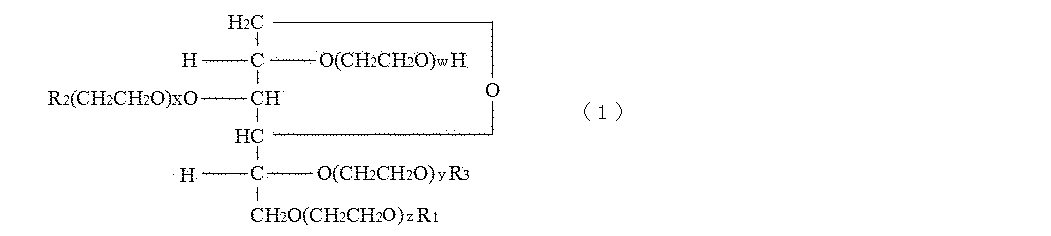
〔式中、R1~R3は、それぞれ、炭素数11~17のアルキル基又はアルケニル基であり、x、y、z及びwは整数であり、x、y、z及びwの合計は、通常、1~50であり、好ましくは15~25であり、特に好ましくは20である。〕
によって表される。
〔式中、R1~R3は、それぞれ、炭素数11~17のアルキル基又はアルケニル基であり、x、y、z及びwは整数であり、x、y、z及びwの合計は、通常、1~50であり、好ましくは15~25であり、特に好ましくは20である。〕
によって表される。
ポリオキシエチレンソルビタン脂肪酸エステルは、ソルビトール及び無水ソルビトールの水酸基の一部を脂肪酸でエステル化することにより得られるソルビタン脂肪酸エステルに、酸化エチレンを縮合させることにより得られる。ポリオキシエチレンソルビタン脂肪酸エステルは、市販のものを使用可能である。その例は、Tween 20、40、60、80、65及び85である。Tween20(モノラウリン酸ポリオキシエチレンソルビタン)は、式1のR1が主としてラウリン酸(CH3(CH2)10CO-)であり、そしてR2及びR3がHである。Tween40(モノパルミチン酸ポリオキシエチレンソルビタン)は、式1のR1が主としてパルミチン酸(CH3(CH2)14CO-)であり、そしてR2及びR3がHである。Tween60(モノステアリン酸ポリオキシエチレンソルビタン)は、式1のR1が主としてステアリン酸(CH3(CH2)16CO-)であり、そしてR2及びR3がHである。Tween80(モノオレイン酸ポリオキシエチレンソルビタン)は、式1のR1が主としてオレイン酸(CH3(CH2)7CH=CH(CH2)7CO-)であり、そしてR2及びR3がHである。Tween65(トリステアリン酸ポリオキシエチレンソルビタン)は、式1のR1、R2及びR3が、主としてステアリン酸である。Tween85(トリオレイン酸ポリオキシエチレンソルビタン)は、式1のR1、R2及びR3が、主としてオレイン酸である。好ましくは、ポリオキシエチレンソルビタン脂肪酸エステルの脂肪酸がラウリン酸、パルミチン酸、ステアリン酸又はオレイン酸であり、特に好ましくはラウリン酸である。
ポリオキシエチレン(9)オクチルフェニルエーテルは、下記式(2):

により表される。
により表される。
ポリオキシエチレン(9)オクチルフェニルエーテルは、市販のものでもよい。その例は、NP-40 (Nonidet P-40、New England Biolab製)が挙げられる。
上記界面活性剤溶液の溶媒には、水、リン酸緩衝化生理食塩水(PBS)、Tris-HCl緩衝液等が挙げられる。好ましくは水又はPBSであり、特に好ましくは水である。
上記溶液の界面活性剤濃度は、通常、0.01~6重量%でよく、好ましくは、0.01~5重量%であり、より好ましくは0.05~5重量%であり、特に好ましくは0.07~3重量%である。
上記界面活性剤溶液に合成PhoSLを浸漬させる温度は、通常、2~50℃でよく、好ましくは4~40℃であり、より好ましくは4~35℃である。
前記浸漬の時間は、浸漬温度によるが、通常、5分~48時間でよく、好ましくは10分~24時間、特に好ましくは20分~24時間である。
フコースα1→6糖鎖の測定方法であって、ポリオキシエチレンソルビタン脂肪酸エステル、ポリオキシエチレン(9)オクチルフェニルエーテル、及びオクチルグルコシドからなる群から選ばれる少なくとも一種の界面活性剤を含む溶液に、化学合成又は遺伝子工学的合成により得られる合成スギタケレクチンを浸漬して、前記フコースα1→6糖鎖との親和性が向上した前記合成スギタケレクチンを得るステップ、及び前記親和性が向上した合成スギタケレクチンと前記フコースα1→6糖鎖とを反応させ、反応したレクチンを検出するステップを含む、前記測定方法を説明する。
前記フコースα1→6糖鎖との親和性が向上した前記合成PhoSLを得るステップは、上記の合成PhoSLの親和性を向上させる方法で説明したとおりである。親和性が向上した前記PhoSLと前記フコースα1→6糖鎖とを反応させ、反応したレクチンを検出するステップを以下に説明する。
該反応レクチンを検出する手段は、特に制限されない。具体的には、上記検出手段として、例えば、ELISA(直接吸着法、サンドウィッチ法、及び競合法)、レクチンアフィニティクロマトグラフィー、レクチン染色、レクチンチップ、フローサイトメトリー(FACS)法、凝集法、表面プラズモン共鳴法(例えば、Biacore(登録商標)システム)、電気泳動、ビーズ等が使用可能である。いくつかの代表的な検出方法を概説する。
直接吸着ELISA法では、血液等の検体をプレートに添加して固定化する。次いで、ビオチン標識したレクチンを添加して、糖鎖とレクチンとを反応させる。2次標識化合物としてHRP(西洋ワサビペルオキシダーゼ)標識ストレプトアビジン溶液を添加して、ビオチンとストレプトアビジンとを反応させる。次いで、HRP用発色基質を加えて発色させ、発色強度を吸光光度計で測定する。予め、既知の濃度の糖鎖を含む標準試料によって検量線を作成しておけば、糖鎖の定量化も可能である。また、ビオチン標識したレクチンに代えて、標識していないレクチンを使用し、糖鎖とレクチンとの反応後、抗レクチン抗体を使用することで測定をすることもできる。
サンドイッチELISA法では、フコースα1→6糖鎖を有する抗原に結合する抗体をプレートに添加し固定化してから、血清等の検体を添加する。次いで、ビオチン標識したレクチンを添加して、糖鎖とレクチンとを反応させる。2次標識化合物としてHRP標識ストレプトアビジン溶液を添加して、ビオチンとストレプトアビジンとを反応させる。次いで、HRP用発色基質を加えて発色させ、発色強度を吸光光度計で測定する。予め、既知の濃度の標準試料によって検量線を作成しておけば、フコースα1→6糖鎖の定量化も可能である。
レクチンアフィニティクロマトグラフィーは、担体に固定化されたレクチンが糖鎖と特異的に結合する性質を利用したアフィニティクロマトグラフィーである。HPLCと組み合わせることでハイスループットが期待される。
レクチンの固定化担体としては、アガロース、デキストラン、セルロース、スターチ、ポリアクリルアミド等のゲル材が一般的である。これらには、市販のものを特に制限なく使用でき、例えばセファロース4Bやセファロース6B(共にGEヘルスケアバイオサイエンス社製)が挙げられる。レクチンクロマトグラフィーに用いるカラムとしては、マイクロプレートやナノウエルにレクチンを固定化したものも含まれる。
固定化するレクチンの濃度は、通常、0.001~100mg/mL、好ましくは0.01~20mg/mLである。担体がアガロースゲルの場合、それをCNBr等で活性化してからレクチンとカップリングさせる。活性化スペーサーを導入したゲルにレクチンを固定化してもよい。さらには、ホルミル基を導入したゲルにレクチンを固定化してからNaCNBH3で還元してもよい。また、NHS-セファロース(GEヘルスケアバイオサイエンス社製)のような市販の活性化ゲルを使用してもよい。
検体をカラムに供与した後、洗浄の目的で緩衝液を流す。緩衝液の一例は、モル濃度が、通常、5~500mM、好ましくは10~500mMであり、pHが、通常、4.0~10.0、好ましくは6.0~9.0であり、NaCl含量が、通常、0~0.5M、好ましくは0.1~0.2Mであり、CaCl2、MgCl2、又は、MnCl2含量が、通常、0~10mM、好ましくは0~5mMの緩衝液である。
アフィニティカラムの洗浄後、糖鎖の溶出は、糖鎖を有効に溶出できる中性の非変性緩衝液中で、塩化ナトリウム、ハプテン糖等の脱着剤を用いて行われる。この緩衝液は、上記と同様であってもよい。脱着剤の濃度は、好ましくは、1~500mM、特に好ましくは10~200mMである。
レクチン染色では、腫瘍組織等の検体を薄く切り出し、その薄片をガラスプレートに貼り付ける。ブロッキングバッファーにプレートを浸し、室温で緩く攪拌する。適宜、内因性ペルオキシダーゼ不活性化を行う。ビオチン標識レクチン溶液(2~5μg/mlにブロッキングバッファーで希釈)にプレートを浸し、室温で1時間、緩く撹拌する。洗浄後、HRP標識アビジン溶液にプレートを浸し、室温で緩く攪拌する。発色液にプレートを浸し、室温で数分間発色させる。発色が十分確認できたら水で洗浄し、反応を停止させる。発色した組織を光学顕微鏡で観察する。レクチン染色には、市販のレクチン染色キットを用いることができる。
FACS法では、細胞(検体)をリン酸緩衝化生理食塩水(PBS)に懸濁する。21Gの針をつけた2.5mlサイズのシリンジで、10回程度強く出し入れして細胞をほぐした後、50μmのメッシュで細胞を濾過する。このように調製した細胞に、蛍光標識したレクチンの溶液を加えて、細胞とレクチンとを結合させる。その後、フローサイトメーター(例えば、ベックマンコールター社製Cytomics FC 500)で、レクチンの結合した細胞の量や割合を分析する。
上記の検出手段に用いる検体は、特に限定されない。例えば、血液、血漿、血清、涙、唾液、体液、乳汁、尿、細胞の培養上清、形質転換動物からの分泌物等が挙げられる。
本発明の測定方法の具体的な用途は、フコースα1→6糖鎖の検出を目的とするものである限り、特に限定されない。その具体例を、以下に説明する。
AFP-L3(コアフコースの転移したαフェトプロテイン)の確度の高い検出は、臨床的に肝硬変に合併する肝細胞癌の早期診断、肝細胞癌の緻密な経過観察、治療効果の正確な判定、胎児性腫瘍の早期発見、劇症肝炎の肝再生の指標等として有用である。コアフコースの転移したα5β1インテグリンもまた、肝癌診断の指標として期待される。
大腸癌で悪性度の低いものや原発癌では、コアフコースを含むフコース全般が増加する。一方、大腸癌の悪性度が高いものや転移癌では、α1→6結合フコースが減少する傾向がある。そこで、一次スクリーニングで大腸癌と診断された者の大腸癌の腫瘍組織に合成スギタケレクチンを作用させ、α1→6結合フコースの量を調べることで、悪性度の高い大腸癌や転移癌の判別が可能となる。
膵臓癌になると、糖タンパク質であるハプトグロビンにコアフコースが付加したフコシル化ハプトグロビンが生成する。このフコシル化ハプトグロビンは、膵臓癌の病期の進展とともに増え、膵臓癌の腫瘍部摘出後には消失する。合成スギタケレクチンとフコシル化ハプトグロビンとの反応に本発明の界面活性剤を含む溶液を使用することにより、合成スギタケレクチンによる検出感度を高めることができる。さらに、合成スギタケレクチンと抗ハプトグロビン抗体を用いたアッセイによれば、膵臓癌を迅速かつ簡便に検出することが可能である。さらに、膵臓癌マーカーCA19-9の抗体と合成スギタケレクチンとを組み合わせることで膵臓癌と膵炎との判別が可能である。
本発明の測定方法は、上記の疾患の診断や研究のほかに、前立腺癌、乳癌、胃癌、小腸癌、結腸直腸癌、腎細胞癌、小細胞肺癌、非小細胞癌、子宮癌、卵巣癌、甲状腺癌、軟部肉腫、骨肉腫、メラノーマ、膠芽腫、星状細胞腫、髄芽細胞腫、急性リンパ腫、悪性リンパ腫、ホジキン病、非ホジキン病、急性骨髄性白血病、慢性リンパ性白血病等の腫瘍;アレルギー疾患;自己免疫疾患;並びに肺気腫等の循環器疾患の診断や研究に使用することが期待される。
以下に実施例及び比較例を示すことにより、本発明をより詳細に説明する。しかし、本発明は、以下の実施例に限定されるものではない。
〔実施例1〕化学合成PhoSLの前処理による親和性の向上試験(1)
1.材料
配列番号2に示すアミノ酸配列をもつPhoSLをFmoc法により化学合成した。得られた合成PhoSLをELISA試験に使用した。
ELISAに使用するタンパク質として、ウシチログロブリン(bTG、シグマアルドリッチ社製)を用意した。
界面活性剤は、表2に示すものを用意した。

緩衝液等は以下のように調製した。
<リン酸緩衝化生理食塩水(PBS)>
リン酸水素二ナトリウム5.75g、リン酸二水素カリウム1.0g、塩化カリウム1.0g、及び塩化ナトリウム40.0gを、水5Lに溶解して、PBSを得た。
<PBS-T>
ポリオキシエチレン(20)ソルビタンモノラウレート(商品名 Tween20)2.5mLを、5LのPBSに溶解して、濃度0.05%のTween20のPBS溶液(以下、PBS-Tという)を得た。
<1% BSA/PBS>
ウシ血清アルブミン(BSA、シグマアルドリッチ社製)1gを、100mLのPBSに溶解して、濃度1%のBSAのPBS溶液(以下、1% BSA/PBSという)を得た。
〔実施例1〕化学合成PhoSLの前処理による親和性の向上試験(1)
1.材料
配列番号2に示すアミノ酸配列をもつPhoSLをFmoc法により化学合成した。得られた合成PhoSLをELISA試験に使用した。
ELISAに使用するタンパク質として、ウシチログロブリン(bTG、シグマアルドリッチ社製)を用意した。
界面活性剤は、表2に示すものを用意した。
<リン酸緩衝化生理食塩水(PBS)>
リン酸水素二ナトリウム5.75g、リン酸二水素カリウム1.0g、塩化カリウム1.0g、及び塩化ナトリウム40.0gを、水5Lに溶解して、PBSを得た。
<PBS-T>
ポリオキシエチレン(20)ソルビタンモノラウレート(商品名 Tween20)2.5mLを、5LのPBSに溶解して、濃度0.05%のTween20のPBS溶液(以下、PBS-Tという)を得た。
<1% BSA/PBS>
ウシ血清アルブミン(BSA、シグマアルドリッチ社製)1gを、100mLのPBSに溶解して、濃度1%のBSAのPBS溶液(以下、1% BSA/PBSという)を得た。
2.合成PhoSLの前処理
合成PhoSLの粉末約0.2mgを1.5 mLチューブに入れ、100μLの水に溶解させた。ブラッドフォード法のタンパク質定量用試薬(製品名Protein assay、バイオラッド社製)を用いて、合成PhoSL溶液の濃度を定量した。なお、定量に用いる標準物質には、ウシ血清アルブミン(BSA)(製品名BSAスタンダード、サーモフィッシャーサイエンティフィック社製)を使用した。定量後、合成PhoSL溶液を、水で濃度1mg/mLになるように希釈した。上記希釈溶液と界面活性剤の水溶液とを混合し、合成PhoSL(濃度100μg/mL)、界面活性剤濃度0.1重量%とした合成PhoSL含有界面活性剤溶液(以下、前処理液という)を調製した。上記前処理液をボルテックスで撹拌後、25℃で18時間、静置させた。反応後、前処理液をELISA試験に供した。
合成PhoSLの粉末約0.2mgを1.5 mLチューブに入れ、100μLの水に溶解させた。ブラッドフォード法のタンパク質定量用試薬(製品名Protein assay、バイオラッド社製)を用いて、合成PhoSL溶液の濃度を定量した。なお、定量に用いる標準物質には、ウシ血清アルブミン(BSA)(製品名BSAスタンダード、サーモフィッシャーサイエンティフィック社製)を使用した。定量後、合成PhoSL溶液を、水で濃度1mg/mLになるように希釈した。上記希釈溶液と界面活性剤の水溶液とを混合し、合成PhoSL(濃度100μg/mL)、界面活性剤濃度0.1重量%とした合成PhoSL含有界面活性剤溶液(以下、前処理液という)を調製した。上記前処理液をボルテックスで撹拌後、25℃で18時間、静置させた。反応後、前処理液をELISA試験に供した。
3.ELISA
合成PhoSLとそれに親和性を有するウシチログロブリン(bTG)との結合試験をELISA(直接法)で測定した。
(1)bTG固相化
bTG溶液をブラッドフォード法で定量し、PBSで500ng/mLに調製した。このbTG溶液25μLを96穴マイクロタイタープレートのウェルに添加して、4℃で2時間静置した。その後、添加液を廃棄することにより、bTGを固相化した。
(2)ブロッキング
上記ウェルを150μLのPBS-Tで1回洗浄し、その後、上記ウェルに1%BSA/PBSを60μL添加して、37℃で1時間放置した。その後、添加液を廃棄した。
(3)レクチン反応
上記ウェルを150μLのPBS-Tで洗浄した。前処理液をPBSで1/100に希釈することにより、合成PhoSLの濃度が1μg/mLの前処理液を調製した。前記前処理液を25 μL、上記ウェルに添加し、4℃で30分間反応させた。その後、添加液を廃棄した。
(4)一次抗体反応
上記ウェルにPBS-Tを150μL添加し、添加液を廃棄した。この操作を合計3回繰り返した。上記ウェルに、一次抗体として抗PhoSLウサギポリクローナル抗体(0.5μg/mL)を25μL添加して、4℃で30分間放置した。その後、添加液を廃棄した。
(5)二次抗体反応
上記ウェルにPBS-Tを150μL添加し、添加液を廃棄した。この操作を合計3回繰り返した。上記ウェルに、二次抗体としてHRP標識抗ウサギIgGヤギ抗体(濃度0.5 μg/mL)を25μL添加し、4℃で30分間放置した。その後、添加液を廃棄した。
(6)発色反応
上記ウェルにPBS-Tを150μL添加し、添加液を廃棄した。この操作を合計4回繰り返した。Tetramethylbenzidine(TMB)及び過酸化水素からなるTMB Microwell Peroxidase Substrate System (KPL社製)を用いて、使用マニュアルに沿って、発色反応をおこなった。
(7)吸光度測定
1M リン酸で発色反応を停止後、プレートリーダー(製品名Powerscan(登録商標) HT、 BioTek社製)で450nm及び600nmの吸光度(OD)を測定した。OD450nmからOD600nmを引いた値をODbTG(+)とした。シグナル値は、実験反復値の平均値である。こうして得られるシグナル値を、合成PhoSL前処理有りの場合、シグナル値前処理有り、そして前処理未実施の場合、シグナル値前処理無しとした。シグナル値前処理有りのシグナル値前処理無しに対する変化率を、表3に示す。
合成PhoSLとそれに親和性を有するウシチログロブリン(bTG)との結合試験をELISA(直接法)で測定した。
(1)bTG固相化
bTG溶液をブラッドフォード法で定量し、PBSで500ng/mLに調製した。このbTG溶液25μLを96穴マイクロタイタープレートのウェルに添加して、4℃で2時間静置した。その後、添加液を廃棄することにより、bTGを固相化した。
(2)ブロッキング
上記ウェルを150μLのPBS-Tで1回洗浄し、その後、上記ウェルに1%BSA/PBSを60μL添加して、37℃で1時間放置した。その後、添加液を廃棄した。
(3)レクチン反応
上記ウェルを150μLのPBS-Tで洗浄した。前処理液をPBSで1/100に希釈することにより、合成PhoSLの濃度が1μg/mLの前処理液を調製した。前記前処理液を25 μL、上記ウェルに添加し、4℃で30分間反応させた。その後、添加液を廃棄した。
(4)一次抗体反応
上記ウェルにPBS-Tを150μL添加し、添加液を廃棄した。この操作を合計3回繰り返した。上記ウェルに、一次抗体として抗PhoSLウサギポリクローナル抗体(0.5μg/mL)を25μL添加して、4℃で30分間放置した。その後、添加液を廃棄した。
(5)二次抗体反応
上記ウェルにPBS-Tを150μL添加し、添加液を廃棄した。この操作を合計3回繰り返した。上記ウェルに、二次抗体としてHRP標識抗ウサギIgGヤギ抗体(濃度0.5 μg/mL)を25μL添加し、4℃で30分間放置した。その後、添加液を廃棄した。
(6)発色反応
上記ウェルにPBS-Tを150μL添加し、添加液を廃棄した。この操作を合計4回繰り返した。Tetramethylbenzidine(TMB)及び過酸化水素からなるTMB Microwell Peroxidase Substrate System (KPL社製)を用いて、使用マニュアルに沿って、発色反応をおこなった。
(7)吸光度測定
1M リン酸で発色反応を停止後、プレートリーダー(製品名Powerscan(登録商標) HT、 BioTek社製)で450nm及び600nmの吸光度(OD)を測定した。OD450nmからOD600nmを引いた値をODbTG(+)とした。シグナル値は、実験反復値の平均値である。こうして得られるシグナル値を、合成PhoSL前処理有りの場合、シグナル値前処理有り、そして前処理未実施の場合、シグナル値前処理無しとした。シグナル値前処理有りのシグナル値前処理無しに対する変化率を、表3に示す。

表3を見ると、TritonX-100(非イオン系界面活性剤の一種)やCTAB及びSB3-14(陽イオン界面活性剤の一種)の界面活性剤からなる溶液中で合成PhoSLを前処理した場合、合成PhoSLの糖鎖への親和性は、前処理未実施と比べて低下する。一方、Tween20(非イオン系界面活性剤の一種)で前処理した場合(実施例1)には、合成PhoSLの糖鎖への親和性が向上することが確認された。
〔実施例2~23〕化学合成PhoSLの前処理による親和性の向上試験(2)
実施例1で効果を確認したTween系界面活性剤の濃度依存性を調べた。具体的には、実施例1において、以下に示す事項以外は、実施例1と同様の操作により、ELISA試験を実施した。
2.前処理において、界面活性剤及びその濃度を表4に示されるように変更した。
3-(4).一次抗体濃度を0.5μg/mLから0.2μg/mLに変更した。
3-(5).二次抗体濃度を0.5μg/mLから0.2μg/mLに変更した。
3-(7).実験反復回数を6回とし、上位及び下位の1つを除外し、平均値を算出した。 シグナル値の変化率を、表4に示す。
実施例1で効果を確認したTween系界面活性剤の濃度依存性を調べた。具体的には、実施例1において、以下に示す事項以外は、実施例1と同様の操作により、ELISA試験を実施した。
2.前処理において、界面活性剤及びその濃度を表4に示されるように変更した。
3-(4).一次抗体濃度を0.5μg/mLから0.2μg/mLに変更した。
3-(5).二次抗体濃度を0.5μg/mLから0.2μg/mLに変更した。
3-(7).実験反復回数を6回とし、上位及び下位の1つを除外し、平均値を算出した。 シグナル値の変化率を、表4に示す。

表4から、合成PhoSLを、Tween20、 Tween40、 Tween60及び Tween80のいずれかの溶液に浸漬することにより、合成PhoSLの糖鎖への親和性は、未処理と比べて少なくとも1.04倍、最大2.58倍増強することが判明した。これらの中で、Tween20は、適用濃度を低くできる点で、好ましいといえる。
〔実施例24~31〕化学合成PhoSLの前処理による親和性の向上試験(3)
Tween系界面活性剤以外の界面活性剤について、親和性向上作用のあるものを探索した。具体的には、実施例1において、以下に示す事項以外は、実施例1と同様の操作により、ELISA試験を実施した。
2.前処理において、界面活性剤及びその濃度を表5に示されるように変更した。
2.前処理において、静置時間を1時間とした。
3-(1).固相化bTG濃度を500ng/mLから1000ng/mLに変更した。
3-(7).実験反復回数を8回とし、上位及び下位の2つを除外し、平均値を算出した。
Tween系界面活性剤以外の界面活性剤について、親和性向上作用のあるものを探索した。具体的には、実施例1において、以下に示す事項以外は、実施例1と同様の操作により、ELISA試験を実施した。
2.前処理において、界面活性剤及びその濃度を表5に示されるように変更した。
2.前処理において、静置時間を1時間とした。
3-(1).固相化bTG濃度を500ng/mLから1000ng/mLに変更した。
3-(7).実験反復回数を8回とし、上位及び下位の2つを除外し、平均値を算出した。
界面活性剤によるPhoSLの前処理区では、OD450nmからOD600nmを引いた値をODbTG(+)とし、合成PhoSL未添加(界面活性剤のみ)でのOD450nmからOD600nmを引いた値をODPhoSL(-)とした。そして、ODbTG(+)からODPhoSL(-)を引いた値をシグナル値前処理有りとした。同様に、界面活性剤によるPhoSLの未処理区の場合のシグナル値を、シグナル値前処理無しとした。シグナル変化率の測定結果を表5に示す。

表5から、NP-40又はオクチルグルコシドからなる界面活性剤溶液中で合成PhoSLを養生することにより、合成PhoSLの糖鎖への親和性が向上する。その効果は、界面活性剤濃度に依存して増強される。
〔実施例32~35〕化学合成PhoSLの前処理による親和性の向上試験(4)
アミノ酸改変合成PhoSLを作成し、それを界面活性剤で前処理したときの糖鎖への親和性を評価した。具体的には、実施例1において、以下に示す事項以外は、実施例1と同様の操作により、ELISA試験を実施した。
2.合成PhoSLを、配列番号3に示すアミノ酸改変PhoSLに変更した。
2.前処理において、界面活性剤及びその濃度を表6に示されるように変更した。
2.前処理において、静置時間を1時間とした。
3-(1).固相化bTG濃度を500ng/mLから1000ng/mLに変更した。
3-(7).実験反復回数を8回とし、上位及び下位の2つを除外し、平均値を算出した。
アミノ酸改変合成PhoSLを作成し、それを界面活性剤で前処理したときの糖鎖への親和性を評価した。具体的には、実施例1において、以下に示す事項以外は、実施例1と同様の操作により、ELISA試験を実施した。
2.合成PhoSLを、配列番号3に示すアミノ酸改変PhoSLに変更した。
2.前処理において、界面活性剤及びその濃度を表6に示されるように変更した。
2.前処理において、静置時間を1時間とした。
3-(1).固相化bTG濃度を500ng/mLから1000ng/mLに変更した。
3-(7).実験反復回数を8回とし、上位及び下位の2つを除外し、平均値を算出した。
界面活性剤によるPhoSLの前処理区では、OD450nmからOD600nmを引いた値をODbTG(+)とし、合成PhoSL未添加(界面活性剤のみ)でのOD450nmからOD600nmを引いた値をODPhoSL(-)とした。そして、ODbTG(+)からODPhoSL(-)を引いた値をシグナル値前処理有りとした。同様に、界面活性剤によるPhoSLの未処理区の場合のシグナル値を、シグナル値前処理無しとした。ELISA試験でのシグナル変化率の測定値を表6に示す。
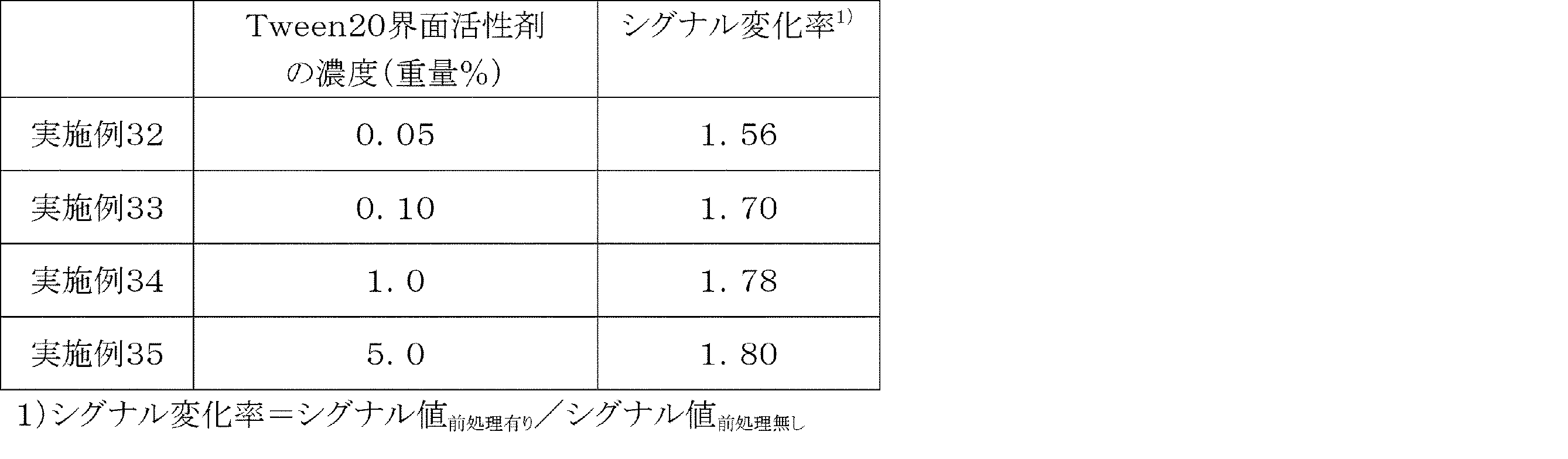
表6の結果から、配列番号2中の1個のアミノ酸が置換され、かつ糖結合活性を有するアミノ酸改変ペプチドをTween20で前処理にすると、合成PhoSLの糖タンパク質の親和性が向上することが確認された。
〔実施例36〕遺伝子工学的合成PhoSLの前処理による親和性の向上試験
実施例1において、以下の点を変更した以外は、実施例1と同様の操作を行った。
2.前処理において、合成PhoSLを、遺伝子組換えFLAGタグ付きPhoSL(表7に示す配列番号18)に変更した。この遺伝子組換えFLAGタグ付きPhoSLは、配列番号17にHisタグとFLAGタグを付加し、さらにN末端に遺伝子発現させるためのM(メチオニン)を付加したものである。この遺伝子組換えFLAGタグ付きPhoSLは、特許文献2(特許5531290号)に記載の方法に準じて、大腸菌で発現し、精製したものを使用した。

2.前処理において、Tween20を使用し、その濃度を1.0重量%とした。
2.前処理において、静置時間を1時間とした。
3-(1).固相化bTG濃度を、500ng/mLから1000ng/mLに変更した。
3-(7).実験反復回数を8回とし、上位及び下位の2つを除外し、平均値を算出した。
実施例1において、以下の点を変更した以外は、実施例1と同様の操作を行った。
2.前処理において、合成PhoSLを、遺伝子組換えFLAGタグ付きPhoSL(表7に示す配列番号18)に変更した。この遺伝子組換えFLAGタグ付きPhoSLは、配列番号17にHisタグとFLAGタグを付加し、さらにN末端に遺伝子発現させるためのM(メチオニン)を付加したものである。この遺伝子組換えFLAGタグ付きPhoSLは、特許文献2(特許5531290号)に記載の方法に準じて、大腸菌で発現し、精製したものを使用した。
2.前処理において、静置時間を1時間とした。
3-(1).固相化bTG濃度を、500ng/mLから1000ng/mLに変更した。
3-(7).実験反復回数を8回とし、上位及び下位の2つを除外し、平均値を算出した。
界面活性剤によるPhoSLの前処理区では、OD450nmからOD600nmを引いた値をODbTG(+)とし、合成PhoSL未添加(界面活性剤のみ)でのOD450nmからOD600nmを引いた値をODPhoSL(-)とした。そして、ODbTG(+)からODPhoSL(-)を引いた値をシグナル値前処理有りとした。同様に、界面活性剤によるPhoSLの未処理区の場合のシグナル値を、シグナル値前処理無しとした。シグナル変化率の測定値を表8に示す。

表8の結果から、遺伝子工学的手法により得られた合成PhoSL(遺伝子組換えFLAGタグ付きPhoSL)においても、Tween20で前処理すると、糖鎖への親和性が向上することが判明した。
Claims (9)
- 化学合成又は遺伝子工学的合成により得られる合成スギタケレクチンのフコースα1→6糖鎖との親和性を向上させる方法であって、
ポリオキシエチレンソルビタン脂肪酸エステル、ポリオキシエチレン(9)オクチルフェニルエーテル、及びオクチルグルコシドからなる群から選ばれる少なくとも一種の界面活性剤を含む溶液に前記合成スギタケレクチンを浸漬するステップを含む、前記合成スギタケレクチンの親和性を向上させる方法。 - 前記溶液の界面活性剤濃度が、0.01~6重量%である、請求項1に記載の合成スギタケレクチンの親和性を向上させる方法。
- 前記浸漬の時間が、5分~48時間である、請求項1に記載の合成スギタケレクチンの親和性を向上させる方法。
- 前記合成スギタケレクチンは、配列番号1に示すアミノ酸配列、又は配列番号1中の1又は数個のアミノ酸が置換、付加又は欠失され、かつ糖結合活性を有するアミノ酸改変ペプチドである、請求項1に記載の合成スギタケレクチンの親和性を向上させる方法。
- 前記アミノ酸改変ペプチドが、配列番号3~17のいずれかで示される、請求項4に記載の合成スギタケレクチンの親和性を向上させる方法。
- フコースα1→6糖鎖の測定方法であって、
ポリオキシエチレンソルビタン脂肪酸エステル、ポリオキシエチレン(9)オクチルフェニルエーテル、及びオクチルグルコシドからなる群から選ばれる少なくとも一種の界面活性剤を含む溶液に、化学合成又は遺伝子工学的合成により得られる合成スギタケレクチンを浸漬して、前記フコースα1→6糖鎖との親和性が向上した前記合成スギタケレクチンを得るステップ、及び
前記親和性が向上した合成スギタケレクチンと前記フコースα1→6糖鎖とを反応させ、反応したレクチンを検出するステップ
を含む、前記測定方法。 - 前記フコースα1→6糖鎖は、担体に固定化されている、請求項6に記載の測定方法。
- 前記フコースα1→6糖鎖は、抗体を介して前記担体に固定化されている、請求項7記載の測定方法。
- 前記合成スギタケレクチンは、標識されている、請求項6に記載の測定方法。
Applications Claiming Priority (2)
| Application Number | Priority Date | Filing Date | Title |
|---|---|---|---|
| JP2016-005274 | 2016-01-14 | ||
| JP2016005274A JP2019052092A (ja) | 2016-01-14 | 2016-01-14 | 合成スギタケレクチンの親和性を向上させる方法 |
Publications (1)
| Publication Number | Publication Date |
|---|---|
| WO2017122613A1 true WO2017122613A1 (ja) | 2017-07-20 |
Family
ID=59311009
Family Applications (1)
| Application Number | Title | Priority Date | Filing Date |
|---|---|---|---|
| PCT/JP2017/000418 Ceased WO2017122613A1 (ja) | 2016-01-14 | 2017-01-10 | 合成スギタケレクチンの親和性を向上させる方法 |
Country Status (2)
| Country | Link |
|---|---|
| JP (1) | JP2019052092A (ja) |
| WO (1) | WO2017122613A1 (ja) |
Citations (5)
| Publication number | Priority date | Publication date | Assignee | Title |
|---|---|---|---|---|
| JPS63126896A (ja) * | 1986-11-14 | 1988-05-30 | Denki Kagaku Kogyo Kk | リンホトキシンの安定化法 |
| JPH10174588A (ja) * | 1996-10-15 | 1998-06-30 | Seikagaku Kogyo Co Ltd | レクチンのポリペプチド及びそれをコードするdna |
| WO2011089988A1 (ja) * | 2010-01-21 | 2011-07-28 | 株式会社J-オイルミルズ | 膵臓癌の検出方法 |
| JP2011149826A (ja) * | 2010-01-21 | 2011-08-04 | J-Oil Mills Inc | 大腸癌の判別方法 |
| JP2011148735A (ja) * | 2010-01-21 | 2011-08-04 | J-Oil Mills Inc | 遺伝子 |
-
2016
- 2016-01-14 JP JP2016005274A patent/JP2019052092A/ja active Pending
-
2017
- 2017-01-10 WO PCT/JP2017/000418 patent/WO2017122613A1/ja not_active Ceased
Patent Citations (5)
| Publication number | Priority date | Publication date | Assignee | Title |
|---|---|---|---|---|
| JPS63126896A (ja) * | 1986-11-14 | 1988-05-30 | Denki Kagaku Kogyo Kk | リンホトキシンの安定化法 |
| JPH10174588A (ja) * | 1996-10-15 | 1998-06-30 | Seikagaku Kogyo Co Ltd | レクチンのポリペプチド及びそれをコードするdna |
| WO2011089988A1 (ja) * | 2010-01-21 | 2011-07-28 | 株式会社J-オイルミルズ | 膵臓癌の検出方法 |
| JP2011149826A (ja) * | 2010-01-21 | 2011-08-04 | J-Oil Mills Inc | 大腸癌の判別方法 |
| JP2011148735A (ja) * | 2010-01-21 | 2011-08-04 | J-Oil Mills Inc | 遺伝子 |
Also Published As
| Publication number | Publication date |
|---|---|
| JP2019052092A (ja) | 2019-04-04 |
Similar Documents
| Publication | Publication Date | Title |
|---|---|---|
| JP4514163B2 (ja) | フコースα1→6特異的レクチン | |
| CN106661110B (zh) | 抗muc1抗体或其抗原结合片段及其用途 | |
| JP6083649B2 (ja) | 未分化細胞検出方法及び複合糖質検出方法 | |
| JP5994121B2 (ja) | バイオマーカー | |
| Strassberger et al. | A comprehensive surface proteome analysis of myeloid leukemia cell lines for therapeutic antibody development | |
| JP2013542182A (ja) | 化合物及び方法 | |
| KR20120082429A (ko) | 간세포암 마커 | |
| KR20120123248A (ko) | 악성 종양의 진단 방법 | |
| JP5109001B2 (ja) | α1,6フコース糖鎖の検出および分別方法 | |
| EP3410118B1 (en) | Prostate carcinoma determination method | |
| EP3088890B1 (en) | Method for measuring soluble gpc3 protein | |
| Wilton et al. | Expression and purification of recombinant human receptor for advanced glycation endproducts in Escherichia coli | |
| HU215555B (hu) | Eljárás variánsok koncentrációjának meghatározására, valamint az eljárásban használható analitikai vizsgálati készlet | |
| KR20140051249A (ko) | 3''황산화코어1당쇄에 결합하는 프로브를 사용하는 뮤신1의 분석 방법, 및 유방암의 검출 또는 모니터링 방법 | |
| EP4397681A1 (en) | Antibodies, immobilized antibodies using same, antibody composition, reagent for immunological measurement, immunological measurement method, and method for improving antigen responsiveness of antibodies | |
| Kusano-Arai et al. | Kinetic exclusion assay of monoclonal antibody affinity to the membrane protein Roundabout 1 displayed on baculovirus | |
| CN111936522B (zh) | 新型抗胸苷激酶抗体 | |
| WO2017122613A1 (ja) | 合成スギタケレクチンの親和性を向上させる方法 | |
| JP5996831B1 (ja) | シグナル増強剤 | |
| CN113801232A (zh) | Rasal2蛋白第123位磷酸化特异性抗体、制备方法和ELISA检测试剂盒 | |
| JP7546262B2 (ja) | アルツハイマー型認知症診断技術 | |
| JPH11230966A (ja) | 肺癌予後検査方法 | |
| EP3844503B1 (en) | Thymidine kinase (tk-1) in prognostic indices for dlbcl | |
| KR101231235B1 (ko) | 전립선암 줄기세포 선별용 단백질성 마커 | |
| Hu | Development of HER2-Targeted Theranostics for Diagnosis and Treatment of Breast Cancer |
Legal Events
| Date | Code | Title | Description |
|---|---|---|---|
| 121 | Ep: the epo has been informed by wipo that ep was designated in this application |
Ref document number: 17738367 Country of ref document: EP Kind code of ref document: A1 |
|
| NENP | Non-entry into the national phase |
Ref country code: DE |
|
| 122 | Ep: pct application non-entry in european phase |
Ref document number: 17738367 Country of ref document: EP Kind code of ref document: A1 |
|
| NENP | Non-entry into the national phase |
Ref country code: JP |