WO2017110424A1 - カメラモジュール用液晶性樹脂組成物、その製造方法、及び上記組成物を用いたカメラモジュール - Google Patents
カメラモジュール用液晶性樹脂組成物、その製造方法、及び上記組成物を用いたカメラモジュール Download PDFInfo
- Publication number
- WO2017110424A1 WO2017110424A1 PCT/JP2016/085909 JP2016085909W WO2017110424A1 WO 2017110424 A1 WO2017110424 A1 WO 2017110424A1 JP 2016085909 W JP2016085909 W JP 2016085909W WO 2017110424 A1 WO2017110424 A1 WO 2017110424A1
- Authority
- WO
- WIPO (PCT)
- Prior art keywords
- crystalline resin
- liquid crystalline
- camera module
- epoxy group
- component
- Prior art date
- Legal status (The legal status is an assumption and is not a legal conclusion. Google has not performed a legal analysis and makes no representation as to the accuracy of the status listed.)
- Ceased
Links
Images


Classifications
-
- C—CHEMISTRY; METALLURGY
- C08—ORGANIC MACROMOLECULAR COMPOUNDS; THEIR PREPARATION OR CHEMICAL WORKING-UP; COMPOSITIONS BASED THEREON
- C08L—COMPOSITIONS OF MACROMOLECULAR COMPOUNDS
- C08L67/00—Compositions of polyesters obtained by reactions forming a carboxylic ester link in the main chain; Compositions of derivatives of such polymers
-
- B—PERFORMING OPERATIONS; TRANSPORTING
- B29—WORKING OF PLASTICS; WORKING OF SUBSTANCES IN A PLASTIC STATE IN GENERAL
- B29B—PREPARATION OR PRETREATMENT OF THE MATERIAL TO BE SHAPED; MAKING GRANULES OR PREFORMS; RECOVERY OF PLASTICS OR OTHER CONSTITUENTS OF WASTE MATERIAL CONTAINING PLASTICS
- B29B7/00—Mixing; Kneading
- B29B7/02—Mixing; Kneading non-continuous, with mechanical mixing or kneading devices, i.e. batch type
- B29B7/06—Mixing; Kneading non-continuous, with mechanical mixing or kneading devices, i.e. batch type with movable mixing or kneading devices
- B29B7/10—Mixing; Kneading non-continuous, with mechanical mixing or kneading devices, i.e. batch type with movable mixing or kneading devices rotary
-
- B—PERFORMING OPERATIONS; TRANSPORTING
- B29—WORKING OF PLASTICS; WORKING OF SUBSTANCES IN A PLASTIC STATE IN GENERAL
- B29B—PREPARATION OR PRETREATMENT OF THE MATERIAL TO BE SHAPED; MAKING GRANULES OR PREFORMS; RECOVERY OF PLASTICS OR OTHER CONSTITUENTS OF WASTE MATERIAL CONTAINING PLASTICS
- B29B11/00—Making preforms
- B29B11/06—Making preforms by moulding the material
- B29B11/10—Extrusion moulding
-
- B—PERFORMING OPERATIONS; TRANSPORTING
- B29—WORKING OF PLASTICS; WORKING OF SUBSTANCES IN A PLASTIC STATE IN GENERAL
- B29B—PREPARATION OR PRETREATMENT OF THE MATERIAL TO BE SHAPED; MAKING GRANULES OR PREFORMS; RECOVERY OF PLASTICS OR OTHER CONSTITUENTS OF WASTE MATERIAL CONTAINING PLASTICS
- B29B9/00—Making granules
- B29B9/12—Making granules characterised by structure or composition
-
- C—CHEMISTRY; METALLURGY
- C08—ORGANIC MACROMOLECULAR COMPOUNDS; THEIR PREPARATION OR CHEMICAL WORKING-UP; COMPOSITIONS BASED THEREON
- C08J—WORKING-UP; GENERAL PROCESSES OF COMPOUNDING; AFTER-TREATMENT NOT COVERED BY SUBCLASSES C08B, C08C, C08F, C08G or C08H
- C08J3/00—Processes of treating or compounding macromolecular substances
- C08J3/20—Compounding polymers with additives, e.g. colouring
-
- C—CHEMISTRY; METALLURGY
- C08—ORGANIC MACROMOLECULAR COMPOUNDS; THEIR PREPARATION OR CHEMICAL WORKING-UP; COMPOSITIONS BASED THEREON
- C08K—Use of inorganic or non-macromolecular organic substances as compounding ingredients
- C08K3/00—Use of inorganic substances as compounding ingredients
-
- C—CHEMISTRY; METALLURGY
- C08—ORGANIC MACROMOLECULAR COMPOUNDS; THEIR PREPARATION OR CHEMICAL WORKING-UP; COMPOSITIONS BASED THEREON
- C08K—Use of inorganic or non-macromolecular organic substances as compounding ingredients
- C08K3/00—Use of inorganic substances as compounding ingredients
- C08K3/01—Use of inorganic substances as compounding ingredients characterized by their specific function
- C08K3/013—Fillers, pigments or reinforcing additives
-
- C—CHEMISTRY; METALLURGY
- C08—ORGANIC MACROMOLECULAR COMPOUNDS; THEIR PREPARATION OR CHEMICAL WORKING-UP; COMPOSITIONS BASED THEREON
- C08L—COMPOSITIONS OF MACROMOLECULAR COMPOUNDS
- C08L101/00—Compositions of unspecified macromolecular compounds
- C08L101/02—Compositions of unspecified macromolecular compounds characterised by the presence of specified groups, e.g. terminal or pendant functional groups
- C08L101/06—Compositions of unspecified macromolecular compounds characterised by the presence of specified groups, e.g. terminal or pendant functional groups containing oxygen atoms
-
- C—CHEMISTRY; METALLURGY
- C08—ORGANIC MACROMOLECULAR COMPOUNDS; THEIR PREPARATION OR CHEMICAL WORKING-UP; COMPOSITIONS BASED THEREON
- C08L—COMPOSITIONS OF MACROMOLECULAR COMPOUNDS
- C08L101/00—Compositions of unspecified macromolecular compounds
- C08L101/12—Compositions of unspecified macromolecular compounds characterised by physical features, e.g. anisotropy, viscosity or electrical conductivity
-
- C—CHEMISTRY; METALLURGY
- C08—ORGANIC MACROMOLECULAR COMPOUNDS; THEIR PREPARATION OR CHEMICAL WORKING-UP; COMPOSITIONS BASED THEREON
- C08L—COMPOSITIONS OF MACROMOLECULAR COMPOUNDS
- C08L33/00—Compositions of homopolymers or copolymers of compounds having one or more unsaturated aliphatic radicals, each having only one carbon-to-carbon double bond, and only one being terminated by only one carboxyl radical, or of salts, anhydrides, esters, amides, imides or nitriles thereof; Compositions of derivatives of such polymers
- C08L33/04—Homopolymers or copolymers of esters
- C08L33/14—Homopolymers or copolymers of esters of esters containing halogen, nitrogen, sulfur, or oxygen atoms in addition to the carboxy oxygen
-
- C—CHEMISTRY; METALLURGY
- C08—ORGANIC MACROMOLECULAR COMPOUNDS; THEIR PREPARATION OR CHEMICAL WORKING-UP; COMPOSITIONS BASED THEREON
- C08L—COMPOSITIONS OF MACROMOLECULAR COMPOUNDS
- C08L77/00—Compositions of polyamides obtained by reactions forming a carboxylic amide link in the main chain; Compositions of derivatives of such polymers
- C08L77/12—Polyester-amides
-
- G—PHYSICS
- G02—OPTICS
- G02B—OPTICAL ELEMENTS, SYSTEMS OR APPARATUS
- G02B7/00—Mountings, adjusting means, or light-tight connections, for optical elements
- G02B7/02—Mountings, adjusting means, or light-tight connections, for optical elements for lenses
-
- G—PHYSICS
- G03—PHOTOGRAPHY; CINEMATOGRAPHY; ANALOGOUS TECHNIQUES USING WAVES OTHER THAN OPTICAL WAVES; ELECTROGRAPHY; HOLOGRAPHY
- G03B—APPARATUS OR ARRANGEMENTS FOR TAKING PHOTOGRAPHS OR FOR PROJECTING OR VIEWING THEM; APPARATUS OR ARRANGEMENTS EMPLOYING ANALOGOUS TECHNIQUES USING WAVES OTHER THAN OPTICAL WAVES; ACCESSORIES THEREFOR
- G03B17/00—Details of cameras or camera bodies; Accessories therefor
- G03B17/02—Bodies
-
- G—PHYSICS
- G03—PHOTOGRAPHY; CINEMATOGRAPHY; ANALOGOUS TECHNIQUES USING WAVES OTHER THAN OPTICAL WAVES; ELECTROGRAPHY; HOLOGRAPHY
- G03B—APPARATUS OR ARRANGEMENTS FOR TAKING PHOTOGRAPHS OR FOR PROJECTING OR VIEWING THEM; APPARATUS OR ARRANGEMENTS EMPLOYING ANALOGOUS TECHNIQUES USING WAVES OTHER THAN OPTICAL WAVES; ACCESSORIES THEREFOR
- G03B30/00—Camera modules comprising integrated lens units and imaging units, specially adapted for being embedded in other devices, e.g. mobile phones or vehicles
Definitions
- the present invention relates to a liquid crystalline resin composition for a camera module, a method for producing the same, and a camera module using the composition.
- Liquid crystalline resins typified by liquid crystalline polyester resins have excellent mechanical strength, heat resistance, chemical resistance, electrical properties, etc. in a well-balanced manner and have excellent dimensional stability. It's being used. Recently, liquid crystal resins have been used for precision equipment parts by taking advantage of these features.
- a small amount of dust, dust, etc. will affect the performance of the equipment.
- a part used in an optical device such as a camera module
- the optical characteristics of the camera module are significantly deteriorated.
- the parts that make up the camera module (hereinafter sometimes referred to as “camera module parts”) are ultrasonically cleaned before being assembled and attached to the surface. Small dust, oil, dust, etc. are removed.
- the molded body formed by molding the liquid crystalline resin composition is easy to peel off because the molecular orientation of the polymer is particularly large in the surface portion.
- the fluffing phenomenon of peeling and fluffing occurs, and the fluffed raised portion causes small dust.
- liquid crystalline resin composition when used as a raw material for camera module parts, a special liquid crystalline resin composition that does not raise the surface of the molded body even when the molded body is subjected to ultrasonic cleaning is used.
- a special liquid crystalline resin composition a liquid crystalline resin composition for a camera module containing a liquid crystalline resin, a specific talc, and carbon black is disclosed (see Patent Document 1).
- the liquid crystalline resin composition for a camera module described in Patent Document 1 has insufficient suppression of raising of the surface of the molded article, and the molded article is more difficult to raise the surface of the molded article.
- a liquid crystalline resin composition for a camera module for manufacturing the above is required.
- the present invention has been made in order to solve the above-mentioned problems, and its purpose is to produce a camera module component in which the surface is less likely to be raised, is excellent in low dust generation, and warpage deformation is suppressed. It is providing the liquid crystalline resin composition for camera modules.
- the inventors of the present invention have made extensive studies to solve the above problems.
- the liquid crystalline resin, the particulate filler having an average primary particle size in a specific range, and an epoxy group-containing copolymer are contained in a specific ratio, and the number of aggregates having a particle size of 10 ⁇ m or more is within a specific range.
- the present inventors have found that the above problems can be solved by using a certain liquid crystalline resin composition for a camera module, and have completed the present invention. More specifically, the present invention provides the following.
- the content of component (A) is 35 to 79% by mass
- the content of component (B) is 20 to 60% by mass
- the content of component (C) is 1 to 5% by mass
- the average primary particle size of the component is 5 ⁇ m or less
- a liquid crystalline resin composition for a camera module wherein the number of aggregates having a particle diameter of 10 ⁇ m or more is 5 or less per cross-sectional area of 0.1 mm 2 .
- the (C) epoxy group-containing copolymer is at least one selected from the group consisting of (C1) an epoxy group-containing olefin copolymer and (C2) an epoxy group-containing styrene copolymer.
- the composition according to (1) is at least one selected from the group consisting of (C1) an epoxy group-containing olefin copolymer and (C2) an epoxy group-containing styrene copolymer.
- a camera module part comprising the composition according to (1) or (2).
- a camera module provided with the components described in (5).
- a camera module part is produced using the liquid crystalline resin composition for a camera module of the present invention as a raw material, a camera module part having a surface that is less likely to be raised, excellent in low dust generation, and suppressed in warpage is obtained. .
- FIG. 1 is a cross-sectional view schematically showing a general camera module.
- FIG. 2 is a view showing two of the electron micrographs used in Example 1.
- FIG. 3 is a diagram showing two of the electron micrographs used in Comparative Example 1.
- the liquid crystalline resin composition for a camera module of the present invention contains (A) a liquid crystalline resin, (B) a particulate filler, and (C) an epoxy group-containing copolymer.
- the (A) liquid crystalline resin used in the present invention refers to a melt processable polymer having a property capable of forming an optically anisotropic molten phase.
- the property of the anisotropic molten phase can be confirmed by a conventional polarization inspection method using an orthogonal polarizer. More specifically, the anisotropic molten phase can be confirmed by using a Leitz polarizing microscope and observing a molten sample placed on a Leitz hot stage under a nitrogen atmosphere at a magnification of 40 times.
- the liquid crystalline polymer applicable to the present invention is inspected between crossed polarizers, the polarized light is normally transmitted even in the molten stationary state, and optically anisotropic.
- the type of (A) liquid crystalline resin as described above is not particularly limited, and is preferably an aromatic polyester and / or an aromatic polyester amide. Moreover, the polyester which partially contains aromatic polyester and / or aromatic polyester amide in the same molecular chain is also within the range.
- the liquid crystalline resin is preferably at least about 2.0 dl / g, more preferably 2.0 to 10.0 dl / g when dissolved in pentafluorophenol at a concentration of 0.1% by mass at 60 ° C. Those having a logarithmic viscosity (IV) of 1 are preferably used.
- the aromatic polyester or aromatic polyester amide as the liquid crystalline resin (A) applicable to the present invention is particularly preferably at least one selected from the group consisting of aromatic hydroxycarboxylic acids, aromatic hydroxyamines, and aromatic diamines.
- Aromatic hydroxycarboxylic acids such as p-hydroxybenzoic acid and 6-hydroxy-2-naphthoic acid, and 2,6-dihydroxy.
- Aromatic diols such as naphthalene, 1,4-dihydroxynaphthalene, 4,4′-dihydroxybiphenyl, hydroquinone, resorcin, compounds represented by the following general formula (I), and compounds represented by the following general formula (II)
- Aromatic dicarboxylic acids such as terephthalic acid, isophthalic acid, 4,4′-diphenyldicarboxylic acid, 2,6-naphthalenedicarboxylic acid, and compounds represented by the following general formula (III); p-aminophenol, p- Aromatic amines such as phenylenediamine are listed.
- X is a group selected from alkylene (C 1 -C 4 ), alkylidene, —O—, —SO—, —SO 2 —, —S—, and —CO—)
- the (A) liquid crystalline resin used in the present invention can be prepared from the above monomer compound (or a mixture of monomers) by a known method using a direct polymerization method or a transesterification method, and usually a melt polymerization method. Or a slurry polymerization method.
- the above compounds having ester-forming ability may be used for polymerization in the form as they are, or may be modified from a precursor to a derivative having ester-forming ability in the previous stage of polymerization.
- various catalysts can be used. Typical examples include dialkyl tin oxide, diaryl tin oxide, titanium dioxide, alkoxy titanium silicates, titanium alcoholates, and alkali of carboxylic acid.
- the amount of the catalyst used is generally about 0.001 to 1% by weight, particularly about 0.01 to 0.2% by weight, based on the total weight of monomers. If the polymer produced by these polymerization methods is further necessary, the molecular weight can be increased by solid-phase polymerization by heating in a reduced pressure or an inert gas.
- the melt viscosity of the (A) liquid crystalline resin obtained by the above method is not particularly limited. In general, those having a melt viscosity at a molding temperature of 10 MPa or more and 600 MPa or less at a shear rate of 1000 sec ⁇ 1 can be used. However, those having a very high viscosity are not preferable because the fluidity is extremely deteriorated.
- the (A) liquid crystalline resin may be a mixture of two or more liquid crystalline resins.
- the content of (A) liquid crystal resin is 35 to 79% by mass. If the content of component (A) is 35% by mass or more, it is preferable for fluidity and suppression of raising of the surface of the molded body, and if the content of component (A) is 79% by mass or less, it is preferable for reasons of heat resistance. .
- the preferable content of the component (A) is 40 to 73% by mass, and the more preferable content of the component (A) is 45 to 67% by mass.
- the component (B) is a granular filler, and the average primary particle size of the component (B) is 5 ⁇ m or less.
- the average primary particle diameter is preferably 0.25 to 4.5 ⁇ m, more preferably 0.5 to 4 ⁇ m. In this specification, a value measured by a laser diffraction / scattering particle size distribution measurement method is employed as the average primary particle size.
- Examples of the particulate filler of component (B) include silica, quartz powder, glass beads, glass powder, calcium oxalate, aluminum oxalate, kaolin, clay, diatomaceous earth, wollastonite and other oxalates; iron oxide, Metal oxides such as titanium oxide, zinc oxide, and alumina; metal carbonates such as calcium carbonate and magnesium carbonate; metal sulfates such as calcium sulfate and barium sulfate; silicon carbide; silicon nitride; boron nitride and the like.
- the component (B) two or more kinds may be used.
- silica, alumina, and titanium oxide are used as the component (B) from the viewpoint of raising effect on the surface of the molded body, low dust generation of the molded body, and warping deformation suppressing effect of the molded body.
- silica and alumina are more preferred.
- the content of the component (B) is 20 to 60% by mass in the liquid crystal composition for a camera module of the present invention.
- the content of the component (B) is 20% by mass or more, the mechanical strength and the deflection temperature under load necessary for the camera module can be easily secured. Low dust generation is likely to be high.
- a preferable content of the component (B) is 25 to 55% by mass, and a more preferable content of the component (B) is 30 to 50% by mass.
- the epoxy group-containing copolymer can be used alone or in combination of two or more.
- the (C) epoxy group-containing copolymer is not particularly limited. For example, at least selected from the group consisting of (C1) an epoxy group-containing olefin copolymer and (C2) an epoxy group-containing styrene copolymer.
- One type is mentioned.
- Mixing the component (C) with the liquid crystalline resin composition for a camera module contributes to suppressing raising of the surface of the molded product when the molded product obtained by molding the composition is subjected to ultrasonic cleaning. The reason for suppressing the raising is not clarified, but it is considered that by adding a certain amount, the surface state of the molded body is changed, and the change contributes to suppressing the raising.
- Examples of the (C1) epoxy group-containing olefin copolymer include a copolymer composed of a structural unit derived from an ⁇ -olefin and a structural unit derived from a glycidyl ester of an ⁇ , ⁇ -unsaturated acid. It is done.
- the ⁇ -olefin is not particularly limited and includes, for example, ethylene, propylene, butene, etc. Among them, ethylene is preferably used.
- the glycidyl ester of ⁇ , ⁇ -unsaturated acid is represented by the following general formula (IV).
- R ′ represents a hydrogen atom or an alkyl group having 1 to 10 carbon atoms.
- the glycidyl ester of ⁇ , ⁇ -unsaturated acid is, for example, glycidyl acrylate, glycidyl methacrylate, glycidyl ethacrylate, glycidyl itaconate, etc., and glycidyl methacrylate is particularly preferable.
- the content of the structural unit derived from ⁇ -olefin is 87 to 98% by mass, and the content of the structural unit derived from the glycidyl ester of ⁇ , ⁇ -unsaturated acid The amount is preferably 13 to 2% by mass.
- Epoxy group-containing olefin copolymer is an olefin such as acrylonitrile, acrylic acid ester, methacrylic acid ester, ⁇ -methylstyrene, maleic anhydride, etc. as a third component in addition to the above two components within the range not impairing the present invention.
- a structural unit derived from one or more of the unsaturated esters may be contained in an amount of 0 to 48 parts by mass with respect to 100 parts by mass of the two components.
- the epoxy group-containing olefin copolymer can be easily prepared by a normal radical polymerization method using a monomer and a radical polymerization catalyst corresponding to each component. More specifically, for example, the presence of a suitable solvent or chain transfer agent at 500 to 4000 atm and 100 to 300 ° C. in the presence of a radical generator such as ⁇ -olefin and glycidyl ester of ⁇ , ⁇ -unsaturated acid. It can be produced by a method of copolymerization under or in the absence.
- It can also be produced by a method in which an ⁇ -olefin, a glycidyl ester of ⁇ , ⁇ -unsaturated acid and a radical generator are mixed and melt graft copolymerized in an extruder.
- Examples of the (C2) epoxy group-containing styrene copolymer include a copolymer composed of a structural unit derived from styrenes and a structural unit derived from a glycidyl ester of an ⁇ , ⁇ -unsaturated acid. . Since the glycidyl ester of ⁇ , ⁇ -unsaturated acid is the same as that described for the component (C1), description thereof is omitted.
- styrenes examples include styrene, ⁇ -methylstyrene, brominated styrene, divinylbenzene and the like, and styrene is preferably used.
- the epoxy group-containing styrene-based copolymer may be a multi-component copolymer containing structural units derived from one or more other vinyl monomers as the third component in addition to the above two components. .
- Suitable as the third component is a structural unit derived from one or more olefinic unsaturated esters such as acrylonitrile, acrylic acid ester, methacrylic acid ester, and maleic anhydride.
- An epoxy group-containing styrene copolymer containing 40% by mass or less of these structural units in the copolymer is preferred as the component (C2).
- the content of the structural unit derived from the glycidyl ester of ⁇ , ⁇ -unsaturated acid is 2 to 20% by mass, and the content of the structural unit derived from styrenes Is preferably 80 to 98% by mass.
- the epoxy group-containing styrenic copolymer can be prepared by a normal radical polymerization method using a monomer corresponding to each component and a radical polymerization catalyst. More specifically, styrenes and glycidyl esters of ⁇ , ⁇ -unsaturated acids are usually present in the presence of a radical generator at 500 to 4000 atm and 100 to 300 ° C. in the presence of a suitable solvent or chain transfer agent. Or it can manufacture by the method of copolymerizing in absence.
- It can also be produced by a method in which styrenes, an ⁇ , ⁇ -unsaturated glycidyl ester and a radical generator are mixed and subjected to melt graft copolymerization in an extruder.
- the (C) epoxy group-containing copolymer is preferably (C1) an epoxy group-containing olefin copolymer from the viewpoint of heat resistance.
- the ratio between these components can be appropriately selected according to the required characteristics.
- the content of the epoxy group-containing copolymer is 1 to 5% by mass in the camera module resin composition of the present invention.
- the content of the component (C) is 1% by mass or more from the viewpoint of suppressing raising of the surface of the molded body, and being 5% by mass or less does not impair the fluidity and obtains a good molded body. It is necessary for the reason.
- a more preferable content is 2 to 4% by mass.
- the (D) carbon black used as an optional component in the present invention is not particularly limited as long as it is generally available for use in resin coloring.
- (D) carbon black contains a lump formed by agglomeration of primary particles, but the resin composition of the present invention is molded unless a large amount of lump having a size of 50 ⁇ m or more is contained.
- Many bumps fine bumpy projections (fine irregularities) in which carbon black is aggregated) hardly occur on the surface of the molded body.
- a preferable content rate is 5 ppm or less.
- the blending amount of carbon black is preferably in the range of 0.5 to 5% by mass in the liquid crystalline resin composition for camera modules.
- the blending amount of the carbon black is 0.5% by mass or more, the jetness of the obtained resin composition is not easily lowered, and the light shielding property is less likely to be anxious.
- the blending amount of the carbon black is 5% by mass or less, it is difficult to be uneconomical, and it is difficult to generate bumps.
- the liquid crystalline resin composition for a camera module of the present invention includes other polymers, other fillers, known substances generally added to synthetic resins, that is, antioxidants, as long as the effects of the present invention are not impaired.
- Stabilizers such as UV absorbers, antistatic agents, flame retardants, colorants such as dyes and pigments, lubricants, mold release agents, crystallization accelerators, crystal nucleating agents, etc. may be added as appropriate according to the required performance. it can.
- fillers refer to fillers other than (B) particulate filler, and examples include plate-like fillers such as talc.
- the liquid crystalline resin composition for a camera module of the present invention does not contain a plate-like filler.
- the number of aggregates having a particle diameter of 10 ⁇ m or more is 5 or less per cross-sectional area of 0.1 mm 2 , preferably 3 or less, and 2 or less. More preferably.
- the component (B) and the component (C) tend to form aggregates in the liquid crystalline resin composition, and if the degree of aggregation of these components is large, It was found that the effect of suppressing the raising of the surface and the low dusting property of the molded body are not sufficiently exhibited.
- the number of the aggregates is 5 or less per cross-sectional area of 0.1 mm 2 , the effect of suppressing the raising of the surface of the molded body and the low dust generation property of the molded body tend to be high.
- the number of aggregates having a particle diameter of 10 ⁇ m or more in the liquid crystalline resin composition is measured as follows. Using a microtome, a molded body obtained by injection molding a liquid crystalline resin composition under the conditions shown in the examples below is trimmed in a cross section perpendicular to the flow direction during molding, and randomly obtained from the obtained sample. The cross section selected in (1) is observed with a scanning electron microscope, the number of aggregates having a particle diameter of 10 ⁇ m or more is measured, and this number is divided by the area of the cross section to be observed. The number of the aggregates per 1 mm 2 is determined. The longest diameter on the cross section is adopted as the particle diameter of the aggregate.
- the shape of the component (B) in the liquid crystalline resin composition for a camera module of the present invention is different from the shape of the component (B) before blending.
- the shape of the above component (B) is the shape before blending. If the shape before blending is as described above, a camera module component that is less prone to raising the surface can be obtained.
- the liquid crystalline resin composition for a camera module of the present invention obtained as described above preferably has a melt viscosity of 90 Pa ⁇ sec or less from the viewpoint of fluidity at the time of melting, the viewpoint of moldability, and the like. -More preferably, it is sec or less.
- the melt viscosity is a value obtained by a measurement method based on ISO 11443 under conditions of a cylinder temperature 10 to 20 ° C. higher than the melting point of the liquid crystalline resin and a shear rate of 1000 sec ⁇ 1 .
- liquid crystalline resin composition for camera module Since the liquid crystalline resin composition for a camera module according to the present invention easily suppresses the formation of an aggregate of (B) the particulate filler and (C) the epoxy group-containing copolymer, (A) the liquid crystalline resin, (B) obtaining a mixture containing a particulate filler, (C) an epoxy group-containing copolymer, (A) mixing of a liquid crystalline resin and (B) particulate filler, and (A) liquid crystalline It is preferable to produce the resin by a method that does not simultaneously mix the resin and the (C) epoxy group-containing copolymer.
- (B) the particulate filler and (C) the epoxy group-containing copolymer separately to (A) the liquid crystalline resin.
- (C) an epoxy group-containing copolymer is mixed in a mixture containing (A) liquid crystalline resin and (B) particulate filler, and / or (A) liquid crystalline resin and ( C)
- a method is used which comprises mixing (B) a particulate filler into a mixture containing an epoxy group-containing copolymer.
- Other components are mixed with (A) liquid crystalline resin together with (B) particulate filler and / or (C) epoxy group-containing copolymer.
- the above components are mixed by, for example, melt kneading using a single screw or twin screw extruder.
- (A) liquid crystalline resin and (B) particulate filler are supplied from the main feed port of the extruder, and the rear side in the extrusion direction from the main feed port.
- the (C) epoxy group-containing copolymer is supplied from a side feed port provided in the above, or (A) a liquid crystalline resin and (C) an epoxy group-containing copolymer are supplied from the main feed port, It is preferable to supply the particulate filler (B) from the side feed port.
- a camera module component is manufactured using the liquid crystalline resin composition for a camera module. If the resin composition of this invention is used as a raw material, it will become difficult to raise the surface of the components for camera modules. Since the camera module component is ultrasonically cleaned, it is required that the surface is not easily raised even if the ultrasonic cleaning is performed. If the resin composition of the present invention is used, even if the ultrasonic cleaning of camera module parts is performed under stronger conditions, there will be no or almost no dropouts causing dust and the like. Accordingly, after the camera module parts are incorporated into the finished product, the dust generated by raising the surface of the camera module parts hardly affects the quality of the finished product.
- the camera module 1 includes a substrate 10, an optical element 11, a lead wire 12, a lens holder 13, a barrel 14, a lens 15, an IR filter 16, and a guide 17.
- the optical element 11 is disposed on the substrate 10, and the optical element 11 and the substrate 10 are electrically connected by a lead wiring 12.
- the guide 17 is disposed on the substrate 10
- the lens holder 13 is disposed on the guide 17, and the guide 17 and the lens holder 13 cover the optical element 11.
- the lens holder 13 has an opening at the top, and a spiral groove is formed on the wall surface of the opening.
- the barrel 14 has a cylindrical shape, and the lens 15 is held inside the cylindrical shape so as to be substantially horizontal.
- a spiral convex portion is formed on the side wall of one end of the cylinder, and this spiral convex portion and the spiral groove portion formed on the opening wall surface of the lens holder 13 are screwed together,
- the barrel 14 is connected to the lens holder 13.
- An IR filter 16 is disposed at one end of the barrel 14 so as to close one end of the cylindrical barrel 14. As shown in FIG. 1, the IR filter 16 and the lens 15 are arranged substantially in parallel.
- the lens holder 13 includes a magnetic force generated by a coil (not shown) wound around the lens holder 13 and a permanent magnet (not shown) arranged around the coil.
- the distance between the lens 15 and the optical element 11 changes by moving up and down on the guide 17 by the action of.
- the focus of the camera can be adjusted by adjusting this distance.
- the lens holder 13 and / or the barrel 14 which are parts for the camera module can be manufactured using the liquid crystalline resin composition for a camera module of the present invention as a raw material.
- a general liquid crystalline resin composition is not suitable as a raw material for producing these parts.
- a molded body formed by molding a general liquid crystalline resin composition is likely to raise the surface of the molded body because the molecular orientation of the polymer is particularly large at the surface portion, and this raising causes generation of small dust. If this small dust adheres to the lens 15 or the like, the performance of the camera module is degraded.
- the camera module parts such as the lens holder 13 and the barrel 14 are ultrasonically cleaned before being assembled into the camera module 1 for the purpose of removing dust and small dust on the surface.
- the surface of a molded product formed by molding a general liquid crystalline resin composition is easily raised, the surface becomes fluffy when ultrasonically cleaned. Since such a problem arises, the molded object formed by shape
- the focus adjustment is performed on the guide 17 by the action of the magnetic force generated by the coil (not shown) wound around the lens holder 13 and the permanent magnet (not shown) arranged around the coil. It is done by moving up and down.
- the surface of the molded body formed by molding a general liquid crystalline resin composition is likely to be raised as described above, the surface may be peeled off to produce a peeled material. There is a high possibility that the peeled material becomes small dust and adheres to the lens 15 or the like, thereby reducing the performance of the camera module.
- the liquid crystalline resin composition for a camera module of the present invention is formed into a molded body, Since the surface state of the molded body has been improved so that even if the molded body is ultrasonically cleaned, the problem of raising the hair hardly occurs, it can be preferably used as a raw material for the lens holder 13 and / or the barrel 14.
- examples of the material for the guide 17 include materials other than the liquid crystalline resin composition for a camera module of the present invention. Etc.
- the stirring torque reached a predetermined value, nitrogen was introduced and the pressure was changed from the reduced pressure state to the normal pressure state, the polymer was discharged from the lower part of the polymerization vessel, and the strands were pelletized to obtain pellets.
- the obtained pellets were heat-treated at 300 ° C. for 2 hours under a nitrogen stream to obtain the target polymer.
- the obtained polymer had a melting point of 334 ° C. and a melt viscosity of 14.0 Pa ⁇ s.
- the melt viscosity of the polymer was measured in the same manner as the melt viscosity measurement method described later.
- -Granular filler 1 Admafine SO-C2 (manufactured by Admatechs, silica, average primary particle size 0.5 ⁇ m)
- -Granular filler 2 Admafine AO-502 (manufactured by Admatechs, Alumina, average primary particle size 0.7 ⁇ m)
- -Granular filler 3 Denka fused silica FB-5SDC (manufactured by Denki Kagaku Kogyo Co., Ltd., silica, average primary particle size 4.0 ⁇ m)
- -Granular filler 4 EGB731 (Potters Ballotini Co., Ltd., glass beads, average primary particle size 20.0 ⁇ m)
- Plate filler GH3 (manufactured by Hayashi Kasei Co., Ltd., talc, average primary particle size 3.0 ⁇ m)
- Carbon black VULCAN XC305 (manufactured by Cabot Japan Co
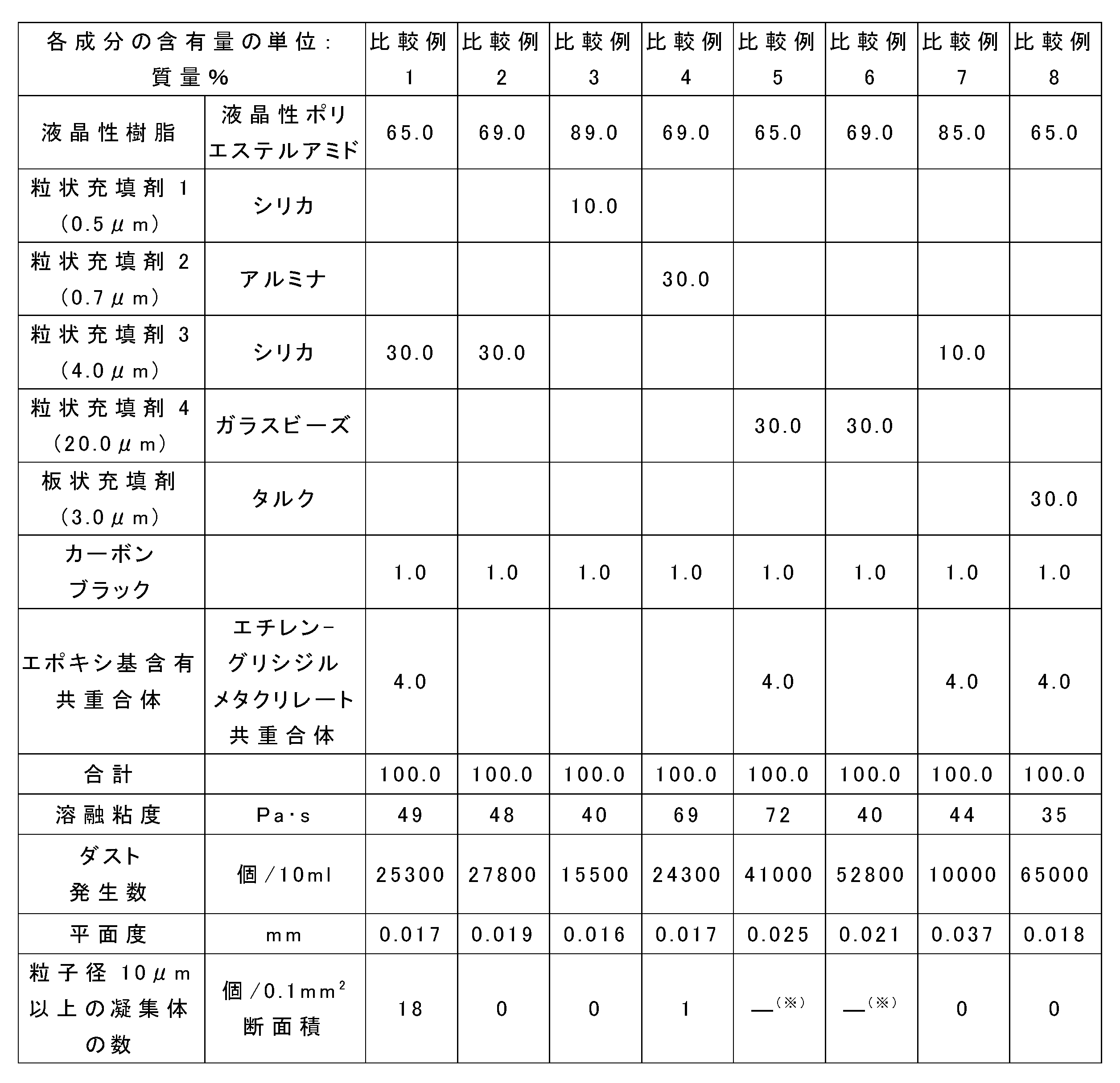
- melt viscosity of the liquid crystalline resin compositions for camera modules of Examples and Comparative Examples was measured using the pellets. Specifically, the apparent melt viscosity under the conditions of a cylinder temperature of 350 ° C. and a shear rate of 1000 sec ⁇ 1 is measured according to ISO 11443 using a capillary rheometer (Capillograph 1D manufactured by Toyo Seiki Seisakusho Co., Ltd .: piston diameter 10 mm). Measured. For the measurement, an orifice having an inner diameter of 1 mm and a length of 20 mm was used. The results are shown in Tables 1 and 2.
- Example 1 As is clear from the comparison between Example 1 and Comparative Example 1, when the particulate filler and the epoxy group-containing copolymer are simultaneously supplied to the extruder, the number of aggregates having a particle diameter of 10 ⁇ m or more is increased, and dust is generated. While the number increases, when the particulate filler and the epoxy group-containing copolymer are separately supplied to the extruder, the number of aggregates having a particle diameter of 10 ⁇ m or more is greatly reduced, and the number of dusts generated is also reduced. It was confirmed.
Landscapes
- Chemical & Material Sciences (AREA)
- Medicinal Chemistry (AREA)
- Health & Medical Sciences (AREA)
- Chemical Kinetics & Catalysis (AREA)
- Polymers & Plastics (AREA)
- Organic Chemistry (AREA)
- Physics & Mathematics (AREA)
- Engineering & Computer Science (AREA)
- Mechanical Engineering (AREA)
- General Physics & Mathematics (AREA)
- Optics & Photonics (AREA)
- Compositions Of Macromolecular Compounds (AREA)
- Processes Of Treating Macromolecular Substances (AREA)
Abstract
Description
(B)粒状充填剤、及び
(C)エポキシ基含有共重合体
を含有し、
(A)成分の含有量が35~79質量%、(B)成分の含有量が20~60質量%、(C)成分の含有量が1~5質量%であり、
(B)成分の平均一次粒子径が5μm以下であり、
粒子径10μm以上の凝集体の数が断面積0.1mm2当たり5個以下であるカメラモジュール用液晶性樹脂組成物。
前記(A)液晶性樹脂と前記(B)粒状充填剤との混合、及び、前記(A)液晶性樹脂と前記(C)エポキシ基含有共重合体との混合を同時には行わない、(1)又は(2)に記載の組成物の製造方法。
前記押出機のメインフィード口から前記(A)液晶性樹脂及び前記(B)粒状充填剤を供給し、前記メインフィード口より押出方向後方に設けられたサイドフィード口から前記(C)エポキシ基含有共重合体を供給し、又は、
前記メインフィード口から前記(A)液晶性樹脂及び前記(C)エポキシ基含有共重合体を供給し、前記サイドフィード口から前記(B)粒状充填剤を供給する、(3)に記載の方法。
本発明のカメラモジュール用液晶性樹脂組成物は、(A)液晶性樹脂、(B)粒状充填剤、及び(C)エポキシ基含有共重合体を含有する。
本発明で使用する(A)液晶性樹脂とは、光学異方性溶融相を形成し得る性質を有する溶融加工性ポリマーを指す。異方性溶融相の性質は、直交偏光子を利用した慣用の偏光検査法により確認することが出来る。より具体的には、異方性溶融相の確認は、Leitz偏光顕微鏡を使用し、Leitzホットステージに載せた溶融試料を窒素雰囲気下で40倍の倍率で観察することにより実施できる。本発明に適用できる液晶性ポリマーは直交偏光子の間で検査したときに、たとえ溶融静止状態であっても偏光は通常透過し、光学的に異方性を示す。
(1)主として芳香族ヒドロキシカルボン酸及びその誘導体の1種又は2種以上に由来する構成単位からなるポリエステル;
(2)主として(a)芳香族ヒドロキシカルボン酸及びその誘導体の1種又は2種以上に由来する構成単位と、(b)芳香族ジカルボン酸、脂環族ジカルボン酸、及びそれらの誘導体の1種又は2種以上に由来する構成単位と、(c)芳香族ジオール、脂環族ジオール、脂肪族ジオール、及びそれらの誘導体の少なくとも1種又は2種以上に由来する構成単位、とからなるポリエステル;
(3)主として(a)芳香族ヒドロキシカルボン酸及びその誘導体の1種又は2種以上に由来する構成単位と、(b)芳香族ヒドロキシアミン、芳香族ジアミン、及びそれらの誘導体の1種又は2種以上に由来する構成単位と、(c)芳香族ジカルボン酸、脂環族ジカルボン酸、及びそれらの誘導体の1種又は2種以上に由来する構成単位、とからなるポリエステルアミド;
(4)主として(a)芳香族ヒドロキシカルボン酸及びその誘導体の1種又は2種以上に由来する構成単位と、(b)芳香族ヒドロキシアミン、芳香族ジアミン、及びそれらの誘導体の1種又は2種以上に由来する構成単位と、(c)芳香族ジカルボン酸、脂環族ジカルボン酸、及びそれらの誘導体の1種又は2種以上に由来する構成単位と、(d)芳香族ジオール、脂環族ジオール、脂肪族ジオール、及びそれらの誘導体の少なくとも1種又は2種以上に由来する構成単位、とからなるポリエステルアミド等が挙げられる。更に上記の構成成分に必要に応じ分子量調整剤を併用してもよい。


(B)成分は粒状充填剤であり、(B)成分の平均一次粒子径は5μm以下である。上記平均一次粒子径が5μm以下であると、成形体表面の起毛抑制効果、成形体の低発塵性、及び成形体のそり変形抑制効果が高くなりやすい。上記平均一次粒子径は、好ましくは0.25~4.5μmであり、より好ましくは0.5~4μmである。なお、本明細書において、平均一次粒子径としては、レーザ回折/散乱式粒度分布測定法で測定した値を採用する。
(C)エポキシ基含有共重合体は、1種単独で又は2種以上組み合わせて使用することができる。(C)エポキシ基含有共重合体としては、特に限定されず、例えば、(C1)エポキシ基含有オレフィン系共重合体及び(C2)エポキシ基含有スチレン系共重合体からなる群より選択される少なくとも1種が挙げられる。(C)成分をカメラモジュール用液晶性樹脂組成物に配合させることが、当該組成物を成形してなる成形体を超音波洗浄したときの、成形体表面の起毛を抑えることに寄与する。
起毛を抑える理由については明確になっているわけではないが、ある一定量配合させることにより、成形体表面状態を変化させ、その変化が起毛を抑えることに寄与していると考えられる。

本発明に任意成分として用いる(D)カーボンブラックは、樹脂着色に用いられる一般的に入手可能なものであれば、特に限定されるものではない。通常、(D)カーボンブラックには一次粒子が凝集して出来上がる塊状物が含まれているが、50μm以上の大きさの塊状物が著しく多く含まれていない限り、本発明の樹脂組成物を成形してなる成形体の表面に多くのブツ(カーボンブラックが凝集した細かいブツブツ状突起物(細かい凹凸))は発生しにくい。上記塊状物粒子径が50μm以上の粒子の含有率が20ppm以下であると、成形体表面の起毛抑制効果及び成形体の低発塵性が高くなりやすい。好ましい含有率は5ppm以下である。
本発明のカメラモジュール用液晶性樹脂組成物には、本発明の効果を害さない範囲で、その他の重合体、その他の充填剤、一般に合成樹脂に添加される公知の物質、即ち、酸化防止剤や紫外線吸収剤等の安定剤、帯電防止剤、難燃剤、染料や顔料等の着色剤、潤滑剤、離型剤、結晶化促進剤、結晶核剤等も要求性能に応じ適宜添加することができる。
本発明のカメラモジュール用液晶性樹脂組成物において、粒子径10μm以上の凝集体の数は、断面積0.1mm2当たり5個以下であり、3個以下であることが好ましく、2個以下であることがより好ましい。本発明者らの検討によれば、液晶性樹脂組成物中で(B)成分と(C)成分とは凝集体を形成する傾向にあり、これらの成分の凝集の程度が大きいと、成形体表面の起毛抑制効果及び成形体の低発塵性が十分には発現されにくいことが判明した。しかし、上記凝集体の数が断面積0.1mm2当たり5個以下であると、成形体表面の起毛抑制効果及び成形体の低発塵性が高くなりやすい。
本発明に係るカメラモジュール用液晶性樹脂組成物は、(B)粒状充填剤と(C)エポキシ基含有共重合体との凝集体の形成を抑制しやすいことから、(A)液晶性樹脂、(B)粒状充填剤、(C)エポキシ基含有共重合体を含有する混合物を得ることを含み、(A)液晶性樹脂と(B)粒状充填剤との混合、及び、(A)液晶性樹脂と(C)エポキシ基含有共重合体との混合を同時には行わない方法により、製造することが好ましい。即ち、(B)粒状充填剤と(C)エポキシ基含有共重合体とを別々に(A)液晶性樹脂に添加することが好ましい。具体的には、例えば、(A)液晶性樹脂及び(B)粒状充填剤を含有する混合物に(C)エポキシ基含有共重合体を混合し、及び/又は、(A)液晶性樹脂及び(C)エポキシ基含有共重合体を含有する混合物に(B)粒状充填剤を混合することを含む方法が用いられる。その他の成分は、(B)粒状充填剤及び/又は(C)エポキシ基含有共重合体とともに、(A)液晶性樹脂と混合される。上記成分の混合は、例えば、1軸又は2軸押出機を用いた溶融混練により行われる。
上記カメラモジュール用液晶性樹脂組成物を用いて、カメラモジュール用部品を製造する。本発明の樹脂組成物を原料として用いれば、カメラモジュール用部品の表面が起毛しにくくなる。カメラモジュール用部品は、超音波洗浄されるため、超音波洗浄されても表面が起毛しにくいことが求められる。本発明の樹脂組成物を用いれば、カメラモジュール用部品の超音波洗浄をより強い条件で行っても、ゴミ等の原因となる脱落物が生じないか、ほとんど生じない。したがって、カメラモジュール用部品が完成品に組み込まれた後に、このカメラモジュール用部品の表面が起毛することにより生じるゴミで、完成品の品質に影響を与えることはほとんど無い。
・液晶性ポリエステルアミド樹脂
重合容器に下記の原料を仕込んだ後、反応系の温度を140℃に上げ、140℃で1時間反応させた。その後、更に340℃まで4.5時間かけて昇温し、そこから15分かけて10Torr(即ち1330Pa)まで減圧にして、酢酸、過剰の無水酢酸、及びその他の低沸分を留出させながら溶融重合を行った。撹拌トルクが所定の値に達した後、窒素を導入して減圧状態から常圧を経て加圧状態にして、重合容器の下部からポリマーを排出し、ストランドをペレタイズしてペレットを得た。得られたペレットについて、窒素気流下、300℃で2時間の熱処理を行って、目的のポリマーを得た。得られたポリマーの融点は334℃、溶融粘度は14.0Pa・sであった。なお、上記ポリマーの溶融粘度は、後述する溶融粘度の測定方法と同様にして測定した。
(I)4-ヒドロキシ安息香酸;188.4g(60モル%)
(II)2-ヒドロキシ-6-ナフトエ酸;21.4g(5モル%)
(III)テレフタル酸;66.8g(17.7モル%)
(IV)4,4’-ジヒドロキシビフェニル;52.2g(12.3モル%)
(V)4-アセトキシアミノフェノール;17.2g(5モル%)
金属触媒(酢酸カリウム触媒);15mg
アシル化剤(無水酢酸);226.2g
・粒状充填剤1:アドマファインSO-C2((株)アドマテックス製、シリカ、平均一次粒子径0.5μm)
・粒状充填剤2:アドマファインAO-502((株)アドマテックス製、アルミナ、平均一次粒子径0.7μm)
・粒状充填剤3:デンカ溶融シリカFB-5SDC(電気化学工業(株)製、シリカ、平均一次粒子径4.0μm)
・粒状充填剤4:EGB731(ポッターズ・バロティーニ(株)製、ガラスビーズ、平均一次粒子径20.0μm)
・板状充填剤:GH3(林化成(株)製、タルク、平均一次粒子径3.0μm)
・カーボンブラック:VULCAN XC305(キャボットジャパン(株)製、平均粒子径20nm、粒子径50μm以上の粒子の割合が20ppm以下)
・エポキシ基含有共重合体(エポキシ基含有オレフィン系共重合体):ボンドファースト2C(住友化学(株)製、エチレン-グリシジルメタクリレート共重合体、グリシジルメタクリレートの含有量6質量%)
上記成分を、表1又は表2に示す割合(単位:質量%)で二軸押出機((株)日本製鋼所製TEX30α型)を用いて、シリンダー温度350℃にて溶融混練し、カメラモジュール用液晶性樹脂組成物ペレットを得た。なお、比較例1では、上記押出機のメインフィード口から液晶性樹脂及びカーボンブラックを供給し、上記メインフィード口より押出方向後方に設けられたサイドフィード口から粒状充填剤及びエポキシ基含有共重合体を供給した。一方、実施例及び他の比較例では、上記押出機のメインフィード口から液晶性樹脂、エポキシ基含有共重合体、及びカーボンブラックを供給し、上記サイドフィード口から粒状充填剤を供給した。
実施例及び比較例のカメラモジュール用液晶性樹脂組成物の溶融粘度を、上記ペレットを用いて測定した。具体的には、キャピラリー式レオメーター((株)東洋精機製作所製キャピログラフ1D:ピストン径10mm)により、シリンダー温度350℃、せん断速度1000sec-1の条件での見かけの溶融粘度をISO 11443に準拠して測定した。測定には、内径1mm、長さ20mmのオリフィスを用いた。結果を表1及び表2に示す。
実施例及び比較例のペレットを、成形機(住友重機械工業(株)製 「SE30DUZ」)を用いて、以下の成形条件で成形し、12.5mm×120mm×0.8mmの成形体を得た。この成形体を試験片として使用した。
〔成形条件〕
シリンダー温度: 350℃
金型温度: 90℃
射出速度: 80mm/sec
〔評価〕
上記試験片を3分間、室温の水中(10ml)で超音波洗浄機(出力300W、周波数45kHz)にかけた。その後、パーティクルカウンター(RION(株)製 液中微粒子計数器KL-11A(PARTICLECOUNTER))にて、上記水中に存在する2μm以上の粒子数を測定し、ダスト発生数として評価した。結果を表1及び表2に示す。
実施例及び比較例のペレットを、成形機(住友重機械工業(株)製 「SE-100DU」)を用いて、以下の成形条件で成形し、80mm×80mm×1mmの平板状試験片を5枚作製した。1枚目の平板状試験片を水平面に静置し、(株)ミツトヨ製のCNC画像測定機(型式:QVBHU404-PRO1F)を用いて、上記平板状試験片上の9箇所において、上記水平面からの高さを測定し、得られた測定値から平均の高さを算出した。高さを測定した位置は、平板状試験片の主平面上に、この主平面の各辺からの距離が3mmとなるように、一辺が74mmの正方形を置いたときに、この正方形の各頂点、この正方形の各辺の中点、及びこの正方形の2本の対角線の交点に該当する位置である。上記水平面からの高さが上記平均の高さと同一であり、上記水平面と平行な面を基準面とした。上記9箇所で測定された高さの中から、基準面からの最大高さと最小高さとを選択し、両者の差を算出した。同様にして、他の4枚の平板状試験片についても上記の差を算出し、得られた5個の値を平均して、平面度の値とした。結果を表1及び表2に示す。
〔成形条件〕
シリンダー温度: 350℃
金型温度: 80℃
射出速度: 33mm/sec
保圧: 60MPa
実施例及び比較例のペレットを、成形機(住友重機械工業(株)製 「SE30DUZ」)を用いて、以下の成形条件で成形し、12.5mm×120mm×0.8mmの成形体を得た。成形体を、ミクロトームを用いて、成形時の流動方向に垂直な断面でトリミングし、得られた試料から無作為に選択した断面について、走査型電子顕微鏡((株)日立ハイテクノロジーズ製「S-4700」、倍率:1000倍)で観察して、粒子径10μm以上の凝集体の数を計測し、この数を、観察対象となった断面の面積で除することで、断面積0.1mm2当たりの上記凝集体の数を求めた。走査型電子顕微鏡での観察に際しては、10枚の電子顕微鏡写真を用いた。結果を表1及び表2に示す。なお、図2は、実施例1で用いた電子顕微鏡写真のうちの2枚を示し、図3は、比較例1で用いた電子顕微鏡写真のうちの2枚を示す。
〔成形条件〕
シリンダー温度: 350℃
金型温度: 90℃
射出速度: 80mm/sec

10 基板
11 光学素子
12 リード配線
13 レンズホルダー
14 バレル
15 レンズ
16 IRフィルター
17 ガイド
Claims (6)
- (A)液晶性樹脂、
(B)粒状充填剤、及び
(C)エポキシ基含有共重合体、
を含有し、
(A)成分の含有量が35~79質量%、(B)成分の含有量が20~60質量%、(C)成分の含有量が1~5質量%であり、
(B)成分の平均一次粒子径が5μm以下であり、
粒子径10μm以上の凝集体の数が断面積0.1mm2当たり5個以下であるカメラモジュール用液晶性樹脂組成物。 - 前記(C)エポキシ基含有共重合体は、(C1)エポキシ基含有オレフィン系共重合体及び(C2)エポキシ基含有スチレン系共重合体からなる群より選択される少なくとも1種である請求項1に記載の組成物。
- 前記(A)液晶性樹脂、前記(B)粒状充填剤、及び前記(C)エポキシ基含有共重合体を含有する混合物を得ることを含み、
前記(A)液晶性樹脂と前記(B)粒状充填剤との混合、及び、前記(A)液晶性樹脂と前記(C)エポキシ基含有共重合体との混合を同時には行わない、請求項1又は2に記載の組成物の製造方法。 - 前記混合物を得る際に、押出機を用い、
前記押出機のメインフィード口から前記(A)液晶性樹脂及び前記(B)粒状充填剤を供給し、前記メインフィード口より押出方向後方に設けられたサイドフィード口から前記(C)エポキシ基含有共重合体を供給し、又は、
前記メインフィード口から前記(A)液晶性樹脂及び前記(C)エポキシ基含有共重合体を供給し、前記サイドフィード口から前記(B)粒状充填剤を供給する、請求項3に記載の方法。 - 請求項1又は2に記載の組成物からなるカメラモジュール用部品。
- 請求項5に記載の部品を備えるカメラモジュール。
Priority Applications (3)
| Application Number | Priority Date | Filing Date | Title |
|---|---|---|---|
| JP2017523563A JP6190089B1 (ja) | 2015-12-24 | 2016-12-02 | カメラモジュール用液晶性樹脂組成物、その製造方法、及び上記組成物を用いたカメラモジュール |
| CN201680062626.2A CN108350278B (zh) | 2015-12-24 | 2016-12-02 | 照相机模块用液晶性树脂组合物、其制造方法及使用有该组合物的照相机模块 |
| KR1020187012357A KR101907100B1 (ko) | 2015-12-24 | 2016-12-02 | 카메라 모듈용 액정성 수지 조성물, 그 제조방법, 및 상기 조성물을 이용한 카메라 모듈 |
Applications Claiming Priority (2)
| Application Number | Priority Date | Filing Date | Title |
|---|---|---|---|
| JP2015252393 | 2015-12-24 | ||
| JP2015-252393 | 2015-12-24 |
Publications (1)
| Publication Number | Publication Date |
|---|---|
| WO2017110424A1 true WO2017110424A1 (ja) | 2017-06-29 |
Family
ID=59090140
Family Applications (1)
| Application Number | Title | Priority Date | Filing Date |
|---|---|---|---|
| PCT/JP2016/085909 Ceased WO2017110424A1 (ja) | 2015-12-24 | 2016-12-02 | カメラモジュール用液晶性樹脂組成物、その製造方法、及び上記組成物を用いたカメラモジュール |
Country Status (5)
| Country | Link |
|---|---|
| JP (1) | JP6190089B1 (ja) |
| KR (1) | KR101907100B1 (ja) |
| CN (1) | CN108350278B (ja) |
| TW (1) | TWI682966B (ja) |
| WO (1) | WO2017110424A1 (ja) |
Cited By (7)
| Publication number | Priority date | Publication date | Assignee | Title |
|---|---|---|---|---|
| US10106682B2 (en) | 2015-08-17 | 2018-10-23 | Ticona Llc | Liquid crystalline polymer composition for camera modules |
| WO2019054187A1 (ja) * | 2017-09-12 | 2019-03-21 | ポリプラスチックス株式会社 | 耐摺動摩耗部材用液晶性樹脂組成物及びそれを用いた耐摺動摩耗部材 |
| WO2019065063A1 (ja) * | 2017-09-29 | 2019-04-04 | ポリプラスチックス株式会社 | 耐摺動摩耗部材用液晶性樹脂組成物及びそれを用いた耐摺動摩耗部材 |
| WO2020071495A1 (ja) * | 2018-10-05 | 2020-04-09 | ポリプラスチックス株式会社 | 耐ボールベアリング摺動摩耗部材用液晶性樹脂組成物及びそれを用いた耐ボールベアリング摺動摩耗部材 |
| US10829634B2 (en) | 2017-12-05 | 2020-11-10 | Ticona Llc | Aromatic polymer composition for use in a camera module |
| WO2020230890A1 (ja) * | 2019-05-16 | 2020-11-19 | ポリプラスチックス株式会社 | 液晶性樹脂組成物及びそれを用いた成形体 |
| JP2023123057A (ja) * | 2022-02-24 | 2023-09-05 | ポリプラスチックス株式会社 | カメラモジュール用液晶性樹脂組成物及びそれを用いたカメラモジュール |
Families Citing this family (7)
| Publication number | Priority date | Publication date | Assignee | Title |
|---|---|---|---|---|
| CN110662803A (zh) | 2017-06-14 | 2020-01-07 | 东丽株式会社 | 液晶性聚酯树脂组合物及由该液晶性聚酯树脂组合物形成的成型品 |
| US11086200B2 (en) | 2019-03-20 | 2021-08-10 | Ticona Llc | Polymer composition for use in a camera module |
| CN113710738A (zh) | 2019-03-20 | 2021-11-26 | 提克纳有限责任公司 | 用于相机模块的致动器组件 |
| KR102532937B1 (ko) * | 2020-09-29 | 2023-05-16 | 포리프라스틱 가부시키가이샤 | 내 볼베어링 접동 마모 부재용 액정성 수지 조성물 및 이를 이용한 내 볼베어링 접동 마모 부재 |
| US12209163B2 (en) | 2021-05-06 | 2025-01-28 | Ticona Llc | Polymer composition for use in a camera module |
| TW202340697A (zh) | 2021-12-13 | 2023-10-16 | 美商堤康那責任有限公司 | 樣品之滾珠凹部性質之測試技術 |
| KR102874880B1 (ko) | 2022-12-29 | 2025-10-22 | 삼성전기주식회사 | 액정성 수지 조성물 및 이를 이용하여 제조된 볼베어링 접동 부품 |
Citations (9)
| Publication number | Priority date | Publication date | Assignee | Title |
|---|---|---|---|---|
| WO2007043701A1 (ja) * | 2005-10-13 | 2007-04-19 | Polyplastics Co., Ltd. | 射出成形用液晶性樹脂組成物 |
| WO2010050327A1 (ja) * | 2008-10-30 | 2010-05-06 | ポリプラスチックス株式会社 | 射出成形用液晶性樹脂組成物、当該樹脂組成物を成形してなる成形体、および当該成形体からなるカメラモジュール |
| JP2011026579A (ja) * | 2009-06-30 | 2011-02-10 | Sumitomo Chemical Co Ltd | 樹脂組成物の製造方法、樹脂組成物、反射板および発光装置 |
| WO2011036927A1 (ja) * | 2009-09-28 | 2011-03-31 | 新日本石油株式会社 | 液晶ポリエステル樹脂組成物 |
| JP2012031391A (ja) * | 2010-06-28 | 2012-02-16 | Toray Ind Inc | 液晶性樹脂組成物およびその製造方法 |
| WO2012050082A1 (ja) * | 2010-10-15 | 2012-04-19 | Jx日鉱日石エネルギー株式会社 | 液晶ポリエステル樹脂組成物及びカメラモジュール部品 |
| JP2012206296A (ja) * | 2011-03-29 | 2012-10-25 | Sumitomo Chemical Co Ltd | 液晶ポリエステル組成物の製造方法 |
| JP2013071281A (ja) * | 2011-09-27 | 2013-04-22 | Sumitomo Chemical Co Ltd | 樹脂組成物の製造方法 |
| JP2015021110A (ja) * | 2013-07-23 | 2015-02-02 | ポリプラスチックス株式会社 | カメラモジュール用液晶性樹脂組成物 |
Family Cites Families (1)
| Publication number | Priority date | Publication date | Assignee | Title |
|---|---|---|---|---|
| WO2014087842A1 (ja) * | 2012-12-03 | 2014-06-12 | ポリプラスチックス株式会社 | カメラモジュール用液晶性樹脂組成物及びそれを用いたカメラモジュール |
-
2016
- 2016-12-02 KR KR1020187012357A patent/KR101907100B1/ko active Active
- 2016-12-02 CN CN201680062626.2A patent/CN108350278B/zh active Active
- 2016-12-02 JP JP2017523563A patent/JP6190089B1/ja active Active
- 2016-12-02 WO PCT/JP2016/085909 patent/WO2017110424A1/ja not_active Ceased
- 2016-12-07 TW TW105140364A patent/TWI682966B/zh active
Patent Citations (9)
| Publication number | Priority date | Publication date | Assignee | Title |
|---|---|---|---|---|
| WO2007043701A1 (ja) * | 2005-10-13 | 2007-04-19 | Polyplastics Co., Ltd. | 射出成形用液晶性樹脂組成物 |
| WO2010050327A1 (ja) * | 2008-10-30 | 2010-05-06 | ポリプラスチックス株式会社 | 射出成形用液晶性樹脂組成物、当該樹脂組成物を成形してなる成形体、および当該成形体からなるカメラモジュール |
| JP2011026579A (ja) * | 2009-06-30 | 2011-02-10 | Sumitomo Chemical Co Ltd | 樹脂組成物の製造方法、樹脂組成物、反射板および発光装置 |
| WO2011036927A1 (ja) * | 2009-09-28 | 2011-03-31 | 新日本石油株式会社 | 液晶ポリエステル樹脂組成物 |
| JP2012031391A (ja) * | 2010-06-28 | 2012-02-16 | Toray Ind Inc | 液晶性樹脂組成物およびその製造方法 |
| WO2012050082A1 (ja) * | 2010-10-15 | 2012-04-19 | Jx日鉱日石エネルギー株式会社 | 液晶ポリエステル樹脂組成物及びカメラモジュール部品 |
| JP2012206296A (ja) * | 2011-03-29 | 2012-10-25 | Sumitomo Chemical Co Ltd | 液晶ポリエステル組成物の製造方法 |
| JP2013071281A (ja) * | 2011-09-27 | 2013-04-22 | Sumitomo Chemical Co Ltd | 樹脂組成物の製造方法 |
| JP2015021110A (ja) * | 2013-07-23 | 2015-02-02 | ポリプラスチックス株式会社 | カメラモジュール用液晶性樹脂組成物 |
Cited By (20)
| Publication number | Priority date | Publication date | Assignee | Title |
|---|---|---|---|---|
| US12331194B2 (en) | 2015-08-17 | 2025-06-17 | Ticona Llc | Liquid crystalline polymer composition for camera modules |
| US10106682B2 (en) | 2015-08-17 | 2018-10-23 | Ticona Llc | Liquid crystalline polymer composition for camera modules |
| US11820892B2 (en) | 2015-08-17 | 2023-11-21 | Ticona Llc | Liquid crystalline polymer composition for camera modules |
| US11214683B2 (en) | 2015-08-17 | 2022-01-04 | Ticona Llc | Liquid crystalline polymer composition for camera modules |
| US10767049B2 (en) | 2015-08-17 | 2020-09-08 | Ticona Llc | Liquid crystalline polymer composition for camera modules |
| JP6513322B1 (ja) * | 2017-09-12 | 2019-05-15 | ポリプラスチックス株式会社 | 耐摺動摩耗部材用液晶性樹脂組成物及びそれを用いた耐摺動摩耗部材 |
| CN110997820A (zh) * | 2017-09-12 | 2020-04-10 | 宝理塑料株式会社 | 耐滑动摩耗构件用液晶性树脂组合物和使用了其的耐滑动摩耗构件 |
| WO2019054187A1 (ja) * | 2017-09-12 | 2019-03-21 | ポリプラスチックス株式会社 | 耐摺動摩耗部材用液晶性樹脂組成物及びそれを用いた耐摺動摩耗部材 |
| CN110997820B (zh) * | 2017-09-12 | 2021-05-11 | 宝理塑料株式会社 | 耐滑动摩耗构件用液晶性树脂组合物和使用了其的耐滑动摩耗构件 |
| JP6545416B1 (ja) * | 2017-09-29 | 2019-07-17 | ポリプラスチックス株式会社 | 耐摺動摩耗部材用液晶性樹脂組成物及びそれを用いた耐摺動摩耗部材 |
| WO2019065063A1 (ja) * | 2017-09-29 | 2019-04-04 | ポリプラスチックス株式会社 | 耐摺動摩耗部材用液晶性樹脂組成物及びそれを用いた耐摺動摩耗部材 |
| US10829634B2 (en) | 2017-12-05 | 2020-11-10 | Ticona Llc | Aromatic polymer composition for use in a camera module |
| US20210061994A1 (en) * | 2017-12-05 | 2021-03-04 | Ticona Llc | Aromatic Polymer Composition for Use in a Camera Module |
| US11725106B2 (en) * | 2017-12-05 | 2023-08-15 | Ticona Llc | Aromatic polymer composition for use in a camera module |
| JPWO2020071495A1 (ja) * | 2018-10-05 | 2021-02-15 | ポリプラスチックス株式会社 | 耐ボールベアリング摺動摩耗部材用液晶性樹脂組成物及びそれを用いた耐ボールベアリング摺動摩耗部材 |
| WO2020071495A1 (ja) * | 2018-10-05 | 2020-04-09 | ポリプラスチックス株式会社 | 耐ボールベアリング摺動摩耗部材用液晶性樹脂組成物及びそれを用いた耐ボールベアリング摺動摩耗部材 |
| JP7026842B2 (ja) | 2019-05-16 | 2022-02-28 | ポリプラスチックス株式会社 | 液晶性樹脂組成物及びそれを用いた成形体 |
| JPWO2020230890A1 (ja) * | 2019-05-16 | 2021-05-20 | ポリプラスチックス株式会社 | 液晶性樹脂組成物及びそれを用いた成形体 |
| WO2020230890A1 (ja) * | 2019-05-16 | 2020-11-19 | ポリプラスチックス株式会社 | 液晶性樹脂組成物及びそれを用いた成形体 |
| JP2023123057A (ja) * | 2022-02-24 | 2023-09-05 | ポリプラスチックス株式会社 | カメラモジュール用液晶性樹脂組成物及びそれを用いたカメラモジュール |
Also Published As
| Publication number | Publication date |
|---|---|
| KR101907100B1 (ko) | 2018-10-11 |
| JPWO2017110424A1 (ja) | 2017-12-28 |
| JP6190089B1 (ja) | 2017-08-30 |
| CN108350278B (zh) | 2019-07-26 |
| TWI682966B (zh) | 2020-01-21 |
| TW201736507A (zh) | 2017-10-16 |
| KR20180053412A (ko) | 2018-05-21 |
| CN108350278A (zh) | 2018-07-31 |
Similar Documents
| Publication | Publication Date | Title |
|---|---|---|
| JP6190089B1 (ja) | カメラモジュール用液晶性樹脂組成物、その製造方法、及び上記組成物を用いたカメラモジュール | |
| JP5680788B2 (ja) | カメラモジュール用液晶性樹脂組成物 | |
| JP6823760B2 (ja) | 耐ボールベアリング摺動摩耗部材用液晶性樹脂組成物及びそれを用いた耐ボールベアリング摺動摩耗部材 | |
| JP6581659B2 (ja) | カメラモジュール用液晶性樹脂組成物及びそれを用いたカメラモジュール | |
| JP6174406B2 (ja) | カメラモジュール用液晶性樹脂組成物 | |
| JP5826411B2 (ja) | カメラモジュール用液晶性樹脂組成物及びそれを用いたカメラモジュール | |
| JP6164945B2 (ja) | カメラモジュール用液晶性樹脂組成物 | |
| JP6762228B2 (ja) | カメラモジュール用液晶性樹脂組成物及びそれを用いたカメラモジュール | |
| JP6906123B1 (ja) | 耐ボールベアリング摺動摩耗部材用液晶性樹脂組成物及びそれを用いた耐ボールベアリング摺動摩耗部材 | |
| CN115702206B (zh) | 耐球轴承滑动磨损构件用液晶性树脂组合物和使用其的耐球轴承滑动磨损构件 | |
| TW201920480A (zh) | 耐滑動磨耗構件用液晶性樹脂組合物及使用該組合物的耐滑動磨耗構件 | |
| TW201925343A (zh) | 耐滑動磨耗構件用液晶性樹脂組合物及使用該組合物的耐滑動磨耗構件 | |
| JP7101323B1 (ja) | 耐ボールベアリング摺動摩耗部材用液晶性樹脂組成物及びそれを用いた耐ボールベアリング摺動摩耗部材 | |
| TW202502969A (zh) | 液晶性樹脂組合物及使用此之相機模組 |
Legal Events
| Date | Code | Title | Description |
|---|---|---|---|
| ENP | Entry into the national phase |
Ref document number: 2017523563 Country of ref document: JP Kind code of ref document: A |
|
| 121 | Ep: the epo has been informed by wipo that ep was designated in this application |
Ref document number: 16878317 Country of ref document: EP Kind code of ref document: A1 |
|
| ENP | Entry into the national phase |
Ref document number: 20187012357 Country of ref document: KR Kind code of ref document: A |
|
| NENP | Non-entry into the national phase |
Ref country code: DE |
|
| 122 | Ep: pct application non-entry in european phase |
Ref document number: 16878317 Country of ref document: EP Kind code of ref document: A1 |