WO2017104171A1 - 油脂固化剤 - Google Patents
油脂固化剤 Download PDFInfo
- Publication number
- WO2017104171A1 WO2017104171A1 PCT/JP2016/073437 JP2016073437W WO2017104171A1 WO 2017104171 A1 WO2017104171 A1 WO 2017104171A1 JP 2016073437 W JP2016073437 W JP 2016073437W WO 2017104171 A1 WO2017104171 A1 WO 2017104171A1
- Authority
- WO
- WIPO (PCT)
- Prior art keywords
- fatty acid
- acid
- oil
- fat
- acid ester
- Prior art date
- Legal status (The legal status is an assumption and is not a legal conclusion. Google has not performed a legal analysis and makes no representation as to the accuracy of the status listed.)
- Ceased
Links
Classifications
-
- A—HUMAN NECESSITIES
- A23—FOODS OR FOODSTUFFS; TREATMENT THEREOF, NOT COVERED BY OTHER CLASSES
- A23D—EDIBLE OILS OR FATS, e.g. MARGARINES, SHORTENINGS OR COOKING OILS
- A23D9/00—Other edible oils or fats, e.g. shortenings or cooking oils
- A23D9/007—Other edible oils or fats, e.g. shortenings or cooking oils characterised by ingredients other than fatty acid triglycerides
-
- C—CHEMISTRY; METALLURGY
- C11—ANIMAL OR VEGETABLE OILS, FATS, FATTY SUBSTANCES OR WAXES; FATTY ACIDS THEREFROM; DETERGENTS; CANDLES
- C11B—PRODUCING, e.g. BY PRESSING RAW MATERIALS OR BY EXTRACTION FROM WASTE MATERIALS, REFINING OR PRESERVING FATS, FATTY SUBSTANCES, e.g. LANOLIN, FATTY OILS OR WAXES; ESSENTIAL OILS; PERFUMES
- C11B15/00—Solidifying fatty oils, fats, or waxes by physical processes
Definitions
- the present invention relates to an oil solidifying agent.
- an object of the present invention is to provide an oil and fat solidifying agent that is excellent in solidification properties of fats and oils and that has a superior food texture.
- an oil and fat solidifying agent according to the present invention contains a sucrose fatty acid ester (A), and the sucrose fatty acid ester (A) comprises an unsaturated fatty acid having 12 to 24 carbon atoms as a constituent fatty acid. contains.
- the content of the unsaturated fatty acid having 12 to 24 carbon atoms is preferably 10 to 60% by mass in the constituent fatty acid of the sucrose fatty acid ester (A).
- the fat solidifying agent according to the present invention further contains a polyglycerin fatty acid ester (B).
- the polyglycerol fatty acid ester (B) is preferably contained in an amount of 10 to 150 parts by mass with respect to 100 parts by mass of the sucrose fatty acid ester (A).
- the food product according to the present invention contains the above-mentioned fat-solidifying agent and fat.
- an oil and fat solidifying agent having excellent fat solidification properties and excellent food texture.
- the oil and fat solidifying agent of this embodiment contains sucrose fatty acid ester (A).
- the sucrose fatty acid ester (A) contains an unsaturated fatty acid whose constituent fatty acid has 12 to 24 carbon atoms.
- Examples of the unsaturated fatty acid having 12 to 24 carbon atoms include an unsaturated fatty acid having 12 carbon atoms such as dodecenoic acid, an unsaturated fatty acid having 13 carbon atoms such as tridecenoic acid, and an unsaturated fatty acid having 14 carbon atoms such as tetradecenoic acid.
- Fatty acids such as pentadecenoic acid, C16 unsaturated fatty acids such as hexadecenoic acid (palmitoleic acid, etc.), C17 unsaturated fatty acids such as heptadecenoic acid, octadecenoic acid (oleic acid, vacsen) Carbon such as octadecadienoic acid (linoleic acid), octadecatrienoic acid ((9,12,15) -linolenic acid, (6,9,12) -linolenic acid, eleostearic acid, etc.) 19 unsaturated fatty acids, 19 unsaturated carbons such as nonadecenoic acid, eicosadienoic acid (8,11-eicosadienoic acid, etc.) ), Eicosatrienoic acid (such as 5,8,11-eicosatrienoic acid), eicosatetraenoic acid
- the unsaturated fatty acid of number 24 is mentioned. Of these, unsaturated fatty acids having 16 to 20 carbon atoms are preferred, unsaturated fatty acids having 16 to 18 carbon atoms are more preferred, and carbon atoms having 16 to 18 carbon atoms are more preferred.
- the unsaturated fatty acid of formula 18 is more preferred.
- the hydrocarbon group in unsaturated fatty acid may be a straight chain and may have a branched chain, since the solidification property of fats and oils is more excellent, it is preferable that it is a straight chain.
- the content of the unsaturated fatty acid having 12 to 24 carbon atoms is preferably 10 to 60% by mass in the constituent fatty acid of the sucrose fatty acid ester (A). By setting it as the said content, the solidification property of fats and oils is more excellent, and the food texture of food is more excellent.
- the content is more preferably 15 to 50% by mass, and further preferably 20 to 40% by mass.
- the sucrose fatty acid ester (A) can further contain a saturated fatty acid having 12 to 24 carbon atoms as a constituent fatty acid.
- saturated fatty acid having 12 to 24 carbon atoms include a saturated fatty acid having 12 carbon atoms such as dodecanoic acid (lauric acid), a saturated fatty acid having 13 carbon atoms such as tridecanoic acid, and 14 carbon atoms such as tetradecanoic acid (myristic acid).
- a saturated fatty acid of 15 carbon atoms a saturated fatty acid having 15 carbon atoms such as pentadecanoic acid (pentadecylic acid), a saturated fatty acid having 16 carbon atoms such as hexadecanoic acid (palmitic acid), a saturated fatty acid having 17 carbon atoms such as heptadecanoic acid (margaric acid), Carbons such as saturated fatty acids having 18 carbon atoms such as octadecanoic acid (stearic acid), saturated fatty acids having 19 carbon atoms such as nonadecanoic acid, saturated fatty acids having 20 carbon atoms such as eicosanoic acid (arachidic acid), and docosanoic acid (behenic acid).
- pentadecanoic acid pentadecanoic acid
- a saturated fatty acid having 16 carbon atoms such as hexadecanoic acid (palmitic acid)
- C22 saturated fatty acids such as C22 fatty acids and tetracosanoic acid (lignoceric acid). It is. Among these, a saturated fatty acid having 12 to 20 carbon atoms is preferable and a saturated fatty acid having 16 to 18 carbon atoms is more preferable because the food texture is more excellent.
- the hydrocarbon group in the saturated fatty acid may be a straight chain or may have a branched chain, but is preferably a straight chain because the fats and oils are more solidified.
- the constituent fatty acid of the sucrose fatty acid ester (A) preferably contains 40 to 90% by mass of the saturated fatty acid having 12 to 24 carbon atoms. By setting it as the said content, the solidification property of fats and oils is more excellent, and the food texture of food is more excellent.
- the content is preferably 50 to 85% by mass, and more preferably 60 to 80% by mass.
- the constituent fatty acid of the sucrose fatty acid ester (A) preferably has a saturated fatty acid content of 12 to 16 carbon atoms of 0 to 30% by mass, more preferably 0 to 20% by mass. By setting it as the said content, the solidification property of fats and oils will become more excellent.
- the sucrose fatty acid ester (A) used in the present invention preferably has an average degree of esterification of 4 to 8, more preferably 4.5 to 7.5, still more preferably 5 to 7. Particularly preferred is 5.5-7. By setting the average degree of esterification within the above range, the solidification property of the fat becomes more excellent.
- the average degree of esterification of the sucrose fatty acid ester can be calculated by the following method.
- the hydroxyl value of sucrose fatty acid ester can be measured according to JIS K0070.
- X is calculated by substituting the following OHV, MwSug and MwFa.
- the sucrose fatty acid ester (A) used in the present invention may be an esterified product of sucrose and a mixture of all the constituent fatty acids, an esterified product of sucrose and some constituent fatty acids, sucrose and the remaining It may be a mixture with an esterified product with a constituent fatty acid.
- an esterified product of sucrose and a mixture of all constituent fatty acids is preferable.
- the oil and fat solidifying agent of the present invention preferably further contains a polyglycerin fatty acid ester (B).
- a polyglycerin fatty acid ester (B) By containing polyglycerin fatty acid ester (B), the solidification property of fats and oils becomes more excellent.
- the average degree of polymerization of polyglycerol used as a raw material for the polyglycerol fatty acid ester (B) is preferably 2 to 20. By setting it within the above range, the solidification property of the oil and fat becomes more excellent.
- the average degree of polymerization of the polyglycerol is more preferably from 3 to 15, further preferably from 4 to 12, and particularly preferably from 8 to 12.
- the constituent fatty acid of the polyglycerol fatty acid ester (B) preferably has 12 to 24 carbon atoms.
- Such fatty acids include saturated fatty acids and unsaturated fatty acids.
- saturated fatty acids include saturated fatty acids having 12 carbon atoms such as dodecanoic acid (lauric acid), saturated fatty acids having 13 carbon atoms such as tridecanoic acid, saturated fatty acids having 14 carbon atoms such as tetradecanoic acid (myristic acid), pentadecanoic acid (pentadecyl).
- C16 saturated fatty acid such as hexadecanoic acid (palmitic acid), C17 saturated fatty acid such as heptadecanoic acid (margaric acid), octadecanoic acid (stearic acid), etc.
- C18 saturated fatty acid C19 saturated fatty acid such as nonadecanoic acid, C20 saturated fatty acid such as eicosanoic acid (arachidic acid), C22 saturated fatty acid such as docosanoic acid (behenic acid), tetracosanoic acid
- saturated fatty acids having 24 carbon atoms such as (lignoceric acid).
- unsaturated fatty acid examples include unsaturated fatty acids having 12 carbon atoms such as dodecenoic acid, unsaturated fatty acids having 13 carbon atoms such as tridecenoic acid, unsaturated fatty acids having 14 carbon atoms such as tetradecenoic acid, and pentadecenoic acid.
- C15 unsaturated fatty acid C16 unsaturated fatty acid such as hexadecenoic acid (palmitoleic acid, etc.), C17 unsaturated fatty acid such as heptadecenoic acid, octadecenoic acid (oleic acid, vaccenic acid, etc.), octadeca C18 unsaturated fatty acids such as dienoic acid (such as linoleic acid) and octadecatrienoic acid (such as (9,12,15) -linolenic acid, (6,9,12) -linolenic acid, eleostearic acid) 19 unsaturated fatty acids such as nonadecenoic acid, eicosadienoic acid (8,11-eicosadienoic acid, etc.), eicosatrienoic acid (Unsaturated fatty acid having 20 carbon atoms such as 5,8,11-eicosatrienoic acid), eicosatetra
- fatty acids having 12 to 20 carbon atoms are more preferable, fatty acids having 16 to 18 carbon atoms are more preferable, and fatty acids having 18 to 18 carbon atoms are more preferable because the solidification property of fats and oils is better and the food texture is more excellent. Certain fatty acids are particularly preferred. Moreover, since the solidification property of fats and oils is more excellent, it is preferable that the said constituent fatty acid is a saturated fatty acid.
- the polyglycerol fatty acid ester (B) preferably has an esterification rate of 40 to 100%, more preferably 50 to 90%, and still more preferably 60 to 85%. By setting the esterification rate within the above range, the solidification property of fats and oils becomes more excellent.
- the esterification rate (%) of the polyglycerol fatty acid ester can be calculated by the following formula.
- the hydroxyl value and ester value of polyglycerol fatty acid ester can be measured according to JIS K0070.
- (Esterification rate (%)) (ester value) ⁇ 100 / [(ester value) + (hydroxyl value)]
- the polyglycerol fatty acid ester (B) preferably has an HLB value of 13 or less, more preferably 6 or less, further preferably 5 or less, and particularly preferably 4 or less.
- the HLB value is preferably 0 or more, more preferably 1 or more, further preferably 1.5 or more, and particularly preferably 2 or more.
- the HLB value of the polyglycerin fatty acid ester can be calculated by the following method based on the Griffin equation.
- the saponification value of polyglycerin fatty acid ester and the acid value of fatty acid can be measured according to JIS K0070.
- HLB 20 ⁇ (1-SV / AV)
- SV Saponification value of polyglycerol fatty acid ester (mgKOH / g)
- AV Acid value of fatty acid (mgKOH / g)
- the content of the sucrose fatty acid ester (A) is preferably 30 to 100% by mass in the fat and oil solidifying agent. By setting it within the above range, the solidification property of the oil and fat becomes more excellent.
- the content is more preferably 40 to 100% by mass, and further preferably 50 to 100% by mass.
- the oil and fat solidifying agent contains the sucrose fatty acid ester (A) and the polyglycerin fatty acid ester (B)
- the content of the sucrose fatty acid ester (A) is preferably 30 to 97% by mass, It is more preferably 95% by mass, and further preferably 40 to 90% by mass.
- the content of the polyglycerin fatty acid ester (B) is preferably 3 to 70% by mass in the fat and oil solidifying agent. By setting it within the above range, the solidification property of the oil and fat becomes more excellent.
- the content is more preferably 10 to 60% by mass, and further preferably 20 to 50% by mass.
- the polyglycerol fatty acid ester (B) is preferably 3 to 150 parts by mass with respect to 100 parts by mass of the sucrose fatty acid ester (A). By setting it within the above range, the solidification property of the oil and fat becomes more excellent.
- the content of the polyglycerin fatty acid ester (B) is more preferably 5 to 120 parts by mass, still more preferably 7 to 100 parts by mass with respect to 100 parts by mass of the sucrose fatty acid ester (A). It is particularly preferably 10 to 50 parts by mass.
- the production method of the fat and oil solidifying agent of the present invention is not particularly limited.
- a method of mixing powder, a method of cooling and pulverizing a mixture of raw materials, and a method of spray drying a slurry containing each raw material Etc. can be obtained.
- the oil and fat solidifying agent of the present invention may contain other components as long as the effects of the present invention are not impaired.
- examples of such components include glycerin fatty acid ester, fatty acid and esterified compound of organic acid other than fatty acid and glycerin, polyglycerin condensed ricinoleic acid ester, stearoyl calcium lactate, stearoyl sodium lactate, sorbitan fatty acid ester, polyoxyethylene Examples include sorbitan fatty acid ester and lecithin.
- the food of the present invention contains the above fat / oil solidifying agent and fat / oil.
- the fats and oils used in the present invention are not particularly limited. Seed oil, macadamia nut oil, hazelnut oil, pumpkin seed oil, walnut oil, coconut oil, tea seed oil, sesame oil, olive oil, mustard oil, rice oil, rice bran oil, wheat germ oil, safflower oil, sunflower oil, fish oil, etc. Can be mentioned.
- transesterification products, fractionated products, and the like of these fats and oils can be used.
- these fats and oils may be used independently and may combine 2 or more types.
- the fats and oils used in the present invention may further contain palm oil, palm kernel oil, coconut oil, cacao butter, transesterification products or fractionated products of these fats and oils.
- the oil / fat is preferably contained in the food in an amount of 10 to 90% by mass.
- the oil / fat solidifying agent is preferably contained in the food in an amount of 0.5 to 15% by mass. By being in the said range, it is excellent in the solidification property of fats and oils, and the food texture becomes more excellent.
- the content is more preferably 1 to 10% by mass, further preferably 1 to 7% by mass, and particularly preferably 1.5 to 5% by mass.
- the food of the present invention further comprises antioxidants, coloring agents, flavorings, dairy products, water, salt, sugar, acidulants, dextrin, starch, modified starch, milk, sugars, salts, proteins, pH adjusters, thickening agents.
- An agent or the like may be contained.
- esterified products (a-1) to (a-6) of sucrose and the constituent fatty acids listed in Table 1 were used as the sucrose fatty acid ester (A).
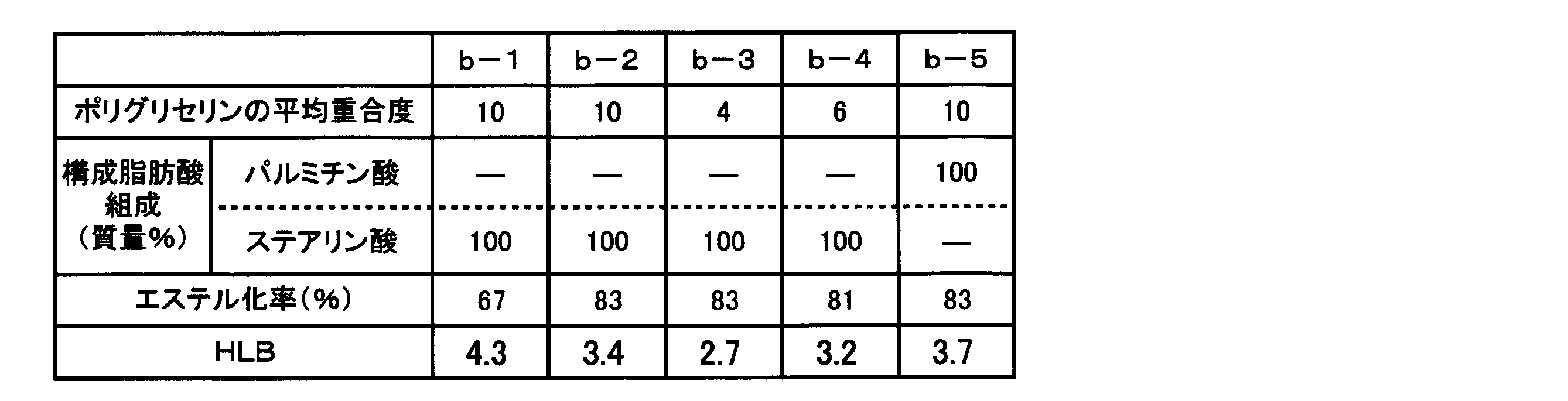
- esterified products (b-1) to (b-5) of polyglycerin having an average degree of polymerization listed in Table 1 and constituent fatty acids listed in Table 2 were used as the sucrose fatty acid ester (A).
- polyglycerin fatty acid ester (B) esterified products (b-1) to (b-5) of polyglycerin having an average degree of polymerization listed in Table 1 and constituent fatty acids listed in Table 2 were used.
- Tables 1 and 2 show the degree of esterification of sucrose fatty acid esters (a-1) to (a-6), the esterification rates of polyglycerin fatty acid esters (b-1) to (b-5), and HLB values. It is as described in.
- Examples 1 to 14, Comparative Examples 1 to 4 Ingredients other than rapeseed oil were mixed in the proportions listed in Table 3 to obtain a fat solidifying agent.
- the rapeseed oil adjusted to 80 ° C. and the oil solidifying agent obtained above were mixed so as to have the ratio shown in Table 3, and mixed at 80 ° C. for 1 hour. 20 g of this was put into a 50 mL screw tube ( ⁇ 3 cm), and allowed to stand in a 5 ° C. environment for 2 hours in a state where the screw tube was set up to obtain a test sample. Using this, solidification property and food texture were evaluated by the following methods. The results are shown in Table 3.
- the oil solidifying agent of the present invention is excellent in fat solidification and excellent in texture.
- the fat solidifying agent containing the sucrose fatty acid ester (A) and the polyglycerin fatty acid ester (B) has an excellent fat solidification property in a small amount.
- sucrose fatty acid ester (A) is not used, it turns out that fat solidification property and food texture are inferior.
- the fat and oil solidifying agent of the present invention is excellent in fat and oil solidification properties and excellent in food texture, and thus can be used in foods such as margarine, fat spread, shortening, whipped cream, ice cream, and soft cream.
Landscapes
- Chemical & Material Sciences (AREA)
- Life Sciences & Earth Sciences (AREA)
- Engineering & Computer Science (AREA)
- Oil, Petroleum & Natural Gas (AREA)
- Chemical Kinetics & Catalysis (AREA)
- Wood Science & Technology (AREA)
- Organic Chemistry (AREA)
- Food Science & Technology (AREA)
- Polymers & Plastics (AREA)
- Edible Oils And Fats (AREA)
- Fats And Perfumes (AREA)
Abstract
油脂の固化性に優れ、食品の食感が優れる油脂固化剤を提供する。 ショ糖脂肪酸エステル(A)を含有する油脂固化剤であって、前記ショ糖脂肪酸エステル(A)を構成する脂肪酸が、炭素数12~24である不飽和脂肪酸を含有する油脂固化剤である。前記油脂固化剤は、前記炭素数12~24である不飽和脂肪酸の含有量が、ショ糖脂肪酸エステル(A)を構成する脂肪酸中に10~60質量%であることが好ましい。
Description
本発明は、油脂固化剤に関する。
油脂を固化する方法として、油脂に水素を付加する方法が知られている。しかし、水素付加した油脂はトランス脂肪酸の含有量が多く、食品に使用する場合は健康への影響が懸念されている。そこで、油脂を固化するための添加剤が求められており、例えば、特許文献1では、炭素数20以上の脂肪酸エステルを含有する油脂固化剤が開示されている。
しかしながら、特許文献1の油脂固化剤は、油脂の固化は可能であるが食品に使用した場合に食感が劣るという問題がある。そこで、本発明は、油脂の固化性が優れ、これを使用した食品の食感が優れる油脂固化剤を提供することを目的とする。
上記課題を解決すべく、本発明に係る油脂固化剤は、ショ糖脂肪酸エステル(A)を含有し、前記ショ糖脂肪酸エステル(A)が構成脂肪酸として炭素数12~24である不飽和脂肪酸を含有する。
前記炭素数12~24である不飽和脂肪酸の含有量は、ショ糖脂肪酸エステル(A)の構成脂肪酸中に10~60質量%であることが好ましい。
本発明に係る油脂固化剤は、さらに、ポリグリセリン脂肪酸エステル(B)を含有することが好ましい。
前記ポリグリセリン脂肪酸エステル(B)は、前記ショ糖脂肪酸エステル(A)100質量部に対して10~150質量部含有することが好ましい。
本発明に係る食品は、上記油脂固化剤および油脂を含有するものである。
本発明によれば、油脂の固化性が優れ、食品の食感が優れる油脂固化剤が得られる。
以下、本発明の好ましい実施の形態について説明する。
本実施形態の油脂固化剤は、ショ糖脂肪酸エステル(A)を含有する。前記ショ糖脂肪酸エステル(A)は、構成脂肪酸が炭素数12~24である不飽和脂肪酸を含有するものである。
前記炭素数12~24である不飽和脂肪酸としては、例えば、ドデセン酸などの炭素数12の不飽和脂肪酸、トリデセン酸などの炭素数13の不飽和脂肪酸、テトラデセン酸などの炭素数14の不飽和脂肪酸、ペンタデセン酸などの炭素数15の不飽和脂肪酸、ヘキサデセン酸(パルミトレイン酸など)などの炭素数16の不飽和脂肪酸、ヘプタデセン酸などの炭素数17の不飽和脂肪酸、オクタデセン酸(オレイン酸、バクセン酸など)、オクタデカジエン酸(リノール酸など)、オクタデカトリエン酸((9,12,15)-リノレン酸、(6,9,12)-リノレン酸、エレオステアリン酸など)などの炭素数18の不飽和脂肪酸、ノナデセン酸などの炭素数19の不飽和脂肪酸、エイコサジエン酸(8,11-エイコサジエン酸など)、エイコサトリエン酸(5,8,11-エイコサトリエン酸など)、エイコサテトラエン酸(アラキドン酸など)などの炭素数20の不飽和脂肪酸、テトラコサン酸(ネルボン酸など)などの炭素数24の不飽和脂肪酸が挙げられる。これらのうち、油脂の固化性がより優れ、食品の食感がより優れることから、炭素数16~20である不飽和脂肪酸が好ましく、炭素数16~18である不飽和脂肪酸がより好ましく、炭素数18である不飽和脂肪酸がさらに好ましい。なお、不飽和脂肪酸における炭化水素基は、直鎖であってもよく、分岐鎖を有していてもよいが、油脂の固化性がより優れることから、直鎖であることが好ましい。
前記炭素数12~24である不飽和脂肪酸の含有量は、ショ糖脂肪酸エステル(A)の構成脂肪酸中に10~60質量%であることが好ましい。上記含有量とすることにより、油脂の固化性がより優れ、食品の食感がより優れたものとなる。上記含有量は、15~50質量%であることがより好ましく、20~40質量%であることがさらに好ましい。
ショ糖脂肪酸エステル(A)は、構成脂肪酸として、さらに炭素数12~24の飽和脂肪酸を含有することができる。炭素数12~24の飽和脂肪酸としては、例えば、ドデカン酸(ラウリン酸)などの炭素数12の飽和脂肪酸、トリデカン酸などの炭素数13の飽和脂肪酸、テトラデカン酸(ミリスチン酸)などの炭素数14の飽和脂肪酸、ペンタデカン酸(ペンタデシル酸)などの炭素数15の不和脂肪酸、ヘキサデカン酸(パルミチン酸)などの炭素数16の飽和脂肪酸、ヘプタデカン酸(マルガリン酸)などの炭素数17の飽和脂肪酸、オクタデカン酸(ステアリン酸)などの炭素数18の飽和脂肪酸、ノナデカン酸などの炭素数19の飽和脂肪酸、エイコサン酸(アラキジン酸)などの炭素数20の飽和脂肪酸、ドコサン酸(ベヘン酸)などの炭素数22の飽和脂肪酸、テトラコサン酸(リグノセリン酸)などの炭素数24の飽和脂肪酸などが挙げられる。これらのうち、食品の食感がより優れることから、炭素数12~20である飽和脂肪酸が好ましく、炭素数16~18である飽和脂肪酸がより好ましい。なお、飽和脂肪酸における炭化水素基は、直鎖であってもよく、分岐鎖を有していてもよいが、油脂の固化性がより優れることから、直鎖であることが好ましい。
ショ糖脂肪酸エステル(A)の構成脂肪酸は、前記炭素数12~24である飽和脂肪酸を40~90質量%含有することが好ましい。上記含有量とすることにより、油脂の固化性がより優れ、食品の食感がより優れたものとなる。上記含有量は、50~85質量%であることが好ましく、60~80質量%であることがさらに好ましい。
また、ショ糖脂肪酸エステル(A)の構成脂肪酸は、炭素数12~16である飽和脂肪酸の含有量が0~30質量%であることが好ましく、0~20質量%であることがより好ましい。上記含有量とすることにより、油脂の固化性がより優れたものとなる。
本発明に用いるショ糖脂肪酸エステル(A)は、平均エステル化度が4~8であることが好ましく、4.5~7.5であることがより好ましく、5~7であることがさらに好ましく、5.5~7であることが特に好ましい。平均エステル化度を上記範囲内とすることにより、油脂の固化性がより優れたものとなる。
なお、本実施形態において、ショ糖脂肪酸エステルの平均エステル化度は、以下の方法により算出し得る。なお、ショ糖脂肪酸エステルの水酸基価は、JIS K0070に準じて測定することができる。
<平均エステル化度の算出方法>
平均エステル化度を「X」とする次式において、下記OHV、MwSug、MwFaを代入してXを算出する。
(ショ糖1分子中のOH基の数-X)
=(サンプル1g中のOH基のモル数)/(サンプル1g中のショ糖脂肪酸エステルのモル数)
=((OHV)/(1000×56.11))/{1/(MwSug+(MwFa-18)X)}
OHV:ショ糖脂肪酸エステルの水酸基価(mgKOH/g)
MwSug:ショ糖の分子量
MwFa:構成脂肪酸の平均分子量
平均エステル化度を「X」とする次式において、下記OHV、MwSug、MwFaを代入してXを算出する。
(ショ糖1分子中のOH基の数-X)
=(サンプル1g中のOH基のモル数)/(サンプル1g中のショ糖脂肪酸エステルのモル数)
=((OHV)/(1000×56.11))/{1/(MwSug+(MwFa-18)X)}
OHV:ショ糖脂肪酸エステルの水酸基価(mgKOH/g)
MwSug:ショ糖の分子量
MwFa:構成脂肪酸の平均分子量
本発明に用いるショ糖脂肪酸エステル(A)は、ショ糖と全ての構成脂肪酸の混合物とのエステル化物であってもよく、ショ糖と一部の構成脂肪酸とのエステル化物とショ糖と残りの構成脂肪酸とのエステル化物との混合物であってもよい。これらのうち、油脂の固化性がより優れることから、ショ糖と全ての構成脂肪酸の混合物とのエステル化物であることが好ましい。
本発明の油脂固化剤は、さらにポリグリセリン脂肪酸エステル(B)を含有することが好ましい。ポリグリセリン脂肪酸エステル(B)を含有することにより、油脂の固化性がより優れたものとなる。
ポリグリセリン脂肪酸エステル(B)の原料として用いられるポリグリセリンの平均重合度は、2~20であることが好ましい。上記範囲内とすることにより、油脂の固化性がより優れたものとなる。上記ポリグリセリンの平均重合度は、3~15であることがより好ましく、4~12であることがさらに好ましく、8~12であることが特に好ましい。
ポリグリセリン脂肪酸エステル(B)の構成脂肪酸は、炭素数12~24であることが好ましい。このような脂肪酸としては、飽和脂肪酸と不飽和脂肪酸が挙げられる。飽和脂肪酸としては、ドデカン酸(ラウリン酸)などの炭素数12の飽和脂肪酸、トリデカン酸などの炭素数13の飽和脂肪酸、テトラデカン酸(ミリスチン酸)などの炭素数14の飽和脂肪酸、ペンタデカン酸(ペンタデシル酸)などの炭素数15の不和脂肪酸、ヘキサデカン酸(パルミチン酸)などの炭素数16の飽和脂肪酸、ヘプタデカン酸(マルガリン酸)などの炭素数17の飽和脂肪酸、オクタデカン酸(ステアリン酸)などの炭素数18の飽和脂肪酸、ノナデカン酸などの炭素数19の飽和脂肪酸、エイコサン酸(アラキジン酸)などの炭素数20の飽和脂肪酸、ドコサン酸(ベヘン酸)などの炭素数22の飽和脂肪酸、テトラコサン酸(リグノセリン酸)などの炭素数24の飽和脂肪酸などが挙げられる。また、不飽和脂肪酸としては、例えば、ドデセン酸などの炭素数12の不飽和脂肪酸、トリデセン酸などの炭素数13の不飽和脂肪酸、テトラデセン酸などの炭素数14の不飽和脂肪酸、ペンタデセン酸などの炭素数15の不飽和脂肪酸、ヘキサデセン酸(パルミトレイン酸など)などの炭素数16の不飽和脂肪酸、ヘプタデセン酸などの炭素数17の不飽和脂肪酸、オクタデセン酸(オレイン酸、バクセン酸など)、オクタデカジエン酸(リノール酸など)、オクタデカトリエン酸((9,12,15)-リノレン酸、(6,9,12)-リノレン酸、エレオステアリン酸など)などの炭素数18の不飽和脂肪酸、ノナデセン酸などの炭素数19の不飽和脂肪酸、エイコサジエン酸(8,11-エイコサジエン酸など)、エイコサトリエン酸(5,8,11-エイコサトリエン酸など)、エイコサテトラエン酸(アラキドン酸など)などの炭素数20の不飽和脂肪酸、テトラコサン酸(ネルボン酸など)などの炭素数24の不飽和脂肪酸などが挙げられる。これらのうち、油脂の固化性がより優れ、食品の食感がより優れることから、炭素数12~20である脂肪酸がより好ましく、炭素数16~18である脂肪酸がさらに好ましく、炭素数18である脂肪酸が特に好ましい。また、油脂の固化性がより優れることから、上記構成脂肪酸は飽和脂肪酸であることが好ましい。
ポリグリセリン脂肪酸エステル(B)は、エステル化率が40~100%であることが好ましく、50~90%であることがより好ましく、60~85%であることがさらに好ましい。エステル化率を上記範囲内とすることにより、油脂の固化性がより優れたものとなる。
ポリグリセリン脂肪酸エステルのエステル化率(%)は、下記式により算出し得る。なお、ポリグリセリン脂肪酸エステルの水酸基価およびエステル価は、JIS K0070に準じて測定することができる。
(エステル化率(%))=(エステル価)×100/[(エステル価)+(水酸基価)]
(エステル化率(%))=(エステル価)×100/[(エステル価)+(水酸基価)]
ポリグリセリン脂肪酸エステル(B)は、HLB値が13以下であることが好ましく、6以下であることがより好ましく、5以下であることがさらに好ましく、4以下であることが特に好ましい。また、上記HLB値は、0以上であることが好ましく、1以上であることがより好ましく、1.5以上であることがさらに好ましく、2以上であることが特に好ましい。HLB値を上記範囲内とすることにより、油脂の固化性がより優れたものとなる。
本実施形態において、ポリグリセリン脂肪酸エステルのHLB値は、Griffinの式に基づいて以下の方法により算出し得る。なお、ポリグリセリン脂肪酸エステルのけん化価および脂肪酸の酸価は、JIS K0070に準じて測定することができる。
<HLB値の算出方法>
HLB=20×(1-SV/AV)
SV:ポリグリセリン脂肪酸エステルのけん化価(mgKOH/g)
AV:脂肪酸の酸価(mgKOH/g)
HLB=20×(1-SV/AV)
SV:ポリグリセリン脂肪酸エステルのけん化価(mgKOH/g)
AV:脂肪酸の酸価(mgKOH/g)
ショ糖脂肪酸エステル(A)の含有量は、油脂固化剤中に30~100質量%であることが好ましい。上記範囲内とすることにより、油脂の固化性がより優れたものとなる。上記含有量は、40~100質量%であることがより好ましく、50~100質量%であることがさらに好ましい。また、油脂固化剤がショ糖脂肪酸エステル(A)およびポリグリセリン脂肪酸エステル(B)を含有する場合、ショ糖脂肪酸エステル(A)の含有量は30~97質量%であることが好ましく、35~95質量%であることがより好ましく、40~90質量%であることがさらに好ましい。
ポリグリセリン脂肪酸エステル(B)の含有量は、油脂固化剤中に3~70質量%であることが好ましい。上記範囲内とすることにより、油脂の固化性がより優れたものとなる。上記含有量は、10~60質量%であることがより好ましく、20~50質量%であることがさらに好ましい。
前記ポリグリセリン脂肪酸エステル(B)は、前記ショ糖脂肪酸エステル(A)100質量部に対して3~150質量部であることが好ましい。上記範囲内とすることにより、油脂の固化性がより優れたものとなる。前記ポリグリセリン脂肪酸エステル(B)の含有量は、ショ糖脂肪酸エステル(A)100質量部に対して5~120質量部であることがより好ましく、7~100質量部であることがさらに好ましく、10~50質量部であることが特に好ましい。
本発明の油脂固化剤の製造方法は特に限定されないが、例えば、粉体を混合する方法、各原料を溶融混合したものを冷却して粉砕する方法、各原料を含有するスラリーを噴霧乾燥する方法などにより得ることができる。
本発明の油脂固化剤は、本発明の効果を阻害しない範囲内で他の成分を含有してもよい。このような成分としては、例えば、グリセリン脂肪酸エステル、脂肪酸および脂肪酸以外の有機酸とグリセリンとのエステル化化合物、ポリグリセリン縮合リシノレイン酸エステル、ステアロイル乳酸カルシウム、ステアロイル乳酸ナトリウム、ソルビタン脂肪酸エステル、ポリオキシエチレンソルビタン脂肪酸エステル、レシチンなどが挙げられる。
本発明の食品は、前記油脂固化剤および油脂を含有するものである。
本発明に用いる油脂は、特に限定されず、例えば、大豆油、菜種油、菜種白絞油、コーン油、ゴマ油、シソ油、亜麻仁油、落花生油、紅花油、高オレイン酸紅花油、綿実油、ぶどう種子油、マカデミアナッツ油、ヘーゼルナッツ油、かぼちゃ種子油、クルミ油、椿油、茶実油、エゴマ油、オリーブ油、カラシ油、米油、米糠油、小麦麦芽油、サフラワー油、ひまわり油、魚油などが挙げられる。また、これらの油脂のエステル交換反応物、分別処理物なども使用できる。なお、これらの油脂は、単独で使用してもよく、2種以上を組合せてもよい。また、本発明に用いる油脂は、さらに、パーム油、パーム核油、ヤシ油、カカオバター、これらの油脂のエステル交換反応物や分別処理物などを含有してもよい。
前記油脂は、食品中に10~90質量%含有することが好ましい。
前記油脂固化剤は、食品中に0.5~15質量%含有することが好ましい。上記範囲内とすることにより、油脂の固化性により優れ、食品の食感がより優れたものとなる。上記含有量は、1~10質量%であることがより好ましく、1~7質量%であることがさらに好ましく、1.5~5質量%であることが特に好ましい。
本発明の食品は、さらに、酸化防止剤、着色料、香料、乳製品、水、食塩、砂糖、酸味料、デキストリン、澱粉、加工澱粉、乳、糖類、塩類、蛋白質、pH調整剤、増粘剤などを含有してもよい。
以下、実施例により本発明を更に詳細に説明するが、本発明はこれらに限定されるものではない。
本実施例では、ショ糖脂肪酸エステル(A)として、ショ糖と表1に記載の構成脂肪酸とのエステル化物(a-1)~(a-6)を用いた。また、ポリグリセリン脂肪酸エステル(B)として、表1に記載の平均重合度を有するポリグリセリンと表2に記載の構成脂肪酸とのエステル化物(b-1)~(b-5)を用いた。なお、ショ糖脂肪酸エステル(a-1)~(a-6)のエステル化度、ポリグリセリン脂肪酸エステル(b-1)~(b-5)のエステル化率およびHLB値は表1および表2に記載のとおりである。

また、その他の化合物として、下記のものを使用した。
(c-1)ソルビタンモノアラキン酸エステル
(c-2)グリセリンモノベヘニン酸エステル
(c-1)ソルビタンモノアラキン酸エステル
(c-2)グリセリンモノベヘニン酸エステル
(実施例1~14、比較例1~4)
表3に記載した割合で菜種油以外の成分を混合し、油脂固化剤を得た。
80℃に調整した菜種油と上記で得られた油脂固化剤とを表3に記載の割合となるように混合し、80℃で1時間混合した。これを、50mLスクリュー管(φ3cm)に20g投入し、スクリュー管を立てた状態で5℃環境下に2時間静置することにより試験サンプルとした。これを用いて、下記の方法で固化性および食感を評価した。結果を表3に示す。
表3に記載した割合で菜種油以外の成分を混合し、油脂固化剤を得た。
80℃に調整した菜種油と上記で得られた油脂固化剤とを表3に記載の割合となるように混合し、80℃で1時間混合した。これを、50mLスクリュー管(φ3cm)に20g投入し、スクリュー管を立てた状態で5℃環境下に2時間静置することにより試験サンプルとした。これを用いて、下記の方法で固化性および食感を評価した。結果を表3に示す。
<固化性>
スクリュー管を20℃環境下に取り出し、立てた状態から横に90度倒して静置して流動性の有無を確認した。その後、試験サンプルの流動性を5分毎に確認し、流動性が見られた最初の時間を測定した。なお、静置直後に流動性が見られたものは「0分」とした。
スクリュー管を20℃環境下に取り出し、立てた状態から横に90度倒して静置して流動性の有無を確認した。その後、試験サンプルの流動性を5分毎に確認し、流動性が見られた最初の時間を測定した。なお、静置直後に流動性が見られたものは「0分」とした。
<食感>
下記の基準で試験サンプルの食感を評価した。なお、評価結果は、パネラー10人による評価の平均値とした。
4:非常になめらかである
3:ややなめらかである
2:ややざらつきがある
1:かなりざらつきがある
下記の基準で試験サンプルの食感を評価した。なお、評価結果は、パネラー10人による評価の平均値とした。
4:非常になめらかである
3:ややなめらかである
2:ややざらつきがある
1:かなりざらつきがある
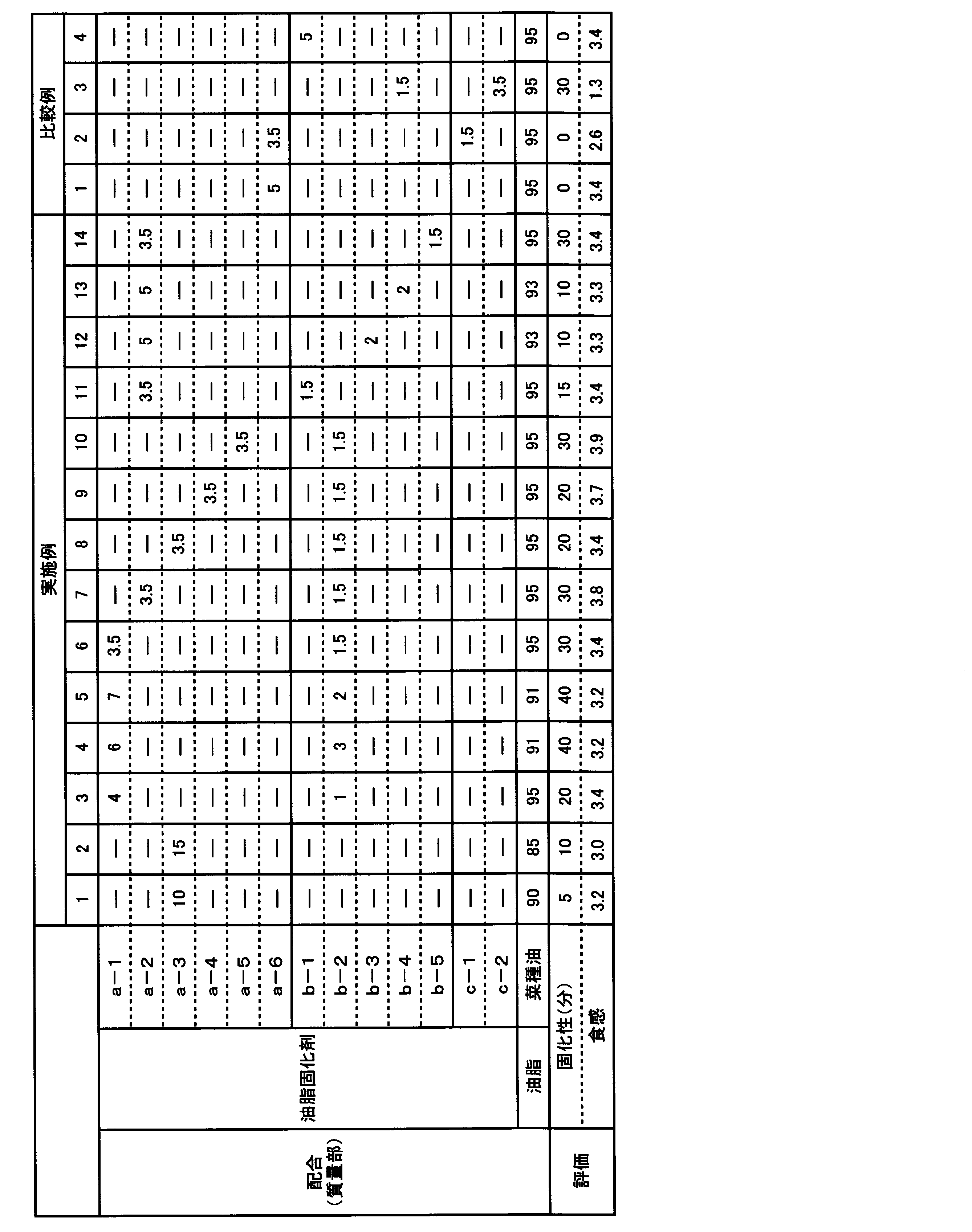
表3から明らかな通り、本発明の油脂固化剤は、油脂の固化性が優れ、食感が優れることがわかる。特に、ショ糖脂肪酸エステル(A)とポリグリセリン脂肪酸エステル(B)を含有する油脂固化剤は、少量で優れた油脂固化性を有することがわかる。一方、ショ糖脂肪酸エステル(A)を用いない場合は、油脂固化性や食感が劣ることがわかる。
本発明の油脂固化剤は、油脂の固化性が優れ、食品の食感が優れることから、マーガリン、ファットスプレッド、ショートニング、ホイップクリーム、アイスクリーム、ソフトクリームなどの食品に利用可能である。
Claims (5)
- ショ糖脂肪酸エステル(A)を含有する油脂固化剤であって、
前記ショ糖脂肪酸エステル(A)が、構成脂肪酸として炭素数12~24である不飽和脂肪酸を含有する、油脂固化剤。 - 前記炭素数12~24である不飽和脂肪酸の含有量が、ショ糖脂肪酸エステル(A)の構成脂肪酸中に10~60質量%である、請求項1に記載の油脂固化剤。
- さらに、ポリグリセリン脂肪酸エステル(B)を含有する、請求項1または2に記載の油脂固化剤。
- 前記ショ糖脂肪酸エステル(A)100質量部に対して、前記ポリグリセリン脂肪酸エステル(B)を10~150質量部含有する、請求項3に記載の油脂固化剤。
- 請求項1~4のいずれか1項に記載の油脂固化剤および油脂を含有する食品。
Priority Applications (1)
| Application Number | Priority Date | Filing Date | Title |
|---|---|---|---|
| JP2017556350A JP6675805B2 (ja) | 2015-12-18 | 2016-08-09 | 油脂固化剤 |
Applications Claiming Priority (2)
| Application Number | Priority Date | Filing Date | Title |
|---|---|---|---|
| JP2015247898 | 2015-12-18 | ||
| JP2015-247898 | 2015-12-18 |
Publications (1)
| Publication Number | Publication Date |
|---|---|
| WO2017104171A1 true WO2017104171A1 (ja) | 2017-06-22 |
Family
ID=59055975
Family Applications (1)
| Application Number | Title | Priority Date | Filing Date |
|---|---|---|---|
| PCT/JP2016/073437 Ceased WO2017104171A1 (ja) | 2015-12-18 | 2016-08-09 | 油脂固化剤 |
Country Status (2)
| Country | Link |
|---|---|
| JP (1) | JP6675805B2 (ja) |
| WO (1) | WO2017104171A1 (ja) |
Cited By (1)
| Publication number | Priority date | Publication date | Assignee | Title |
|---|---|---|---|---|
| WO2021224964A1 (ja) * | 2020-05-07 | 2021-11-11 | 日本食品化工株式会社 | 加工食用粉、加工食用粉の製造方法、揚げ物用衣材、揚げ物用衣材の製造方法、及び揚げ物用衣材の食感改良方法 |
Citations (3)
| Publication number | Priority date | Publication date | Assignee | Title |
|---|---|---|---|---|
| JPS5624478A (en) * | 1979-08-06 | 1981-03-09 | Nippon Saafuakutanto Kogyo Kk | Thickening and gelatinizing agent |
| JP3378356B2 (ja) * | 1994-06-10 | 2003-02-17 | 豊年リーバ株式会社 | 複合菓子類の製造方法 |
| JP2008273881A (ja) * | 2007-04-27 | 2008-11-13 | Lion Corp | 多層被覆油粒子、その水分散液、及びそれらの製造方法 |
-
2016
- 2016-08-09 WO PCT/JP2016/073437 patent/WO2017104171A1/ja not_active Ceased
- 2016-08-09 JP JP2017556350A patent/JP6675805B2/ja active Active
Patent Citations (3)
| Publication number | Priority date | Publication date | Assignee | Title |
|---|---|---|---|---|
| JPS5624478A (en) * | 1979-08-06 | 1981-03-09 | Nippon Saafuakutanto Kogyo Kk | Thickening and gelatinizing agent |
| JP3378356B2 (ja) * | 1994-06-10 | 2003-02-17 | 豊年リーバ株式会社 | 複合菓子類の製造方法 |
| JP2008273881A (ja) * | 2007-04-27 | 2008-11-13 | Lion Corp | 多層被覆油粒子、その水分散液、及びそれらの製造方法 |
Cited By (2)
| Publication number | Priority date | Publication date | Assignee | Title |
|---|---|---|---|---|
| WO2021224964A1 (ja) * | 2020-05-07 | 2021-11-11 | 日本食品化工株式会社 | 加工食用粉、加工食用粉の製造方法、揚げ物用衣材、揚げ物用衣材の製造方法、及び揚げ物用衣材の食感改良方法 |
| CN115515431A (zh) * | 2020-05-07 | 2022-12-23 | 日本食品化工株式会社 | 加工食用粉、加工食用粉的制造方法、油炸食品用裹衣材料、油炸食品用裹衣材料的制造方法、及油炸食品用裹衣材料的口感改良方法 |
Also Published As
| Publication number | Publication date |
|---|---|
| JPWO2017104171A1 (ja) | 2018-11-08 |
| JP6675805B2 (ja) | 2020-04-08 |
Similar Documents
| Publication | Publication Date | Title |
|---|---|---|
| EA001326B1 (ru) | Композиция, содержащая жидкий жирный компонент | |
| HU225065B1 (en) | Natural triglyceride fat and its use | |
| NL8302198A (nl) | Margarinevetmengsel en werkwijze ter bereiding van een dergelijk vetmengsel. | |
| JP2019092403A (ja) | 乳化剤含有油脂組成物及び乳化剤含有油脂組成物中の乳化剤の分離抑制方法 | |
| JPWO2002018524A1 (ja) | 泡立ち抑制効果を有する油脂組成物 | |
| JP7703275B2 (ja) | 食用油脂用添加剤および食用油脂組成物 | |
| JP6159537B2 (ja) | 食用油脂組成物及び該食用油脂組成物含有食品 | |
| JP6675805B2 (ja) | 油脂固化剤 | |
| TW201616973A (zh) | 加熱烹飪用油脂組成物,該加熱烹飪用油脂組成物之製造方法,及殘留於加熱烹飪後之烹飪對象物之油份之減低方法 | |
| CN103687497A (zh) | 棕榈油精油组合物 | |
| JP2503811B2 (ja) | 脂肪組成物の製造法 | |
| JP4347559B2 (ja) | フライ用油脂組成物、フライ用油脂結晶成長抑制剤 | |
| JP2023184675A (ja) | 澱粉含有食品用ほぐれ剤、及び澱粉含有食品 | |
| JP2005218380A (ja) | 油脂組成物 | |
| EP4622474A1 (en) | Edible fat-containing products and methods for their preparation | |
| JP6525564B2 (ja) | 加熱調理用油脂組成物、該加熱調理用油脂組成物の製造方法及び加熱調理後の調理対象物に残存する油分を低減する方法 | |
| JP2020048506A (ja) | 澱粉含有食品用ほぐれ剤、澱粉含有食品及び澱粉含有食品の製造方法 | |
| JP4040204B2 (ja) | 油脂組成物 | |
| JP2007185123A (ja) | チョコレート用油脂組成物 | |
| JP2010279266A (ja) | パーム油のひび割れ及び白色化防止剤 | |
| JP2003313583A (ja) | 泡立ち抑制効果を有する油脂組成物 | |
| JP2020048455A (ja) | スープ用油脂組成物 | |
| JP2010279267A (ja) | 油脂のひび割れ及び白色化防止剤 | |
| JP6328381B2 (ja) | 食用液体油脂 | |
| JP4046439B2 (ja) | 油脂組成物 |
Legal Events
| Date | Code | Title | Description |
|---|---|---|---|
| 121 | Ep: the epo has been informed by wipo that ep was designated in this application |
Ref document number: 16875158 Country of ref document: EP Kind code of ref document: A1 |
|
| ENP | Entry into the national phase |
Ref document number: 2017556350 Country of ref document: JP Kind code of ref document: A |
|
| NENP | Non-entry into the national phase |
Ref country code: DE |
|
| 122 | Ep: pct application non-entry in european phase |
Ref document number: 16875158 Country of ref document: EP Kind code of ref document: A1 |