WO2017099099A1 - 放射性セシウム及び放射性ストロンチウムを含む放射性廃液の処理方法 - Google Patents
放射性セシウム及び放射性ストロンチウムを含む放射性廃液の処理方法 Download PDFInfo
- Publication number
- WO2017099099A1 WO2017099099A1 PCT/JP2016/086300 JP2016086300W WO2017099099A1 WO 2017099099 A1 WO2017099099 A1 WO 2017099099A1 JP 2016086300 W JP2016086300 W JP 2016086300W WO 2017099099 A1 WO2017099099 A1 WO 2017099099A1
- Authority
- WO
- WIPO (PCT)
- Prior art keywords
- radioactive
- cesium
- strontium
- adsorbent
- less
- Prior art date
- Legal status (The legal status is an assumption and is not a legal conclusion. Google has not performed a legal analysis and makes no representation as to the accuracy of the status listed.)
- Ceased
Links
Images



Classifications
-
- G—PHYSICS
- G21—NUCLEAR PHYSICS; NUCLEAR ENGINEERING
- G21F—PROTECTION AGAINST X-RADIATION, GAMMA RADIATION, CORPUSCULAR RADIATION OR PARTICLE BOMBARDMENT; TREATING RADIOACTIVELY CONTAMINATED MATERIAL; DECONTAMINATION ARRANGEMENTS THEREFOR
- G21F9/00—Treating radioactively contaminated material; Decontamination arrangements therefor
- G21F9/04—Treating liquids
- G21F9/06—Processing
- G21F9/12—Processing by absorption; by adsorption; by ion-exchange
-
- B—PERFORMING OPERATIONS; TRANSPORTING
- B01—PHYSICAL OR CHEMICAL PROCESSES OR APPARATUS IN GENERAL
- B01J—CHEMICAL OR PHYSICAL PROCESSES, e.g. CATALYSIS OR COLLOID CHEMISTRY; THEIR RELEVANT APPARATUS
- B01J20/00—Solid sorbent compositions or filter aid compositions; Sorbents for chromatography; Processes for preparing, regenerating or reactivating thereof
- B01J20/28—Solid sorbent compositions or filter aid compositions; Sorbents for chromatography; Processes for preparing, regenerating or reactivating thereof characterised by their form or physical properties
- B01J20/28002—Solid sorbent compositions or filter aid compositions; Sorbents for chromatography; Processes for preparing, regenerating or reactivating thereof characterised by their form or physical properties characterised by their physical properties
- B01J20/28004—Sorbent size or size distribution, e.g. particle size
-
- B—PERFORMING OPERATIONS; TRANSPORTING
- B01—PHYSICAL OR CHEMICAL PROCESSES OR APPARATUS IN GENERAL
- B01J—CHEMICAL OR PHYSICAL PROCESSES, e.g. CATALYSIS OR COLLOID CHEMISTRY; THEIR RELEVANT APPARATUS
- B01J20/00—Solid sorbent compositions or filter aid compositions; Sorbents for chromatography; Processes for preparing, regenerating or reactivating thereof
- B01J20/02—Solid sorbent compositions or filter aid compositions; Sorbents for chromatography; Processes for preparing, regenerating or reactivating thereof comprising inorganic material
- B01J20/10—Solid sorbent compositions or filter aid compositions; Sorbents for chromatography; Processes for preparing, regenerating or reactivating thereof comprising inorganic material comprising silica or silicate
-
- B—PERFORMING OPERATIONS; TRANSPORTING
- B01—PHYSICAL OR CHEMICAL PROCESSES OR APPARATUS IN GENERAL
- B01J—CHEMICAL OR PHYSICAL PROCESSES, e.g. CATALYSIS OR COLLOID CHEMISTRY; THEIR RELEVANT APPARATUS
- B01J20/00—Solid sorbent compositions or filter aid compositions; Sorbents for chromatography; Processes for preparing, regenerating or reactivating thereof
- B01J20/28—Solid sorbent compositions or filter aid compositions; Sorbents for chromatography; Processes for preparing, regenerating or reactivating thereof characterised by their form or physical properties
-
- Y—GENERAL TAGGING OF NEW TECHNOLOGICAL DEVELOPMENTS; GENERAL TAGGING OF CROSS-SECTIONAL TECHNOLOGIES SPANNING OVER SEVERAL SECTIONS OF THE IPC; TECHNICAL SUBJECTS COVERED BY FORMER USPC CROSS-REFERENCE ART COLLECTIONS [XRACs] AND DIGESTS
- Y02—TECHNOLOGIES OR APPLICATIONS FOR MITIGATION OR ADAPTATION AGAINST CLIMATE CHANGE
- Y02E—REDUCTION OF GREENHOUSE GAS [GHG] EMISSIONS, RELATED TO ENERGY GENERATION, TRANSMISSION OR DISTRIBUTION
- Y02E30/00—Energy generation of nuclear origin
- Y02E30/30—Nuclear fission reactors
Definitions
- the present invention relates to a method for treating radioactive liquid waste containing radioactive cesium and radioactive strontium, and in particular, radioactive cesium contained in waste liquid containing contaminating ions such as Na ions, Ca ions and / or Mg ions generated in a nuclear power plant.
- the present invention relates to a method for treating radioactive liquid waste that removes both elements of radioactive strontium.
- radioactive liquid waste containing radioactive iodine has been generated due to the accident that occurred at the Fukushima Daiichi Nuclear Power Station due to the Great East Japan Earthquake on March 11, 2011.
- This radioactive liquid waste includes contaminated water generated by the reactor pressure vessel, containment vessel, and cooling water injected into the spent fuel pool, trench water remaining in the trench, and subdrains around the reactor building.
- Radioactive substances are removed from these radioactive waste liquids at a processing facility called Sally (SARRY, Simplified Active Water Retrieve and Recovery System (Cesium Removal System) or Alps (ALPS)).
- Sally Simplified Active Water Retrieve and Recovery System
- APS Alps
- substances that can selectively adsorb and remove radioactive cesium include ferrocyan compounds such as bitumen, mordenite, which is a kind of zeolite, aluminosilicate, and titanium silicate (CST).
- ferrocyan compounds such as bitumen, mordenite, which is a kind of zeolite, aluminosilicate, and titanium silicate (CST).
- CST titanium silicate
- UOP IE96 which is an aluminosilicate
- UOP IE911 which is CST
- substances that can selectively adsorb and remove radioactive strontium include natural zeolite, synthetic A-type and X-type zeolite, titanate, and CST.
- an adsorbent that is titanate is used to remove radioactive strontium.
- Non-Patent Document 1 published by the Japan Atomic Energy Society Backend Committee, IE910 manufactured by UOP, which is a powdery CST, and molding Regarding the adsorption performance of UOP IE911 cesium and strontium, which is a formed CST, the powdered CST has the ability to adsorb radioactive cesium and strontium, and the molded CST has high cesium adsorption performance but low strontium adsorption performance Has been reported.
- a modified CST obtained by bringing a titanium silicate compound into contact with a sodium hydroxide aqueous solution having a sodium hydroxide concentration in the range of 0.5 mol / L or more and 2.0 mol / L to perform surface treatment, It has been reported that a cesium removal efficiency of 99% or more and a strontium removal efficiency of 95% or more are achieved (Patent Document 1).
- Powdered CST can be used in methods such as coagulation sedimentation, but is suitable for the method of filling the column with the adsorbent and passing the water to be treated, which is adopted in Sally and Alps. Absent.
- Patent Document 1 In order to improve the strontium adsorption performance of the molded CST, the treatments and operations shown in Patent Document 1 and Non-Patent Document 2 have been studied, but there is a problem that a large amount of chemicals is required and the cost is increased.
- CST is weak to heat, and when it is ignited, the composition changes and the adsorption ability of cesium and strontium decreases.
- the zeolite molded body uses a binder such as clay mineral and is fired at 500 to 800 ° C. to improve the strength of the molded body.
- the adsorptive capacity decreases. It cannot be fired. For this reason, it was necessary to mold CST without igniting it.
- Non-patent Document 2 Non-patent Document 2
- the inventors of the present invention have the general formula; Na 4 Ti 4 Si 3 O 16 .nH 2 O, (Na x K (1-x )) 4 Ti 4 Si 3 O 16 ⁇ nH 2 O and K 4 Ti 4 Si 3 O 16 ⁇ nH 2 O ( in these formulas, x is a number from 0 to less ultra 1, the number of n is 0-8 And at least one selected from crystalline silicotitanates represented by general formula: Na 4 Ti 9 O 20 ⁇ mH 2 O, (Na y K (1-y) ) 4 Ti 9 O 20 ⁇ mH Selected from titanates represented by 2 O and K 4 Ti 9 O 20 ⁇ mH 2 O (wherein y represents a number greater than 0 and less than 1 and m represents a number from 0 to 10).
- Cesium or strontium including at least one of The method proposed adsorbent and its preparation (
- An object of the present invention is to provide a method for treating a radioactive liquid waste that can easily remove both radioactive cesium and radioactive strontium with high removal efficiency by a method of filling a column with an adsorbent and passing water to be treated. It is to provide.
- both radioactive cesium and radioactive strontium are obtained by passing radioactive waste liquid through an adsorption tower packed with a specific adsorbent material under specific water flow conditions. Has been found to be easily and efficiently removed, and the present invention has been completed.
- the present invention includes the following aspects.
- the adsorbent has a crystalline silicotitanate peak of 1 or more when X-ray diffraction measurement is performed with Cu—K ⁇ as an X-ray source and a diffraction angle (2 ⁇ ) of 5 to 80 °. 1 or more of the titanate peak is observed and the ratio of the height of the main peak of the titanate to the height of the main peak of the crystalline silicotitanate is 5% or more and 70% or less.
- both radioactive cesium and radioactive strontium can be easily removed with high removal efficiency by a method in which an adsorbent is filled in an adsorption tower and water to be treated is passed.
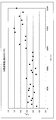
- FIG. 6 is a graph showing cesium adsorption / removal performance in Example 3.
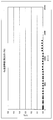
- 6 is a graph showing the strontium adsorption removal performance in Example 3.
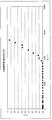
- 6 is a graph showing cesium adsorption / removal performance in Example 4;
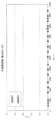
- 6 is a graph showing strontium adsorption removal performance in Example 4.
- 10 is a graph showing the cesium adsorption removal performance in Example 7.
- 10 is a graph showing the strontium adsorption removal performance in Example 7.
- the present invention relates to the general formulas: Na 4 Ti 4 Si 3 O 16 .nH 2 O, (Na x K (1-x) ) 4 Ti 4 Si 3 O 16 .mH 2 O and K 4 Ti 4 Si 3 O 16. At least one selected from crystalline silicotitanates represented by 1H 2 O (wherein x represents a number greater than 0 and less than 1 and n, m and l each represent a number from 0 to 8) And general formulas: Na 4 Ti 9 O 20 ⁇ qH 2 O, (Na y K (1-y) ) 4 Ti 9 O 20 ⁇ rH 2 O and K 4 Ti 9 O 20 ⁇ tH 2 O (these formulas) Wherein y represents a number greater than 0 and less than 1, and q, r, and t each represent a number of 0 to 10.) An adsorbent of cesium or strontium, containing at least one selected from titanates In which the particle diameter is 250 ⁇ m or more and 1200
- the adsorbing tower packed with the formed adsorbent at a layer height of 10 cm to 300 cm is filled with a radioactive waste liquid containing radioactive cesium and radioactive strontium at a water flow velocity (LV) of 1 m / h to 40 m / h, space velocity (SV) It relates to a method for treating radioactive liquid waste containing radioactive cesium and radioactive strontium, comprising passing water at 200 h ⁇ 1 or less to adsorb the radioactive cesium and radioactive strontium to the adsorbent.
- LV water flow velocity
- SV space velocity
- the adsorbent used in the treatment method of the present invention is an adsorbent obtained by a production method disclosed in Japanese Patent No. 5696244 with a hydrothermal reaction of 300 ° C. or lower and a drying condition of 200 ° C. or lower.
- it is formed into a particle shape of 300 ⁇ m or more and 800 ⁇ m or less, more preferably 300 ⁇ m or more and 600 ⁇ m or less.
- the particle size of the adsorbent of the present invention is finer than that of a commercially available general adsorbent (for example, a zeolite adsorbent is a pellet having a particle size of about 1.5 mm), and the adsorption rate is high. high.
- the powdery adsorbent flows out when the adsorption tower is filled and subjected to water treatment, it is preferably formed into a predetermined particle size.
- Mixing gel of crystalline silicotitanate and titanate in a water-containing state for example, stirring and mixing granulation, rolling granulation, extrusion granulation, crushing granulation, fluidized bed granulation, spray drying granulation (spray drying), compression It can be formed into particles using a known granulation method such as granulation or melt granulation.
- polyvinyl alcohol for example, polyvinyl alcohol, polyethylene oxide, hydroxyethyl cellulose, hydroxypropyl cellulose, hydroxypropyl methyl cellulose, hydroxyethyl methyl cellulose, carboxymethyl cellulose, hydroxypropyl methyl cellulose, methyl cellulose, ethyl cellulose, starch, corn starch, molasses, lactose, gelatin, It may be granulated using a known binder such as dextrin, gum arabic, alginic acid, polyacrylic acid, glycerin, polyethylene glycol, polyvinyl pyrrolidone, alumina, or may be granulated without using these binders.
- a known binder such as dextrin, gum arabic, alginic acid, polyacrylic acid, glycerin, polyethylene glycol, polyvinyl pyrrolidone, alumina, or may be granulated without using these binders.
- Adsorbents granulated without using a binder are preferable because the amount of adsorbent per volume increases, and in the treatment method of the present invention used by filling the adsorption tower, the amount of treatment per volume of the same adsorption tower increases.
- the mixed gel of crystalline silicotitanate and titanate in a water-containing state may be dried and then pulverized to form particles. After forming into particles, the particles can be classified using a sieve to obtain particles having a predetermined particle size range.
- the adsorbent formed into particles having a particle size in the predetermined range used in the present invention preferably has a strength of 0.1 N or more in a wet state, and the radioactive waste liquid to be treated is passed through. It does not disintegrate due to the pressure (generally 0.1 to 1.0 MPa) or water for a long time.
- the adsorbent is packed in an adsorption tower so as to have a layer height of 10 cm to 300 cm, preferably 20 cm to 250 cm, more preferably 50 cm to 200 cm. If the bed height is less than 10 cm, the adsorbent layer cannot be uniformly packed when the adsorbent is packed in the adsorption tower, causing a short path during water flow, resulting in deterioration of the quality of treated water.
- a higher bed height is preferable because an appropriate water flow differential pressure can be realized, the treated water quality is stabilized, and the total amount of treated water is increased. However, when the bed height exceeds 300 cm, the water flow differential pressure becomes too large.
- the radioactive waste liquid containing radioactive cesium and radioactive strontium has a water flow velocity (LV) of 1 m / h to 40 m / h, preferably 5 m / h to 30 m / h, more preferably 10 m / h than 20 m / h less, space velocity (SV) 200h -1 or less, preferably 100h -1 or less, more preferably 50h -1 or less, preferably 5h -1 or more, more preferably 10h -1 Pass water through the above.
- LV water flow velocity
- the water flow velocity exceeds 40 m / h, the water differential pressure increases, and if it is less than 1 m / h, the amount of treated water is small.
- Space velocity (SV) is typical wastewater treatment in 20h -1 or less used, but can also obtain the effect of the adsorbent of the present invention in particular 10h approximately -1, 20h in wastewater treatment using conventional adsorbents -
- SV space velocity
- the water flow velocity and space velocity can be increased without increasing the size of the adsorption tower.
- the water line flow velocity is a value obtained by dividing the amount of water (m 3 / h) passing through the adsorption tower by the cross-sectional area (m 2 ) of the adsorption tower.
- the space velocity is a value obtained by dividing the volume of the adsorbent filled in the adsorption tower water (m 3 / h) which passed through the adsorption tower (m 3).
- the treatment method of the present invention is suitable for decontamination of waste liquid containing Na ions, Ca ions and / or Mg ions.
- ⁇ X-ray diffraction> Bruker D8 AdvanceS was used.
- Cu-K ⁇ was used as the radiation source.
- the measurement conditions were a tube voltage of 40 kV, a tube current of 40 mA, and a scanning speed of 0.1 ° / sec.
- the obtained mixed gel was put in an autoclave, heated to 170 ° C. over 1 hour, and then reacted for 24 hours with stirring while maintaining this temperature.
- the slurry after the reaction was filtered, washed and dried to obtain an adsorbent (a mixture of crystalline silicotitanate and titanate).
- the X-ray diffraction chart (after baseline correction) of the obtained adsorbent is shown in FIG.
- the molar ratio of crystalline silicotitanate and sodium titanate was determined by the following method.
- A The adsorbent is put in a suitable container (aluminum ring or the like), sandwiched between dies, and pelletized by applying a pressure of 10 MPa with a press machine to obtain a measurement sample.
- This sample was subjected to a fluorescent X-ray apparatus (device name: ZSX100e, tube: Rh (4 kW), atmosphere: vacuum, analysis window: Be (30 ⁇ m), measurement mode: SQX analysis (EZ scan), measurement diameter: 30 mm ⁇ , (stock ) All elements are measured with Rigaku).
- the content (mass%) of SiO 2 and TiO 2 in the adsorbent is calculated by calculating by the SQX method which is a semi-quantitative analysis method.
- B the obtained content of SiO 2 and TiO 2 (mass%) divided by the respective molecular weight, obtaining the number of moles of SiO 2 and TiO 2 in the adsorbent 100 g.
- C One third of the number of moles of SiO 2 in the adsorbent determined above is assumed to be the number of moles of the crystalline silicotitanate (Na 4 Ti 4 Si 3 O 16 .nH 2 O) in the adsorbent. To do. Moreover, since the number of moles of Ti atoms in 1 mole of the crystalline silicotitanate is 4, the number of moles of the titanate in the adsorbent is determined by the following formula (1).
- Table 1 shows the composition determined from the X-ray diffraction structure and the molar ratio of crystalline silicotitanate and sodium titanate obtained by the above method.
- the mixed slurry of the above crystalline silicotitanate and titanate was put into a cylindrical extruder having a screen with a true circle equivalent diameter of 0.6 mm at the tip, and extruded.
- the water-containing molded body extruded from the screen was dried at 120 ° C. for 1 day at normal pressure.
- the obtained dried product was lightly pulverized and then passed through a sieve having an opening of 600 ⁇ m.
- the residue on the sieve was ground again, and the entire amount was passed through a sieve having an opening of 600 ⁇ m.
- the entire amount that passed through the sieve having an opening of 600 ⁇ m was collected and passed through a sieve having an opening of 300 ⁇ m, and the residue on the sieve was collected to prepare a sample.
- Production Example 2 In Production Example 1, powdery crystalline silicotitanate that passed through a sieve having an opening of 300 ⁇ m was formed into a granular shape by a melt granulation method using polyvinyl alcohol as a binder. After molding, the sample was thoroughly washed, and a sample having a particle size of 0.35 to 1.18 mm was obtained with a sieve.
- Production Example 3 In Production Example 1, powdery crystalline silicotitanate that passed through a sieve having an opening of 300 ⁇ m was formed into granules by melt granulation using alginic acid as a binder. After molding, the sample was thoroughly washed, and a sample having a particle size of 0.35 to 1.18 mm was obtained with a sieve.
- Production Example 4 In Production Example 1, powdery crystalline silicotitanate that passed through a sieve having an opening of 300 ⁇ m was formed into a column shape by extrusion using alumina as a binder. After molding, a sample having a particle size of 0.30 to 0.60 mm was obtained with a sieve.
- Example 1 ⁇ Preparation of simulated contaminated seawater 1> Simulated contaminated water containing non-radioactive cesium and strontium simulating contaminated water from the Fukushima Daiichi nuclear power plant was prepared by the following procedure.
- cesium chloride was added so that the cesium concentration was 1 mg / L to prepare simulated contaminated seawater 1 having a cesium concentration of 1.0 mg / L.
- a part of the simulated contaminated seawater 1 was collected and analyzed by ICP-MS.
- the cesium concentration was 1.07 mg / L and the strontium concentration was 6.39 mg / L.
- a 100 ml Erlenmeyer flask was filled with 0.5 g of the adsorbent having a particle size of 300 ⁇ m or more and 600 ⁇ m or less prepared in Production Example 1, 50 ml of simulated contaminated seawater 1 was added, and the mixture was allowed to stand for 24 hours. When a part was collected and the cesium and strontium concentrations were measured, the cesium concentration was 0.06 mg / L and the strontium concentration was 1.03 mg / L.
- the removal rate was calculated from the cesium and strontium concentrations before and after treatment with the adsorbent. The results are shown in Table 2.
- Example 2 ⁇ Preparation of simulated contaminated seawater 2> Simulated contaminated water containing non-radioactive cesium and strontium simulating contaminated water from the Fukushima Daiichi nuclear power plant was prepared by the following procedure.
- an aqueous solution was prepared using normal salt so that the salinity concentration became 0.3 wt%. Then, cesium chloride and strontium chloride were added so that the cesium concentration was 1 mg / L and the strontium concentration was 10 mg / L to prepare simulated contaminated seawater 2 having a cesium concentration of 1.0 mg / L and a strontium concentration of 10 mg / L. did. A part of the simulated contaminated seawater 2 was collected and analyzed by ICP-MS. As a result, the cesium concentration was 1.08 mg / L and the strontium concentration was 9.74 mg / L.
- a 100 ml Erlenmeyer flask is filled with 0.5 g of the adsorbent having a particle size of 300 to 600 ⁇ m prepared in Production Example 1, 50 ml of simulated contaminated seawater 2 is added, and the mixture is allowed to stand for 24 hours.
- cesium and strontium concentrations were measured by sampling a portion, the cesium concentration was 0.09 mg / L and the strontium concentration was 0.15 mg / L.
- Example 3 ⁇ Preparation of simulated contaminated seawater 3> Simulated contaminated water containing non-radioactive cesium and strontium simulating contaminated water from the Fukushima Daiichi nuclear power plant was prepared by the following procedure.
- an aqueous solution was prepared by using Marine Art SF-1 which is a chemical for producing artificial seawater by Osaka Yakuken Co., Ltd. so that the salt concentration becomes 0.17 wt%.
- cesium chloride was added so that the cesium concentration was 1 mg / L, and a simulated contaminated seawater 3 having a cesium concentration of 1.0 mg / L was prepared.
- the cesium concentration was 0.81 to 1.26 mg / L and the strontium concentration was 0.26 to 0.42 mg / L.
- the removal performance of cesium is shown in FIG. 2, and the removal performance of strontium is shown in FIG. 2 and 6, the horizontal axis indicates how many times the amount of simulated contaminated seawater has passed through the adsorbent volume.
- V The vertical axis represents values obtained by dividing the concentration of cesium or strontium at the column outlet by the concentration of cesium or strontium at the column inlet, respectively.
- the height of the layer is 10 cm and the space velocity is 200 h ⁇ 1 . V. It can be seen that almost 100% of cesium can be adsorbed and removed up to about 13,000.
- the adsorption / removal performance of strontium is inferior to the adsorption / removal performance of cesium at a bed height of 10 cm and a space velocity of 200 h ⁇ 1 in the adsorption tower.
- V. Strontium can be removed by about 50 to 60% up to about 15000.
- Example 4 Simulated contaminated seawater 4 (cesium concentration adjusted in the same manner as simulated contaminated seawater 3 was prepared by filling 200 ml of an adsorbent having a particle diameter of 300 ⁇ m or more and 600 ⁇ m or less prepared in Production Example 1 into a glass column having an inner diameter of 16 mm so as to have a layer height of 100 cm. 0.83 to 1.24 mg / L, strontium concentration 0.24 to 0.30 mg / L) at a flow rate of 67 ml / min (water flow velocity 20 m / h, space velocity 20 h ⁇ 1 ) Were collected periodically to measure cesium and strontium concentrations. As a result of analyzing the outlet water, the cesium concentration was 0.00 to 0.01 mg / L, and the strontium concentration was 0.00 to 0.27 mg / L.
- Fig. 4 shows the cesium removal performance
- Fig. 5 shows the strontium removal performance
- the horizontal axis indicates how many times the amount of simulated contaminated seawater passed through the adsorbent volume.
- V The vertical axis represents values obtained by dividing the concentration of cesium or strontium at the column outlet by the concentration of cesium or strontium at the column inlet, respectively.
- Example 5 Simulated contaminated seawater 5 (cesium concentration adjusted in the same manner as simulated contaminated seawater 3 was prepared by filling 20 ml of an adsorbent having a particle diameter of 300 ⁇ m or more and 600 ⁇ m or less prepared in Production Example 1 into a glass column having an inner diameter of 16 mm so as to have a layer height of 10 cm.
- 40 ml of the adsorbent having a particle diameter of 300 ⁇ m or more and 600 ⁇ m or less prepared in Production Example 1 is packed into a glass column having an inner diameter of 16 mm so as to have a layer height of 20 cm, and the simulated contaminated seawater 5 is flowed at a flow rate of 134 ml / min (water passage line). Water was passed at a flow rate of 40 m / h and a space velocity of 200 h ⁇ 1 ), and outlet water was collected periodically to measure cesium and strontium concentrations. As a result of analyzing the outlet water, the cesium concentration was 0.00 to 0.07 mg / L, and the strontium concentration was 0.11 to 0.32 mg / L.
- the value obtained by dividing the column outlet concentration by the column inlet concentration (C / C0) is 0.1 for cesium and 1.0 for strontium.
- Table 4 shows the values. As can be seen from Table 4, when the space velocity exceeds 200h -1 (285h -1 and 400h -1 ) compared to the case where the space velocity is 200h -1 or less (20h -1 and 200h -1 ), C / C0 is 0.1 for cesium and 1.0 for strontium. V. It was confirmed that the removal performance of both cesium ions and strontium ions was lowered.
- Example 6 20 ml of the adsorbent prepared in Production Examples 1, 2, and 3 was packed in a glass column having an inner diameter of 16 mm so as to have a layer height of 10 cm, and the simulated contaminated seawater 6 adjusted in the same manner as the simulated contaminated seawater 3 (the cesium concentration was 0. 0). 81 to 1.39 mg / L, the strontium concentration was 0.27 to 0.40 mg / L) at a flow rate of 67 ml / min (water flow velocity 20 m / h, space velocity 200 h ⁇ 1 ), The outlet water was collected periodically to measure cesium and strontium concentrations. As a result of analyzing the outlet water, the cesium concentration was 0.00 to 0.11 mg / L, and the strontium concentration was 0.07 to 0.34 mg / L.
- the value obtained by dividing the column outlet concentration by the column inlet concentration (C / C0) is 0.1 for cesium and 1.0 for strontium.
- Table 5 shows values obtained by dividing the value by the net specific gravity (specific gravity excluding the binder) of the mixture of crystalline silicotitanate and titanate. As can be seen from Table 5, it was confirmed that Production Examples 2 and 3 using a binder had substantially the same cesium ion and strontium ion removal performance as compared to Production Example 1 in which no binder was used.
- Example 7 20 ml of the adsorbent prepared in Production Examples 2 and 4 was packed in a glass column having an inner diameter of 16 mm so as to have a layer height of 10 cm, and the simulated contaminated seawater 7 adjusted in the same manner as the simulated contaminated seawater 3 (cesium concentration was 0.85 to 0.96 mg / L and the strontium concentration was 0.17 to 0.38 mg / L) at a flow rate of 6.5 ml / min (water flow velocity 2 m / h, space velocity 20 h ⁇ 1 ), The outlet water was collected periodically to measure cesium and strontium concentrations. As a result of analyzing the outlet water, the cesium concentration was 0.00 to 0.02 mg / L, and the strontium concentration was 0.00 to 0.35 mg / L.
- the cesium removal performance is shown in FIG. 6, and the strontium removal performance is shown in FIG. 6 and 10, the horizontal axis is BV indicating how many times the amount of simulated contaminated seawater was passed with respect to the volume of the adsorbent, and the vertical axis represents the concentration of cesium or strontium at the column outlet and cesium at the column inlet. Or it is a value (C / C0) divided by the concentration of strontium.
- strontium can be removed by adsorption up to about V5000.
Landscapes
- Chemical & Material Sciences (AREA)
- Analytical Chemistry (AREA)
- Organic Chemistry (AREA)
- Chemical Kinetics & Catalysis (AREA)
- Inorganic Chemistry (AREA)
- Physics & Mathematics (AREA)
- Engineering & Computer Science (AREA)
- General Engineering & Computer Science (AREA)
- High Energy & Nuclear Physics (AREA)
- Solid-Sorbent Or Filter-Aiding Compositions (AREA)
Priority Applications (3)
| Application Number | Priority Date | Filing Date | Title |
|---|---|---|---|
| US16/060,636 US20190013107A1 (en) | 2015-12-10 | 2016-12-07 | Treatment method of radioactive waste water containing radioactive cesium and radioactive strontium |
| EP16872996.0A EP3385954A4 (en) | 2015-12-10 | 2016-12-07 | Treatment method for radioactive waste liquid comprising radioactive cesium and radioactive strontium |
| CA3007460A CA3007460C (en) | 2015-12-10 | 2016-12-07 | Treatment method of radioactive waste water containing radioactive cesium and radioactive strontium |
Applications Claiming Priority (2)
| Application Number | Priority Date | Filing Date | Title |
|---|---|---|---|
| JP2015-240941 | 2015-12-10 | ||
| JP2015240941A JP6279539B2 (ja) | 2015-12-10 | 2015-12-10 | 放射性セシウム及び放射性ストロンチウムを含む放射性廃液の処理方法 |
Publications (1)
| Publication Number | Publication Date |
|---|---|
| WO2017099099A1 true WO2017099099A1 (ja) | 2017-06-15 |
Family
ID=59013213
Family Applications (1)
| Application Number | Title | Priority Date | Filing Date |
|---|---|---|---|
| PCT/JP2016/086300 Ceased WO2017099099A1 (ja) | 2015-12-10 | 2016-12-07 | 放射性セシウム及び放射性ストロンチウムを含む放射性廃液の処理方法 |
Country Status (5)
| Country | Link |
|---|---|
| US (1) | US20190013107A1 (enExample) |
| EP (1) | EP3385954A4 (enExample) |
| JP (1) | JP6279539B2 (enExample) |
| CA (1) | CA3007460C (enExample) |
| WO (1) | WO2017099099A1 (enExample) |
Families Citing this family (4)
| Publication number | Priority date | Publication date | Assignee | Title |
|---|---|---|---|---|
| CA3007454A1 (en) * | 2015-12-10 | 2017-06-15 | Ebara Corporation | Treatment method of radioactive waste water containing radioactive cesium and radioactive strontium |
| CN110193350A (zh) * | 2019-06-27 | 2019-09-03 | 中国科学院青海盐湖研究所 | 负载钛酸盐的生物质碳气凝胶吸附剂及其制备方法与应用 |
| JP2021041378A (ja) * | 2019-09-13 | 2021-03-18 | 旭化成株式会社 | 多孔性成形体 |
| KR102875394B1 (ko) * | 2022-08-25 | 2025-10-23 | 한국수력원자력 주식회사 | 염화칼륨 세척제 및 선택적 세슘흡착제를 사용하는 방사성 오염토양 처리 방법 및 이를 이용한 장치 |
Citations (2)
| Publication number | Priority date | Publication date | Assignee | Title |
|---|---|---|---|---|
| JP2015042395A (ja) * | 2013-08-26 | 2015-03-05 | 栗田工業株式会社 | ストロンチウム吸着剤の製造方法 |
| JP5696244B1 (ja) * | 2014-03-27 | 2015-04-08 | 日本化学工業株式会社 | 吸着材 |
Family Cites Families (8)
| Publication number | Priority date | Publication date | Assignee | Title |
|---|---|---|---|---|
| TWI370012B (en) * | 2004-04-02 | 2012-08-11 | Kureha Corp | Adsorbent for oral administration, and agent for treating or preventing renal or liver disease |
| FI118177B (fi) * | 2004-09-24 | 2007-08-15 | Kemira Oyj | Menetelmä rautaoksihydroksidia sisältävän adsorbenttimateriaalin valmistamiseksi, adsorbenttimateriaali sekä sen käyttö |
| EP2198946B8 (en) * | 2008-12-22 | 2019-08-07 | Glatt Systemtechnik GmbH | Composite adsorbent bead, process for its production and gas separation process |
| US8657924B2 (en) * | 2011-08-10 | 2014-02-25 | Praxair Technology, Inc. | Process for separating gases and adsorbent compositions used therein |
| JP6053325B2 (ja) * | 2012-05-22 | 2016-12-27 | スリーエム イノベイティブ プロパティズ カンパニー | 焼成物、金属イオン吸着材、金属イオンの除去方法、及び金属イオン除去設備 |
| JP5285171B1 (ja) * | 2012-07-31 | 2013-09-11 | 日立Geニュークリア・エナジー株式会社 | 放射性廃液の処理方法及び放射性廃液処理装置 |
| JP5285183B1 (ja) * | 2012-12-20 | 2013-09-11 | 日立Geニュークリア・エナジー株式会社 | 放射性核種吸着材の製造方法、その製造装置及び放射性核種吸着材 |
| CA3007454A1 (en) * | 2015-12-10 | 2017-06-15 | Ebara Corporation | Treatment method of radioactive waste water containing radioactive cesium and radioactive strontium |
-
2015
- 2015-12-10 JP JP2015240941A patent/JP6279539B2/ja active Active
-
2016
- 2016-12-07 CA CA3007460A patent/CA3007460C/en active Active
- 2016-12-07 EP EP16872996.0A patent/EP3385954A4/en not_active Withdrawn
- 2016-12-07 US US16/060,636 patent/US20190013107A1/en not_active Abandoned
- 2016-12-07 WO PCT/JP2016/086300 patent/WO2017099099A1/ja not_active Ceased
Patent Citations (2)
| Publication number | Priority date | Publication date | Assignee | Title |
|---|---|---|---|---|
| JP2015042395A (ja) * | 2013-08-26 | 2015-03-05 | 栗田工業株式会社 | ストロンチウム吸着剤の製造方法 |
| JP5696244B1 (ja) * | 2014-03-27 | 2015-04-08 | 日本化学工業株式会社 | 吸着材 |
Non-Patent Citations (1)
| Title |
|---|
| See also references of EP3385954A4 * |
Also Published As
| Publication number | Publication date |
|---|---|
| JP6279539B2 (ja) | 2018-02-14 |
| CA3007460A1 (en) | 2017-06-15 |
| JP2017106817A (ja) | 2017-06-15 |
| EP3385954A1 (en) | 2018-10-10 |
| EP3385954A4 (en) | 2018-12-19 |
| US20190013107A1 (en) | 2019-01-10 |
| CA3007460C (en) | 2019-06-04 |
Similar Documents
| Publication | Publication Date | Title |
|---|---|---|
| CN107847902B (zh) | 吸附碘化合物及/或锑的吸附剂及其制造方法以及使用该吸附剂的放射性废液的处理方法及装置 | |
| JP6279539B2 (ja) | 放射性セシウム及び放射性ストロンチウムを含む放射性廃液の処理方法 | |
| CN103861567A (zh) | 羟基磷灰石/蔗渣活性炭的制备方法 | |
| CN104903253A (zh) | 锶及铯特异性离子交换介质 | |
| CA3007617C (en) | Adsorbent for radioactive antimony, radioactive iodine and radioactive ruthenium, and treatment method of radioactive waste water using the adsorbent | |
| JP2016123902A (ja) | ヨウ素酸イオン捕捉剤及びヨウ素酸イオンの除去方法 | |
| CN103071457B (zh) | 凝胶型碘离子吸附剂、其制备方法及应用 | |
| CN108837794A (zh) | 一种用于吸附放射性锶的金属硫化物吸附剂的制备方法、金属硫化物吸附剂及水处理方法 | |
| US11400432B2 (en) | Silicotitanate molded body, production method thereof, adsorbent for cesium and/or strontium comprising silicotitanate molded body, and decontamination method for radioactive waste solution by using adsorbent | |
| CN103071456B (zh) | 有机胺类碘离子吸附剂、其制备方法及应用 | |
| JP6708663B2 (ja) | 放射性セシウム及び放射性ストロンチウムを含む放射性廃液の処理方法 | |
| JP2015064252A (ja) | 放射性物質吸着剤、その製造方法およびその製造装置 | |
| WO2018066634A1 (ja) | 放射性セシウムを含有する放射性廃液の処理方法 | |
| JP2015171958A (ja) | 多孔性チタン酸塩及びその製造方法、金属イオン吸着材、金属イオンの除去方法、並びに金属イオン除去設備 | |
| JP6773511B2 (ja) | 放射性ストロンチウムを含有する放射性廃液の処理方法 | |
| CN113713788B (zh) | 一种插层型硫代亚磷酸锰材料及其制备方法和应用 | |
| CA3014634C (en) | Treatment method of radioactive iodine-containing fluid | |
| Papynov et al. | Manganese oxide-based sorbent for Sr-90 radionuclide removal from seawater | |
| JP2014186033A (ja) | 水酸化チタンを含むセシウム吸着剤 |
Legal Events
| Date | Code | Title | Description |
|---|---|---|---|
| 121 | Ep: the epo has been informed by wipo that ep was designated in this application |
Ref document number: 16872996 Country of ref document: EP Kind code of ref document: A1 |
|
| ENP | Entry into the national phase |
Ref document number: 3007460 Country of ref document: CA |
|
| NENP | Non-entry into the national phase |
Ref country code: DE |
|
| WWE | Wipo information: entry into national phase |
Ref document number: 2016872996 Country of ref document: EP |
|
| ENP | Entry into the national phase |
Ref document number: 2016872996 Country of ref document: EP Effective date: 20180705 |