WO2017098729A1 - 結晶質薬物ナノ粒子の製造方法 - Google Patents
結晶質薬物ナノ粒子の製造方法 Download PDFInfo
- Publication number
- WO2017098729A1 WO2017098729A1 PCT/JP2016/005088 JP2016005088W WO2017098729A1 WO 2017098729 A1 WO2017098729 A1 WO 2017098729A1 JP 2016005088 W JP2016005088 W JP 2016005088W WO 2017098729 A1 WO2017098729 A1 WO 2017098729A1
- Authority
- WO
- WIPO (PCT)
- Prior art keywords
- drug
- water
- soluble polymer
- mixture
- nanoparticles
- Prior art date
- Legal status (The legal status is an assumption and is not a legal conclusion. Google has not performed a legal analysis and makes no representation as to the accuracy of the status listed.)
- Ceased
Links
Images





Classifications
-
- A—HUMAN NECESSITIES
- A61—MEDICAL OR VETERINARY SCIENCE; HYGIENE
- A61K—PREPARATIONS FOR MEDICAL, DENTAL OR TOILETRY PURPOSES
- A61K31/00—Medicinal preparations containing organic active ingredients
- A61K31/185—Acids; Anhydrides, halides or salts thereof, e.g. sulfur acids, imidic, hydrazonic or hydroximic acids
- A61K31/19—Carboxylic acids, e.g. valproic acid
- A61K31/195—Carboxylic acids, e.g. valproic acid having an amino group
- A61K31/196—Carboxylic acids, e.g. valproic acid having an amino group the amino group being directly attached to a ring, e.g. anthranilic acid, mefenamic acid, diclofenac, chlorambucil
-
- A—HUMAN NECESSITIES
- A61—MEDICAL OR VETERINARY SCIENCE; HYGIENE
- A61K—PREPARATIONS FOR MEDICAL, DENTAL OR TOILETRY PURPOSES
- A61K31/00—Medicinal preparations containing organic active ingredients
- A61K31/21—Esters, e.g. nitroglycerine, selenocyanates
- A61K31/215—Esters, e.g. nitroglycerine, selenocyanates of carboxylic acids
- A61K31/216—Esters, e.g. nitroglycerine, selenocyanates of carboxylic acids of acids having aromatic rings, e.g. benactizyne, clofibrate
-
- A—HUMAN NECESSITIES
- A61—MEDICAL OR VETERINARY SCIENCE; HYGIENE
- A61K—PREPARATIONS FOR MEDICAL, DENTAL OR TOILETRY PURPOSES
- A61K31/00—Medicinal preparations containing organic active ingredients
- A61K31/33—Heterocyclic compounds
- A61K31/395—Heterocyclic compounds having nitrogen as a ring hetero atom, e.g. guanethidine or rifamycins
- A61K31/40—Heterocyclic compounds having nitrogen as a ring hetero atom, e.g. guanethidine or rifamycins having five-membered rings with one nitrogen as the only ring hetero atom, e.g. sulpiride, succinimide, tolmetin, buflomedil
- A61K31/403—Heterocyclic compounds having nitrogen as a ring hetero atom, e.g. guanethidine or rifamycins having five-membered rings with one nitrogen as the only ring hetero atom, e.g. sulpiride, succinimide, tolmetin, buflomedil condensed with carbocyclic rings, e.g. carbazole
- A61K31/404—Indoles, e.g. pindolol
- A61K31/405—Indole-alkanecarboxylic acids; Derivatives thereof, e.g. tryptophan, indomethacin
-
- A—HUMAN NECESSITIES
- A61—MEDICAL OR VETERINARY SCIENCE; HYGIENE
- A61K—PREPARATIONS FOR MEDICAL, DENTAL OR TOILETRY PURPOSES
- A61K31/00—Medicinal preparations containing organic active ingredients
- A61K31/64—Sulfonylureas, e.g. glibenclamide, tolbutamide, chlorpropamide
-
- A—HUMAN NECESSITIES
- A61—MEDICAL OR VETERINARY SCIENCE; HYGIENE
- A61K—PREPARATIONS FOR MEDICAL, DENTAL OR TOILETRY PURPOSES
- A61K47/00—Medicinal preparations characterised by the non-active ingredients used, e.g. carriers or inert additives; Targeting or modifying agents chemically bound to the active ingredient
- A61K47/06—Organic compounds, e.g. natural or synthetic hydrocarbons, polyolefins, mineral oil, petrolatum or ozokerite
- A61K47/16—Organic compounds, e.g. natural or synthetic hydrocarbons, polyolefins, mineral oil, petrolatum or ozokerite containing nitrogen, e.g. nitro-, nitroso-, azo-compounds, nitriles, cyanates
- A61K47/18—Amines; Amides; Ureas; Quaternary ammonium compounds; Amino acids; Oligopeptides having up to five amino acids
-
- A—HUMAN NECESSITIES
- A61—MEDICAL OR VETERINARY SCIENCE; HYGIENE
- A61K—PREPARATIONS FOR MEDICAL, DENTAL OR TOILETRY PURPOSES
- A61K47/00—Medicinal preparations characterised by the non-active ingredients used, e.g. carriers or inert additives; Targeting or modifying agents chemically bound to the active ingredient
- A61K47/06—Organic compounds, e.g. natural or synthetic hydrocarbons, polyolefins, mineral oil, petrolatum or ozokerite
- A61K47/20—Organic compounds, e.g. natural or synthetic hydrocarbons, polyolefins, mineral oil, petrolatum or ozokerite containing sulfur, e.g. dimethyl sulfoxide [DMSO], docusate, sodium lauryl sulfate or aminosulfonic acids
-
- A—HUMAN NECESSITIES
- A61—MEDICAL OR VETERINARY SCIENCE; HYGIENE
- A61K—PREPARATIONS FOR MEDICAL, DENTAL OR TOILETRY PURPOSES
- A61K47/00—Medicinal preparations characterised by the non-active ingredients used, e.g. carriers or inert additives; Targeting or modifying agents chemically bound to the active ingredient
- A61K47/30—Macromolecular organic or inorganic compounds, e.g. inorganic polyphosphates
- A61K47/32—Macromolecular compounds obtained by reactions only involving carbon-to-carbon unsaturated bonds, e.g. carbomers, poly(meth)acrylates, or polyvinyl pyrrolidone
-
- A—HUMAN NECESSITIES
- A61—MEDICAL OR VETERINARY SCIENCE; HYGIENE
- A61K—PREPARATIONS FOR MEDICAL, DENTAL OR TOILETRY PURPOSES
- A61K47/00—Medicinal preparations characterised by the non-active ingredients used, e.g. carriers or inert additives; Targeting or modifying agents chemically bound to the active ingredient
- A61K47/30—Macromolecular organic or inorganic compounds, e.g. inorganic polyphosphates
- A61K47/34—Macromolecular compounds obtained otherwise than by reactions only involving carbon-to-carbon unsaturated bonds, e.g. polyesters, polyamino acids, polysiloxanes, polyphosphazines, copolymers of polyalkylene glycol or poloxamers
-
- A—HUMAN NECESSITIES
- A61—MEDICAL OR VETERINARY SCIENCE; HYGIENE
- A61K—PREPARATIONS FOR MEDICAL, DENTAL OR TOILETRY PURPOSES
- A61K47/00—Medicinal preparations characterised by the non-active ingredients used, e.g. carriers or inert additives; Targeting or modifying agents chemically bound to the active ingredient
- A61K47/30—Macromolecular organic or inorganic compounds, e.g. inorganic polyphosphates
- A61K47/36—Polysaccharides; Derivatives thereof, e.g. gums, starch, alginate, dextrin, hyaluronic acid, chitosan, inulin, agar or pectin
- A61K47/38—Cellulose; Derivatives thereof
-
- A—HUMAN NECESSITIES
- A61—MEDICAL OR VETERINARY SCIENCE; HYGIENE
- A61K—PREPARATIONS FOR MEDICAL, DENTAL OR TOILETRY PURPOSES
- A61K9/00—Medicinal preparations characterised by special physical form
- A61K9/14—Particulate form, e.g. powders, Processes for size reducing of pure drugs or the resulting products, Pure drug nanoparticles
Definitions
- the present invention relates to a method for producing crystalline drug nanoparticles in which a crystalline drug and a water-soluble polymer are heated and kneaded, and a method for producing crystalline drug nanoparticles.
- the wet pulverization method and the high-pressure homogenizer method can obtain nanoparticles, but since the nanoparticles are obtained in a suspension state, a drying step is required to form a solid preparation, which is chemically decomposed into water. There was a problem that it could not be applied to easy-to-use drugs.
- the coprecipitation method and the crystallization method in which drug particles are precipitated in an organic solvent it is necessary to remove the organic solvent when taking out the nanoparticles, and there is a problem that the organic solvent remains in the nanoparticles. Therefore, there is a need for a method that can easily and continuously produce drug nanoparticles without requiring a drying step or an organic solvent.
- a heat-melt kneading method is known as one method of mixing polymer materials.
- This method is not a method for pulverizing an object, but in the field of drugs, a poorly water-soluble drug is dispersed in an amorphous state by heating and kneading a mixture of the poorly water-soluble drug and the water-soluble polymer. It is used to obtain a solid dispersion (Patent Document 2). Since this solid dispersion can also improve the solubility of a poorly water-soluble drug, it is used to improve the solubility and bioavailability of the poorly water-soluble drug.
- Patent Document 3 In order to coat the crystalline drug particles with a water-soluble polymer (Patent Document 3), or to melt the drug once and mix it with an excipient, then to recrystallize the drug ( It is also proposed to use it in Patent Document 4).
- Patent Document 4 it has not been proposed to produce crystalline drug nanoparticles by a hot melt kneading method.
- the method described in Patent Document 3 is a method of coating a drug particle with a water-soluble polymer using a small amount of water-soluble polymer for the drug.
- the average particle size of the obtained particles is a micron size and not a nano size.
- An object of the present invention is to solve the above-mentioned problems, and does not require a drying step or an organic solvent, and can easily and continuously produce crystalline drug nanoparticles, a method for producing crystalline drug nanoparticles, and a drying step or organic It is an object of the present invention to provide a nanoparticulate method of a crystalline drug that does not require a solvent and can easily and continuously nanocrystallize a crystalline drug.
- the inventors of the present invention have focused on a heat-melt kneading method that has not been used in the production of crystalline drug nanoparticles in the past when examining the formation of nanoparticles of crystalline drugs. And when the investigation was advanced, the crystalline drug and the water-soluble polymer were mixed at a specific ratio, and the heating temperature when heating and kneading the mixture was set to a specific range in relation to the melting point of the drug, It has been found that nano-sized crystalline drug particles can be obtained by heating and kneading.
- the heating temperature is When the heating temperature is higher than the melting point of the drug so as to be lower than the melting point of the drug by heating, the crystalline drug nanoparticle is heated and kneaded so that the heating temperature is higher than the melting point of the drug by 10 ° C. We found that particles were obtained.
- the lower limit of the mixing ratio of the drug was 15% by mass when the heating temperature was lower than the melting point of the drug, and 20% by mass when the heating temperature was higher than the melting point of the drug. Furthermore, it has been found that when a surfactant is added to the mixture, the formation of nanoparticles is further promoted and the dispersion stability of the obtained nanoparticles is excellent.
- the present invention is specified by the following items.
- a method for producing crystalline drug nanoparticles characterized by heating at a lower temperature and kneading.
- the method for producing crystalline drug nanoparticles of the present invention does not require a drying step or an organic solvent, and can easily and continuously produce crystalline drug nanoparticles.
- the nanoparticulate method of the crystalline drug of the present invention does not require a drying step or an organic solvent, and can easily and continuously nanocrystallize the crystalline drug.
- FIG. 2 is a schematic diagram of manufacturing steps of Examples 1 and 2.
- FIG. 6 is a schematic diagram of manufacturing steps of Comparative Examples 1 and 3.
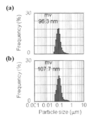
- FIG. 2 is a graph showing the particle size distribution of glibenclamide particles obtained in Example 1.
- FIG. (A) shows the state immediately after water dispersion, and (b) shows the state after standing for 6 hours. It is the image which observed the glibenclamide raw material used in Example 1 with the electron microscope.
- 4 is a graph showing the particle size distribution of fenofibrate particles obtained in Example 2.
- FIG. (A) shows the state immediately after water dispersion, and (b) shows the state after standing for 6 hours. It is the image which observed the fenofibrate raw material used in Example 2 with the electron microscope.
- FIG. 2 is an X-ray diffraction diagram of the raw materials used in Example 1 and the heat-melt kneaded product obtained in Example 1.
- FIG. 3 is an X-ray diffraction diagram of the raw materials used in Example 2 and the heated melt-kneaded product obtained in Example 2.
- FIG. It is a schematic diagram of a process until manufacturing a heat-melt kneaded material in Example 1 and 2 and performing freeze-drying of a suspension.
- FIG. 3 is an X-ray diffraction pattern of a sample obtained by freeze-drying a raw material used in Examples 1 and 2 and a suspension of the heat-melt kneaded product obtained in Examples 1 and 2. It is a differential scanning calorimetric analysis result of the raw material and raw material mixture which were used in Example 1 and 2.
- a crystalline drug and a water-soluble polymer are mixed so that the drug is 15 to 40% by mass based on the total of the drug and the water-soluble polymer.
- the mixture is heated and kneaded at a temperature lower than the melting point of the drug by 50 ° C. or more.
- the method for producing crystalline drug nanoparticles of the present invention comprises a crystalline drug and a water-soluble polymer such that the drug is 20 to 40% by mass based on the total of the drug and the water-soluble polymer.
- the mixed mixture is heated and kneaded at a temperature 10 ° C. or more higher than the melting point of the drug.
- the crystalline drug in the present invention is not particularly limited, and examples thereof include poorly water-soluble drugs.
- a poorly water-soluble drug is a drug classified as “slightly insoluble”, “hardly soluble”, “extremely insoluble”, or “almost insoluble” as defined by the Japanese Pharmacopoeia.
- the water-soluble polymer in the present invention is not particularly limited, and examples thereof include methyl cellulose, ethyl cellulose, hydroxymethyl cellulose, hydroxyethyl cellulose, hydroxypropyl cellulose, hydroxypropyl methyl cellulose, carboxymethyl cellulose, polyvinyl alcohol, polyvinyl pyrrolidone, and dextrin. Can be mentioned. Among these, hydroxypropylcellulose, polyvinylpyrrolidone, and hydroxypropylmethylcellulose can be suitably exemplified from the viewpoint that they are widely used as preparation additives and are inexpensive.
- the crystalline drug is dissolved in the crystalline drug and the water-soluble polymer.
- a crystalline drug and a water-soluble polymer are mixed so as to be 15 to 40% by mass with respect to the total of the molecules. From the viewpoint of the obtained particle size, the mixing ratio of the crystalline drug is preferably 25 to 35% by mass.
- a mixture of a crystalline drug and a water-soluble polymer is heated and kneaded at a temperature of 10 ° C.
- the crystalline drug is based on the total of the crystalline drug and the water-soluble polymer.
- the crystalline drug and the water-soluble polymer are mixed so that the total amount is 20 to 40% by mass. From the viewpoint of the obtained particle size, the mixing ratio of the crystalline drug is preferably 25 to 35% by mass.
- a mixture of a crystalline drug and a water-soluble polymer is heated at a temperature lower than the melting point of the crystalline drug, and when kneaded, the mixture is heated at a temperature lower by 50 ° C. or more than the melting point of the crystalline drug.
- the lower limit of the heating temperature is not particularly limited as long as it is equal to or higher than the temperature at which the water-soluble polymer to be used is softened to such an extent that it can be kneaded.
- the shearing force by kneading is effectively applied to the crystalline drug by mixing the crystalline drug and the water-soluble polymer in the above ratio. Further, it is considered that the surface portion of the crystalline drug particles is dissolved into the softened water-soluble polymer during kneading, and crystalline drug nanoparticles are obtained.
- the mixture of the crystalline drug and the water-soluble polymer is heated at a temperature higher than the melting point of the crystalline drug and kneaded, the mixture is heated at a temperature higher by 10 ° C. or more than the melting point of the crystalline drug.
- the upper limit of the heating temperature is not particularly limited as long as the drug used does not decompose.
- a drug having a melting point lower than the heating temperature is considered to be in a melted state during kneading, and the domain size of the drug in the melted state is reduced by shearing force, and the drug and water-soluble high drug at the nano level or molecular level.
- the molecules are miscible.
- finish of heat kneading a drug precipitates as a nanocrystal particle in the process cooled to room temperature.
- the mixture of the crystalline drug and the water-soluble polymer is heated at a temperature that is 50 ° C. or more lower than the melting point of the crystalline drug and kneading is performed at a temperature that is 50 ° C.
- Nanoparticles mean particles having an average particle size of less than a micron size, that is, particles having an average particle size of less than 1 ⁇ m.
- the heat kneading in the production method of the present invention is not particularly limited as long as the mixture in the present invention can be heated and kneaded at a predetermined temperature.
- a uniaxial or biaxial extruder examples thereof include a method using a heated melt kneader such as a kneading extruder.
- the extruder is suitable because the mixture can be kneaded while being heated, so that heating and kneading can be performed simultaneously, and temperature adjustment during kneading is easy.
- a biaxial extruder with high kneading and extruding ability is preferable.
- a mixture obtained by mixing a crystalline drug and a water-soluble polymer at a mixing ratio in the present invention is introduced into the raw material supply port of the extruder and heated with a screw while being heated by a heater provided in the extruder. Knead. The charged mixture is pushed out toward the discharge port while being kneaded by a screw.
- the crystalline drug and the water-soluble polymer may be mixed in advance into the extruder, and the crystalline drug and the water-soluble polymer are separately charged so that the mixing ratio in the present invention is obtained during kneading. May be.
- the time for kneading the mixture at the temperature in the present invention and the kneading force can be appropriately selected according to the crystalline drug and the water-soluble polymer to be used.
- the mixture of the crystalline drug and the water-soluble polymer can further contain a surfactant.
- the surfactant in the present invention is not particularly limited, and examples thereof include anionic surfactants such as sodium dodecyl sulfate and sodium deoxycholate, hexadecyltrimethylammonium bromide, myristyltrimethylammonium bromide and the like. Examples thereof include a cationic surfactant, a nonionic surfactant sold under the trade name of Tween, Span or Brij, and a nonionic surfactant such as poloxamer.
- sodium dodecyl sulfate, hexadecyltrimethylammonium bromide, and poloxamer can be preferably exemplified from the viewpoint of enhancing the dispersion stability of the nanoparticles during water dispersion.
- a surfactant By adding a surfactant to the mixture of crystalline drug and water-soluble polymer, it is possible to further promote the formation of nanoparticles of crystalline drug, and the dispersion stability when using the obtained nanoparticles Can be improved.
- the compounding amount of the surfactant can be appropriately selected according to the type of the crystalline drug and the water-soluble polymer to be used, and is not particularly limited.
- the content is preferably 5% by mass or more based on the total of the crystalline drug, the water-soluble polymer and the surfactant.
- the upper limit is not particularly limited, but is preferably 40% by mass or less from the viewpoint of toxicity and safety when formulated, and the amount of the surfactant is preferably 5 to 40% by mass, preferably 5 to 15 mass% is more preferable.
- the surfactant may be mixed with the crystalline drug and the water-soluble polymer in advance and charged into the extruder.
- the surfactant may be added separately from the crystalline drug or the water-soluble polymer.
- the three components may be mixed in the present invention during the kneading.
- a crystalline drug and a water-soluble polymer mixture can be heated and kneaded to form nanoparticles of the crystalline drug in the mixture. Since the nanoparticles produced by the production method of the present invention are dispersed in a water-soluble polymer, they can be processed into oral preparations as they are. The oral preparation disintegrates after taking, the water-soluble polymer dissolves, and the drug nanoparticles are dispersed in the body and absorbed. In the production method of the present invention, it is not necessary to use water or an organic solvent in the production of nanoparticles, and therefore, the drug nanoparticles obtained by the production method of the present invention are subjected to a water drying step for processing into an oral preparation.
- the crystalline drug can be made into nanoparticles simply by putting the mixture of the crystalline drug and the water-soluble polymer into a heat-melting kneader such as an extruder, so that continuous production is possible with simple steps. Thus, mass production of crystalline drug nanoparticles becomes possible.
- a surfactant with a mixture of crystalline drug and water-soluble polymer, the dispersibility of the drug nanoparticles is improved when the water-soluble polymer dissolves and the drug nanoparticles are absorbed into the body. Improves absorption in the body.
- the mixture is poured into water to dissolve the water-soluble polymer in the mixture and to separate the crystalline drug nanoparticles from the mixture. can do.
- a surfactant is added to the mixture, the dispersion stability of the crystalline drug nanoparticles in water is improved, so that the obtained nanoparticles can be separated without agglomeration.
- the separated crystalline drug nanoparticles can be removed by filtration, drying or the like.
- Glybenclamide (GLB), polyvinylpyrrolidone (PVP) and sodium dodecyl sulfate (SDS) were mixed for 5 minutes using a vortex mixer so that the mass ratio of GLB: PVP: SDS was 3: 6: 1, and the physical mixture (Physical mixture: PM) was obtained.
- PM Physical mixture
- the heating conditions of the obtained PM were adjusted so that the temperature of the PM would be 90 ° C, the screw rotation speed was 10, 200, 350 rpm, the throughput Heat kneading was performed under the conditions of 2 g / min and the number of treatments of 1 to 3 times.
- the heating conditions were adjusted so that the temperature of PM was 115 ° C., and the heat kneading process was performed under the conditions of a screw rotation speed of 350 rpm, a throughput of 2 g / min, and a processing frequency of 3 times.
- the specifications of the heated melt kneader used were a motor power of 0.4 kW, a screw having a conical shape, a screw upper bottom diameter of 5 mm, a screw lower bottom diameter of 14 mm, and a length of 109.5 mm.
- the preparation temperatures of 90 ° C. and 115 ° C. were temperatures at which PM could be extruded. The temperature was measured near the outlet of the heated melt kneader.
- FIG. 1 shows a schematic diagram of the production process of Example 1.
- Fenofibrate Fenofibrate
- PVP polyvinylpyrrolidone
- SDS sodium dodecyl sulfate
- the specifications of the heated melt kneader used were a motor power of 0.4 kW, a screw having a conical shape, a screw upper bottom diameter of 5 mm, a screw lower bottom diameter of 14 mm, and a length of 109.5 mm.
- the preparation temperature of 90 ° C. was a temperature at which PM could be extruded. The temperature was measured near the outlet of the heated melt kneader.
- the obtained pellets were pulverized for 5 minutes using a ball mill (MM400, manufactured by Restch) and sieved with a 100 mesh sieve to obtain a heated melt kneaded product (HotHmelt extrudate: HME).
- the obtained HME was dispersed in distilled water so as to have a drug concentration of 0.5 mg / ml, and the HME suspension was obtained by rotating and mixing for 1 minute.
- FIG. 1 shows a schematic diagram of the production process of Example 2.
- Fenofibrate (FFB), polyvinylpyrrolidone (PVP) and sodium dodecyl sulfate (SDS) were mixed for 5 minutes using a vortex mixer so that the mass ratio of FFB: PVP: SDS was 3: 6: 1, and physically A mixture (PM) was obtained.
- the obtained PM was pulverized for 5 minutes using a ball mill (MM400, manufactured by Restch), and sieved with a 100 mesh sieve to obtain a ground mixture (GM).
- the obtained GM was dispersed in distilled water to a drug concentration of 0.5 mg / ml, and GM suspension was obtained by rotating and mixing for 1 minute.
- FIG. 2 shows a schematic diagram of the manufacturing process of Comparative Example 3.
- Example 1 the result of measuring the particle size distribution of the glibenclamide particles in the heated melt kneaded product obtained under the conditions of a screw rotation speed of 350 rpm and a treatment frequency of 3 using an HME suspension is shown in FIG.
- the particle size distribution was measured using a Nanotrac UPA-UT151 (manufactured by Microtrac).
- FIG. 3 (a) shows the results measured immediately after water dispersion.
- the glibenclamide particles obtained in Example 1 had a unimodal particle size distribution, and the average particle size was about 100 nm.
- FIG. 3 (b) shows the measurement results after 6 hours of storage at 25 ° C. after water dispersion.
- the glibenclamide particles obtained in Example 1 have a large particle size even after 6 hours of storage. No change was observed, indicating high dispersion stability.
- FIG. 4 is an electron microscopic image of the glibenclamide raw material used.
- the particle size of the glibenclamide raw material used was
- Example 2 the result of having measured the particle size distribution of the fenofibrate particle
- FIG. 5 (a) shows the results measured immediately after dispersion in water.
- the fenofibrate particles obtained in Example 2 had a unimodal particle size distribution, and the average particle size was about 220 nm.
- FIG. 5 (b) shows the measurement results after storage for 6 hours at 25 ° C. after water dispersion.
- the fenofibrate particles obtained in Example 2 have a particle size even after 6 hours of storage. No significant change was observed, indicating high dispersion stability.
- FIG. 6 is an electron microscope image of the used fenofibrate raw material.
- the particle size of the fenofibrate raw material used was several ⁇ m to several tens of ⁇ m.
- Table 1 shows that in Example 1, the preparation temperature was 90 ° C., the number of treatments was 1 at a screw rotation speed of 10 rpm, the treatment frequency was 1 at a screw rotation speed of 200 rpm, the treatment frequency was 2 times at a screw rotation speed of 200 rpm, and the screw rotation speed was 350 rpm.
- the residence time is the time during which the PM charged in the heated melt kneader is heated and kneaded. Torque was measured using a measuring instrument attached to the heated melt kneader, and the residence time was evaluated by measuring the mass of pellets discharged from the heated melt kneader within a certain time.
- the combination of the screw rotation speed and the number of processing times may be expressed as (screw rotation number [rpm], processing number of times [times]).
- HME (10, 1) represents that the conditions for obtaining a heated melt-kneaded product (HME) are a screw rotation speed of 10 rpm and a processing frequency of once.
- the residence time showed a value equivalent to about 5 minutes.
- Table 1 comparing the results of HME (10,1), HME (200,2) and HME (350,3) with the same residence time, the particle diameter of the nanoparticles obtained as the screw speed increased Is getting smaller. This is thought to be due to an increase in shear force during heating and kneading with an increase in the number of screw rotations, and a reduction in drug particle size.
- Table 1 when the results of HME (350, 1), HME (350, 2), and HME (350, 3) with the same screw rotation speed are compared, as the residence time increases, The particle size became smaller. From this, it can be seen that the particle size of the drug gradually decreased during heating and kneading.
- Table 3 shows the second embodiment, in which the screw rotation speed is 10 rpm, the screw rotation speed is 1 time, the screw rotation speed is 200 rpm, the screw rotation speed is 200 rpm, the screw rotation speed is 2 times, and the screw rotation speed is 350 rpm.
- the fenofibrate particles in the heated melt kneaded mixture obtained under the conditions of the number of treatments of 2 times at 350 rpm and the number of treatments of 3 times at 350 rpm, and the fenofibrate particles in the pulverized mixture obtained in Comparative Example 3 The measurement result of the average particle diameter immediately after water dispersion of and the average particle diameter after 6-hour stationary storage is shown.
- the average particle diameter described in Table 3 is obtained by measuring and averaging three samples for each sample.
- Table 4 shows the results of measuring the torque and dwell time in the combinations of the screw rotation speeds and the processing times in Example 2. Torque and residence time were measured in the same manner as in Example 1.
- the fenofibrate particles in the hot melt kneaded product (HME) obtained in Example 2 all had an average particle size of 250 nm or less, and nanoparticles were obtained. In addition, even after 6 hours of standing, no significant change in the particle size was observed, indicating that the dispersion stability was high.
- the pulverized mixture (GM) obtained in Comparative Example 3 had an average particle diameter exceeding 3 ⁇ m. From the results in Table 4, it was recognized that the torque value increased as the screw rotation speed increased. Moreover, in HME (10,1), HME (200,2), and HME (350,3), the residence time showed a value equivalent to about 5 minutes.
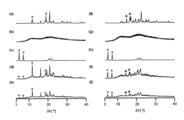
- FIG. 7 shows the results of X-ray diffraction measurement performed on Example 1.
- (a) is glibenclamide used as a raw material
- (b) is polyvinylpyrrolidone (PVP)
- (c) is sodium dodecyl sulfate (SDS)
- (d) is a physical mixture (PM) obtained in the middle
- (e ) Is the pulverized mixture (GM) obtained in Comparative Example 1
- (f) to (k) are heated melt kneaded materials (GLB HME) containing the glibenclamide particles obtained in Example 1, and the screw rotation speed and (F) is (10, 1), (g) is (200, 1), (h) is (200, 2), (i) is (350, 1), and (j) is (350).
- FIG. 8 shows the results of X-ray diffraction measurement performed on Example 2.
- (l) is fenofibrate used as a raw material
- (m) is polyvinylpyrrolidone (PVP)
- (n) is sodium dodecyl sulfate (SDS)
- (o) is a physical mixture (PM) obtained in the middle
- ( p) is the pulverized mixture (GM) obtained in Comparative Example 3
- (q) to (v) are heated melt kneaded materials (FFB HME) containing the fenofibrate particles obtained in Example 2
- screw rotation (Q) is (10, 1), (r) is (200, 1), (s) is (200, 2), (t) is (350, 1), (u) (350, 2) and (v) are (350, 3).
- FIG. 10 shows a heated melt kneaded product (GLB HME) containing glibenclamide (GLB) particles obtained in Example 1 at a preparation temperature of 90 ° C., a screw rotation speed of 350 rpm, and a treatment frequency of 3 times, and the screw rotation speed in Example 2.
- GLB HME heated melt kneaded product
- FAB HME heated melt kneaded material
- FAB fenofibrate
- glibenclamide used as a raw material
- PVP polyvinylpyrrolidone
- SDS sodium dodecyl sulfate
- PM physical mixture
- (E) is a sample obtained by freeze-drying an HME suspension of GLB HME
- (f) is fenofibrate (FFB) used as a raw material
- (g) is polyvinylpyrrolidone (PVP)
- (h) is sodium dodecyl sulfate (SDS)
- (i) is a physical mixture (PM) obtained in the middle
- (j) is a result of X-ray diffraction measurement of a sample obtained by freeze-drying an HME suspension of FFB HME.
- FIG. 11 shows the results of differential scanning calorimetry (DSC) measurement of each component alone and ternary mixture used in Examples 1 and 2.
- DSC differential scanning calorimetry
- (a) is glibenclamide
- (b) is fenofibrate
- (c) is polyvinylpyrrolidone
- (d) is sodium dodecyl sulfate
- (e) is a physical mixture (PM) of glibenclamide, polyvinylpyrrolidone and sodium dodecyl sulfate.
- (F) is the result of a physical mixture (PM) of fenofibrate, polyvinylpyrrolidone and sodium dodecyl sulfate.
- the peak near 170 ° C.
- Example 1 since the heating temperature is lower by 50 ° C. or more than the melting point of glibenclamide, it is considered that glibenclamide is maintained in a crystalline state without melting during heating and kneading.
- Example 2 the heating temperature is fenofibrate. Since it is higher than the melting point by 10 ° C. or more, the fenofibrate is considered to melt once during the heating and kneading.
- a heat-melt kneaded material was prepared in the same manner as in Example 1 with the composition, screw rotation number, treatment frequency, and treatment temperature shown in Table 5 below.
- Table 5 shows the average particle diameter of the drug particles in the obtained heat-melt kneaded product.
- MFA represents mefenamic acid
- IMC represents indomethacin.
- Mefenamic acid has a melting point of 230 ° C and indomethacin has a melting point of 160 ° C.
- HPC represents hydroxypropylcellulose, and Poloxamer (poloxamer) and CTAB (hexadecyltrimethylammonium bromide) are surfactants.
- Example 4 A heat-melt kneaded material was prepared in the same manner as in Example 1 with the formulation, screw rotation number, treatment frequency, and treatment temperature shown in Table 6 below. Table 6 shows the average particle size of the drug particles in the obtained heat-melt kneaded product.
- the average particle size of the drug particles obtained in Example 3 was 280 nm or less, and all were nanoparticles. Moreover, as a result of X-ray diffraction measurement, any of the obtained nanoparticles was crystalline.
- the temperature during heating and kneading was lower than the melting point of MFA, but the difference was only 40 ° C., so that the obtained product was amorphous.
- a heat-melt kneaded material was prepared in the same manner as in Example 2 with the composition, the number of screw rotations, the number of treatments, and the treatment temperature shown in Table 7 below.
- Table 7 shows the average particle diameter of the drug particles in the obtained heat-melt kneaded product.
- IBU represents ibuprofen
- the melting point of ibuprofen is 76 ° C.
- Example 5 A heat-melt kneaded material was prepared in the same manner as in Example 2 with the formulation, screw rotation number, treatment frequency, and treatment temperature shown in Table 8 below. Table 8 shows the average particle size of the drug particles in the obtained heat-melt kneaded product.
- the average particle diameter of the drug particles obtained in Example 4 was 350 nm or less, and all were nanoparticles. Moreover, as a result of X-ray diffraction measurement, any of the obtained nanoparticles was crystalline. From the results shown in Table 8, in the example in which FFB / PVP / SDS of Comparative Example 5 was blended at 4: 5: 1, the mixing ratio of FFB as a drug was 44% with respect to the total of FFB and PVP. The average particle diameter of the obtained particles exceeded 3 ⁇ m, and no nanoparticles were obtained.
- the method for producing crystalline drug nanoparticles and the method for producing crystalline drug nanoparticles according to the present invention do not require a drying step or an organic solvent, and can easily and continuously form a crystalline drug into nanoparticles. This is useful as a technique for improving the solubility of water-soluble drugs.
Landscapes
- Health & Medical Sciences (AREA)
- Chemical & Material Sciences (AREA)
- Life Sciences & Earth Sciences (AREA)
- Public Health (AREA)
- Veterinary Medicine (AREA)
- Medicinal Chemistry (AREA)
- Pharmacology & Pharmacy (AREA)
- Epidemiology (AREA)
- Animal Behavior & Ethology (AREA)
- General Health & Medical Sciences (AREA)
- Engineering & Computer Science (AREA)
- Inorganic Chemistry (AREA)
- Proteomics, Peptides & Aminoacids (AREA)
- Chemical Kinetics & Catalysis (AREA)
- General Chemical & Material Sciences (AREA)
- Oil, Petroleum & Natural Gas (AREA)
- Emergency Medicine (AREA)
- Bioinformatics & Cheminformatics (AREA)
- Acyclic And Carbocyclic Compounds In Medicinal Compositions (AREA)
- Medicinal Preparation (AREA)
- Pharmaceuticals Containing Other Organic And Inorganic Compounds (AREA)
Abstract
乾燥工程や有機溶媒が不要であり、簡易に連続的に結晶質の薬物ナノ粒子を製造できる結晶質薬物ナノ粒子の製造方法や、結晶質薬物をナノ粒子化できるナノ粒子化方法を提供することを課題とする。 結晶質薬物と水溶性高分子を、前記薬物が前記薬物及び前記水溶性高分子の合計に対して15~40質量%となるように混合した混合物を、前記薬物の融点より50℃以上低い温度で加熱し、混練する、又は前記薬物が前記薬物及び前記水溶性高分子の合計に対して20~40質量%となるように混合した混合物を、前記薬物の融点より10℃以上高い温度で加熱し、混練する。
Description
結晶質薬物と水溶性高分子を加熱し、混練する結晶質薬物ナノ粒子の製造方法及び結晶質薬物のナノ粒子化方法に関する。
従来、薬物を微粒子化すると表面積が増大することにより薬物の溶解速度が増加することが知られており、薬物の微粒子化は、難水溶性薬物の溶解性及び薬物の体内への吸収割合を示すバイオアべイラビリティーを改善する手法の一つに挙げられている。従来の薬物微粒子の調製方法には、ボールミルやロッドミルを用いる乾式粉砕法、ビーズミルを用いる湿式粉砕法、高圧ホモジナイザー法、共沈法、晶析法等がある(特許文献1)。しかし、乾式粉砕法は、バッチ式であるため大量生産が困難であった。また、湿式粉砕法や高圧ホモジナイザー法は、ナノ粒子を得ることはできるが、ナノ粒子が懸濁液状態で得られるため、固形製剤とするには乾燥工程が必要であり、水に化学分解しやすい薬物には適用できないとの問題があった。薬物粒子を有機溶媒中で析出させる共沈法や晶析法では、ナノ粒子を取り出すときに有機溶媒の除去が必要であり、ナノ粒子中へ有機溶媒が残存するとの問題があった。そのため、乾燥工程や有機溶媒が不要であり、簡易に連続的に薬物のナノ粒子を製造できる方法が求められていた。
一方、高分子材料を混合する方法の一つとして、加熱溶融混練法が知られている。この方法は、対象物を粉砕するための方法ではなく、薬物に関する分野では、難水溶性薬物と水溶性高分子の混合物を加熱混練することにより、難水溶性薬物が非晶質状態で分散した固体分散体を得るために用いられている(特許文献2)。この固体分散体も、難水溶性薬物の溶解性を向上できるため、難水溶性薬物の溶解性及びバイオアべイラビリティーを改善するために用いられる。しかし、固体分散体自身の安定性に問題があり、非晶質状態が物理的又は化学的に不安定な薬物には用いることができない等の問題がある。また、加熱溶融混練法を、結晶質の薬物粒子を水溶性ポリマーで被覆するためや(特許文献3)、薬物を一旦溶融して賦形剤と混合した後、薬物を再結晶化させるため(特許文献4)に用いることも提案されている。しかしながら、加熱溶融混練法により結晶質薬物ナノ粒子を製造することは提案されていなかった。例えば、特許文献3に記載された方法は、薬物に対して少量の水溶性ポリマーを使用して薬物粒子を水溶性ポリマーで被覆する方法であり、特許文献4に記載された方法では、薬物を再結晶化させることにより結晶質粒子の粒子径を縮小させているが、得られる粒子の平均粒子径はミクロンサイズでありナノサイズではなかった。
本発明の課題は、上記問題を解決し、乾燥工程や有機溶媒が不要であり、簡易に連続的に結晶質の薬物ナノ粒子を製造できる結晶質薬物ナノ粒子の製造方法、及び乾燥工程や有機溶媒が不要であり、結晶質薬物を簡易に連続的にナノ粒子化できる結晶質薬物のナノ粒子化方法を提供することにある。
本発明者らは、結晶質薬物のナノ粒子化を検討するにあたり、従来は結晶質薬物ナノ粒子の製造に用いられていなかった加熱溶融混練法に着目した。そして、検討を進めたところ、結晶質の薬物と水溶性高分子を特定の割合で混合し、混合物を加熱混練するときの加熱温度を薬物の融点との関係で特定の範囲とすることにより、加熱混練によってナノサイズの結晶質薬物粒子が得られることを見いだした。具体的には、薬物の割合が薬物と水溶性高分子の合計に対して40質量%以下となるように両者を混合し、加熱温度を薬物の融点より低くする場合には、加熱温度が薬物の融点より50℃以上低くなるように、加熱温度を薬物の融点より高くする場合には、加熱温度が薬物の融点より10℃以上高くなるように加熱して混練することにより、結晶質薬物ナノ粒子が得られることを見いだした。また、薬物の混合割合の下限は、加熱温度を薬物の融点より低くする場合は15質量%であり、加熱温度を薬物の融点より高くする場合は20質量%であった。さらに、界面活性剤を前記混合物中に添加すると、ナノ粒子化がより促進されると共に、得られたナノ粒子の使用時の分散安定性が優れることを見いだした。
すなわち、本発明は以下に示す事項により特定されるものである。
(1)結晶質薬物と水溶性高分子を、前記薬物が前記薬物及び前記水溶性高分子の合計に対して15~40質量%となるように混合した混合物を、前記薬物の融点より50℃以上低い温度で加熱し、混練することを特徴とする結晶質薬物ナノ粒子の製造方法。
(2)結晶質薬物と水溶性高分子を、前記薬物が前記薬物及び前記水溶性高分子の合計に対して20~40質量%となるように混合した混合物を、前記薬物の融点より10℃以上高い温度で加熱し、混練することを特徴とする結晶質薬物ナノ粒子の製造方法。
(3)混合物が、界面活性剤をさらに含むことを特徴とする上記(1)又は(2)記載の結晶質薬物ナノ粒子の製造方法。
(4)混合物における界面活性剤の含有量が、薬物、水溶性高分子及び前記界面活性剤の合計に対して5質量%以上であることを特徴とする上記(1)~(3)のいずれか記載の結晶質薬物ナノ粒子の製造方法。
(5)混合物を加熱し、混練した後、前記混合物を水中に投入することを特徴とする上記(1)~(4)のいずれか記載の結晶質薬物ナノ粒子の製造方法。
(6)結晶質薬物及び水溶性高分子の混合物を加熱し、混練することにより前記結晶質薬物を結晶質ナノ粒子にする方法であって、前記混合物における前記薬物の含有量が前記薬物及び前記水溶性高分子の合計に対して15~40質量%であり、加熱温度が前記薬物の融点より50℃以上低い温度である、又は前記混合物における前記薬物の含有量が前記薬物及び前記水溶性高分子の合計に対して20~40質量%であり、加熱温度が前記薬物の融点より10℃以上高い温度であることを特徴とする結晶質薬物のナノ粒子化方法。
(1)結晶質薬物と水溶性高分子を、前記薬物が前記薬物及び前記水溶性高分子の合計に対して15~40質量%となるように混合した混合物を、前記薬物の融点より50℃以上低い温度で加熱し、混練することを特徴とする結晶質薬物ナノ粒子の製造方法。
(2)結晶質薬物と水溶性高分子を、前記薬物が前記薬物及び前記水溶性高分子の合計に対して20~40質量%となるように混合した混合物を、前記薬物の融点より10℃以上高い温度で加熱し、混練することを特徴とする結晶質薬物ナノ粒子の製造方法。
(3)混合物が、界面活性剤をさらに含むことを特徴とする上記(1)又は(2)記載の結晶質薬物ナノ粒子の製造方法。
(4)混合物における界面活性剤の含有量が、薬物、水溶性高分子及び前記界面活性剤の合計に対して5質量%以上であることを特徴とする上記(1)~(3)のいずれか記載の結晶質薬物ナノ粒子の製造方法。
(5)混合物を加熱し、混練した後、前記混合物を水中に投入することを特徴とする上記(1)~(4)のいずれか記載の結晶質薬物ナノ粒子の製造方法。
(6)結晶質薬物及び水溶性高分子の混合物を加熱し、混練することにより前記結晶質薬物を結晶質ナノ粒子にする方法であって、前記混合物における前記薬物の含有量が前記薬物及び前記水溶性高分子の合計に対して15~40質量%であり、加熱温度が前記薬物の融点より50℃以上低い温度である、又は前記混合物における前記薬物の含有量が前記薬物及び前記水溶性高分子の合計に対して20~40質量%であり、加熱温度が前記薬物の融点より10℃以上高い温度であることを特徴とする結晶質薬物のナノ粒子化方法。
本発明の結晶質薬物ナノ粒子の製造方法は、乾燥工程や有機溶媒が不要で、簡易に連続的に結晶質の薬物ナノ粒子を製造できる。また、本発明の結晶質薬物のナノ粒子化方法は、乾燥工程や有機溶媒が不要で、簡易に連続的に結晶質薬物をナノ粒子化できる。
本発明の結晶質薬物ナノ粒子の製造方法は、結晶質薬物と水溶性高分子を、前記薬物が前記薬物及び前記水溶性高分子の合計に対して15~40質量%となるように混合した混合物を、前記薬物の融点より50℃以上低い温度で加熱し、混練することを特徴とする。また、本発明の結晶質薬物ナノ粒子の製造方法は、結晶質薬物と水溶性高分子を、前記薬物が前記薬物及び前記水溶性高分子の合計に対して20~40質量%となるように混合した混合物を、前記薬物の融点より10℃以上高い温度で加熱し、混練することを特徴とする。本発明における結晶質薬物としては、特に限定されるものではないが、例えば、難水溶性薬物を挙げることができる。難水溶性薬物とは、日本薬局方に規定される「やや溶けにくい」「溶けにくい」「極めて溶けにくい」「ほとんど溶けない」に分類される薬物をいう。結晶質薬物と水溶性高分子の混合物を混練する場合、水溶性高分子を混練可能な程度に軟化させる必要があるので、薬物の融点より50℃以上低い温度で加熱しながら混練する場合は、水溶性高分子が軟化する温度を確保する観点から、例えば、アプレピタント、ピロキシカム、レセルピン、フェニトイン、グリセオフルビン、ニフェジピン、フロセミド、インドメタシン、グリベンクラミド、ニトラゼパム、メフェナム酸、カルバマゼピン、ヒドロコルチゾン、ヒドロクロロチアジド、プレドニゾロン、べラパミル、シロリムス、ジルチアゼム、テオフィリン、ナプロキセン等の融点が150℃以上である薬物を挙げることができる。また、薬物の融点より10℃以上高い温度で加熱し、混練する場合は、高温になり過ぎないようにする観点から、例えば、イブプロフェン、ケトプロフェン、フェノフィブラート、エトフィブラート、ゲムフィブロジム、フェニルブタゾン、トルナフタート、リドカイン、ナブメトン等の融点が110℃以下である薬物を挙げることができる。
本発明における水溶性高分子としては、特に限定されるものではないが、例えば、メチルセルロース、エチルセルロース、ヒドロキシメチルセルロース、ヒドロキシエチルセルロース、ヒドロキシプロピルセルロース、ヒドロキシプロピルメチルセルロース、カルボキシメチルセルロース、ポリビニルアルコール、ポリビニルピロリドン、デキストリン等を挙げることができる。これらの中でも、製剤添加剤として広く用いられており、安価であるという観点から、ヒドロキシプロピルセルロース、ポリビニルピロリドン、ヒドロキシプロピルメチルセルロースを好適に例示することができる。
本発明の製造方法では、結晶質薬物と水溶性高分子の混合物を、結晶質薬物の融点より50℃以上低い温度で加熱し、混練する場合は、結晶質薬物が結晶質薬物と水溶性高分子の合計に対して15~40質量%となるように、結晶質薬物と水溶性高分子とを混合する。得られる粒子径の観点から、結晶質薬物の混合割合は、25~35質量%が好ましい。また、結晶質薬物と水溶性高分子の混合物を、結晶質薬物の融点より10℃以上高い温度で加熱し、混練する場合は、結晶質薬物が結晶質薬物と水溶性高分子の合計に対して20~40質量%となるように、結晶質薬物と水溶性高分子とを混合する。得られる粒子径の観点から、結晶質薬物の混合割合は、25~35質量%が好ましい。
本発明の製造方法では、結晶質薬物と水溶性高分子の混合物を、結晶質薬物の融点より低い温度で加熱し、混練する場合は、結晶質薬物の融点より50℃以上低い温度で加熱する。加熱温度の下限は、使用する水溶性高分子が混練可能な程度に軟化する温度以上であれば特に限定されるものではない。加熱温度をかかる範囲の温度とすることにより、混練中、結晶質薬物は融解することなく結晶性を維持したまま存在し、前記混合物に加わるせん断力により結晶質薬物の粒子径が小さくなる。本発明においては、結晶質薬物と水溶性高分子を上記割合で混合することにより、混練によるせん断力が結晶質薬物に効果的に加わると考えられる。また、混練中に結晶質薬物粒子の表面部分の軟化した水溶性高分子中への溶け込みも生じていると考えられ、結晶質の薬物ナノ粒子が得られる。結晶質薬物と水溶性高分子の混合物を、結晶質薬物の融点より高い温度で加熱し、混練する場合は、結晶質薬物の融点より10℃以上高い温度で加熱する。加熱温度の上限は、使用する薬物が分解しない温度であれば特に限定されるものではない。この場合、加熱温度より低い融点を有する薬物は、混練中に融解状態になると考えられ、せん断力により融解状態の薬物のドメインサイズが減少していき、ナノレベルまたは分子レベルで薬物と水溶性高分子が混和する。そして、加熱混練終了後、室温まで冷やされていく過程で、薬物はナノ結晶粒子として析出する。ここで、結晶質薬物と水溶性高分子の混合物を、結晶質薬物の融点より50℃以上低い温度で加熱し、混練するとは、加熱により前記混合物を結晶質薬物の融点より50℃以上低い温度とした状態で混練することをいい、前記混合物を前記温度となるように加熱しながら混練する場合、一旦加熱により前記温度とした混合物の温度を保温等により維持しながら混練する場合も含む。結晶質薬物と水溶性高分子の混合物を、結晶質薬物の融点より10℃以上高い温度で加熱する場合も同様である。また、ナノ粒子とは、ミクロンサイズ未満の平均粒子径を有する粒子、すなわち平均粒子径が1μm未満の粒子のことをいう。
本発明の製造方法における加熱混練は、本発明における混合物を所定の温度で加熱し、混練できれば、その具体的な方法は特に限定されるものではないが、例えば、一軸又は二軸のエクストリューダ(混練押出機)等の加熱溶融混練機を用いた方法を挙げることができる。エクストリューダは、混合物を加熱しながら混練できるため、加熱と混練を同時にでき、また混練時の温度調節が容易であるので好適である。中でも混練及び押出し能力の高い二軸のエクストリューダが好ましい。エクストリューダを用いる場合、結晶質薬物と水溶性高分子を本発明における混合比で混合した混合物をエクストリューダの原料供給口に投入し、エクストリューダに備えられたヒ―タで加熱しながらスクリューで混練する。投入された混合物は、スクリューにより混練されながら排出口に向かって押し出される。結晶質薬物と水溶性高分子は、予め混合したものをエクストリューダに投入してもよく、結晶質薬物と水溶性高分子を別々に投入し、混練中に本発明における混合割合となるようにしてもよい。前記混合物を本発明における温度で混練する時間及び混練力は、使用する結晶質薬物と水溶性高分子に応じて適宜選択できる。
本発明の製造方法では、結晶質薬物と水溶性高分子の混合物は、さらに界面活性剤を含むことができる。本発明における界面活性剤としては、特に限定されるものではないが、例えば、ドデシル硫酸ナトリウム、デオキシコール酸ナトリウム等の陰イオン界面活性剤、臭化ヘキサデシルトリメチルアンモニウム、臭化ミリスチルトリメチルアンモニウム等の陽イオン界面活性剤、Tween、Span又はBrijの商品名で販売されている非イオン性界面活性剤、ポロキサマー等の非イオン性界面活性剤などを挙げることができる。この中でも、水分散時におけるナノ粒子の分散安定性を高める観点から、ドデシル硫酸ナトリウム、臭化ヘキサデシルトリメチルアンモニウム、ポロキサマーを好適に例示できる。結晶質薬物と水溶性高分子の混合物に、さらに界面活性剤を添加することにより、結晶質薬物のナノ粒子化をより促進することができ、また得られたナノ粒子の使用時の分散安定性を向上させることができる。界面活性剤の配合量は、使用する結晶質薬物と水溶性高分子の種類に応じて適宜選択することができ、特に限定されるものではないが、ナノ粒子化を促進し、得られたナノ粒子の使用時の分散安定性を向上させる観点から、結晶質薬物、水溶性高分子及び界面活性剤の合計に対して5質量%以上が好ましい。また、上限は特に制限されるものではないが、製剤化した際の毒性及び安全性の観点から40質量%以下が好ましく、界面活性剤の配合量は、5~40質量%が好ましく、5~15質量%がより好ましい。例えば、エクストリューダを用いる場合、界面活性剤を、結晶質薬物及び水溶性高分子と予め混合して、エクストリューダに投入してもよく、結晶質薬物や水溶性高分子とは別々に投入し、混練中に3成分が本発明における混合割合となるようにしてもよい。
本発明の製造方法では、結晶質薬物と水溶性高分子の混合物を加熱し、混練することにより、前記混合物中で結晶質薬物をナノ粒子化することができる。本発明の製造方法により製造されたナノ粒子は、水溶性高分子中に分散しているため、そのまま経口剤に加工することができる。経口剤は、服用後、崩壊し、水溶性高分子が溶けて薬物ナノ粒子が体内に分散されて吸収される。本発明の製造方法では、ナノ粒子の製造にあたり、水や有機溶媒を使用する必要がないため、本発明の製造方法で得られた薬物ナノ粒子は、経口剤に加工するために水の乾燥工程や有機溶媒の除去工程は必要としない。また、本発明では、結晶質薬物と水溶性高分子の混合物をエクストリューダ等の加熱溶融混練機に投入するだけで、結晶質薬物のナノ粒子化ができるので、簡易な工程で連続生産が可能であり、結晶質薬物ナノ粒子の大量生産が可能となる。また、結晶質薬物と水溶性高分子の混合物に界面活性剤をさらに混合することにより、水溶性高分子が溶けて薬物ナノ粒子が体内に吸収されるときの薬物ナノ粒子の分散性がよくなり、体内への吸収性が向上する。さらに、本発明の製造方法では、混合物を加熱し、混練した後、前記混合物を水中に投入することにより、混合物中の水溶性高分子を水中に溶解させ、結晶質薬物ナノ粒子を混合物から分離することができる。特に、界面活性剤を混合物中に添加すると水中での結晶質薬物ナノ粒子の分散安定性が向上するため、得られたナノ粒子を凝集させることなく分離することができる。分離した結晶質薬物ナノ粒子は、濾過、乾燥等により取り出すことができる。
以下、本発明の実施例を挙げて、本発明を具体的に説明するが、本発明の技術的範囲はこれらの例示に限定されるものではない。
グリベンクラミド(GLB)、ポリビニルピロリドン(PVP)及びドデシル硫酸ナトリウム(SDS)を、GLB:PVP:SDSの質量比が3:6:1となるようにボルテックスミキサーを用いて5分間混合し、物理的混合物(Physical mixture:PM)を得た。得られたPMを、加熱溶融混練機(HAAKE Minilab II、Thermo scientific社製)を用いて、PMの温度が90℃となるように加熱条件を調整し、スクリュー回転数10、200、350rpm、スループット2g/min、処理回数1~3回の条件で加熱混練処理を行った。また、PMの温度が115℃となるように加熱条件を調整し、スクリュー回転数350rpm、スループット2g/min、処理回数3回の条件で加熱混練処理を行った。使用した加熱溶融混練機の仕様は、モーター力が0.4kW、スクリューは、円錐形、スクリュー上底の直径が5mm、スクリュー下底の直径が14mm、長さが109.5mmであった。調製温度90℃及び115℃は、PMが押出し可能な温度であった。また、温度は加熱溶融混練機の出口近くで測定した。得られたペレットをボールミル(MM400、Restch社製)を用いて5分間粉砕し、100meshの篩で篩過したものを加熱溶融混練物(Hotmelt extrudate:HME)とした。得られたHMEを薬物濃度0.5mg/mlとなるように蒸留水に分散させ、1分間回転混和を行うことによりHME懸濁液を得た。図1に実施例1の製造工程の模式図を示す。
フェノフィブラート(FFB)、ポリビニルピロリドン(PVP)及びドデシル硫酸ナトリウム(SDS)を、FFB:PVP:SDSの質量比が3:6:1となるようにボルテックスミキサーを用いて5分間混合し、物理的混合物(Physical mixture:PM)を得た。得られたPMを、加熱溶融混練機(HAAKE Minilab II、Thermo scientific社製)を用いて、PMの温度が90℃となるように加熱条件を調整し、スクリュー回転数10、200、350rpm、スループット2g/min、処理回数1~3回の条件で加熱混練処理を行った。使用した加熱溶融混練機の仕様は、モーター力が0.4kW、スクリューは、円錐形、スクリュー上底の直径が5mm、スクリュー下底の直径が14mm、長さが109.5mmであった。調製温度90℃は、PMが押出し可能な温度であった。また、温度は加熱溶融混練機の出口近くで測定した。得られたペレットをボールミル(MM400、Restch社製)を用いて5分間粉砕し、100meshの篩で篩過したものを加熱溶融混練物(Hot melt extrudate:HME)とした。得られたHMEを薬物濃度0.5mg/mlとなるように蒸留水に分散させ、1分間回転混和を行うことによりHME懸濁液を得た。図1に実施例2の製造工程の模式図を示す。
[比較例1]
グリベンクラミド(GLB)、ポリビニルピロリドン(PVP)及びドデシル硫酸ナトリウム(SDS)を、GLB:PVP:SDSの質量比が3:6:1となるようにボルテックスミキサーを用いて5分間混合し、物理的混合物(Physical mixture:PM)を得た。得られたPMを、ボールミル(MM400、Restch社製)を用いて5分間粉砕し、100meshの篩で篩過したものを粉砕混合物(Ground mixture:GM)とした。得られたGMを薬物濃度0.5mg/mlとなるように蒸留水に分散させ、1分間回転混和を行うことによりGM懸濁液を得た。図2に比較例1の製造工程の模式図を示す。
グリベンクラミド(GLB)、ポリビニルピロリドン(PVP)及びドデシル硫酸ナトリウム(SDS)を、GLB:PVP:SDSの質量比が3:6:1となるようにボルテックスミキサーを用いて5分間混合し、物理的混合物(Physical mixture:PM)を得た。得られたPMを、ボールミル(MM400、Restch社製)を用いて5分間粉砕し、100meshの篩で篩過したものを粉砕混合物(Ground mixture:GM)とした。得られたGMを薬物濃度0.5mg/mlとなるように蒸留水に分散させ、1分間回転混和を行うことによりGM懸濁液を得た。図2に比較例1の製造工程の模式図を示す。
[比較例2]
PMの温度を130℃、140℃となるように加熱条件を調製し、スクリュー回転数を350rpm、スループットを2g/min、処理回数を3回として、それ以外は実施例1と同じ条件で、加熱溶融混練物(HME)を得て、さらにHME懸濁液を得た。
PMの温度を130℃、140℃となるように加熱条件を調製し、スクリュー回転数を350rpm、スループットを2g/min、処理回数を3回として、それ以外は実施例1と同じ条件で、加熱溶融混練物(HME)を得て、さらにHME懸濁液を得た。
[比較例3]
フェノフィブラート(FFB)、ポリビニルピロリドン(PVP)及びドデシル硫酸ナトリウム(SDS)を、FFB:PVP:SDSの質量比が3:6:1となるようにボルテックスミキサーを用いて5分間混合し、物理的混合物(Physical mixture:PM)を得た。得られたPMを、ボールミル(MM400、Restch社製)を用いて5分間粉砕し、100meshの篩で篩過したものを粉砕混合物(Ground mixture:GM)とした。得られたGMを薬物濃度0.5mg/mlとなるように蒸留水に分散させ、1分間回転混和を行うことによりGM懸濁液を得た。図2に比較例3の製造工程の模式図を示す。
フェノフィブラート(FFB)、ポリビニルピロリドン(PVP)及びドデシル硫酸ナトリウム(SDS)を、FFB:PVP:SDSの質量比が3:6:1となるようにボルテックスミキサーを用いて5分間混合し、物理的混合物(Physical mixture:PM)を得た。得られたPMを、ボールミル(MM400、Restch社製)を用いて5分間粉砕し、100meshの篩で篩過したものを粉砕混合物(Ground mixture:GM)とした。得られたGMを薬物濃度0.5mg/mlとなるように蒸留水に分散させ、1分間回転混和を行うことによりGM懸濁液を得た。図2に比較例3の製造工程の模式図を示す。
実施例1において、スクリュー回転数350rpm、処理回数3回の条件で得られた加熱溶融混練物中のグリベンクラミド粒子の粒度分布をHME懸濁液を用いて測定した結果を図3に示す。粒度分布は、Nanotrac UPA-UT151(Microtrac社製)を使用して測定した。図3(a)は、水分散直後に測定した結果であり、実施例1で得られたグリベンクラミド粒子は、単峰性の粒度分布を有し、その平均粒子径は約100nmであった。図3(b)は、水分散後25℃の条件下で6時間静置保存後の測定結果であり、実施例1で得られたグリベンクラミド粒子は、6時間静置後も、粒子径に大きな変化は認められず、分散安定性が高いことが示された。また、図4は、使用したグリベンクラミド原料の電子顕微鏡画像である。使用したグリベンクラミド原料の粒子径は数十μm~数百μmであった。
また、実施例2において、スクリュー回転数350rpm、処理回数3回の条件で得られた加熱溶融混練物中のフェノフィブラート粒子の粒度分布をHME懸濁液を用いて測定した結果を図5に示す。図5(a)は、水分散直後に測定した結果であり、実施例2で得られたフェノフィブラート粒子は、単峰性の粒度分布を有し、その平均粒子径は約220nmであった。図5(b)は、水分散後25℃の条件下で6時間静置保存後の測定結果であり、実施例2で得られたフェノフィブラート粒子は、6時間静置後も、粒子径に大きな変化は認められず、分散安定性が高いことが示された。また、図6は、使用したフェノフィブラート原料の電子顕微鏡画像である。使用したフェノフィブラート原料の粒子径は数μm~数十μmであった。
表1は、実施例1において、調製温度90℃で、スクリュー回転数10rpmで処理回数1回、スクリュー回転数200rpmで処理回数1回、スクリュー回転数200rpmで処理回数2回、スクリュー回転数350rpmで処理回数1回、スクリュー回転数350rpmで処理回数2回、スクリュー回転数350rpmで処理回数3回の各条件で得られた加熱溶融混練物及び調製温度115℃で、スクリュー回転数350rpmで処理回数3回の条件で得られた加熱溶融混練物中のグリベンクラミド粒子、比較例1で得られた粉砕混合物中のグリベンクラミド粒子、並びに比較例2で得られた加熱溶融混練物中のグリベンクラミド粒子の水分散直後の平均粒子径と、6時間静置保存後の平均粒子径の測定結果を示したものである。表1に記載された平均粒子径は、各試料について3サンプルを測定し平均したものである。また、表2は、実施例1における調製温度90℃にて調製した試料の各スクリュー回転数及び処理回数の組合せにおけるトルクと滞留時間を測定した結果である。トルクは、物体を回転させる力のことであり、試料にかかるせん断応力の目安となる。滞留時間とは、加熱溶融混練機に投入されたPMが加熱混練されている時間である。トルクは、加熱溶融混練機に付属されている測定器を用いて測定し、滞留時間は、一定時間内に加熱溶融混練機から排出されるペレットの質量を測定することで評価した。また、本願明細書及び図面において、スクリュー回転数と処理回数の組合せを、(スクリュー回転数[rpm],処理回数[回])で表すことがある。例えば、HME(10,1)は、加熱溶融混練物(HME)を得る条件がスクリュー回転数10rpm、処理回数1回であることを表す。

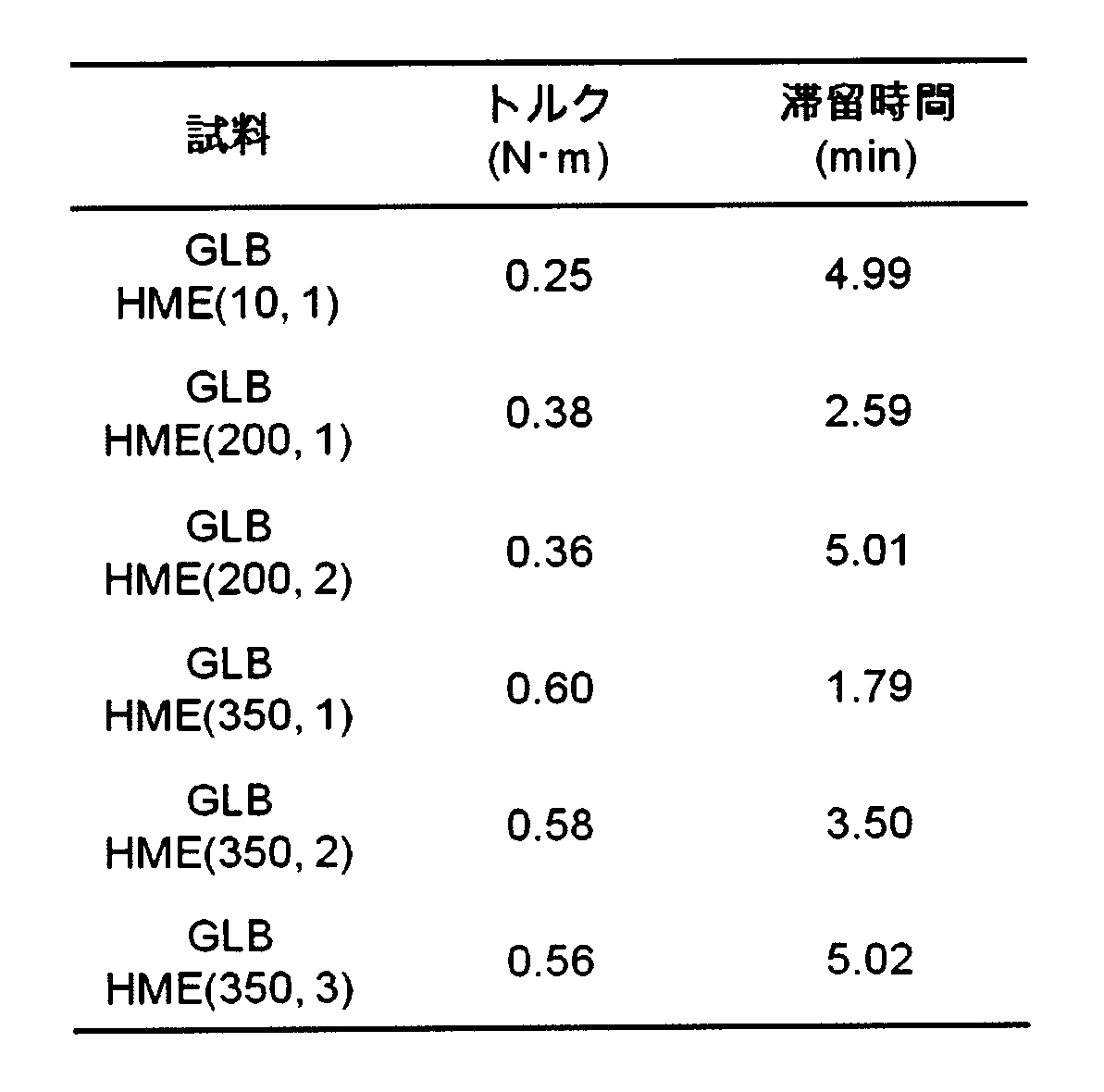
表1の結果から、実施例1で得られた加熱溶融混練物(HME)中のグリベンクラミド粒子は、いずれも平均粒子径が500nm以下であり、ナノ粒子が得られていた。また、6時間静置後も、粒子径に大きな変化は認められず、分散安定性が高いことが示された。一方、比較例1で得られた粉砕混合物(GM)は、平均粒子径が3μmを超えていた。また、比較例2で得られたグリベンクラミド粒子は、分散直後は平均粒子径が500nm以下であったが、6時間静置したものは沈殿が生じていた。表2の結果からは、スクリュー回転数の増加によりトルク値が増加することが認められた。また、HME(10,1)、HME(200,2)およびHME(350,3)では、滞留時間は約5分と同等の値を示した。表1において、滞留時間が等しい、HME(10,1)、HME(200,2)およびHME(350,3)の結果を比べると、スクリュー回転数が増加するにつれ、得られるナノ粒子の粒子径が小さくなっている。これは、スクリュー回転数の増加に伴い、加熱混練中のせん断力が増加し、薬物の粒子サイズが小さくなったと考えられる。また、表1において、スクリュー回転数が等しい、HME(350,1)、HME(350,2)およびHME(350,3)の結果を比べると、滞留時間が増加するにつれ、得られるナノ粒子の粒子径が小さくなった。このことから、加熱混練中に徐々に薬物の粒子サイズが小さくなったことがわかる。
表3は、実施例2で、スクリュー回転数10rpmで処理回数1回、スクリュー回転数200rpmで処理回数1回、スクリュー回転数200rpmで処理回数2回、スクリュー回転数350rpmで処理回数1回、スクリュー回転数350rpmで処理回数2回、スクリュー回転数350rpmで処理回数3回の各条件で得られた加熱溶融混練物中のフェノフィブラート粒子、及び比較例3で得られた粉砕混合物中のフェノフィブラート粒子の水分散直後の平均粒子径と、6時間静置保存後の平均粒子径の測定結果を示す。表3に記載された平均粒子径は、各試料について3サンプルを測定し平均したものである。また、表4は、実施例2における上記各スクリュー回転数及び処理回数の組合せにおけるトルクと滞留時間を測定した結果である。トルクと滞留時間の測定は実施例1の場合と同様に行った。
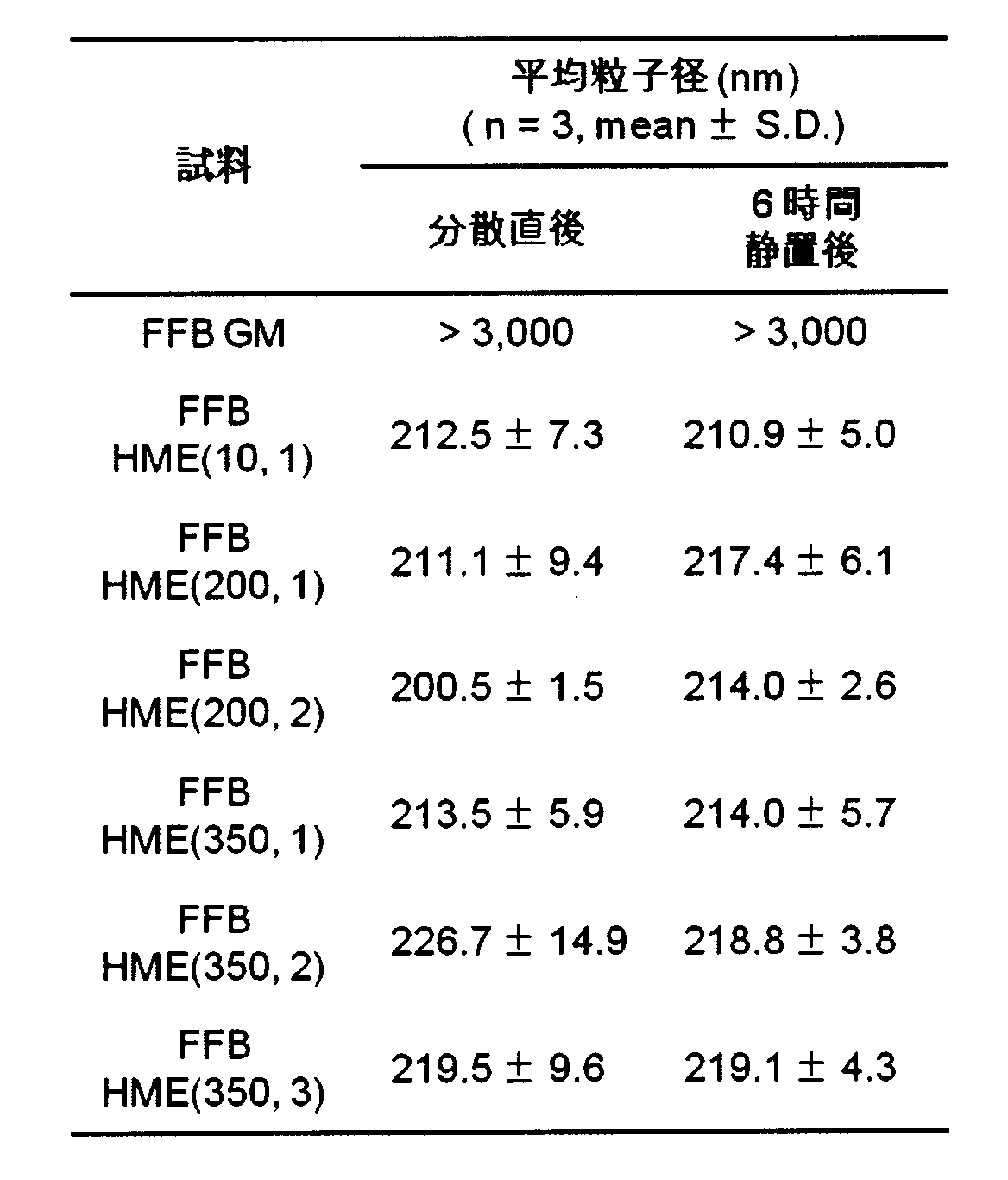
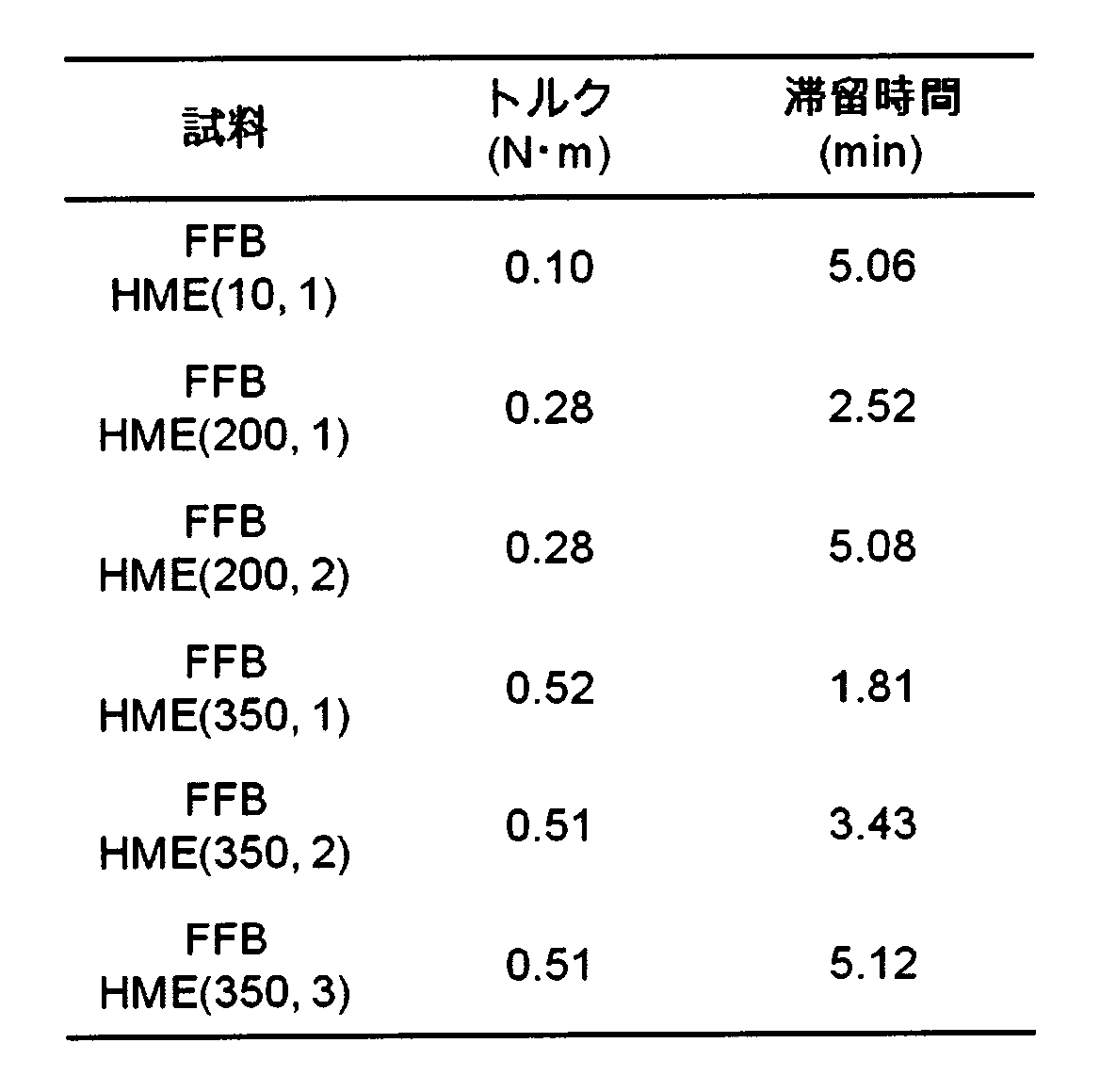
表3の結果から、実施例2で得られた加熱溶融混練物(HME)中のフェノフィブラート粒子は、いずれも平均粒子径が250nm以下であり、ナノ粒子が得られていた。また、6時間静置後も、粒子径に大きな変化は認められず、分散安定性が高いことが示された。一方、比較例3で得られた粉砕混合物(GM)は、平均粒子径が3μmを超えていた。
表4の結果からは、スクリュー回転数の増加によりトルク値が増加することが認められた。また、HME(10,1)、HME(200,2)およびHME(350,3)では、滞留時間は約5分と同等の値を示した。表3において、滞留時間が等しい、HME(10,1)、HME(200,2)およびHME(350,3)の結果を比べると、得られるナノ粒子の粒子径のスクリュー回転数による変化はみられなかった。また、表1において、スクリュー回転数が等しい、HME(350,1)、HME(350,2)およびHME(350,3)の結果を比べると、得られるナノ粒子の粒子径の滞留時間による変化はみられなかった。これは、実施例2の場合は、加熱混練中において、融解したフェノフィブラートはせん断力により軟化した水溶性高分子とナノサイズまたは分子レベルで混和するためと考えられる。
表4の結果からは、スクリュー回転数の増加によりトルク値が増加することが認められた。また、HME(10,1)、HME(200,2)およびHME(350,3)では、滞留時間は約5分と同等の値を示した。表3において、滞留時間が等しい、HME(10,1)、HME(200,2)およびHME(350,3)の結果を比べると、得られるナノ粒子の粒子径のスクリュー回転数による変化はみられなかった。また、表1において、スクリュー回転数が等しい、HME(350,1)、HME(350,2)およびHME(350,3)の結果を比べると、得られるナノ粒子の粒子径の滞留時間による変化はみられなかった。これは、実施例2の場合は、加熱混練中において、融解したフェノフィブラートはせん断力により軟化した水溶性高分子とナノサイズまたは分子レベルで混和するためと考えられる。
図7は、実施例1に関して行ったX線回折測定の結果である。図中(a)は原料として使用したグリベンクラミド、(b)はポリビニルピロリドン(PVP)、(c)はドデシル硫酸ナトリウム(SDS)、(d)は途中で得られる物理的混合物(PM)、(e)は比較例1で得られた粉砕混合物(GM)、(f)~(k)は、実施例1で得られたグリベンクラミド粒子を含む加熱溶融混練物(GLB HME)であり、スクリュー回転数及び処理回数は、(f)が(10,1)、(g)が(200,1)、(h)が(200,2)、(i)が(350,1)、(j)が(350,2)、(k)が(350,3)である。(a)における2θ=11.72°、19.16°は、グリベンクラミドの結晶に特徴的なピークである。実施例1で得られた(f)~(k)においても同様のピークが認められることから、実施例1で得られた加熱溶融混練物中のグリベンクラミド粒子は結晶質であることがわかる。
図8は、実施例2に関して行ったX線回折測定の結果である。図中(l)は原料として使用したフェノフィブラート、(m)はポリビニルピロリドン(PVP)、(n)はドデシル硫酸ナトリウム(SDS)、(o)は途中で得られる物理的混合物(PM)、(p)は比較例3で得られた粉砕混合物(GM)、(q)~(v)は、実施例2で得られたフェノフィブラート粒子を含む加熱溶融混練物(FFB HME)であり、スクリュー回転数及び処理回数は、(q)が(10,1)、(r)が(200,1)、(s)が(200,2)、(t)が(350,1)、(u)が(350,2)、(v)が(350,3)である。(l)における2θ=14.48°、16.24°は、フェノフィブラートの結晶に特徴的なピークである。実施例2で得られた(q)~(v)においても同様のピークが認められることから、実施例2で得られた加熱溶融混練物中のフェノフィブラート粒子は結晶質であることがわかる。
図10は、実施例1で調製温度90℃、スクリュー回転数350rpm、処理回数3回で得られたグリベンクラミド(GLB)粒子を含む加熱溶融混練物(GLB HME)、及び実施例2でスクリュー回転数350rpm、処理回数3回で得られたフェノフィブラート(FFB)粒子を含む加熱溶融混練物(FFB HME)のそれぞれのHME懸濁液を凍結乾燥させた(図9)試料のX線回折測定の結果である。図中(a)は原料として使用したグリベンクラミド(GLB)、(b)はポリビニルピロリドン(PVP)、(c)はドデシル硫酸ナトリウム(SDS)、(d)は途中で得られる物理的混合物(PM)、(e)はGLB HMEのHME懸濁液を凍結乾燥させた試料、(f)は原料として使用したフェノフィブラート(FFB)、(g)はポリビニルピロリドン(PVP)、(h)はドデシル硫酸ナトリウム(SDS)、(i)は途中で得られる物理的混合物(PM)、(j)はFFB HMEのHME懸濁液を凍結乾燥させた試料のX線回折測定の結果である。(e)における2θ=11.72°、19.16°はグリベンクラミドの結晶に特徴的なピークであり、(j)における2θ=14.48°、16.24°はフェノフィブラートの結晶に特徴的なピークである。この結果から、実施例1で得られたグリベンクラミド(GLB)粒子及び実施例2で得られたフェノフィブラート(FFB)粒子は、蒸留水中においても結晶質であることがわかる。
図11に、実施例1及び2で使用した各成分単独及び3成分混合物の示差走査熱量分析(DSC)測定結果を示す。図中、(a)はグリベンクラミド、(b)はフェノフィブラート、(c)はポリビニルピロリドン、(d)はドデシル硫酸ナトリウム、(e)は、グリベンクラミド、ポリビニルピロリドン及びドデシル硫酸ナトリウムの物理的混合物(PM)、(f)は、フェノフィブラート、ポリビニルピロリドン及びドデシル硫酸ナトリウムの物理的混合物(PM)の結果である。(a)の170℃付近のピークは、グリベンクラミドの融解に由来するピークであり、(b)の79℃付近のピークは、フェノフィブラートの融解に由来するピークである。したがって、グリベンクラミドの融点は170℃であり、フェノフィブラートの融点は79℃であることがわかる。実施例1では、加熱温度がグリベンクラミドの融点より50℃以上低いため、加熱混練中にグリベンクラミドは融解せずに結晶状態を維持していると考えられ、実施例2では、加熱温度がフェノフィブラートの融点より10℃以上高いため、加熱混練中にフェノフィブラートは一度融解すると考えられる。
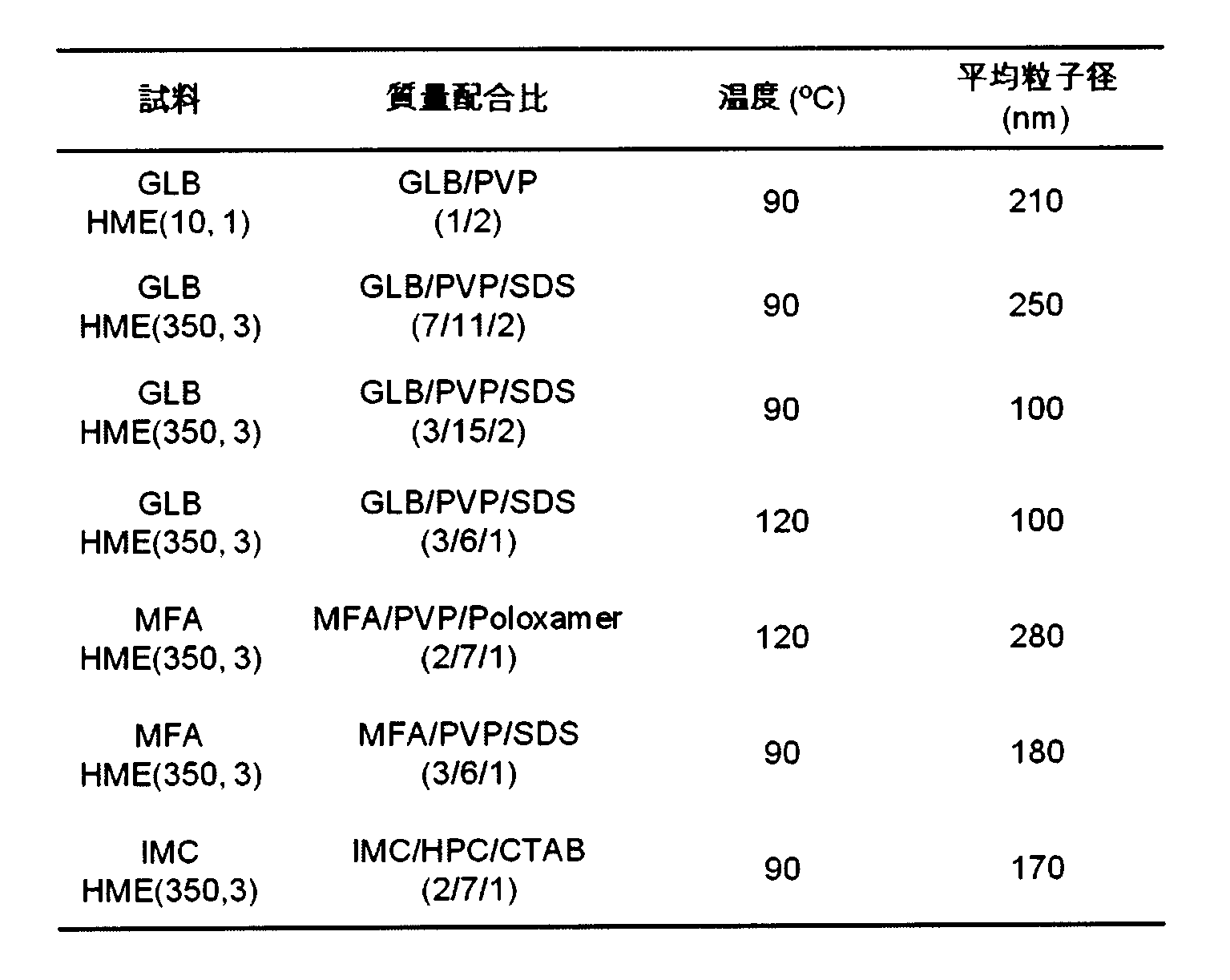
以下の表5の配合、スクリュー回転数、処理回数及び処理温度で、実施例1と同様に加熱溶融混練物を作製した。得られた加熱溶融混練物中の薬物粒子の平均粒子径は、表5のとおりであった。表5において、MFAはメフェナム酸、IMCはインドメタシンを表す。メフェナム酸の融点は230℃であり、インドメタシンの融点は160℃である。また、HPCはヒドロキシプロピルセルロースを表し、Poloxamer(ポロキサマー)及びCTAB(臭化ヘキサデシルトリメチルアンモニウム)は界面活性剤である。
[比較例4]
以下の表6の配合、スクリュー回転数、処理回数及び処理温度で、実施例1と同様に加熱溶融混練物を作製した。得られた加熱溶融混練物中の薬物粒子の平均粒子径は、表6のとおりであった。
以下の表6の配合、スクリュー回転数、処理回数及び処理温度で、実施例1と同様に加熱溶融混練物を作製した。得られた加熱溶融混練物中の薬物粒子の平均粒子径は、表6のとおりであった。

表5の結果から、実施例3で得られた薬物粒子の平均粒子径は280nm以下であり、いずれもナノ粒子であった。また、X線回折測定の結果、得られたいずれのナノ粒子も結晶質であった。比較例4のMFA/PVP/Poloxamerを配合した例は、加熱混練時の温度がMFAの融点より低かったが、その差が40℃しかなかったため、得られたものは非晶質であった。また、GLB/PVP/SDSを4:5:1で配合した例は、薬物であるGLBの混合割合が、GLBとPVPの合計に対して44%であったため、得られた粒子の平均粒子径は3μmを超え、ナノ粒子が得られなかった。GLB/PVP/SDSを1:8:1で配合した例は、薬物であるGLBの混合割合が、GLBとPVPの合計に対して11%であったため、加熱混練時にGLBが融解し非晶質となった。表1のGLB HME(10,1)と表5のGLB HME(10,1)とを比較すると、両者は共にGLBの混合割合が、GLBとPVPの合計に対して33%であり、加熱混練時の温度が90℃であるが、表1のGLB HME(10,1)では、平均粒子径が198.8nmであるのに対し、表5のGLB HME(10,1)では、210nmであった。これは、界面活性剤を配合したことにより、表1のGLB HME(10,1)においては、ナノ粒子化がより促進されたためと考えられる。また、表5のGLB HME(10,1)では、界面活性剤を用いていないため、得られた粒子を他の実施例と同様に蒸留水に分散させることはできなかった。そのため、SDSを溶解させた蒸留水中に超音波処理しながら分散させた。表5の結果はこうして分散させた粒子の平均粒子径を測定した結果である。
以下の表7の配合、スクリュー回転数、処理回数及び処理温度で、実施例2と同様に加熱溶融混練物を作製した。得られた加熱溶融混練物中の薬物粒子の平均粒子径は、表7のとおりであった。表7において、IBUはイブプロフェンを表し、イブプロフェンの融点は76℃である。

[比較例5]
以下の表8の配合、スクリュー回転数、処理回数及び処理温度で、実施例2と同様に加熱溶融混練物を作製した。得られた加熱溶融混練物中の薬物粒子の平均粒子径は、表8のとおりであった。
以下の表8の配合、スクリュー回転数、処理回数及び処理温度で、実施例2と同様に加熱溶融混練物を作製した。得られた加熱溶融混練物中の薬物粒子の平均粒子径は、表8のとおりであった。

表7の結果から、実施例4で得られた薬物粒子の平均粒子径は350nm以下であり、いずれもナノ粒子であった。また、X線回折測定の結果、得られたいずれのナノ粒子も結晶質であった。表8の結果から、比較例5のFFB/PVP/SDSを4:5:1で配合した例は、薬物であるFFBの混合割合が、FFBとPVPの合計に対して44%であったため、得られた粒子の平均粒子径は3μmを超え、ナノ粒子が得られなかった。FFB/PVP/SDSを3:15:2で配合した例は、薬物であるFFBの混合割合が、FFBとPVPの合計に対して17%であったため、加熱混練時にFFBが融解し非晶質となった。表3のFFBHME(10,1)と表7のFFBHME(10,1)とを比較すると、両者は共にFFBの混合割合が、FFBとPVPの合計に対して33%であり、加熱混練時の温度が90℃であるが、表3のFFBHME(10,1)では、平均粒子径が212.5nmであるのに対し、表7のFFBHME(10,1)では、230nmであった。これは、界面活性剤を配合したことにより、表3のFFBHME(10,1)においては、ナノ粒子化がより促進されたためと考えられる。また、表7のFFB HME(10,1)では、界面活性剤を用いていないため、得られた粒子を他の実施例と同様に蒸留水に分散させることはできなかった。そのため、SDSを溶解させた蒸留水中に超音波処理しながら分散させた。表7の結果はこうして分散させた粒子の平均粒子径を測定した結果である。
本発明の結晶質薬物ナノ粒子の製造方法及び結晶質薬物のナノ粒子化方法は、乾燥工程や有機溶媒が不要で、簡易に連続的に結晶質薬物をナノ粒子化できるので、薬物、特に難水溶性薬物の溶解性改善技術として有用である。
Claims (6)
- 結晶質薬物と水溶性高分子を、前記薬物が前記薬物及び前記水溶性高分子の合計に対して15~40質量%となるように混合した混合物を、前記薬物の融点より50℃以上低い温度で加熱し、混練することを特徴とする結晶質薬物ナノ粒子の製造方法。
- 結晶質薬物と水溶性高分子を、前記薬物が前記薬物及び前記水溶性高分子の合計に対して20~40質量%となるように混合した混合物を、前記薬物の融点より10℃以上高い温度で加熱し、混練することを特徴とする結晶質薬物ナノ粒子の製造方法。
- 混合物が、界面活性剤をさらに含むことを特徴とする請求項1又は2記載の結晶質薬物ナノ粒子の製造方法。
- 混合物における界面活性剤の含有量が、薬物、水溶性高分子及び前記界面活性剤の合計に対して5質量%以上であることを特徴とする請求項3に記載の結晶質薬物ナノ粒子の製造方法。
- 混合物を加熱し、混練した後、前記混合物を水中に投入することを特徴とする請求項1~4のいずれか記載の結晶質薬物ナノ粒子の製造方法。
- 結晶質薬物及び水溶性高分子の混合物を加熱し、混練することにより前記結晶質薬物を結晶質ナノ粒子にする方法であって、前記混合物における前記薬物の含有量が前記薬物及び前記水溶性高分子の合計に対して15~40質量%であり、加熱温度が前記薬物の融点より50℃以上低い温度である、又は前記混合物における前記薬物の含有量が前記薬物及び前記水溶性高分子の合計に対して20~40質量%であり、加熱温度が前記薬物の融点より10℃以上高い温度であることを特徴とする結晶質薬物のナノ粒子化方法。
Priority Applications (1)
| Application Number | Priority Date | Filing Date | Title |
|---|---|---|---|
| JP2017554796A JP6867035B2 (ja) | 2015-12-10 | 2016-12-09 | 結晶質薬物ナノ粒子の製造方法 |
Applications Claiming Priority (2)
| Application Number | Priority Date | Filing Date | Title |
|---|---|---|---|
| JP2015241484 | 2015-12-10 | ||
| JP2015-241484 | 2015-12-10 |
Publications (1)
| Publication Number | Publication Date |
|---|---|
| WO2017098729A1 true WO2017098729A1 (ja) | 2017-06-15 |
Family
ID=59013917
Family Applications (1)
| Application Number | Title | Priority Date | Filing Date |
|---|---|---|---|
| PCT/JP2016/005088 Ceased WO2017098729A1 (ja) | 2015-12-10 | 2016-12-09 | 結晶質薬物ナノ粒子の製造方法 |
Country Status (2)
| Country | Link |
|---|---|
| JP (1) | JP6867035B2 (ja) |
| WO (1) | WO2017098729A1 (ja) |
Cited By (2)
| Publication number | Priority date | Publication date | Assignee | Title |
|---|---|---|---|---|
| JP2022552305A (ja) * | 2019-10-10 | 2022-12-15 | バイエル、アクチエンゲゼルシャフト | 活性物質、ポリマーおよび界面活性剤を含んでなる医薬製剤を製造するための方法 |
| CN115969794A (zh) * | 2023-02-13 | 2023-04-18 | 爱力迈(安徽)动物药业有限公司 | 一种氟苯尼考纳米晶的制备方法 |
Citations (3)
| Publication number | Priority date | Publication date | Assignee | Title |
|---|---|---|---|---|
| JP2004099442A (ja) * | 2002-09-04 | 2004-04-02 | Nisshin Pharma Inc | 難溶性薬物含有製剤およびその製造方法 |
| JP2008543724A (ja) * | 2005-02-11 | 2008-12-04 | アボット ゲーエムベーハー ウント コンパニー カーゲー | 微結晶性活性物質の固体分散体を有する剤形の製造 |
| JP2014505714A (ja) * | 2011-02-17 | 2014-03-06 | エフ.ホフマン−ラ ロシュ アーゲー | ホットメルト押出法による過冷却液体状態からの活性医薬成分の制御された結晶化方法 |
-
2016
- 2016-12-09 JP JP2017554796A patent/JP6867035B2/ja active Active
- 2016-12-09 WO PCT/JP2016/005088 patent/WO2017098729A1/ja not_active Ceased
Patent Citations (3)
| Publication number | Priority date | Publication date | Assignee | Title |
|---|---|---|---|---|
| JP2004099442A (ja) * | 2002-09-04 | 2004-04-02 | Nisshin Pharma Inc | 難溶性薬物含有製剤およびその製造方法 |
| JP2008543724A (ja) * | 2005-02-11 | 2008-12-04 | アボット ゲーエムベーハー ウント コンパニー カーゲー | 微結晶性活性物質の固体分散体を有する剤形の製造 |
| JP2014505714A (ja) * | 2011-02-17 | 2014-03-06 | エフ.ホフマン−ラ ロシュ アーゲー | ホットメルト押出法による過冷却液体状態からの活性医薬成分の制御された結晶化方法 |
Non-Patent Citations (3)
| Title |
|---|
| BASF, SOLUPLUS(R), TECHNICAL INFORMATION, July 2010 (2010-07-01) * |
| BASF: "Kollidon VA64(R", TECHNICAL INFORMATION, March 2000 (2000-03-01), pages 3 - 10 * |
| BAUMGARTNER RAMONA ET AL.: "Nano-extrusion:A promising tool for continuous manufacturing of solid nano-formulations", INTERNATIONAL JOURNAL OF PHARMACEUTICS, vol. 477, 13 October 2014 (2014-10-13), pages 1 - 11, XP055392604, Retrieved from the Internet <URL:http://dx.doi.org/10.1016/j.ijpharm.2014.10.008> [retrieved on 20160120] * |
Cited By (2)
| Publication number | Priority date | Publication date | Assignee | Title |
|---|---|---|---|---|
| JP2022552305A (ja) * | 2019-10-10 | 2022-12-15 | バイエル、アクチエンゲゼルシャフト | 活性物質、ポリマーおよび界面活性剤を含んでなる医薬製剤を製造するための方法 |
| CN115969794A (zh) * | 2023-02-13 | 2023-04-18 | 爱力迈(安徽)动物药业有限公司 | 一种氟苯尼考纳米晶的制备方法 |
Also Published As
| Publication number | Publication date |
|---|---|
| JP6867035B2 (ja) | 2021-04-28 |
| JPWO2017098729A1 (ja) | 2018-10-25 |
Similar Documents
| Publication | Publication Date | Title |
|---|---|---|
| Zhang et al. | Coupling 3D printing with hot-melt extrusion to produce controlled-release tablets | |
| Pina et al. | The influence of drug physical state on the dissolution enhancement of solid dispersions prepared via hot-melt extrusion: a case study using olanzapine | |
| Liu et al. | Effects of extrusion process parameters on the dissolution behavior of indomethacin in Eudragit® E PO solid dispersions | |
| EP4116357B1 (en) | Resin beads, method for producing resin beads and product using resin beads | |
| KR101722568B1 (ko) | 생약재 및 가용화제를 포함하는 고체분산체 및 그 제조방법 | |
| Li et al. | A comparative assessment of nanocomposites vs. amorphous solid dispersions prepared via nanoextrusion for drug dissolution enhancement | |
| Liu et al. | Self-assembly of zein microspheres with controllable particle size and narrow distribution using a novel built-in ultrasonic dialysis process | |
| US5814621A (en) | Drug composition and process for preparing the same | |
| CN103561728B (zh) | 生产高堆积密度、良好流动性和改进的在冷水中的分散性的纤维素衍生物的方法 | |
| JP6077713B2 (ja) | ホットメルト断片化押出機およびプロセス | |
| CN102149410A (zh) | 医疗用复合有机化合物粉体及其制造方法以及悬浮液 | |
| CN1894158A (zh) | 使用固体脂肪作为溶剂制备纳米级或无定形颗粒的方法 | |
| JP6867035B2 (ja) | 結晶質薬物ナノ粒子の製造方法 | |
| JP7853275B2 (ja) | セルロースアシレート組成物及びその製造方法 | |
| Kumar et al. | Solid dispersion-strategy to enhance solubility and dissolution of poorly water soluble drugs | |
| CN102204868A (zh) | 采用多元辅料制备吲哚美辛速释制剂的热熔挤出工艺 | |
| CN107080745A (zh) | 一种载叶黄素白蛋白纳米粒的口腔速溶膜及其制备方法 | |
| Bhirud et al. | Advances in solid dispersion technology and its applications in the development of solid dosage forms | |
| KR101794032B1 (ko) | 나노입자 제조방법 | |
| JPS60190723A (ja) | 難溶性薬物の溶解速度向上方法 | |
| Verma et al. | Solid dispersion: different methods of enhancing solubility and classification of solid dispersion | |
| JPH0566364B2 (ja) | ||
| CN118994653B (zh) | 多形态淀粉纳米颗粒的制备方法 | |
| Jain et al. | Solid Dispersion Technique: A Strategic Solution to Boost Solubility | |
| R Jadhav et al. | Approaches to stabilize amorphous form-a review |
Legal Events
| Date | Code | Title | Description |
|---|---|---|---|
| 121 | Ep: the epo has been informed by wipo that ep was designated in this application |
Ref document number: 16872630 Country of ref document: EP Kind code of ref document: A1 |
|
| ENP | Entry into the national phase |
Ref document number: 2017554796 Country of ref document: JP Kind code of ref document: A |
|
| NENP | Non-entry into the national phase |
Ref country code: DE |
|
| 122 | Ep: pct application non-entry in european phase |
Ref document number: 16872630 Country of ref document: EP Kind code of ref document: A1 |