WO2017094763A1 - 共重合体及びその製造方法、並びに樹脂組成物 - Google Patents
共重合体及びその製造方法、並びに樹脂組成物 Download PDFInfo
- Publication number
- WO2017094763A1 WO2017094763A1 PCT/JP2016/085524 JP2016085524W WO2017094763A1 WO 2017094763 A1 WO2017094763 A1 WO 2017094763A1 JP 2016085524 W JP2016085524 W JP 2016085524W WO 2017094763 A1 WO2017094763 A1 WO 2017094763A1
- Authority
- WO
- WIPO (PCT)
- Prior art keywords
- copolymer
- resin
- acid
- amide bond
- structural unit
- Prior art date
- Legal status (The legal status is an assumption and is not a legal conclusion. Google has not performed a legal analysis and makes no representation as to the accuracy of the status listed.)
- Ceased
Links
Images
Classifications
-
- C—CHEMISTRY; METALLURGY
- C08—ORGANIC MACROMOLECULAR COMPOUNDS; THEIR PREPARATION OR CHEMICAL WORKING-UP; COMPOSITIONS BASED THEREON
- C08L—COMPOSITIONS OF MACROMOLECULAR COMPOUNDS
- C08L77/00—Compositions of polyamides obtained by reactions forming a carboxylic amide link in the main chain; Compositions of derivatives of such polymers
- C08L77/04—Polyamides derived from alpha-amino carboxylic acids
-
- C—CHEMISTRY; METALLURGY
- C08—ORGANIC MACROMOLECULAR COMPOUNDS; THEIR PREPARATION OR CHEMICAL WORKING-UP; COMPOSITIONS BASED THEREON
- C08G—MACROMOLECULAR COMPOUNDS OBTAINED OTHERWISE THAN BY REACTIONS ONLY INVOLVING UNSATURATED CARBON-TO-CARBON BONDS
- C08G63/00—Macromolecular compounds obtained by reactions forming a carboxylic ester link in the main chain of the macromolecule
- C08G63/68—Polyesters containing atoms other than carbon, hydrogen and oxygen
- C08G63/685—Polyesters containing atoms other than carbon, hydrogen and oxygen containing nitrogen
- C08G63/6852—Polyesters containing atoms other than carbon, hydrogen and oxygen containing nitrogen derived from hydroxy carboxylic acids
-
- C—CHEMISTRY; METALLURGY
- C08—ORGANIC MACROMOLECULAR COMPOUNDS; THEIR PREPARATION OR CHEMICAL WORKING-UP; COMPOSITIONS BASED THEREON
- C08G—MACROMOLECULAR COMPOUNDS OBTAINED OTHERWISE THAN BY REACTIONS ONLY INVOLVING UNSATURATED CARBON-TO-CARBON BONDS
- C08G69/00—Macromolecular compounds obtained by reactions forming a carboxylic amide link in the main chain of the macromolecule
- C08G69/02—Polyamides derived from amino-carboxylic acids or from polyamines and polycarboxylic acids
- C08G69/04—Preparatory processes
-
- C—CHEMISTRY; METALLURGY
- C08—ORGANIC MACROMOLECULAR COMPOUNDS; THEIR PREPARATION OR CHEMICAL WORKING-UP; COMPOSITIONS BASED THEREON
- C08G—MACROMOLECULAR COMPOUNDS OBTAINED OTHERWISE THAN BY REACTIONS ONLY INVOLVING UNSATURATED CARBON-TO-CARBON BONDS
- C08G69/00—Macromolecular compounds obtained by reactions forming a carboxylic amide link in the main chain of the macromolecule
- C08G69/02—Polyamides derived from amino-carboxylic acids or from polyamines and polycarboxylic acids
- C08G69/08—Polyamides derived from amino-carboxylic acids or from polyamines and polycarboxylic acids derived from amino-carboxylic acids
- C08G69/10—Alpha-amino-carboxylic acids
-
- C—CHEMISTRY; METALLURGY
- C08—ORGANIC MACROMOLECULAR COMPOUNDS; THEIR PREPARATION OR CHEMICAL WORKING-UP; COMPOSITIONS BASED THEREON
- C08G—MACROMOLECULAR COMPOUNDS OBTAINED OTHERWISE THAN BY REACTIONS ONLY INVOLVING UNSATURATED CARBON-TO-CARBON BONDS
- C08G69/00—Macromolecular compounds obtained by reactions forming a carboxylic amide link in the main chain of the macromolecule
- C08G69/44—Polyester-amides
-
- C—CHEMISTRY; METALLURGY
- C08—ORGANIC MACROMOLECULAR COMPOUNDS; THEIR PREPARATION OR CHEMICAL WORKING-UP; COMPOSITIONS BASED THEREON
- C08G—MACROMOLECULAR COMPOUNDS OBTAINED OTHERWISE THAN BY REACTIONS ONLY INVOLVING UNSATURATED CARBON-TO-CARBON BONDS
- C08G73/00—Macromolecular compounds obtained by reactions forming a linkage containing nitrogen with or without oxygen or carbon in the main chain of the macromolecule, not provided for in groups C08G12/00 - C08G71/00
- C08G73/06—Polycondensates having nitrogen-containing heterocyclic rings in the main chain of the macromolecule
- C08G73/10—Polyimides; Polyester-imides; Polyamide-imides; Polyamide acids or similar polyimide precursors
- C08G73/16—Polyester-imides
-
- C—CHEMISTRY; METALLURGY
- C08—ORGANIC MACROMOLECULAR COMPOUNDS; THEIR PREPARATION OR CHEMICAL WORKING-UP; COMPOSITIONS BASED THEREON
- C08L—COMPOSITIONS OF MACROMOLECULAR COMPOUNDS
- C08L101/00—Compositions of unspecified macromolecular compounds
-
- C—CHEMISTRY; METALLURGY
- C08—ORGANIC MACROMOLECULAR COMPOUNDS; THEIR PREPARATION OR CHEMICAL WORKING-UP; COMPOSITIONS BASED THEREON
- C08L—COMPOSITIONS OF MACROMOLECULAR COMPOUNDS
- C08L101/00—Compositions of unspecified macromolecular compounds
- C08L101/16—Compositions of unspecified macromolecular compounds the macromolecular compounds being biodegradable
-
- C—CHEMISTRY; METALLURGY
- C08—ORGANIC MACROMOLECULAR COMPOUNDS; THEIR PREPARATION OR CHEMICAL WORKING-UP; COMPOSITIONS BASED THEREON
- C08L—COMPOSITIONS OF MACROMOLECULAR COMPOUNDS
- C08L67/00—Compositions of polyesters obtained by reactions forming a carboxylic ester link in the main chain; Compositions of derivatives of such polymers
-
- C—CHEMISTRY; METALLURGY
- C08—ORGANIC MACROMOLECULAR COMPOUNDS; THEIR PREPARATION OR CHEMICAL WORKING-UP; COMPOSITIONS BASED THEREON
- C08L—COMPOSITIONS OF MACROMOLECULAR COMPOUNDS
- C08L67/00—Compositions of polyesters obtained by reactions forming a carboxylic ester link in the main chain; Compositions of derivatives of such polymers
- C08L67/04—Polyesters derived from hydroxycarboxylic acids, e.g. lactones
-
- A—HUMAN NECESSITIES
- A61—MEDICAL OR VETERINARY SCIENCE; HYGIENE
- A61K—PREPARATIONS FOR MEDICAL, DENTAL OR TOILETRY PURPOSES
- A61K47/00—Medicinal preparations characterised by the non-active ingredients used, e.g. carriers or inert additives; Targeting or modifying agents chemically bound to the active ingredient
- A61K47/30—Macromolecular organic or inorganic compounds, e.g. inorganic polyphosphates
- A61K47/34—Macromolecular compounds obtained otherwise than by reactions only involving carbon-to-carbon unsaturated bonds, e.g. polyesters, polyamino acids, polysiloxanes, polyphosphazines, copolymers of polyalkylene glycol or poloxamers
-
- C—CHEMISTRY; METALLURGY
- C08—ORGANIC MACROMOLECULAR COMPOUNDS; THEIR PREPARATION OR CHEMICAL WORKING-UP; COMPOSITIONS BASED THEREON
- C08G—MACROMOLECULAR COMPOUNDS OBTAINED OTHERWISE THAN BY REACTIONS ONLY INVOLVING UNSATURATED CARBON-TO-CARBON BONDS
- C08G2230/00—Compositions for preparing biodegradable polymers
-
- C—CHEMISTRY; METALLURGY
- C08—ORGANIC MACROMOLECULAR COMPOUNDS; THEIR PREPARATION OR CHEMICAL WORKING-UP; COMPOSITIONS BASED THEREON
- C08L—COMPOSITIONS OF MACROMOLECULAR COMPOUNDS
- C08L2201/00—Properties
- C08L2201/06—Biodegradable
Definitions
- the present invention relates to a copolymer useful for use for promoting hydrolysis of other resins, a method for producing the same, and a resin composition containing the copolymer.
- resins represented by polylactic acid, polyglycolic acid, polycaprolactone, etc. are biodegradable resins that are degraded by moisture and enzymes in the natural environment and in vivo, and are used in various applications in the form of films and fibers. It's being used.
- polylactic acid is used for applications such as disposable containers and packaging materials because it has good processability and excellent mechanical strength of molded products.
- the degradation rate under conditions other than compost for example, in seawater and soil
- polylactic acid has a slow degradation rate in the body, and remains long in the body after releasing the drug. Therefore, it is not possible to sufficiently meet the need for a preparation that releases drug in a relatively short period of time.
- Patent Document 1 discloses a block or graft copolymer having a hydrophilic segment derived from a polyamino acid and a hydrophobic segment composed of a degradable polymer.
- Patent Document 2 discloses a copolymer having a structural unit derived from a polyvalent carboxylic acid excluding amino acids and a structural unit derived from a hydroxycarboxylic acid.
- Patent Document 3 discloses a copolymer having a structural unit derived from a polyvalent carboxylic acid and a structural unit derived from a hydroxycarboxylic acid.
- Patent Document 4 further discloses a copolymer having both a succinimide unit and a hydroxycarboxylic acid unit, and Non-Patent Document 1 is obtained from aspartic acid and lactide.
- a novel copolymer is disclosed
- Non-Patent Document 2 discloses a novel method of synthesizing an aspartic acid-lactic acid copolymer by direct melt polycondensation
- Non-Patent Document 3 discloses aspartic acid and lactic acid or A method for synthesizing a copolymer with glycolic acid using a specific catalyst is disclosed.
- the copolymer described in Patent Document 2 is obtained using a polyvalent carboxylic acid (malic acid, citric acid, etc.) excluding amino acids, the glass transition temperature is low and there is a problem in storage stability.
- the copolymer described in the preparation example of Patent Document 3 has problems such as low glass transition temperature and poor storage stability because of its low molecular weight.
- JP 2000-345033 A International Publication No. 2012/137683 International Publication No. 2014/038608 JP 2000-159888 A
- an object of the present invention is a copolymer having excellent storage stability, good compatibility with other resins (such as biodegradable resins), and excellent performance for promoting hydrolysis of other resins and its It is in providing the manufacturing method and the resin composition containing the copolymer.
- the molar ratio (X / Y) between the structural unit (X) and the structural unit (Y) is 2/1 ⁇ (X / Y) ⁇ 8/1
- a copolymer in which the amide bond ratio of the structural unit (Y) represented by the following formula (1) is within the range of the following formulas (2-1) to (2-3).
- Amide bond ratio (%) A / Asp ⁇ 100 (1)
- A is the number of moles of amide bonds in the structural unit (Y) calculated from 1 H-NMR spectrum measured in deuterated dimethylformamide
- Asp is the number of structural units (Y) in the copolymer). Number of moles.) [When 2/1 ⁇ (X / Y) ⁇ 4/1] Amide bond ratio (%) ⁇ 25 (2-1) [When 4/1 ⁇ (X / Y) ⁇ 6.5 / 1] Amide bond ratio (%) ⁇ 30 (2-2) [If 6.5 / 1 ⁇ (X / Y) ⁇ 8/1] Amide bond ratio (%) ⁇ 50 (2-3)
- a resin (B) selected from the group consisting of polyolefin resin, polystyrene resin, polyester resin, polycarbonate resin and degradable resin, A resin composition having a mass ratio (A / B) of the copolymer (A) to the resin (B) of 1/99 to 50/50.
- the resin composition according to [12], wherein the degradable resin is an aliphatic polyester.
- the resin composition according to [11] wherein the reduced viscosity of the copolymer (A) in di
- the copolymer (A) described in [1] is mixed so that the mass ratio (A / B) of A) to the resin (B) is 1/99 to 50/50, thereby adding water to the resin (B). A way to promote degradation.
- a copolymer having excellent storage stability, good compatibility with other resins (such as biodegradable resins), and excellent performance in promoting hydrolysis of other resins can be obtained.
- the copolymer (A) of the present invention is a water-insoluble copolymer having a structural unit (X) derived from a hydroxycarboxylic acid and a structural unit (Y) derived from an amino group-containing polyvalent carboxylic acid. is there.
- water-insoluble means that the polymer is not substantially dissolved in water even when the polymer is poured into water at normal temperature (23 ° C.) and sufficiently stirred. Specifically, by visual observation, no change is observed between the state of the polymer powder in water immediately after the addition and the state of the polymer powder in water after sufficiently stirring, so that the polymer is " Those skilled in the art can easily determine that it is "water-insoluble”.
- Patent Document 4 described above also describes a copolymer which hydrolyzes an imide ring in a copolymer to generate a carboxyl group, thereby making it water-soluble.
- Copolymer has a low glass transition temperature and thus has poor storage stability, and has a problem that the molecular weight is remarkably lowered when kneaded with other resins (such as biodegradable resins). On the other hand, since the copolymer (A) of the present invention is insoluble in water, such a problem does not occur.
- the copolymer (A) of the present invention has a molar ratio (X / Y) of the structural unit (X) derived from hydroxycarboxylic acid and the structural unit (Y) derived from amino group-containing polyvalent carboxylic acid, 2/1 ⁇ (X / Y) ⁇ 8/1, and the amide bond ratio of the structural unit (Y) represented by the following formula (1) is represented by the following formulas (2-1) to (2-3). Is in range.
- Amide bond ratio (%) A / Asp ⁇ 100 (1) (In the formula, A is the number of moles of amide bonds in the structural unit (Y) calculated from 1 H-NMR spectrum measured in deuterated dimethylformamide, and Asp is the number of structural units (Y) in the copolymer). Number of moles.)
- the amide bond ratio is an index of the amount of the long chain branched structure in the copolymer (A).
- the structural unit (X) derived from the hydroxycarboxylic acid in the copolymer (A) and the structural unit (Y) derived from the amino group-containing polyvalent carboxylic acid are directly amide-bonded. It means that there are many places. A branched structure is inevitably generated at the amide bond portion, and a carboxyl group is present at the end of the branched structure.
- the ratio of the amide bond is high, the alternation between the structural unit (X) and the structural unit (Y) becomes high (blocking property is low), so that compared with the conventional copolymer having a high blocking property, The compatibility with a resin (such as a biodegradable resin) is increased, and as a result, the performance of promoting hydrolysis is improved.
- a resin such as a biodegradable resin
- the glass transition temperature of the copolymer is increased due to intermolecular hydrogen bonding, and the storage stability (blocking resistance, etc.) at high temperatures such as in a warehouse is improved.
- This effect is particularly effective when [4/1 ⁇ (X / Y) ⁇ 6.5 / 1] in the formula (2-2).
- the copolymer (A) having such a molar ratio (X / Y) tends to have a low original glass transition temperature, and therefore it is highly necessary to increase the glass transition temperature by the action of hydrogen bonding.
- the structural unit (X) is not particularly limited as long as it is a structural unit derived from hydroxycarboxylic acid.
- the valence (number of hydroxy groups) of the hydroxycarboxylic acid is preferably 1 to 4, more preferably 1 to 2, and most preferably 1.
- ⁇ -hydroxycarboxylic acids such as lactic acid, glycolic acid, 2-hydroxybutyric acid, 2-hydroxyvaleric acid, 2-hydroxycaproic acid, 2-hydroxycapric acid; lactide, glycolide, p-dioxanone, ⁇ -propiolactone
- a structural unit derived from ⁇ -butyrolactone, ⁇ -valerolactone or ⁇ -caprolactone is preferred, and a structural unit derived from lactic acid or lactide is more preferred.
- These structural units (X) may be used alone or in combination of two or more.
- lactide is a cyclic dimer of lactic acid
- glycolide is a cyclic dimer of glycolic acid, which are opened during polymerization and react as hydroxycarboxylic acids. Therefore, the structural unit which used those cyclic dimers as a raw material is also a structural unit derived from hydroxycarboxylic acid.
- the structural unit (Y) is not particularly limited as long as it is a structural unit derived from an amino group-containing polyvalent carboxylic acid.
- the valence (number of carboxyl groups) of the amino group-containing polyvalent carboxylic acid is preferably 2 to 4, more preferably 2 to 3, and most preferably 2.
- structural units derived from aspartic acid, glutamic acid or aminodicarboxylic acid are preferred.
- the structural unit (Y) may form a ring structure such as an imide ring, the ring structure may be opened, or these may be mixed. These structural units (Y) may be used alone or in combination of two or more.
- the amount must be such that the properties of the copolymer (A) are not significantly impaired. From this point, the amount is preferably 0 to 20 mol% in 100 mol% of the structural units of the entire copolymer (A).
- the weight average molecular weight (Mw) of the copolymer (A) of the present invention is preferably 8000 to 50000 g / mol, more preferably 10,000 to 30000 g / mol, and particularly preferably 12000 to 25000 g / mol.
- This Mw is a value measured using standard polystyrene by size exclusion chromatography (SEC) using dimethylacetamide, which will be described later, as an eluent. It is well known that the weight average molecular weight obtained by SEC varies greatly depending on conditions such as differences in eluent used, column, standard sample for relative comparison, and the like.
- the weight average molecular weight of the copolymer (A) of the present invention is a measured value when dimethylacetamide is used as an eluent under the conditions shown in Examples described later.
- Patent Document 3 discloses a measured value when chloroform is used as an eluent. Therefore, in order to facilitate comparison with the present invention, in the examples described later, the weight average molecular weight of a specific copolymer when chloroform is used as an eluent is also measured, and the correlation between the two measured values is examined. It was.
- the inherent viscosity of the copolymer (A) of the present invention in dimethylacetamide is preferably 0.05 dl / g or more and 0.20 dl / g or less, more preferably 0.08 dl / g or more and 0.15 dl / g or less. It is.
- the inherent viscosity is a value measured by preparing a sample dimethylacetamide solution having a specific concentration and using an Ubbelote viscosity tube.
- the acid value of the copolymer (A) of the present invention is preferably 0.2 mmol / g or more and 2.5 mmol / g or less, more preferably 0.8 mmol / g or more and 2.0 mmol / g or less.
- This acid value is a value measured by dissolving about 0.5 g of a sample in 30 mL of a mixed solution of chloroform / methanol (volume ratio 70/30) using a potentiometric titrator.
- a potentiometric titrator As described above, when the amide bond ratio is high, the number of branched structures increases, and accordingly, a large number of carboxyl groups exist at the molecular chain ends.
- the acid value of the copolymer (A) becomes relatively high. And when an acid value becomes high, the decomposition promotion ability when it mixes with other resin improves. In general linear polymers, the acid value decreases as the molecular weight increases (as the degree of polymerization increases).
- the copolymer (A) of the present invention can increase the molecular weight by increasing the branched structure and at the same time increase the acid value.
- the glass transition temperature of the copolymer (A) of the present invention is preferably 40 ° C. or higher, more preferably 52 ° C. to 120 ° C., particularly preferably 55 ° C. to 70 ° C., and has substantially no melting point. It is preferably amorphous.
- the glass transition temperature and melting point are values measured by DSC. As described above, the copolymer (A) of the present invention has a higher glass transition temperature as the amide bond ratio increases, and as a result, storage stability (such as blocking resistance) is improved. Moreover, if it is amorphous, it is not necessary to melt at high temperature.
- Increasing the glass transition temperature is particularly effective when the copolymer (A) has few structures that inherently tend to increase the glass transition temperature, such as a succinimide block structure.
- the phrase “having substantially no melting point” specifically means that no melting point is observed when DSC measurement is performed under the conditions in Examples described later.
- the method for producing the copolymer (A) of the present invention is not particularly limited.
- it can be obtained by mixing a hydroxycarboxylic acid and an amino group-containing polyvalent carboxylic acid and directly dehydrating and condensing under heating and reduced pressure in the presence or absence of a catalyst.
- the reaction temperature is preferably set lower than that of the conventional method. Specifically, the reaction temperature is preferably 170 ° C. or lower, more preferably 140 ° C. to 160 ° C. In order to obtain a copolymer having a high amide bond ratio such as the copolymer (A) of the present invention, it is important to perform polymerization in consideration of the reactivity (reaction rate, etc.) of each functional group.
- the reaction temperature is preferably set lower than that of the conventional method.
- the reaction temperature is preferably 170 ° C. or lower, more preferably 140 ° C. to 160 ° C.
- the reaction temperature is set to a relatively low temperature to suppress the reaction rate of the specific functional group of the amino group-containing polycarboxylic acid.
- the reaction temperature is 170 ° C. or lower, the copolymer (A) of the present invention is not necessarily obtained, and other conditions in the reaction such as the dehydration rate of by-product water produced by the reaction and stirring conditions are not necessarily obtained. It is also preferable to consider these as appropriate.
- Specific methods for quickly dewatering by-product water include the use of a reactor that increases the contact area between the reaction solution and the gas phase, higher stirring speed, and stirring such as Max Blend blades with high stirring efficiency. Examples thereof include the use of wings, blowing of an inert gas into the reaction system, and the use of an azeotropic solvent.
- heating may be performed at a high temperature exceeding 170 ° C. This is presumably because, when completely dissolved, an amide bond is sufficiently generated by the reaction between the amino group-containing polyvalent carboxylic acid and the hydroxycarboxylic acid, and the hydrolysis reaction of the generated amide bond is suppressed.
- the polymerization step for producing the copolymer (A) of the present invention is preferably performed stepwise under reduced pressure for the purpose of efficiently removing water generated as the polymerization reaction proceeds.
- the pressure is preferably 100 mmHg or less, more preferably 100 to 10 mmHg. It is also preferable to lower the pressure stepwise as the polymerization proceeds. Under such polymerization conditions, a copolymer having many branched structures and a high molecular weight tends to be obtained.
- the reaction time is preferably 10 to 40 hours, more preferably 15 to 30 hours.
- the catalyst include one or two or more catalysts selected from the group consisting of tin, titanium, zinc, aluminum, calcium, magnesium, and organic acids. Of these, divalent tin, titanium, and organic acids are preferable.
- copolymer (A) of the present invention is not limited, but it is preferably used for promoting hydrolysis of other resins. If the effect by the copolymer (A) of this invention is acquired, the kind of other resin will not be specifically limited.
- the resin (B) is a resin selected from the group consisting of a polyolefin resin, a polystyrene resin, a polyester resin, a polycarbonate resin, and a decomposable resin. It is particularly effective to use the copolymer (A) of the present invention in order to promote hydrolysis of the resin (B).
- polyolefin resins include high density polyethylene, low density polyethylene, linear low density polyethylene, polypropylene, polyisopropylene, polyisobutylene, polybutadiene, etc., synthesized from one or more olefin monomers such as ethylene, propylene, butylene, etc. Homopolymers or copolymers made, copolymers with any other monomer, or mixtures thereof.
- polystyrene resins include polystyrene, acrylonitrile-butadiene-styrene copolymers, homopolymers or copolymers synthesized from one or more styrene monomers, copolymers with any other monomers, A mixture etc. are mentioned.
- polyester resin examples include (1) ⁇ -hydroxymonocarboxylic acids (for example, glycolic acid, lactic acid, 2-hydroxybutyric acid, 2-hydroxyvaleric acid, 2-hydroxycaproic acid, 2-hydroxycapric acid), Homopolymers or copolymers synthesized from one or more hydroxycarboxylic acids such as hydroxydicarboxylic acids (eg malic acid), hydroxytricarboxylic acids (eg citric acid), copolymers with any other monomer, or mixtures thereof (2) 1 such as glycolide, lactide, benzyl malolactonate, malite benzyl ester, 3-[(benzyloxycarbonyl) methyl] -1,4-dioxane-2,5-dione, etc.
- ⁇ -hydroxymonocarboxylic acids for example, glycolic acid, lactic acid, 2-hydroxybutyric acid, 2-hydroxyvaleric acid, 2-hydroxycaproic acid, 2-hydroxycapric acid
- hydroxycarboxylic acids such as
- lactide Polylactides such as selected homopolymers or copolymers, copolymers with any other monomers, or mixtures thereof; (3) ⁇ -propiolactone, ⁇ -valerolactone, ⁇ -caprolactone, N-benzyloxycarbonyl-L -Polylactones such as homopolymers or copolymers synthesized from one or more lactones such as serine- ⁇ -lactone, copolymers with other optional monomers, or mixtures thereof.
- they can be copolymerized with glycolide, lactide and the like, which are cyclic dimers of ⁇ -hydroxy acid.
- polycarbonate resin examples include homopolymers or copolymers synthesized from one or more monomers such as polyoxymethylene, butylene polyterephthalate, ethylene polyterephthalate, and polyphenylene oxide, and copolymers with other arbitrary monomers. Homopolymers or copolymers synthesized from the above, copolymers with other arbitrary monomers, or mixtures thereof.
- degradable resin examples include the polyester resins (1) to (3) listed above, poly [1,3-bis (p-carboxyphenoxy) methane], poly (terephthalic acid-sebacic anhydride), and the like.
- polyolefin trees, polycarbonates, and decomposable resins are preferred from the viewpoint that the copolymer (A) and the resin (B) are not separated and mixed more uniformly. Is preferred.
- degradable resins from the viewpoint of compatibility with the copolymer (A), aliphatic polyesters, polylactides, and polylactones are preferable, aliphatic polyesters are more preferable, and polyhydroxycarboxylic acids (for example, polylactic acid, Lactic acid-glycolic acid copolymer, polycaprolactone) is most preferred.
- the molecular weight of the resin (B) is not particularly limited. However, considering the ease of mixing with the copolymer (A), the weight average molecular weight of the resin (B) is preferably 3000 or more and 500,000 or less, more preferably 10,000 or more and 300,000 or less. .
- the resin composition of the present invention is a composition containing the copolymer (A) of the present invention and the resin (B) described above. As described above, since the copolymer (A) suitably promotes hydrolysis of the resin (B), it is suitable as a biodegradable resin composition that is decomposed by moisture and enzymes in the natural environment or in vivo. It is.
- the mass ratio (A / B) of the copolymer (A) and the resin (B) is from 1/99 to 50/50, preferably from 5/95 to 50/50.
- the reduced viscosity of the copolymer (A) in the resin composition of the present invention in dimethylacetamide is preferably 0.05 or more and 0.20 or less, more preferably 0.08 or more and 0.15 or less.
- the mass ratio (A / B) of the copolymer (A) to the resin (B) is 1/99 to the resin (B) having a weight average molecular weight of 3000 to 500,000.
- This method is a method for producing the resin composition of the present invention described above, and is also an invention of a method that focuses particularly on promoting hydrolysis.
- the resin (B) is preferably an aliphatic polyester.
- the present invention will be specifically described based on examples, but the present invention is not limited to these examples.
- the measuring method of each physical property value is as follows.
- Glass transition temperature (Tg) and melting point Using a DSC-50 manufactured by Shimadzu Corporation, a copolymer sample precisely weighed in an aluminum pan was heated from room temperature to 150 ° C. at a rate of temperature increase of 10 ° C./min in a nitrogen stream, then rapidly cooled to 0 ° C. and then again raised The glass transition temperature (middle point) and melting point when the temperature was raised to 150 ° C. at a temperature rate of 10 ° C./min were measured.
- Example 1 In a 300 mL separable flask equipped with a Dean-Stark trap equipped with a stirring blade, thermometer, nitrogen inlet tube and condenser, 100.11 g of 90% L-lactic acid (HP-90) manufactured by Purac and asparagine manufactured by Wako Pure Chemical Industries, Ltd. 26.62 g of acid was charged. The molar ratio of lactic acid to aspartic acid is 5/1. Further, tin chloride dihydrate was added so that the tin concentration became 2000 ppm, and the atmosphere in the flask was replaced with nitrogen. The flask was immersed in an oil bath heated to 165 ° C. and dehydrated under nitrogen flow for 4 hours.
- the nitrogen flow was stopped, the internal temperature was 160 ° C., 5 hours at 100 mmHg, 10 hours at 30 mmHg, 2 hours at 10 mmHg, and the mixture was heated and stirred stepwise at a reduced pressure to obtain a copolymer.
- Example 2 Copolymerization as in Example 1 except that 300.33 g of 90% L-lactic acid (HP-90) manufactured by Purac and 79.86 g of aspartic acid manufactured by Wako Pure Chemical Industries, Ltd. were used (molar ratio 5/1). Coalescence was obtained.
- Example 3 A copolymer was obtained in the same manner as in Example 2 except that tin chloride dihydrate was not used.
- Example 4 In a 500 mL four-necked flask equipped with a Dean-Stark trap equipped with a stirring blade, thermometer, nitrogen inlet tube and condenser, 167 g of Purac 90% L-lactic acid (HP-90) and aspartic acid manufactured by Wako Pure Chemical Industries, Ltd. 45g was charged. The molar ratio of lactic acid to aspartic acid is 5/1. Further, tin chloride dihydrate was added so that the tin concentration became 2000 ppm, and the atmosphere in the flask was replaced with nitrogen. The flask was immersed in an oil bath heated to 145 ° C. and dehydrated under nitrogen flow for 13 hours.
- the nitrogen flow was stopped, the internal temperature was 140 ° C., 5 hours at 100 mmHg, 11 hours at 30 mmHg, 12 hours at 10 mmHg, and the mixture was heated and stirred stepwise while increasing the degree of vacuum to obtain a copolymer.
- Example 5 A copolymer was obtained in the same manner as in Example 1 except that the molar ratio of lactic acid to aspartic acid was changed to 2/1.
- Example 6 A copolymer was obtained in the same manner as in Example 1 except that the molar ratio of lactic acid to aspartic acid was changed to 7.5 / 1.
- Example 7 In a 500 mL separable flask equipped with a Dean-Stark trap equipped with a stirring blade, thermometer, nitrogen inlet tube and condenser, 300.33 g of 90% L-lactic acid (HP-90) manufactured by Purac and asparagine manufactured by Wako Pure Chemical Industries, Ltd. 79.86 g of acid was charged. The molar ratio of lactic acid to aspartic acid is 5/1. Furthermore, 1.9 g of tin octoate was added, and the atmosphere in the flask was replaced with nitrogen. Under nitrogen flow, the flask was immersed in an oil bath, heated to 160 ° C. over 1.5 hours, and dehydrated for another 3 hours at a stirring speed of 300 revolutions.
- HP-90 90% L-lactic acid manufactured by Purac and asparagine manufactured by Wako Pure Chemical Industries, Ltd. 79.86 g of acid was charged. The molar ratio of lactic acid to aspartic acid is 5/1.
- Aspartic acid was completely dissolved. Further dehydration was continued under a nitrogen stream for 1 hour. The amount of dehydration at this time was 88 g. Thereafter, the nitrogen flow was stopped, and the internal temperature was 160 ° C., 5 hours at 100 mmHg, 10 hours at 30 mmHg, 2 hours at 10 mmHg, and the mixture was heated and stirred stepwise while increasing the degree of vacuum to obtain a copolymer.
- Example 8> In the same manner as in Example 7, 300.33 g of lactic acid and 79.86 g of aspartic acid (molar ratio 5/1) were charged in a separable flask, and 1.9 g of tin octoate was added, and the atmosphere in the flask was replaced with nitrogen. Next, the flask was immersed in an oil bath under a nitrogen flow, heated to 150 ° C. over 1.5 hours, and dehydrated for another 3 hours at a stirring speed of 100 revolutions. Aspartic acid was completely dissolved. Further dehydration was continued under a nitrogen stream for 3 hours. The amount of dehydration at this time was 59 g. Thereafter, the nitrogen flow was stopped, and the degree of vacuum was increased stepwise under the same conditions as in Example 7, followed by heating and stirring to obtain a copolymer.
- Example 9 In a 2 L separable flask equipped with a Dean-Stark trap equipped with a stirring blade, thermometer, nitrogen inlet tube and condenser, 1802 g of 90% L-lactic acid (HP-90) manufactured by Purac and 479 g of aspartic acid manufactured by Wako Pure Chemical Industries, Ltd. Was charged. The molar ratio of lactic acid to aspartic acid is 5/1. Furthermore, 11.4 g of tin octoate was added, and the atmosphere in the flask was replaced with nitrogen. Under nitrogen flow, the flask was immersed in an oil bath, heated to 150 ° C. over 1.8 hours, and further dehydrated for 5 hours at a stirring speed of 300 revolutions.
- Aspartic acid was completely dissolved. Further dehydration was continued under a nitrogen stream for 1 hour. The amount of dehydration at this time was 390 g. Thereafter, the nitrogen flow was stopped, and the pressure was gradually reduced and maintained at 100 mmHg for 3 hours. The accumulated dewatering amount at this time was 567 g. Thereafter, the temperature was raised to 160 ° C., 10 hours at 30 mmHg, and 4 hours at 10 mmHg, the degree of vacuum was increased stepwise and the mixture was heated and stirred to obtain a copolymer.
- Example 10 As in Example 9, 1802 g of lactic acid and 479 g of aspartic acid (molar ratio 5/1) were charged into a separable flask, and 11.4 g of stannous octoate was added, and the atmosphere in the flask was replaced with nitrogen. Next, the flask was immersed in an oil bath under nitrogen flow, heated to 150 ° C. over 2.5 hours, and dehydrated at a stirring speed of 100 revolutions for another 5 hours. Aspartic acid was completely dissolved. Further dehydration was continued under a nitrogen stream for 1 hour. Thereafter, the nitrogen flow was stopped, and the pressure was gradually reduced and maintained at 100 mmHg for 3 hours. The accumulated dewatering amount at this time was 543 g.
- the temperature was raised to 180 ° C.
- the degree of vacuum was increased stepwise at 30 mmHg for 10 hours, and the mixture was heated and stirred to obtain a copolymer. That is, the reaction was performed at a low temperature until aspartic acid was dissolved, and then polycondensation was performed at a high temperature.
- the internal temperature is cooled to 130 ° C., then tin octoate is added so that the tin concentration becomes 2000 ppm, and the mixture is heated and stirred at an internal temperature of 180 ° C. and normal pressure for 25 hours under a nitrogen stream to obtain a copolymer. It was.
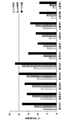
- FIG. 1 is a graph showing the relationship between the aspartic acid ratio and the amide bond ratio in the copolymers of Examples and Comparative Examples.
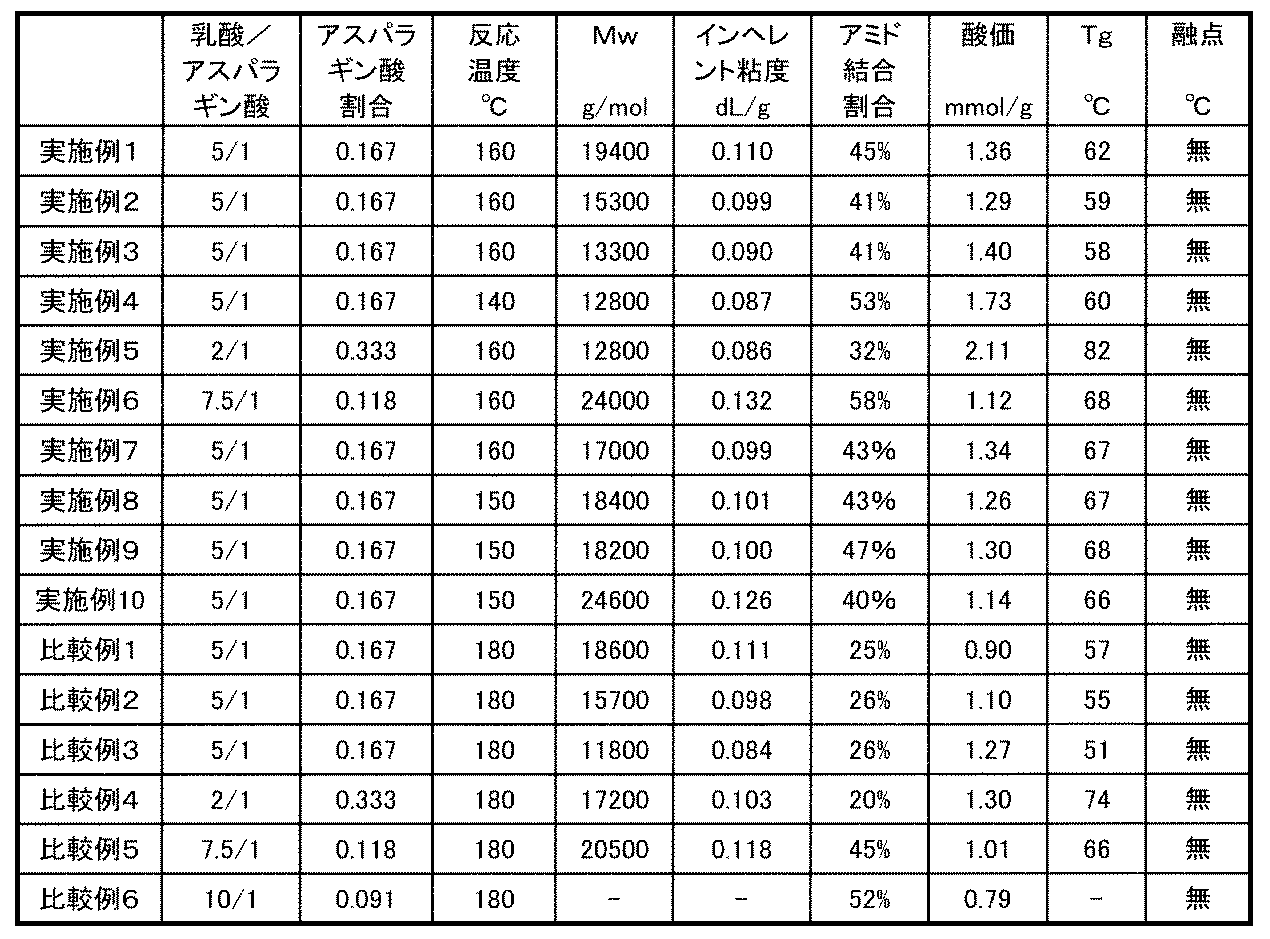
- the copolymers of Comparative Examples 1 to 6 were prepared by a conventional method (reaction temperature 180 ° C.), whereas the copolymers of Examples 1 to 10 were prepared by a special method (for example, reaction temperature 140 to 160). (Adjustment of other conditions such as ° C and stirring conditions).
- reaction temperature 140 to 160 As a result, as is clear from Table 2 and FIG. 1, the copolymers of Examples 1 to 10 have a higher amide bond ratio than the copolymers of Comparative Examples 1 to 5 having the same composition.
- Tg heat resistance is improved
- the copolymers of Examples 1 to 10 have a high acid value even though Tg is not low, so that they are useful when used as a decomposition accelerator or the like in which carboxylic acid is effective in promoting decomposition.
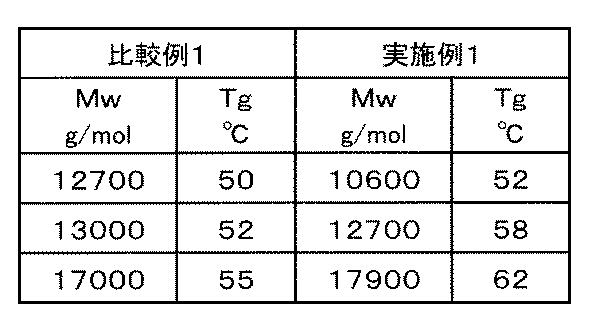
- Example 1 is higher than the Tg of Comparative Example 1 even when the copolymers having comparable molecular weights are compared.
- Such a relatively high Tg is advantageous in terms of performance such as storage stability.
- the Tg of this water-soluble compound was 47.2 ° C. Furthermore, when the solubility in water was examined, the solubility was about 12% by mass. Further, when it was left in the atmosphere at room temperature, it was sticky and very hygroscopic. That is, as described in Patent Document 1, when an imide bond is converted to an amide bond by ring opening, the amide bond ratio is expected to increase, but changes to water solubility, Tg decreases, and hygroscopicity increases. Get higher.
- the copolymer of the present invention having an amide bond in a specific ratio at the time of polymerization is insoluble in water, has a relatively high Tg, and has a low hygroscopic property, so that it has excellent storage stability.
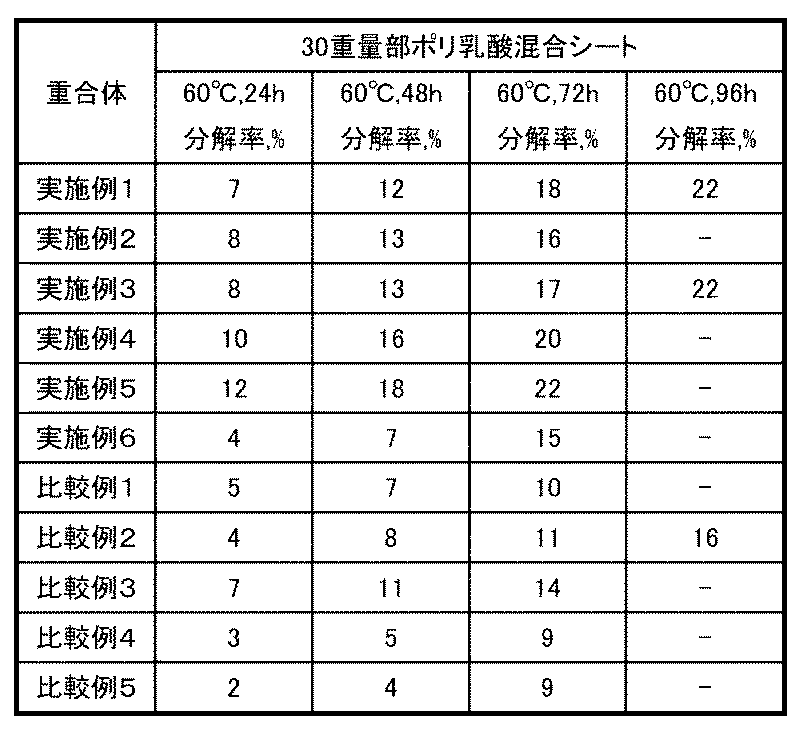
- polylactic acid manufactured by NatureWorks, trade name Ingeo 6302D
- the compositions obtained by mixing the copolymers of Examples 1 to 6 having many amide bonds and a high acid value are those of Comparative Examples 1 to 5 having a small amide bond and a low acid value.
- the rate of weight reduction by hydrolysis was faster. This is considered to be due to an increase in the compatibility with the increase in the amide bond ratio and an increase in the content of carboxyl groups having a catalytic action of hydrolysis, thereby promoting the decomposition.
- Example 6 having the lowest aspartic acid ratio among Examples 1 to 6 (molar ratio of lactic acid to aspartic acid 7.5 / 1, acid value 1.12 mmol / g) and Comparative Example Even when Comparative Example 4 (Molar ratio of lactic acid to aspartic acid 2/1, acid value 1.30 mmol / g) having the highest aspartic acid ratio among 1 to 5 was compared, The rate of weight reduction due to hydrolysis was faster than that of Comparative Example 4. From this fact, if a copolymer having an amide bond ratio within a specific range as in the present invention is used, it is excellent even if the ratio of aspartic acid (amino group-containing polycarboxylic acid) in the copolymer is low. It can be understood that hydrolysis can occur.
- the resin composition containing the copolymer (A) of the present invention and another resin is used as a biodegradable resin composition with accelerated hydrolysis, used as a container, film, fiber, etc., or in the pharmaceutical field (sustained release). It is useful for various uses such as the use of a sex medicine.
Landscapes
- Chemical & Material Sciences (AREA)
- Health & Medical Sciences (AREA)
- Medicinal Chemistry (AREA)
- Chemical Kinetics & Catalysis (AREA)
- Polymers & Plastics (AREA)
- Organic Chemistry (AREA)
- Polyamides (AREA)
- Biological Depolymerization Polymers (AREA)
- Life Sciences & Earth Sciences (AREA)
- Inorganic Chemistry (AREA)
- Epidemiology (AREA)
- Animal Behavior & Ethology (AREA)
- General Health & Medical Sciences (AREA)
- Public Health (AREA)
- Veterinary Medicine (AREA)
- Pharmacology & Pharmacy (AREA)
- Proteomics, Peptides & Aminoacids (AREA)
- Compositions Of Macromolecular Compounds (AREA)
- Macromolecular Compounds Obtained By Forming Nitrogen-Containing Linkages In General (AREA)
Abstract
Description
[1]ヒドロキシカルボン酸に由来する構成単位(X)と、アミノ基含有多価カルボン酸に由来する構成単位(Y)とを有する非水溶性の共重合体であって、
構成単位(X)と構成単位(Y)とのモル比(X/Y)が、2/1≦(X/Y)<8/1であり、
下記式(1)で表される構成単位(Y)のアミド結合割合が、下記式(2-1)~(2-3)の範囲内にある共重合体。
アミド結合割合(%)=A/Asp×100 ・・・(1)
(式中、Aは重ジメチルホルムアミド中で測定した1H-NMRスペクトルより算出される構成単位(Y)中のアミド結合のモル数であり、Aspは共重合体中の構成単位(Y)のモル数である。)
[2/1≦(X/Y)<4/1の場合]
アミド結合割合(%)≧25 ・・・(2-1)
[4/1≦(X/Y)≦6.5/1の場合]
アミド結合割合(%)≧30 ・・・(2-2)
[6.5/1<(X/Y)<8/1の場合]
アミド結合割合(%)≧50 ・・・(2-3)
[3]ジメチルアセトアミド中におけるインヘレント粘度が0.05dl/g以上、0.20dl/g以下である[1]に記載の共重合体。
[4]酸価が0.2mmol/g以上、2.5mmol/g以下である[1]に記載の共重合体。
[5]ガラス転移温度が40℃以上であり、実質的に融点を持たない非晶性である[1]に記載の共重合体。
[7]アミノ基含有多価カルボン酸が溶解するまでは、170℃以下の反応温度で重合する[6]に記載の共重合体の製造方法。
[8]100mmHg以下の反応圧力で重合する[6]に記載の共重合体の製造方法。
[9]触媒を用いて重合する[6]に記載の共重合体の製造方法。
[10]スズ、チタン、亜鉛、アルミニウム、カルシウム、マグネシウム及び有機酸からなる群より選ばれる1種又は2種以上の触媒を用いて重合する[9]に記載の共重合体の製造方法。
ポリオレフィン系樹脂、ポリスチレン系樹脂、ポリエステル系樹脂、ポリカーボート系樹脂及び分解性樹脂からなる群より選ばれる樹脂(B)とを含有し、
共重合体(A)と樹脂(B)の質量比(A/B)が1/99~50/50である樹脂組成物。
[12]樹脂(B)が、分解性樹脂である[11]に記載の樹脂組成物。
[13]分解性樹脂が、脂肪族ポリエステルである[12]に記載の樹脂組成物。
[14]共重合体(A)のジメチルアセトアミド中における還元粘度が0.05以上、0.20以下である[11]に記載の樹脂組成物。
[16]樹脂(B)が、脂肪族ポリエステルである[15]に記載の方法。
本発明の共重合体(A)は、ヒドロキシカルボン酸に由来する構成単位(X)と、アミノ基含有多価カルボン酸に由来する構成単位(Y)とを有する非水溶性の共重合体である。
アミド結合割合(%)=A/Asp×100 ・・・(1)
(式中、Aは重ジメチルホルムアミド中で測定した1H-NMRスペクトルより算出される構成単位(Y)中のアミド結合のモル数であり、Aspは共重合体中の構成単位(Y)のモル数である。)
アミド結合割合(%)≧25 ・・・(2-1)
[4/1≦(X/Y)≦6.5/1の場合]
アミド結合割合(%)≧30 ・・・(2-2)
[6.5/1<(X/Y)<8/1の場合]
アミド結合割合(%)≧50 ・・・(2-3)
このアミド結合割合(%)は、核磁気共鳴装置を用いて得られる1H-NMRスペクトルから算出した値である。
樹脂(B)は、ポリオレフィン系樹脂、ポリスチレン系樹脂、ポリエステル系樹脂、ポリカーボート系樹脂及び分解性樹脂からなる群より選ばれる樹脂である。本発明の共重合体(A)は、この樹脂(B)の加水分解を促進する為に用いることが特に有効である。
本発明の樹脂組成物は、本発明の共重合体(A)と、以上説明した樹脂(B)とを含有する組成物である。先に述べたように、共重合体(A)が樹脂(B)の加水分解を好適に促進するので、自然環境下や生体内で水分や酵素により分解される生分解性樹脂組成物として好適である。
本発明の加水分解促進方法は、重量平均分子量3000以上50万以下の樹脂(B)に対して、共重合体(A)と樹脂(B)の質量比(A/B)が1/99~50/50となるように共重合体(A)を混合することにより樹脂(B)の加水分解を促進する方法である。この方法は、以上説明した本発明の樹脂組成物の製造方法であると共に、特に加水分解を促進するという点に着眼した方法の発明でもある。ここでも、樹脂(B)としては、脂肪族ポリエステルが好ましい。
濃度が5%(w/v)となるように共重合体を重ジメチルスルホキシドに室温で完全に溶解し、JEOL社製270MHz核磁気共鳴装置を用いて1H-NMRスペクトルを測定した。得られたスペクトルから、以下の式で共重合体中のアミド結合割合を算出した。TMSを0ppmとしたとき、以下の範囲でそれぞれ積分強度を算出する。
Ia: 9.23 ~ 7.75ppm
Ib: 5.92 ~ 3.84ppm
Ic: 4.38 ~ 4.08ppm
Id: 2.04 ~ 0.28ppm
Ia:アミド由来プロトン
Ib:乳酸及びアスパラギン酸由来のメチン及び乳酸末端ヒドロキシル基由来のプロトンの総和
Ic:末端乳酸由来のメチンプロトン(乳酸末端ヒドロキシル基と強度が等価)
Id:乳酸由来のメチル基
これらの強度比より、以下の式によりアミド結合割合を算出する。
アミド結合割合(%) = [Ia/{Ib-(Id/3+Ic)}]×100
サイズ排除クロマトグラフィー(SEC)を使用し、5mM臭化リチウム及びリン酸を溶解したジメチルアセトアミド(DMAc)を溶離液に用い、共重合体の重量平均分子量(Mw)及び数平均分子量(Mn)を標準ポリスチレン(分子量63000、186000、65500、28500、13000、3790、1270)によって作成した3次の標準曲線の相対値として算出した。以下に測定条件を示した。
検出器:島津製RID-10A、カラム:アジレント・テクノロジー社製PLgel 5μm Mixed-C(2本)、カラム温度:40℃、流量:1.0ml/分、試料濃度:20mg/mL(注入量100μL)

[クロロホルム溶離液の場合のMw]=0.9413×[DMAc溶離液の場合のMw]-3410 (i)
試料濃度4%のジメチルアセトアミド溶液を調製し、ウベローテ粘度管を用いてインヘレント粘度(dl/g)を測定した。
[Mw]=261×103×[インヘレント粘度]-10400 (ii)
共重合体試料約0.5gを精秤し、クロロホルム/メタノール(容積比70/30)の混合溶液30mLに溶解し、京都電子社製自動電位差滴定装置(AT-510)により0.1N水酸化カリウム(2-プロパノール溶液)を滴定液として算出した。
島津製作所社製DSC-50を用い、アルミパンに精秤した共重合体試料を窒素気流下、昇温速度10℃/分で室温から150℃まで昇温した後0℃まで急冷し、再び昇温速度10℃/分で150℃まで昇温したときのガラス転移温度(中間点)及び融点を測定した。
撹拌羽、温度計、窒素導入管及びコンデンサーを取り付けたディーンスタークトラップを備え付けた300mLのセパラブルフラスコに、Purac社製90%L-乳酸(HP-90)100.11g及び和光純薬社製アスパラギン酸26.62gを仕込んだ。この乳酸とアスパラギン酸とのモル比は5/1である。さらに、塩化スズ2水和物をスズ濃度が2000ppmとなるよう加え、フラスコ内を窒素置換した。165℃に加熱したオイルバスにフラスコを浸漬し、4時間窒素流通下で脱水した。窒素流通を停止し、内温160℃、100mmHgにて5時間、30mmHgで10時間、10mmHgで2時間、段階的に減圧度を高めて加熱撹拌し、共重合体を得た。
Purac社製90%L-乳酸(HP-90)300.33g及び和光純薬社製アスパラギン酸79.86gを用いた(モル比5/1)こと以外は、実施例1と同様にして共重合体を得た。
塩化スズ2水和物を用いなかったこと以外は、実施例2と同様にして共重合体を得た。
撹拌羽、温度計、窒素導入管及びコンデンサーを取り付けたディーンスタークトラップを備え付けた500mLの4ツ口フラスコに、Purac社製90%L-乳酸(HP-90)167g及び和光純薬社製アスパラギン酸45gを仕込んだ。この乳酸とアスパラギン酸とのモル比は5/1である。さらに、塩化スズ2水和物をスズ濃度が2000ppmとなるよう加え、フラスコ内を窒素置換した。145℃に加熱したオイルバスにフラスコを浸漬し、13時間窒素流通下で脱水した。窒素流通を停止し、内温140℃、100mmHgにて5時間、30mmHgで11時間、10mmHgで12時間、段階的に減圧度を高めて加熱撹拌し、共重合体を得た。
乳酸とアスパラギン酸のモル比を2/1に変更したこと以外は、実施例1と同様にして共重合体を得た。
乳酸とアスパラギン酸のモル比を7.5/1に変更したこと以外は、実施例1と同様にして共重合体を得た。
撹拌羽、温度計、窒素導入管及びコンデンサーを取り付けたディーンスタークトラップを備え付けた500mLのセパラブルフラスコに、Purac社製90%L-乳酸(HP-90)300.33g及び和光純薬社製アスパラギン酸79.86gを仕込んだ。この乳酸とアスパラギン酸とのモル比は5/1である。さらに、オクタン酸スズを1.9g加え、フラスコ内を窒素置換した。窒素流通下、オイルバスにフラスコを浸漬し、1.5時間かけて160℃まで昇温し、撹拌速度300回転でさらに3時間脱水したところでアスパラギン酸は完全に溶解した。さらに1時間窒素気流下で脱水を継続した。この時の脱水量は88gであった。その後、窒素流通を停止し、内温160℃、100mmHgにて5時間、30mmHgで10時間、10mmHgで2時間、段階的に減圧度を高めて加熱撹拌し、共重合体を得た。
実施例7と同様に、セパラブルフラスコに乳酸300.33gとアスパラギン酸79.86g(モル比5/1)を仕込み、オクタン酸スズを1.9g加えてフラスコ内を窒素置換した。次いで、窒素流通下、オイルバスにフラスコを浸漬し、1.5時間かけて150℃まで昇温し、撹拌速度100回転でさらに3時間脱水したところでアスパラギン酸は完全に溶解した。さらに3時間窒素気流下で脱水を継続した。この時の脱水量は59gであった。その後、窒素流通を停止し、実施例7と同じ条件で段階的に減圧度を高めて加熱撹拌し、共重合体を得た。
撹拌羽、温度計、窒素導入管及びコンデンサーを取り付けたディーンスタークトラップを備え付けた2Lのセパラブルフラスコに、Purac社製90%L-乳酸(HP-90)1802g及び和光純薬社製アスパラギン酸479gを仕込んだ。この乳酸とアスパラギン酸とのモル比は5/1である。さらに、オクタン酸スズを11.4g加え、フラスコ内を窒素置換した。窒素流通下、オイルバスにフラスコを浸漬し、1.8時間かけて150℃まで昇温し、撹拌速度300回転でさらに5時間脱水したところでアスパラギン酸は完全に溶解した。さらに1時間窒素気流下で脱水を継続した。この時の脱水量は390gであった。その後、窒素流通を停止し、徐々に減圧して100mmHgにて3時間保持した。この時の積算脱水量は567gであった。その後160℃に昇温し、30mmHgで10時間、10mmHgで4時間、段階的に減圧度を高めて加熱撹拌し、共重合体を得た。
実施例9と同様に、セパラブルフラスコに乳酸1802gとアスパラギン酸479g(モル比5/1)を仕込み、オクタン酸スズを11.4g加えてフラスコ内を窒素置換した。次いで、窒素流通下、オイルバスにフラスコを浸漬し、2.5時間かけて150℃まで昇温し、撹拌速度100回転でさらに5時間脱水したところでアスパラギン酸が完全に溶解した。さらに1時間窒素気流下で脱水を継続した。その後、窒素流通を停止し、徐々に減圧して100mmHgにて3時間保持した。この時の積算脱水量は543gであった。その後180℃に昇温し、30mmHgで10時間段階的に減圧度を高めて加熱撹拌し、共重合体を得た。すなわち、アスパラギン酸が溶解するまでは低温で反応を行い、その後高温にて重縮合を行った。
撹拌羽、温度計、窒素導入管及びコンデンサーを取り付けたディーンスタークトラップを備え付けた300mLのセパラブルフラスコに、Purac社製L-ラクチド72.1g及び和光純薬社製アスパラギン酸26.62gを仕込んだ。この乳酸(L-ラクチドから換算)とアスパラギン酸とのモル比は5/1である。185℃に加熱したオイルバスにフラスコを浸漬し、8時間窒素流通下でアスパラギン酸を溶解させた。次いで、内温が130℃になるまで冷却し、その後オクタン酸スズをスズ濃度が2000ppmとなるよう加え、窒素気流下、内温180℃、常圧で25時間加熱撹拌し、共重合体を得た。
反応温度を180℃に変更したこと以外は、実施例3と同様にして共重合体を得た。
1500mLのセパラブルフラスコを用いたこと、Purac社製90%L-乳酸(HP-90)1200g及び和光純薬社製アスパラギン酸319.44gを用いた(モル比5/1)こと、及び、反応温度(内温)を180℃に変更したこと以外は、実施例3と同様にして共重合体を得た。
乳酸とアスパラギン酸のモル比を2/1に変更したこと以外は、比較例1と同様にして共重合体を得た。
乳酸とアスパラギン酸のモル比を7.5/1に変更したこと以外は、比較例1と同様にして共重合体を得た。
乳酸とアスパラギン酸のモル比を10/1に変更したこと以外は、比較例1と同様にして共重合体を得た。
実施例1及び比較例1の重合反応途中におけるMwの変化に伴うTgの変化を測定した。結果を表3に示す。
実施例1~10の共重合体約200mgをイオン交換水10mL中へ加え、室温で1時間撹拌し、水への溶解性を調べた。いずれの共重合体も全く溶解しなかった。一方、比較例2の共重合体約5gを、特許文献1を参照して、0.1モル/Lの水酸化ナトリウム水溶液を滴下し共重合体中のスクシンイミド部分を開環させた。次いで0.1モル/Lの塩酸で中和し、クロロホルム/メタノール溶媒を添加して塩化ナトリウムを析出させてろ過し、ろ液を真空乾燥および凍結乾燥し、スクシンイミド部分が開環した水溶性化合物を得た。この水溶性化合物のTgは47.2℃であった。さらに、水への溶解性を調べたところ溶解度は約12質量%であった。また、室温で大気中に放置しておくとべとつきが生じ、非常に吸湿性が高いものであった。すなわち、特許文献1に記載されるようにイミド結合を開環によりアミド結合へ変換した場合は、アミド結合割合は高くなると予想されるものの水溶性へと変化し、Tgが低下し、吸湿性が高くなる。一方、重合時に既にアミド結合を特定の割合で有する本発明の共重合体は非水溶性であり、Tgも比較的高く、吸湿性が低いので保存安定性に優れる。
実施例2の共重合体及び比較例2の共重合体の紛体100gをそれぞれアルミ袋に密閉し、50℃のオーブン中に1か月間保管した後取り出した。実施例2の共重合体は取り出したのち手で容易にほぐれ、元の紛体の性状となったが、比較例2で得られた共重合体は融着し、全体が一つの塊となってしまった。
実施例1~6及び比較例1~5の共重合体30質量部、及び、ポリ乳酸(NatureWorks社製、商品名Ingeo6302D)70質量部を、DSM社製マイクロコンパウンダーを用い、180℃、100rpmの条件にて10分間混練し、ストランドを得た。この混練時には、実施例1~6及び比較例1~5の共重合体の分子量低下の差異は認められなかった。次に、得られたストランドを溶融真空プレスして厚み約160μmのシートを作製し、20mm角にカットして試験片とした。
Claims (16)
- ヒドロキシカルボン酸に由来する構成単位(X)と、アミノ基含有多価カルボン酸に由来する構成単位(Y)とを有する非水溶性の共重合体であって、
構成単位(X)と構成単位(Y)とのモル比(X/Y)が、2/1≦(X/Y)<8/1であり、
下記式(1)で表される構成単位(Y)のアミド結合割合が、下記式(2-1)~(2-3)の範囲内にある共重合体。
アミド結合割合(%)=A/Asp×100 ・・・(1)
(式中、Aは重ジメチルホルムアミド中で測定した1H-NMRスペクトルより算出される構成単位(Y)中のアミド結合のモル数であり、Aspは共重合体中の構成単位(Y)のモル数である。)
[2/1≦(X/Y)<4/1の場合]
アミド結合割合(%)≧25 ・・・(2-1)
[4/1≦(X/Y)≦6.5/1の場合]
アミド結合割合(%)≧30 ・・・(2-2)
[6.5/1<(X/Y)<8/1の場合]
アミド結合割合(%)≧50 ・・・(2-3) - ジメチルアセトアミドを溶離液としたサイズ排除クロマトグラフィーにより測定される重量平均分子量が、8000以上、50000以下である請求項1に記載の共重合体。
- ジメチルアセトアミド中におけるインヘレント粘度が0.05dl/g以上、0.20dl/g以下である請求項1に記載の共重合体。
- 酸価が0.2mmol/g以上、2.5mmol/g以下である請求項1に記載の共重合体。
- ガラス転移温度が40℃以上であり、実質的に融点を持たない非晶性である請求項1に記載の共重合体。
- 請求項1に記載の共重合体を製造する為の方法であって、ヒドロキシカルボン酸とアミノ基含有多価カルボン酸とを直接脱水縮合することにより重合する工程を有する共重合体の製造方法。
- アミノ基含有多価カルボン酸が溶解するまでは、170℃以下の反応温度で重合する請求項6に記載の共重合体の製造方法。
- 100mmHg以下の反応圧力で重合する請求項6に記載の共重合体の製造方法。
- 触媒を用いて重合する請求項6に記載の共重合体の製造方法。
- スズ、チタン、亜鉛、アルミニウム、カルシウム、マグネシウム及び有機酸からなる群より選ばれる1種又は2種以上の触媒を用いて重合する請求項9に記載の共重合体の製造方法。
- 請求項1に記載の共重合体(A)と、
ポリオレフィン系樹脂、ポリスチレン系樹脂、ポリエステル系樹脂、ポリカーボート系樹脂及び分解性樹脂からなる群より選ばれる樹脂(B)とを含有し、
共重合体(A)と樹脂(B)の質量比(A/B)が1/99~50/50である樹脂組成物。 - 樹脂(B)が分解性樹脂である請求項11に記載の樹脂組成物。
- 分解性樹脂が脂肪族ポリエステルである請求項12に記載の樹脂組成物。
- 共重合体(A)のジメチルアセトアミド中における還元粘度が0.05以上、0.20以下である請求項11に記載の樹脂組成物。
- ポリオレフィン系樹脂、ポリスチレン系樹脂、ポリエステル系樹脂、ポリカーボート系樹脂及び分解性樹脂からなる群より選ばれる重量平均分子量3000以上50万以下の樹脂(B)に対して、共重合体(A)と樹脂(B)の質量比(A/B)が1/99~50/50となるように請求項1に記載の共重合体(A)を混合することにより樹脂(B)の加水分解を促進する方法。
- 樹脂(B)が脂肪族ポリエステルである請求項15に記載の方法。
Priority Applications (7)
| Application Number | Priority Date | Filing Date | Title |
|---|---|---|---|
| CN201680069905.1A CN108291029B (zh) | 2015-12-04 | 2016-11-30 | 共聚物及其制造方法以及树脂组合物 |
| AU2016361696A AU2016361696A1 (en) | 2015-12-04 | 2016-11-30 | Copolymer, method for producing same and resin composition |
| US15/780,318 US20190002691A1 (en) | 2015-12-04 | 2016-11-30 | Copolymer, production method thereof, and resin composition |
| MX2018006772A MX2018006772A (es) | 2015-12-04 | 2016-11-30 | Copolimero, metodo de produccion del mismo y composicion de resina. |
| CA3006708A CA3006708C (en) | 2015-12-04 | 2016-11-30 | Copolymer, production method thereof, and resin composition |
| JP2017554136A JPWO2017094763A1 (ja) | 2015-12-04 | 2016-11-30 | 共重合体及びその製造方法、並びに樹脂組成物 |
| AU2020202896A AU2020202896A1 (en) | 2015-12-04 | 2020-04-30 | Copolymer, method for producing same and resin composition |
Applications Claiming Priority (2)
| Application Number | Priority Date | Filing Date | Title |
|---|---|---|---|
| JP2015-237343 | 2015-12-04 | ||
| JP2015237343 | 2015-12-04 |
Publications (1)
| Publication Number | Publication Date |
|---|---|
| WO2017094763A1 true WO2017094763A1 (ja) | 2017-06-08 |
Family
ID=58797004
Family Applications (1)
| Application Number | Title | Priority Date | Filing Date |
|---|---|---|---|
| PCT/JP2016/085524 Ceased WO2017094763A1 (ja) | 2015-12-04 | 2016-11-30 | 共重合体及びその製造方法、並びに樹脂組成物 |
Country Status (7)
| Country | Link |
|---|---|
| US (1) | US20190002691A1 (ja) |
| JP (1) | JPWO2017094763A1 (ja) |
| CN (1) | CN108291029B (ja) |
| AU (2) | AU2016361696A1 (ja) |
| CA (1) | CA3006708C (ja) |
| MX (1) | MX2018006772A (ja) |
| WO (1) | WO2017094763A1 (ja) |
Cited By (2)
| Publication number | Priority date | Publication date | Assignee | Title |
|---|---|---|---|---|
| JP2020164567A (ja) * | 2019-03-28 | 2020-10-08 | 三井化学株式会社 | アスパラギン酸−乳酸共重合体の製造方法 |
| JPWO2019203037A1 (ja) * | 2018-04-16 | 2021-04-30 | コニカミノルタ株式会社 | ポリマーブレンド組成物及びポリマーフィルム |
Families Citing this family (4)
| Publication number | Priority date | Publication date | Assignee | Title |
|---|---|---|---|---|
| WO2021002471A1 (ja) | 2019-07-03 | 2021-01-07 | 三菱ケミカル株式会社 | ダイバーティングエージェント及びこれを用いた坑井の亀裂の閉塞方法 |
| EP4239026A4 (en) * | 2020-10-30 | 2024-11-06 | Toray Industries, Inc. | Polymer composition and molded article |
| CN114456364B (zh) * | 2022-02-18 | 2023-06-02 | 自然资源部第二海洋研究所 | 一种羟基乙酸聚合物及其衍生物的合成方法及应用 |
| CN120272007B (zh) * | 2025-06-10 | 2025-09-23 | 洛阳市智耕农业科技有限公司 | 一种氨基酸基可降解材料的制备方法 |
Citations (3)
| Publication number | Priority date | Publication date | Assignee | Title |
|---|---|---|---|---|
| JP2008024851A (ja) * | 2006-07-21 | 2008-02-07 | Mitsui Chemicals Inc | 生分解性組成物、その成形体および用途 |
| WO2012137681A1 (ja) * | 2011-04-01 | 2012-10-11 | 三井化学株式会社 | 生分解性樹脂組成物及びその成形体 |
| WO2014038608A1 (ja) * | 2012-09-07 | 2014-03-13 | 三井化学株式会社 | 水性分散液およびフラクチャリング作業用添加剤 |
Family Cites Families (2)
| Publication number | Priority date | Publication date | Assignee | Title |
|---|---|---|---|---|
| US6372880B1 (en) * | 1997-12-25 | 2002-04-16 | Mitsui Chemicals, Inc. | Copolymer and process for preparing the same |
| CN100516120C (zh) * | 2000-01-21 | 2009-07-22 | 三井化学株式会社 | 烯烃嵌段共聚物,其制备方法和用途 |
-
2016
- 2016-11-30 MX MX2018006772A patent/MX2018006772A/es unknown
- 2016-11-30 WO PCT/JP2016/085524 patent/WO2017094763A1/ja not_active Ceased
- 2016-11-30 JP JP2017554136A patent/JPWO2017094763A1/ja active Pending
- 2016-11-30 AU AU2016361696A patent/AU2016361696A1/en not_active Abandoned
- 2016-11-30 US US15/780,318 patent/US20190002691A1/en not_active Abandoned
- 2016-11-30 CN CN201680069905.1A patent/CN108291029B/zh active Active
- 2016-11-30 CA CA3006708A patent/CA3006708C/en active Active
-
2020
- 2020-04-30 AU AU2020202896A patent/AU2020202896A1/en not_active Abandoned
Patent Citations (3)
| Publication number | Priority date | Publication date | Assignee | Title |
|---|---|---|---|---|
| JP2008024851A (ja) * | 2006-07-21 | 2008-02-07 | Mitsui Chemicals Inc | 生分解性組成物、その成形体および用途 |
| WO2012137681A1 (ja) * | 2011-04-01 | 2012-10-11 | 三井化学株式会社 | 生分解性樹脂組成物及びその成形体 |
| WO2014038608A1 (ja) * | 2012-09-07 | 2014-03-13 | 三井化学株式会社 | 水性分散液およびフラクチャリング作業用添加剤 |
Cited By (3)
| Publication number | Priority date | Publication date | Assignee | Title |
|---|---|---|---|---|
| JPWO2019203037A1 (ja) * | 2018-04-16 | 2021-04-30 | コニカミノルタ株式会社 | ポリマーブレンド組成物及びポリマーフィルム |
| JP2020164567A (ja) * | 2019-03-28 | 2020-10-08 | 三井化学株式会社 | アスパラギン酸−乳酸共重合体の製造方法 |
| JP7291518B2 (ja) | 2019-03-28 | 2023-06-15 | 三井化学株式会社 | アスパラギン酸-乳酸共重合体の製造方法 |
Also Published As
| Publication number | Publication date |
|---|---|
| CN108291029A (zh) | 2018-07-17 |
| AU2016361696A1 (en) | 2018-07-19 |
| CN108291029B (zh) | 2021-03-09 |
| CA3006708C (en) | 2020-07-28 |
| MX2018006772A (es) | 2018-08-01 |
| JPWO2017094763A1 (ja) | 2018-09-20 |
| US20190002691A1 (en) | 2019-01-03 |
| AU2020202896A1 (en) | 2020-05-21 |
| CA3006708A1 (en) | 2017-06-08 |
Similar Documents
| Publication | Publication Date | Title |
|---|---|---|
| WO2017094763A1 (ja) | 共重合体及びその製造方法、並びに樹脂組成物 | |
| JP7619042B2 (ja) | ポリマー組成物、成形体および神経再生誘導チューブ | |
| TWI608031B (zh) | 聚酯及其製造方法 | |
| Zhou et al. | Effect of star-shaped chain architectures on the polylactide stereocomplex crystallization behaviors | |
| Baimark et al. | Effect of chain extension on thermal stability behaviors of polylactide bioplastics | |
| Nanthananon et al. | Effect of chain architecture and comonomer ratio on the biodegradability and thermal stability of biodegradable copolymers of l-lactide and δ-valerolactone | |
| US6372844B1 (en) | Resin composition | |
| Bhattarai et al. | Synthesis and characterization of ABA type tri‐block copolymers derived from p‐dioxanone, l‐lactide and poly (ethylene glycol) | |
| WO2012137681A1 (ja) | 生分解性樹脂組成物及びその成形体 | |
| JP7116169B2 (ja) | 乳酸-グリコール酸共重合体及びその製造方法 | |
| Hu et al. | Random copolymerization of trimethylene carbonate with l-lactide initiated by amine-bridged bis (phenolate) neodymium alkoxides | |
| JP7566401B2 (ja) | ポリラクテートステレオコンプレックスおよびその製造方法 | |
| Hyun et al. | Preparation of diblock copolymers consisting of methoxy poly (ethylene glycol) and poly (ε‐caprolactone)/poly (L‐lactide) and their degradation property | |
| JP4390273B2 (ja) | 生分解性樹脂組成物 | |
| JP4634566B2 (ja) | 樹脂組成物及びその製造方法 | |
| Ibrahim et al. | High molecular weight of polylactic acid (PLA): A review on the effect of initiator | |
| CN105073025A (zh) | 由具有两个或更多个羧酸基团的单醇和二醇聚合引发剂制备的聚内酯聚合物 | |
| Li et al. | Synthesis of poly (lactic acid-b-p-dioxanone) block copolymers from ring opening polymerization of p-dioxanone by poly (L-lactic acid) macroinitiators | |
| JP6950885B2 (ja) | 生分解性樹脂多孔質体 | |
| Bagheri et al. | Synthesis and characterization of biodegradable random copolymers of L-lactide, glycolide and trimethylene carbonate | |
| JP2002234934A (ja) | 反応性置換基を有する生分解性重合体 | |
| Little | Synthesis and characterisation of glycolic acid-based copolymers for biodegradable plastic packaging | |
| CN104610533A (zh) | 基于聚乳酸的新型可降解聚酯及其制备方法 | |
| CN115397883B (zh) | 共聚物及其制备方法 | |
| JP7772467B2 (ja) | ブロック共重合体およびその製造方法 |
Legal Events
| Date | Code | Title | Description |
|---|---|---|---|
| 121 | Ep: the epo has been informed by wipo that ep was designated in this application |
Ref document number: 16870700 Country of ref document: EP Kind code of ref document: A1 |
|
| WWE | Wipo information: entry into national phase |
Ref document number: 3006708 Country of ref document: CA |
|
| ENP | Entry into the national phase |
Ref document number: 2017554136 Country of ref document: JP Kind code of ref document: A |
|
| WWE | Wipo information: entry into national phase |
Ref document number: MX/A/2018/006772 Country of ref document: MX |
|
| NENP | Non-entry into the national phase |
Ref country code: DE |
|
| ENP | Entry into the national phase |
Ref document number: 2016361696 Country of ref document: AU Date of ref document: 20161130 Kind code of ref document: A |
|
| 122 | Ep: pct application non-entry in european phase |
Ref document number: 16870700 Country of ref document: EP Kind code of ref document: A1 |