WO2017094411A1 - ゴム組成物及び積層体 - Google Patents
ゴム組成物及び積層体 Download PDFInfo
- Publication number
- WO2017094411A1 WO2017094411A1 PCT/JP2016/082011 JP2016082011W WO2017094411A1 WO 2017094411 A1 WO2017094411 A1 WO 2017094411A1 JP 2016082011 W JP2016082011 W JP 2016082011W WO 2017094411 A1 WO2017094411 A1 WO 2017094411A1
- Authority
- WO
- WIPO (PCT)
- Prior art keywords
- rubber
- group
- vulcanization
- hose
- mass
- Prior art date
- Legal status (The legal status is an assumption and is not a legal conclusion. Google has not performed a legal analysis and makes no representation as to the accuracy of the status listed.)
- Ceased
Links
Images



Classifications
-
- B—PERFORMING OPERATIONS; TRANSPORTING
- B32—LAYERED PRODUCTS
- B32B—LAYERED PRODUCTS, i.e. PRODUCTS BUILT-UP OF STRATA OF FLAT OR NON-FLAT, e.g. CELLULAR OR HONEYCOMB, FORM
- B32B25/00—Layered products comprising a layer of natural or synthetic rubber
- B32B25/16—Layered products comprising a layer of natural or synthetic rubber comprising polydienes homopolymers or poly-halodienes homopolymers
-
- B—PERFORMING OPERATIONS; TRANSPORTING
- B32—LAYERED PRODUCTS
- B32B—LAYERED PRODUCTS, i.e. PRODUCTS BUILT-UP OF STRATA OF FLAT OR NON-FLAT, e.g. CELLULAR OR HONEYCOMB, FORM
- B32B1/00—Layered products having a non-planar shape
- B32B1/08—Tubular products
-
- B—PERFORMING OPERATIONS; TRANSPORTING
- B32—LAYERED PRODUCTS
- B32B—LAYERED PRODUCTS, i.e. PRODUCTS BUILT-UP OF STRATA OF FLAT OR NON-FLAT, e.g. CELLULAR OR HONEYCOMB, FORM
- B32B15/00—Layered products comprising a layer of metal
- B32B15/02—Layer formed of wires, e.g. mesh
-
- B—PERFORMING OPERATIONS; TRANSPORTING
- B32—LAYERED PRODUCTS
- B32B—LAYERED PRODUCTS, i.e. PRODUCTS BUILT-UP OF STRATA OF FLAT OR NON-FLAT, e.g. CELLULAR OR HONEYCOMB, FORM
- B32B15/00—Layered products comprising a layer of metal
- B32B15/04—Layered products comprising a layer of metal comprising metal as the main or only constituent of a layer, which is next to another layer of the same or of a different material
- B32B15/043—Layered products comprising a layer of metal comprising metal as the main or only constituent of a layer, which is next to another layer of the same or of a different material of metal
-
- B—PERFORMING OPERATIONS; TRANSPORTING
- B32—LAYERED PRODUCTS
- B32B—LAYERED PRODUCTS, i.e. PRODUCTS BUILT-UP OF STRATA OF FLAT OR NON-FLAT, e.g. CELLULAR OR HONEYCOMB, FORM
- B32B15/00—Layered products comprising a layer of metal
- B32B15/04—Layered products comprising a layer of metal comprising metal as the main or only constituent of a layer, which is next to another layer of the same or of a different material
- B32B15/06—Layered products comprising a layer of metal comprising metal as the main or only constituent of a layer, which is next to another layer of the same or of a different material of natural rubber or synthetic rubber
-
- B—PERFORMING OPERATIONS; TRANSPORTING
- B32—LAYERED PRODUCTS
- B32B—LAYERED PRODUCTS, i.e. PRODUCTS BUILT-UP OF STRATA OF FLAT OR NON-FLAT, e.g. CELLULAR OR HONEYCOMB, FORM
- B32B15/00—Layered products comprising a layer of metal
- B32B15/18—Layered products comprising a layer of metal comprising iron or steel
-
- B—PERFORMING OPERATIONS; TRANSPORTING
- B32—LAYERED PRODUCTS
- B32B—LAYERED PRODUCTS, i.e. PRODUCTS BUILT-UP OF STRATA OF FLAT OR NON-FLAT, e.g. CELLULAR OR HONEYCOMB, FORM
- B32B25/00—Layered products comprising a layer of natural or synthetic rubber
- B32B25/02—Layered products comprising a layer of natural or synthetic rubber with fibres or particles being present as additives in the layer
-
- B—PERFORMING OPERATIONS; TRANSPORTING
- B32—LAYERED PRODUCTS
- B32B—LAYERED PRODUCTS, i.e. PRODUCTS BUILT-UP OF STRATA OF FLAT OR NON-FLAT, e.g. CELLULAR OR HONEYCOMB, FORM
- B32B25/00—Layered products comprising a layer of natural or synthetic rubber
- B32B25/12—Layered products comprising a layer of natural or synthetic rubber comprising natural rubber
-
- B—PERFORMING OPERATIONS; TRANSPORTING
- B32—LAYERED PRODUCTS
- B32B—LAYERED PRODUCTS, i.e. PRODUCTS BUILT-UP OF STRATA OF FLAT OR NON-FLAT, e.g. CELLULAR OR HONEYCOMB, FORM
- B32B25/00—Layered products comprising a layer of natural or synthetic rubber
- B32B25/18—Layered products comprising a layer of natural or synthetic rubber comprising butyl or halobutyl rubber
-
- B—PERFORMING OPERATIONS; TRANSPORTING
- B32—LAYERED PRODUCTS
- B32B—LAYERED PRODUCTS, i.e. PRODUCTS BUILT-UP OF STRATA OF FLAT OR NON-FLAT, e.g. CELLULAR OR HONEYCOMB, FORM
- B32B27/00—Layered products comprising a layer of synthetic resin
- B32B27/32—Layered products comprising a layer of synthetic resin comprising polyolefins
-
- C—CHEMISTRY; METALLURGY
- C08—ORGANIC MACROMOLECULAR COMPOUNDS; THEIR PREPARATION OR CHEMICAL WORKING-UP; COMPOSITIONS BASED THEREON
- C08J—WORKING-UP; GENERAL PROCESSES OF COMPOUNDING; AFTER-TREATMENT NOT COVERED BY SUBCLASSES C08B, C08C, C08F, C08G or C08H
- C08J5/00—Manufacture of articles or shaped materials containing macromolecular substances
- C08J5/04—Reinforcing macromolecular compounds with loose or coherent fibrous material
- C08J5/0405—Reinforcing macromolecular compounds with loose or coherent fibrous material with inorganic fibres
- C08J5/041—Reinforcing macromolecular compounds with loose or coherent fibrous material with inorganic fibres with metal fibres
-
- C—CHEMISTRY; METALLURGY
- C08—ORGANIC MACROMOLECULAR COMPOUNDS; THEIR PREPARATION OR CHEMICAL WORKING-UP; COMPOSITIONS BASED THEREON
- C08K—Use of inorganic or non-macromolecular organic substances as compounding ingredients
- C08K5/00—Use of organic ingredients
- C08K5/04—Oxygen-containing compounds
- C08K5/05—Alcohols; Metal alcoholates
- C08K5/053—Polyhydroxylic alcohols
-
- C—CHEMISTRY; METALLURGY
- C08—ORGANIC MACROMOLECULAR COMPOUNDS; THEIR PREPARATION OR CHEMICAL WORKING-UP; COMPOSITIONS BASED THEREON
- C08L—COMPOSITIONS OF MACROMOLECULAR COMPOUNDS
- C08L9/00—Compositions of homopolymers or copolymers of conjugated diene hydrocarbons
-
- C—CHEMISTRY; METALLURGY
- C08—ORGANIC MACROMOLECULAR COMPOUNDS; THEIR PREPARATION OR CHEMICAL WORKING-UP; COMPOSITIONS BASED THEREON
- C08L—COMPOSITIONS OF MACROMOLECULAR COMPOUNDS
- C08L9/00—Compositions of homopolymers or copolymers of conjugated diene hydrocarbons
- C08L9/06—Copolymers with styrene
-
- C—CHEMISTRY; METALLURGY
- C09—DYES; PAINTS; POLISHES; NATURAL RESINS; ADHESIVES; COMPOSITIONS NOT OTHERWISE PROVIDED FOR; APPLICATIONS OF MATERIALS NOT OTHERWISE PROVIDED FOR
- C09D—COATING COMPOSITIONS, e.g. PAINTS, VARNISHES OR LACQUERS; FILLING PASTES; CHEMICAL PAINT OR INK REMOVERS; INKS; CORRECTING FLUIDS; WOODSTAINS; PASTES OR SOLIDS FOR COLOURING OR PRINTING; USE OF MATERIALS THEREFOR
- C09D109/00—Coating compositions based on homopolymers or copolymers of conjugated diene hydrocarbons
-
- C—CHEMISTRY; METALLURGY
- C09—DYES; PAINTS; POLISHES; NATURAL RESINS; ADHESIVES; COMPOSITIONS NOT OTHERWISE PROVIDED FOR; APPLICATIONS OF MATERIALS NOT OTHERWISE PROVIDED FOR
- C09D—COATING COMPOSITIONS, e.g. PAINTS, VARNISHES OR LACQUERS; FILLING PASTES; CHEMICAL PAINT OR INK REMOVERS; INKS; CORRECTING FLUIDS; WOODSTAINS; PASTES OR SOLIDS FOR COLOURING OR PRINTING; USE OF MATERIALS THEREFOR
- C09D121/00—Coating compositions based on unspecified rubbers
-
- B—PERFORMING OPERATIONS; TRANSPORTING
- B32—LAYERED PRODUCTS
- B32B—LAYERED PRODUCTS, i.e. PRODUCTS BUILT-UP OF STRATA OF FLAT OR NON-FLAT, e.g. CELLULAR OR HONEYCOMB, FORM
- B32B2250/00—Layers arrangement
- B32B2250/03—3 layers
-
- B—PERFORMING OPERATIONS; TRANSPORTING
- B32—LAYERED PRODUCTS
- B32B—LAYERED PRODUCTS, i.e. PRODUCTS BUILT-UP OF STRATA OF FLAT OR NON-FLAT, e.g. CELLULAR OR HONEYCOMB, FORM
- B32B2250/00—Layers arrangement
- B32B2250/40—Symmetrical or sandwich layers, e.g. ABA, ABCBA, ABCCBA
-
- B—PERFORMING OPERATIONS; TRANSPORTING
- B32—LAYERED PRODUCTS
- B32B—LAYERED PRODUCTS, i.e. PRODUCTS BUILT-UP OF STRATA OF FLAT OR NON-FLAT, e.g. CELLULAR OR HONEYCOMB, FORM
- B32B2255/00—Coating on the layer surface
- B32B2255/06—Coating on the layer surface on metal layer
-
- B—PERFORMING OPERATIONS; TRANSPORTING
- B32—LAYERED PRODUCTS
- B32B—LAYERED PRODUCTS, i.e. PRODUCTS BUILT-UP OF STRATA OF FLAT OR NON-FLAT, e.g. CELLULAR OR HONEYCOMB, FORM
- B32B2255/00—Coating on the layer surface
- B32B2255/20—Inorganic coating
- B32B2255/205—Metallic coating
-
- B—PERFORMING OPERATIONS; TRANSPORTING
- B32—LAYERED PRODUCTS
- B32B—LAYERED PRODUCTS, i.e. PRODUCTS BUILT-UP OF STRATA OF FLAT OR NON-FLAT, e.g. CELLULAR OR HONEYCOMB, FORM
- B32B2262/00—Composition or structural features of fibres which form a fibrous or filamentary layer or are present as additives
- B32B2262/10—Inorganic fibres
- B32B2262/101—Glass fibres
-
- B—PERFORMING OPERATIONS; TRANSPORTING
- B32—LAYERED PRODUCTS
- B32B—LAYERED PRODUCTS, i.e. PRODUCTS BUILT-UP OF STRATA OF FLAT OR NON-FLAT, e.g. CELLULAR OR HONEYCOMB, FORM
- B32B2264/00—Composition or properties of particles which form a particulate layer or are present as additives
- B32B2264/10—Inorganic particles
-
- B—PERFORMING OPERATIONS; TRANSPORTING
- B32—LAYERED PRODUCTS
- B32B—LAYERED PRODUCTS, i.e. PRODUCTS BUILT-UP OF STRATA OF FLAT OR NON-FLAT, e.g. CELLULAR OR HONEYCOMB, FORM
- B32B2264/00—Composition or properties of particles which form a particulate layer or are present as additives
- B32B2264/10—Inorganic particles
- B32B2264/104—Oxysalt, e.g. carbonate, sulfate, phosphate or nitrate particles
-
- B—PERFORMING OPERATIONS; TRANSPORTING
- B32—LAYERED PRODUCTS
- B32B—LAYERED PRODUCTS, i.e. PRODUCTS BUILT-UP OF STRATA OF FLAT OR NON-FLAT, e.g. CELLULAR OR HONEYCOMB, FORM
- B32B2264/00—Composition or properties of particles which form a particulate layer or are present as additives
- B32B2264/10—Inorganic particles
- B32B2264/107—Ceramic
- B32B2264/108—Carbon, e.g. graphite particles
-
- B—PERFORMING OPERATIONS; TRANSPORTING
- B32—LAYERED PRODUCTS
- B32B—LAYERED PRODUCTS, i.e. PRODUCTS BUILT-UP OF STRATA OF FLAT OR NON-FLAT, e.g. CELLULAR OR HONEYCOMB, FORM
- B32B2264/00—Composition or properties of particles which form a particulate layer or are present as additives
- B32B2264/12—Mixture of at least two particles made of different materials
-
- B—PERFORMING OPERATIONS; TRANSPORTING
- B32—LAYERED PRODUCTS
- B32B—LAYERED PRODUCTS, i.e. PRODUCTS BUILT-UP OF STRATA OF FLAT OR NON-FLAT, e.g. CELLULAR OR HONEYCOMB, FORM
- B32B2270/00—Resin or rubber layer containing a blend of at least two different polymers
-
- B—PERFORMING OPERATIONS; TRANSPORTING
- B32—LAYERED PRODUCTS
- B32B—LAYERED PRODUCTS, i.e. PRODUCTS BUILT-UP OF STRATA OF FLAT OR NON-FLAT, e.g. CELLULAR OR HONEYCOMB, FORM
- B32B2307/00—Properties of the layers or laminate
- B32B2307/50—Properties of the layers or laminate having particular mechanical properties
- B32B2307/51—Elastic
-
- B—PERFORMING OPERATIONS; TRANSPORTING
- B32—LAYERED PRODUCTS
- B32B—LAYERED PRODUCTS, i.e. PRODUCTS BUILT-UP OF STRATA OF FLAT OR NON-FLAT, e.g. CELLULAR OR HONEYCOMB, FORM
- B32B2307/00—Properties of the layers or laminate
- B32B2307/50—Properties of the layers or laminate having particular mechanical properties
- B32B2307/54—Yield strength; Tensile strength
-
- B—PERFORMING OPERATIONS; TRANSPORTING
- B32—LAYERED PRODUCTS
- B32B—LAYERED PRODUCTS, i.e. PRODUCTS BUILT-UP OF STRATA OF FLAT OR NON-FLAT, e.g. CELLULAR OR HONEYCOMB, FORM
- B32B2307/00—Properties of the layers or laminate
- B32B2307/70—Other properties
- B32B2307/712—Weather resistant
-
- B—PERFORMING OPERATIONS; TRANSPORTING
- B32—LAYERED PRODUCTS
- B32B—LAYERED PRODUCTS, i.e. PRODUCTS BUILT-UP OF STRATA OF FLAT OR NON-FLAT, e.g. CELLULAR OR HONEYCOMB, FORM
- B32B2307/00—Properties of the layers or laminate
- B32B2307/70—Other properties
- B32B2307/726—Permeability to liquids, absorption
- B32B2307/7265—Non-permeable
-
- B—PERFORMING OPERATIONS; TRANSPORTING
- B32—LAYERED PRODUCTS
- B32B—LAYERED PRODUCTS, i.e. PRODUCTS BUILT-UP OF STRATA OF FLAT OR NON-FLAT, e.g. CELLULAR OR HONEYCOMB, FORM
- B32B2307/00—Properties of the layers or laminate
- B32B2307/70—Other properties
- B32B2307/732—Dimensional properties
-
- B—PERFORMING OPERATIONS; TRANSPORTING
- B32—LAYERED PRODUCTS
- B32B—LAYERED PRODUCTS, i.e. PRODUCTS BUILT-UP OF STRATA OF FLAT OR NON-FLAT, e.g. CELLULAR OR HONEYCOMB, FORM
- B32B2307/00—Properties of the layers or laminate
- B32B2307/70—Other properties
- B32B2307/748—Releasability
-
- B—PERFORMING OPERATIONS; TRANSPORTING
- B32—LAYERED PRODUCTS
- B32B—LAYERED PRODUCTS, i.e. PRODUCTS BUILT-UP OF STRATA OF FLAT OR NON-FLAT, e.g. CELLULAR OR HONEYCOMB, FORM
- B32B2433/00—Closed loop articles
- B32B2433/02—Conveyor belts
-
- B—PERFORMING OPERATIONS; TRANSPORTING
- B32—LAYERED PRODUCTS
- B32B—LAYERED PRODUCTS, i.e. PRODUCTS BUILT-UP OF STRATA OF FLAT OR NON-FLAT, e.g. CELLULAR OR HONEYCOMB, FORM
- B32B2597/00—Tubular articles, e.g. hoses, pipes
-
- B—PERFORMING OPERATIONS; TRANSPORTING
- B32—LAYERED PRODUCTS
- B32B—LAYERED PRODUCTS, i.e. PRODUCTS BUILT-UP OF STRATA OF FLAT OR NON-FLAT, e.g. CELLULAR OR HONEYCOMB, FORM
- B32B2605/00—Vehicles
-
- C—CHEMISTRY; METALLURGY
- C08—ORGANIC MACROMOLECULAR COMPOUNDS; THEIR PREPARATION OR CHEMICAL WORKING-UP; COMPOSITIONS BASED THEREON
- C08L—COMPOSITIONS OF MACROMOLECULAR COMPOUNDS
- C08L91/00—Compositions of oils, fats or waxes; Compositions of derivatives thereof
- C08L91/06—Waxes
Definitions
- the present invention relates to a rubber composition and a laminate.
- a hose for example, a hydraulic hose used for a construction machine or the like uses a laminate including a rubber layer and a reinforcing layer whose surface is plated with a metal such as brass (brass). Also, from the viewpoint of preventing wear due to contact with a rotating body such as a pulley, butadiene rubber having excellent wear resistance may be used for the rubber layer.
- Patent Document 1 discloses a hydraulic hose having a rubber layer formed using a composition containing butadiene rubber as a main component and a brass plating wire reinforcing layer adjacent to the rubber layer (patent). Claims etc.).
- the vulcanization method when manufacturing a hose comprising a rubber layer and a reinforcing layer having a metal surface, it is usually vulcanized after an unvulcanized rubber layer is formed on the reinforcing layer.
- the vulcanization method at this time there are mainly a steam vulcanization method in which vulcanization is performed by heating with steam, and an oven vulcanization method in which vulcanization is performed by heating in an oven.
- the steam vulcanization method is a closed system and continuous production is difficult
- the oven vulcanization method is an open system, so continuous production is possible. From the viewpoint of productivity, the steam vulcanization method is better than the steam vulcanization method.
- the oven vulcanization method is preferred.
- the present invention has excellent adhesion to a metal surface not only when vulcanized by a steam vulcanization method but also when vulcanized by an oven vulcanization method, and vulcanization.
- a rubber composition that exhibits excellent adhesion even when left in a moist heat environment, and a laminate comprising a reinforcing layer having a metal surface and a rubber layer formed using the rubber composition.
- the present inventors have found that the above problems can be solved by blending polyhydric alcohol. That is, the present inventor has found that the above problem can be solved by the following configuration.
- a rubber composition that exhibits excellent adhesion even when left in a moist heat environment, and a laminate comprising a reinforcing layer having a metal surface and a rubber layer formed using the rubber composition. Can do.
- FIG. 1 is a partially broken perspective view of one embodiment of the hose of the present invention.
- FIG. 2 is an explanatory view of one embodiment of a production process for producing the hose of the present invention.
- Drawing 3 is an explanatory view of one embodiment of a vulcanization process among the manufacturing processes which manufacture the hose of the present invention.
- FIG. 4 is a partial cross-sectional view illustrating an example of a layer structure around a mandrel that is fed into a vulcanizer.
- a numerical range represented by using “to” means a range including numerical values described before and after “to” as a lower limit value and an upper limit value.
- the rubber composition of the present invention (hereinafter also referred to as “the composition of the present invention”) contains a diene polymer containing butadiene rubber and a polyhydric alcohol.
- content of the said polyhydric alcohol is 0.5 to 14 mass parts with respect to 100 mass parts of said diene polymers.
- the composition of this invention contains a polyhydric alcohol, it is estimated that a desired effect is acquired. The reason is not clear, but it is presumed that it is as follows. From the study of the present inventors, when an unvulcanized rubber layer is formed using a rubber composition on a reinforcing layer having a metal surface, and then vulcanized, moisture in the rubber composition serves as a catalyst to form the rubber layer. It has been found that the bonding reaction between the metal surface proceeds and, as a result, the adhesion between the rubber layer and the metal surface is improved.
- the rubber composition when vulcanized using the steam vulcanization method, the rubber composition is difficult to dry and contains a lot of moisture, so that the bond formation between the rubber layer and the metal surface proceeds sufficiently, whereas oven vulcanization When vulcanized by the method, the rubber composition is easy to dry, and since there is little water present, it has been found that the formation of a bond between the rubber layer and the metal surface is difficult to proceed.
- the present invention is based on the above findings, and promotes the formation of a bond between the rubber layer and the metal surface by blending a polyhydric alcohol.
- the hydroxy group having a polyhydric alcohol compensates for the water loss in the rubber composition due to heat during vulcanization, and the polyhydric alcohol itself forms a bond between the rubber layer and the metal surface. Can be thought of as working. As a result, when the composition of the present invention is used, it is presumed that the adhesion between the rubber layer and the metal surface is extremely excellent.
- the diene polymer contained in the composition of the present invention contains butadiene rubber (BR).
- the butadiene rubber content in the diene polymer is preferably 10% by mass or more, more preferably 20% by mass or more, and further preferably 30% by mass or more.
- the upper limit is not particularly limited, but is preferably 90% by mass or less, more preferably 70% by mass or less, and further preferably 50% by mass or less.
- the diene polymer may contain a diene polymer other than butadiene rubber.
- the diene polymer other than butadiene is not particularly limited, but natural rubber (NR), isoprene rubber (IR), aromatic vinyl-conjugated diene copolymer rubber, acrylonitrile-butadiene copolymer rubber (NBR), butyl rubber (IIR). ), Halogenated butyl rubber (Br-IIR, Cl-IIR), chloroprene rubber (CR), ethylene-propylene-diene rubber (EPDM), chlorinated polyethylene rubber (CM), chlorosulfonated polyethylene rubber (CSM), etc. These may be used alone or in combination of two or more.
- the diene polymer other than butadiene is preferably aromatic vinyl-conjugated diene copolymer rubber, and more preferably styrene-butadiene copolymer rubber (SBR).
- SBR styrene-butadiene copolymer rubber
- the content of the diene polymer other than butadiene rubber in the diene polymer is preferably 10 to 90% by mass, preferably 30 to 70%. More preferably, it is mass%.
- the polyhydric alcohol contained in the composition of the present invention is not particularly limited as long as it is an alcohol having two or more hydroxyl groups.
- Examples of the polyhydric alcohol include ethylene glycol, diethylene glycol, 1,2-propanediol, 1,3-propanediol, 1,2-butanediol, 1,4-butanediol, and 2-butene-1,4-diol.
- 2,3-butanediol pentanediol, hexanediol, octanediol, dihydroxyacetone, 1,1,1-trishydroxymethylethane, 2-ethyl-2-hydroxymethyl-1,3-propanediol, 1,2 , 6-hexanetriol, 1,2,3-hexanetriol, 1,2,4-butanetriol, trimethylolpropane, ascorbic acid, erythorbic acid, sugar alcohols, monosaccharides, disaccharides, trisaccharides, etc. .
- Sugar alcohols include glycerin-containing tritols, erythritol, tetritols such as threitol, pentitols such as arabinitol, xylitol, ribitol (aditol), iditol, galactitol (dulcitol), glucitol (sorbitol), mannitol, etc. Hexitols, boremitol, heptitols such as perseitol, and the like.
- Monosaccharides include glyceraldehyde, threose, erythrose, ribose, arabinose, xylose, lyxose, allose, altrose, glucose, mannose, gulose, idose, galactose, talose and other aldoses, dihydroxyacetone, erythrulose, xylulose, ribulose And ketoses such as psicose, fructose, sorbose, tagatose, sedoheptulose, and coliose.
- disaccharides include non-reducing sugars such as sucrose, trehalose, isotrehalose ( ⁇ , ⁇ -trehalose), neotrehalose ( ⁇ , ⁇ -trehalose), galactosucrose, lactulose, lactose, maltose, cellobiose, cordobiose, nigerose, iso
- examples thereof include reducing sugars such as maltose, sophorose, laminaribiose, gentibiose, turanose, maltulose, palatinose, gentibiurose, mannobiose, melibiose, melibiose, neolactoses, sylabiose, rutinose, rutinulose, vicyanose, xylobiose, and primeverose.
- trisaccharide examples include nigerotriose, maltotriose, melezitose, maltotriurose, raffinose, and kestose.
- the polyhydric alcohol is preferably a compound represented by the following general formula (1) from the reason that the adhesiveness is more excellent.
- R 1 represents a hydrogen atom or a mono- or polyhydroxyalkyl group having 1 to 5 carbon atoms which may contain an ether bond and a branch
- R 2 represents an ether bond and a branch. It represents a mono- or polyhydroxyalkyl group having 1 to 5 carbon atoms which may be contained.
- R 1 is, for example, a hydroxymethyl group, a 1-hydroxyethyl group, a 2-hydroxyethyl group, a dihydroxyethyl group, a 1-hydroxypropyl group, a 2-hydroxypropyl group, a 3-hydroxy Propyl group, dihydroxypropyl group, trihydroxypropyl group, 1-hydroxybutyl group, 2-hydroxybutyl group, 3-hydroxybutyl group, 4-hydroxybutyl group, dihydroxybutyl group, trihydroxybutyl group, tetrahydroxybutyl group, Pentahydroxybutyl group, 1-hydroxypentyl group, 2-hydroxypentyl group, 3-hydroxypentyl group, 4-hydroxypentyl group, 5-hydroxypentyl group, dihydroxypentyl group, trihydroxypentyl group, tetrahydroxypentyl group , Pentahydroxypentyl group, methoxymethyl group, hydroxyethoxyethyl group, dihydroxypropoxymethyl group, dihydroxypropoxymethyl group
- R 2 is, for example, a hydroxymethyl group, a 1-hydroxyethyl group, a 2-hydroxyethyl group, a dihydroxyethyl group, a 1-hydroxypropyl group, a 2-hydroxypropyl group, a 3-hydroxy group.
- Examples of the compound represented by the general formula (1) include ethylene glycol, propylene glycol, butylene glycol, pentylene glycol, diethylene glycol, triethylene glycol, glycerin, 1,2,6-trihydroxyhexane, diglycerin, Examples include trimethylolpropane, pentaerythritol, sorbitol, hexanetriol, and the like.
- ethylene glycol, diethylene glycol, glycerin, hexanetriol, diglycerin, and sorbitol are preferable, and glycerin is more preferable because of better adhesiveness.
- the molecular weight of the polyhydric alcohol is not particularly limited, but is preferably 50 to 1,000, and more preferably 70 to 300.
- the boiling point of the polyhydric alcohol is not particularly limited, but is preferably 100 to 400 ° C, and more preferably 100 to 300 ° C. In addition, the said boiling point shall point out the value in 1 atm.
- the content of the polyhydric alcohol is 0.5 parts by mass or more and 14 parts by mass or less with respect to 100 parts by mass of the diene polymer described above. Of these, 1.0 to 10 parts by mass is preferable.
- the composition of this invention may contain components other than a diene polymer and a polyhydric alcohol.
- components include fillers, plasticizers, softeners, anti-aging agents, organic activators, antioxidants, antistatic agents, flame retardants, vulcanization accelerators, crosslinking accelerators, vulcanizations.
- retarder ozone degrading agent, process oil (aromatic oil), adhesion aid, wax, fatty acid ester, vulcanizing agent (for example, sulfur) and the like.
- Examples of the filler include carbon black, silica (white carbon), clay, talc, iron oxide, zinc oxide (ZnO), titanium oxide, barium oxide, magnesium oxide, calcium carbonate, magnesium carbonate, zinc carbonate, barium sulfate, Examples include mica (mica) and diatomaceous earth. These may be used alone or in combination of two or more.
- carbon black it can select suitably according to a use and can be used.
- As the carbon black ISAF class, FEF class and the like are preferable.
- silica examples include crystalline silica, precipitated silica, amorphous silica (for example, high-temperature treated silica), fumed silica, calcined silica, precipitated silica, pulverized silica, and fused silica.
- silica is known to produce carbon gel (bound rubber) like carbon black, and can be suitably used as necessary.
- the clay include hard clay, waxite clay, kaolin clay, and calcined clay.
- plasticizer examples include dioctyl phthalate (DOP), dibutyl phthalate (DBP), dioctyl adipate (DOA), isodecyl succinate, diethylene glycol dibenzoate, pentaerythritol ester, butyl oleate, methyl acetylricinoleate, tricresyl phosphate , Trioctyl phosphate, trimellitic acid ester, propylene glycol adipate polyester, butylene glycol adipate polyester, naphthene oil, and the like. These may be used alone or in combination of two or more.
- DOP dioctyl phthalate
- DBP dibutyl phthalate
- DOA dioctyl adipate
- isodecyl succinate diethylene glycol dibenzoate
- pentaerythritol ester butyl oleate
- softener examples include aroma oil, naphthene oil, paraffin oil, petroleum resin, vegetable oil, and liquid rubber. These may be used alone or in combination of two or more.
- Antiaging agents include, for example, N- (1,3-dimethylbutyl) -N′-phenyl-p-phenylenediamine (6PPD), N, N′-dinaphthyl-p-phenylenediamine (DNPD), N-isopropyl -N'-phenyl-p-phenylenediamine (IPPD), styrenated phenol (SP), 2,2,4-trimethyl-1,2-dihydroquinoline polymer (RD), and the like. These may be used alone or in combination of two or more.
- organic active agent examples include stearic acid, oleic acid, lauric acid, and zinc stearate. These may be used alone or in combination of two or more.
- antioxidants examples include butylhydroxytoluene (BHT) and butylhydroxyanisole (BHA).
- antistatic agent examples include quaternary ammonium salts; hydrophilic compounds such as polyglycols and ethylene oxide derivatives.
- Examples of the flame retardant include chloroalkyl phosphate, dimethyl / methylphosphonate, bromine / phosphorus compound, ammonium polyphosphate, neopentyl bromide-polyether, and brominated polyether.
- Examples of the non-halogen flame retardant include aluminum hydroxide, magnesium hydroxide, tricresyl phosphate, and diphenyl cresyl phosphate.
- crosslinking accelerating aid general rubber auxiliaries can be used together.
- rubber auxiliaries for example, zinc white; stearic acid, oleic acid, and Zn salts thereof can be used.
- adhesion assistants include triazine thiol compounds (for example, 2,4,6-trimercapto-1,3,5-triazine, 6-butylamino-2,4-dimercapto-1,3,5-triazine). ), Resorcin, cresol, resorcin-formalin latex, monomethylol melamine, monomethylol urea, ethylene maleimide, cobalt naphthenate, cobalt stearate, cobalt versatate, and cobalt dodecanoate. These may be used alone or in combination of two or more.
- the composition of the present invention preferably contains a wax.
- the wax is not particularly limited.
- vegetable wax rice wax, candelilla wax, carnauba wax, Japan wax, urushi wax, sugarcane wax, palm wax, etc.
- ore wax montane wax, ozokerite and ceresin, oil shell) And wax obtained from animal
- animal wax eg beeswax wax
- microcrystalline wax and paraffin wax are preferable.
- the content of the wax in the composition of the present invention is not particularly limited, but is preferably 2 parts by mass or more with respect to 100 parts by mass of the diene polymer described above.
- the upper limit is not particularly limited, but is preferably 10 parts by mass or less.
- the composition of this invention can be manufactured with a conventionally well-known manufacturing method. Examples thereof include a method of kneading the above-described components using a Banbury mixer, a closed mixer such as a kneader, a kneading roll machine such as a roll, an extruder, a twin screw extruder, or the like.
- the laminate of the present invention includes a reinforcing layer having a metal surface and a rubber layer provided on the metal surface.
- the rubber layer is formed using the composition of the present invention described above.
- the laminated body of this invention is used suitably for a hose (especially high pressure hose, hydraulic hose).
- FIG. 1 is a partially broken perspective view of one embodiment of the hose of the present invention.
- the hose 1 is formed in a cylindrical shape, and includes an inner rubber layer 11 through which fluid passes, a reinforcing layer 12 provided outside the inner rubber layer 11, and an outer side of the reinforcing layer 12. And an external rubber layer 13.
- the reinforcing layer 12 has a metal surface.
- the inner rubber layer 11 and / or the outer rubber layer 13 are formed using the composition of the present invention described above.
- the reinforcing layer 12 is disposed so as to be sandwiched between the inner rubber layer 11 and the outer rubber layer 13.
- the inner rubber layer 11, the reinforcing layer 12, and the outer rubber layer 13 are bonded and fixed by vulcanization of the inner rubber layer 11 and the outer rubber layer 13.
- each layer is described first, and then a specific example for producing the hose of the present invention is described in detail.
- the reinforcing layer is a layer for maintaining the strength of the hose, and has a metal surface from the viewpoint of adhesiveness with the rubber layer.
- the reinforcing layer is preferably a wire blade in which a steel wire is woven, and the surface of the wire is preferably brass-plated.
- a single reinforcing layer is provided, but a plurality of reinforcing layers in which an intermediate rubber layer is disposed between the layers may be provided.
- the reinforcing layer may be formed as a spiral wire in which a steel wire wire is spirally wound around the inner rubber layer.
- the material forming the reinforcing layer and the knitting method, weaving method, or winding method can be appropriately selected according to the application, for example, according to the pressure resistance.
- a hydraulic hose or the like it is preferable to form a reinforcing layer with a wire blade.
- the reinforcing layer preferably has a braided structure or a spiral structure in which wires are knitted.
- Examples of the wire material include piano wire (carbon steel), hard steel wire, and stainless steel wire.
- piano wire (carbon steel) and hard steel wire are particularly preferable from the viewpoint of workability and strength.
- the surface of the reinforcing layer is preferably metal-plated in order to improve adhesion with the rubber layer.
- This metal plating is a piano wire and a hard steel wire coated with brass (brass).
- brass coating copper is plated on the steel wire and zinc is plated on the copper and a heat diffusion treatment is applied to form the brass coating.
- the rubber layer is formed using the above-described composition of the present invention. From the viewpoint of weather resistance, at least the outer rubber layer is preferably formed using the above-described composition of the present invention.
- the internal rubber layer is preferably formed using a rubber composition mainly composed of acrylonitrile butadiene rubber (NBR) having excellent oil resistance.
- the method of forming the rubber layer using the composition of the present invention is not particularly limited, and examples thereof include a method of forming a rubber composition layer on the metal surface of the reinforcing layer and then vulcanizing.
- a vulcanizing agent such as sulfur to give elasticity and tensile strength
- a metal and a vulcanizing agent for example, sulfur
- sulfur When sulfur is used as a vulcanizing agent, sulfur is preferably blended with other materials when forming a compound as a rubber composition.
- the molecular chain forming the diene polymer with sulfur is cross-linked by sulfur, and the rubber layer and the reinforcing layer are bonded to each other by the bond of metal and sulfur at the interface between the rubber layer and the reinforcing layer. As long as it is made, it is not limited to the compounding at the time of compound preparation.
- Examples of the vulcanization method include a method of heat-treating the rubber composition at a predetermined temperature for a predetermined time in the presence of sulfur.
- the vulcanization temperature is preferably 130 ° C. or higher and 180 ° C. or lower.
- the vulcanization time is preferably from 30 minutes to 240 minutes. By combining the temperature and time within this range, more excellent physical properties such as elasticity, tensile strength, appearance, adhesion at the rubber-metal interface, and rubber attachment at the rubber-metal interface can be obtained.
- Examples of the vulcanization method include a steam vulcanization method in which a rubber composition layer is formed on the metal surface of the reinforcing layer, and then sealed in a high-pressure vessel and crosslinked in a steam can.
- An oven vulcanization method for vulcanizing things in a hot air drying furnace can be used.
- the steam vulcanization method is a batch process
- the oven vulcanization method is a continuous process.
- an oven vulcanization method that is a continuous treatment is preferred.
- it can be suitably used for the production of rubber products by other conventionally known vulcanization methods.
- Examples of other vulcanization methods include press vulcanization, steam vulcanization, and hot water vulcanization.
- the thickness of the internal rubber layer is, for example, preferably 0.2 mm or greater and 4.0 mm or less, and more preferably 0.5 mm or greater and 2.0 mm or less.
- the thickness of the external rubber layer is preferably 0.2 mm or greater and 4.0 mm or less, and more preferably 0.5 mm or greater and 2.0 mm or less.
- FIG. 2 is an explanatory diagram of an embodiment of a manufacturing process for manufacturing the hose of the present invention
- FIG. 3 is an explanatory diagram of an embodiment of the vulcanization process in the manufacturing process of manufacturing the hose of the present invention.
- the hose is a rubber material extrusion process (step S101) for forming the internal rubber layer 11, a reinforcement layer 12 knitting process (step S102), and an external rubber layer 13 extrusion / vulcanization process (step). S103) and the mandrel 101 extraction step (step S104).
- the manufactured hose is packed and shipped through a water pressure inspection and an inspection winding process.
- step S101 the unvulcanized inner rubber layer 103 is coated on the outer peripheral surface of the mandrel 101 fed from the unwinder 100 by the first extruder 102.
- the unvulcanized inner rubber layer 103 is wound around a winder / unroller 104.
- step S102 the unvulcanized internal rubber layer 106 with the reinforcing layer formed by braiding with the braiding machine 105 to form the reinforcing layer so as to cover the unvulcanized internal rubber layer 103 fed out from the winding and unwinding machine 104. Is wound around the winder 107.
- a metal wire is used for the cord of the reinforcing layer.
- the reinforcing layer may be formed by spirally winding a metal wire around the unvulcanized inner rubber layer 103 formed around the mandrel 101.
- step S103 an unvulcanized external rubber layer is coated on the reinforcing layer of the unvulcanized internal rubber layer 106 with the reinforcing layer fed from the winder 107 by the second extruder 108. Then, the hose precursor 109 is formed, and the formed hose precursor 109 is wound around the winder 110.
- the vulcanized hose is subjected to a vulcanization process by the vulcanizer 111 and the winder 110 is vulcanized.
- the vulcanization step may be provided after the hose precursor 109 is wound by the winder 110.
- a wrapping device 113 and an unwrapping device 114 for detaching a protective cloth such as a nylon cloth from the hose precursor 109 are provided before and after the vulcanizing device 111.
- the nylon cloth-attached hose precursor 115 wound with the nylon cloth by the wrapping device 113 becomes the nylon cloth-attached hose 112 after vulcanization and before removing the nylon cloth.
- the vulcanization process will be described later.
- step S104 after vulcanization, the mandrel 101 is extracted from the unwrapped hose 116 unwound from the winder 110 by the mandrel extraction device 117, and the hose 118 is completed.
- the nylon cloth 119 is wound around the hose precursor 109 exiting the second extruder 108 by the lapping device 113.
- the nylon cloth-attached hose precursor 115 covered with the nylon cloth 119 is carried into the vulcanizer 111.
- the vulcanizing device 111 is a hot air circulation type continuous vulcanizing device that advances vulcanization with hot air 120.
- This vulcanization method is an oven vulcanization method.
- the vulcanization method may be a vulcanization method other than the oven vulcanization method such as the steam vulcanization method, but the oven vulcanization method is preferable from the viewpoint of improving productivity.
- FIG. 4 is a partial cross-sectional view illustrating an example of a layer structure around a mandrel that is fed into a vulcanizer.
- an unvulcanized inner rubber layer 103 is formed around the mandrel 101
- a reinforcing layer 12 is further formed around the mandrel 101
- an unvulcanized outer rubber layer 121 is formed around the mandrel 101.
- a nylon cloth 119 is wound around the unvulcanized outer rubber layer 121 and heated in this state to proceed with the vulcanization process.
- the vulcanization temperature is preferably 130 ° C. or higher and 180 ° C. or lower
- the vulcanization time that is, the vulcanization time in the vulcanizer 111 is preferably 30 minutes or longer and 240 minutes or shorter.
- a hose having better adhesion between the inner rubber layer and the outer rubber layer and the reinforcing layer can be obtained.
- the adhesion between the inner rubber layer and / or the outer rubber layer and the metal reinforcing layer is good.
- a hose can be manufactured.
- the manufacturing process by the continuous processing system is exemplified, but the rubber layer and the reinforcing layer can be manufactured by a separate process and then bonded.
- the hose of the present invention can be applied to various uses.
- a use of the hose of the present invention for example, it can be suitably used as an air conditioner hose for automobiles, a power steering hose, a hydraulic hose used for a hydraulic system of construction vehicles, and the like.
- hose including a reinforcing layer having a metal surface and a rubber layer (outer rubber layer) provided on the metal surface of the reinforcing layer was obtained.
- the obtained hose (steam vulcanization method, oven vulcanization method) was evaluated for peel strength (kN / m) and with rubber (%).
- the results are shown in Table 1 (before wet heat aging test).
- the peeling force (kN / m) is the magnitude (kN) of the force per unit width (m) required when peeling the outer rubber layer from the reinforcing layer (peeling speed 50 mm / min).
- the term “with rubber” refers to the ratio of the outer rubber layer remaining on the surface of the reinforcing layer when the outer rubber layer is peeled, and the area ratio of the residual rubber layer to the entire surface area of the reinforcing layer expressed as a percentage. is there.
- the numerical values of peel strength (kN / m) and with rubber (%) are average values measured 10 times. From the viewpoint of adhesiveness, it is preferable that the peeling force is 3.5 kN / m or more, and that with rubber is 70% or more.
- the obtained hose (steam vulcanization method, oven vulcanization method) was allowed to stand in a moist heat environment (50 ° C., relative humidity 95%) for 1 week, and the adhesion was evaluated in the same manner. The results are shown in Table 1 (after wet heat aging test).
- SBR Styrene butadiene rubber (Taipol 1723) (oil-extended product: containing 37.5 parts by mass of oil-extended oil with respect to 100 parts by mass of rubber. The net SBR is 72.7% by mass)
- BR Butadiene rubber (NIPOL BR 1220) ⁇ C.
- Examples 1 to 5 containing a predetermined amount of polyhydric alcohol are not only used when vulcanized by the steam vulcanization method, Even when vulcanized by vulcanization method, excellent adhesion was shown. Also, excellent adhesion was exhibited when left in a moist heat environment after vulcanization.
- Examples 1 to 4 in which the content of the polyhydric alcohol was 10 parts by mass or less with respect to 100 parts by mass of the diene polymer showed excellent bloom resistance.
- Example 4 in which the content of polyhydric alcohol is 2.5 parts by mass or more with respect to 100 parts by mass of the diene polymer shows better adhesion when vulcanized by an oven vulcanization method. It was.
- Comparative Example 2 containing a polyhydric alcohol but having a polyhydric alcohol content of less than 0.5 parts by mass with respect to 100 parts by mass of the diene polymer is similar to Comparative Example 1 in an oven vulcanization method. Adhesiveness when vulcanized with was insufficient. Moreover, although the polyhydric alcohol is contained, Comparative Example 3 in which the content of the polyhydric alcohol exceeds 14 parts by mass with respect to 100 parts by mass of the diene polymer has an adhesive property when vulcanized by a steam vulcanization method. It became insufficient. Moreover, the comparative examples 4 and 5 which increased sulfur content instead of containing a polyhydric alcohol became inadequate when left in a humid heat environment after vulcanization (oven vulcanization method). .
Landscapes
- Chemical & Material Sciences (AREA)
- Organic Chemistry (AREA)
- Engineering & Computer Science (AREA)
- Medicinal Chemistry (AREA)
- Polymers & Plastics (AREA)
- Health & Medical Sciences (AREA)
- Chemical Kinetics & Catalysis (AREA)
- Materials Engineering (AREA)
- Wood Science & Technology (AREA)
- Life Sciences & Earth Sciences (AREA)
- Mechanical Engineering (AREA)
- Inorganic Chemistry (AREA)
- Manufacturing & Machinery (AREA)
- Compositions Of Macromolecular Compounds (AREA)
- Rigid Pipes And Flexible Pipes (AREA)
- Laminated Bodies (AREA)
- Oil, Petroleum & Natural Gas (AREA)
Abstract
本発明は、スチーム加硫方式で加硫した場合だけでなくオーブン加硫方式で加硫した場合にも金属表面に対して優れた接着性し、かつ、加硫後に湿熱環境下に放置した場合にも優れた接着性を示すゴム組成物、及び、金属表面を有する補強層と上記ゴム組成物を用いて形成されたゴム層とを備える積層体を提供することを目的とする。本発明のゴム組成物は、ブタジエンゴムを含むジエン系重合体と、多価アルコールとを含有し、上記多価アルコールの含有量が上記ジエン系重合体100質量部に対して0.5質量部以上14質量部以下である。
Description
本発明は、ゴム組成物及び積層体に関する。
従来、建機等に用いられるホース(例えば、油圧ホース)には、ゴム層と、表面がブラス(真鍮)などの金属でめっきされた補強層とを備える積層体が使用されている。また、プーリーなどの回転体との接触による摩耗を防ぐ観点等から上記ゴム層には耐摩耗性に優れたブタジエンゴムが使用されることがある。
例えば、特許文献1には、ブタジエンゴムを主成分とする組成物を用いて形成されるゴム層と、上記ゴム層に隣接するブラスめっきワイヤ補強層とを有する油圧ホースが開示されている(特許請求の範囲等)。
ところで、ゴム層と金属表面を有する補強層とを備えるホースを製造する場合、通常、補強層に未加硫のゴム層を形成してから加硫する。このときの加硫方式としては、主に、スチームで加熱して加硫するスチーム加硫方式と、オーブンで加熱して加硫するオーブン加硫方式がある。ここで、スチーム加硫方式は密閉系であり連続生産が難しいのに対して、オーブン加硫方式は開放系であるため連続生産が可能であり、生産性の観点からはスチーム加硫方式よりもオーブン加硫方式の方が望ましい。
このようななか、本発明者が、ブタジエンゴムを含有するゴム組成物を用いてゴム層と金属表面を有する補強層とを備えるホースを製造したところ、スチーム加硫方式で加硫した場合にはゴム層と金属表面との間の接着性に問題は見られなかったが、オーブン加硫方式で加硫した場合にゴム層と金属表面との間の接着性が低下することがあり、その接着性は必ずしも昨今要求される水準を必ずしも満たすものではないことが明らかになった。
また、建機等に使用されるホースは湿熱環境下に曝される場合が多いところ、得られたホースを湿熱環境下に放置した場合、さらに接着性が低下することが明らかになった。
また、建機等に使用されるホースは湿熱環境下に曝される場合が多いところ、得られたホースを湿熱環境下に放置した場合、さらに接着性が低下することが明らかになった。
そこで、本発明は、上記実情に鑑みて、スチーム加硫方式で加硫した場合だけでなくオーブン加硫方式で加硫した場合にも金属表面に対して優れた接着性し、かつ、加硫後に湿熱環境下に放置した場合にも優れた接着性を示すゴム組成物、及び、金属表面を有する補強層と上記ゴム組成物を用いて形成されたゴム層とを備える積層体を提供することを目的とする。
本発明者が上記課題について鋭意検討した結果、多価アルコールを配合することで上記課題を解決できることを見出した。
すなわち、本発明者は、以下の構成により上記課題が解決できることを見出した。
すなわち、本発明者は、以下の構成により上記課題が解決できることを見出した。
(1) ブタジエンゴムを含むジエン系重合体と、多価アルコールとを含有し、
上記多価アルコールの含有量が、上記ジエン系重合体100質量部に対して、0.5質量部以上14質量部以下である、ゴム組成物。
(2) 上記多価アルコールが、グリセリンである、上記(1)に記載のゴム組成物。
(3) さらに、ワックスを含有し、
上記ワックスの含有量が、上記ジエン系重合体100質量部に対して、2質量部以上である、上記(1)又は(2)に記載のゴム組成物。
(4) 金属表面を有する補強層と、上記金属表面上に設けられたゴム層とを備え、
上記ゴム層が、上記(1)~(3)のいずれかに記載のゴム組成物を用いて形成された、積層体。
(5) 上記補強層が、ワイヤを編み上げた、編組構造又はスパイラル構造を有する、上記(4)に記載の積層体。
(6) ホースである、上記(4)又は(5)に記載の積層体。
上記多価アルコールの含有量が、上記ジエン系重合体100質量部に対して、0.5質量部以上14質量部以下である、ゴム組成物。
(2) 上記多価アルコールが、グリセリンである、上記(1)に記載のゴム組成物。
(3) さらに、ワックスを含有し、
上記ワックスの含有量が、上記ジエン系重合体100質量部に対して、2質量部以上である、上記(1)又は(2)に記載のゴム組成物。
(4) 金属表面を有する補強層と、上記金属表面上に設けられたゴム層とを備え、
上記ゴム層が、上記(1)~(3)のいずれかに記載のゴム組成物を用いて形成された、積層体。
(5) 上記補強層が、ワイヤを編み上げた、編組構造又はスパイラル構造を有する、上記(4)に記載の積層体。
(6) ホースである、上記(4)又は(5)に記載の積層体。
以下に示すように、本発明によれば、スチーム加硫方式で加硫した場合だけでなくオーブン加硫方式で加硫した場合にも金属表面に対して優れた接着性し、かつ、加硫後に湿熱環境下に放置した場合にも優れた接着性を示すゴム組成物、及び、金属表面を有する補強層と上記ゴム組成物を用いて形成されたゴム層とを備える積層体を提供することができる。
以下に、本発明のゴム組成物、及び、積層体について説明する。
なお、本明細書において「~」を用いて表される数値範囲は、「~」の前後に記載される数値を下限値および上限値として含む範囲を意味する。
なお、本明細書において「~」を用いて表される数値範囲は、「~」の前後に記載される数値を下限値および上限値として含む範囲を意味する。
[ゴム組成物]
本発明のゴム組成物(以下、「本発明の組成物」とも言う)は、ブタジエンゴムを含むジエン系重合体と、多価アルコールとを含有する。ここで、上記多価アルコールの含有量は、上記ジエン系重合体100質量部に対して、0.5質量部以上14質量部以下である。
本発明のゴム組成物(以下、「本発明の組成物」とも言う)は、ブタジエンゴムを含むジエン系重合体と、多価アルコールとを含有する。ここで、上記多価アルコールの含有量は、上記ジエン系重合体100質量部に対して、0.5質量部以上14質量部以下である。
本発明の組成物は多価アルコールを含有するため、所望の効果が得られるものと推測される。その理由は明らかではないが、およそ以下のとおりと推測される。
本発明者の検討から、金属表面を有する補強層にゴム組成物を用いて未加硫のゴム層を形成し、その後加硫した場合、ゴム組成物中の水分が触媒となってゴム層と金属表面との間の結合反応が進み、その結果、ゴム層と金属表面との接着性が向上することが分かっている。さらに、スチーム加硫方式を用いて加硫した場合にはゴム組成物が乾燥し難く、水分が多く存在するため、ゴム層と金属表面との結合形成が十分に進むのに対し、オーブン加硫方式で加硫した場合にはゴム組成物が乾燥し易く、存在する水分が少ないため、ゴム層と金属表面との結合形成が進み難いとの知見が得られている。
本発明は、上記知見に基づくものであり、多価アルコールを配合することでゴム層との金属表面との結合形成の促進を図ったものである。その作用は明らかではないが、多価アルコールを有するヒドロキシ基が加硫時の熱によるゴム組成物中の水分減量を補填し、多価アルコール自体がゴム層と金属表面との結合を形成する触媒として働くものと考えらえる。結果として、本発明の組成物を用いた場合、ゴム層と金属表面との間の接着性が極めて優れたものになるものと推測される。
本発明者の検討から、金属表面を有する補強層にゴム組成物を用いて未加硫のゴム層を形成し、その後加硫した場合、ゴム組成物中の水分が触媒となってゴム層と金属表面との間の結合反応が進み、その結果、ゴム層と金属表面との接着性が向上することが分かっている。さらに、スチーム加硫方式を用いて加硫した場合にはゴム組成物が乾燥し難く、水分が多く存在するため、ゴム層と金属表面との結合形成が十分に進むのに対し、オーブン加硫方式で加硫した場合にはゴム組成物が乾燥し易く、存在する水分が少ないため、ゴム層と金属表面との結合形成が進み難いとの知見が得られている。
本発明は、上記知見に基づくものであり、多価アルコールを配合することでゴム層との金属表面との結合形成の促進を図ったものである。その作用は明らかではないが、多価アルコールを有するヒドロキシ基が加硫時の熱によるゴム組成物中の水分減量を補填し、多価アルコール自体がゴム層と金属表面との結合を形成する触媒として働くものと考えらえる。結果として、本発明の組成物を用いた場合、ゴム層と金属表面との間の接着性が極めて優れたものになるものと推測される。
以下、本発明の組成物に含有される各成分について詳述する。
<ジエン系重合体>
本発明の組成物に含有されるジエン系重合体はブタジエンゴム(BR)を含む。
ジエン系重合体中のブタジエンゴムの含有量は、10質量%以上であることが好ましく、20質量%以上であることがより好ましく、30質量%以上であることがさらに好ましい。上限は特に制限されないが、90質量%以下であることが好ましく、70質量%以下であることがより好ましく、50質量%以下であることがさらに好ましい。
本発明の組成物に含有されるジエン系重合体はブタジエンゴム(BR)を含む。
ジエン系重合体中のブタジエンゴムの含有量は、10質量%以上であることが好ましく、20質量%以上であることがより好ましく、30質量%以上であることがさらに好ましい。上限は特に制限されないが、90質量%以下であることが好ましく、70質量%以下であることがより好ましく、50質量%以下であることがさらに好ましい。
ジエン系重合体はブタジエンゴム以外のジエン系重合体を含んでいてもよい。ブタジエン以外のジエン系重合体としては特に制限されないが、天然ゴム(NR)、イソプレンゴム(IR)、芳香族ビニル-共役ジエン共重合体ゴム、アクリロニトリル-ブタジエン共重合ゴム(NBR)、ブチルゴム(IIR)、ハロゲン化ブチルゴム(Br-IIR、Cl-IIR)、クロロプレンゴム(CR)、エチレン-プロピレン-ジエンゴム(EPDM)、塩素化ポリエチレンゴム(CM)、クロロスルホン化ポリエチレンゴム(CSM)などが挙げられ、これらを単独で用いても、2種以上を併用してもよい。
ブタジエン以外のジエン系重合体は、芳香族ビニル-共役ジエン共重合体ゴムであることが好ましく、スチレン-ブタジエン共重合体ゴム(SBR)であることがより好ましい。
ジエン系重合体がブタジエンゴム以外のジエン系重合体を含む場合、ジエン系重合体中のブタジエンゴム以外のジエン系重合体の含有量は、10~90質量%であることが好ましく、30~70質量%であることがより好ましい。
ブタジエン以外のジエン系重合体は、芳香族ビニル-共役ジエン共重合体ゴムであることが好ましく、スチレン-ブタジエン共重合体ゴム(SBR)であることがより好ましい。
ジエン系重合体がブタジエンゴム以外のジエン系重合体を含む場合、ジエン系重合体中のブタジエンゴム以外のジエン系重合体の含有量は、10~90質量%であることが好ましく、30~70質量%であることがより好ましい。
<多価アルコール>
本発明の組成物に含有される多価アルコールは、2以上の水酸基を有するアルコールであれば特に制限されない。
多価アルコールとしては、例えば、エチレングリコール、ジエチレングリコール、1,2-プロパンジオール、1,3-プロパンジオール、1,2-ブタンジオール、1,4-ブタンジオール、2-ブテン-1,4-ジオール、2,3-ブタンジオール、ペンタンジオール、ヘキサンジオール、オクタンジオール、ジヒドロキシアセトン、1,1,1-トリスヒドロキシメチルエタン、2-エチル-2-ヒドロキシメチル-1,3-プロパンジオール、1,2,6-ヘキサントリオール、1,2,3-ヘキサントリオール、1,2,4-ブタントリオール、トリメチロールプロパン、アスコルビン酸、エリソルビン酸、糖アルコール類、単糖類、二糖類、三糖類などが挙げられる。
本発明の組成物に含有される多価アルコールは、2以上の水酸基を有するアルコールであれば特に制限されない。
多価アルコールとしては、例えば、エチレングリコール、ジエチレングリコール、1,2-プロパンジオール、1,3-プロパンジオール、1,2-ブタンジオール、1,4-ブタンジオール、2-ブテン-1,4-ジオール、2,3-ブタンジオール、ペンタンジオール、ヘキサンジオール、オクタンジオール、ジヒドロキシアセトン、1,1,1-トリスヒドロキシメチルエタン、2-エチル-2-ヒドロキシメチル-1,3-プロパンジオール、1,2,6-ヘキサントリオール、1,2,3-ヘキサントリオール、1,2,4-ブタントリオール、トリメチロールプロパン、アスコルビン酸、エリソルビン酸、糖アルコール類、単糖類、二糖類、三糖類などが挙げられる。
糖アルコール類としては、グリセリンを含むトリトール類、エリトリトール、トレイトール等のテトリトール類、アラビニトール、キシリトール、リビトール(アドニトール)等のペンチトール類、イジトール、ガラクチトール(ダルシトール)、グルシトール(ソルビトール)、マンニトール等のヘキシトール類、ボレミトール、ペルセイトール等のヘプチトール類などが挙げられる。
単糖類としては、グリセルアルデヒド、トレオース、エリトロース、リボース、アラビノース、キシロース、リキソース、アロース、アルトロース、グルコース、マンノース、グロース、イドース、ガラクトース、タロース等のアルドース類、ジヒドロキシアセトン、エリトルロース、キシルロース、リブロース、プシコース、フルクトース、ソルボース、タガトース、セドヘプツロース、コリオース等のケトース類などが挙げられる。
二糖類としては、スクロース、トレハロース、イソトレハロース(β,β-トレハロース)、ネオトレハロース(α,β-トレハロース)、ガラクトスクロース等の非還元糖、ラクツロース、ラクトース、マルトース、セロビオース、コージビオース、ニゲロース、イソマルトース、ソホロース、ラミナリビオース、ゲンチビオース、ツラノース、マルツロース、パラチノース、ゲンチビウロース、マンノビオース、メリビオース、メリビウロース、ネオラクトース、シラビオース、ルチノース、ルチヌロース、ビシアノース、キシロビオース、プリメベロース等の還元糖などが挙げられる。
三糖類としては、ニゲロトリオース、マルトトリオース、メレジトース、マルトトリウロース、ラフィノース、ケストース等が挙げられる。
多価アルコールは、接着性がより優れる理由から、下記一般式(1)で表される化合物であることが好ましい。

一般式(1)中、R1は、水素原子又はエーテル結合及び分岐を含んでいてもよい炭素数が1以上5以下のモノ又はポリヒドロキシアルキル基を表し、R2は、エーテル結合及び分岐を含んでいてもよい炭素数が1以上5以下のモノ又はポリヒドロキシアルキル基を表す。
上記一般式(1)において、R1としては、例えば、ヒドロキシメチル基、1-ヒドロキシエチル基、2-ヒドロキシエチル基、ジヒドロキシエチル基、1-ヒドロキシプロピル基、2-ヒドロキシプロピル基、3-ヒドロキシプロピル基、ジヒドロキシプロピル基、トリヒドロキシプロピル基、1-ヒドロキシブチル基、2-ヒドロキシブチル基、3-ヒドロキシブチル基、4-ヒドロキシブチル基、ジヒドロキシブチル基、トリヒドロキシブチル基、テトラヒドロキシブチル基、ペンタヒドロキシブチル基、1-ヒドロキシペンチル基、2-ヒドロキシペンチル基、3-ヒドロキシペンチル基、4-ヒドロキシペンチル基、5-ヒドロキシペンチル基、ジヒドロキシペンチル基、トリヒドロキシペンチル基、テトラヒドロキシペンチル基、ペンタヒドロキシペンチル基、メトキシメチル基、ヒドロキシエトキシエチル基、ジヒドロキシプロポキシメチル基、ジヒドロキシプロポキシエチル基、トリヒドロキシプロポキシメチル基、及びトリヒドロキシプロポキシエチル基などが挙げられる。
上記一般式(1)において、R2としては、例えば、ヒドロキシメチル基、1-ヒドロキシエチル基、2-ヒドロキシエチル基、ジヒドロキシエチル基、1-ヒドロキシプロピル基、2-ヒドロキシプロピル基、3-ヒドロキシプロピル基、ジヒドロキシプロピル基、トリヒドロキシプロピル基、1-ヒドロキシブチル基、2-ヒドロキシブチル基、3-ヒドロキシブチル基、4-ヒドロキシブチル基、ジヒドロキシブチル基、トリヒドロキシブチル基、テトラヒドロキシブチル基、ペンタヒドロキシブチル基、1-ヒドロキシペンチル基、2-ヒドロキシペンチル基、3-ヒドロキシペンチル基、4-ヒドロキシペンチル基、5-ヒドロキシペンチル基、ジヒドロキシペンチル基、トリヒドロキシペンチル基、テトラヒドロキシペンチル基、ペンタヒドロキシペンチル基、メトキシメチル基、ヒドロキシエトキシエチル基、ジヒドロキシプロポキシメチル基、ジヒドロキシプロポキシエチル基、トリヒドロキシプロポキシメチル基、及びトリヒドロキシプロポキシエチル基などが挙げられる。
上記一般式(1)で表される化合物としては、例えば、エチレングリコール、プロピレングリコール、ブチレングリコール、ペンチレングリコール、ジエチレングリコール、トリエチレングリコール、グリセリン、1,2,6-トリヒドロキシヘキサン、ジグリセリン、トリメチロールプロパン、ペンタエリスリトール、ソルビトール及びヘキサントリオールなどが挙げられる。これらの中でも、接着性がより優れる理由から、エチレングリコール、ジエチレングリコール、グリセリン、ヘキサントリオール、ジグリセリン、ソルビトールが好ましく、グリセリンがより好ましい。
多価アルコールの分子量は特に制限されないが、50~1,000であることが好ましく、70~300であることがより好ましい。
多価アルコールの沸点は特に制限されないが、100~400℃であることが好ましく、100~300℃であることがより好ましい。なお、上記沸点は1atmにおける値を指すものとする。
本発明の組成物において、多価アルコールの含有量は、上述したジエン系重合体100質量部に対して、0.5質量部以上14質量部以下である。なかでも、1.0~10質量部であることが好ましい。
<任意成分>
本発明の組成物は、ジエン系重合体、多価アルコール以外の成分を含有していてもよい。そのような成分としては、例えば、充填材、可塑剤、軟化剤、老化防止剤、有機系活性剤、酸化防止剤、帯電防止剤、難燃剤、加硫促進剤、架橋促進助剤、加硫遅延剤、オゾン劣化剤、プロセスオイル(アロマオイル)、接着助剤、ワックス、脂肪酸エステル、加硫剤(例えば、硫黄)等が挙げられる。
本発明の組成物は、ジエン系重合体、多価アルコール以外の成分を含有していてもよい。そのような成分としては、例えば、充填材、可塑剤、軟化剤、老化防止剤、有機系活性剤、酸化防止剤、帯電防止剤、難燃剤、加硫促進剤、架橋促進助剤、加硫遅延剤、オゾン劣化剤、プロセスオイル(アロマオイル)、接着助剤、ワックス、脂肪酸エステル、加硫剤(例えば、硫黄)等が挙げられる。
充填材としては、例えば、カーボンブラック、シリカ(ホワイトカーボン)、クレー、タルク、酸化鉄、酸化亜鉛(ZnO)、酸化チタン、酸化バリウム、酸化マグネシウム、炭酸カルシウム、炭酸マグネシウム、炭酸亜鉛、硫酸バリウム、マイカ(雲母)、及びケイソウ土などが挙げられる。これらは、1種を単独で用いてもよく、2種以上を併用してもよい。カーボンブラックとしては、用途に応じて適宜選択して使用することができる。カーボンブラックとしては、ISAF級及びFEF級などが好ましい。シリカとしては、例えば、結晶性シリカ、沈殿シリカ、非晶質シリカ(例えば、高温処理シリカ)、ヒュームドシリカ、焼成シリカ、沈降シリカ、粉砕シリカ、及び溶融シリカなどが挙げられる。特に、シリカは、カーボンブラックと同様に、カーボンゲル(バウンドラバー)を生成することが知られており、必要に応じて好適に用いることができる。クレーとしては、ハードクレー、ろう石クレー、カオリンクレー、及び焼成クレーなどが挙げられる。
可塑剤としては、例えば、ジオクチルフタレート(DOP)、ジブチルフタレート(DBP)、アジピン酸ジオクチル(DOA)、コハク酸イソデシル、ジエチレングリコールジベンゾエート、ペンタエリスリトールエステル、オレイン酸ブチル、アセチルリシノール酸メチル、リン酸トリクレジル、リン酸トリオクチル、トリメリット酸エステル、アジピン酸プロピレングリコールポリエステル、及びアジピン酸ブチレングリコールポリエステル、ナフテンオイルなどが挙げられる。これらは、1種を単独で用いてもよく、2種以上を併用してもよい。
軟化剤としては、具体的には、例えば、アロマ系オイル、ナフテン系オイル、パラフィン系オイル、石油樹脂、植物油、及び液状ゴムなどが挙げられる。これらは、1種を単独で用いてもよく、2種以上を併用してもよい。
老化防止剤としては、例えば、N-(1,3-ジメチルブチル)-N′-フェニル-p-フェニレンジアミン(6PPD)、N,N′-ジナフチル-p-フェニレンジアミン(DNPD)、N-イソプロピル-N′-フェニル-p-フェニレンジアミン(IPPD)、スチレン化フェノール(SP)、及び2,2,4-トリメチル-1,2-ジヒドロキノリン重合物(RD)などが挙げられる。これらは、1種を単独で用いてもよく、2種以上を併用してもよい。
有機系活性剤としては、例えば、ステアリン酸、オレイン酸、ラウリン酸、ステアリン酸亜鉛などが挙げられる。これらは、1種を単独で用いてもよく、2種以上を併用してもよい。
酸化防止剤としては、例えば、ブチルヒドロキシトルエン(BHT)、ブチルヒドロキシアニソール(BHA)が挙げられる。
帯電防止剤としては、例えば、第四級アンモニウム塩;ポリグリコール、エチレンオキサイド誘導体などの親水性化合物が挙げられる。
難燃剤としては、例えば、クロロアルキルホスフェート、ジメチル・メチルホスホネート、臭素・リン化合物、アンモニウムポリホスフェート、ネオペンチルブロマイド-ポリエーテル、及び臭素化ポリエーテルなどが挙げられる。また、非ハロゲン系難燃剤としては、例えば、水酸化アルミニウム、水酸化マグネシウム、トリクレジル・ホスフェート、及びジフェニルクレジル・ホスフェートが挙げられる。
架橋促進助剤としては、一般的なゴム用助剤を併せて用いることができる。ゴム用助剤としては、例えば、亜鉛華;ステアリン酸、オレイン酸、これらのZn塩を用いることができる。
接着助剤としては、例えば、トリアジンチオール系化合物(例えば、2,4,6-トリメルカプト-1,3,5-トリアジン、6-ブチルアミノ-2,4-ジメルカプト-1,3,5-トリアジン)、レゾルシン、クレゾール、レゾルシン-ホルマリンラテックス、モノメチロールメラミン、モノメチロール尿素、エチレンマレイミド、ナフテン酸コバルト、ステアリン酸コバルト、バーサチック酸コバルト、及びドデカン酸コバルトなどが挙げられる。これらは、1種を単独で用いてもよく、又は2種以上を併用してもよい。
本発明の組成物はワックスを含有するのが好ましい。
ワックスは特に制限されないが、例えば、植物性ワックス(ライスワックス、キャンデリラワックス、カルナバワックス、ジャパンワックス、ウルシろう、サトウキビろう、パームろう等)、鉱石系ワックス(モンタンワックス、オゾケライトとセレシン、オイルシェルより得られるワックス等)、動物性ワックス(蜜ろうワックス等)などが挙げられる。なかでも、マイクロクリスタリンワックス、パラフィンワックスが好ましい。
本発明の組成物においてワックスの含有量は特に制限されないが、上述したジエン系重合体100質量部に対して、2質量部以上であることが好ましい。上限は特に制限されないが、10質量部以下であることが好ましい。
ワックスは特に制限されないが、例えば、植物性ワックス(ライスワックス、キャンデリラワックス、カルナバワックス、ジャパンワックス、ウルシろう、サトウキビろう、パームろう等)、鉱石系ワックス(モンタンワックス、オゾケライトとセレシン、オイルシェルより得られるワックス等)、動物性ワックス(蜜ろうワックス等)などが挙げられる。なかでも、マイクロクリスタリンワックス、パラフィンワックスが好ましい。
本発明の組成物においてワックスの含有量は特に制限されないが、上述したジエン系重合体100質量部に対して、2質量部以上であることが好ましい。上限は特に制限されないが、10質量部以下であることが好ましい。
<ゴム組成物の調製方法>
本発明の組成物は、従来公知の製造方法により製造できる。例えば、上述した各成分を、バンバリーミキサー、及びニーダーなどの密閉式混合機、ロールなどの混練ロール機、押出し機、及び二軸押出機などを用いて混練する方法が挙げられる。
本発明の組成物は、従来公知の製造方法により製造できる。例えば、上述した各成分を、バンバリーミキサー、及びニーダーなどの密閉式混合機、ロールなどの混練ロール機、押出し機、及び二軸押出機などを用いて混練する方法が挙げられる。
[積層体]
本発明の積層体は、金属表面を有する補強層と、上記金属表面上に設けられたゴム層とを備える。ここで、ゴム層は、上述した本発明の組成物を用いて形成される。
上述のとおり、本発明の組成物は金属表面に対して優れた接着性を示すため、本発明の積層体はホース(特に、高圧ホース、油圧ホース)に好適に用いられる。
本発明の積層体は、金属表面を有する補強層と、上記金属表面上に設けられたゴム層とを備える。ここで、ゴム層は、上述した本発明の組成物を用いて形成される。
上述のとおり、本発明の組成物は金属表面に対して優れた接着性を示すため、本発明の積層体はホース(特に、高圧ホース、油圧ホース)に好適に用いられる。
[ホース]
以下、本発明の積層体がホースである場合について詳述する。
図1は、本発明のホースの一実施態様の一部破断斜視図である。図1に示すように、ホース1は、円筒状に形成され、内部を流体が通過する内部ゴム層11と、内部ゴム層11の外側に設けられる補強層12と、補強層12の外側に設けられる外部ゴム層13とを有する。ここで、補強層12は金属表面を有する。また、内部ゴム層11及び/又は外部ゴム層13は上述した本発明の組成物を用いて形成される。補強層12は、内部ゴム層11と外部ゴム層13との間に挟みこまれるように配設されている。内部ゴム層11、補強層12、及び外部ゴム層13は、内部ゴム層11及び外部ゴム層13の加硫により接着固定される。
以下では、まず各層について述べ、その後、本発明のホースを製造する具体例について詳述する。
以下、本発明の積層体がホースである場合について詳述する。
図1は、本発明のホースの一実施態様の一部破断斜視図である。図1に示すように、ホース1は、円筒状に形成され、内部を流体が通過する内部ゴム層11と、内部ゴム層11の外側に設けられる補強層12と、補強層12の外側に設けられる外部ゴム層13とを有する。ここで、補強層12は金属表面を有する。また、内部ゴム層11及び/又は外部ゴム層13は上述した本発明の組成物を用いて形成される。補強層12は、内部ゴム層11と外部ゴム層13との間に挟みこまれるように配設されている。内部ゴム層11、補強層12、及び外部ゴム層13は、内部ゴム層11及び外部ゴム層13の加硫により接着固定される。
以下では、まず各層について述べ、その後、本発明のホースを製造する具体例について詳述する。
<補強層>
補強層は、ホースの強度を保持するための層であり、ゴム層との接着性の観点から、金属表面を有する。補強層は、鋼線材が編みこまれたワイヤブレードであり、ワイヤの表面がブラスめっきされているのが好ましい。なお、図1に示した例では、補強層を一層としているが、層間に中間ゴム層が配置された複数の補強層を設けるようにしてもよい。補強層は、ワイヤブレードのほか、内部ゴム層周囲に鋼線材ワイヤをらせん状に巻きつけたスパイラルワイヤとして形成されたものであってもよい。補強層を形成する材料及び編み方や織り方又は巻き付け方は用途に応じて、例えば、耐圧力に応じて、適宜選択することができる。油圧ホースなどにおいては、ワイヤブレードにより補強層を形成することが好ましい。補強層は、ワイヤを編み上げた、編組構造又はスパイラル構造を有するのが好ましい。
補強層は、ホースの強度を保持するための層であり、ゴム層との接着性の観点から、金属表面を有する。補強層は、鋼線材が編みこまれたワイヤブレードであり、ワイヤの表面がブラスめっきされているのが好ましい。なお、図1に示した例では、補強層を一層としているが、層間に中間ゴム層が配置された複数の補強層を設けるようにしてもよい。補強層は、ワイヤブレードのほか、内部ゴム層周囲に鋼線材ワイヤをらせん状に巻きつけたスパイラルワイヤとして形成されたものであってもよい。補強層を形成する材料及び編み方や織り方又は巻き付け方は用途に応じて、例えば、耐圧力に応じて、適宜選択することができる。油圧ホースなどにおいては、ワイヤブレードにより補強層を形成することが好ましい。補強層は、ワイヤを編み上げた、編組構造又はスパイラル構造を有するのが好ましい。
ワイヤ材料としては、例えば、ピアノ線(炭素鋼)、硬鋼線及びステンレス鋼線などが挙げられる。ワイヤ材料としては、加工性及び強度などの観点からピアノ線(炭素鋼)及び硬鋼線が特に好ましい。
補強層は、ゴム層との接着性を高めるために、表面が金属めっきされるのが好ましい。この金属めっきは、ピアノ線及び硬鋼線にブラス(真鍮)コーティングが施されたものである。ブラスコーティングでは、銅が鋼ワイヤ上にめっきされ、亜鉛が銅の上にめっきされ、熱拡散処理を加えてブラスコーティングを形成する。
<ゴム層>
ゴム層は上述した本発明の組成物を用いて形成される。耐候性の観点から、少なくとも外部ゴム層は上述した本発明の組成物を用いて形成されるのが好ましい。内部ゴム層は、耐油性に優れたアクリロニトリルブタジエンゴム(NBR)を主成分とするゴム組成物を用いて形成するのが好ましい。
ゴム層は上述した本発明の組成物を用いて形成される。耐候性の観点から、少なくとも外部ゴム層は上述した本発明の組成物を用いて形成されるのが好ましい。内部ゴム層は、耐油性に優れたアクリロニトリルブタジエンゴム(NBR)を主成分とするゴム組成物を用いて形成するのが好ましい。
本発明の組成物を用いてゴム層を形成する方法は特に制限されないが、例えば、補強層の金属表面上にゴム組成物の層を形成してから、加硫する方法などが挙げられる。加硫によって、硫黄などの加硫剤によってゴム同士が架橋され、弾性と引っ張り強さが付与されると共に、補強層との界面で金属と加硫剤(例えば、硫黄)とが結合してゴム層と補強層とが接着される。
加硫剤として硫黄を用いる場合、硫黄は、ゴム組成物としてのコンパウンドを形成する際に、他の材料とともに配合しておくことが好ましい。なお、硫黄の配合は、硫黄によりジエン系重合体を形成する分子鎖同士が硫黄により架橋され、ゴム層と補強層との界面における金属と硫黄との結合などによりゴム層と補強層とが接着される限りにおいては、コンパウンド調製時の配合に限定されない。
加硫方法としては、硫黄の存在下でゴム組成物を所定温度で所定時間加熱処理する方法などが挙げられる。加硫温度としては、130℃以上180℃以下が好ましい。加硫時間としては、30分以上240分以下が好ましい。この範囲の温度と時間との組み合わせによって、より優れた物性、例えば弾性、引張強度、外観、ゴム-金属界面の接着性及びゴム-金属界面のゴム付きを得ることができる。
加硫方式としては、例えば、補強層の金属表面上にゴム組成物の層を形成してから、高圧容器内に封入して蒸気缶内で架橋するスチーム加硫方式、ナイロン布などで覆ったものを熱風乾燥炉内で加硫するオーブン加硫方式などが挙げられる。一般的に、スチーム加硫方式はバッチ式処理であり、オーブン加硫方式は連続式処理である。生産性の観点から、連続式処理であるオーブン加硫方式が好ましい。
なお、従来公知の他の加硫方式によるゴム製品の製造にも好適に使用できることはいうまでもない。他の加硫方式としては、例えば、プレス加硫、蒸気加硫、及び温水加硫などを挙げることができる。
加硫方式としては、例えば、補強層の金属表面上にゴム組成物の層を形成してから、高圧容器内に封入して蒸気缶内で架橋するスチーム加硫方式、ナイロン布などで覆ったものを熱風乾燥炉内で加硫するオーブン加硫方式などが挙げられる。一般的に、スチーム加硫方式はバッチ式処理であり、オーブン加硫方式は連続式処理である。生産性の観点から、連続式処理であるオーブン加硫方式が好ましい。
なお、従来公知の他の加硫方式によるゴム製品の製造にも好適に使用できることはいうまでもない。他の加硫方式としては、例えば、プレス加硫、蒸気加硫、及び温水加硫などを挙げることができる。
上記内部ゴム層の厚みは、例えば、0.2mm以上4.0mm以下が好ましく、0.5mm以上2.0mm以下がより好ましい。同様に、上記外部ゴム層の厚みは、例えば0.2mm以上4.0mm以下が好ましく、0.5mm以上2.0mm以下がより好ましい。
<製造方法>
以下、図2及び図3を参照して、本発明のホースを製造する方法の具体例について説明する。
図2は、本発明のホースを製造する製造工程の一実施態様の説明図であり、図3は、本発明のホースを製造する製造工程のうち加硫工程の一実施態様の説明図である。
以下、図2及び図3を参照して、本発明のホースを製造する方法の具体例について説明する。
図2は、本発明のホースを製造する製造工程の一実施態様の説明図であり、図3は、本発明のホースを製造する製造工程のうち加硫工程の一実施態様の説明図である。
図2に示すように、ホースは、内部ゴム層11を形成するゴム材の押出し工程(ステップS101)、補強層12の編上げ工程(ステップS102)、外部ゴム層13の押出し・加硫工程(ステップS103)、及び、マンドレル101の抜出し工程(ステップS104)により得られる。製造されたホースは、水圧検査、さらに検査巻取り工程を経て、梱包、出荷される。
まず、ステップS101においては、巻出機100から繰り出したマンドレル101の外周面に、第1押出機102により未加硫内部ゴム層103を被覆する。未加硫内部ゴム層103は、巻取捲出機104に巻き取る。
次に、ステップS102において、巻取捲出機104から繰り出した未加硫内部ゴム層103を覆うように、編組機105により編組して補強層を形成した補強層付未加硫内部ゴム層106を巻取捲出機107に巻き取る。この補強層のコードには、金属ワイヤが用いられる。金属ワイヤは、ゴムとの接着性を良好にするために真鍮をめっきした鋼線が用いられる。なお、補強層は、金属ワイヤをマンドレル101の周囲に形成した未加硫内部ゴム層103の周囲にスパイラルに巻き回すことにより形成してもよい。
次に、ステップS103においては、巻取捲出機107から繰り出した補強層付未加硫内部ゴム層106の補強層の上に、第2押出機108により未加硫の外部ゴム層を被覆してホース前駆体109を形成し、形成したホース前駆体109を巻取機110に巻き取る。ここでは、ホース前駆体109が、第2押出機108を出てから巻取機110に巻き取られる間に、加硫装置111により加硫工程を実施して加硫したホースを巻取機110で巻き取っているが、加硫工程は、ホース前駆体109を巻取機110で巻き取ったあとに設けてもよい。また、加硫装置111の前後には、ナイロン布などの保護布をホース前駆体109へ脱着するためのラッピング装置113及びアンラッピング装置114が設けられている。なお、図2においては、ラッピング装置113によりナイロン布が巻かれたナイロン布付ホース前駆体115は、加硫後、ナイロン布を取り外す前のナイロン布付ホース112となる。加硫工程については後述する。
次に、ステップS104においては、加硫後、巻取機110から巻き出したアンラッピングしたホース116からマンドレル抜出装置117により、マンドレル101を抜き取ってホース118が完成する。
図3に示すように、第2押出機108を出たホース前駆体109は、ラッピング装置113によって周囲にナイロン布119が巻き回される。ナイロン布119で被覆されたナイロン布付ホース前駆体115は、加硫装置111内に搬入される。加硫装置111は、熱風120により加硫を進行させる熱風循環型の連続加硫装置である。この加硫方式は、オーブン加硫方式である。加硫方式はスチーム加硫方式などオーブン加硫方式以外の加硫方式であってもよいが、生産性向上の観点から、オーブン加硫方式であることが好ましい。
図4は、加硫装置に投入されるマンドレル周囲の層構造の一例を説明する部分断面図である。図4に示すように、マンドレル101周囲には、未加硫内部ゴム層103が形成されて、更にその周囲には補強層12が形成され、更にその周囲には未加硫外部ゴム層121が形成されている。未加硫外部ゴム層121の周囲には、ナイロン布119が巻き付けられており、この状態で加熱されて加硫工程が進行する。
上述したように、加硫温度は130℃以上180℃以下、加硫時間すなわち加硫装置111内における加硫時間は30分以上240分以下であることが好ましい。この温度範囲及び加硫時間において、内部ゴム層及び外部ゴム層と補強層との接着性がより良好なホースが得られる。ここでは、上述した本発明の組成物を用いて内部ゴム層及び/又は外部ゴム層を形成することにより、内部ゴム層及び/又は外部ゴム層と金属製の補強層との接着性が良好なホースを製造することができる。
また上記実施態様においては、連続処理方式による製造工程を例示したが、ゴム層と補強層とを別工程で製造した後貼り合わせる方法によっても製造できる。
<用途>
本発明のホースは、様々な用途に適用することができる。本発明のホースの用途としては、例えば、自動車用エアコンホース、パワーステアリングホース、建設車両の油圧系などに用いられる油圧ホースなどとして好適に用いることができる。
本発明のホースは、様々な用途に適用することができる。本発明のホースの用途としては、例えば、自動車用エアコンホース、パワーステアリングホース、建設車両の油圧系などに用いられる油圧ホースなどとして好適に用いることができる。
また、例えば、コンベヤベルトなど他のゴム積層体においても同様に用いることができる。
以下、実施例により、本発明についてさらに詳細に説明するが、本発明はこれらに限定されるものではない。
<ゴム組成物の調製>
バンバリーミキサーを用いて、下記表1に示される成分を下記表1に示される割合(質量部)で混練し、ゴム組成物を調製した。
なお、表1中、SBRの量について、上段の値はSBR(油展品)の量(単位:質量部)であり、下段の値は、SBRに含まれるSBRの正味の量(単位:質量部)である。
バンバリーミキサーを用いて、下記表1に示される成分を下記表1に示される割合(質量部)で混練し、ゴム組成物を調製した。
なお、表1中、SBRの量について、上段の値はSBR(油展品)の量(単位:質量部)であり、下段の値は、SBRに含まれるSBRの正味の量(単位:質量部)である。
<ホースの作製>
まず、外径34mmのマンドレル上に、ブラスめっきワイヤをブレード状に巻き付けて金属表面を有する補強層を形成した。次に、補強層の金属表面上に、得られた各ゴム組成物から調製した厚さ2.5mmの未加硫シートを貼り合わせた。さらに、未加硫シートの外側を覆うようにナイロン66製のキュアリングテープ(保護布)を巻きつけ、スチーム加硫方式(142℃のスチーム缶内、90分間)又はオーブン加硫方式(142℃の常圧オーブン内、135分間)で加硫を行った。このようにして、金属表面を有する補強層と補強層の金属表面上に設けられたゴム層(外側ゴム層)とを備えるホースを得た。
まず、外径34mmのマンドレル上に、ブラスめっきワイヤをブレード状に巻き付けて金属表面を有する補強層を形成した。次に、補強層の金属表面上に、得られた各ゴム組成物から調製した厚さ2.5mmの未加硫シートを貼り合わせた。さらに、未加硫シートの外側を覆うようにナイロン66製のキュアリングテープ(保護布)を巻きつけ、スチーム加硫方式(142℃のスチーム缶内、90分間)又はオーブン加硫方式(142℃の常圧オーブン内、135分間)で加硫を行った。このようにして、金属表面を有する補強層と補強層の金属表面上に設けられたゴム層(外側ゴム層)とを備えるホースを得た。
<接着性の評価>
得られたホース(スチーム加硫方式、オーブン加硫方式)について剥離力(kN/m)及びゴム付き(%)を評価した。結果を表1に示す(湿熱老化試験前)。
ここで、剥離力(kN/m)とは、補強層から外側ゴム層を剥離(剥離速度50mm/分)するときに要する単位幅(m)あたりの力の大きさ(kN)である。
また、ゴム付きとは、外側ゴム層を剥離したときに外側ゴム層が補強層表面に残留している割合であって、補強層表面積全体に対する残留ゴム層の面積比率を百分率で表したものである。
剥離力(kN/m)及びゴム付き(%)の数値は、10回測定した平均値である。
接着性の観点から、剥離力が3.5kN/m以上、かつ、ゴム付きが70%以上であることが好ましい。
得られたホース(スチーム加硫方式、オーブン加硫方式)について剥離力(kN/m)及びゴム付き(%)を評価した。結果を表1に示す(湿熱老化試験前)。
ここで、剥離力(kN/m)とは、補強層から外側ゴム層を剥離(剥離速度50mm/分)するときに要する単位幅(m)あたりの力の大きさ(kN)である。
また、ゴム付きとは、外側ゴム層を剥離したときに外側ゴム層が補強層表面に残留している割合であって、補強層表面積全体に対する残留ゴム層の面積比率を百分率で表したものである。
剥離力(kN/m)及びゴム付き(%)の数値は、10回測定した平均値である。
接着性の観点から、剥離力が3.5kN/m以上、かつ、ゴム付きが70%以上であることが好ましい。
また、得られたホース(スチーム加硫方式、オーブン加硫方式)を湿熱環境(50℃、相対湿度95%)下に1週間放置した後に、同様に接着性を評価した。結果を表1に示す(湿熱老化試験後)。
<耐ブルーム性の評価>
得られたホース(オーブン加硫方式、湿熱老化試験前)を25℃の環境下に6週間放置した。その後、外側ゴム層の表面を観察又は実際に触って、以下の基準でワックスの耐ブルーム性を評価した。結果を表1に示す。A又はBであることが好ましく、Aであることがより好ましい。
・A:加硫した時とほぼ同じでブルームは見られない。
・B:わずかにワックスのブルームが見られる。
・C:ワックスのブルームが顕著に確認される。
得られたホース(オーブン加硫方式、湿熱老化試験前)を25℃の環境下に6週間放置した。その後、外側ゴム層の表面を観察又は実際に触って、以下の基準でワックスの耐ブルーム性を評価した。結果を表1に示す。A又はBであることが好ましく、Aであることがより好ましい。
・A:加硫した時とほぼ同じでブルームは見られない。
・B:わずかにワックスのブルームが見られる。
・C:ワックスのブルームが顕著に確認される。
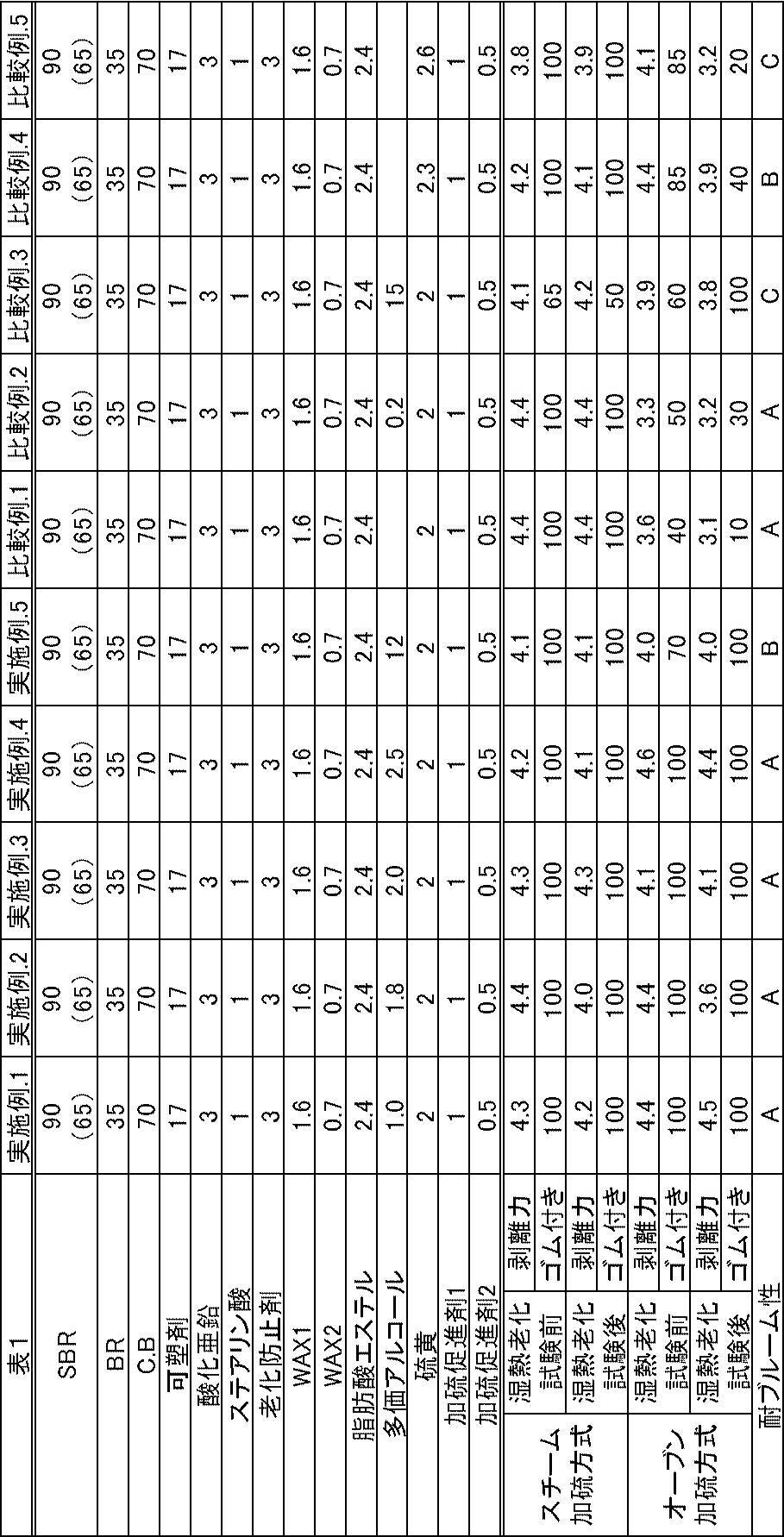
上記表1に示されている各成分の詳細は以下のとおりである。
・SBR:スチレンブタジエンゴム(Taipol1723)(油展品:ゴム100質量部に対して油展オイル37.5質量部を含む。SBRの正味は72.7質量%。)
・BR:ブタジエンゴム(NIPOL BR 1220)
・C.B:ISAF級カーボンブラック(ショウブラックN220、キャボットジャパン社製)
・可塑剤:アロマ系オイル(A/O MIX 2010、三共油化工業社製)
・酸化亜鉛:酸化亜鉛3種(正同化学工業社製)
・ステアリン酸:ステアリン酸
・老化防止剤:N-フェニル-N′-(1,3-ジメチルブチル)-p-フェニレンジアミン(オゾノン6C、精工化学社製)
・WAX1:マイクロクリスタリンワックス(HI-MIC-1080、日本精蝋社製)
・WAX2:パラフィンワックス(OZOACE-0015、日本精蝋社製)
・脂肪酸エステル:脂肪酸エステル(ニューエイド EG-ROLL、精工化学社製)
・多価アルコール:グリセリン(分子量:92、沸点:290℃、精製グリセリン、阪本薬品工業社製)
・硫黄:硫黄(細井化学工業社製)
・加硫促進剤1:N-t-ブチルベンゾチアゾール-2-スルフェンアミド(ノクセラーNS-P、大内新興化学工業社製)
・加硫促進剤2:ジフェニルグアニジン(ソクシノールD-G、住友化学社製)
・SBR:スチレンブタジエンゴム(Taipol1723)(油展品:ゴム100質量部に対して油展オイル37.5質量部を含む。SBRの正味は72.7質量%。)
・BR:ブタジエンゴム(NIPOL BR 1220)
・C.B:ISAF級カーボンブラック(ショウブラックN220、キャボットジャパン社製)
・可塑剤:アロマ系オイル(A/O MIX 2010、三共油化工業社製)
・酸化亜鉛:酸化亜鉛3種(正同化学工業社製)
・ステアリン酸:ステアリン酸
・老化防止剤:N-フェニル-N′-(1,3-ジメチルブチル)-p-フェニレンジアミン(オゾノン6C、精工化学社製)
・WAX1:マイクロクリスタリンワックス(HI-MIC-1080、日本精蝋社製)
・WAX2:パラフィンワックス(OZOACE-0015、日本精蝋社製)
・脂肪酸エステル:脂肪酸エステル(ニューエイド EG-ROLL、精工化学社製)
・多価アルコール:グリセリン(分子量:92、沸点:290℃、精製グリセリン、阪本薬品工業社製)
・硫黄:硫黄(細井化学工業社製)
・加硫促進剤1:N-t-ブチルベンゾチアゾール-2-スルフェンアミド(ノクセラーNS-P、大内新興化学工業社製)
・加硫促進剤2:ジフェニルグアニジン(ソクシノールD-G、住友化学社製)
表1から分かるように、多価アルコールを含有しない比較例1と比較して、多価アルコールを所定量含有する実施例1~5は、スチーム加硫方式で加硫した場合だけでなく、オーブン加硫方式で加硫した場合にも優れた接着性を示した。また、加硫後に湿熱環境下に放置した場合にも優れた接着性を示した。なかでも、多価アルコールの含有量がジエン系重合体100質量部に対して10質量部以下である実施例1~4は、優れた耐ブルーム性を示した。そのなかでも、多価アルコールの含有量がジエン系重合体100質量部に対して2.5質量部以上である実施例4は、オーブン加硫方式で加硫した場合により優れた接着性を示した。
一方、多価アルコールを含有するが、多価アルコールの含有量がジエン系重合体100質量部に対して0.5質量部未満である比較例2は、比較例1と同様、オーブン加硫方式で加硫した場合の接着性が不十分となった。また、多価アルコールを含有するが、多価アルコールの含有量がジエン系重合体100質量部に対して14質量部を超える比較例3は、スチーム加硫方式で加硫した場合の接着性が不十分となった。
また、多価アルコールを含有する代わりに、硫黄の含有量を増やした比較例4及び5は、加硫(オーブン加硫方式)後に湿熱環境下に放置した場合の接着性が不十分となった。
また、多価アルコールを含有する代わりに、硫黄の含有量を増やした比較例4及び5は、加硫(オーブン加硫方式)後に湿熱環境下に放置した場合の接着性が不十分となった。
1 ホース
11 内部ゴム層
12 補強層
13 外部ゴム層
100 巻出機
101 マンドレル
102 第1押出機
103 未加硫内部ゴム層
104 巻取捲出機
105 編組機
106 補強層付未加硫内部ゴム層
107 巻取捲出機
108 第2押出機
109 ホース前駆体
110 巻取機
111 加硫装置
112 ナイロン布付ホース
113 ラッピング装置
114 アンラッピング装置
115 ナイロン布付ホース前駆体
116 ホース
117 マンドレル抜出装置
118 ホース
119 ナイロン布
120 熱風
121 未加硫外部ゴム層
11 内部ゴム層
12 補強層
13 外部ゴム層
100 巻出機
101 マンドレル
102 第1押出機
103 未加硫内部ゴム層
104 巻取捲出機
105 編組機
106 補強層付未加硫内部ゴム層
107 巻取捲出機
108 第2押出機
109 ホース前駆体
110 巻取機
111 加硫装置
112 ナイロン布付ホース
113 ラッピング装置
114 アンラッピング装置
115 ナイロン布付ホース前駆体
116 ホース
117 マンドレル抜出装置
118 ホース
119 ナイロン布
120 熱風
121 未加硫外部ゴム層
Claims (6)
- ブタジエンゴムを含むジエン系重合体と、多価アルコールとを含有し、
前記多価アルコールの含有量が、前記ジエン系重合体100質量部に対して、0.5質量部以上14質量部以下である、ゴム組成物。 - 前記多価アルコールが、グリセリンである、請求項1に記載のゴム組成物。
- さらに、ワックスを含有し、
前記ワックスの含有量が、前記ジエン系重合体100質量部に対して、2質量部以上である、請求項1又は2に記載のゴム組成物。 - 金属表面を有する補強層と、前記金属表面上に設けられたゴム層とを備え、
前記ゴム層が、請求項1~3のいずれか1項に記載のゴム組成物を用いて形成された、積層体。 - 前記補強層が、ワイヤを編み上げた、編組構造又はスパイラル構造を有する、請求項4に記載の積層体。
- ホースである、請求項4又は5に記載の積層体。
Priority Applications (2)
| Application Number | Priority Date | Filing Date | Title |
|---|---|---|---|
| CN201680069918.9A CN108291058B (zh) | 2015-12-02 | 2016-10-28 | 橡胶组合物以及层叠体 |
| US15/781,058 US20180264772A1 (en) | 2015-12-02 | 2016-10-28 | Rubber Composition and Layered Body |
Applications Claiming Priority (2)
| Application Number | Priority Date | Filing Date | Title |
|---|---|---|---|
| JP2015235856A JP6644253B2 (ja) | 2015-12-02 | 2015-12-02 | ゴム組成物及びホース |
| JP2015-235856 | 2015-12-02 |
Publications (1)
| Publication Number | Publication Date |
|---|---|
| WO2017094411A1 true WO2017094411A1 (ja) | 2017-06-08 |
Family
ID=58797030
Family Applications (1)
| Application Number | Title | Priority Date | Filing Date |
|---|---|---|---|
| PCT/JP2016/082011 Ceased WO2017094411A1 (ja) | 2015-12-02 | 2016-10-28 | ゴム組成物及び積層体 |
Country Status (4)
| Country | Link |
|---|---|
| US (1) | US20180264772A1 (ja) |
| JP (1) | JP6644253B2 (ja) |
| CN (1) | CN108291058B (ja) |
| WO (1) | WO2017094411A1 (ja) |
Cited By (2)
| Publication number | Priority date | Publication date | Assignee | Title |
|---|---|---|---|---|
| JPWO2018198775A1 (ja) * | 2017-04-25 | 2020-03-05 | 住友ゴム工業株式会社 | ゴム組成物 |
| EP3699227A4 (en) * | 2017-10-17 | 2021-08-04 | Nippon Seiro Co., Ltd. | SURFACE MODIFIER FOR RUBBER COMPOSITION AND RUBBER COMPOSITION WITH IT |
Families Citing this family (3)
| Publication number | Priority date | Publication date | Assignee | Title |
|---|---|---|---|---|
| US20190047183A1 (en) * | 2017-08-10 | 2019-02-14 | G. B. Kirby Meacham | Rubber-Steel Composite Structures |
| JP7099085B2 (ja) * | 2018-06-27 | 2022-07-12 | 住友ゴム工業株式会社 | タイヤ |
| JP7705019B2 (ja) * | 2021-01-05 | 2025-07-09 | 横浜ゴム株式会社 | ホース用ゴム組成物、自動車用トランスミッションオイル配管及びその製造方法 |
Citations (5)
| Publication number | Priority date | Publication date | Assignee | Title |
|---|---|---|---|---|
| JPH11199711A (ja) * | 1998-01-09 | 1999-07-27 | Yokohama Rubber Co Ltd:The | ゴム組成物 |
| JP2008074926A (ja) * | 2006-09-20 | 2008-04-03 | Yokohama Rubber Co Ltd:The | ゴム組成物 |
| JP2008150435A (ja) * | 2006-12-14 | 2008-07-03 | Toyo Tire & Rubber Co Ltd | タイヤ用ゴム組成物及び空気入りタイヤ |
| CN102585308A (zh) * | 2012-03-06 | 2012-07-18 | 昆明财利来工贸有限公司 | 牛筋橡胶软管耐磨内层胶 |
| JP2013213129A (ja) * | 2012-04-02 | 2013-10-17 | Yokohama Rubber Co Ltd:The | タイヤ用ゴム組成物およびそれを用いた空気入りタイヤ |
Family Cites Families (4)
| Publication number | Priority date | Publication date | Assignee | Title |
|---|---|---|---|---|
| US3533979A (en) * | 1966-08-19 | 1970-10-13 | Nylo Thane Plastics Corp | Thermally curable elastomer compositions and additive therefor |
| US5736611A (en) * | 1997-02-12 | 1998-04-07 | The Goodyear Tire & Rubber Company | Sulfur-vulcanized rubber compound having improved reversion resistance |
| CN1059218C (zh) * | 1997-03-21 | 2000-12-06 | 刘均平 | 喷砂胶管内层胶配方 |
| US6835447B2 (en) * | 1999-12-15 | 2004-12-28 | Toray Industries, Inc. | Rubber reinforcing cord and fiber reinforced rubber material |
-
2015
- 2015-12-02 JP JP2015235856A patent/JP6644253B2/ja active Active
-
2016
- 2016-10-28 CN CN201680069918.9A patent/CN108291058B/zh active Active
- 2016-10-28 WO PCT/JP2016/082011 patent/WO2017094411A1/ja not_active Ceased
- 2016-10-28 US US15/781,058 patent/US20180264772A1/en not_active Abandoned
Patent Citations (5)
| Publication number | Priority date | Publication date | Assignee | Title |
|---|---|---|---|---|
| JPH11199711A (ja) * | 1998-01-09 | 1999-07-27 | Yokohama Rubber Co Ltd:The | ゴム組成物 |
| JP2008074926A (ja) * | 2006-09-20 | 2008-04-03 | Yokohama Rubber Co Ltd:The | ゴム組成物 |
| JP2008150435A (ja) * | 2006-12-14 | 2008-07-03 | Toyo Tire & Rubber Co Ltd | タイヤ用ゴム組成物及び空気入りタイヤ |
| CN102585308A (zh) * | 2012-03-06 | 2012-07-18 | 昆明财利来工贸有限公司 | 牛筋橡胶软管耐磨内层胶 |
| JP2013213129A (ja) * | 2012-04-02 | 2013-10-17 | Yokohama Rubber Co Ltd:The | タイヤ用ゴム組成物およびそれを用いた空気入りタイヤ |
Cited By (3)
| Publication number | Priority date | Publication date | Assignee | Title |
|---|---|---|---|---|
| JPWO2018198775A1 (ja) * | 2017-04-25 | 2020-03-05 | 住友ゴム工業株式会社 | ゴム組成物 |
| JP7180377B2 (ja) | 2017-04-25 | 2022-11-30 | 住友ゴム工業株式会社 | ゴム組成物 |
| EP3699227A4 (en) * | 2017-10-17 | 2021-08-04 | Nippon Seiro Co., Ltd. | SURFACE MODIFIER FOR RUBBER COMPOSITION AND RUBBER COMPOSITION WITH IT |
Also Published As
| Publication number | Publication date |
|---|---|
| CN108291058B (zh) | 2021-05-28 |
| JP2017101159A (ja) | 2017-06-08 |
| JP6644253B2 (ja) | 2020-02-12 |
| CN108291058A (zh) | 2018-07-17 |
| US20180264772A1 (en) | 2018-09-20 |
Similar Documents
| Publication | Publication Date | Title |
|---|---|---|
| WO2017094411A1 (ja) | ゴム組成物及び積層体 | |
| JP6015711B2 (ja) | ゴム組成物金属積層体、及び加硫ゴム製品 | |
| CN105143333B (zh) | 金属表面粘合性橡胶组合物、橡胶组合物金属积层体、硫化橡胶产品和硫化橡胶产品的制造方法 | |
| US9932464B2 (en) | Rubber composition, laminated body of rubber composition and metal, and vulcanized rubber product | |
| CA2925929C (en) | Rubber compositions and uses thereof | |
| EP2878457A1 (en) | Laminate for inner liner, and tyre using same | |
| JP6052040B2 (ja) | ゴム組成物金属積層体、加硫ゴム製品、および加硫ゴム製品の製造方法 | |
| JP4543685B2 (ja) | ホース層間ゴム用ゴム組成物およびホース | |
| CN107709432B (zh) | 橡胶组合物、橡胶组合物金属层叠体及硫化橡胶制品 | |
| JP2016030784A (ja) | ゴム組成物、ゴム組成物金属積層体、加硫ゴム製品及びゴム組成物金属積層体の製造方法 | |
| JP6015710B2 (ja) | ゴム組成物金属積層体、及び加硫ゴム製品 | |
| WO2017013798A1 (ja) | ゴム組成物、ゴム組成物金属積層体、及び加硫ゴム製品 | |
| JP6182957B2 (ja) | ゴム組成物金属積層体、加硫ゴム製品、および加硫ゴム製品の製造方法 | |
| JP2016035002A (ja) | ゴム組成物、ゴム組成物金属積層体、及び加硫ゴム製品 | |
| JP6467802B2 (ja) | ホース用ゴム組成物金属積層体、及び加硫ゴム製品 | |
| TWI903253B (zh) | 橡膠組成物、層合體及軟管 | |
| TWI662048B (zh) | Rubber composition, rubber composition metal laminate, and vulcanized rubber product | |
| TWI662083B (zh) | Rubber composition, rubber composition metal laminate, and vulcanized rubber product |
Legal Events
| Date | Code | Title | Description |
|---|---|---|---|
| 121 | Ep: the epo has been informed by wipo that ep was designated in this application |
Ref document number: 16870351 Country of ref document: EP Kind code of ref document: A1 |
|
| WWE | Wipo information: entry into national phase |
Ref document number: 15781058 Country of ref document: US |
|
| NENP | Non-entry into the national phase |
Ref country code: DE |
|
| 122 | Ep: pct application non-entry in european phase |
Ref document number: 16870351 Country of ref document: EP Kind code of ref document: A1 |