WO2017090416A1 - 油性化粧料 - Google Patents
油性化粧料 Download PDFInfo
- Publication number
- WO2017090416A1 WO2017090416A1 PCT/JP2016/082992 JP2016082992W WO2017090416A1 WO 2017090416 A1 WO2017090416 A1 WO 2017090416A1 JP 2016082992 W JP2016082992 W JP 2016082992W WO 2017090416 A1 WO2017090416 A1 WO 2017090416A1
- Authority
- WO
- WIPO (PCT)
- Prior art keywords
- component
- mass
- oily cosmetic
- group
- cosmetic according
- Prior art date
- Legal status (The legal status is an assumption and is not a legal conclusion. Google has not performed a legal analysis and makes no representation as to the accuracy of the status listed.)
- Ceased
Links
Classifications
-
- A—HUMAN NECESSITIES
- A61—MEDICAL OR VETERINARY SCIENCE; HYGIENE
- A61K—PREPARATIONS FOR MEDICAL, DENTAL OR TOILETRY PURPOSES
- A61K8/00—Cosmetics or similar toiletry preparations
- A61K8/18—Cosmetics or similar toiletry preparations characterised by the composition
- A61K8/72—Cosmetics or similar toiletry preparations characterised by the composition containing organic macromolecular compounds
- A61K8/73—Polysaccharides
- A61K8/731—Cellulose; Quaternized cellulose derivatives
-
- A—HUMAN NECESSITIES
- A61—MEDICAL OR VETERINARY SCIENCE; HYGIENE
- A61K—PREPARATIONS FOR MEDICAL, DENTAL OR TOILETRY PURPOSES
- A61K8/00—Cosmetics or similar toiletry preparations
- A61K8/02—Cosmetics or similar toiletry preparations characterised by special physical form
- A61K8/04—Dispersions; Emulsions
- A61K8/06—Emulsions
-
- A—HUMAN NECESSITIES
- A61—MEDICAL OR VETERINARY SCIENCE; HYGIENE
- A61K—PREPARATIONS FOR MEDICAL, DENTAL OR TOILETRY PURPOSES
- A61K8/00—Cosmetics or similar toiletry preparations
- A61K8/18—Cosmetics or similar toiletry preparations characterised by the composition
- A61K8/30—Cosmetics or similar toiletry preparations characterised by the composition containing organic compounds
- A61K8/31—Hydrocarbons
-
- A—HUMAN NECESSITIES
- A61—MEDICAL OR VETERINARY SCIENCE; HYGIENE
- A61K—PREPARATIONS FOR MEDICAL, DENTAL OR TOILETRY PURPOSES
- A61K8/00—Cosmetics or similar toiletry preparations
- A61K8/18—Cosmetics or similar toiletry preparations characterised by the composition
- A61K8/30—Cosmetics or similar toiletry preparations characterised by the composition containing organic compounds
- A61K8/33—Cosmetics or similar toiletry preparations characterised by the composition containing organic compounds containing oxygen
- A61K8/37—Esters of carboxylic acids
-
- A—HUMAN NECESSITIES
- A61—MEDICAL OR VETERINARY SCIENCE; HYGIENE
- A61K—PREPARATIONS FOR MEDICAL, DENTAL OR TOILETRY PURPOSES
- A61K8/00—Cosmetics or similar toiletry preparations
- A61K8/18—Cosmetics or similar toiletry preparations characterised by the composition
- A61K8/72—Cosmetics or similar toiletry preparations characterised by the composition containing organic macromolecular compounds
- A61K8/73—Polysaccharides
-
- A—HUMAN NECESSITIES
- A61—MEDICAL OR VETERINARY SCIENCE; HYGIENE
- A61K—PREPARATIONS FOR MEDICAL, DENTAL OR TOILETRY PURPOSES
- A61K8/00—Cosmetics or similar toiletry preparations
- A61K8/18—Cosmetics or similar toiletry preparations characterised by the composition
- A61K8/72—Cosmetics or similar toiletry preparations characterised by the composition containing organic macromolecular compounds
- A61K8/84—Cosmetics or similar toiletry preparations characterised by the composition containing organic macromolecular compounds obtained by reactions otherwise than those involving only carbon-carbon unsaturated bonds
- A61K8/89—Polysiloxanes
- A61K8/891—Polysiloxanes saturated, e.g. dimethicone, phenyl trimethicone, C24-C28 methicone or stearyl dimethicone
-
- A—HUMAN NECESSITIES
- A61—MEDICAL OR VETERINARY SCIENCE; HYGIENE
- A61K—PREPARATIONS FOR MEDICAL, DENTAL OR TOILETRY PURPOSES
- A61K8/00—Cosmetics or similar toiletry preparations
- A61K8/18—Cosmetics or similar toiletry preparations characterised by the composition
- A61K8/72—Cosmetics or similar toiletry preparations characterised by the composition containing organic macromolecular compounds
- A61K8/84—Cosmetics or similar toiletry preparations characterised by the composition containing organic macromolecular compounds obtained by reactions otherwise than those involving only carbon-carbon unsaturated bonds
- A61K8/89—Polysiloxanes
- A61K8/896—Polysiloxanes containing atoms other than silicon, carbon, oxygen and hydrogen, e.g. dimethicone copolyol phosphate
- A61K8/897—Polysiloxanes containing atoms other than silicon, carbon, oxygen and hydrogen, e.g. dimethicone copolyol phosphate containing halogen, e.g. fluorosilicones
-
- A—HUMAN NECESSITIES
- A61—MEDICAL OR VETERINARY SCIENCE; HYGIENE
- A61K—PREPARATIONS FOR MEDICAL, DENTAL OR TOILETRY PURPOSES
- A61K8/00—Cosmetics or similar toiletry preparations
- A61K8/18—Cosmetics or similar toiletry preparations characterised by the composition
- A61K8/92—Oils, fats or waxes; Derivatives thereof, e.g. hydrogenation products thereof
-
- A—HUMAN NECESSITIES
- A61—MEDICAL OR VETERINARY SCIENCE; HYGIENE
- A61Q—SPECIFIC USE OF COSMETICS OR SIMILAR TOILETRY PREPARATIONS
- A61Q1/00—Make-up preparations; Body powders; Preparations for removing make-up
- A61Q1/02—Preparations containing skin colorants, e.g. pigments
- A61Q1/04—Preparations containing skin colorants, e.g. pigments for lips
Definitions
- the present invention relates to an oily cosmetic.
- Patent Document 1 describes that an oily cosmetic material obtained by combining a specific acylated cellulose derivative, an ester oil, and a hydrocarbon oil in a specific ratio maintains a smooth feel.
- Patent Document 2 describes that an oily cosmetic material containing a specific acylated cellulose derivative, a silicone oil agent, and an ester oil is excellent in transparency and gloss, and maintains a smooth feel. Describes that an oily cosmetic containing a specific acylated cellulose derivative and a silicone having a nonionic hydrophilic group is excellent in sustainability of a beautiful cosmetic finish and maintains a smooth feel.
- Patent Document 1 JP 2010-1000061 A
- Patent Document 2 JP 2011-79746 A
- Patent Document 3 JP 2011-173818 A
- the present invention includes the following components (A), (B) and (C):
- B) Volatile hydrocarbon oil 5-80% by mass
- the bulk shear relates to an oily cosmetic having a viscosity of 1500 Pa ⁇ s or less.
- the oily cosmetic containing the acylated cellulose derivative is excellent in smooth feel, it has problems in terms of color transfer and color retention.
- the oily cosmetic composition of the present invention does not feel sticky or tight at the time of application, has smooth lips and skin, etc., and suppresses secondary adhesion to a cup or the like immediately after application and after a long period of time. It is also resistant to wetting. Moreover, when removing cosmetics from lips or skin, it can be removed cleanly.
- the cellulose derivative of the component (A) used in the present invention is not limited as long as it has a cellulose skeleton in the main chain, but the raw material cellulose derivative includes cellulose and short chain acyls such as acetylcellulose and acetylbutylcellulose.
- Preferred are short-chain alkyl etherified celluloses such as functionalized cellulose, methylcellulose, and ethylcellulose, cellulose modified with hydroxyalkyl groups, glyceryl ether groups, and (mono) alkyl glyceryl ether groups.
- hydroxyethyl cellulose, hydroxypropyl cellulose, hydroxypropylmethyl cellulose, glyceryl cellulose, methyl glyceryl cellulose and the like can be mentioned. Furthermore, what has the following structural units as a cellulose derivative of the manufacturing raw material of the cellulose derivative of a component (A) is preferable.
- R ′ represents a linear or branched alkylene group having 2 to 8 carbon atoms
- n represents a number with an average added mole number of R′O per glucose unit of 0.1 to 10.
- R ′ is preferably a linear or branched alkylene group having 2 to 4 carbon atoms, and more preferably an ethylene group or a propylene group.
- n is preferably a number such that the average added mole number of R′O per glucose unit is 0.3 to 5, more preferably 0.5 to 4.5, and a number 1 to 4. Further preferred.
- the raw material cellulose derivative include hydroxyethyl cellulose and hydroxypropyl cellulose, and hydroxypropyl cellulose is more preferred.
- the mass average molecular weight (Mw) of the raw material cellulose derivative is preferably 10,000 to 4,000,000, more preferably 100,000 to 3,000,000, and still more preferably 300,000 to 200, from the viewpoint of solubility in oil and feel. It is ten thousand.
- Examples of branched alkyl groups include methylpentyl, methylhexyl, methylheptyl, methyloctyl, methylnonyl, methylundecyl, methylheptadecyl, ethylhexadecyl, methyloctadecyl, propyl Pentadecyl group, 2-hexyldecyl group, 2-octyldodecyl, 2-heptylundecyl group, 2-decyltetradecyl group, 2-dodecylhexadecyl group, 2-tetradecyloctadecyl group, 2-hexadecylicosyl group Etc.
- linear alkenyl groups include dodecenyl group, tridecenyl group, tetradecenyl group, pentadecenyl group, hexadecenyl group, heptadecenyl group, octadecenyl group, nonadecenyl group, icosenyl group, heicosenyl group, dococenyl group, tricocenyl group, tetracocenyl group, Examples include a pentacocenyl group, a hexacocenyl group, a heptacocenyl group, and an octacocenyl group.
- Examples of branched alkenyl groups include isotridecenyl, isooctadecenyl, isotriacontenyl, 2-butyloctenyl, 2-hexyldecenyl, 2-octyldecenyl, 2-decyltetra Examples include a decenyl group and a 2-dodecylhexadecenyl group.
- R is preferably a linear alkyl group from the viewpoint of imparting smoothness during the application of the oily cosmetic and forming a uniform film on the lips and skin.
- the number of carbon atoms is preferably 9 to 21, more preferably 11 to 17, and even more preferably 15.
- Hydroxyl group —O—M—R substitution rate is 45 mol% or more from the standpoint of enhancing the solubility in oil, not feeling sticky or sticking at the time of application, and suppressing secondary adhesion to a cup or the like. Yes, 48 mol% or more is preferable, 51 mol% or more is more preferable, and 95 mol% or less is preferable, 94 mol% or less is preferable, 92 mol% or less is more preferable, and 66 mol% or less is still more preferable from the viewpoint of improving dripping resistance and water resistance. .
- the group —O—M—R substitution rate of the hydroxyl group is 45 to 95 mol%, preferably 48 to 94 mol%, more preferably 51 to 92 mol%, and still more preferably 51 to 66 mol%. It is preferable that the hydroxyl group remains appropriately from the viewpoint of feeling of use and pigment dispersibility, preferably 5 mol% or more, more preferably 6 mol% or more, further preferably 8 mol% or more, and further preferably 34 mol% or more. 55 mol% or less is preferable, 52 mol% or less is more preferable, and 49 mol% or less is more preferable.
- the residual ratio of hydroxyl groups is preferably 5 to 55 mol%, more preferably 6 to 52 mol%, further preferably 8 to 49 mol%, and still more preferably 34 to 49 mol%.
- the mass average molecular weight of the component (A) cellulose derivative is preferably 100,000 or more, more preferably 200,000 or more, still more preferably 300,000 or more, from the viewpoint that the solubility in the oil component and the smooth feel are maintained. 10,000 or more are more preferable, 5 million or less are preferable, 4 million or less are more preferable, 3 million or less are more preferable, and 2 million or less are still more preferable.
- the mass average molecular weight (Mw) is determined by gel permeation chromatography (using a calibration curve and a refractive index detector defined with chloroform solvent and linear polystyrene as a standard).
- the cellulose derivative of component (A) is obtained by reacting a raw material cellulose derivative with an acid halide having a linear or branched alkyl group or alkenyl group having 3 to 40 carbon atoms, to give 45 to 95 mol of all hydroxyl groups of the raw material cellulose derivative. Produced by replacing%.
- a compound in which M is CH 2 can be produced by reacting a cellulose derivative with a corresponding sulfonic acid ester such as alkyl halide or alkyl mesylate in the presence of a base.
- the main chain comprising a cellulose skeleton can also be obtained by transesterification (acidolysis) of acetylcellulose. According to this method, a cellulose ester derivative having a very low residual amount of hydroxyl groups can be obtained.
- hydroxyethyl cellulose lauric acid ester hydroxyethyl cellulose myristic acid ester, hydroxyethyl cellulose palmitic acid ester, hydroxyethyl cellulose stearic acid ester, hydroxyethyl cellulose behenic acid ester; hydroxypropyl cellulose lauric acid ester, hydroxypropyl cellulose myristic acid ester, hydroxy Propylcellulose palmitate, hydroxypropylcellulose stearate, hydroxypropylcellulose behenate; hydroxyethylmethylcellulose laurate, hydroxyethylmethylcellulose myristate, hydroxyethylmethylcellulose palmitate, hydroxyethyl Methyl cellulose stearate, hydroxyethyl methyl cellulose behenate; hydroxypropyl methyl cellulose laurate, hydroxypropyl methyl cellulose myristic ester, hydroxypropyl methyl cellulose palmitate, hydroxypropyl methyl cellulose steoate,
- hydroxypropylcellulose laurate hydroxypropylcellulose myristic acid ester, hydroxypropylcellulose palmitic acid ester, hydroxypropyl are used to form a uniform film on the lips and skin and suppress secondary adhesion to the cup.
- Cellulose stearic acid ester and hydroxypropyl cellulose behenic acid ester are preferable, and hydroxypropyl cellulose palmitic acid ester is more preferable.
- the cellulose derivative of component (A) can be used singly or in combination of two or more, and the content forms a uniform film on the lips and skin, etc., and suppresses secondary adhesion to the cup, etc.
- the total composition is 1% by mass or more, preferably 1.5% by mass or more, more preferably 2% by mass or more, further preferably 3% by mass or more, 50% by mass or less, and preferably 30% by mass or less, 20 mass% or less is more preferable, 15 mass% or less is more preferable, and 10 mass% or less is further more preferable.
- the content of the component (A) is 1 to 50% by mass in the total composition, preferably 1.5 to 30% by mass, more preferably 2 to 20% by mass, and further preferably 2 to 15% by mass. More preferably, it is 3 to 10% by mass.
- Component (B) is a volatile hydrocarbon oil. Volatile has a flash point of 35-87 ° C.
- the volatile hydrocarbon oil of component (B) is excellent in compatibility with component (A), and even after the volatile hydrocarbon oil has volatilized, it does not feel sticky or stiff.
- paraffinic hydrocarbon oils such as n-decane, n-undecane, and n-dodecane
- isoparaffinic hydrocarbon oils such as isodecane, isododecane, and hydrogenated polyisobutene
- cyclic paraffin hydrocarbon oils such as cyclodecane and cyclododecane. It is done.
- hydrocarbon oils having 8 to 16 carbon atoms are preferable, hydrocarbon oils having 10 to 16 carbon atoms are more preferable, and hydrocarbon oils having 12 carbon atoms are more preferable.
- isoparaffinic hydrocarbon oils are preferable, isododecane and hydrogenated polyisobutene having 12 carbon atoms are more preferable, and isododecane is more preferable.
- Examples of commercially available products include Marcazole R (manufactured by Maruzen Petrochemical Co., Ltd .: flash point 48 ° C.), Pearl Ream 3 (manufactured by NOF Corporation: flash point 61 ° C.), and the like.
- Component (B) can be used alone or in combination of two or more, and the content is excellent in compatibility with components (A) and (C), and after application to lips and skin, component (B) Even after volatilization, it is not sticky or sticky, forms a uniform film on the lips, etc., and suppresses secondary adhesion to the cup, etc. 35% by mass or more, preferably 40% by mass or more, more preferably 45% by mass or more, still more preferably 46% by mass or more, 80% by mass or less, preferably 75% by mass or less, and 70% by mass. The following is more preferable, and 66% by mass or less is more preferable.
- the content of component (B) is from 5 to 80% by mass in the total composition, preferably from 35 to 75% by mass, more preferably from 40 to 75% by mass, still more preferably from 45 to 70% by mass, and from 46 to 66 mass% is still more preferable.
- the ester oil of component (C) used in the present invention is liquid at 25 ° C.
- the liquid state at 25 ° C. has fluidity, and includes pastes.
- Such ester oils are not limited as long as they are used in ordinary cosmetics.
- Examples thereof include diglyceryl acid, glyceryl monoisostearate, 2-ethylhexyl paramethoxycinnamate, tocopherol acetate, and diglyceryl monoisostearate.
- ester oil having a branched chain is excellent in that the component (A) is excellent in compatibility and is not sticky or sticky even after the component (B) is volatilized after being applied to the lips or skin.
- isotridecyl isononanoate diisostearyl malate, isostearyl myristate, octyldodecyl ricinoleate, diglyceryl diisostearate, glyceryl monoisostearate, 2-ethylhexyl paramethoxycinnamate, diglyceryl monoisostearate
- isotridecyl isononanoate and diisostearyl malate are more preferable.
- the component (C) ester oil can be used singly or in combination of two or more.
- the content is excellent in compatibility with the component (A), and the component (B) is volatilized after being applied to the lips or skin. Even after the coating, it is not sticky or sticky, forms a uniform film on the lips, etc., and suppresses secondary adhesion to the cup.
- % By mass or more, preferably 10% by mass or more, more preferably 13% by mass or more, 50% by mass or less, preferably 40% by mass or less, more preferably 35% by mass or less, and even more preferably 33% by mass or less. preferable.
- the content of the component (C) is 5 to 50% by mass, preferably 7 to 40% by mass, more preferably 10 to 35% by mass, and further preferably 13 to 33% by mass in the total composition.
- the mass ratio (B) / (C) of the component (B) with respect to the component (C) does not feel stiff or tight at the time of application, and the lips and skin are smooth, immediately after application and for a long time. Even after the passage, secondary adhesion to the cup is suppressed, it is strong against water wetting, and it can be removed cleanly when lipstick is removed from the lips.
- the above is preferable, 1.4 or more is more preferable, 9 or less, 7 or less is preferable, and 5 or less is more preferable.
- the mass ratio (B) / (C) of the component (B) to the component (C) is 0.7 to 9, preferably 1.0 to 7, and more preferably 1.4 to 5.
- the mass ratio (A) / (C) of the component (A) with respect to the component (C) does not feel stiffness or tension at the time of application, and the lips and skin are smooth, immediately after application and for a long time. Even after the lapse of time, secondary adhesion to the cup and the like is suppressed, and it is resistant to water so that it can be removed cleanly when the cosmetic is removed from the lips and skin.
- 0.12 or more is more preferable
- 0.14 or more is more preferable
- 1.25 or less is preferable
- 1.0 or less is more preferable
- 0.65 or less is more preferable.
- the mass ratio (A) / (C) of the component (A) to the component (C) is preferably 0.10 to 1.25, more preferably 0.12 to 1.0, and 0.14 to 0.00. 65 is more preferable.
- the oily cosmetic of the present invention can further contain (D) an organosilicone resin, and can evenly adhere the cosmetic to the lips, skin, etc., improve adhesion, and improve water resistance. Can do.
- Any organic silicone resin of component (D) can be used as long as it is usually used in cosmetics.
- (D-1) trimethylsiloxysilicic acid, (D-2) fluorine-modified silicone examples thereof include resins.
- the component (D-1) trimethylsiloxysilicic acid is not limited as long as it is used in ordinary cosmetics, and is a compound having a crosslinked structure having a siloxane structure as a main skeleton, [ Those represented by (CH 3 ) 3 SiO 1/2 ] X [SiO 2 ] Y (X is 1 to 3, Y is 0.5 to 8) are preferred.
- Component (D-1), trimethylsiloxysilicic acid preferably has a mass average molecular weight of 1000 to 10,000, more preferably 2000 to 9000, and still more preferably 3000 to 6000, from the viewpoint of feeling of use and makeup. .
- the property may be any of liquid, gum, paste, solid, etc.
- a solid product is preferred.
- the solvent to be diluted or dispersed is preferably one or more selected from dimethylpolysiloxane, octamethylcyclotetrasiloxane, decamethylcyclopentasiloxane, and isododecane, and volatile dimethylpolysiloxane and decamethylcyclopentasiloxane are preferred. More preferred. Volatile has a flash point of 35 to 87 ° C.
- components (D-1) are those previously dissolved in a solvent, such as KF-7312J (solid content 50% decamethylcyclopentasiloxane solution), KF-9021 (50% decamethylcyclopentasiloxane solution) X21-5249 (50% decamethylcyclopentasiloxane solution) (manufactured by Shin-Etsu Chemical Co., Ltd.), SS4267 (35% dimethylpolysiloxane solution), SR1000 (manufactured by Momentive Performance Materials Japan GK) BY11-018 (30% cyclopentasiloxane solution) (manufactured by Toray Dow Corning Silicone), BELSIL TMS 803 (manufactured by Wacker Chemie AG), and the like can be used.
- KF-7312J solid content 50% decamethylcyclopentasiloxane solution
- KF-9021 50% decamethylcyclopentasiloxane solution
- X21-5249 50%
- the component (D-2) fluorine-modified silicone resin is represented by the general formula (1) R 1 a SiO (4-a) / 2 (1) (Wherein R 1 represents a hydrocarbon group having 1 to 8 carbon atoms, a phenyl group, a hydroxyl group, or a general formula —R 2 —Rf (R 2 represents a divalent alkylene group having 2 to 6 carbon atoms; Rf represents carbon A perfluoroalkyl group of the formula 1 to 8, which is arbitrarily selected from a hydroxyl group and a functional group essentially having the general formula —R 2 —Rf, and a is an average number of 1.0 ⁇ a ⁇ 1. 8) What has the structure represented by these is preferable.
- the fluorine-modified silicone resin has silanol groups in the molecule from the viewpoint of adhesion to skin and powder, and the ratio of OH groups in the silanol groups is 0.1 to 5% by mass with respect to the resin mass. Of these, 0.5 to 5% by mass is more preferable.
- Component (D-2) is preferably a solid at 25 ° C., and from the viewpoint of compoundability, it is a solution or dispersion diluted with a solvent, or a solution or dispersion obtained by mixing in advance. It is also possible to use it in a state.
- the solvent to be diluted or dispersed cyclic silicone, dimethylpolysiloxane and the like are preferable.
- the cyclic silicone is preferably used by dissolving in one or more selected from octamethylcyclotetrasiloxane (D4) and decamethylcyclopentasiloxane (D5).
- fluorine-modified silicone resins include INCI names “Trifluoropropyldimethyl / Trimethylsiloxysilicate”, XS66-B8226, XS66-C1191, XS66-B8636 (momentive performance materials). Commercially available products such as those manufactured by the company) can be used.
- the organic silicone resin of component (D) can be used alone or in combination of two or more, and the content is such that the cosmetic material is uniformly attached to the lips, skin, etc., and the adhesion is improved, Moreover, from the point which is excellent in water resistance, 0.01 mass% or more is preferable in the whole composition, 0.2 mass% or more is more preferable, 0.5 mass% or more is further more preferable, 1 mass% or more is more preferable. 25 mass% or less is preferable, 20 mass% or less is more preferable, 15 mass% or less is more preferable, and 13 mass% or less is more preferable. Further, the content of the component (D) is preferably 0.01 to 25% by mass, more preferably 0.2 to 20% by mass, further preferably 0.5 to 15% by mass in the total composition. A mass% is even more preferable.
- the mass ratio (A) / (D) of the component (A) to the component (D) is suppressed from secondary adhesion to the cup or the like immediately after application and after a long time has elapsed, so Strong, more preferably 0.05 or more, more preferably 0.2 or more, further preferably 0.3 or more, more preferably 0.5 or more from the viewpoint that it can be removed cleanly even when the cosmetic is removed from the lips or skin.
- the above is more preferable, 40 or less is preferable, 20 or less is more preferable, 12 or less is more preferable, and 10 or less is more preferable.
- the mass ratio (A) / (D) of the component (A) to the component (D) is preferably 0.05 to 40, more preferably 0.2 to 20, still more preferably 0.3 to 12, 5 to 10 is even more preferable.
- the oily cosmetic of the present invention can contain a solid wax at 25 ° C.
- Solid at 25 ° C. means a solid property at 25 ° C. and a melting point of 61 ° C. or higher.
- the solid wax at 25 ° C. is not limited as long as it is used in ordinary cosmetics, for example, mineral wax such as ozokerite and ceresin; petroleum wax such as paraffin and microcrystalline wax; Fischer-Tropsch wax , Synthetic hydrocarbons such as polyethylene wax; plant waxes such as carnauba wax, candelilla wax, rice wax, tree wax, sunflower wax; animal waxes such as beeswax and whale wax; synthetic waxes such as silicone wax and synthetic beeswax Is mentioned.
- a solid wax at 25 ° C. has a melting point of 65 ° C. or higher and 140 ° C. or lower, preferably 70 ° C. or higher and 90 ° C., from the viewpoint of imparting moderate hardness to oily cosmetics, suppressing oil seepage and moistening. The following is more preferable. Moreover, it is preferable not to include a wax having a melting point exceeding 90 ° C. from the viewpoint of imparting a smooth usability.
- the solid wax at 25 ° C. has a penetration of 1 or more and 150 or less at 25 ° C. from the viewpoint of imparting appropriate hardness to oily cosmetics, suppressing oil seepage and moistening. Of these, 15 or more and 110 or less are more preferable.
- the penetration of the wax sample kept at 25 ⁇ 0.1 ° C. was adjusted to a specified needle (needle mass 2.5 ⁇ 0.02 g, needle holder mass 47.5 ⁇ 0.02 g, The weight of the weight 50 ⁇ 0.05 g) measures the length of needle penetration in 5 seconds, and the penetration depth is a value obtained by multiplying the needle penetration distance (mm) by 10; JIS K-2235 It is a value measured according to 5.4 (1991).
- solid waxes having a penetration of 1 to 150 at 25 ° C. examples include mineral waxes, petroleum waxes, and synthetic hydrocarbons.
- microcrystalline wax and paraffin wax having a penetration of 15 or more and 110 or less are preferable, and the penetration is 15 or more from the viewpoint of suppressing dullness of the appearance color and high durability of the coating film and high performance of moisture.
- 110 or less microcrystalline wax is more preferable.
- the penetration degree in 25 degreeC is 25 or more and 80 or less microcrystalline wax.
- these waxes commercially available products can be used.
- microcrystalline wax For example, as microcrystalline wax, Multiwax W-445, W-835 (manufactured by SONNEBORN), Paracera M (manufactured by Paramelt), Hi-Mic-1045 And 1070, 2045 (manufactured by Nippon Seiki Co., Ltd.), refined microcrystalline wax (manufactured by Nikko Jamaica Co., Ltd.), 155 ° microwax (manufactured by Nippon Oil Co., Ltd.) and the like.
- the microcrystalline wax having a penetration of 15 or more is preferably contained in a solid wax at 25 ° C. in an amount of 50% by mass or more, and 70% by mass or more from the viewpoint of providing a smooth feeling of use and gloss when applied. More preferably.
- the wax that is solid at 25 ° C. can be used alone or in combination of two or more, and the content is less than 5% by mass in the total composition from the viewpoint of suppressing cosmetic distortion on the lips. It is preferably 3% by mass or less, more preferably 1% by mass or less, and still more preferably 0.5% by mass or less.
- the oily cosmetic of the present invention can contain a powder.
- a powder is not limited as long as it is used in ordinary cosmetics, and extender pigments, colored pigments, glitter pigments and the like can be used.
- extender pigments include silicic acid, anhydrous silicic acid, magnesium silicate, talc, sericite, mica, synthetic mica, glass flake, synthetic phlogopite, kaolin, clay, bentonite, bismuth oxychloride, zirconium oxide, magnesium oxide.
- inorganic pigments such as aluminum oxide, calcium sulfate, barium sulfate, magnesium sulfate, calcium carbonate, and magnesium carbonate, and composite powders thereof.
- the color pigment examples include metal oxides such as titanium oxide, zinc oxide, yellow iron oxide, red iron oxide, black iron oxide, bitumen, ultramarine blue, chromium oxide, and chromium hydroxide; metal complexes such as manganese violet and cobalt titanate;
- inorganic pigments such as carbon black; Red No. 3, Red No. 104, Red No. 106, Red No. 201, Red No. 202, Red No. 204, Red No. 205, Red No. 220, Red No. 226, Red No. 227, Red No. 228 No., Red No. 230, Red No. 401, Red No. 405, Red No. 505, Orange No. 203, Orange No. 204, Orange No. 205, Yellow No. 4, Yellow No. 5, Yellow No. 401, Blue No. 1, Blue No. 404, etc. Synthetic organic pigments; natural organic pigments such as ⁇ -carotene, caramel, and paprika pigments.
- the surface of a plate powder such as mica, synthetic phlogopite, glass, silica, alumina, etc. is coated with titanium oxide, iron oxide, silicon oxide, bitumen, chromium oxide, tin oxide, chromium hydroxide, gold, Film raw materials such as those coated with colorants such as silver, carmine, organic pigments, etc., and polyethylene terephthalate / polymethylmethacrylate laminate powder, polyethylene terephthalate / aluminum deposition powder, polyethylene terephthalate / gold deposition laminate powder, etc. The cut one can be used. As these powders, those subjected to various surface treatments such as water repellency treatment, water repellency / oil repellency treatment, and the like can also be used.
- One or more kinds of powders can be used, and the content is preferably 0.01% by mass or more, more preferably 0.05% by mass or more, and preferably 20% by mass or less in the total composition. 10 mass% or less is more preferable.
- the content of the powder is preferably 0.01 to 20% by mass, more preferably 0.05 to 10% by mass in the total composition.
- oily cosmetics of the present invention include, in addition to the above components, components used in ordinary cosmetics, for example, oily components other than components (B) and (C), surfactants, lower alcohols, polyhydric alcohols, Polymer components other than components (A) and (D), ultraviolet absorbers, antioxidants, dyes, fragrances, coloring materials, antifouling agents, moisturizing agents, water and the like can be contained.
- the oily cosmetic of the present invention can be produced by a usual method, and the dosage form may be any of solid, semi-solid, gel, liquid and the like.
- the oily cosmetic composition of the present invention has a bulk bulk shear viscosity of 1500 Pa ⁇ s or less and 900 Pa ⁇ s or less at a shear rate of 0.1 s ⁇ 1 at 25 ° C. from the viewpoint of ease of extension at the time of application. It is preferably 500 Pa ⁇ s or less, more preferably 250 Pa ⁇ s or less, even more preferably 200 Pa ⁇ s or less, and even more preferably 10 Pa ⁇ s or more, and 20 Pa ⁇ s or less. It is more preferably s or more, and further preferably 30 Pa ⁇ s or more. Further, when the shear rate at 25 ° C.
- the shear viscosity of the whole bulk is preferably 10 to 900 Pa ⁇ s, more preferably 20 to 500 Pa ⁇ s, and more preferably 20 to 250 Pa ⁇ s. More preferably, it is 30 to 200 Pa ⁇ s.
- Shear viscosity is measured with a rheometer.
- the jig is ⁇ 25mm.
- the shear viscosity when the shear rate is 0.1 s ⁇ 1 is read and measured.
- the adjusted bulk is measured with a rheometer (MCR301; manufactured by Anton Paar).
- the jig is ⁇ 25mm.
- the shear viscosity when the shear rate is 0.1 s ⁇ 1 is read and measured.
- the oily cosmetic of the present invention is a cosmetic having an oil agent as a continuous phase, and is used for the skin, lips, eyelashes, nails and hair, and preferably used for the lips.
- Lip cosmetics such as lipstick, lip gloss, lip liner; makeup cosmetics such as mascara, eyeliner, eye shadow, teak color, foundation, concealer; cream, milky lotion, essence, massage agent, deodorant, sunscreen, hair growth It can be an agent, hair color, hair wax, hair foam, and the like. Especially, it is suitable as lip cosmetics selected from lipstick, lip gloss, and lip liner.
- the oily cosmetic of the present invention is preferably used for application sites such as skin, lips, eyelashes, nails and hair using a cosmetic application tool.
- the oily cosmetic of the present invention is preferably in the form of being stored in a container to be taken out with a cosmetic application tool, and the container to be taken out is more preferably a bottle container, a jar container, or a tube container. From the viewpoint of suppression, a bottle container and a tube container are more preferable.
- the cosmetic applicator for taking out the oily cosmetic contained in the container has an application surface for applying the cosmetic, and has a support shaft that connects the application part to the tip.
- Specific examples include a chip, a sponge, a puff, and a brush.
- a cosmetic application tool having an application surface for applying cosmetics, and having an application part made of a cone-shaped, flat body, and a support shaft having the application part connected to the tip, From the initial use, it is preferable from the viewpoint of easy application to the applicator and ease of application to the lips and skin.
- the oily cosmetic of the present invention is in a form housed in a cosmetic container having a cosmetic applicator for taking out, so that it can be easily taken into the applicator from the initial use.
- a dipping container in which the cosmetic applicator is applied to the cosmetic is more preferable because there is little residual cosmetic remaining in the container after use.
- the raw material cellulose derivative is preferably the following structural unit:
- R ′ represents a linear or branched alkylene group having 2 to 8 carbon atoms, and n represents a number with an average added mole number of R′O per glucose unit of 0.1 to 10.
- the oily cosmetic according to ⁇ 1> wherein hydroxyethyl cellulose and hydroxypropyl cellulose are more preferable, and hydroxypropyl cellulose is further preferable.
- R in the group —OMR which is a substituent of the hydroxyl group of the raw material cellulose derivative, is preferably a linear or branched alkyl group or alkenyl group having 9 to 21 carbon atoms.
- the hydroxyl group —OMR substitution rate is preferably 48 mol% or more, more preferably 51 mol% or more, preferably 94 mol% or less, more preferably 92 mol% or less.
- the oily cosmetic according to any one of ⁇ 1> to ⁇ 3> preferably 66 mol% or less.
- the hydroxyl group residual ratio is preferably 5 mol% or more, more preferably 6 mol% or more, further preferably 8 mol% or more, still more preferably 34 mol% or more, and 55 mol% or less.
- the oily cosmetic according to any one of the above items ⁇ 1> to ⁇ 4> preferably 52 mol% or less, more preferably 49 mol% or less.
- the mass average molecular weight of the cellulose derivative of component (A) is preferably 100,000 or more, more preferably 200,000 or more, further preferably 300,000 or more, still more preferably 500,000 or more, and 5,000,000.
- Component (A) is preferably hydroxypropylcellulose lauric acid ester, hydroxypropylcellulose myristic acid ester, hydroxypropylcellulose palmitic acid ester, hydroxypropylcellulose stearic acid ester, hydroxypropylcellulose behenic acid ester,
- the content of ⁇ 8> component (A) is preferably 1.5% by mass or more in the total composition, more preferably 2% by mass or more, further preferably 3% by mass or more, and 30% by mass or less.
- the oily cosmetic according to any one of ⁇ 1> to ⁇ 7> preferably 20% by mass or less, more preferably 15% by mass or less, and still more preferably 10% by mass or less.
- the component (B) is preferably a hydrocarbon oil having 8 to 16 carbon atoms, more preferably a hydrocarbon oil having 10 to 16 carbon atoms, and still more preferably a hydrocarbon oil having 12 carbon atoms.
- Component (B) is preferably an isoparaffinic hydrocarbon oil, isododecane, hydrogenated polyisobutene having 12 carbon atoms is more preferable, and isododecane is more preferably any one of the above items ⁇ 1> to ⁇ 10>
- the content of ⁇ 12> component (B) is preferably 35% by mass or more in the total composition, more preferably 40% by mass or more, further preferably 45% by mass or more, and further more preferably 46% by mass or more.
- the ester oil of component (C) is preferably an ester oil having a branched chain, and is isotridecyl isononanoate, diisostearyl malate, isostearyl myristate, octyldodecyl ricinoleate, diglyceryl diisostearate, Any one of the above items ⁇ 1> to ⁇ 12>, wherein glyceryl monoisostearate, 2-ethylhexyl paramethoxycinnamate, and diglyceryl monoisostearate are more preferable, and isotridecyl isononanoate and diisostearyl malate are more preferable.
- the content of ⁇ 14> component (C) is preferably 7% by mass or more in the total composition, more preferably 10% by mass or more, further preferably 13% by mass or more, and preferably 40% by mass or less,
- the mass ratio (B) / (C) of the component (B) to the component (C) is preferably 1.0 or more, more preferably 1.4 or more, preferably 7 or less, and 5 or less.
- the mass ratio (A) / (C) of the component (A) to the component (C) is preferably 0.10 or more, more preferably 0.12 or more, and further preferably 0.14 or more.
- Component (D) is preferably (D-1) trimethylsiloxysilicic acid, a compound having a crosslinked structure having a siloxane structure as a main skeleton, and [[CH 3 ) 3 SiO 1/2 ]
- the trimethylsiloxysilicic acid preferably has a mass average molecular weight of 1000 to 10,000, more preferably 2000 to 9000, and even more preferably 3000 to 6000.
- Component (D) is preferably (D-2) a fluorine-modified silicone resin having the general formula (1) R 1 a SiO (4-a) / 2 (1)
- R 1 represents a hydrocarbon group, a phenyl group, a hydroxyl group or the general formula -R 2 -Rf
- R 2 is a divalent alkylene group having 2 to 6 carbon atoms of 1 to 8 carbon atoms
- Rf is carbon
- a perfluoroalkyl group of the formula 1 to 8 which is arbitrarily selected from a hydroxyl group and a functional group essentially having the general formula —R 2 —Rf
- a is an average number of 1.0 ⁇ a ⁇ 1.
- the oily cosmetic according to ⁇ 17> more preferably having a structure represented by the formula: ⁇ 21> (D-2)
- the fluorine-modified silicone resin preferably has a silanol group in the molecule, and the ratio of the OH group in the silanol group is 0.1 to 5% by mass with respect to the resin mass.
- the oily cosmetic according to ⁇ 20> more preferably 0.5 to 5% by mass.
- the content of ⁇ 22> component (D) is preferably 0.01% by mass or more, more preferably 0.2% by mass or more, still more preferably 0.5% by mass or more, in the total composition. Any of the above ⁇ 17> to ⁇ 21>, more preferably not less than 25% by weight, more preferably not more than 25% by weight, more preferably not more than 20% by weight, still more preferably not more than 15% by weight, and still more preferably not more than 13% by weight.
- the mass ratio (A) / (D) of the component (A) to the component (D) is preferably 0.05 or more, more preferably 0.2 or more, and further preferably 0.3 or more.
- the oily cosmetic according to 1. ⁇ 25> A wax that is solid at 25 ° C., preferably the penetration at 25 ° C. is 1 or more and 150 or less, more preferably 15 or more and 110 or less, and the penetration is 1 or more and 150 or less.
- the content of the wax solid at 25 ° C. is preferably less than 5% by mass in the total composition, more preferably 3% by mass or less, still more preferably 1% by mass or less, and 0.5% by mass.
- ⁇ 27> The oily cosmetic according to any one of ⁇ 1> to ⁇ 26>, further comprising powder, wherein the powder is preferably an extender pigment, a color pigment, or a bright pigment.
- the content of ⁇ 28> powder is preferably 0.01% by mass or more, more preferably 0.05% by mass or more, more preferably 20% by mass or less, and more preferably 10% by mass or less in the total composition.
- the bulk bulk shear viscosity is preferably 900 Pa ⁇ s or less, more preferably 500 Pa ⁇ s or less, and 250 Pa ⁇ s or less. More preferably, it is 200 Pa ⁇ s or less, more preferably 10 Pa ⁇ s or more, more preferably 20 Pa ⁇ s or more, and further preferably 30 Pa ⁇ s or more.
- ⁇ 1> to ⁇ 28> Any one of the oily cosmetics.
- ⁇ 31> Use of the oily cosmetic composition according to any one of ⁇ 1> to ⁇ 30> for application to a lip.
- ⁇ 32> Use of the oily cosmetic according to any one of ⁇ 1> to ⁇ 30> for the production of an oily cosmetic.
- ⁇ 33> Use of the oily cosmetic composition according to any one of the above items ⁇ 1> to ⁇ 30> for application to a lip using a cosmetic application tool.
- the average molecular weight (Mw) of the polymer was measured by gel permeation chromatography (GPC) using Hitachi L-6000 type high performance liquid chromatography.
- the eluent flow path pump was Hitachi L-6000
- the detector was a Shodex RI SE-61 differential refractive index detector
- the column was a GMHHR-H double connected.
- the sample was adjusted to a concentration of 0.5 g / 100 mL with an eluent, and 20 ⁇ L was used.
- a chloroform solution of 1 mmol / L N, N-dimethyldodecylamine (Farmin DM20, manufactured by Kao Corporation) was used as the eluent.
- the column temperature was 40 ° C. and the flow rate was 1.0 mL / min.
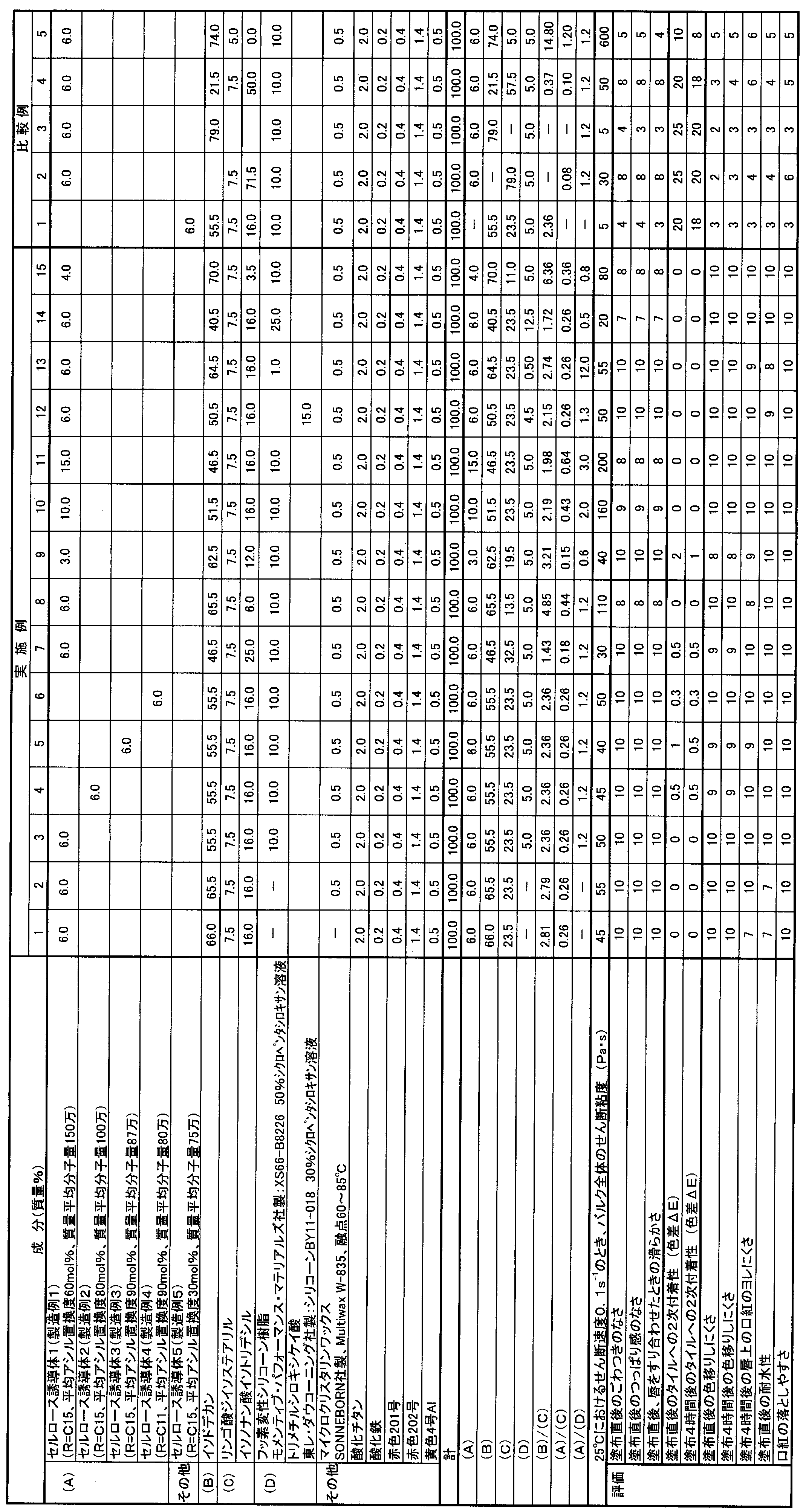
- Examples 1 to 15 and Comparative Examples 1 to 5 Manufacture lipsticks with the composition shown in Table 1 and measure the bulk shear viscosity, and there is no wrinkle immediately after application, no tension immediately after application, smoothness when the lips are rubbed immediately after application, Secondary adhesion to tile (color difference ⁇ E), secondary adhesion to tile 4 hours after application (color difference ⁇ E), difficulty in color transfer immediately after application, difficulty in color transfer after application 4 hours, application After 4 hours, the lipstick crease on the lips, water resistance immediately after application, and ease of lipstick removal were evaluated. The results are also shown in Table 1.
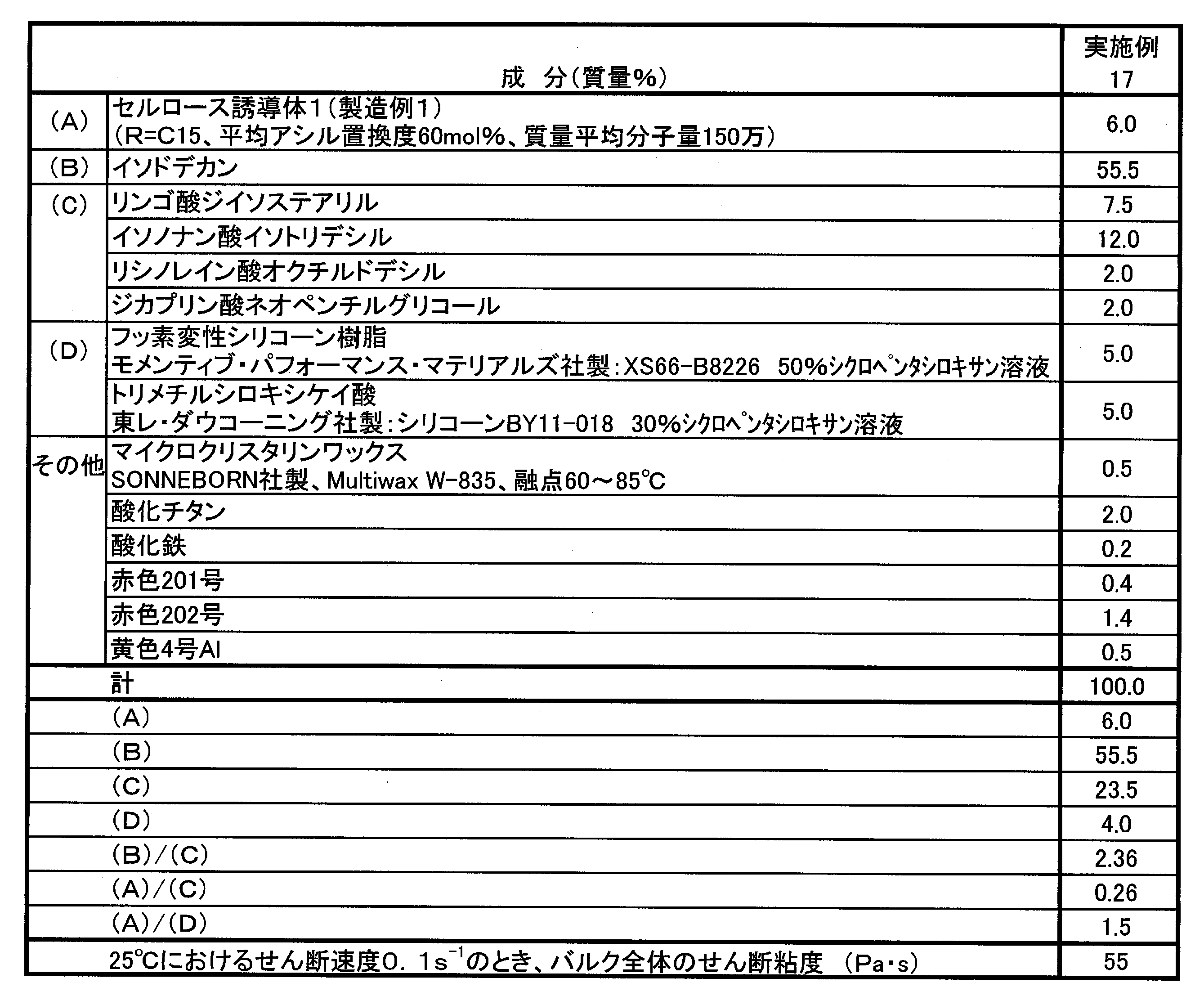
- Examples 16-17 Lipsticks having the compositions shown in Tables 2 and 3 were produced in the same manner as in Examples 1 to 15, and bulk shear viscosity was measured. All of the lipsticks obtained did not feel sticky or sticky immediately after application, and were smooth when the lips were rubbed immediately after application, and secondary adhesion to the tile immediately after application and 4 hours after application was suppressed. In addition, color transfer is difficult after 4 hours of application, lipstick on the lips is not easily blurred after 4 hours of application, water resistance immediately after application is excellent, and lipstick can be removed cleanly.
Landscapes
- Health & Medical Sciences (AREA)
- Life Sciences & Earth Sciences (AREA)
- Veterinary Medicine (AREA)
- Animal Behavior & Ethology (AREA)
- General Health & Medical Sciences (AREA)
- Public Health (AREA)
- Birds (AREA)
- Epidemiology (AREA)
- Chemical & Material Sciences (AREA)
- Emergency Medicine (AREA)
- Oil, Petroleum & Natural Gas (AREA)
- Dispersion Chemistry (AREA)
- Cosmetics (AREA)
Abstract
次の成分(A)、(B)及び(C): (A)主鎖にセルロース骨格を有し、全水酸基の45~95mol%が基-O-M-R(MはCH2又はカルボニル基C=Oを示し、Rは炭素数3~40の直鎖又は分岐鎖のアルキル基又はアルケニル基を示す)で置換されているセルロース誘導体 1~50質量%、 (B)揮発性の炭化水素油 5~80質量%、 (C)25℃で液状のエステル油 5~50質量% を含有し、成分(C)に対する成分(B)の質量割合(B)/(C)が、0.7~9であり、25℃におけるせん断速度0.1s-1 のとき、バルク全体のせん断粘度が1500Pa・s 以下である油性化粧料。
Description
本発明は、油性化粧料に関する。
口紅等の油性化粧料では、美しい仕上がりや、滑らかな感触を得るため、種々の検討がなされている。例えば、特許文献1には、特定のアシル化セルロース誘導体と、エステル油及び炭化水素油を特定の割合で組み合わせた油性化粧料が、滑らかな感触が持続することが記載されている。また、特許文献2には、特定のアシル化セルロース誘導体、シリコーン油剤、エステル油を含有する油性化粧料が、透明感と光沢に優れ、滑らかな感触が持続することが記載され、特許文献3には、特定のアシル化セルロース誘導体、非イオン性親水基を有するシリコーンを含有する油性化粧料が、美しい化粧仕上がりの持続性に優れ、滑らかな感触が持続することが記載されている。
(特許文献1)特開2010-100612号公報
(特許文献2)特開2011-79746号公報
(特許文献3)特開2011-173818号公報
(特許文献2)特開2011-79746号公報
(特許文献3)特開2011-173818号公報
本発明は、次の成分(A)、(B)及び(C):
(A)主鎖にセルロース骨格を有し、全水酸基の45~95mol%が基-O-M-R(MはCH2又はカルボニル基C=Oを示し、Rは炭素数3~40の直鎖又は分岐鎖のアルキル基又はアルケニル基を示す)で置換されているセルロース誘導体 1~50質量%、
(B)揮発性の炭化水素油 5~80質量%、
(C)25℃で液状のエステル油 5~50質量%
を含有し、成分(C)に対する成分(B)の質量割合(B)/(C)が、0.7~9であり、25℃におけるせん断速度0.1s-1 のとき、バルク全体のせん断粘度が1500Pa・s 以下である油性化粧料に関する。
(A)主鎖にセルロース骨格を有し、全水酸基の45~95mol%が基-O-M-R(MはCH2又はカルボニル基C=Oを示し、Rは炭素数3~40の直鎖又は分岐鎖のアルキル基又はアルケニル基を示す)で置換されているセルロース誘導体 1~50質量%、
(B)揮発性の炭化水素油 5~80質量%、
(C)25℃で液状のエステル油 5~50質量%
を含有し、成分(C)に対する成分(B)の質量割合(B)/(C)が、0.7~9であり、25℃におけるせん断速度0.1s-1 のとき、バルク全体のせん断粘度が1500Pa・s 以下である油性化粧料に関する。
アシル化セルロース誘導体を含有する油性化粧料は、滑らかな感触に優れるものの、色移りや色持ちの点で課題があった。
本発明者らは、特定のアシル化セルロース誘導体と、揮発性炭化水素油及びエステル油を、特定の割合で組み合わせて用いれば、滑らかな感触に優れるとともに、色移りが抑制され、色持ちが改善された油性化粧料が得られることを見出した。
本発明の油性化粧料は、塗布時にごわつきやつっぱり感などを感じず、唇や皮膚などが滑らかであり、塗布直後及び長時間経過後においても、カップ等への2次付着が抑制され、水濡れにも強いものである。また、唇や皮膚などから化粧料を落とすときには、きれいに落とすことができる。
本発明で用いる成分(A)のセルロース誘導体は、主鎖にセルロース骨格を有するものであれば限定されないが、原料セルロース誘導体としては、セルロースを含むほか、アセチルセルロース、アセチルブチルセルロース等の短鎖アシル化セルロース、メチルセルロース、エチルセルロース等の短鎖アルキルエーテル化セルロース、ヒドロキシアルキル基、グリセリルエーテル基、(モノ)アルキルグリセリルエーテル基で変性されたセルロースが好ましい。より具体的には、ヒドロキシエチルセルロース、ヒドロキシプロピルセルロース、ヒドロキシプロピルメチルセルロース、グリセリルセルロース、メチルグリセリルセルロース等が挙げられる。
更には、成分(A)のセルロース誘導体の製造原料のセルロース誘導体としては、以下の構成単位を有するものが好ましい。
更には、成分(A)のセルロース誘導体の製造原料のセルロース誘導体としては、以下の構成単位を有するものが好ましい。

(式中、R'は炭素数2~8の直鎖又は分岐鎖のアルキレン基を示し、nはグルコース単位当たりのR'Oの平均付加モル数が0.1~10となる数を示す)
当該構成単位において、R'としては、直鎖又は分岐鎖の炭素数2~4のアルキレン基が好ましく、更には、エチレン基及びプロピレン基がより好ましい。またnとしては、グルコース単位当たりのR'Oの平均付加モル数が0.3~5となる数が好ましく、0.5~4.5となる数がより好ましく、1~4となる数が更に好ましい。
原料セルロース誘導体の好ましいものとしては、ヒドロキシエチルセルロース、ヒドロキシプロピルセルロース等が挙げられ、ヒドロキシプロピルセルロースがより好ましい。
また、原料セルロース誘導体の質量平均分子量(Mw)は、油剤への溶解性、及び感触の点から、好ましくは1万~400万、より好ましくは10万~300万、更に好ましくは30万~200万である。
また、原料セルロース誘導体の質量平均分子量(Mw)は、油剤への溶解性、及び感触の点から、好ましくは1万~400万、より好ましくは10万~300万、更に好ましくは30万~200万である。
成分(A)のセルロース誘導体は、原料セルロース誘導体の水酸基の置換基である基-O-M-R中、MはCH2又はカルボニル基C=Oを示し、Rは炭素数3~40の直鎖又は分岐鎖のアルキル基又はアルケニル基である。
(i)直鎖のアルキル基としては、ブチル基、ペンチル基、ヘキシル基、ヘプチル基、オクチル基、ノニル基、デシル基、ウンデシル基、ドデシル基、トリデシル基、テトラデシル基、ペンタデシル基、ヘキサデシル基、ヘプタデシル基、オクタデシル基、ノナデシル基、イコシル基、ヘンイコシル基、ドコシル基、トリコシル基、テトラコシル基、ペンタコシル基、ヘキサコシル基、ヘプタコシル基、オクタコシル基、ノナコシル基、トリアコンチル基、ヘントリアコンチル基、ドトリアコンチル基、トリトリアコンチル基、テトラトリアコンチル基、ペンタトリアコンチル基、ヘキサトリアコンチル基、ヘプタトリアコンチル基、オクタトリアコンチル基、ノナトリアコンチル基及びテトラコンチル基が挙げられる。
(i)直鎖のアルキル基としては、ブチル基、ペンチル基、ヘキシル基、ヘプチル基、オクチル基、ノニル基、デシル基、ウンデシル基、ドデシル基、トリデシル基、テトラデシル基、ペンタデシル基、ヘキサデシル基、ヘプタデシル基、オクタデシル基、ノナデシル基、イコシル基、ヘンイコシル基、ドコシル基、トリコシル基、テトラコシル基、ペンタコシル基、ヘキサコシル基、ヘプタコシル基、オクタコシル基、ノナコシル基、トリアコンチル基、ヘントリアコンチル基、ドトリアコンチル基、トリトリアコンチル基、テトラトリアコンチル基、ペンタトリアコンチル基、ヘキサトリアコンチル基、ヘプタトリアコンチル基、オクタトリアコンチル基、ノナトリアコンチル基及びテトラコンチル基が挙げられる。
(ii)分岐鎖のアルキル基としては、メチルペンチル基、メチルヘキシル基、メチルヘプチル基、メチルオクチル基、メチルノニル基、メチルウンデシル基、メチルヘプタデシル基、エチルヘキサデシル基、メチルオクタデシル基、プロピルペンタデシル基、2-ヘキシルデシル基、2-オクチルドデシル、2-ヘプチルウンデシル基、2-デシルテトラデシル基、2-ドデシルヘキサデシル基、2-テトラデシルオクタデシル基、2-ヘキサデシルイコシル基等が挙げられる。
(iii)直鎖のアルケニル基としては、ドデセニル基、トリデセニル基、テトラデセニル基、ペンタデセニル基、ヘキサデセニル基、ヘプタデセニル基、オクタデセニル基、ノナデセニル基、イコセニル基、ヘンイコセニル基、ドコセニル基、トリコセニル基、テトラコセニル基、ペンタコセニル基、ヘキサコセニル基、ヘプタコセニル基、オクタコセニル基等が挙げられる。
(iv)分岐鎖のアルケニル基としては、イソトリデセニル基、イソオクタデセニル基、イソトリアコンテニル基、2-ブチルオクテニル基、2-ヘキシルデセニル基、2-オクチルドデセニル基、2-デシルテトラデセニル基、2-ドデシルヘキサデセニル基等が挙げられる。
(iv)分岐鎖のアルケニル基としては、イソトリデセニル基、イソオクタデセニル基、イソトリアコンテニル基、2-ブチルオクテニル基、2-ヘキシルデセニル基、2-オクチルドデセニル基、2-デシルテトラデセニル基、2-ドデシルヘキサデセニル基等が挙げられる。
これらのうち、油性化粧料の塗布時の滑らかさを付与し、唇や皮膚などに均一な被膜を形成する観点から、Rは、直鎖アルキル基が好ましい。また、伸ばしやすさ、密着性の良さから、炭素数9~21が好ましく、炭素数11~17がより好ましく、炭素数15が更に好ましい。
水酸基の基-O-M-R置換率は、油剤への溶解性を高め、塗布時にごわつきやつっぱり感を感じない点や、カップ等への2次付着を抑制する点から、45mol%以上であり、48mol%以上が好ましく、51mol%以上がより好ましく、ヨレにくさや耐水性を高める点から、95mol%以下であり、94mol%以下が好ましく、92mol%以下がより好ましく、66mol%以下がさらに好ましい。また、水酸基の基-O-M-R置換率は、45~95mol%であり、48~94mol%が好ましく、51~92mol%がより好ましく、51~66mol%がさらに好ましい。
水酸基は、適度に残留していることが、使用感、顔料分散性の点から好ましく、5mol%以上が好ましく、6mol%以上がより好ましく、8mol%以上がさらに好ましく、34mol%以上がよりさらに好ましく、55mol%以下が好ましく、52mol%以下がより好ましく、49mol%以下がさらに好ましい。また、水酸基の残留率は、5~55mol%が好ましく、6~52mol%がより好ましく、8~49mol%がさらに好ましく、34~49mol%がよりさらに好ましい。
水酸基は、適度に残留していることが、使用感、顔料分散性の点から好ましく、5mol%以上が好ましく、6mol%以上がより好ましく、8mol%以上がさらに好ましく、34mol%以上がよりさらに好ましく、55mol%以下が好ましく、52mol%以下がより好ましく、49mol%以下がさらに好ましい。また、水酸基の残留率は、5~55mol%が好ましく、6~52mol%がより好ましく、8~49mol%がさらに好ましく、34~49mol%がよりさらに好ましい。
成分(A)のセルロース誘導体の質量平均分子量は、油成分への溶解性、滑らかな感触が持続する点から、10万以上が好ましく、20万以上がより好ましく、30万以上が更に好ましく、50万以上がより更に好ましく、500万以下が好ましく、400万以下がより好ましく、300万以下が更に好ましく、200万以下がより更に好ましい。
なお、質量平均分子量(Mw)は、ゲルパーミエーションクロマトグラフィー(クロロホルム溶媒、直鎖ポリスチレンを標準として定められた較正曲線、屈折率検出器を用いる)測定によって求められるものである。
なお、質量平均分子量(Mw)は、ゲルパーミエーションクロマトグラフィー(クロロホルム溶媒、直鎖ポリスチレンを標準として定められた較正曲線、屈折率検出器を用いる)測定によって求められるものである。
成分(A)のセルロース誘導体は、原料セルロース誘導体と、炭素数3~40の直鎖又は分岐鎖のアルキル基又はアルケニル基を有する酸ハライドとを反応させ、原料セルロース誘導体の全水酸基の45~95mol%を置換することにより製造される。
また、MがCH2であるものは、塩基存在下に、セルロース誘導体と対応するアルキルハライドあるいはアルキルメシラート等のスルホン酸エステルを反応させることによって製造することができる。主鎖がセルロース骨格からなるものは、アセチルセルロースのエステル交換反応(アシドーリシス)によっても得ることができる。この方法によれば、水酸基の残留量が極めて低いセルロースエステル誘導体が得られる。
また、MがCH2であるものは、塩基存在下に、セルロース誘導体と対応するアルキルハライドあるいはアルキルメシラート等のスルホン酸エステルを反応させることによって製造することができる。主鎖がセルロース骨格からなるものは、アセチルセルロースのエステル交換反応(アシドーリシス)によっても得ることができる。この方法によれば、水酸基の残留量が極めて低いセルロースエステル誘導体が得られる。
具体的には、ヒドロキシエチルセルロースラウリン酸エステル、ヒドロキシエチルセルロースミリスチン酸エステル、ヒドロキシエチルセルロースパルミチン酸エステル、ヒドロキシエチルセルロースステアリン酸エステル、ヒドロキシエチルセルロースベヘン酸エステル;ヒドロキシプロピルセルロースラウリン酸エステル、ヒドロキシプロピルセルロースミリスチン酸エステル、ヒドロキシプロピルセルロースパルミチン酸エステル、ヒドロキシプロピルセルロースステアリン酸エステル、ヒドロキシプロピルセルロースベヘン酸エステル;ヒドロキシエチルメチルセルロースラウリン酸エステル、ヒドロキシエチルメチルセルロースミリスチン酸エステル、ヒドロキシエチルメチルセルロースパルミチン酸エステル、ヒドロキシエチルメチルセルロースステアリン酸エステル、ヒドロキシエチルメチルセルロースベヘン酸エステル;ヒドロキシプロピルメチルセルロースラウリン酸エステル、ヒドロキシプロピルメチルセルロースミリスチン酸エステル、ヒドロキシプロピルメチルセルロースパルミチン酸エステル、ヒドロキシプロピルメチルセルロースステアリン酸エステル、ヒドロキシプロピルメチルセルロースベヘン酸エステル等が挙げられる。中でも、唇や皮膚などに均一な被膜を形成し、カップ等への2次付着を抑制する点から、ヒドロキシプロピルセルロースラウリン酸エステル、ヒドロキシプロピルセルロースミリスチン酸エステル、ヒドロキシプロピルセルロースパルミチン酸エステル、ヒドロキシプロピルセルロースステアリン酸エステル、ヒドロキシプロピルセルロースベヘン酸エステルが好ましく、ヒドロキシプロピルセルロースパルミチン酸エステルがより好ましい。
成分(A)のセルロース誘導体は、1種又は2種以上を用いることができ、含有量は、唇や皮膚などに均一な被膜を形成し、カップ等への2次付着を抑制する点から、全組成中に1質量%以上であり、1.5質量%以上が好ましく、2質量%以上がより好ましく、3質量%以上がさらに好ましく、50質量%以下であり、30質量%以下が好ましく、20質量%以下がより好ましく、15質量%以下がさらに好ましく、10質量%以下がよりさらに好ましい。また、成分(A)の含有量は、全組成中に1~50質量%であり、1.5~30質量%が好ましく、2~20質量%がより好ましく、2~15質量%がさらに好ましく、3~10質量%がよりさらに好ましい。
成分(B)は、揮発性の炭化水素油である。揮発性とは、35~87℃の引火点を有するものである。
成分(B)の揮発性炭化水素油としては、成分(A)との相溶性に優れ、本揮発性炭化水素油が、揮散した後でも、べたついたり、ごわついたりする感触がない点から、例えば、n-デカン、n-ウンデカン、n-ドデカン等のパラフィン系炭化水素油;イソデカン、イソドデカン、水添ポリイソブテン等のイソパラフィン系炭化水素油;シクロデカン、シクロドデカン等の環状パラフィン炭化水素油が挙げられる。これらのうち、炭素数8~16の炭化水素油が好ましく、炭素数10~16の炭化水素油がより好ましく、炭素数12の炭化水素油がさらに好ましい。なかでも、イソパラフィン系炭化水素油が好ましく、イソドデカン、炭素数12の水添ポリイソブテンがより好ましく、イソドデカンがさらに好ましい。
市販品としては、マルカゾールR(丸善石油化学社製:引火点48℃)、パールリーム3(日油社製:引火点61℃)等が挙げられる。
成分(B)の揮発性炭化水素油としては、成分(A)との相溶性に優れ、本揮発性炭化水素油が、揮散した後でも、べたついたり、ごわついたりする感触がない点から、例えば、n-デカン、n-ウンデカン、n-ドデカン等のパラフィン系炭化水素油;イソデカン、イソドデカン、水添ポリイソブテン等のイソパラフィン系炭化水素油;シクロデカン、シクロドデカン等の環状パラフィン炭化水素油が挙げられる。これらのうち、炭素数8~16の炭化水素油が好ましく、炭素数10~16の炭化水素油がより好ましく、炭素数12の炭化水素油がさらに好ましい。なかでも、イソパラフィン系炭化水素油が好ましく、イソドデカン、炭素数12の水添ポリイソブテンがより好ましく、イソドデカンがさらに好ましい。
市販品としては、マルカゾールR(丸善石油化学社製:引火点48℃)、パールリーム3(日油社製:引火点61℃)等が挙げられる。
成分(B)は、1種又は2種以上を用いることができ、含有量は、成分(A)や(C)の相溶性に優れ、唇や皮膚などに塗布した後、成分(B)が揮発した後でも、ごわついたり、べたついたりせず、唇上などで均一な皮膜を形成し、カップなどへの2次付着が抑制される点から、全組成中に5質量%以上であり、35質量%以上が好ましく、40質量%以上がより好ましく、45質量%以上がさらに好ましく、46質量%以上がよりさらに好ましく、80質量%以下であり、75質量%以下が好ましく、70質量%以下がより好ましく、66質量%以下がさらに好ましい。また、成分(B)の含有量は、全組成中5~80質量%であり、35~75質量%が好ましく、40~75質量%がより好ましく、45~70質量%がさらに好ましく、46~66質量%がよりさらに好ましい。
本発明で用いる成分(C)のエステル油は、25℃で液状のものである。25℃で液状とは、流動性を有するもので、ペースト状のものも含まれる。
かかるエステル油としては、通常の化粧料に用いられるものであれば制限されず、例えば、イソノナン酸イソトリデシル、リンゴ酸ジイソステアリル、ミリスチン酸イソステアリル、リシノレイン酸オクチルドデシル、ジカプリン酸ネオペンチルグリコール、ジイソステアリン酸ジグリセリル、モノイソステアリン酸モノミリスチン酸グリセリル、パラメトキシケイ皮酸2-エチルヘキシル、酢酸トコフェロール、モノイソステアリン酸ジグリセリル等が挙げられる。
これらのうち、成分(A)の相溶性に優れ、唇や皮膚などに塗布した後、成分(B)が揮発した後でも、ごわついたり、べたついたりしない点から、分岐鎖を有するエステル油が好ましく、イソノナン酸イソトリデシル、リンゴ酸ジイソステアリル、ミリスチン酸イソステアリル、リシノレイン酸オクチルドデシル、ジイソステアリン酸ジグリセリル、モノイソステアリン酸モノミリスチン酸グリセリル、パラメトキシケイ皮酸2-エチルヘキシル、モノイソステアリン酸ジグリセリルがより好ましく、イソノナン酸イソトリデシル、リンゴ酸ジイソステアリルがさらに好ましい。
かかるエステル油としては、通常の化粧料に用いられるものであれば制限されず、例えば、イソノナン酸イソトリデシル、リンゴ酸ジイソステアリル、ミリスチン酸イソステアリル、リシノレイン酸オクチルドデシル、ジカプリン酸ネオペンチルグリコール、ジイソステアリン酸ジグリセリル、モノイソステアリン酸モノミリスチン酸グリセリル、パラメトキシケイ皮酸2-エチルヘキシル、酢酸トコフェロール、モノイソステアリン酸ジグリセリル等が挙げられる。
これらのうち、成分(A)の相溶性に優れ、唇や皮膚などに塗布した後、成分(B)が揮発した後でも、ごわついたり、べたついたりしない点から、分岐鎖を有するエステル油が好ましく、イソノナン酸イソトリデシル、リンゴ酸ジイソステアリル、ミリスチン酸イソステアリル、リシノレイン酸オクチルドデシル、ジイソステアリン酸ジグリセリル、モノイソステアリン酸モノミリスチン酸グリセリル、パラメトキシケイ皮酸2-エチルヘキシル、モノイソステアリン酸ジグリセリルがより好ましく、イソノナン酸イソトリデシル、リンゴ酸ジイソステアリルがさらに好ましい。
成分(C)のエステル油は、1種又は2種以上を用いることができ、含有量は、成分(A)の相溶性に優れ、唇や皮膚などに塗布した後、成分(B)が揮発した後でも、ごわついたり、べたついたりせず、唇上などで均一な皮膜を形成し、カップへの2次付着が抑制される点から、全組成中に5質量%以上であり、7質量%以上が好ましく、10質量%以上がより好ましく、13質量%以上がさらに好ましく、50質量%以下であり、40質量%以下が好ましく、35質量%以下がより好ましく、33質量%以下がさらに好ましい。また、成分(C)の含有量は、全組成中に5~50質量%であり、7~40質量%が好ましく、10~35質量%がより好ましく、13~33質量%がさらに好ましい。
本発明において、成分(C)に対する成分(B)の質量割合(B)/(C)は、塗布時にごわつきやつっぱり感などを感じず、唇や皮膚などが滑らかであり、塗布直後及び長時間経過後においても、カップへの2次付着が抑制され、水濡れにも強い点、さらに、唇から口紅を落とす時にも、きれいに落とすことができる点から、0.7以上であり、1.0以上が好ましく、1.4以上がより好ましく、9以下であり、7以下が好ましく、5以下がより好ましい。また、成分(C)に対する成分(B)の質量割合(B)/(C)は、0.7~9あり、1.0~7が好ましく、1.4~5がより好ましい。
本発明において、成分(C)に対する成分(A)の質量割合(A)/(C)は、塗布時にごわつきやつっぱり感などを感じず、唇や皮膚などが滑らかであり、塗布直後及び長時間経過後においても、カップなどへの2次付着が抑制され、水濡れにも強い点、さらに、唇や皮膚などから化粧料を落とす時にも、きれいに落とすことができる点から、0.10以上が好ましく、0.12以上がより好ましく、0.14以上がさらに好ましく、1.25以下が好ましく、1.0以下がより好ましく、0.65以下がさらに好ましい。また、成分(C)に対する成分(A)の質量割合(A)/(C)は、0.10~1.25が好ましく、0.12~1.0がより好ましく、0.14~0.65がさらに好ましい。
本発明の油性化粧料は、さらに、(D)有機シリコーン樹脂を含有することができ、化粧料を唇や皮膚などに対して均一に付着させ、密着性を向上させ、耐水性を向上することができる。
成分(D)の有機シリコーン樹脂は、通常化粧料に用いられるものであればいずれのものも使用することができ、例えば、(D-1)トリメチルシロキシケイ酸、(D-2)フッ素変性シリコーン樹脂等が挙げられる。
成分(D)の有機シリコーン樹脂は、通常化粧料に用いられるものであればいずれのものも使用することができ、例えば、(D-1)トリメチルシロキシケイ酸、(D-2)フッ素変性シリコーン樹脂等が挙げられる。
成分(D)のうち、成分(D-1)トリメチルシロキシケイ酸としては、通常の化粧料に用いられるものであれば制限されず、シロキサン構造を主骨格とした架橋構造を持つ化合物で、[(CH3)3SiO1/2]X[SiO2]Y(Xは1~3、Yは0.5~8)で表されるものが好ましい。
成分(D-1)トリメチルシロキシケイ酸は、使用感と化粧持ちの点から、質量平均分子量が1000~10000のものが好ましく、2000~9000のものがより好ましく、3000~6000のものがさらに好ましい。また、その性状は、25℃で液状、ガム状、ペースト状、固体状などのいずれでも良いが、得られる化粧持ちの観点から、固体状のものが好ましい。また、配合性の観点から、溶剤によって希釈された溶液や分散液であること、または、事前に混合して得られる溶液や分散液の状態で使用することも可能である。希釈又は分散させる溶剤としては、ジメチルポリシロキサン、オクタメチルシクロテトラシロキサン、デカメチルシクロペンタシロキサン、イソドデカンから選ばれる1種又は2種以上が好ましく、揮発性のジメチルポリシロキサン、デカメチルシクロペンタシロキサンがより好ましい。なお、揮発性とは、35~87℃の引火点を有するものである。
成分(D-1)トリメチルシロキシケイ酸は、使用感と化粧持ちの点から、質量平均分子量が1000~10000のものが好ましく、2000~9000のものがより好ましく、3000~6000のものがさらに好ましい。また、その性状は、25℃で液状、ガム状、ペースト状、固体状などのいずれでも良いが、得られる化粧持ちの観点から、固体状のものが好ましい。また、配合性の観点から、溶剤によって希釈された溶液や分散液であること、または、事前に混合して得られる溶液や分散液の状態で使用することも可能である。希釈又は分散させる溶剤としては、ジメチルポリシロキサン、オクタメチルシクロテトラシロキサン、デカメチルシクロペンタシロキサン、イソドデカンから選ばれる1種又は2種以上が好ましく、揮発性のジメチルポリシロキサン、デカメチルシクロペンタシロキサンがより好ましい。なお、揮発性とは、35~87℃の引火点を有するものである。
成分(D-1)の市販品としては、予め溶剤に溶解させたもので、KF-7312J(固形分50%デカメチルシクロペンタシロキサン溶液)、KF-9021(50%デカメチルシクロペンタシロキサン溶液)、X21-5249(50%デカメチルシクロペンタシロキサン溶液)(以上、信越化学工業社製)、SS4267(35%ジメチルポリシロキサン溶液)、SR1000(以上、モメンティブ・パフォーマンス・マテリアルズ・ジャパン合同会社製)、BY11-018(30%シクロペンタシロキサン溶液)(東レ・ダウコーニング・シリコーン社製)、BELSIL TMS 803(Wacker Chemie AG社製)等を使用することができる。
成分(D)のうち、成分(D-2)フッ素変性シリコーン樹脂としては、一般式(1)
R1 aSiO(4-a)/2 (1)
(式中、R1は炭素数1~8の炭化水素基、フェニル基、水酸基又は一般式-R2-Rf(R2は炭素数2~6の2価のアルキレン基を示し、Rfは炭素数1~8のパーフルオロアルキル基を示す)であって、水酸基及び一般式-R2-Rfを必須とする官能基から任意に選ばれ、aは平均数で1.0≦a≦1.8である)
で表される構造を有するものが好ましい。
フッ素変性シリコーン樹脂は、皮膚や粉体に対する付着性の点から、分子内にシラノール基を有し、シラノール基中のOH基の割合が、樹脂質量に対して0.1~5質量%であるのが好ましく、0.5~5質量%がより好ましい。
成分(D-2)は、25℃で固体のものが好ましく、配合性の観点から、溶剤によって希釈された溶液や分散液であること、または、事前に混合して得られる溶液や分散液の状態で使用することも可能である。希釈又は分散させる溶剤としては、環状シリコーン、ジメチルポリシロキサン等が好ましい。環状シリコーンとしては、オクタメチルシクロテトラシロキサン(D4)及びデカメチルシクロペンタシロキサン(D5)から選ばれる1種以上に溶解して用いるのが好ましい。
このようなフッ素変性シリコーン樹脂としては、INCI名「トリフルオロプロピルジメチル/トリメチルシロキシシリケート(Trifluoropropyldimethyl/Trimethylsiloxysilicate)」である、XS66-B8226、XS66-C1191、XS66-B8636(以上、モメンティブ・パフォーマンス・マテリアルズ社製)等の市販品を用いることができる。
R1 aSiO(4-a)/2 (1)
(式中、R1は炭素数1~8の炭化水素基、フェニル基、水酸基又は一般式-R2-Rf(R2は炭素数2~6の2価のアルキレン基を示し、Rfは炭素数1~8のパーフルオロアルキル基を示す)であって、水酸基及び一般式-R2-Rfを必須とする官能基から任意に選ばれ、aは平均数で1.0≦a≦1.8である)
で表される構造を有するものが好ましい。
フッ素変性シリコーン樹脂は、皮膚や粉体に対する付着性の点から、分子内にシラノール基を有し、シラノール基中のOH基の割合が、樹脂質量に対して0.1~5質量%であるのが好ましく、0.5~5質量%がより好ましい。
成分(D-2)は、25℃で固体のものが好ましく、配合性の観点から、溶剤によって希釈された溶液や分散液であること、または、事前に混合して得られる溶液や分散液の状態で使用することも可能である。希釈又は分散させる溶剤としては、環状シリコーン、ジメチルポリシロキサン等が好ましい。環状シリコーンとしては、オクタメチルシクロテトラシロキサン(D4)及びデカメチルシクロペンタシロキサン(D5)から選ばれる1種以上に溶解して用いるのが好ましい。
このようなフッ素変性シリコーン樹脂としては、INCI名「トリフルオロプロピルジメチル/トリメチルシロキシシリケート(Trifluoropropyldimethyl/Trimethylsiloxysilicate)」である、XS66-B8226、XS66-C1191、XS66-B8636(以上、モメンティブ・パフォーマンス・マテリアルズ社製)等の市販品を用いることができる。
成分(D)の有機シリコーン樹脂は、1種又は2種以上を組み合わせて用いることができ、含有量は、化粧料を唇や皮膚などに対して均一に付着させ、密着性を向上させる点、また、耐水性に優れる点から、全組成中に0.01質量%以上が好ましく、0.2質量%以上がより好ましく、0.5質量%以上がさらに好ましく、1質量%以上がよりさらに好ましく、25質量%以下が好ましく、20質量%以下がより好ましく、15質量%以下がさらに好ましく、13質量%以下がよりさらに好ましい。また、成分(D)の含有量は、全組成中に0.01~25質量%が好ましく、0.2~20質量%がより好ましく、0.5~15質量%がさらに好ましく、1~13質量%がよりさらに好ましい。
本発明において、成分(D)に対する成分(A)の質量割合(A)/(D)は、塗布直後及び長時間経過後においても、カップなどへの2次付着が抑制され、水濡れにも強く、さらに、唇や皮膚から化粧料を落とすときにも、きれいに落とすことができる点から、0.05以上が好ましく、0.2以上がより好ましく、0.3以上がさらに好ましく、0.5以上がよりさらに好ましく、40以下が好ましく、20以下がより好ましく、12以下がさらに好ましく、10以下がよりさらに好ましい。また、成分(D)に対する成分(A)の質量割合(A)/(D)は、0.05~40が好ましく、0.2~20がより好ましく、0.3~12がさらに好ましく、0.5~10がよりさらに好ましい。
さらに、本発明の油性化粧料は、25℃で固形のワックスを含有することができる。25℃で固形とは、25℃において固体の性状を示し、融点が61℃以上のものを指す。
25℃で固形のワックスとしては、通常の化粧料に用いられるものであれば制限されず、例えば、オゾケライト、セレシン等の鉱物系ワックス;パラフィン、マイクロクリスタリンワックス等の石油系ワックス;フィッシャー・トロプシュワックス、ポリエチレンワックス等の合成炭化水素;カルナウバロウ、キャンデリラロウ、ライスワックス、木ロウ、サンフラワーワックス等の植物系ワックス;ミツロウ、鯨ロウ等の動物性ワックス;シリコーンワックス、合成ミツロウ等の合成ワックスなどが挙げられる。
25℃で固形のワックスとしては、通常の化粧料に用いられるものであれば制限されず、例えば、オゾケライト、セレシン等の鉱物系ワックス;パラフィン、マイクロクリスタリンワックス等の石油系ワックス;フィッシャー・トロプシュワックス、ポリエチレンワックス等の合成炭化水素;カルナウバロウ、キャンデリラロウ、ライスワックス、木ロウ、サンフラワーワックス等の植物系ワックス;ミツロウ、鯨ロウ等の動物性ワックス;シリコーンワックス、合成ミツロウ等の合成ワックスなどが挙げられる。
25℃で固形のワックスは、油性化粧料に適度な硬さを付与し、油の染み出し抑制、潤いを付与する点から、融点65℃以上、140℃以下が好ましく、70℃以上、90℃以下がより好ましい。また、滑らかな使用感を付与する点から、融点が90℃を超えるワックスを含まないことが好ましい。
また、25℃で固形のワックスは、油性化粧料に適度な硬さを付与し、油の染み出し抑制、潤いを付与する点から、25℃での針入度が1以上、150以下であるのが好ましく、15以上、110以下がより好ましい。
ここで、針入度は、25±0.1℃に保ったワックスの試料に、規定の針(針の質量2.5±0.02g、針保持具の質量47.5±0.02g、おもりの質量50±0.05g)が、5秒間に針入する長さを測定し、その針入距離(mm)を10倍した値を針入度とするものであり、JIS K-2235-5.4(1991年)に準じて測定した値である。
ここで、針入度は、25±0.1℃に保ったワックスの試料に、規定の針(針の質量2.5±0.02g、針保持具の質量47.5±0.02g、おもりの質量50±0.05g)が、5秒間に針入する長さを測定し、その針入距離(mm)を10倍した値を針入度とするものであり、JIS K-2235-5.4(1991年)に準じて測定した値である。
25℃での針入度が1以上、150以下の固形のワックスとしては、鉱物系ワックス、石油系ワックス及び合成炭化水素が挙げられる。なかでも、外観色のくすみを抑制し、塗布膜の持続性、潤いの性能が高い点から、針入度が15以上、110以下のマイクロクリスタリンワックス、パラフィンワックスが好ましく、針入度が15以上、110以下のマイクロクリスタリンワックスがより好ましい。また、25℃での針入度が、25以上、80以下のマイクロクリスタリンワックスであることが好ましい。
これらのワックスは、市販品を使用することができ、例えば、マイクロクリスタリンワックスとして、Multiwax W-445、W-835(以上、SONNEBORN社製)、Paracera M(Paramelt社製)、Hi-Mic-1045、1070、2045(以上、日本精鑞社製)、精製マイクロクリスタリンワックス(日興リカ社製)、155°マイクロワックス(日本石油社製)等が挙げられる。
針入度が15以上のマイクロクリスタリンワックスは、滑らかな使用感、塗布時の艶を付与する点から、25℃で固形のワックス中に50質量%以上含まれるのが好ましく、70質量%以上含まれるのがより好ましい。
これらのワックスは、市販品を使用することができ、例えば、マイクロクリスタリンワックスとして、Multiwax W-445、W-835(以上、SONNEBORN社製)、Paracera M(Paramelt社製)、Hi-Mic-1045、1070、2045(以上、日本精鑞社製)、精製マイクロクリスタリンワックス(日興リカ社製)、155°マイクロワックス(日本石油社製)等が挙げられる。
針入度が15以上のマイクロクリスタリンワックスは、滑らかな使用感、塗布時の艶を付与する点から、25℃で固形のワックス中に50質量%以上含まれるのが好ましく、70質量%以上含まれるのがより好ましい。
25℃で固形のワックスは、1種又は2種以上を組み合わせて用いることができ、含有量は、唇上などでの化粧料のよれを抑制する点から、全組成中に5質量%未満であるのが好ましく、3質量%以下がより好ましく、1質量%以下がさらに好ましく、0.5質量%以下がよりさらに好ましい。
さらに、本発明の油性化粧料は、粉体を含有することができる。かかる粉体としては、通常の化粧料に用いられるものであれば制限されず、体質顔料、着色顔料、光輝性顔料等を用いることができる。
体質顔料としては、例えば、ケイ酸、無水ケイ酸、ケイ酸マグネシウム、タルク、セリサイト、マイカ、合成マイカ、ガラスフレーク、合成金雲母、カオリン、クレー、ベントナイト、オキシ塩化ビスマス、酸化ジルコニウム、酸化マグネシウム、酸化アルミニウム、硫酸カルシウム、硫酸バリウム、硫酸マグネシウム、炭酸カルシウム、炭酸マグネシウム等の無機顔料及びこれらの複合粉体が挙げられる。
体質顔料としては、例えば、ケイ酸、無水ケイ酸、ケイ酸マグネシウム、タルク、セリサイト、マイカ、合成マイカ、ガラスフレーク、合成金雲母、カオリン、クレー、ベントナイト、オキシ塩化ビスマス、酸化ジルコニウム、酸化マグネシウム、酸化アルミニウム、硫酸カルシウム、硫酸バリウム、硫酸マグネシウム、炭酸カルシウム、炭酸マグネシウム等の無機顔料及びこれらの複合粉体が挙げられる。
着色顔料としては、例えば、酸化チタン、酸化亜鉛、黄酸化鉄、ベンガラ、黒酸化鉄、紺青、群青、酸化クロム、水酸化クロム等の金属酸化物;マンガンバイオレット、チタン酸コバルト等の金属錯体;更にカーボンブラック等の無機顔料;赤色3号、赤色104号、赤色106号、赤色201号、赤色202号、赤色204号、赤色205号、赤色220号、赤色226号、赤色227号、赤色228号、赤色230号、赤色401号、赤色405号、赤色505号、橙色203号、橙色204号、橙色205号、黄色4号、黄色5号、黄色401号、青色1号、青色404号等の合成有機顔料;β-カロチン、カラメル、パプリカ色素等の天然有機色素などが挙げられる。
光輝性顔料としては、雲母、合成金雲母、ガラス、シリカ、アルミナ等の板状粉体等の表面を酸化チタン、酸化鉄、酸化ケイ素、紺青、酸化クロム、酸化スズ、水酸化クロム、金、銀、カルミン、有機顔料等の着色剤で被覆したものなど、及びポリエチレンテレフタレート・ポリメチルメタクリレート積層末、ポリエチレンテレフタレート・アルミ蒸着末、ポリエチレンテレフタレート・金蒸着積層末などの、フィルム原反を任意形状に断裁したものなどを用いることができる。
これらの粉体は、通常の方法により、撥水処理、撥水・撥油化処理等の各種表面処理を施したものを用いることもできる。
これらの粉体は、通常の方法により、撥水処理、撥水・撥油化処理等の各種表面処理を施したものを用いることもできる。
粉体は、1種又は2種以上を用いることができ、含有量は、全組成中に0.01質量%以上が好ましく、0.05質量%以上がより好ましく、20質量%以下が好ましく、10質量%以下がより好ましい。また、粉体の含有量は、全組成中に0.01~20質量%が好ましく、0.05~10質量%がより好ましい。
さらに、本発明の油性化粧料は、前記成分以外に、通常の化粧料に用いられる成分、例えば、成分(B)及び(C)以外の油性成分、界面活性剤、低級アルコール、多価アルコール、成分(A)及び(D)以外の高分子化合物、紫外線吸収剤、酸化防止剤、染料、香料、色材、防汚剤、保湿剤、水等を含有することができる。
本発明の油性化粧料は、通常の方法により製造することができ、その剤型としては、固形、半固形、ゲル、液状等のいずれでも良い。
本発明の油性化粧料は、塗布時の伸ばしやすさの点から、25℃におけるせん断速度0.1s-1 のとき、バルク全体のせん断粘度が1500Pa・s 以下であり、900Pa・s以下であるのが好ましく、500Pa・s以下であるのがより好ましく、250Pa・s以下であるのがさらに好ましく、200Pa・s以下であるのがよりさらに好ましく、10Pa・s以上であるのが好ましく、20Pa・s以上であるのがより好ましく、30Pa・s以上であるのがさらに好ましい。また、25℃におけるせん断速度0.1s-1 のとき、バルク全体のせん断粘度が、10~900Pa・s であるのが好ましく、20~500Pa・s であるのがより好ましく、20~250Pa・s であるのがさらに好ましく、30~200Pa・s であるのがよりさらに好ましい。
せん断粘度は、レオメーターにより測定する。冶具はφ25mm。せん断速度が0.1s-1 のときのせん断粘度を読み取り、測定される。具体的には、調整したバルクを、レオメーター(MCR301;アントンパール社製)により測定する。冶具はφ25mm。せん断速度が0.1s-1 のときのせん断粘度を読み取り、測定される。
せん断粘度は、レオメーターにより測定する。冶具はφ25mm。せん断速度が0.1s-1 のときのせん断粘度を読み取り、測定される。具体的には、調整したバルクを、レオメーター(MCR301;アントンパール社製)により測定する。冶具はφ25mm。せん断速度が0.1s-1 のときのせん断粘度を読み取り、測定される。
本発明の油性化粧料は、油剤を連続相とする化粧料であり、皮膚、口唇、睫毛、爪、毛髪に使用され、好ましくは、口唇に使用される。口紅、リップグロス、リップライナー等の口唇化粧料;マスカラ、アイライナー、アイシャドウ、チークカラー、ファンデーション、コンシーラー等のメイクアップ化粧料;クリーム、乳液、美容液、マッサージ剤、デオドラント、サンスクリーン、育毛剤、ヘアカラー、ヘアワックス、ヘアフォームなどとすることができる。中でも、口紅、リップグロス、リップライナーから選ばれる口唇化粧料として好適である。
本発明の油性化粧料は、化粧料塗布用具を用いて、皮膚、口唇、睫毛、爪、毛髪等の適用部位に使用するのが好ましい。
本発明の油性化粧料は、化粧料塗布用具で、取り出す容器に収納された形態であることが好ましく、取り出す容器が、ボトル容器、ジャー容器、チューブ容器がより好ましく、中でも使用時の液だれを抑制する点から、ボトル容器、チューブ容器がさらに好ましい。
容器に収納された油性化粧料を取り出す化粧料塗布用具は、化粧料を塗布する為の塗布面を有し、先端に該塗布部を連結した支持軸を有している。具体的には、チップ、スポンジ、パフ、筆等が挙げられる。なかでも、化粧料を塗布する為の塗布面を有し、かつ錐状、扁平体からなる塗布部と、先端に該塗布部を連結した支持軸とを有している化粧料塗布用具が、初期の使用時から塗布用具への取れ性、唇や皮膚等への塗りやすさの点から好ましい。
本発明の油性化粧料は、取り出し用の化粧料塗布用具を備える化粧料容器に収納された形態であることで、初期の使用時から塗布用具への取れ性に優れる。特に、使用後に容器内に残る化粧料の残留が少ない点から、化粧料塗布用具が化粧料にどぶづけされているディッピング容器がより好ましい。
上述した実施形態に関し、本発明は、更に以下の組成物を開示する。
上述した実施形態に関し、本発明は、更に以下の組成物を開示する。
<1>次の成分(A)、(B)及び(C):
(A)主鎖にセルロース骨格を有し、全水酸基の45~95mol%が基-O-M-R(MはCH2又はカルボニル基C=Oを示し、Rは炭素数3~40の直鎖又は分岐鎖のアルキル基又はアルケニル基を示す)で置換されているセルロース誘導体 1~50質量%、
(B)揮発性の炭化水素油 5~80質量%、
(C)25℃で液状のエステル油 5~50質量%
を含有し、成分(C)に対する成分(B)の質量割合(B)/(C)が、0.7~9であり、25℃におけるせん断速度0.1s-1 のとき、バルク全体のせん断粘度が1500Pa・s 以下である油性化粧料。
(A)主鎖にセルロース骨格を有し、全水酸基の45~95mol%が基-O-M-R(MはCH2又はカルボニル基C=Oを示し、Rは炭素数3~40の直鎖又は分岐鎖のアルキル基又はアルケニル基を示す)で置換されているセルロース誘導体 1~50質量%、
(B)揮発性の炭化水素油 5~80質量%、
(C)25℃で液状のエステル油 5~50質量%
を含有し、成分(C)に対する成分(B)の質量割合(B)/(C)が、0.7~9であり、25℃におけるせん断速度0.1s-1 のとき、バルク全体のせん断粘度が1500Pa・s 以下である油性化粧料。
<2>成分(A)のセルロース誘導体において、原料セルロース誘導体が、好ましくは、以下の構成単位

(式中、R'は炭素数2~8の直鎖又は分岐鎖のアルキレン基を示し、nはグルコース単位当たりのR'Oの平均付加モル数が0.1~10となる数を示す)
を有するものであって、ヒドロキシエチルセルロース、ヒドロキシプロピルセルロースがより好ましく、ヒドロキシプロピルセルロースが更に好ましい前記<1>記載の油性化粧料。
を有するものであって、ヒドロキシエチルセルロース、ヒドロキシプロピルセルロースがより好ましく、ヒドロキシプロピルセルロースが更に好ましい前記<1>記載の油性化粧料。
<3>成分(A)において、原料セルロース誘導体の水酸基の置換基である基-O-M-RのRが、好ましくは、炭素数9~21の直鎖又は分岐鎖のアルキル基又はアルケニル基であって、炭素数11~17がより好ましく、炭素数15が更に好ましい前記<1>又は<2>記載の油性化粧料。
<4>成分(A)において、水酸基の基-O-M-R置換率が、好ましくは、48mol%以上であって、51mol%以上がより好ましく、94mol%以下が好ましく、92mol%以下がより好ましく、66mol%以下が更に好ましい前記<1>~<3>のいずれか1記載の油性化粧料。
<5>成分(A)において、水酸基の残留率は、好ましくは、5mol%以上であって、6mol%以上がより好ましく、8mol%以上がさらに好ましく、34mol%以上がよりさらに好ましく、55mol%以下が好ましく、52mol%以下がより好ましく、49mol%以下がさらに好ましい前記<1>~<4>のいずれか1記載の油性化粧料。
<4>成分(A)において、水酸基の基-O-M-R置換率が、好ましくは、48mol%以上であって、51mol%以上がより好ましく、94mol%以下が好ましく、92mol%以下がより好ましく、66mol%以下が更に好ましい前記<1>~<3>のいずれか1記載の油性化粧料。
<5>成分(A)において、水酸基の残留率は、好ましくは、5mol%以上であって、6mol%以上がより好ましく、8mol%以上がさらに好ましく、34mol%以上がよりさらに好ましく、55mol%以下が好ましく、52mol%以下がより好ましく、49mol%以下がさらに好ましい前記<1>~<4>のいずれか1記載の油性化粧料。
<6>成分(A)のセルロース誘導体の質量平均分子量が、好ましくは、10万以上であって、20万以上がより好ましく、30万以上が更に好ましく、50万以上がより更に好ましく、500万以下が好ましく、400万以下がより好ましく、300万以下が更に好ましく、200万以下がより更に好ましい前記<1>~<5>のいずれか1記載の油性化粧料。
<7>成分(A)が、好ましくは、ヒドロキシプロピルセルロースラウリン酸エステル、ヒドロキシプロピルセルロースミリスチン酸エステル、ヒドロキシプロピルセルロースパルミチン酸エステル、ヒドロキシプロピルセルロースステアリン酸エステル、ヒドロキシプロピルセルロースベヘン酸エステルであって、ヒドロキシプロピルセルロースパルミチン酸エステルがより好ましい前記<1>~<6>のいずれか1記載の油性化粧料。
<8>成分(A)の含有量が、好ましくは、全組成中に1.5質量%以上であって、2質量%以上がより好ましく、3質量%以上がさらに好ましく、30質量%以下が好ましく、20質量%以下がより好ましく、15質量%以下がさらに好ましく、10質量%以下がよりさらに好ましい前記<1>~<7>のいずれか1記載の油性化粧料。
<7>成分(A)が、好ましくは、ヒドロキシプロピルセルロースラウリン酸エステル、ヒドロキシプロピルセルロースミリスチン酸エステル、ヒドロキシプロピルセルロースパルミチン酸エステル、ヒドロキシプロピルセルロースステアリン酸エステル、ヒドロキシプロピルセルロースベヘン酸エステルであって、ヒドロキシプロピルセルロースパルミチン酸エステルがより好ましい前記<1>~<6>のいずれか1記載の油性化粧料。
<8>成分(A)の含有量が、好ましくは、全組成中に1.5質量%以上であって、2質量%以上がより好ましく、3質量%以上がさらに好ましく、30質量%以下が好ましく、20質量%以下がより好ましく、15質量%以下がさらに好ましく、10質量%以下がよりさらに好ましい前記<1>~<7>のいずれか1記載の油性化粧料。
<9>成分(B)が、好ましくは、35~87℃の引火点を有するものである前記<1>~<8>のいずれか1記載の油性化粧料。
<10>成分(B)が、好ましくは、炭素数8~16の炭化水素油であって、炭素数10~16の炭化水素油がより好ましく、炭素数12の炭化水素油がさらに好ましい前記<1>~<9>のいずれか1記載の油性化粧料。
<11>成分(B)が、好ましくは、イソパラフィン系炭化水素油であって、イソドデカン、炭素数12の水添ポリイソブテンがより好ましく、イソドデカンがさらに好ましい前記<1>~<10>のいずれか1記載の油性化粧料。
<12>成分(B)の含有量が、好ましくは、全組成中に35質量%以上であって、40質量%以上がより好ましく、45質量%以上がさらに好ましく、46質量%以上がよりさらに好ましく、75質量%以下が好ましく、70質量%以下がより好ましく、66質量%以下がさらに好ましい前記<1>~<11>のいずれか1記載の油性化粧料。
<10>成分(B)が、好ましくは、炭素数8~16の炭化水素油であって、炭素数10~16の炭化水素油がより好ましく、炭素数12の炭化水素油がさらに好ましい前記<1>~<9>のいずれか1記載の油性化粧料。
<11>成分(B)が、好ましくは、イソパラフィン系炭化水素油であって、イソドデカン、炭素数12の水添ポリイソブテンがより好ましく、イソドデカンがさらに好ましい前記<1>~<10>のいずれか1記載の油性化粧料。
<12>成分(B)の含有量が、好ましくは、全組成中に35質量%以上であって、40質量%以上がより好ましく、45質量%以上がさらに好ましく、46質量%以上がよりさらに好ましく、75質量%以下が好ましく、70質量%以下がより好ましく、66質量%以下がさらに好ましい前記<1>~<11>のいずれか1記載の油性化粧料。
<13>成分(C)のエステル油が、好ましくは、分岐鎖を有するエステル油であって、イソノナン酸イソトリデシル、リンゴ酸ジイソステアリル、ミリスチン酸イソステアリル、リシノレイン酸オクチルドデシル、ジイソステアリン酸ジグリセリル、モノイソステアリン酸モノミリスチン酸グリセリル、パラメトキシケイ皮酸2-エチルヘキシル、モノイソステアリン酸ジグリセリルがより好ましく、イソノナン酸イソトリデシル、リンゴ酸ジイソステアリルがさらに好ましい前記<1>~<12>のいずれか1記載の油性化粧料。
<14>成分(C)の含有量が、好ましくは、全組成中に7質量%以上であって、10質量%以上がより好ましく、13質量%以上がさらに好ましく、40質量%以下が好ましく、35質量%以下がより好ましく、33質量%以下がさらに好ましい前記<1>~<13>のいずれか1記載の油性化粧料。
<14>成分(C)の含有量が、好ましくは、全組成中に7質量%以上であって、10質量%以上がより好ましく、13質量%以上がさらに好ましく、40質量%以下が好ましく、35質量%以下がより好ましく、33質量%以下がさらに好ましい前記<1>~<13>のいずれか1記載の油性化粧料。
<15>成分(C)に対する成分(B)の質量割合(B)/(C)が、好ましくは、1.0以上であって、1.4以上がより好ましく、7以下が好ましく、5以下がより好ましい前記<1>~<14>のいずれか1記載の油性化粧料。
<16>成分(C)に対する成分(A)の質量割合(A)/(C)が、好ましくは、0.10以上であって、0.12以上がより好ましく、0.14以上がさらに好ましく、1.25以下が好ましく、1.0以下がより好ましく、0.65以下がさらに好ましい前記<1>~<15>のいずれか1記載の油性化粧料。
<16>成分(C)に対する成分(A)の質量割合(A)/(C)が、好ましくは、0.10以上であって、0.12以上がより好ましく、0.14以上がさらに好ましく、1.25以下が好ましく、1.0以下がより好ましく、0.65以下がさらに好ましい前記<1>~<15>のいずれか1記載の油性化粧料。
<17>さらに、(D)有機シリコーン樹脂を含有する前記<1>~<16>のいずれか1記載の油性化粧料。
<18>成分(D)が、好ましくは、(D-1)トリメチルシロキシケイ酸であって、シロキサン構造を主骨格とした架橋構造を持つ化合物で、[(CH3)3SiO1/2]X[SiO2]Y(Xは1~3、Yは0.5~8)で表されるものがより好ましい前記<17>記載の油性化粧料。
<19>(D-1)トリメチルシロキシケイ酸が、好ましくは、質量平均分子量が1000~10000のものであって、2000~9000のものがより好ましく、3000~6000のものがさらに好ましい前記<18>記載の油性化粧料。
<18>成分(D)が、好ましくは、(D-1)トリメチルシロキシケイ酸であって、シロキサン構造を主骨格とした架橋構造を持つ化合物で、[(CH3)3SiO1/2]X[SiO2]Y(Xは1~3、Yは0.5~8)で表されるものがより好ましい前記<17>記載の油性化粧料。
<19>(D-1)トリメチルシロキシケイ酸が、好ましくは、質量平均分子量が1000~10000のものであって、2000~9000のものがより好ましく、3000~6000のものがさらに好ましい前記<18>記載の油性化粧料。
<20>成分(D)が、好ましくは、(D-2)フッ素変性シリコーン樹脂であって、一般式(1)
R1 aSiO(4-a)/2 (1)
(式中、R1は炭素数1~8の炭化水素基、フェニル基、水酸基又は一般式-R2-Rf(R2は炭素数2~6の2価のアルキレン基を示し、Rfは炭素数1~8のパーフルオロアルキル基を示す)であって、水酸基及び一般式-R2-Rfを必須とする官能基から任意に選ばれ、aは平均数で1.0≦a≦1.8である)
で表される構造を有するものがより好ましい前記<17>記載の油性化粧料。
<21>(D-2)フッ素変性シリコーン樹脂が、好ましくは、分子内にシラノール基を有し、シラノール基中のOH基の割合が、樹脂質量に対して0.1~5質量%であって、0.5~5質量%がより好ましい前記<20>記載の油性化粧料。
R1 aSiO(4-a)/2 (1)
(式中、R1は炭素数1~8の炭化水素基、フェニル基、水酸基又は一般式-R2-Rf(R2は炭素数2~6の2価のアルキレン基を示し、Rfは炭素数1~8のパーフルオロアルキル基を示す)であって、水酸基及び一般式-R2-Rfを必須とする官能基から任意に選ばれ、aは平均数で1.0≦a≦1.8である)
で表される構造を有するものがより好ましい前記<17>記載の油性化粧料。
<21>(D-2)フッ素変性シリコーン樹脂が、好ましくは、分子内にシラノール基を有し、シラノール基中のOH基の割合が、樹脂質量に対して0.1~5質量%であって、0.5~5質量%がより好ましい前記<20>記載の油性化粧料。
<22>成分(D)の含有量が、好ましくは、全組成中に0.01質量%以上であって、0.2質量%以上がより好ましく、0.5質量%以上がさらに好ましく、1質量%以上がよりさらに好ましく、25質量%以下が好ましく、20質量%以下がより好ましく、15質量%以下がさらに好ましく、13質量%以下がよりさらに好ましい前記<17>~<21>のいずれか1記載の油性化粧料。
<23>成分(D)に対する成分(A)の質量割合(A)/(D)が、好ましくは、0.05以上であって、0.2以上がより好ましく、0.3以上がさらに好ましく、0.5以上がよりさらに好ましく、40以下が好ましく、20以下がより好ましく、12以下がさらに好ましく、10以下がよりさらに好ましい前記<17>~<22>のいずれか1記載の油性化粧料。
<23>成分(D)に対する成分(A)の質量割合(A)/(D)が、好ましくは、0.05以上であって、0.2以上がより好ましく、0.3以上がさらに好ましく、0.5以上がよりさらに好ましく、40以下が好ましく、20以下がより好ましく、12以下がさらに好ましく、10以下がよりさらに好ましい前記<17>~<22>のいずれか1記載の油性化粧料。
<24>さらに、25℃で固形のワックスを含有し、ワックスは、融点65℃以上、140℃以下が好ましく、70℃以上、90℃以下がより好ましい前記<1>~<23>のいずれか1記載の油性化粧料。
<25>25℃で固形のワックスが、好ましくは、25℃での針入度が1以上、150以下であって、15以上、110以下がより好ましく、針入度が1以上、150以下のマイクロクリスタリンワックス、パラフィンワックスがさらに好ましく、針入度が1以上、150以下のマイクロクリスタリンワックスがよりさらに好ましい前記<24>記載の油性化粧料。
<26>25℃で固形のワックスの含有量が、好ましくは、全組成中に5質量%未満であって、3質量%以下がより好ましく、1質量%以下がさらに好ましく、0.5質量%以下がよりさらに好ましい前記<24>又は<25>記載の油性化粧料。
<27>さらに、粉体を含有し、粉体は、体質顔料、着色顔料、光輝性顔料が好ましい前記<1>~<26>のいずれか1記載の油性化粧料。
<28>粉体の含有量が、好ましくは、全組成中に0.01質量%以上であって、0.05質量%以上がより好ましく、20質量%以下が好ましく、10質量%以下がより好ましい前記<27>記載の油性化粧料。
<25>25℃で固形のワックスが、好ましくは、25℃での針入度が1以上、150以下であって、15以上、110以下がより好ましく、針入度が1以上、150以下のマイクロクリスタリンワックス、パラフィンワックスがさらに好ましく、針入度が1以上、150以下のマイクロクリスタリンワックスがよりさらに好ましい前記<24>記載の油性化粧料。
<26>25℃で固形のワックスの含有量が、好ましくは、全組成中に5質量%未満であって、3質量%以下がより好ましく、1質量%以下がさらに好ましく、0.5質量%以下がよりさらに好ましい前記<24>又は<25>記載の油性化粧料。
<27>さらに、粉体を含有し、粉体は、体質顔料、着色顔料、光輝性顔料が好ましい前記<1>~<26>のいずれか1記載の油性化粧料。
<28>粉体の含有量が、好ましくは、全組成中に0.01質量%以上であって、0.05質量%以上がより好ましく、20質量%以下が好ましく、10質量%以下がより好ましい前記<27>記載の油性化粧料。
<29>25℃におけるせん断速度0.1s-1 のとき、バルク全体のせん断粘度が、好ましくは、900Pa・s以下であって、500Pa・s以下であるのがより好ましく、250Pa・s以下であるのがさらに好ましく、200Pa・s以下であるのがよりさらに好ましく、10Pa・s以上であるのが好ましく、20Pa・s以上であるのがより好ましく、30Pa・s以上であるのがさらに好ましい前記<1>~<28>のいずれか1記載の油性化粧料。
<30>口唇化粧料である前記<1>~<29>のいずれか1記載の油性化粧料。
<30>口唇化粧料である前記<1>~<29>のいずれか1記載の油性化粧料。
<31>前記<1>~<30>のいずれか1記載の油性化粧料の口唇に適用するための使用。
<32>油性化粧料製造のための前記<1>~<30>のいずれか1記載の油性化粧料の使用。
<33>前記<1>~<30>のいずれか1記載の油性化粧料の、化粧料塗布用具を用いて口唇に適用するための使用。
<32>油性化粧料製造のための前記<1>~<30>のいずれか1記載の油性化粧料の使用。
<33>前記<1>~<30>のいずれか1記載の油性化粧料の、化粧料塗布用具を用いて口唇に適用するための使用。
製造例1(セルロース誘導体1の製造)
窒素下トルエン、メチルエチルケトン混合溶媒中50℃で、57.8g(0.165mol)のヒドロキシプロピルセルロース(セルニーM;日本曹達社製)に、94g(1.01mol)の3-メチルピリジンを加えて溶解させる。85.1g(0.31mol)の塩化パルミトイルを0.5時間かけて滴下する。その後50℃で5時間反応させ、エタノール中で沈殿させて精製し、乾燥させると、ヒドロキシプロピルセルロースパルミチン酸エステルが得られた。(質量平均分子量150万、平均アシル置換度は全水酸基の60mol%)
窒素下トルエン、メチルエチルケトン混合溶媒中50℃で、57.8g(0.165mol)のヒドロキシプロピルセルロース(セルニーM;日本曹達社製)に、94g(1.01mol)の3-メチルピリジンを加えて溶解させる。85.1g(0.31mol)の塩化パルミトイルを0.5時間かけて滴下する。その後50℃で5時間反応させ、エタノール中で沈殿させて精製し、乾燥させると、ヒドロキシプロピルセルロースパルミチン酸エステルが得られた。(質量平均分子量150万、平均アシル置換度は全水酸基の60mol%)
(質量平均分子量の測定)
重合体の平均分子量(Mw)は、日立L-6000型高速液体クロマトグラフィーを使用し、ゲル・パーミエーション・クロマトグラフィー(GPC)によって測定した。溶離液流路ポンプは日立L-6000、検出器はショーデックスRI SE-61示差屈折率検出器、カラムはGMHHR-Hをダブルに接続したものを用いた。サンプルは、溶離液で0.5g/100mLの濃度に調整し、20μLを用いた。溶離液には、1mmol/LのN,N‐ジメチルドデシルアミン(ファーミンDM20、花王社製)のクロロホルム溶液を使用した。カラム温度は40℃で、流速は1.0mL/分で行った。
重合体の平均分子量(Mw)は、日立L-6000型高速液体クロマトグラフィーを使用し、ゲル・パーミエーション・クロマトグラフィー(GPC)によって測定した。溶離液流路ポンプは日立L-6000、検出器はショーデックスRI SE-61示差屈折率検出器、カラムはGMHHR-Hをダブルに接続したものを用いた。サンプルは、溶離液で0.5g/100mLの濃度に調整し、20μLを用いた。溶離液には、1mmol/LのN,N‐ジメチルドデシルアミン(ファーミンDM20、花王社製)のクロロホルム溶液を使用した。カラム温度は40℃で、流速は1.0mL/分で行った。
(平均アシル(エステル)置換度の測定)
H-NMRにおいて、エステル化されたセルロースのカルボニル基の隣のメチン基のプロトンは、5ppm付近に現れ、セルロースの6員環酸素の隣のプロトンとセルロースの水酸基の隣のメチレン基の合計が3.5ppm付近に現れる。その積分値から算出した。
H-NMRにおいて、エステル化されたセルロースのカルボニル基の隣のメチン基のプロトンは、5ppm付近に現れ、セルロースの6員環酸素の隣のプロトンとセルロースの水酸基の隣のメチレン基の合計が3.5ppm付近に現れる。その積分値から算出した。
製造例2(セルロース誘導体2の製造)
窒素下トルエン、メチルエチルケトン混合溶媒中50℃で、57.8g(0.165mol)のヒドロキシプロピルセルロース(セルニーM;日本曹達社製)に、231.2g(2.46mol)の3-メチルピリジンを加えて溶解させる。122.5g(0.44mol)の塩化パルミトイルを0.5時間かけて滴下する。その後50℃で5時間反応させ、エタノール中で沈殿させて精製し、乾燥させると、ヒドロキシプロピルセルロースパルミチン酸エステルが得られた。(質量平均分子量100万、平均アシル置換度は全水酸基の80mol%)
窒素下トルエン、メチルエチルケトン混合溶媒中50℃で、57.8g(0.165mol)のヒドロキシプロピルセルロース(セルニーM;日本曹達社製)に、231.2g(2.46mol)の3-メチルピリジンを加えて溶解させる。122.5g(0.44mol)の塩化パルミトイルを0.5時間かけて滴下する。その後50℃で5時間反応させ、エタノール中で沈殿させて精製し、乾燥させると、ヒドロキシプロピルセルロースパルミチン酸エステルが得られた。(質量平均分子量100万、平均アシル置換度は全水酸基の80mol%)
製造例3(セルロース誘導体3の製造)
窒素下トルエン、メチルエチルケトン混合溶媒中50℃で、57.8g(0.165mol)のヒドロキシプロピルセルロース(セルニーM;日本曹達社製)に、232.8g(2.5mol)の3-メチルピリジンを加えて溶解させる。300.0g(1.09mol)の塩化パルミトイルを0.5時間かけて滴下する。その後50℃で5時間反応させ、エタノール中で沈殿させて精製し、乾燥させると、ヒドロキシプロピルセルロースパルミチン酸エステルが得られた。(質量平均分子量87万、平均アシル置換度は全水酸基の90mol%)
窒素下トルエン、メチルエチルケトン混合溶媒中50℃で、57.8g(0.165mol)のヒドロキシプロピルセルロース(セルニーM;日本曹達社製)に、232.8g(2.5mol)の3-メチルピリジンを加えて溶解させる。300.0g(1.09mol)の塩化パルミトイルを0.5時間かけて滴下する。その後50℃で5時間反応させ、エタノール中で沈殿させて精製し、乾燥させると、ヒドロキシプロピルセルロースパルミチン酸エステルが得られた。(質量平均分子量87万、平均アシル置換度は全水酸基の90mol%)
製造例4(セルロース誘導体4の製造)
窒素下クロロホルム中室温で、5g(8.3×10⁻⁶mol)のヒドロキシプロピルセルロース(セルニーM;日本曹達社製)に、19.9グラム(0.21mol)の3-メチルピリジンを加えて溶解させる。20.6g(0.094mol)の塩化ラウロイルを0.5時間かけて滴下する。その後50℃で15時間反応させ、メタノール中で沈殿させて精製し、乾燥させると、ヒドロキシプロピルセルロースラウリン酸エステルが得られた。(質量平均分子量80万、平均アシル置換度は全水酸基の90mol%)
窒素下クロロホルム中室温で、5g(8.3×10⁻⁶mol)のヒドロキシプロピルセルロース(セルニーM;日本曹達社製)に、19.9グラム(0.21mol)の3-メチルピリジンを加えて溶解させる。20.6g(0.094mol)の塩化ラウロイルを0.5時間かけて滴下する。その後50℃で15時間反応させ、メタノール中で沈殿させて精製し、乾燥させると、ヒドロキシプロピルセルロースラウリン酸エステルが得られた。(質量平均分子量80万、平均アシル置換度は全水酸基の90mol%)
製造例5(セルロース誘導体5の製造)
窒素下トルエン、メチルエチルケトン混合溶媒中50℃で、57.8g(0.165mol)のヒドロキシプロピルセルロース(セルニーM;日本曹達社製)に、93.8g(1mol)の3-メチルピリジンを加えて溶解させる。47.6g(0.17mol)の塩化パルミトイルを0.5時間かけて滴下する。その後50℃で5時間反応させ、エタノール中で沈殿させて精製し、乾燥させると、ヒドロキシプロピルセルロースパルミチン酸エステルが得られた。(質量平均分子量75万、平均アシル置換度は全水酸基の30mol%)
窒素下トルエン、メチルエチルケトン混合溶媒中50℃で、57.8g(0.165mol)のヒドロキシプロピルセルロース(セルニーM;日本曹達社製)に、93.8g(1mol)の3-メチルピリジンを加えて溶解させる。47.6g(0.17mol)の塩化パルミトイルを0.5時間かけて滴下する。その後50℃で5時間反応させ、エタノール中で沈殿させて精製し、乾燥させると、ヒドロキシプロピルセルロースパルミチン酸エステルが得られた。(質量平均分子量75万、平均アシル置換度は全水酸基の30mol%)
実施例1~15、比較例1~5
表1に示す組成の口紅を製造し、バルクのせん断粘度を測定するとともに、塗布直後のごわつきのなさ、塗布直後のつっぱり感のなさ、塗布直後、唇をすり合わせたときの滑らかさ、塗布直後のタイルへの2次付着性(色差ΔE)、塗布4時間後のタイルへの2次付着性(色差ΔE)、塗布直後の色移りしにくさ、塗布4時間後の色移りしにくさ、塗布4時間後の唇上の口紅のヨレにくさ、塗布直後の耐水性及び口紅の落としやすさを評価した。結果を表1に併せて示す。
表1に示す組成の口紅を製造し、バルクのせん断粘度を測定するとともに、塗布直後のごわつきのなさ、塗布直後のつっぱり感のなさ、塗布直後、唇をすり合わせたときの滑らかさ、塗布直後のタイルへの2次付着性(色差ΔE)、塗布4時間後のタイルへの2次付着性(色差ΔE)、塗布直後の色移りしにくさ、塗布4時間後の色移りしにくさ、塗布4時間後の唇上の口紅のヨレにくさ、塗布直後の耐水性及び口紅の落としやすさを評価した。結果を表1に併せて示す。
(製造方法)
色材以外の基剤原料を加熱溶解して均一に混合し、40℃まで冷却した。これに色材原料を加え、ディスパーザーにて均一に分散させ、脱泡した後、容器に流し込んで、口紅を得た。
色材以外の基剤原料を加熱溶解して均一に混合し、40℃まで冷却した。これに色材原料を加え、ディスパーザーにて均一に分散させ、脱泡した後、容器に流し込んで、口紅を得た。
(評価方法)
(1)せん断粘度の測定:
調製したバルクを、レオメーター(MCR301;アントンパール社製)により、25℃におけるせん断粘度を測定した。冶具はφ25mmのものを用い、せん断速度0.1s-1 のときのせん断粘度を読み取った。
(1)せん断粘度の測定:
調製したバルクを、レオメーター(MCR301;アントンパール社製)により、25℃におけるせん断粘度を測定した。冶具はφ25mmのものを用い、せん断速度0.1s-1 のときのせん断粘度を読み取った。
(2)塗布直後のごわつきのなさ(官能評価):
専門パネラー10名により、各口紅を唇へ塗布し、5分後のごわつきのなさを官能評価した。結果を、良好である(ごわつきがない)と評価したパネラーの人数で示した。
専門パネラー10名により、各口紅を唇へ塗布し、5分後のごわつきのなさを官能評価した。結果を、良好である(ごわつきがない)と評価したパネラーの人数で示した。
(3)塗布直後のつっぱり感のなさ(官能評価):
専門パネラー10名により、各口紅を唇へ塗布し、5分後のつっぱり感のなさを官能評価した。結果を、良好である(つっぱり感がない)と評価したパネラーの人数で示した。
専門パネラー10名により、各口紅を唇へ塗布し、5分後のつっぱり感のなさを官能評価した。結果を、良好である(つっぱり感がない)と評価したパネラーの人数で示した。
(4)塗布直後、唇をすり合わせたときの滑らかさ(官能評価):
専門パネラー10名により、各口紅を唇へ塗布し、5分後に唇をすり合わせたときの滑らかさを官能評価した。結果を、良好である(滑らかである)と評価したパネラーの人数で示した。
専門パネラー10名により、各口紅を唇へ塗布し、5分後に唇をすり合わせたときの滑らかさを官能評価した。結果を、良好である(滑らかである)と評価したパネラーの人数で示した。
(5)塗布直後及び4時間後のタイルへの2次付着性(色差ΔE):
唇に口紅を適量塗布し、5分経過後と4時間経過後、白タイルに口紅を転写し、色のついた部分を測色した。次式により、白タイルとの色差ΔEを求めた。
ΔE=(ΔL2+Δa2+Δb2)1/2
・白タイル : 住居用陶器製タイル(INAX社製、10cm×10cm)
白タイルの測色値は、L=93.7,a=0.86,b=3.95
・測色器 : 色差計CR-300(ミノルタ社製)
唇に口紅を適量塗布し、5分経過後と4時間経過後、白タイルに口紅を転写し、色のついた部分を測色した。次式により、白タイルとの色差ΔEを求めた。
ΔE=(ΔL2+Δa2+Δb2)1/2
・白タイル : 住居用陶器製タイル(INAX社製、10cm×10cm)
白タイルの測色値は、L=93.7,a=0.86,b=3.95
・測色器 : 色差計CR-300(ミノルタ社製)
(6)塗布直後及び4時間後の色移りしにくさ(官能評価):
専門パネラー10名により、各口紅を唇へ塗布し、5分後と4時間経過後、カップに唇を付けたときの色移りしにくさを官能評価した。結果を、良好である(色移りしにくい)と評価したパネラーの人数で示した。
専門パネラー10名により、各口紅を唇へ塗布し、5分後と4時間経過後、カップに唇を付けたときの色移りしにくさを官能評価した。結果を、良好である(色移りしにくい)と評価したパネラーの人数で示した。
(7)塗布4時間後の唇上の口紅のヨレにくさ(官能評価):
専門パネラー10名により、各口紅を唇へ塗布し、4時間経過後、唇上の口紅のヨレにくさを官能評価した。結果を、良好である(ヨレにくい)と評価したパネラーの人数で示した。
専門パネラー10名により、各口紅を唇へ塗布し、4時間経過後、唇上の口紅のヨレにくさを官能評価した。結果を、良好である(ヨレにくい)と評価したパネラーの人数で示した。
(8)塗布直後の耐水性(官能評価):
各口紅を唇へ塗布した後、唇が濡れている状態での色移りしにくさを評価した。
専門パネラー10名により、各口紅を唇へ塗布し、5分後に20℃の水を入れたカップで水を飲み、カップへの色移りしにくさを官能評価した。結果を、良好である(色移りしにくい)と評価したパネラーの人数で示した。
各口紅を唇へ塗布した後、唇が濡れている状態での色移りしにくさを評価した。
専門パネラー10名により、各口紅を唇へ塗布し、5分後に20℃の水を入れたカップで水を飲み、カップへの色移りしにくさを官能評価した。結果を、良好である(色移りしにくい)と評価したパネラーの人数で示した。
(9)口紅の落としやすさ:
専門パネラー10名により、各口紅を唇へ塗布し、4時間経過後、その口紅をメイク落とし(ビオレメイク落とし ふくだけコットン うるおいリッチ)で落としたときの落としやすさを官能評価した。結果を、良好である(綺麗に落とすことができる)と評価したパネラーの人数で示した。
専門パネラー10名により、各口紅を唇へ塗布し、4時間経過後、その口紅をメイク落とし(ビオレメイク落とし ふくだけコットン うるおいリッチ)で落としたときの落としやすさを官能評価した。結果を、良好である(綺麗に落とすことができる)と評価したパネラーの人数で示した。
実施例16~17
実施例1~15と同様にして、表2及び表3に示す組成の口紅を製造し、バルクのせん断粘度を測定した。
得られた口紅はいずれも、塗布直後のごわつきやつっぱり感がなく、塗布直後、唇をすり合わせたときに滑らかで、塗布直後及び塗布4時間後のタイルへの2次付着が抑制され、塗布直後及び塗布4時間後に色移りしにくく、塗布4時間後に唇上の口紅がヨレにくく、塗布直後の耐水性に優れ、しかも、口紅をきれいに落とすことができるものである。
実施例1~15と同様にして、表2及び表3に示す組成の口紅を製造し、バルクのせん断粘度を測定した。
得られた口紅はいずれも、塗布直後のごわつきやつっぱり感がなく、塗布直後、唇をすり合わせたときに滑らかで、塗布直後及び塗布4時間後のタイルへの2次付着が抑制され、塗布直後及び塗布4時間後に色移りしにくく、塗布4時間後に唇上の口紅がヨレにくく、塗布直後の耐水性に優れ、しかも、口紅をきれいに落とすことができるものである。

Claims (33)
- 次の成分(A)、(B)及び(C):
(A)主鎖にセルロース骨格を有し、全水酸基の45~95mol%が基-O-M-R(MはCH2又はカルボニル基C=Oを示し、Rは炭素数3~40の直鎖又は分岐鎖のアルキル基又はアルケニル基を示す)で置換されているセルロース誘導体 1~50質量%、
(B)揮発性の炭化水素油 5~80質量%、
(C)25℃で液状のエステル油 5~50質量%
を含有し、成分(C)に対する成分(B)の質量割合(B)/(C)が、0.7~9であり、25℃におけるせん断速度0.1s-1 のとき、バルク全体のせん断粘度が1500Pa・s 以下である油性化粧料。 - 成分(A)において、Rが炭素数9~21の直鎖又は分岐鎖のアルキル基又はアルケニル基である請求項1記載の油性化粧料。
- 成分(A)において水酸基の残留率が5~55mol%である請求項1又は2記載の油性化粧料。
- 成分(A)のセルロース誘導体の質量平均分子量が、10万以上500万以下である請求項1~3のいずれか1項記載の油性化粧料。
- 成分(A)が、ヒドロキシプロピルセルロースパルミチン酸エステルである請求項1~4のいずれか1項記載の油性化粧料。
- 成分(A)の含有量が、全組成中に1.5~30質量%である請求項1~5のいずれか1項記載の油性化粧料。
- 成分(B)が、35~87℃の引火点を有するものである請求項1~6のいずれか1項記載の油性化粧料。
- 成分(B)が、炭素数8~16の炭化水素油である請求項1~7のいずれか1項記載の油性化粧料。
- 成分(B)が、イソドデカンである請求項1~8のいずれか1項記載の油性化粧料。
- 成分(B)の含有量が、全組成中に35~75質量%である請求項1~9のいずれか1項記載の油性化粧料。
- 成分(C)のエステル油が、分岐鎖を有するエステル油である請求項1~10のいずれか1項記載の油性化粧料。
- 成分(C)のエステル油が、イソノナン酸イソトリデシル、リンゴ酸ジイソステアリル、ミリスチン酸イソステアリル、リシノレイン酸オクチルドデシル、ジイソステアリン酸ジグリセリル、モノイソステアリン酸モノミリスチン酸グリセリル、パラメトキシケイ皮酸2-エチルヘキシル及びモノイソステアリン酸ジグリセリルから選ばれるものである請求項1~11のいずれか1項記載の油性化粧料。
- 成分(C)の含有量が、全組成中に7~40質量%である請求項1~12のいずれか1項記載の油性化粧料。
- 成分(C)に対する成分(B)の質量割合(B)/(C)が、1.0~7である請求項1~13のいずれか1項記載の油性化粧料。
- 成分(C)に対する成分(A)の質量割合(A)/(C)が、0.10~1.25である請求項1~14のいずれか1項記載の油性化粧料。
- さらに、(D)有機シリコーン樹脂 0.01~25質量%を含有する請求項1~15のいずれか1項記載の油性化粧料。
- 成分(D)が、少なくとも、(D-1)トリメチルシロキシケイ酸であって、シロキサン構造を主骨格とした架橋構造を持つ化合物で、[(CH3)3SiO1/2]X[SiO2]Y(Xは1~3、Yは0.5~8)を含有する請求項16記載の油性化粧料。
- 成分(D-1)トリメチルシロキシケイ酸が、質量平均分子量が1000~10000のものである請求項17記載の油性化粧料。
- 成分(D)が、少なくとも、(D-2)フッ素変性シリコーン樹脂であって、一般式(1)
R1 aSiO(4-a)/2 (1)
(式中、R1は炭素数1~8の炭化水素基、フェニル基、水酸基又は一般式-R2-Rf(R2は炭素数2~6の2価のアルキレン基を示し、Rfは炭素数1~8のパーフルオロアルキル基を示す)であって、水酸基及び一般式-R2-Rfを必須とする官能基から任意に選ばれ、aは平均数で1.0≦a≦1.8である)
で表される構造を有するものである請求項16~18のいずれか1項記載の油性化粧料。 - 成分(D-2)フッ素変性シリコーン樹脂が、分子内にシラノール基を有し、シラノール基中のOH基の割合が、樹脂質量に対して0.1~5質量%である請求項19記載の油性化粧料。
- 成分(D)の含有量が、全組成中に0.2~20質量%である請求項16~20のいずれか1項記載の油性化粧料。
- 成分(D)に対する成分(A)の質量割合(A)/(D)が、0.05~40である請求項16~21のいずれか1項記載の油性化粧料。
- さらに、25℃で固形のワックスを含有する請求項1~22のいずれか1項記載の油性化粧料。
- 25℃で固形のワックスが、融点65℃以上、140℃以下である請求項23記載の油性化粧料。
- 25℃で固形のワックスが、25℃での針入度が1以上、150以下である請求項23又は24記載の油性化粧料。
- 25℃で固形のワックスの含有量が、全組成中に5質量%未満である請求項23~25のいずれか1項記載の油性化粧料。
- さらに、粉体 0.01~20質量%を含有する請求項1~26のいずれか1項記載の油性化粧料。
- 25℃におけるせん断速度0.1s-1 のとき、バルク全体のせん断粘度が10~900Pa・s である請求項1~27のいずれか1項記載の油性化粧料。
- 25℃におけるせん断速度0.1s-1 のとき、バルク全体のせん断粘度が20~500Pa・s である請求項1~28のいずれか1項記載の油性化粧料。
- 口唇化粧料である請求項1~29のいずれか1項記載の油性化粧料。
- 請求項1~30のいずれか1項記載の油性化粧料の口唇に適用するための使用。
- 油性化粧料製造のための請求項1~30のいずれか1項記載の油性化粧料の使用。
- 請求項1~30のいずれか1項記載の油性化粧料の、化粧料塗布用具を用いて口唇に適用するための使用。
Priority Applications (2)
| Application Number | Priority Date | Filing Date | Title |
|---|---|---|---|
| KR1020187013475A KR102704512B1 (ko) | 2015-11-27 | 2016-11-07 | 유성 화장료 |
| CN201680069165.1A CN108289826B (zh) | 2015-11-27 | 2016-11-07 | 油性化妆品 |
Applications Claiming Priority (2)
| Application Number | Priority Date | Filing Date | Title |
|---|---|---|---|
| JP2015231884 | 2015-11-27 | ||
| JP2015-231884 | 2015-11-27 |
Publications (1)
| Publication Number | Publication Date |
|---|---|
| WO2017090416A1 true WO2017090416A1 (ja) | 2017-06-01 |
Family
ID=58764157
Family Applications (1)
| Application Number | Title | Priority Date | Filing Date |
|---|---|---|---|
| PCT/JP2016/082992 Ceased WO2017090416A1 (ja) | 2015-11-27 | 2016-11-07 | 油性化粧料 |
Country Status (5)
| Country | Link |
|---|---|
| JP (1) | JP6829581B2 (ja) |
| KR (1) | KR102704512B1 (ja) |
| CN (1) | CN108289826B (ja) |
| TW (1) | TWI728006B (ja) |
| WO (1) | WO2017090416A1 (ja) |
Cited By (1)
| Publication number | Priority date | Publication date | Assignee | Title |
|---|---|---|---|---|
| JP2019199411A (ja) * | 2018-05-15 | 2019-11-21 | 花王株式会社 | 油性化粧料 |
Families Citing this family (1)
| Publication number | Priority date | Publication date | Assignee | Title |
|---|---|---|---|---|
| WO2023095892A1 (ja) | 2021-11-29 | 2023-06-01 | 株式会社ダイセル | 組成物およびセルロース誘導体 |
Citations (8)
| Publication number | Priority date | Publication date | Assignee | Title |
|---|---|---|---|---|
| JPH08143423A (ja) * | 1994-11-15 | 1996-06-04 | Shiseido Co Ltd | 化粧料及び表面処理剤 |
| JPH092920A (ja) * | 1995-06-22 | 1997-01-07 | Shiseido Co Ltd | 化粧料及び表面処理剤 |
| JP2004300093A (ja) * | 2003-03-31 | 2004-10-28 | Kose Corp | 口紅オーバーコート |
| JP2006111543A (ja) * | 2004-10-13 | 2006-04-27 | Kanebo Cosmetics Inc | 油性化粧料 |
| JP2010100612A (ja) * | 2008-09-25 | 2010-05-06 | Kao Corp | 油性化粧料 |
| JP2015101560A (ja) * | 2013-11-25 | 2015-06-04 | 花王株式会社 | 油性化粧料 |
| JP2015224220A (ja) * | 2014-05-28 | 2015-12-14 | 花王株式会社 | 油性化粧料 |
| JP2015224221A (ja) * | 2014-05-28 | 2015-12-14 | 花王株式会社 | 油性化粧料 |
Family Cites Families (5)
| Publication number | Priority date | Publication date | Assignee | Title |
|---|---|---|---|---|
| US6387405B1 (en) * | 1998-02-27 | 2002-05-14 | E-L Management Corp. | Velvety hydrocarbon based cosmetic compositions |
| FR2857257B1 (fr) * | 2003-07-07 | 2007-10-19 | Oreal | Utilisation de derives cellulosiques modifies en tant qu'agent epaississant de la phase organique d'une composition de vernis a ongles. |
| KR101652536B1 (ko) * | 2008-09-25 | 2016-08-30 | 카오카부시키가이샤 | 유성 화장료 |
| JP2011079746A (ja) | 2009-10-02 | 2011-04-21 | Kao Corp | 油性化粧料 |
| JP5599199B2 (ja) | 2010-02-24 | 2014-10-01 | 花王株式会社 | 油性化粧料 |
-
2016
- 2016-11-02 JP JP2016215200A patent/JP6829581B2/ja active Active
- 2016-11-07 KR KR1020187013475A patent/KR102704512B1/ko active Active
- 2016-11-07 CN CN201680069165.1A patent/CN108289826B/zh not_active Expired - Fee Related
- 2016-11-07 WO PCT/JP2016/082992 patent/WO2017090416A1/ja not_active Ceased
- 2016-11-24 TW TW105138602A patent/TWI728006B/zh not_active IP Right Cessation
Patent Citations (8)
| Publication number | Priority date | Publication date | Assignee | Title |
|---|---|---|---|---|
| JPH08143423A (ja) * | 1994-11-15 | 1996-06-04 | Shiseido Co Ltd | 化粧料及び表面処理剤 |
| JPH092920A (ja) * | 1995-06-22 | 1997-01-07 | Shiseido Co Ltd | 化粧料及び表面処理剤 |
| JP2004300093A (ja) * | 2003-03-31 | 2004-10-28 | Kose Corp | 口紅オーバーコート |
| JP2006111543A (ja) * | 2004-10-13 | 2006-04-27 | Kanebo Cosmetics Inc | 油性化粧料 |
| JP2010100612A (ja) * | 2008-09-25 | 2010-05-06 | Kao Corp | 油性化粧料 |
| JP2015101560A (ja) * | 2013-11-25 | 2015-06-04 | 花王株式会社 | 油性化粧料 |
| JP2015224220A (ja) * | 2014-05-28 | 2015-12-14 | 花王株式会社 | 油性化粧料 |
| JP2015224221A (ja) * | 2014-05-28 | 2015-12-14 | 花王株式会社 | 油性化粧料 |
Cited By (2)
| Publication number | Priority date | Publication date | Assignee | Title |
|---|---|---|---|---|
| JP2019199411A (ja) * | 2018-05-15 | 2019-11-21 | 花王株式会社 | 油性化粧料 |
| JP7201335B2 (ja) | 2018-05-15 | 2023-01-10 | 花王株式会社 | 油性化粧料 |
Also Published As
| Publication number | Publication date |
|---|---|
| JP2017105757A (ja) | 2017-06-15 |
| KR20180083329A (ko) | 2018-07-20 |
| TWI728006B (zh) | 2021-05-21 |
| CN108289826A (zh) | 2018-07-17 |
| JP6829581B2 (ja) | 2021-02-10 |
| KR102704512B1 (ko) | 2024-09-06 |
| CN108289826B (zh) | 2021-08-17 |
| TW201722399A (zh) | 2017-07-01 |
Similar Documents
| Publication | Publication Date | Title |
|---|---|---|
| JP6886276B2 (ja) | 口唇化粧料 | |
| JP2001058915A (ja) | 油と特定のゲル化化合物を含有する固体状組成物、美容処理方法及び該化合物の用途 | |
| JP6309825B2 (ja) | 油性化粧料 | |
| CN102834089A (zh) | 彩妆化妆品及包含该彩妆化妆品和外涂剂的彩妆套装 | |
| CN102596323A (zh) | 用耐久性睫毛膏组合物涂覆睫毛和眼睑的方法 | |
| JP7078454B2 (ja) | 油性化粧料 | |
| JP2011173818A (ja) | 油性化粧料 | |
| JP6401935B2 (ja) | 油性化粧料 | |
| JP6196891B2 (ja) | 油性化粧料 | |
| JP6829581B2 (ja) | 油性化粧料 | |
| JP2011079746A (ja) | 油性化粧料 | |
| JP7201335B2 (ja) | 油性化粧料 | |
| JP2012184206A (ja) | 油性固形化粧料 | |
| JP7106350B2 (ja) | 油性化粧料 | |
| JP6224316B2 (ja) | 口唇化粧料 | |
| JP4530468B2 (ja) | 化粧料 | |
| JP6886277B2 (ja) | 口唇化粧料 | |
| JP6933504B2 (ja) | 油性化粧料 | |
| JP6730800B2 (ja) | 油性化粧料 | |
| JP7067871B2 (ja) | 油性化粧料 | |
| JP2023040468A (ja) | スティック状油性固形化粧料 | |
| JP6930851B2 (ja) | 油性化粧料 | |
| JP7118600B2 (ja) | 油性化粧料 | |
| CN120302960A (zh) | 化妆品 | |
| WO2011001218A1 (en) | Cosmetic process for coating keratin material |
Legal Events
| Date | Code | Title | Description |
|---|---|---|---|
| 121 | Ep: the epo has been informed by wipo that ep was designated in this application |
Ref document number: 16868365 Country of ref document: EP Kind code of ref document: A1 |
|
| ENP | Entry into the national phase |
Ref document number: 20187013475 Country of ref document: KR Kind code of ref document: A |
|
| NENP | Non-entry into the national phase |
Ref country code: DE |
|
| 122 | Ep: pct application non-entry in european phase |
Ref document number: 16868365 Country of ref document: EP Kind code of ref document: A1 |