WO2017086489A1 - 着色組成物 - Google Patents
着色組成物 Download PDFInfo
- Publication number
- WO2017086489A1 WO2017086489A1 PCT/JP2016/086773 JP2016086773W WO2017086489A1 WO 2017086489 A1 WO2017086489 A1 WO 2017086489A1 JP 2016086773 W JP2016086773 W JP 2016086773W WO 2017086489 A1 WO2017086489 A1 WO 2017086489A1
- Authority
- WO
- WIPO (PCT)
- Prior art keywords
- group
- carbon atoms
- bis
- acridine
- mass
- Prior art date
- Legal status (The legal status is an assumption and is not a legal conclusion. Google has not performed a legal analysis and makes no representation as to the accuracy of the status listed.)
- Ceased
Links
- 0 *CC(*)(C(O*OC(C*)=O)=O)N Chemical compound *CC(*)(C(O*OC(C*)=O)=O)N 0.000 description 2
Classifications
-
- C—CHEMISTRY; METALLURGY
- C08—ORGANIC MACROMOLECULAR COMPOUNDS; THEIR PREPARATION OR CHEMICAL WORKING-UP; COMPOSITIONS BASED THEREON
- C08F—MACROMOLECULAR COMPOUNDS OBTAINED BY REACTIONS ONLY INVOLVING CARBON-TO-CARBON UNSATURATED BONDS
- C08F2/00—Processes of polymerisation
- C08F2/44—Polymerisation in the presence of compounding ingredients, e.g. plasticisers, dyestuffs, fillers
-
- C—CHEMISTRY; METALLURGY
- C08—ORGANIC MACROMOLECULAR COMPOUNDS; THEIR PREPARATION OR CHEMICAL WORKING-UP; COMPOSITIONS BASED THEREON
- C08F—MACROMOLECULAR COMPOUNDS OBTAINED BY REACTIONS ONLY INVOLVING CARBON-TO-CARBON UNSATURATED BONDS
- C08F220/00—Copolymers of compounds having one or more unsaturated aliphatic radicals, each having only one carbon-to-carbon double bond, and only one being terminated by only one carboxyl radical or a salt, anhydride ester, amide, imide or nitrile thereof
- C08F220/02—Monocarboxylic acids having less than ten carbon atoms; Derivatives thereof
- C08F220/04—Acids; Metal salts or ammonium salts thereof
- C08F220/06—Acrylic acid; Methacrylic acid; Metal salts or ammonium salts thereof
-
- C—CHEMISTRY; METALLURGY
- C08—ORGANIC MACROMOLECULAR COMPOUNDS; THEIR PREPARATION OR CHEMICAL WORKING-UP; COMPOSITIONS BASED THEREON
- C08F—MACROMOLECULAR COMPOUNDS OBTAINED BY REACTIONS ONLY INVOLVING CARBON-TO-CARBON UNSATURATED BONDS
- C08F220/00—Copolymers of compounds having one or more unsaturated aliphatic radicals, each having only one carbon-to-carbon double bond, and only one being terminated by only one carboxyl radical or a salt, anhydride ester, amide, imide or nitrile thereof
- C08F220/02—Monocarboxylic acids having less than ten carbon atoms; Derivatives thereof
- C08F220/10—Esters
- C08F220/12—Esters of monohydric alcohols or phenols
- C08F220/16—Esters of monohydric alcohols or phenols of phenols or of alcohols containing two or more carbon atoms
- C08F220/18—Esters of monohydric alcohols or phenols of phenols or of alcohols containing two or more carbon atoms with acrylic or methacrylic acids
-
- C—CHEMISTRY; METALLURGY
- C08—ORGANIC MACROMOLECULAR COMPOUNDS; THEIR PREPARATION OR CHEMICAL WORKING-UP; COMPOSITIONS BASED THEREON
- C08F—MACROMOLECULAR COMPOUNDS OBTAINED BY REACTIONS ONLY INVOLVING CARBON-TO-CARBON UNSATURATED BONDS
- C08F299/00—Macromolecular compounds obtained by interreacting polymers involving only carbon-to-carbon unsaturated bond reactions, in the absence of non-macromolecular monomers
-
- C—CHEMISTRY; METALLURGY
- C08—ORGANIC MACROMOLECULAR COMPOUNDS; THEIR PREPARATION OR CHEMICAL WORKING-UP; COMPOSITIONS BASED THEREON
- C08K—Use of inorganic or non-macromolecular organic substances as compounding ingredients
- C08K3/00—Use of inorganic substances as compounding ingredients
- C08K3/34—Silicon-containing compounds
- C08K3/36—Silica
-
- C—CHEMISTRY; METALLURGY
- C08—ORGANIC MACROMOLECULAR COMPOUNDS; THEIR PREPARATION OR CHEMICAL WORKING-UP; COMPOSITIONS BASED THEREON
- C08K—Use of inorganic or non-macromolecular organic substances as compounding ingredients
- C08K5/00—Use of organic ingredients
- C08K5/0008—Organic ingredients according to more than one of the "one dot" groups of C08K5/01 - C08K5/59
- C08K5/0041—Optical brightening agents, organic pigments
-
- C—CHEMISTRY; METALLURGY
- C08—ORGANIC MACROMOLECULAR COMPOUNDS; THEIR PREPARATION OR CHEMICAL WORKING-UP; COMPOSITIONS BASED THEREON
- C08K—Use of inorganic or non-macromolecular organic substances as compounding ingredients
- C08K5/00—Use of organic ingredients
- C08K5/16—Nitrogen-containing compounds
- C08K5/34—Heterocyclic compounds having nitrogen in the ring
- C08K5/3412—Heterocyclic compounds having nitrogen in the ring having one nitrogen atom in the ring
- C08K5/3415—Five-membered rings
- C08K5/3417—Five-membered rings condensed with carbocyclic rings
-
- C—CHEMISTRY; METALLURGY
- C09—DYES; PAINTS; POLISHES; NATURAL RESINS; ADHESIVES; COMPOSITIONS NOT OTHERWISE PROVIDED FOR; APPLICATIONS OF MATERIALS NOT OTHERWISE PROVIDED FOR
- C09B—ORGANIC DYES OR CLOSELY-RELATED COMPOUNDS FOR PRODUCING DYES, e.g. PIGMENTS; MORDANTS; LAKES
- C09B23/00—Methine or polymethine dyes, e.g. cyanine dyes
-
- G—PHYSICS
- G02—OPTICS
- G02B—OPTICAL ELEMENTS, SYSTEMS OR APPARATUS
- G02B5/00—Optical elements other than lenses
- G02B5/20—Filters
- G02B5/22—Absorbing filters
Definitions
- the present invention uses a coloring composition containing a cyanine compound, a polymerizable compound having an ethylenically unsaturated bond and a hydrophilic group in one molecule, and silica particles having an average particle diameter of 5 nm to 100 ⁇ m, and the coloring composition.
- the present invention relates to a wavelength cut filter.
- the sensitivity of solid-state image sensors ranges from the ultraviolet region to the infrared region of the wavelength of light.
- human visibility is only in the visible region of the wavelength of light. Therefore, by providing an infrared cut filter between the imaging lens and the solid-state imaging device, the sensitivity of the solid-state imaging device is corrected so as to approach human visibility.
- an infrared cut filter As an infrared cut filter, a reflection type filter using a combination of layers containing substances that do not have absorption characteristics and laminating them in multiple layers, and using a difference in refractive index between them, a light absorber is contained in a transparent substrate, or bonded. Absorbed filters are known.
- Patent Document 1 describes a paint containing silicone and a polymer dispersant
- Patent Document 2 discloses a photocurable blue coloring composition for ultraviolet laser exposure color filter containing silica fine particles and a resin
- Patent Document 3 describes a blue photosensitive coloring composition containing a resin and silica fine particles.
- an object of the present invention is to provide a colored composition having excellent adhesion to an inorganic material such as an inorganic vapor deposition film or an inorganic sputtered film.
- Another object of the present invention is to provide a wavelength cut filter using the colored composition.
- the present inventor has found that at least one cyanine compound ( ⁇ ), a polymerizable compound ( ⁇ ) having an ethylenically unsaturated bond and a hydrophilic group, and silica particles having an average particle diameter of 5 nm to 100 ⁇ m ( ⁇ ).
- ⁇ cyanine compound
- ⁇ polymerizable compound
- ⁇ silica particles having an average particle diameter of 5 nm to 100 ⁇ m
- the color composition containing improves the adhesiveness with the inorganic material of the wavelength cut filter using the same, and is found to be suitable for the wavelength cut filter used in a solid-state imaging device, etc. did.
- the present invention relates to a colored composition
- a colored composition comprising at least one cyanine compound ( ⁇ ), a polymerizable compound ( ⁇ ) having an ethylenically unsaturated bond and a hydrophilic group, and silica particles ( ⁇ ) having an average particle size of 5 nm to 100 ⁇ m.
- the content of the silica particles ( ⁇ ) having an average particle diameter of 5 nm to 100 ⁇ m is 32 to 82% by mass in the solid content of the colored composition.
- the present invention also provides a cured product of the above colored composition.
- the coloring composition of the present invention containing at least one kind of cyanine compound ( ⁇ ), a polymerizable compound ( ⁇ ) having an ethylenically unsaturated bond and a hydrophilic group, and silica particles ( ⁇ ) having an average particle diameter of 5 nm to 100 ⁇ m, It has excellent adhesion to inorganic materials.
- the cured product is suitable for a wavelength cut filter.
- the coloring composition of the present invention comprises at least one kind of cyanine compound ( ⁇ ) (hereinafter also referred to as cyanine compound ( ⁇ )), a polymerizable compound ( ⁇ ) having an ethylenically unsaturated bond and a hydrophilic group (hereinafter referred to as polymerizable).
- cyanine compound ( ⁇ ) hereinafter also referred to as cyanine compound ( ⁇ )
- polymerizable compound ( ⁇ ) having an ethylenically unsaturated bond and a hydrophilic group
- cyanine compound ( ⁇ ) used in the colored composition of the present invention is not particularly limited and conventionally known compounds can be used, but those represented by the following general formula (II) are preferable from the viewpoint of availability. .
- rings A and A ′ each independently represent a benzene ring, a naphthalene ring, a phenanthrene ring or a pyridine ring
- R 11 and R 11 ′ are each independently a hydroxyl group, a halogen atom, a nitro group, a cyano group, —SO 3 H, a carboxyl group, an amino group, an amide group, a metallocenyl group, an aryl group having 6 to 30 carbon atoms, An arylalkyl group having 7 to 30 carbon atoms or an alkyl group having 1 to 8 carbon atoms;
- X 11 and X 11 ′ each independently represents an oxygen atom, a sulfur atom, a selenium atom, —CR 23 R 24 —, a cycloalkane-1,1-diyl group having 3 to 6 carbon atoms, or —NR 25 —.
- R 23 , R 24 and R 25 are each independently a hydrogen atom, a hydroxyl group, a halogen atom, a nitro group, a cyano group, —SO 3 H, a carboxyl group, an amino group, an amide group, a metallocenyl group, or 6 to 6 carbon atoms.
- the aryl group, arylalkyl group and alkyl group in R 11 , R 11 ′, Y 11 , Y 11 ′ , R 23 , R 24 and R 25 are a hydroxyl group, a halogen atom, a nitro group, a cyano group, — It may be substituted with SO 3 H, carboxyl group, amino group, amide group or metallocenyl group, and arylalkyl in the above R 11 , R 11 ′, Y 11 , Y 11 ′ , R 23 , R 24 and R 25
- methylene groups in alkyl groups are —O—, —S—, —CO—, —COO—, —OCO—, —SO 2 —, —NH—, —CONH—, —
- —O—, —S—, —CO—, —COO—, —OCO—, —SO 2 —, —NH—, —CONH—, —NHCO—, —N ⁇ CH— or It may be interrupted with -CH CH- R and R ′ each represents an aryl group having 6 to 30 carbon atoms, an arylalkyl group having 7 to 30 carbon atoms, or an alkyl group having 1 to 8 carbon atoms; r and r ′ represent 0 or a number that can be substituted in ring A and ring A ′; An q ⁇ represents a q-valent anion, q represents 1 or 2, and p represents a coefficient for keeping the charge neutral. )
- R 11 , R 11 ′, Y 11 , Y 11 ′ and the halogen atom represented by R 23 , R 24 and R 25 in X 11 and X 11 ′ include fluorine, chlorine, Examples include bromine and iodine.
- R 11 in the formula (II), R 11 The amino group represented by ', Y 11, Y 11' and X 11 and R 23 in X 11 ', R 24 and R 25, amino, ethylamino , Dimethylamino, diethylamino, butylamino, cyclopentylamino, 2-ethylhexylamino, dodecylamino, anilino, chlorophenylamino, toluidino, anisidino, N-methyl-anilino, diphenylamino, naphthylamino, 2-pyridylamino, methoxycarbonylamino, phenoxy Carbonylamino, acetylamino, benzoylamino, formylamino, pivaloylamino, lauroylamino, carbamoylamino, N, N-dimethylaminocarbonylamino, N, N-diethylaminocarbonylamino
- the metalocenyl group represented by R 11, R 11 ', Y 11, Y 11' and X 11 and X 11 'in R 23, R 24 and R 25 in the above formula (II), ferrocenyl, Nikkeroseniru, Zirconosenyl, titanocenyl, hafnocenyl and the like can be mentioned.
- arylalkyl group of ⁇ 30 examples include benzyl, phenethyl, 2-phenylpropan-2-yl, diphenylmethyl, triphenylmethyl, styryl, cinnamyl, ferrocenylmethyl, ferrocenylpropyl and the like.
- alkyl group of ⁇ 8 methyl, ethyl, propyl, iso-propyl, butyl, sec-butyl, tert-butyl, iso-butyl, amyl, iso-amyl, tert-amyl, hexyl, 2-hexyl, 3- Examples include hexyl, cyclohexyl, 1-methylcyclohexyl, heptyl, 2-heptyl, 3-heptyl, iso-heptyl, tert-heptyl, 1-octyl, iso-octyl, tert-octyl and the like.
- the hydrogen atom is a hydroxyl group, a halogen atom, a nitro group, a cyano group, — An aryl group having 6 to 30 carbon atoms, an arylalkyl group having 7 to 30 carbon atoms and an alkyl group having 1 to 8 carbon atoms, which may be substituted with an SO 3 H group, a carboxyl group, an amino group, an amide group or a metallocenyl group;
- the alkyl group, the aryl group, arylalkyl group, and hydrogen atom in the alkyl group exemplified in the description of R 11 and the like are a hydroxyl group, a halogen atom, a nitro group, a cyano group, a —SO 3 H group, a carboxyl group, an amino group
- R 21 and R 22 in R 11 , R 11 ′ and Y 11 , Y 11 ′ , and the arylalkyl group and the methylene in the alkyl group in R 23 , R 24 and R 25 in X 11 and X 11 ′ The group is —O—, —S—, —CO—, —COO—, —OCO—, —SO 2 —, —NH—, —CONH—, —NHCO—, —N ⁇ CH— or a double bond. When substituted, the number and position of these substitutions are arbitrary.
- examples of the group in which the hydrogen atom of the alkyl group having 1 to 8 carbon atoms is substituted with a halogen atom include chloromethyl, dichloromethyl, trichloromethyl, fluoromethyl, difluoromethyl, trifluoromethyl, and nonafluorobutyl. Etc.
- Examples of the group in which the alkyl group having 1 to 8 carbon atoms is interrupted by —O— include methyloxy, ethyloxy, iso-propyloxy, propyloxy, butyloxy, pentyloxy, iso-pentyloxy, hexyloxy, heptyl Alkoxy groups such as oxy, octyloxy, 2-ethylhexyloxy, 2-methoxyethyl, 2- (2-methoxy) ethoxyethyl, 2-ethoxyethyl, 2-butoxyethyl, 4-methoxybutyl, 3-methoxybutyl, etc.
- An alkoxyalkyl group of Examples of the group in which the hydrogen atom of the alkyl group having 1 to 8 carbon atoms is substituted with a halogen atom and interrupted by —O— include, for example, chloromethyloxy, dichloromethyloxy, trichloromethyloxy, fluoromethyloxy, Difluoromethyloxy, trifluoromethyloxy, nonafluorobutyloxy and the like can be mentioned.
- the cycloalkane-1,1-diyl group having 3 to 6 carbon atoms represented by X 11 and X 11 ′ includes cyclopropane-1,1-diyl, cyclobutane-1, 1-diyl, 2,4-dimethylcyclobutane-1,1-diyl, 3,3-dimethylcyclobutane-1,1-diyl, cyclopentane-1,1-diyl, cyclohexane-1,1-diyl, etc. .
- Examples of the linking group that constitutes a methine chain having 1 to 9 carbon atoms represented by Q in the general formula (II) and may include a ring structure in the chain include the following (Q-1) to (Q-11): ) Is preferred because it is easy to produce.
- the number of carbon atoms in the methine chain having 1 to 9 carbon atoms represents a methine chain and a linking group that may contain a ring structure in the chain, and a group that further replaces the linking group (for example, R 14 to R 19 , below) Z ′) carbon atoms (for example, carbon atoms at both ends in the linking group (Q-1)) are not included.
- R 14 , R 15 , R 16 , R 17 , R 18 , R 19 and Z ′ are each independently a hydrogen atom, a hydroxyl group, a halogen atom, a cyano group, —NRR ′, an aryl group, an arylalkyl
- a hydrogen atom of the —NRR ′, aryl group, arylalkyl group and alkyl group may be substituted with a hydroxyl group, a halogen atom, a cyano group or —NRR ′, and —O—, When interrupted by —S—, —CO—, —COO—, —OCO—, —SO 2 —, —NH—, —CONH—, —NHCO—, —N ⁇ CH— or —CH ⁇ CH—.
- R and R ′ represent an aryl group, an arylalkyl group or an alkyl group.
- Examples of the halogen atom, aryl group, arylalkyl or alkyl group represented by R 14 , R 15 , R 16 , R 17 , R 18 , R 19 and Z ′ include those exemplified in the description of R 11 and the like.
- Examples of the aryl group, arylalkyl group or alkyl group represented by R and R ′ include those exemplified in the description of R 11 and the like.
- Examples of the aryl group, arylalkyl group, alkyl group, and halogen atom that may be substituted for the hydrogen atom of the methine chain having 1 to 9 carbon atoms represented by Q include those exemplified in the description of R 11 and the like.
- Examples of the halogen atom that may be substituted for the hydrogen atom of these aryl groups, arylalkyl groups, and alkyl groups include those exemplified in the description of R 11 and the like.
- Examples of the amide group and metallocenyl group include those exemplified in the description of R 11 and the like.
- Examples of the q-valent anion represented by pAn q- in the general formula (II) include methanesulfonate anion, dodecylsulfonate anion, benzenesulfonate anion, toluenesulfonate anion, trifluoromethanesulfonate anion, naphthalenesulfone.
- chloride ions bromide ions, iodide ions, fluoride ions, chloric acid Ion, thiocyanate ion, hexafluorophosphate ion, hexafluoroantimonate ion, tetrafluoroborate ion, octyl phosphate ion, dodecyl phosphate ion, octadecyl phosphate ion, phenyl phosphate ion, nonylphenyl phosphate ion, 2 , 2'-Methylenebis 4,6-di-t-butylphenyl) phosphonate ion, tetrakis (pentafluorophenyl) borate ion, quencher anion or cyclopenta having
- cyanine compound ( ⁇ ) used in the present invention include the following compound No. 1-104. In the following examples, cyanine cations without anions are shown.
- Ring A or ring A ′ is a benzene ring or a naphthalene ring.
- r or r ′ is 0-2.
- R 11 and R 11 ′ are halogen atoms, nitro groups, carboxyl groups, ferrocenyl groups, unsubstituted alkyl groups having 1 to 8 (particularly 1 to 4) carbon atoms, or carbon A halogen-substituted alkyl group having 1 to 8 atoms (particularly 1 to 4 atoms).
- X 11 and X 11 ′ are an oxygen atom, a sulfur atom, —CR 23 R 24 [in particular, R 23 and R 24 may be unsubstituted or substituted with a halogen atom, and may be substituted with a double bond. May be an alkyl group having 1 to 8 carbon atoms (particularly 1 to 4 carbon atoms), unsubstituted or substituted with a halogen atom, and may be substituted with a double bond 7 to 7 carbon atoms 20 (especially 7 to 15 arylalkyl groups)] or a cycloalkane-1,1-diyl group having 3 to 6 carbon atoms.
- Y 11 and Y 11 ′ may be substituted with a halogen atom, a nitro group, a carboxyl group, or a ferrocenyl group, and may be substituted with an oxygen atom or —CO—, especially 6 to 30 carbon atoms (particularly An aryl group having 6 to 12), an arylalkyl group having 7 to 30 carbon atoms (particularly 7 to 15), or an alkyl group having 1 to 8 carbon atoms; Further, an arylalkyl group having 7 to 30 carbon atoms (particularly 7 to 15) or an alkyl group having 1 to 8 carbon atoms, which may be substituted with a halogen atom and may be substituted with an oxygen atom, More preferable.
- Q constitutes a methine chain having 7 or 9 carbon atoms.
- a methine chain having 7 or 9 carbon atoms and having a ring structure in the chain are also possible.
- the production method of the cyanine compound ( ⁇ ) used in the present invention is not particularly limited, and can be obtained by a method utilizing a well-known general reaction.
- a method utilizing a well-known general reaction For example, the route described in JP 2010-209191 A As described above, there is a method of synthesizing by reacting a compound having a corresponding structure with an imine derivative.
- the cyanine compound ( ⁇ ) used in the present invention preferably has a maximum absorption wavelength ( ⁇ max) of the coating film of 650 to 1200 nm, more preferably 650 to 900 nm.
- ⁇ max maximum absorption wavelength of the coating film
- the maximum absorption wavelength ( ⁇ max) of the coating film exceeds 1200 nm, the effect of the present invention cannot be exhibited, and when it is less than 650 nm, visible light is absorbed.
- the content of the cyanine compound ( ⁇ ) is a single component or a total of a plurality of types, and the solid content of the polymerizable compound ( ⁇ ) described later and the solid content of the colloidal silica ( ⁇ ) described later.
- the total amount of at least one cyanine compound ( ⁇ ) is 0.01 to 10 parts by mass with respect to 100 parts by mass in total.
- the content of the cyanine compound ( ⁇ ) is smaller than 0.01 parts by mass, sufficient cured infrared shielding ability may not be obtained in the cured product of the present invention.
- the content is larger than 10 parts by mass, the cyanine is contained in the colored composition. Precipitation of the compound ( ⁇ ) may occur.
- said polymeric compound ((beta)) as long as it is a polymeric compound which has an ethylenically unsaturated bond and a hydrophilic group in 1 molecule, what is used conventionally can be used.
- the hydrophilic group include a hydroxyl group, a thiol group, a carboxyl group, a sulfo group, an amino group, an amide group, or a salt thereof, and the hydroxyl group and the carboxyl group are highly soluble in an alkali of the polymerizable compound ( ⁇ ). Therefore, it is preferable.
- the preferred functional group equivalent of the hydrophilic group in the polymerizable compound ( ⁇ ) (the mass of the polymerizable compound containing 1 equivalent of the hydrophilic group) is 50 to 10,000.
- a preferred mass average molecular weight of the polymerizable compound ( ⁇ ) is 1,000 to 500,000.
- polymerizable compounds ( ⁇ ) a unit represented by the following general formula (I-1), a unit represented by the following general formula (I-2), and a unit represented by the following general formula (I-3) It is preferable because it has high developability and heat resistance.
- X 1 represents a hydrogen atom or a methyl group
- Y 1 represents a divalent linking group
- R 1 represents an alkyl group having 1 to 20 carbon atoms, an aryl group having 6 to 30 carbon atoms
- R 1 represents an alkyl group having 1 to 20 carbon atoms, an aryl group having 6 to 30 carbon atoms
- arylalkyl group having 7 to 30 carbon atoms in which the hydrogen atom of the alkyl group, aryl group and arylalkyl group may be substituted with a halogen atom, a hydroxyl group or a nitro group.
- the methylene group in the alkyl group may be replaced by a linking group of —O—, —S—, —CO—, —COO—, —OCO— or —NH—, or a combination thereof, and R 2 , R 3 and R 4 are each independently a hydrogen atom or a methyl group.
- the divalent linking group represented by Y 1 in the general formula (I-2) is not particularly limited, but a structure represented by the following general formula (1) can be preferably exemplified.
- R 5 , R 6 and R 7 are each a hydrogen atom, an alkyl group having 1 to 8 carbon atoms, an aryl group having 6 to 30 carbon atoms or an aryl group having 7 to 30 carbon atoms represents an alkyl group
- Z 1 and Z 2 are independently a direct bond, -O -, - S -, - SO 2 -, - SO -, - NR 7 - or -PR 8 - represents,
- R 8 Represents a hydrogen atom, an alkyl group having 1 to 8 carbon atoms
- R 71 represents a hydrogen atom, an optionally substituted phenyl group, or a cycloalkyl group having 3 to 10 carbon atoms
- R 72 represents an alkyl group having 1 to 10 carbon atoms, an alkoxy group having 1 to 10 carbon atoms, an alkenyl group having 2 to 10 carbon atoms or a halogen atom
- the alkyl group, alkoxy group and alkenyl group are substituents.
- May have f is an integer of 0 to 5.
- R 73 and R 74 are each independently an alkyl group having 1 to 10 carbon atoms which may have a substituent, or 6 carbon atoms which may have a substituent.
- An arylalkenyl group having 6 to 30 carbon atoms that may have, an arylalkyl group having 7 to 30 carbon atoms that may have a substituent, and a carbon that may have a substituent Represents a heterocycle-containing group having 2 to 20 atoms or a halogen atom
- the methylene group in the alkyl group and arylalkyl group may be interrupted by an unsaturated bond, —O— or —S—, R 73 may form a ring with adjacent R 73 ,
- d represents a number from 0 to 4;
- f represents a number from 0 to 8
- g represents a number from 0 to 4,
- h represents a number from 0 to 4,
- the total number of g and h is 2-4.
- the cyanine compound which is the component ( ⁇ ) is described.
- the exemplified aryl group or arylalkyl group can be mentioned.
- alkyl group having 1 to 20 carbon atoms examples include nonyl, decyl, undecyl, dodecyl, tridecyl, isotridecyl, tetradecyl, hexadecyl, heptadecyl, octadecyl and the like in addition to the alkyl group exemplified in the description of the cyanine compound ( ⁇ ). It is done.
- Examples of the halogen atom that may replace the hydrogen atom of the aryl group having 6 to 30 carbon atoms, the arylalkyl group having 7 to 20 carbon atoms, and the alkyl group having 1 to 20 carbon atoms represented by R 1 include: The halogen atom illustrated by description of the cyanine compound which is the said ((alpha)) component is mentioned.
- the divalent chain hydrocarbon group having 1 to 35 carbon atoms represented by X 2 includes methane, ethane, propane, iso-propane, butane, sec-butane, tert- Butane, iso-butane, hexane, 2-methylhexane, 3-methylhexane, heptane, 2-methylheptane, 3-methylheptane, iso-heptane, tert-heptane, 1-methyloctane, iso-octane, tert-octane And the like include groups substituted with Z 1 and Z 2 ,
- Examples of the divalent heterocyclic group having 2 to 35 carbon atoms include pyridine, pyrazine, piperidine, piperazine, pyrimidine, pyridazine, triazine, hexahydrotriazine, furan, tetrahydrofuran, chroman, xanthene, thiophene, thiolane, and the like. Examples thereof include groups substituted with 1 and Z 2 , and a plurality of these groups may be combined. In addition, these chain hydrocarbon group, alicyclic hydrocarbon group and aromatic hydrocarbon group may be substituted with a halogen atom (fluorine, chlorine, bromine, iodine), a hydroxyl group or a nitro group.
- a halogen atom fluorine, chlorine, bromine, iodine
- the methylene group is —O—, —S—, —CO—, —COO—, —OCO— or —NH— group. It may be replaced.
- Examples of the alkyl group include the alkyl group, aryl group, and arylalkyl group exemplified in the description of the cyanine compound ( ⁇ ).
- the alkyl group, aryl group and arylalkyl group in R 5 , R 6 , R 7 and R 8 may be substituted with a halogen atom (fluorine, chlorine, bromine, iodine), a hydroxyl group or a nitro group.
- the methylene group in the alkyl group and arylalkyl group in R 5 , R 6 and R 7 is —O—, —S—, —CO—, —COO—, —OCO—, —NH—, or these groups.
- the combination is interrupted by a combination of groups, and the substitution position and the interruption position are not particularly limited.
- examples of the cycloalkyl group having 3 to 10 carbon atoms represented by R 71 include cyclopropyl, cyclobutyl, cyclopentyl, cyclohebutyl, cyclooctyl and the like.
- examples of the alkyl group having 1 to 10 carbon atoms represented by R 72 include groups satisfying a predetermined number of carbon atoms among the groups exemplified as the alkyl group having 1 to 40 carbon atoms represented by R 1.
- Examples of the alkoxy group having 1 to 10 carbon atoms represented by R 72 include methyloxy, ethyloxy, propyloxy, isopropyloxy, butyloxy, sec-butyloxy, tert-butyloxy, isobutyloxy, amyloxy, isoamyloxy, tert-amyloxy Hexyloxy, cyclohexyloxy, heptyloxy, isoheptyloxy, tertiary heptyloxy, n-octyloxy, isooctyloxy, tertiary octyloxy, 2-ethylhexyloxy, nonyloxy, decyloxy, etc.
- Examples of the alkenyl group having 2 to 10 carbon atoms represented by R 72 include vinyl, 1-methylethenyl, 2-methylethenyl, 2-propenyl, 1-methyl-3-propenyl, 3-butenyl, 1-methyl-3- Butenyl, isobutenyl, 3-pentenyl, 4-hexenyl, cyclohexenyl, heptenyl, octenyl, decenyl, etc.
- Examples of the halogen atom represented by R 72 include the halogen atoms exemplified in the description of the cyanine compound ( ⁇ ).
- Examples of the substituent that the alkyl group, alkoxy group, and alkenyl group represented by R 72 may have include a halogen atom (fluorine, chlorine, bromine, iodine), a hydroxyl group, and a nitro group.
- a halogen atom fluorine, chlorine, bromine, iodine
- the alkyl group having 1 to 10 carbon atoms which may have a substituent represented by R 73 and R 74 includes a carbon represented by R 1.
- R 1 to 20 atoms groups satisfying a predetermined number of carbon atoms and the like can be mentioned.
- Examples of the aryl group having 6 to 30 carbon atoms which may have a substituent represented by R 73 and R 74 include the groups exemplified as the aryl group having 6 to 30 carbon atoms represented by R 11 and the like.
- Examples of the aryloxy group having 6 to 30 carbon atoms which may have a substituent represented by R 73 and R 74 include phenyloxy, naphthyloxy, 2-methylphenyloxy, 3-methylphenyloxy, 4 -Methylphenyloxy, 4-vinylphenyldioxy, 3-iso-propylphenyloxy, 4-iso-propylphenyloxy, 4-butylphenyloxy, 4-tert-butylphenyloxy, 4-hexylphenyloxy, 4 -Cyclohexylphenyloxy, 4-octylphenyloxy, 4- (2-ethylhexyl) phenyloxy, 2,3-dimethylphenyloxy, 2,4-dimethylphenyloxy, 2,5-dimethylphenyloxy, 2.6-dimethyl Phenyloxy, 3.4-dimethylphenyloxy, 3.5-di Tilphenyloxy, 2,4-d
- the arylthio group having 6 to 30 carbon atoms which may have a substituent represented by R 73 and R 74 includes an aryloxy group having 6 to 30 carbon atoms which may have the above substituent
- the arylalkenyl group having 8 to 30 carbon atoms which may have a substituent represented by R 73 and R 74 is an aryloxy group having 6 to 30 carbon atoms which may have the above substituent.
- Groups in which the oxygen atom of the group is substituted with an alkenyl group such as vinyl, allyl, 1-propenyl, isopropenyl, 2-butenyl, 1,3-butadienyl, 2-pentenyl, 2-octenyl, etc.
- Examples of the arylalkyl group having 7 to 30 carbon atoms represented by R 73 and R 74 include groups exemplified as the arylalkyl group having 7 to 30 carbon atoms in the description of the cyanine compound ( ⁇ ).
- Examples of the heterocyclic group having 2 to 20 carbon atoms which may have a substituent represented by R 73 and R 74 include pyridine, pyrazine, piperidine, piperazine, pyrimidine, pyridazine, triazine, hexahydrotriazine, Furan, tetrahydrofuran, chroman, xanthene, thiophene, thiolane, etc.
- Examples of the halogen atom represented by R 73 and R 74 include the halogen atoms exemplified in the description of the cyanine compound ( ⁇ ). Examples of the substituent that the various groups represented by R 73 and R 74 may have include a halogen atom (fluorine, chlorine, bromine, iodine), a hydroxyl group, and a nitro group.
- R 1 is preferably an alkyl group having 1 to 8 carbon atoms and an arylalkyl group having 7 to 30 carbon atoms, and more preferably an alkyl group having 1 to 4 carbon atoms.
- Y 1 is a structure in which the divalent linking group is represented by the above general formula (1), X 2 is preferably an alkylene group having 1 to 15 carbon atoms, and has 7 carbon atoms having a cycloalkylene group. More preferred is an alkylene group of ⁇ 15.
- the hydrogen atom in these alkylene groups may be substituted with a halogen atom, a hydroxyl group or a nitro atom, and the methylene group in the chain alkylene portion in the alkylene group is —O—, —S—, —CO. It may be replaced by a —, —COO—, —OCO— or —NH— group.
- Z 1 and Z 2 are preferably direct bonds.
- the polymerizable compound ( ⁇ ) preferably has an acid value of 10 to 200 mg / KOH, more preferably 30 to 150 mg / KOH. If the acid value is less than 10 mg / KOH, sufficient alkali developability may not be obtained, and if it is more than 200 mg / KOH, the production of the polymerizable compound ( ⁇ ) may be difficult.
- the acid value is based on JIS K0050 and JISK 0211.
- the content of the polymerizable compound ( ⁇ ) is preferably 30 to 99% by mass, particularly 60 to 95% by mass in the colored composition of the present invention. If the content of the polymerizable compound ( ⁇ ) is less than 30% by mass, the cured product may have insufficient mechanical strength and cracks may occur, and if it is greater than 99% by mass, curing due to exposure becomes insufficient. May occur.
- the silica particles ( ⁇ ) having an average particle diameter of 5 nm to 100 ⁇ m are particulate silicon dioxide and exist as primary particles, or primary aggregates (aggregates), secondary aggregates (agglomerates). The thing which forms the aggregate like is mentioned.
- the surface of the silica particles may be modified with a polymerizable functional group, and the surface of commercially available silica particles may be modified with a polymerizable functional group.
- the polymerizable functional group include radical polymerizable groups such as vinyl group, allyl group, acrylic group, and methacryl group; and cationic polymerizable groups such as epoxy group and oxetane group.
- the content of the silica particles ( ⁇ ) in the colored composition of the present invention is 32 to 82% by mass in the solid content of the colored composition, and is preferably 50 to 82% by mass from the viewpoint of heat resistance. 50 to 70% by mass is particularly preferable.
- colloidal silica as the silica particles ( ⁇ ). It is preferable to use colloidal silica from the viewpoint of availability and adhesion.
- silica particles ( ⁇ ) negatively charged amorphous silica particles having an average particle diameter of 5 to 100 nm are used in a monodispersed state of primary particles, and water or an organic solvent or a mixture thereof is used as a dispersion medium to form a colloidal shape.
- colloidal silica can be obtained.
- organic solvent examples include methanol, ethanol, isopropanol, propylene glycol monomethyl ether, propylene glycol monoethyl ether, propylene glycol monobutyl ether, propylene glycol propyl ether, ethylene glycol monomethyl ether, ethylene glycol monoethyl ether, ethylene glycol monobutyl ether, ethylene
- examples include glycol, diethylene glycol, triethylene glycol, propylene glycol, diacetone alcohol, tetrahydrofuran, methyl ethyl ketone, methyl isobutyl ketone, toluene, ethyl acetate, propylene glycol monomethyl ether acetate, and propylene glycol monoethyl ether acetate.
- colloidal silica examples include cationic colloidal silica and anionic colloidal silica.
- Cationic colloidal silica is prepared by cationically charging colloidal silica by adjusting the pH to 2 to 4, or by introducing a cationic group such as amino group or ammonium group into the silanol group on the surface of silica particles. It is.
- Anionic colloidal silica is obtained by stably dispersing ultrafine particles of silicic anhydride in which silanol groups, hydroxyl groups, and anionic groups such as carboxyl groups and sulfone groups are present on the surface of silica particles in an aqueous liquid.
- the treatment liquid containing anionic colloidal silica preferably contains sodium hydroxide, potassium, ammonia, etc., and is made alkaline at 25 ° C. to a pH of about 8 to 11 in order to stabilize the colloid.
- the average particle size of the silica particles ( ⁇ ) is about 5 nm to 100 ⁇ m and is preferably 10 nm to 1 ⁇ m from the viewpoint of transparency.
- the average primary particle size can be measured from an electron micrograph obtained by a scanning electron microscope (SEM), a transmission electron microscope (TEM) or the like, and a particle size distribution using a dynamic light scattering method, a static light scattering method, or the like. It can also be measured by a meter or the like, or can be calculated by measuring the specific surface area.
- the shape of the silica particles ( ⁇ ) includes a spherical shape, a chain shape, a pearl necklace shape, and a cyclic type, and a mixture thereof may be used.
- colloidal silica When colloidal silica is used as the silica particles ( ⁇ ), commercially available products may be used. For example, Snowtex ST-20, ST-30, ST-40ST, ST-C, ST-N, ST-20L , ST-O, ST-OL, ST-S, ST-XS, ST- XL, ST-YL, ST-ZL, ST-OZL, ST-AK, Snowtex-AK series, Snowtex-PS series, Snow Tex-UP series, Snowtex-OUP series (Nissan Chemical Industry Co., Ltd.); Catloid SI-350, Cataloid SI-50, Cataloid SI-30, Cataloid S-20L, Cataloid S-20H, Cataloid S-30L, Cataloid S -45P, Cataloid SI-4 0, Cataloid SI-80P (manufactured by JGC Catalysts & Chemicals Co., Ltd.); Adelite AT-20, AT-20N, AT-20A, AT-300 (manufactured by ADEKA); Grace
- the method for producing colloidal silica is not particularly limited, and can be produced by a known method.
- a water glass method in which an alkali metal silicate such as sodium silicate is used as a raw material and is subjected to a condensation reaction in an aqueous solution to grow particles, and (2) an alkoxysilane such as tetraethoxysilane is used as a raw material and water such as alcohol is used.
- Examples include an alkoxysilane method for growing by condensation reaction in water containing an organic solvent, (3) a sol-gel method for hydrolyzing and condensing a metal alkoxide, and (4) an inorganic colloid method.
- the colored composition of the present invention may further contain a monomer ( ⁇ ) having an unsaturated bond.
- the monomer having an unsaturated bond include 2-hydroxyethyl acrylate, 2-hydroxypropyl acrylate, isobutyl acrylate, n-octyl acrylate, isooctyl acrylate, isononyl acrylate, stearyl acrylate, acrylic acid Methoxyethyl, dimethylaminoethyl acrylate, zinc acrylate, 1,6-hexanediol diacrylate, trimethylolpropane triacrylate, 2-hydroxyethyl methacrylate, 2-hydroxypropyl methacrylate, butyl methacrylate, methacrylic acid Tertiary butyl, cyclohexyl methacrylate, trimethylolpropane trimethacrylate, dipentaerythritol pentaacrylate,
- the coloring composition of the present invention may further contain a polymerization initiator ( ⁇ ).
- a polymerization initiator examples include a photo radical polymerization initiator and a thermal radical polymerization initiator.
- Preferred examples of the photopolymerization initiator include acetophenone compounds, benzyl compounds, benzophenone compounds, thioxanthone compounds, bisimidazole compounds, acridine compounds, acylphosphine compounds, and oxime ester compounds. it can.
- acetophenone compound examples include diethoxyacetophenone, 2-hydroxy-2-methyl-1-phenylpropan-1-one, 4′-isopropyl-2-hydroxy-2-methylpropiophenone, 2-hydroxymethyl- 2-methylpropiophenone, 2,2-dimethoxy-1,2-diphenylethane-1-one, p-dimethylaminoacetophenone, p-tertiarybutyldichloroacetophenone, p-tertiarybutyltrichloroacetophenone, p-azidoben Salacetophenone, 1-hydroxycyclohexyl phenyl ketone, 2-methyl-1- [4- (methylthio) phenyl] -2-morpholinopropanone-1, 2-benzyl-2-dimethylamino-1- (4-morpholinophenyl) ) -Butanone-1, Ben Zoin, benzoin methyl ether, benzoin ethyl ether, benzoin is
- benzylic compound examples include benzyl.
- benzophenone compounds include benzophenone, methyl o-benzoylbenzoate, Michler's ketone, 4,4′-bisdiethylaminobenzophenone, 4,4′-dichlorobenzophenone, 4-benzoyl-4′-methyldiphenyl sulfide, and the like. It is done.
- thioxanthone compound examples include thioxanthone, 2-methylthioxanthone, 2-ethylthioxanthone, 2-chlorothioxanthone, 2-isopropylthioxanthone, and 2,4-diethylthioxanthone.
- hexaarylbisimidazole hexaarylbisimidazole (HABI, a dimer of triaryl-imidazole) can be used.
- HABI a dimer of triaryl-imidazole
- 2,2′-bis (2-chlorophenyl) -4 , 4 ', 5,5'-tetrakis (4-ethoxycarbonylphenyl) -1,2'-biimidazole 2,2'-bis (2-bromophenyl) -4,4', 5,5'-tetrakis (-Ethoxycarbonylphenyl) -1,2'-biimidazole, 2,2'-bis (2-chlorophenyl) -4,4 ', 5,5'-tetraphenyl-1,2'-biimidazole, 2,2′-bis (2,4-dichlorophenyl) -4,4 ′, 5,5′-tetraphenyl-1,2′
- acridine compounds include acridine, 9-phenylacridine, 9- (p-methylphenyl) acridine, 9- (p-ethylphenyl) acridine, 9- (p-iso-propylphenyl) acridine, 9- (p -N-butylphenyl) acridine, 9- (p-tert-butylphenyl) acridine, 9- (p-methoxyphenyl) acridine, 9- (p-ethoxyphenyl) acridine, 9- (p-acetylphenyl) acridine 9- (p-dimethylaminophenyl) acridine, 9- (p-cyanophenylphenyl) acridine, 9- (p-chlorophenyl) acridine, 9- (p-bromophenyl) acridine, 9--
- acylphosphine compounds examples include 2,4,6-trimethylbenzoyldiphenylphosphine oxide (Lucirin TPO; manufactured by BASF), isobutyryl-methylphosphinic acid methyl ester, isobutyryl-phenylphosphinic acid methyl ester, and pivaloyl-phenylphosphinic acid methyl.
- Lucirin TPO 2,4,6-trimethylbenzoyldiphenylphosphine oxide
- isobutyryl-methylphosphinic acid methyl ester isobutyryl-phenylphosphinic acid methyl ester
- pivaloyl-phenylphosphinic acid methyl examples include 2,4,6-trimethylbenzoyldiphenylphosphine oxide (Lucirin TPO; manufactured by BASF), isobutyryl-methylphosphinic acid methyl ester, isobutyryl-phenylphosphinic acid methyl ester, and pivaloyl-phen
- Examples of the oxime ester compound include ethanone-1- [9-ethyl-6- (2-methylbenzoyl -9H-carbazol-3-yl] -1- (O-acetyloxime), 1- [9-ethyl -6-benzoyl-9H-carbazol-3-yl-octane-1-one oxime-O-acetate, 1- [9-ethyl-6- (2-methylbenzoyl) -9H-carbazol-3-yl] -ethane- 1-one oxime-O-benzoate, 1- [9-n-butyl-6- (2-ethylbenzoyl) -9H-carbazol-3-yl] -ethane-1-one oxime-O-benzoate, ethanone-1- [ 9-ethyl-6- (2-methyl-4-tetrahydrofuranylbenzoyl) -9H-carbazol-3-yl] -1- (O-acetyl
- thermal radical polymerization initiator examples include 2,2′-azobisisobutyronitrile, 2,2′-azobis (methylisobutylate), 2,2′-azobis-2,4-dimethylvaleronitrile, Azo initiators such as 1′-azobis (1-acetoxy-1-phenylethane); benzoyl peroxide, di-t-butylbenzoyl peroxide, t-butylperoxypivalate, di (4-t-butylcyclohexyl) )
- Peroxide initiators such as peroxydicarbonate, and persulfates such as ammonium persulfate, sodium persulfate, and potassium persulfate. These can be used alone or in combination of two or more.
- the content of the polymerization initiator ( ⁇ ) in the colored composition of the present invention is preferably 0.01 to 30 parts by mass, more preferably 0.01 to 10 parts per 100 parts by mass of the polymerizable composition ( ⁇ ). Part by mass.
- the colored composition of the present invention may further contain a solvent ( ⁇ ).
- the solvent is usually a solvent capable of dissolving or dispersing each of the above components (cyanine compound ( ⁇ ) etc.) as necessary, for example, methyl ethyl ketone, methyl amyl ketone, diethyl ketone, acetone, methyl isopropyl ketone, methyl isobutyl.
- Ketones such as ketone, cyclohexanone, 2-heptanone; ether solvents such as ethyl ether, dioxane, tetrahydrofuran, 1,2-dimethoxyethane, 1,2-diethoxyethane, dipropylene glycol dimethyl ether; methyl acetate, ethyl acetate, Ester solvents such as acetic acid-n-propyl, isopropyl acetate, n-butyl acetate, cyclohexyl acetate, ethyl lactate, dimethyl succinate, texanol; and the like such as ethylene glycol monomethyl ether and ethylene glycol monoethyl ether Solve solvents; alcohol solvents such as methanol, ethanol, iso- or n-propanol, iso- or n-butanol, amyl alcohol, diacetone alcohol; ethylene glycol monomethyl acetate, ethylene glycol mono
- Ether ester solvents such as benzene, toluene and xylene; Aliphatic hydrocarbon solvents such as hexane, heptane, octane and cyclohexane; Oil, terpene hydrocarbon oils such as D-limonene and pinene; paraffinic solvents such as mineral spirits, Swazol # 310 (Cosmo Matsuyama Oil Co., Ltd.), Solvesso # 100 (Exxon Chemical Co., Ltd.); carbon tetrachloride, Halogenated aliphatic hydrocarbon solvents such as chloroform, trichloroethylene, methylene chloride, 1,2-dichloroethane; halogenated aromatic hydrocarbon solvents such as chlorobenzene; carbitol solvents, aniline, triethylamine, pyridine, acetic acid, acetonitrile, Examples thereof include carbon disulfide, N, N-dimethylformamide, N,
- solvents may be used as one or a mixture of two or more. it can.
- ketones, ether ester solvents, etc. particularly propylene glycol-1-monomethyl ether-2-acetate, cyclohexanone, etc. are compatible with the polymerizable compound ( ⁇ ) and colloidal silica ( ⁇ ) in the colored composition. Is preferable.
- the amount of the solvent ( ⁇ ) used is preferably such that the concentration of the composition other than the solvent ( ⁇ ) is 5 to 30% by mass. If the concentration of the composition other than the solvent ( ⁇ ) is less than 5% by mass, it may be difficult to increase the film thickness or may not be able to absorb the desired wavelength light sufficiently, and if it exceeds 30% by mass, The storage stability of the composition due to precipitation of the composition may decrease, or the viscosity may improve and handling may decrease.
- the coloring composition of the present invention may further contain an inorganic compound other than the silica particles ( ⁇ ).
- the inorganic compound include metal oxides such as nickel oxide, iron oxide, iridium oxide, titanium oxide, zinc oxide, magnesium oxide, calcium oxide, potassium oxide, and alumina; lamellar clay mineral, miloli blue, calcium carbonate, magnesium carbonate , Cobalt, manganese, glass powder, mica, talc, kaolin, ferrocyanide, various metal sulfates, sulfides, selenides, aluminum hydroxide, platinum, gold, silver, copper, etc. Titanium oxide, layered clay mineral, silver and the like are preferable.
- the content of the inorganic compound is preferably 0.1 to 50 parts by mass, more preferably 0.5 to 20 parts by mass with respect to 100 parts by mass of the polymerizable compound ( ⁇ ).
- These inorganic compounds can be used alone or in combination of two or more.
- a dispersant when an inorganic compound is used, a dispersant can be added.
- the dispersant is not particularly limited as long as it can disperse or stabilize an inorganic compound, and commercially available dispersants such as BYK series manufactured by Big Chemie can be used.
- basic functional groups can be used.
- Polymer dispersing agent comprising polyester having a group, polyether, polyurethane, having a nitrogen atom as a basic functional group, the functional group having a nitrogen atom is an amine and / or a quaternary salt thereof, and an amine value of 1 Those of ⁇ 100 mg KOH / g are preferably used.
- the coloring composition of the present invention contains, if necessary, a pigment; a thermal polymerization inhibitor such as p-anisole, hydroquinone, pyrocatechol, t-butylcatechol, phenothiazine; a polymerization initiator; a plasticizer; an adhesion promoter.
- a filler, an antifoaming agent, a leveling agent, a surface conditioner, an antioxidant, an ultraviolet absorber, a dispersion aid, a coagulation inhibitor, a catalyst, a curing accelerator, a crosslinking agent, a thickener and the like. Can be added.
- optional components other than the above-mentioned cyanine compound ( ⁇ ), polymerizable compound ( ⁇ ) and colloidal silica ( ⁇ ) are included in the colored composition of the present invention.
- the content of (excluding) is appropriately selected according to the purpose of use and is not particularly limited, but is preferably 50 parts by mass or less in total with respect to 100 parts by mass of the polymerizable compound ( ⁇ ).
- cured material which consists of a coloring composition of this invention can also be improved by using another organic polymer with the said polymeric compound ((beta)).
- the organic polymer include polystyrene, polymethyl methacrylate, methyl methacrylate-ethyl acrylate copolymer, poly (meth) acrylic acid, styrene- (meth) acrylic acid copolymer, (meth) acrylic acid-methyl methacrylate.
- Copolymer ethylene-vinyl chloride copolymer, ethylene-vinyl copolymer, polyvinyl chloride resin, ABS resin, nylon 6, nylon 66, nylon 12, urethane resin, polycarbonate polyvinyl butyral, cellulose ester, polyacrylamide, saturated Polyester, phenolic resin, phenoxy resin, polyamideimide resin, polyamic acid resin, epoxy resin, and the like.
- polystyrene, (meth) acrylic acid-methyl methacrylate copolymer, and epoxy resin are included.
- the amount used is preferably 10 to 500 parts by mass with respect to 100 parts by mass of the polymerizable compound ( ⁇ ).
- a chain transfer agent a sensitizer, a surfactant, a silane coupling agent, a melamine compound and the like can be used in combination with the coloring composition of the present invention.
- a sulfur atom-containing compound is generally used.
- Alkyl compounds trimethylolpropane tris (3-mercaptoisobutyrate), butanediol bis (3-mercaptoisobutyrate), hexanedithiol, decanedithiol, 1,4- Methyl mercaptobenzene, butanediol bisthiopropionate, butanediol bisthioglycolate, ethylene glycol bisthioglycolate, trimethylolpropane tristhioglycolate, butanediol bisthiopropionate, trimethylolpropane tristhiopropionate , Trimethylolpropane tristhioglycolate, pentaerythritol tetrakisthiopropionate, pentaerythritol tetrakisthioglycolate, trishydroxyethyltristhiopropionate, the following compound C1, tris (2-hydroxyethyl) iso
- the surfactant examples include fluorine surfactants such as perfluoroalkyl phosphates and perfluoroalkyl carboxylates, anionic surfactants such as higher fatty acid alkali salts, alkyl sulfonates, and alkyl sulfates, and higher amines. Cationic surfactants such as halogenates and quaternary ammonium salts, nonionic surfactants such as polyethylene glycol alkyl ethers, polyethylene glycol fatty acid esters, sorbitan fatty acid esters and fatty acid monoglycerides, amphoteric surfactants, silicone surfactants Surfactants such as agents can be used, and these may be used in combination.
- fluorine surfactants such as perfluoroalkyl phosphates and perfluoroalkyl carboxylates
- anionic surfactants such as higher fatty acid alkali salts, alkyl sulfonates, and alkyl sulfates,
- silane coupling agent for example, a silane coupling agent manufactured by Shin-Etsu Chemical Co., Ltd. can be used. Among these, an isocyanate group such as KBE-9007, KBM-502, KBE-403, etc., a methacryloyl group, and an epoxy group are used. A silane coupling agent is preferably used.
- Examples of the melamine compound include all or part of active methylol groups (CH 2 OH groups) in nitrogen compounds such as (poly) methylol melamine, (poly) methylol glycoluril, (poly) methylol benzoguanamine, and (poly) methylol urea. Mention may be made of compounds in which (at least two) are alkyl etherified.
- examples of the alkyl group constituting the alkyl ether include a methyl group, an ethyl group, and a butyl group, which may be the same as or different from each other.
- the methylol group which is not alkyletherified may be self-condensed within one molecule, or may be condensed between two molecules, and as a result, an oligomer component may be formed.
- an oligomer component may be formed.
- hexamethoxymethyl melamine, hexabutoxymethyl melamine, tetramethoxymethyl glycoluril, tetrabutoxymethyl glycoluril and the like can be used.
- alkyl etherified melamines such as hexamethoxymethyl melamine and hexabutoxymethyl melamine are preferable.
- the colored composition of the present invention is dissolved or dispersed in a solvent, then spin coater, roll coater, bar coater, die coater, curtain coater, slit coater, dip coater, various printing It can be applied on a supporting substrate such as soda glass, quartz glass, semiconductor substrate, metal, paper, plastic by known means such as immersion. Moreover, after once applying on support bases, such as a film, it can also transfer on another support base
- an inorganic material is used for the substrate, and it is produced by various deposition methods such as vacuum deposition, ion plating, plasma CVD, ion assist, reactive sputtering, and chemical vapor deposition. It is also possible to use a laminate of the above films or a laminate of an infrared reflection film (C) on a glass substrate in a wavelength cut filter described later.
- the film thickness is, for example, 5 to 300 nm, although it varies depending on the type of inorganic material used.
- the vapor deposition film may be formed only on one side of the substrate, or may be formed on both sides of the substrate.
- the inorganic material examples include silicon (Si), aluminum (Al), magnesium (Mg), calcium (Ca), potassium (K), tin (Sn), indium (In), sodium (Na), boron ( B), titanium (Ti), lead (Pb), zirconium (Zr), yttrium (Y), antimony (Sb), and other oxides, indium-tin composite oxides (abbreviated as ITO), antimony-tin composites A composite oxide such as an oxide (abbreviated as ATO) can be used.
- the cured product of the colored composition of the present invention has particularly good adhesion to a film produced using the inorganic material.
- the colored composition of the present invention can be cured to a dry-to-touch state or a solvent-insoluble state usually after 0.1 seconds to several minutes by irradiation with energy rays such as ultraviolet rays.
- energy rays such as ultraviolet rays.
- Any suitable energy ray may be used as long as it induces decomposition of the photoacid generator, but preferably an ultra-high, high, medium, low-pressure mercury lamp, xenon lamp, carbon arc lamp, metal halide lamp, fluorescent lamp, From 2000 angstroms obtained from tungsten lamp, excimer lamp, germicidal lamp, excimer laser, nitrogen laser, argon ion laser, helium cadmium laser, helium neon laser, krypton ion laser, various semiconductor lasers, YAG laser, light emitting diode, CRT light source, etc.
- High energy rays such as electromagnetic energy having a wavelength of 7000 angstroms, electron beams, X-rays, and radiation
- the exposure time to energy rays depends on the strength of the energy rays, the coating thickness and the cationically polymerizable organic compound, but usually about 0.1 to 10 seconds is sufficient. However, it is preferable to take a longer irradiation time for a relatively thick coating. From 0.1 seconds to several minutes after irradiation with energy rays, most compositions are dry to the touch by cationic polymerization. However, in order to accelerate cationic polymerization, heat energy from heating or a thermal head may be used in combination. preferable.
- the colored composition of the present invention can be cured by heating.
- the heating conditions for curing by heating are 70 to 250 ° C. and 1 to 100 minutes. After pre-baking, it may be pressurized and post-baked or may be baked at several different temperatures.
- the heating conditions vary depending on the type and mixing ratio of each component. For example, the heating conditions are 70 to 180 ° C., 5 to 15 minutes for an oven, and 1 to 5 minutes for a hot plate. Thereafter, in order to cure the coating film, a cured film can be obtained by heat treatment at 180 to 250 ° C., preferably 200 to 250 ° C. for 30 to 90 minutes for an oven and 5 to 30 minutes for a hot plate.
- the coloring composition of the present invention (or a cured product thereof) is a heat-reactive paint or varnish, a heat-reactive adhesive, a printed circuit board, or a color display liquid crystal display such as a color television, a PC monitor, a portable information terminal, or a digital camera.
- the colored composition of the present invention is used for the purpose of blocking specific infrared rays, and is particularly useful as a colored composition for forming a wavelength cut filter.
- the wavelength cut filter of the present invention has a coating layer (B) obtained from the colored composition of the present invention on one surface of the glass substrate (A), and infrared reflection on the other surface of the glass substrate (A). It has a film (C).
- the coating layer (B) and the infrared reflective film (C) are laminated on each surface of the glass substrate (A).
- the side having the coating layer (B) obtained from the colored composition of the present invention may be the light incident side, and the side having the infrared reflective film (C) may be the light incident side.
- each layer will be described in order.
- the glass substrate (A) used for the wavelength cut filter of the present invention can be used by appropriately selecting from a glass material transparent in the visible range, but soda lime glass, white plate glass, borosilicate glass, tempered glass, Quartz glass, phosphate glass, and the like can be used. Among them, soda lime glass is preferable because it is inexpensive and easily available. White plate glass, borosilicate glass, and tempered glass are easily available, have high hardness, and excellent workability. Therefore, it is preferable.
- a coating liquid comprising the colored composition of the present invention is applied to form a coating layer (B).
- the adhesion of the coating layer (B) containing the dye to the glass substrate is enhanced.
- silane coupling agent examples include epoxy-functional alkoxysilanes such as ⁇ -glycidoxypropyltrimethoxysilane, ⁇ -glycidoxypropylmethyldiethoxysilane, and ⁇ - (3,4-epoxycyclohexyl) ethyltrimethoxysilane.
- Amino-functional alkoxysilanes such as N- ⁇ (aminoethyl) - ⁇ -aminopropyltrimethoxysilane, ⁇ -aminopropyltriethoxysilane, N-phenyl- ⁇ -aminopropyltrimethoxysilane, ⁇ -mercaptopropyltrimethoxy Examples include mercapto functional alkoxysilanes such as silane.
- an underlayer may be provided between the glass substrate (A) and the coating layer (B).
- the underlayer is made of a coating liquid in which aggregates of metal oxide fine particles having an average secondary particle diameter of 20 to 250 nm in which primary particles having an average primary particle diameter of 5 to 100 nm are aggregated are dispersed in a solvent shown below. It is obtained by coating by the coating method shown below and has a thickness of 30 to 1000 nm.
- the aggregate of the metal oxide fine particles is preferably 0.1 to 50% by mass with respect to the total amount of the coating solution.
- the thickness of the glass substrate (A) is not particularly limited, but is preferably 0.05 to 8 mm, and more preferably 0.05 to 1 mm from the viewpoint of weight reduction and strength.
- the base material is a glass plate
- it can be directly coated on the base material, dried and then cut, and the structure and process are simplified.
- substrate is a glass plate, heat resistance (260 degreeC reflow tolerance) is higher than the case where it is a plastic.
- ⁇ Coating layer (B)> The coating layer (B) obtained from the colored composition of the present invention used for the wavelength cut filter of the present invention is formed by applying the colored composition of the present invention on the glass substrate (A) as described above. can do. The obtained coating film is heated and cured as necessary.
- the thickness of the coating layer (B) containing the dye is preferably 1 to 200 ⁇ m because a uniform film can be obtained and it is advantageous for thinning. If the thickness is less than 1 ⁇ m, the function cannot be sufficiently exhibited, and if it exceeds 200 ⁇ m, the solvent may remain during coating.
- the infrared reflective film (C) used in the wavelength cut filter of the present invention has a function of blocking light in the wavelength range of 700 to 1200 nm, and has a low refractive index layer and a high refractive index layer laminated alternately.
- the dielectric multilayer film is formed.
- a material constituting the low refractive index layer a material having a refractive index of 1.2 to 1.6 can be used.
- silica, alumina, lanthanum fluoride, magnesium fluoride, aluminum hexafluoride sodium, etc. can be mentioned.
- a material having a refractive index of 1.7 to 2.5 can be used as the material constituting the high refractive index layer.
- the method for laminating the low refractive index layer and the high refractive index layer is not particularly limited as long as a dielectric multilayer film in which these layers are laminated is formed.
- a CVD method a sputtering method on a glass substrate.
- the number of laminated layers is 10 to 80, and 25 to 50 is preferable from the viewpoint of process and strength.
- the thickness of the low refractive index layer and the high refractive index layer is usually 1/10 to 1/2 of the wavelength ⁇ (nm) of the light beam to be blocked.
- the thickness is less than 0.1 ⁇ or greater than 0.5 ⁇ , the product (nd) of the refractive index (n) and the physical film thickness (d) is significantly different from the optical film thickness expressed as a multiple of ⁇ / 4. There is a risk that the wavelength cannot be blocked or transmitted.
- the infrared reflective film (C) in addition to the dielectric multilayer film, a film containing a dye having a maximum absorption wavelength of 700 to 1100 nm, a film in which a polymer is laminated, or a film formed by applying a cholesteric liquid crystal
- a film containing a dye having a maximum absorption wavelength of 700 to 1100 nm, a film in which a polymer is laminated, or a film formed by applying a cholesteric liquid crystal can also be used.
- the wavelength cut filter of the present invention preferably has a transmittance satisfying the following (i) to (iii).
- the transmittance was measured with an ultraviolet-visible near-infrared spectrophotometer V-570 manufactured by JASCO Corporation.
- V-570 ultraviolet-visible near-infrared spectrophotometer manufactured by JASCO Corporation.
- the average value of transmittance when measured from the vertical direction of the wavelength cut filter is 75% or more.
- the average transmittance when measured from the vertical direction of the wavelength cut filter is 5% or less.
- the wavelength value (Ya) at which the transmittance is 80% when measured from the vertical direction of the wavelength cut filter, and an angle of 35 ° with respect to the vertical direction of the wavelength cut filter The absolute value of the difference in wavelength value (Yb) at which the transmittance is 80% when measured from is 30 nm or less.
- the wavelength cut filter when the average value of the transmittance in the wavelength range of 430 to 580 nm in (i) is less than 75%, light in the visible light region is hardly transmitted, and the wavelength 800 in (ii) above.
- a heat ray cut filter mounted on a window glass of an automobile or a building; a digital still camera, a digital video camera, a surveillance camera, an in-vehicle camera, a web camera, a mobile phone
- a solid-state imaging device such as a CCD or CMOS in a solid-state imaging device such as a camera
- an automatic exposure meter for a visibility correction for a solid-state imaging device such as a CCD or CMOS in a solid-state imaging device such as a camera
- a display device such as a plasma display.
- X 1 represents a hydrogen atom or a methyl group
- Y 1 represents a divalent linking group represented by formula (1)
- X 2 is a group represented by the following formula (n), Z 1 and Z 2 are direct bonds
- R 1 is an alkyl group having 1 to 8 carbon atoms
- R 2 R 4 is a polymerizable compound ( ⁇ ) having a unit that is a methyl group.
- Preparation of 1 500 g of the intermediate AT-20QM obtained in Step 1 was charged, and 17.7 g of KBM-5103 (a silane coupling agent manufactured by Shin-Etsu Chemical Co., Ltd.) was added under nitrogen and reacted at 100 ° C. for 60 minutes. After cooling to 40 ° C. or lower and filtering with a 10 ⁇ m filter, colloidal silica ( ⁇ ) No. 1 was obtained (solid content 22% by mass). The obtained colloidal silica ( ⁇ ) No. The average particle size of 1 was 20 nm.
- KBM-5103 a silane coupling agent manufactured by Shin-Etsu Chemical Co., Ltd.
- Examples 1-1 to 1-14 and Comparative Examples 1-1 to 1-4 1-No. 14 and comparative composition no. 1-No. Preparation of Step 4 ⁇ Step 1> Dye Solution No. 1-No. 14 and comparative dye solution no. 1-No. Preparation of No. 4
- component (A) a solvent ( ⁇ ) was added to the cyanine compound ( ⁇ ) shown in [Table 1] to [Table 3], and the mixture was stirred and dissolved.
- 1-No. 14 and comparative dye solution no. 1-No. 4 was obtained.
- An AR film (antireflection film) is formed on the obtained cured film by a vacuum deposition method, cross-cut from the AR layer with a cutter knife, and a cellophane tape is attached to the cross-cut portion, followed by a tape adhesion test. The adhesion of the cured film was measured.
- the colored composition of the present invention has high adhesion to the AR film, that is, high adhesion to the inorganic material.
Landscapes
- Chemical & Material Sciences (AREA)
- Organic Chemistry (AREA)
- Health & Medical Sciences (AREA)
- Chemical Kinetics & Catalysis (AREA)
- Medicinal Chemistry (AREA)
- Polymers & Plastics (AREA)
- Physics & Mathematics (AREA)
- Optics & Photonics (AREA)
- General Physics & Mathematics (AREA)
- Materials For Photolithography (AREA)
- Optical Filters (AREA)
- Polymerisation Methods In General (AREA)
- Graft Or Block Polymers (AREA)
- Macromonomer-Based Addition Polymer (AREA)
- Pigments, Carbon Blacks, Or Wood Stains (AREA)
- Compositions Of Macromolecular Compounds (AREA)
Abstract
シアニン化合物の少なくとも一種(α)、エチレン性不飽和結合及び親水性基を有する重合性化合物(β)及び平均粒径5nm~100μmのシリカ粒子(γ)を含有する着色組成物であって、上記平均粒径5nm~100μmのシリカ粒子(γ)の含有量が、着色組成物の固形分中32~82質量%である着色組成物。 エチレン性不飽和結合及び親水性基を有する重合性化合物(β)の固形分と上記平均粒径5nm~100μmのシリカ粒子(γ)の固形分との合計分100質量部に対してシアニン化合物の少なくとも一種(α)を合計で0.01~10.0質量部含有することことが好ましい。上記平均粒径5nm~100μmのシリカ粒子(γ)がコロイダルシリカであることが好ましい。
Description
本発明は、シアニン化合物、エチレン性不飽和結合及び親水性基を一分子内に有する重合性化合物及び平均粒径5nm~100μmのシリカ粒子を含有する着色組成物、及び該着色組成物を用いた波長カットフィルタに関する。
デジタルスチルカメラ、ビデオカメラ、携帯電話用カメラ等に使用される固体撮像素子(CCDやC-MOS等)の感度は、光の波長の紫外領域から赤外領域にわたっている。一方、人間の視感度は、光の波長の可視領域のみである。そのため、撮像レンズと固体撮像素子との間に赤外線カットフィルタを設けることで、人間の視感度に近づくように固体撮像素子の感度を補正している。
赤外線カットフィルタとしては、吸収特性を持たない物質を含有する層を組み合わせて多層に積層しそれらの屈折率の差を利用した反射型フィルターや、光吸収剤を透明な基板に含有させるか又は結合させた吸収型フィルターが知られている。
特に、吸収型フィルターにおいて、製造時における加熱処理などにより光吸収剤の劣化が起こり、赤外線遮断能の低下が起こることが問題となっている。
特許文献1には、シリコーン及び高分子分散剤を含有する塗料が記載されており、特許文献2には、シリカ微粒子及び樹脂を含有する紫外光レーザー露光カラーフィルタ用光硬化性青色着色組成物が記載されており、特許文献3には、樹脂及びシリカ微粒子を含有する青色感光性着色組成物が記載されている。
特許文献1には、シリコーン及び高分子分散剤を含有する塗料が記載されており、特許文献2には、シリカ微粒子及び樹脂を含有する紫外光レーザー露光カラーフィルタ用光硬化性青色着色組成物が記載されており、特許文献3には、樹脂及びシリカ微粒子を含有する青色感光性着色組成物が記載されている。
しかしながら、特許文献1~3に記載の組成物等は、吸収型フィルターとして用いられているものではなく、また、無機材料との密着性の点で十分なものではなかった。
従って、本発明の目的は、無機蒸着膜や無機スパッタ膜等の無機材料との密着性に優れる着色組成物を提供することにある。また、本発明の別の目的は、上記着色組成物を用いた波長カットフィルタを提供することにある。
従って、本発明の目的は、無機蒸着膜や無機スパッタ膜等の無機材料との密着性に優れる着色組成物を提供することにある。また、本発明の別の目的は、上記着色組成物を用いた波長カットフィルタを提供することにある。
本発明者は、鋭意検討を重ねた結果、シアニン化合物の少なくとも一種(α)、エチレン性不飽和結合及び親水性基を有する重合性化合物(β)及び平均粒径5nm~100μmのシリカ粒子(γ)を含有する着色組成物が、それを用いた波長カットフィルタの無機材料との密着性を向上させ、固体撮像装置等に用いられる波長カットフィルタに好適であることを知見し、本発明に到達した。
本発明は、シアニン化合物の少なくとも一種(α)、エチレン性不飽和結合及び親水性基を有する重合性化合物(β)及び平均粒径5nm~100μmのシリカ粒子(γ)を含有す着色組成物であって、上記平均粒径5nm~100μmのシリカ粒子(γ)の含有量が、着色組成物の固形分中32~82質量%である着色組成物を提供するものである。
また、本発明は、上記着色組成物の硬化物を提供するものである。
シアニン化合物の少なくとも一種(α)、エチレン性不飽和結合及び親水性基を有する重合性化合物(β)及び平均粒径5nm~100μmのシリカ粒子(γ)を含有する本発明の着色組成物は、無機材料との密着性に優れるものである。また、その硬化物は、波長カットフィルタに好適なものである。
以下、本発明の着色組成物について、好ましい実施形態に基づき説明する。
本発明の着色組成物は、シアニン化合物の少なくとも一種(α)(以下、シアニン化合物(α)ともいう)、エチレン性不飽和結合及び親水性基を有する重合性化合物(β)(以下、重合性化合物(β)ともいう)、平均粒径5nm~100μmのシリカ粒子(γ)、並びに必要に応じて更に不飽和結合を有するモノマー(ω)、重合開始剤(δ)及び溶媒(σ)を含有する。以下、各成分について順に説明する。
<シアニン化合物(α)>
本発明の着色組成物に用いられるシアニン化合物(α)は、特に制限されず従来公知のものを用いることができるが、入手容易性の観点から、下記一般式(II)で表わされるものが好ましい。
本発明の着色組成物に用いられるシアニン化合物(α)は、特に制限されず従来公知のものを用いることができるが、入手容易性の観点から、下記一般式(II)で表わされるものが好ましい。
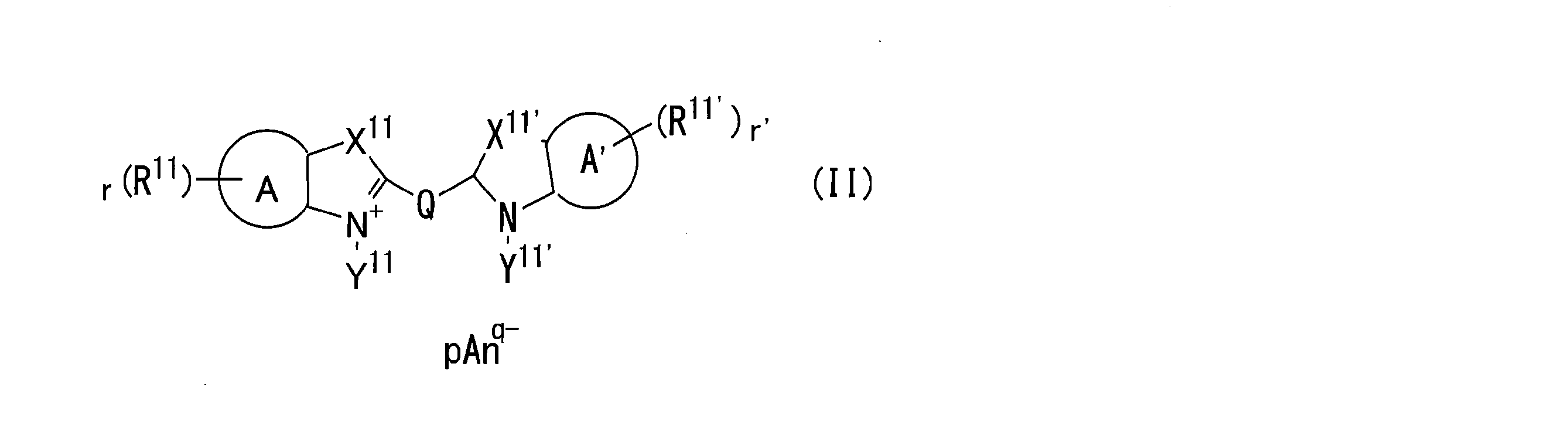
R11及びR11’は、それぞれ独立に、水酸基、ハロゲン原子、ニトロ基、シアノ基、-SO3H、カルボキシル基、アミノ基、アミド基、メタロセニル基、炭素原子数6~30のアリール基、炭素原子数7~30のアリールアルキル基又は炭素原子数1~8のアルキル基を表し、
X11及びX11'は、それぞれ独立に、酸素原子、硫黄原子、セレン原子、-CR23R24-、炭素原子数3~6のシクロアルカン-1,1-ジイル基又は-NR25-を表し、
R23、R24及びR25は、それぞれ独立に、水素原子、水酸基、ハロゲン原子、ニトロ基、シアノ基、-SO3H、カルボキシル基、アミノ基、アミド基、メタロセニル基、炭素原子数6~30のアリール基、炭素原子数7~30のアリールアルキル基又は炭素原子数1~8のアルキル基を表し、
Y11及びY11'は、それぞれ独立に、水素原子、又は水酸基、ハロゲン原子、ニトロ基、シアノ基、-SO3H、カルボキシル基、アミノ基、アミド基若しくはメタロセニル基で置換されてもよい炭素原子数6~30のアリール基、炭素原子数7~30のアリールアルキル基若しくは炭素原子数1~8のアルキル基を表し、
上記R11、R11’、Y11、Y11'、R23、R24及びR25におけるアリール基、アリールアルキル基及びアルキル基の水素原子は、水酸基、ハロゲン原子、ニトロ基、シアノ基、-SO3H、カルボキシル基、アミノ基、アミド基又はメタロセニル基で置換されている場合もあり、上記R11、R11’、Y11、Y11'、R23、R24及びR25におけるアリールアルキル基及びアルキル基中のメチレン基は、-O-、-S-、-CO-、-COO-、-OCO-、-SO2-、-NH-、-CONH-、-NHCO-、-N=CH-又は二重結合-で置き換えられている場合もあり、
Qは、炭素原子数1~9のメチン鎖を構成し、鎖中に環構造を含んでもよい連結基を表し、該メチン鎖中の水素原子は水酸基、ハロゲン原子、シアノ基、-NRR’、アリール基、アリールアルキル基又はアルキル基で置換されている場合もあり、該-NRR’、アリール基、アリールアルキル基及びアルキル基の水素原子は更に水酸基、ハロゲン原子、シアノ基又は-NRR’で置換されている場合もあり、-O-、-S-、-CO-、-COO-、-OCO-、-SO2-、-NH-、-CONH-、-NHCO-、-N=CH-又は-CH=CH-で中断されている場合もあり、
R及びR’は、炭素原子数6~30のアリール基、炭素原子数7~30のアリールアルキル基又は炭素原子数1~8のアルキル基を表し、
r及びr’は、0又は環A及び環A’において置換可能な数を表し、
Anq-はq価のアニオンを表し、qは1又は2を表し、pは電荷を中性に保つ係数を表す。)
上記一般式(II)におけるR11、R11’、Y11、Y11'並びにX11及びX11’中のR23、R24及びR25で表されるハロゲン原子としては、フッ素、塩素、臭素、ヨウ素が挙げられる。
上記一般式(II)におけるR11、R11’、Y11、Y11'並びにX11及びX11’中のR23、R24及びR25で表されるアミノ基としては、アミノ、エチルアミノ、ジメチルアミノ、ジエチルアミノ、ブチルアミノ、シクロペンチルアミノ、2-エチルヘキシルアミノ、ドデシルアミノ、アニリノ、クロロフェニルアミノ、トルイジノ、アニシジノ、N-メチル-アニリノ、ジフェニルアミノ,ナフチルアミノ、2-ピリジルアミノ、メトキシカルボニルアミノ、フェノキシカルボニルアミノ、アセチルアミノ、ベンゾイルアミノ、ホルミルアミノ、ピバロイルアミノ、ラウロイルアミノ、カルバモイルアミノ、N,N-ジメチルアミノカルボニルアミノ、N,N-ジエチルアミノカルボニルアミノ、モルホリノカルボニルアミノ、メトキシカルボニルアミノ、エトキシカルボニルアミノ、t-ブトキシカルボニルアミノ、n-オクタデシルオキシカルボニルアミノ、N-メチル-メトキシカルボニルアミノ、フェノキシカルボニルアミノ、スルファモイルアミノ、N,N-ジメチルアミノスルホニルアミノ、メチルスルホニルアミノ、ブチルスルホニルアミノ、フェニルスルホニルアミノ等が挙げられる。
上記一般式(II)におけるR11、R11’、Y11、Y11'並びにX11及びX11’中のR23、R24及びR25で表されるアミド基としては、ホルムアミド、アセトアミド、エチルアミド、イソプロピルアミド、ブチルアミド、オクチルアミド、ノニルアミド、デシルアミド、ウンデシルアミド、ドデシルアミド、ヘキサデシルアミド、オクタデシルアミド、(2-エチルヘキシル)アミド、ベンズアミド、トリフルオロアセトアミド、ペンタフルオロベンズアミド、ジホルムアミド、ジアセトアミド、ジエチルアミド、ジイソプロピルアミド、ジブチルアミド、ジオクチルアミド、ジノニルアミド、ジデシルアミド、ジウンデシルアミド、ジドデシルアミド、ジ(2-エチルヘキシル)アミド、ジベンズアミド、ジトリフルオロアセトアミド、ジペンタフルオロベンズアミド等が挙げられ、
上記一般式(II)におけるR11、R11’、Y11、Y11'並びにX11及びX11’中のR23、R24及びR25で表されるメタロセニル基としては、フェロセニル、ニッケロセニル、ジルコノセニル、チタノセニル、ハフノセニル等が挙げられる。
上記一般式(II)におけるR11、R11’、Y11、Y11'、R、R’並びにX11及びX11’中のR23、R24及びR25で表される炭素原子数6~30のアリール基としては、フェニル、ナフチル、2-メチルフェニル、3-メチルフェニル、4-メチルフェニル、4-ビニルフェニル、3-iso-プロピルフェニル、4-iso-プロピルフェニル、4-ブチルフェニル、4-iso-ブチルフェニル、4-tert-ブチルフェニル、4-ヘキシルフェニル、4-シクロヘキシルフェニル、4-オクチルフェニル、4-(2-エチルヘキシル)フェニル、4-ステアリルフェニル、2,3-ジメチルフェニル、2,4-ジメチルフェニル、2,5-ジメチルフェニル、2,6-ジメチルフェニル、3,4-ジメチルフェニル、3,5-ジメチルフェニル、2,4-ジ-tert-ブチルフェニル、2,5-ジ-tert-ブチルフェニル、2,6-ジ-tert-ブチルフェニル、2,4-ジ-tert-ペンチルフェニル、2,5-ジ-tert-アミルフェニル、2,5-ジ-tert-オクチルフェニル、2,4-ジクミルフェニル、4-シクロヘキシルフェニル、(1,1’-ビフェニル)-4-イル、2,4,5-トリメチルフェニル、フェロセニル等が挙げられる。
上記一般式(II)におけるR11、R11’、Y11、Y11'、R、R’並びにX11及びX11’中のR23、R24及びR25で表される炭素原子数7~30のアリールアルキル基としては、ベンジル、フェネチル、2-フェニルプロパン-2-イル、ジフェニルメチル、トリフェニルメチル、スチリル、シンナミル、フェロセニルメチル、フェロセニルプロピル等が挙げられ。
上記一般式(II)におけるR11、R11’、Y11、Y11'、R、R’並びにX11及びX11’中のR23、R24及びR25で表される炭素原子数1~8のアルキル基としては、メチル、エチル、プロピル、iso-プロピル、ブチル、sec-ブチル、tert-ブチル、iso-ブチル、アミル、iso-アミル、tert-アミル、ヘキシル、2-ヘキシル、3-ヘキシル、シクロヘキシル、1-メチルシクロヘキシル、ヘプチル、2-ヘプチル、3-ヘプチル、iso-ヘプチル、tert-ヘプチル、1-オクチル、iso-オクチル、tert-オクチル等が挙げられる。
上記R11、R11’、Y11、Y11'、並びにX11及びX11’中のR23、R24及びR25における、水素原子が、水酸基、ハロゲン原子、ニトロ基、シアノ基、-SO3H基、カルボキシル基、アミノ基、アミド基又はメタロセニル基で置換されてもよい炭素原子数6~30のアリール基、炭素原子数7~30のアリールアルキル基及び炭素原子数1~8のアルキル基としては、上記R11等の説明で例示したアリール基、アリールアルキル基及びアルキル基中の水素原子が、水酸基、ハロゲン原子、ニトロ基、シアノ基、-SO3H基、カルボキシル基、アミノ基、アミド基又はメタロセニル基で置換されているものが挙げられ、これらの置換基の位置及び数に特に制限はない。
また、上記R11、R11’及びY11、Y11'中のR21及びR22並びにX11及びX11’中のR23、R24及びR25におけるアリールアルキル基及びアルキル基中のメチレン基が、-O-、-S-、-CO-、-COO-、-OCO-、-SO2-、-NH-、-CONH-、-NHCO-、-N=CH-又は二重結合で置き換えられている場合、これらの置換の数及び位置は任意である。
例えば、上記炭素原子数1~8のアルキル基の水素原子がハロゲン原子で置換された基としては、例えば、クロロメチル、ジクロロメチル、トリクロロメチル、フルオロメチル、ジフルオロメチル、トリフルオロメチル、ノナフルオロブチル等が挙げられ、
上記炭素原子数1~8のアルキル基が、-O-で中断された基としては、メチルオキシ、エチルオキシ、iso-プロピルオキシ、プロピルオキシ、ブチルオキシ、ペンチルオキシ、iso-ペンチルオキシ、ヘキシルオキシ、ヘプチルオキシ、オクチルオキシ、2-エチルヘキシルオキシ等のアルコキシ基や、2-メトキシエチル、2-(2-メトキシ)エトキシエチル、2-エトキシエチル、2-ブトキシエチル、4-メトキシブチル、3-メトキシブチル等のアルコキシアルキル基等が挙げられ、
上記炭素原子数1~8のアルキル基の水素原子がハロゲン原子で置換され、且つ-O-で中断された基としては、例えば、クロロメチルオキシ、ジクロロメチルオキシ、トリクロロメチルオキシ、フルオロメチルオキシ、ジフルオロメチルオキシ、トリフルオロメチルオキシ、ノナフルオロブチルオキシ等が挙げられる。
また、上記R11、R11’及びY11、Y11'中のR21及びR22並びにX11及びX11’中のR23、R24及びR25におけるアリールアルキル基及びアルキル基中のメチレン基が、-O-、-S-、-CO-、-COO-、-OCO-、-SO2-、-NH-、-CONH-、-NHCO-、-N=CH-又は二重結合で置き換えられている場合、これらの置換の数及び位置は任意である。
例えば、上記炭素原子数1~8のアルキル基の水素原子がハロゲン原子で置換された基としては、例えば、クロロメチル、ジクロロメチル、トリクロロメチル、フルオロメチル、ジフルオロメチル、トリフルオロメチル、ノナフルオロブチル等が挙げられ、
上記炭素原子数1~8のアルキル基が、-O-で中断された基としては、メチルオキシ、エチルオキシ、iso-プロピルオキシ、プロピルオキシ、ブチルオキシ、ペンチルオキシ、iso-ペンチルオキシ、ヘキシルオキシ、ヘプチルオキシ、オクチルオキシ、2-エチルヘキシルオキシ等のアルコキシ基や、2-メトキシエチル、2-(2-メトキシ)エトキシエチル、2-エトキシエチル、2-ブトキシエチル、4-メトキシブチル、3-メトキシブチル等のアルコキシアルキル基等が挙げられ、
上記炭素原子数1~8のアルキル基の水素原子がハロゲン原子で置換され、且つ-O-で中断された基としては、例えば、クロロメチルオキシ、ジクロロメチルオキシ、トリクロロメチルオキシ、フルオロメチルオキシ、ジフルオロメチルオキシ、トリフルオロメチルオキシ、ノナフルオロブチルオキシ等が挙げられる。
上記一般式(II)において、X11及びX11’で表される炭素原子数3~6のシクロアルカン-1,1-ジイル基としては、シクロプロパン-1,1-ジイル、シクロブタン-1,1-ジイル、2,4-ジメチルシクロブタン-1,1-ジイル、3,3-ジメチルシクロブタン-1,1-ジイル、シクロペンタン-1,1-ジイル、シクロヘキサン-1,1-ジイル等が挙げられる。
上記一般式(II)におけるQで表わされる、炭素原子数1~9のメチン鎖を構成し、鎖中に環構造を含んでもよい連結基としては、下記(Q-1)~(Q-11)の何れかで表される基が、製造が容易であるため好ましい。炭素原子数1~9のメチン鎖における炭素原子数には、メチン鎖及び鎖中に環構造を含んでもよい連結基を表し、該連結基をさらに置換する基(例えば下記R14~R19、Z’)の炭素原子(例えば、連結基(Q-1)における両末端の炭素原子)を含まない。

R及びR’は、アリール基、アリールアルキル基又はアルキル基を表す。)
上記R14、R15、R16、R17、R18、R19及びZ’で表わされるハロゲン原子、アリール基、アリールアルキル又はアルキル基としては、R11等の説明で例示したものが挙げられ、R及びR’で表されるアリール基、アリールアルキル基又はアルキル基としてはR11等の説明で例示したものが挙げられる。
Qで表わされる、炭素原子数1~9のメチン鎖の水素原子を置換していてもよいアリール基、アリールアルキル基、アルキル基、及びハロゲン原子としては、R11等の説明で例示したものが挙げられ、これらのアリール基、アリールアルキル基、アルキル基の水素原子を置換してもよいハロゲン原子としてはR11等の説明で例示したものが挙げられる。
R11、R11’、Y11、Y11'、R23、R24及びR25で表されるアリール基、アリールアルキル基、アルキル基の水素原子を置換してもよいハロゲン原子、アミノ基、アミド基及びメタロセニル基としては、R11等の説明で例示したものが挙げられる。
R11、R11’、Y11、Y11'、R23、R24及びR25で表されるアリール基、アリールアルキル基、アルキル基の水素原子を置換してもよいハロゲン原子、アミノ基、アミド基及びメタロセニル基としては、R11等の説明で例示したものが挙げられる。
上記一般式(II)中のpAnq-で表されるq価のアニオンとしては、メタンスルホン酸アニオン、ドデシルスルホン酸アニオン、ベンゼンスルホン酸アニオン、トルエンスルホン酸アニオン、トリフルオロメタンスルホン酸アニオン、ナフタレンスルホン酸アニオン、ジフェニルアミン-4-スルホン酸アニオン、2-アミノ-4-メチル-5-クロロベンゼンスルホン酸アニオン、2-アミノ-5-ニトロベンゼンスルホン酸アニオン、ナフタレンジスルホン酸アニオン、ナフトールスルホン酸アニオン、ビス(トリフルオロメタンスルホニル)イミド酸アニオン、特開平10-235999号公報、特開平10-337959号公報、特開平11-102088号公報、特開2000-108510号公報、特開2000-168223号公報、特開2001-209969号公報、特開2001-322354号公報、特開2006-248180号公報、特開2006-297907号公報、特開平8-253705号公報、特表2004-503379号公報、特開2005-336150号公報、国際公開2006/28006号公報等に記載されたスルホン酸アニオン等の有機スルホン酸アニオンの他、塩化物イオン、臭化物イオン、ヨウ化物イオン、フッ化物イオン、塩素酸イオン、チオシアン酸イオン、ヘキサフルオロリン酸イオン、ヘキサフルオロアンチモン酸イオン、テトラフルオロホウ酸イオン、オクチルリン酸イオン、ドデシルリン酸イオン、オクタデシルリン酸イオン、フェニルリン酸イオン、ノニルフェニルリン酸イオン、2,2’-メチレンビス(4,6-ジ-t-ブチルフェニル)ホスホン酸イオン、テトラキス(ペンタフルオロフェニル)ホウ酸イオン、励起状態にある活性分子を脱励起させる(クエンチングさせる)機能を有するクエンチャー陰イオンやシクロペンタジエニル環にカルボキシル基やホスホン酸基、スルホン酸基等の陰イオン性基を有するフェロセン、ルテオセン等のメタロセン化合物陰イオン等が挙げられる。
本発明で用いられるシアニン化合物(α)の具体例としては、下記化合物No.1-~104が挙げられる。なお、以下の例示では、アニオンを省いたシアニンカチオンで示している。


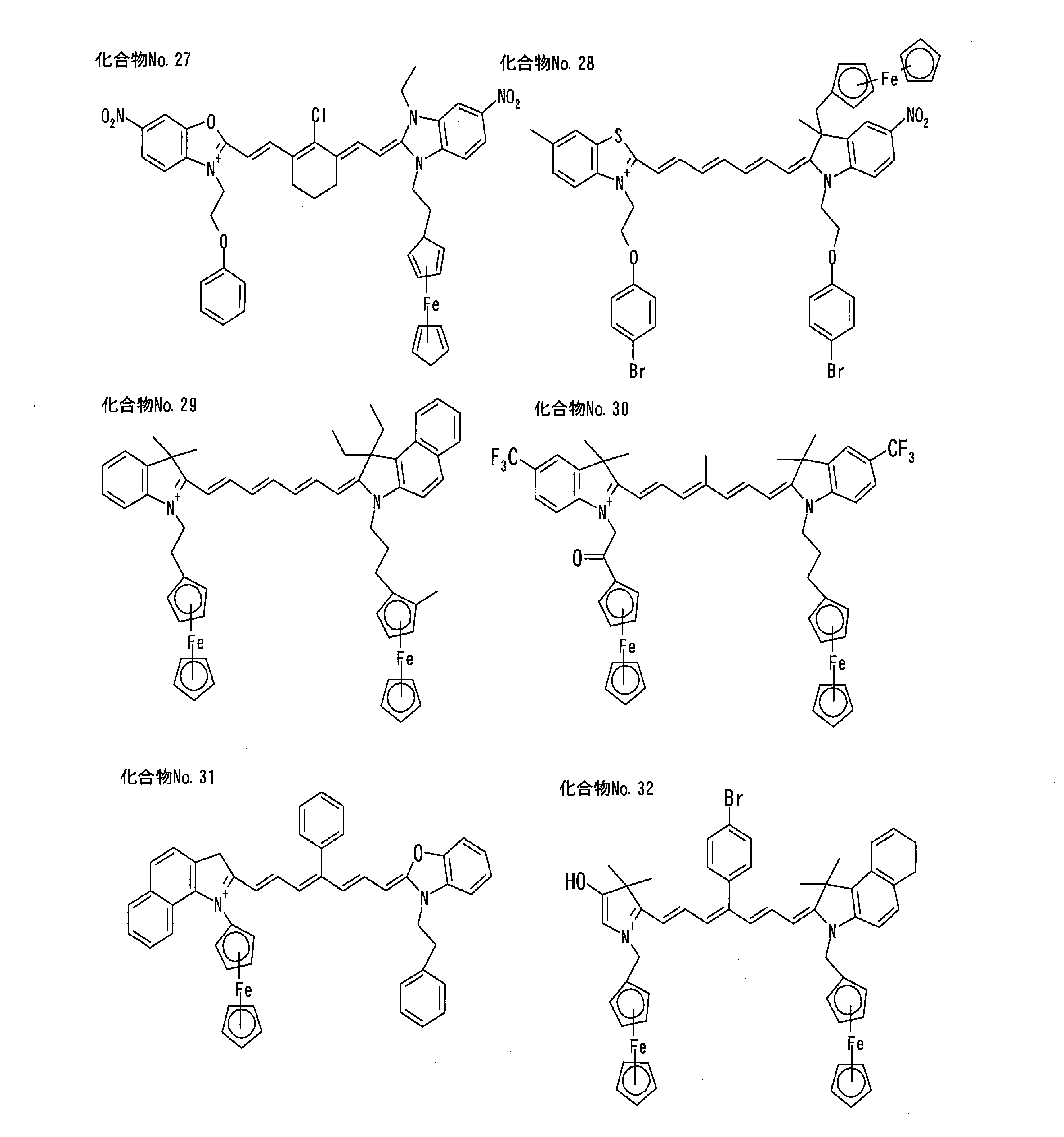
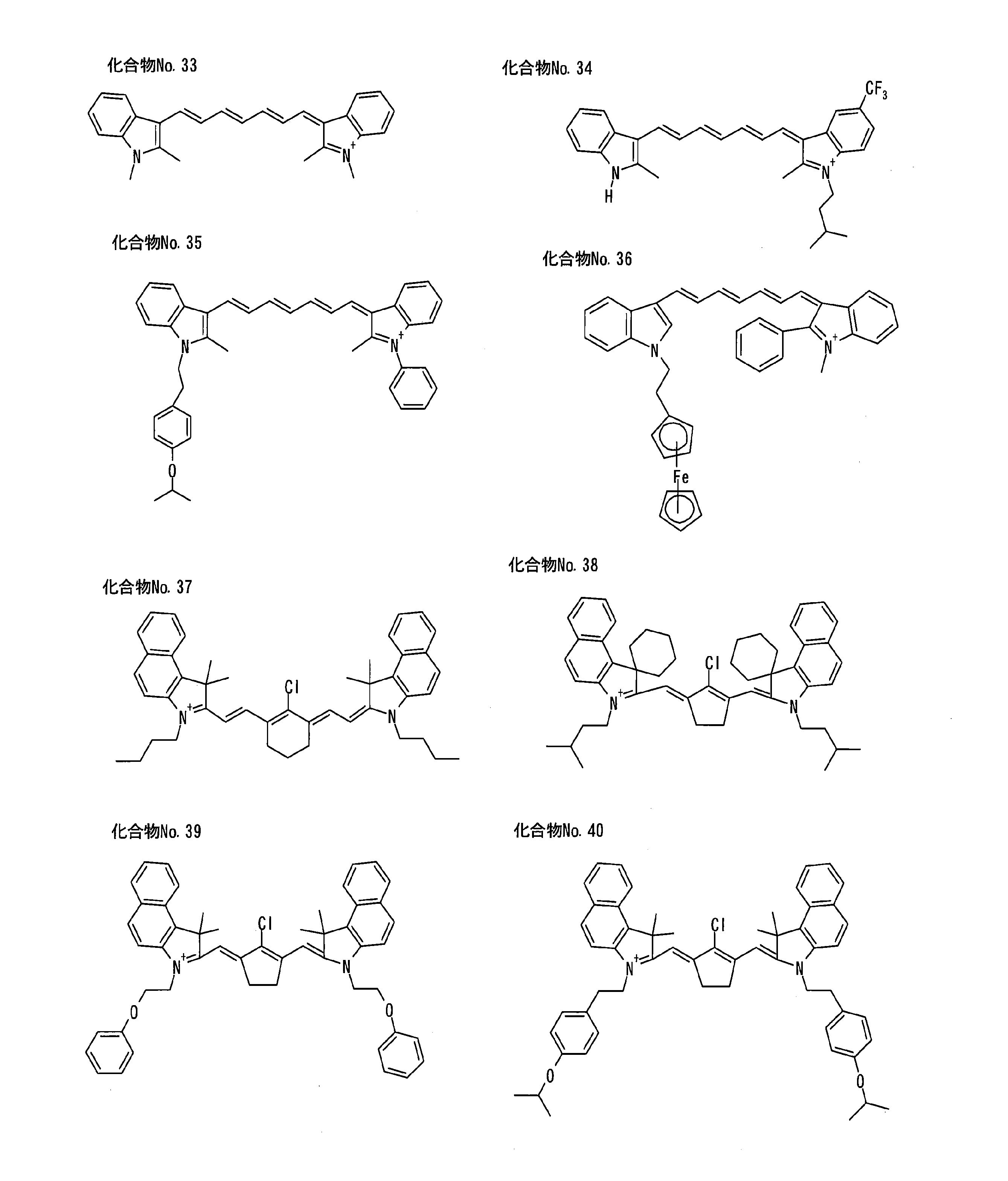

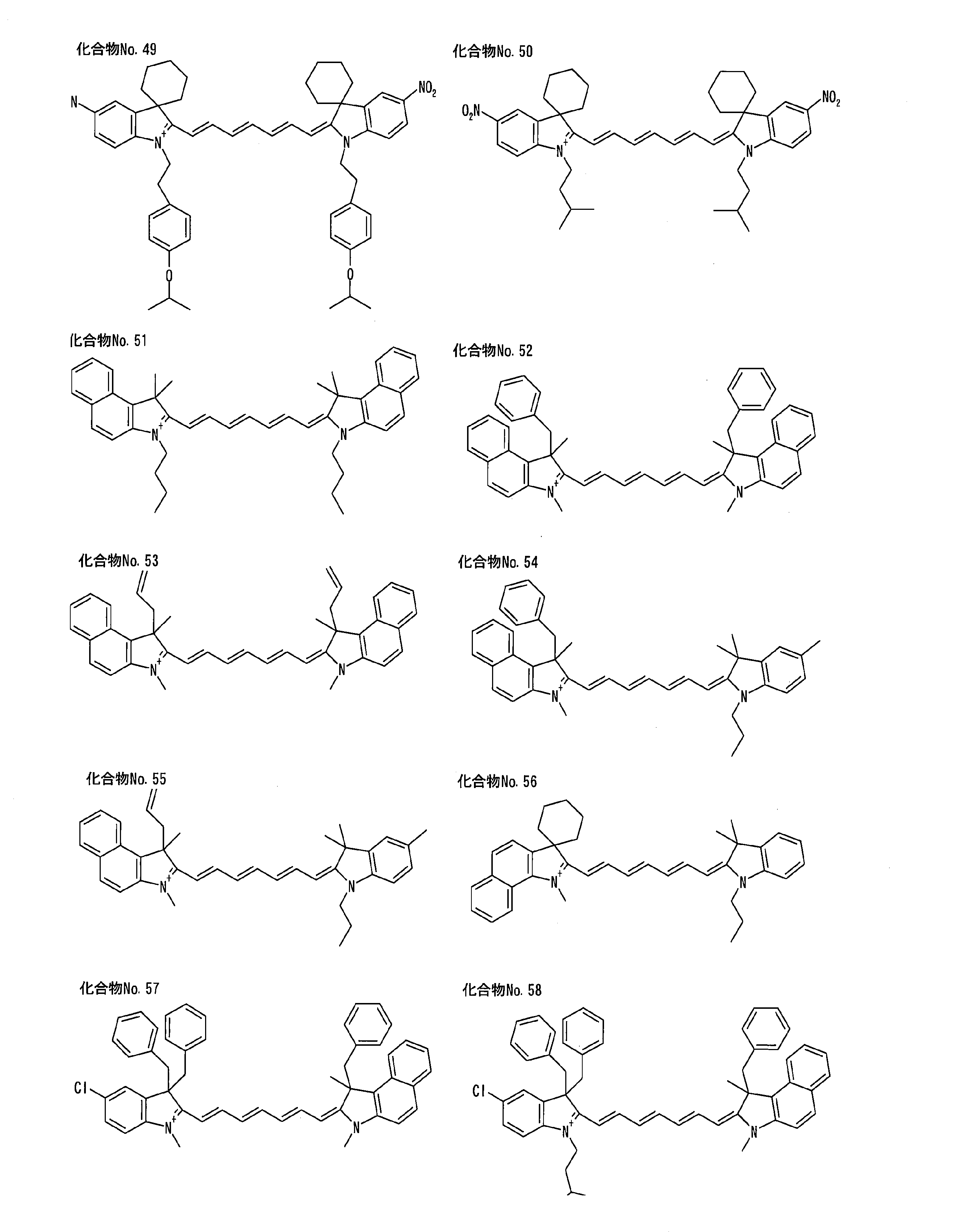
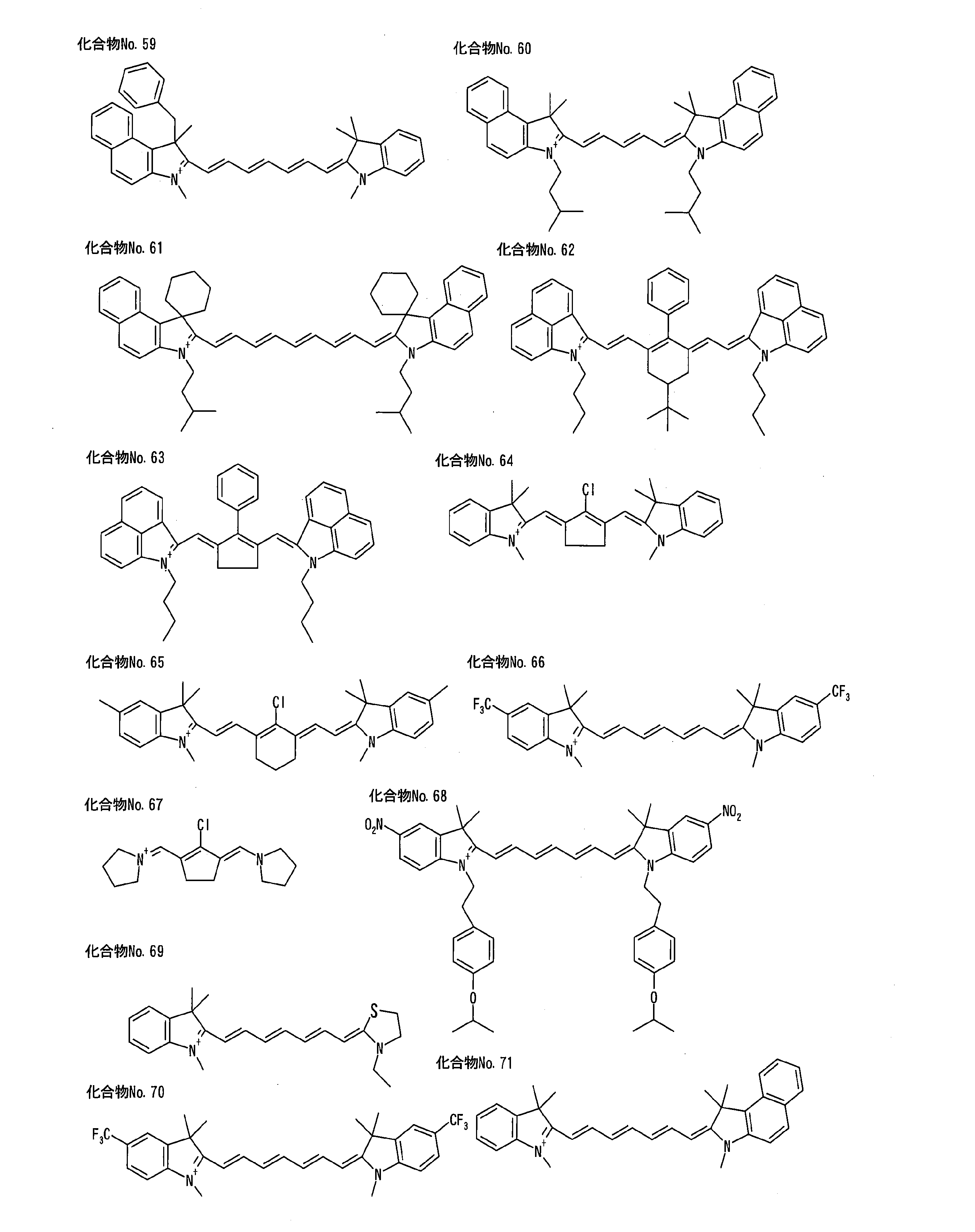


上記一般式(II)で表される化合物の中では、以下のものが好ましい。
環A又は環A’がベンゼン環又はナフタレン環であるもの。
r又はr’が、0~2であるもの。
r又はr’が1以上の場合、R11及びR11’が、ハロゲン原子、ニトロ基、カルボキシル基、フェロセニル基、無置換の炭素原子数1~8(特に1~4)のアルキル基又は炭素原子数1~8(特に1~4)のハロゲン置換アルキル基であるもの。 X11及びX11'が、酸素原子、硫黄原子、-CR23R24〔特に、R23及びR24が、無置換又はハロゲン原子で置換されている場合もあり、二重結合で置き換えられている場合もある炭素原子数1~8(特に1~4)のアルキル基、無置換又はハロゲン原子で置換されている場合もあり、二重結合で置き換えられている場合もある炭素原子数7~20(特に7~15)のアリールアルキル基〕又は炭素原子数3~6のシクロアルカン-1,1-ジイル基であるもの。さらに、酸素原子、硫黄原子、-CR23R24-〔特に、R23及びR24が無置換の炭素原子数1~4のアルキル基〕がより好ましい。
Y11及びY11'が、ハロゲン原子、ニトロ基、カルボキシル基若しくはフェロセニル基で置換されている場合もあり、酸素原子若しくは-CO-で置き換えられている場合もある炭素原子数6~30(特に6~12)のアリール基、炭素原子数7~30(特に7~15)のアリールアルキル基若しくは炭素原子数1~8のアルキル基であるもの。さらに、ハロゲン原子で置換されている場合もあり、酸素原子で置き換えられている場合もある炭素原子数7~30(特に7~15)のアリールアルキル基若しくは炭素原子数1~8のアルキル基が、より好ましい。
Qが、炭素原子数7又は9のメチン鎖を構成するもの。また、炭素原子数7又は9のメチン鎖を構成し、該メチン鎖中の水素原子が水酸基、ハロゲン原子、シアノ基又はアリール基で置換されているもの。また、炭素原子数7又は9のメチン鎖を構成し、鎖中に環構造を有するもの。
環A又は環A’がベンゼン環又はナフタレン環であるもの。
r又はr’が、0~2であるもの。
r又はr’が1以上の場合、R11及びR11’が、ハロゲン原子、ニトロ基、カルボキシル基、フェロセニル基、無置換の炭素原子数1~8(特に1~4)のアルキル基又は炭素原子数1~8(特に1~4)のハロゲン置換アルキル基であるもの。 X11及びX11'が、酸素原子、硫黄原子、-CR23R24〔特に、R23及びR24が、無置換又はハロゲン原子で置換されている場合もあり、二重結合で置き換えられている場合もある炭素原子数1~8(特に1~4)のアルキル基、無置換又はハロゲン原子で置換されている場合もあり、二重結合で置き換えられている場合もある炭素原子数7~20(特に7~15)のアリールアルキル基〕又は炭素原子数3~6のシクロアルカン-1,1-ジイル基であるもの。さらに、酸素原子、硫黄原子、-CR23R24-〔特に、R23及びR24が無置換の炭素原子数1~4のアルキル基〕がより好ましい。
Y11及びY11'が、ハロゲン原子、ニトロ基、カルボキシル基若しくはフェロセニル基で置換されている場合もあり、酸素原子若しくは-CO-で置き換えられている場合もある炭素原子数6~30(特に6~12)のアリール基、炭素原子数7~30(特に7~15)のアリールアルキル基若しくは炭素原子数1~8のアルキル基であるもの。さらに、ハロゲン原子で置換されている場合もあり、酸素原子で置き換えられている場合もある炭素原子数7~30(特に7~15)のアリールアルキル基若しくは炭素原子数1~8のアルキル基が、より好ましい。
Qが、炭素原子数7又は9のメチン鎖を構成するもの。また、炭素原子数7又は9のメチン鎖を構成し、該メチン鎖中の水素原子が水酸基、ハロゲン原子、シアノ基又はアリール基で置換されているもの。また、炭素原子数7又は9のメチン鎖を構成し、鎖中に環構造を有するもの。
本発明で用いられるシアニン化合物(α)は、その製造方法は特に限定されず、周知一般の反応を利用した方法で得ることができ、例えば、特開2010-209191号公報に記載されているルートの如く、該当する構造を有する化合物と、イミン誘導体との反応により合成する方法が挙げられる。
本発明で用いられるシアニン化合物(α)は、塗膜の極大吸収波長(λmax)が650~1200nmであるものが好ましく、650~900nmであるものがさらに好ましい。塗膜の極大吸収波長(λmax)が1200nm超であると、本発明の効果を発揮せず、650nm未満であると、可視光線を吸収するため好ましくない。
本発明の着色組成物において、上記シアニン化合物(α)の含有量は、単独又は複数種の合計で、後述する重合性化合物(β)の固形分と後述するコロイダルシリカ(γ)の固形分の合計量100質量部に対してシアニン化合物の少なくとも一種(α)の合計で0.01~10質量部である。シアニン化合物(α)の含有量が0.01質量部より小さいと、本発明の硬化物において十分な赤外線遮蔽能が得られない場合があり、10質量部より大きいと、着色組成物中でシアニン化合物(α)の析出が起こる場合がある。
<重合性化合物(β)>
上記重合性化合物(β)としては、エチレン性不飽和結合及び親水性基を一分子内に有する重合性化合物である限り、特に限定されず従来用いられているものを用いることができる。
親水性基としては、水酸基、チオール基、カルボキシル基、スルホ基、アミノ基、アミド基又はその塩等が挙げられ、水酸基及びカルボキシル基が、重合性化合物(β)のアルカリへの溶解性が高いため好ましい。
重合性化合物(β)における親水性基の好ましい官能基当量(親水性基1当量を含む重合性化合物の質量)は、50~10000である。
重合性化合物(β)の好ましい質量平均分子量は、1000~500000である。
上記重合性化合物(β)としては、エチレン性不飽和結合及び親水性基を一分子内に有する重合性化合物である限り、特に限定されず従来用いられているものを用いることができる。
親水性基としては、水酸基、チオール基、カルボキシル基、スルホ基、アミノ基、アミド基又はその塩等が挙げられ、水酸基及びカルボキシル基が、重合性化合物(β)のアルカリへの溶解性が高いため好ましい。
重合性化合物(β)における親水性基の好ましい官能基当量(親水性基1当量を含む重合性化合物の質量)は、50~10000である。
重合性化合物(β)の好ましい質量平均分子量は、1000~500000である。
上記重合性化合物(β)の中でも下記一般式(I-1)で表されるユニット、下記一般式(I-2)で表されるユニット及び下記一般式(I-3)で表されるユニットを有するものが、現像性や耐熱性が高いので好ましい。

上記一般式(I-2)におけるY1で表される二価の結合基としては、特に限定されないが、下記一般式(1)で表される構造を好ましく挙げることができる。

上記R5、R6、R7及びR8におけるアルキル基、アリール基及びアリールアルキル基の水素原子は、ハロゲン原子、水酸基又はニトロ基で置換されている場合もあり、上記R5、R6、R7及びR8におけるアルキル基及びアリールアルキル基中のメチレン基は、-O-、-S-、-CO-、-COO-、-OCO-又は-NH-基で置き換えられている場合もある。但し、上記一般式(1)で表される基の炭素原子数は1~35の範囲内である。)
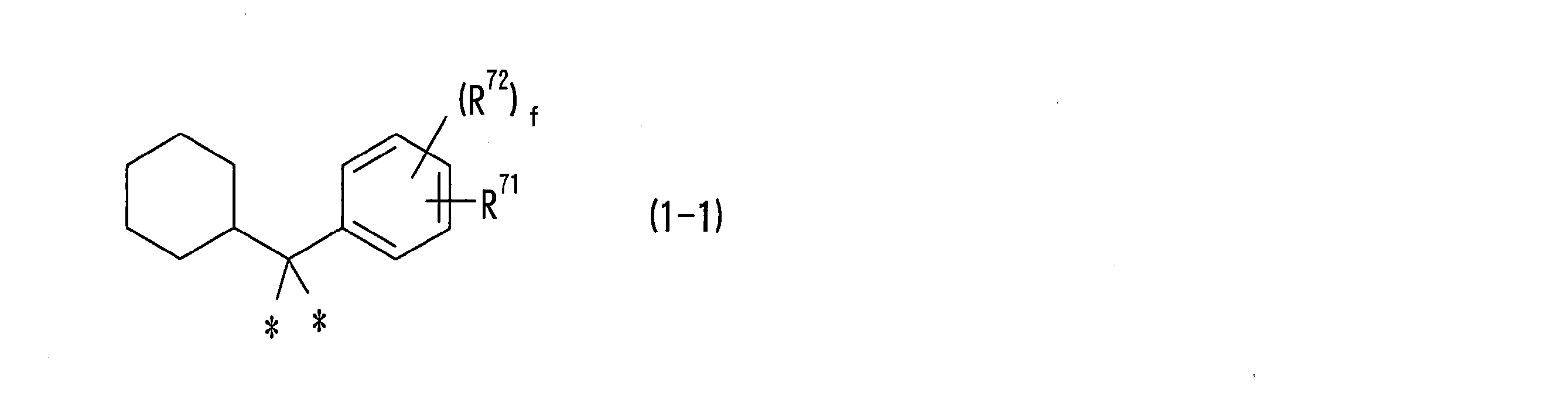
R72は炭素原子数1~10のアルキル基、炭素原子数1~10のアルコキシ基、炭素原子数2~10のアルケニル基又はハロゲン原子を表し、上記アルキル基、アルコキシ基及びアルケニル基は置換基を有している場合もあり、
fは0~5の整数である。)
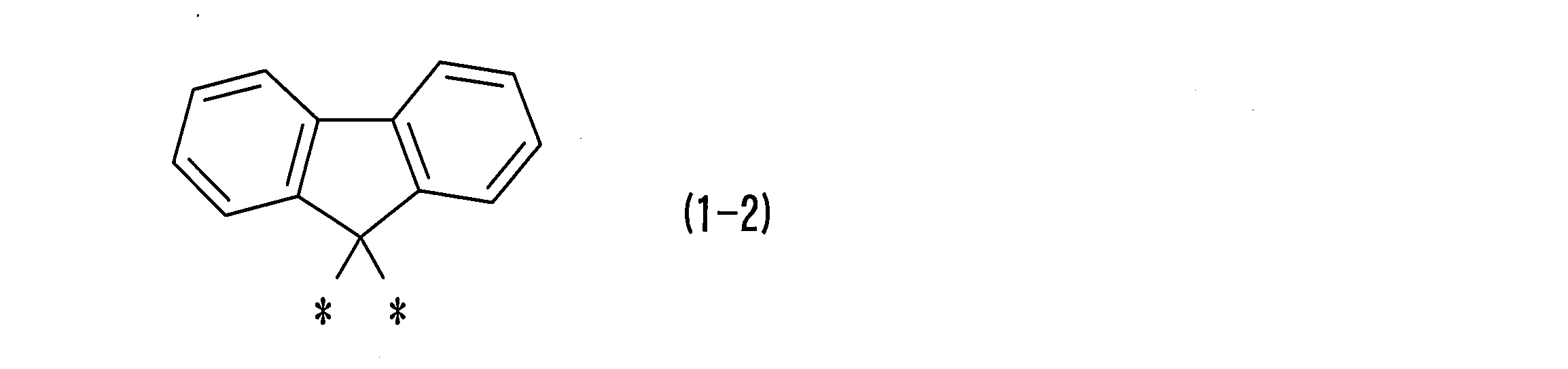

該アルキル基及びアリールアルキル基中のメチレン基は不飽和結合、-O-又は-S-で中断されている場合もあり、
R73は、隣接するR73同士で環を形成している場合もあり、
dは0~4の数を表し、
fは0~8の数を表し、gは0~4の数を表し、
hは0~4の数を表し、
gとhの数の合計は2~4である。)
上記一般式(I-3)におけるR1で表される炭素原子数6~30のアリール基又は炭素原子数7~20のアリールアルキル基としては、上記(α)成分であるシアニン化合物の説明で例示したアリール基又はアリールアルキル基が挙げられる。
炭素原子数1~20のアルキル基としては、上記シアニン化合物(α)の説明で例示したアルキル基の他、ノニル、デシル、ウンデシル、ドデシル、トリデシル、イソトリデシル、テトラデシル、ヘキサデシル、ヘプタデシル、オクタデシル等が挙げられる。
R1で表される炭素原子数6~30のアリール基、炭素原子数7~20のアリールアルキル基及び炭素原子数1~20のアルキル基の水素原子を置換してもよいハロゲン原子としては、上記(α)成分であるシアニン化合物の説明で例示したハロゲン原子が挙げられる。
炭素原子数1~20のアルキル基としては、上記シアニン化合物(α)の説明で例示したアルキル基の他、ノニル、デシル、ウンデシル、ドデシル、トリデシル、イソトリデシル、テトラデシル、ヘキサデシル、ヘプタデシル、オクタデシル等が挙げられる。
R1で表される炭素原子数6~30のアリール基、炭素原子数7~20のアリールアルキル基及び炭素原子数1~20のアルキル基の水素原子を置換してもよいハロゲン原子としては、上記(α)成分であるシアニン化合物の説明で例示したハロゲン原子が挙げられる。
上記一般式(1)において、X2で表される二価の炭素原子数1~35の鎖状炭化水素基としては、メタン、エタン、プロパン、iso-プロパン、ブタン、sec-ブタン、tert-ブブタン、iso-ブタン、ヘキサン、2-メチルヘキサン、3-メチルヘキサン、ヘプタン、2-メチルヘプタン、3-メチルヘプタン、iso-ヘプタン、tert-ヘプタン、1-メチルオクタン、iso-オクタン、tert-オクタン等が、Z1及びZ2で置換された基が挙げられ、
二価の炭素原子数3~35の脂環式炭化水素基としては、シクロプロパン、シクロブタン、シクロペンタン、シクロヘキサン、シクロヘプタン、2,4-ジメチルシクロブタン、4-メチルシクロヘキサン等が、Z1及びZ2で置換された基等が挙げられ、
二価の炭素原子数6~35の芳香族炭化水素基としては、フェニレン、ナフチレン、ビフェニル等の基が、Z1及びZ2で置換された基等が挙げられ、
二価の炭素原子数2~35の複素環含有基としては、ピリジン、ピラジン、ピペリジン、ピペラジン、ピリミジン、ピリダジン、トリアジン、ヘキサヒドロトリアジン、フラン、テトラヒドロフラン、クロマン、キサンテン、チオフェン、チオラン等が、Z1及びZ2で置換された基が挙げられ、これらの基は複数組み合わせられてもよい。また、これらの鎖状炭化水素基、脂環式炭化水素基及び芳香族炭化水素基は、ハロゲン原子(フッ素、塩素、臭素、ヨウ素)、水酸基又はニトロ基で置換されていてもよい。またこれらの鎖状炭化水素基、脂環式炭化水素基及び芳香族炭化水素基におけるメチレン基は-O-、-S-、-CO-、-COO-、-OCO-又は-NH-基で置き換えられている場合もある。
二価の炭素原子数3~35の脂環式炭化水素基としては、シクロプロパン、シクロブタン、シクロペンタン、シクロヘキサン、シクロヘプタン、2,4-ジメチルシクロブタン、4-メチルシクロヘキサン等が、Z1及びZ2で置換された基等が挙げられ、
二価の炭素原子数6~35の芳香族炭化水素基としては、フェニレン、ナフチレン、ビフェニル等の基が、Z1及びZ2で置換された基等が挙げられ、
二価の炭素原子数2~35の複素環含有基としては、ピリジン、ピラジン、ピペリジン、ピペラジン、ピリミジン、ピリダジン、トリアジン、ヘキサヒドロトリアジン、フラン、テトラヒドロフラン、クロマン、キサンテン、チオフェン、チオラン等が、Z1及びZ2で置換された基が挙げられ、これらの基は複数組み合わせられてもよい。また、これらの鎖状炭化水素基、脂環式炭化水素基及び芳香族炭化水素基は、ハロゲン原子(フッ素、塩素、臭素、ヨウ素)、水酸基又はニトロ基で置換されていてもよい。またこれらの鎖状炭化水素基、脂環式炭化水素基及び芳香族炭化水素基におけるメチレン基は-O-、-S-、-CO-、-COO-、-OCO-又は-NH-基で置き換えられている場合もある。
上記一般式(1)におけるR5、R6、R7及びR8で表される炭素原子数1~8のアルキル基、炭素原子数6~30のアリール基又は炭素原子数7~30のアリールアルキル基としては、上記シアニン化合物(α)の説明で例示したアルキル基、アリール基、アリールアルキル基が挙げられ、
上記R5、R6、R7及びR8におけるアルキル基、アリール基及びアリールアルキル基は、ハロゲン原子(フッ素、塩素、臭素、ヨウ素)、水酸基又はニトロ基で置換されている場合もあり、上記R5、R6及びR7におけるアルキル基及びアリールアルキル基中のメチレン基は、-O-、-S-、-CO-、-COO-、-OCO-、-NH-、又はこれらの基を複数組み合わせた基で中断されている場合もあり、これらの置換位置及び中断位置は特に制限されない。
上記R5、R6、R7及びR8におけるアルキル基、アリール基及びアリールアルキル基は、ハロゲン原子(フッ素、塩素、臭素、ヨウ素)、水酸基又はニトロ基で置換されている場合もあり、上記R5、R6及びR7におけるアルキル基及びアリールアルキル基中のメチレン基は、-O-、-S-、-CO-、-COO-、-OCO-、-NH-、又はこれらの基を複数組み合わせた基で中断されている場合もあり、これらの置換位置及び中断位置は特に制限されない。
上記(1-1)で表される置換基において、R71で表される炭素原子数3~10のシクロアルキル基としては、シクロプロピル、シクロブチル、シクロペンチル、シクロへブチル、シクロオクチル等が挙げられ、
R72で表される炭素原子数1~10のアルキル基としては、R1で表される炭素原子数1~40のアルキル基として例示した基のうち、所定の炭素原子数を満たす基等が挙げられ、
R72で表される炭素原子数1~10のアルコキシ基としては、メチルオキシ、エチルオキシ、プロピルオキシ、イソプロピルオキシ、ブチルオキシ、第二ブチルオキシ、第三ブチルオキシ、イソブチルオキシ、アミルオキシ、イソアミルオキシ、第三アミルオキシ、ヘキシルオキシ、シクロヘキシルオキシ、ヘプチルオキシ、イソヘプチルオキシ、第三ヘプチルオキシ、n-オクチルオキシ、イソオクチルオキシ、第三オクチルオキシ、2-エチルヘキシルオキシ、ノニルオキシ、デシルオキシ等が挙げられ、
R72で表される炭素原子数2~10のアルケニル基としては、ビニル、1-メチルエテニル、2-メチルエテニル、2-プロペニル、1-メチル-3-プロペニル、3-ブテニル、1-メチル-3-ブテニル、イソブテニル、3-ペンテニル、4-ヘキセニル、シクロヘキセニル、ヘプテニル、オクテニル、デセニル等が挙げられ、
R72で表されるハロゲン原子としては、上記シアニン化合物(α)の説明で例示したハロゲン原子が挙げられる。
R72で表されるアルキル基、アルコキシ基及びアルケニル基が有していてもよい置換基としては、ハロゲン原子(フッ素、塩素、臭素、ヨウ素)、水酸基、ニトロ基が挙げられる。
R72で表される炭素原子数1~10のアルキル基としては、R1で表される炭素原子数1~40のアルキル基として例示した基のうち、所定の炭素原子数を満たす基等が挙げられ、
R72で表される炭素原子数1~10のアルコキシ基としては、メチルオキシ、エチルオキシ、プロピルオキシ、イソプロピルオキシ、ブチルオキシ、第二ブチルオキシ、第三ブチルオキシ、イソブチルオキシ、アミルオキシ、イソアミルオキシ、第三アミルオキシ、ヘキシルオキシ、シクロヘキシルオキシ、ヘプチルオキシ、イソヘプチルオキシ、第三ヘプチルオキシ、n-オクチルオキシ、イソオクチルオキシ、第三オクチルオキシ、2-エチルヘキシルオキシ、ノニルオキシ、デシルオキシ等が挙げられ、
R72で表される炭素原子数2~10のアルケニル基としては、ビニル、1-メチルエテニル、2-メチルエテニル、2-プロペニル、1-メチル-3-プロペニル、3-ブテニル、1-メチル-3-ブテニル、イソブテニル、3-ペンテニル、4-ヘキセニル、シクロヘキセニル、ヘプテニル、オクテニル、デセニル等が挙げられ、
R72で表されるハロゲン原子としては、上記シアニン化合物(α)の説明で例示したハロゲン原子が挙げられる。
R72で表されるアルキル基、アルコキシ基及びアルケニル基が有していてもよい置換基としては、ハロゲン原子(フッ素、塩素、臭素、ヨウ素)、水酸基、ニトロ基が挙げられる。
上記(1-3)で表される基において、R73及びR74で表される置換基を有していてもよい炭素原子数1~10のアルキル基としては、R1で表される炭素原子数1~20のアルキル基として例示した基のうち、所定の炭素原子数を満たす基等が挙げられ、
R73及びR74で表される置換基を有していてもよい炭素原子数6~30のアリール基としては、R11等で表される炭素原子数6~30のアリール基として例示した基等が挙げられ、
R73及びR74で表される置換基を有していてもよい炭素原子数6~30のアリールオキシ基としては、フェニルオキシ、ナフチルオキシ、2-メチルフェニルオキシ、3-メチルフェニルオキシ、4-メチルフェニルオキシ、4-ビニルフェニル二オキシ、3-iso-プロピルフェニルオキシ、4-iso-プロピルフェニルオキシ、4-ブチルフェニルオキシ、4-tert-ブチルフェニルオキシ、4-へキシルフェニルオキシ、4-シクロヘキシルフェニルオキシ、4-オクチルフェニルオキシ、4-(2-エチルヘキシル)フェニルオキシ、2,3-ジメチルフェニルオキシ、2,4-ジメチルフェニルオキシ、2,5-ジメチルフェニルオキシ、2.6-ジメチルフェニルオキシ、3.4-ジメチルフェニルオキシ、3.5-ジメチルフェニルオキシ、2,4-ジーtert-ブチルフェニルオキシ、2,5-ジーtert-ブチルフェニルオキシ、2,6-ジーtert-ブチルフェニルオキシ、2.4-ジーtert-ペンチルフェニルオキシ、2,5-tert-アミルフェニルオキシ、4-シクロへキシルフェニルオキシ、2,4,5-トリメチルフェニルオキシ、フェロセニルオキシ等の基が奉げられ、
R73及びR74で表される置換基を有していてもよい炭素原子数6~30のアリールチオ基としては、上記置換基を有していてもよい炭素原子数6~30のアリールオキシ基の酸素原子を硫黄原子に置換した基等が奉げられ、
R73及びR74で表される置換基を有していてもよい炭素原子数8~30のアリールアルケニル基としては、上記置換基を有していてもよい炭素原子数6~30のアリールオキシ基の酸素原子をビニル、アリル、1-プロペニル、イソプロペニル、2-ブテニル、1,3-ブタジエニル、2-ペンテニル、2-オクテニル等のアルケニル基で置換した基等が挙げられ、
R73及びR74で表される炭素原子数7~30のアリールアルキル基としては、上記シアニン化合物(α)の説明で炭素原子数7~30のアリールアルキル基として例示した基等が挙げられ、
R73及びR74で表される置換基を有していてもよい炭素原子数2~20の複素環含有基としては、ピリジン、ピラジン、ピペリジン、ピペラジン、ピリミジン、ピリダジン、トリアジン、ヘキサヒドロトリアジン、フラン、テトラヒドロフラン、クロマン、キサンテン、チオフェン、チオラン等が挙げられ、
R73及びR74で表されるハロゲン原子としては上記シアニン化合物(α)の説明で例示したハロゲン原子が挙げられる。
R73及びR74で表される上記各種の基が有していてもよい上記の置換基としては、ハロゲン原子(フッ素、塩素、臭素、ヨウ素)、水酸基、ニトロ基が挙げられる。
R73及びR74で表される置換基を有していてもよい炭素原子数6~30のアリール基としては、R11等で表される炭素原子数6~30のアリール基として例示した基等が挙げられ、
R73及びR74で表される置換基を有していてもよい炭素原子数6~30のアリールオキシ基としては、フェニルオキシ、ナフチルオキシ、2-メチルフェニルオキシ、3-メチルフェニルオキシ、4-メチルフェニルオキシ、4-ビニルフェニル二オキシ、3-iso-プロピルフェニルオキシ、4-iso-プロピルフェニルオキシ、4-ブチルフェニルオキシ、4-tert-ブチルフェニルオキシ、4-へキシルフェニルオキシ、4-シクロヘキシルフェニルオキシ、4-オクチルフェニルオキシ、4-(2-エチルヘキシル)フェニルオキシ、2,3-ジメチルフェニルオキシ、2,4-ジメチルフェニルオキシ、2,5-ジメチルフェニルオキシ、2.6-ジメチルフェニルオキシ、3.4-ジメチルフェニルオキシ、3.5-ジメチルフェニルオキシ、2,4-ジーtert-ブチルフェニルオキシ、2,5-ジーtert-ブチルフェニルオキシ、2,6-ジーtert-ブチルフェニルオキシ、2.4-ジーtert-ペンチルフェニルオキシ、2,5-tert-アミルフェニルオキシ、4-シクロへキシルフェニルオキシ、2,4,5-トリメチルフェニルオキシ、フェロセニルオキシ等の基が奉げられ、
R73及びR74で表される置換基を有していてもよい炭素原子数6~30のアリールチオ基としては、上記置換基を有していてもよい炭素原子数6~30のアリールオキシ基の酸素原子を硫黄原子に置換した基等が奉げられ、
R73及びR74で表される置換基を有していてもよい炭素原子数8~30のアリールアルケニル基としては、上記置換基を有していてもよい炭素原子数6~30のアリールオキシ基の酸素原子をビニル、アリル、1-プロペニル、イソプロペニル、2-ブテニル、1,3-ブタジエニル、2-ペンテニル、2-オクテニル等のアルケニル基で置換した基等が挙げられ、
R73及びR74で表される炭素原子数7~30のアリールアルキル基としては、上記シアニン化合物(α)の説明で炭素原子数7~30のアリールアルキル基として例示した基等が挙げられ、
R73及びR74で表される置換基を有していてもよい炭素原子数2~20の複素環含有基としては、ピリジン、ピラジン、ピペリジン、ピペラジン、ピリミジン、ピリダジン、トリアジン、ヘキサヒドロトリアジン、フラン、テトラヒドロフラン、クロマン、キサンテン、チオフェン、チオラン等が挙げられ、
R73及びR74で表されるハロゲン原子としては上記シアニン化合物(α)の説明で例示したハロゲン原子が挙げられる。
R73及びR74で表される上記各種の基が有していてもよい上記の置換基としては、ハロゲン原子(フッ素、塩素、臭素、ヨウ素)、水酸基、ニトロ基が挙げられる。
上記一般式(I-1)~(I-3)で表されるユニットの構成比(モル比)は、(I-1):(I-2):(I-3)=0.1~0.65:0.3~0.8:0.001~2であり、ランダム共重合、ブロック共重合、グラフト共重合など、いずれの配列を取っていてもよい。
上記一般式(I-1)、(I-2)及び(I-3)で表されるユニットを有する重合性化合物(β)の中では、以下のものが好ましい。
R1は、炭素原子数1~8のアルキル基及び炭素原子数7~30のアリールアルキル基が好ましく、炭素原子数1~4のアルキル基がより好ましい。
Y1は、二価の結合基が、上記一般式(1)で表される構造の場合、X2は、炭素原子数1~15のアルキレン基が好ましく、シクロアルキレン基を有する炭素原子数7~15のアルキレン基がより好ましい。これらのアルキレン基中の水素原子は、ハロゲン原子、水酸基又はニトロ原子で置換されている場合もあり、また、アルキレン基中の鎖状アルキレン部分におけるメチレン基は-O-、-S-、-CO-、-COO-、-OCO-又は-NH-基で置き換えられている場合もある。
Z1及びZ2は、直接結合であるのが好ましい。
R1は、炭素原子数1~8のアルキル基及び炭素原子数7~30のアリールアルキル基が好ましく、炭素原子数1~4のアルキル基がより好ましい。
Y1は、二価の結合基が、上記一般式(1)で表される構造の場合、X2は、炭素原子数1~15のアルキレン基が好ましく、シクロアルキレン基を有する炭素原子数7~15のアルキレン基がより好ましい。これらのアルキレン基中の水素原子は、ハロゲン原子、水酸基又はニトロ原子で置換されている場合もあり、また、アルキレン基中の鎖状アルキレン部分におけるメチレン基は-O-、-S-、-CO-、-COO-、-OCO-又は-NH-基で置き換えられている場合もある。
Z1及びZ2は、直接結合であるのが好ましい。
上記重合性化合物(β)は、酸価が好ましくは10~200mg/KOH、さらに好ましくは30~150mg/KOHである。酸価が10mg/KOH未満であると、アルカリ現像性が十分に得られない場合があり、200mg/KOHより大きいと、重合性化合物(β)の製造が困難である恐れがある。
ここで、酸価とは、JIS K0050及びJISK 0211によるものである。
ここで、酸価とは、JIS K0050及びJISK 0211によるものである。
本発明の着色組成物において、上記重合性化合物(β)の含有量は、本発明の着色組成物中、30~99質量%、特に60~95質量%が好ましい。上記重合性化合物(β)の含有量が30質量%より小さいと、硬化物の力学的強度が不足しクラックが入る場合があり、99質量%より大きいと、露光による硬化が不十分になりタックが発生する場合がある。
<平均粒径5nm~100μmのシリカ粒子(γ)>
上記平均粒径5nm~100μmのシリカ粒子(γ)とは、粒子状の二酸化ケイ素であり、一次粒子のまま存在しているもの、あるいは一次凝集体(アグリゲート)、二次凝集体(アグロマレート)のような凝集体を形成しているものが挙げられる。上記シリカ粒子は、表面を重合性官能基で修飾することもでき、市販品のシリカ粒子の表面を、重合性官能基で修飾してもよい。
上記重合性官能基としては、ビニル基、アリル基、アクリル基、メタアクリル基等のラジカル重合性基;エポキシ基、オキセタン基等のカチオン重合性基が挙げられる。
上記平均粒径5nm~100μmのシリカ粒子(γ)とは、粒子状の二酸化ケイ素であり、一次粒子のまま存在しているもの、あるいは一次凝集体(アグリゲート)、二次凝集体(アグロマレート)のような凝集体を形成しているものが挙げられる。上記シリカ粒子は、表面を重合性官能基で修飾することもでき、市販品のシリカ粒子の表面を、重合性官能基で修飾してもよい。
上記重合性官能基としては、ビニル基、アリル基、アクリル基、メタアクリル基等のラジカル重合性基;エポキシ基、オキセタン基等のカチオン重合性基が挙げられる。
本発明の着色組成物における上記シリカ粒子(γ)の含有量は、着色組成物の固形分中、32~82質量%であり、耐熱性の観点から、50~82質量%であることが好ましく、50~70質量%であることが特に好ましい。
本発明の着色組成物においては、上記シリカ粒子(γ)として、コロイダルシリカを用いることが好ましい。コロイダルシリカを用いることが、入手容易性及び密着性の点から好ましい。
上記シリカ粒子(γ)のうち、負に帯電した平均粒径5~100nmの無定形シリカ粒子を一次粒子の単分散体状態で用い、水又は有機溶媒、あるいはこれらの混合物を分散媒としてコロイダル状で分散させると、コロイダルシリカを得ることができる。コロイダルシリカ粒子の表面には-SiOH基や-OHイオンが存在し、アルカリイオンにより電気二重層が形成され、粒子間の反発により安定化されている。
上記有機溶媒としては、メタノール、エタノール、イソプロパノール、プロピレングリコールモノメチルエーテル、プロピレングリコールモノエチルエーテル、プロピレングリコールモノブチルエーテル、プロピレングリコールプロピルエーテル、エチレングリコールモノメチルエーテル、エチレングリコールモノエチルエーテル、エチレングリコールモノブチルエーテル、エチレングリコール、ジエチレングリコール、トリエチレングリコール、プロピレングリコール、ダイアセトンアルコール、テトラヒドロフラン、メチルエチルケトン、メチルイソブチルケトン、トルエン、酢酸エチル、プロピレングリコールモノメチルエーテルアセテート、プロピレングリコールモノエチルエーテルアセテートが挙げられる。
上記シリカ粒子(γ)のうち、負に帯電した平均粒径5~100nmの無定形シリカ粒子を一次粒子の単分散体状態で用い、水又は有機溶媒、あるいはこれらの混合物を分散媒としてコロイダル状で分散させると、コロイダルシリカを得ることができる。コロイダルシリカ粒子の表面には-SiOH基や-OHイオンが存在し、アルカリイオンにより電気二重層が形成され、粒子間の反発により安定化されている。
上記有機溶媒としては、メタノール、エタノール、イソプロパノール、プロピレングリコールモノメチルエーテル、プロピレングリコールモノエチルエーテル、プロピレングリコールモノブチルエーテル、プロピレングリコールプロピルエーテル、エチレングリコールモノメチルエーテル、エチレングリコールモノエチルエーテル、エチレングリコールモノブチルエーテル、エチレングリコール、ジエチレングリコール、トリエチレングリコール、プロピレングリコール、ダイアセトンアルコール、テトラヒドロフラン、メチルエチルケトン、メチルイソブチルケトン、トルエン、酢酸エチル、プロピレングリコールモノメチルエーテルアセテート、プロピレングリコールモノエチルエーテルアセテートが挙げられる。
上記コロイダルシリカとしては、カチオン性コロイダルシリカとアニオン性コロイダルシリカが挙げられる。カチオン性コロイダルシリカは、pHを2~4に調整することにより、コロイダルシリカをカチオン性に帯電させたり、シリカ粒子の表面のシラノール基に、アミノ基やアンモニウム基等のカチオン性基を導入したものである。
アニオン性コロイダルシリカは、シリカ粒子の表面にシラノール基、水酸基と、カルボキシル基やスルホン基等のアニオン性基が存在する無水ケイ酸の超微粒子を、水性液体中に安定に分散したものである。
アニオン性コロイダルシリカを含有する処理液は、コロイドを安定化するために、水酸化ナトリウム、カリウム、アンモニア等を含有させ、25℃でpH8~11程度のアルカリ性にすることが好ましい。
アニオン性コロイダルシリカは、シリカ粒子の表面にシラノール基、水酸基と、カルボキシル基やスルホン基等のアニオン性基が存在する無水ケイ酸の超微粒子を、水性液体中に安定に分散したものである。
アニオン性コロイダルシリカを含有する処理液は、コロイドを安定化するために、水酸化ナトリウム、カリウム、アンモニア等を含有させ、25℃でpH8~11程度のアルカリ性にすることが好ましい。
上記シリカ粒子(γ)の粒子径は、平均一次粒径が5nm~100μm程度であり、10nm~1μmであるものが、透明性の観点から好ましい。平均一次粒径は、走査電子顕微鏡(SEM)、透過電子顕微鏡(TEM)等による電子顕微鏡写真から計測することができるし、また動的光散乱法や静的光散乱法等を利用する粒度分布計等によって計測することもできるし、また、比表面積を測定して算出することもできる。
上記シリカ粒子(γ)の形状としては、球状、鎖状、パールネックレス(数珠)状、環状のタイプがあり、これらの混合物を用いてもよい。
上記シリカ粒子(γ)としてコロイダルシリカを用いる場合には、市販品を用いてもよく、例えば、スノーテックスST-20、ST-30、ST-40 、ST-C、ST-N、ST-20L、ST-O、ST-OL、ST-S、ST-XS、ST- XL 、ST-YL、ST-ZL、ST-OZL、ST-AK 、スノーテックス-AKシリーズ、スノーテックス-PSシリーズ、スノーテックス-UPシリーズ、スノーテックス-OUPシリーズ(日産化学工業社製);Cataloid SI-350、Cataloid SI-50、Cataloid SI-30、Cataloid S-20L、Cataloid S-20H、Cataloid S-30L、Cataloid S-45P、Cataloid SI-40、Cataloid SI-80P(日揮触媒化成株式会社製);アデライトAT-20、AT-20N、AT-20A、AT-300(ADEKA社製);レバシルシリーズ(バイエル社製)、ルドックスシリーズ(グレース社製) 、シリカドールシリーズ(日本化学工業社製)、クォートロンPL-3等のクォートロンPLシリーズ( 扶桑化学工業社製)等を挙げることができる。
上記シリカ粒子(γ)としてコロイダルシリカを用いる場合、コロイダルシリカの製造方法に特に制限はなく、公知の方法で製造することができる。
例えば、(1)珪酸ナトリウム等の珪酸アルカリ金属塩を原料とし、水溶液中で縮合反応させて粒子を成長させる水ガラス法、(2)テトラエトキシシラン等のアルコキシシランを原料とし、アルコール等の水溶性有機溶媒を含有する水中で縮合反応させて成長させるアルコキシシラン法(3)金属アルコキシドを加水分解および縮合するゾルゲル法(4)無機コロイド法等が挙げられる。
例えば、(1)珪酸ナトリウム等の珪酸アルカリ金属塩を原料とし、水溶液中で縮合反応させて粒子を成長させる水ガラス法、(2)テトラエトキシシラン等のアルコキシシランを原料とし、アルコール等の水溶性有機溶媒を含有する水中で縮合反応させて成長させるアルコキシシラン法(3)金属アルコキシドを加水分解および縮合するゾルゲル法(4)無機コロイド法等が挙げられる。
<不飽和結合を有するモノマー(ω)>
本発明の着色組成物には、更に不飽和結合を有するモノマー(ω)を含有していてもよい。上記不飽和結合を有するモノマーとしては、アクリル酸-2-ヒドロキシエチル、アクリル酸-2-ヒドロキシプロピル、アクリル酸イソブチル、アクリル酸n-オクチル、アクリル酸イソオクチル、アクリル酸イソノニル、アクリル酸ステアリル、アクリル酸メトキシエチル、アクリル酸ジメチルアミノエチル、アクリル酸亜鉛、1,6-ヘキサンジオールジアクリレート、トリメチロールプロパントリアクリレート、メタクリル酸-2-ヒドロキシエチル、メタクリル酸-2-ヒドロキシプロピル、メタクリル酸ブチル、メタクリル酸ターシャリーブチル、メタクリル酸シクロヘキシル、トリメチロールプロパントリメタクリレート、ジペンタエリスリトールペンタアクリレート、ジペンタエリスリトールヘキサアクリレート、ペンタエリスリトールテトラアクリレート、ペンタエリスリトールトリアクリレート、ビスフェノールAジグリシジルエーテル(メタ)アクリレート、ビスフェノールFジグリシジルエーテル(メタ)アクリレート、ビスフェノールZジグリシジルエーテル(メタ)アクリレート、トリプロピレングリコールジ(メタ)アクリレート等が挙げられる。
上記の中でも、不飽和結合を複数有するモノマーが、赤外線遮蔽能及び耐熱性を向上させることができるため好ましい。
本発明の着色組成物には、更に不飽和結合を有するモノマー(ω)を含有していてもよい。上記不飽和結合を有するモノマーとしては、アクリル酸-2-ヒドロキシエチル、アクリル酸-2-ヒドロキシプロピル、アクリル酸イソブチル、アクリル酸n-オクチル、アクリル酸イソオクチル、アクリル酸イソノニル、アクリル酸ステアリル、アクリル酸メトキシエチル、アクリル酸ジメチルアミノエチル、アクリル酸亜鉛、1,6-ヘキサンジオールジアクリレート、トリメチロールプロパントリアクリレート、メタクリル酸-2-ヒドロキシエチル、メタクリル酸-2-ヒドロキシプロピル、メタクリル酸ブチル、メタクリル酸ターシャリーブチル、メタクリル酸シクロヘキシル、トリメチロールプロパントリメタクリレート、ジペンタエリスリトールペンタアクリレート、ジペンタエリスリトールヘキサアクリレート、ペンタエリスリトールテトラアクリレート、ペンタエリスリトールトリアクリレート、ビスフェノールAジグリシジルエーテル(メタ)アクリレート、ビスフェノールFジグリシジルエーテル(メタ)アクリレート、ビスフェノールZジグリシジルエーテル(メタ)アクリレート、トリプロピレングリコールジ(メタ)アクリレート等が挙げられる。
上記の中でも、不飽和結合を複数有するモノマーが、赤外線遮蔽能及び耐熱性を向上させることができるため好ましい。
<重合開始剤(δ)>
本発明の着色組成物には、更に重合開始剤(δ)を含有していてもよい。重合開始剤としては、光ラジカル重合開始剤または熱ラジカル重合開始剤が挙げられる。
本発明の着色組成物には、更に重合開始剤(δ)を含有していてもよい。重合開始剤としては、光ラジカル重合開始剤または熱ラジカル重合開始剤が挙げられる。
上記光重合開始剤としては、アセトフェノン系化合物、ベンジル系化合物、ベンゾフェノン系化合物、チオキサントン系化合物、ビスイミダゾール系化合物、アクリジン系化合物、アシルホスフィン系化合物、オキシムエステル化合物等を好ましいものとして例示することができる。
上記アセトフェノン系化合物としては例えば、ジエトキシアセトフェノン、2-ヒドロキシ-2-メチル-1-フェニルプロパン-1-オン、4'-イソプロピル-2-ヒドロキシ-2-メチルプロピオフェノン、2-ヒドロキシメチル-2-メチルプロピオフェノン、2,2-ジメトキシ-1,2-ジフェニルエタン-1-オン、p-ジメチルアミノアセトフェノン、p-ターシャリブチルジクロロアセトフェノン、p-ターシャリブチルトリクロロアセトフェノン、p-アジドベンザルアセトフェノン、1-ヒドロキシシクロヘキシルフェニルケトン、2-メチル-1-[4-(メチルチオ)フェニル]-2-モルフォリノプロパノン-1、2-ベンジル-2-ジメチルアミノ-1-(4-モルフォリノフェニル)-ブタノン-1、ベンゾイン、ベンゾインメチルエーテル、ベンゾインエチルエーテル、ベンゾインイソプロピルエーテル、ベンゾイン-n-ブチルエーテル、ベンゾインイソブチルエーテル、1-[4-(2-ヒドロキシエトキシ)-フェニル]-2-ヒドロキシ-2-メチル-1-プロパン-1-オン等が挙げられる。
上記ベンジル系化合物としては、ベンジル等が挙げられる。
上記ベンゾフェノン系化合物としては、例えば、ベンゾフェノン、o-ベンゾイル安息香酸メチル、ミヒラーケトン、4,4'-ビスジエチルアミノベンゾフェノン、4,4'-ジクロロベンゾフェノン、4-ベンゾイル-4'-メチルジフェニルスルフィドなどが挙げられる。
上記チオキサントン系化合物としては、チオキサントン、2-メチルチオキサントン、2-エチルチオキサントン、2-クロロチオキサントン、2-イソプロピルチオキサントン、2,4-ジエチルチオキサントン等が挙げられる。
上記ビスイミダゾール系化合物としては、ヘキサアリールビスイミダゾール(HABI、トリアリール-イミダゾールの二量体)を用いることができ、具体的には、例えば、2,2’-ビス( 2-クロロフェニル)-4,4 ’,5,5’-テトラキス( 4-エトキシカルボニルフェニル)-1,2’-ビイミダゾール、2,2’-ビス(2-ブロモフェニル)-4,4’,5,5’-テトラキス( 4-エトキシカルボニルフェニル)-1,2’-ビイミダゾール、2,2’-ビス(2-クロロフェニル)-4,4’,5,5’-テトラフェニル-1,2’-ビイミダゾール、2,2’-ビス(2,4-ジクロロフェニル) -4,4’,5,5’-テトラフェニル-1,2’-ビイミダゾール、2,2’-ビス(2,4,6-トリクロロフェニル)-4,4’,5,5’-テトラフェニル-1,2’-ビイミダゾール、2,2’-ビス(2-ブロモフェニル)-4,4’,5,5’-テトラフェニル-1,2’-ビイミダゾール、2,2’-ビス(2,4-ジブロモフェニル)-4,4’,5,5’- テトラフェニル-1,2’-ビイミダゾール、2,2’-ビス(2,4,6-トリブロモフェニル)-4,4’,5,5’-テトラフェニル-1,2’-ビイミダゾール、2,4,5,2′ ,4′ ,5′-ヘキサフェニルビスイミダゾール、 2,2′-ビス(2-クロロフェニル)-4 ,5,4′ ,5′-テトラフェニルビスイミダゾール、2 ,2′-ビス(2-ブロモフェニル)-4,5,4′ ,5′-テトラフェニルビスイミダゾール、2,2′-ビス(2 ,4-ジクロロフェニル)-4,5,4′ ,5′-テトラフェニルビスイミダゾール、2,2′-ビス(2-クロロフェニル)-4,5,4′ ,5′-テトラキス(3-メトキシフェニル)ビスイミダゾール、2,2′-ビス(2-クロロフェニル)-4,5,4′ ,5′-テトラキス(3,4,5-トリメトキシフェニル)-ビスイミダゾール、2, 5,2′ ,5′-テトラキス(2-クロロフェニル)-4,4′-ビス(3 ,4-ジメトキシフェニル)ビスイミダゾール、2,2′-ビス(2 ,6-ジクロロフェニル)-4,5,4′ ,5′-テトラフェニルビスイミダゾール、2,2′-ビス(2-ニトロフェニル)-4 ,5,4′ ,5′-テトラフェニルビスイミダゾール、2 ,2′-ジ-o-トリル-4,5,4′ ,5′-テトラフェニルビスイミダゾール、2,2′-ビス(2-エトキシフェニル)-4,5,4′ ,5′-テトラフェニルビスイミダゾールおよび2,2′-ビス(2 ,6-ジフルオロフェニル)-4,5,4′ ,5′-テトラフェニルビスイミダゾール、5′-テトラ(p-ヨードフェニル)ビイミダゾール、2,2’- ビス(o-クロロフェニル-4,4’,5,5 ’- テトラ(m-メトキシフェニル)ビイミダゾール)、2,2′-ビス(p-メチルチオフェニル)-4,5,4′,5′-ジフェニル-1,1′-ビイミダゾール、ビス(2,4,5-トリフェニル)-1,1′-ビイミダゾール、5,5′-テトラ(p-クロルナフチル)ビイミダゾール、等や特公昭45-37377号公報に開示される1,2′-、1,4′-、2,4′-で共有結合している互変異性体、WO00/52529号公報に記載の化合物などが挙げられる。
上記アクリジン系化合物としては、アクリジン、9-フェニルアクリジン、9-(p-メチルフェニル)アクリジン、9-( p-エチルフェニル)アクリジン、9-(p-iso-プロピルフェニル)アクリジン、9-(p-n-ブチルフェニル)アクリジン、9-(p-tert-ブチルフェニル)アクリジン、9-(p-メチキシフェニル)アクリジン、9-(p-エトキシフェニル)アクリジン、9-(p-アセチルフェニル)アクリジン、9-(p-ジメチルアミノフェニル)アクリジン、9-(p-シアノフェニルフェニル)アクリジン、9-(p-クロルシフェニル)アクリジン、9-(p-ブロモフェニル)アクリジン、9-(m-メチルフェニル)アクリジン、9-(m-n-プロピルフェニル)アクリジン、9-(m-iso- プロピルフェニル)アクリジン、9-(m-n-ブチルフェニル)アクリジン、9-(m -tert-ブチルフェニル)アクリジン、9-(m-メチキシフェニル)アクリジン、9-(m-エトキシフェニル)アクリジン、9-(m-アセチルフェニル)アクリジン、9-(m-ジメチルアミノフェニル)アクリジン、9-(m-ジエチルアミノフェニル)アクリジン、9-(シアノフェニル)アクリジン、9-(m-クロルフェニル)アクリジン、9-(m-ブロモフェニル)アクリジン、9-メチルアクリジン、9-エチルアクリジン、9-n-プロピルアクリジン、9-iso-プロピルアクリジン、9-シアノエチルアクリジン、9-ヒドロキシエチルアクリジン、9-クロロエチルアクリジン、9-ブロモアクリジン、9-ヒドロキシアクリジン、9-ニトロアクリジン、9-アミノアクリジン、9-メトキシアクリジン、9-エトキシアクリジン、9-n-プロポキシアクリジン、9-iso-プロポキシアクリジン、9-クロロエトキシアクリジン、4,6-ビス(ジメチルアミノ)アクリジン、10-酢酸アクリジン、10-メチルアセテートアクリジン、3,6-ジメチルアクリジン、7,13-ジメチルアクリジン、7,13-ビス(ジメチルアミノ)アクリジン、3,6-ジメチル-10-酢酸アクリジン、3,5-ジメチル-10-メチルアセテートアクリジン、7,13-ジメチル-10-酢酸アクリジン、7,13-ジメチル-10-メチルアセテートアクリジン、1,7-ビス(9-アクリジニル)ヘプタン、1,5-ビス(9-アクリジニル)ペンタン、1,3-ビス(9-アクリジニル)プロパン、2,7-ジベンゾイル-9-フェニルアクリジン、2,7-ビス(α-ヒドロキシベンジル)-9-フェニルアクリジン、2,7-ビス(α-アセトキシベンジル)-9-フェニルアクリジン、2,7-ジメチル-9-(4-メチルフェニル)アクリジン、2,7-ジメチル-9-フェニルアクリジン、2,7-ビス(3,4-ジメチル-ベンゾイル)-9-(3,4-ジメチルフェニル)アクリジン、2,7-ビス(α-アセトキシ-4-tert-ブチルベンジル)-9-(4-tert-ブチルフェニル)アクリジン、2,7-ジメチル-9-(3,4-ジクロロフェニル)アクリジン、2,7-ジメチル-9-(4-ベンゾイルフェニル)アクリジン、2,7-ビス(2-クロロベンゾイル)-9-(2-クロロフェニル)アクリジン、2-(α-ヒドロキシ-3-ブロモベンジル)-6-メチル-9-(3-ブロモフェニル)アクリジン、2,5-ビス(4-tert-ブチルベンゾイル)-9-(4-tert-ブチルフェニル)アクリジン、1,4-ビス(2,7-ジメチル-9-アクリジニル)ベンゼン、2,7-ビス(α-フェニルアミノカルボニルオキシ-3,4-ジメチルベンジル)-9-(3,4-ジメチルフェニル)アクリジン及び2,7-ビス(3,5-ジメチル-4-ヒドロキシ-4′-フルオロジフェニルメチル)-9-(4-フルオロフェニル)アクリジン、9,10-ジヒドロアクリジン、1-メチルアクリジン、4-メチルアクリジン、2,3-ジメチルアクリジン、1-フェニルアクリジン、4-フェニルアクリジン、1-ベンジルアクリジン、4-ベンジルアクリジン、1-クロロアクリジン、2,3-ジクロロアクリジン、10-ブチル-2-クロロアクリジン-9(10H)-オン、10-プロピル-2-クロロアクリジン-9(10H)-オン、10-ブチル-2-クロロアクリジン-9(10H )-オン1,2-ビス(9-アクリジニル)エタン、1,3-ビス(9-アクリジニル)プロパン、1,4-ビス(9-アクリジニル)ブタン、1,6-ビス(9-アクリジニル)ヘキサン、1,7-ビス(9-アクリジニル)ヘプタン、1,8-ビス(9-アクリジニル)オクタン、1,9-ビス(9-アクリジニル)ノナン、1,10-ビス(9-アクリジニル)デカン、1,11-ビス(9-アクリジニル)ウンデカン、1,12-ビス(9-アクリジニル)ドデカン、1,14-ビス(9-アクリジニル)テトラデカン、1,16-ビス(9-アクリジニル)ヘキサデカン、1,18-ビス(9-アクリジニル)オクタデカン、1,20-ビス(9-アクリジニル)エイコサン、1,3-ビス(9-アクリジニル)-2-チアプロパン、1,5-ビス(9-アクリジニル)-3-チアペンタン、7-メチル-ベンゾ〔c〕アクリジン、7-エチル-ベンゾ〔c〕アクリジン、7-プロピル-ベンゾ〔c〕アクリジン、7-ブチル-ベンゾ 〔c〕アクリジン、7-ペンチル-ベンゾ〔c〕アクリジン、7-ヘキシル-ベンゾ〔c〕アクリジン、7-ヘプチル-ベンゾ〔c〕アクリジン、7-オクチル-ベンゾ〔c〕アクリジン、7-ノニル-ベンゾ〔c〕アクリジン、7-デシル-ベンゾ〔c〕アクリジン、7-ウンデシル-ベンゾ〔c〕アクリジン、7-ドデシル-ベンゾ〔c〕アクリジン、7-トリデシル-ベンゾ〔c〕アクリジン、7-テトラデシル-ベンゾ〔c〕アクリジン、7-ペンタデシル-ベンゾ〔c〕アクリジン、7-ヘキサデシル-ベンゾ〔c〕アクリジン、7-ヘプタデ シル-ベンゾ〔c〕アクリジン、7-オクタデシル-ベンゾ〔c〕アクリジン、7-ノナデシル-ベンゾ〔c〕アクリジン、1,1-ビス(7-ベンゾ〔c〕アクリジニル)メタン、1,2-ビス(7-ベンゾ〔c〕アクリジニル)エタン、1,3-ビス(7-ベンゾ〔c〕アクリジニル)プロパン、1,4-ビス(7-ベンゾ〔c〕アクリジニル)ブタン、1,5-ビス(7-ベンゾ〔c〕アクリジニル)ペンタン、1,6-ビス(7-ベンゾ〔c〕アクリジニル)ヘキサン、1,7-ビス(7-ベンゾ〔c〕アクリジニル)ヘプタン、1,8-ビス(7-ベンゾ〔c〕アクリジニル)オクタン、1,9-ビス(7-ベンゾ〔c〕アクリジニル)ノナン、1,10-ビス(7-ベンゾ〔c〕アクリジニル)デカン、1,11-ビス(7-ベンゾ〔c〕アクリジニル)ウンデカン、1,12-ビス(7-ベンゾ〔c〕アクリジニル)ドデカン、1,13-ビス(7-ベンゾ〔c〕アクリジニル)トリデカン、1,14-ビス(7-ベンゾ〔c〕アクリジニル)テトラデカン、1,15-ビス(7-ベンゾ〔c〕アクリジニル)ペンタデカン、1,16-ビス(7-ベンゾ〔c〕アクリジニル)ヘキサデカン、1,17-ビス(7-ベンゾ〔c〕アクリジニル)ヘプタデカン、1,18-ビス(7-ベンゾ〔c〕アクリジニル)オクタデカン、1,19-ビス(7-ベンゾ〔c〕アクリジニル)ノナデカン、1,20-ビス(7-ベンゾ〔c〕アクリジニル)エイコサン、7-フェニル-ベンゾ〔c〕アクリジン、7-(2-クロルフェニル)-ベンゾ〔c〕アクリジン、7-(4-メチルフェニル)-ベンゾ〔c〕アクリジン、7-(4-ニトロフェニル)-ベンゾ〔c〕アクリジン、1,3-ビス(7-ベンゾ〔c〕アクリジニル)ベンゼン、1,4-ビス(7-ベンゾ〔c〕アクリジニル)ベンゼン、7-〔1-プロペン-3-イル(ベンゾ〔c〕アクリジン)〕、7-〔1-エチルペンチル-(ベンゾ〔c〕アクリジン)〕、7-〔8-ヘプタデセニル-(ベンゾ〔c〕アクリジン)〕、7,8-ジフェニル-1,14-ビス(7-ベンゾ〔c〕アクリジニル)テトラデカン、1,2-ビス(7-ベンゾ〔c〕アクリジニル)エチレン、1-メチル-1,2-ビス(7-ベンゾ〔c〕アクリジニル)エチレン、7-スチリル-ベンゾ〔c〕アクリジン、7-(1-プロペニル)-ベンゾ〔c〕アクリジン、7-(1-ペンテニル)-ベンゾ〔c〕アクリジン、9-(2-ピリジル)アクリジン,9-(3-ピリジル)アクリジン,9-(4-ピリジル)アクリジン,9-(4-ピリミジニル)アクリジン,9-(2-ピラジニル)アクリジン,9(5-メチル-2-ピラジニル)アクリジン,9-(2-キノリニル)アクリジン,9-(2-ピリジル)-2-メチル-アクリジン,9-(2-ピリジル)-2-エチルアクリジン,9-(3-ピリジル)-2-メチル-アクリジン,9-(3-ピリジル)-2,4-ジエチル-アクリジン、3,6-ジアミノ-アクリジンスルフォン酸塩、3,6-ビス-(ジメチルアミノ)-アクリジンスルフォン酸塩、3,6-ジアミノ-10-メチル-アクリジニウムクロライド、9-アクリジンカルボン酸等が挙げられる。
上記アシルホスフィン系化合物としては、2,4,6-トリメチルベンゾイルジフェニルホスフィンオキサイド(Lucirin TPO;BASF社製)、イソブチリル-メチルホスフィン酸メチルエステル、イソブチリル-フェニルホスフィン酸メチルエステル、ピバロイル-フェニルホスフィン酸メチルエステル、2-エチルヘキサノイル-フェニルホスフィン酸メチルエステル、ピバロイル-フェニルホスフィン酸イソプロピルエステル、p-トルイル-フェニルホスフィン酸メチルエステル、o-トルイル-フェニルホスフィン酸メチルエステル、2,4-ジメチルベンゾイル-フェニルホスフィン酸メチルエステル、p-三級ブチルベンゾイル-フェニルホスフィン酸イソプロピルエステル、アクリロイル-フェニルホスフィン酸メチルエステル、イソブチリル-ジフェニルホスフィンオキサイド、2-エチルヘキサノイル-ジフェニルホスフィンオキサイド、o-トルイル-ジフェニルホスフィンオキサイド、p-三級ブチルベンゾイル-ジフェニルホスフィンオキサイド、3-ピリジルカルボニル-ジフェニルホスフィンオキサイド、アクリロイル-ジフェニルホスフィンオキサイド、ベンゾイル-ジフェニルホスフィンオキサイド、ピバロイル-フェニルホスフィン酸ビニルエステル、アジポイル-ビス-ジフェニルホスフィンオキサイド、ピバロイル-ジフェニルホスフィンオキサイド、p-トルイル-ジフェニルホスフィンオキサイド、4-(三級ブチル)-ベンゾイル-ジフェニルホスフィンオキサイド、2-メチルベンゾイル-ジフェニルホスフィンオキサイド、2-メチル-2-エチルヘキサノイル-ジフェニルホスフィンオキサイド、1-メチル-シクロヘキサノイル-ジフェニルホスフィンオキサイド、ピバロイル-フェニルホスフィン酸メチルエステル及びピバロイル-フェニルホスフィン酸イソプロピルエステル、4-オクチルフェニルホスフィンオキサイド、テレフタロイル-ビス-ジフェニルホスフィンオキサイド、1-メチル-シクロヘキシルカルボニルジフェニルホスフィンオキサイド、バーサトイル-ジフェニルホスフィンオキサイド、ビス(2,4,6-トリメチルベンゾイル)-2,4-ジイソブトキシフェニルホスフィンオキサイド、ビス( 2,4,6-トリメチルベンゾイル) フェニルホスフィンオキサイド(Irgacure819;BASF社製)、ビス(2,4,6-トリメチルベンゾイル)-2,5-ジメチルフェニルホスフィンオキサイド、ビス(2,6-ジクロル-3,4,5-トリメトキシベンゾイル) -2,5-ジメ
チルフェニルホスフィンオキサイド、ビス(2,6-ジクロル-3,4,5-トリメトキシベンゾイル)-4-エトキシフェニルホスフィンオキサイド、ビス(2-メチル-1-ナフトイル)-2,5-ジメチルフェニルホスフィンオキサイド、ビス(2-メチル-1-ナフトイル)-4-エトキシフェニルホスフィンオキサイド、ビス(2-メチル-1- ナフトイル)-2-ナフチルホスフィンオキサイド、ビス(2-メチル-1-ナフトイル)-4-プロピルフェニルホスフィンオキサイド、ビス(2-メチル-1-ナフトイル)-2,5-ジメチルフェニルホスフィンオキサイド、ビス(2-メトキシ-1-ナフトイル)-4-エトキシフェニルホスフィンオキサイド、ビス(2-クロル-1-ナフトイル)-2,5-ジメチルフェニルホスフィンオキサイド、ビス(2,6-ジメトキシベンゾイル)-2,4,4-トリメチルペンチルホスフィンオキサイド、ビス(2,4,6-トリメチルベンゾイル)-2,4-ジオクチルオキシフェニルホスフィンオキサイド、ビス(2,4,6-トリメチルベンゾイル)-2,4-ジイソプロポキシフェニルホスフィンオキサイド、ビス(2,4,6-トリメチルベンゾイル)-2,4-ジヘキシルオキシフェニルホスフィンオキサイド、ビス(2,4,6-トリメチルベンゾイル)-2-プロポキシ-4-メチルフェニルホスフィンオキサイド、ビス(2,4,6-トリメチルベンゾイル)-2,4-ジイソペンチルオキシフェニルホスフィンオキサイド、ビス(2,6-ジクロロベンゾイル)フェニルホスフィンオキサイド、ビス(2,6-ジクロロベンゾイル)-2,5-ジメチルフェニルホスフィンオキサイド、ビス( 2 , 6 - ジクロルベンゾイル) - フェニルホスフィンオキサイド、ビス(2,6-ジクロロベンゾイル)-4-ビフェニリルホスフィンオキサイド、ビス(2,6-ジクロロベンゾイル)-4-プロピルフェニルホスフィンオキサイド、ビス(2,6-ジクロロベンゾイル)-2-ナフチルホスフィンオキサイド、ビス(2,6-ジクロロベンゾイル)-1-ナフチルホスフィンオキサイド、ビス(2,6-ジメトキシベンゾイル)-2,4,4-トリメチル-ペンチルフォスフィンオキサイド(CGI403)、6-トリメチルベンゾイル-エチル-フェニル-フォスフィネート(SPEEDCURE TPO-L;Lambson社製)等が挙げられる。
チルフェニルホスフィンオキサイド、ビス(2,6-ジクロル-3,4,5-トリメトキシベンゾイル)-4-エトキシフェニルホスフィンオキサイド、ビス(2-メチル-1-ナフトイル)-2,5-ジメチルフェニルホスフィンオキサイド、ビス(2-メチル-1-ナフトイル)-4-エトキシフェニルホスフィンオキサイド、ビス(2-メチル-1- ナフトイル)-2-ナフチルホスフィンオキサイド、ビス(2-メチル-1-ナフトイル)-4-プロピルフェニルホスフィンオキサイド、ビス(2-メチル-1-ナフトイル)-2,5-ジメチルフェニルホスフィンオキサイド、ビス(2-メトキシ-1-ナフトイル)-4-エトキシフェニルホスフィンオキサイド、ビス(2-クロル-1-ナフトイル)-2,5-ジメチルフェニルホスフィンオキサイド、ビス(2,6-ジメトキシベンゾイル)-2,4,4-トリメチルペンチルホスフィンオキサイド、ビス(2,4,6-トリメチルベンゾイル)-2,4-ジオクチルオキシフェニルホスフィンオキサイド、ビス(2,4,6-トリメチルベンゾイル)-2,4-ジイソプロポキシフェニルホスフィンオキサイド、ビス(2,4,6-トリメチルベンゾイル)-2,4-ジヘキシルオキシフェニルホスフィンオキサイド、ビス(2,4,6-トリメチルベンゾイル)-2-プロポキシ-4-メチルフェニルホスフィンオキサイド、ビス(2,4,6-トリメチルベンゾイル)-2,4-ジイソペンチルオキシフェニルホスフィンオキサイド、ビス(2,6-ジクロロベンゾイル)フェニルホスフィンオキサイド、ビス(2,6-ジクロロベンゾイル)-2,5-ジメチルフェニルホスフィンオキサイド、ビス( 2 , 6 - ジクロルベンゾイル) - フェニルホスフィンオキサイド、ビス(2,6-ジクロロベンゾイル)-4-ビフェニリルホスフィンオキサイド、ビス(2,6-ジクロロベンゾイル)-4-プロピルフェニルホスフィンオキサイド、ビス(2,6-ジクロロベンゾイル)-2-ナフチルホスフィンオキサイド、ビス(2,6-ジクロロベンゾイル)-1-ナフチルホスフィンオキサイド、ビス(2,6-ジメトキシベンゾイル)-2,4,4-トリメチル-ペンチルフォスフィンオキサイド(CGI403)、6-トリメチルベンゾイル-エチル-フェニル-フォスフィネート(SPEEDCURE TPO-L;Lambson社製)等が挙げられる。
上記オキシムエステル化合物としては、例えば、エタノン-1-〔9-エチル-6-(2-メチルベンゾイル -9H-カルバゾール-3-イル〕-1-(O-アセチルオキシム) 、1-〔9-エチル-6-ベンゾイル-9H-カルバゾール-3-イル-オクタン-1-オンオキシム-O-アセテート、1-〔9-エチル-6-(2-メチルベンゾイル)-9H-カルバゾール-3-イル〕-エタン-1-オンオキシム-O-ベンゾエート、1-〔9-n-ブチル-6-(2-エチルベンゾイル)-9H-カルバゾール-3-イル〕-エタン-1-オンオキシム-O-ベンゾエート、エタノン-1-〔9-エチル-6-(2-メチル-4-テトラヒドロフラニルベンゾイル)-9H-カルバゾール-3-イル〕-1- (O-アセチルオキシム)、エタノン-1-〔9-エチル-6-( 2-メチル-4-テトラヒドロピラニルベンゾイル)-9H-カルバゾール-3-イル〕-1-(O-アセチルオキシム)、エタノン-1-〔9-エチル-6-(2-メチル-5-テトラヒドロフラニルベンゾイル)-9H-カルバゾール-3-イル〕-1-(O-アセチルオキシム)、エタノン-1-〔9-エチル-6-{2-メチル-4-(2,2-ジメチル-1,3-ジオキソラニル)メトキシベンゾイル}-9H-カルバゾール-3-イル〕-1-(O-アセチルオキシム)、エタノン-1-〔9-エチル-6-(2-メチル-4-テトラヒドロフラニルメトキシベンゾイル)-9H-カルバゾール-3-イル〕-1-(O-アセチルオキシム)等が挙げられる。
上記熱ラジカル重合開始剤としては、2,2′-アゾビスイソブチロニトリル、2,2′-アゾビス(メチルイソブチレ-ト)、2,2’-アゾビス-2,4-ジメチルバレロニトリル、1,1’-アゾビス(1-アセトキシ-1-フェニルエタン)等のアゾ系開始剤;ベンゾイルパーオキサイド、ジ-t-ブチルベンゾイルパーオキサイド、t-ブチルパーオキシピバレート、ジ(4-t-ブチルシクロヘキシル)パーオキシジカーボネート等の過酸化物系開始剤、過硫酸アンモニウム、過硫酸ナトリウム、過硫酸カリウム等の過硫酸塩等が挙げられる。これらは一種又は二種以上を混合して用いることができる。
本発明の着色組成物における重合開始剤(δ)の含有量は、重合性組成物(β)100質量部に対して、好ましくは0.01~30質量部、より好ましくは0.01~10質量部である。
<溶媒(σ)>
本発明の着色組成物には、更に溶媒(σ)を含有していてもよい。該溶媒としては、通常、必要に応じて上記の各成分(シアニン化合物(α)等)を溶解又は分散しえる溶媒、例えば、メチルエチルケトン、メチルアミルケトン、ジエチルケトン、アセトン、メチルイソプロピルケトン、メチルイソブチルケトン、シクロヘキサノン、2-ヘプタノン等のケトン類;エチルエーテル、ジオキサン、テトラヒドロフラン、1,2-ジメトキシエタン、1,2-ジエトキシエタン、ジプロピレングリコールジメチルエーテル等のエーテル系溶媒;酢酸メチル、酢酸エチル、酢酸-n-プロピル、酢酸イソプロピル、酢酸n-ブチル、酢酸シクロヘキシル、乳酸エチル、コハク酸ジメチル、テキサノール等のエステル系溶媒;エチレングリコールモノメチルエーテル、エチレングリコールモノエチルエーテル等のセロソルブ系溶媒;メタノール、エタノール、イソ-又はn-プロパノール、イソ-又はn-ブタノール、アミルアルコール、ジアセトンアルコール等のアルコール系溶媒;エチレングリコールモノメチルアセテート、エチレングリコールモノエチルアセテート、プロピレングリコール-1-モノメチルエーテル-2-アセテート(PGMEA)、ジプロピレングリコールモノメチルエーテルアセテート、3-メトキシブチルアセテート、エトキシエチルプロピオネート、1-t-ブトキシ-2-プロパノール、3-メトキシブチルアセテート、シクロヘキサノールアセテート等のエーテルエステル系溶媒;ベンゼン、トルエン、キシレン等のBTX系溶媒;ヘキサン、ヘプタン、オクタン、シクロヘキサン等の脂肪族炭化水素系溶媒;テレピン油、D-リモネン、ピネン等のテルペン系炭化水素油;ミネラルスピリット、スワゾール#310(コスモ松山石油(株))、ソルベッソ#100(エクソン化学(株))等のパラフィン系溶媒;四塩化炭素、クロロホルム、トリクロロエチレン、塩化メチレン、1,2-ジクロロエタン等のハロゲン化脂肪族炭化水素系溶媒;クロロベンゼン等のハロゲン化芳香族炭化水素系溶媒;カルビトール系溶媒、アニリン、トリエチルアミン、ピリジン、酢酸、アセトニトリル、二硫化炭素、N,N-ジメチルホルムアミド、N,N-ジメチルアセトアミド、N-メチルピロリドン、ジメチルスルホキシド、水等が挙げられ、これらの溶媒は1種又は2種以上の混合溶媒として使用することができる。これらの中でも、ケトン類、エーテルエステル系溶媒等、特にプロピレングリコール-1-モノメチルエーテル-2-アセテート、シクロヘキサノン等が、着色組成物において重合性化合物(β)及びコロイダルシリカ(γ)との相溶性がよいので好ましい。
本発明の着色組成物には、更に溶媒(σ)を含有していてもよい。該溶媒としては、通常、必要に応じて上記の各成分(シアニン化合物(α)等)を溶解又は分散しえる溶媒、例えば、メチルエチルケトン、メチルアミルケトン、ジエチルケトン、アセトン、メチルイソプロピルケトン、メチルイソブチルケトン、シクロヘキサノン、2-ヘプタノン等のケトン類;エチルエーテル、ジオキサン、テトラヒドロフラン、1,2-ジメトキシエタン、1,2-ジエトキシエタン、ジプロピレングリコールジメチルエーテル等のエーテル系溶媒;酢酸メチル、酢酸エチル、酢酸-n-プロピル、酢酸イソプロピル、酢酸n-ブチル、酢酸シクロヘキシル、乳酸エチル、コハク酸ジメチル、テキサノール等のエステル系溶媒;エチレングリコールモノメチルエーテル、エチレングリコールモノエチルエーテル等のセロソルブ系溶媒;メタノール、エタノール、イソ-又はn-プロパノール、イソ-又はn-ブタノール、アミルアルコール、ジアセトンアルコール等のアルコール系溶媒;エチレングリコールモノメチルアセテート、エチレングリコールモノエチルアセテート、プロピレングリコール-1-モノメチルエーテル-2-アセテート(PGMEA)、ジプロピレングリコールモノメチルエーテルアセテート、3-メトキシブチルアセテート、エトキシエチルプロピオネート、1-t-ブトキシ-2-プロパノール、3-メトキシブチルアセテート、シクロヘキサノールアセテート等のエーテルエステル系溶媒;ベンゼン、トルエン、キシレン等のBTX系溶媒;ヘキサン、ヘプタン、オクタン、シクロヘキサン等の脂肪族炭化水素系溶媒;テレピン油、D-リモネン、ピネン等のテルペン系炭化水素油;ミネラルスピリット、スワゾール#310(コスモ松山石油(株))、ソルベッソ#100(エクソン化学(株))等のパラフィン系溶媒;四塩化炭素、クロロホルム、トリクロロエチレン、塩化メチレン、1,2-ジクロロエタン等のハロゲン化脂肪族炭化水素系溶媒;クロロベンゼン等のハロゲン化芳香族炭化水素系溶媒;カルビトール系溶媒、アニリン、トリエチルアミン、ピリジン、酢酸、アセトニトリル、二硫化炭素、N,N-ジメチルホルムアミド、N,N-ジメチルアセトアミド、N-メチルピロリドン、ジメチルスルホキシド、水等が挙げられ、これらの溶媒は1種又は2種以上の混合溶媒として使用することができる。これらの中でも、ケトン類、エーテルエステル系溶媒等、特にプロピレングリコール-1-モノメチルエーテル-2-アセテート、シクロヘキサノン等が、着色組成物において重合性化合物(β)及びコロイダルシリカ(γ)との相溶性がよいので好ましい。
本発明の着色組成物において、上記溶媒(σ)の使用量は、溶媒(σ)以外の組成物の濃度が5~30質量%になることが好ましい。溶媒(σ)以外の組成物の濃度が5質量%より小さい場合、膜厚を厚くする事が困難となったり、所望の波長光を十分に吸収できない場合があり、30質量%を超える場合、組成物の析出による組成物の保存性が低下したり、粘度が向上してハンドリングが低下したりする場合がある。
本発明の着色組成物には、更に上記シリカ粒子(γ)以外の無機化合物を含有させることができる。該無機化合物としては、例えば、酸化ニッケル、酸化鉄、酸化イリジウム、酸化チタン、酸化亜鉛、酸化マグネシウム、酸化カルシウム、酸化カリウム、アルミナ等の金属酸化物;層状粘土鉱物、ミロリブルー、炭酸カルシウム、炭酸マグネシウム、コバルト系、マンガン系、ガラス粉末、マイカ、タルク、カオリン、フェロシアン化物、各種金属硫酸塩、硫化物、セレン化物、水酸化アルミニウム、白金、金、銀、銅等が挙げられ、これらの中でも、酸化チタン、層状粘土鉱物、銀等が好ましい。本発明の着色組成物において、上記無機化合物の含有量は、上記重合性化合物(β)100質量部に対して、好ましくは0.1~50質量部、より好ましくは0.5~20質量部であり、これらの無機化合物は1種又は2種以上を使用することができる。
本発明の着色組成物において、無機化合物を用いる場合、分散剤を加えることができる。該分散剤としては、又は無機化合物を分散又は安定化できるものであれば特に制限されず、市販の分散剤、例えばビックケミー社製、BYKシリーズ等を用いることができ、これらの中でも、塩基性官能基を有するポリエステル、ポリエーテル、ポリウレタンからなる高分子分散剤、塩基性官能基として窒素原子を有し、窒素原子を有する官能基がアミン、及び/又はその四級塩であり、アミン価が1~100mgKOH/gのものが好適に用いられる。
また、本発明の着色組成物には、必要に応じて、顔料;p-アニソール、ハイドロキノン、ピロカテコール、t-ブチルカテコール、フェノチアジン等の熱重合抑制剤;重合開始剤;可塑剤;接着促進剤;充填剤;消泡剤;レベリング剤;表面調整剤;酸化防止剤;紫外線吸収剤;分散助剤;凝集防止剤;触媒;硬化促進剤;架橋剤;増粘剤等の慣用の添加物を加えることができる。
本発明の着色組成物において、上記のシアニン化合物(α)、重合性化合物(β)及びコロイダルシリカ(γ)以外の任意成分(但し、不飽和結合を有するモノマー(ω)及び溶媒(σ)は除く)の含有量は、その使用目的に応じて適宜選択され特に制限されないが、好ましくは、上記重合性化合物(β)100質量部に対して合計で50質量部以下とする。
本発明の着色組成物においては、上記重合性化合物(β)と共に、他の有機重合体を用いることによって、本発明の着色組成物からなる硬化物の特性を改善することもできる。上記有機重合体としては、例えば、ポリスチレン、ポリメチルメタクリレート、メチルメタクリレート-エチルアクリレート共重合体、ポリ(メタ)アクリル酸、スチレン-(メタ)アクリル酸共重合体、(メタ)アクリル酸-メチルメタクリレート共重合体、エチレン-塩化ビニル共重合体、エチレン-ビニル共重合体、ポリ塩化ビニル樹脂、ABS樹脂、ナイロン6、ナイロン66、ナイロン12、ウレタン樹脂、ポリカーボネートポリビニルブチラール、セルロースエステル、ポリアクリルアミド、飽和ポリエステル、フェノール樹脂、フェノキシ樹脂、ポリアミドイミド樹脂、ポリアミック酸樹脂、エポキシ樹脂等が挙げられ、これらの中でも、ポリスチレン、(メタ)アクリル酸-メチルメタクリレート共重合体、エポキシ樹脂が好ましい。
他の有機重合体を使用する場合、その使用量は、上記重合性化合物(β)100質量部に対して、好ましくは10~500質量部である。
他の有機重合体を使用する場合、その使用量は、上記重合性化合物(β)100質量部に対して、好ましくは10~500質量部である。
本発明の着色組成物には、更に、連鎖移動剤、増感剤、界面活性剤、シランカプリング剤、メラミン化合物等を併用することができる。
上記連鎖移動剤又は増感剤としては、一般的に硫黄原子含有化合物が用いられる。例えばチオグリコール酸、チオリンゴ酸、チオサリチル酸、2-メルカプトプロピオン酸、3-メルカプトプロピオン酸、3-メルカプト酪酸、N-(2-メルカプトプロピオニル)グリシン、2-メルカプトニコチン酸、3-[N-(2-メルカプトエチル)カルバモイル]プロピオン酸、3-[N-(2-メルカプトエチル)アミノ]プロピオン酸、N-(3-メルカプトプロピオニル)アラニン、2-メルカプトエタンスルホン酸、3-メルカプトプロパンスルホン酸、4-メルカプトブタンスルホン酸、ドデシル(4-メチルチオ)フェニルエーテル、2-メルカプトエタノール、3-メルカプト-1,2-プロパンジオール、1-メルカプト-2-プロパノール、3-メルカプト-2-ブタノール、メルカプトフェノール、2-メルカプトエチルアミン、2-メルカプトイミダゾール、2-メルカプトベンゾイミダゾール、2-メルカプト-3-ピリジノール、2-メルカプトベンゾチアゾール、メルカプト酢酸、トリメチロールプロパントリス(3-メルカプトプロピオネート)、ペンタエリスリトールテトラキス(3-メルカプトプロピオネート)等のメルカプト化合物、該メルカプト化合物を酸化して得られるジスルフィド化合物、ヨード酢酸、ヨードプロピオン酸、2-ヨードエタノール、2-ヨードエタンスルホン酸、3-ヨードプロパンスルホン酸等のヨード化アルキル化合物、トリメチロールプロパントリス(3-メルカプトイソブチレート)、ブタンジオールビス(3-メルカプトイソブチレート)、ヘキサンジチオール、デカンジチオール、1,4-ジメチルメルカプトベンゼン、ブタンジオールビスチオプロピオネート、ブタンジオールビスチオグリコレート、エチレングリコールビスチオグリコレート、トリメチロールプロパントリスチオグリコレート、ブタンジオールビスチオプロピオネート、トリメチロールプロパントリスチオプロピオネート、トリメチロールプロパントリスチオグリコレート、ペンタエリスリトールテトラキスチオプロピオネート、ペンタエリスリトールテトラキスチオグリコレート、トリスヒドロキシエチルトリスチオプロピオネート、下記化合物C1、トリメルカプトプロピオン酸トリス(2-ヒドロキシエチル)イソシアヌレート等の脂肪族多官能チオール化合物、昭和電工社製カレンズMT BD1、PE1、NR1等が挙げられる。
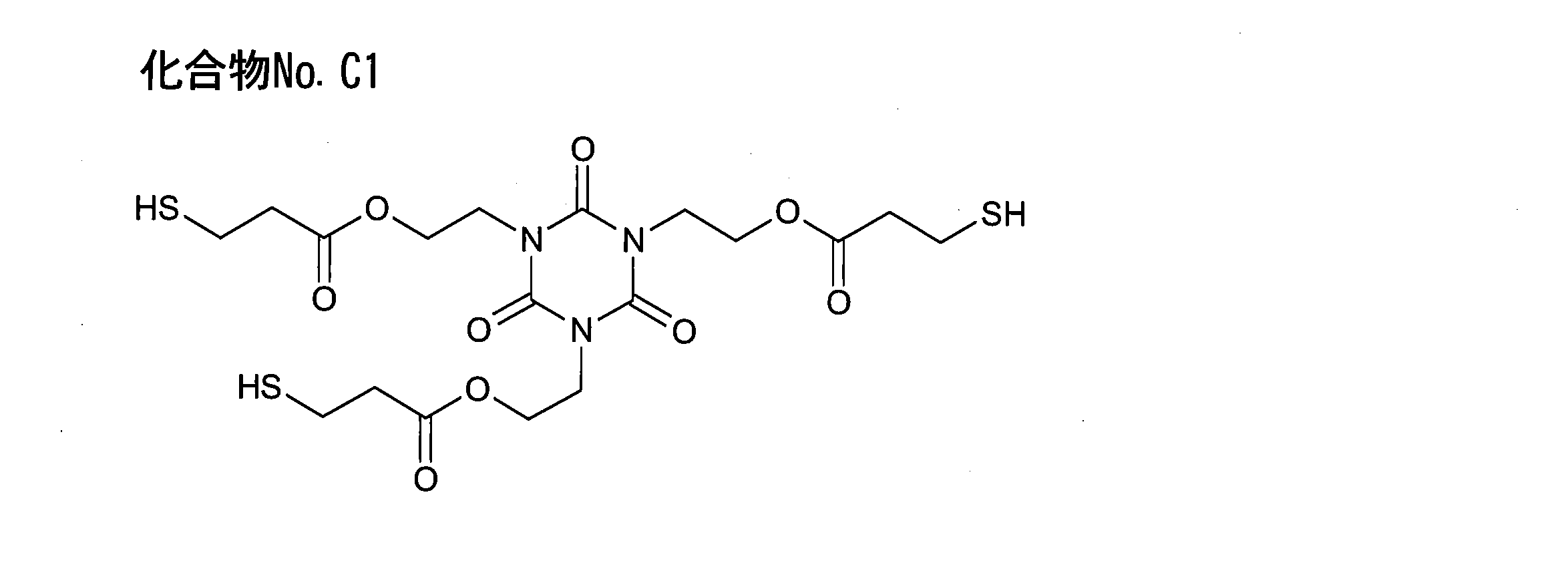
上記界面活性剤としては、パーフルオロアルキルリン酸エステル、パーフルオロアルキルカルボン酸塩等のフッ素界面活性剤、高級脂肪酸アルカリ塩、アルキルスルホン酸塩、アルキル硫酸塩等のアニオン系界面活性剤、高級アミンハロゲン酸塩、第四級アンモニウム塩等のカチオン系界面活性剤、ポリエチレングリコールアルキルエーテル、ポリエチレングリコール脂肪酸エステル、ソルビタン脂肪酸エステル、脂肪酸モノグリセリド等の非イオン界面活性剤、両性界面活性剤、シリコーン系界面活性剤等の界面活性剤を用いることができ、これらは組み合わせて用いてもよい。
上記シランカップリング剤としては、例えば信越化学社製シランカップリング剤を用いることができ、これらの中でも、KBE-9007、KBM-502、KBE-403等のイソシアネート基、メタクリロイル基、エポキシ基を有するシランカップリング剤が好適に用いられる。
上記メラミン化合物としては、(ポリ)メチロールメラミン、(ポリ)メチロールグリコールウリル、(ポリ)メチロールベンゾグアナミン、(ポリ)メチロールウレア等の窒素化合物中の活性メチロール基(CH2OH基)の全部又は一部(少なくとも2つ)がアルキルエーテル化された化合物を挙げることができる。ここで、アルキルエーテルを構成するアルキル基としては、メチル基、エチル基又はブチル基が挙げられ、互いに同一であってもよいし、異なっていてもよい。また、アルキルエーテル化されていないメチロール基は、一分子内で自己縮合していてもよく、二分子間で縮合して、その結果オリゴマー成分が形成されていてもよい。具体的には、ヘキサメトキシメチルメラミン、ヘキサブトキシメチルメラミン、テトラメトキシメチルグリコールウリル、テトラブトキシメチルグリコールウリル等を用いることができる。これらの中でも、ヘキサメトキシメチルメラミン、ヘキサブトキシメチルメラミン等のアルキルエーテル化されたメラミンが好ましい。
本発明の着色組成物は、溶剤がない固形状態の場合には溶剤に溶解又は分散させた後、スピンコーター、ロールコーター、バーコーター、ダイコーター、カーテンコーター、スリットコーター、ディップコーター、各種の印刷、浸漬等の公知の手段で、ソーダガラス、石英ガラス、半導体基板、金属、紙、プラスチック等の支持基体上に適用することができる。また、一旦フィルム等の支持基体上に施した後、他の支持基体上に転写することもでき、その適用方法に制限はない。
また、支持基体としては、基材に無機材料を用い、真空蒸着法、イオンプレーティング法、プラズマCVD法、イオンアシスト法、反応性スパッタリング法、化学的気相成長法等の各種蒸着法により作製した膜を積層したものや、後述の波長カットフィルタにおけるガラス基板に赤外線反射膜(C)を積層させたものを用いることもできる。
蒸着法により膜を積層する場合、基材としては、ガラスを用いるのが好ましく、膜厚は、使用する無機材料の種類等によっても異なるが、例えば、5~300nmである。蒸着膜は、基板の片面のみに形成させてもよいし、あるいは基板の両面に形成させてもよい。
上記無機材料としては、例えば、ケイ素(Si)、アルミニウム(Al)、マグネシウム(Mg)、カルシウム(Ca)、カリウム(K)、スズ(Sn)、インジウム(In)、ナトリウム(Na)、ホウ素(B)、チタン(Ti)、鉛(Pb)、ジルコニウム(Zr)、イットリウム(Y)、アンチモン(Sb)等 の酸化物や、インジウム・スズ複合酸化物(ITOと略す。)、アンチモン・スズ複合酸化物(ATOと略す。)等の複合酸化物を使用することができる。
本発明の着色組成物の硬化物は、特に、上記無機材料を用いて作製した膜への密着性が良好である。
蒸着法により膜を積層する場合、基材としては、ガラスを用いるのが好ましく、膜厚は、使用する無機材料の種類等によっても異なるが、例えば、5~300nmである。蒸着膜は、基板の片面のみに形成させてもよいし、あるいは基板の両面に形成させてもよい。
上記無機材料としては、例えば、ケイ素(Si)、アルミニウム(Al)、マグネシウム(Mg)、カルシウム(Ca)、カリウム(K)、スズ(Sn)、インジウム(In)、ナトリウム(Na)、ホウ素(B)、チタン(Ti)、鉛(Pb)、ジルコニウム(Zr)、イットリウム(Y)、アンチモン(Sb)等 の酸化物や、インジウム・スズ複合酸化物(ITOと略す。)、アンチモン・スズ複合酸化物(ATOと略す。)等の複合酸化物を使用することができる。
本発明の着色組成物の硬化物は、特に、上記無機材料を用いて作製した膜への密着性が良好である。
本発明の着色組成物は、紫外線等のエネルギー線を照射することにより通常は0.1秒~数分後に指触乾燥状態或いは溶媒不溶性の状態に硬化することができる。適当なエネルギー線としては、光酸発生剤の分解を誘発する限りいかなるものでもよいが、好ましくは、超高、高、中、低圧水銀ランプ、キセノンランプ、カーボンアーク灯、メタルハライドランプ、蛍光灯、タングステンランプ、エキシマーランプ、殺菌灯、エキシマーレーザー、窒素レーザー、アルゴンイオンレーザー、ヘリウムカドミウムレーザー、ヘリウムネオンレーザー、クリプトンイオンレーザー、各種半導体レーザー、YAGレーザー、発光ダイオード、CRT光源等から得られる2000オングストロームから7000オングストロームの波長を有する電磁波エネルギーや電子線、X線、放射線等の高エネルギー線を利用する。
エネルギー線への暴露時間は、エネルギー線の強度、塗膜厚やカチオン重合性有機化合物によるが、通常は0.1秒~10秒程度で十分である。しかし、比較的厚い塗装物についてはそれ以上の照射時間をかけたほうが好ましい。エネルギー線照射後0.1秒~数分後には、ほとんどの組成物はカチオン重合により指触乾燥するが、カチオン重合を促進するため加熱やサーマルヘッド等による熱エネルギーを併用することも場合によっては好ましい。
本発明の着色組成物は、加熱によって硬化させることもできる。加熱により硬化させる際の加熱条件は、70~250℃で1~100分である。プレベイクした後、加圧してポストベイクしてもよいし、異なる数段階の温度でベイクしてもよい。
加熱条件は各成分の種類及び配合割合によって異なるが、例えば、70~180℃で、オーブンなら5~15分間、ホットプレートなら1~5分間である。その後、塗膜を硬化させるために180~250℃ 、好ましくは200~250℃ で、オーブンなら30~90分間、ホットプレートなら5~30分間加熱処理することによって硬化膜を得ることができる。
加熱条件は各成分の種類及び配合割合によって異なるが、例えば、70~180℃で、オーブンなら5~15分間、ホットプレートなら1~5分間である。その後、塗膜を硬化させるために180~250℃ 、好ましくは200~250℃ で、オーブンなら30~90分間、ホットプレートなら5~30分間加熱処理することによって硬化膜を得ることができる。
本発明の着色組成物(又はその硬化物)は、熱反応性塗料或いはワニス、熱反応性接着剤、プリント基板、或いはカラーテレビ、PCモニタ、携帯情報端末、デジタルカメラ等のカラー表示の液晶表示パネルにおけるカラーフィルタ、CCDイメージセンサのカラーフィルタ、プラズマ表示パネル用の電極材料、粉末コーティング、印刷インク、印刷版、接着剤、歯科用組成物、立体造形用樹脂、ゲルコート、電子工学用のフォトレジスト、電気メッキレジスト、エッチングレジスト、液状及び乾燥膜の双方、はんだレジスト、種々の表示用途用のカラーフィルタを製造するための或いはプラズマ表示パネル、電気発光表示装置、及びLCDの製造工程において構造を形成するためのレジスト、電気及び電子部品を封入するための組成物、ソルダーレジスト、磁気記録材料、微小機械部品、導波路、光スイッチ、めっき用マスク、エッチングマスク、カラー試験系、ガラス繊維ケーブルコーティング、スクリーン印刷用ステンシル、ステレオリトグラフィによって三次元物体を製造するための材料、ホログラフィ記録用材料、画像記録材料、微細電子回路、脱色材料、画像記録材料のための脱色材料、マイクロカプセルを使用する画像記録材料用の脱色材料、印刷配線板用フォトレジスト材料、UV及び可視レーザー直接画像系用のフォトレジスト材料、プリント回路基板の逐次積層における誘電体層形成に使用するフォトレジスト材料或いは保護膜等の各種の用途に使用することができ、その用途に特に制限はない。
本発明の着色組成物は、特定の赤外線を遮断する目的で使用され、特に波長カットフィルタを形成するための着色組成物として有用である。
続いて、本発明の波長カットフィルタについて説明する。
本発明の波長カットフィルタは、ガラス基板(A)の一方の面に、本発明の着色組成物より得られるコーティング層(B)を有し、且つガラス基板(A)の他方の面に赤外線反射膜(C)を有するものである。コーティング層(B)及び赤外線反射膜(C)はそれぞれガラス基板(A)の各面に積層されている。本発明の着色組成物より得られるコーティング層(B)を有する側を光の入射側としてもよく、赤外線反射膜(C)を有する側を光の入射側としてもよい。以下、各層について順に説明する。
本発明の波長カットフィルタは、ガラス基板(A)の一方の面に、本発明の着色組成物より得られるコーティング層(B)を有し、且つガラス基板(A)の他方の面に赤外線反射膜(C)を有するものである。コーティング層(B)及び赤外線反射膜(C)はそれぞれガラス基板(A)の各面に積層されている。本発明の着色組成物より得られるコーティング層(B)を有する側を光の入射側としてもよく、赤外線反射膜(C)を有する側を光の入射側としてもよい。以下、各層について順に説明する。
<ガラス基板(A)>
本発明の波長カットフィルタに用いられるガラス基板(A)としては、可視域で透明なガラス材料から適宜選択して使用することができるが、ソーダ石灰ガラス、白板ガラス、硼珪酸ガラス、強化ガラス、石英ガラス、リン酸塩系ガラス等を用いることができ、中でもソーダ石灰ガラスは、安価で入手容易なため好ましく、白板ガラス、硼珪酸ガラス及び強化ガラスは、入手容易で硬度が高く加工性に優れるため好ましい。
本発明の波長カットフィルタに用いられるガラス基板(A)としては、可視域で透明なガラス材料から適宜選択して使用することができるが、ソーダ石灰ガラス、白板ガラス、硼珪酸ガラス、強化ガラス、石英ガラス、リン酸塩系ガラス等を用いることができ、中でもソーダ石灰ガラスは、安価で入手容易なため好ましく、白板ガラス、硼珪酸ガラス及び強化ガラスは、入手容易で硬度が高く加工性に優れるため好ましい。
さらに、ガラス基板(A)にシランカップリング剤等の前処理を施した後に、本発明の着色組成物からなる塗工液を塗布してコーティング層(B)を形成すると、塗工液乾燥後の染料を含有するコーティング層(B)のガラス基板に対する密着性が高まる。
上記シランカップリング剤としては、γ-グリシドキシプロピルトリメトキシシラン、γ-グリシドキシプロピルメチルジエトキシシラン、β-(3,4-エポキシシクロヘキシル)エチルトリメトキシシラン等のエポキシ官能性アルコキシシラン、N-β(アミノエチル)-γ-アミノプロピルトリメトキシシラン、γ-アミノプロピルトリエトキシシラン、N-フェニル-γ-アミノプロピルトリメトキシシラン等のアミノ官能性アルコキシシラン、γ-メルカプトプロピルトリメトキシシラン等のメルカプト官能性アルコキシシラン等が挙げられる。
また、ガラス基板(A)とコーティング層(B)との間に、下地層を有していてもよい。下地層は、平均一次粒子径が5~100nmの一次粒子が凝集した平均二次粒子径が20~250nmである金属酸化物微粒子の凝集体を、下記に示す溶媒に分散させた塗工液を、下記に示す塗布方法により塗工することにより得られ、厚さが30~1000nmである。上記金属酸化物微粒子の凝集体は、塗工液全量に対して0.1~50質量%が好ましい。
ガラス基板(A)の厚さは、特に限定されないが、0.05~8mmが好ましく、軽量化及び強度の点から0.05~1mmがさらに好ましい。
本発明では、基材がガラス板のため、基材上に直接塗工、乾燥した後切断加工することが可能であり、構造やプロセスが簡易となる。また、基板がガラス板のため、プラスチックである場合より耐熱性(260℃リフロー耐性)が高い。
<コーティング層(B)>
本発明の波長カットフィルタに用いられる、本発明の着色組成物より得られるコーティング層(B)は、上述のように、本発明の着色組成物をガラス基板(A)上に塗布することにより形成することができる。得られた塗膜は必要に応じ加熱して硬化させる。
本発明の波長カットフィルタに用いられる、本発明の着色組成物より得られるコーティング層(B)は、上述のように、本発明の着色組成物をガラス基板(A)上に塗布することにより形成することができる。得られた塗膜は必要に応じ加熱して硬化させる。
染料を含有するコーティング層(B)の厚さは1~200μmであるのが、均一な膜が得られ薄膜化に有利であるため好ましい。1μm未満だと機能を十分に発現することができず、200μmを超えると、塗布時に溶媒が残留する恐れがある。
<赤外線反射膜(C)>
本発明の波長カットフィルタに用いられる赤外線反射膜(C)は、700~1200nmの波長域の光を遮断する機能を有するものであり、低屈折率層と高屈折率層とが交互に積層された誘電体多層膜により形成される。
本発明の波長カットフィルタに用いられる赤外線反射膜(C)は、700~1200nmの波長域の光を遮断する機能を有するものであり、低屈折率層と高屈折率層とが交互に積層された誘電体多層膜により形成される。
上記低屈折率層を構成する材料としては、屈折率1.2~1.6の材料を用いることができ、例えば、シリカ、アルミナ、フッ化ランタン、フッ化マグネシウム、六フッ化アルミニウムナトリウム等が挙げられる。
上記高屈折率層を構成する材料としては、屈折率が1.7~2.5の材料を用いることができ、例えば、酸化チタン、酸化ジルコニウム、五酸化タンタル、五酸化ニオブ、酸化ランタン、酸化イットリウム、酸化亜鉛、硫化亜鉛、酸化インジウム等が挙げられる他、これらを主成分とし、酸化チタン、酸化錫、酸化セリウム等を少量含有させたもの等が挙げられる。
上記低屈折率層と高屈折率層を積層する方法については、これらの層を積層した誘電体多層膜が形成される限り特に制限はないが、例えば、ガラス基板上に、CVD法、スパッタ法、真空蒸着法等により低屈折率層と高屈折率層を交互に積層した誘電体多層膜を形成する方法が挙げられる。また、あらかじめ誘電体多層膜を形成し、これをガラス基板に接着剤で貼り合わせることもできる。
積層数は、10~80層であり、25~50層であるのが、プロセス及び強度の点から好ましい。
積層数は、10~80層であり、25~50層であるのが、プロセス及び強度の点から好ましい。
上記低屈折率層と高屈折率層の厚みは、それぞれ、通常、遮断しようとする光線の波長λ(nm)の1/10~1/2の厚みである。厚みが0.1λ未満あるいは0.5λより大きくなると、屈折率(n)と物理膜厚(d)との積(nd)がλ/4の倍数で表される光学膜厚と大きく異なって特定波長の遮断・透過ができない恐れがある。
上記赤外線反射膜(C)としては、前記の誘電体多層膜の他、極大吸収波長が700~1100nmの染料を含有する膜、高分子を積層させたもの、コレステリック液晶を塗布して形成した膜等の有機材料を用いたものを使用することもできる。
本発明の波長カットフィルタは、透過率が下記(i)~(iii)を満たすことが好ましい。尚、透過率の測定は、日本分光(株)製紫外可視近赤外分光光度計V-570で測定した。
(i)波長430~580nmの範囲において、波長カットフィルタの垂直方向(ガラス基板の板面に対して垂直な方向、以下同様)から測定した場合の透過率の平均値が75%以上である。
(ii)波長800~1000nmにおいて、波長カットフィルタの垂直方向から測定した場合の透過率の平均値が5%以下である。
(iii)波長560~800nmの範囲において、波長カットフィルタの垂直方向から測定した場合の透過率が80%となる波長の値(Ya)と、波長カットフィルタの垂直方向に対して35°の角度から測定した場合の透過率が80%となる波長の値(Yb)の差の絶対値が30nm以下である。
波長カットフィルタにおいて、上記(i)の波長430~580nmの範囲における透過率の平均値が75%未満であると、可視光領域における光をほとんど透過しないことになり、上記(ii)の波長800~1000nmにおける透過率の平均値が5%を超えると、赤外線領域における光をほとんどカットしないため、人間の視感度に近づくよう感度を補正することが困難になる恐れがある。
また、上記(iii)のYaとYbの差の絶対値が30nmを超えると、光の入射角による依存性が高くなり、光の入射角によって波長カットフィルタの特性が変化するため、画面の中心と周辺で色合いが変化する等の弊害が生じる恐れがある。
(i)波長430~580nmの範囲において、波長カットフィルタの垂直方向(ガラス基板の板面に対して垂直な方向、以下同様)から測定した場合の透過率の平均値が75%以上である。
(ii)波長800~1000nmにおいて、波長カットフィルタの垂直方向から測定した場合の透過率の平均値が5%以下である。
(iii)波長560~800nmの範囲において、波長カットフィルタの垂直方向から測定した場合の透過率が80%となる波長の値(Ya)と、波長カットフィルタの垂直方向に対して35°の角度から測定した場合の透過率が80%となる波長の値(Yb)の差の絶対値が30nm以下である。
波長カットフィルタにおいて、上記(i)の波長430~580nmの範囲における透過率の平均値が75%未満であると、可視光領域における光をほとんど透過しないことになり、上記(ii)の波長800~1000nmにおける透過率の平均値が5%を超えると、赤外線領域における光をほとんどカットしないため、人間の視感度に近づくよう感度を補正することが困難になる恐れがある。
また、上記(iii)のYaとYbの差の絶対値が30nmを超えると、光の入射角による依存性が高くなり、光の入射角によって波長カットフィルタの特性が変化するため、画面の中心と周辺で色合いが変化する等の弊害が生じる恐れがある。
本発明の波長カットフィルタの具体的な用途としては、自動車や建物の窓ガラス等に装着される熱線カットフィルタ;デジタルスチルカメラ、デジタルビデオカメラ、監視カメラ、車載用カメラ、ウェブカメラ、携帯電話用カメラ等の固体撮像装置におけるCCDやCMOS等の固体撮像素子用視感度補正用;自動露出計;プラズマディスプレイ等の表示装置等を挙げることができる。
以下、実施例等を挙げて本発明を更に詳細に説明するが、本発明はこれらの実施例等に限定されるものではない。
[製造例1]重合性化合物(β)No.1の調製
アクリル酸40質量部及びブチルメタクリレート50質量部を、プロピレングリコール-1-モノメチルエーテル-2-アセテート(PGMEA)200質量部に溶解し、この溶液に、ラジカル重合開始剤としてアゾビスイソブチロニトリル4質量部を加え、80℃で3時間撹拌した。続いて、アクリル酸で変性したセロキサイド2021P(ダイセル化学社製脂環式エポキシ樹脂)10質量部を加え、120℃で3時間撹拌し、重合性化合物(β)No.1を得た。
この重合性化合物(β)No.1は、上記一般式(I-1)~(I-3)において、X1が水素原子又はメチル基であり、Y1が、上記一般式(1)で表される二価の結合基(X2は、下記式(n)で表される基であり、Z1及びZ2は、直接結合である)であり、R1は、炭素原子数1~8のアルキル基であり、R2~R4はメチル基であるユニットを有する重合性化合物(β)である。
アクリル酸40質量部及びブチルメタクリレート50質量部を、プロピレングリコール-1-モノメチルエーテル-2-アセテート(PGMEA)200質量部に溶解し、この溶液に、ラジカル重合開始剤としてアゾビスイソブチロニトリル4質量部を加え、80℃で3時間撹拌した。続いて、アクリル酸で変性したセロキサイド2021P(ダイセル化学社製脂環式エポキシ樹脂)10質量部を加え、120℃で3時間撹拌し、重合性化合物(β)No.1を得た。
この重合性化合物(β)No.1は、上記一般式(I-1)~(I-3)において、X1が水素原子又はメチル基であり、Y1が、上記一般式(1)で表される二価の結合基(X2は、下記式(n)で表される基であり、Z1及びZ2は、直接結合である)であり、R1は、炭素原子数1~8のアルキル基であり、R2~R4はメチル基であるユニットを有する重合性化合物(β)である。

[製造例2]重合性化合物(β)No.2の調製
メタクリル酸20質量部、グリシジルメタクリレート20質量部及びベンジルメタクリレート50質量部をシクロヘキサノン500質量部に溶解し、ラジカル重合開始剤としてアゾビスイソブチロニトリル4質量部を加えて、80℃で3時間撹拌した。続いて、アクリル酸20質量部を加えて120℃で3時間撹拌し、重合性化合物(β)No.2を得た。
メタクリル酸20質量部、グリシジルメタクリレート20質量部及びベンジルメタクリレート50質量部をシクロヘキサノン500質量部に溶解し、ラジカル重合開始剤としてアゾビスイソブチロニトリル4質量部を加えて、80℃で3時間撹拌した。続いて、アクリル酸20質量部を加えて120℃で3時間撹拌し、重合性化合物(β)No.2を得た。
[製造例3]重合性化合物(β)No.3の調製
グリシジルメタクリレート50質量部、ベンジルメタクリレート5部及びスチレン40質量部をプロピレングリコール-1-モノメチルエーテル-2-アセテート(PGMEA)500質量部に溶解し、ラジカル重合開始剤として1-ジ(t-ブチルパーオキシ)-3,3,5-トリメチルシクロヘキサン1質量部を加えて、140℃で2時間撹拌した。次いで、アクリル酸20質量部を加えて120℃で3時間撹拌し、重合性化合物(β)No.3を得た。
グリシジルメタクリレート50質量部、ベンジルメタクリレート5部及びスチレン40質量部をプロピレングリコール-1-モノメチルエーテル-2-アセテート(PGMEA)500質量部に溶解し、ラジカル重合開始剤として1-ジ(t-ブチルパーオキシ)-3,3,5-トリメチルシクロヘキサン1質量部を加えて、140℃で2時間撹拌した。次いで、アクリル酸20質量部を加えて120℃で3時間撹拌し、重合性化合物(β)No.3を得た。
[製造例4]重合性化合物(β)No.4の調製
グリシジルメタクリレート40質量部、ベンジルメタクリレート5部、スチレン40質量部をプロピレングリコール-1-モノメチルエーテル-2-アセテート(PGMEA)500質量部に溶解し、ラジカル重合開始剤としてアゾビスイソブチロニトリル10質量部を用いて80℃で3時間撹拌した。次いで、アクリル酸20質量部を加えて、120℃で3時間撹拌し、重合性化合物(β)No.4を得た。
グリシジルメタクリレート40質量部、ベンジルメタクリレート5部、スチレン40質量部をプロピレングリコール-1-モノメチルエーテル-2-アセテート(PGMEA)500質量部に溶解し、ラジカル重合開始剤としてアゾビスイソブチロニトリル10質量部を用いて80℃で3時間撹拌した。次いで、アクリル酸20質量部を加えて、120℃で3時間撹拌し、重合性化合物(β)No.4を得た。
[製造例5]重合性化合物(β)No.5の調製
グリシジルメタクリレート40質量部、ベンジルメタクリレート5部、スチレン40質量部をプロピレングリコール-1-モノメチルエーテル-2-アセテート(PGMEA)500質量部に溶解し、ラジカル重合開始剤としてアゾビスイソブチロニトリル5質量部を加えて、80℃で3時間撹拌した。次いで、アクリル酸20質量部を加えて、120℃で3時間攪拌した。次いで、テトラヒドロフタル酸無水物5質量部を加えて120℃で3時間撹拌した後、重合性化合物(β)No.5を得た。
グリシジルメタクリレート40質量部、ベンジルメタクリレート5部、スチレン40質量部をプロピレングリコール-1-モノメチルエーテル-2-アセテート(PGMEA)500質量部に溶解し、ラジカル重合開始剤としてアゾビスイソブチロニトリル5質量部を加えて、80℃で3時間撹拌した。次いで、アクリル酸20質量部を加えて、120℃で3時間攪拌した。次いで、テトラヒドロフタル酸無水物5質量部を加えて120℃で3時間撹拌した後、重合性化合物(β)No.5を得た。
[製造例6]コロイダルシリカ(γ)No.1の調製
<ステップ1>中間体AT-20QMの調製
アデライトAT-20Q(ADEKA社製コロイダルシリカ)60g及びプロピレングリコールモノメチルエーテル(PGMEA)26gを仕込み、60℃減圧下で水とPGMEAを共沸させて溶媒置換を行った。0.5μmのカートリッジフィルターでろ過を行い、中間体AT-20QMを得た。
<ステップ1>中間体AT-20QMの調製
アデライトAT-20Q(ADEKA社製コロイダルシリカ)60g及びプロピレングリコールモノメチルエーテル(PGMEA)26gを仕込み、60℃減圧下で水とPGMEAを共沸させて溶媒置換を行った。0.5μmのカートリッジフィルターでろ過を行い、中間体AT-20QMを得た。
<ステップ2>コロイダルシリカ(γ)No.1の調製
ステップ1で得られた中間体AT-20QM500gを仕込み、窒素下で及びKBM-5103(信越化学社製シランカップリング剤)17.7gを加えて100℃で60分反応させた。40℃以下に冷却し、10μmのフィルターでろ過してコロイダルシリカ(γ)No.1を得た(固形分 22質量%)。得られたコロイダルシリカ(γ)No.1の平均粒径は20nmであった。
ステップ1で得られた中間体AT-20QM500gを仕込み、窒素下で及びKBM-5103(信越化学社製シランカップリング剤)17.7gを加えて100℃で60分反応させた。40℃以下に冷却し、10μmのフィルターでろ過してコロイダルシリカ(γ)No.1を得た(固形分 22質量%)。得られたコロイダルシリカ(γ)No.1の平均粒径は20nmであった。
[実施例1-1~1-14及び比較例1-1~1-4]着色組成物No.1~No.14及び比較組成物No.1~No.4の調製
<ステップ1>染料液No.1~No.14及び比較染料液No.1~No.4の調製
(A)成分として[表1]~[表3]に示すシアニン化合物(α)に溶媒(σ)を加え、撹拌して溶解させて染料液No.1~No.14及び比較染料液No.1~No.4を得た。
<ステップ1>染料液No.1~No.14及び比較染料液No.1~No.4の調製
(A)成分として[表1]~[表3]に示すシアニン化合物(α)に溶媒(σ)を加え、撹拌して溶解させて染料液No.1~No.14及び比較染料液No.1~No.4を得た。
<ステップ2>着色組成物No.1~No.14及び比較組成物No.1~No.4の調製
[表1]~[表3]の配合に従い、上記染料液No.1~No.14及び比較染料液No.1~No.5に、重合性化合物(β)、コロイダルシリカ(γ)、不飽和結合を有するモノマー(ω)、溶媒(σ)及び重合開始剤(δ)を加えて撹拌し、着色組成物No.1~No.14及び比較組成物No.1~No.4を調製した。[表4]に、実施例及び比較例の着色組成物におけるシリカ粒子(γ)及びシアニン化合物(α)の含有量を示す。
[表1]~[表3]の配合に従い、上記染料液No.1~No.14及び比較染料液No.1~No.5に、重合性化合物(β)、コロイダルシリカ(γ)、不飽和結合を有するモノマー(ω)、溶媒(σ)及び重合開始剤(δ)を加えて撹拌し、着色組成物No.1~No.14及び比較組成物No.1~No.4を調製した。[表4]に、実施例及び比較例の着色組成物におけるシリカ粒子(γ)及びシアニン化合物(α)の含有量を示す。
[表1]~[表3]の各符号は下記の成分を表す。
α-1:化合物No.76のヘキサフルオロリン酸塩
α-2:化合物No.100のヘキサフルオロリン酸塩
α-3:化合物No.100のビス(トリフルオロメタンスルホニル)イミド酸塩
α-4:化合物No.102のビス(トリフルオロメタンスルホニル)イミド酸塩
α-5:化合物No.103のビス(トリフルオロメタンスルホニル)イミド酸塩
β-1:製造例1で得られた重合性化合物(β)No.1
β-2:ACA Z251(ダイセル・オルネクス社製アクリル化アクリレート)
β-3:ACA Z250(ダイセル・オルネクス社製アクリル化アクリレート)
β-4:ACA 200M(ダイセル・オルネクス社製アクリル化アクリレート)
β-5:SPC-1000(昭和電工社製アクリル樹脂)
β-6:SPC-3000(昭和電工社製アクリル樹脂)
β-7:製造例2で得られた重合性化合物(β)No.2
β-8:製造例3で得られた重合性化合物(β)No.3
β-9:製造例4で得られた重合性化合物(β)No.4
β-10:製造例5で得られた重合性化合物(β)No.5
γ-1:製造例6で得られたコロイダルシリカ(γ)No.1
ω-1:アロニックスM450(東亞合成社製アクリル系モノマー)
ω-2:アロニックスM315(東亞合成社製アクリル系モノマー)
ω-3:アロニックスM405(東亞合成社製アクリル系モノマー)
σ-1:ジアセトンアルコール
σ-2:シクロヘキサノン
δ-1:V-60(和光純薬社製油溶性アゾ重合開始剤)
δ-2:V-70(和光純薬社製油溶性アゾ重合開始剤)
δ-3:V-65(和光純薬社製油溶性アゾ重合開始剤)
δ-4:V-59(和光純薬社製油溶性アゾ重合開始剤)
δ-5:V-40(和光純薬社製油溶性アゾ重合開始剤)
δ-6:VAm-110(和光純薬社製油溶性アゾ重合開始剤)
δ-7:Irg-907(BASF社製光重合開始剤)
δ-8:SP-246(ADEKA社製光重合開始剤)
δ-9:OXE-01(BASF社製光重合開始剤)
δ-10:OXE-02(BASF社製光重合開始剤)
α-1:化合物No.76のヘキサフルオロリン酸塩
α-2:化合物No.100のヘキサフルオロリン酸塩
α-3:化合物No.100のビス(トリフルオロメタンスルホニル)イミド酸塩
α-4:化合物No.102のビス(トリフルオロメタンスルホニル)イミド酸塩
α-5:化合物No.103のビス(トリフルオロメタンスルホニル)イミド酸塩
β-1:製造例1で得られた重合性化合物(β)No.1
β-2:ACA Z251(ダイセル・オルネクス社製アクリル化アクリレート)
β-3:ACA Z250(ダイセル・オルネクス社製アクリル化アクリレート)
β-4:ACA 200M(ダイセル・オルネクス社製アクリル化アクリレート)
β-5:SPC-1000(昭和電工社製アクリル樹脂)
β-6:SPC-3000(昭和電工社製アクリル樹脂)
β-7:製造例2で得られた重合性化合物(β)No.2
β-8:製造例3で得られた重合性化合物(β)No.3
β-9:製造例4で得られた重合性化合物(β)No.4
β-10:製造例5で得られた重合性化合物(β)No.5
γ-1:製造例6で得られたコロイダルシリカ(γ)No.1
ω-1:アロニックスM450(東亞合成社製アクリル系モノマー)
ω-2:アロニックスM315(東亞合成社製アクリル系モノマー)
ω-3:アロニックスM405(東亞合成社製アクリル系モノマー)
σ-1:ジアセトンアルコール
σ-2:シクロヘキサノン
δ-1:V-60(和光純薬社製油溶性アゾ重合開始剤)
δ-2:V-70(和光純薬社製油溶性アゾ重合開始剤)
δ-3:V-65(和光純薬社製油溶性アゾ重合開始剤)
δ-4:V-59(和光純薬社製油溶性アゾ重合開始剤)
δ-5:V-40(和光純薬社製油溶性アゾ重合開始剤)
δ-6:VAm-110(和光純薬社製油溶性アゾ重合開始剤)
δ-7:Irg-907(BASF社製光重合開始剤)
δ-8:SP-246(ADEKA社製光重合開始剤)
δ-9:OXE-01(BASF社製光重合開始剤)
δ-10:OXE-02(BASF社製光重合開始剤)

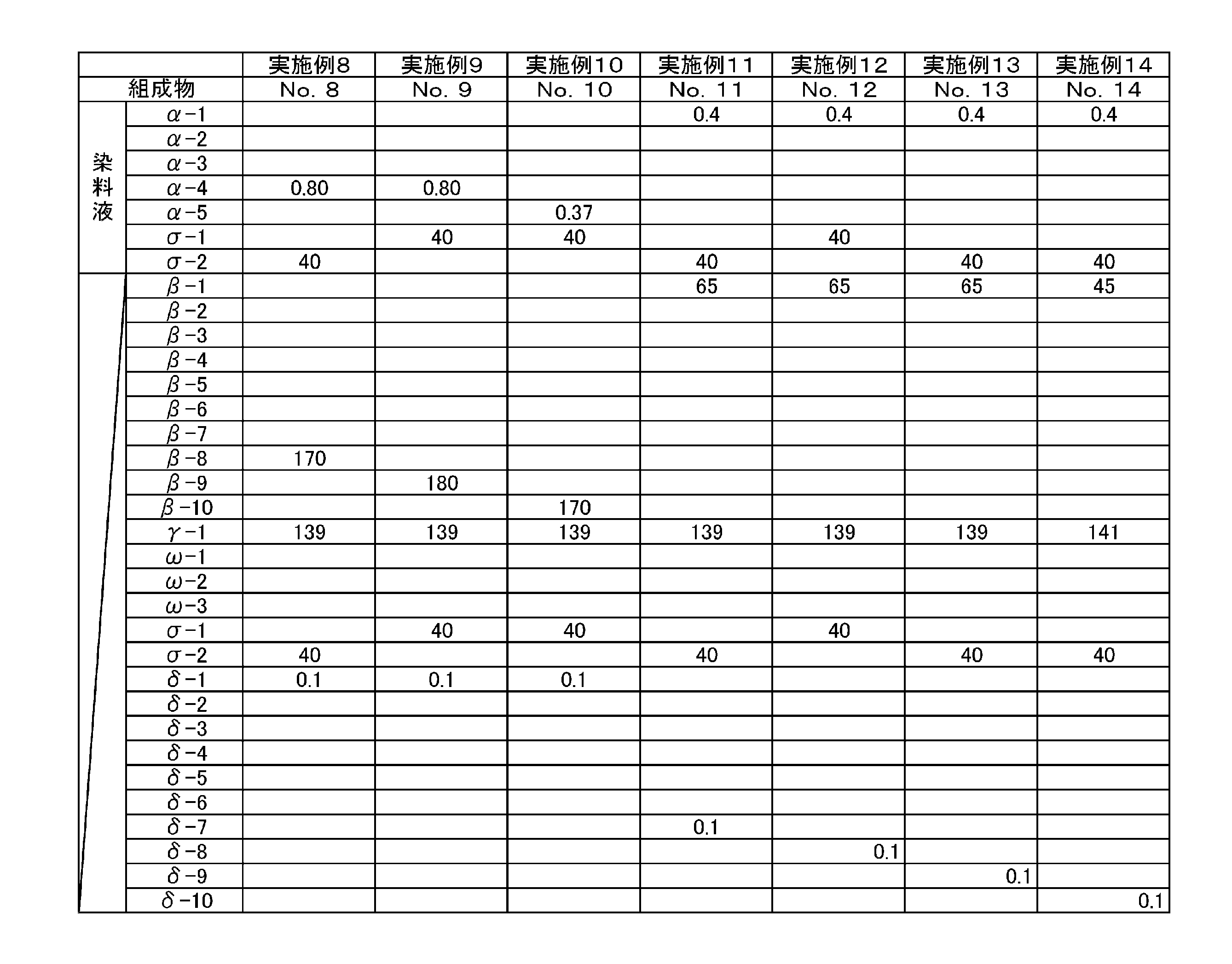

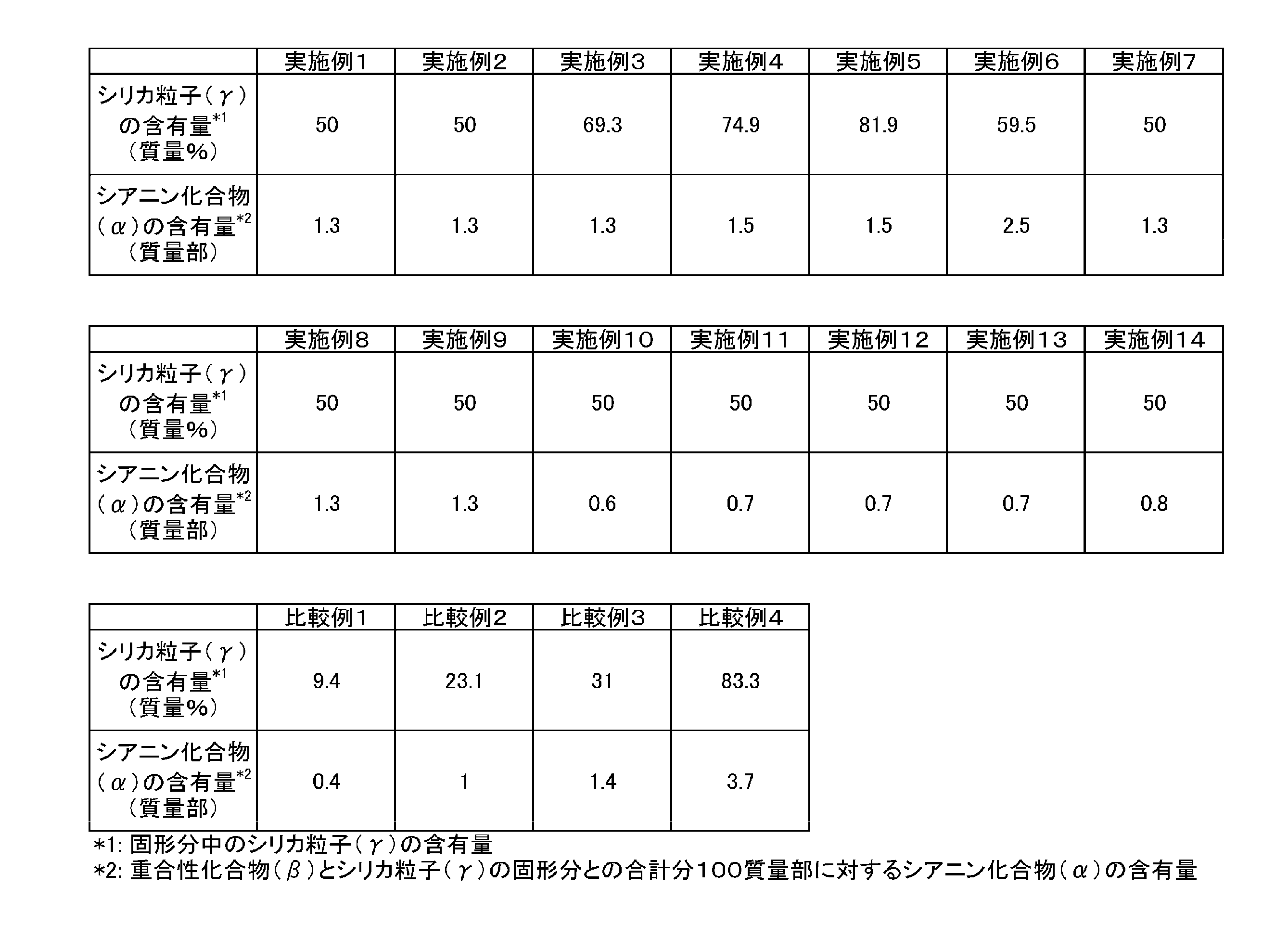
[評価例1-1~1-14及び比較評価例1-1~1-4]
実施例1-1~1-14で得られた着色組成物No.1~No.14及び比較例1-1~1-4で得られた比較組成物No.1~No.4を、それぞれガラス基板に410rpm×7秒の条件で塗工し、ホットプレートで乾燥(90℃、10分)させた。乾燥後、ホットプレートで150℃×10分加熱して塗膜を硬化させた。着色組成物No.9~No.14及び比較組成物No.3については、さらに、高圧水銀灯により300mJ/cm2で露光を行った。
得られた硬化膜の上にAR膜(反射防止膜)を真空蒸着法により成膜し、AR層からカッターナイフでクロスカットし、セロハンテープをクロスカット部に貼り付けた後、テープ付着試験による硬化膜の密着性を測定した。
これらの結果を、[表5]に示す。
実施例1-1~1-14で得られた着色組成物No.1~No.14及び比較例1-1~1-4で得られた比較組成物No.1~No.4を、それぞれガラス基板に410rpm×7秒の条件で塗工し、ホットプレートで乾燥(90℃、10分)させた。乾燥後、ホットプレートで150℃×10分加熱して塗膜を硬化させた。着色組成物No.9~No.14及び比較組成物No.3については、さらに、高圧水銀灯により300mJ/cm2で露光を行った。
得られた硬化膜の上にAR膜(反射防止膜)を真空蒸着法により成膜し、AR層からカッターナイフでクロスカットし、セロハンテープをクロスカット部に貼り付けた後、テープ付着試験による硬化膜の密着性を測定した。
これらの結果を、[表5]に示す。

上記〔表5〕の結果より、本発明の着色組成物はAR膜との密着性が高い、すなわち無機材料との密着性が高いことは明らかである。
Claims (7)
- シアニン化合物の少なくとも一種(α)、エチレン性不飽和結合及び親水性基を有する重合性化合物(β)及び平均粒径5nm~100μmのシリカ粒子(γ)を含有す着色組成物であって、
上記平均粒径5nm~100μmのシリカ粒子(γ)の含有量が、着色組成物の固形分中32~82質量%である着色組成物。 - エチレン性不飽和結合及び親水性基を有する重合性化合物(β)が、下記一般式(I-1)で表されるユニット、下記一般式(I-2)で表されるユニット及び下記一般式(I-3)で表されるユニットを有することを特徴とする請求項1に記載の着色組成物。
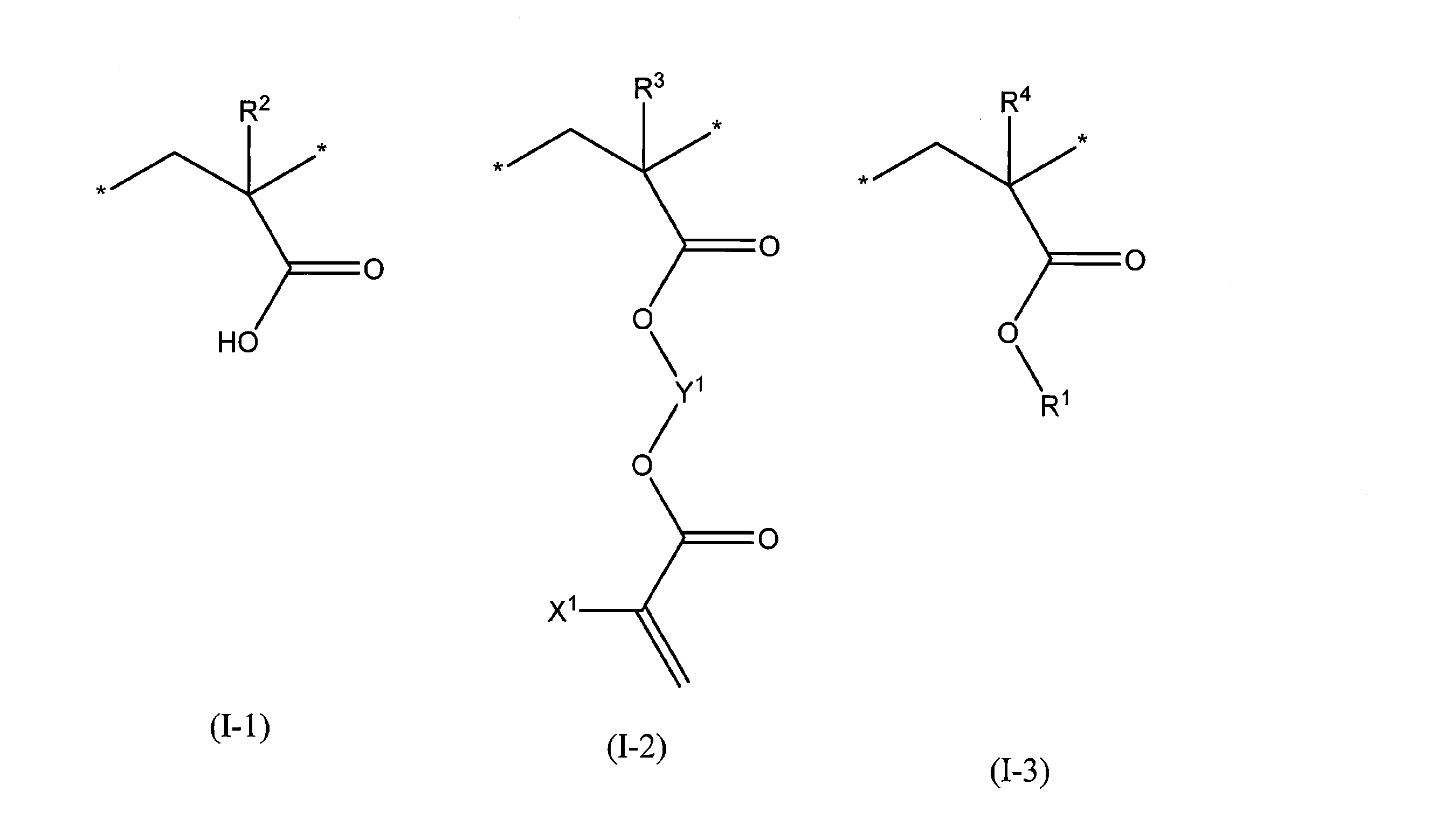
- エチレン性不飽和結合及び親水性基を有する重合性化合物(β)の固形分と上記平均粒径5nm~100μmのシリカ粒子(γ)の固形分との合計分100質量部に対してシアニン化合物の少なくとも一種(α)を合計で0.01~10.0質量部含有することを特徴とする請求項1又は2に記載の着色組成物。
- 上記平均粒径5nm~100μmのシリカ粒子(γ)がコロイダルシリカであることを特徴とする請求項1~3のいずれか一項に記載の着色組成物。
- 請求項1~4のいずれか一項に記載の着色組成物を、エネルギー線照射又は加熱により硬化させる方法。
- 請求項1~5のいずれか一項に記載の着色組成物の硬化物。
- 請求項1~4のいずれか一項に記載の着色組成物から得られる波長カットフィルタ。
Priority Applications (2)
| Application Number | Priority Date | Filing Date | Title |
|---|---|---|---|
| CN201680055262.5A CN108419438B (zh) | 2015-11-20 | 2016-12-09 | 着色组合物 |
| KR1020187007491A KR20190095098A (ko) | 2015-11-20 | 2016-12-09 | 착색 조성물 |
Applications Claiming Priority (2)
| Application Number | Priority Date | Filing Date | Title |
|---|---|---|---|
| JP2015-227498 | 2015-11-20 | ||
| JP2015227498A JP6619627B2 (ja) | 2015-11-20 | 2015-11-20 | 着色組成物 |
Publications (2)
| Publication Number | Publication Date |
|---|---|
| WO2017086489A1 true WO2017086489A1 (ja) | 2017-05-26 |
| WO2017086489A8 WO2017086489A8 (ja) | 2017-08-24 |
Family
ID=58719016
Family Applications (1)
| Application Number | Title | Priority Date | Filing Date |
|---|---|---|---|
| PCT/JP2016/086773 Ceased WO2017086489A1 (ja) | 2015-11-20 | 2016-12-09 | 着色組成物 |
Country Status (4)
| Country | Link |
|---|---|
| JP (1) | JP6619627B2 (ja) |
| KR (1) | KR20190095098A (ja) |
| CN (1) | CN108419438B (ja) |
| WO (1) | WO2017086489A1 (ja) |
Families Citing this family (3)
| Publication number | Priority date | Publication date | Assignee | Title |
|---|---|---|---|---|
| JP7339161B2 (ja) * | 2018-01-09 | 2023-09-05 | 株式会社Adeka | 組成物、硬化物、光学フィルタ及び硬化物の製造方法 |
| JP7192249B2 (ja) * | 2018-05-25 | 2022-12-20 | 昭和電工マテリアルズ株式会社 | 樹脂組成物、硬化物、半導体装置及びその製造方法 |
| JP2022151479A (ja) * | 2021-03-24 | 2022-10-07 | Agc株式会社 | 光学フィルタ |
Citations (5)
| Publication number | Priority date | Publication date | Assignee | Title |
|---|---|---|---|---|
| JP2011221310A (ja) * | 2010-04-09 | 2011-11-04 | Fujifilm Corp | カラーフィルタ用光硬化性青色着色組成物、カラーフィルタ、カラーフィルタの製造方法、及び液晶表示装置 |
| JP2013155353A (ja) * | 2012-01-31 | 2013-08-15 | Fujifilm Corp | 赤外線吸収性液状組成物、これを用いた赤外線カットフィルタ及びその製造方法、並びに、カメラモジュール及びその製造方法 |
| JP2013171276A (ja) * | 2012-02-23 | 2013-09-02 | Toyo Ink Sc Holdings Co Ltd | 青色感光性着色組成物、およびカラーフィルタ |
| JP2015137300A (ja) * | 2014-01-22 | 2015-07-30 | 東洋インキScホールディングス株式会社 | 着色組成物、カラーフィルタ用着色組成物、および、カラーフィルタ |
| JP2015172189A (ja) * | 2014-02-20 | 2015-10-01 | 東友ファインケム株式会社Dongwoo Fine−Chem Co., Ltd. | 着色硬化性樹脂組成物 |
Family Cites Families (3)
| Publication number | Priority date | Publication date | Assignee | Title |
|---|---|---|---|---|
| JP2006273942A (ja) | 2005-03-28 | 2006-10-12 | Sumitomo Osaka Cement Co Ltd | 塗料および塗膜 |
| JP6027753B2 (ja) * | 2012-02-24 | 2016-11-16 | 株式会社Adeka | 着色アルカリ現像性感光性組成物 |
| WO2013161492A1 (ja) * | 2012-04-25 | 2013-10-31 | 株式会社Adeka | 波長カットフィルタ |
-
2015
- 2015-11-20 JP JP2015227498A patent/JP6619627B2/ja not_active Expired - Fee Related
-
2016
- 2016-12-09 WO PCT/JP2016/086773 patent/WO2017086489A1/ja not_active Ceased
- 2016-12-09 CN CN201680055262.5A patent/CN108419438B/zh not_active Expired - Fee Related
- 2016-12-09 KR KR1020187007491A patent/KR20190095098A/ko not_active Withdrawn
Patent Citations (5)
| Publication number | Priority date | Publication date | Assignee | Title |
|---|---|---|---|---|
| JP2011221310A (ja) * | 2010-04-09 | 2011-11-04 | Fujifilm Corp | カラーフィルタ用光硬化性青色着色組成物、カラーフィルタ、カラーフィルタの製造方法、及び液晶表示装置 |
| JP2013155353A (ja) * | 2012-01-31 | 2013-08-15 | Fujifilm Corp | 赤外線吸収性液状組成物、これを用いた赤外線カットフィルタ及びその製造方法、並びに、カメラモジュール及びその製造方法 |
| JP2013171276A (ja) * | 2012-02-23 | 2013-09-02 | Toyo Ink Sc Holdings Co Ltd | 青色感光性着色組成物、およびカラーフィルタ |
| JP2015137300A (ja) * | 2014-01-22 | 2015-07-30 | 東洋インキScホールディングス株式会社 | 着色組成物、カラーフィルタ用着色組成物、および、カラーフィルタ |
| JP2015172189A (ja) * | 2014-02-20 | 2015-10-01 | 東友ファインケム株式会社Dongwoo Fine−Chem Co., Ltd. | 着色硬化性樹脂組成物 |
Also Published As
| Publication number | Publication date |
|---|---|
| CN108419438A (zh) | 2018-08-17 |
| JP2017095558A (ja) | 2017-06-01 |
| WO2017086489A8 (ja) | 2017-08-24 |
| JP6619627B2 (ja) | 2019-12-11 |
| KR20190095098A (ko) | 2019-08-14 |
| CN108419438B (zh) | 2021-10-01 |
Similar Documents
| Publication | Publication Date | Title |
|---|---|---|
| KR101475588B1 (ko) | 착색제, 착색 조성물, 컬러 필터 및 표시 소자 | |
| JP5573724B2 (ja) | 着色組成物、カラーフィルタ及び表示素子 | |
| KR102170466B1 (ko) | 착색 조성물, 착색 경화막 및 표시 소자 | |
| JP2017201003A (ja) | 着色組成物、着色硬化膜、カラーフィルタ、表示素子及び固体撮像素子 | |
| JP6028478B2 (ja) | 着色剤、着色組成物、カラーフィルタ及び表示素子 | |
| JP5962099B2 (ja) | 着色組成物、カラーフィルタ及び表示素子 | |
| US9334270B2 (en) | Polymerizable (photosensitive or reactive) cyano-containing compound, a dye, and colored photosensitive composition | |
| JP5919674B2 (ja) | 着色剤、着色組成物、カラーフィルタ及び表示素子 | |
| JP5940988B2 (ja) | 新規化合物、染料及び着色感光性組成物 | |
| JPWO2017170182A1 (ja) | 感光性組成物及び新規化合物 | |
| JP2013025194A (ja) | 着色剤、着色組成物、カラーフィルタ及び表示素子 | |
| CN111936532A (zh) | 化合物、潜伏性添加剂、组合物、固化物、固化物的制造方法及组合物的制造方法 | |
| JP5955584B2 (ja) | 新規化合物及び着色アルカリ現像性感光性組成物 | |
| JP6619627B2 (ja) | 着色組成物 | |
| KR102723373B1 (ko) | 신규 화합물, 잠재성 첨가제 및 그 첨가제를 함유하는 조성물 | |
| CN108699183A (zh) | 组合物及新型化合物 | |
| JP6064598B2 (ja) | 着色組成物、カラーフィルタ及び表示素子 | |
| TWI731909B (zh) | 著色組合物 | |
| KR20150048044A (ko) | 착색 조성물, 착색 경화막 및 표시 소자 | |
| JP6027753B2 (ja) | 着色アルカリ現像性感光性組成物 | |
| CN107531857B (zh) | 热反应性组合物 | |
| KR102510303B1 (ko) | 착색 감광성 수지 조성물, 이를 사용하여 제조된 컬러필터, 및 상기 컬러필터를 포함하는 화상표시장치 | |
| JP2014123008A (ja) | 硬化性組成物、カラーフィルタ及び表示素子 | |
| KR102441365B1 (ko) | 녹색 감광성 수지 조성물, 이를 포함하는 컬러필터 및 화상표시장치 | |
| JP5955583B2 (ja) | 新規化合物、染料及び着色感光性組成物 |
Legal Events
| Date | Code | Title | Description |
|---|---|---|---|
| 121 | Ep: the epo has been informed by wipo that ep was designated in this application |
Ref document number: 16866489 Country of ref document: EP Kind code of ref document: A1 |
|
| ENP | Entry into the national phase |
Ref document number: 20187007491 Country of ref document: KR Kind code of ref document: A |
|
| NENP | Non-entry into the national phase |
Ref country code: DE |
|
| 122 | Ep: pct application non-entry in european phase |
Ref document number: 16866489 Country of ref document: EP Kind code of ref document: A1 |