WO2017082404A1 - 極性基含有プロピレン系オレフィン共重合体及びその製造方法 - Google Patents
極性基含有プロピレン系オレフィン共重合体及びその製造方法 Download PDFInfo
- Publication number
- WO2017082404A1 WO2017082404A1 PCT/JP2016/083572 JP2016083572W WO2017082404A1 WO 2017082404 A1 WO2017082404 A1 WO 2017082404A1 JP 2016083572 W JP2016083572 W JP 2016083572W WO 2017082404 A1 WO2017082404 A1 WO 2017082404A1
- Authority
- WO
- WIPO (PCT)
- Prior art keywords
- group
- carbon atoms
- polar
- general formula
- olefin copolymer
- Prior art date
- Legal status (The legal status is an assumption and is not a legal conclusion. Google has not performed a legal analysis and makes no representation as to the accuracy of the status listed.)
- Ceased
Links
Classifications
-
- C—CHEMISTRY; METALLURGY
- C08—ORGANIC MACROMOLECULAR COMPOUNDS; THEIR PREPARATION OR CHEMICAL WORKING-UP; COMPOSITIONS BASED THEREON
- C08F—MACROMOLECULAR COMPOUNDS OBTAINED BY REACTIONS ONLY INVOLVING CARBON-TO-CARBON UNSATURATED BONDS
- C08F4/00—Polymerisation catalysts
- C08F4/42—Metals; Metal hydrides; Metallo-organic compounds; Use thereof as catalyst precursors
- C08F4/44—Metals; Metal hydrides; Metallo-organic compounds; Use thereof as catalyst precursors selected from light metals, zinc, cadmium, mercury, copper, silver, gold, boron, gallium, indium, thallium, rare earths or actinides
- C08F4/60—Metals; Metal hydrides; Metallo-organic compounds; Use thereof as catalyst precursors selected from light metals, zinc, cadmium, mercury, copper, silver, gold, boron, gallium, indium, thallium, rare earths or actinides together with refractory metals, iron group metals, platinum group metals, manganese, rhenium technetium or compounds thereof
- C08F4/70—Iron group metals, platinum group metals or compounds thereof
-
- C—CHEMISTRY; METALLURGY
- C08—ORGANIC MACROMOLECULAR COMPOUNDS; THEIR PREPARATION OR CHEMICAL WORKING-UP; COMPOSITIONS BASED THEREON
- C08F—MACROMOLECULAR COMPOUNDS OBTAINED BY REACTIONS ONLY INVOLVING CARBON-TO-CARBON UNSATURATED BONDS
- C08F210/00—Copolymers of unsaturated aliphatic hydrocarbons having only one carbon-to-carbon double bond
- C08F210/04—Monomers containing three or four carbon atoms
- C08F210/06—Propene
Definitions
- the present invention relates to a polar group-containing propylene-based olefin copolymer and a method for producing the same.
- Olefin-based resins are used as industrial materials because of their excellent mechanical strength and moldability, as well as excellent chemical resistance and corrosion resistance.
- films and laminates are produced by injection molding, extrusion molding, blow molding, etc. It is a material that is molded into containers, blow bottles, etc., and contributes to a wide range of industrial applications.
- resin modification by adding polar groups is an industrial material for olefinic resins, such as improved printing characteristics and adhesion to other materials such as other synthetic resins, metals, and wood. It is expected to increase its usefulness.
- Japanese Patent No. 2792982 Japanese Laid-Open Patent Publication No. 3-229713 Japanese Unexamined Patent Publication No. 2007-77395 Japanese Unexamined Patent Publication No. 2007-117991 Japanese Unexamined Patent Publication No. Sho 63-11002 Japanese Unexamined Patent Publication No. 2008-214628 Japanese Unexamined Patent Publication No. 2008-214629 Japanese Unexamined Patent Publication No. 2008-214630 Japanese Unexamined Patent Publication No. 55-098208 Japanese Unexamined Patent Publication No. 2003-231710 Japanese Unexamined Patent Publication No. 2010-159357
- this method has a problem in that a metal residue derived from the added organoaluminum is generated.
- the metal residue in the copolymer causes poor appearance, reduced film formability, corrosion and insulating properties, and narrows the application of the copolymer.
- it is difficult to completely remove the aluminum metal residue even by the decalcification treatment it is impossible to avoid the increase in cost associated with the organic aluminum and the decalcification process. Therefore, development of late transition metal complexes that can copolymerize propylene and polar comonomers and that do not require addition of organoaluminum has been energetically advanced.
- An object of the present invention is an olefin copolymer containing propylene and at least one polar group-containing monomer, wherein the polar group-containing monomer has a high structural unit amount and a linear copolymer having a linear molecular structure. And providing a polar group-containing propylene-based olefin copolymer having a low aluminum (Al) content in the copolymer.
- propylene and a polar group-containing monomer obtained by a production method using a metal complex having a substituent at a specific structural site as a component of a polymerization catalyst.
- the polar group-containing propylene-based olefin copolymer containing at least one kind is a linear random copolymer having many structural units of the polar group-containing monomer, and the content of aluminum (Al) contained in the copolymer is small. This was confirmed and the present invention was completed.
- the present invention relates to the following polar group-containing propylene-based olefin copolymers [1] to [5] and methods for producing the polar group-containing propylene-based olefin copolymers [6] to [13].
- FG 1 , FG 2 and FG 3 each independently represent a halogen atom, a hydroxyl group, an alkoxy group having 1 to 20 carbon atoms, or 1 to 20 alkylthio groups, substituted amino groups having a hydrocarbon group having 1 to 20 carbon atoms, cyano groups, carboxyl groups, ester groups having a hydrocarbon group having 1 to 20 carbon atoms, or those having 1 to 20 carbon atoms An acyloxy group having a hydrocarbon group.
- a polar group-containing propylene-based olefin copolymer comprising 20 to 0.001 mol% of structural units derived from at least one of the polar group-containing monomers represented by the formula:
- a polar group-containing propylene-based olefin copolymer which is a linear random copolymer and has an aluminum (Al) content of 0 to 100 ⁇ g per 1 g of the copolymer.
- the FG 1 , FG 2 , and FG 3 are each independently a halogen atom, a substituted amino group having a hydrocarbon group having 1 to 20 carbon atoms, a cyano group, or a hydrocarbon having 1 to 20 carbon atoms. 4.
- the polar group-containing propylene-based olefin copolymer according to any one of items 1 to 3, which is an ester group having a group or an acyloxy group having a hydrocarbon group having 1 to 20 carbon atoms.
- Item 4 The polar group-containing propylene-based olefin copolymer according to item. [6] 99.999 to 80 mol% of a structural unit derived from propylene and the following general formula (1), (2) or (3)
- FG 1 , FG 2 and FG 3 each independently represent a halogen atom, a hydroxyl group, an alkoxy group having 1 to 20 carbon atoms, or 1 to 20 alkylthio groups, substituted amino groups having a hydrocarbon group having 1 to 20 carbon atoms, cyano groups, carboxyl groups, ester groups having a hydrocarbon group having 1 to 20 carbon atoms, or those having 1 to 20 carbon atoms An acyloxy group having a hydrocarbon group.
- a polar group-containing propylene-based olefin copolymer by linearly copolymerizing 20 to 0.001 mol% of structural units derived from at least one of the polar group-containing monomers represented by the following formula: ,
- the aluminum (Al) content is 0-100 ⁇ g / g of the copolymer;
- M represents a metal atom of Group 10 of the periodic table
- X represents a phosphorus atom (P) or an arsenic atom (As)
- Y 1 is substituted with at least one silyl group and substituted with one or more groups selected from a hydroxyl group, an alkoxy group having 1 to 10 carbon atoms, an ester group having 2 to 10 carbon atoms, and a halogen atom.
- a divalent hydrocarbon group having 1 to 70 carbon atoms which may be Q is Y 1 [—S ( ⁇ O) 2 —O—] M, Y 1 [—C ( ⁇ O) —O—] M, Y 1 [—P ( ⁇ O) (— OH) —O— ] M or Y 1 [—S—] represents a divalent group shown in “[]” of M (wherein Y 1 and M on both sides are described to indicate the bonding direction of the group).
- R 5 is substituted with a hydrogen atom, a halogen atom, a hydrocarbon group having 1 to 30 carbon atoms, a hydrocarbon group having 1 to 30 carbon atoms substituted with a halogen atom, or an alkoxy group having 1 to 10 carbon atoms. Substituted with a hydrocarbon group having 2 to 30 carbon atoms, a hydrocarbon group having 7 to 30 carbon atoms substituted with an aryloxy group having 6 to 20 carbon atoms, or an amide group having 2 to 10 carbon atoms.
- R 6 and R 7 are each independently substituted with one or more groups selected from a hydrogen atom, an alkoxy group, an aryloxy group, a silyl group, an amino group, or a halogen atom, an alkoxy group, and an aryloxy group.
- L represents an electron donating ligand, q is 0, 1/2, 1 or 2.
- Q is —S ( ⁇ O) 2 —O— (wherein S is bonded to Y 1 and O is bonded to M).
- the metal complex represented by the general formula (C1) is represented by the general formula (C2).
- R 12 to R 15 are a hydrogen atom, a halogen atom, a hydrocarbon group having 1 to 20 carbon atoms, an alkoxy group having 1 to 8 carbon atoms, or an aryloxy group having 6 to 20 carbon atoms. Represents a C 1-20 hydrocarbon group substituted with a silyl group or a halogen atom. However, at least one of R 12 to R 15 is a silyl group.
- M, X, R 5 , R 6 , R 7 , L, and q represent the same meaning as described in the general formula (C1). ] 8.
- the metal complex represented by the general formula (C2) has the general formula (C3) in which R 12 is a silyl group.
- R 16 s each independently represent a hydrogen atom or a hydrocarbon group having 1 to 8 carbon atoms, and may be the same or different.
- M, X, R 5 , R 6 , R 7 , R 13 , R 14 , R 15 , L, and q represent the same meaning as described in the general formula (C2).
- the manufacturing method of the polar group containing propylene-type olefin copolymer of previous clause 8 which is a metal complex shown by these.
- the polar group-containing propylene-based olefin copolymer of the present invention is a linear random copolymer having many structural units of polar group-containing monomers. Due to such characteristics, when the polymer of the present invention is used, practically sufficient resin physical properties such as high mechanical properties can be expected.
- the polar group-containing propylene-based olefin copolymer of the present invention has an aluminum (Al) content of 1 to 100 ⁇ g, preferably 0 to 10 ⁇ g, more preferably 0 to 5 ⁇ g, and 0 to 2 ⁇ g per 1 g of the copolymer. Problems such as poor appearance, deterioration of film formability, corrosion, and deterioration of insulation seen when the content exceeds 100 ⁇ g are solved.
- the catalyst (structure) of the periodic table group 10 metal complex used in the present invention is represented by the general formula (C1).
- M represents a metal atom of Group 10 of the periodic table
- X represents a phosphorus atom (P) or an arsenic atom (As)
- Y 1 is substituted with at least one silyl group, and a hydroxyl group, carbon A divalent hydrocarbon group having 1 to 70 carbon atoms which may be substituted with one or more groups selected from an alkoxy group having 1 to 10 atoms, an ester group having 2 to 10 carbon atoms and a halogen atom
- Q represents Y 1 [—S ( ⁇ O) 2 —O—] M, Y 1 [—C ( ⁇ O) —O—] M, Y 1 [—P ( ⁇ O) (— OH) — O—] M or Y 1 [—S—] represents a divalent group represented by “[]” in M (provided that Y 1 and M on both sides are described to indicate the bonding direction of the group) Yes.)
- R 5 is substituted with a hydrogen atom, a halogen atom, a hydrocarbon group having 1 to 30 carbon atoms, a hydrocarbon group having 1 to 30 carbon atoms substituted with a halogen atom, or an alkoxy group having 1 to 10 carbon atoms. Substituted with a hydrocarbon group having 2 to 30 carbon atoms, a hydrocarbon group having 7 to 30 carbon atoms substituted with an aryloxy group having 6 to 20 carbon atoms, or an amide group having 2 to 10 carbon atoms.
- R 6 and R 7 are each independently substituted with one or more groups selected from a hydrogen atom, an alkoxy group, an aryloxy group, a silyl group, an amino group, or a halogen atom, an alkoxy group, and an aryloxy group.
- a hydrocarbon group having 1 to 120 carbon atoms and at least one of R 6 and R 7 is an alkyl group having 1 to 10 carbon atoms or a cycloalkyl group having 4 to 106 carbon atoms.
- R 6 or R 7 may combine with Y 1 to form a ring structure.
- L represents an electron-donating ligand, and q is 0, 1/2, 1 or 2.
- “hydrocarbon” includes saturated and unsaturated aliphatic hydrocarbons and aromatic hydrocarbons. Moreover, a chain structure and a cyclic structure are included.
- M represents a metal atom of Group 10 of the periodic table.
- the metal atom of Group 10 of the periodic table include Ni, Pd, and Pt. Ni and Pd are preferable, and Pd is more preferable from the viewpoint of catalytic activity and the molecular weight of the obtained polymer.
- X is a phosphorus atom (P) or an arsenic atom (As), and is coordinated to the central metal M by two electrons. X is preferably P from the viewpoint of easy availability and catalyst cost.
- R 5 is substituted with a hydrogen atom, a halogen atom, a hydrocarbon group having 1 to 30 carbon atoms, a hydrocarbon group having 1 to 30 carbon atoms substituted with a halogen atom, or an alkoxy group having 1 to 10 carbon atoms. Substituted with a hydrocarbon group having 2 to 30 carbon atoms, a hydrocarbon group having 7 to 30 carbon atoms substituted with an aryloxy group having 6 to 20 carbon atoms, or an amide group having 2 to 10 carbon atoms.
- a substituent selected from the group consisting of a hydrocarbon group having 3 to 30 carbon atoms, an alkoxy group having 1 to 30 carbon atoms, an aryloxy group having 6 to 30 carbon atoms, or an acyloxy group having 2 to 10 carbon atoms Represents a group.
- halogen atom represented by R 5 are a fluorine atom, a chlorine atom and a bromine atom. Of these, a more preferred substituent is a chlorine atom.
- the hydrocarbon group having 1 to 30 carbon atoms represented by R 5 is preferably a hydrocarbon group having 1 to 20 carbon atoms, more preferably a hydrocarbon group having 1 to 13 carbon atoms.
- a group or an aryl group Preferred examples are methyl group, ethyl group, 1-propyl group, 1-butyl group, 1-pentyl group, 1-hexyl group, 1-heptyl group, 1-octyl group, 1-nonyl group, 1-decyl group.
- T-butyl group tricyclohexylmethyl group, 1,1-dimethyl-2-phenylethyl group, isopropyl group, 1-dimethylpropyl group, 1,1,2-trimethylpropyl group, 1,1-diethylpropyl group, 1-phenyl-2-propyl group, isobutyl group, 1,1-dimethylbutyl group, 2-pentyl group, 3-pentyl group, 2-hexyl group, 3-hexyl group, 2-ethylhexyl group, 2-heptyl group, 3-heptyl, 4-heptyl, 2-propylheptyl, 2-octyl, 3-nonyl, cyclopropyl, cyclobutyl, cyclopentyl, methylcyclo Nthyl group, cyclohexyl group, methylcyclohexyl group, cycloheptyl group, cyclooctyl group, cyclodode
- the hydrocarbon group having 1 to 30 carbon atoms that is substituted with a halogen atom represented by R 5 is preferably a substituent in which the aforementioned hydrocarbon group having 1 to 30 carbon atoms is substituted with a fluorine atom, a chlorine atom, or a bromine atom
- preferred groups include a trifluoromethyl group and a pentafluorophenyl group.
- the hydrocarbon group having 2 to 30 carbon atoms substituted by the alkoxy group having 1 to 10 carbon atoms represented by R 5 is preferably a methoxy group, an ethoxy group, the hydrocarbon group having 1 to 30 carbon atoms described above, A substituent substituted with an isopropoxy group, 1-propoxy group, 1-butoxy group, or t-butoxy group.
- a hydrocarbon group having 2 to 6 carbon atoms substituted with a methoxy group or an ethoxy group and specifically includes a 1- (methoxymethyl) ethyl group, 1- (ethoxymethyl) ethyl group, 1- (Phenoxymethyl) ethyl group, 1- (methoxyethyl) ethyl group, 1- (ethoxyethyl) ethyl group, di (methoxymethyl) methyl group, di (ethoxymethyl) methyl group, di (phenoxymethyl) methyl group It is done. Particularly preferred are 1- (methoxymethyl) ethyl group and 1- (ethoxymethyl) ethyl group.
- the hydrocarbon group having 7 to 30 carbon atoms that is substituted with the aryloxy group having 6 to 20 carbon atoms represented by R 5 is preferably a phenoxy group, 4 to 4 hydrocarbon group having 1 to 30 carbon atoms as described above.
- the hydrocarbon group having 3 to 30 carbon atoms substituted by the amide group having 2 to 10 carbon atoms represented by R 5 is preferably an acetamide group, propionylamino group having the above 1 to 30 carbon atoms.
- the alkoxy group having 1 to 30 carbon atoms represented by R 5 is preferably an alkoxy group having 1 to 20 carbon atoms, more preferably an alkoxy group having 1 to 6 carbon atoms.
- Preferred specific examples include a methoxy group, An ethoxy group, an isopropoxy group, a 1-propoxy group, a 1-butoxy group, a t-butoxy group, and the like.
- a more preferred substituent is a methoxy group, an ethoxy group, or an isopropoxy group, and particularly preferably a methoxy group.
- the aryloxy group having 6 to 30 carbon atoms represented by R 5 is preferably an aryloxy group having 6 to 12 carbon atoms, and preferred specific examples thereof include phenoxy group, 4-methylphenoxy group, 4-methoxyphenoxy group. 2,6-dimethylphenoxy group and 2,6-di-t-butylphenoxy group. Among these, a more preferred substituent is a phenoxy group or a 2,6-dimethylphenoxy group, and particularly preferred is a phenoxy group.
- the acyloxy group having 2 to 10 carbon atoms represented by R 5 is preferably an acyloxy group having 2 to 8 carbon atoms, and specific examples thereof include an acetyloxy group, a propionyloxy group, a butyryloxy group, and an isobutyryloxy group. , Valeryloxy group, isovaleryloxy group, pivaloyloxy group, benzoyloxy group. Among these, more preferred substituents are an acetyloxy group, a propionyloxy group, and a benzoyloxy group, and particularly preferred are an acetyloxy group and a propionyloxy group.
- R 5 a hydrocarbon group having 1 to 20 carbon atoms, a hydrocarbon group having 2 to 30 carbon atoms substituted with an alkoxy group, and an alkoxy group having 1 to 20 carbon atoms.
- Particularly preferred specific examples include a methyl group, a benzyl group, a methoxy group, a 2-acetamidophenyl group, and an acetyloxy group.
- R 6 and R 7 are each independently substituted with one or more groups selected from a hydrogen atom, an alkoxy group, an aryloxy group, a silyl group, an amino group, or a halogen atom, an alkoxy group, and an aryloxy group. Or a hydrocarbon group having 1 to 120 carbon atoms. However, at least one of R 6 and R 7 is an alkyl group having 1 to 10 carbon atoms or a cycloalkyl group having 4 to 106 carbon atoms. R 6 or R 7 may combine with Y 1 to form a ring structure.
- the alkoxy group represented by R 6 and R 7 is preferably an alkoxy group having 1 to 20 carbon atoms, and examples thereof include a methoxy group, an ethoxy group, a propoxy group, and an isopropoxy group.
- the aryloxy group represented by R 6 and R 7 is preferably one having 6 to 24 carbon atoms, and examples thereof include a phenoxy group.
- Examples of the silyl group represented by R 6 and R 7 include a trimethylsilyl group.
- Examples of the amino group represented by R 6 and R 7 include an amino group, a methylamino group, and a dimethylamino group.
- hydrocarbon group having 1 to 120 carbon atoms which may be substituted with one or more groups selected from a halogen atom, an alkoxy group and an aryloxy group represented by R 6 and R 7 include a methyl group, Ethyl, n-propyl, isopropyl, n-butyl, isobutyl, sec-butyl, t-butyl, n-pentyl, 2-pentyl, 3-pentyl, neopentyl, n-hexyl Group, 2-hexyl group, 3-hexyl group, 2-heptyl group, 3-heptyl group, 4-heptyl group, 2-methyl-4-heptyl group, 2,6-dimethyl-4-heptyl group, 3-methyl -4-heptyl, cyclopropyl, cyclobutyl, cyclopentyl, cyclohexyl, cycloheptyl, cycloocty
- R 6 and R 7 may be the same or different.
- R 6 and R 7 may combine to form a ring structure.
- R 6 and / or R 7 may combine with Y 1 to form a ring structure.
- R 6 and R 7 represents an alkyl group having 1 to 10 carbon atoms or a cycloalkyl group having 4 to 106 carbon atoms.
- alkyl group having 1 to 10 carbon atoms a methyl group, an ethyl group, an n-propyl group, an isopropyl group, an n-butyl group, an isobutyl group, a sec-butyl group, and a t-butyl group are preferable.
- Examples of the cycloalkyl group having 4 to 106 carbon atoms include a cyclobutyl group, a cyclopentyl group, a cyclohexyl group, a cycloheptyl group, a cyclooctyl group, and the like.
- a cycloalkyl group represented by the following general formula (5) is exemplified. Particularly preferred.
- R represents an optionally substituted alkylene group having 1 to 14 carbon atoms
- R 9 , R 10 and R 11 are each independently a hydrogen atom, an alkoxy group, an aryloxy group, silyl group, an amino group or a halogen atom, a hydrocarbon group of 1 or more carbon atoms which may be substituted with a group having 1 to 30 selected from alkoxy and aryloxy radicals, R 9 and R 10, At least one of them is not a hydrogen atom, but R 9 , R 10 , R 11 and the alkylene group R may be bonded to each other to form a ring structure.
- a bond between a carbon atom and X in the general formula (C1) is also shown.
- R 6 and R 7 are preferably a cycloalkyl group represented by the general formula (5) for ease of synthesis.
- R 9 and R 10 are not a hydrogen atom. It is considered that the substituent R 9 or R 10 that is not a hydrogen atom suppresses the chain transfer of the polymer due to ⁇ -hydrogen elimination during the polymerization reaction and improves the molecular weight of the resulting polymer.
- R 9 , R 10 and R 11 represent an alkoxy group, an aryloxy group, a silyl group, an amino group, or a carbon atom optionally substituted with one or more groups selected from a halogen atom, an alkoxy group and an aryloxy group
- Specific examples of the hydrocarbon group having 1 to 30 include those similar to the specific examples of R 6 and R 7 described above.
- the alkylene group R those having 2 to 6 carbon atoms are preferable, and those having 4 carbon atoms are more preferable.
- At least one of R 9 and R 10 is preferably an alkyl group having 1 to 6 carbon atoms or a cycloalkyl group having 3 to 8 carbon atoms. Further, at least one of R 9 and R 10 is preferably an isopropyl group.
- R 6 and R 7 are preferably a 2-isopropyl-5-methylcyclohexyl group (menthyl group) represented by the following formula. More preferably, R 6 and R 7 are both menthyl groups.
- Q is represented by —S ( ⁇ O) 2 —O—, —C ( ⁇ O) —O—, —P ( ⁇ O) (— OH) —O—, or —S—.
- This is a moiety that coordinates one electron to M.
- the left side of each formula is bound to Y 1, the right side is bonded to M.
- —S ( ⁇ O) 2 —O— is particularly preferable from the viewpoint of catalytic activity.
- an oxygen atom or sulfur atom having a high electronegativity is coordinated to the metal atom M by one electron.
- Bonding electrons between Y 1 -Q-M is formally, can be indicated as a Y 1 -Q anion state, the M cation state.
- Y 1 is substituted with at least one silyl group and substituted with one or more groups selected from a hydroxyl group, an alkoxy group having 1 to 10 carbon atoms, an ester group having 2 to 10 carbon atoms, and a halogen atom. And a divalent hydrocarbon group having 1 to 70 carbon atoms.
- Examples of the silyl group as a substituent on Y 1 include a trimethylsilyl group, a triethylsilyl group, a tripropylsilyl group, a tributylsilyl group, a triisopropylsilyl group, a t-butyldimethylsilyl group, and a t-butyldiphenylsilyl group.
- a trimethylsilyl group and a triethylsilyl group are preferable.
- the alkoxy group having 1 to 10 carbon atoms which is a substituent on Y 1 is preferably an alkoxy group having 1 to 6 carbon atoms.
- ester group having 2 to 10 carbon atoms which is a substituent on Y 1 , is preferably an ester group having 2 to 8 carbon atoms, and specific examples thereof include a methoxycarbonyl group, an ethoxycarbonyl group, and n-propoxycarbonyl.
- the hydrocarbon group having 1 to 70 carbon atoms is preferably a hydrocarbon group having 1 to 12 carbon atoms, preferably an alkylene group or an arylene group, and an arylene group is particularly preferable.
- Y 1 is a cross-linking site that binds X and Q sites. Specific examples of Y 1 in which X is a P atom are shown below.
- the plurality of R 4 may be the same or different, and are a hydrogen atom, a halogen atom, a hydrocarbon group having 1 to 20 carbon atoms, an alkoxy group having 1 to 8 carbon atoms, or 6 to 20 carbon atoms. An aryloxy group, a silyl group, or a hydrocarbon group having 1 to 20 carbon atoms substituted with a halogen atom.
- the upper limit of the number of carbon atoms as Y 1 is 70, and at least one of R 4 is a silyl group.
- halogen atom, alkoxy group, aryloxy group and silyl group represented by R 4 are the same as those described for Y 1 .
- hydrocarbon group having 1 to 20 carbon atoms represented by R 4 and the hydrocarbon group having 1 to 20 carbon atoms substituted with a halogen atom include methyl group, ethyl group, n-propyl group, isopropyl group, n- Butyl, isobutyl, sec-butyl, t-butyl, n-pentyl, 2-pentyl, 3-pentyl, neopentyl, n-hexyl, 2-hexyl, 3-hexyl, cyclo Propyl group, cyclobutyl group, cyclopentyl group, cyclohexyl group, cycloheptyl group, cyclooctyl group, cyclododecyl group, 1-adamantyl group, 2-
- the substituent R 6 or R 7 may be bonded to the Y 1 site to form a ring structure. Specific examples include the following structures. In the following example, the substituent R 6 and the Y 1 site are bonded to form a ring structure.
- metal complexes represented by the general formula (C1) those represented by the following general formula (C2) are particularly preferable.
- R 12 to R 15 are a hydrogen atom, a halogen atom, a hydrocarbon group having 1 to 20 carbon atoms, an alkoxy group having 1 to 8 carbon atoms, or an aryloxy group having 6 to 20 carbon atoms. Represents a C 1-20 hydrocarbon group substituted with a silyl group or a halogen atom. Specific examples thereof are the same as those described for R 4 . However, at least one of R 12 to R 15 is a silyl group. M, X, R 5 , R 6 , R 7 , L, and q represent the same meaning as described in the general formula (C1).
- each of three independent R 16 s may be the same or different and each represents a hydrogen atom or a hydrocarbon group having 1 to 8 carbon atoms.
- M, X, R 5 , R 6 , R 7 , R 13 , R 14 , R 15 , L, and q represent the same meaning as described in the general formula (C2).
- R 16 is preferably a hydrocarbon group having 1 to 4 carbon atoms, and all three R 16 are particularly preferably methyl groups.
- R 13 is preferably a hydrogen atom or a hydrocarbon group having 1 to 6 carbon atoms, particularly preferably a hydrogen atom, an isopropyl group, or a phenyl group.
- R 14 and R 15 are preferably a hydrogen atom or a hydrocarbon group having 1 to 4 carbon atoms, and particularly preferably a hydrogen atom.
- the metal complex of the catalyst represented by the general formula (C1) can be synthesized by a method similar to the method described in known literature (for example, J. Am. Chem. Soc. 2007, 129, 8948). That is, a metal complex is synthesized by reacting a zero-valent or divalent M source with a ligand in the general formula (C1).
- Y 1 and Q in general formula (C1) should be specific groups corresponding to general formula (C2) and general formula (C3). Can be synthesized.
- Examples of the zero-valent M source include tris (dibenzylideneacetone) dipalladium as the palladium source, and tetracarbonylnickel (0): Ni (CO) 4 , bis (1,5-cyclooctadiene) as the nickel source. Nickel is mentioned.
- the metal complex represented by the general formula (C1) can be used after being isolated, but this can be obtained by contacting a metal source containing M and a ligand precursor in the reaction system without isolating the complex. Can also be subjected to polymerization in situ.
- R 5 in the general formula (C1) is a hydrogen atom, after reacting a metal source containing zero-valent M with a ligand precursor, it can be directly subjected to polymerization without isolating the complex. preferable.
- the ligand precursor is represented by the general formula (C1):
- the ratio ((C1 ligand) / M) of the M source (M) and the ligand precursor (C1-1) (C1 ligand) in the general formula (C1) is 0.5 to 2.0. It is preferable to select within the range of 1.0 to 1.5.
- the electron donating ligand (L) is a compound having an electron donating group and capable of coordinating to the metal atom M and stabilizing the metal complex.
- dimethyl sulfoxide (DMSO) is exemplified as one having a sulfur atom.
- DMSO dimethyl sulfoxide
- Those having a nitrogen atom include trialkylamines having 1 to 10 carbon atoms in the alkyl group, dialkylamines having 1 to 10 carbon atoms in the alkyl group, pyridine, and 2,6-dimethylpyridine (also known as 2,6-lutidine).
- TEDA 2,6-dimethylaniline
- 2,6-diisopropylaniline N, N, N ′, N′-tetramethylethylenediamine
- DMAP 4- (N, N-dimethylamino) pyridine
- Acetonitrile, benzonitrile, quinoline, 2-methylquinoline and the like can be mentioned.
- examples of those having an oxygen atom include diethyl ether, tetrahydrofuran, and 1,2-dimethoxyethane.
- dimethyl sulfoxide (DMSO), pyridine, 2,6-dimethylpyridine (also known as 2,6-lutidine), N, N, N ′, N′-tetramethylethylenediamine ( TMEDA) is preferred, and dimethyl sulfoxide (DMSO) and 2,6-dimethylpyridine (also known as 2,6-lutidine) are more preferred.
- the metal complexes represented by general formula (C1), general formula (C2), and general formula (C3) can be supported on a carrier and used for polymerization.
- the carrier in this case is not particularly limited, and examples thereof include inorganic carriers such as silica gel and alumina, and organic carriers such as polystyrene, polyethylene, and polypropylene.
- Examples of the method for supporting a metal complex include a physical adsorption method in which a carrier is impregnated with a solution of the metal complex and drying, and a method in which a metal complex and a carrier are chemically bonded and supported.
- [monomer] In the method for producing a copolymer of the present invention, (a) propylene and (b) a polar group-containing monomer are used as monomers. The proportions of both monomers are (a) 99.999 to 80 mol% of propylene, (b) 20 to 0.001 mol% of polar group-containing monomer, (a) 99.999 to 90 mol% of propylene, (b) The polar group-containing monomer is preferably 10 to 0.001 mol%, more preferably (a) propylene 99.999 to 95 mol%, and (b) polar group-containing monomer 5 to 0.001 mol%. (B) The polar group-containing monomer component may be used alone or in combination.
- Polar group-containing monomer used in the present invention is represented by the general formula (1), (2) or (3).
- FG 1 , FG 2 and FG 3 each independently represent a halogen atom, a hydroxyl group, an alkoxy group having 1 to 20 carbon atoms, or 1 to 20 alkylthio groups, substituted amino groups having 1 to 20 carbon atoms, cyano groups, carboxyl groups, ester groups having 1 to 20 carbon atoms, or carbon atoms having 1 to 20 carbon atoms
- An acyloxy group having a hydrogen group is represented.
- FG 1 , FG 2 , and FG 3 are each a halogen atom, a substituted amino group having a hydrocarbon group having 1 to 20 carbon atoms, a cyano group, an ester group having a hydrocarbon group having 1 to 20 carbon atoms, or carbon
- An acyloxy group having a hydrocarbon group having 1 to 20 atoms is preferred.
- the alkoxy group having 1 to 20 carbon atoms represented by FG 1 , FG 2 and FG 3 is preferably an alkoxy group having 1 to 4 carbon atoms, and specific examples thereof include a methoxy group, an ethoxy group and an isopropoxy group. 1-propoxy group, 1-butoxy group, t-butoxy group and the like. Among these, a more preferred substituent is a methoxy group, an ethoxy group or an isopropoxy group, and particularly preferably a methoxy group.
- the ester group having a hydrocarbon group having 1 to 20 carbon atoms represented by FG 1 , FG 2 and FG 3 is preferably an ester group having 2 to 8 carbon atoms.
- Preferred specific examples include a methoxycarbonyl group, Examples include ethoxycarbonyl group, n-propoxycarbonyl group, isopropoxycarbonyl group, n-butoxycarbonyl group, t-butoxycarbonyl group, (4-hydroxybutoxy) carbonyl group, (4-glycidylbutoxy) carbonyl group, and phenoxycarbonyl group. It is done.
- more preferred substituents include a methoxycarbonyl group, an ethoxycarbonyl group, and a (4-hydroxybutoxy) carbonyl group, and particularly preferred is a methoxycarbonyl group.
- the acyloxy group having a hydrocarbon group having 1 to 20 carbon atoms represented by FG 1 , FG 2 and FG 3 is preferably an acyloxy group having 2 to 8 carbon atoms.
- Preferred specific examples include an acetyloxy group, Examples include propionyloxy group, butyryloxy group, isobutyryloxy group, valeryloxy group, isovaleryloxy group, pivaloyloxy group, and benzoyloxy group.
- more preferred substituents are an acetyloxy group, a propionyloxy group, and a benzoyloxy group, and particularly preferred are an acetyloxy group and a propionyloxy group.
- substituted amino group having a hydrocarbon group having 1 to 20 carbon atoms represented by FG 1 , FG 2 and FG 3 are monomethylamino group, dimethylamino group, monoethylamino group, diethylamino group, monoisopropylamino Group, diisopropylamino group, monophenylamino group, diphenylamino group, bis (trimethylsilyl) amino group, and morpholinyl group.
- substituents are a dimethylamino group and a diphenylamino group.
- Preferred specific examples of the alkylthio group having 1 to 20 carbon atoms represented by FG 1 , FG 2 and FG 3 are a methylthio group, an ethylthio group, a propylthio group and a t-butylthio group. Among these, more preferred substituents include a methylthio group and a t-butylthio group, and a methylthio group is particularly preferred.
- Preferable specific examples of the halogen atom represented by FG 1 , FG 2 and FG 3 are a fluorine atom, a chlorine atom and a bromine atom. Of these, a more preferred substituent is a chlorine atom.
- FG 1 , FG 2 and FG 3 are ester groups having a halogen atom, a cyano group and a hydrocarbon group having 1 to 20 carbon atoms.
- it is preferably 0.1 to 50%. More preferably, it is 0.1 to 10%, and particularly preferably 0.1 to 5%.
- the method for producing a polymer of propylene of the present invention and a polar group-containing monomer represented by the general formula (1), (2) or (3) is not particularly limited, and can be polymerized by a generally used method. is there. That is, process methods such as a solution polymerization method, a suspension polymerization method, and a gas phase polymerization method are possible, but a solution polymerization method and a suspension polymerization method are particularly preferable.
- the polymerization mode can be a batch mode or a continuous mode. Further, it can be carried out by single-stage polymerization or multi-stage polymerization.
- Two or more kinds of metal complex catalysts used in the present invention may be mixed and used for the polymerization reaction. It is possible to control the molecular weight of the polymer, the molecular weight distribution, and the content of the monomer unit derived from the monomer represented by the general formula (1), (2) or (3) by using the mixture. A polymer suitable for the use can be obtained.
- the molar ratio of the total amount of metal complex catalyst to the total amount of monomer is a monomer / metal complex ratio in the range of 1 to 10,000,000, preferably in the range of 10 to 1,000,000, more preferably 100 to 100,000. A range of 000 is used.
- the polymerization temperature is not particularly limited. Usually, it is carried out in the range of ⁇ 30 to 400 ° C., preferably 0 to 180 ° C., more preferably 20 to 150 ° C.
- the polymerization pressure in which the propylene pressure occupies most of the internal pressure is carried out in the range from normal pressure to 100 MPa, preferably from normal pressure to 20 MPa, more preferably in the range from normal pressure to 10 MPa.
- the polymerization time can be appropriately adjusted depending on the process mode and the polymerization activity of the catalyst, and can be as short as several minutes or as long as several thousand hours.
- the atmosphere in the polymerization system is preferably filled with an inert gas such as nitrogen gas or argon so that air, oxygen, moisture, etc. other than the monomer is not mixed in order to prevent the catalyst activity from decreasing.
- an inert gas such as nitrogen gas or argon
- the inert solvent is not particularly limited, but is an aliphatic hydrocarbon such as isobutane, pentane, hexane, heptane, cyclohexane, aromatic hydrocarbon such as benzene, toluene, xylene, chloroform, methylene chloride, carbon tetrachloride, dichloroethane, tetra Halogenated aliphatic hydrocarbons such as chloroethane, halogenated aromatic hydrocarbons such as chlorobenzene, dichlorobenzene and trichlorobenzene, aliphatic esters such as methyl acetate and ethyl acetate, aromatic esters such as methyl benzoate and ethyl benzoate, etc. Is mentioned.
- an aliphatic hydrocarbon such as isobutane, pentane, hexane, heptane, cyclohexane
- aromatic hydrocarbon such as benzene
- the polar group-containing propylene-based olefin copolymer according to the present invention has an aluminum (Al) content of 0 to 100 ⁇ g, preferably 0 to 10 ⁇ g, per 1 g of the copolymer.
- Al aluminum
- the polar group-containing propylene-based olefin copolymer according to the present invention has a propylene unit triplet mm fraction in the structural unit derived from propylene obtained by 13 C-NMR analysis of 30.0 to 80.0%.
- the content is preferably 40.0 to 70.0%.
- mm about 24.3 to about 21.1 ppm mr: about 21.2 to about 20.5 ppm rr: about 20.5 to about 19.8 ppm
- the chemical shift range of each region slightly shifts depending on the molecular weight and copolymer composition, but the above three regions can be easily identified.
- mm, mr, and rr each represent a structure represented by the following formulas (3-a) to (3-c).
- Mm fraction is calculated from the following formula.
- the polar group-containing propylene-based olefin copolymer according to the present invention has a weight average molecular weight (Mw) determined by gel permeation chromatography (GPC) of 10,000 to 500,000, preferably 10,000 to 200,000. is there. When the weight average molecular weight (Mw) is within such a range, it is possible to provide resin physical properties that maintain a balance between rigidity and melt moldability.
- Mw weight average molecular weight
- the number average molecular weight (Mn) and the weight average molecular weight (Mw) of the copolymer obtained in the examples were measured by TSKgel (registered trademark) GMHRHR-H (S) HT column (7.8 mm ID) manufactured by Tosoh Corporation. Size exclusion chromatography (solvent: 1,2-dichlorobenzene, using polystyrene as a standard substance of molecular weight, using a high-temperature GPC apparatus manufactured by Tosoh Corp.
- the number average molecular weight (Mn) and the weight average molecular weight (Mw) of the copolymer obtained in the comparative example were obtained using a waters high temperature GPC apparatus 150C equipped with AD806M / S (3) manufactured by Showa Denko KK Measurement was performed at 140 ° C. using chlorobenzene (containing 0.5 mg / mL BHT (containing 2,6-di-t-butyl-4-methylphenol)) as a solvent. The measurement was performed by the standard polystyrene method, and the conversion from the retention volume to the molecular weight was performed using a calibration curve prepared in advance using standard polystyrene.
- Aluminum content A sample was weighed in a platinum crucible, concentrated sulfuric acid was added, and the mixture was carbonized by heating on a plate heater and then incinerated in an electric furnace. Concentrated nitric acid and hydrofluoric acid were added to the ash and dissolved by heating. The solution was fixed in a volumetric flask, and the amount of aluminum was measured by ICP-MS (NexION 300S model manufactured by PerkinElmer) or ICP-OES (iCAP6500DUO model manufactured by Thermo Fisher Scientific).
- a metal complex catalyst 1A was synthesized according to the following reaction scheme.
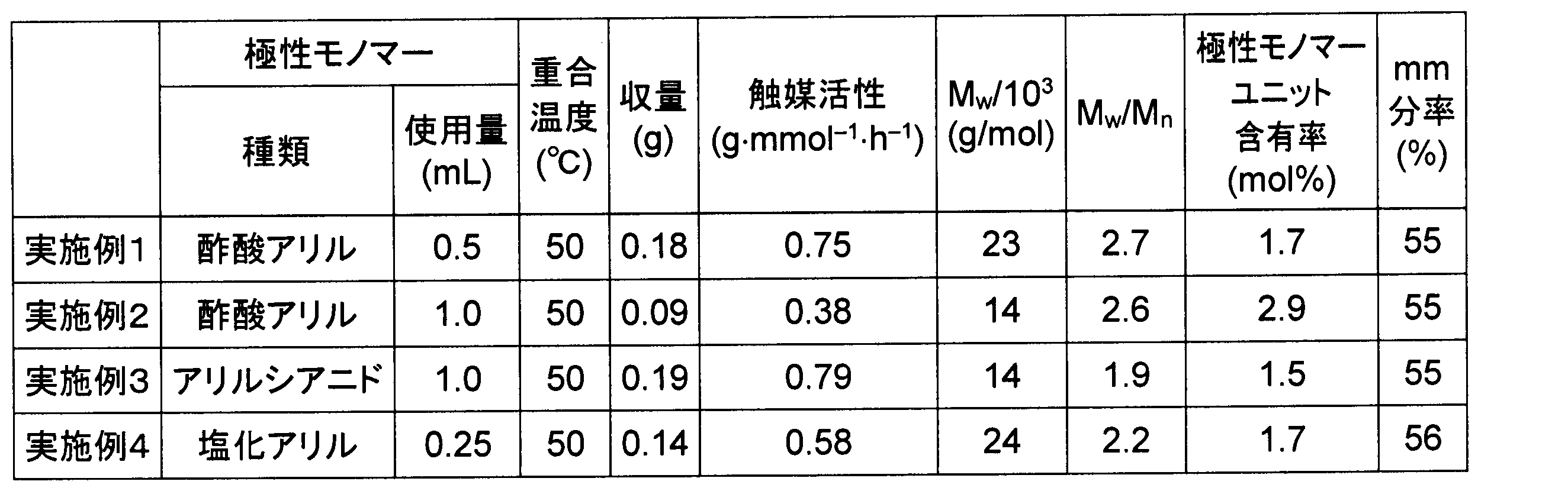
- Examples 1 to 4 Using the metal complex synthesized by the above method, propylene and polar monomers (allyl acetate, allyl cyanide, allyl chloride) were copolymerized. In an argon atmosphere, toluene (10 mL) and a predetermined amount of polar monomer were added to a 50 mL autoclave containing metal complex catalyst 1A (0.02 mmol). After charging 6.0 g of propylene, the autoclave was stirred at 50 ° C. for 12 hours.
- propylene and polar monomers allyl acetate, allyl cyanide, allyl chloride
- Table 2 shows the measurement results of the aluminum content in the copolymers obtained in Examples 1 to 4 and Comparative Example 1.
Landscapes
- Chemical & Material Sciences (AREA)
- Health & Medical Sciences (AREA)
- Chemical Kinetics & Catalysis (AREA)
- Medicinal Chemistry (AREA)
- Polymers & Plastics (AREA)
- Organic Chemistry (AREA)
- Engineering & Computer Science (AREA)
- Materials Engineering (AREA)
- Addition Polymer Or Copolymer, Post-Treatments, Or Chemical Modifications (AREA)
- Polymerization Catalysts (AREA)
Abstract
本発明は、プロピレン由来の構造単位と、下記一般式(1)、(2)または(3)で示される極性基含有モノマーの少なくとも1種に由来する構造単位とを含む極性基含有プロピレン系オレフィン共重合体であって、直鎖状のランダム共重合体であり、アルミニウム(Al)含量が共重合体1g当たり0~100μgである極性基含有プロピレン系オレフィン共重合体に関する。(式中の記号は明細書中に記載の通り。)
Description
本発明は、極性基含有プロピレン系オレフィン共重合体及びその製造方法に関する。
オレフィン系樹脂は、機械強度と成形性に優れ、かつ耐薬品性や耐腐食性などに優れるために、産業資材として重用され、例えば、射出成形、押出成形、吹込成形などにより、フィルム、積層体、容器、ブロー瓶などに成形され、広範囲な産業用途に資する材料である。オレフィン系樹脂は非極性であることから、極性基の付与による樹脂改質は、印刷特性や、他の合成樹脂、金属、木材などの異種材料への接着性改善など、オレフィン系樹脂の産業資材としての有用性を高めることが期待される。
これまでにエチレン系では、高圧ラジカル重合プロセスを利用した、極性基を有するビニルモノマー(極性基を有するオレフィン)との共重合体が広く知られている。この場合、重合プロセスが高圧ラジカル法であるため、得られた極性基含有オレフィン共重合体は多くの長鎖分岐及び短鎖分岐を不規則に持つ分子構造となる。このために、低弾性率かつ機械物性の低い極性基含有オレフィン共重合体しか得られず、高強度が要求される用途への応用範囲は限定的であった(特許文献1及び特許文献2参照。)。
1990年代以降、中~低圧条件での、後周期遷移金属錯体触媒を用いた極性基を有するオレフィン共重合が精力的に研究されており、例えば、ブルックハルト(Brookhart)らによる(α-ジイミン)パラジウム錯体や、グラッブス(Grubbs)らによる(サリチルアミジナート)ニッケル触媒、さらに、いわゆるSHOP系触媒と呼ばれる(フォスファニルフェノラート)ニッケル触媒が知られている。これらの触媒では、連鎖移動を抑制するために重合温度は低めに設定されており、コポリマーの生産性は低く、分子量も低かった(非特許文献1参照)。
2002年、ピュー(Pugh)らは、特定構造のホスフィンスルホナート配位子をパラジウム化合物と組み合わせて触媒成分として用いると、高温(80℃)でも共重合可能なことを報告した(特許文献3及び非特許文献2参照。)。このホスフィンスルホナート配位子はキレート性または潜在的キレート性であると予想され、野崎らは、触媒活性成分として(ホスフィンスルホナート)パラジウム錯体を単離し、その共重合触媒としての有用性を報告している(特許文献4及び非特許文献3参照。)。これらの方法によれば、高圧ラジカル法プロセスで得られる分岐状構造のオレフィン共重合体とは異なり、実質的に直鎖構造を持つオレフィン共重合体を製造可能なことが報告されている。
一方、これらのエチレン系での技術発展に対して、αオレフィン、例えばプロピレン系での極性基の付与は、その報告例が限られる。例えば、ポリプロピレン末端への極性官能基修飾や、ポリプロピレン側鎖にグラフト重合させる例が報告されているが、これらの極性基の導入率は極めて低いという問題を有している(特許文献5~8参照。)。そこで、有機アルミニウムなどのルイス酸を予め極性基を有するオレフィンと反応させ、前周期遷移金属錯体を用いてプロピレンと極性基を有するオレフィンを共重合させる例が報告されている(特許文献9~11参照。)。
S.Mecking et.al., J.Am.Chem.Soc.,1998年,120巻,p888
E.Drent et.al., Chem.Commun.,2002年,p744
K.Nozaki et.al., Dalton TRANSACTIONS,2006年,p25
しかし、この手法では、添加した有機アルミニウム由来の金属残渣が生じる点が問題である。共重合体中の金属残渣は、外観不良、フィルム成膜性の低下、腐食や絶縁性の低下を引き起こす原因となり、共重合体の用途展開を狭めている。脱灰処理によってもアルミニウム金属残渣の完全除去は困難であることに加えて、有機アルミニウムや脱灰プロセスに伴うコスト上昇を避けることができない。
したがって、プロピレンと極性コモノマーとの共重合が可能であり、かつ、有機アルミニウムの添加を必要としない、後周期遷移金属錯体の開発が精力的に進められている。しかしながら、従来の後周期遷移金属錯体を用いたプロピレン重合では連鎖移動が頻発し、プロピレンホモ重合であってもオリゴマー程度の低分子量にとどまっていたことから、実用上十分な樹脂物性を有する極性基含有プロピレン系オレフィン共重合体は得られていなかった。
したがって、プロピレンと極性コモノマーとの共重合が可能であり、かつ、有機アルミニウムの添加を必要としない、後周期遷移金属錯体の開発が精力的に進められている。しかしながら、従来の後周期遷移金属錯体を用いたプロピレン重合では連鎖移動が頻発し、プロピレンホモ重合であってもオリゴマー程度の低分子量にとどまっていたことから、実用上十分な樹脂物性を有する極性基含有プロピレン系オレフィン共重合体は得られていなかった。
本発明の課題は、プロピレンと、極性基含有モノマーの少なくとも1種を含むオレフィン共重合体であって、極性基含有モノマーの構造単位量が高く、分子構造が直鎖状のランダム共重合体であり、前記共重合体中に含まれるアルミニウム(Al)含量が少ない極性基含有プロピレン系オレフィン共重合体を提供することである。
本発明者らは、上記の課題の解決を目指して種々探索した結果、特定構造部位に置換基を有する金属錯体を重合用触媒の成分として用いる製造方法により得られる、プロピレンと極性基含有モノマーの少なくとも1種を含む極性基含有プロピレン系オレフィン共重合体が、極性基含有モノマーの構造単位が多い直鎖状のランダム共重合体であり、共重合体中に含まれるアルミニウム(Al)含量が少ないことを確認して本発明を完成した。
すなわち、本発明は、以下の[1]~[5]の極性基含有プロピレン系オレフィン共重合体、及び[6]~[13]の極性基含有プロピレン系オレフィン共重合体の製造方法に関する。
[1] プロピレンに由来する構造単位99.999~80mol%と、下記一般式(1)、(2)または(3)
[1] プロピレンに由来する構造単位99.999~80mol%と、下記一般式(1)、(2)または(3)

[式(1)、(2)及び(3)中、FG1、FG2、FG3は、それぞれ独立して、ハロゲン原子、水酸基、炭素原子数1~20のアルコキシ基、炭素原子数1~20のアルキルチオ基、炭素原子数1~20の炭化水素基を有する置換アミノ基、シアノ基、カルボキシル基、炭素原子数1~20の炭化水素基を有するエステル基、または炭素原子数1~20の炭化水素基を有するアシルオキシ基である。]で示される極性基含有モノマーの少なくとも1種に由来する構造単位20~0.001mol%とを含む極性基含有プロピレン系オレフィン共重合体であって、前記極性基含有プロピレン系オレフィン共重合体は直鎖状のランダム共重合体であり、アルミニウム(Al)含量が共重合体1g当たり0~100μgであることを特徴とする極性基含有プロピレン系オレフィン共重合体。
[2] 13C-NMR分析によって得られる前記プロピレンに由来する構造単位中のプロピレン単位3連子のmm分率が30.0~80.0%である前項1に記載の極性基含有プロピレン系オレフィン共重合体。
[3] ゲル浸透クロマトグラフィー(GPC)によって求められる重量平均分子量(Mw)が10,000~500,000である前項1または2に記載の極性基含有プロピレン系オレフィン共重合体。
[4] 前記FG1、FG2、FG3が、それぞれ独立して、ハロゲン原子、炭素原子数1~20の炭化水素基を有する置換アミノ基、シアノ基、炭素原子数1~20の炭化水素基を有するエステル基、または炭素原子数1~20の炭化水素基を有するアシルオキシ基である前項1~3のいずれか1項に記載の極性基含有プロピレン系オレフィン共重合体。
[5] 前記FG1、FG2、FG3が、それぞれ独立して、ハロゲン原子、シアノ基、または炭素原子数1~20の炭化水素基を有するエステル基である前項1~4のいずれか1項に記載の極性基含有プロピレン系オレフィン共重合体。
[6] プロピレンに由来する構造単位99.999~80mol%と、下記一般式(1)、(2)または(3)
[2] 13C-NMR分析によって得られる前記プロピレンに由来する構造単位中のプロピレン単位3連子のmm分率が30.0~80.0%である前項1に記載の極性基含有プロピレン系オレフィン共重合体。
[3] ゲル浸透クロマトグラフィー(GPC)によって求められる重量平均分子量(Mw)が10,000~500,000である前項1または2に記載の極性基含有プロピレン系オレフィン共重合体。
[4] 前記FG1、FG2、FG3が、それぞれ独立して、ハロゲン原子、炭素原子数1~20の炭化水素基を有する置換アミノ基、シアノ基、炭素原子数1~20の炭化水素基を有するエステル基、または炭素原子数1~20の炭化水素基を有するアシルオキシ基である前項1~3のいずれか1項に記載の極性基含有プロピレン系オレフィン共重合体。
[5] 前記FG1、FG2、FG3が、それぞれ独立して、ハロゲン原子、シアノ基、または炭素原子数1~20の炭化水素基を有するエステル基である前項1~4のいずれか1項に記載の極性基含有プロピレン系オレフィン共重合体。
[6] プロピレンに由来する構造単位99.999~80mol%と、下記一般式(1)、(2)または(3)

[式(1)、(2)及び(3)中、FG1、FG2、FG3は、それぞれ独立して、ハロゲン原子、水酸基、炭素原子数1~20のアルコキシ基、炭素原子数1~20のアルキルチオ基、炭素原子数1~20の炭化水素基を有する置換アミノ基、シアノ基、カルボキシル基、炭素原子数1~20の炭化水素基を有するエステル基、または炭素原子数1~20の炭化水素基を有するアシルオキシ基である。]で示される極性基含有モノマーの少なくとも1種に由来する構造単位20~0.001mol%とを直鎖状にランダム共重合して極性基含有プロピレン系オレフィン共重合体を製造する方法であって、
アルミニウム(Al)含量が前記共重合体1g当たり0~100μgであり、
下記一般式(C1)
アルミニウム(Al)含量が前記共重合体1g当たり0~100μgであり、
下記一般式(C1)

[式(C1)中、
Mは周期表第10族の金属原子を表し、
Xはリン原子(P)または砒素原子(As)を表し、
Y1は、少なくとも1つのシリル基で置換され、かつ水酸基、炭素原子数1~10のアルコキシ基、炭素原子数2~10のエステル基、及びハロゲン原子から選ばれる1つ以上の基で置換されていてもよい炭素原子数1~70の2価の炭化水素基を表し、
Qは、Y1[-S(=O)2-O-]M、Y1[-C(=O)-O-]M、Y1[-P(=O)(-OH)-O-]MまたはY1[-S-]Mの「[ ]」の中に示される2価の基を表し(ただし、両側のY1、Mは基の結合方向を示すために記載している。)、
R5は、水素原子、ハロゲン原子、炭素原子数1~30の炭化水素基、ハロゲン原子で置換された炭素原子数1~30の炭化水素基、炭素原子数1~10のアルコキシ基で置換された炭素原子数2~30の炭化水素基、炭素原子数6~20のアリールオキシ基で置換された炭素原子数7~30の炭化水素基、炭素原子数2~10のアミド基で置換された炭素原子数3~30の炭化水素基、炭素原子数1~30のアルコキシ基、炭素原子数6~30のアリールオキシ基、及び炭素原子数2~10のアシロキシ基からなる群より選ばれる置換基を表し、
R6及びR7はそれぞれ独立して、水素原子、アルコキシ基、アリールオキシ基、シリル基、アミノ基、またはハロゲン原子、アルコキシ基及びアリールオキシ基から選ばれる1つ以上の基で置換されていてもよい炭素原子数1~120の炭化水素基を表し、R6及びR7の少なくとも一方が、炭素原子数1~10のアルキル基または炭素原子数4~106のシクロアルキル基である。また、R6またはR7はY1と結合して環構造を形成してもよい。
Lは電子供与性配位子を表し、
qは0、1/2、1または2である。]
で示される金属錯体を重合触媒として使用することを特徴とする極性基含有プロピレン系オレフィン共重合体の製造方法。
[7] 一般式(C1)中、Qが-S(=O)2-O-である(ただし、SはY1に結合し、OはMに結合する。)、前項6に記載の極性基含有プロピレン系オレフィン共重合体の製造方法。
[8] 一般式(C1)で示される金属錯体が、一般式(C2)
Mは周期表第10族の金属原子を表し、
Xはリン原子(P)または砒素原子(As)を表し、
Y1は、少なくとも1つのシリル基で置換され、かつ水酸基、炭素原子数1~10のアルコキシ基、炭素原子数2~10のエステル基、及びハロゲン原子から選ばれる1つ以上の基で置換されていてもよい炭素原子数1~70の2価の炭化水素基を表し、
Qは、Y1[-S(=O)2-O-]M、Y1[-C(=O)-O-]M、Y1[-P(=O)(-OH)-O-]MまたはY1[-S-]Mの「[ ]」の中に示される2価の基を表し(ただし、両側のY1、Mは基の結合方向を示すために記載している。)、
R5は、水素原子、ハロゲン原子、炭素原子数1~30の炭化水素基、ハロゲン原子で置換された炭素原子数1~30の炭化水素基、炭素原子数1~10のアルコキシ基で置換された炭素原子数2~30の炭化水素基、炭素原子数6~20のアリールオキシ基で置換された炭素原子数7~30の炭化水素基、炭素原子数2~10のアミド基で置換された炭素原子数3~30の炭化水素基、炭素原子数1~30のアルコキシ基、炭素原子数6~30のアリールオキシ基、及び炭素原子数2~10のアシロキシ基からなる群より選ばれる置換基を表し、
R6及びR7はそれぞれ独立して、水素原子、アルコキシ基、アリールオキシ基、シリル基、アミノ基、またはハロゲン原子、アルコキシ基及びアリールオキシ基から選ばれる1つ以上の基で置換されていてもよい炭素原子数1~120の炭化水素基を表し、R6及びR7の少なくとも一方が、炭素原子数1~10のアルキル基または炭素原子数4~106のシクロアルキル基である。また、R6またはR7はY1と結合して環構造を形成してもよい。
Lは電子供与性配位子を表し、
qは0、1/2、1または2である。]
で示される金属錯体を重合触媒として使用することを特徴とする極性基含有プロピレン系オレフィン共重合体の製造方法。
[7] 一般式(C1)中、Qが-S(=O)2-O-である(ただし、SはY1に結合し、OはMに結合する。)、前項6に記載の極性基含有プロピレン系オレフィン共重合体の製造方法。
[8] 一般式(C1)で示される金属錯体が、一般式(C2)

[式(C2)中、R12~R15は水素原子、ハロゲン原子、炭素原子数1~20の炭化水素基、炭素原子数1~8のアルコキシ基、炭素原子数6~20のアリールオキシ基、シリル基またはハロゲン原子で置換された炭素原子数1~20の炭化水素基を表す。ただし、R12~R15の少なくとも1つはシリル基である。M、X、R5、R6、R7、L及びqは一般式(C1)の記載と同じ意味を表す。]
で示される金属錯体である、前項7に記載の極性基含有プロピレン系オレフィン共重合体の製造方法。
[9] 一般式(C2)で示される金属錯体が、R12がシリル基である一般式(C3)
で示される金属錯体である、前項7に記載の極性基含有プロピレン系オレフィン共重合体の製造方法。
[9] 一般式(C2)で示される金属錯体が、R12がシリル基である一般式(C3)

[式(C3)中、3つのR16はそれぞれ独立して、水素原子または炭素原子数1~8の炭化水素基を表し、それぞれ同じであっても異なっていてもよい。M、X、R5、R6、R7、R13、R14、R15、L及びqは一般式(C2)の記載と同じ意味を表す。]
で示される金属錯体である、前項8に記載の極性基含有プロピレン系オレフィン共重合体の製造方法。
[10] 一般式(C3)中、R16がすべてメチル基である前項9に記載の極性基含有プロピレン系オレフィン共重合体の製造方法。
[11] 一般式(C3)のR13が水素原子または炭素原子数1~6の炭化水素基である前項9または10に記載の極性基含有プロピレン系オレフィン共重合体の製造方法。
[12] 一般式(C3)のR13が水素原子、イソプロピル基またはフェニル基である前項9~11のいずれか1項に記載の極性基含有プロピレン系オレフィン共重合体の製造方法。
[13] 一般式(C3)のR14、R15が共に水素原子である前項9~12のいずれか1項に記載の極性基含有プロピレン系オレフィン共重合体の製造方法。
で示される金属錯体である、前項8に記載の極性基含有プロピレン系オレフィン共重合体の製造方法。
[10] 一般式(C3)中、R16がすべてメチル基である前項9に記載の極性基含有プロピレン系オレフィン共重合体の製造方法。
[11] 一般式(C3)のR13が水素原子または炭素原子数1~6の炭化水素基である前項9または10に記載の極性基含有プロピレン系オレフィン共重合体の製造方法。
[12] 一般式(C3)のR13が水素原子、イソプロピル基またはフェニル基である前項9~11のいずれか1項に記載の極性基含有プロピレン系オレフィン共重合体の製造方法。
[13] 一般式(C3)のR14、R15が共に水素原子である前項9~12のいずれか1項に記載の極性基含有プロピレン系オレフィン共重合体の製造方法。
本発明の極性基含有プロピレン系オレフィン共重合体は、極性基含有モノマーの構造単位が多い直鎖状のランダム共重合体である。このような特性により、本発明の重合体を用いた場合には、機械物性が高いなどの実用上十分な樹脂物性が期待できる。また、本発明の極性基含有プロピレン系オレフィン共重合体は共重合体1g当たりのアルミニウム(Al)含量が0~100μg、好ましくは0~10μg、さらに好ましくは0~5μg、0~2μgであり、含量が100μgを超える場合に見られる外観不良、フィルム成膜性の低下、腐食、絶縁性の低下などの問題が解消される。
[触媒]
本発明で使用する周期表第10族金属錯体からなる触媒(の構造)は、一般式(C1)で示される。
本発明で使用する周期表第10族金属錯体からなる触媒(の構造)は、一般式(C1)で示される。

式中、Mは周期律表第10族の金属原子を表し、Xはリン原子(P)または砒素原子(As)を表し、Y1は、少なくとも1つのシリル基で置換され、かつ水酸基、炭素原子数1~10のアルコキシ基、炭素原子数2~10のエステル基及びハロゲン原子から選ばれる1つ以上の基で置換されていてもよい炭素原子数1~70の2価の炭化水素基を表し、Qは、Y1[-S(=O)2-O-]M、Y1[-C(=O)-O-]M、Y1[-P(=O)(-OH)-O-]MまたはY1[-S-]Mの「[ ]」の中に示される2価の基を表す(ただし、両側のY1、Mは基の結合方向を示すために記載している。)。
R5は、水素原子、ハロゲン原子、炭素原子数1~30の炭化水素基、ハロゲン原子で置換された炭素原子数1~30の炭化水素基、炭素原子数1~10のアルコキシ基で置換された炭素原子数2~30の炭化水素基、炭素原子数6~20のアリールオキシ基で置換された炭素原子数7~30の炭化水素基、炭素原子数2~10のアミド基で置換された炭素原子数3~30の炭化水素基、炭素原子数1~30のアルコキシ基、炭素原子数6~30のアリールオキシ基、及び炭素原子数2~10のアシロキシ基からなる群より選ばれる置換基を表す。
R6及びR7はそれぞれ独立して、水素原子、アルコキシ基、アリールオキシ基、シリル基、アミノ基、またはハロゲン原子、アルコキシ基及びアリールオキシ基から選ばれる1つ以上の基で置換されていてもよい炭素原子数1~120の炭化水素基を表し、R6及びR7のうち少なくとも一方が、炭素原子数1~10のアルキル基または炭素原子数4~106のシクロアルキル基である。また、R6またはR7はY1と結合して環構造を形成してもよい。
Lは電子供与性配位子を表し、qは0、1/2、1または2である。
なお、本明細書では、「炭化水素」は飽和、不飽和の脂肪族炭化水素、及び芳香族炭化水素を含む。また、鎖状構造及び環状構造を含む。
Lは電子供与性配位子を表し、qは0、1/2、1または2である。
なお、本明細書では、「炭化水素」は飽和、不飽和の脂肪族炭化水素、及び芳香族炭化水素を含む。また、鎖状構造及び環状構造を含む。
以下、一般式(C1)の構造について説明する。
Mは周期律表第10族の金属原子を表す。周期律表第10族の金属原子としては、Ni、Pd、Ptが挙げられるが、触媒活性や得られる重合体の分子量の観点からNi及びPdが好ましく、Pdがより好ましい。
Xはリン原子(P)または砒素原子(As)であり、中心金属Mに2電子配位している。Xとしては、入手が容易であることと触媒コストの面からPが好ましい。
Mは周期律表第10族の金属原子を表す。周期律表第10族の金属原子としては、Ni、Pd、Ptが挙げられるが、触媒活性や得られる重合体の分子量の観点からNi及びPdが好ましく、Pdがより好ましい。
Xはリン原子(P)または砒素原子(As)であり、中心金属Mに2電子配位している。Xとしては、入手が容易であることと触媒コストの面からPが好ましい。
R5は、水素原子、ハロゲン原子、炭素原子数1~30の炭化水素基、ハロゲン原子で置換された炭素原子数1~30の炭化水素基、炭素原子数1~10のアルコキシ基で置換された炭素原子数2~30の炭化水素基、炭素原子数6~20のアリールオキシ基で置換された炭素原子数7~30の炭化水素基、炭素原子数2~10のアミド基で置換された炭素原子数3~30の炭化水素基、炭素原子数1~30のアルコキシ基、炭素原子数6~30のアリールオキシ基、または炭素原子数2~10のアシロキシ基からなる群より選ばれた置換基を表す。
R5が表すハロゲン原子の好ましい具体例は、フッ素原子、塩素原子、臭素原子である。これらの中で、さらに好ましい置換基は、塩素原子である。
R5が表す炭素原子数1~30の炭化水素基は、好ましくは炭素原子数1~20の炭化水素基、より好ましくは炭素原子数1~13の炭化水素基であり、アルキル基、シクロアルキル基、またはアリール基である。
好ましい具体例は、メチル基、エチル基、1-プロピル基、1-ブチル基、1-ペンチル基、1-ヘキシル基、1-ヘプチル基、1-オクチル基、1-ノニル基、1-デシル基、t-ブチル基、トリシクロヘキシルメチル基、1,1-ジメチル-2-フェニルエチル基、イソプロピル基、1-ジメチルプロピル基、1,1,2-トリメチルプロピル基、1,1-ジエチルプロピル基、1-フェニル-2-プロピル基、イソブチル基、1,1-ジメチルブチル基、2-ペンチル基、3-ペンチル基、2-ヘキシル基、3-ヘキシル基、2-エチルヘキシル基、2-ヘプチル基、3-ヘプチル基、4-ヘプチル基、2-プロピルヘプチル基、2-オクチル基、3-ノニル基、シクロプロピル基、シクロブチル基、シクロペンチル基、メチルシクロペンチル基、シクロヘキシル基、メチルシクロヘキシル基、シクロヘプチル基、シクロオクチル基、シクロドデシル基、1-アダマンチル基、2-アダマンチル基、エキソ-ノルボルニル基、エンド-ノルボニル基、2-ビシクロ[2.2.2]オクチル基、ノピニル基、デカヒドロナフチル基、メンチル基、ネオメンチル基、ネオペンチル基、5-デシル基、フェニル基、ナフチル基、アントラセニル基、フルオレニル基、トリル基、キシリル基、ベンジル基、及びp-エチルフェニル基などが挙げられる。
これらの中で、さらに好ましい置換基としては、メチル基、ベンジル基であり、特に好ましくはメチル基である。
好ましい具体例は、メチル基、エチル基、1-プロピル基、1-ブチル基、1-ペンチル基、1-ヘキシル基、1-ヘプチル基、1-オクチル基、1-ノニル基、1-デシル基、t-ブチル基、トリシクロヘキシルメチル基、1,1-ジメチル-2-フェニルエチル基、イソプロピル基、1-ジメチルプロピル基、1,1,2-トリメチルプロピル基、1,1-ジエチルプロピル基、1-フェニル-2-プロピル基、イソブチル基、1,1-ジメチルブチル基、2-ペンチル基、3-ペンチル基、2-ヘキシル基、3-ヘキシル基、2-エチルヘキシル基、2-ヘプチル基、3-ヘプチル基、4-ヘプチル基、2-プロピルヘプチル基、2-オクチル基、3-ノニル基、シクロプロピル基、シクロブチル基、シクロペンチル基、メチルシクロペンチル基、シクロヘキシル基、メチルシクロヘキシル基、シクロヘプチル基、シクロオクチル基、シクロドデシル基、1-アダマンチル基、2-アダマンチル基、エキソ-ノルボルニル基、エンド-ノルボニル基、2-ビシクロ[2.2.2]オクチル基、ノピニル基、デカヒドロナフチル基、メンチル基、ネオメンチル基、ネオペンチル基、5-デシル基、フェニル基、ナフチル基、アントラセニル基、フルオレニル基、トリル基、キシリル基、ベンジル基、及びp-エチルフェニル基などが挙げられる。
これらの中で、さらに好ましい置換基としては、メチル基、ベンジル基であり、特に好ましくはメチル基である。
R5が表すハロゲン原子で置換された炭素原子数1~30の炭化水素基は、好ましくは前述の炭素原子数1~30の炭化水素基をフッ素原子、塩素原子、または臭素原子で置換した置換基であり、具体的に好ましい例として、トリフルオロメチル基、またはペンタフルオロフェニル基が挙げられる。
R5が表す炭素原子数1~10のアルコキシ基で置換された炭素原子数2~30の炭化水素基は、好ましくは前述の炭素原子数1~30の炭化水素基をメトキシ基、エトキシ基、イソプロポキシ基、1-プロポキシ基、1-ブトキシ基、またはt-ブトキシ基で置換した置換基である。さらに好ましくはメトキシ基またはエトキシ基で置換された炭素原子数2~6の炭化水素基であり、具体的には、1-(メトキシメチル)エチル基、1-(エトキシメチル)エチル基、1-(フェノキシメチル)エチル基、1-(メトキシエチル)エチル基、1-(エトキシエチル)エチル基、ジ(メトキシメチル)メチル基、ジ(エトキシメチル)メチル基、ジ(フェノキシメチル)メチル基が挙げられる。特に好ましくは、1-(メトキシメチル)エチル基、1-(エトキシメチル)エチル基である。
R5が表す炭素原子数6~20のアリールオキシ基で置換された炭素原子数7~30の炭化水素基は、好ましくは、前述の炭素原子数1~30の炭化水素基をフェノキシ基、4-メチルフェノキシ基、4-メトキシフェノキシ基、2,6-ジメチルフェノキシ基、2,6-ジ-t-ブチルフェノキシ基で置換した置換基である。さらに好ましくはフェノキシ基または2,6-ジメチルフェノキシ基で置換された炭素原子数1~6の炭化水素基であり、特に好ましくは、1-(フェノキシメチル)エチル基、または1-(2,6-ジメチルフェノキシ基メチル)エチル基である。
R5が表す炭素原子数2~10のアミド基で置換された炭素原子数3~30の炭化水素基は、好ましくは、前述の炭素原子数1~30の炭化水素基をアセトアミド基、プロピオニルアミノ基、ブチリルアミノ基、イソブチリルアミノ基、ヴァレリルアミノ基、イソヴァレリルアミノ基、ピバロイルアミノ基、ベンゾイルアミノ基で置換した置換基である。さらに好ましくは2-アセトアミドフェニル基、2-プロピオニルアミノフェニル基、2-ヴァレリルアミノフェニル基、2-ベンゾイルフェニル基であり、特に好ましくは、2-アセトアミドフェニル基である。
R5が表す炭素原子数1~30のアルコキシ基は、好ましくは炭素原子数1~20のアルコキシ基、より好ましくは炭素原子数1~6のアルコキシ基であり、好ましい具体例は、メトキシ基、エトキシ基、イソプロポキシ基、1-プロポキシ基、1-ブトキシ基、及びt-ブトキシ基などである。これらの中で、さらに好ましい置換基としては、メトキシ基、エトキシ基、またはイソプロポキシ基であり、特に好ましくは、メトキシ基である。
R5が表す炭素原子数6~30のアリールオキシ基は、好ましくは炭素原子数6~12のアリールオキシ基であり、好ましい具体例は、フェノキシ基、4-メチルフェノキシ基、4-メトキシフェノキシ基、2,6-ジメチルフェノキシ基、及び2,6-ジ-t-ブチルフェノキシ基が挙げられる。これらの中で、さらに好ましい置換基としては、フェノキシ基、または2,6-ジメチルフェノキシ基であり、特に好ましくは、フェノキシ基である。
R5が表す炭素原子数2~10のアシロキシ基は、好ましくは炭素原子数2~8のアシルオキシ基であり、好ましい具体例は、アセチルオキシ基、プロピオニルオキシ基、ブチリルオキシ基、イソブチリルオキシ基、ヴァレリルオキシ基、イソヴァレリルオキシ基、ピバロイルオキシ基、ベンゾイルオキシ基が挙げられる。
これらの中で、さらに好ましい置換基としては、アセチルオキシ基、プロピオニルオキシ基、ベンゾイルオキシ基であり、特に好ましくは、アセチルオキシ基、プロピオニルオキシ基である。
これらの中で、さらに好ましい置換基としては、アセチルオキシ基、プロピオニルオキシ基、ベンゾイルオキシ基であり、特に好ましくは、アセチルオキシ基、プロピオニルオキシ基である。
これらのR5として好ましい群のうち、さらに好ましくは、炭素原子数1~20の炭化水素基、アルコキシ基で置換された炭素原子数2~30の炭化水素基、炭素原子数1~20のアルコキシ基であり、特に好ましい具体例は、メチル基、ベンジル基、メトキシ基、2-アセトアミドフェニル基、アセチルオキシ基が挙げられる。
R6及びR7はそれぞれ独立して、水素原子、アルコキシ基、アリールオキシ基、シリル基、アミノ基、またはハロゲン原子、アルコキシ基及びアリールオキシ基から選ばれる1つ以上の基で置換されていてもよい炭素原子数1~120の炭化水素基を表す。ただし、R6及びR7の少なくとも一方は、炭素原子数1~10のアルキル基または炭素原子数4~106のシクロアルキル基である。また、R6またはR7は、Y1と結合して環構造を形成してもよい。
R6及びR7が表すアルコキシ基としては、炭素原子数1~20のものが好ましく、メトキシ基、エトキシ基、プロポキシ基、イソプロポキシ基などが挙げられる。R6及びR7が表すアリールオキシ基としては炭素原子数6~24のものが好ましく、フェノキシ基などが挙げられる。R6及びR7が表すシリル基としてはトリメチルシリル基などが挙げられる。R6及びR7が表すアミノ基としてはアミノ基、メチルアミノ基、ジメチルアミノ基などが挙げられる。R6及びR7が表すハロゲン原子、アルコキシ基及びアリールオキシ基から選ばれる1つ以上の基で置換されていてもよい炭素原子数1~120の炭化水素基の具体例としては、メチル基、エチル基、n-プロピル基、イソプロピル基、n-ブチル基、イソブチル基、sec-ブチル基、t-ブチル基、n-ペンチル基、2-ペンチル基、3-ペンチル基、ネオペンチル基、n-ヘキシル基、2-ヘキシル基、3-ヘキシル基、2-ヘプチル基、3-ヘプチル基、4-ヘプチル基、2-メチル-4-ヘプチル基、2,6-ジメチル-4-ヘプチル基、3-メチル-4-ヘプチル基、シクロプロピル基、シクロブチル基、シクロペンチル基、シクロヘキシル基、シクロヘプチル基、シクロオクチル基、1-アダマンチル基、トリフルオロメチル基、ベンジル基、2’-メトキシベンジル基、3’-メトキシベンジル基、4’-メトキシベンジル基、4’-トリフルオロメチルベンジル基、フェニル基、2-メチルフェニル基、3-メチルフェニル基、4-メチルフェニル基、2,6-ジメチルフェニル基、3,5-ジメチルフェニル基、2,4,6-トリメチルフェニル基、2-イソプロピルフェニル基、3-イソプロピルフェニル基、4-イソプロピルフェニル基、2,6-ジイソプロピルフェニル基、3,5-ジイソプロピルフェニル基、2,4,6-トリイソプロピルフェニル基、2-t-ブチルフェニル基、2-シクロヘキシルフェニル基、2-メトキシフェニル基、3-メトキシフェニル基、4-メトキシフェニル基、2,6-ジメトキシフェニル基、3,5-ジメトキシフェニル基、2,4,6-トリメトキシフェニル基、4-フルオロフェニル基、ペンタフルオロフェニル基、4-トリフルオロメチルフェニル基、3,5-ビス(トリフルオロメチル)フェニル基、1-ナフチル基、2-ナフチル基、2-フリル基、2-ビフェニル基、2’,6’-ジメトキシ-2-ビフェニル基、2’-メチル-2-ビフェニル基、2’,4’,6’-トリイソプロピル-2-ビフェニル基などが挙げられる。
また、R6とR7は同じでも、異なっていてもよい。また、R6とR7は結合して環構造を形成してもよい。R6及び/またはR7はY1と結合して環構造を形成してもよい。
なお、R6及びR7の少なくとも一方は、炭素原子数1~10のアルキル基または炭素原子数4~106のシクロアルキル基を表す。炭素原子数1~10のアルキル基としては、メチル基、エチル基、n-プロピル基、イソプロピル基、n-ブチル基、イソブチル基、sec-ブチル基、t-ブチル基が好ましい。炭素原子数4~106のシクロアルキル基としては、シクロブチル基、シクロペンチル基、シクロヘキシル基、シクロヘプチル基、シクロオクチル基、等が挙げられるが、以下の一般式(5)で示されるシクロアルキル基が特に好ましい。

式中、Rは置換基を有してもよい炭素原子数1~14のアルキレン基を表し、R9、R10及びR11は、それぞれ独立して、水素原子、アルコキシ基、アリールオキシ基、シリル基、アミノ基、またはハロゲン原子、アルコキシ基及びアリールオキシ基から選ばれる1つ以上の基で置換されていてもよい炭素原子数1~30の炭化水素基を表し、R9及びR10の少なくとも一方は、水素原子ではなく、R9、R10、R11及び前記アルキレン基Rは、それぞれで結合して、環構造を形成してもよい。なお、式中では、炭素原子と一般式(C1)におけるXとの結合も表記している。
さらに、R6及びR7は、合成の容易さから双方とも前記一般式(5)で示されるシクロアルキル基であることが好ましい。
上記したように、一般式(5)において、R9及びR10の少なくとも一方は水素原子でない。この水素原子でない置換基R9またはR10が、重合反応中のβ-水素脱離によるポリマーの連鎖移動を抑制して、得られる重合体の分子量を向上させると考えられる。R9、R10及びR11が表すアルコキシ基、アリールオキシ基、シリル基、アミノ基、またはハロゲン原子、アルコキシ基及びアリールオキシ基から選ばれる1つ以上の基で置換されていてもよい炭素原子数1~30の炭化水素基の具体例として、前記のR6及びR7の具体例と同様のものが挙げられる。
前記アルキレン基Rとしては、炭素原子数が2~6であるものが好ましく、炭素原子数が4であるものがより好ましい。
前記アルキレン基Rとしては、炭素原子数が2~6であるものが好ましく、炭素原子数が4であるものがより好ましい。
R9及びR10の少なくとも一方は、炭素原子数1~6のアルキル基または炭素原子数3~8のシクロアルキル基であることが好ましい。さらにR9及びR10は少なくとも一方がイソプロピル基であることが好ましい。
以下、R6またはR7が一般式(5)で示される基を表す場合のX-R6またはX-R7部位の具体例を挙げる。なお、Meはメチル基を表し、XとM、XとY1との結合は省略している。
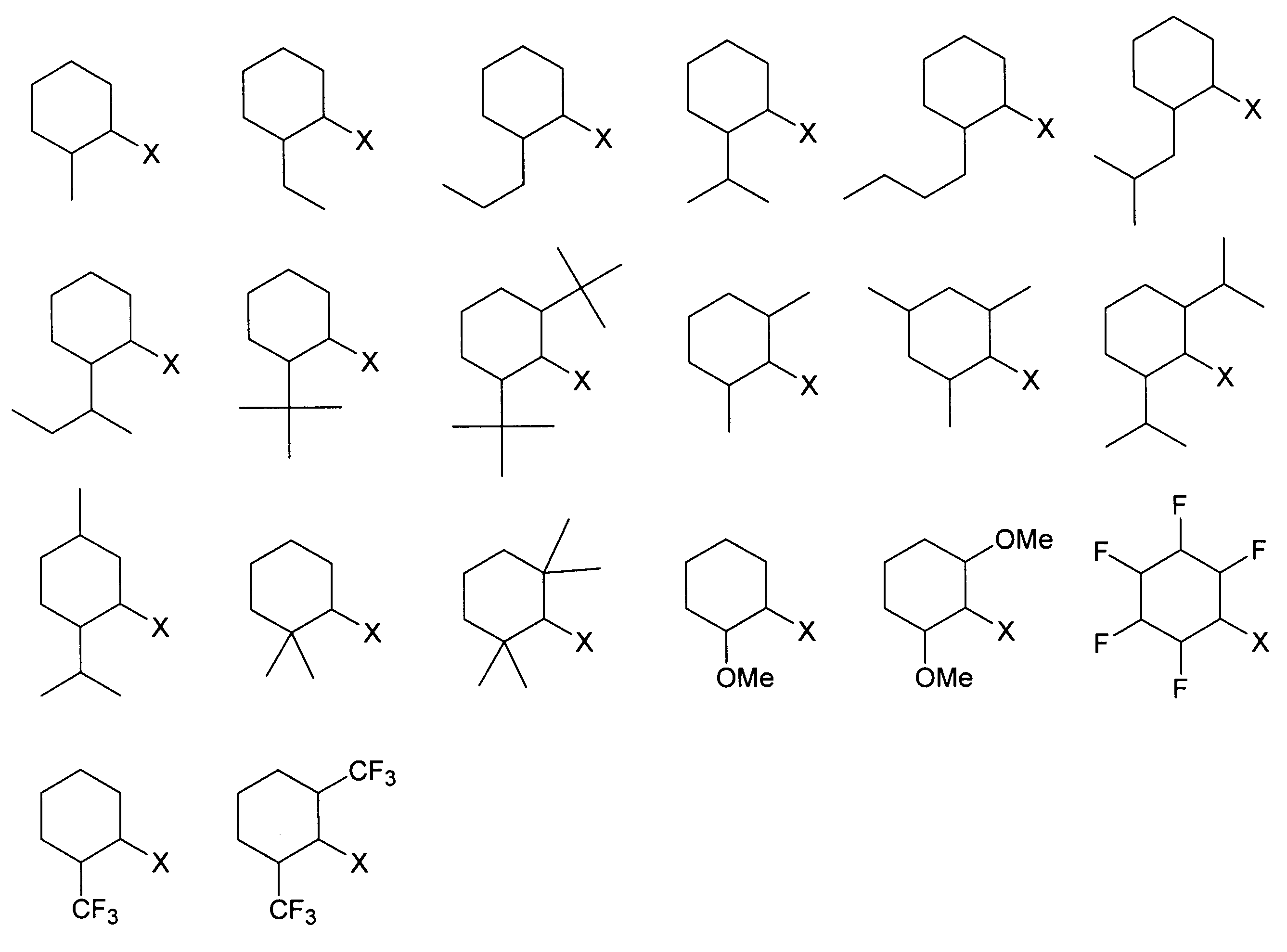

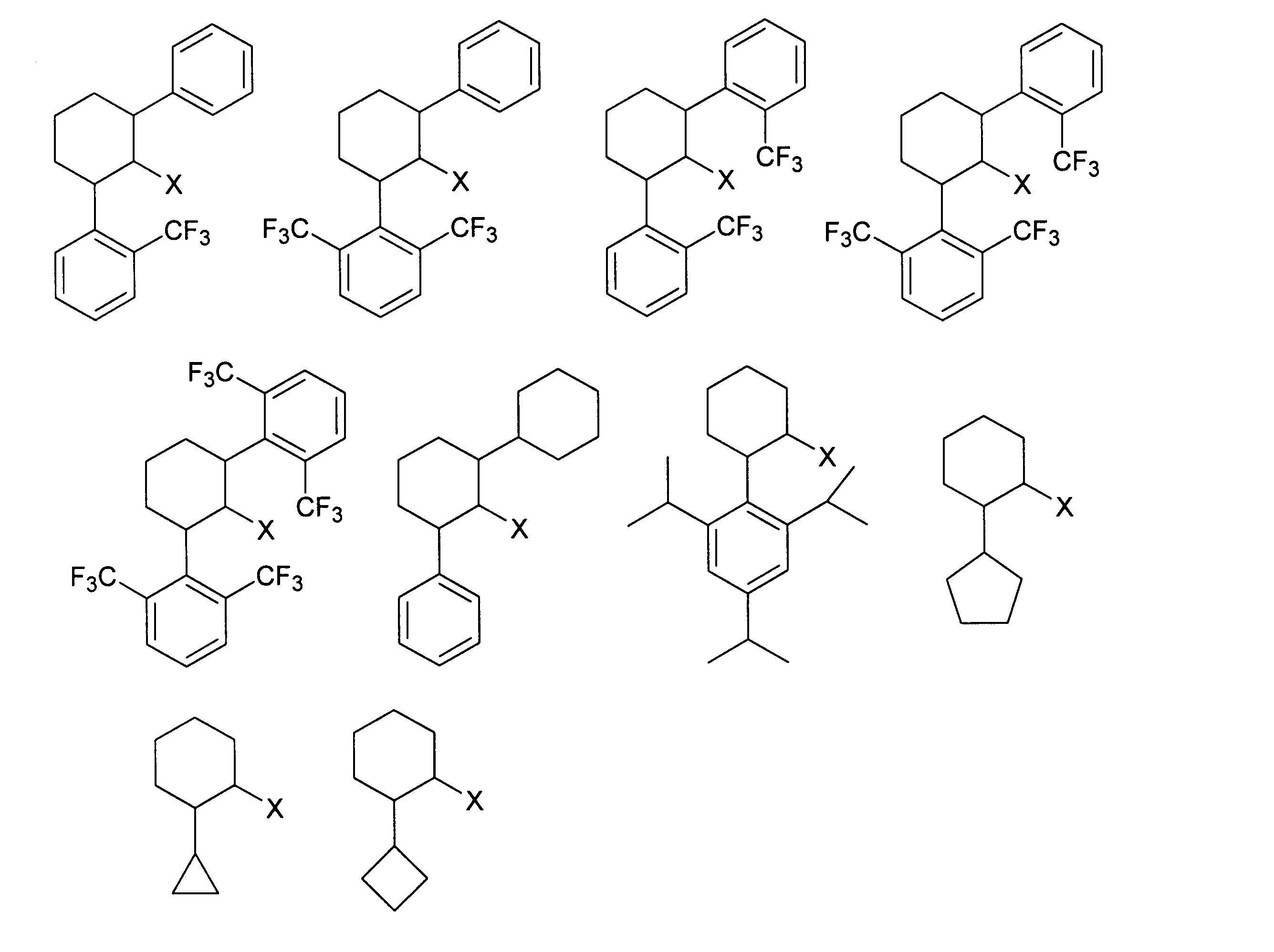

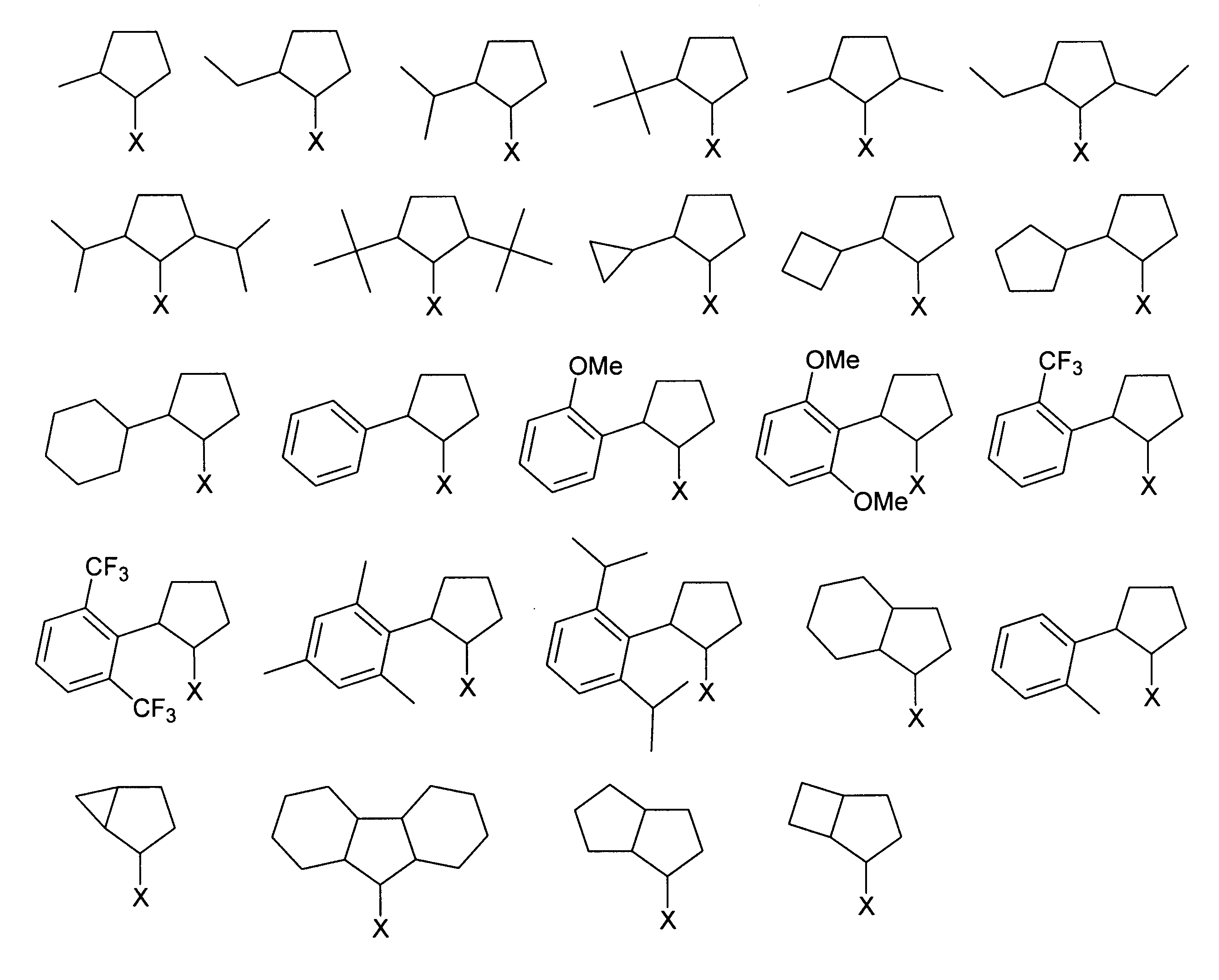


これらの中で、R6及びR7は下記式で示される2-イソプロピル-5-メチルシクロヘキシル基(メンチル基)であることが好ましい。さらにR6及びR7は双方ともメンチル基であることがより好ましい。

一般式(C1)において、Qは-S(=O)2-O-、-C(=O)-O-、-P(=O)(-OH)-O-、または-S-で示される2価の基を表し、Mに1電子配位する部位である。前記各式の左側がY1に結合し、右側がMに結合している。これらの中でも触媒活性の面から-S(=O)2-O-が特に好ましい。
Y1-Q部位では、電気陰性度の大きい酸素原子または硫黄原子が金属原子Mに1電子配位している。Y1-Q-M間の結合電子は、形式上、Y1-Qをアニオン状態、Mをカチオン状態で表記することも可能である。
一般式(C1)中、
Y1は少なくとも1つのシリル基で置換され、かつ水酸基、炭素原子数1~10のアルコキシ基、炭素原子数2~10のエステル基、及びハロゲン原子から選ばれる1つ以上の基で置換されていてもよい炭素原子数1~70の2価の炭化水素基を表す。
Y1上の置換基であるシリル基としては、トリメチルシリル基、トリエチルシリル基、トリプロピルシリル基、トリブチルシリル基、トリイソプロピルシリル基、t-ブチルジメチルシリル基、t-ブチルジフェニルシリル基などが挙げられ、特にトリメチルシリル基、トリエチルシリル基が好ましい。
Y1上の置換基である炭素原子数1~10のアルコキシ基としては、好ましくは炭素数1~6のアルコキシ基である。好ましい具体例は、メトキシ基、エトキシ基、イソプロポキシ基、フェノキシ基などが挙げられ、特にメトキシ基、フェノキシ基が好ましい。
Y1上の置換基である炭素原子数2~10のエステル基としては、好ましくは炭素数2~8のエステル基であり、好ましい具体例は、メトキシカルボニル基、エトキシカルボニル基、n-プロポキシカルボニル基、イソプロポキシカルボニル基、n-ブトキシカルボニル基、t-ブトキシカルボニル基、(4-ヒドロキシブトキシ)カルボニル基、(4-グリシジルブトキシ)カルボニル基、フェノキシカルボニル基、スクシン酸無水物基、スクシン酸イミド基が挙げられる。好ましくは、メトキシカルボニル基、エトキシカルボニル基、(4-ヒドロキシブトキシ)カルボニル基、スクシン酸無水物基が挙げられ、特に好ましくは、メトキシカルボニル基、スクシン酸無水物基である。
Y1上の置換基であるハロゲン原子としては、フッ素、塩素、臭素等が挙げられ、特に、フッ素、塩素が好ましい。
炭素原子数1~70の炭化水素基としては、好ましくは、炭素原子数1~12の炭化水素基であり、好ましくはアルキレン基、アリーレン基等が挙げられ、特にアリーレン基が好ましい。
Y1は少なくとも1つのシリル基で置換され、かつ水酸基、炭素原子数1~10のアルコキシ基、炭素原子数2~10のエステル基、及びハロゲン原子から選ばれる1つ以上の基で置換されていてもよい炭素原子数1~70の2価の炭化水素基を表す。
Y1上の置換基であるシリル基としては、トリメチルシリル基、トリエチルシリル基、トリプロピルシリル基、トリブチルシリル基、トリイソプロピルシリル基、t-ブチルジメチルシリル基、t-ブチルジフェニルシリル基などが挙げられ、特にトリメチルシリル基、トリエチルシリル基が好ましい。
Y1上の置換基である炭素原子数1~10のアルコキシ基としては、好ましくは炭素数1~6のアルコキシ基である。好ましい具体例は、メトキシ基、エトキシ基、イソプロポキシ基、フェノキシ基などが挙げられ、特にメトキシ基、フェノキシ基が好ましい。
Y1上の置換基である炭素原子数2~10のエステル基としては、好ましくは炭素数2~8のエステル基であり、好ましい具体例は、メトキシカルボニル基、エトキシカルボニル基、n-プロポキシカルボニル基、イソプロポキシカルボニル基、n-ブトキシカルボニル基、t-ブトキシカルボニル基、(4-ヒドロキシブトキシ)カルボニル基、(4-グリシジルブトキシ)カルボニル基、フェノキシカルボニル基、スクシン酸無水物基、スクシン酸イミド基が挙げられる。好ましくは、メトキシカルボニル基、エトキシカルボニル基、(4-ヒドロキシブトキシ)カルボニル基、スクシン酸無水物基が挙げられ、特に好ましくは、メトキシカルボニル基、スクシン酸無水物基である。
Y1上の置換基であるハロゲン原子としては、フッ素、塩素、臭素等が挙げられ、特に、フッ素、塩素が好ましい。
炭素原子数1~70の炭化水素基としては、好ましくは、炭素原子数1~12の炭化水素基であり、好ましくはアルキレン基、アリーレン基等が挙げられ、特にアリーレン基が好ましい。
Y1はXとQ部位を結合する架橋部位である。XをP原子で示したY1の具体例を以下に示す。ここで、複数のR4は、同じでも異なっていてもよく、水素原子、ハロゲン原子、炭素原子数1~20の炭化水素基、炭素原子数1~8のアルコキシ基、炭素原子数6~20のアリールオキシ基、シリル基またはハロゲン原子で置換された炭素原子数1~20の炭化水素基を表す。ただし、Y1としての炭素原子数の上限は70であり、R4の少なくとも1つはシリル基である。

R4が表すハロゲン原子、アルコキシ基、アリールオキシ基及びシリル基の具体例はY1で説明したものと同様である。R4が表す炭素原子数1~20の炭化水素基及びハロゲン原子で置換された炭素原子数1~20の炭化水素基としては、メチル基、エチル基、n-プロピル基、イソプロピル基、n-ブチル基、イソブチル基、sec-ブチル基、t-ブチル基、n-ペンチル基、2-ペンチル基、3-ペンチル基、ネオペンチル基、n-ヘキシル基、2-ヘキシル基、3-ヘキシル基、シクロプロピル基、シクロブチル基、シクロペンチル基、シクロヘキシル基、シクロヘプチル基、シクロオクチル基、シクロドデシル基、1-アダマンチル基、2-アダマンチル基、エキソ-ノルボニル基、エンド-ノルボニル基、メンチル基、ネオメンチル基、トリフルオロメチル基、ベンジル基、4’-トリフルオロメチルベンジル基、フェニル基、2-メチルフェニル基、3-メチルフェニル基、4-メチルフェニル基、2,6-ジメチルフェニル基、3,5-ジメチルフェニル基、2,4,6-トリメチルフェニル基、2-イソプロピルフェニル基、3-イソプロピルフェニル基、4-イソプロピルフェニル基、2,6-ジイソプロピルフェニル基、3,5-ジイソプロピルフェニル基、2,4,6-トリイソプロピルフェニル基、2-t-ブチルフェニル基、2-シクロヘキシルフェニル基、4-フルオロフェニル基、ペンタフルオロフェニル基、4-トリフルオロメチルフェニル基、3,5-ビス(トリフルオロメチル)フェニル基、1-ナフチル基、2-ナフチル基、2-フリル基、2-ビフェニル基、2’-メチル-2-ビフェニル基、2’,4’,6’-トリイソプロピル-2-ビフェニル基、ビニル基、アリル基、ブテニル基、シクロヘキセニル基、シンナミル基、スチリル基、アントラセニル基、フルオレニル基などが挙げられる。
置換基R6またはR7は、Y1部位と結合して環構造を形成してもよい。具体的には以下に示す構造が挙げられる。なお、以下の例は、置換基R6とY1部位が結合して環構造を形成している場合を示している。

一般式(C1)で示される金属錯体の中でも、特に以下の一般式(C2)で示されるものが好ましい。

一般式(C2)中、R12~R15は水素原子、ハロゲン原子、炭素原子数1~20の炭化水素基、炭素原子数1~8のアルコキシ基、炭素原子数6~20のアリールオキシ基、シリル基またはハロゲン原子で置換された炭素原子数1~20の炭化水素基を表す。これらの具体例はR4で説明したものと同様である。ただし、R12~R15の少なくとも1つはシリル基である。M、X、R5、R6、R7、L及びqは一般式(C1)の記載と同じ意味を表す。
一般式(C2)においては、R12がシリル基である以下の一般式(C3)で示されるものが好ましい。
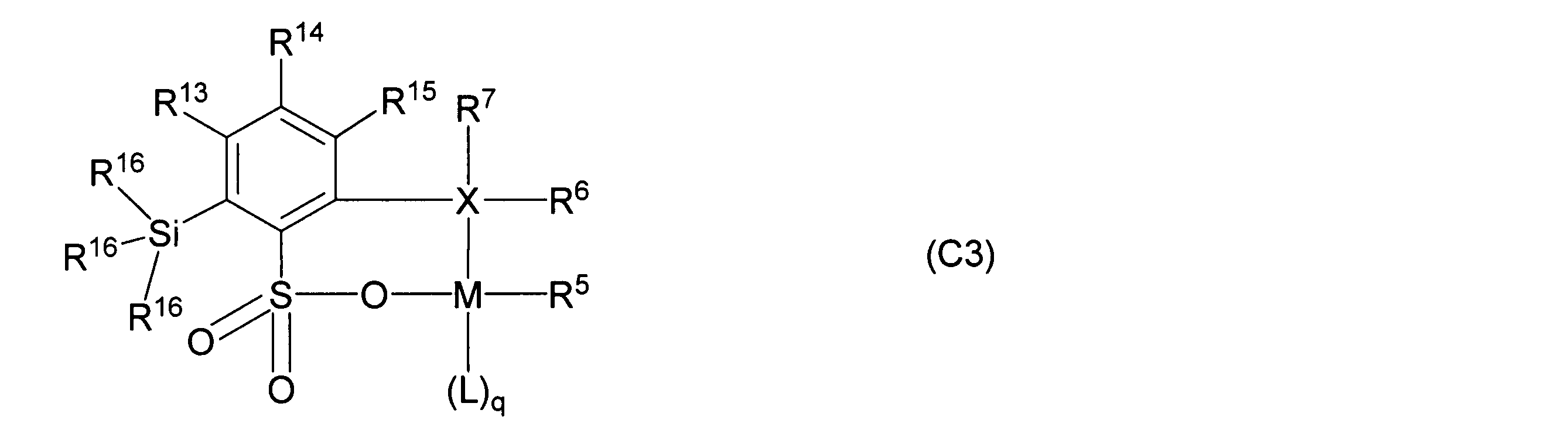
式中、それぞれ独立した3つのR16は同じでも異なっていてもよく、水素原子または炭素原子数1~8の炭化水素基を表す。M、X、R5、R6、R7、R13、R14、R15、L及びqは一般式(C2)の記載と同じ意味を表す。
一般式(C3)において、R16は炭素原子数1~4の炭化水素基が好ましく、3つのR16がすべてメチル基であることが特に好ましい。R13は水素原子または炭素原子数1~6の炭化水素基であることが好ましく、水素原子、イソプロピル基、またはフェニル基であることが特に好ましい。R14及びR15は水素原子または炭素原子数1~4の炭化水素基が好ましく、水素原子であることが特に好ましい。
一般式(C1)で示される触媒の金属錯体は、公知の文献(例えば、J.Am.Chem.Soc.2007,129,8948)に記載の方法と同様の方法で、合成することができる。すなわち、0価あるいは2価のMソースと一般式(C1)中の配位子とを反応させて金属錯体を合成する。
一般式(C2)及び一般式(C3)で示される化合物は、一般式(C1)中のY1及びQを、一般式(C2)及び一般式(C3)に対応する特定の基にすることにより合成することができる。
0価のMソースは、パラジウムソースとして、トリス(ジベンジリデンアセトン)ジパラジウムが挙げられ、ニッケルソースとして、テトラカルボニルニッケル(0):Ni(CO)4、ビス(1,5-シクロオクタジエン)ニッケルが挙げられる。
2価のMソースは、パラジウムソースとして、(1,5-シクロオクタジエン)(メチル)塩化パラジウム、塩化パラジウム、酢酸パラジウム、ビス(アセトニトリル)ジクロロパラジウム:PdCl2(CH3CN)2、ビス(ベンゾニトリル)ジクロロパラジウム:PdCl2(PhCN)2、(N,N,N’,N’-テトラメチルエチレンジアミン)ジクロロパラジウム(II):PdCl2(TMEDA)、(N,N,N’,N’-テトラメチルエチレンジアミン)ジメチルパラジウム(II):PdMe2(TMEDA)、ビス(アセチルアセトナト)パラジウム(II):Pd(acac)2(acac=アセチルアセトナト)、(トリフルオロメタンスルホン酸パラジウム(II):Pd(OSO2CF3)2が、ニッケルソースとして、(アリル)塩化ニッケル、(アリル)臭化ニッケル、塩化ニッケル、酢酸ニッケル、ビス(アセチルアセトナト)ニッケル(II):Ni(acac)2、(1,2-ジメトキシエタン)ジクロロニッケル(II):NiCl2(DME)、トリフルオロメタンスルホン酸ニッケル(II):Ni(OSO2CF3)2が挙げられる。
一般式(C1)で示される金属錯体は、単離して使用することができるが、錯体を単離することなくMを含む金属ソースと配位子前駆体を反応系中で接触させて、これをそのまま(in situ)重合に供することもできる。特に一般式(C1)中のR5が水素原子の場合、0価のMを含む金属ソースと配位子前駆体とを反応させた後、錯体を単離することなくそのまま重合に供することが好ましい。
この場合の配位子前駆体は、一般式(C1)の場合、

(式中の記号は前記と同じ意味を表す。)
で示される。
で示される。
一般式(C1)におけるMソース(M)と配位子前駆体(C1-1)(C1配位子)との比率((C1配位子)/M)は、0.5~2.0の範囲で、さらには、1.0~1.5の範囲で選択することが好ましい。
一般式(C1)の金属錯体を単離する場合、予め電子供与性配位子(L)を配位させて安定化させたものを用いることもできる。この場合、qは1/2、1または2となる。qが1/2とは一つの2価の電子供与性配位子が2つの金属錯体に配位していることを意味する。qは金属錯体触媒を安定化する意味で1/2または1が好ましい。なお、qが0の場合は配位子がないことを意味する。
電子供与性配位子(L)とは、電子供与性基を有し、金属原子Mに配位して金属錯体を安定化させることのできる化合物である。
電子供与性配位子(L)としては、硫黄原子を有するものとしてジメチルスルホキシド(DMSO)が挙げられる。窒素原子を有するものとして、アルキル基の炭素原子数1~10のトリアルキルアミン、アルキル基の炭素原子数1~10のジアルキルアミン、ピリジン、2,6-ジメチルピリジン(別名:2,6-ルチジン)、アニリン、2,6-ジメチルアニリン、2,6-ジイソプロピルアニリン、N,N,N’,N’-テトラメチルエチレンジアミン(TMEDA)、4-(N,N-ジメチルアミノ)ピリジン(DMAP)、アセトニトリル、ベンゾニトリル、キノリン、2-メチルキノリンなどが挙げられる。酸素原子を有するものとして、ジエチルエーテル、テトラヒドロフラン、1,2-ジメトキシエタンが挙げられる。金属錯体の安定性及び触媒活性の観点から、ジメチルスルホキシド(DMSO)、ピリジン、2,6-ジメチルピリジン(別名:2,6-ルチジン)、N,N,N’,N’-テトラメチルエチレンジアミン(TMEDA)が好ましく、ジメチルスルホキシド(DMSO)、2,6-ジメチルピリジン(別名:2,6-ルチジン)がより好ましい。
電子供与性配位子(L)としては、硫黄原子を有するものとしてジメチルスルホキシド(DMSO)が挙げられる。窒素原子を有するものとして、アルキル基の炭素原子数1~10のトリアルキルアミン、アルキル基の炭素原子数1~10のジアルキルアミン、ピリジン、2,6-ジメチルピリジン(別名:2,6-ルチジン)、アニリン、2,6-ジメチルアニリン、2,6-ジイソプロピルアニリン、N,N,N’,N’-テトラメチルエチレンジアミン(TMEDA)、4-(N,N-ジメチルアミノ)ピリジン(DMAP)、アセトニトリル、ベンゾニトリル、キノリン、2-メチルキノリンなどが挙げられる。酸素原子を有するものとして、ジエチルエーテル、テトラヒドロフラン、1,2-ジメトキシエタンが挙げられる。金属錯体の安定性及び触媒活性の観点から、ジメチルスルホキシド(DMSO)、ピリジン、2,6-ジメチルピリジン(別名:2,6-ルチジン)、N,N,N’,N’-テトラメチルエチレンジアミン(TMEDA)が好ましく、ジメチルスルホキシド(DMSO)、2,6-ジメチルピリジン(別名:2,6-ルチジン)がより好ましい。
一般式(C1)、一般式(C2)、一般式(C3)で示される金属錯体は、担体に担持して重合に使用することもできる。この場合の担体は、特に限定されないが、シリカゲル、アルミナなどの無機担体、ポリスチレン、ポリエチレン、ポリプロピレンなどの有機担体などを挙げることができる。金属錯体の担持法としては、金属錯体の溶液を担体に含浸させて乾燥する物理的な吸着方法や、金属錯体と担体とを化学的に結合させて担持する方法などが挙げられる。
[モノマー]
本発明の共重合体の製造方法では、モノマーとして(a)プロピレン及び(b)極性基含有モノマーが用いられる。両モノマーの割合は、(a)プロピレンが99.999~80mol%、(b)極性基含有モノマーが20~0.001mol%であり、(a)プロピレンが99.999~90mol%、(b)極性基含有モノマーが10~0.001mol%が好ましく、(a)プロピレンが99.999~95mol%、(b)極性基含有モノマーが5~0.001mol%がさらに好ましい。(b)極性基含有モノマー成分は1種を単独で使用してもよいし、複数を併用してもよい。
本発明の共重合体の製造方法では、モノマーとして(a)プロピレン及び(b)極性基含有モノマーが用いられる。両モノマーの割合は、(a)プロピレンが99.999~80mol%、(b)極性基含有モノマーが20~0.001mol%であり、(a)プロピレンが99.999~90mol%、(b)極性基含有モノマーが10~0.001mol%が好ましく、(a)プロピレンが99.999~95mol%、(b)極性基含有モノマーが5~0.001mol%がさらに好ましい。(b)極性基含有モノマー成分は1種を単独で使用してもよいし、複数を併用してもよい。
(b)極性基含有モノマー
本発明に用いられる極性基含有モノマーは、一般式(1)、(2)または(3)で示される。
本発明に用いられる極性基含有モノマーは、一般式(1)、(2)または(3)で示される。

一般式(1)、(2)及び(3)中、FG1、FG2、FG3は、それぞれ独立して、ハロゲン原子、水酸基、炭素原子数1~20のアルコキシ基、炭素原子数1~20のアルキルチオ基、炭素数1~20の炭化水素基を有する置換アミノ基、シアノ基、カルボキシル基、炭素原子数1~20の炭化水素基を有するエステル基、または炭素原子数1~20の炭化水素基を有するアシルオキシ基を表す。
前記FG1、FG2、FG3は、ハロゲン原子、炭素原子数1~20の炭化水素基を有する置換アミノ基、シアノ基、炭素原子数1~20の炭化水素基を有するエステル基、または炭素原子数1~20の炭化水素基を有するアシルオキシ基が好ましい。
FG1、FG2及びFG3が表す炭素原子数1~20のアルコキシ基は、好ましくは、炭素原子数1~4のアルコキシ基であり、好ましい具体例は、メトキシ基、エトキシ基、イソプロポキシ基、1-プロポキシ基、1-ブトキシ基、及びt-ブトキシ基などである。
これらの中で、さらに好ましい置換基としては、メトキシ基、エトキシ基またはイソプロポキシ基であり、特に好ましくは、メトキシ基である。
これらの中で、さらに好ましい置換基としては、メトキシ基、エトキシ基またはイソプロポキシ基であり、特に好ましくは、メトキシ基である。
FG1、FG2及びFG3が表す炭素原子数1~20の炭化水素基を有するエステル基は、好ましくは、炭素原子数2~8のエステル基であり、好ましい具体例は、メトキシカルボニル基、エトキシカルボニル基、n-プロポキシカルボニル基、イソプロポキシカルボニル基、n-ブトキシカルボニル基、t-ブトキシカルボニル基、(4-ヒドロキシブトキシ)カルボニル基、(4-グリシジルブトキシ)カルボニル基、フェノキシカルボニル基が挙げられる。
これらの中で、さらに好ましい置換基としては、メトキシカルボニル基、エトキシカルボニル基、(4-ヒドロキシブトキシ)カルボニル基が挙げられ、特に好ましくは、メトキシカルボニル基である。
これらの中で、さらに好ましい置換基としては、メトキシカルボニル基、エトキシカルボニル基、(4-ヒドロキシブトキシ)カルボニル基が挙げられ、特に好ましくは、メトキシカルボニル基である。
FG1、FG2及びFG3が表す炭素原子数1~20の炭化水素基を有するアシルオキシ基は、好ましくは、炭素原子数2~8のアシルオキシ基であり、好ましい具体例は、アセチルオキシ基、プロピオニルオキシ基、ブチリルオキシ基、イソブチリルオキシ基、ヴァレリルオキシ基、イソヴァレリルオキシ基、ピバロイルオキシ基、ベンゾイルオキシ基が挙げられる。
これらの中で、さらに好ましい置換基としては、アセチルオキシ基、プロピオニルオキシ基、ベンゾイルオキシ基であり、特に好ましくは、アセチルオキシ、プロピオニルオキシ基である。
これらの中で、さらに好ましい置換基としては、アセチルオキシ基、プロピオニルオキシ基、ベンゾイルオキシ基であり、特に好ましくは、アセチルオキシ、プロピオニルオキシ基である。
FG1、FG2及びFG3が表す炭素原子数1~20の炭化水素基を有する置換アミノ基の好ましい具体例は、モノメチルアミノ基、ジメチルアミノ基、モノエチルアミノ基、ジエチルアミノ基、モノイソプロピルアミノ基、ジイソプロピルアミノ基、モノフェニルアミノ基、ジフェニルアミノ基、ビス(トリメチルシリル)アミノ基、モルホリニル基である。
これらの中で、さらに好ましい置換基は、ジメチルアミノ基、ジフェニルアミノ基である。
これらの中で、さらに好ましい置換基は、ジメチルアミノ基、ジフェニルアミノ基である。
FG1、FG2及びFG3が表す炭素原子数1~20のアルキルチオ基の好ましい具体例は、メチルチオ基、エチルチオ基、プロピルチオ基、t-ブチルチオ基である。
これらの中で、さらに好ましい置換基としては、メチルチオ基、t-ブチルチオ基が挙げられ、特に好ましくは、メチルチオ基である。
FG1、FG2及びFG3が表すハロゲン原子の好ましい具体例は、フッ素原子、塩素原子、臭素原子である。これらの中で、さらに好ましい置換基は塩素原子である。
これらの中で、さらに好ましい置換基としては、メチルチオ基、t-ブチルチオ基が挙げられ、特に好ましくは、メチルチオ基である。
FG1、FG2及びFG3が表すハロゲン原子の好ましい具体例は、フッ素原子、塩素原子、臭素原子である。これらの中で、さらに好ましい置換基は塩素原子である。
これらのFG1、FG2及びFG3として好ましい群のうち、さらに好ましくは、ハロゲン原子、シアノ基、炭素原子数1~20の炭化水素基を有するエステル基である。
一般式(1)、(2)または(3)で示される極性基含有モノマーの含有量(モル%=(極性基含有モノマーのモル数/共重合体中の総モノマーモル数)×100)に関しては、特に制限はないが、好ましくは、0.1~50%である。さらに好ましくは、0.1~10%であり、特に好ましくは、0.1~5%である。
[重合方法]
本発明のプロピレンと一般式(1)、(2)または(3)で示される極性基含有モノマーの重合体を製造する方法は特に制限されるものではなく、一般に使用される方法で重合可能である。すなわち、溶液重合法、懸濁重合法、気相重合法などのプロセス法が可能であるが、特に溶液重合法、懸濁重合法が好ましい。また重合様式は、バッチ様式でも連続様式でも可能である。また、一段重合でも、多段重合でも行うこともできる。
本発明のプロピレンと一般式(1)、(2)または(3)で示される極性基含有モノマーの重合体を製造する方法は特に制限されるものではなく、一般に使用される方法で重合可能である。すなわち、溶液重合法、懸濁重合法、気相重合法などのプロセス法が可能であるが、特に溶液重合法、懸濁重合法が好ましい。また重合様式は、バッチ様式でも連続様式でも可能である。また、一段重合でも、多段重合でも行うこともできる。
本発明で用いられる金属錯体触媒は2種類以上を混合して重合反応に使用してもよい。混合して使用することで重合体の分子量、分子量分布、一般式(1)、(2)または(3)で示されるモノマーに由来するモノマーユニットの含有量を制御することが可能であり、所望の用途に適した重合体を得ることができる。金属錯体触媒総量とモノマーの総量のモル比は、モノマー/金属錯体の比で、1~10,000,000の範囲、好ましくは10~1,000,000の範囲、より好ましくは100~100,000の範囲が用いられる。
重合温度は、特に限定されない。通常-30~400℃の範囲で行われ、好ましくは0~180℃、より好ましくは20~150℃の範囲で行われる。
プロピレン圧が内部圧力の大半を占める重合圧力については、常圧から100MPaの範囲内で行われ、好ましくは常圧から20MPa、より好ましくは常圧から10MPaの範囲内で行われる。
プロピレン圧が内部圧力の大半を占める重合圧力については、常圧から100MPaの範囲内で行われ、好ましくは常圧から20MPa、より好ましくは常圧から10MPaの範囲内で行われる。
重合時間は、プロセス様式や触媒の重合活性などにより適宜調整することができ、数分の短い時間も、数千時間の長い反応時間も可能である。
重合系中の雰囲気は触媒の活性低下を防ぐため、モノマー以外の空気、酸素、水分などが混入しないように窒素ガスやアルゴンなどの不活性ガスで満たすことが好ましい。また溶液重合の場合、モノマー以外に不活性溶媒を使用することが可能である。不活性溶媒は、特に限定されないが、イソブタン、ペンタン、ヘキサン、ヘプタン、シクロヘキサンなどの脂肪族炭化水素、ベンゼン、トルエン、キシレンなどの芳香族炭化水素、クロロホルム、塩化メチレン、四塩化炭素、ジクロロエタン、テトラクロロエタンなどのハロゲン化脂肪族炭化水素、クロロベンゼン、ジクロロベンゼン、トリクロロベンゼンなどのハロゲン化芳香族炭化水素、酢酸メチル、酢酸エチルなどの脂肪族エステル、安息香酸メチル、安息香酸エチルなどの芳香族エステルなどが挙げられる。
[重合体]
本発明に係る極性基含有プロピレン系オレフィン共重合体は、アルミニウム(Al)含量が共重合体1g当たり0~100μg、好ましくは0~10μgである。アルミニウム(Al)含量がかかる範囲であることにより脱灰処理によるアルミニウム金属残渣の除去が不要となる。
本発明に係る極性基含有プロピレン系オレフィン共重合体は、アルミニウム(Al)含量が共重合体1g当たり0~100μg、好ましくは0~10μgである。アルミニウム(Al)含量がかかる範囲であることにより脱灰処理によるアルミニウム金属残渣の除去が不要となる。
本発明に係る極性基含有プロピレン系オレフィン共重合体は、13C-NMR分析によって得られる前記プロピレンに由来する構造単位中のプロピレン単位3連子のmm分率が30.0~80.0%、好ましくは40.0~70.0%である。当該mm分率がかかる範囲であることにより剛性と溶融成型性のバランスを保った樹脂物性を提供可能である。
プロピレン単位を中心として頭尾結合した3連子の中心プロピレンのメチル基に由来するピークは、その立体配置に応じて、3つの領域に生じる。
mm:約24.3~約21.1ppm
mr:約21.2~約20.5ppm
rr:約20.5~約19.8ppm
各領域の化学シフト範囲は、分子量や、共重合体組成により若干シフトするが、上記3領域の識別は、容易である。
ここで、mm、mr及びrrは、それぞれ下記の式(3-a)~(3-c)で示される構造を表す。
mm:約24.3~約21.1ppm
mr:約21.2~約20.5ppm
rr:約20.5~約19.8ppm
各領域の化学シフト範囲は、分子量や、共重合体組成により若干シフトするが、上記3領域の識別は、容易である。
ここで、mm、mr及びrrは、それぞれ下記の式(3-a)~(3-c)で示される構造を表す。
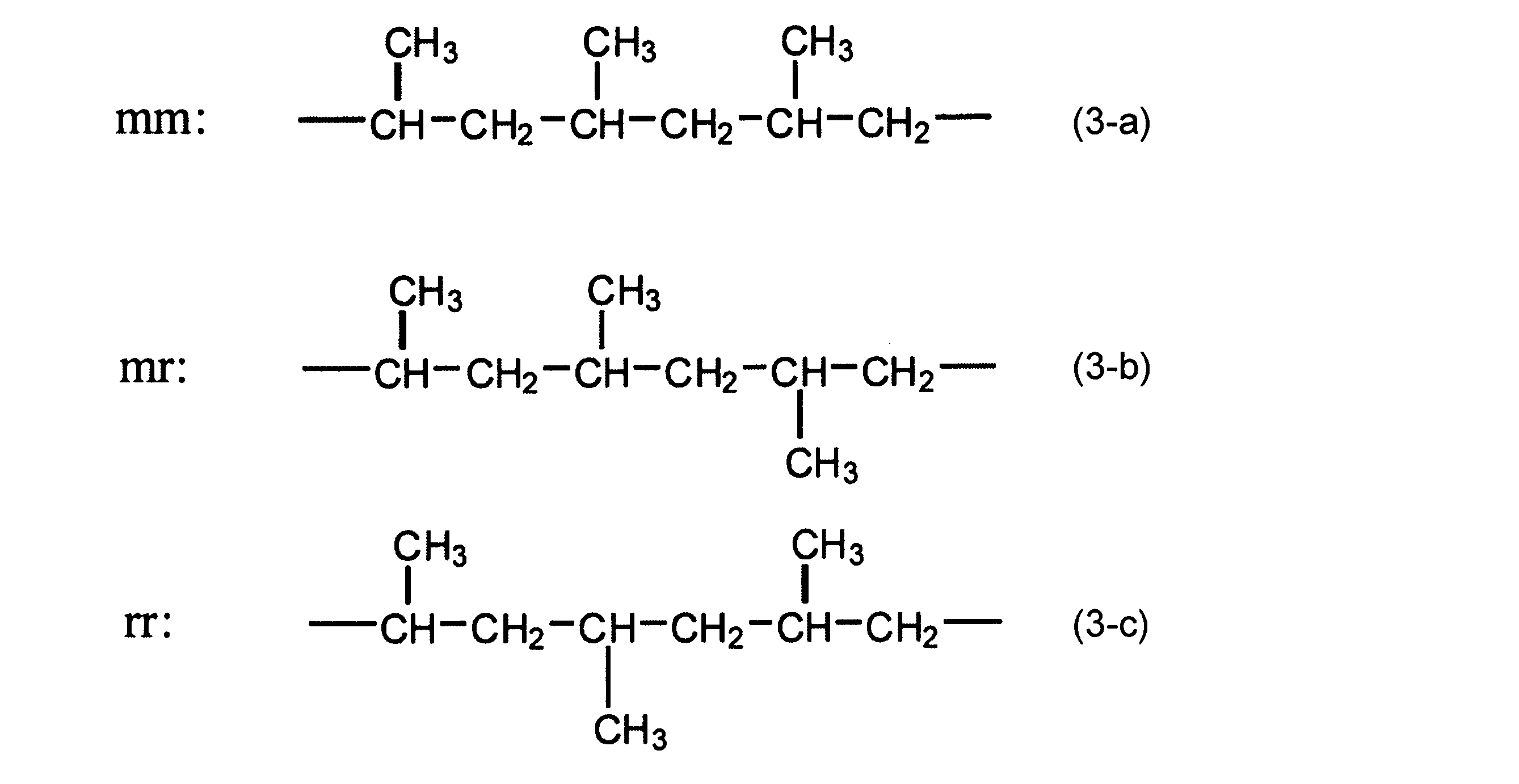
mm分率は、次の数式から算出される。

本発明に係る極性基含有プロピレン系オレフィン共重合体は、ゲル浸透クロマトグラフィー(GPC)によって求められる重量平均分子量(Mw)が10,000~500,000、好ましくは10,000~200,000である。重量平均分子量(Mw)がかかる範囲であることにより剛性と溶融成型性のバランスを保った樹脂物性を提供可能である。
以下、実施例及び比較例を挙げて本発明をより詳細に説明するが、本発明は下記の例に限定されるものではない。
[重合体の構造の解析方法]
1.極性基含有モノマーの含量
実施例で得た共重合体の構造は、ブルカー・バイオスピン(株)のASCEND500を用いた各種NMR解析により決定した。極性基含有モノマーに由来するモノマーユニットの含有率は、溶媒として1,1,2,2-テトラクロロエタン-d2を使用した120℃における1H-NMR測定により、極性基含有モノマー由来のピークに対する主鎖(0.8~1.8ppm)の積分比をもとに算出した。
比較例で得た共重合体の構造は、ブルカー・バイオスピン(株)のAVANCE III 400を用いた各種NMR解析により決定した。試料をo-ジクロロベンゼン/重水素化臭化ベンゼン(C6D5Br)=4/1(体積比)2.4ml及び化学シフトの基準物質であるヘキサメチルジシロキサンと共に内径10mmφのNMR試料管に入れて窒素置換した後封管し、加熱溶解して均一な溶液としてNMR測定に供した。120℃における1H-NMR測定により、極性基含有モノマー由来のピークに対する主鎖(0.8~1.8ppm)の積分比をもとに算出した。
1.極性基含有モノマーの含量
実施例で得た共重合体の構造は、ブルカー・バイオスピン(株)のASCEND500を用いた各種NMR解析により決定した。極性基含有モノマーに由来するモノマーユニットの含有率は、溶媒として1,1,2,2-テトラクロロエタン-d2を使用した120℃における1H-NMR測定により、極性基含有モノマー由来のピークに対する主鎖(0.8~1.8ppm)の積分比をもとに算出した。
比較例で得た共重合体の構造は、ブルカー・バイオスピン(株)のAVANCE III 400を用いた各種NMR解析により決定した。試料をo-ジクロロベンゼン/重水素化臭化ベンゼン(C6D5Br)=4/1(体積比)2.4ml及び化学シフトの基準物質であるヘキサメチルジシロキサンと共に内径10mmφのNMR試料管に入れて窒素置換した後封管し、加熱溶解して均一な溶液としてNMR測定に供した。120℃における1H-NMR測定により、極性基含有モノマー由来のピークに対する主鎖(0.8~1.8ppm)の積分比をもとに算出した。
2.分子量
実施例で得た共重合体の数平均分子量(Mn)及び重量平均分子量(Mw)は、東ソー(株)製,TSKgel(登録商標) GMHHR-H(S)HTカラム(7.8mmI.D.×30cmを2本直列)を備えた東ソー(株)製高温GPC装置、HLC-8121GPC/HTを用い、ポリスチレンを分子量の標準物質とするサイズ排除クロマトグラフィー(溶媒:1,2-ジクロロベンゼン、温度:145℃)により算出した。
比較例で得た共重合体の数平均分子量(Mn)及び重量平均分子量(Mw)は、昭和電工社製AD806M/S(3本)を備えたウォーターズ社製高温GPC装置150Cを用い、オルトジクロロベンゼン(0.5mg/mLのBHT(2,6-ジ-t-ブチル-4-メチルフェノール)を含む)を溶媒として、140℃で測定した。標準ポリスチレン法により測定し、保持容量から分子量への換算は、予め作成しておいた標準ポリスチレンによる検量線を用いて行った。
実施例で得た共重合体の数平均分子量(Mn)及び重量平均分子量(Mw)は、東ソー(株)製,TSKgel(登録商標) GMHHR-H(S)HTカラム(7.8mmI.D.×30cmを2本直列)を備えた東ソー(株)製高温GPC装置、HLC-8121GPC/HTを用い、ポリスチレンを分子量の標準物質とするサイズ排除クロマトグラフィー(溶媒:1,2-ジクロロベンゼン、温度:145℃)により算出した。
比較例で得た共重合体の数平均分子量(Mn)及び重量平均分子量(Mw)は、昭和電工社製AD806M/S(3本)を備えたウォーターズ社製高温GPC装置150Cを用い、オルトジクロロベンゼン(0.5mg/mLのBHT(2,6-ジ-t-ブチル-4-メチルフェノール)を含む)を溶媒として、140℃で測定した。標準ポリスチレン法により測定し、保持容量から分子量への換算は、予め作成しておいた標準ポリスチレンによる検量線を用いて行った。
3.アルミニウム含量
試料を白金製るつぼに秤量し、濃硫酸を添加して、プレートヒーター上で加熱して炭化した後、電気炉で灰化した。灰分に濃硝酸とフッ化水素酸を添加して加温溶解した。溶液をメスフラスコに定容し、アルミニウム量をICP-MS(パーキンエルマー社製NexION300S型)またはICP-OES(サーモフィッシャーサイエンティフィック社製iCAP6500DUO型)で測定した。
試料を白金製るつぼに秤量し、濃硫酸を添加して、プレートヒーター上で加熱して炭化した後、電気炉で灰化した。灰分に濃硝酸とフッ化水素酸を添加して加温溶解した。溶液をメスフラスコに定容し、アルミニウム量をICP-MS(パーキンエルマー社製NexION300S型)またはICP-OES(サーモフィッシャーサイエンティフィック社製iCAP6500DUO型)で測定した。
4.プロピレン単位3連子のmm分率
試料約80mgをNMRサンプル管(5mm)中で重水素化1,1,2,2-テトラクロロエタン約0.5mLに溶解させた後、125℃にて広帯域プロトンデカップリング法にて測定したケミカルシフトは1,1,2,2-テトラクロロエタンの5本のピークの中央のピークを73.8ppmに設定した。
フリップ角:30度
パルス間隔:2秒
共鳴周波数:100MHz以上
積算回数:1,000回以上
観測域:-18ppmから218ppm
スペクトルの帰属は、Macromolecules,(1975年)8巻,687頁やPolymer,30巻 1350頁(1989年)を参考に行う。
試料約80mgをNMRサンプル管(5mm)中で重水素化1,1,2,2-テトラクロロエタン約0.5mLに溶解させた後、125℃にて広帯域プロトンデカップリング法にて測定したケミカルシフトは1,1,2,2-テトラクロロエタンの5本のピークの中央のピークを73.8ppmに設定した。
フリップ角:30度
パルス間隔:2秒
共鳴周波数:100MHz以上
積算回数:1,000回以上
観測域:-18ppmから218ppm
スペクトルの帰属は、Macromolecules,(1975年)8巻,687頁やPolymer,30巻 1350頁(1989年)を参考に行う。
[金属錯体触媒1Aの合成]
下記の反応スキームに従って金属錯体触媒1Aを合成した。
下記の反応スキームに従って金属錯体触媒1Aを合成した。
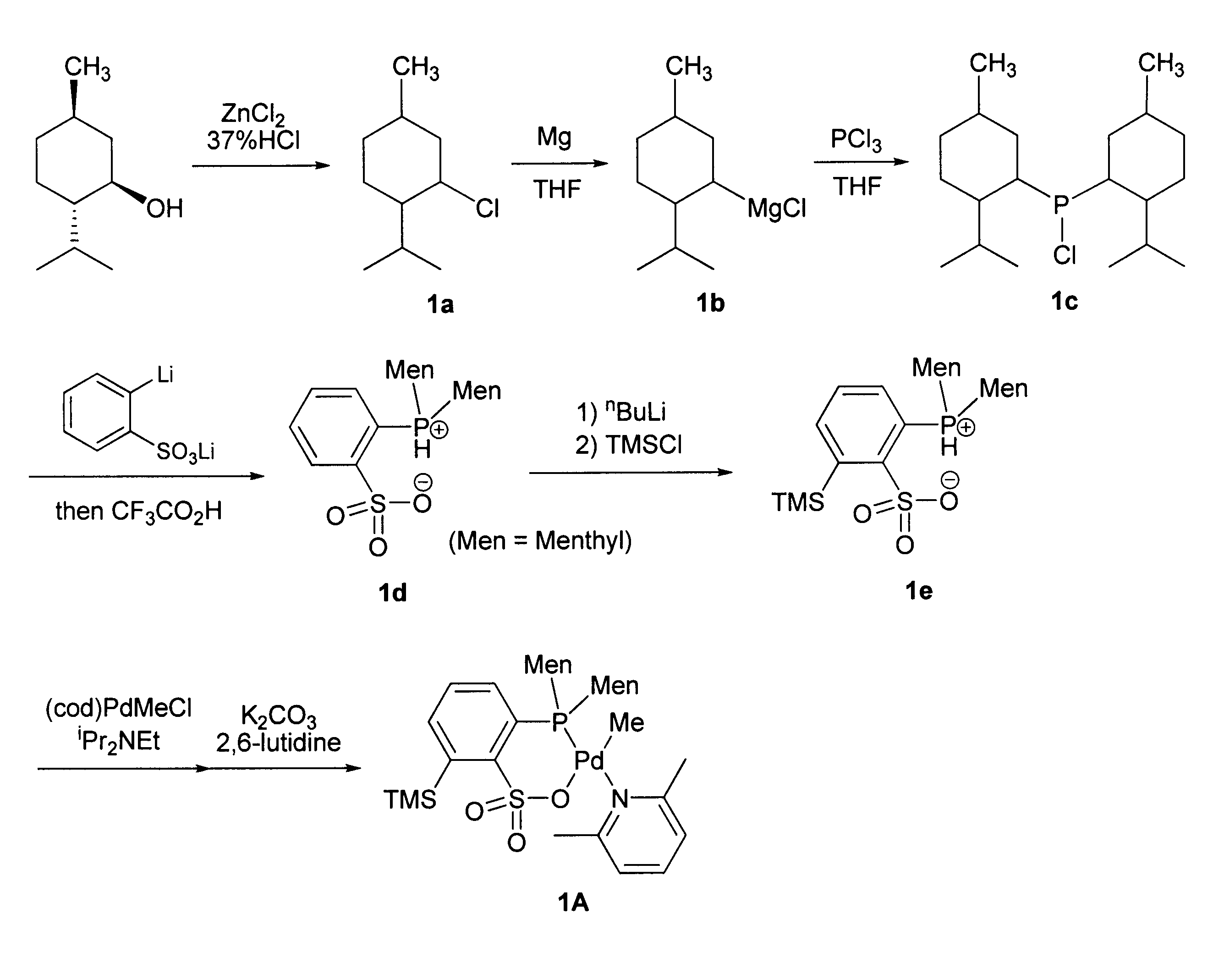
(a)塩化メンチル(化合物1a)の合成
文献(J. Org. Chem., 17, 1116. (1952))記載の手法で、塩化メンチル(化合物1a)の合成を行った。すなわち、塩化亜鉛(77g、0.56mol)の37%塩酸(52mL、0.63mol)溶液に、(-)-メントール(27g、0.17mol)を加え、35℃に加熱しながら、5時間撹拌した。室温まで冷却した後、反応液にヘキサン(50mL)を加え、分液漏斗を使用して、有機層と水層を分離した。有機層は水(30mL×1)で洗浄後、さらに濃硫酸(10mL×5)及び水(30mL×5)で洗浄した。有機層を硫酸マグネシウムで乾燥後、減圧濃縮を行い、塩化メンチル(化合物1a)を無色の油状物質として得た。収量は27g(収率91%)であった。
文献(J. Org. Chem., 17, 1116. (1952))記載の手法で、塩化メンチル(化合物1a)の合成を行った。すなわち、塩化亜鉛(77g、0.56mol)の37%塩酸(52mL、0.63mol)溶液に、(-)-メントール(27g、0.17mol)を加え、35℃に加熱しながら、5時間撹拌した。室温まで冷却した後、反応液にヘキサン(50mL)を加え、分液漏斗を使用して、有機層と水層を分離した。有機層は水(30mL×1)で洗浄後、さらに濃硫酸(10mL×5)及び水(30mL×5)で洗浄した。有機層を硫酸マグネシウムで乾燥後、減圧濃縮を行い、塩化メンチル(化合物1a)を無色の油状物質として得た。収量は27g(収率91%)であった。
(b)塩化ジメンチルホスフィン(化合物1c)の合成
文献(Journal fur Praktische Chemie, 322, 485. (1980))記載の手法で、塩化ジメンチルホスフィン(化合物1c)の合成を行った。すなわち、アルゴン雰囲気下、塩化メンチル(化合物1a;2.6g、15mmol)とマグネシウム(0.63g、26mmol)をテトラヒドロフラン(THF)(30mL)中で、70℃に加熱しながら反応させて得られた塩化メンチルマグネシウム(化合物1b)の溶液を、三塩化リン(0.63mL、7.2mmol)のTHF(30mL)溶液に-78℃で加えた。室温まで昇温後、70℃に加熱しながら2時間撹拌した。溶媒を減圧留去した後、蒸留精製を行い、塩化ジメンチルホスフィン(化合物1c)を得た。収量は、0.62g(収率25%)であった。
31P-NMR(162MHz,THF):δ 123.9.
文献(Journal fur Praktische Chemie, 322, 485. (1980))記載の手法で、塩化ジメンチルホスフィン(化合物1c)の合成を行った。すなわち、アルゴン雰囲気下、塩化メンチル(化合物1a;2.6g、15mmol)とマグネシウム(0.63g、26mmol)をテトラヒドロフラン(THF)(30mL)中で、70℃に加熱しながら反応させて得られた塩化メンチルマグネシウム(化合物1b)の溶液を、三塩化リン(0.63mL、7.2mmol)のTHF(30mL)溶液に-78℃で加えた。室温まで昇温後、70℃に加熱しながら2時間撹拌した。溶媒を減圧留去した後、蒸留精製を行い、塩化ジメンチルホスフィン(化合物1c)を得た。収量は、0.62g(収率25%)であった。
31P-NMR(162MHz,THF):δ 123.9.
(c)2-(ジメンチルホスフィノ)ベンゼンスルホン酸(化合物1d)の合成
ベンゼンスルホン酸(13.2g,83.5mmol)のテトラヒドロフラン溶液(150mL)に、n-ブチルリチウム(2.5Mヘキサン溶液,66.8mL,167mmol)を0℃で加え、10℃で1時間撹拌した。反応容器を-78℃に冷却した後に、塩化ジメンチルホスフィン(化合物1c;11.5g,33.4mmol)のテトラヒドロフラン(50mL)溶液を-78℃で加え、室温で16時間撹拌した。反応液にトリフルオロ酢酸(9.52g,83.5mmol)のテトラヒドロフラン(50mL)溶液を0℃で加えて反応停止した後に、溶媒を減圧留去した。ジクロロメタン(100mL×4回)で抽出した後、有機層を硫酸ナトリウムで乾燥した。溶媒留去後、シリカゲルクロマトグラフィー(ジクロロメタン/メタノール=10/1)で精製し、酢酸エチルで洗浄することにより、2-(ジメンチルホスフィノ)ベンゼンスルホン酸(化合物1d)を白色粉末として得た。収量は5.0g(収率32%)であった。
ベンゼンスルホン酸(13.2g,83.5mmol)のテトラヒドロフラン溶液(150mL)に、n-ブチルリチウム(2.5Mヘキサン溶液,66.8mL,167mmol)を0℃で加え、10℃で1時間撹拌した。反応容器を-78℃に冷却した後に、塩化ジメンチルホスフィン(化合物1c;11.5g,33.4mmol)のテトラヒドロフラン(50mL)溶液を-78℃で加え、室温で16時間撹拌した。反応液にトリフルオロ酢酸(9.52g,83.5mmol)のテトラヒドロフラン(50mL)溶液を0℃で加えて反応停止した後に、溶媒を減圧留去した。ジクロロメタン(100mL×4回)で抽出した後、有機層を硫酸ナトリウムで乾燥した。溶媒留去後、シリカゲルクロマトグラフィー(ジクロロメタン/メタノール=10/1)で精製し、酢酸エチルで洗浄することにより、2-(ジメンチルホスフィノ)ベンゼンスルホン酸(化合物1d)を白色粉末として得た。収量は5.0g(収率32%)であった。
(d)2-(ジメンチルホスフィノ)-6-(トリメチルシリル)-ベンゼンスルホン酸(化合物1e)の合成
2-(ジメンチルホスフィノ)ベンゼンスルホン酸(化合物1d;2.50g,5.4mmol)のTHF溶液(40mL)に、n-ブチルリチウム(2.5Mヘキサン溶液,12.9mL,32.2mmol)を-78℃で加え、10℃で4時間撹拌した。反応容器を-78℃に冷却した後に、トリメチルシリルクロリド(4.05mL,32.2mmol)を-78℃で加え、10℃で16時間撹拌した。反応液を氷水(50mL)に注いで反応停止した後に、酢酸エチル(100mL×3回)にて抽出した。有機層を硫酸ナトリウムで乾燥後、溶媒を減圧留去し、酢酸エチル(15mL)にて洗浄することにより、2-(ジメンチルホスフィノ)-6-(トリメチルシリル)-ベンゼンスルホン酸(化合物1e)を白色粉末として得た。収量は2.10g(収率73%)であった。
2-(ジメンチルホスフィノ)ベンゼンスルホン酸(化合物1d;2.50g,5.4mmol)のTHF溶液(40mL)に、n-ブチルリチウム(2.5Mヘキサン溶液,12.9mL,32.2mmol)を-78℃で加え、10℃で4時間撹拌した。反応容器を-78℃に冷却した後に、トリメチルシリルクロリド(4.05mL,32.2mmol)を-78℃で加え、10℃で16時間撹拌した。反応液を氷水(50mL)に注いで反応停止した後に、酢酸エチル(100mL×3回)にて抽出した。有機層を硫酸ナトリウムで乾燥後、溶媒を減圧留去し、酢酸エチル(15mL)にて洗浄することにより、2-(ジメンチルホスフィノ)-6-(トリメチルシリル)-ベンゼンスルホン酸(化合物1e)を白色粉末として得た。収量は2.10g(収率73%)であった。
1H-NMR(400MHz,CDCl3):δ7.99(d,J=7.2Hz,1H),7.57(dd,J=7.2,16.0Hz,1H),7.47(m,1H),5.30(d,J=339.2Hz,1H),3.57(dd,J=12.4,27.6Hz,1H),2.71(brs,2H),2.03(brs,1H),1.74(brs,6H),1.60(brs,1H),1.41(brs,2H),1.28(m,1H),1.09(m,6H),0.94-0.67(m,15H),0.46(s,9H),0.22(d,J=6.4Hz,3H).
(e)金属錯体触媒1Aの合成
アルゴン雰囲気下、2-(ジメンチルホスフィノ)-6-(トリメチルシリル)-ベンゼンスルホン酸(化合物1e;2.04g,3.79mmol)とN,N-ジイソプロピルエチルアミン(3.20mL,18.4mmol)の塩化メチレン溶液(30mL)に、(cod)PdMeCl(cod=1,5-シクロオクタジエン、1.00g,3.77mmol)を加え、室温で1時間撹拌した。溶液を濃縮した後に、残渣を塩化メチレン(10mL)に溶解させ、この溶液を、炭酸カリウム(5.20g,37.6mmol)と2,6-ルチジン(4.40mL,37.8mmol)の塩化メチレン懸濁液(20mL)に加え、室温で1時間撹拌した。この反応液をセライト(乾燥珪藻土)及びフロリジル(ケイ酸マグネシウム)でろ過した後に、溶媒を濃縮し、減圧下乾燥を行った。ヘキサン(5mL×3回)で洗浄することにより、金属錯体触媒1Aを得た。収量は、2.32g(収率80%)であった。
アルゴン雰囲気下、2-(ジメンチルホスフィノ)-6-(トリメチルシリル)-ベンゼンスルホン酸(化合物1e;2.04g,3.79mmol)とN,N-ジイソプロピルエチルアミン(3.20mL,18.4mmol)の塩化メチレン溶液(30mL)に、(cod)PdMeCl(cod=1,5-シクロオクタジエン、1.00g,3.77mmol)を加え、室温で1時間撹拌した。溶液を濃縮した後に、残渣を塩化メチレン(10mL)に溶解させ、この溶液を、炭酸カリウム(5.20g,37.6mmol)と2,6-ルチジン(4.40mL,37.8mmol)の塩化メチレン懸濁液(20mL)に加え、室温で1時間撹拌した。この反応液をセライト(乾燥珪藻土)及びフロリジル(ケイ酸マグネシウム)でろ過した後に、溶媒を濃縮し、減圧下乾燥を行った。ヘキサン(5mL×3回)で洗浄することにより、金属錯体触媒1Aを得た。収量は、2.32g(収率80%)であった。
1H-NMR(400MHz,CDCl3):δ7.80(d,J=7.5Hz,1H),7.77(t,J=8.0Hz,1H),7.54(t,J=7.7Hz,1H),7.36(dd,J=7.7,7.6Hz,1H),7.10(d,J=7.7Hz,1H),7.05(d,J=7.6Hz,1H),3.70(m,1H),3.24(s,3H),3.16(s,3H),2.5-0.7(m,19H),0.96(d,J=6.4Hz,3H),0.95(d,J=6.4Hz,3H),0.83(d,J=6.6Hz,3H),0.76(d,J=6.7Hz,3H),0.50(d,J=6.6Hz,3H),0.37(s,9H),0.36(m,3H),0.15(d,J=6.7Hz,3H).
[重合体の合成/プロピレンと極性モノマーの共重合]
実施例1~4:
上記の方法で合成した金属錯体を使用して、プロピレンと極性モノマー(酢酸アリル、アリルシアニド、塩化アリル)の共重合を行った。
アルゴン雰囲気下、金属錯体触媒1A(0.02mmol)を含む50mLオートクレーブ中に、トルエン(10mL)及び極性モノマーを所定量加えた。6.0gのプロピレンを充填した後、オートクレーブを50℃で12時間撹拌した。室温に冷却後、オートクレーブ内の反応液を濃縮した後、シリカゲルクロマトグラフィー(トルエン)により触媒を除去し、減圧下乾燥して、共重合体を得た。
1H-NMR及び13C-NMRの測定結果から、得られた共重合体は、いずれもランダム共重合であることが分かった。
重合条件及び重合結果を表1に示す。
実施例1~4:
上記の方法で合成した金属錯体を使用して、プロピレンと極性モノマー(酢酸アリル、アリルシアニド、塩化アリル)の共重合を行った。
アルゴン雰囲気下、金属錯体触媒1A(0.02mmol)を含む50mLオートクレーブ中に、トルエン(10mL)及び極性モノマーを所定量加えた。6.0gのプロピレンを充填した後、オートクレーブを50℃で12時間撹拌した。室温に冷却後、オートクレーブ内の反応液を濃縮した後、シリカゲルクロマトグラフィー(トルエン)により触媒を除去し、減圧下乾燥して、共重合体を得た。
1H-NMR及び13C-NMRの測定結果から、得られた共重合体は、いずれもランダム共重合であることが分かった。
重合条件及び重合結果を表1に示す。
比較例1:プロピレンと酢酸アリルの共重合
充分に窒素置換した30mLフラスコに、40μmolのrac-ジメチルシリレンビス(2-メチル-4-フェニルインデニル)ジルコニウムジクロリドを秤量し、脱水ヘプタン(20mL)を加えた。このヘプタン溶液2.5mLに、日本アルキルアルミ(株)製のメチルアルミノキサントルエン溶液(20mmol)を加えて触媒溶液を調製した。
次に、内容積2.4Lの誘導撹拌機付ステンレス製オートクレーブ内に精製窒素雰囲気下で極性含有モノマー濃度が0.15mol/Lとなるように精製トルエン、酢酸アリルを導入した。トリイソブチルアルミニウムヘプタン溶液(132mmol)を加えた後、水素(200mL)を加え、プロピレン圧0.2MPa、70℃で安定化させた。先に調製した触媒溶液を添加し、重合を開始した。反応中は温度を70℃に保ち、圧力が保持されるように連続的にプロピレンを供給した。30分間の重合終了後、エタノール(10mL)を加え、圧力をパージして窒素置換し、オートクレーブを室温まで冷却した。回収した重合スラリー液を、エタノール(1L)を用いて共重合体を再沈し、ろ過により共重合体を得た。共重合体を塩酸(2N、200mL)/エタノール(1L)溶液で洗浄した後、さらにエタノール(1L)を用いて洗浄した。70℃で6時間減圧乾燥後、最終的に極性基含有オレフィン共重合体を回収した。収量は26.7g、Mw86,000、Mw/Mn2.1、酢酸アリル含量0.1mol%であった。
充分に窒素置換した30mLフラスコに、40μmolのrac-ジメチルシリレンビス(2-メチル-4-フェニルインデニル)ジルコニウムジクロリドを秤量し、脱水ヘプタン(20mL)を加えた。このヘプタン溶液2.5mLに、日本アルキルアルミ(株)製のメチルアルミノキサントルエン溶液(20mmol)を加えて触媒溶液を調製した。
次に、内容積2.4Lの誘導撹拌機付ステンレス製オートクレーブ内に精製窒素雰囲気下で極性含有モノマー濃度が0.15mol/Lとなるように精製トルエン、酢酸アリルを導入した。トリイソブチルアルミニウムヘプタン溶液(132mmol)を加えた後、水素(200mL)を加え、プロピレン圧0.2MPa、70℃で安定化させた。先に調製した触媒溶液を添加し、重合を開始した。反応中は温度を70℃に保ち、圧力が保持されるように連続的にプロピレンを供給した。30分間の重合終了後、エタノール(10mL)を加え、圧力をパージして窒素置換し、オートクレーブを室温まで冷却した。回収した重合スラリー液を、エタノール(1L)を用いて共重合体を再沈し、ろ過により共重合体を得た。共重合体を塩酸(2N、200mL)/エタノール(1L)溶液で洗浄した後、さらにエタノール(1L)を用いて洗浄した。70℃で6時間減圧乾燥後、最終的に極性基含有オレフィン共重合体を回収した。収量は26.7g、Mw86,000、Mw/Mn2.1、酢酸アリル含量0.1mol%であった。
実施例1~4及び比較例1により得られた共重合体中のアルミニウム含量の測定結果を表2に示す。
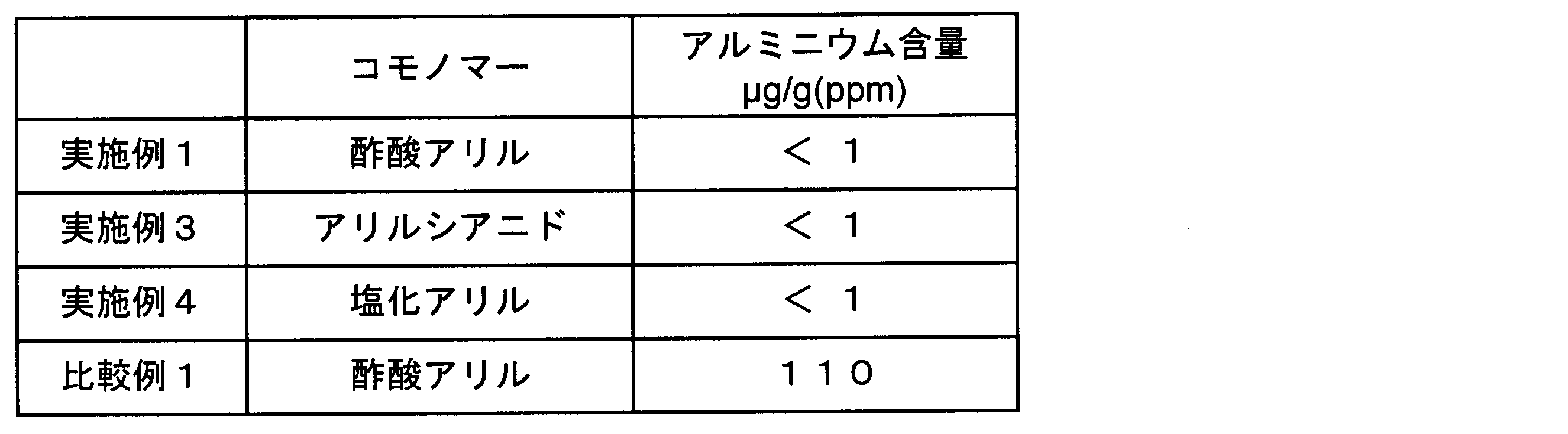
本発明を詳細にまた特定の実施態様を参照して説明したが、本発明の精神と範囲を逸脱することなく様々な変更や修正を加えることができることは当業者にとって明らかである。本出願は2015年11月11日出願の日本特許出願(特願2015-220864)に基づくものであり、その内容はここに参照として取り込まれる。
Claims (13)
- プロピレンに由来する構造単位99.999~80mol%と、下記一般式(1)、(2)または(3)

- 13C-NMR分析によって得られる前記プロピレンに由来する構造単位中のプロピレン単位3連子のmm分率が30.0~80.0%である、請求項1に記載の極性基含有プロピレン系オレフィン共重合体。
- ゲル浸透クロマトグラフィー(GPC)によって求められる重量平均分子量(Mw)が10,000~500,000である、請求項1または2に記載の極性基含有プロピレン系オレフィン共重合体。
- 前記FG1、FG2、FG3が、それぞれ独立して、ハロゲン原子、炭素原子数1~20の炭化水素基を有する置換アミノ基、シアノ基、炭素原子数1~20の炭化水素基を有するエステル基、または炭素原子数1~20の炭化水素基を有するアシルオキシ基である、請求項1~3のいずれか1項に記載の極性基含有プロピレン系オレフィン共重合体。
- 前記FG1、FG2、FG3が、それぞれ独立して、ハロゲン原子、シアノ基、または炭素原子数1~20の炭化水素基を有するエステル基である請求項1~4のいずれか1項に記載の極性基含有プロピレン系オレフィン共重合体。
- プロピレンに由来する構造単位99.999~80mol%と、下記一般式(1)、(2)または(3)

アルミニウム(Al)含量が前記共重合体1g当たり0~100μgであり、
下記一般式(C1)

Mは周期表第10族の金属原子を表し、
Xはリン原子(P)または砒素原子(As)を表し、
Y1は、少なくとも1つのシリル基で置換され、かつ水酸基、炭素原子数1~10のアルコキシ基、炭素原子数2~10のエステル基、及びハロゲン原子から選ばれる1つ以上の基で置換されていてもよい炭素原子数1~70の2価の炭化水素基を表し、
Qは、Y1[-S(=O)2-O-]M、Y1[-C(=O)-O-]M、Y1[-P(=O)(-OH)-O-]MまたはY1[-S-]Mの「[ ]」の中に示される2価の基を表し(ただし、両側のY1、Mは基の結合方向を示すために記載している。)、
R5は、水素原子、ハロゲン原子、炭素原子数1~30の炭化水素基、ハロゲン原子で置換された炭素原子数1~30の炭化水素基、炭素原子数1~10のアルコキシ基で置換された炭素原子数2~30の炭化水素基、炭素原子数6~20のアリールオキシ基で置換された炭素原子数7~30の炭化水素基、炭素原子数2~10のアミド基で置換された炭素原子数3~30の炭化水素基、炭素原子数1~30のアルコキシ基、炭素原子数6~30のアリールオキシ基、及び炭素原子数2~10のアシロキシ基からなる群より選ばれる置換基を表し、
R6及びR7はそれぞれ独立して、水素原子、アルコキシ基、アリールオキシ基、シリル基、アミノ基、またはハロゲン原子、アルコキシ基及びアリールオキシ基から選ばれる1つ以上の基で置換されていてもよい炭素原子数1~120の炭化水素基を表し、R6及びR7の少なくとも一方が、炭素原子数1~10のアルキル基または炭素原子数4~106のシクロアルキル基である。また、R6またはR7はY1と結合して環構造を形成してもよい。
Lは電子供与性配位子を表し、
qは0、1/2、1または2である。]
で示される金属錯体を重合触媒として使用することを特徴とする極性基含有プロピレン系オレフィン共重合体の製造方法。 - 一般式(C1)中、Qが-S(=O)2-O-である(ただし、SはY1に結合し、OはMに結合する。)、請求項6に記載の極性基含有プロピレン系オレフィン共重合体の製造方法。
- 一般式(C1)で示される金属錯体が、一般式(C2)
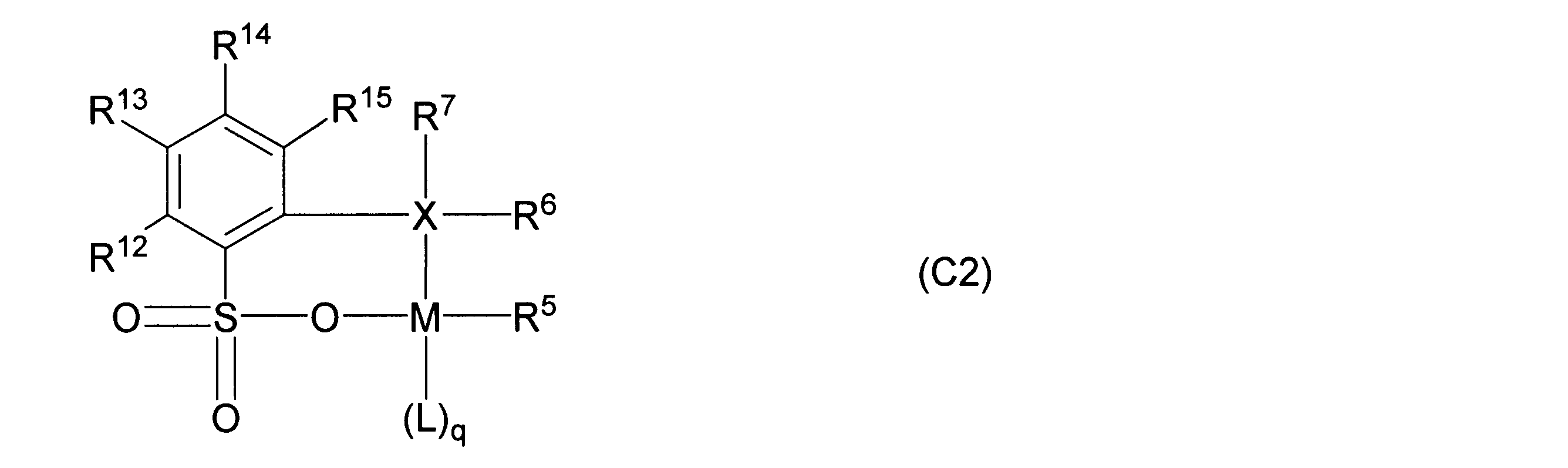
で示される金属錯体である、請求項7に記載の極性基含有プロピレン系オレフィン共重合体の製造方法。 - 一般式(C2)で示される金属錯体が、R12がシリル基である一般式(C3)

で示される金属錯体である、請求項8に記載の極性基含有プロピレン系オレフィン共重合体の製造方法。 - 一般式(C3)中、R16がすべてメチル基である請求項9に記載の極性基含有プロピレン系オレフィン共重合体の製造方法。
- 一般式(C3)のR13が水素原子または炭素原子数1~6の炭化水素基である請求項9または10に記載の極性基含有プロピレン系オレフィン共重合体の製造方法。
- 一般式(C3)のR13が水素原子、イソプロピル基またはフェニル基である請求項9~11のいずれか1項に記載の極性基含有プロピレン系オレフィン共重合体の製造方法。
- 一般式(C3)のR14、R15が共に水素原子である請求項9~12のいずれか1項に記載の極性基含有プロピレン系オレフィン共重合体の製造方法。
Applications Claiming Priority (2)
| Application Number | Priority Date | Filing Date | Title |
|---|---|---|---|
| JP2015220864 | 2015-11-11 | ||
| JP2015-220864 | 2015-11-11 |
Publications (1)
| Publication Number | Publication Date |
|---|---|
| WO2017082404A1 true WO2017082404A1 (ja) | 2017-05-18 |
Family
ID=58695463
Family Applications (1)
| Application Number | Title | Priority Date | Filing Date |
|---|---|---|---|
| PCT/JP2016/083572 Ceased WO2017082404A1 (ja) | 2015-11-11 | 2016-11-11 | 極性基含有プロピレン系オレフィン共重合体及びその製造方法 |
Country Status (2)
| Country | Link |
|---|---|
| JP (1) | JP6842057B2 (ja) |
| WO (1) | WO2017082404A1 (ja) |
Families Citing this family (1)
| Publication number | Priority date | Publication date | Assignee | Title |
|---|---|---|---|---|
| WO2023190912A1 (ja) * | 2022-03-31 | 2023-10-05 | 日本ポリケム株式会社 | 極性基含有オレフィン共重合体及びその製造方法 |
Citations (7)
| Publication number | Priority date | Publication date | Assignee | Title |
|---|---|---|---|---|
| JPS51136737A (en) * | 1975-05-23 | 1976-11-26 | Mitsui Petrochem Ind Ltd | Adherent polyolefin composition |
| JP2003231710A (ja) * | 2002-02-12 | 2003-08-19 | Idemitsu Petrochem Co Ltd | オレフィン/極性ビニルモノマー共重合体の製造方法 |
| JP2010159357A (ja) * | 2009-01-09 | 2010-07-22 | Mitsui Chemicals Inc | 水酸基含有オレフィン共重合体の製造方法 |
| JP2011068881A (ja) * | 2009-08-28 | 2011-04-07 | Univ Of Tokyo | 極性基含有アリルモノマー共重合体の製造方法 |
| JP2014159540A (ja) * | 2013-01-23 | 2014-09-04 | Univ Of Tokyo | 極性基含有オレフィン系共重合体の製造方法 |
| JP2015137282A (ja) * | 2014-01-20 | 2015-07-30 | 国立大学法人 東京大学 | 極性基含有オレフィン系重合体の製造方法 |
| JP2016084437A (ja) * | 2014-10-28 | 2016-05-19 | 国立大学法人 東京大学 | 極性基含有オレフィン系重合体の製造方法 |
-
2016
- 2016-11-11 JP JP2016220736A patent/JP6842057B2/ja active Active
- 2016-11-11 WO PCT/JP2016/083572 patent/WO2017082404A1/ja not_active Ceased
Patent Citations (7)
| Publication number | Priority date | Publication date | Assignee | Title |
|---|---|---|---|---|
| JPS51136737A (en) * | 1975-05-23 | 1976-11-26 | Mitsui Petrochem Ind Ltd | Adherent polyolefin composition |
| JP2003231710A (ja) * | 2002-02-12 | 2003-08-19 | Idemitsu Petrochem Co Ltd | オレフィン/極性ビニルモノマー共重合体の製造方法 |
| JP2010159357A (ja) * | 2009-01-09 | 2010-07-22 | Mitsui Chemicals Inc | 水酸基含有オレフィン共重合体の製造方法 |
| JP2011068881A (ja) * | 2009-08-28 | 2011-04-07 | Univ Of Tokyo | 極性基含有アリルモノマー共重合体の製造方法 |
| JP2014159540A (ja) * | 2013-01-23 | 2014-09-04 | Univ Of Tokyo | 極性基含有オレフィン系共重合体の製造方法 |
| JP2015137282A (ja) * | 2014-01-20 | 2015-07-30 | 国立大学法人 東京大学 | 極性基含有オレフィン系重合体の製造方法 |
| JP2016084437A (ja) * | 2014-10-28 | 2016-05-19 | 国立大学法人 東京大学 | 極性基含有オレフィン系重合体の製造方法 |
Also Published As
| Publication number | Publication date |
|---|---|
| JP6842057B2 (ja) | 2021-03-17 |
| JP2017088883A (ja) | 2017-05-25 |
Similar Documents
| Publication | Publication Date | Title |
|---|---|---|
| JP6309206B2 (ja) | 極性基含有オレフィン系共重合体の製造方法 | |
| JP5763312B2 (ja) | 極性基含有アリルモノマー共重合体の製造方法 | |
| JP6616779B2 (ja) | 極性基含有オレフィン系重合体の製造方法 | |
| JP5666808B2 (ja) | 新規なトリアリールホスフィン又はトリアリールアルシン化合物及びそれらを使用するα−オレフィン系重合触媒並びにα−オレフィン系共重合体の製造方法。 | |
| JP7213504B2 (ja) | 極性基含有オレフィン共重合体 | |
| US11248074B2 (en) | Method for producing copolymer of polar group-containing allyl monomer | |
| JP7165368B2 (ja) | オレフィン重合用触媒及び極性基含有オレフィン系重合体の製造方法 | |
| US20200347159A1 (en) | Catalyst for olefin polymerization and production method for polar group-containing olefin-based polymers | |
| JP6332978B2 (ja) | 極性基含有オレフィン系重合体の製造方法 | |
| JP2017031300A (ja) | エチレン・α−オレフィン・極性基含有アリルモノマー三元共重合体及びその製造方法 | |
| JP6357074B2 (ja) | 極性基含有オレフィン系重合体の製造方法 | |
| WO2012029432A1 (ja) | カルボキシラート金属錯体及びオレフィン重合用触媒 | |
| JP6842057B2 (ja) | 極性基含有プロピレン系オレフィン共重合体 | |
| JP2013079347A (ja) | 極性基含有アリルモノマー3元共重合体及びその製造方法 | |
| JP7705642B2 (ja) | オレフィン重合用触媒及びオレフィン系重合体の製造方法 | |
| Cui et al. | SYNTHESIS, CHARACTERIZATION AND CATALYTIC BEHAVIOR OF DIMERIC Co (II) AND Ni (II) COMPLEXES CONTAINIGN N, N'-(PHENYL-2-PYRIDINYLMETHYLENE)-3, 3', 5, 5'-TETRAMETHYLBENZIDINE | |
| JP2012158727A (ja) | 新規なトリアリールホスフィン又はトリアリールアルシン化合物によるα−オレフィン重合用触媒及びα−オレフィン重合体の製造方法 | |
| KR101601493B1 (ko) | 환상올레핀계 고분자 화합물의 개환중합용 촉매 및 이를 이용한 환상올레핀계 고분자 화합물의 제조방법 |
Legal Events
| Date | Code | Title | Description |
|---|---|---|---|
| 121 | Ep: the epo has been informed by wipo that ep was designated in this application |
Ref document number: 16864365 Country of ref document: EP Kind code of ref document: A1 |
|
| NENP | Non-entry into the national phase |
Ref country code: DE |
|
| 122 | Ep: pct application non-entry in european phase |
Ref document number: 16864365 Country of ref document: EP Kind code of ref document: A1 |