WO2017078075A1 - 熱可塑性樹脂の製造方法 - Google Patents
熱可塑性樹脂の製造方法 Download PDFInfo
- Publication number
- WO2017078075A1 WO2017078075A1 PCT/JP2016/082617 JP2016082617W WO2017078075A1 WO 2017078075 A1 WO2017078075 A1 WO 2017078075A1 JP 2016082617 W JP2016082617 W JP 2016082617W WO 2017078075 A1 WO2017078075 A1 WO 2017078075A1
- Authority
- WO
- WIPO (PCT)
- Prior art keywords
- formula
- compound represented
- dihydroxy compound
- thermoplastic resin
- weight
- Prior art date
- Legal status (The legal status is an assumption and is not a legal conclusion. Google has not performed a legal analysis and makes no representation as to the accuracy of the status listed.)
- Ceased
Links
Classifications
-
- C—CHEMISTRY; METALLURGY
- C08—ORGANIC MACROMOLECULAR COMPOUNDS; THEIR PREPARATION OR CHEMICAL WORKING-UP; COMPOSITIONS BASED THEREON
- C08G—MACROMOLECULAR COMPOUNDS OBTAINED OTHERWISE THAN BY REACTIONS ONLY INVOLVING UNSATURATED CARBON-TO-CARBON BONDS
- C08G64/00—Macromolecular compounds obtained by reactions forming a carbonic ester link in the main chain of the macromolecule
- C08G64/16—Aliphatic-aromatic or araliphatic polycarbonates
-
- C—CHEMISTRY; METALLURGY
- C08—ORGANIC MACROMOLECULAR COMPOUNDS; THEIR PREPARATION OR CHEMICAL WORKING-UP; COMPOSITIONS BASED THEREON
- C08G—MACROMOLECULAR COMPOUNDS OBTAINED OTHERWISE THAN BY REACTIONS ONLY INVOLVING UNSATURATED CARBON-TO-CARBON BONDS
- C08G63/00—Macromolecular compounds obtained by reactions forming a carboxylic ester link in the main chain of the macromolecule
- C08G63/02—Polyesters derived from hydroxycarboxylic acids or from polycarboxylic acids and polyhydroxy compounds
- C08G63/12—Polyesters derived from hydroxycarboxylic acids or from polycarboxylic acids and polyhydroxy compounds derived from polycarboxylic acids and polyhydroxy compounds
- C08G63/16—Dicarboxylic acids and dihydroxy compounds
- C08G63/18—Dicarboxylic acids and dihydroxy compounds the acids or hydroxy compounds containing carbocyclic rings
- C08G63/199—Acids or hydroxy compounds containing cycloaliphatic rings
-
- C—CHEMISTRY; METALLURGY
- C08—ORGANIC MACROMOLECULAR COMPOUNDS; THEIR PREPARATION OR CHEMICAL WORKING-UP; COMPOSITIONS BASED THEREON
- C08G—MACROMOLECULAR COMPOUNDS OBTAINED OTHERWISE THAN BY REACTIONS ONLY INVOLVING UNSATURATED CARBON-TO-CARBON BONDS
- C08G63/00—Macromolecular compounds obtained by reactions forming a carboxylic ester link in the main chain of the macromolecule
- C08G63/64—Polyesters containing both carboxylic ester groups and carbonate groups
-
- C—CHEMISTRY; METALLURGY
- C08—ORGANIC MACROMOLECULAR COMPOUNDS; THEIR PREPARATION OR CHEMICAL WORKING-UP; COMPOSITIONS BASED THEREON
- C08G—MACROMOLECULAR COMPOUNDS OBTAINED OTHERWISE THAN BY REACTIONS ONLY INVOLVING UNSATURATED CARBON-TO-CARBON BONDS
- C08G63/00—Macromolecular compounds obtained by reactions forming a carboxylic ester link in the main chain of the macromolecule
- C08G63/66—Polyesters containing oxygen in the form of ether groups
-
- C—CHEMISTRY; METALLURGY
- C08—ORGANIC MACROMOLECULAR COMPOUNDS; THEIR PREPARATION OR CHEMICAL WORKING-UP; COMPOSITIONS BASED THEREON
- C08G—MACROMOLECULAR COMPOUNDS OBTAINED OTHERWISE THAN BY REACTIONS ONLY INVOLVING UNSATURATED CARBON-TO-CARBON BONDS
- C08G63/00—Macromolecular compounds obtained by reactions forming a carboxylic ester link in the main chain of the macromolecule
- C08G63/66—Polyesters containing oxygen in the form of ether groups
- C08G63/668—Polyesters containing oxygen in the form of ether groups derived from polycarboxylic acids and polyhydroxy compounds
-
- C—CHEMISTRY; METALLURGY
- C08—ORGANIC MACROMOLECULAR COMPOUNDS; THEIR PREPARATION OR CHEMICAL WORKING-UP; COMPOSITIONS BASED THEREON
- C08G—MACROMOLECULAR COMPOUNDS OBTAINED OTHERWISE THAN BY REACTIONS ONLY INVOLVING UNSATURATED CARBON-TO-CARBON BONDS
- C08G63/00—Macromolecular compounds obtained by reactions forming a carboxylic ester link in the main chain of the macromolecule
- C08G63/78—Preparation processes
-
- C—CHEMISTRY; METALLURGY
- C08—ORGANIC MACROMOLECULAR COMPOUNDS; THEIR PREPARATION OR CHEMICAL WORKING-UP; COMPOSITIONS BASED THEREON
- C08G—MACROMOLECULAR COMPOUNDS OBTAINED OTHERWISE THAN BY REACTIONS ONLY INVOLVING UNSATURATED CARBON-TO-CARBON BONDS
- C08G64/00—Macromolecular compounds obtained by reactions forming a carbonic ester link in the main chain of the macromolecule
- C08G64/04—Aromatic polycarbonates
- C08G64/06—Aromatic polycarbonates not containing aliphatic unsaturation
-
- C—CHEMISTRY; METALLURGY
- C08—ORGANIC MACROMOLECULAR COMPOUNDS; THEIR PREPARATION OR CHEMICAL WORKING-UP; COMPOSITIONS BASED THEREON
- C08G—MACROMOLECULAR COMPOUNDS OBTAINED OTHERWISE THAN BY REACTIONS ONLY INVOLVING UNSATURATED CARBON-TO-CARBON BONDS
- C08G64/00—Macromolecular compounds obtained by reactions forming a carbonic ester link in the main chain of the macromolecule
- C08G64/20—General preparatory processes
- C08G64/30—General preparatory processes using carbonates
-
- C—CHEMISTRY; METALLURGY
- C08—ORGANIC MACROMOLECULAR COMPOUNDS; THEIR PREPARATION OR CHEMICAL WORKING-UP; COMPOSITIONS BASED THEREON
- C08G—MACROMOLECULAR COMPOUNDS OBTAINED OTHERWISE THAN BY REACTIONS ONLY INVOLVING UNSATURATED CARBON-TO-CARBON BONDS
- C08G64/00—Macromolecular compounds obtained by reactions forming a carbonic ester link in the main chain of the macromolecule
- C08G64/20—General preparatory processes
- C08G64/30—General preparatory processes using carbonates
- C08G64/307—General preparatory processes using carbonates and phenols
-
- C—CHEMISTRY; METALLURGY
- C08—ORGANIC MACROMOLECULAR COMPOUNDS; THEIR PREPARATION OR CHEMICAL WORKING-UP; COMPOSITIONS BASED THEREON
- C08J—WORKING-UP; GENERAL PROCESSES OF COMPOUNDING; AFTER-TREATMENT NOT COVERED BY SUBCLASSES C08B, C08C, C08F, C08G or C08H
- C08J5/00—Manufacture of articles or shaped materials containing macromolecular substances
- C08J5/18—Manufacture of films or sheets
-
- C—CHEMISTRY; METALLURGY
- C08—ORGANIC MACROMOLECULAR COMPOUNDS; THEIR PREPARATION OR CHEMICAL WORKING-UP; COMPOSITIONS BASED THEREON
- C08L—COMPOSITIONS OF MACROMOLECULAR COMPOUNDS
- C08L67/00—Compositions of polyesters obtained by reactions forming a carboxylic ester link in the main chain; Compositions of derivatives of such polymers
- C08L67/02—Polyesters derived from dicarboxylic acids and dihydroxy compounds
-
- C—CHEMISTRY; METALLURGY
- C08—ORGANIC MACROMOLECULAR COMPOUNDS; THEIR PREPARATION OR CHEMICAL WORKING-UP; COMPOSITIONS BASED THEREON
- C08L—COMPOSITIONS OF MACROMOLECULAR COMPOUNDS
- C08L69/00—Compositions of polycarbonates; Compositions of derivatives of polycarbonates
- C08L69/005—Polyester-carbonates
-
- G—PHYSICS
- G02—OPTICS
- G02B—OPTICAL ELEMENTS, SYSTEMS OR APPARATUS
- G02B1/00—Optical elements characterised by the material of which they are made; Optical coatings for optical elements
- G02B1/04—Optical elements characterised by the material of which they are made; Optical coatings for optical elements made of organic materials, e.g. plastics
-
- G—PHYSICS
- G02—OPTICS
- G02B—OPTICAL ELEMENTS, SYSTEMS OR APPARATUS
- G02B1/00—Optical elements characterised by the material of which they are made; Optical coatings for optical elements
- G02B1/04—Optical elements characterised by the material of which they are made; Optical coatings for optical elements made of organic materials, e.g. plastics
- G02B1/041—Lenses
Definitions
- the present invention relates to a thermoplastic resin excellent in dimensional stability and hue during molding.
- plastic lenses are preferably used rather than glass lenses. The reason is that a plastic lens can cope with various shapes such as a thin shape and an aspherical surface, is inexpensive, and is easily mass-produced by injection molding.
- Optical lenses made of transparent optical resins have the advantage that they can be mass-produced by injection molding and are easy to manufacture aspherical lenses, and are currently used as camera lenses. ing.
- As the optical transparent resin for example, polycarbonate made of bisphenol A (BPA) was the mainstream, but a polymer having a fluorene skeleton such as 9,9-bis (4- (2-hydroxyethoxy) phenyl) fluorene (BPEF).
- Patent Documents 1 and 2 have been developed. Furthermore, the present inventors have developed a resin using a dihydroxy compound having a binaphthalene skeleton as a raw material monomer as a material having a high refractive index and low birefringence (Patent Document 3).
- thermoplastic resin having a low saturated water absorption rate Provide a method for producing a thermoplastic resin having a low saturated water absorption rate.
- the present inventors can solve the above problems by setting the content of a specific dihydroxy compound in a dihydroxy compound having a specific binaphthalene skeleton within a certain range. And reached the present invention. That is, the present invention is as follows, for example.
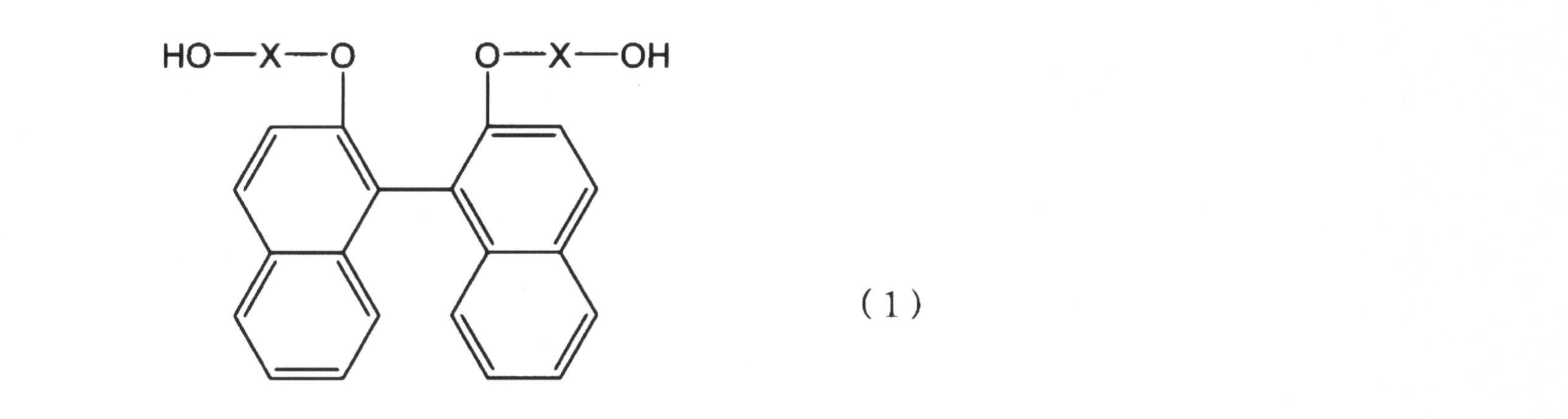
- a method for producing a thermoplastic resin by reacting a reactant containing a dihydroxy compound includes a dihydroxy compound represented by the following formula (1):
- the total weight of the compound represented by the following formula (A), the compound represented by the following formula (B), and the compound represented by the following formula (C) in the dihydroxy compound is represented by the above formula (1).
- the manufacturing method which is 1500 ppm or less with respect to 100 weight part of a dihydroxy compound. (In the formula, each X is independently an alkylene group having 1 to 4 carbon atoms.)
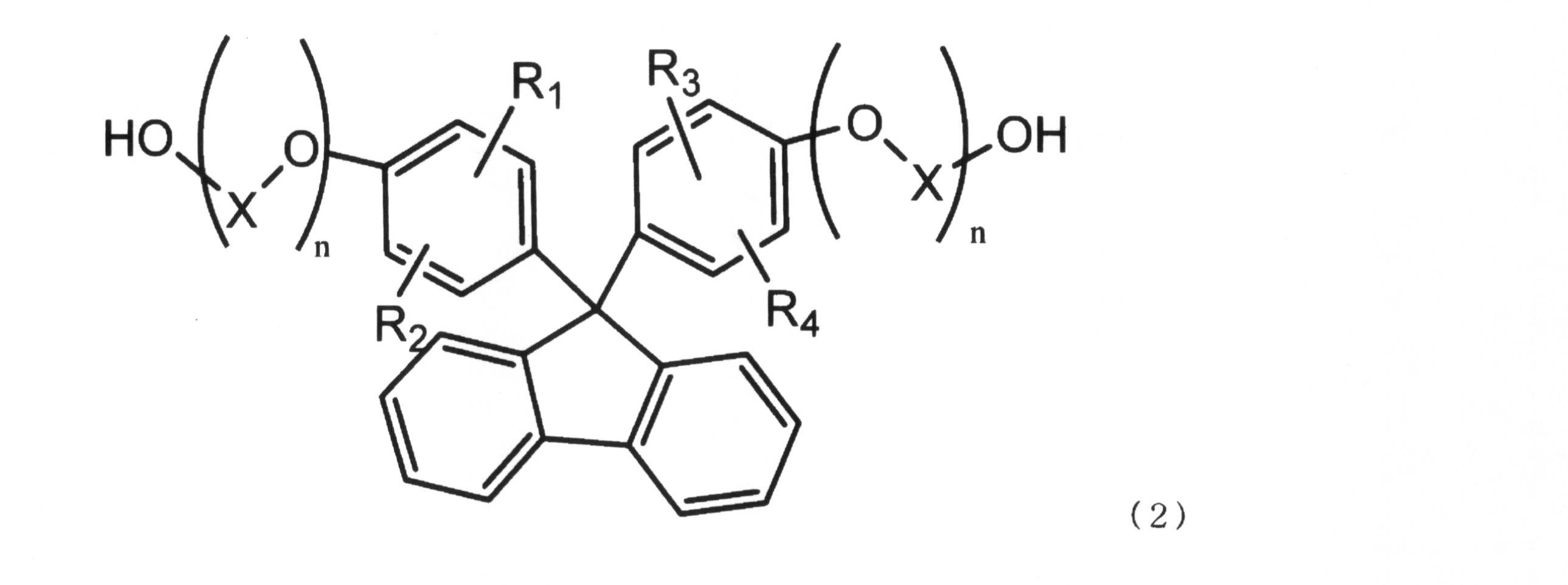
- the production method according to [1], wherein the dihydroxy compound further contains a compound represented by the following formula (2).
- R 1 to R 4 each independently represents a hydrogen atom, an alkyl group having 1 to 20 carbon atoms, an alkoxyl group having 1 to 20 carbon atoms, a cycloalkyl group having 5 to 20 carbon atoms, or 5 to 20 carbon atoms) Selected from the group consisting of a cycloalkoxyl group, an aryl group having 6 to 20 carbon atoms, an aryloxy group having 6 to 20 carbon atoms and a halogen atom;
- Each X is independently an alkylene group having 2 to 8 carbon atoms;
- n is each independently an integer of 1 to 5.
- thermoplastic resin is selected from the group consisting of a polycarbonate resin, a polyester resin, and a polyester carbonate resin.
- thermoplastic resin is a polycarbonate resin.
- the reactionant further contains a carbonic acid diester.
- thermoplastic resin has a saturated water absorption of 0.39% by weight or less.
- a method for producing an optical lens comprising using the thermoplastic resin obtained by the production method according to any one of [1] to [11].
- a method for producing an optical film comprising using the thermoplastic resin obtained by the production method according to any one of [1] to [11].
- thermoplastic resin having a low saturated water absorption rate and hardly undergoing dimensional changes during molding can be obtained.
- One aspect of the present invention is a method for producing a thermoplastic resin by reacting a reactant containing a dihydroxy compound, wherein the dihydroxy compound includes a dihydroxy compound represented by the following formula (1), and the dihydroxy compound:
- the total weight of the compound represented by the following formula (A), the compound represented by the following formula (B), and the compound represented by the following formula (C) is a dihydroxy compound represented by the above formula (1) It is related with the manufacturing method which is 1500 ppm or less with respect to 100 weight part.
- the dihydroxy compound represented by the formula (1) contains a plurality of by-product compounds having a dinaphthol structure as impurities by-produced during the synthesis process.
- the present inventors have found that the presence of the compound represented by the formula (A), the compound represented by the formula (B), and / or the compound represented by the formula (C) is represented by the formula ( It has been found that this is a cause of an increase in the saturated water absorption of the thermoplastic resin obtained by polymerizing the dihydroxy compound represented by 1) and a decrease in the rate of the polymerization reaction. And it discovered that the speed
- One of the advantages of low saturated water absorption is that the dimensional change of the resin hardly occurs during molding.
- Another advantage of the low saturated water absorption is that the drying at the time of molding can be performed in a short time, whereby the coloring of the resin can be suppressed.
- the speed of the polymerization reaction can be improved.
- the advantage of improving the polymerization reaction rate is that a high molecular weight thermoplastic resin can be obtained in a short time.
- Thermoplastic resins with various molecular weights are required according to the diversifying needs of optical materials, but in general, when polymerizing for a long time in order to obtain a high molecular weight resin, the resin tends to be colored. It is difficult to obtain a thermoplastic resin with little coloring.
- the production method of the present invention can increase the molecular weight in a short time, and is advantageous for producing a thermoplastic resin as an optical material.
- the production method of the present invention includes a compound represented by the formula (A), a compound represented by the formula (B), and a compound represented by the formula (C) contained in a dihydroxy compound that is a raw material of a thermoplastic resin.
- the total weight is 1500 ppm or less with respect to 100 parts by weight of the dihydroxy compound represented by the formula (1). When the total weight is 1500 ppm or less, a decrease in the saturated water absorption rate of the thermoplastic resin and / or the effect of the polymerization reaction rate can be obtained.
- the total weight of the compound represented by formula (A), the compound represented by formula (B), and the compound represented by formula (C) is preferably 1000 ppm or less, more preferably 500 ppm or less.
- the lower limit of the total weight of the compound represented by the formula (A), the compound represented by the formula (B), and the compound represented by the formula (C) is preferably as low as possible. That's fine.
- the dihydroxy compound represented by the formula (1) usually contains any compound of the formula (A), (B), and / or (C) by-produced during the synthesis process, and the total content thereof. Setting the content to less than 1 ppm has a large load on the purification technology. Moreover, even if it is less than 1 ppm, there is no significant difference in physical properties as compared with the case where it is 1 ppm.
- the total weight of the compound represented by formula (A) and the compound represented by formula (B) in the dihydroxy compound is 100 parts by weight of the dihydroxy compound represented by formula (1). , 1000 ppm or less (more preferably 500 ppm or less, still more preferably 300 ppm or less). Since the compound of the formula (A) and the compound of the formula (B) have an ethylene oxide chain and a phenolic hydroxyl group, they have high polarity and tend to improve hydrophilicity. Therefore, by reducing the content of the compound of formula (A) and the compound of formula (B), the saturated water absorption of the resulting thermoplastic resin can be further reduced.
- the weight of the compound represented by formula (A) in the dihydroxy compound is based on 100 parts by weight of the dihydroxy compound represented by formula (1) from the viewpoint of reducing the saturated water absorption rate of the thermoplastic resin and improving the polymerization rate.
- it is preferably 300 ppm or less, more preferably 250 ppm or less.
- a minimum in particular is not restrict
- the weight of the compound represented by formula (B) in the dihydroxy compound is based on 100 parts by weight of the dihydroxy compound represented by formula (1) from the viewpoint of reducing the saturated water absorption rate of the thermoplastic resin and improving the polymerization rate.
- it is preferably 500 ppm or less, more preferably 300 ppm or less, further preferably 100 ppm or less, particularly preferably 50 ppm or less, and most preferably 25 ppm or less.
- the lower limit is not particularly limited and is, for example, 0 ppm.
- the weight of the compound represented by the formula (C) in the dihydroxy compound is based on 100 parts by weight of the dihydroxy compound represented by the formula (1) from the viewpoint of reducing the saturated water absorption rate of the thermoplastic resin and improving the polymerization rate. Thus, it is preferably 100 ppm or less, more preferably 50 ppm or less.
- the lower limit is not particularly limited and is, for example, 0 ppm.
- the amount of the compound represented by the formula (A), the compound represented by the formula (B), and the compound represented by the formula (C) contained in the dihydroxy compound is determined using high performance liquid chromatography (HPLC). Can be measured.
- HPLC high performance liquid chromatography
- An example of HPLC measurement conditions is as follows.
- LC measuring device LC-2010A manufactured by Shimadzu Corporation
- Mobile phase solvent pure water / acetonitrile (acetonitrile 20% ⁇ 95%)
- Flow rate 1.0mL / min
- Detection method UV (detection wavelength: 254 nm)
- Sensitivity 2.5 AU / V (AUXRNG6)
- the purity of the dihydroxy compound represented by the formula (1) is 99% or more.
- the compound represented by formula (A), the compound represented by formula (B), and the compound represented by formula (C) in the dihydroxy compound are reduced, and the saturated water absorption rate of the thermoplastic resin is reduced. From the viewpoints of reducing the amount of polymerization and improving the polymerization rate.
- the method for reducing the compound represented by the formula (A), the compound represented by the formula (B), and the compound represented by the formula (C) is not particularly limited.
- a method for purifying the dihydroxy compound represented by the formula (1) after synthesis for example, washing, filtration, etc.
- a synthesis condition for the dihydroxy compound represented by the formula (1) for example, reaction temperature, reaction time
- Reaction solvent species, solvent amount, and the like can be mentioned.
- the manufacturing method of the thermoplastic resin which concerns on one Embodiment includes the process of refine
- the purification method is not particularly limited, and examples thereof include filtration treatment and / or washing treatment with a washing solvent.
- the method for the filtration treatment is not particularly limited, but the filter mesh is preferably 7 ⁇ m or less, more preferably 5 ⁇ m or less.
- the washing solvent is not particularly limited, and examples thereof include aromatic hydrocarbon solvents such as benzene, ethylbenzene, xylene, and ethyltoluene, aliphatic hydrocarbons such as pentane, hexane, and heptane, and water.
- xylene and toluene are preferable. According to this method, the content of at least one of the compound represented by formula (A), the compound represented by formula (B), and the compound represented by formula (C) contained in the dihydroxy compound is significantly increased. Can be reduced.
- a method for producing a thermoplastic resin is a step of reacting 1,1′-bi-2-naphthol and alkylene carbonate to obtain a dihydroxy compound of the formula (1), wherein the reaction comprises:
- the method further includes a step performed at a temperature of 110 ° C. or higher (preferably 110 ° C. to 120 ° C., more preferably 110 ° C. to 115 ° C.).
- the content of at least one of the compound represented by formula (A), the compound represented by formula (B), and the compound represented by formula (C) contained in the dihydroxy compound is significantly increased. Can be reduced.
- the reaction time is preferably 11 hours or less, more preferably 9 to 11 hours, still more preferably 9 to 10 hours.
- the preferred reaction time can vary depending on the reaction scale.
- the reaction time refers to the time from when the desired reaction temperature (for example, 110 ° C.) is reached until the alkaline aqueous solution is added.
- thermoplastic resin obtained by the production method of the present invention will be described.
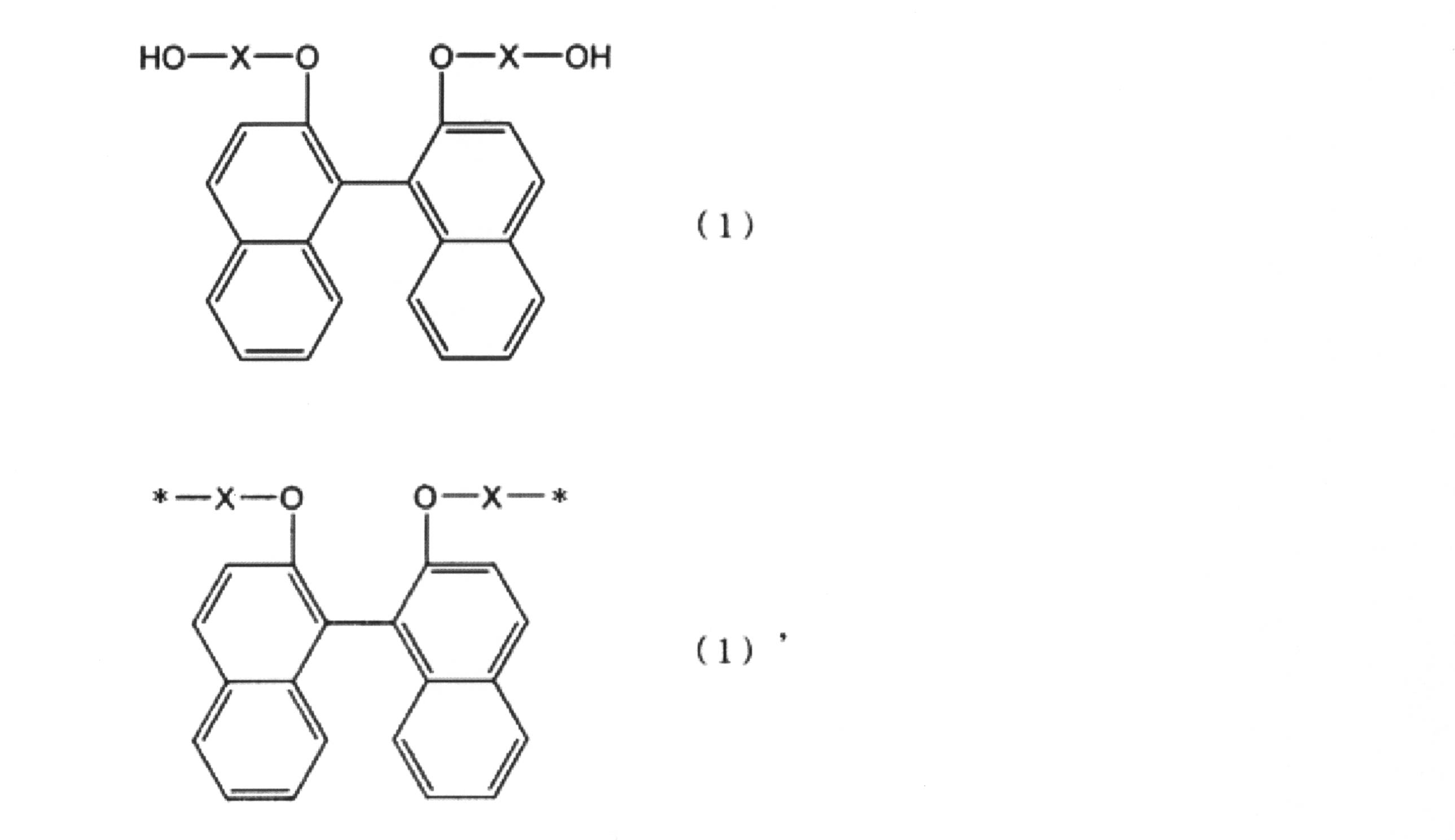
- thermoplastic resin obtained by the production method of the embodiment of the present invention is produced by reacting a reaction product containing a dihydroxy compound represented by the formula (1), and is derived from the dihydroxy compound represented by the formula (1).
- the structural unit (1) ′ to be included is included.
- the resin using the compound of the above formula (1) as a raw material exhibits physical properties such as a high refractive index, a low Abbe number, a high transparency, a glass transition temperature suitable for injection molding, a low birefringence, and the like.
- an optical component such as an excellent optical lens substantially free from optical distortion can be obtained.
- thermoplastic resin a polyester resin, a polyester carbonate resin, or a polycarbonate resin is preferable. Especially, since it is excellent in heat resistance and hydrolysis resistance, it is preferable to contain polycarbonate resin.
- a thermoplastic resin may be included singly or in combination of two or more.
- Optical characteristics such as refractive index, Abbe number, and birefringence value are greatly affected by the chemical structure of the structural units, and the influence of whether the chemical bond between the structural units is an ester bond or a carbonate bond is relatively small.
- the influence of impurities is also greatly affected by the chemical structure of the constituent units constituting the resin, and is due to differences in chemical bonds (ester bonds, carbonate bonds) between the constituent units. The impact is relatively small.
- the thermoplastic resin according to the embodiment of the present invention is produced by reacting a reactant containing a dihydroxy compound.
- a reactant containing a dihydroxy compound For example, it is produced by polycondensation using a dihydroxy compound containing a dihydroxy compound represented by the formula (1) as a raw material.
- the functional group contributing to polycondensation is an alcoholic hydroxyl group.
- the structural unit derived from the compound represented by the formula (1) is subjected to a polycondensation reaction with the compound represented by the formula (1) and a carbonic acid diester and / or a dicarboxylic acid or a derivative thereof. Joined through a bond.
- a thermoplastic resin containing the structural unit (1) ′ derived from the dihydroxy compound represented by the formula (1) can be obtained.
- each X is independently an alkylene group having 1 to 4 carbon atoms.
- Preferred examples of the alkylene group having 1 to 4 carbon atoms include methylene group, ethylene group, propylene group, isopropylene group, n-butylene group, isobutylene group, sec-butylene group, and tert-butylene group.
- X is preferably an ethylene group because the melt fluidity of the resin during molding becomes good.
- Examples of the dihydroxy compound represented by the formula (1) include 2,2′-bis (1-hydroxymethoxy) -1,1′-binaphthalene, 2,2′-bis (2-hydroxyethoxy) -1,1.
- Examples include '-binaphthalene, 2,2'-bis (3-hydroxypropyloxy) -1,1'-binaphthalene, 2,2'-bis (4-hydroxybutoxy) -1,1'-binaphthalene, and the like. Of these, 2,2'-bis (2-hydroxyethoxy) -1,1'-binaphthalene is preferable. These may be used alone or in combination of two or more.
- the proportion of the dihydroxy compound of the formula (1) is preferably 1 to 100 mol%, more preferably 30 to 100 mol%, based on 100 mol% of the dihydroxy compound used as a raw material for the thermoplastic resin, Preferably, it is 40 to 100 mol%.
- the proportion of the dihydroxy compound of the formula (1) is preferably 1 to 100 mol%, more preferably 30 to 100 mol% with respect to 100 mol% of all monomers used as a raw material for the thermoplastic resin. More preferably, it is 40 to 100 mol%.
- the dihydroxy compound may include at least one of a compound represented by Formula (A), a compound represented by Formula (B), and a compound represented by Formula (C).
- these compounds are contained, they are usually subjected to a polycondensation reaction with the dihydroxy compound of the formula (1), and in the thermoplastic resin, the structural unit (A) ′ derived from the compound represented by the formula (A), The structural unit (B) ′ derived from the compound represented by the formula (B) and / or the structural unit (C) ′ derived from the compound represented by the formula (C) may be incorporated.
- * represents a binding moiety.
- the dihydroxy component in addition to the compound represented by the formula (1), other dihydroxy compounds can be used in combination.
- the dihydroxy compound further includes a dihydroxy compound represented by the formula (2) in addition to the dihydroxy compound represented by the formula (1).
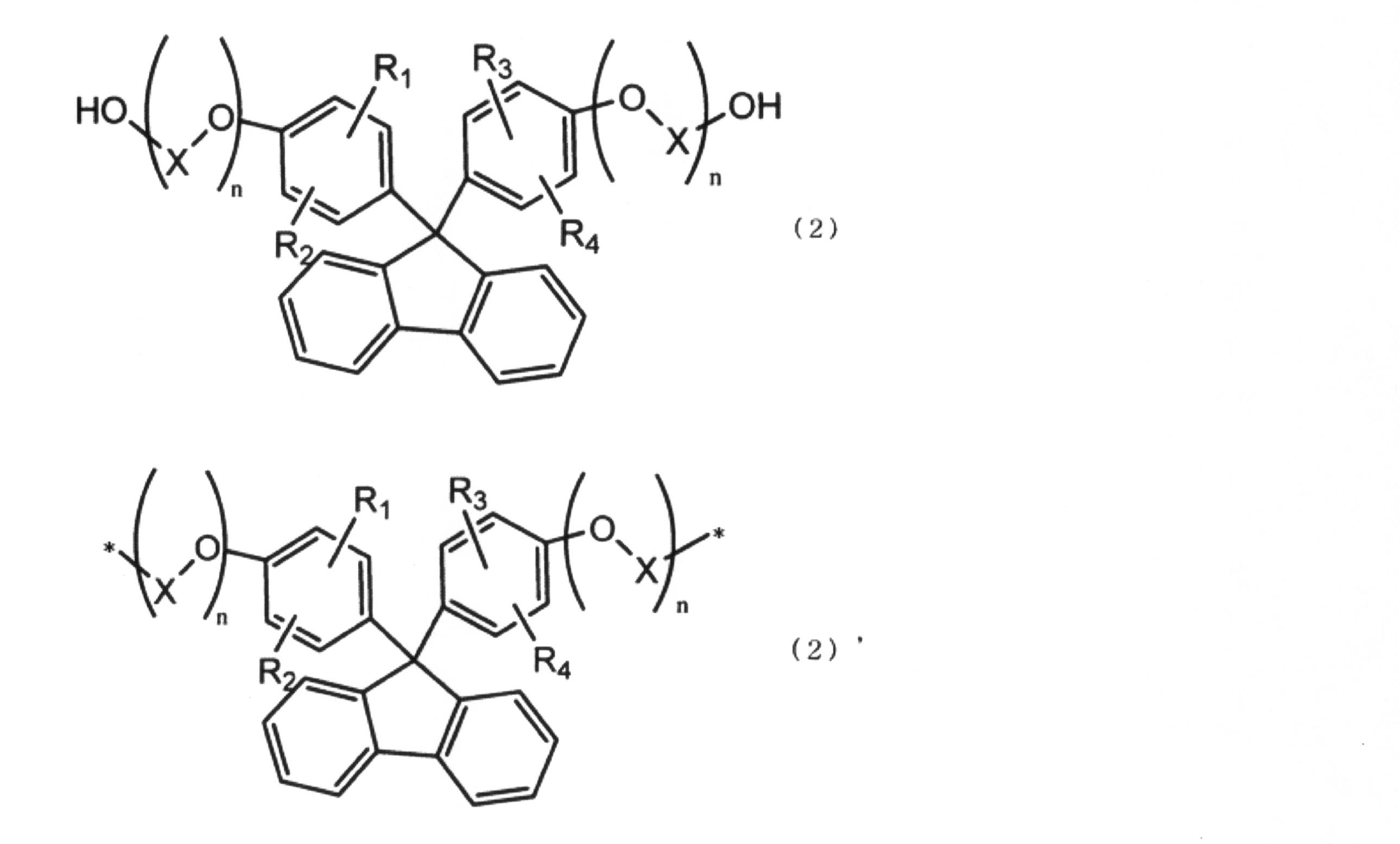
- the thermoplastic resin obtained by using such a dihydroxy compound as a raw material is represented by the formula (2) in addition to the structural unit (1) ′ derived from the dihydroxy compound represented by the formula (1).
- the structural unit (2) ′ derived from a dihydroxy compound is further included.
- the functional group contributing to polycondensation is an alcoholic hydroxyl group or a phenolic hydroxyl group.
- the resulting thermoplastic resin has a structural unit (2) ′ derived from the compound represented by the formula (2).
- the structural unit (2) ′ derived from the compound represented by the formula (2) contributes to a high refractive index.
- R 1 to R 4 each independently represent a hydrogen atom, an alkyl group having 1 to 20 carbon atoms, an alkoxyl group having 1 to 20 carbon atoms, a cycloalkyl group having 5 to 20 carbon atoms, or a carbon number It represents a 5 to 20 cycloalkoxyl group, an aryl group having 6 to 20 carbon atoms, an aryloxy group having 6 to 20 carbon atoms and a halogen atom (F, Cl, Br, I).
- a compound in which R 1 to R 4 are hydrogen atoms is preferable because the melt fluidity when molding as an optical lens is improved.
- R 1 to R 2 are hydrogen atoms and R 3 to R 4 is an aryl group having 6 to 20 carbon atoms (preferably a phenyl group) is preferable because the optical properties of the thermoplastic resin are improved.
- each X independently represents an alkylene group having 2 to 8 carbon atoms.
- X is preferably an alkylene group having 2 or more carbon atoms, since the larger the number of carbons, the lower the melt viscosity and the toughness and moldability are improved.
- an alkylene group having 3 or less carbon atoms is preferred from the viewpoint of heat resistance. From the viewpoint of achieving both excellent moldability and heat resistance, it is more preferable that the number of carbon atoms is 2 to 3, and in particular, X is a compound having 2 carbon atoms from the viewpoint of excellent refractive index and monomer production and distribution. An ethylene group is preferred.
- each n is an integer of 1 to 5 independently.
- n is preferably 1 from the viewpoint of excellent thermal stability and availability.
- Examples of the compound represented by the formula (2) include 9,9-bis (4- (2-hydroxyethoxy) phenyl) fluorene, 9,9-bis (4- (2-hydroxyethoxy) -3-methylphenyl ) Fluorene, 9,9-bis (4- (2-hydroxyethoxy) -3,5-dimethylphenyl) fluorene, 9,9-bis (4- (2-hydroxyethoxy) -3-tert-butylphenyl) fluorene 9,9-bis (4- (2-hydroxyethoxy) -3-isopropylphenyl) fluorene, 9,9-bis (4- (2-hydroxyethoxy) -3-cyclohexylphenyl) fluorene, 9,9-bis (4- (2-hydroxyethoxy) -3-phenylphenyl) fluorene and the like.
- 9,9-bis (4- (2-hydroxyethoxy) -3-phenylphenyl) fluorene and 9,9-bis (4- (2-hydroxyethoxy) phenyl) fluorene are preferred, and 9,9-bis (4- (2-hydroxyethoxy) phenyl) fluorene is more preferred. These may be used alone or in combination of two or more.
- the total amount of the dihydroxy compound of the formula (1) and the dihydroxy compound of the formula (2) is preferably 50 mol% or more, more preferably 80 mol% or more with respect to 100 mol% of the dihydroxy compound used as a raw material for the thermoplastic resin. Is preferable, 90 mol% or more is particularly preferable, and 100 mol% is most preferable.
- the molar ratio of the dihydroxy compound of the formula (1) and the dihydroxy compound of the formula (2) (the structural unit (1) ′ and the structural unit (2) ′) is preferably 20/80 to 80/20, more preferably 30/70 to 80 / 20 is more preferable, and from the viewpoint of reducing saturated water absorption, 30/70 to 50/50 is more preferable, and 40/60 to 50/50 is particularly preferable.
- the dihydroxy compound may contain a structural unit derived from a dihydroxy compound other than the compounds of the above formulas (1) to (2).
- Other dihydroxy compounds include tricyclodecane [5.2.1.0 2,6 ] dimethanol, pentacyclopentadecanedimethanol, cyclohexane-1,2-dimethanol, cyclohexane-1,4-dimethanol, cyclohexane -1,3-dimethanol, decalin-2,6-dimethanol, decalin-2,3-dimethanol, decalin-1,5-dimethanol, 2,3-norbornane dimethanol, 2,5-norbornane dimethanol Alicyclic dihydroxy compounds such as 1,3-adamantane dimethanol; ethylene glycol, 1,3-propanediol, 1,2-propanediol, 1,4-butanediol, 1,3-butanediol, 1,2 -Butanediol, 1,5-pentaned
- dihydroxy compounds are preferably added in an amount of 20 mol% or less, more preferably 10 mol% or less, relative to 100 mol% of the compound of formula (1). Within this range, a high refractive index is maintained.
- the thermoplastic resin is derived from a resin (first embodiment) composed of the structural unit (1) ′ derived from the dihydroxy compound of the formula (1) or the dihydroxy compound of the formula (1). It is preferable that it is resin (2nd aspect) which consists of structural unit (1) 'and the structural unit (2)' which originates in the dihydroxy compound of Formula (2).
- the thermoplastic resin (polycarbonate resin, polyester resin, polyester carbonate resin) of the first aspect and the second aspect may be used as a mixture, or may be used as a mixture with other resins.
- the “resin comprising the structural unit (1) ′ and / or the structural unit (2) ′” means that the repeating unit excluding the carbonate bond portion and the ester bond portion in the resin is the structural unit (1) ′ and / or the structural unit. (2) means that it consists of '.
- the polycarbonate binding moiety is derived from a carbonate precursor such as phosgene or carbonic acid diester.
- the preferred weight average molecular weight of the thermoplastic resin is 10,000 to 100,000.
- the weight average molecular weight (Mw) of a thermoplastic resin means the polystyrene conversion weight average molecular weight, and is measured by the method as described in the Example mentioned later. If Mw is 10,000 or more, the brittle fall of a molded object is prevented. If Mw is 100,000 or less, the melt viscosity does not become too high, the resin can be easily taken out from the mold at the time of molding, and the fluidity is good, and the precision of the optical lens in the molten state is improved. It is suitable for the required injection molding. More preferably, the weight average molecular weight (Mw) is 35,000 to 70,000, and more preferably 40,000 to 65,000 from the viewpoint of preventing resin coloring and maintaining the strength of the molded body.
- the preferred glass transition temperature (Tg) is 95 to 180 ° C, more preferably 110 to 170 ° C, still more preferably 115 to 160 ° C, and particularly preferably 125. ⁇ 145 ° C.
- Tg is lower than 95 ° C.
- the melting temperature of the resin becomes high and the resin is likely to be decomposed or colored, which is not preferable.
- the glass transition temperature of resin is too high, in a general-purpose mold temperature controller, the difference between the mold temperature and the resin glass transition temperature becomes large. Therefore, in applications where strict surface accuracy is required for products, it is difficult and undesirable to use a resin having a glass transition temperature that is too high.
- the thermoplastic resin preferably has a 5% weight loss temperature (Td) of 350 ° C. or higher measured at a temperature rising rate of 10 ° C./min as an index of thermal stability to withstand heating during injection molding.
- Td 5% weight loss temperature
- the thermal decomposition during the molding is severe and it becomes difficult to obtain a good molded product, which is not preferable.
- the thermoplastic resin may have any structure of random, block and alternating copolymer.
- thermoplastic resin phenol produced during production and carbonic diester remaining without reacting exist as impurities.
- the phenol content in the thermoplastic resin is preferably 0.1 to 3000 ppm, more preferably 0.1 to 2000 ppm, 1 to 1000 ppm, 1 to 800 ppm, 1 to 500 ppm, or 1 to 300 ppm. It is particularly preferred.
- the content of carbonic acid diester in the polycarbonate resin or polyester carbonate resin is preferably 0.1 to 1000 ppm, more preferably 0.1 to 500 ppm, and particularly preferably 1 to 100 ppm.
- the thermoplastic resin according to the embodiment is desired to have as little foreign matter content as possible, and it is preferable to perform filtration of the molten raw material, filtration of the catalyst solution, and filtration of the molten oligomer.
- the filter mesh is preferably 7 ⁇ m or less, more preferably 5 ⁇ m or less.
- the mesh of the polymer filter is preferably 100 ⁇ m or less, more preferably 30 ⁇ m or less.
- the step of collecting the resin pellets must be a low dust environment, and is preferably class 6 or less, more preferably class 5 or less.
- An antioxidant, a release agent, an ultraviolet absorber, a fluidity modifier, a crystal nucleating agent, a reinforcing agent, a dye, an antistatic agent or an antibacterial agent may be added to the thermoplastic resin of the present invention.
- thermoplastic resin a polycarbonate resin
- polyester resin and the polyester carbonate resin can also be carried out with reference to the following description (polycarbonate resin) and / or using a known method.
- the polycarbonate resin according to the embodiment is a polycarbonate resin including the structural unit (1) ′ derived from the compound represented by the above formula (1) and the other structural units described above as necessary.
- the polycarbonate resin is produced by reacting a dihydroxy compound with a carbonate precursor such as a carbonic acid diester.
- a carbonate precursor such as a carbonic acid diester.
- each structural unit is bonded through a carbonate bond.
- the reactant further comprises a carbonic acid diester in addition to the dihydroxy compound.
- a dihydroxy compound containing a compound represented by the above formula (1) and a carbonate precursor such as a carbonic acid diester are reacted by a melt polycondensation method in the presence or absence of a transesterification catalyst. Can be manufactured.
- Examples of the carbonic acid diester include diphenyl carbonate, ditolyl carbonate, bis (chlorophenyl) carbonate, m-cresyl carbonate, dimethyl carbonate, diethyl carbonate, dibutyl carbonate, and dicyclohexyl carbonate. Of these, diphenyl carbonate is particularly preferred.
- the diphenyl carbonate is preferably used in a ratio of 0.97 to 1.20 mol, more preferably 0.98 to 1.10 mol, relative to a total of 1 mol of the dihydroxy compound.
- An example of the production method is a method in which a dihydroxy compound component is heated and stirred with a carbonic acid diester and melted in an inert gas atmosphere, and then polymerized while distilling off the alcohol or phenols produced.
- the reaction temperature varies depending on the boiling point of the alcohol or phenol produced, but is usually in the range of 120 to 350 ° C.
- the reaction is decompressed from the beginning, and the reaction is completed while distilling off the produced alcohol or phenol.
- a transesterification catalyst can also be used to accelerate the reaction.
- a dihydroxy compound containing a compound represented by the formula (1) and a carbonic acid diester are melted in a reaction vessel, and then reacted while distilling off a by-product monohydroxy compound.
- the reaction time is 200 minutes to 500 minutes, preferably 250 minutes to 450 minutes, particularly preferably 300 minutes to 40 minutes.
- the preferred reaction time can vary depending on the reaction scale.
- the reaction time refers to the time from when the raw material is dissolved (that is, when stirring is possible) to when nitrogen is introduced into the reactor after reaching (for example, 180 ° C.).
- the reaction may be carried out continuously or batchwise.
- the reaction apparatus used for the reaction may be a vertical type equipped with paddle blades, lattice blades, glasses blades, etc. Or an extruder type equipped with a screw. Further, it is preferable to use a reaction apparatus in which these reaction apparatuses are appropriately combined in consideration of the viscosity of the polymer.
- a basic compound catalyst is used as the transesterification catalyst.
- examples thereof include alkali metal compounds, alkaline earth metal compounds, and nitrogen-containing compounds.
- alkali metal compound examples include organic acid salts, inorganic salts, oxides, hydroxides, hydrides, and alkoxides of alkali metals.
- alkaline earth metal compound examples include organic acid salts, inorganic salts, oxides, hydroxides, hydrides or alkoxides of alkaline earth metal compounds.
- magnesium hydroxide, calcium acetate, strontium acetate, barium acetate, magnesium stearate, calcium stearate, calcium benzoate, magnesium phenyl phosphate and the like are used.
- nitrogen-containing compound examples include quaternary ammonium hydroxide and salts thereof, amines and the like.
- quaternary ammonium hydroxides having an alkyl group, an aryl group, and the like such as tetramethylammonium hydroxide, tetraethylammonium hydroxide, tetrapropylammonium hydroxide, tetrabutylammonium hydroxide, and trimethylbenzylammonium hydroxide;
- Tertiary amines such as triethylamine, dimethylbenzylamine and triphenylamine; secondary amines such as diethylamine and dibutylamine; primary amines such as propylamine and butylamine; 2-methylimidazole, 2-phenylimidazole and benzimidazole Imidazoles such as ammonia, tetramethylammonium borohydride, tetrabutylammonium borohydride, te
- transesterification catalysts salts of zinc, tin, zirconium, lead, etc. may be used, and these can be used alone or in combination.
- specific examples of other transesterification catalysts include zinc acetate, zinc benzoate, zinc 2-ethylhexanoate, tin (II) chloride, tin (IV) chloride, tin (II) acetate, tin (IV) acetate, Examples include dibutyltin dilaurate, dibutyltin oxide, dibutyltin dimethoxide, zirconium acetylacetonate, zirconium oxyacetate, zirconium tetrabutoxide, lead (II) acetate, and lead (IV) acetate.
- transesterification catalysts are used in a ratio of 1 ⁇ 10 ⁇ 9 to ⁇ 10 ⁇ 3 mol, preferably 1 ⁇ 10 ⁇ 7 to 1 ⁇ 10 ⁇ 4 mol, relative to a total of 1 mol of the dihydroxy compound. It is done.
- catalysts Two or more types may be used in combination. Further, the catalyst itself may be added as it is, or it may be added after being dissolved in a solvent such as water or phenol.
- the melt polycondensation method is a method in which melt polycondensation is carried out using the above-mentioned raw materials and catalysts under heating and further under normal pressure or reduced pressure while removing by-products by transesterification.
- the catalyst may be present together with the raw materials from the beginning of the reaction, or may be added during the reaction.
- the catalyst may be removed or deactivated after the polymerization reaction to maintain thermal stability and hydrolysis stability, but it is not always necessary to deactivate.
- a method for deactivation of the catalyst by adding a known acidic substance can be preferably carried out.
- the acidic substance include esters such as butyl benzoate; aromatic sulfonic acids such as p-toluenesulfonic acid; aromatic sulfonic acid esters such as butyl p-toluenesulfonate and hexyl p-toluenesulfonate.
- Phosphoric acids such as phosphorous acid, phosphoric acid, phosphonic acid; triphenyl phosphite, monophenyl phosphite, diphenyl phosphite, diethyl phosphite, di-n-propyl phosphite, diphosphorous acid Phosphorous esters such as n-butyl, di-n-hexyl phosphite, dioctyl phosphite, monooctyl phosphite; triphenyl phosphate, diphenyl phosphate, monophenyl phosphate, dibutyl phosphate, phosphoric acid Phosphate esters such as dioctyl and monooctyl phosphate; Phosphonic acids such as diphenylphosphonic acid, dioctylphosphonic acid and dibutylphosphonic acid Phosphonates such as diethyl phenylphosphonate; pho
- p-toluene or butyl sulfonate is particularly preferable.
- These deactivators are used in an amount of 0.01 to 50 times mol, preferably 0.3 to 20 times mol for the amount of catalyst. When the amount is less than 0.01 times the amount of the catalyst, the deactivation effect is insufficient, which is not preferable. Moreover, when it is more than 50 times mole with respect to the amount of catalyst, since the heat resistance of resin falls and it becomes easy to color a molded object, it is unpreferable.
- the kneading of the deactivator may be performed immediately after the completion of the polymerization reaction, or may be performed after pelletizing the polymerized resin.
- other additives antioxidants, mold release agents, ultraviolet absorbers, fluidity modifiers, crystal nucleating agents, reinforcing agents, dyes, antistatic agents, antibacterial agents, etc. described later. Can also be added in a similar manner.
- the temperature during devolatilization is preferably 230 to 300 ° C, more preferably 250 to 270 ° C.
- a horizontal apparatus equipped with a stirring blade having excellent surface renewability, such as a paddle blade, a lattice blade, or a glasses blade, or a thin film evaporator is preferably used.
- thermoplastic resin an antioxidant, a processing stabilizer, a light stabilizer, a polymerized metal deactivator, a flame retardant, a lubricant, an antistatic agent, a surfactant, an antibacterial agent, as long as the characteristics of the present invention are not impaired.
- Additives such as mold release agents, ultraviolet absorbers, plasticizers and compatibilizers may be added.
- Antioxidants include triethylene glycol-bis [3- (3-tert-butyl-5-methyl-4-hydroxyphenyl) propionate], 1,6-hexanediol-bis [3- (3,5-di- -Tert-butyl-4-hydroxyphenyl) propionate], pentaerythritol-tetrakis [3- (3,5-di-tert-butyl-4-hydroxyphenyl) propionate], octadecyl-3- (3,5-di- tert-butyl-4-hydroxyphenyl) propionate, 1,3,5-trimethyl-2,4,6-tris (3,5-di-tert-butyl-4-hydroxybenzyl) benzene, N, N-hexamethylene Bis (3,5-di-tert-butyl-4-hydroxy-hydrocinnamide), 3,5-di-te t-butyl-4-hydroxy-benzylphosphonate-diethy
- processing stabilizers include phosphorus processing heat stabilizers and sulfur processing heat stabilizers.
- the phosphorus processing heat stabilizer include phosphorous acid, phosphoric acid, phosphonous acid, phosphonic acid, and esters thereof.
- triphenyl phosphite tris (nonylphenyl) phosphite, tris (2,4-di-tert-butylphenyl) phosphite, tris (2,6-di-tert-butylphenyl) phosphite, Tridecyl phosphite, trioctyl phosphite, trioctadecyl phosphite, didecyl monophenyl phosphite, dioctyl monophenyl phosphite, diisopropyl monophenyl phosphite, monobutyl diphenyl phosphite, monodecyl dipheny
- Sulfur-based processing heat stabilizers include pentaerythritol-tetrakis (3-laurylthiopropionate), pentaerythritol-tetrakis (3-myristylthiopropionate), pentaerythritol-tetrakis (3-stearylthiopropionate) Dilauryl-3,3′-thiodipropionate, dimyristyl-3,3′-thiodipropionate, distearyl-3,3′-thiodipropionate, and the like.
- the content of the sulfur-based processing heat stabilizer is preferably 0.001 to 0.2 parts by weight with respect to 100 parts by weight of the thermoplastic resin.
- esters of alcohol and fatty acid include esters of monohydric alcohol and fatty acid, partial esters or total esters of polyhydric alcohol and fatty acid.
- the ester of the monohydric alcohol and the fatty acid is preferably an ester of a monohydric alcohol having 1 to 20 carbon atoms and a saturated fatty acid having 10 to 30 carbon atoms.
- the partial ester or total ester of a polyhydric alcohol and a fatty acid is preferably a partial ester or total ester of a polyhydric alcohol having 1 to 25 carbon atoms and a saturated fatty acid having 10 to 30 carbon atoms.
- examples of the ester of a monohydric alcohol and a saturated fatty acid include stearyl stearate, palmityl palmitate, butyl stearate, methyl laurate, isopropyl palmitate and the like.
- Examples of partial esters or total esters of polyhydric alcohols and saturated fatty acids include stearic acid monoglyceride, stearic acid diglyceride, stearic acid triglyceride, stearic acid monosorbate, behenic acid monoglyceride, capric acid monoglyceride, lauric acid monoglyceride, pentaerythritol monostearate.
- Dipentaerythritol such as rate, pentaerythritol tetrastearate, pentaerythritol tetrapelargonate, propylene glycol monostearate, biphenyl biphenate, sorbitan monostearate, 2-ethylhexyl stearate, dipentaerythritol hexastearate And all esters or partial esters.
- stearic acid monoglyceride and lauric acid monoglyceride are particularly preferred.
- the content of these release agents is preferably in the range of 0.005 to 2.0 parts by weight, more preferably in the range of 0.01 to 0.6 parts by weight, with respect to 100 parts by weight of the thermoplastic resin. A range of ⁇ 0.5 parts by weight is more preferred.
- the ultraviolet absorber at least one ultraviolet ray selected from the group consisting of a benzotriazole ultraviolet absorber, a benzophenone ultraviolet absorber, a triazine ultraviolet absorber, a cyclic imino ester ultraviolet absorber, and a cyanoacrylate ultraviolet absorber.
- Absorbents are preferred. That is, any of the ultraviolet absorbers listed below may be used alone or in combination of two or more.
- benzotriazole ultraviolet absorber examples include 2- (2-hydroxy-5-methylphenyl) benzotriazole, 2- (2-hydroxy-5-tert-octylphenyl) benzotriazole, 2- (2-hydroxy- 3,5-dicumylphenyl) phenylbenzotriazole, 2- (2-hydroxy-3-tert-butyl-5-methylphenyl) -5-chlorobenzotriazole, 2,2′-methylenebis [4- (1,1 , 3,3-tetramethylbutyl) -6- (2N-benzotriazol-2-yl) phenol], 2- (2-hydroxy-3,5-di-tert-butylphenyl) benzotriazole, 2- ( 2-hydroxy-3,5-di-tert-butylphenyl) -5-chlorobenzotriazole, 2- (2-hydroxy -3,5-di-tert-amylphenyl) benzotriazole, 2- (2-hydroxy-5-tert-octyl
- benzophenone ultraviolet absorbers examples include 2,4-dihydroxybenzophenone, 2-hydroxy-4-methoxybenzophenone, 2-hydroxy-4-octoxybenzophenone, 2-hydroxy-4-benzyloxybenzophenone, 2-hydroxy-4- Methoxy-5-sulfoxybenzophenone, 2-hydroxy-4-methoxy-5-sulfoxytrihydridolate benzophenone, 2,2'-dihydroxy-4-methoxybenzophenone, 2,2 ', 4,4'-tetrahydroxybenzophenone 2,2'-dihydroxy-4,4'-dimethoxybenzophenone, 2,2'-dihydroxy-4,4'-dimethoxy-5-sodiumsulfoxybenzophenone, bis (5-benzoyl-4-hydroxy-2- Methoxyphenyl) Down, 2-hydroxy -4-n-dodecyloxy benzophenone, 2-hydroxy-4-methoxy-2'-carboxy benzophenone.
- triazine ultraviolet absorbers examples include 2- (4,6-diphenyl-1,3,5-triazin-2-yl) -5-[(hexyl) oxy] -phenol, 2- (4,6-bis ( 2,4-dimethylphenyl) -1,3,5-triazin-2-yl) -5-[(octyl) oxy] -phenol and the like.
- Cyclic imino ester UV absorbers include 2,2′-bis (3,1-benzoxazin-4-one), 2,2′-p-phenylenebis (3,1-benzoxazin-4-one) 2,2′-m-phenylenebis (3,1-benzoxazin-4-one), 2,2 ′-(4,4′-diphenylene) bis (3,1-benzoxazin-4-one), 2,2 '-(2,6-naphthalene) bis (3,1-benzoxazin-4-one), 2,2'-(1,5-naphthalene) bis (3,1-benzoxazin-4-one) ), 2,2 ′-(2-methyl-p-phenylene) bis (3,1-benzoxazin-4-one), 2,2 ′-(2-nitro-p-phenylene) bis (3,1- Benzoxazin-4-one) and 2,2 '-(2-chloro-p- Eniren) bis (3,1-benzoxazin-4-one
- Cyanoacrylate-based ultraviolet absorbers include 1,3-bis-[(2′-cyano-3 ′, 3′-diphenylacryloyl) oxy] -2,2-bis [(2-cyano-3,3-diphenyl). And acryloyl) oxy] methyl) propane and 1,3-bis-[(2-cyano-3,3-diphenylacryloyl) oxy] benzene.
- the content of the ultraviolet absorber is preferably 0.01 to 3.0 parts by weight, more preferably 0.02 to 1.0 parts by weight, and still more preferably 100 parts by weight of the thermoplastic resin. 0.05 to 0.8 part by weight. If it is the range of this compounding quantity, it is possible to provide sufficient weather resistance to a thermoplastic resin according to a use.
- thermoplastic resin of the present invention may be in the form of a resin composition containing a plurality of types of resins.
- the resin composition contains at least a thermoplastic resin containing 1 to 100% by weight of the repeating unit represented by the formula (1).
- Examples of other resins include the following: Polyethylene, polypropylene, polyvinyl chloride, polystyrene, (meth) acrylic resin, ABS resin, polyamide, polyacetal, polycarbonate (excluding constituent unit (1) '), polyphenylene ether, polyester (providing constituent unit (1)' ), Polyester carbonate (excluding the structural unit (1) ′), polyphenylene sulfide, polyimide, polyethersulfone, polyetheretherketone, fluororesin, cycloolefin polymer, ethylene / vinyl acetate copolymer Coalescence, epoxy resin, silicone resin, phenol resin, unsaturated polyester resin, polyurethane.
- the content of the other resin that may be contained is preferably 20 parts by mass or less, more preferably 10 parts by mass or less, with respect to the total mass of the thermoplastic resin including the structural unit derived from the dihydroxy compound of the above formula (1). . When there is too much content of other resin, compatibility will worsen and the transparency of a resin composition may fall.
- thermoplastic resin of the present invention (a molded product produced from a thermoplastic resin) has a saturated water absorption of 0.39% by weight or less, preferably 0.38% by weight or less.
- the saturated water absorption of the resin can be measured by the method described in the examples described later.
- thermoplastic resin of the present invention (molded product produced from a thermoplastic resin) has a YI of 19 or less, preferably 18 or less, more preferably 17 or less.
- the YI value of the resin can be measured by the method described in Examples described later.
- a molded body (for example, an optical element) can be produced using the thermoplastic resin of the present invention.
- it is molded by an arbitrary method such as an injection molding method, a compression molding method, an extrusion molding method, or a solution casting method.
- the optical element manufactured using the thermoplastic resin according to the embodiment is suitably used for lenses, prisms and the like.
- Molded articles produced by these methods are used for various glazing applications, automobile lamp lenses, lamp covers, optical lenses, OHP sheets, nameplates, indicator lamps, and the like.
- the film manufactured by this method is suitably used as a placel substrate or a retardation film for flat panel display substrate applications.
- the placel substrate is used unstretched, but in order to use it as a retardation film, it is stretched and oriented in at least a uniaxial direction so as to have an optimal birefringence characteristic to form a retardation film.
- An optical lens can be manufactured using the thermoplastic resin of the present invention.
- Optical lenses manufactured using the thermoplastic resin according to the embodiments have a high refractive index and excellent heat resistance, and thus, conventionally, expensive high refractive glass lenses such as telescopes, binoculars, and television projectors have been used. It can be used in various fields and is extremely useful. If necessary, it is preferably used in the form of an aspheric lens. Since an aspherical lens can substantially eliminate spherical aberration with a single lens, there is no need to remove spherical aberration by combining a plurality of spherical lenses, which reduces weight and reduces production costs. It becomes possible. Therefore, the aspherical lens is particularly useful as a camera lens among optical lenses.
- the optical lens is molded by an arbitrary method such as an injection molding method, a compression molding method, or an injection compression molding method.
- an injection molding method such as an injection molding method, a compression molding method, or an injection compression molding method.
- the optical lens of the present invention When the optical lens of the present invention is manufactured by injection molding, it is preferable to mold it under conditions of a cylinder temperature of 230 to 270 ° C. and a mold temperature of 100 to 140 ° C. With these molding conditions, it has excellent physical properties as an optical lens, and also has a function of cutting the wavelength in the ultraviolet region. The effect can be prevented. On the contrary, when the resin composition of the present invention is used as an ultraviolet filter, it is very transparent, so that a clear photograph can be taken without deteriorating the image quality of the photograph taken.
- the resin of the embodiment since it has high fluidity, it can be an optical lens having a thin and small size and a complicated shape.
- the thickness of the central portion is 0.05 to 3.0 mm, more preferably 0.05 to 2.0 mm, and still more preferably 0.1 to 2.0 mm.
- the diameter is 1.0 mm to 20.0 mm, more preferably 1.0 to 10.0 mm, and still more preferably 3.0 to 10.0 mm.
- the surface of the optical lens of the present invention may be provided with a coating layer such as an antireflection layer or a hard coating layer as necessary.
- the antireflection layer may be a single layer or a multilayer, and may be organic or inorganic, but is preferably inorganic. Specific examples include oxides or fluorides such as silicon oxide, aluminum oxide, zirconium oxide, titanium oxide, cerium oxide, magnesium oxide, and magnesium fluoride.
- the optical lens of the present invention may be molded by any method such as mold molding, cutting, polishing, laser processing, electric discharge machining, and edging. Furthermore, mold molding is more preferable.
- the molding environment In order to avoid the contamination of foreign matter into the optical lens as much as possible, the molding environment must naturally be a low dust environment, preferably class 6 or less, more preferably class 5 or less.
- thermoplastic resin of the present invention An optical film can be produced using the thermoplastic resin of the present invention. Since the optical film manufactured using the thermoplastic resin according to the embodiment is excellent in transparency and heat resistance, it is suitably used for a film for a liquid crystal substrate, an optical memory card, and the like.
- sheet is generally a thin product whose thickness is small and flat instead of length and width, and “film” is extremely small compared to the length and width, and has a maximum thickness.
- sheet and film are not clearly distinguished, and both are used as the same meaning.
- the film formed from the thermoplastic resin of the present invention has good heat resistance and hue.
- the resin composition is dissolved in an organic solvent such as methylene chloride, tetrahydrofuran, dioxane, etc., and a casting film is formed.
- a gas barrier film and a solvent-resistant film are attached to both sides of the film, and it is suitably used as a film for liquid crystal displays such as a film for a liquid crystal substrate (a plastic substrate) or a retardation film together with a transparent conductive film and a polarizing plate. It can be advantageously used for tablets, smartphones, handy terminals, various display elements, and the like.
- % is an area percentage value corrected excluding the solvent in HPLC.
- Saturated water absorption was measured according to JIS-K-7209 using a disk (diameter 40 mm, thickness 3 mm) obtained by press-molding the obtained polycarbonate resin.
- YI The pellet was filled in a quartz glass cell, and measured by a reflection measurement method according to JIS K 7373: 2006 using a differential meter (SE-2000 manufactured by Nippon Denshoku).
- Table 1 shows the analysis results of the dihydroxy compounds obtained in Synthesis Examples 1 to 3.
- BHEBN-1 obtained in Synthesis Example 1; 19.787 g (0.053 mol), 9,9-bis (4- (2-hydroxyethoxy) -3-phenylphenyl) fluorene (hereinafter abbreviated as “BPPEF”) 39.756 g (0.067 mol), DPC; 26.078 g (0.122 mol), and sodium hydrogen carbonate as catalyst; 6 ⁇ mol / mol (sodium hydrogen carbonate of BHEBN-1 and BPPEF This was added in the form of a 0.1 wt% aqueous solution in the number of moles relative to the total) and placed in a glass reaction vessel equipped with a stirrer and a distillation apparatus and heated to 180 ° C.
- BPPEF 9,9-bis (4- (2-hydroxyethoxy) -3-phenylphenyl) fluorene
- Example 3 The reaction was performed in the same manner as in Example 1 except that BHEBN-2 obtained in Synthesis Example 2 was used. Table 2 shows the evaluation of the obtained resin.
- Example 4 The reaction was conducted in the same manner as in Example 2 except that BHEBN-2 obtained in Synthesis Example 2 was used. Table 2 shows the evaluation of the obtained resin.
- Example 5 As raw materials, BHEBN-1 obtained in Synthesis Example 1; 14.450 g (0.039 mol), 9,9-bis (4- (2-hydroxyethoxy) phenyl) fluorene (BPEF); 40.000 g (0 091 mol), diphenyl carbonate (DPC); 28.521 g (0.133 mol) and sodium bicarbonate as catalyst; 6 ⁇ mol / mol (sodium bicarbonate in moles relative to the sum of BHEBN-1 and BPEF) The reaction was conducted in the same manner as in Example 1 except that 0.1 wt% aqueous solution was added. Table 2 shows the evaluation of the obtained resin.
- Example 6 As raw materials, BHEBN-1 obtained in Synthesis Example 1; 23.000 g (0.061 mol), BPEF; 18.000 g (0.041 mol), DPC; 22.500 g (0.105 mol) and as a catalyst Example 1 with the exception of using sodium hydrogen carbonate; 6 ⁇ mol / mol (sodium hydrogen carbonate is the number of moles relative to the sum of BHEBN-1 and BPEF and added in the form of a 0.1 wt% aqueous solution). It reacted in the same way. Table 2 shows the evaluation of the obtained resin.
- Example 7 As raw materials, BHEBN-1 obtained in Synthesis Example 1; 12.000 g (0.032 mol), 9,9-bis (4- (2-hydroxyethoxy) -3-phenylphenyl) fluorene (BPPEF); 44 .000 g (0.074 mol), DPC; 23.400 g (0.109 mol) and sodium bicarbonate as catalyst; 6 ⁇ mol / mol (sodium bicarbonate in moles relative to the sum of BHEBN-1 and BPPEF) The reaction was carried out in the same manner as in Example 2 except that 0.1 wt% aqueous solution was added.
- Example 8> As raw materials, BHEBN-1 obtained in Synthesis Example 1; 20.000 g (0.053 mol), BPPEF; 21.000 g (0.036 mol), DPC; 19.600 g (0.091 mol) and as a catalyst Example 2 with the exception of using sodium bicarbonate; 6 ⁇ mol / mol (sodium bicarbonate is the number of moles relative to the sum of BHEBN-1 and BPPEF and added in the form of a 0.1 wt% aqueous solution). It reacted in the same way.
- BHEBN-1 obtained in Synthesis Example 1; 17.800 g (0.048 mol), 9,9-bis (4- (2-hydroxyethoxy) -3-phenylphenyl) fluorene (hereinafter abbreviated as “BPPEF”) 36.420 g (0.062 mol), DPC; 23.646 g (0.110 mol), and sodium hydrogen carbonate as catalyst; 6 ⁇ mol / mol (sodium hydrogen carbonate of BHEBN-1 and BPPEF) Is added in a 0.1 wt% aqueous solution state) to a glass reaction vessel equipped with a stirrer and a distiller, and heated at 180 ° C. under a nitrogen atmosphere of 760 Torr. did.
- BPPEF 9,9-bis (4- (2-hydroxyethoxy) -3-phenylphenyl) fluorene
- Table 2 shows the composition, Mw (weight average molecular weight), saturated water absorption, and YI of the resins obtained in the above Examples and Comparative Examples.
- BPEF 9,9-bis (4- (2-hydroxyethoxy) phenyl) fluorene
- BPPEF 9, 9-bis (4- (2-hydroxyethoxy) -3-phenylphenyl) fluorene
- BHEBN 2,2'-bis (2-hydroxyethoxy) -1,1′-binaphthalene
- BPA 2,2-bis (4-hydroxyphenyl) propane
- DPC diphenyl carbonate
- the saturated water absorption of the polycarbonate resins obtained in Examples 1 to 8 using raw materials with reduced content of the compounds of formulas (A) to (C) is as low as 0.35 to 0.39% by weight. Recognize. In particular, when the raw material (BHEBN-2) in which the content of the compounds of formulas (A) to (C) is significantly reduced is used (Examples 3 and 4), the saturated water absorption rate of the resin is significantly reduced. I understand that. On the other hand, it can be seen that the saturated water absorption of the polycarbonate resins obtained in Comparative Examples 1 to 4 having a large content of the compounds of the formulas (A) to (C) is as high as 0.40% by weight or more.
- Examples 1 to 8 using raw materials in which the content of the compounds of formulas (A) to (C) is reduced are obtained as compared with Comparative Examples 1 and 2 using a dihydroxy compound having the same structure. It was found that an increase in the molecular weight of the resin and an excellent hue (low YI value) were obtained.
- Refractive index A film having a thickness of 0.1 mm was measured by the method of JIS-K-7142 using an Abbe refractometer (23 ° C., wavelength 589 nm).
- ⁇ (nD-1) / (nF-nC) nD: Refractive index at a wavelength of 589 nm nC: Refractive index at a wavelength of 656 nm nF: Refractive index at a wavelength of 486 nm
- Example 9 BHEBN 6.20 kg (16.56 mol), BPEF 10.00 kg (22.80 mol), diphenyl carbonate (DPC) 8.67 kg (40.46 mol), sodium bicarbonate 1.98 ⁇ 10 ⁇
- the reaction was conducted in the same manner as in Example 1 except that 2 g (2.36 ⁇ 10 ⁇ 4 mol) and the reactor were changed to 50 L. After completion of the reaction, nitrogen was introduced into the reactor, and the produced polycarbonate resin was extracted while pelletizing.
- the obtained pellets were melt extruded at 280 ° C. using a 26 mm twin screw extruder and a T die.
- the extruded molten film was nipped between a first cooling roll made of silicon rubber having a diameter of 200 mm and a second cooling roll made of metal having a diameter of 200 mm subjected to mat processing (arithmetic average roughness of the surface: 3.2 ⁇ m).
- mat processing as 3.2 ⁇ metic average roughness of the surface: 3.2 ⁇ m.
- the film was cooled, and the film was passed through a metal third cooling roll having a mirror surface structure, and a single-sided mat film was formed while being taken up by a take-up roll.
- the temperature of the first cooling roll is set to 40 ° C.
- the temperature of the second cooling roll is set to 130 ° C.
- the temperature of the third cooling roll is set to 130 ° C.
- the speed of the cooling roll is adjusted.
- the average roughness was 3.0 ⁇ m.
- Table 3 shows the evaluation results of the film obtained in Example 9.
- the film produced using the polycarbonate resin of the present invention has high haze, excellent transparency, and low Abbe and high refractive index.
- the thin molded product has a convex radius of curvature of 5.73 mm, a concave radius of curvature of 3.01 mm, a size of 4.5 mm, a lens portion diameter of 3 mm, and a lens center thickness of 0.8 mm.
- the obtained optical lens was evaluated by the following method.
- the obtained molded product was measured with a birefringence meter (manufactured by Oji Scientific Instruments; KOBRA (registered trademark) -CCD / X), and compared with the retardation value at the measurement wavelength of 650 nm at the center of the lens. The smaller the retardation value is, the better the low birefringence is. A less than 20 is B, 20 to less than 40 is B, 40 to less than 60 is C, and 60 or more is D.
- Example 10 The polycarbonate resin obtained in Example 1 was vacuum dried at 120 ° C. for 1 hour to prepare an injection molded product.
- Table 4 shows the results of birefringence evaluation and weld line evaluation of the obtained molded product.
- Example 11 The polycarbonate resin obtained in Example 2 was vacuum dried at 120 ° C. for 1 hour to prepare an injection molded product.
- Table 4 shows the results of birefringence evaluation and weld line evaluation of the obtained molded product.
- Example 12 The polycarbonate resin obtained in Example 3 was vacuum dried at 120 ° C. for 1 hour to prepare an injection molded product.
- Table 4 shows the results of birefringence evaluation and weld line evaluation of the obtained molded product.
- Example 13 The polycarbonate resin obtained in Example 4 was vacuum dried at 120 ° C. for 1 hour to prepare an injection molded product.
- Table 4 shows the results of birefringence evaluation and weld line evaluation of the obtained molded product.
- Comparative Example 5 The polycarbonate resin obtained in Comparative Example 1 was vacuum dried at 120 ° C. for 1 hour to produce an injection molded product.
- Table 4 shows the results of birefringence evaluation and weld line evaluation of the obtained molded product.
- Comparative Example 6 The polycarbonate resin obtained in Comparative Example 2 was vacuum dried at 120 ° C. for 1 hour to prepare an injection molded product.
- Table 4 shows the results of birefringence evaluation and weld line evaluation of the obtained molded product.
- Comparative Example 7 The polycarbonate resin obtained in Comparative Example 3 was vacuum dried at 120 ° C. for 1 hour to prepare an injection molded product.
- Table 4 shows the results of birefringence evaluation and weld line evaluation of the obtained molded product.
- Comparative Example 8 The polycarbonate resin obtained in Comparative Example 4 was vacuum dried at 120 ° C. for 1 hour to prepare an injection molded product. Table 4 shows the results of birefringence evaluation and weld line evaluation of the obtained molded product.
- the optical lens produced using the polycarbonate resin of the present invention had a low birefringence (evaluation of B).
- the optical lens of the present invention also had a short weld line (A or B evaluation). This is presumably due to the good saturated water absorption of the polycarbonate resin of the present invention and the suppression of the generation of decomposition gas when the polycarbonate resin of the present invention is used.
- the weld line is affected by factors such as gas accumulation in the mold, molding conditions (molding temperature, mold temperature, pressure, etc.), and generation of decomposition gas.
- the polycarbonate resin of the present invention can reduce the abundance of OH (water, aromatic OH, etc.) in the system by using a raw material in which the content of the compounds of formulas (A) to (C) is reduced. It is speculated that it was possible to suppress the generation of cracked gas, leading to the suppression of replacement.
- the polycarbonate resin of the present invention conventional measures for reducing the weld line length (for example, countermeasures at the mold (installation of a vent, adjustment of the thickness of the mold, adjustment of the gate, etc.) ),
- the weld line length can be reduced, which is advantageous in terms of manufacturing cost and ease of manufacturing.
Landscapes
- Chemical & Material Sciences (AREA)
- Health & Medical Sciences (AREA)
- Chemical Kinetics & Catalysis (AREA)
- Medicinal Chemistry (AREA)
- Polymers & Plastics (AREA)
- Organic Chemistry (AREA)
- Physics & Mathematics (AREA)
- General Physics & Mathematics (AREA)
- Optics & Photonics (AREA)
- Manufacturing & Machinery (AREA)
- Engineering & Computer Science (AREA)
- Materials Engineering (AREA)
- Polyesters Or Polycarbonates (AREA)
- Metal Extraction Processes (AREA)
- Arc Welding In General (AREA)
- Optical Filters (AREA)
- Laminated Bodies (AREA)
- Eyeglasses (AREA)
- Injection Moulding Of Plastics Or The Like (AREA)
- Lining Or Joining Of Plastics Or The Like (AREA)
- Other Resins Obtained By Reactions Not Involving Carbon-To-Carbon Unsaturated Bonds (AREA)
Abstract
Description
前記ジヒドロキシ化合物は、下記式(1)で表されるジヒドロキシ化合物を含み、
前記ジヒドロキシ化合物における下記式(A)で表される化合物、下記式(B)で表される化合物、および下記式(C)で表される化合物の合計重量が、前記式(1)で表されるジヒドロキシ化合物の100重量部に対して、1500ppm以下である、製造方法。

Xはそれぞれ独立に、炭素数2~8のアルキレン基であり;
nはそれぞれ独立に、1~5の整数である。)
[3] 前記熱可塑性樹脂の重量平均分子量が、35,000~70,000である、[1]または[2]に記載の製造方法。
[4] 前記ジヒドロキシ化合物における前記式(A)で表される化合物の重量が、前記式(1)で表されるジヒドロキシ化合物の100重量部に対して、300ppm以下である、[1]~[3]のいずれかに記載の製造方法。
[5] 前記ジヒドロキシ化合物における前記式(B)で表される化合物の重量が、前記式(1)で表されるジヒドロキシ化合物の100重量部に対して、100ppm以下である、[1]~[4]のいずれかに記載の製造方法。
[6] 前記ジヒドロキシ化合物における前記式(C)で表される化合物の重量が、前記式(1)で表されるジヒドロキシ化合物の100重量部に対して、100ppm以下である、[1]~[5]のいずれかに記載の製造方法。
[7] 前記式(1)で表されるジヒドロキシ化合物の純度が99%以上である、[1]~[6]のいずれかに記載の製造方法。
[8] 前記熱可塑性樹脂はポリカーボネート樹脂、ポリエステル樹脂、およびポリエステルカーボネート樹脂からなる群から選択される、[1]~[7]のいずれかに記載の製造方法。
[9] 前記熱可塑性樹脂はポリカーボネート樹脂である、[8]に記載の製造方法。
[10] 前記反応物は炭酸ジエステルをさらに含む、[1]~[9]のいずれかに記載の製造方法。
[11] 前記熱可塑性樹脂の飽和吸水率が、0.39重量%以下である、[1]~[10]のいずれかに記載の製造方法。
[12] [1]~[11]のいずれかに記載の製造方法で得られた熱可塑性樹脂を用いることを特徴とする、光学素子の製造方法。
[13] [1]~[11]のいずれかに記載の製造方法で得られた熱可塑性樹脂を用いることを特徴とする、光学レンズの製造方法。
[14] [1]~[11]のいずれかに記載の製造方法で得られた熱可塑性樹脂を用いることを特徴とする、光学フィルムを製造方法。

(HPLC測定条件)
・LC測定装置:島津製作所(株)製LC‐2010A
・カラム:YMC-Pack ODS-AM(4.6mm径×250mm、粒子径5μm)
・カラム温度:25℃
・移動相溶媒:純水/アセトニトリル(アセトニトリル20%→95%)
・流量:1.0mL/min
・検出法:UV(検出波長:254nm)
・感度:2.5AU/V(AUXRNG6)
・試料:50mg/50mL-アセトニトリル
本発明の実施形態の製造方法により得られる熱可塑性樹脂は、式(1)で表されるジヒドロキシ化合物を含む反応物を反応させることにより製造され、式(1)で表されるジヒドロキシ化合物に由来する構成単位(1)’を含むものである。

本発明において、ジヒドロキシ成分としては、式(1)で表される化合物に加えて、その他のジヒドロキシ化合物を併用することができる。例えば、ジヒドロキシ化合物は、式(1)で表されるジヒドロキシ化合物に加えて、式(2)で表されるジヒドロキシ化合物をさらに含む。このようなジヒドロキシ化合物を原料として用いることで、得られる熱可塑性樹脂は、式(1)で表されるジヒドロキシ化合物に由来する構成単位(1)’に加えて、式(2)で表されるジヒドロキシ化合物に由来する構成単位(2)’をさらに含む。
本発明の熱可塑性樹脂には、酸化防止剤、離型剤、紫外線吸収剤、流動性改質剤、結晶核剤、強化剤、染料、帯電防止剤あるいは抗菌剤等を添加してもよい。
実施形態に係るポリカーボネート樹脂は、上記式(1)で表される化合物に由来する構成単位(1)’、および必要に応じて上述したその他の構成単位を含むポリカーボネート樹脂である。ポリカーボネート樹脂は、ジヒドロキシ化合物を炭酸ジエステルなどのカーボネート前駆物質と反応させて生成され、ポリカーボネート樹脂において、各構成単位は、カーボネート結合を介して結合される。一実施形態は、反応物はジヒドロキシ化合物に加えて炭酸ジエステルをさらに含む。
スブレンド攪拌翼、ヘリカルリボン型攪拌翼等を装備した縦型であっても、パドル翼、格子翼、メガネ翼等を装備した横型であっても、スクリューを装備した押出機型であってもよい。また、重合物の粘度を勘案してこれらの反応装置を適宜組み合わせた反応装置を使用することが好適に実施される。
熱可塑性樹脂には、本発明の特性を損なわない範囲において、酸化防止剤、加工安定剤、光安定剤、重合金属不活性化剤、難燃剤、滑剤、帯電防止剤、界面活性剤、抗菌剤、離型剤、紫外線吸収剤、可塑剤、相溶化剤等の添加剤を添加してもよい。
ポリエチレン、ポリプロピレン、ポリ塩化ビニル、ポリスチレン、(メタ)クリル樹脂、ABS樹脂、ポリアミド、ポリアセタール、ポリカーボネート(ただし構成単位(1)’を含まないもの)、ポリフェニレンエーテル、ポリエステル(ただし構成単位(1)’を含まないもの)、ポリエステルカーボネート(ただし構成単位(1)’を含まないもの)、ポリフェニレンサルファイド、ポリイミド、ポリエーテルサルホン、ポリエーテルエーテルケトン、フッ素樹脂、シクロオレフィンポリマー、エチレン・酢酸ビニル共重合体、エポキシ樹脂、シリコーン樹脂、フェノール樹脂、不飽和ポリエステル樹脂、ポリウレタン。
本発明の熱可塑性樹脂(熱可塑性樹脂から製造された成形体)は、飽和吸水率が0.39重量%以下であり、好ましくは0.38重量%以下である。樹脂の飽和吸水率は、後述する実施例に記載の方法で測定することができる。
本発明の熱可塑性樹脂を用いて成形体(例えば、光学素子)を製造できる。例えば射出成形法、圧縮成形法、押出成形法、溶液キャスティング法など任意の方法により成形される。実施形態に係る熱可塑性樹脂を用いて製造される光学素子は、レンズ、プリズム等に好適に使用される。
本発明の熱可塑性樹脂を用いて光学レンズを製造できる。実施形態に係る熱可塑性樹脂を用いて製造される光学レンズは、高屈折率であり、耐熱性に優れるため、望遠鏡、双眼鏡、テレビプロジェクター等、従来、高価な高屈折率ガラスレンズが用いられていた分野に用いることができ、極めて有用である。必要に応じて、非球面レンズの形で用いることが好ましい。非球面レンズは、1枚のレンズで球面収差を実質的にゼロとすることが可能であるため、複数の球面レンズの組み合わせによって球面収差を取り除く必要がなく、軽量化および生産コストの低減化が可能になる。従って、非球面レンズは、光学レンズの中でも特にカメラレンズとして有用である。
本発明の熱可塑性樹脂を用いて光学フィルムを製造できる。実施形態に係る熱可塑性樹脂を用いて製造される光学フィルムは、透明性および耐熱性に優れるため、液晶基板用フィルム、光メモリーカード等に好適に使用される。
ポリカーボネート樹脂の評価は以下の方法により行った。
GPCを用い、テトラヒドロフランを展開溶媒として、既知の分子量(分子量分布=1)の標準ポリスチレンを用いて検量線を作成した。この検量線に基づいてGPCのリテンションタイムから算出した。
・LC測定装置:島津製作所(株)製LC‐2010A
・カラム :YMC-Pack ODS-AM(4.6mm径×250mm、粒子径5μm)
・カラム温度:25℃
・移動相溶媒:純水/アセトニトリル(アセトニトリル20%→95%)
・流量:1.0mL/min
・検出法:UV(検出波長:254nm)
4)YI:ペレットを石英ガラスセルに充填し、式差計(日本電色製 SE-2000)を用い、反射測定法で、JIS K 7373:2006に準じて測定した。
攪拌器、冷却器、および温度計を備えたガラス製反応器に、1,1’‐ビ‐2‐ナフトール;18.082g(0.063モル)、エチレンカーボネート;12.652g(0.144モル)、炭酸カリウム;1.5gおよびトルエン20gを仕込み、115℃まで昇温しスラリー状態とした後、115℃で10時間反応した。この反応混合液にトルエン18gを加え希釈した後、反応混合液を含む有機溶媒相を10%水酸化ナトリウム溶液30gで洗浄し、さらに洗浄水が中性となるまで水洗を行った。水洗後、有機溶媒相を還流脱水した後、室温まで冷却し、ろ過、乾燥して2,2’‐ビス(2‐ヒドロキシエトキシ)‐1,1’‐ビナフタレンの白色結晶を得た。HPLC純度は99.66%、化合物(A)は250ppm、化合物(B)は30ppm、化合物(C)は検出されなかった。(BHEBN‐1)
110℃で10時間反応した以外は合成例1と同様に反応を行い、2,2’‐ビス(2‐ヒドロキシエトキシ)‐1,1’‐ビナフタレンの白色結晶を得た。HPLC純度は99.76%、化合物(A)は210ppm、化合物(B)及び(C)は検出されなかった。(BHEBN‐2)
105℃で12時間反応した以外は合成例1と同様に反応を行い、2,2’‐ビス(2‐ヒドロキシエトキシ)‐1,1’‐ビナフタレンの白色結晶を得た。HPLC純度は98.76%、化合物(A)は480ppm、化合物(B)は950ppm、化合物(C)は200ppmであった。(BHEBN‐3)

合成例1で得られたBHEBN‐1;20.360g(0.054モル)、9,9‐ビス(4‐(2‐ヒドロキシエトキシ)フェニル)フルオレン(以下「BPEF」と省略することがある);32.954g(0.075モル)、ジフェニルカーボネート(以下「DPC」と省略することがある);28.521g(0.133モル)、および及び触媒として炭酸水素ナトリウム;6μモル/モル(炭酸水素ナトリウムはBHEBN‐1とBPEFの合計に対してのモル数であり、0.1wt%水溶液の状態で添加した)を攪拌器および留出装置付の500mLガラス製反応容器に入れ、窒素雰囲気760Torrの下、180℃に加熱した。加熱開始10分後に原料の完全溶解を確認し、攪拌を開始した。その後同条件で110分間攪拌を行った。この際副生したフェノールの留出開始を確認した。その後減圧度を20Torrに調整すると同時に、60℃/hrの速度で200℃まで昇温を行った。その後、20分間その温度に保持して反応を行った。さらに75℃/hrの速度で230℃まで昇温し、昇温終了10分後、その温度で保持しながら1時間かけて減圧度を1Torr以下とした。その後、60℃/hrの速度で240℃まで昇温し、さらに20分間攪拌下で反応を行った。反応終了後、反応器内に窒素を導入して常圧に戻し、生成したポリカーボネート樹脂を取り出した。得られた樹脂の評価を表2に示す。
合成例1で得られたBHEBN‐1;19.787g(0.053モル)、9,9‐ビス(4‐(2‐ヒドロキシエトキシ)‐3‐フェニルフェニル)フルオレン(以下「BPPEF」と省略することがある);39.756g(0.067モル)、DPC;26.078g(0.122モル)、および及び触媒として炭酸水素ナトリウム;6μモル/モル(炭酸水素ナトリウムはBHEBN‐1とBPPEFの合計に対してのモル数であり、0.1wt%水溶液の状態で添加した)を攪拌器および留出装置付のガラス製反応容器に入れ、窒素雰囲気760Torrの下、180℃に加熱した。加熱開始10分後に原料の完全溶解を確認し、攪拌を開始した。その後同条件で110分間攪拌を行った。この際副生したフェノールの留出開始を確認した。その後減圧度を20Torrに調整すると同時に、60℃/hrの速度で200℃まで昇温を行った。その後、20分間その温度に保持して反応を行った。さらに75℃/hrの速度で230℃まで昇温し、昇温終了10分後、その温度で保持しながら1時間かけて減圧度を1Torr以下とした。その後、60℃/hrの速度で240℃まで昇温し、さらに20分間攪拌下で反応を行った。反応終了後、反応器内に窒素を導入して常圧に戻し、生成したポリカーボネート樹脂を取り出した。得られた樹脂の評価を表2に示す。
合成例2で得られたBHEBN‐2を用いる以外は、実施例2と同様に反応した。得られた樹脂の評価を表2に示す。
原料として、合成例1で得られたBHEBN‐1;14.450g(0.039モル)、9,9‐ビス(4‐(2‐ヒドロキシエトキシ)フェニル)フルオレン(BPEF);40.000g(0.091モル)、ジフェニルカーボネート(DPC);28.521g(0.133モル)及び触媒として炭酸水素ナトリウム;6μモル/モル(炭酸水素ナトリウムはBHEBN‐1とBPEFの合計に対してのモル数であり、0.1wt%水溶液の状態で添加した)を使用する以外は、実施例1と同様に反応した。得られた樹脂の評価を表2に示す。
原料として、合成例1で得られたBHEBN‐1;23.000g(0.061モル)、BPEF;18.000g(0.041モル)、DPC;22.500g(0.105モル)及び触媒として炭酸水素ナトリウム;6μモル/モル(炭酸水素ナトリウムはBHEBN‐1とBPEFの合計に対してのモル数であり、0.1wt%水溶液の状態で添加した)を使用する以外は、実施例1と同様に反応した。得られた樹脂の評価を表2に示す。
原料として、合成例1で得られたBHEBN‐1;12.000g(0.032モル)、9,9‐ビス(4‐(2‐ヒドロキシエトキシ)‐3‐フェニルフェニル)フルオレン(BPPEF);44.000g(0.074モル)、DPC;23.400g(0.109モル)及び触媒として炭酸水素ナトリウム;6μモル/モル(炭酸水素ナトリウムはBHEBN‐1とBPPEFの合計に対してのモル数であり、0.1wt%水溶液の状態で添加した)を使用する以外は、実施例2と同様に反応した。
原料として、合成例1で得られたBHEBN‐1;20.000g(0.053モル)、BPPEF;21.000g(0.036モル)、DPC;19.600g(0.091モル)及び触媒として炭酸水素ナトリウム;6μモル/モル(炭酸水素ナトリウムはBHEBN‐1とBPPEFの合計に対してのモル数であり、0.1wt%水溶液の状態で添加した)を使用する以外は、実施例2と同様に反応した。
合成例3で得られたBHEBN‐3を用いる以外は、実施例1と同様に反応した。得られた樹脂の評価を表2に示す。
合成例3で得られたBHEBN‐3を用いる以外は、実施例2と同様に反応した。得られた樹脂の評価を表2に示す。
合成例3で得られたBHEBN‐3;18.120g(0.048モル)、9,9‐ビス(4‐(2‐ヒドロキシエトキシ)フェニル)フルオレン(BPEF);29.899g(0.068モル)、ジフェニルカーボネート(DPC);25.600g(0.120モル)、および及び触媒として炭酸水素ナトリウム;6μモル/モル(炭酸水素ナトリウムはBHEBN‐1とBPEFの合計に対してのモル数であり、0.1wt%水溶液の状態で添加した)を攪拌器および留出装置付のガラス製反応容器に入れ、窒素雰囲気760Torrの下、180℃に加熱した。加熱開始10分後に原料の完全溶解を確認し、攪拌を開始した。その後同条件で110分間攪拌を行った。この際副生したフェノールの留出開始を確認した。その後減圧度を20Torrに調整すると同時に、60℃/hrの速度で200℃まで昇温を行った。その後、20分間その温度に保持して反応を行った。さらに75℃/hrの速度で230℃まで昇温し、昇温終了10分後、その温度で保持しながら1時間かけて減圧度を1Torr以下とした。その後、60℃/hrの速度で240℃まで昇温し、さらに40分間攪拌下で反応を行った。反応終了後、反応器内に窒素を導入して常圧に戻し、生成したポリカーボネート樹脂を取り出した。得られた樹脂の評価を表2に示す。
合成例1で得られたBHEBN‐1;17.800g(0.048モル)、9、9‐ビス(4‐(2‐ヒドロキシエトキシ)‐3‐フェニルフェニル)フルオレン(以下「BPPEF」と省略することがある);36.420g(0.062モル)、DPC;23.646g(0.110モル)、および及び触媒として炭酸水素ナトリウム;6μモル/モル(炭酸水素ナトリウムはBHEBN‐1とBPPEFの合計に対してのモル数であり、0.1wt%水溶液の状態で添加した)を攪拌器および留出装置付のガラス製反応容器に入れ、窒素雰囲気760Torrの下、180℃・BR>ノ加熱した。加熱開始10分後に原料の完全溶解を確認し、攪拌を開始した。その後同条件で110分間攪拌を行った。この際副生したフェノールの留出開始を確認した。その後減圧度を20Torrに調整すると同時に、60℃/hrの速度で200℃まで昇温を行った。その後、20分間その温度に保持して反応を行った。さらに75℃/hrの速度で230℃まで昇温し、昇温終了10分後、その温度で保持しながら1時間かけて減圧度を1Torr以下とした。その後、60℃/hrの速度で240℃まで昇温し、さらに40分間攪拌下で反応を行った。反応終了後、反応器内に窒素を導入して常圧に戻し、生成したポリカーボネート樹脂を取り出した。得られた樹脂の評価を表2に示す。

BPPEF:9、9‐ビス(4‐(2‐ヒドロキシエトキシ)‐3‐フェニルフェニル)フルオレン
BHEBN:2,2’‐ビス(2‐ヒドロキシエトキシ)‐1,1’‐ビナフタレン
BPA:2,2‐ビス(4‐ヒドロキシフェニル)プロパン
DPC :ジフェニルカーボネート
特に、式(A)~(C)の化合物の含有量が顕著に低減された原料(BHEBN‐2)を用いた場合(実施例3,4)に、樹脂の飽和吸水率が顕著に低下することがわかる。
一方、式(A)~(C)の化合物の含有量が大きい比較例1~4で得られたポリカーボネート樹脂の飽和吸水率は0.40重量%以上と高いことがわかる。
フィルムの評価は、以下に示す方法で行った。
全光線透過率およびヘーズは、ヘイズメーター((株)村上色彩技術研究所製、「HM-150」)を用いて、JIS K-7361-1:1997、JIS K-7136:2000に従って測定した。
示差熱走査熱量分析計(DSC)により測定した(測定機器:株式会社日立ハイテクサイエンスDSC7000X)。
光拡散フィルムの表面形状は、算術平均粗さによって評価した。算術平均粗さは、小型表面粗さ測定機(株式会社ミツトモ製、「サーフテストSJ-210」)を用いて粗さ曲線を作成し、以下のように算出した。作成した粗さ曲線から、基準長さ(l)(平均線方向)の範囲を抜き取り、この抜き取り部分の平均線の方向にX軸を、X軸と直交する方向にY軸を取り、粗さ曲線をy=f(x)で表したときに、次の式によって求められる値(μm)を算術平均粗さ(Ra)とした。ここで、「基準長さ(l)(平均線方向)」とは、JIS B 0601:2001(ISO 4287:1997)に基づいた、粗さパラメータの基準長さを示す。

厚さ0.1mmフィルムについて、アッベ屈折計を用い、JIS-K-7142の方法で測定した(23℃、波長589nm)。
厚さ0.1mmフィルムについて、アッベ屈折計を用い、23℃下での波長486nm、589nmおよび656nmの屈折率を測定し、さらに下記式を用いてアッベ数を算出した。
ν=(nD-1)/(nF-nC)
nD:波長589nmでの屈折率
nC:波長656nmでの屈折率
nF:波長486nmでの屈折率
得られた樹脂を120℃で4時間真空乾燥し、(株)東洋精機製作所製メルトインデクサーT‐111を用い、温度260℃、加重2160gの条件下で測定した。
BHEBNを6.20kg(16.56モル)、BPEFを10.00kg(22.80モル)、ジフェニルカーボネート(DPC)を8.67kg(40.46モル)、炭酸水素ナトリウムを1.98×10⁻²g(2.36×10⁻⁴モル)及び反応器を50Lに変えた以外は、実施例1と同様に反応を行った。反応終了後、反応器内に窒素を導入し、生成したポリカーボネート樹脂をペレタイズしながら抜き出した。
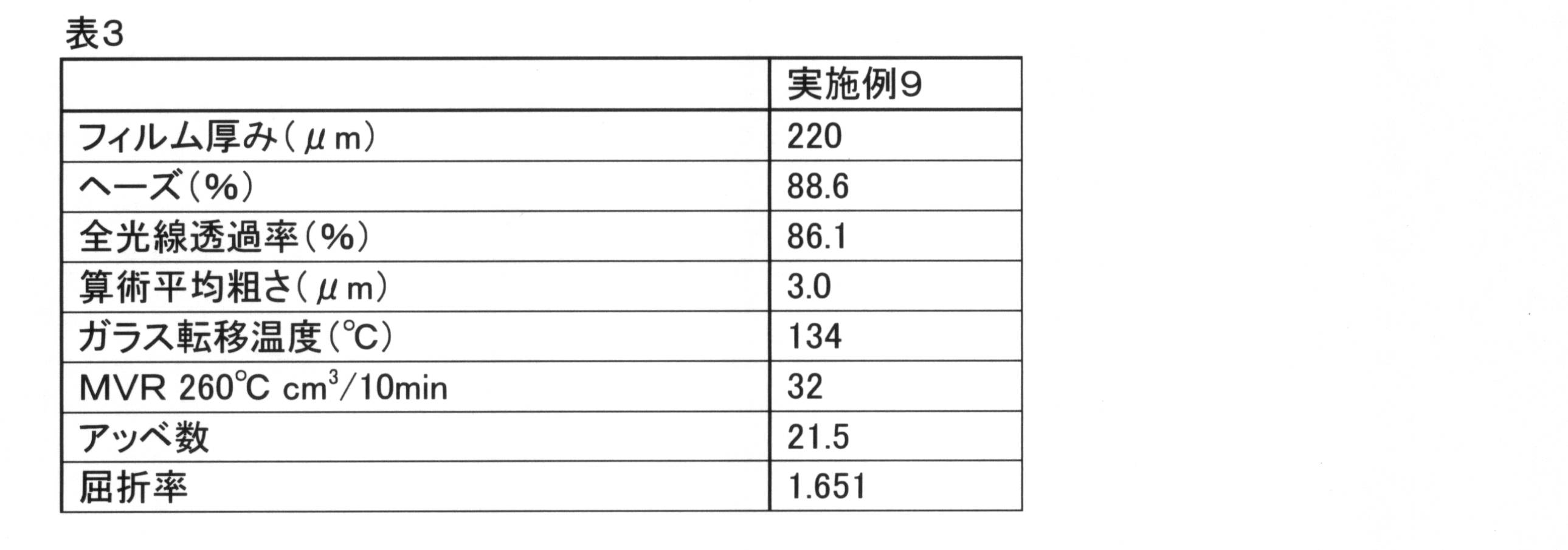
薄肉成形品は、凸面の曲率半径が5.73mm、凹面の曲率半径が3.01mm、大きさが直径4.5mm、レンズ部分の直径が3mm、レンズの中心厚が0.20mmのレンズを形成する金型を用い、ファナック(株)製ROBOSHOT S‐2000i30A射出成形機を用いて樹脂温度260℃、型温Tg-5℃、保圧600kgf/cm2で成形品を10個作成した。
得られた成形品を複屈折計(王子計測器社製;KOBRA(登録商標)-CCD/X)により測定し、レンズ中心部の、測定波長650nmでのレタデーションの値によって比較した。レタデーションの値は小さいほど低複屈折性に優れていることを意味し、20未満をA、20以上40未満をB、40以上60未満をC、60以上をDとした。
得られた成形品を顕微鏡により観察し、反ゲート方向に生じたウェルドライン長さの測定を行った。ウェルドラインの長さが0.1mm未満ならA、0.1mm以上0.3mm未満ならB、0.3mm以上0.5mm未満ならC、0.5mm以上ならD、とした。
実施例1において得られポリカーボネート樹脂を120℃で1時間真空乾燥し、射出成型物を作成した。得られた成形物の複屈折評価、ウェルドライン評価結果を表4に示す。
実施例2において得られポリカーボネート樹脂を120℃で1時間真空乾燥し、射出成型物を作成した。得られた成形物の複屈折評価、ウェルドライン評価結果を表4に示す。
実施例3において得られポリカーボネート樹脂を120℃で1時間真空乾燥し、射出成型物を作成した。得られた成形物の複屈折評価、ウェルドライン評価結果を表4に示す。
実施例4において得られポリカーボネート樹脂を120℃で1時間真空乾燥し、射出成型物を作成した。得られた成形物の複屈折評価、ウェルドライン評価結果を表4に示す。
比較例1において得られポリカーボネート樹脂を120℃で1時間真空乾燥し、射出成型物を作成した。得られた成形物の複屈折評価、ウェルドライン評価結果を表4に示す。
比較例2において得られポリカーボネート樹脂を120℃で1時間真空乾燥し、射出成型物を作成した。得られた成形物の複屈折評価、ウェルドライン評価結果を表4に示す。
比較例3において得られポリカーボネート樹脂を120℃で1時間真空乾燥し、射出成型物を作成した。得られた成形物の複屈折評価、ウェルドライン評価結果を表4に示す。
比較例4において得られポリカーボネート樹脂を120℃で1時間真空乾燥し、射出成型物を作成した。得られた成形物の複屈折評価、ウェルドライン評価結果を表4に示す。
ポリカーボネート樹脂(三菱エンジニアリングプラスチックス株式会社製ユーピロンH-4000;ビスフェノールAからなるポリカーボネート樹脂(BPA-HOMO-PC))のペレットを用い、射出成型物を作成した。得られた成形物の複屈折評価、ウェルドライン評価結果を表4に示す。

したがって、本発明のポリカーボネート樹脂を使用することにより、従来ウェルドライン長の低減のための対策(例えば、金型での対応策(ベントの設置、金型の肉厚調整、ゲートの調整、等))を行うことなく、ウェルドライン長を低減することができ、製造コストおよび製造容易性の面で有利である。
Claims (14)
- ジヒドロキシ化合物を含む反応物を反応させて熱可塑性樹脂を製造する方法であって、
前記ジヒドロキシ化合物は、下記式(1)で表されるジヒドロキシ化合物を含み、
前記ジヒドロキシ化合物における下記式(A)で表される化合物、下記式(B)で表される化合物、および下記式(C)で表される化合物の合計重量が、前記式(1)で表されるジヒドロキシ化合物の100重量部に対して、1500ppm以下である、製造方法。


- 前記ジヒドロキシ化合物は、下記式(2)で表される化合物をさらに含有する、請求項1に記載の製造方法。

Xはそれぞれ独立に、炭素数2~8のアルキレン基であり;
nはそれぞれ独立に、1~5の整数である。) - 前記熱可塑性樹脂の重量平均分子量が、35,000~70,000である、請求項1または2に記載の製造方法。
- 前記ジヒドロキシ化合物における前記式(A)で表される化合物の重量が、前記式(1)で表されるジヒドロキシ化合物の100重量部に対して、300ppm以下である、請求項1~3のいずれか一項に記載の製造方法。
- 前記ジヒドロキシ化合物における前記式(B)で表される化合物の重量が、前記式(1)で表されるジヒドロキシ化合物の100重量部に対して、100ppm以下である、請求項1~4のいずれか一項に記載の製造方法。
- 前記ジヒドロキシ化合物における前記式(C)で表される化合物の重量が、前記式(1)で表されるジヒドロキシ化合物の100重量部に対して、100ppm以下である、請求項1~5のいずれか一項に記載の製造方法。
- 前記式(1)で表されるジヒドロキシ化合物の純度が99%以上である、請求項1~6のいずれか一項に記載の製造方法。
- 前記熱可塑性樹脂はポリカーボネート樹脂、ポリエステル樹脂、およびポリエステルカーボネート樹脂からなる群から選択される、請求項1~7のいずれか一項に記載の製造方法。
- 前記熱可塑性樹脂はポリカーボネート樹脂である、請求項8に記載の製造方法。
- 前記反応物は炭酸ジエステルをさらに含む、請求項1~9のいずれか一項に記載の製造方法。
- 前記熱可塑性樹脂の飽和吸水率が、0.39重量%以下である、請求項1~10のいずれか一項に記載の製造方法。
- 請求項1~11のいずれか一項に記載の製造方法で得られた熱可塑性樹脂を用いることを特徴とする、光学素子の製造方法。
- 請求項1~11のいずれか一項に記載の製造方法で得られた熱可塑性樹脂を用いることを特徴とする、光学レンズの製造方法。
- 請求項1~11のいずれか一項に記載の製造方法で得られた熱可塑性樹脂を用いることを特徴とする、光学フィルムを製造方法。
Priority Applications (7)
| Application Number | Priority Date | Filing Date | Title |
|---|---|---|---|
| KR1020247007490A KR102694621B1 (ko) | 2015-11-04 | 2016-11-02 | 열가소성 수지의 제조 방법 |
| CN201680063166.5A CN108350162B (zh) | 2015-11-04 | 2016-11-02 | 热塑性树脂的制造方法 |
| US15/769,486 US10654972B2 (en) | 2015-11-04 | 2016-11-02 | Method for producing thermoplastic resin |
| JP2017548812A JP6888552B2 (ja) | 2015-11-04 | 2016-11-02 | 熱可塑性樹脂の製造方法 |
| KR1020197010656A KR102645903B1 (ko) | 2015-11-04 | 2016-11-02 | 디하이드록시 화합물 |
| KR1020187014563A KR102648445B1 (ko) | 2015-11-04 | 2016-11-02 | 열가소성 수지의 제조 방법 |
| US16/383,163 US10711100B2 (en) | 2015-11-04 | 2019-04-12 | Dihydroxy compound |
Applications Claiming Priority (2)
| Application Number | Priority Date | Filing Date | Title |
|---|---|---|---|
| JP2015216979 | 2015-11-04 | ||
| JP2015-216979 | 2015-11-04 |
Related Child Applications (2)
| Application Number | Title | Priority Date | Filing Date |
|---|---|---|---|
| US15/769,486 A-371-Of-International US10654972B2 (en) | 2015-11-04 | 2016-11-02 | Method for producing thermoplastic resin |
| US16/383,163 Division US10711100B2 (en) | 2015-11-04 | 2019-04-12 | Dihydroxy compound |
Publications (1)
| Publication Number | Publication Date |
|---|---|
| WO2017078075A1 true WO2017078075A1 (ja) | 2017-05-11 |
Family
ID=58662090
Family Applications (1)
| Application Number | Title | Priority Date | Filing Date |
|---|---|---|---|
| PCT/JP2016/082617 Ceased WO2017078075A1 (ja) | 2015-11-04 | 2016-11-02 | 熱可塑性樹脂の製造方法 |
Country Status (6)
| Country | Link |
|---|---|
| US (2) | US10654972B2 (ja) |
| JP (3) | JP6888552B2 (ja) |
| KR (3) | KR102694621B1 (ja) |
| CN (2) | CN108350162B (ja) |
| TW (3) | TWI814646B (ja) |
| WO (1) | WO2017078075A1 (ja) |
Cited By (5)
| Publication number | Priority date | Publication date | Assignee | Title |
|---|---|---|---|---|
| JP2019113797A (ja) * | 2017-12-26 | 2019-07-11 | 恵和株式会社 | 光拡散板及び直下型バックライトユニット |
| WO2020137926A1 (ja) * | 2018-12-27 | 2020-07-02 | 三菱瓦斯化学株式会社 | 樹脂組成物、成形体、光学レンズ、及び光学レンズユニット |
| JPWO2020175663A1 (ja) * | 2019-02-27 | 2020-09-03 | ||
| JPWO2022034898A1 (ja) * | 2020-08-13 | 2022-02-17 | ||
| US20220106483A1 (en) * | 2018-12-27 | 2022-04-07 | Mitsubishi Gas Chemical Company, Inc. | Thermoplastic resin composition and optical member using same |
Families Citing this family (4)
| Publication number | Priority date | Publication date | Assignee | Title |
|---|---|---|---|---|
| KR102348153B1 (ko) * | 2019-08-13 | 2022-01-05 | 주식회사 엘지화학 | 폴리에스터 및 이를 포함한 광학 소자 |
| CN114945619A (zh) | 2020-01-16 | 2022-08-26 | 旭化成株式会社 | 聚碳酸酯树脂、聚碳酸酯树脂组合物、包含它们的光学用成型体、以及环状碳酸酯 |
| KR20250039380A (ko) | 2022-07-15 | 2025-03-20 | 오사카 가스 케미칼 가부시키가이샤 | 플루오렌 골격을 갖는 수지의 해중합법, 그 생성물 및 용도 |
| WO2024014448A1 (ja) * | 2022-07-15 | 2024-01-18 | 大阪ガスケミカル株式会社 | フルオレン骨格を有する樹脂の解重合法、その生成物および用途 |
Citations (4)
| Publication number | Priority date | Publication date | Assignee | Title |
|---|---|---|---|---|
| JP2011084731A (ja) * | 2009-09-15 | 2011-04-28 | Muroran Institute Of Technology | 芳香族ポリエステル |
| WO2014073496A1 (ja) * | 2012-11-07 | 2014-05-15 | 三菱瓦斯化学株式会社 | ポリカーボネート樹脂、その製造方法および光学成形体 |
| JP2015168658A (ja) * | 2014-03-10 | 2015-09-28 | 田岡化学工業株式会社 | 2,2’−ビス(2−ヒドロキシエトキシ)−1,1’−ビナフタレンの製造方法 |
| JP2015180747A (ja) * | 2013-02-20 | 2015-10-15 | 帝人株式会社 | ポリカーボネート樹脂組成物 |
Family Cites Families (7)
| Publication number | Priority date | Publication date | Assignee | Title |
|---|---|---|---|---|
| JPH08118394A (ja) * | 1994-10-27 | 1996-05-14 | Fuji Photo Film Co Ltd | 写真感光材料用射出成形品及びその成形方法並びにそれを用いた包装体 |
| JP2005309167A (ja) | 2004-04-23 | 2005-11-04 | Fuji Photo Film Co Ltd | プラスチック製レンズを用いた光学ユニット |
| CN103257376B (zh) | 2006-06-05 | 2015-12-09 | 三菱瓦斯化学株式会社 | 光学透镜 |
| JP5202146B2 (ja) * | 2008-07-14 | 2013-06-05 | 日本化薬株式会社 | (メタ)アクリレート化合物及びそれを含有する活性エネルギー線硬化型樹脂組成物並びにその硬化物 |
| CN102471467B (zh) | 2009-07-24 | 2013-07-17 | 帝人化成株式会社 | 光学透镜用聚酯碳酸酯共聚物及光学透镜 |
| CN105348503A (zh) * | 2009-11-17 | 2016-02-24 | 三菱化学株式会社 | 聚碳酸酯树脂及由该聚碳酸酯树脂形成的透明膜 |
| WO2014129260A1 (ja) * | 2013-02-22 | 2014-08-28 | Dic株式会社 | 偏光板 |
-
2016
- 2016-11-02 TW TW111144860A patent/TWI814646B/zh active
- 2016-11-02 KR KR1020247007490A patent/KR102694621B1/ko active Active
- 2016-11-02 TW TW105135548A patent/TWI789339B/zh active
- 2016-11-02 CN CN201680063166.5A patent/CN108350162B/zh active Active
- 2016-11-02 TW TW108113442A patent/TWI787497B/zh active
- 2016-11-02 JP JP2017548812A patent/JP6888552B2/ja active Active
- 2016-11-02 KR KR1020187014563A patent/KR102648445B1/ko active Active
- 2016-11-02 WO PCT/JP2016/082617 patent/WO2017078075A1/ja not_active Ceased
- 2016-11-02 US US15/769,486 patent/US10654972B2/en active Active
- 2016-11-02 KR KR1020197010656A patent/KR102645903B1/ko active Active
- 2016-11-02 CN CN201910311801.2A patent/CN110105558B/zh active Active
-
2019
- 2019-04-08 JP JP2019073325A patent/JP6904375B2/ja active Active
- 2019-04-12 US US16/383,163 patent/US10711100B2/en active Active
-
2021
- 2021-04-30 JP JP2021077955A patent/JP7136265B2/ja active Active
Patent Citations (4)
| Publication number | Priority date | Publication date | Assignee | Title |
|---|---|---|---|---|
| JP2011084731A (ja) * | 2009-09-15 | 2011-04-28 | Muroran Institute Of Technology | 芳香族ポリエステル |
| WO2014073496A1 (ja) * | 2012-11-07 | 2014-05-15 | 三菱瓦斯化学株式会社 | ポリカーボネート樹脂、その製造方法および光学成形体 |
| JP2015180747A (ja) * | 2013-02-20 | 2015-10-15 | 帝人株式会社 | ポリカーボネート樹脂組成物 |
| JP2015168658A (ja) * | 2014-03-10 | 2015-09-28 | 田岡化学工業株式会社 | 2,2’−ビス(2−ヒドロキシエトキシ)−1,1’−ビナフタレンの製造方法 |
Cited By (16)
| Publication number | Priority date | Publication date | Assignee | Title |
|---|---|---|---|---|
| JP2019113797A (ja) * | 2017-12-26 | 2019-07-11 | 恵和株式会社 | 光拡散板及び直下型バックライトユニット |
| JP7364321B2 (ja) | 2017-12-26 | 2023-10-18 | 恵和株式会社 | 光拡散板及び直下型バックライトユニット |
| JPWO2020137926A1 (ja) * | 2018-12-27 | 2021-11-18 | 三菱瓦斯化学株式会社 | 樹脂組成物、成形体、光学レンズ、及び光学レンズユニット |
| US12286532B2 (en) * | 2018-12-27 | 2025-04-29 | Mitsubishi Gas Chemical Company, Inc. | Thermoplastic resin composition and optical member using same |
| US12091498B2 (en) | 2018-12-27 | 2024-09-17 | Mitsubishi Gas Chemical Company, Inc. | Resin composition, molded body, optical lens, and optical lens unit |
| JP7367704B2 (ja) | 2018-12-27 | 2023-10-24 | 三菱瓦斯化学株式会社 | 樹脂組成物、成形体、光学レンズ、及び光学レンズユニット |
| WO2020137926A1 (ja) * | 2018-12-27 | 2020-07-02 | 三菱瓦斯化学株式会社 | 樹脂組成物、成形体、光学レンズ、及び光学レンズユニット |
| US20220106483A1 (en) * | 2018-12-27 | 2022-04-07 | Mitsubishi Gas Chemical Company, Inc. | Thermoplastic resin composition and optical member using same |
| JP7405133B2 (ja) | 2019-02-27 | 2023-12-26 | 三菱瓦斯化学株式会社 | 熱可塑性樹脂、その製造方法、及び、光学レンズ |
| JPWO2020175663A1 (ja) * | 2019-02-27 | 2020-09-03 | ||
| WO2020175663A1 (ja) * | 2019-02-27 | 2020-09-03 | 三菱瓦斯化学株式会社 | 熱可塑性樹脂、その製造方法、及び、光学レンズ |
| US12516153B2 (en) | 2019-02-27 | 2026-01-06 | Mitsubishi Gas Chemical Company, Inc. | Thermoplastic resin, method for manufacturing same, and optical lens |
| US12540215B2 (en) | 2019-02-27 | 2026-02-03 | Mitsubishi Gas Chemical Company, Inc. | Method of manufacturing crystalline and amorphous forms of 6,6′-diphenyl-2,2′-bis(2-hydroxyethoxy)-1,1′-binaphthyl and thermoplastic resin therefrom |
| WO2022034898A1 (ja) * | 2020-08-13 | 2022-02-17 | 三菱瓦斯化学株式会社 | 光学材料用の熱可塑性樹脂組成物、成形体、配合剤、熱可塑性樹脂組成物の製造方法及び透過率向上方法 |
| JPWO2022034898A1 (ja) * | 2020-08-13 | 2022-02-17 | ||
| JP7816153B2 (ja) | 2020-08-13 | 2026-02-18 | 三菱瓦斯化学株式会社 | 光学材料用の熱可塑性樹脂組成物、成形体、配合剤、熱可塑性樹脂組成物の製造方法及び透過率向上方法 |
Also Published As
| Publication number | Publication date |
|---|---|
| CN108350162A (zh) | 2018-07-31 |
| US10711100B2 (en) | 2020-07-14 |
| KR20240035915A (ko) | 2024-03-18 |
| TWI814646B (zh) | 2023-09-01 |
| JPWO2017078075A1 (ja) | 2018-09-13 |
| CN110105558B (zh) | 2021-10-26 |
| US20180305496A1 (en) | 2018-10-25 |
| KR102694621B1 (ko) | 2024-08-12 |
| TWI787497B (zh) | 2022-12-21 |
| JP2021120461A (ja) | 2021-08-19 |
| TW202311352A (zh) | 2023-03-16 |
| JP6888552B2 (ja) | 2021-06-16 |
| CN110105558A (zh) | 2019-08-09 |
| KR20180079357A (ko) | 2018-07-10 |
| CN108350162B (zh) | 2021-01-15 |
| KR20190041546A (ko) | 2019-04-22 |
| JP6904375B2 (ja) | 2021-07-14 |
| US10654972B2 (en) | 2020-05-19 |
| KR102648445B1 (ko) | 2024-03-15 |
| TW201734085A (zh) | 2017-10-01 |
| TW201932506A (zh) | 2019-08-16 |
| JP2019131824A (ja) | 2019-08-08 |
| US20190233585A1 (en) | 2019-08-01 |
| KR102645903B1 (ko) | 2024-03-08 |
| JP7136265B2 (ja) | 2022-09-13 |
| TWI789339B (zh) | 2023-01-11 |
Similar Documents
| Publication | Publication Date | Title |
|---|---|---|
| JP7238952B2 (ja) | 熱可塑性樹脂の製造方法 | |
| JP7136265B2 (ja) | 熱可塑性樹脂の製造方法 | |
| WO2015170691A1 (ja) | 重縮合で製造された樹脂および樹脂組成物 | |
| JP2014185325A (ja) | ポリカーボネート共重合体 | |
| WO2023085340A1 (ja) | ポリカーボネート樹脂、ならびにそれを用いた光学レンズおよび光学フィルム |
Legal Events
| Date | Code | Title | Description |
|---|---|---|---|
| 121 | Ep: the epo has been informed by wipo that ep was designated in this application |
Ref document number: 16862135 Country of ref document: EP Kind code of ref document: A1 |
|
| WWE | Wipo information: entry into national phase |
Ref document number: 15769486 Country of ref document: US |
|
| ENP | Entry into the national phase |
Ref document number: 2017548812 Country of ref document: JP Kind code of ref document: A |
|
| NENP | Non-entry into the national phase |
Ref country code: DE |
|
| ENP | Entry into the national phase |
Ref document number: 20187014563 Country of ref document: KR Kind code of ref document: A |
|
| 122 | Ep: pct application non-entry in european phase |
Ref document number: 16862135 Country of ref document: EP Kind code of ref document: A1 |