WO2017077929A1 - レーザー溶接性に優れたバスバー用アルミニウム合金板 - Google Patents
レーザー溶接性に優れたバスバー用アルミニウム合金板 Download PDFInfo
- Publication number
- WO2017077929A1 WO2017077929A1 PCT/JP2016/081815 JP2016081815W WO2017077929A1 WO 2017077929 A1 WO2017077929 A1 WO 2017077929A1 JP 2016081815 W JP2016081815 W JP 2016081815W WO 2017077929 A1 WO2017077929 A1 WO 2017077929A1
- Authority
- WO
- WIPO (PCT)
- Prior art keywords
- aluminum alloy
- mass
- alloy plate
- less
- conductivity
- Prior art date
- Legal status (The legal status is an assumption and is not a legal conclusion. Google has not performed a legal analysis and makes no representation as to the accuracy of the status listed.)
- Ceased
Links
Images
Classifications
-
- C—CHEMISTRY; METALLURGY
- C22—METALLURGY; FERROUS OR NON-FERROUS ALLOYS; TREATMENT OF ALLOYS OR NON-FERROUS METALS
- C22C—ALLOYS
- C22C21/00—Alloys based on aluminium
-
- C—CHEMISTRY; METALLURGY
- C22—METALLURGY; FERROUS OR NON-FERROUS ALLOYS; TREATMENT OF ALLOYS OR NON-FERROUS METALS
- C22F—CHANGING THE PHYSICAL STRUCTURE OF NON-FERROUS METALS AND NON-FERROUS ALLOYS
- C22F1/00—Changing the physical structure of non-ferrous metals or alloys by heat treatment or by hot or cold working
- C22F1/04—Changing the physical structure of non-ferrous metals or alloys by heat treatment or by hot or cold working of aluminium or alloys based thereon
-
- H—ELECTRICITY
- H01—ELECTRIC ELEMENTS
- H01M—PROCESSES OR MEANS, e.g. BATTERIES, FOR THE DIRECT CONVERSION OF CHEMICAL ENERGY INTO ELECTRICAL ENERGY
- H01M50/00—Constructional details or processes of manufacture of the non-active parts of electrochemical cells other than fuel cells, e.g. hybrid cells
- H01M50/50—Current conducting connections for cells or batteries
-
- H—ELECTRICITY
- H01—ELECTRIC ELEMENTS
- H01M—PROCESSES OR MEANS, e.g. BATTERIES, FOR THE DIRECT CONVERSION OF CHEMICAL ENERGY INTO ELECTRICAL ENERGY
- H01M50/00—Constructional details or processes of manufacture of the non-active parts of electrochemical cells other than fuel cells, e.g. hybrid cells
- H01M50/50—Current conducting connections for cells or batteries
- H01M50/502—Interconnectors for connecting terminals of adjacent batteries; Interconnectors for connecting cells outside a battery casing
-
- H—ELECTRICITY
- H01—ELECTRIC ELEMENTS
- H01M—PROCESSES OR MEANS, e.g. BATTERIES, FOR THE DIRECT CONVERSION OF CHEMICAL ENERGY INTO ELECTRICAL ENERGY
- H01M50/00—Constructional details or processes of manufacture of the non-active parts of electrochemical cells other than fuel cells, e.g. hybrid cells
- H01M50/50—Current conducting connections for cells or batteries
- H01M50/502—Interconnectors for connecting terminals of adjacent batteries; Interconnectors for connecting cells outside a battery casing
- H01M50/505—Interconnectors for connecting terminals of adjacent batteries; Interconnectors for connecting cells outside a battery casing comprising a single busbar
-
- H—ELECTRICITY
- H01—ELECTRIC ELEMENTS
- H01M—PROCESSES OR MEANS, e.g. BATTERIES, FOR THE DIRECT CONVERSION OF CHEMICAL ENERGY INTO ELECTRICAL ENERGY
- H01M50/00—Constructional details or processes of manufacture of the non-active parts of electrochemical cells other than fuel cells, e.g. hybrid cells
- H01M50/50—Current conducting connections for cells or batteries
- H01M50/502—Interconnectors for connecting terminals of adjacent batteries; Interconnectors for connecting cells outside a battery casing
- H01M50/521—Interconnectors for connecting terminals of adjacent batteries; Interconnectors for connecting cells outside a battery casing characterised by the material
- H01M50/522—Inorganic material
-
- H—ELECTRICITY
- H01—ELECTRIC ELEMENTS
- H01M—PROCESSES OR MEANS, e.g. BATTERIES, FOR THE DIRECT CONVERSION OF CHEMICAL ENERGY INTO ELECTRICAL ENERGY
- H01M50/00—Constructional details or processes of manufacture of the non-active parts of electrochemical cells other than fuel cells, e.g. hybrid cells
- H01M50/50—Current conducting connections for cells or batteries
- H01M50/528—Fixed electrical connections, i.e. not intended for disconnection
-
- H—ELECTRICITY
- H01—ELECTRIC ELEMENTS
- H01M—PROCESSES OR MEANS, e.g. BATTERIES, FOR THE DIRECT CONVERSION OF CHEMICAL ENERGY INTO ELECTRICAL ENERGY
- H01M50/00—Constructional details or processes of manufacture of the non-active parts of electrochemical cells other than fuel cells, e.g. hybrid cells
- H01M50/50—Current conducting connections for cells or batteries
- H01M50/543—Terminals
-
- H—ELECTRICITY
- H01—ELECTRIC ELEMENTS
- H01M—PROCESSES OR MEANS, e.g. BATTERIES, FOR THE DIRECT CONVERSION OF CHEMICAL ENERGY INTO ELECTRICAL ENERGY
- H01M2220/00—Batteries for particular applications
- H01M2220/20—Batteries in motive systems, e.g. vehicle, ship, plane
-
- Y—GENERAL TAGGING OF NEW TECHNOLOGICAL DEVELOPMENTS; GENERAL TAGGING OF CROSS-SECTIONAL TECHNOLOGIES SPANNING OVER SEVERAL SECTIONS OF THE IPC; TECHNICAL SUBJECTS COVERED BY FORMER USPC CROSS-REFERENCE ART COLLECTIONS [XRACs] AND DIGESTS
- Y02—TECHNOLOGIES OR APPLICATIONS FOR MITIGATION OR ADAPTATION AGAINST CLIMATE CHANGE
- Y02E—REDUCTION OF GREENHOUSE GAS [GHG] EMISSIONS, RELATED TO ENERGY GENERATION, TRANSMISSION OR DISTRIBUTION
- Y02E60/00—Enabling technologies; Technologies with a potential or indirect contribution to GHG emissions mitigation
- Y02E60/10—Energy storage using batteries
Definitions
- the present invention relates to an aluminum alloy plate for a bus bar used for, for example, an automobile bus bar, and more particularly to an aluminum alloy plate for a bus bar excellent in laser weldability.
- Patent Document 1 describes that external terminals having different polarities of a rectangular secondary battery such as a lithium ion secondary battery are connected by a bus bar made of an aluminum material.
- the bus bar made of an aluminum material is welded to an external terminal made of an aluminum material by laser welding or electron beam welding.
- Patent Document 2 describes a bus bar made of an aluminum material for connecting a positive electrode and a negative electrode terminal of a secondary battery such as a lithium ion secondary battery.
- the bus bar is welded to the positive electrode and the negative electrode terminal by laser welding.
- the aluminum material is Fe: 0.50 mass% or less, Si: 0.5 mass% or less, Ti and B are each 0.01 to 0.10 mass%, and Ti and B are 0.15 mass% or less in total. Contains pure aluminum or aluminum alloy.
- JIS standards 1050, 1080, 1100, 2024, 5052, and 7N71 are specifically listed as aluminum materials.
- Ti and B are added in order to improve the bonding strength (compensate for the decrease in bonding strength caused by suppressing Fe and Si low).
- Patent Document 3 describes that an aluminum alloy is used as an electrical connection member (for example, a bus bar) that is mechanically fastened (bolt tightening, rivet tightening, etc.) to a fastened member.
- JIS standard 6101-T6 material and 1100-H24 material are specifically mentioned as aluminum alloys.
- Si 0.15 mass% or less
- Fe 1.00 to 1.60 mass%
- Ti 0.005 to 0.02 mass%
- Zr 0.0005 to 0.03 mass%
- Aluminum materials have a relatively high conductivity and are lighter than copper materials, so application to bus bars for automobiles is being studied.
- an aluminum material for an automobile bus bar is bent as necessary, and laser welding or mechanical fastening (bolt fastening, etc.) to an external terminal such as a lithium ion secondary battery.
- the former Connected by Comparing laser welding and mechanical fastening, the former can reduce the electrical resistance between the bus bar and the terminal, does not require other fastening members (bolts, nuts, etc.), and also for reducing the number of parts and weight It is advantageous.
- the present invention was made in view of the above problems when laser welding a bus bar made of an aluminum material to an external terminal or the like of a lithium ion secondary battery, and has a relatively high conductivity, laser weldability and An object of the present invention is to provide an aluminum alloy plate for a bus bar excellent in bending workability.
- the aluminum alloy plate for a bus bar according to the present invention has Si: 0.35 mass% or less, Fe: 0.15 to 0.60 mass%, Ti: 0.10 mass% or less, B: 1 to 6 ppm, and the balance is Al. And the number density of the intermetallic compound consisting of unavoidable impurities and having a maximum length of 1 ⁇ 4 ⁇ m of the cross-sectional plate thickness of 2 ⁇ m or more is 400 to 1500 / mm 2 and the conductivity is 58 to 62% IACS.
- the aluminum alloy may contain one or more of Cu: 0.10% by mass or less, Mn: 0.05% by mass or less, and Mg: 0.05% by mass or less as an inevitable impurity or additive element.
- the aluminum alloy plate according to the present invention has a relatively high conductivity, is excellent in bending workability and laser weldability, for example, for an automobile bus bar joined by laser welding to an external terminal of a lithium ion secondary battery, etc. It can be used suitably.
- the aluminum alloy according to the present invention has Si: 0.35 mass% or less, Fe: 0.15 to 0.60 mass%, Ti: 0.10 mass% or less, B: 1 to 6 ppm (mass ppm), and the balance It consists of Al and inevitable impurities.
- the aluminum purity is desirably 99.0% by mass or more from the viewpoint of conductivity.
- Si has the effect of increasing the strength of the aluminum alloy plate by dissolving in the matrix, and the effect is improved as the Si content increases.
- Si forms Al, Fe and Al—Fe—Si intermetallic compounds.
- the Si content exceeds 0.35 mass%, the Al—Fe—Si intermetallic compounds increase in size and increase. As a result, the bending workability of the aluminum alloy plate is reduced.
- the Si content exceeds 0.35 mass%, while electroconductivity falls, it becomes easy to generate
- Fe has the effect of increasing the strength of the aluminum alloy plate by dissolving in the matrix.
- the Fe content is less than 0.15% by mass, the effect of increasing the strength is insufficient, the conductivity is improved, the penetration amount (penetration depth) in laser welding is reduced, and the bonding strength is lowered.
- Fe forms Al, Si and Al-Fe-based and Al-Fe-Si-based intermetallic compounds.
- the coarse intermetallic compound has a maximum length of 2 ⁇ m or more. This increases the bending workability of the aluminum alloy plate. Therefore, the Fe content is 0.15 to 0.6% by mass.
- Ti has the effect of refining and homogenizing (stabilizing) the aluminum alloy cast structure and preventing casting cracks, and is preferably added in an amount of 0.003 mass% or more.
- the Ti content is more preferably 0.005% by mass or more.
- B is an element commonly used with Ti as a Ti—B master alloy for the purpose of preventing casting cracks during slab ingot formation of an aluminum alloy. B is usually contained as an impurity in an aluminum raw metal in an amount of 1 ppm or more.
- the B content exceeds 6 ppm, an abnormal part with deeper penetration than necessary or an undercut may occur in the solidification beads of laser welding (such as CW (continuous oscillation) laser welding).
- porosity defects may remain in the solidified beads.
- the bead width is widened at the place where the abnormal portion is generated, and as a result, the bead width becomes non-uniform in the length direction. Therefore, the B content is 1 to 6 ppm.
- the aluminum alloy according to the present invention may contain one or more of Cu, Mn, and Mg as inevitable impurities or as an additional element as necessary.
- Cu has the effect of increasing the strength of the aluminum alloy plate by solid solution strengthening.
- the Cu content increases, the weld cracking property in laser welding tends to deteriorate.
- material cost will increase when Cu is added. Therefore, the Cu content is restricted to 0.10% by mass or less (including 0% by mass).
- Mn has the effect of increasing the strength of the aluminum alloy plate by dissolving in the matrix.
- the addition of Mn increases the material cost. Therefore, the Mn content is regulated to 0.05% by mass or less (including 0% by mass).
- Mg has the effect of increasing the strength of the aluminum alloy plate by dissolving in the matrix.
- the content of Mg is increased, in laser welding (CW (continuous oscillation type) laser welding or the like), the shape of the weld bead is disturbed or a defect is easily generated inside.
- material cost will increase if Mg is added. Therefore, the Mg content is restricted to 0.05% by mass or less (including 0% by mass).
- the aluminum alloy according to the present invention may contain elements other than those described above as inevitable impurities.
- Zn has a low vapor pressure, so it is scattered during laser welding, easily contaminates the surroundings, and deteriorates the laser weldability of the aluminum alloy plate. Therefore, the Zn content is restricted to 0.1% by mass or less (including 0% by mass).
- the content of inevitable impurity elements other than Zn is regulated within the range specified in the column of other elements of alloy number 1100 of JISH4000: 2014. Specific examples of the inevitable impurity elements include Cr, Zr, V, Ni, Sn, In, and Ga. The contents of these elements are individually 0.05% by mass or less and 0.15 in total. It is regulated to less than mass%. If these elements are within this range, the effect of the present invention is not hindered not only when they are contained as inevitable impurities but also when they are actively added.
- the main intermetallic compounds are Al—Fe and Al—Fe—Si compounds.
- the number density of coarse intermetallic compounds having a maximum length of 2 ⁇ m or more is less than 400 / mm 2 , the amount of solid solution of Fe, Si, etc. is large, and the aluminum alloy plate The conductivity of the is reduced.
- the number density of intermetallic compounds may become less than 400 pieces / mm ⁇ 2 > because Fe content is insufficient. In this case, the solid solution amount of Fe, Si, etc.
- the number density of intermetallic compounds having a maximum length of 2 ⁇ m or more exceeds 1500 pieces / mm 2 , the bendability of the aluminum alloy plate is lowered. Accordingly, the number density of intermetallic compounds having a maximum length of 2 ⁇ m or more is set to 400 to 1500 / mm 2 .
- the electrical conductivity of the aluminum alloy plate according to the present invention if the electrical conductivity is 62% IACS or less, the penetration depth in laser welding becomes deep, and high joint strength can be obtained. On the other hand, when the content of alloy elements other than the aluminum alloy is large and the electrical conductivity is low, the electrical conductivity as a bus bar that is an electrical connection component is poor. If the electrical conductivity of the aluminum alloy plate is 58% IACS or higher, the electrical conductivity as a bus bar is sufficient. Therefore, the electrical conductivity of the aluminum alloy plate is in the range of 58 to 62% IACS.
- the method for producing an aluminum alloy plate according to the present invention may be a conventional method, and includes, for example, semi-continuous casting (DC (direct chill) casting), homogenization treatment, hot rolling, cold rolling, and finish annealing. .
- the number density of intermetallic compounds having a maximum length of 2 ⁇ m or more decreases as the cooling rate during casting increases.
- the cooling rate during casting should be 0.1 to 1.0 ° C./second. Is preferred.
- a more preferable cooling rate is 0.1 to 0.5 ° C./second.
- the electrical conductivity of the aluminum alloy plate was measured according to the provisions of JISH0505: 1975 using an eddy current conductivity measuring device (trade name Sigma Test, model number 2.068) manufactured by Forster. When the conductivity is 58% IACS or more and 62% IACS or less, the conductivity is evaluated as “good”, and when the conductivity is less than 58% IACS or more than 62% IACS, the conductivity is evaluated as “poor”. .
- a JIS No. 5 test piece JIS Z2201: 2009 was cut out from the aluminum alloy plate so that the tensile direction was parallel to the rolling direction. Using this test piece, a tensile test based on JISZ2241: 2009 was performed, and tensile strength, proof stress (0.2% proof stress) and elongation were measured.
- a test piece having a size of 30 mm ⁇ 100 mm was cut out from an aluminum alloy plate, and a bead with a weld length of 90 mm was used using a welding machine with a continuous wave fiber laser (IPG Photonics Japan, model: YLR-10000) as a heat source. Welded on plate.
- the welding conditions were a laser output of 2.0 kW, a welding speed of 10.0 m / min, and a forward angle of 5 deg. I went there.
- About the weld bead part, the presence or absence of a weld crack, the uniformity of the weld bead width, the presence or absence of an undercut, and the presence or absence of welding spatter adhesion were observed.
- the weld bead portion has no cracks, the weld bead width is uniform, the weld bead portion has no undercut, bumped portion, and spatter adhesion with a diameter of 1 mm or more, and the weld appearance is good. “” was evaluated, and all other than that, the weld appearance was evaluated as “bad”.
- the penetration depth of the weld bead was measured using the same specimen.
- the test piece is cut along a cross section perpendicular to the welding direction, and the cross section of the weld bead portion is observed with an optical microscope.
- the penetration depth was measured by observation. When the penetration depth was 700 ⁇ m or more, it was evaluated as good “ ⁇ ”, and when it was less than 700 ⁇ m, it was evaluated as defective “x”.
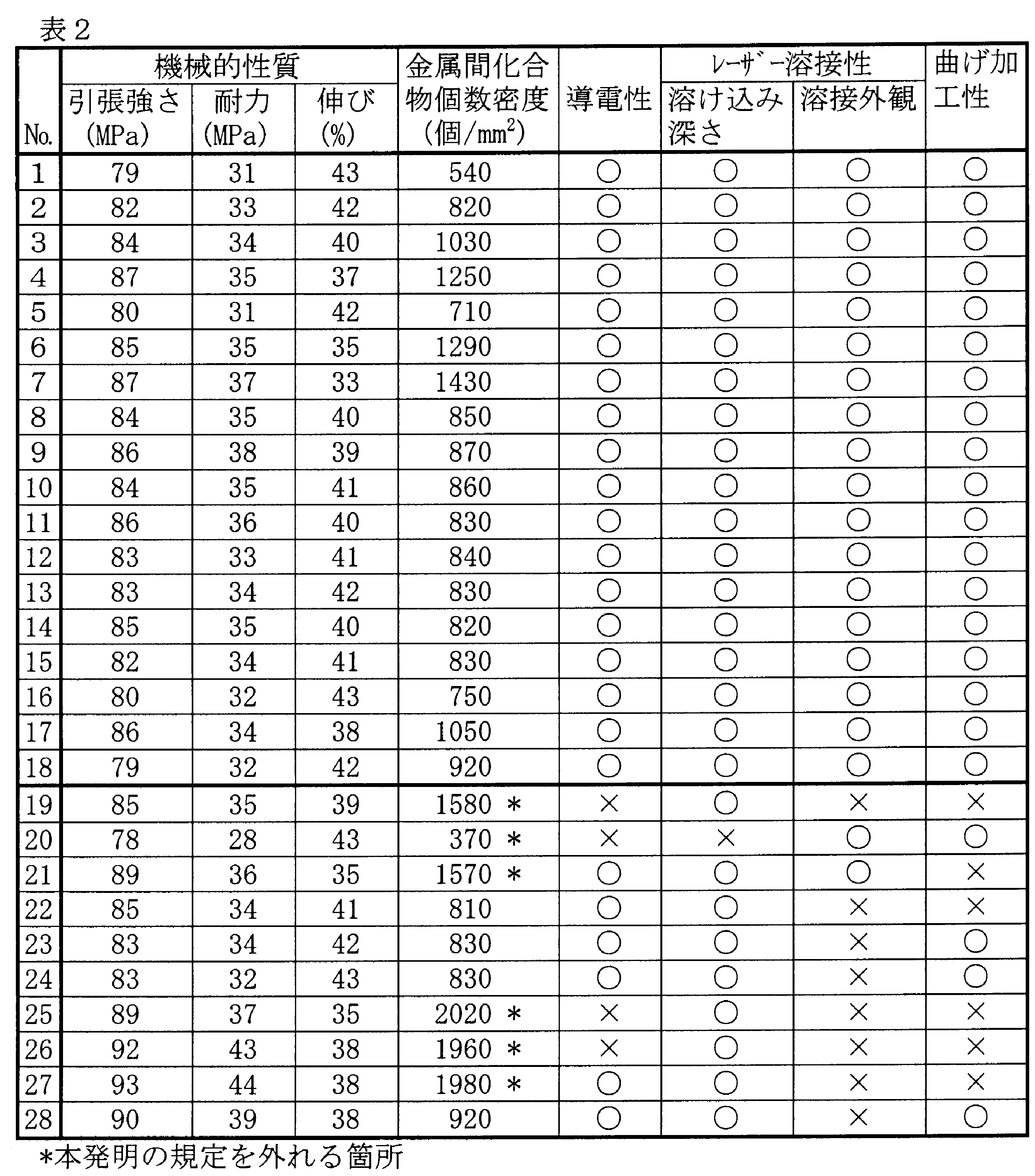
- the alloy composition, the number density of intermetallic compounds having a maximum length of 2 ⁇ m or more at 1 ⁇ 4 of the thickness of the cross section, and the electrical conductivity satisfying the provisions of the present invention are No. Nos. 1 to 18 were evaluated to have good laser weldability and bending workability. No. Nos. 1 to 18 have mechanical properties that can be used for automobile bus bars.
- No. 1 in which any one or more of the alloy composition, the number density of the intermetallic compound, and the electrical conductivity does not satisfy the provisions of the present invention.
- Nos. 19 to 28 were evaluated as having poor laser weldability and / or bending workability. Specifically, it is as follows. No. In No. 19, since the Si content is excessive, the conductivity is low, weld cracking occurs, and the weld appearance is poor. No. No. 19 has an excessive number density of intermetallic compounds and is inferior in bending workability. No. No. 20 has an insufficient Fe content, and therefore has high conductivity, a low number density of intermetallic compounds, and a lack of penetration depth in laser welding.
- the cooling rate during casting was in the range of 0.1 to 1.0 ° C./second.
- the number density of the intermetallic compound is within the range specified in the present invention, the conductivity is good (58% IACS or more and 62% IACS or less), and the laser weldability and bending workability are good. It is good.
- the mechanical properties are at a level that can be used for automobile bus bars.
- the cooling rate during casting was 0.05 ° C./second. 2-1 has an excessive number density of intermetallic compounds, poor conductivity (exceeding 62% IACS), lack of penetration depth, and bending workability is poor. No.
- the aluminum alloy plate of the present invention has a relatively high electrical conductivity and is excellent in bending workability and laser weldability, and is useful, for example, for an automobile bus bar that is joined to an external terminal of a lithium ion secondary battery by laser welding. It is.
Landscapes
- Chemical & Material Sciences (AREA)
- Chemical Kinetics & Catalysis (AREA)
- Electrochemistry (AREA)
- General Chemical & Material Sciences (AREA)
- Organic Chemistry (AREA)
- Engineering & Computer Science (AREA)
- Materials Engineering (AREA)
- Mechanical Engineering (AREA)
- Metallurgy (AREA)
- Crystallography & Structural Chemistry (AREA)
- Physics & Mathematics (AREA)
- Thermal Sciences (AREA)
- Inorganic Chemistry (AREA)
- Laser Beam Processing (AREA)
- Conductive Materials (AREA)
- Connection Of Batteries Or Terminals (AREA)
Abstract
Description
特許文献1には、リチウムイオン二次電池等の角型二次電池の異なる極性の外部端子同士を、アルミニウム材からなるバスバーで接続することが記載されている。アルミニウム材からなるバスバーは、レーザー溶接又は電子ビーム溶接により、アルミニウム材からなる外部端子に溶接される。
特許文献4には、Si:0.15質量%以下、Fe:1.00~1.60質量%、Ti:0.005~0.02質量%、Zr:0.0005~0.03質量%、及び必要に応じてMn:0.01~0.50質量%を含有し、残部Al及び不可避不純物からなり、熱伝導性(導電性)に優れたアルミニウム合金板材が記載されている。
本発明は、アルミニウム材からなるバスバーを、リチウムイオン二次電池の外部端子等にレーザー溶接する場合の上記問題点に鑑みてなされたもので、比較的高い導電率を有し、レーザー溶接性及び曲げ加工性に優れたバスバー用アルミニウム合金板を提供することを目的とする。
<アルミニウム合金の組成>
本発明に係るアルミニウム合金は、Si:0.35質量%以下、Fe:0.15~0.60質量%、Ti:0.10質量%以下、B:1~6ppm(質量ppm)、残部がAl及び不可避不純物からなる。本発明に係るアルミニウム合金において、アルミニウム純度は、導電性の観点から99.0質量%以上が望ましい。
Bは、アルミニウム合金のスラブ造塊時の鋳造割れ防止を目的に、Ti-B母合金としてTiと共に常用されている元素である。またBは、アルミニウムの原料地金に不純物として通常1ppm以上含有される。一方、B含有量が6ppmを超えると、レーザー溶接(CW(連続発振式)レーザー溶接など)の凝固ビードに、必要以上に溶込みが深くなった異常部が発生したり、アンダーカットが生じる場合があり、また、凝固ビード内にポロシティ欠陥が残留する場合がある。前記異常部が発生した箇所ではビード幅が広がり、その結果、ビード幅が長さ方向で不均一になる。従って、B含有量は1~6ppmとする。
このうちCuは、固溶強化によりアルミニウム合金板の強度を高める効果を有する。一方、Cuの含有量が増加するとともにレーザー溶接における溶接割れ性が劣化する傾向がある。また、Cuを添加すると材料コストが高まる。従って、Cu含有量は0.10質量%以下(0質量%を含む)に規制する。
Mnは、母相内に固溶してアルミニウム合金板の強度を高める効果がある。一方、Mnを添加すると材料コストが高まる。従って、Mn含有量は0.05質量%以下(0質量%を含む)に規制する。
不可避不純物のうちZnは、蒸気圧が低いため、レーザー溶接時に飛散し、周囲を汚染しやすく、アルミニウム合金板のレーザー溶接性を劣化させる。従って、Zn含有量は0.1質量%以下(0質量%を含む)に規制する。
Zn以外の不可避不純物元素の含有量は、JISH4000:2014の合金番号1100のその他元素の欄に規定される範囲内に規制される。この不可避不純物元素として、具体的には、Cr、Zr、V、Ni、Sn、In、Ga等が挙げられ、これらの元素の含有量は個々に0.05質量%以下、合計で0.15質量%以下に規制される。これらの元素は、この範囲内であれば、不可避不純物として含有される場合だけではなく、積極的に添加された場合であっても、本発明の効果を妨げない。
本発明に係るアルミニウム合金板において、主たる金属間化合物はAl-Fe系及びAl-Fe-Si系化合物である。本発明に係るアルミニウム合金板の組成において、最大長が2μm以上の粗大な金属間化合物の個数密度が400個/mm2未満の場合は、Fe,Si等の固溶量が多く、アルミニウム合金板の導電性が低下する。なお、Fe含有量が不足することで、金属間化合物の個数密度が400個/mm2未満となる場合もある。この場合は、Fe,Si等の固溶量も少なく、アルミニウム合金板の導電性が良く、レーザー溶接における溶込み量(溶け込み深さ)が小さくなり、接合強度が低下する。一方、最大長が2μm以上の金属間化合物の個数密度が1500個/mm2を超える場合は、アルミニウム合金板の曲げ加工性が低下する。従って、最大長が2μm以上の金属間化合物の個数密度は、400~1500個/mm2とする。
アルミニウム合金板は鋼板やステンレス板に比べて熱伝導性、すなわち導電性が良好であるため、レーザー溶接において同じ深さの溶込みを得るためには、大きいレーザーエネルギーが必要である。アルミニウム以外の合金元素(Si、Fe、Cu、Mn、Mg、Ti等)の含有量が多いと、それら元素が固溶することにより導電性及び熱伝導性が低下し、レーザー溶接における溶込み深さが深くなる。逆に、アルミニウム以外の合金元素の含有量が少なく、アルミニウムの純度が高いと、導電性及び熱伝導性が高く、溶込み深さが浅くなりやすい。本発明に係るアルミニウム合金板において、導電率が62%IACS以下であれば、レーザー溶接における溶込み深さが深くなり、高い継手強度を得ることができる。一方、アルミニウム合金以外の合金元素の含有量が多く、導電性が低い場合、電気接続部品であるバスバーとしての通電性が劣るものとなる。アルミニウム合金板の導電率が58%IACS以上であれば、バスバーとしての通電性は十分である。従って、アルミニウム合金板の導電率は、58~62%IACSの範囲内とする。
本発明に係るアルミニウム合金板の製造方法は、常法でよく、例えば、半連続鋳造(DC(direct chill)鋳造)、均質化処理、熱間圧延、冷間圧延及び仕上げ焼鈍の各工程からなる。最大長が2μm以上の金属間化合物の個数密度は、鋳造時の冷却速度が大きいほど小さくなる。本発明の組成のアルミニウム合金板において、最大長が2μm以上の金属間化合物の個数密度を上記範囲内に収めるには、鋳造時の冷却速度を0.1~1.0℃/秒とすることが好ましい。より好ましい冷却速度は0.1~0.5℃/秒である。
表1に示す組成のアルミニウム合金(No.1~28)を溶解し、鋳造して鋳塊スラブを製作し、面削処理をした。鋳造時の冷却速度は0.4℃/秒とした。このスラブに対し、570℃にて均質化処理を行った後、熱間圧延を施して、厚さ5mmの熱間圧延板とした。その後冷間圧延を施し、厚さ2mmの冷間圧延板を製作した。この冷間圧延板に対し、さらに350℃にて焼鈍を施し、アルミニウム合金板のO材(焼鈍材)とした。

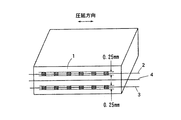
アルミニウム合金板から試験片を切り出し、圧延方向と板厚方向を含む断面が観察面となるように樹脂埋めし、前記観察面を研磨して鏡面とした。走査型電子顕微鏡(日本電子株式会社製のJSM-7001F)を用い、観察面を加速電圧20kVで、500倍の倍率で20視野(合計0.4mm2)観察し、COMPO像(組成像)を得た。観察視野として、図1に示すように、観察面1の板厚の1/4の部位(板厚の1/4の位置(ライン2,3)を中心とした幅0.25mmの範囲内)から、板厚の中心(ライン4)を挟んで上下10視野ずつ(計20視野)を選択した。COMPO像において母相より白く写る部分をAl-Fe系又はAl-Fe-Si系金属間化合物の粒子とみなし、走査型電子顕微鏡に内蔵された粒子解析ソフトEX-35110を用い、絶対最大長が2μm以上の粒子の個数をカウントし、個数密度を算出した。なお、絶対最大長とは、粒子の輪郭線上の任意の2点間の距離の最大値を意味する。
アルミニウム合金板の導電率は、フェルスター社製の渦流導電率測定装置(商品名シグマテスト、型番2.068)を用い、JISH0505:1975の規定に準じて測定した。導電率が58%IACS以上62%IACS以下の場合、導電性が良好「○」と評価し、導電率が58%IACS未満又は62%IACS超の場合、導電性が不良「×」と評価した。
(機械的性質の測定)
アルミニウム合金板から、引張方向が圧延方向と平行になるように、JIS5号試験片(JISZ2201:2009)を切り出した。この試験片を用いて、JISZ2241:2009に準拠する引張試験を実施し、引張強さ、耐力(0.2%耐力)及び伸びを測定した。
アルミニウム合金板から30mm×100mmのサイズの試験片を切り出し、連続発振式ファイバーレーザー(IPGフォトニクスジャパン株式会社製、型式:YLR-10000)を熱源とした溶接加工機を用いて、90mm溶接長でビードオンプレート溶接した。溶接条件は、レーザー出力2.0kW、溶接速度10.0m/分、前進角5deg.で行った。溶接ビード部について、溶接割れの有無、溶接ビード幅の均一性、アンダーカットの有無、及び溶接スパッタ付着の有無を観察した。その結果、溶接ビード部に割れの発生無く、溶接ビード幅が均一で、溶接ビード部にアンダーカット、突沸部、及び径が1mm以上のスパッタ付着が見られなかったものを、溶接外観が良好「○」と評価し、それ以外は全て溶接外観が不良「×」と評価した。
溶接外観の観察後、同じ試験片を用いて溶接ビードの溶け込み深さを測定した。溶接ビード長さの中央位置(中央位置に異常部が発生している場合は該異常部の近傍)で、試験片を溶接方向に垂直な断面で切断し、溶接ビード部の断面を光学顕微鏡で観察して溶込み深さを測定した。溶け込み深さが700μm以上の場合に良好「○」と評価し、700μm未満の場合は不良「×」と評価した。
各アルミニウム合金板から、長手方向が圧延方向と垂直になるように、5個のJIS3号試験片(JISZ2204:2009)を切り出した。この試験片(幅30mm)に対し、JISZ2248:2006に準拠し、Vブロック法により先端角度60度の押金具を用いて曲げ角度120度の曲げ加工を行った後、平金具で押しつぶし、曲げ角度180度の密着曲げを行った。密着曲げ後の曲げ部(湾曲部)外側を全幅30mmにわたり観察し、5個全ての試験片において肌荒れ及び割れが発生しなかったものを良好「○」と評価し、1個でも肌荒れ又は割れが発生したものを不良「×」と評価した。
No.19は、Si含有量が過剰なため、導電性が低く、溶接割れが発生して溶接外観が劣る。また、No.19は金属間化合物の個数密度が過剰であり、曲げ加工性が劣る。
No.20は、Fe含有量が不足するため、導電性が高く、金属間化合物の個数密度が低く、レーザー溶接の溶け込み深さが不足する。
No.22~24,26~28は、B含有量が過剰なため、溶接ビードに異常部が発生し、溶接ビード幅が不均一になり、溶接ビードにアンダーカットが生じた。No.25,26はSi含有量が過剰なため導電性が低く、No.25は溶接割れも発生した。また、No.22はTi含有量が過剰なため、曲げ加工性が劣る。No.25,26はSi及びFe含有量が過剰なため、No.27はFe含有量が過剰なため、いずれも金属間化合物の個数密度が過剰となり、曲げ加工性が劣る。
表3に示すアルミニウム合金板(No.2-1~2-5)について、実施例1と同じ要領で、最大長が2μm以上の金属間化合物の個数密度、導電率及び曲げ加工性を測定した。その結果を表3に示す。
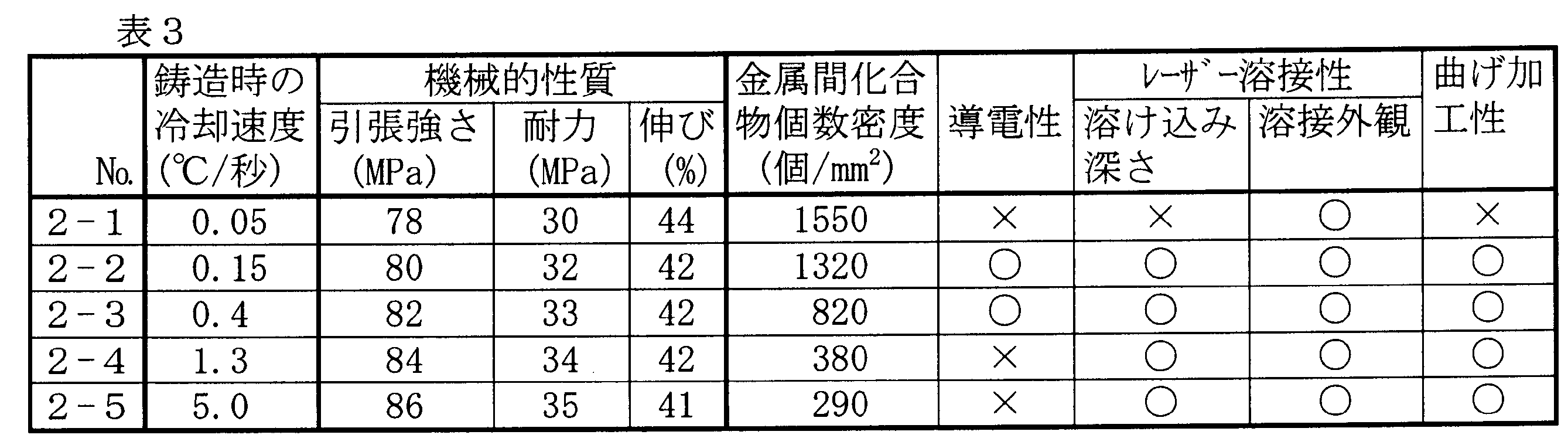
一方、鋳造時の冷却速度が0.05℃/秒であったNo.2-1は金属間化合物の個数密度が過剰で、導電性は不良(62%IACS超)であり、溶け込み深さが不足し、曲げ加工性が劣る。No.2-1の導電性が不良(62%IACS超)であったのは、Fe,Si等の固溶量が少なくなったためと考えられる。
鋳造時の冷却速度が1.3℃/秒であったNo.2-4及び5.0℃/秒であったNo.2-5は、金属間化合物の個数密度が少なく、導電性は不良(58%IACS未満)であった。No.2-4及びNo.2-5の導電性が不良(58%IACS未満)であったのは、Fe、Si等の固溶量が多くなったためと考えられる。
本出願は、2015年11月5日出願の日本特許出願(特願2015-217392)に基づくものであり、その内容はここに参照として取り込まれる。
2,3 板断面において板厚の1/4の位置を示すライン
4 板断面において板厚の中心位置を示すライン
Claims (2)
- Si:0.35質量%以下、Fe:0.15~0.60質量%、Ti:0.10質量%以下、B:1~6ppm、残部がAl及び不可避不純物からなり、断面の板厚の1/4における最大長が2μm以上の金属間化合物の個数密度が400~1500個/mm2であり、導電率が58~62%IACSであることを特徴とするレーザー溶接性に優れたバスバー用アルミニウム合金板。
- Cu:0.10質量%以下、Mn:0.05質量%以下、Mg:0.05質量%以下の1種以上を含むことを特徴とする請求項1に記載されたレーザー溶接性に優れたバスバー用アルミニウム合金板。
Priority Applications (4)
| Application Number | Priority Date | Filing Date | Title |
|---|---|---|---|
| CN201680063326.6A CN108350533A (zh) | 2015-11-05 | 2016-10-27 | 激光焊接性优异的汇流排用铝合金板 |
| DE112016005108.5T DE112016005108T5 (de) | 2015-11-05 | 2016-10-27 | Aluminiumlegierungsblech für Sammelschienen, das eine hervorragende Laserschweissbarkeit aufweist |
| KR1020187012277A KR20180055896A (ko) | 2015-11-05 | 2016-10-27 | 레이저 용접성이 우수한 버스 바용 알루미늄 합금판 |
| US15/773,208 US20180331348A1 (en) | 2015-11-05 | 2016-10-27 | Aluminum alloy plate for bus bars, which has excellent laser weldability |
Applications Claiming Priority (2)
| Application Number | Priority Date | Filing Date | Title |
|---|---|---|---|
| JP2015-217392 | 2015-11-05 | ||
| JP2015217392A JP6087413B1 (ja) | 2015-11-05 | 2015-11-05 | レーザー溶接性に優れた自動車バスバー用アルミニウム合金板 |
Publications (1)
| Publication Number | Publication Date |
|---|---|
| WO2017077929A1 true WO2017077929A1 (ja) | 2017-05-11 |
Family
ID=58185980
Family Applications (1)
| Application Number | Title | Priority Date | Filing Date |
|---|---|---|---|
| PCT/JP2016/081815 Ceased WO2017077929A1 (ja) | 2015-11-05 | 2016-10-27 | レーザー溶接性に優れたバスバー用アルミニウム合金板 |
Country Status (6)
| Country | Link |
|---|---|
| US (1) | US20180331348A1 (ja) |
| JP (1) | JP6087413B1 (ja) |
| KR (1) | KR20180055896A (ja) |
| CN (1) | CN108350533A (ja) |
| DE (1) | DE112016005108T5 (ja) |
| WO (1) | WO2017077929A1 (ja) |
Cited By (1)
| Publication number | Priority date | Publication date | Assignee | Title |
|---|---|---|---|---|
| JPWO2019021623A1 (ja) * | 2017-07-25 | 2020-05-28 | 住友電気工業株式会社 | 金属部材の溶接構造の製造方法、及び金属部材の溶接構造 |
Families Citing this family (6)
| Publication number | Priority date | Publication date | Assignee | Title |
|---|---|---|---|---|
| CN111540944A (zh) * | 2019-09-20 | 2020-08-14 | 杭州乾代科技有限公司 | 组装式锂电池模组 |
| JP7252926B2 (ja) * | 2020-09-17 | 2023-04-05 | プライムプラネットエナジー&ソリューションズ株式会社 | 二次電池用端子および該端子を備えた二次電池 |
| JP7256780B2 (ja) | 2020-09-17 | 2023-04-12 | プライムプラネットエナジー&ソリューションズ株式会社 | 二次電池用端子および二次電池用端子の製造方法 |
| JP7245208B2 (ja) | 2020-09-17 | 2023-03-23 | プライムプラネットエナジー&ソリューションズ株式会社 | 二次電池用端子および該端子を備えた二次電池 |
| JP7402202B2 (ja) | 2021-07-15 | 2023-12-20 | プライムプラネットエナジー&ソリューションズ株式会社 | 端子部品および端子部品の製造方法 |
| JP7426356B2 (ja) | 2021-08-06 | 2024-02-01 | プライムプラネットエナジー&ソリューションズ株式会社 | 端子部品ならびに該端子部品を備える二次電池および組電池 |
Citations (2)
| Publication number | Priority date | Publication date | Assignee | Title |
|---|---|---|---|---|
| JP2009287116A (ja) * | 2007-12-28 | 2009-12-10 | Kobe Steel Ltd | パルスレーザ溶接用アルミニウム合金材及び電池ケース |
| JP2014025119A (ja) * | 2012-07-27 | 2014-02-06 | Fujifilm Corp | 平版印刷版用アルミニウム合金板及びその製造方法 |
Family Cites Families (11)
| Publication number | Priority date | Publication date | Assignee | Title |
|---|---|---|---|---|
| JP2009256754A (ja) * | 2008-04-21 | 2009-11-05 | Sumitomo Light Metal Ind Ltd | レーザー溶接性に優れた電池ケース用アルミニウム板 |
| JP5542472B2 (ja) | 2010-02-17 | 2014-07-09 | 株式会社東芝 | 電池部品ならびに電池パックおよび電池パックの製造方法 |
| JP2012072487A (ja) * | 2010-09-03 | 2012-04-12 | Fujifilm Corp | 平版印刷版用アルミニウム合金板及びその製造方法 |
| JP5725344B2 (ja) * | 2011-02-02 | 2015-05-27 | 日本軽金属株式会社 | 成形性、溶接性に優れた電池ケース用アルミニウム合金板 |
| JP5846032B2 (ja) * | 2011-06-07 | 2016-01-20 | 日本軽金属株式会社 | 成形性、溶接性に優れた電池ケース用アルミニウム合金板 |
| JP5456747B2 (ja) | 2011-10-14 | 2014-04-02 | 株式会社神戸製鋼所 | 電池ケース用アルミニウム合金板及び電池ケース |
| CN103361521B (zh) * | 2013-07-22 | 2015-08-12 | 苏州有色金属研究院有限公司 | 具有优异激光焊接性能的铝合金板及其制备方法 |
| JP5929855B2 (ja) * | 2013-08-02 | 2016-06-08 | 日本軽金属株式会社 | 成形性、放熱性及び溶接性に優れた電池ケース用アルミニウム合金板 |
| JP6193070B2 (ja) | 2013-09-26 | 2017-09-06 | 日産自動車株式会社 | 電気接続用部材 |
| JP6355098B2 (ja) | 2013-12-27 | 2018-07-11 | 三菱アルミニウム株式会社 | 熱伝導性に優れた高成形用アルミニウム合金板材およびその製造方法 |
| JP6369122B2 (ja) | 2014-05-14 | 2018-08-08 | 新日鐵住金株式会社 | 鋳片の連続鋳造方法および連続鋳造鋳片 |
-
2015
- 2015-11-05 JP JP2015217392A patent/JP6087413B1/ja not_active Expired - Fee Related
-
2016
- 2016-10-27 WO PCT/JP2016/081815 patent/WO2017077929A1/ja not_active Ceased
- 2016-10-27 KR KR1020187012277A patent/KR20180055896A/ko not_active Ceased
- 2016-10-27 CN CN201680063326.6A patent/CN108350533A/zh active Pending
- 2016-10-27 US US15/773,208 patent/US20180331348A1/en not_active Abandoned
- 2016-10-27 DE DE112016005108.5T patent/DE112016005108T5/de not_active Withdrawn
Patent Citations (2)
| Publication number | Priority date | Publication date | Assignee | Title |
|---|---|---|---|---|
| JP2009287116A (ja) * | 2007-12-28 | 2009-12-10 | Kobe Steel Ltd | パルスレーザ溶接用アルミニウム合金材及び電池ケース |
| JP2014025119A (ja) * | 2012-07-27 | 2014-02-06 | Fujifilm Corp | 平版印刷版用アルミニウム合金板及びその製造方法 |
Cited By (2)
| Publication number | Priority date | Publication date | Assignee | Title |
|---|---|---|---|---|
| JPWO2019021623A1 (ja) * | 2017-07-25 | 2020-05-28 | 住友電気工業株式会社 | 金属部材の溶接構造の製造方法、及び金属部材の溶接構造 |
| JP7174361B2 (ja) | 2017-07-25 | 2022-11-17 | 住友電気工業株式会社 | 金属部材の溶接構造の製造方法、及び金属部材の溶接構造 |
Also Published As
| Publication number | Publication date |
|---|---|
| CN108350533A (zh) | 2018-07-31 |
| KR20180055896A (ko) | 2018-05-25 |
| JP6087413B1 (ja) | 2017-03-01 |
| US20180331348A1 (en) | 2018-11-15 |
| JP2017088926A (ja) | 2017-05-25 |
| DE112016005108T5 (de) | 2018-08-02 |
Similar Documents
| Publication | Publication Date | Title |
|---|---|---|
| JP6087413B1 (ja) | レーザー溶接性に優れた自動車バスバー用アルミニウム合金板 | |
| JP6148923B2 (ja) | アルミニウム合金製バスバー | |
| US9926619B2 (en) | Aluminum alloy | |
| JP5872256B2 (ja) | リチウムイオン電池封口材用アルミニウム合金板材およびその製造方法 | |
| WO2013118734A1 (ja) | 接続部品用アルミニウム合金板およびその製造方法 | |
| JP6034765B2 (ja) | 電気接続部品用アルミニウム合金板およびその製造方法 | |
| WO2015020054A1 (ja) | 導電用アルミニウム合金板およびその製造方法 | |
| CA3005031A1 (en) | Aluminum welding filler metal | |
| JP6181277B1 (ja) | 導電用アルミニウム板材 | |
| WO2021070900A1 (ja) | 耐応力腐食割れ性に優れた溶接構造部材及びその製造方法 | |
| KR101599653B1 (ko) | 버스바용 판상 도전체 및 그것으로 이루어지는 버스바 | |
| JP6228913B2 (ja) | リチウムイオン電池用アルミニウム合金板材およびその製造方法 | |
| EP4299777A1 (en) | Wrought aluminum alloy material for welding, aluminum alloy welded body and method for welding same | |
| JP2014118624A (ja) | バスバー用アルミニウム合金板およびその製造方法 | |
| JP2015052143A (ja) | 銅合金板材およびその製造方法 | |
| JP5647665B2 (ja) | バスバー用アルミニウム合金板 | |
| JP6632839B2 (ja) | アルミニウム合金溶加材及びアルミニウム合金の溶接方法 | |
| JP2018168468A (ja) | アルミニウム合金クラッド材及びその製造方法 | |
| JP6148925B2 (ja) | 導電用Al合金板材 | |
| JP6084083B2 (ja) | バスバー用アルミニウム合金材、ならびに、当該アルミニウム合金材を用いたバスバーと他部材とのレーザー溶接体 | |
| CA2884032A1 (en) | Aluminium welding filler metal, casting and wrought metal alloy | |
| EP2592165A1 (en) | Aluminium alloy | |
| JP2018199854A (ja) | 溶接用アルミニウム合金板及び溶接用アルミニウム合金板製造方法 | |
| JP2014185377A (ja) | 大型角筒電池ケース用アルミニウム合金板 | |
| JP5927617B2 (ja) | 電気接続部品用アルミニウム合金板およびその製造方法 |
Legal Events
| Date | Code | Title | Description |
|---|---|---|---|
| 121 | Ep: the epo has been informed by wipo that ep was designated in this application |
Ref document number: 16861990 Country of ref document: EP Kind code of ref document: A1 |
|
| ENP | Entry into the national phase |
Ref document number: 20187012277 Country of ref document: KR Kind code of ref document: A |
|
| WWE | Wipo information: entry into national phase |
Ref document number: 15773208 Country of ref document: US |
|
| WWE | Wipo information: entry into national phase |
Ref document number: 112016005108 Country of ref document: DE |
|
| 122 | Ep: pct application non-entry in european phase |
Ref document number: 16861990 Country of ref document: EP Kind code of ref document: A1 |