WO2017073365A1 - 硬化性樹脂組成物及び表示素子 - Google Patents
硬化性樹脂組成物及び表示素子 Download PDFInfo
- Publication number
- WO2017073365A1 WO2017073365A1 PCT/JP2016/080517 JP2016080517W WO2017073365A1 WO 2017073365 A1 WO2017073365 A1 WO 2017073365A1 JP 2016080517 W JP2016080517 W JP 2016080517W WO 2017073365 A1 WO2017073365 A1 WO 2017073365A1
- Authority
- WO
- WIPO (PCT)
- Prior art keywords
- group
- water
- resin composition
- curable resin
- resin
- Prior art date
- Legal status (The legal status is an assumption and is not a legal conclusion. Google has not performed a legal analysis and makes no representation as to the accuracy of the status listed.)
- Ceased
Links
Classifications
-
- C—CHEMISTRY; METALLURGY
- C08—ORGANIC MACROMOLECULAR COMPOUNDS; THEIR PREPARATION OR CHEMICAL WORKING-UP; COMPOSITIONS BASED THEREON
- C08L—COMPOSITIONS OF MACROMOLECULAR COMPOUNDS
- C08L33/00—Compositions of homopolymers or copolymers of compounds having one or more unsaturated aliphatic radicals, each having only one carbon-to-carbon double bond, and only one being terminated by only one carboxyl radical, or of salts, anhydrides, esters, amides, imides or nitriles thereof; Compositions of derivatives of such polymers
- C08L33/02—Homopolymers or copolymers of acids; Metal or ammonium salts thereof
-
- C—CHEMISTRY; METALLURGY
- C08—ORGANIC MACROMOLECULAR COMPOUNDS; THEIR PREPARATION OR CHEMICAL WORKING-UP; COMPOSITIONS BASED THEREON
- C08L—COMPOSITIONS OF MACROMOLECULAR COMPOUNDS
- C08L101/00—Compositions of unspecified macromolecular compounds
- C08L101/02—Compositions of unspecified macromolecular compounds characterised by the presence of specified groups, e.g. terminal or pendant functional groups
-
- C—CHEMISTRY; METALLURGY
- C09—DYES; PAINTS; POLISHES; NATURAL RESINS; ADHESIVES; COMPOSITIONS NOT OTHERWISE PROVIDED FOR; APPLICATIONS OF MATERIALS NOT OTHERWISE PROVIDED FOR
- C09D—COATING COMPOSITIONS, e.g. PAINTS, VARNISHES OR LACQUERS; FILLING PASTES; CHEMICAL PAINT OR INK REMOVERS; INKS; CORRECTING FLUIDS; WOODSTAINS; PASTES OR SOLIDS FOR COLOURING OR PRINTING; USE OF MATERIALS THEREFOR
- C09D133/00—Coating compositions based on homopolymers or copolymers of compounds having one or more unsaturated aliphatic radicals, each having only one carbon-to-carbon double bond, and at least one being terminated by only one carboxyl radical, or of salts, anhydrides, esters, amides, imides, or nitriles thereof; Coating compositions based on derivatives of such polymers
- C09D133/02—Homopolymers or copolymers of acids; Metal or ammonium salts thereof
-
- C—CHEMISTRY; METALLURGY
- C09—DYES; PAINTS; POLISHES; NATURAL RESINS; ADHESIVES; COMPOSITIONS NOT OTHERWISE PROVIDED FOR; APPLICATIONS OF MATERIALS NOT OTHERWISE PROVIDED FOR
- C09D—COATING COMPOSITIONS, e.g. PAINTS, VARNISHES OR LACQUERS; FILLING PASTES; CHEMICAL PAINT OR INK REMOVERS; INKS; CORRECTING FLUIDS; WOODSTAINS; PASTES OR SOLIDS FOR COLOURING OR PRINTING; USE OF MATERIALS THEREFOR
- C09D201/00—Coating compositions based on unspecified macromolecular compounds
- C09D201/02—Coating compositions based on unspecified macromolecular compounds characterised by the presence of specified groups, e.g. terminal or pendant functional groups
Definitions
- the present invention relates to a curable resin composition that can obtain a cured product that is excellent in transparency, adhesion, hardness, and heat-and-moisture resistance, and that can reduce the burden on the environment.
- the present invention also relates to a display element using the curable resin composition.
- Patent Document 1 discloses a coating composition containing a siloxane polymer and two or more types of organic solvents.
- Patent Document 2 discloses a resin, a polyfunctional monomer, a solvent, and photopolymerization initiation.
- a photosensitive transparent resin composition containing an agent and an organic compound-based ultraviolet absorber is disclosed. These compositions are excellent in transparency and are said to be suitably used for display device applications.
- Patent Document 1 and Patent Document 2 contain an organic solvent, an organic solvent is not used from the viewpoint of reducing the burden on the environment. Therefore, a resin composition having excellent transparency has been demanded.
- An object of the present invention is to provide a curable resin composition capable of obtaining a cured product excellent in transparency, adhesion, hardness, and heat-and-moisture resistance, and capable of reducing the burden on the environment. To do. Moreover, an object of this invention is to provide the display element which uses this curable resin composition.
- the present invention relates to a segment having a —C ( ⁇ O) OX group (X is hydrogen or a salt-forming cation) derived from a carboxyl group of a carboxyl group-containing ethylenically unsaturated monomer, and other ethylenically unsaturated monomers.
- a water-soluble resin that is a copolymer having a segment derived from a saturated monomer, a cross-linkable resin having a cross-linkable functional group capable of cross-linking the water-soluble resin, and a curable resin containing water It is a composition.
- the present invention is described in detail below.
- the present inventors use water as a solvent in place of the organic solvent used in conventional resin compositions, and use a water-soluble resin as a resin component, so that the resin composition is excellent in transparency without using an organic solvent.
- a water-soluble resin excellent in transparency a single amount of an ethylenically unsaturated monomer that is a carboxylic acid or a salt thereof and another ethylenically unsaturated monomer copolymerizable therewith The use of a copolymer as a body component was examined.
- the obtained cured product is excellent in transparency, there is a problem that it is inferior in adhesion, hardness, and heat-and-moisture resistance.
- the present inventors cross-linked the water-soluble resin with a cross-linkable resin that can cross-link the water-soluble resin, so that the cured product has transparency, adhesion, hardness. And it discovered that it was excellent in moist heat resistance, and could obtain the curable resin composition which can reduce the load to an environment, and came to complete this invention. Moreover, since the curable resin composition of the present invention can be cured by heating at a low temperature, damage to the device due to light irradiation or high-temperature heating can be prevented.
- the above-mentioned “transparent” means that the total light transmittance measured with a haze meter is 85% or more and the haze value (cloudiness value) is 1% or less. To do.
- the curable resin composition of the present invention contains a water-soluble resin.
- the water-soluble resin includes a segment having a —C ( ⁇ O) OX group (X is hydrogen or a salt-forming cation) derived from a carboxyl group of a carboxyl group-containing ethylenically unsaturated monomer, and other ethylene And a segment derived from a polymerizable unsaturated monomer (hereinafter also referred to as “water-soluble resin according to the present invention”).
- the water-soluble resin according to the present invention may be any of a random copolymer, a block copolymer, and a graft copolymer.
- the term “water-soluble” means that an aqueous solution can be obtained in a neutral range of pH 6 to pH 9.
- the water-soluble resin according to the present invention has excellent reactivity with water-soluble and crosslinkable resins.
- the —C ( ⁇ O) OX group is derived from the carboxyl group of the carboxyl group-containing ethylenically unsaturated monomer.
- the carboxyl group-containing ethylenically unsaturated monomer include acrylic acid, methacrylic acid, 3-acryloyloxypropionic acid, fumaric acid, itaconic acid, maleic acid, and crotonic acid. Of these, acrylic acid and methacrylic acid are preferable from the viewpoint of copolymerization.
- X is hydrogen or a salt-forming cation.
- examples of the salt-forming cation include ammonium ions and alkali metal ions.
- the “ammonium ion” means a cation derived from ammonia, a primary amine, a secondary amine, or a tertiary amine.
- the —C ( ⁇ O) OX group can be confirmed using an infrared spectrometer.
- the preferable lower limit of the content ratio of the segment having —C ( ⁇ O) OX group in the water-soluble resin according to the present invention is 5% by weight, and the preferable upper limit is 25% by weight.
- the content ratio of the segment having the —C ( ⁇ O) OX group is within this range, the obtained water-soluble resin is water-soluble and cross-linkable resin without deteriorating water resistance and storage stability. It becomes more excellent by the reactivity with.
- the more preferable lower limit of the content ratio of the segment having the —C ( ⁇ O) OX group is 10% by weight, and the more preferable upper limit is 15% by weight.
- the content ratio of the segment having the —C ( ⁇ O) OX group can be determined by 1 H-NMR and 13 C-NMR.
- Examples of the other ethylenically unsaturated monomers include methyl (meth) acrylate, ethyl (meth) acrylate, propyl (meth) acrylate, isopropyl (meth) acrylate, and n- (meth) acrylate.
- the preferable lower limit of the content ratio of the segment derived from the other ethylenically unsaturated monomer in the water-soluble resin according to the present invention is 75% by weight, and the preferable upper limit is 95% by weight.
- the content ratio of the segment derived from the other ethylenically unsaturated monomer is within this range, the cured product of the obtained curable resin composition is more excellent in moisture and heat resistance.
- the minimum with more preferable content rate of the segment originating in the said other ethylenically unsaturated monomer is 80 weight%, and a more preferable upper limit is 90 weight%.
- the water-soluble resin according to the present invention includes aromatic substituted maleimide monomers such as N-phenylmaleimide, N-benzylmaleimide, N- (1-naphthyl) maleimide, o-chlorophenylmaleimide, and N-methylmaleimide. , Segments derived from alkyl-substituted maleimide monomers such as N-ethylmaleimide, N-propylmaleimide and N-isopropylmaleimide.
- aromatic substituted maleimide monomers such as N-phenylmaleimide, N-benzylmaleimide, N- (1-naphthyl) maleimide, o-chlorophenylmaleimide, and N-methylmaleimide.
- the water-soluble resin according to the present invention is preferably a (meth) acrylic copolymer having the above-mentioned —C ( ⁇ O) OX group in the side chain.
- the water-soluble resin according to the present invention may be a copolymer having a segment derived from the carboxyl group-containing ethylenically unsaturated monomer and a segment derived from the other ethylenically unsaturated monomer.
- the copolymer may be neutralized with a base such as ammonia or amine to form a carboxylate.
- a method for producing a copolymer having a segment derived from the carboxyl group-containing ethylenically unsaturated monomer and a segment derived from the other ethylenically unsaturated monomer for example, a radical polymerization initiator and If necessary, using a molecular weight regulator, a monomer component constituting a copolymer such as the carboxyl group-containing ethylenically unsaturated monomer and the other ethylenically unsaturated monomer, bulk polymerization, Examples of the polymerization method include conventionally known methods such as solution polymerization, suspension polymerization, dispersion polymerization, and emulsion polymerization. Of these, solution polymerization is preferred.
- solvent used in the solution polymerization examples include aliphatic alcohols such as methanol, ethanol, isopropanol and glycol, cellosolves such as cellosolve and butylcellosolve, carbitols such as carbitol and butylcarbitol, and acetic acid.
- Esters such as cellosolve, carbitol acetate, propylene glycol monomethyl ether acetate, ethers such as diethylene glycol dimethyl ether, cyclic ethers such as tetrahydrofuran, ketones such as cyclohexanone, methyl ethyl ketone, methyl isobutyl ketone, dimethyl sulfoxide, dimethylformamide, etc.
- organic solvents having the following polarity.
- Examples of the medium used for the suspension polymerization, the dispersion polymerization, the emulsion polymerization, and the like include liquid hydrocarbons such as benzene, toluene, hexane, and cyclohexane, and other nonpolar organic solvents. .
- radical polymerization initiator used when producing a copolymer having a segment derived from the carboxyl group-containing ethylenically unsaturated monomer and a segment derived from the other ethylenically unsaturated monomer
- Peroxides for example, Peroxides, azo initiators, and the like.
- the molecular weight modifier include ⁇ -methylstyrene dimer, mercaptan chain transfer agent, and the like.
- amine that can be used when neutralizing a copolymer having a segment derived from the carboxyl group-containing ethylenically unsaturated monomer and a segment derived from the other ethylenically unsaturated monomer
- primary amines such as methylamine, ethylamine, propylamine, isopropylamine
- secondary amines such as dimethylamine, diethylamine, dipropylamine, diisopropylamine, trimethylamine, triethylamine, N, N-dimethylpropylamine, N
- Tertiary amines such as N-dimethylisopropylamine, N, N-diisopropylmethylamine, N, N-diisopropylethylamine and the like can be mentioned.
- the minimum with a preferable weight average molecular weight of the water-soluble resin concerning this invention is 5000, and a preferable upper limit is 50,000.
- the weight average molecular weight of the water-soluble resin according to the present invention is within this range, the resulting curable resin composition has better adhesion.
- the minimum with a more preferable weight average molecular weight of the water-soluble resin concerning this invention is 10,000, and a more preferable upper limit is 20,000.
- the said weight average molecular weight is a value calculated
- Examples of the column for measuring the weight average molecular weight in terms of polystyrene by GPC include Shodex LF-804 (manufactured by Showa Denko KK). Moreover, tetrahydrofuran etc. are mentioned as a solvent used by GPC.
- the preferable lower limit of the —C ( ⁇ O) OX group equivalent of the water-soluble resin according to the present invention is 288, and the preferable upper limit is 4000.
- the —C ( ⁇ O) OX group equivalent of the water-soluble resin according to the present invention is within this range, the water-soluble resin and the reactivity with the cross-linkable resin are excellent.
- the more preferable lower limit of the —C ( ⁇ O) OX group equivalent of the water-soluble resin according to the present invention is 480, and the more preferable upper limit is 2000.
- the —C ( ⁇ O) OX group equivalent of the water-soluble resin according to the present invention is such that the weight (g) of the water-soluble resin according to the present invention is the —C ( ⁇ O) contained in the water-soluble resin according to the present invention. It is a value obtained by dividing by the number of moles (mol) of the OX group.
- water-soluble resin examples include (meth) acrylic acid / (meth) methyl acrylate copolymer, (meth) acrylic acid / (meth) ethyl acrylate copolymer, (meth ) Acrylic acid / (meth) propyl propyl copolymer, (meth) acrylic acid / (meth) isopropyl acrylate copolymer, (meth) acrylic acid / (meth) acrylic acid n-butyl copolymer, (meth ) Acrylic acid / (meth) acrylic acid isobutyl copolymer, (meth) acrylic acid / (meth) acrylic acid 2-ethylhexyl copolymer, (meth) acrylic acid / (meth) acrylic acid cyclohexyl copolymer, (meta ) Acrylic acid / (meth) acrylic acid 2-methylcyclohexyl copolymer, (meth) acrylic acid / (meth) acrylic acid / (meth)
- the water-soluble resin according to the present invention may be mixed with a cross-linkable resin after being previously in an aqueous solution state.
- aqueous solutions containing the water-soluble resin according to the present invention include Acryt 3SQ-424 and Acryt 3SQ-426 (both manufactured by Taisei Fine Chemical Co., Ltd.).
- the curable resin composition of the present invention contains a crosslinkable resin having a crosslinkable functional group capable of crosslinking the water-soluble resin according to the present invention.
- a crosslinkable resin having a crosslinkable functional group capable of crosslinking the water-soluble resin according to the present invention.
- the cured product of the curable resin composition of the present invention has adhesion to a glass substrate or an acrylic coating layer, hardness, and heat and humidity resistance. It will be excellent.
- the said crosslinkable resin also has the effect of improving the wettability at the time of application
- crosslinkable functional group possessed by the crosslinkable resin examples include an oxazoline group, an epoxy group, a hydroxy group, an amino group, an isocyanate group, a carbodiimide group, and an aziridine group. Of these, an oxazoline group is preferred because of good storage stability and curability upon heating.
- the crosslinkable resin preferably has two or more crosslinkable functional groups in one molecule.
- the preferable lower limit of the crosslinkable functional group equivalent of the crosslinkable resin is 100, and the preferable upper limit is 2000.
- the crosslinkable functional group equivalent of the crosslinkable resin is within this range, the cured product of the resulting curable resin composition is more excellent in adhesion, hardness, and moist heat resistance.
- the more preferable lower limit of the crosslinkable functional group equivalent of the crosslinkable resin is 120, and the more preferable upper limit is 600.
- the crosslinkable functional group equivalent of the crosslinkable resin is a value obtained by dividing the weight (g) of the crosslinkable resin by the number of moles (mol) of the crosslinkable functional group contained in the crosslinkable resin.
- the crosslinkable resin is preferably water-soluble.
- the resin skeleton of the crosslinkable resin include a polyacryl skeleton, a polyether skeleton, a polyester skeleton, a polyurethane skeleton, a polyamide skeleton, a polyimide skeleton, and a polystyrene skeleton. Of these, a polyacryl skeleton is preferable.
- the minimum with a preferable weight average molecular weight of the said crosslinkable resin is 500, and a preferable upper limit is 500,000.
- the weight average molecular weight of the crosslinkable resin is within this range, the water-soluble resin according to the present invention can be more uniformly crosslinked.
- the minimum with a more preferable weight average molecular weight of the said crosslinkable resin is 10,000, and a more preferable upper limit is 200,000.
- the crosslinkable resin may be mixed with the water-soluble resin according to the present invention after it is in an aqueous solution in advance.
- Epocross K series Epocross WS series (all are the Nippon Shokubai company make) etc. are mentioned, for example.
- the content ratio of the water-soluble resin according to the present invention and the crosslinkable resin is within this range, the cured product of the obtained curable resin composition is more excellent in adhesion, hardness, and moisture and heat resistance.
- the molar ratio of the —C ( ⁇ O) OX group of the water-soluble resin according to the present invention to the crosslinkable functional group of the crosslinkable resin is within this range, a cured product of the resulting curable resin composition is obtained. Is superior in adhesion, hardness, and heat-and-moisture resistance.
- the molar ratio of the —C ( ⁇ O) OX group of the water-soluble resin according to the present invention to the crosslinkable functional group of the crosslinkable resin is —C ( ⁇ O).
- the molar ratio of the —C ( ⁇ O) OX group of the water-soluble resin according to the present invention to the cross-linkable functional group of the cross-linkable resin is determined by the —C ( ⁇ O) of the water-soluble resin according to the present invention. It can be determined from the OX group equivalent, the crosslinkable functional group equivalent of the crosslinkable resin, and the content ratio of the water-soluble resin and the crosslinkable resin according to the present invention.
- the curable resin composition of the present invention is further provided with a —N (H) C ( ⁇ O) Y group (Y is an alkyl having 1 to 3 carbon atoms) for the purpose of improving the crack prevention property of the cured product.
- Y is an alkyl having 1 to 3 carbon atoms
- Examples of the ethylenically unsaturated monomer having a —N (H) C ( ⁇ O) Y group include N-vinylacetamide, N-vinylpropionamide, N-vinylbutyramide, N-vinylcarbamic acid, Examples include sodium N-vinylcarbamate and N-vinylformamide. Of these, N-vinylacetamide is preferable.
- the resin having the —N (H) C ( ⁇ O) Y group may be a homopolymer of an ethylenically unsaturated monomer having the —N (H) C ( ⁇ O) Y group.
- a copolymer of the ethylenically unsaturated monomer having the —N (H) C ( ⁇ O) Y group and other monomers may also be used.
- the thing similar to other ethylenically unsaturated monomers such as acrylamide, vinyl acetate, (meth) acrylic acid, sodium (meth) acrylate, methyl (meth) acrylate, acrylonitrile, etc. Or a salt thereof.
- the obtained copolymer is the above-mentioned copolymer having a segment derived from the carboxyl group-containing ethylenically unsaturated monomer and a segment derived from the other ethylenically unsaturated monomer. You may neutralize like the method of neutralizing.
- the preferable lower limit of the weight average molecular weight of the resin having the —N (H) C ( ⁇ O) Y group is 30,000, and the preferable upper limit is 5 million.
- the weight average molecular weight of the resin having the —N (H) C ( ⁇ O) Y group is in this range, the excellent coating property and adhesion property of the curable resin composition of the present invention are maintained.
- the cured product is more excellent in crack prevention.
- the more preferable lower limit of the weight average molecular weight of the resin having the —N (H) C ( ⁇ O) Y group is 300,000, and the more preferable upper limit is 4 million.
- the content of the resin having a —N (H) C ( ⁇ O) Y group is within this range, curing can be performed while maintaining excellent coating properties and adhesion of the curable resin composition of the present invention. Things are superior due to crack prevention.
- the curable resin composition of the present invention contains water as a solvent.
- water By using the above water as a solvent, the impact on the environment, such as the discharge of organic chemicals, the danger of fire, and the health of the handler when coating and drying the curable resin composition are adversely affected. Can be reduced.
- the water-soluble resin and the cross-linkable resin according to the present invention may be mixed after previously in the state of an aqueous solution.
- the content of water in the curable resin composition of the present invention is not particularly limited and is appropriately set so as to have a viscosity suitable for the coating method and the like, but in such an amount that the solid content concentration is 1 to 50% by weight. Preferably, the amount is 10 to 40% by weight.
- the curable resin composition of the present invention may contain other solvents such as organic solvents in addition to the above water, but does not contain other solvents for the purpose of the present invention to reduce the burden on the environment. It is preferable. When it contains the said other solvent, it is preferable that the content is 30 weight% or less of the whole solvent, and it is more preferable that it is 10 weight% or less. When the content of the other solvent is excessive, it is preferable to remove the other solvent by an appropriate method such as azeotropy. The removal of the other solvent may be performed before mixing with the water-soluble resin and the crosslinkable resin according to the present invention.
- organic solvents with low toxicity such as propylene glycols, such as propylene glycol monomethyl ether acetate, alcohols, such as ethyl alcohol and isopropyl alcohol, are mentioned, for example.
- the curable resin composition of the present invention is a pH adjuster such as ammonia water and sodium hydroxide, a viscosity adjuster, an ultraviolet absorber, an antioxidant, an antifoaming agent, and a leveling agent as long as the object of the present invention is not impaired. Further, various known additives such as coupling agents, pigments, and dyes may be contained. In the curable resin composition of the present invention, it is preferable to adjust the pH in order to suppress thickening and improve storage stability, and it is more preferable to adjust the pH appropriately to the high pH side.
- the curable resin composition of the present invention for example, a water-soluble resin according to the present invention, the crosslinkable resin, the water, an additive used as necessary, and the like are mixed with a stirrer. And the like. Moreover, it is preferable to filter using a filter after stirring so that it may become a uniform mixture.
- the coating method includes, for example, known methods such as spin coating, slit coating, screen printing, ink jet coating, electrostatic coating, bar coating, die coating, and roll coating.
- a coating method can be used, and it can be used by adjusting to a desired film thickness and a concentration and viscosity suitable for a predetermined coating method.
- the curable resin composition of the present invention can be cured by heating at a low temperature.
- the heating temperature for curing the curable resin composition of the present invention is not particularly limited, but is usually 80 ° C. to 250 ° C., and preferably 100 ° C. or more to reduce the heat treatment time, thereby suppressing yellowing due to heating. Therefore, the temperature is preferably 200 ° C. or lower.
- a display element having a cured product comprising the curable resin composition of the present invention is also one aspect of the present invention. Since the cured product made of the curable resin composition of the present invention is excellent in transparency, adhesion, hardness, and heat-and-moisture resistance, the display element of the present invention is particularly excellent in display performance.
- the present invention it is possible to provide a curable resin composition that can obtain a cured product that is excellent in transparency, adhesion, hardness, and heat-and-moisture resistance, and that can reduce the burden on the environment. it can. Moreover, according to this invention, the display element which uses this curable resin composition can be provided.
- Example 1 Preparation of water-soluble resin A A four-necked separable flask having a capacity of 1000 mL was equipped with a reactor equipped with a stirrer, reflux condenser, thermometer, nitrogen gas inlet tube, and dropping funnel. 50 parts by weight of tetrahydrofuran was placed in the flask, and nitrogen gas was introduced and bubbled to remove dissolved oxygen.
- curable resin composition 100 parts by weight of an aqueous solution of water-soluble resin A obtained in the above-mentioned "(1) Preparation of water-soluble resin A” and an aqueous solution of a crosslinkable resin having an oxazoline group as a crosslinkable functional group (Nippon Shokubai Co., Ltd., “Epocross WS-300”, weight average molecular weight 120,000 of crosslinkable resin, oxazoline group equivalent 130 in crosslinkable resin, solid content 10 wt%) 69 parts by weight with a stirrer After mixing for a minute, the mixture was filtered through a membrane filter having a pore size of 5 ⁇ m to prepare a curable resin composition.
- a crosslinkable resin having an oxazoline group as a crosslinkable functional group Nippon Shokubai Co., Ltd., “Epocross WS-300”, weight average molecular weight 120,000 of crosslinkable resin, oxazoline group equivalent 130 in crosslinkable resin, solid content
- Example 2 As an aqueous solution containing a water-soluble resin, “Acryt 3SQ-424” (manufactured by Taisei Fine Chemical Co., Ltd., a water-soluble resin obtained by neutralizing a copolymer containing 15% by weight of methacrylic acid as a carboxyl group-containing ethylenically unsaturated monomer with ammonia) As an aqueous solution containing 100 parts by weight of a water-soluble resin, a weight average molecular weight of 16000, a —C ( ⁇ O) OX group equivalent weight of 590, a solid content of 25% by weight in the water-soluble resin, and “Epocross” 110 parts by weight of WS-300 was mixed with a stirrer for 30 minutes, and then filtered through a membrane filter having a pore size of 5 ⁇ m to prepare a curable resin composition.
- Example 6 A curable resin composition was obtained in the same manner as in Example 3 except that the blending amount of “Epocross WS-300” which is an aqueous solution of a crosslinkable resin having an oxazoline group as a crosslinkable functional group was changed as shown in Table 1. A product was prepared.
- Example 7 100 parts by weight of an aqueous solution of the water-soluble resin A obtained in “(1) Preparation of water-soluble resin A” in Example 1 and an aqueous solution containing a crosslinkable resin (“Epocross WS-700” manufactured by Nippon Shokubai Co., Ltd.) 70 weight parts of the weight average molecular weight of the functional resin, 40,000 oxazoline group in the crosslinkable resin, solid content rate 25 weight%) was mixed for 30 minutes with a stirrer, and then filtered through a membrane filter having a pore size of 5 ⁇ m. A curable resin composition was prepared.
- Example 8 100 parts by weight of “Acryt 3SQ-424” as an aqueous solution containing a water-soluble resin and 112 parts by weight of “Epocross WS-700” as an aqueous solution containing a crosslinkable resin were mixed for 30 minutes with a stirrer, and then the pore diameter was 5 ⁇ m.
- the curable resin composition was prepared by filtering through a membrane filter.
- Example 9 100 parts by weight of “Acryt 3SQ-426” as an aqueous solution containing a water-soluble resin and 112 parts by weight of “Epocross WS-700” as an aqueous solution containing a crosslinkable resin were mixed for 30 minutes with a stirrer, and then the pore diameter was 5 ⁇ m.
- the curable resin composition was prepared by filtering through a membrane filter.
- Example 10 100 parts by weight of “Acryt 3SQ-426” as an aqueous solution containing a water-soluble resin and 186 parts by weight of “Epocross WS-700” as an aqueous solution containing a crosslinkable resin were mixed for 30 minutes with a stirrer, and then the pore diameter was 5 ⁇ m.
- the curable resin composition was prepared by filtering through a membrane filter.
- Example 11 100 parts by weight of an aqueous solution of water-soluble resin A obtained in “(1) Preparation of water-soluble resin A” in Example 1, crosslinkable resin (manufactured by Nagase ChemteX Corporation, “Denacol EX-521”, A weight average molecular weight of 1294 and 10 parts by weight of an epoxy group equivalent of 183 in the crosslinkable resin were mixed with a stirrer for 30 minutes, and then filtered through a membrane filter having a pore size of 5 ⁇ m to prepare a curable resin composition.
- crosslinkable resin manufactured by Nagase ChemteX Corporation, “Denacol EX-521”
- a weight average molecular weight of 1294 and 10 parts by weight of an epoxy group equivalent of 183 in the crosslinkable resin were mixed with a stirrer for 30 minutes, and then filtered through a membrane filter having a pore size of 5 ⁇ m to prepare a curable resin composition.
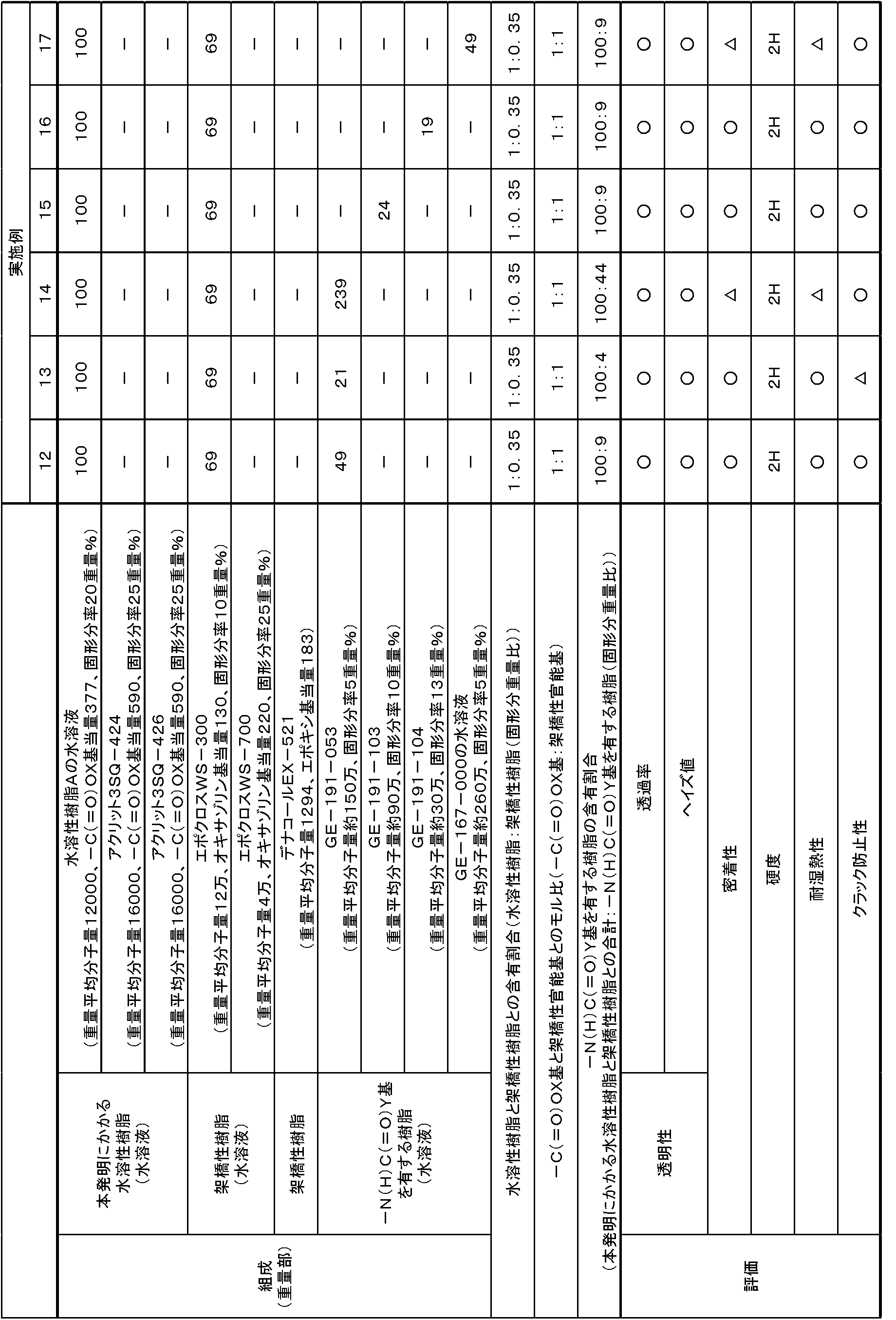
- Example 12 As an aqueous solution containing a resin having a —N (H) C ( ⁇ O) Y group, “GE-191-053” (manufactured by Showa Denko KK, poly-N-vinylacetamide aqueous solution, poly-N-vinylacetamide A curable resin composition was prepared in the same manner as in Example 1 except that 49 parts by weight of a weight average molecular weight of about 1.5 million and a solid content of 5% by weight were blended.
- Example 13 A curable resin composition was prepared in the same manner as in Example 12 except that the amount of “GE-191-053” was changed to 21 parts by weight.
- Example 14 A curable resin composition was prepared in the same manner as in Example 12 except that the amount of “GE-191-053” was changed to 239 parts by weight.
- Example 15 As an aqueous solution containing a resin having a —N (H) C ( ⁇ O) Y group, “GE-191-103” (manufactured by Showa Denko KK, poly-N-vinylacetamide aqueous solution, poly-N-vinylacetamide A curable resin composition was prepared in the same manner as in Example 1 except that 24 parts by weight of a weight average molecular weight of about 900,000 and a solid content of 10% by weight were blended.
- Example 16 As an aqueous solution containing a resin having a —N (H) C ( ⁇ O) Y group, “GE-191-104” (manufactured by Showa Denko KK, poly-N-vinylacetamide aqueous solution, poly-N-vinylacetamide A curable resin composition was prepared in the same manner as in Example 1 except that 19 parts by weight of a weight average molecular weight of about 300,000 and a solid content of 13% by weight were blended.
- Example 17 As an aqueous solution containing a resin having a —N (H) C ( ⁇ O) Y group, “GE-167-000” (manufactured by Showa Denko KK, N-vinylacetamide / sodium acrylate copolymer, A curable resin composition was prepared in the same manner as in Example 1 except that 49 parts by weight of an aqueous solution having a solid content of 5% by weight obtained by dissolving a weight average molecular weight of about 2.6 million) in water was blended.
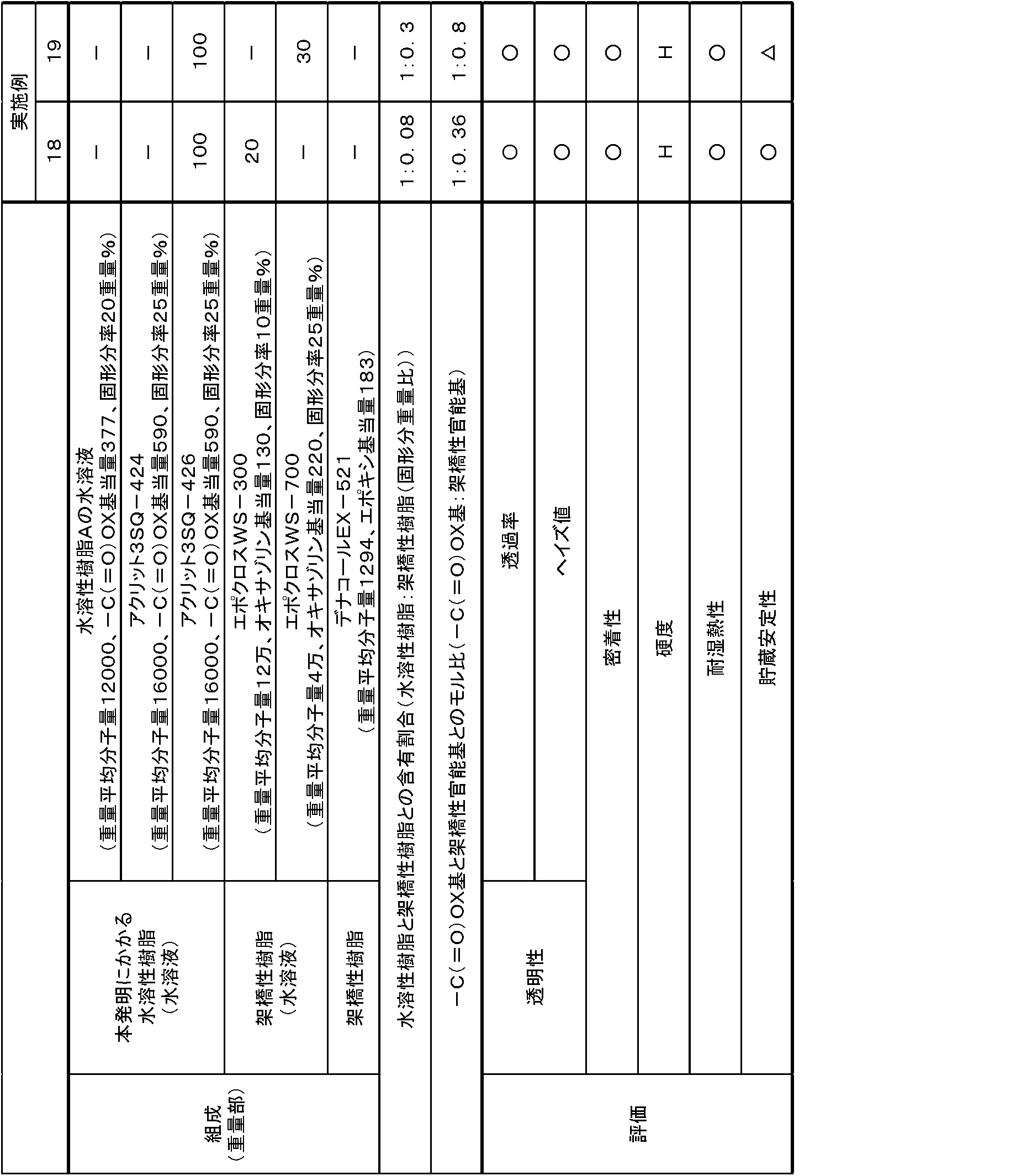
- Example 18 100 parts by weight of “Acryt 3SQ-426” as an aqueous solution containing a water-soluble resin and 20 parts by weight of “Epocross WS-300” as an aqueous solution containing a crosslinkable resin were mixed for 30 minutes with a stirrer, and then the pore diameter was 5 ⁇ m.
- the curable resin composition was prepared by filtering through a membrane filter.
- Example 19 100 parts by weight of “Acryt 3SQ-426” as an aqueous solution containing a water-soluble resin and 30 parts by weight of “Epocross WS-700” as an aqueous solution containing a crosslinkable resin were mixed for 30 minutes with a stirrer, and then the pore diameter was 5 ⁇ m.
- the curable resin composition was prepared by filtering through a membrane filter.
- Each curable resin composition obtained in Examples 12 to 17 was applied on a non-alkali glass substrate having a thickness of 0.7 mm, a width of 50 mm, and a length of 50 mm by spin coating, and then allowed to stand at room temperature for 10 minutes.
- a test piece having a thickness of about 10 ⁇ m was produced by drying at 120 ° C. for 10 minutes. The obtained test piece was visually observed, “ ⁇ ” when no cracks were confirmed, “ ⁇ ” when very slight cracks were confirmed, and “ ⁇ ” when cracks were clearly confirmed. The crack prevention property was evaluated.
- the present invention it is possible to provide a curable resin composition that can obtain a cured product that is excellent in transparency, adhesion, hardness, and heat-and-moisture resistance, and that can reduce the burden on the environment. it can. Moreover, according to this invention, the display element which uses this curable resin composition can be provided.
Landscapes
- Chemical & Material Sciences (AREA)
- Organic Chemistry (AREA)
- Life Sciences & Earth Sciences (AREA)
- Engineering & Computer Science (AREA)
- Materials Engineering (AREA)
- Wood Science & Technology (AREA)
- Health & Medical Sciences (AREA)
- Chemical Kinetics & Catalysis (AREA)
- Medicinal Chemistry (AREA)
- Polymers & Plastics (AREA)
- Compositions Of Macromolecular Compounds (AREA)
- Addition Polymer Or Copolymer, Post-Treatments, Or Chemical Modifications (AREA)
Abstract
Description
例えば、特許文献1には、シロキサンポリマーと特定の2種類以上の有機溶媒とを含有するコーティング用組成物が開示されており、特許文献2には、樹脂と多官能モノマーと溶剤と光重合開始剤と有機化合物系紫外線吸収剤とを含有する感光性透明樹脂組成物が開示されている。これらの組成物は透明性に優れ、表示素子用途に好適に用いられるとされている。
以下に本発明を詳述する。
そこで本発明者らは更に鋭意検討した結果、上記水溶性樹脂を架橋することが可能な架橋性樹脂を用いて該水溶性樹脂を架橋することにより、硬化物が、透明性、密着性、硬度、及び、耐湿熱性に優れ、かつ、環境への負荷を低減することができる硬化性樹脂組成物を得ることができることを見出し、本発明を完成させるに至った。
また、本発明の硬化性樹脂組成物は、低温での加熱硬化が可能であるため、光照射や高温加熱によるデバイスへのダメージを防止することができる。
なお、本明細書において上記「透明」とは、へイズメーターを用いて測定した、全光線透過率が85%以上であり、かつ、ヘイズ値(曇価)が1%以下であることを意味する。
上記水溶性樹脂は、カルボキシル基含有エチレン性不飽和単量体のカルボキシル基に由来する-C(=O)OX基(Xは、水素又は塩形成カチオンである)を有するセグメントと、その他のエチレン性不飽和単量体に由来するセグメントとを有する共重合体(以下、「本発明にかかる水溶性樹脂」ともいう)である。本発明にかかる水溶性樹脂は、ランダム共重合体、ブロック共重合体、及び、グラフト共重合体のいずれであってもよい。
なお、本明細書において、上記「水溶性」とは、pH6からpH9の概ね中性の範囲で水溶液を得ることができることを意味する。
上記カルボキシル基含有エチレン性不飽和単量体としては、例えば、アクリル酸、メタクリル酸、3-アクリロイルオキシプロピオン酸、フマル酸、イタコン酸、マレイン酸、クロトン酸等が挙げられる。なかでも、共重合性の観点から、アクリル酸、メタクリル酸が好ましい。
上記Xが塩形成カチオンである場合、該塩形成カチオンとしては、アンモニウムイオン、アルカリ金属イオン等が挙げられる。
なかでも、得られる水溶性樹脂がオキサゾリン基を有する架橋性樹脂との反応性により優れるものとなることから、上記Xは、水素又はアンモニウムイオンであることが好ましい。
なお、本明細書において上記「アンモニウムイオン」とは、アンモニア、一級アミン、二級アミン、又は、三級アミン由来のカチオンを意味する。
上記-C(=O)OX基としては、具体的には例えば、-C(=O)OH基、-C(=O)O-NH3基、-C(=O)O-NH2(CH3)基、-C(=O)O-NH(CH3)2基、-C(=O)O-N(CH3)3基、-C(=O)ONa基、-C(=O)OK基等が挙げられる。
なお、上記-C(=O)OX基は、赤外分光装置を用いて確認することができる。
なお、上記-C(=O)OX基を有するセグメントの含有割合は、1H-NMR及び13C-NMRにより求めることができる。
なお、本明細書において上記「(メタ)アクリル」は、アクリル又はメタクリルを意味する。
また、上記懸濁重合、上記分散重合、上記乳化重合等に用いられる媒体としては、例えば、ベンゼン、トルエン、ヘキサン、シクロヘキサン等の液状の炭化水素や、その他の非極性の有機溶剤等が挙げられる。
また、上記分子量調整剤としては、例えば、α-メチルスチレンダイマー、メルカプタン系の連鎖移動剤等が挙げられる。
なお、本明細書において上記重量平均分子量は、ゲルパーミエーションクロマトグラフィー(GPC)で測定を行い、ポリスチレン換算により求められる値である。GPCによってポリスチレン換算による重量平均分子量を測定する際のカラムとしては、例えば、Shodex LF-804(昭和電工社製)等が挙げられる。また、GPCで用いる溶媒としては、テトラヒドロフラン等が挙げられる。
なお、本発明にかかる水溶性樹脂の-C(=O)OX基当量は、本発明にかかる水溶性樹脂の重量(g)を本発明にかかる水溶性樹脂に含まれる-C(=O)OX基のモル数(mol)で除して求められる値である。
本発明にかかる水溶性樹脂を含有する水溶液として市販されているものとしては、例えば、アクリット3SQ-424、アクリット3SQ-426(いずれも大成ファインケミカル社製)等が挙げられる。
上記架橋性樹脂は、上記架橋性官能基を1分子中に2個以上有することが好ましい。
なお、上記架橋性樹脂の架橋性官能基当量は、架橋性樹脂の重量(g)を架橋性樹脂中に含まれる架橋性官能基のモル数(mol)で除して求められる値である。
上記架橋性樹脂の樹脂骨格としては、例えば、ポリアクリル骨格、ポリエーテル骨格、ポリエステル骨格、ポリウレタン骨格、ポリアミド骨格、ポリイミド骨格、ポリスチレン骨格等が挙げられる。なかでも、ポリアクリル骨格が好ましい。
上記架橋性樹脂を含有する水溶液として市販されているものとしては、例えば、エポクロスKシリーズ、エポクロスWSシリーズ(いずれも日本触媒社製)等が挙げられる。
硬度を重要特性とする場合、本発明にかかる水溶性樹脂と上記架橋性樹脂との含有割合は、重量比で、本発明にかかる水溶性樹脂:架橋性樹脂=1:0.1~1:1.5であることが好ましく、本発明にかかる水溶性樹脂:架橋性樹脂=1:0.25~1:1であることがより好ましい。
貯蔵安定性を重要特性とする場合、本発明にかかる水溶性樹脂と上記架橋性樹脂との含有割合は、重量比で、本発明にかかる水溶性樹脂:架橋性樹脂=1:0.04~1:0.7であることが好ましく、本発明にかかる水溶性樹脂:架橋性樹脂=1:0.08~1:0.25であることがより好ましい。
貯蔵安定性を重要特性とする場合、本発明にかかる水溶性樹脂の有する-C(=O)OX基と、架橋性樹脂の有する架橋性官能基とのモル比は、-C(=O)OX基:架橋性官能基=1:0.1~1:1であることが好ましく、-C(=O)OX基:架橋性官能基=1:0.2~1:0.5であることがより好ましい。
なお、本発明にかかる水溶性樹脂の有する-C(=O)OX基と、架橋性樹脂の有する架橋性官能基とのモル比は、本発明にかかる水溶性樹脂の-C(=O)OX基当量及び上記架橋性樹脂の架橋性官能基当量と、本発明にかかる水溶性樹脂と上記架橋性樹脂との含有割合とから求めることができる。
上記水を溶剤として用いることにより、硬化性樹脂組成物を塗工及び乾燥する際の、有機化学物質の排出等の環境への負荷、火災の危険性、及び、取扱者の健康への悪影響を低減することができる。
上述したように本発明にかかる水溶性樹脂及び上記架橋性樹脂は、それぞれ予め水溶液の状態とした後に混合してもよい。
上記その他の溶剤の含有量が多くなりすぎる場合には、共沸等の適当な方法で上記その他の溶剤を除去することが好ましい。上記その他の溶剤の除去は、本発明にかかる水溶性樹脂及び上記架橋性樹脂と混合する前に行ってもよい。
本発明の硬化性樹脂組成物からなる硬化物は、透明性、密着性、硬度、及び、耐湿熱性に優れるため、本発明の表示素子は、特に表示性能に優れるものとなる。
(1)水溶性樹脂Aの調製
容量1000mLの四つ口セパラブルフラスコに、撹拌機、還流冷却器、温度計、窒素ガス導入管、及び、滴下漏斗を備えた反応装置を準備した。該フラスコ中にテトラヒドロフラン50重量部を入れ、窒素ガスを導入してバブリングし、溶存酸素を除去した。カルボキシル基含有エチレン性不飽和単量体としてアクリル酸20重量部と、その他のエチレン性不飽和単量体としてメタクリル酸メチル60重量部及びアクリル酸2-ヒドロキシエチル30重量部と、ラジカル重合開始剤としてt-ブチルパーオキシ-2-エチルへキサノエート1.3重量部と、溶剤としてテトラヒドロフラン50重量部とを予め混合してモノマー溶液を調製し、上記テトラヒドロフランの入ったフラスコ内を撹拌しながら該モノマー溶液を1時間かけて滴下し、その後80℃にて3時間還流して共重合反応を行い、樹脂溶液を得た。得られた樹脂溶液から共重合樹脂をメタノールで単離し、精製した後、減圧乾燥して樹脂固形物を得た。
次に、得られた樹脂固形物20gに対して1mol/Lのアンモニア水37重量部と水43重量部とを添加し、中和しつつ80℃で加熱撹拌して溶解し、水溶性樹脂Aの水溶液(水溶性樹脂の重量平均分子量12000、水溶性樹脂中の-C(=O)OX基当量377、固形分率20重量%)を得た。
上記「(1)水溶性樹脂Aの調製」で得た水溶性樹脂Aの水溶液100重量部と、架橋性官能基としてオキサゾリン基を有する架橋性樹脂の水溶液(日本触媒社製、「エポクロスWS-300」、架橋性樹脂の重量平均分子量12万、架橋性樹脂中のオキサゾリン基当量130、固形分率10重量%)69重量部とを、撹拌機で30分間混合した後、孔径5μmのメンブレンフィルターで濾過し、硬化性樹脂組成物を調製した。
水溶性樹脂を含有する水溶液として「アクリット3SQ-424」(大成ファインケミカル社製、カルボキシル基含有エチレン性不飽和単量体としてメタクリル酸15重量%を含む共重合体をアンモニアで中和した水溶性樹脂の水溶液、水溶性樹脂の重量平均分子量16000、水溶性樹脂中の-C(=O)OX基当量590、固形分率25重量%)100重量部と、架橋性樹脂を含有する水溶液として「エポクロスWS-300」110重量部とを、撹拌機で30分間混合した後、孔径5μmのメンブレンフィルターで濾過し、硬化性樹脂組成物を調製した。
水溶性樹脂を含有する水溶液として「アクリット3SQ-426」(大成ファインケミカル社製、カルボキシル基含有エチレン性不飽和単量体としてメタクリル酸15重量%を含む共重合体をアンモニアで中和した水溶性樹脂の水溶液、水溶性樹脂の重量平均分子量16000、水溶性樹脂中の-C(=O)OX基当量590、固形分率25重量%)100重量部と、架橋性官能基としてオキサゾリン基を有する架橋性樹脂の水溶液として「エポクロスWS-300」110重量部とを、撹拌機で30分間混合した後、孔径5μmのメンブレンフィルターで濾過し、硬化性樹脂組成物を調製した。
架橋性官能基としてオキサゾリン基を有する架橋性樹脂の水溶液である「エポクロスWS-300」の配合量を表1に示したように変更したこと以外は実施例3と同様にして、硬化性樹脂組成物を調製した。
実施例1の「(1)水溶性樹脂Aの調製」で得た水溶性樹脂Aの水溶液100重量部と、架橋性樹脂を含有する水溶液(日本触媒社製、「エポクロスWS-700」、架橋性樹脂の重量平均分子量4万、架橋性樹脂中のオキサゾリン基当量220、固形分率25重量%)70重量部とを、撹拌機で30分間混合した後、孔径5μmのメンブレンフィルターで濾過し、硬化性樹脂組成物を調製した。
水溶性樹脂を含有する水溶液として「アクリット3SQ-424」100重量部と、架橋性樹脂を含有する水溶液として「エポクロスWS-700」112重量部とを、撹拌機で30分間混合した後、孔径5μmのメンブレンフィルターで濾過し、硬化性樹脂組成物を調製した。
水溶性樹脂を含有する水溶液として「アクリット3SQ-426」100重量部と、架橋性樹脂を含有する水溶液として「エポクロスWS-700」112重量部とを、撹拌機で30分間混合した後、孔径5μmのメンブレンフィルターで濾過し、硬化性樹脂組成物を調製した。
水溶性樹脂を含有する水溶液として「アクリット3SQ-426」100重量部と、架橋性樹脂を含有する水溶液として「エポクロスWS-700」186重量部とを、撹拌機で30分間混合した後、孔径5μmのメンブレンフィルターで濾過し、硬化性樹脂組成物を調製した。
実施例1の「(1)水溶性樹脂Aの調製」で得た水溶性樹脂Aの水溶液100重量部と、架橋性樹脂(ナガセケムテックス社製、「デナコールEX-521」、架橋性樹脂の重量平均分子量1294、架橋性樹脂中のエポキシ基当量183)10重量部とを、撹拌機で30分間混合した後、孔径5μmのメンブレンフィルターで濾過し、硬化性樹脂組成物を調製した。
-N(H)C(=O)Y基を有する樹脂を含有する水溶液として、「GE-191-053」(昭和電工社製、ポリ-N-ビニルアセトアミドの水溶液、ポリ-N-ビニルアセトアミドの重量平均分子量約150万、固形分率5重量%)49重量部を配合したこと以外は、実施例1と同様にして、硬化性樹脂組成物を調製した。
「GE-191-053」の配合量を21重量部に変更したこと以外は、実施例12と同様にして、硬化性樹脂組成物を調製した。
「GE-191-053」の配合量を239重量部に変更したこと以外は、実施例12と同様にして、硬化性樹脂組成物を調製した。
-N(H)C(=O)Y基を有する樹脂を含有する水溶液として、「GE-191-103」(昭和電工社製、ポリ-N-ビニルアセトアミドの水溶液、ポリ-N-ビニルアセトアミドの重量平均分子量約90万、固形分率10重量%)24重量部を配合したこと以外は、実施例1と同様にして、硬化性樹脂組成物を調製した。
-N(H)C(=O)Y基を有する樹脂を含有する水溶液として、「GE-191-104」(昭和電工社製、ポリ-N-ビニルアセトアミドの水溶液、ポリ-N-ビニルアセトアミドの重量平均分子量約30万、固形分率13重量%)19重量部を配合したこと以外は、実施例1と同様にして、硬化性樹脂組成物を調製した。
-N(H)C(=O)Y基を有する樹脂を含有する水溶液として、「GE-167-000」(昭和電工社製、N-ビニルアセトアミド・アクリル酸ナトリウム共重合体、共重合体の重量平均分子量約260万)を水に溶かして得られた固形分率5重量%の水溶液49重量部を配合したこと以外は、実施例1と同様にして、硬化性樹脂組成物を調製した。
水溶性樹脂を含有する水溶液として「アクリット3SQ-426」100重量部と、架橋性樹脂を含有する水溶液として「エポクロスWS-300」20重量部とを、撹拌機で30分間混合した後、孔径5μmのメンブレンフィルターで濾過し、硬化性樹脂組成物を調製した。
水溶性樹脂を含有する水溶液として「アクリット3SQ-426」100重量部と、架橋性樹脂を含有する水溶液として「エポクロスWS-700」30重量部とを、撹拌機で30分間混合した後、孔径5μmのメンブレンフィルターで濾過し、硬化性樹脂組成物を調製した。
実施例1の「(1)水溶性樹脂Aの調製」で得た水溶性樹脂Aの水溶液を硬化性樹脂組成物として用意した。
「アクリット3SQ-424」を硬化性樹脂組成物として用意した。
「アクリット3SQ-426」を硬化性樹脂組成物として用意した。
「エポクロスWS-300」を硬化性樹脂組成物として用意した。
「エポクロスWS-700」を硬化性樹脂組成物として用意した。
実施例及び比較例で得られた各硬化性樹脂組成物について、以下の評価を行った。結果を表1~5に示した。
実施例及び比較例で得られた各硬化性樹脂組成物を厚さ0.7mm、幅50mm、長さ50mmの無アルカリガラス基板上にスピンコートにより塗布した後、120℃で10分間乾燥し、膜厚が約10μmの塗膜を得た。得られたガラス基板上の塗膜について、へイズメーターを用いて全光線透過率とヘイズ値(曇価)の測定を行った。
透過率は、85%以上であった場合を「○」、85%未満であった場合を「×」とし、ヘイズ値は、1%以下であった場合を「○」、1%を超えた場合を「×」として透明性を評価した。
「(透明性)」の評価に用いたガラス基板上に形成した塗膜について、JIS K5400に準拠して1mm間隔100マス目の碁盤目剥離試験を行った。
テープ剥離後の塗膜の残存率が95%以上であった場合を「○」、95%未満80%以上であった場合を「△」、80%未満であった場合を「×」として密着性を評価した。
「(透明性)」の評価に用いたガラス基板上に形成した塗膜について、JIS K5400に準拠して鉛筆硬度を測定した。
「(透明性)」の評価に用いたガラス基板上に形成した塗膜について、温度85℃、湿度85%RHに調整した恒温恒湿オーブン中で240時間保持する高温高湿試験を行った際の高温高湿試験前後における塗膜の状態を目視にて観察した。
高温高湿試験前後で塗膜に変化が見られなかった場合を「○」、高温高湿試験後の塗膜の一部に溶解、剥がれ、クラック、白化等の変化が見られた場合を「△」、高温高湿試験後の塗膜の広範囲に溶解、剥がれ、クラック、白化等の変化が見られた場合を「×」として耐湿熱性を評価した。
実施例12~17で得られた各硬化性樹脂組成物を厚さ0.7mm、幅50mm、長さ50mmの無アルカリガラス基板上にスピンコートにより塗布した後、室温で10分間放置した後、120℃で10分間乾燥し、膜厚が約10μmの試験片を作製した。得られた試験片を目視にて観察し、全くクラックが確認されなかった場合を「○」、ごく僅かにクラックが確認された場合を「△」、はっきりとクラックが確認された場合を「×」としてクラック防止性を評価した。
実施例18及び実施例19で得られた各硬化性樹脂組成物の初期粘度及び23℃にて1ヶ月放置した後の粘度を測定し、23℃にて1ヶ月放置した後の粘度が初期粘度の1.3倍未満であった場合を「○」、1.3倍以上2倍未満であった場合を「△」、2倍以上5倍未満であった場合を「×」、5倍以上であった場合を「××」として貯蔵安定性を評価した。



Claims (6)
- カルボキシル基含有エチレン性不飽和単量体のカルボキシル基に由来する-C(=O)OX基(Xは、水素又は塩形成カチオンである)を有するセグメントと、その他のエチレン性不飽和単量体に由来するセグメントとを有する共重合体である水溶性樹脂、前記水溶性樹脂を架橋することが可能な架橋性官能基を有する架橋性樹脂、及び、水を含有する
ことを特徴とする硬化性樹脂組成物。 - 水溶性樹脂中における-C(=O)OX基を有するセグメントの含有割合が5~25重量%であることを特徴とする請求項1記載の硬化性樹脂組成物。
- 水溶性樹脂は、重量平均分子量が5000~5万であることを特徴とする請求項1又は2記載の硬化性樹脂組成物。
- 水溶性樹脂の有する-C(=O)OX基と、架橋性樹脂の有する架橋性官能基とのモル比が-C(=O)OX基:架橋性官能基=1:0.1~1:10であることを特徴とする請求項1、2又は3記載の硬化性樹脂組成物。
- 更に、-N(H)C(=O)Y基(Yは、炭素数1~3のアルキル基、水酸基、-ONa基、又は、水素基である)を有するエチレン性不飽和単量体に由来するセグメントを有する樹脂を含有することを特徴とする請求項1、2、3又は4記載の硬化性樹脂組成物。
- 請求項1、2、3、4又は5記載の硬化性樹脂組成物からなる硬化物を有することを特徴とする表示素子。
Priority Applications (3)
| Application Number | Priority Date | Filing Date | Title |
|---|---|---|---|
| CN201680021555.1A CN107429030A (zh) | 2015-10-27 | 2016-10-14 | 固化性树脂组合物和显示元件 |
| KR1020177024938A KR20180074616A (ko) | 2015-10-27 | 2016-10-14 | 경화성 수지 조성물 및 표시 소자 |
| JP2016564280A JPWO2017073365A1 (ja) | 2015-10-27 | 2016-10-14 | 硬化性樹脂組成物及び表示素子 |
Applications Claiming Priority (4)
| Application Number | Priority Date | Filing Date | Title |
|---|---|---|---|
| JP2015210813 | 2015-10-27 | ||
| JP2015-210813 | 2015-10-27 | ||
| JP2016122162 | 2016-06-20 | ||
| JP2016-122162 | 2016-06-20 |
Publications (1)
| Publication Number | Publication Date |
|---|---|
| WO2017073365A1 true WO2017073365A1 (ja) | 2017-05-04 |
Family
ID=58630115
Family Applications (1)
| Application Number | Title | Priority Date | Filing Date |
|---|---|---|---|
| PCT/JP2016/080517 Ceased WO2017073365A1 (ja) | 2015-10-27 | 2016-10-14 | 硬化性樹脂組成物及び表示素子 |
Country Status (5)
| Country | Link |
|---|---|
| JP (1) | JPWO2017073365A1 (ja) |
| KR (1) | KR20180074616A (ja) |
| CN (1) | CN107429030A (ja) |
| TW (1) | TW201730265A (ja) |
| WO (1) | WO2017073365A1 (ja) |
Families Citing this family (1)
| Publication number | Priority date | Publication date | Assignee | Title |
|---|---|---|---|---|
| EP3974457A4 (en) * | 2019-05-20 | 2023-06-07 | Resonac Corporation | COMPOSITION FOR WATER COATING LIQUID |
Citations (4)
| Publication number | Priority date | Publication date | Assignee | Title |
|---|---|---|---|---|
| JPH07118356A (ja) * | 1994-03-28 | 1995-05-09 | Nippon Oil & Fats Co Ltd | 樹脂水性分散体の製造方法 |
| JPH11158434A (ja) * | 1997-11-28 | 1999-06-15 | Kansai Paint Co Ltd | 親水化処理用組成物及び親水化処理方法 |
| JP2011039360A (ja) * | 2009-08-14 | 2011-02-24 | Sumitomo Chemical Co Ltd | 偏光板および液晶表示装置 |
| JP2013511597A (ja) * | 2009-11-23 | 2013-04-04 | スリーエム イノベイティブ プロパティズ カンパニー | アジリジニル−エポキシ架橋系を有するアクリル感圧性接着剤 |
Family Cites Families (4)
| Publication number | Priority date | Publication date | Assignee | Title |
|---|---|---|---|---|
| CN101617006B (zh) * | 2007-02-23 | 2015-10-14 | 株式会社日本触媒 | 涂料用水性树脂组合物 |
| CN102827518A (zh) * | 2012-06-01 | 2012-12-19 | 安徽省金盾涂料有限责任公司 | 一种水性涂料组合物 |
| CN103481584B (zh) * | 2012-06-11 | 2016-08-10 | 株式会社神户制钢所 | 薄膜黑色涂装金属板 |
| CN105637682A (zh) * | 2013-10-28 | 2016-06-01 | 日本瑞翁株式会社 | 锂离子二次电池负极用浆料组合物、锂离子二次电池用负极、锂离子二次电池、以及制造方法 |
-
2016
- 2016-10-14 WO PCT/JP2016/080517 patent/WO2017073365A1/ja not_active Ceased
- 2016-10-14 JP JP2016564280A patent/JPWO2017073365A1/ja active Pending
- 2016-10-14 KR KR1020177024938A patent/KR20180074616A/ko not_active Withdrawn
- 2016-10-14 CN CN201680021555.1A patent/CN107429030A/zh active Pending
- 2016-10-18 TW TW105133489A patent/TW201730265A/zh unknown
Patent Citations (4)
| Publication number | Priority date | Publication date | Assignee | Title |
|---|---|---|---|---|
| JPH07118356A (ja) * | 1994-03-28 | 1995-05-09 | Nippon Oil & Fats Co Ltd | 樹脂水性分散体の製造方法 |
| JPH11158434A (ja) * | 1997-11-28 | 1999-06-15 | Kansai Paint Co Ltd | 親水化処理用組成物及び親水化処理方法 |
| JP2011039360A (ja) * | 2009-08-14 | 2011-02-24 | Sumitomo Chemical Co Ltd | 偏光板および液晶表示装置 |
| JP2013511597A (ja) * | 2009-11-23 | 2013-04-04 | スリーエム イノベイティブ プロパティズ カンパニー | アジリジニル−エポキシ架橋系を有するアクリル感圧性接着剤 |
Also Published As
| Publication number | Publication date |
|---|---|
| JPWO2017073365A1 (ja) | 2018-08-09 |
| TW201730265A (zh) | 2017-09-01 |
| KR20180074616A (ko) | 2018-07-03 |
| CN107429030A (zh) | 2017-12-01 |
Similar Documents
| Publication | Publication Date | Title |
|---|---|---|
| EP2090594B1 (en) | Active-energy-ray-curable water-based resin composition, active-energy-ray-curable coating material, method of forming cured coating film, and article | |
| TWI609056B (zh) | Photocurable resin composition and optical film using this resin composition | |
| WO2016208999A1 (ko) | 표시 장치용 하드코팅 필름 및 이를 포함하는 표시 장치 | |
| JP5569726B2 (ja) | 活性エネルギー線硬化型樹脂組成物及びフィルム基材 | |
| JP6404557B2 (ja) | 硬化性樹脂組成物 | |
| TWI778029B (zh) | 硬化型組成物 | |
| JP6295652B2 (ja) | 光硬化性重合体、光硬化性樹脂組成物、その硬化物、及び硬化塗膜 | |
| JP5669373B2 (ja) | 4級カチオン性帯電防止剤及びそれを含有した帯電防止組成物と成形品 | |
| JP6639819B2 (ja) | コーティング材用表面調整剤 | |
| CN105431777A (zh) | 着色固化性树脂组合物 | |
| JPWO2017073365A1 (ja) | 硬化性樹脂組成物及び表示素子 | |
| JP6958553B2 (ja) | 活性エネルギー線硬化型樹脂組成物及び積層フィルム | |
| JP6847040B2 (ja) | (メタ)アクリル系重合体の製造方法および粘着剤層の製造方法 | |
| JP2019131717A (ja) | 硬化性重合体組成物及びその硬化物 | |
| JP7067906B2 (ja) | 硬化性樹脂組成物、及び(メタ)アクリレート系重合体の製造方法 | |
| JP2017058627A (ja) | 感光性樹脂組成物及びその硬化膜 | |
| CN104583242A (zh) | 形成固化膜的组合物 | |
| JP5821103B2 (ja) | 4級カチオン性ビニルモノマーからなる帯電防止剤及び帯電防止組成物 | |
| JP6332994B2 (ja) | 共役ジエン系構造を含む主鎖エーテル環重合体 | |
| JP7772112B2 (ja) | 積層体、偏光子保護フィルム及び偏光板 | |
| JP2017210504A (ja) | 表示素子用封止剤及び表示素子 | |
| JP6951994B2 (ja) | 新規重合体 | |
| TW201802172A (zh) | 光學物品用活性能量射線硬化型樹脂組成物、硬化物及光學片 | |
| JP6420646B2 (ja) | 着色硬化性樹脂組成物 | |
| WO2015174201A1 (ja) | カラーフィルタ用着色組成物及びカラーフィルタ |
Legal Events
| Date | Code | Title | Description |
|---|---|---|---|
| ENP | Entry into the national phase |
Ref document number: 2016564280 Country of ref document: JP Kind code of ref document: A |
|
| 121 | Ep: the epo has been informed by wipo that ep was designated in this application |
Ref document number: 16859595 Country of ref document: EP Kind code of ref document: A1 |
|
| ENP | Entry into the national phase |
Ref document number: 20177024938 Country of ref document: KR Kind code of ref document: A |
|
| NENP | Non-entry into the national phase |
Ref country code: DE |
|
| 122 | Ep: pct application non-entry in european phase |
Ref document number: 16859595 Country of ref document: EP Kind code of ref document: A1 |