WO2017051778A1 - 繊維強化ポリプロピレン系樹脂組成物 - Google Patents
繊維強化ポリプロピレン系樹脂組成物 Download PDFInfo
- Publication number
- WO2017051778A1 WO2017051778A1 PCT/JP2016/077452 JP2016077452W WO2017051778A1 WO 2017051778 A1 WO2017051778 A1 WO 2017051778A1 JP 2016077452 W JP2016077452 W JP 2016077452W WO 2017051778 A1 WO2017051778 A1 WO 2017051778A1
- Authority
- WO
- WIPO (PCT)
- Prior art keywords
- component
- mass
- resin composition
- ethylene
- propylene
- Prior art date
- Legal status (The legal status is an assumption and is not a legal conclusion. Google has not performed a legal analysis and makes no representation as to the accuracy of the status listed.)
- Ceased
Links
Images
Classifications
-
- C—CHEMISTRY; METALLURGY
- C08—ORGANIC MACROMOLECULAR COMPOUNDS; THEIR PREPARATION OR CHEMICAL WORKING-UP; COMPOSITIONS BASED THEREON
- C08J—WORKING-UP; GENERAL PROCESSES OF COMPOUNDING; AFTER-TREATMENT NOT COVERED BY SUBCLASSES C08B, C08C, C08F, C08G or C08H
- C08J5/00—Manufacture of articles or shaped materials containing macromolecular substances
- C08J5/04—Reinforcing macromolecular compounds with loose or coherent fibrous material
- C08J5/0405—Reinforcing macromolecular compounds with loose or coherent fibrous material with inorganic fibres
-
- C—CHEMISTRY; METALLURGY
- C08—ORGANIC MACROMOLECULAR COMPOUNDS; THEIR PREPARATION OR CHEMICAL WORKING-UP; COMPOSITIONS BASED THEREON
- C08L—COMPOSITIONS OF MACROMOLECULAR COMPOUNDS
- C08L53/00—Compositions of block copolymers containing at least one sequence of a polymer obtained by reactions only involving carbon-to-carbon unsaturated bonds; Compositions of derivatives of such polymers
-
- C—CHEMISTRY; METALLURGY
- C08—ORGANIC MACROMOLECULAR COMPOUNDS; THEIR PREPARATION OR CHEMICAL WORKING-UP; COMPOSITIONS BASED THEREON
- C08K—Use of inorganic or non-macromolecular organic substances as compounding ingredients
- C08K5/00—Use of organic ingredients
- C08K5/16—Nitrogen-containing compounds
- C08K5/20—Carboxylic acid amides
-
- C—CHEMISTRY; METALLURGY
- C08—ORGANIC MACROMOLECULAR COMPOUNDS; THEIR PREPARATION OR CHEMICAL WORKING-UP; COMPOSITIONS BASED THEREON
- C08L—COMPOSITIONS OF MACROMOLECULAR COMPOUNDS
- C08L23/00—Compositions of homopolymers or copolymers of unsaturated aliphatic hydrocarbons having only one carbon-to-carbon double bond; Compositions of derivatives of such polymers
- C08L23/02—Compositions of homopolymers or copolymers of unsaturated aliphatic hydrocarbons having only one carbon-to-carbon double bond; Compositions of derivatives of such polymers not modified by chemical after-treatment
- C08L23/16—Ethylene-propylene or ethylene-propylene-diene copolymers
-
- C—CHEMISTRY; METALLURGY
- C08—ORGANIC MACROMOLECULAR COMPOUNDS; THEIR PREPARATION OR CHEMICAL WORKING-UP; COMPOSITIONS BASED THEREON
- C08F—MACROMOLECULAR COMPOUNDS OBTAINED BY REACTIONS ONLY INVOLVING CARBON-TO-CARBON UNSATURATED BONDS
- C08F210/00—Copolymers of unsaturated aliphatic hydrocarbons having only one carbon-to-carbon double bond
- C08F210/02—Ethene
-
- C—CHEMISTRY; METALLURGY
- C08—ORGANIC MACROMOLECULAR COMPOUNDS; THEIR PREPARATION OR CHEMICAL WORKING-UP; COMPOSITIONS BASED THEREON
- C08F—MACROMOLECULAR COMPOUNDS OBTAINED BY REACTIONS ONLY INVOLVING CARBON-TO-CARBON UNSATURATED BONDS
- C08F210/00—Copolymers of unsaturated aliphatic hydrocarbons having only one carbon-to-carbon double bond
- C08F210/04—Monomers containing three or four carbon atoms
- C08F210/06—Propene
-
- C—CHEMISTRY; METALLURGY
- C08—ORGANIC MACROMOLECULAR COMPOUNDS; THEIR PREPARATION OR CHEMICAL WORKING-UP; COMPOSITIONS BASED THEREON
- C08F—MACROMOLECULAR COMPOUNDS OBTAINED BY REACTIONS ONLY INVOLVING CARBON-TO-CARBON UNSATURATED BONDS
- C08F210/00—Copolymers of unsaturated aliphatic hydrocarbons having only one carbon-to-carbon double bond
- C08F210/14—Monomers containing five or more carbon atoms
-
- C—CHEMISTRY; METALLURGY
- C08—ORGANIC MACROMOLECULAR COMPOUNDS; THEIR PREPARATION OR CHEMICAL WORKING-UP; COMPOSITIONS BASED THEREON
- C08F—MACROMOLECULAR COMPOUNDS OBTAINED BY REACTIONS ONLY INVOLVING CARBON-TO-CARBON UNSATURATED BONDS
- C08F2500/00—Characteristics or properties of obtained polyolefins; Use thereof
- C08F2500/07—High density, i.e. > 0.95 g/cm3
-
- C—CHEMISTRY; METALLURGY
- C08—ORGANIC MACROMOLECULAR COMPOUNDS; THEIR PREPARATION OR CHEMICAL WORKING-UP; COMPOSITIONS BASED THEREON
- C08F—MACROMOLECULAR COMPOUNDS OBTAINED BY REACTIONS ONLY INVOLVING CARBON-TO-CARBON UNSATURATED BONDS
- C08F2500/00—Characteristics or properties of obtained polyolefins; Use thereof
- C08F2500/12—Melt flow index or melt flow ratio
-
- C—CHEMISTRY; METALLURGY
- C08—ORGANIC MACROMOLECULAR COMPOUNDS; THEIR PREPARATION OR CHEMICAL WORKING-UP; COMPOSITIONS BASED THEREON
- C08J—WORKING-UP; GENERAL PROCESSES OF COMPOUNDING; AFTER-TREATMENT NOT COVERED BY SUBCLASSES C08B, C08C, C08F, C08G or C08H
- C08J2323/00—Characterised by the use of homopolymers or copolymers of unsaturated aliphatic hydrocarbons having only one carbon-to-carbon double bond; Derivatives of such polymers
- C08J2323/02—Characterised by the use of homopolymers or copolymers of unsaturated aliphatic hydrocarbons having only one carbon-to-carbon double bond; Derivatives of such polymers not modified by chemical after treatment
- C08J2323/16—Ethene-propene or ethene-propene-diene copolymers
-
- C—CHEMISTRY; METALLURGY
- C08—ORGANIC MACROMOLECULAR COMPOUNDS; THEIR PREPARATION OR CHEMICAL WORKING-UP; COMPOSITIONS BASED THEREON
- C08K—Use of inorganic or non-macromolecular organic substances as compounding ingredients
- C08K2201/00—Specific properties of additives
- C08K2201/002—Physical properties
- C08K2201/004—Additives being defined by their length
Definitions
- the present disclosure relates to a fiber-reinforced polypropylene resin composition, and more particularly, to a fiber-reinforced polypropylene resin composition having low gloss on a textured surface and excellent heat resistance and scratch resistance.
- Polypropylene resin compositions are widely used as resin materials having excellent physical properties, moldability, recyclability, and economic efficiency.
- resin materials having excellent physical properties, moldability, recyclability, and economic efficiency.
- polypropylene resin, polypropylene resin and fillers such as glass fiber and talc, and elastomer (rubber) are reinforced.
- Polypropylene resin compositions such as composite polypropylene resins are excellent in moldability, physical property balance, recyclability and economy, and are therefore widely used in various fields including molded articles.
- the quality of the molded product of the polypropylene resin composition has been increasing, especially in the automotive interior parts field, such as higher functionality, larger size, and diversified and complicated applications. And in order to cope with such high quality, in addition to the moldability and physical property balance of the polypropylene resin composition and its molded product, it also has a great influence on the superiority of the texture of the composition and molded product. Improvements in gloss, heat resistance and scratch resistance are required.
- Patent Document 1 discloses a high-strength, high-rigidity polyolefin-based resin composition having mechanical strength comparable to that of a polyamide-based resin reinforced with glass fibers.
- such a polyolefin resin composition is (A) a mixture mainly composed of polypropylene obtained by sequential polymerization of two or more stages, and the propylene-ethylene copolymer rubber in the mixture A polypropylene resin mixture having an average dispersed particle size of 2 ⁇ m or less, (B) a polyolefin resin, and (C) an average diameter of 0.01 to 1000 ⁇ m and an average aspect ratio (length / diameter).
- a high-strength and high-rigidity polyolefin-based thermoplastic resin composition comprising 5 to 2500 fillers is disclosed.
- the molded product of the composition has high tensile strength, bending strength, Izod impact strength, falling weight impact strength and bending elastic modulus.
- the performance is expected to be insufficient.
- Patent Document 2 has excellent surface characteristics (no stickiness or sliminess, resists dirt and scratches), does not contain elements that cause harmful gases, and is easy to process.
- thermoplastic elastomer compositions that is, Patent Document 2 discloses, as such a thermoplastic elastomer composition, a propylene-ethylene copolymer in which 20-50 parts by weight of a propylene-ethylene copolymer is blended with 80-50 parts by weight of a hydrogenated diene copolymer.
- the higher fatty acid amide is blended in an amount of 0.2 to 5.0 parts by weight per 100 parts by weight of the blended / hydrogenated diene copolymer mixed composition, and the surfactant is added to 100 parts by weight of the mixed composition.
- a composition containing 0.05 to 5.0 parts by weight is disclosed. It is described that the composition has excellent touch feeling (no stickiness). However, in fields that require higher rigidity and strength, such as automotive interior parts, it is difficult to apply because it cannot be expected to exhibit the characteristics, and it is expected that there will be problems with its heat resistance. .
- Patent Document 3 discloses a polymer molding composition that is suitable for producing a molded article having good rigidity, high scratch resistance, and extremely pleasant soft touch. That is, in Patent Document 3, as such a polymer molding composition, at least 5 to 90% by weight of a soft material, 5 to 60% by weight of a glass material and 3 to 70% by weight of a thermoplastic polymer as fillers.
- a polymer molding composition is disclosed comprising a combination of: The compositions and molded articles are described as having good stiffness, low surface hardness, high scratch resistance, and a pleasant soft feel. However, no consideration has been given to its gloss, heat resistance and flexural modulus, and its performance is expected to be insufficient.
- Patent Documents 4 and 5 disclose a fiber-reinforced propylene resin composition having low shrinkage and excellent texture transfer and scratch resistance. It is a fiber reinforced propylene resin composition in which a propylene resin composition based on a metallocene catalyst is combined with an elastomer and a glass material and carbon fiber as a filler. It is described that the composition has high transferability, low shrinkage, and high load deflection and scratch resistance. However, no consideration has been given to the change in gloss after heat resistance, and it is expected to be insufficient.
- JP 2002-3691 A Japanese Patent Laid-Open No. 7-292212 Special table 2009-506177 JP 2013-67789 A JP 2014-132073 A
- the purpose of the present disclosure is a high-rigidity, high-heat-resistant fiber-reinforced polypropylene resin composition that has low gloss, little heat-gloss change, excellent scratch resistance, and excellent heat-resistance characteristics in view of the above-mentioned problems of the prior art To provide things.
- the present inventors have conducted extensive research. As a result, glass fiber, a specific thermoplastic elastomer, erucic acid amide, and a specific modified polyolefin are added to a specific propylene-ethylene block copolymer.
- the present inventors have found that a fiber-reinforced polypropylene resin composition contained at a specific ratio can solve the above problems, and have completed the present disclosure based on these findings.
- the first disclosed technology of the present disclosure is a fiber-reinforced polypropylene resin composition, Component (A) that satisfies the following conditions: 53% by mass to 74.5% by mass; Component (B) 10 mass% to 20 mass%, Component (C) 15-25% by mass, Component (D) 0.5-2% by mass (However, the total amount of the component (A), the component (B), the component (C), and the component (D) is 100% by mass), Further, 0.05 to 0.15 parts by mass of component (E) satisfying the following conditions with respect to 100 parts by mass of the total amount of component (A), component (B), component (C) and component (D) A fiber-reinforced polypropylene-based resin composition is provided.
- Component (A) It has the requirements specified in the following (Ai) to (A-iv).
- Component (A) is a metallocene catalyst, and in the first step, propylene alone or a propylene-ethylene random copolymer component (AA) having an ethylene content of 7% by mass or less is 30% by mass. 95% by mass of propylene-ethylene random copolymer component (AB) containing 3% by mass to 20% by mass more ethylene than component (AA) in the second step by 70% by mass to 5% by mass % Propylene-ethylene block copolymer obtained by sequential polymerization.
- Component (B) has the requirements specified in (Bi) below.
- Component (B) is glass fiber.
- Component (C) It has the requirements specified in the following (Ci) and (C-ii).
- Component (D) It has the requirements specified in the following (Di).
- Component (D) is acid-modified polyolefin and / or hydroxy-modified polyolefin.
- Component (E) has the requirements specified in (Ei) below.
- Component (E) is erucic acid amide.
- the length of the component (B) is 0.2 mm or more and 10 mm or less, and the fiber-reinforced polypropylene resin composition is characterized in that Is provided.
- the fiber-reinforced polypropylene resin composition of the present disclosure has low gloss, excellent scratch resistance, excellent heat resistance, and high rigidity.
- automotive interior parts such as instrument panels, glove boxes, console boxes, door trims, armrests, grip knobs, various trims, ceiling parts, housings, etc.
- electrical and electronic equipment parts such as TVs and vacuum cleaners, various types It can be suitably used for industrial parts, toilet equipment parts such as toilet seats, and building material parts.
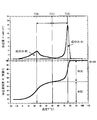
- FIG. 1 is a diagram showing the elution amount and elution amount integration by temperature rising elution fractionation (TREF).
- TREF temperature rising elution fractionation
- a specific propylene-ethylene block copolymer (A), glass fiber (B), specific thermoplastic elastomer (C), specific modified polyolefin (D) and erucic acid amide (E) are specified. It is related with the fiber reinforced polypropylene resin composition contained in the ratio.
- Ingredient (A) Component (A) used in the present embodiment satisfies requirements (Ai) to (A-iv).
- Component (A) is a metallocene catalyst, and in the first step, propylene alone or a propylene-ethylene random copolymer component (AA) having an ethylene content of 7% by mass or less is 30% by mass. 95% by mass of propylene-ethylene random copolymer component (AB) containing 3% by mass to 20% by mass more ethylene than component (AA) in the second step by 70% by mass to 5% by mass % Propylene-ethylene block copolymer obtained by sequential polymerization.
- Component (A) in the present embodiment is a propylene-ethylene block copolymer. Since the propylene-ethylene block copolymer contains a low crystalline component, the fiber reinforced polypropylene resin composition of the present embodiment (hereinafter also simply referred to as “resin composition”) has low glossiness, It has the feature of imparting functions such as scratch resistance.
- the propylene-ethylene block copolymer (A) used in the present embodiment satisfies the requirement (Ai). That is, using a metallocene catalyst, in the first step, propylene alone or a propylene-ethylene random copolymer component (A) having an ethylene content of 7% by mass or less, preferably 5% by mass or less, more preferably 3% by mass or less.
- component (AA) in an amount of 30 to 95% by mass, and in the second step, 3 to 20% by mass of ethylene more than component (AA), preferably 6 to A propylene-ethylene random copolymer component (AB) (hereinafter also referred to as component (AB)) containing 18% by mass of ethylene, more preferably 8 to 16% by mass of ethylene. 70 mass% to 5 mass% are produced by sequential polymerization.
- the difference in ethylene content between the second step component (AB) and the first step component (AA) is less than 3% by mass
- the surface when the resulting resin composition is a molded body In some cases, the gloss of the film becomes high (low glossiness deteriorates).
- the compatibility between the component (AA) and the component (AB) is lowered, and the gloss of the surface is increased when the resulting resin composition is used as a molded product (low). (Glossiness deteriorates), there are cases where production problems such as adhesion of reaction products to the reactor may occur, and production on an industrial scale may be difficult.
- the resin composition and the molded body thereof are better. It is possible to express a low gloss. Also, a method of polymerizing component (AB) after polymerizing component (AA) is used to prevent manufacturing problems such as adhesion of reaction products to the reactor. is important.
- Metallocene-based catalyst For the production of the propylene-ethylene block copolymer (A) used in the present embodiment, it is essential to use a metallocene-based catalyst.
- the metallocene catalyst is not particularly limited as long as the propylene-ethylene block copolymer (A) used in the present embodiment can be produced. In order to satisfy the requirements of the present embodiment, for example, it is preferable to use a metallocene catalyst comprising components (a) and (b) as shown below, and component (c) used as necessary. .
- Component (a) at least one metallocene transition metal compound selected from transition metal compounds represented by the following general formula (1).
- Component (b) At least one solid component selected from the following (b-1) to (b-4).
- (B-1) A particulate carrier carrying an organic aluminum oxy compound.
- (B-2) A particulate carrier carrying an ionic compound or Lewis acid capable of reacting with component (a) to convert component (a) into a cation.
- Component (c) Organoaluminum compound.
- At least one metallocene transition metal compound selected from transition metal compounds represented by the following general formula (1) can be used.
- Q represents a divalent linking group that bridges two conjugated five-membered ring ligands.
- Q include a divalent hydrocarbon group, a silylene group or an oligosilylene group, a silylene group or oligosilylene group having a hydrocarbon group as a substituent, or a germylene group having a hydrocarbon group as a substituent.
- a silylene group having a divalent hydrocarbon group and a hydrocarbon group as a substituent is preferred.
- X and Y each represents a hydrogen atom, a halogen atom, a hydrocarbon group, an alkoxy group, an amino group, a nitrogen-containing hydrocarbon group, a phosphorus-containing hydrocarbon group, or a silicon-containing hydrocarbon group. , Chlorine, methyl, isobutyl, phenyl, dimethylamide, diethylamide group and the like. X and Y may be each independently, that is, may be the same or different.
- R 1a and R 2b are hydrogen, hydrocarbon group, halogenated hydrocarbon group, silicon-containing hydrocarbon group, nitrogen-containing hydrocarbon group, oxygen-containing hydrocarbon group, boron-containing hydrocarbon group, or phosphorus-containing hydrocarbon group.
- the hydrocarbon group include a methyl group, an ethyl group, a propyl group, a butyl group, a hexyl group, an octyl group, a phenyl group, a naphthyl group, a butenyl group, and a butadienyl group.
- halogenated hydrocarbon group silicon-containing hydrocarbon group, nitrogen-containing hydrocarbon group, oxygen-containing hydrocarbon group, boron-containing hydrocarbon group, or phosphorus-containing hydrocarbon group, methoxy group, ethoxy group, phenoxy group
- Typical examples include trimethylsilyl group, diethylamino group, diphenylamino group, pyrazolyl group, indolyl group, dimethylphosphino group, diphenylphosphino group, diphenylboron group, and dimethoxyboron group.
- a hydrocarbon group having 1 to 20 carbon atoms is preferable, and a methyl group, an ethyl group, a propyl group, and a butyl group are particularly preferable.
- adjacent R 1a and R 2b may combine to form a ring, on which a hydrocarbon group, halogenated hydrocarbon group, silicon-containing hydrocarbon group, nitrogen-containing hydrocarbon group, oxygen-containing You may have a substituent which consists of a hydrocarbon group, a boron containing hydrocarbon group, or a phosphorus containing hydrocarbon group.
- Me is a metal atom selected from titanium, zirconium and hafnium, preferably zirconium and hafnium.
- those preferred for the production of the propylene-ethylene block copolymer (A) used in the present embodiment are preferably a silylene group, a germylene group or an alkylene group having a hydrocarbon substituent.
- Is a transition metal compound comprising a ligand having a substituted cyclopentadienyl group, a substituted indenyl group, a substituted fluorenyl group, and a substituted azulenyl group, and particularly preferably a silylene group having a hydrocarbon substituent, or germylene It is a transition metal compound comprising a ligand having a 2,4-position substituted indenyl group and a 2,4-position substituted azulenyl group bridged by a group.
- Non-limiting specific examples include dimethylsilylenebis (2-methyl-4-phenylindenyl) zirconium dichloride, diphenylsilylenebis (2-methyl-4-phenylindenyl) zirconium dichloride, dimethylsilylenebis (2-methyl).
- Benzoindenyl) zirconium dichloride dimethylsilylenebis ⁇ 2-isopropyl-4- (3,5-diisopropylphenyl) indenyl ⁇ zirconium dichloride, dimethylsilylenebis (2-propyl-4-phenanthrylindenyl) zirconium dichloride, dimethyl Silylene bis (2-methyl-4-phenylazulenyl) zirconium dichloride, dimethylsilylene bis ⁇ 2-methyl-4- (4-chlorophenyl) azurenyl ⁇ zirconium dichloride, dimethylsilylene (2-ethyl-4-phenylazurenyl) zirconium dichloride, dimethylsilylenebis (2-isopropyl-4-phenylazurenyl) zirconium dichloride, dimethylsilylenebis ⁇ 2-ethyl-4- (2-fluorobiphenyl) azurenyl ⁇ Zirconium dichloride, dimethyl
- a compound in which the silylene group of these specific examples is replaced with a germylene group and zirconium is replaced with hafnium is also exemplified as a suitable compound.
- the catalyst component is not an important element of the present embodiment, it avoids complicated listing and is limited to a representative example, but it is obvious that the effective range of the present disclosure is not limited thereby. That is.
- component (b) at least one solid component selected from the components (b-1) to (b-4) described above is used.
- Each of these components is a well-known thing, and can be used selecting it suitably from well-known techniques. Specific examples and production methods thereof are described in detail in JP-A No. 2002-284808, JP-A No. 2002-53609, JP-A No. 2002-69116, JP-A No. 2003-105015, and the like.
- the ion-exchange layered silicates of the component (b-4) particularly preferable are the ion-exchange layered silicates of the component (b-4), and more preferable are chemical treatments such as acid treatment, alkali treatment, salt treatment, and organic matter treatment. Is an ion-exchange layered silicate.
- organoaluminum compound used as the component (c) as necessary examples include the following general formula (2) AlR a P (3-a) (2) (Wherein R represents a hydrocarbon group having 1 to 20 carbon atoms, P represents hydrogen, halogen or alkoxy group, and a represents a number of 0 ⁇ a ⁇ 3.) Or a trialkylaluminum such as trimethylaluminum, triethylaluminum, tripropylaluminum, or triisobutylaluminum, or a halogen- or alkoxy-containing alkylaluminum such as diethylaluminum monochloride or diethylaluminum monomethoxide. In addition, aluminoxanes such as methylaluminoxane can also be used. Of these, trialkylaluminum is particularly preferred.
- the above-mentioned component (a), component (b) and, if necessary, component (c) are brought into contact with each other to form a catalyst.
- the contact method will not be specifically limited if it is a method which can form a catalyst, A well-known method can be used.
- the usage-amount of component (a), (b) and (c) is arbitrary.
- the amount of component (a) used relative to component (b) is preferably in the range of 0.1 to 1,000 ⁇ mol, particularly preferably 0.5 to 500 ⁇ mol, relative to 1 g of component (b).
- the amount of component (c) used relative to component (b) is preferably such that the amount of transition metal is 0.001 to 100 ⁇ mol, particularly preferably 0.005 to 50 ⁇ mol, relative to 1 g of component (b).
- the catalyst used in the present embodiment is subjected to a pre-polymerization treatment in which a small amount of polymer is brought into contact with an olefin in advance.
- propylene-ethylene block copolymer (A) polymerized using a metallocene catalyst a commercially available product can be used, for example, Wellnex series manufactured by Nippon Polypro Co., Ltd. can be suitably used.
- the component (AA) and the component (AB) can be polymerized using a single reactor by changing the polymerization conditions with time. As long as the effect of the present embodiment is not hindered, a plurality of reactors may be connected in parallel.
- the polymerization method of the propylene-ethylene block copolymer (A) can be any polymerization method such as a slurry method, a bulk method, and a gas phase method. Moreover, it is also possible to carry out by combining these polymerization formats. Although it is possible to use supercritical conditions as intermediate conditions between the bulk method and the gas phase method, they are substantially equivalent to the gas phase method, and are therefore included in the gas phase method without particular distinction.
- the component (AA) For the production of the component (AA), there is no particular problem no matter which process is used. In the case of producing the component (AA) having relatively low crystallinity, it is preferable to use a gas phase method in order to avoid problems such as adhesion of the product to the reactor.
- component (AB) is readily soluble in organic solvents such as hydrocarbons and liquefied propylene, it is preferable to use a gas phase method for the production of component (AB).
- the component (AA) is first polymerized by a bulk method or a gas phase method and then the component (AB) is polymerized by a gas phase method using a continuous method.
- the polymerization temperature can be used without any particular problem as long as it is within a commonly used temperature range. Specifically, a range of 0 ° C. to 200 ° C., more preferably 40 ° C. to 100 ° C. can be used.
- the polymerization pressure varies depending on the process to be selected, but the optimum pressure can be used without any problem as long as it is in a pressure range usually used.
- the relative pressure with respect to the atmospheric pressure can be in the range of greater than 0 MPa to 200 MPa, more preferably in the range of 0.1 MPa to 50 MPa.
- an inert gas such as nitrogen may coexist.
- the propylene-ethylene block copolymer (A) used in the present embodiment contains a low crystalline component, and in particular, the progress of cooling and solidification in the molding process is delayed by the component (AB). For this reason, the propylene-ethylene block copolymer (A) has a feature of imparting a function of low gloss in the resin composition and the molded product thereof.
- the propylene-ethylene block copolymer (A) is, as defined in (Ai), propylene alone or a propylene-ethylene random copolymer component and a propylene-ethylene random copolymer. It is a block copolymer with a common name obtained by sequentially polymerizing the coalescing component.
- the propylene-ethylene block copolymer (A) does not necessarily need to have the component (AA) and the component (AB) bonded together in a block form.
- propylene-ethylene block copolymers (A) can be used in combination.
- the ethylene content of component (AA) and component (AB) is determined by the following method.
- the lower limit of the TREF measurement temperature is ⁇ 15 ° C. in the apparatus used for this measurement.
- the present measurement method may not show a peak within the measurement temperature range (in this case, the measurement temperature The concentration of component (AB) dissolved in the solvent at the lower limit (ie -15 ° C. is detected).
- T (B) is considered to exist below the measurement temperature lower limit, but the value cannot be measured.
- T (B) is the measurement temperature lower limit ⁇ It is defined as 15 ° C.
- the integrated amount of the component eluted before T (C) is defined as W (B) mass%
- the integrated amount of the component eluted at T (C) or higher is defined as W (A) mass%
- W (B) Corresponds almost to the amount of the low-crystalline or amorphous component (AB)
- the integrated amount W (A) of the component eluted at T (C) or higher is a component with relatively high crystallinity ( It almost corresponds to the amount of AA).
- the elution amount curve obtained by TREF and the above-described methods for calculating the various temperatures and amounts obtained therefrom are performed as illustrated in FIG.
- the TREF is specifically measured as follows. A sample is dissolved in orthodichlorobenzene (ODCB (containing 0.5 mg / mL BHT)) at 140 ° C. to obtain a solution. This is introduced into a 140 ° C. TREF column, cooled to 100 ° C. at a rate of 8 ° C./min, subsequently cooled to ⁇ 15 ° C. at a rate of 4 ° C./min, and held for 60 minutes. Thereafter, ODCB (containing 0.5 mg / mL BHT) as a solvent is passed through the column at a flow rate of 1 mL / min, and components dissolved in ODCB at ⁇ 15 ° C. are eluted for 10 minutes in the TREF column. Then, the column is linearly heated to 140 ° C. at a temperature increase rate of 100 ° C./hour to obtain an elution curve.
- ODCB orthodichlorobenzene
- the outline of the apparatus used in this embodiment is as follows, and it is also possible to determine using an equivalent apparatus or the like.
- TREF column 4.3 mm ⁇ ⁇ 150 mm stainless steel column Column filler: 100 ⁇ m Surface inactive glass beads Heating method: Aluminum heat block Cooling method: Peltier element (Peltier element is cooled by water) Temperature distribution: ⁇ 0.5 ° C Temperature controller: Chino Corporation Digital Program Controller KP1000 (Valve Oven) Heating method: Air bath oven Measurement temperature: 140 ° C Temperature distribution: ⁇ 1 ° C Valve: 6-way valve 4-way valve Injection method: Loop injection method Detector: Fixed wavelength infrared detector MIRAN 1A manufactured by FOXBORO Detection wavelength: 3.42 ⁇ m High-temperature flow cell: Micro flow cell for LC-IR Optical path length 1.5mm Window shape 2 ⁇ x 4mm long round Synthetic sapphire window Sample concentration: 5mg / mL Sample injection volume: 0.1 mL (Ii) Separation of component (AA) and component (AB): Based on the T (C) determined by the TREF, a soluble component (
- the temperature rising column fractionation method is described in detail in the following literature, for example.
- a cylindrical column having a diameter of 50 mm and a height of 500 mm is packed with a glass bead carrier (80 to 100 mesh) and maintained at 140 ° C.
- the column temperature is increased to 140 ° C. at a rate of temperature increase of 10 ° C./min, held at 140 ° C. for 1 hour, and then 800 mL of a 140 ° C. solvent (ODCB) is flowed at a flow rate of 20 mL / min to obtain T (C). Insoluble components are eluted and recovered.
- ODCB 140 ° C. solvent
- the polymer-containing solution obtained by fractionation is concentrated to 20 mL using an evaporator and then precipitated in 5 times the amount of methanol.
- the precipitated polymer is recovered by filtration and then dried overnight in a vacuum dryer.
- P is a propylene unit in a copolymer chain
- E is an ethylene unit
- six types of triads such as PPP, PPE, EPE, PEP, PEE, and EEE may exist in the chain.
- concentration of these triads and the peak intensity of the spectrum are linked by the following relational expressions ⁇ 1> to ⁇ 6>.
- [PPP] k ⁇ I (T ⁇ ) ⁇ 1>
- [PPE] k ⁇ I (T ⁇ ) ⁇ 2>
- [EPE] k ⁇ I (T ⁇ ) ⁇ 3>
- [PEP] k ⁇ I (S ⁇ ) ⁇ 4>
- [PEE] k ⁇ I (S ⁇ ) ⁇ 5>
- [EEE] k ⁇ [I (S ⁇ ) / 2 + I (S ⁇ ) / 4 ⁇ ⁇ 6>
- [] indicates the fraction of triads, for example, [PPP] is the fraction of PPP triads in all triads.
- I indicates the spectral intensity
- I (T ⁇ ) means the intensity of the peak at 28.7 ppm attributed to T ⁇ .
- Ethylene content (mol%) ([PEP] + [PEE] + [EEE]) ⁇ 100 Note that the propylene random copolymer contains a small amount of a propylene hetero bond (2,1-bond and / or 1,3-bond), thereby producing the following minute peak.
- the ethylene content in the present embodiment is substantially equal to the Ziegler-Natta that does not contain heterogeneous bonds. Similar to the analysis of the copolymer produced with the catalyst, it is determined using the relational expressions ⁇ 1> to ⁇ 7>.
- Ethylene content (mass%) (28 ⁇ X / 100) / ⁇ 28 ⁇ X / 100 + 42 ⁇ (1 ⁇ X / 100) ⁇ ⁇ 100
- X is the ethylene content in mol%.
- the ethylene content [E] W of the entire propylene-ethylene block copolymer is determined by the ethylene content [E] A and [E] of each of the component (A-A) and the component (A-B) measured from the above. It is calculated by the following formula from the mass ratios W (A) and W (B) mass% of each component calculated from B and TREF.
- Tm Melting peak temperature
- Tm melting peak temperature measured by the DSC (Differential Scanning Calorimetry) method of the propylene-ethylene block copolymer (A) used in the present embodiment is 110.
- the temperature is from 150 ° C. to 150 ° C., preferably from 115 ° C. to 148 ° C., more preferably from 120 ° C. to 145 ° C., and still more preferably from 125 to 145 ° C.
- Tm melting peak temperature
- Tm is measured by using a differential scanning calorimeter (for example, DSC6200 manufactured by Seiko Instruments Inc.), taking 5.0 mg of sample, holding at 200 ° C. for 5 minutes, and then decreasing the temperature to 40 ° C. at 10 ° C./min. The crystal is evaluated by the peak temperature when it is melted at a heating rate of 10 ° C./min.
- a differential scanning calorimeter for example, DSC6200 manufactured by Seiko Instruments Inc.
- the component (AA) and the component (A) in the propylene-ethylene block copolymer (A) ( It is necessary that AB) is not phase separated. And when it does not phase-separate, a tan-delta curve shows a single peak below 0 degreeC.
- component (AA) and component (AB) are in a phase separation structure, the glass transition temperature of the amorphous part contained in component (AA) and the amorphous contained in component (AB) Since the glass transition temperatures of the parts are different, the tan ⁇ curve shows a plurality of peaks.
- Solid viscoelasticity measurement is performed by applying a sinusoidal strain of a specific frequency to a strip-shaped sample piece and detecting the generated stress.
- a frequency of 1 Hz is used, and the measurement temperature is raised stepwise from ⁇ 60 ° C. until the sample is melted and cannot be measured.
- the magnitude of distortion is about 0.1% to 0.5%.
- the molded product of propylene-ethylene block copolymer (A) shows a sharp peak in the temperature range below 0 ° C. Generally, the peak of the tan ⁇ curve below 0 ° C. observes the glass transition of the amorphous part. To do.
- the solid viscoelasticity measurement (DMA) used in the present embodiment is specifically as follows, and can also be measured using an equivalent device or the like.
- the sample used is a 10 mm wide x 18 mm long x 2 mm thick strip cut out from a 2 mm thick sheet formed by injection molding under the following conditions.
- the equipment uses ARES manufactured by Rheometric Scientific.
- MFR Melt flow rate
- the melt flow rate (230 ° C., 2.16 kg load) (hereinafter sometimes abbreviated as MFR) of the propylene-ethylene block copolymer (A) used in the present embodiment is 0.5 to 200 g / 10. Minutes, preferably 1 to 150 g / 10 minutes, more preferably 5 to 100 g / 10 minutes.
- the molded body having sufficient impact resistance can be produced on an industrial scale. That is, if the MFR is less than 0.5 g / 10 min, it may be difficult to adapt during production on an industrial scale, for example, insufficient filling during injection molding. On the other hand, if the MFR exceeds 200 g / 10 minutes, the impact resistance performance may be reduced. MFR can be controlled by adjusting the polymerization conditions (polymerization temperature, hydrogenation amount, etc.) or using a molecular weight depressant.
- MFR is a value measured according to JIS K7210 at a test temperature of 230 ° C. and a load of 2.16 kg.
- the propylene-ethylene block copolymer (A) of the present embodiment preferably has a Q value of 2 to 5, more preferably 2.3 to 4.8, still more preferably 2 .5 to 4.5.
- the Q value can be controlled by adjusting the catalyst and polymerization conditions, and further by adding a molecular weight depressant.
- Q value is defined by the ratio (Mw / Mn) of mass average molecular weight (Mw) and number average molecular weight (Mn) measured by gel permeation chromatography (GPC).
- Mw mass average molecular weight
- Mn number average molecular weight measured by gel permeation chromatography
- GPC 150C type manufactured by Waters Inc.
- Detector 1A infrared spectrophotometer manufactured by MIRAN (measurement wavelength: 3.42 ⁇ m)
- MIRAN measurement wavelength: 3.42 ⁇ m
- Column AD806M / S, manufactured by Showa Denko Co., Ltd.
- the initial gloss of the surface is further improved (sufficiently low).
- Ingredient (B) Component (B) in the present embodiment satisfies the requirement (Bi).
- Component (B) is glass fiber.
- glass fiber Since glass fiber has high tensile modulus and tensile strength, the rigidity of the resin composition and its molded body can be increased. Further, when the resin composition of the present embodiment is formed into a molded body, it has an effect that the hardness of the surface of the molded body is increased, which contributes to improvement of scratch resistance. The use of glass fiber is also preferable from the viewpoints of ease of manufacture of the resin composition of the present embodiment and economical efficiency.
- glass fibers (B) can be used in combination. Furthermore, it can also be used in the form of a so-called master batch in which the glass fiber (B) is contained in a relatively high concentration in the propylene-ethylene block copolymer (A) in advance.
- inorganic or organic fillers such as talc, mica, glass beads, glass balloons, whiskers, and organic fibers other than glass fibers can be used in combination as long as the effects of the present embodiment are not significantly impaired.
- the glass fiber can be used without any particular limitation.
- Examples of the glass used for the fiber include E glass, C glass, A glass, S glass, etc. Among them, E glass is preferable.
- the manufacturing method of glass fiber is not specifically limited, It manufactures with various well-known manufacturing methods.
- Two or more kinds of glass fibers can be used in combination.
- the fiber length is preferably 2 to 20 mm, more preferably 3 to 10 mm.
- the fiber length is preferably 2 to 20 mm, more preferably 3 to 10 mm.
- the fiber length represents the length in the case of using ordinary roving-like or strand-like fibers as the raw material of glass fibers before being melt-kneaded.
- the fiber length is as follows. That is, in the case of a glass fiber-containing pellet, the length of one side (extrusion direction) of the pellet is substantially the same as the length of the fiber in the pellet.
- substantially specifically refers to the length of the glass fiber-containing pellets with a fiber length of 50% or more, preferably 90% or more, based on the total number of fibers in the glass fiber-containing pellets. This means that the glass fiber is hardly broken during the preparation of the pellets.
- the fiber length is measured by the following procedure. That is, the resin composition pellets or molded body is burned or dissolved so that the glass fibers (B) remain. And after diffusing the remaining glass fiber (B) on a glass plate, it measures using a digital microscope. The average length was calculated using the length values of 100 or more fibers measured by the method.
- the measurement using the digital microscope is specifically performed by the following method, for example. That is, glass fiber is mixed with surfactant-containing water, and the mixed aqueous solution is dropped and diffused onto a thin glass plate. Thereafter, the length of 100 or more glass fibers is measured using a digital microscope (for example, VHX-900 type manufactured by Keyence Corporation), and the average value is calculated.
- a digital microscope for example, VHX-900 type manufactured by Keyence Corporation
- the fiber diameter of the glass fiber is preferably 3 to 25 ⁇ m, more preferably 6 to 20 ⁇ m. If the fiber diameter is less than 3 ⁇ m, the glass fiber may be easily broken during the production and molding of the resin composition and its molded body. On the other hand, when the fiber diameter exceeds 25 ⁇ m, there is a possibility that each improvement effect such as the rigidity of the resin composition and the molded body thereof is lowered with a decrease in the aspect ratio of the glass fiber.
- the fiber diameter is determined by the following method. That is, the glass fiber is cut perpendicular to the fiber length direction, and the diameter is measured by observing the cross section under a microscope. And the average value of the diameter of 100 or more fibers is calculated.
- the glass fiber can be either surface treated or untreated.
- organosilane coupling agents In order to improve dispersibility in polypropylene resins, organosilane coupling agents, titanate coupling agents, aluminate coupling agents, zirconate coupling agents, silicone compounds, higher fatty acids, fatty acid metal salts, fatty acids It is preferable to use a surface treated with an ester or the like.
- the glass fiber that has been focused (surface) with a sizing agent may be used.
- the sizing agent include an epoxy sizing agent, an aromatic urethane sizing agent, an aliphatic urethane sizing agent, an acrylic sizing agent, and a maleic anhydride-modified polyolefin sizing agent. Since these sizing agents need to be melted in the melt-kneading with the polypropylene resin, it is preferable that they are melted at 200 ° C. or lower.
- the glass fiber can be either surface treated or untreated.
- organosilane coupling agents In order to improve dispersibility in polypropylene resins, organosilane coupling agents, titanate coupling agents, aluminate coupling agents, zirconate coupling agents, silicone compounds, higher fatty acids, fatty acid metal salts, fatty acids It is preferable to use a surface treated with an ester or the like.
- Examples of the organic silane coupling agent used for the surface treatment include vinyltrimethoxysilane, ⁇ -chloropropyltrimethoxysilane, ⁇ -methacryloxypropyltrimethoxysilane, ⁇ -aminopropyltrimethoxysilane, and 3-acryloxypropyl. And trimethoxysilane.
- Examples of titanate coupling agents include isopropyl triisostearoyl titanate, isopropyl tris (dioctyl pyrophosphate) titanate, and isopropyl tri (N-aminoethyl) titanate.
- acetoalkoxy aluminum diisopropylate etc.
- zirconate coupling agent examples include tetra (2,2-diallyloxymethyl) butyl, di (tridecyl) phosphitozirconate; neopentyl (diallyl) oxy, and trineodecanoyl zirconate.
- silicone compound examples include silicone oil and silicone resin.
- examples of the higher fatty acid used for the surface treatment include oleic acid, capric acid, lauric acid, palmitic acid, stearic acid, montanic acid, kaleic acid, linoleic acid, rosin acid, linolenic acid, undecanoic acid, and undecenoic acid.
- examples of the higher fatty acid metal salt include fatty acids having 9 or more carbon atoms, such as sodium salts such as stearic acid and montanic acid, lithium salts, calcium salts, magnesium salts, zinc salts, and aluminum salts. Of these, calcium stearate, aluminum stearate, calcium montanate, and sodium montanate are preferred.
- fatty acid esters examples include polyhydric alcohol fatty acid esters such as glycerin fatty acid esters, alpha sulfone fatty acid esters, polyoxyethylene sorbitan fatty acid esters, sorbitan fatty acid esters, polyethylene fatty acid esters, and sucrose fatty acid esters.
- polyhydric alcohol fatty acid esters such as glycerin fatty acid esters, alpha sulfone fatty acid esters, polyoxyethylene sorbitan fatty acid esters, sorbitan fatty acid esters, polyethylene fatty acid esters, and sucrose fatty acid esters.
- the amount of the surface treatment agent used is not particularly limited, but is preferably 0.01 parts by mass to 5 parts by mass, more preferably 0.1 parts by mass to 3 parts by mass with respect to 100 parts by mass of the glass fiber. .
- the glass fiber a so-called chopped strand glass fiber obtained by cutting a fiber yarn into a desired length can be used.
- chopped strand glass fibers obtained by aligning strands of glass fibers and cutting them to 2 mm to 20 mm are provided. It is preferable to use it.
- glass fiber-containing pellets are obtained by assembling and integrating an arbitrary amount of, for example, propylene-ethylene block copolymer (A) and the like, and a large number of continuous glass fibers by melt extrusion.
- the use of “glass fiber-containing pellets” is preferable from the viewpoint of further improving each effect of improving the transferability and rigidity of the resin composition and its molded product.
- the fiber length is preferably the length of glass fiber-containing pellets (extrusion direction) as described above, and preferably 2 to 20 mm.
- the method for producing such glass fiber-containing pellets is not particularly limited, and a known method can be used.
- the glass fiber content is preferably 20% by mass to 70% by mass based on 100% by mass of the whole pellet.
- the content ratio of the glass fiber (B) used in the present embodiment is 10 to 20% by mass, preferably 10 to 18% by mass, more preferably 12 to 17% by mass, and further preferably 13 to 16%. (However, the total amount of the component (A), the component (B), the component (C), and the component (D) is 100% by mass).
- the content ratio of the glass fiber (B) in such a range, when the resin composition of the present embodiment is formed into a molded body, the resin composition of the present embodiment having good rigidity and impact resistance. Can be manufactured on an industrial scale. That is, if the content ratio of the glass fiber (B) is less than 10% by mass, physical properties such as rigidity and impact resistance may be deteriorated. If the content of the glass fiber (B) exceeds 20% by mass, there is a concern that it is difficult to form a pellet in the first place.
- the content ratio of the glass fiber (B) is an actual amount. For example, when using the said glass fiber containing pellet, it calculates based on the actual content of the glass fiber (B) contained in this pellet.
- Ingredient (C) Component (C) used in the present embodiment satisfies the following requirements (Ci) and (C-ii).
- the ethylene-octene copolymer which is the component (C) used in the present embodiment, is characterized in that the resin composition and the molded body have little heat-resistant gloss change and impart an impact resistance function.
- the density of the component (C) used in the present embodiment is 0.85 to 0.87 g / cm 3 , preferably 0.855 to 0.865 g / cm 3. cm 3 .
- the density of the component (C) is 0.85 to 0.87 g / cm 3 , preferably 0.855 to 0.865 g / cm 3. cm 3 .
- the propylene-ethylene block copolymer (A) and the component (C) exhibit good dispersion. Therefore, when the resin composition of the present embodiment is used as a molded body, the change in the thermal gloss on the surface of the molded body is small, and it is possible to obtain good impact resistance and low initial gloss. That is, when the density is less than 0.85 g / cm 3 , the heat-resistant gloss change may be increased (deteriorated) in the resin composition and the molded body thereof. When the density exceeds 0.87 g / cm 3 , impact resistance and initial gloss may be increased.
- the component (C) used in the present embodiment is an ethylene-octene copolymer having the above density.
- the resin composition and its molded product tend to have less heat-resistant gloss change, better performance such as impact strength, and better economy. From the point of view, it is preferable.
- the MFR (230 ° C., 2.16 kg load) of the component (C) used in the present embodiment is in the range of 0.5 to 1.1 g / 10 minutes, preferably 0.6 to 1.05 g / 10. Min, more preferably in the range of 0.7 to 1.0 g / 10 min.
- the MFR of the component (C) within such a range, the propylene-ethylene block copolymer (A) and the component (C) exhibit good dispersion. Therefore, when the resin composition of the present embodiment is used as a molded body, the change in the thermal gloss on the surface of the molded body is small, and it is possible to obtain good impact resistance and low initial gloss.
- the MFR is less than 0.5 g / 10 min, the initial gloss of the resin composition and the molded product may be increased. On the other hand, if the MFR exceeds 1.1 g / 10 min, the heat-resistant gloss change may be increased (deteriorated).
- the ethylene-octene copolymer of component (C) used in the present embodiment is produced by polymerizing each monomer of ethylene and octene in the presence of a catalyst.
- the catalyst examples include titanium compounds such as titanium halides, organoaluminum-magnesium complexes such as alkylaluminum-magnesium complexes, so-called Ziegler-type catalysts such as alkylaluminum or alkylaluminum chloride, and WO 91/04257 pamphlet.
- a metallocene compound catalyst or the like can be used.
- polymerization can be performed by applying a production process such as a gas phase fluidized bed method, a solution method, or a slurry method.
- the content ratio of the component (C) used in the present embodiment is 15 to 25% by mass, preferably 17 to 23% by mass, more preferably 18 to 22% by mass (provided that the component (C) A), component (B), component (C), and component (D) are 100% by mass in total).
- the content ratio of the component (C) in such a range, when the resin composition of the present embodiment is formed into a molded body, the thermal gloss change is small and the impact resistance performance is good, and the rigidity is good. It has the effect of becoming. That is, when the content ratio of the component (C) is less than 15% by mass, impact resistance performance and heat-resistant gloss change may be large (deteriorate).
- the content ratio of the component (C) exceeds 25% by mass, the rigidity of the resin composition of the present embodiment and the molded body thereof may be reduced.
- Component (D) of the present embodiment satisfies the requirement (Di).
- Component (D) is an acid-modified polyolefin and / or a hydroxy-modified polyolefin.
- the interfacial strength between propylene-ethylene block copolymer (A) and glass fiber (B) is improved. Improvement in the interfacial strength is effective for improving physical properties such as rigidity and impact strength in the resin composition and the molded product thereof.
- the acid-modified polyolefin is not particularly limited, and conventionally known ones can be used.
- the acid-modified polyolefin is a polyolefin obtained by graft copolymerization with an unsaturated carboxylic acid and modified.
- polystyrene resin examples include polyethylene, polypropylene, ethylene- ⁇ -olefin copolymer, ethylene- ⁇ -olefin-nonconjugated diene compound copolymer (EPDM, etc.), ethylene-aromatic monovinyl compound-conjugated diene compound copolymer rubber, etc. It is.
- the unsaturated carboxylic acid is, for example, maleic acid or maleic anhydride.
- This graft copolymerization is performed, for example, by reacting the polyolefin with an unsaturated carboxylic acid in a suitable solvent using a radical generator such as benzoyl peroxide.
- the component of unsaturated carboxylic acid or its derivative can also be introduce
- the hydroxy-modified polyolefin is a modified polyolefin containing a hydroxyl group.
- the modified polyolefin may have a hydroxyl group at an appropriate site, for example, at the end of the main chain or at the side chain.
- the polyolefin resin constituting the hydroxy-modified polyolefin resin include homo- or copolymers of ⁇ -olefins such as ethylene, propylene, butene, 4-methylpentene-1, hexene, octene, nonene, decene, dodecene, Examples thereof include a copolymer of the ⁇ -olefin and a copolymerizable monomer.
- Hydroxy-modified polyolefin resins such as hydroxy-modified polyethylene (for example, low density, medium density or high density polyethylene, linear low density polyethylene, ultrahigh molecular weight polyethylene, ethylene- (meth) acrylate copolymer, ethylene-acetic acid Vinyl copolymers, etc.), hydroxy-modified polypropylene (eg, polypropylene homopolymers such as isotactic polypropylene), random copolymers of propylene and ⁇ -olefins (eg, ethylene, butene, hexane, etc.), propylene- ⁇ -olefins A block copolymer) and hydroxy-modified poly (4-methylpentene-1).
- polyethylene for example, low density, medium density or high density polyethylene, linear low density polyethylene, ultrahigh molecular weight polyethylene, ethylene- (meth) acrylate copolymer, ethylene-acetic acid Vinyl copolymers, etc.
- the content ratio of the component (D) used in the present embodiment is 0.5 to 2% by mass, preferably 0.7 to 1.5% by mass, more preferably 0.8 to 1.%. 2% by mass, particularly preferably 0.9 to 1.1% by mass (provided that the total amount of component (A), component (B), component (C) and component (D) is 100% by mass) ).
- the content ratio of the component (D) in such a range, when the resin composition of the present embodiment is formed into a molded body, rigidity and scratch resistance are improved, and a molded body is easily obtained. Has the effect of becoming possible. That is, when the content ratio of the component (D) is less than 0.5% by mass, rigidity and scratch resistance may be deteriorated.
- the content ratio of the component (D) exceeds 2% by mass, there is a concern that the fluidity is lowered and it is difficult to produce the molded body itself.
- Ingredient (E) The component (E) in the present embodiment satisfies the requirement (Ei).
- Component (E) is erucic acid amide.
- Erucamide has a feature that contributes to further improving scratch resistance, moldability, etc. by reducing surface friction in the resin composition of the present embodiment and the molded product thereof.
- erucic acid amide has the ability to reduce whitening scars that are likely to occur due to external contact, collision, etc., even in the molded product obtained from the resin composition of the present embodiment, during its molding, distribution and use. Also bring. Moreover, the effect which prevents dust adhesion at the time of storage is also brought about.
- the content ratio of erucic acid amide used in the present embodiment is 0.05 with respect to 100 parts by mass of the total amount of component (A), component (B), component (C), and component (D). To 0.15 parts by mass, preferably 0.06 to 0.14 parts by mass, more preferably 0.08 to 0.12 parts by mass, and particularly preferably 0.09 to 0.11 parts by mass.
- the erucic acid amide when the content ratio of erucic acid amide exceeds 0.05 parts by mass, the erucic acid amide bleeds out to the surface of the molded body when the resin composition of the present embodiment is formed into a molded body. There is a concern that the thermal gloss change of the toner increases (deteriorates) and the initial gloss increases. Further, if the content ratio of erucic acid amide is less than 0.15 parts by mass, scratch resistance may be deteriorated.
- Optional additive component The resin composition of the present embodiment can contain various optional additive components such as a molecular weight depressant and an antioxidant as long as the effects of the present embodiment are not significantly impaired as an optional additive component. .
- Optionally added components may be used in combination of two or more.
- Optional addition components may be added to the resin composition, or may be added in advance to each of the above-described components such as the propylene-ethylene block copolymer (A). It can also be used in combination.
- the content ratio of the optional additive component is not particularly limited, but is usually about 0.01 to 0.5 parts by mass in 100 parts by mass of the resin composition, and is appropriately selected according to the purpose. .
- the molecular weight depressant is effective for imparting and improving moldability (fluidity).
- molecular weight depressant for example, various organic peroxides and so-called decomposition (oxidation) accelerators can be used, and organic peroxides are preferable.
- organic peroxide examples include benzoyl peroxide, t-butyl perbenzoate, t-butyl peracetate, t-butyl peroxyisopropyl carbonate, 2,5-di-methyl-2,5-di- (benzoyl peroxide).
- Antioxidant Antioxidant is effective in preventing deterioration of the quality of the resin composition and its molded product.
- antioxidants include phenolic, phosphorus and sulfur antioxidants.
- the resin composition of the present embodiment is a range that does not significantly impair the effects of the present embodiment, and heat such as polyolefin resins, polyamide resins, and polyester resins other than those listed above.
- a plastic resin, an elastomer (rubber component) other than the ethylene-octene copolymer of component (C), and the like can be contained.
- the fiber reinforced polypropylene resin composition of the present embodiment can be produced by the following method. That is, propylene-ethylene block copolymer (A) is mixed with glass fiber (B), ethylene-octene copolymer (C), acid-modified polyolefin and / or hydroxy-modified polyolefin (D) and erucamide (E). If necessary, an optional additive component is added, and blended in the above-mentioned content ratio by a conventionally known method. And it can manufacture by passing through the kneading
- melt-kneading is usually (half) melt-kneaded and granulated using a kneading apparatus such as a single-screw extruder, a twin-screw extruder, a Banbury mixer, a roll mixer, a Brabender plastograph, a kneader, and a stirring granulator.
- a kneading apparatus such as a single-screw extruder, a twin-screw extruder, a Banbury mixer, a roll mixer, a Brabender plastograph, a kneader, and a stirring granulator.
- a kneading apparatus such as a single-screw extruder, a twin-screw extruder, a Banbury mixer, a roll mixer, a Brabender plastograph, a kneader, and a stirring granulator.
- the composition of each component may be
- a method of kneading each component separately is, for example, first kneading part or all of the propylene-ethylene block copolymer (A) and part of the glass fiber (B), and then mixing the remaining components. It is a method of kneading and granulating.
- the average length of the glass fibers (B) present in the resin composition pellets obtained through the kneading step or in the molded body is 0.3 mm or more, preferably 0. It is preferable to manufacture by a compounding method such that the thickness is 4 mm or more and 2.5 mm or less.
- the average length of the glass fibers (B) present in the resin composition pellets or in the molded product means a value obtained by calculating an average using a value measured by a digital microscope.
- the specific measuring method is the same as the measuring method of the above-mentioned glass fiber (B).
- the following methods can be mentioned. That is, for example, in melt kneading with a twin screw extruder, for example, propylene-ethylene block copolymer (A), ethylene-octene copolymer (C), acid-modified polyolefin and / or hydroxy-modified polyolefin (D) and erucamide (E) is sufficiently melt-kneaded. Thereafter, the glass fiber (B) is fed by a side feed method or the like, and the bundled fibers are dispersed while minimizing breakage of the glass fiber.
- a twin screw extruder for example, propylene-ethylene block copolymer (A), ethylene-octene copolymer (C), acid-modified polyolefin and / or hydroxy-modified polyolefin (D) and erucamide (E) is sufficiently melt-kneaded. Thereafter, the glass fiber (B) is fed by a side feed method or the like, and the bundled fibers
- the propylene-ethylene block copolymer (A) and other components are kneaded at high speed in a Henschel mixer so that they are in a semi-molten state, and the glass fiber (B) is kneaded into the mixture.
- a stirring granulation method is also mentioned. This stirring granulation method is also one of the preferable production methods because the glass fibers can be easily dispersed while minimizing breakage of the glass fibers.
- glass fiber (B) are melted and kneaded with an extruder or the like to form pellets, and the pellets and the so-called “glass fiber (B) -containing pellets” of the glass fiber-containing pellets are mixed.
- the manufacturing method which makes a fiber reinforced polypropylene resin composition by doing is also mentioned. This manufacturing method is also one of the preferable manufacturing methods for the same reason as described above.
- a preferable method for producing the fiber-reinforced polypropylene resin composition of the present embodiment includes a method of adding glass fiber (B) after kneading components other than glass fiber (B) in the kneading step.
- the resin composition of the present embodiment can be manufactured by an easy manufacturing method.
- the resin composition of the present embodiment manufactured by the above method can be applied to various molding methods to form a molded body.
- molding methods such as injection molding (including gas injection molding, two-color injection molding, core back injection molding, sandwich injection molding), injection compression molding (press injection), extrusion molding, sheet molding, and hollow molding.
- a desired molded article can be obtained by molding. Among these, it is preferable to obtain a molded body by injection molding or injection compression molding.
- the molded product obtained from the resin composition of the present embodiment is characterized by low initial gloss on the textured surface and small heat-resistant gloss change. Furthermore, a great feature of the molded body obtained from the resin composition of the present embodiment is high rigidity and excellent scratch resistance.
- the molded product obtained from the resin composition of the present embodiment is easily available, is produced by an easy production method using components that are economically advantageous, and can be obtained at low cost.
- automotive interior and exterior such as instrument panels, glove boxes, console boxes, door trims, armrests, grip knobs, various trims, ceiling parts, housings, pillars, mudguards, bumpers, fenders, back doors, fan shrouds, etc. It can be suitably used for applications such as engine room parts, electrical and electronic equipment parts such as TVs and vacuum cleaners, various industrial parts, housing equipment parts such as toilet seats, and building material parts. In particular, since it has low gloss and excellent scratch resistance, it is suitable for automobile parts, particularly interior parts.
- the test piece used for the physical property evaluation was manufactured under the following conditions.
- -Molding machine EC20 type injection molding machine manufactured by Toshiba Machine.
- -Mold 2 strip test pieces (10 x 80 x 4t (mm)) for physical property evaluation. Molding conditions: molding temperature 220 ° C., mold temperature 40 ° C., injection pressure 50 MPa, injection time 5 seconds, cooling time 20 seconds.
- Test piece flat plate shape: 120 ⁇ 120 ⁇ 3 t (mm).
- Measurement surface (planar surface of the above-mentioned test piece ...
- Wrinkle face car interior pear place wrinkle.
- Wrinkle depth 30 ⁇ m.
- Molding machine IS100GN type injection molding machine manufactured by Toshiba Machine.
- Molding conditions molding temperature 220 ° C., mold temperature 40 ° C., injection pressure 50 MPa, injection time 10 seconds, cooling time 20 seconds.
- Gloss meter VG-2000 model manufactured by Nippon Denshoku Industries Co., Ltd. The gloss was measured from an angle of 60 ° from the plane of the test piece. It is judged that the initial gloss is 2.3 or less and the difference between the initial gloss and the gloss after standing for 10 hours is 0.8 or less has reached the practical level.
- Scratch resistance A test piece manufactured in the same manner as the test piece for gloss evaluation was used.
- Scratch tester "Automatic cross-cut tester” manufactured by Yasuda Seiki Seisakusho
- Tm Melting point peak temperature
- GPC 150C type manufactured by Waters Inc.
- Detector 1A infrared spectrophotometer manufactured by MIRAN (measurement wavelength: 3.42 ⁇ m)
- MIRAN measurement wavelength: 3.42 ⁇ m
- Column AD806M / S, manufactured by Showa Denko Co., Ltd.
- Peak of tan ⁇ curve in solid viscoelasticity measurement Measured by solid viscoelasticity measurement.
- the sample used is a 10 mm width ⁇ 18 mm length ⁇ 2 mm thickness strip cut out from a 2 mm thick sheet formed by injection molding under the following conditions.
- the equipment uses ARES manufactured by Rheometric Scientific.
- the ethylene content of the propylene-ethylene random copolymer (AA) in the first step is 2.2% by mass
- the composition ratio is 80% by mass
- the propylene-ethylene random copolymer (AB) in the second step Has an ethylene content of 10.5% by mass, a composition ratio of 20% by mass, and a tan ⁇ curve having a single peak at ⁇ 11 ° C.
- the ethylene content of the propylene-ethylene random copolymer (AA) in the first step is 0% by mass (propylene homopolymer), the composition ratio is 73% by mass, the propylene-ethylene random copolymer in the second step ( AB) has an ethylene content of 40% by mass, a composition ratio of 27% by mass, and tan ⁇ curves show peaks at two locations ( ⁇ 1.8 ° C. and ⁇ 40 ° C.).
- B-1 T480H (Nippon Electric Glass Co., Ltd.) Glass fiber, chopped strand (fiber diameter 10 ⁇ m, length 8 mm).
- C Component (C) The density described below is a catalog value of each product.
- Kneading device “KZW-15-MG” type twin screw extruder manufactured by Technobel.
- the glass fiber (B-1) of component (B) was side fed from the middle of the extruder.
- the average length of the glass fibers (B-1) in the obtained resin pellets was in the range of 0.45 mm to 0.7 mm.
- Example 1 which satisfies the embodiment requirements of the resin composition of the present embodiment and the molded body thereof, exhibits high rigidity and impact properties, and has low initial gloss and heat-resistant gloss. It can be seen that there is a characteristic that the change is small and the scratch resistance is good.
- the resin composition having the composition shown in comparative examples 1 and 2 and the molded product thereof are poor in performance balance, and those of example 1 It is inferior to.
- Comparative Example 1 talc is used as the component (B), the scratch resistance is poor, and the gloss change is greatly inferior to Example 1. Low impact, high initial gloss, large gloss change after heat test. In Comparative Example 3, since the thermoplastic elastomer (C) does not satisfy the requirements, the heat resistance change of the gloss is large.
Landscapes
- Chemical & Material Sciences (AREA)
- Health & Medical Sciences (AREA)
- Chemical Kinetics & Catalysis (AREA)
- Medicinal Chemistry (AREA)
- Polymers & Plastics (AREA)
- Organic Chemistry (AREA)
- Inorganic Chemistry (AREA)
- Engineering & Computer Science (AREA)
- Manufacturing & Machinery (AREA)
- Materials Engineering (AREA)
- Compositions Of Macromolecular Compounds (AREA)
- Reinforced Plastic Materials (AREA)
- Graft Or Block Polymers (AREA)
Abstract
繊維強化ポリプロピレン系樹脂組成物であって、特定の条件を満足する成分(A)53質量%~74.5質量%と、成分(B)10質量%~20質量%と、成分(C)15~25質量%と、成分(D)0.5~2質量%(但し、成分(A)と成分(B)と成分(C)と成分(D)との合計量は100質量%である)とを含有し、更に、成分(A)と成分(B)と成分(C)と成分(D)との合計量100質量部に対して特定の条件を満足する成分(E)0.05~0.15質量部を含有することを特徴とする繊維強化ポリプロピレン系樹脂組成物。
Description
本開示は、繊維強化ポリプロピレン系樹脂組成物に関し、さらに詳しくは、シボ面において低光沢で耐熱性および耐傷付性にすぐれた繊維強化ポリプロピレン系樹脂組成物に関する。
ポリプロピレン系樹脂組成物は、物性、成形性、リサイクル性及び経済性などに優れた樹脂材料としてその使用分野が拡がっている。中でもインストルメントパネル、ピラーなどの自動車部品、テレビ、掃除機などの電気機器部品の分野などでは、ポリプロピレン系樹脂や、ポリプロピレン系樹脂にガラス繊維やタルクなどのフィラーやエラストマー(ゴム)を複合強化した複合ポリプロピレン系樹脂などのポリプロピレン系樹脂組成物が、成形性、物性バランス、リサイクル性や経済性などに優れるため、その成形体を含めて、様々な分野で広く用いられている。
これらの分野においては、ポリプロピレン系樹脂組成物の成形体の高機能化、大型化、用途の多様・複雑化など、とりわけ自動車内装部品分野などにおける高品質化が益々進んでいる。そして、このような高品質化に対応するなどのため、ポリプロピレン系樹脂組成物やその成形体の成形性、物性バランスなどのほか、前記組成物や成形体の質感の優劣に大きな影響を及ぼす低光沢、耐熱性、耐傷付性の向上が求められている。
ポリプロピレン系樹脂組成物及びその成形体に、ガラス繊維やタルクなどのフィラーを含有させて、該樹脂組成物及びその成形体の剛性(強度)を向上させることは広く行われている。例えば、特許文献1には、ガラス繊維で強化されたポリアミド系樹脂に匹敵する機械的強度を有する高強度・高剛性のポリオレフィン系樹脂組成物が開示されている。すなわち、特許文献1では、そのようなポリオレフィン系樹脂組成物として、(A)2段以上の逐次重合により得られるポリプロピレンを主体とした混合物であり、該混合物中のプロピレン-エチレン系共重合体ゴムの平均分散粒径が2μm以下であるポリプロピレン系樹脂混合物と、(B)ポリオレフィン系樹脂と、(C)平均の直径が0.01~1000μmであり且つ平均のアスペクト比(長さ/直径)が5~2500のフィラーとからなる高強度・高剛性ポリオレフィン系熱可塑性樹脂組成物が開示されている。該組成物の成形品は、高い引張強度・曲げ強度・アイゾット衝撃強度・落錘衝撃強度や曲げ弾性率を有していることが記載されている。しかしながら、該成形品の低光沢、耐熱性、耐傷付性については何ら検討されておらず、その性能は不十分であると予想される。
また、特許文献2には、指触感の優れた表面特性(べたつきやぬるつきが無く、汚れにくく、傷が付きにくい)を有し、有害ガスを発生する要因となる元素を含まず、加工性が良好な熱可塑性エラストマー組成物が開示されている。すなわち、特許文献2には、そのような熱可塑性エラストマー組成物として、水添ジエン系共重合体80~50重量部にプロピレン-エチレン共重合体20~50重量部を配合したプロピレン-エチレン共重合体・水添ジエン系共重合体混合組成物100重量部に対して、高級脂肪酸アミドを0.2~5.0重量部を配合すると共に、この混合組成物100重量部に対して界面活性剤0.05~5.0重量部を配合した組成物が開示されている。該組成物は、優れた指触感(べたつき感が無い)を有していることが記載されている。しかしながら、例えば自動車内装部品用途の様なより高い剛性・強度を必要とする分野には、当該特性を示すことが期待できない為適用が困難で、またその耐熱性には課題があると予想される。
一方、物性と触感の両方の向上を図る組成物も提案されている。例えば、特許文献3には、良好な剛性、高い引っ掻き抵抗性、及び極めて心地よい柔らかい触感を有する成形品を製造するのに好適であるポリマー成形組成物が開示されている。すなわち、特許文献3では、そのようなポリマー成形組成物として、少なくとも、5~90重量%の軟質材料と、充填剤として5~60重量%のガラス材料及び3~70重量%の熱可塑性ポリマーとの組み合わせを含むポリマー成形組成物が開示されている。該組成物及び成形品は、良好な剛性、低い表面硬度、高い引っ掻き抵抗性、及び心地よい柔らかな触感を有することが記載されている。しかしながら、その光沢および耐熱性や曲げ弾性率については何ら検討されておらず、その性能は不十分であると予想される。
また、特許文献4および5には、低収縮で、シボ転写性、耐傷付性に優れた繊維強化プロピレン系樹脂組成物が開示されている。メタロセン触媒によるプロピレン系樹脂組成物とエラストマーおよび充填材としてガラス材料およびカーボンファイバーを組合わせた繊維強化プロピレン系樹脂組成物である。該組成物は高転写性、低収縮、および高い荷重たわみ性、傷つき性を有する事が記載されている。しかしながら、その耐熱後の光沢変化については何ら検討されておらず、不十分であると予想される。
以上の様に、ポリプロピレン系樹脂組成物及びその成形体において、高剛性を図るには、フィラーを含有させることが必要な場合が多いため、その光沢、傷つき性が損なわれ易くなる。一方、衝撃性の向上を図るには、エラストマーや軟質系ポリオレフィンなどを含有させることが必要な場合が多いため、剛性や耐熱性が損なわれ易くなる。ゆえに、これらの特性を同時に向上させることは困難であった。
本開示の目的は、上記従来技術の問題点等に鑑み、低光沢でかつ耐熱光沢変化が少なく、耐傷付性にすぐれ、耐熱特性にすぐれた高剛性・高耐熱性の繊維強化ポリプロピレン系樹脂組成物を提供することにある。
本開示者らは、上記課題を解決するため、鋭意研究を重ねた結果、特定のプロピレン-エチレンブロック共重合体に、ガラス繊維、特定の熱可塑性エラストマー、エルカ酸アミド及び特定の変性ポリオレフィンを、特定の割合で含有してなる繊維強化ポリプロピレン系樹脂組成物が、上記の課題を解決できることを見出し、これらの知見に基き本開示を完成するに至った。
すなわち、本開示の第1の開示技術によれば、繊維強化ポリプロピレン系樹脂組成物であって、
下記の条件を満足する
成分(A)53質量%~74.5質量%と、
成分(B)10質量%~20質量%と、
成分(C)15~25質量%と、
成分(D)0.5~2質量%
(但し、成分(A)と成分(B)と成分(C)と成分(D)との合計量は100質量%である)と
を含有し、
更に、成分(A)と成分(B)と成分(C)と成分(D)との合計量100質量部に対して
下記の条件を満足する成分(E)0.05~0.15質量部
を含有することを特徴とする繊維強化ポリプロピレン系樹脂組成物が提供される。
下記の条件を満足する
成分(A)53質量%~74.5質量%と、
成分(B)10質量%~20質量%と、
成分(C)15~25質量%と、
成分(D)0.5~2質量%
(但し、成分(A)と成分(B)と成分(C)と成分(D)との合計量は100質量%である)と
を含有し、
更に、成分(A)と成分(B)と成分(C)と成分(D)との合計量100質量部に対して
下記の条件を満足する成分(E)0.05~0.15質量部
を含有することを特徴とする繊維強化ポリプロピレン系樹脂組成物が提供される。
成分(A):次の(A-i)~(A-iv)に規定する要件を有する。
(A-i):成分(A)はメタロセン系触媒を用いて、第1工程でプロピレン単独またはエチレン含有量7質量%以下のプロピレン-エチレンランダム共重合体成分(A-A)を30質量%~95質量%、第2工程で成分(A-A)よりも3質量%~20質量%多くのエチレンを含有するプロピレン-エチレンランダム共重合体成分(A-B)を70質量%~5質量%逐次重合することで得られたプロピレン-エチレンブロック共重合体である。
(A-ii):DSC法により測定された融解ピーク温度(Tm)が110℃~150℃である。
(A-iii):固体粘弾性測定により得られる温度-損失正接曲線において、tanδ曲線が0℃以下に単一のピークを有する。
(A-iv):メルトフローレート(MFR:230℃、2.16kg荷重)が0.5g/10分~200g/10分である。
成分(B):次の(B-i)に規定する要件を有する。
(B-i):成分(B)が、ガラス繊維である。
成分(C):次の(C-i)及び(C-ii)に規定する要件を有する。
(C-i):密度が0.85g/cm3~0.87g/cm3のエチレン-オクテン共重合体である。
(C-ii):メルトフローレート(230℃、2.16kg荷重)が0.5g/10分~1.1g/10分である。
成分(D):次の(D-i)に規定する要件を有する。
(D-i):成分(D)が、酸変性ポリオレフィンおよび/またはヒドロキシ変性ポリオレフィンである。
成分(E):次の(E-i)に規定する要件を有する。
(E-i):成分(E)が、エルカ酸アミドである。
また、本開示の第2の開示技術によれば、第1の開示技術において、成分(B)の長さが、0.2mm以上10mm以下であることを特徴とする繊維強化ポリプロピレン系樹脂組成物が提供される。
本開示の繊維強化ポリプロピレン系樹脂組成物は、低光沢で耐傷付性に優れ、耐熱特性に優れさらに高剛性である。
そのため、インストルメントパネル、グローブボックス、コンソールボックス、ドアトリム、肘掛け、グリップノブ、各種トリム類、天井部品、ハウジング類などの自動車用内装用部品をはじめ、テレビ・掃除機などの電気電子機器部品、各種工業部品、便座などの住宅設備機器部品、建材部品などの用途に、好適に用いることができる。
本実施の形態は、特定のプロピレン-エチレンブロック共重合体(A)、ガラス繊維(B)、特定の熱可塑性エラストマー(C)、特定の変性ポリオレフィン(D)及びエルカ酸アミド(E)を特定の割合で含有する繊維強化ポリプロピレン系樹脂組成物に関する。
以下、本実施の形態において用いられる各成分、得られる繊維強化ポリプロピレン系樹脂組成物について、詳細に説明する。
1.成分(A)
本実施の形態に用いられる成分(A)は、要件(A-i)~(A-iv)を満足する。
本実施の形態に用いられる成分(A)は、要件(A-i)~(A-iv)を満足する。
(A-i):成分(A)はメタロセン系触媒を用いて、第1工程でプロピレン単独またはエチレン含有量7質量%以下のプロピレン-エチレンランダム共重合体成分(A-A)を30質量%~95質量%、第2工程で成分(A-A)よりも3質量%~20質量%多くのエチレンを含有するプロピレン-エチレンランダム共重合体成分(A-B)を70質量%~5質量%逐次重合することで得られたプロピレン-エチレンブロック共重合体である。
(A-ii):DSC法により測定された融解ピーク温度(Tm)が110℃~150℃である。
(A-iii):固体粘弾性測定により得られる温度-損失正接曲線において、tanδ曲線が0℃以下に単一のピークを有する。
(A-iv):メルトフローレート(MFR:230℃、2.16kg荷重)が0.5g/10分~200g/10分である。
(1)各要件
要件(A-i)
本実施の形態の成分(A)は、プロピレン-エチレンブロック共重合体である。プロピレン-エチレンブロック共重合体は、低結晶性成分を含んでいるため、本実施の形態の繊維強化ポリプロピレン系樹脂組成物(以下、単に「樹脂組成物」ともいう。)において、低光沢性、耐傷付性などの機能を付与するという特徴を有する。
要件(A-i)
本実施の形態の成分(A)は、プロピレン-エチレンブロック共重合体である。プロピレン-エチレンブロック共重合体は、低結晶性成分を含んでいるため、本実施の形態の繊維強化ポリプロピレン系樹脂組成物(以下、単に「樹脂組成物」ともいう。)において、低光沢性、耐傷付性などの機能を付与するという特徴を有する。
本実施の形態に用いられるプロピレン-エチレンブロック共重合体(A)は、要件(A-i)を満足する。即ち、メタロセン系触媒を用いて、第1工程で、プロピレン単独またはエチレン含有量7質量%以下、好ましくは5質量%以下、より好ましくは3質量%以下のプロピレン-エチレンランダム共重合体成分(A-A)(以下、成分(A-A)ともいう。)を30~95質量%、第2工程で、成分(A-A)よりも3~20質量%多くのエチレンを、好ましくは6~18質量%多くのエチレンを、より好ましくは8~16質量%多くのエチレンを、含有するプロピレン-エチレンランダム共重合体成分(A-B)(以下、成分(A-B)ともいう。)を70質量%~5質量%逐次重合して製造する。このような特性(A-i)を満足することにより、本実施の形態の樹脂組成物を成形体とした時に成形体表面を低光沢にすることが可能であり、当該成形体を工業規模で生産可能であるという特徴を有する。例えば、第2工程成分(A-B)と、第1工程成分(A-A)のエチレン含有量の差異が3質量%未満であると、得られる樹脂組成物を成形体とした時の表面の光沢が高くなる(低光沢性が悪化する)場合がある。一方、20質量%を超えると、成分(A-A)と成分(A-B)との相溶性が低下し、得られる樹脂組成物を成形体とした時の表面の光沢が高くなる(低光沢性が悪化する)場合があるばかりでなく、反応器へ反応生成物が付着する等の製造上の問題が発生する場合があり、工業規模での製造が困難となる恐れがある。
すなわち、プロピレン-エチレンブロック共重合体(A)において、第1工程と第2工程でエチレン含有量が所定の範囲で異なる成分を逐次重合することにより、樹脂組成物及びその成形体において、より良好な低光沢を発現することが可能となる。また、反応器への反応生成物の付着などの製造上の問題を防止するなどのために、成分(A-A)を重合した後で、成分(A-B)を重合する方法を用いることが重要である。
(i)メタロセン系触媒
本実施の形態に用いられるプロピレン-エチレンブロック共重合体(A)の製造は、メタロセン系触媒を用いることを必須とする。
本実施の形態に用いられるプロピレン-エチレンブロック共重合体(A)の製造は、メタロセン系触媒を用いることを必須とする。
メタロセン系触媒としては、本実施の形態に用いられるプロピレン-エチレンブロック共重合体(A)を製造できる限りは、特に限定はされるものではない。なお、本実施の形態の要件を満たすために、例えば、下記に示す様な成分(a)、(b)、および必要に応じて使用する成分(c)からなるメタロセン系触媒を用いることが好ましい。
成分(a):下記の一般式(1)で表される遷移金属化合物から選ばれる少なくとも1種のメタロセン遷移金属化合物。
成分(b):下記(b-1)~(b-4)から選ばれる少なくとも1種の固体成分。
(b-1):有機アルミオキシ化合物が担持された微粒子状担体。
(b-2):成分(a)と反応して成分(a)をカチオンに変換することが可能なイオン性化合物またはルイス酸が担持された微粒子状担体。
(b-3):固体酸微粒子。
(b-4):イオン交換性層状珪酸塩。
成分(c):有機アルミニウム化合物。
成分(a)としては、下記一般式(1)で表される遷移金属化合物から選ばれる少なくとも1種のメタロセン遷移金属化合物を使用することができる。
Q(C5H4-aR1a)(C5H4-bR2b)MeXY (1)
ここで、Qは2つの共役五員環配位子を架橋する2価の結合性基を表す。Qとしては、例えば、2価の炭化水素基、シリレン基ないしオリゴシリレン基、炭化水素基を置換基として有するシリレン基あるいはオリゴシリレン基、または炭化水素基を置換基として有するゲルミレン基などが例示される。この中でも好ましいものは2価の炭化水素基と炭化水素基を置換基として有するシリレン基である。
ここで、Qは2つの共役五員環配位子を架橋する2価の結合性基を表す。Qとしては、例えば、2価の炭化水素基、シリレン基ないしオリゴシリレン基、炭化水素基を置換基として有するシリレン基あるいはオリゴシリレン基、または炭化水素基を置換基として有するゲルミレン基などが例示される。この中でも好ましいものは2価の炭化水素基と炭化水素基を置換基として有するシリレン基である。
XおよびYは、水素原子、ハロゲン原子、炭化水素基、アルコキシ基、アミノ基、窒素含有炭化水素基、リン含有炭化水素基またはケイ素含有炭化水素基を示し、このうちで好ましいものとしては、水素、塩素、メチル、イソブチル、フェニル、ジメチルアミド、ジエチルアミド基などを例示することができる。XおよびYは、それぞれ独立に、すなわち同一でも異なっていてもよい。
R1aとR2bは、水素、炭化水素基、ハロゲン化炭化水素基、ケイ素含有炭化水素基、窒素含有炭化水素基、酸素含有炭化水素基、ホウ素含有炭化水素基、または、リン含有炭化水素基を表す。炭化水素基としては、具体的には、メチル基、エチル基、プロピル基、ブチル基、ヘキシル基、オクチル基、フェニル基、ナフチル基、ブテニル基、ブタジエニル基などが例示される。また、ハロゲン化炭化水素基、ケイ素含有炭化水素基、窒素含有炭化水素基、酸素含有炭化水素基、ホウ素含有炭化水素基、または、リン含有炭化水素基としては、メトキシ基、エトキシ基、フェノキシ基、トリメチルシリル基、ジエチルアミノ基、ジフェニルアミノ基、ピラゾリル基、インドリル基、ジメチルフォスフィノ基、ジフェニルフォスフィノ基、ジフェニルホウ素基、ジメトキシホウ素基などを典型的な例として例示できる。これらの中で、炭素数1~20の炭化水素基であることが好ましく、メチル基、エチル基、プロピル基、ブチル基であることが特に好ましい。ところで、隣接したR1aとR2bは、結合して環を形成してもよく、この環上に炭化水素基、ハロゲン化炭化水素基、ケイ素含有炭化水素基、窒素含有炭化水素基、酸素含有炭化水素基、ホウ素含有炭化水素基、または、リン含有炭化水素基からなる置換基を有していてもよい。
Meは、チタン、ジルコニウム、ハフニウムの中から選ばれる金属原子であり、好ましくはジルコニウム、ハフニウムである。
なお、aおよびbは、置換基の数である。
以上において記載した成分(a)の中で、本実施の形態に用いられるプロピレン-エチレンブロック共重合体(A)の製造に好ましいものは、炭化水素置換基を有するシリレン基、ゲルミレン基あるいはアルキレン基で架橋された置換シクロペンタジエニル基、置換インデニル基、置換フルオレニル基、置換アズレニル基を有する配位子からなる遷移金属化合物であり、特に好ましくは、炭化水素置換基を有するシリレン基、あるいはゲルミレン基で架橋された2,4-位置換インデニル基、2,4-位置換アズレニル基を有する配位子からなる遷移金属化合物である。
非限定的な具体例としては、ジメチルシリレンビス(2-メチル-4-フェニルインデニル)ジルコニウムジクロリド、ジフェニルシリレンビス(2-メチル-4-フェニルインデニル)ジルコニウムジクロリド、ジメチルシリレンビス(2-メチルベンゾインデニル)ジルコニウムジクロリド、ジメチルシリレンビス{2-イソプロピル-4-(3、5-ジイソプロピルフェニル)インデニル}ジルコニウムジクロリド、ジメチルシリレンビス(2-プロピル-4-フェナントリルインデニル)ジルコニウムジクロリド、ジメチルシリレンビス(2-メチル-4-フェニルアズレニル)ジルコニウムジクロリド、ジメチルシリレンビス{2-メチル-4-(4-クロロフェニル)アズレニル}ジルコニウムジクロリド、ジメチルシリレンビス(2-エチル-4-フェニルアズレニル)ジルコニウムジクロリド、ジメチルシリレンビス(2-イソプロピル-4-フェニルアズレニル)ジルコニウムジクロリド、ジメチルシリレンビス{2-エチル-4-(2-フルオロビフェニル)アズレニル}ジルコニウムジクロリド、ジメチルシリレンビス{2-エチル-4-(4-t-ブチル-3-クロロフェニル)アズレニル}ジルコニウムジクロリドなどがあげられる。これらの具体例の化合物のシリレン基をゲルミレン基に、ジルコニウムをハフニウムに置き換えた化合物も好適な化合物として例示される。なお、触媒成分は本実施の形態の重要要素ではないので、煩雑な列記を避け、代表的な例示に限定しているが、これにより本開示の有効範囲が制限されることが無いのは自明のことである。
成分(b)としては、前記した成分(b-1)~成分(b-4)から選ばれる少なくとも1種の固体成分を使用する。これらの各成分は、公知のものであり、公知技術の中から適宜選択して使用することができる。その具体的な例示や製造方法については、特開2002-284808号公報、特開2002-53609号公報、特開2002-69116号公報、特開2003-105015号公報などに詳細な例示がある。
前記成分(b)の中で、特に好ましいものは、成分(b-4)のイオン交換性層状珪酸塩であり、さらに好ましいものは、酸処理、アルカリ処理、塩処理、有機物処理などの化学処理が施されたイオン交換性層状珪酸塩である。
必要に応じて成分(c)として用いられる有機アルミニウム化合物の例は、下記一般式(2)
AlRaP(3-a) (2)
(式中、Rは、炭素数1~20の炭化水素基、Pは、水素、ハロゲンまたはアルコキシ基、aは、0<a≦3の数を表わす。)
で示されるトリメチルアルミニウム、トリエチルアルミニウム、トリプロピルアルミニウム、トリイソブチルアルミニウムなどのトリアルキルアルミニウムまたはジエチルアルミニウムモノクロライド、ジエチルアルミニウムモノメトキシドなどのハロゲンもしくはアルコキシ含有アルキルアルミニウムである。またこの他に、メチルアルミノキサンなどのアルミノキサン類なども使用できる。これらのうち特にトリアルキルアルミニウムが好ましい。
AlRaP(3-a) (2)
(式中、Rは、炭素数1~20の炭化水素基、Pは、水素、ハロゲンまたはアルコキシ基、aは、0<a≦3の数を表わす。)
で示されるトリメチルアルミニウム、トリエチルアルミニウム、トリプロピルアルミニウム、トリイソブチルアルミニウムなどのトリアルキルアルミニウムまたはジエチルアルミニウムモノクロライド、ジエチルアルミニウムモノメトキシドなどのハロゲンもしくはアルコキシ含有アルキルアルミニウムである。またこの他に、メチルアルミノキサンなどのアルミノキサン類なども使用できる。これらのうち特にトリアルキルアルミニウムが好ましい。
触媒の形成方法としては、前記の成分(a)と成分(b)及び必要に応じて成分(c)を接触させて触媒とする。なお、その接触方法は触媒を形成することができる方法であれば特に限定されず、公知の方法を用いることができる。
また、成分(a)と(b)及び(c)の使用量は、任意である。例えば、成分(b)に対する成分(a)の使用量は、成分(b)1gに対して、好ましくは0.1~1,000μmol、特に好ましくは0.5~500μmolの範囲である。成分(b)に対する成分(c)の使用量は、成分(b)1gに対し、好ましくは遷移金属の量が0.001~100μmol、特に好ましくは0.005~50μmolの範囲である。
さらに、本実施の形態にて使用される触媒は、予めオレフィンを接触させて少量重合されることからなる予備重合処理に付すことが好ましい。
メタロセン触媒を用いて重合されたプロピレン-エチレンブロック共重合体(A)は、市販品を使用することもでき、例えば、日本ポリプロ社製ウェルネクスシリーズ等を好適に使用できる。
(ii)逐次重合
本実施の形態に用いられるプロピレン-エチレンブロック共重合体(A)の製造に際しては、成分(A-A)と成分(A-B)を逐次重合することが必要である。
本実施の形態に用いられるプロピレン-エチレンブロック共重合体(A)の製造に際しては、成分(A-A)と成分(A-B)を逐次重合することが必要である。
逐次重合を行う際には、バッチ法と連続法のいずれを用いることも可能であるが、一般的には生産性の観点から連続法を用いることが望ましい。
バッチ法の場合には、時間と共に重合条件を変化させることにより、単一の反応器を用いても成分(A-A)と成分(A-B)を重合することが可能である。本実施の形態の効果を阻害しない限り、複数の反応器を並列に接続して用いてもよい。
連続法の場合には、成分(A-A)と成分(A-B)を個別に重合する必要から2個以上の反応器を直列に接続した製造設備を用いる必要がある。なお、本実施の形態の効果を阻害しない限り、成分(A-A)と成分(A-B)の夫々について複数の反応器を直列及び/または並列に接続して用いてもよい。
(iii)重合プロセス
プロピレン-エチレンブロック共重合体(A)の重合形式としては、スラリー法、バルク法、気相法など任意の重合方法が可能である。また、これらの重合形式を組み合わせて行うことも可能である。バルク法と気相法の中間的な条件として、超臨界条件を用いることも可能であるが、実質的には気相法と同等であるため、特に区別することなく気相法に含める。
プロピレン-エチレンブロック共重合体(A)の重合形式としては、スラリー法、バルク法、気相法など任意の重合方法が可能である。また、これらの重合形式を組み合わせて行うことも可能である。バルク法と気相法の中間的な条件として、超臨界条件を用いることも可能であるが、実質的には気相法と同等であるため、特に区別することなく気相法に含める。
成分(A-A)の製造に対しては、どのプロセスを用いても特に問題はない。なお、比較的結晶性の低い成分(A-A)を製造する場合には、反応器への生成物の付着などの問題を避けるために気相法を用いることが好ましい。
成分(A-B)は、炭化水素などの有機溶媒や液化プロピレンに溶けやすいため、成分(A-B)の製造に際しては気相法を用いることが好ましい。
従って、連続法を用いて、先ず成分(A-A)をバルク法もしくは気相法にて重合し、引き続き成分(A-B)を気相法にて重合することが最も好ましい。
(iv)その他の重合条件
重合温度は、通常用いられている温度範囲であれば、特に問題なく用いることができる。具体的には、0℃~200℃、より好ましくは40℃~100℃の範囲を用いることができる。
重合温度は、通常用いられている温度範囲であれば、特に問題なく用いることができる。具体的には、0℃~200℃、より好ましくは40℃~100℃の範囲を用いることができる。
重合圧力は、選択するプロセスによって最適な圧力には差異が生じるが、通常用いられている圧力範囲であれば、特に問題なく用いることができる。具体的には、大気圧に対する相対圧力で0MPaより大きく200MPaまで、より好ましくは0.1MPa~50MPaの範囲を用いることができる。この際窒素などの不活性ガスを共存させてもよい。
第1工程で成分(A-A)、第2工程で成分(A-B)の逐次重合を行う場合、第2工程にて系中に重合抑制剤を添加することが望ましい。第2工程のエチレン-プロピレンランダム共重合を行う反応器に重合抑制剤を添加すると、得られるパウダーの粒子性状(流動性など)やゲルなどの製品品質を改良することができる。この手法については、各種技術検討がなされており、一例として、特公昭63-54296号、特開平7-25960号、特開2003-2939号などの公報に記載の方法を例示することができる。本実施の形態にも当該手法を適用することが望ましい。
本実施の形態に用いられるプロピレン-エチレンブロック共重合体(A)は、低結晶性成分を含み、特に成分(A-B)により成形過程における冷却固化の進行が遅延される。このため、プロピレン-エチレンブロック共重合体(A)は、樹脂組成物及びその成形体において、低光沢の機能を付与する特徴を有する。
なお、本明細書でのプロピレン-エチレンブロック共重合体(A)とは、(A-i)に規定するように、プロピレン単独またはプロピレン-エチレンランダム共重合体成分と、プロピレン-エチレンランダム共重合体成分を逐次重合することで得られる、通称でのブロック共重合体である。そして、プロピレン-エチレンブロック共重合体(A)は、必ずしも成分(A-A)と成分(A-B)とが完全にブロック状に結合されたものでなくてもよい。
また、プロピレン-エチレンブロック共重合体(A)は、二種以上を併用することもできる。
なお、成分(A-A)及び成分(A-B)のエチレン含有量は、以下の方法により決定される。
(i)温度昇温溶離分別(TREF)とT(C)の算出:
プロピレン-エチレンブロック共重合体(A)の結晶性分布を、温度昇温溶離分別(以下、単にTREFともいう。)により評価する手法は、当該業者によく知られるものであり、例えば、次の文献などで詳細な測定法が示されている。
(i)温度昇温溶離分別(TREF)とT(C)の算出:
プロピレン-エチレンブロック共重合体(A)の結晶性分布を、温度昇温溶離分別(以下、単にTREFともいう。)により評価する手法は、当該業者によく知られるものであり、例えば、次の文献などで詳細な測定法が示されている。
G.Glockner,J.Appl.Polym.Sci.:Appl.Polym.Symp.;45,1-24(1990)
L.Wild,Adv.Polym.Sci.;98,1-47(1990)
J.B.P.Soares,A.E.Hamielec,Polymer;36,8,1639-1654(1995)
本実施の形態の成分(A-A)及び成分(A-B)などの特定は、TREFによる。
L.Wild,Adv.Polym.Sci.;98,1-47(1990)
J.B.P.Soares,A.E.Hamielec,Polymer;36,8,1639-1654(1995)
本実施の形態の成分(A-A)及び成分(A-B)などの特定は、TREFによる。
具体的な方法を、図1のTREFによる溶出量及び溶出量積算を示す図を用いて説明する。TREF溶出曲線(温度に対する溶出量のプロット)において、成分(A-A)と(A-B)は結晶性の違いにより各々T(A)とT(B)にその溶出ピークを示す。そのT(A)とT(B)の差は十分大きいため、中間の温度T(C)(={T(A)+T(B)}/2)において、ほぼ分離が可能である。
また、TREF測定温度の下限は、本測定に用いた装置では-15℃である。なお、成分(A-B)の結晶性が非常に低いあるいは非晶性成分の場合には、本測定方法において、測定温度範囲内にピークを示さない場合がある(この場合には、測定温度下限(すなわち-15℃)において溶媒に溶解した成分(A-B)の濃度は検出される。)。
このとき、T(B)は、測定温度下限以下に存在するものと考えられるが、その値を測定することが出来ないため、このような場合にはT(B)を測定温度下限である-15℃と定義する。
ここで、T(C)までに溶出する成分の積算量をW(B)質量%、T(C)以上で溶出する部分の積算量をW(A)質量%と定義すると、W(B)は結晶性が低いあるいは非晶性の成分(A-B)の量とほとんど対応しており、T(C)以上で溶出する成分の積算量W(A)は結晶性が比較的高い成分(A-A)の量とほぼ対応している。TREFによって得られる溶出量曲線と、そこから求められる上記の各種の温度や量の算出の方法は図1に例示するように行う。
(TREF測定方法)
本実施の形態においては、TREFの測定は具体的には以下のように測定を行う。試料を140℃でオルトジクロルベンゼン(ODCB(0.5mg/mLBHT入り))に溶解し溶液とする。これを140℃のTREFカラムに導入した後8℃/分の降温速度で100℃まで冷却し、引き続き4℃/分の降温速度で-15℃まで冷却し、60分間保持する。その後、溶媒であるODCB(0.5mg/mLBHT入り)を1mL/分の流速でカラムに流し、TREFカラム中で-15℃のODCBに溶解している成分を10分間溶出させる。そして、昇温速度100℃/時間にてカラムを140℃までリニアに昇温し、溶出曲線を得る。
本実施の形態においては、TREFの測定は具体的には以下のように測定を行う。試料を140℃でオルトジクロルベンゼン(ODCB(0.5mg/mLBHT入り))に溶解し溶液とする。これを140℃のTREFカラムに導入した後8℃/分の降温速度で100℃まで冷却し、引き続き4℃/分の降温速度で-15℃まで冷却し、60分間保持する。その後、溶媒であるODCB(0.5mg/mLBHT入り)を1mL/分の流速でカラムに流し、TREFカラム中で-15℃のODCBに溶解している成分を10分間溶出させる。そして、昇温速度100℃/時間にてカラムを140℃までリニアに昇温し、溶出曲線を得る。
本実施の形態で用いた装置などの概要は、下記の通りであり、同等の装置等を用いて決定することも可能である。
TREFカラム:4.3mmφ×150mmステンレスカラム
カラム充填材:100μm 表面不活性処理ガラスビーズ
加熱方式:アルミヒートブロック
冷却方式:ペルチェ素子(ペルチェ素子の冷却は水冷)
温度分布:±0.5℃
温調器:(株)チノー デジタルプログラム調節計KP1000(バルブオーブン)
加熱方式:空気浴式オーブン
測定時温度:140℃
温度分布:±1℃
バルブ:6方バルブ 4方バルブ
注入方式:ループ注入方式
検出器:波長固定型赤外検出器 FOXBORO社製 MIRAN 1A
検出波長:3.42μm
高温フローセル:LC-IR用ミクロフローセル 光路長1.5mm 窓形状2φ×4mm長丸 合成サファイア窓板
試料濃度:5mg/mL
試料注入量:0.1mL
(ii)成分(A-A)と成分(A-B)の分離:
先のTREFにより求めたT(C)を基に、分取型分別装置を用い、昇温カラム分別法により、T(C)における可溶成分(A-B)とT(C)における不溶成分(A-A)とに分別する。そして、NMRにより各成分のエチレン含有量を求める。
カラム充填材:100μm 表面不活性処理ガラスビーズ
加熱方式:アルミヒートブロック
冷却方式:ペルチェ素子(ペルチェ素子の冷却は水冷)
温度分布:±0.5℃
温調器:(株)チノー デジタルプログラム調節計KP1000(バルブオーブン)
加熱方式:空気浴式オーブン
測定時温度:140℃
温度分布:±1℃
バルブ:6方バルブ 4方バルブ
注入方式:ループ注入方式
検出器:波長固定型赤外検出器 FOXBORO社製 MIRAN 1A
検出波長:3.42μm
高温フローセル:LC-IR用ミクロフローセル 光路長1.5mm 窓形状2φ×4mm長丸 合成サファイア窓板
試料濃度:5mg/mL
試料注入量:0.1mL
(ii)成分(A-A)と成分(A-B)の分離:
先のTREFにより求めたT(C)を基に、分取型分別装置を用い、昇温カラム分別法により、T(C)における可溶成分(A-B)とT(C)における不溶成分(A-A)とに分別する。そして、NMRにより各成分のエチレン含有量を求める。
昇温カラム分別法とは、例えば、次の文献などで詳細な測定法が示されている。
Macromolecules;21,314-319(1988)
具体的には、本実施の形態において以下の方法を用いる。
具体的には、本実施の形態において以下の方法を用いる。
(分別条件)
直径50mm、高さ500mmの円筒状カラムにガラスビーズ担体(80~100メッシュ)を充填し、140℃に保持する。
直径50mm、高さ500mmの円筒状カラムにガラスビーズ担体(80~100メッシュ)を充填し、140℃に保持する。
次に、140℃で溶解したサンプルのODCB溶液(10mg/mL)200mLを前記カラムに導入する。その後、該カラムの温度を0℃まで10℃/時間の降温速度で冷却する。0℃で1時間保持後、10℃/時間の昇温速度でカラム温度をT(C)まで加熱し、1時間保持する。なお、一連の操作を通じてのカラムの温度制御精度は±1℃とする。
次いで、カラム温度をT(C)に保持したまま、T(C)のODCBを20mL/分の流速で800mL流すことにより、カラム内に存在するT(C)で可溶な成分を溶出させ回収する。
次いで10℃/分の昇温速度で当該カラム温度を140℃まで上げ、140℃で1時間保持後、140℃の溶媒(ODCB)を20mL/分の流速で800mL流すことにより、T(C)で不溶な成分を溶出させ回収する。
分別によって得られたポリマーを含む溶液は、エバポレーターを用いて20mLまで濃縮された後、5倍量のメタノール中に析出される。析出ポリマーをろ過して回収後、真空乾燥器により一晩乾燥する。
(iii)13C-NMRによるエチレン含有量の測定:
前記分別により得られた成分(A-A)と成分(A-B)それぞれについてのエチレン含有量は、プロトン完全デカップリング法により測定した13C-NMRスペクトルを解析することにより求める。代表例として、本実施の形態で用いた方法を以下に説明する。
前記分別により得られた成分(A-A)と成分(A-B)それぞれについてのエチレン含有量は、プロトン完全デカップリング法により測定した13C-NMRスペクトルを解析することにより求める。代表例として、本実施の形態で用いた方法を以下に説明する。
機種:日本電子(株)製GSX-400(炭素核共鳴周波数400MHz)
溶媒:ODCB/重ベンゼン=4/1(体積比)
濃度:100mg/mL
温度:130℃
パルス角:90°
パルス間隔:15秒
積算回数:5,000回以上
スペクトルの帰属は、例えば以下の文献などを参考に行えばよい。
溶媒:ODCB/重ベンゼン=4/1(体積比)
濃度:100mg/mL
温度:130℃
パルス角:90°
パルス間隔:15秒
積算回数:5,000回以上
スペクトルの帰属は、例えば以下の文献などを参考に行えばよい。
Macromolecules;17,1950(1984)
上記条件により測定されたスペクトルの帰属は表1の通りである。表中Sααなどの記号は以下の文献の表記法に従い、Pはメチル炭素、Sはメチレン炭素、Tはメチン炭素をそれぞれ表わす。
上記条件により測定されたスペクトルの帰属は表1の通りである。表中Sααなどの記号は以下の文献の表記法に従い、Pはメチル炭素、Sはメチレン炭素、Tはメチン炭素をそれぞれ表わす。
Carman,Macromolecules;10,536(1977)

以下、「P」を共重合体連鎖中のプロピレン単位、「E」をエチレン単位とすると、連鎖中にはPPP、PPE、EPE、PEP、PEE、及びEEEの6種類のトリアッドが存在し得る。Macromolecules,15 1150 (1982)などに記されているように、これらトリアッドの濃度と、スペクトルのピーク強度とは、以下の<1>~<6>の関係式で結び付けられる。
[PPP]=k×I(Tββ) <1>
[PPE]=k×I(Tβδ) <2>
[EPE]=k×I(Tδδ) <3>
[PEP]=k×I(Sββ) <4>
[PEE]=k×I(Sβδ) <5>
[EEE]=k×[I(Sδδ)/2+I(Sγδ)/4} <6>
ここで[ ]はトリアッドの分率を示し、例えば、[PPP]は、全トリアッド中のPPPトリアッドの分率である。
[PPE]=k×I(Tβδ) <2>
[EPE]=k×I(Tδδ) <3>
[PEP]=k×I(Sββ) <4>
[PEE]=k×I(Sβδ) <5>
[EEE]=k×[I(Sδδ)/2+I(Sγδ)/4} <6>
ここで[ ]はトリアッドの分率を示し、例えば、[PPP]は、全トリアッド中のPPPトリアッドの分率である。
従って、
[PPP]+[PPE]+[EPE]+[PEP]+[PEE]+[EEE]=1 <7>
である。
[PPP]+[PPE]+[EPE]+[PEP]+[PEE]+[EEE]=1 <7>
である。
また、kは定数であり、Iはスペクトル強度を示し、例えばI(Tββ)はTββに帰属される28.7ppmのピークの強度を意味する。
上記<1>~<7>の関係式を用いることにより、各トリアッドの分率が求まり、さらに下式によりエチレン含有量が求まる。
エチレン含有量(モル%)=([PEP]+[PEE]+[EEE])×100
なお、プロピレンランダム共重合体には、少量のプロピレン異種結合(2,1-結合及び/または1,3-結合)が含まれ、それにより、以下の微小なピークを生じる。
なお、プロピレンランダム共重合体には、少量のプロピレン異種結合(2,1-結合及び/または1,3-結合)が含まれ、それにより、以下の微小なピークを生じる。

正確なエチレン含有量を求めるには、これら異種結合に由来するピークも考慮して計算に含める必要がある。しかしながら、異種結合由来のピークの完全な分離・同定が困難であり、また異種結合量が少量であることから、本実施の形態におけるエチレン含有量は、実質的に異種結合を含まないチーグラー・ナッタ触媒で製造された共重合体の解析と同じく、<1>~<7>の関係式を用いて求めることとする。
エチレン含有量のモル%から質量%への換算は以下の式を用いて行う。
エチレン含有量(質量%)=(28×X/100)/{28×X/100+42×(1-X/100)}×100
ここでXは、モル%表示でのエチレン含有量である。また、プロピレン-エチレンブロック共重合体全体のエチレン含有量[E]Wは、上記より測定された成分(ア-A)と成分(ア-B)それぞれのエチレン含有量[E]Aと[E]B及びTREFより算出される各成分の質量比率W(A)とW(B)質量%から以下の式により算出される。
ここでXは、モル%表示でのエチレン含有量である。また、プロピレン-エチレンブロック共重合体全体のエチレン含有量[E]Wは、上記より測定された成分(ア-A)と成分(ア-B)それぞれのエチレン含有量[E]Aと[E]B及びTREFより算出される各成分の質量比率W(A)とW(B)質量%から以下の式により算出される。
[E]W={[E]A×W(A)+[E]B×W(B)}/100 (質量%)
(A-ii)融解ピーク温度(Tm)
本実施の形態に用いられるプロピレン-エチレンブロック共重合体(A)のDSC(示差走査熱量計)法により測定された融解ピーク温度(Tm)(以下、Tmと略記することがある)は、110℃~150℃であり、好ましくは115℃~148℃、より好ましくは120℃~145℃、さらに好ましくは125~145℃である。
(A-ii)融解ピーク温度(Tm)
本実施の形態に用いられるプロピレン-エチレンブロック共重合体(A)のDSC(示差走査熱量計)法により測定された融解ピーク温度(Tm)(以下、Tmと略記することがある)は、110℃~150℃であり、好ましくは115℃~148℃、より好ましくは120℃~145℃、さらに好ましくは125~145℃である。
融解ピーク温度(Tm)をこの様な範囲とすることにより、本実施の形態の樹脂組成物を成形体とした時に、十分な剛性が得られると共に、成形体表面を低光沢にすることが可能になるという特徴を有する。即ち、Tmが110℃未満であると、樹脂組成物及びその成形体の剛性が低下するおそれがある。一方、150℃を超えると、得られる樹脂組成物を成形体とした時の表面の光沢が高くなる(低光沢性が悪化する)おそれがある。Tmは、使用する触媒やプロピレンと共重合するエチレンの含有量を調節することにより制御することができる。
Tmの測定は、示差走査熱量計(例えば、本願ではセイコー・インスツルメンツ社製DSC6200型)を用い、サンプル5.0mgを採り、200℃で5分間保持後、40℃まで10℃/分の降温スピードで結晶化させ、さらに10℃/分の昇温スピードで融解させたときのピーク温度で評価する。
(A-iii):tanδ曲線
本実施の形態に用いられるプロピレン-エチレンブロック共重合体(A)の固体粘弾性測定により得られる温度-損失正接曲線において、tanδ曲線が単一のピークを0℃以下に有する。
本実施の形態に用いられるプロピレン-エチレンブロック共重合体(A)の固体粘弾性測定により得られる温度-損失正接曲線において、tanδ曲線が単一のピークを0℃以下に有する。
すなわち、本実施の形態においては、樹脂組成物を成形体とした時に成形体表面を低光沢にするために、プロピレン-エチレンブロック共重合体(A)における、成分(A-A)と成分(A-B)とが相分離していないことが必要である。そして、相分離していない場合、tanδ曲線は単一のピークを0℃以下に示す。
成分(A-A)と成分(A-B)とが相分離構造にある場合、成分(A-A)に含まれる非晶部のガラス転移温度と成分(A-B)に含まれる非晶部のガラス転移温度が各々異なるため、tanδ曲線は複数のピークを示す。
固体粘弾性測定(DMA)は、短冊状の試料片に特定周波数の正弦歪みを与え、発生する応力を検知することで行う。ここでは、周波数は1Hzを用い、測定温度は-60℃から段階状に昇温し、サンプルが融解して測定不能になるまで行う。
また、歪みの大きさは0.1%~0.5%程度が推奨される。得られた応力から、公知の方法によって貯蔵弾性率G’と損失弾性率G”を求め、これの比で定義される損失正接(=損失弾性率/貯蔵弾性率)を温度に対してプロットする。プロピレン-エチレンブロック共重合体(A)の成形体では、0℃以下の温度領域で鋭いピークを示す。なお、一般に0℃以下でのtanδ曲線のピークは、非晶部のガラス転移を観測するものである。
本実施の形態で用いた固体粘弾性測定(DMA)は、具体的には、下記の通りであり、同等の装置等を用いて測定も可能である。
試料は下記条件により射出成形した厚さ2mmのシートから、10mm幅×18mm長×2mm厚の短冊状に切り出したものを用いる。
装置はレオメトリック・サイエンティフィック社製のARESを用いる。
規格番号:JIS-7152(ISO294-1)
周波数:1Hz
測定温度:-60℃から段階状に昇温し、試料が融解するまで。
周波数:1Hz
測定温度:-60℃から段階状に昇温し、試料が融解するまで。
歪:0.1~0.5%の範囲
・成形機=東芝機械社製EC20型射出成形機。
・金型=物性評価用短冊状試験片(60×80×2t(mm))。
・成形条件=成形温度220℃、金型温度40℃、射出圧力50MPa、射出時間5秒、冷却時間20秒。
・成形機=東芝機械社製EC20型射出成形機。
・金型=物性評価用短冊状試験片(60×80×2t(mm))。
・成形条件=成形温度220℃、金型温度40℃、射出圧力50MPa、射出時間5秒、冷却時間20秒。
(A-iv)メルトフローレート(MFR)
本実施の形態に用いられるプロピレン-エチレンブロック共重合体(A)のメルトフローレート(230℃、2.16kg荷重)(以下、MFRと略記することがある)は、0.5~200g/10分であり、好ましくは1~150g/10分、より好ましくは5~100g/10分である。
本実施の形態に用いられるプロピレン-エチレンブロック共重合体(A)のメルトフローレート(230℃、2.16kg荷重)(以下、MFRと略記することがある)は、0.5~200g/10分であり、好ましくは1~150g/10分、より好ましくは5~100g/10分である。
MFRをこの様な範囲とすることにより、本実施の形態の樹脂組成物を成形体とした時に、十分な耐衝撃性能を備えた成形体を、工業規模で生産可能であるという特徴を有する。即ち、MFRが0.5g/10分未満であると、例えば射出成形時に充填不足になる等、工業規模での生産時に適応が困難となる場合がある。一方、MFRが200g/10分を超えると、耐衝撃性能が低下するおそれがある。MFRは、重合条件(重合温度、水素添加量等)を調整したり、分子量降下剤を用いるなどして制御することができる。
なお、MFRは、JIS K7210に準拠し、試験温度=230℃、荷重=2.16kgで測定した値である。
(2)Q値
本実施の形態のプロピレン-エチレンブロック共重合体(A)は、Q値が好ましくは2~5であり、より好ましくは、2.3~4.8、さらに好ましくは、2.5~4.5である。Q値をこの様な範囲とすることにより、本実施の形態の樹脂組成物を成形体とした時の成形体表面の各種性能が、実用レベルを十分に満足し得るという特徴を有する。即ち、Q値が2未満では、得られる樹脂組成物を成形体とした時の表面の面品質が低下したりするおそれがある。一方、Q値が5を超えると、得られる樹脂組成物を成形体とした時の表面の初期光沢が高くなる(低光沢性が悪化する)場合がある。Q値は、触媒および重合条件の調節、さらには分子量降下剤の添加量により制御することができる。
本実施の形態のプロピレン-エチレンブロック共重合体(A)は、Q値が好ましくは2~5であり、より好ましくは、2.3~4.8、さらに好ましくは、2.5~4.5である。Q値をこの様な範囲とすることにより、本実施の形態の樹脂組成物を成形体とした時の成形体表面の各種性能が、実用レベルを十分に満足し得るという特徴を有する。即ち、Q値が2未満では、得られる樹脂組成物を成形体とした時の表面の面品質が低下したりするおそれがある。一方、Q値が5を超えると、得られる樹脂組成物を成形体とした時の表面の初期光沢が高くなる(低光沢性が悪化する)場合がある。Q値は、触媒および重合条件の調節、さらには分子量降下剤の添加量により制御することができる。
Q値とは、ゲル浸透クロマトグラフィー(GPC)で測定した質量平均分子量(Mw)と数平均分子量(Mn)との比(Mw/Mn)で定義される。なお、本願におけるGPC測定の詳細は下記の通りであり、同等の装置等を用いても測定は可能である。
装置:ウオーターズ社製GPC 150C型
検出器:MIRAN社製 1A赤外分光光度計(測定波長、3.42μm)
カラム:昭和電工社製AD806M/S 3本(カラムの較正は東ソー社製単分散ポリスチレン(A500,A2500,F1,F2,F4,F10,F20,F40,F288の各0.5mg/ml溶液)の測定を行い、溶出体積と分子量の対数値を2次式で近似した。また、試料の分子量はポリスチレンとポリプロピレンの粘度式を用いてポリプロピレンに換算した。ここでポリスチレンの粘度式の係数はα=0.723、logK=-3.967であり、ポリプロピレンはα=0.707、logK=-3.616である。)
測定温度:140℃
濃度:20mg/10ml
注入量:0.2ml
溶媒:オルソジクロロベンゼン
流速:1.0ml/分
(3)含有割合
本実施の形態に用いられるプロピレン-エチレンブロック共重合体(A)の含有割合は、53質量%~74.5質量%、好ましくは55~72質量%、より好ましくは58~70質量%、さらに好ましくは60~68質量%である(但し、成分(A)と成分(B)と成分(C)と成分(D)との合計量は100質量%である)。プロピレン-エチレンブロック共重合体(A)の含有割合をこの様な範囲とすることにより、本実施の形態の樹脂組成物を成形体とした時に、表面の初期光沢が更に良好(十分に低い)であると共に、更に良好な剛性を得ることができるという特徴が期待できる。即ち、プロピレン-エチレンランダム共重合体(A)の含有量が53質量%未満であると、本実施の形態の繊維強化組成物を成形体とした時の表面の初期光沢が高くなる(低光沢性が悪化する)傾向となる場合があることが懸念される。一方、プロピレン-エチレンランダム共重合体(A)の含有量が74.5質量%を超えると、剛性などが低下する傾向となることが懸念される場合がある。
検出器:MIRAN社製 1A赤外分光光度計(測定波長、3.42μm)
カラム:昭和電工社製AD806M/S 3本(カラムの較正は東ソー社製単分散ポリスチレン(A500,A2500,F1,F2,F4,F10,F20,F40,F288の各0.5mg/ml溶液)の測定を行い、溶出体積と分子量の対数値を2次式で近似した。また、試料の分子量はポリスチレンとポリプロピレンの粘度式を用いてポリプロピレンに換算した。ここでポリスチレンの粘度式の係数はα=0.723、logK=-3.967であり、ポリプロピレンはα=0.707、logK=-3.616である。)
測定温度:140℃
濃度:20mg/10ml
注入量:0.2ml
溶媒:オルソジクロロベンゼン
流速:1.0ml/分
(3)含有割合
本実施の形態に用いられるプロピレン-エチレンブロック共重合体(A)の含有割合は、53質量%~74.5質量%、好ましくは55~72質量%、より好ましくは58~70質量%、さらに好ましくは60~68質量%である(但し、成分(A)と成分(B)と成分(C)と成分(D)との合計量は100質量%である)。プロピレン-エチレンブロック共重合体(A)の含有割合をこの様な範囲とすることにより、本実施の形態の樹脂組成物を成形体とした時に、表面の初期光沢が更に良好(十分に低い)であると共に、更に良好な剛性を得ることができるという特徴が期待できる。即ち、プロピレン-エチレンランダム共重合体(A)の含有量が53質量%未満であると、本実施の形態の繊維強化組成物を成形体とした時の表面の初期光沢が高くなる(低光沢性が悪化する)傾向となる場合があることが懸念される。一方、プロピレン-エチレンランダム共重合体(A)の含有量が74.5質量%を超えると、剛性などが低下する傾向となることが懸念される場合がある。
2.成分(B)
本実施の形態の成分(B)は要件(B-i)を満足する。
本実施の形態の成分(B)は要件(B-i)を満足する。
(B-i):成分(B)が、ガラス繊維である。
ガラス繊維は、引張弾性率および引張強度が高いため、樹脂組成物及びその成形体の剛性を高めることができる。また、本実施の形態の樹脂組成物を成形体とした時に、成形体表面の硬度が高くなるという効果を有するため、耐傷付性の向上などに寄与するという特徴を有する。また、ガラス繊維を用いることは、本実施の形態の樹脂組成物の製造のし易さ及び経済性などの観点からも好ましい。
また、ガラス繊維(B)は、2種以上を併用することもできる。さらに、予めプロピレン-エチレンブロック共重合体(A)などに、比較的高濃度にガラス繊維(B)を含有させた所謂マスターバッチとした形で使用することもできる。
また、ガラス繊維以外のタルク、マイカ、ガラスビーズ、ガラスバルーン、ウィスカー及び有機繊維などの各種無機又は有機のフィラーを本実施の形態の効果を著しく損なわない範囲内で併用することもできる。
以下、本実施の形態に用いられるガラス繊維について、詳細に説明する。
ガラス繊維としては、特に限定されず用いることができ、繊維に用いられるガラスの種類としては、例えば、Eガラス、Cガラス、Aガラス、Sガラスなどが挙げることができ、中でもEガラスが好ましい。ガラス繊維の製造方法は、特に限定されたものではなく、公知の各種製造方法にて製造される。
なお、2種以上のガラス繊維を併用することもできる。
繊維長は、好ましくは、2~20mmであり、より好ましくは、3~10mmである。繊維長をこの様な範囲とすることにより、本実施の形態の樹脂組成物を成形体とした時に、高い剛性を得ることができると共に、耐衝撃性の向上にも寄与するという効果を有する。即ち、ガラス繊維の長さが2mm未満であると、樹脂組成物及びその成形体の剛性などの物性を低下させるおそれがある。一方、ガラス繊維の長さが20mmを超えると、流動性が悪化する為に工業規模での成形体製造が困難な場合や、繊維により表面外観が悪化する為に工業製品への適用が困難な場合が懸念される。
なお、本明細書で繊維長とは、通常のロービング状、ストランド状の繊維である場合、溶融混練する前のガラス繊維をそのまま原料として用いる場合における長さを表す。ただし、後述する溶融押出加工し、連続した多数本のガラス繊維を集合一体化したガラス繊維含有ペレットの場合は、繊維長は以下の通りとする。すなわち、ガラス繊維含有ペレットの場合は、ペレットの一辺(押出方向)の長さが実質的にペレット中の繊維の長さと同じであるため、ペレットの一辺(押出方向)の長さを、繊維長とする。
ここで「実質的に」とは、具体的には、ガラス繊維含有ペレット中の繊維の個数全体を基準として、50%以上、好ましくは90%以上の繊維の長さがガラス繊維含有ペレットの長さ(押出方向)と同じであって、該ペレット調製の際にガラス繊維の折損を殆ど受けないことを意味する。
なお、本明細書において、繊維長は、以下の手順で測定する。すなわち、樹脂組成物ペレットあるいは成形体をガラス繊維(B)が残存する様に燃焼または溶解などする。そして、残存したガラス繊維(B)をガラス板上に拡散するなどした後、デジタル顕微鏡を用いて測定する。該方法によって測定された100本以上の繊維の長さの値を用いて平均長さを算出した。
そのデジタル顕微鏡を用いた測定は、具体的には例えば、以下の方法による。すなわち、ガラス繊維を界面活性剤含有水に混合し、該混合水液を薄ガラス板上に滴下拡散させる。その後、デジタル顕微鏡(例えばキーエンス社製VHX-900型)を用いて100本以上のガラス繊維長さを測定し、その平均値を算出する。
また、ガラス繊維の繊維径は3~25μmのものが好ましく、6~20μmのものがより好ましい。繊維径が3μm未満であると、樹脂組成物及びその成形体の製造、成形時などにおいて該ガラス繊維が折損し易くなるおそれがある。一方、繊維径が25μmを超えると、ガラス繊維のアスペクト比が低下することに伴い、樹脂組成物及びその成形体の剛性などの各向上効果などが低下するおそれがある。
繊維径は、以下の方法により求める。すなわち、ガラス繊維を繊維長さ方向に垂直に裁断し、その断面を顕微鏡観察して直径を計測する。そして、100本以上の繊維の直径の平均値を算出する。
ガラス繊維は、表面処理されたものも無処理のものもいずれも用いることができる。なお、ポリプロピレン系樹脂への分散性を向上させるなどのため、有機シランカップリング剤、チタネートカップリング剤、アルミネートカップリング剤、ジルコネートカップリング剤、シリコーン化合物、高級脂肪酸、脂肪酸金属塩、脂肪酸エステルなどによって表面処理されているものを用いることが好ましい。
また、ガラス繊維は、集束剤で集束(表面)処理されたものを用いてもよい。集束剤の種類としては、エポキシ系集束剤、芳香族ウレタン系集束剤、脂肪族ウレタン系集束剤、アクリル系集束剤及び無水マレイン酸変性ポリオレフィン系集束剤などが挙げられる。これらの集束剤は、ポリプロピレン系樹脂との溶融混練において融解する必要があるため、200℃以下で溶融するものであることが好ましい。
ガラス繊維は、表面処理されたものも無処理のものもいずれも用いることができる。なお、ポリプロピレン系樹脂への分散性を向上させるなどのため、有機シランカップリング剤、チタネートカップリング剤、アルミネートカップリング剤、ジルコネートカップリング剤、シリコーン化合物、高級脂肪酸、脂肪酸金属塩、脂肪酸エステルなどによって表面処理されているものを用いることが好ましい。
表面処理に使用する有機シランカップリング剤としては、例えば、ビニルトリメトキシシラン、γ-クロロプロピルトリメトキシシラン、γ-メタクリロキシプロピルトリメトキシシラン、γ-アミノプロピルトリメトキシシラン、3-アクリロキシプロピルトリメトキシシランなどを挙げることができる。また、チタネートカップリング剤としては、例えばイソプロピルトリイソステアロイルチタネート、イソプロピルトリス(ジオクチルパイロホスフェート)チタネート、イソプロピルトリ(N-アミノエチル)チタネートなどが挙げられる。また、アルミネートカップリング剤としては、例えば、アセトアルコキシアルミニウムジイソプロピレートなどを挙げることができる。また、ジルコネートカップリング剤としては、例えば、テトラ(2,2-ジアリルオキシメチル)ブチル、ジ(トリデシル)ホスフィトジルコネート;ネオペンチル(ジアリル)オキシ、トリネオデカノイルジルコネートが挙げられる。また、前記シリコーン化合物としては、シリコーンオイル、シリコーン樹脂などが挙げられる。
さらに、表面処理に使用する高級脂肪酸としては、例えば、オレイン酸、カプリン酸、ラウリル酸、パルミチン酸、ステアリン酸、モンタン酸、カレイン酸、リノール酸、ロジン酸、リノレン酸、ウンデカン酸、ウンデセン酸などが挙げられる。また、高級脂肪酸金属塩としては、炭素数9以上の脂肪酸、例えば、ステアリン酸、モンタン酸などのナトリウム塩、リチウム塩、カルシウム塩、マグネシウム塩、亜鉛塩、アルミニウム塩などが挙げられる。中でも、ステアリン酸カルシウム、ステアリン酸アルミニウム、モンタン酸カルシウム、モンタン酸ナトリウムが好適である。また、脂肪酸エステルとしては、グリセリン脂肪酸エステルなどの多価アルコール脂肪酸エステル、アルファスルホン脂肪酸エステル、ポリオキシエチレンソルビタン脂肪酸エステル、ソルビタン脂肪酸エステル、ポリエチレン脂肪酸エステル、ショ糖脂肪酸エステルなどが例示される。
前記表面処理剤の使用量は、特に制限されるわけではないが、ガラス繊維100質量部に対して0.01質量部~5質量部が好ましく、0.1質量部~3質量部がより好ましい。
ガラス繊維は、繊維原糸を所望の長さに裁断した、所謂チョップドストランド状ガラス繊維を用いることもできる。この中でも、樹脂組成物及びその成形体の低収縮性、剛性・衝撃強度などの観点から、ガラス繊維を収束したストランドを引き揃えて、2mm~20mmに切断して得られるチョップドストランド状ガラス繊維を用いることが好ましい。
ガラス繊維は、種々の製品が多くの会社から市販されており、具体例としては、日本電気硝子社製(T480H)などを挙げることができる。
また、これらのガラス繊維は、「ガラス繊維含有ペレット」として用いることができる。「ガラス繊維含有ペレット」とは、予め任意の量の例えばプロピレン-エチレンブロック共重合体(A)などと、溶融押出加工して連続した多数本のガラス繊維を集合一体化したものである。「ガラス繊維含有ペレット」を用いることは、樹脂組成物及びその成形体のシボ転写性、剛性などの各向上効果などをより高める観点から好ましい。
このようなガラス繊維含有ペレットの場合、繊維長は、前述したように、ガラス繊維含有ペレットの長さ(押出方向)とし、2~20mmが好ましい。
このようなガラス繊維含有ペレットの製造方法は、特に制限されず、公知の方法を用いることができる。
また、ガラス繊維含有ペレットにおいて、ガラス繊維の含有量は、該ペレット全体100質量%を基準として、20質量%~70質量%であることが好ましい。
ガラス繊維の含有量が20質量%未満であるガラス繊維含有ペレットを本実施の形態において用いた場合、樹脂組成物及びその成形体に剛性などの物性を付与しようとすると、該ペレットを大量に使用する必要があり、工業規模での製造には適用が困難な場合がある。一方、ガラス繊維の含有量が70質量%を超えるガラス繊維含有ペレットを用いた場合には、そもそもペレットとすることが困難であると懸念される。
含有割合
本実施の形態に用いられるガラス繊維(B)の含有割合は、10質量%~20質量%、好ましくは10~18質量%、より好ましくは12~17質量%、さらに好ましくは13~16質量%である(但し、成分(A)と成分(B)と成分(C)と成分(D)との合計量は100質量%である)。ガラス繊維(B)の含有割合をこの様な範囲とすることにより、本実施の形態の樹脂組成物を成形体とした時に、良好な剛性や耐衝撃性を有する本実施の形態の樹脂組成物を、工業規模で製造可能となる。即ち、ガラス繊維(B)の含有割合が10質量%未満であると、剛性、耐衝撃性などの物性低下のおそれがある。ガラス繊維(B)の含有割合が20質量%を超えると、そもそもペレットとすることが困難であると懸念される。
本実施の形態に用いられるガラス繊維(B)の含有割合は、10質量%~20質量%、好ましくは10~18質量%、より好ましくは12~17質量%、さらに好ましくは13~16質量%である(但し、成分(A)と成分(B)と成分(C)と成分(D)との合計量は100質量%である)。ガラス繊維(B)の含有割合をこの様な範囲とすることにより、本実施の形態の樹脂組成物を成形体とした時に、良好な剛性や耐衝撃性を有する本実施の形態の樹脂組成物を、工業規模で製造可能となる。即ち、ガラス繊維(B)の含有割合が10質量%未満であると、剛性、耐衝撃性などの物性低下のおそれがある。ガラス繊維(B)の含有割合が20質量%を超えると、そもそもペレットとすることが困難であると懸念される。
ここで、ガラス繊維(B)の含有割合は実量である。例えば、前記ガラス繊維含有ペレットを用いる場合は、該ペレットに含有するガラス繊維(B)の実含有量に基づき算出する。
3.成分(C)
本実施の形態に用いられる成分(C)は、下記要件(C-i)及び(C-ii)を満足する。
本実施の形態に用いられる成分(C)は、下記要件(C-i)及び(C-ii)を満足する。
(C-i):密度が0.85~0.87g/cm3のエチレン-オクテン共重合体である。
(C-ii):メルトフローレート(230℃、2.16kg荷重)が0.5~1.0g/10分である。
本実施の形態に用いられる成分(C)であるエチレン-オクテン共重合体は、樹脂組成物及び成形体において、耐熱光沢変化が少なく、耐衝撃機能を付与するという特徴を有する。
なお、成分(C)は、上記の特性を満たす2種以上を併用することもできる。
(1)各要件
(C-i)密度
本実施の形態に用いられる成分(C)の密度は、0.85~0.87g/cm3であり、好ましくは、0.855~0.865g/cm3である。成分(C)の密度をこの様な範囲とすることにより、プロピレン-エチレンブロック共重合体(A)と成分(C)が良好な分散を示す。ゆえに、本実施の形態の樹脂組成物を成形体とした時に成形体表面の熱光沢変化が少なく、良好な耐衝撃性能と低い初期光沢を得ることが可能となる。即ち、密度が0.85g/cm3未満であると、樹脂組成物及びその成形体において、耐熱光沢変化が大きくなる(悪化する)場合がある。密度が0.87g/cm3を超えると、耐衝撃性能および初期光沢が高くなる場合がある。
(C-i)密度
本実施の形態に用いられる成分(C)の密度は、0.85~0.87g/cm3であり、好ましくは、0.855~0.865g/cm3である。成分(C)の密度をこの様な範囲とすることにより、プロピレン-エチレンブロック共重合体(A)と成分(C)が良好な分散を示す。ゆえに、本実施の形態の樹脂組成物を成形体とした時に成形体表面の熱光沢変化が少なく、良好な耐衝撃性能と低い初期光沢を得ることが可能となる。即ち、密度が0.85g/cm3未満であると、樹脂組成物及びその成形体において、耐熱光沢変化が大きくなる(悪化する)場合がある。密度が0.87g/cm3を超えると、耐衝撃性能および初期光沢が高くなる場合がある。
また、本実施の形態に用いられる成分(C)は、上記の密度を有するエチレン-オクテン共重合体である。成分(C)として、エチレン-オクテン共重合体を用いると、樹脂組成物及びその成形体において、耐熱光沢変化が少なく、衝撃強度などの性能がより優れ、経済性にも優れる傾向にあることなどの点から好ましい。
(C-ii)メルトフローレート(MFR)
本実施の形態に用いられる成分(C)のMFR(230℃、2.16kg荷重)は、0.5~1.1g/10分の範囲であり、好ましくは0.6~1.05g/10分、さらに好ましくは0.7~1.0g/10分の範囲内である。成分(C)のMFRをこの様な範囲とすることにより、プロピレン-エチレンブロック共重合体(A)と成分(C)が良好な分散を示す。ゆえに、本実施の形態の樹脂組成物を成形体とした時に成形体表面の熱光沢変化が少なく、良好な耐衝撃性能と低い初期光沢を得ることが可能となる。即ち、MFRが0.5g/10分未満であると、樹脂組成物及びその成形体の初期光沢が高くなるおそれがある。一方、MFRが1.1g/10分を超えると、耐熱光沢変化が大きくなる(悪化する)おそれがある。
本実施の形態に用いられる成分(C)のMFR(230℃、2.16kg荷重)は、0.5~1.1g/10分の範囲であり、好ましくは0.6~1.05g/10分、さらに好ましくは0.7~1.0g/10分の範囲内である。成分(C)のMFRをこの様な範囲とすることにより、プロピレン-エチレンブロック共重合体(A)と成分(C)が良好な分散を示す。ゆえに、本実施の形態の樹脂組成物を成形体とした時に成形体表面の熱光沢変化が少なく、良好な耐衝撃性能と低い初期光沢を得ることが可能となる。即ち、MFRが0.5g/10分未満であると、樹脂組成物及びその成形体の初期光沢が高くなるおそれがある。一方、MFRが1.1g/10分を超えると、耐熱光沢変化が大きくなる(悪化する)おそれがある。
(2)製造方法
本実施の形態に用いられる成分(C)のエチレン-オクテン共重合体は、エチレン及びオクテンの各モノマーを触媒の存在下、重合することにより製造される。
本実施の形態に用いられる成分(C)のエチレン-オクテン共重合体は、エチレン及びオクテンの各モノマーを触媒の存在下、重合することにより製造される。
触媒としては、例えばハロゲン化チタンの様なチタン化合物、アルキルアルミニウム-マグネシウム錯体の様な有機アルミニウム-マグネシウム錯体、アルキルアルミニウムまたはアルキルアルミニウムクロリドなどのいわゆるチーグラー型触媒、WO91/04257号パンフレットなどに記載のメタロセン化合物触媒などを使用することができる。
重合法としては、気相流動床法、溶液法、スラリー法などの製造プロセスを適用して重合することができる。
また、これらのエチレン-オクテン共重合体は種々の製品が多くの会社から市販されているので、所望の物性を有する製品を入手し、使用することもできる。
(3)含有割合
本実施の形態に用いられる成分(C)の含有割合は、15~25質量%、好ましくは17~23質量%、より好ましくは18~22質量%である(但し、成分(A)と成分(B)と成分(C)と成分(D)との合計量は100質量%である)。成分(C)の含有割合をこの様な範囲とすることにより、本実施の形態の樹脂組成物を成形体とした時に、熱光沢変化が少なく耐衝撃性能が良好になると共に、剛性が良好になるという効果を有する。即ち、成分(C)の含有割合が15質量%未満であると、耐衝撃性能、耐熱光沢変化が大きく(悪化する)なる場合がある。一方、成分(C)の含有割合が25質量%を超えると、本実施の形態の樹脂組成物及びその成形体の剛性が低下するおそれがある。
本実施の形態に用いられる成分(C)の含有割合は、15~25質量%、好ましくは17~23質量%、より好ましくは18~22質量%である(但し、成分(A)と成分(B)と成分(C)と成分(D)との合計量は100質量%である)。成分(C)の含有割合をこの様な範囲とすることにより、本実施の形態の樹脂組成物を成形体とした時に、熱光沢変化が少なく耐衝撃性能が良好になると共に、剛性が良好になるという効果を有する。即ち、成分(C)の含有割合が15質量%未満であると、耐衝撃性能、耐熱光沢変化が大きく(悪化する)なる場合がある。一方、成分(C)の含有割合が25質量%を超えると、本実施の形態の樹脂組成物及びその成形体の剛性が低下するおそれがある。
4.成分(D)
本実施の形態の成分(D)は要件(D-i)を満足する。
(D-i):成分(D)が、酸変性ポリオレフィンおよび/またはヒドロキシ変性ポリオレフィンである。
本実施の形態の成分(D)は要件(D-i)を満足する。
(D-i):成分(D)が、酸変性ポリオレフィンおよび/またはヒドロキシ変性ポリオレフィンである。
成分(D)として、酸変性ポリオレフィン及び/またはヒドロキシ変性ポリオレフィンを用いることで、プロピレン-エチレンブロック共重合体(A)とガラス繊維(B)との界面強度が向上する。界面強度が向上すると、樹脂組成物及びその成形体において、剛性・衝撃強度などの物性などの向上などに有効である。
(1)(D-i):酸変性ポリオレフィンおよび/またはヒドロキシ変性ポリオレフィン
酸変性ポリオレフィンとしては、特に制限はなく、従来公知のものを用いることができる。酸変性ポリオレフィンは、ポリオレフィンを、不飽和カルボン酸を用いてグラフト共重合し、変性したものである。上記ポリオレフィンは、例えばポリエチレン、ポリプロピレン、エチレン-α-オレフィン共重合体、エチレン-α-オレフィン-非共役ジエン化合物共重合体(EPDMなど)、エチレン-芳香族モノビニル化合物-共役ジエン化合物共重合ゴムなどである。上記不飽和カルボン酸は、例えば、マレイン酸または無水マレイン酸などである。このグラフト共重合は、例えば上記ポリオレフィンを適当な溶媒中において、ベンゾイルパーオキシドなどのラジカル発生剤を用いて、不飽和カルボン酸と反応させることにより行われる。また、不飽和カルボン酸またはその誘導体の成分は、ポリオレフィン用モノマーとのランダムもしくはブロック共重合によりポリマー鎖中に導入することもできる。
(1)(D-i):酸変性ポリオレフィンおよび/またはヒドロキシ変性ポリオレフィン
酸変性ポリオレフィンとしては、特に制限はなく、従来公知のものを用いることができる。酸変性ポリオレフィンは、ポリオレフィンを、不飽和カルボン酸を用いてグラフト共重合し、変性したものである。上記ポリオレフィンは、例えばポリエチレン、ポリプロピレン、エチレン-α-オレフィン共重合体、エチレン-α-オレフィン-非共役ジエン化合物共重合体(EPDMなど)、エチレン-芳香族モノビニル化合物-共役ジエン化合物共重合ゴムなどである。上記不飽和カルボン酸は、例えば、マレイン酸または無水マレイン酸などである。このグラフト共重合は、例えば上記ポリオレフィンを適当な溶媒中において、ベンゾイルパーオキシドなどのラジカル発生剤を用いて、不飽和カルボン酸と反応させることにより行われる。また、不飽和カルボン酸またはその誘導体の成分は、ポリオレフィン用モノマーとのランダムもしくはブロック共重合によりポリマー鎖中に導入することもできる。
また、ヒドロキシ変性ポリオレフィンは、ヒドロキシル基を含有する変性ポリオレフィンである。該変性ポリオレフィンは、ヒドロキシル基を適当な部位、例えば、主鎖の末端や側鎖に有していてもよい。ヒドロキシ変性ポリオレフィン系樹脂を構成するポリオレフィン系樹脂としては、例えば、エチレン、プロピレン、ブテン、4-メチルペンテン-1、ヘキセン、オクテン、ノネン、デセン、ドデセンなどのα-オレフィンの単独または共重合体、前記α-オレフィンと共重合性単量体との共重合体などが例示できる。ヒドロキシ変性ポリオレフィン系樹脂として、ヒドロキシ変性ポリエチレン(例えば、低密度、中密度または高密度ポリエチレン、直鎖状低密度ポリエチレン、超高分子量ポリエチレン、エチレン-(メタ)アクリル酸エステル共重合体、エチレン-酢酸ビニル共重合体など)、ヒドロキシ変性ポリプロピレン(例えば、アイソタクチックポリプロピレンなどのポリプロピレンホモポリマー、プロピレンとα-オレフィン(例えば、エチレン、ブテン、ヘキサンなど)とのランダム共重合体、プロピレン-α-オレフィンブロック共重合体など)、ヒドロキシ変性ポリ(4-メチルペンテン-1)などを挙げることができる。
(2)含有割合
本実施の形態に用いられる成分(D)の含有割合は、0.5~2質量%、好ましくは0.7~1.5質量%、より好ましくは0.8~1.2質量%、特に好ましくは0.9~1.1質量%である(但し、成分(A)と成分(B)と成分(C)と成分(D)との合計量は100質量%である)。成分(D)の含有割合をこの様な範囲とすることにより、本実施の形態の樹脂組成物を成形体とした時に、剛性や耐傷付性が良好となると共に、容易に成形体を得ることが可能になるという効果を有する。即ち、成分(D)の含有割合が0.5質量%未満であると剛性や耐傷付性が悪化する場合がある。一方、成分(D)の含有割合が2質量%を超えると、流動性が低下し、成形体の製造自体が困難となることが懸念される。
(2)含有割合
本実施の形態に用いられる成分(D)の含有割合は、0.5~2質量%、好ましくは0.7~1.5質量%、より好ましくは0.8~1.2質量%、特に好ましくは0.9~1.1質量%である(但し、成分(A)と成分(B)と成分(C)と成分(D)との合計量は100質量%である)。成分(D)の含有割合をこの様な範囲とすることにより、本実施の形態の樹脂組成物を成形体とした時に、剛性や耐傷付性が良好となると共に、容易に成形体を得ることが可能になるという効果を有する。即ち、成分(D)の含有割合が0.5質量%未満であると剛性や耐傷付性が悪化する場合がある。一方、成分(D)の含有割合が2質量%を超えると、流動性が低下し、成形体の製造自体が困難となることが懸念される。
5.成分(E)
本実施の形態の成分(E)は要件(E-i)を満たす。
本実施の形態の成分(E)は要件(E-i)を満たす。
(E-i):成分(E)が、エルカ酸アミドである。
エルカ酸アミドは、本実施の形態の樹脂組成物及びその成形体において、表面の摩擦を低減するなどして耐傷付性、成形性などをより向上させることに寄与する特徴を有する。
また、エルカ酸アミドは、本実施の形態の樹脂組成物から得られる成形体においても、その成形、流通及び使用時においても、外部との接触、衝突などにより発生し易い白化傷跡を低減する性能ももたらす。また、保管時における埃付着を防止する効果ももたらす。
含有割合
本実施の形態に用いられるエルカ酸アミドの含有割合は、成分(A)と成分(B)と成分(C)と成分(D)との合計量100質量部に対して、0.05~0.15質量部、好ましくは0.06~0.14質量部、より好ましくは0.08~0.12質量部、特に好ましくは0.09~0.11質量部である。エルカ酸アミドの含有割合をこの様な範囲とすることにより、本実施の形態の樹脂組成物を成形体とした時に、良好な耐傷付性を得ることができると共に、成形体表面の熱光沢変化が少なく、かつ低い初期光沢を得ることができるという効果を有する。即ち、エルカ酸アミドの含有割合が0.05質量部を超えると、本実施の形態の樹脂組成物を成形体とした時に、エルカ酸アミドが成形体表面にブリードアウトする為に、成形体表面の熱光沢変化が大きくなる(悪化する)ことや、初期光沢が高くなることが懸念される。また、エルカ酸アミドの含有割合が0.15質量部未満であると、耐傷付性が悪化する場合がある。
本実施の形態に用いられるエルカ酸アミドの含有割合は、成分(A)と成分(B)と成分(C)と成分(D)との合計量100質量部に対して、0.05~0.15質量部、好ましくは0.06~0.14質量部、より好ましくは0.08~0.12質量部、特に好ましくは0.09~0.11質量部である。エルカ酸アミドの含有割合をこの様な範囲とすることにより、本実施の形態の樹脂組成物を成形体とした時に、良好な耐傷付性を得ることができると共に、成形体表面の熱光沢変化が少なく、かつ低い初期光沢を得ることができるという効果を有する。即ち、エルカ酸アミドの含有割合が0.05質量部を超えると、本実施の形態の樹脂組成物を成形体とした時に、エルカ酸アミドが成形体表面にブリードアウトする為に、成形体表面の熱光沢変化が大きくなる(悪化する)ことや、初期光沢が高くなることが懸念される。また、エルカ酸アミドの含有割合が0.15質量部未満であると、耐傷付性が悪化する場合がある。
6.任意添加成分
本実施の形態の樹脂組成物は、任意添加成分として、本実施の形態の効果を著しく損なわない範囲で、分子量降下剤、酸化防止剤などの各種任意添加成分を含有することができる。
本実施の形態の樹脂組成物は、任意添加成分として、本実施の形態の効果を著しく損なわない範囲で、分子量降下剤、酸化防止剤などの各種任意添加成分を含有することができる。
任意添加成分は、2種以上を併用してもよい。また、任意添加成分は、樹脂組成物に添加してもよいし、プロピレン-エチレンブロック共重合体(A)などの前記の各成分に予め添加されていてもよく、それぞれの成分においても2種以上併用することもできる。本実施の形態において、任意添加成分の含有割合は特に限定されないが、通常、樹脂組成物100質量部において、0.01~0.5質量部程度であり、その目的に応じて適宜選択される。
(1)分子量降下剤
分子量降下剤は、成形性(流動性)などの付与、向上に有効である。
分子量降下剤は、成形性(流動性)などの付与、向上に有効である。
分子量降下剤は、例えば、各種の有機過酸化物や、分解(酸化)促進剤と称されるものなどが使用でき、有機過酸化物が好適である。
有機過酸化物としては、例えば、ベンゾイルパーオキサイド、t-ブチルパーベンゾエート、t-ブチルパーアセテート、t-ブチルパーオキシイソプロピルカーボネート、2,5-ジ-メチル-2,5-ジ-(ベンゾイルパーオキシ)ヘキサン、2,5-ジ-メチル-2,5-ジ-(ベンゾイルパーオキシ)ヘキシン-3、t-ブチル-ジ-パーアジペート、t-ブチルパーオキシ-3,5,5-トリメチルヘキサノエート、メチル-エチルケトンパーオキサイド、シクロヘキサノンパーオキサイド、ジ-t-ブチルパーオキサイド、ジキュミルパーオキサイド、2,5-ジ-メチル-2,5-ジ-(t-ブチルパーオキシ)ヘキサン、2,5-ジ-メチル-2,5-ジ-(t-ブチルパーオキシ)ヘキシン-3、1,3-ビス-(t-ブチルパーオキシイソプロピル)ベンゼン、t-ブチルキュミルパーオキサイド、1,1-ビス-(t-ブチルパーオキシ)-3,3,5-トリメチルシクロヘキサン、1,1-ビス-(t-ブチルパーオキシ)シクロヘキサン、2,2-ビス-t-ブチルパーオキシブタン、p-メンタンハイドロパーオキサイド、ジ-イソプロピルベンゼンハイドロパーオキサイド、キュメンハイドロパーオキサイド、t-ブチルハイドロパーオキサイド、p-サイメンハイドロパーオキサイド、1,1,3,3-テトラ-メチルブチルハイドロパーオキサイド及び2,5-ジ-メチル-2,5-ジ-(ハイドロパーオキシ)ヘキサンのグループから選ばれる1種または2種以上からなるものを挙げることができる。
(2)酸化防止剤
酸化防止剤は、樹脂組成物及びその成形体の品質劣化の防止に有効である。
酸化防止剤は、樹脂組成物及びその成形体の品質劣化の防止に有効である。
酸化防止剤として、例えば、フェノール系、リン系やイオウ系の酸化防止剤などを挙げることができる。
(3)その他
また、本実施の形態の樹脂組成物は、本実施の形態の効果を著しく損なわない範囲で、前記の説明に挙げられた以外のポリオレフィン系樹脂、ポリアミド樹脂やポリステル樹脂などの熱可塑性樹脂、成分(C)のエチレン-オクテン共重合体以外のエラストマー(ゴム成分)などを含有することができる。
また、本実施の形態の樹脂組成物は、本実施の形態の効果を著しく損なわない範囲で、前記の説明に挙げられた以外のポリオレフィン系樹脂、ポリアミド樹脂やポリステル樹脂などの熱可塑性樹脂、成分(C)のエチレン-オクテン共重合体以外のエラストマー(ゴム成分)などを含有することができる。
これらの任意成分は、種々の製品が多くの会社から市販されており、その目的に応じて、所望の製品を入手し、使用することができる。
7.繊維強化ポリプロピレン系樹脂組成物の製造方法
本実施の形態の繊維強化ポリプロピレン系樹脂組成物は、以下の方法により製造することができる。すなわち、プロピレン-エチレンブロック共重合体(A)に、ガラス繊維(B)、エチレン-オクテン共重合体(C)、酸変性ポリオレフィンおよび/またはヒドロキシ変性ポリオレフィン(D)及びエルカ酸アミド(E)を、必要に応じ任意添加成分を加え、前記含有割合で、従来公知の方法で配合する。そして、配合物を溶融混練する混練工程を経ることにより製造することができる。
本実施の形態の繊維強化ポリプロピレン系樹脂組成物は、以下の方法により製造することができる。すなわち、プロピレン-エチレンブロック共重合体(A)に、ガラス繊維(B)、エチレン-オクテン共重合体(C)、酸変性ポリオレフィンおよび/またはヒドロキシ変性ポリオレフィン(D)及びエルカ酸アミド(E)を、必要に応じ任意添加成分を加え、前記含有割合で、従来公知の方法で配合する。そして、配合物を溶融混練する混練工程を経ることにより製造することができる。
混合は、通常、タンブラー、Vブレンダー、リボンブレンダーなどの混合機器を用いて行う。そして、溶融混練は、通常、一軸押出機、二軸押出機、バンバリーミキサー、ロールミキサー、ブラベンダープラストグラフ、ニーダー、撹拌造粒器などの混練機器を用いて(半)溶融混練し、造粒する。(半)溶融混練・造粒して製造する際には、前記各成分の配合物を同時に混練してもよく、また性能向上をはかるべく各成分を分割して混練する方法を採用することもできる。各成分を分割して混練する方法は、例えば、先ずプロピレン-エチレンブロック共重合体(A)の一部または全部と、ガラス繊維(B)の一部とを混練し、その後に残りの成分を混練・造粒する方法である。
本実施の形態の樹脂組成物は、上記混練工程を経て得られた樹脂組成物ペレット中、あるいは成形体中に存在するガラス繊維(B)の平均長さが、0.3mm以上、好ましくは0.4mm以上2.5mm以下となる様な複合化方法にて製造することが好ましい。
なお、本明細書において、樹脂組成物ペレット中、あるいは成形体中に存在するガラス繊維(B)の平均長さとは、デジタル顕微鏡によって測定された値を用いて平均を算出した値を意味する。その具体的な測定方法は、前述のガラス繊維(B)の測定方法と同様である。
また、樹脂組成物の好ましい製造方法としては、例えば以下の方法が挙げられる。すなわち、例えば2軸押出機による溶融混練において、例えばプロピレン-エチレンブロック共重合体(A)、エチレン-オクテン共重合体(C)、酸変性ポリオレフィンおよび/またはヒドロキシ変性ポリオレフィン(D)及びエルカ酸アミド(E)を十分に溶融混練する。その後、ガラス繊維(B)をサイドフィード法などによりフィードし、ガラス繊維の折損を最小限に留めながら、集束繊維を分散させるなどの方法が挙げられる。
また、例えばプロピレン-エチレンブロック共重合体(A)および他の各成分を、ヘンシェルミキサー内で高速撹拌してこれらを半溶融状態とさせながら、当該混合物中にガラス繊維(B)を混練するいわゆる撹拌造粒方法も挙げられる。この撹拌造粒方法も、ガラス繊維の折損を最小限に留めながらガラス繊維を分散させ易いので、好ましい製造方法の一つである。
さらに、予めガラス繊維(B)を除く他の成分を押出機などで溶融混練してペレットと成し、該ペレットと前記のガラス繊維含有ペレットの所謂「ガラス繊維(B)含有ペレット」とを混合することにより繊維強化ポリプロピレン系樹脂組成物とする製造方法も挙げられる。この製造方法も、前記同様の理由などで、好ましい製造方法の一つである。
以上の通り、本実施の形態の繊維強化ポリプロピレン系樹脂組成物の好ましい製造方法としては、混練工程において、ガラス繊維(B)以外の成分を混練した後に、ガラス繊維(B)を加える方法を挙げることができ、容易な製造方法により本実施の形態の樹脂組成物を製造することができる。
8.成形体の製造方法及び特性
前記方法で製造された本実施の形態の樹脂組成物は、各種の成形方法に適用し、成形体とすることが可能である。例えば、射出成形(ガス射出成形、二色射出成形、コアバック射出成形、サンドイッチ射出成形も含む)、射出圧縮成形(プレスインジェクション)、押出成形、シート成形及び中空成形などの周知の成形方法にて成形することによって、所望の成形体を得ることができる。この内、射出成形または射出圧縮成形にて成形体を得ることが好ましい。
前記方法で製造された本実施の形態の樹脂組成物は、各種の成形方法に適用し、成形体とすることが可能である。例えば、射出成形(ガス射出成形、二色射出成形、コアバック射出成形、サンドイッチ射出成形も含む)、射出圧縮成形(プレスインジェクション)、押出成形、シート成形及び中空成形などの周知の成形方法にて成形することによって、所望の成形体を得ることができる。この内、射出成形または射出圧縮成形にて成形体を得ることが好ましい。
本実施の形態の樹脂組成物から得られる成形体は、シボ面における初期光沢が低く耐熱光沢変化が小さいという特徴を有する。さらに、本実施の形態の樹脂組成物から得られる成形体の大きな特徴は、高剛性かつ耐傷付性に優れていることである。
さらに、本実施の形態の樹脂組成物から得られる成形体は、入手が容易で、経済的に有利な成分を使用し、容易な製造方法にて製造し、低コストで得られる。
そのため、インストルメントパネル、グローブボックス、コンソールボックス、ドアトリム、肘掛け、グリップノブ、各種トリム類、天井部品、ハウジング類、ピラー類、マッドガード、バンパー、フェンダー、バックドアー、ファンシュラウドなどの自動車用内外装及びエンジンルーム内部品をはじめ、テレビ・掃除機などの電気電子機器部品、各種工業部品、便座などの住宅設備機器部品、建材部品などの用途に、好適に用いることができる。特に、低光沢で耐傷付性に優れることから、自動車部品、特に内装用部品に好適である。
本実施の形態を実施例によりさらに詳細に説明するが、本実施の形態はこれらの実施例に限定されるものではない。
なお、実施例で用いた評価法、分析の各法および材料は、以下の通りである。
1.評価方法及び分析方法
(1)剛性(曲げ弾性率:FM)
JIS K7171に準拠し、試験温度=23℃にて測定した。試験片は以下の条件で製作した物性評価用試験片を用いた。
・成形機=東芝機械社製EC20型射出成形機。
・金型=物性評価用短冊状試験片(10×80×4t(mm))2個取り。
・成形条件=成形温度220℃、金型温度40℃、射出圧力50MPa、射出時間5秒、冷却時間20秒。
(1)剛性(曲げ弾性率:FM)
JIS K7171に準拠し、試験温度=23℃にて測定した。試験片は以下の条件で製作した物性評価用試験片を用いた。
・成形機=東芝機械社製EC20型射出成形機。
・金型=物性評価用短冊状試験片(10×80×4t(mm))2個取り。
・成形条件=成形温度220℃、金型温度40℃、射出圧力50MPa、射出時間5秒、冷却時間20秒。
(2)衝撃強度(シャルピー衝撃強度(ノッチ付)):
JIS K7111に準拠し、試験温度=23℃にて測定した。試験片は上記剛性(曲げ弾性率)の測定と同様に製作した物性評価用試験片を用いた。
JIS K7111に準拠し、試験温度=23℃にて測定した。試験片は上記剛性(曲げ弾性率)の測定と同様に製作した物性評価用試験片を用いた。
(3)耐熱光沢変化
下記の評価用試験片を作成し、初期とオーブン中で115℃にて10時間静置後の光沢およびその光沢変化率を測定した。
・試験片=平板状:120×120×3t(mm)。
・測定面(上記試験片の平面…下記デザイン)
シボ面=自動車内装ナシ地シボ。シボ深さ=30μm。
・成形機=東芝機械社製IS100GN型射出成形機。
・成形条件=成形温度220℃、金型温度40℃、射出圧力50MPa、射出時間10秒、冷却時間20秒。
・光沢計=日本電色工業社製VG-2000型
なお、光沢の測定は、試験片平面から60°の角度から測定を行った。初期光沢が2.3以下、かつ初期光沢と10時間静置後の光沢の差が0.8以内のものが実用レベルに達していると判断される。
下記の評価用試験片を作成し、初期とオーブン中で115℃にて10時間静置後の光沢およびその光沢変化率を測定した。
・試験片=平板状:120×120×3t(mm)。
・測定面(上記試験片の平面…下記デザイン)
シボ面=自動車内装ナシ地シボ。シボ深さ=30μm。
・成形機=東芝機械社製IS100GN型射出成形機。
・成形条件=成形温度220℃、金型温度40℃、射出圧力50MPa、射出時間10秒、冷却時間20秒。
・光沢計=日本電色工業社製VG-2000型
なお、光沢の測定は、試験片平面から60°の角度から測定を行った。初期光沢が2.3以下、かつ初期光沢と10時間静置後の光沢の差が0.8以内のものが実用レベルに達していると判断される。
(4)耐傷付性
試験片は上記光沢評価用の試験片と同様に製作したものを用いた。
・引掻試験機=安田精機製作所社製
「自動クロスカット試験機」
・測定方法=上記試験機にて、引掻針:先端曲率半径0.5mmのサファイヤ針を用いて引掻速度=1000mm/分、荷重:200gで引掻き、試験片表面の傷付き度合いを目視判定する。
試験片は上記光沢評価用の試験片と同様に製作したものを用いた。
・引掻試験機=安田精機製作所社製
「自動クロスカット試験機」
・測定方法=上記試験機にて、引掻針:先端曲率半径0.5mmのサファイヤ針を用いて引掻速度=1000mm/分、荷重:200gで引掻き、試験片表面の傷付き度合いを目視判定する。
○:変化がわずかに認められる。
×:変化が著しい。
(5)融点ピーク温度(Tm)
セイコー・インスツルメンツ社製DSC6200型を用い、サンプル5.0mgを採り、200℃で5分間保持後、40℃まで10℃/分の降温スピードで結晶化させ、さらに10℃/分の昇温スピードで融解させて測定する。
セイコー・インスツルメンツ社製DSC6200型を用い、サンプル5.0mgを採り、200℃で5分間保持後、40℃まで10℃/分の降温スピードで結晶化させ、さらに10℃/分の昇温スピードで融解させて測定する。
(6)メルトフローレート(MFR):成分(A)
JIS K7210に準拠し、試験温度=230℃、荷重=2.16kgで測定した。
JIS K7210に準拠し、試験温度=230℃、荷重=2.16kgで測定した。
(7)Q値
試料20gを溶媒10mlに溶解し、以下の方法にて、ゲル浸透クロマトグラフィー(GPC)で測定した質量平均分子量(Mw)と数平均分子量(Mn)との比(Mw/Mn)から計算にて求めた。
試料20gを溶媒10mlに溶解し、以下の方法にて、ゲル浸透クロマトグラフィー(GPC)で測定した質量平均分子量(Mw)と数平均分子量(Mn)との比(Mw/Mn)から計算にて求めた。
装置:ウオーターズ社製GPC 150C型
検出器:MIRAN社製 1A赤外分光光度計(測定波長、3.42μm)
カラム:昭和電工社製AD806M/S 3本(カラムの較正は東ソー社製単分散ポリスチレン(A500,A2500,F1,F2,F4,F10,F20,F40,F288の各0.5mg/ml溶液)の測定を行い、溶出体積と分子量の対数値を2次式で近似した。また、試料の分子量はポリスチレンとポリプロピレンの粘度式を用いてポリプロピレンに換算した。ここでポリスチレンの粘度式の係数はα=0.723、logK=-3.967であり、ポリプロピレンはα=0.707、logK=-3.616である。)
測定温度:140℃
濃度:20mg/10ml
注入量:0.2ml
溶媒:オルソジクロロベンゼン
流速:1.0ml/分
(8)繊維の長さ
樹脂組成物ペレットあるいは成形体を成分(B)が残存する様に燃焼または溶解などする。そして、残存した成分(B)をガラス板上に拡散するなどした後、デジタル顕微鏡(キーエンス社製VHX-900型)を用いて測定する。該方法によって測定された100本以上の繊維の長さの値を用いて平均長さを算出した。
検出器:MIRAN社製 1A赤外分光光度計(測定波長、3.42μm)
カラム:昭和電工社製AD806M/S 3本(カラムの較正は東ソー社製単分散ポリスチレン(A500,A2500,F1,F2,F4,F10,F20,F40,F288の各0.5mg/ml溶液)の測定を行い、溶出体積と分子量の対数値を2次式で近似した。また、試料の分子量はポリスチレンとポリプロピレンの粘度式を用いてポリプロピレンに換算した。ここでポリスチレンの粘度式の係数はα=0.723、logK=-3.967であり、ポリプロピレンはα=0.707、logK=-3.616である。)
測定温度:140℃
濃度:20mg/10ml
注入量:0.2ml
溶媒:オルソジクロロベンゼン
流速:1.0ml/分
(8)繊維の長さ
樹脂組成物ペレットあるいは成形体を成分(B)が残存する様に燃焼または溶解などする。そして、残存した成分(B)をガラス板上に拡散するなどした後、デジタル顕微鏡(キーエンス社製VHX-900型)を用いて測定する。該方法によって測定された100本以上の繊維の長さの値を用いて平均長さを算出した。
(9)エチレン含有量及び成分(A)における(A-A)及び(A-B)の特定
本文に記載の方法及び特開2013-067789号公報に記載の方法に準じて測定を行った。
本文に記載の方法及び特開2013-067789号公報に記載の方法に準じて測定を行った。
(10)固体粘弾性測定におけるtanδ曲線のピーク
固体粘弾性測定により測定する。試料は下記条件により射出成形した厚さ2mmのシートから、10mm幅×18mm長×2mm厚の短冊状に切り出したものを用いる。
固体粘弾性測定により測定する。試料は下記条件により射出成形した厚さ2mmのシートから、10mm幅×18mm長×2mm厚の短冊状に切り出したものを用いる。
装置はレオメトリック・サイエンティフィック社製のARESを用いる。
規格番号:JIS-7152(ISO294-1)
周波数:1Hz
測定温度:-60℃から段階状に昇温し、試料が融解するまで。
周波数:1Hz
測定温度:-60℃から段階状に昇温し、試料が融解するまで。
歪:0.1~0.5%の範囲
成形機:東芝機械社製EC20型射出成形機
・金型=物性評価用短冊状試験片(60×80×2t(mm))。
・成形条件=成形温度220℃、金型温度40℃、射出圧力50MPa、射出時間5秒、冷却時間20秒。
成形機:東芝機械社製EC20型射出成形機
・金型=物性評価用短冊状試験片(60×80×2t(mm))。
・成形条件=成形温度220℃、金型温度40℃、射出圧力50MPa、射出時間5秒、冷却時間20秒。
2.材料
(1)成分(A)
A-1:ウェルネクス(日本ポリプロ社製)
メタロセン系触媒を用いて製造されたプロピレン-エチレンブロック共重合体、MFR(230℃、2.16kg荷重)55g/10分、エチレン含有量3.8質量%、Q値=2.7、融解ピーク温度(Tm)=130℃。
(1)成分(A)
A-1:ウェルネクス(日本ポリプロ社製)
メタロセン系触媒を用いて製造されたプロピレン-エチレンブロック共重合体、MFR(230℃、2.16kg荷重)55g/10分、エチレン含有量3.8質量%、Q値=2.7、融解ピーク温度(Tm)=130℃。
また、第1工程のプロピレン-エチレンランダム共重合体(A-A)のエチレン含有量2.2質量%、組成比80質量%、第2工程のプロピレン-エチレンランダム共重合体(A-B)のエチレン含有量10.5質量%、組成比20質量%、tanδ曲線が-11℃に単一のピークを有する。
A-2:ノバテックBC03HR(日本ポリプロ社製)
チーグラー系触媒を用いて製造されたプロピレン-エチレンブロック共重合体、MFR(230℃、2.16kg荷重)27g/10分、エチレン含有量10.8質量%、Q値=6.5、融解ピーク温度(Tm)=161℃。
A-2:ノバテックBC03HR(日本ポリプロ社製)
チーグラー系触媒を用いて製造されたプロピレン-エチレンブロック共重合体、MFR(230℃、2.16kg荷重)27g/10分、エチレン含有量10.8質量%、Q値=6.5、融解ピーク温度(Tm)=161℃。
また、第1工程のプロピレン-エチレンランダム共重合体(A-A)のエチレン含有量0質量%(プロピレン単独重合体)、組成比73質量%、第2工程のプロピレン-エチレンランダム共重合体(A-B)のエチレン含有量40質量%、組成比27質量%、tanδ曲線が2ヶ所(-1.8℃、-40℃)にピークを示す。
(2)成分(B)
B-1:T480H(日本電気硝子社製)
ガラス繊維、チョップドストランド(繊維径10μm、長さ8mm)。
B-2:タルク(富士タルク工業社製)
平均粒径=6.3μm(カタログ値)。
B-1:T480H(日本電気硝子社製)
ガラス繊維、チョップドストランド(繊維径10μm、長さ8mm)。
B-2:タルク(富士タルク工業社製)
平均粒径=6.3μm(カタログ値)。
(3)成分(C)
以下に記載の密度は、各製品のカタログ値である。
C-1:エンゲージEG8150(ダウ・ケミカル社製)
エチレン-オクテン共重合エラストマー、MFR(230℃、2.16kg荷重)1g/10分、密度0.868g/cm3、形状=ペレット。
C-2:エンゲージEG8100(ダウ・ケミカル社製)
エチレン-オクテン共重合エラストマー、MFR(230℃、2.16kg荷重)2g/10分、密度0.870g/cm3、形状=ペレット。
以下に記載の密度は、各製品のカタログ値である。
C-1:エンゲージEG8150(ダウ・ケミカル社製)
エチレン-オクテン共重合エラストマー、MFR(230℃、2.16kg荷重)1g/10分、密度0.868g/cm3、形状=ペレット。
C-2:エンゲージEG8100(ダウ・ケミカル社製)
エチレン-オクテン共重合エラストマー、MFR(230℃、2.16kg荷重)2g/10分、密度0.870g/cm3、形状=ペレット。
(4)成分(D)
D-1:アルケマ社製の酸変性量(グラフト率)=0.8質量%の無水マレイン酸変性ポリプロピレン(OREVAC CA100)
(5)成分(E)
E-1:ニュートロン-S(日本精化社製エルカ酸アミド)
3.実施例及び比較例
[実施例1及び較例1、2]
(1)樹脂組成物の製造
前記成分(A)~(E)を、下記の添加剤とともに表3に示す割合で配合し、下記の条件で混練、造粒し、樹脂ペレットを製造した。
D-1:アルケマ社製の酸変性量(グラフト率)=0.8質量%の無水マレイン酸変性ポリプロピレン(OREVAC CA100)
(5)成分(E)
E-1:ニュートロン-S(日本精化社製エルカ酸アミド)
3.実施例及び比較例
[実施例1及び較例1、2]
(1)樹脂組成物の製造
前記成分(A)~(E)を、下記の添加剤とともに表3に示す割合で配合し、下記の条件で混練、造粒し、樹脂ペレットを製造した。
この際、前記成分(A)~(E)からなる組成物全体100質量部当たり、BASF社製IRGANOX1010を0.1質量部、BASF社製IRGAFOS168を0.05質量部それぞれ配合した。
混練装置:テクノベル社製「KZW-15-MG」型2軸押出機。
混練条件:温度=200℃、スクリュー回転数=400rpm、吐出量=3kg/時間。
なお、成分(B)のガラス繊維(B-1)は押出機中途からサイドフィードした。ここで、得られた各樹脂ペレット中のガラス繊維(B-1)の平均長さは0.45mm~0.7mmの範囲内であった。
(2)樹脂組成物の成形及び評価
得られた樹脂ペレットを用いて、前記の方法で成形及び評価を行った。結果を表3に示す。
(2)樹脂組成物の成形及び評価
得られた樹脂ペレットを用いて、前記の方法で成形及び評価を行った。結果を表3に示す。
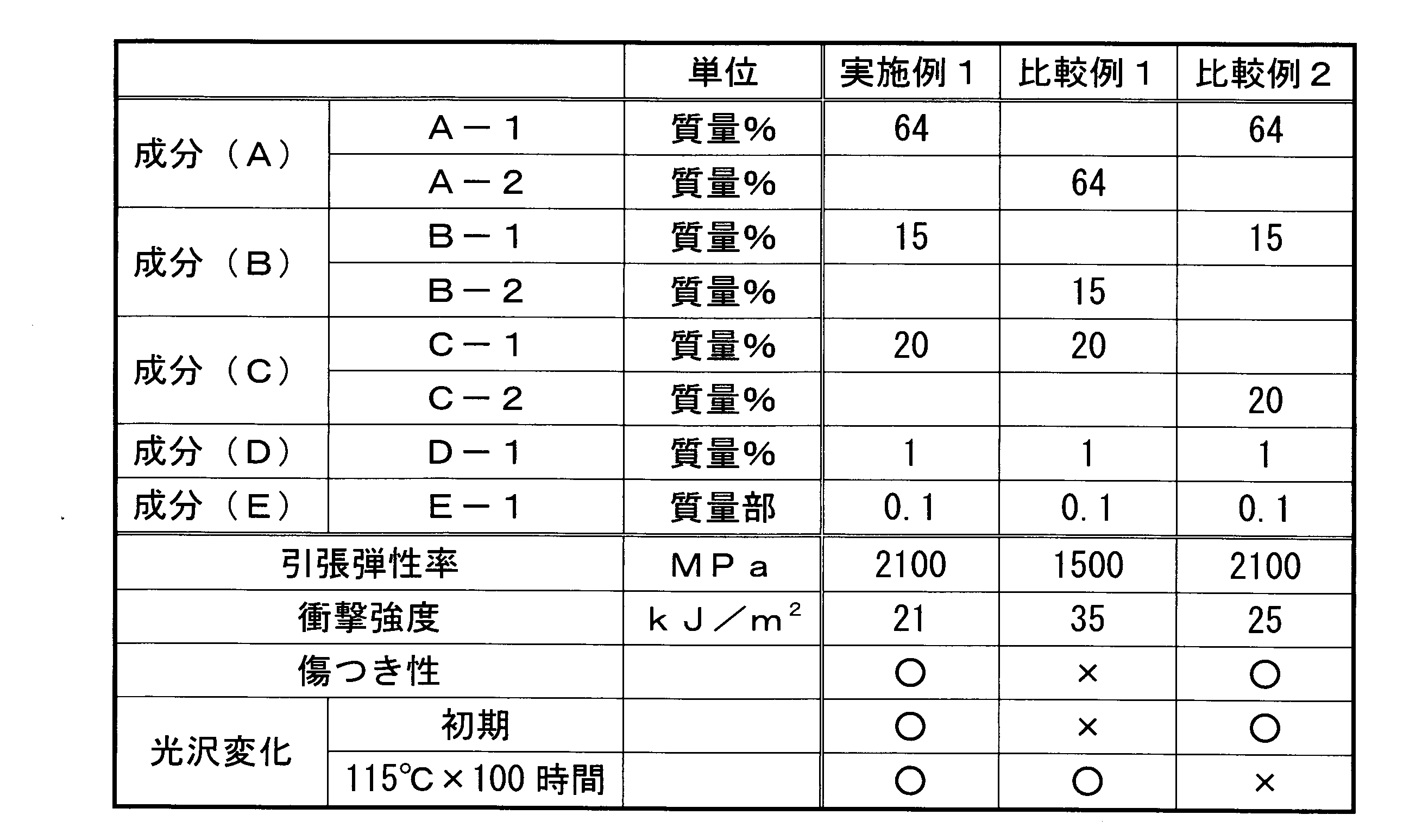
4.評価
表3に示す結果から、本実施の形態の樹脂組成物及びその成形体の実施形態要件を満たしている実施例1は、高い剛性および衝撃性を示し、かつ初期光沢が低い上に耐熱光沢変化が小さく耐傷つき性が良好であるという特徴を有していることが分かる。
表3に示す結果から、本実施の形態の樹脂組成物及びその成形体の実施形態要件を満たしている実施例1は、高い剛性および衝撃性を示し、かつ初期光沢が低い上に耐熱光沢変化が小さく耐傷つき性が良好であるという特徴を有していることが分かる。
一方、上記本実施の形態の特定事項を満たさない比較例において、比較例1、2に示す組成を持った樹脂組成物及びその成形体は、これらの性能バランスが不良で、実施例1のものに対して見劣りしている。
例えば、比較例1では、成分(B)としてタルクを使用しており、耐傷つき性が悪く、さらに光沢変化も実施例1に大きく劣るものである。衝撃が低く、また初期光沢が高く、耐熱試験後の光沢変化も大きい。比較例3では、熱可塑性エラストマー(C)が要件を満たさないため光沢の耐熱変化がおおきくなっている。
Claims (2)
- 繊維強化ポリプロピレン系樹脂組成物であって、
下記の条件を満足する
成分(A)53質量%~74.5質量%と、
成分(B)10質量%~20質量%と、
成分(C)15~25質量%と、
成分(D)0.5~2質量%
(但し、成分(A)と成分(B)と成分(C)と成分(D)との合計量は100質量%である)と
を含有し、
更に、成分(A)と成分(B)と成分(C)と成分(D)との合計量100質量部に対して
下記の条件を満足する成分(E)0.05~0.15質量部
を含有することを特徴とする繊維強化ポリプロピレン系樹脂組成物。
成分(A):次の(A-i)~(A-iv)に規定する要件を有する。
(A-i):成分(A)はメタロセン系触媒を用いて、第1工程でプロピレン単独またはエチレン含有量7質量%以下のプロピレン-エチレンランダム共重合体成分(A-A)を30質量%~95質量%、第2工程で成分(A-A)よりも3質量%~20質量%多くのエチレンを含有するプロピレン-エチレンランダム共重合体成分(A-B)を70質量%~5質量%逐次重合することで得られたプロピレン-エチレンブロック共重合体である。
(A-ii):DSC法により測定された融解ピーク温度(Tm)が110℃~150℃である。
(A-iii):固体粘弾性測定により得られる温度-損失正接曲線において、tanδ曲線が0℃以下に単一のピークを有する。
(A-iv):メルトフローレート(MFR:230℃、2.16kg荷重)が0.5g/10分~200g/10分である。
成分(B):次の(B-i)に規定する要件を有する。
(B-i):成分(B)が、ガラス繊維である。
成分(C):次の(C-i)及び(C-ii)に規定する要件を有する。
(C-i):密度が0.85g/cm3~0.87g/cm3のエチレン-オクテン共重合体である。
(C-ii):メルトフローレート(230℃、2.16kg荷重)が0.5g/10分~1.1g/10分である。
成分(D):次の(D-i)に規定する要件を有する。
(D-i):成分(D)が、酸変性ポリオレフィンおよび/またはヒドロキシ変性ポリオレフィンである。
成分(E):次の(E-i)に規定する要件を有する。
(E-i):成分(E)が、エルカ酸アミドである。 - 成分(B)の長さが、0.2mm以上10mm以下であることを特徴とする請求項1に記載の繊維強化ポリプロピレン系樹脂組成物。
Priority Applications (3)
| Application Number | Priority Date | Filing Date | Title |
|---|---|---|---|
| US15/759,448 US20180251611A1 (en) | 2015-09-24 | 2016-09-16 | Fiber-reinforced polypropylene resin composition |
| DE112016003822.4T DE112016003822T5 (de) | 2015-09-24 | 2016-09-16 | Faserverstärkte Polypropylenharzzusammensetzung |
| CN201680053304.1A CN108026293A (zh) | 2015-09-24 | 2016-09-16 | 纤维增强聚丙烯类树脂组合物 |
Applications Claiming Priority (2)
| Application Number | Priority Date | Filing Date | Title |
|---|---|---|---|
| JP2015186848A JP6770796B2 (ja) | 2015-09-24 | 2015-09-24 | 繊維強化ポリプロピレン系樹脂組成物 |
| JP2015-186848 | 2015-09-24 |
Publications (1)
| Publication Number | Publication Date |
|---|---|
| WO2017051778A1 true WO2017051778A1 (ja) | 2017-03-30 |
Family
ID=58386480
Family Applications (1)
| Application Number | Title | Priority Date | Filing Date |
|---|---|---|---|
| PCT/JP2016/077452 Ceased WO2017051778A1 (ja) | 2015-09-24 | 2016-09-16 | 繊維強化ポリプロピレン系樹脂組成物 |
Country Status (5)
| Country | Link |
|---|---|
| US (1) | US20180251611A1 (ja) |
| JP (1) | JP6770796B2 (ja) |
| CN (1) | CN108026293A (ja) |
| DE (1) | DE112016003822T5 (ja) |
| WO (1) | WO2017051778A1 (ja) |
Families Citing this family (6)
| Publication number | Priority date | Publication date | Assignee | Title |
|---|---|---|---|---|
| CN110615992A (zh) * | 2019-10-15 | 2019-12-27 | 中国工程物理研究院化工材料研究所 | 一种短切纤维增强有机硅树脂组合物及其制备方法 |
| CN113321873B (zh) * | 2020-02-28 | 2022-10-28 | 合肥杰事杰新材料股份有限公司 | 一种低收缩高韧性改性聚丙烯材料及其制备方法 |
| WO2022002839A1 (en) * | 2020-06-29 | 2022-01-06 | Sabic Global Technologies B.V. | Polymer composition with improved flowability and falling weight impact resistance at low temperature |
| JP7705858B2 (ja) * | 2020-06-30 | 2025-07-10 | 住友化学株式会社 | ポリプロピレン系樹脂組成物 |
| CN116724083B (zh) * | 2021-01-22 | 2025-09-19 | 博里利斯股份公司 | 包含丙烯无规共聚物的纤维增强组合物 |
| CN116394614B (zh) * | 2023-04-08 | 2023-11-28 | 河北澳航建材科技有限公司 | 一种预制装配干式地暖模块 |
Citations (11)
| Publication number | Priority date | Publication date | Assignee | Title |
|---|---|---|---|---|
| JPH0753843A (ja) * | 1993-08-19 | 1995-02-28 | Mitsubishi Chem Corp | 熱可塑性重合体組成物 |
| JP2000026697A (ja) * | 1998-07-14 | 2000-01-25 | Japan Polychem Corp | プロピレン系樹脂組成物 |
| JP2004051769A (ja) * | 2002-07-19 | 2004-02-19 | Nissan Motor Co Ltd | 自動車内装成形品 |
| JP2008019347A (ja) * | 2006-07-13 | 2008-01-31 | Sumitomo Chemical Co Ltd | ポリプロピレン系樹脂組成物 |
| JP2008101090A (ja) * | 2006-10-18 | 2008-05-01 | Japan Polypropylene Corp | プロピレンブロック共重合体組成物及び自動車内装部品 |
| JP2009173916A (ja) * | 2007-12-27 | 2009-08-06 | Sumitomo Chemical Co Ltd | プロピレン系樹脂組成物及びその成形体 |
| JP2010150328A (ja) * | 2008-12-24 | 2010-07-08 | Sumitomo Chemical Co Ltd | ポリプロピレン系樹脂組成物およびそれからなるフィルム |
| JP2011127058A (ja) * | 2009-12-21 | 2011-06-30 | Nissan Motor Co Ltd | 自動車用射出成形部品 |
| JP2013067789A (ja) * | 2011-09-08 | 2013-04-18 | Japan Polypropylene Corp | 繊維強化ポリプロピレン系樹脂組成物及びその成形体 |
| JP2013234278A (ja) * | 2012-05-10 | 2013-11-21 | Sumitomo Chemical Co Ltd | オレフィン樹脂組成物、シートおよび成形体 |
| JP2014172985A (ja) * | 2013-03-08 | 2014-09-22 | Japan Polypropylene Corp | リブ付き成形体用繊維強化ポリプロピレン系樹脂組成物及びそれを成形してなるリブ付き成形体 |
Family Cites Families (7)
| Publication number | Priority date | Publication date | Assignee | Title |
|---|---|---|---|---|
| JPS6354296A (ja) | 1986-05-14 | 1988-03-08 | 相模通信工業株式会社 | 開閉ロック付キャップ |
| US5055438A (en) | 1989-09-13 | 1991-10-08 | Exxon Chemical Patents, Inc. | Olefin polymerization catalysts |
| JP3460854B2 (ja) | 1994-04-28 | 2003-10-27 | 株式会社日立製作所 | 熱可塑性エラストマー組成物 |
| JP2002003691A (ja) | 2000-06-19 | 2002-01-09 | Asahi Kasei Corp | 高強度・高剛性ポリオレフィン系熱可塑性樹脂組成物 |
| US6911497B2 (en) * | 2003-03-27 | 2005-06-28 | Sumitomo Chemical Company, Limited | Polypropylene resin composition, method for its production, and injection molded article |
| EP1920001A1 (en) | 2005-08-31 | 2008-05-14 | Basell Poliolefine Italia S.r.l. | Molding-compositions composed of filler-reinforced thermoplastic material with very good scratch resistance and soft-touch feel |
| US20150315365A1 (en) | 2012-12-07 | 2015-11-05 | Japan Polypropylene Corporation | Fiber-reinforced polypropylene resin composition and molded article of same |
-
2015
- 2015-09-24 JP JP2015186848A patent/JP6770796B2/ja active Active
-
2016
- 2016-09-16 DE DE112016003822.4T patent/DE112016003822T5/de not_active Withdrawn
- 2016-09-16 WO PCT/JP2016/077452 patent/WO2017051778A1/ja not_active Ceased
- 2016-09-16 US US15/759,448 patent/US20180251611A1/en not_active Abandoned
- 2016-09-16 CN CN201680053304.1A patent/CN108026293A/zh active Pending
Patent Citations (11)
| Publication number | Priority date | Publication date | Assignee | Title |
|---|---|---|---|---|
| JPH0753843A (ja) * | 1993-08-19 | 1995-02-28 | Mitsubishi Chem Corp | 熱可塑性重合体組成物 |
| JP2000026697A (ja) * | 1998-07-14 | 2000-01-25 | Japan Polychem Corp | プロピレン系樹脂組成物 |
| JP2004051769A (ja) * | 2002-07-19 | 2004-02-19 | Nissan Motor Co Ltd | 自動車内装成形品 |
| JP2008019347A (ja) * | 2006-07-13 | 2008-01-31 | Sumitomo Chemical Co Ltd | ポリプロピレン系樹脂組成物 |
| JP2008101090A (ja) * | 2006-10-18 | 2008-05-01 | Japan Polypropylene Corp | プロピレンブロック共重合体組成物及び自動車内装部品 |
| JP2009173916A (ja) * | 2007-12-27 | 2009-08-06 | Sumitomo Chemical Co Ltd | プロピレン系樹脂組成物及びその成形体 |
| JP2010150328A (ja) * | 2008-12-24 | 2010-07-08 | Sumitomo Chemical Co Ltd | ポリプロピレン系樹脂組成物およびそれからなるフィルム |
| JP2011127058A (ja) * | 2009-12-21 | 2011-06-30 | Nissan Motor Co Ltd | 自動車用射出成形部品 |
| JP2013067789A (ja) * | 2011-09-08 | 2013-04-18 | Japan Polypropylene Corp | 繊維強化ポリプロピレン系樹脂組成物及びその成形体 |
| JP2013234278A (ja) * | 2012-05-10 | 2013-11-21 | Sumitomo Chemical Co Ltd | オレフィン樹脂組成物、シートおよび成形体 |
| JP2014172985A (ja) * | 2013-03-08 | 2014-09-22 | Japan Polypropylene Corp | リブ付き成形体用繊維強化ポリプロピレン系樹脂組成物及びそれを成形してなるリブ付き成形体 |
Also Published As
| Publication number | Publication date |
|---|---|
| CN108026293A (zh) | 2018-05-11 |
| US20180251611A1 (en) | 2018-09-06 |
| JP2017061596A (ja) | 2017-03-30 |
| JP6770796B2 (ja) | 2020-10-21 |
| DE112016003822T5 (de) | 2018-05-09 |
Similar Documents
| Publication | Publication Date | Title |
|---|---|---|
| JP6330302B2 (ja) | 繊維強化ポリプロピレン系樹脂組成物及びその成形体 | |
| JP6136149B2 (ja) | 繊維強化ポリプロピレン系樹脂組成物及びその成形体 | |
| JP6613578B2 (ja) | 繊維強化ポリプロピレン系樹脂組成物 | |
| JP2017061595A (ja) | 繊維強化ポリプロピレン系樹脂組成物 | |
| JP6770796B2 (ja) | 繊維強化ポリプロピレン系樹脂組成物 | |
| EP2682425B1 (en) | Resin composition and laminated body | |
| JP6394473B2 (ja) | 押出ラミネート用ポリプロピレン系樹脂組成物および積層体 | |
| KR20080048473A (ko) | 충전재-강화된 열가소성 물질로 구성되고 내스크라치성 및부드러운 촉감이 우수한 몰딩 조성물 | |
| JP6589323B2 (ja) | ポリプロピレン系樹脂組成物及びその成形体 | |
| JP5613655B2 (ja) | ポリプロピレン系樹脂組成物およびその成形体 | |
| CN100460460C (zh) | 热塑性树脂组合物及其注塑制件 | |
| EP3990539B1 (en) | Coupled post-consumer recycled polypropylene and process to provide same | |
| JP2014172985A (ja) | リブ付き成形体用繊維強化ポリプロピレン系樹脂組成物及びそれを成形してなるリブ付き成形体 | |
| EP1860147B1 (en) | A polyolefin composition with improved stress whitening resistance | |
| US8618215B2 (en) | Modified polypropylene-based polymer and composition comprising it | |
| JP2014172915A (ja) | 発泡用繊維強化ポリプロピレン系樹脂組成物及びそれを発泡成形してなる成形体 | |
| JP2014172916A (ja) | 発泡用繊維強化ポリプロピレン系樹脂組成物及びそれを発泡成形してなる成形体 | |
| JP7744342B2 (ja) | ポリプロピレン系樹脂組成物 | |
| KR20120112076A (ko) | 프로필렌계 수지 조성물 및 그 필름 | |
| JP2018138637A (ja) | 接着性樹脂組成物及びマスターバッチ、並びに、これらを用いた積層フィルム、延伸フィルム、及び多層成形体 | |
| JP6136389B2 (ja) | プロピレン・エチレンブロック共重合体組成物および用途 | |
| JP2024125549A (ja) | 4-メチル-1-ペンテン系重合体組成物、および成形体 | |
| JP2016183280A (ja) | 自動車部品用ポリプロピレン系樹脂組成物及びその成形体 |
Legal Events
| Date | Code | Title | Description |
|---|---|---|---|
| 121 | Ep: the epo has been informed by wipo that ep was designated in this application |
Ref document number: 16848566 Country of ref document: EP Kind code of ref document: A1 |
|
| WWE | Wipo information: entry into national phase |
Ref document number: 15759448 Country of ref document: US |
|
| WWE | Wipo information: entry into national phase |
Ref document number: 112016003822 Country of ref document: DE |
|
| 122 | Ep: pct application non-entry in european phase |
Ref document number: 16848566 Country of ref document: EP Kind code of ref document: A1 |