WO2017017945A1 - 低脂肪スプレッドの製造方法 - Google Patents
低脂肪スプレッドの製造方法 Download PDFInfo
- Publication number
- WO2017017945A1 WO2017017945A1 PCT/JP2016/003437 JP2016003437W WO2017017945A1 WO 2017017945 A1 WO2017017945 A1 WO 2017017945A1 JP 2016003437 W JP2016003437 W JP 2016003437W WO 2017017945 A1 WO2017017945 A1 WO 2017017945A1
- Authority
- WO
- WIPO (PCT)
- Prior art keywords
- water
- fat spread
- low
- spread
- oil
- Prior art date
- Legal status (The legal status is an assumption and is not a legal conclusion. Google has not performed a legal analysis and makes no representation as to the accuracy of the status listed.)
- Ceased
Links
Images



Classifications
-
- A—HUMAN NECESSITIES
- A23—FOODS OR FOODSTUFFS; TREATMENT THEREOF, NOT COVERED BY OTHER CLASSES
- A23D—EDIBLE OILS OR FATS, e.g. MARGARINES, SHORTENINGS OR COOKING OILS
- A23D7/00—Edible oil or fat compositions containing an aqueous phase, e.g. margarines
- A23D7/015—Reducing calorie content; Reducing fat content, e.g. "halvarines"
Definitions
- the present invention relates to a method for producing a low fat spread. Specifically, it is related with the manufacturing method of the low fat spread which is excellent in both emulsification stability and melt in the mouth, and can satisfy both a manufacturer and a consumer.
- Low fat spread is generally obtained by dispersing or dissolving raw materials in an oil phase and an aqueous phase, mixing the oil phase and the aqueous phase, and then (preliminary) emulsification, heating (sterilization), cooling, kneading, etc. Manufactured.
- various low-fat spreads have been studied in consideration of consumers' low-calorie orientation, and the following low-fat spreads have been proposed, for example.
- Patent Document 1 contains polyglycerin-condensed ricinoleic acid ester, glycerin fatty acid ester, and organic acid monoglyceride, has a fat percentage of 40% by weight or less, and has an electrical conductivity in the vicinity of 36 ° C. A salted, low fat spread that rises to 0.1 mS / cm or higher within 300 seconds is described.
- Patent Document 2 describes 40 to 40 water-in-oil emulsions having a fat content of 35 to 60% by weight and a sugar concentration in the aqueous phase of 60 to 75% by weight.
- a low-fat water-in-oil composition in the form of a spread or butter cream is obtained by mixing 80 parts with 60 to 20 parts of an aqueous flavor liquid having a sugar concentration of 55 to 75% by weight.
- the sugar concentration is smaller than 60% by weight, the preservability of the water-in-oil composition is poor, so that the sugar concentration is larger than a predetermined value.
- the oil phase part is reduced, so that the water phase part relatively increases.
- the low fat spread is a water-in-oil emulsion
- the emulsion stability decreases.
- a phenomenon such as phase inversion from a water-in-oil emulsion to an oil-in-water emulsion occurs in the cooling process, etc.
- the stability is poor and the physical properties are inferior.
- Patent Document 1 uses a strong lipophilic emulsifier having a small HLB value such as polyglycerin condensed ricinoleic acid ester (PGPR). .
- PGPR polyglycerin condensed ricinoleic acid ester
- the emulsion stability is excellent, but the emulsified state becomes too strong, so consumers eat.
- the emulsified state is difficult to break, the low fat spread is poorly melted, and the flavor is poor.
- an object of the present invention is to provide a method for producing a low-fat spread that is excellent in both emulsion stability and meltability in the mouth and can be satisfied by both the manufacturer and the consumer.
- the present inventor has reviewed and studied the entire manufacturing process of low-fat spread, including the raw material, blending, physical properties, flavor, etc. of the oil-phase part and water-phase part of the low-fat spread. did.
- an aqueous phase aqueous solution
- a low fat spread can be produced which is superior to both and satisfactory to both manufacturers and consumers.
- a water-in-oil emulsion having a fat content of 50% by mass or more is prepared, and then the water-in-oil emulsion is cooled, while an aqueous phase (aqueous solution) is separately prepared. From this, it was found that a low fat spread having a fat content of 40% by mass or less can be produced by adding and mixing to this cooled water-in-oil emulsion, and the present invention was completed.
- a method for producing a low fat spread comprising preparing a water-in-oil emulsion having a fat content of 50% by mass or more and then cooling and then adding and mixing an aqueous phase (aqueous solution). 2.
- a method for producing a low fat spread comprising: adding the aqueous phase (aqueous solution) to the water-in-oil emulsion to emulsify. 3.
- the method for producing a low fat spread according to 1 or 2 wherein the water-in-oil emulsion is prepared using an emulsifier having an HLB value of 3 or more. 4). 4.
- a water-in-oil emulsion can be prepared and then cooled to stabilize the tissue (structure) of a low fat spread. For this reason, in this invention, at the time of manufacture of a low fat spread, a phase inversion etc. cannot occur easily, emulsification stability is good, and a physical property is excellent.
- the emulsification stability of the low fat spread can be improved and the physical properties can be stabilized. For this reason, in this invention, at the time of eating of a low-fat spread, an emulsified state disintegrates appropriately, the mouth melts well, and the flavor is excellent.
- a low fat spread can be stably manufactured on a commercial scale.
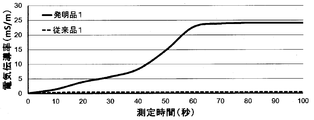
- 3 is a graph showing the measurement results of conductivity of Invention 1 and Conventional 1 in Test Example 1; It is a graph which shows the measurement result of the electrical conductivity of the inventive product 1 and the conventional product 1 in Test Example 1, and is a graph showing the measurement time in an enlarged range up to 100 seconds.
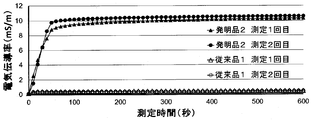
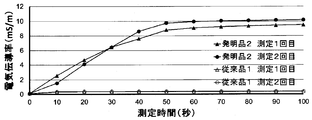
- 6 is a graph showing the measurement results of conductivity of Invention Product 2 and Conventional Product 1 in Test Example 2. It is a graph which shows the measurement result of the electrical conductivity of invention product 2 and conventional product 1 in test example 2, and is a graph which expanded and showed measurement time in the range to 100 seconds.
- 10 is a graph showing measurement results of conductivity of Invention Products 3 to 5 in Test Example 3.
- 4 is a graph showing the measurement results of the electrical conductivity of Invention products 3 to 5 in Test Example 3, and is a graph showing the measurement time in an enlarged range up to 100 seconds.
- 10 is a graph showing the results of a use test of Test Example 4.
- aqueous phase aqueous solution
- emulsification stability physical property
- mouth melting mouth melting
- aqueous phase is heated (sterilized) and then cooled. Then, the cooled water-in-oil emulsion is added and mixed (kneaded) with the cooled aqueous phase, and the state of emulsification is stabilized while adjusting the composition of the low fat spread substantially evenly. .
- the method for producing a low-fat spread according to the present invention includes a step of preparing a water-in-oil emulsion having a fat content of 50% by mass or more, and heat-sterilization of the water-in-oil emulsion, followed by cooling.
- the aqueous lysate prepared separately from the water-in-oil emulsion is an additional water phase, and together with the water phase of the water-in-oil emulsion, constitutes the water phase in the produced low fat spread. .
- the water-in-oil emulsion may be filtered using a ceramic filter or the like.
- the filtration may be performed before the water-in-oil emulsion is heated, or may be filtered after the water-in-oil emulsion is heated.
- “spread” refers to what is defined as “fat spread” among those prescribed as Japanese Agricultural Standards (JAS) “margarines”. “Fat spread” includes “margarines”. Among them, those having a fat content (oil content) of less than 80% are included. Further, in the present invention, “manufacturing on a commercial scale” means that a product is manufactured on a large scale and stably supplied in large quantities to the market, and includes, for example, manufacturing with a charging amount of 1000 kg or more.
- the fat content of the water-in-oil emulsion (base spread) is adjusted to 50% by mass or more.
- the fat content of the water-in-oil emulsion (base spread) is more preferably 50 to 80% by mass, still more preferably 50 to 70% by mass, and further preferably 50 to 60% by mass. If the fat content is 50 to 80% by mass, the water phase part becomes too much, the emulsion stability does not deteriorate, and the oil phase part becomes too much, resulting in a low fat spread. In order to do so, a large amount of the aqueous phase must be added later, which does not cause instability.
- the oil phase and water phase materials constituting the water-in-oil emulsion are not particularly limited, and those known in the art can be appropriately selected and used.
- the step of preparing the water-in-oil emulsion is not particularly limited as long as it is processed using a general food industry apparatus or equipment. It may be processed using a tank or the like.
- the temperature conditions for this preparation are preferably 50 to 75 ° C. and 5 to 60 minutes, more preferably 50 to 70 ° C. and 5 to 30 minutes, and still more preferably 50 to 65 ° C. and 5 to 20 minutes. More preferably, it is 50 to 60 ° C. and 5 to 10 minutes.
- the step of cooling after heating the water-in-oil emulsion is not particularly limited as long as it is processed using a general food industry apparatus or equipment, for example, You may process using a plate-type heat exchanger, a tube-type heat exchanger, an energization (joule) type heater, a jacketed tank, etc.
- the heating conditions are preferably 90 to 120 ° C., 1 to 60 seconds, more preferably 90 to 110 ° C., 5 to 60 seconds, and still more preferably 90 to 100 ° C., 10 to 60 seconds. More preferably, it is 90 to 95 ° C. and 20 to 60 seconds.
- the cooling conditions are preferably 10 to 50 ° C., more preferably 10 to 40 ° C., still more preferably 15 to 30 ° C., still more preferably 15 to 20 ° C., preferably 1 to Rapid cooling (rapid cooling) is performed for 120 seconds, more preferably 1 to 100 seconds, still more preferably 1 to 80 seconds, and still more preferably 1 to 60 seconds.
- rapid cooling rapid cooling
- mixing a water-in-oil emulsion will not be specifically limited if it processes using the apparatus and apparatus for manufacture of a general margarine.
- the step of separately preparing an aqueous phase is not particularly limited as long as it is processed using a general food industry apparatus or equipment. It may be processed using an attached tank or the like.
- the temperature conditions for this preparation are preferably 50 to 75 ° C. and 5 to 60 minutes, more preferably 50 to 70 ° C. and 5 to 30 minutes, and still more preferably 50 to 65 ° C. and 5 to 20 minutes. More preferably, it is 50 to 60 ° C. and 5 to 10 minutes.
- the material constituting the aqueous phase (aqueous solution) is not particularly limited, and those known in the art can be appropriately selected and used.
- the step of cooling after heating the aqueous phase (aqueous solution) is not particularly limited as long as it is processed using a general food industry apparatus or equipment, for example,
- the heat treatment may be performed using a plate heat exchanger, a tube heat exchanger, an energizing (joule) heater, a jacketed tank, or the like.
- the heating conditions are preferably 90 to 120 ° C., 1 to 60 seconds, more preferably 90 to 110 ° C., 5 to 60 seconds, and still more preferably 90 to 100 ° C., 10 to 60 seconds. More preferably, it is 90 to 95 ° C. and 20 to 60 seconds.
- the cooling conditions are preferably 3 to 50 ° C., more preferably 3 to 30 ° C., still more preferably 3 to 15 ° C., still more preferably 3 to 10 ° C., preferably 1 to Rapid cooling (rapid cooling) is performed for 120 seconds, more preferably 1 to 90 seconds, still more preferably 1 to 60 seconds, and still more preferably 1 to 30 seconds.
- the step of adding a cooled aqueous phase (aqueous solution) to a cooled water-in-oil emulsion and mixing (kneading) is a general production of margarine. If it processes using the apparatus and apparatus for this, it will not specifically limit.
- a raw material is dispersed or dissolved in an oil phase and an aqueous phase, and the oil phase and the aqueous phase are mixed (preliminarily) and emulsified, and the fat content is less than 50% by mass ( For example, 40% by mass) of a water-in-oil emulsion is prepared, and then heated (sterilized), cooled and kneaded.
- the conventional low fat spread since a small amount of oil phase part is emulsified as a continuous phase and a large amount of water phase part is dispersed as a dispersed phase, the emulsified state is difficult to stabilize.
- the water-in-oil emulsion is heated and then cooled and kneaded to emulsify.
- aqueous solution aqueous solution
- the aqueous phase aqueous solution
- the cooled aqueous phase aqueous solution
- the composition of the low fat spread is adjusted substantially evenly while emulsifying. Stabilize the state.
- a large amount of oil phase part is used as a continuous phase, and a small amount of aqueous phase part is used as a dispersed phase so that the emulsified state is stabilized. Since the phase part (aqueous solution) is added and mixed, the emulsified state is easily stabilized.
- a water-in-oil emulsion may be prepared using an emulsifier having an HLB value of 3 or more.
- the HLB value is an index indicating the degree of affinity for water and oil in emulsifiers and surfactants.
- the HLB value is based on a range from 0 to 20, and the closer to 0, the higher the lipophilicity, and the closer to 20, the higher the hydrophilicity.
- the HLB value of the emulsifier is preferably 3 or more, more preferably 3 to 20, still more preferably 3 to 10, further preferably 4 or more. More preferably, it is 4 to 10, more preferably 4 to 8, and still more preferably 4 to 6. If the emulsifier has an HLB value of 3, the low fat spread will not dissolve well and the flavor will not be inferior.
- a water-in-oil emulsion is prepared using an emulsifier having an HLB value of 3 or more, consumers eat while maintaining an emulsified state at an appropriate strength. In this case, the emulsified state is properly broken, the low fat spread is well melted, and the flavor is excellent.
- starch is blended, and the aqueous phase (the aqueous phase constituting the water-in-oil emulsion and the aqueous phase prepared separately from the water-in-oil emulsion (aqueous solution) And)) may be prepared.
- starch is not particularly limited as long as the effects of the present invention can be obtained, but preferably, it is subjected to enzymatic, physical, or chemical modification treatment to improve or improve properties and impart functionality. It is a modified starch.
- modified starch includes acetylated adipic acid crosslinked starch, acetylated phosphate crosslinked starch, acetylated oxidized starch, starch octenyl succinate, starch acetate, oxidized starch, hydroxypropyl starch, hydroxypropylated phosphate crosslinked starch.
- examples thereof include phosphoric acid monoesterified phosphoric acid crosslinked starch, phosphorylated starch, and phosphoric acid crosslinked starch, and hydroxypropyl starch is preferred.
- the starch concentration is preferably It is 3% by mass or more, more preferably 3 to 10% by mass, further preferably 4 to 8% by mass, and further preferably 5 to 6% by mass. If the starch concentration is 3 to 10% by mass, the emulsification stability of the low fat spread can be effectively improved, and the water separation of the low fat spread can be effectively suppressed or prevented.
- an additive is blended, and an aqueous phase (an aqueous phase constituting a water-in-oil emulsion and an aqueous phase prepared separately from the water-in-oil emulsion (aqueous dissolution) And the like) may be prepared.
- the additive is not particularly limited as long as the effect of the present invention is obtained, but examples thereof include flavor materials and physical property improvers, and examples of fats such as fats and oils.
- the fat content is preferably 20 to 45% by mass, more preferably 25 to 45% by mass, still more preferably 30 to 45% by mass, and further preferably 30 to 40% by mass. It is. If the fat content is 20 to 45% by mass, the water phase part becomes too much, the emulsion stability does not deteriorate, and the oil phase part becomes too much. There will be no disappearance.
- the conductivity of the low fat spread can be measured to evaluate the degree of melting in the mouth.
- the conductivity is an index that expresses the ease of current flow in an aqueous solution. That is, when dissolution of the low fat spread proceeds, salt (salt) contained in the low fat spread is released into the aqueous solution, and accordingly, the conductivity of the low fat spread increases. That is, the fact that the conductivity of the low fat spread tends to increase means that the low fat spread is well melted.
- the low fat spread of the present invention in the measurement of conductivity at 37 ° C., the conductivity reaches 8 mS / m or more in less than 100 seconds from the start of measurement. At this time, if the electrical conductivity does not reach 8 mS / m or more in less than 100 seconds from the start of measurement, the melting of the low fat spread is poor. Therefore, the low fat spread of the present invention preferably has a conductivity of 8 mS / m or less in 90 seconds from the start of measurement, more preferably less than 80 seconds from the start of measurement in the measurement of conductivity at 37 ° C. The conductivity reaches 8 mS / m or more, more preferably less than 70 seconds from the start of measurement, and the conductivity reaches 8 mS / m or more, more preferably less than 60 seconds from the start of measurement. Will be reached.
- Example 1 Production of Invention Product 1
- 11438.4 g of edible vegetable oil Mitsubishi Corporation
- 4450 g of edible refined processed oil Ueda Oil Co., Ltd.
- glycerin fatty acid ester RIKEN VITAMIN, HLB Value: 4.3
- lecithin Sakai Oil Co., Ltd.
- 8009.1 g of prepared water (food manufacturing water) and 480 g of salt (Diasolt) in another tank for mixing the mixture was stirred and dissolved, and then hydroxypropyl starch (Nelite CL, Ingle). Dion Japan Co., Ltd.) was added at 515 g and dispersed by stirring. Thereafter, the mixture was heated to 60 ° C. and then mixed by stirring to prepare an “aqueous phase”.
- the “oil phase” is placed in the “oil phase”, and the “water phase” is added and mixed. Further, 7.5 g of fragrance (Shiono Fragrance Co., Ltd.) is added, and then 50 to 60 ° C. The mixture was stirred for 10 minutes while being warmed to the extent, and emulsified (preliminarily emulsified) to prepare an “emulsion”. Next, this “emulsion” was fed to a plate heat exchanger (sterilizer), heated (sterilized) at 95 ° C. for 20 seconds, and then cooled to about 50 ° C.
- this “emulsion” was filtered using a filter (60 mesh, manufactured by PET), and then sent to a scraper heat exchanger (cooler), and rapidly cooled to 18 ° C.
- this “emulsion” was fed to a kneader and kneaded at 20 ° C. to make a total of 25 kg to prepare a “base spread”.
- a recipe for “base spread” of Invention 1 is shown in Table 1.
- the “base spread” is fed to a kneader, the “water phase for post-mixing” is filtered, mixed and dispersed, and then kneaded at 20 ° C. to prepare an “emulsion”. .
- the base spread (Table 1): the aqueous phase for post-mixing (Table 2) was mixed at a ratio of 62.5: 37.5.
- this “emulsion” was fed to a filling machine and filled in a predetermined container to produce a low fat spread (Invention 1) having a fat content of 40% by mass.
- Table 3 shows the recipe for Invention Product 1.
- a separate tank for preparation 108.76 kg of preparation water (food production water) is added, 96 kg of saline (preparation water (food production water)) and 32 kg of salt (Diasolt) are mixed and stirred. 128 kg of dissolved product), 34 kg of gelatin (Nitta Gelatin Co., Ltd.), 5.4 kg of citric acid (San-Eigen FFI Co., Ltd.), and 0 of sodium citrate (San-Eigen FFI Co., Ltd.) Then, the mixture was stirred and mixed while reducing the pressure in the tank to 0.060 MPa to prepare an “aqueous phase”.
- the “water phase” is heated to 60 ° C. in the place where the “oil phase” is contained, and then this “water phase” is added using a filter (60 mesh, made of PET).
- a mixture of fragrance (Shiono Fragrance Co., Ltd.) and fragrance (Ogawa Fragrance Co., Ltd.) was added at 0.84 kg, and the mixture was stirred for 10 minutes while being heated to about 60 ° C. Emulsified) to prepare an “emulsion”.
- a sintered filter 40 mesh
- it was sent to a plate heat exchanger (sterilizer) and heated (sterilized) at 95 ° C. for 20 seconds.
- this “emulsion” is filtered using a sintered filter (40 mesh), and then sent to a scraper heat exchanger (cooler), rapidly cooled to 28 ° C., and further scraped. The solution was sent to a heat exchanger (cooler) and rapidly cooled to 18 ° C.
- this “emulsion” was fed to a kneader and kneaded at 20 ° C. Then, this “emulsion” was fed to a filling machine, passed through a magnetic separator, and then filled into a predetermined container to produce a low fat spread (conventional product 1) having a fat content of 38 mass%.
- Table 4 shows a recipe for conventional product 1.
- the conductivity is an index indicating the ease of current flow in an aqueous solution containing an electrolyte.
- the invention product 1 can produce a low-fat spread with a stable emulsification and a good mouth melt without using a polyglycerin condensed ricinoleic acid ester, which is a strong lipophilic emulsifier.
- the conventional product 1 in the conventional product 1, the conductivity did not increase even after about 600 seconds had elapsed since the start of the test. Therefore, it was suggested that the conventional product 1 is a low fat spread in which the salt content in the aqueous phase is not released into the aqueous solution, does not demulsify, and does not dissolve in the mouth even after about 600 seconds have passed.
- the conventional product 1 uses a polyglycerin condensed ricinoleic acid ester which is a strong lipophilic emulsifier and produces a low fat spread which is stable in emulsification but not well melted in the mouth. confirmed.
- Example 2 Manufacture of Invention Product 2
- 352.42 kg of edible refined processed oil Ueda Oil Co., Ltd.
- 1.98 kg of glycerin fatty acid ester RIKEN VITAMIN, HLB value: 4.3
- Lecithin Sakai Oil Co., Ltd.
- Add edible vegetable oil Mitsubishi Corporation
- antioxidant tocopherol (40%), J-Oil Mills
- An “oil phase” was prepared.
- the “water phase” is heated to 60 ° C. in the place where the “oil phase” is contained, and then this “water phase” is added using a filter (60 mesh, made of PET).
- the fragrance Shiono Fragrance Co., Ltd.
- the mixture was stirred for 10 minutes while being heated to about 50-60 ° C. and emulsified (preliminarily emulsified).
- a sintered filter 40 mesh
- this “emulsion” is filtered using a sintered filter (40 mesh), then sent to a scraper heat exchanger (cooler), rapidly cooled to 20 ° C., and further scraped. The solution was sent to a heat exchanger (cooler) and rapidly cooled to 14 ° C. Next, this “emulsion” was fed to a kneader and kneaded at 20 ° C. to prepare a “base spread” with a total of 2000 kg. Table 5 shows the “base spread” recipe for Invention 2.
- the “base spread” is fed to a kneader, the “water phase for post-mixing” is filtered, mixed and dispersed, and then kneaded at 20 ° C. to prepare an “emulsion”. .
- the base spread (Table 5): the aqueous phase for post-mixing (formulation in Table 2) was mixed at a ratio of 66:34.
- this “emulsion” is fed to a filling machine, passed through a magnetic separator, and then filled into a predetermined container to produce a low fat spread (Invention 2) with a fat content of 40 mass% on a commercial scale. did.
- the formulation table for Invention 2 is shown in Table 6.
- Test Example 2 Comparison of Mouth Melting of Invention Product 2 and Conventional Product 1
- the electrical conductivity of Invention Product 2 and Conventional Product 1 was measured. Specifically, in the same manner as in Test Example 1, the conductivity of hot water was measured every 10 seconds up to 600 seconds. The results are shown in FIG. Moreover, it expanded in the range which measured the electrical conductivity of warm water to 100 second, and this result was shown in FIG.
- Invention 2 can produce a low fat spread with a stable emulsification state and good meltability on a commercial scale without using a polyglycerin condensed ricinoleic acid ester, which is a strong lipophilic emulsifier. .
- Example 3 Manufacture of Invention Products 3 to 5
- 12995 g of edible vegetable oil Mitsubishi Corporation
- 5566 g of edible refined processed oil Ueda Oil Co., Ltd.
- glycerin fatty acid ester RIKEN VITAMIN, HLB Value: 4.3
- lecithin manufactured by Sakai Oil Co., Ltd.
- 3475.76 g of prepared water (food manufacturing water) and 276 g of sodium chloride (Diasolt) were added to another preparation tank and dissolved by stirring.
- 515.2 g of hydroxypropyl starch (Nulite CL, Ingledion Japan) was added and stirred and dispersed. Thereafter, the mixture was heated to 60 ° C. and then mixed by stirring to prepare an “aqueous phase”.
- the “water phase” is added to the “oil phase” and mixed. Further, ⁇ -carotene (DSM Nutrition Japan) is added at 11.04 g, and the temperature is 50-60 ° C. The mixture was stirred for 10 minutes while being warmed to the extent, and emulsified (preliminarily emulsified) to prepare an “emulsion”. Next, this “emulsion” was fed to a plate heat exchanger (sterilizer), heated (sterilized) at 95 ° C. for 20 seconds, and then cooled to about 50 ° C.
- this “emulsion” was filtered using a filter (60 mesh, manufactured by PET), and then sent to a scraper heat exchanger (cooler), and rapidly cooled to 18 ° C.
- this “emulsion” was fed to a kneader and kneaded at 20 ° C. to prepare a “base spread” with a total of 23 kg.
- Table 7 shows a recipe for “base spread” of Inventions 3 to 5.
- the “base spread” is fed to a kneader, the “water phase for post-mixing” is filtered, mixed and dispersed, and then kneaded at 20 ° C. to prepare an “emulsion”. .
- the “base spread” (Table 7) and the “water phase for post-mixing” (Table 8) were mixed so as to have the ratio shown in Table 9.
- these “emulsions” are fed to a filling machine, filled into a predetermined container, a low fat spread (invention 3) with a fat content of 39.1% by mass, and a fat content of 30.9% by mass.
- Low fat spread (Invention 4), and a low fat spread (Invention 5) having a fat content of 22.8% by mass.
- Ingredients for Inventions 3 to 5 are shown in Tables 10 to 12, respectively.
- Test Example 3 Comparison of Mouth Melting of Invention Products 3 to 5
- the electrical conductivity of Invention Products 3 to 5 was measured. Specifically, the conductivity of hot water was measured every 10 seconds up to 600 seconds in the same manner as in Test Example 1, and the results are shown in FIG. Moreover, it expanded in the range which measured the electrical conductivity of warm water to 100 second, and this result was shown in FIG.
- any of the inventive products 3 to 5 can produce a low fat spread having a stable emulsification state and good meltability without using a strong lipophilic emulsifier polyglycerin condensed ricinoleate. It was.
- Example 4 Production of Invention 6
- 10500 g of olive oil Mitsubishi Corporation
- 4125 g of edible refined processed oil Ueda Oil Co., Ltd.
- glycerin fatty acid ester RIKEN vitamins, HLB value: 4. 3
- 25 g and lecithin manufactured by Sakai Oil Co., Ltd.
- 9415 g of prepared water (food manufacturing water) and 300 g of sodium chloride (Diasolt) were added to another preparation tank and dissolved by stirring.
- hydroxypropyl starch (Nulite CL, Ingledion Japan) was added at 560 g, and then dispersed by stirring. Thereafter, the mixture was heated to 60 ° C. and then mixed by stirring to prepare an “aqueous phase”.
- this “emulsion” was filtered using a filter (60 mesh, manufactured by PET), and then sent to a scraper heat exchanger (cooler), and rapidly cooled to 18 ° C.
- this “emulsion” was fed to a kneader and kneaded at 20 ° C. to make a total of 25 kg to prepare a “base spread”.
- Table 13 shows a recipe for “base spread” of Invention 6.
- the “base spread” is fed to a kneader, the “water phase for post-mixing” is filtered, mixed and dispersed, and then kneaded at 20 ° C. to prepare an “emulsion”. .
- the base spread (Table 13): the aqueous phase for post-mixing (Table 14) was mixed at a ratio of 66:34.
- this “emulsion” was fed to a filling machine and filled into a predetermined container to produce a low fat spread (Invention 6) having a fat content of 38.9% by mass.
- Table 15 shows a recipe for Invention 6.
- a low fat spread tissue can be stabilized in a high fat content of 50% by mass or more. For this reason, in this invention, at the time of manufacture of a low fat spread, a phase inversion etc. cannot occur easily, emulsification stability is good, and a physical property is excellent. Further, according to the present invention, a low fat spread can be produced without using a strong lipophilic emulsifier such as PGPR. For this reason, in this invention, at the time of eating of a low-fat spread, an emulsified state disintegrates appropriately, the mouth melts well, and the flavor is excellent.
- PGPR strong lipophilic emulsifier
Landscapes
- Chemical & Material Sciences (AREA)
- Oil, Petroleum & Natural Gas (AREA)
- Life Sciences & Earth Sciences (AREA)
- Engineering & Computer Science (AREA)
- Food Science & Technology (AREA)
- Polymers & Plastics (AREA)
- Edible Oils And Fats (AREA)
Abstract
脂肪分が50質量%以上の油中水型乳化物を調製してから冷却した後に、水相(水性溶解物)を添加して混合する、低脂肪スプレッドの製造方法である。
Description
本発明は、低脂肪スプレッドの製造方法に関する。具体的には、乳化安定性及び口溶けの両方に優れており、製造者と消費者の両方が満足できる、低脂肪スプレッドの製造方法に関する。
低脂肪スプレッドは一般的に、油相と水相に原料を分散や溶解させて、油相と水相を混合してから、(予備)乳化、加熱(殺菌)、冷却、混練等することで製造される。近年、消費者の低カロリー指向等を意識し、各種の低脂肪スプレッドの開発が検討されており、例えば、次のような低脂肪スプレッドが提案されている。
WO99/15025号公報(特許文献1)には、ポリグリセリン縮合リシノレイン酸エステル、グリセリン脂肪酸エステル、有機酸モノグリセリドを含有し、脂肪率が40重量%以下であって、36℃付近における電気伝導度が300秒以内に0.1mS/cm以上に上昇する、有塩の低脂肪スプレッドが記載されている。また、特開2001-178361号公報(特許文献2)には、油脂含有量が35~60重量%で、水相中の糖濃度が60~75重量%の油中水型乳化物を40~80部と、糖濃度が55~75重量%の水性の風味液を60~20部で混合して得られる、スプレッド状やバタークリーム状の低脂肪の油中水型組成物が記載されている。ここでは、糖濃度が60重量%よりも小さい場合、油中水型組成物の保存性が悪いため、糖濃度が所定値よりも大きいことが必須要件となる。
低脂肪スプレッドでは、油相部を低減するため、水相部が相対的に増大する。ここで、低脂肪スプレッドは、油中水型乳化物であり、水相部が増大すると、乳化安定性が低下することとなる。特に、製造者が低脂肪スプレッドを商業規模で製造する場合には、冷却工程等において、油中水型乳化物から水中油型乳化物へ転相する等の現象が起こり、低脂肪スプレッドの乳化安定性が悪く、物性が劣ることとなる。このとき、低脂肪スプレッドの乳化安定性を担保する方法として、例えば、特許文献1では、ポリグリセリン縮合リシノレイン酸エステル(PGPR)等のHLB値が小さい、強力な親油性の乳化剤を使用している。しかしながら、強力な親油性の乳化剤(PGPR等)を使用して、低脂肪スプレッドを製造すると、乳化安定性が優れたものとなるものの、乳化の状態が強固になりすぎるため、消費者が喫食する際にも、乳化の状態が壊れにくくなり、低脂肪スプレッドの口溶けが悪く、風味が劣ることとなる。
つまり、従来の低脂肪スプレッドでは、製造者が乳化安定性(物性)を向上させようとすると、消費者が口溶け(風味)を満足できないこととなり、消費者が口溶けを満足できるようにしようとすると、製造者が乳化安定性を十分に向上できないこととなっていた。そこで、本発明では、乳化安定性及び口溶けの両方に優れており、製造者と消費者の両方が満足できる、低脂肪スプレッドの製造方法を提供することを課題とする。
上記課題を解決するために、本発明者は、低脂肪スプレッドの油相部及び水相部の原料、配合、物性、風味等を含めて、低脂肪スプレッドの製造工程の全体等を見直して検討した。そして、この結果として、脂肪分が50質量%以上の油中水型乳化物を調製してから冷却した後に、水相(水性溶解物)を添加して混合することにより、乳化安定性及び口溶けの両方に優れており、製造者と消費者の両方が満足できる、低脂肪スプレッドを製造することができることを見出し、本発明を完成させた。具体的には、脂肪分が50質量%以上の油中水型乳化物を調製してから、この油中水型乳化物を冷却する一方で、水相(水性溶解物)を別途調製してから、この冷却した油中水型乳化物に添加して混合することにより、脂肪分が40質量%以下の低脂肪スプレッドを製造することができることを見出し、本発明を完成させた。
本発明によれば、以下の低脂肪スプレッドの製造方法等が提供される。
1.脂肪分が50質量%以上の油中水型乳化物を調製してから冷却した後に、水相(水性溶解物)を添加して混合することを特徴とする、低脂肪スプレッドの製造方法。
2.脂肪分が50質量%以上である油中水型乳化物を調製する工程と、
前記油中水型乳化物を加熱殺菌してから、冷却する工程と、
水相(水性溶解物)を調製し、加熱殺菌してから、冷却する工程と、
前記油中水型乳化物に前記水相(水性溶解物)を添加して、乳化する工程と
を含む、低脂肪スプレッドの製造方法。
3.HLB値が3以上の乳化剤を用いて、前記油中水型乳化物を調製することを特徴とする、1又は2に記載の低脂肪スプレッドの製造方法。
4.デンプンを配合して、前記水相を調製することを特徴とする、1~3のいずれかに記載の低脂肪スプレッドの製造方法。
5.製造される低脂肪スプレッドの脂肪分が40質量%以下であることを特徴とする、1~4のいずれかに記載の低脂肪スプレッドの製造方法。
6.37℃の導電率の測定において、測定開始から100秒未満で導電率が8mS/m以上に達する低脂肪スプレッドであることを特徴とする、1~5のいずれかに記載の低脂肪スプレッドの製造方法。
7.37℃の導電率の測定において、測定開始から100秒未満で導電率が8mS/m以上に達することを特徴とする、低脂肪スプレッド。
8.脂肪分が40質量%以下であることを特徴とする、7に記載の低脂肪スプレッド。
1.脂肪分が50質量%以上の油中水型乳化物を調製してから冷却した後に、水相(水性溶解物)を添加して混合することを特徴とする、低脂肪スプレッドの製造方法。
2.脂肪分が50質量%以上である油中水型乳化物を調製する工程と、
前記油中水型乳化物を加熱殺菌してから、冷却する工程と、
水相(水性溶解物)を調製し、加熱殺菌してから、冷却する工程と、
前記油中水型乳化物に前記水相(水性溶解物)を添加して、乳化する工程と
を含む、低脂肪スプレッドの製造方法。
3.HLB値が3以上の乳化剤を用いて、前記油中水型乳化物を調製することを特徴とする、1又は2に記載の低脂肪スプレッドの製造方法。
4.デンプンを配合して、前記水相を調製することを特徴とする、1~3のいずれかに記載の低脂肪スプレッドの製造方法。
5.製造される低脂肪スプレッドの脂肪分が40質量%以下であることを特徴とする、1~4のいずれかに記載の低脂肪スプレッドの製造方法。
6.37℃の導電率の測定において、測定開始から100秒未満で導電率が8mS/m以上に達する低脂肪スプレッドであることを特徴とする、1~5のいずれかに記載の低脂肪スプレッドの製造方法。
7.37℃の導電率の測定において、測定開始から100秒未満で導電率が8mS/m以上に達することを特徴とする、低脂肪スプレッド。
8.脂肪分が40質量%以下であることを特徴とする、7に記載の低脂肪スプレッド。
本発明によれば、脂肪分が50質量%以上の高い状態で、油中水型乳化物を調製してから冷却して、低脂肪スプレッドの組織(構造)を安定化できる。このため、本発明では、低脂肪スプレッドの製造時に、転相などが起こりにくく、乳化安定性が良く、物性が優れている。
また、本発明によれば、PGPRなどの強力な親油性の乳化剤を使用しなくても、低脂肪スプレッドの乳化安定性を向上して、物性を安定化できる。このため、本発明では、低脂肪スプレッドの喫食時に、乳化状態が適切に崩壊し、口溶けが良く、風味が優れている。
したがって、本発明によれば、乳化安定性及び口溶けの両方に優れており、製造者と消費者の両方が満足できる、低脂肪スプレッドの製造方法を提供することができる。そして、本発明によれば、低脂肪スプレッドを商業規模で安定して製造することができる。
本発明の低脂肪スプレッドの製造方法では、脂肪分が50質量%以上の油中水型乳化物(ベーススプレッド)を調製してから冷却した後に、水相(水性溶解物)を添加して混合する。これにより、乳化安定性(物性)及び口溶け(風味)の両方に優れており、製造者と消費者の両方が満足できる、低脂肪スプレッドを製造することができる。
本発明の低脂肪スプレッドの製造方法は、具体的には、脂肪分が50質量%以上の油中水型乳化物を調製してから、前記の油中水型乳化物を加熱(殺菌)した後に冷却して混練する。一方で、水相(水性溶解物)を別途調製してから、前記の水相を加熱(殺菌)した後に冷却する。そして、前記の冷却した油中水型乳化物に、前記の冷却した水相を添加して混合(混練)し、低脂肪スプレッドの組成を略均等に調整しながら、乳化の状態を安定化させる。
本発明の低脂肪スプレッドの製造方法は、具体的には、脂肪分が50質量%以上の油中水型乳化物を調製してから、前記の油中水型乳化物を加熱(殺菌)した後に冷却して混練する。一方で、水相(水性溶解物)を別途調製してから、前記の水相を加熱(殺菌)した後に冷却する。そして、前記の冷却した油中水型乳化物に、前記の冷却した水相を添加して混合(混練)し、低脂肪スプレッドの組成を略均等に調整しながら、乳化の状態を安定化させる。
言い換えれば、本発明の低脂肪スプレッドの製造方法は、脂肪分が50質量%以上である油中水型乳化物を調製する工程と、前記油中水型乳化物を加熱殺菌してから、冷却する工程と、水相(水性溶解物)を調製し、加熱殺菌してから、冷却する工程と、前記油中水型乳化物に前記水相(水性溶解物)を添加して、乳化する工程とを含むものである。
本発明において、油中水型乳化物とは別に調製する水性溶解物は、追加の水相であり、油中水型乳化物の水相とともに、製造される低脂肪スプレッドにおいて水相を構成する。
本発明において、油中水型乳化物とは別に調製する水性溶解物は、追加の水相であり、油中水型乳化物の水相とともに、製造される低脂肪スプレッドにおいて水相を構成する。
尚、本発明の低脂肪スプレッドの製造方法では、セラミック製フィルター等を用いて、前記の油中水型乳化物を濾過してもよい。濾過は、前記の油中水型乳化物を加熱する前に濾過してもよいし、前記の油中水型乳化物を加熱した後に濾過してもよい。
本発明において「スプレッド」とは、日本農林規格(JAS)「マーガリン類」として規定されているもののうち、「ファットスプレッド」として定義されるものを指し、「ファットスプレッド」には、「マーガリン類」のうち、脂肪分(油脂含有率)が80%未満のものが含まれる。また、本発明において「商業規模で製造する」とは、商品を大規模で製造し、市場に安定して大量に供給することを指し、例えば1000kg以上の仕込み量で製造することが含まれる。
本発明では、油中水型乳化物(ベーススプレッド)の脂肪分は50質量%以上で調製する。油中水型乳化物(ベーススプレッド)の脂肪分は、より好ましくは、50~80質量%、さらに好ましくは、50~70質量%、さらに好ましくは、50~60質量%である。この脂肪分が50~80質量%であれば、水相部が多量になりすぎることで、乳化安定性が劣るようなことがなく、油相部が多量になりすぎることで、低脂肪スプレッドとするために後で水相を多量に加えなければならなくなり、不安定化の要因となるようなことがない。
油中水型乳化物を構成する油相、水相の材料は、特に限定されず、当技術分野において既知のものを適宜選択して使用できる。
油中水型乳化物を構成する油相、水相の材料は、特に限定されず、当技術分野において既知のものを適宜選択して使用できる。
本発明の低脂肪スプレッドの製造方法において、油中水型乳化物を調製する工程は、一般的な食品工業の装置や機器を用いて処理されれば、特に限定されないが、例えば、ジャケット付のタンク等を用いて処理されてもよい。このとき、この調製の温度の条件は、好ましくは、50~75℃、5~60分間、より好ましくは、50~70℃、5~30分間、さらに好ましくは、50~65℃、5~20分間、さらに好ましくは、50~60℃、5~10分間である。
本発明の低脂肪スプレッドの製造方法において、油中水型乳化物を加熱した後に冷却する工程は、一般的な食品工業の装置や機器を用いて処理されれば、特に限定されないが、例えば、プレート式熱交換機、チューブ式熱交換機、通電(ジュール)式加熱機、ジャケット付のタンク等を用いて処理されてもよい。
このとき、この加熱の条件は、好ましくは、90~120℃、1~60秒間、より好ましくは、90~110℃、5~60秒間、さらに好ましくは、90~100℃、10~60秒間、さらに好ましくは、90~95℃、20~60秒間である。
また、この冷却の条件は、好ましくは、10~50℃、より好ましくは、10~40℃、さらに好ましくは、15~30℃、さらに好ましくは、15~20℃であり、好ましくは、1~120秒間、より好ましくは、1~100秒間、さらに好ましくは、1~80秒間、さらに好ましくは、1~60秒間で、急速に冷却(急冷)することである。
なお、本発明の低脂肪スプレッドの製造方法において、油中水型乳化物を混練する工程は、一般的なマーガリンの製造のための装置や機器を用いて処理されれば、特に限定されない。
このとき、この加熱の条件は、好ましくは、90~120℃、1~60秒間、より好ましくは、90~110℃、5~60秒間、さらに好ましくは、90~100℃、10~60秒間、さらに好ましくは、90~95℃、20~60秒間である。
また、この冷却の条件は、好ましくは、10~50℃、より好ましくは、10~40℃、さらに好ましくは、15~30℃、さらに好ましくは、15~20℃であり、好ましくは、1~120秒間、より好ましくは、1~100秒間、さらに好ましくは、1~80秒間、さらに好ましくは、1~60秒間で、急速に冷却(急冷)することである。
なお、本発明の低脂肪スプレッドの製造方法において、油中水型乳化物を混練する工程は、一般的なマーガリンの製造のための装置や機器を用いて処理されれば、特に限定されない。
本発明の低脂肪スプレッドの製造方法において、水相(水性溶解物)を別途調製する工程は、一般的な食品工業の装置や機器を用いて処理されれば、特に限定されないが、例えば、ジャケット付のタンク等を用いて処理されてもよい。このとき、この調製の温度の条件は、好ましくは、50~75℃、5~60分間、より好ましくは、50~70℃、5~30分間、さらに好ましくは、50~65℃、5~20分間、さらに好ましくは、50~60℃、5~10分間である。
水相(水性溶解物)を構成する材料は、特に限定されず、当技術分野において既知のものを適宜選択して使用できる。
水相(水性溶解物)の量は、製造する低脂肪スプレッドにおいて目的とする脂肪分の割合(含有量)となるように、油中水型乳化物の脂肪分の割合(含有量)を考慮して、適宜決定できる。
水相(水性溶解物)を構成する材料は、特に限定されず、当技術分野において既知のものを適宜選択して使用できる。
水相(水性溶解物)の量は、製造する低脂肪スプレッドにおいて目的とする脂肪分の割合(含有量)となるように、油中水型乳化物の脂肪分の割合(含有量)を考慮して、適宜決定できる。
本発明の低脂肪スプレッドの製造方法において、水相(水性溶解物)を加熱した後に冷却する工程は、一般的な食品工業の装置や機器を用いて処理されれば、特に限定されないが、例えば、プレート式熱交換機、チューブ式熱交換機、通電(ジュール)式加熱機、ジャケット付のタンク等を用いて処理されてもよい。
このとき、この加熱の条件は、好ましくは、90~120℃、1~60秒間、より好ましくは、90~110℃、5~60秒間、さらに好ましくは、90~100℃、10~60秒間、さらに好ましくは、90~95℃、20~60秒間である。
また、この冷却の条件は、好ましくは、3~50℃、より好ましくは、3~30℃、さらに好ましくは、3~15℃、さらに好ましくは、3~10℃であり、好ましくは、1~120秒間、より好ましくは、1~90秒間、さらに好ましくは、1~60秒間、さらに好ましくは、1~30秒間で、急速に冷却(急冷)することである。
なお、本発明の低脂肪スプレッドの製造方法において、冷却した油中水型乳化物に、冷却した水相(水性溶解物)を添加して混合(混練)する工程は、一般的なマーガリンの製造のための装置や機器を用いて処理されれば、特に限定されない。
このとき、この加熱の条件は、好ましくは、90~120℃、1~60秒間、より好ましくは、90~110℃、5~60秒間、さらに好ましくは、90~100℃、10~60秒間、さらに好ましくは、90~95℃、20~60秒間である。
また、この冷却の条件は、好ましくは、3~50℃、より好ましくは、3~30℃、さらに好ましくは、3~15℃、さらに好ましくは、3~10℃であり、好ましくは、1~120秒間、より好ましくは、1~90秒間、さらに好ましくは、1~60秒間、さらに好ましくは、1~30秒間で、急速に冷却(急冷)することである。
なお、本発明の低脂肪スプレッドの製造方法において、冷却した油中水型乳化物に、冷却した水相(水性溶解物)を添加して混合(混練)する工程は、一般的なマーガリンの製造のための装置や機器を用いて処理されれば、特に限定されない。
従来の低脂肪スプレッドの製造方法では、例えば、油相と水相に原料を分散や溶解させて、油相と水相を混合してから(予備)乳化し、脂肪分が50質量%未満(例えば40質量%)の油中水型乳化物を調製した後に、加熱(殺菌)、冷却、混練する。このとき、従来の低脂肪スプレッドでは、少量の油相部を連続相とし、多量の水相部を分散相として、乳化させているため、乳化の状態が安定化しにくい。
本発明の低脂肪スプレッドの製造方法では、脂肪分が50質量%以上の油中水型乳化物を調製してから、前記の油中水型乳化物を加熱した後に冷却して混練し、乳化させる。一方で、水相(水性溶解物)を別途調製してから、前記の水相(水性溶解物)を加熱(殺菌)した後に冷却する。そして、前記の冷却した油中水型乳化物に、前記の冷却した水相(水性溶解物)を添加して混合(混練)し、低脂肪スプレッドの組成を略均等に調整しながら、乳化の状態を安定化させる。このとき、本発明の低脂肪スプレッドでは、多量の油相部を連続相とし、少量の水相部を分散相として、乳化させておくことで、乳化の状態が安定化してから、多量の水相部(水性溶解物)を添加して混合しているため、乳化の状態が安定化しやすい。
本発明の低脂肪スプレッドの製造方法では、HLB値が3以上の乳化剤を用いて、油中水型乳化物を調製してもよい。ここで、HLB値とは、乳化剤や界面活性剤において、水と油に対する親和性の程度を示す指標である。具体的には、HLB値は0から20までの範囲を基準とし、0に近いほど、親油性が高く、20に近いほど、親水性が高くなる。実際には、HLB値が小さい乳化剤を用いると、脂肪分が低い状態でも、油中水型乳化物において、乳化の状態を安定化して、乳化安定性が優れたものとなる。
本発明の油中水型乳化物(ベーススプレッド)において、乳化剤のHLB値は、好ましくは、3以上、より好ましくは、3~20、さらに好ましくは、3~10、さらに好ましくは、4以上、さらに好ましくは、4~10、さらに好ましくは、4~8、さらに好ましくは、4~6である。この乳化剤のHLB値が3上であれば、低脂肪スプレッドの口溶けが悪く、風味が劣るようなことがない。
従来の低脂肪スプレッドの製造方法では、例えば、HLB値が1と小さい乳化剤のPGPRを用いると、脂肪分が40質量%以下の低い状態であっても、油中水型乳化物において、乳化の状態を安定化することができる。しかしながら、HLB値が小さい乳化剤を用いると、乳化安定性が優れたものとなるものの、乳化の状態が強固になりすぎるため、消費者が喫食する際にも、乳化の状態が壊れにくくなり、低脂肪スプレッドの口溶けが悪く、風味が劣ることとなる。
本発明の低脂肪スプレッドの製造方法では、HLB値が3以上の乳化剤を用いて、油中水型乳化物を調製するので、乳化の状態が適度な強度に維持されながら、消費者が喫食する際に、乳化の状態が適切に壊れて、低脂肪スプレッドの口溶けが良く、風味が優れることとなる。
本発明の低脂肪スプレッドの製造方法では、デンプンを配合して、水相(油中水型乳化物を構成する水相と、油中水型乳化物とは別に調製する水相(水性溶解物)とを含む)を調製してもよい。ここで、デンプンは、本発明の効果が得られれば、特に限定されないが、好ましくは、酵素的、物理的、化学的な化工処理を施して、特性を改質や改善し、機能性を付与や増強した化工デンプンである。本発明において、化工デンプンには、アセチル化アジピン酸架橋デンプン、アセチル化リン酸架橋デンプン、アセチル化酸化デンプン、オクテニルコハク酸デンプンナトリウム、酢酸デンプン、酸化デンプン、ヒドロキシプロピルデンプン、ヒドロキシプロピル化リン酸架橋デンプン、リン酸モノエステル化リン酸架橋デンプン、リン酸化デンプン、リン酸架橋デンプン等を例示することができるが、ヒドロキシプロピルデンプンが好ましい。
本発明の水相(油中水型乳化物を構成する水相と、油中水型乳化物とは別に調製する水相(水性溶解物)とを含む)において、デンプンの濃度は、好ましくは、3質量%以上、より好ましくは、3~10質量%、さらに好ましくは、4~8質量%、さらに好ましくは、5~6質量%である。このデンプンの濃度が3~10質量%であれば、低脂肪スプレッドの乳化安定性を効果的に向上することができると共に、低脂肪スプレッドの離水を効果的に抑制や防止することができる。
本発明の低脂肪スプレッドの製造方法では、添加剤を配合して、水相(油中水型乳化物を構成する水相と、油中水型乳化物とは別に調製する水相(水性溶解物)とを含む)を調製してもよい。ここで、添加剤は、本発明の効果が得られれば、特に限定されないが、風味素材、物性改良剤を例示することができ、また、油脂等の脂肪分を例示することができる。
本発明の低脂肪スプレッドにおいて、脂肪分は、好ましくは、20~45質量%、より好ましくは、25~45質量%、さらに好ましくは、30~45質量%、さらに好ましくは、30~40質量%である。この脂肪分が20~45質量%であれば、水相部が多量になりすぎることで、乳化安定性が劣るようなことがなく、油相部が多量になりすぎることで、低脂肪スプレッドではなくなるようなことがない。
本発明の低脂肪スプレッドでは、低脂肪スプレッドの導電率を測定して、口溶けの程度を評価することができる。ここで、導電率とは、水溶液における電流の流れやすさを表現する指標である。すなわち、低脂肪スプレッドの溶解が進行すると、低脂肪スプレッドに含まれる塩分(食塩)が水溶液に放出され、それに伴って、低脂肪スプレッドの導電率が上昇する。つまり、低脂肪スプレッドの導電率が上昇しやすいことは、低脂肪スプレッドの口溶けが良いことを意味している。
本発明の低脂肪スプレッドでは、37℃の導電率の測定において、測定開始から100秒未満で導電率が8mS/m以上に達する。このとき、測定開始から100秒未満で導電率が8mS/m以上に達しないと、低脂肪スプレッドの口溶けが悪いこととなる。そこで、本発明の低脂肪スプレッドは、37℃での導電率の測定において、好ましくは、測定開始から90秒未満で導電率が8mS/m以上に達し、より好ましくは、測定開始から80秒未満で導電率が8mS/m以上に達し、さらに好ましくは、測定開始から70秒未満で導電率が8mS/m以上に達し、さらに好ましくは、測定開始から60秒未満で導電率が8mS/m以上に達することとなる。
以下、実施例に基づいて、本発明をより具体的に説明する。なお、この実施例は、本発明を限定するものではない。
[実施例1]発明品1の製造
調合用のタンクに、食用植物油脂(三菱商事社)を11438.4g、食用精製加工油脂(植田製油社)を4450g、グリセリン脂肪酸エステル(理研ビタミン社、HLB値:4.3)を25g、レシチン(辻製油社)を75gで入れてから撹拌して混合し、「油相」を調製した。一方、別の調合用のタンクに、調合水(食品製造用水)を8009.1g、食塩(ダイヤソルト社)を480gで入れてから撹拌して溶解させた後に、ヒドロキシプロピルデンプン(エヌライトCL、イングレディオン・ジャパン社)を515gで入れてから撹拌して分散させた。その後に、60℃まで加温してから撹拌して混合し、「水相」を調製した。
調合用のタンクに、食用植物油脂(三菱商事社)を11438.4g、食用精製加工油脂(植田製油社)を4450g、グリセリン脂肪酸エステル(理研ビタミン社、HLB値:4.3)を25g、レシチン(辻製油社)を75gで入れてから撹拌して混合し、「油相」を調製した。一方、別の調合用のタンクに、調合水(食品製造用水)を8009.1g、食塩(ダイヤソルト社)を480gで入れてから撹拌して溶解させた後に、ヒドロキシプロピルデンプン(エヌライトCL、イングレディオン・ジャパン社)を515gで入れてから撹拌して分散させた。その後に、60℃まで加温してから撹拌して混合し、「水相」を調製した。
そして、調合用のタンクにおいて、「油相」の入ったところに、「水相」を入れて混合し、さらに、香料(塩野香料社製)を7.5gで入れてから、50~60℃程度に加温しながら、10分間で撹拌し、乳化(予備乳化)させて、「乳化物」を調製した。次に、この「乳化物」をプレート式熱交換機(殺菌機)に送液し、95℃、20秒間で加熱(殺菌)した後に、50℃程度に冷却した。その後に、フィルター(60メッシュ、PET製)を用いて、この「乳化物」を濾過してから、かきとり式熱交換機(冷却機)に送液し、18℃に急冷した。次に、この「乳化物」を混練機に送液し、20℃で混練しながら、合計を25kgとして、「ベーススプレッド」を調製した。発明品1の「ベーススプレッド」の配合表を表1に示した。

別の調合用のタンクに、調合水(食品製造用水)を56640g、ヒドロキシプロピルデンプン(エヌライトCL、イングレディオン・ジャパン社)を3360gで入れてから撹拌して分散させた。次に、プレート式熱交換機(殺菌機)に送液し、95℃、60秒間で加熱(殺菌)した後に、5℃以下に冷却し、合計を60kgとして、「後混合用の水相」(水性溶解物)を調製した。発明品1の「後混合用の水相」の配合表を表2に示した。

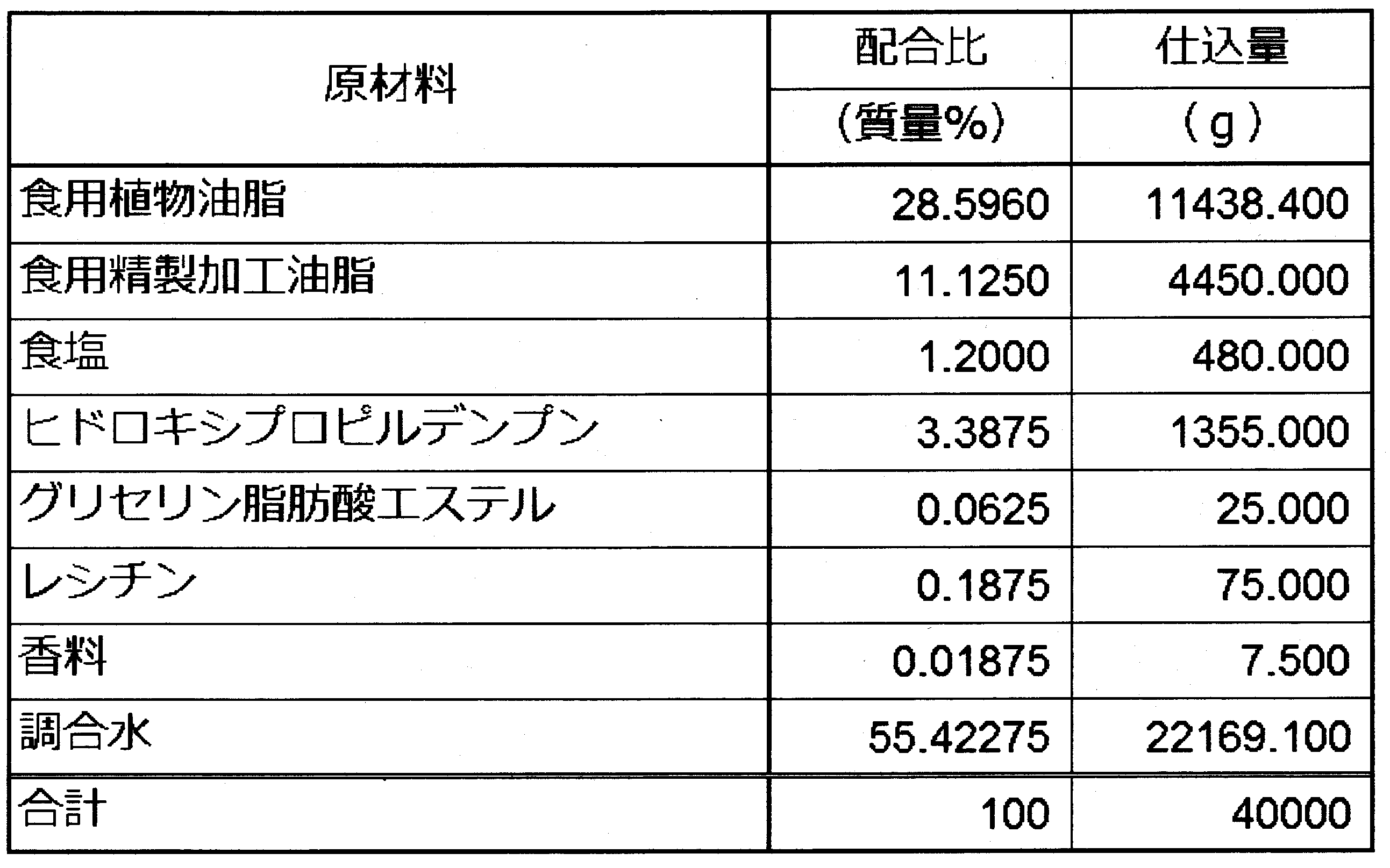
「ベーススプレッド」を混練機に送液しているところに、「後混合用の水相」を濾過してから混合して分散させた後に、20℃で混練し、「乳化物」を調製した。このとき、ベーススプレッド(表1):後混合用の水相(表2)が62.5:37.5の割合になるように混合した。次に、この「乳化物」を充填機に送液し、所定の容器に充填し、脂肪分が40質量%の低脂肪スプレッド(発明品1)を製造した。発明品1の配合表を表3に示した。
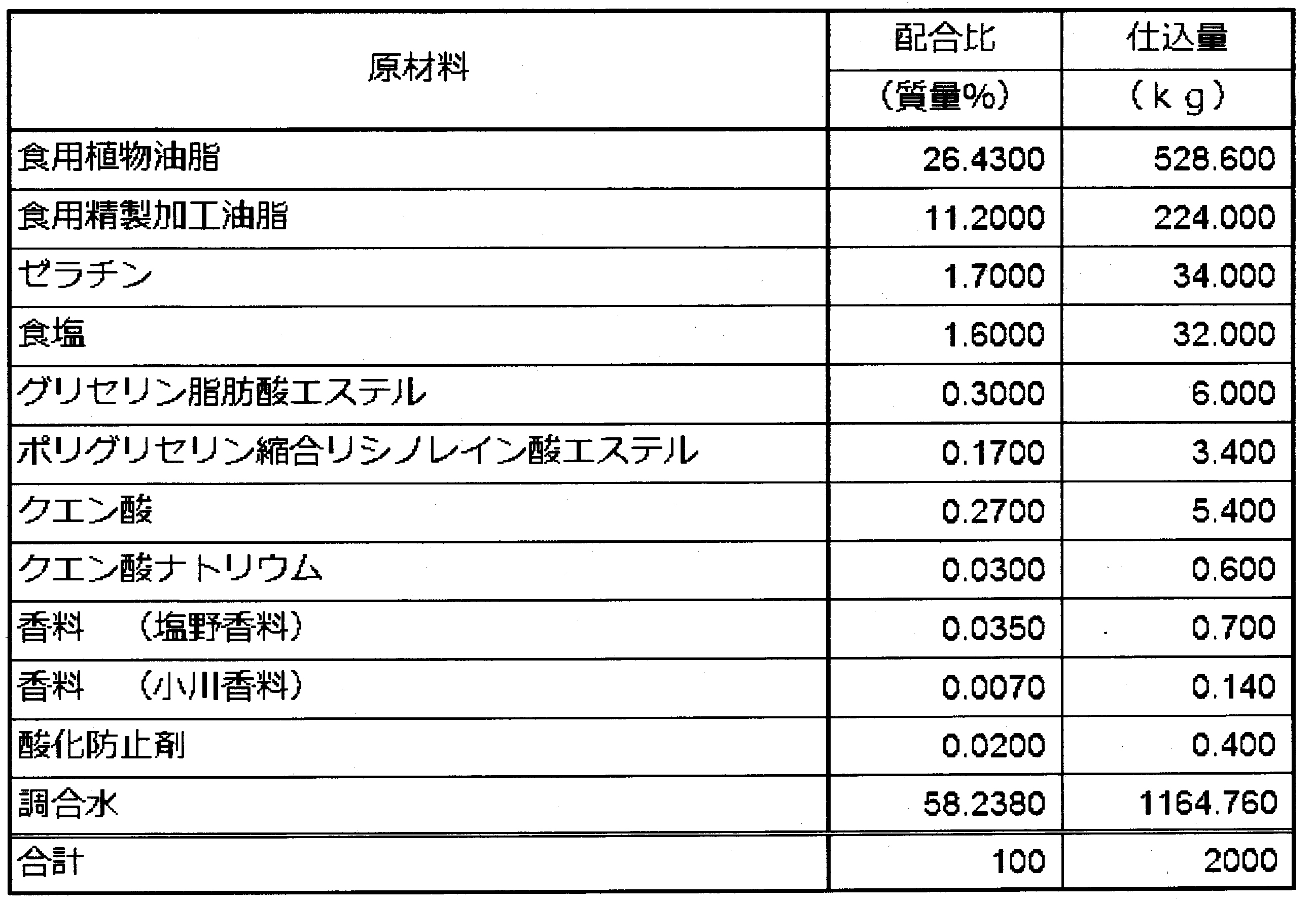
[比較例1]従来品1の製造
調合用のタンクに、食用精製加工油脂(植田製油社)を224kg、グリセリン脂肪酸エステル(太陽化学社、HLB値:3)を6kgで入れてから撹拌して混合し、60℃に加温した。ポリグリセリン縮合リシノレイン酸エステル(太陽化学社、HLB値:約1)を3.4kgで加えると共に、食用植物油脂(三菱商事社)を528.6kgで濾過してから加えて、さらに、酸化防止剤(トコフェロール(40%)、J-オイルミルズ社)を0.4kgで加えてから撹拌して混合し、「油相」を調製した。別の調合用タンクに、調合水(食品製造用水)を1068.76kgで入れ、食塩水(調合水(食品製造用水)を96kg、食塩(ダイヤソルト社)を32kgで混合してから撹拌して溶解させたもの)を128kg、ゼラチン(新田ゼラチン社)を34kg、クエン酸(三栄源エフ・エフ・アイ社)を5.4kg、クエン酸ナトリウム(三栄源エフ・エフ・アイ社)を0.6kgで加えてから、タンク内の圧力を0.060MPaに減圧しながら撹拌して混合し、「水相」を調製した。
調合用のタンクに、食用精製加工油脂(植田製油社)を224kg、グリセリン脂肪酸エステル(太陽化学社、HLB値:3)を6kgで入れてから撹拌して混合し、60℃に加温した。ポリグリセリン縮合リシノレイン酸エステル(太陽化学社、HLB値:約1)を3.4kgで加えると共に、食用植物油脂(三菱商事社)を528.6kgで濾過してから加えて、さらに、酸化防止剤(トコフェロール(40%)、J-オイルミルズ社)を0.4kgで加えてから撹拌して混合し、「油相」を調製した。別の調合用タンクに、調合水(食品製造用水)を1068.76kgで入れ、食塩水(調合水(食品製造用水)を96kg、食塩(ダイヤソルト社)を32kgで混合してから撹拌して溶解させたもの)を128kg、ゼラチン(新田ゼラチン社)を34kg、クエン酸(三栄源エフ・エフ・アイ社)を5.4kg、クエン酸ナトリウム(三栄源エフ・エフ・アイ社)を0.6kgで加えてから、タンク内の圧力を0.060MPaに減圧しながら撹拌して混合し、「水相」を調製した。
そして、調合用のタンクにおいて、「油相」の入ったところに、「水相」を60℃に加温してから、フィルター(60メッシュ、PET製)を用いて、この「水相」を濾過した後に加えて、さらに、香料(塩野香料社)と香料(小川香料社)の混合物を0.84kgで加えてから、60℃程度に加温しながら、10分間で撹拌し、乳化(予備乳化)させて、「乳化物」を調製した。次に、焼結フィルター(40メッシュ)を用いて、この「乳化物」を濾過してから、プレート式熱交換機(殺菌機)に送液し、95℃、20秒間で加熱(殺菌)した後に、60℃程度に冷却した。その後に、焼結フィルター(40メッシュ)を用いて、この「乳化物」を濾過してから、かきとり式熱交換機(冷却機)に送液し、28℃に急冷してから、さらに、かきとり式熱交換機(冷却機)に送液し、18℃に急冷した。次に、この「乳化物」を混練機に送液し、20℃で混練した。そして、この「乳化物」を充填機に送液し、マグネットセパレーターを通した後に、所定の容器に充填し、脂肪分が38質量%の低脂肪スプレッド(従来品1)を製造した。従来品1の配合表を表4に示した。
[試験例1]発明品1と従来品1の口溶けの比較
口溶けの程度を評価するため、発明品1と従来品1の導電率を測定した。具体的には、測定用の試料:1gを予め冷蔵し、温水:100gを恒温水槽内で37℃に調温したところに添加した。そして、電気伝導率計(CM-30R、東亜ディーケーケー社)を用いて、温水の導電率を10秒毎に600秒まで測定した。この結果を図1に示した。また、温水の導電率を100秒まで測定した範囲で拡大し、この結果を図2に示した。
口溶けの程度を評価するため、発明品1と従来品1の導電率を測定した。具体的には、測定用の試料:1gを予め冷蔵し、温水:100gを恒温水槽内で37℃に調温したところに添加した。そして、電気伝導率計(CM-30R、東亜ディーケーケー社)を用いて、温水の導電率を10秒毎に600秒まで測定した。この結果を図1に示した。また、温水の導電率を100秒まで測定した範囲で拡大し、この結果を図2に示した。
ここで、導電率とは、電解質を含む水溶液において、電流の流れ易さを示す指標である。測定試料が水溶液に添加され、測定試料の構造が崩壊して、解乳化すると、測定試料の水相中の塩分が水溶液に放出されて、水溶液の導電率が上昇する。すなわち、測定試料を添加した水溶液の導電率が上昇することは、測定試料の構造が崩壊して、解乳化が進行していることを意味しており、測定試料の口溶けが良いことを表現している。
図1と図2において、発明品1では、試験開始から60秒程度が経過すると、導電率が24mS/m程度まで上昇し、その後にも、少なくとも600秒まで、導電率の数値(水準)が維持されていた。したがって、発明品1では、わずか60秒程度が経過すると、水相中の塩分(食塩)の全部が水溶液に放出されて、解乳化しており、口溶けが良い低脂肪スプレッドであることが確認された。つまり、発明品1では、強力な親油性の乳化剤のポリグリセリン縮合リシノレイン酸エステルを使用しなくても、乳化の状態が安定した、口溶けが良い低脂肪スプレッドを製造できることが確認された。
一方、図1と図2において、従来品1では、試験開始から600秒程度が経過しても、導電率が上昇しなかった。したがって、従来品1では、少なくとも600秒程度が経過しても、水相中の塩分は水溶液に放出されず、解乳化せず、口溶けが悪い低脂肪スプレッドであることが示唆された。つまり、従来品1では、強力な親油性の乳化剤のポリグリセリン縮合リシノレイン酸エステルを使用しており、乳化の状態が安定しているものの、口溶けが良くない低脂肪スプレッドを製造していることが確認された。
[実施例2]発明品2の製造
調合用のタンクに、食用精製加工油脂(植田製油社)を352.42kg、グリセリン脂肪酸エステル(理研ビタミン社、HLB値:4.3)を1.98kg、レシチン(辻製油社)を5.94kgで入れてから撹拌して混合した。食用植物油脂(三菱商事社)を831.6kgで濾過してから加え、酸化防止剤(トコフェロール(40%)、J-オイルミルズ社)を0.594kgで加えてから撹拌して混合し、「油相」を調製した。一方、別の調合用タンクに、調合水(食品製造用水)を596.673kgで入れ、食塩水(調合水(食品製造用水)を108.108kg、食塩(ダイヤソルト社)を36.036kgで混合してから撹拌して溶解させたもの)を144.144kg、ヒドロキシプロピルデンプン(エヌライトCL、イングレディオン・ジャパン社)を44.352kgで加え、タンク内の圧力を0.060MPaに減圧しながら撹拌して溶解させ、「水相」を調製した。
調合用のタンクに、食用精製加工油脂(植田製油社)を352.42kg、グリセリン脂肪酸エステル(理研ビタミン社、HLB値:4.3)を1.98kg、レシチン(辻製油社)を5.94kgで入れてから撹拌して混合した。食用植物油脂(三菱商事社)を831.6kgで濾過してから加え、酸化防止剤(トコフェロール(40%)、J-オイルミルズ社)を0.594kgで加えてから撹拌して混合し、「油相」を調製した。一方、別の調合用タンクに、調合水(食品製造用水)を596.673kgで入れ、食塩水(調合水(食品製造用水)を108.108kg、食塩(ダイヤソルト社)を36.036kgで混合してから撹拌して溶解させたもの)を144.144kg、ヒドロキシプロピルデンプン(エヌライトCL、イングレディオン・ジャパン社)を44.352kgで加え、タンク内の圧力を0.060MPaに減圧しながら撹拌して溶解させ、「水相」を調製した。
そして、調合用のタンクにおいて、「油相」の入ったところに、「水相」を60℃に加温してから、フィルター(60メッシュ、PET製)を用いて、この「水相」を濾過した後に加えて、さらに、香料(塩野香料社)を0.297kgで加えてから、50~60℃程度に加温しながら、10分間で撹拌し、乳化(予備乳化)させて、「乳化物」を調製した。次に、焼結フィルター(40メッシュ)を用いて、この「乳化物」を濾過してから、プレート式熱交換機(殺菌機)に送液し、95℃、20秒間で加熱(殺菌)した後に、50℃程度に冷却した。その後に、焼結フィルター(40メッシュ)を用いて、この「乳化物」を濾過してから、かきとり式熱交換機(冷却機)に送液し、20℃に急冷してから、さらに、かきとり式熱交換機(冷却機)に送液し、14℃に急冷した。次に、この「乳化物」を混練機に送液し、20℃で混練し、合計を2000kgとして、「ベーススプレッド」を調製した。発明品2の「ベーススプレッド」の配合表を表5に示した。

別の調合用のタンクに、実施例1と同様にして、「後混合用の水相」(水性溶解物)を調製した。
「ベーススプレッド」を混練機に送液しているところに、「後混合用の水相」を濾過してから混合して分散させた後に、20℃で混練し、「乳化物」を調製した。このとき、ベーススプレッド(表5):後混合用の水相(表2の配合)が66:34の割合になるように混合した。次に、この「乳化物」を充填機に送液し、マグネットセパレーターを通した後に、所定の容器に充填し、脂肪分が40質量%の低脂肪スプレッド(発明品2)を商業規模で製造した。発明品2の配合表を表6に示した。

[試験例2]発明品2と従来品1の口溶けの比較
口溶けの程度を評価するため、発明品2と従来品1の導電率を測定した。具体的には、試験例1と同様にして、温水の導電率を10秒毎に600秒まで測定した。この結果を図3に示した。また、温水の導電率を100秒まで測定した範囲で拡大し、この結果を図4に示した。
口溶けの程度を評価するため、発明品2と従来品1の導電率を測定した。具体的には、試験例1と同様にして、温水の導電率を10秒毎に600秒まで測定した。この結果を図3に示した。また、温水の導電率を100秒まで測定した範囲で拡大し、この結果を図4に示した。
図3と図4において、発明品2では、試験開始から60秒程度が経過すると、導電率が9~10mS/m程度まで上昇し、その後にも、少なくとも600秒まで、導電率の数値(水準)が維持されていた。したがって、発明品2では、わずか60秒程度が経過すると、水相中の塩分(食塩)の全部が水溶液に放出されて、解乳化しており、口溶けが良い低脂肪スプレッドであることが確認された。つまり、発明品2では、強力な親油性の乳化剤のポリグリセリン縮合リシノレイン酸エステルを使用しなくても、乳化の状態が安定した、口溶けが良い低脂肪スプレッドを商業規模で製造できることが確認された。
[実施例3]発明品3~5の製造
調合用のタンクに、食用植物油脂(三菱商事社)を12995g、食用精製加工油脂(植田製油社)を5566g、グリセリン脂肪酸エステル(理研ビタミン社、HLB値:4.3)を23g、レシチン(辻製油社製)を138gで入れてから撹拌して混合し、「油相」を調製した。一方、別の調合用のタンクに、調合水(食品製造用水)を3475.76g、食塩(ダイヤソルト社)を276gで入れてから撹拌して溶解させた。さらに、ヒドロキシプロピルデンプン(エヌライトCL、イングレディオン・ジャパン社)を515.2gで加えてから撹拌して分散させた。その後に、60℃まで加温してから撹拌して混合し、「水相」を調製した。
調合用のタンクに、食用植物油脂(三菱商事社)を12995g、食用精製加工油脂(植田製油社)を5566g、グリセリン脂肪酸エステル(理研ビタミン社、HLB値:4.3)を23g、レシチン(辻製油社製)を138gで入れてから撹拌して混合し、「油相」を調製した。一方、別の調合用のタンクに、調合水(食品製造用水)を3475.76g、食塩(ダイヤソルト社)を276gで入れてから撹拌して溶解させた。さらに、ヒドロキシプロピルデンプン(エヌライトCL、イングレディオン・ジャパン社)を515.2gで加えてから撹拌して分散させた。その後に、60℃まで加温してから撹拌して混合し、「水相」を調製した。
そして、調合用のタンクにおいて、「油相」の入ったところに、「水相」を加えて混合し、さらに、βカロチン(DSMニュートリションジャパン社)を11.04gで加えて、50~60℃程度に加温しながら、10分間で撹拌し、乳化(予備乳化)させて、「乳化物」を調製した。次に、この「乳化物」をプレート式熱交換機(殺菌機)に送液し、95℃、20秒間で加熱(殺菌)した後に、50℃程度に冷却した。その後に、フィルター(60メッシュ、PET製)を用いて、この「乳化物」を濾過してから、かきとり式熱交換機(冷却機)に送液し、18℃に急冷した。次に、この「乳化物」を混練機に送液し、20℃で混練しながら、合計を23kgとして、「ベーススプレッド」を調製した。発明品3~5の「ベーススプレッド」の配合表を表7に示した。
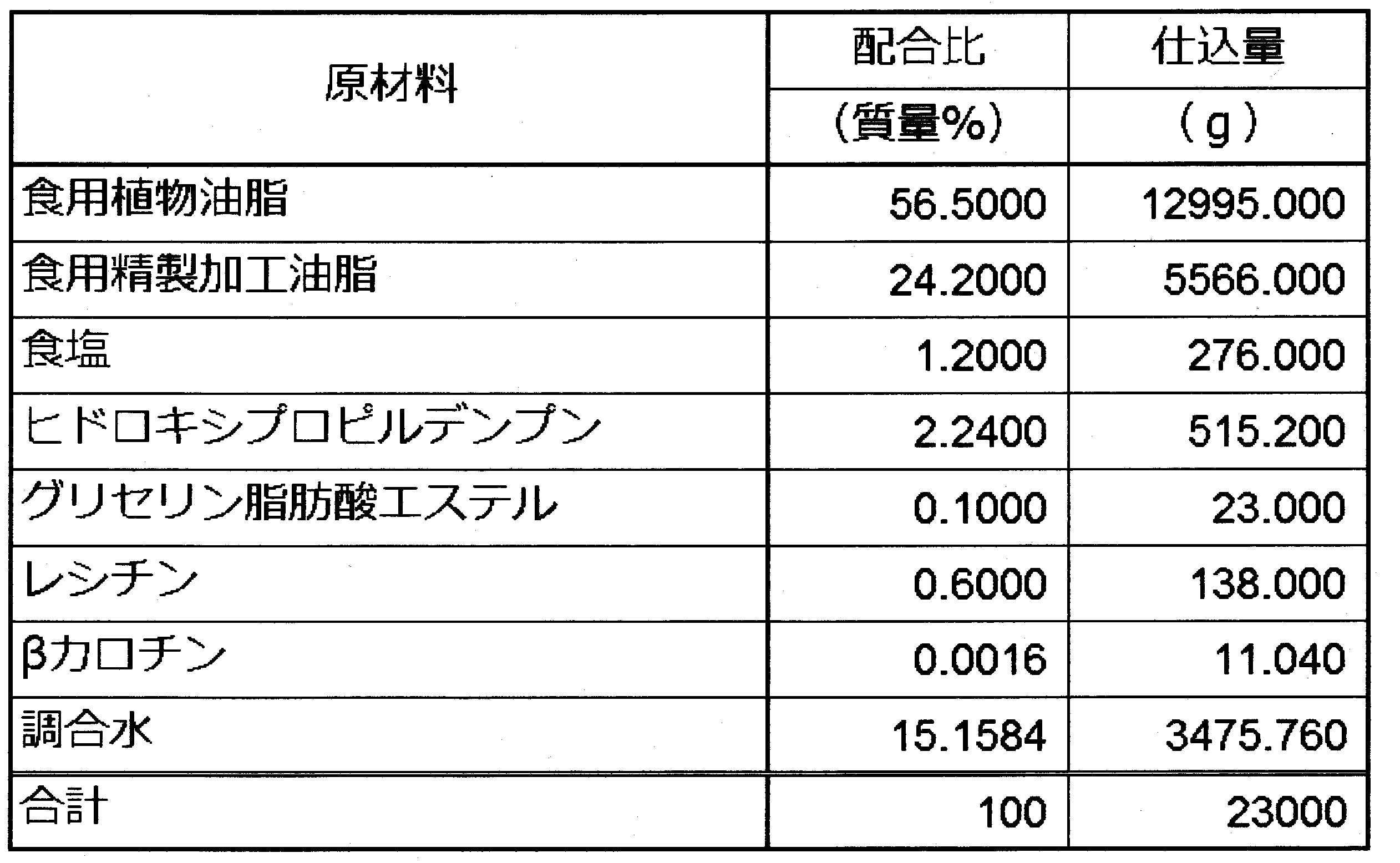
別の調合用のタンクに、調合水(食品製造用水)を13048g、食塩(ダイヤソルト社)を168g、ヒドロキシプロピルデンプン(エヌライトCL、イングレディオン・ジャパン社)を784gで入れてから撹拌して分散させた。次に、プレート式熱交換機(殺菌機)に送液し、95℃、60秒間で加熱(殺菌)した後に、5℃以下に冷却して、「後混合用の水相」(水性溶解物)を調製した。発明品3~5の「後混合用の水相」の配合表を表8に示した。
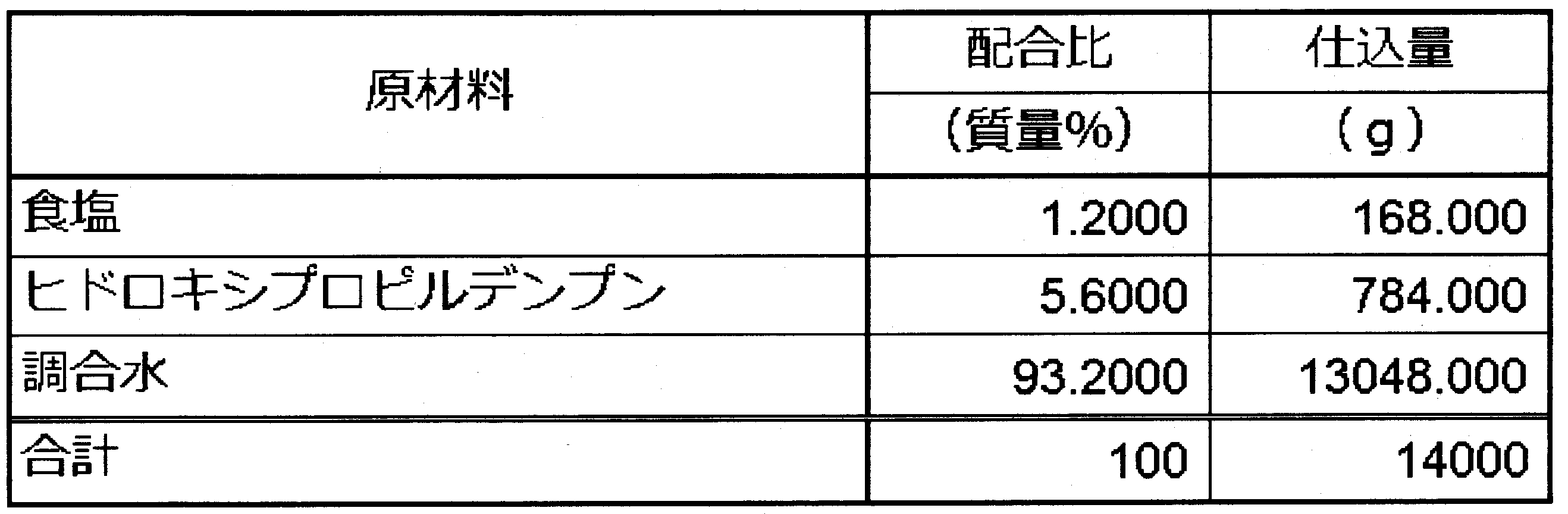
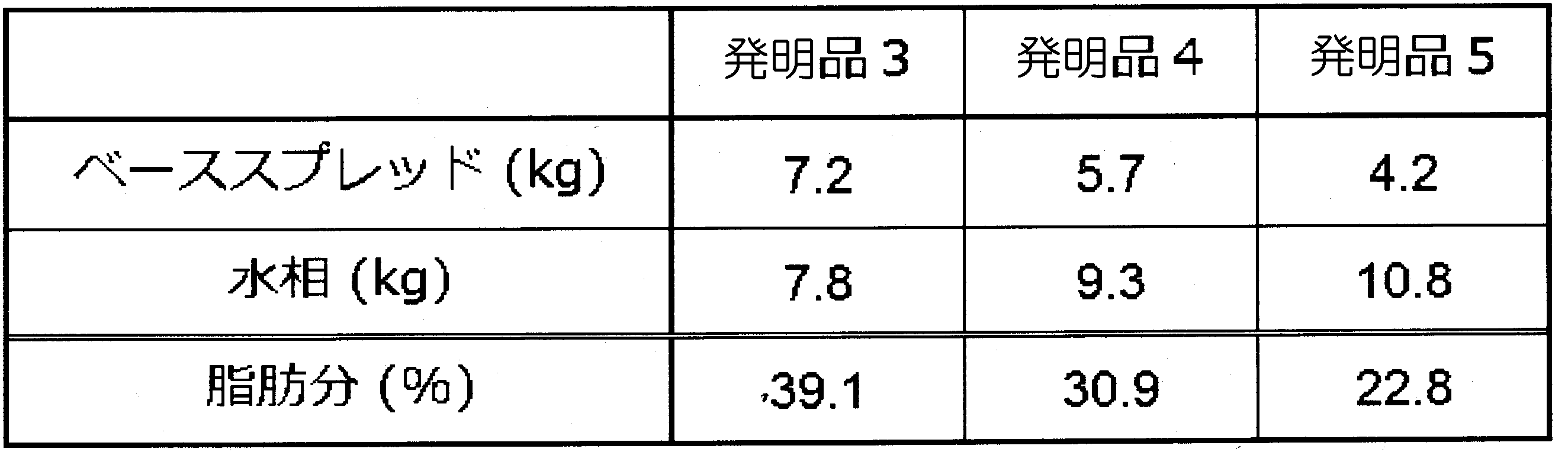
「ベーススプレッド」を混練機に送液しているところに、「後混合用の水相」を濾過してから混合して分散させた後に、20℃で混練し、「乳化物」を調製した。このとき、「ベーススプレッド」(表7)と「後混合用の水相」(表8)が表9の割合になるように混合した。次に、これらの「乳化物」を充填機に送液し、所定の容器に充填し、脂肪分が39.1質量%の低脂肪スプレッド(発明品3)、脂肪分が30.9質量%の低脂肪スプレッド(発明品4)、脂肪分が22.8質量%の低脂肪スプレッド(発明品5)を製造した。発明品3~5の配合表を、それぞれ表10~12に示した。


[試験例3]発明品3~5の口溶けの比較
口溶けの程度を評価するため、発明品3~5の導電率を測定した。具体的には、試験例1と同様にして、温水の導電率を10秒毎に600秒まで測定し、この結果を図5に示した。また、温水の導電率を100秒まで測定した範囲で拡大し、この結果を図6に示した。
口溶けの程度を評価するため、発明品3~5の導電率を測定した。具体的には、試験例1と同様にして、温水の導電率を10秒毎に600秒まで測定し、この結果を図5に示した。また、温水の導電率を100秒まで測定した範囲で拡大し、この結果を図6に示した。
図5と図6において、発明品3~5では何れも、試験開始から60秒程度が経過すると、導電率が10mS/m程度まで上昇し、その後にも、少なくとも600秒まで、導電率の数値(水準)が維持されていた。したがって、発明品3~5では何れも、わずか60秒程度が経過すると、水相中の塩分(食塩)の全部が水溶液に放出されて、解乳化しており、口溶けが良い低脂肪スプレッドであることが確認された。つまり、発明品3~5では何れも、強力な親油性の乳化剤のポリグリセリン縮合リシノレイン酸エステルを使用しなくても、乳化の状態が安定した、口溶けが良い低脂肪スプレッドを製造できることが確認された。
一方、発明品5では、導電率が最も速く上昇し、発明品3では、導電率が最も遅く上昇した。すなわち、低脂肪スプレッドの脂肪分の含量が小さい程、導電率が早く上昇しており、低脂肪スプレッドの口溶けが良いことが確認された。
[実施例4]発明品6の製造
調合用のタンクに、オリーブ油(三菱商事社)を10500g、食用精製加工油脂(植田製油社)を4125g、グリセリン脂肪酸エステル(理研ビタミン社、HLB値:4.3)を25g、レシチン(辻製油社製)を75gで入れてから撹拌して混合し、「油相」を調製した。一方、別の調合用のタンクに、調合水(食品製造用水)を9415g、食塩(ダイヤソルト社)を300gで入れてから撹拌して溶解させた。さらに、ヒドロキシプロピルデンプン(エヌライトCL、イングレディオン・ジャパン社)を560gで加えてから撹拌して分散させた。その後に、60℃まで加温してから撹拌して混合し、「水相」を調製した。
調合用のタンクに、オリーブ油(三菱商事社)を10500g、食用精製加工油脂(植田製油社)を4125g、グリセリン脂肪酸エステル(理研ビタミン社、HLB値:4.3)を25g、レシチン(辻製油社製)を75gで入れてから撹拌して混合し、「油相」を調製した。一方、別の調合用のタンクに、調合水(食品製造用水)を9415g、食塩(ダイヤソルト社)を300gで入れてから撹拌して溶解させた。さらに、ヒドロキシプロピルデンプン(エヌライトCL、イングレディオン・ジャパン社)を560gで加えてから撹拌して分散させた。その後に、60℃まで加温してから撹拌して混合し、「水相」を調製した。
そして、調合用のタンクにおいて、「油相」の入ったところに、「水相」を加えて混合し、さらに、βカロチン(DSMニュートリションジャパン社)を12gで加えて、50~60℃程度に加温しながら、10分間で撹拌し、乳化(予備乳化)させて、「乳化物」を調製した。次に、この「乳化物」をプレート式熱交換機(殺菌機)に送液し、95℃、20秒間で加熱(殺菌)した後に、50℃程度に冷却した。その後に、フィルター(60メッシュ、PET製)を用いて、この「乳化物」を濾過してから、かきとり式熱交換機(冷却機)に送液し、18℃に急冷した。次に、この「乳化物」を混練機に送液し、20℃で混練しながら、合計を25kgとして、「ベーススプレッド」を調製した。発明品6の「ベーススプレッド」の配合表を表13に示した。
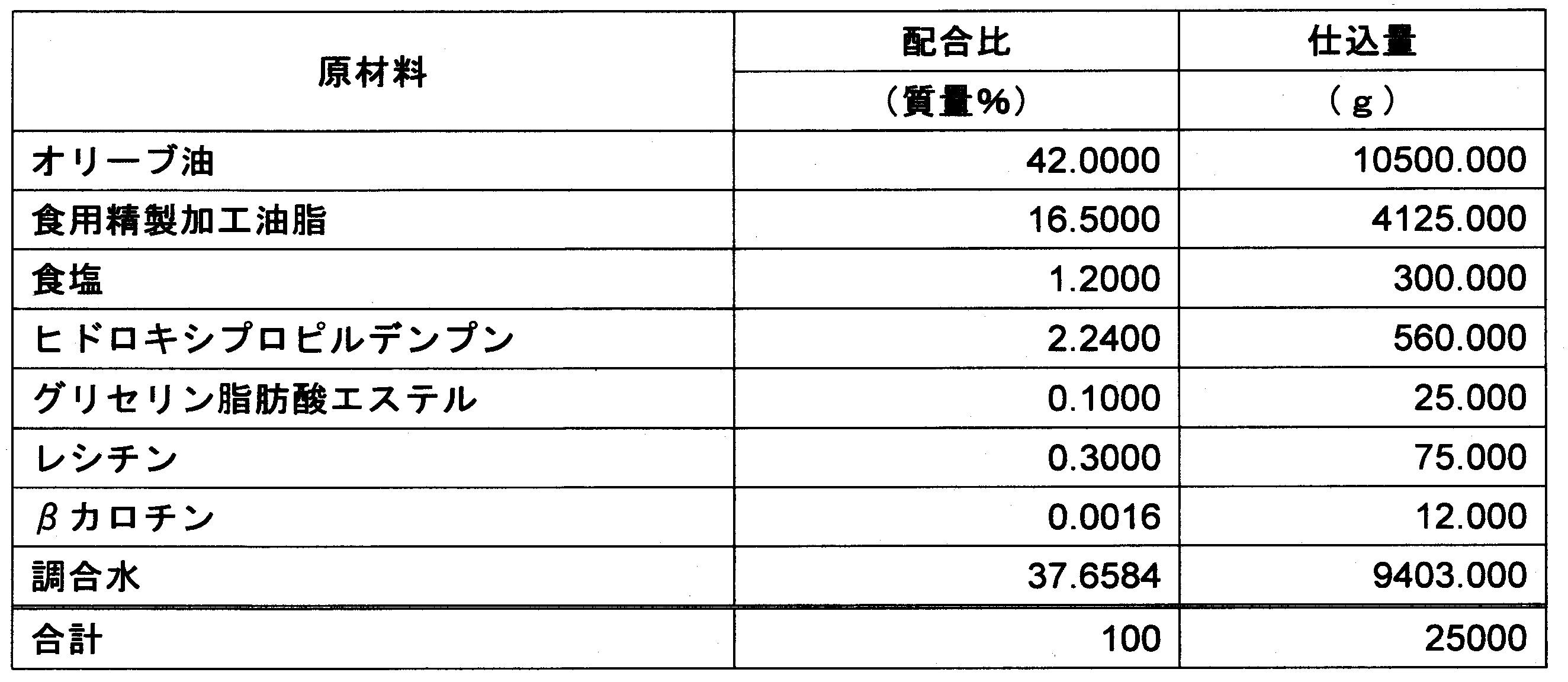
別の調合用のタンクに、調合水(食品製造用水)を16776g、食塩(ダイヤソルト社)を216g、ヒドロキシプロピルデンプン(エヌライトCL、イングレディオン・ジャパン社)を1008gで入れてから撹拌して分散させた。次に、プレート式熱交換機(殺菌機)に送液し、95℃、60秒間で加熱(殺菌)した後に、5℃以下に冷却して、「後混合用の水相」(水性溶解物)を調製した。発明品6の「後混合用の水相」の配合表を表14に示した。
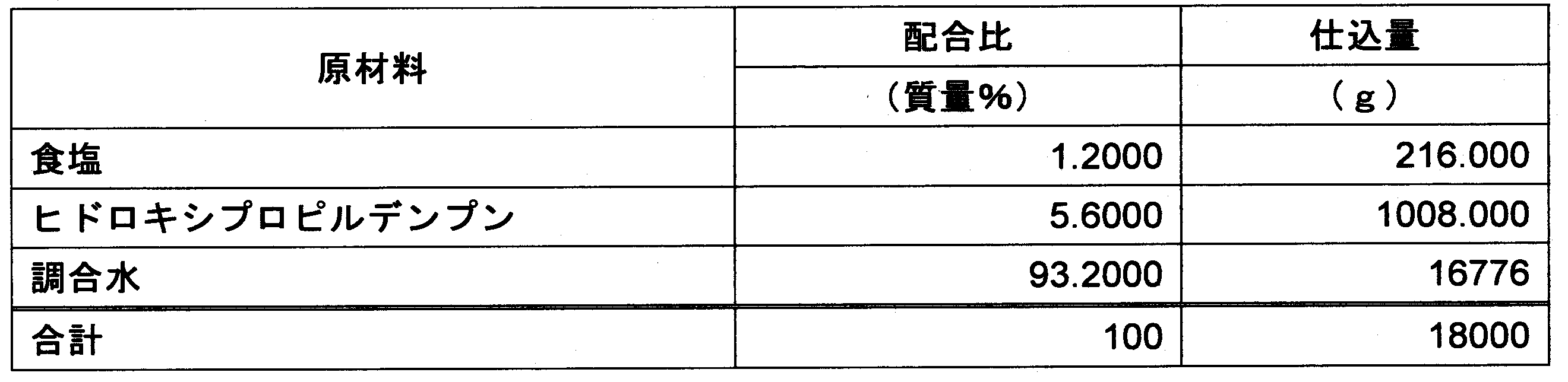
「ベーススプレッド」を混練機に送液しているところに、「後混合用の水相」を濾過してから混合して分散させた後に、20℃で混練し、「乳化物」を調製した。このとき、ベーススプレッド(表13):後混合用の水相(表14)が66:34の割合になるように混合した。次に、この「乳化物」を充填機に送液し、所定の容器に充填し、脂肪分が38.9質量%の低脂肪スプレッド(発明品6)を製造した。発明品6の配合表を表15に示した。

[試験例4]発明品6と従来品1のユーステスト
発明品6と従来品1について104人を対象にユーステストを行った。具体的には、発明品と従来品をそれぞれ食してもらい、「後味のあっさり感」、「塩味の好み」、「オリーブの風味の好み」、「オリーブの香りの好み」、「風味のフレッシュ感の好み」の各項目について、評価した。
「後味のあっさり感」は、「あっさりしている」を5点、「ややあっさりしている」を4点、「どちらともいえない」を3点、「ややこってりしている」を2点、「こってりしている」を1点とした。
「塩味の好み」、「オリーブの風味の好み」、「オリーブの香りの好み」、「風味のフレッシュ感の好み」は、「好き」を5点、「やや好き」を4点、「どちらともいえない」を3点、「あまり好きでない」を2点、「好きでない」を1点とした。
各項目について5点又は4点と答えた人の割合(104人に対するパーセント)を図7に示す。
発明品6は、すべての項目について、従来品1と比較して高い評価が得られた。発明品6は、口溶けが良く、風味や塩味を良好に感じることができるものであった。
発明品6と従来品1について104人を対象にユーステストを行った。具体的には、発明品と従来品をそれぞれ食してもらい、「後味のあっさり感」、「塩味の好み」、「オリーブの風味の好み」、「オリーブの香りの好み」、「風味のフレッシュ感の好み」の各項目について、評価した。
「後味のあっさり感」は、「あっさりしている」を5点、「ややあっさりしている」を4点、「どちらともいえない」を3点、「ややこってりしている」を2点、「こってりしている」を1点とした。
「塩味の好み」、「オリーブの風味の好み」、「オリーブの香りの好み」、「風味のフレッシュ感の好み」は、「好き」を5点、「やや好き」を4点、「どちらともいえない」を3点、「あまり好きでない」を2点、「好きでない」を1点とした。
各項目について5点又は4点と答えた人の割合(104人に対するパーセント)を図7に示す。
発明品6は、すべての項目について、従来品1と比較して高い評価が得られた。発明品6は、口溶けが良く、風味や塩味を良好に感じることができるものであった。
本発明によれば、脂肪分が50質量%以上の高い状態で、低脂肪スプレッドの組織を安定化できる。このため、本発明では、低脂肪スプレッドの製造時に、転相などが起こりにくく、乳化安定性が良く、物性が優れている。また、本発明によれば、PGPRなどの強力な親油性の乳化剤を使用しなくても、低脂肪スプレッドを製造できる。このため、本発明では、低脂肪スプレッドの喫食時に、乳化状態が適切に崩壊し、口溶けが良く、風味が優れている。
上記に本発明の実施形態及び/又は実施例を幾つか詳細に説明したが、当業者は、本発明の新規な教示及び効果から実質的に離れることなく、これら例示である実施形態及び/又は実施例に多くの変更を加えることが容易である。従って、これらの多くの変更は本発明の範囲に含まれる。
この明細書に記載の文献及び本願のパリ優先の基礎となる日本出願明細書の内容を全てここに援用する。
この明細書に記載の文献及び本願のパリ優先の基礎となる日本出願明細書の内容を全てここに援用する。
Claims (8)
- 脂肪分が50質量%以上の油中水型乳化物を調製してから冷却した後に、水相(水性溶解物)を添加して混合することを特徴とする、低脂肪スプレッドの製造方法。
- 脂肪分が50質量%以上である油中水型乳化物を調製する工程と、
前記油中水型乳化物を加熱殺菌してから、冷却する工程と、
水相(水性溶解物)を調製し、加熱殺菌してから、冷却する工程と、
前記油中水型乳化物に前記水相(水性溶解物)を添加して、乳化する工程と
を含む、低脂肪スプレッドの製造方法。 - HLB値が3以上の乳化剤を用いて、前記油中水型乳化物を調製することを特徴とする、請求項1又は2に記載の低脂肪スプレッドの製造方法。
- デンプンを配合して、前記水相を調製することを特徴とする、請求項1~3のいずれかに記載の低脂肪スプレッドの製造方法。
- 製造される低脂肪スプレッドの脂肪分が40質量%以下であることを特徴とする、請求項1~4のいずれかに記載の低脂肪スプレッドの製造方法。
- 37℃の導電率の測定において、測定開始から100秒未満で導電率が8mS/m以上に達する低脂肪スプレッドであることを特徴とする、請求項1~5のいずれかに記載の低脂肪スプレッドの製造方法。
- 37℃の導電率の測定において、測定開始から100秒未満で導電率が8mS/m以上に達することを特徴とする、低脂肪スプレッド。
- 脂肪分が40質量%以下であることを特徴とする、請求項7に記載の低脂肪スプレッド。
Priority Applications (1)
| Application Number | Priority Date | Filing Date | Title |
|---|---|---|---|
| JP2017531014A JP6868558B2 (ja) | 2015-07-24 | 2016-07-22 | 低脂肪スプレッドの製造方法 |
Applications Claiming Priority (2)
| Application Number | Priority Date | Filing Date | Title |
|---|---|---|---|
| JP2015-146576 | 2015-07-24 | ||
| JP2015146576 | 2015-07-24 |
Publications (1)
| Publication Number | Publication Date |
|---|---|
| WO2017017945A1 true WO2017017945A1 (ja) | 2017-02-02 |
Family
ID=57884318
Family Applications (1)
| Application Number | Title | Priority Date | Filing Date |
|---|---|---|---|
| PCT/JP2016/003437 Ceased WO2017017945A1 (ja) | 2015-07-24 | 2016-07-22 | 低脂肪スプレッドの製造方法 |
Country Status (2)
| Country | Link |
|---|---|
| JP (1) | JP6868558B2 (ja) |
| WO (1) | WO2017017945A1 (ja) |
Cited By (1)
| Publication number | Priority date | Publication date | Assignee | Title |
|---|---|---|---|---|
| JP7269402B1 (ja) | 2022-03-30 | 2023-05-08 | 博繁 河野 | W/o型乳化油脂組成物の製造方法 |
Citations (7)
| Publication number | Priority date | Publication date | Assignee | Title |
|---|---|---|---|---|
| JPH08501702A (ja) * | 1992-11-25 | 1996-02-27 | エフ エム シー コーポレーション | 低脂肪スプレッド及びその製造法 |
| JPH08187051A (ja) * | 1995-01-09 | 1996-07-23 | Miyoshi Oil & Fat Co Ltd | 油中水型乳化油脂組成物 |
| WO1999027797A1 (fr) * | 1997-12-03 | 1999-06-10 | Snow Brand Milk Products Co., Ltd. | Pate a tertiner |
| JP2001178361A (ja) * | 1999-12-28 | 2001-07-03 | Kanegafuchi Chem Ind Co Ltd | 低脂肪油中水型組成物 |
| JP2010148478A (ja) * | 2008-12-26 | 2010-07-08 | Tsukishima Foods Industry Co Ltd | 油中水型乳化組成物及びその製造方法 |
| JP2012175949A (ja) * | 2011-02-28 | 2012-09-13 | J-Oil Mills Inc | 油中水型油脂組成物及びその製造方法 |
| WO2013176207A1 (ja) * | 2012-05-23 | 2013-11-28 | 株式会社明治 | スプレッド及びその製造方法 |
-
2016
- 2016-07-22 WO PCT/JP2016/003437 patent/WO2017017945A1/ja not_active Ceased
- 2016-07-22 JP JP2017531014A patent/JP6868558B2/ja active Active
Patent Citations (7)
| Publication number | Priority date | Publication date | Assignee | Title |
|---|---|---|---|---|
| JPH08501702A (ja) * | 1992-11-25 | 1996-02-27 | エフ エム シー コーポレーション | 低脂肪スプレッド及びその製造法 |
| JPH08187051A (ja) * | 1995-01-09 | 1996-07-23 | Miyoshi Oil & Fat Co Ltd | 油中水型乳化油脂組成物 |
| WO1999027797A1 (fr) * | 1997-12-03 | 1999-06-10 | Snow Brand Milk Products Co., Ltd. | Pate a tertiner |
| JP2001178361A (ja) * | 1999-12-28 | 2001-07-03 | Kanegafuchi Chem Ind Co Ltd | 低脂肪油中水型組成物 |
| JP2010148478A (ja) * | 2008-12-26 | 2010-07-08 | Tsukishima Foods Industry Co Ltd | 油中水型乳化組成物及びその製造方法 |
| JP2012175949A (ja) * | 2011-02-28 | 2012-09-13 | J-Oil Mills Inc | 油中水型油脂組成物及びその製造方法 |
| WO2013176207A1 (ja) * | 2012-05-23 | 2013-11-28 | 株式会社明治 | スプレッド及びその製造方法 |
Cited By (2)
| Publication number | Priority date | Publication date | Assignee | Title |
|---|---|---|---|---|
| JP7269402B1 (ja) | 2022-03-30 | 2023-05-08 | 博繁 河野 | W/o型乳化油脂組成物の製造方法 |
| JP2023147606A (ja) * | 2022-03-30 | 2023-10-13 | 博繁 河野 | W/o型乳化油脂組成物の製造方法 |
Also Published As
| Publication number | Publication date |
|---|---|
| JPWO2017017945A1 (ja) | 2018-05-10 |
| JP6868558B2 (ja) | 2021-05-12 |
Similar Documents
| Publication | Publication Date | Title |
|---|---|---|
| JP4736893B2 (ja) | 水中油型乳化物の製造方法 | |
| JP5693864B2 (ja) | 油中水型食品 | |
| EP1065938A1 (en) | Process for preparing a spread | |
| JP2005524407A (ja) | ジアシルグリセロール含有食品およびドリンク類 | |
| JPWO2015022961A1 (ja) | 生クリーム含有ホイップドコンパウンドクリーム | |
| AU2014334012B2 (en) | Process for preparing emulsifier-free edible fat-continuous emulsions | |
| CA2906985C (en) | Edible aerated water-in-oil emulsions | |
| JP2010051231A (ja) | 低油分起泡性水中油型乳化物 | |
| Melchior et al. | Design of Fat Alternatives Using Saturated Monoglycerides | |
| JP6868558B2 (ja) | 低脂肪スプレッドの製造方法 | |
| JPWO1999027797A1 (ja) | スプレッド | |
| TR201905559T4 (tr) | Az yağlı yağ sürekli emülsiyonların hazırlanması için işlem. | |
| US6153248A (en) | Low-fat spread | |
| JPS6154230A (ja) | O/w型エマルジヨン組成物 | |
| JP4539389B2 (ja) | 油中水型乳化油脂組成物及びその製造方法 | |
| JP2006121921A (ja) | 水中油型乳化油脂乳化物 | |
| JP3545038B2 (ja) | 水中油型乳化食品 | |
| US20100080884A1 (en) | Multiphase oil continuous flavor and ingredient delivery system | |
| JP3513047B2 (ja) | スプレッド | |
| JP3551318B2 (ja) | 起泡済ピーナッツフィリングとその製造方法 | |
| JPS63279750A (ja) | 低脂肪スプレツドの製造方法 | |
| JPS58175475A (ja) | 水中油中水型乳化食品 | |
| JP2646637B2 (ja) | 流動性食用油脂組成物及びその製造法 | |
| JP2000236810A (ja) | 油中水型乳化組成物 | |
| WO2018047838A1 (ja) | 風味の良好なバター様スプレッド及びその製造方法 |
Legal Events
| Date | Code | Title | Description |
|---|---|---|---|
| 121 | Ep: the epo has been informed by wipo that ep was designated in this application |
Ref document number: 16830050 Country of ref document: EP Kind code of ref document: A1 |
|
| ENP | Entry into the national phase |
Ref document number: 2017531014 Country of ref document: JP Kind code of ref document: A |
|
| NENP | Non-entry into the national phase |
Ref country code: DE |
|
| 122 | Ep: pct application non-entry in european phase |
Ref document number: 16830050 Country of ref document: EP Kind code of ref document: A1 |