WO2017010158A1 - 粘着剤組成物及び表面保護フィルム - Google Patents
粘着剤組成物及び表面保護フィルム Download PDFInfo
- Publication number
- WO2017010158A1 WO2017010158A1 PCT/JP2016/064144 JP2016064144W WO2017010158A1 WO 2017010158 A1 WO2017010158 A1 WO 2017010158A1 JP 2016064144 W JP2016064144 W JP 2016064144W WO 2017010158 A1 WO2017010158 A1 WO 2017010158A1
- Authority
- WO
- WIPO (PCT)
- Prior art keywords
- sensitive adhesive
- pressure
- adhesive composition
- polyurethane
- composition according
- Prior art date
- Legal status (The legal status is an assumption and is not a legal conclusion. Google has not performed a legal analysis and makes no representation as to the accuracy of the status listed.)
- Ceased
Links
Classifications
-
- C—CHEMISTRY; METALLURGY
- C09—DYES; PAINTS; POLISHES; NATURAL RESINS; ADHESIVES; COMPOSITIONS NOT OTHERWISE PROVIDED FOR; APPLICATIONS OF MATERIALS NOT OTHERWISE PROVIDED FOR
- C09J—ADHESIVES; NON-MECHANICAL ASPECTS OF ADHESIVE PROCESSES IN GENERAL; ADHESIVE PROCESSES NOT PROVIDED FOR ELSEWHERE; USE OF MATERIALS AS ADHESIVES
- C09J175/00—Adhesives based on polyureas or polyurethanes; Adhesives based on derivatives of such polymers
- C09J175/04—Polyurethanes
- C09J175/08—Polyurethanes from polyethers
-
- C—CHEMISTRY; METALLURGY
- C09—DYES; PAINTS; POLISHES; NATURAL RESINS; ADHESIVES; COMPOSITIONS NOT OTHERWISE PROVIDED FOR; APPLICATIONS OF MATERIALS NOT OTHERWISE PROVIDED FOR
- C09J—ADHESIVES; NON-MECHANICAL ASPECTS OF ADHESIVE PROCESSES IN GENERAL; ADHESIVE PROCESSES NOT PROVIDED FOR ELSEWHERE; USE OF MATERIALS AS ADHESIVES
- C09J11/00—Features of adhesives not provided for in group C09J9/00, e.g. additives
- C09J11/02—Non-macromolecular additives
- C09J11/06—Non-macromolecular additives organic
-
- C—CHEMISTRY; METALLURGY
- C09—DYES; PAINTS; POLISHES; NATURAL RESINS; ADHESIVES; COMPOSITIONS NOT OTHERWISE PROVIDED FOR; APPLICATIONS OF MATERIALS NOT OTHERWISE PROVIDED FOR
- C09J—ADHESIVES; NON-MECHANICAL ASPECTS OF ADHESIVE PROCESSES IN GENERAL; ADHESIVE PROCESSES NOT PROVIDED FOR ELSEWHERE; USE OF MATERIALS AS ADHESIVES
- C09J175/00—Adhesives based on polyureas or polyurethanes; Adhesives based on derivatives of such polymers
- C09J175/04—Polyurethanes
-
- C—CHEMISTRY; METALLURGY
- C09—DYES; PAINTS; POLISHES; NATURAL RESINS; ADHESIVES; COMPOSITIONS NOT OTHERWISE PROVIDED FOR; APPLICATIONS OF MATERIALS NOT OTHERWISE PROVIDED FOR
- C09J—ADHESIVES; NON-MECHANICAL ASPECTS OF ADHESIVE PROCESSES IN GENERAL; ADHESIVE PROCESSES NOT PROVIDED FOR ELSEWHERE; USE OF MATERIALS AS ADHESIVES
- C09J7/00—Adhesives in the form of films or foils
- C09J7/20—Adhesives in the form of films or foils characterised by their carriers
Definitions
- the present invention relates to an adhesive composition that can be suitably used as a surface protective film.
- Surface protective films are widely used for the purpose of preventing dirt and scratches on the surface of glass or plastic.
- the surface protective film for example, a laminate of a plastic film such as a polyethylene terephthalate film, an adhesive layer, and a release film is used (for example, see Patent Document 1).
- a silicon adhesive, an acrylic adhesive, a urethane adhesive, etc. are utilized widely.
- the problem to be solved by the present invention is to provide a pressure-sensitive adhesive composition capable of obtaining a pressure-sensitive adhesive film excellent in whitening resistance in a heat-and-humidity environment and stain resistance to an adherend.
- the present invention provides a pressure-sensitive adhesive composition
- a pressure-sensitive adhesive composition comprising a polyurethane (A) having two or more hydroxyl groups, a crosslinking agent (B), a carbodiimide compound (C), and an organic solvent (D). Is.
- the present invention also provides a surface protective film having a cured film of the pressure-sensitive adhesive composition.
- the pressure-sensitive adhesive composition of the present invention provides a pressure-sensitive adhesive film that is excellent in whitening resistance in a moist heat-resistant environment and stain resistance to an adherend.
- the pressure-sensitive adhesive composition further contains a specific esterified product, in addition to the above effects, the wettability to the adherend and the stain resistance to the adherend in a heat and humidity resistant environment. The property can be further improved. Therefore, the pressure-sensitive adhesive composition of the present invention can be particularly suitably used as a pressure-sensitive adhesive layer for a surface protective film.
- the pressure-sensitive adhesive composition of the present invention contains polyurethane (A) having two or more hydroxyl groups, a crosslinking agent (B), a carbodiimide compound (C), and an organic solvent (D) as essential components.
- the polyurethane (A) has two or more hydroxyl groups for crosslinking with the crosslinking agent (B) described later, and preferably has 4 to 8 hydroxyl groups.
- the polyurethane (A) is crosslinked with the crosslinking agent (B)
- good adhesive properties, stain resistance and whitening resistance can be obtained.
- polyurethane (A) for example, one obtained by reacting a polyol (a′1) and a polyisocyanate (a2) can be used.
- polystyrene resin examples include polyoxyalkylene polyol (a1), polyester polyol, polycarbonate polyol, polybutadiene polyol, polycaprolactone polyol, acrylic polyol, dimer diol, and polyisoprene polyol. These polyols may be used alone or in combination of two or more. Among these, it is preferable to use the polyoxyalkylene polyol (a1) from the viewpoint of further improving the stain resistance and whitening resistance derived from the flexibility of the pressure-sensitive adhesive and the hydrolyzability of the polyurethane.
- polyoxyalkylene polyol (a1) examples include polyoxyethylene polyol, polyoxypropylene polyol, polyoxytetramethylene polyol, polyoxyethylene polyoxypropylene polyol, polyoxyethylene polyoxytetramethylene polyol, polyoxypropylene poly Oxytetramethylene polyol or the like can be used. These polyoxyalkylene polyols may be used alone or in combination of two or more. Further, as the polyoxyalkylene polyol, those having 2 to 6 hydroxyl groups are preferable and those having 2 to 4 hydroxyl groups are more preferable from the viewpoint of reactivity with the polyisocyanate (a2).
- the content of the oxyalkylene structure in the polyurethane (A) is preferably in the range of 5 to 30 mol / kg from the viewpoint of obtaining further excellent stain resistance and whitening resistance by improving the hydrophilicity of the polyurethane.
- the range of 10 to 20 mol / kg is more preferable, and the range of 13 to 17 mol / kg is more preferable.
- polyoxyalkylene polyol (a1) polyoxypropylene glycol and / or polyoxyethylene polyoxy are used because they impart flexibility to the pressure-sensitive adhesive and provide better wettability to the adherend.
- Propylene triol is preferably contained, and polyoxypropylene glycol and polyoxyethylene polyoxypropylene triol are more preferably contained.
- the stain resistance and the whitening resistance can be further improved by improving the hydrophilicity of the polyurethane. Therefore, it is preferably in the range of 5/95 to 60/40, and more preferably in the range of 10/90 to 30/70.
- the number average molecular weight of the polyol (a′1) containing the polyoxyalkylene polyol (a1) is in the range of 500 to 6,000 from the viewpoint of good adhesive properties and mechanical strength of the adhesive film. Preferably, it is in the range of 800 to 3,000.
- the number average molecular weight of the said polyol (a'1) shows the value measured on condition of the following by the gel permeation chromatography (GPC) method.
- Measuring device High-speed GPC device (“HLC-8220GPC” manufactured by Tosoh Corporation) Column: The following columns manufactured by Tosoh Corporation were connected in series. "TSKgel G5000" (7.8 mm ID x 30 cm) x 1 "TSKgel G4000” (7.8 mm ID x 30 cm) x 1 "TSKgel G3000” (7.8 mm ID x 30 cm) x 1 “TSKgel G2000” (7.8 mm ID ⁇ 30 cm) ⁇ 1 detector: RI (differential refractometer) Column temperature: 40 ° C Eluent: Tetrahydrofuran (THF) Flow rate: 1.0 mL / min Injection amount: 100 ⁇ L (tetrahydrofuran solution with a sample concentration of 0.4 mass%) Standard sample: A calibration curve was prepared using the following standard polystyrene.
- a chain extender having a number average molecular weight of 50 to 400 may be used in combination with the polyol (a′1) as necessary.
- chain extender examples include ethylene glycol, diethylene glycol, triethylene glycol, 1,2-propylene glycol, 1,3-propylene glycol, dipropylene glycol, 1,4-butanediol, 1,3-butanediol, 1,5-pentanediol, 1,5-hexanediol, 1,6-hexanediol, 1,7-heptanediol, 1,8-octanediol, 1,9-nonanediol, 1,10-decanediol, 3 -Methyl-1,5-pentanediol, 2-butyl-2-ethylpropanoldiol, neopentyl glycol, 1,4-cyclohexanediol, 1,4-cyclohexanedimethanol and the like can be used. These chain extenders may be used alone or in combination of two or more.
- polyisocyanate (a2) examples include aromatic polyisocyanates such as xylylene diisocyanate, phenylene diisocyanate, tolylene diisocyanate, diphenylmethane diisocyanate, naphthalene diisocyanate; hexamethylene diisocyanate, lysine diisocyanate, cyclohexane diisocyanate, isophorone diisocyanate, 4,4.
- Aliphatic or alicyclic polyisocyanates such as' -dicyclohexylmethane diisocyanate and tetramethylxylylene diisocyanate can be used. These polyisocyanates may be used alone or in combination of two or more. Among these, it is preferable to use an aliphatic or alicyclic polyisocyanate from the viewpoint of maintaining good adhesive force and further suppressing discoloration over time.
- both are reacted so that the molar ratio of the hydroxyl group of the polyol (a′1) is excessive with respect to the molar ratio of the isocyanate group of the polyisocyanate (a2).
- a method is mentioned.
- the polyol (a′1) may be charged all at once or may be charged in two or more times while controlling the reaction.
- the molar ratio (NCO / OH) between the hydroxyl group of the polyol (a′1) and the isocyanate group of the polyisocyanate (a2) is 0 from the viewpoints of ease of reactivity control and mechanical strength of the adhesive film. It is preferably in the range of 3 to 0.99, and more preferably in the range of 0.4 to 0.9.
- the weight average molecular weight of the polyurethane (A) is preferably in the range of 50,000 to 300,000, from the viewpoint that both the physical properties of the adhesive and the wettability to the adherend can be achieved at a high level. More preferably, it is in the range of 200,000. In addition, the weight average molecular weight of the said polyurethane (A) shows the value measured similarly to the number average molecular weight of the said polyol (a'1).
- crosslinking agent (B) for example, a polyisocyanate crosslinking agent, an epoxy crosslinking agent, a melamine crosslinking agent, or the like can be used. These crosslinking agents may be used alone or in combination of two or more. Among these, it is preferable to use an isocyanate cross-linking agent because it reacts with the hydroxyl group of the polyurethane (A) to obtain good pressure-sensitive adhesive properties, stain resistance and whitening resistance by increasing the cross-linking density of the pressure-sensitive adhesive.
- polyisocyanate crosslinking agent examples include tolylene diisocyanate, chlorophenylene diisocyanate, hexamethylene diisocyanate, tetramethylene diisocyanate, isophorone diisocyanate, diphenylmethane diisocyanate, hydrogenated diphenylmethane diisocyanate, and xylylene diisocyanate; hexamethylene diisocyanate trimethylolpropane Adduct, Trimethylolpropane adduct of tolylene diisocyanate, Trimethylolpropane adduct of isophorone diisocyanate, Trimethylolpropane adduct of xylylene diisocyanate, Nurate of hexamethylene diisocyanate, Nurate of tolylene diisocyanate, Isophorone diisocyanate Isocyanurate of over preparative, isocyanurate of xylylene diisocyanate
- the amount of the crosslinking agent (B) used is in the range of 0.01 to 20 parts by mass with respect to 100 parts by mass of the polyurethane (A) from the viewpoint of obtaining good adhesive properties, stain resistance and whitening resistance.
- the range of 0.1 to 15 parts by mass is more preferable.
- the carbodiimide compound (C) is an essential component for exhibiting excellent whitening resistance, excellent wettability to various adherends regardless of the substrate or adherend, and stain resistance. .
- the reason why the effect is obtained by using the carbodiimide compound (C) is to prevent the decomposition product derived from the base material generated under high humidity heat from being transferred to the adherend.
- carbodiimide compound (C) examples include N, N′-dicyclohexylcarbodiimide, N, N′-diisopropylcarbodiimide, 1-ethyl-3- (3-dimethylaminopropyl) carbodiimide, N- [3- (dimethylamino).
- carbodiimide compounds which can be used can be used.
- These carbodiimide compounds may be used alone or in combination of two or more.
- carbodiimide compound (C) examples include “carbodilite V-02”, “carbodilite V-02-L2”, “carbodilite V-04”, “carbodilite V-05”, “carbodilite V-07”, “carbodilite”. “V-09”, “Carbodilite E-01”, “Carbodilite E-02”, “Carbodilite E-03A”, “Carbodilite E-04” (manufactured by Nisshinbo Chemical Co., Ltd.), etc. are available as commercial products. .
- the amount of the carbodiimide compound (C) used is 0 with respect to 100 parts by mass of the polyurethane (A-1) because excellent whitening resistance, wettability to the adherend and stain resistance can be obtained.
- the range is preferably from 1 to 7 parts by mass, and more preferably from 0.5 to 5 parts by mass.
- the organic solvent (D) is used for improving the production stability of the polyurethane (A-1) and the coating property of the pressure-sensitive adhesive composition.
- ethyl acetate, methyl acetate, butyl acetate Ester solvents such as acetone solvents, ketone solvents such as acetone, methyl ethyl ketone, and methyl isobutyl ketone; aliphatic hydrocarbon solvents such as heptane, hexane, cyclohexane, and methylcyclohexane; aromatics such as toluene, o-xylene, m-xylene, and p-xylene Hydrocarbon solvents: alcohol solvents such as methanol, ethanol, isopropyl alcohol, isobutanol, sec-butanol, and tertiary butanol can be used. These organic solvents may be used alone or in combination of two or more.
- the amount of the organic solvent (D) used is preferably in the range of 20 to 200 parts by mass, preferably in the range of 40 to 100 parts by mass with respect to 100 parts by mass of the polyurethane (A) from the viewpoint of coating properties. Is more preferable.
- the pressure-sensitive adhesive composition of the present invention contains the polyurethane (A), the cross-linking agent (B), the carbodiimide compound (C), and the organic solvent (D) as essential components. At least one hydroxyl group of polyoxyethylene glycol can be obtained by suppressing a significant increase in adhesive strength even in wettability and heat-and-moisture resistant environments and further improving the stain resistance to the adherend. It is preferable to further contain an esterified product (E) esterified with a monobasic acid.
- esterified product (E) The reason why the effect can be obtained by using the esterified product (E) is that the pressure-sensitive adhesive can give more flexibility and hydrophilicity.
- the number average molecular weight of the polyoxyethylene glycol it is possible to obtain good wettability to the adherend by softening the pressure-sensitive adhesive, and to improve the stain resistance due to bleed-out from the pressure-sensitive adhesive. Is preferably in the range of ⁇ 1,500, more preferably in the range of 150 to 1,000.
- the number average molecular weight of the polyoxyethylene glycol is a value obtained by measurement in the same manner as the number average molecular weight of the polyol (a′1).
- Examples of the monobasic acid include butanoic acid, pentanoic acid, hexanoic acid, heptanoic acid, 2-ethylhexylic acid, octanoic acid, nonanoic acid, decanoic acid, lauric acid, myristic acid, pentadecanoic acid, palmitic acid, heptadecanoic acid, Saturated fatty acids such as stearic acid, arachidic acid, behenic acid, lignoceric acid; unsaturated acids such as oleic acid, elaidic acid, linoleic acid, linolenic acid, arachidonic acid, eicosenoic acid, eicosapentaenoic acid, erucic acid, docosahexaenoic acid, ricinlic acid Fatty acids and the like can be used.
- a saturated fatty acid having 6 to 18 carbon atoms and / or an unsaturated fatty acid having 14 to 18 carbon atoms from the viewpoint of obtaining good compatibility with polyurethane, and 2-ethylhexyl. It is more preferable to use one or more monobasic acids selected from the group consisting of acids, lauric acid and oleic acid.
- the amount of the esterified product (E) used is 100% by mass of the polyurethane (A) from the viewpoint that excellent wettability to the adherend and stain resistance to the adherend in a moisture and heat resistant environment can be obtained. Is preferably in the range of 1 to 50 parts by weight, more preferably in the range of 5 to 30 parts by weight.
- the pressure-sensitive adhesive composition of the present invention comprises the components (A) to (D) as essential components, and more preferably contains the component (E), but may further contain other additives as necessary. Good.
- additives examples include an antioxidant, a plasticizer, a rust inhibitor, a thixotropic agent, a dispersant, a sensitizer, a urethanization catalyst, a polymerization inhibitor, a leveling agent, a tackifier, and a foam stabilizer. Etc. can be used. These additives may be used alone or in combination of two or more.
- the pressure-sensitive adhesive composition of the present invention for example, in the mixture in which the polyurethane (A) is dissolved in the organic solvent (D), the crosslinking agent (B), the carbodiimide compound (C), and The method of adding and mixing the said esterified substance (E) is mentioned.
- the pressure-sensitive adhesive composition of the present invention can provide a pressure-sensitive adhesive film excellent in whitening resistance in a moist heat-resistant environment and stain resistance to an adherend.
- the pressure-sensitive adhesive composition further contains a specific esterified product, in addition to the above effects, the wettability to the adherend and the stain resistance to the adherend in a heat and humidity resistant environment. The property can be further improved. Therefore, the pressure-sensitive adhesive composition of the present invention can be particularly suitably used as a pressure-sensitive adhesive layer for a surface protective film.
- the pressure-sensitive adhesive composition is coated on a plastic substrate, dried and cured to obtain a pressure-sensitive adhesive layer, The method of bonding a release film on the adhesion layer is mentioned.
- plastic substrate examples include polyester such as polyethylene terephthalate, polyethylene naphthalate, and polybutylene terephthalate, polyolefin, polyacrylate, polyvinyl chloride, polyethylene, polypropylene ethylene vinyl alcohol, polyurethane, polyamide, and polyimide. Sheet or film can be used.
- the surface of these plastic substrates may be subjected to mold release treatment, antistatic treatment, corona treatment and the like. Further, the thickness of the plastic substrate is, for example, in the range of 10 to 200 ⁇ m.
- Examples of the method of applying the pressure-sensitive adhesive composition to the plastic substrate include a coating method using a roll coater, a gravure coater, a reverse coater, a spray coater, an air knife coater, a die coater, or the like.
- the thickness of the coated adhesive layer after drying with the organic solvent (D) is, for example, in the range of 5 to 100 ⁇ m.
- Examples of a method of drying the pressure-sensitive adhesive composition after coating the pressure-sensitive adhesive composition on the plastic substrate include a method of drying at 50 to 120 ° C. for 30 seconds to 10 minutes. Further, after drying, aging may be performed in the range of 30 ° C. to 50 ° C., for example, from the viewpoint of promoting the curing reaction from the point of promoting the curing reaction.
- nonvolatile content 65% by mass
- viscosity A polyurethane (A-1) having 10,000 mPa ⁇ s, weight average molecular weight; 130,000, polyoxyalkylene content; 12 mol / kg was obtained.
- nonvolatile content 75% by mass, viscosity: 2,000 mPa ⁇ s, weight average molecular weight: 70,000, polyoxyalkylene content; polyurethane of 18 mol / kg (A-3) was obtained.
- Example 1 A carbodiimide compound “Carbodilite V-05” (hereinafter abbreviated as “V-05”) manufactured by Nisshinbo Co., Ltd. is used with respect to 100 parts by mass of the nonvolatile content of the polyurethane (A-1) obtained in Synthesis Example 1. 10 parts by mass of hexamethylene diisocyanate nurate (“Duranate TKA-100” manufactured by Asahi Kasei Co., Ltd., hereinafter abbreviated as “TKA-100”) as a cross-linking agent was blended to obtain an adhesive composition.
- TKA-100 hexamethylene diisocyanate nurate
- the pressure-sensitive adhesive composition was applied to the surface of a 50 ⁇ m thick polyethylene terephthalate film so that the film thickness after drying was 10 ⁇ m, and dried at 80 ° C. for 3 minutes. This was bonded with a 38 ⁇ m thick polyethylene terephthalate film whose surface was release-molded, and was cured at 40 ° C. for 3 days to obtain a surface protective film.
- Example 2 to 10 Except that the types and / or amounts of the polyurethane (A), the crosslinking agent (B) and the carbodiimide compound (C) to be used were changed as shown in Table 1, the same as in Example 1, the pressure-sensitive adhesive composition And a surface protective film were obtained.
- Example 1 A pressure-sensitive adhesive composition and a surface protective film were obtained in the same manner as in Example 1 except that the carbodiimide compound (C) was not used.
- haze (%) was measured with a turbidimeter “NDH5000” (manufactured by Nippon Denshoku Industries Co., Ltd.) according to JIS K 7361-1-1997. evaluated.
- ⁇ The difference in haze (%) values before and after the wet heat resistance test is less than 0.3%.
- ⁇ The difference in haze (%) values before and after the wet heat resistance test is 0.3% or more and less than 1%.
- X The difference in haze (%) values before and after the wet heat resistance test is 1% or more.
- V-07 Carbodiimide compound “Carbodilite V-07” manufactured by Nisshinbo Co., Ltd.
- V-09 Carbodiimide compound “Carbodilite V-09” manufactured by Nisshinbo Co., Ltd.
- P301-75E trimethylolpropane adduct of hexamethylene diisocyanate (“Duranate P301-75E” manufactured by Asahi Kasei Chemicals Corporation)
- Example 11 To the pressure-sensitive adhesive composition obtained in Example 1, an esterified product (E-) obtained by esterifying both ends of polyoxyethylene glycol (number average molecular weight; 200) with 2-ethylhexylic acid as an esterified product (E). 10 parts by mass of 1) was added to obtain an adhesive composition. Next, the pressure-sensitive adhesive composition was applied to the surface of a 50 ⁇ m thick polyethylene terephthalate film so that the film thickness after drying was 10 ⁇ m, and dried at 80 ° C. for 3 minutes. This was bonded with a 38 ⁇ m thick polyethylene terephthalate film whose surface was release-molded, and was cured at 40 ° C. for 3 days to obtain a surface protective film.
- E- esterified product obtained by esterifying both ends of polyoxyethylene glycol (number average molecular weight; 200) with 2-ethylhexylic acid as an esterified product (E). 10 parts by mass of 1
- the pressure-sensitive adhesive composition was applied to the surface
- Example 12 to 18 Except that the types and / or amounts of the polyurethane (A), the crosslinking agent (B), the carbodiimide compound (C), and the esterified product (E) used were changed as shown in Table 3, the same as in Example 1. Thus, an adhesive composition and a surface protective film were obtained.
- E-2 esterified product “E-3” obtained by esterifying both ends of polyoxyethylene glycol (number average molecular weight; 600) with 2-ethylhexylic acid; piece of polyoxyethylene glycol (number average molecular weight; 500) Esterified product with terminal esterified with lauric acid
- the pressure-sensitive adhesive composition of the present invention is excellent in whitening resistance and stain resistance to an adherend even in a heat and humidity resistant environment. It was also found that Examples 9 to 16 containing the esterified product (E) were excellent in wettability to the adherend and could suppress an increase in adhesive strength after the moist heat resistance test.
Landscapes
- Chemical & Material Sciences (AREA)
- Organic Chemistry (AREA)
- Adhesives Or Adhesive Processes (AREA)
- Adhesive Tapes (AREA)
- Laminated Bodies (AREA)
Abstract
本発明が解決しようとする課題は、耐湿熱環境下における耐白化性、及び、被着体への耐汚染性に優れる粘着皮膜が得られる粘着剤組成物を提供することである。本発明は、2つ以上の水酸基を有するポリウレタン(A)、架橋剤(B)、カルボジイミド化合物(C)、及び、有機溶剤(D)を含有することを特徴とする粘着剤組成物を提供するものである。また、本発明は、前記粘着剤組成物の硬化被膜を有する表面保護フィルムを提供するものである。本発明の粘着剤組成物は、表面保護フィルムの粘着層として特に好適に使用することができる。本発明の粘着剤組成物は、耐湿熱環境下における耐白化性、及び、被着体への耐汚染性に優れる粘着皮膜が得られるものである。
Description
本発明は、表面保護フィルムとして好適に使用することができる粘着剤組成物に関する。
ガラスやプラスチック等の表面の汚れや傷付きを防止する目的で、表面保護フィルムが広く利用されている。
前記表面保護フィルムの構成としては、例えば、ポリエチレンテレフタレートフィルム等のプラスチックフィルム、粘着剤層、離型フィルムが積層されたものが利用されている(例えば、特許文献1を参照。)。また、前記粘着剤層に使用される粘着剤としては、シリコン粘着剤、アクリル粘着剤、ウレタン粘着剤等が広く利用されている。
特に、スマートフォンやタブレットに使用されるタッチパネル周辺部材の製造工程では、貼り付け作業の効率性と価格的優位性からウレタン粘着剤を使用した保護フィルムの利用が増えている。しかしながら、ウレタン系保護フィルムを使用した場合には、製造工程時や、その後の搬送工程時、使用時等における耐湿熱環境下で、被着体を汚染したり、湿熱による白化が発生する問題があった。
本発明が解決しようとする課題は、耐湿熱環境下における耐白化性、及び、被着体への耐汚染性に優れる粘着皮膜が得られる粘着剤組成物を提供することである。
本発明は、2つ以上の水酸基を有するポリウレタン(A)、架橋剤(B)、カルボジイミド化合物(C)、及び、有機溶剤(D)を含有することを特徴とする粘着剤組成物を提供するものである。
また、本発明は、前記粘着剤組成物の硬化被膜を有する表面保護フィルムを提供するものである。
本発明の粘着剤組成物は、耐湿熱環境下における耐白化性、及び、被着体への耐汚染性に優れる粘着皮膜が得られるものである。また、前記粘着剤組成物に、特定のエステル化物を更に含有させた場合には、上記効果に加え、更に被着体への濡れ性、及び、耐湿熱環境下における被着体への耐汚染性をより一層向上することができる。よって、本発明の粘着剤組成物は、表面保護フィルムの粘着層として特に好適に使用することができる。
本発明の粘着剤組成物は、2つ以上の水酸基を有するポリウレタン(A)、架橋剤(B)、カルボジイミド化合物(C)、及び、有機溶剤(D)を必須成分として含有するものである。
前記ポリウレタン(A)は、後述する架橋剤(B)と架橋するための水酸基を2つ以上有するものであり、好ましくは、4~8個の範囲の水酸基を有するものである。前記ポリウレタン(A)は架橋剤(B)と架橋することにより、良好な粘着物性、耐汚染性及び耐白化性が得られる。
前記ポリウレタン(A)としては、例えば、ポリオール(a’1)とポリイソシアネート(a2)とを反応して得られるものを用いることができる。
前記ポリオール(a’1)としては、例えば、ポリオキシアルキレンポリオール(a1)、ポリエステルポリオール、ポリカーボネートポリオール、ポリブタジエンポリオール、ポリカプロラクトンポリオール、アクリルポリオール、ダイマージオール、ポリイソプレンポリオール等を用いることができる。これらのポリオールは単独で用いても2種以上を併用してもよい。これらの中でも、粘着剤の柔軟性付与と、ポリウレタンの加水分解性に由来する耐汚染性及び耐白化をより一層向上できる点から、ポリオキシアルキレンポリオール(a1)を用いることが好ましい。
前記ポリオキシアルキレンポリオール(a1)としては、例えば、ポリオキシエチレンポリオール、ポリオキシプロピレンポリオール、ポリオキシテトラメチレンポリオール、ポリオキシエチレンポリオキシプロピレンポリオール、ポリオキシエチレンポリオキシテトラメチレンポリオール、ポリオキシプロピレンポリオキシテトラメチレンポリオール等を用いることができる。これらのポリオキシアルキレンポリオールは単独で用いても2種以上を併用してもよい。また、前記ポリオキシアルキレンポリオールとしては、ポリイソシアネート(a2)との反応性の点から、水酸基を2~6個有するものを用いることが好ましく、2~4個有するものがより好ましい。
前記ポリウレタン(A)中におけるオキシアルキレン構造の含有量としては、ポリウレタンの親水性向上により、一層優れた耐汚染性及び耐白化が得られる点から、5~30mol/kgの範囲であることが好ましく、10~20mol/kgの範囲であることがより好ましく、13~17mol/kgの範囲が更に好ましい。
前記ポリオキシアルキレンポリオール(a1)としては、粘着剤に柔軟性を付与し、被着体へのより一層優れた濡れ性が得られる点から、ポリオキシプロピレングリコール、及び/又はポリオキシエチレンポリオキシプロピレントリオールを含有することが好ましく、ポリオキシプロピレングリコール、及びポリオキシエチレンポリオキシプロピレントリオールを含有することがより好ましい。
また、前記ポリオキシアルキレンポリオール(a1)におけるオキシエチレン構造とオキシプロピレン構造とのモル比[EO/PO]としては、ポリウレタンの親水性向上により、耐汚染性及び耐白化性をより一層向上できる点から、5/95~60/40の範囲であることが好ましく、10/90~30/70の範囲であることがより好ましい。
前記ポリオキシアルキレンポリオール(a1)を含む前記ポリオール(a’1)の数平均分子量としては、良好な粘着物性及び粘着皮膜の機械的強度の点から、500~6,000の範囲であることが好ましく、800~3,000の範囲であることがより好ましい。なお、前記ポリオール(a’1)の数平均分子量は、ゲル・パーミエーション・クロマトグラフィー(GPC)法により、以下の条件にて測定した値を示す。
測定装置:高速GPC装置(東ソー株式会社製「HLC-8220GPC」)
カラム:東ソー株式会社製の下記のカラムを直列に接続して使用した。
「TSKgel G5000」(7.8mmI.D.×30cm)×1本
「TSKgel G4000」(7.8mmI.D.×30cm)×1本
「TSKgel G3000」(7.8mmI.D.×30cm)×1本
「TSKgel G2000」(7.8mmI.D.×30cm)×1本
検出器:RI(示差屈折計)
カラム温度:40℃
溶離液:テトラヒドロフラン(THF)
流速:1.0mL/分
注入量:100μL(試料濃度0.4質量%のテトラヒドロフラン溶液)
標準試料:下記の標準ポリスチレンを用いて検量線を作成した。
カラム:東ソー株式会社製の下記のカラムを直列に接続して使用した。
「TSKgel G5000」(7.8mmI.D.×30cm)×1本
「TSKgel G4000」(7.8mmI.D.×30cm)×1本
「TSKgel G3000」(7.8mmI.D.×30cm)×1本
「TSKgel G2000」(7.8mmI.D.×30cm)×1本
検出器:RI(示差屈折計)
カラム温度:40℃
溶離液:テトラヒドロフラン(THF)
流速:1.0mL/分
注入量:100μL(試料濃度0.4質量%のテトラヒドロフラン溶液)
標準試料:下記の標準ポリスチレンを用いて検量線を作成した。
(標準ポリスチレン)
東ソー株式会社製「TSKgel 標準ポリスチレン A-500」
東ソー株式会社製「TSKgel 標準ポリスチレン A-1000」
東ソー株式会社製「TSKgel 標準ポリスチレン A-2500」
東ソー株式会社製「TSKgel 標準ポリスチレン A-5000」
東ソー株式会社製「TSKgel 標準ポリスチレン F-1」
東ソー株式会社製「TSKgel 標準ポリスチレン F-2」
東ソー株式会社製「TSKgel 標準ポリスチレン F-4」
東ソー株式会社製「TSKgel 標準ポリスチレン F-10」
東ソー株式会社製「TSKgel 標準ポリスチレン F-20」
東ソー株式会社製「TSKgel 標準ポリスチレン F-40」
東ソー株式会社製「TSKgel 標準ポリスチレン F-80」
東ソー株式会社製「TSKgel 標準ポリスチレン F-128」
東ソー株式会社製「TSKgel 標準ポリスチレン F-288」
東ソー株式会社製「TSKgel 標準ポリスチレン F-550」
東ソー株式会社製「TSKgel 標準ポリスチレン A-500」
東ソー株式会社製「TSKgel 標準ポリスチレン A-1000」
東ソー株式会社製「TSKgel 標準ポリスチレン A-2500」
東ソー株式会社製「TSKgel 標準ポリスチレン A-5000」
東ソー株式会社製「TSKgel 標準ポリスチレン F-1」
東ソー株式会社製「TSKgel 標準ポリスチレン F-2」
東ソー株式会社製「TSKgel 標準ポリスチレン F-4」
東ソー株式会社製「TSKgel 標準ポリスチレン F-10」
東ソー株式会社製「TSKgel 標準ポリスチレン F-20」
東ソー株式会社製「TSKgel 標準ポリスチレン F-40」
東ソー株式会社製「TSKgel 標準ポリスチレン F-80」
東ソー株式会社製「TSKgel 標準ポリスチレン F-128」
東ソー株式会社製「TSKgel 標準ポリスチレン F-288」
東ソー株式会社製「TSKgel 標準ポリスチレン F-550」
また、前記ポリオール(a’1)には、必要に応じて数平均分子量50~400の鎖伸長剤を併用してもよい。
前記鎖伸長剤としては、例えば、エチレングリコール、ジエチレングリコール、トリエチレングリコール、1,2-プロピレングリコール、1,3-プロピレングリコール、ジプロピレングリコール、1,4-ブタンジオール、1,3-ブタンジオール、1,5-ペンタンジオール、1,5-ヘキサンジオール、1,6-ヘキサンジオール、1,7-ヘプタンジオール、1,8-オクタンジオール、1,9-ノナンジオール、1,10-デカンジオール、3-メチル-1,5-ペンタンジオール、2-ブチル-2-エチルプロパノールジオール、ネオペンチルグリコール、1,4-シクロヘキサンジオール、1,4-シクロヘキサンジメタノール等を用いることができる。これらの鎖伸長剤は単独で用いても2種以上を併用してもよい。
前記ポリイソシアネート(a2)としては、例えば、キシリレンジイソシアネート、フェニレンジイソシアネート、トリレンジイソシアネート、ジフェニルメタンジイソシアネート、ナフタレンジイソシアネート等の芳香族ポリイソシアネート;ヘキサメチレンジイソシアネート、リジンジイソシアネート、シクロヘキサンジイソシアネート、イソホロンジイソシアネート、4,4’-ジシクロヘキシルメタンジイソシアネート、テトラメチルキシリレンジイソシアネート等の脂肪族又は脂環式ポリイソシアネートなどを用いることができる。これらのポリイソシアネートは単独で用いても2種以上を併用してもよい。これらの中でも、良好な接着力を保持し、継時的な変色をより一層抑制できる点から、脂肪族又は脂環式ポリイソシアネートを用いることが好ましい。
前記ポリウレタン(A)の製造方法としては、例えば、ポリイソシアネート(a2)が有するイソシアネート基のモル比に対し、ポリオール(a’1)が有する水酸基のモル比が過剰となるように両者を反応させる方法が挙げられる。なお、前記反応は、後述する有機溶媒(D)中で行ってもよい。また、ポリオール(a’1)は、一括で仕込んでも、反応を制御しながら2回以上に分けて仕込んでもよい。前記ポリオール(a’1)が有する水酸基とポリイソシアネート(a2)が有するイソシアネート基とのモル比(NCO/OH)としては、反応性制御の容易性及び粘着フィルムの機械的強度の点から、0.3~0.99の範囲であることが好ましく、0.4~0.9の範囲であることがより好ましい。
前記ポリウレタン(A)の重量平均分子量としては、粘着物性及び被着体への濡れ性を高いレベルで両立できる点から、50,000~300,000の範囲であることが好ましく、70,000~200,000の範囲であることがより好ましい。なお、前記ポリウレタン(A)の重量平均分子量は、前記ポリオール(a’1)の数平均分子量と同様に測定した値を示す。
前記架橋剤(B)としては、例えば、ポリイソシアネート架橋剤、エポキシ架橋剤、メラミン架橋剤等を用いることができる。これらの架橋剤は単独で用いても2種以上を併用してもよい。これらの中でも、ポリウレタン(A)が有する水酸基と反応し、粘着剤の高架橋密度化により、良好な粘着物性、耐汚染性及び耐白化性が得られる点から、イソシアネート架橋剤を用いることが好ましい。
前記ポリイソシアネート架橋剤としては、トリレンジイソシアネート、クロロフェニレンジイソシアネート、ヘキサメチレンジイソシアネート、テトラメチレンジイソシアネート、イソホロンジイソシアネート、ジフェニルメタンジイソシアネート、水添ジフェニルメタンジイソシアネート、キシリレンジイソシアネート等のポリイソシアネート;ヘキサメチレンジイソシアネートのトリメチロールプロパンアダクト体、トリレンジイソシアネートのトリメチロールプロパンアダクト体、イソホロンジイソシアネートのトリメチロールプロパンアダクト体、キシリレンジイソシアネートのトリメチロールプロパンアダクト体、ヘキサメチレンジイソシアネートのヌレート体、トリレンジイソシアネートのヌレート体、イソホロンジイソシアネートのヌレート体、キシリレンジイソシアネートのヌレート体等を用いることができる。これらの架橋剤は単独で用いても2種以上を併用してもよい。
前記架橋剤(B)の使用量としては、良好な粘着物性、耐汚染性及び耐白化性が得られる点から、前記ポリウレタン(A)100質量部に対して0.01~20質量部の範囲であることが好ましく、0.1~15質量部の範囲がより好ましい。
前記カルボジイミド化合物(C)は、優れた耐白化性と、基材や被着体を選ばず様々な被着体への優れた濡れ性、及び耐汚染性とを発現するための必須成分である。前記カルボジイミド化合物(C)を使用することにより前記効果が得られた理由としては、高湿熱下において発生する基材由来の分解物が被着体に移染することを防ぐことが挙げられる。
前記カルボジイミド化合物(C)としては、例えば、N,N’-ジシクロヘキシルカルボジイミド、N,N’-ジイソプロピルカルボジイミド、1-エチル-3-(3-ジメチルアミノプロピル)カルボジイミド、N-[3-(ジメチルアミノ)プロピル]-N’-エチルカルボジイミド、N-[3-(ジメチルアミノ)プロピル]-N'-エチルカルボジイミドメチオジド、N-tert-ブチル-N’-エチルカルボジイミド、N-シクロヘキシル-N’-(2-モルホリノエチル)カルボジイミドメソ-p-トルエンスルホネート、N,N’-ジ-tert-ブチルカルボジイミド、N,N’-ジ-p-トリルカルボジイミド等のカルボジイミド化合物;カルボジイミド化触媒の存在下でポリイソシアネートを公知の縮合反応により得られるポリカルボジイミド等を用いることができる。これらのカルボジイミド化合物は単独で用いても2種以上を併用してもよい。これらの中でも、ポリウレタン(A)の水酸基と反応し、一層優れた耐汚染性、及び耐白化性が得られることから、イソシアネート基を有するカルボジイミド化合物を用いることが好ましい。
前記カルボジイミド化合物(C)としては、例えば、「カルボジライトV-02」、「カルボジライトV-02-L2」、「カルボジライトV-04」、「カルボジライトV-05」、「カルボジライトV-07」、「カルボジライトV-09」、「カルボジライトE-01」「カルボジライトE-02」、「カルボジライトE-03A」、「カルボジライトE-04」(以上、日清紡ケミカル株式会社製)等が市販品として入手することができる。
前記カルボジイミド化合物(C)の使用量としては、優れた耐白化性、被着体への濡れ性、及び耐汚染性が得られる点から、前記ポリウレタン(A-1)100質量部に対して0.1~7質量部の範囲であることが好ましく、0.5~5質量部の範囲であることがより好ましい。
前記有機溶剤(D)としては、ポリウレタン(A-1)の製造安定性や粘着剤組成物の塗工性を向上するために使用されるものであり、例えば、酢酸エチル、酢酸メチル、酢酸ブチル等のエステル溶媒;アセトン、メチルエチルケトン、メチルイソブチルケトン等のケトン溶媒;ヘプタン、ヘキサン、シクロヘキサン、メチルシクロヘキサン等の脂肪族炭化水素溶媒;トルエン、o-キシレン、m-キシレン、p-キシレン等の芳香族炭化水素溶媒;メタノール、エタノール、イソプロピルアルコール、イソブタノール、sec-ブタノール、ターシャリーブタノール等のアルコール溶媒などを用いることができる。これらの有機溶媒は単独で用いても2種以上を併用してもよい。
前記有機溶媒(D)の使用量としては、塗工性の点から、前記ポリウレタン(A)100質量部に対して20~200質量部の範囲であることが好ましく、40~100質量部の範囲がより好ましい。
本発明の粘着剤組成物としては、前記ポリウレタン(A)、前記架橋剤(B)、前記カルボジイミド化合物(C)、及び、有機溶剤(D)を必須成分として含有するが、被着体への濡れ性、及び、耐湿熱環境下においても粘着力の大幅の増加を抑制し、被着体への耐汚染性をより一層向上することができることから、ポリオキシエチレングリコールの少なくとも1つ以上の水酸基が一塩基酸でエステル化されたエステル化物(E)を更に含有することが好ましい。
前記エステル化物(E)を使用することにより前記効果が得られる理由としては、粘着剤により一層の柔軟性、親水性を付与できることが挙げられる。
前記ポリオキシエチレングリコールの数平均分子量としては、粘着剤の柔軟化による被着体への良好な濡れ性が得られ、また、粘着剤からのブリードアウトによる耐汚染性を向上できる点から、100~1,500の範囲であることが好ましく、150~1,000の範囲であることがより好ましい。なお、前記ポリオキシエチレングリコールの数平均分子量は、前記ポリオール(a’1)の数平均分子量と同様に測定して得られた値を示す。
前記一塩基酸としては、例えば、ブタン酸、ペンタン酸、ヘキサン酸、ヘプタン酸、2-エチルヘキシル酸、オクタン酸、ノナン酸、デカン酸、ラウリル酸、ミリスチン酸、ペンタデカン酸、パルミチン酸、ヘプタデカン酸、ステアリン酸、アラキジン酸、ベヘン酸、リグノセリン酸等の飽和脂肪酸;オレイン酸、エライジン酸、リノール酸、リノレン酸、アラキドン酸、エイコセン酸、エイコサペンタエン酸、エルカ酸、ドコサヘキサエン酸、リシンール酸等の不飽和脂肪酸などを用いることができる。これらの中でも、ポリウレタンとの良好な相溶性が得られる点から、炭素原子数6~18の飽和脂肪酸、及び/又は、炭素原子数14~18の不飽和脂肪酸を用いることが好ましく、2-エチルヘキシル酸、ラウリル酸及びオレイン酸からなる群より選ばれる1種以上の一塩基酸を用いることがより好ましい。
前記エステル化物(E)の使用量としては、優れた被着体への濡れ性、及び、耐湿熱環境下における被着体への耐汚染性が得られる点から、前記ポリウレタン(A)100質量部に対して、1~50質量部の範囲であることが好ましく、5~30質量部の範囲であることがより好ましい。
本発明の粘着剤組成物は、前記(A)~(D)成分を必須成分とし、より好ましくは前記(E)成分を含有するが、必要に応じてその他の添加剤を更に含有してもよい。
前記その他の添加剤としては、例えば、酸化防止剤、可塑剤、防錆剤、チキソ付与剤、分散剤、増感剤、ウレタン化触媒、重合禁止剤、レベリング剤、粘着付与剤、整泡剤等を用いることができる。これらの添加剤は単独で用いても2種以上を併用してもよい。
本発明の粘着剤組成物の製造方法としては、例えば、前記有機溶媒(D)中に前記ポリウレタン(A)が溶解した混合物に、前記架橋剤(B)、前記カルボジイミド化合物(C)、及び、前記エステル化物(E)を添加し、混合する方法が挙げられる。
以上、本発明の粘着剤組成物は、耐湿熱環境下における耐白化性、及び、被着体への耐汚染性に優れる粘着皮膜が得られるものである。また、前記粘着剤組成物に、特定のエステル化物を更に含有させた場合には、上記効果に加え、更に被着体への濡れ性、及び、耐湿熱環境下における被着体への耐汚染性をより一層向上することができる。よって、本発明の粘着剤組成物は、表面保護フィルムの粘着層として特に好適に使用することができる。
前記粘着剤組成物を使用して表面保護フィルムを製造する方法としては、例えば、前記粘着剤組成物をプラスチック基材上に塗工し、乾燥・硬化させることにより粘着層を得、次いで、該粘着層上に離型フィルムを貼り合せる方法が挙げられる。
前記プラスチック基材としては、例えば、ポリエチレンテレフタレート、ポリエチレンナフタレート、ポリブチレンテレフタレー等のポリエステル、ポリオレフィン、ポリアクリレート、ポリ塩化ビニル、ポリエチレン、ポリプロピレンエチレンビニルアルコール、ポリウレタン、ポリアミド、ポリイミドなどを用いて得られるシート又はフィルムを使用することができる。これらのプラスチック基材の表面は、離型処理、帯電防止処理、コロナ処理等が施されていてもよい。また、これらの前記プラスチック基材の厚さとしては、例えば10~200μmの範囲である。
前記プラスチック基材に前記粘着剤組成物を塗工する方法としては、ロールコーター、グラビアコーター、リバースコーター、スプレーコーター、エアーナイフコーター、ダイコーター等による塗工方法が挙げられる。
塗工された粘着層の有機溶媒(D)乾燥後の厚さとしては、例えば5~100μmの範囲である。
前記プラスチック基材上に粘着剤組成物を塗工した後、その粘着剤組成物を乾燥させる方法としては、例えば50~120℃で30秒~10分間乾燥させる方法が挙げられる。また、乾燥後、硬化反応を促進する点から硬化反応を促進する点から、例えば30℃~50℃の範囲でエージングを行っても良い。
以下、実施例を用いて本発明をより詳細に説明する。
[合成例1]
<ポリウレタン(A-1)の合成>
攪拌機、還流冷却管、窒素導入管、温度計を備えた反応容器にポリエステルポリオール(クラレ株式会社製「クラレポリオールP1010」、数平均分子量;1,000、以下「P1010」と略記する。)330質量部、ヘキサメチレンジイソシアネート(以下、「HDI」と略記する。)を150質量部、ジオクチル錫ジラウレートを0.01質量部、酢酸エチル430質量部をセパラブルフラスコに仕込み、70℃まで加温した。ジブチルアミンと塩酸による滴定法でイソシアネート基含有率が仕込み量から算出した含有率になったことを確認した後、40℃まで冷却した。次いで、ポリオキシエチレンポリオキシプロピレントリオール(三洋化成株式会社製「サンニックスGL-3000」、数平均分子量;3,000、モル比[EO/PO]=25/75、以下「GL-3000」と略記する。)960質量部、ジオクチル錫ジラウレートを0.02質量部、酢酸エチルを345質量部をセパラブルフラスコに仕込み、70℃で3時間反応させることで、不揮発分;65質量%、粘度:10,000mPa・s、重量平均分子量;130,000、ポリオキシアルキレンの含有量;12mol/kgのポリウレタン(A-1)を得た。
<ポリウレタン(A-1)の合成>
攪拌機、還流冷却管、窒素導入管、温度計を備えた反応容器にポリエステルポリオール(クラレ株式会社製「クラレポリオールP1010」、数平均分子量;1,000、以下「P1010」と略記する。)330質量部、ヘキサメチレンジイソシアネート(以下、「HDI」と略記する。)を150質量部、ジオクチル錫ジラウレートを0.01質量部、酢酸エチル430質量部をセパラブルフラスコに仕込み、70℃まで加温した。ジブチルアミンと塩酸による滴定法でイソシアネート基含有率が仕込み量から算出した含有率になったことを確認した後、40℃まで冷却した。次いで、ポリオキシエチレンポリオキシプロピレントリオール(三洋化成株式会社製「サンニックスGL-3000」、数平均分子量;3,000、モル比[EO/PO]=25/75、以下「GL-3000」と略記する。)960質量部、ジオクチル錫ジラウレートを0.02質量部、酢酸エチルを345質量部をセパラブルフラスコに仕込み、70℃で3時間反応させることで、不揮発分;65質量%、粘度:10,000mPa・s、重量平均分子量;130,000、ポリオキシアルキレンの含有量;12mol/kgのポリウレタン(A-1)を得た。
[合成例2]
<ポリウレタン(A-2)の合成>
攪拌機、還流冷却管、窒素導入管、温度計を備えた反応容器にポリオキシプロピレングリコール(数平均分子量;1,000、以下「PPG1000」と略記する。)330質量部、HDIを150質量部、ジオクチル錫ジラウレートを0.2質量部、酢酸エチル430質量部をセパラブルフラスコに仕込み、70℃まで加温した。ジブチルアミンと塩酸による滴定法でイソシアネート基含有率が仕込み量から算出した含有率になったことを確認した後、40℃まで冷却した。次いで、GL-3000を960質量部、酢酸エチルを345質量部をセパラブルフラスコに仕込み、70℃で3時間反応させることで、不揮発分;65質量%、粘度:15,500mPa・s、重量平均分子量;130,000、ポリオキシアルキレンの含有量;16mol/kgのポリウレタン(A-2)を得た。
<ポリウレタン(A-2)の合成>
攪拌機、還流冷却管、窒素導入管、温度計を備えた反応容器にポリオキシプロピレングリコール(数平均分子量;1,000、以下「PPG1000」と略記する。)330質量部、HDIを150質量部、ジオクチル錫ジラウレートを0.2質量部、酢酸エチル430質量部をセパラブルフラスコに仕込み、70℃まで加温した。ジブチルアミンと塩酸による滴定法でイソシアネート基含有率が仕込み量から算出した含有率になったことを確認した後、40℃まで冷却した。次いで、GL-3000を960質量部、酢酸エチルを345質量部をセパラブルフラスコに仕込み、70℃で3時間反応させることで、不揮発分;65質量%、粘度:15,500mPa・s、重量平均分子量;130,000、ポリオキシアルキレンの含有量;16mol/kgのポリウレタン(A-2)を得た。
[合成例3]
<ポリウレタン(A-3)の合成>
攪拌機、還流冷却管、窒素導入管、温度計を備えた反応容器にポリオキシエチレンポリオキシプロピレントリオール(日油株式会社製「ユニルーブ50TG-32」、数平均分子量;2,800、モル比[EO/PO]=57/43、以下「50TG-32」と略記する。)1,800質量部、HDIを150質量部、ジオクチル錫ジラウレートを0.2質量部、酢酸エチル830質量部をセパラブルフラスコに仕込み、70℃まで加温し、反応させることで、不揮発分;75質量%、粘度:2,000mPa・s、重量平均分子量;70,000、ポリオキシアルキレンの含有量;18mol/kgのポリウレタン(A-3)を得た。
<ポリウレタン(A-3)の合成>
攪拌機、還流冷却管、窒素導入管、温度計を備えた反応容器にポリオキシエチレンポリオキシプロピレントリオール(日油株式会社製「ユニルーブ50TG-32」、数平均分子量;2,800、モル比[EO/PO]=57/43、以下「50TG-32」と略記する。)1,800質量部、HDIを150質量部、ジオクチル錫ジラウレートを0.2質量部、酢酸エチル830質量部をセパラブルフラスコに仕込み、70℃まで加温し、反応させることで、不揮発分;75質量%、粘度:2,000mPa・s、重量平均分子量;70,000、ポリオキシアルキレンの含有量;18mol/kgのポリウレタン(A-3)を得た。
[実施例1]
合成例1で得られたポリウレタン(A-1)の不揮発分100質量部に対して、日清紡株式会社製カルボジイミド化合物「カルボジライトV-05」(以下、「V-05」と略記する。)を1質量部、架橋剤としてヘキサメチレンジイソシアネートのヌレート体(旭化成株式会社製「デュラネートTKA-100」、以下「TKA-100」と略記する。)を10質量部配合し、粘着剤組成物を得た。
次いで、厚さ50μmのポリエチレンテレフタレートフィルムの表面に、乾燥後の膜厚が10μmとなるように前記粘着剤組成物を塗工し、80℃で3分間乾燥させた。これに表面が離型処理された厚さ38μmのポリエチレンテレフタレートフィルムを貼り合せ、40℃で3日間養生することで、表面保護フィルムを得た。
合成例1で得られたポリウレタン(A-1)の不揮発分100質量部に対して、日清紡株式会社製カルボジイミド化合物「カルボジライトV-05」(以下、「V-05」と略記する。)を1質量部、架橋剤としてヘキサメチレンジイソシアネートのヌレート体(旭化成株式会社製「デュラネートTKA-100」、以下「TKA-100」と略記する。)を10質量部配合し、粘着剤組成物を得た。
次いで、厚さ50μmのポリエチレンテレフタレートフィルムの表面に、乾燥後の膜厚が10μmとなるように前記粘着剤組成物を塗工し、80℃で3分間乾燥させた。これに表面が離型処理された厚さ38μmのポリエチレンテレフタレートフィルムを貼り合せ、40℃で3日間養生することで、表面保護フィルムを得た。
[実施例2~10]
用いるポリウレタン(A)、架橋剤(B)、及び、カルボジイミド化合物(C)の種類、及び/又は量を、表1に示す通りに変更した以外は、実施例1と同様にして、粘着剤組成物、及び表面保護フィルムを得た。
用いるポリウレタン(A)、架橋剤(B)、及び、カルボジイミド化合物(C)の種類、及び/又は量を、表1に示す通りに変更した以外は、実施例1と同様にして、粘着剤組成物、及び表面保護フィルムを得た。
[比較例1]
カルボジイミド化合物(C)を用いなかった以外は、実施例1と同様にして、粘着剤組成物、及び表面保護フィルムを得た。
カルボジイミド化合物(C)を用いなかった以外は、実施例1と同様にして、粘着剤組成物、及び表面保護フィルムを得た。
[比較例2~4]
用いるポリウレタン(A)、及び、架橋剤(B)の種類、及び/又は量を、表2に示す通り変更した以外は、比較例1と同様にして、粘着剤組成物、及び表面保護フィルムを得た。
用いるポリウレタン(A)、及び、架橋剤(B)の種類、及び/又は量を、表2に示す通り変更した以外は、比較例1と同様にして、粘着剤組成物、及び表面保護フィルムを得た。
[粘着力の測定方法]
実施例及び比較例で得られた表面保護フィルムを幅20mmに裁断したものを試験片とした。試験片から離型フィルムを剥離し、ガラス板に対し、接着面積が20mm×60mmとなるように2kgロールで2往復して貼り付けた。貼り付けして24時間後に23℃、湿度50%の雰囲気下で180度剥離強度を行い、初期粘着力(N/25mm)とした。また、前記貼り付け後、85℃、湿度85%の条件下で72時間放置し、その後、23℃環境下で24時間放置した後に、180度剥離強度を行い、耐湿熱後粘着力(N/25mm)とした。
実施例及び比較例で得られた表面保護フィルムを幅20mmに裁断したものを試験片とした。試験片から離型フィルムを剥離し、ガラス板に対し、接着面積が20mm×60mmとなるように2kgロールで2往復して貼り付けた。貼り付けして24時間後に23℃、湿度50%の雰囲気下で180度剥離強度を行い、初期粘着力(N/25mm)とした。また、前記貼り付け後、85℃、湿度85%の条件下で72時間放置し、その後、23℃環境下で24時間放置した後に、180度剥離強度を行い、耐湿熱後粘着力(N/25mm)とした。
[耐白化性の評価方法]
実施例及び比較例で得られた表面保護フィルムの離型フィルムを剥離し、ガラス板に貼り付けた。該試験体のヘイズ(%)を濁度計「NDH5000」(日本電色工業(株)製)にて、JISK7361-1-1997に準じて測定した。次いで、得られた試験片を85℃、85%RHの条件下で100時間放置した後(以下、「耐湿熱試験後」と略記する。)、23℃、50%RHの雰囲気下で取り出した。取り出し後、10分以内にヘイズ(%)を濁度計「NDH5000」(日本電色工業(株)製)にて、JISK7361-1-1997に準じて測定し、耐白化性を以下のように評価した。
「○」:耐湿熱試験前後のヘイズ(%)値の差が0.3%未満である。
「△」:耐湿熱試験前後のヘイズ(%)値の差が0.3%以上、1%未満である。
「×」:耐湿熱試験前後のヘイズ(%)値の差が1%以上である。
実施例及び比較例で得られた表面保護フィルムの離型フィルムを剥離し、ガラス板に貼り付けた。該試験体のヘイズ(%)を濁度計「NDH5000」(日本電色工業(株)製)にて、JISK7361-1-1997に準じて測定した。次いで、得られた試験片を85℃、85%RHの条件下で100時間放置した後(以下、「耐湿熱試験後」と略記する。)、23℃、50%RHの雰囲気下で取り出した。取り出し後、10分以内にヘイズ(%)を濁度計「NDH5000」(日本電色工業(株)製)にて、JISK7361-1-1997に準じて測定し、耐白化性を以下のように評価した。
「○」:耐湿熱試験前後のヘイズ(%)値の差が0.3%未満である。
「△」:耐湿熱試験前後のヘイズ(%)値の差が0.3%以上、1%未満である。
「×」:耐湿熱試験前後のヘイズ(%)値の差が1%以上である。
[耐汚染性の評価方法]
実施例及び比較例で得られた表面保護フィルムの離型フィルムを剥離し、ガラス板に貼り付けた。その時粘着フィルムとガラス板との間に気泡を入れるようにした。該試験体を85℃、湿度85%の条件下で72時間放置した。その後23℃環境下で24時間放置した後に、ガラス板から粘着フィルムを手で剥離し、ガラス板の下部よりLEDライトを照射し、汚染状況を目視観察して以下のように評価した。
「○」;ガラス板に汚染が全くない。
「△」;ガラス板の一部にのみ汚染が確認される。
「×」;ガラス板の全面に汚染が確認される。
実施例及び比較例で得られた表面保護フィルムの離型フィルムを剥離し、ガラス板に貼り付けた。その時粘着フィルムとガラス板との間に気泡を入れるようにした。該試験体を85℃、湿度85%の条件下で72時間放置した。その後23℃環境下で24時間放置した後に、ガラス板から粘着フィルムを手で剥離し、ガラス板の下部よりLEDライトを照射し、汚染状況を目視観察して以下のように評価した。
「○」;ガラス板に汚染が全くない。
「△」;ガラス板の一部にのみ汚染が確認される。
「×」;ガラス板の全面に汚染が確認される。

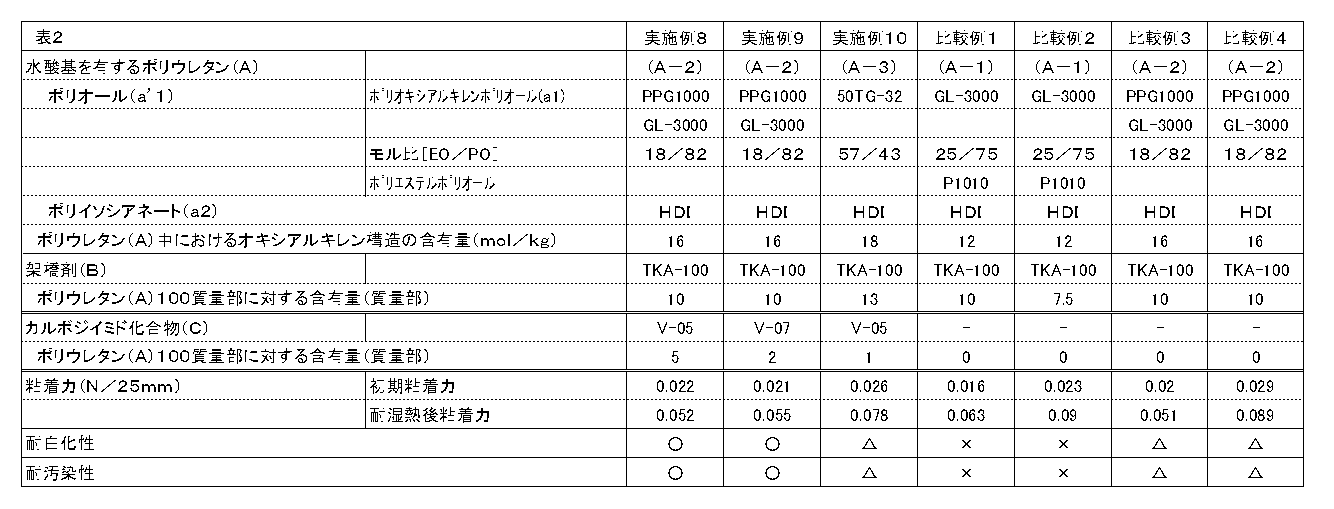
表1~2中の略語について説明する。
「V-07」;日清紡株式会社製カルボジイミド化合物「カルボジライトV-07」
「V-09」;日清紡株式会社製カルボジイミド化合物「カルボジライトV-09」
「P301-75E」;ヘキサメチレンジイソシアネートのトリメチロールプロパンアダクト体(旭化成ケミカルズ株式会社製「デュラネートP301-75E」)
「V-07」;日清紡株式会社製カルボジイミド化合物「カルボジライトV-07」
「V-09」;日清紡株式会社製カルボジイミド化合物「カルボジライトV-09」
「P301-75E」;ヘキサメチレンジイソシアネートのトリメチロールプロパンアダクト体(旭化成ケミカルズ株式会社製「デュラネートP301-75E」)
[実施例11]
実施例1にて得られた粘着剤組成物に、更にエステル化物(E)として、ポリオキシエチレングリコール(数平均分子量;200)の両末端を2-エチルヘキシル酸でエステル化したエステル化物(E-1)を10質量部入れ、粘着剤組成物を得た。
次いで、厚さ50μmのポリエチレンテレフタレートフィルムの表面に、乾燥後の膜厚が10μmとなるように前記粘着剤組成物を塗工し、80℃で3分間乾燥させた。これに表面が離型処理された厚さ38μmのポリエチレンテレフタレートフィルムを貼り合せ、40℃で3日間養生することで、表面保護フィルムを得た。
実施例1にて得られた粘着剤組成物に、更にエステル化物(E)として、ポリオキシエチレングリコール(数平均分子量;200)の両末端を2-エチルヘキシル酸でエステル化したエステル化物(E-1)を10質量部入れ、粘着剤組成物を得た。
次いで、厚さ50μmのポリエチレンテレフタレートフィルムの表面に、乾燥後の膜厚が10μmとなるように前記粘着剤組成物を塗工し、80℃で3分間乾燥させた。これに表面が離型処理された厚さ38μmのポリエチレンテレフタレートフィルムを貼り合せ、40℃で3日間養生することで、表面保護フィルムを得た。
[実施例12~18]
用いるポリウレタン(A)、架橋剤(B)、カルボジイミド化合物(C)、及び、エステル化物(E)の種類、及び/又は量を、表3に示す通りに変更した以外は、実施例1と同様にして、粘着剤組成物、及び表面保護フィルムを得た。
用いるポリウレタン(A)、架橋剤(B)、カルボジイミド化合物(C)、及び、エステル化物(E)の種類、及び/又は量を、表3に示す通りに変更した以外は、実施例1と同様にして、粘着剤組成物、及び表面保護フィルムを得た。
[比較例6]
カルボジイミド化合物(C)を用いなかった以外は、実施例1と同様にして、粘着剤組成物、及び表面保護フィルムを得た。
カルボジイミド化合物(C)を用いなかった以外は、実施例1と同様にして、粘着剤組成物、及び表面保護フィルムを得た。
[比較例5~8]
用いるポリウレタン(A)、及び、架橋剤(B)の種類、及び/又は量を、表4に示す通り変更した以外は、比較例5と同様にして、粘着剤組成物、及び表面保護フィルムを得た。
用いるポリウレタン(A)、及び、架橋剤(B)の種類、及び/又は量を、表4に示す通り変更した以外は、比較例5と同様にして、粘着剤組成物、及び表面保護フィルムを得た。
[濡れ性の評価方法]
実施例及び比較例で得られた表面保護フィルムを幅5cm、長さ15cmの長方形に裁断し、離型フィルムを剥離したものを試験片とした。この試験片の両端を手で持ち、湾曲させ、露出した粘着層の中心部をガラス板に接着させた後に手を放し、自重で粘着フィルムがガラス板に貼付くまでの秒数を測定した。
実施例及び比較例で得られた表面保護フィルムを幅5cm、長さ15cmの長方形に裁断し、離型フィルムを剥離したものを試験片とした。この試験片の両端を手で持ち、湾曲させ、露出した粘着層の中心部をガラス板に接着させた後に手を放し、自重で粘着フィルムがガラス板に貼付くまでの秒数を測定した。
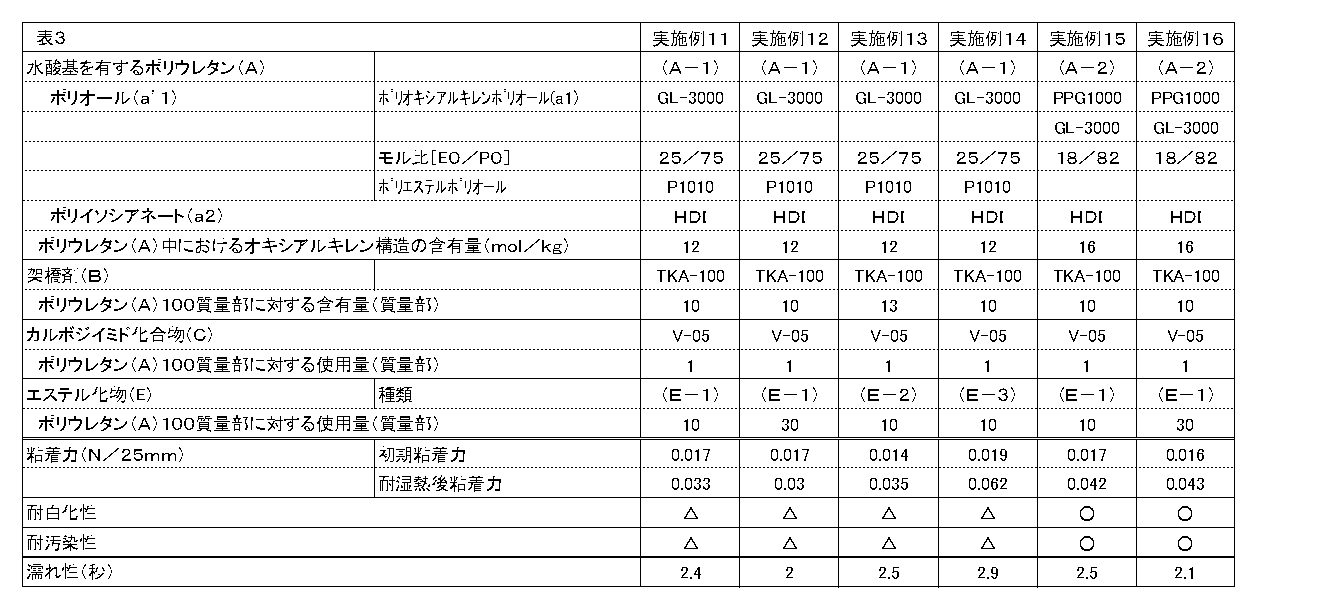
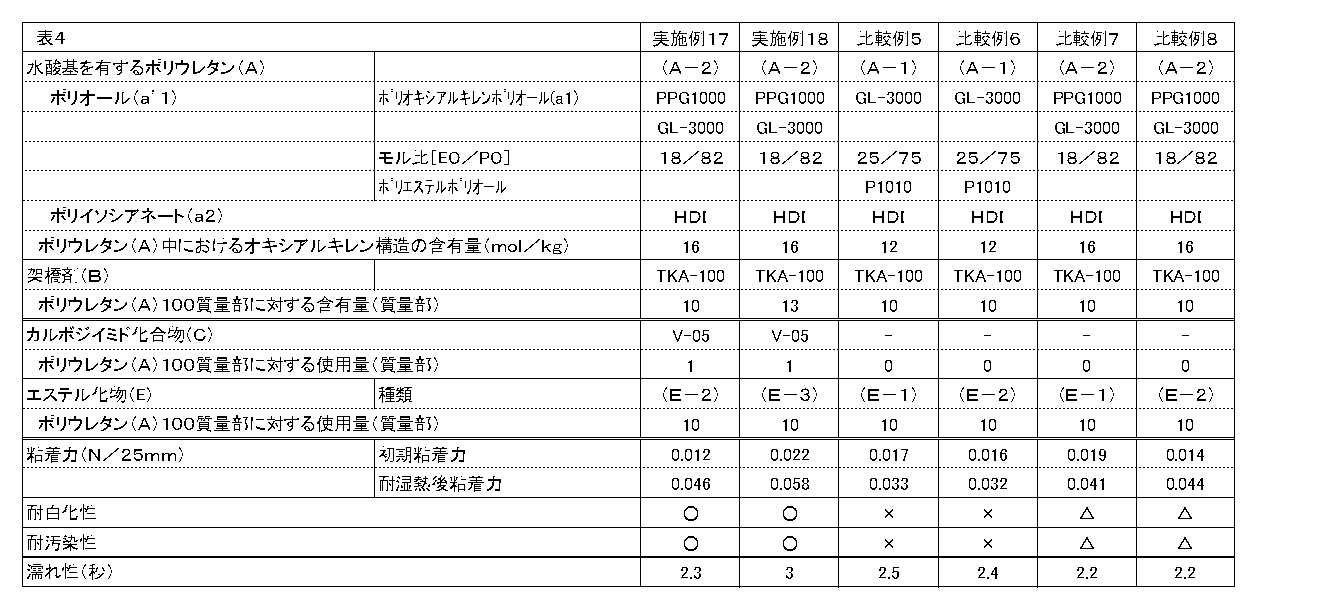
表3~4中の略語について説明する。
「E-2」:ポリオキシエチレングリコール(数平均分子量;600)の両末端を2-エチルヘキシル酸でエステル化したエステル化物
「E-3」;ポリオキシエチレングリコール(数平均分子量;500)の片末端をラウリル酸でエステル化したエステル化物
「E-2」:ポリオキシエチレングリコール(数平均分子量;600)の両末端を2-エチルヘキシル酸でエステル化したエステル化物
「E-3」;ポリオキシエチレングリコール(数平均分子量;500)の片末端をラウリル酸でエステル化したエステル化物
本発明の粘着剤組成物は、耐湿熱環境下でも耐白化性、及び、被着体への耐汚染性に優れることが分かった。また、エステル化物(E)を含有した実施例9~16は、被着体への濡れ性に優れ、耐湿熱試験後の粘着力の上昇も抑制できることが分かった。
一方、比較例1~8は、カルボジイミド化合物(C)を用いなかった態様であるが、いずでも被着体の汚染が確認された。
Claims (10)
- 2つ以上の水酸基を有するポリウレタン(A)、架橋剤(B)、カルボジイミド化合物(C)、及び、有機溶剤(D)を含有することを特徴とする粘着剤組成物。
- 前記ポリウレタン(A)が、ポリオキシアルキレンポリオール(a1)、及び、ポリイソシアネート(a2)由来の構造を有するものである請求項1記載の粘着剤組成物。
- 前記ポリオキシアルキレンポリオール(a1)が、ポリオキシプロピレングリコール、及び/又はポリオキシエチレンポリオキシプロピレントリオールを含有するものである請求項2記載の粘着剤組成物。
- 前記ポリオキシアルキレンポリオール(a1)が、ポリオキシプロピレングリコール及びポリオキシエチレンポリオキシプロピレントリオールを含有するものであり、ポリオキシアルキレンポリオール(a1)中のオキシエチレン構造とオキシプロピレン構造とのモル比[EO/PO]が、5/95~60/40の範囲である請求項3記載の粘着剤組成物。
- 前記ポリウレタン(A)中におけるオキシアルキレン構造の含有量が、5~30mol/kgの範囲である請求項2記載の粘着剤組成物。
- 前記カルボジイミド化合物(C)の使用量が、前記ポリウレタン(A)100質量部に対して、0.1~7質量部の範囲である請求項1記載の粘着剤組成物。
- 前記架橋剤(B)が、ポリイソシアネート架橋剤である請求項1記載の粘着剤組成物。
- ポリオキシエチレングリコールの少なくとも1つ以上の水酸基が一塩基酸でエステル化されたエステル化物(E)を更に含有するものである請求項1記載の粘着剤組成物。
- 前記エステル化物(E)の使用量が、ポリウレタン(A)100質量部に対し、1~50質量部の範囲である請求項8記載の粘着剤組成物。
- 請求項1~9のいずれか1項記載の粘着剤組成物の硬化被膜を有する表面保護フィルム。
Priority Applications (2)
| Application Number | Priority Date | Filing Date | Title |
|---|---|---|---|
| CN201680041066.2A CN107835845B (zh) | 2015-07-15 | 2016-05-12 | 粘合剂组合物和表面保护膜 |
| JP2016550656A JP6032388B1 (ja) | 2015-07-15 | 2016-05-12 | 粘着剤組成物及び表面保護フィルム |
Applications Claiming Priority (2)
| Application Number | Priority Date | Filing Date | Title |
|---|---|---|---|
| JP2015-141365 | 2015-07-15 | ||
| JP2015141365 | 2015-07-15 |
Publications (1)
| Publication Number | Publication Date |
|---|---|
| WO2017010158A1 true WO2017010158A1 (ja) | 2017-01-19 |
Family
ID=57756942
Family Applications (1)
| Application Number | Title | Priority Date | Filing Date |
|---|---|---|---|
| PCT/JP2016/064144 Ceased WO2017010158A1 (ja) | 2015-07-15 | 2016-05-12 | 粘着剤組成物及び表面保護フィルム |
Country Status (3)
| Country | Link |
|---|---|
| CN (1) | CN107835845B (ja) |
| TW (1) | TWI677549B (ja) |
| WO (1) | WO2017010158A1 (ja) |
Cited By (3)
| Publication number | Priority date | Publication date | Assignee | Title |
|---|---|---|---|---|
| WO2020095484A1 (ja) * | 2018-11-06 | 2020-05-14 | Dic株式会社 | 粘着剤組成物及び表面保護フィルム |
| WO2020110368A1 (ja) * | 2018-11-29 | 2020-06-04 | Dic株式会社 | 粘着剤組成物及び表面保護フィルム |
| WO2025249369A1 (ja) * | 2024-05-31 | 2025-12-04 | 日本カーバイド工業株式会社 | 加飾フィルム |
Families Citing this family (3)
| Publication number | Priority date | Publication date | Assignee | Title |
|---|---|---|---|---|
| JP6863524B2 (ja) * | 2018-08-01 | 2021-04-21 | Dic株式会社 | 粘着剤組成物及び表面保護フィルム |
| JP7388814B2 (ja) * | 2018-10-29 | 2023-11-29 | リンテック株式会社 | 飛散防止粘着シート |
| CN109796921B (zh) * | 2019-01-30 | 2021-03-26 | 广东盈通新材料有限公司 | 一种改性聚氨酯胶粘剂、包括改性聚氨酯胶粘剂的复合防水贴条及其制备方法和应用 |
Citations (4)
| Publication number | Priority date | Publication date | Assignee | Title |
|---|---|---|---|---|
| JP2003155321A (ja) * | 2001-09-10 | 2003-05-27 | Toyo Ink Mfg Co Ltd | ウレタン樹脂組成物 |
| JP2003292928A (ja) * | 2002-02-04 | 2003-10-15 | Toyo Ink Mfg Co Ltd | ウレタン樹脂粘着剤及び積層体 |
| JP2006182795A (ja) * | 2004-12-24 | 2006-07-13 | Mitsubishi Chemicals Corp | ポリウレタン粘着剤組成物、及び粘着シート又は表面保護フィルム |
| JP2007277484A (ja) * | 2006-04-11 | 2007-10-25 | Nitto Denko Corp | 粘着剤組成物、粘着シートおよび表面保護フィルム |
Family Cites Families (6)
| Publication number | Priority date | Publication date | Assignee | Title |
|---|---|---|---|---|
| JP5456440B2 (ja) * | 2009-01-30 | 2014-03-26 | 日東電工株式会社 | ダイシングテープ一体型ウエハ裏面保護フィルム |
| WO2011068112A1 (ja) * | 2009-12-04 | 2011-06-09 | 東洋紡績株式会社 | 易接着性熱可塑性樹脂フィルム |
| WO2012017724A1 (ja) * | 2010-08-06 | 2012-02-09 | Dic株式会社 | ウレタン樹脂組成物、コーティング剤、皮革様シートの表皮層形成用ウレタン樹脂組成物、並びに積層体及び皮革様シート |
| KR20130048057A (ko) * | 2011-11-01 | 2013-05-09 | 현대자동차주식회사 | 고 안락성 자동차용 폴리 우레탄 시트 조성물 |
| JP2014162821A (ja) * | 2013-02-22 | 2014-09-08 | Nitto Denko Corp | 表面保護フィルム |
| JP6092034B2 (ja) * | 2013-07-30 | 2017-03-08 | 日東電工株式会社 | 表面保護フィルムおよび光学部材 |
-
2016
- 2016-05-12 WO PCT/JP2016/064144 patent/WO2017010158A1/ja not_active Ceased
- 2016-05-12 CN CN201680041066.2A patent/CN107835845B/zh active Active
- 2016-05-25 TW TW105116183A patent/TWI677549B/zh active
Patent Citations (4)
| Publication number | Priority date | Publication date | Assignee | Title |
|---|---|---|---|---|
| JP2003155321A (ja) * | 2001-09-10 | 2003-05-27 | Toyo Ink Mfg Co Ltd | ウレタン樹脂組成物 |
| JP2003292928A (ja) * | 2002-02-04 | 2003-10-15 | Toyo Ink Mfg Co Ltd | ウレタン樹脂粘着剤及び積層体 |
| JP2006182795A (ja) * | 2004-12-24 | 2006-07-13 | Mitsubishi Chemicals Corp | ポリウレタン粘着剤組成物、及び粘着シート又は表面保護フィルム |
| JP2007277484A (ja) * | 2006-04-11 | 2007-10-25 | Nitto Denko Corp | 粘着剤組成物、粘着シートおよび表面保護フィルム |
Cited By (6)
| Publication number | Priority date | Publication date | Assignee | Title |
|---|---|---|---|---|
| WO2020095484A1 (ja) * | 2018-11-06 | 2020-05-14 | Dic株式会社 | 粘着剤組成物及び表面保護フィルム |
| JPWO2020095484A1 (ja) * | 2018-11-06 | 2021-02-25 | Dic株式会社 | 粘着剤組成物及び表面保護フィルム |
| CN112996875A (zh) * | 2018-11-06 | 2021-06-18 | Dic株式会社 | 粘合剂组合物及表面保护膜 |
| WO2020110368A1 (ja) * | 2018-11-29 | 2020-06-04 | Dic株式会社 | 粘着剤組成物及び表面保護フィルム |
| JPWO2020110368A1 (ja) * | 2018-11-29 | 2021-04-08 | Dic株式会社 | 粘着剤組成物及び表面保護フィルム |
| WO2025249369A1 (ja) * | 2024-05-31 | 2025-12-04 | 日本カーバイド工業株式会社 | 加飾フィルム |
Also Published As
| Publication number | Publication date |
|---|---|
| TW201708483A (zh) | 2017-03-01 |
| TWI677549B (zh) | 2019-11-21 |
| CN107835845B (zh) | 2021-06-25 |
| CN107835845A (zh) | 2018-03-23 |
Similar Documents
| Publication | Publication Date | Title |
|---|---|---|
| CN107835845B (zh) | 粘合剂组合物和表面保护膜 | |
| TWI595063B (zh) | 胺甲酸酯系黏著劑及使用其之表面保護膜 | |
| TWI648366B (zh) | 聚酯系黏著劑組成物及黏著片 | |
| JP6519687B1 (ja) | 粘着剤、粘着シート、および水酸基末端ウレタンプレポリマーの製造方法 | |
| JP5835525B1 (ja) | 粘着剤組成物及び粘着フィルム | |
| CN108300366B (zh) | 粘着片 | |
| JP7532982B2 (ja) | バックグラインドテープ | |
| KR101577650B1 (ko) | 비산방지 필름 | |
| WO2008056751A1 (en) | Actinic radiation curable adhesive composition | |
| JP7127596B2 (ja) | 粘着剤、粘着シート、および水酸基末端ウレタンプレポリマーの製造方法 | |
| JP6032388B1 (ja) | 粘着剤組成物及び表面保護フィルム | |
| JP7688850B2 (ja) | 粘着剤組成物 | |
| JP6350764B2 (ja) | ポリウレタン組成物、及び、シート | |
| JP6870789B1 (ja) | 粘着剤組成物及び表面保護フィルム | |
| JP2016216645A (ja) | 粘着フィルム | |
| CN111936592B (zh) | 氨基甲酸酯粘合剂和粘合片 | |
| CN112996875B (zh) | 粘合剂组合物及表面保护膜 | |
| JP6763365B2 (ja) | 粘着シート | |
| TW201922994A (zh) | 光硬化性樹脂組成物及接著片 | |
| JP2016216644A (ja) | 粘着フィルム |
Legal Events
| Date | Code | Title | Description |
|---|---|---|---|
| ENP | Entry into the national phase |
Ref document number: 2016550656 Country of ref document: JP Kind code of ref document: A |
|
| 121 | Ep: the epo has been informed by wipo that ep was designated in this application |
Ref document number: 16824138 Country of ref document: EP Kind code of ref document: A1 |
|
| NENP | Non-entry into the national phase |
Ref country code: DE |
|
| 122 | Ep: pct application non-entry in european phase |
Ref document number: 16824138 Country of ref document: EP Kind code of ref document: A1 |