WO2017010035A1 - 車両用無線通信装置および無線通信システム - Google Patents
車両用無線通信装置および無線通信システム Download PDFInfo
- Publication number
- WO2017010035A1 WO2017010035A1 PCT/JP2016/002610 JP2016002610W WO2017010035A1 WO 2017010035 A1 WO2017010035 A1 WO 2017010035A1 JP 2016002610 W JP2016002610 W JP 2016002610W WO 2017010035 A1 WO2017010035 A1 WO 2017010035A1
- Authority
- WO
- WIPO (PCT)
- Prior art keywords
- service
- channel
- information
- reception
- wireless communication
- Prior art date
- Legal status (The legal status is an assumption and is not a legal conclusion. Google has not performed a legal analysis and makes no representation as to the accuracy of the status listed.)
- Ceased
Links
Images









Classifications
-
- H—ELECTRICITY
- H04—ELECTRIC COMMUNICATION TECHNIQUE
- H04W—WIRELESS COMMUNICATION NETWORKS
- H04W4/00—Services specially adapted for wireless communication networks; Facilities therefor
- H04W4/30—Services specially adapted for particular environments, situations or purposes
- H04W4/40—Services specially adapted for particular environments, situations or purposes for vehicles, e.g. vehicle-to-pedestrians [V2P]
- H04W4/44—Services specially adapted for particular environments, situations or purposes for vehicles, e.g. vehicle-to-pedestrians [V2P] for communication between vehicles and infrastructures, e.g. vehicle-to-cloud [V2C] or vehicle-to-home [V2H]
-
- G—PHYSICS
- G08—SIGNALLING
- G08G—TRAFFIC CONTROL SYSTEMS
- G08G1/00—Traffic control systems for road vehicles
- G08G1/09—Arrangements for giving variable traffic instructions
- G08G1/095—Traffic lights
-
- H—ELECTRICITY
- H04—ELECTRIC COMMUNICATION TECHNIQUE
- H04W—WIRELESS COMMUNICATION NETWORKS
- H04W4/00—Services specially adapted for wireless communication networks; Facilities therefor
- H04W4/30—Services specially adapted for particular environments, situations or purposes
- H04W4/40—Services specially adapted for particular environments, situations or purposes for vehicles, e.g. vehicle-to-pedestrians [V2P]
-
- H—ELECTRICITY
- H04—ELECTRIC COMMUNICATION TECHNIQUE
- H04W—WIRELESS COMMUNICATION NETWORKS
- H04W72/00—Local resource management
- H04W72/20—Control channels or signalling for resource management
-
- G—PHYSICS
- G08—SIGNALLING
- G08G—TRAFFIC CONTROL SYSTEMS
- G08G1/00—Traffic control systems for road vehicles
- G08G1/09—Arrangements for giving variable traffic instructions
- G08G1/0962—Arrangements for giving variable traffic instructions having an indicator mounted inside the vehicle, e.g. giving voice messages
- G08G1/0967—Systems involving transmission of highway information, e.g. weather, speed limits
- G08G1/096766—Systems involving transmission of highway information, e.g. weather, speed limits where the system is characterised by the origin of the information transmission
- G08G1/096783—Systems involving transmission of highway information, e.g. weather, speed limits where the system is characterised by the origin of the information transmission where the origin of the information is a roadside individual element
Definitions
- the present disclosure relates to a vehicle wireless communication device used in a vehicle, and a wireless communication system including the vehicle wireless communication device.
- WAVE Wireless Access in Vehicular Environments
- the vehicle wireless communication device and the roadside device communicate using two types of channels, a control channel and a service channel.
- the service channel is a channel used for transmission / reception of information for executing a service (hereinafter, service execution information).
- service execution information There are a plurality of types of services, and service channels include a plurality of channels having different frequencies. Each service is associated with one of a plurality of service channels.
- the control channel is a channel used for the roadside device to transmit various information (hereinafter referred to as service notification information) that needs to be notified in order to communicate with the vehicle wireless communication apparatus using the service channel.
- service notification information includes information (hereinafter referred to as channel information) that determines a service channel to be set as a reception channel.
- reception channel is set as a service channel
- service notification information cannot be received. If the service notification information cannot be received, the vehicular wireless communication apparatus cannot set the reception channel to the service channel specified by the channel information included in the service notification information.
- the present disclosure has been made based on this situation, and an object of the present disclosure is to provide a vehicular radio communication apparatus and radio communication that can prevent a reception channel from being set as a service channel specified by channel information. To provide a system.
- a vehicular wireless communication apparatus used in a vehicle receives information through a plurality of service channels and control channels set to different frequency channels.
- a first wireless receiver that receives service execution information, which is information for executing a service, by setting a service channel determined according to the type of service from a plurality of service channels as a reception channel, and a control channel as a reception channel
- a reception controller for setting a reception channel of the first wireless receiver.
- the vehicle radio communication apparatus includes two radio receivers, a first radio receiver and a second radio receiver.
- the second wireless receiver sets the control channel as a reception channel and receives service notification information.
- the reception controller sets the reception channel of the first radio receiver based on the channel information included in the service notification information received by the second radio receiver.
- the vehicular wireless communication apparatus receives the service notification information transmitted through the control channel, and uses the channel information included in the service notification information.
- the identified service channel can be set to the reception channel of the first radio receiver. Therefore, it can suppress that the communication channel of a 1st radio
- the wireless communication system includes a notification-type roadside device that transmits service notification information in addition to service execution information, and the vehicle wireless communication device according to the first aspect described above. Is provided.
- 1st Embodiment it is a figure showing the frequency channel which a 1st radio
- the wireless communication system 1 includes a notification-type roadside device 2, a non-notification-type roadside device 3, and an in-vehicle device 4.
- the in-vehicle device 4 corresponds to a vehicle wireless communication device.
- FIG. 1 Outline configuration of wireless communication system 1
- a plurality of notification-type roadside devices 2 may be provided.
- only one non-notification type roadside device 3 and one in-vehicle device 4 are shown in FIG. 1, but a plurality of these non-notification type roadside devices 3 and in-vehicle devices 4 may be provided.
- the notification-type roadside device 2, the non-notification-type roadside device 3, and the vehicle-mounted device 4 communicate according to the WAVE standard.
- the wireless communication system 1 sets one control channel and a plurality of service channels as communication channels.
- the control channel and the plurality of service channels are set to different predetermined frequency channels.
- the notification-type roadside device 2 notifies WSA (Wave Service Announcement) through the control channel.
- This WSA corresponds to service notification information, and includes information on a service channel that is a frequency channel for transmitting service execution information that is information for executing a service, that is, channel information and the like.
- the notification-type roadside device 2 transmits service execution information through the service channel notified by WSA.
- Information is used not only as a countable noun but also as a countable noun, and is equivalent to an information item.
- One information item is equivalent to one information item, and a plurality of information items are equivalent to a plurality of information items.
- the non-notification-type roadside device 3 transmits service execution information on a preset service channel without transmitting WSA, and thus without notifying channel information.
- the notification type roadside machine 2 and the non-notification type roadside machine 3 may be fixed to the roadside or may be mobile.
- the in-vehicle device 4 is mounted on the vehicle 5 and receives WSA and service execution information. In addition, inter-vehicle communication with other in-vehicle devices 4 can also be performed.
- the vehicle 5 includes various vehicles such as passenger cars, buses, and trucks that travel on the road. Moreover, although the four-wheeled vehicle is illustrated as the vehicle 5 in FIG. 1, the vehicle 5 may be a two-wheeled vehicle. Two-wheeled vehicles include bicycles.
- the notification-type roadside device 2 performs road-to-vehicle communication with the in-vehicle device 4 existing in the wireless communication area formed by the notification-type roadside device 2, and transmits various information to the in-vehicle device 4.
- the predetermined service is implemented by acquiring the information.
- the notification type roadside machine 2 is provided at a position suitable for the service provided by the notification type roadside machine 2.
- the notification-type roadside machine 2 is provided at an intersection, on the way of connecting roads between intersections and at intersections of specific facilities (for example, parking lots, stores, and toll roads).
- the wireless communication area of the notification-type roadside device 2 (in other words, the output of radio waves transmitted by the notification-type roadside device 2) can be set according to the service provided by the notification-type roadside device 2. When the set wireless communication area is wide, it may overlap with the wireless communication areas of other notification-type roadside devices 2 and non-notification-type roadside devices 3.
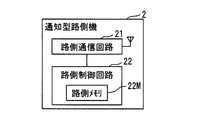
- the notification-type roadside machine 2 includes a roadside communication circuit 21 and a roadside control circuit 22 as shown in FIG.
- the roadside communication circuit 21 and the roadside control circuit 22 are connected so that they can communicate with each other.
- the roadside communication circuit 21 performs road-to-vehicle communication with the in-vehicle device 4 existing in the wireless communication area formed by the notification-type roadside device 2.
- the roadside communication circuit 21 demodulates the signal received from the in-vehicle device 4 and outputs the demodulated signal to the roadside control circuit 22, modulates the data input from the roadside control circuit 22, further converts it into a radio wave and transmits it.
- the roadside communication circuit 21 has two operation modes: a mode for communicating using a control channel and a mode for communicating using a service channel. That is, both communication using the control channel with the vehicle-mounted device 4 and communication using the service channel are performed via the roadside communication circuit 21.
- the roadside control circuit 22 is configured as a normal computer, and includes a well-known CPU, a nonvolatile memory such as a ROM and a flash memory, a volatile memory such as a RAM, an I / O, and a bus line connecting these configurations. It has.
- the roadside memory 22M included in the roadside control circuit 22 is a non-volatile storage medium, and is realized by, for example, a flash memory or a ROM included in the roadside control circuit 22.
- the roadside memory 22M stores program modules and data for executing various processes, a terminal ID assigned to the notification-type roadside device 2, and the like. Information for generating the WSA is also stored in the roadside memory 22M.
- the roadside control circuit 22 includes a roadside communication controller 221 and a service processor 224 as functional blocks realized by executing the above program modules, as shown in FIG. Note that some or all of the functions executed by the roadside control circuit 22 may be configured in hardware by one or a plurality of ICs.
- the roadside communication controller 221 controls the operation of the roadside communication circuit 21 and switches between communication using the control channel and communication using the service channel.
- the roadside communication controller 221 generates information to be transmitted from the roadside communication circuit 21 according to the operation mode of the roadside communication circuit 21, and transmits the information from the roadside communication circuit 21. Also, the data received by the roadside communication circuit 21 is acquired and provided to the service processor 224.
- the roadside communication controller 221 includes a CCH communication processor 222 and an SCH communication processor 223 as finer functional blocks.
- CCH in the name of each part means a control channel (Control Channel)
- SCH means a service channel (Service Channel).
- the CCH communication processor 222 is in charge of communication control using the control channel.
- the CCH communication processor 222 generates WSA, sets the transmission channel of the roadside communication circuit 21 as a control channel, and causes the roadside communication circuit 21 to transmit the generated WSA in a broadcast manner. Further, the CCH communication processor 222 acquires data received by the roadside communication circuit 21 through communication using the control channel, and provides the data to the service processor 224.
- the SCH communication processor 223 is in charge of communication control using a predetermined service channel.
- the SCH communication processor 223 generates service execution information, sets the transmission channel of the roadside communication circuit 21 to a service channel determined according to the type of service, and causes the roadside communication circuit 21 to transmit the generated service execution information.
- the transmission method may be any of broadcast, unicast, and multicast, and it is determined depending on the type of service whether the communication method is used. Further, the SCH communication processor 223 acquires data received by the roadside communication circuit 21 through communication using the service channel, and provides the data to the service processor 224.
- the service processor 224 provides a predetermined service to the in-vehicle device 4 in the wireless communication area based on the data provided from the roadside communication controller 221.
- Services to be provided are, for example, an automatic fee collection service when traveling on a toll road, an automatic parking fee collection service when parking, a traffic information distribution service, a location information notification service, an advertisement distribution service, and the like.
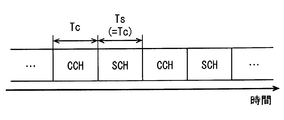
- FIG. 4 is a conceptual diagram illustrating an example of a flow of communication performed by the notification-type roadside device 2.
- the notification-type roadside device 2 switches between communication using the control channel and communication using the service channel every predetermined time (for example, 50 milliseconds).
- the present invention is not limited to the example shown in FIG. 4, and the time Tc for continuing communication using the control channel and the time Ts for continuing communication using the service channel may be appropriately designed. Moreover, each duration may be changed dynamically as needed. Furthermore, it is good also as an aspect which maintains communication by a control channel until it receives the response from the vehicle equipment 4 with respect to WSA transmitted sequentially using a control channel.
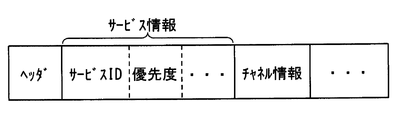
- WSA includes a header, service information, and channel information as shown in FIG.
- the header is information for recognizing that the received data is WSA in the in-vehicle device 4 that is a device on the receiving side.
- the header includes, for example, information indicating the version of the WAVE standard, information for distinguishing the WSA from other information such as service execution information, and the like.
- Service information is information indicating the type of service provided by the notification-type roadside device 2.
- the service information indicates the service type by a service ID set in advance for each service type.
- service priorities are included.
- the in-vehicle device 4 that has received the WSA refers to the service information included in the WSA, so that the service type corresponding to the WSA, that is, the service provided by the notification-type roadside device 2 that is the source of the WSA is provided.
- the type can be specified.
- the channel information is information including a channel number of a service channel used by the notification-type roadside device 2 to provide a service among a plurality of service channels.
- the service channel may be determined according to the service to be provided, and a plurality of services may be associated with the same service channel.
- the in-vehicle device 4 can specify the service channel that the notification roadside device 2 uses for providing the service by referring to the channel information.
- the non-notification-type roadside device 3 is different from the notification-type roadside device 2 in that WSA that is service notification information is not transmitted.
- the other points are the same as the notification type roadside machine 2.
- the non-notification type roadside machine 3 includes a roadside communication circuit 31 and a roadside control circuit 32 as in the case of the notification type roadside machine 2.
- the roadside control circuit 32 includes a roadside memory 32M.
- the roadside communication circuit 31 does not have a mode for communication using the control channel as an operation mode, but only a mode for communication using the service channel.
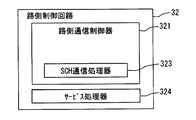
- FIG. 7 is a diagram showing functional blocks realized by the roadside control circuit 32 by executing the program modules stored in the roadside memory 32M.
- the roadside control circuit 32 includes a roadside communication controller 321 and a service processor 324.
- the roadside communication controller 321 includes an SCH communication processor 323, but the non-notification type roadside device 3 does not transmit a WSA, and therefore does not include a CCH communication processing unit.
- the function of the SCH communication processor 323 is the same as that of the SCH communication processor 223 included in the notification type roadside device 2.
- the function of the service processor 324 is the same as that of the service processor 224 provided in the notification type roadside device 2.
- the in-vehicle device 4 includes a control circuit 41, a first wireless communication device 42, a second wireless communication device 43, a GNSS receiver 44, an acceleration sensor 45, and a gyro sensor 46.
- the control circuit 41 is connected to each of the first wireless communication device 42, the second wireless communication device 43, the GNSS receiver 44, the acceleration sensor 45, and the gyro sensor 46 so as to be able to communicate with each other.
- the first wireless communication device 42 corresponds to a first wireless receiver
- the second wireless communication device 43 corresponds to a second wireless receiver.
- the first wireless communication device 42 can switch a plurality of frequency channels and set one frequency channel as a communication channel.
- the communication channel is a channel that performs reception and transmission. That is, the communication channel means a reception channel and a transmission channel.
- the second wireless communication device 43 can also switch a plurality of frequency channels and set one frequency channel as a communication channel.
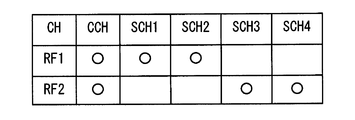
- FIG. 9 shows communication channels that can be set by the first wireless communication device 42 and the second wireless communication device 43 in the first embodiment.
- the first wireless communication device 42 and the second wireless communication device 43 demodulate the signal received by the antenna and output it to the control circuit 41, modulate the data input from the control circuit 41, and convert it into radio waves. To send.
- CCH represents a control channel and SCH represents a service channel.
- these channels all belong to the 5.8 GHz band and the 5.9 GHz band.
- RF1 means the first wireless communication device 42
- RF2 means the second wireless communication device 43.
- circles indicate communication channels that can be set by the first wireless communication device 42 and the second wireless communication device 43. Therefore, the first wireless communication device 42 can set three communication channels: a control channel, a first service channel SCH1, and a second service channel SCH2. On the other hand, the second wireless communication device 43 can be set to three communication channels: a control channel, a third service channel SCH3, and a fourth service channel SCH4.
- the GNSS receiver 44 acquires data indicating the current position of the GNSS receiver 44 by receiving radio waves from satellites used in GNSS (Global Navigation Satellite System).
- the current position information acquired by the GNSS receiver 44 is represented by latitude and longitude, for example.
- the current position information acquired by the GNSS receiver 44 is sequentially provided to the control circuit 41 (for example, every 100 milliseconds).
- the radio wave received by the GNSS receiver 44 is also used for correcting a clock (not shown) provided in the in-vehicle device 4.
- the acceleration sensor 45 detects acceleration acting in the front-rear direction of the host vehicle.
- the in-vehicle device 4 is attached to the host vehicle in a predetermined posture so that the acceleration detection direction by the acceleration sensor 45 coincides with the front-rear direction of the host vehicle.
- the host vehicle here refers to a vehicle on which the in-vehicle device 4 is mounted.
- the acceleration sensor 45 may be a three-axis acceleration sensor that detects acceleration acting in three axial directions orthogonal to each other in the front-rear direction, the left-right direction, and the up-down direction of the host vehicle.
- the gyro sensor 46 detects the rotational angular velocity around the vertical axis of the host vehicle when the in-vehicle device 4 is attached in a predetermined posture.
- the acceleration sensor 45 and the gyro sensor 46 are used to determine the estimated position of the in-vehicle device 4.
- the control circuit 41 is configured as an ordinary computer, and includes a well-known CPU, a non-volatile memory such as a ROM and a flash memory, a volatile memory such as a RAM, an I / O, and a bus line connecting these configurations (whichever Are also not shown).
- the memory 41M included in the control circuit 41 is a non-volatile storage medium, and is realized by, for example, a flash memory or a ROM included in the control circuit 41.
- the memory 41M stores program modules and data for executing various processes, a terminal ID assigned to the in-vehicle device 4, and the like.
- the memory 41M is provided with a first queue 41M1 and a second queue 41M2 which are examples of storage devices.
- the first queue 41M1 is a queue in which a WSA including a channel number corresponding to a service channel that can be set by the first wireless communication device 42 is stored.
- the second queue 41M2 is a queue in which a WSA including a channel number corresponding to a service channel that can be set by the second wireless communication device 43 is stored.
- the control circuit 41 includes a first communication controller 411, a first storage controller 412, a second communication controller 413, and a second function block that are realized by executing the above program modules.
- a storage controller 414 is provided.
- the first communication controller 411 corresponds to a first reception controller
- the second communication controller 413 corresponds to a second reception controller.
- a part or all of the functions executed by the control circuit 41 may be configured by hardware by one or a plurality of ICs.
- the first communication controller 411 controls the operation of the first wireless communication device 42. Specifically, the communication channel of the first wireless communication device 42 is set to either the control channel or the service channel. Therefore, when the communication channel of the first wireless communication device 42 is not set to the service channel, the communication channel is set to the control channel. Then, communication is performed using the set channel.
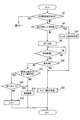
- the processing executed by the first communication controller 411 will be described in detail later using the flowcharts shown in FIGS.
- the first storage controller 412 determines whether or not to store the WSA in the first queue 41M1 when either the first wireless communication device 42 or the second wireless communication device 43 receives the WSA. Further, it is sequentially determined whether to hold or delete the WSA stored in the first queue 41M1. The processing executed by the first storage controller 412 will be described in detail later using the flowcharts shown in FIGS.
- the second communication controller 413 controls the operation of the second wireless communication device 43.
- the control content executed by the second communication controller 413 is the same as the control content executed by the first communication controller 411 for the first wireless communication device 42.
- the second storage controller 414 determines whether or not to store the WSA in the second queue 41M2, and sequentially determines whether to hold or delete the WSA stored in the second queue 41M2.
- the process performed by the second storage controller 414 for the second queue 41M2 is the same as the process performed by the first storage controller 412 for the first queue 41M1.
- the first communication controller 411 and the first storage controller 412 periodically perform the processes shown in FIGS. 11 to 15 in order to control the first wireless communication device 42 and update the stored contents of the first queue 41M1.
- the second communication controller 413 and the second storage controller 414 also control the second wireless communication device 43 and perform the processes shown in FIGS. 11 to 15 in order to update the stored contents of the second queue 41M2. Run periodically.
- S4 S12, S14, S16, S18, S20, S54, S56, S58, S60, S72, and S78 are performed by the first storage controller 412 and the second storage controller 414.
- the other processes are the processes performed by the first communication controller 411 and the second communication controller 413.
- the SCH fixed condition is a condition for fixing the communication channel of the second radio communication device 43 to one service channel.
- the wireless communication system 1 according to this embodiment is provided with the non-notification type roadside device 3 to determine the SCH fixed condition, and the non notification type roadside device 3 does not transmit WSA. Therefore, when communicating with the non-notification-type roadside device 3, it may be preferable that the vehicle-mounted device 4 fixes the communication channel to a service channel with which the non-notification-type roadside device 3 communicates.
- the SCH fixed condition is, for example, that the vehicle-mounted device 4 is located in a predetermined SCH fixed area, or that the first queue 41M1 that is a queue corresponding to the first wireless communication device 42 after the vehicle-mounted device 4 is powered on. For example, until the WSA is stored.
- S4 it is determined whether or not WSA is stored in its own queue.
- the own queue is the first queue 41M1 in the case of the first communication controller 411 that controls the first wireless communication device 42, and the second communication controller 413 that controls the second wireless communication device 43. Is the second queue 41M2.
- the process of storing the WSA in the first queue 41M1 and the second queue 41M2 is performed in S16 of FIG. 11 or the CCH reception process shown in FIG. If judgment of S4 is NO, it will progress to S6.
- the communication channel of the wireless communication device to be controlled is set as the control channel.
- the wireless communication device to be controlled is the first wireless communication device 42 if it is the first communication controller 411, and the second wireless communication device 43 if it is the second communication controller 413.
- S8 it is determined whether or not the wireless communication device to be controlled has received WSA. If this determination is NO, S8 is repeated. On the other hand, if the determination in S8 is YES, the process proceeds to S10.
- the first wireless communication device 42 can set the service channels SCH1 and SCH2 as communication channels. Therefore, for the first communication controller 411 that controls the first wireless communication device 42, the WSA whose WSA channel information is the service channel SCH1 or SCH2 is its own WSA. On the other hand, for the second communication controller 413 that controls the second wireless communication device 43, the WSA whose WSA channel information is the service channel SCH3 or SCH4 is the WSA for itself. If judgment of S10 is YES, it will progress to S22, and if it is NO, it will progress to S12.
- S12 it is determined whether or not the other party is executing any service.
- the partner here is the second communication controller 413 for the first communication controller 411 and the first communication controller 411 for the second communication controller 413.
- the determination of S12 is YES. If the determination in S12 is YES, the process proceeds to S14.
- S14 it is determined whether or not the other party is executing the same service as the service determined from the service ID of the WSA determined to have been received in S8. This determination is made, for example, by determining which channel is set as the communication channel of the wireless communication devices 42 and 43 to be controlled by the other communication controllers 411 and 413. If the determination in S14 is NO, the process proceeds to S16.
- the WSA determined to be received in S8 is stored in the queue for the other party, that is, the second queue 41M2 for the first communication controller 411 and the first queue 41M1 for the second communication controller 413.
- the first communication controller 411 that controls the first wireless communication device 42 acquires the WSA from the first queue 41M1 even if the first wireless communication device 42 cannot receive the WSA, and newly A process for executing a simple service can be started.
- the process proceeds to S18.
- S18 the WSA received this time is discarded. If the determination in S12 is NO, the other party is not executing any service, and the other party's wireless communication devices 42 and 43 should have received the WSA with the communication channel set to CCH. is there. Further, if the other party is executing the same service as the service determined from the service ID of the WSA received this time, the WSA received this time is unnecessary. Therefore, when the determination at S14 is YES or when the determination at S12 is NO, the WSA received this time is discarded.
- S4 determines whether there is WSA in its own queue. If the determination in S4 is YES, that is, if it is determined that there is WSA in its own queue, the process proceeds to S20.
- WSA is acquired from the queue for own use. The WSA acquired here is deleted from the queue. Note that when a plurality of WSAs are stored in the own queue, the WSA with the oldest reception time is acquired in this embodiment. If WSA is acquired, it will progress to S22.
- the service execution process is a process of receiving a service execution information transmitted from the notification-type roadside device 2 or the non-notification-type roadside device 3 and executing a predetermined service. This service execution process is shown in detail in FIG.
- S30 it is determined whether or not the SCH fixed service. Specifically, it is determined whether or not the service ID included in the WSA is a service ID of a service set as an SCH fixed service. If this determination is YES, the process proceeds to FIG. On the other hand, if judgment of S30 is NO, it will progress to S32.
- opening means setting a communication channel.
- the time for opening the service channel is determined from the WSA.
- WSA includes information indicating that a service channel needs to be opened immediately. If the WSA includes information instructing to immediately open the service channel, S32 is immediately determined as YES. Further, when the WSA does not include information for instructing to immediately open the service channel, the WSA includes the time to open the service channel.
- the time for opening the service channel is included in the WSA, in S32, it is determined whether or not the time has come.
- the communication channels of the wireless communication devices 42 and 43 to be controlled are set as service channels determined from the channel information included in the WSA.
- service execution information processing is performed.
- the service execution information processing is a process for executing a service determined by the service execution information when the wireless communication devices 42 and 43 to be controlled receive the service execution information.
- the service execution information received by the wireless communication devices 42 and 43 to be controlled includes information indicating the service termination.
- S38 it is determined whether or not the service has ended. Specifically, this determination is to determine whether or not the service execution information includes information indicating service termination. If the determination in S38 is YES, the service execution process in FIG. 12 is terminated. When the service execution process ends, the process of FIG. 11 also ends.
- S40 it is determined whether or not it is time to open the control channel.
- the time to open the control channel can be determined from the WSA.
- the WSA may include information indicating a period for opening a service channel. If the WSA includes information indicating the period for opening the service channel, it can be determined that it is time to open the control channel after a period determined from the information has elapsed. If the WSA does not include information indicating the period for opening the service channel, it is determined that it is time to open the control channel when the time Ts shown in FIG. 4 has elapsed since the service channel was opened. To do. This is because the communication channel is switched in synchronization with the notification-type roadside device 2.
- CCH reception processing is executed.
- the CCH reception process is a process executed while the communication channel is set as the control channel. Details of the CCH reception process are shown in FIG.
- S50, S52, S54, S56, S58, and S60 are the same processes as S8, S10, S12, S14, S16, and S18 of FIG. 11, respectively. Therefore, if the WSA is received, the received WSA is not for itself, the other party has not received the WSA, and the service determined from the WSA is not executed, the received WSA is queued. Store in 41M1 and 41M2.
- S62 whether the service indicated by the service ID included in the received WSA is the same as the service currently being executed, and whether the service is the same as the WSA stored in its own queue. Judging. If the service indicated by the service ID included in the received WSA is the same as the service currently being executed, or the same as the WSA stored in its own queue, the determination in S62 is YES. become. If judgment of S62 is YES, it will progress to S64. In S64, the WSA received this time is discarded.
- S66 the WSA received this time is stored in its own queue. At this time, if the WSA is already stored in the own queue, the new WSA is stored in the own queue while the stored WSA is stored.
- S68 it is determined whether or not to open the service channel. This determination is YES when the period during which the control channel is open has elapsed. If the WSA received this time includes the time to open the service channel, the determination in S68 is YES when that time is reached. Further, if the WSA received this time includes information instructing to immediately open the service channel, the determination in S68 is YES. If the WSA received this time includes information instructing to immediately open the service channel, the service channel may be opened without executing S66.
- a service channel set in advance as a service channel for executing the SCH fixed service is opened.
- S74 service execution information processing is performed. This process is the same as S36.
- S76 it is judged whether the service was complete
- the process returns to S72. If judgment of S72 is YES, it will progress to S78.
- the WSA is acquired from the queue for the user. The WSA acquired here is deleted from the queue. When a plurality of WSAs are stored in its own queue, the WSA with the oldest reception time is acquired. When the WSA is acquired, the process proceeds to the service execution process of FIG. Therefore, for example, even if the communication channel of the first wireless communication device 42 is fixed to the service channel, it is possible to shift to the next service using the first wireless communication device 42.
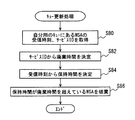
- the first storage controller 412 and the second storage controller 414 also periodically execute the queue update process shown in FIG. However, any one of the first storage controller 412 and the second storage controller 414 may execute the queue update process shown in FIG. 15 for the first queue 41M1 and the second queue 41M2.
- the WSA reception time and service ID stored in its own queue are acquired.
- the discard time of the WSA stored in the queue for the user is determined. This relationship is set such that the more important the service, the longer the discard time.
- the holding time which is the time that the WSA is held in the queue, is determined for each WSA from the difference between the reception time acquired in S80 and the current time.
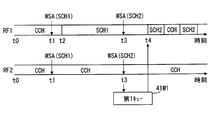
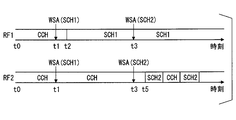
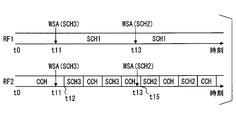
- FIGS. 16 and 17 are diagrams exemplifying time changes of communication channels set by the first wireless communication device 42 and the second wireless communication device 43 in the first embodiment.
- RF1 and RF2 mean the first radio communication device 42 and the second radio communication device 43
- CCH means the control channel
- SCH means the service channel. Further, it is assumed that the time t0 is when the power is turned on.
- the communication channel of both the first wireless communication device 42 and the second wireless communication device 43 is the control channel.
- WSA is transmitted from the notification-type roadside device 2.
- both the first wireless communication device 42 and the second wireless communication device 43 set the communication channel as the control channel, so that both the first wireless communication device 42 and the second wireless communication device 43 receive the WSA.
- This WSA includes a service channel SCH1 as channel information.
- the service channel SCH1 is a channel that can be set by the first wireless communication device 42.
- the first service channel SCH1 is a service channel that performs an SCH fixed service. Accordingly, the first wireless communication device 42 sets the communication channel to the first service channel SCH1 from time t2, which is the time when S32 of FIG. 12 becomes YES.
- the second wireless communication device 43 receives WSA at time t1, it does not change the communication channel.
- the WSA that includes the second service channel SCH2 as channel information is transmitted from a notification-type roadside device 2 that is different from the notification-type roadside device 2 that is transmitting the WSA at time t1.
- a notification-type roadside device 2 that is different from the notification-type roadside device 2 that is transmitting the WSA at time t1.
- the first wireless communication device 42 fixes the communication channel to the first service channel SCH1, it cannot receive the WSA transmitted at time t3.
- the second wireless communication device 43 uses the communication channel as the control channel, the second wireless communication device 43 receives the WSA transmitted at time t3.
- This WSA includes the second service channel SCH2 as channel information, and the second service channel SCH2 is not a communication channel set by the second wireless communication device 43 but a communication channel set by the first wireless communication device 42. . Therefore, this WSA is stored in the first queue 41M1.
- Communication using the first service channel SCH1 as the communication channel of the first wireless communication device 42 ends at time t4.
- WSA including the second service channel SCH2 as channel information is stored in the first queue 41M1. Therefore, the first communication controller 411 acquires WSA from the first queue 41M1 at time t4 and sets the communication channel to the second service channel SCH2.
- the in-vehicle device 4 uses the communication channel of the first wireless communication device 42 as the WSA transmitted from the notification roadside device 2 at time t3.
- the second service channel SCH2 shown can be set. Note that the service using the second service channel SCH2 is not a SCH fixed service. Therefore, the first wireless communication device 42 alternately sets the communication channel to the second service channel SCH2 and the control channel after time t4.
- FIG. 17 an example of FIG. 17 will be described.
- the SCH fixing condition for fixing the communication channel of the first wireless communication device 42 to the first service channel SCH1 is satisfied when the power is turned on. Therefore, from time t0 when the power is turned on, the first wireless communication device 42 fixes the communication channel to the first service channel SCH1.
- the second wireless communication device 43 sets the communication channel to the control channel.
- WSA including the third service channel SCH3 is transmitted from the notification-type roadside device 2 as channel information. This WSA is received by the second wireless communication device 43.
- the second wireless communication device 43 receives the service reception information on the third service channel SCH3 while alternately switching the communication channel to the third service channel SCH3 and the control channel.
- the WSA that includes the second service channel SCH2 as channel information is transmitted from a notification-type roadside device 2 that is different from the notification-type roadside device 2 that is transmitting the WSA at time t11.
- the first wireless communication device 42 cannot receive the WSA because the communication channel is fixed to the first service channel SCH1.
- the second wireless communication device 43 sets the communication channel to the control channel at time t13, the second wireless communication device 43 receives the WSA at time t13.
- this WSA is stored in the first queue 41M1.
- the first communication controller 411 performs the SCH fixed service execution process shown in FIG. Even in this SCH fixed service execution process, whether or not there is a WSA in its own queue is confirmed in S72. Therefore, when the WSA is stored in the first queue 41M1 at time t13, the WSA is acquired by the first communication controller 411.
- the first communication controller 411 sets the communication channel of the first wireless communication device 42 to the second service channel SCH2 from time t14. Can do.
- time t14 is the time when communication using the first service channel SCH1 as the communication channel of the first wireless communication device 42 ends.
- the in-vehicle device 4 includes the two wireless communication devices of the first wireless communication device 42 and the second wireless communication device 43.
- the second wireless communication device 43 can receive the WSA by setting the control channel as the communication channel.
- the first communication controller 411 sets the communication channel of the first wireless communication device 42 based on the WSA received by the second wireless communication device 43.
- the in-vehicle device 4 receives the WSA transmitted through the control channel, and determines the service channel specified by the WSA as the first wireless communication device. 42 communication channels can be set. Therefore, it can suppress that the communication channel of the 1st radio
- the enqueue is executed at S16.
- the first communication controller 411 and the second communication controller 413 are respectively the cases where the WSA received by the first wireless communication device 42 and the second wireless communication device 43 that are controlled objects is not for itself. That is, when it is determined that the WSA is for the other party and the other party does not execute the service determined from the WSA, the received WSA is enqueued. Thereby, storing unnecessary WSA in the queues 41M1 and 41M2 can be suppressed.
- the second communication controller 413 can not only set the communication channel as a control channel but also set the communication channel as a service channel. Therefore, the in-vehicle device 4 of the present embodiment can execute two services at the same time.
- both the first communication controller 411 and the second communication controller 413 execute FIG. Therefore, both the first communication controller 411 and the second communication controller 413 are the cases where the wireless communication devices 42 and 43 to be controlled receive WSA, and the received WSA is the partner WSA. Based on, the received WSA is enqueued. Thereby, even if either one of the first wireless communication device 42 and the second wireless communication device 43 cannot receive the WSA, the communication channel of the first wireless communication device 42 and the second wireless communication device 43 is set by the WSA. It can suppress that it cannot set to the specified service channel.
- FIG. 11 when it is determined that the service is finished, FIG. 11 is executed again. If it is determined in S4 that there is a WSA in its own queue, the WSA is acquired from the queue. Therefore, after communication for executing a certain service is completed, a service corresponding to the WSA stored in the queue can be executed immediately while communication for executing the service is performed.
- the WSA retention time exceeds the discard time by the queue update process shown in FIG. 15, the WSA is discarded. Thereby, since time has passed since the time of receiving the WSA, it is possible to suppress execution of a service that is no longer required to be executed.
- the discard time is determined from the service ID. That is, the discard time is determined for each service type. Specifically, the more important the service represented by the service ID is, the longer the discard time is. Thereby, it is possible to suppress the execution of unnecessary services while suppressing the inability to execute important services.
- the service channel that can be set as the communication channel by the first wireless communication device 42 and the service channel that can be set as the communication channel by the second wireless communication device 43 do not overlap.
- the service channel that the first wireless communication device 42 can set as the communication channel is the same as that in the first embodiment.
- the second radio communication device 43 can set all four service channels SCH1 to SCH4 as communication channels. Therefore, in the second embodiment, the service channel that can be set by the first radio communication device 42 as the communication channel can also be set by the second radio communication device 43 as the communication channel.
- FIG. 19 shows processing executed in the second embodiment instead of FIG. 11 executed in the first embodiment.
- the process which is the same as FIG. 11 is performed in the part omitted in FIG. FIG. 19 differs from FIG. 11 in two points.
- the first is that in FIG. 19, S10A is executed instead of S10 in FIG.
- the second is that S15 is provided.
- Other processes in FIG. 19 are the same as those in FIG.
- S10A which is executed when it is determined that the WSA is received in S8, it is determined whether or not the WSA is dedicated to itself.
- the third service channel SCH3 and the fourth service channel SCH4 are communication channels set only by the second radio communication device 43. That is, the third service channel SCH3 and the fourth service channel SCH4 are dedicated channels for the second radio communication device 43.
- the first wireless communication device 42 has no dedicated channel.
- the second communication controller 413 executes the processing of FIG. 19 and the WSA channel information received by the second wireless communication device 43 is information including the third service channel SCH3 or the fourth service channel SCH4. In this case, the determination in S10A is YES. Otherwise, the determination in S10A is NO. If the determination in S10A is YES, the process proceeds to S22, and if the determination in S10A is NO, the process proceeds to S12.
- S15 it is determined whether the WSA determined to have been received in S8 is dedicated to the other party. If this determination is YES, the process proceeds to S16, and the WSA determined to have been received in S8 is stored in the partner queue.
- S15 On the other hand, if judgment of S15 is NO, it will progress to S22.
- S15 When S15 is executed, the communication channel is fixed to the control channel, and the service execution process is not performed. Further, since it is not a partner-specific WSA, a service specified by the WSA can be executed. Therefore, even if the determination in S15 is NO, the process proceeds to S22 and the service execution process is performed by itself.
- FIG. 20 shows processing executed in the second embodiment instead of FIG. 13 executed in the first embodiment.
- FIG. 20 differs from FIG. 13 in three points. The first is that in FIG. 20, S52A is executed instead of S52 in FIG. The second is that S57 is provided. The third point is that S57A is provided. Other processes in FIG. 20 are the same as those in FIG.
- S52A it is determined whether the WSA determined to have been received in S50 is dedicated to itself. This S52A is the same processing as S10A of FIG.
- S57 it is determined whether or not the WSA determined to be received in S50 is dedicated to the other party. This S57 is the same process as S15 of FIG.
- the CCH reception process shown in FIG. 20 is a part of the service execution process shown in FIG. That is, in the state in which FIG. 20 is being executed, the first communication controller 411 or the second communication controller 413 that is executing FIG. 20 is also performing service execution processing.
- S57A it is determined whether or not the priority included in the WSA service information is higher than the priority of the service currently being executed. If this determination is NO, the process proceeds to S58. On the other hand, if judgment of S57A is YES, it will progress to S22. If the determination in S57A is YES and the process proceeds to S22, the service represented by the WSA determined to have been received in S50 is executed without waiting for the end of the service being executed.
- FIG. 21 and FIG. 22 are diagrams exemplifying time changes of communication channels set by the first wireless communication device 42 and the second wireless communication device 43 in the second embodiment, respectively.
- 21 and 22 the meanings of RF1, RF2, CCH, and SCH are the same as those in FIGS. Further, it is assumed that the time t0 is when the power is turned on.
- the second wireless communication device 43 receives WSA including the second service channel SCH2 as channel information.
- the second wireless communication device 43 can also set the second service channel SCH2 as a communication channel. Therefore, in the example of FIG. 21, the second communication controller 413 sets the communication channel of the second wireless communication device 43 to the second service channel SCH2 at time t5.
- the time t5 is a time before the time t4 in FIG. That is, the service specified by the WSA received at time t3 can be quickly executed.
- the second wireless communication device 43 receives the WSA including the second service channel SCH2 as channel information.
- the second wireless communication device 43 can also set the second service channel SCH2 as a communication channel.
- the determination in S57A of FIG. 20 is YES at time t13.
- the second communication controller 413 changes the communication channel of the second wireless communication device 43 to the second service channel SCH2 even if the service using the third service channel SCH3 is still being executed. Set. Therefore, the service specified by the WSA received at time t13 can be quickly executed.
- the second communication controller 413 does not perform the service execution process and receives the WSA when the communication channel of the second wireless communication device 43 is continuously set as the control channel ( S8: YES), it is determined whether the first wireless communication device 42 has set a service channel different from the service channel specified by the WSA (S14).
- the second wireless communication device 43 can set all service channels as communication channels. Therefore, the determination in S15 executed when the determination in S14 is NO is YES, and the service execution process is performed. Accordingly, when the in-vehicle device 4 receives a WSA that needs to open another service channel that can be opened by the first wireless communication device 42 when the first wireless communication device 42 has opened a certain service channel, Service execution processing can be performed using the communication channel of the second wireless communication device 43 as another service channel. Therefore, the service specified by the WSA can be executed quickly.
- the second communication controller 413 receives the WSA when the communication channel of the second wireless communication device 43 is used as the control channel even when the service execution process is being performed (S50: YES). It is determined whether the wireless communication device 42 has set a service channel different from the service channel specified by the WSA (S56).
- the second wireless communication device 43 can set all service channels as communication channels. Therefore, if the determination in S56 is NO, the determination in S57 is YES. S57A is determined. If the priority included in the service information of the WSA is higher than the priority of the service currently being executed (S57A: YES), the service execution is executed in order to execute the service indicated by the WSA. Processing (S22) is performed.
- the WSA representing the service having a high priority is set.
- the service specified by the WSA can be quickly executed.
- ⁇ Modification 1> For example, in the above-described embodiment, when the WSA is acquired from the queues 41M1 and 41M2, if the plurality of WSAs are stored in the queues 41M1 and 41M2, the WSA having the oldest reception time is acquired. However, the present invention is not limited to this, and the WSA having the highest priority among the plurality of WSAs stored in the queues 41M1 and 41M2 may be acquired. This priority is included in the WSA in the above-described embodiment, but the relationship in which the priority is determined from the service ID is stored in the memory 41M of the vehicle-mounted device 4, and the service ID included in the WSA and the relationship Priorities may be determined.
- both the first wireless communication device 42 and the second wireless communication device 43 can set the control channel as a communication channel.
- any one of the first wireless communication device 42 and the second wireless communication device 43 only needs to set a plurality of service channels as communication channels, and the control channel may not be set as a communication channel.
- the service ID corresponds to the service channel. Therefore, when the in-vehicle device 4 stores a correspondence relationship in which the service channel is determined from the service ID, the service ID included in the WSA may be used as channel information.
- the second wireless communication device 43 can set all the service channels that can be set as the communication channel by the first wireless communication device 42 as the communication channel.
- the second wireless communication device 43 may be configured to set only a part of service channels that can be set as the communication channel by the first wireless communication device 42 as the communication channel.
- ⁇ Modification 5> when the priority of the service being executed is compared with the priority of the service indicated by the WSA in S57A of FIG. 20, the priority of the service indicated by the WSA is higher.
- the service execution process was implemented. However, a service execution process is performed when the priority of the service represented by the WSA is further compared with a preset priority threshold and the priority of the service represented by the WSA is higher than the priority threshold. You may make it do. In this way, it is possible to limit only the important services to the services that are started until the services that are being performed are terminated.
- the discard time is determined for each service, but the discard time may be the same time regardless of the service.
- the service channel and the control channel are the 5.8 GHz band and the 5.9 GHz band.
- these channels may be realized using a frequency belonging to the 2.4 GHz band, or may be realized using a frequency belonging to another frequency band.
- the wireless communication system 1 includes the notification-type roadside device 2, the non-notification-type roadside device 3, and the vehicle-mounted device 4, the wireless communication system may be configured not to include the non-notification-type roadside device 3.
Landscapes
- Engineering & Computer Science (AREA)
- Computer Networks & Wireless Communication (AREA)
- Signal Processing (AREA)
- Physics & Mathematics (AREA)
- General Physics & Mathematics (AREA)
- Mobile Radio Communication Systems (AREA)
- Traffic Control Systems (AREA)
Abstract
Description
以下、本開示の実施形態を図面に基づいて説明する。図1に示すように、第1実施形態に係る無線通信システム1は、通知型路側機2と、非通知型路側機3と、車載機4とを備える。車載機4は車両用無線通信装置に相当する。
図1には、1つの通知型路側機2を示しているが、通知型路側機2は、複数であってもよい。また、非通知型路側機3、車載機4も、図1には1つずつしか示していないが、これら非通知型路側機3、車載機4も、複数であってもよい。通知型路側機2、非通知型路側機3、車載機4は、WAVEの規格に準拠して通信する。
通知型路側機2は、通知型路側機2が形成する無線通信エリア内に存在する車載機4と路車間通信を実施し、種々の情報を車載機4に送信したり、車載機4から種々の情報を取得したりすることで所定のサービスを実施する。
非通知型路側機3は、サービス通知情報であるWSAを送信しない点が通知型路側機2と相違する。その他の点は、通知型路側機2と同じである。したがって、非通知型路側機3は、図6に示すように、通知型路側機2と同じく、路側通信回路31と路側制御回路32を備える。また、路側制御回路32は路側メモリ32Mを備える。
次に、車載機4の構成を説明する。車載機4は、図8に示すように、制御回路41、第1無線通信機42、第2無線通信機43、GNSS受信機44、加速度センサ45、ジャイロセンサ46を備える。制御回路41は、第1無線通信機42、第2無線通信機43、GNSS受信機44、加速度センサ45、ジャイロセンサ46のそれぞれと、相互通信可能に接続されている。
第1通信制御器411と第1記憶制御器412は、第1無線通信機42を制御するとともに、第1キュー41M1の記憶内容を更新するために、図11~図15に示す処理を周期的に実行する。また、第2通信制御器413と第2記憶制御器414も、第2無線通信機43を制御するとともに、第2キュー41M2の記憶内容を更新するために、図11~図15に示す処理を周期的に実行する。
具体的には、WSAに含まれているサービスIDがSCH固定サービスとして設定されているサービスのサービスIDであるか否かを判断する。この判断がYESであれば、図14に進む。一方、S30の判断がNOであればS32に進む。
図16、図17は、第1実施形態における第1無線通信機42、第2無線通信機43がそれぞれ設定する通信チャネルの時間変化を例示する図である。図16、図17において、RF1、RF2はそれぞれ第1無線通信機42、第2無線通信機43を意味し、CCHはコントロールチャネルを意味し、SCHはサービスチャネルを意味する。また、時刻t0は電源オン時であるとする。
以上、説明した第1実施形態の車載機4は、第1無線通信機42と第2無線通信機43の2つの無線通信機を備える。第2無線通信機43は、コントロールチャネルを通信チャネルに設定してWSAを受信することができる。そして、第1通信制御器411は、第2無線通信機43が受信したWSAに基づいて、第1無線通信機42の通信チャネルを設定する。
次に、第2実施形態を説明する。この第2実施形態以下の説明において、それまでに使用した符号と同一番号の符号を有する要素は、特に言及する場合を除き、それ以前の実施形態における同一符号の要素と同一である。また、構成の一部のみを説明している場合、構成の他の部分については先に説明した実施形態を適用できる。
図21、図22は、第2実施形態における第1無線通信機42、第2無線通信機43がそれぞれ設定する通信チャネルの時間変化を例示する図である。図21、図22において、RF1、RF2、CCH、SCHの意味は図16、図17と同じである。また、時刻t0は電源オン時であるとする。
この第2実施形態では、第2通信制御器413は、サービス実行処理を実施しておらず、第2無線通信機43の通信チャンネルを継続してコントロールチャネルとしているときにWSAを受信した場合(S8:YES)、第1無線通信機42がWSAにより特定されるサービスチャネルとは異なるサービスチャネルを設定しているかを判断する(S14)。
たとえば、前述の実施形態では、キュー41M1、41M2からWSAを取得する場合、キュー41M1、41M2に複数のWSAが格納されていれば、受信時刻が最も古いWSAを取得していた。しかし、これに限られず、キュー41M1、41M2に格納されている複数のWSAのうち、優先度が最も高いWSAを取得してもよい。この優先度は、前述の実施形態ではWSAに含まれていたが、車載機4のメモリ41MにサービスIDから
優先度が定まる関係が記憶されており、WSAに含まれるサービスIDと、この関係から優先度を決定してもよい。
前述の実施形態では、第1無線通信機42、第2無線通信機43ともに、コントロールチャネルを通信チャネルに設定できるようになっていた。しかし、第1無線通信機42、第2無線通信機43のいずれか一方は、複数のサービスチャネルを通信チャネルに設定できればよく、コントロールチャネルは通信チャネルに設定できないようになっていてもよい。
サービスIDとサービスチャネルは対応する。したがって、車載機4が、サービスIDからサービスチャネルが定まる対応関係を記憶している場合、WSAに含まれるサービスIDをチャネル情報として利用してもよい。
第2実施形態では、第2無線通信機43は、第1無線通信機42が通信チャネルに設定可能な全てのサービスチャネルを通信チャネルに設定できるようになっていた。しかし、第2無線通信機43は、第1無線通信機42が通信チャネルに設定可能なサービスチャネルのうちの一部のみを通信チャネルに設定できるようになっていてもよい。
第2実施形態では、図20のS57Aで、実施中のサービスの優先度と、WSAが表しているサービスの優先度とを比較し、WSAが表しているサービスの優先度の方が高い場合に、サービス実行処理を実施していた。しかし、WSAが表しているサービスの優先度と予め設定された優先度閾値との比較をさらに行い、WSAが表しているサービスの優先度が優先度閾値よりも高い場合に、サービス実行処理を実施するようにしてもよい。このようにすれば、実施中のサービスを途中で終了してまで開始するサービスを、重要なサービスのみとすることができる。
前述の実施形態では、S14、S56の判断がNOであれば、受信したWSAを常にキューに格納していた。しかし、受信したWSAに、サービスチャネルを即座にオープンすることを指示する情報が含まれている場合には、WSAをキューに格納せずに、即座にそのWSAが表しているサービスチャネルをオープンしてもよい。
前述の実施形態では、破棄時間をサービス毎に決定していたが、破棄時間をサービスによらず同じ時間としてもよい。
前述の実施形態では、サービスチャネルやコントロールチャネルは、5.8GHz帯や5.9GHz帯であった。しかし、これらのチャネルは、2.4GHz帯に属する周波数を用いて実現されても良いし、その他の周波数帯に属する周波数を用いて実現されても良い。
無線通信システム1は、通知型路側機2と、非通知型路側機3と、車載機4とを備えていたが、無線通信システムを、非通知型路側機3を備えない構成としてもよい。
Claims (12)
- 互いに異なる周波数チャネルに設定された複数のサービスチャネルおよびコントロールチャネルで情報を受信する車両用無線通信装置であって、
前記複数のサービスチャネルから、サービスの種類に応じて定まる前記サービスチャネルを受信チャネルに設定して、前記サービスを実行するための情報であるサービス実行情報を受信する第1無線受信機(42)と、
前記コントロールチャネルを受信チャネルに設定して、前記サービスチャネルが定まる情報であるチャネル情報を含んでいるサービス通知情報を受信する第2無線受信機(43)と、
前記第2無線受信機が受信した前記サービス通知情報に含まれている前記チャネル情報に基づいて、前記第1無線受信機の前記受信チャネルを設定する受信制御器(411)とを備え、車両で用いられる
車両用無線通信装置。 - 請求項1において、
前記第2無線受信機が受信した前記サービス通知情報を記憶する記憶器(41M1)を備え、
前記受信制御器は、前記記憶器から前記サービス通知情報に含まれている前記チャネル情報を取得し、取得した前記チャネル情報に基づいて、前記第1無線受信機の前記受信チャネルを設定する
車両用無線通信装置。 - 請求項1または2において、
前記第1無線受信機は、前記コントロールチャネルも前記第1無線受信機の前記受信チャネルに設定可能であり、
前記受信制御器は、前記第1無線受信機の前記受信チャネルを、前記サービスチャネルに設定していないときは、前記コントロールチャネルに設定する
車両用無線通信装置。 - 請求項2において、
前記第2無線受信機が受信した前記サービス通知情報に含まれている前記チャネル情報により特定される前記サービスチャネルが、前記第1無線受信機が設定可能な前記受信チャネルであり、かつ、前記第2無線受信機が前記サービス通知情報を受信したときに、前記第1無線受信機が、前記サービス通知情報に含まれている前記チャネル情報により特定される前記サービスチャネルとは異なる前記サービスチャネルを設定していることに基づいて、前記サービス通知情報を前記記憶器に記憶する記憶制御器(414)を備える
車両用無線通信装置。 - 請求項1~4のいずれか1項において、
前記第2無線受信機は、前記コントロールチャネルに加えて、少なくとも1つの前記サービスチャネルが設定可能であり、
前記受信制御器を第1受信制御器(411)として備えるとともに、
前記第2無線受信機の前記受信チャネルを制御する第2受信制御器(413)を備え、
前記第2受信制御器は、前記第2無線受信機が受信した前記サービス通知情報に含まれている前記チャネル情報により特定される前記サービスチャネルが、前記第2無線受信機が設定可能な前記サービスチャネルであることに基づいて、前記第2無線受信機の前記受信チャネルを、前記チャネル情報により特定される前記サービスチャネルに設定する
車両用無線通信装置。 - 請求項5において、
前記第2無線受信機は、前記コントロールチャネルに加えて、前記第1無線受信機が設定可能な前記複数のサービスチャネルのうちの少なくとも1つを、前記第2無線受信機の前記受信チャネルに設定可能であり、
前記第2受信制御器は、前記第2無線受信機の前記受信チャネルを前記コントロールチャネルとして前記サービス通知情報を受信したときに、前記第1無線受信機が、前記サービス通知情報に含まれている前記チャネル情報により特定される前記サービスチャネルとは異なる前記サービスチャネルを設定しており、かつ、前記チャネル情報により特定される前記サービスチャネルが、前記第1無線受信機および前記第2無線受信機がともに設定可能な前記受信チャネルであることに基づいて、前記第2無線受信機の前記受信チャネルを、前記チャネル情報により特定される前記サービスチャネルに設定する
車両用無線通信装置。 - 請求項6において、
前記第2無線受信機は、前記コントロールチャネルに加えて、前記第1無線受信機が設定可能な前記複数のサービスチャネルのうちの少なくとも1つを含む2つ以上の前記サービスチャネルを、前記第2無線受信機の前記受信チャネルに設定可能であり、
前記第2受信制御器は、
前記第2無線受信機の前記受信チャネルを、前記コントロールチャネル、および、前記第2無線受信機が設定可能な2つ以上の前記サービスチャネルのうちのいずれかの前記サービスチャネルに交互に切り替えつつ、前記受信チャネルを前記サービスチャネルとしているときに前記サービス実行情報を受信し、
前記第2無線受信機の前記受信チャネルを前記コントロールチャネルとしたときに、前記サービス通知情報を受信した場合、前記第1無線受信機が、前記サービス通知情報に含まれている前記チャネル情報により特定される前記サービスチャネルとは異なる前記サービスチャネルを設定しており、前記チャネル情報により特定される前記サービスチャネルが前記第2無線受信機が設定可能な前記受信チャネルであって、前記受信チャネルを前記サービスチャネルとして受信している前記サービス実行情報が表す前記サービスの優先度よりも、前記第2無線受信機の前記受信チャネルを前記コントロールチャネルとして受信した前記サービス通知情報に含まれている前記チャネル情報から特定できる前記サービスの優先度が高いことに基づいて、前記第2無線受信機の前記受信チャネルを、前記チャネル情報により特定される前記サービスチャネルに設定する
車両用無線通信装置。 - 請求項4において、
前記受信制御器は、前記第1無線受信機が、前記サービスの終了を示す前記サービス実行情報を受信した後に、前記記憶器に前記サービス通知情報が記憶されていることに基づいて、前記記憶器から前記サービス通知情報を取得し、
前記記憶制御器は、前記サービス通知情報を前記記憶器に記憶している時間が破棄時間を超えたことに基づいて、前記サービス通知情報を前記記憶器から消去する
車両用無線通信装置。 - 請求項8において、
前記サービス通知情報は、前記チャネル情報に加えて、前記サービスの種類を特定できる情報を含んでおり、
前記記憶制御器は、前記サービス通知情報により定まる前記サービスの種類ごとに前記破棄時間を決定する
車両用無線通信装置。 - 請求項4、8、9のいずれか1項において、
前記サービス通知情報は、前記チャネル情報と、前記サービスの種類を特定できる情報と、前記サービスの優先度を特定できる情報とを含んでおり、
前記記憶制御器は、前記記憶器に前記サービス通知情報が記憶されており、かつ、前記記憶器に記憶されている前記サービス通知情報とは、特定できる前記サービスが異なる前記サービス通知情報を前記第2無線受信機が受信したことに基づいて、すでに前記記憶器に記憶されている前記サービス通知情報を前記記憶器に記憶したまま、前記第2無線受信機が受信した前記サービス通知情報を前記記憶器に記憶し、
前記受信制御器は、前記記憶器に複数の前記サービス通知情報が記憶されている場合、前記優先度が最も高い前記サービス通知情報に基づいて定まる前記サービスチャネルに、前記第1無線受信機の前記受信チャネルを設定する
車両用無線通信装置。 - 前記サービス実行情報に加えて、前記サービス通知情報を送信する通知型路側機(2)と、
請求項1~10のいずれか1項に記載の車両用無線通信装置(4)と、を備える
無線通信システム。 - 請求項11において、
前記サービス通知情報は送信せずに、前記サービス実行情報を送信する非通知型路側機(3)を備える
無線通信システム。
Priority Applications (2)
| Application Number | Priority Date | Filing Date | Title |
|---|---|---|---|
| US15/735,404 US10582353B2 (en) | 2015-07-10 | 2016-05-30 | Wireless communication device for vehicles and wireless communication system |
| SG11201708614PA SG11201708614PA (en) | 2015-07-10 | 2016-05-30 | Wireless communication device for vehicles and wireless communication system |
Applications Claiming Priority (2)
| Application Number | Priority Date | Filing Date | Title |
|---|---|---|---|
| JP2015-138787 | 2015-07-10 | ||
| JP2015138787A JP6493045B2 (ja) | 2015-07-10 | 2015-07-10 | 車両用無線通信装置および無線通信システム |
Publications (1)
| Publication Number | Publication Date |
|---|---|
| WO2017010035A1 true WO2017010035A1 (ja) | 2017-01-19 |
Family
ID=57757328
Family Applications (1)
| Application Number | Title | Priority Date | Filing Date |
|---|---|---|---|
| PCT/JP2016/002610 Ceased WO2017010035A1 (ja) | 2015-07-10 | 2016-05-30 | 車両用無線通信装置および無線通信システム |
Country Status (4)
| Country | Link |
|---|---|
| US (1) | US10582353B2 (ja) |
| JP (1) | JP6493045B2 (ja) |
| SG (1) | SG11201708614PA (ja) |
| WO (1) | WO2017010035A1 (ja) |
Cited By (1)
| Publication number | Priority date | Publication date | Assignee | Title |
|---|---|---|---|---|
| CN111066331A (zh) * | 2017-09-19 | 2020-04-24 | 三菱电机株式会社 | 车辆用无线通信装置 |
Families Citing this family (2)
| Publication number | Priority date | Publication date | Assignee | Title |
|---|---|---|---|---|
| US11838855B2 (en) * | 2020-06-19 | 2023-12-05 | Blackberry Limited | Advertising service information for a service |
| US11604760B2 (en) * | 2021-03-16 | 2023-03-14 | International Business Machines Corporation | Dynamic determination of retention periods for digital content |
Citations (3)
| Publication number | Priority date | Publication date | Assignee | Title |
|---|---|---|---|---|
| WO2011111282A1 (ja) * | 2010-03-12 | 2011-09-15 | 日本電気株式会社 | 通信システム、通信機、通信方法 |
| JP2012528496A (ja) * | 2009-05-29 | 2012-11-12 | エヌイーシー ヨーロッパ リミテッド | ネットワークノードの無線送受信機を連携させる方法およびネットワークノード |
| JP2013504231A (ja) * | 2009-09-02 | 2013-02-04 | エヌイーシー ヨーロッパ リミテッド | 通信ネットワーク内でマルチチャネル信号方式を可能にする方法 |
Family Cites Families (6)
| Publication number | Priority date | Publication date | Assignee | Title |
|---|---|---|---|---|
| DE69724625T2 (de) * | 1996-09-02 | 2004-06-24 | Stmicroelectronics N.V. | Verbesserungen bei, oder in bezug auf mehrträgerübertragungssysteme |
| JP4285321B2 (ja) | 2004-05-13 | 2009-06-24 | トヨタ自動車株式会社 | 車車間通信システム及び車両用無線通信装置 |
| US8761676B2 (en) | 2010-03-09 | 2014-06-24 | Stmicroelectronics, Inc. | Channel switching for interoperable safety and non-safety communications in wireless environments |
| KR101338479B1 (ko) * | 2010-06-11 | 2013-12-10 | 한국전자통신연구원 | 차량 환경에서의 무선 접속을 이용한 채널 할당 방법 및 그 장치 |
| TWI458378B (zh) * | 2010-12-08 | 2014-10-21 | Ind Tech Res Inst | 提供車載通訊服務頻道之方法及系統、以及切換車載通訊服務頻道之方法及系統與電腦可讀取媒體 |
| EP3314917B1 (en) * | 2015-06-24 | 2019-08-07 | INTEL Corporation | Enhanced proximity services (prose) protocols for vehicle-to-anything (v2x) communication |
-
2015
- 2015-07-10 JP JP2015138787A patent/JP6493045B2/ja active Active
-
2016
- 2016-05-30 WO PCT/JP2016/002610 patent/WO2017010035A1/ja not_active Ceased
- 2016-05-30 US US15/735,404 patent/US10582353B2/en not_active Expired - Fee Related
- 2016-05-30 SG SG11201708614PA patent/SG11201708614PA/en unknown
Patent Citations (3)
| Publication number | Priority date | Publication date | Assignee | Title |
|---|---|---|---|---|
| JP2012528496A (ja) * | 2009-05-29 | 2012-11-12 | エヌイーシー ヨーロッパ リミテッド | ネットワークノードの無線送受信機を連携させる方法およびネットワークノード |
| JP2013504231A (ja) * | 2009-09-02 | 2013-02-04 | エヌイーシー ヨーロッパ リミテッド | 通信ネットワーク内でマルチチャネル信号方式を可能にする方法 |
| WO2011111282A1 (ja) * | 2010-03-12 | 2011-09-15 | 日本電気株式会社 | 通信システム、通信機、通信方法 |
Cited By (2)
| Publication number | Priority date | Publication date | Assignee | Title |
|---|---|---|---|---|
| CN111066331A (zh) * | 2017-09-19 | 2020-04-24 | 三菱电机株式会社 | 车辆用无线通信装置 |
| US11403944B2 (en) | 2017-09-19 | 2022-08-02 | Mitsubishi Electric Corporation | Vehicle wireless communication device |
Also Published As
| Publication number | Publication date |
|---|---|
| JP6493045B2 (ja) | 2019-04-03 |
| SG11201708614PA (en) | 2017-11-29 |
| US20180184271A1 (en) | 2018-06-28 |
| US10582353B2 (en) | 2020-03-03 |
| JP2017022561A (ja) | 2017-01-26 |
Similar Documents
| Publication | Publication Date | Title |
|---|---|---|
| JP6540594B2 (ja) | 車両制御システムおよび車両制御装置 | |
| JP2019074853A (ja) | 車載通信装置、通信制御方法、及び車両 | |
| JP6942413B2 (ja) | 通信装置、通信システム、及び通信制御方法 | |
| JP2000090395A (ja) | 車両間通信の送信装置及び方法 | |
| JP6493045B2 (ja) | 車両用無線通信装置および無線通信システム | |
| CN107950068B (zh) | 无线通信装置 | |
| US20200236520A1 (en) | Mobile object communication system and mobile object side device | |
| JP2009252214A (ja) | 無線通信システム | |
| JP6375931B2 (ja) | 無線通信装置 | |
| JP2009118061A (ja) | 車両用無線通信装置 | |
| EP3223258A2 (en) | Terminal device and method for terminal device | |
| JP2008148131A (ja) | 車車間通信の発信信号周波数設定システム及びその発信信号周波数設定方法 | |
| JP2010011414A (ja) | 無線装置 | |
| JP2010016493A (ja) | 無線装置 | |
| JP6418090B2 (ja) | 無線通信装置 | |
| WO2019150460A1 (ja) | 車載装置、車車間通信方法、及びコンピュータプログラム | |
| JP4631625B2 (ja) | 車両用無線通信装置および車両用無線通信方法 | |
| JP4618059B2 (ja) | 車車間通信装置 | |
| JP2004310558A (ja) | 車々間通信システム | |
| JP2016131320A (ja) | 無線通信装置 | |
| CN112312356B (zh) | 车载通信装置 | |
| JP2004222008A (ja) | 車々間通信システム | |
| JP2009290680A (ja) | 無線通信装置及び車車間通信システム | |
| US20230282111A1 (en) | Vehicle-mounted device, vehicle communication system, and algorithm provision method | |
| JP5741525B2 (ja) | 車両用無線通信装置および車車間情報通信システム |
Legal Events
| Date | Code | Title | Description |
|---|---|---|---|
| 121 | Ep: the epo has been informed by wipo that ep was designated in this application |
Ref document number: 16824021 Country of ref document: EP Kind code of ref document: A1 |
|
| WWE | Wipo information: entry into national phase |
Ref document number: 11201708614P Country of ref document: SG |
|
| WWE | Wipo information: entry into national phase |
Ref document number: 15735404 Country of ref document: US |
|
| NENP | Non-entry into the national phase |
Ref country code: DE |
|
| 122 | Ep: pct application non-entry in european phase |
Ref document number: 16824021 Country of ref document: EP Kind code of ref document: A1 |