WO2016208527A1 - 容器詰め炭酸飲料および容器詰め炭酸飲料の品質改善方法 - Google Patents
容器詰め炭酸飲料および容器詰め炭酸飲料の品質改善方法 Download PDFInfo
- Publication number
- WO2016208527A1 WO2016208527A1 PCT/JP2016/068215 JP2016068215W WO2016208527A1 WO 2016208527 A1 WO2016208527 A1 WO 2016208527A1 JP 2016068215 W JP2016068215 W JP 2016068215W WO 2016208527 A1 WO2016208527 A1 WO 2016208527A1
- Authority
- WO
- WIPO (PCT)
- Prior art keywords
- container
- carbonated
- content
- drink
- fatty acid
- Prior art date
- Legal status (The legal status is an assumption and is not a legal conclusion. Google has not performed a legal analysis and makes no representation as to the accuracy of the status listed.)
- Ceased
Links
Images


Classifications
-
- A—HUMAN NECESSITIES
- A23—FOODS OR FOODSTUFFS; TREATMENT THEREOF, NOT COVERED BY OTHER CLASSES
- A23L—FOODS, FOODSTUFFS OR NON-ALCOHOLIC BEVERAGES, NOT OTHERWISE PROVIDED FOR; PREPARATION OR TREATMENT THEREOF
- A23L2/00—Non-alcoholic beverages; Dry compositions or concentrates therefor; Preparation or treatment thereof
Definitions
- the present invention relates to a container-packed carbonated drink and a method for improving the quality of a container-packed carbonated drink.
- Carbonated drinks are generally known as palatability drinks that allow consumers to taste a unique carbonation due to carbon dioxide contained in the carbonated drinks when they are drunk.
- the carbonic acid gas dissolved in the drink gradually escapes with the passage of time after opening, and thus the above-mentioned unique carbonic acid feeling is reduced. there were.
- Patent Document 1 contains an oil-in-water emulsion composition containing emulsion particles having an average particle diameter of 120 nm or less in order to suppress the outflow of carbon dioxide dissolved in a carbonated beverage containing lycopene. The technology to be described is described.
- the above-mentioned conventional technology can be expected to have a certain effect in terms of reducing the amount of carbon dioxide that escapes when a container is opened to drink a carbonated beverage, that is, in terms of suppressing the outflow of carbon dioxide.
- carbonated beverages that are distributed in the market, even if measures are taken to reduce the amount of carbon dioxide that escapes when the container is opened as in the above-described prior art, it is still possible to suppress the outflow of carbon dioxide.
- a peculiar carbonic sensation by carbon dioxide gas would not be sustained for a long time due to a phenomenon such as foaming after opening.
- the present inventor has found that the presence of a fragrance compounded to increase the preference for most carbonated drinks is one of the factors. Specifically, the present inventor has found that when a fragrance component is contained in a carbonated beverage, inconveniences such as outgassing and foaming are promoted.
- the present inventor has found that conventional carbonated beverages, which have taken measures to reduce the amount of carbon dioxide that escapes when the container is opened, have a complex taste due to the effects of additives formulated in anticipation of an effect of suppressing gas loss. I also found out that it tends to end up. Specifically, as described above, the present inventor emphasizes the taste derived from the additive when the outgassing or foaming of carbon dioxide gas occurs in the conventional carbonated beverage, and the taste is enhanced. It has also been found that there is a disadvantage that the quality deteriorates with the passage of time after opening. Thus, the conventional carbonated drink had room for improvement also in the point of temporal stability of taste. In addition, the quality of carbonated beverages is generally evaluated to be high when there is a balance between the refreshing carbonic acid-derived feel of carbon dioxide, the taste of the beverage itself, and the flavor that consumers feel when drinking. There is a tendency.
- the present invention provides a container-packed carbonated beverage excellent in long-term stability of quality and a method for improving the quality thereof from the viewpoints of outgassing suppression, foaming suppression, and taste stability over time.
- the present inventors diligently studied to provide a container-packed carbonated drink excellent in long-term stability of quality from the viewpoints of suppressing outgassing, suppressing foaming, and stability over time of taste. As a result, it has been found that the combined use of an emulsifier containing a polyglycerin fatty acid ester and a fragrance containing a specific hydrophobic component is effective as a design guideline, leading to the present invention.
- a fragrance comprising one or more ingredients selected from the group consisting of limonene, linalool, geraniol and citral;
- An emulsifier containing a polyglycerol fatty acid ester is a compound formed by ester bonding of polyglycerol and a fatty acid having 12 to 18 carbon atoms,
- a container-packed carbonated drink in which the total amount of the limonene content, the linalool content, the geraniol content, and the citral content is 1 ppm or more with respect to the total amount of the carbonated drink in the container is provided.
- the method comprises a step of mixing a fragrance containing one or more components selected from the group consisting of limonene, linalool, geraniol and citral, and an emulsifier containing a polyglycerol fatty acid ester,
- the fatty acid ester is a compound in which polyglycerin and a fatty acid having 12 to 18 carbon atoms are ester-bonded, and the limonene content, the linalool content, and the geraniol with respect to the total amount of the carbonated beverage packed in the container
- a method for improving the quality of a container-packed carbonated beverage in which the total content of the citral and the citral content is 1 ppm or more.
- the present invention it is possible to provide a container-packed carbonated beverage excellent in long-term stability in quality and a method for improving the quality thereof from the viewpoints of suppressing outgassing, suppressing foaming and aging stability of taste.
- the container-packed carbonated beverage of the present invention contains a fragrance containing one or more components selected from the group consisting of limonene, linalool, geraniol and citral, and an emulsifier containing a polyglycerol fatty acid ester.
- the polyglycerin fatty acid ester is a compound formed by ester bonding of polyglycerin and a fatty acid having 12 to 18 carbon atoms
- limonene is based on the total amount of the packaged carbonated beverage.
- the total amount of the content, the content of linalool, the content of geraniol and the content of citral is 1 ppm or more.
- the present inventor has found that conventional carbonated beverages that have taken measures to reduce the amount of carbon dioxide that escapes when the container is opened have a complex taste due to the effects of additives formulated in anticipation of an effect of suppressing gas loss. They also found out that they tend to be Specifically, the present inventor has found that conventional carbonated beverages tend to emphasize a rich taste with the passage of time after opening. In addition, the quality of carbonated beverages is generally evaluated to be high when there is a balance between the refreshing carbonic acid-derived feel of carbon dioxide, the taste of the beverage itself, and the flavor that consumers feel when drinking. There is a tendency.
- carbonated drink hereinafter also referred to as “carbonated drink”
- the fragrance containing one or more components selected from the group consisting of limonene, linalool, geraniol and citral, polyglycerin, and fatty acid having 12 to 18 carbon atoms are esterified.
- a total amount of limonene content, linalool content, geraniol content and citral content with respect to the total amount of the carbonated beverage is 1 ppm or more. It is. In this way, the reason is not clear, but due to the synergistic effect of the specific perfume and the specific emulsifier, long-term stability of quality in terms of outgassing suppression, suppression of foaming and stability over time of taste. An excellent container-packed carbonated beverage can be realized.
- the amount of carbon dioxide contained in the carbonated beverage in the present invention is preferably 2.0 vol% or more and 6.0 vol% or less, and more preferably 2.3 vol% or more and 5. vol% or less with respect to the total amount of the carbonated beverage. It is 0 vol% or less.
- the carbonated drinks according to the present invention are various carbonated drinks such as non-colored drinks such as cider drinks, ramune drinks, fruit juice drinks, colored carbonated drinks (eg cola drinks and melon soda), and non-alcoholic beer drinks. It can be set as the drink containing gas.
- the above-described disadvantages in the conventional carbonated beverages are not limited to the presence or absence of the alcohol component, and may occur in any form of beverage as long as it is a beverage that contains a fragrance and contains carbon dioxide gas. Therefore, the carbonated beverage according to the present invention may be a beverage containing an alcohol component together with carbon dioxide, that is, a carbonated beverage containing alcohol.
- Examples of carbonated beverages (alcoholic beverages) containing such alcohol include beer, sparkling liquor, chu-hi, and cocktails.
- the carbonated beverage according to the present invention can be used for any of non-colored beverages, ramune beverages, fruit juice-containing beverages, colored carbonated beverages, non-alcoholic beer beverages, and alcoholic beverages.
- the container for sealing the carbonated beverage in the present invention can be appropriately selected and used as long as it is a sealed container known in the beverage industry.
- a sealed container made of a single material such as glass, plastic (polyethylene terephthalate (PET), etc.), aluminum, steel, or a composite material or a laminated material.
- PET polyethylene terephthalate
- a container shape is not specifically limited, For example, a can container, a bottle container, etc. are mentioned.
- the total content of limonene, linalool, geraniol and citral relative to the total amount of the carbonated beverage is 1 ppm or more, preferably 2 ppm or more, and more preferably 3 ppm or more.
- the upper limit of the said total content is not specifically limited, For example, 500 ppm or less may be sufficient, 300 ppm or less may be sufficient, and 100 ppm or less may be sufficient.
- the total content of limonene, linalool, geraniol and citral relative to the total amount of beverage can be quantified by a solid phase microextraction method (SPME) method using a gas chromatograph mass spectrometer (GC / MS).
- SPME solid phase microextraction method
- GC / MS gas chromatograph mass spectrometer
- the emulsifier according to the present invention includes a polyglycerin fatty acid ester which is a compound formed by ester bonding of polyglycerin and a fatty acid having 12 to 18 carbon atoms.
- polyglycerol fatty acid esters include food emulsifiers such as decaglycerol monolaurate, decaglycerol monomyristate, decaglycerol monostearate, decaglycerol monooleate, and pentaglycerol monooleate.
- it is a compound formed by ester-linking polyglycerin and oleic acid, and monooleic acid decaglycerin is more preferable as one of representative examples of food emulsifiers.
- the content of the emulsifier is, for example, 1 ⁇ 10 ⁇ 4 mass% or more with respect to the total amount of the carbonated beverage from the viewpoint of making the synergistic effect of the emulsifier and the fragrance more remarkable.
- 2 ⁇ 10 ⁇ 2 mass% or less preferably 2 ⁇ 10 ⁇ 4 mass% or more and 2 ⁇ 10 ⁇ 2 mass% or less, more preferably 5 ⁇ 10 ⁇ 4 based on the total amount of the carbonated beverage. It is not less than 2% 10 -2 % by mass.
- the HLB (Hydrophilic-Lipophilic Balance, balance between hydrophilicity and hydrophobicity) value of the polyglycerol fatty acid ester is preferably 8 or more, and more preferably 10 or more. By doing so, it is possible to further improve the outgassing suppression effect and the bubbling suppression effect.
- flavor which concerns on this invention contains 1 or more components selected from the group which consists of limonene, a linalool, geraniol, and citral.
- Limonene, linalool, geraniol, and citral are all components that are difficult to dissolve in water (components having low affinity with water), that is, hydrophobic components. Therefore, each of the above-described components is considered to be a component having a possibility of acting as a carbonate nucleus in the carbonated beverage.
- all of the above-mentioned limonene, linalool, geraniol, and citral are known as components contained in a large amount in citrus fruits.
- the fragrance according to the present invention it is preferable to use a citrus flavor containing at least one component selected from the group consisting of limonene, linalool, geraniol and citral.
- flavor can use the other citrus flavor which has hydrophobic components, such as an aldehyde component and a terpene component.
- other citrus flavors containing an aldehyde component include octanal, decanal, nonanal and the like
- other citrus flavors including a terpene component include ⁇ -pinene and the like.
- synergistic effect of the emulsifier and the fragrance according to the present invention is that hexanal or trans-2- is used instead of the citrus flavor containing one or more components selected from the group consisting of limonene, linalool, geraniol and citral.
- Apple flavors containing hydrophobic components such as hexenal
- peach flavors containing hydrophobic components such as ⁇ -decalactone, ⁇ -hexalactone, ⁇ -nonalactone, ⁇ -heptalactone, ⁇ -dodecalactone, hexanol, trans-2-hexenol It is presumed that the same effect can be obtained even when a soft fruit flavor such as a grape flavor containing a hydrophobic component such as the above is used.
- the carbonated beverage according to the present invention may contain a natural sweetener or a synthetic sweetener. By carrying out like this, since it is possible to provide sweet taste to carbonated drink, it can be set as the carbonated drink excellent in palatability.
- the natural sweeteners mentioned above include sugars such as sucrose, glucose, fructose, lactose, maltose, fructose glucose liquid sugar, low sweetness sweeteners such as xylitol and D-sorbitol, thaumatin, stevia extract, disodium glycyrrhizinate High-intensity sweeteners and the like.
- examples of the above-mentioned synthetic sweetener include high-intensity sweeteners such as acesulfame potassium, sucralose, aspartame, saccharin, neotame, saccharin sodium and the like. These sweeteners may be used individually by 1 type, and may mix 2 or more types.
- the carbonated beverage according to the present invention may contain fruit juice.
- the fruit juice includes not only the fruit that has been crushed and squeezed, strained, etc. to remove the skin, seeds, etc., but also the puree-like pulp that has just been crushed the fruit.
- the type of fruit is not particularly limited, for example, grapes such as Muscat and Kyoho, mandarin orange, lemon, grapefruit, lime, mandarin, yuzu, seeker, tangerine, temple orange, tangero, Caramansi, Dekopon, Ponkan, Iyokan, Banpeille and other citrus fruits, strawberry, blueberry, raspberry, acai, kiwifruit, peach, apple, pineapple, guava, banana, mango, acerola, prune, papaya, passion fruit, ume, pear, apricot Lychee, melon, watermelon, cherry, pear, plum and the like. You may use these fruits individually by 1 type or in mixture of 2 or more types.
- the fruit juice contained in the carbonated beverage according to the present invention is not limited to the fruit-derived fruit juice described above, and may contain the following vegetable-derived fruit juice (vegetable juice).
- the types of vegetables include sweet corn, green beans, radish, carrots, burdock, radish, turnip, sweet potato, potato, Chinese yam, yam, taro, ginenjo, yamatomo, bell pepper, paprika, citrus, cucumber, celery, kale, leek, cabbage , Chinese cabbage, Sengoku, Saladana, Sanchu, Ooba, Spinach, Komatsuna, Mizuna, Mibuuna, Asparagus, Cucumber Rhinoceros, Lettuce, Thyme, Parsley, Italian Parsley, Rosemary, Oregano, Lemon Balm, Chives, Lavender, Salad Barnet, Rams Year , Rocket, Dandy Lion, Nastatum, Basil, Arugula, Watercress, Morohe
- the carbonated beverage according to the present invention may further contain a sour agent. By carrying out like this, it can be set as the carbonated drink excellent in taste in the point of a refreshing feeling.
- the acidulant according to the present invention is not particularly limited. For example, trisodium citrate, anhydrous citric acid, adipic acid, gluconic acid, succinic acid, tartaric acid, lactic acid, fumaric acid, malic acid, phosphoric acid, phytic acid, ascorbine Examples thereof include acids or salts thereof.
- the carbonated beverage according to the present invention includes various nutritional components, extracts, sweeteners, colorants, diluents, antioxidants and the like as long as the object of the present invention is not impaired.
- Other food additives can also be added.
- flavor containing 1 or more components selected from the group which consists of limonene, linalool, geraniol, and citral, and the emulsifier containing polyglycerol fatty acid ester It can be produced using a known production method on the premise of inclusion.
- the total amount of limonene, linalool, geraniol, and citral is 1 ppm or more with respect to the total amount of the carbonated beverage in the container. It is necessary to mix the above fragrances.
- Examples of the known production method include a premix method and a postmix method, and any method may be adopted in the present invention.
- the following method can be adopted as the above-mentioned known production method.
- a beverage stock solution is prepared by adding and mixing various additives to a solvent containing water as a main component or a diluted solution thereof.
- the container-packed carbonated drink according to the present invention can be obtained by filling the container with carbon dioxide gas after filling the obtained beverage stock solution with carbon dioxide.
- the process which sterilizes the said carbonated drink may be included.
- a carbonated beverage having improved quality in terms of taste and suppressing outgassing and foaming of carbon dioxide contains one or more components selected from the group consisting of limonene, linalool, geraniol and citral It is important to employ a method including a step of mixing a fragrance and an emulsifier containing a polyglycerin fatty acid ester.
- the polyglycerol fatty acid ester to be used is a compound formed by ester bonding of polyglycerol and a fatty acid having 12 to 18 carbon atoms.
- the total amount of limonene, linalool, geraniol, and citral should be 1 ppm or more with respect to the total amount of carbonated beverage in the container.
- the component mentioned above can be used as a component in the container-packed carbonated drink used for this quality improvement method.
- the citrus flavor mentioned above can be used as a fragrance
- Example 1 A mixed solvent was prepared by adding a lemon flavor and an emulsifier containing decaglycerin monooleate (manufactured by Taiyo Kagaku Co., Ltd.) after mixing with pure water so as to have the blending ratio shown in Table 1 below with respect to pure water. . Further, carbonated water (pure water containing carbon dioxide) was mixed with the above mixed solvent so that the amount of carbon dioxide was about 4 vol%, and then filled and sealed in a 500 mL PET bottle. Thus, the carbonated drink of Example 1 was produced.
- a lemon flavor and an emulsifier containing decaglycerin monooleate manufactured by Taiyo Kagaku Co., Ltd.
- Example 2 A mixed solvent was prepared by adding a grapefruit flavor and an emulsifier (made by Taiyo Kagaku Co., Ltd.) containing monooleic acid decaglycerin to the pure water so as to have the mixing ratio shown in Table 1 below, followed by mixing. . Further, carbonated water (pure water containing carbon dioxide) was mixed with the above mixed solvent so that the amount of carbon dioxide was about 4 vol%, and then filled and sealed in a 500 mL PET bottle. Thus, the carbonated beverage of Example 2 was produced.
- a grapefruit flavor and an emulsifier made by Taiyo Kagaku Co., Ltd.
- carbonated water pure water containing carbon dioxide
- a mixed solvent was prepared by adding an emulsifier (made by Taiyo Kagaku Co., Ltd.) containing monooleic acid decaglycerin to pure water so as to have a blending ratio shown in Table 1 below. Further, carbonated water (pure water containing carbon dioxide) was mixed with the above mixed solvent so that the amount of carbon dioxide was about 4 vol%, and then filled and sealed in a 500 mL PET bottle. In this way, a carbonated beverage of Comparative Example 2 was produced.
- an emulsifier made by Taiyo Kagaku Co., Ltd.
- carbonated water pure water containing carbon dioxide
- ⁇ Comparative Example 3> A mixed solvent was prepared by adding lemon flavor and mixing with pure water so that the blending ratio shown in Table 1 below was obtained. Further, carbonated water (pure water containing carbon dioxide) was mixed with the above mixed solvent so that the amount of carbon dioxide was about 4 vol%, and then filled and sealed in a 500 mL PET bottle. In this way, a carbonated beverage of Comparative Example 3 was produced.
- ⁇ Comparative example 4> A mixed solvent was prepared by adding grapefruit flavor and mixing with pure water so as to have the blending ratio shown in Table 1 below. Further, carbonated water (pure water containing carbon dioxide) was mixed with the above mixed solvent so that the amount of carbon dioxide was about 4 vol%, and then filled and sealed in a 500 mL PET bottle. In this way, a carbonated beverage of Comparative Example 4 was produced.
- each of the carbonated drinks obtained was evaluated as follows.
- the carbonated drink used for evaluation used what was left and stored for 12 hours or more at 20 degreeC immediately after manufacture.
- Sensory evaluation test 2 Carbonated beverages of Examples 1 and 2 and Comparative Examples 1 to 4 immediately after opening, and Examples 1 and 2 and Comparative Examples 1 to 4 60 minutes after opening 5 experienced panelists tasted it. Each panelist performed a 9-level evaluation of 1 to 9 points on the sampled carbonated beverages according to the following evaluation criteria.
- the evaluation result according to the sensory evaluation test 2 was the average of the evaluation points by each panel. 1 point: I do not think there is a refreshing feeling 9 points: I think there is a refreshing feeling
- Sensory evaluation test 3 Carbonated beverages of Examples 1 and 2 and Comparative Examples 1 to 4 immediately after opening, Examples 1 to 2 and Comparative Examples 1 to 4 60 minutes after opening Were tasted by five experienced panelists. Each panelist performed a 9-level evaluation of 1 to 9 points on the sampled carbonated beverages according to the following evaluation criteria.
- the evaluation result according to the sensory evaluation test 3 was the average of the evaluation points by each panel. 1 point: I don't think there's a feeling of loss 9 points: I think there's a feeling of loss
- Sensory evaluation test 4 (unpleasant odor): Carbonated beverages of Examples 1 and 2 and Comparative Examples 1 to 4 immediately after opening, and Examples 1 and 2 and Comparative Examples 1 to 4 60 minutes after opening 5 experienced panelists tasted it. Each panelist performed a three-level evaluation of the sampled carbonated beverages according to the following evaluation criteria. The evaluation result according to the sensory evaluation test 4 was the average of the evaluation points by each panel. X (0 points): No nasty nasty smell is felt. ⁇ (1 point): Slightly off-flavored odor. ⁇ (2 points): I feel a nasty smell.
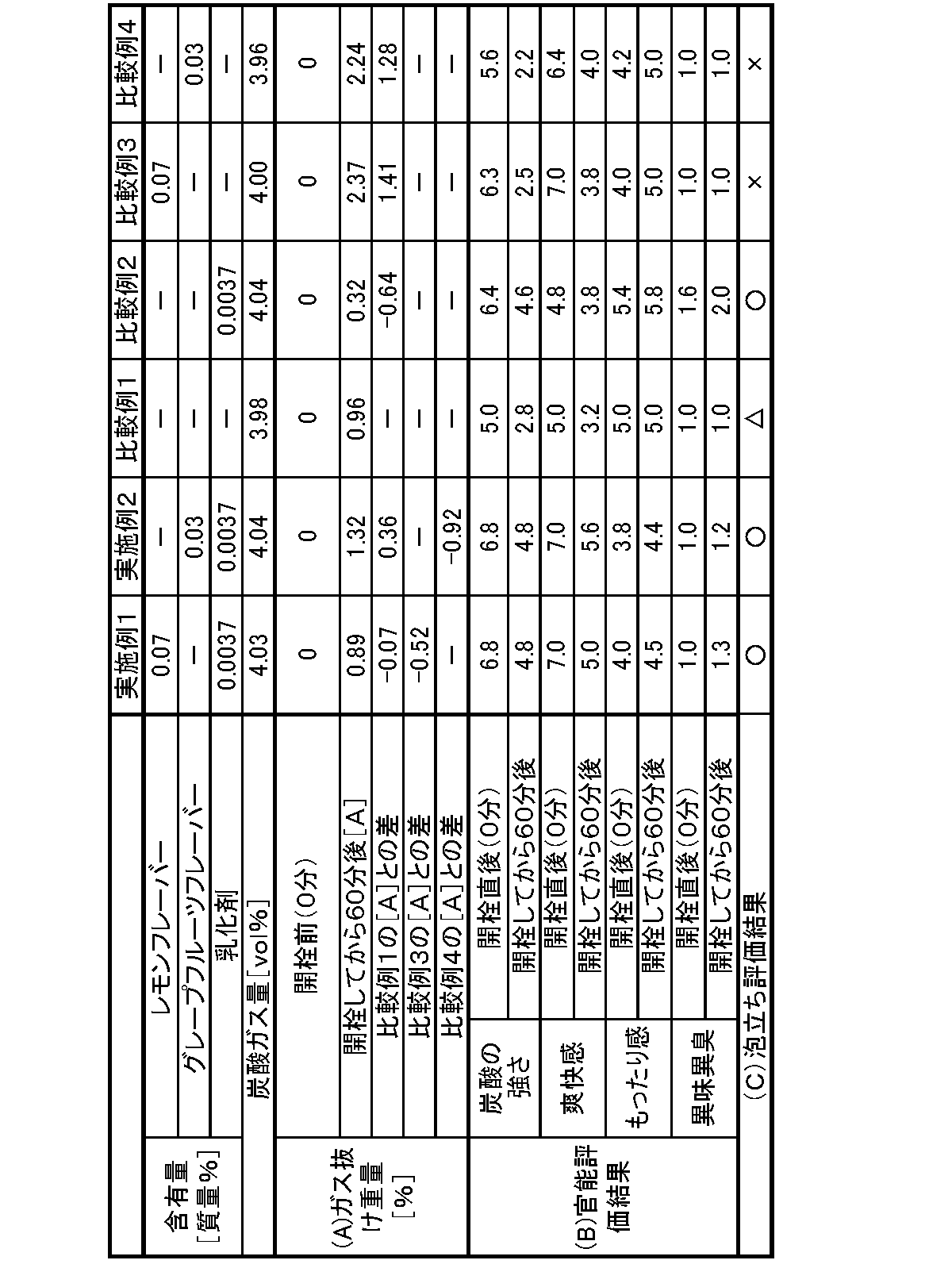
- Evaluation results such as sensory evaluation regarding the above evaluation items are shown in Table 1 below together with the blending ratio of each component.
- Table 5 below shows the results of measuring the contents of limonene, linalool, geraniol and citral with respect to the total amount of carbonated beverages for carbonated beverages blended with lemon flavor and carbonated beverages blended with grapefruit flavor.
- the contents of limonene, linalool, geraniol, and citral shown in Table 2 below were measured using a solid phase microextraction method (SPME) using a gas chromatograph mass spectrometer (GC / MS, manufactured by Agilent Technologies, 7890GC / 5975MSD). Quantified by the method. Specifically, the contents of limonene, linalool, geraniol and citral were quantified by the absolute calibration curve method according to the following method. The unit is ppm.
- the 20 mL vial containing the measurement sample prepared by the method described above was subjected to heat treatment at 50 ° C. for 10 minutes, and then the SPME fiber (DVB / CAR manufactured by Sigma Aldrich) was applied to the gas phase portion of the vial. / PDMS) and volatile components were collected for 5 minutes.
- This SPME fiber was installed in GC / MS and baked for 300 seconds to desorb the collected volatile components.
- the amounts of limonene, linalool, geraniol and citral contained in the volatile components were quantified.
- the calibration curve was prepared using a mixed standard solution in which limonene, linalool, geraniol and citral were dissolved in an ethanol solvent. Specifically, the calibration curve was prepared by analyzing the mixed standard solution prepared so that the final concentrations of the four components were 0 ppm, 0.1 ppm, 1 ppm, 5 ppm and 10 ppm in the same manner as the measurement sample. did.
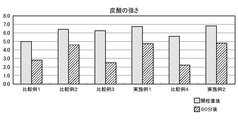
- FIG. 1 to 4 are diagrams showing sensory evaluation results regarding the carbonated beverages of Examples 1 and 2 and Comparative Examples 1 to 4.
- FIG. As shown in Table 1 and FIGS. 1 to 4, the carbonated beverages of Examples 1 and 2 are excellent in long-term stability in quality from the viewpoints of outgassing suppression, foaming suppression, and taste aging stability. there were.
- the beverage of the comparative example did not satisfy the required level in terms of quality in terms of gas outage suppression, foaming suppression and taste aging stability.
- the taste derived from the emulsifier was emphasized 60 minutes after opening the plug, in terms of moist feeling and off-flavor.
- a mixed solvent was prepared by adding a mix flavor containing apple flavor to pure water so as to have a blending ratio shown in Table 3 below, followed by mixing. Further, carbonated water (pure water containing carbon dioxide) was mixed with the above mixed solvent so that the amount of carbon dioxide was about 4.15 vol%, and then filled and sealed in a 500 mL PET bottle. In this way, a carbonated beverage of Comparative Example 5 was produced.
- each of the carbonated drinks obtained was evaluated as follows.
- the carbonated drink used for evaluation used what was left and stored for 12 hours or more at 20 degreeC immediately after manufacture.
Landscapes
- Health & Medical Sciences (AREA)
- Nutrition Science (AREA)
- Life Sciences & Earth Sciences (AREA)
- Chemical & Material Sciences (AREA)
- Engineering & Computer Science (AREA)
- Food Science & Technology (AREA)
- Polymers & Plastics (AREA)
- Non-Alcoholic Beverages (AREA)
Abstract
リモネン、リナロール、ゲラニオールおよびシトラールからなる群より選択される1以上の成分を含む香料と、ポリグリセリン脂肪酸エステルを含む乳化剤と、を含む容器詰め炭酸飲料であって、前記ポリグリセリン脂肪酸エステルが、ポリグリセリンと、炭素数12以上18以下の脂肪酸とがエステル結合してなる化合物であり、当該容器詰め炭酸飲料全量に対する、前記リモネンの含有量、前記リナロールの含有量、前記ゲラニオールの含有量および前記シトラールの含有量の合計量が1ppm以上である。
Description
本発明は、容器詰め炭酸飲料および容器詰め炭酸飲料の品質改善方法に関する。
炭酸飲料は、一般的に、消費者が喫飲した際に当該炭酸飲料中に含まれている炭酸ガスによる独特の炭酸感を味わうことができる嗜好性飲料として知られている。従来の炭酸飲料においては、開封してからの時間経過に伴って、飲料中に溶解している炭酸ガスが徐々に抜けていくことにより、上述した独特の炭酸感が低減してしまうという不都合があった。
独特の炭酸感が低減してしまうという上述した不都合が生じることを抑制すべく、これまでに、炭酸ガスのガス抜けを抑制することに着目した技術が種々報告されている。
たとえば、特許文献1には、リコピンを含む炭酸飲料中に溶解している炭酸ガスのガス抜けを抑制するため、平均粒子径が120nm以下であるエマルション粒子を含有する水中油型エマルション組成物を含有させる技術が記載されている。
上記従来技術は、消費者が炭酸飲料を喫飲するために容器を開封した際に抜ける炭酸ガス量を低減させる点、すなわち炭酸ガスのガス抜け抑制という点では、ある程度の効果を期待できる。しかしながら、市場に流通している炭酸飲料においては、上記従来技術のように容器を開封した際に抜ける炭酸ガス量を低減させる対策を施したとしてもなお、依然として、炭酸ガスのガス抜けを抑制しきれていない、開栓後に泡立ちが発生してしまう等の現象に起因した、炭酸ガスによる独特の炭酸感が長時間持続しないという不都合が生じる可能性を有していた。本発明者は、その原因について鋭意検討した結果、大概の炭酸飲料に対してその嗜好性を高めるために配合されている香料の存在がその要因の1つであることを突き止めた。具体的には、本発明者は、香料成分を炭酸飲料中に含有させた場合、ガス抜けや泡立ちが促進されてしまうという不都合が生じることを見出した。
さらに、本発明者は、容器を開封した際に抜ける炭酸ガス量を低減させる対策を施した従来の炭酸飲料は、ガス抜け抑制効果を期待して配合した添加剤の影響により呈味が複雑化してしまう傾向にあることも知見した。具体的には、本発明者は、上述したように従来の炭酸飲料において炭酸ガスのガス抜けや泡立ちが発生した場合には、結果として、添加剤由来の呈味が強調されてしまい、呈味という面において開栓後の時間経過に伴い品質が低下してしまうという不都合が生じることも見出した。このように従来の炭酸飲料は、呈味の経時安定性という点においても改善の余地を有していた。なお、炭酸飲料の品質は、一般的に、炭酸ガス由来の爽快な炭酸感、飲料自体の呈味、消費者が喫飲した際に感じる香味のバランスが取れている場合に高いと評価される傾向にある。
そこで、本発明は、ガス抜け抑制、泡立ち抑制および呈味の経時安定性という観点において、品質の長期安定性に優れた容器詰め炭酸飲料、およびその品質改善方法を提供する。
本発明者らは、ガス抜け抑制、泡立ち抑制および呈味の経時安定性という観点において、品質の長期安定性に優れた容器詰め炭酸飲料を提供すべく、鋭意検討した。その結果、ポリグリセリン脂肪酸エステルを含む乳化剤と、特定の疎水性成分を含む香料とを併用することが設計指針として有効であることを見出し、本発明に至った。
本発明によれば、リモネン、リナロール、ゲラニオールおよびシトラールからなる群より選択される1以上の成分を含む香料と、
ポリグリセリン脂肪酸エステルを含む乳化剤と、
を含む容器詰め炭酸飲料であって、
前記ポリグリセリン脂肪酸エステルが、ポリグリセリンと、炭素数12以上18以下の脂肪酸とがエステル結合してなる化合物であり、
当該容器詰め炭酸飲料全量に対する、前記リモネンの含有量、前記リナロールの含有量、前記ゲラニオールの含有量および前記シトラールの含有量の合計量が1ppm以上である容器詰め炭酸飲料が提供される。
ポリグリセリン脂肪酸エステルを含む乳化剤と、
を含む容器詰め炭酸飲料であって、
前記ポリグリセリン脂肪酸エステルが、ポリグリセリンと、炭素数12以上18以下の脂肪酸とがエステル結合してなる化合物であり、
当該容器詰め炭酸飲料全量に対する、前記リモネンの含有量、前記リナロールの含有量、前記ゲラニオールの含有量および前記シトラールの含有量の合計量が1ppm以上である容器詰め炭酸飲料が提供される。
さらに、本発明によれば、リモネン、リナロール、ゲラニオールおよびシトラールからなる群より選択される1以上の成分を含む香料と、ポリグリセリン脂肪酸エステルを含む乳化剤と、を混合する工程を含み、前記ポリグリセリン脂肪酸エステルが、ポリグリセリンと、炭素数12以上18以下の脂肪酸とがエステル結合してなる化合物であり、かつ当該容器詰め炭酸飲料全量に対する、前記リモネンの含有量、前記リナロールの含有量、前記ゲラニオールの含有量および前記シトラールの含有量の合計量が1ppm以上となる、容器詰め炭酸飲料の品質改善方法が提供される。
本発明によれば、ガス抜け抑制、泡立ち抑制および呈味の経時安定性という観点において、品質の長期安定性に優れた容器詰め炭酸飲料、およびその品質改善方法を提供することができる。
上述した目的、およびその他の目的、特徴および利点は、以下に述べる好適な実施の形態、およびそれに付随する以下の図面によってさらに明らかになる。
<<容器詰め炭酸飲料>>
本発明の容器詰め炭酸飲料は、リモネン、リナロール、ゲラニオールおよびシトラールからなる群より選択される1以上の成分を含む香料と、ポリグリセリン脂肪酸エステルを含む乳化剤と、を含むものである。また、かかる容器詰め炭酸飲料において、上記ポリグリセリン脂肪酸エステルは、ポリグリセリンと、炭素数12以上18以下の脂肪酸とがエステル結合してなる化合物であり、かつ当該容器詰め炭酸飲料全量に対する、リモネンの含有量、リナロールの含有量、ゲラニオールの含有量およびシトラールの含有量の合計量が1ppm以上である。こうすることで、ガス抜け抑制、泡立ち抑制および呈味の経時安定性という観点において、品質の長期安定性に優れた容器詰め炭酸飲料を実現することができる。
本発明の容器詰め炭酸飲料は、リモネン、リナロール、ゲラニオールおよびシトラールからなる群より選択される1以上の成分を含む香料と、ポリグリセリン脂肪酸エステルを含む乳化剤と、を含むものである。また、かかる容器詰め炭酸飲料において、上記ポリグリセリン脂肪酸エステルは、ポリグリセリンと、炭素数12以上18以下の脂肪酸とがエステル結合してなる化合物であり、かつ当該容器詰め炭酸飲料全量に対する、リモネンの含有量、リナロールの含有量、ゲラニオールの含有量およびシトラールの含有量の合計量が1ppm以上である。こうすることで、ガス抜け抑制、泡立ち抑制および呈味の経時安定性という観点において、品質の長期安定性に優れた容器詰め炭酸飲料を実現することができる。
市場に流通している従来の炭酸飲料については、公知となっている炭酸ガスのガス抜け抑制対策を施したとしても、炭酸ガスのガス抜けを抑制しきれていない、開栓後に泡立ちが発生してしまう等の現象に起因した、炭酸ガスによる独特の炭酸感が長時間持続しないという不都合が生じる可能性を有していた。本発明者は、上述した不都合が生じる原因について鋭意検討した結果、香料成分中に含まれている疎水性成分が炭酸飲料中において炭酸核として作用し、ガス抜けや泡立ちが促進している可能性があることを見出した。
くわえて、本発明者は、容器を開封した際に抜ける炭酸ガス量を低減させる対策を施した従来の炭酸飲料は、ガス抜け抑制効果を期待して配合した添加剤の影響により呈味が複雑化してしまう傾向にあることも知見した。具体的には、本発明者は、従来の炭酸飲料は開栓後の時間経過に伴い、もったりとした呈味が強調される傾向にあることを知見した。なお、炭酸飲料の品質は、一般的に、炭酸ガス由来の爽快な炭酸感、飲料自体の呈味、消費者が喫飲した際に感じる香味のバランスが取れている場合に高いと評価される傾向にある。
そこで、本発明者は、上述した不都合が生じることのない、ガス抜け抑制、泡立ち抑制および呈味の経時安定性という観点において、品質の長期安定性に優れた容器詰め炭酸飲料を提供すべく、その設計指針について鋭意検討した。その結果、ポリグリセリン脂肪酸エステルを含む乳化剤と、特定の疎水性成分を含む香料とを併用することが、設計指針として有効であることを見出した。具体的には、本発明者は、ポリグリセリン脂肪酸エステルを含む乳化剤と、特定の疎水性成分を含む香料とを併用することの相乗効果により、高度にガス抜けや泡立ちが抑制され、かつ呈味という面において品質の経時安定性に優れた炭酸飲料を実現できるとことを見出した。
以下、本発明に係る容器詰め炭酸飲料(以下、「炭酸飲料」とも示す。)について詳説する。
本発明における炭酸飲料は、上述したように、リモネン、リナロール、ゲラニオールおよびシトラールからなる群より選択される1以上の成分を含む香料と、ポリグリセリンと、炭素数12以上18以下の脂肪酸とがエステル結合してなるポリグリセリン脂肪酸エステルを含む乳化剤と、を含み、かつ当該炭酸飲料全量に対する、リモネンの含有量、リナロールの含有量、ゲラニオールの含有量およびシトラールの含有量の合計量が1ppm以上のものである。こうすることで、理由は明らかではないが、上記特定の香料と、上記特定の乳化剤との相乗効果により、ガス抜け抑制、泡立ち抑制および呈味の経時安定性という観点において、品質の長期安定性に優れた容器詰め炭酸飲料を実現することができる。
本発明における炭酸飲料中に含まれている炭酸ガス量は、炭酸飲料全量に対して、好ましくは、2.0vol%以上6.0vol%以下であり、さらに好ましくは、2.3vol%以上5.0vol%以下である。こうすることで、より一層炭酸感に優れた容器詰め炭酸飲料を実現することが可能となる。
ここで、本発明に係る炭酸飲料は、たとえば、サイダー飲料等の非着色飲料、ラムネ飲料、果汁入り飲料、着色炭酸飲料(たとえば、コーラ飲料やメロンソーダ等)、ノンアルコールビール飲料等の各種炭酸ガスを含む飲料とすることができる。また、従来の炭酸飲料における上述した不都合は、アルコール成分の有無に限らず、香料を含み、かつ炭酸ガスを含有させた飲料であれば、いかなる形態の飲料であっても生じる可能性がある。そのため、本発明に係る炭酸飲料は、炭酸ガスとともに、アルコール成分を含有した飲料、すなわちアルコールを含有する炭酸飲料であってもよい。かかるアルコールを含有する炭酸飲料(アルコール飲料)の一例としては、ビール、発泡酒、チューハイ、カクテル等が挙げられる。このように、本発明に係る炭酸飲料は、非着色飲料、ラムネ飲料、果汁入り飲料、着色炭酸飲料、ノンアルコールビール飲料、およびアルコール飲料のいずれかに用いることができる。
本発明における炭酸飲料を封入する容器は、飲料業界で公知の密封容器であれば、適宜選択して用いることができる。その具体例としては、ガラス、プラスチック(ポリエチレンテレフタレート(PET)、等)、アルミ、スチール等の単体もしくは複合材料又は積層材料からなる密封容器が挙げられる。また、容器形状は、特に限定されるものではないが、たとえば、缶容器、ボトル容器等が挙げられる。
本発明における炭酸飲料において、当該炭酸飲料全量に対する、リモネン、リナロール、ゲラニオールおよびシトラールの合計含有量は、1ppm以上であるが、好ましくは、2ppm以上であり、さらに好ましくは、3ppm以上である。こうすることで、理由は明らかではないが、乳化剤と香料との相乗効果をより一層顕著なものとすることができるものと考えられる。なお、上記合計含有量の上限値は、特に限定されないが、例えば、500ppm以下でもよく、300ppm以下でもよく、100ppm以下でもよい。こうすることで、上記上述した相乗効果を十分に発揮できるものと考えられる。
ここで、飲料全量に対する、リモネン、リナロール、ゲラニオールおよびシトラールの合計含有量は、ガスクロマトグラフ質量分析計(GC/MS)を用いた固相マイクロ抽出法(SPME)法により定量することができる。
ここで、飲料全量に対する、リモネン、リナロール、ゲラニオールおよびシトラールの合計含有量は、ガスクロマトグラフ質量分析計(GC/MS)を用いた固相マイクロ抽出法(SPME)法により定量することができる。
<乳化剤>
本発明に係る乳化剤は、ポリグリセリンと、炭素数12以上18以下の脂肪酸とがエステル結合してなる化合物であるポリグリセリン脂肪酸エステルを含むものである。かかるポリグリセリン脂肪酸エステルの具体例としては、モノラウリン酸デカグリセリン、モノミリスチン酸デカグリセリン、モノステアリン酸デカグリセリン、モノオレイン酸デカグリセリン、モノオレイン酸ペンタグリセリン等の食品用乳化剤が挙げられる。中でも、ポリグリセリンと、オレイン酸とがエステル結合してなる化合物であることが好ましく、食品用乳化剤の代表例の一つとして、モノオレイン酸デカグリセリンであるとさらに好ましい。こうすることで、ガス抜け抑制効果および泡立ち抑制効果をより一層良好なものとすることができる。
本発明に係る乳化剤は、ポリグリセリンと、炭素数12以上18以下の脂肪酸とがエステル結合してなる化合物であるポリグリセリン脂肪酸エステルを含むものである。かかるポリグリセリン脂肪酸エステルの具体例としては、モノラウリン酸デカグリセリン、モノミリスチン酸デカグリセリン、モノステアリン酸デカグリセリン、モノオレイン酸デカグリセリン、モノオレイン酸ペンタグリセリン等の食品用乳化剤が挙げられる。中でも、ポリグリセリンと、オレイン酸とがエステル結合してなる化合物であることが好ましく、食品用乳化剤の代表例の一つとして、モノオレイン酸デカグリセリンであるとさらに好ましい。こうすることで、ガス抜け抑制効果および泡立ち抑制効果をより一層良好なものとすることができる。
本発明に係る炭酸飲料において、乳化剤の含有量は、乳化剤と香料との相乗効果をより一層顕著なものとする観点から、当該炭酸飲料全量に対して、例えば、1×10⁻⁴質量%以上2×10⁻²質量%以下であり、好ましくは、2×10⁻⁴質量%以上2×10⁻²質量%以下であり、さらに好ましくは、当該炭酸飲料全量に対して、5×10⁻⁴質量%以上2×10⁻²質量%以下である。
上記ポリグリセリン脂肪酸エステルのHLB(Hydrophilic-Lipophilic Balance、親水性と疎水性のバランス)値は、好ましくは、8以上であり、さらに好ましくは、10以上である。こうすることで、ガス抜け抑制効果および泡立ち抑制効果をより一層良好なものとすることが可能である。
<香料>
本発明に係る香料は、リモネン、リナロール、ゲラニオールおよびシトラールからなる群より選択される1以上の成分を含むものである。上述した、リモネン、リナロール、ゲラニオールおよびシトラールは、いずれも、水に対して溶解しにくい成分(水との親和性が低い成分)、すなわち疎水性成分である。それ故、上述した各成分は、いずれも炭酸飲料中において、炭酸核として作用する可能性を有した成分であると考えられる。また、上述した、リモネン、リナロール、ゲラニオールおよびシトラールは、いずれも、柑橘系果実中に多く含まれている成分として知られている。そのため、本発明に係る香料としては、リモネン、リナロール、ゲラニオールおよびシトラールからなる群より選択される1以上の成分を含む柑橘系フレーバーを用いることが好ましい。
なお、上記香料としては、上述したリモネン、リナロール、ゲラニオールおよびシトラールの他に、アルデヒド成分やテルペン成分等の疎水性成分を有する他の柑橘系フレーバーを用いることができる。例えば、アルデヒド成分を含む他の柑橘系フレーバーとしては、オクタナール、デカナール、ノナナール等が挙げられ、テルペン成分を含む他の柑橘系フレーバーとしては、β-ピネン等が挙げられる。ここで、従来の炭酸飲料において、ガス抜けや泡立ちの促進に寄与する成分は、未だ解明されていない。そのため、ガス抜けや泡立ちの促進に、上記アルデヒド成分やテルペン成分等も関与している可能性はある。
本発明に係る香料は、リモネン、リナロール、ゲラニオールおよびシトラールからなる群より選択される1以上の成分を含むものである。上述した、リモネン、リナロール、ゲラニオールおよびシトラールは、いずれも、水に対して溶解しにくい成分(水との親和性が低い成分)、すなわち疎水性成分である。それ故、上述した各成分は、いずれも炭酸飲料中において、炭酸核として作用する可能性を有した成分であると考えられる。また、上述した、リモネン、リナロール、ゲラニオールおよびシトラールは、いずれも、柑橘系果実中に多く含まれている成分として知られている。そのため、本発明に係る香料としては、リモネン、リナロール、ゲラニオールおよびシトラールからなる群より選択される1以上の成分を含む柑橘系フレーバーを用いることが好ましい。
なお、上記香料としては、上述したリモネン、リナロール、ゲラニオールおよびシトラールの他に、アルデヒド成分やテルペン成分等の疎水性成分を有する他の柑橘系フレーバーを用いることができる。例えば、アルデヒド成分を含む他の柑橘系フレーバーとしては、オクタナール、デカナール、ノナナール等が挙げられ、テルペン成分を含む他の柑橘系フレーバーとしては、β-ピネン等が挙げられる。ここで、従来の炭酸飲料において、ガス抜けや泡立ちの促進に寄与する成分は、未だ解明されていない。そのため、ガス抜けや泡立ちの促進に、上記アルデヒド成分やテルペン成分等も関与している可能性はある。
また、本発明に係る乳化剤と香料との相乗効果は、上述したリモネン、リナロール、ゲラニオールおよびシトラールからなる群より選択される1以上の成分を含む柑橘系フレーバーに代えて、ヘキサナールやトランス-2-ヘキセナール等の疎水性成分を含むリンゴフレーバー、γ-デカラクトン、γ-ヘキサラクトン、γ-ノナラクトン、γ-ヘプタラクトン、γ-ドデカラクトン等の疎水性成分を含むピーチフレーバー、ヘキサノール、トランス-2-ヘキセノール等の疎水性成分を含むグレープフレーバー等のソフトフルーツ系フレーバーを用いた場合においても、同様の効果が得られるものと推測される。
<その他の成分>
本発明に係る炭酸飲料は、天然甘味料または合成甘味料を含んでいてもよい。こうすることで、炭酸飲料に対して甘味を付与することが可能であるため、より一層嗜好性に優れた炭酸飲料とすることができる。
本発明に係る炭酸飲料は、天然甘味料または合成甘味料を含んでいてもよい。こうすることで、炭酸飲料に対して甘味を付与することが可能であるため、より一層嗜好性に優れた炭酸飲料とすることができる。
上述した天然甘味料としては、ショ糖、ブドウ糖、果糖、乳糖、麦芽糖、果糖ブドウ糖液糖等の糖類、キシリトール、D-ソルビトール等の低甘味度甘味料、タウマチン、ステビア抽出物、グリチルリチン酸二ナトリウム等の高甘味度甘味料などが挙げられる。他方、上述した合成甘味料としては、アセスルファムカリウム、スクラロース、アスパルテーム、サッカリン、ネオテーム、サッカリンナトリウム等の高甘味度甘味料が挙げられる。これらの甘味料は、1種を単独で使用してもよいし、2種以上を混合してもよい。
本発明に係る炭酸飲料は、果汁を含んでいてもよい。ここで、果汁とは、果実を粉砕して搾汁、裏ごし等をし、皮、種子等を除去したものだけでなく、果実を粉砕しただけのピューレ状の果肉も含む。また、果実の種類としては、特に限定されるものではないが、たとえば、マスカットや巨峰等のぶどう類、みかん、オレンジ、レモン、グレープフルーツ、ライム、マンダリン、ユズ、シークワーサー、タンジェリン、テンプルオレンジ、タンジェロ、カラマンシー、デコポン、ポンカン、イヨカン、バンペイユ等の柑橘類、イチゴ、ブルーベリー、ラズベリー、アサイー、キウイフルーツ、モモ、リンゴ、パイナップル、グアバ、バナナ、マンゴー、アセロラ、プルーン、パパイヤ、パッションフルーツ、ウメ、ナシ、アンズ、ライチ、メロン、スイカ、サクランボ、西洋ナシ、スモモ等が挙げられる。これらの果実は、1種を単独で又は2種以上を混合して使用してもよい。
また、本発明に係る炭酸飲料に含有させる果汁としては、上記果物由来の果汁に限定されず、以下に挙げる野菜由来の果汁(野菜汁)を含有させてもよい。野菜の種類としては、スィートコーン、エダマメ、ダイコン、ニンジン、ゴボウ、ラディッシュ、カブ、サツマイモ、ジャガイモ、ナガイモ、ヤマイモ、サトイモ、ジネンジョ、ヤマトイモ、ピーマン、パプリカ、シシトウ、キュウリ、セロリ、ケール、ネギ、キャベツ、ハクサイ、シュンギク、サラダナ、サンチュ、オオバ、ホウレンソウ、コマツナ、ミズナ、ミブナ、アスパラガス、クウシンサイ、レタス、タイム、セージ、パセリ、イタリアンパセリ、ローズマリー、オレガノ、レモンバーム、チャイブ、ラベンダー、サラダバーネット、ラムズイヤー、ロケット、ダンディライオン、ナスタチューム、バジル、ルッコラ、クレソン、モロヘイヤ、フキ、ナバナ、チンゲンサイ、ミツバ、セリ、メキャベツ、ブロッコリー、カリフラワー、ミョウガ、ナス、トマト、ミニトマト、カボチャ、ゴーヤ、オクラ、サヤエンドウ、サヤインゲン、ソラマメ等が挙げられる。また、野菜由来の果汁についても、果物と同様に、1種を単独で又は2種以上を混合して使用してもよい。さらに、野菜由来の果汁と果物由来の果汁を混合して使用してもよい。
本発明に係る炭酸飲料は、さらに酸味料を含んでいてもよい。こうすることで、爽快感という点において呈味に優れた炭酸飲料とすることができる。本発明に係る酸味料は、特に限定されないが、たとえば、クエン酸三ナトリウム、無水クエン酸、アジピン酸、グルコン酸、コハク酸、酒石酸、乳酸、フマル酸、リンゴ酸、リン酸、フィチン酸、アスコルビン酸又はそれらの塩類等が挙げられる。
なお、本発明に係る炭酸飲料には、以上に説明した成分の他にも、本発明の目的を損なわない範囲で各種栄養成分、抽出物、甘味料、着色料、希釈剤、酸化防止剤等の食品添加物を添加することもできる。
<<容器詰め炭酸飲料の製造方法>>
本発明における容器詰め炭酸飲料の製造方法においては、リモネン、リナロール、ゲラニオールおよびシトラールからなる群より選択される1以上の成分を含む香料と、ポリグリセリン脂肪酸エステルを含む乳化剤と、を混合する工程を含むことを前提として、公知の製造方法を用いて作製することができる。ただし、本発明における容器詰め炭酸飲料の製造方法においては、当該容器詰め炭酸飲料全量に対する、リモネンの含有量、リナロールの含有量、ゲラニオールの含有量およびシトラールの含有量の合計量が1ppm以上となるように上記香料を混合する必要がある。
上記公知の製造方法としては、プレミックス法とポストミックス法とが挙げられるが、本発明においては、いずれの方法を採用してもよい。たとえば、上記公知の製造方法として、以下の方法を採用することができる。具体的には、水を主成分とする溶媒またはその希釈液に対して各種添加物を添加・混合し、飲料原液を調製する。その後、得られた飲料原液に対して、炭酸ガスをガス封入(カーボネーション)してから容器に充填することにより、本発明係る容器詰め炭酸飲料を得ることができる。なお、上述した容器詰め炭酸飲料の製造工程においては、当該炭酸飲料を殺菌する工程を含んでいてもよい。
本発明における容器詰め炭酸飲料の製造方法においては、リモネン、リナロール、ゲラニオールおよびシトラールからなる群より選択される1以上の成分を含む香料と、ポリグリセリン脂肪酸エステルを含む乳化剤と、を混合する工程を含むことを前提として、公知の製造方法を用いて作製することができる。ただし、本発明における容器詰め炭酸飲料の製造方法においては、当該容器詰め炭酸飲料全量に対する、リモネンの含有量、リナロールの含有量、ゲラニオールの含有量およびシトラールの含有量の合計量が1ppm以上となるように上記香料を混合する必要がある。
上記公知の製造方法としては、プレミックス法とポストミックス法とが挙げられるが、本発明においては、いずれの方法を採用してもよい。たとえば、上記公知の製造方法として、以下の方法を採用することができる。具体的には、水を主成分とする溶媒またはその希釈液に対して各種添加物を添加・混合し、飲料原液を調製する。その後、得られた飲料原液に対して、炭酸ガスをガス封入(カーボネーション)してから容器に充填することにより、本発明係る容器詰め炭酸飲料を得ることができる。なお、上述した容器詰め炭酸飲料の製造工程においては、当該炭酸飲料を殺菌する工程を含んでいてもよい。
<<容器詰め炭酸飲料の品質改善方法>>
炭酸ガスのガス抜けや泡立ちを抑制し、かつ呈味という面において品質を改善した炭酸飲料を実現するためには、リモネン、リナロール、ゲラニオールおよびシトラールからなる群より選択される1以上の成分を含む香料と、ポリグリセリン脂肪酸エステルを含む乳化剤と、を混合する工程を含む方法を採用することが重要である。また、かかる方法において、使用するポリグリセリン脂肪酸エステルは、ポリグリセリンと、炭素数12以上18以下の脂肪酸とがエステル結合してなる化合物である。また、当該容器詰め炭酸飲料全量に対する、リモネンの含有量、リナロールの含有量、ゲラニオールの含有量およびシトラールの含有量の合計量が1ppm以上となるようにする必要がある。また、この品質改善方法に用いられる容器詰め炭酸飲料中の成分としては、上述した成分を使用することができる。例えば、香料としては、上述した柑橘系フレーバーを使用することができる。
炭酸ガスのガス抜けや泡立ちを抑制し、かつ呈味という面において品質を改善した炭酸飲料を実現するためには、リモネン、リナロール、ゲラニオールおよびシトラールからなる群より選択される1以上の成分を含む香料と、ポリグリセリン脂肪酸エステルを含む乳化剤と、を混合する工程を含む方法を採用することが重要である。また、かかる方法において、使用するポリグリセリン脂肪酸エステルは、ポリグリセリンと、炭素数12以上18以下の脂肪酸とがエステル結合してなる化合物である。また、当該容器詰め炭酸飲料全量に対する、リモネンの含有量、リナロールの含有量、ゲラニオールの含有量およびシトラールの含有量の合計量が1ppm以上となるようにする必要がある。また、この品質改善方法に用いられる容器詰め炭酸飲料中の成分としては、上述した成分を使用することができる。例えば、香料としては、上述した柑橘系フレーバーを使用することができる。
以上、本発明の実施形態について述べたが、これらは本発明の例示であり、上記以外の様々な構成を採用することもできる。
以下、本発明を実施例および比較例により説明するが、本発明はこれらに限定されるものではない。
<実施例1>
純水に対し、下記表1に示す配合比率となるように、レモンフレーバーと、モノオレイン酸デカグリセリンを含む乳化剤(太陽化学社製)を添加してから混合することにより、混合溶媒を作製した。さらに、炭酸ガス量が約4vol%となるように炭酸水(炭酸ガスを含有する純水)を上記混合溶媒と混合した後、500mLのPETボトルに充填・密封した。このようにして、実施例1の炭酸飲料を作製した。
純水に対し、下記表1に示す配合比率となるように、レモンフレーバーと、モノオレイン酸デカグリセリンを含む乳化剤(太陽化学社製)を添加してから混合することにより、混合溶媒を作製した。さらに、炭酸ガス量が約4vol%となるように炭酸水(炭酸ガスを含有する純水)を上記混合溶媒と混合した後、500mLのPETボトルに充填・密封した。このようにして、実施例1の炭酸飲料を作製した。
<実施例2>
純水に対し、下記表1に示す配合比率となるように、グレープフルーツフレーバーと、モノオレイン酸デカグリセリンを含む乳化剤(太陽化学社製)を添加してから混合することにより、混合溶媒を作製した。さらに、炭酸ガス量が約4vol%となるように炭酸水(炭酸ガスを含有する純水)を上記混合溶媒と混合した後、500mLのPETボトルに充填・密封した。このようにして、実施例2の炭酸飲料を作製した。
純水に対し、下記表1に示す配合比率となるように、グレープフルーツフレーバーと、モノオレイン酸デカグリセリンを含む乳化剤(太陽化学社製)を添加してから混合することにより、混合溶媒を作製した。さらに、炭酸ガス量が約4vol%となるように炭酸水(炭酸ガスを含有する純水)を上記混合溶媒と混合した後、500mLのPETボトルに充填・密封した。このようにして、実施例2の炭酸飲料を作製した。
<比較例1>
純水に炭酸ガス量が約4vol%となるように炭酸水(炭酸ガスを含有する純水)を混合した後、500mLのPETボトルに充填・密封した。このようにして、比較例1の炭酸飲料を作製した。
純水に炭酸ガス量が約4vol%となるように炭酸水(炭酸ガスを含有する純水)を混合した後、500mLのPETボトルに充填・密封した。このようにして、比較例1の炭酸飲料を作製した。
<比較例2>
純水に対し、下記表1に示す配合比率となるように、モノオレイン酸デカグリセリンを含む乳化剤(太陽化学社製)を添加してから混合することにより、混合溶媒を作製した。さらに、炭酸ガス量が約4vol%となるように炭酸水(炭酸ガスを含有する純水)を上記混合溶媒と混合した後、500mLのPETボトルに充填・密封した。このようにして、比較例2の炭酸飲料を作製した。
純水に対し、下記表1に示す配合比率となるように、モノオレイン酸デカグリセリンを含む乳化剤(太陽化学社製)を添加してから混合することにより、混合溶媒を作製した。さらに、炭酸ガス量が約4vol%となるように炭酸水(炭酸ガスを含有する純水)を上記混合溶媒と混合した後、500mLのPETボトルに充填・密封した。このようにして、比較例2の炭酸飲料を作製した。
<比較例3>
純水に対し、下記表1に示す配合比率となるように、レモンフレーバーを添加してから混合することにより、混合溶媒を作製した。さらに、炭酸ガス量が約4vol%となるように炭酸水(炭酸ガスを含有する純水)を上記混合溶媒と混合した後、500mLのPETボトルに充填・密封した。このようにして、比較例3の炭酸飲料を作製した。
純水に対し、下記表1に示す配合比率となるように、レモンフレーバーを添加してから混合することにより、混合溶媒を作製した。さらに、炭酸ガス量が約4vol%となるように炭酸水(炭酸ガスを含有する純水)を上記混合溶媒と混合した後、500mLのPETボトルに充填・密封した。このようにして、比較例3の炭酸飲料を作製した。
<比較例4>
純水に対し、下記表1に示す配合比率となるように、グレープフルーツフレーバーを添加してから混合することにより、混合溶媒を作製した。さらに、炭酸ガス量が約4vol%となるように炭酸水(炭酸ガスを含有する純水)を上記混合溶媒と混合した後、500mLのPETボトルに充填・密封した。このようにして、比較例4の炭酸飲料を作製した。
純水に対し、下記表1に示す配合比率となるように、グレープフルーツフレーバーを添加してから混合することにより、混合溶媒を作製した。さらに、炭酸ガス量が約4vol%となるように炭酸水(炭酸ガスを含有する純水)を上記混合溶媒と混合した後、500mLのPETボトルに充填・密封した。このようにして、比較例4の炭酸飲料を作製した。
得られた各炭酸飲料について、以下に示す評価を行った。なお、評価に用いた炭酸飲料は、製造直後に20℃で12時間以上静置保管したものを使用した。
(評価項目)
(A)ガス抜け重量測定:20℃の温度条件下、各炭酸飲料の容器を開封した。その後、開封した容器を閉栓することなく20℃の温度で静置し、容器を開封してから60分後の段階で容器を含めた全重量を測定した。次いで、開封前の容器を含めた全重量と、上述した方法で測定した60分後における全重量との差分を重量変化量として算出し、ガス抜け重量(%)とした。
(A)ガス抜け重量測定:20℃の温度条件下、各炭酸飲料の容器を開封した。その後、開封した容器を閉栓することなく20℃の温度で静置し、容器を開封してから60分後の段階で容器を含めた全重量を測定した。次いで、開封前の容器を含めた全重量と、上述した方法で測定した60分後における全重量との差分を重量変化量として算出し、ガス抜け重量(%)とした。
(B)官能評価:実施例1~2と比較例1~4の炭酸飲料それぞれについて、以下の当該炭酸飲料の炭酸感に係る官能評価試験1~4を実施した。
官能評価試験1(炭酸の強さ):開封直後の実施例1~2と比較例1~4の炭酸飲料と、開封してから60分後の実施例1~2と比較例1~4のそれぞれを、熟練した5名のパネラーが試飲した。各パネラーは、試飲した炭酸飲料について、以下の評価基準に従って1~9点の9段階評価を実施した。官能評価試験1に係る評価結果は、各パネラーによる評価点の平均点とした。
1点:炭酸の強さが、弱い
9点:炭酸の強さが、強い
官能評価試験1(炭酸の強さ):開封直後の実施例1~2と比較例1~4の炭酸飲料と、開封してから60分後の実施例1~2と比較例1~4のそれぞれを、熟練した5名のパネラーが試飲した。各パネラーは、試飲した炭酸飲料について、以下の評価基準に従って1~9点の9段階評価を実施した。官能評価試験1に係る評価結果は、各パネラーによる評価点の平均点とした。
1点:炭酸の強さが、弱い
9点:炭酸の強さが、強い
官能評価試験2(爽快感):開封直後の実施例1~2と比較例1~4の炭酸飲料と、開封してから60分後の実施例1~2と比較例1~4のそれぞれを、熟練した5名のパネラーが試飲した。各パネラーは、試飲した炭酸飲料について、以下の評価基準に従って1~9点の9段階評価を実施した。官能評価試験2に係る評価結果は、各パネラーによる評価点の平均点とした。
1点:爽快感が、あるとは思わない
9点:爽快感が、あると思う
1点:爽快感が、あるとは思わない
9点:爽快感が、あると思う
官能評価試験3(もったり感):開封直後の実施例1~2と比較例1~4の炭酸飲料と、開封してから60分後の実施例1~2と比較例1~4のそれぞれを、熟練した5名のパネラーが試飲した。各パネラーは、試飲した炭酸飲料について、以下の評価基準に従って1~9点の9段階評価を実施した。官能評価試験3に係る評価結果は、各パネラーによる評価点の平均点とした。
1点:もったり感が、あるとは思わない
9点:もったり感が、あると思う
1点:もったり感が、あるとは思わない
9点:もったり感が、あると思う
官能評価試験4(異味異臭):開封直後の実施例1~2と比較例1~4の炭酸飲料と、開封してから60分後の実施例1~2と比較例1~4のそれぞれを、熟練した5名のパネラーが試飲した。各パネラーは、試飲した炭酸飲料について、以下の評価基準に従って3段階評価を実施した。官能評価試験4に係る評価結果は、各パネラーによる評価点の平均点とした。
×(0点):異味異臭を、感じない。
△(1点):異味異臭を、やや感じる。
○(2点):異味異臭を、感じる。
×(0点):異味異臭を、感じない。
△(1点):異味異臭を、やや感じる。
○(2点):異味異臭を、感じる。
(C)泡立ち評価試験:開封直後の実施例1~2と比較例1~4の炭酸飲料と、開封してから30分後の実施例1~2と比較例1~4の炭酸飲料とを、それぞれを比較して、熟練した5名のパネラーが以下の評価基準に従って目視にて評価を実施した。
○:開封直後の炭酸飲料と比べて、30分後の炭酸飲料は、泡立ちがほぼ生じていないといえる。
△:開封直後の炭酸飲料と比べて、30分後の炭酸飲料は、やや泡立ちが生じているといえる。
×:開封直後の炭酸飲料と比べて、30分後の炭酸飲料は、多くの泡立ちが生じているといえる。
○:開封直後の炭酸飲料と比べて、30分後の炭酸飲料は、泡立ちがほぼ生じていないといえる。
△:開封直後の炭酸飲料と比べて、30分後の炭酸飲料は、やや泡立ちが生じているといえる。
×:開封直後の炭酸飲料と比べて、30分後の炭酸飲料は、多くの泡立ちが生じているといえる。
上記評価項目に関する官能評価等の評価結果を、以下の表1に各成分の配合比率と共に示す。
レモンフレーバーを配合した炭酸飲料と、グレープフルーツフレーバーを配合した炭酸飲料について、以下の表2に当該炭酸飲料全量に対する、リモネン、リナロール、ゲラニオールおよびシトラールの含有量を測定した結果を示す。なお、下記表2に示すリモネン、リナロール、ゲラニオールおよびシトラールの含有量は、ガスクロマトグラフ質量分析計(GC/MS、アジレント・テクノロジー社製、7890GC/5975MSD)を用いた固相マイクロ抽出法(SPME)法により定量した。具体的には、リモネン、リナロール、ゲラニオールおよびシトラールの含有量は、以下の方法で絶対検量線法により定量した。なお、単位は、ppmである。
まず、20mLバイアル瓶に対して、測定試料である炭酸飲料を10g入れた。次いで、かかるバイアル瓶に対して、塩化ナトリウム3gとともに、エタノールに溶解させた2-オクタノールを2-オクタノールを内部標準物質として終濃度が1ppmとなるように入れ、上記塩化ナトリウムを完全に溶解させたものを測定サンプルとして準備した。なお、上記測定サンプルについて3サンプルずつ準備した。そのため、下記表2には、準備した3つの測定サンプルに関する定量結果の平均値を測定結果として示す。
次に、上述した方法により準備した測定サンプルを含む20mLバイアル瓶を、50℃で10分間の加熱処理を施した後、当該バイアル瓶の気相部分にシグマアルドリッチ社製のSPMEファイバー(DVB/CAR/PDMS)を挿入し、5分間、揮発成分を捕集した。このSPMEファイバーをGC/MSに設置し、300秒間焼成することにより、捕集した揮発成分を脱離させた。本実施例および比較例においては、上記揮発成分中に含まれるリモネン、リナロール、ゲラニオールおよびシトラールの定量を行った。
GC/MSの分析条件は、以下の通りである。
・カラム:アジレント・テクノロジー社製、DB-WAX(長さ30m、内径0.25mm、膜厚0.25μm)
・オーブン温度:40℃で2分間保持し、その後、8℃/分で240℃まで昇温し、10分間保持した。
・キャリアガス:ヘリウム
・キャリアガス流量:2.2146mL/分(ODP分岐)
・注入口温度:240℃
・スプリット比:300:1
・注入方法:スプリット注入
・カラム:アジレント・テクノロジー社製、DB-WAX(長さ30m、内径0.25mm、膜厚0.25μm)
・オーブン温度:40℃で2分間保持し、その後、8℃/分で240℃まで昇温し、10分間保持した。
・キャリアガス:ヘリウム
・キャリアガス流量:2.2146mL/分(ODP分岐)
・注入口温度:240℃
・スプリット比:300:1
・注入方法:スプリット注入
検量線は、エタノール溶媒にリモネン、リナロール、ゲラニオールおよびシトラールを溶解させた混合標準液を用い作製した。具体的には、検量線は、上記4成分の終濃度が0ppm、0.1ppm、1ppm、5ppmおよび10ppmとなるよう調製した上記混合標準液を用い、上記測定サンプルと同様の方法で分析し作製した。
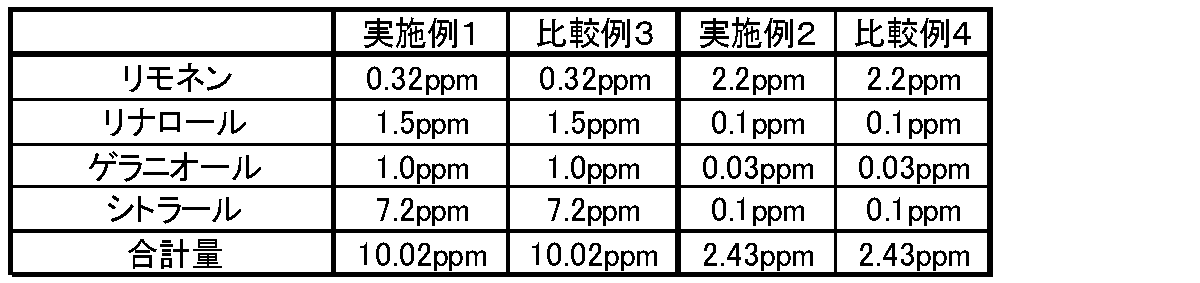
図1~4は、実施例1~2および比較例1~4の炭酸飲料に関する官能評価結果を示す図である。
表1および図1~図4に示すように、実施例1および2の炭酸飲料は、ガス抜け抑制、泡立ち抑制および呈味の経時安定性という観点において、品質の長期安定性に優れたものであった。一方、比較例の飲料は、ガス抜け抑制、泡立ち抑制および呈味の経時安定性という観点における品質において、要求水準を満たすものではなかった。特に、比較例2の飲料については、開栓してから60分後において、もったり感および異味異臭という点において、乳化剤に由来する呈味が強調されていた。
表1および図1~図4に示すように、実施例1および2の炭酸飲料は、ガス抜け抑制、泡立ち抑制および呈味の経時安定性という観点において、品質の長期安定性に優れたものであった。一方、比較例の飲料は、ガス抜け抑制、泡立ち抑制および呈味の経時安定性という観点における品質において、要求水準を満たすものではなかった。特に、比較例2の飲料については、開栓してから60分後において、もったり感および異味異臭という点において、乳化剤に由来する呈味が強調されていた。
<参考例1~6>
純水に対し、下記表3に示す配合比率となるように、アップルフレーバーを含むミックスフレーバーと、モノオレイン酸デカグリセリンを含む乳化剤(太陽化学社製)を添加してから混合することにより、混合溶媒を作製した。さらに、炭酸ガス量が約4.15vol%となるように炭酸水(炭酸ガスを含有する純水)を上記混合溶媒と混合した後、500mLのPETボトルに充填・密封した。このようにして、参考例1~6の炭酸飲料を作製した。
純水に対し、下記表3に示す配合比率となるように、アップルフレーバーを含むミックスフレーバーと、モノオレイン酸デカグリセリンを含む乳化剤(太陽化学社製)を添加してから混合することにより、混合溶媒を作製した。さらに、炭酸ガス量が約4.15vol%となるように炭酸水(炭酸ガスを含有する純水)を上記混合溶媒と混合した後、500mLのPETボトルに充填・密封した。このようにして、参考例1~6の炭酸飲料を作製した。
<比較例5>
純水に対し、下記表3に示す配合比率となるように、アップルフレーバーを含むミックスフレーバーを添加してから混合することにより、混合溶媒を作製した。さらに、炭酸ガス量が約4.15vol%となるように炭酸水(炭酸ガスを含有する純水)を上記混合溶媒と混合した後、500mLのPETボトルに充填・密封した。このようにして、比較例5の炭酸飲料を作製した。
純水に対し、下記表3に示す配合比率となるように、アップルフレーバーを含むミックスフレーバーを添加してから混合することにより、混合溶媒を作製した。さらに、炭酸ガス量が約4.15vol%となるように炭酸水(炭酸ガスを含有する純水)を上記混合溶媒と混合した後、500mLのPETボトルに充填・密封した。このようにして、比較例5の炭酸飲料を作製した。
得られた各炭酸飲料について、以下に示す評価を行った。なお、評価に用いた炭酸飲料は、製造直後に20℃で12時間以上静置保管したものを使用した。
(評価項目)
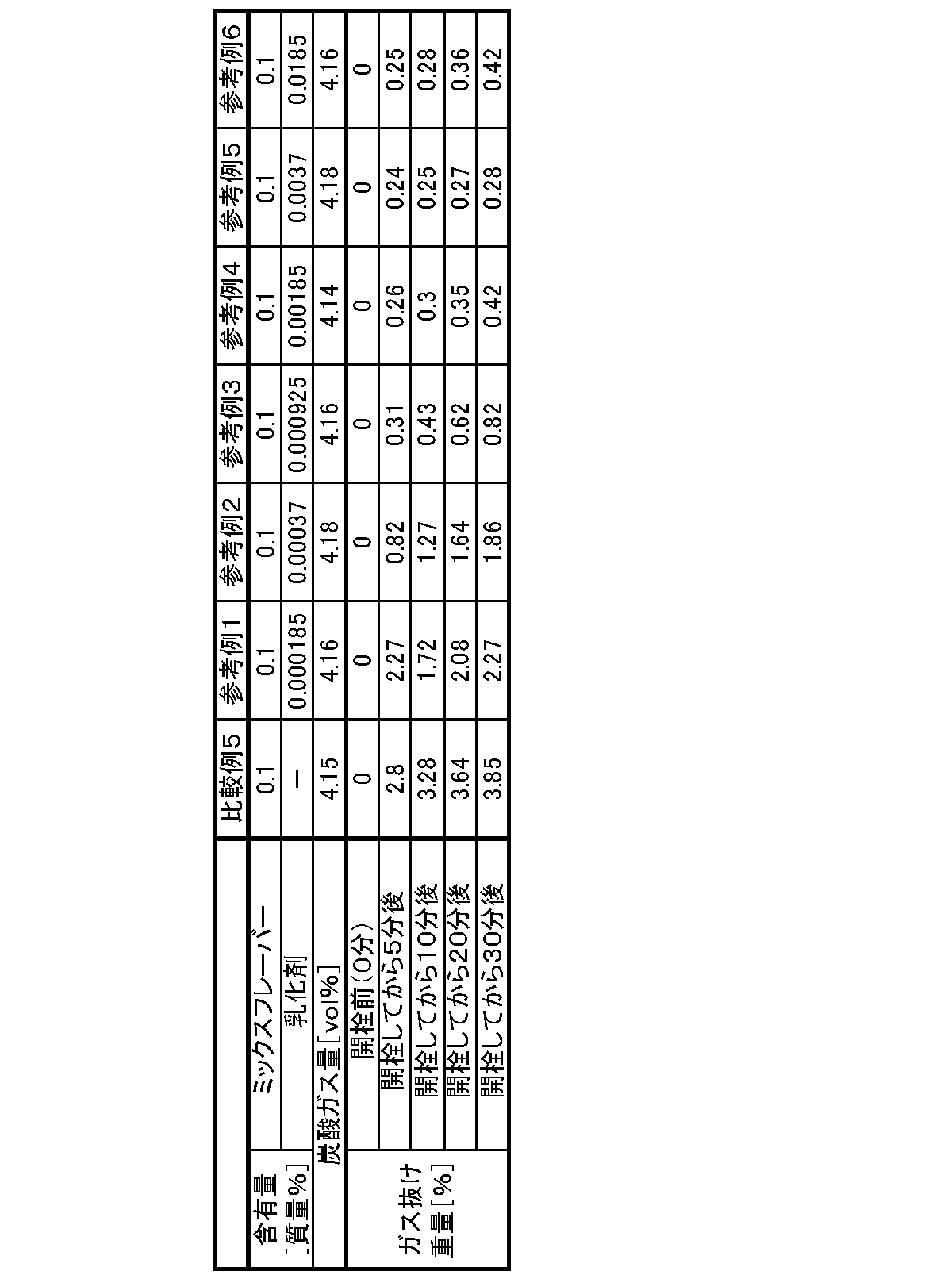
・ガス抜け重量測定:20℃の温度条件下、各炭酸飲料の容器を開封した。その後、開封した容器を閉栓することなく20℃の温度で静置し、容器を開封してから5分後、10分後、20分後および30分後の各段階で容器を含めた全重量を、経時的に測定した。次いで、開封前の容器を含めた全重量と、上述した方法で測定した各段階における全重量との差分を重量変化量として算出し、ガス抜け重量(%)とした。
・ガス抜け重量測定:20℃の温度条件下、各炭酸飲料の容器を開封した。その後、開封した容器を閉栓することなく20℃の温度で静置し、容器を開封してから5分後、10分後、20分後および30分後の各段階で容器を含めた全重量を、経時的に測定した。次いで、開封前の容器を含めた全重量と、上述した方法で測定した各段階における全重量との差分を重量変化量として算出し、ガス抜け重量(%)とした。
上記評価項目に関する評価結果を、以下の表3に各成分の配合比率と共に示す。
この出願は、2015年6月26日に出願された日本出願特願2015-129145号を基礎とする優先権を主張し、その開示の全てをここに取り込む。
Claims (10)
- リモネン、リナロール、ゲラニオールおよびシトラールからなる群より選択される1以上の成分を含む香料と、
ポリグリセリン脂肪酸エステルを含む乳化剤と、
を含む容器詰め炭酸飲料であって、
前記ポリグリセリン脂肪酸エステルが、ポリグリセリンと、炭素数12以上18以下の脂肪酸とがエステル結合してなる化合物であり、
当該容器詰め炭酸飲料全量に対する、前記リモネンの含有量、前記リナロールの含有量、前記ゲラニオールの含有量および前記シトラールの含有量の合計量が1ppm以上である、容器詰め炭酸飲料。 - 前記ポリグリセリン脂肪酸エステルが、ポリグリセリンと、オレイン酸とがエステル結合してなる化合物である、請求項1に記載の容器詰め炭酸飲料。
- 前記ポリグリセリン脂肪酸エステルが、モノオレイン酸デカグリセリンである、請求項1または2に記載の容器詰め炭酸飲料。
- 前記乳化剤の含有量が、当該容器詰め炭酸飲料全量に対して、1×10⁻⁴質量%以上2×10⁻²質量%以下である請求項1乃至3のいずれか一項に記載の容器詰め炭酸飲料。
- 前記香料が、柑橘系フレーバーである請求項1乃至4のいずれか一項に記載の容器詰め炭酸飲料。
- 炭酸ガスを、当該容器詰め炭酸飲料全量に対して、2.0vol%以上6.0vol%以下含む請求項1乃至5のいずれか一項に記載の容器詰め炭酸飲料。
- 当該容器詰め炭酸飲料全量に対する、前記リモネンの含有量、前記リナロールの含有量、前記ゲラニオールの含有量および前記シトラールの含有量の合計量の上限値が500ppm以下である、請求項1乃至6のいずれか一項に記載の容器詰め炭酸飲料。
- 非着色飲料、ラムネ飲料、果汁入り飲料、着色炭酸飲料、ノンアルコールビール飲料、およびアルコール飲料のいずれかに用いる、請求項1乃至7のいずれか一項に記載の容器詰め炭酸飲料。
- リモネン、リナロール、ゲラニオールおよびシトラールからなる群より選択される1以上の成分を含む香料と、ポリグリセリン脂肪酸エステルを含む乳化剤と、を混合する工程を含み、前記ポリグリセリン脂肪酸エステルが、ポリグリセリンと、炭素数12以上18以下の脂肪酸とがエステル結合してなる化合物であり、かつ当該容器詰め炭酸飲料全量に対する、前記リモネンの含有量、前記リナロールの含有量、前記ゲラニオールの含有量および前記シトラールの含有量の合計量が1ppm以上となる、容器詰め炭酸飲料の品質改善方法。
- 前記香料が、柑橘系フレーバーである請求項9に記載の容器詰め炭酸飲料の品質改善方法。
Applications Claiming Priority (2)
| Application Number | Priority Date | Filing Date | Title |
|---|---|---|---|
| JP2015-129145 | 2015-06-26 | ||
| JP2015129145A JP6868950B2 (ja) | 2015-06-26 | 2015-06-26 | 容器詰め炭酸飲料および容器詰め炭酸飲料の品質改善方法 |
Publications (1)
| Publication Number | Publication Date |
|---|---|
| WO2016208527A1 true WO2016208527A1 (ja) | 2016-12-29 |
Family
ID=57585060
Family Applications (1)
| Application Number | Title | Priority Date | Filing Date |
|---|---|---|---|
| PCT/JP2016/068215 Ceased WO2016208527A1 (ja) | 2015-06-26 | 2016-06-20 | 容器詰め炭酸飲料および容器詰め炭酸飲料の品質改善方法 |
Country Status (3)
| Country | Link |
|---|---|
| JP (1) | JP6868950B2 (ja) |
| TW (1) | TWI730969B (ja) |
| WO (1) | WO2016208527A1 (ja) |
Cited By (6)
| Publication number | Priority date | Publication date | Assignee | Title |
|---|---|---|---|---|
| EP3682744A4 (en) * | 2017-09-11 | 2021-05-26 | Suntory Holdings Limited | COLORLESS AND TRANSPARENT DRINK INCLUDING A LINALOL |
| CN115590135A (zh) * | 2022-10-12 | 2023-01-13 | 恒枫食品科技有限公司(Cn) | 一种香精及其应用、含该香精的碳酸饮料 |
| CN117044851A (zh) * | 2023-08-23 | 2023-11-14 | 上海应用技术大学 | 一种利用甜橙香气物质降糖增甜的果汁饮料及其制备方法 |
| EP4205554A4 (en) * | 2020-08-25 | 2024-01-24 | Takasago International Corporation | Carbonated beverage, method for preparing flavor composition, and method for suppressing bubbles of carbonated beverage |
| US20240114931A1 (en) * | 2020-12-30 | 2024-04-11 | Corn Products Development, Inc. | Beverages including steviol glycosides and a foam suppressing agent |
| JP7569919B1 (ja) | 2023-12-22 | 2024-10-18 | 小川香料株式会社 | リナロール含有飲食品用風味改善剤 |
Families Citing this family (10)
| Publication number | Priority date | Publication date | Assignee | Title |
|---|---|---|---|---|
| JP7025121B2 (ja) * | 2017-03-08 | 2022-02-24 | アサヒビール株式会社 | 炭酸アルコール飲料及びその製造方法 |
| JP6608087B1 (ja) * | 2019-03-26 | 2019-11-20 | アサヒ飲料株式会社 | 炭酸飲料、および炭酸飲料の茶風味向上方法 |
| JP7377672B2 (ja) * | 2019-03-26 | 2023-11-10 | アサヒ飲料株式会社 | 炭酸飲料、および炭酸飲料の茶風味向上方法 |
| JP6745375B1 (ja) * | 2019-04-02 | 2020-08-26 | アサヒ飲料株式会社 | 柑橘風味の無糖炭酸飲料 |
| JP6786699B1 (ja) * | 2019-12-17 | 2020-11-18 | キリンホールディングス株式会社 | ノンアルコールビールテイスト飲料 |
| JP7436199B2 (ja) * | 2019-12-25 | 2024-02-21 | アサヒ飲料株式会社 | 容器詰めゼリー飲料、炭酸感の増強方法 |
| JP7034565B2 (ja) * | 2020-05-21 | 2022-03-14 | アサヒ飲料株式会社 | 酢酸含有飲料 |
| WO2022014424A1 (ja) * | 2020-07-13 | 2022-01-20 | アサヒグループホールディングス株式会社 | 飲料の泡立ちの抑制方法 |
| JP7732776B2 (ja) * | 2020-07-13 | 2025-09-02 | アサヒビール株式会社 | 飲料の泡立ちの抑制方法 |
| JP7631267B2 (ja) * | 2022-09-09 | 2025-02-18 | サッポロビール株式会社 | アルコール飲料、アルコール飲料の製造方法、及び、アルコール飲料の香味向上方法 |
Citations (6)
| Publication number | Priority date | Publication date | Assignee | Title |
|---|---|---|---|---|
| JPH099939A (ja) * | 1995-06-29 | 1997-01-14 | Lion Corp | パーム油抽出天然抗酸化剤を含有する食品又は飼料 |
| JP2010279293A (ja) * | 2009-06-04 | 2010-12-16 | Asahi Breweries Ltd | オイル香料を含有するアルコール飲料の製造方法 |
| JP2011135803A (ja) * | 2009-12-28 | 2011-07-14 | Taiyo Kagaku Co Ltd | 飲料用起泡剤及びこれを含有する発泡飲料、並びに発泡飲料の製造方法 |
| JP2014217282A (ja) * | 2013-05-01 | 2014-11-20 | 理研ビタミン株式会社 | 炭酸ガス含有非アルコール飲料用起泡剤 |
| JP2014226073A (ja) * | 2013-05-21 | 2014-12-08 | アサヒ飲料株式会社 | 容器詰め炭酸飲料、炭酸飲料を消泡する方法、及び炭酸飲料用消泡剤 |
| JP2015000044A (ja) * | 2013-06-17 | 2015-01-05 | 高田香料株式会社 | 乳化香料組成物 |
-
2015
- 2015-06-26 JP JP2015129145A patent/JP6868950B2/ja active Active
-
2016
- 2016-06-20 WO PCT/JP2016/068215 patent/WO2016208527A1/ja not_active Ceased
- 2016-06-24 TW TW105119840A patent/TWI730969B/zh active
Patent Citations (6)
| Publication number | Priority date | Publication date | Assignee | Title |
|---|---|---|---|---|
| JPH099939A (ja) * | 1995-06-29 | 1997-01-14 | Lion Corp | パーム油抽出天然抗酸化剤を含有する食品又は飼料 |
| JP2010279293A (ja) * | 2009-06-04 | 2010-12-16 | Asahi Breweries Ltd | オイル香料を含有するアルコール飲料の製造方法 |
| JP2011135803A (ja) * | 2009-12-28 | 2011-07-14 | Taiyo Kagaku Co Ltd | 飲料用起泡剤及びこれを含有する発泡飲料、並びに発泡飲料の製造方法 |
| JP2014217282A (ja) * | 2013-05-01 | 2014-11-20 | 理研ビタミン株式会社 | 炭酸ガス含有非アルコール飲料用起泡剤 |
| JP2014226073A (ja) * | 2013-05-21 | 2014-12-08 | アサヒ飲料株式会社 | 容器詰め炭酸飲料、炭酸飲料を消泡する方法、及び炭酸飲料用消泡剤 |
| JP2015000044A (ja) * | 2013-06-17 | 2015-01-05 | 高田香料株式会社 | 乳化香料組成物 |
Non-Patent Citations (2)
| Title |
|---|
| "Orange Flavonoid", 2014, Retrieved from the Internet <URL:https://www.ogawa.net/guide/image/orangeflavon oid.pdf> * |
| MASAKI TOMABECHI: "How to use emulsifier: Use in Beverage", FOOD CHEMICALS, vol. 28, no. 2, 2012, pages 39 - 45, ISSN: 0911-2286 * |
Cited By (9)
| Publication number | Priority date | Publication date | Assignee | Title |
|---|---|---|---|---|
| EP3682744A4 (en) * | 2017-09-11 | 2021-05-26 | Suntory Holdings Limited | COLORLESS AND TRANSPARENT DRINK INCLUDING A LINALOL |
| EP4205554A4 (en) * | 2020-08-25 | 2024-01-24 | Takasago International Corporation | Carbonated beverage, method for preparing flavor composition, and method for suppressing bubbles of carbonated beverage |
| US20240114931A1 (en) * | 2020-12-30 | 2024-04-11 | Corn Products Development, Inc. | Beverages including steviol glycosides and a foam suppressing agent |
| CN115590135A (zh) * | 2022-10-12 | 2023-01-13 | 恒枫食品科技有限公司(Cn) | 一种香精及其应用、含该香精的碳酸饮料 |
| CN115590135B (zh) * | 2022-10-12 | 2024-04-26 | 恒枫食品科技有限公司 | 一种香精及其应用、含该香精的碳酸饮料 |
| CN117044851A (zh) * | 2023-08-23 | 2023-11-14 | 上海应用技术大学 | 一种利用甜橙香气物质降糖增甜的果汁饮料及其制备方法 |
| CN117044851B (zh) * | 2023-08-23 | 2025-07-29 | 上海应用技术大学 | 一种利用甜橙香气物质降糖增甜的果汁饮料及其制备方法 |
| JP7569919B1 (ja) | 2023-12-22 | 2024-10-18 | 小川香料株式会社 | リナロール含有飲食品用風味改善剤 |
| JP2025099704A (ja) * | 2023-12-22 | 2025-07-03 | 小川香料株式会社 | リナロール含有飲食品用風味改善剤 |
Also Published As
| Publication number | Publication date |
|---|---|
| JP2017012016A (ja) | 2017-01-19 |
| JP6868950B2 (ja) | 2021-05-12 |
| TWI730969B (zh) | 2021-06-21 |
| TW201707572A (zh) | 2017-03-01 |
Similar Documents
| Publication | Publication Date | Title |
|---|---|---|
| WO2016208527A1 (ja) | 容器詰め炭酸飲料および容器詰め炭酸飲料の品質改善方法 | |
| JP7027590B2 (ja) | 容器詰飲料の製造方法 | |
| JP6207484B2 (ja) | 高リコピン含有ケチャップ | |
| JP7265846B2 (ja) | 赤ぶどう風味飲料、透明容器詰め飲料の陳列方法、赤ぶどう風味飲料の光劣化臭マスキング剤、赤ぶどう風味飲料の光劣化臭のマスキング方法 | |
| JP5116884B1 (ja) | 容器詰トマト含有飲料及びその製造方法 | |
| JP2023118944A (ja) | 白ぶどう風味飲料、透明容器詰め飲料、透明容器詰め飲料の陳列方法、白ぶどう風味飲料の光劣化臭マスキング剤、及び白ぶどう風味飲料の光劣化臭のマスキング方法 | |
| US4529606A (en) | Citrus flavored beverage in polyethylene containers | |
| JP5221785B1 (ja) | 容器詰トマト含有飲料及びその製造方法 | |
| JP7189712B2 (ja) | 柑橘風味飲料 | |
| WO2017006811A1 (ja) | 濃縮飲料および濃縮飲料の品質改善方法 | |
| EP4736668A1 (en) | Composition, raw material liquor, and beverage | |
| JP6368739B2 (ja) | アブラナ科野菜含有飲料及びその製造方法、並びにアブラナ科野菜含有飲料に対する新鮮な香味の付与方法 | |
| JP6929399B2 (ja) | 容器詰め炭酸飲料 | |
| CA2691300A1 (en) | Blended wines & juice beverage | |
| JP6821848B1 (ja) | 飲料 | |
| JP7686202B2 (ja) | 有機酸と植物の搾汁及び/又は植物風味香料を含有する容器詰め炭酸飲料 | |
| JP6718205B2 (ja) | 容器詰め炭酸飲料の製造方法および容器詰め炭酸飲料の炭酸感向上方法 | |
| JP2023158795A (ja) | 容器詰飲料、容器詰飲料の製造方法及び飲料のボディ感の増強方法 | |
| JP2018148934A (ja) | アブラナ科野菜含有飲料及びその製造方法、並びにアブラナ科野菜含有飲料に対する新鮮な香味の付与方法 |
Legal Events
| Date | Code | Title | Description |
|---|---|---|---|
| 121 | Ep: the epo has been informed by wipo that ep was designated in this application |
Ref document number: 16814297 Country of ref document: EP Kind code of ref document: A1 |
|
| NENP | Non-entry into the national phase |
Ref country code: DE |
|
| 122 | Ep: pct application non-entry in european phase |
Ref document number: 16814297 Country of ref document: EP Kind code of ref document: A1 |