WO2016204258A1 - ゲル形成用ポリマー及び皮膚用粘着性材料 - Google Patents
ゲル形成用ポリマー及び皮膚用粘着性材料 Download PDFInfo
- Publication number
- WO2016204258A1 WO2016204258A1 PCT/JP2016/068029 JP2016068029W WO2016204258A1 WO 2016204258 A1 WO2016204258 A1 WO 2016204258A1 JP 2016068029 W JP2016068029 W JP 2016068029W WO 2016204258 A1 WO2016204258 A1 WO 2016204258A1
- Authority
- WO
- WIPO (PCT)
- Prior art keywords
- monomer unit
- skin
- copolymer
- formula
- group
- Prior art date
- Legal status (The legal status is an assumption and is not a legal conclusion. Google has not performed a legal analysis and makes no representation as to the accuracy of the status listed.)
- Ceased
Links
Images


Classifications
-
- A—HUMAN NECESSITIES
- A61—MEDICAL OR VETERINARY SCIENCE; HYGIENE
- A61K—PREPARATIONS FOR MEDICAL, DENTAL OR TOILETRY PURPOSES
- A61K8/00—Cosmetics or similar toiletry preparations
- A61K8/02—Cosmetics or similar toiletry preparations characterised by special physical form
-
- A—HUMAN NECESSITIES
- A61—MEDICAL OR VETERINARY SCIENCE; HYGIENE
- A61K—PREPARATIONS FOR MEDICAL, DENTAL OR TOILETRY PURPOSES
- A61K47/00—Medicinal preparations characterised by the non-active ingredients used, e.g. carriers or inert additives; Targeting or modifying agents chemically bound to the active ingredient
- A61K47/30—Macromolecular organic or inorganic compounds, e.g. inorganic polyphosphates
- A61K47/32—Macromolecular compounds obtained by reactions only involving carbon-to-carbon unsaturated bonds, e.g. carbomers, poly(meth)acrylates, or polyvinyl pyrrolidone
-
- A—HUMAN NECESSITIES
- A61—MEDICAL OR VETERINARY SCIENCE; HYGIENE
- A61K—PREPARATIONS FOR MEDICAL, DENTAL OR TOILETRY PURPOSES
- A61K8/00—Cosmetics or similar toiletry preparations
- A61K8/18—Cosmetics or similar toiletry preparations characterised by the composition
- A61K8/72—Cosmetics or similar toiletry preparations characterised by the composition containing organic macromolecular compounds
- A61K8/81—Cosmetics or similar toiletry preparations characterised by the composition containing organic macromolecular compounds obtained by reactions involving only carbon-to-carbon unsaturated bonds
-
- A—HUMAN NECESSITIES
- A61—MEDICAL OR VETERINARY SCIENCE; HYGIENE
- A61K—PREPARATIONS FOR MEDICAL, DENTAL OR TOILETRY PURPOSES
- A61K9/00—Medicinal preparations characterised by special physical form
- A61K9/08—Solutions
-
- A—HUMAN NECESSITIES
- A61—MEDICAL OR VETERINARY SCIENCE; HYGIENE
- A61Q—SPECIFIC USE OF COSMETICS OR SIMILAR TOILETRY PREPARATIONS
- A61Q19/00—Preparations for care of the skin
-
- C—CHEMISTRY; METALLURGY
- C08—ORGANIC MACROMOLECULAR COMPOUNDS; THEIR PREPARATION OR CHEMICAL WORKING-UP; COMPOSITIONS BASED THEREON
- C08F—MACROMOLECULAR COMPOUNDS OBTAINED BY REACTIONS ONLY INVOLVING CARBON-TO-CARBON UNSATURATED BONDS
- C08F290/00—Macromolecular compounds obtained by polymerising monomers on to polymers modified by introduction of aliphatic unsaturated end or side groups
- C08F290/02—Macromolecular compounds obtained by polymerising monomers on to polymers modified by introduction of aliphatic unsaturated end or side groups on to polymers modified by introduction of unsaturated end groups
- C08F290/06—Polymers provided for in subclass C08G
Definitions
- the present invention relates to a gel-forming polymer, a gel-forming polymer mixture, a skin-adhesive material, and a skin-adhesive gel suitable as a base for external preparations for skin, such as cosmetics and external preparations for skin use used in the skin care field.
- a base for example, there is a sheet-like base in which a layer of a composition containing a polymer or copolymer and a crosslinking agent is formed on a support, and more specifically, the polymer or copolymer Water-soluble sheet-like base using polyvinyl alcohol, polyacrylic acid or a salt thereof as a combination, a hydrophobic copolymer using a rubber-based copolymer or a silicone-based copolymer as a polymer or copolymer
- a sheet-like base Generally, a skin external preparation using a water-soluble sheet base is called a poultice, and a skin external preparation using a hydrophobic sheet base is called a tape.
- the external preparation for skin using the above sheet-like base also has disadvantages. That is, there are very fine irregularities on the skin surface, and it is difficult to say that the solidified sheet-like base is completely in contact with the skin surface, and there are always voids. Therefore, the adhesiveness of the base to the skin is weak, and the external preparation for skin may fall off during daily activities. In addition, moisture and the like in the base evaporate with time and cure to lose flexibility. If the patch or tape loses its flexibility, it will not be able to follow the movement of the body of the applicator, and the adhesion to the skin will be further reduced, making it easier to peel off, and active ingredients and moisture will not penetrate into the skin well. A phenomenon occurs.
- Patent Documents 1 to 3 propose a base formulation that improves the adhesiveness and prevents moisture evaporation by devising the composition of the adhesive (polymer or copolymer).
- the tape agent is a polymer or copolymer that becomes an adhesive, a cross-linking agent that cross-links the polymer or copolymer, and an active ingredient and moisture. It is obtained by spreading the mixture on the support, but at that time, the active ingredient and moisture are partially bonded to the crosslinking agent or polymer due to the chemical reaction with the crosslinking agent or polymer, so the tape agent is applied Even if affixed to the site, the active ingredient and water do not transfer to the skin, and the effect may not be sufficiently exhibited.
- Patent Document 6 has developed a copolymer having a structure capable of directly crosslinking between copolymers without using a crosslinking agent composed of a low-molecular compound, and effective in that.
- a combination of ingredients and moisture has been proposed to improve the transfer of active ingredients and moisture to the skin compared to existing sheet bases. No mention is made of the problem of adhesion and the problem of adhesiveness of the base material over time.
- film forming agent in which a solution in which a polymer or a copolymer is dissolved is directly applied to an application site, and the solution is dried on the skin to form a film.
- a film forming agent a film forming agent using a highly unique artificial synthetic copolymer in order to exhibit a specific function in addition to those actually used for a long time using polyvinyl pyrrolidone, polyvinyl alcohol, etc.
- Patent Document 7 Nail polish applied to nails and the like
- Patent Document 8 Antibacterial and antifouling
- Patent Document 9 Protection from external stimuli such as ultraviolet rays
- Patent Document 10 Hairdressing
- Patent Document 11 Prevention of skin roughness due to drying
- Patent Documents 12 and 13 General makeup such as eyeliner, mascara, facial cosmetics, etc.).
- JP 2011-88890 A Japanese Patent Laid-Open No. 6-40893 JP 2013-216636 A JP-A-6-142178 JP-A-8-208459 JP 2009-149660 A JP-A-2005-350466 JP 2010-5161 A Japanese Patent Laid-Open No. 5-331019 Special table 2006-508937 JP 2003-12437 A JP 2006-507367 A Special table 2014-528420 gazette
- the present invention has been made in view of the above circumstances, and the problem to be solved is a novel adhesive for skin that can form a hydrogel excellent in adhesion to the skin surface and adhesion to the skin. It is to provide a material and to provide a gel-forming polymer material for use in the adhesive material for skin.
- the inventors have completed the present invention as a result of intensive studies from a completely new viewpoint in order to solve the above problems. That is, a liquid material (sol) containing moisture and polymer is applied to the skin to wet the skin crevice, and a part of the moisture in the liquid volatilizes or is absorbed into the skin to quickly gel. In the hypothesis that the resulting gel will adhere to the skin surface without forming a gap, and the adhesiveness will not easily decrease over time.
- a liquid material (sol) containing moisture and polymer is applied to the skin to wet the skin crevice, and a part of the moisture in the liquid volatilizes or is absorbed into the skin to quickly gel.
- the resulting gel will adhere to the skin surface without forming a gap, and the adhesiveness will not easily decrease over time.
- a copolymer having a monomer unit containing a polyalkylene glycol skeleton having a specific degree of polymerization in the side chain and a monomer unit containing a branched alkyl group having a specific number of carbon atoms in the side chain is converted into an aqueous solvent. It has been found that the dispersion liquid dispersed in can be a material that quickly gels on the skin when applied to the above skin, and has completed the present invention.
- a monomer unit (I) having a polyalkylene glycol skeleton having a polymerization degree of 2 to 100 in the side chain and a monomer unit (II) having a branched alkyl group having 3 to 30 carbon atoms in the side chain A gel-forming polymer comprising the copolymer (A).
- the monomer unit (I) is a monomer unit represented by the following formula (1)
- the monomer unit (II) is a monomer unit represented by the following formula (2)
- R 1 represents a hydrogen atom or a methyl group
- X 1 represents —O—, —CH 2 —O—, —CO—, —CO—O—, or —CO—NR 2 —
- R 2 represents a hydrogen atom or an alkyl group having 1 to 4 carbon atoms
- R 3 represents a hydrogen atom or an alkyl group having 1 to 18 carbon atoms
- A represents an alkylene group, 2 ⁇ n ⁇ 100 .
- R 4 represents a hydrogen atom or a methyl group
- X 2 represents —O—, —CH 2 —O—, —CO—, or —CO—O—
- R 5 represents 3 carbon atoms
- the copolymerization ratio a1 ((1) :( 2)) of the monomer unit represented by the formula (1) and the monomer unit represented by the formula (2) in the copolymer (A) is: 5.
- the polymer according to [6], wherein the monomer unit (III) is a monomer unit represented by the following formula (3).
- the monomer unit (I) is a monomer unit represented by the following formula (1)
- the monomer unit (II) is a monomer unit represented by the following formula (2)
- R 1 represents a hydrogen atom or a methyl group
- X 1 represents —O—, —CH 2 —O—, —CO—, —CO—O—, or —CO—NR 2 —
- R 2 represents a hydrogen atom or an alkyl group having 1 to 4 carbon atoms
- R 3 represents a hydrogen atom or an alkyl group having 1 to 18 carbon atoms
- A represents an alkylene group, 2 ⁇ n ⁇ 100 .
- R 4 represents a hydrogen atom or a methyl group
- X 2 represents —O—, —CH 2 —O—, —CO—, or —CO—O—
- R 5 represents 3 carbon atoms
- R 6 represents a hydrogen atom or a methyl group
- X 3 represents —O—, —CH 2 —O—, —CO—, or —CO—O—
- R 7 represents 3 carbon atoms
- the branched alkyl group having 3 to 30 carbon atoms represented by R 5 in the formula (2) is any one of groups represented by the following formulas (4) to (6). Or a polymer mixture according to [11].
- the copolymerization ratio a3 ((1) :( 2)) of the monomer unit represented by the formula (1) and the monomer unit represented by the formula (2) in the copolymer (A) is: 1:99 to 90:10 (molar ratio), and the copolymer ratio of the monomer unit represented by the formula (1) and the monomer unit represented by the formula (3) in the copolymer (B)
- [14] (a) The polymer or polymer mixture according to any one of [1] to [13] above, A liquid composition comprising (b) water, and (c) an oil component, An adhesive material for skin that turns into a gel on the skin. [15] The adhesive material for skin according to [14], further comprising (d) an organic solvent. [16] The material according to [14] or [15] above, which is used as a base for an external preparation for skin. [17] The material according to [16] above, wherein the external preparation for skin is a cosmetic. [18] The material according to [16] above, wherein the external preparation for skin is an external preparation for skin. [19] A method for forming a skin adhesive gel, comprising bringing the skin adhesive material according to [14] or [15] into contact with the skin.
- a gel-forming polymer or polymer mixture it is a liquid before application to the skin, but has excellent adhesion to the skin surface on the skin and good adhesion to the skin. It is possible to realize a pressure-sensitive adhesive material for skin that preferably changes to a gel (preferably a hydrogel having excellent adhesion to the skin surface, good adhesion to the skin, and no stickiness).
- the adhesive material for skin obtained by the present invention is suitable as a base for external preparations for skin, and when used as a base for external preparations for skin, the base adheres to the skin and the skin is sufficiently hydrated. Since the moist state can be maintained, it is possible to obtain a skin external preparation excellent in the penetration of active ingredients and moisture into the skin.
- FIG. 2 is a phase diagram of the composition prepared in Example 3.
- FIG. 2 is a phase diagram of the composition prepared in Example 4.
- FIG. 2 is a phase diagram of the composition prepared in Example 5.
- FIG. 2 is a phase diagram of the composition prepared in Example 6.
- FIG. 2 is a phase diagram of the composition prepared in Comparative Example 1.
- the gel-forming polymer of the present invention comprises a monomer unit (I) having a polyalkylene glycol skeleton having a degree of polymerization of 2 to 100 in the side chain and a monomer having a branched alkyl group having 3 to 30 carbon atoms in the side chain. It consists of a copolymer (A) containing unit (II).
- Copolymer (A) gels by coexisting with water. That is, the polyalkylene glycol skeletons having a degree of polymerization of 2 to 100 in the side chain of the monomer unit (I) are cross-linked via water molecules to form a gel and form a hydrogel.
- the branched alkyl group having 3 to 30 carbon atoms in the side chain of the monomer unit (II) gives skin adhesiveness. Accordingly, a skin-adhesive hydrogel can be formed.
- the monomer unit (I) is preferably a monomer unit represented by the following formula (1) (hereinafter also abbreviated as “monomer unit of formula (1)”).
- R 1 represents a hydrogen atom or a methyl group
- X 1 represents —O—, —CH 2 —O—, —CO—, —CO—O— or —CO—NR 2 —.
- R 2 in —CO—NR 2 — represents a hydrogen atom or an alkyl group having 1 to 4 carbon atoms.
- R 3 represents a hydrogen atom or a linear or branched alkyl group having 1 to 18 carbon atoms, preferably a hydrogen atom, a methyl group, an ethyl group, a propyl group, or an isopropyl group, and more preferably a hydrogen atom or a methyl group.
- A represents an alkylene group, and the alkylene group preferably has 1 to 5 carbon atoms, more preferably 2 to 3 carbon atoms.
- n — represents a polyalkylene glycol skeleton, and the oxyalkylene group represented by A—O may be composed of one oxyalkylene group, for example, an ethylene oxide group and You may be comprised from multiple types of oxyalkylene groups, such as two types with a propylene oxide group.
- the polymerization degree n of the polyalkylene glycol skeleton is 2 ⁇ n ⁇ 100, preferably 5 ⁇ n ⁇ 10000, more preferably 10 ⁇ n ⁇ 100, and particularly preferably 10 ⁇ n ⁇ 50. . If n is in such a preferable range, a sufficient effect can be easily obtained.
- the monomer unit of the formula (1) is a unit derived from a (meth) acrylic monomer (wherein X 1 is —CO—O—), a unit derived from a (meth) allyl ether monomer (formula Wherein X 1 is —CH 2 —O—), a unit derived from a vinyl ether monomer (wherein X 1 is —O—), and a unit derived from a (meth) acrylamide monomer (wherein X 1 is preferably any one or more selected from —CO—NR 2 —), more preferably a unit derived from a (meth) acrylic monomer.
- “(meth) acryl” means both “acryl” and “methacryl”.
- R 1 is a methyl group
- X 1 is —CO—O—
- — (A—O) n — has a degree of polymerization of 10 to 100 polyethylene glycol residues, polyethylene glycol methacrylate, wherein R 3 is a hydrogen atom.
- the monomer unit (II) having a branched alkyl group having 3 to 30 carbon atoms in the side chain is preferably a monomer unit represented by the following formula (2) (hereinafter referred to as “single unit of the formula (2) It is also abbreviated as “mer unit”).
- R 4 represents a hydrogen atom or a methyl group
- X 2 represents —O—, —CH 2 —O—, —CO—, or —CO—O—
- R 5 represents a branched alkyl group having 3 to 30 carbon atoms.
- Examples of the branched alkyl group having 3 to 30 carbon atoms represented by R 5 include isopropyl group, isobutyl group, sec-butyl group, t-butyl group, isohexyl group, isoheptyl group, isopentyl group, neopentyl group, t- Pentyl group, 1-methylbutyl group, 2-methylbutyl group, 1,2-dimethylpropyl group, 1-ethylpropyl group, 1-methylpentyl group, 2-methylpentyl group, 3-methylpentyl group, 4-methylpentyl group 1,1-dimethylbutyl group, 2,2-dimethylbutyl group, 3,3-dimethylbutyl group, 1,2-dimethylbutyl group, 2,3-dimethylbutyl group, 1,3-dimethylbutyl group, 1 -Ethylbutyl group, 2-ethylbutyl group, 1,1,2-trimethylpropyl group,
- the monomer unit of the formula (2) is a unit derived from a (meth) acrylic monomer (wherein X 2 is —CO—O—), a unit derived from a (meth) allyl ether monomer (formula Wherein X 2 is —CH 2 —O—) and a unit derived from a vinyl ether monomer (wherein X 2 is —O—), and is preferably one or more of them, More preferably, it is a unit derived from a (meth) acrylic monomer.
- R 4 is a hydrogen atom or a methyl group
- X 2 is —CO—O—
- R 5 is a branched alkyl of the formula (4) It is a (meth) acrylate monomer that is a group.
- the copolymer (A) may be either a random copolymer or a block copolymer, but is preferably a random copolymer.
- the copolymerization ratio a1 ((1) :( 2)) of the monomer unit of the formula (1) and the monomer unit of the formula (2) is 5:95 to 90 in terms of molar ratio. : 10 is preferable, 15:85 to 80:20 is more preferable, 20:80 to 70:30 is still more preferable, and 20:80 to 55:45 is particularly preferable.
- the ratio of the monomer unit of formula (1) is too small, it is difficult to form a gel on the skin, and when it is too large, adhesion to the skin is difficult to obtain.
- the copolymer (A) is a monomer unit having a linear alkyl group having 3 to 30 carbon atoms in the side chain ( It may be a copolymer further comprising III).
- the monomer unit (III) is preferably a monomer unit represented by the following formula (3) (hereinafter also abbreviated as “monomer unit of formula (3)”).
- R 6 represents a hydrogen atom or a methyl group
- X 3 represents —O—, —CH 2 —O—, —CO—, or —CO—O—
- R 7 represents 3 carbon atoms
- the linear alkyl group having 3 to 30 carbon atoms represented by R 7 is, for example, n-propyl group, n-butyl group, n-pentyl group, n-hexyl group, n-heptyl group.
- the monomer unit of the formula (3) is a unit derived from a (meth) acrylic monomer (wherein X 3 is —CO—O—), a unit derived from a (meth) allyl ether monomer (formula Wherein X 3 is —CH 2 —O—) and a unit derived from a vinyl ether monomer (wherein X 3 is —O—), and is preferably one or more of them, More preferably, it is a unit derived from a (meth) acrylic monomer.
- the most preferred embodiment of the monomer unit of the formula (3) is a methacrylate type unit wherein R 6 is a methyl group, X 3 is —CO—O—, and R 7 is an n-octadecyl group. It is a mer.
- the copolymer (A) when the copolymer (A) is a copolymer containing the monomer unit of the formula (3), the copolymer (A) may be either a random copolymer or a block copolymer. A random copolymer is preferred. Further, a copolymerization ratio a2 ((1) :( 2) :( 3)) of the monomer unit of the formula (1), the monomer unit of the formula (2), and the monomer unit of the formula (3) Is preferably 5 to 60:10 to 90: 5 to 50 (provided that the sum of the three numerical values is 100) in terms of molar ratio.
- the proportion of the monomer unit of the formula (1) is too small, it is difficult to form a gel on the skin, and if the proportion of the monomer unit of the formula (3) is too small, the sticking suppression effect of the gel is sufficient. When it becomes difficult to obtain and is too large, the skin adhesiveness of the gel tends to decrease.
- the weight average molecular weight (Mw) of the copolymer (A) is preferably 5000 to 200,000, more preferably 10,000 to 100,000.
- Mw weight average molecular weight
- adhesion to the skin and gelling ability tend to be difficult to be expressed.
- weight average molecular weight (Mw) is greater than 200000, for example, when an organic solvent (diluent) described later is used, It tends to be difficult to mix with organic solvents. If the weight average molecular weight (Mw) is within such a preferable range, a sufficient effect is easily obtained.
- the weight average molecular weight (Mw) in the present invention is measured by gel permeation chromatography (GPC) method (polystyrene conversion).
- GPC gel permeation chromatography
- the weight average molecular weight by the GPC method is manufactured by Tosoh Corporation, HLC-8320GPC Eco-SEC as a measuring device, Tosoh Corporation, SuperHZ as a column, tetrahydrofuran or the like as a mobile phase, It can be measured at a column temperature of 25 ° C. and calculated using a standard polystyrene calibration curve.
- the gel-forming polymer of the present invention has a monomer unit (I) having a polyalkylene glycol skeleton having a polymerization degree of 2 to 100 in the side chain and a branched alkyl group having 3 to 30 carbon atoms in the side chain.
- the copolymer (A) containing the monomer unit (II) is added to the monomer units of the formulas (1) and (2), and the monomer unit of the formula (3) is further copolymerized.
- the gel-forming polymer of the present invention has a polymerization degree of 2 to 100 in the side chain.
- a copolymer (A) containing a monomer unit (I) having a polyalkylene glycol skeleton and a monomer unit (II) having a branched alkyl group having 3 to 30 carbon atoms in the side chain, and polymerized in the side chain Has a polyalkylene glycol skeleton of 2 to 100 degrees
- a mixture (polymer mixture) with a monomer unit (I) and a copolymer (B) containing a monomer unit (III) having a linear alkyl group having 3 to 30 carbon atoms in the side chain There may be.
- the preferred embodiment of the copolymer (A) is the monomer unit of the above formula (1) and the above formula (3). It is a copolymer with monomer units.
- the monomer unit (I) in the copolymer (B) is preferably a monomer unit of the above formula (1), and the monomer unit (III) is preferably the above-mentioned monomer unit (III). It is a monomer unit of formula (3).
- the preferable aspect of the monomer unit of Formula (1) and the monomer unit of Formula (3) in this case follows that in the above-mentioned copolymer (A).
- the copolymer (A) in the polymer mixture may be either a random copolymer or a block copolymer, but a random copolymer is preferred.
- the copolymerization ratio a3 ((1) :( 2)) of the monomer unit of the formula (1) and the monomer unit of the formula (2) is 1:99 to 90 in terms of molar ratio. : 10 is preferable, and 5:95 to 80:20 is more preferable. If the proportion of the monomer unit of the formula (1) is too small, there is a possibility that a powdery precipitation of the copolymer occurs on the skin, and if it is too large, it tends to be difficult to suppress the stickiness of the gel. .
- the copolymer (B) in the polymer mixture may be either a random copolymer or a block copolymer, but a random copolymer is preferred.
- the copolymerization ratio b1 ((1) :( 3)) of the monomer unit of the formula (1) and the monomer unit of the formula (3) is 1:99 to 90 in terms of molar ratio. : 10 is preferable, 5:95 to 80:20 is more preferable, 10:90 to 80:20 is still more preferable, and 10:90 to 55:45 is particularly preferable.
- the weight average molecular weight (Mw) of the copolymer (B) is preferably from 5,000 to 200,000, more preferably from 10,000 to 100,000. If the weight average molecular weight (Mw) is less than 5000, the sticking suppression effect is hardly exhibited, and if it is more than 200000, the stickiness may be increased. If the weight average molecular weight (Mw) is within such a preferable range, a sufficient effect is easily obtained. If it is out of the above range, it becomes difficult to obtain adhesion to the skin.
- the mixing ratio ((A) :( B)) of the copolymer (A) and the copolymer (B) in the polymer mixture is determined depending on the copolymerization ratio a3 in the copolymer (A) and the copolymer (B).
- the mass ratio is preferably 95: 5 to 10:90, more preferably 90:10 to 40:60, although it varies depending on the polymerization ratio b1. If the ratio of the copolymer (B) is too small, the sticking suppression effect tends to be hardly exhibited, and if too large, the adhesion to the skin tends not to be sufficiently exhibited.
- Copolymer (A) and copolymer (B) are, for example, monomer units of formulas (1) and (2), monomer units of formulas (1) to (3), or formula (1) ) And (3) can be obtained by polymerizing a monomer mixture to be used in the monomer unit in an inert gas atmosphere such as nitrogen in the presence of a radical polymerization initiator.
- the polymerization (reaction temperature) may be performed by heating or cooling to a temperature suitable for the polymerization initiator.
- the polymerization method include solution polymerization, dispersion polymerization, precipitation polymerization, bulk polymerization, and the like. Among these, solution polymerization or precipitation polymerization is preferable.
- the reaction by solution polymerization in an organic solvent from the viewpoint of molecular weight control.
- the organic solvent include alcohols such as methanol, ethanol, n-propanol, and isopropanol; esters such as methyl acetate and ethyl acetate; ketones such as acetone and methyl ethyl ketone; aromatic hydrocarbons such as benzene and toluene; From the viewpoint of the safety of the polymer to the living body, alcohols are preferred.
- the solvent can be used alone or in combination of two or more.
- the content of the organic solvent in the entire polymerization reaction product is preferably 1 to 100 parts by weight, more preferably 5 to 50 parts by weight per 1 part by weight of the total amount of all monomers. It is.
- the polymerization initiator may be a general one used for copolymerization of a monomer having a radical polymerizable double bond, and an azo polymerization initiator is preferably used.
- the azo polymerization initiator include 2,2′-azobisisobutyronitrile, 2,2′-azobis-2-methylbutyronitrile, 2,2′-azobis-2,4-dimethylvaleronitrile. 2,2′-azobis-4-methoxy-2,4-dimethylvaleronitrile, dimethyl 2,2′-azobisisobutyrate and the like. These can use 1 type (s) or 2 or more types.
- the amount of the polymerization initiator is preferably 1 to 100 mol%, more preferably 3 to 50 mol%, based on the total amount of monomers.
- the polymerization reaction product containing the copolymer (copolymer (A) or copolymer (B)) produced by the polymerization reaction is appropriately dried, filtered, etc., and the copolymer is collected.
- the solvent is concentrated (volatilized) by drying under reduced pressure, and the copolymer is collected.
- [Skin adhesive material] (A) The gel-forming polymer or polymer mixture of the present invention, that is, the copolymer (copolymer (A) or copolymer (A) and copolymer (B) obtained as described above) For example, (b) water, (c) oily components, etc. are added to prepare a liquid composition of an emulsion (O / W emulsion). Such a liquid composition becomes the adhesive material for skin of the present invention.
- the copolymer (copolymer (A) or a mixture of the copolymer (A) and the copolymer (B)) obtained as described above has a high viscosity and is an emulsion (O / W When it is difficult to form an emulsion, it is preferable to prepare a liquid composition by further adding (d) an organic solvent as a copolymer diluent.
- the water is preferably ultrapure water, pure water, purified water or tap water, more preferably pure water or purified water.
- perfume containing a fragrance, or fruit juice water that is naturally derived water can be used, and there is no particular limitation.
- the oily component is not particularly limited, and includes hydrocarbon oils, higher fatty acids, higher alcohols, synthetic ester oils, liquid oils, silicone oils and the like that are usually used in cosmetics, skin external medicines, and the like. 1 type (s) or 2 or more types can be used.
- hydrocarbon oil examples include isododecane, isohexadecane, isoparaffin, paraffin, liquid paraffin, squalane, squalene, and ceresin.
- higher fatty acid examples include lauric acid, myristic acid, palmitic acid, stearic acid, behenic acid, oleic acid, undecylenic acid, toluic acid, isostearic acid, linoleic acid, linolenic acid, eicosapentaenoic acid (EPA), docosahexaenoic acid ( DHA) and the like.
- higher alcohols examples include linear alcohols (eg, lauryl alcohol, cetyl alcohol, stearyl alcohol, behenyl alcohol, myristyl alcohol, oleyl alcohol, cetostearyl alcohol); branched chain alcohols (eg, monostearyl glycerin ether (batyl alcohol) ), 2-decyltetradecinol, lanolin alcohol, cholesterol, phytosterol, hexyl decanol, isostearyl alcohol, octyldodecanol, and the like.
- linear alcohols eg, lauryl alcohol, cetyl alcohol, stearyl alcohol, behenyl alcohol, myristyl alcohol, oleyl alcohol, cetostearyl alcohol
- branched chain alcohols eg, monostearyl glycerin ether (batyl alcohol)
- 2-decyltetradecinol lanolin alcohol
- cholesterol phytosterol
- hexyl decanol isoste
- Synthetic ester oils include, for example, isopropyl myristate, cetyl octanoate, cetyl 2-ethylhexanoate, octyldodecyl myristate, isopropyl palmitate, butyl stearate, hexyl laurate, myristyl myristate, decyl oleate, dimethyloctane Hexyldecyl acid, cetyl lactate, myristyl lactate, lanolin acetate, isocetyl stearate, isocetyl isostearate, cholesteryl 12-hydroxystearate, ethylene glycol di-2-ethylhexanoate, dipentaerythritol fatty acid ester, N-alkyl monoisostearate Glycol, neopentyl glycol dicaprate, diisostearyl malate, glycerin di-2-heptyl
- liquid oils examples include linseed oil, camellia oil, macadamia nut oil, corn oil, mink oil, olive oil, avocado oil, sasanqua oil, castor oil, safflower oil, jojoba oil, sunflower oil, almond oil, rapeseed oil, sesame oil. , Soybean oil, peanut oil, triglycerin, glycerin trioctanoate, glycerin triisopalmitate and the like.
- silicone oil examples include chain silicones such as dimethylpolysiloxane, methylphenylpolysiloxane, and methylhydrogenpolysiloxane, and cyclic silicones such as octamethylcyclotetrasiloxane, decamethylcyclopentasiloxane, and dodecamethylcyclohexasiloxane.
- chain silicones such as dimethylpolysiloxane, methylphenylpolysiloxane, and methylhydrogenpolysiloxane
- cyclic silicones such as octamethylcyclotetrasiloxane, decamethylcyclopentasiloxane, and dodecamethylcyclohexasiloxane.
- the organic solvent may be a gel-forming polymer or polymer mixture (that is, a copolymer (A) or a mixture of a copolymer (A) and a copolymer (B)).
- a gel-forming polymer or polymer mixture that is, a copolymer (A) or a mixture of a copolymer (A) and a copolymer (B)
- alcohol solvents, ether solvents, ketone solvents and the like are suitable, and polar solvents (for example, ethyl acetate, tetrahydrofuran and the like) can also be used.
- Examples of the alcohol solvent include lower monohydric alcohols such as methanol, ethanol, n-propanol, isopropanol, n-butanol, isobutanol, t-butanol, 2-ethylhexyl alcohol, propylene glycol, glycerin, 1,3- Examples include polyhydric alcohols such as butanediol.
- Examples of ether solvents include diethyl ether, tetrahydrofuran, dioxane, ethyl cellosolve, butyl cellosolve, ethyl carbitol, butyl carbitol, propylene glycol monomethyl ether, and the like.
- ketone solvent examples include acetone, methyl ethyl ketone, methyl isobutyl ketone, di-n-butyl ketone, and cyclohexanone.
- the organic solvent is preferably an alcohol solvent, and more preferably ethanol.
- the organic solvent can use 1 type (s) or 2 or more types.
- an organic solvent add the organic solvent to the gel-forming polymer or polymer mixture (that is, the copolymer (A) or the mixture of the copolymer (A) and the copolymer (B)) and mix.
- (b) water and (c) oily components are added to prepare a liquid composition of emulsion (O / W emulsion).
- the skin adhesive gel can be formed by bringing the adhesive material for skin of the present invention into contact with the skin. That is, when the adhesive material for skin of the present invention is applied to the skin, water partially volatilizes or penetrates into the skin, and the overall composition ratio changes, so that the monomer unit (I) of the copolymer is changed.
- the polyalkylene glycol skeletons in the side chains are cross-linked through water to gel and stay on the skin.
- the branched alkyl group in the side chain of the monomer unit (II) in the copolymer exhibits affinity with the skin and imparts skin adhesiveness.
- the copolymer has a monomer unit (III)
- the linear alkyl group in the side chain of the monomer unit (III) suppresses the stickiness of the hydrogel. Is obtained.
- a hydrogel that is liquid before application to the skin but has excellent adhesion to the skin surface on the skin and good adhesion to the skin (preferably the skin surface). It is possible to realize an adhesive material for skin that is excellent in adhesiveness to the skin, has good persistence of adhesion to the skin, and changes to a sticky hydrogel).
- the adhesive material for skin (liquid composition) of the present invention can be appropriately mixed with additives in addition to the water, the oil component and the organic solvent.
- additives include other polymers, alcohol solvents, surfactants, preservatives, and the like, which can be freely blended.
- the blending composition of the adhesive material for skin (liquid composition) of the present invention is not particularly limited, but preferred specific examples include the following blending compositions.
- Gel-forming polymer or polymer mixture 2 to 40% by mass (preferably 5 to 20% by mass), Water: 20 to 95% by mass (preferably 30 to 90% by mass), Oil component: 1 to 60% by mass (preferably 2 to 50% by mass), Organic solvent: 2 to 40% by mass (preferably 5 to 20% by mass), Additive: 0-50% by mass (preferably 0-10% by mass)
- the adhesive material for skin of the present invention is suitable as a base for external preparations for skin, such as cosmetics and external preparations for skin.
- bases for cosmetics include basic cosmetics such as moisturizing sheets, whitening sheets, wrinkle-stretching sheets, exfoliating sheets, body moisturizing sheets, body whitening agents, and sunburn treatments.
- additives include polyhydric alcohols such as glycerin, propylene glycol, dipropylene glycol, and 1,3-butanediol; lower alcohols such as ethanol and propanol; sorbitol, xylitol, Sugars such as mannitol; preservatives such as paraben, phenoxyethanol, chlorhexidine gluconate; antioxidants such as tocopherol and its derivatives, butylhydroxytoluene, pyrosulfite; ultraviolet absorbers such as paraaminobenzoic acid derivatives and benzophenone derivatives; polyethylene glycol Moisturizers such as hyaluronic acid; vitamin C derivatives such as vitamin C and ascorbic acid-2-glucoside; whitening agents such as arbutin and kojic acid; exfoliating agents such as urea, lactic acid and citric acid; Anti-inflammatory agents such as humic acid, allantoin and glycy
- the adhesive material for skin of the present invention is used as a base for external preparations for skin, for example, a wound / burn protection sheet containing an osmotic pressure adjusting agent such as salt, a heat-treatment sheet containing ethanol or menthol, an antihistamine Anti-pruritic agent with antibacterial and antibiotics, anti-inflammatory agent with anti-inflammatory agent, anti-inflammatory agent with anti-fungal agent, and anthesis drug It is suitable as.
- Example 1 Synthesis of Copolymer 1 1.15 g (5.0 mmol) of dimethyl 2,2′-azobisisobutyrate (manufactured by Wako Pure Chemical Industries, Ltd.) purified by recrystallization from methanol in a 500 mL round bottom flask.
- ethanol is concentrated by drying under reduced pressure to form a monomer unit (x) having a polyethylene glycol skeleton in the side chain and a monomer unit (y) having a branched alkyl group of the formula (4) in the side chain.
- a copolymer 1 having a content ratio (x: y) of 2: 8 in molar ratio was obtained.
- the weight average molecular weight (Mw) 37681
- the number average molecular weight (Mn) 14775
- the polydispersity (Mw / Mn) 2.554.
- Example 2 Synthesis of Copolymer 2 1.15 g (5.0 mmol) of dimethyl 2,2′-azobisisobutyrate (manufactured by Wako Pure Chemical Industries, Ltd.) purified by recrystallization from methanol in a 500 mL round bottom flask.
- Reference Example 1 Synthesis of Copolymer 3 1.15 g (5.0 mmol) of dimethyl 2,2′-azobisisobutyrate (manufactured by Wako Pure Chemical Industries, Ltd.) purified by recrystallization from methanol in a 500 mL round bottom flask. ), 30.4 g (80 mmol) of stearyl methacrylate (manufactured by Tokyo Kasei Kogyo Co., Ltd., alcohol residue consisting of n-octadecyl) purified by removing the polymerization inhibitor in advance with hexane, reprecipitated with hexane and polymerized.
- dimethyl 2,2′-azobisisobutyrate manufactured by Wako Pure Chemical Industries, Ltd.
- 30.4 g (80 mmol) of stearyl methacrylate manufactured by Tokyo Kasei Kogyo Co., Ltd., alcohol residue consisting of n-octadecyl
- Reference Example 2 Synthesis of copolymer 4 1.15 g (5.0 mmol) of dimethyl 2,2′-azobisisobutyrate (manufactured by Wako Pure Chemical Industries, Ltd.) purified by recrystallization from methanol in a 500 mL round bottom flask. ), 17.0 g (50 mmol) of stearyl methacrylate (manufactured by Tokyo Chemical Industry Co., Ltd., methallylic acid ester whose alcohol residue is n-octadecyl) purified by removing the polymerization inhibitor in advance with hexane, reprecipitated with hexane, and polymerized.
- dimethyl 2,2′-azobisisobutyrate manufactured by Wako Pure Chemical Industries, Ltd.
- stearyl methacrylate manufactured by Tokyo Chemical Industry Co., Ltd., methallylic acid ester whose alcohol residue is n-octadecyl
- the weight average molecular weight (Mw) was 78423
- the number average molecular weight (Mn) was 38802
- the polydispersity (Mw / Mn) was 2.016.
- the white turbid solution was emulsified, the dispersion did not fall even when the test tube was turned upside down, the gel state, and the oily component discharged from the emulsion was judged as phase separation, and a phase diagram (Fig. 1) was created. .
- the white turbid solution was emulsified, the dispersion did not fall even when the test tube was inverted, the gel state, and the oily component discharged from the emulsion was judged as phase separation, and a phase diagram (Fig. 2) was created. .
- the white turbid solution was emulsified, the dispersion did not fall even when the test tube was inverted, the gel state, and the oily component discharged from the emulsion was judged as phase separation, and a phase diagram (Fig. 3) was created. .
- the white turbid solution was emulsified, the dispersion did not fall even when the test tube was inverted, the gel state, and the oily component discharged from the emulsion was judged as phase separation, and a phase diagram (Fig. 4) was created. .
- compositions containing the copolymers prepared in Examples 3 to 6 were the same component and were in an oil-in-water emulsified state, an oil-in-water gel state, and phase separation. It can be seen that there are three states. This is because it is liquid in the emulsified state, and spreads and adheres to the skin surface corresponding to the unevenness of the skin surface. When the composition changes due to partial evaporation of moisture or penetration into the skin, the gel state (hydrogel ).
- Comparative Example 1 Synthesis of Copolymer 5 1.15 g (5.0 mmol) of dimethyl 2,2′-azobisisobutyrate (manufactured by Wako Pure Chemical Industries, Ltd.) purified by recrystallization from methanol in a 500 mL round bottom flask. ), 9.5 g (95 mmol) of methyl methacrylate (manufactured by Tokyo Kasei Kogyo Co., Ltd.), which was reprecipitated with hexane and purified by removing the polymerization inhibitor in advance, was reprecipitated with hexane, and purified by removing the polymerization inhibitor in advance.
- copolymer 5 and the same amount of ethanol were added to a test tube, heated to 60 ° C. with a hot stirrer, and stirred manually for 10 minutes with a spatula to make uniform. Further, neopentyl glycol dicaprate was added as an oil component with stirring, and purified water was further added, followed by manual stirring for 30 minutes to prepare a sample. Copolymer 5 and ethanol, an oil component, and purified water were mixed at various ratios, and the shape of the obtained dispersion was visually confirmed.
- the white turbid solution was emulsified, the dispersion did not fall even when the test tube was inverted, the gel state, and the oily component discharged from the emulsion was judged as phase separation, and a phase diagram (Fig. 5) was created. .
- the copolymer 5 of Comparative Example 1 is a copolymer comprising 5 mol% of monomer units having a polyethylene glycol skeleton in the side chain and 95 mol% of monomer units having a methyl group in the side chain.
- O / W type oil-in-water type
- O / W type oil-in-water type
- the side chain of the copolymer has an appropriate polyethylene glycol skeleton together with a branched alkyl group. It has been shown.
- the formulation 1 containing the copolymer 1 having a high content of monomer units having a branched alkyl group in the side chain was evaluated as having the most stickiness. From the comparison between Formulation 3 in which copolymer 3 containing a monomer unit having a linear alkyl group in the side chain is added to Formulation 1 and Formulation 2 and Formulation 4, the side chain has a linear alkyl group. When a copolymer containing monomer units was blended, stickiness was suppressed.
- Copolymer 1 containing a monomer unit having a polyethylene glycol skeleton in the side chain and a copolymer unit 1 having a monomer unit having a branched alkyl group in the side chain and a monomer unit having a linear alkyl group in the side chain It was confirmed that when the coalescence 3 was blended, the peeling stress was reduced. From this, it was recognized that the copolymer having a linear alkyl group in the side chain suppresses stickiness.
- a dispersion of a copolymer containing a monomer unit having a polyalkylene glycol skeleton in the side chain and a monomer unit having a branched alkyl group in the side chain changes from liquid to gel on the skin, It is a material that adheres. Further, by copolymerizing such a copolymer with a monomer having a linear alkyl group in the side chain, or combining a copolymer containing a monomer unit having a linear alkyl group in the side chain. Can suppress stickiness on the skin.
- These copolymers are useful as a new base for solving the problems of existing bases, as a base for skin external preparations such as cosmetics and external medicines appropriately blended with moisturizing agents and active ingredients.
Landscapes
- Health & Medical Sciences (AREA)
- Life Sciences & Earth Sciences (AREA)
- Chemical & Material Sciences (AREA)
- Animal Behavior & Ethology (AREA)
- General Health & Medical Sciences (AREA)
- Public Health (AREA)
- Veterinary Medicine (AREA)
- Epidemiology (AREA)
- Medicinal Chemistry (AREA)
- Pharmacology & Pharmacy (AREA)
- Birds (AREA)
- Inorganic Chemistry (AREA)
- Chemical Kinetics & Catalysis (AREA)
- Polymers & Plastics (AREA)
- Organic Chemistry (AREA)
- Dermatology (AREA)
- Cosmetics (AREA)
- Medicinal Preparation (AREA)
- Compositions Of Macromolecular Compounds (AREA)
- Addition Polymer Or Copolymer, Post-Treatments, Or Chemical Modifications (AREA)
- Macromonomer-Based Addition Polymer (AREA)
- Materials For Medical Uses (AREA)
Abstract
(a)側鎖に重合度2~100のポリアルキレングリコール骨格を有する単量体単位(I)及び側鎖に炭素原子数3~30の分岐アルキル基を有する単量体単位(II)を含む共重合体、(b)水、及び(c)油性成分を含む液状組成物であって、皮膚上でゲルに変化する、皮膚用粘着性材料。当該皮膚用粘着性材料を皮膚に塗布することで、皮膚上で皮膚表面への密着性及び皮膚に対する接着性に優れたハイドロゲルを形成することができる。
Description
本発明はスキンケア分野において使用する化粧料や皮膚外用医薬品等の皮膚外用剤の基剤に好適なゲル形成用ポリマー、ゲル形成用ポリマー混合物、皮膚用粘着性材料、及び皮膚粘着性ゲルに関する。
整肌や美肌、及び、ざ瘡等の皮膚疾患の治癒等を目的として、従来から、クリーム、化粧水、乳液、さらには、ポリビニルアルコールやポリアクリル酸塩などの皮膜形成剤を含むパック剤等の種々の形態の皮膚外用剤が市販されている。
これらの皮膚外用剤は、その中に配合されている有効成分や水分を皮膚に浸透させて効果を発揮するものであり、皮膚を浸潤状態に保ち、皮膚を水和させることによって、その効果を最大限に発揮できるものである。有効成分や水分の浸透性は、基剤と皮膚との分配係数によって決まるため、皮膚と基剤が密着することが非常に重要である。しかし、クリーム、化粧水、乳液では流動性を有するために、使用時に垂れや流れを生じると共に、適用部位に塗布しても比較的早く乾燥するため、皮膚を十分に水和させるだけの湿潤状態を保つことが困難である。そのため、水分及び有効成分を長く適用部位に留めさせるための基剤の開発が、盛んに研究、開発されている。
そのような基剤としては、例えば、支持体上に、重合体もしくは共重合体と架橋剤を含む組成物の層を形成したシート状基剤があり、より詳細には、重合体もしくは共重合体として、ポリビニルアルコール、ポリアクリル酸及びその塩等を使用した水溶性のシート状基剤、重合体もしくは共重合体として、ゴム系共重合体やシリコーン系共重合体等を使用した疎水性のシート状基剤がある。一般に、水溶性のシート状基剤を用いた皮膚外用剤はパップ剤と呼ばれ、疎水性のシート状基剤を用いた皮膚外用剤はテープ剤と呼ばれている。これらパップ剤やテープ剤等の皮膚外用剤は、皮膚の適用部位に直接貼付することにより、水分や有効成分等が持続的に浸透することで、水分や有効成分を長く適用部位に留めさせる作用を有する。
しかしながら、上記のシート状基剤を用いた皮膚外用剤はデメリットも有している。すなわち、皮膚表面には、非常に微細な凹凸があり、固化したシート状基剤が皮膚表面に完全に密着しているとはいい難く、必ず空隙が存在する。そのため、基剤の皮膚への接着性が弱く、皮膚外用剤が日常活動中に脱落することがある。また、経時と共に基剤中の水分等が蒸発し、硬化してしなやかさを失う。パップ剤やテープ剤がしなやかさを失うと、適用者の身体の動きに追従できず、皮膚への接着性がさらに低下して剥離しやすくなり、有効成分や水分がうまく皮膚内部に浸透しなくなる現象が起こる。このため、特許文献1~3では、接着剤(重合体もしくは共重合体)の組成に工夫を施し、接着性の向上や水分の蒸発を防止する基剤の処方を提案しているが、基剤を皮膚表面の微細な凹凸に対応させること、すなわち、微細な凹凸を有する皮膚表面への基剤の十分な密着性という課題には着目しておらず、かかる課題の解決には至っていない。
基剤を皮膚表面の微細な凹凸に対応させるには、例えば、特許文献4、5等に示されるように、シート状基剤をゲル状に軟化させる方法が考えられる。しかし、その場合、基剤の固形性が保てなくなり、使用時の垂れ等の原因になったり、剥がす際に基剤残りが生じ、ベタツキによる使用感の悪さや、皮膚のカブレ等が起こる。しかし、通常、皮膚への密着性よりも、生体への安全性の課題が優先されるため、基剤の処方は皮膚のカブレ等を抑えるための処方に重きが置かれることとなり、そのため、皮膚表面への基剤の十分な密着性という課題は十分に解決されていない。
さらに、シート状基剤を使用した皮膚外用剤の最大の問題点として、基剤から薬剤や水分が皮膚へ移行しにくいという現象がある。すなわち、例えば、テープ剤は、接着剤となる重合体もしくは共重合体、該重合体もしくは共重合体を架橋する架橋剤、並びに、有効成分及び水分等を混合し、均一になったところで、該混合物を支持体上に延展させて得られるが、その際、有効成分や水分が架橋剤や重合体との化学反応により一部が架橋剤や重合体に結合してしまうため、テープ剤を適用部位に貼付しても、有効成分や水分が皮膚に移行せず、十分にその効果が発揮されないことがある。この課題を解決するため、例えば、特許文献6では、低分子化合物からなる架橋剤を使用せず、共重合体間で直接架橋が可能な構造を持つ共重合体を開発し、その中に有効成分や水分を配合したものが、既存のシート状基剤と比較して皮膚への有効成分や水分の移行性を向上させたものを提案しているが、皮膚表面への基剤の十分な密着性という課題や、経時的な基剤の接着性という課題に関しては言及されていない。
一方、重合体や共重合体を溶解させた溶液を適用部位に直接塗布し、皮膚上で溶液が乾燥して重合体が膜を形成する、いわゆる、皮膜形成剤なるものがある。皮膜形成剤としては、ポリビニルピロリドンやポリビニルアルコール等を使用した古くから実際に使用されているものの他、特定機能を発揮させるために、独自性の高い人工合成の共重合体を使用した皮膜形成剤が提案されている(例えば、特許文献7:爪等に塗布するマニキュア、特許文献8:抗菌、防汚、特許文献9:紫外線等の外部刺激からの防御、特許文献10:整髪、特許文献11:乾燥による皮膚のかさつき防止、特許文献12、13:アイライナー、マスカラ、顔用化粧品等のメイクアップ全般)。
しかし、これらの皮膜形成剤は、いずれも、水分が乾燥し、皮膚上に皮膜状に形成された重合体それ自体が、目的の用途においてその機能を発揮するものであり、有効成分や水分を持続的に皮膚中に浸透させることを目的としているものではない。
本発明は上記の事情に鑑みて成されたものであり、その解決しようとする課題は、皮膚表面への密着性及び皮膚に対する接着性に優れたハイドロゲルを形成し得る新規な皮膚用粘着性材料を提供すること、及び、該皮膚用粘着性材料に使用するゲル形成用ポリマー材料を提供することである。
本発明者等は、上記の課題を解決すべく、全く新しい観点から鋭意研究を重ねた結果、本発明を完成するに至った。すなわち、水分およびポリマーを含む液体材料(ゾル)を皮膚に塗布することで皮膚の皮溝に湿潤し、液体中の水分の一部が揮発するか若しくは皮膚中に吸収されることで速やかにゲル化するようにすれば、得られたゲルは皮膚表面に対して隙間を形成することなく密着し、しかも、経時的に接着性が低下し難いものになるのではないかとの仮説の下、鋭意研究を進めたところ、側鎖に特定重合度のポリアルキレングリコール骨格を含む単量体単位と側鎖に特定炭素原子数の分岐アルキル基を含む単量体単位とを有する共重合体を水系溶媒に分散させた分散液は、上記の皮膚に塗布すること皮膚上で速やかにゲル化する材料になり得ることを見出し、本発明を完成するに至った。
すなわち、本発明は以下の通りである。
[1] 側鎖に重合度2~100のポリアルキレングリコール骨格を有する単量体単位(I)及び側鎖に炭素原子数3~30の分岐アルキル基を有する単量体単位(II)を含む共重合体(A)からなる、ゲル形成用ポリマー。
[2] 単量体単位(I)が、下記式(1)で表される単量体単位であり、単量体単位(II)が、下記式(2)で表される単量体単位である、上記[1]記載のポリマー。
[1] 側鎖に重合度2~100のポリアルキレングリコール骨格を有する単量体単位(I)及び側鎖に炭素原子数3~30の分岐アルキル基を有する単量体単位(II)を含む共重合体(A)からなる、ゲル形成用ポリマー。
[2] 単量体単位(I)が、下記式(1)で表される単量体単位であり、単量体単位(II)が、下記式(2)で表される単量体単位である、上記[1]記載のポリマー。
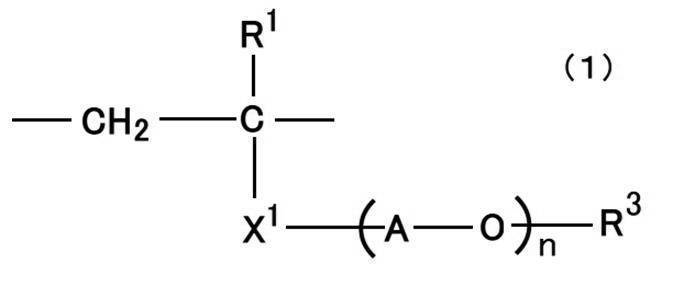
(式中、R1は水素原子又はメチル基を表し、X1は、-O-、-CH2-O-、-CO-、-CO-O-、又は-CO-NR2-を表す。ここでR2は水素原子または炭素原子数1~4のアルキル基を表す。R3は水素原子または炭素原子数1~18のアルキル基を表し、Aはアルキレン基を表し、2≦n≦100である。)
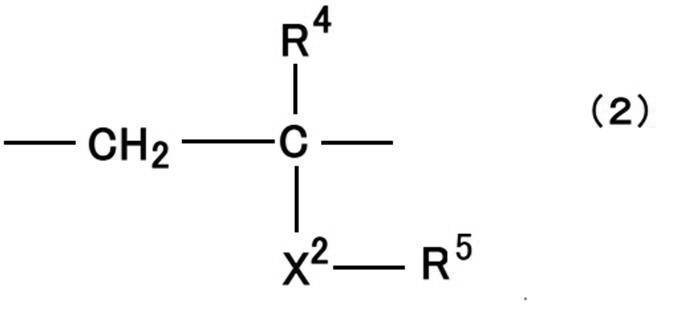
(式中、R4は水素原子又はメチル基を表し、X2は、-O-、-CH2-O-、-CO-、又は-CO-O-を表し、R5は炭素原子数3~30の分岐アルキル基を表す。)
[3] 式(1)中のA-Oで表されるオキシアルキレン基が、エチレンオキサイド基である、上記[2]記載のポリマー。
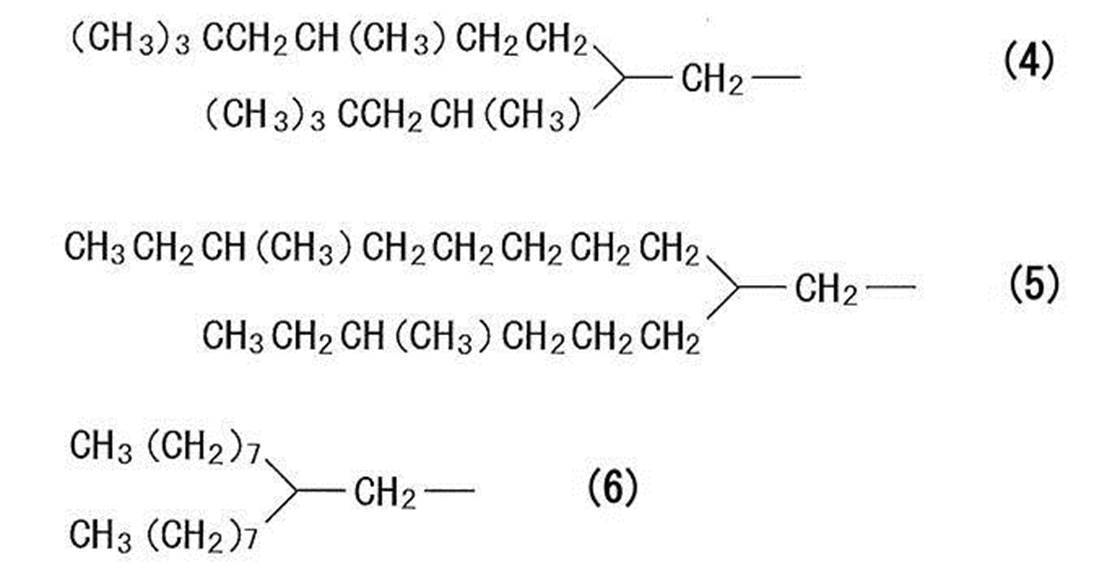
[4] 式(2)中のR5で表される炭素原子数3~30の分岐アルキル基が、下記式(4)~(6)で表される基のいずれかである、上記[2]又は[3]記載のポリマー。
[4] 式(2)中のR5で表される炭素原子数3~30の分岐アルキル基が、下記式(4)~(6)で表される基のいずれかである、上記[2]又は[3]記載のポリマー。

[5] 共重合体(A)における式(1)で表される単量体単位と式(2)で表される単量体単位の共重合比a1((1):(2))が5:95~90:10(モル比)である、上記[2]~[4]のいずれか1つに記載のポリマー。
[6] 共重合体(A)が、側鎖に炭素原子数3~30の直鎖アルキル基を有する単量体単位(III)をさらに含む、上記[1]~[4]のいずれか1つに記載のポリマー。
[7] 単量体単位(III)が、下記式(3)で表される単量体単位である、上記[6]記載のポリマー。
[6] 共重合体(A)が、側鎖に炭素原子数3~30の直鎖アルキル基を有する単量体単位(III)をさらに含む、上記[1]~[4]のいずれか1つに記載のポリマー。
[7] 単量体単位(III)が、下記式(3)で表される単量体単位である、上記[6]記載のポリマー。
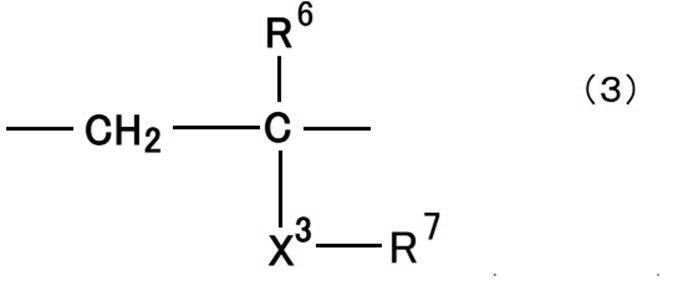
(式中、R6は水素原子又はメチル基を表し、X3は、-O-、-CH2-O-、-CO-、又は-CO-O-を表し、R7は炭素原子数3~30の直鎖アルキル基を表す。)
[8] 共重合体(A)における式(1)で表される単量体単位と式(2)で表される単量体単位と式(3)で表される単量体単位の共重合比a2((1):(2):(3))が、5~60:10~90:5~50(モル比)(但し、(1)と(2)と(3)の数値の合計が100)である、上記[7]記載のポリマー。
[9] 側鎖に重合度2~100のポリアルキレングリコール骨格を有する単量体単位(I)及び側鎖に炭素原子数3~30の分岐アルキル基を有する単量体単位(II)を含む共重合体(A)と、
側鎖に重合度2~100のポリアルキレングリコール骨格を有する単量体単位(I)及び側鎖に炭素原子数3~30の直鎖アルキル基を有する単量体単位(III)を含む共重合体(B)とを含む、ゲル形成用ポリマー混合物。
[10] 単量体単位(I)が、下記式(1)で表される単量体単位であり、単量体単位(II)が、下記式(2)で表される単量体単位であり、単量体単位(III)が、下記式(3)で表される単量体単位である、上記[9]記載のポリマー混合物。
[8] 共重合体(A)における式(1)で表される単量体単位と式(2)で表される単量体単位と式(3)で表される単量体単位の共重合比a2((1):(2):(3))が、5~60:10~90:5~50(モル比)(但し、(1)と(2)と(3)の数値の合計が100)である、上記[7]記載のポリマー。
[9] 側鎖に重合度2~100のポリアルキレングリコール骨格を有する単量体単位(I)及び側鎖に炭素原子数3~30の分岐アルキル基を有する単量体単位(II)を含む共重合体(A)と、
側鎖に重合度2~100のポリアルキレングリコール骨格を有する単量体単位(I)及び側鎖に炭素原子数3~30の直鎖アルキル基を有する単量体単位(III)を含む共重合体(B)とを含む、ゲル形成用ポリマー混合物。
[10] 単量体単位(I)が、下記式(1)で表される単量体単位であり、単量体単位(II)が、下記式(2)で表される単量体単位であり、単量体単位(III)が、下記式(3)で表される単量体単位である、上記[9]記載のポリマー混合物。

(式中、R1は水素原子又はメチル基を表し、X1は、-O-、-CH2-O-、-CO-、-CO-O-、又は-CO-NR2-を表す。ここでR2は水素原子または炭素原子数1~4のアルキル基を表す。R3は水素原子または炭素原子数1~18のアルキル基を表し、Aはアルキレン基を表し、2≦n≦100である。)
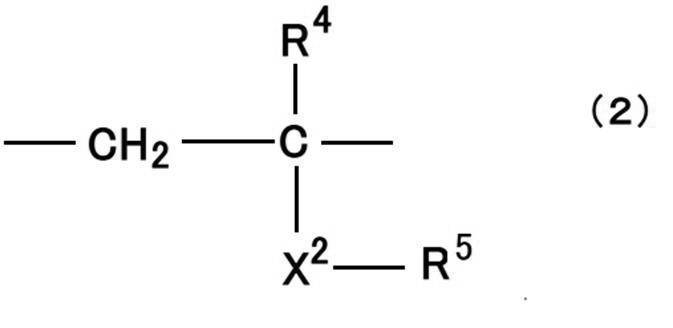
(式中、R4は水素原子又はメチル基を表し、X2は、-O-、-CH2-O-、-CO-、又は-CO-O-を表し、R5は炭素原子数3~30の分岐アルキル基を表す。)
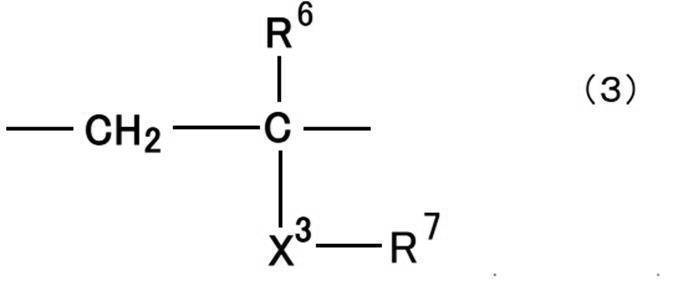
(式中、R6は水素原子又はメチル基を表し、X3は、-O-、-CH2-O-、-CO-、又は-CO-O-を表し、R7は炭素原子数3~30の直鎖アルキル基を表す。)
[11] 式(1)中のA-Oで表されるオキシアルキレン基が、エチレンオキサイド基である、上記[10]記載のポリマー混合物。
[12] 式(2)中のR5で表される炭素原子数3~30の分岐アルキル基が、下記式(4)~(6)で表される基のいずれかである、上記[10]又は[11]記載のポリマー混合物。
[11] 式(1)中のA-Oで表されるオキシアルキレン基が、エチレンオキサイド基である、上記[10]記載のポリマー混合物。
[12] 式(2)中のR5で表される炭素原子数3~30の分岐アルキル基が、下記式(4)~(6)で表される基のいずれかである、上記[10]又は[11]記載のポリマー混合物。
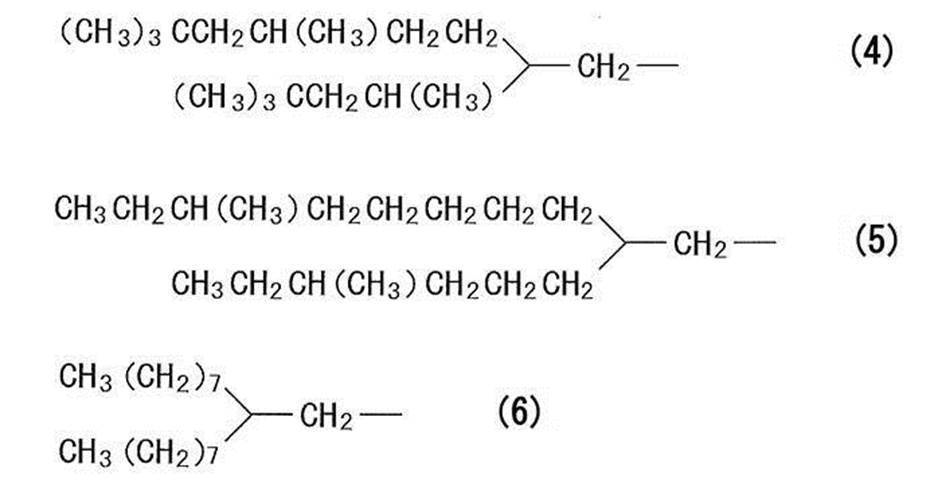
[13] 共重合体(A)における式(1)で表される単量体単位と式(2)で表される単量体単位の共重合比a3((1):(2))が1:99~90:10(モル比)であり、共重合体(B)における式(1)で表される単量体単位と式(3)で表される単量体単位の共重合比b1((1):(3))が1:99~90:10(モル比)である、上記[10]~[12]のいずれか1つに記載のポリマー混合物。
[14] (a)上記[1]~[13]のいずれか1つに記載のポリマー又はポリマー混合物、
(b)水、及び
(c)油性成分、を含む液状組成物であって、
皮膚上でゲルに変化する、皮膚用粘着性材料。
[15] さらに、(d)有機溶剤を含有する、上記[14]に記載の皮膚用粘着性材料。
[16] 皮膚外用剤の基剤用である、上記[14]又は[15]記載の材料。
[17] 皮膚外用剤が化粧料である、上記[16]記載の材料。
[18] 皮膚外用剤が皮膚外用医薬品である、上記[16]記載の材料。
[19] 上記[14]又は[15]記載の皮膚用粘着性材料を皮膚に接触させることを含む、皮膚粘着性ゲルの形成方法。
[14] (a)上記[1]~[13]のいずれか1つに記載のポリマー又はポリマー混合物、
(b)水、及び
(c)油性成分、を含む液状組成物であって、
皮膚上でゲルに変化する、皮膚用粘着性材料。
[15] さらに、(d)有機溶剤を含有する、上記[14]に記載の皮膚用粘着性材料。
[16] 皮膚外用剤の基剤用である、上記[14]又は[15]記載の材料。
[17] 皮膚外用剤が化粧料である、上記[16]記載の材料。
[18] 皮膚外用剤が皮膚外用医薬品である、上記[16]記載の材料。
[19] 上記[14]又は[15]記載の皮膚用粘着性材料を皮膚に接触させることを含む、皮膚粘着性ゲルの形成方法。
本発明によれば、水と共存することで、ゲル化し、しかも、皮膚への粘着性が発現する新規なゲル形成用ポリマー又はポリマー混合物を提供することができる。
また、かかるゲル形成用ポリマー又はポリマー混合物を含むことで、皮膚へ塗布する前は液状でありながら、皮膚上で、皮膚表面への密着性に優れ、皮膚に対する接着性の持続性も良好なハイドロゲル(好ましくは、皮膚表面への密着性に優れ、皮膚に対する接着性の持続性も良好で、しかも、べたつきの無いハイドロゲル)に変化する皮膚用粘着性材料、を実現することができる。
本発明により得られる皮膚用粘着性材料は、皮膚外用剤の基剤として好適であり、皮膚外用剤の基剤として使用することで、皮膚に基剤が密着し、皮膚が十分に水和した湿潤状態を持続させることができるため、有効成分や水分の皮膚への浸透性に優れた、皮膚外用剤を得ることが可能になる。
以下、本発明を詳細に説明する。
[ゲル形成用ポリマー]
本発明のゲル形成用ポリマーは、側鎖に重合度2~100のポリアルキレングリコール骨格を有する単量体単位(I)及び側鎖に炭素原子数3~30の分岐アルキル基を有する単量体単位(II)を含む共重合体(A)からなる。
[ゲル形成用ポリマー]
本発明のゲル形成用ポリマーは、側鎖に重合度2~100のポリアルキレングリコール骨格を有する単量体単位(I)及び側鎖に炭素原子数3~30の分岐アルキル基を有する単量体単位(II)を含む共重合体(A)からなる。
共重合体(A)は、水と共存することで、ゲル化する。すなわち、単量体単位(I)の側鎖の重合度2~100のポリアルキレングリコール骨格同士が水分子を介して架橋することで、ゲル化し、ハイドロゲルを形成する。一方、単量体単位(II)の側鎖の炭素原子数3~30の分岐アルキル基は皮膚粘着性を与える。従って、皮膚粘着性ハイドロゲルを形成し得る。
単量体単位(I)は、好ましくは、下記式(1)で表される単量体単位(以下、「式(1)の単量体単位」とも略称する。)である。
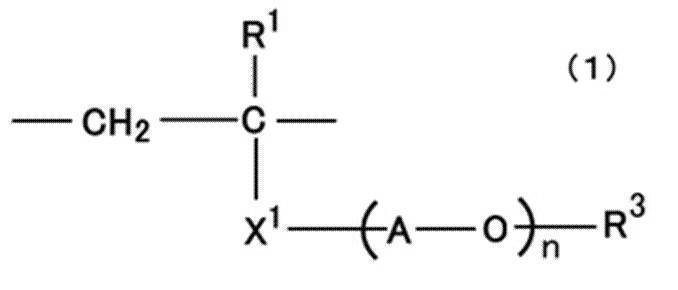
式(1)中、R1は水素原子又はメチル基を表し、X1は、-O-、-CH2-O-、-CO-、-CO-O-または-CO-NR2-を表す。なお、-CO-NR2-におけるR2は水素原子または炭素原子数1~4のアルキル基を表す。
R3は水素原子または炭素原子数1~18の直鎖または分岐アルキル基を表し、水素原子、メチル基、エチル基、プロピル基、イソプロピル基が好ましく、水素原子、メチル基がより好ましい。
Aはアルキレン基を表し、アルキレン基の炭素原子数は1~5が好ましく、2~3がより好ましい。
―(A-O)n―はポリアルキレングリコール骨格を表し、A-Oで表されるオキシアルキレン基は、1種のオキシアルキレン基からなるものであってもよいし、例えば、エチレンオキサイド基とプロピレンオキサイド基との2種類等のような複数種類のオキシアルキレン基から構成されるものであってもよい。
ポリアルキレングリコール骨格の重合度nは、2≦n≦100であり、好ましくは、5≦n≦10000、より好ましくは、10≦n≦100であり、特に好ましくは、10≦n≦50である。nがかかる好ましい範囲にあれば、十分な効果が得られやすい。
式(1)の単量体単位は、(メタ)アクリル系単量体由来の単位(式中、X1が-CO-O-)、(メタ)アリルエーテル系単量体由来の単位(式中、X1が-CH2-O-)、ビニルエーテル系単量体由来の単位(式中、X1が-O-)、及び(メタ)アクリルアミド系単量体由来の単位(式中、X1が-CO-NR2-)から選ばれるいずれか1種または2種以上であるのが好ましく、より好ましくは、(メタ)アクリル系単量体由来の単位である。なお、本明細書中、「(メタ)アクリル」は「アクリル」及び「メタクリル」の両方を意味する。
式(1)の単量体単位の最も好ましい態様は、式中のR1がメチル基であり、X1が-CO-O-であり、―(A-O)n―が重合度10~100のポリエチレングリコール残基、R3が水素原子である、ポリエチレングリコールメタクリレートである。
側鎖に炭素原子数3~30の分岐アルキル基を有する単量体単位(II)は、好ましくは、下記式(2)で表される単量体単位(以下、「式(2)の単量体単位」とも略称する。)である。

式(2)中、R4は水素原子又はメチル基を表し、X2は、-O-、-CH2-O-、-CO-、又は-CO-O-を表す。R5は炭素原子数3~30の分岐アルキル基を表す。
R5で表される炭素原子数3~30の分岐アルキル基は、例えば、イソプロピル基、イソブチル基、sec-ブチル基、t-ブチル基、イソヘキシル基、イソヘプチル基、イソペンチル基、ネオペンチル基、t-ペンチル基、1-メチルブチル基、2-メチルブチル基、1,2-ジメチルプロピル基、1-エチルプロピル基、1-メチルペンチル基、2-メチルペンチル基、3-メチルペンチル基、4-メチルペンチル基、1,1-ジメチルブチル基、2,2-ジメチルブチル基、3,3-ジメチルブチル基、1,2-ジメチルブチル基、2,3-ジメチルブチル基、1,3-ジメチルブチル基、1-エチルブチル基、2-エチルブチル基、1,1,2-トリメチルプロピル基、1,2,2-トリメチルプロピル基、1-エチル-1-メチルプロピル基、1-エチル-2-メチルプロピル基、イソオクチル基、イソノニル基、イソデシル基、イソラウリル基、イソパルミチル基、イソミリスチル基、イソステアリル基、イソアイコシル基、下記の式(4)~(9)で表される基等が挙げられる。これらのうち、炭素原子数が4~24のものが好ましく、炭素原子数が6~20のものがより好ましく、特に好ましくは、下記の式(4)~(9)で表される基であり、最も好ましくは、下記の式(4)~(6)で表される基である。

式(2)の単量体単位は、(メタ)アクリル系単量体由来の単位(式中、X2が-CO-O-)、(メタ)アリルエーテル系単量体由来の単位(式中、X2が-CH2-O-)、及びビニルエーテル系単量体由来の単位(式中、X2が-O-)から選ばれるいずれか1種または2種以上であるのが好ましく、より好ましくは、(メタ)アクリル系単量体由来の単位である。
式(2)の単量体単位の最も好ましい態様は、式中のR4が水素原子又はメチル基であり、X2が-CO-O-であり、R5が式(4)の分岐アルキル基である、(メタ)アクリレート系単量体である。
共重合体(A)は、ランダム共重合体、ブロック共重合体のいずれであってもよいが、ランダム共重合体が好ましい。また、式(1)の単量体単位と式(2)の単量体単位との共重合比a1((1):(2))は、モル比で換算して、5:95~90:10が好ましく、15:85~80:20がより好ましく、20:80~70:30がさらに一層好ましく、20:80~55:45が特に好ましい。式(1)の単量体単位の割合が小さすぎると、皮膚上でゲルを形成しにくくなり、大きすぎると、皮膚への密着性が得難くなる。
共重合体(A)により形成される、ハイドロゲルのベタツキを抑制する観点から、共重合体(A)は、側鎖に炭素原子数3~30の直鎖アルキル基を有する単量体単位(III)をさらに含む、共重合体であってもよい。
単量体単位(III)は、好ましくは、下記式(3)で表される単量体単位(以下、「式(3)の単量体単位」とも略称する。)である。

(式中、R6は水素原子又はメチル基を表し、X3は、-O-、-CH2-O-、-CO-、又は-CO-O-を表し、R7は炭素原子数3~30の直鎖アルキル基を表す。)
式(3)中、R7で表される炭素原子数3~30の直鎖アルキル基は、例えば、n-プロピル基、n-ブチル基、n-ペンチル基、n-ヘキシル基、n-ヘプチル基、n-オクチル基、n-ノニル基、n-デシル基、n-ウンデシル基、n-ドデシル基、n-トリデシル基、n-テトラデシル基、n-ペンタデシル基、n-ヘキサデシル基、n-ヘプタデシル、n-オクタデシル、n-ノナデシル、n-イコシル基、n-ヘンイコシル基、n-ドコシル基、n-トリコシル基、n-テトラコシル基、n-ペンタコシル基、n-ヘキサコシル基、n-ヘプタコシル基、n-オクタコシル基、n-ノナコシル基、n-トリアコンチル基等が挙げられる。これらのうち、炭素原子数が4~24のものが好ましく、炭素原子数が6~20のものがより好ましく、特に好ましくは、n-ヘキサデシル基、n-オクタデシル基である。
式(3)の単量体単位は、(メタ)アクリル系単量体由来の単位(式中、X3が-CO-O-)、(メタ)アリルエーテル系単量体由来の単位(式中、X3が-CH2-O-)、及びビニルエーテル系単量体由来の単位(式中、X3が-O-)から選ばれるいずれか1種または2種以上であるのが好ましく、より好ましくは、(メタ)アクリル系単量体由来の単位である。
式(3)の単量体単位の最も好ましい態様は、式中のR6がメチル基であり、X3が-CO-O-であり、R7がn-オクタデシル基である、メタクリレート系単量体である。
共重合体(A)が式(3)の単量体単位を含む共重合体である場合、共重合体(A)は、ランダム共重合体、ブロック共重合体のいずれであってもよいが、ランダム共重合体が好ましい。また、式(1)の単量体単位と式(2)の単量体単位と式(3)の単量体単位との共重合比a2((1):(2):(3))は、モル比で換算して、5~60:10~90:5~50(但し、3つの数値の合計が100)であることが好ましい。式(1)の単量体単位の割合が小さすぎると、皮膚上でゲルを形成し難くなり、式(3)の単量体単位の割合が小さすぎると、ゲルのベタツキ抑制効果が十分に得られにくくなり、大きすぎると、ゲルの皮膚粘着性が低下する傾向になる。
共重合体(A)の重量平均分子量(Mw)は、好ましくは5000~200000であり、より好ましくは10000~100000である。重量平均分子量(Mw)が5000より小さいと、皮膚への密着性やゲル化能が発現し難くなる傾向となり、200000より大きいと、例えば、後述の有機溶剤(希釈剤)を使用する場合に、有機溶剤と混合し難い傾向となる。重量平均分子量(Mw)がかかる好ましい範囲にあれば、十分な効果が得られやすい。
本発明における重量平均分子量(Mw)は、ゲルパーミエーションクロマトグラフィー(GPC)法(ポリスチレンン換算)で測定される。GPC法による重量平均分子量は、具体的には、測定装置として東ソー(株)製、HLC-8320GPC Eco-SECを、カラムとして東ソー(株)製、SuperHZを、移動相としてテトラヒドロフラン等を用いて、カラム温度25℃にて測定し、標準ポリスチレンの検量線を用いて算出することができる。
上記では、本発明のゲル形成用ポリマーにおける、側鎖に重合度2~100のポリアルキレングリコール骨格を有する単量体単位(I)及び側鎖に炭素原子数3~30の分岐アルキル基を有する単量体単位(II)を含む共重合体(A)を、式(1)及び式(2)の単量体単位に加えて、式(3)の単量体単位をさらに共重合した共重合体とすることで、共重合体(A)により形成されるハイドロゲルのベタツキ抑制効果が高められることを説明したが、本発明のゲル形成用ポリマーは、側鎖に重合度2~100のポリアルキレングリコール骨格を有する単量体単位(I)及び側鎖に炭素原子数3~30の分岐アルキル基を有する単量体単位(II)を含む共重合体(A)と、側鎖に重合度2~100のポリアルキレングリコール骨格を有する単量体単位(I)及び側鎖に炭素原子数3~30の直鎖アルキル基を有する単量体単位(III)を含む共重合体(B)との混合物(ポリマー混合物)の態様であってもよい。
かかる共重合体(A)と共重合体(B)のポリマー混合物の場合、共重合体(A)の好ましい態様は、上述の式(1)の単量体単位と上述の式(3)の単量体単位との共重合体である。また、共重合体(B)における、単量体単位(I)は、好ましくは、上述の式(1)の単量体単位であり、単量体単位(III)は、好ましくは、上述の式(3)の単量体単位である。なお、この場合の、式(1)の単量体単位および式(3)の単量体単位の好ましい態様は、上述の共重合体(A)におけるそれが踏襲される。
ポリマー混合物における共重合体(A)は、ランダム共重合体、ブロック共重合体のいずれであってもよいが、ランダム共重合体が好ましい。また、式(1)の単量体単位と式(2)の単量体単位との共重合比a3((1):(2))は、モル比で換算して、1:99~90:10が好ましく、5:95~80:20がより好ましい。式(1)の単量体単位の割合が小さすぎると、皮膚上で共重合体の粉状の析出が生じる虞があり、大きすぎると、ゲルのベタツキを抑制することが困難な傾向になる。
また、ポリマー混合物における共重合体(B)は、ランダム共重合体、ブロック共重合体のいずれであってもよいが、ランダム共重合体が好ましい。また、式(1)の単量体単位と式(3)の単量体単位との共重合比b1((1):(3))は、モル比で換算して、1:99~90:10が好ましく、5:95~80:20がより好ましく、10:90~80:20がさらに一層好ましく、10:90~55:45が特に好ましい。式(1)の単量体単位の割合が小さすぎると、皮膚上でゲルを形成しにくくなる傾向となり、大きすぎると、皮膚上で共重合体が紛体状に析出するおそれがある。また、共重合体(B)の重量平均分子量(Mw)は、好ましくは5000~200000であり、より好ましくは10000~100000である。重量平均分子量(Mw)が5000より小さいと、ベタツキの抑制効果が発揮され難くなり、200000より大きいと、逆にベタツキが強まるおそれがある。重量平均分子量(Mw)がかかる好ましい範囲にあれば、十分な効果が得られやすい。また上記範囲外であると、皮膚への密着性が得難くなる。
ポリマー混合物における共重合体(A)と共重合体(B)の混合比((A):(B))は、共重合体(A)における共重合比a3や共重合体(B)における共重合比b1によっても異なるが、一般的には、質量比で、95:5~10:90が好ましく、90:10~40:60がより好ましい。共重合体(B)の割合が小さすぎると、ベタツキの抑制効果が発揮され難くなる傾向となり、大きすぎると、皮膚への密着性が十分に発揮されない傾向となる。
共重合体(A)および共重合体(B)は、例えば、式(1)、(2)の単量体単位、式(1)~(3)の単量体単位、或いは、式(1)、(3)の単量体単位に充当する単量体の混合物を、ラジカル重合開始剤の存在下、窒素等の不活性ガス雰囲気において重合することにより得ることができる。重合(反応温度)は重合開始剤に適当な温度に加温もしくは冷却して行えば良い。重合方法としては、例えば、溶液重合、分散重合、沈殿重合、塊状重合等が挙げられ、中でも溶液重合または沈殿重合が好ましい。特に、分子量制御の観点から、有機溶媒中での溶液重合によって反応を実施することが好ましい。有機溶媒は、メタノール、エタノール、n-プロパノール、イソプロパノール等のアルコール類;酢酸メチル、酢酸エチル等のエステル類;アセトン、メチルエチルケトン等のケトン類;ベンゼン、トルエン等の芳香族炭化水素等が挙げられ、ポリマーの生体への安全性の観点から、アルコール類が好ましい。溶媒は1種または2種以上を併用することができる。有機溶媒中での溶液重合の場合、重合反応物全体における有機溶媒の含量は、全単量体の合計量の1質量部当たり、1~100質量部が好ましく、より好ましくは5~50質量部である。
重合開始剤は、ラジカル重合性二重結合を有するモノマーの共重合に用いる一般的なものを用いればよく、好ましくは、アゾ系重合開始剤が用いられる。アゾ系重合開始剤としては、例えば、2,2’-アゾビスイソブチロニトリル、2,2’-アゾビス-2-メチルブチロニトリル、2,2’-アゾビス-2,4-ジメチルバレロニトリル、2,2’-アゾビス-4-メトキシ-2,4-ジメチルバレロニトリル、ジメチル2,2’-アゾビスイソブチレート等が挙げられる。これらは1種又は2種以上を使用できる。中でも、得られるポリマーの生体への安全性の観点から、ジメチル2,2’-アゾビスイソブチレートが特に好ましい。重合開始剤の量は、単量体全量に対して1~100モル%が好ましく、3~50モル%がより好ましい。
重合反応により生成した共重合体(共重合体(A)又は共重合体(B))を含む重合反応物は適宜乾燥、濾過等を行って、共重合体を採取する。例えば、溶液重合により共重合体を合成した場合、減圧乾燥により溶媒を濃縮(揮散)して共重合体を採取する。
[皮膚用粘着性材料]
(a)本発明のゲル形成用ポリマー又はポリマー混合物、すなわち、上記のようにして得られた共重合体(共重合体(A)、或いは、共重合体(A)と共重合体(B)の混合物)は、例えば、(b)水、(c)油性成分等を加えて、乳液状(O/Wエマルジョン)の液状組成物に調製して使用される。かかる液状組成物が、本発明の皮膚用粘着性材料となる。なお、上記のようにして得られた共重合体(共重合体(A)、或いは、共重合体(A)と共重合体(B)の混合物)の粘度が高く、乳液状(O/Wエマルジョン)を形成し難い場合は、共重合体の希釈剤として、(d)有機溶剤をさらに加えて、液状組成物を調製することが好ましい。
(a)本発明のゲル形成用ポリマー又はポリマー混合物、すなわち、上記のようにして得られた共重合体(共重合体(A)、或いは、共重合体(A)と共重合体(B)の混合物)は、例えば、(b)水、(c)油性成分等を加えて、乳液状(O/Wエマルジョン)の液状組成物に調製して使用される。かかる液状組成物が、本発明の皮膚用粘着性材料となる。なお、上記のようにして得られた共重合体(共重合体(A)、或いは、共重合体(A)と共重合体(B)の混合物)の粘度が高く、乳液状(O/Wエマルジョン)を形成し難い場合は、共重合体の希釈剤として、(d)有機溶剤をさらに加えて、液状組成物を調製することが好ましい。
(b)水は、超純水、純水、精製水もしくは水道水が好ましく、より好ましくは純水、精製水である。しかしながら、これらに制限されることは無く、例えば香料が含まれる香水等や、天然由来の水分である果汁水等も用いることができ、特に制限はされない。
(c)油性成分は、特に制限されることなく、通常、化粧料、皮膚外用医薬品等に使用される炭化水素油、高級脂肪酸、高級アルコール、合成エステル油、液体油脂、シリコーン油などが挙げられ、1種また2種以上を用いることができる。
炭化水素油としては、例えば、イソドデカン、イソヘキサデカン、イソパラフィン、パラフィン、流動パラフィン、スクワラン、スクワレン、セレシン等が挙げられる。
高級脂肪酸としては、例えば、ラウリン酸、ミリスチン酸、パルミチン酸、ステアリン酸、ベヘン酸、オレイン酸、ウンデシレン酸、トール酸、イソステアリン酸、リノール酸、リノレイン酸、エイコサペンタエン酸(EPA)、ドコサヘキサエン酸(DHA)等が挙げられる。
高級アルコールとしては、例えば、直鎖アルコール(例えば、ラウリルアルコール、セチルアルコール、ステアリルアルコール、ベヘニルアルコール、ミリスチルアルコール、オレイルアルコール、セトステアリルアルコール等);分枝鎖アルコール(例えば、モノステアリルグリセリンエーテル(バチルアルコール)、2-デシルテトラデシノール、ラノリンアルコール、コレステロール、フィトステロール、ヘキシルドデカノール、イソステアリルアルコール、オクチルドデカノール等)等が挙げられる。
合成エステル油としては、例えば、ミリスチン酸イソプロピル、オクタン酸セチル、2-エチルヘキサン酸セチル、ミリスチン酸オクチルドデシル、パルミチン酸イソプロピル、ステアリン酸ブチル、ラウリン酸ヘキシル、ミリスチン酸ミリスチル、オレイン酸デシル、ジメチルオクタン酸ヘキシルデシル、乳酸セチル、乳酸ミリスチル、酢酸ラノリン、ステアリン酸イソセチル、イソステアリン酸イソセチル、12-ヒドロキシステアリン酸コレステリル、ジ-2-エチルヘキサン酸エチレングリコール、ジペンタエリスリトール脂肪酸エステル、モノイソステアリン酸N-アルキルグリコール、ジカプリン酸ネオペンチルグリコール、リンゴ酸ジイソステアリル、ジ-2-ヘプチルウンデカン酸グリセリン、トリ-2-エチルヘキサン酸トリメチロールプロパン、トリイソステアリン酸トリメチロールプロパン、テトラ-2-エチルヘキサン酸ペンタエリスリトール、トリ-2-エチルヘキサン酸グリセリン、トリオクタン酸グリセリン、トリイソパルミチン酸グリセリン、トリイソステアリン酸トリメチロールプロパン、パルミチン酸2-エチルヘキシル、トリミリスチン酸グリセリン、トリ-2-ヘプチルウンデカン酸グリセライド、ヒマシ油脂肪酸メチルエステル、オレイン酸オレイル、アセトグリセライド、パルミチン酸2-ヘプチルウンデシル、アジピン酸ジイソブチル、N-ラウロイル-L-グルタミン酸-2-オクチルドデシルエステル、アジピン酸ジ-2-ヘプチルウンデシル、エチルラウレート、セバシン酸ジ-2-エチルヘキシル、ミリスチン酸2-ヘキシルデシル、パルミチン酸2-ヘキシルデシル、アジピン酸2-ヘキシルデシル、セバシン酸ジイソプロピル、コハク酸2-エチルヘキシル、クエン酸トリエチル等が挙げられる。これらの中で、ジカプリン酸ネオペンチルグリコールが好ましい。
液体油脂としては、例えば、アマニ油、ツバキ油、マカデミアナッツ油、トウモロコシ油、ミンク油、オリーブ油、アボガド油、サザンカ油、ヒマシ油、サフラワー油、ホホバ油、ヒマワリ油、アルモンド油、ナタネ油、ゴマ油、大豆油、落花生油、トリグリセリン、トリオクタン酸グリセリン、トリイソパルミチン酸グリセリン等がある。
また、シリコーン油としては、例えば、ジメチルポリシロキサン、メチルフェニルポリシロキサン、メチルハイドロジェンポリシロキサン等の鎖状シリコーン、オクタメチルシクロテトラシロキサン、デカメチルシクロペンタシロキサン、ドデカメチルシクロヘキサシロキサン等の環状シリコーンがある。
(d)有機溶剤としては、ゲル形成用ポリマー又はポリマー混合物(すなわち、共重合体(A)、或いは、共重合体(A)と共重合体(B)の混合物)を希釈し得るものであれば、特に制限なく使用できる。例えば、アルコール系溶媒、エーテル系溶媒、ケトン系溶媒等が好適であり、また、極性溶媒(例えば、酢酸エチル、テトラヒドロフラン等)も使用可能である。
アルコール系溶媒としては、例えば、メタノール、エタノール、n-プロパノール、イソプロパノール、n-ブタノール、イソブタノール、t-ブタノール、2-エチルヘキシルアルコール等の低級一価アルコールや、プロピレングリコール、グリセリン、1,3-ブタンジオール等の多価アルコールが挙げられる。また、エーテル系溶媒としては、例えば、ジエチルエーテル、テトラヒドロフラン、ジオキサン、エチルセロソルブ、ブチルセロソルブ、エチルカルビトール、ブチルカルビトール、プロピレングリコールモノメチルエーテル等が挙げられる。また、ケトン系溶媒としては、例えば、アセトン、メチルエチルケトン、メチルイソブチルケトン、ジ-n-ブチルケトン、シクロヘキサノン等が挙げられる。有機溶剤は好ましくはアルコール系溶媒であり、より好ましくは、エタノールである。
有機溶剤は1種または2種以上を使用できる。
有機溶剤を使用する場合、ゲル形成用ポリマー又はポリマー混合物(すなわち、共重合体(A)、或いは、共重合体(A)と共重合体(B)の混合物)に、有機溶剤を加えて混合し、その後、(b)水および(c)油性成分を加えて、乳液状(O/Wエマルジョン)の液状組成物に調製する手順が好ましい。
有機溶剤を使用する場合、ゲル形成用ポリマー又はポリマー混合物(すなわち、共重合体(A)、或いは、共重合体(A)と共重合体(B)の混合物)に、有機溶剤を加えて混合し、その後、(b)水および(c)油性成分を加えて、乳液状(O/Wエマルジョン)の液状組成物に調製する手順が好ましい。
本発明の皮膚用粘着性材料を皮膚に接触させることで、皮膚粘着性ゲルを形成することができる。すなわち、本発明の皮膚用粘着性材料を皮膚に塗布すると、水が一部揮発もしくは皮膚中に浸透して、全体の組成比が変わることにより、共重合体の単量体単位(I)の側鎖にあるポリアルキレングリコール骨格同士が水を介して架橋することでゲル化し、皮膚上に留まる。また、共重合体中の単量体単位(II)の側鎖にある分鎖アルキル基が皮膚との親和性を示し、皮膚粘着性を与える。さらに、共重合体が単量体単位(III)を有する場合、単量体単位(III)の側鎖にある直鎖アルキル基がハイドロゲルのベタツキを抑制するので、ベタツキが抑制されたハイドロゲルが得られる。
従って、本発明によれば、皮膚へ塗布する前は液状でありながら、皮膚上で、皮膚表面への密着性に優れ、皮膚に対する接着性の持続性も良好なハイドロゲル(好ましくは、皮膚表面への密着性に優れ、皮膚に対する接着性の持続性も良好で、しかも、ベタツキが抑制されたハイドロゲル)に変化する、皮膚用粘着性材料、を実現することができる。
なお、本発明の皮膚用粘着性材料(液状組成物)には、上記の水、油性成分、有機溶剤の他に適宜添加剤を配合することが出来る。例えば、添加剤としては、他の高分子、アルコール系の溶剤、界面活性剤、防腐剤等が挙げられ、これらは自由に配合可能である。
本発明の皮膚用粘着性材料(液状組成物)の配合組成は特に限定されないが、好適な具体例として、例えば、以下の配合組成が挙げられる。
ゲル形成用ポリマー又はポリマー混合物:2~40質量%(好ましくは5~20質量%)、
水:20~95質量%(好ましくは30~90質量%)、
油性成分:1~60質量%(好ましくは2~50質量%)、
有機溶剤:2~40質量%(好ましくは5~20質量%)、
添加剤:0~50質量%(好ましくは0~10質量%)
ゲル形成用ポリマー又はポリマー混合物:2~40質量%(好ましくは5~20質量%)、
水:20~95質量%(好ましくは30~90質量%)、
油性成分:1~60質量%(好ましくは2~50質量%)、
有機溶剤:2~40質量%(好ましくは5~20質量%)、
添加剤:0~50質量%(好ましくは0~10質量%)
本発明の皮膚用粘着性材料は、化粧料、皮膚外用医薬品等の皮膚外用剤の基剤に好適である。化粧料の基剤としては、例えば、保湿シート、美白シート、しわ伸ばしシート、角質除去シートなどの基礎化粧品、ボディー用保湿シート、ボディー用美白剤、日焼けトリートメント剤などの基剤が挙げられる。これら化粧料の基剤とする場合、添加剤としては、グリセリン、プロピレングリコール、ジプロピレングリコール、1,3-ブタンジオールなどの多価アルコール類;エタノール、プロパノールなどの低級アルコール類;ソルビトール、キシリトール、マンニトールなどの糖類;パラベン、フェノキシエタノール、グルコン酸クロルヘキシジンなどの防腐剤;トコフェロールおよびその誘導体、ブチルヒドロキシトルエン、ピロ亜硫酸塩などの抗酸化剤;パラアミノ安息香酸誘導体、ベンゾフェノン誘導体などの紫外線吸収剤;ポリエチレングリコール、ヒアルロン酸などの保湿剤;ビタミンCやアスコルビン酸-2-グルコシドなどのビタミンC誘導体、アルブチン、コウジ酸などの美白剤;尿素、乳酸、クエン酸などの角質除去剤;トラネキサム酸、アラントイン、グリチルリチン酸塩などの抗炎症剤;水酸化カリウム(KOH)、クエン酸塩、酢酸塩などのpH調整剤;キレート剤;香料;アミノ酸およびアミノ酸塩;コラーゲン;色素;胎盤抽出物、朝鮮人参エキス、ステロール配糖体などの薬効成分;ナトリウム塩、カルシウム塩、カリウム塩などの無機塩類;タルク、シリカゲル、酸化亜鉛、酸化チタンなどの粉体類などが好適である。
本発明の皮膚用粘着性材料を皮膚外用医薬品の基剤として使用する場合、例えば、食塩などの浸透圧調整剤を配合した創傷・火傷保護シート、エタノールやメントールを配合した熱さまし用シート、抗ヒスタミン剤やステロイドホルモンなどを配合した痒み止めシート、殺菌剤や抗生物質を配合した化膿防止薬、抗炎症剤を配合した抗炎症薬、抗真菌剤を配合した水虫治療薬やタムシ治療薬等の基剤として好適である。
以下、実施例及び比較例等を示し、本発明を詳しく説明するが、本発明がこれらの例に限定されるものでは無い。
実施例1:共重合体1の合成
500mLの丸底フラスコに、メタノールで再結晶し精製したジメチル2,2’-アゾビスイソブチラート(和光純薬社製)を1.15g(5.0mmol)、ヘキサンで重合禁止剤を予め除去し精製したイソステアリルアクリレート(大阪有機化学社製、アルコール残基が式(4)の分岐アルキル基からなるアクリル酸エステル)を26.0g(80mmol)、ヘキサンで再沈殿させ、重合禁止剤を予め除去し精製した重合度が23のポリエチレングリコールメタクリレート(日油社製、ブレンマー1000)を22.2g(20mmol)、脱水エタノールを197.2g加え、窒素雰囲気下で75℃、120分間加熱撹拌を行った。その後、減圧乾燥にてエタノールを濃縮することで、側鎖にポリエチレングリコール骨格を有する単量体単位(x)と側鎖に式(4)の分岐アルキル基を有する単量体単位(y)の含有比(x:y)がモル比で2:8の共重合体1を得た。GPCによる分子量測定の結果、重量平均分子量(Mw)=37681、数平均分子量(Mn)=14775、多分散度(Mw/Mn)=2.554であった。
500mLの丸底フラスコに、メタノールで再結晶し精製したジメチル2,2’-アゾビスイソブチラート(和光純薬社製)を1.15g(5.0mmol)、ヘキサンで重合禁止剤を予め除去し精製したイソステアリルアクリレート(大阪有機化学社製、アルコール残基が式(4)の分岐アルキル基からなるアクリル酸エステル)を26.0g(80mmol)、ヘキサンで再沈殿させ、重合禁止剤を予め除去し精製した重合度が23のポリエチレングリコールメタクリレート(日油社製、ブレンマー1000)を22.2g(20mmol)、脱水エタノールを197.2g加え、窒素雰囲気下で75℃、120分間加熱撹拌を行った。その後、減圧乾燥にてエタノールを濃縮することで、側鎖にポリエチレングリコール骨格を有する単量体単位(x)と側鎖に式(4)の分岐アルキル基を有する単量体単位(y)の含有比(x:y)がモル比で2:8の共重合体1を得た。GPCによる分子量測定の結果、重量平均分子量(Mw)=37681、数平均分子量(Mn)=14775、多分散度(Mw/Mn)=2.554であった。
実施例2:共重合体2の合成
500mLの丸底フラスコに、メタノールで再結晶し精製したジメチル2,2’-アゾビスイソブチラート(和光純薬社製)を1.15g(5.0mmol)、ヘキサンで重合禁止剤を予め除去し精製したイソステアリルアクリレート(大阪有機化学社製、アルコール残基が式(4)の分岐アルキル基からなるアクリル酸エステル)を16.2g(50mmol)、ヘキサンで再沈殿させ、重合禁止剤を予め除去し精製した重合度が23のポリエチレングリコールメタクリレート(日油社製、ブレンマー1000)を55.5g(50mmol)、脱水エタノールを291.5g加え、窒素雰囲気下で75℃、120分間加熱撹拌を行った。その後、減圧乾燥にてエタノールを濃縮することで、側鎖にポリエチレングリコール骨格を有する単量体単位(x)と側鎖に式(4)の分岐アルキル基を有する単量体単位(y)の含有比(x:y)がモル比で5:5の共重合体2を得た。GPCによる分子量測定の結果、重量平均分子量(Mw)=89139、数平均分子量(Mn)=32508、多分散度(Mw/Mn)=2.742であった。
500mLの丸底フラスコに、メタノールで再結晶し精製したジメチル2,2’-アゾビスイソブチラート(和光純薬社製)を1.15g(5.0mmol)、ヘキサンで重合禁止剤を予め除去し精製したイソステアリルアクリレート(大阪有機化学社製、アルコール残基が式(4)の分岐アルキル基からなるアクリル酸エステル)を16.2g(50mmol)、ヘキサンで再沈殿させ、重合禁止剤を予め除去し精製した重合度が23のポリエチレングリコールメタクリレート(日油社製、ブレンマー1000)を55.5g(50mmol)、脱水エタノールを291.5g加え、窒素雰囲気下で75℃、120分間加熱撹拌を行った。その後、減圧乾燥にてエタノールを濃縮することで、側鎖にポリエチレングリコール骨格を有する単量体単位(x)と側鎖に式(4)の分岐アルキル基を有する単量体単位(y)の含有比(x:y)がモル比で5:5の共重合体2を得た。GPCによる分子量測定の結果、重量平均分子量(Mw)=89139、数平均分子量(Mn)=32508、多分散度(Mw/Mn)=2.742であった。
参考例1:共重合体3の合成
500mLの丸底フラスコに、メタノールで再結晶し精製したジメチル2,2’-アゾビスイソブチラート(和光純薬社製)を1.15g(5.0mmol)、ヘキサンで重合禁止剤を予め除去し精製したステアリルメタクリレート(東京化成工業社製、アルコール残基がn-オクタデシルからなるメタリル酸エステル)を30.4g(80mmol)、ヘキサンで再沈殿させ、重合禁止剤を予め除去し精製した重合度が23のポリエチレングリコールメタクリレート(日油社製、ブレンマー1000)を11.1g(10mmol)、脱水エタノールを170.9g加え、窒素雰囲気下で75℃、120分間加熱撹拌を行った。その後、減圧乾燥にてエタノールを濃縮することで、側鎖にポリエチレングリコール骨格を有する単量体単位(x)と、側鎖にn-オクタデシル基を有する単量体単位(z)の含有比(x:z)がモル比で1:9の共重合体3を得た。GPCによる分子量測定の結果、重量平均分子量(Mw)=17457、数平均分子量(Mn)=10243、多分散度(Mw/Mn)=1.704であった。
500mLの丸底フラスコに、メタノールで再結晶し精製したジメチル2,2’-アゾビスイソブチラート(和光純薬社製)を1.15g(5.0mmol)、ヘキサンで重合禁止剤を予め除去し精製したステアリルメタクリレート(東京化成工業社製、アルコール残基がn-オクタデシルからなるメタリル酸エステル)を30.4g(80mmol)、ヘキサンで再沈殿させ、重合禁止剤を予め除去し精製した重合度が23のポリエチレングリコールメタクリレート(日油社製、ブレンマー1000)を11.1g(10mmol)、脱水エタノールを170.9g加え、窒素雰囲気下で75℃、120分間加熱撹拌を行った。その後、減圧乾燥にてエタノールを濃縮することで、側鎖にポリエチレングリコール骨格を有する単量体単位(x)と、側鎖にn-オクタデシル基を有する単量体単位(z)の含有比(x:z)がモル比で1:9の共重合体3を得た。GPCによる分子量測定の結果、重量平均分子量(Mw)=17457、数平均分子量(Mn)=10243、多分散度(Mw/Mn)=1.704であった。
参考例2:共重合体4の合成
500mLの丸底フラスコに、メタノールで再結晶し精製したジメチル2,2’-アゾビスイソブチラート(和光純薬社製)を1.15g(5.0mmol)、ヘキサンで重合禁止剤を予め除去し精製したステアリルメタクリレート(東京化成工業社製、アルコール残基がn-オクタデシルからなるメタリル酸エステル)を17.0g(50mmol)、ヘキサンで再沈殿させ、重合禁止剤を予め除去し精製した重合度が23のポリエチレングリコールメタクリレート(日油社製、ブレンマー1000)を55.5g(50mmol)、脱水エタノールを294.3g加え、窒素雰囲気下で75℃、120分間加熱撹拌を行った。その後、減圧乾燥にてエタノールを濃縮することで、側鎖にポリエチレングリコール骨格を有する単量体単位(x)と、側鎖にn-オクタデシル基を有する単量体単位(z)の含有比(x:z)がモル比で5:5の共重合体4を得た。GPCによる分子量測定の結果、重量平均分子量(Mw)=78423、数平均分子量(Mn)=38802、多分散度(Mw/Mn)=2.016であった。
500mLの丸底フラスコに、メタノールで再結晶し精製したジメチル2,2’-アゾビスイソブチラート(和光純薬社製)を1.15g(5.0mmol)、ヘキサンで重合禁止剤を予め除去し精製したステアリルメタクリレート(東京化成工業社製、アルコール残基がn-オクタデシルからなるメタリル酸エステル)を17.0g(50mmol)、ヘキサンで再沈殿させ、重合禁止剤を予め除去し精製した重合度が23のポリエチレングリコールメタクリレート(日油社製、ブレンマー1000)を55.5g(50mmol)、脱水エタノールを294.3g加え、窒素雰囲気下で75℃、120分間加熱撹拌を行った。その後、減圧乾燥にてエタノールを濃縮することで、側鎖にポリエチレングリコール骨格を有する単量体単位(x)と、側鎖にn-オクタデシル基を有する単量体単位(z)の含有比(x:z)がモル比で5:5の共重合体4を得た。GPCによる分子量測定の結果、重量平均分子量(Mw)=78423、数平均分子量(Mn)=38802、多分散度(Mw/Mn)=2.016であった。
実施例3
x:y=2:8の共重合体1と、同量のエタノールを試験管に加え、ホットスターラーで60℃に加熱し、スパーテルで10分間手撹拌し、均一にした。さらに油性成分としてジカプリン酸ネオペンチルグリコールを撹拌しながら加え、さらに精製水を加え、30分間手撹拌し、サンプルを調製した。共重合体1及びエタノールと、油性成分と、精製水とを様々な比率で混合し、得られた分散液の形状を目視にて確認した。白濁した溶液を乳化状態、試験管を倒置しても分散液が落下しない状態をゲル状態、乳液から油性成分が液吐きされたものを相分離と判断し、相図(図1)を作成した。
x:y=2:8の共重合体1と、同量のエタノールを試験管に加え、ホットスターラーで60℃に加熱し、スパーテルで10分間手撹拌し、均一にした。さらに油性成分としてジカプリン酸ネオペンチルグリコールを撹拌しながら加え、さらに精製水を加え、30分間手撹拌し、サンプルを調製した。共重合体1及びエタノールと、油性成分と、精製水とを様々な比率で混合し、得られた分散液の形状を目視にて確認した。白濁した溶液を乳化状態、試験管を倒置しても分散液が落下しない状態をゲル状態、乳液から油性成分が液吐きされたものを相分離と判断し、相図(図1)を作成した。
実施例4
x:y=5:5の共重合体2と、同量のエタノールを試験管に加え、ホットスターラーで60℃に加熱し、スパーテルで10分間手撹拌し、均一にした。さらに油性成分としてジカプリン酸ネオペンチルグリコールを撹拌しながら加え、さらに精製水を加え、30分間手撹拌し、サンプルを調製した。共重合体2及びエタノールと、油性成分と、精製水とを様々な比率で混合し、得られた分散液の形状を目視にて確認した。白濁した溶液を乳化状態、試験管を倒置しても分散液が落下しない状態をゲル状態、乳液から油性成分が液吐きされたものを相分離と判断し、相図(図2)を作成した。
x:y=5:5の共重合体2と、同量のエタノールを試験管に加え、ホットスターラーで60℃に加熱し、スパーテルで10分間手撹拌し、均一にした。さらに油性成分としてジカプリン酸ネオペンチルグリコールを撹拌しながら加え、さらに精製水を加え、30分間手撹拌し、サンプルを調製した。共重合体2及びエタノールと、油性成分と、精製水とを様々な比率で混合し、得られた分散液の形状を目視にて確認した。白濁した溶液を乳化状態、試験管を倒置しても分散液が落下しない状態をゲル状態、乳液から油性成分が液吐きされたものを相分離と判断し、相図(図2)を作成した。
実施例5
x:y=2:8の共重合体1とx:z=1:9の共重合体3を1:1の質量部比で混合し、同質量部のエタノールを試験管に加え、ホットスターラーで60℃に加熱し、スパーテルで10分間手撹拌し、均一にした。さらに油性成分としてジカプリン酸ネオペンチルグリコールを撹拌しながら加え、さらに精製水を加え、30分間手撹拌し、サンプルを調製した。共重合体1、共重合体3及びエタノールと、油性成分と、精製水とを様々な比率で混合し、得られた分散液の形状を目視にて確認した。白濁した溶液を乳化状態、試験管を倒置しても分散液が落下しない状態をゲル状態、乳液から油性成分が液吐きされたものを相分離と判断し、相図(図3)を作成した。
x:y=2:8の共重合体1とx:z=1:9の共重合体3を1:1の質量部比で混合し、同質量部のエタノールを試験管に加え、ホットスターラーで60℃に加熱し、スパーテルで10分間手撹拌し、均一にした。さらに油性成分としてジカプリン酸ネオペンチルグリコールを撹拌しながら加え、さらに精製水を加え、30分間手撹拌し、サンプルを調製した。共重合体1、共重合体3及びエタノールと、油性成分と、精製水とを様々な比率で混合し、得られた分散液の形状を目視にて確認した。白濁した溶液を乳化状態、試験管を倒置しても分散液が落下しない状態をゲル状態、乳液から油性成分が液吐きされたものを相分離と判断し、相図(図3)を作成した。
実施例6
x:y=5:5の共重合体2とx:z=5:5の共重合体4を1:1の質量部比で混合し、同質量部のエタノールを試験管に加え、ホットスターラーで60℃に加熱し、スパーテルで10分間手撹拌し、均一にした。さらに油性成分としてジカプリン酸ネオペンチルグリコールを撹拌しながら加え、さらに精製水を加え、30分間手撹拌し、サンプルを調製した。共重合体2、共重合体4及びエタノールと、油性成分と、精製水とを様々な比率で混合し、得られた分散液の形状を目視にて確認した。白濁した溶液を乳化状態、試験管を倒置しても分散液が落下しない状態をゲル状態、乳液から油性成分が液吐きされたものを相分離と判断し、相図(図4)を作成した。
x:y=5:5の共重合体2とx:z=5:5の共重合体4を1:1の質量部比で混合し、同質量部のエタノールを試験管に加え、ホットスターラーで60℃に加熱し、スパーテルで10分間手撹拌し、均一にした。さらに油性成分としてジカプリン酸ネオペンチルグリコールを撹拌しながら加え、さらに精製水を加え、30分間手撹拌し、サンプルを調製した。共重合体2、共重合体4及びエタノールと、油性成分と、精製水とを様々な比率で混合し、得られた分散液の形状を目視にて確認した。白濁した溶液を乳化状態、試験管を倒置しても分散液が落下しない状態をゲル状態、乳液から油性成分が液吐きされたものを相分離と判断し、相図(図4)を作成した。
実施例3~6の結果から、実施例3~6で調製された共重合体を含む組成物は、同一成分にて、水中油滴型の乳化状態、水中油滴型のゲル状態及び相分離の3つ状態が存在することが分かる。このことは、乳化状態では液状であることから皮膚表面の凹凸に対応して皮膚表面に広がり、付着し、水分が一部蒸発もしくは皮膚中に浸透して組成が変わると、ゲル状態(ハイドロゲル)へと変化することを示している。
比較例1:共重合体5の合成
500mLの丸底フラスコに、メタノールで再結晶し精製したジメチル2,2’-アゾビスイソブチラート(和光純薬社製)を1.15g(5.0mmol)、ヘキサンで再沈殿させ、重合禁止剤を予め除去し精製したメタクリル酸メチル(東京化成工業社製)を9.5g(95mmol)、ヘキサンで再沈殿させ、重合禁止剤を予め除去し精製した重合度が23のポリエチレングリコールメタクリレート(日油社製、ブレンマー1000)を5.5g(5mmol)、脱水エタノールを64.8g加え、窒素雰囲気下で75℃、120分間加熱撹拌を行った。その後、減圧乾燥にてエタノールを濃縮することで、共重合体5を得た。GPCによる分子量測定の結果、重量平均分子量(Mw)=24909、数平均分子量(Mn)=13209、多分散度(Mw/Mn)=1.886であった。
500mLの丸底フラスコに、メタノールで再結晶し精製したジメチル2,2’-アゾビスイソブチラート(和光純薬社製)を1.15g(5.0mmol)、ヘキサンで再沈殿させ、重合禁止剤を予め除去し精製したメタクリル酸メチル(東京化成工業社製)を9.5g(95mmol)、ヘキサンで再沈殿させ、重合禁止剤を予め除去し精製した重合度が23のポリエチレングリコールメタクリレート(日油社製、ブレンマー1000)を5.5g(5mmol)、脱水エタノールを64.8g加え、窒素雰囲気下で75℃、120分間加熱撹拌を行った。その後、減圧乾燥にてエタノールを濃縮することで、共重合体5を得た。GPCによる分子量測定の結果、重量平均分子量(Mw)=24909、数平均分子量(Mn)=13209、多分散度(Mw/Mn)=1.886であった。
上記合成した共重合体5と、同量のエタノールを試験管に加え、ホットスターラーで60℃に加熱し、スパーテルで10分間手撹拌し、均一にした。さらに油性成分としてジカプリン酸ネオペンチルグリコールを撹拌しながら加え、さらに精製水を加え、30分間手撹拌し、サンプルを調製した。共重合体5及びエタノールと、油性成分と、精製水とを様々な比率で混合し、得られた分散液の形状を目視にて確認した。白濁した溶液を乳化状態、試験管を倒置しても分散液が落下しない状態をゲル状態、乳液から油性成分が液吐きされたものを相分離と判断し、相図(図5)を作成した。
比較例1の共重合体5は、側鎖にポリエチレングリコール骨格を有する単量体単位5モル%と側鎖にメチル基に有する単量体単位95モル%からなる共重合体であり、共重合体1、2等における分岐アルキル基を有する単量体単位を、側鎖にメチル基に有する単量体単位に置き換え、ポリエチレングリコール骨格を有する単量体単位の含有量を抑えた共重合体であるが、分離しやすい水中油滴型(O/W型)乳液、水中油滴型(O/W型)乳液、及び透明溶液の状態しかとらず、ゲルを形成しなかった。このことから、皮膚に塗布した液状組成物が皮膚上でゲルになり皮膚に粘着するためには、共重合体の側鎖に分岐アルキル基とともに適度なポリエチレングリコール骨格を有するこが必要であることが示された。
[ベタツキの評価]
下記表1に示す配合組成(処方)の液状物を、被験者に組成を開示せずに皮膚に適量塗布させ、ベタツキ感の評価を実施し、ベタツキがあると感じた順番を決定させた。
下記表1に示す配合組成(処方)の液状物を、被験者に組成を開示せずに皮膚に適量塗布させ、ベタツキ感の評価を実施し、ベタツキがあると感じた順番を決定させた。
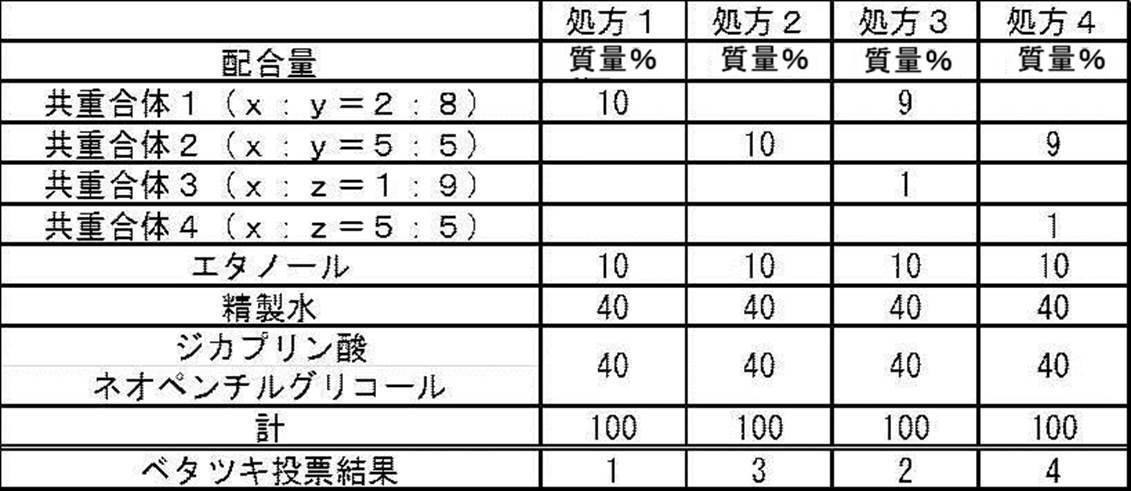
側鎖に分岐アルキル基を有する単量体単位の含有比率が高い共重合体1を含む処方1が、最もベタツキがあると評価された。この処方1に、側鎖に直鎖アルキル基を有する単量体単位を含む共重合体3を配合した処方3と、処方2および処方4との比較から、側鎖に直鎖アルキル基を有する単量体単位を含む共重合体を配合すると、ベタツキが抑えられるという結果となった。
[タック試験]
ベタツキの尺度を、タック試験によって機械的に評価した。
下記表2に示す配合組成(処方)の液状組成物を作製し、前腕内側に2cm×2cmの範囲に10μL塗布した。塗布後、冷風で3分間乾燥させた。ハンディラブテスターのタック試験モードで測定し、接触子にはバイオスキンを貼付した。接触子を塗布部分に2秒間当てて、離す操作を12回繰り返し、得られた応力の結果の平均を算出した。
ベタツキの尺度を、タック試験によって機械的に評価した。
下記表2に示す配合組成(処方)の液状組成物を作製し、前腕内側に2cm×2cmの範囲に10μL塗布した。塗布後、冷風で3分間乾燥させた。ハンディラブテスターのタック試験モードで測定し、接触子にはバイオスキンを貼付した。接触子を塗布部分に2秒間当てて、離す操作を12回繰り返し、得られた応力の結果の平均を算出した。
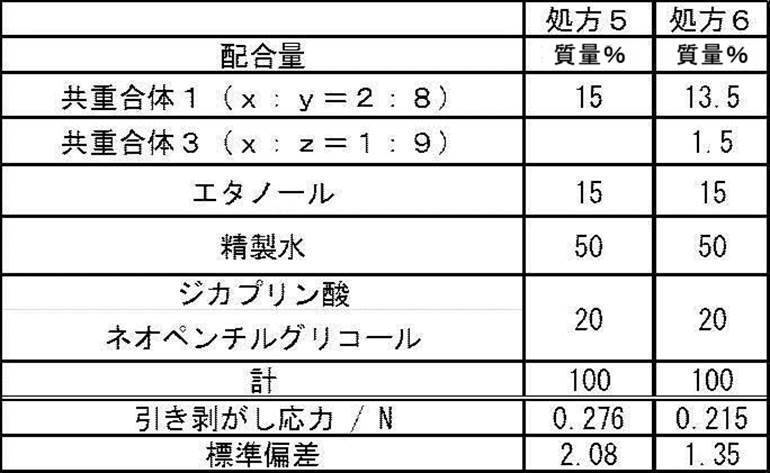
側鎖にポリエチレングリコール骨格を有する単量体単位と側鎖に分岐アルキル基を有する単量体単位を含む共重合体1に、側鎖に直鎖アルキル基を有する単量体単位を含む共重合体3を配合すると、引き剥がし応力が低下することが確認された。このことから、側鎖に直鎖アルキル基を有する共重合体はベタツキを抑えることが認められた。
側鎖にポリアルキレングリコール骨格を有する単量体単位及び側鎖に分岐アルキル基を有する単量体単位を含む共重合体の分散液は、皮膚上で液状からゲル状へと変化し、皮膚に密着する材料である。また、かかる共重合体に側鎖に直鎖アルキル基を有する単量体をさらに共重合するか、或いは、側鎖に直鎖アルキル基を有する単量体単位を含む共重合体を組み合わせることにより、皮膚上のベタツキを抑えることができる。これら共重合体は、適宜保湿剤や有効成分を配合した化粧品、外用医薬品等の皮膚外用剤の基剤として、既存の基剤の課題点を解決する新しい基剤として有用である。
本出願は日本で出願された特願2015-124280を基礎としており、その内容は本明細書に全て包含される。
Claims (19)
- 側鎖に重合度2~100のポリアルキレングリコール骨格を有する単量体単位(I)及び側鎖に炭素原子数3~30の分岐アルキル基を有する単量体単位(II)を含む共重合体(A)からなる、ゲル形成用ポリマー。
- 単量体単位(I)が、下記式(1)で表される単量体単位であり、単量体単位(II)が、下記式(2)で表される単量体単位である、請求項1記載のポリマー。

(式中、R1は水素原子又はメチル基を表し、X1は、-O-、-CH2-O-、-CO-、-CO-O-、又は-CO-NR2-を表す。ここでR2は水素原子または炭素原子数1~4のアルキル基を表す。R3は水素原子または炭素原子数1~18のアルキル基を表し、Aはアルキレン基を表し、2≦n≦100である。)

(式中、R4は水素原子又はメチル基を表し、X2は、-O-、-CH2-O-、-CO-、又は-CO-O-を表し、R5は炭素原子数3~30の分岐アルキル基を表す。) - 式(1)中のA-Oで表されるオキシアルキレン基が、エチレンオキサイド基である、請求項2記載のポリマー。
- 式(2)中のR5で表される炭素原子数3~30の分岐アルキル基が、下記式(4)~(6)で表される基のいずれかである、請求項2又は3記載のポリマー。
- 共重合体(A)における式(1)で表される単量体単位と式(2)で表される単量体単位の共重合比a1((1):(2))が5:95~90:10(モル比)である、請求項2~4のいずれか1項記載のポリマー。
- 共重合体(A)が、側鎖に炭素原子数3~30の直鎖アルキル基を有する単量体単位(III)をさらに含む、請求項1~4のいずれか1項記載のポリマー。
- 単量体単位(III)が、下記式(3)で表される単量体単位である、請求項6記載のポリマー。

(式中、R6は水素原子又はメチル基を表し、X3は、-O-、-CH2-O-、-CO-、又は-CO-O-を表し、R7は炭素原子数3~30の直鎖アルキル基を表す。) - 共重合体(A)における式(1)で表される単量体単位と式(2)で表される単量体単位と式(3)で表される単量体単位の共重合比a2((1):(2):(3))が、5~60:10~90:5~50(モル比)(但し、(1)と(2)と(3)の数値の合計が100)である、請求項7記載のポリマー。
- 側鎖に重合度2~100のポリアルキレングリコール骨格を有する単量体単位(I)及び側鎖に炭素原子数3~30の分岐アルキル基を有する単量体単位(II)を含む共重合体(A)と、
側鎖に重合度2~100のポリアルキレングリコール骨格を有する単量体単位(I)及び側鎖に炭素原子数3~30の直鎖アルキル基を有する単量体単位(III)を含む共重合体(B)とを含む、ゲル形成用ポリマー混合物。 - 単量体単位(I)が、下記式(1)で表される単量体単位であり、単量体単位(II)が、下記式(2)で表される単量体単位であり、単量体単位(III)が、下記式(3)で表される単量体単位である、請求項9記載のポリマー混合物。
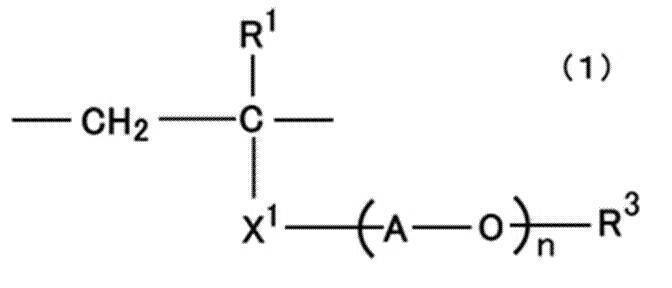
(式中、R1は水素原子又はメチル基を表し、X1は、-O-、-CH2-O-、-CO-、-CO-O-、又は-CO-NR2-を表す。ここでR2は水素原子または炭素原子数1~4のアルキル基を表す。R3は水素原子または炭素原子数1~18のアルキル基を表し、Aはアルキレン基を表し、2≦n≦100である。)
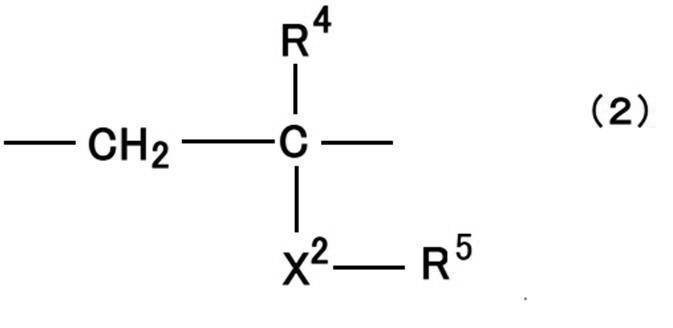
(式中、R4は水素原子又はメチル基を表し、X2は、-O-、-CH2-O-、-CO-、又は-CO-O-を表し、R5は炭素原子数3~30の分岐アルキル基を表す。)

(式中、R6は水素原子又はメチル基を表し、X3は、-O-、-CH2-O-、-CO-、又は-CO-O-を表し、R7は炭素原子数3~30の直鎖アルキル基を表す。) - 式(1)中のA-Oで表されるオキシアルキレン基が、エチレンオキサイド基である、請求項10記載のポリマー混合物。
- 式(2)中のR5で表される炭素原子数3~30の分岐アルキル基が、下記式(4)~(6)で表される基のいずれかである、請求項10又は11記載のポリマー混合物。
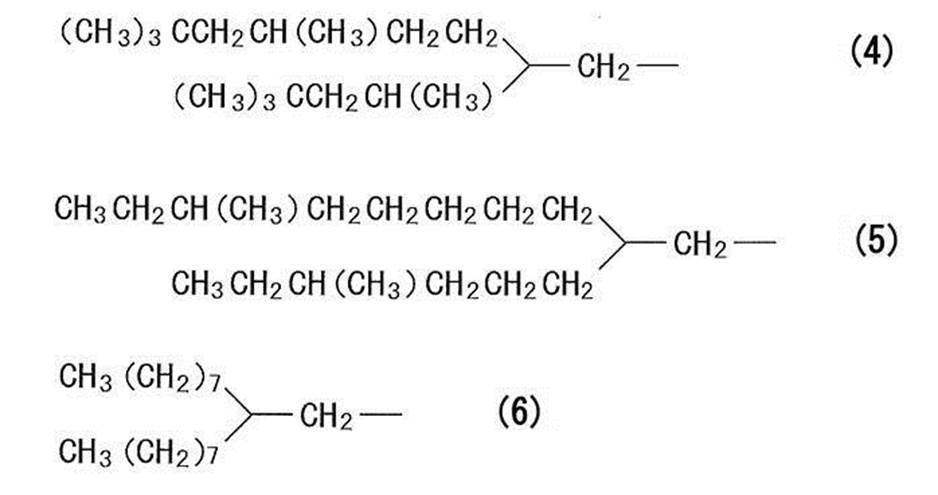
- 共重合体(A)における式(1)で表される単量体単位と式(2)で表される単量体単位の共重合比a3((1):(2))が1:99~90:10(モル比)であり、共重合体(B)における式(1)で表される単量体単位と式(3)で表される単量体単位の共重合比b1((1):(3))が1:99~90:10(モル比)である、請求項10~12のいずれか1項記載のポリマー混合物。
- (a)請求項1~13のいずれか1項記載のポリマー又はポリマー混合物、
(b)水、及び
(c)油性成分、を含む液状組成物であって、
皮膚上でゲルに変化する、皮膚用粘着性材料。 - さらに、(d)有機溶剤を含有する、請求項14に記載の皮膚用粘着性材料。
- 皮膚外用剤の基剤用である、請求項14又は15記載の材料。
- 皮膚外用剤が化粧料である、請求項16記載の材料。
- 皮膚外用剤が皮膚外用医薬品である、請求項16記載の材料。
- 請求項14又は15記載の皮膚用粘着性材料を皮膚に接触させることを含む、皮膚粘着性ゲルの形成方法。
Priority Applications (1)
| Application Number | Priority Date | Filing Date | Title |
|---|---|---|---|
| JP2017524843A JPWO2016204258A1 (ja) | 2015-06-19 | 2016-06-17 | ゲル形成用ポリマー及び皮膚用粘着性材料 |
Applications Claiming Priority (2)
| Application Number | Priority Date | Filing Date | Title |
|---|---|---|---|
| JP2015-124280 | 2015-06-19 | ||
| JP2015124280 | 2015-06-19 |
Publications (1)
| Publication Number | Publication Date |
|---|---|
| WO2016204258A1 true WO2016204258A1 (ja) | 2016-12-22 |
Family
ID=57546770
Family Applications (1)
| Application Number | Title | Priority Date | Filing Date |
|---|---|---|---|
| PCT/JP2016/068029 Ceased WO2016204258A1 (ja) | 2015-06-19 | 2016-06-17 | ゲル形成用ポリマー及び皮膚用粘着性材料 |
Country Status (2)
| Country | Link |
|---|---|
| JP (1) | JPWO2016204258A1 (ja) |
| WO (1) | WO2016204258A1 (ja) |
Citations (13)
| Publication number | Priority date | Publication date | Assignee | Title |
|---|---|---|---|---|
| JPS5785318A (en) * | 1980-11-14 | 1982-05-28 | Nitto Electric Ind Co Ltd | Hydrophilic medical material |
| JPH07187999A (ja) * | 1993-12-24 | 1995-07-25 | Hisamitsu Pharmaceut Co Inc | 粘着剤、それを用いる医療用貼付製剤及びその製造方法 |
| JPH08509019A (ja) * | 1993-04-14 | 1996-09-24 | ミネソタ マイニング アンド マニュファクチャリング カンパニー | 架橋吸収性感圧接着剤及び外傷包帯 |
| JPH09227329A (ja) * | 1996-02-16 | 1997-09-02 | M & M Kenkyusho:Kk | 香粧品基剤および外用香粧品 |
| JP2000008013A (ja) * | 1998-06-19 | 2000-01-11 | Nichiban Co Ltd | 感圧接着剤組成物 |
| JP2002371257A (ja) * | 2001-06-14 | 2002-12-26 | Nichiban Co Ltd | 湿潤面接着性粘着剤 |
| JP2004534111A (ja) * | 2001-04-23 | 2004-11-11 | ウィスコンシン アルムニ リサーチ ファウンデイション | 二機能性改変ハイドロゲル |
| JP2006037109A (ja) * | 2004-07-29 | 2006-02-09 | L'oreal Sa | 選択のモノマーを含む高級分枝状コポリマー、それを含む組成物、および化粧方法 |
| JP2006036911A (ja) * | 2004-07-27 | 2006-02-09 | Sekisui Chem Co Ltd | 粘着テープ |
| JP2007506838A (ja) * | 2003-09-26 | 2007-03-22 | スリーエム イノベイティブ プロパティズ カンパニー | 反応性を有する親水性オリゴマー |
| JP2007217348A (ja) * | 2006-02-17 | 2007-08-30 | Shiseido Co Ltd | 増粘剤並びにこれを含有する化粧料及び洗浄料 |
| JP2010180205A (ja) * | 2009-01-08 | 2010-08-19 | Kose Corp | 凹凸補正用組成物、並びに該凹凸補正用組成物を含有する皮膚化粧料、及び皮膚外用剤 |
| JP2015013842A (ja) * | 2013-07-08 | 2015-01-22 | 花王株式会社 | 毛髪化粧料 |
-
2016
- 2016-06-17 JP JP2017524843A patent/JPWO2016204258A1/ja active Pending
- 2016-06-17 WO PCT/JP2016/068029 patent/WO2016204258A1/ja not_active Ceased
Patent Citations (13)
| Publication number | Priority date | Publication date | Assignee | Title |
|---|---|---|---|---|
| JPS5785318A (en) * | 1980-11-14 | 1982-05-28 | Nitto Electric Ind Co Ltd | Hydrophilic medical material |
| JPH08509019A (ja) * | 1993-04-14 | 1996-09-24 | ミネソタ マイニング アンド マニュファクチャリング カンパニー | 架橋吸収性感圧接着剤及び外傷包帯 |
| JPH07187999A (ja) * | 1993-12-24 | 1995-07-25 | Hisamitsu Pharmaceut Co Inc | 粘着剤、それを用いる医療用貼付製剤及びその製造方法 |
| JPH09227329A (ja) * | 1996-02-16 | 1997-09-02 | M & M Kenkyusho:Kk | 香粧品基剤および外用香粧品 |
| JP2000008013A (ja) * | 1998-06-19 | 2000-01-11 | Nichiban Co Ltd | 感圧接着剤組成物 |
| JP2004534111A (ja) * | 2001-04-23 | 2004-11-11 | ウィスコンシン アルムニ リサーチ ファウンデイション | 二機能性改変ハイドロゲル |
| JP2002371257A (ja) * | 2001-06-14 | 2002-12-26 | Nichiban Co Ltd | 湿潤面接着性粘着剤 |
| JP2007506838A (ja) * | 2003-09-26 | 2007-03-22 | スリーエム イノベイティブ プロパティズ カンパニー | 反応性を有する親水性オリゴマー |
| JP2006036911A (ja) * | 2004-07-27 | 2006-02-09 | Sekisui Chem Co Ltd | 粘着テープ |
| JP2006037109A (ja) * | 2004-07-29 | 2006-02-09 | L'oreal Sa | 選択のモノマーを含む高級分枝状コポリマー、それを含む組成物、および化粧方法 |
| JP2007217348A (ja) * | 2006-02-17 | 2007-08-30 | Shiseido Co Ltd | 増粘剤並びにこれを含有する化粧料及び洗浄料 |
| JP2010180205A (ja) * | 2009-01-08 | 2010-08-19 | Kose Corp | 凹凸補正用組成物、並びに該凹凸補正用組成物を含有する皮膚化粧料、及び皮膚外用剤 |
| JP2015013842A (ja) * | 2013-07-08 | 2015-01-22 | 花王株式会社 | 毛髪化粧料 |
Also Published As
| Publication number | Publication date |
|---|---|
| JPWO2016204258A1 (ja) | 2018-04-05 |
Similar Documents
| Publication | Publication Date | Title |
|---|---|---|
| CN103327959B (zh) | 用于个人护理应用的改性淀粉 | |
| CN101507691B (zh) | 水包油型乳化白浊皮肤化妆品 | |
| CN101668791B (zh) | 接枝有机硅聚合物以及用其制备的产品 | |
| TWI524903B (zh) | Esterification reaction products and cosmetics | |
| BRPI0702106B1 (pt) | Polímero seqüenciado, composição cosmética, processo cosmético de maquilagem ou de cuidado das matérias queratínicas, uso de um polímero e processo de preparação de um polímero | |
| WO2007096400A1 (en) | Cosmetic composition comprising functionalised poly(alpha olefin-copolymer- maleic anhydride) | |
| JP2003535883A (ja) | ポリマーで構造が与えられた液体脂肪相を含む固形エマルション | |
| TW200900090A (en) | Skin cosmetic | |
| JP2011213676A (ja) | 水中油型乳化組成物 | |
| EP2598207A2 (en) | Surfactant-free oil-in-water type emulsion, process for preparation and uses thereof | |
| JP2004503572A (ja) | 特定のプロ接着性物質を含むロングラスティング化粧品組成物 | |
| JP2004131475A (ja) | デキストリンエステルでゲル化された組成物 | |
| WO2009079546A1 (en) | Cholesteric liquid crystal coloring compositions and articles produced therefrom | |
| TWI661840B (zh) | 嶄新錯合物及乳化組合物 | |
| JP6368064B1 (ja) | 新規複合体および油中水型乳化組成物 | |
| JPH1053625A (ja) | アクリル酸系ポリマー及びこれを配合した乳化組成物 | |
| WO2021223652A1 (en) | Cosmetic product and making-up method | |
| US10172780B2 (en) | Acrylic polymer of maleic anhydride and use thereof in cosmetics | |
| JPWO2016204258A1 (ja) | ゲル形成用ポリマー及び皮膚用粘着性材料 | |
| JP2004059526A (ja) | 油中水型乳化化粧料 | |
| JP2006282517A (ja) | ゲル組成物及びそれを含有する化粧料 | |
| KR101815127B1 (ko) | 온도 감응성 색조 화장료 조성물 및 이의 제조방법 | |
| JP6469286B1 (ja) | 新規複合体および乳化組成物 | |
| JP2018193324A (ja) | 乳化化粧料 | |
| JPH0517317A (ja) | 化粧料及び外用剤 |
Legal Events
| Date | Code | Title | Description |
|---|---|---|---|
| 121 | Ep: the epo has been informed by wipo that ep was designated in this application |
Ref document number: 16811732 Country of ref document: EP Kind code of ref document: A1 |
|
| ENP | Entry into the national phase |
Ref document number: 2017524843 Country of ref document: JP Kind code of ref document: A |
|
| NENP | Non-entry into the national phase |
Ref country code: DE |
|
| 122 | Ep: pct application non-entry in european phase |
Ref document number: 16811732 Country of ref document: EP Kind code of ref document: A1 |