WO2016199854A1 - 点眼剤、及び点眼剤防腐効力維持方法 - Google Patents
点眼剤、及び点眼剤防腐効力維持方法 Download PDFInfo
- Publication number
- WO2016199854A1 WO2016199854A1 PCT/JP2016/067220 JP2016067220W WO2016199854A1 WO 2016199854 A1 WO2016199854 A1 WO 2016199854A1 JP 2016067220 W JP2016067220 W JP 2016067220W WO 2016199854 A1 WO2016199854 A1 WO 2016199854A1
- Authority
- WO
- WIPO (PCT)
- Prior art keywords
- eye drop
- added
- acid
- sodium
- ophthalmic solution
- Prior art date
- Legal status (The legal status is an assumption and is not a legal conclusion. Google has not performed a legal analysis and makes no representation as to the accuracy of the status listed.)
- Ceased
Links
Classifications
-
- A—HUMAN NECESSITIES
- A61—MEDICAL OR VETERINARY SCIENCE; HYGIENE
- A61K—PREPARATIONS FOR MEDICAL, DENTAL OR TOILETRY PURPOSES
- A61K9/00—Medicinal preparations characterised by special physical form
- A61K9/0012—Galenical forms characterised by the site of application
- A61K9/0048—Eye, e.g. artificial tears
-
- A—HUMAN NECESSITIES
- A61—MEDICAL OR VETERINARY SCIENCE; HYGIENE
- A61K—PREPARATIONS FOR MEDICAL, DENTAL OR TOILETRY PURPOSES
- A61K31/00—Medicinal preparations containing organic active ingredients
- A61K31/185—Acids; Anhydrides, halides or salts thereof, e.g. sulfur acids, imidic, hydrazonic or hydroximic acids
- A61K31/19—Carboxylic acids, e.g. valproic acid
- A61K31/195—Carboxylic acids, e.g. valproic acid having an amino group
- A61K31/196—Carboxylic acids, e.g. valproic acid having an amino group the amino group being directly attached to a ring, e.g. anthranilic acid, mefenamic acid, diclofenac, chlorambucil
-
- A—HUMAN NECESSITIES
- A61—MEDICAL OR VETERINARY SCIENCE; HYGIENE
- A61K—PREPARATIONS FOR MEDICAL, DENTAL OR TOILETRY PURPOSES
- A61K47/00—Medicinal preparations characterised by the non-active ingredients used, e.g. carriers or inert additives; Targeting or modifying agents chemically bound to the active ingredient
- A61K47/02—Inorganic compounds
-
- A—HUMAN NECESSITIES
- A61—MEDICAL OR VETERINARY SCIENCE; HYGIENE
- A61K—PREPARATIONS FOR MEDICAL, DENTAL OR TOILETRY PURPOSES
- A61K47/00—Medicinal preparations characterised by the non-active ingredients used, e.g. carriers or inert additives; Targeting or modifying agents chemically bound to the active ingredient
- A61K47/06—Organic compounds, e.g. natural or synthetic hydrocarbons, polyolefins, mineral oil, petrolatum or ozokerite
- A61K47/16—Organic compounds, e.g. natural or synthetic hydrocarbons, polyolefins, mineral oil, petrolatum or ozokerite containing nitrogen, e.g. nitro-, nitroso-, azo-compounds, nitriles, cyanates
- A61K47/18—Amines; Amides; Ureas; Quaternary ammonium compounds; Amino acids; Oligopeptides having up to five amino acids
-
- A—HUMAN NECESSITIES
- A61—MEDICAL OR VETERINARY SCIENCE; HYGIENE
- A61K—PREPARATIONS FOR MEDICAL, DENTAL OR TOILETRY PURPOSES
- A61K9/00—Medicinal preparations characterised by special physical form
- A61K9/08—Solutions
Definitions
- the present invention relates to an eye drop and a method for maintaining the preservative effect of the eye drop.
- Bromfenac sodium has the action of suppressing the biosynthesis of prostaglandin (PG), has a therapeutic effect on conjunctivitis, allergic conjunctivitis, blepharitis with eye inflammation, etc., and is widely used as eye drops Yes.
- PG prostaglandin
- cationic antiseptics such as benzalkonium chloride have been widely known for eye drops (for example, Patent Document 1 and Patent Document 2). Further, in the eye drop, a nonionic surfactant that does not exhibit ionic properties even when dissolved in water is generally used.
- the surface tension of the eye drop is lowered by adding a nonionic surfactant to the eye drop.
- problems such as dripping of the ophthalmic solution and cracking of the ophthalmic container arise.
- the use concentration of the nonionic surfactant it is preferable to reduce the use concentration of the nonionic surfactant as much as possible, and it is more preferable not to use the nonionic surfactant at all.
- the present invention relates to an eye drop that can maintain an excellent preservative effect for a long period of time without substantially containing a cationic preservative and a nonionic surfactant, and a method for maintaining the preservative effect of the eye drop
- the purpose is to provide.
- the present inventors substantially contain a cationic preservative and a nonionic surfactant when a specific concentration range of borate ion and sodium edetate is contained.
- the inventors have found that an excellent antiseptic effect can be maintained for a long period of time, and have reached the present invention. That is, the present invention relates to the following.
- the first aspect of the present invention is that 0.01-1.0% (w / v) 2-amino-3- (4-bromobenzoyl) phenylacetic acid or a salt thereof, 215-360 mM boric acid Ophthalmic solution containing ions and 0.001 to 0.15% (w / v) sodium edetate, substantially free of cationic preservatives and nonionic surfactants, An ophthalmic solution having an osmotic pressure ratio of 0.8 to 1.3.
- the second aspect of the present invention is that 0.01-1.0% (w / v) 2-amino-3- (4-bromobenzoyl) phenylacetic acid or a salt thereof, 215-360 mM boric acid Ophthalmic solution containing ions and 0.001 to 0.15% (w / v) sodium edetate, substantially free of cationic preservatives and nonionic surfactants, It is an eye drop that conforms to the criteria in the 16th revision Japanese Pharmacopoeia Preservation Efficacy Test Act.
- bromfenac eye drops containing a specific concentration range of borate ions and sodium edetate, and substantially free of cationic preservatives and nonionic surfactants are excellent antiseptics over a long period of time. It can be effective. Furthermore, the bromfenac ophthalmic solution of the present invention contains substantially no cationic preservative such as benzalkonium chloride and a nonionic surfactant, so there is no need to worry about the damage to corneal cells, and In addition, no dripping of eye drops or cracking of the eye drops container occurs.
- the eye drop of the present invention comprises 0.01 to 1.0% (w / v) 2-amino-3- (4-bromobenzoyl) phenylacetic acid or a salt thereof, 215 to 360 mM borate ion and 0.001.
- Bromfenac or a salt thereof contains 2-amino-3- (4-bromobenzoyl) phenylacetic acid (also referred to as “bromfenac”) or a salt thereof as a medicinal ingredient, preferably as a medicinal ingredient. Contains only 2-amino-3- (4-bromobenzoyl) phenylacetic acid or a salt thereof.
- 2-amino-3- (4-bromobenzoyl) phenylacetic acid or a salt thereof is non-dissociated 2-amino-3- (4-bromobenzoyl) phenylacetic acid itself, 2-amino- 3- (4-Bromobenzoyl) phenylacetic acid salt, zwitterion (carboxy group forms carboxylate ion and amino group forms ammonium ion), positive ion body (only amino group contains ammonium ion) And at least one selected from the group consisting of a negative ionic form (only the carboxy group forms a carboxylate ion) can exist in dissolved form, but 2-amino-3- (4 -Bromobenzoyl) phenylacetic acid salts are preferred.
- the salt of 2-amino-3- (4-bromobenzoyl) phenylacetic acid is not particularly limited as long as it is a pharmaceutically acceptable salt.
- the salt include salts with inorganic acids, Examples thereof include salts with organic acids, quaternary ammonium salts, salts with halogen ions, salts with alkali metals, salts with alkaline earth metals, metal salts, salts with organic amines, and the like.
- the salt with inorganic acid include salts with hydrochloric acid, hydrobromic acid, hydroiodic acid, nitric acid, sulfuric acid, phosphoric acid and the like.
- Salts with organic acids include acetic acid, oxalic acid, fumaric acid, maleic acid, succinic acid, citric acid, tartaric acid, adipic acid, gluconic acid, glucoheptic acid, glucuronic acid, terephthalic acid, methanesulfonic acid, lactic acid, hippuric acid 1,2-ethanedisulfonic acid, isethionic acid, lactobionic acid, oleic acid, pamoic acid, polygalacturonic acid, stearic acid, tannic acid, trifluoromethanesulfonic acid, benzenesulfonic acid, p-toluenesulfonic acid, lauryl sulfate, sulfuric acid And salts with methyl, naphthalenesulfonic acid, sulfosalicylic acid and the like.
- Examples of quaternary ammonium salts include salts with methyl bromide, methyl iodide and the like.
- Salts with halogen ions include salts with chloride ions, bromide ions, iodide ions, etc.
- Salts with alkali metals include salts with lithium, sodium, potassium, etc., alkaline earths
- Examples of the salt with metal include salts with calcium, magnesium and the like, and examples of the metal salt include salts with iron, zinc and the like.
- Salts with organic amines include triethylenediamine, 2-aminoethanol, 2,2-iminobis (ethanol), 1-deoxy-1- (methylamino) -2-D-sorbitol, 2-amino-2- (hydroxy And salts with methyl) -1,3-propanediol, procaine, N, N-bis (phenylmethyl) -1,2-ethanediamine and the like.
- a preferred salt of 2-amino-3- (4-bromobenzoyl) phenylacetic acid is a sodium salt.
- the concentration of 2-amino-3- (4-bromobenzoyl) phenylacetic acid or a salt thereof is not particularly limited as long as it is an amount sufficient to achieve a desired medicinal effect. -1.0% (w / v) is preferable, 0.03-0.5% (w / v) is more preferable, 0.05-0.2% (w / v) is further more preferable, 0.08 -0.1% (w / v) is most preferred. These concentrations were converted to 2-amino-3- (4-bromobenzoyl) phenylacetic acid when using a salt of 2-amino-3- (4-bromobenzoyl) phenylacetic acid or a hydrate thereof. Calculate using mass.
- Borate ions can be contained in the eye drop of the present embodiment by blending a compound that dissolves in water to generate borate ions. Although it does not specifically limit as this compound, A boric acid and / or a borate are preferable, and it is more preferable to use both a boric acid and a borate. Examples of the borate include borax, sodium borate, potassium borate and the like, and borax is preferable.
- the eye drop of this embodiment is excellent in preservative effect, and when it is 360 mM or less, no boric acid crystals are precipitated.
- the borate ion concentration in the eye drop of the present embodiment is preferably 217 mM as the lower limit, more preferably 219 mM, preferably 340 mM, more preferably 310 mM, and still more preferably 307 mM.
- edetate sodium (ethylenediaminetetraacetic acid sodium salt) in the eye drop of the present embodiment may be in the form of a hydrate.
- edetate sodium include edetate monosodium, edetate disodium, and edetate tetrasodium.
- hydrates include edetate disodium dihydrate.
- the ophthalmic solution of this embodiment is excellent in antiseptic effect when the sodium edetate concentration is 0.001% (w / v) or more.
- E. coli and / or Pseudomonas aeruginosa has an antiseptic effect, and if it is 0.15% (w / v) or less, no irritation occurs.
- the borate ion concentration in the eye drop of the present embodiment is preferably 0.005% (w / v), more preferably 0.01% (w / v) as a lower limit, and 0.02% (w / v).
- the upper limit is preferably 0.13% (w / v), more preferably 0.1% (w / v), and still more preferably 0.08% (w / v).
- the ophthalmic solution of the present embodiment contains sodium edetate and borate ions at concentrations within the above-mentioned numerical ranges, and thus can exhibit synergistically excellent antiseptic effects.
- the eye drop of the present embodiment contains substantially no cationic preservative and nonionic surfactant.
- “substantially does not contain a cationic preservative” means that the concentration of the cationic preservative in the eye drop is 0.003% (w / v) or less, preferably 0.8. It is 001% (w / v) or less, and more preferably indicates that no cationic preservative is contained.
- “substantially does not contain a nonionic surfactant” means that the concentration of the nonionic surfactant in the eye drop is 0.003% (w / v) or less. Yes, preferably 0.001% (w / v) or less, more preferably no nonionic surfactant.
- the eye drop of this embodiment does not substantially contain a cationic preservative such as chlorhexidine, benzethonium chloride, cetylpyridinium chloride, and cetrimide, and is also polyoxyethylene hydrogenated castor oil 20, polyoxyethylene.
- a cationic preservative such as chlorhexidine, benzethonium chloride, cetylpyridinium chloride, and cetrimide
- polyoxyethylene hydrogenated castor oil polyoxyethylene.
- Contains substantially no nonionic surfactants such as polyoxyethylene hydrogenated castor oil such as hydrogenated castor oil 60, polyoxyethylene sorbitan such as polyoxyethylene sorbitan monopalmitate, polyoxyethylene sorbitan monolaurate .
- the eye drop of the present embodiment does not substantially contain these cationic antiseptics, so there is no need to worry about damaging to corneal cells, and substantially contains these nonionic surfactants. Therefore, the dripping of the ophthalmic solution and the cracking of the ophthalmic container do not occur, and the generation of fine particles in the ophthalmic solution can be suppressed.
- the concentration is preferably 0.01% (w / v), more preferably 0.05% (w / v), 0.1% (w / v) is more preferable, and the upper limit is preferably 0.5% (w / v), more preferably 0.3% (w / v).
- the ophthalmic solution of the present embodiment is easy to adjust the osmotic pressure ratio of the eye drop to the above numerical range, although boric acid is precipitated. It is hard to do and it is easy to show the superior antiseptic effect.
- the eye drop of the present embodiment preferably further contains a pH adjuster in order to adjust the pH to the preferred range described below.
- the pH adjusting agent is not particularly limited as long as it can adjust the pH of the eye drop of the present embodiment, and specific examples include dilute hydrochloric acid, sodium hydroxide and the like.
- the addition amount (concentration) of the pH adjusting agent is not particularly limited as long as the pH of the eye drop of the present embodiment can be adjusted to a preferable range described later.
- the eye drop of the present embodiment may further contain a buffering agent in order to adjust the pH to a preferable range described later.
- a buffering agent examples include epsilon-aminocaproic acid, sodium phosphate, sodium hydrogen phosphate, sodium dihydrogen phosphate, sodium acetate and the like.
- the addition amount (concentration) of the buffering agent is not particularly limited as long as the pH of the eye drop of the present embodiment can be adjusted to a preferable range described later.
- the eye drop of the present embodiment does not substantially contain a cationic preservative, but may be contained as long as it is a preservative other than the cationic preservative and can be used as a pharmaceutical additive. For example, 0.002% (w / v) or less is preferable, and 0.0015% (w / v) or less is more preferable. However, since the ophthalmic solution of this embodiment contains borate ions and sodium edetate in a specific concentration range as described above, it is not necessary to contain a preservative other than the cationic preservative, and other than the cationic preservative. It is preferable that no preservative is contained.
- the eye drop of the present embodiment also contains a nonionic surfactant substantially, but is a surfactant other than the nonionic surfactant and can be used as an additive for pharmaceuticals. If it is, it may contain, for example, you may contain a cationic surfactant and anionic surfactant.
- cationic surfactants include alkylamine salts, alkylamine polyoxyethylene adducts, fatty acid triethanolamine monoester salts, acylaminoethyl diethylamine salts, fatty acid polyamine condensates, alkylimidazolines, 1-acylaminoethyl- Examples thereof include 2-alkyl imidazoline, 1-hydroxylethyl-2-alkyl imidazoline and the like.
- anionic surfactants include phospholipids, and examples of phospholipids include lecithin.
- phospholipids include lecithin.
- the ophthalmic solution of the present embodiment contains borate ions and sodium edetate in a specific concentration range as described above, it is not necessary to contain a surfactant other than the nonionic surfactant. It is preferable that no surfactant other than the surfactant is contained.
- the eye drop of the present embodiment is preferably an aqueous composition.
- the “aqueous composition” means a composition based on water.
- the eye drop of the present embodiment is preferably an aqueous solution containing at least the above-mentioned 2-amino-3- (4-bromobenzoyl) phenylacetic acid or a salt thereof, borate ion and sodium edetate as an aqueous composition.
- an ophthalmic solution can be used as an eye drop described later.
- a pharmaceutically acceptable additive can be added as necessary.
- the pH of the ophthalmic solution of this embodiment is preferably 7.8, more preferably 8.0, as the lower limit in terms of sufficiently dissociating the salt when bromfenac salt is used as the medicinal component.
- the pH of the eye drop is preferably 8.6, more preferably 8.3, as the upper limit of the eye irritation.
- a pH within the above numerical range is preferred.
- the eye drop of this embodiment has an osmotic pressure ratio of 0.8 to 1.3.
- the eye drop of the present embodiment is less likely to precipitate boric acid and easily exhibits excellent antiseptic effect.
- the lower limit of the osmotic pressure ratio in the eye drop of the present embodiment is preferably 0.80, more preferably 0.86, still more preferably 1.05, and the upper limit is preferably 1.25, more preferably 1.23. Preferably, 1.21 is more preferable, and 1.20 is even more preferable.
- the osmotic pressure ratio is preferably in the above numerical range. In the ophthalmic solution of the present embodiment, the osmotic pressure ratio is considered to depend on the balance of the salt concentration such as sodium chloride and potassium chloride, the borate ion concentration and the added amount of pH adjusting agent and buffering agent.
- the ophthalmic solution of the present embodiment conforms to the criteria in the 16th revised Japanese Pharmacopoeia preservation efficacy test method.
- the criteria used in the examples described later are applied as the judgment criteria.
- the eye drop of the second aspect of the present embodiment is not limited to Staphylococcus aureus, Candida albicans and Aspergillus brasiliensis, as well as Escherichia coli and Pseudomonas aeruginosa, which generally require stronger storage efficacy. Storage efficacy that meets the criteria can be exhibited in 2 weeks and 4 weeks of storage.
- the preservative effect determined by the above preservative effect test method is also referred to as antiseptic effect.
- the eye drop in the first aspect of the present embodiment can also preferably have a preservative efficacy that meets the above criteria.
- the eye drop of this embodiment can be prepared, for example, by a conventional method.
- 2-amino-3- (4-bromobenzoyl) phenylacetic acid or a salt thereof, borate ion and sodium edetate and as necessary It can be obtained by dissolving sodium chloride, potassium chloride, a buffering agent or the like to be blended accordingly in water and adjusting the pH by adding a pH adjusting agent if necessary.
- 2-amino-3- (4-bromobenzoyl) phenylacetic acid or a salt thereof, as well as a hydrate thereof can be used.
- Specific examples of such hydrates include sodium 2-amino-3- (4-bromobenzoyl) phenylacetate, 1/2 hydrate, sodium 2-amino-3- (4-bromobenzoyl) phenylacetate, Monohydrate, sodium 2-amino-3- (4-bromobenzoyl) phenylacetate, 3/2 hydrate, and the like, such as sodium 2-amino-3- (4-bromobenzoyl) phenylacetate, Preferable examples include 3/2 hydrate.
- the eye drop of the present invention is stable over a long period of time, can suppress the generation of precipitates due to the coexistence of bromfenac and other components, and can maintain the concentration of bromfenac high over a long period of time. Therefore, the eye drop of the present invention can stably exhibit effects such as medicinal effects as a therapeutic agent for symptoms associated with eye inflammation such as conjunctivitis, allergic conjunctivitis, blepharitis.
- the eye drop of the present invention can exhibit an excellent antiseptic or storage effect over a long period of time, and there is no dripping of the eye drop and no cracking occurs in the eye drop container.
- the eye drop can be stored in a multi-dose type container. It is suitable for.
- the present invention relates to a method for maintaining antiseptic efficacy of eye drops, comprising 0.01-1.0% (w / v) 2-amino-3- (4-bromobenzoyl) phenylacetic acid or a salt thereof,
- a method for maintaining the preservative effect of an eye drop substantially free of a nonionic surfactant also referred to as “a method for maintaining preservative effect of eye drop”.
- the eye drop contains 215 to 360 mM borate ions and 0.001 to 0.15% (w / v) sodium edetate, and the osmotic pressure ratio of the eye drop is 0.8.
- Including -1.3 According to this method, even an eye drop that does not substantially contain a cationic preservative and a nonionic surfactant can exhibit an excellent antiseptic effect over a long period of time. In addition, the preservation effect can be exerted.
- the description of these components in the eye drops of the present invention described above can be applied to borate ions, sodium edetate, and the osmotic pressure ratio, including preferred values thereof. Moreover, the description about the eye drop of the above-mentioned this invention is applicable as an eye drop with which antiseptic effect is maintained by this method.
- Example 1 0.9 g of boric acid, 0.7 g of borax, 60 mL of purified water, and 20 mL of 0.5% sodium chloride / 0.1% sodium edetate aqueous solution were added and stirred well. To this solution, 0.1 g of sodium 2-amino-3- (4-bromobenzoyl) phenylacetate.3 / 2 hydrate (hereinafter also referred to as compound A) was added and stirred sufficiently. Dilute hydrochloric acid and sodium hydroxide test solution were added to adjust the pH to around 8.0, and then an appropriate amount of purified water was added to make the total volume 100 mL.
- Example 2 0.9 g of boric acid, 0.7 g of borax, 60 mL of purified water, and 20 mL of 0.5% sodium chloride / 0.1% sodium edetate aqueous solution were added and stirred well. To this solution, 0.08 g of sodium edetate hydrate and 0.1 g of compound A were added and stirred sufficiently. Dilute hydrochloric acid and sodium hydroxide test solution were added to adjust the pH to around 8.0, and then an appropriate amount of purified water was added to make the total volume 100 mL.
- Example 3 A beaker containing 85 mL of 2.2% boric acid / 2.2% borax aqueous solution, 50 mL of 0.6% sodium chloride / 0.4% potassium chloride aqueous solution, and 4.25 mL of 0.8% sodium edetate hydrate aqueous solution In addition, it was well stirred. 0.2g of compound A was added to this liquid, and it fully stirred. Dilute hydrochloric acid and sodium hydroxide test solution were added to adjust the pH to about 8.0, and then an appropriate amount of purified water was added to make the total volume 200 mL.
- Example 4 A beaker containing 85 mL of 2.2% boric acid / 2.2% borax aqueous solution, 50 mL of 0.6% sodium chloride / 0.4% potassium chloride aqueous solution, and 4.25 mL of 0.8% sodium edetate hydrate aqueous solution In addition, it was well stirred. 0.2g of compound A was added to this liquid, and it fully stirred. Dilute hydrochloric acid and sodium hydroxide test solution were added to adjust the pH to around 8.6, and then an appropriate amount of purified water was added to make the total volume 200 mL.
- Example 5 1.1 g boric acid, 0.9 g borax, 60 mL purified water, 20 mL 0.5% sodium chloride / 0.1% sodium edetate aqueous solution were added and stirred well. To this solution, 0.1 g of Compound A was added and stirred sufficiently. Dilute hydrochloric acid and sodium hydroxide test solution were added to adjust the pH to around 8.0, and then an appropriate amount of purified water was added to make the total volume 100 mL.
- Example 6 1.1 g boric acid, 0.9 g borax, 60 mL purified water, 20 mL 0.5% sodium chloride / 0.1% sodium edetate aqueous solution were added and stirred well. To this solution, 0.1 g of Compound A was added and stirred sufficiently. Dilute hydrochloric acid and sodium hydroxide test solution were added to bring the pH to around 8.3, and then an appropriate amount of purified water was added to make the total volume 100 mL.
- Example 7 160 mL of an aqueous solution of 1.4% boric acid, 1.4% borax, 0.13% sodium chloride, 0.03% sodium edetate hydrate was added to a beaker. 0.3 g of sodium chloride and 0.2 g of potassium chloride were added and stirred well. 0.2g of compound A was added to this liquid, and it fully stirred. Dilute hydrochloric acid and sodium hydroxide test solution were added to adjust the pH to around 8.3, and then an appropriate amount of purified water was added to make the total volume 200 mL.
- Example 8 1.3 g boric acid, 1.0 g borax, 60 mL purified water, 20 mL 0.5% sodium chloride / 0.1% sodium edetate aqueous solution were added and stirred well. To this solution, 0.1 g of Compound A was added and stirred sufficiently. Dilute hydrochloric acid and sodium hydroxide test solution were added to adjust the pH to around 8.0, and then an appropriate amount of purified water was added to make the total volume 100 mL.
- Example 9 80 mL of a solution of 1.6% boric acid, 1.3% borax, 0.03% sodium edetate hydrate, 0.13% sodium chloride and 0.13% compound A was added to the beaker. Dilute hydrochloric acid and sodium hydroxide test solution were added to bring the pH to around 8.3, and then an appropriate amount of purified water was added to make the total volume 100 mL.
- Example 10 After adding 160 mL of purified water to the beaker, 2.2 g of boric acid, 2.2 g of borax, 0.4 g of sodium chloride, and 0.04 g of sodium edetate hydrate were added and stirred well. To this solution, 0.1 g of Compound A was added and stirred sufficiently. Dilute hydrochloric acid or sodium hydroxide test solution was added to adjust the pH to around 8.3, and then an appropriate amount of purified water was added to make the total volume 200 mL.
- Example 11 After adding 160 mL of purified water to the beaker, 2.2 g of boric acid, 2.2 g of borax, 0.4 g of sodium chloride, and 0.01 g of sodium edetate hydrate were added and stirred well. 0.2g of compound A was added to this liquid, and it fully stirred. Dilute hydrochloric acid or sodium hydroxide test solution was added to adjust the pH to around 8.3, and then an appropriate amount of purified water was added to make the total volume 200 mL.
- Example 12 After adding 160 mL of purified water to a beaker, 2.2 g of boric acid, 2.2 g of borax, and 0.04 g of sodium edetate hydrate were added and stirred well. 0.2g of compound A was added to this liquid, and it fully stirred. Dilute hydrochloric acid or sodium hydroxide test solution was added to adjust the pH to around 8.3, and then an appropriate amount of purified water was added to make the total volume 200 mL.
- Example 13 After adding 160 mL of purified water to a beaker, 2.4 g of boric acid, 2.0 g of borax, 0.4 g of sodium chloride, and 0.04 g of sodium edetate hydrate were added and stirred well. 0.2g of compound A was added to this liquid, and it fully stirred. Dilute hydrochloric acid or sodium hydroxide test solution was added to adjust the pH to around 7.8, and then an appropriate amount of purified water was added to make the total volume 200 mL.
- Example 14 After adding 160 mL of purified water to the beaker, 2.6 g of boric acid, 2.8 g of borax, and 0.1 g of sodium edetate hydrate were added and stirred well. 0.2g of compound A was added to this liquid, and it fully stirred. Dilute hydrochloric acid or sodium hydroxide test solution was added to adjust the pH to around 8.3, and then an appropriate amount of purified water was added to make the total volume 200 mL.
- Comparative Example 1 After adding 50 mL of purified water to the beaker, 0.7 g of boric acid, 1.0 g of borax, and 0.2 g of sodium chloride were added and stirred well. To this solution, 2 mL of a 1.0% sodium edetate hydrate solution and 0.1 g of Compound A were added and stirred sufficiently. Dilute hydrochloric acid and sodium hydroxide test solution were added to bring the pH to around 8.3, and then an appropriate amount of purified water was added to make the total volume 100 mL.
- Comparative Example 2 After adding 50 mL of purified water to the beaker, 0.7 g of boric acid, 1.0 g of borax, and 0.2 g of sodium chloride were added and stirred well. To this solution, 5 mL of a 1.0% sodium edetate hydrate solution and 0.1 g of Compound A were added and stirred sufficiently. Dilute hydrochloric acid and sodium hydroxide test solution were added to bring the pH to around 8.3, and then an appropriate amount of purified water was added to make the total volume 100 mL.
- Comparative Example 3 After adding 50 mL of purified water to the beaker, 0.7 g of boric acid, 1.0 g of borax, and 0.2 g of sodium chloride were added and stirred well. To this solution, 0.1 g of Compound A was added and stirred sufficiently. Dilute hydrochloric acid and sodium hydroxide test solution were added to bring the pH to around 8.3, and then an appropriate amount of purified water was added to make the total volume 100 mL.
- Comparative Example 4 After 160 mL of purified water was added to the beaker, 1.6 g of boric acid, 2.0 g of borax, and 0.4 g of sodium chloride were added and stirred well. To this solution, 0.1 g of Compound A was added and stirred sufficiently. Dilute hydrochloric acid or sodium hydroxide test solution was added to adjust the pH to around 8.3, and then an appropriate amount of purified water was added to make the total volume 200 mL.
- Comparative Example 5 After 160 mL of purified water was added to the beaker, 1.8 g of boric acid, 1.8 g of borax, and 0.4 g of sodium chloride were added and stirred well. To this solution, 0.1 g of Compound A was added and stirred sufficiently. Dilute hydrochloric acid or sodium hydroxide test solution was added to adjust the pH to around 8.3, and then an appropriate amount of purified water was added to make the total volume 200 mL.
- Example 1 to 9 and Comparative Examples 1 to 3 were dispensed into five sterilized PE containers, and the precultured test bacteria shown in Tables 5 to 7 below were 10 5 to 10 6 cells / mL. After preparing the mixed sample so inoculated, it was stored at 20-25 ° C. in the dark. In addition, each test specimen was inoculated independently without mixing the test bacteria. After storage for 2 weeks and 4 weeks from the start of storage, 1 mL of each mixed sample was sampled, and the number of viable bacteria was measured. Test strains are listed below.
- the mobile phase was measured for 8 minutes in a gradient mode using acetonitrile and 0.01% phosphoric acid solution adjusted to pH 3.5 at a flow rate of 0.47 mL.
- As a sample 2 ⁇ L of 10-fold diluted water was injected and detected at a wavelength of 230 nm.
- the osmotic pressure ratio was measured by the method described above. The solution state was observed visually. The results are shown in Table 8.
Landscapes
- Health & Medical Sciences (AREA)
- Chemical & Material Sciences (AREA)
- Life Sciences & Earth Sciences (AREA)
- General Health & Medical Sciences (AREA)
- Public Health (AREA)
- Veterinary Medicine (AREA)
- Animal Behavior & Ethology (AREA)
- Epidemiology (AREA)
- Medicinal Chemistry (AREA)
- Pharmacology & Pharmacy (AREA)
- Engineering & Computer Science (AREA)
- Oil, Petroleum & Natural Gas (AREA)
- Proteomics, Peptides & Aminoacids (AREA)
- Chemical Kinetics & Catalysis (AREA)
- General Chemical & Material Sciences (AREA)
- Inorganic Chemistry (AREA)
- Ophthalmology & Optometry (AREA)
- Medicinal Preparation (AREA)
- Acyclic And Carbocyclic Compounds In Medicinal Compositions (AREA)
Abstract
カチオン系防腐剤及び非イオン性界面活性剤を実質的に含有しなくても長期間優れた防腐効力を維持することができる点眼剤、及び点眼剤防腐効力維持方法を提供すること。 0.01~1.0%(w/v)の2-アミノ-3-(4-ブロモベンゾイル)フェニル酢酸又はその塩、215~360mMのホウ酸イオン及び0.001~0.15%(w/v)のエデト酸ナトリウムを含有し、カチオン系防腐剤及び非イオン性界面活性剤を実質的に含有しない点眼剤であって、浸透圧比が0.8~1.3である点眼剤である。また、0.01~1.0%(w/v)の2-アミノ-3-(4-ブロモベンゾイル)フェニル酢酸又はその塩、215~360mMのホウ酸イオン及び0.001~0.15%(w/v)のエデト酸ナトリウムを含有し、カチオン系防腐剤及び非イオン性界面活性剤を実質的に含有しない点眼剤であって、第十六改正日本薬局方の保存効力試験法における判定基準に適合する点眼剤である。
Description
本発明は、点眼剤、及び点眼剤防腐効力維持方法に関する。
ブロムフェナクナトリウムは、プロスタグランジン(PG)の生合成を抑制する作用があり、目の炎症をともなう結膜炎、アレルギー結膜炎、眼瞼炎などに対して治療効果を有し、点眼剤として汎用されている。
従来、点眼剤には、防腐剤として、塩化ベンザルコニウムなどのカチオン系防腐剤が広く知られている(例えば、特許文献1、特許文献2)。また、点眼剤においては、一般に水に溶けてもイオン性を示さない非イオン性界面活性剤が用いられる。
特許文献1及び特許文献2に記載されているように、ブロムフェナクナトリウムとカチオン系防腐剤とを併用すれば赤色の不溶性異物が析出することが知られている。また、点眼剤用のカチオン系防腐剤は、高濃度で配合すると角質のたんぱく質を変性させ、角膜や結膜の上皮剥離、欠損を生じることがあるといわれている。
したがって、カチオン系防腐剤の使用濃度は可能な限り低減化することが好ましく、カチオン系防腐剤を全く用いないことが更に好ましいが、そうすると防腐効力が欠如するという問題が生じる。
一方、点眼剤は、非イオン性界面活性剤を配合することによって点眼液の表面張力が下がってしまう。その結果、点眼液の液だれが生じたり、点眼容器にひび割れが生じたりするという問題が生じる。
点眼液の液だれ防止、点眼容器のひび割れ防止の観点から、非イオン性界面活性剤の使用濃度も可能な限り低減することが好ましく、非イオン性界面活性剤を全く用いないことが更に好ましい。
本発明は、カチオン系防腐剤及び非イオン性界面活性剤を実質的に含有しなくても長期間優れた防腐効力を維持することができる点眼剤、及び、点眼剤の防腐効力を維持する方法の提供を目的とする。
本発明者らは、ブロムフェナクナトリウムを含有する点眼剤において、特定濃度範囲のホウ酸イオン及びエデト酸ナトリウムを含有させると、カチオン系防腐剤及び非イオン性界面活性剤を実質的に含有せずとも長期間優れた防腐効力を維持できることを見出し、本発明に至った。すなわち、本発明は、以下に関する。
[1] 本発明の第一の態様は、0.01~1.0%(w/v)の2-アミノ-3-(4-ブロモベンゾイル)フェニル酢酸又はその塩、215~360mMのホウ酸イオン及び0.001~0.15%(w/v)のエデト酸ナトリウムを含有し、カチオン系防腐剤及び非イオン性界面活性剤を実質的に含有しない点眼剤であって、
浸透圧比が0.8~1.3である点眼剤である。
浸透圧比が0.8~1.3である点眼剤である。
[2] 本発明の第二の態様は、0.01~1.0%(w/v)の2-アミノ-3-(4-ブロモベンゾイル)フェニル酢酸又はその塩、215~360mMのホウ酸イオン及び0.001~0.15%(w/v)のエデト酸ナトリウムを含有し、カチオン系防腐剤及び非イオン性界面活性剤を実質的に含有しない点眼剤であって、
第十六改正日本薬局方の保存効力試験法における判定基準に適合する点眼剤である。
第十六改正日本薬局方の保存効力試験法における判定基準に適合する点眼剤である。
[3] 上記2-アミノ-3-(4-ブロモベンゾイル)フェニル酢酸又はその塩がブロムフェナクナトリウムである、[1]又は[2]記載の点眼剤。
[4] 更に、0.1~0.3%(w/v)の塩化ナトリウムを含有する、[1]~[3]の何れか1項記載の点眼剤。
[5] pHが7.8~8.6である、[1]~[4]の何れか1項記載の点眼剤。
[6] マルチドーズ型容器に収納されている、[1]~[5]の何れか1項記載の点眼剤。
[7] 0.01~1.0%(w/v)の2-アミノ-3-(4-ブロモベンゾイル)フェニル酢酸又はその塩を含有し、カチオン系防腐剤及び非イオン性界面活性剤を実質的に含有しない点眼剤の防腐効力を維持する方法であって、前記方法は、
前記点眼剤に、ホウ酸イオンを215~360mM及びエデト酸ナトリウムを0.001~0.15%(w/v)含有させること、及び、
前記点眼剤の浸透圧比を0.8~1.3とすること
を含む、方法。
前記点眼剤に、ホウ酸イオンを215~360mM及びエデト酸ナトリウムを0.001~0.15%(w/v)含有させること、及び、
前記点眼剤の浸透圧比を0.8~1.3とすること
を含む、方法。
本発明によれば、特定濃度範囲のホウ酸イオン及びエデト酸ナトリウムを含有し、かつ、カチオン系防腐剤及び非イオン性界面活性剤を実質的に含有しないブロムフェナク点眼剤は、長期にわたって優れた防腐効力を発揮することができる。更に、本発明のブロムフェナク点眼剤は、ベンザルコニウム塩化物などのカチオン系防腐剤及び非イオン性界面活性剤を実質的に含有しないので、角膜細胞への障害性を懸念する必要がなく、かつ、点眼液の液だれや点眼容器のひび割れも生じない。
以下、本発明の実施形態について説明する。
本発明の点眼剤は、0.01~1.0%(w/v)の2-アミノ-3-(4-ブロモベンゾイル)フェニル酢酸又はその塩、215~360mMのホウ酸イオン及び0.001~0.15%(w/v)のエデト酸ナトリウムを含有し、カチオン系防腐剤及び非イオン性界面活性剤を実質的に含有しない点眼剤である。
ブロムフェナク又はその塩
本実施形態の点眼剤は、2-アミノ-3-(4-ブロモベンゾイル)フェニル酢酸(「ブロムフェナク」ともいう。)又はその塩を薬効成分として含有し、好ましくは、薬効成分として2-アミノ-3-(4-ブロモベンゾイル)フェニル酢酸又はその塩のみを含有する。本実施形態の点眼剤において、2-アミノ-3-(4-ブロモベンゾイル)フェニル酢酸又はその塩は、非解離の2-アミノ-3-(4-ブロモベンゾイル)フェニル酢酸自体、2-アミノ-3-(4-ブロモベンゾイル)フェニル酢酸の塩、双性イオン体(カルボキシ基がカルボキシラートイオンを形成し、そしてアミノ基がアンモニウムイオンを形成する)、陽性イオン体(アミノ基のみがアンモニウムイオンを形成する)及び陰性イオン体(カルボキシ基のみがカルボキシラートイオンを形成する)からなる群より選択される少なくとも1つとして、溶解した形態で存在することができるが、2-アミノ-3-(4-ブロモベンゾイル)フェニル酢酸の塩が好ましい。
本実施形態の点眼剤は、2-アミノ-3-(4-ブロモベンゾイル)フェニル酢酸(「ブロムフェナク」ともいう。)又はその塩を薬効成分として含有し、好ましくは、薬効成分として2-アミノ-3-(4-ブロモベンゾイル)フェニル酢酸又はその塩のみを含有する。本実施形態の点眼剤において、2-アミノ-3-(4-ブロモベンゾイル)フェニル酢酸又はその塩は、非解離の2-アミノ-3-(4-ブロモベンゾイル)フェニル酢酸自体、2-アミノ-3-(4-ブロモベンゾイル)フェニル酢酸の塩、双性イオン体(カルボキシ基がカルボキシラートイオンを形成し、そしてアミノ基がアンモニウムイオンを形成する)、陽性イオン体(アミノ基のみがアンモニウムイオンを形成する)及び陰性イオン体(カルボキシ基のみがカルボキシラートイオンを形成する)からなる群より選択される少なくとも1つとして、溶解した形態で存在することができるが、2-アミノ-3-(4-ブロモベンゾイル)フェニル酢酸の塩が好ましい。
本実施形態の点眼剤において、2-アミノ-3-(4-ブロモベンゾイル)フェニル酢酸の塩は、医薬として許容される塩であれば特に制限されず、塩としては、無機酸との塩、有機酸との塩、四級アンモニウム塩、ハロゲンイオンとの塩、アルカリ金属との塩、アルカリ土類金属との塩、金属塩、有機アミンとの塩等が挙げられる。無機酸との塩としては、塩酸、臭化水素酸、ヨウ化水素酸、硝酸、硫酸、リン酸等との塩が挙げられる。有機酸との塩としては、酢酸、シュウ酸、フマル酸、マレイン酸、コハク酸、クエン酸、酒石酸、アジピン酸、グルコン酸、グルコヘプト酸、グルクロン酸、テレフタル酸、メタンスルホン酸、乳酸、馬尿酸、1,2-エタンジスルホン酸、イセチオン酸、ラクトビオン酸、オレイン酸、パモ酸、ポリガラクツロン酸、ステアリン酸、タンニン酸、トリフルオロメタンスルホン酸、ベンゼンスルホン酸、p-トルエンスルホン酸、硫酸ラウリル、硫酸メチル、ナフタレンスルホン酸、スルホサリチル酸等との塩が挙げられる。四級アンモニウム塩としては、臭化メチル、ヨウ化メチル等との塩が挙げられる。ハロゲンイオンとの塩としては、塩化物イオン、臭化物イオン、ヨウ化物イオン等との塩が挙げられ、アルカリ金属との塩としては、リチウム、ナトリウム、カリウム等との塩が挙げられ、アルカリ土類金属との塩としては、カルシウム、マグネシウム等との塩が挙げられ、金属塩としては、鉄、亜鉛等との塩が挙げられる。有機アミンとの塩としては、トリエチレンジアミン、2-アミノエタノール、2,2-イミノビス(エタノール)、1-デオキシ-1-(メチルアミノ)-2-D-ソルビトール、2-アミノ-2-(ヒドロキシメチル)-1,3-プロパンジオール、プロカイン、N,N-ビス(フェニルメチル)-1,2-エタンジアミン等との塩が挙げられる。本実施形態の点眼剤においては、2-アミノ-3-(4-ブロモベンゾイル)フェニル酢酸の好ましい塩は、ナトリウム塩である。
本実施形態の点眼剤において、2-アミノ-3-(4-ブロモベンゾイル)フェニル酢酸又はその塩の濃度は、所望の薬効を奏するのに充分な量であれば特に制限されないが、0.01~1.0%(w/v)が好ましく、0.03~0.5%(w/v)がより好ましく、0.05~0.2%(w/v)が更に好ましく、0.08~0.1%(w/v)が最も好ましい。なお、これらの濃度は、2-アミノ-3-(4-ブロモベンゾイル)フェニル酢酸の塩又はそれらの水和物を用いる場合、2-アミノ-3-(4-ブロモベンゾイル)フェニル酢酸に換算した質量を用いて計算する。
ホウ酸イオン
ホウ酸イオンは、水に溶解してホウ酸イオンを生じる化合物を配合することにより、本実施形態の点眼剤に含有させることができる。かかる化合物としては特に限定されないが、ホウ酸及び/又はホウ酸塩が好ましく、ホウ酸及びホウ酸塩の両方を用いることがより好ましい。ホウ酸塩としては、ホウ砂、ホウ酸ナトリウム、ホウ酸カリウム等が挙げられ、ホウ砂が好ましい。
ホウ酸イオンは、水に溶解してホウ酸イオンを生じる化合物を配合することにより、本実施形態の点眼剤に含有させることができる。かかる化合物としては特に限定されないが、ホウ酸及び/又はホウ酸塩が好ましく、ホウ酸及びホウ酸塩の両方を用いることがより好ましい。ホウ酸塩としては、ホウ砂、ホウ酸ナトリウム、ホウ酸カリウム等が挙げられ、ホウ砂が好ましい。
本実施形態の点眼剤は、ホウ酸イオン濃度が215mM以上であると防腐効力に優れ、360mM以下であるとホウ酸の結晶を析出しない。本実施形態の点眼剤におけるホウ酸イオン濃度は、下限値としては217mMが好ましく、219mMがより好ましく、上限値としては340mMが好ましく、310mMがより好ましく、307mMが更に好ましい。
エデト酸ナトリウム
本実施形態の点眼剤におけるエデト酸ナトリウム(エチレンジアミン四酢酸のナトリウム塩)は、水和物の形態でもよい。エデト酸ナトリウムとしては、例えばエデト酸一ナトリウム、エデト酸二ナトリウム、エデト酸四ナトリウムなどが挙げられ、水和物としては例えばエデト酸二ナトリウムの2水和物などが挙げられる。
本実施形態の点眼剤におけるエデト酸ナトリウム(エチレンジアミン四酢酸のナトリウム塩)は、水和物の形態でもよい。エデト酸ナトリウムとしては、例えばエデト酸一ナトリウム、エデト酸二ナトリウム、エデト酸四ナトリウムなどが挙げられ、水和物としては例えばエデト酸二ナトリウムの2水和物などが挙げられる。
本実施形態の点眼剤は、エデト酸ナトリウム濃度が0.001%(w/v)以上であると防腐効力に優れ、なかでもE.coli及び/又は緑膿菌に対する防腐効力に優れ、0.15%(w/v)以下であると刺激性を生じない。本実施形態の点眼剤におけるホウ酸イオン濃度は、下限値としては0.005%(w/v)が好ましく、0.01%(w/v)がより好ましく、0.02%(w/v)が更に好ましく、上限値としては0.13%(w/v)が好ましく、0.1%(w/v)がより好ましく、0.08%(w/v)が更に好ましい。本実施形態の点眼剤は、エデト酸ナトリウム及びホウ酸イオンをそれぞれ上述の数値範囲内の濃度で含有するので、相乗的に優れた防腐効力を奏することができる。
カチオン系防腐剤、非イオン性界面活性剤
本実施形態の点眼剤は、カチオン系防腐剤及び非イオン性界面活性剤を実質的に含有しない。本実施形態の点眼剤において「カチオン系防腐剤を実質的に含有しない」とは、点眼剤におけるカチオン系防腐剤の濃度が、0.003%(w/v)以下であり、好ましくは0.001%(w/v)以下であり、更に好ましくはカチオン系防腐剤を全く含有しないことを指す。また、本実施形態の点眼剤において「非イオン性界面活性剤を実質的に含有しない」とは、点眼剤における非イオン性界面活性剤の濃度が、0.003%(w/v)以下であり、好ましくは0.001%(w/v)以下であり、更に好ましくは非イオン性界面活性剤を全く含有しないことを指す。
本実施形態の点眼剤は、カチオン系防腐剤及び非イオン性界面活性剤を実質的に含有しない。本実施形態の点眼剤において「カチオン系防腐剤を実質的に含有しない」とは、点眼剤におけるカチオン系防腐剤の濃度が、0.003%(w/v)以下であり、好ましくは0.001%(w/v)以下であり、更に好ましくはカチオン系防腐剤を全く含有しないことを指す。また、本実施形態の点眼剤において「非イオン性界面活性剤を実質的に含有しない」とは、点眼剤における非イオン性界面活性剤の濃度が、0.003%(w/v)以下であり、好ましくは0.001%(w/v)以下であり、更に好ましくは非イオン性界面活性剤を全く含有しないことを指す。
本実施形態の点眼剤は、具体的には、クロルヘキシジン、塩化ベンゼトニウム、塩化セチルピリジニウム、セトリマイドなどのカチオン系防腐剤を実質的に含有せず、また、ポリオキシエチレン硬化ヒマシ油20、ポリオキシエチレン硬化ヒマシ油60等のポリオキシエチレン硬化ヒマシ油類、ポリオキシエチレンソルビタンモノパルミテート、ポリオキシエチレンソルビタンモノラウレート等のポリオキシエチレンソルビタン類などの非イオン性界面活性剤も実質的に含有しない。
本実施形態の点眼剤は、これらのカチオン系防腐剤を実質的に含有しないので、角膜細胞への障害性を懸念する必要がなく、また、これらの非イオン性界面活性剤を実質的に含有しないので、点眼液の液だれや点眼容器のひび割れが生じず、更に点眼剤中に微粒子が発生するのを抑制することができる。
塩化ナトリウム
本実施形態の点眼剤は、塩化ナトリウムを含有する場合、その濃度は、下限値としては0.01%(w/v)が好ましく、0.05%(w/v)がより好ましく、0.1%(w/v)が更に好ましく、上限値としては0.5%(w/v)が好ましく、0.3%(w/v)がより好ましい。本実施形態の点眼剤は、塩化ナトリウム濃度が上記数値範囲内であると、ホウ酸イオン濃度にもよるが、点眼剤の浸透圧比を上述の数値範囲内に調整しやすい結果、ホウ酸が析出しにくく、優れた防腐効力を発揮しやすい。
本実施形態の点眼剤は、塩化ナトリウムを含有する場合、その濃度は、下限値としては0.01%(w/v)が好ましく、0.05%(w/v)がより好ましく、0.1%(w/v)が更に好ましく、上限値としては0.5%(w/v)が好ましく、0.3%(w/v)がより好ましい。本実施形態の点眼剤は、塩化ナトリウム濃度が上記数値範囲内であると、ホウ酸イオン濃度にもよるが、点眼剤の浸透圧比を上述の数値範囲内に調整しやすい結果、ホウ酸が析出しにくく、優れた防腐効力を発揮しやすい。
その他の添加剤
本実施形態の点眼剤は、後述の好ましい範囲のpHに調整するため、更に、pH調節剤を含有するものが好ましい。pH調節剤としては、本実施形態の点眼剤のpHを調節できるものであれば特に限定されないが、具体例としては、希塩酸、水酸化ナトリウムなどが挙げられる。本実施形態の点眼剤のpHを後述の好ましい範囲に調整できるのであれば、pH調節剤の添加量(濃度)は特に限定されない。
本実施形態の点眼剤は、後述の好ましい範囲のpHに調整するため、更に、pH調節剤を含有するものが好ましい。pH調節剤としては、本実施形態の点眼剤のpHを調節できるものであれば特に限定されないが、具体例としては、希塩酸、水酸化ナトリウムなどが挙げられる。本実施形態の点眼剤のpHを後述の好ましい範囲に調整できるのであれば、pH調節剤の添加量(濃度)は特に限定されない。
本実施形態の点眼剤は、後述の好ましい範囲のpHに調整するため、更に、緩衝剤を含有するものであってもよい。緩衝剤としては、イプシロン-アミノカプロン酸、リン酸ナトリウム、リン酸水素ナトリウム、リン酸二水素ナトリウム、酢酸ナトリウムなどを挙げることができる。本実施形態の点眼剤のpHを後述の好ましい範囲に調整できるのであれば、緩衝剤の添加量(濃度)は特に限定されない。
本実施形態の点眼剤は、カチオン系防腐剤を実質的に含有しないが、カチオン系防腐剤以外であって、医薬品の添加物として使用可能な防腐剤であれば含有してもよく、その濃度としては、例えば、0.002%(w/v)以下が好ましく、0.0015%(w/v)以下がより好ましい。しかしながら、本実施形態の点眼剤は、上述のように特定濃度範囲のホウ酸イオン及びエデト酸ナトリウムを含有するので、カチオン系防腐剤以外の防腐剤を含有する必要がなく、カチオン系防腐剤以外の防腐剤を含有しないことが好ましい。
本実施形態の点眼剤は、また、非イオン性界面活性剤を実質的に含有しないが、非イオン性界面活性剤以外の界面活性剤であって、医薬品の添加物として使用可能な界面活性剤であれば含有してもよく、例えばカチオン性界面活性剤、アニオン性界面活性剤を含有してもよい。
カチオン性界面活性剤の例としては、アルキルアミン塩、アルキルアミンポリオキシエチレン付加物、脂肪酸トリエタノールアミンモノエステル塩、アシルアミノエチルジエチルアミン塩、脂肪酸ポリアミン縮合物、アルキルイミダゾリン、1-アシルアミノエチル-2-アルキルイミダゾリン、1-ヒドロキシルエチル-2-アルキルイミダゾリン等が挙げられる。
アニオン性界面活性剤の例としては、リン脂質等が挙げられ、リン脂質としてはレシチン等が挙げられる。
しかしながら、本実施形態の点眼剤は、上述のように特定濃度範囲のホウ酸イオン及びエデト酸ナトリウムを含有するので、非イオン性界面活性剤以外の界面活性剤を含有する必要がなく、非イオン性界面活性剤以外の界面活性剤を含有しないことが好ましい。
カチオン性界面活性剤の例としては、アルキルアミン塩、アルキルアミンポリオキシエチレン付加物、脂肪酸トリエタノールアミンモノエステル塩、アシルアミノエチルジエチルアミン塩、脂肪酸ポリアミン縮合物、アルキルイミダゾリン、1-アシルアミノエチル-2-アルキルイミダゾリン、1-ヒドロキシルエチル-2-アルキルイミダゾリン等が挙げられる。
アニオン性界面活性剤の例としては、リン脂質等が挙げられ、リン脂質としてはレシチン等が挙げられる。
しかしながら、本実施形態の点眼剤は、上述のように特定濃度範囲のホウ酸イオン及びエデト酸ナトリウムを含有するので、非イオン性界面活性剤以外の界面活性剤を含有する必要がなく、非イオン性界面活性剤以外の界面活性剤を含有しないことが好ましい。
点眼剤
本実施形態の点眼剤は、水性組成物であることが好ましい。本実施形態において「水性組成物」とは、水を基剤とする組成物を意味する。本実施形態の点眼剤は、水性組成物として、上述の2-アミノ-3-(4-ブロモベンゾイル)フェニル酢酸又はその塩、ホウ酸イオン及びエデト酸ナトリウムを少なくとも含有する水溶液であることが好ましく、例えば後述の点眼剤として点眼液とすることができる。
本実施形態の点眼剤は、水性組成物であることが好ましい。本実施形態において「水性組成物」とは、水を基剤とする組成物を意味する。本実施形態の点眼剤は、水性組成物として、上述の2-アミノ-3-(4-ブロモベンゾイル)フェニル酢酸又はその塩、ホウ酸イオン及びエデト酸ナトリウムを少なくとも含有する水溶液であることが好ましく、例えば後述の点眼剤として点眼液とすることができる。
本実施形態の点眼剤には、必要に応じて製薬学的に許容される添加剤を添加することができる。
本実施形態の点眼剤のpHは、薬効成分としてブロムフェナクの塩を用いる場合、該塩を十分に解離させる点で、下限値としては7.8が好ましく、8.0がより好ましい。また、該点眼剤のpHは、眼刺激性を生じない点で、上限値としては8.6が好ましく、8.3がより好ましい。薬効成分としてブロムフェナク自体を用いる場合も上記数値範囲内のpHが好ましい。
本実施形態の点眼剤は、本実施形態の第一の態様において、その浸透圧比は0.8~1.3である。なお、浸透圧比は、第十六改正日本薬局方の浸透圧測定法(オスモル濃度測定法)に記載された方法により求められ、具体的には、生理食塩水のオスモル濃度(cS)が一定(286mOsm)であることから、本実施形態の点眼剤のオスモル濃度(cT)を測定すれば、次式によって本実施形態の点眼剤の浸透圧比を計算することができる。
浸透圧比=cT/cS
浸透圧比=cT/cS
本実施形態の点眼剤は、浸透圧比が上記範囲内であると、ホウ酸が析出しにくく、優れた防腐効力を発揮しやすい。本実施形態の点眼剤における浸透圧比は、下限値としては0.80が好ましく、0.86がより好ましく、1.05が更に好ましく、上限値としては1.25が好ましく、1.23がより好ましく、1.21が更に好ましく、1.20が更により好ましい。後述する本実施形態の第二の態様における点眼剤においても、浸透圧比は上記数値範囲であることが好ましい。本実施形態の点眼剤において、浸透圧比は、塩化ナトリウム、塩化カリウム等の塩濃度、ホウ酸イオン濃度及びpH調節剤、緩衝剤等の添加量等のバランスに依存すると考えられる。
本実施形態の点眼剤は、本実施形態の第二の態様において、第十六改正日本薬局方の保存効力試験法における判定基準に適合する。本実施形態において、該判定基準としては、後述の実施例において用いた基準を適用する。本実施形態の第二の態様の点眼剤は、かかる判定基準において、Staphylococcus aureus、Candida albicans及びAspergillus brasiliensisのみならず、一般により強い保存効力が必要とされるEscherichia coli及びPseudomonas aeruginosaに対しても、保存2週間及び4週間で判定基準に適合する保存効力を発揮することができる。本明細書において、上記保存効力試験法により判定される保存効力を防腐効力ともいう。本実施形態の第一の態様における点眼剤も、好ましくは、上記判定基準に適合する保存効力を有することができる。
本実施形態の点眼剤は、例えば常法により調製することができ、例えば、2-アミノ-3-(4-ブロモベンゾイル)フェニル酢酸又はその塩、ホウ酸イオン及びエデト酸ナトリウム、並びに、必要に応じて配合する塩化ナトリウム、塩化カリウム、緩衝剤などを水に溶解し、必要に応じて更にpH調節剤を添加することなどによりpHを調整して、得ることができる。
本実施形態の点眼剤の調製に際しては、2-アミノ-3-(4-ブロモベンゾイル)フェニル酢酸若しくはその塩のほか、それらの水和物を用いることができる。かかる水和物としては、具体的には2-アミノ-3-(4-ブロモベンゾイル)フェニル酢酸ナトリウム・1/2水和物、2-アミノ-3-(4-ブロモベンゾイル)フェニル酢酸ナトリウム・1水和物、2-アミノ-3-(4-ブロモベンゾイル)フェニル酢酸ナトリウム・3/2水和物等を挙げることができ、2-アミノ-3-(4-ブロモベンゾイル)フェニル酢酸ナトリウム・3/2水和物を好ましく挙げることができる。
本発明の点眼剤は、長期にわたって安定であり、ブロムフェナクと他の成分との併存による析出物の発生を抑え、ブロムフェナクの濃度を長期にわたって高く維持することができる。従って、本発明の点眼剤は、結膜炎、アレルギー結膜炎、眼瞼炎などの目の炎症を伴う症状に対する治療剤として、薬効などの効果を安定して奏することができる。
本発明の点眼剤は、長期にわたって優れた防腐効力ないし保存効力を発揮することができるとともに、点眼液の液だれがなく、点眼容器にひび割れも生じないので、例えばマルチドーズ型容器に収納するのに好適である。
点眼剤防腐効力維持方法
本発明は、0.01~1.0%(w/v)の2-アミノ-3-(4-ブロモベンゾイル)フェニル酢酸又はその塩を含有し、カチオン系防腐剤及び非イオン性界面活性剤を実質的に含有しない点眼剤の防腐効力を維持する方法(「点眼剤防腐効力維持方法」ともいう。)をも提供する。
この方法は、該点眼剤に、ホウ酸イオンを215~360mM及びエデト酸ナトリウムを0.001~0.15%(w/v)含有させること、及び、該点眼剤の浸透圧比を0.8~1.3とすることを含む。この方法によれば、カチオン系防腐剤及び非イオン性界面活性剤を実質的に含有しない点眼剤であっても、長期にわたって優れた防腐効力を発揮させることができ、更に、該防腐効力とともに長期にわたって保存効力を発揮することもできる。
本発明は、0.01~1.0%(w/v)の2-アミノ-3-(4-ブロモベンゾイル)フェニル酢酸又はその塩を含有し、カチオン系防腐剤及び非イオン性界面活性剤を実質的に含有しない点眼剤の防腐効力を維持する方法(「点眼剤防腐効力維持方法」ともいう。)をも提供する。
この方法は、該点眼剤に、ホウ酸イオンを215~360mM及びエデト酸ナトリウムを0.001~0.15%(w/v)含有させること、及び、該点眼剤の浸透圧比を0.8~1.3とすることを含む。この方法によれば、カチオン系防腐剤及び非イオン性界面活性剤を実質的に含有しない点眼剤であっても、長期にわたって優れた防腐効力を発揮させることができ、更に、該防腐効力とともに長期にわたって保存効力を発揮することもできる。
点眼剤防腐効力維持方法において、ホウ酸イオン、エデト酸ナトリウム及び浸透圧比については、その好ましい値を含め、上述の本発明の点眼剤におけるこれらの成分についての記載を適用することができる。また、この方法により防腐効力が維持される点眼剤としては、上述の本発明の点眼剤についての記載を適用することができる。
以下に製剤例及び試験結果を示すが、これらは本発明をよりよく理解するためのものであり、本発明の範囲を限定するものではない。
(1)製剤例
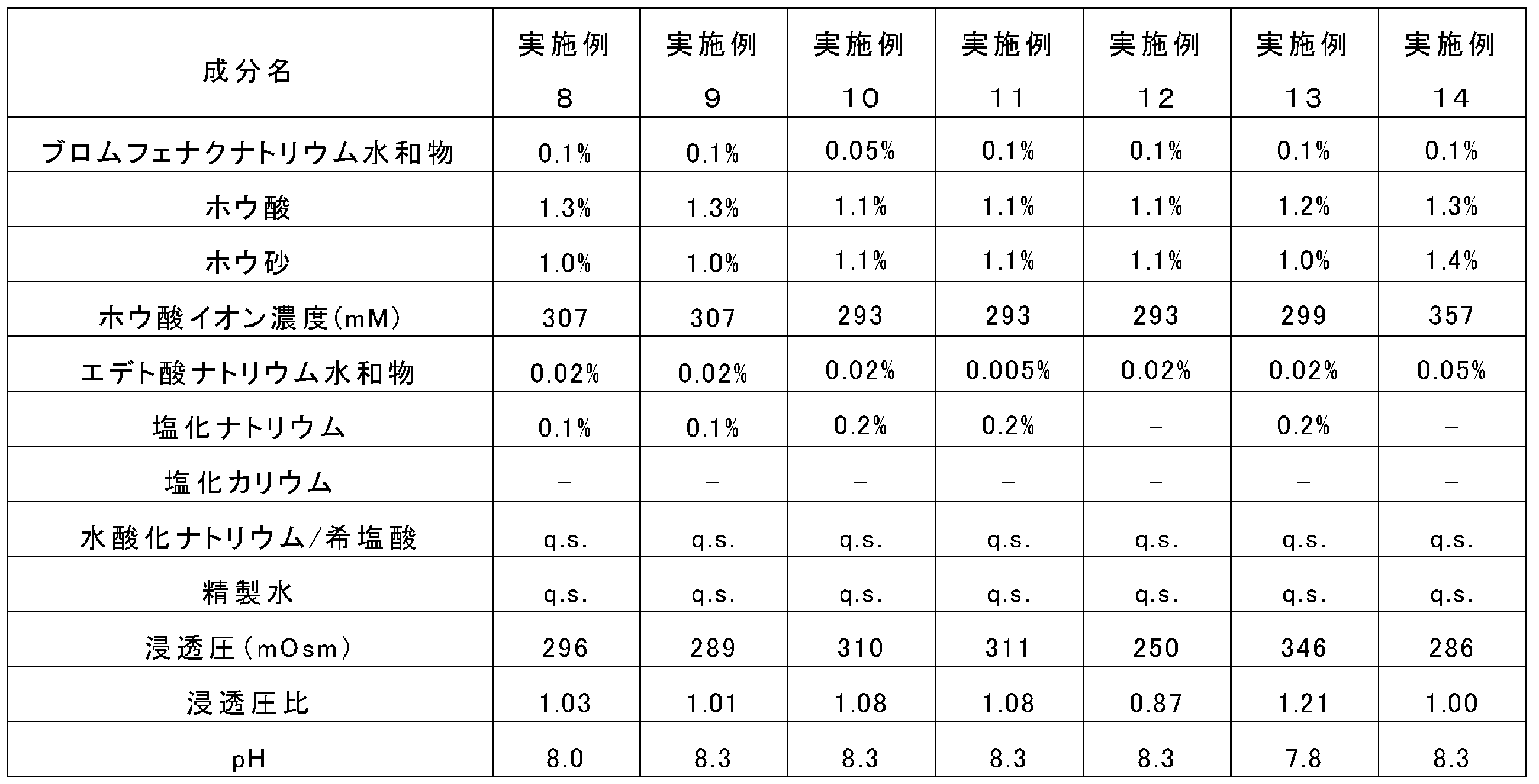
以下に示すとおり、実施例1~14及び比較例1~5の各製剤を調製した。各製剤の組成を表1~3にまとめた。表1~3において、「%」は%(w/v)を意味する。
以下に示すとおり、実施例1~14及び比較例1~5の各製剤を調製した。各製剤の組成を表1~3にまとめた。表1~3において、「%」は%(w/v)を意味する。
実施例1
ホウ酸を0.9g、ホウ砂を0.7g、精製水60mL、0.5%塩化ナトリウム/0.1%エデト酸ナトリウム水溶液を20mL加え、良く攪拌した。この液に、2-アミノ-3-(4-ブロモベンゾイル)フェニル酢酸ナトリウム・3/2水和物(以下、化合物Aともいう)を0.1g加え、充分に攪拌した。希塩酸及び水酸化ナトリウム試液を加えて、pHを8.0付近とした後、精製水を適量加えて全量を100mLとした。
ホウ酸を0.9g、ホウ砂を0.7g、精製水60mL、0.5%塩化ナトリウム/0.1%エデト酸ナトリウム水溶液を20mL加え、良く攪拌した。この液に、2-アミノ-3-(4-ブロモベンゾイル)フェニル酢酸ナトリウム・3/2水和物(以下、化合物Aともいう)を0.1g加え、充分に攪拌した。希塩酸及び水酸化ナトリウム試液を加えて、pHを8.0付近とした後、精製水を適量加えて全量を100mLとした。
実施例2
ホウ酸を0.9g、ホウ砂を0.7g、精製水60mL、0.5%塩化ナトリウム/0.1%エデト酸ナトリウム水溶液を20mL加え、良く攪拌した。この液に、エデト酸ナトリウム水和物を0.08g、化合物Aを0.1g加え、充分に攪拌した。希塩酸及び水酸化ナトリウム試液を加えて、pHを8.0付近とした後、精製水を適量加えて全量を100mLとした。
ホウ酸を0.9g、ホウ砂を0.7g、精製水60mL、0.5%塩化ナトリウム/0.1%エデト酸ナトリウム水溶液を20mL加え、良く攪拌した。この液に、エデト酸ナトリウム水和物を0.08g、化合物Aを0.1g加え、充分に攪拌した。希塩酸及び水酸化ナトリウム試液を加えて、pHを8.0付近とした後、精製水を適量加えて全量を100mLとした。
実施例3
2.2%ホウ酸・2.2%ホウ砂水溶液85mL、0.6%塩化ナトリウム/0.4%塩化カリウム水溶液を50mL、0.8%エデト酸ナトリウム水和物水溶液4.25mLをビーカーに加え、良く攪拌した。この液に、化合物Aを0.2g加え、充分に攪拌した。希塩酸及び水酸化ナトリウム試液を加えて、pHを8.0付近とした後、精製水を適量加えて全量を200mLとした。
2.2%ホウ酸・2.2%ホウ砂水溶液85mL、0.6%塩化ナトリウム/0.4%塩化カリウム水溶液を50mL、0.8%エデト酸ナトリウム水和物水溶液4.25mLをビーカーに加え、良く攪拌した。この液に、化合物Aを0.2g加え、充分に攪拌した。希塩酸及び水酸化ナトリウム試液を加えて、pHを8.0付近とした後、精製水を適量加えて全量を200mLとした。
実施例4
2.2%ホウ酸/2.2%ホウ砂水溶液85mL、0.6%塩化ナトリウム/0.4%塩化カリウム水溶液を50mL、0.8%エデト酸ナトリウム水和物水溶液4.25mLをビーカーに加え、良く攪拌した。この液に、化合物Aを0.2g加え、充分に攪拌した。希塩酸及び水酸化ナトリウム試液を加えて、pHを8.6付近とした後、精製水を適量加えて全量を200mLとした。
2.2%ホウ酸/2.2%ホウ砂水溶液85mL、0.6%塩化ナトリウム/0.4%塩化カリウム水溶液を50mL、0.8%エデト酸ナトリウム水和物水溶液4.25mLをビーカーに加え、良く攪拌した。この液に、化合物Aを0.2g加え、充分に攪拌した。希塩酸及び水酸化ナトリウム試液を加えて、pHを8.6付近とした後、精製水を適量加えて全量を200mLとした。
実施例5
ホウ酸を1.1g、ホウ砂を0.9g、精製水60mL、0.5%塩化ナトリウム/0.1%エデト酸ナトリウム水溶液を20mL加え、良く攪拌した。この液に、化合物Aを0.1g加え、充分に攪拌した。希塩酸及び水酸化ナトリウム試液を加えて、pHを8.0付近とした後、精製水を適量加えて全量を100mLとした。
ホウ酸を1.1g、ホウ砂を0.9g、精製水60mL、0.5%塩化ナトリウム/0.1%エデト酸ナトリウム水溶液を20mL加え、良く攪拌した。この液に、化合物Aを0.1g加え、充分に攪拌した。希塩酸及び水酸化ナトリウム試液を加えて、pHを8.0付近とした後、精製水を適量加えて全量を100mLとした。
実施例6
ホウ酸を1.1g、ホウ砂を0.9g、精製水60mL、0.5%塩化ナトリウム/0.1%エデト酸ナトリウム水溶液を20mL加え、良く攪拌した。この液に、化合物Aを0.1g加え、充分に攪拌した。希塩酸及び水酸化ナトリウム試液を加えて、pHを8.3付近とした後、精製水を適量加えて全量を100mLとした。
ホウ酸を1.1g、ホウ砂を0.9g、精製水60mL、0.5%塩化ナトリウム/0.1%エデト酸ナトリウム水溶液を20mL加え、良く攪拌した。この液に、化合物Aを0.1g加え、充分に攪拌した。希塩酸及び水酸化ナトリウム試液を加えて、pHを8.3付近とした後、精製水を適量加えて全量を100mLとした。
実施例7
1.4%ホウ酸、1.4%ホウ砂、0.13%塩化ナトリウム、0.03%エデト酸ナトリウム水和物の水溶液160mLをビーカーに加えた。塩化ナトリウムを0.3g、塩化カリウムを0.2g加え、良く攪拌した。この液に、化合物Aを0.2g加え、充分に攪拌した。希塩酸及び水酸化ナトリウム試液を加えて、pHを8.3付近とした後、精製水を適量加えて全量を200mLとした。
1.4%ホウ酸、1.4%ホウ砂、0.13%塩化ナトリウム、0.03%エデト酸ナトリウム水和物の水溶液160mLをビーカーに加えた。塩化ナトリウムを0.3g、塩化カリウムを0.2g加え、良く攪拌した。この液に、化合物Aを0.2g加え、充分に攪拌した。希塩酸及び水酸化ナトリウム試液を加えて、pHを8.3付近とした後、精製水を適量加えて全量を200mLとした。
実施例8
ホウ酸を1.3g、ホウ砂を1.0g、精製水60mL、0.5%塩化ナトリウム/0.1%エデト酸ナトリウム水溶液を20mL加え、良く攪拌した。この液に、化合物Aを0.1g加え、充分に攪拌した。希塩酸及び水酸化ナトリウム試液を加えて、pHを8.0付近とした後、精製水を適量加えて全量を100mLとした。
ホウ酸を1.3g、ホウ砂を1.0g、精製水60mL、0.5%塩化ナトリウム/0.1%エデト酸ナトリウム水溶液を20mL加え、良く攪拌した。この液に、化合物Aを0.1g加え、充分に攪拌した。希塩酸及び水酸化ナトリウム試液を加えて、pHを8.0付近とした後、精製水を適量加えて全量を100mLとした。
実施例9
1.6%ホウ酸、1.3%ホウ砂、0.03%エデト酸ナトリウム水和物、0.13%塩化ナトリウム及び0.13%化合物Aの溶液80mLをビーカーに加えた。希塩酸及び水酸化ナトリウム試液を加えて、pHを8.3付近とした後、精製水を適量加えて全量を100mLとした。
1.6%ホウ酸、1.3%ホウ砂、0.03%エデト酸ナトリウム水和物、0.13%塩化ナトリウム及び0.13%化合物Aの溶液80mLをビーカーに加えた。希塩酸及び水酸化ナトリウム試液を加えて、pHを8.3付近とした後、精製水を適量加えて全量を100mLとした。
実施例10
ビーカーに精製水を160mL加えた後に、ホウ酸を2.2g、ホウ砂を2.2g、塩化ナトリウムを0.4g、エデト酸ナトリウム水和物を0.04g加え、良く攪拌した。この液に、化合物Aを0.1g加え、充分に攪拌した。希塩酸又は水酸化ナトリウム試液を加えて、pHを8.3付近とした後、精製水を適量加えて全量を200mLとした。
ビーカーに精製水を160mL加えた後に、ホウ酸を2.2g、ホウ砂を2.2g、塩化ナトリウムを0.4g、エデト酸ナトリウム水和物を0.04g加え、良く攪拌した。この液に、化合物Aを0.1g加え、充分に攪拌した。希塩酸又は水酸化ナトリウム試液を加えて、pHを8.3付近とした後、精製水を適量加えて全量を200mLとした。
実施例11
ビーカーに精製水を160mL加えた後に、ホウ酸を2.2g、ホウ砂を2.2g、塩化ナトリウムを0.4g、エデト酸ナトリウム水和物を0.01g加え、良く攪拌した。この液に、化合物Aを0.2g加え、充分に攪拌した。希塩酸又は水酸化ナトリウム試液を加えて、pHを8.3付近とした後、精製水を適量加えて全量を200mLとした。
ビーカーに精製水を160mL加えた後に、ホウ酸を2.2g、ホウ砂を2.2g、塩化ナトリウムを0.4g、エデト酸ナトリウム水和物を0.01g加え、良く攪拌した。この液に、化合物Aを0.2g加え、充分に攪拌した。希塩酸又は水酸化ナトリウム試液を加えて、pHを8.3付近とした後、精製水を適量加えて全量を200mLとした。
実施例12
ビーカーに精製水を160mL加えた後に、ホウ酸を2.2g、ホウ砂を2.2g、エデト酸ナトリウム水和物を0.04g加え、良く攪拌した。この液に、化合物Aを0.2g加え、充分に攪拌した。希塩酸又は水酸化ナトリウム試液を加えて、pHを8.3付近とした後、精製水を適量加えて全量を200mLとした。
ビーカーに精製水を160mL加えた後に、ホウ酸を2.2g、ホウ砂を2.2g、エデト酸ナトリウム水和物を0.04g加え、良く攪拌した。この液に、化合物Aを0.2g加え、充分に攪拌した。希塩酸又は水酸化ナトリウム試液を加えて、pHを8.3付近とした後、精製水を適量加えて全量を200mLとした。
実施例13
ビーカーに精製水を160mL加えた後に、ホウ酸を2.4g、ホウ砂を2.0g、塩化ナトリウムを0.4g、エデト酸ナトリウム水和物を0.04g加え、良く攪拌した。この液に、化合物Aを0.2g加え、充分に攪拌した。希塩酸又は水酸化ナトリウム試液を加えて、pHを7.8付近とした後、精製水を適量加えて全量を200mLとした。
ビーカーに精製水を160mL加えた後に、ホウ酸を2.4g、ホウ砂を2.0g、塩化ナトリウムを0.4g、エデト酸ナトリウム水和物を0.04g加え、良く攪拌した。この液に、化合物Aを0.2g加え、充分に攪拌した。希塩酸又は水酸化ナトリウム試液を加えて、pHを7.8付近とした後、精製水を適量加えて全量を200mLとした。
実施例14
ビーカーに精製水を160mL加えた後に、ホウ酸を2.6g、ホウ砂を2.8g、エデト酸ナトリウム水和物を0.1g加え、良く攪拌した。この液に、化合物Aを0.2g加え、充分に攪拌した。希塩酸又は水酸化ナトリウム試液を加えて、pHを8.3付近とした後、精製水を適量加えて全量を200mLとした。
ビーカーに精製水を160mL加えた後に、ホウ酸を2.6g、ホウ砂を2.8g、エデト酸ナトリウム水和物を0.1g加え、良く攪拌した。この液に、化合物Aを0.2g加え、充分に攪拌した。希塩酸又は水酸化ナトリウム試液を加えて、pHを8.3付近とした後、精製水を適量加えて全量を200mLとした。
比較例1
ビーカーに精製水を50mL加えた後に、ホウ酸を0.7g、ホウ砂を1.0g、塩化ナトリウムを0.2g加え、良く攪拌した。この液に、1.0%エデト酸ナトリウム水和物溶液を2mL及び化合物Aを0.1g加え、充分に攪拌した。希塩酸及び水酸化ナトリウム試液を加えて、pHを8.3付近とした後、精製水を適量加えて全量を100mLとした。
ビーカーに精製水を50mL加えた後に、ホウ酸を0.7g、ホウ砂を1.0g、塩化ナトリウムを0.2g加え、良く攪拌した。この液に、1.0%エデト酸ナトリウム水和物溶液を2mL及び化合物Aを0.1g加え、充分に攪拌した。希塩酸及び水酸化ナトリウム試液を加えて、pHを8.3付近とした後、精製水を適量加えて全量を100mLとした。
比較例2
ビーカーに精製水を50mL加えた後に、ホウ酸を0.7g、ホウ砂を1.0g、塩化ナトリウムを0.2g加え、良く攪拌した。この液に、1.0%エデト酸ナトリウム水和物溶液を5mL及び化合物Aを0.1g加え、充分に攪拌した。希塩酸及び水酸化ナトリウム試液を加えて、pHを8.3付近とした後、精製水を適量加えて全量を100mLとした。
ビーカーに精製水を50mL加えた後に、ホウ酸を0.7g、ホウ砂を1.0g、塩化ナトリウムを0.2g加え、良く攪拌した。この液に、1.0%エデト酸ナトリウム水和物溶液を5mL及び化合物Aを0.1g加え、充分に攪拌した。希塩酸及び水酸化ナトリウム試液を加えて、pHを8.3付近とした後、精製水を適量加えて全量を100mLとした。
比較例3
ビーカーに精製水を50mL加えた後に、ホウ酸を0.7g、ホウ砂を1.0g、塩化ナトリウムを0.2g加え、良く攪拌した。この液に、化合物Aを0.1g加え、充分に攪拌した。希塩酸及び水酸化ナトリウム試液を加えて、pHを8.3付近とした後、精製水を適量加えて全量を100mLとした。
ビーカーに精製水を50mL加えた後に、ホウ酸を0.7g、ホウ砂を1.0g、塩化ナトリウムを0.2g加え、良く攪拌した。この液に、化合物Aを0.1g加え、充分に攪拌した。希塩酸及び水酸化ナトリウム試液を加えて、pHを8.3付近とした後、精製水を適量加えて全量を100mLとした。
比較例4
ビーカーに精製水を160mL加えた後に、ホウ酸を1.6g、ホウ砂を2.0g、塩化ナトリウムを0.4g、加え、良く攪拌した。この液に、化合物Aを0.1g加え、充分に攪拌した。希塩酸又は水酸化ナトリウム試液を加えて、pHを8.3付近とした後、精製水を適量加えて全量を200mLとした。
ビーカーに精製水を160mL加えた後に、ホウ酸を1.6g、ホウ砂を2.0g、塩化ナトリウムを0.4g、加え、良く攪拌した。この液に、化合物Aを0.1g加え、充分に攪拌した。希塩酸又は水酸化ナトリウム試液を加えて、pHを8.3付近とした後、精製水を適量加えて全量を200mLとした。
比較例5
ビーカーに精製水を160mL加えた後に、ホウ酸を1.8g、ホウ砂を1.8g、塩化ナトリウムを0.4g、加え、良く攪拌した。この液に、化合物Aを0.1g加え、充分に攪拌した。希塩酸又は水酸化ナトリウム試液を加えて、pHを8.3付近とした後、精製水を適量加えて全量を200mLとした。
ビーカーに精製水を160mL加えた後に、ホウ酸を1.8g、ホウ砂を1.8g、塩化ナトリウムを0.4g、加え、良く攪拌した。この液に、化合物Aを0.1g加え、充分に攪拌した。希塩酸又は水酸化ナトリウム試液を加えて、pHを8.3付近とした後、精製水を適量加えて全量を200mLとした。
[浸透圧及び浸透圧比の測定]
実施例1~14及び比較例1~5で得られた各製剤について、第十六改正日本薬局方の浸透圧測定法(オスモル濃度測定法)に記載された方法により浸透圧及び浸透圧比を測定した。結果を表1~3に示す。
実施例1~14及び比較例1~5で得られた各製剤について、第十六改正日本薬局方の浸透圧測定法(オスモル濃度測定法)に記載された方法により浸透圧及び浸透圧比を測定した。結果を表1~3に示す。


(2)保存効力試験
以下に示すように、実施例1、3~5、及び7~14及び比較例1~5で得られた各製剤を用いて保存効力試験を実施した。
以下に示すように、実施例1、3~5、及び7~14及び比較例1~5で得られた各製剤を用いて保存効力試験を実施した。
[操作方法]
第十六改正日本薬局方の参考情報 保存効力試験法に従って試験を行い判定した。
表5~7に示す5種の菌株をそれぞれカンテン斜面培地の表面に接種して前培養した。前培養用のカンテン培地としては、細菌の場合はソイビーン・カゼイン・ダイジェストカンテン培地を、真菌の場合はサブロー・ブドウ糖カンテン培地を用いた。細菌の場合は30~35℃で18~24時間、Candida albicansは20~25℃で44~52時間、Aspergillus brasiliensisは20~25℃で1週間又は十分な胞子が形成されるまで前培養した。実施例1~9及び比較例1~3の検体を5本の滅菌済みのPE容器に分注し、前培養した下記表5~7に示す試験菌を105~106個/mLとなるよう接種した混合試料を調製後、20~25℃で遮光保存した。なお、試験菌は混合せず、それぞれ単独に各検体に接種した。保存開始から2週及び4週保存後に各混合試料から1mLをサンプリングした液を培養し、生菌数の測定を行った。試験菌株を以下に記載する。
Escherichia coli ATCC 8739
Pseudomonas aeruginosa ATCC 9027
Staphylococcus aureus ATCC 6538
Candida albicans ATCC 10231
Aspergillus brasiliensis ATCC 16404
第十六改正日本薬局方の参考情報 保存効力試験法に従って試験を行い判定した。
表5~7に示す5種の菌株をそれぞれカンテン斜面培地の表面に接種して前培養した。前培養用のカンテン培地としては、細菌の場合はソイビーン・カゼイン・ダイジェストカンテン培地を、真菌の場合はサブロー・ブドウ糖カンテン培地を用いた。細菌の場合は30~35℃で18~24時間、Candida albicansは20~25℃で44~52時間、Aspergillus brasiliensisは20~25℃で1週間又は十分な胞子が形成されるまで前培養した。実施例1~9及び比較例1~3の検体を5本の滅菌済みのPE容器に分注し、前培養した下記表5~7に示す試験菌を105~106個/mLとなるよう接種した混合試料を調製後、20~25℃で遮光保存した。なお、試験菌は混合せず、それぞれ単独に各検体に接種した。保存開始から2週及び4週保存後に各混合試料から1mLをサンプリングした液を培養し、生菌数の測定を行った。試験菌株を以下に記載する。
Escherichia coli ATCC 8739
Pseudomonas aeruginosa ATCC 9027
Staphylococcus aureus ATCC 6538
Candida albicans ATCC 10231
Aspergillus brasiliensis ATCC 16404
[判定]
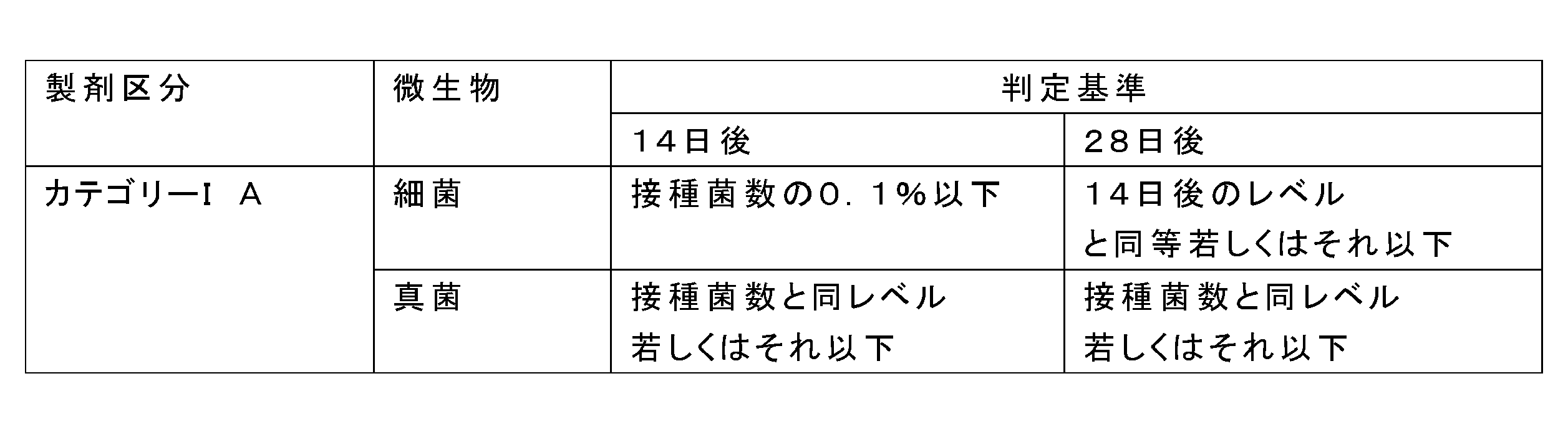
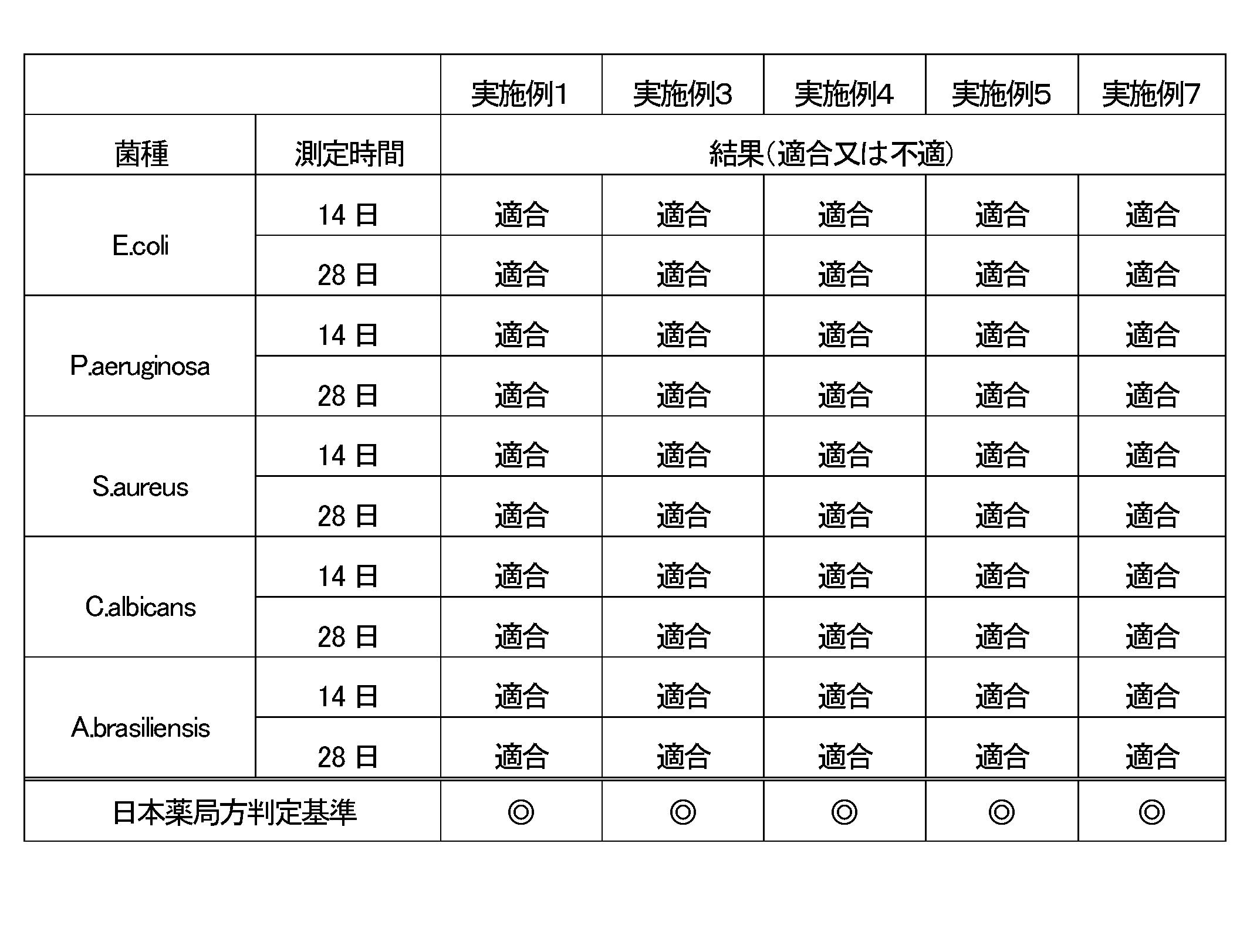
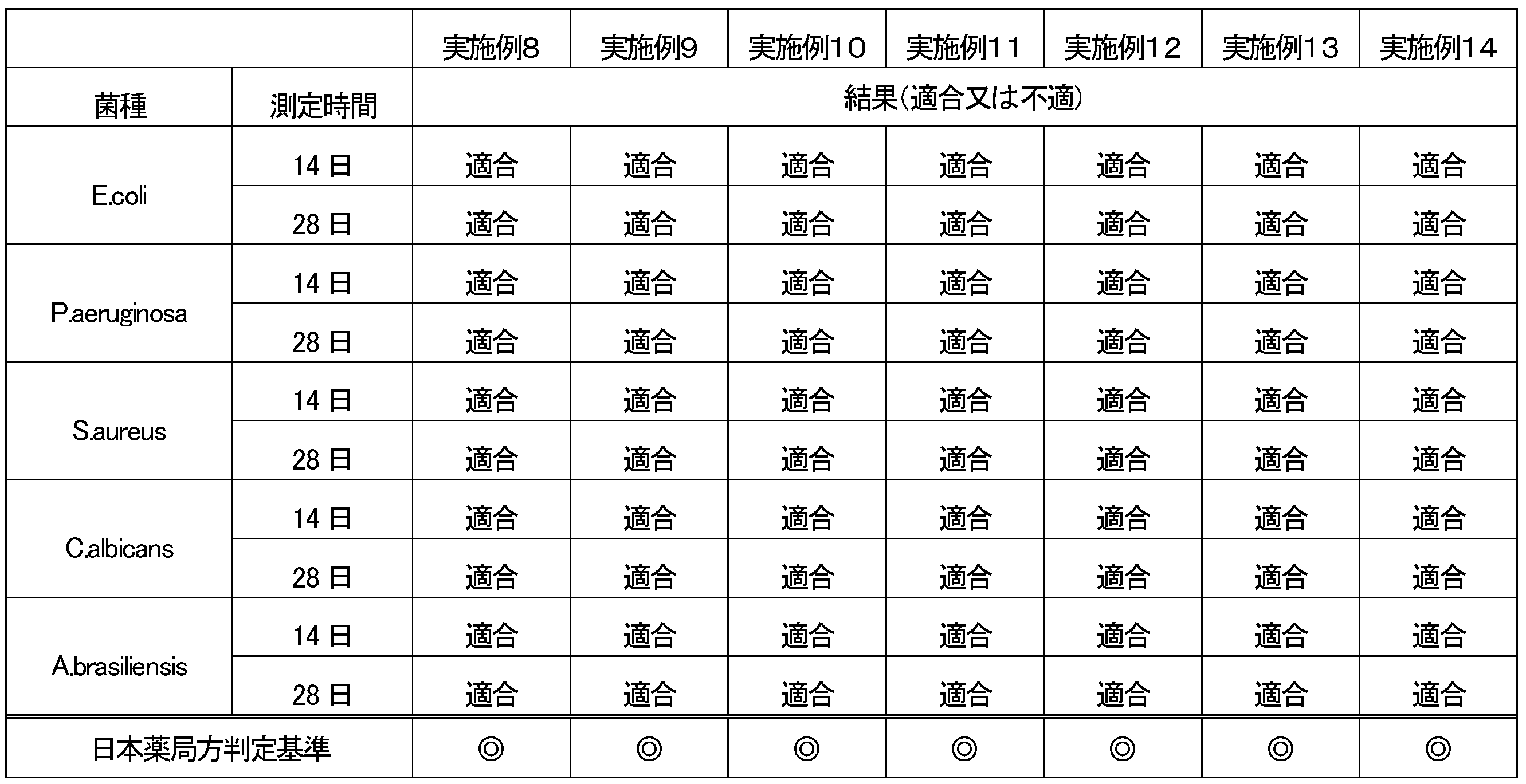
保存効力の判定は、表4に従う。表4に記されている判定基準に適合する場合、保存効力があると判定する。全ての試験菌株について保存効力がある場合、保存効力を有する(◎)と判定し、細菌及び真菌のうち1種でも上記判定基準を満たさない菌があった検体は保存効力が不十分である(△)とした。試験結果を表5~7に示す。
保存効力の判定は、表4に従う。表4に記されている判定基準に適合する場合、保存効力があると判定する。全ての試験菌株について保存効力がある場合、保存効力を有する(◎)と判定し、細菌及び真菌のうち1種でも上記判定基準を満たさない菌があった検体は保存効力が不十分である(△)とした。試験結果を表5~7に示す。
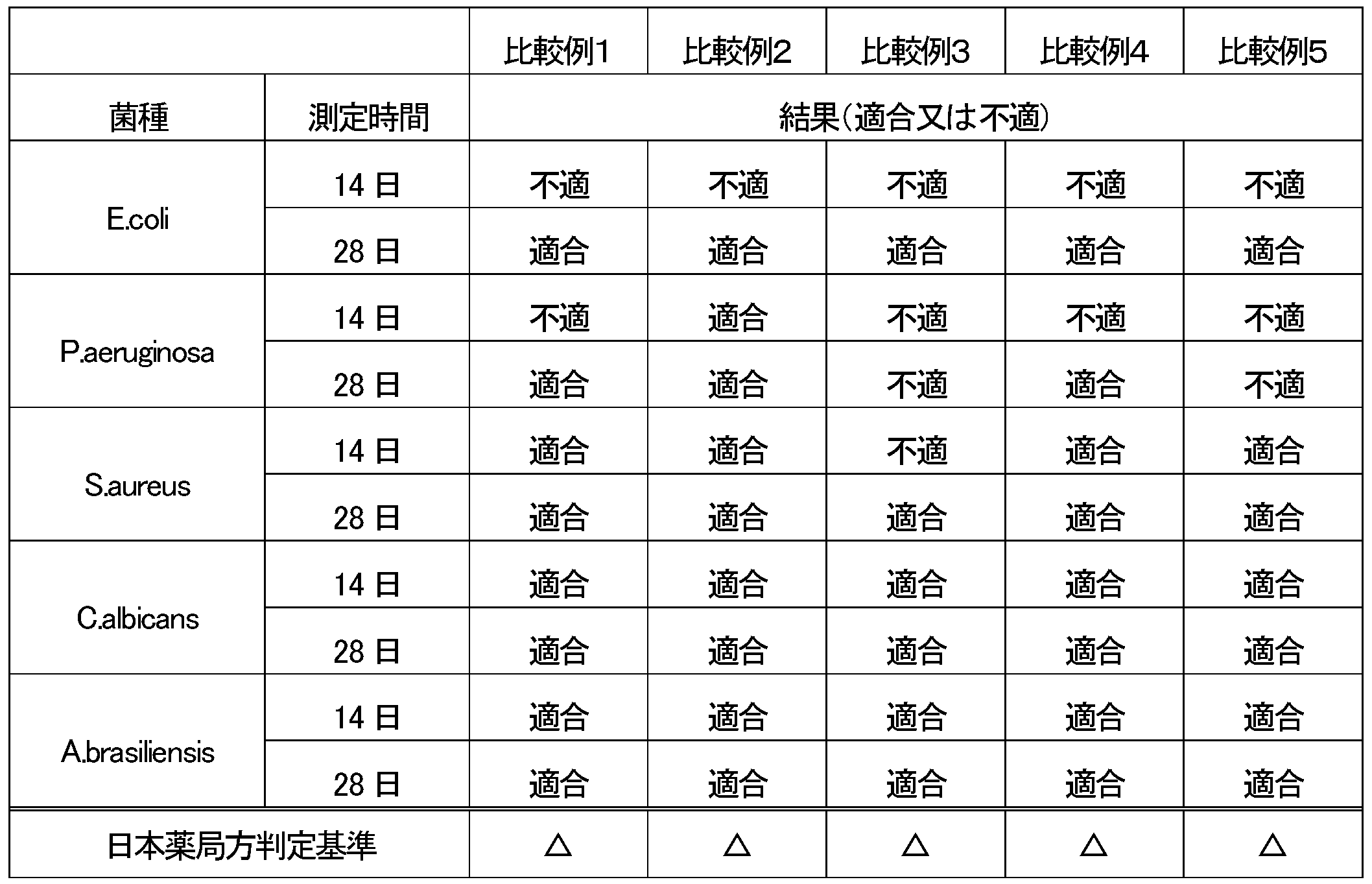
[考察]
実施例1、3~5、及び7~14の各製剤は、全ての試験菌株について保存効力があった(◎)が、ホウ酸イオン濃度が210mMの比較例1~3、及びエデト酸ナトリウムを含まない比較例4~5は、試験菌株について保存効力が不充分であった(△)。
実施例1、3~5、及び7~14の各製剤は、全ての試験菌株について保存効力があった(◎)が、ホウ酸イオン濃度が210mMの比較例1~3、及びエデト酸ナトリウムを含まない比較例4~5は、試験菌株について保存効力が不充分であった(△)。
(3)保存安定性試験
実施例1、2、5、6及び8で得た各製剤を密閉容器に入れ、70℃の恒温機に8日間静置保管することにより、保存安定性試験を実施した。期間の経過後、各製剤を室温下に放置して冷却し、25℃におけるブロムフェナク残存率(%(w/v))及び浸透圧比の測定並びに溶液状態の観察を行った。
ブロムフェナク残存率の測定は、Waters社製UPLCを用いて行った。カラムは、Waters社製Acquity HSS C18 SB (2.1mm I.D.×100mm、粒子径1.8μm)を用いて30℃付近の一定温度に保った。移動相は、アセトニトリル及び0.01%リン酸溶液をpH3.5に調整したものを流速0.47mLとして、グラジエントモードにて8分間測定した。試料は、水で10倍希釈したものを2μL注入し、230nmの波長で検出した。
浸透圧比の測定は、上述の方法により行った。溶液状態は目視により観察した。
結果を表8に示す。
実施例1、2、5、6及び8で得た各製剤を密閉容器に入れ、70℃の恒温機に8日間静置保管することにより、保存安定性試験を実施した。期間の経過後、各製剤を室温下に放置して冷却し、25℃におけるブロムフェナク残存率(%(w/v))及び浸透圧比の測定並びに溶液状態の観察を行った。
ブロムフェナク残存率の測定は、Waters社製UPLCを用いて行った。カラムは、Waters社製Acquity HSS C18 SB (2.1mm I.D.×100mm、粒子径1.8μm)を用いて30℃付近の一定温度に保った。移動相は、アセトニトリル及び0.01%リン酸溶液をpH3.5に調整したものを流速0.47mLとして、グラジエントモードにて8分間測定した。試料は、水で10倍希釈したものを2μL注入し、230nmの波長で検出した。
浸透圧比の測定は、上述の方法により行った。溶液状態は目視により観察した。
結果を表8に示す。

[考察]
実施例1、2、5、6及び8の各製剤は何れも、70℃、8日間保存後であっても澄明で析出物はなかった。
実施例1、2、5、6及び8の各製剤は何れも、70℃、8日間保存後であっても澄明で析出物はなかった。
Claims (7)
- 0.01~1.0%(w/v)の2-アミノ-3-(4-ブロモベンゾイル)フェニル酢酸又はその塩、215~360mMのホウ酸イオン及び0.001~0.15%(w/v)のエデト酸ナトリウムを含有し、カチオン系防腐剤及び非イオン性界面活性剤を実質的に含有しない点眼剤であって、
浸透圧比が0.8~1.3である点眼剤。 - 0.01~1.0%(w/v)の2-アミノ-3-(4-ブロモベンゾイル)フェニル酢酸又はその塩、215~360mMのホウ酸イオン及び0.001~0.15%(w/v)のエデト酸ナトリウムを含有し、カチオン系防腐剤及び非イオン性界面活性剤を実質的に含有しない点眼剤であって、
第十六改正日本薬局方の保存効力試験法における判定基準に適合する点眼剤。 - 前記2-アミノ-3-(4-ブロモベンゾイル)フェニル酢酸又はその塩がブロムフェナクナトリウムである、請求項1又は2記載の点眼剤。
- 更に、0.01~0.5%(w/v)の塩化ナトリウムを含有する、請求項1~3の何れか1項記載の点眼剤。
- pHが7.8~8.6である、請求項1~4の何れか1項記載の点眼剤。
- マルチドーズ型容器に収納されている、請求項1~5の何れか1項記載の点眼剤。
- 0.01~1.0%(w/v)の2-アミノ-3-(4-ブロモベンゾイル)フェニル酢酸又はその塩を含有し、カチオン系防腐剤及び非イオン性界面活性剤を実質的に含有しない点眼剤の防腐効力を維持する方法であって、前記方法は、
前記点眼剤に、ホウ酸イオンを215~360mM及びエデト酸ナトリウムを0.001~0.15%(w/v)含有させること、及び、
前記点眼剤の浸透圧比を0.8~1.3とすること
を含む、方法。
Priority Applications (1)
| Application Number | Priority Date | Filing Date | Title |
|---|---|---|---|
| KR1020187000016A KR20180016469A (ko) | 2015-06-10 | 2016-06-09 | 점안제, 및 점안제 방부 효력 유지 방법 |
Applications Claiming Priority (2)
| Application Number | Priority Date | Filing Date | Title |
|---|---|---|---|
| JP2015117384 | 2015-06-10 | ||
| JP2015-117384 | 2015-06-10 |
Publications (1)
| Publication Number | Publication Date |
|---|---|
| WO2016199854A1 true WO2016199854A1 (ja) | 2016-12-15 |
Family
ID=57503246
Family Applications (1)
| Application Number | Title | Priority Date | Filing Date |
|---|---|---|---|
| PCT/JP2016/067220 Ceased WO2016199854A1 (ja) | 2015-06-10 | 2016-06-09 | 点眼剤、及び点眼剤防腐効力維持方法 |
Country Status (4)
| Country | Link |
|---|---|
| JP (1) | JP2017002042A (ja) |
| KR (1) | KR20180016469A (ja) |
| TW (1) | TW201713325A (ja) |
| WO (1) | WO2016199854A1 (ja) |
Cited By (1)
| Publication number | Priority date | Publication date | Assignee | Title |
|---|---|---|---|---|
| CN110664737A (zh) * | 2018-07-02 | 2020-01-10 | 盘锦雨源新创意开发推广有限公司 | 一种溴芬酸钠滴眼液及其制备工艺 |
Citations (5)
| Publication number | Priority date | Publication date | Assignee | Title |
|---|---|---|---|---|
| JP2002080314A (ja) * | 2000-06-19 | 2002-03-19 | Santen Pharmaceut Co Ltd | 防腐剤 |
| JP2005162747A (ja) * | 2003-11-12 | 2005-06-23 | Rohto Pharmaceut Co Ltd | 眼科用組成物 |
| JP2007023020A (ja) * | 2005-06-17 | 2007-02-01 | Rohto Pharmaceut Co Ltd | 眼粘膜適用製剤 |
| JP2013227300A (ja) * | 2012-03-28 | 2013-11-07 | Santen Pharmaceut Co Ltd | 2−アミノ−3−(4−ブロモベンゾイル)フェニル酢酸含有水性組成物 |
| WO2014204952A1 (en) * | 2013-06-19 | 2014-12-24 | Sentiss Research Center | Stable bromfenac solution |
-
2016
- 2016-06-09 KR KR1020187000016A patent/KR20180016469A/ko not_active Withdrawn
- 2016-06-09 JP JP2016115280A patent/JP2017002042A/ja active Pending
- 2016-06-09 WO PCT/JP2016/067220 patent/WO2016199854A1/ja not_active Ceased
- 2016-06-13 TW TW105118302A patent/TW201713325A/zh unknown
Patent Citations (5)
| Publication number | Priority date | Publication date | Assignee | Title |
|---|---|---|---|---|
| JP2002080314A (ja) * | 2000-06-19 | 2002-03-19 | Santen Pharmaceut Co Ltd | 防腐剤 |
| JP2005162747A (ja) * | 2003-11-12 | 2005-06-23 | Rohto Pharmaceut Co Ltd | 眼科用組成物 |
| JP2007023020A (ja) * | 2005-06-17 | 2007-02-01 | Rohto Pharmaceut Co Ltd | 眼粘膜適用製剤 |
| JP2013227300A (ja) * | 2012-03-28 | 2013-11-07 | Santen Pharmaceut Co Ltd | 2−アミノ−3−(4−ブロモベンゾイル)フェニル酢酸含有水性組成物 |
| WO2014204952A1 (en) * | 2013-06-19 | 2014-12-24 | Sentiss Research Center | Stable bromfenac solution |
Non-Patent Citations (1)
| Title |
|---|
| TAKESHI TAKIZAWA ET AL.: "Antimicrobial Activities and Mechanisms of New Composition for Eyedrops Containing Borate", JOURNAL OF THE EYE, vol. 27, no. 4, 2010, pages 518 - 522 * |
Cited By (1)
| Publication number | Priority date | Publication date | Assignee | Title |
|---|---|---|---|---|
| CN110664737A (zh) * | 2018-07-02 | 2020-01-10 | 盘锦雨源新创意开发推广有限公司 | 一种溴芬酸钠滴眼液及其制备工艺 |
Also Published As
| Publication number | Publication date |
|---|---|
| JP2017002042A (ja) | 2017-01-05 |
| TW201713325A (zh) | 2017-04-16 |
| KR20180016469A (ko) | 2018-02-14 |
Similar Documents
| Publication | Publication Date | Title |
|---|---|---|
| JP7447176B2 (ja) | ジクアホソル含有点眼液 | |
| KR102607126B1 (ko) | 안과용 조성물 | |
| TWI650127B (zh) | 含吡啶基胺基乙酸化合物之醫藥組成物 | |
| JP5246182B2 (ja) | 点眼剤、防腐剤及び防腐力向上剤 | |
| CN103608000B (zh) | 含有透明质酸或其盐以及丙二醇的滴眼液 | |
| JP2008266168A (ja) | 眼科用剤 | |
| WO2016199854A1 (ja) | 点眼剤、及び点眼剤防腐効力維持方法 | |
| JP5922609B2 (ja) | 2−アミノ−3−(4−ブロモベンゾイル)フェニル酢酸含有水性組成物 | |
| WO2019189720A1 (ja) | 水性液剤 | |
| JP2015086222A (ja) | 安定化された2−アミノ−3−(4−ブロモベンゾイル)フェニル酢酸含有水性組成物 | |
| JP2013129618A (ja) | 防腐効力および物性を向上させたレボフロキサシン含有水性液剤 | |
| US20140348779A1 (en) | Ophthalmic composition |
Legal Events
| Date | Code | Title | Description |
|---|---|---|---|
| 121 | Ep: the epo has been informed by wipo that ep was designated in this application |
Ref document number: 16807560 Country of ref document: EP Kind code of ref document: A1 |
|
| NENP | Non-entry into the national phase |
Ref country code: DE |
|
| ENP | Entry into the national phase |
Ref document number: 20187000016 Country of ref document: KR Kind code of ref document: A |
|
| 122 | Ep: pct application non-entry in european phase |
Ref document number: 16807560 Country of ref document: EP Kind code of ref document: A1 |