WO2016190366A1 - 撥水撥油剤組成物、その製造方法および物品 - Google Patents
撥水撥油剤組成物、その製造方法および物品 Download PDFInfo
- Publication number
- WO2016190366A1 WO2016190366A1 PCT/JP2016/065501 JP2016065501W WO2016190366A1 WO 2016190366 A1 WO2016190366 A1 WO 2016190366A1 JP 2016065501 W JP2016065501 W JP 2016065501W WO 2016190366 A1 WO2016190366 A1 WO 2016190366A1
- Authority
- WO
- WIPO (PCT)
- Prior art keywords
- monomer
- water
- group
- repellent composition
- oil repellent
- Prior art date
- Legal status (The legal status is an assumption and is not a legal conclusion. Google has not performed a legal analysis and makes no representation as to the accuracy of the status listed.)
- Ceased
Links
Classifications
-
- C—CHEMISTRY; METALLURGY
- C09—DYES; PAINTS; POLISHES; NATURAL RESINS; ADHESIVES; COMPOSITIONS NOT OTHERWISE PROVIDED FOR; APPLICATIONS OF MATERIALS NOT OTHERWISE PROVIDED FOR
- C09K—MATERIALS FOR MISCELLANEOUS APPLICATIONS, NOT PROVIDED FOR ELSEWHERE
- C09K3/00—Materials not provided for elsewhere
- C09K3/18—Materials not provided for elsewhere for application to surfaces to minimize adherence of ice, mist or water thereto; Thawing or antifreeze materials for application to surfaces
-
- D—TEXTILES; PAPER
- D06—TREATMENT OF TEXTILES OR THE LIKE; LAUNDERING; FLEXIBLE MATERIALS NOT OTHERWISE PROVIDED FOR
- D06M—TREATMENT, NOT PROVIDED FOR ELSEWHERE IN CLASS D06, OF FIBRES, THREADS, YARNS, FABRICS, FEATHERS OR FIBROUS GOODS MADE FROM SUCH MATERIALS
- D06M15/00—Treating fibres, threads, yarns, fabrics, or fibrous goods made from such materials, with macromolecular compounds; Such treatment combined with mechanical treatment
- D06M15/19—Treating fibres, threads, yarns, fabrics, or fibrous goods made from such materials, with macromolecular compounds; Such treatment combined with mechanical treatment with synthetic macromolecular compounds
- D06M15/21—Macromolecular compounds obtained by reactions only involving carbon-to-carbon unsaturated bonds
- D06M15/263—Macromolecular compounds obtained by reactions only involving carbon-to-carbon unsaturated bonds of unsaturated carboxylic acids; Salts or esters thereof
- D06M15/277—Macromolecular compounds obtained by reactions only involving carbon-to-carbon unsaturated bonds of unsaturated carboxylic acids; Salts or esters thereof containing fluorine
-
- C—CHEMISTRY; METALLURGY
- C08—ORGANIC MACROMOLECULAR COMPOUNDS; THEIR PREPARATION OR CHEMICAL WORKING-UP; COMPOSITIONS BASED THEREON
- C08F—MACROMOLECULAR COMPOUNDS OBTAINED BY REACTIONS ONLY INVOLVING CARBON-TO-CARBON UNSATURATED BONDS
- C08F220/00—Copolymers of compounds having one or more unsaturated aliphatic radicals, each having only one carbon-to-carbon double bond, and only one being terminated by only one carboxyl radical or a salt, anhydride ester, amide, imide or nitrile thereof
- C08F220/02—Monocarboxylic acids having less than ten carbon atoms; Derivatives thereof
- C08F220/10—Esters
- C08F220/22—Esters containing halogen
-
- C—CHEMISTRY; METALLURGY
- C08—ORGANIC MACROMOLECULAR COMPOUNDS; THEIR PREPARATION OR CHEMICAL WORKING-UP; COMPOSITIONS BASED THEREON
- C08F—MACROMOLECULAR COMPOUNDS OBTAINED BY REACTIONS ONLY INVOLVING CARBON-TO-CARBON UNSATURATED BONDS
- C08F220/00—Copolymers of compounds having one or more unsaturated aliphatic radicals, each having only one carbon-to-carbon double bond, and only one being terminated by only one carboxyl radical or a salt, anhydride ester, amide, imide or nitrile thereof
- C08F220/62—Monocarboxylic acids having ten or more carbon atoms; Derivatives thereof
- C08F220/68—Esters
-
- D—TEXTILES; PAPER
- D06—TREATMENT OF TEXTILES OR THE LIKE; LAUNDERING; FLEXIBLE MATERIALS NOT OTHERWISE PROVIDED FOR
- D06M—TREATMENT, NOT PROVIDED FOR ELSEWHERE IN CLASS D06, OF FIBRES, THREADS, YARNS, FABRICS, FEATHERS OR FIBROUS GOODS MADE FROM SUCH MATERIALS
- D06M15/00—Treating fibres, threads, yarns, fabrics, or fibrous goods made from such materials, with macromolecular compounds; Such treatment combined with mechanical treatment
- D06M15/19—Treating fibres, threads, yarns, fabrics, or fibrous goods made from such materials, with macromolecular compounds; Such treatment combined with mechanical treatment with synthetic macromolecular compounds
- D06M15/21—Macromolecular compounds obtained by reactions only involving carbon-to-carbon unsaturated bonds
- D06M15/244—Macromolecular compounds obtained by reactions only involving carbon-to-carbon unsaturated bonds of halogenated hydrocarbons
- D06M15/248—Macromolecular compounds obtained by reactions only involving carbon-to-carbon unsaturated bonds of halogenated hydrocarbons containing chlorine
-
- D—TEXTILES; PAPER
- D06—TREATMENT OF TEXTILES OR THE LIKE; LAUNDERING; FLEXIBLE MATERIALS NOT OTHERWISE PROVIDED FOR
- D06M—TREATMENT, NOT PROVIDED FOR ELSEWHERE IN CLASS D06, OF FIBRES, THREADS, YARNS, FABRICS, FEATHERS OR FIBROUS GOODS MADE FROM SUCH MATERIALS
- D06M15/00—Treating fibres, threads, yarns, fabrics, or fibrous goods made from such materials, with macromolecular compounds; Such treatment combined with mechanical treatment
- D06M15/19—Treating fibres, threads, yarns, fabrics, or fibrous goods made from such materials, with macromolecular compounds; Such treatment combined with mechanical treatment with synthetic macromolecular compounds
- D06M15/21—Macromolecular compounds obtained by reactions only involving carbon-to-carbon unsaturated bonds
- D06M15/263—Macromolecular compounds obtained by reactions only involving carbon-to-carbon unsaturated bonds of unsaturated carboxylic acids; Salts or esters thereof
- D06M15/27—Macromolecular compounds obtained by reactions only involving carbon-to-carbon unsaturated bonds of unsaturated carboxylic acids; Salts or esters thereof of alkylpolyalkylene glycol esters of unsaturated carboxylic acids
-
- D—TEXTILES; PAPER
- D06—TREATMENT OF TEXTILES OR THE LIKE; LAUNDERING; FLEXIBLE MATERIALS NOT OTHERWISE PROVIDED FOR
- D06M—TREATMENT, NOT PROVIDED FOR ELSEWHERE IN CLASS D06, OF FIBRES, THREADS, YARNS, FABRICS, FEATHERS OR FIBROUS GOODS MADE FROM SUCH MATERIALS
- D06M15/00—Treating fibres, threads, yarns, fabrics, or fibrous goods made from such materials, with macromolecular compounds; Such treatment combined with mechanical treatment
- D06M15/19—Treating fibres, threads, yarns, fabrics, or fibrous goods made from such materials, with macromolecular compounds; Such treatment combined with mechanical treatment with synthetic macromolecular compounds
- D06M15/21—Macromolecular compounds obtained by reactions only involving carbon-to-carbon unsaturated bonds
- D06M15/285—Macromolecular compounds obtained by reactions only involving carbon-to-carbon unsaturated bonds of unsaturated carboxylic acid amides or imides
- D06M15/29—Macromolecular compounds obtained by reactions only involving carbon-to-carbon unsaturated bonds of unsaturated carboxylic acid amides or imides containing a N-methylol group or an etherified N-methylol group; containing a N-aminomethylene group; containing a N-sulfidomethylene group
-
- D—TEXTILES; PAPER
- D06—TREATMENT OF TEXTILES OR THE LIKE; LAUNDERING; FLEXIBLE MATERIALS NOT OTHERWISE PROVIDED FOR
- D06M—TREATMENT, NOT PROVIDED FOR ELSEWHERE IN CLASS D06, OF FIBRES, THREADS, YARNS, FABRICS, FEATHERS OR FIBROUS GOODS MADE FROM SUCH MATERIALS
- D06M15/00—Treating fibres, threads, yarns, fabrics, or fibrous goods made from such materials, with macromolecular compounds; Such treatment combined with mechanical treatment
- D06M15/19—Treating fibres, threads, yarns, fabrics, or fibrous goods made from such materials, with macromolecular compounds; Such treatment combined with mechanical treatment with synthetic macromolecular compounds
- D06M15/21—Macromolecular compounds obtained by reactions only involving carbon-to-carbon unsaturated bonds
- D06M15/285—Macromolecular compounds obtained by reactions only involving carbon-to-carbon unsaturated bonds of unsaturated carboxylic acid amides or imides
- D06M15/295—Macromolecular compounds obtained by reactions only involving carbon-to-carbon unsaturated bonds of unsaturated carboxylic acid amides or imides containing fluorine
-
- D—TEXTILES; PAPER
- D06—TREATMENT OF TEXTILES OR THE LIKE; LAUNDERING; FLEXIBLE MATERIALS NOT OTHERWISE PROVIDED FOR
- D06M—TREATMENT, NOT PROVIDED FOR ELSEWHERE IN CLASS D06, OF FIBRES, THREADS, YARNS, FABRICS, FEATHERS OR FIBROUS GOODS MADE FROM SUCH MATERIALS
- D06M2200/00—Functionality of the treatment composition and/or properties imparted to the textile material
- D06M2200/10—Repellency against liquids
- D06M2200/11—Oleophobic properties
-
- D—TEXTILES; PAPER
- D06—TREATMENT OF TEXTILES OR THE LIKE; LAUNDERING; FLEXIBLE MATERIALS NOT OTHERWISE PROVIDED FOR
- D06M—TREATMENT, NOT PROVIDED FOR ELSEWHERE IN CLASS D06, OF FIBRES, THREADS, YARNS, FABRICS, FEATHERS OR FIBROUS GOODS MADE FROM SUCH MATERIALS
- D06M2200/00—Functionality of the treatment composition and/or properties imparted to the textile material
- D06M2200/10—Repellency against liquids
- D06M2200/12—Hydrophobic properties
Definitions
- the present invention relates to a water / oil repellent composition, a production method thereof, and an article treated using the water / oil repellent composition.
- a water / oil repellent composition in which a copolymer having a unit based on a monomer having a polyfluoroalkyl group is dispersed in a liquid medium.
- a method of processing an article by using the above Articles treated with the water / oil repellent composition have no significant decrease in water repellency even after repeated washing (washing durability), and greatly decrease in water repellency even when exposed to heavy rain conditions. Not to do (torrential rain durability) is required.
- a water / oil repellent composition comprising a copolymer having units based on the following monomer 1 and units based on the following monomer 2 (Patent Document 1).
- Monomer 1 (meth) acrylate having a perfluoroalkyl group having 1 to 6 carbon atoms.
- Monomer 2 (meth) acrylate having an alkyl group having 20 to 30 carbon atoms.
- An antifouling agent composition comprising a copolymer having a unit based on the following monomer 3, a unit based on the following monomer 4 and a unit based on the following monomer 5 (Patent Document 2).
- Monomer 3 (meth) acrylate having a perfluoroalkyl group having 1 to 6 carbon atoms.
- Monomer 4 (meth) acrylate having a poly (oxyethylene) chain.
- Monomer 5 (meth) acrylate having a poly (oxyethylene / oxytetramethylene) chain.
- Monomer 6 (meth) acrylate having a polyfluoroalkyl group having 4 to 6 carbon atoms.
- Monomer 7 (meth) acrylate having an alkyl group having 12 or more carbon atoms.
- Monomer 8 Vinyl chloride or vinylidene chloride.
- Monomer 9 (meth) acrylate having a poly (oxyethylene) chain.
- Monomer 10 (meth) acrylate having a poly (oxyethylene / oxytetramethylene) chain.
- the article treated with the water / oil repellent composition (1) has insufficient oil repellency.
- Articles treated with the water / oil repellent composition (2) have insufficient washing durability and texture.
- Articles treated with the water / oil repellent composition (3) have insufficient washing durability and texture.
- the present invention provides a water / oil repellent composition, a method for producing a water / oil repellent composition capable of obtaining an article having good water repellency, oil repellency, washing durability, heavy rain durability and texture, and Provided is an article having good water repellency, oil repellency, washing durability, heavy rain durability and texture.
- the present invention has the following aspects.
- Water and water repellency comprising a copolymer having a unit based on the following monomer (a), a unit based on the following monomer (b), and a unit based on the following monomer (c) and a liquid medium Oil composition.
- Z is a perfluoroalkyl group having 1 to 6 carbon atoms, a group represented by the following formula (2-1), or a group represented by the following formula (2-2), and Y is fluorine A divalent organic group having no atom or a single bond, n is 1 or 2, and X is represented by the following formulas (3-1) to (3-5) when n is 1 Any one of the groups, and when n is 2, any one of the groups represented by the following formulas (4-1) to (4-4).
- i is an integer of 1 to 6
- j is an integer of 0 to 10
- X 1 and X 2 are each a fluorine atom or a trifluoromethyl group
- s is an integer of 1 to 6
- T is an integer of 1 to 4
- u is an integer of 1 to 3.
- -CR CH 2 (3-1)
- -C (O) OCR CH 2 (3-2)
- -OC (O) CR CH 2 (3-3)
- -OCH 2 - ⁇ -CR CH 2 (3-4)
- -OCH CH 2 (3-5).
- R is a hydrogen atom, a methyl group, or a halogen atom
- ⁇ is a phenylene group.
- CH 2 CR 1 C (O) O — [(C 2 H 4 O) a (C 4 H 8 O) b ] —H (5).
- R 1 is a hydrogen atom or a methyl group
- a is 3 to 50
- b is 1 to 50
- the ratio of a to b (a / b) is 1 to 3.
- the binding order of the (C 2 H 4 O) units and (C 4 H 8 O) units is not limited.
- the content ratio of the units based on the monomer (a) is 5 to 40% by mass with respect to the units based on all monomers constituting the copolymer, and the monomer (b).
- Composition [3] The water / oil repellent composition according to [1] or [2], wherein the copolymer further has a unit based on the following monomer (d).
- Z is a perfluoroalkyl group having 1 to 6 carbon atoms, a group represented by the following formula (2-1), or a group represented by the following formula (2-2), and Y is fluorine A divalent organic group having no atom or a single bond, n is 1 or 2, and X is represented by the following formulas (3-1) to (3-5) when n is 1 Any one of the groups, and when n is 2, any one of the groups represented by the following formulas (4-1) to (4-4).
- i is an integer of 1 to 6
- j is an integer of 0 to 10
- X 1 and X 2 are each a fluorine atom or a trifluoromethyl group
- s is an integer of 1 to 6
- T is an integer of 1 to 4
- u is an integer of 1 to 3.
- -CR CH 2 (3-1)
- -C (O) OCR CH 2 (3-2)
- -OC (O) CR CH 2 (3-3)
- -OCH 2 - ⁇ -CR CH 2 (3-4)
- -OCH CH 2 (3-5).
- R is a hydrogen atom, a methyl group, or a halogen atom
- ⁇ is a phenylene group.
- CH 2 CR 1 C (O) O — [(C 2 H 4 O) a (C 4 H 8 O) b ] —H (5).
- R 1 is a hydrogen atom or a methyl group
- a is 3 to 50
- b is 1 to 50
- the ratio of a to b (a / b) is 1 to 3.
- the binding order of the (C 2 H 4 O) units and (C 4 H 8 O) units is not limited.
- the proportion of the monomer (a) is 5 to 40% by mass and the proportion of the monomer (b) is 40 to 94.9% by mass with respect to the total amount of the monomer components.
- the method for producing a water / oil repellent composition according to [8] or [9], wherein the monomer component further comprises the following monomer (d).
- an article having good water repellency, oil repellency, washing durability, heavy rain durability and texture can be obtained.
- a water / oil repellent composition capable of obtaining an article having good water repellency, oil repellency, washing durability, heavy rain durability and texture can be manufactured.
- the article of the present invention has good water repellency, oil repellency, washing durability, heavy rain durability and texture.
- a compound represented by the formula (1) is referred to as a compound (1).
- a group represented by the formula (2) is referred to as a group (2).
- Groups represented by other formulas are also described in the same manner.
- the meanings of the following terms in this specification are as follows. “(Meth) acrylate” is a general term for acrylate and methacrylate.
- “Monomer” means a compound having a polymerizable unsaturated group.
- polyfluoroalkyl group means a group in which part or all of the hydrogen atoms of the alkyl group are substituted with fluorine atoms.
- polyfluoroalkyl group is also referred to as “R f group”.
- Perfluoroalkyl group means a group in which all of the hydrogen atoms of an alkyl group are substituted with fluorine atoms.
- R F group a “perfluoroalkyl group” is also referred to as "R F group”.
- the “number average molecular weight” and “mass average molecular weight” of the copolymer are values determined in terms of polystyrene by gel permeation chromatography (GPC).
- “A” and “b” of the [(C 2 H 4 O) a (C 4 H 8 O) b ] chain of the monomer (c) are the average number of units of oxyethylene units and oxytetramethylene units, respectively. Yes, a value calculated by nuclear magnetic resonance spectroscopy (NMR).
- the “number average molecular weight” of the [(C 2 H 4 O) a (C 4 H 8 O) b ] chain of the monomer (c) is obtained by multiplying the molecular weight of the oxyethylene unit by the average number of units, It is a value obtained by adding the value obtained by multiplying the molecular weight of the tetramethylene unit by the average number of units.
- the water / oil repellent composition of the present invention contains a specific copolymer and a liquid medium as essential components, and optionally contains a surfactant and an additive.
- the copolymer has a unit based on the monomer (a), a unit based on the monomer (b), and a unit based on the monomer (c).
- the copolymer preferably further has units based on the monomer (d) and / or units based on the monomer (e).
- the copolymer may have a unit based on the monomer (f) as necessary.
- Monomer (a) is compound (1). (ZY) n X (1).
- Z is an R 3 F group having 1 to 6 carbon atoms, a group represented by the following formula (2-1), or a group represented by the following formula (2-2).
- i is an integer of 1 to 6
- j is an integer of 0 to 10
- X 1 and X 2 are each a fluorine atom or a trifluoromethyl group
- s is an integer of 1 to 6
- T is an integer of 1 to 4
- u is an integer of 1 to 3.
- the number of carbon atoms in the R F group is preferably 4-6.
- the RF group may be linear or branched, and is preferably linear.
- Z include F (CF 2 ) 4 —, F (CF 2 ) 5 —, F (CF 2 ) 6 —, (CF 3 ) 2 CF (CF 2 ) 2 — and the like.
- Y is a divalent organic group having no fluorine atom or a single bond.
- an alkylene group is preferable.
- the alkylene group may be linear or branched.
- the alkylene group is —O—, —NH—, —CO—, —SO 2 —, —S—, —CD 1 ⁇ CD 2 — (wherein D 1 and D 2 are a hydrogen atom or a methyl group, respectively. ), - ⁇ -OCO-, and the like.
- n 1 or 2.
- X is any one of groups (3-1) to (3-5) when n is 1, and when n is 2, X is any of groups (4-1) to (4-4). Either.
- R is a hydrogen atom, a methyl group, or a halogen atom
- ⁇ is a phenylene group
- R is preferably a hydrogen atom, a methyl group or a chlorine atom.
- R is a hydrogen atom, methyl group or halogen atom, and m is an integer of 0-4. R is preferably a hydrogen atom, a methyl group or a chlorine atom.
- Examples of the compound (1) include polymerizability with other monomers, copolymer film flexibility, adhesion of the copolymer to the article, dispersibility or solubility in the liquid medium, and ease of emulsion polymerization. From the above point, an acrylate having 1 to 6 carbon atoms, an acrylate having an R 3 F group, a methacrylate, an acrylate substituted with a halogen atom at the ⁇ -position, or an acrylate or methacrylate having a group (2-2) is preferable. More preferred are acrylates having up to 6 RF groups, methacrylates or acrylates substituted in the ⁇ -position with halogen atoms.
- Z is an R F group having 4-6 carbon atoms
- Y is an alkylene group having 1-4 carbon atoms
- n is 1
- X is a group (3-3)
- R is particularly preferably a hydrogen atom, a methyl group or a chlorine atom.
- the monomer (b) is a (meth) acrylate having no R f group and having an alkyl group having 20 or more carbon atoms.
- the alkyl group preferably has 20 to 30 carbon atoms, and more preferably 20 to 24 carbon atoms. If the carbon number of the alkyl group is at least the lower limit, the washing durability and heavy rain durability of the article treated with the water / oil repellent composition will be good. When the number of carbon atoms of the alkyl group is not more than the above upper limit, handling in the polymerization operation is easy, and a copolymer can be obtained with good yield.
- behenyl (meth) acrylate and icosyl (meth) acrylate are preferable, and behenyl acrylate is particularly preferable.
- the monomer (c) is the compound (5).
- CH 2 CR 1 C (O) O — [(C 2 H 4 O) a (C 4 H 8 O) b ] —H (5).
- R 1 is a hydrogen atom or a methyl group, and a methyl group is preferred from the viewpoint of further improving the oil repellency of an article treated with the water / oil repellent composition.
- a is from 3 to 50, more preferably from 3 to 20. If a is at least the lower limit of the above range, the oil repellency of the article treated with the water / oil repellent composition will be good. If a is below the upper limit of the said range, the water repellency of the articles
- b is 1 to 50, and more preferably 2 to 20. If b is at least the lower limit of the above range, the water repellency of the article treated with the water / oil repellent composition will be good. If b is below the upper limit of the said range, the oil repellency of the articles
- the ratio of a to b is 1 to 3, and more preferably 1.5 to 2.5.
- a / b is at least the lower limit of the above range, the oil repellency of the article treated with the water / oil repellent composition will be good. If a / b is not more than the upper limit of the above range, the water repellency of the article treated with the water / oil repellent composition will be good.
- the number average molecular weight of [(C 2 H 4 O) a (C 4 H 8 O) b ] is preferably from 200 to 6000, more preferably from 300 to 2000. If the number average molecular weight of [(C 2 H 4 O) a (C 4 H 8 O) b ] is not less than the lower limit of the above range, the oil repellency of the article treated with the water / oil repellent composition is improved. Even better. If the number average molecular weight of [(C 2 H 4 O) a (C 4 H 8 O) b ] is less than or equal to the upper limit of the above range, the water repellency of the article treated with the water / oil repellent composition is improved. Even better.
- the bonding order of a mole of (C 2 H 4 O) unit and b mole of (C 4 H 8 O) unit is not limited. .
- (C 2 H 4 O) units and (C 4 H 8 O) units may be randomly arranged, and (C 2 H 4 O) units and (C 4 H 8 O) units are alternately arranged.
- a block composed of a plurality of (C 2 H 4 O) units and a block composed of a plurality of (C 4 H 8 O) units may be connected.
- the (C 2 H 4 O) unit and the (C 4 H 8 O) unit may be randomly arranged from the point that the oil repellency of the article treated with the water / oil repellent composition is further improved. preferable.
- the (C 2 H 4 O) unit and the (C 4 H 8 O) unit may be linear or branched. From the viewpoint that the effects of the present invention can be sufficiently exerted, a straight chain is preferable.
- the copolymer has units based on the monomer (c), oil repellency, washing durability and heavy rain durability can be sufficiently exhibited.
- the monomer having a (C 2 H 4 O) unit and a (C 4 H 8 O) unit has a glass transition temperature of a homopolymer rather than a monomer having only a (C 2 H 4 O) unit.
- the glass transition temperature of the copolymer having a unit derived from a monomer having a (C 2 H 4 O) unit and a (C 4 H 8 O) unit is lowered, and the film forming property is improved. It is considered that the adhesion to the base material is improved.
- the monomer having (C 2 H 4 O) and (C 4 H 8 O) is hydrophobic, it is also oleophobic, so that the water repellency and oil repellency of the copolymer must be inhibited as a result. Conceivable.
- the monomer (d) is a halogenated olefin.
- halogenated olefin examples include compounds represented by the following formula (6).
- R 4 R 5 C CR 6 R 7 (6)
- R 4 , R 5 , R 6 , and R 7 are each independently a hydrogen atom, a halogen atom, or a perfluoroalkyl group having 1 to 3 carbon atoms.
- at least one of R 4 , R 5 , R 6 and R 7 is a halogen atom or a perfluoroalkyl group having 1 to 3 carbon atoms.
- halogenated olefin a chlorinated olefin and a fluorinated olefin are preferable.
- R 8 HC CR 9 R 10 (7)
- R 8 , R 9 , and R 10 are each independently a hydrogen atom, a chlorine atom, a fluorine atom, or a perfluoroalkyl group having 1 to 3 carbon atoms.
- at least one of R 8 , R 9 , and R 10 is a chlorine atom, a fluorine atom, or a perfluoroalkyl group having 1 to 3 carbon atoms.
- halogenated olefin examples include vinyl chloride, vinylidene chloride, tetrafluoroethylene, vinylidene fluoride, 2,3,3,3-tetrafluoro-1-propene, 1-chloro-3,3,3-trifluoro Propene (E form), 1-chloro-3,3,3-trifluoropropene (Z form), trifluoroethylene, 1,2-difluoroethylene (E form), 1,2-difluoroethylene (Z form), Examples include 1-chloro-2,3,3,3-tetrafluoro-1-propene (E-form), 1-chloro-2,3,3,3-tetrafluoro-1-propene (Z-form) and the like.
- vinyl chloride, vinylidene chloride, tetrafluoroethylene, vinylidene fluoride, and 2,3,3,3-tetrafluoro-1-propene are preferable, and vinyl chloride, vinylidene chloride, 2,3,3,3-tetrafluoro-1-propene is more preferred.
- the monomer (e) is a monomer having a functional group capable of crosslinking (except for the monomer (c)).
- the durability (washing durability and heavy rain durability) of the article treated with the water / oil repellent composition is further improved.
- the functional group capable of crosslinking is preferably a functional group having at least one bond among a covalent bond, an ionic bond and a hydrogen bond, or a functional group capable of forming a crosslinked structure by the interaction of the bonds.
- the functional group includes isocyanate group, blocked isocyanate group, alkoxysilyl group, amino group, alkoxymethylamide group, silanol group, ammonium group, amide group, epoxy group, hydroxyl group, oxazoline group, carboxyl group, alkenyl group, sulfone. Acid groups and the like are preferable.
- an epoxy group, a hydroxyl group, a blocked isocyanate group, an alkoxysilyl group, an amino group, or a carboxyl group is preferable.
- (meth) acrylates As the monomer (e), (meth) acrylates, acrylamides, vinyl ethers, or vinyl esters are preferable.
- a pyrazole adduct, or a 3,5-dimethylpyrazole adduct of 3-isocyanatopropyl (meth) acrylate, or 3-chloro-2-hydroxypropyl (meth) acrylate is particularly preferred.
- the monomer (f) is a monomer excluding the monomer (a), the monomer (b), the monomer (c), the monomer (d), and the monomer (e).
- the following compounds may be mentioned.
- Crotonic acid alkyl ester maleic acid alkyl ester, fumaric acid alkyl ester, citraconic acid alkyl ester, mesaconic acid alkyl ester, triallyl cyanurate, allyl acetate, N-vinylcarbazole, maleimide, N-methylmaleimide, silicone in side chain (Meth) acrylate having a urethane bond, (meth) acrylate having a polyoxyalkylene chain having a terminal alkyl group having 1 to 4 carbon atoms, alkylene di (meth) acrylate, and the like.
- the copolymer has a monomer having only a (C 2 H 4 O) unit as a unit constituting a poly (oxyalkylene) chain, and has only a (C 3 H 6 O) unit. It is preferred not to have monomers or units based on monomers having only (C 2 H 4 O) units and (C 3 H 6 O) units. Monomers having only (C 2 H 4 O) units, monomers having only (C 3 H 6 O) units, or (C 2 H 4 O) units and (C 3 H 6 O) units only When it has a unit based on the monomer it has, it is preferably added in a range that does not reduce the water and oil repellency of the copolymer. The content is preferably 0.1 to 3% by mass with respect to the units based on all monomers constituting the copolymer.
- the ratio of the units based on the monomer (a) is the ratio of all the monomers constituting the copolymer from the viewpoint of the water / oil repellency and durability of the article treated with the water / oil repellent composition.
- the amount is preferably 5 to 40% by mass, more preferably 10 to 25% by mass, based on the unit based.
- the proportion of the units based on the monomer (b) is based on all the monomers constituting the copolymer from the viewpoint of the water / oil repellency and durability of the article treated with the water / oil repellent composition.
- the proportion of the units based on the monomer (c) is the proportion of all monomers constituting the copolymer from the viewpoint of water / oil repellency and durability of the article treated with the water / oil repellent composition.
- the amount is preferably from 0.1 to 20% by weight, more preferably from 0.1 to 10% by weight, based on the base unit.
- the proportion of the units based on the monomer (d) is the ratio of all monomers constituting the copolymer from the viewpoint of the water / oil repellency and durability of the article treated with the water / oil repellent composition.
- the amount is preferably 0 to 30% by weight, more preferably 3 to 25% by weight, based on the unit based.
- the proportion of the units based on the monomer (e) is based on the water / oil repellency and durability of the article treated with the water / oil repellent composition, to all the monomers constituting the copolymer.
- the amount is preferably 0 to 20% by weight, more preferably 0.1 to 10% by weight based on the unit based.
- the proportion of the units based on the monomer (f) is the ratio of all monomers constituting the copolymer from the viewpoint of the water / oil repellency and durability of the article treated with the water / oil repellent composition.
- the amount is preferably 0 to 35% by weight, more preferably 0 to 20% by weight, based on the unit based.
- the ratio of the units based on the monomer in the present invention is calculated based on the charged amount of the monomer at the time of producing the copolymer.
- the weight average molecular weight (Mw) of the copolymer is preferably 8,000 to 1,000,000, and more preferably 10,000 to 800,000. When the weight average molecular weight (Mw) of the copolymer is within the above range, both water repellency and oil repellency can be expressed.
- the number average molecular weight (Mn) of the copolymer is preferably from 3000 to 800000, more preferably from 5000 to 600000. If the number average molecular weight (Mn) of the copolymer is within the above range, both water repellency and oil repellency can be expressed.
- liquid medium examples include water, alcohol, glycol, glycol ether, glycol ester, halogen compound, hydrocarbon, ketone, ester, ether, nitrogen compound, sulfur compound, inorganic solvent, organic acid, etc.
- An aqueous medium is preferable from the viewpoint of ease.
- An aqueous medium means water, a water-soluble organic solvent, and those mixed media.
- the water-soluble organic solvent one or more water-soluble organic solvents selected from the group consisting of water-soluble monoalcohols, water-soluble glycols, water-soluble glycol ethers, and water-soluble glycol esters are preferable.
- a liquid medium may be used individually by 1 type, and 2 or more types may be mixed and used for it.
- a mixture of two or more liquid media it is preferable to use a mixture of water and a water-soluble organic solvent.
- the aqueous medium in the water / oil repellent composition of the present invention is preferably an aqueous medium containing water alone or an aqueous medium containing water and the water-soluble organic solvent.
- the amount of the water-soluble organic solvent in the water / oil repellent composition of the present invention is preferably 0 to 40% by mass, preferably 1 to 20% by mass, when the composition contains 20% by mass of the copolymer. Is more preferable.
- the surfactant examples include a hydrocarbon-based surfactant and a fluorine-based surfactant, and an anionic surfactant, a nonionic surfactant, a cationic surfactant, and an amphoteric surfactant, respectively.
- a combination of a nonionic surfactant and an amphoteric surfactant is preferable from the viewpoint of compatibility with the additive, and from the viewpoint of the stability of the copolymer, the nonionic surfactant is preferably used. Use alone or a combination of a nonionic surfactant and a cationic surfactant is preferred.
- the ratio of the nonionic surfactant to the cationic surfactant is preferably 97/3 to 40/60 (mass ratio).
- nonionic surfactant examples include surfactants s 1 to s 6 described in International Publication No. 2010/047258 and International Publication No. 2010/123042, and an amidoamine interface described in Japanese Patent No. 5569614. One or more selected from activators are preferred.
- the surfactant contains a cationic surfactant
- the surfactant s 7 described in International Publication No. 2010/047258 and International Publication No. 2010/123042 is preferable as the cationic surfactant.
- the surfactant contains an amphoteric surfactant
- surfactant WO 2010/047258
- it may be used WO 2010/123042 surfactants described in JP s 9 (polymeric surfactant).
- the preferable aspect of surfactant is the same as the preferable aspect described in international publication 2010/047258 and international publication 2010/123042.
- nonionic surfactant examples include the following compounds.
- Preferred examples of the cationic surfactant include stearyl trimethyl ammonium chloride, stearyl dimethyl monoethyl ammonium ethyl sulfate, stearyl monomethyl di (polyethylene glycol) ammonium chloride, fluorohexyl trimethyl ammonium chloride, di (tallow alkyl) dimethyl ammonium chloride. Dimethyl monococonut amine acetate, amidoamine quaternary ammonium salts described in Japanese Patent No. 5569614, and the like.
- amphoteric surfactant examples include dodecyl betaine, stearyl betaine, dodecylcarboxymethylhydroxyethylimidazolinium betaine, dodecyldimethylaminoacetic acid betaine, fatty acid amidopropyldimethylaminoacetic acid betaine and the like.
- the total amount of the surfactant is preferably 1 to 10 parts by mass and more preferably 2 to 8 parts by mass with respect to 100 parts by mass of the copolymer.
- Additives include penetrants, antifoaming agents (silicone antifoaming agents, etc.), water absorbing agents, antistatic agents, antifungal agents, texture modifiers, film-forming aids, water-soluble polymers (polyacrylamide, polyvinyl alcohol) Etc.), thermal curing agents (melamine curing agents such as methylol melamine, isocyanate curing agents such as blocked polyisocyanate), epoxy curing agents (isophthalic acid dihydrazide, adipic acid dihydrazide, sebacic acid dihydrazide, dodecanedioic acid dihydrazide, 1,6-hexamethylenebis (N, N-dimethylsemicarbazide), 1,1,1 ′, 1′-tetramethyl-4,4 ′-(methylene-di-para-phenylene) disemicarbazide, spiroglycol, etc.) , Carbodiimide group-containing curing agent, ox
- the monomer (a), the monomer (b) and the monomer are prepared in a liquid medium in the presence of a surfactant and a polymerization initiator.
- a monomer component containing (c) is polymerized to form a copolymer.
- the monomer component one or more of the monomer (d), the monomer (e) and the monomer (f) can be used.
- the water / oil repellent composition of the present invention can be produced, for example, by the following method (i) or (ii).
- a monomer component containing monomers (a) to (c) and, if necessary, monomers (d) to (f) in a liquid medium in the presence of a surfactant and a polymerization initiator Is obtained by polymerizing the copolymer to obtain a solution, dispersion or emulsion of the copolymer, and then separating the copolymer, and adding a liquid medium, a surfactant and, if necessary, an additive to the copolymer.
- the polymerization method include a dispersion polymerization method, an emulsion polymerization method, and a suspension polymerization method.
- the monomers (a) to (c) and optionally the monomers (d) to (c) in an aqueous medium in the presence of a surfactant and a polymerization initiator As a method for producing the water / oil repellent composition, the monomers (a) to (c) and optionally the monomers (d) to (c) in an aqueous medium in the presence of a surfactant and a polymerization initiator.
- a method of obtaining a copolymer emulsion by emulsion polymerization of the monomer component containing f) is preferred. From the viewpoint of improving the yield of the copolymer, it is preferable to pre-emulsify a mixture comprising a monomer, a surfactant and an aqueous medium before emulsion polymerization.
- a mixture comprising a monomer, a surfactant and an aqueous medium is mixed and dispersed with a homomixer or a high-pressure emulsifier.
- the gaseous monomer can be added to an emulsified mixture obtained by pre-emulsification and copolymerized with the monomer in the emulsified mixture.
- the polymerization initiator examples include a thermal polymerization initiator, a photopolymerization initiator, a radiation polymerization initiator, a radical polymerization initiator, an ionic polymerization initiator, and the like, and a water-soluble or oil-soluble radical polymerization initiator is preferable.
- a general-purpose initiator such as an azo polymerization initiator, a peroxide polymerization initiator, or a redox initiator is used depending on the polymerization temperature.
- an azo compound is particularly preferable, and when polymerization is performed in an aqueous medium, a salt of the azo compound is more preferable.
- the polymerization temperature is preferably 20 to 150 ° C.
- a molecular weight modifier may be used.
- aromatic compounds, mercapto alcohols or mercaptans are preferable, and alkyl mercaptans are particularly preferable.
- molecular weight modifiers include mercaptoethanol, mercaptoglycerol, n-octyl mercaptan, n-dodecyl mercaptan, t-dodecyl mercaptan, stearyl mercaptan, ⁇ -methylstyrene dimer (CH 2 ⁇ C (Ph) CH 2 C (CH 3 ) 2 Ph, where Ph is a phenyl group.
- the proportions of the monomers (a) to (f) are the same as the proportions of the units based on the monomers (a) to (f) described above, respectively, since almost no monomer remaining after the polymerization is detected.
- the preferred embodiment is also the same.
- the copolymer is preferably dispersed as particles in a liquid medium.
- the average particle size of the copolymer is preferably 10 to 1000 nm, more preferably 10 to 500 nm, and particularly preferably 50 to 300 nm. If the average particle diameter is within this range, it is not necessary to use a large amount of a surfactant or the like, the water and oil repellency is good, and no discoloration occurs when dyed fabrics are processed. Among them, the dispersed particles can exist stably and do not settle.
- the average particle size of the copolymer can be measured by a dynamic light scattering device, an electron microscope or the like.
- the solid content concentration of the water / oil repellent composition of the present invention is preferably 25 to 40% by mass immediately after the production of the water / oil repellent composition.
- the solid content concentration of the water / oil repellent composition of the present invention is preferably 0.2 to 5% by mass when the article is processed.
- the solid content concentration of the water / oil repellent composition is calculated from the mass of the water / oil repellent composition before heating and the mass after drying in a convection dryer at 120 ° C. for 4 hours.
- PFOA Perfluorooctanoic acid
- PFOS perfluorooctanesulfonic acid
- precursors and analogs thereof content when the solid content concentration is 20%
- the article of the present invention is an article treated with the water / oil repellent composition of the present invention.
- Articles treated with the water / oil repellent composition of the present invention include fibers (natural fibers, synthetic fibers, blended fibers, etc.), textile products, nonwoven fabrics, resin products, paper, leather products, wood, metal products, stone materials, Concrete products, gypsum products, glass products and the like can be mentioned.
- a fiber product is particularly preferable.
- the treatment method include a method of applying or impregnating the water / oil repellent composition to the article by a known coating method and then drying.
- the film is flexible, the texture of the fiber product becomes flexible and high quality water / oil repellency can be imparted to the article. Moreover, it is excellent in film adhesion, and can impart water and oil repellency even at low temperature curing. In addition, there is little deterioration in performance due to friction or washing, and the performance at the initial stage of processing can be stably maintained. Moreover, when processed to paper, excellent size, water repellency and oil resistance can be imparted to paper even under low temperature drying conditions. When treated on a resin, glass or metal surface, it is possible to form a water / oil repellent film having good adhesion to the article and excellent film forming properties.
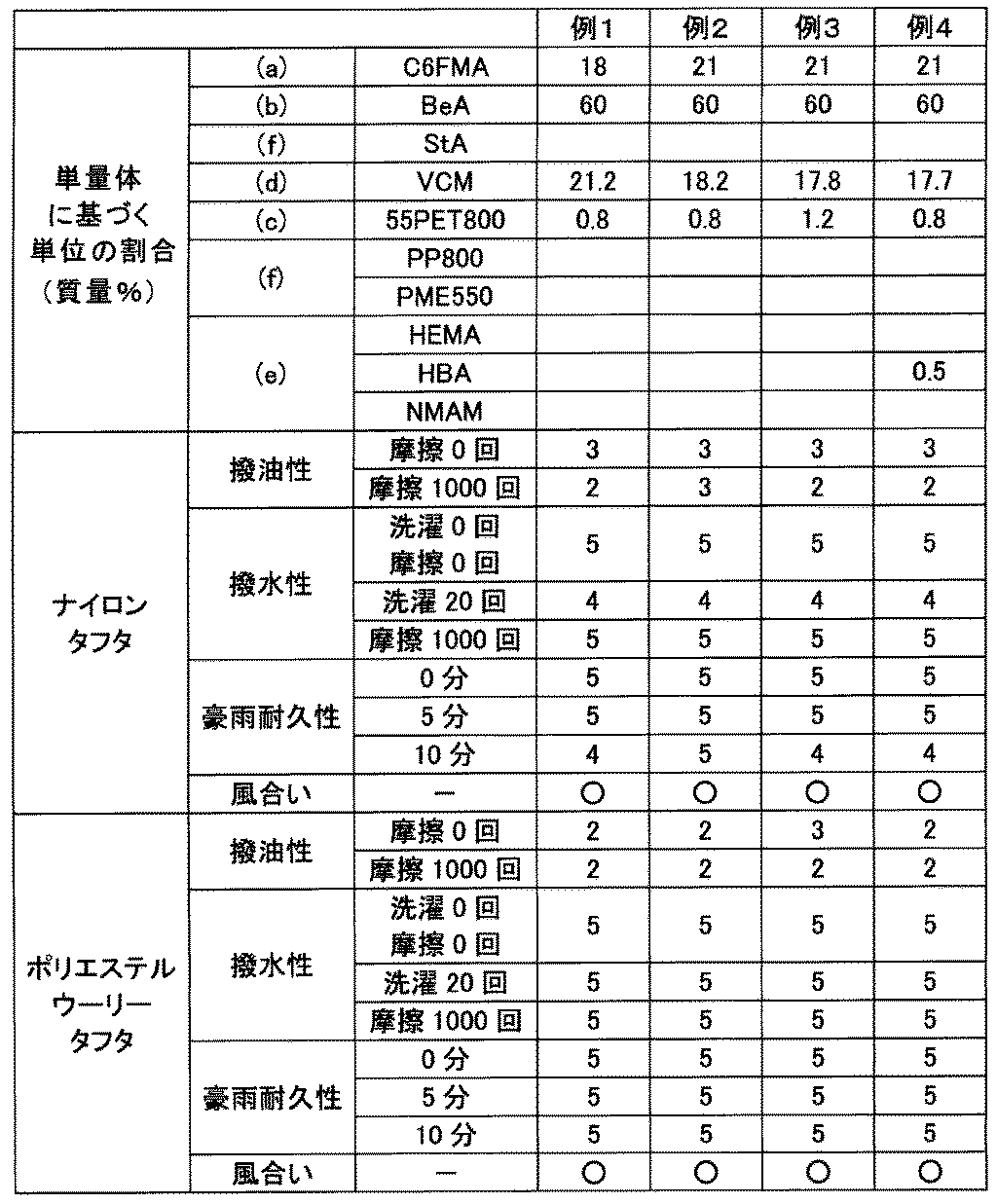
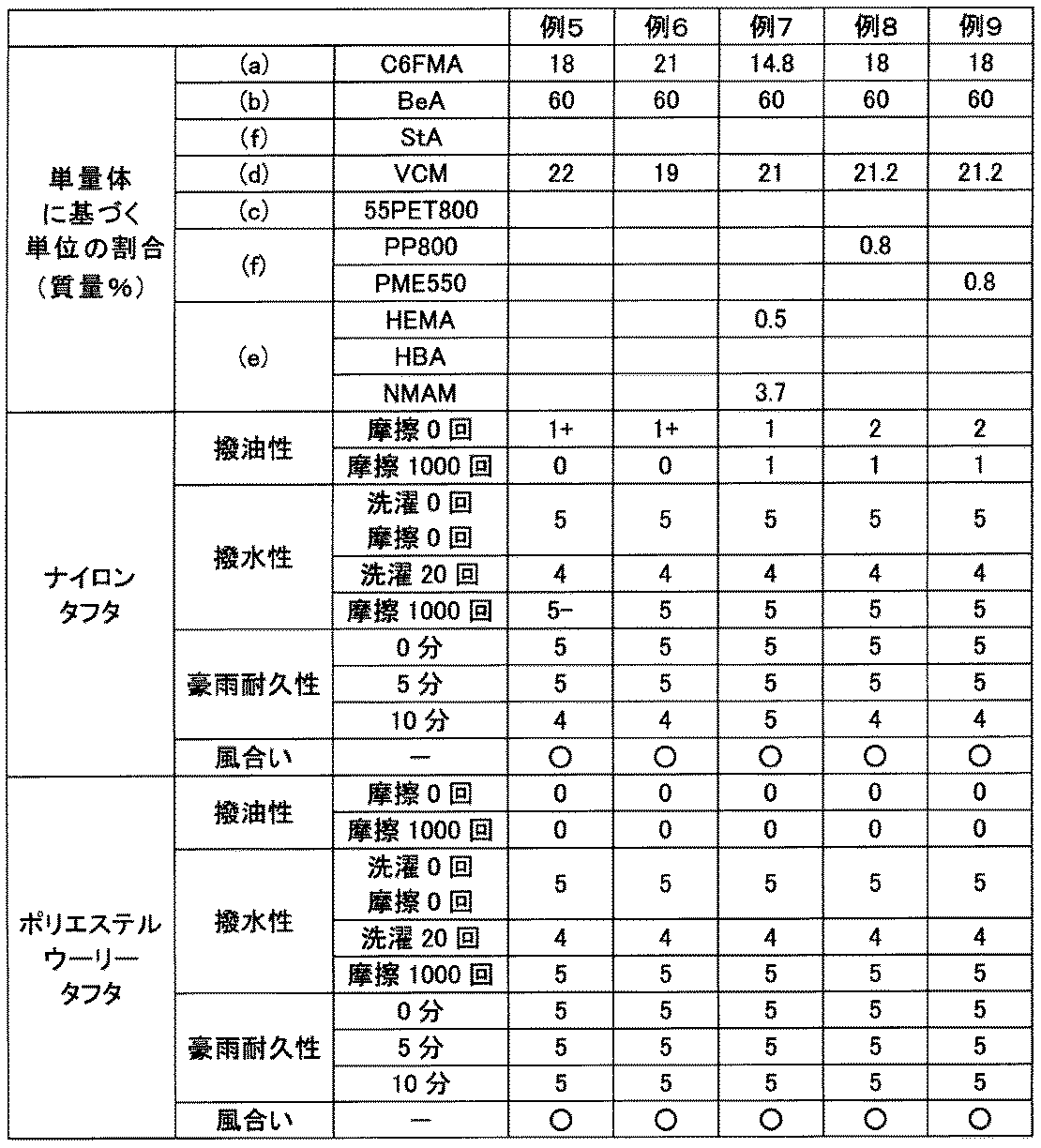
- Examples 1 to 4 are examples, and examples 5 to 13 are comparative examples.
- Oil repellency The test fabric was evaluated for oil repellency according to the test method of AATCC-TM118-1966. The oil repellency was represented by the grade shown in Table 1. A grade marked with + (-) indicates that each property is slightly better (bad).
- the test cloth was allowed to stand for one day in a constant temperature and humidity room at room temperature 20 ° C. ⁇ 2 ° C. and humidity 65% ⁇ 2%, and then the flexibility was determined by sensory evaluation according to the following criteria. ⁇ : Soft. ⁇ : Normal. X: Hard.
- Surfactant s 1 PEO-30: 10% by mass aqueous solution of polyoxyethylene oleyl ether (manufactured by Kao Corporation, Emulgen (registered trademark) E430, adduct of about 30 mol of ethylene oxide).
- Surfactant s 3 P204: ethylene oxide propylene oxide polymer (manufactured by NOF Corporation, Pronon (registered trademark) 204, the proportion of ethylene oxide is 40% by mass).
- Surfactant s 7 TMAC: A mixed solution of 63% by mass isopropyl alcohol and water of stearyltrimethylammonium chloride.
- Liquid medium DPM: Dipropylene glycol monomethyl ether
- Water Ion exchange water
- DoSH n-dodecyl mercaptan
- VA061A 10% by mass aqueous solution of acetate of 2,2′-azobis [2- (2-imidazolin-2-yl) propane] (manufactured by Wako Pure Chemical Industries, Ltd., VA061).
- Example 1 In a glass beaker, 5.60 g of C6FMA, 18.67 g of BeA, 0.25 g of 55 PET800, 7.78 g of PEO-30, 0.49 g of TMAC, 0.16 g of P204, 18.67 g of DPM, water And 0.31 g of DoSH were added and heated at 60 ° C. for 30 minutes, and then mixed using a homomixer (manufactured by Nippon Seiki Seisakusho, Biomixer) to obtain a mixed solution.
- a homomixer manufactured by Nippon Seiki Seisakusho, Biomixer
- the obtained mixed solution was treated at 40 MPa using a high-pressure emulsifier (manufactured by APV Lanier Co., Ltd., Minilab) while maintaining the temperature at 60 ° C. to obtain an emulsion.
- the obtained emulsion was put into a stainless steel reaction vessel and cooled to 40 ° C. or lower. After adding 3.11 g of VA061A and replacing the gas phase with nitrogen, 6.60 g of VCM was added. While stirring, the polymerization reaction was carried out at 60 ° C. for 15 hours to obtain a copolymer emulsion.
- Table 2 shows the ratio of units based on each monomer.
- the copolymer emulsion is diluted with distilled water and the solid content concentration is adjusted to 1% by mass, and then a melamine curing agent (DIC, Beccamine (registered trademark) M3) and an acid catalyst (DIC, accelerator). ACX) was added so that each concentration would be 0.3% by mass to obtain a water / oil repellent composition.
- a melamine curing agent DIC, Beccamine (registered trademark) M3
- DIC, accelerator an acid catalyst
- Dyeed nylon taffeta or dyed polyester wooly taffeta was dipped in the water / oil repellent composition, and squeezed so that the wet pickup would be 50% by mass and 30% by mass, respectively. This was dried at 110 ° C. for 60 seconds and then dried at 170 ° C. for 60 seconds to obtain a test cloth. The test cloth was evaluated for oil repellency, oil repellency friction durability, water repellency, water repellency washing durability, water repellency friction durability, heavy rain durability and texture. The results are shown in Table 2.
- Examples 2 to 13 A copolymer emulsion was obtained in the same manner as in Example 1 except that the charged amount of each monomer was changed so as to be the proportion of units based on each monomer shown in Tables 2 to 4. Tables 2 to 4 show the ratio of units based on each monomer.
- a water / oil repellent composition was obtained in the same manner as in Example 1 except that the emulsion was used.
- Example 13 two kinds of emulsions, Example 5 and Example 12, were mixed at a ratio of 1: 1 as shown in Table 4 to obtain a water / oil repellent composition.
- a test cloth was obtained in the same manner as in Example 1 except that the water / oil repellent composition was used. The test cloth was evaluated for oil repellency, oil repellency friction durability, water repellency, water repellency washing durability, water repellency friction durability, heavy rain durability and texture. The results are shown in Tables 2-4.
- the water / oil repellent composition of the present invention comprises fiber products (clothing articles (sportswear, coats, blousons, work clothes, uniforms, etc.), bags, industrial materials, etc.), non-woven fabrics, leather products, wood, stones, concretes. It is useful as a water / oil repellent for imparting water / oil repellency to building materials. Moreover, it is useful as a coating agent for filtration materials, a surface protective agent, a coating agent for electronics, and an antifouling coating agent used in the presence of an organic solvent liquid or its vapor. Furthermore, it is also useful for applications where water and oil repellency is imparted by mixing and molding with fiber such as polypropylene and nylon. Note that the entire contents of the specification, claims and abstract of Japanese Patent Application No. 2015-106994 filed on May 27, 2015 are incorporated herein as the disclosure of the specification of the present invention. It is.
Landscapes
- Chemical & Material Sciences (AREA)
- Chemical Kinetics & Catalysis (AREA)
- Engineering & Computer Science (AREA)
- Textile Engineering (AREA)
- Organic Chemistry (AREA)
- Health & Medical Sciences (AREA)
- Medicinal Chemistry (AREA)
- Polymers & Plastics (AREA)
- Materials Engineering (AREA)
- Combustion & Propulsion (AREA)
- Materials Applied To Surfaces To Minimize Adherence Of Mist Or Water (AREA)
- Addition Polymer Or Copolymer, Post-Treatments, Or Chemical Modifications (AREA)
- Treatments For Attaching Organic Compounds To Fibrous Goods (AREA)
Abstract
Description
(1)下記単量体1に基づく単位および下記単量体2に基づく単位を有する共重合体を含む撥水撥油剤組成物(特許文献1)。
単量体1:炭素数が1~6のペルフルオロアルキル基を有する(メタ)アクリレート。
単量体2:炭素数が20~30のアルキル基を有する(メタ)アクリレート。
(2)下記単量体3に基づく単位、下記単量体4に基づく単位および下記単量体5に基づく単位を有する共重合体を含む防汚剤組成物(特許文献2)。
単量体3:炭素数が1~6のペルフルオロアルキル基を有する(メタ)アクリレート。
単量体4:ポリ(オキシエチレン)鎖を有する(メタ)アクリレート。
単量体5:ポリ(オキシエチレン・オキシテトラメチレン)鎖を有する(メタ)アクリレート。
下記単量体6に基づく単位、下記単量体7に基づく単位および下記単量体8に基づく単位を有し、フッ素原子の割合が45質量%以上である共重合体と、
下記単量体6に基づく単位、下記単量体9に基づく単位および下記単量体10に基づく単位を有する共重合体とを含む防汚剤組成物(特許文献3)。
単量体6:炭素数が4~6のポリフルオロアルキル基を有する(メタ)アクリレート。
単量体7:炭素数が12以上のアルキル基を有する(メタ)アクリレート。
単量体8:塩化ビニルまたは塩化ビニリデン。
単量体9:ポリ(オキシエチレン)鎖を有する(メタ)アクリレート。
単量体10:ポリ(オキシエチレン・オキシテトラメチレン)鎖を有する(メタ)アクリレート。
(2)の撥水撥油剤組成物を用いて処理された物品は、洗濯耐久性、風合いが不充分である。
(3)の撥水撥油剤組成物を用いて処理された物品は、洗濯耐久性、風合いが不充分である。
[1]下記単量体(a)に基づく単位と下記単量体(b)に基づく単位と下記単量体(c)に基づく単位とを有する共重合体および液状媒体を含む、撥水撥油剤組成物。
単量体(a):下式(1)で表される化合物。
(Z-Y)nX ・・・(1)。
ただし、Zは、炭素数が1~6のペルフルオロアルキル基、または下式(2-1)で表される基、または下式(2-2)で表される基であり、Yは、フッ素原子を有しない2価有機基または単結合であり、nは、1または2であり、Xは、nが1の場合は、下式(3-1)~(3-5)で表される基のいずれかであり、nが2の場合は、下式(4-1)~(4-4)で表される基のいずれかである。
CiF2i+1O(CFX1CF2O)jCFX2- ・・・(2-1)、
CsF2s+1(CH2CF2)t(CF2CF2)u-・・・(2-2)。
ただし、iは、1~6の整数であり、jは、0~10の整数であり、X1およびX2は、それぞれフッ素原子またはトリフルオロメチル基であり、sは、1~6の整数であり、tは1~4の整数であり、uは1~3の整数である。
-CR=CH2 ・・・(3-1)、
-C(O)OCR=CH2 ・・・(3-2)、
-OC(O)CR=CH2 ・・・(3-3)、
-OCH2-φ-CR=CH2 ・・・(3-4)、
-OCH=CH2 ・・・(3-5)。
ただし、Rは、水素原子、メチル基またはハロゲン原子であり、φは、フェニレン基である。
-CH[-(CH2)mCR=CH2]- ・・・(4-1)、
-CH[-(CH2)mC(O)OCR=CH2]- ・・・(4-2)、
-CH[-(CH2)mOC(O)CR=CH2]- ・・・(4-3)、
-OC(O)CH=CHC(O)O- ・・・(4-4)。
ただし、Rは、水素原子、メチル基またはハロゲン原子であり、mは0~4の整数である。
単量体(b):ポリフルオロアルキル基を有さず、炭素数が20以上のアルキル基を有する(メタ)アクリレート。
単量体(c):下式(5)で表される化合物。
CH2=CR1C(O)O-[(C2H4O)a(C4H8O)b]-H ・・・(5)。
ただし、R1は、水素原子またはメチル基であり、aは、3~50であり、bは、1~50であり、aとbとの比(a/b)は、1~3である。また、(C2H4O)単位と(C4H8O)単位との結合順序は限定されない。
[3]前記共重合体が、下記単量体(d)に基づく単位をさらに有する、[1]または[2]の撥水撥油剤組成物。
単量体(d):ハロゲン化オレフィン。
[4]前記単量体(d)が塩化ビニルである、[3]の撥水撥油剤組成物。
[5]前記共重合体を構成する全ての単量体に基づく単位に対して、前記単量体(d)に基づく単位の割合が30質量%以下である、[3]または[4]の撥水撥油剤組成物。
[6]前記共重合体が、下記単量体(e)に基づく単位をさらに有する、[1]~[5]のいずれかの撥水撥油剤組成物。
単量体(e):架橋しうる官能基を有する単量体。
[7]前記液状媒体が水性媒体である、[1]~[6]のいずれかの撥水撥油剤組成物。
単量体(a):下式(1)で表される化合物。
(Z-Y)nX ・・・(1)。
ただし、Zは、炭素数が1~6のペルフルオロアルキル基、または下式(2-1)で表される基、または下式(2-2)で表される基であり、Yは、フッ素原子を有しない2価有機基または単結合であり、nは、1または2であり、Xは、nが1の場合は、下式(3-1)~(3-5)で表される基のいずれかであり、nが2の場合は、下式(4-1)~(4-4)で表される基のいずれかである。
CiF2i+1O(CFX1CF2O)jCFX2- ・・・(2-1)、
CsF2s+1(CH2CF2)t(CF2CF2)u-・・・(2-2)。
ただし、iは、1~6の整数であり、jは、0~10の整数であり、X1およびX2は、それぞれフッ素原子またはトリフルオロメチル基であり、sは、1~6の整数であり、tは1~4の整数であり、uは1~3の整数である。
-CR=CH2 ・・・(3-1)、
-C(O)OCR=CH2 ・・・(3-2)、
-OC(O)CR=CH2 ・・・(3-3)、
-OCH2-φ-CR=CH2 ・・・(3-4)、
-OCH=CH2 ・・・(3-5)。
ただし、Rは、水素原子、メチル基またはハロゲン原子であり、φは、フェニレン基である。
-CH[-(CH2)mCR=CH2]- ・・・(4-1)、
-CH[-(CH2)mC(O)OCR=CH2]- ・・・(4-2)、
-CH[-(CH2)mOC(O)CR=CH2]- ・・・(4-3)、
-OC(O)CH=CHC(O)O- ・・・(4-4)。
ただし、Rは、水素原子、メチル基またはハロゲン原子であり、mは0~4の整数である。
単量体(b):ポリフルオロアルキル基を有さず、炭素数が20以上のアルキル基を有する(メタ)アクリレート。
単量体(c):下式(5)で表される化合物。
CH2=CR1C(O)O-[(C2H4O)a(C4H8O)b]-H ・・・(5)。
ただし、R1は、水素原子またはメチル基であり、aは、3~50であり、bは、1~50であり、aとbとの比(a/b)は、1~3である。また、(C2H4O)単位と(C4H8O)単位との結合順序は限定されない。
[10]前記単量体成分が下記単量体(d)をさらに含む、[8]または[9]の撥水撥油剤組成物の製造方法。
単量体(d):ハロゲン化オレフィン。
[11]前記単量体成分が下記単量体(e)をさらに含む、[8]~[10]のいずれかの撥水撥油剤組成物の製造方法。
単量体(e):架橋しうる官能基を有する単量体。
[12]前記液状媒体が水性媒体である、[8]~[11]のいずれかの撥水撥油剤組成物の製造方法。
[14]前記物品が繊維製品である、[13]の物品。
本発明の撥水撥油剤組成物の製造方法によれば、撥水性、撥油性、洗濯耐久性、豪雨耐久性および風合いのいずれもが良好である物品を得ることができる撥水撥油剤組成物を製造できる。
本発明の物品は、撥水性、撥油性、洗濯耐久性、豪雨耐久性および風合いのいずれもが良好である。
本明細書においては、式(2)で表される基を基(2)と記す。他の式で表される基も同様に記す。
本明細書における以下の用語の意味は、以下の通りである。
「(メタ)アクリレート」は、アクリレートおよびメタクリレートの総称である。
「単量体」は、重合性不飽和基を有する化合物を意味する。
「ポリフルオロアルキル基」は、アルキル基の水素原子の一部またはすべてがフッ素原子に置換された基を意味する。以下、「ポリフルオロアルキル基」を「Rf基」とも記す。
「ペルフルオロアルキル基」は、アルキル基の水素原子のすべてがフッ素原子に置換された基を意味する。以下、「ペルフルオロアルキル基」を「RF基」とも記す。
共重合体の「数平均分子量」および「質量平均分子量」は、ゲルパーミエーションクロマトグラフィ(GPC)法によってポリスチレン換算で求めた値である。
単量体(c)の[(C2H4O)a(C4H8O)b]鎖の「a」および「b」は、それぞれオキシエチレン単位およびオキシテトラメチレン単位の平均単位数であり、核磁気共鳴分光法(NMR)により算出した値である。
単量体(c)の[(C2H4O)a(C4H8O)b]鎖の「数平均分子量」は、オキシエチレン単位の分子量に平均単位数を乗じた値と、オキシテトラメチレン単位の分子量に平均単位数を乗じた値とを合算した値である。
本発明の撥水撥油剤組成物は、特定の共重合体と液状媒体を必須成分として含み、必要に応じて、界面活性剤、添加剤を含む。
共重合体は、単量体(a)に基づく単位と単量体(b)に基づく単位と単量体(c)に基づく単位とを有する。
共重合体は、単量体(d)に基づく単位および/または単量体(e)に基づく単位をさらに有することが好ましい。
共重合体は、必要に応じて、単量体(f)に基づく単位を有していてもよい。
単量体(a)は、化合物(1)である。
(Z-Y)nX ・・・(1)。
CiF2i+1O(CFX1CF2O)jCFX2- ・・・(2-1)、
CsF2s+1(CH2CF2)t(CF2CF2)u-・・・(2-2)。
ただし、iは、1~6の整数であり、jは、0~10の整数であり、X1およびX2は、それぞれフッ素原子またはトリフルオロメチル基であり、sは、1~6の整数であり、tは1~4の整数であり、uは1~3の整数である。
RF基の炭素数は、4~6が好ましい。RF基は、直鎖状であってもよく、分岐状であってもよく、直鎖状が好ましい。
Zとしては、F(CF2)4-、F(CF2)5-、F(CF2)6-、(CF3)2CF(CF2)2-等が挙げられる。
2価有機基としては、アルキレン基が好ましい。アルキレン基は、直鎖状であってもよく、分岐状であってもよい。アルキレン基は、-O-、-NH-、-CO-、-SO2-、-S-、-CD1=CD2-(ただし、D1、D2は、それぞれ水素原子またはメチル基である。)、-φ-OCO-等を有していてもよい。
Yとしては、-CH2-、-CH2CH2-、-(CH2)3-、-CH2CH2CH(CH3)-、-CH=CH-CH2-、-S-CH2CH2-、-SO2-CH2CH2-、-CH2CH2CH2-S-CH2CH2-、-CH2CH2CH2-SO2-CH2CH2-、-φ-OCO-CH2CH2-等が挙げられる。
Xは、nが1の場合は、基(3-1)~基(3-5)のいずれかであり、nが2の場合は、基(4-1)~基(4-4)のいずれかである。
-C(O)OCR=CH2 ・・・(3-2)、
-OC(O)CR=CH2 ・・・(3-3)、
-OCH2-φ-CR=CH2 ・・・(3-4)、
-OCH=CH2 ・・・(3-5)。
ただし、Rは、水素原子、メチル基またはハロゲン原子であり、φは、フェニレン基である。Rとしては、水素原子、メチル基または塩素原子が好ましい。
-CH[-(CH2)mC(O)OCR=CH2]- ・・・(4-2)、
-CH[-(CH2)mOC(O)CR=CH2]- ・・・(4-3)、
-OC(O)CH=CHC(O)O- ・・・(4-4)。
ただし、Rは、水素原子、メチル基またはハロゲン原子であり、mは0~4の整数である。Rとしては、水素原子、メチル基または塩素原子が好ましい。
化合物(1)としては、Zが炭素数4~6のRF基であり、Yが炭素数1~4のアルキレン基であり、nが1であり、Xが基(3-3)であり、Rが水素原子、メチル基または塩素原子である化合物が特に好ましい。
化合物(1)の好ましい具体例としては、C6F13C2H4OCOC(CH3)=CH2、C6F13C2H4OCOCH=CH2、C6F13C2H4OCOCCl=CH2、C4F9C2H4OCOC(CH3)=CH2、C4F9C2H4OCOCH=CH2、C4F9C2H4OCOCCl=CH2、C4F9CH2CF2C4F8C2H4OCOCH=CH2、C4F9CH2CF2C4F8C2H4OCOC(CH3)=CH2、C6F13C2H4OCOφOCOCH=CH2、C4F8C2H4OCOφOCOCH=CH2が挙げられる。
単量体(b)は、Rf基を有さず、炭素数が20以上のアルキル基を有する(メタ)アクリレートである。アルキル基の炭素数は、20~30が好ましく、20~24がより好ましい。
アルキル基の炭素数が前記下限値以上であれば、撥水撥油剤組成物を用いて処理された物品の洗濯耐久性および豪雨耐久性が良好となる。アルキル基の炭素数が前記上限値以下であれば、重合操作における取り扱いが容易であり、収率よく共重合体を得ることができる。
単量体(b)としては、ベヘニル(メタ)アクリレート、イコシル(メタ)アクリレートが好ましく、ベヘニルアクリレートが特に好ましい。
単量体(c)は、化合物(5)である。
CH2=CR1C(O)O-[(C2H4O)a(C4H8O)b]-H ・・・(5)。
bは、1~50であり、2~20がより好ましい。bが前記範囲の下限値以上であれば、撥水撥油剤組成物を用いて処理された物品の撥水性が良好となる。bが前記範囲の上限値以下であれば、撥水撥油剤組成物を用いて処理された物品の撥油性が良好となる。
aとbとの比(a/b)は、1~3であり、1.5~2.5がより好ましい。a/bが前記範囲の下限値以上であれば、撥水撥油剤組成物を用いて処理された物品の撥油性が良好となる。a/bが前記範囲の上限値以下であれば、撥水撥油剤組成物を用いて処理された物品の撥水性が良好となる。
(C2H4O)単位および(C4H8O)単位は、直鎖状であってもよく、分岐状であってもよい。本発明の効果を充分に発揮できる点からは、直鎖状が好ましい。
これは、(C2H4O)単位と(C4H8O)単位を有する単量体が(C2H4O)単位のみを有する単量体よりも単独重合体のガラス転移温度が低いため、結果的に(C2H4O)単位と(C4H8O)単位を有する単量体に由来する単位を有する共重合体のガラス転移温度が下がり、造膜性が向上し、基材への密着性が向上するためと考えられる。また、(C2H4O)と(C4H8O)を有する単量体は疎水性でありながら疎油性でもあるため、結果的に共重合体の撥水性および撥油性を阻害しないと考えられる。
単量体(d)は、ハロゲン化オレフィンである。
単量体(b)に基づく単位と単量体(d)に基づく単位とを組み合わせることによって、物品との密着性が向上するため、撥水撥油剤組成物を用いて処理された物品の洗濯耐久性および豪雨耐久性がさらに向上する。
R4R5C=CR6R7 ・・・(6)
R4、R5、R6、R7は、それぞれ独立して、水素原子、ハロゲン原子または炭素数1~3のペルフルオロアルキル基である。ただし、R4、R5、R6、R7のうち少なくとも1つは、ハロゲン原子または炭素数1~3のペルフルオロアルキル基である。ペルフルオロアルキル基とは、CF3-、C2F5-、C3F7-である。
ハロゲン化オレフィンとしては、塩素化オレフィン、フッ素化オレフィンが好ましい。
R8HC=CR9R10 ・・・(7)
R8、R9、R10は、それぞれ独立して、水素原子、塩素原子、フッ素原子、または炭素数1~3のペルフルオロアルキル基である。ただし、R8、R9、R10のうち少なくとも1つは、塩素原子、フッ素原子、または炭素数1~3のペルフルオロアルキル基である。
ハロゲン化オレフィンの具体例としては、塩化ビニル、塩化ビニリデン、テトラフルオロエチレン、フッ化ビニリデン、2,3,3,3-テトラフルオロ-1-プロペン、1-クロロ-3,3,3-トリフルオロプロペン(E体)、1-クロロ-3,3,3-トリフルオロプロペン(Z体)、トリフルオロエチレン、1,2-ジフルオロエチレン(E体)、1,2-ジフルオロエチレン(Z体)、1-クロロ-2,3,3,3-テトラフルオロ-1-プロペン(E体)、1-クロロ-2,3,3,3-テトラフルオロ-1-プロペン(Z体)等が挙げられる。なかでも、塩化ビニル、塩化ビニリデン、テトラフルオロエチレン、フッ化ビニリデン、2,3,3,3-テトラフルオロ-1-プロペンが好ましく、物品との密着性の点からは、塩化ビニル、塩化ビニリデン、2,3,3,3-テトラフルオロ-1-プロペンがより好ましい。
単量体(e)は、架橋しうる官能基を有する単量体である(ただし、単量体(c)を除く)。
共重合体が単量体(e)に基づく単位を有することにより、撥水撥油剤組成物を用いて処理された物品の耐久性(洗濯耐久性および豪雨耐久性)がさらに向上する。
該官能基としては、イソシアネート基、ブロックドイソシアネート基、アルコキシシリル基、アミノ基、アルコキシメチルアミド基、シラノール基、アンモニウム基、アミド基、エポキシ基、水酸基、オキサゾリン基、カルボキシル基、アルケニル基、スルホン酸基等が好ましい。特に、エポキシ基、水酸基、ブロックドイソシアネート基、アルコキシシリル基、アミノ基、またはカルボキシル基が好ましい。
単量体(e)としては、N-メチロール(メタ)アクリルアミド、N-ブトキシメチル(メタ)アクリルアミド、2-ヒドロキシエチル(メタ)アクリレート、4-ヒドロキシブチル(メタ)アクリレート、2-イソシアナトエチル(メタ)アクリレートの3,5-ジメチルピラゾール付加体、3-イソシアナトプロピル(メタ)アクリレートの3,5-ジメチルピラゾール付加体、ダイアセトンアクリルアミド、グリシジルメタクリレート、グリセロール(メタ)アクリレート、3-クロロ-2-ヒドロキシプロピル(メタ)アクリレート、ヒドロキシエチル(メタ)アクリレートのポリカプロラクトンエステル、フェニルグリシジルエチルアクリレートトリレンジイソシアナート(AT-600、共栄社化学社製)または3-(メチルエチルケトオキシム)イソシアナトメチル-3,5,5-トリメチルシクロヘキシル(2-ヒドロキシエチルメタクリレート)シアナート(テックコートHE-6P、京絹化成社製)がより好ましい。
単量体(e)としては、N-メチロール(メタ)アクリルアミド、2-ヒドロキシエチル(メタ)アクリレート、4-ヒドロキシブチル(メタ)アクリレート、2-イソシアナトエチル(メタ)アクリレートの3,5-ジメチルピラゾール付加体、または3-イソシアナトプロピル(メタ)アクリレートの3,5-ジメチルピラゾール付加体、または3-クロロ-2-ヒドロキシプロピル(メタ)アクリレートが特に好ましい。
単量体(f)は、単量体(a)、単量体(b)、単量体(c)、単量体(d)および単量体(e)を除く単量体である。
メチルアクリレート、エチルアクリレート、プロピルアクリレート、ブチルメタクリレート、シクロヘキシル(メタ)アクリレート、2-エチルヘキシル(メタ)アクリレート、ブチルメタクリレート、n-ヘキシル(メタ)アクリレート、ラウリル(メタ)アクリレート、セチル(メタ)アクリレート、ステアリル(メタ)アクリレート、酢酸ビニル、プロピオン酸ビニル、ブテン、イソプレン、ブタジエン、エチレン、プロピレン、ビニルエチレン、ペンテン、エチル-2-プロピレン、ブチルエチレン、シクロヘキシルプロピルエチレン、デシルエチレン、ドデシルエチレン、ヘキセン、イソヘキシルエチレン、ネオペンチルエチレン、(1,2-ジエトキシカルボニル)エチレン、(1,2-ジプロポキシカルボニル)エチレン、メトキシエチレン、エトキシエチレン、ブトキシエチレン、2-メトキシプロピレン、ペンチルオキシエチレン、シクロペンタノイルオキシエチレン、シクロペンチルアセトキシエチレン、スチレン、α-メチルスチレン、p-メチルスチレン、ヘキシルスチレン、オクチルスチレン、ノニルスチレン、クロロプレン。
(C2H4O)単位のみを有する単量体、(C3H6O)単位のみを有する単量体、または(C2H4O)単位および(C3H6O)単位のみを有する単量体に基づく単位を有する場合には、共重合体の撥水撥油性を低下させない範囲で加えることが好ましい。共重合体を構成する全ての単量体に基づく単位に対して、0.1~3質量%であることが好ましい。
単量体(b)に基づく単位の割合は、撥水撥油剤組成物を用いて処理された物品の撥水撥油性および耐久性の点から、共重合体を構成する全ての単量体に基づく単位に対して、40~94.9質量%が好ましく、40~91.9質量%がより好ましく、40~91.8質量%がさらに好ましく、40~89.9質量%が特に好ましく、40~84.9質量%が最も好ましい。
単量体(c)に基づく単位の割合は、撥水撥油剤組成物を用いて処理された物品の撥水撥油性および耐久性の点から、共重合体を構成する全ての単量体に基づく単位に対して、0.1~20質量%が好ましく、0.1~10質量%がより好ましい。
単量体(d)に基づく単位の割合は、撥水撥油剤組成物を用いて処理された物品の撥水撥油性および耐久性の点から、共重合体を構成する全ての単量体に基づく単位に対して、0~30質量%が好ましく、3~25質量%がより好ましい。
単量体(e)に基づく単位の割合は、撥水撥油剤組成物を用いて処理された物品の撥水撥油性および耐久性の点から、共重合体を構成する全ての単量体に基づく単位に対して、0~20質量%が好ましく、0.1~10質量%がより好ましい。
単量体(f)に基づく単位の割合は、撥水撥油剤組成物を用いて処理された物品の撥水撥油性および耐久性の点から、共重合体を構成する全ての単量体に基づく単位に対して、0~35質量%が好ましく、0~20質量%がより好ましい。
本発明における単量体に基づく単位の割合は、共重合体の製造時の単量体の仕込み量に基づいて算出する。
共重合体の数平均分子量(Mn)は、3000~800000が好ましく、5000~600000がより好ましい。共重合体の数平均分子量(Mn)が前記範囲内であれば、撥水性と撥油性をともに発現することができる。
液状媒体としては、水、アルコール、グリコール、グリコールエーテル、グリコールエステル、ハロゲン化合物、炭化水素、ケトン、エステル、エーテル、窒素化合物、硫黄化合物、無機溶剤、有機酸等が挙げられ、溶解性、取扱いの容易さの点から、水性媒体が好ましい。
水性媒体とは、水、水溶性有機溶媒およびそれらの混合媒体を意味する。水溶性有機溶媒としては、水溶性モノアルコール、水溶性グリコール、水溶性グリコールエーテルおよび水溶性グリコールエステルからなる群から選ばれた1種以上の水溶性有機溶媒が好ましい。
本発明の撥水撥油剤組成物における水性媒体は、水単独または水と前記水溶性有機溶媒とを含む水性媒体を含む水性媒体であることが好ましい。本発明の撥水撥油剤組成物中の水溶性有機溶媒の量は、共重合体を20質量%含む組成物とした場合に、0~40質量%であることが好ましく、1~20質量%がより好ましい。
界面活性剤としては、炭化水素系界面活性剤またはフッ素系界面活性剤が挙げられ、それぞれ、アニオン性界面活性剤、ノニオン性界面活性剤、カチオン性界面活性剤、または両性界面活性剤が挙げられる。
界面活性剤としては、添加剤との相溶性の点からは、ノニオン性界面活性剤と両性界面活性剤との併用が好ましく、共重合体の安定性の点からは、ノニオン性界面活性剤の単独使用、またはノニオン性界面活性剤とカチオン性界面活性剤との併用が好ましい。
ノニオン性界面活性剤とカチオン性界面活性剤との比(ノニオン性界面活性剤/カチオン性界面活性剤)は、97/3~40/60(質量比)が好ましい。
界面活性剤がカチオン性界面活性剤を含む場合、該カチオン性界面活性剤としては、国際公開第2010/047258号、国際公開第2010/123042号に記載された界面活性剤s7が好ましい。
界面活性剤が両性界面活性剤を含む場合、該両性界面活性剤としては、国際公開第2010/047258号、国際公開第2010/123042号に記載された界面活性剤s8が好ましい。
また、界面活性剤として、国際公開第2010/047258号、国際公開第2010/123042号に記載された界面活性剤s9(高分子界面活性剤)を用いてもよい。
界面活性剤の好ましい態様は、国際公開第2010/047258号、国際公開第2010/123042号に記載された好ましい態様と同様である。
C18H37O[CH2CH(CH3)O]2-(CH2CH2O)30H、
C18H35O-(CH2CH2O)26H、
C18H35O-(CH2CH2O)30H、
C16H33O[CH2CH(CH3)O]5-(CH2CH2O)20H、
C12H25O[CH2CH(CH3)O]2-(CH2CH2O)15H、
(C8H17)(C6H13)CHO-(CH2CH2O)15H、
C10H21O[CH2CH(CH3)O]2-(CH2CH2O)15H、
C6F13CH2CH2O-(CH2CH2O)15H、
C6F13CH2CH2O[CH2CH(CH3)O]2-(CH2CH2O)15H、
C4F9CH2CH2O[CH2CH(CH3)O]2-(CH2CH2O)15H。
HO-(CH2CH2O)15-(C3H6O)35-(CH2CH2O)15H、
HO-(CH2CH2O)8-(C3H6O)35-(CH2CH2O)8H、
HO-(CH2CH2O)9-(C3H6O)20-(CH2CH2O)9H、
HO-(CH2CH2O)45-(C3H6O)17-(CH2CH2O)45H、
HO-(CH2CH2O)34-(CH2CH2CH2CH2O)28-(CH2CH2O)34H。
CH3(CH2)m-CH[O(CH2CH2O)sH]-(CH2)nCH3
ただし、m+nは9~11の整数、sは3~15の整数を表す。
両性界面活性剤の好ましい具体例としては、ドデシルベタイン、ステアリルベタイン、ドデシルカルボキシメチルヒドロキシエチルイミダゾリニウムベタイン、ドデシルジメチルアミノ酢酸ベタイン、脂肪酸アミドプロピルジメチルアミノ酢酸ベタイン等が挙げられる。
添加剤としては、浸透剤、消泡剤(シリコーン系消泡剤等)、吸水剤、帯電防止剤、防皺剤、風合い調整剤、造膜助剤、水溶性高分子(ポリアクリルアミド、ポリビニルアルコール等)、熱硬化剤(メチロールメラミン等のメラミン系硬化剤、ブロック化ポリイソシアネート等のイソシアネート系硬化剤等)、エポキシ硬化剤(イソフタル酸ジヒドラジド、アジピン酸ジヒドラジド、セバチン酸ジヒドラジド、ドデカン二酸ジヒドラジド、1,6-ヘキサメチレンビス(N,N-ジメチルセミカルバジド)、1,1,1’,1’-テトラメチル-4,4’-(メチレン-ジ-パラ-フェニレン)ジセミカルバジド、スピログリコール等)、カルボジイミド基含有硬化剤、オキサゾリン基含有硬化剤、熱硬化触媒、架橋触媒、合成樹脂、繊維安定剤、トリエタノールアミン、酢酸、コロイダルシリカ等が挙げられる。
本発明の撥水撥油剤組成物の製造方法は、界面活性剤および重合開始剤の存在下、液状媒体中にて前記単量体(a)と前記単量体(b)と前記単量体(c)とを含む単量体成分を重合し、共重合体とする方法である。また、単量体成分としてさらに前記単量体(d)、前記単量体(e)および前記単量体(f)の1種以上を使用することができる。
本発明の撥水撥油剤組成物は、たとえば、下記(i)または(ii)の方法で製造できる。
(i)界面活性剤および重合開始剤の存在下、液状媒体中にて単量体(a)~(c)、必要に応じて単量体(d)~(f)を含む単量体成分を重合して共重合体の溶液、分散液またはエマルションを得た後、必要に応じて、液状媒体、界面活性剤、添加剤を加える方法。
(ii)界面活性剤および重合開始剤の存在下、液状媒体中にて単量体(a)~(c)、必要に応じて単量体(d)~(f)を含む単量体成分を重合して共重合体の溶液、分散液またはエマルションを得た後、共重合体を分離し、共重合体に液状媒体、界面活性剤、必要に応じて添加剤を加える方法。
重合法としては、分散重合法、乳化重合法、懸濁重合法等が挙げられる。
共重合体の収率が向上する点から、乳化重合の前に、単量体、界面活性剤および水性媒体からなる混合物を前乳化することが好ましい。たとえば、単量体、界面活性剤および水性媒体からなる混合物を、ホモミキサーまたは高圧乳化機で混合分散する。また、気体状単量体は前乳化して得られた乳化混合物に添加して乳化混合物中の単量体と共重合させることができる。
ラジカル重合開始剤としては、アゾ系重合開始剤、過酸化物系重合開始剤、レドックス系開始剤等の汎用の開始剤が、重合温度に応じて用いられる。ラジカル重合開始剤としては、アゾ系化合物が特に好ましく、水性媒体中で重合を行う場合、アゾ系化合物の塩がより好ましい。重合温度は20~150℃が好ましい。
本発明の撥水撥油剤組成物の固形分濃度は、物品の処理時は、0.2~5質量%が好ましい。
撥水撥油剤組成物の固形分濃度は、加熱前の撥水撥油剤組成物の質量と、120℃の対流式乾燥機にて4時間乾燥した後の質量とから計算される。
以上説明した本発明の撥水撥油剤組成物にあっては、単量体(a)に基づく単位および単量体(b)に基づく単位に加え、単量体(c)に基づく単位をさらに有する共重合体を含むため、該撥水撥油剤組成物を用いて物品を処理することによって、撥水性、撥油性、洗濯耐久性、豪雨耐久性および風合いのいずれもが良好である物品を得ることができる。
また、本発明の撥水撥油剤組成物にあっては、共重合体が炭素数7以上のRF基を有する単量体に基づく単位を有しないため、環境への影響が指摘されているペルフルオロオクタン酸(PFOA)やペルフルオロオクタンスルホン酸(PFOS)およびその前駆体、類縁体の含有量(固形分濃度20%とした場合の含有量)を国際公開第2009/081822号に記載の方法によるLC-MS/MSの分析値として検出限界以下にすることができる。
本発明の物品は、本発明の撥水撥油剤組成物を用いて処理された物品である。
本発明の撥水撥油剤組成物で処理される物品としては、繊維(天然繊維、合成繊維、混紡繊維等)、繊維製品、不織布、樹脂製品、紙、皮革製品、木材、金属製品、石材、コンクリート製品、石膏製品、ガラス製品等が挙げられる。物品としては、特に繊維製品が好ましい。
処理方法としては、たとえば、公知の塗工方法によって物品に撥水撥油剤組成物を塗布または含浸した後、乾燥する方法が挙げられる。
例1~4は実施例であり、例5~13は比較例である。
試験布について、AATCC-TM118-1966の試験方法にしたがって撥油性を評価した。撥油性は、表1に示す等級で表した。等級に+(-)を記したものは、それぞれの性質がわずかに良い(悪い)ことを示す。

摩擦試験機を用い、試験布の摩擦面を1000回摩擦し、温度25℃、湿度55%の部屋で一晩風乾させた後、試験布の摩擦面の前記撥油性を評価した。
試験布について、JIS L 1092のスプレー試験にしたがって撥水性を評価した。撥水性は、1~5の5段階の等級で表した。点数が大きいほど撥水性が良好であることを示す。等級に+(-)を記したものは、当該等級の標準的なものと比べてそれぞれの性質がわずかに良い(悪い)ことを示す。
試験布について、JIS L 0217の別表103の水洗い法にしたがって、洗濯を20回繰り返した。洗濯後、室温25℃、湿度55%の部屋で一晩風乾させた後、試験布の前記撥水性を評価した。
摩擦試験機を用い、試験布の摩擦面を1000回摩擦し、温度25℃、湿度55%の部屋で一晩風乾させた後、試験布の摩擦面の前記撥水性を評価した。
試験布について、JIS L 1092(c)法に記載の方法(ブンデスマン試験)にしたがって、降雨量を100cc/分、降雨水温を20℃、降雨時間0分、5分または10分とする条件で降雨させ、撥水性を評価した。撥水性は、1~5の5段階の等級で表した。点数が大きいほど撥水性が良好であることを示す。等級に+(-)を記したものは、それぞれの性質がわずかに良い(悪い)ことを示す。
試験布を、室温20℃±2℃、湿度65%±2%の恒温恒湿室に1昼夜静置した後、官能評価で、柔軟性を下記基準にて判定した。
○:柔らかい。
△:ふつう。
×:硬い。
単量体(a):
C6FMA:C6F13C2H4OC(O)C(CH3)=CH2。
BeA:ベヘニルアクリレート。
55PET800:CH2=C(CH3)C(O)O-[(C2H4O)a(C4H8O)b]-H(日油社製、ブレンマー(登録商標)55PET-800、a≒10、b≒5、[(C2H4O)a(C4H8O)b]の数平均分子量:約800)。
VCM:塩化ビニル。
HEMA:2-ヒドロキシエチルメタクリレート、
HBA:4-ヒドロキシブチルアクリレート、
NMAM:N-メチロールアクリルアミド。
単量体(f):
StA:ステアリルアクリレート、
PP800:CH2=C(CH3)C(O)O-(C3H6O)c-H(日油社製、ブレンマー(登録商標)PP-800、c≒13、(C3H6O)cの数平均分子量:約754)、
PME550:CH2=C(CH3)C(O)O-(C2H4O)d-CH3(日油社製、ブレンマー(登録商標)PME-550、d≒12、(C2H4O)dの数平均分子量:約528)。
PEO-30:ポリオキシエチレンオレイルエーテル(花王社製、エマルゲン(登録商標)E430、エチレンオキシド約30モル付加物)の10質量%水溶液。
P204:エチレンオキシドプロピレンオキシド重合物(日油社製、プロノン(登録商標)204、エチレンオキシドの割合は40質量%。)。
TMAC:ステアリルトリメチルアンモニウムクロライドの63質量%イソプロピルアルコールおよび水の混合溶液。
DPM:ジプロピレングリコールモノメチルエーテル、
水:イオン交換水。
DoSH:n-ドデシルメルカプタン。
VA061A:2,2'-アゾビス[2-(2-イミダゾリン-2-イル)プロパン](和光純薬社製、VA061)の酢酸塩の10質量%水溶液。
ガラス製ビーカーに、C6FMAの5.60g、BeAの18.67g、55PET800の0.25g、PEO-30の7.78g、TMACの0.49g、P204の0.16g、DPMの18.67g、水の38.37g、DoSHの0.31gを入れ、60℃で30分間加温した後、ホモミキサー(日本精機製作所社製、バイオミキサー)を用いて混合して混合液を得た。
各単量体の仕込み量が、表2~表4に示す各単量体に基づく単位の割合となるように変更した以外は、例1と同様にして共重合体のエマルションを得た。各単量体に基づく単位の割合を表2~表4に示す。
該エマルションを用いた以外は、例1と同様にして撥水撥油剤組成物を得た。例13については、2種類のエマルションである例5と例12を表4に示すとおり1対1の割合にて混合して撥水撥油剤組成物を得た。
該撥水撥油剤組成物を用いた以外は、例1と同様にして試験布を得た。該試験布について、撥油性、撥油性の摩擦耐久性、撥水性、撥水性の洗濯耐久性、撥水性の摩擦耐久性、豪雨耐久性および風合いを評価した。結果を表2~表4に示す。

なお、2015年5月27日に出願された日本特許出願2015-106994号の明細書、特許請求の範囲および要約書の全内容をここに引用し、本発明の明細書の開示として、取り入れるものである。
Claims (14)
- 下記単量体(a)に基づく単位と下記単量体(b)に基づく単位と下記単量体(c)に基づく単位とを有する共重合体および液状媒体を含む、撥水撥油剤組成物。
単量体(a):下式(1)で表される化合物。
(Z-Y)nX ・・・(1)。
ただし、Zは、炭素数が1~6のペルフルオロアルキル基、または下式(2-1)で表される基、または下式(2-2)で表される基であり、Yは、フッ素原子を有しない2価有機基または単結合であり、nは、1または2であり、Xは、nが1の場合は、下式(3-1)~(3-5)で表される基のいずれかであり、nが2の場合は、下式(4-1)~(4-4)で表される基のいずれかである。
CiF2i+1O(CFX1CF2O)jCFX2- ・・・(2-1)、
CsF2s+1(CH2CF2)t(CF2CF2)u-・・・(2-2)。
ただし、iは、1~6の整数であり、jは、0~10の整数であり、X1およびX2は、それぞれフッ素原子またはトリフルオロメチル基であり、sは、1~6の整数であり、tは1~4の整数であり、uは1~3の整数である。
-CR=CH2 ・・・(3-1)、
-C(O)OCR=CH2 ・・・(3-2)、
-OC(O)CR=CH2 ・・・(3-3)、
-OCH2-φ-CR=CH2 ・・・(3-4)、
-OCH=CH2 ・・・(3-5)。
ただし、Rは、水素原子、メチル基またはハロゲン原子であり、φは、フェニレン基である。
-CH[-(CH2)mCR=CH2]- ・・・(4-1)、
-CH[-(CH2)mC(O)OCR=CH2]- ・・・(4-2)、
-CH[-(CH2)mOC(O)CR=CH2]- ・・・(4-3)、
-OC(O)CH=CHC(O)O- ・・・(4-4)。
ただし、Rは、水素原子、メチル基またはハロゲン原子であり、mは0~4の整数である。
単量体(b):ポリフルオロアルキル基を有さず、炭素数が20以上のアルキル基を有する(メタ)アクリレート。
単量体(c):下式(5)で表される化合物。
CH2=CR1C(O)O-[(C2H4O)a(C4H8O)b]-H ・・・(5)。
ただし、R1は、水素原子またはメチル基であり、aは、3~50であり、bは、1~50であり、aとbとの比(a/b)は、1~3である。また、(C2H4O)単位と(C4H8O)単位との結合順序は限定されない。 - 前記共重合体を構成する全ての単量体に基づく単位に対して、前記単量体(a)に基づく単位の含有割合が5~40質量%であり、前記単量体(b)に基づく単位の含有割合が40~94.9質量%であり、前記単量体(c)に基づく単位の含有割合が0.1~20質量%である、請求項1に記載の撥水撥油剤組成物。
- 前記共重合体が、下記単量体(d)に基づく単位をさらに有する、請求項1または2に記載の撥水撥油剤組成物。
単量体(d):ハロゲン化オレフィン。 - 前記単量体(d)が塩化ビニルである、請求項3に記載の撥水撥油剤組成物。
- 前記共重合体を構成する全ての単量体に基づく単位に対して、前記単量体(d)に基づく単位の割合が30質量%以下である、請求項3または4に記載の撥水撥油剤組成物。
- 前記共重合体が、下記単量体(e)に基づく単位をさらに有する、請求項1~5のいずれか一項に記載の撥水撥油剤組成物。
単量体(e):架橋しうる官能基を有する単量体。 - 前記液状媒体が水性媒体である、請求項1~6のいずれか一項に記載の撥水撥油剤組成物。
- 界面活性剤および重合開始剤の存在下、液状媒体中にて下記単量体(a)と下記単量体(b)と下記単量体(c)とを含む単量体成分を重合し、共重合体とする、撥水撥油剤組成物の製造方法。
単量体(a):下式(1)で表される化合物。
(Z-Y)nX ・・・(1)。
ただし、Zは、炭素数が1~6のペルフルオロアルキル基、または下式(2-1)で表される基、または下式(2-2)で表される基であり、Yは、フッ素原子を有しない2価有機基または単結合であり、nは、1または2であり、Xは、nが1の場合は、下式(3-1)~(3-5)で表される基のいずれかであり、nが2の場合は、下式(4-1)~(4-4)で表される基のいずれかである。
CiF2i+1O(CFX1CF2O)jCFX2- ・・・(2-1)、
CsF2s+1(CH2CF2)t(CF2CF2)u-・・・(2-2)。
ただし、iは、1~6の整数であり、jは、0~10の整数であり、X1およびX2は、それぞれフッ素原子またはトリフルオロメチル基であり、sは、1~6の整数であり、tは1~4の整数であり、uは1~3の整数である。
-CR=CH2 ・・・(3-1)、
-C(O)OCR=CH2 ・・・(3-2)、
-OC(O)CR=CH2 ・・・(3-3)、
-OCH2-φ-CR=CH2 ・・・(3-4)、
-OCH=CH2 ・・・(3-5)。
ただし、Rは、水素原子、メチル基またはハロゲン原子であり、φは、フェニレン基である。
-CH[-(CH2)mCR=CH2]- ・・・(4-1)、
-CH[-(CH2)mC(O)OCR=CH2]- ・・・(4-2)、
-CH[-(CH2)mOC(O)CR=CH2]- ・・・(4-3)、
-OC(O)CH=CHC(O)O- ・・・(4-4)。
ただし、Rは、水素原子、メチル基またはハロゲン原子であり、mは0~4の整数である。
単量体(b):ポリフルオロアルキル基を有さず、炭素数が20以上のアルキル基を有する(メタ)アクリレート。
単量体(c):下式(5)で表される化合物。
CH2=CR1C(O)O-[(C2H4O)a(C4H8O)b]-H ・・・(5)。
ただし、R1は、水素原子またはメチル基であり、aは、3~50であり、bは、1~50であり、aとbとの比(a/b)は、1~3である。また、(C2H4O)単位と(C4H8O)単位との結合順序は限定されない。 - 前記単量体成分の全量に対して、前記単量体(a)の割合が5~40質量%であり、前記単量体(b)の割合が40~94.9質量%であり、前記単量体(c)の割合が0.1~20質量%である、請求項8に記載の撥水撥油剤組成物の製造方法。
- 前記単量体成分が下記単量体(d)をさらに含む、請求項8または9に記載の撥水撥油剤組成物の製造方法。
単量体(d):ハロゲン化オレフィン。 - 前記単量体成分が下記単量体(e)をさらに含む、請求項8~10のいずれか一項に記載の撥水撥油剤組成物の製造方法。
単量体(e):架橋しうる官能基を有する単量体。 - 前記液状媒体が水性媒体である、請求項8~11のいずれか一項に記載の撥水撥油剤組成物の製造方法。
- 請求項1~7のいずれか一項に記載の撥水撥油剤組成物を用いて処理された、物品。
- 前記物品が繊維製品である、請求項13に記載の物品。
Priority Applications (4)
| Application Number | Priority Date | Filing Date | Title |
|---|---|---|---|
| CN201680030694.0A CN107709505B (zh) | 2015-05-27 | 2016-05-25 | 拒水拒油剂组合物、其制造方法及物品 |
| JP2017520788A JP6717300B2 (ja) | 2015-05-27 | 2016-05-25 | 撥水撥油剤組成物、その製造方法および物品 |
| KR1020177027958A KR102528045B1 (ko) | 2015-05-27 | 2016-05-25 | 발수 발유제 조성물, 그 제조 방법 및 물품 |
| US15/714,458 US10513819B2 (en) | 2015-05-27 | 2017-09-25 | Water/oil repellent composition, method for its production, and article |
Applications Claiming Priority (2)
| Application Number | Priority Date | Filing Date | Title |
|---|---|---|---|
| JP2015106994 | 2015-05-27 | ||
| JP2015-106994 | 2015-05-27 |
Related Child Applications (1)
| Application Number | Title | Priority Date | Filing Date |
|---|---|---|---|
| US15/714,458 Continuation US10513819B2 (en) | 2015-05-27 | 2017-09-25 | Water/oil repellent composition, method for its production, and article |
Publications (1)
| Publication Number | Publication Date |
|---|---|
| WO2016190366A1 true WO2016190366A1 (ja) | 2016-12-01 |
Family
ID=57394028
Family Applications (1)
| Application Number | Title | Priority Date | Filing Date |
|---|---|---|---|
| PCT/JP2016/065501 Ceased WO2016190366A1 (ja) | 2015-05-27 | 2016-05-25 | 撥水撥油剤組成物、その製造方法および物品 |
Country Status (6)
| Country | Link |
|---|---|
| US (1) | US10513819B2 (ja) |
| JP (1) | JP6717300B2 (ja) |
| KR (1) | KR102528045B1 (ja) |
| CN (1) | CN107709505B (ja) |
| TW (1) | TWI717352B (ja) |
| WO (1) | WO2016190366A1 (ja) |
Cited By (1)
| Publication number | Priority date | Publication date | Assignee | Title |
|---|---|---|---|---|
| JPWO2017033893A1 (ja) * | 2015-08-24 | 2018-06-28 | 旭硝子株式会社 | 撥液性成形体の製造方法および撥液剤組成物 |
Families Citing this family (6)
| Publication number | Priority date | Publication date | Assignee | Title |
|---|---|---|---|---|
| CN111836870B (zh) * | 2018-03-08 | 2023-03-24 | Agc株式会社 | 拒水拒油剂组合物的制造方法及拒水拒油性物品的制造方法 |
| KR20210132016A (ko) * | 2019-02-26 | 2021-11-03 | 에이지씨 가부시키가이샤 | 함불소 공중합체, 그 제조 방법, 발수 발유제 조성물 및 물품 |
| CN112574347B (zh) * | 2019-09-29 | 2022-03-04 | 北京化工大学 | 含氟的氯乙烯系共聚物、其制备方法、包括其的组合物和由该组合物制成的树脂制品 |
| WO2021065256A1 (ja) * | 2019-10-02 | 2021-04-08 | Agc株式会社 | 撥水撥油剤組成物、その製造方法及び物品 |
| JP7639699B2 (ja) * | 2019-12-26 | 2025-03-05 | Agc株式会社 | 含フッ素重合体、その製造方法、撥水撥油剤組成物及び物品 |
| EP4186957A4 (en) * | 2020-07-21 | 2024-07-24 | Agc Inc. | Water- and oil-repelling agent composition, method for producing same, and article |
Citations (4)
| Publication number | Priority date | Publication date | Assignee | Title |
|---|---|---|---|---|
| WO2008143299A1 (ja) * | 2007-05-22 | 2008-11-27 | Asahi Glass Company, Limited | 防汚加工剤組成物およびその製造方法ならびに加工物品 |
| WO2009145234A1 (ja) * | 2008-05-28 | 2009-12-03 | 旭硝子株式会社 | 防汚剤組成物とその製造方法、およびこれを用いて処理された物品 |
| JP2013007044A (ja) * | 2001-04-13 | 2013-01-10 | Asahi Glass Co Ltd | 撥水撥油剤組成物 |
| WO2014030648A1 (ja) * | 2012-08-21 | 2014-02-27 | 旭硝子株式会社 | 含フッ素共重合体およびその製造方法、撥水剤組成物、物品 |
Family Cites Families (4)
| Publication number | Priority date | Publication date | Assignee | Title |
|---|---|---|---|---|
| FR2819143B1 (fr) * | 2000-12-28 | 2003-03-07 | Thomson Csf | Procede de realisation de plots de connexion sur un circuit imprime |
| ES2564980T3 (es) | 2007-04-27 | 2016-03-30 | Asahi Glass Company, Limited | Composición hidrófuga/oleófuga, método para la producción de la misma y artículo |
| US7776732B2 (en) * | 2007-09-10 | 2010-08-17 | International Business Machines Corporation | Metal high-K transistor having silicon sidewall for reduced parasitic capacitance, and process to fabricate same |
| JP5223385B2 (ja) | 2008-03-07 | 2013-06-26 | 旭硝子株式会社 | 撥水はつ油防汚剤組成物およびこれを用いて処理された物品 |
-
2016
- 2016-05-25 WO PCT/JP2016/065501 patent/WO2016190366A1/ja not_active Ceased
- 2016-05-25 CN CN201680030694.0A patent/CN107709505B/zh active Active
- 2016-05-25 KR KR1020177027958A patent/KR102528045B1/ko active Active
- 2016-05-25 JP JP2017520788A patent/JP6717300B2/ja active Active
- 2016-05-26 TW TW105116487A patent/TWI717352B/zh active
-
2017
- 2017-09-25 US US15/714,458 patent/US10513819B2/en active Active
Patent Citations (4)
| Publication number | Priority date | Publication date | Assignee | Title |
|---|---|---|---|---|
| JP2013007044A (ja) * | 2001-04-13 | 2013-01-10 | Asahi Glass Co Ltd | 撥水撥油剤組成物 |
| WO2008143299A1 (ja) * | 2007-05-22 | 2008-11-27 | Asahi Glass Company, Limited | 防汚加工剤組成物およびその製造方法ならびに加工物品 |
| WO2009145234A1 (ja) * | 2008-05-28 | 2009-12-03 | 旭硝子株式会社 | 防汚剤組成物とその製造方法、およびこれを用いて処理された物品 |
| WO2014030648A1 (ja) * | 2012-08-21 | 2014-02-27 | 旭硝子株式会社 | 含フッ素共重合体およびその製造方法、撥水剤組成物、物品 |
Cited By (1)
| Publication number | Priority date | Publication date | Assignee | Title |
|---|---|---|---|---|
| JPWO2017033893A1 (ja) * | 2015-08-24 | 2018-06-28 | 旭硝子株式会社 | 撥液性成形体の製造方法および撥液剤組成物 |
Also Published As
| Publication number | Publication date |
|---|---|
| JP6717300B2 (ja) | 2020-07-01 |
| JPWO2016190366A1 (ja) | 2018-04-05 |
| CN107709505B (zh) | 2020-04-28 |
| KR20180012738A (ko) | 2018-02-06 |
| US20180010290A1 (en) | 2018-01-11 |
| US10513819B2 (en) | 2019-12-24 |
| KR102528045B1 (ko) | 2023-05-02 |
| TW201708441A (zh) | 2017-03-01 |
| TWI717352B (zh) | 2021-02-01 |
| CN107709505A (zh) | 2018-02-16 |
Similar Documents
| Publication | Publication Date | Title |
|---|---|---|
| JP5353701B2 (ja) | 撥水撥油剤組成物および物品 | |
| US10513819B2 (en) | Water/oil repellent composition, method for its production, and article | |
| TWI507514B (zh) | A water repellent and oil repellent composition, a method for producing the same, and an article | |
| JP5799804B2 (ja) | 撥水撥油剤組成物、その製造方法および物品の処理方法 | |
| JP5585078B2 (ja) | 撥水撥油剤組成物、その製造方法および物品 | |
| JP6607196B2 (ja) | 撥水撥油剤組成物、その製造方法および物品 | |
| JP5741855B2 (ja) | 撥水撥油剤組成物、その製造方法および物品の処理方法 | |
| JP5678660B2 (ja) | 共重合体、その製造方法および撥水撥油剤組成物 | |
| JP5200403B2 (ja) | 撥液剤組成物、撥液加工方法、撥液膜を有する物品 | |
| WO2009113589A1 (ja) | 共重合体およびその製造方法 | |
| JP7056640B2 (ja) | 撥水撥油性物品、その製造方法及び撥水撥油剤組成物 | |
| WO2010047258A1 (ja) | 撥水撥油剤組成物およびその製造方法 | |
| JPWO2009041650A1 (ja) | 撥水撥油剤組成物および物品 | |
| JP2020186300A (ja) | 撥水撥油剤組成物、その製造方法及び物品 | |
| JP2011021082A (ja) | 撥水撥油剤組成物およびその製造方法 | |
| WO2019172021A1 (ja) | 撥水撥油剤組成物の製造方法及び撥水撥油性物品の製造方法 | |
| JP2011021081A (ja) | 撥水撥油剤組成物およびその製造方法 | |
| JP2016190957A (ja) | 撥水撥油剤組成物、その製造方法および物品 | |
| JP7639699B2 (ja) | 含フッ素重合体、その製造方法、撥水撥油剤組成物及び物品 | |
| JP2016089087A (ja) | 撥水撥油剤組成物、その製造方法および物品 |
Legal Events
| Date | Code | Title | Description |
|---|---|---|---|
| 121 | Ep: the epo has been informed by wipo that ep was designated in this application |
Ref document number: 16800070 Country of ref document: EP Kind code of ref document: A1 |
|
| ENP | Entry into the national phase |
Ref document number: 20177027958 Country of ref document: KR Kind code of ref document: A |
|
| ENP | Entry into the national phase |
Ref document number: 2017520788 Country of ref document: JP Kind code of ref document: A |
|
| NENP | Non-entry into the national phase |
Ref country code: DE |
|
| 122 | Ep: pct application non-entry in european phase |
Ref document number: 16800070 Country of ref document: EP Kind code of ref document: A1 |