WO2016178411A1 - 二次電池及び電池外装材 - Google Patents
二次電池及び電池外装材 Download PDFInfo
- Publication number
- WO2016178411A1 WO2016178411A1 PCT/JP2016/063414 JP2016063414W WO2016178411A1 WO 2016178411 A1 WO2016178411 A1 WO 2016178411A1 JP 2016063414 W JP2016063414 W JP 2016063414W WO 2016178411 A1 WO2016178411 A1 WO 2016178411A1
- Authority
- WO
- WIPO (PCT)
- Prior art keywords
- secondary battery
- aqueous electrolyte
- antioxidant
- negative electrode
- positive electrode
- Prior art date
- Legal status (The legal status is an assumption and is not a legal conclusion. Google has not performed a legal analysis and makes no representation as to the accuracy of the status listed.)
- Ceased
Links
Images

Classifications
-
- H—ELECTRICITY
- H01—ELECTRIC ELEMENTS
- H01M—PROCESSES OR MEANS, e.g. BATTERIES, FOR THE DIRECT CONVERSION OF CHEMICAL ENERGY INTO ELECTRICAL ENERGY
- H01M50/00—Constructional details or processes of manufacture of the non-active parts of electrochemical cells other than fuel cells, e.g. hybrid cells
- H01M50/10—Primary casings; Jackets or wrappings
- H01M50/102—Primary casings; Jackets or wrappings characterised by their shape or physical structure
- H01M50/105—Pouches or flexible bags
-
- H—ELECTRICITY
- H01—ELECTRIC ELEMENTS
- H01M—PROCESSES OR MEANS, e.g. BATTERIES, FOR THE DIRECT CONVERSION OF CHEMICAL ENERGY INTO ELECTRICAL ENERGY
- H01M10/00—Secondary cells; Manufacture thereof
- H01M10/05—Accumulators with non-aqueous electrolyte
- H01M10/052—Li-accumulators
-
- H—ELECTRICITY
- H01—ELECTRIC ELEMENTS
- H01M—PROCESSES OR MEANS, e.g. BATTERIES, FOR THE DIRECT CONVERSION OF CHEMICAL ENERGY INTO ELECTRICAL ENERGY
- H01M10/00—Secondary cells; Manufacture thereof
- H01M10/05—Accumulators with non-aqueous electrolyte
- H01M10/056—Accumulators with non-aqueous electrolyte characterised by the materials used as electrolytes, e.g. mixed inorganic/organic electrolytes
- H01M10/0564—Accumulators with non-aqueous electrolyte characterised by the materials used as electrolytes, e.g. mixed inorganic/organic electrolytes the electrolyte being constituted of organic materials only
- H01M10/0566—Liquid materials
- H01M10/0567—Liquid materials characterised by the additives
-
- H—ELECTRICITY
- H01—ELECTRIC ELEMENTS
- H01M—PROCESSES OR MEANS, e.g. BATTERIES, FOR THE DIRECT CONVERSION OF CHEMICAL ENERGY INTO ELECTRICAL ENERGY
- H01M10/00—Secondary cells; Manufacture thereof
- H01M10/05—Accumulators with non-aqueous electrolyte
- H01M10/058—Construction or manufacture
-
- H—ELECTRICITY
- H01—ELECTRIC ELEMENTS
- H01M—PROCESSES OR MEANS, e.g. BATTERIES, FOR THE DIRECT CONVERSION OF CHEMICAL ENERGY INTO ELECTRICAL ENERGY
- H01M50/00—Constructional details or processes of manufacture of the non-active parts of electrochemical cells other than fuel cells, e.g. hybrid cells
- H01M50/10—Primary casings; Jackets or wrappings
- H01M50/14—Primary casings; Jackets or wrappings for protecting against damage caused by external factors
- H01M50/141—Primary casings; Jackets or wrappings for protecting against damage caused by external factors for protecting against humidity
-
- H—ELECTRICITY
- H01—ELECTRIC ELEMENTS
- H01M—PROCESSES OR MEANS, e.g. BATTERIES, FOR THE DIRECT CONVERSION OF CHEMICAL ENERGY INTO ELECTRICAL ENERGY
- H01M50/00—Constructional details or processes of manufacture of the non-active parts of electrochemical cells other than fuel cells, e.g. hybrid cells
- H01M50/10—Primary casings; Jackets or wrappings
- H01M50/14—Primary casings; Jackets or wrappings for protecting against damage caused by external factors
- H01M50/145—Primary casings; Jackets or wrappings for protecting against damage caused by external factors for protecting against corrosion
-
- Y—GENERAL TAGGING OF NEW TECHNOLOGICAL DEVELOPMENTS; GENERAL TAGGING OF CROSS-SECTIONAL TECHNOLOGIES SPANNING OVER SEVERAL SECTIONS OF THE IPC; TECHNICAL SUBJECTS COVERED BY FORMER USPC CROSS-REFERENCE ART COLLECTIONS [XRACs] AND DIGESTS
- Y02—TECHNOLOGIES OR APPLICATIONS FOR MITIGATION OR ADAPTATION AGAINST CLIMATE CHANGE
- Y02E—REDUCTION OF GREENHOUSE GAS [GHG] EMISSIONS, RELATED TO ENERGY GENERATION, TRANSMISSION OR DISTRIBUTION
- Y02E60/00—Enabling technologies; Technologies with a potential or indirect contribution to GHG emissions mitigation
- Y02E60/10—Energy storage using batteries
-
- Y—GENERAL TAGGING OF NEW TECHNOLOGICAL DEVELOPMENTS; GENERAL TAGGING OF CROSS-SECTIONAL TECHNOLOGIES SPANNING OVER SEVERAL SECTIONS OF THE IPC; TECHNICAL SUBJECTS COVERED BY FORMER USPC CROSS-REFERENCE ART COLLECTIONS [XRACs] AND DIGESTS
- Y02—TECHNOLOGIES OR APPLICATIONS FOR MITIGATION OR ADAPTATION AGAINST CLIMATE CHANGE
- Y02P—CLIMATE CHANGE MITIGATION TECHNOLOGIES IN THE PRODUCTION OR PROCESSING OF GOODS
- Y02P70/00—Climate change mitigation technologies in the production process for final industrial or consumer products
- Y02P70/50—Manufacturing or production processes characterised by the final manufactured product
Definitions
- the present invention relates to a secondary battery having good cycle characteristics and an exterior material thereof.
- Secondary batteries typified by lithium-ion batteries are often used as driving power sources for portable electronic devices such as mobile phones including smartphones, portable computers, PDAs, and portable music players.
- the power supply for driving electric vehicles (EV) and hybrid electric vehicles (HEV, PHEV), solar power generation, wind power generation, and other applications for suppressing output fluctuations, and for use in the daytime to save power at night Secondary batteries are also often used in stationary storage battery systems such as system power peak shift applications.
- Patent Laid-Open No. 2007-242496 Patent Document 1
- metals such as Si and Sn have attracted attention as negative electrode active materials.
- metals such as Si and Sn have a large expansion / contraction due to charge and discharge, metals such as Si and Sn are repeatedly subjected to repeated charge and discharge cycles. Cracks occur in the particles, and the decomposition reaction of the electrolytic solution occurs at the cracks.
- An additive that reacts quickly on the metal surface where the particles are broken to form a protective film and suppresses the reaction between the electrolyte and the metal particle interface has been studied (Japanese Patent Laid-Open No. 2014-99263; Patent) Reference 2).
- An object of the present invention is to provide a secondary battery in which deterioration of cycle characteristics is suppressed.
- the present invention includes the following secondary batteries (1) to (12), battery outer packaging materials (13) to (17) and methods for producing the same, and methods for producing secondary batteries (18) to (20). .
- the phenolic antioxidant is pentaerythritol tetrakis [3- (3,5-di-t-butyl-4-hydroxyphenyl) propionate], and the phosphorus antioxidant is tris (2,4-di-).
- the secondary battery according to (5) which is (t-butylphenyl) phosphite.
- Next battery. (8) A secondary battery containing a positive electrode, a negative electrode, and a non-aqueous electrolyte, wherein the non-aqueous electrolyte contains an electrolyte, a non-aqueous solvent, and an additive, and the additive contains a fatty acid amide. Secondary battery.
- the negative electrode is any one of (1) to (9), which is at least one selected from the group consisting of a metal capable of occluding lithium ions, an oxide of the metal, and an alloy containing the metal.
- Secondary battery (11) The secondary battery according to (10), wherein the metal capable of storing lithium ions is at least one selected from the group consisting of Si and Sn.
- the battery exterior material containing the cyclic compound containing this and its ring-opening polymer.
- Battery exterior material containing an inhibitor In the layer in contact with the non-aqueous electrolyte solution of the secondary battery according to any one of (1) to (11), —CO—NR— (where R is an alkyl group having 1 to 6 carbon atoms or a hydrogen atom)
- thermoplastic resin film constituting the layer in contact with the non-aqueous electrolyte contains —CO—NR—
- R is an alkyl group having 1 to 6 carbon atoms or a hydrogen atom
- a phenolic antioxidant is contained in a thermoplastic resin film constituting a layer in contact with the non-aqueous electrolyte.
- a method for producing a battery outer material in which one or more antioxidants selected from the group consisting of phosphorus-based antioxidants are incorporated 17.
- a method for producing a battery exterior material comprising kneading a cyclic compound containing 6 to 6 alkyl groups or hydrogen atoms, a ring-opening polymer thereof, a phenolic antioxidant and a phosphorus antioxidant.
- a method for producing a secondary battery comprising a positive electrode, a negative electrode, and a non-aqueous electrolyte, wherein -CO-NR- (R is an alkyl group having 1 to 6 carbon atoms) Or a cyclic compound containing a hydrogen atom) and a ring-opening polymer thereof.
- a method for producing a secondary battery comprising a positive electrode, a negative electrode, and a non-aqueous electrolyte, wherein the non-aqueous electrolyte is selected from the group consisting of a phenolic antioxidant and a phosphorus-based antioxidant.
- a method for producing a secondary battery wherein one or more antioxidants are added.
- a method for producing a secondary battery comprising a positive electrode, a negative electrode, and a non-aqueous electrolyte, wherein a fatty acid amide is added to the non-aqueous electrolyte.
- a secondary battery having good cycle characteristics can be provided. For example, even when a negative electrode active material containing a metal element such as Si or Sn is used, deterioration of cycle characteristics can be suppressed.
- the positive electrode used in one embodiment of the present invention has a structure in which a positive electrode mixture containing a positive electrode active material is supported on one surface or both surfaces of a positive electrode current collector.
- a positive electrode active material, a conductive additive and a binder are suspended in a commonly used solvent to prepare a paste, this paste is applied to the positive electrode current collector, dried, and then added. It can be adjusted by pressure forming. Examples of the pressure molding method include molding methods such as roll pressing and press pressing.
- the positive electrode may be produced by forming a positive electrode active material, a conductive additive and a binder in the form of a pellet to form a positive electrode mixture, which is formed on a positive electrode current collector.
- the thickness of one surface of the positive electrode mixture is preferably in the range of 1.0 to 150 ⁇ m from the viewpoint of maintaining the large current discharge characteristics and cycle life of the battery. Accordingly, when the positive electrode current collector is supported on both surfaces, the total thickness of the positive electrode mixture is preferably in the range of 20 to 200 ⁇ m. In consideration of large current discharge characteristics and cycle life, a more preferable range of one side is 20 ⁇ m to 120 ⁇ m.
- a commonly used material can be used as long as it is a material capable of reversibly occluding and releasing lithium ions.
- the conductive auxiliary agent is not particularly limited as long as it has a function of imparting conductivity and electrode stability to the electrode (buffering action against volume change in insertion / extraction of lithium ions).
- vapor grown carbon fiber for example, “VGCF (registered trademark)” (manufactured by Showa Denko KK)
- conductive carbon for example, “DENKA BLACK (registered trademark)” (manufactured by Denki Kagaku Kogyo)
- Super C65 Manufactured by TIMCAL
- Super C45 manufactured by TIMCAL
- KKS6L manufactured by TIMCAL
- binder examples include styrene butadiene rubber, butadiene rubber, butyl rubber, acrylic rubber, styrene acrylic copolymer, polyethylene, polypropylene, and a polymer compound having a large ion conductivity.
- polymer compound having a large ionic conductivity examples include polyvinylidene fluoride, polyethylene oxide, polyepichlorohydrin, polyphasphazene, polyacrylonitrile and the like.
- the solvent used for the electrode preparation paste is not particularly limited, and includes N-methyl-2-pyrrolidone, dimethylformamide, isopropanol, water and the like.
- a binder using water as a solvent it is preferable to use a thickener together. The amount of the solvent is adjusted so that the viscosity of the paste can be easily applied to the current collector.
- the preferable blending ratio of the positive electrode active material, the conductive auxiliary agent and the binder in the positive electrode mixture is in the range of 70 to 98% by mass for the positive electrode active material.
- the agent is in the range of 1 to 20% by mass
- the binder is in the range of 1 to 10% by mass.
- the positive electrode current collector a conductive substrate having a porous structure represented by aluminum foil or the like, or a nonporous conductive substrate can be used.
- the thickness of the positive electrode current collector is desirably 5 to 20 ⁇ m. This is because within this range, the electrode strength and weight reduction can be balanced.
- the negative electrode used in one embodiment of the present invention has a structure in which a negative electrode mixture containing a negative electrode active material is supported on one surface or both surfaces of a negative electrode current collector.
- the negative electrode mixture is prepared by, for example, suspending a negative electrode active material, a conductive additive and a binder in a commonly used solvent to prepare a paste, applying the paste to a negative electrode current collector, drying, It can be adjusted by pressure molding. Examples of the pressure molding method include molding methods such as roll pressing and press pressing.
- a negative electrode may be produced by forming a negative electrode active material, a conductive additive and a binder into a pellet shape to form a negative electrode mixture, which is formed on a negative electrode current collector.
- the thickness of the negative electrode mixture is preferably in the range of 1.0 to 150 ⁇ m per side. More preferably, the thickness is 30 to 100 ⁇ m.
- the negative electrode active material used in one embodiment of the present invention can be used without limitation as long as it contains a material capable of occluding lithium ions.
- Carbon materials, metals, metal oxides, alloys and the like can be used.
- the metal capable of occluding lithium ions one or more metals selected from the group consisting of Si and Sn can be used.
- a single alloy or a combination of these alloys can be employed, and a combination of these and a carbon material can also be used as the negative electrode active material.
- the effects of the present invention are likely to appear significantly.
- Metals capable of occluding lithium ions, oxides of the metals, alloys containing the metals, etc. have a large expansion and contraction when occluding and releasing lithium. Therefore, in order to alleviate this stress, they are dispersed as finely as possible. Preferably it is. In order to relieve stress, the metal, metal oxide, alloy, etc. are preferably dispersed with a size of 1 nm to 500 nm.
- the metal oxide capable of occluding lithium ions is, for example, SiO x (0.5 ⁇ x ⁇ 2) or SnO x (0.5 ⁇ x ⁇ 2), and has an amorphous or crystalline structure. Although it can be employed, it is preferable that the Si phase or the Sn phase is contained or held therein and dispersed without any deviation.
- the carbon material artificial graphite, natural graphite, soft carbon, hard carbon, carbon black, coke, glassy carbon, carbon fiber, or a mixture of one or more of these fired bodies can be used.
- the carbon material may be mixed or compounded with a metal capable of occluding lithium ions, an oxide of the metal, an alloy containing the metal, or the like.
- the carbon material may be covered with a metal capable of occluding lithium ions, an oxide of the metal, an alloy containing the metal, or the like.
- the metal can be coated with a metal capable of storing lithium ions, an oxide of the metal, an alloy containing the metal, and the like.
- the conductive auxiliary agent is not particularly limited as long as it has a function of imparting conductivity and electrode stability (buffering action against volume change in insertion / extraction of lithium ions) to the electrode.
- vapor grown carbon fiber for example, “VGCF (registered trademark)” (manufactured by Showa Denko KK)
- conductive carbon for example, “DENKA BLACK (registered trademark)” (manufactured by Denki Kagaku Kogyo), “Super C65” ”(Manufactured by TIMCAL),“ Super C45 ”(manufactured by TIMCAL),“ KS6L ”(manufactured by TIMCAL)), and the like.
- binder examples include styrene butadiene rubber, butadiene rubber, butyl rubber, acrylic rubber, styrene acrylic copolymer, polyethylene, polypropylene, and a polymer compound having a large ion conductivity.
- polymer compound having a large ionic conductivity examples include polyvinylidene fluoride, polyethylene oxide, polyepichlorohydrin, polyphasphazene, polyacrylonitrile and the like.
- the solvent used for the electrode preparation paste is not particularly limited, and examples thereof include N-methyl-2-pyrrolidone, dimethylformamide, isopropanol, and water.
- a binder using water as a solvent it is preferable to use a thickener together. The amount of the solvent is adjusted so that the viscosity of the paste can be easily applied to the current collector.
- the active material, conductive additive and binder in the negative electrode mixture are mixed in an amount of 55 to 96% by weight for the active material and 2 to 30% by weight for the conductive aid.
- the binder is preferably in the range of 2 to 15% by mass.
- a conductive substrate having a porous structure or a nonporous conductive substrate can be used as the negative electrode current collector.
- These conductive substrates can be formed from, for example, copper, stainless steel, or nickel.
- the thickness of the current collector is preferably 5 to 20 ⁇ m.
- separator conventionally used separators can be used. Specifically, not only a separator made of polyethylene, but also a material in which a layer made of polypropylene is formed on the surface of a polyethylene layer, or a material in which a resin such as an aramid resin is applied to the surface of a polyethylene separator is used. Also good.
- Nonaqueous solvents used for the nonaqueous electrolyte include cyclic carbonates such as ethylene carbonate (EC), propylene carbonate (PC), and butylene carbonate (BC); fluorinated cyclic carbonates; ⁇ -butyrolactone ( ⁇ - BL) and cyclic carboxylic acid esters such as ⁇ -valerolactone ( ⁇ -VL); dimethyl carbonate (DMC), diethyl carbonate (DEC), methyl ethyl carbonate (MEC), methyl propyl carbonate (MPC), dibutyl carbonate (DBC) Chain carbonate esters such as fluorinated chain carbonate esters; chain carboxylates such as methyl pivalate, ethyl pivalate, methyl isobutyrate and methyl propionate; N, N′-dimethylformamide and N -Amides such as methyloxazolidinone Compounds; sulfur compounds such as sulfolane; tetrafluoroborate 1-
- a lithium salt generally used as an electrolyte salt in a secondary battery can be used.
- examples of such a lithium salt include LiPF 6 , LiBF 4 , LiCF 3 SO 3 , LiN (CF 3 SO 2 ) 2 , LiN (C 2 F 5 SO 2 ) 2 , LiN (CF 3 SO 2 ) (C 4 F 9 SO 2), LiC (CF 3 SO 2) 3, LiC (C 2 F 5 SO 2) 3, LiAsF 6, LiClO 4, Li 2 B 10 Cl 10, Li 2 B 12 Cl 12 and the like one A single substance or a mixture of plural kinds thereof can be used.
- the amount of electrolyte salt dissolved in the non-aqueous solvent is preferably 0.8 to 1.5 mol / L.
- a cyclic compound containing (A) -CO-NR- and a ring-opening polymer thereof are contained as an additive to the non-aqueous electrolyte.
- the additive contains 1 or more types of antioxidant chosen from the group which consists of (B) phenolic antioxidant and phosphorus antioxidant.
- the additive contains (C) a fatty acid amide.
- R is an alkyl group having 1 to 6 carbon atoms or a hydrogen atom.
- An alkyl group having 1 to 3 carbon atoms or a hydrogen atom is preferable, and a hydrogen atom is more preferable.
- lactam and a ring-opening polymer of lactam can be used.
- lactams and lactam oligomers can be used.
- the addition amount of the cyclic compound containing —CO—NR— and the ring-opening polymer thereof is preferably in the range of 0.1 to 2.0% by mass with respect to the total mass of the non-aqueous electrolyte, and 0.3 to 1.0 A range of mass% is more preferred.
- the addition amount is less than 0.1% by mass, the effect of addition is hardly exhibited.
- the addition amount exceeds 2.0% by mass, it tends to precipitate due to a decrease in solubility, and the battery is caused by excessive adhesion to the active material surface or separator. Resistance tends to be high.
- the average molecular weight (MW) when a monomer composed of ⁇ -caprolactam and an oligomer thereof is used is a molar mass of ⁇ -caprolactam monomer itself of 113 g / mol.
- a range of 113 to 2260 is preferable, and a range of 113 to 1130 is more preferable. If the molecular weight of the oligomer exceeds 2260, it tends to precipitate due to a decrease in solubility, and the battery resistance tends to increase.
- composition of monomers and oligomers composed of ⁇ -caprolactam is as follows: monomer composed of ⁇ -caprolactam 22.5% by mass, aminocaproic acid 3.1% by mass, cyclic dimer 16.6% by mass, cyclic trimer They are 21.1 mass%, cyclic tetramer 13.4 mass%, cyclic pentamer 7.3 mass%, cyclic hexamer 1.8 mass%, and cyclic heptamer 1.4 mass%.
- monomers and oligomers composed of ⁇ -caprolactam are generally known as polymerization monomers and polymerization residues for polyamide (6-nylon).
- the oligomer of ⁇ -caprolactam there are a chain monomer and a cyclic body, and any of them may be used.
- a cyclic compound containing —CO—NR— and a ring-opening polymer thereof as an additive, the adhesion between the active material particles and further at the interface between the electrode mixture layer and the current collector foil is strengthened. It is estimated that the deterioration of the cycle characteristics of the secondary battery is suppressed.
- Antioxidants include phenolic antioxidants IRGANOX (registered trademark) 1010: pentaerythritol tetrakis [3- (3,5-di-t-butyl-4-hydroxyphenyl) propionate], phosphorus antioxidants IRGAFOS® 168: Tris (2,4-di-t-butylphenyl) phosphite is preferred. It is presumed that the antioxidant is effective in improving cycle characteristics by suppressing the surface oxidation of the metal accompanying charge / discharge. In addition to the phenol-based antioxidant and the phosphorus-based antioxidant, a sulfur-based antioxidant can also be used. These antioxidants may be used alone or in combination of two or more.
- the addition amount of the antioxidant is preferably in the range of 0.1 to 2.0% by mass, and more preferably in the range of 0.3 to 1.0% by mass.
- the addition amount is less than 0.1% by mass, the effect of addition is hardly exhibited.
- the addition amount exceeds 2.0%, it tends to precipitate due to a decrease in solubility, and the battery resistance is reduced due to adhesion to the active material surface or separator. Tend to be higher.
- the phenolic antioxidant is other than IRGANOX (registered trademark) 1010: pentaerythritol tetrakis [3- (3,5-di-t-butyl-4-hydroxyphenyl) propionate] (manufactured by Ciba Specialty Chemicals)
- IRGANOX (registered trademark) 1076 octadecyl-3- (3,5-di-t-butyl-4-hydroxyphenyl) propionate (manufactured by Ciba Specialty Chemicals)
- IRGANOX (registered trademark) 3114 1,3,5-tris (3,5
- Examples of the phosphorus antioxidant include IRGAFOS (registered trademark) 16: Tris (2,4-di-t-butylphenyl) phosphite (manufactured by Ciba Specialty Chemicals), for example, IRGAFOS (registered trademark).
- sulfur-based antioxidant examples include dialkylthiodipropionate compounds such as dilauryl thiodipropionate, dimyristyl, and distearyl, and ⁇ -alkyl mercaptopropion of polyols such as tetrakis [methylene (3-dodecylthio) propionate] methane. Acid ester compounds and the like can be used.
- fatty acid amide As the fatty acid amide, stearic acid amide, erucic acid amide, erucic acid amide, oleic acid amide or the like can be adopted, and these may be used in combination.
- the amount of fatty acid amide added is preferably in the range of 0.05 to 2.0% by mass, more preferably in the range of 0.3 to 1.0% by mass. When the addition amount is less than 0.05% by mass, the effect of addition is hardly exhibited. When the addition amount exceeds 2.0%, it tends to precipitate due to a decrease in solubility, and battery resistance is reduced due to adhesion to the active material surface or separator. Tend to be higher.
- the non-aqueous electrolyte in addition to the additive presented in the present invention, for example, vinylene carbonate (VC), vinyl ethyl carbonate (VEC), succinic anhydride (SUCAH), maleic anhydride (MAAH), Additional addition of glycolic anhydride, ethylene sulfite (ES), divinyl sulfone (VS), vinyl acetate (VA), vinyl pivalate (VP), catechol carbonate, biphenyl (BP), ethynyl ethylene carbonate (EEC), etc. Also good. Two or more of these compounds may be appropriately mixed and used.
- the total amount of additives in the non-aqueous electrolyte is preferably 0.1 to 20% in total by mass ratio. More preferably, the total mass ratio is 0.5 to 10%.
- the lithium ion secondary battery according to the embodiment includes at least a positive electrode 2, a negative electrode 3, a non-aqueous electrolyte (not shown), and a battery outer package 5.
- the battery outer package 5 is configured, for example, by stacking sheet-shaped battery outer packaging materials 5a and 5b to form a bag shape.
- the positive electrode 2, the negative electrode 3, and the nonaqueous electrolytic solution are inserted into the battery outer package 5.
- the separator 6 is disposed between the positive electrode 2 and the negative electrode 3.
- the battery outer package 5 is formed into a bag shape by stacking two sheet-shaped battery outer packages 5a and 5b so that the inner layers face each other, and heat-sealing the outer peripheral portion 5c of the battery outer package 5a and 5b. It has been made.
- the battery exterior materials 5a and 5b are configured by laminating an outer layer including a heat-resistant resin film, a metal foil layer, an adhesive layer containing insulating particles, and an inner layer including a thermoplastic resin film.
- a concave portion 5d for accommodating the positive electrode 2, the negative electrode 3, and the non-aqueous electrolyte is formed in one of the battery exterior materials 5a by deep drawing or stretch forming.
- the other battery exterior material 5b is not provided with a recess, but the other battery exterior material 5b may also be provided with a recess.
- the positive electrode 2 and the negative electrode 3 are each composed of a current collector 2a, 3a made of a metal foil or a metal net, and an electrode mixture 2b, 3b laminated on the current collector 2a, 3a, respectively. it can.
- the electrode mixture 2b of the positive electrode 2 contains a positive electrode active material
- the electrode mixture 3b of the negative electrode 3 contains a negative electrode active material.
- tab leads 2c and 3c as extraction terminals are joined to the current collectors 2a and 3a of the positive electrode 2 and the negative electrode 3, respectively.
- the tab leads 2c and 3c have their longitudinal base ends joined to the current collectors 2a and 3a inside the battery outer package, and the longitudinal tips penetrate through the outer peripheral portion 5c which is a heat seal portion of the battery outer package 5. It protrudes outside the secondary battery 1.
- the tab leads 2c and 3c are sandwiched between two sheet-shaped battery exterior materials 5a and 5b, and the inner layers of the battery exterior materials 5a and 5b are formed on the surfaces of the tab leads 2c and 3c. Is in a heat-sealed state.
- a bag-shaped battery outer body 5 having an opening is prepared, and the positive electrode 2, the negative electrode 3, the nonaqueous electrolyte, and the separator 6 are inserted into the battery outer body 5. Further, after injecting a non-aqueous electrolyte as necessary, the opening was sealed by heat sealing with the tab leads 2c and 3c protruding from the opening interposed therebetween, so that the opening was sealed. A secondary battery 1 is obtained.
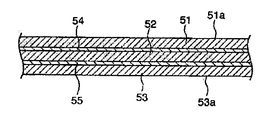
- the battery outer packaging materials 5 a and 5 b are formed by laminating an outer layer 51 serving as an outer surface 51 a of the battery outer packaging body 5, a metal foil layer 52, and an inner layer 53 serving as an inner surface 53 a of the battery outer packaging body 5. Configured. As shown in FIG. 2, adhesive layers 54 and 55 are interposed between the outer layer 51 and the metal foil layer 52 and between the inner layer 53 and the metal foil layer 52.
- the outer layer 51 constituting the battery exterior materials 5a and 5b includes at least one or two or more heat resistant resin films.
- the heat-resistant resin films are preferably laminated via an adhesive layer.
- the heat-resistant resin film constituting the outer layer 51 plays a role of ensuring the moldability of the battery exterior material 5a when the recess 5d for housing the positive electrode 2 and the negative electrode 3 is formed in the battery exterior material 5a.
- Nylon or polyester resin stretched films are preferably used.
- the melting point of the heat-resistant resin film constituting the outer layer 51 is preferably higher than the melting point of the thermoplastic resin film constituting the inner layer 53.
- the thickness of the outer layer 51 is preferably about 10 to 50 ⁇ m, more preferably about 15 to 30 ⁇ m. If the thickness is 10 ⁇ m or more, the stretch of the stretched film will not be insufficient when the battery outer packaging material 5a is molded, necking will not occur in the metal foil layer 52, and molding defects will not occur. Moreover, if thickness is 50 micrometers or less, the effect of a moldability can fully be exhibited.
- the metal foil layer 52 constituting the battery outer packaging material 5a, 5b serves to ensure the barrier property of the battery outer packaging material 5a, 5b.
- the metal foil layer 52 aluminum foil, iron foil, stainless steel foil, copper Although foil etc. are used, it is preferable to use aluminum foil in consideration of formability and light weight.
- the material of the aluminum foil a pure aluminum-based or aluminum-iron-based alloy O material (soft material) is preferably used.
- the thickness of the metal foil layer 52 is preferably 20 to 80 ⁇ m in order to ensure workability and to ensure barrier properties that prevent oxygen and moisture from entering the battery.
- the thickness is 20 ⁇ m or more, the metal foil layer 52 is not broken during the formation of the battery outer packaging material 5a, and no pinholes are generated, and oxygen and moisture can be prevented from entering.
- the thickness is 80 ⁇ m or less, the effect of improving the breakage at the time of molding and the effect of preventing the occurrence of pinholes are maintained, and the total thickness of the battery exterior materials 5a and 5b is not excessively increased, thereby preventing an increase in weight.
- the volume energy density of the battery 1 can be improved.
- the metal foil layer 52 is subjected to undercoat treatment with a silane coupling agent or a titanium coupling agent, chromate treatment, or the like in order to improve adhesion with the outer layer 51 and the inner layer 53 or improve corrosion resistance.
- a chemical conversion treatment should be performed.
- the inner layer 53 constituting the battery outer packaging materials 5a and 5b includes a thermoplastic resin film.
- the thermoplastic resin film used for the inner layer 53 it plays a role of improving chemical resistance against a highly corrosive electrolyte having heat sealability, and the metal foil layer 52 and the nonaqueous electrolyte secondary battery 1. It is preferable that the insulating property with respect to the positive electrode 2 or the negative electrode 3 is ensured.
- unstretched polyolefin films such as polypropylene and maleic anhydride-modified polypropylene, and unstretched films such as ethylene-acrylate copolymers or ionomer resins are preferable.
- the thermoplastic resin film constituting the inner layer 53 may be composed of a single thermoplastic resin layer, but may be composed of a laminate of a plurality of thermoplastic resin layers.
- the thickness of the inner layer 53 is preferably in the range of 0.1 to 200 ⁇ m, more preferably in the range of 50 to 100 ⁇ m.
- the thickness is 0.1 ⁇ m or more, preferably 50 ⁇ m or more, the heat seal strength is sufficient, the corrosion resistance against the electrolytic solution or the like is improved, and the insulation between the metal foil layer and the positive electrode or the negative electrode is enhanced.
- thickness is 200 micrometers or less, Preferably it is 100 micrometers or less, there is no trouble in heat-seal property and chemical-resistance, and the volume energy density of a secondary battery can be improved.
- the melting point of the thermoplastic resin film constituting the inner layer 53 is preferably in the range of 130 to 170 ° C., more preferably in the range of 160 to 165 ° C. If the melting point is within this range, the heat resistance of the inner layer 53 is improved, the thickness of the inner layer 53 during heat sealing is not reduced, and the insulation of the inner layer 53 is improved.
- the adhesive layers 54 and 55 are provided between the outer layer 51 and the metal foil layer 52 and between the inner layer 53 and the metal foil layer 52 in order to bond the outer layer 51 and the metal foil layer 52 and the inner layer 53 and the metal foil layer 52. It is arranged between.
- the adhesive layers 54 and 55 are preferably an adhesive layer for dry laminate made of an adhesive for dry laminate.
- acrylic adhesive silicone adhesive
- ether adhesive One selected from ethylene-vinyl acetate adhesives can be used.
- adhesive layers made of different materials for the outer layer-side adhesive layer 54 and the inner layer-side adhesive layer 55.
- a urethane adhesive is preferably used as an adhesive on the outer layer side when the outer layer 51 is made of PET or nylon, and an inner layer side when the inner layer 53 is made of polypropylene.
- an acrylic adhesive or an acid-modified olefin adhesive is preferable.
- the thickness of the adhesive layers 54 and 55 is preferably in the range of 1 to 10 ⁇ m, and more preferably in the range of 1.5 to 5 ⁇ m. If the thickness of the adhesive layers 54 and 55 is 0.1 ⁇ m or more, preferably 1.5 ⁇ m, the adhesive strength is not lowered, moisture transmission can be suppressed, and the insulation of the inner layer 53 is further enhanced on the inner layer side. be able to. Moreover, if the thickness of the adhesive layers 54 and 55 is 10 ⁇ m or less, more preferably 5 ⁇ m or less, a decrease in the adhesive strength can be prevented.
- thermoplastic resin film constituting the inner layer in contact with the non-aqueous electrolyte
- the additive is appropriately added to the non-aqueous electrolyte. It is possible to elute to a concentration range.
- a composition obtained by adding the additive to a thermoplastic resin as a raw material is supplied to an extruder and is heated by being extruded in the extruder.
- the resin is melted, kneaded at that temperature, passed through a filtration filter, extruded from a slit-shaped die, wound around a metal drum, cooled and solidified into a sheet, and an unstretched film can be obtained.
- the amount of the additive to be added to the thermoplastic resin film is preferably in the range of 0.3 to 5.0 parts by mass, more preferably 1.0 to 3 parts by mass with respect to 100 parts by mass of the thermoplastic resin film.
- the range is preferably 0 parts by mass. If the addition amount is less than 0.3 parts by mass, the effect associated with elution is hardly exhibited, and if added over 5.0 parts by mass, the adhesiveness and heat sealability may be reduced.
- a lubricant is preferably added to the thermoplastic resin film, and more preferably used in combination with the additive. This is added in order to improve the fluidity and releasability during molding of the thermoplastic resin film, and is added to adjust the frictional force between the processing machine and the film surface or between the films.
- the lubricant is not particularly limited, and examples thereof include fatty acid amides such as stearic acid amide, erucic acid amide, erucic acid amide, and oleic acid amide, or a mixture thereof.
- the addition amount of the lubricant is preferably in the range of 0.05 to 2.0 parts by mass with respect to 100 parts by mass of the thermoplastic resin film.
- the thermoplastic resin film may contain an antistatic agent for preventing electrostatic damage due to charging of the film, inorganic particles and / or crosslinked organic particles for imparting antiblocking properties, etc. in addition to the above.
- the antistatic agent is not particularly limited, and examples thereof include ethylene oxide adducts of betaine derivatives, quaternary amine compounds, alkyldiethanolamine fatty acid esters, glycerin fatty acid esters, stearic acid glycerides, and the like, or mixtures thereof. it can.
- the addition amount of the antistatic agent is preferably in the range of 0.05 to 1.5 parts by mass with respect to 100 parts by mass of the thermoplastic resin film.
- the inorganic particles added for imparting the anti-blocking property are inorganic particles of a metal compound, and are not particularly limited.
- zeolite calcium carbonate, magnesium carbonate, alumina, silica, aluminum silicate, kaolin, kaolinite
- Mention may be made of particles such as talc, clay, diatomaceous earth, montmorillonite, titanium oxide, or mixtures thereof.
- the above-mentioned crosslinked organic particles added for imparting anti-blocking properties are particles obtained by crosslinking a polymer compound using a crosslinking agent.
- the crosslinked organic particles are not particularly limited.
- crosslinked particles of a polymethoxysilane compound, crosslinked particles of a polystyrene compound, crosslinked particles of an acrylic compound, crosslinked particles of a polyurethane compound, crosslinked particles of a polyester compound, and fluorine examples thereof include crosslinked particles of a system compound or a mixture thereof.
- the average particle size of the inorganic particles and the crosslinked organic particles is preferably in the range of 0.5 to 6 ⁇ m.
- the addition amount of the inorganic particles and / or crosslinked organic particles is preferably in the range of 0.02 to 0.5 parts by mass with respect to 100 parts by mass of the thermoplastic resin film.
- the secondary battery is not limited to a secondary battery provided with a battery exterior material, and the additive can be similarly applied to a square secondary battery and a cylindrical secondary battery.
- Styrene butadiene rubber (SBR) and carboxymethyl cellulose (CMC) were prepared as binders.
- the white powder of SBR was dispersed in purified water to obtain an SBR dispersion.
- the white powder of CMC was mixed with purified water, and stirred for one day with a stirrer to obtain a CMC solution.
- Carbon black and vapor-grown carbon fiber (VGCF (registered trademark) -H, manufactured by Showa Denko KK) were prepared as conductive assistants, and a mixture of the two in a 3: 2 (mass ratio) mixed conductive assistant. It was.
- negative electrode active material particles 80/20 by mass ratio
- 5 parts by mass of mixed conductive assistant 2.5 parts by mass of CMC solution as solid content
- 2.5 parts by mass of SBR dispersion was mixed as a solid content, an appropriate amount of water for viscosity adjustment was added thereto, and kneaded by a rotation / revolution mixer to obtain a negative electrode paste.
- the negative electrode paste was uniformly applied to a thickness of 150 ⁇ m on a 20 ⁇ m thick copper foil using a doctor blade, dried on a hot plate, and then vacuum dried to obtain a negative electrode sheet.
- the dried electrode was pressed with a uniaxial press at a pressure of 3 ton / cm 2 to obtain a negative electrode sheet for battery evaluation.
- the negative electrode sheet is evaluated in advance with respect to the active material weight in a half cell of the counter electrode Li, and the negative electrode sheet with respect to the capacity (QC) of the positive electrode sheet
- the capacity of the negative electrode sheet was finely adjusted so that the ratio of the capacity (QA) was 1.2 and a constant value.
- Non-aqueous electrolyte was a non-aqueous solvent in which ethylene carbonate, ethyl methyl carbonate, and diethyl carbonate were mixed at a volume ratio of 3: 5: 2, and 1% by mass of vinylene carbonate (VC) as an additive, fluoroethylene. 5% by mass of carbonate (FEC) was mixed. Further, the additives shown in Table 1 were mixed. Electrolyte LiPF 6 was dissolved in this to a concentration of 1 mol / L to obtain a non-aqueous electrolyte.
- VC vinylene carbonate
- FEC 5% by mass of carbonate
- Table 1 collectively shows the measurement results of the room temperature cycle capacity retention rate (%) for the secondary batteries of Experimental Examples 1 to 8 and Comparative Example 1 measured as described above.
- Examples 1-7 A secondary battery was fabricated by adding ⁇ -caprolactam oligomer and IRGANOX (registered trademark) 1010 and IRGAPHOS (registered trademark) 168 as non-aqueous electrolyte. Table 1 shows the addition amount and the room temperature cycle characteristic capacity retention rate.
- Example 8 Using a CPP film (casting polypropylene film) used as the inner layer of the battery outer packaging material, kneaded ⁇ -caprolactam monomer and its oligomer, and IRGANOX (registered trademark) 1010 as the battery outer packaging material, Produced. Table 1 shows the addition amount and the room temperature cycle characteristic capacity retention rate.
- Comparative Example 1 A secondary battery was produced without using the additive of the present invention in the non-aqueous electrolyte. Table 1 shows the room temperature cycle capacity retention rate.
Landscapes
- Chemical & Material Sciences (AREA)
- Chemical Kinetics & Catalysis (AREA)
- Electrochemistry (AREA)
- General Chemical & Material Sciences (AREA)
- Engineering & Computer Science (AREA)
- Manufacturing & Machinery (AREA)
- Physics & Mathematics (AREA)
- Condensed Matter Physics & Semiconductors (AREA)
- General Physics & Mathematics (AREA)
- Inorganic Chemistry (AREA)
- Secondary Cells (AREA)
- Sealing Battery Cases Or Jackets (AREA)
- Battery Electrode And Active Subsutance (AREA)
- Laminated Bodies (AREA)
Abstract
本発明の課題は、サイクル特性の低下を抑制した二次電池を提供することにある。本発明は、正極と、負極と、非水電解液を含有する二次電池であって、前記非水電解液が、電解質と非水溶媒と添加剤を含有し、前記添加剤が―CO-NR-(Rは、炭素数1~6のアルキル基または水素原子)を含む環状化合物及びその開環重合物及び/または酸化防止剤を含有している二次電池、及び前記二次電池の非水電解液と接する層に、―CO-NR-(Rは、炭素数1~6のアルキル基または水素原子)を含む環状化合物、その開環重合物、及び/または、酸化防止剤を含有している電池外装材に関する。
Description
本発明は、サイクル特性が良好な二次電池及びその外装材に関する。
スマートフォンを含む携帯電話機、携帯型コンピュータ、PDA、携帯型音楽プレイヤー等の携帯型電子機器の駆動電源として、リチウムイオン電池に代表される二次電池が多く使用されている。さらに、電気自動車(EV)やハイブリッド電気自動車(HEV、PHEV)の駆動用電源、太陽光発電、風力発電等の出力変動を抑制するための用途や夜間に電力をためて昼間に利用するための系統電力のピークシフト用途等の定置用蓄電池システムにおいても、二次電池が多く使用されるようになってきている。
二次電池のサイクル特性を向上させるため、種々の添加剤が検討されている(特開2007-242496号公報;特許文献1)。近年、Si、Snなどの金属が負極活物質として注目されているが、Si、Snなどの金属は充放電に伴う膨張/収縮が大きいため、充放電サイクルを繰り返すと、Si、Snなどの金属の粒子に割れが生じ、その割れの部分で電解液の分解反応が起こる。粒子の割れた金属表面で速やかに反応して保護皮膜を形成し、電解液と金属粒子界面との間の反応を抑えるような添加剤も検討されている(特開2014-99263号公報;特許文献2)。
本発明の課題は、サイクル特性の低下を抑制した二次電池を提供することにある。
本発明は以下の(1)~(12)の二次電池、(13)~(17)の電池外装材及びその製造方法、並びに(18)~(20)の二次電池の製造方法を含む。
(1) 正極と、負極と、非水電解液を含有する二次電池であって、前記非水電解液が電解質と非水溶媒と添加剤を含有し、前記添加剤が-CO-NR-(Rは、炭素数1~6のアルキル基または水素原子)を含む環状化合物及びその開環重合物を含有している二次電池。
(2) 前記環状化合物がラクタムであり、その開環重合物がラクタムのオリゴマーである(1)に記載の二次電池。
(3) 前記環状化合物がε-カプロラクタムである(1)または(2)に記載の二次電池。
(4) 前記非水電解液が、前記環状化合物及びその開環重合物を全非水電解液質量に対し、0.1~2.0質量%含有している(1)~(3)のいずれかに記載の二次電池。
(5) 正極と、負極と、非水電解液を含有する二次電池であって、前記非水電解液が電解質と非水溶媒と添加剤を含有し、前記添加剤がフェノール系酸化防止剤及びリン系酸化防止剤からなる群より選ばれる1種以上の酸化防止剤を含有している二次電池。
(6) 前記フェノール系酸化防止剤がペンタエリスリトールテトラキス[3-(3,5-ジ-t-ブチル-4-ヒドロキシフェニル)プロピオネート] 、前記リン系酸化防止剤がトリス(2,4-ジ-t-ブチルフェニル)フォスファイトである(5)に記載の二次電池。
(7) 前記非水電解液が、前記酸化防止剤を、全非水電解液質量に対し、0.1~2.0質量%含有している、(5)または(6)に記載の二次電池。
(8) 正極と、負極と、非水電解液を含有する二次電池であって、前記非水電解液が電解質と非水溶媒と添加剤を含有し、前記添加剤が脂肪酸アミドを含有している二次電池。
(9) 正極と、負極と、非水電解液を含有する二次電池であって、前記非水電解液が電解質と非水溶媒と添加剤を含有し、前記添加剤が、-CO-NR-(Rは、炭素数1~6のアルキル基または水素原子)を含む環状化合物、その開環重合物、フェノール系酸化防止剤及びリン系酸化防止剤を含有している二次電池。
(10) 前記負極が、リチウムイオンを吸蔵可能な金属、該金属の酸化物、該金属を含む合金からなる群より選ばれる少なくとも1種以上である(1)~(9)のいずれかに記載の二次電池。
(11) 前記リチウムイオンを吸蔵可能な金属が、SiとSnからなる群より選ばれる少なくとも1種である(10)に記載の二次電池。
(12) (1)~(11)のいずれかに記載の二次電池の非水電解液と接する層に、-CO-NR-(Rは、炭素数1~6のアルキル基または水素原子)を含む環状化合物及びその開環重合物を含有している電池外装材。
(13) (1)~(11)のいずれかに記載の二次電池の非水電解液と接する層にフェノール系酸化防止剤及びリン系酸化防止剤からなる群より選ばれる1種以上の酸化防止剤を含有している電池外装材。
(14) (1)~(11)のいずれかに記載の二次電池の非水電解液と接する層に、-CO-NR-(Rは、炭素数1~6のアルキル基または水素原子)を含む環状化合物、その開環重合物、フェノール系酸化防止剤及びリン系酸化防止剤を含有している電池外装材。
(15) (1)~(11)のいずれかに記載の二次電池の外装材の製造方法であって、非水電解液と接する層を構成する熱可塑性樹脂フィルム中に-CO-NR-(Rは、炭素数1~6のアルキル基または水素原子)含む環状化合物及びその開環重合物を練りこむ電池外装材の製造方法。
(16) (1)~(11)のいずれかに記載の二次電池の外装材の製造方法であって、非水電解液と接する層を構成する熱可塑性樹脂フィルム中にフェノール系酸化防止剤及びリン系酸化防止剤からなる群より選ばれる1種以上の酸化防止剤を練りこむ電池外装材の製造方法。
(17) (1)~(11)のいずれかに記載の二次電池の外装材の製造方法であって、非水電解液と接する層に、-CO-NR-(Rは、炭素数1~6のアルキル基または水素原子)を含む環状化合物、その開環重合物、フェノール系酸化防止剤及びリン系酸化防止剤を練りこむ電池外装材の製造方法。
(18) 正極と、負極と、非水電解液を含有する二次電池の製造方法であって、前記非水電解液に、-CO-NR-(Rは、炭素数1~6のアルキル基または水素原子)を含む環状化合物及びその開環重合物を添加する二次電池の製造方法。
(19) 正極と、負極と、非水電解液を含有する二次電池の製造方法であって、前記非水電解液に、フェノール系酸化防止剤及びリン系酸化防止剤からなる群より選ばれる1種以上の酸化防止剤を添加する二次電池の製造方法。
(20) 正極と、負極と、非水電解液を含有する二次電池の製造方法であって、前記非水電解液に、脂肪酸アミドを添加する二次電池の製造方法。
(1) 正極と、負極と、非水電解液を含有する二次電池であって、前記非水電解液が電解質と非水溶媒と添加剤を含有し、前記添加剤が-CO-NR-(Rは、炭素数1~6のアルキル基または水素原子)を含む環状化合物及びその開環重合物を含有している二次電池。
(2) 前記環状化合物がラクタムであり、その開環重合物がラクタムのオリゴマーである(1)に記載の二次電池。
(3) 前記環状化合物がε-カプロラクタムである(1)または(2)に記載の二次電池。
(4) 前記非水電解液が、前記環状化合物及びその開環重合物を全非水電解液質量に対し、0.1~2.0質量%含有している(1)~(3)のいずれかに記載の二次電池。
(5) 正極と、負極と、非水電解液を含有する二次電池であって、前記非水電解液が電解質と非水溶媒と添加剤を含有し、前記添加剤がフェノール系酸化防止剤及びリン系酸化防止剤からなる群より選ばれる1種以上の酸化防止剤を含有している二次電池。
(6) 前記フェノール系酸化防止剤がペンタエリスリトールテトラキス[3-(3,5-ジ-t-ブチル-4-ヒドロキシフェニル)プロピオネート] 、前記リン系酸化防止剤がトリス(2,4-ジ-t-ブチルフェニル)フォスファイトである(5)に記載の二次電池。
(7) 前記非水電解液が、前記酸化防止剤を、全非水電解液質量に対し、0.1~2.0質量%含有している、(5)または(6)に記載の二次電池。
(8) 正極と、負極と、非水電解液を含有する二次電池であって、前記非水電解液が電解質と非水溶媒と添加剤を含有し、前記添加剤が脂肪酸アミドを含有している二次電池。
(9) 正極と、負極と、非水電解液を含有する二次電池であって、前記非水電解液が電解質と非水溶媒と添加剤を含有し、前記添加剤が、-CO-NR-(Rは、炭素数1~6のアルキル基または水素原子)を含む環状化合物、その開環重合物、フェノール系酸化防止剤及びリン系酸化防止剤を含有している二次電池。
(10) 前記負極が、リチウムイオンを吸蔵可能な金属、該金属の酸化物、該金属を含む合金からなる群より選ばれる少なくとも1種以上である(1)~(9)のいずれかに記載の二次電池。
(11) 前記リチウムイオンを吸蔵可能な金属が、SiとSnからなる群より選ばれる少なくとも1種である(10)に記載の二次電池。
(12) (1)~(11)のいずれかに記載の二次電池の非水電解液と接する層に、-CO-NR-(Rは、炭素数1~6のアルキル基または水素原子)を含む環状化合物及びその開環重合物を含有している電池外装材。
(13) (1)~(11)のいずれかに記載の二次電池の非水電解液と接する層にフェノール系酸化防止剤及びリン系酸化防止剤からなる群より選ばれる1種以上の酸化防止剤を含有している電池外装材。
(14) (1)~(11)のいずれかに記載の二次電池の非水電解液と接する層に、-CO-NR-(Rは、炭素数1~6のアルキル基または水素原子)を含む環状化合物、その開環重合物、フェノール系酸化防止剤及びリン系酸化防止剤を含有している電池外装材。
(15) (1)~(11)のいずれかに記載の二次電池の外装材の製造方法であって、非水電解液と接する層を構成する熱可塑性樹脂フィルム中に-CO-NR-(Rは、炭素数1~6のアルキル基または水素原子)含む環状化合物及びその開環重合物を練りこむ電池外装材の製造方法。
(16) (1)~(11)のいずれかに記載の二次電池の外装材の製造方法であって、非水電解液と接する層を構成する熱可塑性樹脂フィルム中にフェノール系酸化防止剤及びリン系酸化防止剤からなる群より選ばれる1種以上の酸化防止剤を練りこむ電池外装材の製造方法。
(17) (1)~(11)のいずれかに記載の二次電池の外装材の製造方法であって、非水電解液と接する層に、-CO-NR-(Rは、炭素数1~6のアルキル基または水素原子)を含む環状化合物、その開環重合物、フェノール系酸化防止剤及びリン系酸化防止剤を練りこむ電池外装材の製造方法。
(18) 正極と、負極と、非水電解液を含有する二次電池の製造方法であって、前記非水電解液に、-CO-NR-(Rは、炭素数1~6のアルキル基または水素原子)を含む環状化合物及びその開環重合物を添加する二次電池の製造方法。
(19) 正極と、負極と、非水電解液を含有する二次電池の製造方法であって、前記非水電解液に、フェノール系酸化防止剤及びリン系酸化防止剤からなる群より選ばれる1種以上の酸化防止剤を添加する二次電池の製造方法。
(20) 正極と、負極と、非水電解液を含有する二次電池の製造方法であって、前記非水電解液に、脂肪酸アミドを添加する二次電池の製造方法。
本発明によれば、サイクル特性が良好な二次電池を提供することができる。例えば、Si、Snなどの金属元素を含有する負極活物質を用いても、サイクル特性の低下を抑制することができる。
以下、本発明の実施形態について詳細に説明する。ただし、以下に示す実施形態は、本発明の技術思想を理解するために例示するものであって、本発明をこの実施形態に特定することを意図するものではなく、本発明は特許請求の範囲に示した技術思想を逸脱することなく種々の変更を行ったものにも均しく適用し得るものである。
以下、本発明の実施形態において、電池外装材を備えたリチウムイオン二次電池を例として説明する。
以下、本発明の実施形態において、電池外装材を備えたリチウムイオン二次電池を例として説明する。
本発明の一実施態様で用いられる正極は、正極活物質を含む正極合剤が正極集電体の片面もしくは両面に担持された構造を有する。
正極合剤は、例えば正極活物質、導電助剤及び結着剤を、汎用されている溶媒に懸濁してペーストを調製し、このペーストを正極集電体に塗布し、乾燥し、その後、加圧成形することによって調整することができる。加圧成形法としては、ロール加圧、プレス加圧などの成形法が挙げられる。また、正極は、正極活物質、導電助剤及び結着剤をペレット状に形成して正極合剤とし、これを正極集電体上に形成することにより作製されてもよい。
前記正極合剤の片面の厚さは1.0~150μmの範囲であることが電池の大電流放電特性とサイクル寿命の保持の点から望ましい。従って正極集電体の両面に担持されている場合は正極合剤の合計の厚さは20~200μmの範囲となることが望ましい。大電流放電特性とサイクル寿命を考慮した場合、片面のより好ましい範囲は20μm~120μmである。
正極合剤は、例えば正極活物質、導電助剤及び結着剤を、汎用されている溶媒に懸濁してペーストを調製し、このペーストを正極集電体に塗布し、乾燥し、その後、加圧成形することによって調整することができる。加圧成形法としては、ロール加圧、プレス加圧などの成形法が挙げられる。また、正極は、正極活物質、導電助剤及び結着剤をペレット状に形成して正極合剤とし、これを正極集電体上に形成することにより作製されてもよい。
前記正極合剤の片面の厚さは1.0~150μmの範囲であることが電池の大電流放電特性とサイクル寿命の保持の点から望ましい。従って正極集電体の両面に担持されている場合は正極合剤の合計の厚さは20~200μmの範囲となることが望ましい。大電流放電特性とサイクル寿命を考慮した場合、片面のより好ましい範囲は20μm~120μmである。
本発明の一実施態様で用いられる正極活物質としては、リチウムイオンを可逆的に吸蔵・放出することが可能な物質であれば、通常使用されているものを使用することが可能である。例えば、LiMO2(但し、MはCo、Ni、Mnの少なくとも1種である)で表されるリチウム遷移金属複合酸化物、すなわち、LiCoO2、LiNiO2、LiNiyCo1-yO2(y=0.01~0.99)、LiMnO2、LiCoxMnyNizO2(x+y+z=1)や、LiMn2O4またはLiFePO4などを1種単独もしくは複数種を混合して用いることができる。
導電助剤は電極に対し導電性及び電極安定性(リチウムイオンの挿入・脱離における体積変化に対する緩衝作用)を付与する役目を果たすものであれば特に限定されない。例えば、気相法炭素繊維(例えば、「VGCF(登録商標)」(昭和電工社製)、導電性カーボン(例えば、「デンカブラック(登録商標)」(電気化学工業社製)、「Super C65」(TIMCAL社製)、「Super C45」(TIMCAL社製)、「KS6L」(TIMCAL社製)))などが挙げられる。
結着材としては、例えば、スチレンブタジエンゴム、ブタジエンゴム、ブチルゴム、アクリルゴム、スチレンアクリル共重合ポリマー、ポリエチレン、ポリプロピレンやイオン伝導率の大きな高分子化合物などが挙げられる。イオン伝導率の大きな高分子化合物としては、ポリフッ化ビニリデン、ポリエチレンオキサイド、ポリエピクロルヒドリン、ポリファスファゼン、ポリアクリロニトリルなどが挙げられる。
電極作製用のペーストに使用する溶媒には、特に制限はなく、N-メチル-2-ピロリドン、ジメチルホルムアミド、イソプロパノール、水などが挙げられる。溶媒として水を使用するバインダーの場合は、増粘剤を併用することが好ましい。溶媒の量はペーストが集電体に塗布しやすいような粘度となるように調整される。
大電流放電特性とサイクル寿命を考慮した場合、正極合剤中の正極活物質、導電助剤及び結着剤の好ましい配合割合は、正極活物質は70~98質量%の範囲であり、導電助剤は1~20質量%の範囲であり、結着剤は1~10質量%の範囲である。
正極集電体としては、アルミニウム箔などに代表される多孔質構造の導電性基板か、あるいは、無孔の導電性基板を用いることができる。正極集電体の厚さは5~20μmであることが望ましい。この範囲であると電極強度と軽量化のバランスがとれるからである。
本発明の一実施態様で用いられる負極は、負極活物質を含む負極合剤が負極集電体の片面もしくは両面に担持された構造を有する。
負極合剤は、例えば、負極活物質、導電助剤及び結着剤を、汎用されている溶媒に懸濁してペーストを調製し、このペーストを負極集電体に塗布し、乾燥し、その後、加圧成形することによって調整することができる。加圧成形法としては、ロール加圧、プレス加圧などの成形法が挙げられる。また負極は、負極活物質、導電助剤及び結着剤をペレット状に形成して負極合剤とし、これを負極集電体上に形成することにより作製されてもよい。
大電流放電特性とサイクル寿命を考慮した場合、負極合剤の厚さは片面あたり1.0~150μmの範囲であることが望ましい。30~100μmであるとより好ましい。
負極合剤は、例えば、負極活物質、導電助剤及び結着剤を、汎用されている溶媒に懸濁してペーストを調製し、このペーストを負極集電体に塗布し、乾燥し、その後、加圧成形することによって調整することができる。加圧成形法としては、ロール加圧、プレス加圧などの成形法が挙げられる。また負極は、負極活物質、導電助剤及び結着剤をペレット状に形成して負極合剤とし、これを負極集電体上に形成することにより作製されてもよい。
大電流放電特性とサイクル寿命を考慮した場合、負極合剤の厚さは片面あたり1.0~150μmの範囲であることが望ましい。30~100μmであるとより好ましい。
本発明の一実施態様で用いられる負極活物質は、リチウムイオンを吸蔵可能な物質を含有するものであれば際限なく使用可能である。炭素材料、金属、金属酸化物、合金などが採用可能である。例えば、リチウムイオンを吸蔵可能な金属として、SiとSnからなる群より選ばれる1種以上の金属が採用可能である。例えば、SiとSnからなる群より選ばれる少なくとも1種の金属、SiとSnからなる群より選ばれる少なくとも1種の金属の酸化物、SiとSnからなる群より選ばれる少なくとも1種の金属を含む合金を単独あるいは組み合わせたものを採用することができ、それらと炭素材料とを組み合わせたものを負極活物質として使用することも可能である。Si、Snなどの金属元素を含有する負極活物質を用いた場合、本発明の効果が顕著に表れ易い。
リチウムイオンを吸蔵可能な金属、該金属の酸化物、該金属を含む合金などは、リチウムを吸蔵放出する際の膨張収縮が大きいので、この応力を緩和するため、できるだけ微細化されて分散されていることが好ましい。応力緩和のため、金属、金属酸化物、合金などは、1nm~500nmのサイズで分散されていることが好ましい。
リチウムイオンを吸蔵可能な金属、該金属の酸化物、該金属を含む合金などは、リチウムを吸蔵放出する際の膨張収縮が大きいので、この応力を緩和するため、できるだけ微細化されて分散されていることが好ましい。応力緩和のため、金属、金属酸化物、合金などは、1nm~500nmのサイズで分散されていることが好ましい。
リチウムイオンを吸蔵可能な金属の酸化物は、例えば、SiOx(0.5≦x<2)またはSnOx(0.5≦x<2)であり、非晶質、結晶質などの構造が採用できるが、内部にSi相またはSn相が包含または保持された形で偏りなく分散されていることが好ましい。
炭素材料としては、人造黒鉛、天然黒鉛、ソフトカーボン、ハードカーボン、カーボンブラック、コークス、ガラス状炭素、炭素繊維等、あるいはこれらの焼成体の1種または複数種混合したものを用いることができる。
炭素材料としては、人造黒鉛、天然黒鉛、ソフトカーボン、ハードカーボン、カーボンブラック、コークス、ガラス状炭素、炭素繊維等、あるいはこれらの焼成体の1種または複数種混合したものを用いることができる。
炭素材料は、リチウムイオンを吸蔵可能な金属、該金属の酸化物、該金属を含む合金などと混合または複合化する形態とすることも可能である。リチウムイオンを吸蔵可能な金属、該金属の酸化物、該金属を含む合金などによって炭素材料を被覆する形態とすることもできる。逆に、炭素材料によって、リチウムイオンを吸蔵可能な金属、該金属の酸化物、該金属を含む合金などを被覆する形態とすることもできる。
導電助剤は、電極に対し導電性及び電極安定性(リチウムイオンの挿入・脱離における体積変化に対する緩衝作用)を付与する役目を果たすものであれば特に限定されない。例えば、気相法炭素繊維(例えば、「VGCF(登録商標)」(昭和電工社製))、導電性カーボン(例えば、「デンカブラック(登録商標)」(電気化学工業社製)、「Super C65」(TIMCAL社製)、「Super C45」(TIMCAL社製)、「KS6L」(TIMCAL社製))などが挙げられる。
結着材としては、例えば、スチレンブタジエンゴム、ブタジエンゴム、ブチルゴム、アクリルゴム、スチレンアクリル共重合ポリマー、ポリエチレン、ポリプロピレンやイオン伝導率の大きな高分子化合物などが挙げられる。イオン伝導率の大きな高分子化合物としては、ポリフッ化ビニリデン、ポリエチレンオキサイド、ポリエピクロルヒドリン、ポリファスファゼン、ポリアクリロニトリルなどが挙げられる。
電極作製用のペーストに使用する溶媒は、特に制限はなく、N-メチル-2-ピロリドン、ジメチルホルムアミド、イソプロパノール、水などが挙げられる。溶媒として水を使用するバインダーの場合は、増粘剤を併用することが好ましい。溶媒の量はペーストが集電体に塗布しやすいような粘度となるように調整される。
大電流放電特性とサイクル寿命を考慮した場合、負極合剤中の活物質、導電助剤及び結着剤の配合割合は、活物質は55~96質量%、導電助剤は2~30質量%、結着剤は2~15質量%の範囲とすることが好ましい。
負極集電体としては、多孔質構造の導電性基板か、あるいは無孔の導電性基板を用いることができる。これら導電性基板は、例えば、銅、ステンレスまたはニッケルから形成することができる。集電体の厚さは5~20μmであることが望ましい。
セパレータとしては、従来から用いられてきたセパレータを用いることができる。具体的には、ポリエチレンからなるセパレータのみならず、ポリエチレン層の表面にポリプロピレンからなる層が形成されたものや、ポリエチレンのセパレータの表面にアラミド系の樹脂等の樹脂が塗布されたものを用いてもよい。
非水電解液に使用する非水溶媒としては、エチレンカーボネート(EC)、プロピレンカーボネート(PC)、ブチレンカーボネート(BC)等の環状炭酸エステル;フッ素化された環状炭酸エステル;γ-ブチロラクトン(γ-BL)やγ-バレロラクトン(γ-VL)等の環状カルボン酸エステル;ジメチルカーボネート(DMC)やジエチルカーボネート(DEC)、メチルエチルカーボネート(MEC)、メチルプロピルカーボネート(MPC)、ジブチルカーボネート(DBC)等の鎖状炭酸エステル;フッ素化された鎖状炭酸エステル;ピバリン酸メチルやピバリン酸エチル、メチルイソブチレート、メチルプロピオネート等の鎖状カルボン酸エステル;N,N'-ジメチルホルムアミドやN-メチルオキサゾリジノン等のアミド化合物;スルホラン等の硫黄化合物;テトラフルオロ硼酸1-エチル-3-メチルイミダゾリウム等の常温溶融塩等を用いることができる。また、これらを2種以上混合して用いるようにしてもよい。
非水溶媒中に溶解させる電解質塩としては、二次電池において一般に電解質塩として用いられるリチウム塩を用いることができる。このようなリチウム塩としては、例えば、LiPF6、LiBF4、LiCF3SO3、LiN(CF3SO2)2、LiN(C2F5SO2)2、LiN(CF3SO2)(C4F9SO2)、LiC(CF3SO2)3、LiC(C2F5SO2)3、LiAsF6、LiClO4、Li2B10Cl10、Li2B12Cl12等を1種単独またはこれらから複数種を混合したものを用いることができる。なお、非水溶媒に対する電解質塩の溶解量は、0.8~1.5mol/Lとするのが好ましい。
本発明の一実施態様においては、非水電解液への添加剤として(A)―CO-NR-を含む環状化合物及びその開環重合物を含有している。また、別の実施態様としては、添加剤が、(B)フェノール系酸化防止剤及びリン系酸化防止剤からなる群より選ばれる1種以上の酸化防止剤を含有している。さらに、別の実施態様としては、添加剤が、(C)脂肪酸アミドを含有している。
これらの添加剤は単独でもよく、(A)と(B)を併用してもよく、(B)と(C)を併用してもよく、(A)と(B)と(C)を併用してもよい。
これらの添加剤は単独でもよく、(A)と(B)を併用してもよく、(B)と(C)を併用してもよく、(A)と(B)と(C)を併用してもよい。
-CO-NR-を含む環状化合物及びその開環重合物において、Rは炭素数1~6のアルキル基または水素原子である。好ましくは、炭素数1~3のアルキル基または水素原子であり、さらに好ましくは水素原子である。
-CO-NR-を含む環状化合物及びその開環重合物として、例えば、ラクタム及びラクタムの開環重合物が使用可能である。好ましくは、ラクタム及びラクタムのオリゴマーが使用可能である。
-CO-NR-を含む環状化合物及びその開環重合物の添加量は、全非水電解液質量に対して0.1~2.0質量%の範囲が好ましく、0.3~1.0質量%の範囲がより好ましい。添加量が0.1質量%未満では添加効果が発現しにくく、2.0質量%を超えて添加した場合は溶解性低下によって析出しやすく、活物質表面やセパレータなどへの過度な付着により電池抵抗が高くなる傾向がある。
-CO-NR-を含む環状化合物及びその開環重合物として、例えば、ラクタム及びラクタムの開環重合物が使用可能である。好ましくは、ラクタム及びラクタムのオリゴマーが使用可能である。
-CO-NR-を含む環状化合物及びその開環重合物の添加量は、全非水電解液質量に対して0.1~2.0質量%の範囲が好ましく、0.3~1.0質量%の範囲がより好ましい。添加量が0.1質量%未満では添加効果が発現しにくく、2.0質量%を超えて添加した場合は溶解性低下によって析出しやすく、活物質表面やセパレータなどへの過度な付着により電池抵抗が高くなる傾向がある。
-CO-NR-を含む環状化合物及びその開環重合物として、ε-カプロラクタムからなるモノマー及びそのオリゴマーを使用した場合の平均分子量(MW)は、ε-カプロラクタムモノマー自身のモル質量113g/molを基準として113~2260の範囲が好ましく、113~1130の範囲がより好ましい。オリゴマーの分子量が2260を超えると溶解性低下により析出しやすく、電池抵抗が高くなる傾向がある。
ε-カプロラクタムからなるモノマー及びオリゴマーの組成の一例を挙げると、ε-カプロラクタムからなるモノマー22.5質量%、アミノカプロン酸3.1質量%、環状2量体16.6質量%、環状3量体21.1質量%、環状4量体13.4質量%、環状5量体7.3質量%、環状6量体1.8質量%、環状7量体1.4質量%である。
ε-カプロラクタムからなるモノマー及びオリゴマーの組成の一例を挙げると、ε-カプロラクタムからなるモノマー22.5質量%、アミノカプロン酸3.1質量%、環状2量体16.6質量%、環状3量体21.1質量%、環状4量体13.4質量%、環状5量体7.3質量%、環状6量体1.8質量%、環状7量体1.4質量%である。
例えば、ε-カプロラクタムからなるモノマー及びオリゴマーは一般的にポリアミド(6-ナイロン)の重合用モノマー及び重合残渣として知られている。ε-カプロラクタムのオリゴマーとしては、鎖状体モノマーと環状体があるがいずれでもよい。
-CO-NR-を含む環状化合物及びその開環重合物を添加剤として使用することにより、活物質粒子間、さらには電極合剤層と集電箔の界面における密着を強化し、結果として二次電池のサイクル特性の劣化が抑制されると推測される。
-CO-NR-を含む環状化合物及びその開環重合物を添加剤として使用することにより、活物質粒子間、さらには電極合剤層と集電箔の界面における密着を強化し、結果として二次電池のサイクル特性の劣化が抑制されると推測される。
酸化防止剤としては、フェノール系酸化防止剤であるIRGANOX(登録商標)1010:ペンタエリスリトールテトラキス[3-(3,5-ジ-t-ブチル-4-ヒドロキシフェニル)プロピオネート] 、リン系酸化防止剤であるIRGAFOS(登録商標)168:トリス(2,4-ジ-t-ブチルフェニル)フォスファイトが好適である。前記酸化防止剤は、充放電に伴う金属の表面酸化を抑制することで、サイクル特性向上に効果的であると推測される。
フェノール系酸化防止剤及びリン系酸化防止剤以外に、硫黄系酸化防止剤などを用いることもできる。これら酸化防止剤は、単独でも2種以上を組み合わせて用いてもよい。
酸化防止剤の添加量は、0.1~2.0質量%の範囲が好ましく、0.3~1.0質量%の範囲がより好ましい。添加量が0.1質量%未満では添加効果が発現しにくく、2.0質量を超えて添加した場合は、溶解性低下により析出しやすく、活物質表面やセパレータなどへの付着により電池抵抗が高くなる傾向がある。
フェノール系酸化防止剤及びリン系酸化防止剤以外に、硫黄系酸化防止剤などを用いることもできる。これら酸化防止剤は、単独でも2種以上を組み合わせて用いてもよい。
酸化防止剤の添加量は、0.1~2.0質量%の範囲が好ましく、0.3~1.0質量%の範囲がより好ましい。添加量が0.1質量%未満では添加効果が発現しにくく、2.0質量を超えて添加した場合は、溶解性低下により析出しやすく、活物質表面やセパレータなどへの付着により電池抵抗が高くなる傾向がある。
前記フェノール系酸化防止剤としては、IRGANOX(登録商標)1010:ペンタエリスリトールテトラキス[3-(3,5-ジ-t-ブチル-4-ヒドロキシフェニル)プロピオネート](チバ・スペシャルティ・ケミカルズ社製)以外にも、例えば、IRGANOX(登録商標)1076:オクタデシル-3-(3,5-ジ-t-ブチル-4-ヒドロキシフェニル)プロピオネート(チバ・スペシャルティ・ケミカルズ社製)、IRGANOX(登録商標)1330:3,3',3'',5,5',5''-ヘキサ-t-ブチル-a,a',a''-(メシチレン-2,4,6-トリイル)トリ-p-クレゾール(チバ・スペシャルティ・ケミカルズ社製)、IRGANOX(登録商標)3114:1,3,5-トリス(3,5-ジ-t-ブチル-4-ヒドロキシベンジル)-1,3,5-トリアジン-2,4,6(1H,3H,5H)-トリオン(チバ・スペシャルティ・ケミカルズ社製)、IRGANOX(登録商標)3790:1,3,5-トリス((4-t-ブチル-3-ヒドロキシ-2,6-キシリル)メチル)-1,3,5-トリアジン-2,4,6(1H,3H,5H)-トリオン(チバ・スペシャルティ・ケミカルズ社製)、IRGANOX(登録商標)1035:チオジエチレンビス[3-(3,5-ジ- teRt-ブチル-4-ヒドロキシフェニル)プロピオネート](チバ・スペシャルティ・ケミカルズ社製)、IRGANOX(登録商標)1135:ベンゼンプロパン酸、3,5-ビス(1,1-ジメチルエチル)-4-ヒドロキシ、C7-C9側鎖アルキルエステル(チバ・スペシャルティ・ケミカルズ社製)、IRGANOX(登録商標)1520L:4,6-ビス(オクチルチオメチル)-o-クレゾール(チバ・スペシャルティ・ケミカルズ社製)、IRGANOX(登録商標)3125(チバ・スペシャルティ・ケミカルズ社製、IRGANOX(登録商標)565:2,4-ビス(n-オクチルチオ)-6-(4-ヒドロキシ3’、5’-ジ-t-ブチルアニリノ)-1,3,5-トリアジン(チバ・スペシャルティ・ケミカルズ社製)、ADKSTAB(登録商標)AO-80:3,9-ビス(2-(3-(3-t-ブチル-4-ヒドロキシ-5-メチルフェニル)プロピオニルオキシ)-1,1-ジメチルエチル)-2,4,8,10-テトラオキサスピロ(5,5)ウンデカン((株)ADEKA製)、Sumilizer(登録商標)BHT(住友化学(株)製)、Sumilizer(登録商標)GA-80(住友化学(株)製)、Sumilizer(登録商標)GS(住友化学(株)製)、Cyanox(登録商標)1790((株)サイテック製)、ビタミンE(エーザイ(株)製)などが使用可能である。
前記リン系酸化防止剤としては、IRGAFOS(登録商標)16:トリス(2,4-ジ-t-ブチルフェニル)フォスファイト(チバ・スペシャルティ・ケミカルズ製)以外にも、例えば、IRGAFOS(登録商標)12:トリス[2-[[2,4,8,10-テトラ-t-ブチルジベンゾ[d、f][1,3,2]ジオキサフォスフィン-6-イル]オキシ]エチル]アミン(チバ・スペシャルティ・ケミカルズ製)、IRGAFOS(登録商標)38:ビス(2,4-ビス(1,1-ジメチルエチル)-6-メチルフェニル)エチルエステル亜りん酸(チバ・スペシャルティ・ケミカルズ製)、ADKSTAB(登録商標)329K((株)ADEKA製)、ADKSTAB(登録商標)PEP36((株)ADEKA製)、ADKSTAB(登録商標)PEP-8((株)ADEKA製)、Sandstab P-EPQ(クラリアント社製)、Weston(登録商標) 618(GE社製)、Weston(登録商標) 619G(GE社製)、Ultranox(登録商標)626(GE社製)、Sumilizer(登録商標) GP:6-[3-(3-t-ブチル-4-ヒドロキシ-5-メチルフェニル)プロポキシ]-2,4,8,10-テトラ-t-ブチルジベンズ[d,f][1.3.2]ジオキサホスフェピン)(住友化学(株)製)などが使用可能である。
前記硫黄系酸化防止剤としては、例えば、チオジプロピオン酸ジラウリル、ジミリスチル、ジステアリル等のジアルキルチオジプロピオネート化合物、テトラキス[メチレン(3-ドデシルチオ)プロピオネート]メタン等のポリオールのβ-アルキルメルカプトプロピオン酸エステル化合物などが使用可能である。
前記脂肪酸アミドとしては、ステアリン酸アミド、エルシン酸アミド、エルカ酸アミド、オレイン酸アミドなどが採用可能であり、これらは混合して使用してもよい。脂肪酸アミドの添加量は、0.05~2.0質量%の範囲が好ましく、0.3~1.0質量%の範囲がより好ましい。添加量が0.05質量%未満では添加効果が発現しにくく、2.0質量を超えて添加した場合は、溶解性低下により析出しやすく、活物質表面やセパレータなどへの付着により電池抵抗が高くなる傾向がある。
非水電解液中には、本発明で提示される添加剤以外にも、例えば、ビニレンカーボネート(VC)や、ビニルエチルカーボネート(VEC)、無水コハク酸(SUCAH)、無水マイレン酸(MAAH)、グリコール酸無水物、エチレンサルファイト(ES)、ジビニルスルホン(VS)、ビニルアセテート(VA)、ビニルピバレート(VP)、カテコールカーボネート、ビフェニル(BP)、エチニルエチレンカーボネート(EEC)等をさらに追加添加してもよい。これらの化合物は、2種以上を適宜混合して用いてもよい。この場合、非水電解液中の添加剤の混合総量は、質量比率で合計0.1~20%であることが好ましい。より好ましくは質量比率で合計0.5~10%である。
一実施形態のリチウムイオン二次電池は、例えば、図1に示すように、正極2と、負極3と、非水電解液(図示せず)と、電池用外装体5を少なくとも備えて構成されている。電池用外装体5は、例えば、シート状の電池外装材5a、5bが重ね合わされて袋状に形成されることにより構成される。そして、正極2、負極3及び非水電解液は、電池外装体5の内部に挿入されている。また、図1に示す例では、正極2と負極3の間にセパレータ6が配置される。
電池外装体5は、例えば、2枚のシート状の電池外装材5a、5bを内層が相互に向き合うように重ね合わせ、電池外装材5a、5bの外周部5cをヒートシールさせて袋状に成形されてなるものである。電池外装材5a、5bは、耐熱性樹脂フィルムを含む外層と、金属箔層と、絶縁性粒子が含有された接着層と、熱可塑性樹脂フィルムを含む内層とが積層されて構成されている。また、一方の電池外装材5aには、正極2、負極3及び非水電解液を収容するための凹部5dが、深絞り成形または張出成形によって形成されている。
図1に示す例では、他方の電池外装材5bには凹部が設けられていないが、他方の電池外装材5bにも凹部を設けてもよい。
図1に示す例では、他方の電池外装材5bには凹部が設けられていないが、他方の電池外装材5bにも凹部を設けてもよい。
正極2及び負極3はそれぞれ、金属箔または金属網からなる集電体2a、3aと、集電体2a、3aにそれぞれ積層された電極合材2b、3bとから構成されるものを用いることができる。正極2の電極合材2bには正極活物質が含有され、負極3の電極合材3bには負極活物質が含有されている。
更に正極2及び負極3の各集電体2a、3aには、取り出し端子としてのタブリード2c、3cが接合される。タブリード2c、3cは、その長手方向基端部が電池外装体内部の集電体2a、3aに接合され、長手方向先端部が電池外装体5のヒートシール部である外周部5cを貫通して二次電池1の外部に突出される。タブリード2c、3cの外周部5c近傍においては、タブリード2c、3cがシート状の2枚の電池外装材5a、5bに挟まれており、タブリード2c、3cの表面に電池外装材5a、5bの内層がヒートシールされた状態になっている。
図1に示す二次電池1を製造する際には、開口部を有する袋状の電池外装体5を用意し、電池外装体5に正極2、負極3及び非水電解液並びにセパレータ6を挿入し、更に必要に応じて非水電解液を注液した後、開口部から突出しているタブリード2c、3cを挟むように開口部を封止してヒートシールすることで、開口部が密閉された二次電池1を得る。
次に、一実施形態の電池外装材について詳細に説明する。電池外装材5a、5bは、図2に示すように、電池外装体5の外表面51aとなる外層51と、金属箔層52と、電池外装体5の内面53aとなる内層53とが積層されて構成されている。
また、図2に示すように、外層51と金属箔層52との間、及び内層53と金属箔層52との間に、接着層54、55が介在されている。
また、図2に示すように、外層51と金属箔層52との間、及び内層53と金属箔層52との間に、接着層54、55が介在されている。
[外層]
電池外装材5a、5bを構成する外層51は、少なくとも1または2以上の耐熱性樹脂フィルムを含んで構成されている。2以上の耐熱性樹脂フィルムから構成される場合の外層51は、耐熱性樹脂フィルム同士が接着層を介して積層されていることが好ましい。
外層51を構成する耐熱性樹脂フィルムは、電池外装材5aに正極2及び負極3を収納する凹部5dを成形する場合に、電池外装材5aの成形性を確保する役割を担うもので、ポリアミド(ナイロン)樹脂またはポリエステル樹脂の延伸フィルムが好ましく用いられる。また、外層51を構成する耐熱性樹脂フィルムの融点は、内層53を構成する熱可塑性樹脂フィルムの融点より高いことが好ましい。これにより、二次電池1を製造する際の開口部のヒートシールを確実に行うことが可能になる。
外層51の厚さは10~50μm程度が好ましく、15~30μm程度がより好ましい。厚みが10μm以上であれば電池外装材5aの成形を行なうときに延伸フィルムの伸びが不足することがなく、金属箔層52にネッキングが生じることがなく、成形不良が起きない。また、厚みが50μm以下であれば、成形性の効果を十分発揮できる。
電池外装材5a、5bを構成する外層51は、少なくとも1または2以上の耐熱性樹脂フィルムを含んで構成されている。2以上の耐熱性樹脂フィルムから構成される場合の外層51は、耐熱性樹脂フィルム同士が接着層を介して積層されていることが好ましい。
外層51を構成する耐熱性樹脂フィルムは、電池外装材5aに正極2及び負極3を収納する凹部5dを成形する場合に、電池外装材5aの成形性を確保する役割を担うもので、ポリアミド(ナイロン)樹脂またはポリエステル樹脂の延伸フィルムが好ましく用いられる。また、外層51を構成する耐熱性樹脂フィルムの融点は、内層53を構成する熱可塑性樹脂フィルムの融点より高いことが好ましい。これにより、二次電池1を製造する際の開口部のヒートシールを確実に行うことが可能になる。
外層51の厚さは10~50μm程度が好ましく、15~30μm程度がより好ましい。厚みが10μm以上であれば電池外装材5aの成形を行なうときに延伸フィルムの伸びが不足することがなく、金属箔層52にネッキングが生じることがなく、成形不良が起きない。また、厚みが50μm以下であれば、成形性の効果を十分発揮できる。
[金属箔層]
電池外装材5a、5bを構成する金属箔層52は、電池外装材5a、5bのバリア性確保の役割を行なうもので、この金属箔層52としては、アルミニウム箔、鉄箔、ステンレス箔、銅箔等が使用されるが、成形性、軽量であることを考慮し、アルミニウム箔を使用することが好ましい。アルミニウム箔の材質としては、純アルミニウム系またはアルミニウム-鉄系合金のO材(軟質材)が好ましく用いられる。
金属箔層52の厚みは、加工性の確保及び酸素や水分の電池内への侵入を防止するバリア性確保のために20~80μmが好適である。厚みが20μm以上であれば、電池外装材5aの成形時において金属箔層52が破断せず、ピンホールの発生もなく、酸素や水分の侵入を防止できる。また、厚みが80μm以下であれば、成形時の破断の改善効果やピンホール発生防止効果が維持され、また、電池外装材5a、5bの総厚が過剰に厚くならず、重量増を防止し、電池1の体積エネルギー密度を向上できる。
電池外装材5a、5bを構成する金属箔層52は、電池外装材5a、5bのバリア性確保の役割を行なうもので、この金属箔層52としては、アルミニウム箔、鉄箔、ステンレス箔、銅箔等が使用されるが、成形性、軽量であることを考慮し、アルミニウム箔を使用することが好ましい。アルミニウム箔の材質としては、純アルミニウム系またはアルミニウム-鉄系合金のO材(軟質材)が好ましく用いられる。
金属箔層52の厚みは、加工性の確保及び酸素や水分の電池内への侵入を防止するバリア性確保のために20~80μmが好適である。厚みが20μm以上であれば、電池外装材5aの成形時において金属箔層52が破断せず、ピンホールの発生もなく、酸素や水分の侵入を防止できる。また、厚みが80μm以下であれば、成形時の破断の改善効果やピンホール発生防止効果が維持され、また、電池外装材5a、5bの総厚が過剰に厚くならず、重量増を防止し、電池1の体積エネルギー密度を向上できる。
また、金属箔層52には、外層51及び内層53との接着性を向上させたり、耐食性を向上させるために、シランカップリング剤やチタンカップリング剤等によるアンダーコート処理や、クロメート処理等による化成処理が施されているとよい。
[内層]
次に、電池外装材5a、5bを構成する内層53は、熱可塑性樹脂フィルムを含んで構成されている。内層53に使用される熱可塑性樹脂フィルムとしては、ヒートシール性を有し、腐食性の強い電解質等に対する耐薬品性を向上させる役割を果たし、かつ、金属箔層52と非水電解質次電池1の正極2または負極3との絶縁性を確保できるものがよく、例えば、ポリプロピレン、無水マレイン酸変性ポリプロピレン等の未延伸ポリオレフィンフィルムや、エチレン-アクリレート共重合体またはアイオノマー樹脂などの未延伸フィルムが好ましく用いられる。また、内層53を構成する熱可塑性樹脂フィルムは、単一の熱可塑性樹脂層で構成されていてもよいが、複数の熱可塑性樹脂層が積層されたもので構成されていてもよい。
次に、電池外装材5a、5bを構成する内層53は、熱可塑性樹脂フィルムを含んで構成されている。内層53に使用される熱可塑性樹脂フィルムとしては、ヒートシール性を有し、腐食性の強い電解質等に対する耐薬品性を向上させる役割を果たし、かつ、金属箔層52と非水電解質次電池1の正極2または負極3との絶縁性を確保できるものがよく、例えば、ポリプロピレン、無水マレイン酸変性ポリプロピレン等の未延伸ポリオレフィンフィルムや、エチレン-アクリレート共重合体またはアイオノマー樹脂などの未延伸フィルムが好ましく用いられる。また、内層53を構成する熱可塑性樹脂フィルムは、単一の熱可塑性樹脂層で構成されていてもよいが、複数の熱可塑性樹脂層が積層されたもので構成されていてもよい。
内層53の厚みは、0.1~200μmの範囲が好ましく、50~100μmの範囲がより好ましい。厚みが0.1μm以上、好ましくは50μm以上であれば、ヒートシール強度が充分になり、また電解液等に対する耐食性が向上し、金属箔層と正極または負極との絶縁性が高められる。また、厚みが200μm以下、好ましくは100μm以下であれば、ヒートシール性及び耐薬品性に支障が無く、また、二次電池の体積エネルギー密度を向上できる。
更に、内層53を構成する熱可塑性樹脂フィルムの融点は、130~170℃の範囲が好ましく、160~165℃の範囲がより好ましい。融点がこの範囲であれば、内層53の耐熱性が向上し、ヒートシール時における内層53の厚みが低下することがなく、内層53の絶縁性が向上する。
[接着層]
接着層54、55は、外層51と金属箔層52、及び内層53と金属箔層52とを接着するために、外層51と金属箔層52との間、及び内層53と金属箔層52との間に配置される。接着層54、55は、ドライラミネート用接着剤からなるドライラミネート用接着層が好ましく、例えば、ウレタン系接着剤、酸変性ポリオレフィン、スチレンエラストマー、アクリル系接着剤、シリコーン系接着剤、エーテル系接着剤、エチレン-酢酸ビニル系接着剤から選ばれる1種を用いることができる。
接着層54、55は、外層51と金属箔層52、及び内層53と金属箔層52とを接着するために、外層51と金属箔層52との間、及び内層53と金属箔層52との間に配置される。接着層54、55は、ドライラミネート用接着剤からなるドライラミネート用接着層が好ましく、例えば、ウレタン系接着剤、酸変性ポリオレフィン、スチレンエラストマー、アクリル系接着剤、シリコーン系接着剤、エーテル系接着剤、エチレン-酢酸ビニル系接着剤から選ばれる1種を用いることができる。
特に、外層側の接着層54と内層側の接着層55は、相互に異なる材質からなる接着層を用いることが好ましい。接着層54、55の材質の組み合わせとして好ましくは、外層51がPETまたはナイロンで構成される場合に外層側の接着剤としてウレタン系接着剤を用い、内層53がポリプロピレンから構成される場合に内層側の接着剤としてアクリル系接着剤または酸変性オレフィン系接着剤がよい。外層側の接着層54と内層側の接着層55として、相互に異なる材質からなる接着層を用いることで、各材質間の接着強度及び耐電解液性能を付与できる。
接着層54、55の厚みは、1~10μmの範囲が好ましく、1.5~5μmの範囲がより好ましい。接着層54、55の厚みが0.1μm以上、好ましくは1.5μmであれば、接着強度が低下することがなく、水分透過を抑制でき、また、内層側では内層53の絶縁性をより高めることができる。また、接着層54、55の厚みが10μm以下、より好ましくは5μm以下であれば、接着強度の低下を防止できる。
電池外装材の構成のうち、非水電解液と接する内層を構成する熱可塑性樹脂フィルム中に、添加剤として、―CO-NR-(Rは、炭素数1~6のアルキル基または水素原子)を含む環状化合物、その開環重合物、フェノール系酸化防止剤、リン系酸化防止剤等を練りこみ、熱可塑性樹脂フィルムから少しづつ溶出させることで、非水電解液中に添加剤を適切な濃度範囲に溶出させることが可能である。
フィルム成型時に前記添加剤を練りこむ方法としては、例えば、熱可塑性樹脂に前記添加剤を加えた組成物を原料とし押出機に供給して、押出機で押出す過程で加熱することで熱可塑性樹脂を溶融させ、その温度で混練し、ろ過フィルターを経た後にスリット状口金から押し出し、金属ドラムに巻き付けてシート状に冷却固化せしめ未延伸フィルムとすることができる。
熱可塑性樹脂フィルムへの前記添加剤の添加量は、熱可塑性樹脂フィルム100質量部に対して0.3~5.0質量部の範囲とするのが好ましく、さらに好ましくは1.0~3.0質量部の範囲にするのがよい。添加量が0.3質量部未満では、溶出に伴う効果が発現しにくく、5.0質量部を超えて添加した場合は、接着性やヒートシール性が低下する場合がある。
熱可塑性樹脂フィルムには、滑剤を添加することが好ましく、前記添加剤と併用することがより好ましい。これは熱可塑性樹脂フィルムの成型時の流動性、離型性をよくするために添加されるもので、加工機械とフィルム表面、またはフィルム同士の間の摩擦力を調節するために添加される。
前記滑剤は、特に限定されないが、例えば、ステアリン酸アミド、エルシン酸アミド、エルカ酸アミド、オレイン酸アミドなどの脂肪酸アミド、もしくはこれらの混合物が挙げられる。滑剤の添加量は、熱可塑性樹脂フィルム100質量部に対して、好ましくは0.05~2.0質量部の範囲である。
前記滑剤は、特に限定されないが、例えば、ステアリン酸アミド、エルシン酸アミド、エルカ酸アミド、オレイン酸アミドなどの脂肪酸アミド、もしくはこれらの混合物が挙げられる。滑剤の添加量は、熱可塑性樹脂フィルム100質量部に対して、好ましくは0.05~2.0質量部の範囲である。
また、熱可塑性樹脂フィルムには、目的に応じて上記以外に、フィルムの帯電による静電気障害防止のため帯電防止剤、アンチブロッキング性付与のため無機粒子及び/または架橋有機粒子などを添加してもよい。前記帯電防止剤は、特に限定されないが、例えば、ベタイン誘導体のエチレンオキサイド付加物、第4級アミン系化合物、アルキルジエタノールアミン脂肪酸エステル、グリセリン脂肪酸エステル、ステアリン酸グリセリドなど、もしくはこれらの混合物を挙げることができる。帯電防止剤の添加量は、熱可塑性樹脂フィルム100質量部に対して、好ましくは0.05~1.5質量部の範囲である。
前記のアンチブロッキング性付与のため添加される無機粒子とは金属化合物の無機粒子であり、特に限定されないが、例えば、ゼオライト、炭酸カルシウム、炭酸マグネシウム、アルミナ、シリカ、珪酸アルミニウム、カオリン、カオリナイト、タルク、クレイ、珪藻土、モンモリロナイト、酸化チタンなどの粒子、もしくはこれらの混合物を挙げることができる。
前記のアンチブロッキング性付与のため添加される架橋有機粒子は、架橋剤を用いて高分子化合物を架橋した粒子である。架橋有機粒子は、特に限定されないが、例えば、ポリメトキシシラン系化合物の架橋粒子、ポリスチレン系化合物の架橋粒子、アクリル系化合物の架橋粒子、ポリウレタン系化合物の架橋粒子、ポリエステル系化合物の架橋粒子、フッソ系化合物の架橋粒子、もしくはこれらの混合物を挙げることができる。
前記の無機粒子及び架橋有機粒子の平均粒径は0.5~6μmの範囲が好ましい。平均粒径が0.5μm未満ではアンチブロッキング性が悪くなることがあり、6μmを越えると粒子の脱落やフィルム同士を擦った時にフィルム表面に傷がつきやすくなることがある。無機粒子及び/または架橋有機粒子の添加量は、熱可塑性樹脂フィルム100質量部に対して、好ましくは0.02~0.5質量部の範囲である。
二次電池としては、電池外装材を備えた二次電池に限らず、角形二次電池や円筒形二次電池に対しても同様に前記添加剤を適用することができる。
以下に本発明の実施態様について代表的な例を示し、さらに具体的に説明する。なお、これらは説明のための単なる例示であって、本発明はこれらに何等制限されるものではない。
[正極シートの製造]
正極活物質としてLiCoO2 90gと導電助剤としてカーボンブラック(TIMCAL社製)5g、及び結着材としてポリフッ化ビニリデン(PVdF)5gにN-メチル-ピロリドンを適宜加えながら攪拌・混合し、ペースト状の正極用ペーストを得た。
前記の正極用ペーストを厚さ20μmのアルミ箔上にロールコーターにより塗布し、乾燥させて正極用シートを得た。乾燥した電極はロールプレスにより密度を3.6g/cm3とし、電池評価用正極シートを得た。
正極活物質としてLiCoO2 90gと導電助剤としてカーボンブラック(TIMCAL社製)5g、及び結着材としてポリフッ化ビニリデン(PVdF)5gにN-メチル-ピロリドンを適宜加えながら攪拌・混合し、ペースト状の正極用ペーストを得た。
前記の正極用ペーストを厚さ20μmのアルミ箔上にロールコーターにより塗布し、乾燥させて正極用シートを得た。乾燥した電極はロールプレスにより密度を3.6g/cm3とし、電池評価用正極シートを得た。
[負極シートの製造]
結着剤としてスチレンブタジエンラバー(SBR)及びカルボキシメチルセルロース(CMC)を用意した。SBRの白色粉末を精製水に分散し、SBR分散液を得た。また、CMCの白色粉末を精製水と混合し、スターラーで一昼夜攪拌して、CMC溶液を得た。
導電助剤としてカーボンブラック及び気相成長法炭素繊維(VGCF(登録商標)-H,昭和電工株式会社製)を用意し、両者を3:2(質量比)で混合したものを混合導電助剤とした。
人造黒鉛及びカーボンコートされたSiOの粒子からなる負極活物質粒子(質量比で80/20)が90質量部、混合導電助剤が5質量部、固形分として2.5質量部のCMC溶液、固形分として2.5質量部のSBR分散液を混合し、これに粘度調整のための水を適量加え、自転・公転ミキサーにて混練し負極用ペーストを得た。
前記の負極用ペーストを厚み20μmの銅箔上にドクターブレードを用いて厚さ150μmとなるよう均一に塗布し、ホットプレートにて乾燥後、真空乾燥させて負極シートを得た。乾燥した電極は3ton/cm2の圧力にて一軸プレス機によりプレスして電池評価用負極シートを得た。
結着剤としてスチレンブタジエンラバー(SBR)及びカルボキシメチルセルロース(CMC)を用意した。SBRの白色粉末を精製水に分散し、SBR分散液を得た。また、CMCの白色粉末を精製水と混合し、スターラーで一昼夜攪拌して、CMC溶液を得た。
導電助剤としてカーボンブラック及び気相成長法炭素繊維(VGCF(登録商標)-H,昭和電工株式会社製)を用意し、両者を3:2(質量比)で混合したものを混合導電助剤とした。
人造黒鉛及びカーボンコートされたSiOの粒子からなる負極活物質粒子(質量比で80/20)が90質量部、混合導電助剤が5質量部、固形分として2.5質量部のCMC溶液、固形分として2.5質量部のSBR分散液を混合し、これに粘度調整のための水を適量加え、自転・公転ミキサーにて混練し負極用ペーストを得た。
前記の負極用ペーストを厚み20μmの銅箔上にドクターブレードを用いて厚さ150μmとなるよう均一に塗布し、ホットプレートにて乾燥後、真空乾燥させて負極シートを得た。乾燥した電極は3ton/cm2の圧力にて一軸プレス機によりプレスして電池評価用負極シートを得た。
[正負極容量比]
正極シートと負極シートを対向させてリチウムイオン電池を作製する際、両者の容量バランスを考慮する必要がある。すなわち、リチウムイオンを受け入れる側の負極が少な過ぎれば過剰なLiが負極側に析出してサイクル劣化の原因となり、逆に負極が多過ぎれば負荷の小さい状態での充放電となるためエネルギー密度は低下するもののサイクル特性は向上する。これを防ぐため、正極シートは同一のものを使用しつつ、負極シートは対極Liのハーフセルにて事前に活物質重量当たりの放電量を評価しておき、正極シートの容量(QC)に対する負極シートの容量(QA)の比が1.2で一定値となるよう負極シートの容量を微調整した。
正極シートと負極シートを対向させてリチウムイオン電池を作製する際、両者の容量バランスを考慮する必要がある。すなわち、リチウムイオンを受け入れる側の負極が少な過ぎれば過剰なLiが負極側に析出してサイクル劣化の原因となり、逆に負極が多過ぎれば負荷の小さい状態での充放電となるためエネルギー密度は低下するもののサイクル特性は向上する。これを防ぐため、正極シートは同一のものを使用しつつ、負極シートは対極Liのハーフセルにて事前に活物質重量当たりの放電量を評価しておき、正極シートの容量(QC)に対する負極シートの容量(QA)の比が1.2で一定値となるよう負極シートの容量を微調整した。
[評価用電池の作製]
露点-80℃以下の乾燥アルゴンガス雰囲気に保ったグローブボックス内で下記の操作を実施した。
上記負極シート及び正極シートを打ち抜いて面積20cm2の負極片及び正極片を得た。正極片のAl箔にAlタブを、負極片のCu箔にNiタブをそれぞれ取り付けた。ポリプロピレン製フィルム微多孔膜を負極片と正極片との間に挟み入れ、その状態で電池外装材にパックした。そして、それに非水電解液を注液した。その後、開口部を熱融着によって封止して評価用の電池を作製した。
露点-80℃以下の乾燥アルゴンガス雰囲気に保ったグローブボックス内で下記の操作を実施した。
上記負極シート及び正極シートを打ち抜いて面積20cm2の負極片及び正極片を得た。正極片のAl箔にAlタブを、負極片のCu箔にNiタブをそれぞれ取り付けた。ポリプロピレン製フィルム微多孔膜を負極片と正極片との間に挟み入れ、その状態で電池外装材にパックした。そして、それに非水電解液を注液した。その後、開口部を熱融着によって封止して評価用の電池を作製した。
[非水電解液]
非水電解液は、エチレンカーボネート、エチルメチルカーボネート、及びジエチルカーボネートが体積比で3:5:2の割合で混合した非水溶媒に、添加剤としてビニレンカーボネート(VC)を1質量%、フルオロエチレンカーボネート(FEC)を5質量%混合した。更に、表1の添加剤を混合した。これに電解質LiPF6を1mol/Lの濃度になるように溶解させて非水電解液とした。
非水電解液は、エチレンカーボネート、エチルメチルカーボネート、及びジエチルカーボネートが体積比で3:5:2の割合で混合した非水溶媒に、添加剤としてビニレンカーボネート(VC)を1質量%、フルオロエチレンカーボネート(FEC)を5質量%混合した。更に、表1の添加剤を混合した。これに電解質LiPF6を1mol/Lの濃度になるように溶解させて非水電解液とした。
[充放電サイクル試験]
0.2Cの電流値で5回の充放電を繰り返すエージングを行った後、次の方法で充放電サイクル試験を行った。
充電は、上限電圧4.2Vとして電流値1CのCC(コンスタントカレント)モード及びカットオフ電流0.05CのCV(コンスタントボルテージ)モードで行った。
放電は、下限電圧2.8Vとして電流値1CのCCモードで行った。
この充放電操作を1サイクルとして100サイクル行い、Nサイクル目の放電量維持率を次式で定義して計算した。
Nサイクル後放電量維持率(%)=
{(Nサイクル時放電容量)/(初回放電容量)}×100
0.2Cの電流値で5回の充放電を繰り返すエージングを行った後、次の方法で充放電サイクル試験を行った。
充電は、上限電圧4.2Vとして電流値1CのCC(コンスタントカレント)モード及びカットオフ電流0.05CのCV(コンスタントボルテージ)モードで行った。
放電は、下限電圧2.8Vとして電流値1CのCCモードで行った。
この充放電操作を1サイクルとして100サイクル行い、Nサイクル目の放電量維持率を次式で定義して計算した。
Nサイクル後放電量維持率(%)=
{(Nサイクル時放電容量)/(初回放電容量)}×100
上述のようにして測定された実験例1~8、及び比較例1の各二次電池についての室温サイクル容量維持率(%)の測定結果を纏めて表1に示した。
実施例1~7:
非水電解液中にε-カプロラクタムオリゴマーや酸化防止剤であるIRGANOX(登録商標)1010やIRGAPHOS(登録商標)168を添加して二次電池を作製した。添加量及び室温サイクル特性容量維持率を表1に示した。
非水電解液中にε-カプロラクタムオリゴマーや酸化防止剤であるIRGANOX(登録商標)1010やIRGAPHOS(登録商標)168を添加して二次電池を作製した。添加量及び室温サイクル特性容量維持率を表1に示した。
実施例8:
電池外装材の内層として使用するCPPフィルム(キャスティングポリプロピレンフィルム)中にε-カプロラクタムモノマー及びそのオリゴマーと、IRGANOX(登録商標)1010を各々練りこんだものを電池外装材として使用し、二次電池を作製した。添加量及び室温サイクル特性容量維持率を表1に示した。
電池外装材の内層として使用するCPPフィルム(キャスティングポリプロピレンフィルム)中にε-カプロラクタムモノマー及びそのオリゴマーと、IRGANOX(登録商標)1010を各々練りこんだものを電池外装材として使用し、二次電池を作製した。添加量及び室温サイクル特性容量維持率を表1に示した。
比較例1:
非水電解液に、本願発明の添加剤を使用しないで二次電池を作製した。室温サイクル特性容量維持率を表1に示した。
非水電解液に、本願発明の添加剤を使用しないで二次電池を作製した。室温サイクル特性容量維持率を表1に示した。

1…二次電池、2…正極、2a…正極集電体、2b…正極合剤、2c…正極タブリード、3…負極、3a…負極集電体、3b…負極合剤、3c…負極タブリード、5a、5b…電池外装材、5c…電池外装材の外周部5c(ヒートシールさせて袋状に成形する部分)、5d…電池外装材の凹部(正極2、負極3及び電解質を収容する部分)、51a…電池外装材5の外表面、51…電池外装材5の外層、52…金属箔層、53…電池外装材5の内層、53b…電池外装材5の内面、54、55…接着層
Claims (20)
- 正極と、負極と、非水電解液を含有する二次電池であって、前記非水電解液が電解質と非水溶媒と添加剤を含有し、前記添加剤が-CO-NR-(Rは、炭素数1~6のアルキル基または水素原子)を含む環状化合物及びその開環重合物を含有している二次電池。
- 前記環状化合物がラクタムであり、その開環重合物がラクタムのオリゴマーである請求項1に記載の二次電池。
- 前記環状化合物がε-カプロラクタムである請求項1または2に記載の二次電池。
- 前記非水電解液が、前記環状化合物及びその開環重合物を全非水電解液質量に対し、0.1~2.0質量%含有している請求項1~3のいずれかに記載の二次電池。
- 正極と、負極と、非水電解液を含有する二次電池であって、前記非水電解液が電解質と非水溶媒と添加剤を含有し、前記添加剤がフェノール系酸化防止剤及びリン系酸化防止剤からなる群より選ばれる1種以上の酸化防止剤を含有している二次電池。
- 前記フェノール系酸化防止剤がペンタエリスリトールテトラキス[3-(3,5-ジ-t-ブチル-4-ヒドロキシフェニル)プロピオネート]であり 、前記リン系酸化防止剤がトリス(2,4-ジ-t-ブチルフェニル)フォスファイトである請求項5に記載の二次電池。
- 前記非水電解液が、前記酸化防止剤を全非水電解液質量に対し、0.1~2.0質量%含有している請求項5または6に記載の二次電池。
- 正極と、負極と、非水電解液を含有する二次電池であって、前記非水電解液が電解質と非水溶媒と添加剤を含有し、前記添加剤が脂肪酸アミドを含有している二次電池。
- 正極と、負極と、非水電解液を含有する二次電池であって、前記非水電解液が電解質と非水溶媒と添加剤を含有し、前記添加剤が、-CO-NR-(Rは、炭素数1~6のアルキル基または水素原子)を含む環状化合物、その開環重合物、フェノール系酸化防止剤及びリン系酸化防止剤を含有している二次電池。
- 前記負極が、リチウムイオンを吸蔵可能な金属、該金属の酸化物、該金属を含む合金からなる群より選ばれる少なくとも1種以上である請求項1~9のいずれかに記載の二次電池。
- 前記リチウムイオンを吸蔵可能な金属が、SiとSnからなる群より選ばれる少なくとも1種である請求項10に記載の二次電池。
- 請求項1~11のいずれかに記載の二次電池の非水電解液と接する層に、-CO-NR-(Rは、炭素数1~6のアルキル基または水素原子)を含む環状化合物及びその開環重合物を含有している電池外装材。
- 請求項1~11のいずれかに記載の二次電池の非水電解液と接する層に、フェノール系酸化防止剤及びリン系酸化防止剤からなる群より選ばれる1種以上の酸化防止剤を含有している電池外装材。
- 請求項1~11のいずれかに記載の二次電池の非水電解液と接する層に、-CO-NR-(Rは、炭素数1~6のアルキル基または水素原子)を含む環状化合物、その開環重合物、フェノール系酸化防止剤及びリン系酸化防止剤を含有している電池外装材。
- 請求項1~11のいずれかに記載の二次電池の外装材の製造方法であって、非水電解液と接する層を構成する熱可塑性樹脂フィルム中に―CO-NR-(Rは、炭素数1~6のアルキル基または水素原子)を含む環状化合物及びその開環重合物を練りこむ電池外装材の製造方法。
- 請求項1~11のいずれかに記載の二次電池の外装材の製造方法であって、非水電解液と接する層を構成する熱可塑性樹脂フィルム中にフェノール系酸化防止剤及びリン系酸化防止剤からなる群より選ばれる1種以上の酸化防止剤を練りこむ電池外装材の製造方法。
- 請求項1~11のいずれかに記載の二次電池の外装材の製造方法であって、非水電解液と接する層に、-CO-NR-(Rは、炭素数1~6のアルキル基または水素原子)を含む環状化合物、その開環重合物、フェノール系酸化防止剤及びリン系酸化防止剤を練りこむ電池外装材の製造方法。
- 正極と、負極と、非水電解液を含有する二次電池の製造方法であって、前記非水電解液に、-CO-NR-(Rは、炭素数1~6のアルキル基または水素原子)を含む環状化合物及びその開環重合物を添加する二次電池の製造方法。
- 正極と、負極と、非水電解液を含有する二次電池の製造方法であって、前記非水電解液に、フェノール系酸化防止剤及びリン系酸化防止剤からなる群より選ばれる1種以上の酸化防止剤を添加する二次電池の製造方法。
- 正極と、負極と、非水電解液を含有する二次電池の製造方法であって、前記非水電解液に脂肪酸アミドを添加する二次電池の製造方法。
Priority Applications (1)
| Application Number | Priority Date | Filing Date | Title |
|---|---|---|---|
| JP2017516607A JP6762465B2 (ja) | 2015-05-01 | 2016-04-28 | 二次電池及び電池外装材 |
Applications Claiming Priority (2)
| Application Number | Priority Date | Filing Date | Title |
|---|---|---|---|
| JP2015-093942 | 2015-05-01 | ||
| JP2015093942 | 2015-05-01 |
Publications (1)
| Publication Number | Publication Date |
|---|---|
| WO2016178411A1 true WO2016178411A1 (ja) | 2016-11-10 |
Family
ID=57217593
Family Applications (1)
| Application Number | Title | Priority Date | Filing Date |
|---|---|---|---|
| PCT/JP2016/063414 Ceased WO2016178411A1 (ja) | 2015-05-01 | 2016-04-28 | 二次電池及び電池外装材 |
Country Status (2)
| Country | Link |
|---|---|
| JP (1) | JP6762465B2 (ja) |
| WO (1) | WO2016178411A1 (ja) |
Cited By (3)
| Publication number | Priority date | Publication date | Assignee | Title |
|---|---|---|---|---|
| JP2019114346A (ja) * | 2017-12-21 | 2019-07-11 | トヨタ自動車株式会社 | リチウムイオン二次電池 |
| CN111732725A (zh) * | 2019-03-08 | 2020-10-02 | 罗伯特·博世有限公司 | 作为锂电池组的阳极电解质的聚酰胺、聚脲和聚磷酰胺 |
| CN116315130A (zh) * | 2023-04-14 | 2023-06-23 | 江西健大源宏新能源科技有限公司 | 用于锂电池的防过充添加剂及其制备方法 |
Citations (5)
| Publication number | Priority date | Publication date | Assignee | Title |
|---|---|---|---|---|
| JPH1167265A (ja) * | 1997-08-19 | 1999-03-09 | Fujitsu Ltd | リチウム電池 |
| JP2002270221A (ja) * | 2001-03-07 | 2002-09-20 | Gs-Melcotec Co Ltd | 非水電解質二次電池用電解液および非水電解質二次電池 |
| JP2010506373A (ja) * | 2006-10-09 | 2010-02-25 | エルジー・ケム・リミテッド | 非水電解液及びこれを用いた二次電池 |
| WO2011081113A1 (ja) * | 2009-12-29 | 2011-07-07 | ソニー株式会社 | 非水電解質および非水電解質電池 |
| JP2013149397A (ja) * | 2012-01-17 | 2013-08-01 | Showa Denko Packaging Co Ltd | 電池用外装材、電池用外装材の成形方法及びリチウム二次電池 |
-
2016
- 2016-04-28 JP JP2017516607A patent/JP6762465B2/ja active Active
- 2016-04-28 WO PCT/JP2016/063414 patent/WO2016178411A1/ja not_active Ceased
Patent Citations (5)
| Publication number | Priority date | Publication date | Assignee | Title |
|---|---|---|---|---|
| JPH1167265A (ja) * | 1997-08-19 | 1999-03-09 | Fujitsu Ltd | リチウム電池 |
| JP2002270221A (ja) * | 2001-03-07 | 2002-09-20 | Gs-Melcotec Co Ltd | 非水電解質二次電池用電解液および非水電解質二次電池 |
| JP2010506373A (ja) * | 2006-10-09 | 2010-02-25 | エルジー・ケム・リミテッド | 非水電解液及びこれを用いた二次電池 |
| WO2011081113A1 (ja) * | 2009-12-29 | 2011-07-07 | ソニー株式会社 | 非水電解質および非水電解質電池 |
| JP2013149397A (ja) * | 2012-01-17 | 2013-08-01 | Showa Denko Packaging Co Ltd | 電池用外装材、電池用外装材の成形方法及びリチウム二次電池 |
Cited By (4)
| Publication number | Priority date | Publication date | Assignee | Title |
|---|---|---|---|---|
| JP2019114346A (ja) * | 2017-12-21 | 2019-07-11 | トヨタ自動車株式会社 | リチウムイオン二次電池 |
| CN111732725A (zh) * | 2019-03-08 | 2020-10-02 | 罗伯特·博世有限公司 | 作为锂电池组的阳极电解质的聚酰胺、聚脲和聚磷酰胺 |
| EP3716388A3 (en) * | 2019-03-08 | 2020-12-09 | Robert Bosch GmbH | Polyamides, polyureas and polyphosphoramides as anolytes for lithium batteries |
| CN116315130A (zh) * | 2023-04-14 | 2023-06-23 | 江西健大源宏新能源科技有限公司 | 用于锂电池的防过充添加剂及其制备方法 |
Also Published As
| Publication number | Publication date |
|---|---|
| JP6762465B2 (ja) | 2020-09-30 |
| JPWO2016178411A1 (ja) | 2018-03-15 |
Similar Documents
| Publication | Publication Date | Title |
|---|---|---|
| CN102696135B (zh) | 非水电解质二次电池用隔膜以及使用了该隔膜的非水电解质二次电池 | |
| KR102172025B1 (ko) | 리튬전지 전해질용 첨가제, 이를 포함하는 유기전해액 및 상기 전해액을 채용한 리튬 전지 | |
| US10811683B2 (en) | Positive electrode for lithium ion secondary battery, and lithium ion secondary battery | |
| CN102812589B (zh) | 非水电解液二次电池 | |
| CN103996871B (zh) | 电解液、非水二次电池、电池组、电动车辆、蓄电系统 | |
| JP6801722B2 (ja) | 二次電池、電池パック、電動車両、電力貯蔵システム、電動工具および電子機器 | |
| JP6269475B2 (ja) | 二次電池 | |
| CN102326287A (zh) | 非水电解质和非水电解质电池 | |
| CN102097648A (zh) | 锂离子二次电池及其负极、电动工具、电动车和能量存储系统 | |
| KR20190045969A (ko) | 리튬-황 전지용 분리막 및 이를 포함하는 리튬-황 전지 | |
| KR20160055137A (ko) | 이차 전지 | |
| CN107210488B (zh) | 二次电池、电池组、电动车辆、电力存储系统、电动工具及电子设备 | |
| JP6806068B2 (ja) | 樹脂組成物 | |
| KR102075280B1 (ko) | 리튬 이온 이차 전지 | |
| JP5776663B2 (ja) | 非水電解液二次電池 | |
| US10903488B2 (en) | Non-aqueous electrolyte secondary battery negative electrode material, and negative electrode and non-aqueous electrolyte secondary battery using the same | |
| JP6762465B2 (ja) | 二次電池及び電池外装材 | |
| JPWO2016178411A6 (ja) | 二次電池及び電池外装材 | |
| JPWO2016181926A1 (ja) | リチウムイオン二次電池 | |
| KR102233775B1 (ko) | 고분자, 및 이를 포함하는 전해질과 리튬 전지 | |
| JP2016072231A (ja) | セパレータ、及びそれを用いたリチウムイオン二次電池 | |
| CN105359301A (zh) | 非水电解质二次电池用正极以及非水电解质二次电池 | |
| JP2018174064A (ja) | 非水電解質二次電池 | |
| KR102295369B1 (ko) | 리튬전지 전해액용 첨가제 조성물, 이를 포함하는 유기전해액 및 리튬 전지 | |
| JP7327507B2 (ja) | 二次電池 |
Legal Events
| Date | Code | Title | Description |
|---|---|---|---|
| 121 | Ep: the epo has been informed by wipo that ep was designated in this application |
Ref document number: 16789547 Country of ref document: EP Kind code of ref document: A1 |
|
| ENP | Entry into the national phase |
Ref document number: 2017516607 Country of ref document: JP Kind code of ref document: A |
|
| NENP | Non-entry into the national phase |
Ref country code: DE |
|
| 122 | Ep: pct application non-entry in european phase |
Ref document number: 16789547 Country of ref document: EP Kind code of ref document: A1 |