WO2016178385A1 - 抗ウィルス剤、抗ウィルス剤組成物及び抗ウィルス材料 - Google Patents
抗ウィルス剤、抗ウィルス剤組成物及び抗ウィルス材料 Download PDFInfo
- Publication number
- WO2016178385A1 WO2016178385A1 PCT/JP2016/062961 JP2016062961W WO2016178385A1 WO 2016178385 A1 WO2016178385 A1 WO 2016178385A1 JP 2016062961 W JP2016062961 W JP 2016062961W WO 2016178385 A1 WO2016178385 A1 WO 2016178385A1
- Authority
- WO
- WIPO (PCT)
- Prior art keywords
- general formula
- antiviral
- group
- phosphonium salt
- carbon atoms
- Prior art date
- Legal status (The legal status is an assumption and is not a legal conclusion. Google has not performed a legal analysis and makes no representation as to the accuracy of the status listed.)
- Ceased
Links
Classifications
-
- A—HUMAN NECESSITIES
- A01—AGRICULTURE; FORESTRY; ANIMAL HUSBANDRY; HUNTING; TRAPPING; FISHING
- A01N—PRESERVATION OF BODIES OF HUMANS OR ANIMALS OR PLANTS OR PARTS THEREOF; BIOCIDES, e.g. AS DISINFECTANTS, AS PESTICIDES OR AS HERBICIDES; PEST REPELLANTS OR ATTRACTANTS; PLANT GROWTH REGULATORS
- A01N57/00—Biocides, pest repellants or attractants, or plant growth regulators containing organic phosphorus compounds
- A01N57/18—Biocides, pest repellants or attractants, or plant growth regulators containing organic phosphorus compounds having phosphorus-to-carbon bonds
- A01N57/20—Biocides, pest repellants or attractants, or plant growth regulators containing organic phosphorus compounds having phosphorus-to-carbon bonds containing acyclic or cycloaliphatic radicals
-
- A—HUMAN NECESSITIES
- A61—MEDICAL OR VETERINARY SCIENCE; HYGIENE
- A61K—PREPARATIONS FOR MEDICAL, DENTAL OR TOILETRY PURPOSES
- A61K31/00—Medicinal preparations containing organic active ingredients
- A61K31/695—Silicon compounds
Definitions
- the present invention relates to an antiviral agent, an antiviral agent composition and an antiviral material having high antiviral activity against viruses, particularly influenza viruses and noroviruses.
- Viruses are 1/10 to 1/200 times the size of bacteria, and unlike bacteria, they do not have cell walls and cannot grow unless other organisms are used as hosts.
- the infection route of influenza is known as droplet infection, air infection, contact infection, and the like.
- contact infection is a secondary infection caused by the contact of humans with the droplets produced by influenza-infected persons adhering to various objects.
- norovirus is well known as oral infection by eating shellfish such as raw oysters, but it is also known that secondary infection is caused by human touching objects contaminated with norovirus. It has been.
- Non-Patent Documents 1 and 2 below introduce that alkyl (aryl) phosphonium salts have high antiviral activity against influenza viruses.
- alkyl (aryl) phosphonium salts and the like have high antiviral activity against influenza virus, but as far as the present applicants know, otherwise. There are no reports of antiviral agents actually using phosphonium salts.
- an object of the present invention is to provide an antiviral agent having higher antiviral activity than conventional ammonium salts.
- the present inventors In the search for compounds having antiviral activity against influenza viruses and noroviruses, the present inventors have found that specific phosphonium salts and hydrolysis condensates thereof have high antiviral activity against viruses such as influenza viruses and noroviruses. In particular, the present inventors have found that it has a higher antiviral activity against norovirus than conventional ammonium salts, and have completed the present invention.
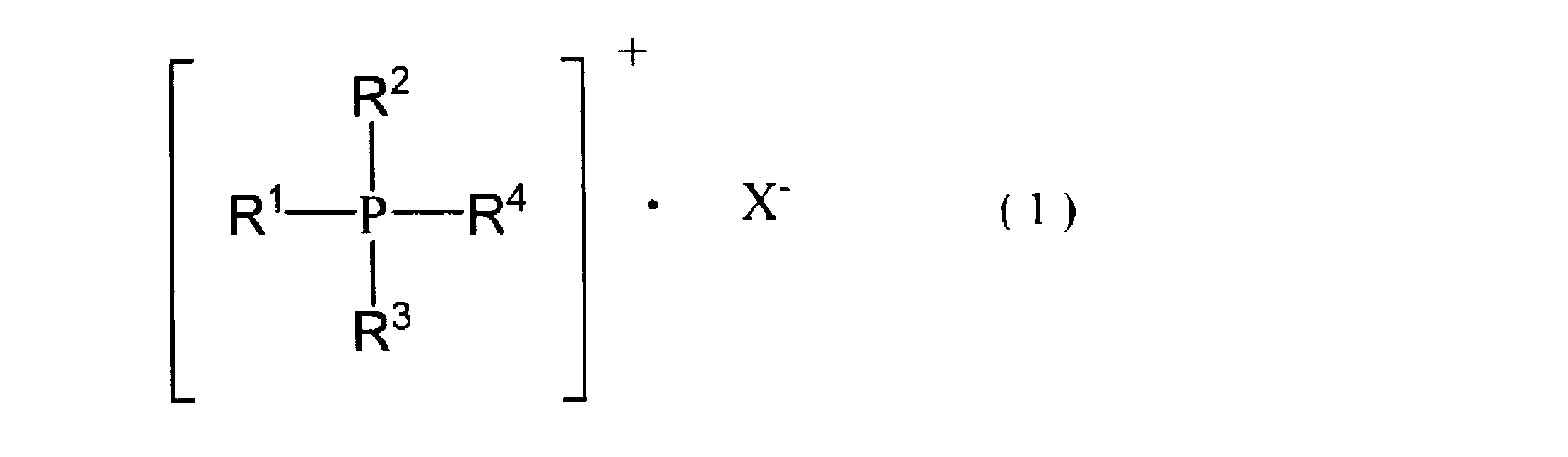
- this invention provides the antiviral agent characterized by including 1 or more types chosen from the phosphonium salt represented by following General formula (1), and its hydrolysis-condensation product. .
- General formula (1) 1 or more types chosen from the phosphonium salt represented by following General formula (1), and its hydrolysis-condensation product.
- R 1 , R 2 and R 3 are linear or branched alkyl groups having 1 to 18 carbon atoms. R 1 to R 3 may be the same group but different from each other.
- R 4 is a linear or branched alkyl group having 1 to 18 carbon atoms or an alkoxysilyl group represented by the following general formula (2), wherein X ⁇ is an anionic group. is there.)
- General formula (2) — (CH 2 ) n —Si— (OR 5 ) 3 (2)
- n is an integer of 1 to 8.
- R 5 is a linear or branched alkyl group having 1 to 5 carbon atoms.
- this invention (2) provides the antiviral agent composition characterized by including 1 or more types chosen from the phosphonium salt represented by following General formula (1), and its hydrolysis-condensation product. It is.
- R 1 , R 2 and R 3 are linear or branched alkyl groups having 1 to 18 carbon atoms. R 1 to R 3 may be the same group but different from each other.
- R 4 is a linear or branched alkyl group having 1 to 18 carbon atoms or an alkoxysilyl group represented by the following general formula (2), wherein X ⁇ is an anionic group. is there.)
- General formula (2) — (CH 2 ) n —Si— (OR 5 ) 3 (2)
- n is an integer of 1 to 8.
- R 5 is a linear or branched alkyl group having 1 to 5 carbon atoms.
- the present invention (3) provides an antiviral material obtained by surface-treating the surface of a substrate with the antiviral composition of (2).
- the present invention (4) provides an antiviral material obtained by impregnating a base material with the antiviral agent composition of (2).
- the present invention (5) is a raw material for a base material comprising at least one selected from the antiviral composition of (2) or a phosphonium salt represented by the following general formula (1) and a hydrolysis condensate thereof.
- the antiviral material obtained by mixing in and then molding the resulting antiviral agent-containing base material is provided.
- R 1 , R 2 and R 3 are linear or branched alkyl groups having 1 to 18 carbon atoms. R 1 to R 3 may be the same group but different from each other.
- R 4 is a linear or branched alkyl group having 1 to 18 carbon atoms or an alkoxysilyl group represented by the following general formula (2), wherein X ⁇ is an anionic group. is there.)
- General formula (2) — (CH 2 ) n —Si— (OR 5 ) 3 (2)
- n is an integer of 1 to 8.
- R 5 is a linear or branched alkyl group having 1 to 5 carbon atoms.
- an antiviral agent having high antiviral activity against viruses particularly influenza viruses and noroviruses
- various antiviral materials having high antiviral activity against viruses, particularly influenza viruses and noroviruses can be provided.
- the antiviral agent of the present invention is an antiviral agent characterized by containing one or more selected from phosphonium salts represented by the following general formula (1) and hydrolysis condensates thereof.
- the phosphonium salt according to the present invention has the general formula (1):
- R 1 , R 2 and R 3 are linear or branched alkyl groups having 1 to 18 carbon atoms, preferably 2 to 10 carbon atoms, particularly preferably 2 to 6 carbon atoms. is there.
- Specific examples of R 1 , R 2 and R 3 include a methyl group, an ethyl group, a propyl group, a butyl group and a pentyl group, and a butyl group, particularly an n-butyl group is preferred.
- R 1 to R 3 may be the same group or different groups.
- R 4 represents a linear or branched alkyl group having 1 to 18 carbon atoms, preferably 1 to 10 carbon atoms, particularly preferably 1 to 8 carbon atoms, or an alkoxysilyl group represented by the following general formula (2) It is a group.
- General formula (2) — (CH 2 ) n —Si— (OR 5 ) 3 (2)
- alkyl group according to R 4 examples include a methyl group, an ethyl group, a propyl group, a butyl group, and a pentyl group.
- n is an integer of 1 to 8, preferably an integer of 2 to 6, particularly preferably 3.
- R 5 is linear or branched alkyl having 1 to 5 carbon atoms, preferably 1 to 3 carbon atoms. R 5 is particularly preferably a methyl group.
- X ⁇ represents an anionic group.
- X ⁇ includes benzotriazole ion, fluorine ion, chlorine ion, bromine ion, iodine ion, BF 4 ⁇ , PF 6 ⁇ , N (SO 2 CF 3 ) 2 ⁇ , PO 2 (OMe) 3 ⁇ and PS 2 ( Anionic groups such as OEt) 2 ⁇ and (CO 2 Me) 2 PhSO 3 — can be mentioned, and among these, chlorine ions are preferred.
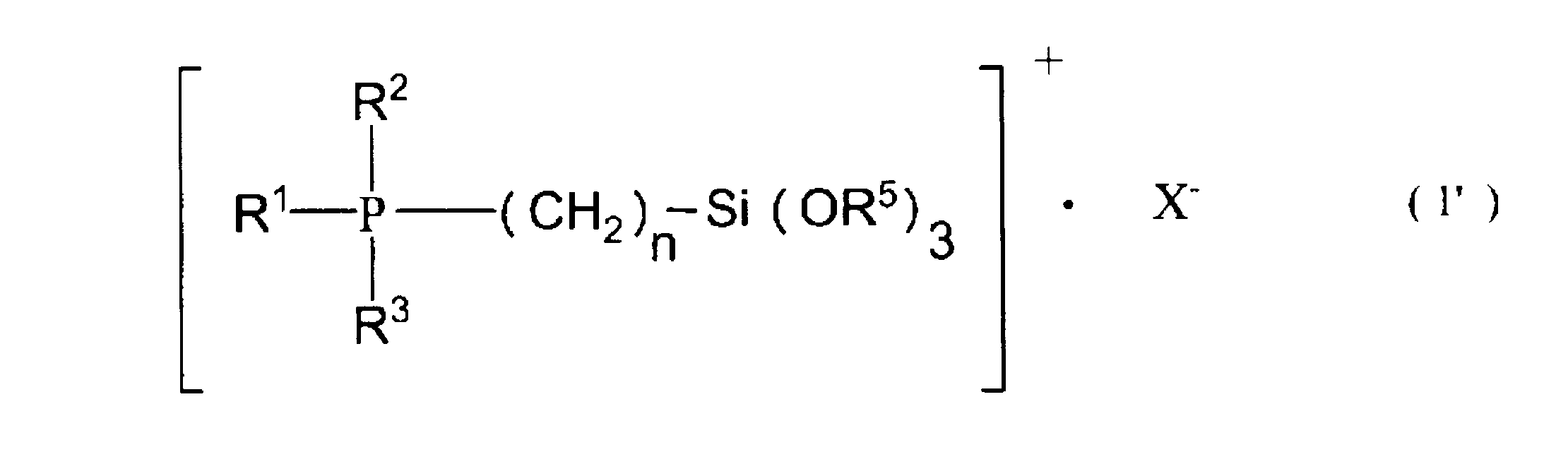
- Examples of the phosphonium salt represented by the general formula (1) include an alkoxysilyl group-containing phosphonium salt represented by the following general formula (1 ′).
- R 1, R 2, R 3, R 5, n and X - is, R 1 in the formula (1), R 2, R 3, R 5, n and X - and It is the same.
- the alkoxysilyl group-containing phosphonium salt represented by the general formula (1 ′) is one in which R 1 , R 2 and R 3 in the general formula (1 ′) are all butyl groups and n is 3. Is preferred.
- the alkoxysilyl group-containing phosphonium salt represented by the general formula (1 ′) has an alkoxysilyl group, it is chemically bonded to a material having an oxygen-containing functional group such as —OH group or —OH— group. Is possible. Therefore, by using the alkoxysilyl group-containing phosphonium salt represented by the general formula (1 ′), various parts such as wood, glass, ceramics, fibers, non-woven fabrics, metals, rubbers, etc. can be used for the portion of the phosphonium salt having antiviral activity. Can be applied to the material.
- the antiviral agent of the present invention includes an phosphonium salt represented by the general formula (1), an alkoxysilyl group-containing phosphonium salt represented by the general formula (1 ′) and a general formula (1) as an active ingredient exhibiting antiviral activity.
- 1 ') 1 or more types of compounds chosen from the hydrolysis-condensation product of the alkoxy silyl group containing phosphonium salt represented.
- the phosphonium salt represented by the general formula (1) and the alkoxysilyl group-containing phosphonium represented by the general formula (1 ') are known compounds (see, for example, JP-A-6-92811).
- the method for obtaining the hydrolysis condensate by hydrolyzing the alkoxysilyl group-containing phosphonium salt represented by the general formula (1 ′) is not particularly limited, but for example, water selected from water, alkali, or acid.
- the method of hydrolyzing with a decomposition agent is mentioned.
- a phosphonium salt represented by the general formula (1), an alkoxysilyl group-containing phosphonium salt represented by the general formula (1 ′), and an alkoxysilyl group represented by the general formula (1 ′) The content of the hydrolyzed condensate of the phosphonium salt (the total content in the case of two or more) is appropriately selected, but is preferably 0.01% by mass or more, particularly preferably 0.01 to 30% by mass. is there.
- the content is the alkoxysilyl group represented by general formula (1') before hydrolysis. It is the content converted into the contained phosphonium salt.
- the antiviral agent of the present invention can contain, as a solvent, alcohol such as methanol and ethanol, water, or a mixed solvent of these alcohol and water. Further, the antiviral agent of the present invention contains auxiliary agents such as surfactants, binders, colorants, dispersants, lubricants, other inorganic or organic diluents, carriers and the like as necessary.
- the method of using the antiviral agent of the present invention is a method of spraying or applying the antiviral agent of the present invention on the surface of an antiviral target article, or the surface of the antiviral target article of the present invention.
- Examples thereof include a method of wiping with a paper or cloth soaked with a virus agent, or a method of immersing an antiviral target article in the antiviral agent of the present invention.
- the antiviral agent of the present invention may be used by directly spraying or applying to the human body such as hands, arms and feet.
- influenza A virus human, bird, swine
- influenza B virus Parainfluenza viruses
- a to E hepatitis viruses measles viruses, herpes viruses, mumps viruses, rabies viruses and other enveloped viruses, noroviruses and other non-enveloped viruses, including influenza viruses, Norovirus is preferred, and norovirus is particularly preferred.
- the antiviral agent composition of the present invention is represented by the general formula (1) as a component for introducing a site exhibiting antiviral activity (a phosphonium salt portion in the general formula (1)) into a substrate.
- a site exhibiting antiviral activity a phosphonium salt portion in the general formula (1)
- One or more compounds selected from hydrolyzed condensates of alkoxysilyl group-containing phosphonium salts represented by the general formula (1 ′) and alkoxysilyl group-containing phosphonium salts represented by the general formula (1 ′) It is an antiviral agent composition characterized by containing.
- Hydrolyzed condensates of silyl group-containing phosphonium salts include phosphonium salts represented by general formula (1), alkoxysilyl group-containing phosphonium salts represented by general formula (1 ′) and general This is the same as the hydrolysis-condensation product of the alkoxysilyl group-containing phosphonium salt represented by the formula (1 ′).
- the antiviral composition of the present invention is used for introducing a phosphonium salt moiety having antiviral activity into a substrate.
- the alkoxysilyl group-containing phosphonium salt represented by the general formula (1 ′) has an alkoxysilyl group, it can be chemically synthesized with a substrate having an oxygen-containing functional group such as —OH group or —OH— group. It is possible to combine. Therefore, the antiviral agent composition of the present invention containing the alkoxysilyl group-containing phosphonium salt represented by the general formula (1 ′) fixes the portion of the phosphonium salt having antiviral activity to the substrate by chemical bonding. be able to.
- the antiviral agent composition of the present invention may contain water, methanol, ethanol, isopropanol and other alcohols as a solvent, and other organic solvents such as toluene, hexane, tetrahydrofuran, diethyl ether, dioxane, acetone, ethyl acetate and the like. it can. Further, the antiviral composition of the present invention contains auxiliary agents such as surfactants, binders, colorants, dispersants, lubricants, other inorganic or organic diluents, carriers and the like as necessary.
- the antiviral composition of the present invention can be used in combination with a fluorine-containing compound, if necessary.
- a fluorine-containing compound a fluoroalkyl group-containing oligomer represented by the following general formula (3) or a hydrolysis-condensation product thereof is particularly preferable.
- the antiviral agent composition of the present invention contains a fluoroalkyl group-containing oligomer or a hydrolyzed condensate thereof, so that the phosphonium salt represented by the general formula (1) and the alkoxy represented by the general formula (1 ′) Even if the addition amount of the hydrolyzed condensate of the silyl group-containing phosphonium salt and the alkoxysilyl group-containing phosphonium salt represented by the general formula (1 ′) is small, excellent antiviral functions can be imparted to various substrates. .
- R 6 and R 7 are — (CF 2 ) pY group, or —CF (CF 3 ) — [OCF 2 CF (CF 3 )] q—OC 3 F 7 group
- R 6 and R 7 may be the same group or different groups
- Y in R 6 and R 7 is a hydrogen atom, a fluorine atom or a chlorine atom
- p and q are 0-10. It is an integer.
- R 8 , R 9 and R 10 may be the same group or different groups, and R 8 , R 9 and R 10 are each a linear alkyl group having 1 to 5 carbon atoms or a carbon number of 1 A branched alkyl group of 5 to 5; m is an integer of 2 to 3.
- the antiviral agent composition of this invention represents with the phosphonium salt represented by General formula (1), the alkoxysilyl group containing phosphonium salt represented by General formula (1 '), and General formula (1').
- One or more compounds selected from the hydrolyzed condensates of alkoxysilyl group-containing phosphonium salts are composite particles containing a fluoroalkyl group-containing oligomer represented by the general formula (3) or a hydrolyzed condensate thereof. Also good. Examples of such composite particles include composite particles disclosed in JP2009-209349A and JP2010-77383A.
- the antiviral composition of the present invention is used for imparting an antiviral function to an object to be imparted with an antiviral function.
- the antiviral composition of the present invention is used to introduce a site having antiviral activity (a phosphonium salt site in the general formula (1)) into various materials.
- the method of using the antiviral agent composition of the present invention includes, for example, (i) applying or spraying the antiviral agent composition of the present invention to the surface of the substrate, and then applying the general formula (1) to the surface of the substrate. And a method of performing surface treatment by adsorbing or binding a phosphonium salt represented by the formula (1) or a site derived therefrom.
- examples of the substrate include paper, rubber, resin, fiber, film, sheet, wood, glass, ceramics, and metal. Examples of the rubber include those described later as the rubber for the substrate. Moreover, what is mentioned later as resin for base materials as resin is mentioned.
- the solvent in the antiviral composition of the present invention is appropriately removed by drying.
- Examples of forms of the method (i) and the antiviral composition of the present invention used therein include a phosphonium salt represented by the general formula (1) and an alkoxysilyl group represented by the general formula (1 ′).
- One or more compounds selected from a hydrolysis condensate of a phosphonium salt and an alkoxysilyl group-containing phosphonium salt represented by the general formula (1 ′) are mixed with a solvent for coating, and if necessary, a pigment, coloring Mixtures of known coating film components such as oils, varnish oils, coating film forming resins, drying agents, plasticizers, fillers, anti-aging agents, UV absorbers, light stabilizers, preservatives, diluents, etc.
- the paint used for painting the painting object corresponds to the antiviral composition of the present invention
- the painting object corresponds to the base material
- the painting object is obtained by painting with a coating material.
- the above corresponds to the antiviral material of the present invention.
- the antiviral agent composition of the present invention is applied to or sprayed on a substrate, or the substrate is immersed in the antiviral agent composition of the present invention, whereby the present invention is incorporated in the substrate.
- a method of impregnating the antiviral agent composition examples of the substrate include paper, rubber, resin, fiber, film, wood, glass, ceramics, and metal. Examples of the rubber include those described later as the rubber for the substrate. Moreover, what is mentioned later as resin for base materials as resin is mentioned.
- the solvent in the antiviral composition of the present invention is appropriately removed by drying.
- the method of applying, spraying or impregnating the antiviral agent composition of the present invention to the substrate is not particularly limited, and for example, brush coating, spraying method, roll Well-known methods, such as a coating method, a spin coat method, a dip coat method, are mentioned.
- (iii) a method of mixing the antiviral agent composition of the present invention into the raw material of the base material, and then molding the obtained antiviral agent composition-containing base material.
- examples of the raw material for the substrate include paper, rubber, and resin.
- the material of the base material is not particularly limited. Fiber, natural resin, non-woven fabric, wood, polybutene resin, polyacrylic acid resin, polyvinyl chloride resin, polyester resin, polypropylene resin, polystyrene resin, polycarbonate resin, polyamide resin, polyamine resin, urethane resin, ABS resin, AS resin, heat Plastic acrylic resin, unsaturated polyester resin, epoxy resin, polyimide resin, cellophane resin, alkyd resin, phenol resin, urea resin, melamine resin, xylene resin, UV curable polyfunctional (meth) acrylate resin, silicone resin or diaryl phthalate resin And resins such as these modified resins, However, rubber, styrene-butadiene rubber (SBR), acrylonitrile-butadiene rubber (NBR), butyl rubber (IIR), polybutadiene rubber (BR), ethylene-propylene rubber
- the material of the substrate is a metal powder, metal or non-metal oxide (hydrous) if it is inorganic.
- Metal silicates including aluminosilicates, metal carbides, metal nitrides, metal carbonates, metal sulfates, metal phosphates, metal sulfides, metal salts, metal halides, stainless steel, geralumin, Examples thereof include inorganic materials such as glass, aluminum, ceramics, activated carbon, and clay minerals.
- the phosphonium salt represented by the general formula (1) in the antiviral agent composition of the present invention the general formula (1)
- the content of the hydrolytic condensate of the alkoxysilyl group-containing phosphonium salt represented by ') and the alkoxysilyl group-containing phosphonium salt represented by the general formula (1') is: Although it is appropriately selected, it is preferably 0.01% by mass or more, particularly preferably 0.01 to 30% by mass.
- the base material is not particularly limited and includes rubber raw materials and resins. It is done.
- the base material is rubber
- examples of the rubber for the base material that is, the rubber used as the matrix of the antiviral material include natural rubber, styrene-butadiene rubber (SBR), acrylonitrile-butadiene rubber (NBR), Butyl rubber (IIR), polybutadiene rubber (BR), ethylene-propylene rubber (EPPM), chlorobutylene rubber (CR), polyisobutylene rubber, allyl rubber, hydrogenated acrylonitrile-butadiene rubber, polysulfide rubber, urethane rubber, chlorosulfone Rubbers, silicone rubbers, modified products thereof, and the like, and two or more kinds of blend rubbers may be used.
- the rubber raw material for producing the rubber for the base material is mixed with the antiviral agent composition of the present invention, and the rubber composition containing the antiviral agent composition of the present invention (antiviral agent-containing group)
- the rubber composition containing the obtained antiviral agent composition of the present invention is molded and rubberized to produce a rubber, thereby producing a site (general formula) having antiviral activity.
- a rubber material containing (the phosphonium salt moiety in (1)) is obtained.
- the base resin that is, the antiviral material matrix Is
- thermoplastic resins such as polyvinyl chloride resin, polyethylene resin, polypropylene resin, polyamide resin, polycarbonate resin, polyester resin, polystyrene resin, ABS resin, AS resin, thermoplastic acrylic resin, epoxy resin, unsaturated polyester resin , Thermosetting resins such as diaryl phthalate resin, phenol resin, urea resin, UV curable polyfunctional (meth) acrylate resin, alkyd resin, melanin resin, guanazine resin, vinyl resin, epoxy resin, polyamine resin, acrylic resin, Polybutadiene resin, urethane resin, Lee fluororesin, fluororesin and the like their modified products thereof.
- thermoplastic resins such as polyvinyl chloride resin, polyethylene resin, polypropylene resin, polyamide resin, polycarbonate resin, polyester resin, polystyrene resin, ABS resin, AS resin, thermoplastic acrylic resin, epoxy resin, unsaturated polyester resin , Thermosetting
- the antiviral agent composition of the present invention is mixed with the thermosetting resin raw material or the ultraviolet curable resin, and the antiviral agent composition of the present invention is mixed. Is obtained, and then the resulting resin composition containing the antiviral agent composition of the present invention is molded and cured to obtain antiviral activity.
- part (The site
- a resin composition (an antiviral agent-containing group) containing the antiviral agent composition of the present invention by melting and mixing the antiviral agent composition of the present invention with the thermoplastic resin.
- the resin composition containing the obtained antiviral agent composition of the present invention is heat-processed to give a site having antiviral activity (a site of the phosphonium salt in the general formula (1)) ) Is obtained.
- a site having antiviral activity a site of the phosphonium salt in the general formula (1)
- the molded product of the resin material include sheets, films, containers, fibers, and the like.
- the antiviral composition of the present invention is used.
- a method of mixing an agent composition simultaneously with a curable resin and other compounds, a method of mixing the antiviral composition of the present invention in advance with one of the curable resin components, and mixing this with the curable resin In the case of a thermoplastic resin, a method of melt-mixing the antiviral composition of the present invention with an extruder, or a method of mechanically mixing particles together and then molding the mixture simultaneously with an injection molding machine Etc.
- the resin composition includes other components such as white carbon, carbon black, zeolite, calcium carbonate, clay, barium sulfate, magnesium carbonate and other inorganic fillers, high styrene resin, lignin, phenol resin, and the like.
- Organic fillers, antibacterial agents, UV absorbers, antioxidants, extenders, dispersion aids, vulcanizing agents, vulcanization accelerators, vulcanization aids, softeners, anti-aging agents, plasticizers, photopolymerization starts An additive known in the art such as an agent may be contained.
- the antiviral agent composition of the present invention When the antiviral agent composition of the present invention is mixed into the raw material of the base material and then the antiviral agent-containing base material is molded, it is represented by the general formula (1) in the antiviral agent-containing base material.
- Content of hydrolysis condensate of phosphonium salt, alkoxysilyl group-containing phosphonium salt represented by general formula (1 ′) and alkoxysilyl group-containing phosphonium salt represented by general formula (1 ′) (contains two or more kinds)
- the total content is appropriately selected, but the content in the non-volatile content excluding volatile components such as solvents is preferably 0.01% by mass or more, particularly preferably 0.01 to 30% by mass. is there.
- the antiviral agent composition of the present invention obtained by surface-treating the surface of a substrate, the substrate is impregnated with the antiviral agent composition of the present invention. Obtained by mixing the antiviral agent composition of the present invention into the raw material of the substrate, and then molding the obtained antiviral agent-containing substrate raw material.
- the antiviral material of the present invention one or more selected from the phosphonium salt represented by the general formula (1) and its hydrolysis condensate are mixed in the raw material of the base material, and then the antiviral material obtained is obtained.
- examples include antiviral materials obtained by molding a virus agent-containing base material.
- Examples of the phosphonium salt represented by the general formula (1) include an alkoxysilyl group-containing phosphonium salt represented by the general formula (1 ′).
- the hydrolyzed condensate of the phosphonium salt contains a phosphonium salt represented by the general formula (1), an alkoxysilyl group-containing phosphonium salt represented by the general formula (1 ′) and the general formula (1) This is the same as the hydrolysis condensate of the alkoxysilyl group-containing phosphonium salt represented by 1 ′).
- Hydrolysis condensate of phosphonium salt represented by general formula (1), alkoxysilyl group-containing phosphonium salt represented by general formula (1 ′), and alkoxysilyl group-containing phosphonium salt represented by general formula (1 ′) In the case where one or more selected from the above are mixed into the raw material of the base material and then the antiviral agent-containing base material is molded, the phosphonium represented by the general formula (1) in the antiviral agent-containing base material Content of hydrolysis condensate of salt, alkoxysilyl group-containing phosphonium salt represented by general formula (1 ′) and alkoxysilyl group-containing phosphonium salt represented by general formula (1 ′) (when two or more kinds are contained) Is a content selected in a nonvolatile matter excluding volatile matter such as a solvent, and is preferably 0.01% by mass or more, particularly preferably 0.01 to 30% by mass.
- the active ingredient is a hydrolysis condensate of an alkoxysilyl group-containing phosphonium salt represented by the general formula (1 ′)
- the content is the alkoxy represented by the general formula (1 ′) before hydrolysis.
- the content is converted to a silyl group-containing phosphonium salt.
- various resins can contain the antiviral component by a generally known method.
- a curable resin such as a thermosetting resin or an ultraviolet curable resin
- a method of mixing these antiviral components simultaneously with the curable resin and other blends one of the curable resin components in advance.
- a method of mixing these antiviral components in advance and mixing them with a curable resin If a thermoplastic resin, a method of melting and mixing these antiviral components with an extruder, or a method of mixing particles. Examples thereof include a method in which uniform mechanical mixing is performed and then molding is performed simultaneously with mixing in an injection molding machine.
- An antiviral material imparted with an antiviral function that is, a phosphonium salt represented by the general formula (1), an alkoxysilyl group-containing phosphonium salt represented by the general formula (1 ′), and a general formula (1 ′)
- a site having an antiviral activity is introduced into the substrate using one or more selected from the hydrolyzed condensates of alkoxysilyl group-containing phosphonium salts
- viruses having an antiviral effect due to the antiviral material of the present invention include influenza A virus (human, bird, swine), influenza B virus , Parainfluenza virus, hepatitis viruses A to E, measles virus, herpes virus, mumps virus, rabies Virus with envelope such-virus, which go up non-envelope viruses such as Norovirus, among these, influenza virus, norovirus
- the antiviral material of the present invention comprises, on a base material, a phosphonium salt represented by the general formula (1), an alkoxysilyl group-containing phosphonium salt represented by the general formula (1 ′), and the general formula (1 ′).
- a phosphonium salt represented by the general formula (1) an alkoxysilyl group-containing phosphonium salt represented by the general formula (1 ′), and the general formula (1 ′).
- the antiviral material of the present invention includes, for example, medical materials, medical devices, masks, gloves, towels, handrails, various fabrics, clothing, furniture, cloths, tableware, rugs, paper bags, cardboard containers, trash cans, trunks, Handbag, shoes, jacket, raincoat, tent, carpet, curtain, chair, desk, window, door handle, door knob, wood, brick, concrete, floor, wall tile, glass, stone, blaster, wallpaper, exterior wall material , Wall material for bath, magnetic tape, floppy disk, hard disk, mouse, keyboard, electronic device, air conditioner filter, touch panel, glasses, sink, kitchen area, toilet, toilet area, bathtub, bathtub Excellent resistance to various items such as surroundings, wash bowls, washrooms, refrigerators, washing machines or parts of vehicles such as airplanes, cars, trains, etc. Grant-virus activity, is used as an antiviral material.
- Example 1 and Comparative Example 1 ⁇ Evaluation of anti-influenza virus> A filter paper was laid in the deep petri dish, and a small amount of sterilized water was added. Place a glass stand of about 5 mm on the filter paper, apply a methanol solution containing 20% by mass of the above antiviral active ingredient on it, vacuum dry for 24 hours to remove the solvent, and antiviral active ingredient A glass plate (50 mm ⁇ 50 mm) chemically fixed was placed.
- a QB phage (NBRC20012) solution of an influenza virus substitute virus acclimated in advance and clarified in concentration was dropped on this, and a polypropylene film (KOYUYO, 40 mm ⁇ 40 mm) was brought into contact with the material surface. ).
- the petri dish was covered with a glass plate.
- the same number of sets for measurement was prepared for the number of times the number of phages was scheduled to be measured, and was left to stand in a dark place at 25 ° C. for 4 hours.
- the host bacteriophage infectivity titer was evaluated using host E.
- V D Viral activity was assessed as V D.
- Table 2 The results are shown in Table 2.
- the untreated glass plate was evaluated similarly, the result was evaluated as the blank 1, and the result was written together in Table 2. Incidentally, indicating that the antiviral activity, the higher the value of V D is larger.
- V D dark effect of antiviral processed material
- B D average value (pfu) of bacteriophage infectivity of 3 test pieces after storing non-antiviral processed test pieces in the dark for 4 hours
- C D Average value (pfu) of bacteriophage infectivity of 3 test pieces after storing the anti-virus processed test pieces in the dark for 4 hours
- Example 2 and Comparative Example 2 ⁇ Evaluation of anti-norovirus> Example 1 and Comparative Example 1 and Comparative Example 1 were used except that instead of QB phage (NBRC20012), Norovirus-replaced ⁇ 6 phage (NBRC105899) was used, and host Pseudomonas aeruginosa (NBRC105640) was used instead of host E. coli (NBRC106373). Similarly, antiviral activity was evaluated as V D. The results are shown in Table 3. Moreover, the untreated glass plate was evaluated similarly, the result was evaluated as the blank 2, and the result was written together in Table 3.
- the phosphonium salt according to the present invention has superior antiviral activity against influenza viruses and noroviruses than the commonly used ammonium salts. In particular, it has been found that it has an excellent antiviral activity against norovirus compared to conventional ammonium salts.
- Example 3 The anti-influenza virus and anti-norovirus were evaluated in the same manner as in Example 1 and Example 2 except that TOSP-Cl was used as an antiviral active ingredient, and the antiviral activity was evaluated as V D. The results are shown in Table 4.
- Example 3 The anti-influenza virus and anti-norovirus were evaluated in the same manner as in Example 1 and Example 2 except that DPSP-Cl was used as an antiviral active ingredient, and the antiviral activity was evaluated as V D. The results are shown in Table 5.
Landscapes
- Life Sciences & Earth Sciences (AREA)
- Health & Medical Sciences (AREA)
- General Health & Medical Sciences (AREA)
- Agronomy & Crop Science (AREA)
- Plant Pathology (AREA)
- Pharmacology & Pharmacy (AREA)
- Animal Behavior & Ethology (AREA)
- Medicinal Chemistry (AREA)
- Public Health (AREA)
- Veterinary Medicine (AREA)
- Chemical & Material Sciences (AREA)
- Pest Control & Pesticides (AREA)
- Epidemiology (AREA)
- Engineering & Computer Science (AREA)
- Dentistry (AREA)
- Wood Science & Technology (AREA)
- Zoology (AREA)
- Environmental Sciences (AREA)
- Agricultural Chemicals And Associated Chemicals (AREA)
- Materials For Medical Uses (AREA)
- Pharmaceuticals Containing Other Organic And Inorganic Compounds (AREA)
Abstract
従来のアンモニウム塩に比べ高い抗ウィルス活性を有する抗ウィルス剤を提供すること。 一般式(1)で表されるホスホニウム塩及びその加水分解縮合物から選ばれる1種以上を含有することを特徴とする抗ウィルス剤。 一般式(1): (式(1)中、R1、R2及びR3は、炭素数1~18の直鎖状又は分岐状のアルキル基である。R1~R3は、同一の基でも、それぞれが異なる基であってもよい。R4は、炭素数1~18の直鎖状又は分岐状のアルキル基、又は一般式(2)で表されるアルコキシシリル基である。X-はアニオン基である。) 一般式(2): -(CH2)n-Si-(OR5)3 (2) (式(2)中、nは1~8の整数である。R5は、炭素数1~5の直鎖状又は分岐状のアルキル基である。)
Description
本発明は、ウィルス、特に、インフルエンザウィルス、ノロウィルスに対して抗ウィルス活性が高い抗ウィルス剤、抗ウィルス剤組成物及び抗ウィルス材料に関するものである。
ウィルスは、その大きさが、細菌の1/10~1/200倍であり、細菌と異なり細胞壁を持たず、他の生物を宿主にしないと増殖出来ないという特徴を持つ。
現在、インフルエンザウィルスやノロウィルス等から引き起こされるウィルス性疾患に関する問題は世界的に大きな問題となっている。
一般的にインフルエンザの感染経路は、飛沫感染、空気感染、接触感染等が知られている。このうち、接触感染は、インフルエンザ感染者から生じた飛沫がいろいろな物体に付着し、それを人が触ることにより二次感染するものである。
また、ノロウィルスの感染経路は、生カキ等の貝類を食することによる経口感染がよく知られているが、ノロウィルスに汚染された物体を、人が触ることにより二次感染することも知られている。
こうした二次感染は、集団感染や感染拡大にもつながり、患者数の増加の大きな原因となっている。
インフルエンザウィルス、ノロウィルスに対する抗ウィルス剤としてアンモニウム塩を用いることが提案されている(例えば、特許文献1~2参照)。
また、ホスホニウム塩は、グラム陽性菌、グラム陰性菌等の菌に対して抗菌活性がある化合物として知られている(例えば、特許文献3~4参照)。また、下記非特許文献1~2には、アルキル(アリール)ホスホニウム塩等がインフルエンザウィルスに対して高い抗ウィルス活性を有することが紹介されている。
Khimiko-Farmatsveticheskij Zhurnal,Vol.24,No.6,p28-30(1990)
Mikrobiologicheskii Zhurnal, Vol.48, No.3, p80-82(1986)
しかしながら、ノロウィルスは、少量存在しても感染することから、アンモニウム塩では抗ウィルス性が不十分である。そこで、アンモニウム塩に比べて、更に抗ウィルス活性が高いものが求められている。
また、ホスホニウム塩については、上述したように、アルキル(アリール)ホスホニウム塩等がインフルエンザウィルスに対して高い抗ウィルス活性を有することが紹介されているが、本出願人らが知る限り、それ以外では、ホスホニウム塩を実際に使用した抗ウィルス剤の報告はない。
従って、本発明の目的は、従来のアンモニウム塩に比べ高い抗ウィルス活性を有する抗ウィルス剤を提供することにある。
本発明者らは、インフルエンザウィルス、ノロウィルスに対する抗ウィルス活性のある化合物を探索する中で、特定のホスホニウム塩及びその加水分解縮合物が、インフルエンザウィルス、ノロウイルス等のウィルスに対して高い抗ウィルス活性を有しており、特に、従来のアンモニウム塩に比べてノロウィルスに対して高い抗ウィルス活性を有していることを見出し、本発明を完成するに到った。
すなわち、本発明(1)は、下記一般式(1)で表されるホスホニウム塩及びその加水分解縮合物から選ばれる1種以上を含有することを特徴とする抗ウィルス剤を提供するものである。
一般式(1):
一般式(1):
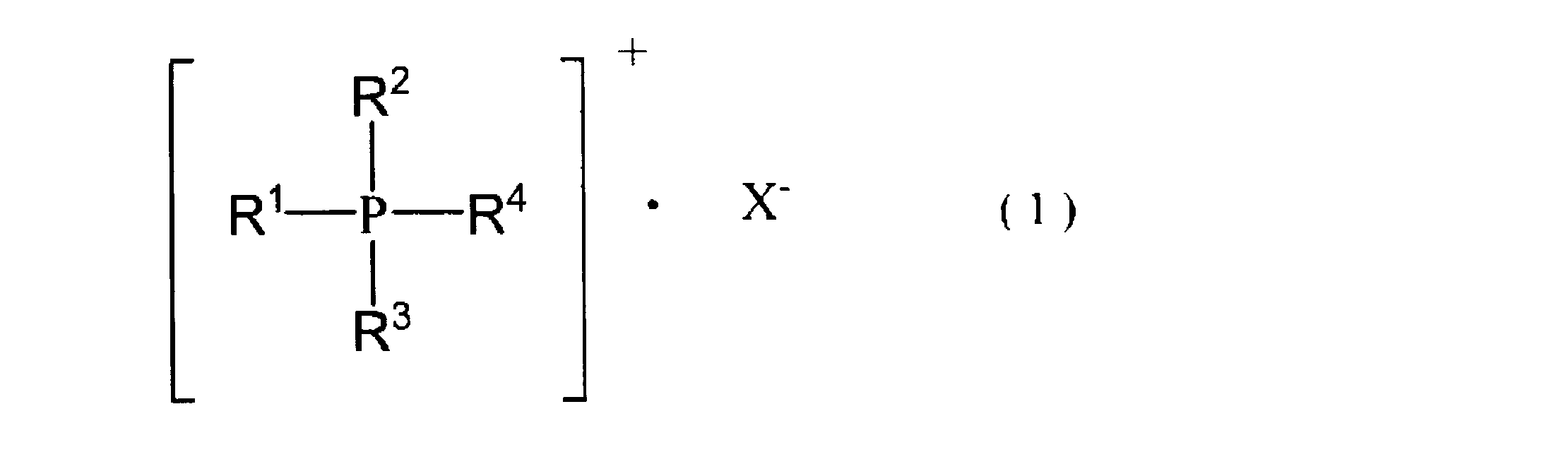
(式(1)中、R1、R2及びR3は、炭素数1~18の直鎖状又は分岐状のアルキル基である。R1~R3は、同一の基でも、それぞれが異なる基であってもよい。R4は、炭素数1~18の直鎖状又は分岐状のアルキル基、又は下記一般式(2)で表されるアルコキシシリル基である。X-はアニオン基である。)
一般式(2):
-(CH2)n-Si-(OR5)3 (2)
(式(2)中、nは1~8の整数である。R5は、炭素数1~5の直鎖状又は分岐状のアルキル基である。)
一般式(2):
-(CH2)n-Si-(OR5)3 (2)
(式(2)中、nは1~8の整数である。R5は、炭素数1~5の直鎖状又は分岐状のアルキル基である。)
また、本発明(2)は、下記一般式(1)で表されるホスホニウム塩及びその加水分解縮合物から選ばれる1種以上を含有することを特徴とする抗ウィルス剤組成物を提供するものである。
一般式(1):
一般式(1):

(式(1)中、R1、R2及びR3は、炭素数1~18の直鎖状又は分岐状のアルキル基である。R1~R3は、同一の基でも、それぞれが異なる基であってもよい。R4は、炭素数1~18の直鎖状又は分岐状のアルキル基、又は下記一般式(2)で表されるアルコキシシリル基である。X-はアニオン基である。)
一般式(2):
-(CH2)n-Si-(OR5)3 (2)
(式(2)中、nは1~8の整数である。R5は、炭素数1~5の直鎖状又は分岐状のアルキル基である。)
一般式(2):
-(CH2)n-Si-(OR5)3 (2)
(式(2)中、nは1~8の整数である。R5は、炭素数1~5の直鎖状又は分岐状のアルキル基である。)
また、本発明(3)は、(2)の抗ウィルス剤組成物で、基材の表面を表面処理することにより得られた抗ウィルス材料を提供するものである。
また、本発明(4)は、(2)の抗ウィルス剤組成物を、基材に含浸させることにより得られた抗ウィルス材料を提供するものである。
また、本発明(5)は、(2)の抗ウィルス剤組成物、又は下記一般式(1)で表されるホスホニウム塩及びその加水分解縮合物から選ばれる1種以上を、基材の原料中に混合し、次いで、得られる抗ウィルス剤含有基材原料を成形することにより得られた抗ウィルス材料を提供するものである。
一般式(1):
一般式(1):

(式(1)中、R1、R2及びR3は、炭素数1~18の直鎖状又は分岐状のアルキル基である。R1~R3は、同一の基でも、それぞれが異なる基であってもよい。R4は、炭素数1~18の直鎖状又は分岐状のアルキル基、又は下記一般式(2)で表されるアルコキシシリル基である。X-はアニオン基である。)
一般式(2):
-(CH2)n-Si-(OR5)3 (2)
(式(2)中、nは1~8の整数である。R5は、炭素数1~5の直鎖状又は分岐状のアルキル基である。)
一般式(2):
-(CH2)n-Si-(OR5)3 (2)
(式(2)中、nは1~8の整数である。R5は、炭素数1~5の直鎖状又は分岐状のアルキル基である。)
本発明によれば、ウィルス、特に、インフルエンザウィルス、ノロウィルスに対して高い抗ウィルス活性を有する抗ウィルス剤を提供することができる。また、本発明によれば、ウィルス、特に、インフルエンザウィルス、ノロウィルスに対して高い抗ウィルス活性を有する各種の抗ウィルス材料を提供することができる。
本発明の抗ウィルス剤は、下記一般式(1)で表されるホスホニウム塩及びその加水分解縮合物から選ばれる1種以上を含有することを特徴とする抗ウィルス剤である。
本発明に係るホスホニウム塩は、一般式(1):
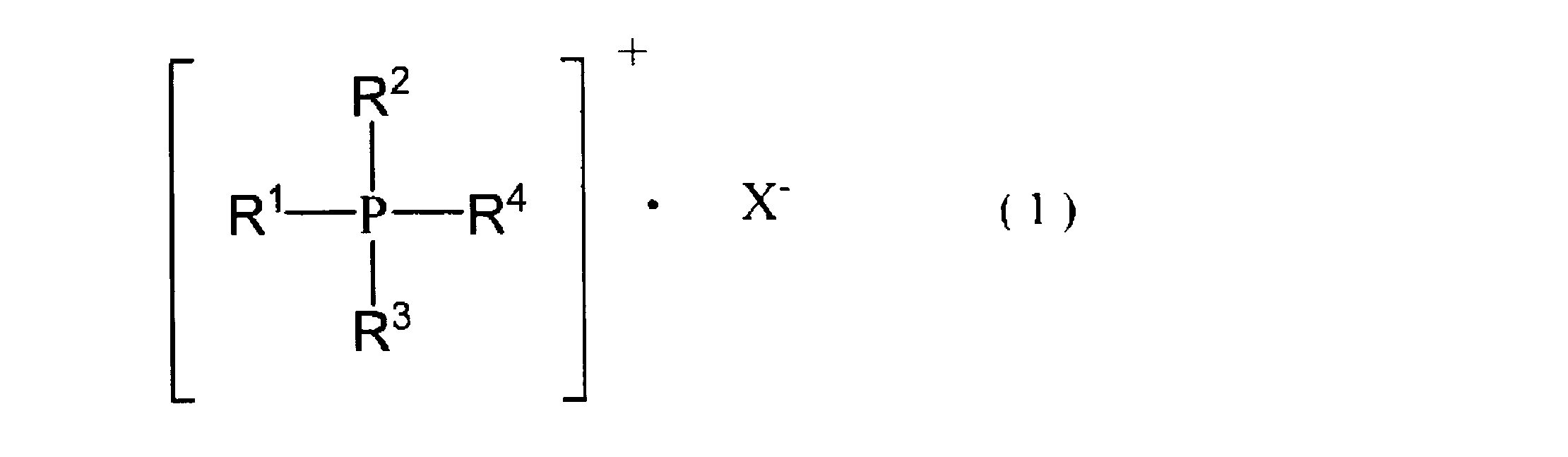
で表されるホスホニウム塩である。
一般式(1)中、R1、R2及びR3は、炭素数1~18、好ましくは炭素数2~10、特に好ましくは炭素数2~6の直鎖状又は分岐状のアルキル基である。R1、R2及びR3としては、具体的には、メチル基、エチル基、プロピル基、ブチル基、ペンチル基等が挙げられ、ブチル基、特にn-ブチル基が好ましい。R1~R3は、同一の基でも、それぞれが異なる基であってもよい。
R4は、炭素数1~18、好ましくは炭素数1~10、特に好ましくは炭素数1~8の直鎖状又は分岐状のアルキル基、又は下記一般式(2)で表されるアルコキシシリル基である。
一般式(2):
-(CH2)n-Si-(OR5)3 (2)
一般式(2):
-(CH2)n-Si-(OR5)3 (2)
R4に係るアルキル基としては、具体的には、メチル基、エチル基、プロピル基、ブチル基、ペンチル基等が挙げられる。
一般式(2)中、nは、1~8の整数、好ましくは2~6の整数、特に好ましくは3である。また、R5は、炭素数1~5、好ましくは炭素数1~3の直鎖状又は分岐状のアルキルである。R5としては、メチル基が特に好ましい。
一般式(1)中、X-はアニオン基である。X-としては、ベンゾトリアゾールイオン、フッ素イオン、塩素イオン、臭素イオン、ヨウ素イオン、BF4
-、PF6
-、N(SO2CF3)2
-、PO2(OMe)3
-、PS2(OEt)2
-、(CO2Me)2PhSO3
-等のアニオン基が挙げられ、この中で、塩素イオンが好ましい。
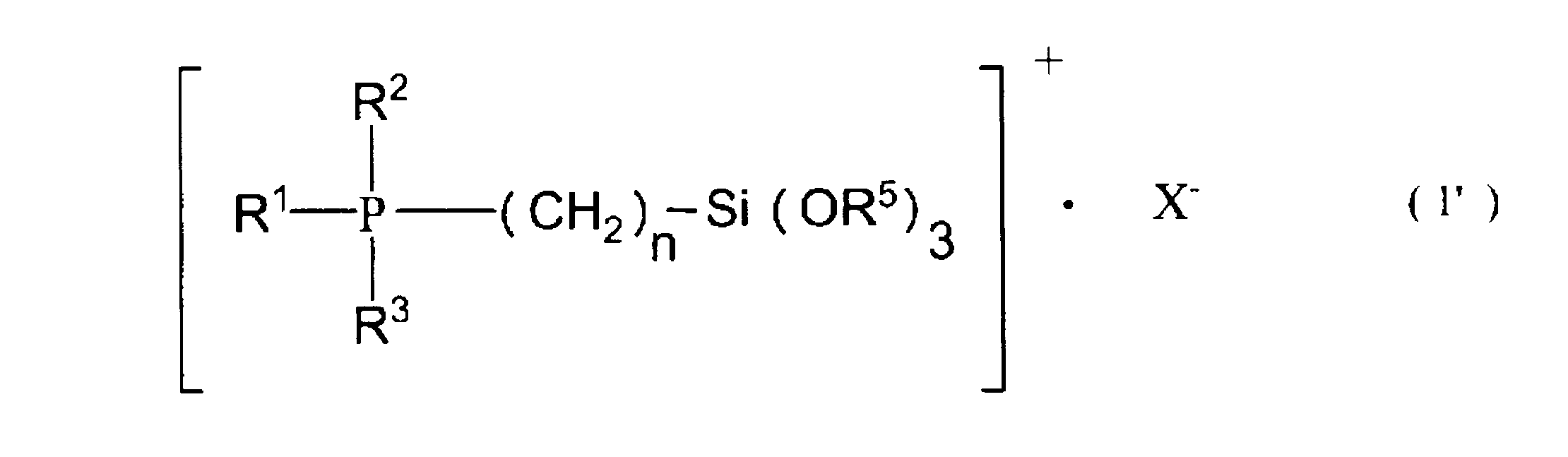
一般式(1)で表されるホスホニウム塩としては、下記一般式(1’)で表されるアルコキシシリル基含有ホスホニウム塩が挙げられる。
一般式(1’):
一般式(1’):
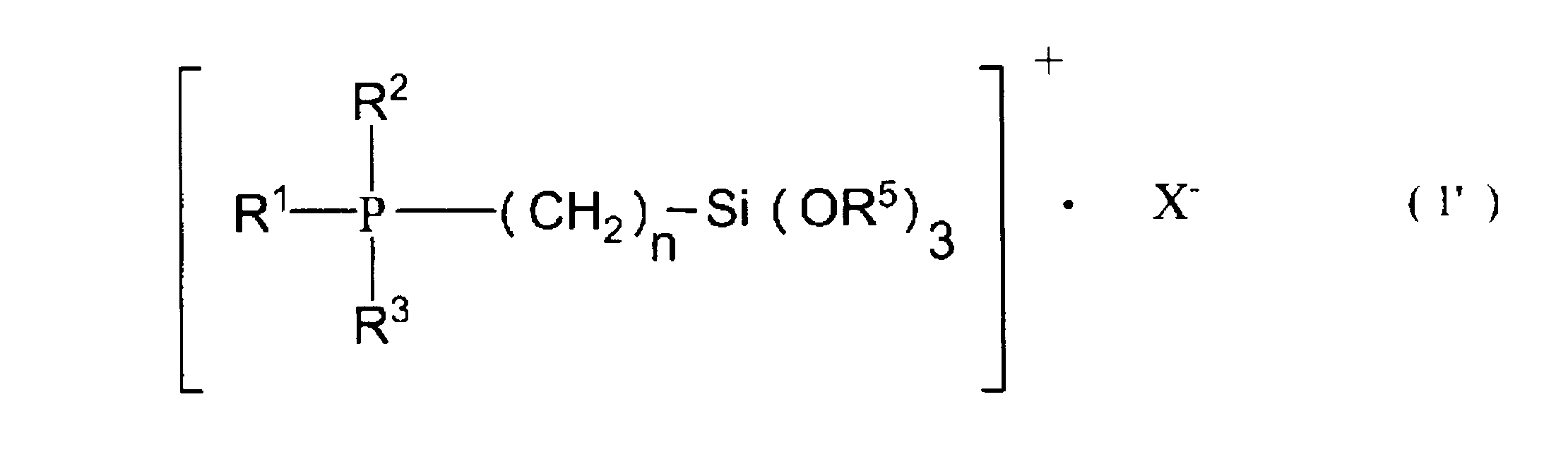
一般式(1’)中、R1、R2、R3、R5、n及びX-は、一般式(1)中のR1、R2、R3、R5、n及びX-と同様である。
一般式(1’)で表されるアルコキシシリル基含有ホスホニウム塩としては、一般式(1’)中のR1、R2及びR3がいずれもがブチル基であり、nが3であるものが好ましい。
一般式(1’)で表されるアルコキシシリル基含有ホスホニウム塩は、アルコキシシリル基を有しているので、-OH基や-OH-基等の含酸素官能基を有する材料と化学結合することが可能である。そのため、一般式(1’)で表されるアルコキシシリル基含有ホスホニウム塩を用いることにより、抗ウィルス活性を有するホスホニウム塩の部位を、木材、ガラス、陶磁器、繊維、不織布、金属、ゴム等の各種材料に付与することができる。
本発明の抗ウィルス剤は、抗ウィルス活性を発揮する有効成分として、一般式(1)で表されるホスホニウム塩、一般式(1’)で表されるアルコキシシリル基含有ホスホニウム塩及び一般式(1’)で表されるアルコキシシリル基含有ホスホニウム塩の加水分解縮合物から選ばれる1種以上の化合物を含有する。
一般式(1)で表されるホスホニウム塩及び一般式(1’)で表されるアルコキシシリル基含有ホスホニウムは、公知の化合物である(例えば、特開平6-92811号公報参照。)。
一般式(1’)で表されるアルコキシシリル基含有ホスホニウム塩を加水分解して、その加水分解縮合物を得る方法としては、特に制限されないが、例えば、水、アルカリ、又は酸から選ばれる加水分解剤により加水分解する方法が挙げられる。
本発明の抗ウィルス剤中、一般式(1)で表されるホスホニウム塩、一般式(1’)で表されるアルコキシシリル基含有ホスホニウム塩及び一般式(1’)で表されるアルコキシシリル基含有ホスホニウム塩の加水分解縮合物の含有量(2種以上の場合は合計含有量)は、適宜選択されるが、好ましくは0.01質量%以上、特に好ましくは0.01~30質量%である。なお、一般式(1’)で表されるアルコキシシリル基含有ホスホニウム塩の加水分解縮合物を含有する場合、その含有量は、加水分解前の一般式(1’)で表されるアルコキシシリル基含有ホスホニウム塩に換算した含有量である。
本発明の抗ウィルス剤は、溶媒として、メタノール、エタノール等のアルコール、水又はこれらアルコールと水の混合溶媒を含有することができる。また、本発明の抗ウィルス剤は、必要に応じて、界面活性剤、結合剤、色剤、分散剤、潤滑剤、その他無機質又は有機質の希釈剤、担体等の助剤を含有する。
本発明の抗ウィルス剤の使用方法であるが、抗ウィルス対象の物品の表面に、本発明の抗ウィルス剤を噴霧又は塗布する方法、あるいは、抗ウィルス対象の物品の表面を、本発明の抗ウィルス剤を浸みこませた紙、布等で拭く方法、あるいは、抗ウィルス対象の物品を、本発明の抗ウィルス剤中に浸漬する方法等が挙げられる。また、本発明の抗ウィルス剤は、手、腕、足等の人体に直接噴霧、或いは塗布して使用しても差し支えない。また、上記使用においては、本発明の抗ウィルス剤を、必要に応じて、水又はメタノール、エタノール等のアルコールで希釈してから使用してもよい。
本発明の抗ウィルス剤が抗ウィルス活性を発揮するウィルスとしては、つまり、本発明の抗ウィルス剤により抗ウィルス効果があるウィルスは、A型インフルエンザウィルス(ヒト、トリ、豚)、B型インフルエンザウィルス、パラインフルエンザウィルス、A~E型の肝炎ウィルス、はしかウィルス、ヘルペスウィルス、ムンプスウィルス、狂犬病ウィルス等のエンベロープを持つウィルス、ノロウィルス等の非エンベローブウィルスが挙がられ、これらのうち、インフルエンザウィルス、ノロウィルスが好ましく、ノロウィルスが特に好ましい。
本発明の抗ウィルス剤組成物は、抗ウィルス活性を発揮する部位(一般式(1)中のホスホニウム塩の部分)を、基材に導入するための成分として、一般式(1)で表されるホスホニウム塩、一般式(1’)で表されるアルコキシシリル基含有ホスホニウム塩及び一般式(1’)で表されるアルコキシシリル基含有ホスホニウム塩の加水分解縮合物から選ばれる1種以上の化合物を含有することを特徴とする抗ウィルス剤組成物である。
本発明の抗ウィルス剤組成物に係る一般式(1)で表されるホスホニウム塩、一般式(1’)で表されるアルコキシシリル基含有ホスホニウム塩及び一般式(1’)で表されるアルコキシシリル基含有ホスホニウム塩の加水分解縮合物は、本発明の抗ウィルス剤に係る一般式(1)で表されるホスホニウム塩、一般式(1’)で表されるアルコキシシリル基含有ホスホニウム塩及び一般式(1’)で表されるアルコキシシリル基含有ホスホニウム塩の加水分解縮合物と同様である。
本発明の抗ウィルス剤組成物は、抗ウィルス活性を有するホスホニウム塩の部位を、基材に導入するために用いられる。そして、一般式(1’)で表されるアルコキシシリル基含有ホスホニウム塩は、アルコキシシリル基を有しているので、-OH基や-OH-基等の含酸素官能基を有する基材と化学結合することが可能である。そのため、一般式(1’)で表されるアルコキシシリル基含有ホスホニウム塩を含有する本発明の抗ウィルス剤組成物は、抗ウィルス活性を有するホスホニウム塩の部位を、基材に化学結合により固定させることができる。
本発明の抗ウィルス剤組成物は、溶媒として、水、メタノール、エタノール、イソプロパノール等アルコール、その他の有機溶媒として、トルエン、ヘキサン、テトラヒドロフラン、ジエチルエーテル、ジオキサン、アセトン、酢酸エチル等を含有することができる。また、本発明の抗ウィルス剤組成物は、必要に応じて、界面活性剤、結合剤、色剤、分散剤、潤滑剤、その他無機質又は有機質の希釈剤、担体等の助剤を含有する。
本発明の抗ウィルス剤組成物は、必要により、含フッ素化合物と併用して用いることが出来る。含フッ素化合物としては、特に下記一般式(3)で表されるフルオロアルキル基含有オリゴマー又はその加水分解縮合物が好ましい。本発明の抗ウィルス剤組成物が、フルオロアルキル基含有オリゴマー又はその加水分解縮合物を含有することで、一般式(1)で表されるホスホニウム塩、一般式(1’)で表されるアルコキシシリル基含有ホスホニウム塩及び一般式(1’)で表されるアルコキシシリル基含有ホスホニウム塩の加水分解縮合物の添加量が少なくても、各種基材に優れた抗ウィルス機能を付与することができる。
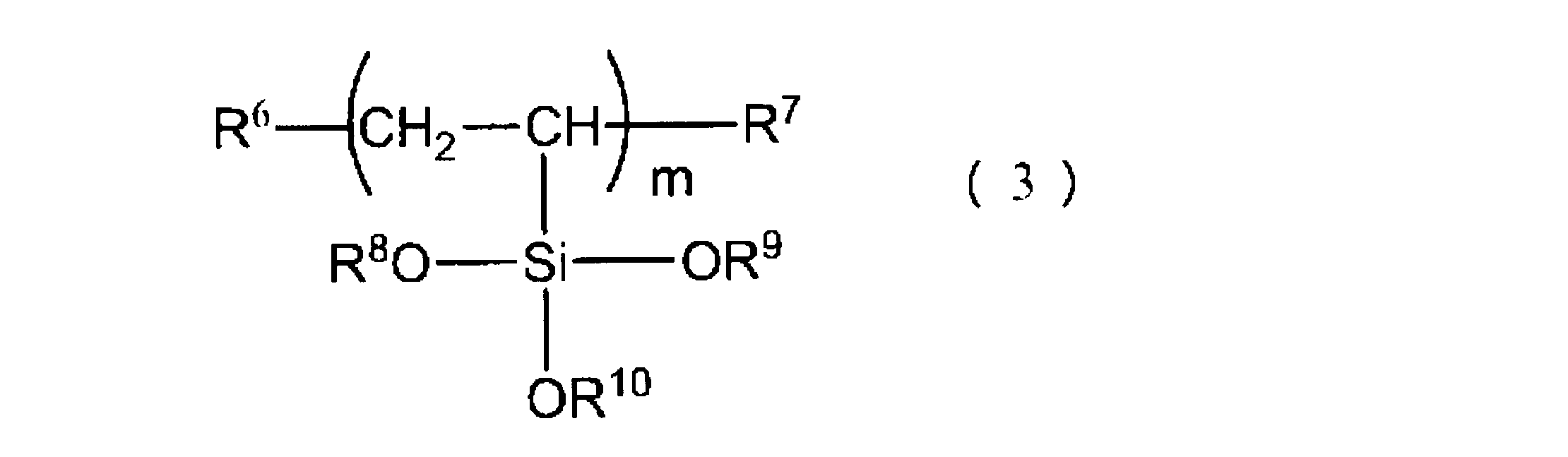
式(3)中、R6及びR7は、-(CF2)p-Y基、又は-CF(CF3)-[OCF2CF(CF3)]q-OC3F7基であり、R6及びR7は、同一の基であっても異なる基であってもよく、R6及びR7中のYは水素原子、フッ素原子又は塩素原子であり、p及びqは0~10の整数である。R8、R9及びR10は、同一の基であっても異なる基であってもよく、R8、R9及びR10は炭素数1~5の直鎖状のアルキル基又は炭素数1~5の分岐状のアルキル基である。mは2~3の整数である。
また、本発明の抗ウィルス剤組成物においては、一般式(1)で表されるホスホニウム塩、一般式(1’)で表されるアルコキシシリル基含有ホスホニウム塩及び一般式(1’)で表されるアルコキシシリル基含有ホスホニウム塩の加水分解縮合物から選ばれる1種以上の化合物は、一般式(3)で表されるフルオロアルキル基含有オリゴマー又はその加水分解縮合物を含むコンポジット粒子であってもよい。このようなコンポジット粒子としては、例えば、特開2009-209349号公報、特開2010-77383号公報のコンポジット粒子が挙がられる。
本発明の抗ウィルス剤組成物は、抗ウィルス機能を付与させる対象物に、抗ウィルス機能を付与するために用いられる。言い換えると、本発明の抗ウィルス剤組成物は、種々の材料に、抗ウィルス活性を有する部位(一般式(1)中のホスホニウム塩の部位)を導入するために用いられる。
本発明の抗ウィルス剤組成物の使用方法としては、例えば、(i)本発明の抗ウィルス剤組成物を、基材の表面に塗布又は噴霧して、基材の表面に一般式(1)で表されるホスホニウム塩又はそれに由来する部位を吸着又は結合させることにより、表面処理を行う方法が挙げられる。(i)の方法において、基材としては、紙、ゴム、樹脂、繊維、フィルム、シート、木材、ガラス、陶磁器、金属等が挙げられる。ゴムとしては、基材用のゴムとして後述するものが挙げられる。また、樹脂としては、基材用の樹脂として後述するものが挙げられる。(i)の方法において、表面処理を行った後、適宜、本発明の抗ウィルス剤組成物中の溶媒を乾燥により除去する。
この(i)の方法及びそれに用いられる本発明の抗ウィルス剤組成物の形態例としては、一般式(1)で表されるホスホニウム塩、一般式(1’)で表されるアルコキシシリル基含有ホスホニウム塩及び一般式(1’)で表されるアルコキシシリル基含有ホスホニウム塩の加水分解縮合物から選ばれる1種以上の化合物を、塗料用の溶剤に混合し、更に、必要により、顔料、着色剤、ワニス等の油、塗膜形成用樹脂、乾燥剤、可塑剤、充填剤、老化防止剤、紫外線吸収剤、光安定剤、防腐剤、希釈剤等の公知の塗膜ビヒクルの成分を混合して、塗料を作製し、得られる塗料を、塗装対象に塗布することにより、塗装対象を塗装すると共に塗装対象の表面を抗ウィルス処理する方法が挙げられる。この形態例では、塗装対象の塗装に用いられる塗料が、本発明の抗ウィルス剤組成物に該当し、また、塗装対象が基材に該当し、また、塗装対象を塗料により塗装して得られたものが、本発明の抗ウィルス材料に該当する。
また、(ii)本発明の抗ウィルス剤組成物を、基材に塗布又は噴霧し、あるいは、本発明の抗ウィルス剤組成物中に、基材を浸漬することにより、基材中に本発明の抗ウィルス剤組成物を含浸させる方法が挙げられる。(ii)の方法において、基材としては、紙、ゴム、樹脂、繊維、フィルム、木材、ガラス、陶磁器、金属が挙げられる。ゴムとしては、基材用のゴムとして後述するものが挙げられる。また、樹脂としては、基材用の樹脂として後述するものが挙げられる。(ii)の方法において、含浸処理を行った後、適宜、本発明の抗ウィルス剤組成物中の溶媒を乾燥により除去する。
上記(i)及び(ii)の方法において、本発明の抗ウィルス剤組成物を、基材に、塗布、噴霧又は含浸させる方法としては、特に制限されないが、例えば、刷毛塗、スプレー法、ロールコーティング法、スピンコート法、ディップコート法等の公知の方法が挙げられる。
また、(iii)本発明の抗ウィルス剤組成物を、基材の原料中に混合し、次いで、得られる抗ウィルス剤組成物含有基材原料を成形する方法が挙げられる。(iii)の方法において、基材の原料としては、紙、ゴム、樹脂等が挙げられる。
本発明の抗ウィルス剤組成物を、基材に、塗布、噴霧又は含浸させる場合、基材の材質としては、その種類には、特に限定はないが、例えば、有機質のものであれば、天然繊維、天然樹脂、不織布、木材、ポリブテン樹脂、ポリアクリル酸樹脂、ポリ塩化ビニル樹脂、ポリエステル樹脂、ポリプロピレン樹脂、ポリスチレン樹脂、ポリカーボネート樹脂、ポリアミド樹脂、ポリアミン樹脂、ウレタン樹脂、ABS樹脂、AS樹脂、熱可塑性アクリル樹脂、不飽和ポリエステル樹脂、エポキシ樹脂、ポリイミド樹脂、セロハン樹脂、アルキツド樹脂、フェノール樹脂、尿素樹脂、メラミン樹脂、キシレン樹脂、紫外線硬化性多官能(メタ)アクリレート樹脂、シリコーン樹脂またはジアリールフタレート樹脂及びこれらの変性樹脂等の樹脂、天然ゴム、スチレン-ブタジエン系ゴム(SBR)、アクロニトリル-ブタジエン系ゴム(NBR)、ブチルゴム(IIR)、ポリブタジエンゴム(BR)、エチレン-プロピレン系ゴム(EPPM)、クロロブチレンゴム(CR)、ポリイソブチレンゴム、アルリルゴム、水素化アクロニトリル-ブタジエンゴム、多硫化ゴム、ウレタンゴム、クリリスルホン化ゴム、シリコーンゴム及びこれらの変性物のゴムが挙げられ、これらは、2種以上のブレンド品であってもよい。
また、本発明の抗ウィルス剤組成物を、基材に、塗布、噴霧又は含浸させる場合、基材の材質としては、無機質のものであれば、金属粉末、金属又は非金属の酸化物(含水物も含む)、アルミノ珪酸塩を含む金属珪酸塩、金属炭化物、金属窒化物、金属炭酸塩、金属硫酸塩、金属リン酸塩、金属硫化物、金属酸塩、金属ハロゲン化物、ステンレス、ジェラルミン、ガラス、アルミニウム、セラミックス、活性炭、粘土鉱物等の無機質材料等が挙げられる。
また、本発明の抗ウィルス剤組成物を、基材に、塗布、噴霧又は含浸させる場合、本発明の抗ウィルス剤組成物中、一般式(1)で表されるホスホニウム塩、一般式(1’)で表されるアルコキシシリル基含有ホスホニウム塩及び一般式(1’)で表されるアルコキシシリル基含有ホスホニウム塩の加水分解縮合物の含有量(2種以上の場合は合計含有量)は、適宜選択されるが、好ましくは0.01質量%以上、特に好ましくは0.01~30質量%である。なお、一般式(1’)で表されるアルコキシシリル基含有ホスホニウム塩の加水分解縮合物の場合、その含有量は、加水分解前の一般式(1’)で表されるアルコキシシリル基含有ホスホニウム塩に換算した含有量である。
本発明の抗ウィルス剤組成物を基材の原料中に混合し、次いで、抗ウィルス剤含有基材原料を成形する場合、基材の原料としては、特に制限されず、ゴム原料、樹脂が挙げられる。基材がゴムの場合、基材用のゴム、すなわち、抗ウィルス材料のマトリックスとなるゴムとしては、例えば、天然ゴム、スチレン-ブタジエン系ゴム(SBR)、アクロニトリル-ブタジエン系ゴム(NBR)、ブチルゴム(IIR)、ポリブタジエンゴム(BR)、エチレン-プロピレン系ゴム(EPPM)、クロロブチレンゴム(CR)、ポリイソブチレンゴム、アリルゴム、水素化アクロニトリル-ブタジエンゴム、多硫化ゴム、ウレタンゴム、クロロスルホン化ゴム、シリコーンゴム及びこれらの変性物等が挙げられ、これらは、2種以上のブレンドゴムであってもよい。そして、上記基材用のゴムを製造するためのゴム原料に、本発明の抗ウィルス剤組成物を混合して、本発明の抗ウィルス剤組成物を含有するゴム組成物(抗ウィルス剤含有基材原料)を得、次いで、得られた本発明の抗ウィルス剤組成物を含有するゴム組成物を成形し、ゴム化させて、ゴムを製造することにより、抗ウィルス活性を有する部位(一般式(1)中のホスホニウム塩の部位)を含有するゴム材料が得られる。
本発明の抗ウィルス剤組成物を基材の原料中に混合し、次いで、抗ウィルス剤含有基材原料を成形する場合において、基材となる樹脂、つまり、抗ウィルス材料のマトリックスとなる樹脂としては、例えば、ポリ塩化ビニル樹脂、ポリエチレン樹脂、ポリプロピレン樹脂、ポリアミド樹脂、ポリカーボネート樹脂、ポリエステル樹脂、ポリスチレン樹脂、ABS樹脂、AS樹脂、熱可塑性アクリル樹脂等の熱可塑性樹脂、エポキシ樹脂、不飽和ポリエステル樹脂、ジアリールフタレート樹脂、フェノール樹脂、尿素樹脂等の熱硬化性樹脂、紫外線硬化性多官能(メタ)アクリレート樹脂、アルキド樹脂、メラニン樹脂、グアナジン樹脂、ビニル系樹脂、エポキシ樹脂、ポリアミン樹脂、アクリル樹脂、ポリブタジエン樹脂、ウレタン樹脂、ケイ素樹脂、含フッ素樹脂及びそれらの変性物等が挙げられる。そして、基材が熱硬化性樹脂や紫外線硬化性樹脂の場合、熱硬化性樹脂原料や紫外線硬化性樹脂に、本発明の抗ウィルス剤組成物を混合して、本発明の抗ウィルス剤組成物を含有する樹脂組成物(抗ウィルス剤含有基材原料)を得、次いで、得られた本発明の抗ウィルス剤組成物を含有する樹脂組成物を成形し、硬化させることにより、抗ウィルス活性を有する部位(一般式(1)中のホスホニウム塩の部位)を含有する樹脂材料が得られる。また、基材が熱可塑性樹脂の場合、熱可塑性樹脂に、本発明の抗ウィルス剤組成物を溶融混合して、本発明の抗ウィルス剤組成物を含有する樹脂組成物(抗ウィルス剤含有基材原料)を得、次いで、得られた本発明の抗ウィルス剤組成物を含有する樹脂組成物を加熱加工することにより、抗ウィルス活性を有する部位(一般式(1)中のホスホニウム塩の部位)を含有する樹脂材料が得られる。樹脂材料の成形品としては、シート、フィルム、容器、繊維等が挙げられる。
本発明の抗ウィルス剤組成物を用いて、抗ウィルス材料を製造する方法としては、例えば、基材が熱硬化性樹脂や紫外線硬化性樹脂等の硬化性樹脂であれば、本発明の抗ウィルス剤組成物を硬化性樹脂及びその他の配合物と同時に混入する方法、硬化性樹脂成分の1種に予め本発明の抗ウィルス剤組成物を混合しておき、これを硬化性樹脂と混合する方法、熱可塑性樹脂であれば、本発明の抗ウィルス剤組成物をエクストルーダーで溶融混合する方法、あるいは粒子状物どうしを均一に機械的に混合した後、射出成形機で混合と同時に成形する方法等が挙げられる。
また、上記樹脂組成物には、他の成分としては、例えば、ホワイトカーボン、カーボンブラック、ゼオライト、炭酸カルシウム、クレー、硫酸バリウム、炭酸マグネシウム等の無機質充填剤、ハイスチレン樹脂、リグニン、フェノール樹脂等の有機質充填剤、抗菌剤、紫外線吸収剤、酸化防止剤、体質顔料、分散助剤、加硫剤、加硫促進剤、加硫助剤、軟化剤、老化防止剤、可塑剤、光重合開始剤等の当分野で公知の添加剤を含有していてもよい。
本発明の抗ウィルス剤組成物を基材の原料中に混合し、次いで、抗ウィルス剤含有基材原料を成形する場合、抗ウィルス剤含有基材原料中の一般式(1)で表されるホスホニウム塩、一般式(1’)で表されるアルコキシシリル基含有ホスホニウム塩及び一般式(1’)で表されるアルコキシシリル基含有ホスホニウム塩の加水分解縮合物の含有量(2種以上含有する場合は合計含有量)は、適宜選択されるが、溶媒等の揮発分を除いた不揮発分中の含有量で、好ましくは0.01質量%以上、特に好ましくは0.01~30質量%である。なお、一般式(1’)で表されるアルコキシシリル基含有ホスホニウム塩の加水分解縮合物の場合、その含有量は、加水分解前の一般式(1’)で表されるアルコキシシリル基含有ホスホニウム塩に換算した含有量である。
本発明の抗ウィルス材料としては、本発明の抗ウィルス剤組成物で、基材の表面を表面処理することにより得られたもの、本発明の抗ウィルス剤組成物を、基材に含浸させることにより得られたもの、本発明の抗ウィルス剤組成物を、基材の原料中に混合し、次いで、得られる抗ウィルス剤含有基材原料を成形することにより得られたものが挙げられる。
また、本発明の抗ウィルス材料としては、一般式(1)で表されるホスホニウム塩及びその加水分解縮合物から選ばれる1種以上を、基材の原料中に混合し、次いで、得られる抗ウィルス剤含有基材原料を成形することにより得られた抗ウィルス材料が挙げられる。一般式(1)で表されるホスホニウム塩としては、一般式(1’)で表されるアルコキシシリル基含有ホスホニウム塩が挙げられる。
本発明の抗ウィルス材料に係る一般式(1)で表されるホスホニウム塩、一般式(1’)で表されるアルコキシシリル基含有ホスホニウム塩及び一般式(1’)で表されるアルコキシシリル基含有ホスホニウム塩の加水分解縮合物は、本発明の抗ウィルス剤に係る一般式(1)で表されるホスホニウム塩、一般式(1’)で表されるアルコキシシリル基含有ホスホニウム塩及び一般式(1’)で表されるアルコキシシリル基含有ホスホニウム塩の加水分解縮合物と同様である。
一般式(1)で表されるホスホニウム塩、一般式(1’)で表されるアルコキシシリル基含有ホスホニウム塩及び一般式(1’)で表されるアルコキシシリル基含有ホスホニウム塩の加水分解縮合物から選ばれる1種以上を、基材の原料中に混合し、次いで、抗ウィルス剤含有基材原料を成形する場合、抗ウィルス剤含有基材原料中の一般式(1)で表されるホスホニウム塩、一般式(1’)で表されるアルコキシシリル基含有ホスホニウム塩及び一般式(1’)で表されるアルコキシシリル基含有ホスホニウム塩の加水分解縮合物の含有量(2種以上含有する場合は合計含有量)は、適宜選択されるが、溶媒等の揮発分を除いた不揮発分中の含有量で、好ましくは0.01質量%以上、特に好ましくは0.01~30質量%である。なお、有効成分が、一般式(1’)で表されるアルコキシシリル基含有ホスホニウム塩の加水分解縮合物の場合、その含有量は、加水分解前の一般式(1’)で表されるアルコキシシリル基含有ホスホニウム塩に換算した含有量である。
一般式(1)で表されるホスホニウム塩、一般式(1’)で表されるアルコキシシリル基含有ホスホニウム塩及び一般式(1’)で表されるアルコキシシリル基含有ホスホニウム塩の加水分解縮合物から選ばれる1種以上(抗ウィルス剤成分)を、樹脂中に含有させる方法としては、通常公知の方法で各種樹脂に抗ウィルス剤成分を含有させることができる。例えば、熱硬化性樹脂や紫外線硬化性樹脂等の硬化性樹脂であれば、これらの抗ウィルス剤成分を硬化性樹脂及びその他の配合物と同時に混入する方法、硬化性樹脂成分の1種に予めこれらの抗ウィルス剤成分を混合しておき、これを硬化性樹脂と混合する方法、熱可塑性樹脂であれば、これらの抗ウィルス剤成分をエクストルーダーで溶融混合する方法、あるいは粒子状物どうしを均一に機械的に混合した後、射出成形機で混合と同時に成形する方法等が挙げられる。
抗ウィルス機能が付与された抗ウィルス材料、すなわち、一般式(1)で表されるホスホニウム塩、一般式(1’)で表されるアルコキシシリル基含有ホスホニウム塩及び一般式(1’)で表されるアルコキシシリル基含有ホスホニウム塩の加水分解縮合物から選ばれる1種以上を用いて、抗ウィルス活性を有する部位(一般式(1)中のホスホニウム塩の部分)が基材に導入されることにより得られた材料が、抗ウィルス活性を発揮するウィルスとしては、つまり、本発明の抗ウィルス材料により抗ウィルス効果があるウィルスは、A型インフルエンザウィルス(ヒト、トリ、豚)、B型インフルエンザウィルス、パラインフルエンザウィルス、A~E型の肝炎ウィルス、はしかウィルス、ヘルペスウィルス、ムンプスウィルス、狂犬病ウィルス等のエンベロープを持つウィルス、ノロウィルス等の非エンベローブウィルスが挙がられ、これらのうち、インフルエンザウィルス、ノロウィルスが好ましく、ノロウィルスが特に好ましい。
このように、本発明の抗ウィルス材料は、基材に、一般式(1)で表されるホスホニウム塩、一般式(1’)で表されるアルコキシシリル基含有ホスホニウム塩及び一般式(1’)で表されるアルコキシシリル基含有ホスホニウム塩の加水分解縮合物から選ばれる1種以上そのもの、又はそれに由来する抗ウィルス活性を有する部位、すなわち、一般式(1)中のホスホニウム塩の部位が導入されている材料である。
本発明の抗ウィルス材料は、例えば、医療用材料、医療用機器、マスク、手袋、タオル、手すり、各種の織物、衣料、家具、掛け布、食器、敷物、紙袋、厚紙容器、ゴミ箱、トランク、ハンドバック、靴、ジャケット、レインコート、テント、カーペット、カーテン、椅子、机、窓、ドアの取手、ドアのノブ、木材、煉瓦、コンクリート、床、壁タイル、ガラス、石、ブラスター、壁紙、外壁材、風呂用壁材、更には、磁気テープ、フロッピー(登録商標)ディスク、ハードディスク、マウス、キーボード、電子機器、空調機器のフィルター、タッチパネル、メガネ、流し、台所周り、便器、トイレ周り、浴槽、浴槽周り、洗面ボウル、洗面所周り、冷蔵庫、洗濯機或いは飛行機、自動車、電車等の乗り物の部材等の各種のものに優れた抗ウィルス活性を付与し、抗ウィルス材料として使用される。
以下、本発明を実施例を挙げて説明するが、本発明はこれらに限定されるものではない。
<抗ウィルス有効成分>
抗ウィルス有効成分として、下記表1に示した4種の化合物を用いた。
<抗ウィルス有効成分>
抗ウィルス有効成分として、下記表1に示した4種の化合物を用いた。
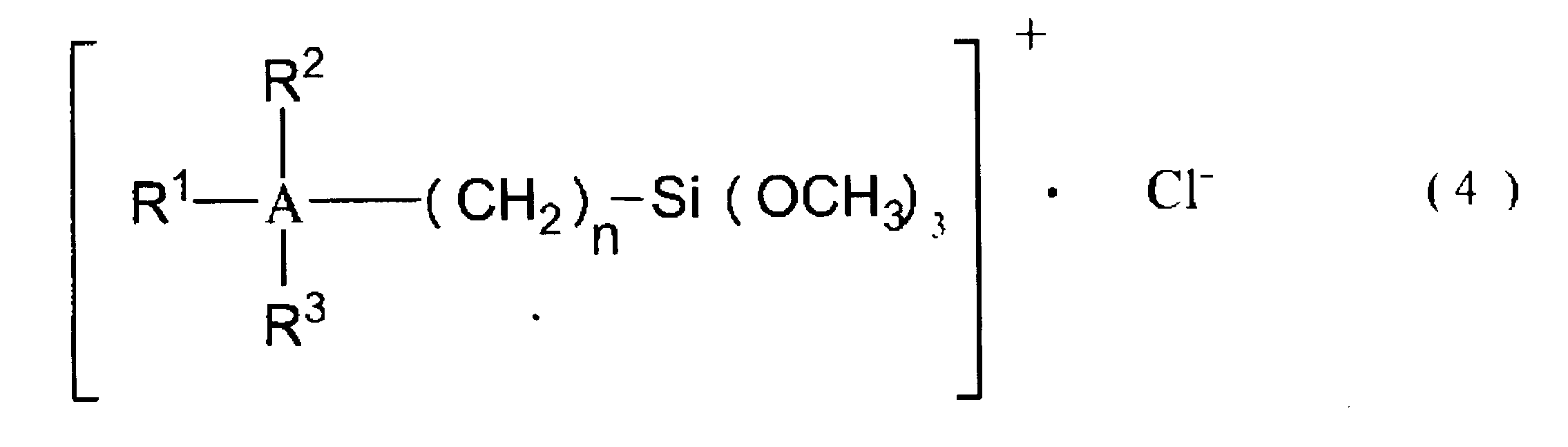
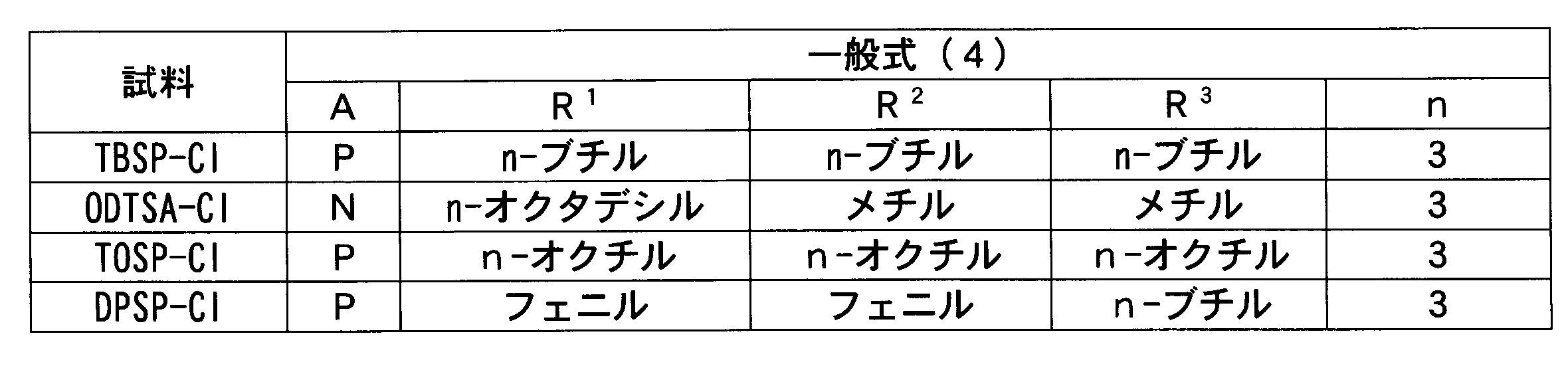
(実施例1及び比較例1)
<抗インフルエンザウィルスに関する評価>
深型シャーレ内にろ紙を敷き、少量の滅菌水を加えた。ろ紙の上に5mm程度のガラス製の台を置き、その上に前記の抗ウィルス有効成分を20質量%含むメタノール溶液を塗布し、24時間真空乾燥して溶媒を除去して、抗ウィルス有効成分を化学的に固定化したガラス板(50mm×50mm)を置いた。この上に予め馴化しておき濃度も明らかにっているインフルエンザウィルス代替ウィルスのQBファージ(NBRC20012)溶液を0.1ml滴下し、材料表面とファージを接触させるためにポリプロピレンフィルム(KOYUYO、40mm×40mm)を被せた。このシャーレにガラス板で蓋をした。同様の測定用セットをファージ数の測定予定回数の数だけ用意し、25℃の暗所に4時間静置した。
次いで、JIS R 1706に基づき、宿主大腸菌(NBRC106373)を用いて、バクテリオファージ感染価を評価し、下記計算式(1)のハイブリッド光触媒抗ウィルス加工材料の暗所での効果の計算式に基づき抗ウィルス活性をVDとして評価した。その結果を表2に示す。また、無処理のガラス板を同様に評価し、その結果をブランク1として評価し、その結果を表2に併記した。
なお、VDの値が大きいほど抗ウィルス活性が高いことを示す。
<抗インフルエンザウィルスに関する評価>
深型シャーレ内にろ紙を敷き、少量の滅菌水を加えた。ろ紙の上に5mm程度のガラス製の台を置き、その上に前記の抗ウィルス有効成分を20質量%含むメタノール溶液を塗布し、24時間真空乾燥して溶媒を除去して、抗ウィルス有効成分を化学的に固定化したガラス板(50mm×50mm)を置いた。この上に予め馴化しておき濃度も明らかにっているインフルエンザウィルス代替ウィルスのQBファージ(NBRC20012)溶液を0.1ml滴下し、材料表面とファージを接触させるためにポリプロピレンフィルム(KOYUYO、40mm×40mm)を被せた。このシャーレにガラス板で蓋をした。同様の測定用セットをファージ数の測定予定回数の数だけ用意し、25℃の暗所に4時間静置した。
次いで、JIS R 1706に基づき、宿主大腸菌(NBRC106373)を用いて、バクテリオファージ感染価を評価し、下記計算式(1)のハイブリッド光触媒抗ウィルス加工材料の暗所での効果の計算式に基づき抗ウィルス活性をVDとして評価した。その結果を表2に示す。また、無処理のガラス板を同様に評価し、その結果をブランク1として評価し、その結果を表2に併記した。
なお、VDの値が大きいほど抗ウィルス活性が高いことを示す。

VD:抗ウィルス加工材料の暗所効果
BD:抗ウィルス加工していない試験片を4時間暗所に保存した後の3試験片のバクテリオファージ感染価の平均値(pfu)
CD:抗ウィルス加工した試験片を4時間暗所に保存した後の3試験片のバクテリオファージ感染価の平均値(pfu)
BD:抗ウィルス加工していない試験片を4時間暗所に保存した後の3試験片のバクテリオファージ感染価の平均値(pfu)
CD:抗ウィルス加工した試験片を4時間暗所に保存した後の3試験片のバクテリオファージ感染価の平均値(pfu)

(実施例2及び比較例2)
<抗ノロウィルスに関する評価>
QBファージ(NBRC20012)の代りに、ノロウィルス代替のф6ファージ(NBRC105899)を用い、宿主大腸菌(NBRC106373)に代えて宿主緑膿菌(NBRC105640)を用いた以外は、実施例1及び比較例1と同様に、抗ウィルス活性をVDとして評価した。その結果を表3に示す。また、無処理のガラス板を同様に評価し、その結果をブランク2として評価し、その結果を表3に併記した。
<抗ノロウィルスに関する評価>
QBファージ(NBRC20012)の代りに、ノロウィルス代替のф6ファージ(NBRC105899)を用い、宿主大腸菌(NBRC106373)に代えて宿主緑膿菌(NBRC105640)を用いた以外は、実施例1及び比較例1と同様に、抗ウィルス活性をVDとして評価した。その結果を表3に示す。また、無処理のガラス板を同様に評価し、その結果をブランク2として評価し、その結果を表3に併記した。
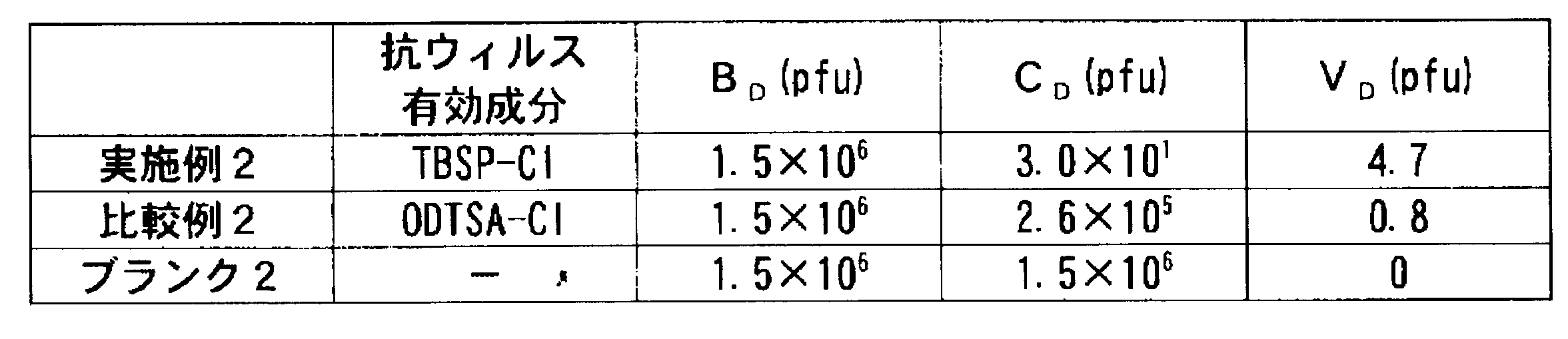
表2及び表3の結果より、通常用いられているアンモニウム塩よりも、本発明に係るホスホニウム塩は、インフルエンザウィルス及びノロウィルスに対して優れた抗ウィルス活性を有していることが分かった。特に、従来のアンモニウム塩に比べて、ノロウィルスに対して優れた抗ウィルス活性を有していることが分かった。
(実施例3)
抗ウィルス有効成分として、TOSP-Clを用いた以外は実施例1及び実施例2と同様にして抗インフルエンザウィルス及び抗ノロウィルスに関する評価を行い、抗ウィルス活性をVDとして評価した。その結果を表4に示す。
抗ウィルス有効成分として、TOSP-Clを用いた以外は実施例1及び実施例2と同様にして抗インフルエンザウィルス及び抗ノロウィルスに関する評価を行い、抗ウィルス活性をVDとして評価した。その結果を表4に示す。

(比較例3)
抗ウィルス有効成分として、DPSP-Clを用いた以外は実施例1及び実施例2と同様にして抗インフルエンザウィルス及び抗ノロウィルスに関する評価を行い、抗ウィルス活性をVDとして評価した。その結果を表5に示す。
抗ウィルス有効成分として、DPSP-Clを用いた以外は実施例1及び実施例2と同様にして抗インフルエンザウィルス及び抗ノロウィルスに関する評価を行い、抗ウィルス活性をVDとして評価した。その結果を表5に示す。

Claims (12)
- 下記一般式(1)で表されるホスホニウム塩及びその加水分解縮合物から選ばれる1種以上を含有することを特徴とする抗ウィルス剤。
一般式(1):

一般式(2):
-(CH2)n-Si-(OR5)3 (2)
(式(2)中、nは1~8の整数である。R5は、炭素数1~5の直鎖状又は分岐状のアルキル基である。) - 前記一般式(1)で表されるホスホニウム塩が、下記一般式(1’)で表されるアルコキシシリル基含有ホスホニウム塩であることを特徴とする請求項1記載の抗ウィルス剤。
- 前記一般式(1’)中のR1~R3がいずれもブチル基であり、nが3であることを特徴とする請求項2記載の抗ウィルス剤。
- 前記ウィルスが、インフルエンザウィルス及びノロウィルスから選ばれる少なくとも1種であることを特徴とする請求項1~3のいずれか1項記載の抗ウィルス剤。
- 下記一般式(1)で表されるホスホニウム塩及びその加水分解縮合物から選ばれる1種以上を含有することを特徴とする抗ウィルス剤組成物。
一般式(1):
一般式(2):
-(CH2)n-Si-(OR5)3 (2)
(式(2)中、nは1~8の整数である。R5は、炭素数1~5の直鎖状又は分岐状のアルキル基である。) - 前記一般式(1)で表されるホスホニウム塩が、下記一般式(1’)で表されるアルコキシシリル基含有ホスホニウム塩であることを特徴とする請求項5記載の抗ウィルス剤組成物。
- 前記一般式(1’)中のR1~R3がいずれもブチル基であり、nが3であることを特徴とする請求項6記載の抗ウィルス剤組成物。
- 前記ウィルスが、インフルエンザウィルス及びノロウィルスから選ばれる少なくとも1種であることを特徴とする請求項5~7いずれか1項記載の抗ウィルス剤組成物。
- 請求項5~8いずれか1項記載の抗ウィルス剤組成物で、基材の表面を表面処理することにより得られた抗ウィルス材料。
- 請求項5~8いずれか1項記載の抗ウィルス剤組成物を、基材に含浸させることにより得られた抗ウィルス材料。
- 請求項5~8いずれか1項記載の抗ウィルス剤組成物、又は下記一般式(1)で表されるホスホニウム塩及びその加水分解縮合物から選ばれる1種以上を、基材の原料中に混合し、次いで、得られる抗ウィルス剤含有基材原料を成形することにより得られた抗ウィルス材料。
一般式(1):

一般式(2):
-(CH2)n-Si-(OR5)3 (2)
(式(2)中、nは1~8の整数である。R5は、炭素数1~5の直鎖状又は分岐状のアルキル基である。) - 前記ウィルスが、インフルエンザウィルス及びノロウィルスから選ばれる少なくとも1種であることを特徴とする請求項9~11のいずれか1項記載の抗ウィルス材料。
Priority Applications (1)
| Application Number | Priority Date | Filing Date | Title |
|---|---|---|---|
| JP2017516595A JPWO2016178385A1 (ja) | 2015-05-01 | 2016-04-26 | 抗ウィルス剤、抗ウィルス剤組成物及び抗ウィルス材料 |
Applications Claiming Priority (2)
| Application Number | Priority Date | Filing Date | Title |
|---|---|---|---|
| JP2015-093965 | 2015-05-01 | ||
| JP2015093965 | 2015-05-01 |
Publications (1)
| Publication Number | Publication Date |
|---|---|
| WO2016178385A1 true WO2016178385A1 (ja) | 2016-11-10 |
Family
ID=57217658
Family Applications (1)
| Application Number | Title | Priority Date | Filing Date |
|---|---|---|---|
| PCT/JP2016/062961 Ceased WO2016178385A1 (ja) | 2015-05-01 | 2016-04-26 | 抗ウィルス剤、抗ウィルス剤組成物及び抗ウィルス材料 |
Country Status (2)
| Country | Link |
|---|---|
| JP (1) | JPWO2016178385A1 (ja) |
| WO (1) | WO2016178385A1 (ja) |
Cited By (1)
| Publication number | Priority date | Publication date | Assignee | Title |
|---|---|---|---|---|
| JP2022124137A (ja) * | 2021-02-15 | 2022-08-25 | リンテック株式会社 | 書き味向上シート |
Citations (7)
| Publication number | Priority date | Publication date | Assignee | Title |
|---|---|---|---|---|
| JPH0692811A (ja) * | 1992-09-11 | 1994-04-05 | Nippon Chem Ind Co Ltd | 抗菌剤 |
| JPH09227318A (ja) * | 1996-02-26 | 1997-09-02 | Masashi Funayama | 微生物汚染の除去方法とそれに用いる抗菌性器具 |
| JPH1121354A (ja) * | 1997-06-30 | 1999-01-26 | Nippon Chem Ind Co Ltd | 抗菌性吸水性樹脂およびその製造方法 |
| US6506737B1 (en) * | 2000-04-05 | 2003-01-14 | Ecolab, Inc. | Antimicrobial phosphonium and sulfonium polyhalide compositions |
| JP2010509467A (ja) * | 2006-11-08 | 2010-03-25 | マサチューセッツ インスティテュート オブ テクノロジー | ウイルス及び細菌を不活化するポリマーコーティング |
| CN105123743A (zh) * | 2015-08-21 | 2015-12-09 | 西南石油大学 | 一种可反应性有机硅季膦盐抗菌消毒剂及其制备方法 |
| WO2016063680A1 (ja) * | 2014-10-24 | 2016-04-28 | 日本化学工業株式会社 | ポリエステル樹脂組成物 |
-
2016
- 2016-04-26 WO PCT/JP2016/062961 patent/WO2016178385A1/ja not_active Ceased
- 2016-04-26 JP JP2017516595A patent/JPWO2016178385A1/ja active Pending
Patent Citations (7)
| Publication number | Priority date | Publication date | Assignee | Title |
|---|---|---|---|---|
| JPH0692811A (ja) * | 1992-09-11 | 1994-04-05 | Nippon Chem Ind Co Ltd | 抗菌剤 |
| JPH09227318A (ja) * | 1996-02-26 | 1997-09-02 | Masashi Funayama | 微生物汚染の除去方法とそれに用いる抗菌性器具 |
| JPH1121354A (ja) * | 1997-06-30 | 1999-01-26 | Nippon Chem Ind Co Ltd | 抗菌性吸水性樹脂およびその製造方法 |
| US6506737B1 (en) * | 2000-04-05 | 2003-01-14 | Ecolab, Inc. | Antimicrobial phosphonium and sulfonium polyhalide compositions |
| JP2010509467A (ja) * | 2006-11-08 | 2010-03-25 | マサチューセッツ インスティテュート オブ テクノロジー | ウイルス及び細菌を不活化するポリマーコーティング |
| WO2016063680A1 (ja) * | 2014-10-24 | 2016-04-28 | 日本化学工業株式会社 | ポリエステル樹脂組成物 |
| CN105123743A (zh) * | 2015-08-21 | 2015-12-09 | 西南石油大学 | 一种可反应性有机硅季膦盐抗菌消毒剂及其制备方法 |
Cited By (2)
| Publication number | Priority date | Publication date | Assignee | Title |
|---|---|---|---|---|
| JP2022124137A (ja) * | 2021-02-15 | 2022-08-25 | リンテック株式会社 | 書き味向上シート |
| JP7695799B2 (ja) | 2021-02-15 | 2025-06-19 | リンテック株式会社 | 書き味向上シート |
Also Published As
| Publication number | Publication date |
|---|---|
| JPWO2016178385A1 (ja) | 2018-06-14 |
Similar Documents
| Publication | Publication Date | Title |
|---|---|---|
| JP7277930B2 (ja) | フェナレン-1-オン含有光増感剤組成物、フェナレン-1-オン化合物およびその使用 | |
| US10364360B2 (en) | Surface coating material, coating film, and hydrophilic oil repellent member | |
| JP2008534714A (ja) | 優れた持続性の抗菌特性を有する、無溶媒のシリコン含有第4級アンモニウムを含むポリマー抗菌剤の作製法 | |
| CN111194168A (zh) | 抗病毒性基体、抗病毒性组合物、抗病毒性基体的制造方法、抗微生物基体、抗微生物组合物和抗微生物基体的制造方法 | |
| JP2016074830A (ja) | 親水撥油剤、表面被覆材、塗布膜、樹脂組成物、油水分離濾材及び多孔質体 | |
| JP2017088509A (ja) | 抗菌性部材 | |
| JP2016128395A (ja) | 抗ウイルス性合成樹脂組成物及びその製造方法 | |
| JPWO2016178385A1 (ja) | 抗ウィルス剤、抗ウィルス剤組成物及び抗ウィルス材料 | |
| JP2020083778A (ja) | 抗微生物部材 | |
| JP2016052624A (ja) | 抗菌及び/または抗ウイルス剤による物品の表面処理方法及びその物品 | |
| JP2021098197A (ja) | 抗微生物硬化物の固着方法および抗微生物部材の製造方法 | |
| JP2020040935A (ja) | 抗微生物組成物及び抗微生物部材 | |
| JP6563041B2 (ja) | 親水撥油剤及びその製造方法、並びに表面被覆材、塗布膜、樹脂組成物、油水分離濾材、多孔質体 | |
| JP2016074828A (ja) | 親水撥油剤、表面被覆材、塗布膜、樹脂組成物、油水分離濾材及び多孔質体 | |
| JP5608246B2 (ja) | 多層構造物及びその作製方法 | |
| JPWO2019146304A1 (ja) | 層間修飾層状無機化合物を含む徐放性複合剤およびその製造方法 | |
| JP6871224B2 (ja) | 抗ウィルス性部材 | |
| GR20220100628A (el) | Μεθοδος αναπτυξης ανθεκτικων αντιρρυπαντικων νανοεπικαλυπτικων συστηματων με επιπροσθετη ισχυρη αντιμικροβιακη δραση | |
| CN105838167A (zh) | 一种环保型硅藻泥墙面漆 | |
| EP3296269A1 (en) | Heteropolyoxometalates | |
| JP2021059562A (ja) | 抗微生物部材 | |
| JP2017025170A (ja) | 抗ウイルス用塗料組成物 | |
| JP2021105020A (ja) | 抗微生物部材 | |
| KR101410931B1 (ko) | 소수성막 형성용 고분자, 이를 포함한 소수성막 및 상기소수성막을 포함한 물품 | |
| KR102488779B1 (ko) | 항균성 식물을 이용한 항바이러스 복합재 및 이를 이용한 표면마감방법 |
Legal Events
| Date | Code | Title | Description |
|---|---|---|---|
| 121 | Ep: the epo has been informed by wipo that ep was designated in this application |
Ref document number: 16789521 Country of ref document: EP Kind code of ref document: A1 |
|
| NENP | Non-entry into the national phase |
Ref country code: DE |
|
| ENP | Entry into the national phase |
Ref document number: 2017516595 Country of ref document: JP Kind code of ref document: A |
|
| 122 | Ep: pct application non-entry in european phase |
Ref document number: 16789521 Country of ref document: EP Kind code of ref document: A1 |