WO2016175284A1 - 摩擦材用充填材 - Google Patents
摩擦材用充填材 Download PDFInfo
- Publication number
- WO2016175284A1 WO2016175284A1 PCT/JP2016/063354 JP2016063354W WO2016175284A1 WO 2016175284 A1 WO2016175284 A1 WO 2016175284A1 JP 2016063354 W JP2016063354 W JP 2016063354W WO 2016175284 A1 WO2016175284 A1 WO 2016175284A1
- Authority
- WO
- WIPO (PCT)
- Prior art keywords
- friction material
- filler
- friction
- present
- material filler
- Prior art date
- Legal status (The legal status is an assumption and is not a legal conclusion. Google has not performed a legal analysis and makes no representation as to the accuracy of the status listed.)
- Ceased
Links
Classifications
-
- C—CHEMISTRY; METALLURGY
- C09—DYES; PAINTS; POLISHES; NATURAL RESINS; ADHESIVES; COMPOSITIONS NOT OTHERWISE PROVIDED FOR; APPLICATIONS OF MATERIALS NOT OTHERWISE PROVIDED FOR
- C09K—MATERIALS FOR MISCELLANEOUS APPLICATIONS, NOT PROVIDED FOR ELSEWHERE
- C09K3/00—Materials not provided for elsewhere
- C09K3/14—Anti-slip materials; Abrasives
-
- F—MECHANICAL ENGINEERING; LIGHTING; HEATING; WEAPONS; BLASTING
- F16—ENGINEERING ELEMENTS AND UNITS; GENERAL MEASURES FOR PRODUCING AND MAINTAINING EFFECTIVE FUNCTIONING OF MACHINES OR INSTALLATIONS; THERMAL INSULATION IN GENERAL
- F16D—COUPLINGS FOR TRANSMITTING ROTATION; CLUTCHES; BRAKES
- F16D69/00—Friction linings; Attachment thereof; Selection of coacting friction substances or surfaces
- F16D69/02—Composition of linings ; Methods of manufacturing
Definitions
- the present invention relates to a filler for a friction material.
- Friction materials used for brake pads of braking devices such as automobiles are mainly composed of various fibrous base materials, fillers such as friction modifiers, and various thermosetting polymers for bonding them. It consists of a binder. The friction material is produced by filling the mixture of these components into a mold and then pressurizing and heating to cure the binder.
- organic fibers such as polyamide fibers and aramid fibers, ceramic fibers, glass fibers, rock wool, synthetic inorganic compound fibers such as potassium titanate are used, and the filler is barium sulfate, Various inorganic compound powders such as calcium carbonate, metal powders and the like are used.
- solid lubricants such as graphite and molybdenum disulfide, cashew dust, and the like are added.
- the required properties of the friction material include high braking force, wear resistance, small and stable change in braking force due to changes in temperature, pressure, etc., and high mechanical strength. and so on.
- Patent Document 1 describes the use of iron oxide having an average particle size of 3.5 ⁇ m or more as a friction modifier, but the average particle size of iron oxide disclosed in the examples is 3.5 ⁇ m, Larger particle size iron oxides are not specifically disclosed.
- Patent Document 2 describes that iron oxide and a resin are combined, but since there are many resin components, it is not preferable in that magnetite characteristics, polishing properties, and the like cannot be sufficiently exhibited.
- the present invention provides a filler for a friction material that is excellent in abrasiveness and can be expected to improve dispersibility in a resin.
- the present invention is a filler for a friction material containing magnetite as a main component and having an average particle size of 10 to 100 ⁇ m (Invention 1).
- this invention is the filler for friction materials of this invention 1 whose true specific gravity is 4.8 g / cm ⁇ 3 > or more (this invention 2).
- the present invention is the filler for a friction material according to the first or second aspect of the present invention having a carbon content of 0.4 wt% or less (Invention 3).
- the present invention is the friction material filler according to any one of the present inventions 1 to 3 having a BET specific surface area of 4 m 2 / g or less (Invention 4).
- the present invention is the friction material filler according to any one of the present inventions 1 to 4 having a crushing strength of 0.2 to 100 MPa (Invention 5).
- the filler for a friction material according to the present invention is suitable as a filler for a friction material because it has a large particle size and excellent abrasiveness. Further, since the particle size is large, an improvement in dispersibility in the resin can be expected. Furthermore, by controlling the crushing strength of the granulated product, it can contribute to the optimization of various properties of the friction material.
- the filler for a friction material according to the present invention is mainly composed of magnetite as a crystal phase, and preferably contains at least 50 wt%. By controlling the content of magnetite within the above range, it is possible to achieve excellent polishing properties.
- the upper limit of the content of magnetite is 100%, more preferably 99.8%.
- As another constituent phase it is preferable to contain 50 wt% or less of FeO, and more preferably 40 wt% or less. Furthermore, you may contain hematite 10wt% or less.
- the filler for friction material according to the present invention has an average particle diameter (D50) of 10 to 100 ⁇ m. By controlling the average particle size within the above range, it is possible to improve the dispersibility in the resin as well as being excellent in polishing properties.
- a preferred average particle diameter (D50) is 15 to 98 ⁇ m, more preferably 20 to 95 ⁇ m.
- the friction material filler according to the present invention preferably has a true specific gravity of 4.8 g / cm 3 or more. By controlling the true specific gravity within the above range, the particles become dense particles for the friction material and have excellent abrasiveness.
- the more preferable true specific gravity is 4.9 g / cm 3 to 5.6 g / cm 3 , and still more preferably 5.0 g / cm 3 to 5.5 g / cm 3 .
- the filler for friction material according to the present invention preferably has a carbon content of 0.4 wt% or less.
- a carbon content of 0.4 wt% or less.
- an iron compound such as magnetite is contained in a large amount, and the polishing property is excellent.
- a more preferable carbon amount is 0 to 0.35 wt%, and still more preferably 0 to 0.3 wt%.
- the filler for friction material according to the present invention preferably has a BET specific surface area of 4.0 m 2 / g or less. By controlling the BET specific surface area value within the above range, the polishing properties are excellent. A more preferable specific surface area value is 0.01 to 3.9 m 2 / g, and still more preferably 0.02 to 3.8 m 2 / g.
- the shape of the filler for friction material according to the present invention is preferably spherical. This is because the more spherical, the better the resin and the better fluidity and the easier molding.
- the friction material filler according to the present invention is preferably black and achromatic. Of the hues, a * is preferably within ⁇ 3, and b * is preferably within ⁇ 3.
- the friction material filler according to the present invention preferably has a crushing strength of 0.1 MPa or more.
- the filler for a friction material according to the present invention is suitable for a friction material because it can maintain high strength even if the amount of carbon is small. If the crushing strength of the filler for friction material is less than 0.1 MPa, it is difficult to maintain a spherical shape.
- a more preferable crushing strength is 0.2 to 100 MPa, and even more preferably 0.3 to 99 MPa.
- the particle size and crushing strength affect the polishing / friction performance, so that the particle size and crushing strength can be controlled to adjust the polishing / friction performance.
- the friction material filler according to the present invention may inevitably contain impurities derived from various raw materials.
- the friction material filler according to the present invention can be manufactured, for example, as follows.
- a granulated product having a predetermined size is obtained by using at least one selected from magnetite particle powder, hematite particle powder and goethite particle powder having an average primary particle size of 0.05 to 5.0 ⁇ m. Is baked in a temperature range of 500 to 1200 ° C. to produce a filler for friction material.
- one or more oxides selected from Ca, Al, Ti, Si, Mg, Zn, Ni, Mn, Cu, and Co, hydroxides, oxalates, carbonates, and the like may be used in combination.
- the particle form of the various raw material powders may be any form of particles such as a cubic shape, a polyhedral shape, a needle shape, and a plate shape.
- the average primary particle size of the raw material powder is preferably 0.05 to 5.0 ⁇ m, more preferably 0.1 to 3.0 ⁇ m. That is, when the average particle size of the primary particles is less than 0.05 ⁇ m, the viscosity of the slurry tends to be high, and there is a tendency to cause trouble when spray drying. When the average particle size exceeds 5.0 ⁇ m, the surface roughness of the sintered body increases. This is because the specific surface area tends to be too large and the filling rate tends not to increase.
- the granulated product may be produced according to a conventional method, but spray drying of the slurry containing the raw material is preferable from the viewpoint of controlling the particle size of the granulated product.
- the particle size of the granulated product can be adjusted by adjusting the solid content concentration of the slurry.
- the resin component may be used when slurried in the manufacturing process of the friction material filler according to the present invention.
- the resin component cellulose, polyvinyl alcohol (PVA), acrylic acid, polyacrylic acid amide, urethane, starches, and the like can be used, and those that are burned off in the subsequent heat treatment are preferable.
- the addition amount of the resin component is preferably 0.3 to 5 parts by weight based on 100 parts by weight of the starting material.
- a dispersant may be used when slurrying in the process of manufacturing the filler for friction material according to the present invention.
- a general surfactant can be used, and those having a functional group capable of binding to a hydroxyl group on the surface of various raw material particles such as iron oxide are preferable.
- a polycarboxylic acid is used. Sodium salt, anionic polycarboxylic acid ammonium salt, lignin sulfonate, melamine sulfonate, naphthalene sulfonate sodium salt, sodium phosphate, sodium citrate, amines, metal salt or ammonium salt of polyacrylic acid It is done. And considering the residue of the ionic impurity after baking, it is preferable to use polycarboxylic acid ammonium salt.
- the amount of the dispersant added is preferably 0.1 to 5 parts by weight with 100 parts by weight of the starting material.
- the spray drying is preferably performed at a slurry concentration of 40 to 80% by weight, more preferably 50 to 70% by weight. That is, if the amount is less than 40% by weight, the slurry viscosity tends to be low and the particle size distribution tends to be difficult to adjust. If the amount exceeds 80% by weight, the slurry viscosity becomes high and it becomes difficult to ensure a spherical shape. This is because there is a tendency.
- the spray drying conditions are not particularly limited, and may be appropriately selected depending on the slurry concentration, viscosity, and the like.
- firing is performed at a temperature of about 500 to 1200 ° C. for 1 to 8 hours, depending on the iron oxide raw material. That is, when the temperature is lower than 500 ° C., the particles do not grow, so that the strength is not maintained and the spherical shape cannot be maintained. This is because if the temperature exceeds 1200 ° C., the sintered particles tend to be fused with each other, and the number of snowball shaped particles tends to increase.
- the temperature is preferably 600 to 1180 ° C.
- the firing atmosphere is preferably an inert gas atmosphere, preferably a nitrogen atmosphere, and may be partially mixed with hydrogen.
- the obtained filler for friction material may be washed with water by a conventional method.
- the friction material filler according to the present invention can be used as a friction material by using a binder such as a phenol resin, a regulator such as titanate, an abrasive, a filler, and the like.
- a typical embodiment of the present invention is as follows.
- the average particle diameter (D50) of the filler for friction material was shown by the value measured by "Laser diffraction type particle size distribution analyzer HELOS" (manufactured by SYMPATEC).
- the average primary particle size was calculated by image analysis of a “scanning secondary electron microscope” (manufactured by Hitachi High-Technologies Corporation).
- the specific surface area of the filler for friction material was shown as a value measured by BET method using “Monosorb MS-11” (manufactured by Kantachrome Co., Ltd.).
- the true specific gravity of the filler for the friction material is indicated by a value measured with “Dry Automatic Densimeter Accup II II 1340” (manufactured by Micromeritics).
- the amount of carbon in the filler for friction material was indicated by a value measured with “Carbon / sulfur analyzer EMIA-920V2” (manufactured by HORIBA).
- the content of each crystal phase constituting the friction material filler was measured using TOPAS software of “Bruker AXS KK” (manufactured by Bruker AXS Co., Ltd.).
- the hue (a * value, b * value) of the filler for friction material is paste-like by kneading 0.5 g of sample and 0.5 ml of castor oil with a Hoover type Mahler, and adding 4.5 g of clear lacquer to this paste.
- a coated piece (coating thickness: about 30 ⁇ m) was prepared by kneading, coating, and applying onto a cast coated paper using a 150 ⁇ m (6 mil) applicator.
- the coating film piece was measured using a “color difference meter CR-400” (manufactured by Konica Minolta Sensing Co., Ltd.) and indicated by a color index (a * value, b * value) according to JIS Z 8729. .
- the crushing strength of the filler for friction material was determined by a single particle compression test (JIS R 1639-5). Using a micro-compression tester (Shimadzu Corporation MCT-W), a compression test of 20 individual particles was performed, and the compressive strength was determined from the fracture test force and the particle size, and the arithmetic average was obtained.
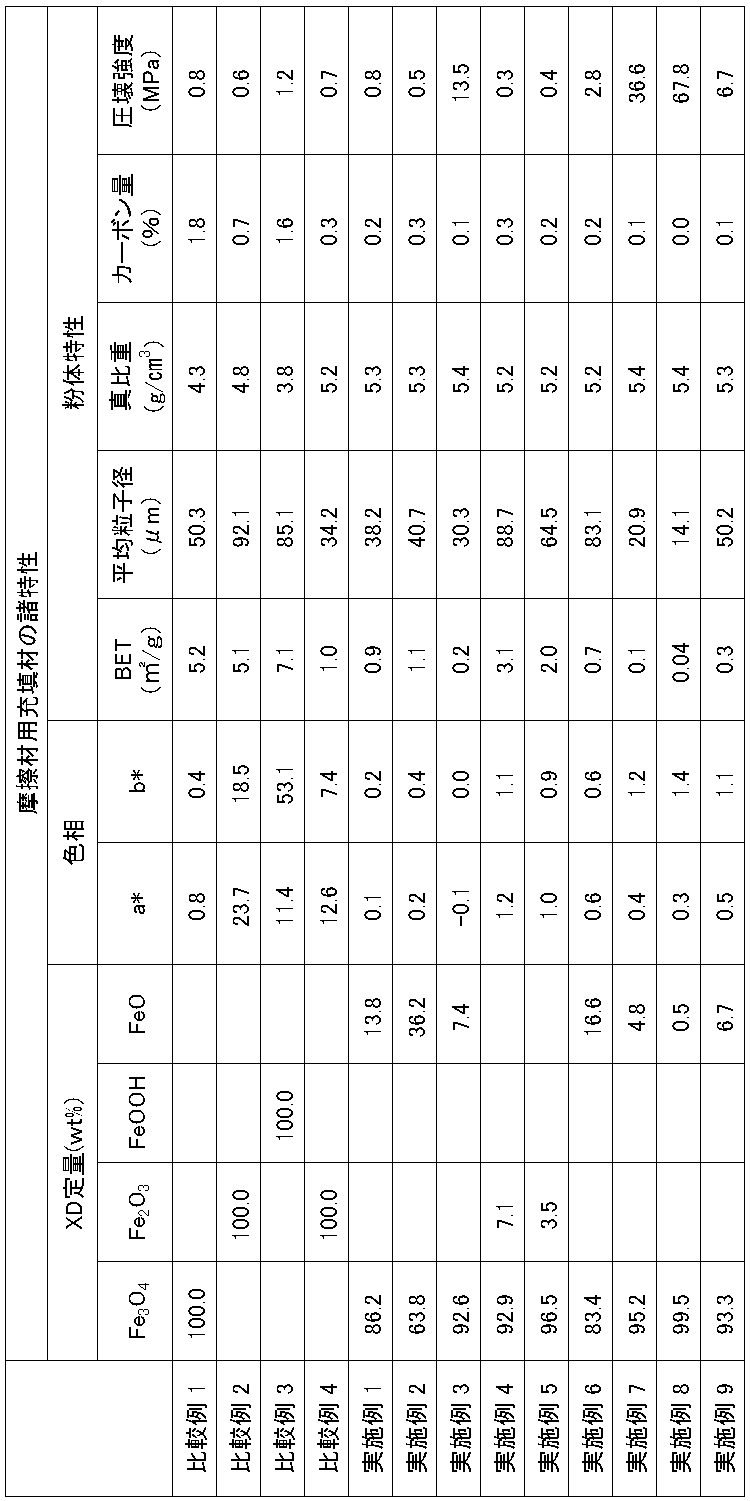
- Example 1 1 kg of magnetite particle powder, 10 g of polyvinyl alcohol, 10 g of polycarboxylic acid ammonium salt, and 1 kg of water were mixed by a ball mill for 2 hours to obtain a slurry containing magnetite particle powder. This slurry was granulated and dried by spray drying to prepare composite particles having an average particle diameter of 50.3 ⁇ m. Next, the particles were placed in a rotary heat treatment furnace and heated at 850 ° C. for 3 hours in a nitrogen atmosphere. After cooling to room temperature, it was taken out and a filler for friction material was obtained. The characteristics are shown in Table 2.
- Example 2 1 kg of magnetite powder, 20 g of polyvinyl alcohol, 5 g of lignin sulfonate and 1 kg of water were mixed in a ball mill for 2 hours to obtain a slurry containing magnetite particle powder. This slurry was granulated and dried by spray drying to prepare composite particles having an average particle size of 53.1 ⁇ m. Next, the particles were placed in a rotary heat treatment furnace and heated at 750 ° C. for 3 hours in a nitrogen atmosphere. After cooling to room temperature, it was taken out and a filler for friction material was obtained. The characteristics are shown in Table 2.
- Example 3 A slurry containing magnetite powder and goethite powder was obtained by mixing 750 g of magnetite powder, 250 g of goethite powder, 10 g of polyvinyl alcohol, 5 g of ammonium polyacrylate, and 1 kg of water with a ball mill for 2 hours. This slurry was granulated and dried by spray drying to prepare composite particles having an average particle diameter of 47.7 ⁇ m. Next, the particles were placed in a pusher-type firing furnace and heated at 950 ° C. for 3 hours in a nitrogen atmosphere. After cooling to room temperature, it was taken out and a filler for friction material was obtained. The characteristics are shown in Table 2.
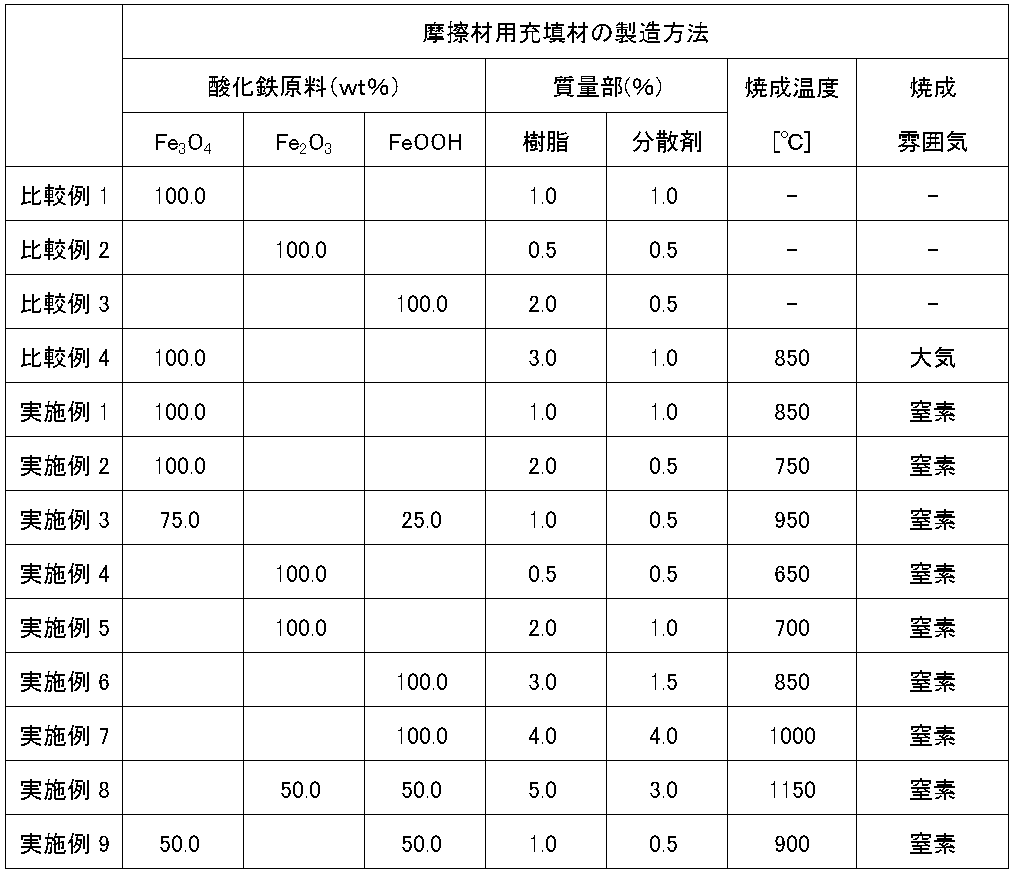
- Examples 4 to 9 A filler for friction material was obtained in the same manner as in Example 1 except that the blending ratio of the iron oxide raw material, the addition amounts of the resin and the dispersant, and the firing temperature were variously changed. The production conditions at this time are shown in Table 1, and the characteristics of the obtained filler for friction material are shown in Table 2.
- Comparative Example 1 The slurry used in Example 1 in which 1 kg of magnetite powder, 10 g of polyvinyl alcohol, 10 g of polycarboxylic acid ammonium salt and 1 kg of water were mixed in a ball mill for 2 hours was granulated and dried by spray drying, and the average particle size was 50.3 ⁇ m. Composite particles were obtained. Table 2 shows various properties of the obtained composite particles.
- Comparative Examples 2 and 3 A filler for friction material was obtained in the same manner as in Comparative Example 1 except that the blending ratio of the iron oxide raw material and the addition amounts of the resin and the dispersant were changed. The production conditions at this time are shown in Table 1, and the characteristics of the obtained filler for friction material are shown in Table 2.
- Comparative Example 4 A filler for friction material was obtained in the same manner as in Example 1 except that the blending ratio of the iron oxide raw material, the addition amount of the resin and the dispersant, the firing temperature, and the firing atmosphere were changed. The production conditions at this time are shown in Table 1, and the characteristics of the obtained filler for friction material are shown in Table 2.
- the filler for a friction material according to the present invention is suitable as a filler for a friction material because it has a large particle size and excellent abrasiveness. Further, since the particle size is large, an improvement in dispersibility in the resin can be expected.
Landscapes
- Engineering & Computer Science (AREA)
- General Engineering & Computer Science (AREA)
- Chemical & Material Sciences (AREA)
- Mechanical Engineering (AREA)
- Materials Engineering (AREA)
- Organic Chemistry (AREA)
- Compositions Of Macromolecular Compounds (AREA)
- Braking Arrangements (AREA)
- Lubricants (AREA)
Abstract
本発明は、研磨性に優れるとともに、樹脂への分散性向上が期待できる摩擦材用の充填材を提供するものである。マグネタイトを主成分として含有し、平均粒径が10~100μmであることを特徴とする摩擦材用充填材であり、該摩擦材用充填材は、平均粒径が0.05~5.0μmのマグネタイト粒子粉末、ヘマタイト粒子粉末及びゲータイト粒子粉末から選ばれる一種以上を用いて所定の大きさの造粒物とし、得られた造粒物を500~1200℃の温度範囲で焼成することにより製造することができる。
Description
本発明は、摩擦材用の充填材に関するものである。
自動車などの制動装置のブレーキパッドに用いられている摩擦材は、各種の繊維状基材、摩擦調整剤などの充填材、及びそれらを結合するための各種熱硬化性高分子を主成分とする結合材などからなる。摩擦材は、これらの各成分の混和物を、型に充填した後、加圧、加熱して結合材を硬化することにより製造される。
そして前記の繊維状基材には、ポリアミド繊維、アラミド繊維などの有機繊維、セラミック繊維、ガラス繊維、ロックウール、チタン酸カリウムなどの合成無機化合物繊維が用いられ、充填材には、硫酸バリウム、炭酸カルシウムなどの各種無機化合物粉末や、金属粉末などが用いられる。また、摩擦調整を目的として、グラファイト、二硫化モリブデンなどの固体潤滑剤や、カシューダストなどが添加される。
摩擦材に要求される特性としては、制動力が大きいこと、耐磨耗性を有すること、温度、圧力などの変化による制動力の変化が小さくて安定していること、機械的強度が大きいことなどがある。
従来より、摩擦材用の充填材としてマグネタイトが用いられている(例えば、特許文献1、2参照)。
特許文献1には、摩擦調整材として平均粒径3.5μm以上の酸化鉄を用いることが記載されているが、実施例に開示されている酸化鉄の平均粒径は3.5μmであり、より大きな粒径の酸化鉄は具体的に開示されていない。特許文献2には、酸化鉄と樹脂とを複合化することが記載されているが、樹脂成分が多いためマグネタイト特性、研磨性等を十分に発揮できない点で好ましくない。
本発明は、研磨性に優れるとともに、樹脂への分散性向上が期待できる摩擦材用の充填材を提供するものである。
前記目的は、次の通りの本発明によって達成できる。
即ち、本発明は、マグネタイトを主成分として含有し、平均粒径が10~100μmであることを特徴とする摩擦材用充填材である(本発明1)。
また、本発明は、真比重が4.8g/cm3以上である本発明1記載の摩擦材用充填材である(本発明2)。
また、本発明は、炭素量が0.4wt%以下である本発明1又は2記載の摩擦材用充填材である(本発明3)。
また、本発明は、BET比表面積が4m2/g以下である本発明1~3のいずれかに記載の摩擦材用充填材である(本発明4)。
また、本発明は、圧壊強度が0.2~100MPaである本発明1~4のいずれかに記載の摩擦材用充填材である(本発明5)。
本発明に係る摩擦材用充填材は、粒径が大きく研磨性に優れるので、摩擦材用の充填材として好適である。また、粒径が大きいので樹脂への分散性向上も期待できる。さらに造粒物の圧壊強度コントロールすることで、摩擦材の諸特性の最適化に貢献できる。
本発明の構成をより詳しく説明すれば次の通りである。
先ず、本発明に係る摩擦材用充填材について述べる。
本発明に係る摩擦材用充填材は、結晶相としてマグネタイトを主成分とするものであり、少なくとも50wt%含有することが好ましい。マグネタイトの含有量を前記範囲に制御することによって研磨性に優れたものとすることができる。マグネタイトの含有量の上限値は100%であり、より好ましくは99.8%である。他の構成相として、FeOを50wt%以下含有することが好ましく、より好ましくは40wt%以下である。さらに、ヘマタイトを10wt%以下含有してもよい。
本発明に係る摩擦材用充填材は平均粒径(D50)が10~100μmである。平均粒径を前記範囲に制御することによって、研磨性に優れるともに、樹脂への分散性向上も期待できる。好ましい平均粒径(D50)は15~98μmであり、より好ましくは20~95μmである。
本発明に係る摩擦材用充填材は真比重が4.8g/cm3以上であることが好ましい。真比重を前記範囲に制御することによって、摩擦材用として緻密な粒子となり、研磨性に優れたものとなる。より好ましい真比重は4.9g/cm3~5.6g/cm3であり、更により好ましくは5.0g/cm3~5.5g/cm3である。
本発明に係る摩擦材用充填材は炭素量が0.4wt%以下であることが好ましい。炭素量を前記範囲に制御することによって、マグネタイト等の鉄化合物を多量に含有することになり研磨性に優れるものである。より好ましい炭素量は0~0.35wt%であり、更により好ましくは0~0.3wt%である。
本発明に係る摩擦材用充填材はBET比表面積が4.0m2/g以下であることが好ましい。BET比表面積値を前記範囲に制御することによって、研磨性に優れたものとなる。より好ましい比表面積値は0.01~3.9m2/gであり、更により好ましくは0.02~3.8m2/gである。
本発明に係る摩擦材用充填材の形状は、球状が好ましい。球状であるほど樹脂となじみやすく、また、流動性にも優れて成型しやすいためである。
本発明に係る摩擦材用充填材は黒色で無彩色であることが好ましく、色相のうちa*は±3以内が好ましく、b*は±3以内が好ましい。
本発明に係る摩擦材用充填材は圧壊強度0.1MPa以上であることが好ましい。本発明に係る摩擦材用充填材は、炭素量が少なくても高い強度を維持できるので、摩擦材用として好適である。摩擦材用充填材の圧壊強度が0.1MPa未満では球状の形態を維持することが困難である。より好ましい圧壊強度は0.2~100MPaであり、更により好ましくは0.3~99MPaである。本発明においては、粒子の大きさや圧壊強度は、研磨・摩擦性能に影響を及ぼすので、粒子サイズや圧壊強度をコントロールし、研磨・摩擦性能に調整できる。
また、本発明に係る摩擦材用充填材は、各種原料由来の不純物が不可避的に混入してもよい。
次に、本発明に係る摩擦材用充填材の製造方法について述べる。
本発明に係る摩擦材用充填材は、例えば、下記のようにして製造することができる。
一次粒子の平均粒径が0.05~5.0μmのマグネタイト粒子粉末、ヘマタイト粒子粉末及びゲータイト粒子粉末から選ばれる一種以上を用いて所定の大きさの造粒物とし、得られた造粒物を500~1200℃の温度範囲で焼成することにより、摩擦材用充填材を製造する。
必要により、Ca、Al、Ti、Si、Mg、Zn、Ni、Mn、Cu、Coから選ばれる1種以上の酸化物、水酸化物、蓚酸塩、炭酸塩等を併用しても良い。
また、前記各種原料粉末の粒子形態としては、立方体状、多面体状、針状、板状等のいずれの形態の粒子であってもよい。この原料粉末の一次粒子の平均粒径としては、0.05~5.0μmであることが好ましく、より好ましくは0.1~3.0μmの範囲である。すなわち、一次粒子の平均粒径が0.05μm未満では、スラリー粘度が高くなり噴霧乾燥する際に支障が生ずる傾向がみられ、5.0μmを超えると、焼結体の表面粗度が大きくなり、比表面積が大きくなりすぎて、充填率が上がらなくなる傾向がみられるからである。
造粒物は、常法に従って製造すればよいが、造粒物の粒径制御などの点から原料を含有するスラリーの噴霧乾燥が好ましい。スラリーの固形分濃度を調整することにより造粒物の粒径を調整することができる。
本発明に係る摩擦材用充填材の製造過程においてスラリー化する際に樹脂成分を用いてもよい。樹脂成分としては、セルロース、ポリビニルアルコール(PVA)、アクリル酸、ポリアクリル酸アミド,ウレタン、でんぷん類などを用いることができ、この後の熱処理において焼失するものが好ましい。樹脂成分の添加量は出発原料を100重量部として、0.3~5重量部が好ましい。
また、本発明に係る摩擦材用充填材の製造過程においてスラリー化する際に分散剤を用いてもよい。この分散剤としては、一般の界面活性剤を使用することができ、酸化鉄などの各種原料の粒子表面に有する水酸基と結合可能な官能基を有するものが好ましく、具体的には、ポリカルボン酸ナトリウム塩、アニオン性ポリカルボン酸アンモニウム塩、リグニンスルホン酸塩、メラミンスルホン酸塩、ナフタレンスルホン酸ナトリウム塩、リン酸ナトリウム、クエン酸ナトリウム、アミン類、ポリアクリル酸の金属塩またはアンモニウム塩等があげられる。そして、焼成後のイオン性不純物の残渣を考慮すると、ポリカルボン酸アンモニウム塩を用いることが好ましい。分散剤の添加量は出発原料を100重量部として0.1~5重量部が好ましい。
本発明に係る摩擦材用充填材の製造に際しては、上記噴霧乾燥はスラリー濃度40~80重量%にて行うことが好ましく、より好ましくは50~70重量%である。すなわち、40重量%未満では、スラリー粘度が低くなり、粒度分布の調整が困難になる傾向がみられ、また80重量%を超えると、スラリー粘度が高くなり、球形の形状の確保が困難となる傾向がみられるからである。
噴霧乾燥の条件は、特に限定されるものではなく、スラリー濃度、粘度等によって適宜選択すればよい。
さらに、本発明においては、酸化鉄原料によって異なるが、500~1200℃程度の温度で、1~8時間の焼成を行う。すなわち、500℃未満では、粒子が成長しないため、強度がなく球状を維持することができない。1200℃を超えると、焼結粒子同士が融着し、雪だるま状の形状粒子が増加する傾向がみられるからである。好ましくは600~1180℃である。
焼成雰囲気は、不活性ガス雰囲気が好ましく、窒素雰囲気が好ましく、一部、水素を混合しても良い。
得られた摩擦材用充填材は、常法によって水洗しても良い。
本発明に係る摩擦材用充填材は、フェノール樹脂などの結合材、チタン酸塩など調整剤、研磨剤、充填材などともに用いて、摩擦材とすることができる。
本発明の代表的な実施例は、次の通りである。
摩擦材用充填材の平均粒径(D50)は、「レーザー回析式粒度分布計HELOS」(SYMPATEC社製)により計測した値で示した。
一次粒子の平均粒径は「走査型二次電子顕微鏡」((株)日立ハイテクノロジーズ製)の画像分析により算出した。
摩擦材用充填材の比表面積は、「モノソーブMS-11」(カンタクロム(株)製)を用いて、BET法により測定した値で示した。
摩擦材用充填材の真比重は、「乾式自動密度計 アキュピックII-1340」(マイクロメリティクス製)で測定した値で示した。
摩擦材用充填材の炭素量は、「炭素・硫黄分析装置 EMIA-920V2」(HORIBA製)で測定した値で示した。
摩擦材用充填材を構成する各結晶相の含有量は、「Bruker AXS K.K」(ブルカー・エイエックスエス(株)製)のTOPASソフトウェアを用いて測定した。
摩擦材用充填材の色相(a*値、b*値)は、試料0.5gとヒマシ油0.5mlとをフーバー式マーラーで練ってペースト状とし、このペーストにクリアラッカー4.5gを加え、混練、塗料化してキャストコート紙上に150μm(6mil)のアプリケーターを用いて塗布した塗布片(塗膜厚み:約30μm)を作製した。塗膜片について、「色彩色差計CR-400」(コニカミノルタセンシング株式会社製)を用いて測定を行い、JIS Z 8729に定めるところに従って表色指数(a*値、b*値)で示した。
摩擦材用充填材の圧壊強度は、単一粒子の圧縮試験(JIS R 1639-5)によって求めた。微小圧縮試験機(島津製作所MCT-W)を用いて、任意の粒子20個の単独粒子の圧縮試験を行い、破壊試験力と粒径より圧懐強度を求め、算術平均した。
実施例1
マグネタイト粒子粉末1kgとポリビニルアルコール10gとポリカルボン酸アンモニウム塩 10gと水 1kgをボールミルで2時間混合してマグネタイト粒子粉末を含有するスラリーを得た。このスラリーをスプレードライで造粒及び乾燥を行い、平均粒径50.3μmの複合体粒子を調整した。次に、該粒子を回転式加熱処理炉内に入れ、窒素雰囲気中、850℃で3時間加熱した。室温まで冷却した後、取り出して摩擦材用充填材を得た。その特性を表2に示す。
マグネタイト粒子粉末1kgとポリビニルアルコール10gとポリカルボン酸アンモニウム塩 10gと水 1kgをボールミルで2時間混合してマグネタイト粒子粉末を含有するスラリーを得た。このスラリーをスプレードライで造粒及び乾燥を行い、平均粒径50.3μmの複合体粒子を調整した。次に、該粒子を回転式加熱処理炉内に入れ、窒素雰囲気中、850℃で3時間加熱した。室温まで冷却した後、取り出して摩擦材用充填材を得た。その特性を表2に示す。
実施例2
マグネタイト粉末1kgとポリビニルアルコール20gとリグニンスルホン酸塩を5gと水 1kgをボールミルで2時間混合してマグネタイト粒子粉末を含有するスラリーを得た。このスラリーをスプレードライで造粒及び乾燥を行い、平均粒径53.1μmの複合体粒子を調整した。次に、該粒子を回転式加熱処理炉内に入れ、窒素雰囲気中、750℃で3時間加熱した。室温まで冷却した後、取り出して摩擦材用充填材を得た。その特性を表2に示す。
マグネタイト粉末1kgとポリビニルアルコール20gとリグニンスルホン酸塩を5gと水 1kgをボールミルで2時間混合してマグネタイト粒子粉末を含有するスラリーを得た。このスラリーをスプレードライで造粒及び乾燥を行い、平均粒径53.1μmの複合体粒子を調整した。次に、該粒子を回転式加熱処理炉内に入れ、窒素雰囲気中、750℃で3時間加熱した。室温まで冷却した後、取り出して摩擦材用充填材を得た。その特性を表2に示す。
実施例3
マグネタイト粉末750g、ゲータイト粉末250gとポリビニルアルコール10gとポリアクリル酸アンモニウムを5gと水 1kgをボールミルで2時間混合してマグネタイト粉末とゲータイト粉末とを含有するスラリーを得た。このスラリーをスプレードライで造粒及び乾燥を行い、平均粒径47.7μmの複合体粒子を調整した。次に、該粒子をプッシャー式焼成炉に入れ、窒素雰囲気中、950℃で3時間加熱した。室温まで冷却した後、取り出して摩擦材用充填材を得た。その特性を表2に示す。
マグネタイト粉末750g、ゲータイト粉末250gとポリビニルアルコール10gとポリアクリル酸アンモニウムを5gと水 1kgをボールミルで2時間混合してマグネタイト粉末とゲータイト粉末とを含有するスラリーを得た。このスラリーをスプレードライで造粒及び乾燥を行い、平均粒径47.7μmの複合体粒子を調整した。次に、該粒子をプッシャー式焼成炉に入れ、窒素雰囲気中、950℃で3時間加熱した。室温まで冷却した後、取り出して摩擦材用充填材を得た。その特性を表2に示す。
実施例4~9
酸化鉄原料の配合割合、樹脂及び分散剤の添加量、焼成温度を種々変化させた以外は実施例1と同様にして、摩擦材用充填材を得た。このときの製造条件を表1に、得られた摩擦材用充填材の諸特性を表2に示す。
酸化鉄原料の配合割合、樹脂及び分散剤の添加量、焼成温度を種々変化させた以外は実施例1と同様にして、摩擦材用充填材を得た。このときの製造条件を表1に、得られた摩擦材用充填材の諸特性を表2に示す。
比較例1
実施例1で使用した、マグネタイト粉末1kgとポリビニルアルコール10gとポリカルボン酸アンモニウム塩 10gと水 1kgをボールミルで2時間混合したスラリーをスプレードライで造粒及び乾燥を行い、平均粒径50.3μmの複合体粒子とした。得られた複合体粒子の諸特性を表2に示す。
実施例1で使用した、マグネタイト粉末1kgとポリビニルアルコール10gとポリカルボン酸アンモニウム塩 10gと水 1kgをボールミルで2時間混合したスラリーをスプレードライで造粒及び乾燥を行い、平均粒径50.3μmの複合体粒子とした。得られた複合体粒子の諸特性を表2に示す。
比較例2、3
酸化鉄原料の配合割合、樹脂及び分散剤の添加量を変化させた以外は比較例1と同様にして、摩擦材用充填材を得た。このときの製造条件を表1に、得られた摩擦材用充填材の諸特性を表2に示す。
酸化鉄原料の配合割合、樹脂及び分散剤の添加量を変化させた以外は比較例1と同様にして、摩擦材用充填材を得た。このときの製造条件を表1に、得られた摩擦材用充填材の諸特性を表2に示す。
比較例4
酸化鉄原料の配合割合、樹脂及び分散剤の添加量、焼成温度、焼成雰囲気を変化させた以外は実施例1と同様にして、摩擦材用充填材を得た。このときの製造条件を表1に、得られた摩擦材用充填材の諸特性を表2に示す。
酸化鉄原料の配合割合、樹脂及び分散剤の添加量、焼成温度、焼成雰囲気を変化させた以外は実施例1と同様にして、摩擦材用充填材を得た。このときの製造条件を表1に、得られた摩擦材用充填材の諸特性を表2に示す。
本発明に係る摩擦材用充填材は、粒径が大きく研磨性に優れるので、摩擦材用の充填材として好適である。また、粒径が大きいので樹脂への分散性向上も期待できる。
Claims (5)
- マグネタイトを主成分として含有し、平均粒径が10~100μmであることを特徴とする摩擦材用充填材。
- 真比重が4.8g/cm3以上である請求項1記載の摩擦材用充填材。
- 炭素量が0.4wt%以下である請求項1又は2記載の摩擦材用充填材。
- BET比表面積が4m2/g以下である請求項1~3のいずれかに記載の摩擦材用充填材。
- 圧壊強度が0.2~100MPaである請求項1~4のいずれかに記載の摩擦材用充填材。
Priority Applications (1)
| Application Number | Priority Date | Filing Date | Title |
|---|---|---|---|
| JP2017515607A JP6958352B2 (ja) | 2015-04-28 | 2016-04-28 | 摩擦材用充填材 |
Applications Claiming Priority (2)
| Application Number | Priority Date | Filing Date | Title |
|---|---|---|---|
| JP2015-092325 | 2015-04-28 | ||
| JP2015092325 | 2015-04-28 |
Publications (1)
| Publication Number | Publication Date |
|---|---|
| WO2016175284A1 true WO2016175284A1 (ja) | 2016-11-03 |
Family
ID=57199257
Family Applications (1)
| Application Number | Title | Priority Date | Filing Date |
|---|---|---|---|
| PCT/JP2016/063354 Ceased WO2016175284A1 (ja) | 2015-04-28 | 2016-04-28 | 摩擦材用充填材 |
Country Status (2)
| Country | Link |
|---|---|
| JP (1) | JP6958352B2 (ja) |
| WO (1) | WO2016175284A1 (ja) |
Cited By (3)
| Publication number | Priority date | Publication date | Assignee | Title |
|---|---|---|---|---|
| WO2017170532A1 (ja) * | 2016-03-30 | 2017-10-05 | 戸田工業株式会社 | 摩擦材用酸化鉄粒子粉末 |
| WO2019031557A1 (ja) * | 2017-08-08 | 2019-02-14 | 曙ブレーキ工業株式会社 | 摩擦材 |
| JP2021054682A (ja) * | 2019-09-30 | 2021-04-08 | 戸田工業株式会社 | 凝集酸化鉄粒子粉末 |
Citations (9)
| Publication number | Priority date | Publication date | Assignee | Title |
|---|---|---|---|---|
| JPH05237369A (ja) * | 1992-02-28 | 1993-09-17 | Toda Kogyo Corp | 無機物粒子含有樹脂複合球状物粉体 |
| JPH05277355A (ja) * | 1992-02-28 | 1993-10-26 | Toda Kogyo Corp | 無機物粒子含有樹脂複合球状物粉体 |
| JPH0885781A (ja) * | 1994-09-16 | 1996-04-02 | Sumitomo Electric Ind Ltd | ブレーキ用摩擦材 |
| JPH09328561A (ja) * | 1996-06-12 | 1997-12-22 | Kubota Corp | 摩擦材 |
| JP2001311071A (ja) * | 2000-04-26 | 2001-11-09 | Nisshinbo Ind Inc | 非石綿系摩擦材 |
| JP2002241737A (ja) * | 2001-02-20 | 2002-08-28 | Nisshinbo Ind Inc | 非石綿系摩擦材 |
| JP2009227768A (ja) * | 2008-03-21 | 2009-10-08 | Nisshinbo Holdings Inc | 摩擦材 |
| CN101597476A (zh) * | 2008-06-05 | 2009-12-09 | 比亚迪股份有限公司 | 一种微孔摩擦材料及其制备方法 |
| CN105713565A (zh) * | 2014-11-30 | 2016-06-29 | 衡阳市安骋汽车配件有限公司 | 一种复合摩擦材料及其制备方法 |
-
2016
- 2016-04-28 JP JP2017515607A patent/JP6958352B2/ja active Active
- 2016-04-28 WO PCT/JP2016/063354 patent/WO2016175284A1/ja not_active Ceased
Patent Citations (9)
| Publication number | Priority date | Publication date | Assignee | Title |
|---|---|---|---|---|
| JPH05237369A (ja) * | 1992-02-28 | 1993-09-17 | Toda Kogyo Corp | 無機物粒子含有樹脂複合球状物粉体 |
| JPH05277355A (ja) * | 1992-02-28 | 1993-10-26 | Toda Kogyo Corp | 無機物粒子含有樹脂複合球状物粉体 |
| JPH0885781A (ja) * | 1994-09-16 | 1996-04-02 | Sumitomo Electric Ind Ltd | ブレーキ用摩擦材 |
| JPH09328561A (ja) * | 1996-06-12 | 1997-12-22 | Kubota Corp | 摩擦材 |
| JP2001311071A (ja) * | 2000-04-26 | 2001-11-09 | Nisshinbo Ind Inc | 非石綿系摩擦材 |
| JP2002241737A (ja) * | 2001-02-20 | 2002-08-28 | Nisshinbo Ind Inc | 非石綿系摩擦材 |
| JP2009227768A (ja) * | 2008-03-21 | 2009-10-08 | Nisshinbo Holdings Inc | 摩擦材 |
| CN101597476A (zh) * | 2008-06-05 | 2009-12-09 | 比亚迪股份有限公司 | 一种微孔摩擦材料及其制备方法 |
| CN105713565A (zh) * | 2014-11-30 | 2016-06-29 | 衡阳市安骋汽车配件有限公司 | 一种复合摩擦材料及其制备方法 |
Cited By (9)
| Publication number | Priority date | Publication date | Assignee | Title |
|---|---|---|---|---|
| WO2017170532A1 (ja) * | 2016-03-30 | 2017-10-05 | 戸田工業株式会社 | 摩擦材用酸化鉄粒子粉末 |
| WO2019031557A1 (ja) * | 2017-08-08 | 2019-02-14 | 曙ブレーキ工業株式会社 | 摩擦材 |
| JP2019031616A (ja) * | 2017-08-08 | 2019-02-28 | 曙ブレーキ工業株式会社 | 摩擦材 |
| CN110997857A (zh) * | 2017-08-08 | 2020-04-10 | 曙制动器工业株式会社 | 摩擦材料 |
| JP7010623B2 (ja) | 2017-08-08 | 2022-01-26 | 曙ブレーキ工業株式会社 | 摩擦材 |
| CN110997857B (zh) * | 2017-08-08 | 2022-06-21 | 曙制动器工业株式会社 | 摩擦材料 |
| US11905182B2 (en) | 2017-08-08 | 2024-02-20 | Akebono Brake Industry Co., Ltd. | Friction material |
| JP2021054682A (ja) * | 2019-09-30 | 2021-04-08 | 戸田工業株式会社 | 凝集酸化鉄粒子粉末 |
| JP7415220B2 (ja) | 2019-09-30 | 2024-01-17 | 戸田工業株式会社 | 凝集酸化鉄粒子粉末 |
Also Published As
| Publication number | Publication date |
|---|---|
| JPWO2016175284A1 (ja) | 2018-07-12 |
| JP6958352B2 (ja) | 2021-11-02 |
Similar Documents
| Publication | Publication Date | Title |
|---|---|---|
| JP6959583B2 (ja) | 摩擦材用酸化鉄粒子粉末 | |
| KR101190938B1 (ko) | 소결광 제조용 원료의 제조방법 | |
| JP6563676B2 (ja) | 摩擦材組成物および摩擦材とその製造方法 | |
| US10106464B2 (en) | Porous titanate compound particles and method for producing same | |
| JP5189333B2 (ja) | 非晶質複合チタン酸アルカリ金属組成物及び摩擦材 | |
| US11572926B2 (en) | Iron oxide powder for brake friction material | |
| JP6958352B2 (ja) | 摩擦材用充填材 | |
| TW201711954A (zh) | 以氮化硼為底的聚集體之粉末 | |
| EP3553149B1 (en) | Iron oxide powder for brake friction material | |
| WO2017051690A1 (ja) | 多孔質チタン酸塩化合物粒子及びその製造方法 | |
| WO2018180123A1 (ja) | 被覆酸化マグネシウム粒子及びその製造方法並びに熱伝導性樹脂組成物 | |
| JP6584213B2 (ja) | 中空粒子、該中空粒子の製造方法及び該中空粒子を含む摩擦材 | |
| JP6730045B2 (ja) | 摩擦材用α−アルミナ粒子及びα−アルミナ粒子の製造方法 | |
| JP5073262B2 (ja) | 複合チタン酸化合物およびその粉末を含有する摩擦材 | |
| KR102401686B1 (ko) | 복합 티타늄산 화합물, 복합 티타늄산 화합물의 제조 방법 및 마찰재 | |
| JP7833105B1 (ja) | フェライト粉末およびそれを含む樹脂組成物 | |
| JP7836698B2 (ja) | 炭化ケイ素粒子、炭化ケイ素粒子の製造方法 | |
| JP6474716B2 (ja) | 多孔質複合粒子及びその製造方法 | |
| JP2016060842A (ja) | 摩擦材 | |
| JPH0517206A (ja) | 石灰系耐火物用バインダーおよびこれを添加する石灰系耐火物焼結体と不定形石灰系耐火物 | |
| JP2005072079A (ja) | 酸化物磁性材料系永久磁石の製造方法 | |
| WO2015004880A1 (ja) | 軸受用鉄粉および軸受用鉄粉の製造方法 |
Legal Events
| Date | Code | Title | Description |
|---|---|---|---|
| 121 | Ep: the epo has been informed by wipo that ep was designated in this application |
Ref document number: 16786560 Country of ref document: EP Kind code of ref document: A1 |
|
| NENP | Non-entry into the national phase |
Ref country code: DE |
|
| ENP | Entry into the national phase |
Ref document number: 2017515607 Country of ref document: JP Kind code of ref document: A |
|
| 122 | Ep: pct application non-entry in european phase |
Ref document number: 16786560 Country of ref document: EP Kind code of ref document: A1 |