WO2016171126A1 - 二色性色素を含有する組成物、及びこれを用いて作製した色素膜並びに該色素膜を有する偏光素子 - Google Patents
二色性色素を含有する組成物、及びこれを用いて作製した色素膜並びに該色素膜を有する偏光素子 Download PDFInfo
- Publication number
- WO2016171126A1 WO2016171126A1 PCT/JP2016/062360 JP2016062360W WO2016171126A1 WO 2016171126 A1 WO2016171126 A1 WO 2016171126A1 JP 2016062360 W JP2016062360 W JP 2016062360W WO 2016171126 A1 WO2016171126 A1 WO 2016171126A1
- Authority
- WO
- WIPO (PCT)
- Prior art keywords
- group
- dye
- film
- polarizing element
- polyoxyethylene
- Prior art date
- Legal status (The legal status is an assumption and is not a legal conclusion. Google has not performed a legal analysis and makes no representation as to the accuracy of the status listed.)
- Ceased
Links
- 0 C*=*c1ccccc1 Chemical compound C*=*c1ccccc1 0.000 description 1
Classifications
-
- C—CHEMISTRY; METALLURGY
- C09—DYES; PAINTS; POLISHES; NATURAL RESINS; ADHESIVES; COMPOSITIONS NOT OTHERWISE PROVIDED FOR; APPLICATIONS OF MATERIALS NOT OTHERWISE PROVIDED FOR
- C09B—ORGANIC DYES OR CLOSELY-RELATED COMPOUNDS FOR PRODUCING DYES, e.g. PIGMENTS; MORDANTS; LAKES
- C09B31/00—Disazo and polyazo dyes of the type A->B->C, A->B->C->D, or the like, prepared by diazotising and coupling
- C09B31/02—Disazo dyes
- C09B31/06—Disazo dyes from a coupling component "C" containing a directive hydroxyl group
- C09B31/068—Naphthols
- C09B31/072—Naphthols containing acid groups, e.g. —CO2H, —SO3H, —PO3H2, —OSO3H, —OPO2H2; Salts thereof
-
- C—CHEMISTRY; METALLURGY
- C09—DYES; PAINTS; POLISHES; NATURAL RESINS; ADHESIVES; COMPOSITIONS NOT OTHERWISE PROVIDED FOR; APPLICATIONS OF MATERIALS NOT OTHERWISE PROVIDED FOR
- C09D—COATING COMPOSITIONS, e.g. PAINTS, VARNISHES OR LACQUERS; FILLING PASTES; CHEMICAL PAINT OR INK REMOVERS; INKS; CORRECTING FLUIDS; WOODSTAINS; PASTES OR SOLIDS FOR COLOURING OR PRINTING; USE OF MATERIALS THEREFOR
- C09D17/00—Pigment pastes, e.g. for mixing in paints
- C09D17/003—Pigment pastes, e.g. for mixing in paints containing an organic pigment
-
- C—CHEMISTRY; METALLURGY
- C09—DYES; PAINTS; POLISHES; NATURAL RESINS; ADHESIVES; COMPOSITIONS NOT OTHERWISE PROVIDED FOR; APPLICATIONS OF MATERIALS NOT OTHERWISE PROVIDED FOR
- C09B—ORGANIC DYES OR CLOSELY-RELATED COMPOUNDS FOR PRODUCING DYES, e.g. PIGMENTS; MORDANTS; LAKES
- C09B31/00—Disazo and polyazo dyes of the type A->B->C, A->B->C->D, or the like, prepared by diazotising and coupling
- C09B31/02—Disazo dyes
- C09B31/08—Disazo dyes from a coupling component "C" containing directive hydroxyl and amino groups
-
- C—CHEMISTRY; METALLURGY
- C09—DYES; PAINTS; POLISHES; NATURAL RESINS; ADHESIVES; COMPOSITIONS NOT OTHERWISE PROVIDED FOR; APPLICATIONS OF MATERIALS NOT OTHERWISE PROVIDED FOR
- C09B—ORGANIC DYES OR CLOSELY-RELATED COMPOUNDS FOR PRODUCING DYES, e.g. PIGMENTS; MORDANTS; LAKES
- C09B31/00—Disazo and polyazo dyes of the type A->B->C, A->B->C->D, or the like, prepared by diazotising and coupling
- C09B31/16—Trisazo dyes
- C09B31/22—Trisazo dyes from a coupling component "D" containing directive hydroxyl and amino groups
-
- C—CHEMISTRY; METALLURGY
- C09—DYES; PAINTS; POLISHES; NATURAL RESINS; ADHESIVES; COMPOSITIONS NOT OTHERWISE PROVIDED FOR; APPLICATIONS OF MATERIALS NOT OTHERWISE PROVIDED FOR
- C09B—ORGANIC DYES OR CLOSELY-RELATED COMPOUNDS FOR PRODUCING DYES, e.g. PIGMENTS; MORDANTS; LAKES
- C09B31/00—Disazo and polyazo dyes of the type A->B->C, A->B->C->D, or the like, prepared by diazotising and coupling
- C09B31/30—Other polyazo dyes
-
- C—CHEMISTRY; METALLURGY
- C09—DYES; PAINTS; POLISHES; NATURAL RESINS; ADHESIVES; COMPOSITIONS NOT OTHERWISE PROVIDED FOR; APPLICATIONS OF MATERIALS NOT OTHERWISE PROVIDED FOR
- C09D—COATING COMPOSITIONS, e.g. PAINTS, VARNISHES OR LACQUERS; FILLING PASTES; CHEMICAL PAINT OR INK REMOVERS; INKS; CORRECTING FLUIDS; WOODSTAINS; PASTES OR SOLIDS FOR COLOURING OR PRINTING; USE OF MATERIALS THEREFOR
- C09D17/00—Pigment pastes, e.g. for mixing in paints
- C09D17/001—Pigment pastes, e.g. for mixing in paints in aqueous medium
-
- G—PHYSICS
- G02—OPTICS
- G02B—OPTICAL ELEMENTS, SYSTEMS OR APPARATUS
- G02B5/00—Optical elements other than lenses
- G02B5/30—Polarising elements
Definitions
- the present invention relates to a composition containing a dichroic dye useful for forming a dye film capable of producing a polarizing element exhibiting a high degree of polarization, and a dye film produced using the same. Moreover, this invention relates to the polarizing element excellent in the polarization performance which has this pigment
- polarizing elements used in liquid crystal display devices, sunglasses, goggles, etc. adsorb dichroic dyes such as iodine or dichroic dyes on a film made of a polymer material such as polyvinyl alcohol. Subsequently, the obtained film is uniaxially stretched, and the dichroic dye molecules are oriented in a certain direction, or the polymer film is uniaxially stretched and then the dichroic dye is adsorbed.
- the shape of the polarizing element is usually limited to a flat plate shape.
- a polyvinyl alcohol film is swollen and dyed, and subsequently subjected to a stretching treatment in an aqueous boric acid solution, followed by a water washing treatment and a drying treatment, and then the obtained film.
- the complicated process of bonding a protective film using an adhesive was required.
- a polarizing element provided with polarization in any direction in a fine pattern And curved polarizing elements have been demanded.
- Non-Patent Document 1 discloses a method for producing a polarizing element by orienting dichroic dye molecules in a certain direction by rubbing treatment.
- the coating property of the dye solution on the substrate is lowered due to scratches and dust on the substrate caused by the rubbing process in the rubbing process, and electrical scratches caused by static electricity. Therefore, there is a portion that is not coated on the obtained dye film, and as a result, the polarization performance quality of the polarizing element having the dye film is not satisfactory.
- Patent Document 1 discloses a technique for obtaining a polarizing element having higher polarization performance by orienting dichroic dye molecules in contact with the photo-alignment film in an arbitrary direction using the photo-alignment film.
- AFM atomic force microscope
- the polarizing performance of the obtained polarizing element has not been able to meet sufficient requirements as a practical level in the polarizing element for display elements.
- Patent Document 2 in order to further improve the uniformity of the orientation of the dichroic dye molecules and the polarization performance of the obtained polarizing element, the generation of craters is reduced as much as possible, and the orientation of the dichroic dye compound is increased overall.
- a method of manufacturing a polarizing element at a practical level for a display element is disclosed.
- the polarizing element uses a liquid crystalline polymer thin film having a photoactive group as an alignment film, irradiates the thin film with linearly polarized light, aligns the molecular axes of the photoactive group of the polarized light irradiation portion in a certain direction, and then forms another micropattern.
- a dichroic dye solution is applied on the thin film with a roll coater so that a specific range of pressure is applied in a direction perpendicular to the substrate.
- the alignment film serving as the base material is special and very expensive.
- JP-A-7-261024 Japanese Patent No. 4175455
- a dye film obtained by applying a composition containing a conventional dichroic dye, and a polarizing element obtained from the dye film have not yet fully satisfied quality, so that the quality is further improved. There is a need. In addition, development of a polarizing element that can be easily manufactured without using a special base material is also desired.
- an object of the present invention is to provide a composition containing a dichroic dye useful for forming a dye film that can be used to produce a polarizing element that has excellent coating properties and is capable of producing a high-quality polarizing element with excellent polarization performance, and a preparation using the same.
- Another object of the present invention is to provide a dye film and a polarizing element having the dye film.
- the present inventor (A) at least one dichroic dye and (B) selected from the group consisting of polyoxyethylene alkyl ether, polyoxyethylene alkylene alkyl ether, polyoxyethylene distyrenated phenyl ether and polyoxyethylene tribenzylphenyl ether
- a composition containing at least one surfactant and (C) a solvent and the surfactant has an HLB value of 12.5 or more and 17.5 or less, there is no polarization failure. It was newly found that a dye film capable of producing a polarizing element having high quality and excellent polarization performance can be obtained.
- the gist configuration of the present invention is as follows.
- (1) It comprises (A) at least one dichroic dye and (B) polyoxyethylene alkyl ether, polyoxyethylene alkylene alkyl ether, polyoxyethylene distyrenated phenyl ether and polyoxyethylene tribenzyl phenyl ether.
- a composition comprising at least one surfactant selected from the group and (C) a solvent, wherein the surfactant has an HLB value of 12.5 or more and 17.5 or less.
- (2) The composition according to (1), wherein the dichroic dye is a water-soluble azo dye.
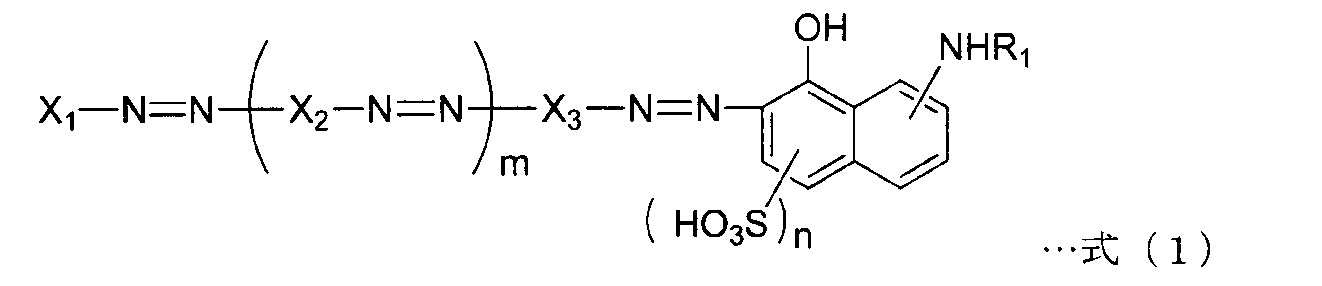
- (3) The composition according to (1) or (2), wherein the dichroic dye is a compound represented by the following formula (1) or a salt thereof.
- X 1 represents a phenyl group or a naphthyl group having one or two sulfonic acid groups and a hydroxyl group or an alkoxy group having 1 to 3 carbon atoms
- X 2 and X 3 each independently represent a phenylene group or a naphthylene group
- the phenylene group or naphthylene group includes an alkyl group having 1 to 3 carbon atoms, an alkoxy group having 1 to 3 carbon atoms, a hydroxyl group, and Having one or two substituents selected from the group consisting of sulfonic acid groups
- R 1 is a hydrogen atom, an alkyl group having 1 to 3 carbon atoms, an acetyl group, a benzoyl group, an unsubstituted phenyl group, an alkyl group having 1 to 4 carbon atoms, or an alkoxy group having 1 to 4 carbon atoms.
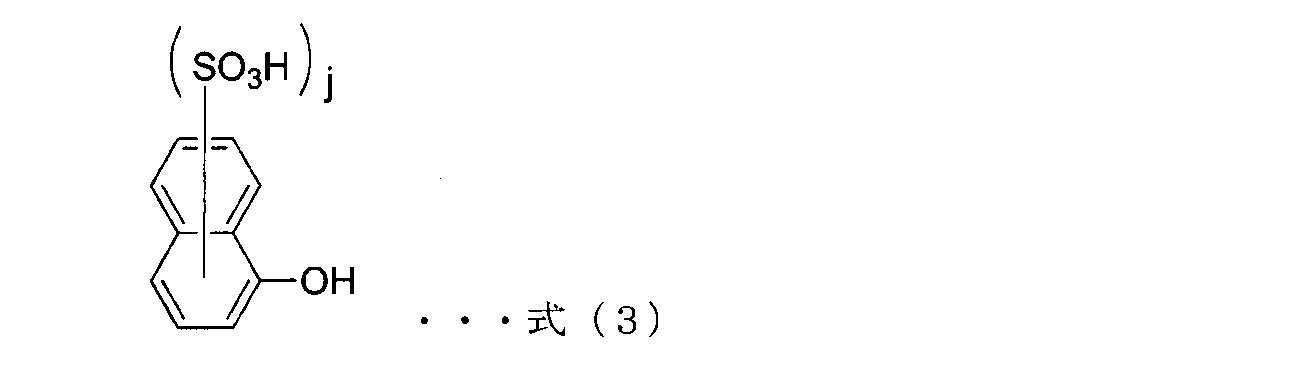
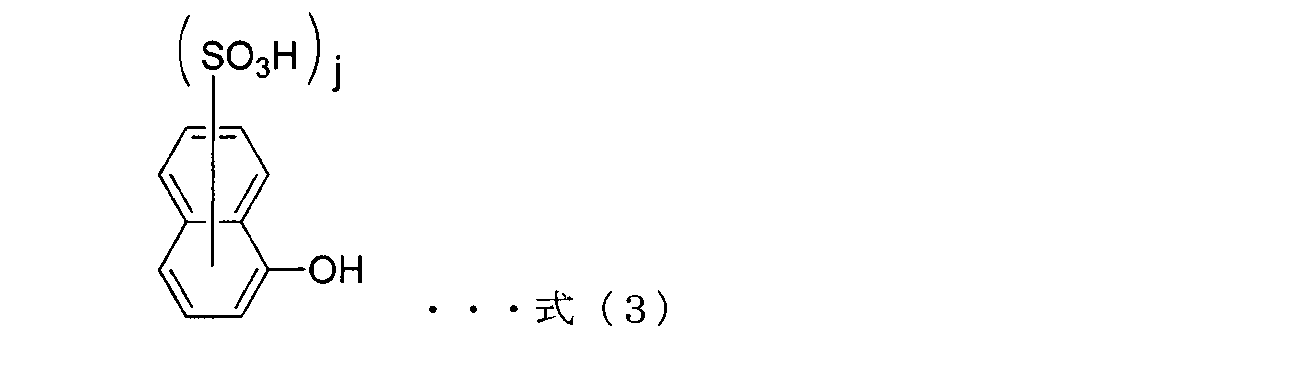
- composition according to (3) wherein X 1 is a compound represented by the following formula (3) or a salt thereof as a substituent. (In formula (3), j is 1 or 2.)
- the polyoxyethylene alkylene alkyl ether is a polyoxyethylene polyoxypropylene alkyl ether or a polyoxyethylene polyoxypropylene block polymer, described in any one of (1) to (4) Composition.
- the composition containing the dichroic dye in the present invention is excellent in coatability. Therefore, when producing a dye film using the composition of the present invention, for example, even if the base material is subjected to a rubbing treatment, a dye film with improved coating failure on the base material that has been produced conventionally is formed. can do. In addition, by using the dye film, a polarizing element having high polarization quality and excellent polarization performance can be obtained. Moreover, in the pigment
- a numerical range expressed using “to” means a range including numerical values described before and after “to” as a lower limit value and an upper limit value.
- the compounds (substituents) represented by the formulas (1) to (3) are represented in the form of free acids, and free acid salts are hydrophilic groups such as hydroxyl groups and sulfonic acid groups. It means a salt of a sex group.
- the composition of the present invention comprises (A) at least one dichroic dye, (B) polyoxyethylene alkyl ether, polyoxyethylene alkylene alkyl ether, polyoxyethylene distyrenated phenyl ether, and polyoxyethylene tribenzyl. It is a composition containing at least one surfactant selected from the group consisting of phenyl ether and (C) a solvent, wherein the surfactant has an HLB value of 12.5 or more and 17.5 or less. .
- the composition of the present invention contains a dichroic dye as a main component for forming a dye film.
- a dichroic dye is a compound that exhibits polarization by being arranged in a certain direction by itself or an aggregate. Examples of such a dichroic dye include azo dyes, stilbene dyes, pyrazolone dyes, And dye compounds such as triphenylmethane dyes, quinoline dyes, oxazine dyes, thiazine dyes and anthraquinone dyes.
- the dichroic dye used in the present invention is a compound that exhibits lyotropic liquid crystal properties under a certain solvent composition, dye concentration, and temperature conditions.
- the dichroic dye is preferably a water-soluble azo dye, and among them, a compound having an aromatic ring structure is more preferable.
- the aromatic ring structure include, for example, benzene, naphthalene, anthracene, phenanthrene, as well as heterocycles such as thiazole, pyridine, pyrimidine, pyridazine, pyrazine, quinoline, and quaternary salts thereof, and benzene, naphthalene, and the like.
- a hydrophilic substituent such as a sulfonic acid group, a carboxylic acid group, an amino group, or a hydroxyl group, or a salt of a sulfonic acid group or a carboxylic acid group is introduced into these aromatic rings.
- a hydrophilic substituent such as a sulfonic acid group, a carboxylic acid group, an amino group, or a hydroxyl group, or a salt of a sulfonic acid group or a carboxylic acid group is introduced into these aromatic rings.
- a hydrophilic substituent such as a sulfonic acid group, a carboxylic acid group, an amino group, or a hydroxyl group, or a salt of a sulfonic acid group or a carboxylic acid group is introduced into these aromatic rings.
- it is.
- dichroic dyes include C.I. I. Direct Orange 39, C.I. I. Direct Orange 41, C.I. I. Direct Orange 49, C.I. I. Direct Orange 72, C.I. I. Direct Red 2, C.I. I. Direct Red 28, C.I. I. Direct Red 39, C.I. I. Direct Red 79, C.I. I. Direct Red 81, C.I. I. Direct Red 83, C.I. I. Direct Red 89, C.I. I. Direct Violet 9, C.I. I. Direct Violet 35, C.I. I. Direct Violet 48, C.I. I. Direct Violet 57, C.I. I. Direct Blue 1, C.I. I. Direct Blue 15, Sakai C.I. I.
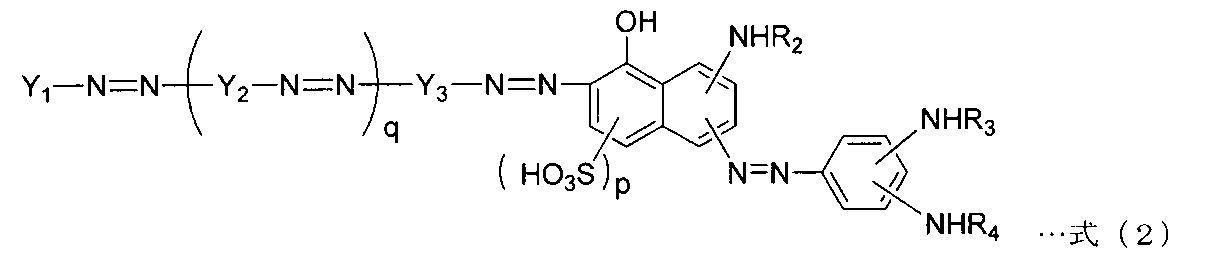
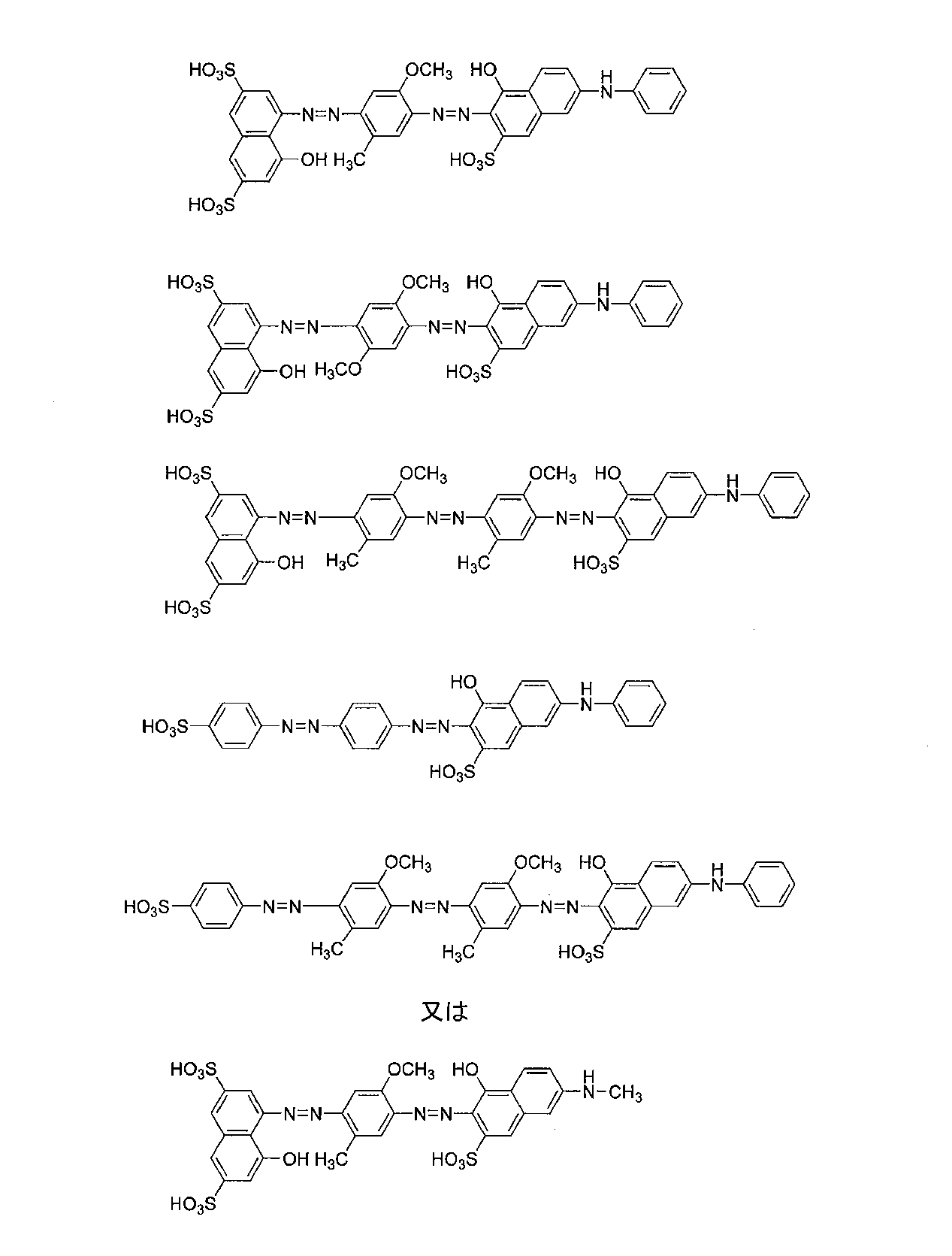
- a compound represented by the following formula (1) or formula (2) is particularly preferred, and a compound represented by formula (1) is particularly preferred.
- the compound represented by Formula (1) and Formula (2) exists as a free acid or its salt.
- the salt of the free acid is not particularly limited, and may be any salt such as an alkali metal salt such as Li, Na, or K, or a quaternary ammonium salt.
- X 1 represents a phenyl group or a naphthyl group having one or two sulfonic acid groups and a hydroxyl group or an alkoxy group having 1 to 3 carbon atoms
- X 2 and X 3 each independently represent a phenylene group or a naphthylene group
- the phenylene group or naphthylene group includes an alkyl group having 1 to 3 carbon atoms, an alkoxy group having 1 to 3 carbon atoms, a hydroxyl group, and Having one or two substituents selected from the group consisting of sulfonic acid groups
- R 1 is a hydrogen atom, an alkyl group having 1 to 3 carbon atoms, an acetyl group, a benzoyl group, an unsubstituted phenyl group, an alkyl group having 1 to 4 carbon atoms, or an alkoxy group having 1 to 4 carbon atoms.
- An amino group, a sulfo group represents a
- Y 1 represents a naphthyl group having one or two sulfonic acid groups, and further having a hydroxyl group or an alkoxy group having 1 to 3 carbon atoms
- Y 2 and Y 3 each independently represent a phenylene group or a naphthylene group
- the phenylene group or naphthylene group is an alkyl group having 1 to 3 carbon atoms, an alkoxy group having 1 to 3 carbon atoms, a hydroxyl group, and a sulfone group.
- R 2 represents a hydrogen atom, an alkyl group having 1 to 3 carbon atoms, an acetyl group, a benzoyl group, an unsubstituted phenyl group, an alkyl group having 1 to 4 carbon atoms, or an alkoxy group having 1 to 4 carbon atoms.
- R 3 and R 4 each independently represent a hydrogen atom, a hydroxyl group, a sulfonic acid group, an alkyl group having 1 to 3 carbon atoms, or an alkoxy group having 1 to 3 carbon atoms, q is 0 or 1, and p is 1 or 2.
- X 1 in formula (1) or Y 1 in formula (2) is a compound represented by the following formula (3) as a substituent.
- the polarizing performance can be further improved.
- it is represented by the formula (1) having a compound represented by the following formula (3) as a substituent in that it has a high dichroic ratio alone.
- the use of compounds is preferred.
- the said substituent exists also as a free acid or its salt similarly to the compound represented by Formula (1) and Formula (2).
- the salt of the free acid is not particularly limited, and may be any salt such as an alkali metal salt such as Li, Na, or K, or a quaternary ammonium salt.
- the dichroic dye of the present invention may be used alone or in combination of two or more.
- the combined use of such two or more dichroic dyes is not particularly limited, but by using an additional dichroic dye, the dichroic ratio of the dichroic dye can be further improved. it can.
- the total content of all the dichroic dyes contained in the composition of the present invention is not particularly limited, but in order to impart high anisotropy to the dye film, the following (C) solvent
- the total amount is 0.1 to 15 parts by weight, preferably 0.3 to 10 parts by weight, and more preferably 0.5 to 7 parts by weight with respect to 100 parts by weight.
- composition of the present invention comprises polyoxyethylene alkyl ether, polyoxyethylene alkylene alkyl ether, polyoxyethylene distyrenated phenyl ether and polyoxyethylene tribenzyl as other components in the production of the dye film. It contains at least one surfactant selected from the group consisting of phenyl ether and having an HLB value of 12.5 or more and 17.5 or less. By using such a surfactant, it is possible to improve a coating defect that has occurred in the past in the production of a dye film on a substrate.
- the surfactant used in the present invention has an HLB value of 12.5 or more and 17.5 or less, and preferably the HLB value is 13.0 or more and 17.0 or less. If the HLB value is less than 12.5, the coating failure occurring in the dye film cannot be improved. On the other hand, if the HLB value is greater than 17.5, the dichroic dye is oriented in the dye film. I can't do that.
- Specific examples of the polyoxyethylene alkyl ether having the HLB value include, for example, Emulgen 1108 (HLB value 13.4) manufactured by Kao Corporation, and Emulgen 1118S-70 (HLB value 16.4) manufactured by Kao Corporation.
- the polyoxyethylene alkylene alkyl ether is particularly preferably a polyoxyethylene polyoxypropylene alkyl ether or a polyoxyethylene polyoxypropylene block polymer.
- Specific examples of the polyoxyethylene alkylenealkylene alkyl ether having the HLB value include, for example, polyoxyethylene polyoxypropylene alkyl ether, Emulgen LS-106 (HLB value 12.5) manufactured by Kao Corporation, and Emulgen LS manufactured by Kao Corporation. -110 (HLB value 13.4), Kao's Emulgen LS-114 (HLB value 14.0), Kao's Emulgen MS-110 (HLB value 12.7), and polyoxyethylene polyoxypropylene block Examples of the polymer include Sanyo Chemical Co., Ltd.
- New Pole PE-68 (HLB value 15.7), Sanyo Chemical Co., Ltd. New Pole PE-78 (HLB value 15.6), Sanyo Kasei Co., Ltd. New Pole PE-108 ( HLB value 15.5), Sanyo Chemical Co., Ltd. New Pole PE 128 (HLB value 15.6) can be mentioned.
- the polyoxyethylene polyoxypropylene alkyl ether in particular, Emulgen LS-106 manufactured by Kao Corporation, Emulgen LS-110 manufactured by Kao Corporation, Emargen LS-114 manufactured by Kao Corporation, and Emulgen MS-110 manufactured by Kao Corporation are preferable.
- As the polyoxyethylene polyoxypropylene block polymer Newpol PE-68 manufactured by Sanyo Chemical Co., Ltd. is preferable.
- polyoxyethylene distyrenated phenyl ether having the above HLB value examples include, for example, Emulgen A-60 (HLB value 12.8) manufactured by Kao Corporation, and Emulgen A-90 manufactured by Kao Corporation (HLB value 14.4).
- polyoxyethylene tribenzylphenyl ether having the HLB value examples include, for example, Emulgen B-66 (HLB value 13.2) manufactured by Kao Corporation.
- the surfactant of the present invention may be used alone or in combination of two or more.
- the total content of all the surfactants contained in the composition of the present invention is 0.01 to 3 with respect to 100 parts by mass of the following (C) solvent from the viewpoint of not inhibiting the orientation of the dichroic dye.
- Part by mass preferably 0.05 to 2 parts by mass.
- the composition of this invention contains a solvent as a coating liquid.
- a solvent is not particularly limited as long as it can dissolve the dichroic dye to be used.
- a solvent is not particularly limited as long as it can dissolve the dichroic dye to be used.
- water alcohols, ethers, pyridine, dimethylformamide (DMF), dimethyl sulfoxide (DMSO) , N-methylpyrrolidinone (NMP), dimethylacetamide (DMAC) / dimethylimidazoline (DMI), etc.
- DMAC dimethylacetamide
- DMI dimethylimidazoline
- the amount of the organic solvent mixed with water is arbitrary, but is preferably 0 to 50% by mass, particularly preferably 0 to 20% by mass with respect to water.
- the dye film of the present invention is produced by applying the above composition to a substrate and then drying it.
- a laminate comprising the substrate and the dye film may be used as a polarizing element, and a protective layer or the like is further laminated on the surface of the dye film.
- the laminated body may be used as a polarizing element.
- a base material used when forming the dye film of the present invention for example, a glass plate such as silica glass or hard glass, a quartz plate, polysiloxane resin, ABS resin, cycloolefin resin, acetal resin, (meta ) Acrylic resin, cellulose acetate, cellulose acetate, chlorinated polyether, ethylene-vinyl acetate copolymer, fluorine resin, ionomer, methylpentene polymer, nylon, polyamide, polycarbonate, polyethylene terephthalate, polybutylene terephthalate and other polyesters, polyimide, Polyamide, polyphenylene oxide, polyphenylene sulfide, polyallylsulfone, polyarylate, polyethylene, polypropylene, polystyrene, polysulfone, cycloolefin resin, vinyl acetate resin, vinyl chloride Plastic plates and sheets (films) of various materials such as resin, AS resin, vinyl chloride resin, alkyd resin,
- the dye film of the present invention having a polarizing function can be formed.
- the rubbing is a method of rubbing a substrate with a specific cloth as described in JP-A-8-152515 and JP-A-2002-90743, or Japanese Patent Application Nos. 2012-015492 and 2012-0649112. And a method of performing a uniaxial polishing process using a polishing agent or a material containing a polishing agent.
- photo-alignment for example, as described in Patent Document 1 or Patent Document 2, a polymer or polymer (generally called a photo-alignment film) having a photoactive group is irradiated with polarized light.
- the photoactive molecule is oriented, polymerized or decomposed to cause the molecule to exhibit anisotropy on a specific axis.
- Stretching means that molecules are oriented on a specific axis by stretching a polymer or a substrate obtained from a resin by heating or the like. Therefore, the dichroic dye applied on the base material can be oriented by rubbing, photo-aligning or stretching the base material.
- the corona discharge treatment can be applied by using various commercially available corona discharge treatment machines as an apparatus for performing the corona discharge treatment, and the use of a corona treatment machine having an aluminum head is particularly preferable.
- the condition of the corona discharge treatment is 20 to 400 W ⁇ min ⁇ m ⁇ 2 , preferably about 50 to 300 W ⁇ min ⁇ m ⁇ 2 in terms of energy density in one corona discharge treatment.
- the corona discharge treatment may be performed twice or more.
- ultraviolet irradiation can be applied by using various commercially available ultraviolet irradiation apparatuses.
- the wavelength of the ultraviolet rays to be used is not particularly limited, but for example, far ultraviolet rays having a wavelength of 300 nm or less are preferable.
- the ultraviolet irradiation is preferably performed in an oxygen stream, and the irradiation time of ultraviolet rays is sufficient if it is several minutes at the longest.
- composition of the present invention containing a dichroic dye (solution containing a dichroic dye) is dropped onto the surface of the base material as described above, and a uniform thickness is formed on the base material by a coater or spin coating method.
- a coating film of the dichroic dye is provided.
- the method of providing the coating film of the dichroic dye is not particularly limited as long as the solution containing the dichroic dye can be applied.
- the substrate is applied to the solution containing the dichroic dye.
- Immersion method Method of applying dichroic dye solution with bar coder, etc.
- Application with inkjet printer applicator such as piezo method, thermal method, bubble jet (registered trademark) method used for home use or commercial use
- methods include spin coating with a spin coater, roll coater coating, flexographic printing, screen printing, gravure printing, curtain coater coating, spray coater coating, etc., in particular, roll coater coating, curtain coater coating, and spray coater spraying.
- a coating method is preferred.
- the substrate coated with the dichroic dye solution is then dried to form a solid dichroic dye layer, whereby the dye film of the present invention is obtained.
- the drying conditions vary depending on the type of solvent, the type of dichroic dye, the amount of the solution containing the applied dichroic dye, the concentration of the dichroic dye, etc.
- the drying temperature is preferably from room temperature to 100 ° C. Is room temperature to 50 ° C., and the humidity is about 20 to 95% RH, preferably about 30 to 90% RH.
- the thickness of the dye film of the present invention is preferably thinner from the viewpoint of improving polarization characteristics, and is preferably 0.001 to 10 ⁇ m, particularly 0.05 to 2 ⁇ m.
- the thickness of the coating film coated with a solution containing a dichroic dye is preferably 2 to 10 ⁇ m. More preferably, it is 5 ⁇ m.
- the substrate on which the solution containing the dichroic dye is applied may be further subjected to heat treatment and / or humidification treatment.
- heat treatment and / or the humidification treatment By performing the heat treatment and / or the humidification treatment, the adhesion of the dichroic dye to the substrate, the polarization performance of the obtained polarizer, the dichroic ratio and the durability can be improved.
- the temperature of the heat treatment is room temperature to 110 ° C., preferably 60 to 90 ° C.
- the humidity of the humidification treatment is about 40 to 95% RH, preferably about 50 to 90% RH.
- the dye film of the present invention thus obtained can be used as a polarizing element.
- the polarizing element of the present invention has a dichroic ratio (Rd), which is generally defined as the ratio of absorbance along the absorption axis to absorbance along the transmission axis.
- the dichroic ratio of the polarizing element of the present invention is calculated by the following formula (4). If the dichroic ratio is 5 or more, it means that the polarizing function is exhibited.
- the dichroic ratio of the polarizing element of the present invention is 5 or more, preferably 10 or more, more preferably 15 or more, and still more preferably 20 or more. When the dichroic ratio is less than 5, the degree of polarization is less than 65%, and the function as a polarizing element is not sufficient.
- the polarization degree of the polarizing element usually needs to be 65% or more, preferably 70% or more, more preferably 80% or more.
- the degree of polarization is the ratio of the light intensity of the polarized component to the total light intensity, and the higher the degree of polarization, the higher the polarization performance.
- Ky is the transmittance of the axis that transmits the most light when the polarized light is incident
- Kz is the transmission of the axis that absorbs the most light when the polarized light is incident. Rate.
- the dichroic ratio of the polarizing element of the present invention As a method for further improving the dichroic ratio of the polarizing element of the present invention, it was applied to the surface of the stretched film in the same direction as the stretching axis of the film with respect to the surface of the stretched film serving as a substrate.
- the dichroic ratio can be further improved.
- Examples of a method of developing a larger molecular anisotropy than the stretched film include a method of rubbing a stretched film. Such rubbing is exemplified in, for example, Japanese Patent Application Laid-Open Nos. 06-110059 and 2002-90743.
- the measurement of the molecular anisotropy of the surface of a stretched film is not specifically limited, For example, it measures by the measuring method used for the anchoring measurement of the alignment film for liquid crystals. Also, an apparatus for measuring such molecular anisotropy is not particularly limited, and for example, MARITEX SCOTT's Ray Scan can be used.
- a polarizing element having molecular anisotropy in the major axis direction on the surface of a film having a phase difference axis (slow axis or fast axis) at an angle different from the major axis direction of the film.
- the polarization axis or absorption axis of the polarizing element is arbitrarily determined by imparting molecular anisotropy to the surface of the stretched film having a retardation axis at an arbitrary angle with respect to the major axis direction of the film by rubbing or the like. Can be controlled.
- a stretched film that becomes a base material by using a stretched film having a phase difference axis at an angle different from the angle to the major axis direction of the film and exhibiting molecular anisotropy on the surface in the major axis direction.
- a polarizing element having a phase difference axis and an absorption axis or a polarization axis at an angle different from the phase difference axis can be manufactured.
- the angle formed by the retardation axis of the stretched film serving as the substrate and the absorption axis or polarization axis of the polarizing element is most preferably 15 °, 45 °, 75 °, or 90 °.
- the reason why the film is placed at 15 ° or 75 ° with respect to the absorption axis or the polarization axis of the polarizing element is that such an angle has a prescription (1/4) for a wide range of wavelengths. This is because the axis angle is generally used in a broadband achromatic phase difference plate). Thereby, it becomes possible to arbitrarily control the polarization axis or the absorption axis of the polarizing element.
- the dye film of the present invention prepared as described above is in a solid state such as amorphous or crystal, since the dye film is usually inferior in mechanical strength, the surface of the dye film is subjected to rake treatment or silane coupling.
- a crosslinking treatment with an agent or a protective layer is provided.
- the rake treatment is to electrically bond metal ions or the like to a dichroic dye exhibiting water solubility. Making a dichroic dye into a rake is sometimes called rake or insolubilization.
- Suitable compounds for rake include aluminum chloride, iron chloride, calcium chloride, barium chloride, nickel chloride, magnesium chloride, copper chloride, barium acetate, nickel acetate, etc.
- the dichroic dye is not particularly limited as long as it can be bonded to each other and the dichroic dye can be insolubilized in water.
- the crosslinking treatment with a silane coupling agent is not particularly limited, for example, using a silane coupling agent as described in JP2011-53234A, the crosslinking treatment is performed by heating or the like,
- the dye film can be immobilized.
- the protective layer is usually provided by a coating method such as coating a dye film with an ultraviolet curable or thermosetting transparent polymer film, or a laminate with a transparent polymer film such as a polyester film or a cellulose acetate film. .
- the protective layer can be provided as a polymer coating layer or as a film laminate layer.
- the transparent polymer or film forming the transparent protective layer is preferably a transparent polymer or film having high mechanical strength and good thermal stability.
- a substance used as a transparent protective layer for example, cellulose acetate resin such as triacetyl cellulose or diacetyl cellulose or film thereof, acrylic resin or film thereof, polyvinyl chloride resin or film thereof, nylon resin or film thereof, polyester resin or film thereof A film, a polyarylate resin or a film thereof, a cyclic polyolefin resin having a cyclic olefin such as norbornene or a film thereof, polyethylene, polypropylene, a polyolefin having a cyclo or norbornene skeleton or a copolymer thereof, a main chain or a side chain
- imide and / or amide resins or polymers or films thereof include imide and / or amide resins or polymers or films thereof.
- a resin having liquid crystallinity or a film thereof can be provided as the transparent protective layer.
- the thickness of the protective layer is, for example, about 0.5 to 200 ⁇ m.
- One or more layers of the resin or film serving as the protective layer can be provided on one side or both sides of the polarizing element. When a plurality of protective layers are used, these protective layers may be the same or different. Also good.
- the polarizing element of the present invention can be used for polarized sunglasses, goggles and the like.
- the polarizing element of the present invention can be provided with a gradation having shading in its manufacturing process or a pattern having a large number of polarization axes.
- a gradation display polarizing element or polarizing plate to which gradation is imparted can be produced by using linearly polarized light through a mask pattern having a shading or a photographic negative film when a polarization pattern is baked on a photoactive molecular layer.
- a multi-axis polarizing element or polarizing plate having a large number of polarization axes can be produced by irradiating different portions with linearly polarized light having different polarization axes when a polarization pattern is baked on the photoactive molecular layer.
- Such an additional function can be imparted by simply applying a solution containing a dichroic dye as compared with the case of using a normal polyvinyl alcohol film, and thus is desired without any dimensional change or shrinkage.
- a polarizing plate can be obtained.
- the absence of dimensional change is particularly effective for displays that require a polarizing element on one side, such as flexible displays and organic electroluminescence displays (commonly referred to as OLEDs).
- OLEDs organic electroluminescence displays
- the transmittance of each wavelength was measured using a spectrophotometer (“U-4100” manufactured by Hitachi, Ltd.).
- the transmittance at each wavelength when measuring one dye film is the transmittance Ts, and the transmittance when the two dye films are stacked so that their absorption axis directions are the same is the parallel transmittance Tp.
- the transmittance when the two dye films are stacked so that their absorption axes are orthogonal to each other is defined as the orthogonal transmittance Tc.
- the degree of polarization ⁇ was determined from the parallel transmittance Tp and the orthogonal transmittance Tc according to the equation (5).
- the dichroic ratio (Rd) was measured using V-7100 manufactured by JASCO Corporation, and the obtained value was taken as the measurement result.
- Example 1 A roll in which a rubbing cloth (MK0012 manufactured by Myonaka Pile Textile Co., Ltd.) is wound around a non-adhesive treated surface of a polyethylene terephthalate film (A-4100 manufactured by Toyobo Co., Ltd., hereinafter abbreviated as “PET film”) having a thickness of 100 ⁇ m as a substrate
- PET film polyethylene terephthalate film
- the rubbing process was performed at a speed of 100 rpm and a load of 5 kgf. C. as a dichroic dye on the surface of the rubbed PET film.
- An acrylic resin-based UV curable resin composition (SPC-920C manufactured by Nippon Kayaku Co., Ltd.) was applied onto the obtained dye film with a spin coater so that the thickness of the protective layer after curing was 3 ⁇ m. Then, the resin composition was cured by irradiating with ultraviolet rays, and a protective layer was provided on the dye film. The polarizing element thus obtained was used as a measurement sample.
- Example 2 Emulgen LS-106 as a surfactant used in Example 1 was changed to polyoxyethylene polyoxypropylene alkyl ether (Emulgen MS-110 manufactured by Kao Corporation) having an HLB value of 12.7, and the content thereof A measurement sample was prepared in the same manner as in Example 1 except that the content was changed to 0.05 parts by mass.
- polyoxyethylene polyoxypropylene alkyl ether Emulgen MS-110 manufactured by Kao Corporation
- Example 3 In the composition used in Example 1, C.I. I. The content of Direct Blue 67 was changed to 3 parts by mass, and Emulgen LS-106 as a surfactant was replaced with polyoxyethylene polyoxypropylene alkyl ether having an HLB value of 12.7 (Emulgen MS-110 manufactured by Kao Corporation). A measurement sample was prepared in the same manner as in Example 1 except that the sample was changed to.
- Example 4 Example except that Emulgen LS-106 as a surfactant used in Example 1 was changed to polyoxyethylene polyoxypropylene alkyl ether having an HLB value of 12.7 (Emulgen MS-110 manufactured by Kao Corporation). A measurement sample was prepared in the same manner as in 1.
- Example 5 In the dye composition used in Example 1, 5 parts by mass of C.I. I. Direct Blue 67 and 1 part by weight of C.I. I. A combination of two dichroic dyes mixed with Direct Orange 72, and Emulgen LS-106 as a surfactant, a polyoxyethylene polyoxypropylene alkyl ether having an HLB value of 12.7 (Kao Corporation) A measurement sample was prepared in the same manner as in Example 1 except that Emulgen MS-110) was used.
- Example 6 Emulgen LS-106 as a surfactant used in Example 1 was changed to polyoxyethylene polyoxypropylene alkyl ether (Emulgen MS-110 manufactured by Kao Corporation) having an HLB value of 12.7, and the content thereof A sample for measurement was prepared in the same manner as in Example 1 except that was changed to 1.0 part by mass.
- polyoxyethylene polyoxypropylene alkyl ether Emulgen MS-110 manufactured by Kao Corporation
- Example 7 The PET film as the base material used in Example 1 was changed to a triacetyl cellulose film (TD-80U manufactured by Fuji Film Co., Ltd.) having a thickness of 80 ⁇ m. Further, in the composition used in Example 1, dichroism was obtained. C. as a dye I. The content of Direct Blue 67 was changed to 10 parts by mass, and Emulgen LS-106 as a surfactant was replaced with polyoxyethylene polyoxypropylene alkyl ether having an HLB value of 12.7 (Emulgen MS-110 manufactured by Kao Corporation). A measurement sample was prepared in the same manner as in Example 1 except that the sample was changed to).
- Example 8 Emulgen LS-106 as a surfactant used in Example 1 was changed to a polyoxyethylene polyoxypropylene glycol block polymer having a HLB value of 15.7 (New Pole PE-68 manufactured by Sanyo Chemical Industries). Prepared a measurement sample in the same manner as in Example 1.
- Example 9 Similar to Example 1 except that Emulgen LS-106 as the surfactant used in Example 1 was replaced with polyoxyethylene alkyl ether having an HLB value of 16.4 (Emulgen 1118S-70 manufactured by Kao Corporation). A measurement sample was prepared.
- Example 10 In the composition used in Example 1, 4 parts by mass of C.I. I. Direct Blue 67 and 4 parts by weight of C.I. I. A combination of two dichroic dyes mixed with Direct Orange 72, emulgen LS-106 as a surfactant, polyoxyethylene alkyl ether polyoxyethylene distyrenated phenyl ether having an HLB value of 14.5 A measurement sample was prepared in the same manner as in Example 1 except that the content was changed to (Emulgen A-90 manufactured by Kao Corporation) and the content thereof was changed to 0.2 parts by mass.
- Example 11 Emulgen A-90 as the surfactant used in Example 10 was changed to polyoxyethylene alkyl ether polyoxyethylene distyrenated phenyl ether (Emulgen A-60 manufactured by Kao Corporation) having an HLB value of 12.8. Except for the above, a measurement sample was prepared in the same manner as in Example 10.
- Example 12 Emulgen A-90 as the surfactant used in Example 10 was changed to polyoxyethylene tribenzylphenyl ether (Emalgen B-66 manufactured by Kao Corporation) having an HLB value of 12.8, and the content thereof A sample for measurement was prepared in the same manner as in Example 10 except that was changed to 0.1 parts by mass.
- polyoxyethylene tribenzylphenyl ether (Emalgen B-66 manufactured by Kao Corporation) having an HLB value of 12.8, and the content thereof
- a sample for measurement was prepared in the same manner as in Example 10 except that was changed to 0.1 parts by mass.
- Example 13 4-Methacryloyloxyazobenzene was dissolved in benzene to give a 20% by mass solution, and the azobenzene was polymerized at 60 ° C. for 12 hours under deaeration using azobisisobutyronitrile as an initiator.
- the obtained solution consisting of 10 parts by mass of the polymer having azobenzene and 90 parts by mass of toluene was spin-coated on the PET film used in Example 1 so that the film thickness after drying was 0.1 ⁇ m.
- the PET film substrate is then dried by heating at 100 ° C. for 1 minute.
- a 500 W / h ultra-high pressure mercury lamp is prepared, the irradiation light is set to visible light (> 400 nm) with a cut-off filter, and linearly polarized light is obtained through a polarizing plate. This linearly polarized light was irradiated on the coated surface of the substrate placed parallel to the polarizing axis of the polarizing plate at room temperature for 1 minute from a distance at which the distance from the coated surface was 50 cm.
- C. as a dichroic dye is applied to the surface of the substrate subjected to such photo-alignment treatment. I.
- the obtained coating film was left in an environment of 25 ° C. and 70% humidity for 1 minute to dry the solvent. Furthermore, the dried coating film was heat-treated and humidified for 5 minutes in an environment of 60 ° C. and a humidity of 90% to obtain the dye film of the present invention.
- the same protective layer as in Example 1 was provided on the obtained dye film.
- the polarizing element thus obtained was used as a measurement sample.
- Emulgen LS-106 as a surfactant used in Example 1 is a nonionic surfactant used in Example 1 of Patent Document 1, that is, a polyoxyethylene lauryl ether having an HLB value of 12.1.
- a measurement sample was prepared in the same manner as in Example 1 except that the sample was changed to (Emulgen 108 manufactured by Kao Corporation), and used as a comparative sample.
- Comparative Example 2 In the composition used in Example 1, C.I. I. The content of Direct Blue 67 was changed to 10 parts by mass, and Emulgen LS-106 as a surfactant was changed to the nonionic surfactant of Comparative Example 1 (Emalgen 108 manufactured by Kao Corporation), and the content was changed. Instead of 1 part by mass, a dichroic dye aqueous solution similar to that of Example 1 of Patent Document 1 was prepared, and a measurement sample was prepared in the same manner as in Example 1 to obtain a comparative sample.
- Emulgen LS-106 as the surfactant used in Example 1 is an anionic surfactant used in the production 1 of the associative dichroic dye film of Patent Document 2 above, that is, a polysiloxane having an HLB value of 25.
- a measurement sample was prepared in the same manner as in Example 1 except that the sample was changed to sodium oxyethylene lauryl ether sulfate (Emal 20C manufactured by Kao Corporation), and used as a comparative sample.
- Comparative Example 4 A measurement sample was prepared in the same manner as in Example 1 except that Emulgen LS-106 as the surfactant used in Example 1 was not used, and used as a comparative sample.
- Comparative Example 5 Without using Emulgen LS-106 as the surfactant used in Example 1, C.I. I. A coating liquid containing a dichroic dye using a coating machine provided with a glass rod set so that the content of Direct Blue 67 is changed to 2 parts by mass and the distance from the PET film is set to 7 ⁇ m A dye film and a measurement sample were prepared in the same manner as in Example 1 except that was applied as a comparative sample.
- Comparative Example 6 Example except that Emulgen LS-106 as the surfactant used in Example 1 was replaced with polyoxyethylene distyrenated phenyl ether having an HLB value of 18.0 (Emulgen A-500 manufactured by Kao Corporation). A measurement sample was prepared in the same manner as in Example 1 and used as a comparative sample.
- Comparative Example 7 Similar to Example 1 except that Emulgen LS-106 as the surfactant used in Example 1 was replaced with polyoxyethylene alkyl ether having an HLB value of 18.5 (Emulgen 1150S-60 manufactured by Kao Corporation). A measurement sample was prepared as a comparative sample.
- Comparative Example 8 Similar to Example 1 except that Emulgen LS-106 as the surfactant used in Example 1 was replaced with polyoxyethylene alkyl ether having an HLB value of 17.9 (Emulgen 1150S-70 manufactured by Kao Corporation). A measurement sample was prepared as a comparative sample.
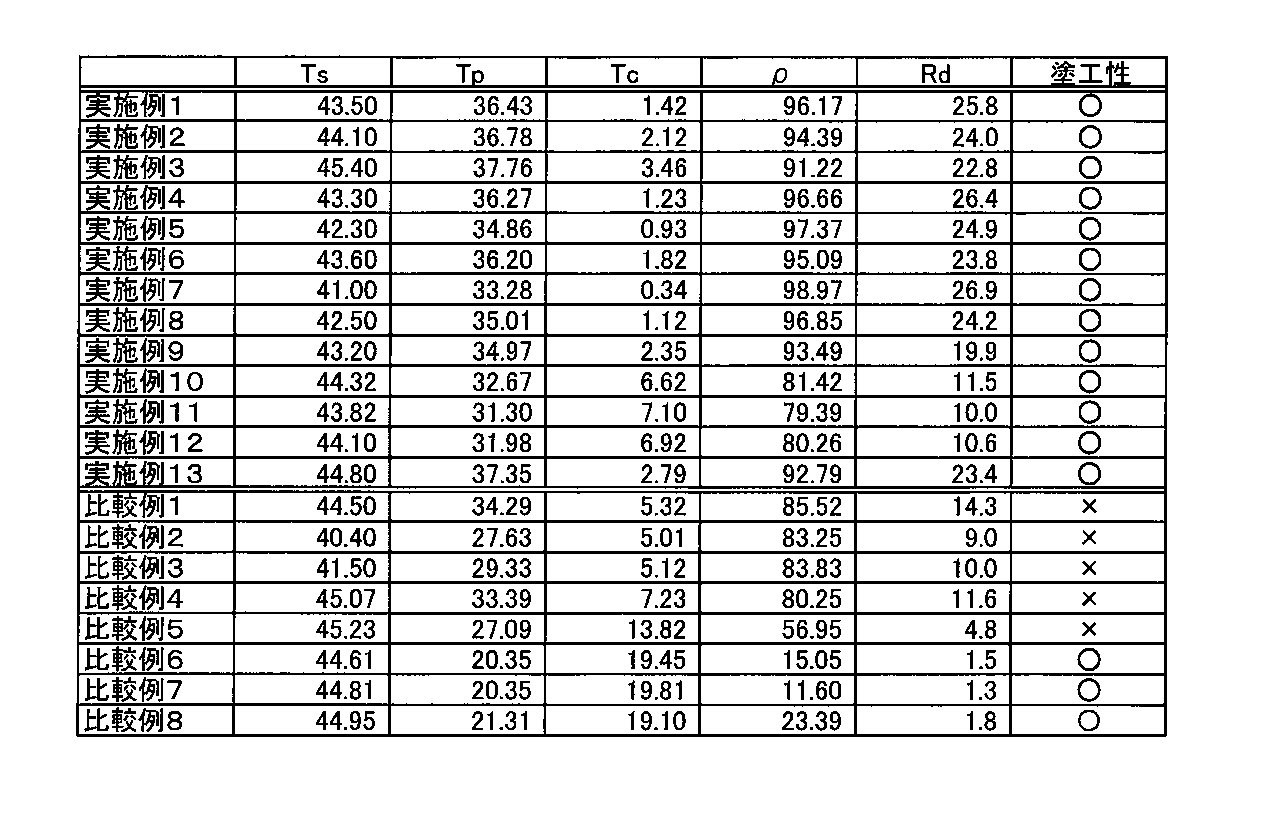
- Table 1 shows Ts, Tp, Tc, ⁇ , and Rd at the wavelength with the highest degree of polarization obtained by measuring the samples obtained in Examples 1 to 13 and Comparative Examples 1 to 8. Moreover, the coating property of the obtained dye film was evaluated. With regard to coating properties, when 10 or more spots that are not coated with a size of 50 ⁇ m or more can be visually confirmed in a 10 cm square pigment film, it is considered that a coating defect has occurred in the pigment film. In Table 1, “X” indicates that a coating failure has occurred, and “ ⁇ ” indicates that a coating failure has not occurred.
- the dye film produced using the composition of the present invention causes poor coating even when the substrate is rubbed as in Examples 1 to 12. From the above, it can be seen that the composition of the present invention is excellent in coating property, and further, a dye film with improved coating failure is obtained. Further, as in Example 13, even when the substrate was subjected to photo-alignment treatment, as in Examples 1 to 12, a composition having excellent coating properties and a dye film with improved coating defects were improved. It can be seen that is obtained. Furthermore, as shown in Examples 1 to 13, the polarizing element having the dye film of the present invention has a high degree of polarization ( ⁇ ) and a high dichroic ratio (Rd) in addition to a high transmittance (Ts). From the above, it can be seen that in the present invention, the poor polarization of the polarizing element is improved along with the improved coating failure of the dye film.
- the sample of Comparative Example 5 using a composition not containing a surfactant and having a relatively thick dye film was calculated from parallel transmittance (Tp) and orthogonal transmittance (Tc).
- the samples of Comparative Examples 5 to 8 have a degree of polarization ( ⁇ ) of less than 65% and a dichroic ratio (Rd) of less than 5, indicating that the function as a polarizing element is not sufficient.
- the dye film produced using the composition of the present invention improves poor coating at the time of applying a dye film obtained by applying a composition containing a conventional dichroic dye, As a result, it is understood that a polarizing element having high quality and excellent polarization performance without polarization failure can be obtained.
- the polarizing element of the present invention is not a polarizing element using a polyvinyl alcohol resin film like a conventional polarizing element, but can be prepared by applying a solution containing a dichroic dye to a rubbed substrate. Therefore, processes such as swelling, dyeing and stretching required in the conventional process are unnecessary.
- a polarizing element film can be produced only with a dichroic dye as a component exhibiting a polarizing function, it is possible to form an ultrathin polarizing element.
- the polarizing element can be produced by applying a solution containing a dichroic dye
- the polarizing element is not limited to a flat polarizing element like a conventional polarizing plate, and a curved or spherical polarizing element is formed.
- the conventional stretched film can only form a polarizing plate that allows polarized light perpendicular to the stretching direction to pass, but the polarizing element of the present invention arbitrarily sets the orientation direction with respect to the rubbed substrate. Therefore, it is possible to form a polarizing element provided with a fine pattern and a polarization property in an arbitrary direction.
Landscapes
- Chemical & Material Sciences (AREA)
- Organic Chemistry (AREA)
- Physics & Mathematics (AREA)
- Life Sciences & Earth Sciences (AREA)
- Engineering & Computer Science (AREA)
- Materials Engineering (AREA)
- Wood Science & Technology (AREA)
- General Physics & Mathematics (AREA)
- Optics & Photonics (AREA)
- Polarising Elements (AREA)
Abstract
Description
(A)少なくとも1種の二色性色素と、(B)ポリオキシエチレンアルキルエーテル、ポリオキシエチレンアルキレンアルキルエーテル、ポリオキシエチレンジスチレン化フェニルエーテル及びポリオキシエチレントリベンジルフェニルエーテルからなる群から選択される少なくとも1種の界面活性剤と、(C)溶媒とを含有し、前記界面活性剤のHLB値が、12.5以上17.5以下である組成物を用いることで、偏光不良のない高品質で偏光性能に優れた偏光素子を製造できる色素膜が得られることを新規に見出した。
(1)(A)少なくとも1種の二色性色素と、(B)ポリオキシエチレンアルキルエーテル、ポリオキシエチレンアルキレンアルキルエーテル、ポリオキシエチレンジスチレン化フェニルエーテル及びポリオキシエチレントリベンジルフェニルエーテルからなる群から選択される少なくとも1種の界面活性剤と、(C)溶媒とを含有し、前記界面活性剤のHLB値が、12.5以上17.5以下であることを特徴とする組成物。
(2)前記二色性色素が、水溶性アゾ色素であることを特徴とする(1)に記載の組成物。
(3)前記二色性色素が、下記式(1)で表される化合物又はその塩であることを特徴とする(1)又は(2)に記載の組成物。

X1は、1つ若しくは2つのスルホン酸基と、水酸基若しくは炭素数が1乃至3のアルコキシ基を有するフェニル基又はナフチル基を表し、
X2及びX3は、それぞれ独立して、フェニレン基又はナフチレン基を表し、当該フェニレン基又はナフチレン基は、炭素数が1乃至3のアルキル基、炭素数が1乃至3のアルコキシ基、水酸基及びスルホン酸基からなる群から選択される1種又は2種の置換基を1つ又は2つ有しており、
R1は、水素原子、炭素数が1乃至3のアルキル基、アセチル基、ベンゾイル基、或いは、非置換のフェニル基又は炭素数が1乃至4のアルキル基、炭素数が1乃至4のアルコキシ基、アミノ基、スルホ基若しくは炭素数が1乃至4のアルキル基を有するアミノ基で置換されたフェニル基を表し、
mは、0又は1であり、かつ
nは、1又は2である)
(4)X1が、置換基として下記式(3)で表される化合物又はその塩であることを特徴とする(3)に記載の組成物。
(5)前記ポリオキシエチレンアルキレンアルキルエーテルが、ポリオキシエチレンポリオキシプロピレンアルキルエーテル又はポリオキシエチレンポリオキシプロピレンブロックポリマーであることを特徴とする(1)乃至(4)のいずれか1つに記載の組成物。
(6)溶媒100質量部に対して、前記二色性色素を合計0.1~15質量部含有することを特徴とする(1)乃至(5)のいずれか1つに記載の組成物。
(7)溶媒が少なくとも水を含むことを特徴とする(1)乃至(6)のいずれか1つに記載の組成物。
(8)(1)乃至(7)のいずれか1つに記載の組成物を用いて作製された色素膜。
(9)(8)に記載の色素膜を有する偏光素子。
(10)二色比が、5以上であることを特徴とする(9)に記載の偏光素子。
本発明の組成物は、色素膜形成のための主成分として、二色性色素を含有する。二色性色素は、それ自身又は集合体で一定方向に配列することにより偏光性を示す化合物であり、このような二色性色素として、例えば、アゾ系色素、スチルベン系色素、ピラゾロン系色素、トリフェニルメタン系色素、キノリン系色素、オキサジン系色素、チアジン系色素、アントラキノン系色素等の色素系化合物等が挙げられる。本発明で用いられる二色性色素は、一定の溶媒組成、色素濃度、温度条件下でリオトロピック液晶性を示す化合物であり、例えば、入江正浩監修,「機能性色素の応用」,第1刷発行版,株式会社CMC,2002年6月,p.102-104に記載の二色性色素が挙げられる。また、二色性色素は、水溶性アゾ系色素を用いることが好ましく、その中でも、芳香族系環構造を有する化合物がより好ましい。芳香族系環構造としては、例えば、ベンゼン、ナフタリン、アントラセン、フェナントレンの他にチアゾール、ピリジン、ピリミジン、ピリダジン、ピラジン、キノリン等の複素環又はこれらの4級塩、更にはこれらとベンゼンやナフタリン等との縮合環が挙げられ、特に、これらの芳香族系環にスルホン酸基、カルボン酸基、アミノ基、水酸基等の親水性置換基、又はスルホン酸基若しくはカルボン酸基の塩が導入されていることが好ましい。
X1は、1つ若しくは2つのスルホン酸基と、水酸基若しくは炭素数が1乃至3のアルコキシ基を有するフェニル基又はナフチル基を表し、
X2及びX3は、それぞれ独立して、フェニレン基又はナフチレン基を表し、当該フェニレン基又はナフチレン基は、炭素数が1乃至3のアルキル基、炭素数が1乃至3のアルコキシ基、水酸基及びスルホン酸基からなる群から選択される1種又は2種の置換基を1つ又は2つ有しており、
R1は、水素原子、炭素数が1乃至3のアルキル基、アセチル基、ベンゾイル基、或いは、非置換のフェニル基又は炭素数が1乃至4のアルキル基、炭素数が1乃至4のアルコキシ基、アミノ基、スルホ基若しくは炭素数が1乃至4のアルキル基を有するアミノ基で置換されたフェニル基を表し、
mは、0又は1であり、かつ
nは、1又は2である。)
Y1は、スルホン酸基を1つ又は2つ有し、さらに水酸基又は炭素数が1及至3のアルコキシ基を有していてもよいナフチル基を表し、
Y2及びY3は、それぞれ独立して、フェニレン基又はナフチレン基を表し、当該フェニレン基又はナフチレン基は、炭素数が1及至3のアルキル基、炭素数1及至3のアルコキシ基、水酸基及びスルホン酸基からなる群から選択される1種又は2種の置換基を1つ又は2つ有しており、
R2は、水素原子、炭素数が1及至3のアルキル基、アセチル基、ベンゾイル基、或いは、非置換のフェニル基又は炭素数が1乃至4のアルキル基、炭素数が1乃至4のアルコキシ基、アミノ基、スルホ基若しくは炭素数が1乃至4のアルキル基を有するアミノ基で置換されたフェニル基を表し、
フェニルアゾ基としての

R3及びR4は、それぞれ独立して、水素原子、水酸基、スルホン酸基、炭素数が1及至3のアルキル基又は炭素数が1及至3のアルコキシ基を表し、
qは、0又は1であり、かつ
pは1又は2である。)
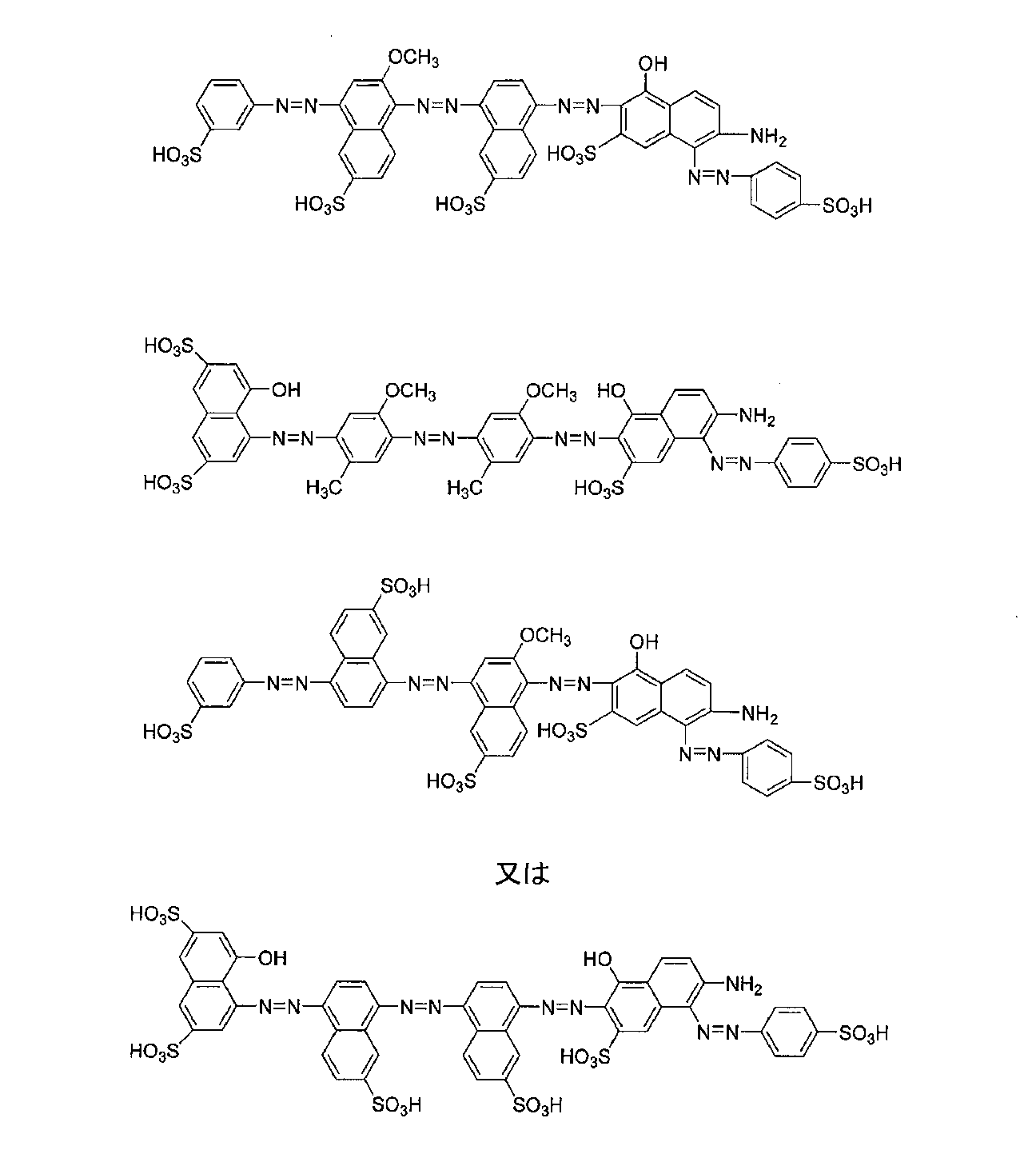
本発明の組成物は、色素膜の作製における他の成分として、ポリオキシエチレンアルキルエーテル、ポリオキシエチレンアルキレンアルキルエーテル、ポリオキシエチレンジスチレン化フェニルエーテル及びポリオキシエチレントリベンジルフェニルエーテルからなる群から選択され、かつHLB値が、12.5以上17.5以下である少なくとも1種の界面活性剤を含有する。このような界面活性剤を使用することにより、従来、基材上への色素膜の作製において、塗布時に生じていた塗工不良を改善することができる。また、特許文献2に記載されている偏光素子の製造方法においては、塗布時の基板に平行なズリ応力を軽減するため、偏光素子の作製において、ロールと基板間に特定の圧力が懸かるように圧力を調整する必要があったものの、本発明の組成物が、特定の界面活性剤を含むことにより、このような特殊な工程は、本発明の組成物の基材への塗布時には不要となる。さらに、ラビング処理された基材、光配向膜が付与された基材、摩擦により傷をつけた基材、又は延伸された基材等に本発明の組成物を塗布しても、得られる色素膜中に目視で確認できる大きさ、例えば50μm以上の大きさで生じ得る塗工されていない箇所が低減され、その結果、塗工不良が改善された色素膜を作製することができる。
本発明の組成物は、塗布液として溶媒を含む。このような溶媒は、使用される二色性色素を溶解できれば、特に限定されるものではなく、例えば、水、アルコール類、エーテル類、ピリジン、ジメチルホルムアミド(DMF)、ジメチルスルフォキシド(DMSO)、N-メチルピロリジノン(NMP)、ジメチルアセトアミド(DMAC)・ジメチルイミダゾリン(DMI)等が挙げられ、これらのうち、1種のみの溶媒が含まれていてもよく、或いは複数の溶媒が含まれていてもよい。特に、水溶性の二色性色素を使用する場合には、溶媒として、水又は水を主に含むと上記有機溶剤との混合溶媒が好ましい。水に対する有機溶媒の混合量は任意であるが、水に対して0~50質量%、特に0~20質量%が好ましい。

以下、実施例により本発明をさらに詳細に説明するが、本発明はこれらによって限定されるものではない。なお、実施例に示す透過率の評価は以下のようにして行った。

基材として100μmの厚さのポリエチレンテレフタレートフィルム(東洋紡社製 A-4100、以下「PETフィルム」と省略)の非易接着処理面に、ラビング布(妙中パイル織物社製 MK0012)を巻いたロールで100rpmの速度で荷重5kgfでラビング処理を行った。そのラビング処理を行ったPETフィルム面に二色性色素としてC.I.Direct Blue 67を5質量部、界面活性剤としてポリオキシエチレンポリオキシプロピレンアルキルエーテル(花王社製 エマルゲンLS-106:HLB値12.5)を0.1質量部、溶媒として水を100質量部含んだ組成物を、PETフィルムとの間隔が3μmになるようにセットされたガラス棒を設けた塗工機を用いて塗布した。得られた塗布膜を25℃、湿度70%の環境で1分間放置し、溶媒を乾燥させた。さらに、乾燥させた塗布膜を60℃、湿度90%の環境で5分間加熱処理及び加湿処理し、色素分子のみで形成された本発明の色素膜を得た。得られた色素膜上に、アクリル樹脂系の紫外線硬化性の樹脂組成物(日本化薬社製 SPC-920C)を、硬化後の保護層の厚さが3μmになるようにスピンコータにて塗布し、次いで紫外線を照射することによって該樹脂組成物を硬化させ、色素膜上に保護層を設けた。このようにして得られた偏光素子を測定試料とした。
実施例1で用いた界面活性剤としてのエマルゲンLS-106を、HLB値が12.7であるポリオキシエチレンポリオキシプロピレンアルキルエーテル(花王社製 エマルゲンMS-110)に変え、かつ、その含有量を0.05質量部に変えた以外は、実施例1と同様に測定試料を作製した。
実施例1で用いた組成物において、二色性色素としてのC.I.Direct Blue67の含有量を3質量部に変え、かつ、界面活性剤としてのエマルゲンLS-106を、HLB値が12.7であるポリオキシエチレンポリオキシプロピレンアルキルエーテル(花王社製 エマルゲンMS-110)に変えた以外は、実施例1と同様に測定試料を作製した。
実施例1で用いた界面活性剤としてのエマルゲンLS-106を、HLB値が12.7であるポリオキシエチレンポリオキシプロピレンアルキルエーテル(花王社製 エマルゲンMS-110)に変えた以外は、実施例1と同様に測定試料を作製した。
実施例1で用いた色素組成物において、二色性色素として5質量部のC.I.Direct Blue 67と1質量部のC.I.Direct Orange 72とを混合した2種の二色性色素を併用し、かつ、界面活性剤としてのエマルゲンLS-106を、HLB値が12.7であるポリオキシエチレンポリオキシプロピレンアルキルエーテル(花王社製 エマルゲンMS-110)に変えた以外は、実施例1と同様に測定試料を作製した。
実施例1で用いた界面活性剤としてのエマルゲンLS-106を、HLB値が12.7であるポリオキシエチレンポリオキシプロピレンアルキルエーテル(花王社製 エマルゲンMS-110)に変え、かつ、その含有量を1.0質量部に変えた以外は、実施例1と同様に測定試料を作製した。
実施例1で用いた基材としてのPETフィルムを、80μmの厚さのトリアセチルセルロースフィルム(富士フィルム社製 TD-80U)に変え、さらに、実施例1で用いた組成物において、二色性色素としてのC.I.Direct Blue 67の含有量を10質量部に変え、かつ、界面活性剤としてのエマルゲン LS-106を、HLB値が12.7であるポリオキシエチレンポリオキシプロピレンアルキルエーテル(花王社製 エマルゲンMS-110)に変えた以外は、実施例1と同様に測定試料を作製した。
実施例1で用いた界面活性剤としてのエマルゲンLS-106を、HLB値が15.7であるポリオキシエチレンポリオキシプロピレングリコールブロックポリマー(三洋化成工業社製 ニューポールPE-68)に変えた以外は、実施例1と同様に測定試料を作製した。
実施例1で用いた界面活性剤としてのエマルゲンLS-106を、HLB値が16.4であるポリオキシエチレンアルキルエーテル(花王社製 エマルゲン1118S-70)に変えた以外は、実施例1と同様に測定試料を作製した。
実施例1で用いた組成物において、二色性色素として4質量部のC.I.Direct Blue67と4質量部のC.I.Direct Orange 72とを混合した2種の二色性色素を併用し、界面活性剤としてのエマルゲンLS-106を、HLB値が14.5であるポリオキシエチレンアルキルエーテルポリオキシエチレンジスチレン化フェニルエーテル(花王社製 エマルゲンA-90)に変え、かつ、その含有量を0.2質量部に変えた以外は、実施例1と同様に測定試料を作製した。
実施例10で用いた界面活性剤としてのエマルゲンA-90を、HLB値が12.8であるポリオキシエチレンアルキルエーテルポリオキシエチレンジスチレン化フェニルエーテル(花王社製 エマルゲンA-60)に変えた以外は、実施例10と同様に測定試料を作製した。
実施例10で用いた界面活性剤としてのエマルゲンA-90を、HLB値が12.8であるポリオキシエチレントリベンジルフェニルエ-テル(花王社製 エマルゲンB-66)に変え、かつその含有量を0.1質量部に変えた以外は、実施例10と同様に測定試料を作製した。
4-メタクリロイルオキシアゾベンゼンをベンゼンに溶解して20質量%溶液とし、当該アゾベンゼンを、アゾビスイソブチロニトリルを開始剤として脱気下で60℃で12時間重合させた。得られたアゾベンゼンを有する高分子10質量部とトルエン90質量部からなる溶液を、乾燥後の膜厚が0.1μmの膜厚になるように実施例1で用いたPETフィルム上に回転塗布し、次いでこのPETフィルム基材を100℃で1分加熱して乾燥させる。500W/hの超高圧水銀ランプを用意しカットオフフィルターで照射光を可視光(>400nm)に設定し、さらに偏光板を介して直線偏光とする。この直線偏光を、偏光板の偏光軸に対し平行に置いた上記基材の塗布面上に室温で、当該塗布面との間隔が50cmとなる距離から1分間照射した。このような光配向処理が施された基材の表面に、二色性色素としてC.I.Direct Blue 67を5質量部、ポリオキシエチレンポリオキシプロピレンアルキルエーテル(花王社製 エマルゲンMS-110:HLB値12.7)を0.1質量部、水を100質量部含んだ組成物を、当該基材との間隔を3μmになるようにセットされたガラス棒を設けた塗工機を用いて塗布した。得られた塗布膜を25℃、湿度70%の環境で1分間放置し、溶媒を乾燥させた。さらに、乾燥させた塗布膜を60℃、湿度90%の環境で5分間加熱処理及び加湿処理し、本発明の色素膜を得た。得られた色素膜上に、実施例1と同じ保護層を設けた。このようにして得られた偏光素子を測定試料とした。
実施例1で用いた界面活性剤としてのエマルゲンLS-106を、上記特許文献1の実施例1で用いられているノニオン界面活性剤、すなわち、HLB値が12.1であるポリオキシエチレンラウリルエーテル(花王社製 エマルゲン108)に変えた以外は、実施例1と同様に測定試料を作製し、比較例サンプルとした。
実施例1で用いた組成物において、二色性色素としてC.I.Direct Blue 67の含有量を、10質量部に変え、かつ、界面活性剤としてのエマルゲンLS-106を、比較例1のノニオン界面活性剤(花王社製 エマルゲン108)に変え、かつその含有量を1質量部に変えて、特許文献1の実施例1と同様の二色性色素水溶液を作製し、実施例1と同様に測定試料を作製し、比較例サンプルとした。
実施例1で用いた界面活性剤としてのエマルゲンLS-106を、上記特許文献2の会合性二色性色素膜の作製1で用いられているアニオン界面活性剤、すなわちHLB値が25であるポリオキシエチレンラウリルエーテル硫酸ナトリウム(花王社製 エマール20C)に変えた以外は、実施例1と同様に測定試料を作製し、比較例サンプルとした。
実施例1で用いた界面活性剤としてのエマルゲンLS-106を用いなかったこと以外は、実施例1と同様に測定試料を作製し、比較例サンプルとした。
実施例1で用いた界面活性剤としてのエマルゲンLS-106を用いず、二色性色素としてのC.I.Direct Blue 67の含有量を2質量部に変え、かつ、PETフィルムとの間隔を7μmになるようにセットされたガラス棒を設けた塗工機を用いて二色性色素を含有した塗工液を塗布した以外は、実施例1と同様に、色素膜、および、測定試料を作製し、比較例サンプルとした。
実施例1で用いた界面活性剤としてのエマルゲンLS-106を、HLB値が18.0であるポリオキシエチレンジスチレン化フェニルエーテル(花王社製 エマルゲンA-500)に変えた以外は、実施例1と同様に測定試料を作製し、比較例サンプルとした。
実施例1で用いた界面活性剤としてのエマルゲンLS-106を、HLB値が18.5であるポリオキシエチレンアルキルエーテル(花王社製 エマルゲン1150S-60)に変えた以外は、実施例1と同様に測定試料を作製し、比較例サンプルとした。
実施例1で用いた界面活性剤としてのエマルゲンLS-106を、HLB値が17.9であるポリオキシエチレンアルキルエーテル(花王社製 エマルゲン1150S-70)に変えた以外は、実施例1と同様に測定試料を作製し、比較例サンプルとした。
Claims (10)
- (A)少なくとも1種の二色性色素と、(B)ポリオキシエチレンアルキルエーテル、ポリオキシエチレンアルキレンアルキルエーテル、ポリオキシエチレンジスチレン化フェニルエーテル及びポリオキシエチレントリベンジルフェニルエーテルからなる群から選択される少なくとも1種の界面活性剤と、(C)溶媒とを含有し、前記界面活性剤のHLB値が、12.5以上17.5以下であることを特徴とする組成物。
- 前記二色性色素が、水溶性アゾ色素であることを特徴とする請求項1に記載の組成物。
- 前記二色性色素が、下記式(1)で表される化合物又はその塩であることを特徴とする請求項1又は2に記載の組成物。

X1は、1つ若しくは2つのスルホン酸基と、水酸基若しくは炭素数が1乃至3を有するアルコキシ基を有するフェニル基又はナフチル基を表し、
X2及びX3は、それぞれ独立して、フェニレン基又はナフチレン基を表し、当該フェニレン基又はナフチレン基は、炭素数が1乃至3のアルキル基、炭素数が1乃至3のアルコキシ基、水酸基及びスルホン酸基からなる群から選択される1種又は2種の置換基を1つ又は2つ有しており、
R1は、水素原子、炭素数が1乃至3のアルキル基、アセチル基、ベンゾイル基、或いは、非置換のフェニル基又は炭素数が1乃至4のアルキル基、炭素数が1乃至4のアルコキシ基、アミノ基、スルホ基若しくは炭素数が1乃至4のアルキル基を有するアミノ基で置換されたフェニル基を表し、
mは、0又は1であり、かつ
nは、1又は2である) - X1が、置換基として下記式(3)で表される化合物又はその塩であることを特徴とする請求項3に記載の組成物。

- 前記ポリオキシエチレンアルキレンアルキルエーテルが、ポリオキシエチレンポリオキシプロピレンアルキルエーテル又はポリオキシエチレンポリオキシプロピレンブロックポリマーであることを特徴とする請求項1乃至4のいずれか一項に記載の組成物。
- 溶媒100質量部に対して、前記二色性色素を合計0.1~15質量部含有することを特徴とする請求項1乃至5のいずれか一項に記載の組成物。
- 溶媒が少なくとも水を含むことを特徴とする請求項1乃至6のいずれか一項に記載の組成物。
- 請求項1乃至7のいずれか一項に記載の組成物を用いて作製された色素膜。
- 請求項8に記載の色素膜を有する偏光素子。
- 二色比が、5以上であることを特徴とする請求項9に記載の偏光素子。
Priority Applications (4)
| Application Number | Priority Date | Filing Date | Title |
|---|---|---|---|
| CN201680022870.6A CN107532009B (zh) | 2015-04-20 | 2016-04-19 | 含有二色性色素的组合物、使用该组合物制作的色素膜以及具有该色素膜的偏振元件 |
| KR1020177033188A KR102601009B1 (ko) | 2015-04-20 | 2016-04-19 | 이색성 색소를 함유하는 조성물, 및 이를 이용해 제조한 색소막 및 상기 색소막을 갖는 편광 소자 |
| HK18102815.9A HK1243446A1 (zh) | 2015-04-20 | 2016-04-19 | 含有二色性色素的组合物、使用该组合物制作的色素膜以及具有该色素膜的偏振元件 |
| JP2017514130A JP6661618B2 (ja) | 2015-04-20 | 2016-04-19 | 二色性色素を含有する組成物、及びこれを用いて作製した色素膜並びに該色素膜を有する偏光素子 |
Applications Claiming Priority (4)
| Application Number | Priority Date | Filing Date | Title |
|---|---|---|---|
| JP2015085511 | 2015-04-20 | ||
| JP2015-085511 | 2015-04-20 | ||
| JP2015085515 | 2015-04-20 | ||
| JP2015-085515 | 2015-04-20 |
Publications (1)
| Publication Number | Publication Date |
|---|---|
| WO2016171126A1 true WO2016171126A1 (ja) | 2016-10-27 |
Family
ID=57143100
Family Applications (1)
| Application Number | Title | Priority Date | Filing Date |
|---|---|---|---|
| PCT/JP2016/062360 Ceased WO2016171126A1 (ja) | 2015-04-20 | 2016-04-19 | 二色性色素を含有する組成物、及びこれを用いて作製した色素膜並びに該色素膜を有する偏光素子 |
Country Status (6)
| Country | Link |
|---|---|
| JP (1) | JP6661618B2 (ja) |
| KR (1) | KR102601009B1 (ja) |
| CN (1) | CN107532009B (ja) |
| HK (1) | HK1243446A1 (ja) |
| TW (1) | TWI708817B (ja) |
| WO (1) | WO2016171126A1 (ja) |
Cited By (5)
| Publication number | Priority date | Publication date | Assignee | Title |
|---|---|---|---|---|
| JP2018106163A (ja) * | 2016-12-27 | 2018-07-05 | 三菱ケミカル株式会社 | 異方性色素膜形成用組成物、異方性色素膜及び偏光素子 |
| JP2018163333A (ja) * | 2017-03-27 | 2018-10-18 | 三菱ケミカル株式会社 | 異方性色素膜形成用組成物、異方性色素膜及び偏光素子 |
| JP2018169484A (ja) * | 2017-03-29 | 2018-11-01 | 株式会社ジャパンディスプレイ | 表示装置 |
| JP2018205712A (ja) * | 2017-06-01 | 2018-12-27 | 三菱ケミカル株式会社 | 異方性膜形成用組成物、異方性膜、及び光学素子 |
| JPWO2021002440A1 (ja) * | 2019-07-03 | 2021-01-07 |
Families Citing this family (2)
| Publication number | Priority date | Publication date | Assignee | Title |
|---|---|---|---|---|
| CN112912467B (zh) * | 2019-02-01 | 2023-10-20 | 捷恩智株式会社 | 液晶复合体、液晶调光元件及调光窗 |
| WO2021051258A1 (zh) * | 2019-09-17 | 2021-03-25 | 香港科技大学 | 一种使用偶氮染料的薄膜偏光片的制备方法 |
Citations (12)
| Publication number | Priority date | Publication date | Assignee | Title |
|---|---|---|---|---|
| JP2002357720A (ja) * | 2001-03-15 | 2002-12-13 | Nippon Kayaku Co Ltd | 新規なマイクロパターン偏光素子の製造方法及びこれを用いる立体表示液晶表示装置 |
| JP2005255846A (ja) * | 2004-03-11 | 2005-09-22 | Mitsubishi Chemicals Corp | アゾ色素、異方性色素膜用二色性アゾ色素並びにこれを用いた異方性色素膜形成用組成物、異方性色素膜および偏光素子 |
| JP2005284260A (ja) * | 2004-03-02 | 2005-10-13 | Mitsubishi Chemicals Corp | 異方性有機膜およびその製造方法並びに偏光膜および偏光素子 |
| JP2006047966A (ja) * | 2004-06-28 | 2006-02-16 | Mitsubishi Chemicals Corp | 異方性色素膜用色素、異方性色素膜用色素組成物、異方性色素膜及び偏光素子 |
| JP2006079030A (ja) * | 2003-10-14 | 2006-03-23 | Mitsubishi Chemicals Corp | 異方性色素膜用色素、異方性色素膜用色素組成物、異方性色素膜および偏光素子 |
| JP2006201759A (ja) * | 2004-12-22 | 2006-08-03 | Mitsubishi Chemicals Corp | 異方性色素膜の製造方法、異方性色素膜および偏光素子 |
| JP2006206878A (ja) * | 2004-12-27 | 2006-08-10 | Mitsubishi Chemicals Corp | トリスアゾ色素、該色素を含む異方性色素膜用組成物、異方性色素膜及び偏光素子 |
| JP2006285219A (ja) * | 2005-03-08 | 2006-10-19 | Mitsubishi Chemicals Corp | 異方性色素膜用組成物、異方性色素膜及び偏光素子 |
| JP2006293025A (ja) * | 2005-04-11 | 2006-10-26 | Mitsubishi Chemicals Corp | 異方性色素膜の製造方法、異方性色素膜および偏光素子 |
| JP2007061755A (ja) * | 2005-08-31 | 2007-03-15 | Mitsubishi Chemicals Corp | 光学素子の製造方法 |
| JP2013210414A (ja) * | 2012-03-30 | 2013-10-10 | Konica Minolta Inc | 光学フィルム、光学フィルムの製造方法、当該光学フィルムを用いた偏光板、画像表示装置用ガラス飛散防止フィルム、タッチパネル及び液晶表示装置 |
| JP2014199436A (ja) * | 2013-03-15 | 2014-10-23 | 富士フイルム株式会社 | 着色感放射線性組成物、着色硬化膜、カラーフィルタ、着色パターン形成方法、カラーフィルタの製造方法、固体撮像素子及び液晶表示装置 |
Family Cites Families (8)
| Publication number | Priority date | Publication date | Assignee | Title |
|---|---|---|---|---|
| JPH07261024A (ja) | 1993-09-10 | 1995-10-13 | Nippon Kayaku Co Ltd | 偏光素子、偏光板およびその製造方法 |
| CN101200599B (zh) * | 2003-10-14 | 2011-07-20 | 三菱化学株式会社 | 各向异性染料膜用染料、各向异性染料膜用染料组合物、各向异性染料膜和偏振元件 |
| CN101087853A (zh) * | 2004-12-27 | 2007-12-12 | 三菱化学株式会社 | 三偶氮染料、含该染料的各向异性染料膜用组合物、各向异性染料膜及偏光元件 |
| WO2006095622A1 (ja) * | 2005-03-08 | 2006-09-14 | Mitsubishi Chemical Corporation | 異方性色素膜用組成物、異方性色素膜及び偏光素子 |
| JP2008201759A (ja) * | 2007-02-22 | 2008-09-04 | Yokohama City Univ | 脂肪肝炎の診断及び/又は治療における肝臓へのコリン集積値の有用性 |
| JP2011104810A (ja) * | 2009-11-13 | 2011-06-02 | Fujifilm Corp | インクジェット記録媒体及び画像形成方法 |
| WO2012108173A1 (ja) * | 2011-02-07 | 2012-08-16 | 日本化薬株式会社 | アゾ化合物及びその塩、並びにそれらを含有する染料系偏光膜並びに偏光板 |
| KR102073987B1 (ko) * | 2012-02-28 | 2020-02-05 | 스미또모 가가꾸 가부시키가이샤 | 화합물 및 이색성 색소, 및 편광막 |
-
2016
- 2016-04-19 KR KR1020177033188A patent/KR102601009B1/ko active Active
- 2016-04-19 JP JP2017514130A patent/JP6661618B2/ja active Active
- 2016-04-19 WO PCT/JP2016/062360 patent/WO2016171126A1/ja not_active Ceased
- 2016-04-19 CN CN201680022870.6A patent/CN107532009B/zh active Active
- 2016-04-19 HK HK18102815.9A patent/HK1243446A1/zh unknown
- 2016-04-20 TW TW105112300A patent/TWI708817B/zh active
Patent Citations (12)
| Publication number | Priority date | Publication date | Assignee | Title |
|---|---|---|---|---|
| JP2002357720A (ja) * | 2001-03-15 | 2002-12-13 | Nippon Kayaku Co Ltd | 新規なマイクロパターン偏光素子の製造方法及びこれを用いる立体表示液晶表示装置 |
| JP2006079030A (ja) * | 2003-10-14 | 2006-03-23 | Mitsubishi Chemicals Corp | 異方性色素膜用色素、異方性色素膜用色素組成物、異方性色素膜および偏光素子 |
| JP2005284260A (ja) * | 2004-03-02 | 2005-10-13 | Mitsubishi Chemicals Corp | 異方性有機膜およびその製造方法並びに偏光膜および偏光素子 |
| JP2005255846A (ja) * | 2004-03-11 | 2005-09-22 | Mitsubishi Chemicals Corp | アゾ色素、異方性色素膜用二色性アゾ色素並びにこれを用いた異方性色素膜形成用組成物、異方性色素膜および偏光素子 |
| JP2006047966A (ja) * | 2004-06-28 | 2006-02-16 | Mitsubishi Chemicals Corp | 異方性色素膜用色素、異方性色素膜用色素組成物、異方性色素膜及び偏光素子 |
| JP2006201759A (ja) * | 2004-12-22 | 2006-08-03 | Mitsubishi Chemicals Corp | 異方性色素膜の製造方法、異方性色素膜および偏光素子 |
| JP2006206878A (ja) * | 2004-12-27 | 2006-08-10 | Mitsubishi Chemicals Corp | トリスアゾ色素、該色素を含む異方性色素膜用組成物、異方性色素膜及び偏光素子 |
| JP2006285219A (ja) * | 2005-03-08 | 2006-10-19 | Mitsubishi Chemicals Corp | 異方性色素膜用組成物、異方性色素膜及び偏光素子 |
| JP2006293025A (ja) * | 2005-04-11 | 2006-10-26 | Mitsubishi Chemicals Corp | 異方性色素膜の製造方法、異方性色素膜および偏光素子 |
| JP2007061755A (ja) * | 2005-08-31 | 2007-03-15 | Mitsubishi Chemicals Corp | 光学素子の製造方法 |
| JP2013210414A (ja) * | 2012-03-30 | 2013-10-10 | Konica Minolta Inc | 光学フィルム、光学フィルムの製造方法、当該光学フィルムを用いた偏光板、画像表示装置用ガラス飛散防止フィルム、タッチパネル及び液晶表示装置 |
| JP2014199436A (ja) * | 2013-03-15 | 2014-10-23 | 富士フイルム株式会社 | 着色感放射線性組成物、着色硬化膜、カラーフィルタ、着色パターン形成方法、カラーフィルタの製造方法、固体撮像素子及び液晶表示装置 |
Cited By (8)
| Publication number | Priority date | Publication date | Assignee | Title |
|---|---|---|---|---|
| JP2018106163A (ja) * | 2016-12-27 | 2018-07-05 | 三菱ケミカル株式会社 | 異方性色素膜形成用組成物、異方性色素膜及び偏光素子 |
| JP7024379B2 (ja) | 2016-12-27 | 2022-02-24 | 三菱ケミカル株式会社 | 異方性色素膜形成用組成物、異方性色素膜及び偏光素子 |
| JP2018163333A (ja) * | 2017-03-27 | 2018-10-18 | 三菱ケミカル株式会社 | 異方性色素膜形成用組成物、異方性色素膜及び偏光素子 |
| JP7024458B2 (ja) | 2017-03-27 | 2022-02-24 | 三菱ケミカル株式会社 | 異方性色素膜形成用組成物、異方性色素膜及び偏光素子 |
| JP2018169484A (ja) * | 2017-03-29 | 2018-11-01 | 株式会社ジャパンディスプレイ | 表示装置 |
| JP2018205712A (ja) * | 2017-06-01 | 2018-12-27 | 三菱ケミカル株式会社 | 異方性膜形成用組成物、異方性膜、及び光学素子 |
| JPWO2021002440A1 (ja) * | 2019-07-03 | 2021-01-07 | ||
| WO2021002440A1 (ja) * | 2019-07-03 | 2021-01-07 | 日本化薬株式会社 | 近赤外吸収染料を含む高耐久性染料系偏光板 |
Also Published As
| Publication number | Publication date |
|---|---|
| JP6661618B2 (ja) | 2020-03-11 |
| TWI708817B (zh) | 2020-11-01 |
| HK1243446A1 (zh) | 2018-07-13 |
| KR20170139079A (ko) | 2017-12-18 |
| KR102601009B1 (ko) | 2023-11-10 |
| JPWO2016171126A1 (ja) | 2018-02-15 |
| TW201708410A (zh) | 2017-03-01 |
| CN107532009A (zh) | 2018-01-02 |
| CN107532009B (zh) | 2020-04-24 |
Similar Documents
| Publication | Publication Date | Title |
|---|---|---|
| JP6661618B2 (ja) | 二色性色素を含有する組成物、及びこれを用いて作製した色素膜並びに該色素膜を有する偏光素子 | |
| KR102281482B1 (ko) | 화상 표시 장치 | |
| CN101310201B (zh) | 偏振片的制造方法以及液晶显示装置 | |
| CN115943331A (zh) | 光学膜、光学层叠体及图像显示装置 | |
| CN107533178B (zh) | 具有高延迟的膜与含有二色性色素的层层叠而成的偏振元件、以及设置有该偏振元件的显示装置 | |
| CN102216818B (zh) | 耐水性偏振薄膜及其制造方法和图像显示装置 | |
| JP2009199075A (ja) | 不溶化異方性膜並びに不溶化処理液及びそれを用いた不溶化異方性膜の製造方法並びにそれを用いた光学素子 | |
| JP4017656B1 (ja) | 偏光膜の製造方法、及び液晶表示装置 | |
| JP5422875B2 (ja) | 異方性光学膜の製造方法 | |
| TWI429965B (zh) | Production method and image display device of optical laminate | |
| JP2008179702A (ja) | オーバーコート膜用組成物、オーバーコート膜および光学素子 | |
| JP5243885B2 (ja) | 耐水性光学フィルムの製造方法、及び画像表示装置 | |
| JP6493972B2 (ja) | 極微量の液滴によって偏光素子を製造する方法 | |
| JP2009003250A (ja) | 二色性偏光素子の製造方法 | |
| WO2007125685A1 (ja) | 複屈折フィルム及びその製造方法 | |
| TW200844508A (en) | Method for production of optical laminate, and image display device | |
| JP2008020908A (ja) | 異方性色素膜用色素 | |
| JP2008009417A (ja) | 異方性色素膜用色素 | |
| WO2013157348A1 (ja) | 偏光フィルム、画像表示装置、及び偏光フィルムの製造方法 | |
| JP2009080250A (ja) | 積層体の製造方法 | |
| KR20190037961A (ko) | 광학 디바이스용 기판의 제조 방법 | |
| KR20230124716A (ko) | 액정 조성물, 경화막, 편광판, 화상 표시 장치 | |
| JP2008056899A (ja) | 異方性色素膜用色素 |
Legal Events
| Date | Code | Title | Description |
|---|---|---|---|
| 121 | Ep: the epo has been informed by wipo that ep was designated in this application |
Ref document number: 16783147 Country of ref document: EP Kind code of ref document: A1 |
|
| ENP | Entry into the national phase |
Ref document number: 2017514130 Country of ref document: JP Kind code of ref document: A |
|
| NENP | Non-entry into the national phase |
Ref country code: DE |
|
| ENP | Entry into the national phase |
Ref document number: 20177033188 Country of ref document: KR Kind code of ref document: A |
|
| 122 | Ep: pct application non-entry in european phase |
Ref document number: 16783147 Country of ref document: EP Kind code of ref document: A1 |