WO2016167568A1 - 가공성이 우수한 에틸렌 /알파-올레핀 공중합체 - Google Patents
가공성이 우수한 에틸렌 /알파-올레핀 공중합체 Download PDFInfo
- Publication number
- WO2016167568A1 WO2016167568A1 PCT/KR2016/003890 KR2016003890W WO2016167568A1 WO 2016167568 A1 WO2016167568 A1 WO 2016167568A1 KR 2016003890 W KR2016003890 W KR 2016003890W WO 2016167568 A1 WO2016167568 A1 WO 2016167568A1
- Authority
- WO
- WIPO (PCT)
- Prior art keywords
- alkyl
- aryl
- ethylene
- alpha
- alkoxy
- Prior art date
- Legal status (The legal status is an assumption and is not a legal conclusion. Google has not performed a legal analysis and makes no representation as to the accuracy of the status listed.)
- Ceased
Links
- 0 Cc1c(c(-c2c(C3)c(C(*)=*)c(**)c(*)c2*)c3[n]2*)c2c(*)c(*)c1* Chemical compound Cc1c(c(-c2c(C3)c(C(*)=*)c(**)c(*)c2*)c3[n]2*)c2c(*)c(*)c1* 0.000 description 3
Classifications
-
- C—CHEMISTRY; METALLURGY
- C08—ORGANIC MACROMOLECULAR COMPOUNDS; THEIR PREPARATION OR CHEMICAL WORKING-UP; COMPOSITIONS BASED THEREON
- C08F—MACROMOLECULAR COMPOUNDS OBTAINED BY REACTIONS ONLY INVOLVING CARBON-TO-CARBON UNSATURATED BONDS
- C08F210/00—Copolymers of unsaturated aliphatic hydrocarbons having only one carbon-to-carbon double bond
- C08F210/16—Copolymers of ethene with alpha-alkenes, e.g. EP rubbers
-
- C—CHEMISTRY; METALLURGY
- C08—ORGANIC MACROMOLECULAR COMPOUNDS; THEIR PREPARATION OR CHEMICAL WORKING-UP; COMPOSITIONS BASED THEREON
- C08L—COMPOSITIONS OF MACROMOLECULAR COMPOUNDS
- C08L23/00—Compositions of homopolymers or copolymers of unsaturated aliphatic hydrocarbons having only one carbon-to-carbon double bond; Compositions of derivatives of such polymers
- C08L23/02—Compositions of homopolymers or copolymers of unsaturated aliphatic hydrocarbons having only one carbon-to-carbon double bond; Compositions of derivatives of such polymers not modified by chemical after-treatment
- C08L23/04—Homopolymers or copolymers of ethene
- C08L23/08—Copolymers of ethene
Definitions
- Olefin polymerization catalyst systems can be classified into Ziegler-Natta and metallocene catalyst systems, and these two highly active catalyst systems have been developed for their respective characteristics.
- the Ziegler-Natta catalyst has been widely applied to the existing commercial processes since the invention in the 50s, but has a wide molecular weight distribution of the polymer because it is a multi-site catalyst with multiple active sites. , There is a problem in that the composition distribution of the comonomer is not uniform and there is a limit in securing desired physical properties.
- the metallocene catalyst is composed of a combination of a main catalyst composed mainly of transition metal compounds and a cocatalyst composed of an organometallic compound composed mainly of aluminum, and such a catalyst is a homogeneous complex catalyst.
- catalyst the molecular weight distribution is narrow according to the characteristics of single active site, the homogeneous composition distribution of the comonomer is obtained, the stereoregularity of the polymer according to the modification of the ligand structure of the catalyst and the change of polymerization conditions, copolymerization characteristics, It has the characteristic to change molecular weight, crystallinity, etc.
- Korean Patent Application No. 10-2003-0012308 discloses a method for controlling the molecular weight distribution by supporting a double-nucleated metallocene catalyst and a mononuclear metallocene catalyst on a carrier together with an activator to polymerize by changing the combination of catalysts in the reaction system. Disclosing the plan.
- linear low density polyethylene is produced by copolymerizing ethylene and alpha olefin at low pressure using a polymerization catalyst, has a narrow molecular weight distribution and a short chain branch of a constant length ,. It is a resin without long chain branching.
- the linear low density polyethylene film has the characteristics of general polyethylene, and has high breaking strength and elongation, and excellent tearing strength and fall stratification strength, so that the use of stretch film or overlap film, which is difficult to apply to the existing low density polyethylene or high density polyethylene, increases. Doing.
- linear low density polyethylene using 1-butene or 1-nuxene as comonomers and sieves is mostly produced in a single vapor phase reactor or a single loop slurry semi-unger, and the productivity is high compared to a process using 1-octene comonomers. Due to the limitations of the catalyst technology and the process technology, the product is inferior to that of the 1-octene comonomer, and the molecular weight distribution is narrow.
- U.S. Pat.No. 4,935,474 reports a method for producing polyethylene having a wide molecular weight distribution using two or more metallocene compounds.
- U. S. Patent No. 6,828, 394 reports a method for producing polyethylene which is a good combination of good comonomer binding and not good comonomerability and is particularly suitable for films.
- US Patent Registration No. 6,841,631, US Patent Registration No. 6,894, 128 to prepare a polyethylene having a bimodal or polycrystalline molecular weight distribution with a metallocene-based catalyst using at least two metal compounds, It is reported that it is applicable to the use of film, blow molding, pipe and the like.
- the present invention is to provide an ethylene / alpha -olefin copolymer excellent in processability.
- the present invention provides an ethylene / alpha-olefin copolymers satisfying the following conditions:
- the weight average molecular weight (g / mol) is 50,000 to 150,000
- Density (g / cin 3 ) is from 0.950 to 0.965
- Ethylene / alpha-lephine copolymers according to the present invention have an advantage in injection molding.
- Ethylene / alpha-olefin copolymer according to the present invention It is made of a metallocene catalyst as will be described later, in general, the polymer produced by the metallocene catalyst is excellent in mechanical properties, but there is a limit in manufacturing a product by injection molding is poor workability.
- the present invention by using a metallocene catalyst as described below, by narrowing the middle molecular region in the molecular weight distribution, and by producing an ethylene / alpha -olefin copolymer having a high proportion of the polymer region, excellent mechanical properties and Together, there is a feature of improving workability.
- the weight average molecular weight is 85, 000 to 100, 000 g / nl.
- the molecular weight distribution is 4 to 10.
- the ethylene / alpha-olefin copolymer according to the present invention is MFRR 5/2 . 16 (melt flow index measured at 190 ° C, 5kg load divided by 190 ° C, 2.
- melt flow index measured at 16kg load) according to ASTM D1238 has a value of 2 to 10, preferably Is »3 ⁇ 43 ⁇ 4 / 2 . 16 is 3.5 to 5.
- the ethylene / alpha-olepin copolymer according to the present invention has an Izod lattice strength of 7 to 15 kg-cm / cm.
- the Izod layer strength may be measured according to ASTM D-256, and the Izod impact strength of the ethylene / alpha-olefin copolymer according to the present invention is 7 to 15 kg-cm / cm, preferably 7 to 13 kg-. Excellent mechanical properties in cm / cm.
- the spiral flow length indicates the processability of the ethylene / alpha-olefin copolymer according to the present invention, and the larger the value, the better the processability.
- the spiral flow length is applied to a spiral mold by applying a specific pressure and temperature to inject the polymer and accordingly melted and injected This can be assessed by measuring how far the polymer is pushed out.
- a mold having a thickness of 1.5 kPa may be used, and an injection temperature of 190 ° C., a mold temperature of 50 ° C, and an injection pressure may be set to 90 bar.
- the spiral flow length of the ethylene / alpha-olefin copolymer according to the invention is 25 to 40 cm, which shows excellent processability.
- the ethylene / alpha -olefin copolymer according to the present invention in addition to the mechanical properties and workability as described above is characterized by excellent environmental stress cracking resistance (ESCR) and flexural modulus (flexural modulus).
- alpha-olefin monomers include propylene, 1-butene, 1-pentene, 4-methyl-1-pentene, 1-nuxene, 1-heptene and 1- Octene, 1-decene, 1-undecene, 1-dodecene, 1-tetradecene, 1-nucleadecene, 1-aitocene, and the like, and two or more kinds thereof may be used.
- 1-butene may be used as the alpha-olefin monomer.
- the content of alpha-ullepin as the comonomer is not particularly limited, and may be appropriately selected according to the use, purpose, etc. of the copolymer. More specifically, it may be more than 0 and 99 mol% or less.
- the ethylene / alpha-olefinic copolymer as described above can be prepared using a metallocene catalyst.
- the metallocene catalyst that can be used includes one or more metallocene compounds represented by the following Chemical Formula 1; And at least one compound selected from the compounds represented by the following Chemical Formulas 3 to 5 may be two metallocene compounds.
- A is hydrogen, halogen, d- 20 alkyl, C 2 - 20 alkenyl, C 6 - 20 aryl, C 7 - 20 alkylaryl, C 7 - 20 arylalkyl, alkoxy, C 2 - 20 alkoxyalkyl, C 3 - 20 heterocycloalkyl, or C 5 - 20 membered heteroaryl;
- D is -0-, -S-, -NCR)-or -SKR R ')-, wherein R and R' are the same as or different from each other, and are each independently hydrogen, halogen, d-20 alkyl, C 2- 20 alkenyl, or C 6 - 20 aryl;
- L is d- 10 straight or branched chain alkylene
- B is carbon, silicon or germanium
- Q is hydrogen, halogen, d- 20 alkyl, C 2 - 20 alkenyl, C 6 - 20 aryl, C 7 -2o alkyl, aryl, or C 7 - 20 aryl-alkyl;
- M is a Group 4 transition metal
- Alkenyl of 20 Al, C 6 - - X 1 and X 2 are the same or different and each independently halogen, alkyl, C 2 to each other 20 aryl, nitro, amido, d-20 alkyl silyl, d-20-alkoxy, or sulfone carbonate ego;
- C 1 and C 2 are the same as or different from each other, and are each independently represented by one of the following Chemical Formula 2a, Chemical Formula 2b, or Chemical Formula 2c, except that both C 1 and C 2 are Chemical Formula 2c;
- R 17 and "to" are the same or different and are each independently hydrogen, halogen, alkyl, C 2 - 20 alkenyl, d- 20 alkylsilyl, alkyl silyl, (20 alkoxysilyl, C ⁇ o alkoxy, C 6 - 20 aryl, C 7 - 20 alkylaryl, or C 7 - 20 aryl-alkyl, wherein R 10 to R 17 of the two or more adjacent to each other are connected to each other substituted or unsubstituted To form a ringed aliphatic or aromatic ring;
- M 1 is a Group 4 transition metal
- Cp 1 and Cp 2 are the same as or different from each other, and are each independently selected from the group consisting of cyclopentadienyl, indenyl, 4, 5, 6, 7-tetrahydro-1-indenyl, and fluorenyl radicals One, they may be substituted with a hydrocarbon of 1 to 20 carbon atoms;
- R 3 and R b are the same or different from each other, each independently hydrogen, d-20-alkyl, d-10 alkoxy, C 2 - 20 alkoxyalkyl, C 6 - 20 aryl, C 6 - 10 aryloxy, C 2 Al alkenyl, C 7 - 40 alkylaryl, C 7 - 40 arylalkyl, C 8 - 40 arylalkenyl, or C 2 - 10 alkynyl;
- Z 1 is a halogen atom, d- 20 alkyl, C 2 - 10 alkenyl, C 7 - 40 alkylaryl, C 7 - 40 arylalkyl, C 20 aryl, substituted or unsubstituted d-20 alkylidene, optionally substituted that is not amino, C 2 - 20 alkyl, an alkoxy, or a C 7 - 40 aryl-alkoxy;
- n 1 or 0;
- M 2 is a Group 4 transition metal
- Cp 3 and Cp 4 are the same as or different from each other, and each independently selected from the group consisting of cyclopentadienyl, indenyl, 4, 5, 6,7-tetrahydro-1-indenyl and fluorenyl radicals One, they may be substituted with a hydrocarbon having 1 to 20 carbon atoms;
- R c and R d are the same or different and each is independently hydrogen, alkyl, C -10 alkoxy, C 2 - 20 alkoxyalkyl, C 6 - 20 aryl, C 6 - 10 aryloxy, C 2 - 20 alkenyl, , C 7 - 40 alkylaryl, C 7 - 40 arylalkyl, C 8 - 40 arylalkenyl, or C 2 - 10 alkynyl;
- Z 2 is a halogen atom, d- 20 alkyl, C 2 - 10 alkenyl, C 7 - 40 alkylaryl, C 7 - 40 arylalkyl, C 6 - 20 aryl, optionally substituted c 20 nyolkil alkylidene, substituted or unsubstituted amino, C 2 - 20 alkyl, an alkoxy, or a C 7 - 40 aryl-alkoxy;
- B 1 is one or more of a carbon, germanium, silicon, phosphorus or nitrogen atom containing radical which crosslinks the Cp 3 R c ring with the Cp 4 R d ring or crosslinks one Cp 4 R d ring with M 2 Or a combination thereof;
- n 1 or 0;
- M 3 is a Group 4 transition metal
- Cp 5 is any one selected from the group consisting of cyclopentadienyl, indenyl, 4, 5, 6, 7-tetrahydro-1-indenyl and fluorenyl radicals, which may be substituted with hydrocarbons having 1 to 20 carbon atoms Can be;
- R e is hydrogen, d- 20 alkyl, C - 10 alkoxy, C 2 - 20 alkoxyalkyl, C 6 - 20 aryl, C 6 - 10 aryloxy, C 2 - 20 alkenyl, C 7 - 40 alkylaryl, C 7-40 arylalkyl, C 8 - 40 arylalkenyl, C 2 -io or alkynyl;
- Z 3 is a halogen atom, alkyl, C 2 - 10 alkenyl, C 7 - 40 alkylaryl, C 7 - 40 arylalkyl, C 6 20 aryl, substituted or unsubstituted (20 alkylidene, optionally substituted amino , C 2 - 20 alkyl, an alkoxy, or a C 7 - 40 aryl-alkoxy;
- B 2 is carbon, germanium, silicon, phosphorus which crosslinks the Cp3 ⁇ 4 e ring and J. Or one or more or a combination of nitrogen atom containing radicals;
- the CO alkyl may include linear or branched alkyl, and specifically methyl, ethyl, propyl, isopropyl, n-butyl, tert-butyl, phenyl, nucleus, heptyl, octyl, etc. It is not limited.
- the C 2 - to 20 alkenyl including alkenylene of straight or branched chain and, specifically allyl, ethenyl, propenyl, butenyl, pentenyl, and the like, but a pen, but is not limited thereto only.
- the C 6 - 20 aryl includes a monocyclic or condensed polycyclic aryl, specifically phenyl, biphenyl, naphthyl, but are phenanthrenyl, fluorenyl deungol, but is not limited thereto.
- the C 5 - 20 heteroaryl group include a monocyclic or condensed ring includes heteroaryl, carbazolyl, pyridyl, quinoline, isoquinoline, thiophenyl, furanyl, imidazole, oxazolyl, thiazolyl, triazine, tetrahydro Hydropyranyl, tetrahydrofuranyl, and the like, but is not limited thereto.
- Examples of the alkoxy include, but are not limited to, methoxy, echoxy, phenyloxy, cyclonuclear oxy, and the like.
- Examples of the Group 4 transition metal include titanium, zirconium, hafnium, and the like, but are not limited thereto.
- Formulas 2a, 2b, and 2c to R 17 and 'to R 9 ' are each independently hydrogen, methyl, ethyl, propyl, isopropyl, n-butyl, tert-butyl, pentyl, nucleus, heptyl, octyl, phenyl, Halogen, trimethylsilyl, triethylsilyl, tripropylsilyl, tributylsilyl, triisopropylsilyl, trimethylsilylmethyl, mesooxy, or ethoxy are more preferred, but not always limited thereto.
- L of the general formula (1) is C 4 - 8 straight or branched chain alkylene of one to more preferred, but is not limited thereto only. Further, the alkylene group alkyl, C 2 - 20 alkenyl, or C 6 - can be unsubstituted or substituted with 20 aryl.
- a in Formula 1 is hydrogen, methyl, ethyl, propyl, isopropyl, n-butyl, tert-butyl, methoxymethyl, tert-subspecific methyl, 1-ethoxyethyl, 1-methyl- 1-special It is preferably, but not limited to, ethyl ethyl, tetrahydropyranyl, or tetrahydrofuranyl.
- B of Formula 1 is preferably silicon, but is not limited thereto.
- the first metallocene compound of Chemical Formula 1 forms a structure in which an indeno indole derivative and / or a fluorene (f luorene) derivative is crosslinked by a bridge, and is non-covalent to act as a Lewis base on the ligand structure. By having an electron pair, it is supported on the surface which has the Lewis acid characteristic of a support, and shows high polymerization activity even when it carries.
- the activity is high, and due to the proper steric hindrance and the electronic effect of the ligand, the reaction is not only low but also maintains high activity even in the presence of hydrogen. .
- the beta-hydrogen of the polymer chain in which the nitrogen atom of the indeno indole derivative is grown is stabilized by hydrogen bonding, thereby inhibiting the beta-hydrogen eliminat ion, thereby increasing the ultra-high molecular weight olefin polymer.
- specific examples of the compound represented by Chemical Formula 2a may include a compound represented by one of the following structural formulas, but the present invention
- specific examples of the compound represented by Formula 2c may include a compound represented by one of the following structural formulas,
- specific examples of the first metallocene compound represented by Chemical Formula 1 may include a compound represented by one of the following structural formulas, but is not limited thereto.
- the first metallocene compound of Chemical Formula 1 has excellent activity and may polymerize a high molecular weight ethylene / alpha-lepin copolymer. In particular, it shows high polymerization activity even when used on a carrier, and ultra high molecular weight ethylene / alpha- Olefin copolymers can be prepared. In addition, even when the polymerization reaction is performed including hydrogen to prepare an ethylene / alpha-olefin copolymer having a high molecular weight and a wide molecular weight distribution, the first metallocene compound of Formula 1 according to the present invention has a low hydrogen It exhibits reaction properties and still allows high polymerization of ultra high molecular weight ethylene / alpha-olefin copolymers.
- an ethylene / alpha-olefin copolymer which satisfies high molecular weight properties without deterioration of activity even when used in combination with a catalyst having other characteristics can be prepared, and the polymer includes an ethylene / alpha-lephine copolymer. While the ethylene / alpha-olefin copolymer having a broad molecular weight distribution can be easily produced.
- the C1 metallocene compound of Chemical Formula 1 is prepared as a ligand compound by connecting an indenoindole derivative and / or fluorene derivative with a bridge compound, and then a metal precursor compound is added to carry out metal lat ion. Can be obtained.
- the manufacturing method of the said crab 1 metallocene compound is demonstrated concretely in the Example mentioned later.
- the compound represented by Formula 5 may be, for example, a compound represented by the following structural formula, but is not limited thereto.
- the metallocene catalyst used in the present invention may be at least one of the first metallocene compounds represented by Formula 1, and at least one of the second metallocene compounds selected from the compounds represented by Formulas 3 to 5.
- the above may be supported on the carrier together with the cocatalyst compound.
- the catalyst may induce the production of long chain branches (LCBs) in the ethylene / alpha-lephine copolymers produced.
- the cocatalyst supported on the carrier for activating the metallocene compound is an organometallic compound containing a Group 13 metal, and polymerizes olefinol under a general metallocene catalyst. If it can be used when it is not particularly limited.
- the cocatalyst compound may include at least one of an aluminum-containing first cocatalyst of Formula 6, and a borate-based second cocatalyst of Formula 7 below.
- each R 18 is independently a halogen, halogen substituted or unsubstituted hydrocarbyl group having 1 to 20 carbon atoms, k is an integer of 2 or more, 7]
- T + is a + monovalent polyatomic ion
- B is boron in +3 oxidation state
- G is independently hydride, dialkylamido, halide, alkoxide, aryloxide, hydrocarbyl, halocarbyl And halo-substituted hydrocarbyl, wherein G has up to 20 carbons, but at less than one position G is a halide.
- the molecular weight distribution of the finally produced polyolefin can be made more uniform, and the polymerization activity can be improved.
- the first cocatalyst of Chemical Formula 6 may be an alkylaluminoxane compound having a repeating unit bonded in a linear, circular, or reticular form.
- Specific examples of the first cocatalyst include methylaluminoxane (MA0) and ethylalumina. Noxyl acid, isobutyl aluminoxane or butyl aluminoxane.
- the Crab 2 cocatalyst of the formula (7) is trisubstituted ammonium salt, or Dialkyl ammonium salts, trisubstituted phosphonium salts.
- a second cocatalyst include trimetalammonium tetraphenylborate, methyldioctadecylammonium tetraphenylborate, triethylammonium tetraphenylborate, tripropylammonium tetraphenylborate, tri (n-butyl) ammonium tetraphenylborate , Methyltetracyclooctadecylammonium tetraphenylborate , ⁇ , ⁇ -dimethylaninium tetraphenylborate, ⁇ , ⁇ -diethylaninynium tetraphenylborate, ⁇ , ⁇ -dimethyl (2
- the mass ratio of the total transition metal to the carrier contained in the first metallocene compound represented by Formula 1 or the second metallocene compound represented by Formulas 3 to 5 is 1 : May be from 1 to 1,000.
- the carrier and the metallocene compound are included in the mass ratio, the optimum shape can be exhibited.
- the mass ratio of the promoter compound to the carrier is 1 : May be from 1 to 1,000.
- a carrier containing a hydroxy group on the surface may be used, and preferably, a semi-ungsung hydroxyl group and a siloxane group are dried to remove moisture on the surface.
- the carrier which has is used for example, silica, silica-alumina, silica-magnesia, etc., dried at a high temperature may be used, and these are usually oxides, carbonates, such as Na 2 O, K 2 C0 3 , BaS0 4 , and Mg (N0 3 ) 2 . Sulfate, and nitrate components.
- the drying temperature of the carrier is preferably 200 to 800 ° C., more preferably 300 to 600 ° C., most preferably 300 to 400 ° C. If the dry silver of the carrier is less than 200 ° C, the water content is too much and the cocatalyst reacts, and if it exceeds 800 ° C, the surface area decreases as the pores on the surface of the carrier are combined, and the surface is hydroxy. It is not preferable because there is a lot of groups and only siloxane groups are left to decrease the reaction space with the promoter.
- the amount of hydroxyl groups on the surface of the carrier is preferably from 0.1 to 10 kPa / g, more preferably from 0.5 to 5 mmol / g.
- the amount of hydroxyl groups on the surface of the carrier can be controlled by the method and conditions for preparing the carrier or by drying conditions such as silver, time, vacuum or spray drying. If the amount of the hydroxy group is less than 0.01 mmol / g, the reaction space with the promoter is small, and if the amount of the hydroxy group is more than 10 ⁇ ol / g, it may be due to moisture other than the hydroxyl group present on the surface of the carrier particle. Because it is not desirable.
- the ethylene / alpha-olefin copolymer according to the present invention can be produced by polymerizing ethylene and alpha-lepin in the presence of the supported metallocene catalyst described above.
- the polymerization reaction may be performed by copolymerizing ethylene and alpha-lephine using one continuous slurry polymerization reactor, a loop slurry reactor, a gas phase reactor, or a solution reactor.
- the polymerization temperature may be about 25 to about 500 ° C, preferably about 25 to about 200 ° C, more preferably about 50 to about 15 CTC.
- the polymerization pressure may be about 1 to about 100 Kgf / cin 2 , preferably about 1 to about 50 Kgf / cin 2 , more preferably about 5 to about 30 Kgf / cuf.
- the supported metallocene catalyst is an aliphatic hydrocarbon solvent having 5 to 12 carbon atoms, for example, pentane, nucleic acid, heptane, nonane, decane, isomers thereof and aromatic hydrocarbon solvents such as toluene and benzene, dichloromethane, chlorobenzene and the like.
- the solution may be dissolved or diluted in a hydrocarbon solvent substituted with the same chlorine atom.
- the solvent used herein is preferably used by removing a small amount of water, air, or the like acting as a catalyst poison by treating a small amount of alkyl aluminum, and may be carried out by further using a promoter.
- Ethylene / alpha-lephine copolymer according to the present invention is a combination of the catalyst of the formula (3) to 5 mainly to polymerize the low molecular weight polymer chain, and the catalyst of the formula (1) to mainly polymerize the high molecular weight chain, ethylene and Prepared by copolymerizing alpha-olefin monomers. Due to the interaction of two or more catalysts, a polymer having a broad molecular weight distribution as a whole and having a higher content of the polymer chains in the high molecular weight region can be obtained.
- the ethylene / alpha-olefin copolymer according to the present invention has excellent mechanical properties and processability, and can be usefully applied to manufacture a product by injection molding.
- the solution was changed to violet color at room temperature overnight.
- the reaction solution was filtered to remove LiCl.
- the toluene of the filtrate was removed by vacuum drying, and the nucleic acid was added and sonicated for 1 hour.
- the slurry was filtered to obtain 6 g of a dark violet metallocene compound (Mw 758.02, 7.92 ⁇ ol, yield 66 mol%). Two isomers were observed on 1 H-NMR.
- T-Butyl-0- (CH 2 ) 6 -Cl was prepared by the method shown in Tetrahedron Lett. 2951 (1988) using 6-chlorohexanol. NaCp was reacted to give t-Butyl-0- (CH 2 ) 6 -C 5 3 ⁇ 4 (yield 60%, bp 80 ° CI 0.1 mmHg).
- t-Butyl-0- (CH 2 ) 6 -C 5 H 5 was dissolved in THF at -78 ° C, and normal butyllithium (n-BuLi) was added slowly, and then the temperature was raised to room temperature. I was. The solution was again mixed with a lithium salt solution pre-synthesized in a suspension solution of ZrCl 4 (THF) 2 (1.70 g, 4.50 ⁇ l) / THF (30 mL) at -78 ° C. Slowly added and reacted further for 6 hours at room temperature.
- THF ZrCl 4
- each of the supported catalysts prepared in Examples and Comparative Examples was quantified in a dry box, and each was placed in a 50 mL glass bottle, sealed with a rubber diaphragm, and taken out of the dry box to prepare a catalyst for injection.
- the polymerization was carried out in a 2 L metal alloy reaction vessel, which was equipped with a mechanical stirrer and temperature controlled and used at high pressure.
- 1 L of nucleic acid containing 1.0 ⁇ ol triethylaluminum and 5 mL of 1—butene were injected, and each supported catalyst prepared above was introduced into the reactor without air contact, followed by 80 ° C.
- MFR 5 melt index (MI, 5kg load) is set to MFR 2 . This is the ratio divided by 16 (MI, 2.16kg load).
- the number average molecular weight and the weight average molecular weight were measured at a measurement temperature of 160 ° C.
- the molecular weight distribution was expressed as the ratio of weight average molecular weight and number average molecular weight.
- the embodiment has a narrower molecular weight distribution than the comparative example, which is a factor to further improve the Izod impact strength.
- the example has a higher ratio than the comparative example. It was confirmed that this is a factor to further improve the Izod impact strength and ESCR.
- a long chain branch (LCB) in the polymer region of the second region to enable a high spiral f low length, as can be seen in Table 1, to improve the workability with excellent mechanical properties compared to the comparative example Can be.
Landscapes
- Chemical & Material Sciences (AREA)
- Health & Medical Sciences (AREA)
- Chemical Kinetics & Catalysis (AREA)
- Medicinal Chemistry (AREA)
- Polymers & Plastics (AREA)
- Organic Chemistry (AREA)
- Transition And Organic Metals Composition Catalysts For Addition Polymerization (AREA)
Abstract
본 발명은 에틸렌 /알파-올레핀 공중합체에 관한 것으로, 본 발명에 따른 에틸렌 /알파-올레핀 공중합체는 본 발명에 따른 에틸렌 /알파-올레핀 공중합체는, 우수한 기계적 물성 및 가공성을 가져 사출 성형으로 제품을 제조하는데 유용하게 적용될 수 있다.
Description
【명세서】
【발명의 명칭】
가공성이 우수한 에틸렌 /알파-올레핀 공중합체
【기술분야】
관련 출원 (들)과의 상호 인용
본 출원은 2015년 4월 15일자 한국특허 출원번호 제 10-2015- 0053381호에 기초한 우선권의 이익을 주장하며, 해당 한국 특허 출원들의 문헌에 개시된 모든 내용은 본 명세서의 일부로서 포함된다. 본 발명은 가공성이 우수한 에틸렌 /알파-올레핀 공중합체에 관한 것이다.
【배경기술】
올레핀 중합 촉매계는 지글러 나타 및 메탈로센 촉매계로 분류할 수 있으며, 이 두 가지의 고활성 촉매계는 각각의 특징에 맞게 발전되어 왔다. 지글러 나타 촉매는 50년대 발명된 이래 기존의 상업 프로세스에 널리 적용되어 왔으나, 활성점이 여러 개 흔재하는 다활성점 촉매 (mul t i-s i te catalyst )이기 때문에, 증합체의 분자량 분포가 넓은 것이 특징이며, 공단량체의 조성 분포가 균일하지 않아 원하는 물성 확보에 한계가 있다는 문제점이 있다. 한편, 메탈로센 촉매는 전이금속 화합물이 주성분인 주촉매와 알루미늄이 주성분인 유기 금속 화합물인 조촉매의 조합으로 이루어지며, 이와 같은 촉매는 균일계 착체 촉매로 단일 활성점 촉매 ( s ingle si te catalyst )이며, 단일 활성점 특성에 따라 분자량 분포가 좁으며, 공단량체의 조성 분포가 균일한 고분자가 얻어지며, 촉매의 리간드 구조 변형 및 중합 조건의 변경에 따라 고분자의 입체 규칙도, 공중합 특성, 분자량, 결정화도 등을 변화시킬 수 있는 특성을 가지고 있다. 미국특허 등록번호 게 5 , 914, 289호에는 각각의 담체에 담지된 메탈로센 촉매를 이용하여 고분자의 분자량 및 분자량 분포를 제어하는
방법이 기재되어 있으나, 담지촉매 제조시 사용된 용매의 양 및 제조시간이 많이 소요되고, 사용되는 메탈로센 촉매를 담체에 각각 담지시켜야 하는 번거로움이 따랐다. 대한민국특허 출원번호 게 10-2003-0012308호에는 담체에 이중핵 메탈로센 촉매와 단일핵 메탈로센 촉매를 활성화제와 함께 담지하여 반웅기 내 촉매의 조합을 변화시키며 중합함으로써 분자량 분포를 제어하는 방안을 개시하고 있다. 그러나, 이러한 방법은 각각의 촉매의 특성을 동시에 구현하기에 한계가 있으며, 또한 완성된 촉매의 담체 성분에서 메탈로센 촉매 부분이 유리되어 반웅기에 파울링 ( foul ing)을 유발하는 단점이 있다. 따라서, 상기한 단점들을 해결하기 위해서 간편하게 활성이 우수한 흔성 담지 메탈로센 촉매를 제조하여 원하는 물성의 올레핀계 중합체를 제조하는 방법에 대한 요구가 계속되고 있다. 한편, 선형 저밀도 폴리에틸렌은 중합촉매를 사용하여 저압에서 에틸렌과 알파 올레핀을 공중합하여 제조되어, 분자량 분포가 좁고 일정한 길이의 단쇄분지를 가지며,. 장쇄분지가 없는 수지이다. 선형 저밀도 폴리에틸렌 필름은 일반 폴리에틸렌의 특성과 더불어 파단강도와 신율이 높고, 인열강도, 낙추층격강도 등이 우수하여 기존의 저밀도 폴리에틸렌이나 고밀도 폴리에틸렌의 적용이 어려운 스트레치 필름, 오버랩 필름 등에의 사용이 증가하고 있다. 그런데, 1-부텐 또는 1-핵센을 공단량.체로 사용하는 선형 저밀도 폴리에틸렌은 대부분 단일 기상반웅기 또는 단일 루프 슬러리 반웅기에서 제조되며, 1-옥텐 공단량체를 사용하는 공정 대비 생산성은 높으나, 이러한 제품 역시 사용 촉매기술 및 공정기술의 한계로 물성이 1-옥텐 공단량체 사용시보다 크게 열세하고, 분자량 분포가 좁아 가공성이 불량한 문제가 있다. 이러한 문제의 개선을 위해 많은 노력이 진행되고 있으며,
미국특허 등록번호 게 4 ,935,474호에는 2종 또는 그 이상의 메탈로센 화합물이 사용되어 넓은 분자량 분포를 갖는 폴리에틸렌 제조법에 대해 보고되어 있다. 미국특허 등록번호 제 6,828,394호에는 공단량체 결합성이 좋은 것과 그렇지 않은 것을 흔합사용해 가공성이 우수하고 특히 필름용에 적합한 폴리에틸렌 제조방법에 대해 보고되어 있다. 또한, 미국특허 등록번호 게 6 ,841,631호, 미국특허 등록번호 제 6 ,894, 128호에는 적어도 2종의 메탈 컴파운드가 사용된 메탈로센계 촉매로 이정 또는 다정 분자량분포를 갖는 폴리에틸렌을 제조하여, 필름, 블로우몰딩, 파이프 등의 용도에 적용이 가능하다고 보고되어 있다. 하지만 이러한 제품들은 가공성은 개선되었으나 단위 입자 내의 분자량별 분산상태가 균일하지 못해 비교적 양호한 압출조건에서도 압출외관이 거칠고 물성이 안정적이지 못한 문제가 있다. 이러한 배경에서 물성과 가공성 간의 균형이 이루어진 보다 우수한 제품의 제조가 끊임없이 요구되고 있으며, 특히 가공성이 우수한 폴리에틸렌 공중합체의 필요성이 더욱 요구된다.
【발명의 내용】
【해결하려는 과제】
상기 종래기술의 문제점을 해결하기 위하여, 본 발명은 가공성이 우수한 에틸렌 /알파-올레핀 공중합체를 제공하고자 한다.
【과제의 해결 수단】
상기 과제를 해결하기 위하여, 본 발명은 하기의 조건을 만족하는 에틸렌 /알파-을레핀 공중합체를 제공한다:
중량 평균 분자량 (g/mol)이 50,000 내지 150,000이고,
분자량 분포 (Mw/Mn)가 2 내지 10이고,
밀도 (g/cin3)가 0.950 내지 0.965이고, 및
스파이럴 플로우 길이 (spiral flow length)가 25 내지 40 cm. 본 발명에 따른 에틸렌 /알파-을레핀 공중합체는, 사출 성형에 유리한 을 가지고 있다. 본 발명에 따른 에틸렌 /알파-올레핀 공중합체는
후술할 바와 같은 메탈로센 촉매로 제조되는데, 일반적으로 메탈로센 촉매로 제조되는 고분자는 기계적 물성이 우수하나 가공성이 떨어져 사출 성형으로 제품을 제조하는데 한계가 있다. 이에 본 발명에서는, 후술할 바와 같은 메탈로센 촉매를 사용하여, 분자량 분포에서 중분자 영역을 좁게 하고, 또한 고분자 영역이 높은 비율을 가지는 에틸렌 /알파-올레핀 공중합체를 제조함으로써, 우수한 기계적 물성과 함께 가공성을 향상시킨다는 특징이 있다. 바람직하게는, 상기 중량 평균 분자량이 85 , 000 내지 100 , 000 g/n l이다. 또한 바람직하게는, 상기 분자량 분포가 4 내지 10이다. 또한, 본 발명에 따른 에틸렌 /알파-올레핀 공중합체는 MFRR5/2.16(ASTM D1238에 의거하여 190 °C , 5kg 하중에서 측정한 용융 유동 지수를 190°C, 2. 16 kg 하중에서 측정한 용융 유동 지수로 나눈 값)이 2 내지 10의 값을 가지며, 바람직하게는 상기 »¾¾/2.16가 3.5 내지 5이다. 또한, 본 발명에 따른 에틸렌 /알파-을레핀 공중합체는 아이조드 층격 강도가 7 내지 15 kg-cm/cm의 값을 가진다. 상기 아이조드 층격 강도는 본 발명에 따른 에틸렌 /알파-올레핀 공중ᅵ합체의 기계적 물성을 나타내는 것으로, 이의 값이 클수록 기계적 물성이 우수함을 의미한다. 상기 아이조드 층격 강도는 ASTM D-256에 의거하여 측정할 수 있으며, 본 발명에 따른 에틸렌 /알파-올레핀 공중합체의 아이조드 충격 강도는 7 내지 15 kg- cm/cm, 바람직하게는 7 내지 13 kg-cm/cm으로 우수한 기계적 물성을 나타낸다. 상기 스파이럴 플로우 길이는 본 발명에 따른 에틸렌 /알파-올레핀 공중합체의 가공성을 나타내는 것으로, 이의 값이 클수록 가공성이 우수함을 의미한다. 상기 스파이럴 플로우 길이는, 나선형의 금형에 특정 압력 및 온도를 적용하여 고분자를 사출하고 이에 따라 용융되어 사출된
고분자가 얼마나 밀려나는지를 측정하는 방식으로 평가할 수 있다. 후술할 본 발명의 일실시예와 같이, 본 발명에서는 두께 1.5 瞧의 금형을 사^하고, 사출 온도 190°C , 금형 온도 50°C 및 사출 압력을 90 bar로 설정하여 측정할 수 있으며, 본 발명에 따른 에틸렌 /알파-올레핀 공중합체의 스파이럴 플로우 길이는 25 내지 40 cm으로 우수한 가공성을 나타낸다. 또한, 상기와 같은 기계적 물성 및 가공성 외에도 본 발명에 따른 에틸렌 /알파-올레핀 공중합체는 내환경 응력 균열성 (ESCR) 및 굴곡 강도 ( f lexural modulus ) 또한 우수하다는 특징이 있다. 본 발명에 따른 에틸렌 /알파-올레핀 공중합체에서, 상기 알파-올레핀 단량체의 구체적인 예로는 프로필렌, 1-부텐, 1—펜텐, 4-메틸 -1-펜텐, 1- 핵센, 1-헵텐, 1-옥텐, 1-데센, 1-운데센, 1-도데센, 1-테트라데센, 1- 핵사데센, 1-아이토센 등이 있으며, 이들을 2종 이상 사용할 수도 있다. 바람직하게는, 상기 알파—올레핀 단량체로 1-부텐을 사용할 수 있다. 상기 에틸렌 /알파-올레핀 공중합체에서, 상기 공단량체인 알파- 을레핀의 함량은 특별히 제한되는 것은 아니며, 공중합체의 용도, 목적 등에 따라 적절하게 선택할 수 있다. 보다 구체적으로는 0 초과 99 몰% 이하일 수 있다. 상기와 같은 에틸렌 /알파-을레핀 공중합체는 메탈로센 촉매를 이용하여 제조할 수 있다. 상기 사용할 수 있는 메탈로센 촉매는 하기 화학식 1로 표시되는 게 1 메탈로센 화합물 1종 이상; 및 하기 화학식 3 내지 5로 표시되는 화합물 중에서 선택되는 게 2 메탈로센 화합물 1종 이상의 흔합물일 수 있다.
[화학식 1]
 상기 화학식 1에서,
A는 수소, 할로겐, d-20 알킬, C2-20 알케닐, C6-20 아릴, C7-20 알킬아릴, C7-20 아릴알킬, 알콕시, C2—20 알콕시알킬, C3-20 헤테로시클로알킬, 또는 C5-20 헤테로아릴이고;
D는 -0-, -S- , -NCR)- 또는 -SKR R ' )-이고, 여기서 R 및 R '은 서로 동일하거나 상이하고, 각각 독립적으로 수소, 할로겐, d-20 알킬, C2-20 알케닐, 또는 C6-20 아릴이고;
L은 d-10 직쇄 또는 분지쇄 알킬렌이고;
B는 탄소, 실리콘 또는 게르마늄이고;
Q는 수소, 할로겐, d-20 알킬, C2-20 알케닐, C6-20 아릴, C7-2o 알킬아릴, 또는 C7-20 아릴알킬이고;
M은 4족 전이금속이며;
X1 및 X2는 서로 동일하거나 상이하고, 각각 독립적으로 할로겐, 알킬, C2-20 알케닐, C6-20 아릴, 니트로, 아미도, d-20 알킬실릴, d-20 알콕시 또는 술폰네이트이고;
C1 및 C2는 서로 동일하거나 상이하고, 각각 독립적으로 하기 화학식 2a , 화학식 2b 또는 하기 화학식 2c 중 하나로 표시되고, 단, C1 및 C2가 모두 화학식 2c인 경우는 제외하며 ;
[

[화학식 2b]


상기 화학식 2a , 2b 및 2c에서, 내지 R17 및 ' 내지 '는 서로 동일하거나 상이하고, 각각 독립적으로 수소, 할로겐, 알킬, C2-20 알케닐, d-20 알킬실릴, 실릴알킬, ( 20 알콕시실릴, C^o 알콕시, C6-20 아릴, C7-20 알킬아릴, 또는 C7— 20 아릴알킬이며, 상기 R10 내지 R17 중 서로 인접하는 2개 이상이 서로 연결되어 치환 또는 비치환된 지방족 또는 방향족 고리를 형성할 수 있고;
[화학식 3]

상기 화학식 3에서,
M1은 4족 전이금속이고;
Cp1 및 Cp2는 서로 동일하거나 상이하고, 각각 독립적으로 시클로펜타디엔닐 , 인데닐, 4 , 5 , 6, 7-테트라하이드로 -1-인데닐 , 및 플루오레닐 라디칼로 이루어진 군으로부터 선택된 어느 하나이고, 이들은 탄소수 1 내지 20의 탄화수소로 치환될 수 있으며;
R3 및 Rb는 서로 동일하거나 상이하고, 각각 독립적으로 수소, d-20 알킬, d-10 알콕시, C2-20 알콕시알킬, C6-20 아릴, C6-10 아릴옥시, C2 알케닐, C7-40 알킬아릴, C7-40 아릴알킬, C8-40 아릴알케닐, 또는 C2-10 알키닐이고;
Z1은 할로겐 원자, d-20 알킬, C2-10 알케닐, C7-40 알킬아릴, C7-40 아릴알킬, C 20 아릴, 치환되거나 치환되지 않은 d-20 알킬리덴, 치환되거나 치환되지 않은 아미노, C2-20 알킬알콕시, 또는 C7-40 아릴알콕시이고;
n은 1 또는 0이고;
[화학식 4]
(Cp3Rc)mB1(Cp4Rd)M2Z2 3-m
상기 화학식 4에서,
M2는 4족 전이 금속이고;
.Cp3 및 Cp4는 서로 동일하거나 상이하고, 각각 독립적으로 시클로펜타디에닐, 인데닐, 4 , 5, 6,7-테트라하이드로 -1-인데닐 및 플루오레닐 라디칼로 이루어진 군으로부터 선택된 어느 하나이고, 이들은 탄소수 1 내지 20의 탄화수소로 치환될 수 있으며 ;
Rc 및 Rd는 서로 동일하거나 상이하고, 각각 독립적으로 수소, 알킬, C -10 알콕시, C2-20 알콕시알킬, C6-20 아릴, C6-10 아릴옥시, C2-20 알케닐, C7-40 알킬아릴, C7-40 아릴알킬, C8-40 아릴알케닐, 또는 C2-10 알키닐이고;
Z2는 할로겐 원자, d-20 알킬, C2-10 알케닐, C7-40 알킬아릴, C7-40 아릴알킬, C6-20 아릴, 치환되거나 치환되지 않은 c 20 뇰킬리덴, 치환되거나 치환되지 않은 아미노, C2-20 알킬알콕시, 또는 C7-40 아릴알콕시이고;
B1은 Cp3Rc 고리와 Cp4Rd 고리를 가교 결합시키거나, 하나의 Cp4Rd 고리를 M2에 가교 결합시키는, 탄소, 게르마늄, 규소, 인 또는 질소 원자 함유 라디칼 중 하나 이상 또는 이들의 조합이고;
m은 1 또는 0이고;
[화학식 5]

상기 화학식 5에서,
M3은 4족 전이 금속이고;
Cp5는 시클로펜타디에닐, 인데닐, 4, 5,6, 7-테트라하이드로 -1-인데닐 및 플루오레닐 라디칼로 이루어진 군으로부터 선택된 어느 하나이고, 이들은 탄소수 1 내지 20의 탄화수소로 치환될 수 있으며;
Re는 수소, d-20 알킬, C -10 알콕시, C2-20 알콕시알킬, C6-20 아릴, C6- 10 아릴옥시, C2-20 알케닐, C7-40 알킬아릴, C7-40 아릴알킬, C8-40 아릴알케닐, 또는 C2-io 알키닐이고;
Z3은 할로겐 원자, 알킬, C2-10 알케닐, C7-40 알킬아릴, C7-40 아릴알킬, C6 20 아릴, 치환되거나 치환되지 않은 ( 20 알킬리덴, 치환되거나 치환되지 않은 아미노, C2-20 알킬알콕시 , 또는 C7-40 아릴알콕시이고;
B2는 Cp¾e 고리와 J를 가교 결합시키는 탄소, 게르마늄, 규소, 인
또는 질소 원자 함유 라디칼중 하나 이상 또는 이들의 조합이고;
J는 NRf, 0, PRf 및 S로 이루어진 군에서 선택된 어느 하나이고, 상기 ' Rf는 d-20 알킬, 아릴, 치환된 알킬 또는 치환된 아틸이다. 상기 화학식 1, 3, 4 및 5의 치환기들을 보다 구체적으로 설명하면 하기와 같다. 상기 C O 알킬로는, 직쇄 또는 분지쇄의 알킬을 포함하고, 구체적으로 메틸, 에틸, 프로필, 이소프로필, n-부틸, tert-부틸, 펜될, 핵실, 헵틸, 옥틸 등을 들 수 있으나, 이에만 한정되는 것은 아니다. 상기 C2-20 알케닐로는, 직쇄 또는 분지쇄의 알케닐을 포함하고, 구체적으로 알릴, 에테닐, 프로페닐, 부테닐, 펜테닐 등을 들 수 있으나, 이에만 한정되는 것은 아니다. 상기 C6-20 아릴로는 단환 또는 축합환의 아릴을 포함하고, 구체적으로 페닐, 비페닐, 나프틸, 페난트레닐, 플루오레닐 등올 들 수 있으나, 이에만 한정되는 것은 아니다. 상기 C5-20 헤테로아릴로는, 단환 또는 축합환의 헤테로아릴을 포함하고, 카바졸릴, 피리딜, 퀴놀린, 이소퀴놀린, 티오페닐, 퓨라닐, 이미다졸, 옥사졸릴, 티아졸릴, 트리아진, 테트라하이드로피라닐, 테트라하이드로퓨라닐 등을 들 수 있으나, 이에만 한정되는 것은 아니다. 상기 에 알콕시로는, 메록시, 에특시, 페닐옥시, 시클로핵실옥시 등을 들 수 있으나, 이에만 한정되는 것은 아니다. 상기 4족 전이금속으로는 티타늄, 지르코늄, 하프늄 등을 들 수 있으나, 이에만 한정되는 것은 아니다.
상기 화학식 2a , 2b 및 2c의 내지 R17 및 ' 내지 R9 '는 각각 독립적으로 수소, 메틸, 에틸, 프로필, 이소프로필, n-부틸, tert-부틸, 펜틸, 핵실, 헵틸, 옥틸, 페닐, 할로겐, 트리메틸실릴, 트리에틸실릴, 트리프로필실릴, 트리부틸실릴, 트리이소프로필실릴, 트리메틸실릴메틸, 메특시, 또는 에록시인 것이 더욱 바람직하나, 이에만 한정되는 것은 아니다. 상기 화학식 1의 L은 C4-8 직쇄 또는 분지쇄 알킬렌인 것이 더욱 바람직하나, 이에만 한정되는 것은 아니다. 또한, 상기 알킬렌기는 알킬, C2-20 알케닐, 또는 C6-20 아릴로 치환 또는 비치환될 수 있다. 또한, 상기 화학식 1의 A는 수소, 메틸, 에틸, 프로필, 이소프로필, n-부틸, tert-부틸, 메록시메틸, tert-부특시메틸, 1-에톡시에틸, 1-메틸- 1-메특시에틸, 테트라하이드로피라닐, 또는 테트라하이드로퓨라닐인 것이 바람직하나, 이에만 한정되는 것은 아니다. 또한, 상기 화학식 1의 B는 실리콘인 것이 바람직하나, 이에만 한정되는 것은 아니다. 상기 화학식 1의 제 1 메탈로센 화합물은 인데노 인돌 ( indeno indole) 유도체 및 /또는 플루오렌 ( f luorene) 유도체가 브릿지에 의해 가교된 구조를 형성하며, 리간드 구조에 루이스 염기로 작용할 수 있는 비공유 전자쌍을 가짐으로써 담체의 루이스 산 특성을 지니는 표면에 담지되어 담지 시에도 높은 중합 활성을 나타낸다. 또한 전자적으로 풍부한 인데노 인돌기 및 /또는 플루오렌기를 포함함에 따라 활성이 높고, 적절한 입체 장애와 리간드의 전자적인 효과로 인해 수소 반웅성이 낮을 뿐 아니라 수소가 존재하는 상황에서도 높은 활성이 유지된다. 또한 인데노 인돌 유도체의 질소 원자가 자라나는 고분자 사슬의 beta-hydrogen을 수소결합에 의해 안정화시켜 beta-hydrogen el iminat ion을 억제하여 초고분자량의 올레핀계 중합체를 증합할 수 있다.
본 발명의 일 실시예에 따르면, 상기 화학식 2a로 표시되는 화합물의 구체적인 예로는 하기 구조식들 중 하나로 표시되는 화합물을 들 수 있으나, 본 발명


H-1


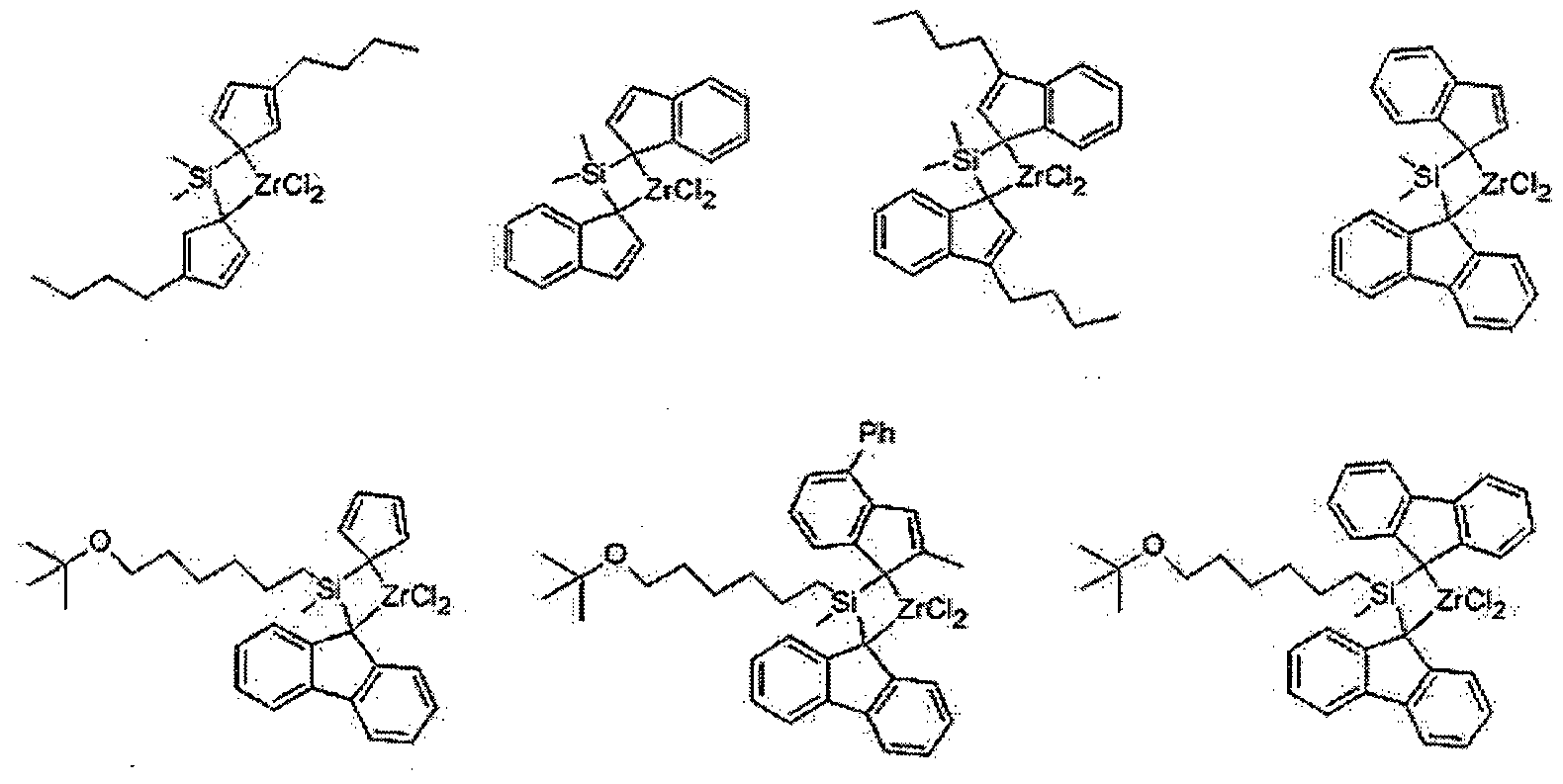


본 발명에서 사용되는 메탈로센 촉매는 상기 화학식 1로 표시되는 제 1 메탈로센 화합물의 1종 이상, 및 상기 화학식 3 내지 화학식 5로 표시되는 화합물 중 선택되는 제 2 메탈로센 화합물의 1종 이상을 조촉매 화합물과 함께 담체에 담지한 것일 수 있다.
또한, 상기 담지 메탈로센. 촉매는 제조되는 에틸렌 /알파-을레핀 공중합체에서 LCB(Long Chain Branch)의 생성을 유도할 수 있다. 본 발명에 따른 담지 메탈로센 촉매에 있어서, 상기 메탈로센 화합물을 활성화하기 위하여 담체에 함께 담지되는 조촉매로는 13족 금속을 포함하는 유기 금속 화합물로서, 일반적인 메탈로센 촉매 하에 올레핀올 중합할 때 사용될 수 있는 것이라면 특별히 한정되는 것은 아니다. 구체적으로, 상기 조촉매 화합물은 하기 화학식 6의 알루미늄 함유 제 1 조촉매, 및 하기 화학식 7의 보레이트계 제 2 조촉매 중 하나 이상을 포함할 수 있다.
[화학식 6]
- [Al (R18)-0-]k- 화학식 6에서, R18은 각각 독립적으로 할로겐, 할로겐 치환 또는 비치환된 탄소수 1 내지 20의 하이드로카빌기이고, k는 2 이상의 정수이고, [화학식 7]
T+[BG4]"
화학식 7에서, T+은 +1가의 다원자 이온이고, B는 +3 산화 상태의 붕소이고, G는 각각 독립적으로 하이드라이드, 디알킬아미도, 할라이드, 알콕사이드, 아릴옥사이드, 하이드로카빌, 할로카빌 및 할로-치환된 하이드로카빌로 이루어진 군에서 선택되고, 상기 G는 20개 이하의 탄소를 가지나, 단 하나 이하의 위치에서 G는 할라이드이다.
이러한 제 1 및 제 2 조촉매의 사용에 의해, 최종 제조된 폴리올레핀의 분자량 분포가 보다 균일하게 되면서, 중합 활성이 향상될 수 있다.
상기 화학식 6의 제 1 조촉매는 선형, 원형 또는 망상형으로 반복단위가 결합된 알킬알루미녹산계 화합물로 될 수 있고, 이러한 제 1 조촉매의 구체적인 예로는, 메틸알루미녹산 (MA0) , 에틸알루미녹산, 이소부틸알루미녹산 또는 부틸알루미녹산 등을 들 수 있다.
또한, 상기 화학식 7의 게 2 조촉매는 삼치환된 암모늄염, 또는
디알킬 암모늄염, 삼치환된 포스포늄염 형태의 보레이트계 화합물로 될 수 있다. 이러한 제 2 조촉매의 구체적인 예로는, 트리메탈암모늄 테트라페닐보레이트, 메틸디옥타데실암모늄 테트라페닐보레이트, 트리에틸암모늄 테트라페닐보레이트, 트리프로필암모늄 테트라페닐보레이트, 트리 (n-부틸)암모늄 테트라페닐보레이트, 메틸테트라데사이클로옥타데실암모늄 테트라페닐보레이트, Ν,Ν- 디메틸아닐늄 테트라페닐보레이트, Ν ,Ν-디에틸아닐늄 테트라페닐보레이트, Ν, Ν-디메틸 (2, 4, 6-트리메틸아닐늄)테트라페닐보레이트, 트리메틸암모늄 테트라키스 (펜타플로오로페닐)보레이트, 메틸디테트라데실암모늄 테트라키스 (펜타페닐)보레이트, 메틸디옥타데실암모늄 테트라키스 (펜타플루오로페닐)보레이트, . 트리에틸암모늄, 테트라키스 (펜타플루오로페닐)보레이트,
트리프로필암모늄테트라키스 (펜타프루오로페닐 )보레이트, 트리 (η- 부틸)암모늄 테트라키스 (펜타플루오로페닐)보레이트, 트라 (2급- 부틸)암모늄테트라키스 (펜타플루오로페닐)보레이트, Ν,Ν-디메틸아닐늄 테트라키스 (펜타플루오로페닐)보레이트, Ν ,Ν- 디에틸아닐늄테트라키스 (펜타플루오로페닐)보레이트, ^^디메틸(2,4,6- 트리메틸아닐늄)테트라키스 (펜타플루오로페닐)보레이트,
트리메틸암모늄테트라키스 (2, 3, 4, 6-테트라플루오로페닐)보레이트,
트리에틸암모늄 테트라키스 (2,3,4, 6-테트라플루오로페닐)보레이트, 트리프로필암모늄 테트라키스 (2,3,4 , 6-테트라플루오로페닐)보레이트, 트리 (η-부틸 )암모늄 테트라키스 ( 2 , 3, 4 , 6-,테트라플루오로페닐)보레이트, 디메틸 ( t-부틸 )암모늄 테트라키스 (2 , 3 , 4 , 6-테트라플루오로페닐)보레이트, Ν ,Ν-디메틸아닐늄 테트라키스 (2,3,4,6-테트라플루오로페닐)보레이트, Ν,Ν- 디에틸아닐늄 테트라키스 (2,3,4,6-테트라플루오로페닐)보레이트 또는 Ν,Ν- 디메틸 -(2,4,6-트리메틸아닐늄)테트라키스 -(2,3,4 , 6- 테트라플루오로페닐)보레이트 등의 삼치환된 암모늄염 형태의 보레이트계 화합물; 디옥타데실암모늄 테트라키스 (펜타플루오로페닐)보레이트, 디테트라데실암모늄 테트라키스 (펜타플루오로페닐)보레이트 또는 디사이클로핵실암모늄 테트라키스 (펜타플루오로페닐)보레이트 등의
디알킬암모늄염 형태의 보레이트계 화합물; 또는 트리페닐포스포늄 테트라키스 (펜타플루오로페닐)보레이트, 메틸디옥타데실포스포늄 테트라키스 (펜타플루오로페닐)보레이트 또는 트리 (2 , 6-디메틸페닐)포스포늄 테트라키스 (펜타플루오로페닐)보레이트 등의 삼치환된 포스포늄염 형태의 보레이트계 화합물 등을 들 수 있다. 본 발명에 따른 담지 메탈로센 촉매에 있어서, 화학식 1로 표시되는 제 1 메탈로센 화합물, 또는 화학식 3 내지 5로 표시되는 제 2 메탈로센 화합물에 포함되는 전체 전이금속 대 담체의 질량비는 1 : 10 내지 1 : 1 , 000 일 수 있다. 상기 질량비로 담체 및 메탈로센 화합물을 포함할 때, 최적의 형상을 나타낼 수 있다. 또한, 조촉매 화합물 대 담체의 질량비는
1 : 1 내지 1 : 100 일 수 있다. 본 발명에 따른 담지 메탈로센 촉매에 있어서, 상기 담체로는 표면에 하이드록시기를 함유하는 담체를 사용할 수 있으며, 바람직하게는 건조되어 표면에 수분이 제거된, 반웅성이 큰 하이드록시기와 실록산기를 가지고 있는 담체를 사용할 수 있다. 예컨대, 고온에서 건조된 실리카, 실리카 -알루미나, 및 실리카- 마그네시아 등이 사용될 수 있고, 이들은 통상적으로 Na20, K2C03 , BaS04, 및 Mg(N03)2 등의 산화물, 탄산염, 황산염, 및 질산염 성분을 함유할 수 있다. 상기 담체의 건조 온도는 200 내지 800 °C가 바람직하고, 300 내지 600 °C가 더욱 바람직하며, 300 내지 400 °C가 가장 바람직하다. 상기 담체의 건조 은도가 200°C 미만인 경우 수분이 너무 많아서 표면의 수분과 조촉매가 반웅하게 되고, 800°C를 초과하는 경우에는 담체 표면의 기공들이 합쳐지면서 표면적이 줄어들며, 또한 표면에 하이드록시기가 많이 없어지고 실록산기만 남게 되어 조촉매와의 반웅자리가 감소하기 때문에 바람직하지 않다.
상기 담체 표면의 하이드록시기 양은 0. 1 내지 10 隱 ol /g이 바람직하며, 0.5 내지 5 mmol /g일 때 더욱 바람직하다. 상기 담체 표면에 있는 하이드록시기의 양은 담체의 제조방법 및 조건 또는 건조 조건, 예컨대 은도, 시간, 진공 또는 스프레이 건조 등에 의해 조절할 수 있다. 상기 하이드록시기의 양이 0. 1 mmol/g 미만이면 조촉매와의 반웅자리가 적고, 10 匪 ol/g을 초과하면 담체 입자 표면에 존재하는 하이드록시기 이외에 수분에서 기인한 것일 가능성이 있기 때문에 바람직하지 않다. 한편, 본 발명에 따른 에틸렌 /알파-올레핀 공중합체는, 상술한 담지 메탈로센 촉매의 존재 하에서, 에틸렌 및 알파-을레핀을 중합시킴으로써 제조할 수 있다. 상기 증합 반웅은 하나의 연속식 슬러리 중합 반웅기, 루프 슬러리 반응기, 기상 반웅기 또는 용액 반웅기를 이용하여 에틸렌 및 알파- 을레핀을 공중합하여 진행할 수 있다. 그리고, 상기 중합 온도는 약 25 내지 약 500 °C , 바람직하게는 약 25 내지 약 200°C , 보다 바람직하게는 약 50 내지 약 15CTC일 수 있다. 또한, 중합 압력은 약 1 내지 약 100 Kgf/cin2 , 바람직하게는 약 1 내지 약 50 Kgf/cin2, 보다 바람직하게는 약 5 내지 약 30 Kgf/cuf일 수 있다. 상기 담지 메탈로센 촉매는 탄소수 5 내지 12의 지방족 탄화수소 용매, 예를 들면 펜탄, 핵산, 헵탄, 노난, 데칸, 및 이들의 이성질체와 를루엔, 벤젠과 같은 방향족 탄화수소 용매, 디클로로메탄, 클로로벤젠과 같은 염소원자로 치환된 탄화수소 용매 등에 용해하거나 희석하여 주입할 수 있다. 여기에 사용되는 용매는 소량의 알킬 알루미늄 처리함으로써 촉매 독으로 작용하는 소량의 물 또는 공기 등을 제거하여 사용하는 것이 바람직하며, 조촉매를 더 사용하여 실시하는 것도 가능하다.
본 발명에 따른 에틸렌 /알파-을레핀 공중합체는 저분자량의 고분자 쇄를 주로 중합하는 화학식 3 내지 5의 촉매와, 고분자량의 고분자 쇄를 주로 중합하는 화학식 1의 촉매를 함께 사용하여, 에틸렌 및 알파-올레핀 단량체를 공중합하여 제조된다. 이러한 2종 이상의 촉매의 상호 작용으로 인하여, 전체적으로 분자량 분포가 넓으면서도, 고분자량 영역에 있는 고분자 쇄들이 보다 높은 함량으로 포함된 중합체가 얻어질 수 있다.
【발명의 효과】
본 발명에 따른 에틸렌 /알파-올레핀 공중합체는, 우수한 기계적 물성 및 가공성을 가져 사출 성형으로 제품을 제조하는데 유용하게 적용될 수 있다.
【도면의 간단한 설명】
도 1은, 본 발명의 비교예 및 실시예에서 제조한 중합체의 GPC 커브를 나타낸 것이다.
【발명을 실시하기 위한 구체적인 내용】
이하, 본 발명의 이해를 돕기 위하여 바람직한 실시예를 제시한다. 그러나 하기의 실시예는 본 발명을 보다 쉽게 이해하기 위하여 제공되는 것일 뿐, 이에 의해 본 발명의 내용이 한정되는 것은 아니다. 제조예 1
단계 1) 리간드 화합물의 제조
Fluorene 2 g을 5 mL MTBE , hexane 100 mL에 녹여 2.5 M n-BuLi hexane solut ion 5.5 mL를 dry i ce/acetone bath에서 적가하여 상온에서 밤새 교반하였다. (6-(tert-butoxy)hexyl )di chloro(methyl )s i lane 3.6 g을 핵산 (hexane) 50 mL에 녹여 dry ice/acetone bath하에서 f luorene-Li 슬러리를 30분 동안 transfer하여 상온에서 밤새 교반하였다. 이와 동시에 5 , 8-d i me t hy 1 -5 , 10-d i hydr o i ndeno [ 1 , 2-b ] i ndo 1 e ( 12 mmol , 2.8 g) 또한 THF 60 mL에 녹여 2.5 M n-BuLi hexane solut ion 5.5 mL를 dry i ce/acetone bath에서 적가하여 상온에서 밤새 교반하였다. f luorene과 (6-(tert_ butoxy)hexyl )di chloro(methyl )si l ane 과의 반웅 용액을 NMR 샘플링하여
반웅 완료를 확인한 후 5,8-dimethyl-5,10-dihydroindeno[l,2-b]in(iole-Li solution을 dry ice/acetone bath하에서 transfer하였다. 상온에서 밤새 교반하였다. 반웅 후 ether /water로 추출 (extract ion)하여 유기층의 잔류수분을 MgS04로 제거 후 리간드 화합물 (Mw 597.90, 12隱 ol)을 얻었으며 이성질체 (isomer) 두 개가 생성되었음을 1H-NMR에서 확인할 수 있었다.
¾ NMR (500 MHz, d6-benzene): -0.30 - -0.18 (3H, d), 0.40 (2H, m), 0.65 ~ 1.45 (8H, m) , 1.12 (9H, d) , 2.36 ~ 2.40 (3Η, d), 3.17 (2Η, m), 3.41 ~ 3.43 (3Η, d) , 4.17 ~ 4.21 (1Η, d), 4.34 ~ 4.38 (1Η, d) , 6.90 ~ 7.80 (15H, m) 단계 2) 메탈로센 화합물의 제조
상기 단계 1에서 합성한 리간드 화합물 7.2 g (12 隱 ol)을 diethylether 50 mL에 녹여 2.5 M n-BuLi hexane solution 11.5 mL를 dry ice/acetone bath에서 적가하여 상온에서 밤새 교반하였다. 진공 건조하여 갈색 (brown color)의 sticky oil을 얻었다. 를루엔에 녹여 슬러리를 얻었다. ZrCl4(THF)2를 준비하고 를루엔 50 mL를 넣어 슬러리로 준비하였다. ZrCl4(THF)2의 50 mL 를루엔 슬러리를 dry ice/acetone bath에서 transfer하였다. 상온에서 밤새 교반함에 따라 보라색 (violet color)으로 변화하였다. 반웅 용액을 필터하여 LiCl을 제거하였다. 여과액 (filtrate)의 를루엔을 진공 건조하여 제거한 후 핵산을 넣고 1시간 동안 sonication하였다. 슬러리를 필터하여 여과된 고체 (filtered solid)인 질은 보라색 (dark violet)의 메탈로센 화합물 6 g(Mw 758.02, 7.92 誦 ol, yield 66 mol%)을 얻었다 . 1H-NMR상에서 두 개의 isomer가 관찰되었다.
¾ NMR (500 MHz, CDC13): 1.19 (9H, d), 1.71 (3H, d) , 1.50 ~ 1.70(4H, m), 1.79(2H, m), 1.98 ~ 2.19(4H, m), 2.58(3H, s), 3.38 (2H, m), 3.91 (3H, d) , 6.66 - 7.88 (15H, m) 제조예 2
6-클로로핵사놀 (6-chlorohexanol)을 사용하여 문헌 (Tetrahedron Lett. 2951 (1988))에 제시된 방법으로 t-Butyl-0-(CH2)6-Cl을 제조하고, 여기에
NaCp를 반웅시켜 t-Butyl-0-(CH2)6-C5¾를 얻었다 (수율 60%, b.p. 80 °C I 0.1 mmHg) .
또한, -78°C에서 t-Butyl-0-(CH2)6-C5H5를 THF에 녹이고, 노르말 부틸리튬 (n-BuLi)을 천천히 가한 후, 실온으로 승온시킨 후, 8시간 반응시켰다. 그 용액을 다시ᅳ -78°C에서 ZrCl4(THF)2(1.70 g, 4.50 隱 ol)/THF(30 mL)의 서스펜견 (suspension) 용액에 기 합성된 리튬염 (lithium salt) 용액을 천천히 가하고 실온에서 6시간 동안 더 반웅시켰다.
모든 휘발성 물질을 진공 건조하고, 얻어진 오일성 액체 물질에 핵산 (hexane) 용매를 가하여 걸러내었다. 걸러낸 용액을 진공 건조한 후, 핵산을 가해 저온 (_20°C)에서 침전물을 유도하였다. 얻어진 침전물을 저온에서 걸러내어 흰색 고체 형태의 [tBu-0-(C¾)6-C5H4]2ZrCl2 화합물을 얻었다 (수율 92%).
¾ NMR (300腿 z, CDCls): 6.28 (t, J = 2.6 Hz, 2 H), 6.19 (t, J = 2.6 Hz, 2 H), 3.31 (t, 6.6 Hz, 2 H), 2.62 (t, J = 8 Hz), 1.7 - 1.3 (m, 8 H), 1.17 (s, 9 H).
13C 匿 (CDC13): 135.09, 116.66, 112.28, 72.42, 61.52, 30.66, 30.61, 30.14, 29.18, 27.58, 26.00. 실시예: 담지 촉매의 제조
단계 1) 담지체 건조
실리카 (Grace Davison사 제조 SYLOPOL 948)를 400°C의 온도에서 15 시간 동안 진공을 가한 상태에서 탈수하였다. 단계 2) 담지 촉매 제조
상기 단계 1의 건조된 실리카 10 g를 유리 반웅기에 넣고, 를루엔 100 mL을 추가로 넣고 교반을 한다. 10 wt% 메틸알루미녹산 (MA0)/를루엔 용액을 50 mL를 가하여 40°C에서 교반하며 천천히 반웅시켰다. 이 후 층분한 양의 를루엔으로 세척하여 반웅하지 않은 알루미늄 화합물을 제거하고, 감압하여 남아 있는 를루엔을 제거하였다. 다시 를루엔 100 mL를
투입한 후, 상기 제조예 1에서 제조된 메탈로센 촉매 0.25 隱 을 를루엔에 녹여 같이 투입하여 1시간 동안 반웅을 시켰다. 반웅이 끝난 후, 상기 제조예 2에서 제조된 메탈로센 촉매 0.25 麵 을 를루엔에 녹여 투입한 후, 1시간 동안 반웅을 추가로 시켰다. 반웅이 끝난 후, 교반을 멈추고 를루엔층을 분리제거 후, 아닐리늄 보레이트 (Ν,Ν-dimethylani l inium tetraki s(pentaf luorophenyDborate , AB) 1.0 mmol을 투입하고 1시간 동안 교반을 시킨 후, 50°C에서 감압하여 를루엔을 제거하여, 담지 촉매를 제조하였다. 실험예
단계 1) 에틸렌 /1-부텐 공중합
상기 실시예 및 비교예에서 제조한 각각의 담지 촉매 50 mg을 드라이 박스에서 정량하여 50 mL의 유리병에 각각 담은 후 고무 격막으로 밀봉하여 드라이 박스에서 꺼내어 주입할 촉매를 준비하였다. 중합은 기계식 교반기가 장착된 온도 조절이 가능하고 고압에서 이용되는 2L 금속 합금 반웅기에서 수행하였다. 상기 반응기에 1.0扁 ol 트리에틸알루미늄 (tr i ethylaluminum)이 들어 있는 핵산 1 L와 1—부텐 5 mL을 주입하고, 상기 준비한 각각의 담지 촉매를 반웅기에 공기 접촉 없이 투입한 후, 80°C에서 기체 에틸렌 단량체를 9 Kgf/cuf의 압력으로 계속적으로 가하면서 1시간 동안 중합하였다. 중합의 종결은 먼저 교반을 멈춘 후 에틸렌을 배기시켜 제거함으로써 완료시켰다. 상기 얻어진 중합체에서 중합 용매를 여과시켜 대부분 제거한 후 80°C 진공 오븐에서 4시간 동안 건조시켰다. 단계 2) 중합체의 물성 평가
상기 실시예 및 비교예에서 제조된 중합체를 하기의 방법으로 물성을 평가하였다.
1) 밀도: ASTM 1505
2) 용융지수 (MFR, 5 kg/2.16 kg) : 측정 온도 190°C , ASTM 1238
3) MFRR(MFR5/MFR2.i6) : MFR5 용융지수 (MI , 5kg 하중)를 MFR2.16(MI , 2.16kg 하중)으로 나눈 비율이다.
4) Mn, Mw, MWD, GPC 커브: 샘플을 PL-SP260을 이용하여 BHT 0.0125% 포함된 1 ,2 ,4-Tr ichlorobenzene에서 160°C , 10시간 동안 녹여 전처리하고,
PL-GPC220을 이용하여 측정 온도 160°C에서 수 평균분자량, 중량 평균분자량을 측정하였다. 분자량 분포는 중량 평균분자량과 수 평균분자량의 비로 나타내었다.
5) Izod impact strength: ASTM D256에 따라 23°C에서 측정하였다. 6) Flexural modulus : ASTM D790에 따라 측정하였다.
7) ESCR: ASTM D1673에 따라 측정하였다.
8) Spiral f low length: ENGEL 150톤 사출기를 사용하였으며, 금형 두께는 1.5 睡, 사출 은도는 190°C , 금형 온도는 50°C , 사출 압력을 90 bar로 하여 측정하였다. 상기 결과를 하기 표 1에 나타내었다. 또한, 각 공중합체의 GPC 커브를 도 1에 나타내었다.
【표 1】

Claims
【청구항 1】
중량 평균 분자량 (g/mol)이 50,000 내지 150,000이고,
분자량 분포 (Mw/Mn)가 2 내지 10이고,
밀도 (g/cirf)가 0.950 내지 0.965이고, 및
스파이럴 플로우 길이 (spiral flow length)가 25 내지 40 cm인, 에틸렌 /알파-올레핀 공중합체.
【청구항 2]
제 1항에 있어서,
상기 중량 평균 분자량이 85,000 내지 100,000 g/TOl인 것을 특징으로 하는,
에틸렌 /알파-을레핀 공중합체. 【청구항 3】
제 1항에 있어서,
상기 분자량 분포 (Mw/Mn)가 4 내지 10인 것을 특징으로 하는, 에틸렌 /알파-올레핀 공중합체. 【청구항 4】
제 1항에 있어서,
상기 에틸렌 /알파-을레핀 공중합체의 MFRR5/2.16(ASTM D1238에 의거하여 190 °C, 5kg 하중에서 측정한 용융 유동 지수를 190°C, 2.16 kg 하중에서 측정한 용융 유동 지수로 나눈 값)이 2 내지 10인 것을 특징으로 하는,
에틸렌 /알파-을레핀 공중합체.
【청구항 5】
제 1항에 있어서,
상기 에틸렌 /알파-올레핀 공중합체의 아이조드 층격 강도 (Izod
impact strength)가 7 내지 15 kg-cm/cm 인 것을 특징으로 하는,
에틸렌 /알파-올레핀 공중합체.
【청구항 6】
게 1항에 있어서,
상기 에틸렌 /알파-올레핀 공중합체의 아이조드 층격 강도 ( Izod impact strength)가 7 내지 13 kg-cm/cm 인 것을 특징으로 하는,
에틸렌 /알파-을레핀 공중합체. 【청구항 7】
제 1항에 있어서,
상기 알파 -을레핀은, 프로필렌, 1-부텐, 1-펜텐, 4-메틸 -1-펜텐, 1- 핵센, 1-헵텐, 1-옥텐, 1-데센, 1-운데센, 1-도데센, 1-테트라데센, 1- 핵사데센 및 1-아이토센으로 구성되는 군으로부터 선택되는 어느 하나 이상인 것을 특징으로 하는,
에틸렌 /알파-올레핀 공중합체.
【청구항 8]
제 1항에 있어서, 상기 에틸렌 /알파-올레핀 공중합체는 하기 화학식 1로 표시되는 게 1 메탈로센 화합물 1종 이상; 및 하기 화학식 3 내지 5로 표시되는 화합물 중에서 선택되는 제 2 메탈로센 화합물 1종 이상의 존재 하에, 에틸렌 및 알파-올레핀을 중합시킴으로써 제조되는, 에틸렌 /알파- 올레핀 공중합체:
[

상기 화학식 1에서,
A는 수소, 할로겐, 알킬, C2-20 알케닐, C6-20 아릴, C7-20 알킬아릴, C7-20 아릴알킬, Cwo 알콕시, C2-20 알콕시알킬, C3-20
헤테로시클로알킬, 또는 C5-20 헤테로아릴이고;
D는 -0-, -S- , -N(R)- 또는 -Si (RKR' )-이고, 여기서 R 및 R '은 서로 동일하거나 상이하고, 각각 독립적으로 수소, 할로겐, d-20 알킬, C2 알케닐, 또는 C6-20 아릴이고;
L은 d-10 직쇄 또는 분지쇄 알킬렌이고;
B는 탄소, 실리콘 또는 게르마늄이고;
Q는 수소, 할로겐, ( 20 알킬, C2-20 알케닐, C6— 20 아릴, C7-20 알킬아릴, 또는 C7-20 아릴알킬이고;
M은 4족 전이금속이며;
X1 및 X2는 서로 동일하거나 상이하고, 각각 독립적으로 할로겐, Cwo 알킬, C2-20 알케닐, C6-20 아릴 , 니트로, 아미도, d-20 알킬실릴, d-20 알콕시 또는 에 술폰네이트이고;
C1 및 C2는 서로 동일하거나 상이하고, 각각 독립적으로 하기 화학식 2a , 화학식 2b 또는 하기 화학식 2c 중 하나로 표시되고, 단, C1 및 C2가 모두 화학식 2c인 경우는 제외하며 ;

[화학식 2c]

상기 화학식 2a , 2b 및 2c에서, 내지 R17 및 I 내지 '는 서로 동일하거나 상이하고, 각각 독립적으로 수소, 할로겐, d-20 알킬, C2-20 알케닐, d-20 알킬실릴, -20 실릴알킬, d-20 알콕시실릴, 알콕시, C6-20 아릴, C7— 20 알킬아릴, 또는 C7-20 아릴알킬이며, 상기 R10 내지 R17 중 서로 인접하는 2개 이상이 서로 연결되어 치환 또는 비치환된 지방족 또늗 방향족 고리를 형성할 수 있고;
[화학식 3]

상기 화학식 3에서,
M1은 4족 전이금속이고;
Cp1 및 Cp2는 서로 동일하거나 상이하고, 각각 독립적으로 시클로펜타디엔닐 , 인데닐, 4,5,6,7-테트라하이드로 -1-인데닐, 및 플루오레닐 라디칼로 이루어진 군으로부터 선택된 어느 하나이고, 이들은 탄소수 1 내지 20의 탄화수소로 치환될 수 있으며;
R3 및 Rb는 서로 동일하거나 상이하고, 각각 독립적으로 수소, d-20 알킬, Cwo 알콕시, C2-20 알콕시알킬, C6-20 아릴, C6—10 아릴옥시, C2-20 알케닐, C7-40 알킬아릴, C7-40 아릴알킬, C8-40 아릴알케닐, 또는 C2-10 알키닐이고;
Z1은 할로겐 원자, d-20 알킬, C2-10 알케닐, C7-40 알킬아릴, C7-40 아릴알킬, C6-20 아릴, 치환되거나 치환되지 않은 d-20 알킬리덴, 치환되거나 치환되지 않은 아미노, C2-20 알킬알콕시 , 또는 C7-40 아릴알콕시이고;
n은 1 또는 0이고;
[화학식 4]
(Cp3Rc)mB1(Cp4Rd)M2ZVm
상기 화학식 4에서,
M2는 4족 전이 금속이고;
Cp3 및 Cp4는 서로 동일하거나 상이하고, 각각 독립적으로 시클로펜타디에닐, 인데닐, 4, 5, 6 , 7-테트라하이드로 -1-인데닐 및 플루오레닐 라디칼로 이루어진 군으로부터 선택된 어느 하나이고, 이들은 탄소수 1 내지 20의 탄화수소로 치환될 수 있으며 ;
Rc 및 Rd는 서로 동일하거나 상이하고, 각각 독립적으로 수소, Cuo 알킬, 에 알콕시 , C2-20 알콕시알킬, c6—20 아릴, c6—10 아릴옥시, c2—20 알케닐, C7-40 알킬아릴, C7-40 아릴알킬, C8-40 아릴알케닐, 또는 c2—10 알키닐이고;
Z2는 할로겐 원자, d-20 알킬, C2-10 알케닐, C7-40 알킬아릴, C7-40 아릴알킬, C6-20 아릴, 치환되거나 치환되지 않은 ( 20 알킬리덴, 치환되거나 치환되지 않은 아미노, C2-20 알킬알콕시, 또는 C7-40 아릴알콕시이고;
B1은 Cp¾c 고리와 Cp4Rd 고리를 가교 결합시키거나, 하나의 Cp4Rd 고리를 M2에 가교 결합시키는, 탄소, 게르마늄, 규소, 인 또는 질소 원자 함유 라디칼 중 하나 이상 또는 이들의 조합이고;
m은 1 또는 0이고;
[화학식 5]
(Cp¾e)B2(J )M3Z3 2
상기 화학식 5에서,
M3은 4족 전이 금속이고;
Cp5는 시클로펜타디에닐, 인데닐, 4 , 5 , 6, 7-테트라하이드로 -1-인데닐 및 플루오레닐 라디칼로 이루어진 군으로부터 선택된 어느 하나이고, 이들은 탄소수 1 내지 20의 탄화수소로 치환될 수 있으며 ;
Re는 수소, Cwo 알킬 , d-10 알콕시, C2-20 알콕시알킬, C6-20 아릴, C6- 10 아릴옥시, C2—20 알케닐, C7-40 알킬아릴, CV40 아릴알킬, C 40 아릴알케닐, 또는 C2-10 알키닐이고;
Z3은 할로겐 원자, Cwo 알킬, C2-10 알케닐, C7-40 알킬아릴, C7-40 아릴알킬, C6-20 아릴, 치환되거나 치환되지 않은 d— 20 알킬리덴, 치환되거나 치환되지 않은 아미노, C2-20 알킬알콕시, 또는 C7-40 아릴알콕시이고;
B2는 Cp¾e 고리와 J를 가교 결합시키는 탄소, 게르마늄, 규소, 인 또는 질소 원자 함유 라디칼중 하나 이상 또는 이들의 조합이고;
J는 N f, 0, PRf 및 S로 이루어진 군에서 ,선택된 어느 하나이고, 는 C-20 알킬, 아릴, 치환된 알킬 또는 치환된 아릴이다.
Applications Claiming Priority (2)
| Application Number | Priority Date | Filing Date | Title |
|---|---|---|---|
| KR10-2015-0053381 | 2015-04-15 | ||
| KR1020150053381A KR20160123172A (ko) | 2015-04-15 | 2015-04-15 | 가공성이 우수한 에틸렌/알파-올레핀 공중합체 |
Publications (1)
| Publication Number | Publication Date |
|---|---|
| WO2016167568A1 true WO2016167568A1 (ko) | 2016-10-20 |
Family
ID=57126714
Family Applications (1)
| Application Number | Title | Priority Date | Filing Date |
|---|---|---|---|
| PCT/KR2016/003890 Ceased WO2016167568A1 (ko) | 2015-04-15 | 2016-04-14 | 가공성이 우수한 에틸렌 /알파-올레핀 공중합체 |
Country Status (2)
| Country | Link |
|---|---|
| KR (1) | KR20160123172A (ko) |
| WO (1) | WO2016167568A1 (ko) |
Cited By (2)
| Publication number | Priority date | Publication date | Assignee | Title |
|---|---|---|---|---|
| US20200048381A1 (en) * | 2016-11-15 | 2020-02-13 | Lg Chem, Ltd. | Ethylene/Alpha-Olefin Copolymer Having Excellent Environmental Stress Crack Resistance |
| US20240101729A1 (en) * | 2021-02-19 | 2024-03-28 | Lg Chem, Ltd. | Polyethylene for preparing fiber and preparation method of the same |
Families Citing this family (8)
| Publication number | Priority date | Publication date | Assignee | Title |
|---|---|---|---|---|
| KR101856727B1 (ko) | 2016-06-21 | 2018-05-10 | 주식회사 엘지화학 | 액정 배향제 조성물, 이를 이용한 액정 배향막의 제조 방법, 및 이를 이용한 액정 배향막 |
| KR102228534B1 (ko) * | 2016-10-27 | 2021-03-15 | 주식회사 엘지화학 | 내환경 응력 균열성이 우수한 에틸렌/알파-올레핀 공중합체 |
| KR102090812B1 (ko) * | 2016-11-15 | 2020-03-18 | 주식회사 엘지화학 | 가공성이 우수한 에틸렌/알파-올레핀 공중합체 |
| KR102039073B1 (ko) | 2016-11-15 | 2019-10-31 | 주식회사 엘지화학 | 충격 강도가 우수한 폴리에틸렌 수지 |
| KR102180532B1 (ko) * | 2016-11-28 | 2020-11-18 | 주식회사 엘지화학 | 내환경 응력 균열성이 우수한 폴리올레핀의 제조 방법 |
| KR102072697B1 (ko) * | 2016-12-09 | 2020-02-03 | 주식회사 엘지화학 | 가공성 및 기계적 물성이 우수한 에틸렌/1-헥센 공중합체 |
| KR102215630B1 (ko) * | 2016-12-13 | 2021-02-10 | 주식회사 엘지화학 | 혼성 담지 메탈로센 촉매 |
| KR102229002B1 (ko) * | 2016-12-14 | 2021-03-16 | 주식회사 엘지화학 | 가공성 및 내환경 응력 균열성이 우수한 에틸렌/알파-올레핀 공중합체 |
Citations (5)
| Publication number | Priority date | Publication date | Assignee | Title |
|---|---|---|---|---|
| US20110217499A1 (en) * | 2008-08-29 | 2011-09-08 | Basell Polyolefine Gmbh | Polyethylene for Injection Moldings |
| KR20130113322A (ko) * | 2010-07-06 | 2013-10-15 | 셰브론 필립스 케미컬 컴퍼니 엘피 | 수소 첨가없이 넓은 분자량 분포의 폴리올레핀 제조를 위한 촉매 |
| US20140213734A1 (en) * | 2013-01-30 | 2014-07-31 | Exxonmobil Chemical Patents Inc. | Polyethylene Copolymers with Vinyl Terminated Macromonomers as Comonomers |
| KR20150015789A (ko) * | 2013-08-01 | 2015-02-11 | 주식회사 엘지화학 | 메탈로센 화합물, 이를 포함하는 촉매 조성물 및 이를 이용하는 올레핀계 중합체의 제조방법 |
| KR20150037520A (ko) * | 2013-09-30 | 2015-04-08 | 주식회사 엘지화학 | 폴리올레핀의 제조 방법 및 이로부터 제조된 폴리올레핀 |
-
2015
- 2015-04-15 KR KR1020150053381A patent/KR20160123172A/ko not_active Withdrawn
-
2016
- 2016-04-14 WO PCT/KR2016/003890 patent/WO2016167568A1/ko not_active Ceased
Patent Citations (5)
| Publication number | Priority date | Publication date | Assignee | Title |
|---|---|---|---|---|
| US20110217499A1 (en) * | 2008-08-29 | 2011-09-08 | Basell Polyolefine Gmbh | Polyethylene for Injection Moldings |
| KR20130113322A (ko) * | 2010-07-06 | 2013-10-15 | 셰브론 필립스 케미컬 컴퍼니 엘피 | 수소 첨가없이 넓은 분자량 분포의 폴리올레핀 제조를 위한 촉매 |
| US20140213734A1 (en) * | 2013-01-30 | 2014-07-31 | Exxonmobil Chemical Patents Inc. | Polyethylene Copolymers with Vinyl Terminated Macromonomers as Comonomers |
| KR20150015789A (ko) * | 2013-08-01 | 2015-02-11 | 주식회사 엘지화학 | 메탈로센 화합물, 이를 포함하는 촉매 조성물 및 이를 이용하는 올레핀계 중합체의 제조방법 |
| KR20150037520A (ko) * | 2013-09-30 | 2015-04-08 | 주식회사 엘지화학 | 폴리올레핀의 제조 방법 및 이로부터 제조된 폴리올레핀 |
Cited By (4)
| Publication number | Priority date | Publication date | Assignee | Title |
|---|---|---|---|---|
| US20200048381A1 (en) * | 2016-11-15 | 2020-02-13 | Lg Chem, Ltd. | Ethylene/Alpha-Olefin Copolymer Having Excellent Environmental Stress Crack Resistance |
| US10815324B2 (en) * | 2016-11-15 | 2020-10-27 | Lg Chem, Ltd. | Ethylene/alpha-olefin copolymer having excellent environmental stress crack resistance |
| US20240101729A1 (en) * | 2021-02-19 | 2024-03-28 | Lg Chem, Ltd. | Polyethylene for preparing fiber and preparation method of the same |
| US12612475B2 (en) * | 2021-02-19 | 2026-04-28 | Lg Chem, Ltd. | Polyethylene for preparing fiber and preparation method of the same |
Also Published As
| Publication number | Publication date |
|---|---|
| KR20160123172A (ko) | 2016-10-25 |
Similar Documents
| Publication | Publication Date | Title |
|---|---|---|
| KR101617870B1 (ko) | 가공성이 우수한 올레핀계 중합체 | |
| US10323110B2 (en) | Ethylene/alpha-olefin copolymer having excellent processability | |
| KR101726820B1 (ko) | 가공성 및 환경 응력 균열 저항성이 우수한 에틸렌/1-헥센 또는 에틸렌/1-부텐 공중합체 | |
| CN108401432B (zh) | 用于合成烯烃共聚物的催化剂组合物和制备烯烃共聚物的方法 | |
| KR101592436B1 (ko) | 내환경 응력 균열성이 우수한 폴리올레핀 | |
| KR102260362B1 (ko) | 올레핀 공중합체 | |
| KR102234944B1 (ko) | 올레핀 공중합체 | |
| WO2016167568A1 (ko) | 가공성이 우수한 에틸렌 /알파-올레핀 공중합체 | |
| KR101691628B1 (ko) | 폴리올레핀의 제조 방법 및 이로부터 제조된 폴리올레핀 | |
| KR101831418B1 (ko) | 가공성 및 표면 특성이 우수한 에틸렌/알파-올레핀 공중합체 | |
| WO2016167547A1 (ko) | 내환경 응력 균열성이 우수한 에틸렌/알파-올레핀 공중합체 | |
| KR101593666B1 (ko) | 가공성이 우수한 올레핀계 중합체 | |
| KR102064990B1 (ko) | 에틸렌 슬러리 중합용 혼성 담지 촉매 시스템 및 이를 이용한 에틸렌 중합체의 제조 방법 | |
| KR20180071160A (ko) | 혼성 담지 메탈로센 촉매 및 이를 이용한 폴리올레핀의 제조 방법 | |
| KR102211603B1 (ko) | 올레핀 공중합체 합성용 촉매 조성물 및 올레핀 공중합체의 제조 방법 | |
| WO2016163810A1 (ko) | 중공 성형용 고밀도 폴리에틸렌 공중합체 | |
| WO2016060445A1 (ko) | 가공성 및 환경 응력 균열 저항성이 우수한 에틸렌 /1-헥센 또는 에틸렌 /1-부텐 공중합체 | |
| WO2016167548A1 (ko) | 가공성 및 표면 특성이 우수한 에틸렌 /알파-올레핀 공중합체 | |
| WO2018117403A1 (ko) | 혼성 담지 메탈로센 촉매 및 이를 이용한 폴리올레핀의 제조 방법 | |
| WO2017155211A1 (ko) | 에틸렌 슬러리 중합용 혼성 담지 촉매 시스템 및 이를 이용한 에틸렌 중합체의 제조 방법 |
Legal Events
| Date | Code | Title | Description |
|---|---|---|---|
| 121 | Ep: the epo has been informed by wipo that ep was designated in this application |
Ref document number: 16780291 Country of ref document: EP Kind code of ref document: A1 |
|
| NENP | Non-entry into the national phase |
Ref country code: DE |