WO2016163372A1 - 化合物、これを用いた有機エレクトロルミネッセンス素子用材料、及びこれを用いた有機エレクトロルミネッセンス素子並びに電子機器 - Google Patents
化合物、これを用いた有機エレクトロルミネッセンス素子用材料、及びこれを用いた有機エレクトロルミネッセンス素子並びに電子機器 Download PDFInfo
- Publication number
- WO2016163372A1 WO2016163372A1 PCT/JP2016/061176 JP2016061176W WO2016163372A1 WO 2016163372 A1 WO2016163372 A1 WO 2016163372A1 JP 2016061176 W JP2016061176 W JP 2016061176W WO 2016163372 A1 WO2016163372 A1 WO 2016163372A1
- Authority
- WO
- WIPO (PCT)
- Prior art keywords
- group
- substituted
- unsubstituted
- ring
- carbon atoms
- Prior art date
- Legal status (The legal status is an assumption and is not a legal conclusion. Google has not performed a legal analysis and makes no representation as to the accuracy of the status listed.)
- Ceased
Links
- JAZVQYSGJLQKLU-UHFFFAOYSA-N C(C1)C=Cc(c2cc(-c(cc34)ccc3-c3ccccc3C4(c3ccccc3)c3ccccc3)ccc22)c1[n]2C(C=CC1=C2)=CC1=CCC2c1nc(-c(cccc2)c2-c2ccc3)c2c3n1 Chemical compound C(C1)C=Cc(c2cc(-c(cc34)ccc3-c3ccccc3C4(c3ccccc3)c3ccccc3)ccc22)c1[n]2C(C=CC1=C2)=CC1=CCC2c1nc(-c(cccc2)c2-c2ccc3)c2c3n1 JAZVQYSGJLQKLU-UHFFFAOYSA-N 0.000 description 1
- CCHBOCOGKVNBJN-UHFFFAOYSA-N C(C12)C1C(c(cc1c3c4cccc3)ccc1[n]4-c(ccc1c3)cc1ccc3-c1nc(-c(cccc3)c3-c3ccc4)c3c4n1)=CC(c1c3cccc1)=C2C3(c1ccccc1)c1ccccc1 Chemical compound C(C12)C1C(c(cc1c3c4cccc3)ccc1[n]4-c(ccc1c3)cc1ccc3-c1nc(-c(cccc3)c3-c3ccc4)c3c4n1)=CC(c1c3cccc1)=C2C3(c1ccccc1)c1ccccc1 CCHBOCOGKVNBJN-UHFFFAOYSA-N 0.000 description 1
- GKEQEHJVECYYST-UHFFFAOYSA-N C(C1C=C2)C1C1=C2c2cccc3nc(-c4ccc(cc(cc5)-[n](c(cccc6)c6c6c7)c6ccc7C6=CC7c(c8ccccc8cc8)c8OC7C=C6)c5c4)cc1c23 Chemical compound C(C1C=C2)C1C1=C2c2cccc3nc(-c4ccc(cc(cc5)-[n](c(cccc6)c6c6c7)c6ccc7C6=CC7c(c8ccccc8cc8)c8OC7C=C6)c5c4)cc1c23 GKEQEHJVECYYST-UHFFFAOYSA-N 0.000 description 1
- BCFMFJHMWHDBTM-UHFFFAOYSA-N C(C1C=C2)C1c(c1cc(-c3cccc(-c4ccccc4)c3)ccc11)c2[n]1-c(ccc1c2)cc1ccc2-c1cc(-c(cccc2)c2-c2ccc3)c2c3n1 Chemical compound C(C1C=C2)C1c(c1cc(-c3cccc(-c4ccccc4)c3)ccc11)c2[n]1-c(ccc1c2)cc1ccc2-c1cc(-c(cccc2)c2-c2ccc3)c2c3n1 BCFMFJHMWHDBTM-UHFFFAOYSA-N 0.000 description 1
- BMJHRMBFCOYVDE-UHFFFAOYSA-N C(C1c2ccc3)=CC=CC1c1c2c3nc(-c2ccc(cc(cc3)-c(cc4c5c6ccc(-c(cc7c8c9cccc8)ccc7[n]9-c7ccccc7)c5)ccc4[n]6-c4cccc(-c5ccccc5)c4)c3c2)c1 Chemical compound C(C1c2ccc3)=CC=CC1c1c2c3nc(-c2ccc(cc(cc3)-c(cc4c5c6ccc(-c(cc7c8c9cccc8)ccc7[n]9-c7ccccc7)c5)ccc4[n]6-c4cccc(-c5ccccc5)c4)c3c2)c1 BMJHRMBFCOYVDE-UHFFFAOYSA-N 0.000 description 1
- SCODYUFZUXRUJX-UHFFFAOYSA-N CC(C)(c(cccc1)c1-c1c2)c1ccc2-c(cc1c2c3cccc2)ccc1[n]3-c1c(-c(cccc2)c2-c2ccc3)c2c3cn1 Chemical compound CC(C)(c(cccc1)c1-c1c2)c1ccc2-c(cc1c2c3cccc2)ccc1[n]3-c1c(-c(cccc2)c2-c2ccc3)c2c3cn1 SCODYUFZUXRUJX-UHFFFAOYSA-N 0.000 description 1
- BCQGRVWWCVWRKH-UHFFFAOYSA-N CC(C)(c1c2)C(C=CC3C4C3)=C4c1ccc2-c(cc1c2c3cccc2)ccc1[n]3-c(ccc1c2)cc1ccc2-c1nc(-c(cccc2)c2-c2ccc3)c2c3n1 Chemical compound CC(C)(c1c2)C(C=CC3C4C3)=C4c1ccc2-c(cc1c2c3cccc2)ccc1[n]3-c(ccc1c2)cc1ccc2-c1nc(-c(cccc2)c2-c2ccc3)c2c3n1 BCQGRVWWCVWRKH-UHFFFAOYSA-N 0.000 description 1
- BULTWGITVSWQAA-UHFFFAOYSA-N CC1(C)c(cc(cc2)-c(cc3c4c5cccc4)ccc3[n]5-c3cc(-c4c(-c(cccc5)c5-c5ccc6)c5c6cn4)ccc3)c2-c2c1cccc2 Chemical compound CC1(C)c(cc(cc2)-c(cc3c4c5cccc4)ccc3[n]5-c3cc(-c4c(-c(cccc5)c5-c5ccc6)c5c6cn4)ccc3)c2-c2c1cccc2 BULTWGITVSWQAA-UHFFFAOYSA-N 0.000 description 1
- IYASUXNMHNRNSG-UHFFFAOYSA-N CC1(C)c(cc(cc2)-c(cc3c4c5cccc4)ccc3[n]5-c3nc(-c(cccc4)c4-c4ccc5)c4c5n3)c2-c2c1cccc2 Chemical compound CC1(C)c(cc(cc2)-c(cc3c4c5cccc4)ccc3[n]5-c3nc(-c(cccc4)c4-c4ccc5)c4c5n3)c2-c2c1cccc2 IYASUXNMHNRNSG-UHFFFAOYSA-N 0.000 description 1
- XEZWUKYKTDNWIC-UHFFFAOYSA-N CC1(C)c2cc(-c(cc3)cc(c4c5cccc4)c3[n]5-c3ncc-4c5c3cccc5-c3ccccc-43)ccc2-c2ccccc12 Chemical compound CC1(C)c2cc(-c(cc3)cc(c4c5cccc4)c3[n]5-c3ncc-4c5c3cccc5-c3ccccc-43)ccc2-c2ccccc12 XEZWUKYKTDNWIC-UHFFFAOYSA-N 0.000 description 1
- HPHDXDJPWGSCGY-UHFFFAOYSA-N CC1(C)c2cc(-c(cc3)cc(c4cc(-c5nc(-c(cccc6)c6-c6ccc7)c6c7n5)ccc44)c3[n]4-c3ccccc3)ccc2-c2ccccc12 Chemical compound CC1(C)c2cc(-c(cc3)cc(c4cc(-c5nc(-c(cccc6)c6-c6ccc7)c6c7n5)ccc44)c3[n]4-c3ccccc3)ccc2-c2ccccc12 HPHDXDJPWGSCGY-UHFFFAOYSA-N 0.000 description 1
- DOBXHIIJHBHRLL-UHFFFAOYSA-N CC1(C)c2cc(-c(cc3c4c5cccc4)ccc3[n]5-c(ccc3c4)cc3ccc4C(CC3c4ccccc4-4)=Nc5c3c-4ccc5)ccc2-c2ccccc12 Chemical compound CC1(C)c2cc(-c(cc3c4c5cccc4)ccc3[n]5-c(ccc3c4)cc3ccc4C(CC3c4ccccc4-4)=Nc5c3c-4ccc5)ccc2-c2ccccc12 DOBXHIIJHBHRLL-UHFFFAOYSA-N 0.000 description 1
- JKDXYECSUFAENZ-OSBQEZSISA-N CC[C@@]1([C@H](N(C)c2ccccc22)N2c2c3cccc2)C3(CC)[IH]C1 Chemical compound CC[C@@]1([C@H](N(C)c2ccccc22)N2c2c3cccc2)C3(CC)[IH]C1 JKDXYECSUFAENZ-OSBQEZSISA-N 0.000 description 1
- NMJGBCONSRNWQR-UHFFFAOYSA-N Clc1nc2cccc(-c3ccccc3-3)c2c-3c1 Chemical compound Clc1nc2cccc(-c3ccccc3-3)c2c-3c1 NMJGBCONSRNWQR-UHFFFAOYSA-N 0.000 description 1
- SHAUZOVQXWIGHW-UHFFFAOYSA-N N#CC(C#N)=C(c1c2)c3cc(OC(F)(F)F)ccc3-c1cc(-c(c1c3)ccc3OC(F)(F)F)c2C1=C(C#N)C#N Chemical compound N#CC(C#N)=C(c1c2)c3cc(OC(F)(F)F)ccc3-c1cc(-c(c1c3)ccc3OC(F)(F)F)c2C1=C(C#N)C#N SHAUZOVQXWIGHW-UHFFFAOYSA-N 0.000 description 1
- IWCKJFLWZKMCLK-UHFFFAOYSA-N c(cc1)cc(-c2ccc3)c1-c1c2c3nc(-c2ccc(cc(cc3)-[n](c(cccc4)c4c4c5)c4ccc5-c(cc45)ccc4[o]c4c5c5ccccc5cc4)c3c2)n1 Chemical compound c(cc1)cc(-c2ccc3)c1-c1c2c3nc(-c2ccc(cc(cc3)-[n](c(cccc4)c4c4c5)c4ccc5-c(cc45)ccc4[o]c4c5c5ccccc5cc4)c3c2)n1 IWCKJFLWZKMCLK-UHFFFAOYSA-N 0.000 description 1
- FDWCZQFWNCKRDF-UHFFFAOYSA-N c(cc1)cc(c2c3cccc2)c1[n]3-c(cc1c2c3cccc2)ccc1[n]3-c(cc1-c2ccc3)ccc1-c1c2c3cnc1 Chemical compound c(cc1)cc(c2c3cccc2)c1[n]3-c(cc1c2c3cccc2)ccc1[n]3-c(cc1-c2ccc3)ccc1-c1c2c3cnc1 FDWCZQFWNCKRDF-UHFFFAOYSA-N 0.000 description 1
- MBZKIPCOELCLNZ-UHFFFAOYSA-N c(cc1)cc(c2ccccc22)c1[n]2-c(cc1c2c3cccc2)ccc1[n]3-c1ccc(-c2c(c-3ccc4)c4cnc2)c-3n1 Chemical compound c(cc1)cc(c2ccccc22)c1[n]2-c(cc1c2c3cccc2)ccc1[n]3-c1ccc(-c2c(c-3ccc4)c4cnc2)c-3n1 MBZKIPCOELCLNZ-UHFFFAOYSA-N 0.000 description 1
- YPVGHMLBNNLJIJ-UHFFFAOYSA-N c(cc1)cc(c2ccccc22)c1[n]2-c(cc1c2c3cccc2)ccc1[n]3-c1ncc(-c2c(c-3ccc4)c4ncc2)c-3c1 Chemical compound c(cc1)cc(c2ccccc22)c1[n]2-c(cc1c2c3cccc2)ccc1[n]3-c1ncc(-c2c(c-3ccc4)c4ncc2)c-3c1 YPVGHMLBNNLJIJ-UHFFFAOYSA-N 0.000 description 1
- FWIBWQUXFXVXSG-UHFFFAOYSA-N c(cc1)cc-2c1-c1c(-[n](c(cccc3)c3c3c4)c3ccc4-c(cc3)cc4c3[s]c3ccccc43)ncc3c1c-2ccc3 Chemical compound c(cc1)cc-2c1-c1c(-[n](c(cccc3)c3c3c4)c3ccc4-c(cc3)cc4c3[s]c3ccccc43)ncc3c1c-2ccc3 FWIBWQUXFXVXSG-UHFFFAOYSA-N 0.000 description 1
- WEYDVMOEOYXRKF-UHFFFAOYSA-N c(cc1)cc-2c1-c1c(-[n](c3ccccc3c3c4)c3ccc4-c(cc3)cc4c3[o]c3ccccc43)ncc3c1c-2ccc3 Chemical compound c(cc1)cc-2c1-c1c(-[n](c3ccccc3c3c4)c3ccc4-c(cc3)cc4c3[o]c3ccccc43)ncc3c1c-2ccc3 WEYDVMOEOYXRKF-UHFFFAOYSA-N 0.000 description 1
- DZRNTBVCTKGAPI-UHFFFAOYSA-N c(cc1)cc-2c1-c1ccnc3c1c-2ccc3-[n](c(cccc1)c1c1c2)c1ccc2-c1ccc2[o]c(cccc3)c3c2c1 Chemical compound c(cc1)cc-2c1-c1ccnc3c1c-2ccc3-[n](c(cccc1)c1c1c2)c1ccc2-c1ccc2[o]c(cccc3)c3c2c1 DZRNTBVCTKGAPI-UHFFFAOYSA-N 0.000 description 1
- ZXQMSYIEZKGRCW-UHFFFAOYSA-N c(cc1)cc-2c1-c1cncc3c1c-2ccc3-[n]1c(ccc(-[n]2c(cccc3)c3c3c2cccc3)c2)c2c2c1cccc2 Chemical compound c(cc1)cc-2c1-c1cncc3c1c-2ccc3-[n]1c(ccc(-[n]2c(cccc3)c3c3c2cccc3)c2)c2c2c1cccc2 ZXQMSYIEZKGRCW-UHFFFAOYSA-N 0.000 description 1
- QNQOCMOBNVQVDU-UHFFFAOYSA-N c(cc1)ccc1-[n](c(c1c2)ccc2-c(cc2)cc(c3c4cccc3)c2[n]4-c2ccc(-c3c(c-4ccc5)c5cnc3)c-4n2)c2c1c1ccccc1cc2 Chemical compound c(cc1)ccc1-[n](c(c1c2)ccc2-c(cc2)cc(c3c4cccc3)c2[n]4-c2ccc(-c3c(c-4ccc5)c5cnc3)c-4n2)c2c1c1ccccc1cc2 QNQOCMOBNVQVDU-UHFFFAOYSA-N 0.000 description 1
- HXCWAKDJILVVQN-UHFFFAOYSA-N c(cc1)ccc1-[n](c(c1c2)ccc2-c(cc2c3c4cccc3)ccc2[n]4-c(cc2-c3ccc4)ccc2-c2c3c4cnc2)c2c1c(cccc1)c1cc2 Chemical compound c(cc1)ccc1-[n](c(c1c2)ccc2-c(cc2c3c4cccc3)ccc2[n]4-c(cc2-c3ccc4)ccc2-c2c3c4cnc2)c2c1c(cccc1)c1cc2 HXCWAKDJILVVQN-UHFFFAOYSA-N 0.000 description 1
- SZKVNRWAYAJUDW-UHFFFAOYSA-N c(cc1)ccc1-[n](c(c1c2)ccc2-c(cc2c3c4cccc3)ccc2[n]4-c2c(-c(cccc3)c3-c3ccc4)c3c4cn2)c2c1c1ccccc1cc2 Chemical compound c(cc1)ccc1-[n](c(c1c2)ccc2-c(cc2c3c4cccc3)ccc2[n]4-c2c(-c(cccc3)c3-c3ccc4)c3c4cn2)c2c1c1ccccc1cc2 SZKVNRWAYAJUDW-UHFFFAOYSA-N 0.000 description 1
- XLMLBGGCIIDPMP-UHFFFAOYSA-N c(cc1)ccc1-[n](c(c1c2)ccc2-c(cc2c3c4cccc3)ccc2[n]4-c2cc(-c(nccc3)c3-c3ccc4)c3c4c2)c2c1c(cccc1)c1cc2 Chemical compound c(cc1)ccc1-[n](c(c1c2)ccc2-c(cc2c3c4cccc3)ccc2[n]4-c2cc(-c(nccc3)c3-c3ccc4)c3c4c2)c2c1c(cccc1)c1cc2 XLMLBGGCIIDPMP-UHFFFAOYSA-N 0.000 description 1
- UEKQFWMINHIRHH-UHFFFAOYSA-N c(cc1)ccc1-[n](c(c1c2)ccc2-c(cc2c3c4cccc3)ccc2[n]4-c2ncc(-c3c(c-4ccc5)c5ncc3)c-4c2)c2c1c1ccccc1cc2 Chemical compound c(cc1)ccc1-[n](c(c1c2)ccc2-c(cc2c3c4cccc3)ccc2[n]4-c2ncc(-c3c(c-4ccc5)c5ncc3)c-4c2)c2c1c1ccccc1cc2 UEKQFWMINHIRHH-UHFFFAOYSA-N 0.000 description 1
- VZVRIFRAUVHIJM-UHFFFAOYSA-N c(cc1)ccc1-[n](c(ccc(-c1ccc2[o]c(cccc3)c3c2c1)c1)c1c1c2)c1ccc2-c1nc(-c(cccc2)c2-c2ccc3)c2c3n1 Chemical compound c(cc1)ccc1-[n](c(ccc(-c1ccc2[o]c(cccc3)c3c2c1)c1)c1c1c2)c1ccc2-c1nc(-c(cccc2)c2-c2ccc3)c2c3n1 VZVRIFRAUVHIJM-UHFFFAOYSA-N 0.000 description 1
- FEUGBFWJMCXRHT-UHFFFAOYSA-N c(cc1)ccc1-[n](c(cccc1)c1c1c2)c1cc(cc1)c2cc1-c(cc1c2c3cccc2)ccc1[n]3-c(nc1)c2c3c1-c(cccc1)c1-c3ccc2 Chemical compound c(cc1)ccc1-[n](c(cccc1)c1c1c2)c1cc(cc1)c2cc1-c(cc1c2c3cccc2)ccc1[n]3-c(nc1)c2c3c1-c(cccc1)c1-c3ccc2 FEUGBFWJMCXRHT-UHFFFAOYSA-N 0.000 description 1
- OTNFHHPUBLWLGN-UHFFFAOYSA-N c(cc1)ccc1-[n](c(cccc1)c1c1c2)c1ccc2-c(cc1)cc(c(c2c3)ccc3-c(ccc3c4)cc3ccc4-c3nc(-c(cccc4)c4-c4ccc5)c4c5n3)c1[n]2-c1ccccc1 Chemical compound c(cc1)ccc1-[n](c(cccc1)c1c1c2)c1ccc2-c(cc1)cc(c(c2c3)ccc3-c(ccc3c4)cc3ccc4-c3nc(-c(cccc4)c4-c4ccc5)c4c5n3)c1[n]2-c1ccccc1 OTNFHHPUBLWLGN-UHFFFAOYSA-N 0.000 description 1
- IDVOKIHGQHQQHM-UHFFFAOYSA-N c(cc1)ccc1-[n](c(cccc1)c1c1c2)c1ccc2-c(cc1)cc(c(c2c3)ccc3-c3ccc-4c5c3nccc5-c3ccccc-43)c1[n]2-c1ccccc1 Chemical compound c(cc1)ccc1-[n](c(cccc1)c1c1c2)c1ccc2-c(cc1)cc(c(c2c3)ccc3-c3ccc-4c5c3nccc5-c3ccccc-43)c1[n]2-c1ccccc1 IDVOKIHGQHQQHM-UHFFFAOYSA-N 0.000 description 1
- JQFLDZQBXOTXPN-UHFFFAOYSA-N c(cc1)ccc1-[n](c(cccc1)c1c1c2)c1ccc2-c(cc1)cc(c2cc(-c(cc3)ccc3-c3cc(-c(cccc4)c4-c4ccc5)c4c5n3)ccc22)c1[n]2-c1ccccc1 Chemical compound c(cc1)ccc1-[n](c(cccc1)c1c1c2)c1ccc2-c(cc1)cc(c2cc(-c(cc3)ccc3-c3cc(-c(cccc4)c4-c4ccc5)c4c5n3)ccc22)c1[n]2-c1ccccc1 JQFLDZQBXOTXPN-UHFFFAOYSA-N 0.000 description 1
- FELUWSOWLLLQFL-UHFFFAOYSA-N c(cc1)ccc1-[n](c(cccc1)c1c1c2)c1ccc2-c(cc1)cc(c2cc(-c3nc(-c(cccc4)c4-c4ccc5)c4c5n3)ccc22)c1[n]2-c1ccccc1 Chemical compound c(cc1)ccc1-[n](c(cccc1)c1c1c2)c1ccc2-c(cc1)cc(c2cc(-c3nc(-c(cccc4)c4-c4ccc5)c4c5n3)ccc22)c1[n]2-c1ccccc1 FELUWSOWLLLQFL-UHFFFAOYSA-N 0.000 description 1
- HBURMNYPRASVGD-UHFFFAOYSA-N c(cc1)ccc1-[n](c(cccc1)c1c1c2)c1ccc2-c(cc1)cc2c1c1ccccc1[n]2-c(cc1)c2nccc-3c2c1-c1c-3cccc1 Chemical compound c(cc1)ccc1-[n](c(cccc1)c1c1c2)c1ccc2-c(cc1)cc2c1c1ccccc1[n]2-c(cc1)c2nccc-3c2c1-c1c-3cccc1 HBURMNYPRASVGD-UHFFFAOYSA-N 0.000 description 1
- QARUUSCTPVRDMY-UHFFFAOYSA-N c(cc1)ccc1-[n](c(cccc1)c1c1c2)c1ccc2-c(cc1)cc2c1c1ccccc1[n]2-c1cc(-c(nccc2)c2-c2ccc3)c2c3c1 Chemical compound c(cc1)ccc1-[n](c(cccc1)c1c1c2)c1ccc2-c(cc1)cc2c1c1ccccc1[n]2-c1cc(-c(nccc2)c2-c2ccc3)c2c3c1 QARUUSCTPVRDMY-UHFFFAOYSA-N 0.000 description 1
- UYRQRDAPHSKNQA-UHFFFAOYSA-N c(cc1)ccc1-[n](c(cccc1)c1c1c2)c1ccc2-c(cc1c2c3c(cccc4)c4cc2)ccc1[n]3-c(cc1-c2ccc3)ccc1-c1c2c3cnc1 Chemical compound c(cc1)ccc1-[n](c(cccc1)c1c1c2)c1ccc2-c(cc1c2c3c(cccc4)c4cc2)ccc1[n]3-c(cc1-c2ccc3)ccc1-c1c2c3cnc1 UYRQRDAPHSKNQA-UHFFFAOYSA-N 0.000 description 1
- PVQZDRCYRRYLQS-UHFFFAOYSA-N c(cc1)ccc1-[n](c(cccc1)c1c1c2)c1ccc2-c(cc1c2c3c(cccc4)c4cc2)ccc1[n]3-c1ccc(-c2c(c-3ccc4)c4cnc2)c-3n1 Chemical compound c(cc1)ccc1-[n](c(cccc1)c1c1c2)c1ccc2-c(cc1c2c3c(cccc4)c4cc2)ccc1[n]3-c1ccc(-c2c(c-3ccc4)c4cnc2)c-3n1 PVQZDRCYRRYLQS-UHFFFAOYSA-N 0.000 description 1
- BTFJEQKJJCIXPV-UHFFFAOYSA-N c(cc1)ccc1-[n](c(cccc1)c1c1c2)c1ccc2-c(cc1c2c3c(cccc4)c4cc2)ccc1[n]3-c1ccc-2c3c1nccc3-c1c-2cccc1 Chemical compound c(cc1)ccc1-[n](c(cccc1)c1c1c2)c1ccc2-c(cc1c2c3c(cccc4)c4cc2)ccc1[n]3-c1ccc-2c3c1nccc3-c1c-2cccc1 BTFJEQKJJCIXPV-UHFFFAOYSA-N 0.000 description 1
- VIWSSJWRDWQEFI-UHFFFAOYSA-N c(cc1)ccc1-[n](c(cccc1)c1c1c2)c1ccc2-c(cc1c2c3c(cccc4)c4cc2)ccc1[n]3-c1ncc(-c2c(c-3ccc4)c4ncc2)c-3c1 Chemical compound c(cc1)ccc1-[n](c(cccc1)c1c1c2)c1ccc2-c(cc1c2c3c(cccc4)c4cc2)ccc1[n]3-c1ncc(-c2c(c-3ccc4)c4ncc2)c-3c1 VIWSSJWRDWQEFI-UHFFFAOYSA-N 0.000 description 1
- HRBIBQIBOAKQFQ-UHFFFAOYSA-N c(cc1)ccc1-[n](c(cccc1)c1c1c2)c1ccc2-c(cc1c2c3cc(cccc4)c4c2)ccc1[n]3-c(cc1-c2ccc3)ccc1-c1c2c3cnc1 Chemical compound c(cc1)ccc1-[n](c(cccc1)c1c1c2)c1ccc2-c(cc1c2c3cc(cccc4)c4c2)ccc1[n]3-c(cc1-c2ccc3)ccc1-c1c2c3cnc1 HRBIBQIBOAKQFQ-UHFFFAOYSA-N 0.000 description 1
- CJMZLMLJZMZLEL-UHFFFAOYSA-N c(cc1)ccc1-[n](c(cccc1)c1c1c2)c1ccc2-c(cc1c2c3cc(cccc4)c4c2)ccc1[n]3-c1ccc(-c2c(c-3ccc4)c4cnc2)c-3n1 Chemical compound c(cc1)ccc1-[n](c(cccc1)c1c1c2)c1ccc2-c(cc1c2c3cc(cccc4)c4c2)ccc1[n]3-c1ccc(-c2c(c-3ccc4)c4cnc2)c-3n1 CJMZLMLJZMZLEL-UHFFFAOYSA-N 0.000 description 1
- GNSYJUDQQVNRLS-UHFFFAOYSA-N c(cc1)ccc1-[n](c(cccc1)c1c1c2)c1ccc2-c(cc1c2c3cc(cccc4)c4c2)ccc1[n]3-c1ccc-2c3c1nccc3-c1c-2cccc1 Chemical compound c(cc1)ccc1-[n](c(cccc1)c1c1c2)c1ccc2-c(cc1c2c3cc(cccc4)c4c2)ccc1[n]3-c1ccc-2c3c1nccc3-c1c-2cccc1 GNSYJUDQQVNRLS-UHFFFAOYSA-N 0.000 description 1
- SKCCOBFKPGEXGM-UHFFFAOYSA-N c(cc1)ccc1-[n](c(cccc1)c1c1c2)c1ccc2-c(cc1c2c3cc(cccc4)c4c2)ccc1[n]3-c1nc(-c(cccc2)c2-c2ccc3)c2c3n1 Chemical compound c(cc1)ccc1-[n](c(cccc1)c1c1c2)c1ccc2-c(cc1c2c3cc(cccc4)c4c2)ccc1[n]3-c1nc(-c(cccc2)c2-c2ccc3)c2c3n1 SKCCOBFKPGEXGM-UHFFFAOYSA-N 0.000 description 1
- ZGRJAZRDKAUPRG-UHFFFAOYSA-N c(cc1)ccc1-[n](c(cccc1)c1c1c2)c1ccc2-c(cc1c2c3cc(cccc4)c4c2)ccc1[n]3-c1ncc(-c2c(c-3ccc4)c4ncc2)c-3c1 Chemical compound c(cc1)ccc1-[n](c(cccc1)c1c1c2)c1ccc2-c(cc1c2c3cc(cccc4)c4c2)ccc1[n]3-c1ncc(-c2c(c-3ccc4)c4ncc2)c-3c1 ZGRJAZRDKAUPRG-UHFFFAOYSA-N 0.000 description 1
- MRGDYMCWSHEDOB-UHFFFAOYSA-N c(cc1)ccc1-[n](c(cccc1)c1c1c2)c1ccc2-c(cc1c2c3ccc(-c(cc4)nc-5c4-c4cncc6cccc-5c46)c2)ccc1[n]3-c1ccccc1 Chemical compound c(cc1)ccc1-[n](c(cccc1)c1c1c2)c1ccc2-c(cc1c2c3ccc(-c(cc4)nc-5c4-c4cncc6cccc-5c46)c2)ccc1[n]3-c1ccccc1 MRGDYMCWSHEDOB-UHFFFAOYSA-N 0.000 description 1
- FRYXPZUGRGXVQK-UHFFFAOYSA-N c(cc1)ccc1-[n](c(cccc1)c1c1c2)c1ccc2-c(cc1c2c3ccc(-c(cc4-5)ccc4-c4cncc6c4c-5ccc6)c2)ccc1[n]3-c1ccccc1 Chemical compound c(cc1)ccc1-[n](c(cccc1)c1c1c2)c1ccc2-c(cc1c2c3ccc(-c(cc4-5)ccc4-c4cncc6c4c-5ccc6)c2)ccc1[n]3-c1ccccc1 FRYXPZUGRGXVQK-UHFFFAOYSA-N 0.000 description 1
- ANKVDXNKORLLNR-UHFFFAOYSA-N c(cc1)ccc1-[n](c(cccc1)c1c1c2)c1ccc2-c(cc1c2c3ccc(-c4ncc(-c5c(c-6ccc7)c7ncc5)c-6c4)c2)ccc1[n]3-c1ccccc1 Chemical compound c(cc1)ccc1-[n](c(cccc1)c1c1c2)c1ccc2-c(cc1c2c3ccc(-c4ncc(-c5c(c-6ccc7)c7ncc5)c-6c4)c2)ccc1[n]3-c1ccccc1 ANKVDXNKORLLNR-UHFFFAOYSA-N 0.000 description 1
- JEEJESHZRIJTBJ-UHFFFAOYSA-N c(cc1)ccc1-[n](c(cccc1)c1c1c2)c1ccc2-c(cc1c2c3ccc4c2cccc4)ccc1[n]3-c1ccc-2c3c1nccc3-c1c-2cccc1 Chemical compound c(cc1)ccc1-[n](c(cccc1)c1c1c2)c1ccc2-c(cc1c2c3ccc4c2cccc4)ccc1[n]3-c1ccc-2c3c1nccc3-c1c-2cccc1 JEEJESHZRIJTBJ-UHFFFAOYSA-N 0.000 description 1
- OTNDLHKLDHQTKK-UHFFFAOYSA-N c(cc1)ccc1-[n](c(cccc1)c1c1c2)c1ccc2-c(cc1c2c3cccc2)ccc1[n]3-c(cc1)cc-2c1-c1cncc3c1c-2ccc3 Chemical compound c(cc1)ccc1-[n](c(cccc1)c1c1c2)c1ccc2-c(cc1c2c3cccc2)ccc1[n]3-c(cc1)cc-2c1-c1cncc3c1c-2ccc3 OTNDLHKLDHQTKK-UHFFFAOYSA-N 0.000 description 1
- PATRXMYVGYCKEW-UHFFFAOYSA-N c(cc1)ccc1-[n](c(cccc1)c1c1c2)c1ccc2-c(cc1c2c3cccc2)ccc1[n]3-c1ccc(-c2c(c-3ccc4)c4cnc2)c-3n1 Chemical compound c(cc1)ccc1-[n](c(cccc1)c1c1c2)c1ccc2-c(cc1c2c3cccc2)ccc1[n]3-c1ccc(-c2c(c-3ccc4)c4cnc2)c-3n1 PATRXMYVGYCKEW-UHFFFAOYSA-N 0.000 description 1
- XJECDURKBIDWAM-UHFFFAOYSA-N c(cc1)ccc1-[n](c(cccc1)c1c1c2)c1ccc2-c(cc1c2c3cccc2)ccc1[n]3-c1ccc-2c3c1cncc3-c1c-2cccc1 Chemical compound c(cc1)ccc1-[n](c(cccc1)c1c1c2)c1ccc2-c(cc1c2c3cccc2)ccc1[n]3-c1ccc-2c3c1cncc3-c1c-2cccc1 XJECDURKBIDWAM-UHFFFAOYSA-N 0.000 description 1
- SHEIZDJMHRDHRJ-UHFFFAOYSA-N c(cc1)ccc1-[n](c(cccc1)c1c1c2)c1ccc2-c(cc1c2c3cccc2)ccc1[n]3-c1ncc(-c2c(c-3ccc4)c4ncc2)c-3c1 Chemical compound c(cc1)ccc1-[n](c(cccc1)c1c1c2)c1ccc2-c(cc1c2c3cccc2)ccc1[n]3-c1ncc(-c2c(c-3ccc4)c4ncc2)c-3c1 SHEIZDJMHRDHRJ-UHFFFAOYSA-N 0.000 description 1
- GEHPNHNHUMLGQG-UHFFFAOYSA-N c(cc1)ccc1-[n](c1ccccc1c1c2)c1ccc2-c(cc1)cc(c2cc(-c3cc(-c(nccc4)c4-c4ccc5)c4c5c3)ccc22)c1[n]2-c1ccccc1 Chemical compound c(cc1)ccc1-[n](c1ccccc1c1c2)c1ccc2-c(cc1)cc(c2cc(-c3cc(-c(nccc4)c4-c4ccc5)c4c5c3)ccc22)c1[n]2-c1ccccc1 GEHPNHNHUMLGQG-UHFFFAOYSA-N 0.000 description 1
- GNJRVFZHFNYXIV-UHFFFAOYSA-N c(cc1)ccc1-[n](c1ccccc1c1c2)c1ccc2-c(cc1)cc2c1c1ccccc1[n]2-c1c(-c(cccc2)c2-c2ccc3)c2c3cn1 Chemical compound c(cc1)ccc1-[n](c1ccccc1c1c2)c1ccc2-c(cc1)cc2c1c1ccccc1[n]2-c1c(-c(cccc2)c2-c2ccc3)c2c3cn1 GNJRVFZHFNYXIV-UHFFFAOYSA-N 0.000 description 1
- QJAYVHHPDBRGJG-UHFFFAOYSA-N c(cc1)ccc1-[n](c1ccccc1c1c2)c1ccc2-c(cc1c2c3ccc(-c4cc(-c5c(-c6ccccc6-c6ccc7)c6c7cn5)ccc4)c2)ccc1[n]3-c1ccccc1 Chemical compound c(cc1)ccc1-[n](c1ccccc1c1c2)c1ccc2-c(cc1c2c3ccc(-c4cc(-c5c(-c6ccccc6-c6ccc7)c6c7cn5)ccc4)c2)ccc1[n]3-c1ccccc1 QJAYVHHPDBRGJG-UHFFFAOYSA-N 0.000 description 1
- IBVIXZTXHWQUJA-UHFFFAOYSA-N c(cc1)ccc1-[n](c1ccccc1c1c2)c1ccc2-c(cc1c2c3ccc(-c4ccc(-c5c6)c7c4nccc7-c5ccc6-c(cc4)cc(c(cc5)c6cc5-c(cc5c7c8cccc7)ccc5[n]8-c5ccc-7c8c5nccc8-c5c-7cccc5)c4[n]6-c4ccccc4)c2)ccc1[n]3-c1ccccc1 Chemical compound c(cc1)ccc1-[n](c1ccccc1c1c2)c1ccc2-c(cc1c2c3ccc(-c4ccc(-c5c6)c7c4nccc7-c5ccc6-c(cc4)cc(c(cc5)c6cc5-c(cc5c7c8cccc7)ccc5[n]8-c5ccc-7c8c5nccc8-c5c-7cccc5)c4[n]6-c4ccccc4)c2)ccc1[n]3-c1ccccc1 IBVIXZTXHWQUJA-UHFFFAOYSA-N 0.000 description 1
- RSGXQAAEYMVDJM-UHFFFAOYSA-N c(cc1)ccc1-[n]1c(c2ccccc2cc2)c2c2cc(-c(cc3c4c5cccc4)ccc3[n]5-c3ccc(-c4c(c-5ccc6)c6cnc4)c-5n3)ccc12 Chemical compound c(cc1)ccc1-[n]1c(c2ccccc2cc2)c2c2cc(-c(cc3c4c5cccc4)ccc3[n]5-c3ccc(-c4c(c-5ccc6)c6cnc4)c-5n3)ccc12 RSGXQAAEYMVDJM-UHFFFAOYSA-N 0.000 description 1
- VXZNVFVBZFDFIM-UHFFFAOYSA-N c(cc1)ccc1-[n]1c(c2ccccc2cc2)c2c2cc(-c(cc3c4c5cccc4)ccc3[n]5-c3ccc-4c5c3nccc5-c3c-4cccc3)ccc12 Chemical compound c(cc1)ccc1-[n]1c(c2ccccc2cc2)c2c2cc(-c(cc3c4c5cccc4)ccc3[n]5-c3ccc-4c5c3nccc5-c3c-4cccc3)ccc12 VXZNVFVBZFDFIM-UHFFFAOYSA-N 0.000 description 1
- IPKNVPYJZZUILR-UHFFFAOYSA-N c(cc1)ccc1-[n]1c(cc(cc2)-c(cc3c4c5cccc4)ccc3[n]5-c3c(-c(cccc4)c4-c4ccc5)c4c5cn3)c2c2c1cccc2 Chemical compound c(cc1)ccc1-[n]1c(cc(cc2)-c(cc3c4c5cccc4)ccc3[n]5-c3c(-c(cccc4)c4-c4ccc5)c4c5cn3)c2c2c1cccc2 IPKNVPYJZZUILR-UHFFFAOYSA-N 0.000 description 1
- RLGDSRYGFWDWOV-UHFFFAOYSA-N c(cc1)ccc1-[n]1c(cc(cc2)-c(cc3c4c5cccc4)ccc3[n]5-c3cc(-c(nccc4)c4-c4ccc5)c4c5c3)c2c2c1cccc2 Chemical compound c(cc1)ccc1-[n]1c(cc(cc2)-c(cc3c4c5cccc4)ccc3[n]5-c3cc(-c(nccc4)c4-c4ccc5)c4c5c3)c2c2c1cccc2 RLGDSRYGFWDWOV-UHFFFAOYSA-N 0.000 description 1
- CTFVJTBTGSUVFW-UHFFFAOYSA-N c(cc1)ccc1-[n]1c(cc(cc2)-c(cc3c4c5cccc4)ccc3[n]5-c3nc(-c(cccc4)c4-c4ccc5)c4c5n3)c2c2c1cccc2 Chemical compound c(cc1)ccc1-[n]1c(cc(cc2)-c(cc3c4c5cccc4)ccc3[n]5-c3nc(-c(cccc4)c4-c4ccc5)c4c5n3)c2c2c1cccc2 CTFVJTBTGSUVFW-UHFFFAOYSA-N 0.000 description 1
- SLJLTHOWNCXZJP-UHFFFAOYSA-N c(cc1)ccc1-[n]1c(cc(ccc(-c(cc2)cc(c3ccccc33)c2[n]3-c(cc2)cc(cc3)c2cc3-c2cc(-c3ccccc3-c3ccc4)c3c4n2)c2)c2c2)c2c2c1cccc2 Chemical compound c(cc1)ccc1-[n]1c(cc(ccc(-c(cc2)cc(c3ccccc33)c2[n]3-c(cc2)cc(cc3)c2cc3-c2cc(-c3ccccc3-c3ccc4)c3c4n2)c2)c2c2)c2c2c1cccc2 SLJLTHOWNCXZJP-UHFFFAOYSA-N 0.000 description 1
- KHNHEYZLBNJIGT-UHFFFAOYSA-N c(cc1)ccc1-[n]1c(cc(ccc(-c(cc2)cc(c3ccccc33)c2[n]3-c2c(-c(cccc3)c3-c3ccc4)c3c4cn2)c2)c2c2)c2c2c1cccc2 Chemical compound c(cc1)ccc1-[n]1c(cc(ccc(-c(cc2)cc(c3ccccc33)c2[n]3-c2c(-c(cccc3)c3-c3ccc4)c3c4cn2)c2)c2c2)c2c2c1cccc2 KHNHEYZLBNJIGT-UHFFFAOYSA-N 0.000 description 1
- IKVSOCAGVJXHJJ-UHFFFAOYSA-N c(cc1)ccc1-[n]1c(cc(ccc(-c(cc2)cc(c3ccccc33)c2[n]3-c2cc(-c(cccc3)c3-c3ccc4)c3c4n2)c2)c2c2)c2c2c1cccc2 Chemical compound c(cc1)ccc1-[n]1c(cc(ccc(-c(cc2)cc(c3ccccc33)c2[n]3-c2cc(-c(cccc3)c3-c3ccc4)c3c4n2)c2)c2c2)c2c2c1cccc2 IKVSOCAGVJXHJJ-UHFFFAOYSA-N 0.000 description 1
- OCCPRDQDLXNCKF-UHFFFAOYSA-N c(cc1)ccc1-[n]1c(cc(ccc(-c(cc2)cc(c3ccccc33)c2[n]3-c2cc(-c3ncc4c5c3-c(cccc3)c3-c5ccc4)ccc2)c2)c2c2)c2c2c1cccc2 Chemical compound c(cc1)ccc1-[n]1c(cc(ccc(-c(cc2)cc(c3ccccc33)c2[n]3-c2cc(-c3ncc4c5c3-c(cccc3)c3-c5ccc4)ccc2)c2)c2c2)c2c2c1cccc2 OCCPRDQDLXNCKF-UHFFFAOYSA-N 0.000 description 1
- CLGKZLSYXHTVGI-UHFFFAOYSA-N c(cc1)ccc1-[n]1c(cc(ccc(-c(cc2)cc(c3ccccc33)c2[n]3-c2cccc(-c3cc4cccc(-c5c-6cccc5)c4c-6n3)c2)c2)c2c2)c2c2c1cccc2 Chemical compound c(cc1)ccc1-[n]1c(cc(ccc(-c(cc2)cc(c3ccccc33)c2[n]3-c2cccc(-c3cc4cccc(-c5c-6cccc5)c4c-6n3)c2)c2)c2c2)c2c2c1cccc2 CLGKZLSYXHTVGI-UHFFFAOYSA-N 0.000 description 1
- PXVXMLJTKYGHCZ-UHFFFAOYSA-N c(cc1)ccc1-[n]1c(cc(ccc(-c(cc2)cc(c3ccccc33)c2[n]3-c2nc(-c(cccc3)c3-c3ccc4)c3c4c2)c2)c2c2)c2c2c1cccc2 Chemical compound c(cc1)ccc1-[n]1c(cc(ccc(-c(cc2)cc(c3ccccc33)c2[n]3-c2nc(-c(cccc3)c3-c3ccc4)c3c4c2)c2)c2c2)c2c2c1cccc2 PXVXMLJTKYGHCZ-UHFFFAOYSA-N 0.000 description 1
- AQFSKUGZNASFOG-UHFFFAOYSA-N c(cc1)ccc1-[n]1c(cc(ccc(-c(cc2)cc(c3ccccc33)c2[n]3-c2nc(cccc3-c4c-5cccc4)c3c-5n2)c2)c2c2)c2c2c1cccc2 Chemical compound c(cc1)ccc1-[n]1c(cc(ccc(-c(cc2)cc(c3ccccc33)c2[n]3-c2nc(cccc3-c4c-5cccc4)c3c-5n2)c2)c2c2)c2c2c1cccc2 AQFSKUGZNASFOG-UHFFFAOYSA-N 0.000 description 1
- RHCFWNIASXZYRC-UHFFFAOYSA-N c(cc1)ccc1-[n]1c(ccc(-c(cc2)cc(c3c4c(cccc5)c5cc3)c2[n]4-c2c(-c(cccc3)c3-c3ccc4)c3c4cn2)c2)c2c2ccccc12 Chemical compound c(cc1)ccc1-[n]1c(ccc(-c(cc2)cc(c3c4c(cccc5)c5cc3)c2[n]4-c2c(-c(cccc3)c3-c3ccc4)c3c4cn2)c2)c2c2ccccc12 RHCFWNIASXZYRC-UHFFFAOYSA-N 0.000 description 1
- GYURYOYZZIOENL-UHFFFAOYSA-N c(cc1)ccc1-[n]1c(ccc(-c(cc2)cc(cc3)c2c2c3c3ccccc3[n]2-c(nc2)c3c4c2-c2ccccc2-c4ccc3)c2)c2c2ccccc12 Chemical compound c(cc1)ccc1-[n]1c(ccc(-c(cc2)cc(cc3)c2c2c3c3ccccc3[n]2-c(nc2)c3c4c2-c2ccccc2-c4ccc3)c2)c2c2ccccc12 GYURYOYZZIOENL-UHFFFAOYSA-N 0.000 description 1
- PVIBLQNLGNOZQY-UHFFFAOYSA-N c(cc1)ccc1-[n]1c(ccc(-c(cc2)cc(cc3)c2c2c3c3ccccc3[n]2-c(ncc2ccc3)c-4c2c3-c2c-4cccc2)c2)c2c2ccccc12 Chemical compound c(cc1)ccc1-[n]1c(ccc(-c(cc2)cc(cc3)c2c2c3c3ccccc3[n]2-c(ncc2ccc3)c-4c2c3-c2c-4cccc2)c2)c2c2ccccc12 PVIBLQNLGNOZQY-UHFFFAOYSA-N 0.000 description 1
- ZDJWFQLIXQHQKH-UHFFFAOYSA-N c(cc1)ccc1-[n]1c(ccc(-c(cc2)cc(cc3)c2c2c3c3ccccc3[n]2-c2nc(-c(cccc3)c3-c3ccc4)c3c4n2)c2)c2c2ccccc12 Chemical compound c(cc1)ccc1-[n]1c(ccc(-c(cc2)cc(cc3)c2c2c3c3ccccc3[n]2-c2nc(-c(cccc3)c3-c3ccc4)c3c4n2)c2)c2c2ccccc12 ZDJWFQLIXQHQKH-UHFFFAOYSA-N 0.000 description 1
- IHGRRCKHDHNQDE-UHFFFAOYSA-N c(cc1)ccc1-[n]1c(ccc(-c(cc2)cc(cc3)c2c2c3c3ccccc3[n]2-c2nc(cccc3-c4ccccc4-4)c3c-4c2)c2)c2c2ccccc12 Chemical compound c(cc1)ccc1-[n]1c(ccc(-c(cc2)cc(cc3)c2c2c3c3ccccc3[n]2-c2nc(cccc3-c4ccccc4-4)c3c-4c2)c2)c2c2ccccc12 IHGRRCKHDHNQDE-UHFFFAOYSA-N 0.000 description 1
- HUTIKBBDFXZJEM-UHFFFAOYSA-N c(cc1)ccc1-[n]1c(ccc(-c(cc2c3c4c(cccc5)c5cc3)ccc2[n]4-c2cccc(-c3c(-c(cccc4)c4-c4ccc5)c4c5cn3)c2)c2)c2c2ccccc12 Chemical compound c(cc1)ccc1-[n]1c(ccc(-c(cc2c3c4c(cccc5)c5cc3)ccc2[n]4-c2cccc(-c3c(-c(cccc4)c4-c4ccc5)c4c5cn3)c2)c2)c2c2ccccc12 HUTIKBBDFXZJEM-UHFFFAOYSA-N 0.000 description 1
- DYXPDSSPOYGXBW-UHFFFAOYSA-N c(cc1)ccc1-[n]1c(ccc(-c(cc2c3c4c(cccc5)c5cc3)ccc2[n]4-c2nc(-c(cccc3)c3-c3ccc4)c3c4n2)c2)c2c2ccccc12 Chemical compound c(cc1)ccc1-[n]1c(ccc(-c(cc2c3c4c(cccc5)c5cc3)ccc2[n]4-c2nc(-c(cccc3)c3-c3ccc4)c3c4n2)c2)c2c2ccccc12 DYXPDSSPOYGXBW-UHFFFAOYSA-N 0.000 description 1
- DYMYKVAXMASJMO-UHFFFAOYSA-N c(cc1)ccc1-[n]1c(ccc(-c(cc2c3c4cc(cccc5)c5c3)ccc2[n]4-c2c(-c(cccc3)c3-c3ccc4)c3c4cn2)c2)c2c2ccccc12 Chemical compound c(cc1)ccc1-[n]1c(ccc(-c(cc2c3c4cc(cccc5)c5c3)ccc2[n]4-c2c(-c(cccc3)c3-c3ccc4)c3c4cn2)c2)c2c2ccccc12 DYMYKVAXMASJMO-UHFFFAOYSA-N 0.000 description 1
- DDHYREQDWJCZCR-UHFFFAOYSA-N c(cc1)ccc1-[n]1c(ccc(-c(cc2c3c4ccc5c3cccc5)ccc2[n]4-c(cc2-c3ccc4)ccc2-c2c3c4cnc2)c2)c2c2ccccc12 Chemical compound c(cc1)ccc1-[n]1c(ccc(-c(cc2c3c4ccc5c3cccc5)ccc2[n]4-c(cc2-c3ccc4)ccc2-c2c3c4cnc2)c2)c2c2ccccc12 DDHYREQDWJCZCR-UHFFFAOYSA-N 0.000 description 1
- OBQYDGUNFDMOJV-UHFFFAOYSA-N c(cc1)ccc1-[n]1c(ccc(-c(cc2c3c4ccc5c3cccc5)ccc2[n]4-c2cc(-c(nccc3)c3-c3ccc4)c3c4c2)c2)c2c2ccccc12 Chemical compound c(cc1)ccc1-[n]1c(ccc(-c(cc2c3c4ccc5c3cccc5)ccc2[n]4-c2cc(-c(nccc3)c3-c3ccc4)c3c4c2)c2)c2c2ccccc12 OBQYDGUNFDMOJV-UHFFFAOYSA-N 0.000 description 1
- WJIPWOVALCTTGQ-UHFFFAOYSA-N c(cc1)ccc1-[n]1c(ccc(-c(cc2c3c4ccc5c3cccc5)ccc2[n]4-c2cc(-c3c(-c4ccccc4-c4ccc5)c4c5cn3)ccc2)c2)c2c2c1cccc2 Chemical compound c(cc1)ccc1-[n]1c(ccc(-c(cc2c3c4ccc5c3cccc5)ccc2[n]4-c2cc(-c3c(-c4ccccc4-c4ccc5)c4c5cn3)ccc2)c2)c2c2c1cccc2 WJIPWOVALCTTGQ-UHFFFAOYSA-N 0.000 description 1
- PPYFEFYESBXSQR-UHFFFAOYSA-N c(cc1)ccc1-[n]1c(ccc(-c(cc2c3c4ccc5c3cccc5)ccc2[n]4-c2ccc(-c3c(c-4ccc5)c5cnc3)c-4n2)c2)c2c2ccccc12 Chemical compound c(cc1)ccc1-[n]1c(ccc(-c(cc2c3c4ccc5c3cccc5)ccc2[n]4-c2ccc(-c3c(c-4ccc5)c5cnc3)c-4n2)c2)c2c2ccccc12 PPYFEFYESBXSQR-UHFFFAOYSA-N 0.000 description 1
- BDUSOBFKJBKGFT-UHFFFAOYSA-N c(cc1)ccc1-[n]1c(ccc(-c(cc2c3c4ccc5c3cccc5)ccc2[n]4-c2nc(-c(cccc3)c3-c3ccc4)c3c4n2)c2)c2c2c1cccc2 Chemical compound c(cc1)ccc1-[n]1c(ccc(-c(cc2c3c4ccc5c3cccc5)ccc2[n]4-c2nc(-c(cccc3)c3-c3ccc4)c3c4n2)c2)c2c2c1cccc2 BDUSOBFKJBKGFT-UHFFFAOYSA-N 0.000 description 1
- QAYIUYOZDPFMCQ-UHFFFAOYSA-N c(cc1)ccc1-[n]1c(ccc(-c(cc2c3c4ccc5c3cccc5)ccc2[n]4-c2ncc(-c3c(c-4ccc5)c5ncc3)c-4c2)c2)c2c2ccccc12 Chemical compound c(cc1)ccc1-[n]1c(ccc(-c(cc2c3c4ccc5c3cccc5)ccc2[n]4-c2ncc(-c3c(c-4ccc5)c5ncc3)c-4c2)c2)c2c2ccccc12 QAYIUYOZDPFMCQ-UHFFFAOYSA-N 0.000 description 1
- XBGWPFQGYYXDKA-UHFFFAOYSA-N c(cc1)ccc1-[n]1c(ccc(-c(cc2c3c4cccc3)ccc2[n]4-c2c(-c(cccc3)c3-c3ccc4)c3c4cn2)c2)c2c2ccccc12 Chemical compound c(cc1)ccc1-[n]1c(ccc(-c(cc2c3c4cccc3)ccc2[n]4-c2c(-c(cccc3)c3-c3ccc4)c3c4cn2)c2)c2c2ccccc12 XBGWPFQGYYXDKA-UHFFFAOYSA-N 0.000 description 1
- HENZGIBEFDPHNI-UHFFFAOYSA-N c(cc1)ccc1-[n]1c(ccc(-c2c(cccc3)c3c(c(cccc3)c3[n]3-c4cc(-c5ncc6c7c5-c(cccc5)c5-c7ccc6)ccc4)c3c2)c2)c2c2ccccc12 Chemical compound c(cc1)ccc1-[n]1c(ccc(-c2c(cccc3)c3c(c(cccc3)c3[n]3-c4cc(-c5ncc6c7c5-c(cccc5)c5-c7ccc6)ccc4)c3c2)c2)c2c2ccccc12 HENZGIBEFDPHNI-UHFFFAOYSA-N 0.000 description 1
- BFBJJXVYVSSNBW-UHFFFAOYSA-N c(cc1)ccc1-[n]1c(ccc(-c2cc(-c3c(-c4ccccc4-c4ccc5)c4c5cn3)ccc2)c2)c2c2cc(-c3ccc4[s]c(c(-c5ccc(c6cc(-c(cc7c8c9cc(cccc%10)c%10c8)ccc7[n]9-c7cccc(-c8c(-c(cccc9)c9-c9ccc%10)c9c%10cn8)c7)ccc6[n]6-c7ccccc7)c6c5)ccc5)c5c4c3)ccc12 Chemical compound c(cc1)ccc1-[n]1c(ccc(-c2cc(-c3c(-c4ccccc4-c4ccc5)c4c5cn3)ccc2)c2)c2c2cc(-c3ccc4[s]c(c(-c5ccc(c6cc(-c(cc7c8c9cc(cccc%10)c%10c8)ccc7[n]9-c7cccc(-c8c(-c(cccc9)c9-c9ccc%10)c9c%10cn8)c7)ccc6[n]6-c7ccccc7)c6c5)ccc5)c5c4c3)ccc12 BFBJJXVYVSSNBW-UHFFFAOYSA-N 0.000 description 1
- BEOPUAAFGREKSL-UHFFFAOYSA-N c(cc1)ccc1-[n]1c(ccc(-c2cc(-c3ncc4c5c3-c3ccccc3-c5ccc4)ccc2)c2)c2c2cc(-c3ccc4[o]c(cccc5)c5c4c3)ccc12 Chemical compound c(cc1)ccc1-[n]1c(ccc(-c2cc(-c3ncc4c5c3-c3ccccc3-c5ccc4)ccc2)c2)c2c2cc(-c3ccc4[o]c(cccc5)c5c4c3)ccc12 BEOPUAAFGREKSL-UHFFFAOYSA-N 0.000 description 1
- UCROENDQOULELU-UHFFFAOYSA-N c(cc1)ccc1-[n]1c(ccc(-c2cc3ccc(c4ccccc4[n]4-c5nc(-c(cccc6)c6-c6ccc7)c6c7c5)c4c3cc2)c2)c2c2ccccc12 Chemical compound c(cc1)ccc1-[n]1c(ccc(-c2cc3ccc(c4ccccc4[n]4-c5nc(-c(cccc6)c6-c6ccc7)c6c7c5)c4c3cc2)c2)c2c2ccccc12 UCROENDQOULELU-UHFFFAOYSA-N 0.000 description 1
- OPENGZNKUQZFNZ-UHFFFAOYSA-N c(cc1)ccc1-[n]1c(ccc(-c2ccc3[o]c(cccc4)c4c3c2)c2)c2c2cc(-c(cc3)ccc3-c3cc(-c(cccc4)c4-c4ccc5)c4c5n3)ccc12 Chemical compound c(cc1)ccc1-[n]1c(ccc(-c2ccc3[o]c(cccc4)c4c3c2)c2)c2c2cc(-c(cc3)ccc3-c3cc(-c(cccc4)c4-c4ccc5)c4c5n3)ccc12 OPENGZNKUQZFNZ-UHFFFAOYSA-N 0.000 description 1
- QERMGVZIRMGLEJ-UHFFFAOYSA-N c(cc1)ccc1-[n]1c(ccc(-c2nc(-c(cccc3)c3-c3ccc4)c3c4n2)c2)c2c2c1ccc(-c(cc1)cc3c1[s]c1c3cccc1)c2 Chemical compound c(cc1)ccc1-[n]1c(ccc(-c2nc(-c(cccc3)c3-c3ccc4)c3c4n2)c2)c2c2c1ccc(-c(cc1)cc3c1[s]c1c3cccc1)c2 QERMGVZIRMGLEJ-UHFFFAOYSA-N 0.000 description 1
- WREHUIVTTYQBHN-UHFFFAOYSA-N c(cc1)ccc1-[n]1c2c(cccc3)c3ccc2c2cc(-c(cc3c4c5cccc4)ccc3[n]5-c(cc3-c4ccc5)ccc3-c3c4c5cnc3)ccc12 Chemical compound c(cc1)ccc1-[n]1c2c(cccc3)c3ccc2c2cc(-c(cc3c4c5cccc4)ccc3[n]5-c(cc3-c4ccc5)ccc3-c3c4c5cnc3)ccc12 WREHUIVTTYQBHN-UHFFFAOYSA-N 0.000 description 1
- UVUBLVMKYGTRTJ-UHFFFAOYSA-N c(cc1)ccc1-[n]1c2c(cccc3)c3ccc2c2cc(-c(cc3c4c5cccc4)ccc3[n]5-c3cc(-c(nccc4)c4-c4ccc5)c4c5c3)ccc12 Chemical compound c(cc1)ccc1-[n]1c2c(cccc3)c3ccc2c2cc(-c(cc3c4c5cccc4)ccc3[n]5-c3cc(-c(nccc4)c4-c4ccc5)c4c5c3)ccc12 UVUBLVMKYGTRTJ-UHFFFAOYSA-N 0.000 description 1
- PPNSWIAKBDWFJK-UHFFFAOYSA-N c(cc1)ccc1-[n]1c2c(cccc3)c3ccc2c2cc(-c(cc3c4c5cccc4)ccc3[n]5-c3ncc(-c4c(c-5ccc6)c6ncc4)c-5c3)ccc12 Chemical compound c(cc1)ccc1-[n]1c2c(cccc3)c3ccc2c2cc(-c(cc3c4c5cccc4)ccc3[n]5-c3ncc(-c4c(c-5ccc6)c6ncc4)c-5c3)ccc12 PPNSWIAKBDWFJK-UHFFFAOYSA-N 0.000 description 1
- QGCOKNUIAWJMAQ-UHFFFAOYSA-N c(cc1)ccc1-[n]1c2cc(-c(cc3)cc(c4c5cccc4)c3[n]5-c(cc3)ccc3-c3cc(-c(cccc4)c4-c4ccc5)c4c5n3)c(cccc3)c3c2c2c1cccc2 Chemical compound c(cc1)ccc1-[n]1c2cc(-c(cc3)cc(c4c5cccc4)c3[n]5-c(cc3)ccc3-c3cc(-c(cccc4)c4-c4ccc5)c4c5n3)c(cccc3)c3c2c2c1cccc2 QGCOKNUIAWJMAQ-UHFFFAOYSA-N 0.000 description 1
- BBCRJZVVVPVHSD-UHFFFAOYSA-N c(cc1)ccc1-[n]1c2cc(-c(cc3)cc(c4ccccc44)c3[n]4-c(cc3)cc(cc4)c3cc4-c3nc(-c4ccccc4-c4ccc5)c4c5n3)c(cccc3)c3c2c2c1cccc2 Chemical compound c(cc1)ccc1-[n]1c2cc(-c(cc3)cc(c4ccccc44)c3[n]4-c(cc3)cc(cc4)c3cc4-c3nc(-c4ccccc4-c4ccc5)c4c5n3)c(cccc3)c3c2c2c1cccc2 BBCRJZVVVPVHSD-UHFFFAOYSA-N 0.000 description 1
- WKPUVDAWYNRZPX-UHFFFAOYSA-N c(cc1)ccc1-[n]1c2cc(-c(cc3)cc(c4ccccc44)c3[n]4-c3cc(-c(nc4)c5c6c4-c(cccc4)c4-c6ccc5)ccc3)c(cccc3)c3c2c2ccccc12 Chemical compound c(cc1)ccc1-[n]1c2cc(-c(cc3)cc(c4ccccc44)c3[n]4-c3cc(-c(nc4)c5c6c4-c(cccc4)c4-c6ccc5)ccc3)c(cccc3)c3c2c2ccccc12 WKPUVDAWYNRZPX-UHFFFAOYSA-N 0.000 description 1
- PSAGVNCJBYKBGP-UHFFFAOYSA-N c(cc1)ccc1-[n]1c2cc(-c(cc3)cc(c4ccccc44)c3[n]4-c3cccc(-c4nc5cccc(-c6c-7cccc6)c5c-7n4)c3)c(cccc3)c3c2c2ccccc12 Chemical compound c(cc1)ccc1-[n]1c2cc(-c(cc3)cc(c4ccccc44)c3[n]4-c3cccc(-c4nc5cccc(-c6c-7cccc6)c5c-7n4)c3)c(cccc3)c3c2c2ccccc12 PSAGVNCJBYKBGP-UHFFFAOYSA-N 0.000 description 1
- ZXPSMJONAABYNF-UHFFFAOYSA-N c(cc1)ccc1-[n]1c2cc(cccc3)c3cc2c2cc(-c(cc3c4c5cccc4)ccc3[n]5-c(cc3-c4ccc5)ccc3-c3c4c5cnc3)ccc12 Chemical compound c(cc1)ccc1-[n]1c2cc(cccc3)c3cc2c2cc(-c(cc3c4c5cccc4)ccc3[n]5-c(cc3-c4ccc5)ccc3-c3c4c5cnc3)ccc12 ZXPSMJONAABYNF-UHFFFAOYSA-N 0.000 description 1
- CISUWAORJIANNI-UHFFFAOYSA-N c(cc1)ccc1-[n]1c2cc(cccc3)c3cc2c2cc(-c(cc3c4c5cccc4)ccc3[n]5-c3ccc(-c4c(c-5ccc6)c6cnc4)c-5n3)ccc12 Chemical compound c(cc1)ccc1-[n]1c2cc(cccc3)c3cc2c2cc(-c(cc3c4c5cccc4)ccc3[n]5-c3ccc(-c4c(c-5ccc6)c6cnc4)c-5n3)ccc12 CISUWAORJIANNI-UHFFFAOYSA-N 0.000 description 1
- JKMKBQKVNQDXNV-UHFFFAOYSA-N c(cc1)ccc1-[n]1c2cc(cccc3)c3cc2c2cc(-c(cc3c4c5cccc4)ccc3[n]5-c3ncc(-c4c(c-5ccc6)c6ncc4)c-5c3)ccc12 Chemical compound c(cc1)ccc1-[n]1c2cc(cccc3)c3cc2c2cc(-c(cc3c4c5cccc4)ccc3[n]5-c3ncc(-c4c(c-5ccc6)c6ncc4)c-5c3)ccc12 JKMKBQKVNQDXNV-UHFFFAOYSA-N 0.000 description 1
- FAZGAIGZVXLZTR-UHFFFAOYSA-N c(cc1)ccc1-[n]1c2cc3ccccc3cc2c2cc(-c(cc3c4c5cccc4)ccc3[n]5-c3c(-c(cccc4)c4-c4ccc5)c4c5cn3)ccc12 Chemical compound c(cc1)ccc1-[n]1c2cc3ccccc3cc2c2cc(-c(cc3c4c5cccc4)ccc3[n]5-c3c(-c(cccc4)c4-c4ccc5)c4c5cn3)ccc12 FAZGAIGZVXLZTR-UHFFFAOYSA-N 0.000 description 1
- HSLKCLGOWHHEOF-UHFFFAOYSA-N c(cc1)ccc1-[n]1c2cc3ccccc3cc2c2cc(-c(cc3c4c5cccc4)ccc3[n]5-c3cc(-c(nccc4)c4-c4ccc5)c4c5c3)ccc12 Chemical compound c(cc1)ccc1-[n]1c2cc3ccccc3cc2c2cc(-c(cc3c4c5cccc4)ccc3[n]5-c3cc(-c(nccc4)c4-c4ccc5)c4c5c3)ccc12 HSLKCLGOWHHEOF-UHFFFAOYSA-N 0.000 description 1
- NNZMMXPQSIWZJC-UHFFFAOYSA-N c(cc1)ccc1-[n]1c2ccc(cc(cc3)-c(ccc4c5)cc4cc(c4c6cccc4)c5[n]6-c(nc4)c5c6c4-c(cccc4)c4-c6ccc5)c3c2c2ccccc12 Chemical compound c(cc1)ccc1-[n]1c2ccc(cc(cc3)-c(ccc4c5)cc4cc(c4c6cccc4)c5[n]6-c(nc4)c5c6c4-c(cccc4)c4-c6ccc5)c3c2c2ccccc12 NNZMMXPQSIWZJC-UHFFFAOYSA-N 0.000 description 1
- XMMJRICZFIOULD-UHFFFAOYSA-N c(cc1)ccc1-[n]1c2ccc(cc(cc3)-c4ccc(cc(c(c5ccccc55)c6)[n]5-c5cc(cccc7-c8c-9cccc8)c7c-9n5)c6c4)c3c2c2ccccc12 Chemical compound c(cc1)ccc1-[n]1c2ccc(cc(cc3)-c4ccc(cc(c(c5ccccc55)c6)[n]5-c5cc(cccc7-c8c-9cccc8)c7c-9n5)c6c4)c3c2c2ccccc12 XMMJRICZFIOULD-UHFFFAOYSA-N 0.000 description 1
- GRNFHHXNZUTSIO-UHFFFAOYSA-N c(cc1)ccc1-[n]1c2ccc(cc(cc3)-c4ccc(cc(c(c5ccccc55)c6)[n]5-c5nc(-c(cccc7)c7-c7ccc8)c7c8n5)c6c4)c3c2c2ccccc12 Chemical compound c(cc1)ccc1-[n]1c2ccc(cc(cc3)-c4ccc(cc(c(c5ccccc55)c6)[n]5-c5nc(-c(cccc7)c7-c7ccc8)c7c8n5)c6c4)c3c2c2ccccc12 GRNFHHXNZUTSIO-UHFFFAOYSA-N 0.000 description 1
- LOGJYEJECPBQOJ-UHFFFAOYSA-N c(cc1)ccc1-[n]1c2ccc(cc(cc3)-c4ccc(cc(c(c5ccccc55)c6)[n]5-c5nc(cccc7-c8c-9cccc8)c7c-9c5)c6c4)c3c2c2ccccc12 Chemical compound c(cc1)ccc1-[n]1c2ccc(cc(cc3)-c4ccc(cc(c(c5ccccc55)c6)[n]5-c5nc(cccc7-c8c-9cccc8)c7c-9c5)c6c4)c3c2c2ccccc12 LOGJYEJECPBQOJ-UHFFFAOYSA-N 0.000 description 1
- PVCZRPLJMFEXGE-UHFFFAOYSA-N c(cc1)ccc1-[n]1c2ccc(cccc3)c3c2c2c1ccc(-c(cc1)cc3c1[nH]c1c3cccc1)c2 Chemical compound c(cc1)ccc1-[n]1c2ccc(cccc3)c3c2c2c1ccc(-c(cc1)cc3c1[nH]c1c3cccc1)c2 PVCZRPLJMFEXGE-UHFFFAOYSA-N 0.000 description 1
- XHZNXKZZVHFVFI-UHFFFAOYSA-N c(cc1)ccc1-[n]1c2ccc(cccc3)c3c2c2c1ccc(-c(cc1c3c4cccc3)ccc1[n]4-c1cc(-c3ccccc3-c3ccc4)c3c4n1)c2 Chemical compound c(cc1)ccc1-[n]1c2ccc(cccc3)c3c2c2c1ccc(-c(cc1c3c4cccc3)ccc1[n]4-c1cc(-c3ccccc3-c3ccc4)c3c4n1)c2 XHZNXKZZVHFVFI-UHFFFAOYSA-N 0.000 description 1
- VFKHTCJNKDBEAW-UHFFFAOYSA-N c(cc1)ccc1-c(cc1)ccc1-[n](c(cccc1)c1c1c2)c1ccc2-c(cc1c2c3cccc2)ccc1[n]3-c1c(-c(cccc2)c2-c2ccc3)c2c3cn1 Chemical compound c(cc1)ccc1-c(cc1)ccc1-[n](c(cccc1)c1c1c2)c1ccc2-c(cc1c2c3cccc2)ccc1[n]3-c1c(-c(cccc2)c2-c2ccc3)c2c3cn1 VFKHTCJNKDBEAW-UHFFFAOYSA-N 0.000 description 1
- BQFIIADCVFHAKC-UHFFFAOYSA-N c(cc1)ccc1-c(cc1)ccc1-c1cc(-c2cc(-[n]3c4ccccc4c4c3cccc4)cc(-[n]3c4ccccc4c4c3cccc4)c2)nc(-c2ccccc2)n1 Chemical compound c(cc1)ccc1-c(cc1)ccc1-c1cc(-c2cc(-[n]3c4ccccc4c4c3cccc4)cc(-[n]3c4ccccc4c4c3cccc4)c2)nc(-c2ccccc2)n1 BQFIIADCVFHAKC-UHFFFAOYSA-N 0.000 description 1
- JAKOGJZOPVOBLK-UHFFFAOYSA-N c(cc1)ccc1-c(cc1c2c3cccc2)ccc1[n]3-c(ccc1c2)cc1ccc2-c1nc(-c2ccccc2-c2ccc3)c2c3n1 Chemical compound c(cc1)ccc1-c(cc1c2c3cccc2)ccc1[n]3-c(ccc1c2)cc1ccc2-c1nc(-c2ccccc2-c2ccc3)c2c3n1 JAKOGJZOPVOBLK-UHFFFAOYSA-N 0.000 description 1
- RSOVZLVEDYNQNF-UHFFFAOYSA-N c(cc1)ccc1-c(cc1c2c3cccc2)ccc1[n]3-c1cc(-c(nccc2)c2-c2ccc3)c2c3c1 Chemical compound c(cc1)ccc1-c(cc1c2c3cccc2)ccc1[n]3-c1cc(-c(nccc2)c2-c2ccc3)c2c3c1 RSOVZLVEDYNQNF-UHFFFAOYSA-N 0.000 description 1
- CLLABOXUJZIHMY-UHFFFAOYSA-N c(cc1)ccc1-c1cc(-[n]2c(ccc(-c(cc3c4c5cccc4)ccc3[n]5-c(cc3-4)ccc3-c3cncc5c3c-4ccc5)c3)c3c3ccccc23)ccc1 Chemical compound c(cc1)ccc1-c1cc(-[n]2c(ccc(-c(cc3c4c5cccc4)ccc3[n]5-c(cc3-4)ccc3-c3cncc5c3c-4ccc5)c3)c3c3ccccc23)ccc1 CLLABOXUJZIHMY-UHFFFAOYSA-N 0.000 description 1
- VSYBSUJITMCXAL-UHFFFAOYSA-N c(cc1)ccc1-c1cc(-[n]2c(ccc(-c(cc3c4c5cccc4)ccc3[n]5-c3c(-c(cccc4)c4-c4ccc5)c4c5cn3)c3)c3c3ccccc23)ccc1 Chemical compound c(cc1)ccc1-c1cc(-[n]2c(ccc(-c(cc3c4c5cccc4)ccc3[n]5-c3c(-c(cccc4)c4-c4ccc5)c4c5cn3)c3)c3c3ccccc23)ccc1 VSYBSUJITMCXAL-UHFFFAOYSA-N 0.000 description 1
- XLNGOHWYPADGBR-UHFFFAOYSA-N c(cc1)ccc1-c1cc(-[n]2c(ccc(-c(cc3c4c5cccc4)ccc3[n]5-c3cc(-c(nccc4)c4-c4ccc5)c4c5c3)c3)c3c3ccccc23)ccc1 Chemical compound c(cc1)ccc1-c1cc(-[n]2c(ccc(-c(cc3c4c5cccc4)ccc3[n]5-c3cc(-c(nccc4)c4-c4ccc5)c4c5c3)c3)c3c3ccccc23)ccc1 XLNGOHWYPADGBR-UHFFFAOYSA-N 0.000 description 1
- GVQBLDLQVFCWFZ-UHFFFAOYSA-N c(cc1)ccc1-c1cc(-[n]2c(ccc(-c(cc3c4c5cccc4)ccc3[n]5-c3ccc(-c4cncc5c4c-4ccc5)c-4n3)c3)c3c3ccccc23)ccc1 Chemical compound c(cc1)ccc1-c1cc(-[n]2c(ccc(-c(cc3c4c5cccc4)ccc3[n]5-c3ccc(-c4cncc5c4c-4ccc5)c-4n3)c3)c3c3ccccc23)ccc1 GVQBLDLQVFCWFZ-UHFFFAOYSA-N 0.000 description 1
- BNXCOYDLPHKAFV-UHFFFAOYSA-N c(cc1)ccc1-c1cc(-[n]2c(ccc(-c(cc3c4c5cccc4)ccc3[n]5-c3ncc(-c4ccnc5c4c-4ccc5)c-4c3)c3)c3c3ccccc23)ccc1 Chemical compound c(cc1)ccc1-c1cc(-[n]2c(ccc(-c(cc3c4c5cccc4)ccc3[n]5-c3ncc(-c4ccnc5c4c-4ccc5)c-4c3)c3)c3c3ccccc23)ccc1 BNXCOYDLPHKAFV-UHFFFAOYSA-N 0.000 description 1
- CUXBBHYEPBBMRK-UHFFFAOYSA-N c(cc1)ccc1-c1cc(-c(cc2c3c4cccc3)ccc2[n]4-c(ccc2c3)cc2ccc3-c2nc(-c(cccc3)c3-c3ccc4)c3c4n2)ccc1 Chemical compound c(cc1)ccc1-c1cc(-c(cc2c3c4cccc3)ccc2[n]4-c(ccc2c3)cc2ccc3-c2nc(-c(cccc3)c3-c3ccc4)c3c4n2)ccc1 CUXBBHYEPBBMRK-UHFFFAOYSA-N 0.000 description 1
- QKHNYZVEFWDLPY-UHFFFAOYSA-N c1ccc(C(c2ccccc2-c2c3)(c2ccc3-c(cc2c3c4cccc3)ccc2[n]4-c2nc(-c(cccc3)c3-c3ccc4)c3c4n2)c2ccccc2)cc1 Chemical compound c1ccc(C(c2ccccc2-c2c3)(c2ccc3-c(cc2c3c4cccc3)ccc2[n]4-c2nc(-c(cccc3)c3-c3ccc4)c3c4n2)c2ccccc2)cc1 QKHNYZVEFWDLPY-UHFFFAOYSA-N 0.000 description 1
- MNTAKEKKWWQNIA-UHFFFAOYSA-N c1ccc(C2(c3cc(-c(cc4c5c6cccc5)ccc4[n]6-c4cccc(-c5c(-c(cccc6)c6-c6ccc7)c6c7cn5)c4)ccc3-c3ccccc23)c2ccccc2)cc1 Chemical compound c1ccc(C2(c3cc(-c(cc4c5c6cccc5)ccc4[n]6-c4cccc(-c5c(-c(cccc6)c6-c6ccc7)c6c7cn5)c4)ccc3-c3ccccc23)c2ccccc2)cc1 MNTAKEKKWWQNIA-UHFFFAOYSA-N 0.000 description 1
- NSHWKSVPXRZMBR-UHFFFAOYSA-N c1ccc(C2(c3cc(-c(cc4c5c6cccc5)ccc4[n]6-c4nc(-c(cccc5)c5-c5ccc6)c5c6n4)ccc3-c3ccccc23)c2ccccc2)cc1 Chemical compound c1ccc(C2(c3cc(-c(cc4c5c6cccc5)ccc4[n]6-c4nc(-c(cccc5)c5-c5ccc6)c5c6n4)ccc3-c3ccccc23)c2ccccc2)cc1 NSHWKSVPXRZMBR-UHFFFAOYSA-N 0.000 description 1
- DFRBGMBTPOSLLM-UHFFFAOYSA-N c1ccc(C2(c3cc(-c(cc4c5c6cccc5)ccc4[n]6-c4ncc-5c6c4cccc6-c4c-5cccc4)ccc3-c3ccccc23)c2ccccc2)cc1 Chemical compound c1ccc(C2(c3cc(-c(cc4c5c6cccc5)ccc4[n]6-c4ncc-5c6c4cccc6-c4c-5cccc4)ccc3-c3ccccc23)c2ccccc2)cc1 DFRBGMBTPOSLLM-UHFFFAOYSA-N 0.000 description 1
Images
Classifications
-
- C—CHEMISTRY; METALLURGY
- C07—ORGANIC CHEMISTRY
- C07D—HETEROCYCLIC COMPOUNDS
- C07D401/00—Heterocyclic compounds containing two or more hetero rings, having nitrogen atoms as the only ring hetero atoms, at least one ring being a six-membered ring with only one nitrogen atom
- C07D401/14—Heterocyclic compounds containing two or more hetero rings, having nitrogen atoms as the only ring hetero atoms, at least one ring being a six-membered ring with only one nitrogen atom containing three or more hetero rings
-
- C—CHEMISTRY; METALLURGY
- C07—ORGANIC CHEMISTRY
- C07D—HETEROCYCLIC COMPOUNDS
- C07D405/00—Heterocyclic compounds containing both one or more hetero rings having oxygen atoms as the only ring hetero atoms, and one or more rings having nitrogen as the only ring hetero atom
- C07D405/14—Heterocyclic compounds containing both one or more hetero rings having oxygen atoms as the only ring hetero atoms, and one or more rings having nitrogen as the only ring hetero atom containing three or more hetero rings
-
- C—CHEMISTRY; METALLURGY
- C09—DYES; PAINTS; POLISHES; NATURAL RESINS; ADHESIVES; COMPOSITIONS NOT OTHERWISE PROVIDED FOR; APPLICATIONS OF MATERIALS NOT OTHERWISE PROVIDED FOR
- C09K—MATERIALS FOR MISCELLANEOUS APPLICATIONS, NOT PROVIDED FOR ELSEWHERE
- C09K11/00—Luminescent materials, e.g. electroluminescent or chemiluminescent
- C09K11/02—Use of particular materials as binders, particle coatings or suspension media therefor
- C09K11/025—Use of particular materials as binders, particle coatings or suspension media therefor non-luminescent particle coatings or suspension media
-
- C—CHEMISTRY; METALLURGY
- C09—DYES; PAINTS; POLISHES; NATURAL RESINS; ADHESIVES; COMPOSITIONS NOT OTHERWISE PROVIDED FOR; APPLICATIONS OF MATERIALS NOT OTHERWISE PROVIDED FOR
- C09K—MATERIALS FOR MISCELLANEOUS APPLICATIONS, NOT PROVIDED FOR ELSEWHERE
- C09K11/00—Luminescent materials, e.g. electroluminescent or chemiluminescent
- C09K11/06—Luminescent materials, e.g. electroluminescent or chemiluminescent containing organic luminescent materials
-
- H—ELECTRICITY
- H05—ELECTRIC TECHNIQUES NOT OTHERWISE PROVIDED FOR
- H05B—ELECTRIC HEATING; ELECTRIC LIGHT SOURCES NOT OTHERWISE PROVIDED FOR; CIRCUIT ARRANGEMENTS FOR ELECTRIC LIGHT SOURCES, IN GENERAL
- H05B33/00—Electroluminescent light sources
- H05B33/12—Light sources with substantially two-dimensional [2D] radiating surfaces
- H05B33/20—Light sources with substantially two-dimensional [2D] radiating surfaces characterised by the chemical or physical composition or the arrangement of the material in which the electroluminescent material is embedded
-
- H—ELECTRICITY
- H10—SEMICONDUCTOR DEVICES; ELECTRIC SOLID-STATE DEVICES NOT OTHERWISE PROVIDED FOR
- H10K—ORGANIC ELECTRIC SOLID-STATE DEVICES
- H10K50/00—Organic light-emitting devices
-
- H—ELECTRICITY
- H10—SEMICONDUCTOR DEVICES; ELECTRIC SOLID-STATE DEVICES NOT OTHERWISE PROVIDED FOR
- H10K—ORGANIC ELECTRIC SOLID-STATE DEVICES
- H10K85/00—Organic materials used in the body or electrodes of devices covered by this subclass
- H10K85/30—Coordination compounds
- H10K85/341—Transition metal complexes, e.g. Ru(II)polypyridine complexes
- H10K85/342—Transition metal complexes, e.g. Ru(II)polypyridine complexes comprising iridium
-
- H—ELECTRICITY
- H10—SEMICONDUCTOR DEVICES; ELECTRIC SOLID-STATE DEVICES NOT OTHERWISE PROVIDED FOR
- H10K—ORGANIC ELECTRIC SOLID-STATE DEVICES
- H10K85/00—Organic materials used in the body or electrodes of devices covered by this subclass
- H10K85/60—Organic compounds having low molecular weight
- H10K85/615—Polycyclic condensed aromatic hydrocarbons, e.g. anthracene
-
- H—ELECTRICITY
- H10—SEMICONDUCTOR DEVICES; ELECTRIC SOLID-STATE DEVICES NOT OTHERWISE PROVIDED FOR
- H10K—ORGANIC ELECTRIC SOLID-STATE DEVICES
- H10K85/00—Organic materials used in the body or electrodes of devices covered by this subclass
- H10K85/60—Organic compounds having low molecular weight
- H10K85/649—Aromatic compounds comprising a hetero atom
- H10K85/657—Polycyclic condensed heteroaromatic hydrocarbons
- H10K85/6572—Polycyclic condensed heteroaromatic hydrocarbons comprising only nitrogen in the heteroaromatic polycondensed ring system, e.g. phenanthroline or carbazole
-
- H—ELECTRICITY
- H10—SEMICONDUCTOR DEVICES; ELECTRIC SOLID-STATE DEVICES NOT OTHERWISE PROVIDED FOR
- H10K—ORGANIC ELECTRIC SOLID-STATE DEVICES
- H10K85/00—Organic materials used in the body or electrodes of devices covered by this subclass
- H10K85/60—Organic compounds having low molecular weight
- H10K85/649—Aromatic compounds comprising a hetero atom
- H10K85/657—Polycyclic condensed heteroaromatic hydrocarbons
- H10K85/6574—Polycyclic condensed heteroaromatic hydrocarbons comprising only oxygen in the heteroaromatic polycondensed ring system, e.g. cumarine dyes
-
- C—CHEMISTRY; METALLURGY
- C09—DYES; PAINTS; POLISHES; NATURAL RESINS; ADHESIVES; COMPOSITIONS NOT OTHERWISE PROVIDED FOR; APPLICATIONS OF MATERIALS NOT OTHERWISE PROVIDED FOR
- C09K—MATERIALS FOR MISCELLANEOUS APPLICATIONS, NOT PROVIDED FOR ELSEWHERE
- C09K2211/00—Chemical nature of organic luminescent or tenebrescent compounds
- C09K2211/10—Non-macromolecular compounds
- C09K2211/1003—Carbocyclic compounds
- C09K2211/1007—Non-condensed systems
-
- C—CHEMISTRY; METALLURGY
- C09—DYES; PAINTS; POLISHES; NATURAL RESINS; ADHESIVES; COMPOSITIONS NOT OTHERWISE PROVIDED FOR; APPLICATIONS OF MATERIALS NOT OTHERWISE PROVIDED FOR
- C09K—MATERIALS FOR MISCELLANEOUS APPLICATIONS, NOT PROVIDED FOR ELSEWHERE
- C09K2211/00—Chemical nature of organic luminescent or tenebrescent compounds
- C09K2211/10—Non-macromolecular compounds
- C09K2211/1018—Heterocyclic compounds
- C09K2211/1025—Heterocyclic compounds characterised by ligands
- C09K2211/1029—Heterocyclic compounds characterised by ligands containing one nitrogen atom as the heteroatom
-
- C—CHEMISTRY; METALLURGY
- C09—DYES; PAINTS; POLISHES; NATURAL RESINS; ADHESIVES; COMPOSITIONS NOT OTHERWISE PROVIDED FOR; APPLICATIONS OF MATERIALS NOT OTHERWISE PROVIDED FOR
- C09K—MATERIALS FOR MISCELLANEOUS APPLICATIONS, NOT PROVIDED FOR ELSEWHERE
- C09K2211/00—Chemical nature of organic luminescent or tenebrescent compounds
- C09K2211/18—Metal complexes
- C09K2211/185—Metal complexes of the platinum group, i.e. Os, Ir, Pt, Ru, Rh or Pd
-
- H—ELECTRICITY
- H10—SEMICONDUCTOR DEVICES; ELECTRIC SOLID-STATE DEVICES NOT OTHERWISE PROVIDED FOR
- H10K—ORGANIC ELECTRIC SOLID-STATE DEVICES
- H10K2101/00—Properties of the organic materials covered by group H10K85/00
- H10K2101/10—Triplet emission
-
- H—ELECTRICITY
- H10—SEMICONDUCTOR DEVICES; ELECTRIC SOLID-STATE DEVICES NOT OTHERWISE PROVIDED FOR
- H10K—ORGANIC ELECTRIC SOLID-STATE DEVICES
- H10K50/00—Organic light-emitting devices
- H10K50/10—OLEDs or polymer light-emitting diodes [PLED]
- H10K50/11—OLEDs or polymer light-emitting diodes [PLED] characterised by the electroluminescent [EL] layers
-
- H—ELECTRICITY
- H10—SEMICONDUCTOR DEVICES; ELECTRIC SOLID-STATE DEVICES NOT OTHERWISE PROVIDED FOR
- H10K—ORGANIC ELECTRIC SOLID-STATE DEVICES
- H10K50/00—Organic light-emitting devices
- H10K50/10—OLEDs or polymer light-emitting diodes [PLED]
- H10K50/14—Carrier transporting layers
- H10K50/15—Hole transporting layers
-
- H—ELECTRICITY
- H10—SEMICONDUCTOR DEVICES; ELECTRIC SOLID-STATE DEVICES NOT OTHERWISE PROVIDED FOR
- H10K—ORGANIC ELECTRIC SOLID-STATE DEVICES
- H10K50/00—Organic light-emitting devices
- H10K50/10—OLEDs or polymer light-emitting diodes [PLED]
- H10K50/14—Carrier transporting layers
- H10K50/16—Electron transporting layers
Definitions
- the present invention relates to a compound, a material for an organic electroluminescence device using the compound, an organic electroluminescence device using the same, and an electronic apparatus.
- organic electroluminescence devices using organic substances are promising for use as solid light-emitting, inexpensive, large-area full-color display devices, and many developments have been made. ing.
- an organic EL element is composed of a light emitting layer and a pair of counter electrodes sandwiching the light emitting layer. When an electric field is applied between both electrodes, electrons are injected from the cathode side and holes are injected from the anode side. Further, the electrons recombine with holes in the light emitting layer to generate an excited state, and energy is emitted as light when the excited state returns to the ground state.
- organic EL elements can be obtained in various light emitting colors by using various light emitting materials for the light emitting layer, and therefore, researches for practical application to displays and the like are active.
- research on light emitting materials of the three primary colors of red, green, and blue is the most active, and intensive research has been conducted with the aim of improving characteristics.
- Patent Document 1 discloses a compound having an unsubstituted carbazolyl group via an unsubstituted benzene ring in the fluoranthene skeleton
- Patent Document 2 discloses a fluoranthene skeleton. It is disclosed that a compound in which a carbon atom at the 7-position and / or the 10-position is substituted with a nitrogen atom is used in an organic EL device.
- Patent Document 3 discloses an acenaphthopyridine derivative having a pyridyl group or a quinolyl group in the fluoranthene skeleton
- Patent Document 4 discloses an azaindenochrysene derivative that can have a fluoranthene skeleton.
- the present invention has been made to solve the above-described problems, and an object thereof is to provide a compound useful as a material for an organic EL device and a low-voltage organic EL device using the compound.
- any one of 1-position to 6-position or 7-position to 10-position of fluoranthene is substituted with a nitrogen atom, and the substituent is substituted. It has been found that a compound having an aromatic heterocyclic group having a specific structure as a substituent is effective for improving device performance as a material for an organic EL device.
- X 1 to X 6 and Z 1 to Z 4 represents a carbon atom bonded to L 1, and X 1 to X 6 and Z 1 to Z 4 do not represent a carbon atom bonded to L 1.
- X 1 to X 6 and Z 1 to Z 4 each independently represent CR 1 or a nitrogen atom. However, at least one of X 1 to X 6 is a nitrogen atom.
- n represents an integer of 1 to 3.
- R 1 each independently represents a hydrogen atom or a substituent.
- L 1 represents a single bond, a substituted or unsubstituted arylene group having 6 to 50 ring carbon atoms, or a substituted or unsubstituted heteroarylene group having 5 to 50 ring atoms.
- Cz represents a group represented by the following formula (2).
- Ar 1 represents a single bond or a monovalent substituent bonded to * 2.
- Ring A 1 and Ring B 1 each independently represent an aromatic hydrocarbon ring having 5 to 50 ring carbon atoms or an aromatic heterocyclic ring having 5 to 50 ring atoms.
- R 2 and R 3 each independently represents a substituent.
- a and b are each independently an integer of 0 or more, and when Ar 1 represents a single bond bonded to * 2, the sum of a and b is 1 or more.
- * 1 represents a bonding position to L 1.
- * 2 is bonded to any one of one ring-forming carbon atom of ring A 1 , one ring-forming carbon atom of ring B 1 , and Ar 1 .
- At least one of Ar 1 , R 2 and R 3 is a substituted or unsubstituted aryl group having 6 to 50 ring carbon atoms or a substituted or unsubstituted heteroaryl group having 5 to 50 ring atoms.
- [2] A material for an organic electroluminescence device containing the compound described in [1].
- [3] A material for an organic electroluminescence device containing a compound represented by the following formula (13).
- any one of Q 1 to Q 6 and W 1 to W 4 represents a carbon atom bonded to L 1, and Q 1 to Q 6 and W 1 to W 4 do not represent a carbon atom bonded to L 1.
- W 2 and W 3 each independently represent CR 11
- W 1 and W 4 each independently represent CR 11 or a nitrogen atom
- Q 1 to Q 6 each independently represent CR 11 Or represents a nitrogen atom.
- at least one of W 1 and W 4 is a nitrogen atom.
- m represents an integer of 1 to 3.
- R 11 each independently represents a hydrogen atom or a substituent.
- L 1 represents a single bond, a substituted or unsubstituted arylene group having 6 to 50 ring carbon atoms, or a substituted or unsubstituted heteroarylene group having 5 to 50 ring atoms.
- Cz represents a group represented by the following formula (2).
- Ar 1 represents a single bond or a monovalent substituent bonded to * 2.
- Ring A 1 and Ring B 1 each independently represent an aromatic hydrocarbon ring having 5 to 50 ring carbon atoms or an aromatic heterocyclic ring having 5 to 50 ring atoms.
- R 2 and R 3 each independently represents a substituent.
- a and b are each independently an integer of 0 or more, and when Ar 1 represents a single bond bonded to * 2, the sum of a and b is 1 or more.
- * 1 represents a bonding position to L 1.
- * 2 is bonded to any one of one ring-forming carbon atom of ring A 1 , one ring-forming carbon atom of ring B 1 , and Ar 1 .
- At least one of Ar 1 , R 2 and R 3 is a substituted or unsubstituted aryl group having 6 to 50 ring carbon atoms or a substituted or unsubstituted heteroaryl group having 5 to 50 ring atoms.
- the organic thin film layer includes a light emitting layer, and at least one of the organic thin film layers The organic electroluminescent element in which a layer contains the compound as described in [2].
- the organic thin film layer includes a light emitting layer, and at least one of the organic thin film layers The organic electroluminescent element in which a layer contains the compound as described in [3].
- the present invention provides a novel material useful for an organic EL device and a low-voltage organic EL device using the same.
- the material for an organic EL device of one embodiment of the present invention includes a compound [compound represented by formula (1) and a compound represented by formula (2)] of one embodiment of the present invention described later.
- the content of the compound of one embodiment of the present invention may be, for example, 1% by mass or more, preferably 10% by mass or more, more preferably 50% by mass or more, and 80% by mass or more. More preferably, it is particularly preferably 90% by mass or more.
- the compound and the material for an organic EL device of one embodiment of the present invention are useful as materials in the organic EL device.
- the host material and the dopant material in the light emitting layer of the fluorescent light emitting unit can be used as a material.
- the light emitting layer contains the organic EL element material of one embodiment of the present invention and a fluorescent light emitting material or a phosphorescent light emitting material.
- an anode-side organic thin film layer provided between the anode of the organic EL element and the light emitting layer, or a cathode provided between the cathode of the organic EL element and the light emitting layer.
- the “light emitting unit” refers to a minimum unit that includes one or more organic layers, one of which is a light emitting layer, and can emit light by recombination of injected holes and electrons.
- the “carbon number XX to YY” in the expression “substituted or unsubstituted ZZ group having XX to YY” represents the number of carbon atoms in the case where the ZZ group is unsubstituted. The carbon number of the substituent in the case where it is present is not included.
- “atom number XX to YY” in the expression “ZZ group of substituted or unsubstituted atoms XX to YY” represents the number of atoms when the ZZ group is unsubstituted. In the case of substitution, the number of substituent atoms is not included.
- the number of ring-forming carbon atoms constitutes the ring itself of a compound having a structure in which atoms are bonded cyclically (for example, a monocyclic compound, a condensed ring compound, a bridged compound, a carbocyclic compound, or a heterocyclic compound). Represents the number of carbon atoms in the atom.
- the carbon contained in the substituent is not included in the number of ring-forming carbons.
- the “ring-forming carbon number” described below is the same unless otherwise specified.
- the benzene ring has 6 ring carbon atoms
- the naphthalene ring has 10 ring carbon atoms
- the pyridinyl group has 5 ring carbon atoms
- the furanyl group has 4 ring carbon atoms.
- the carbon number of the alkyl group is not included in the number of ring-forming carbons.
- the carbon number of the fluorene ring as a substituent is not included in the number of ring-forming carbons.
- the number of ring-forming atoms refers to a compound (for example, a monocyclic compound, a condensed ring compound, a bridged compound, or a carbocyclic compound) having a structure in which atoms are bonded in a cyclic manner (for example, a single ring, a condensed ring, or a ring assembly).
- a heterocyclic compound represents the number of atoms constituting the ring itself.
- An atom that does not constitute a ring for example, a hydrogen atom that terminates a bond of an atom that constitutes a ring
- an atom contained in a substituent when the ring is substituted by a substituent is not included in the number of ring-forming atoms.
- the “number of ring-forming atoms” described below is the same unless otherwise specified. For example, the number of ring-forming atoms in the pyridine ring is 6, the number of ring-forming atoms in the quinazoline ring is 10, and the number of ring-forming atoms in the furan ring is 5.
- a hydrogen atom bonded to a carbon atom of a pyridine ring or a quinazoline ring or an atom constituting a substituent is not included in the number of ring-forming atoms. Further, when, for example, a fluorene ring is bonded to the fluorene ring as a substituent (including a spirofluorene ring), the number of atoms of the fluorene ring as a substituent is not included in the number of ring-forming atoms.
- hydrogen atom includes isotopes having different numbers of neutrons, that is, light hydrogen (protium), deuterium (triuterium), and tritium (tritium).
- the “heteroaryl group” and the “heteroarylene group” are groups containing at least one heteroatom as a ring-forming atom, and the heteroatom includes a nitrogen atom, an oxygen atom, and a sulfur atom. It is preferable that it is 1 or more types chosen from a silicon atom and a selenium atom.
- an alkyl group having 1 to 50 carbon atoms (preferably 1 to 18, more preferably 1 to 8); A cycloalkyl group having 3 to 50 (preferably 3 to 10, more preferably 3 to 8, more preferably 5 or 6); 6 to 50 ring carbon atoms (preferably 6 to 25, more preferably 6 to 18)
- substituents may be further substituted with the above-mentioned arbitrary substituents.
- substituents may be bonded to each other to form a ring.
- unsubstituted in the description of “substituted or unsubstituted” means that a hydrogen atom is bonded without being substituted by these substituents.
- a substituted or unsubstituted alkyl group having 1 to 50 carbon atoms preferably 1 to 18, more preferably 1 to 8
- substituted or unsubstituted ring forming carbon atoms having 6 to 50 carbon atoms preferably 1 to 18, more preferably 1 to 8.
- aryl group substituted or unsubstituted heteroaryl group having 5 to 50 (preferably 5 to 24, more preferably 5 to 13) ring-forming atoms, halogen An atom, a cyano group, a substituted or unsubstituted fluoroalkyl group having 1 to 50 carbon atoms (preferably 1 to 20, more preferably 1 to 10, more preferably 1 to 5), a substituted or unsubstituted carbon atom having 1 to 50 (preferably 1 to 20, more preferably 1 to 10, more preferably 1 to 5) alkoxy group, substituted or unsubstituted 1 to 50 carbon atoms (preferably 1 to 20 and more) 1 to 10, more preferably 1 to 5) fluoroalkoxy group, substituted or unsubstituted 6 to 50 ring carbon atoms (preferably 6 to 25, more preferably 6 to 18, more preferably 6 to 5).
- an aryloxy group or an alkyl group having 1 to 50 (preferably 1 to 18, more preferably 1 to 8) carbon atoms and a ring carbon number of 6 to 50 (preferably 6 to 25, more preferably 6).
- a di-substituted amino group having a substituent selected from an aryl group, an alkyl group having 1 to 50 carbon atoms (preferably 1 to 18, more preferably 1 to 8), and a ring forming carbon number 6 to 50 preferably Is a tri-substituted silyl group having a substituent selected from 6-25, more preferably 6-18) aryl groups.
- alkyl group having 1 to 50 carbon atoms examples include methyl group, ethyl group, n-propyl group, isopropyl group, n-butyl group, isobutyl group, s-butyl group, t-butyl group, pentyl group (isomer) Body group), hexyl group (including isomer group), heptyl group (including isomer group), octyl group (including isomer group), nonyl group (including isomer group), decyl group (isomer) Body group), undecyl group (including isomer group), dodecyl group (including isomer group), and the like.
- aryl group having 6 to 50 ring carbon atoms examples include phenyl group, naphthylphenyl group, biphenylyl group, terphenylyl group, biphenylenyl group, naphthyl group, phenylnaphthyl group, acenaphthylenyl group, anthryl group, benzoan Tolyl group, aceanthryl group, phenanthryl group, benzophenanthryl group, phenalenyl group, fluorenyl group, 9,9-dimethylfluorenyl group, 7-phenyl-9,9-dimethylfluorenyl group, pentacenyl group, picenyl Group, pentaphenyl group, pyrenyl group, chrycenyl group, benzocricenyl group, s-indacenyl group, as-indacenyl group, fluoranthenyl group, perylenyl group
- the heteroaryl group having 5 to 50 ring atoms contains at least 1, preferably 1 to 3 identical or different heteroatoms (for example, nitrogen atom, sulfur atom, and oxygen atom).
- the heteroaryl group include a pyrrolyl group, a furyl group, a thienyl group, a pyridyl group, a pyridazinyl group, a pyrimidinyl group, a pyrazinyl group, a triazinyl group, an imidazolyl group, an oxazolyl group, a thiazolyl group, an isoxazolyl group, an isothiazolyl group.
- fluoroalkyl group having 1 to 50 carbon atoms examples include, for example, at least one hydrogen atom of the above alkyl group having 1 to 50 carbon atoms, preferably 1 to 7 hydrogen atoms or all hydrogen atoms as fluorine atoms. Group obtained by substituting with.
- Specific examples of the fluoroalkyl group include a heptafluoropropyl group, a pentafluoroethyl group, a 2,2,2-trifluoroethyl group, and a trifluoromethyl group.
- the alkoxy group having 1 to 50 carbon atoms is a group represented by —OR X , and R X represents the above alkyl group having 1 to 50 carbon atoms.
- R X represents the above alkyl group having 1 to 50 carbon atoms.
- Specific examples of the alkoxy group include a t-butoxy group, a propoxy group, an ethoxy group, and a methoxy group.
- the fluoroalkoxy group having 1 to 50 carbon atoms is a group represented by —OR Y , and R Y represents the above-described fluoroalkyl group having 1 to 50 carbon atoms.
- R Y represents the above-described fluoroalkyl group having 1 to 50 carbon atoms.
- Specific examples of the fluoroalkoxy group include a heptafluoropropoxy group, a pentafluoroethoxy group, a 2,2,2-trifluoroethoxy group, and a trifluoromethoxy group.
- the aryloxy group having 6 to 50 ring carbon atoms is a group represented by —OR Z , and R Z represents the above aryl group having 6 to 50 ring carbon atoms.
- R Z represents the above aryl group having 6 to 50 ring carbon atoms.
- Specific examples of the aryloxy group include a phenyloxy group, a 1-naphthyloxy group, a 2-naphthyloxy group, a 4-biphenylyloxy group, a p-terphenyl-4-yloxy group, and a p-tolyloxy group. It is done.
- Examples of the alkyl group and aryl group of the disubstituted amino group having a substituent selected from an alkyl group having 1 to 50 carbon atoms and an aryl group having 6 to 50 ring carbon atoms include the above-described alkyl groups having 1 to 50 carbon atoms and Examples include aryl groups having 6 to 50 ring carbon atoms.
- di-substituted amino group examples include dialkylamino groups such as dimethylamino group, diethylamino group, diisopropylamino group, and di-t-butylamino group; diphenylamino group, di (methylphenyl) amino group, dinaphthylamino group, And dibiphenylylamino group.
- Examples of the alkyl group and aryl group of the tri-substituted silyl group having a substituent selected from the alkyl group having 1 to 50 carbon atoms and the aryl group having 6 to 50 ring carbon atoms include the above-described alkyl groups having 1 to 50 carbon atoms. And aryl groups having 6 to 50 ring carbon atoms.
- the tri-substituted silyl group is preferably a trialkylsilyl group (the alkyl group is as described above) or a triarylsilyl group (the aryl group is as described above).
- trialkylsilyl group examples include a trimethylsilyl group, a triethylsilyl group, a triisopropylsilyl group, a tri-t-butylsilyl group, and a tri-n-butylsilyl group.
- triarylsilyl group examples include a triphenylsilyl group and a tri (methylphenyl) silyl group.
- substituents may be further substituted with the above-mentioned arbitrary substituents.
- substituents may be bonded to each other to form a ring, or may not form a ring.
- the material for organic EL elements of one embodiment of the present invention can contain a compound represented by the following formula (1).
- any one of X 1 to X 6 and Z 1 to Z 4 represents a carbon atom bonded to L 1, and X 1 to X 6 and Z 1 to Z 4 do not represent a carbon atom bonded to L 1.
- X 1 to X 6 and Z 1 to Z 4 each independently represent CR 1 or a nitrogen atom. However, at least one of X 1 to X 6 is a nitrogen atom.
- n represents an integer of 1 to 3.
- R 1 each independently represents a hydrogen atom or a substituent.
- L 1 represents a single bond, a substituted or unsubstituted arylene group having 6 to 50 ring carbon atoms, or a substituted or unsubstituted heteroarylene group having 5 to 50 ring atoms.
- a plurality of R 1 that bind to adjacent carbon atoms may form a ring structure bonded to a saturated or unsaturated with one another, the ring structure May not be formed.
- R 1 when R 1 is a substituent, the substituent is preferably selected from the following.
- substituted or unsubstituted aralkyl groups having 7 to 61 carbon atoms (more preferably 7 to 25, more preferably 7 to 18), amino groups, substituted or unsubstituted carbon atoms 1 to 50 (more The alkyl group is preferably 1 to 18, more preferably 1 to 8) and the substituted or unsubstituted aryl group having 6 to 60 ring carbon atoms (more preferably 6 to 25, still more preferably 6 to 18).
- an unsubstituted aryl group having 5 to 60 (more preferably 5 to 30, more preferably 5 to 26) heteroaryl groups (synonymous with “heterocyclic group”, the same shall apply hereinafter), substituted or unsubstituted carbon atoms 1 to 50 (more preferably 1 to 18, more preferably 1 to 8) haloalkyl group, halogen atom, cyano group, nitro group, substituted or unsubstituted carbon number 1 to 50 (more preferably 1 to 18, more preferably Preferably 1 to 8) and a substituent selected from a substituted or unsubstituted aryl group having 6 to 60 ring carbon atoms (more preferably 6 to 25, still more preferably 6 to 18).
- alkyl group in this embodiment examples include a methyl group, an ethyl group, an n-propyl group, an isopropyl group, an n-butyl group, an isobutyl group, an s-butyl group, a t-butyl group, and a pentyl group (including isomers).
- Examples of the cycloalkyl group in this embodiment include a cyclopropyl group, a cyclobutyl group, a cyclopentyl group, a cyclohexyl group, a cycloheptyl group, a cyclooctyl group, an adamantyl group, and the like. These may be substituted. More preferably, a cyclopentyl group and a cyclohexyl group are mentioned. These may be substituted.
- Examples of the aryl group in the present embodiment include a phenyl group, a naphthyl group, a naphthylphenyl group, a biphenylyl group, a terphenylyl group, a quaterphenylyl group, a kinkphenylyl group, an acenaphthylenyl group, an anthryl group, a benzoanthryl group, and an aceanthryl group.
- Phenanthryl group benzophenanthryl group, phenalenyl group, fluorenyl group, 9,9′-spirobifluorenyl group, benzofluorenyl group, dibenzofluorenyl group, picenyl group, pentaphenyl group, pentacenyl group, Pyrenyl group, chrysenyl group, benzochrysenyl group, s-indanyl group, as-indanyl group, fluoranthenyl group, benzofluoranthenyl group, tetracenyl group, triphenylenyl group, benzotriphenylenyl group, perylenyl group, coronyl group, dibenzoan Thrill Group, 9,9-dimethylfluorenyl group, 9,9-diphenylfluorenyl group and the like.
- the heteroaryl group has at least 1, preferably 1 to 5 (more preferably 1 to 3, more preferably 1 to 2) heteroatoms such as a nitrogen atom, a sulfur atom, an oxygen atom, Contains phosphorus atoms.
- heteroaryl group include pyrrolyl group, furyl group, thienyl group, pyridyl group, pyridazinyl group, pyrimidinyl group, pyrazinyl group, triazinyl group, imidazolyl group, oxazolyl group, thiazolyl group, pyrazolyl group, isoxazolyl group, isothiazolyl group.
- Examples of the aralkyl group of the present embodiment include aralkyl groups having the above aryl group having 6 to 60 ring carbon atoms. These may be further substituted. More preferred is an aralkyl group having the above aryl group having 6 to 25 ring carbon atoms, and further preferred is an aralkyl group having the above aryl group having 6 to 18 ring carbon atoms. These may be further substituted.
- the mono-substituted or di-substituted amino group of the present embodiment includes a mono-substituted or di-substituted amino group having a substituent selected from the above alkyl group having 1 to 50 carbon atoms and the above aryl group having 6 to 60 ring carbon atoms.
- the di-substituted amino group is preferable, and a di-substituted amino group having a substituent selected from the above aryl groups is more preferable. These may be further substituted. More preferable examples include a mono-substituted or di-substituted amino group having a substituent selected from the above alkyl group having 1 to 18 carbon atoms and the above aryl group having 6 to 25 ring carbon atoms. These may be further substituted. More preferable examples include mono-substituted or di-substituted amino groups having a substituent selected from the above alkyl group having 1 to 8 carbon atoms and the above aryl group having 6 to 18 ring carbon atoms. These may be further substituted.
- Examples of the alkoxy group of this embodiment include an alkoxy group having the above alkyl group having 1 to 50 carbon atoms. These may be further substituted. More preferred is an alkoxy group having the above alkyl group having 1 to 18 carbon atoms. These may be further substituted. More preferable examples include alkoxy groups having the above alkyl group having 1 to 8 carbon atoms, and for example, a methoxy group and an ethoxy group are preferable. These may be further substituted. Examples of the cycloalkoxy group in this embodiment include a cycloalkoxy group having the above cycloalkyl group having 3 to 50 carbon atoms. These may be further substituted.
- Examples of the aryloxy group of the present embodiment include aryloxy groups having the above aryl group having 6 to 60 ring carbon atoms. These may be further substituted. More preferred is an aryloxy group having the above aryl group having 6 to 25 ring carbon atoms. These may be further substituted. More preferred are aryloxy groups having the above aryl group having 6 to 18 ring carbon atoms, and for example, a phenoxy group is preferred. These may be further substituted.
- alkylthio group in this embodiment examples include alkylthio groups having the above alkyl group having 1 to 50 carbon atoms. These may be further substituted. More preferred is an alkylthio group having the above alkyl group having 1 to 18 carbon atoms. These may be further substituted. More preferred is an alkylthio group having the above alkyl group having 1 to 8 carbon atoms. These may be further substituted.
- the arylthio group in this embodiment include an arylthio group having the above aryl group having 6 to 60 ring carbon atoms. These may be further substituted. More preferred is an arylthio group having the above aryl group having 6 to 25 ring carbon atoms. These may be further substituted. More preferred is an arylthio group having the above aryl group having 6 to 18 ring carbon atoms. These may be further substituted.
- the mono-substituted, di-substituted or tri-substituted silyl group of the present embodiment is a mono-substituted or di-substituted having a substituent selected from the above alkyl group having 1 to 50 carbon atoms and the above aryl group having 6 to 60 ring carbon atoms. Or a tri-substituted silyl group is mentioned. These may be further substituted. More preferred are mono-substituted, di-substituted or tri-substituted silyl groups having a substituent selected from the above alkyl group having 1 to 18 carbon atoms and the above aryl group having 6 to 25 ring carbon atoms. These may be further substituted.
- haloalkyl group of the present embodiment examples include those in which one or more hydrogen atoms of the alkyl group having 1 to 50 carbon atoms are substituted with a halogen atom (a fluorine atom, a chlorine atom, a bromine atom, or an iodine atom). These may be further substituted. More preferable examples include those in which one or more hydrogen atoms of the alkyl group having 1 to 18 carbon atoms are substituted with the halogen atom. These may be further substituted. More preferable examples include those in which one or more hydrogen atoms of the alkyl group having 1 to 8 carbon atoms are substituted with the halogen atom. These may be further substituted. Specific examples include a trifluoromethyl group, a pentafluoroethyl group, and a heptafluoropropyl group.
- Examples of the sulfonyl group of this embodiment include a sulfonyl group having a substituent selected from the above alkyl group having 1 to 50 carbon atoms or the above aryl group having 6 to 60 ring carbon atoms. These may be further substituted. More preferable examples include a sulfonyl group having a substituent selected from the above alkyl group having 1 to 18 carbon atoms or the above aryl group having 6 to 25 ring carbon atoms. These may be further substituted. More preferred is a sulfonyl group having a substituent selected from the above alkyl group having 1 to 8 carbon atoms or the above aryl group having 6 to 18 ring carbon atoms. These may be further substituted.
- Examples of the disubstituted phosphoryl group of the present embodiment include a disubstituted phosphoryl group having a substituent selected from the above alkyl group having 1 to 50 carbon atoms and the above aryl group having 6 to 60 ring carbon atoms. These may be further substituted. More preferred is a disubstituted phosphoryl group having a substituent selected from the above alkyl group having 1 to 18 carbon atoms and the above aryl group having 6 to 25 ring carbon atoms. These may be further substituted.
- More preferable examples include a disubstituted phosphoryl group having a substituent selected from the above alkyl group having 1 to 8 carbon atoms and the above aryl group having 6 to 18 ring carbon atoms. These may be further substituted.
- Examples of the alkylsulfonyloxy group, arylsulfonyloxy group, alkylcarbonyloxy group, arylcarbonyloxy group, alkyl-substituted or aryl-substituted carbonyl group include groups each having a substituent selected from the alkyl group and the aryl group. It is done.
- a fluorine atom, a cyano group, an alkyl group, an aryl group, a heteroaryl group, a disubstituted amino group, a trifluoromethyl group, a pentafluoroethyl group, and a heptafluoropropyl group are particularly preferable.
- the substituent represented by R 1 in Formula (1) is independently a substituted or unsubstituted alkyl group having 1 to 50 carbon atoms, a substituted or unsubstituted ring forming carbon number of 3 to 50.
- the substituent represented by R 1 in formula (1) is independently a substituted or unsubstituted aryl group having 6 to 60 ring carbon atoms, or a substituted or unsubstituted ring.
- It is preferably a heteroaryl group having 5 to 60 atoms, and is a substituted or unsubstituted phenyl group, a substituted or unsubstituted naphthyl group, a substituted or unsubstituted anthracenyl group, a substituted or unsubstituted phenanthryl group, substituted or unsubstituted More preferably, it is a substituted fluorenyl group, a substituted or unsubstituted dibenzofuranyl group, a substituted or unsubstituted dibenzothiophenyl group, a substituted or unsubstituted carbazolyl group, or an aza form thereof.
- the adjacent substituents that may be formed by bonding to each other include a substituted or unsubstituted aromatic hydrocarbon ring having 6 to 60 ring carbon atoms, or a substituted or unsubstituted ring.
- An unsubstituted heterocyclic ring having 5 to 60 ring atoms is exemplified.
- Examples of the substituted or unsubstituted aromatic hydrocarbon ring having 6 to 60 carbon atoms include rings corresponding to the aryl group of the substituent represented by R 1 .
- Examples of the substituted or unsubstituted heterocyclic ring having 5 to 60 atoms include rings corresponding to the heteroaryl group of the substituent represented by R 1 .
- L 1 represents a single bond, a substituted or unsubstituted arylene group having 6 to 50 ring carbon atoms, or a substituted or unsubstituted heteroarylene group having 5 to 50 ring atoms.
- Examples of the substituted or unsubstituted aryl group having 6 to 60 ring carbon atoms include the same examples as the aryl group of the substituent represented by R 1 above.
- Examples of the substituted or unsubstituted heteroaryl group having 5 to 60 ring atoms include the same examples as the heteroaryl group of the substituent represented by R 1 above.
- L 1 represents a single bond or a substituted or unsubstituted arylene group having 6 to 50 ring carbon atoms.
- L 1 is preferably bonded to a carbon atom adjacent to X 1 to X 6 representing a nitrogen atom or Z 1 to Z 4, and carbon adjacent to X 1 to X 6 representing a nitrogen atom More preferably, it is bonded to an atom. At least one of L 1 is preferably bonded to the carbon atom represented by X 2 .
- X 3 is preferably a nitrogen atom.
- the carbon atom adjacent to X 1 to X 6 or Z 1 to Z 4 representing a nitrogen atom is considered as follows.
- X 1 when X 1 is a nitrogen atom, “X 2 is adjacent”.
- X2-1 when X 2 is a nitrogen atom, it is said that “X 1 and X 3 are adjacent”.
- X 3 when X 3 is a nitrogen atom, it is said that “X 2 or X 4 are adjacent”.
- X 1 and X 3 are nitrogen atoms, “X 2 is adjacent”.
- n represents an integer of 1 to 3. n is preferably an integer of 1 to 2, and more preferably 1. That is, it is preferable that the compound represented by Formula (1) is represented by Formula (3).
- X 1 to X 6 and Z 1 to Z 4 , L 1 and Cz are the same as described above.
- L 1 is preferably bonded to a carbon atom adjacent to X 1 , X 2 or X 3, and is preferably bonded to the carbon atom represented by X 2 .
- X 3 is preferably a nitrogen atom.
- Cz represents a group represented by the following formula (2).
- Ar 1 represents a single bond or a monovalent substituent bonded to * 2.
- Ring A 1 and Ring B 1 each independently represent an aromatic hydrocarbon ring having 5 to 50 ring carbon atoms or an aromatic heterocyclic ring having 5 to 50 ring atoms.
- R 2 and R 3 each independently represents a substituent.
- a and b are each independently an integer of 0 or more, and when Ar 1 represents a single bond bonded to * 2, the sum of a and b is 1 or more.
- * 1 represents a bonding position to L 1.
- * 2 is bonded to any one of one ring-forming carbon atom of ring A 1 , one ring-forming carbon atom of ring B 1 , and Ar 1 .
- At least one of Ar 1 , R 2 and R 3 is a substituted or unsubstituted aryl group having 6 to 50 ring carbon atoms or a substituted or unsubstituted heteroaryl group having 5 to 50 ring atoms.
- Ar 1 represents a single bond when bonded to * 2. That is, the nitrogen atom of ring C 1 in the following formula (2 ′) is bonded to L 1 . Further, when Ar 1 is bonded to * 2, the sum of a and b in formula (2) is 1 or more. When Ar 1 is bonded to * 2, the sum of a and b in formula (2) is preferably 1 to 3, more preferably 1 to 2, and still more preferably 1.
- Ar 1 when Ar 1 does not bind to * 2, Ar 1 represents a monovalent substituent.
- substituent represented by Ar 1 include the same examples as the substituent represented by R 1 .
- at least one of Ar 1 , R 2 and R 3 is a substituted or unsubstituted aryl group having 6 to 50 ring carbon atoms or a substituted or unsubstituted heteroaryl group having 5 to 50 ring atoms. .
- Ar 1 is a substituted or unsubstituted aryl group having 6 to 50 ring carbon atoms or a substituted or unsubstituted heteroaryl group having 5 to 50 ring atoms.
- Examples of the substituted or unsubstituted aryl group having 6 to 60 ring carbon atoms include the same examples as the aryl group of the substituent represented by R 1 above.
- Examples of the substituted or unsubstituted heteroaryl group having 5 to 60 ring atoms include the same examples as the heteroaryl group of the substituent represented by R 1 above.
- Ring A 1 and Ring B 1 are each independently an aromatic hydrocarbon ring having 5 to 50 ring carbon atoms (more preferably 6 to 25, still more preferably 6 to 18), or 5 to 50 ring atoms. (More preferably 5-30, still more preferably 5-26) aromatic heterocycle.
- specific examples of the condensed ring formed by the ring A 1 , the ring B 1 and the ring C 1 include, for example, the following structures (abc-1) to (abc-17) and (abc-h1): ) To (abc-h26), but is not limited thereto.
- R 2 and R 3 each independently represent a substituent. Examples of the substituent represented by R 2 and R 3 are the same as those of the substituent represented by R 1 . Provided that when Ar 1 is bonded to * 2, at least one of R 2 and R 3 is a substituted or unsubstituted aryl group having 6 to 50 ring carbon atoms or a substituted or unsubstituted ring atom having 5 to 5 atoms. 50 heteroaryl groups. Examples of the substituted or unsubstituted aryl group having 6 to 60 ring carbon atoms include the same examples as the aryl group of the substituent represented by R 1 above.
- Examples of the substituted or unsubstituted heteroaryl group having 5 to 60 ring atoms include the same examples as the heteroaryl group of the substituent represented by R 1 above. At least one of R 2 and R 3 is preferably represented by the following formula (5).
- each of the ring A 2 and the ring B 2 independently represents an aromatic hydrocarbon ring having 5 to 50 ring carbon atoms or an aromatic heterocyclic ring having 5 to 50 ring atoms.
- R 4 and R 5 represent a substituent, and c and d represent an integer of 0 or more.
- D 1 represents an oxygen atom, a sulfur atom, CR 6 R 7 , or NR 8 .
- R 6 to R 8 each independently represents a hydrogen atom, a substituent, or a single bond bonded to * 4.
- L 2 represents a single bond, a substituted or unsubstituted arylene group having 6 to 50 ring carbon atoms, or a substituted or unsubstituted heteroarylene group having 5 to 50 ring atoms.
- * 3 is bonded to the ring-forming carbon atom of ring A 1 or ring B 1 .
- * 4 is bonded to one ring-forming carbon atom of ring A 2 , one ring-forming carbon atom of ring B 2 , and any one of R 6 to R 8 .
- Ring A 2 and ring B 2 in formula (5) are the same as ring A 1 and ring B 1 in formula (2), and ring A 2 and ring B 2 in formula (5) and formula (5) Specific examples of the condensed ring formed by the 5-membered ring formed including D 1 include, for example, the structures (abc-1) to (abc-17) and (abc-h1) to (abc) described above. -H26).
- R 4 and R 5 represent a substituent
- c and d represent an integer of 0 or more.
- Examples of the substituent represented by R 4 and R 5 are each independently the same as the substituent represented by R 1 . Both c and d are preferably 0 to 2, and more preferably 0 to 1.
- D 1 represents an oxygen atom, a sulfur atom, CR 6 R 7 , or NR 8 .
- RR 6 to R 8 each independently represents a hydrogen atom, a substituent, or a single bond bonded to * 4. Examples of the substituent represented by R 6 to R are the same as those of the substituent represented by R 1 above.
- D 1 is preferably NR 8 , an oxygen atom, or a sulfur atom, more preferably NR 8 , and still more preferably NH.
- L 2 represents a single bond, a substituted or unsubstituted arylene group having 6 to 50 ring carbon atoms, or a substituted or unsubstituted heteroarylene group having 5 to 50 ring atoms.
- the substituted or unsubstituted aryl group having 6 to 60 ring carbon atoms include the same examples as the aryl group of the substituent represented by R 1 above.
- the substituted or unsubstituted heteroaryl group having 5 to 60 ring atoms include the same examples as the heteroaryl group of the substituent represented by R 1 above.
- L 2 preferably represents a single bond or a substituted or unsubstituted arylene group having 6 to 50 ring carbon atoms.
- the Cz is preferably represented by the following formula (6).
- Y 1 to Y 8 are each independently CR 9 or a nitrogen atom
- Y 11 to Y 18 are each independently CR 10 or a nitrogen atom
- R 9 each independently represents a hydrogen atom, a substituent, or a single bond bonded to * 2 ′
- R 10 each independently represents a hydrogen atom, a substituent, or a single bond bonded to * 4 ′.
- * 1, Ar 1 , D 1 and L 2 are the same as described above.
- * 2 ′ is bonded to the carbon atom represented by any one of Ar 1 and R 9 .
- * 3 ′ is bonded to any one of a plurality of R 9 .
- * 4 ′ is bonded to any one of R 6 to R 8 or a plurality of R 10 .
- the L 2 represents two carbon atoms represented by the Y 2 and the Y 13, two carbon atoms represented by the Y 3 and the Y 12 , or the Y 3 and the Y 13. Bonding to two carbon atoms is preferred.
- the Cz is preferably represented by the following formula (7), and more preferably represented by the following formula (8).
- * 1, * 3 ′, * 4 ′, Y 1 to Y 8 , Y 11 to Y 18 , L 2 , and D 1 are the same as described above.
- * 1, * 3 ′, Y 1 to Y 8 , Y 11 to Y 18 , L 2 , and D 1 are the same as described above.
- * 4 is bonded to any one of the carbon atoms which represent the Y 15 ⁇ Y 18, other Y 15 ⁇ Y 18 each independently represents a CR 10 or a nitrogen atom.
- R 10 is the same as described above.
- the Cz is preferably represented by the following formula (9), and more preferably represented by the following formula (10).
- the compound represented by the formula (1) is preferably represented by the formula (1) having Cz represented by the formula (7), and the Cz represented by the formula (8) is represented by It is more preferable to be represented by the formula (1), more preferably the formula (3) having Cz represented by the formula (7), and the formula having Cz represented by the formula (8). More preferably, it is represented by (3). That is, the compound represented by the formula (1) is more preferably represented by the following formula (11), and even more preferably represented by the following formula (12).
- X 1 to X 6 , Z 1 to Z 4 , L 1 , Y 1 to Y 8 , * 3 ′, L 2 , * 4 ′, Y 11 to Y 18 , and D 1 are It is the same.
- X 1 to X 6 , Z 1 to Z 4 , L 1 , Y 1 to Y 8 , * 3 ′, L 2 , * 4 ′′, Y 11 to Y 18 , and D 1 are It is the same.
- the organic EL device material of one embodiment of the present invention can contain a compound represented by the following formula (13).
- any one of Q 1 to Q 6 and W 1 to W 4 represents a carbon atom bonded to L 1, and Q 1 to Q 6 and W 1 to W 4 do not represent a carbon atom bonded to L 1.
- W 2 and W 3 each independently represent CR 11
- W 1 and W 4 each independently represent CR 11 or a nitrogen atom
- Q 1 to Q 6 each independently represent CR 11 Or represents a nitrogen atom.
- at least one of W 1 and W 4 is a nitrogen atom.
- m represents an integer of 1 to 3.
- R 11 each independently represents a hydrogen atom or a substituent.
- L 1 represents a single bond, a substituted or unsubstituted arylene group having 6 to 50 ring carbon atoms, or a substituted or unsubstituted heteroarylene group having 5 to 50 ring atoms.
- Cz represents a group represented by the formula (2).
- Formula (2) is the same as Formula (2) described in the description of the compound represented by Formula (1).
- examples of the substituent represented by R 11 include the same examples as the substituent represented by R 1 .
- a plurality of R 11 to bind to adjacent carbon atoms may form a ring structure bonded to a saturated or unsaturated with one another, the ring structure May not be formed.
- the adjacent substituents that may be formed by bonding to each other include a substituted or unsubstituted aromatic hydrocarbon ring having 6 to 60 ring carbon atoms, or a substituted or unsubstituted ring.
- An unsubstituted heterocyclic ring having 5 to 60 ring atoms is exemplified.
- Examples of the substituted or unsubstituted aromatic hydrocarbon ring having 6 to 60 carbon atoms include rings corresponding to the aryl group of the substituent represented by R 1 .
- Examples of the substituted or unsubstituted heterocyclic ring having 5 to 60 atoms include rings corresponding to the heteroaryl group of the substituent represented by R 1 .
- m represents an integer of 1 to 3, and an integer of 2 to 3 is preferable.
- L 1 and Cz are the same as L 1 and Cz in Formula (1) described in the description of the compound represented by Formula (1).
- L 1 is preferably bonded to any one to three of the carbon atoms represented by Q 1 to Q 6 and W 2 to W 4 , and Q 1 to Q 6 , W 2 and It is preferably bonded to any one to three carbon atoms represented by W 3 .
- Q 1 to Q 6 , W 2 and W 3 are preferably CR 11 and W 1 is preferably a nitrogen atom.
- R 2 and R 3 in the formula (2) is represented by the formula (5).
- Formula (5) is the same as Formula (5) described in the description of the compound represented by Formula (1).
- Cz in the formula (13) is preferably represented by any of the formulas (6) to (10), more preferably represented by the formula (9), and represented by the formula (10). Is more preferable.
- Formula (6) to Formula (10) are the same as Formula (6) to Formula (10) described in the description of the compound represented by Formula (1), respectively.
- An organic EL device includes a cathode, an anode, and an organic thin film layer composed of one layer or a plurality of layers sandwiched between the cathode and the anode. And at least one layer of the organic thin film layer is represented by the compound of the present invention [the compound represented by the formula (1) and each compound of the subordinate concept included therein, or the formula (13)]. And the above-mentioned compounds of the subordinate concept included therein].
- Examples of the organic thin film layer containing the compound of the present invention include an anode-side organic thin film layer (hole transport layer, hole injection layer, etc.) provided between the anode and the light emitting layer, a light emitting layer, a cathode and light emission.
- Examples include, but are not limited to, a cathode-side organic thin film layer (electron transport layer, electron injection layer, etc.), a space layer, a barrier layer, and the like provided between the layers.
- the compound (1) may be contained in any of the above layers, for example, a host material or a dopant material in the light emitting layer of the fluorescent light emitting unit, a host material in the light emitting layer of the phosphorescent light emitting unit, or a hole transport of the light emitting unit. It can be used as a layer material, an electron transport layer material, or the like.
- the light emitting layer preferably contains the compound of the present invention. In that case, the compound of the present invention can function as a host material.
- the organic EL element may be a fluorescent or phosphorescent monochromatic light emitting element, a fluorescent / phosphorescent hybrid white light emitting element, or a simple type having a single light emitting unit.
- a tandem type having a plurality of light emitting units may be used, and among them, a phosphorescent type is preferable.
- the “light emitting unit” refers to a minimum unit that includes one or more organic layers, one of which is a light emitting layer, and can emit light by recombination of injected holes and electrons.
- typical element configurations of simple organic EL elements include the following element configurations.
- Anode / light emitting unit / cathode The above light emitting unit may be a laminated type having a plurality of phosphorescent light emitting layers and fluorescent light emitting layers. In that case, the light emitting unit is generated by a phosphorescent light emitting layer between the light emitting layers. In order to prevent the excitons from diffusing into the fluorescent light emitting layer, a space layer may be provided. A typical layer structure of the light emitting unit is shown below.
- A Hole transport layer / light emitting layer (/ electron transport layer)
- B Hole transport layer / first phosphorescent light emitting layer / second phosphorescent light emitting layer (/ electron transport layer)
- C Hole transport layer / phosphorescent layer / space layer / fluorescent layer (/ electron transport layer)
- D Hole transport layer / first phosphorescent light emitting layer / second phosphorescent light emitting layer / space layer / fluorescent light emitting layer (/ electron transport layer)
- E Hole transport layer / first phosphorescent light emitting layer / space layer / second phosphorescent light emitting layer / space layer / fluorescent light emitting layer (/ electron transport layer)
- F Hole transport layer / phosphorescent layer / space layer / first fluorescent layer / second fluorescent layer (/ electron transport layer)
- G Hole transport layer / electron barrier layer / light emitting layer (/ electron transport layer)
- H Hole transport layer / light emitting layer / hole barrier layer (
- Each phosphorescent or fluorescent light-emitting layer may have a different emission color.
- hole transport layer / first phosphorescent light emitting layer (red light emitting) / second phosphorescent light emitting layer (green light emitting) / space layer / fluorescent light emitting layer (blue light emitting) / Examples include a layer configuration such as an electron transport layer.
- An electron barrier layer may be appropriately provided between each light emitting layer and the hole transport layer or space layer.
- a hole blocking layer may be appropriately provided between each light emitting layer and the electron transport layer.
- the following element structure can be mentioned as a typical element structure of a tandem type organic EL element.
- the intermediate layer is generally called an intermediate electrode, an intermediate conductive layer, a charge generation layer, an electron extraction layer, a connection layer, or an intermediate insulating layer, and has electrons in the first light emitting unit and holes in the second light emitting unit.
- a known material structure to be supplied can be used.
- FIG. 1 shows a schematic configuration of an example of the organic EL element.
- the organic EL element 1 includes a substrate 2, an anode 3, a cathode 4, and a light emitting unit 10 disposed between the anode 3 and the cathode 4.
- the light emitting unit 10 includes a light emitting layer 5 including at least one phosphorescent light emitting layer including a phosphorescent host material and a phosphorescent dopant (phosphorescent material).
- electron injection / transport layer (cathode-side organic thin film layer) 7 between the light-emitting layer 5 and the cathode 4 May be formed.
- an electron barrier layer (not shown) may be provided on the anode 3 side of the light emitting layer 5, and a hole barrier layer (not shown) may be provided on the cathode 4 side of the light emitting layer 5.
- a host combined with a fluorescent dopant is called a fluorescent host
- a host combined with a phosphorescent dopant is called a phosphorescent host
- the fluorescent host and the phosphorescent host are not distinguished only by the molecular structure. That is, the phosphorescent host means a material for forming a phosphorescent light emitting layer containing a phosphorescent dopant, and does not mean that it cannot be used as a material for forming a fluorescent light emitting layer. The same applies to the fluorescent host.
- the substrate is used as a support for the light emitting element.
- glass, quartz, plastic, or the like can be used as the substrate.
- a flexible substrate may be used.
- the flexible substrate is a substrate that can be bent (flexible), and examples thereof include a plastic substrate made of polycarbonate or polyvinyl chloride.
- anode For the anode formed on the substrate, it is preferable to use a metal, an alloy, an electrically conductive compound, a mixture thereof, or the like having a high work function (specifically, 4.0 eV or more).
- a metal, an alloy, an electrically conductive compound, a mixture thereof, or the like having a high work function (specifically, 4.0 eV or more).
- ITO indium tin oxide
- ITO indium oxide-tin oxide containing silicon or silicon oxide
- indium oxide-zinc oxide silicon oxide
- tungsten oxide and indium oxide containing zinc oxide.
- graphene graphene.
- gold (Au), platinum (Pt), a nitride of a metal material (for example, titanium nitride), or the like can be given.
- cathode It is preferable to use a metal, an alloy, an electrically conductive compound, a mixture thereof, or the like having a low work function (specifically, 3.8 eV or less) for the cathode.
- cathode materials include elements belonging to Group 1 or Group 2 of the periodic table of elements, that is, alkali metals such as lithium (Li) and cesium (Cs), and alkaline earth such as magnesium (Mg). And other rare earth metals such as alloys and alloys containing them (for example, MgAg, AlLi) and alloys containing these.
- the light-emitting layer is a layer including a substance having high light-emitting properties, and various materials can be used.
- a fluorescent compound that emits fluorescence or a phosphorescent compound that emits phosphorescence can be used as the substance having high light-emitting property.
- a fluorescent compound is a compound that can emit light from a singlet excited state
- a phosphorescent compound is a compound that can emit light from a triplet excited state.
- pyrene derivatives As a blue fluorescent material that can be used for the light emitting layer, pyrene derivatives, styrylamine derivatives, chrysene derivatives, fluoranthene derivatives, fluorene derivatives, diamine derivatives, triarylamine derivatives, and the like can be used.
- N, N′-bis [4- (9H-carbazol-9-yl) phenyl] -N, N′-diphenylstilbene-4,4′-diamine (abbreviation: YGA2S)
- 4- (9H -Carbazol-9-yl) -4 '-(10-phenyl-9-anthryl) triphenylamine (abbreviation: YGAPA)
- 4- (10-phenyl-9-anthryl) -4'-(9-phenyl-9H -Carbazol-3-yl) triphenylamine abbreviation: PCBAPA
- An aromatic amine derivative or the like can be used as a green fluorescent material that can be used for the light emitting layer.
- Tetracene derivatives, diamine derivatives, and the like can be used as red fluorescent materials that can be used for the light emitting layer.
- N, N, N ′, N′-tetrakis (4-methylphenyl) tetracene-5,11-diamine (abbreviation: p-mPhTD), 7,14-diphenyl-N, N, N ′, And N′-tetrakis (4-methylphenyl) acenaphtho [1,2-a] fluoranthene-3,10-diamine (abbreviation: p-mPhAFD).
- an ortho metalated complex of metal atoms selected from iridium (Ir), osmium (Os), and platinum (Pt), that is, an iridium complex, an osmium complex, platinum Metal complexes such as complexes are used.
- An iridium complex or the like is used as a green phosphorescent material that can be used for the light emitting layer.
- a metal complex such as an iridium complex, a platinum complex, a terbium complex, or a europium complex is used.
- a metal complex such as an iridium complex, a platinum complex, a terbium complex, or a europium complex is used.
- iridium complex bis [2- (2′-benzo [4,5- ⁇ ] thienyl) pyridinato-N, C3 ′] iridium (III) acetylacetonate (abbreviation: Ir (btp) 2 (acac)), Bis (1-phenylisoquinolinato-N, C2 ′) iridium (III) acetylacetonate (abbreviation: Ir (piq) 2 (acac)), (acetylacetonato) bis [2,3-bis (4-fluoro Phenyl) quinoxalinato] iridium (III) (abbreviation: Ir (Fdp
- Tb (acac) 3 (Phen) Tris (1,3-diphenyl-1,3-propanedionate) (monophenanthroline) europium (III) (abbreviation
- the phosphorescent material that is an orthometalated complex of a metal atom selected from iridium (Ir), osmium (Os), and platinum (Pt) is represented by the following formula (V), (X), (Y), or (Z). It is preferable that it is a represented complex.
- R 50 to R 54 are hydrogen atoms or substituents, k is an integer of 1 to 4, and l is an integer of 1 to 4. , M is an integer of 1 to 2. M is Ir, Os, or Pt. Examples of the substituent represented by R 50 to R 54 include the same substituents as those exemplified for R 1 in the above formula (1).
- Formula (V) is preferably represented by the following formula (V-1), and formula (X) is preferably represented by the following formula (X-1) or formula (X-2).
- R 50 , k, and M are the same as R 50 , k, and M described above.
- the light-emitting layer may have a structure in which the above-described highly light-emitting substance (guest material) is dispersed in another substance (host material).
- Various materials can be used as a material for dispersing a highly luminescent substance.
- the lowest unoccupied orbital level (LUMO level) is higher than that of a highly luminescent substance, and the highest occupied orbital level ( It is preferable to use a substance having a low HOMO level.
- LUMO level lowest unoccupied orbital level
- the compound of the present invention is preferable.
- metal complexes such as aluminum complexes, beryllium complexes, or zinc complexes
- heterocyclic compounds such as oxadiazole derivatives, benzimidazole derivatives, or phenanthroline derivatives
- carbazole An aromatic amine compound such as a derivative, anthracene derivative, phenanthrene derivative, pyrene derivative, or chrysene derivative can be used, and 4) a triarylamine derivative or a condensed polycyclic aromatic amine derivative.
- the electron transport layer is a layer containing a substance having a high electron transport property.
- 1) Metal complexes such as aluminum complexes, beryllium complexes, zinc complexes, 2) Heteroaromatic compounds such as imidazole derivatives, benzimidazole derivatives, azine derivatives, carbazole derivatives, phenanthroline derivatives, 3) A high molecular compound can be used.
- the electron injection layer is a layer containing a substance having a high electron injection property.
- the electron injection layer includes an alkali metal such as lithium (Li), lithium fluoride (LiF), cesium fluoride (CsF), calcium fluoride (CaF 2 ), lithium oxide (LiOx), or an alkaline earth metal. Or a compound thereof.
- 8-quinolinolatolithium (abbreviation: Liq)
- Alq tris (4-methyl-8-quinolinolato) aluminum
- An organometallic complex such as bis (10-hydroxybenzo [h] quinolinato) beryllium (abbreviation: BeBq 2 ), BAlq, Znq, ZnPBO, or ZnBTZ can also be used.
- the hole injection layer is a layer containing a substance having a high hole injection property.
- Substances with high hole injection properties include molybdenum oxide, titanium oxide, vanadium oxide, rhenium oxide, ruthenium oxide, chromium oxide, zirconium oxide, hafnium oxide, tantalum oxide, silver oxide, Tungsten oxide, manganese oxide, aromatic amine compound, or high molecular compound (oligomer, dendrimer, polymer, etc.) can also be used.
- the hole transport layer is a layer containing a substance having a high hole transport property.
- An aromatic amine compound, a carbazole derivative, an anthracene derivative, or the like can be used for the hole transport layer.
- a high molecular compound such as poly (N-vinylcarbazole) (abbreviation: PVK) or poly (4-vinyltriphenylamine) (abbreviation: PVTPA) can also be used.
- PVK N-vinylcarbazole
- PVTPA poly (4-vinyltriphenylamine
- the layer containing a substance having a high hole-transport property is not limited to a single layer, and two or more layers containing the above substances may be stacked.
- the hole transport layer is positioned as a first charge transport layer between the anode and the light emitting layer, and the first charge transport layer contains a compound represented by the formula (1) or the formula (13). Or a compound that is positioned as a second charge transport layer between the cathode and the light-emitting layer, and the second charge transport layer is represented by the formula (1) or the formula (13). It may be contained.
- each layer of the organic EL element can be formed by a conventionally known vacuum deposition method, spin coating method, or the like.
- vacuum deposition molecular beam deposition (MBE), or coating methods such as dipping, spin coating, casting, bar coating, roll coating, etc., using a solution of a compound that forms a layer. It can be formed by a known method.
- MBE molecular beam deposition
- each organic layer of the organic EL device which is one embodiment of the present invention is not particularly limited. Generally, if the film thickness is too thin, defects such as pinholes are likely to occur. Conversely, if it is too thick, a high applied voltage is required. In general, the range of several nm to 1 ⁇ m is preferable.
- Examples of a method for forming a layer (in particular, a light emitting layer) containing a compound that is one embodiment of the present invention include a method of forming a film of a solution composed of the compound and other materials such as a dopant as necessary. It is done. When an organic EL element material containing a compound represented by the formula (13) is used as the organic EL element material of one embodiment of the present invention, it is preferable to form a film using a solution containing the compound.
- a known coating method can be used effectively.
- spin coating method, casting method, micro gravure coating method, gravure coating method, bar coating method, roll coating method, slit coating method, wire bar examples thereof include a coating method, a dip coating method, a spray coating method, a screen printing method, a flexographic printing method, an offset printing method, an ink jet method, and a nozzle printing method.
- a screen printing method, a flexographic printing method, an offset printing method, and an ink jet printing method are preferable. Film formation by these methods can be performed under conditions well known to those skilled in the art.
- heating upper limit 250 ° C.
- drying under vacuum may be performed to remove the solvent, and polymerization reaction by light or high temperature heating exceeding 250 ° C. is unnecessary. Therefore, it is possible to suppress deterioration of the performance of the element due to light or high temperature heating exceeding 250 ° C.
- the film forming solution only needs to contain at least one compound according to an embodiment of the present invention, and other hole transport materials, electron transport materials, light emitting materials, acceptor materials, solvents, stabilizers, and the like.
- the additive may be included.
- the film-forming solution contains additives for adjusting the viscosity and / or surface tension, such as thickeners (high molecular weight compounds, etc.), viscosity reducing agents (low molecular weight compounds, etc.), surfactants, and the like. May be.
- the content of the compound according to an embodiment of the present invention in the film forming solution is preferably 0.1 to 15% by mass, and more preferably 0.5 to 10% by mass with respect to the entire film forming solution.
- High molecular weight compounds that can be used as thickeners include insulating resins such as polystyrene, polycarbonate, polyarylate, polyester, polyamide, polyurethane, polysulfone, polymethyl methacrylate, polymethyl acrylate, and cellulose, copolymers thereof, poly Examples thereof include photoconductive resins such as —N-vinylcarbazole and polysilane, and conductive resins such as polythiophene and polypyrrole.
- Examples of the solvent for the film forming solution include chloro solvents such as chloroform, methylene chloride, 1,2-dichloroethane, 1,1,2-trichloroethane, chlorobenzene, o-dichlorobenzene; tetrahydrofuran, dioxane, dioxolane, anisole and the like.
- Ether solvents aromatic hydrocarbon solvents such as toluene and xylene; cyclohexane, methylcyclohexane, n-pentane, n-hexane, n-heptane, n-octane, n-nonane, n-decane, etc.
- Aliphatic hydrocarbon solvents such as acetone, methyl ethyl ketone, cyclohexanone, benzophenone and acetophenone; ester solvents such as ethyl acetate, butyl acetate, ethyl cellosolve acetate, methyl benzoate and phenyl acetate; ethylene Glycol, ethylene glycol Polyhydric alcohols such as butyl ether, ethylene glycol monoethyl ether, ethylene glycol monomethyl ether, dimethoxyethane, propylene glycol, diethoxymethane, triethylene glycol monoethyl ether, glycerin, 1,2-hexanediol and derivatives thereof; methanol, Examples thereof include alcohol solvents such as ethanol, propanol, isopropanol and cyclohexanol; sulfoxide solvents such as dimethyl sulfoxide; amide solvents such as
- aromatic hydrocarbon solvents aromatic hydrocarbon solvents, ether solvents, aliphatic hydrocarbon solvents, ester solvents, ketone solvents are preferable from the viewpoints of solubility, film formation uniformity, viscosity characteristics, and the like.
- An organic electroluminescence element includes a display component such as an organic EL panel module, a display device such as a television, a mobile phone, or a personal computer, and an electronic device such as a light emitting device for lighting or a vehicle lamp. Can be used for
- intermediates (A) and (B) were synthesized.
- the synthesis method of the intermediates (A) and (B) is as follows.
- Example 1 (Production and evaluation of organic EL element) A glass substrate with an ITO transparent electrode of 25 mm ⁇ 75 mm ⁇ thickness 1.1 mm (manufactured by Geomatic Co., Ltd.) was subjected to ultrasonic cleaning in isopropyl alcohol for 5 minutes and then UV ozone cleaning for 30 minutes. The thickness of the ITO transparent electrode was 130 nm. A glass substrate with a transparent electrode line after cleaning is attached to a substrate holder of a vacuum deposition apparatus, and first, the following acceptor material (HA) is vapor-deposited so as to cover the transparent electrode on the surface where the transparent electrode line is formed, An acceptor layer having a thickness of 5 nm was formed. On this acceptor layer, the following aromatic amine compound HT was vapor-deposited to form a 210 nm-thick hole transport layer.
- acceptor material HA
- the compound 1 (host material) obtained in Synthesis Example 1 and the following compound RD-1 (dopant material) were co-evaporated to form a 40 nm-thick co-deposited film.
- the concentration of Compound RD-1 was 2.0% by mass.
- This co-deposited film functions as a light emitting layer.
- the following compound ET (50 mass%) and the electron donating dopant Liq (50 mass%) are binary-deposited to form an ET film having a thickness of 30 nm, and an electron transport layer Formed.
- Liq was deposited at a deposition rate of 0.1 angstrom / min to form a 1 nm-thick Liq film to form an electron injecting electrode (cathode).
- metal Al was vapor-deposited on this Liq film
- the manufactured organic EL element was made to emit light by direct current driving, and driving voltages (V) at current densities of 1 mA / cm 2 and 10 mA / cm 2 were obtained. Further, the electron affinity (affinity) was calculated. The results are shown in Table 1, respectively.
- Example 1 an organic EL device was prepared and evaluated in the same manner as in Example 1 except that the light emitting layer was formed using Comparative Compound 1 instead of Compound 1.
- the measurement result of the driving voltage and the calculated value of the electron affinity (affinity) are shown in Table 1.
- Example 2 In Example 1, an organic EL device was produced and the driving voltage was evaluated in the same manner as in Example 1 except that the light emitting layer was formed using Compound 13 instead of Compound 1. Table 2 shows the measurement results of the drive voltage.
- the compound having an azafluoranthene skeleton which is an embodiment of the present invention, carrier injection property, particularly electron injection property is improved.
- the azafluoranthene skeleton is presumed to be because introduction of a nitrogen atom on the fluoranthene skeleton expands the nitrogen-containing conjugated system and increases the affinity compared to the fluoranthene skeleton.
- Example 1 compared to Comparative Example 1, the low voltage driving in the high current density region from the low current density areas such 10 mA / cm 2, such as 1 mA / cm 2 Can be achieved.
- low voltage driving is achieved in a low current density region such as 1 mA / cm 2 to a high current density region such as 10 mA / cm 2 .
Landscapes
- Chemical & Material Sciences (AREA)
- Organic Chemistry (AREA)
- Engineering & Computer Science (AREA)
- Materials Engineering (AREA)
- Physics & Mathematics (AREA)
- Spectroscopy & Molecular Physics (AREA)
- Crystallography & Structural Chemistry (AREA)
- Inorganic Chemistry (AREA)
- Optics & Photonics (AREA)
- Electroluminescent Light Sources (AREA)
Abstract
有機エレクトロルミネッセンス素子材料として有用な材料を提供するものであり、フルオランテンの1位~6位のいずれか、又は7位~10位のいずれかを窒素原子で置換し、かつ、置換基を有する特定構造の芳香族複素環基を置換基として有する化合物、これを用いた低電圧な有機エレクトロルミネッセンス素子用材料、及びこれを用いた有機エレクトロルミネッセンス素子並びに電子機器。 具体的には、下記式(1)で表される化合物、あるいは、下記式(13)で表される化合物を含有する有機エレクトロルミネッセンス素子用材料を提供する。
Description
本発明は、化合物、これを用いた有機エレクトロルミネッセンス素子用材料、及びこれを用いた有機エレクトロルミネッセンス素子並びに電子機器に関する。
有機物質を使用した有機エレクトロルミネッセンス素子(以下、有機EL素子と略記する場合がある。)は、固体発光型の安価な大面積フルカラー表示素子としての用途が有望視され、多くの開発が行われている。一般に有機EL素子は、発光層および該発光層を挟んだ一対の対向電極から構成されている。両電極間に電界が印加されると、陰極側から電子が注入され、陽極側から正孔が注入される。さらに、この電子が発光層において正孔と再結合し、励起状態を生成し、励起状態が基底状態に戻る際にエネルギーを光として放出する。
また、有機EL素子は、発光層に種々の発光材料を用いることにより、多様な発光色を得ることが可能であることから、ディスプレイなどへの実用化研究が盛んである。特に赤色、緑色、青色の三原色の発光材料の研究が最も活発であり、特性向上を目指して鋭意研究がなされている。
また、有機EL素子は、発光層に種々の発光材料を用いることにより、多様な発光色を得ることが可能であることから、ディスプレイなどへの実用化研究が盛んである。特に赤色、緑色、青色の三原色の発光材料の研究が最も活発であり、特性向上を目指して鋭意研究がなされている。
このような有機EL素子用の材料として、特許文献1にはフルオランテン骨格に無置換のベンゼン環を介して無置換のカルバゾリル基を有する化合物等が開示され、特許文献2には、フルオランテン骨格を構成する7位及び/又は10位の炭素原子を窒素原子に置換した化合物を有機EL素子に用いることが開示されている。特許文献3には、フルオランテン骨格にピリジル基又はキノリル基を有するアセナフトピリジン誘導体が開示され、特許文献4には、フルオランテン骨格を有し得るアザインデノクリセン誘導体が開示されている。
しかしながら、有機EL素子の分野においては、さらなる素子性能の向上を目指すため、それらに有用な材料系の開発が求められている。
本発明は、前記の課題を解決するためになされたもので、有機EL素子用材料として有用な化合物、及びこれを用いてなる低電圧な有機EL素子を提供することを目的とする。
本発明は、前記の課題を解決するためになされたもので、有機EL素子用材料として有用な化合物、及びこれを用いてなる低電圧な有機EL素子を提供することを目的とする。
前記の目的を達成するため、本発明者らが鋭意検討した結果、フルオランテンの1位~6位のいずれか、又は7位~10位のいずれかを窒素原子で置換し、かつ、置換基を有する特定構造の芳香族複素環基を置換基として有する化合物が、有機EL素子用材料として素子性能向上に有効であることを見出した。
すなわち、本発明の一実施態様によれば、以下に示される化合物が提供される。
[1]下記式(1)で表される化合物。
[1]下記式(1)で表される化合物。
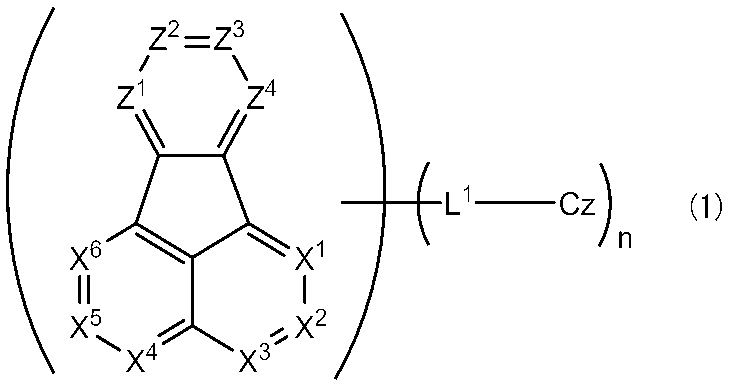
式(1)において、
X1~X6及びZ1~Z4のいずれかn個はL1と結合する炭素原子を表し、X1~X6及びZ1~Z4がL1と結合する炭素原子を表さないとき、X1~X6及びZ1~Z4は、各々独立に、CR1又は窒素原子を表す。ただし、X1~X6の少なくとも1つは窒素原子である。
nは1~3の整数を表す。
R1は、各々独立に水素原子又は置換基を表す。
L1は、単結合、置換もしくは無置換の環形成炭素数6~50のアリーレン基、又は置換もしくは無置換の環形成原子数5~50のヘテロアリーレン基を表す。
Czは、下記式(2)で示される基を表す。
X1~X6及びZ1~Z4のいずれかn個はL1と結合する炭素原子を表し、X1~X6及びZ1~Z4がL1と結合する炭素原子を表さないとき、X1~X6及びZ1~Z4は、各々独立に、CR1又は窒素原子を表す。ただし、X1~X6の少なくとも1つは窒素原子である。
nは1~3の整数を表す。
R1は、各々独立に水素原子又は置換基を表す。
L1は、単結合、置換もしくは無置換の環形成炭素数6~50のアリーレン基、又は置換もしくは無置換の環形成原子数5~50のヘテロアリーレン基を表す。
Czは、下記式(2)で示される基を表す。
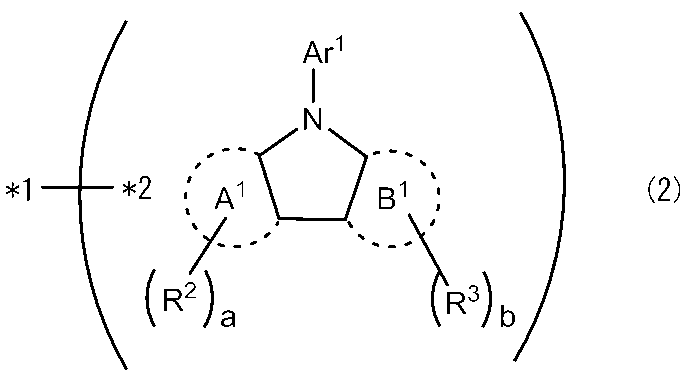
式(2)において、Ar1は、*2に結合する単結合又は1価の置換基を表す。
環A1及び環B1は、各々独立に、環形成炭素数5~50の芳香族炭化水素環、又は環形成原子数5~50の芳香族複素環を表す。
R2及びR3は、各々独立に、置換基を表す。
aとbは、各々独立に、0以上の整数であり、Ar1が*2に結合する単結合を表す場合、aとbとの合計は1以上である。
*1はL1との結合位置を表す。
*2は、環A1の1つの環形成炭素原子、環B1の1つの環形成炭素原子、及びAr1のいずれか1つと結合する。
Ar1、R2及びR3の少なくとも一つは、置換もしくは無置換の環形成炭素数6~50のアリール基又は置換もしくは無置換の環形成原子数5~50のヘテロアリール基である。
環A1及び環B1は、各々独立に、環形成炭素数5~50の芳香族炭化水素環、又は環形成原子数5~50の芳香族複素環を表す。
R2及びR3は、各々独立に、置換基を表す。
aとbは、各々独立に、0以上の整数であり、Ar1が*2に結合する単結合を表す場合、aとbとの合計は1以上である。
*1はL1との結合位置を表す。
*2は、環A1の1つの環形成炭素原子、環B1の1つの環形成炭素原子、及びAr1のいずれか1つと結合する。
Ar1、R2及びR3の少なくとも一つは、置換もしくは無置換の環形成炭素数6~50のアリール基又は置換もしくは無置換の環形成原子数5~50のヘテロアリール基である。
[2][1]に記載される化合物を含有する有機エレクトロルミネッセンス素子用材料。
[3]下記式(13)で表される化合物を含有する有機エレクトロルミネッセンス素子用材料。
[3]下記式(13)で表される化合物を含有する有機エレクトロルミネッセンス素子用材料。
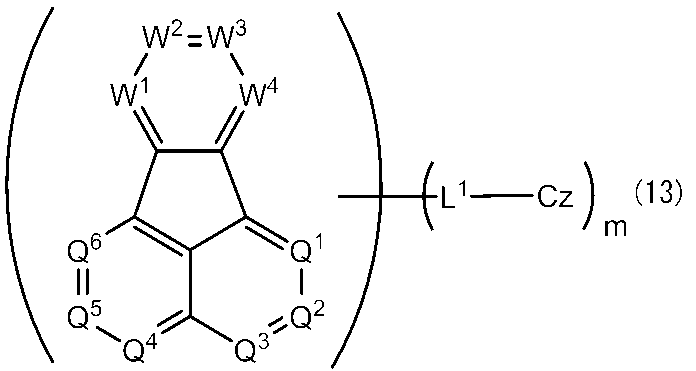
式(13)において、
Q1~Q6及びW1~W4のいずれかm個はL1と結合する炭素原子を表し、Q1~Q6及びW1~W4がL1と結合する炭素原子を表さないとき、W2及びW3は、各々独立に、CR11を表し、W1及びW4は、各々独立に、CR11又は窒素原子を表し、Q1~Q6は、各々独立に、CR11又は窒素原子を表す。ただし、W1及びW4の少なくとも1つは窒素原子である。
mは1~3の整数を表す。
R11は、各々独立に水素原子又は置換基を表す。
L1は、単結合、置換もしくは無置換の環形成炭素数6~50のアリーレン基、又は置換もしくは無置換の環形成原子数5~50のヘテロアリーレン基を表す。
Czは、下記式(2)で示される基を表す。
Q1~Q6及びW1~W4のいずれかm個はL1と結合する炭素原子を表し、Q1~Q6及びW1~W4がL1と結合する炭素原子を表さないとき、W2及びW3は、各々独立に、CR11を表し、W1及びW4は、各々独立に、CR11又は窒素原子を表し、Q1~Q6は、各々独立に、CR11又は窒素原子を表す。ただし、W1及びW4の少なくとも1つは窒素原子である。
mは1~3の整数を表す。
R11は、各々独立に水素原子又は置換基を表す。
L1は、単結合、置換もしくは無置換の環形成炭素数6~50のアリーレン基、又は置換もしくは無置換の環形成原子数5~50のヘテロアリーレン基を表す。
Czは、下記式(2)で示される基を表す。
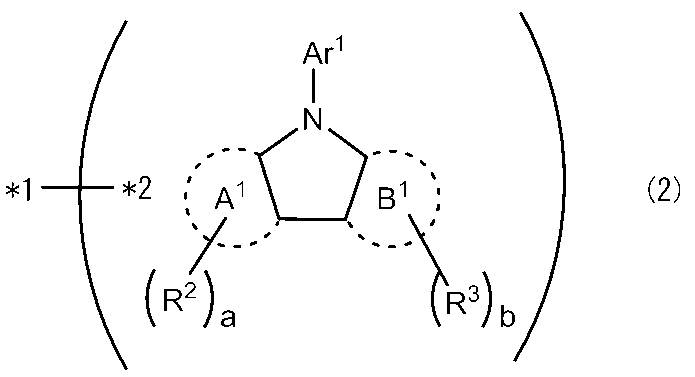
式(2)において、Ar1は、*2に結合する単結合又は1価の置換基を表す。
環A1及び環B1は、各々独立に、環形成炭素数5~50の芳香族炭化水素環、又は環形成原子数5~50の芳香族複素環を表す。
R2及びR3は、各々独立に、置換基を表す。
aとbは、各々独立に、0以上の整数であり、Ar1が*2に結合する単結合を表す場合、aとbとの合計は1以上である。
*1はL1との結合位置を表す。
*2は、環A1の1つの環形成炭素原子、環B1の1つの環形成炭素原子、及びAr1のいずれか1つと結合する。
Ar1、R2及びR3の少なくとも一つは、置換もしくは無置換の環形成炭素数6~50のアリール基又は置換もしくは無置換の環形成原子数5~50のヘテロアリール基である。
環A1及び環B1は、各々独立に、環形成炭素数5~50の芳香族炭化水素環、又は環形成原子数5~50の芳香族複素環を表す。
R2及びR3は、各々独立に、置換基を表す。
aとbは、各々独立に、0以上の整数であり、Ar1が*2に結合する単結合を表す場合、aとbとの合計は1以上である。
*1はL1との結合位置を表す。
*2は、環A1の1つの環形成炭素原子、環B1の1つの環形成炭素原子、及びAr1のいずれか1つと結合する。
Ar1、R2及びR3の少なくとも一つは、置換もしくは無置換の環形成炭素数6~50のアリール基又は置換もしくは無置換の環形成原子数5~50のヘテロアリール基である。
[4]陰極、陽極、及び陰極と陽極間に挟持された一層又は複数層からなる有機薄膜層を含む有機エレクトロルミネッセンス素子において、該有機薄膜層は発光層を含み、該有機薄膜層の少なくとも1層が、[2]に記載の化合物を含有する有機エレクトロルミネッセンス素子。
[5]陰極、陽極、及び陰極と陽極間に挟持された一層又は複数層からなる有機薄膜層を含む有機エレクトロルミネッセンス素子において、該有機薄膜層は発光層を含み、該有機薄膜層の少なくとも1層が、[3]に記載の化合物を含有する有機エレクトロルミネッセンス素子。
[5]陰極、陽極、及び陰極と陽極間に挟持された一層又は複数層からなる有機薄膜層を含む有機エレクトロルミネッセンス素子において、該有機薄膜層は発光層を含み、該有機薄膜層の少なくとも1層が、[3]に記載の化合物を含有する有機エレクトロルミネッセンス素子。
[6][4]又は[5]に記載の有機エレクトロルミネッセンス素子を備える電子機器。
本発明は、有機EL素子用として有用な新規材料及びこれを用いてなる低電圧な有機EL素子を提供する。
[有機エレクトロルミネッセンス素子用材料]
本発明の一実施態様の有機EL素子用材料は、後述する本発明の一実施態様の化合物〔式(1)で表される化合物及び式(2)で表される化合物〕を含む。
本発明の一実施態様の化合物の含有量は、例えば、1質量%以上であればよく、10質量%以上であることが好ましく、50質量%以上であることがより好ましく、80質量%以上であることがさらに好ましく、90質量%以上であることが特に好ましい。
本発明の一実施態様の化合物及び有機EL素子用材料は、有機EL素子における材料として有用であり、例えば、蛍光発光ユニットの発光層におけるホスト材料及びドーパント材料や、燐光発光ユニットの発光層におけるホスト材料として用いることができる。この場合、発光層は本発明の一実施態様の有機EL素子用材料と蛍光発光材料又は燐光発光材料を含有する。また、蛍光発光ユニット及び燐光発光ユニットのいずれにおいても、有機EL素子の陽極と発光層との間に設けられる陽極側有機薄膜層や、有機EL素子の陰極と発光層との間に設けられる陰極側有機薄膜層の材料、すなわち、正孔輸送層、正孔注入層、電子輸送層、電子注入層、正孔阻止層、電子阻止層等の材料としても有用である。
ここで、「発光ユニット」とは、一層以上の有機層を含み、そのうちの一層が発光層であり、注入された正孔と電子が再結合することにより発光することができる最小単位をいう。
以下、本発明の一実施態様の化合物である式(1)で表される化合物及び式(2)で表される化合物について、詳細に説明する。
本発明の一実施態様の有機EL素子用材料は、後述する本発明の一実施態様の化合物〔式(1)で表される化合物及び式(2)で表される化合物〕を含む。
本発明の一実施態様の化合物の含有量は、例えば、1質量%以上であればよく、10質量%以上であることが好ましく、50質量%以上であることがより好ましく、80質量%以上であることがさらに好ましく、90質量%以上であることが特に好ましい。
本発明の一実施態様の化合物及び有機EL素子用材料は、有機EL素子における材料として有用であり、例えば、蛍光発光ユニットの発光層におけるホスト材料及びドーパント材料や、燐光発光ユニットの発光層におけるホスト材料として用いることができる。この場合、発光層は本発明の一実施態様の有機EL素子用材料と蛍光発光材料又は燐光発光材料を含有する。また、蛍光発光ユニット及び燐光発光ユニットのいずれにおいても、有機EL素子の陽極と発光層との間に設けられる陽極側有機薄膜層や、有機EL素子の陰極と発光層との間に設けられる陰極側有機薄膜層の材料、すなわち、正孔輸送層、正孔注入層、電子輸送層、電子注入層、正孔阻止層、電子阻止層等の材料としても有用である。
ここで、「発光ユニット」とは、一層以上の有機層を含み、そのうちの一層が発光層であり、注入された正孔と電子が再結合することにより発光することができる最小単位をいう。
以下、本発明の一実施態様の化合物である式(1)で表される化合物及び式(2)で表される化合物について、詳細に説明する。
本明細書において、「置換もしくは無置換の炭素数XX~YYのZZ基」という表現における「炭素数XX~YY」は、ZZ基が無置換である場合の炭素数を表すものであり、置換されている場合の置換基の炭素数は含めない。
また、本明細書において、「置換もしくは無置換の原子数XX~YYのZZ基」という表現における「原子数XX~YY」は、ZZ基が無置換である場合の原子数を表すものであり、置換されている場合の置換基の原子数は含めない。
また、本明細書において、「置換もしくは無置換の原子数XX~YYのZZ基」という表現における「原子数XX~YY」は、ZZ基が無置換である場合の原子数を表すものであり、置換されている場合の置換基の原子数は含めない。
本明細書において、環形成炭素数とは、原子が環状に結合した構造の化合物(例えば、単環化合物、縮合環化合物、架橋化合物、炭素環化合物、複素環化合物)の当該環自体を構成する原子のうちの炭素原子の数を表す。当該環が置換基によって置換される場合、置換基に含まれる炭素は環形成炭素数には含まない。以下で記される「環形成炭素数」については、特筆しない限り同様とする。例えば、ベンゼン環は環形成炭素数が6であり、ナフタレン環は環形成炭素数が10であり、ピリジニル基は環形成炭素数5であり、フラニル基は環形成炭素数4である。また、ベンゼン環やナフタレン環に置換基として例えばアルキル基が置換している場合、当該アルキル基の炭素数は、環形成炭素数の数に含めない。また、フルオレン環に置換基として例えばフルオレン環が結合している場合(スピロフルオレン環を含む)、置換基としてのフルオレン環の炭素数は環形成炭素数の数に含めない。
また、本明細書において、環形成原子数とは、原子が環状に結合した構造(例えば単環、縮合環、環集合)の化合物(例えば単環化合物、縮合環化合物、架橋化合物、炭素環化合物、複素環化合物)の当該環自体を構成する原子の数を表す。環を構成しない原子(例えば環を構成する原子の結合手を終端する水素原子)や、当該環が置換基によって置換される場合の置換基に含まれる原子は環形成原子数には含まない。以下で記される「環形成原子数」については、特筆しない限り同様とする。例えば、ピリジン環の環形成原子数は6であり、キナゾリン環の環形成原子数は10であり、フラン環の環形成原子数は5である。ピリジン環やキナゾリン環の炭素原子にそれぞれ結合している水素原子や置換基を構成する原子については、環形成原子数の数に含めない。また、フルオレン環に置換基として例えばフルオレン環が結合している場合(スピロフルオレン環を含む)、置換基としてのフルオレン環の原子数は環形成原子数の数に含めない。
また、本明細書において、「水素原子」とは、中性子数が異なる同位体、すなわち、軽水素(protium)、重水素(deuterium)及び三重水素(tritium)を包含する。
本明細書中において、「ヘテロアリール基」及び「ヘテロアリーレン基」は、環形成原子として、少なくとも1つのヘテロ原子を含む基であり、該へテロ原子としては、窒素原子、酸素原子、硫黄原子、ケイ素原子及びセレン原子から選ばれる1種以上であることが好ましい。
本明細書中において、「ヘテロアリール基」及び「ヘテロアリーレン基」は、環形成原子として、少なくとも1つのヘテロ原子を含む基であり、該へテロ原子としては、窒素原子、酸素原子、硫黄原子、ケイ素原子及びセレン原子から選ばれる1種以上であることが好ましい。
また、置換基としては、又は「置換もしくは無置換」との記載における置換基としては、炭素数1~50(好ましくは1~18、より好ましくは1~8)のアルキル基;環形成炭素数3~50(好ましくは3~10、より好ましくは3~8、さらに好ましくは5又は6)のシクロアルキル基;環形成炭素数6~50(好ましくは6~25、より好ましくは6~18)のアリール基;環形成炭素数6~50(好ましくは6~25、より好ましくは6~18)のアリール基を有する炭素数7~51(好ましくは7~30、より好ましくは7~20)のアラルキル基;炭素数1~50(好ましくは1~18、より好ましくは1~8)のアルキル基を有するアルコキシ基;環形成炭素数6~50(好ましくは6~25、より好ましくは6~18)のアリール基を有するアリールオキシ基;炭素数1~50(好ましくは1~18、より好ましくは1~8)のアルキル基及び環形成炭素数6~50(好ましくは6~25、より好ましくは6~18)のアリール基から選ばれる置換基を有するジ置換アミノ基;炭素数1~50(好ましくは1~18、より好ましくは1~8)のアルキル基及び環形成炭素数6~50(好ましくは6~25、より好ましくは6~18)のアリール基から選ばれる置換基を有するモノ置換、ジ置換又はトリ置換シリル基;環形成原子数5~50(好ましくは5~24、より好ましくは5~13)のヘテロアリール基;炭素数1~50(好ましくは1~18、より好ましくは1~8)のハロアルキル基;ハロゲン原子(フッ素原子、塩素原子、臭素原子、ヨウ素原子);シアノ基;ニトロ基;炭素数1~50(好ましくは1~18、より好ましくは1~8)のアルキル基及び環形成炭素数6~50(好ましくは6~25、より好ましくは6~18)のアリール基から選ばれる置換基を有するスルホニル基;炭素数1~50(好ましくは1~18、より好ましくは1~8)のアルキル基及び環形成炭素数6~50(好ましくは6~25、より好ましくは6~18)のアリール基から選ばれる置換基を有するジ置換ホスフォリル基;アルキルスルホニルオキシ基;アリールスルホニルオキシ基;アルキルカルボニルオキシ基;アリールカルボニルオキシ基;ホウ素含有基;亜鉛含有基;スズ含有基;ケイ素含有基;マグネシウム含有基;リチウム含有基;ヒドロキシ基;アルキル置換又はアリール置換カルボニル基;カルボキシル基;ビニル基;(メタ)アクリロイル基;エポキシ基;並びにオキセタニル基からなる群より選ばれる基であることが好ましい。
これらの置換基は、さらに上述の任意の置換基により置換されていてもよい。また、これらの置換基は、複数の置換基が互いに結合して環を形成していてもよい。
また、「置換もしくは無置換」との記載における「無置換」とは、これらの置換基で置換されておらず、水素原子が結合していることを意味する。
これらの置換基は、さらに上述の任意の置換基により置換されていてもよい。また、これらの置換基は、複数の置換基が互いに結合して環を形成していてもよい。
また、「置換もしくは無置換」との記載における「無置換」とは、これらの置換基で置換されておらず、水素原子が結合していることを意味する。
上記置換基の中でも、より好ましくは、置換もしくは無置換の炭素数1~50(好ましくは1~18、より好ましくは1~8)のアルキル基、置換もしくは無置換の環形成炭素数6~50(好ましくは6~25、より好ましくは6~18)のアリール基、置換もしくは無置換の環形成原子数5~50(好ましくは5~24、より好ましくは5~13)のヘテロアリール基、ハロゲン原子、シアノ基、置換もしくは無置換の炭素数1~50(好ましくは1~20、より好ましくは1~10、さらに好ましくは1~5)のフルオロアルキル基、置換もしくは無置換の炭素数1~50(好ましくは1~20、より好ましくは1~10、さらに好ましくは1~5)のアルコキシ基、置換もしくは無置換の炭素数1~50(好ましくは1~20、より好ましくは1~10、さらに好ましくは1~5)のフルオロアルコキシ基、置換もしくは無置換の環形成炭素数6~50(好ましくは6~25、より好ましくは6~18、さらに好ましくは6~12)のアリールオキシ基、又は、炭素数1~50(好ましくは1~18、より好ましくは1~8)のアルキル基及び環形成炭素数6~50(好ましくは6~25、より好ましくは6~18)のアリール基から選ばれる置換基を有するジ置換アミノ基、炭素数1~50(好ましくは1~18、より好ましくは1~8)のアルキル基及び環形成炭素数6~50(好ましくは6~25、より好ましくは6~18)のアリール基から選ばれる置換基を有するトリ置換シリル基である。
上記置換基の中でも、さらに好ましくは、置換もしくは無置換の環形成炭素数6~50(好ましくは6~25、より好ましくは6~18)のアリール基、置換もしくは無置換の環形成原子数5~50(好ましくは5~24、より好ましくは5~13)のヘテロアリール基、ハロゲン原子、シアノ基、置換もしくは無置換の炭素数1~50(好ましくは1~20、より好ましくは1~10、さらに好ましくは1~5)のフルオロアルキル基、置換もしくは無置換の炭素数1~50(好ましくは1~20、より好ましくは1~10、さらに好ましくは1~5)のアルコキシ基、置換もしくは無置換の炭素数1~50(好ましくは1~20、より好ましくは1~10、さらに好ましくは1~5)のフルオロアルコキシ基、又は、置換もしくは無置換の環形成炭素数6~50(好ましくは6~25、より好ましくは6~18、さらに好ましくは6~12)のアリールオキシ基である。
<前記置換基の具体例>
前記炭素数1~50のアルキル基としては、例えば、メチル基、エチル基、n-プロピル基、イソプロピル基、n-ブチル基、イソブチル基、s-ブチル基、t-ブチル基、ペンチル基(異性体基を含む)、ヘキシル基(異性体基を含む)、ヘプチル基(異性体基を含む)、オクチル基(異性体基を含む)、ノニル基(異性体基を含む)、デシル基(異性体基を含む)、ウンデシル基(異性体基を含む)、及びドデシル基(異性体基を含む)等が挙げられる。
前記炭素数1~50のアルキル基としては、例えば、メチル基、エチル基、n-プロピル基、イソプロピル基、n-ブチル基、イソブチル基、s-ブチル基、t-ブチル基、ペンチル基(異性体基を含む)、ヘキシル基(異性体基を含む)、ヘプチル基(異性体基を含む)、オクチル基(異性体基を含む)、ノニル基(異性体基を含む)、デシル基(異性体基を含む)、ウンデシル基(異性体基を含む)、及びドデシル基(異性体基を含む)等が挙げられる。
前記環形成炭素数6~50のアリール基としては、例えば、フェニル基、ナフチルフェニル基、ビフェニルイル基、ターフェニルイル基、ビフェニレニル基、ナフチル基、フェニルナフチル基、アセナフチレニル基、アントリル基、ベンゾアントリル基、アセアントリル基、フェナントリル基、ベンゾフェナントリル基、フェナレニル基、フルオレニル基、9,9-ジメチルフルオレニル基、7-フェニル-9,9-ジメチルフルオレニル基、ペンタセニル基、ピセニル基、ペンタフェニル基、ピレニル基、クリセニル基、ベンゾクリセニル基、s-インダセニル基、as-インダセニル基、フルオランテニル基、及びペリレニル基等が挙げられる。
前記環形成原子数5~50のヘテロアリール基は、少なくとも1個、好ましくは1~3個の同一又は異なるヘテロ原子(例えば、窒素原子、硫黄原子、及び酸素原子)を含む。
該ヘテロアリール基としては、例えば、ピロリル基、フリル基、チエニル基、ピリジル基、ピリダジニル基、ピリミジニル基、ピラジニル基、トリアジニル基、イミダゾリル基、オキサゾリル基、チアゾリル基、ピラゾリル基、イソオキサゾリル基、イソチアゾリル基、オキサジアゾリル基、チアジアゾリル基、トリアゾリル基、インドリル基、イソインドリル基、ベンゾフラニル基、イソベンゾフラニル基、ベンゾチオフェニル基、インドリジニル基、キノリジニル基、キノリル基、イソキノリル基、シンノリル基、フタラジニル基、キナゾリニル基、キノキサリニル基、ベンズイミダゾリル基、ベンズオキサゾリル基、ベンズチアゾリル基、インダゾリル基、ベンズイソキサゾリル基、ベンズイソチアゾリル基、ジベンゾフラニル基、ジベンゾチオフェニル基、フェナントリジニル基、アクリジニル基、フェナントロリニル基、フェナジニル基、フェノチアジニル基、フェノキサジニル基、及びキサンテニル基等が挙げられる。
該ヘテロアリール基としては、例えば、ピロリル基、フリル基、チエニル基、ピリジル基、ピリダジニル基、ピリミジニル基、ピラジニル基、トリアジニル基、イミダゾリル基、オキサゾリル基、チアゾリル基、ピラゾリル基、イソオキサゾリル基、イソチアゾリル基、オキサジアゾリル基、チアジアゾリル基、トリアゾリル基、インドリル基、イソインドリル基、ベンゾフラニル基、イソベンゾフラニル基、ベンゾチオフェニル基、インドリジニル基、キノリジニル基、キノリル基、イソキノリル基、シンノリル基、フタラジニル基、キナゾリニル基、キノキサリニル基、ベンズイミダゾリル基、ベンズオキサゾリル基、ベンズチアゾリル基、インダゾリル基、ベンズイソキサゾリル基、ベンズイソチアゾリル基、ジベンゾフラニル基、ジベンゾチオフェニル基、フェナントリジニル基、アクリジニル基、フェナントロリニル基、フェナジニル基、フェノチアジニル基、フェノキサジニル基、及びキサンテニル基等が挙げられる。
前記炭素数1~50のフルオロアルキル基としては、例えば、上述の炭素数1~50のアルキル基の少なくとも1個の水素原子、好ましくは1~7個の水素原子又はすべての水素原子をフッ素原子で置換して得られる基が挙げられる。
具体的なフルオロアルキル基としては、例えば、ヘプタフルオロプロピル基、ペンタフルオロエチル基、2,2,2-トリフルオロエチル基、及びトリフルオロメチル基が挙げられる。
具体的なフルオロアルキル基としては、例えば、ヘプタフルオロプロピル基、ペンタフルオロエチル基、2,2,2-トリフルオロエチル基、及びトリフルオロメチル基が挙げられる。
前記炭素数1~50のアルコキシ基は、-ORXで表される基であって、RXは、上述の炭素数1~50のアルキル基を表す。
具体的なアルコキシ基としては、例えば、t-ブトキシ基、プロポキシ基、エトキシ基、及びメトキシ基が挙げられる。
具体的なアルコキシ基としては、例えば、t-ブトキシ基、プロポキシ基、エトキシ基、及びメトキシ基が挙げられる。
前記炭素数1~50のフルオロアルコキシ基は、-ORYで表される基であって、RYは、上述の炭素数1~50のフルオロアルキル基を表す。
具体的なフルオロアルコキシ基としては、例えば、ヘプタフルオロプロポキシ基、ペンタフルオロエトキシ基、2,2,2-トリフルオロエトキシ基、及びトリフルオロメトキシ基が挙げられる。
具体的なフルオロアルコキシ基としては、例えば、ヘプタフルオロプロポキシ基、ペンタフルオロエトキシ基、2,2,2-トリフルオロエトキシ基、及びトリフルオロメトキシ基が挙げられる。
前記環形成炭素数6~50のアリールオキシ基は、-ORZで表される基であって、RZは上述の環形成炭素数6~50のアリール基を表す。
具体的なアリールオキシ基としては、例えば、フェニルオキシ基、1-ナフチルオキシ基、2-ナフチルオキシ基、4-ビフェニルイルオキシ基、p-ターフェニル-4-イルオキシ基、p-トリルオキシ基が挙げられる。
具体的なアリールオキシ基としては、例えば、フェニルオキシ基、1-ナフチルオキシ基、2-ナフチルオキシ基、4-ビフェニルイルオキシ基、p-ターフェニル-4-イルオキシ基、p-トリルオキシ基が挙げられる。
炭素数1~50のアルキル基及び環形成炭素数6~50のアリール基から選ばれる置換基を有するジ置換アミノ基のアルキル基及びアリール基としては、上述の炭素数1~50のアルキル基及び環形成炭素数6~50のアリール基が挙げられる。
該ジ置換アミノ基としては、例えば、ジメチルアミノ基、ジエチルアミノ基、ジイソプロピルアミノ基、ジt-ブチルアミノ基などのジアルキルアミノ基;ジフェニルアミノ基、ジ(メチルフェニル)アミノ基、ジナフチルアミノ基、ジビフェニリルアミノ基などが挙げられる。
該ジ置換アミノ基としては、例えば、ジメチルアミノ基、ジエチルアミノ基、ジイソプロピルアミノ基、ジt-ブチルアミノ基などのジアルキルアミノ基;ジフェニルアミノ基、ジ(メチルフェニル)アミノ基、ジナフチルアミノ基、ジビフェニリルアミノ基などが挙げられる。
前記炭素数1~50のアルキル基及び環形成炭素数6~50のアリール基から選ばれる置換基を有するトリ置換シリル基のアルキル基及びアリール基としては、上述の炭素数1~50のアルキル基及び環形成炭素数6~50のアリール基が挙げられる。
該トリ置換シリル基としては、トリアルキルシリル基(アルキル基は前記の通りである。)、トリアリールシリル基(アリール基は前記の通りである。)が好ましい。トリアルキルシリル基としては、例えば、トリメチルシリル基、トリエチルシリル基、トリイソプロピルシリル基、トリt-ブチルシリル基、トリn-ブチルシリル基が挙げられる。トリアリールシリル基としては、例えば、トリフェニルシリル基、トリ(メチルフェニル)シリル基が挙げられる。
該トリ置換シリル基としては、トリアルキルシリル基(アルキル基は前記の通りである。)、トリアリールシリル基(アリール基は前記の通りである。)が好ましい。トリアルキルシリル基としては、例えば、トリメチルシリル基、トリエチルシリル基、トリイソプロピルシリル基、トリt-ブチルシリル基、トリn-ブチルシリル基が挙げられる。トリアリールシリル基としては、例えば、トリフェニルシリル基、トリ(メチルフェニル)シリル基が挙げられる。
これらの置換基は、さらに上述の任意の置換基により置換されていてもよい。また、これらの置換基は、複数の置換基が互いに結合して環を形成していてもよいし、環を形成していなくてもよい。
本明細書中、好ましいとする規定は任意に選択することができ、また、好ましいとする規定の組み合わせはより好ましいと言える。
本明細書中、好ましいとする規定は任意に選択することができ、また、好ましいとする規定の組み合わせはより好ましいと言える。
[化合物]
〔式(1)で表される化合物〕
本発明の一実施態様の有機EL素子用材料は、下記式(1)で表される化合物を含有することができる。
〔式(1)で表される化合物〕
本発明の一実施態様の有機EL素子用材料は、下記式(1)で表される化合物を含有することができる。

式(1)において、
X1~X6及びZ1~Z4のいずれかn個はL1と結合する炭素原子を表し、X1~X6及びZ1~Z4がL1と結合する炭素原子を表さないとき、X1~X6及びZ1~Z4は、各々独立に、CR1又は窒素原子を表す。ただし、X1~X6の少なくとも1つは窒素原子である。
nは1~3の整数を表す。
R1は、各々独立に水素原子又は置換基を表す。
L1は、単結合、置換もしくは無置換の環形成炭素数6~50のアリーレン基、又は置換もしくは無置換の環形成原子数5~50のヘテロアリーレン基を表す。
Czについては、後述する。
式(1)において、R1が結合する炭素原子のうち、隣り合う炭素原子に結合する複数のR1は、互いに結合して飽和又は不飽和の環構造を形成してもよいし、環構造を形成しなくてもよい。
X1~X6及びZ1~Z4のいずれかn個はL1と結合する炭素原子を表し、X1~X6及びZ1~Z4がL1と結合する炭素原子を表さないとき、X1~X6及びZ1~Z4は、各々独立に、CR1又は窒素原子を表す。ただし、X1~X6の少なくとも1つは窒素原子である。
nは1~3の整数を表す。
R1は、各々独立に水素原子又は置換基を表す。
L1は、単結合、置換もしくは無置換の環形成炭素数6~50のアリーレン基、又は置換もしくは無置換の環形成原子数5~50のヘテロアリーレン基を表す。
Czについては、後述する。
式(1)において、R1が結合する炭素原子のうち、隣り合う炭素原子に結合する複数のR1は、互いに結合して飽和又は不飽和の環構造を形成してもよいし、環構造を形成しなくてもよい。
式(1)において、前記R1が置換基である場合の置換基は、下記から選択されるものが好ましい。
置換もしくは無置換の炭素数1~50(より好ましくは1~18、更に好ましくは1~8)のアルキル基、置換もしくは無置換の環形成炭素数3~50(より好ましくは3~10、更に好ましくは3~8)のシクロアルキル基、置換もしくは無置換の環形成炭素数6~60(より好ましくは6~25、更に好ましくは6~18)のアリール基(「芳香族炭化水素基」と同義、以下同様)、置換もしくは無置換の炭素数7~61(より好ましくは7~25、更に好ましくは7~18)のアラルキル基、アミノ基、置換もしくは無置換の炭素数1~50(より好ましくは1~18、更に好ましくは1~8)のアルキル基及び置換もしくは無置換の環形成炭素数6~60(より好ましくは6~25、更に好ましくは6~18)のアリール基から選ばれる置換基を有するモノ置換又はジ置換アミノ基、置換もしくは無置換の炭素数1~50(より好ましくは1~18、更に好ましくは1~8)のアルコキシ基、置換もしくは無置換の環形成炭素数3~50(より好ましくは3~10、更に好ましくは3~8)のシクロアルコキシ基、置換もしくは無置換の環形成炭素数6~60(より好ましくは6~25、更に好ましくは6~18)のアリールオキシ基、置換もしくは無置換の炭素数1~50(より好ましくは1~18、更に好ましくは1~8)のアルキルチオ基、置換もしくは無置換の環形成炭素数6~60(より好ましくは6~25、更に好ましくは6~18)のアリールチオ基、置換もしくは無置換の炭素数1~50(より好ましくは1~18、更に好ましくは1~8)のアルキル基及び置換もしくは無置換の環形成炭素数6~60(より好ましくは6~25、更に好ましくは6~18)のアリール基から選ばれる置換基を有するモノ置換、ジ置換又はトリ置換シリル基、置換もしくは無置換の環形成原子数5~60(より好ましくは5~30、更に好ましくは5~26)のヘテロアリール基(「複素環基」と同義、以下同様)、置換もしくは無置換の炭素数1~50(より好ましくは1~18、更に好ましくは1~8)のハロアルキル基、ハロゲン原子、シアノ基、ニトロ基、置換もしくは無置換の炭素数1~50(より好ましくは1~18、更に好ましくは1~8)のアルキル基及び置換もしくは無置換の環形成炭素数6~60(より好ましくは6~25、更に好ましくは6~18)のアリール基から選ばれる置換基を有するスルフォニル基、置換もしくは無置換の炭素数1~50(より好ましくは1~18、更に好ましくは1~8)のアルキル基及び置換もしくは無置換の環形成炭素数6~60(より好ましくは6~25、更に好ましくは6~18)のアリール基から選ばれる置換基を有するジ置換ホスフォリル基、アルキルスルホニルオキシ基、アリールスルホニルオキシ基、アルキルカルボニルオキシ基、アリールカルボニルオキシ基、ホウ素含有基、亜鉛含有基、スズ含有基、ケイ素含有基、マグネシウム含有基、リチウム含有基、ヒドロキシ基、アルキル置換又はアリール置換カルボニル基、カルボキシル基、ビニル基、(メタ)アクリロイル基、エポキシ基、並びにオキセタニル基が挙げられる。
置換もしくは無置換の炭素数1~50(より好ましくは1~18、更に好ましくは1~8)のアルキル基、置換もしくは無置換の環形成炭素数3~50(より好ましくは3~10、更に好ましくは3~8)のシクロアルキル基、置換もしくは無置換の環形成炭素数6~60(より好ましくは6~25、更に好ましくは6~18)のアリール基(「芳香族炭化水素基」と同義、以下同様)、置換もしくは無置換の炭素数7~61(より好ましくは7~25、更に好ましくは7~18)のアラルキル基、アミノ基、置換もしくは無置換の炭素数1~50(より好ましくは1~18、更に好ましくは1~8)のアルキル基及び置換もしくは無置換の環形成炭素数6~60(より好ましくは6~25、更に好ましくは6~18)のアリール基から選ばれる置換基を有するモノ置換又はジ置換アミノ基、置換もしくは無置換の炭素数1~50(より好ましくは1~18、更に好ましくは1~8)のアルコキシ基、置換もしくは無置換の環形成炭素数3~50(より好ましくは3~10、更に好ましくは3~8)のシクロアルコキシ基、置換もしくは無置換の環形成炭素数6~60(より好ましくは6~25、更に好ましくは6~18)のアリールオキシ基、置換もしくは無置換の炭素数1~50(より好ましくは1~18、更に好ましくは1~8)のアルキルチオ基、置換もしくは無置換の環形成炭素数6~60(より好ましくは6~25、更に好ましくは6~18)のアリールチオ基、置換もしくは無置換の炭素数1~50(より好ましくは1~18、更に好ましくは1~8)のアルキル基及び置換もしくは無置換の環形成炭素数6~60(より好ましくは6~25、更に好ましくは6~18)のアリール基から選ばれる置換基を有するモノ置換、ジ置換又はトリ置換シリル基、置換もしくは無置換の環形成原子数5~60(より好ましくは5~30、更に好ましくは5~26)のヘテロアリール基(「複素環基」と同義、以下同様)、置換もしくは無置換の炭素数1~50(より好ましくは1~18、更に好ましくは1~8)のハロアルキル基、ハロゲン原子、シアノ基、ニトロ基、置換もしくは無置換の炭素数1~50(より好ましくは1~18、更に好ましくは1~8)のアルキル基及び置換もしくは無置換の環形成炭素数6~60(より好ましくは6~25、更に好ましくは6~18)のアリール基から選ばれる置換基を有するスルフォニル基、置換もしくは無置換の炭素数1~50(より好ましくは1~18、更に好ましくは1~8)のアルキル基及び置換もしくは無置換の環形成炭素数6~60(より好ましくは6~25、更に好ましくは6~18)のアリール基から選ばれる置換基を有するジ置換ホスフォリル基、アルキルスルホニルオキシ基、アリールスルホニルオキシ基、アルキルカルボニルオキシ基、アリールカルボニルオキシ基、ホウ素含有基、亜鉛含有基、スズ含有基、ケイ素含有基、マグネシウム含有基、リチウム含有基、ヒドロキシ基、アルキル置換又はアリール置換カルボニル基、カルボキシル基、ビニル基、(メタ)アクリロイル基、エポキシ基、並びにオキセタニル基が挙げられる。
本実施形態のアルキル基としては、例えば、メチル基、エチル基、n-プロピル基、イソプロピル基、n-ブチル基、イソブチル基、s-ブチル基、t-ブチル基、ペンチル基(異性体を含む)、ヘキシル基(異性体を含む)、ヘプチル基(異性体を含む)、オクチル基(異性体を含む)、ノニル基(異性体を含む)、デシル基(異性体を含む)、ウンデシル基(異性体を含む)、及びドデシル基(異性体を含む)、トリデシル基、テトラデシル基、オクタデシル基、テトラコサニル基、テトラコンタニル基等が挙げられる。これらは置換されていてもよい。
より好ましくは、メチル基、エチル基、n-プロピル基、イソプロピル基、n-ブチル基、イソブチル基、s-ブチル基、t-ブチル基、ペンチル基(異性体を含む)、ヘキシル基(異性体を含む)、ヘプチル基(異性体を含む)、オクチル基(異性体を含む)、ノニル基(異性体を含む)、デシル基(異性体を含む)、ウンデシル基(異性体を含む)、ドデシル基(異性体を含む)、トリデシル基、テトラデシル基、及びオクタデシル基が挙げられる。これらは置換されていてもよい。
更に好ましくは、メチル基、エチル基、n-プロピル基、イソプロピル基、n-ブチル基、イソブチル基、s-ブチル基、t-ブチル基、ペンチル基(異性体を含む)、ヘキシル基(異性体を含む)、ヘプチル基(異性体を含む)、及びオクチル基(異性体を含む)が挙げられる。これらは置換されていてもよい。
より好ましくは、メチル基、エチル基、n-プロピル基、イソプロピル基、n-ブチル基、イソブチル基、s-ブチル基、t-ブチル基、ペンチル基(異性体を含む)、ヘキシル基(異性体を含む)、ヘプチル基(異性体を含む)、オクチル基(異性体を含む)、ノニル基(異性体を含む)、デシル基(異性体を含む)、ウンデシル基(異性体を含む)、ドデシル基(異性体を含む)、トリデシル基、テトラデシル基、及びオクタデシル基が挙げられる。これらは置換されていてもよい。
更に好ましくは、メチル基、エチル基、n-プロピル基、イソプロピル基、n-ブチル基、イソブチル基、s-ブチル基、t-ブチル基、ペンチル基(異性体を含む)、ヘキシル基(異性体を含む)、ヘプチル基(異性体を含む)、及びオクチル基(異性体を含む)が挙げられる。これらは置換されていてもよい。
本実施形態のシクロアルキル基としては、シクロプロピル基、シクロブチル基、シクロペンチル基、シクロヘキシル基、シクロヘプチル基、シクロオクチル基、アダマンチル基等が挙げられる。これらは置換されていてもよい。
より好ましくは、シクロペンチル基、シクロヘキシル基が挙げられる。これらは置換されていてもよい。
より好ましくは、シクロペンチル基、シクロヘキシル基が挙げられる。これらは置換されていてもよい。
本実施形態のアリール基としては、例えば、フェニル基、ナフチル基、ナフチルフェニル基、ビフェニリル基、ターフェニリル基、クアテルフェニリル基、キンクフェニリル基、アセナフチレニル基、アントリル基、ベンゾアントリル基、アセアントリル基、フェナントリル基、ベンゾフェナントリル基、フェナレニル基、フルオレニル基、9,9’-スピロビフルオレニル基、ベンゾフルオレニル基、ジベンゾフルオレニル基、ピセニル基、ペンタフェニル基、ペンタセニル基、ピレニル基、クリセニル基、ベンゾクリセニル基、s-インダニル基、as-インダニル基、フルオランテニル基、ベンゾフルオランテニル基、テトラセニル基、トリフェニレニル基、ベンゾトリフェニレニル基、ペリレニル基、コロニル基、ジベンゾアントリル基、9,9-ジメチルフルオレニル基、9,9-ジフェニルフルオレニル基等が挙げられる。これらは置換されていてもよい。
より好ましくは、フェニル基、ナフチル基、ビフェニリル基、ターフェニリル基、フェナントリル基、ベンゾフェナントリル基、フルオレニル基、9,9’-スピロビフルオレニル基、ベンゾフルオレニル基、ジベンゾフルオレニル基、クリセニル基、ベンゾクリセニル基、s-インダニル基、as-インダニル基、トリフェニレニル基、ベンゾトリフェニレニル基、アントリル基、9,9-ジメチルフルオレニル基、9,9-ジフェニルフルオレニル基が挙げられる。これらは置換されていてもよい。
更に好ましくは、フェニル基、ビフェニリル基、ターフェニリル基、ナフチル基、フェナントリル基、フルオレニル基、9,9’-スピロビフルオレニル基、クリセニル基、トリフェニレニル基、9,9-ジメチルフルオレニル基、9,9-ジフェニルフルオレニル基が挙げられる。これらは置換されていてもよい。
より好ましくは、フェニル基、ナフチル基、ビフェニリル基、ターフェニリル基、フェナントリル基、ベンゾフェナントリル基、フルオレニル基、9,9’-スピロビフルオレニル基、ベンゾフルオレニル基、ジベンゾフルオレニル基、クリセニル基、ベンゾクリセニル基、s-インダニル基、as-インダニル基、トリフェニレニル基、ベンゾトリフェニレニル基、アントリル基、9,9-ジメチルフルオレニル基、9,9-ジフェニルフルオレニル基が挙げられる。これらは置換されていてもよい。
更に好ましくは、フェニル基、ビフェニリル基、ターフェニリル基、ナフチル基、フェナントリル基、フルオレニル基、9,9’-スピロビフルオレニル基、クリセニル基、トリフェニレニル基、9,9-ジメチルフルオレニル基、9,9-ジフェニルフルオレニル基が挙げられる。これらは置換されていてもよい。
本実施形態のヘテロアリール基は少なくとも1個、好ましくは1~5個(より好ましくは1~3個、さらに好ましくは1~2個)のヘテロ原子、例えば、窒素原子、硫黄原子、酸素原子、リン原子を含む。該へテロアリール基としては、例えば、ピロリル基、フリル基、チエニル基、ピリジル基、ピリダジニル基、ピリミジニル基、ピラジニル基、トリアジニル基、イミダゾリル基、オキサゾリル基、チアゾリル基、ピラゾリル基、イソオキサゾリル基、イソチアゾリル基、オキサジアゾリル基、チアジアゾリル基、トリアゾリル基、テトラゾリル基、インドリル基、イソインドリル基、ベンゾフラニル基、イソベンゾフラニル基、ベンゾチオフェニル基、イソベンゾチオフェニル基、インドリジニル基、キノリジニル基、キノリル基、イソキノリル基、シンノリル基、フタラジニル基、キナゾリニル基、キノキサリニル基、ベンズイミダゾリル基、ベンズオキサゾリル基、ベンズチアゾリル基、インダゾリル基、ベンズイソキサゾリル基、ベンズイソチアゾリル基、ジベンゾフラニル基、ジベンゾチオフェニル基、カルバゾリル基、ビカルバゾリル基フェナントリジニル基、アクリジニル基、フェナントロリニル基、フェナジニル基、フェノチアジニル基、フェノキサジニル基、アザトリフェニレニル基、ジアザトリフェニレニル基、キサンテニル基、アザカルバゾリル基、アザジベンゾフラニル基、アザジベンゾチオフェニル基、ベンゾフラノベンゾチオフェニル基、ベンゾチエノベンゾチオフェニル基、ジベンゾフラノナフチル基、ジベンゾチエノナフチル基、及びジナフトチエノチオフェニル基、ジナフト-<2’,3’:2,3:2’,3’:6,7>-カルバゾリル基などが挙げられる。これらは置換されていてもよい。
より好ましくは、ピリジル基、ピリダジニル基、ピリミジニル基、ピラジニル基、トリアジニル基、イミダゾリル基、インドリル基、イソインドリル基、ベンゾフラニル基、イソベンゾフラニル基、ベンゾチオフェニル基、イソベンゾチオフェニル基、インドリジニル基、キノリジニル基、キノリル基、イソキノリル基、キナゾリニル基、キノキサリニル基、ベンズイミダゾリル基、ベンズオキサゾリル基、ベンズチアゾリル基、ベンズイソキサゾリル基、ベンズイソチアゾリル基、ジベンゾフラニル基、ジベンゾチオフェニル基、カルバゾリル基、ビカルバゾリル基、フェナントリジニル基、アクリジニル基、フェナントロリニル基、アザトリフェニレニル基、ジアザトリフェニレニル基、キサンテニル基、アザカルバゾリル基、アザジベンゾフラニル基、アザジベンゾチオフェニル基が挙げられる。これらは置換されていてもよい。
更に好ましくは、ピリジル基、ピリミジニル基、トリアジニル基、ベンゾフラニル基、イソベンゾフラニル基、キノリル基、イソキノリル基、キナゾリニル基、ベンゾチオフェニル基、イソベンゾチオフェニル基、インドリジニル基、ジベンゾフラニル基、ジベンゾチオフェニル基、カルバゾリル基、ビカルバゾリル基、アザトリフェニレニル基、ジアザトリフェニレニル基、キサンテニル基、アザカルバゾリル基、アザジベンゾフラニル基、アザジベンゾチオフェニル基が挙げられる。これらは置換されていてもよい。
より好ましくは、ピリジル基、ピリダジニル基、ピリミジニル基、ピラジニル基、トリアジニル基、イミダゾリル基、インドリル基、イソインドリル基、ベンゾフラニル基、イソベンゾフラニル基、ベンゾチオフェニル基、イソベンゾチオフェニル基、インドリジニル基、キノリジニル基、キノリル基、イソキノリル基、キナゾリニル基、キノキサリニル基、ベンズイミダゾリル基、ベンズオキサゾリル基、ベンズチアゾリル基、ベンズイソキサゾリル基、ベンズイソチアゾリル基、ジベンゾフラニル基、ジベンゾチオフェニル基、カルバゾリル基、ビカルバゾリル基、フェナントリジニル基、アクリジニル基、フェナントロリニル基、アザトリフェニレニル基、ジアザトリフェニレニル基、キサンテニル基、アザカルバゾリル基、アザジベンゾフラニル基、アザジベンゾチオフェニル基が挙げられる。これらは置換されていてもよい。
更に好ましくは、ピリジル基、ピリミジニル基、トリアジニル基、ベンゾフラニル基、イソベンゾフラニル基、キノリル基、イソキノリル基、キナゾリニル基、ベンゾチオフェニル基、イソベンゾチオフェニル基、インドリジニル基、ジベンゾフラニル基、ジベンゾチオフェニル基、カルバゾリル基、ビカルバゾリル基、アザトリフェニレニル基、ジアザトリフェニレニル基、キサンテニル基、アザカルバゾリル基、アザジベンゾフラニル基、アザジベンゾチオフェニル基が挙げられる。これらは置換されていてもよい。
本実施形態のアラルキル基としては、環形成炭素数6~60の上記アリール基を有するアラルキル基が挙げられる。これらは更に置換されていてもよい。より好ましくは環形成炭素数6~25の上記アリール基を有するアラルキル基であり、更に好ましくは環形成炭素数6~18の上記アリール基を有するアラルキル基である。これらは更に置換されていてもよい。
本実施形態のモノ置換又はジ置換アミノ基としては、炭素数1~50の上記アルキル基及び環形成炭素数6~60の上記アリール基から選ばれる置換基を有するモノ置換又はジ置換アミノ基が挙げられ、該ジ置換アミノ基が好ましく、上記アリール基から選ばれる置換基を有するジ置換アミノ基がさらに好ましい。これらは更に置換されていてもよい。より好ましくは、炭素数1~18の上記アルキル基及び環形成炭素数6~25の上記アリール基から選ばれる置換基を有するモノ置換又はジ置換アミノ基が挙げられる。これらは更に置換されていてもよい。更に好ましくは、炭素数1~8の上記アルキル基及び環形成炭素数6~18の上記アリール基から選ばれる置換基を有するモノ置換又はジ置換アミノ基が挙げられる。これらは更に置換されていてもよい。
本実施形態のモノ置換又はジ置換アミノ基としては、炭素数1~50の上記アルキル基及び環形成炭素数6~60の上記アリール基から選ばれる置換基を有するモノ置換又はジ置換アミノ基が挙げられ、該ジ置換アミノ基が好ましく、上記アリール基から選ばれる置換基を有するジ置換アミノ基がさらに好ましい。これらは更に置換されていてもよい。より好ましくは、炭素数1~18の上記アルキル基及び環形成炭素数6~25の上記アリール基から選ばれる置換基を有するモノ置換又はジ置換アミノ基が挙げられる。これらは更に置換されていてもよい。更に好ましくは、炭素数1~8の上記アルキル基及び環形成炭素数6~18の上記アリール基から選ばれる置換基を有するモノ置換又はジ置換アミノ基が挙げられる。これらは更に置換されていてもよい。
本実施形態のアルコキシ基としては、炭素数1~50の上記アルキル基を有するアルコキシ基が挙げられる。これらは更に置換されていてもよい。より好ましくは、炭素数1~18の上記アルキル基を有するアルコキシ基が挙げられる。これらは更に置換されていてもよい。更に好ましくは、炭素数1~8の上記アルキル基を有するアルコキシ基が挙げられ、例えば、メトキシ基、エトキシ基が好ましい。これらは更に置換されていてもよい。
本実施形態のシクロアルコキシ基としては、炭素数3~50の上記シクロアルキル基を有するシクロアルコキシ基が挙げられる。これらは更に置換されていてもよい。
本実施形態のアリールオキシ基としては、環形成炭素数6~60の上記アリール基を有するアリールオキシ基が挙げられる。これらは更に置換されていてもよい。より好ましくは、環形成炭素数6~25の上記アリール基を有するアリールオキシ基が挙げられる。これらは更に置換されていてもよい。更に好ましくは、環形成炭素数6~18の上記アリール基を有するアリールオキシ基が挙げられ、例えば、フェノキシ基等が好ましい。これらは更に置換されていてもよい。
本実施形態のシクロアルコキシ基としては、炭素数3~50の上記シクロアルキル基を有するシクロアルコキシ基が挙げられる。これらは更に置換されていてもよい。
本実施形態のアリールオキシ基としては、環形成炭素数6~60の上記アリール基を有するアリールオキシ基が挙げられる。これらは更に置換されていてもよい。より好ましくは、環形成炭素数6~25の上記アリール基を有するアリールオキシ基が挙げられる。これらは更に置換されていてもよい。更に好ましくは、環形成炭素数6~18の上記アリール基を有するアリールオキシ基が挙げられ、例えば、フェノキシ基等が好ましい。これらは更に置換されていてもよい。
本実施形態のアルキルチオ基としては、炭素数1~50の上記アルキル基を有するアルキルチオ基が挙げられる。これらは更に置換されていてもよい。より好ましくは、炭素数1~18の上記アルキル基を有するアルキルチオ基が挙げられる。これらは更に置換されていてもよい。更に好ましくは、炭素数1~8の上記アルキル基を有するアルキルチオ基が挙げられる。これらは更に置換されていてもよい。
本実施形態のアリールチオ基としては、環形成炭素数6~60の上記アリール基を有するアリールチオ基が挙げられる。これらは更に置換されていてもよい。より好ましくは、環形成炭素数6~25の上記アリール基を有するアリールチオ基が挙げられる。これらは更に置換されていてもよい。更に好ましくは、環形成炭素数6~18の上記アリール基を有するアリールチオ基が挙げられる。これらは更に置換されていてもよい。
本実施形態のアリールチオ基としては、環形成炭素数6~60の上記アリール基を有するアリールチオ基が挙げられる。これらは更に置換されていてもよい。より好ましくは、環形成炭素数6~25の上記アリール基を有するアリールチオ基が挙げられる。これらは更に置換されていてもよい。更に好ましくは、環形成炭素数6~18の上記アリール基を有するアリールチオ基が挙げられる。これらは更に置換されていてもよい。
本実施形態のモノ置換、ジ置換又はトリ置換シリル基としては、炭素数1~50の上記アルキル基及び環形成炭素数6~60の上記アリール基から選ばれる置換基を有するモノ置換、ジ置換又はトリ置換シリル基が挙げられる。これらは更に置換されていてもよい。より好ましくは、炭素数1~18の上記アルキル基及び環形成炭素数6~25の上記アリール基から選ばれる置換基を有するモノ置換、ジ置換又はトリ置換シリル基が挙げられる。これらは更に置換されていてもよい。更に好ましくは、炭素数1~8の上記アルキル基及び環形成炭素数6~18の上記アリール基から選ばれる置換基を有するモノ置換、ジ置換又はトリ置換シリル基が挙げられる。これらは更に置換されていてもよい。例えば、トリメチルシリル基、トリエチルシリル基、t-ブチルジメチルシリル基、ビニルジメチルシリル基、プロピルジメチルシリル基、イソプロピルジメチルシリル基、トリフェニルシリル基、フェニルジメチルシリル基、t-ブチルジフェニルシリル基、トリトリルシリル基等が挙げられる。これらは更に置換されていてもよい。
本実施形態のハロアルキル基としては、炭素数1~50の上記アルキル基の水素原子の1以上が、ハロゲン原子(フッ素原子、塩素原子、臭素原子、ヨウ素原子)により置換されたものが挙げられる。これらは更に置換されていてもよい。より好ましくは、炭素数1~18の上記アルキル基の水素原子の1以上が、上記ハロゲン原子により置換されたものが挙げられる。これらは更に置換されていてもよい。更に好ましくは、炭素数1~8の上記アルキル基の水素原子の1以上が、上記ハロゲン原子により置換されたものが挙げられる。これらは更に置換されていてもよい。具体的にはトリフルオロメチル基、ペンタフルオロエチル基、ヘプタフルオロプロピル基が挙げられる。
本実施形態のハロアルキル基としては、炭素数1~50の上記アルキル基の水素原子の1以上が、ハロゲン原子(フッ素原子、塩素原子、臭素原子、ヨウ素原子)により置換されたものが挙げられる。これらは更に置換されていてもよい。より好ましくは、炭素数1~18の上記アルキル基の水素原子の1以上が、上記ハロゲン原子により置換されたものが挙げられる。これらは更に置換されていてもよい。更に好ましくは、炭素数1~8の上記アルキル基の水素原子の1以上が、上記ハロゲン原子により置換されたものが挙げられる。これらは更に置換されていてもよい。具体的にはトリフルオロメチル基、ペンタフルオロエチル基、ヘプタフルオロプロピル基が挙げられる。
本実施形態のスルフォニル基としては、炭素数1~50の上記アルキル基又は環形成炭素数6~60の上記アリール基から選ばれる置換基を有するスルフォニル基が挙げられる。これらは更に置換されていてもよい。より好ましくは、炭素数1~18の上記アルキル基又は環形成炭素数6~25の上記アリール基から選ばれる置換基を有するスルフォニル基が挙げられる。これらは更に置換されていてもよい。更に好ましくは、炭素数1~8の上記アルキル基又は環形成炭素数6~18の上記アリール基から選ばれる置換基を有するスルフォニル基が挙げられる。これらは更に置換されていてもよい。
本実施形態のジ置換ホスフォリル基としては、炭素数1~50の上記アルキル基及び環形成炭素数6~60の上記アリール基から選ばれる置換基を有するジ置換ホスフォリル基が挙げられる。これらは更に置換されていても良い。より好ましくは、炭素数1~18の上記アルキル基及び環形成炭素数6~25の上記アリール基から選ばれる置換基を有するジ置換ホスフォリル基が挙げられる。これらは更に置換されていても良い。更に好ましくは、炭素数1~8の上記アルキル基及び環形成炭素数6~18の上記アリール基から選ばれる置換基を有するジ置換ホスフォリル基が挙げられる。これらは更に置換されていても良い。
前記アルキルスルホニルオキシ基、アリールスルホニルオキシ基、アルキルカルボニルオキシ基、アリールカルボニルオキシ基、アルキル置換又はアリール置換カルボニル基としては、それぞれ、上記アルキル基及び上記アリール基から選ばれる置換基を有する基が挙げられる。
以上の置換基の中でも、特に、フッ素原子、シアノ基、アルキル基、アリール基、ヘテロアリール基、ジ置換アミノ基、トリフルオロメチル基、ペンタフルオロエチル基、ヘプタフルオロプロピル基が好ましい。
本実施形態のジ置換ホスフォリル基としては、炭素数1~50の上記アルキル基及び環形成炭素数6~60の上記アリール基から選ばれる置換基を有するジ置換ホスフォリル基が挙げられる。これらは更に置換されていても良い。より好ましくは、炭素数1~18の上記アルキル基及び環形成炭素数6~25の上記アリール基から選ばれる置換基を有するジ置換ホスフォリル基が挙げられる。これらは更に置換されていても良い。更に好ましくは、炭素数1~8の上記アルキル基及び環形成炭素数6~18の上記アリール基から選ばれる置換基を有するジ置換ホスフォリル基が挙げられる。これらは更に置換されていても良い。
前記アルキルスルホニルオキシ基、アリールスルホニルオキシ基、アルキルカルボニルオキシ基、アリールカルボニルオキシ基、アルキル置換又はアリール置換カルボニル基としては、それぞれ、上記アルキル基及び上記アリール基から選ばれる置換基を有する基が挙げられる。
以上の置換基の中でも、特に、フッ素原子、シアノ基、アルキル基、アリール基、ヘテロアリール基、ジ置換アミノ基、トリフルオロメチル基、ペンタフルオロエチル基、ヘプタフルオロプロピル基が好ましい。
本実施形態において、式(1)のR1で表される置換基は、それぞれ独立に、置換もしくは無置換の炭素数1~50のアルキル基、置換もしくは無置換の環形成炭素数3~50のシクロアルキル基、置換もしくは無置換の炭素数1~50のアルコキシ基、置換もしくは無置換の環形成炭素数6~60のアリール基、置換もしくは無置換の環形成原子数5~60のヘテロアリール基、置換もしくは無置換のアミノ基、置換もしくは無置換の環形成炭素数6~60のアリールオキシ基、置換のシリル基、置換もしくは無置換の炭素数1~50のハロアルキル基、ハロゲン原子、シアノ基、又は、ニトロ基であると好ましい。これら各基の具体例としては前記と同じである。
また、本実施形態において、式(1)のR1で表される置換基は、それぞれ独立に、置換もしくは無置換の環形成炭素数6~60のアリール基、又は、置換もしくは無置換の環形成原子数5~60のヘテロアリール基であると好ましく、置換もしくは無置換のフェニル基、置換もしくは無置換のナフチル基、置換もしくは無置換のアントラセニル基、置換もしくは無置換のフェナントリル基、置換もしくは無置換のフルオレニル基、置換もしくは無置換のジベンゾフラニル基、置換もしくは無置換のジベンゾチオフェニル基、置換もしくは無置換のカルバゾリル基、又は、それらのアザ体のいずれかであるとより好ましい。
また、本実施形態において、式(1)のR1で表される置換基は、それぞれ独立に、置換もしくは無置換の環形成炭素数6~60のアリール基、又は、置換もしくは無置換の環形成原子数5~60のヘテロアリール基であると好ましく、置換もしくは無置換のフェニル基、置換もしくは無置換のナフチル基、置換もしくは無置換のアントラセニル基、置換もしくは無置換のフェナントリル基、置換もしくは無置換のフルオレニル基、置換もしくは無置換のジベンゾフラニル基、置換もしくは無置換のジベンゾチオフェニル基、置換もしくは無置換のカルバゾリル基、又は、それらのアザ体のいずれかであるとより好ましい。
式(1)のR1において、隣接する置換基同士が互いに結合して形成してもよい環としては、置換もしくは無置換の環形成炭素数6~60の芳香族炭化水素環、又は置換もしくは無置換の環形成原子数5~60の複素環が挙げられる。
置換もしくは無置換の環形成炭素数6~60の芳香族炭化水素環としては、上記R1で表される置換基のアリール基に対応する環が挙げられる。
置換もしくは無置換の環形成原子数5~60の複素環としては、上記R1で表される置換基のヘテロアリール基に対応する環が挙げられる。
置換もしくは無置換の環形成炭素数6~60の芳香族炭化水素環としては、上記R1で表される置換基のアリール基に対応する環が挙げられる。
置換もしくは無置換の環形成原子数5~60の複素環としては、上記R1で表される置換基のヘテロアリール基に対応する環が挙げられる。
式(1)において、L1は、単結合、置換もしくは無置換の環形成炭素数6~50のアリーレン基、又は置換もしくは無置換の環形成原子数5~50のヘテロアリーレン基を表す。
置換もしくは無置換の環形成炭素数6~60のアリール基としては、上記R1で表される置換基のアリール基と同様の例が挙げられる。
置換もしくは無置換の環形成原子数5~60のヘテロアリール基としては、上記R1で表される置換基のヘテロアリール基と同様の例が挙げられる。
式(1)において、L1は、単結合、又は置換もしくは無置換の環形成炭素数6~50のアリーレン基を表す。
置換もしくは無置換の環形成炭素数6~60のアリール基としては、上記R1で表される置換基のアリール基と同様の例が挙げられる。
置換もしくは無置換の環形成原子数5~60のヘテロアリール基としては、上記R1で表される置換基のヘテロアリール基と同様の例が挙げられる。
式(1)において、L1は、単結合、又は置換もしくは無置換の環形成炭素数6~50のアリーレン基を表す。
式(1)において、L1は、窒素原子を表すX1~X6又はZ1~Z4に隣接する炭素原子に結合することが好ましく、窒素原子を表すX1~X6に隣接する炭素原子に結合することがより好ましい。
L1の少なくとも1つは、X2が表す炭素原子に結合することが好ましい。
また、式(1)において、X3は窒素原子であることが好ましい。
L1の少なくとも1つは、X2が表す炭素原子に結合することが好ましい。
また、式(1)において、X3は窒素原子であることが好ましい。
ここで、「窒素原子を表すX1~X6又はZ1~Z4に隣接する炭素原子」とは、次のように考える。例えば、下記式(NL1)に示すように、X1が窒素原子である場合、「X2が隣接する」という。下記式(NL2-1)~(NL2-3)に示すように、X2が窒素原子である場合、「X1とX3が隣接する」という。下記式(NL3-1)~(NL3-3)に示すように、X3が窒素原子である場合、「X2又はX4が隣接する」という。下記式(NL4)に示すように、X1とX3が窒素原子の場合、「X2が隣接する」という。X1~X3が窒素原子である場合についてのみ説明したが、X4~X6及びZ1~Z4が窒素原子である場合においても同様に考えることができる。なお、式(NL1)~(NL4)におけるX1~X6、Z1~Z4及びL1は、式(1)におけるX1~X6、Z1~Z4及びL1と同じである。

式(1)において、nは1~3の整数を表す。nは1~2の整数であることが好ましく、1であることがより好ましい。すなわち、式(1)で表される化合物は式(3)で表されることが好ましい。
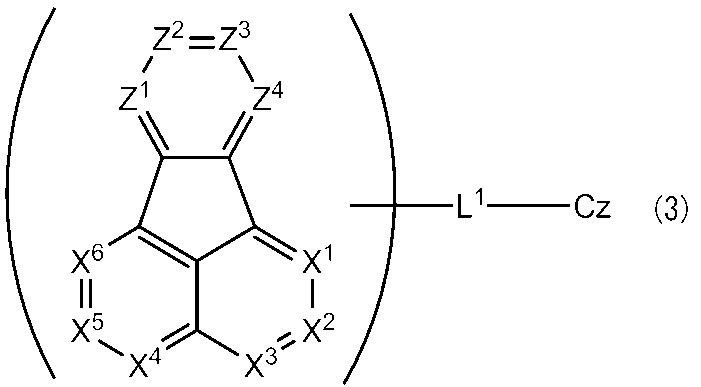
式(3)において、X1~X6及びZ1~Z4、L1及びCzは前記と同様である。
式(3)において、L1はX1、X2又はX3に隣接する炭素原子に結合することが好ましく、また、X2が表す炭素原子に結合することが好ましい。
式(3)において、X3は窒素原子であることが好ましい。
Czは、下記式(2)で示される基を表す。
式(3)において、L1はX1、X2又はX3に隣接する炭素原子に結合することが好ましく、また、X2が表す炭素原子に結合することが好ましい。
式(3)において、X3は窒素原子であることが好ましい。
Czは、下記式(2)で示される基を表す。
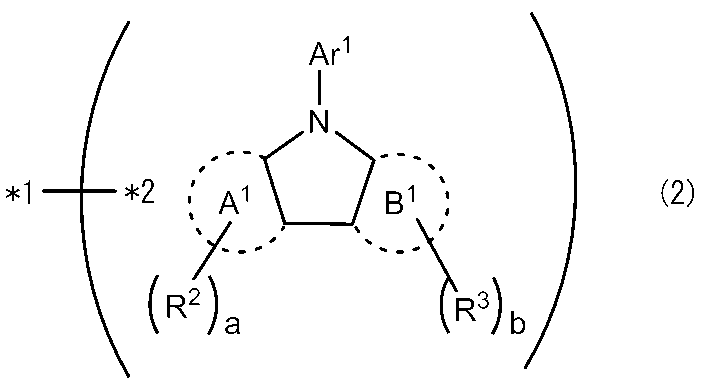
式(2)において、Ar1は、*2に結合する単結合又は1価の置換基を表す。
環A1及び環B1は、各々独立に、環形成炭素数5~50の芳香族炭化水素環、又は環形成原子数5~50の芳香族複素環を表す。
R2及びR3は、各々独立に、置換基を表す。
aとbは、各々独立に、0以上の整数であり、Ar1が*2に結合する単結合を表す場合、aとbとの合計は1以上である。
*1はL1との結合位置を表す。
*2は、環A1の1つの環形成炭素原子、環B1の1つの環形成炭素原子、及びAr1のいずれか1つと結合する。
Ar1、R2及びR3の少なくとも一つは、置換もしくは無置換の環形成炭素数6~50のアリール基又は置換もしくは無置換の環形成原子数5~50のヘテロアリール基である。
環A1及び環B1は、各々独立に、環形成炭素数5~50の芳香族炭化水素環、又は環形成原子数5~50の芳香族複素環を表す。
R2及びR3は、各々独立に、置換基を表す。
aとbは、各々独立に、0以上の整数であり、Ar1が*2に結合する単結合を表す場合、aとbとの合計は1以上である。
*1はL1との結合位置を表す。
*2は、環A1の1つの環形成炭素原子、環B1の1つの環形成炭素原子、及びAr1のいずれか1つと結合する。
Ar1、R2及びR3の少なくとも一つは、置換もしくは無置換の環形成炭素数6~50のアリール基又は置換もしくは無置換の環形成原子数5~50のヘテロアリール基である。
式(2)において、Ar1は、*2に結合するとき、単結合を表す。すなわち、下記式(2’)の環C1の窒素原子がL1と結合する。また、Ar1が*2に結合するとき、式(2)のaとbとの合計は1以上である。Ar1が*2に結合するとき、式(2)のaとbとの合計は1~3が好ましく、1~2がより好ましく、1が更に好ましい。
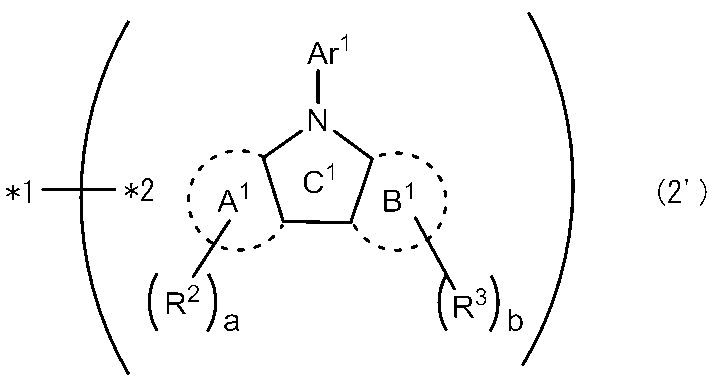
式(2’)中のAr1、R2、R3、a、b、*1及び*2は、いずれも式(2)のAr1、R2、R3、a、b、*1及び*2と同じである。
式(2)において、Ar1が*2に結合しないとき、Ar1は1価の置換基を表す。Ar1で表される置換基としては、上記R1で表される置換基と同様の例が挙げられる。ただし、Ar1、R2及びR3の少なくとも一つは、置換もしくは無置換の環形成炭素数6~50のアリール基又は置換もしくは無置換の環形成原子数5~50のヘテロアリール基である。従って、R2及びR3が、共に、置換もしくは無置換の環形成炭素数6~50のアリール基でなく、かつ、置換もしくは無置換の環形成原子数5~50のヘテロアリール基でないとき、Ar1は置換もしくは無置換の環形成炭素数6~50のアリール基又は置換もしくは無置換の環形成原子数5~50のヘテロアリール基である。
置換もしくは無置換の環形成炭素数6~60のアリール基としては、上記R1で表される置換基のアリール基と同様の例が挙げられる。
置換もしくは無置換の環形成原子数5~60のヘテロアリール基としては、上記R1で表される置換基のヘテロアリール基と同様の例が挙げられる。
置換もしくは無置換の環形成炭素数6~60のアリール基としては、上記R1で表される置換基のアリール基と同様の例が挙げられる。
置換もしくは無置換の環形成原子数5~60のヘテロアリール基としては、上記R1で表される置換基のヘテロアリール基と同様の例が挙げられる。
環A1及び環B1は、各々独立に、環形成炭素数5~50(より好ましくは6~25、更に好ましくは6~18)の芳香族炭化水素環、又は環形成原子数5~50(より好ましくは5~30、更に好ましくは5~26)の芳香族複素環を表す。
式(2)において、環A1、環B1及び環C1により形成される縮環の具体例としては、例えば、次の構造(abc-1)~(abc-17)及び(abc-h1)~(abc-h26)が挙げられるが、これらに限定されない。
なお、構造(abc-1)~(abc-17)及び(abc-h1)~(abc-h26)中、**はAr1の結合位置を表す。また、構造(abc-h1)~(abc-h26)中、X及びYは、各々独立に、NR、酸素原子、又は硫黄原子を表し、Rは水素原子又は置換基を表す。Rで表される置換基としては、上記R1で表される置換基と同様の例が挙げられる。
式(2)において、環A1、環B1及び環C1により形成される縮環の具体例としては、例えば、次の構造(abc-1)~(abc-17)及び(abc-h1)~(abc-h26)が挙げられるが、これらに限定されない。
なお、構造(abc-1)~(abc-17)及び(abc-h1)~(abc-h26)中、**はAr1の結合位置を表す。また、構造(abc-h1)~(abc-h26)中、X及びYは、各々独立に、NR、酸素原子、又は硫黄原子を表し、Rは水素原子又は置換基を表す。Rで表される置換基としては、上記R1で表される置換基と同様の例が挙げられる。

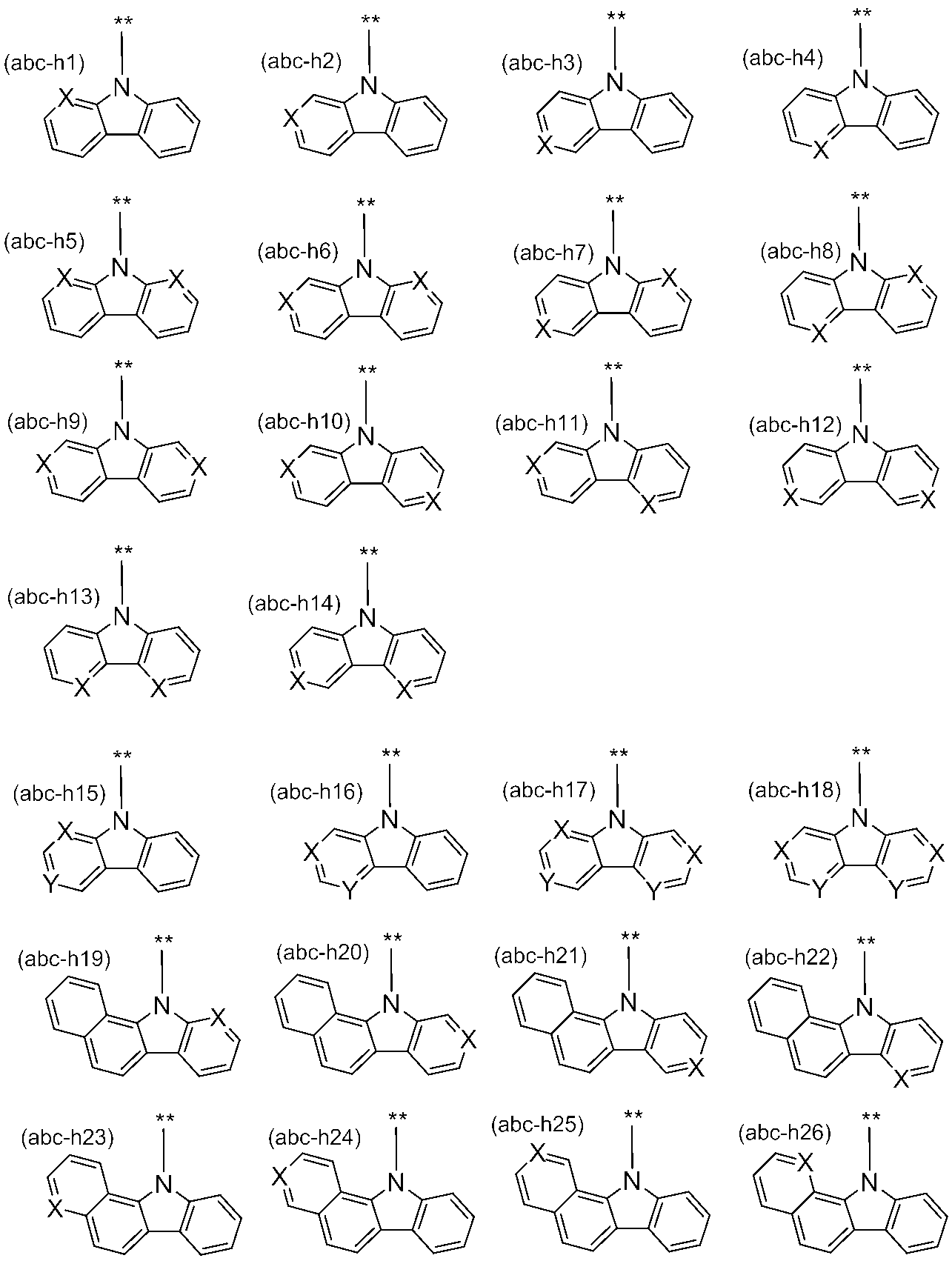
式(2)において、R2及びR3は、各々独立に、置換基を表す。R2及びR3で表される置換基としては、各々独立に、上記R1で表される置換基と同様の例が挙げられる。ただし、Ar1が*2に結合するとき、R2及びR3の少なくとも一つは、置換もしくは無置換の環形成炭素数6~50のアリール基又は置換もしくは無置換の環形成原子数5~50のヘテロアリール基である。
置換もしくは無置換の環形成炭素数6~60のアリール基としては、上記R1で表される置換基のアリール基と同様の例が挙げられる。
置換もしくは無置換の環形成原子数5~60のヘテロアリール基としては、上記R1で表される置換基のヘテロアリール基と同様の例が挙げられる。
R2及びR3の少なくとも一方は、下記式(5)で表されることが好ましい。
置換もしくは無置換の環形成炭素数6~60のアリール基としては、上記R1で表される置換基のアリール基と同様の例が挙げられる。
置換もしくは無置換の環形成原子数5~60のヘテロアリール基としては、上記R1で表される置換基のヘテロアリール基と同様の例が挙げられる。
R2及びR3の少なくとも一方は、下記式(5)で表されることが好ましい。

式(5)において、環A2及び環B2は、各々独立に、環形成炭素数5~50の芳香族炭化水素環、又は環形成原子数5~50の芳香族複素環を表す。
R4及びR5は、置換基を表し、c及びdは、0以上の整数を表す。
D1は、酸素原子、硫黄原子、CR6R7、又は、NR8を表す。
R6~R8は、各々独立に、水素原子、置換基、又は*4と結合する単結合を表す。
L2は、単結合、置換もしくは無置換の環形成炭素数6~50のアリーレン基、又は置換もしくは無置換の環形成原子数5~50のヘテロアリーレン基を表す。
*3は前記環A1又は環B1の環形成炭素原子に結合する。
*4は環A2の1つの環形成炭素原子、環B2の1つの環形成炭素原子、及びR6~R8のいずれか1つと結合する。
R4及びR5は、置換基を表し、c及びdは、0以上の整数を表す。
D1は、酸素原子、硫黄原子、CR6R7、又は、NR8を表す。
R6~R8は、各々独立に、水素原子、置換基、又は*4と結合する単結合を表す。
L2は、単結合、置換もしくは無置換の環形成炭素数6~50のアリーレン基、又は置換もしくは無置換の環形成原子数5~50のヘテロアリーレン基を表す。
*3は前記環A1又は環B1の環形成炭素原子に結合する。
*4は環A2の1つの環形成炭素原子、環B2の1つの環形成炭素原子、及びR6~R8のいずれか1つと結合する。
式(5)における環A2及び環B2は、式(2)における環A1及び環B1と同様であり、式(5)における環A2及び環B2と、式(5)においてD1を含んで形成される5員環とにより形成される縮環の具体例としては、例えば、既述の構造(abc-1)~(abc-17)及び(abc-h1)~(abc-h26)が挙げられる。
式(5)において、R4及びR5は、置換基を表し、c及びdは、0以上の整数を表す。R4及びR5で表される置換基としては、各々独立に、上記R1で表される置換基と同様の例が挙げられる。
c及びdは、共に、0~2であることが好ましく、0~1であることがより好ましい。
式(5)において、R4及びR5は、置換基を表し、c及びdは、0以上の整数を表す。R4及びR5で表される置換基としては、各々独立に、上記R1で表される置換基と同様の例が挙げられる。
c及びdは、共に、0~2であることが好ましく、0~1であることがより好ましい。
式(5)において、D1は、酸素原子、硫黄原子、CR6R7、又は、NR8を表す。RR6~R8は、各々独立に、水素原子、置換基、又は*4と結合する単結合を表す。R6~Rで表される置換基としては、各々独立に、上記R1で表される置換基と同様の例が挙げられる。
D1は、NR8、酸素原子、又は硫黄原子であることが好ましく、NR8であることがより好ましく、NHであることが更に好ましい。
D1は、NR8、酸素原子、又は硫黄原子であることが好ましく、NR8であることがより好ましく、NHであることが更に好ましい。
式(5)において、L2は、単結合、置換もしくは無置換の環形成炭素数6~50のアリーレン基、又は置換もしくは無置換の環形成原子数5~50のヘテロアリーレン基を表す。
置換もしくは無置換の環形成炭素数6~60のアリール基としては、上記R1で表される置換基のアリール基と同様の例が挙げられる。
置換もしくは無置換の環形成原子数5~60のヘテロアリール基としては、上記R1で表される置換基のヘテロアリール基と同様の例が挙げられる。
式(5)において、L2は、単結合、又は置換もしくは無置換の環形成炭素数6~50のアリーレン基を表すことが好ましい。
前記Czは、下記式(6)で表されることが好ましい。
置換もしくは無置換の環形成炭素数6~60のアリール基としては、上記R1で表される置換基のアリール基と同様の例が挙げられる。
置換もしくは無置換の環形成原子数5~60のヘテロアリール基としては、上記R1で表される置換基のヘテロアリール基と同様の例が挙げられる。
式(5)において、L2は、単結合、又は置換もしくは無置換の環形成炭素数6~50のアリーレン基を表すことが好ましい。
前記Czは、下記式(6)で表されることが好ましい。

式(6)において、
Y1~Y8は各々独立に、CR9又は窒素原子であり、
Y11~Y18は各々独立に、CR10又は窒素原子であり、
R9は各々独立に、水素原子、置換基、又は*2’と結合する単結合を表す。
R10は各々独立に、水素原子、置換基、又は*4’と結合する単結合を表す。
*1、Ar1、D1及びL2は前記と同様である。
*2’は、Ar1又はR9のいずれか1つが表す炭素原子に結合する。
*3’は複数のR9のいずれか1つに結合する。
*4’はR6~R8又は複数のR10のいずれか1つに結合する。
Y1~Y8は各々独立に、CR9又は窒素原子であり、
Y11~Y18は各々独立に、CR10又は窒素原子であり、
R9は各々独立に、水素原子、置換基、又は*2’と結合する単結合を表す。
R10は各々独立に、水素原子、置換基、又は*4’と結合する単結合を表す。
*1、Ar1、D1及びL2は前記と同様である。
*2’は、Ar1又はR9のいずれか1つが表す炭素原子に結合する。
*3’は複数のR9のいずれか1つに結合する。
*4’はR6~R8又は複数のR10のいずれか1つに結合する。
式(6)において、前記L2は、前記Y2及び前記Y13が表す2つの炭素原子、前記Y3及び前記Y12が表す2つの炭素原子、又は、前記Y3及び前記Y13が表す2つの炭素原子に結合することが好ましい。
式(2)においてAr1が*2に結合する単結合である場合、前記Czは下記式(7)で表されることが好ましく、下記式(8)で表されることがより好ましい。

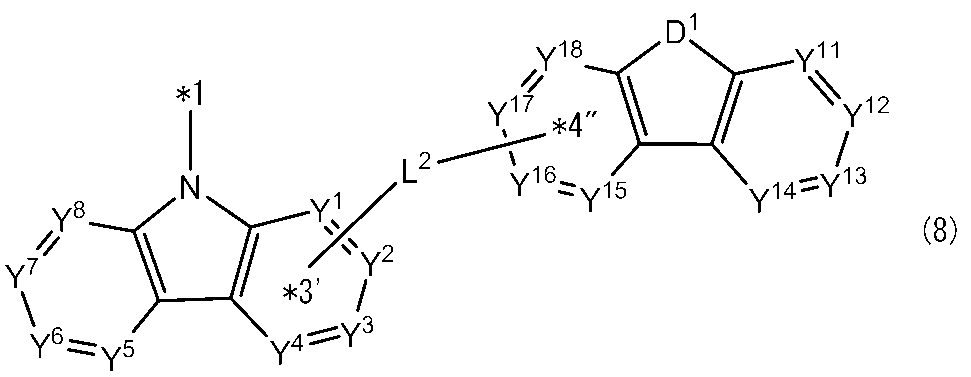
式(7)において、*1、*3’、*4’、Y1~Y8、Y11~Y18、L2、及びD1は前記と同様である。
式(8)において、*1、*3’、Y1~Y8、Y11~Y18、L2、及びD1は前記と同様である。
*4”はY15~Y18のいずれか1つが表す炭素原子と結合し、その他のY15~Y18は各々独立にCR10又は窒素原子を表す。
R10は前記と同様である。
式(8)において、*1、*3’、Y1~Y8、Y11~Y18、L2、及びD1は前記と同様である。
*4”はY15~Y18のいずれか1つが表す炭素原子と結合し、その他のY15~Y18は各々独立にCR10又は窒素原子を表す。
R10は前記と同様である。
式(2)においてAr1が1価の置換基を表す場合、前記Czは下記式(9)で表されることが好ましく、下記式(10)で表されることがより好ましい。

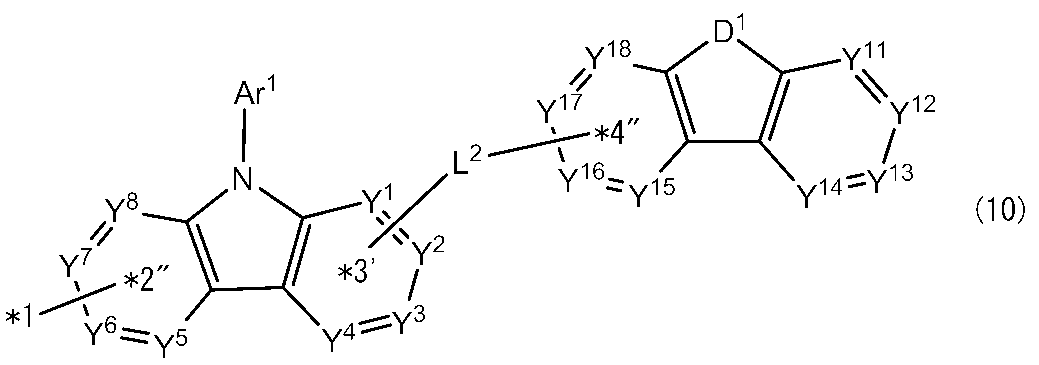
式(9)において、*1、*3’、*4’、Y1~Y8、Y11~Y18、L2、及びD1は前記と同様である。
式(9)において、*2”は、Y5~Y8のいずれか1つが表す炭素原子に結合し、その他のY5~Y8は各々独立にCR10又は窒素原子を表す。R10は前記と同様である。
式(10)において、*1、*2”、*3’、*4”、Y1~Y8、Y11~Y18、L2、及びD1は前記と同様である。
式(9)において、*2”は、Y5~Y8のいずれか1つが表す炭素原子に結合し、その他のY5~Y8は各々独立にCR10又は窒素原子を表す。R10は前記と同様である。
式(10)において、*1、*2”、*3’、*4”、Y1~Y8、Y11~Y18、L2、及びD1は前記と同様である。
以上の構造の中でも、式(1)で表される化合物は、式(7)で表されるCzを有する式(1)で表されることが好ましく、式(8)で表されるCzを有する式(1)で表されることがより好ましく、式(7)で表されるCzを有する式(3)で表されることが更に好ましく、式(8)で表されるCzを有する式(3)で表されることがより更に好ましい。
すなわち、式(1)で表される化合物は、下記式(11)で表されることが更に好ましく、下記式(12)で表されることがより更に好ましい。
すなわち、式(1)で表される化合物は、下記式(11)で表されることが更に好ましく、下記式(12)で表されることがより更に好ましい。

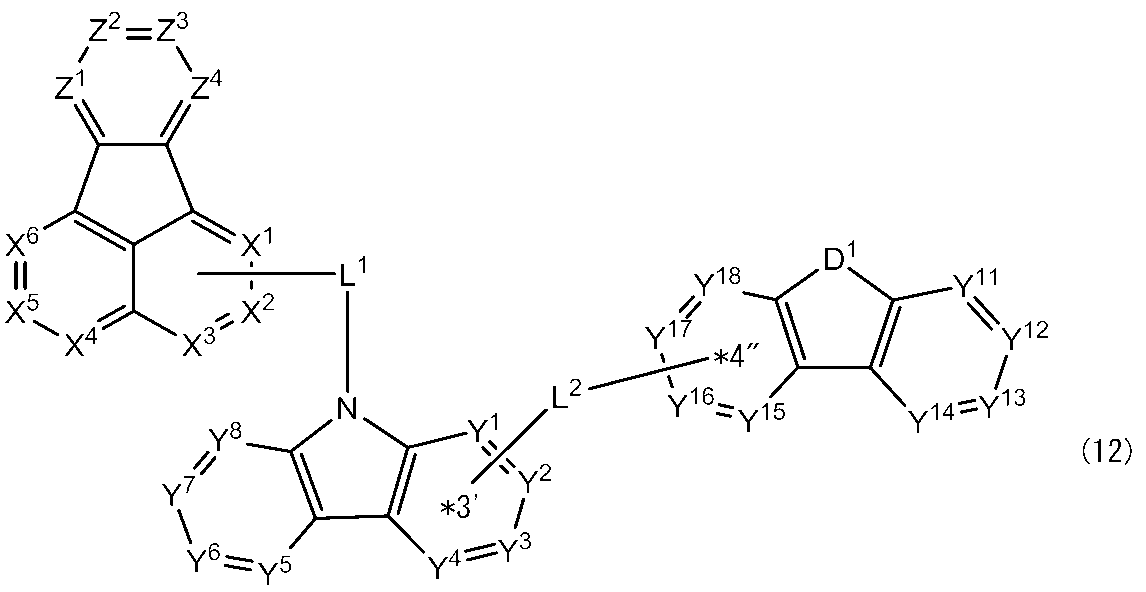
式(11)において、X1~X6、Z1~Z4、L1、Y1~Y8、*3’、L2、*4’、Y11~Y18、及びD1は前記と同様である。
式(12)において、X1~X6、Z1~Z4、L1、Y1~Y8、*3’、L2、*4”、Y11~Y18、及びD1は前記と同様である。
式(12)において、X1~X6、Z1~Z4、L1、Y1~Y8、*3’、L2、*4”、Y11~Y18、及びD1は前記と同様である。
〔式(13)で表される化合物〕
本発明の一実施態様の有機EL素子用材料は、下記式(13)で表される化合物を含有することができる。
本発明の一実施態様の有機EL素子用材料は、下記式(13)で表される化合物を含有することができる。

式(13)において、
Q1~Q6及びW1~W4のいずれかm個はL1と結合する炭素原子を表し、Q1~Q6及びW1~W4がL1と結合する炭素原子を表さないとき、W2及びW3は、各々独立に、CR11を表し、W1及びW4は、各々独立に、CR11又は窒素原子を表し、Q1~Q6は、各々独立に、CR11又は窒素原子を表す。ただし、W1及びW4の少なくとも1つは窒素原子である。
mは1~3の整数を表す。
R11は、各々独立に水素原子又は置換基を表す。
L1は、単結合、置換もしくは無置換の環形成炭素数6~50のアリーレン基、又は置換もしくは無置換の環形成原子数5~50のヘテロアリーレン基を表す。
Czは、前記式(2)で示される基を表す。
式(2)は、式(1)で表される化合物の説明で記載した式(2)と同じである。
Q1~Q6及びW1~W4のいずれかm個はL1と結合する炭素原子を表し、Q1~Q6及びW1~W4がL1と結合する炭素原子を表さないとき、W2及びW3は、各々独立に、CR11を表し、W1及びW4は、各々独立に、CR11又は窒素原子を表し、Q1~Q6は、各々独立に、CR11又は窒素原子を表す。ただし、W1及びW4の少なくとも1つは窒素原子である。
mは1~3の整数を表す。
R11は、各々独立に水素原子又は置換基を表す。
L1は、単結合、置換もしくは無置換の環形成炭素数6~50のアリーレン基、又は置換もしくは無置換の環形成原子数5~50のヘテロアリーレン基を表す。
Czは、前記式(2)で示される基を表す。
式(2)は、式(1)で表される化合物の説明で記載した式(2)と同じである。
式(13)において、R11で表される置換基としては、各々独立に、上記R1で表される置換基と同様の例が挙げられる。
式(13)において、R11が結合する炭素原子のうち、隣り合う炭素原子に結合する複数のR11は、互いに結合して飽和又は不飽和の環構造を形成してもよいし、環構造を形成しなくてもよい。
式(13)のR11において、隣接する置換基同士が互いに結合して形成してもよい環としては、置換もしくは無置換の環形成炭素数6~60の芳香族炭化水素環、又は置換もしくは無置換の環形成原子数5~60の複素環が挙げられる。
置換もしくは無置換の環形成炭素数6~60の芳香族炭化水素環としては、上記R1で表される置換基のアリール基に対応する環が挙げられる。
置換もしくは無置換の環形成原子数5~60の複素環としては、上記R1で表される置換基のヘテロアリール基に対応する環が挙げられる。
式(13)において、R11が結合する炭素原子のうち、隣り合う炭素原子に結合する複数のR11は、互いに結合して飽和又は不飽和の環構造を形成してもよいし、環構造を形成しなくてもよい。
式(13)のR11において、隣接する置換基同士が互いに結合して形成してもよい環としては、置換もしくは無置換の環形成炭素数6~60の芳香族炭化水素環、又は置換もしくは無置換の環形成原子数5~60の複素環が挙げられる。
置換もしくは無置換の環形成炭素数6~60の芳香族炭化水素環としては、上記R1で表される置換基のアリール基に対応する環が挙げられる。
置換もしくは無置換の環形成原子数5~60の複素環としては、上記R1で表される置換基のヘテロアリール基に対応する環が挙げられる。
式(13)において、mは1~3の整数を表し、2~3の整数が好ましい。
式(13)において、L1及びCzは、式(1)で表される化合物の説明で記載した式(1)におけるL1及びCzと同じである。
式(13)において、L1は、前記Q1~Q6及びW2~W4が表す炭素原子のいずれか1つ~3つに結合することが好ましく、Q1~Q6、W2及びW3が表す炭素原子のいずれか1つ~3つに結合することが好ましい。
式(13)において、Q1~Q6、W2及びW3はCR11であることが好ましく、また、W1が窒素原子であることが好ましい。
式(13)において、L1及びCzは、式(1)で表される化合物の説明で記載した式(1)におけるL1及びCzと同じである。
式(13)において、L1は、前記Q1~Q6及びW2~W4が表す炭素原子のいずれか1つ~3つに結合することが好ましく、Q1~Q6、W2及びW3が表す炭素原子のいずれか1つ~3つに結合することが好ましい。
式(13)において、Q1~Q6、W2及びW3はCR11であることが好ましく、また、W1が窒素原子であることが好ましい。
式(13)で表される化合物において、式(2)におけるR2及びR3の少なくとも一方は、前記式(5)で表されることが好ましい。式(5)は、式(1)で表される化合物の説明で記載した式(5)と同じである。
式(13)におけるCzは、式(6)~式(10)のいずれかで表されることが好ましく、式(9)で表されることがより好ましく、式(10)で表されることが更に好ましい。式(6)~式(10)は、式(1)で表される化合物の説明で記載した式(6)~式(10)と、それぞれ同じである。
式(13)におけるCzは、式(6)~式(10)のいずれかで表されることが好ましく、式(9)で表されることがより好ましく、式(10)で表されることが更に好ましい。式(6)~式(10)は、式(1)で表される化合物の説明で記載した式(6)~式(10)と、それぞれ同じである。
以下に本発明の一実施態様である式(1)で表される化合物及び式(13)で表される化合物の具体例を示すが、本発明はこれらに限定されるものではない。
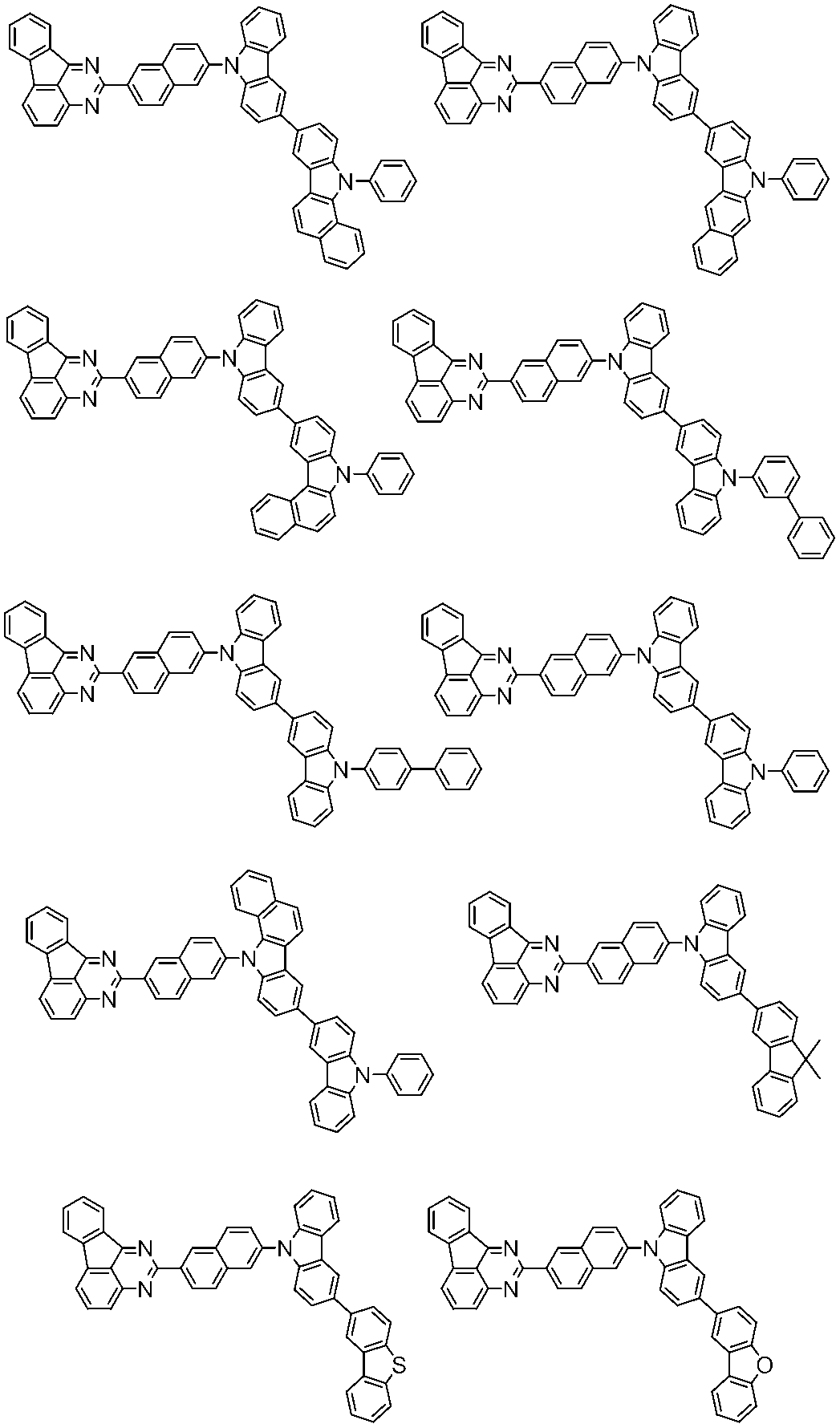
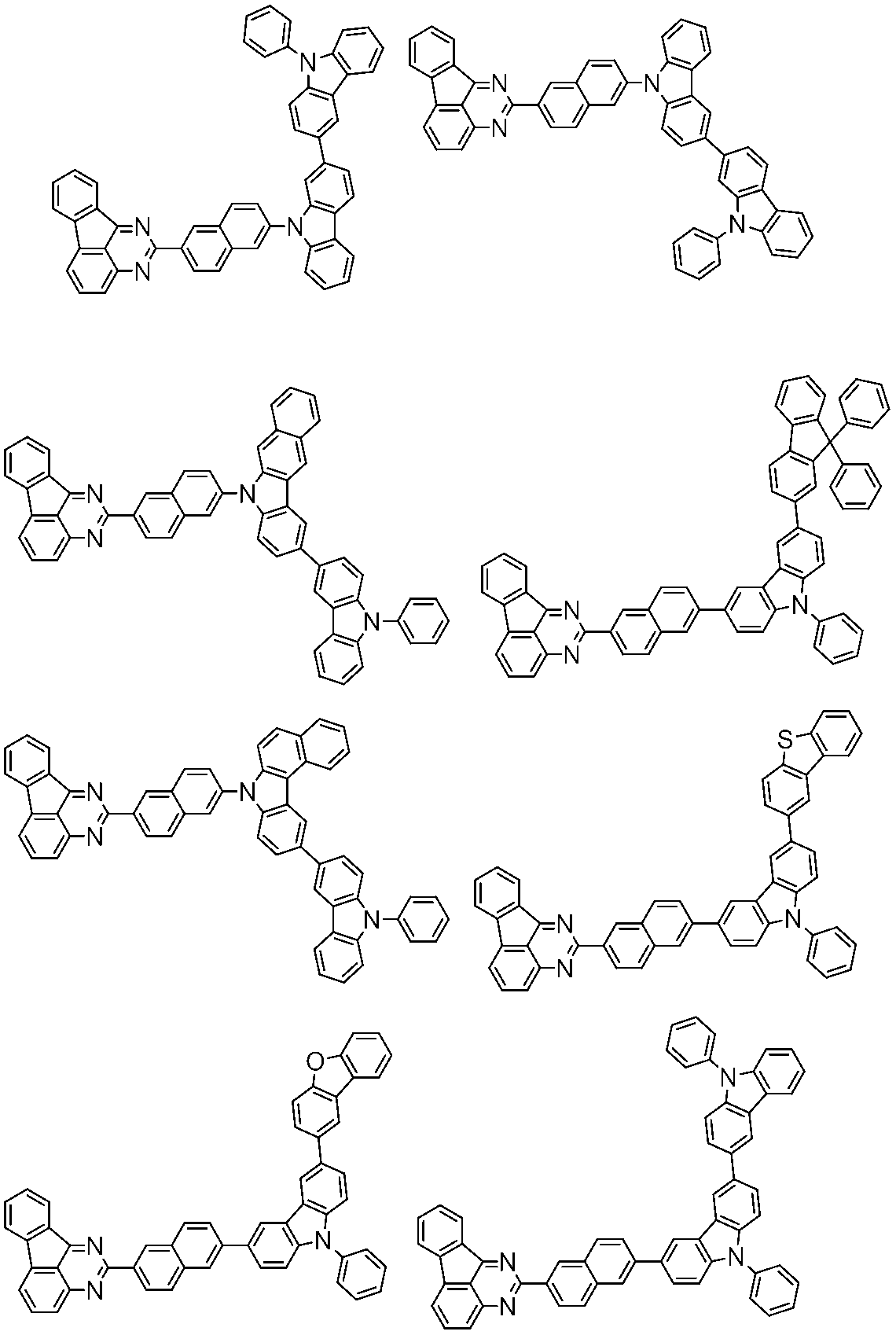
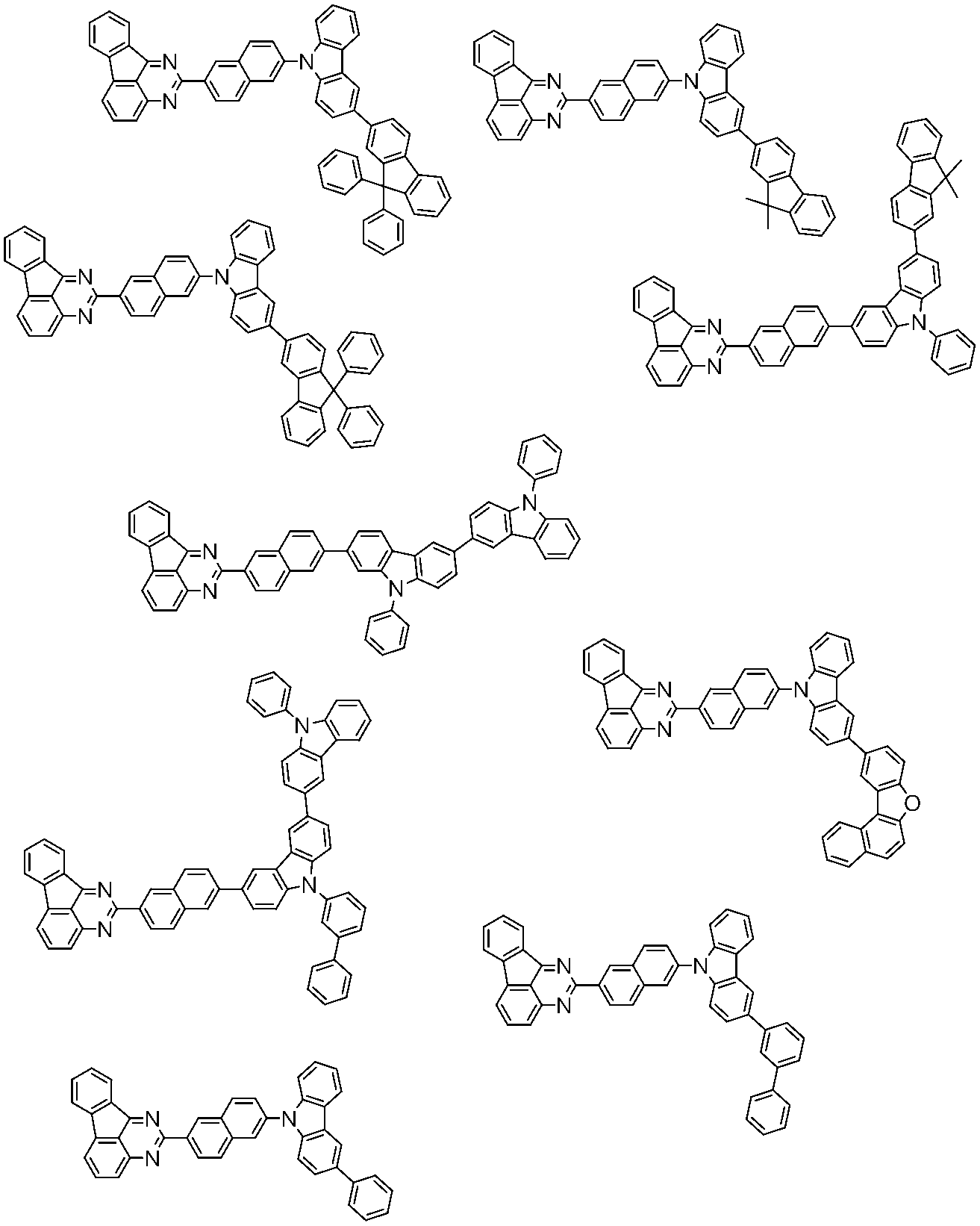
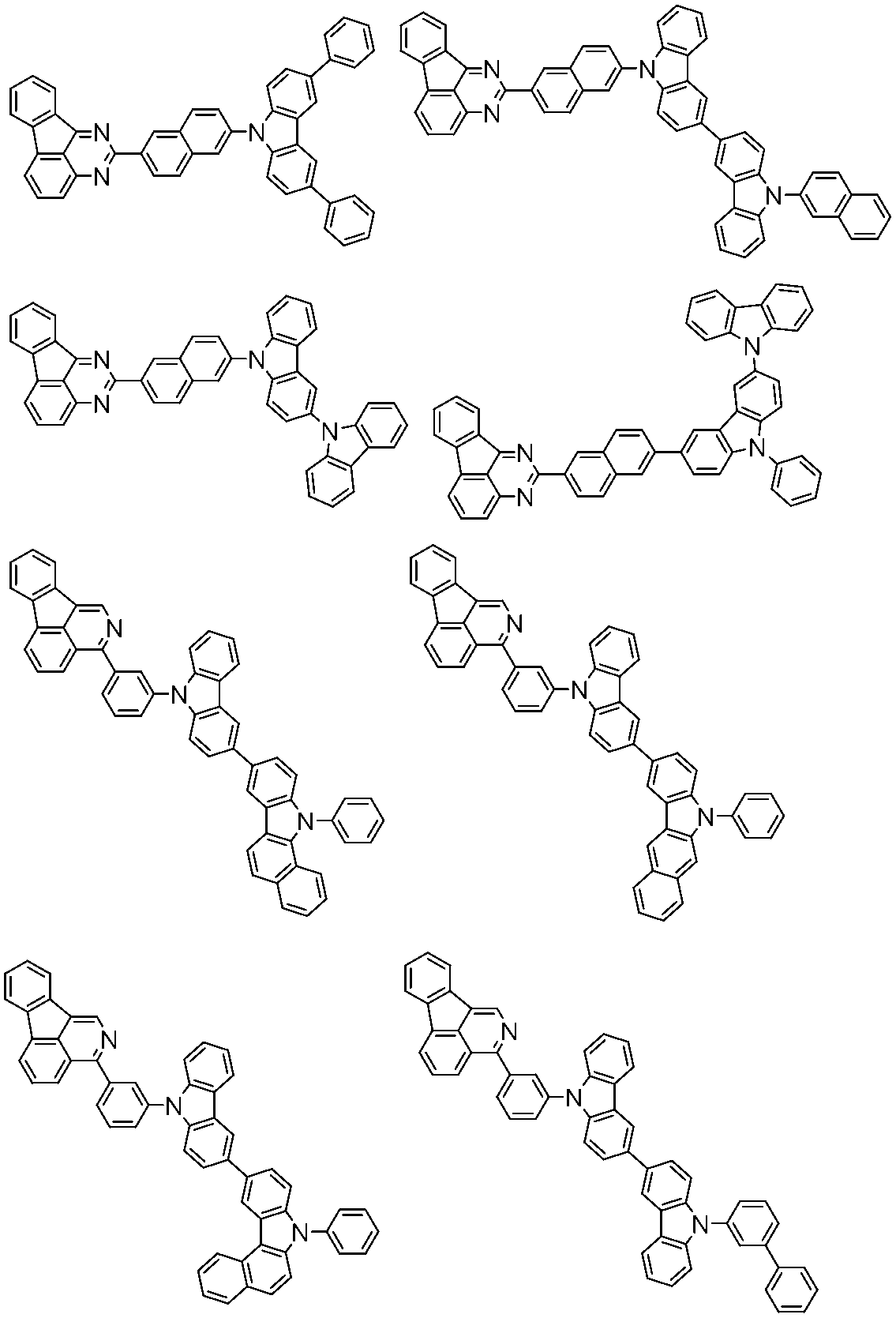
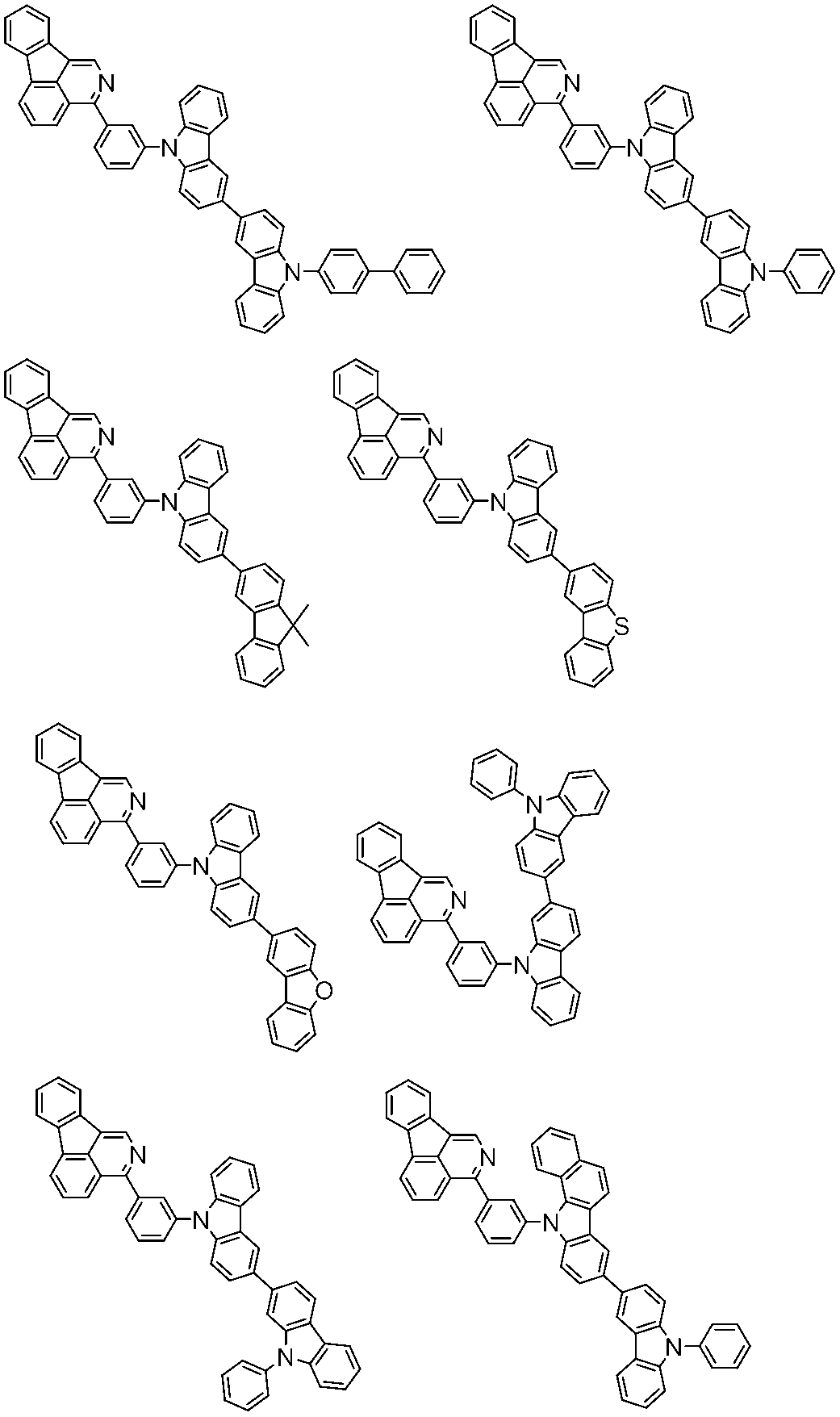

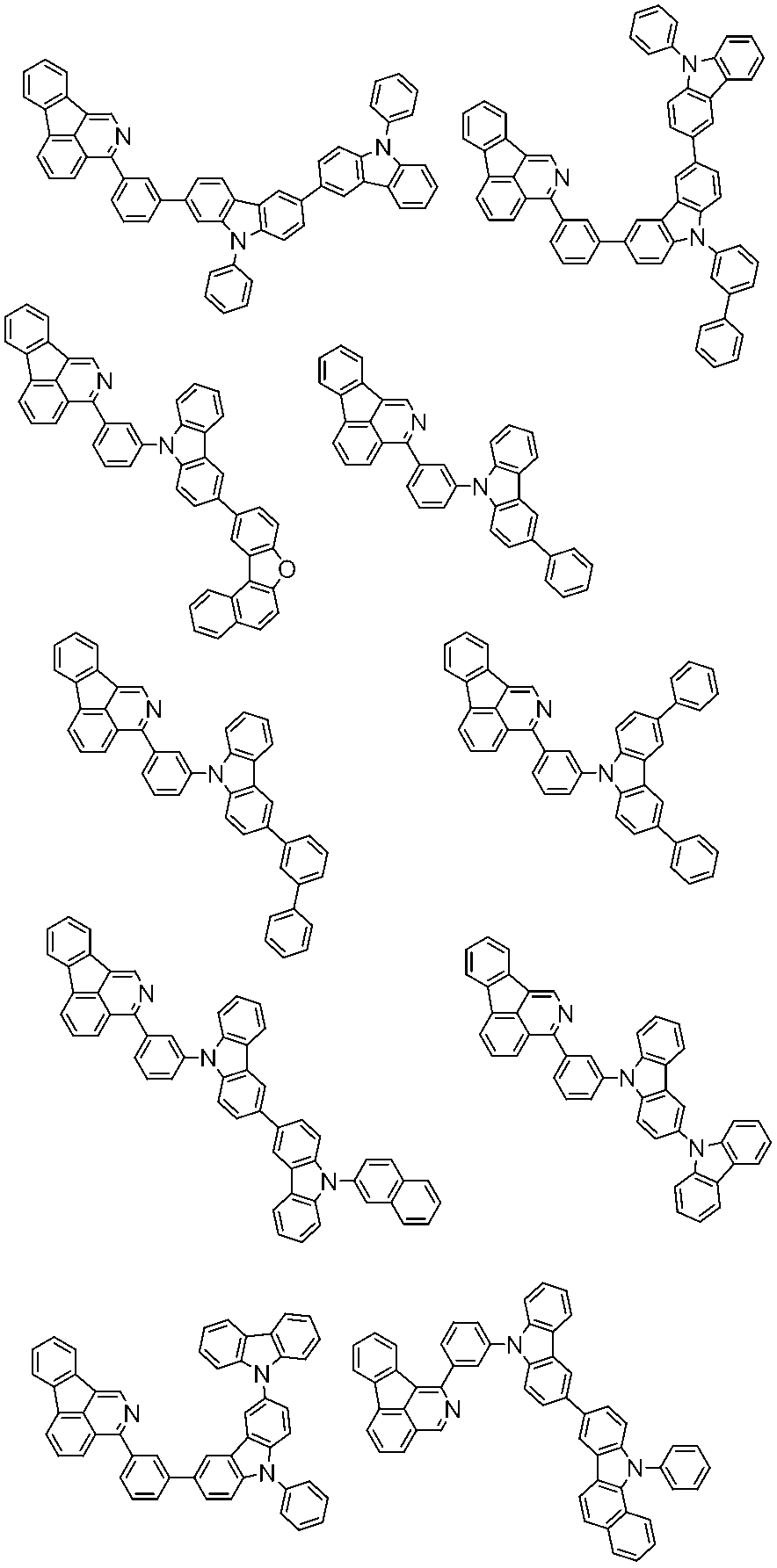

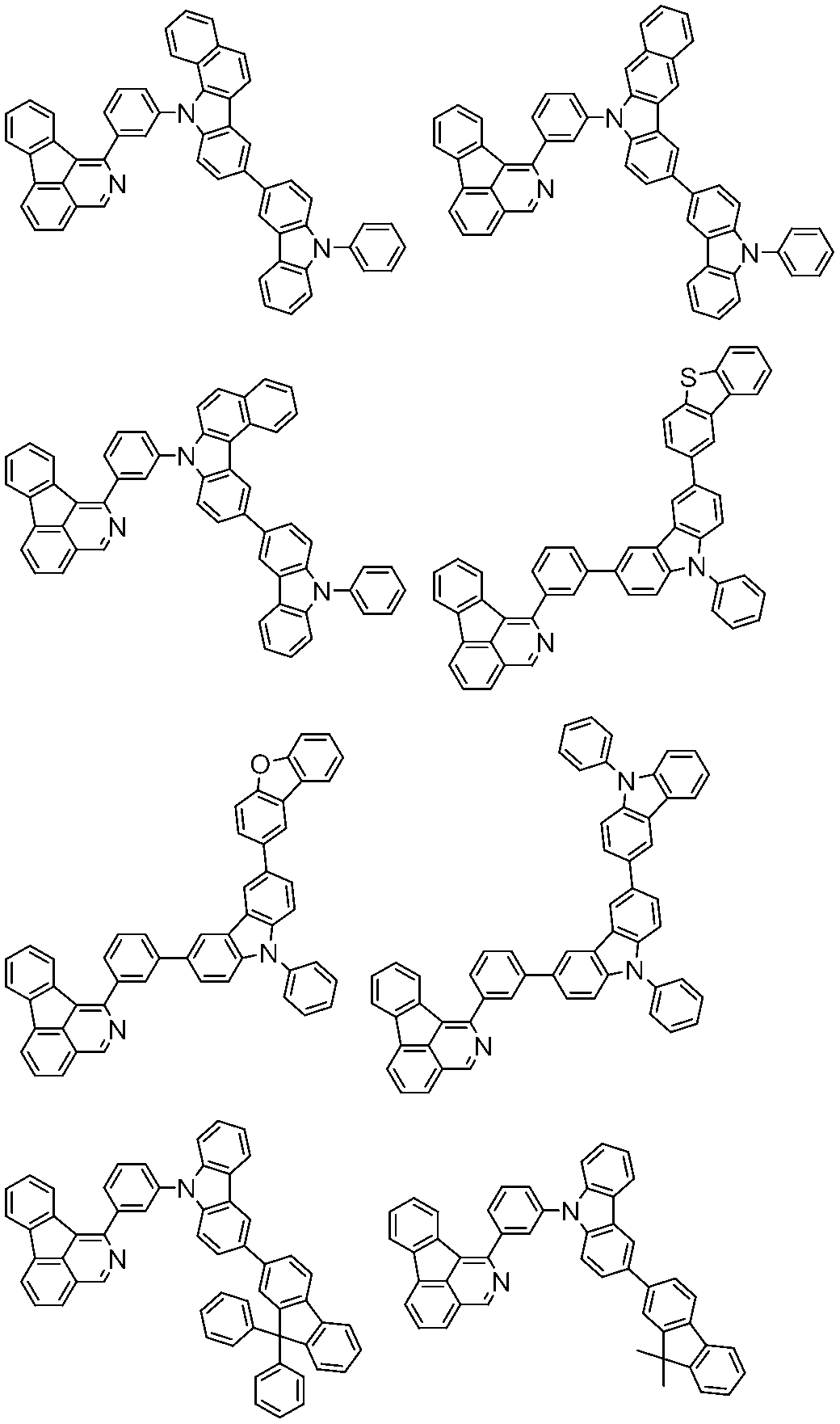
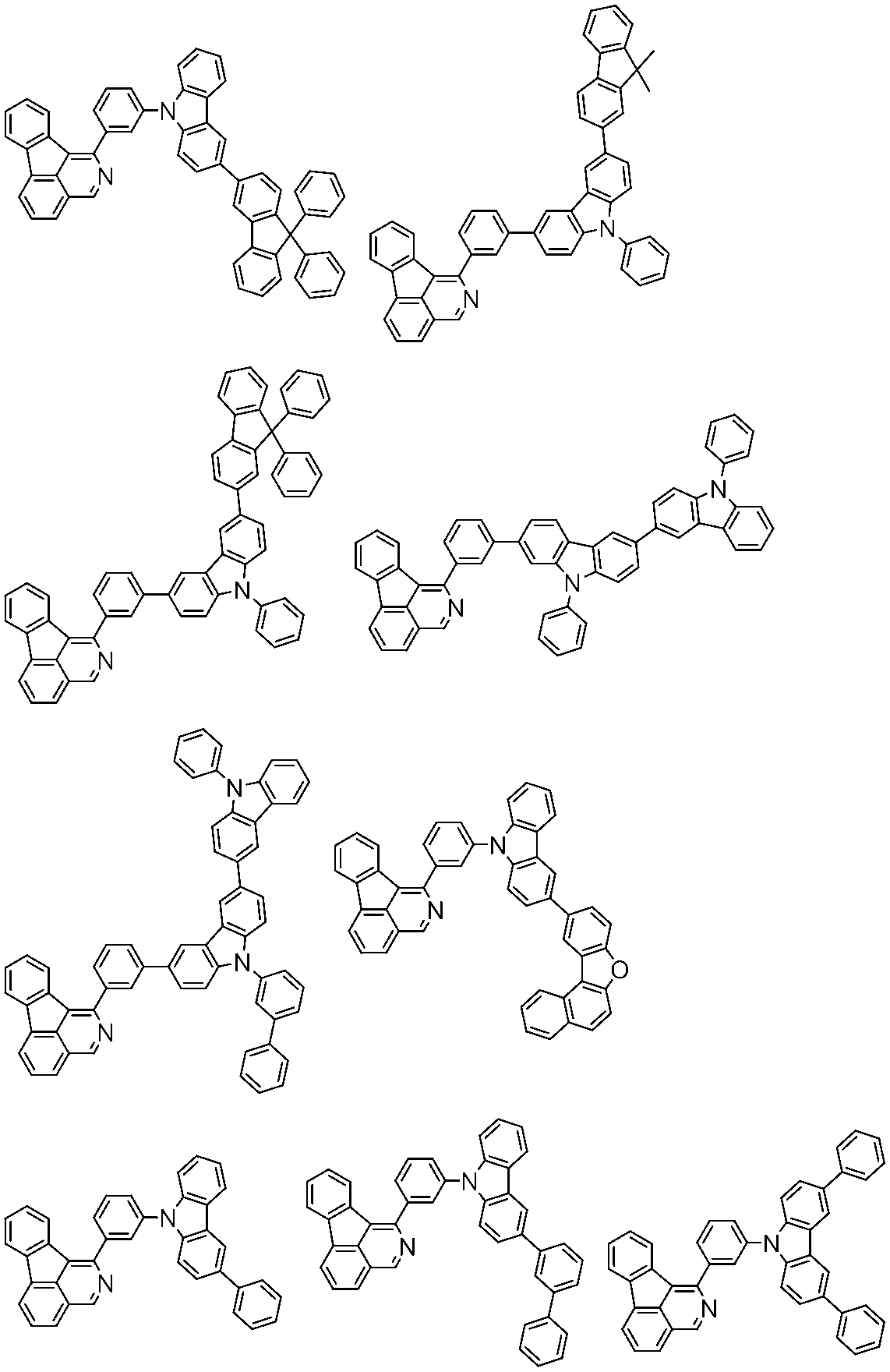
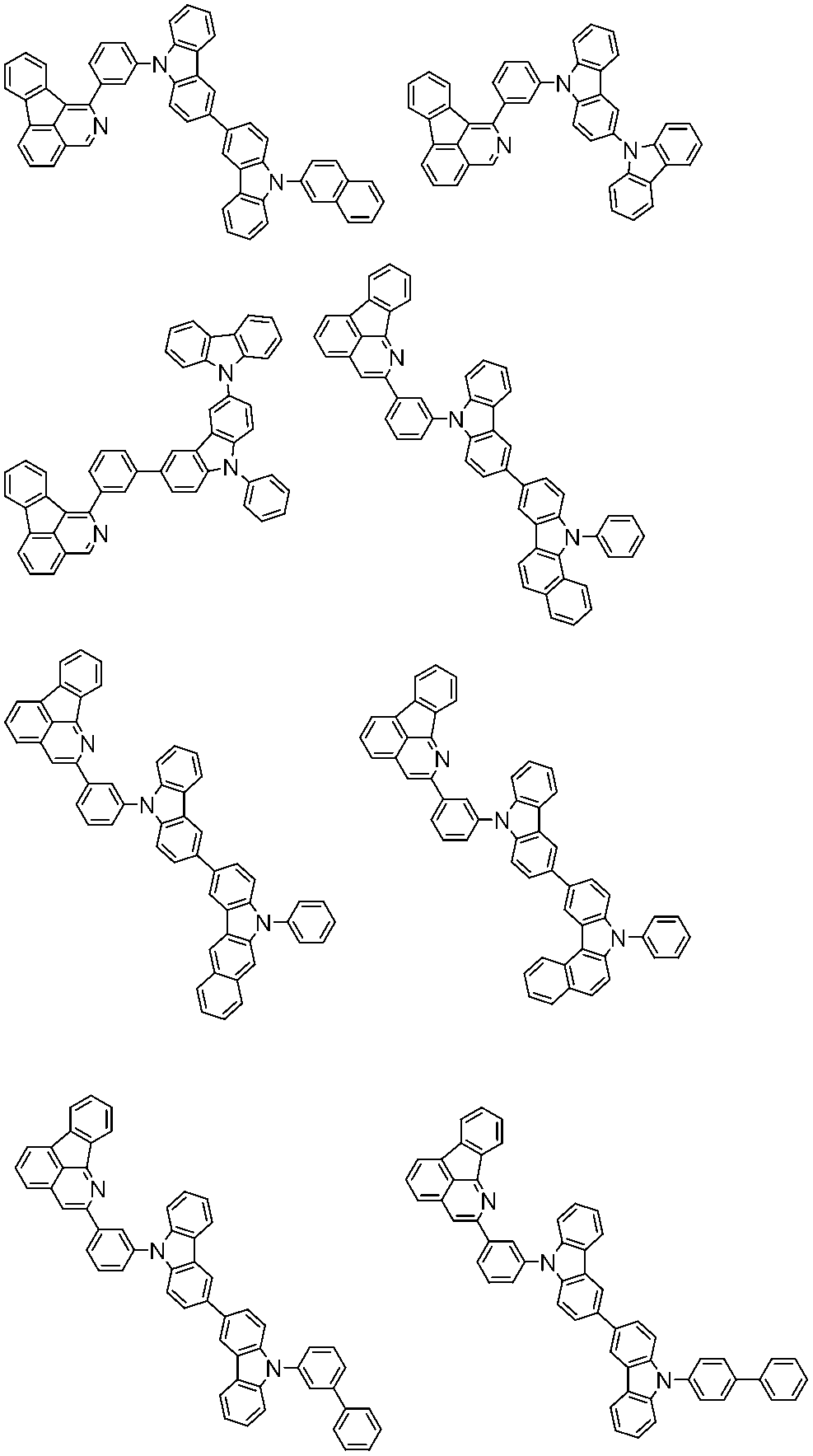


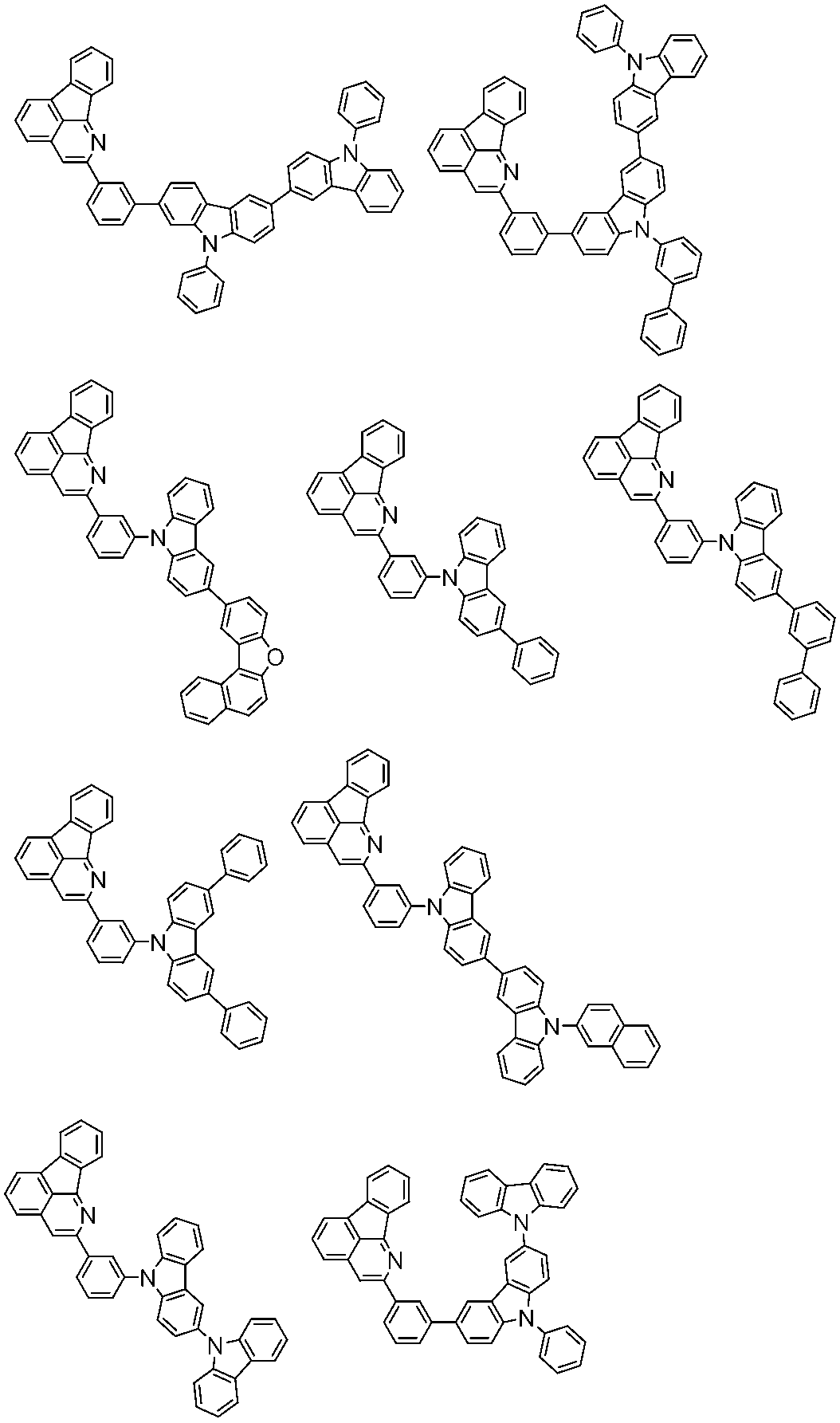
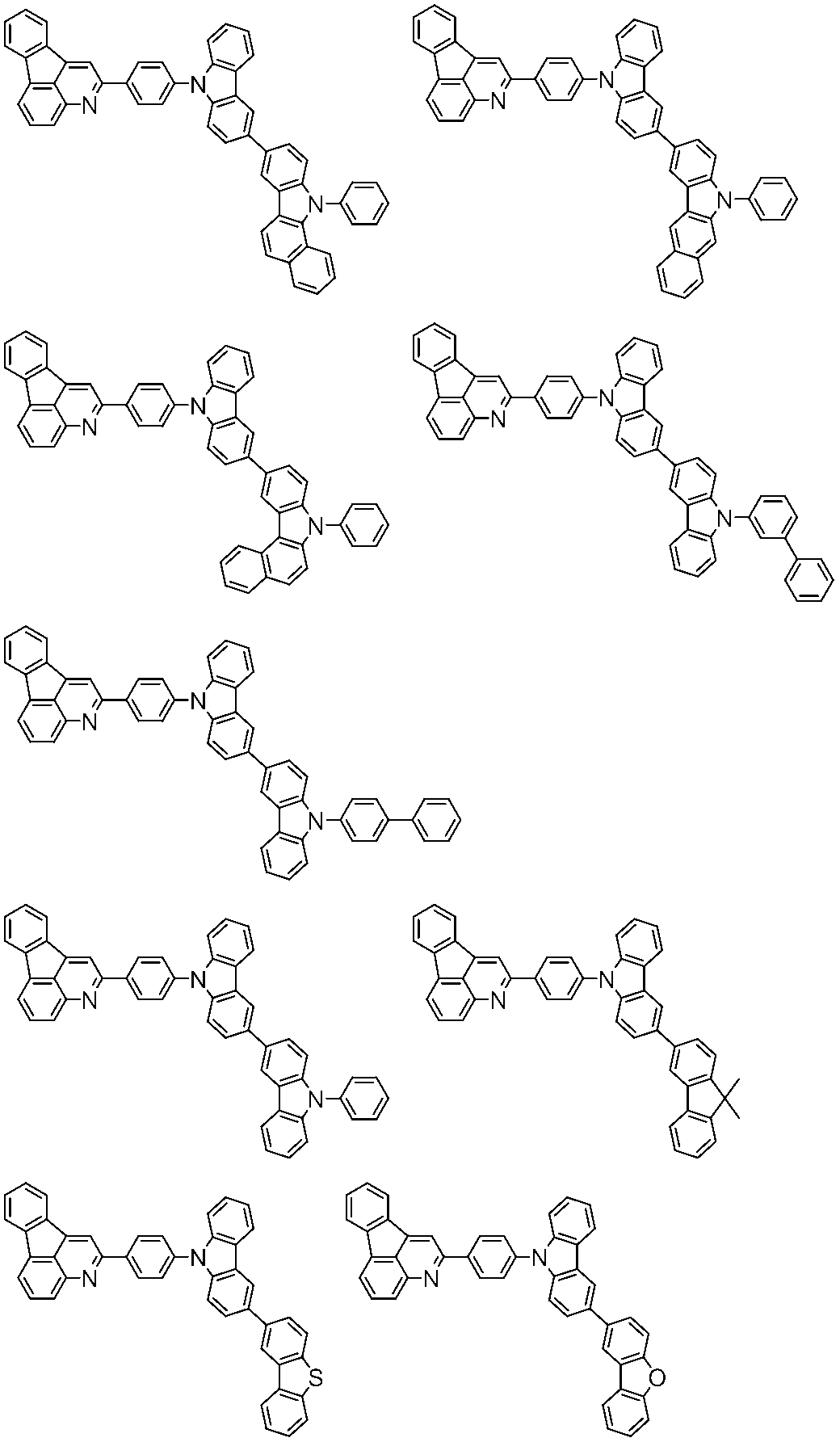


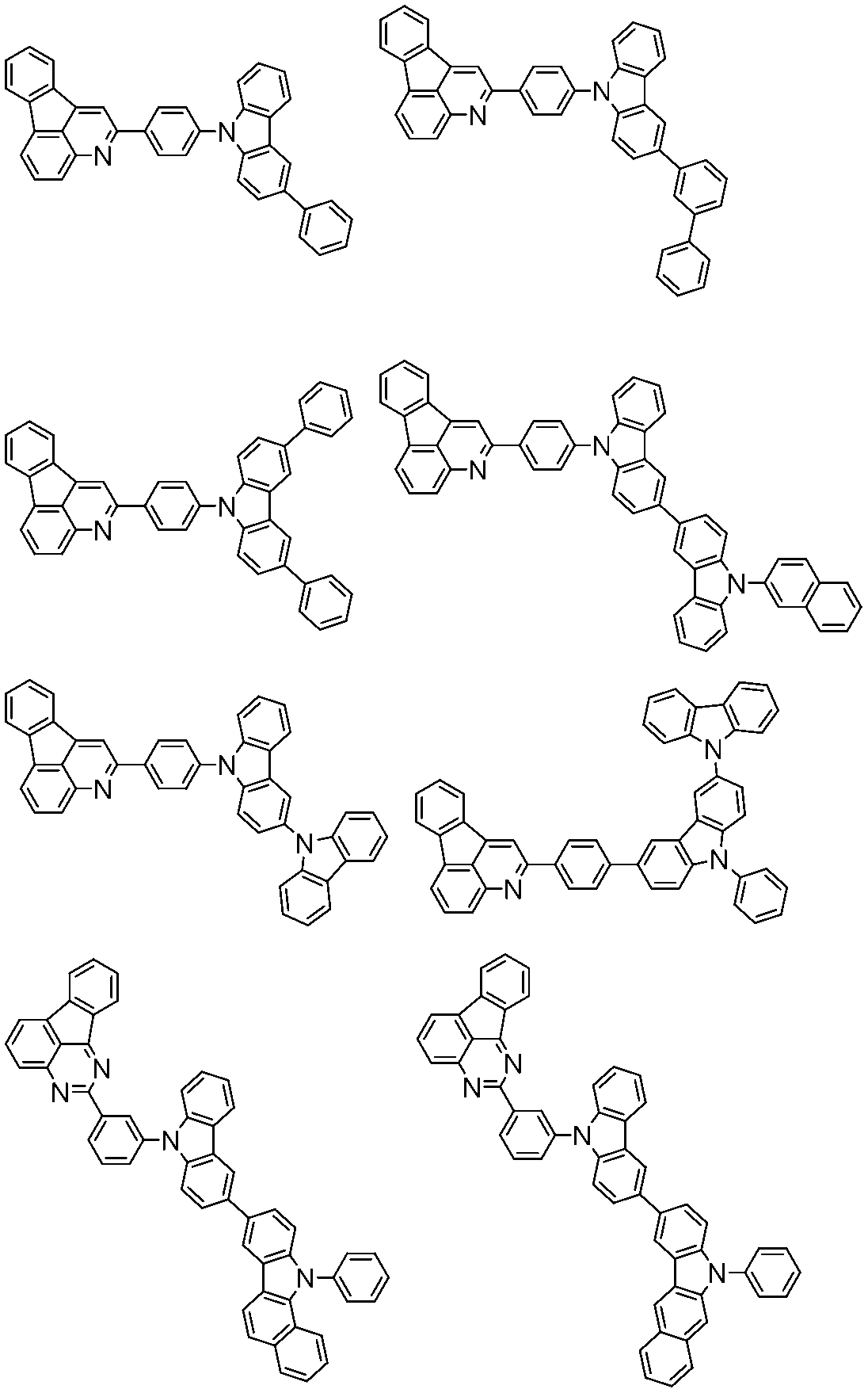
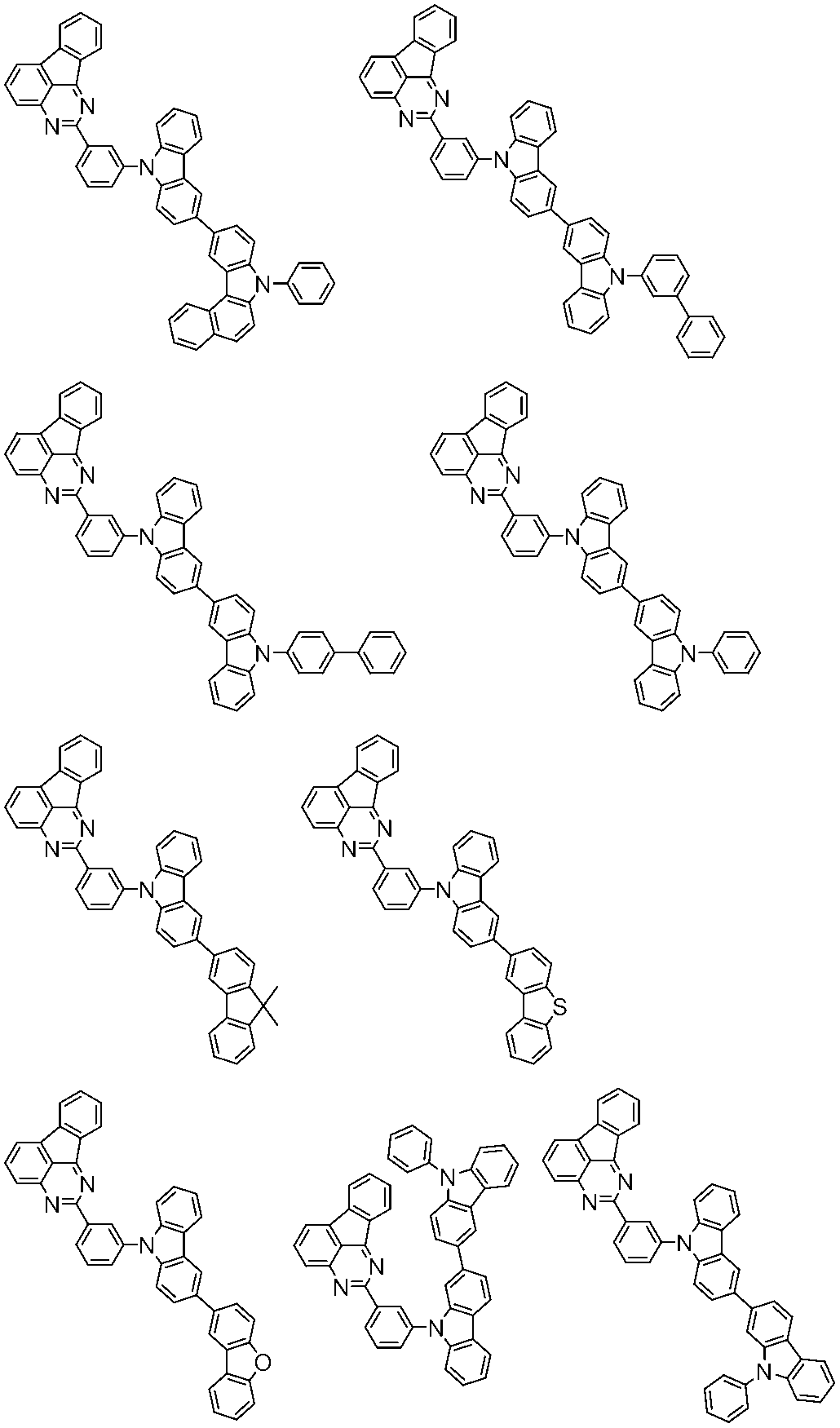

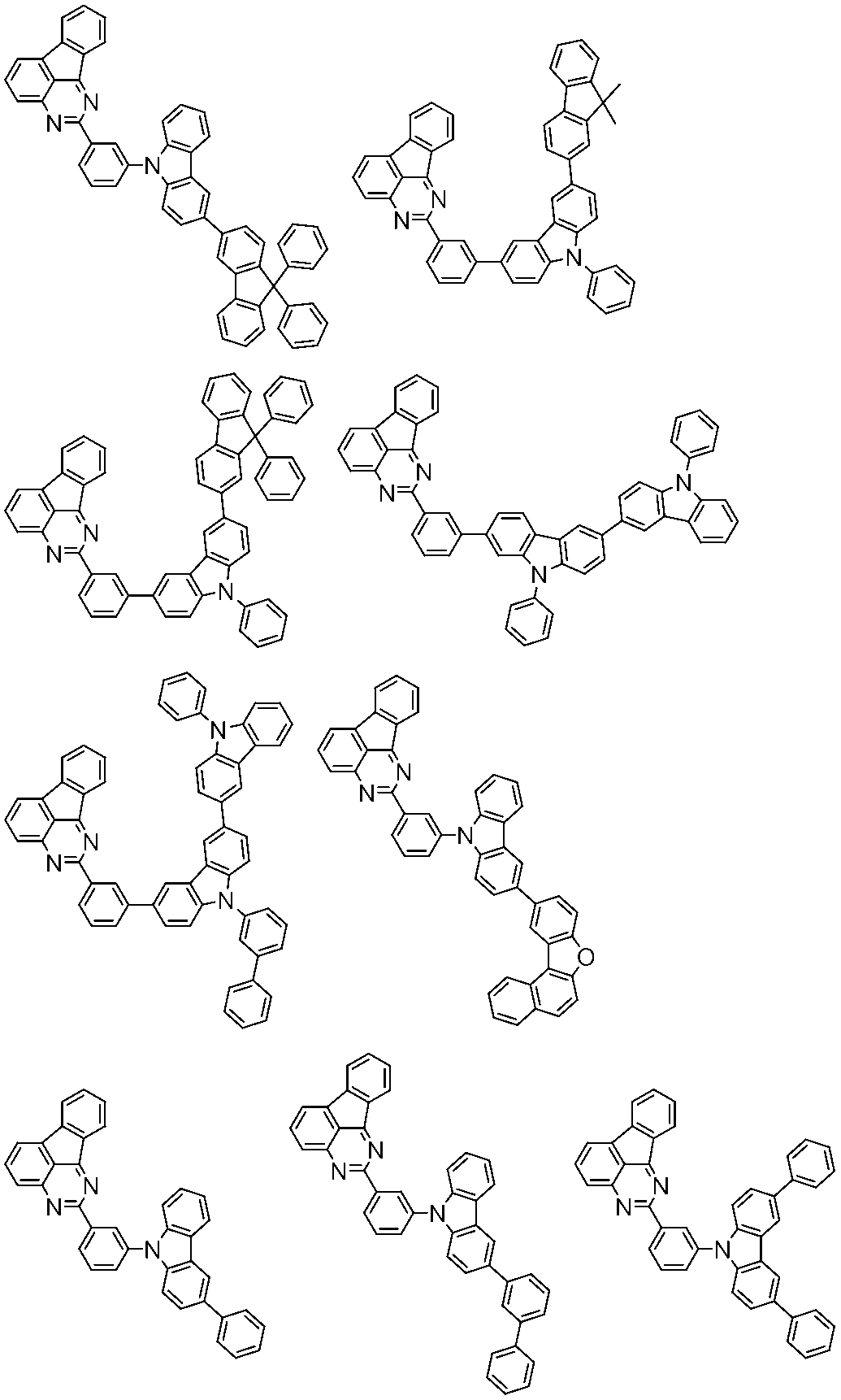
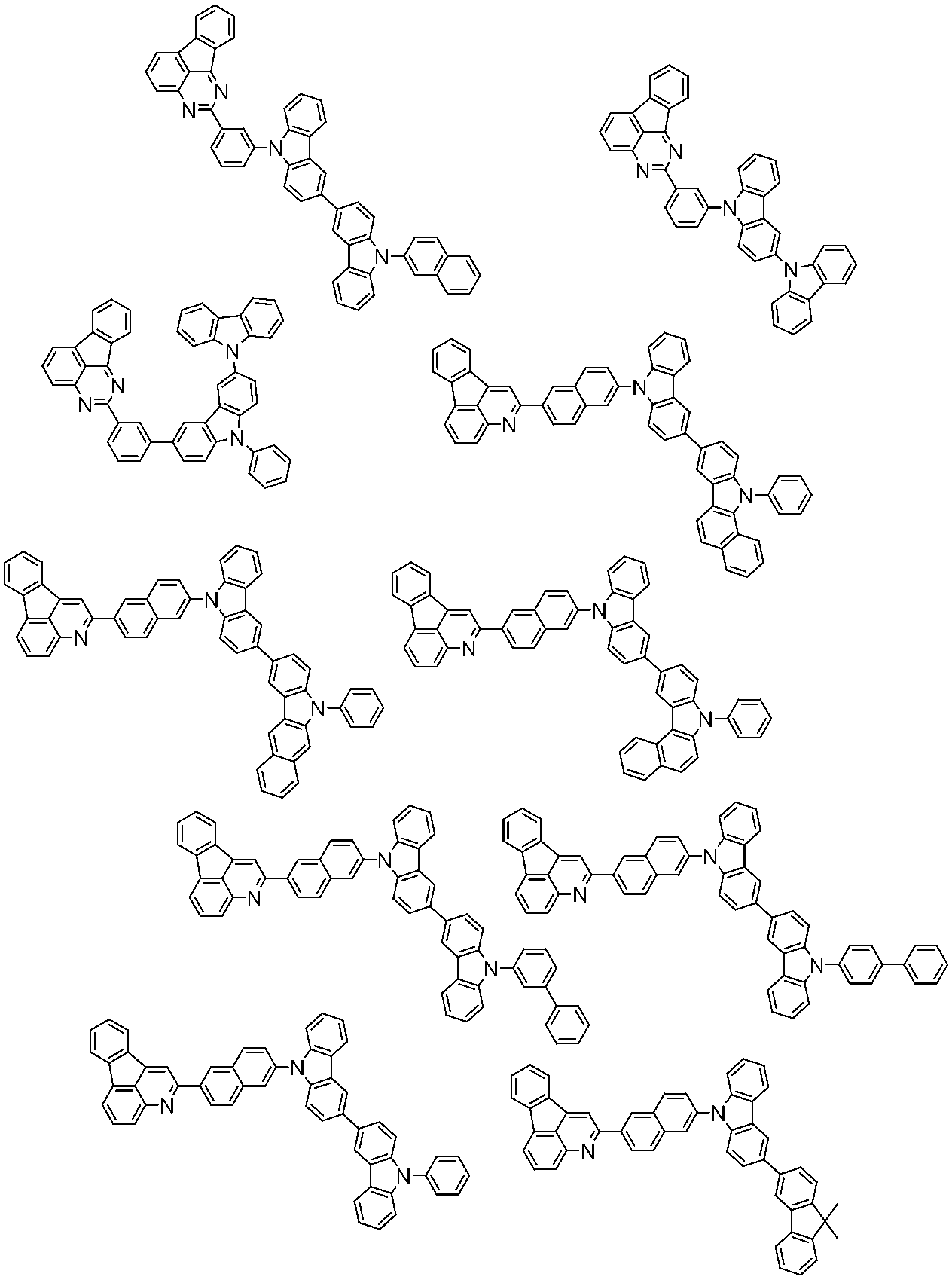
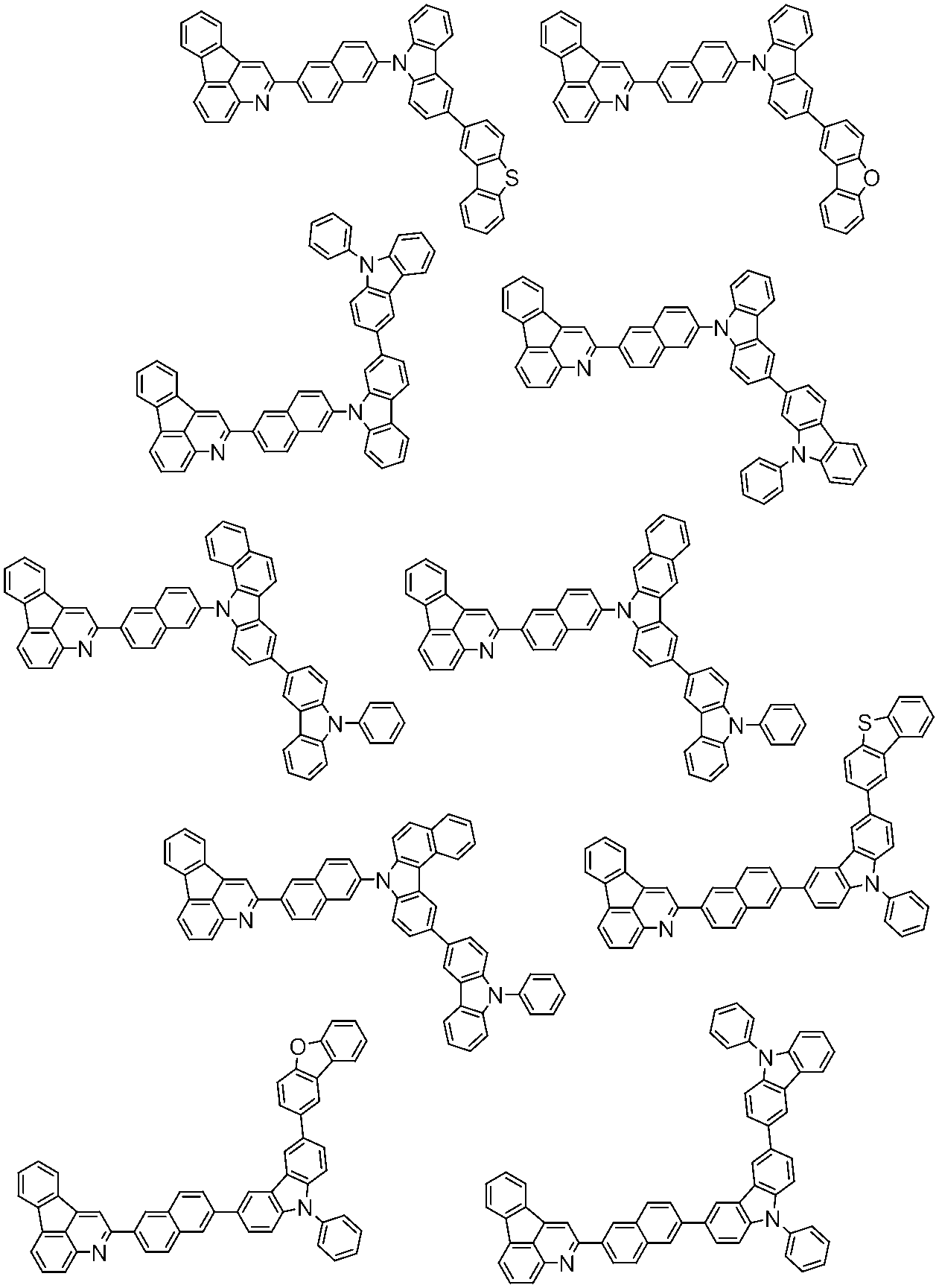
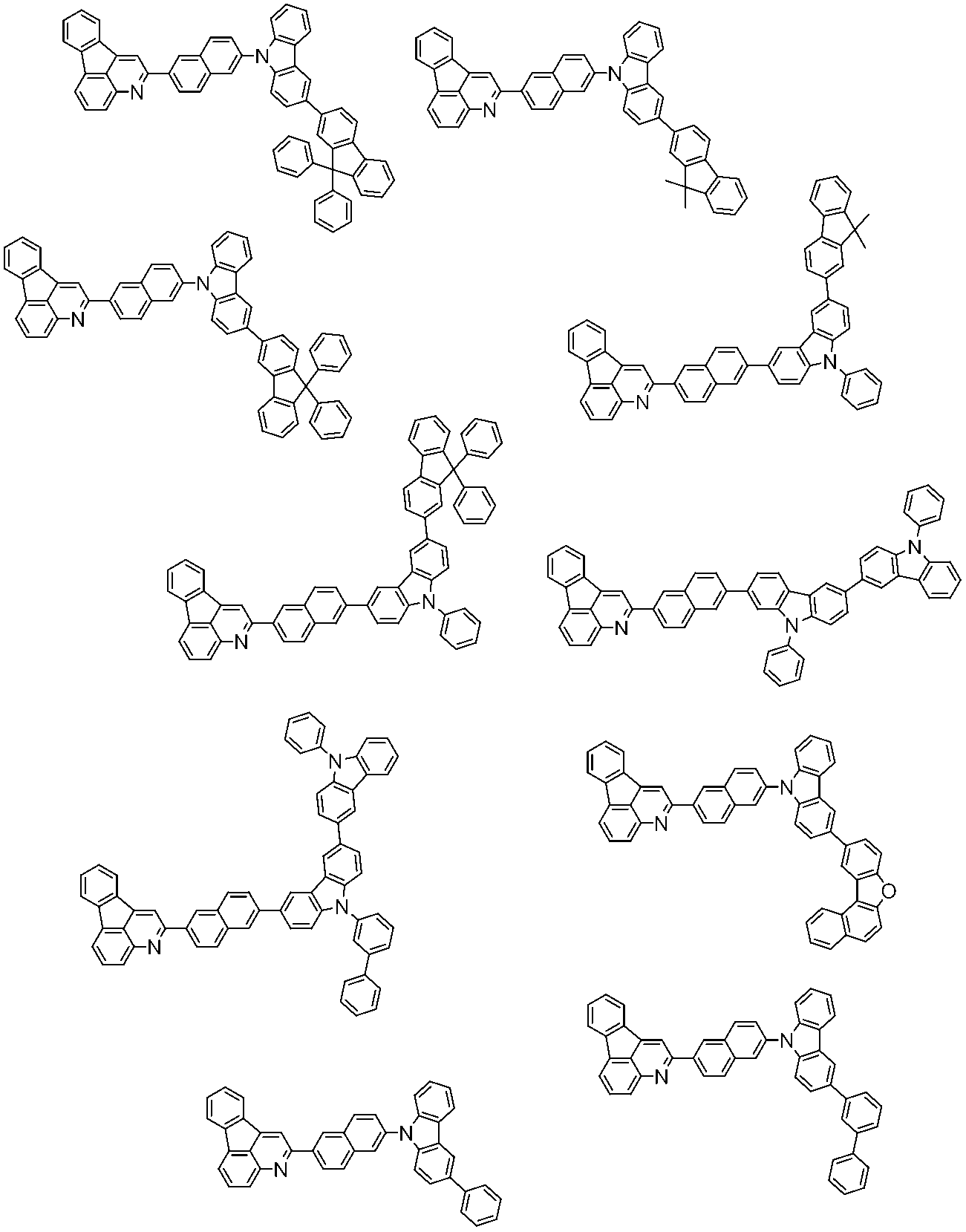


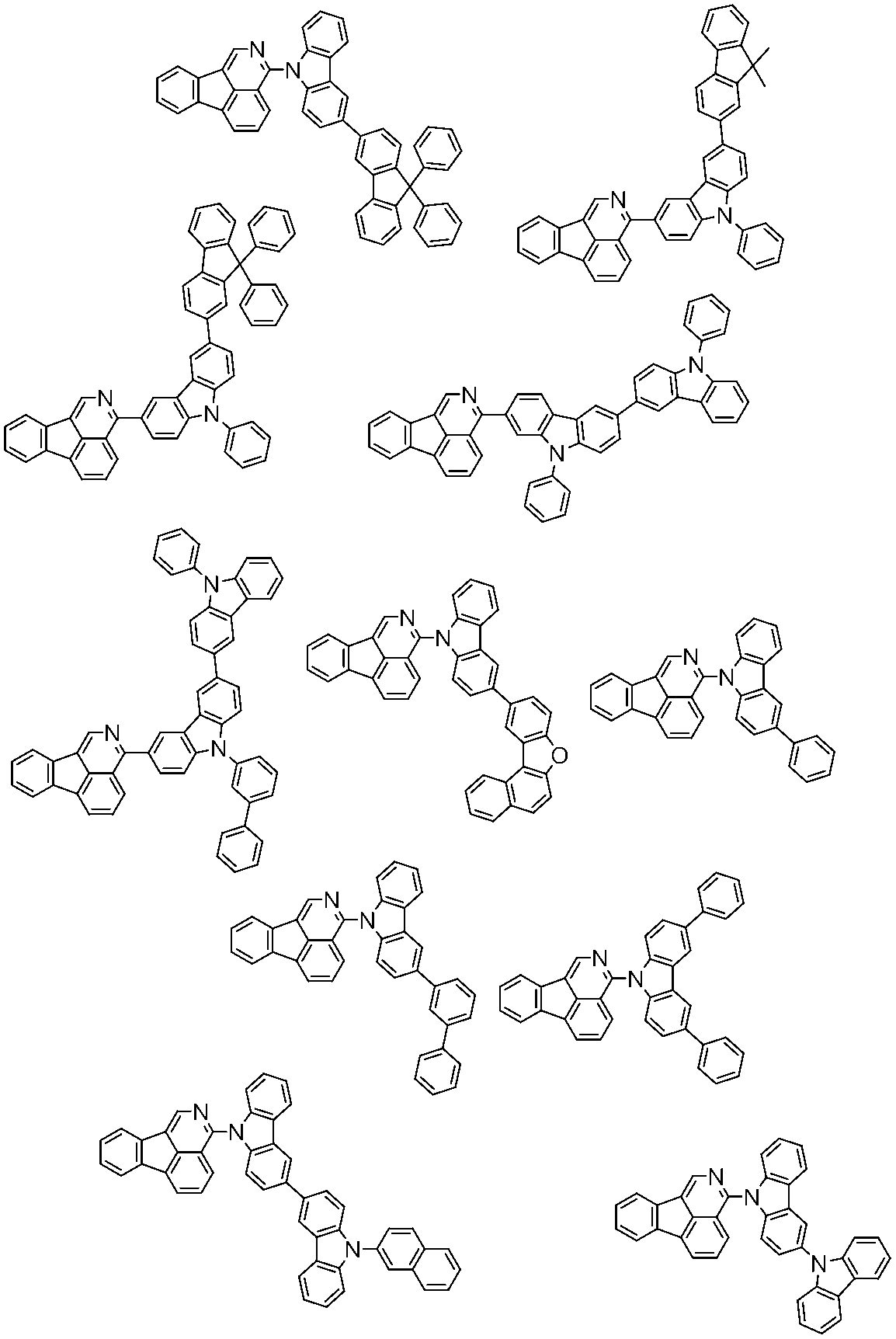
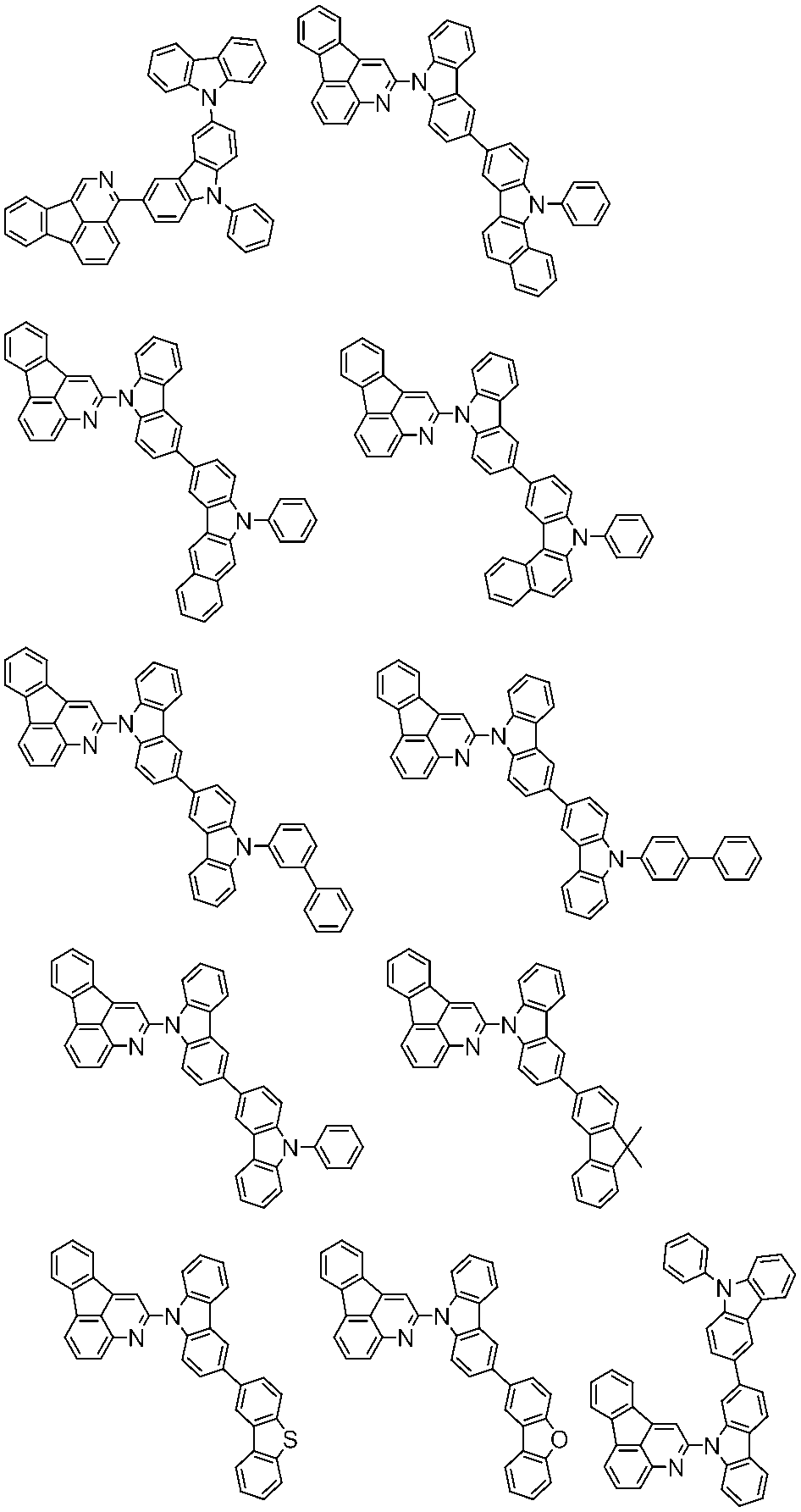
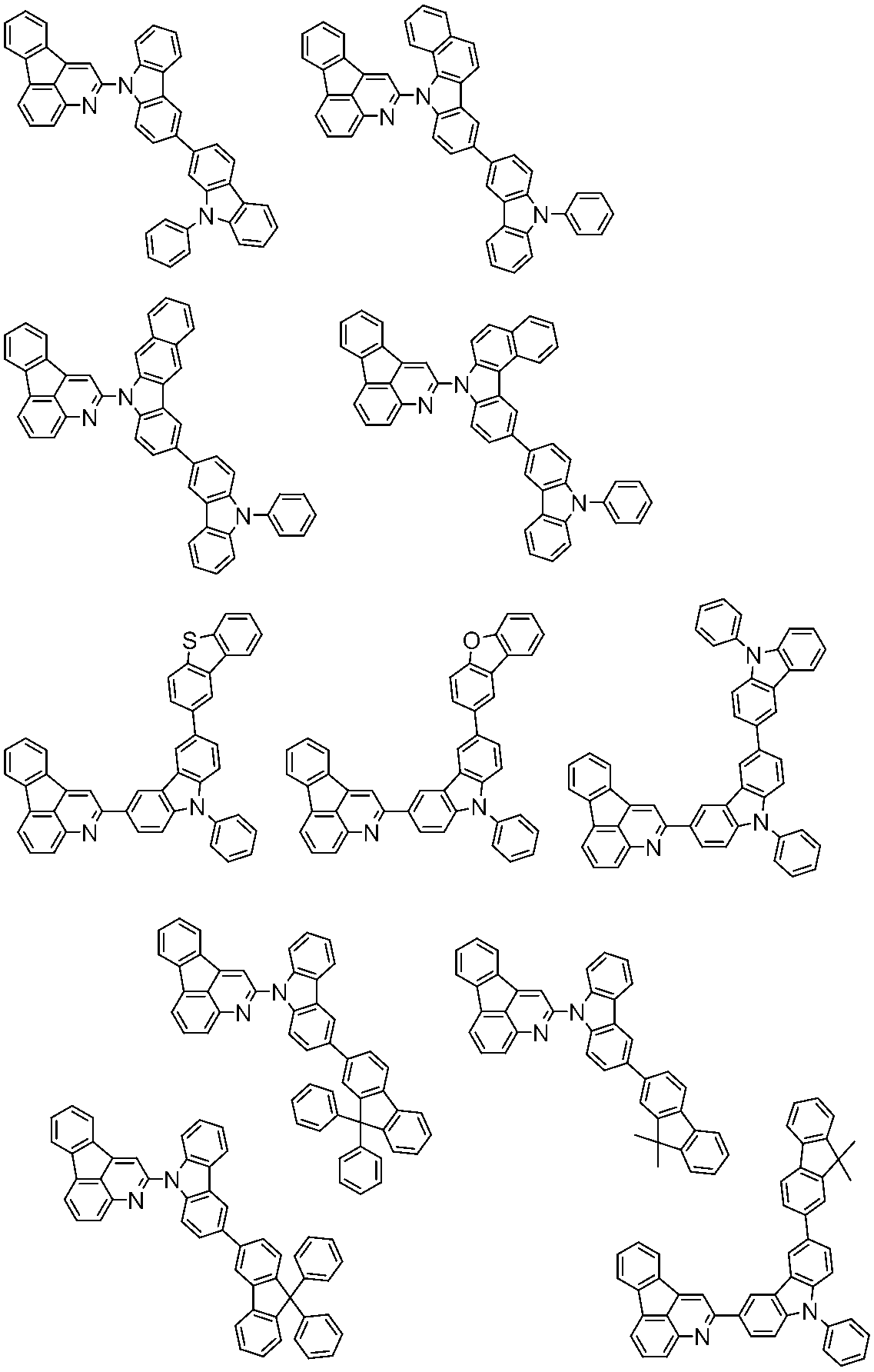
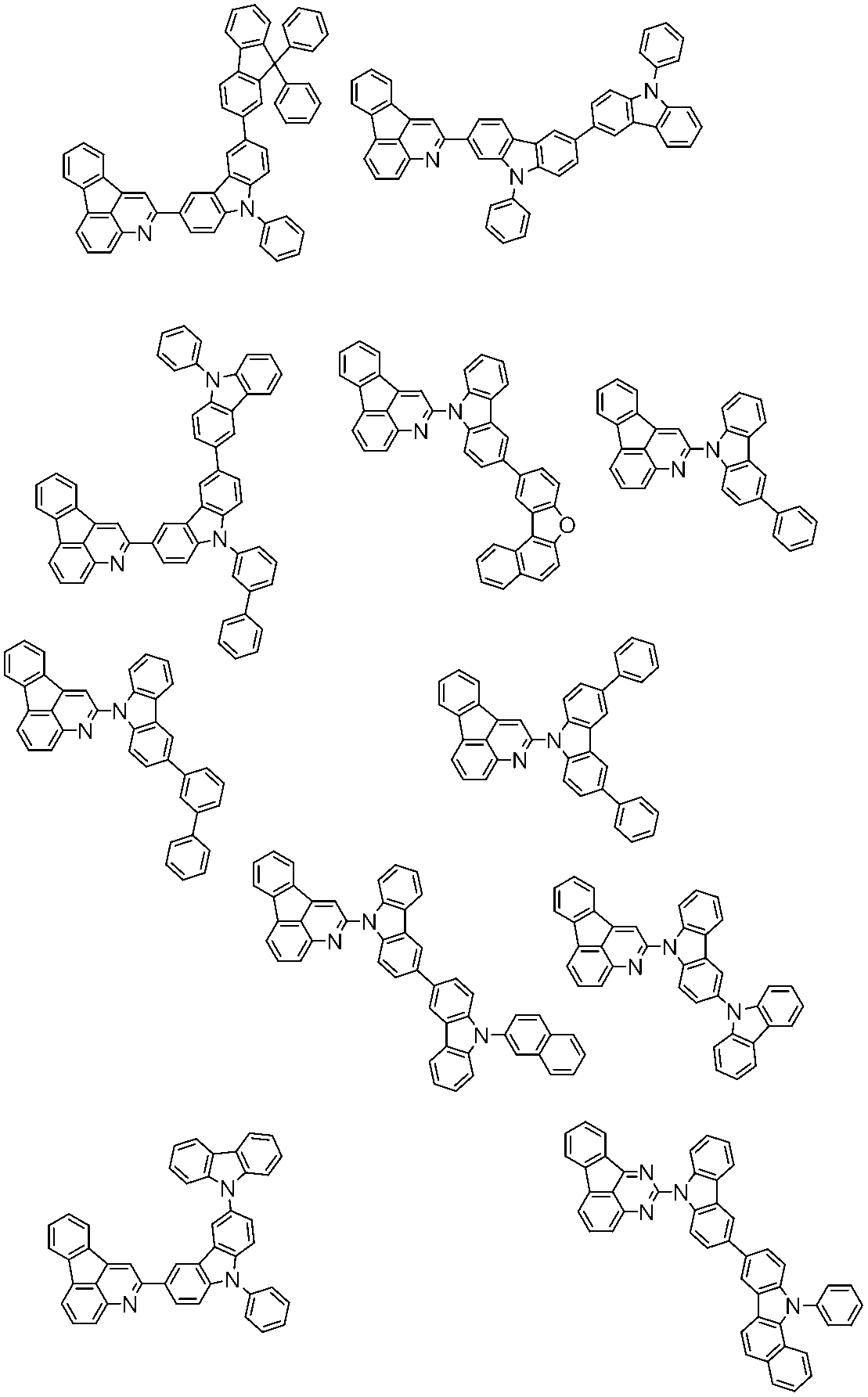
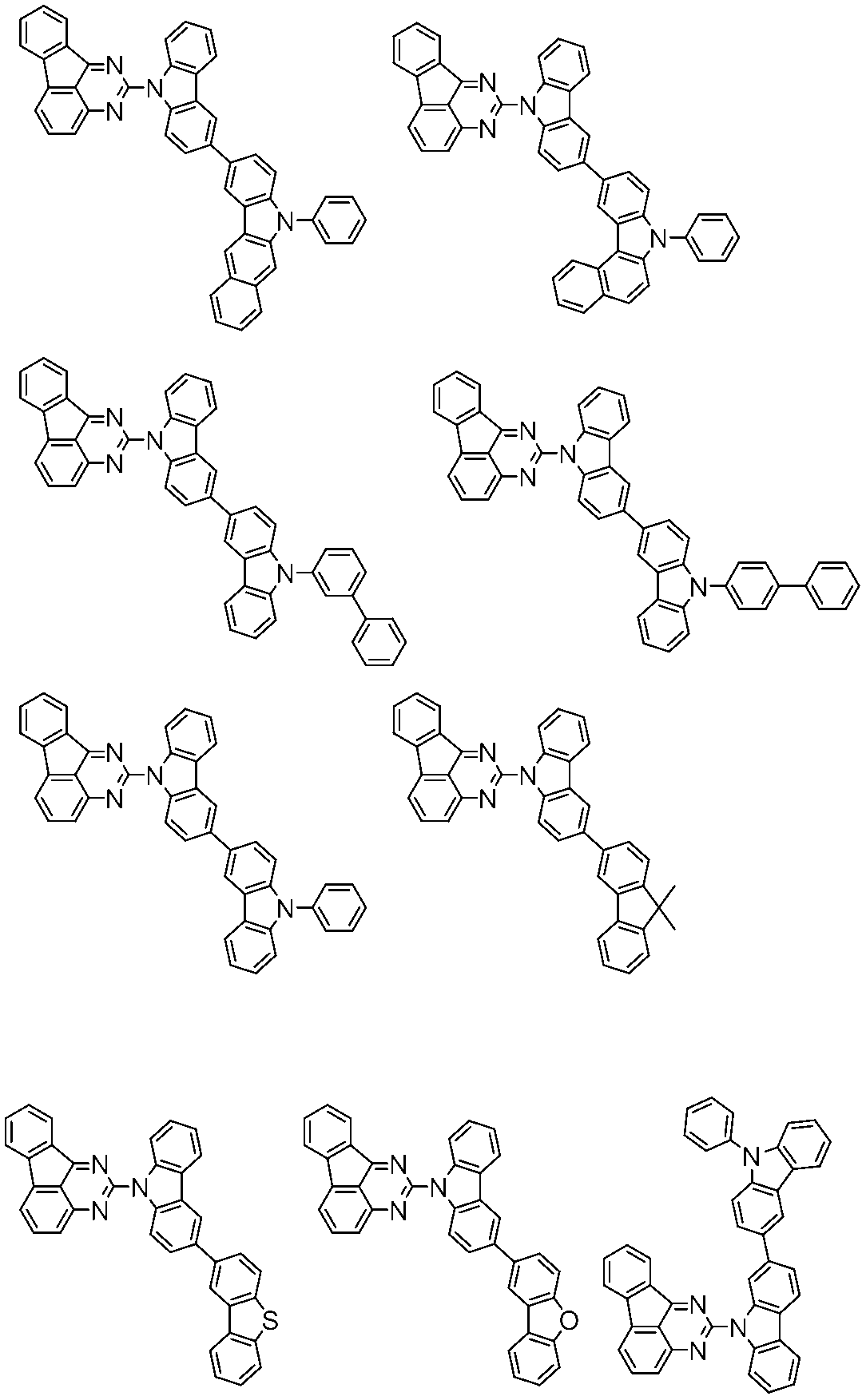
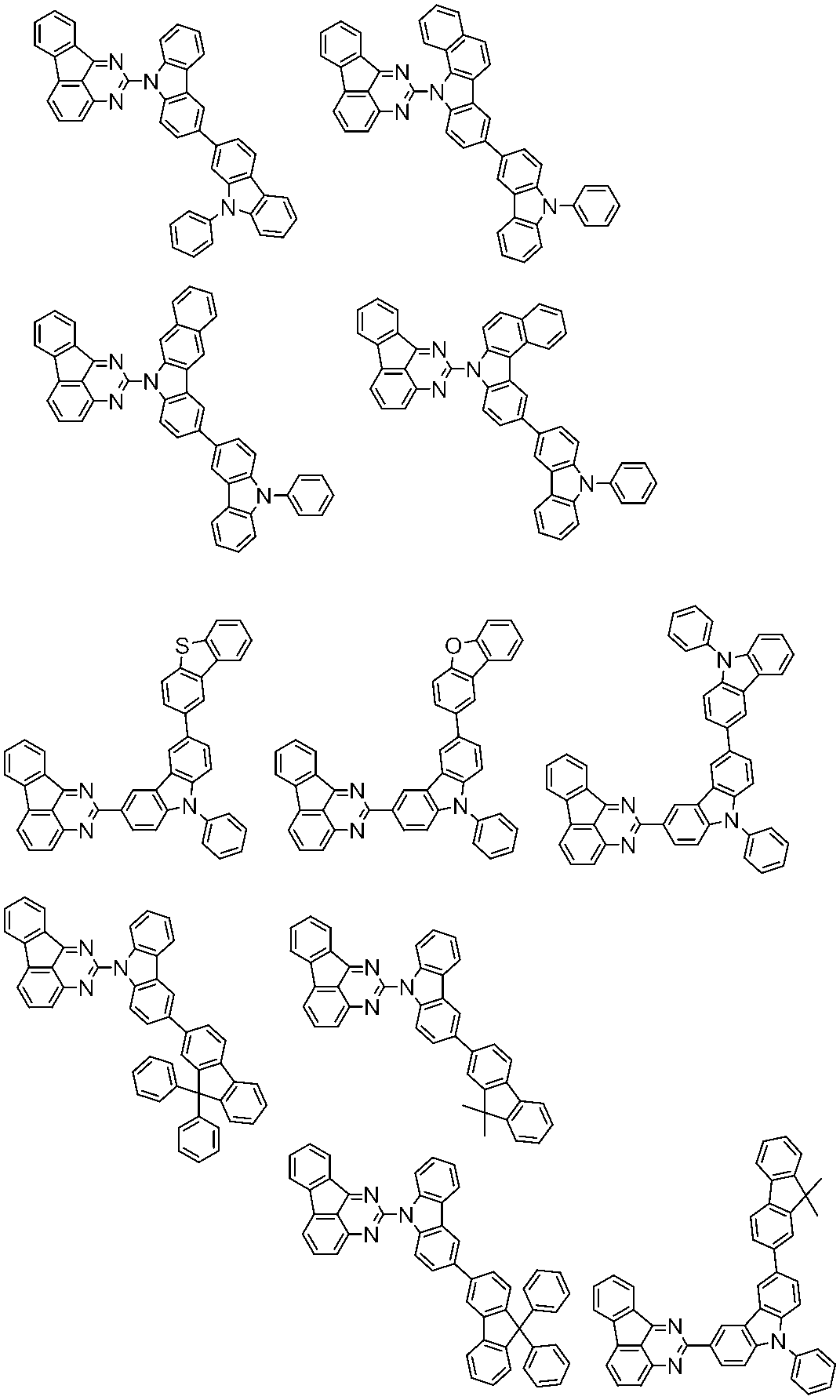

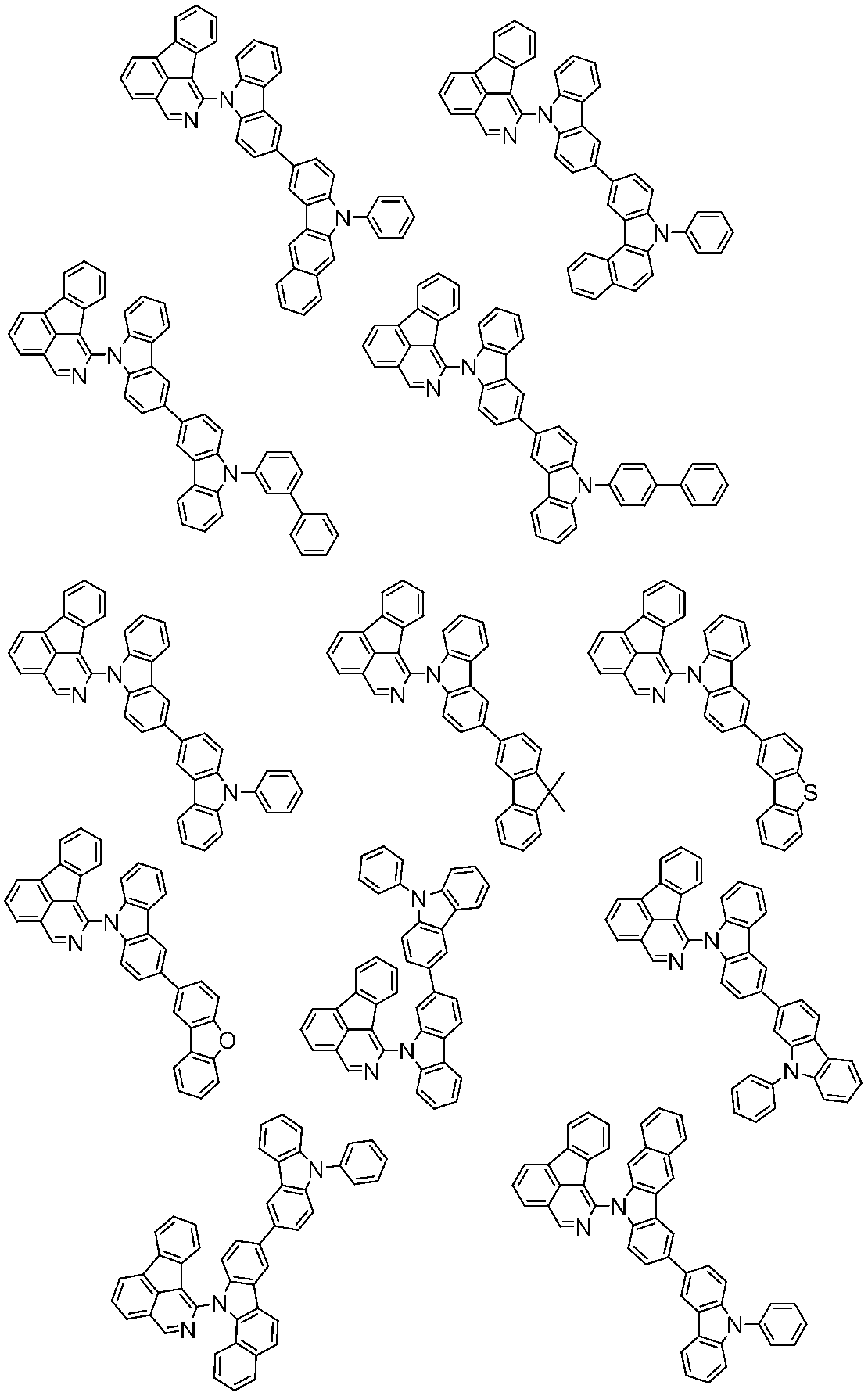
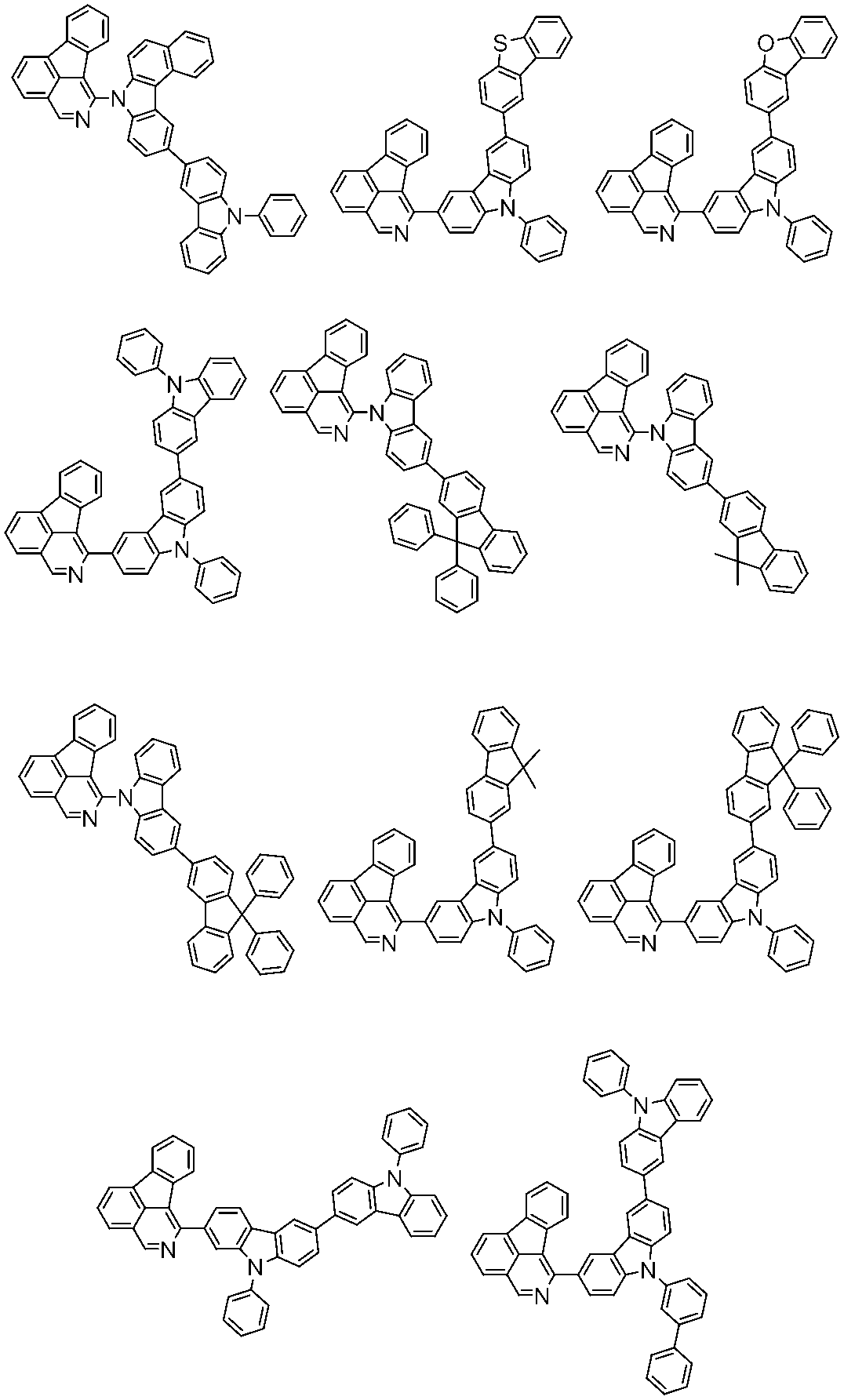
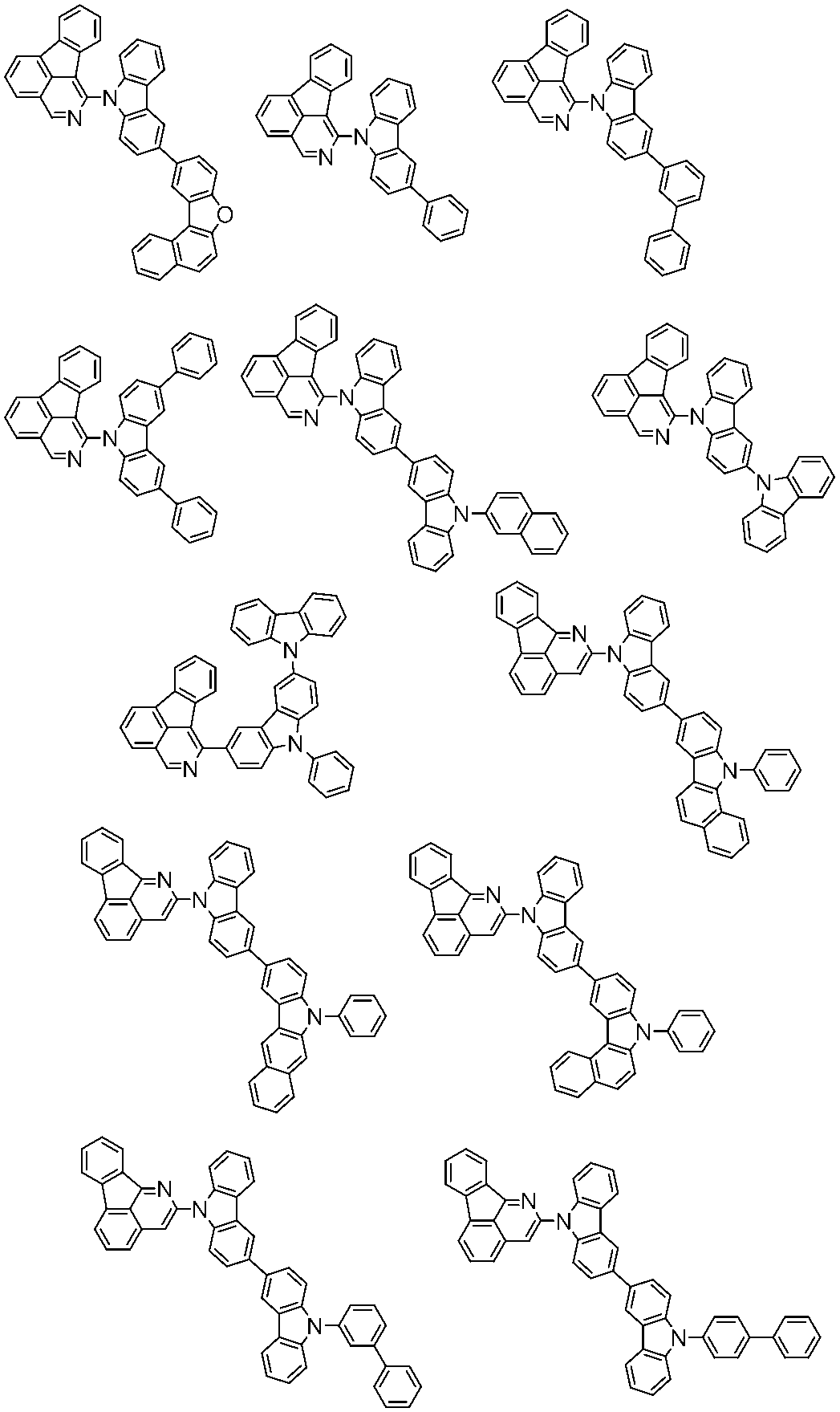
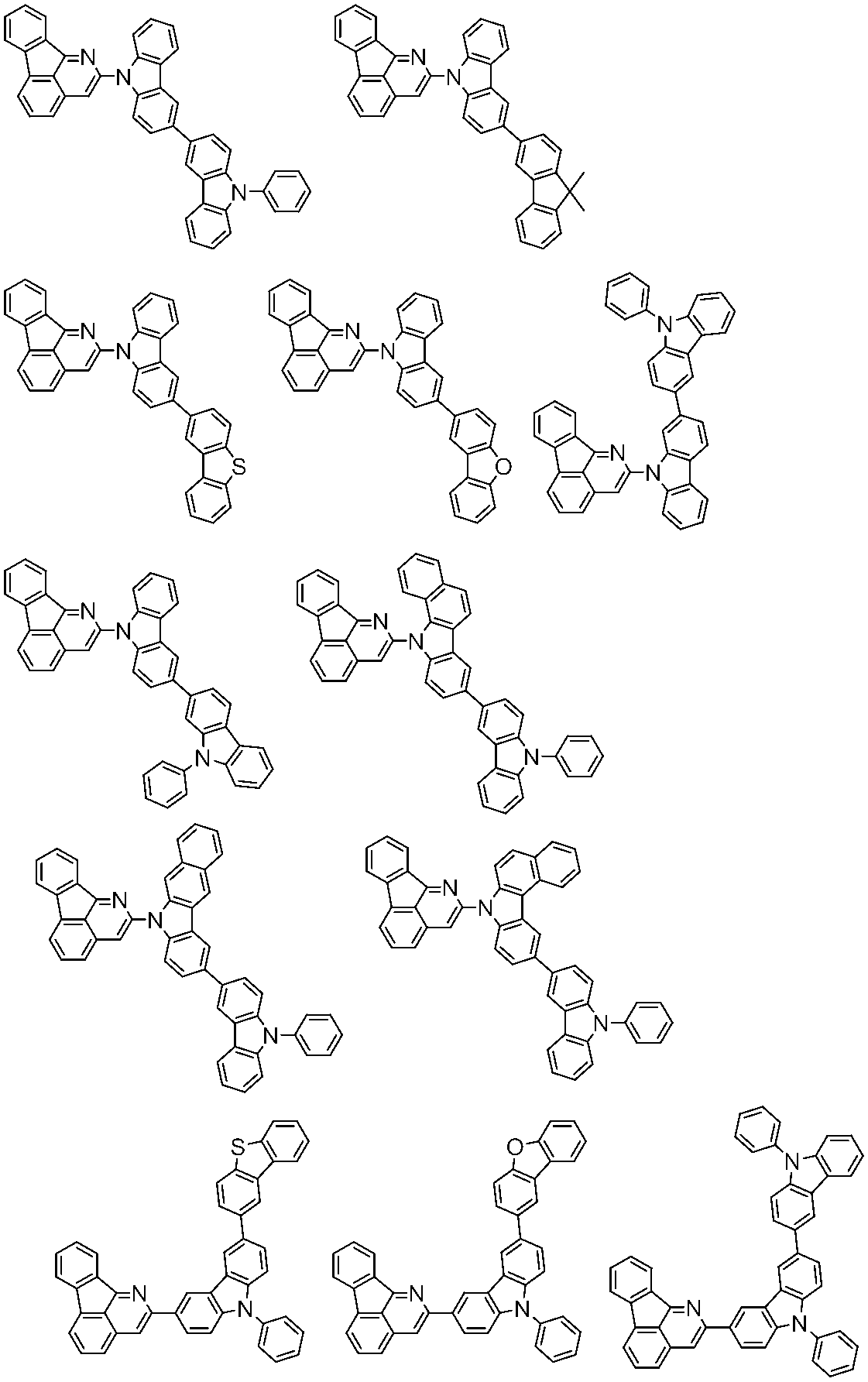
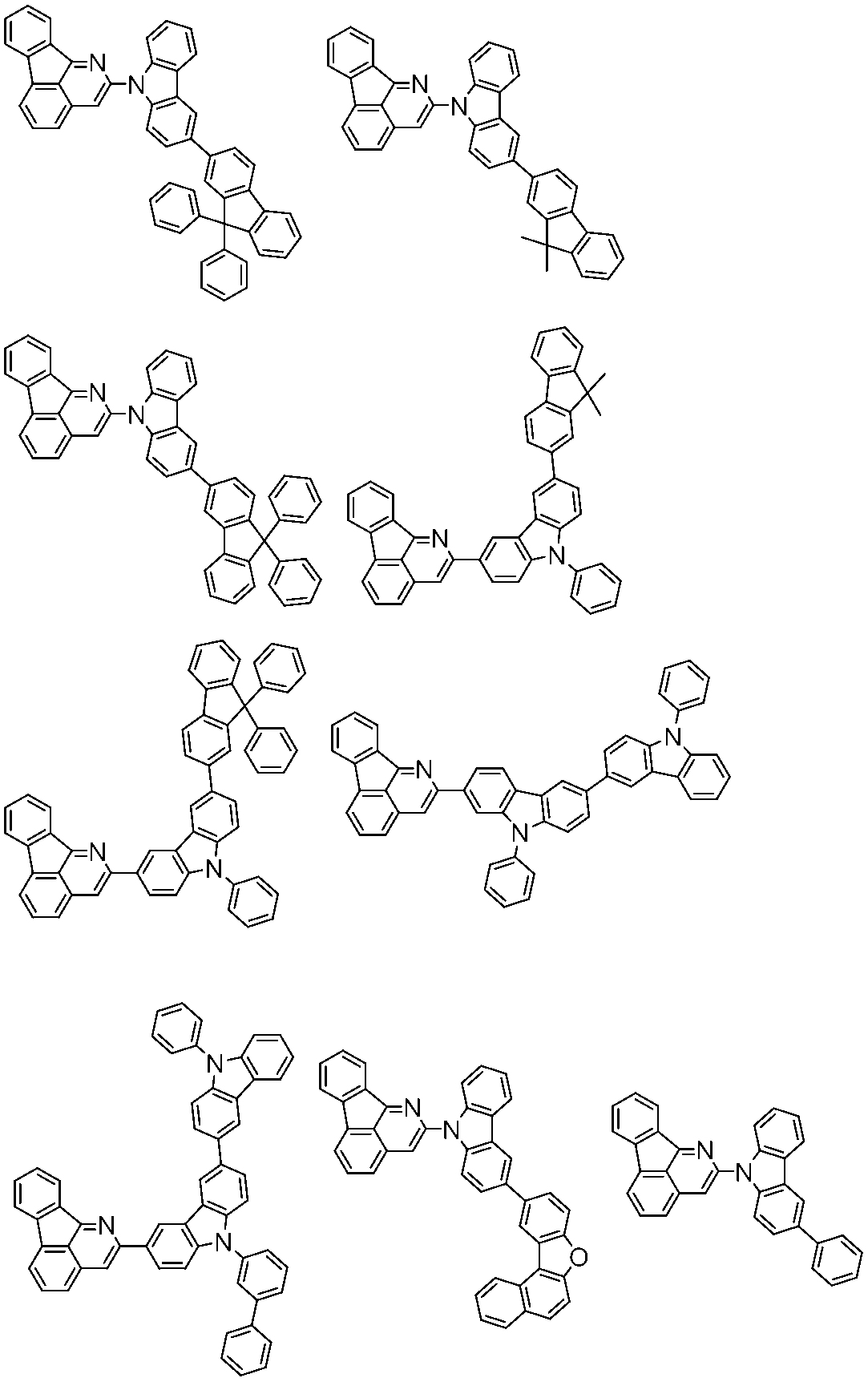
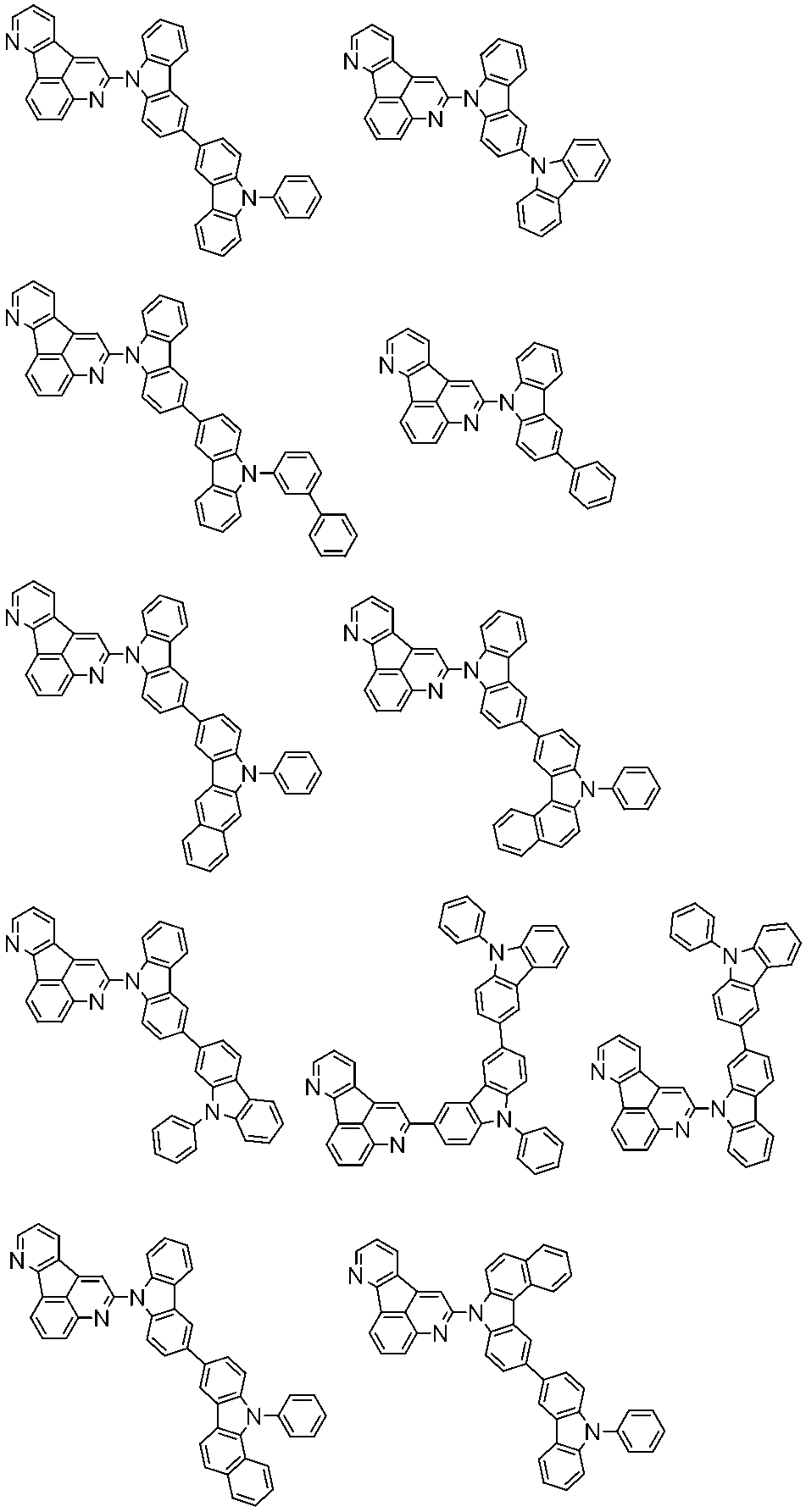
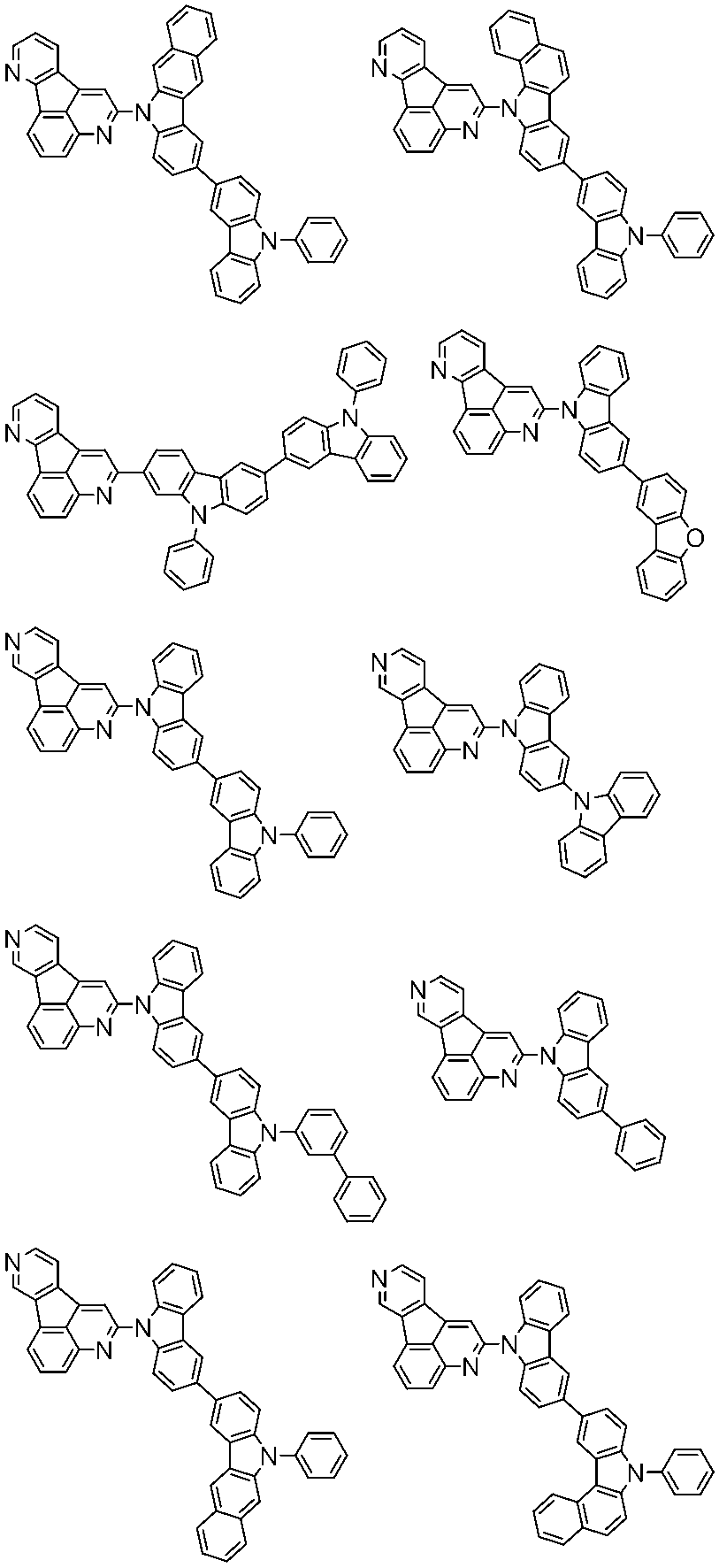
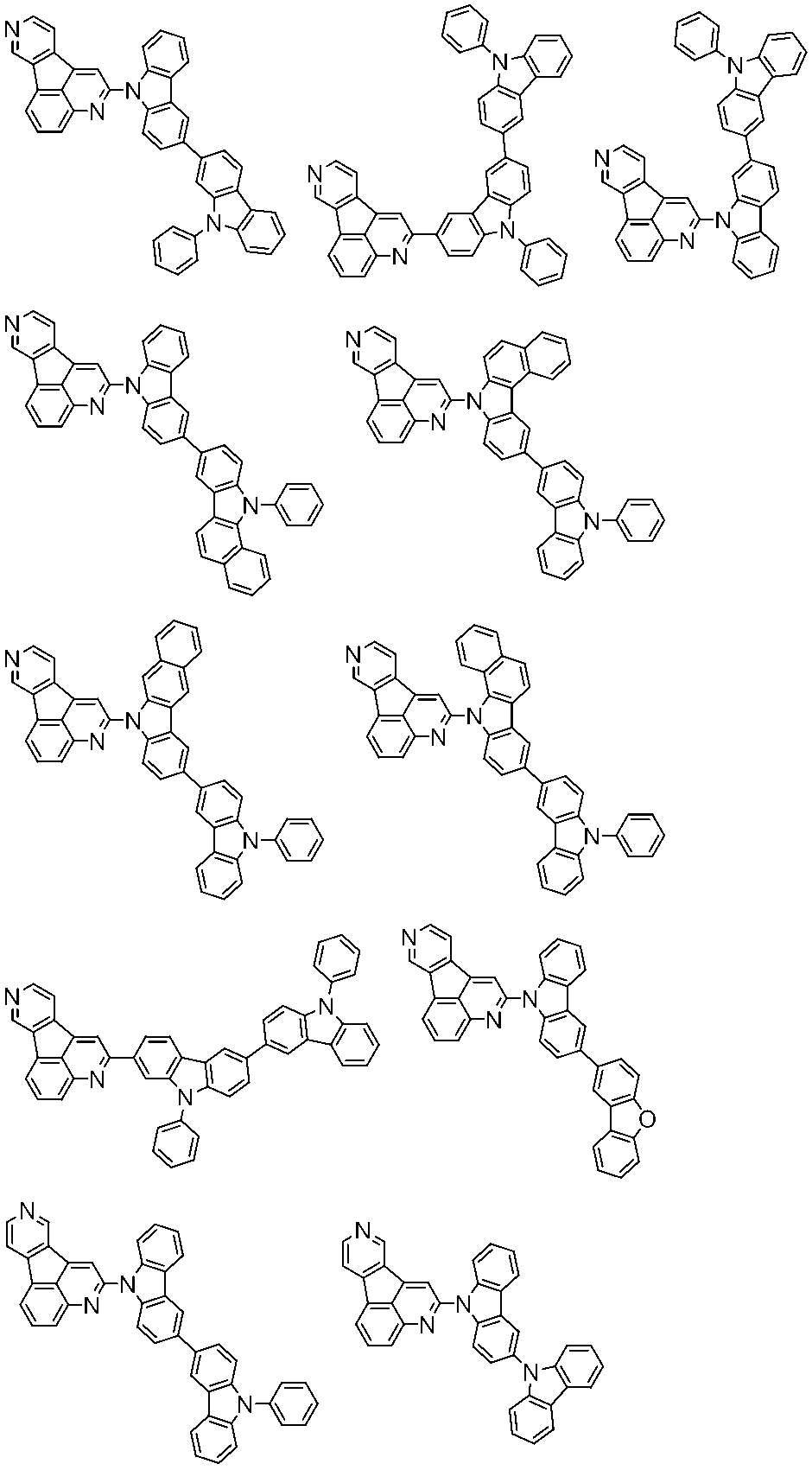

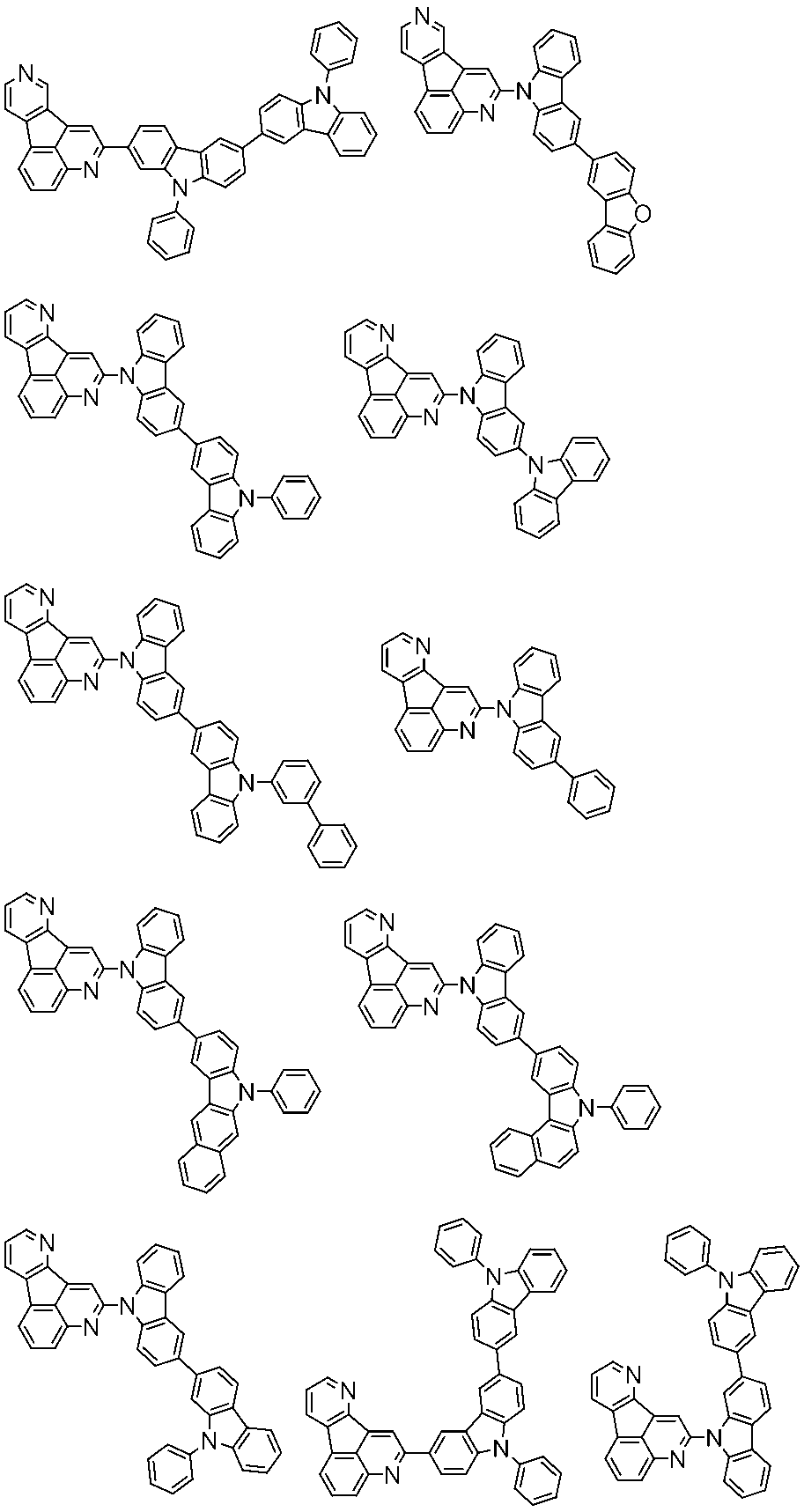
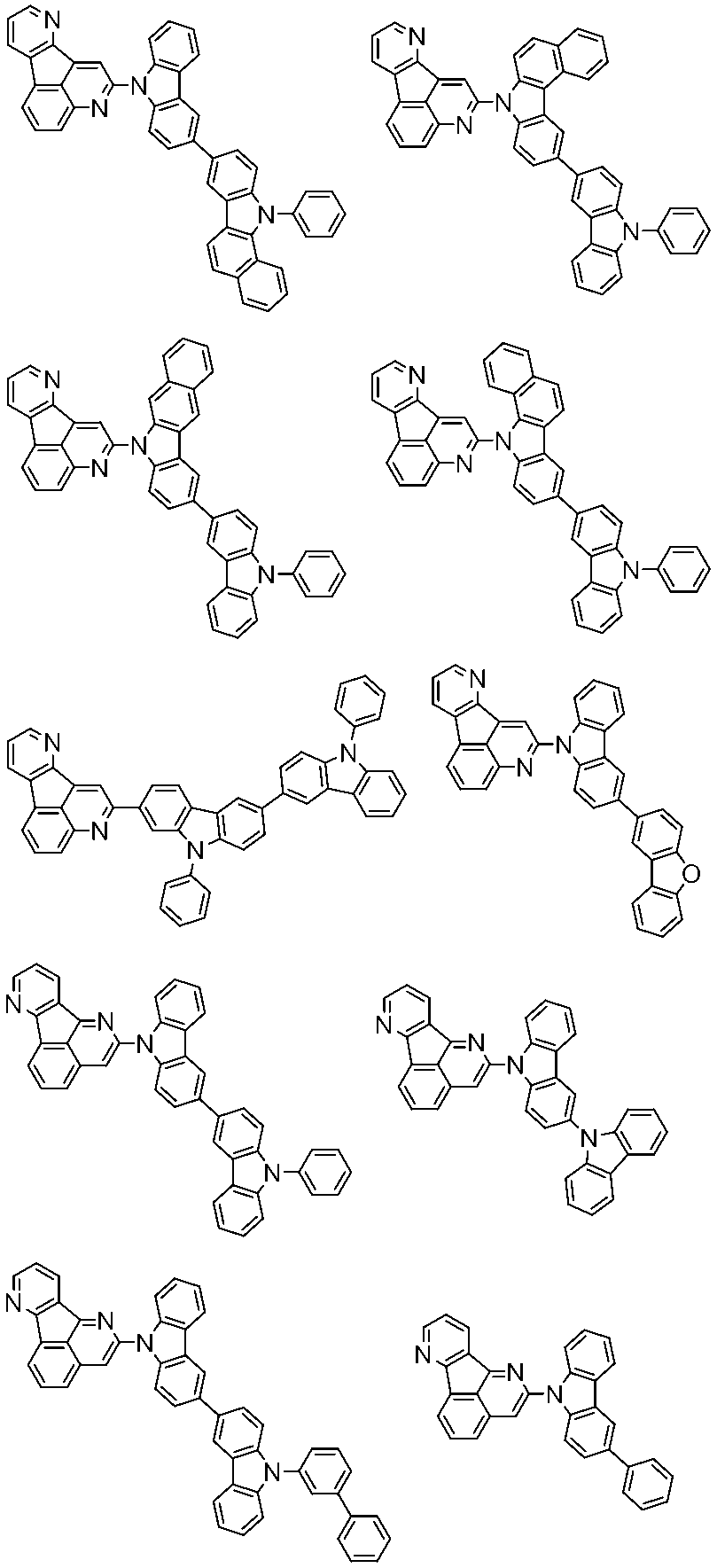
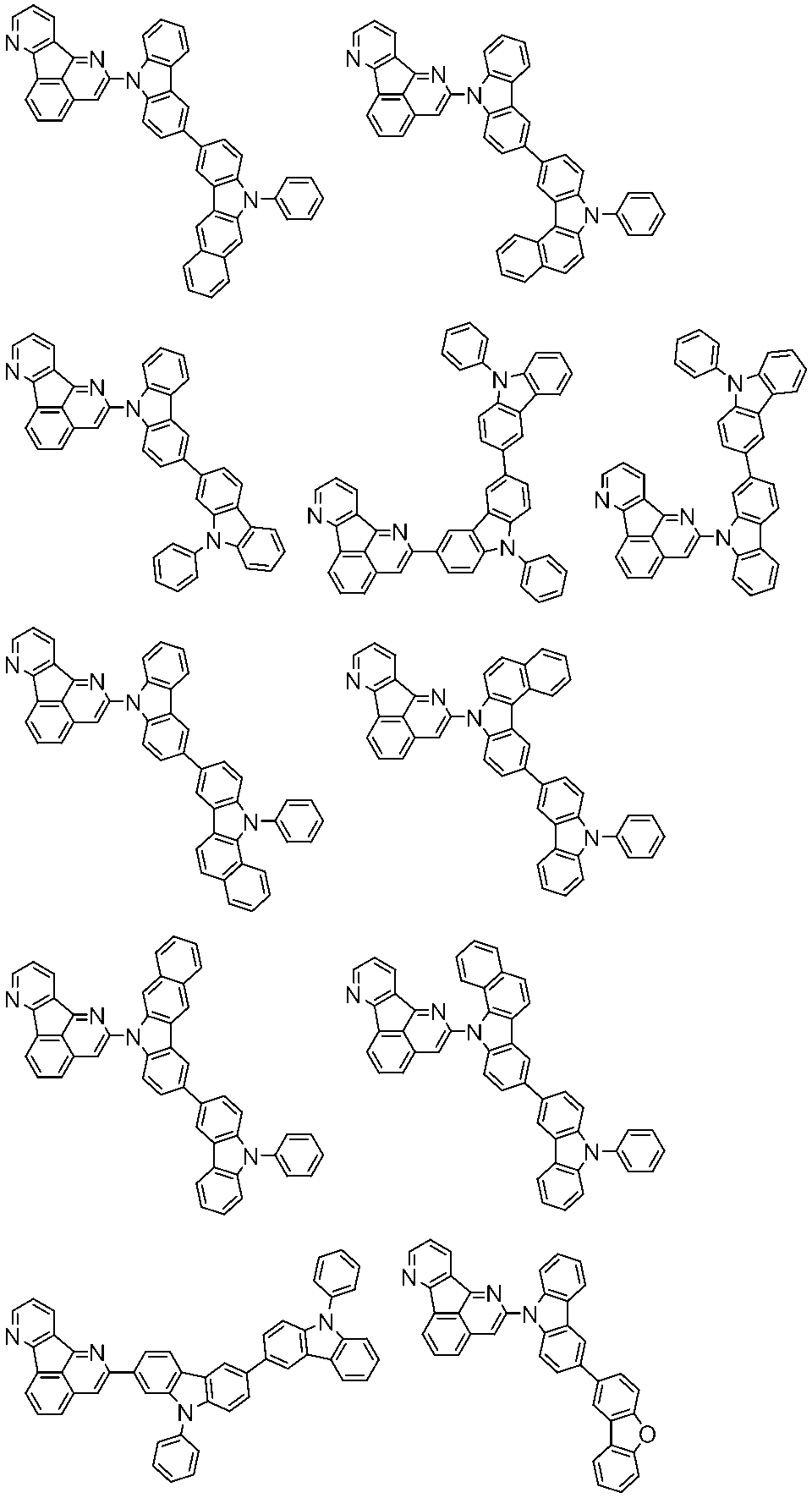
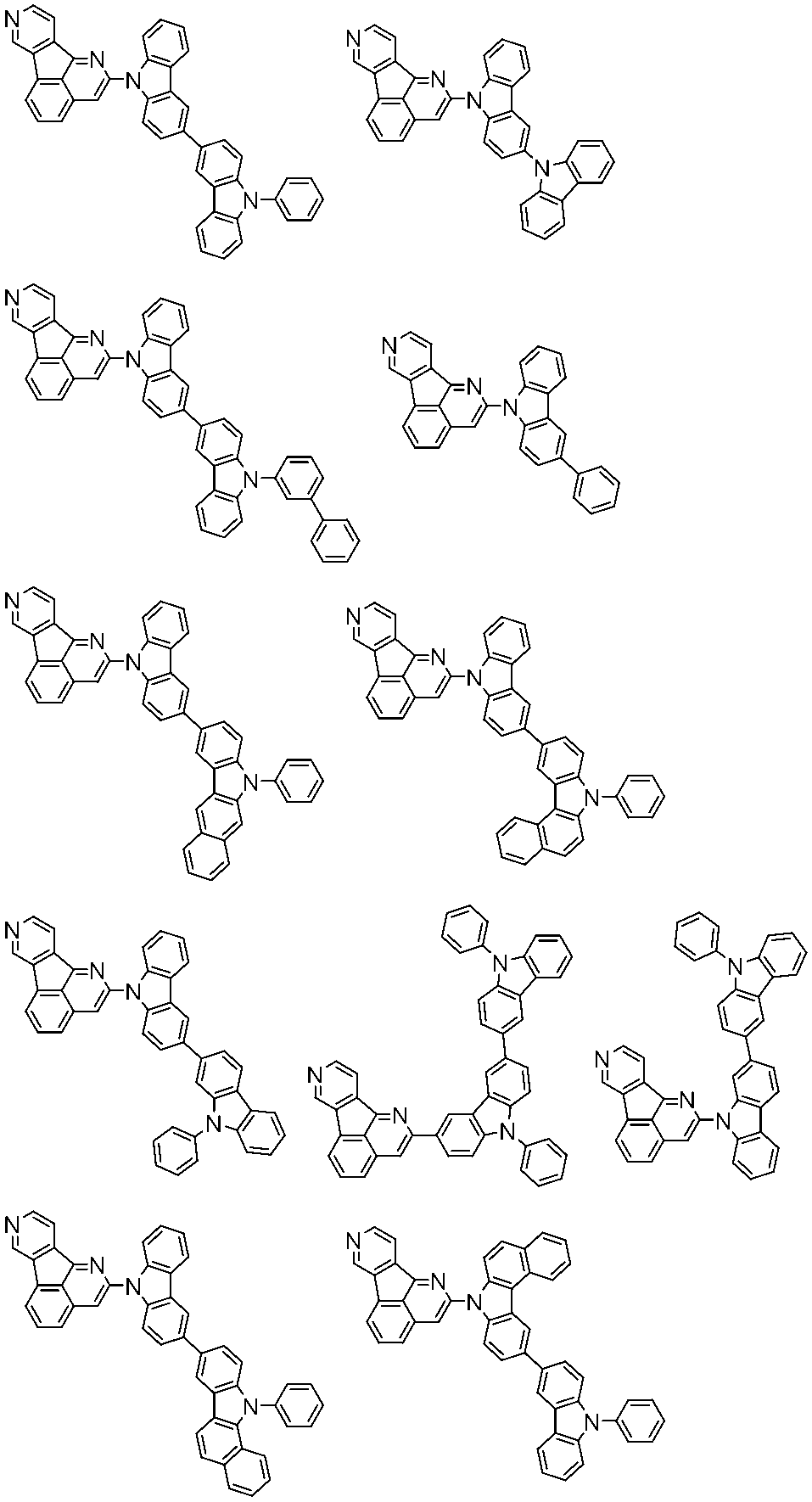
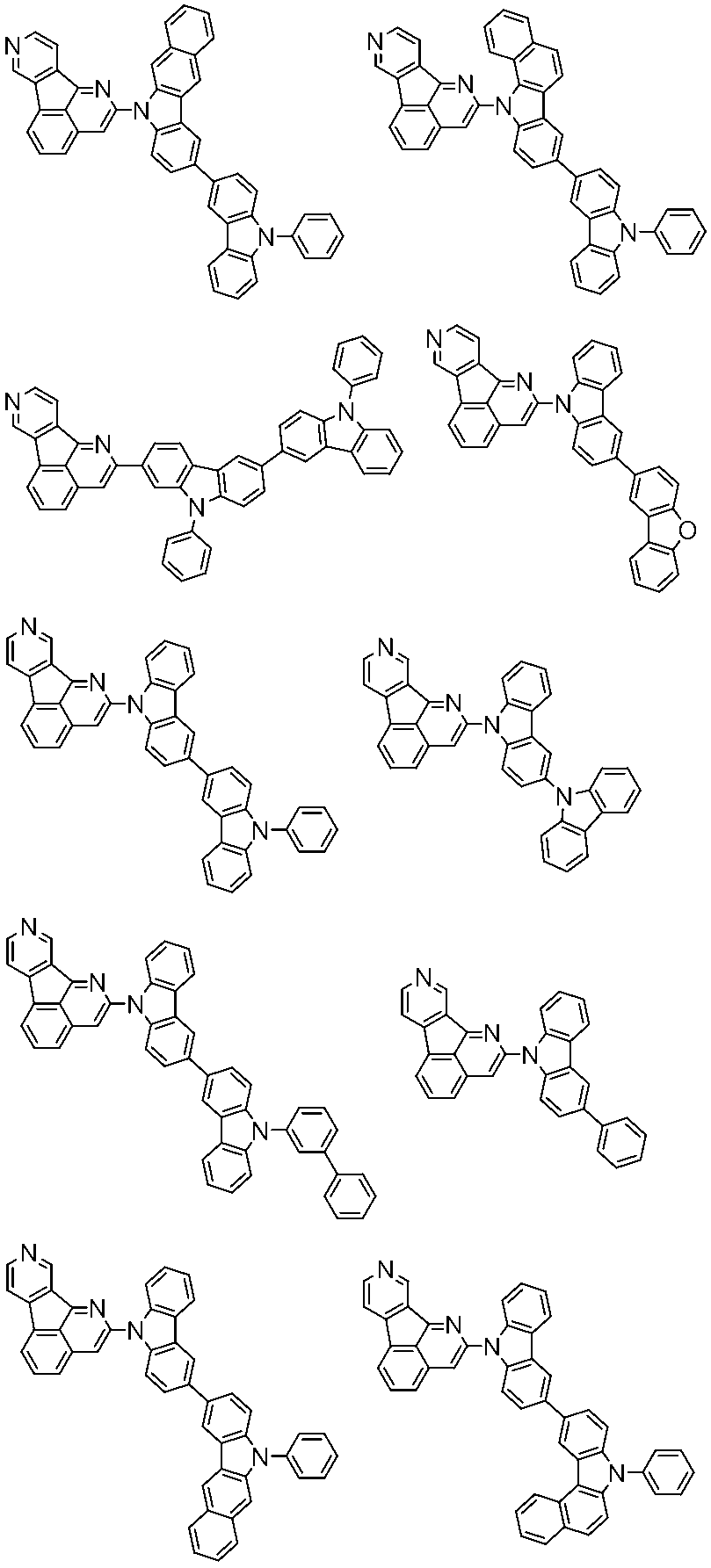

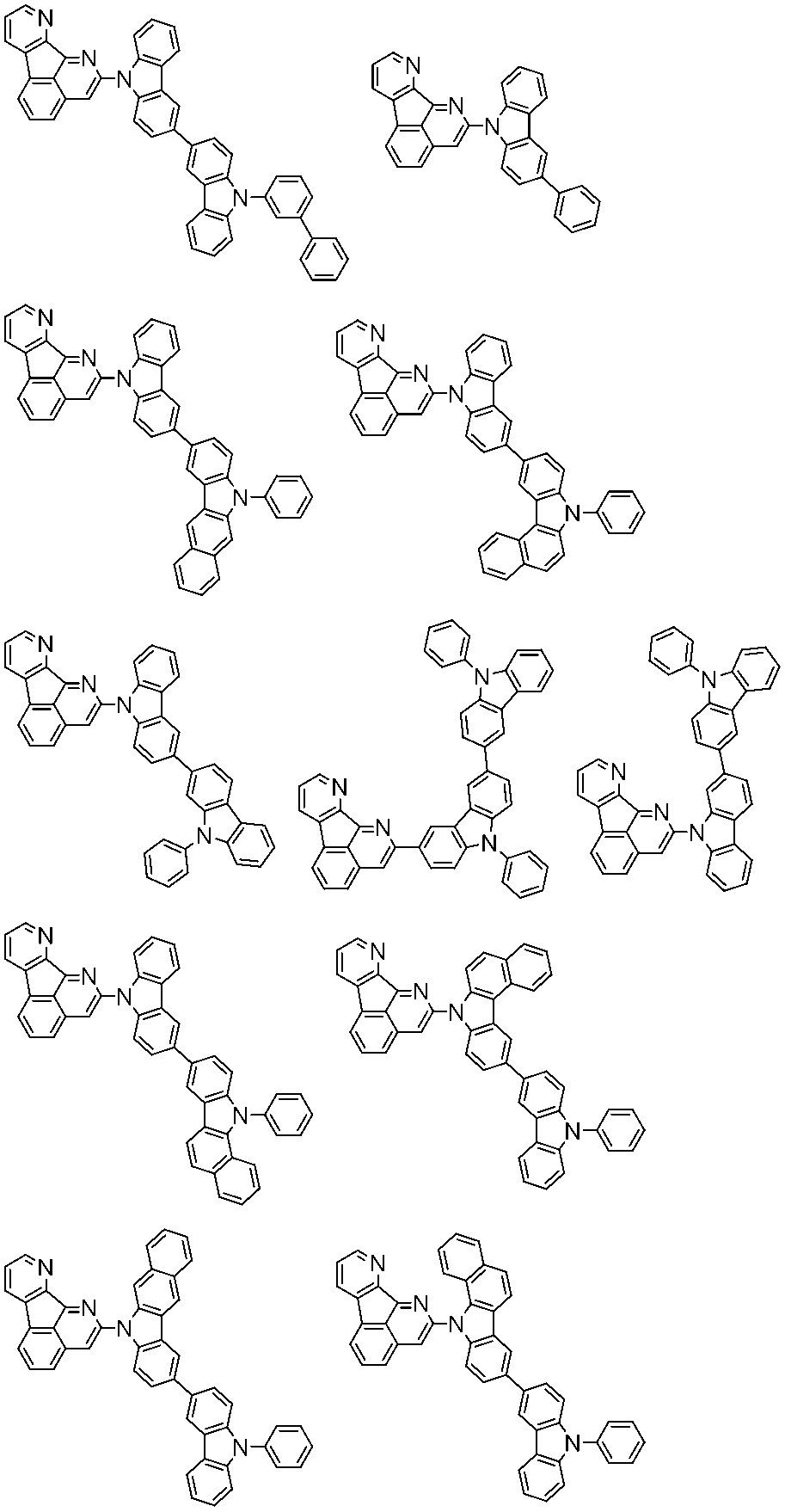

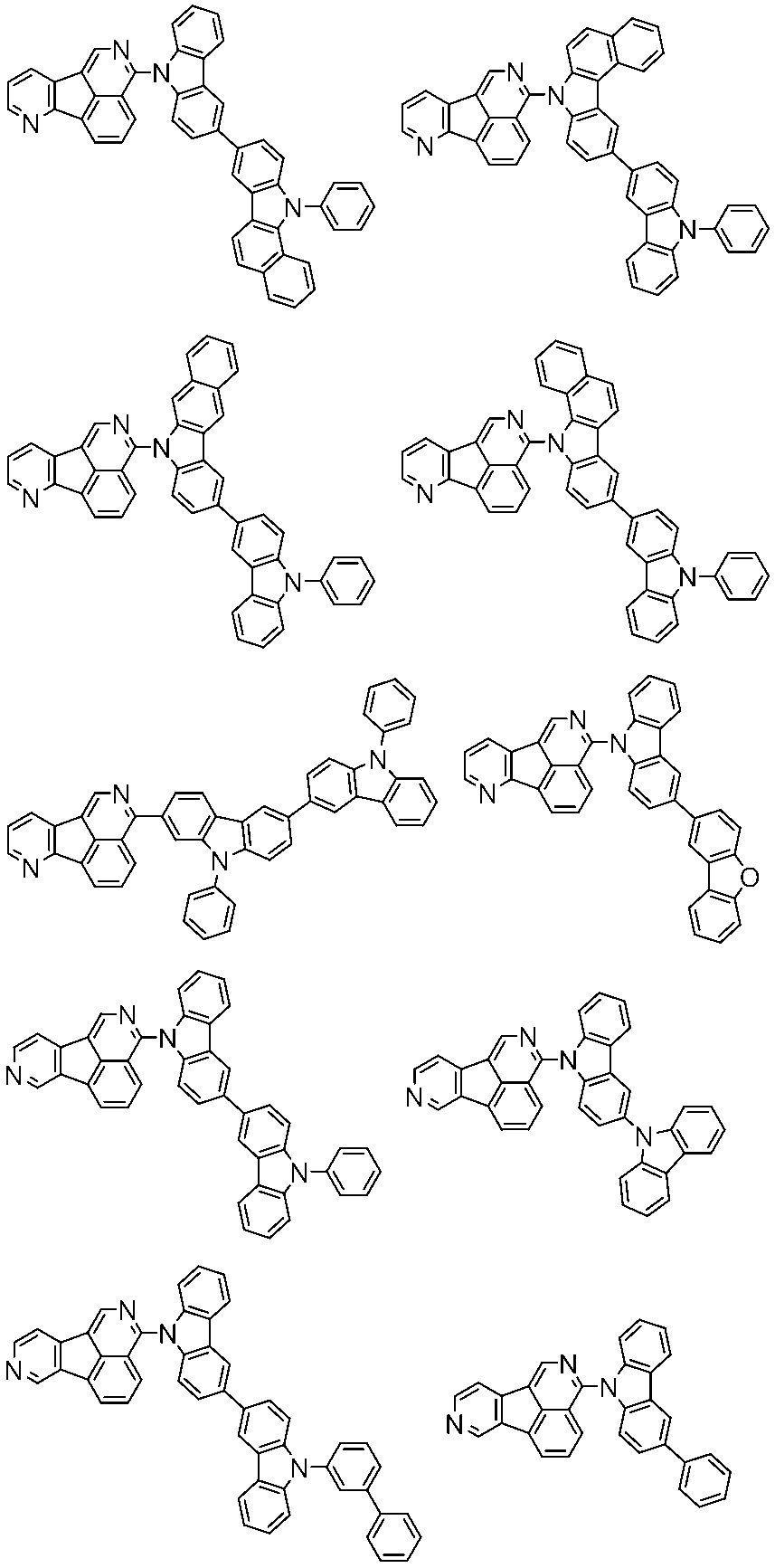

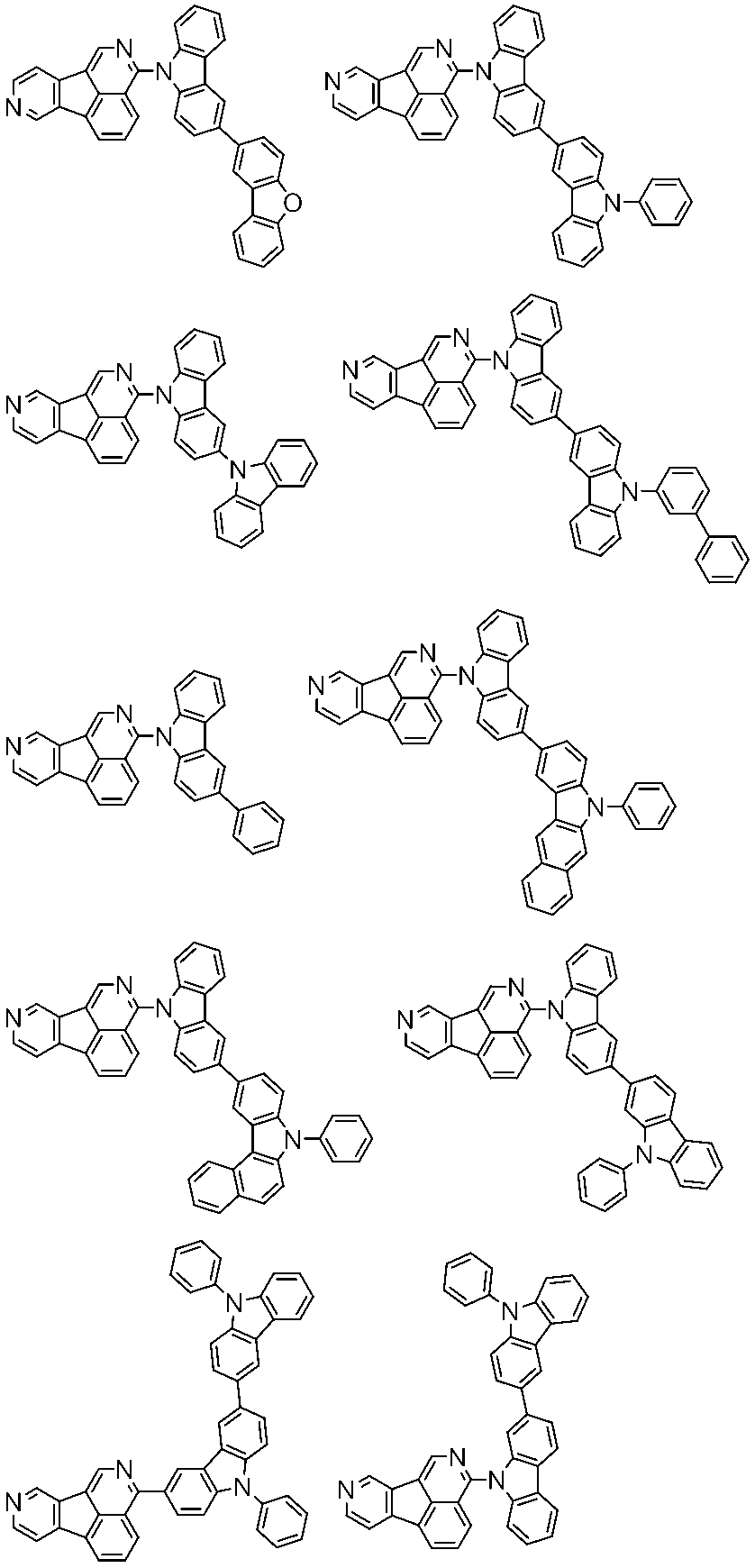


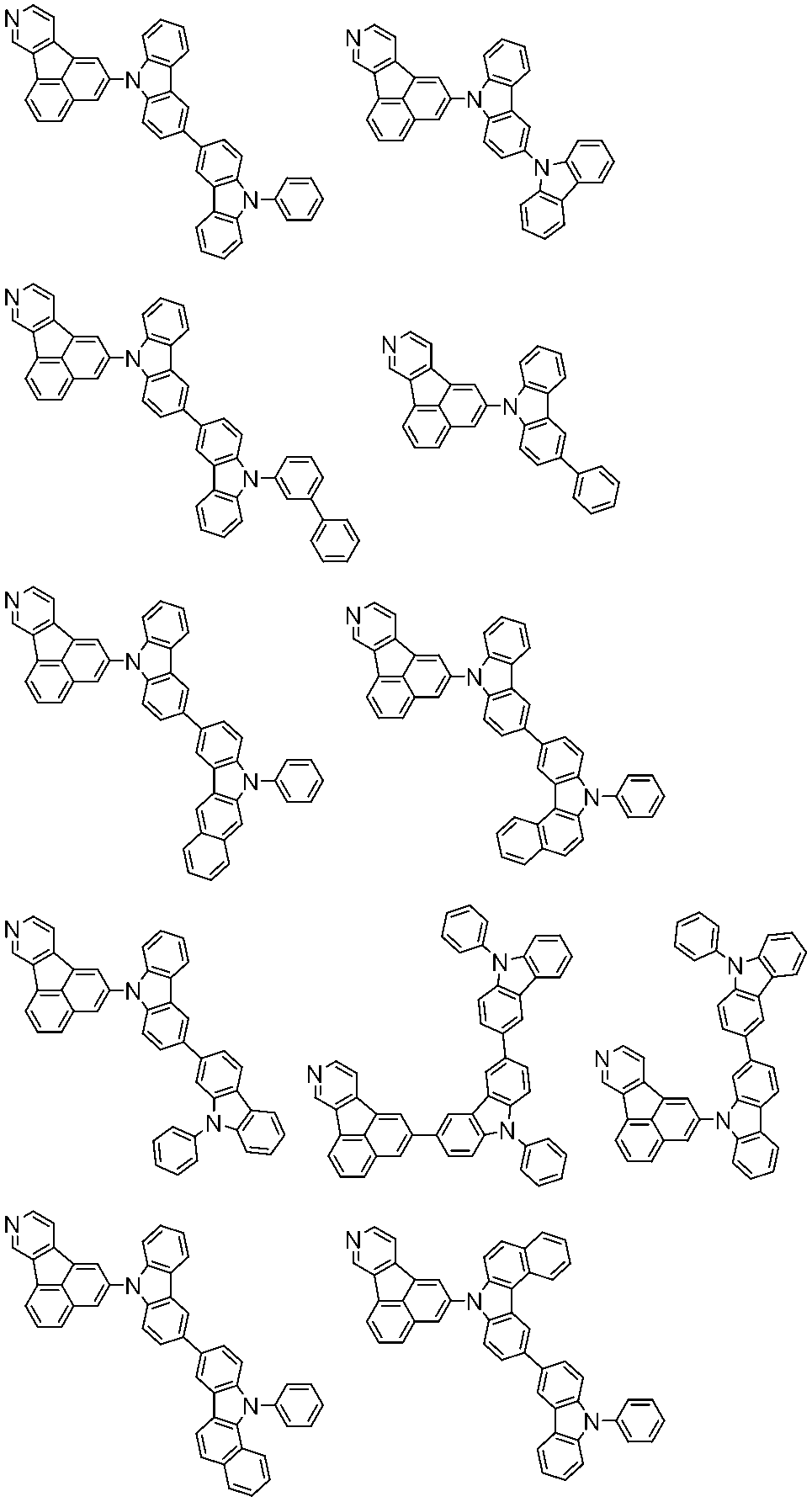

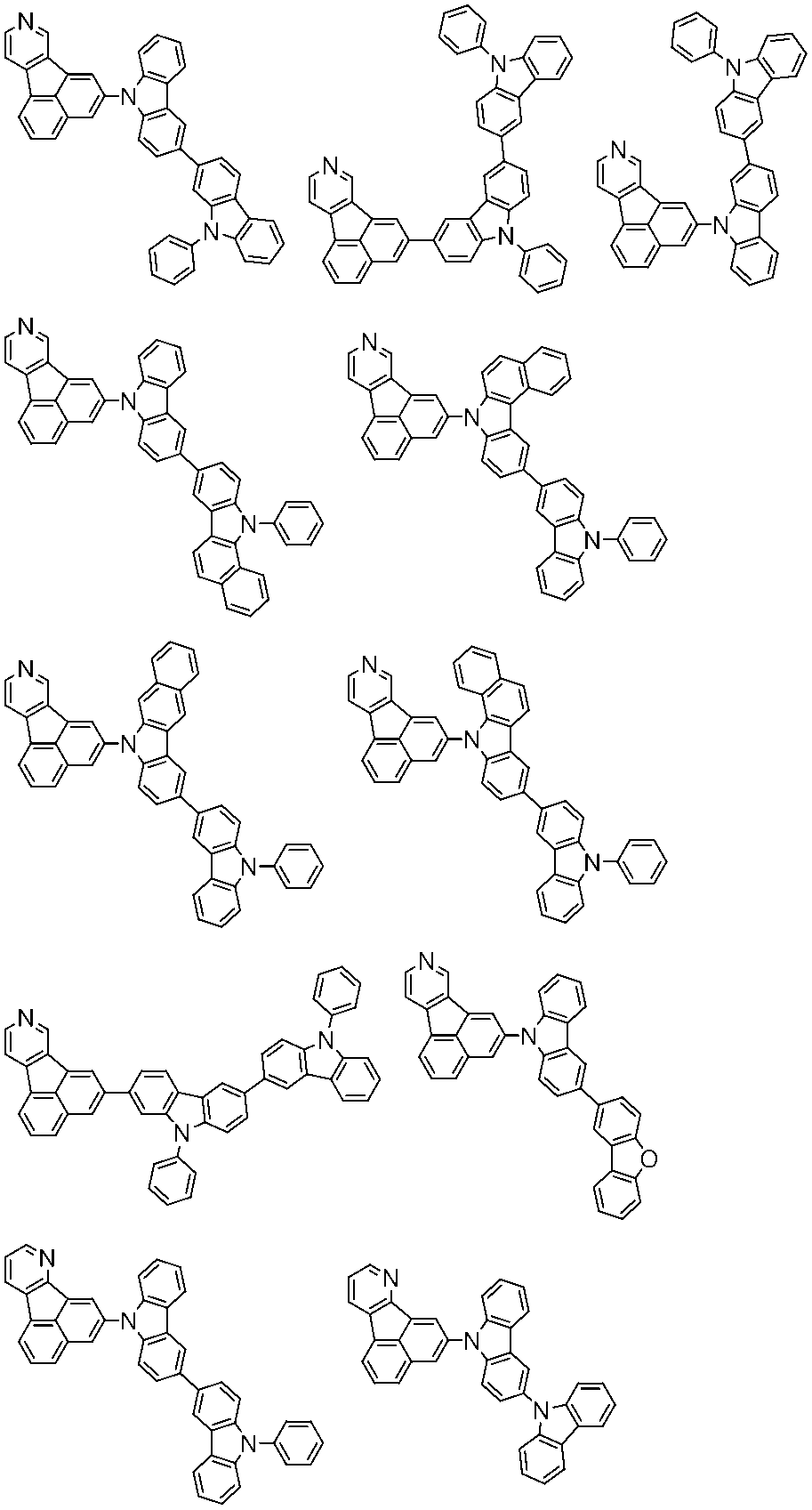


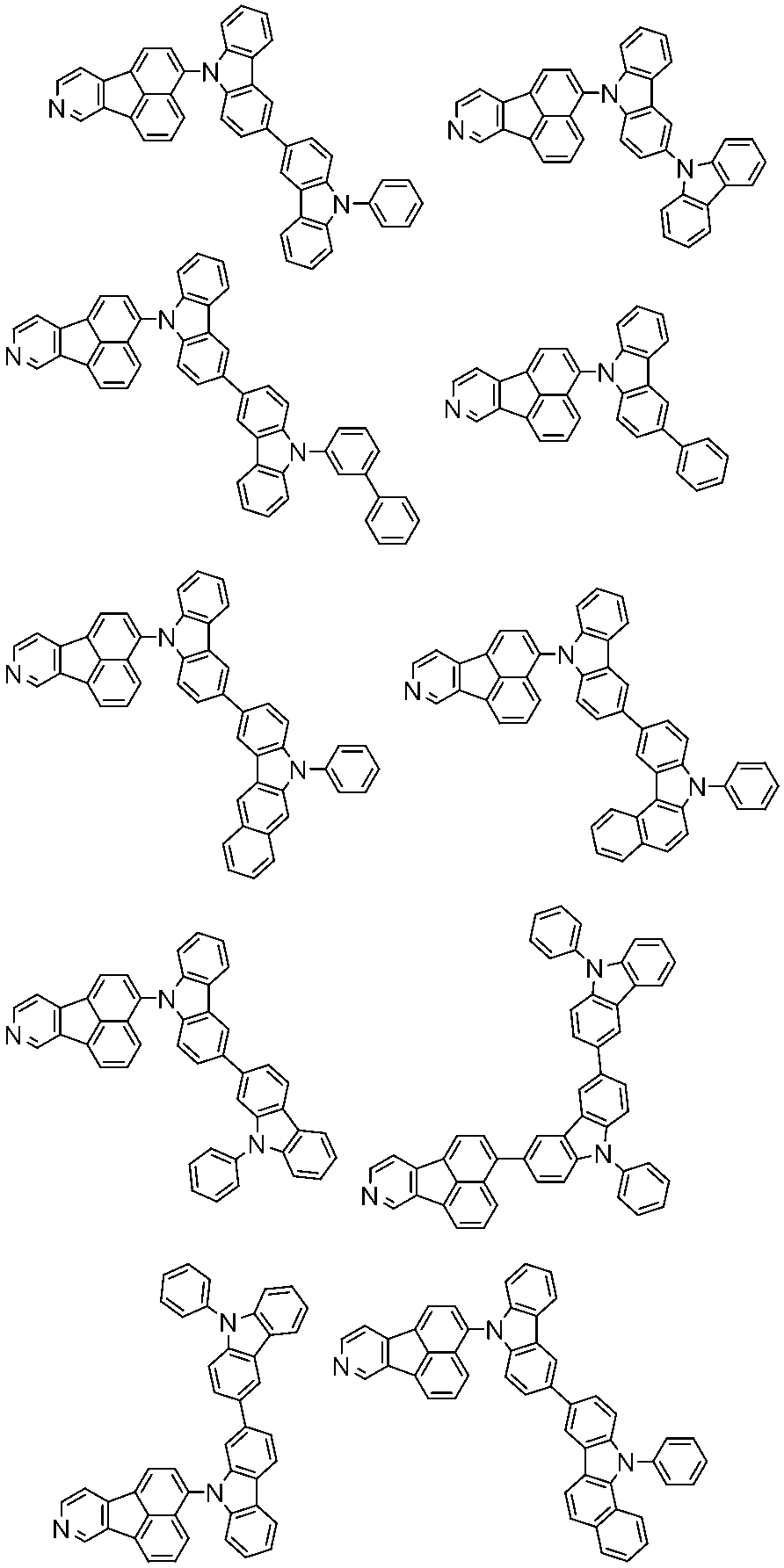
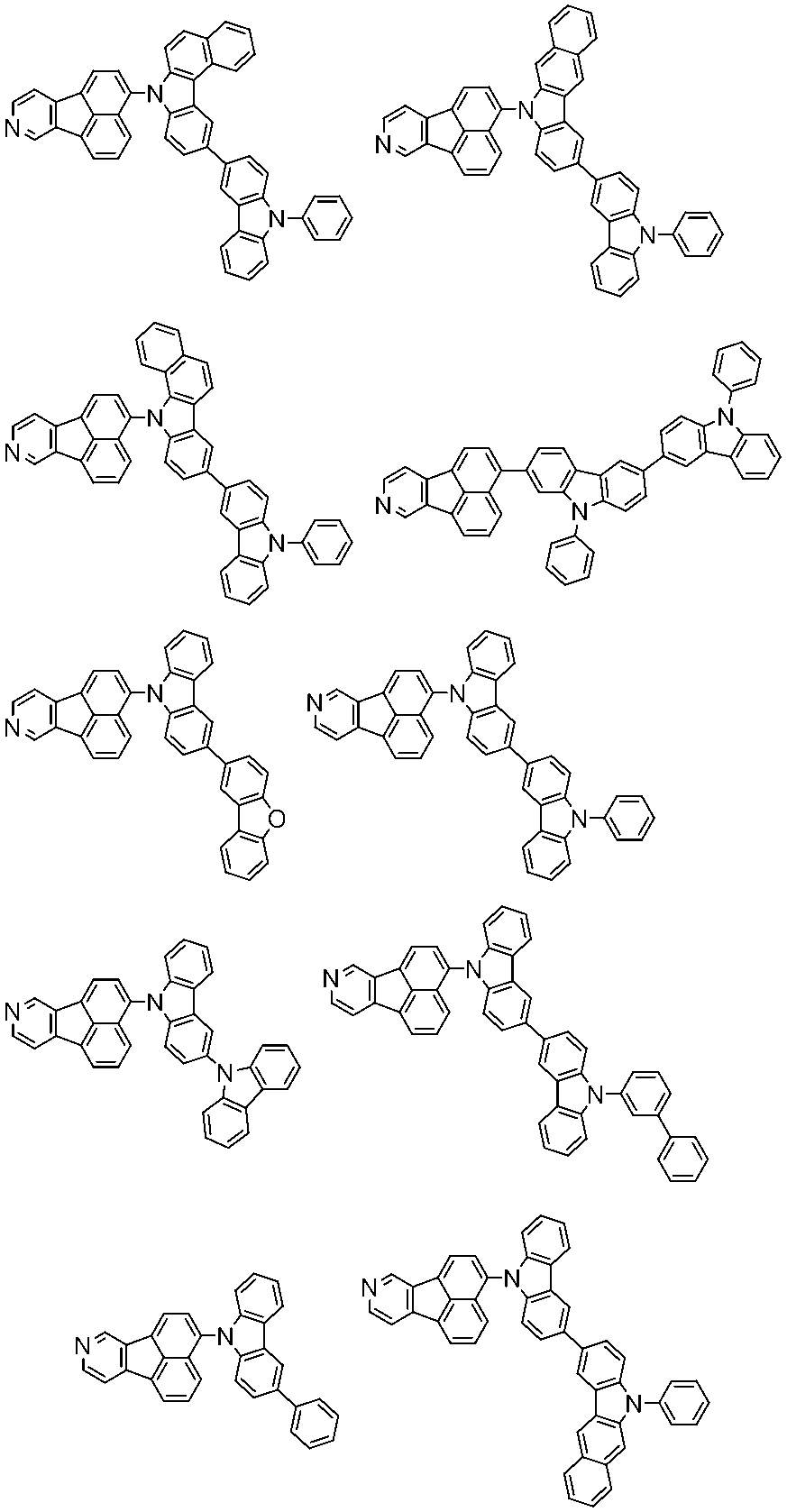
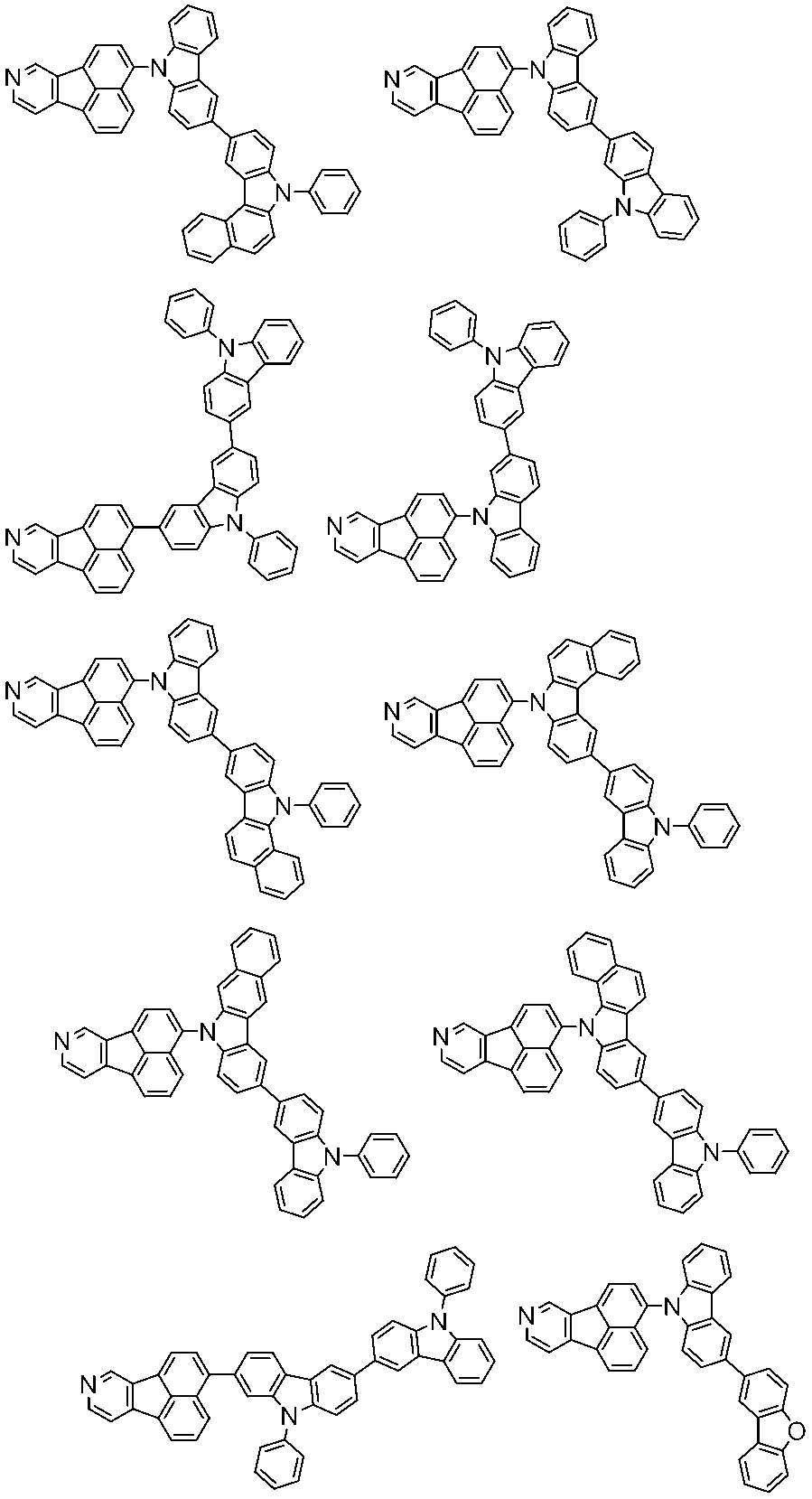

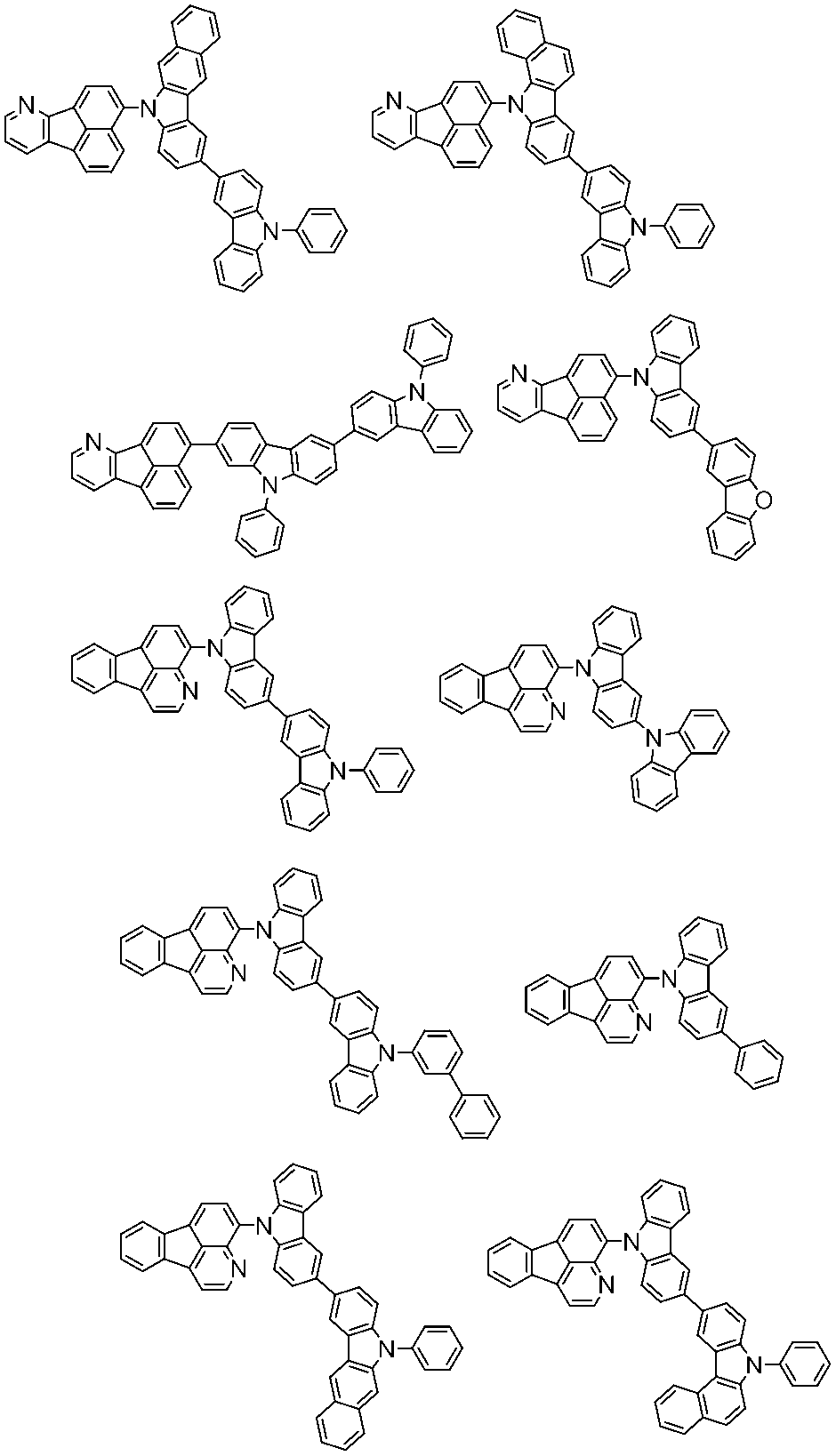
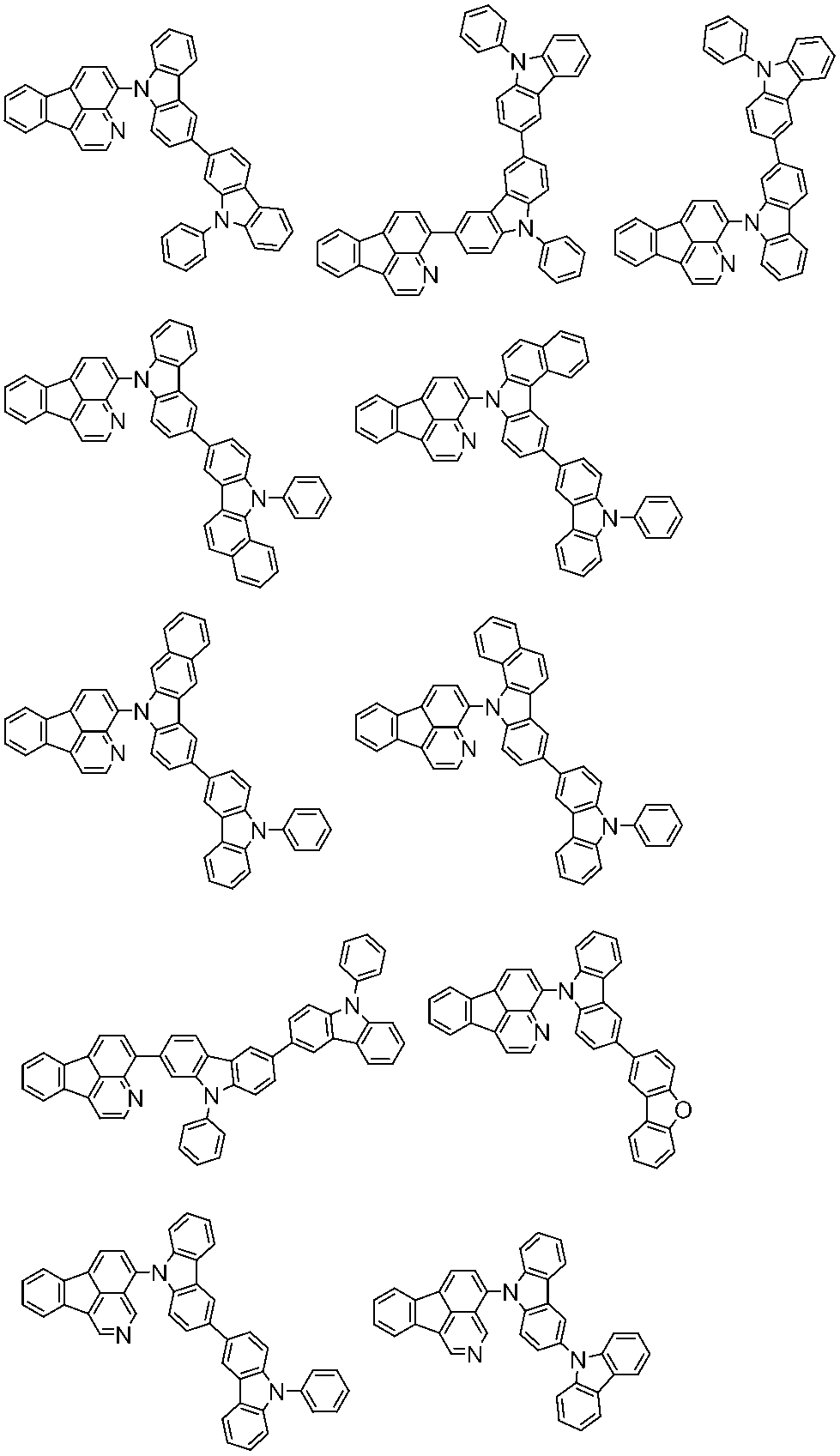


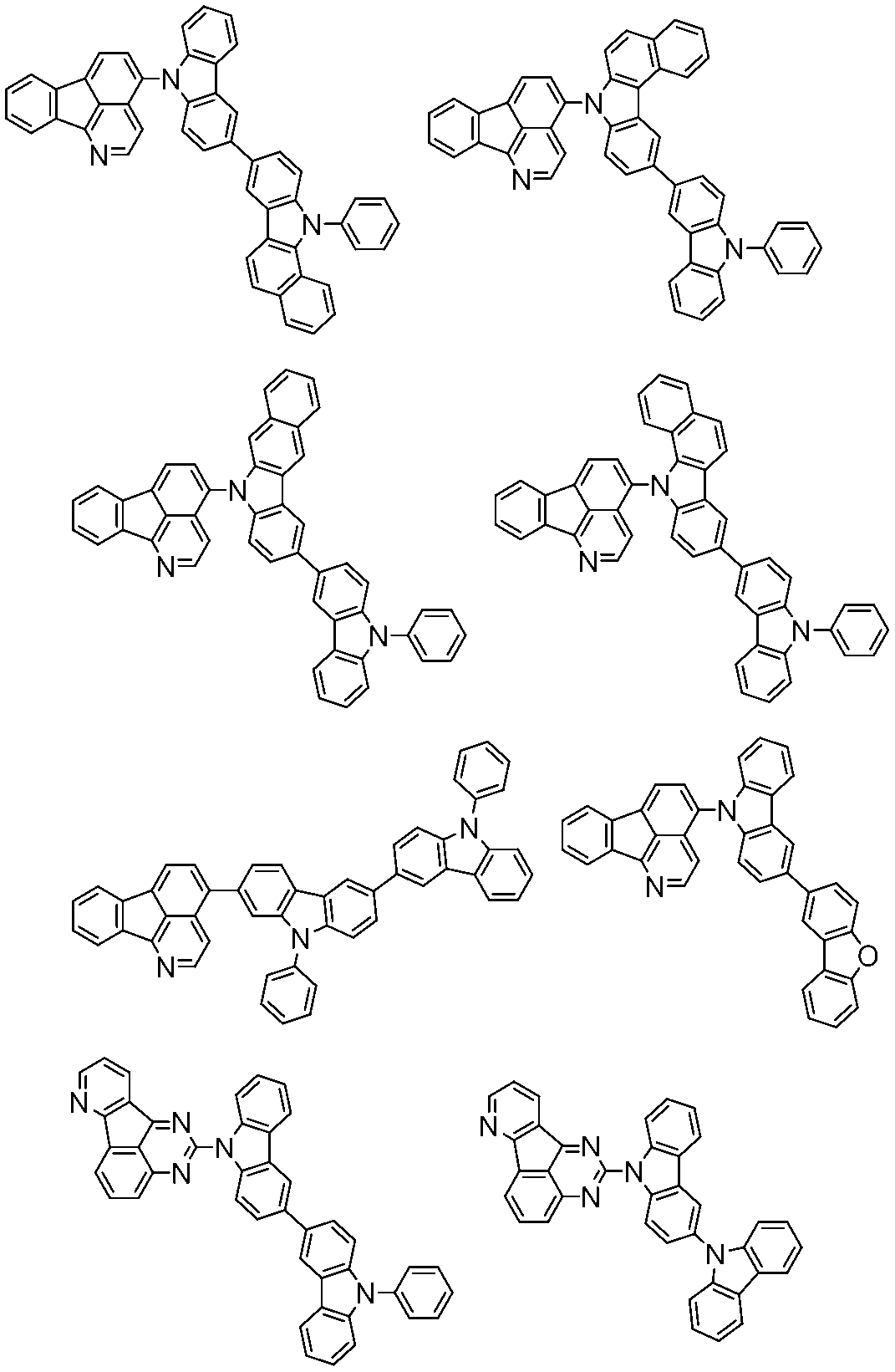
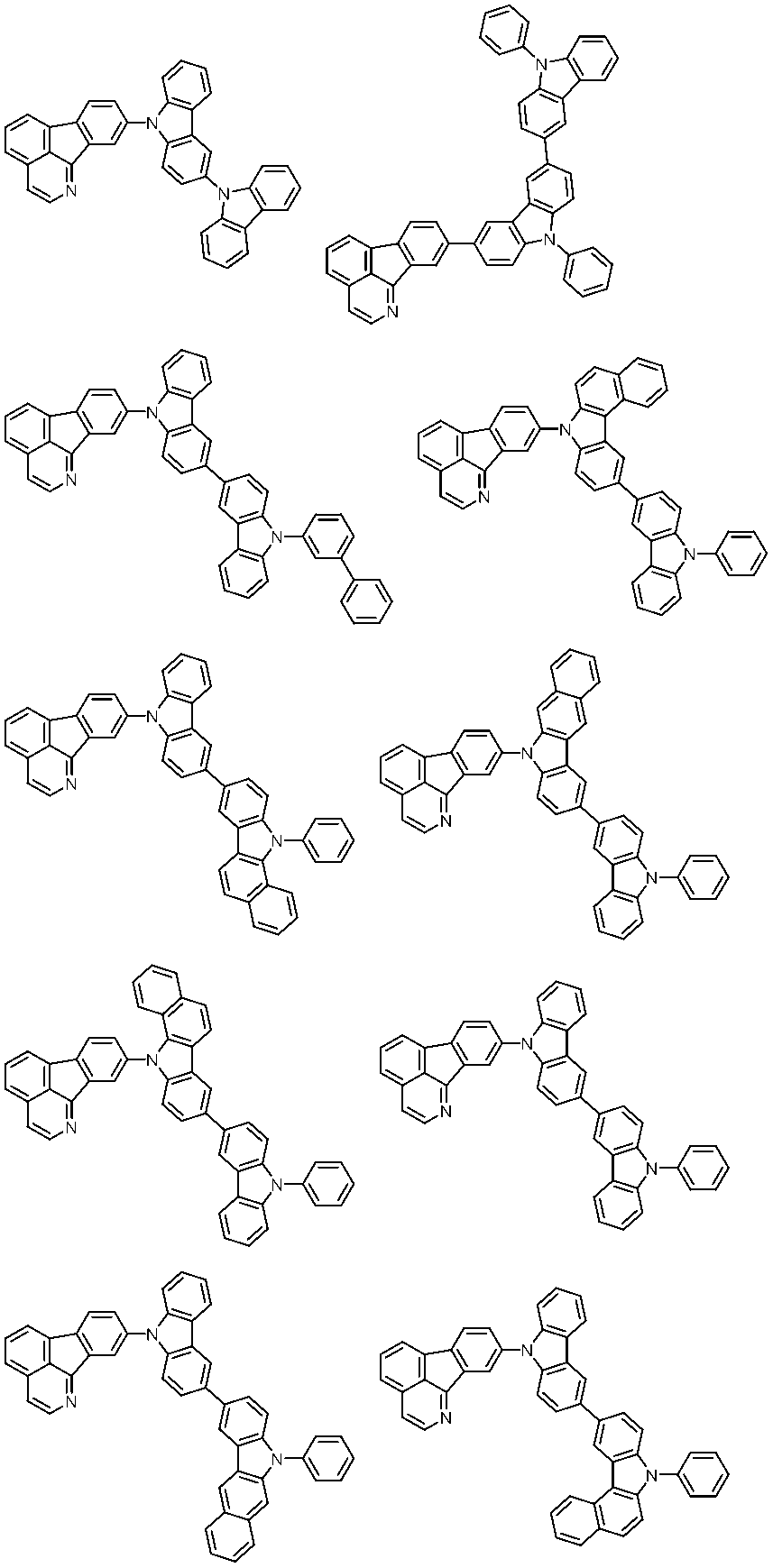
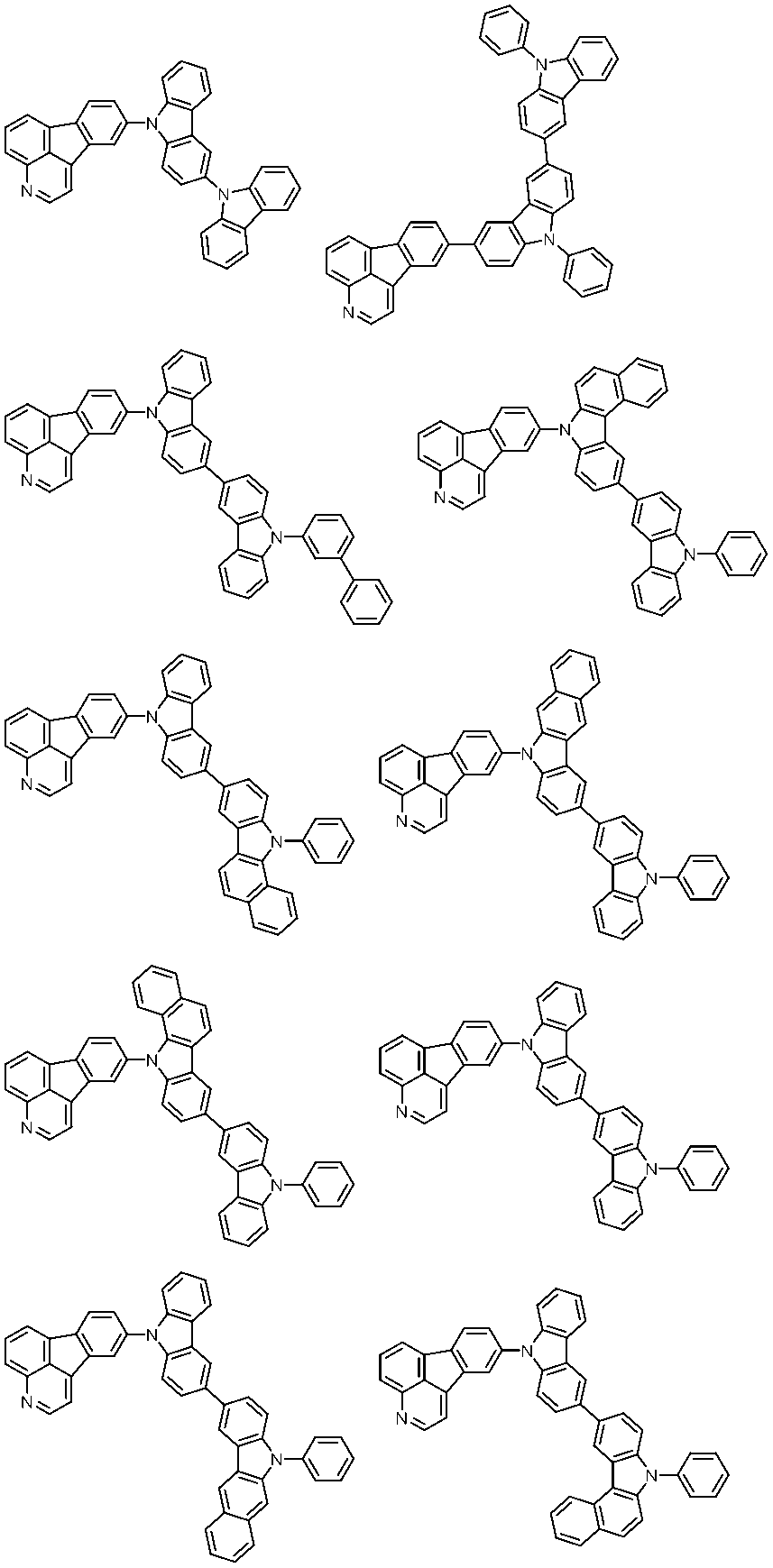
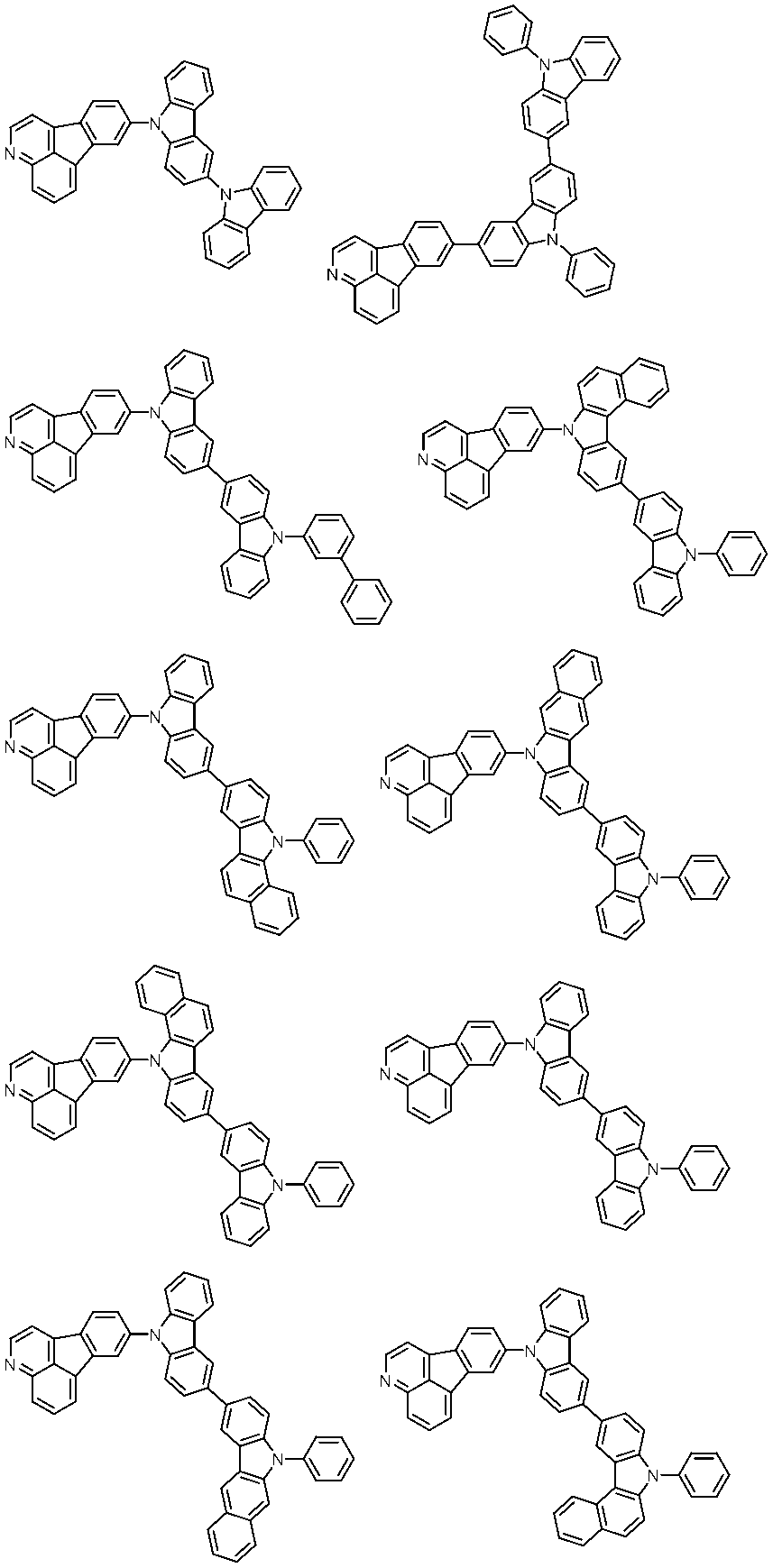
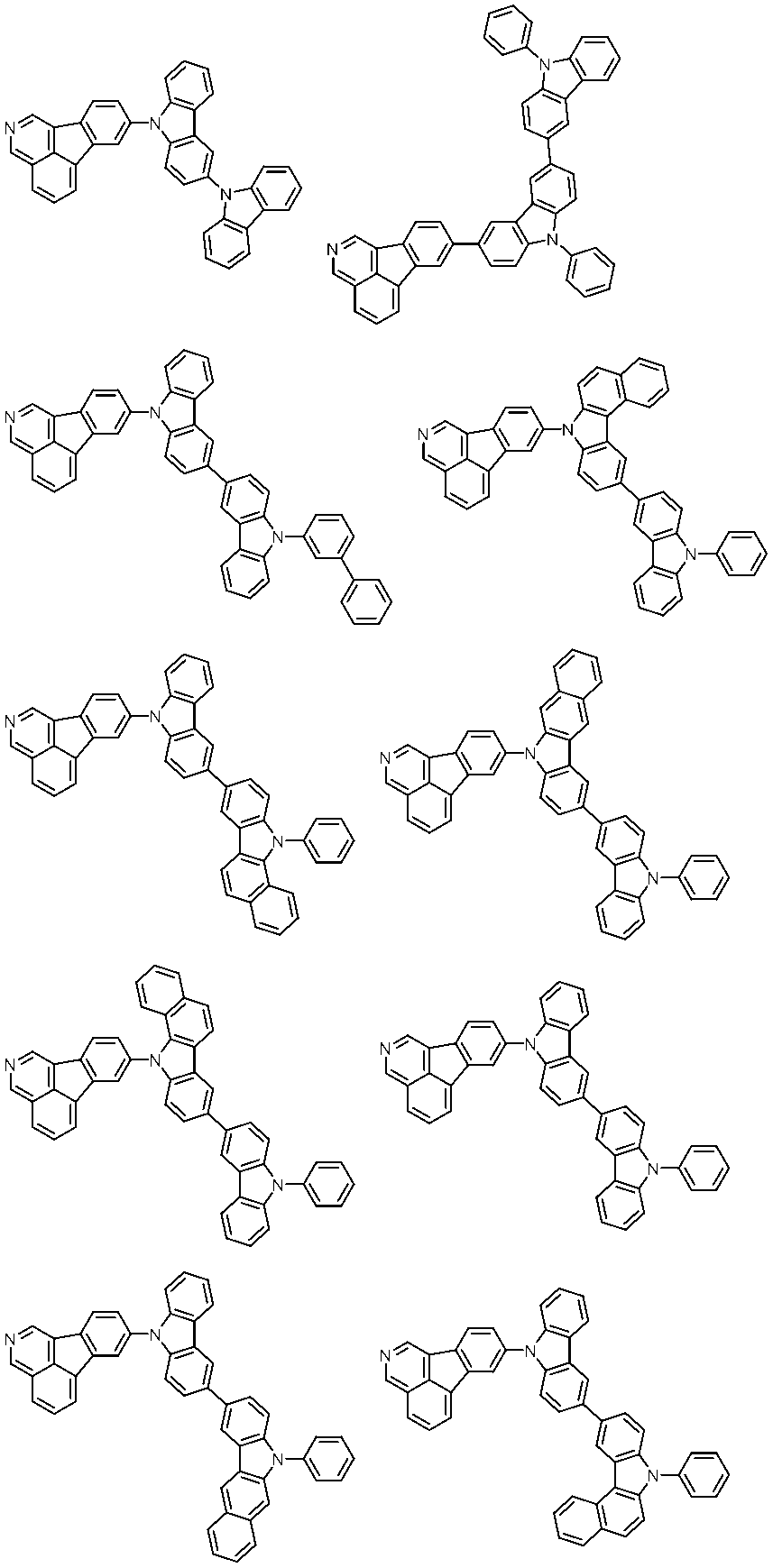
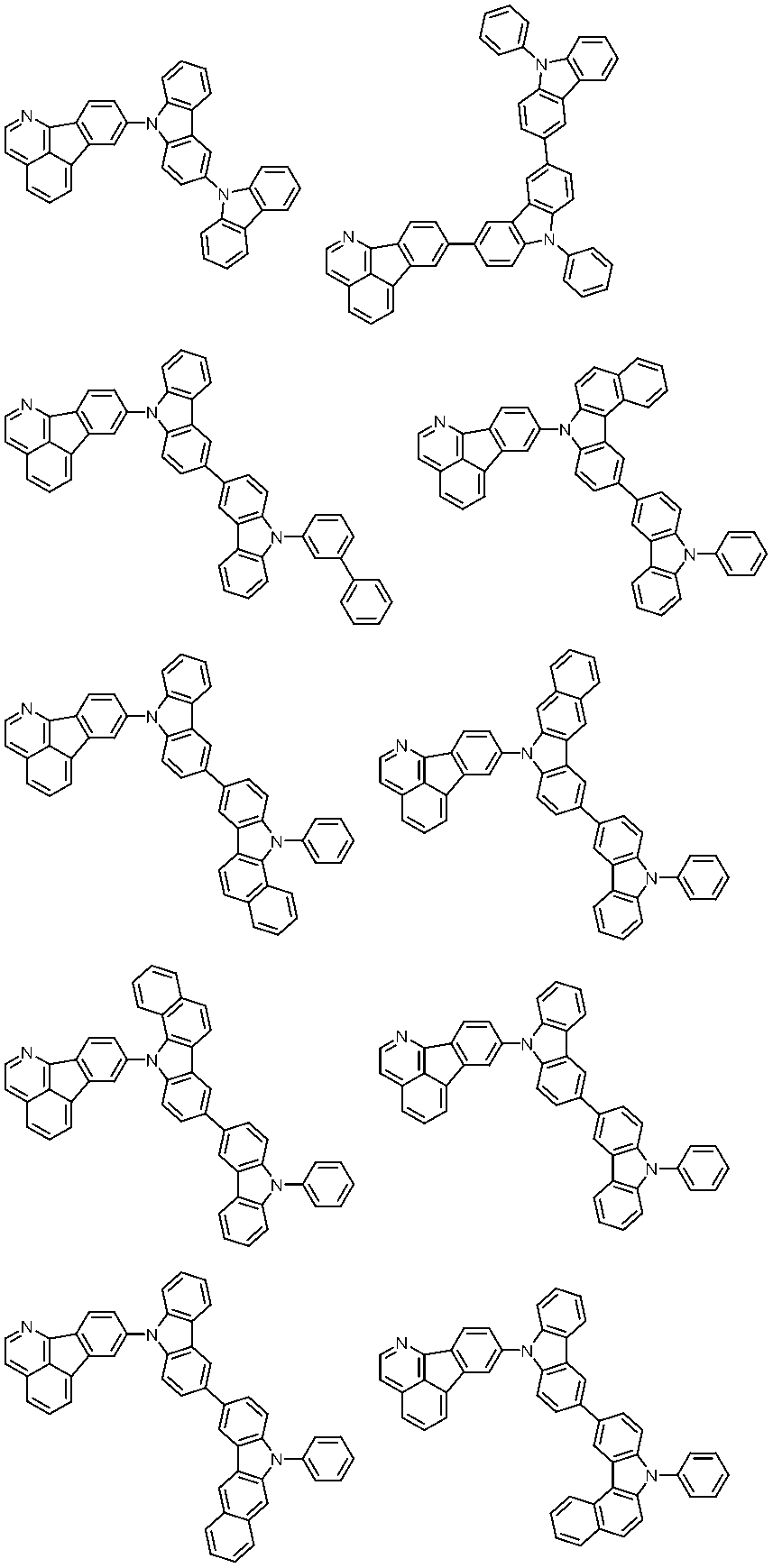
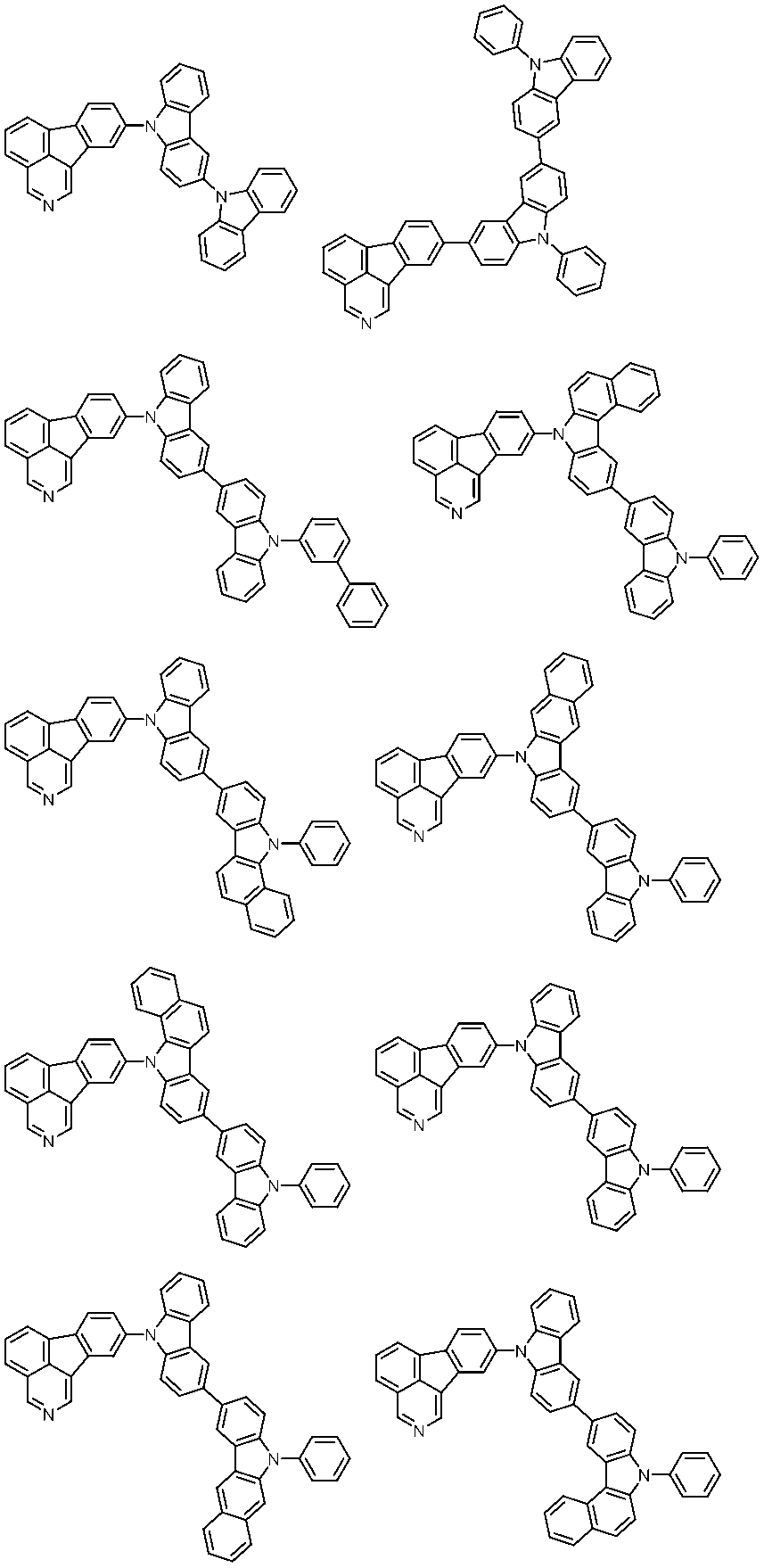

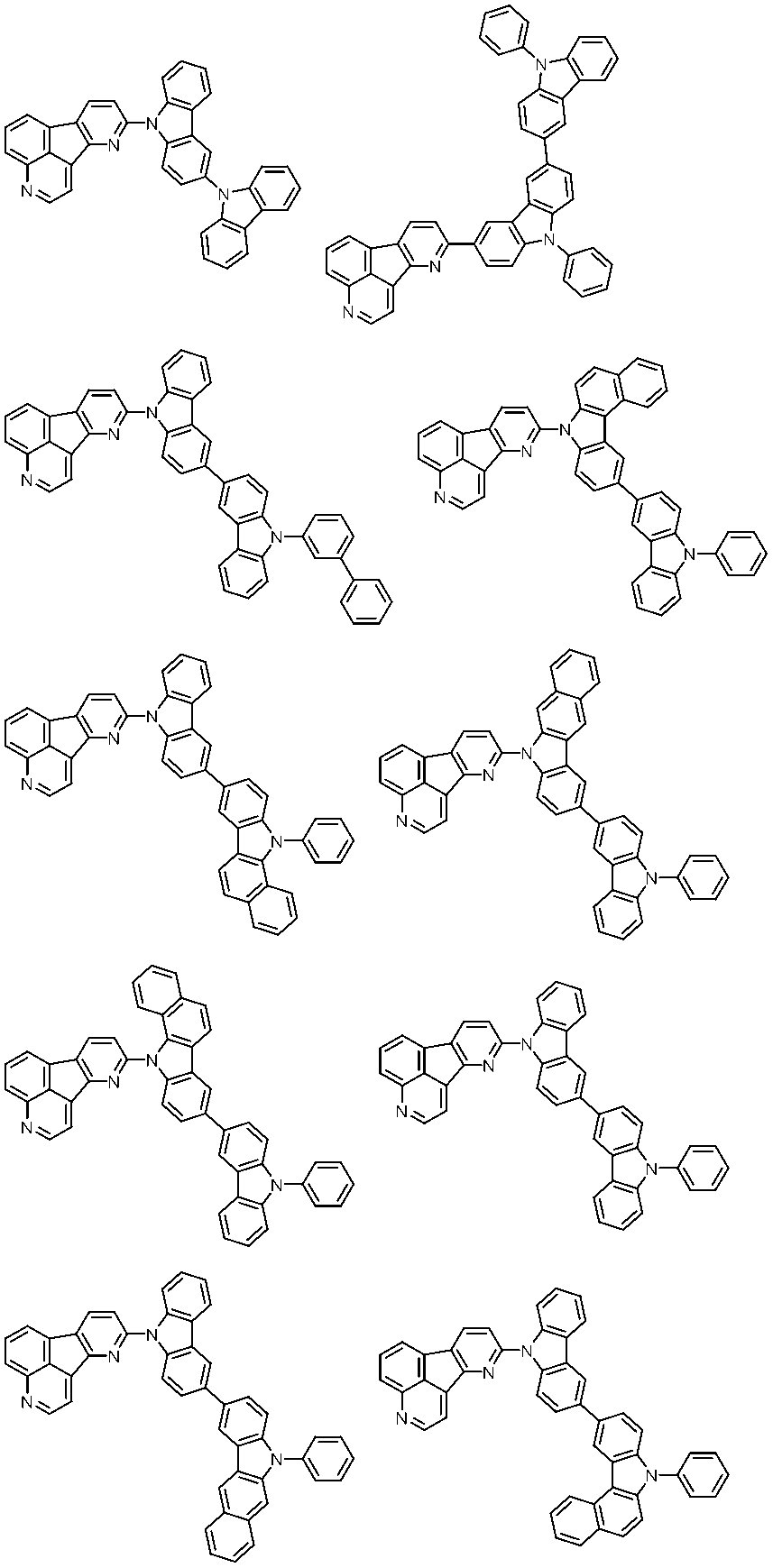

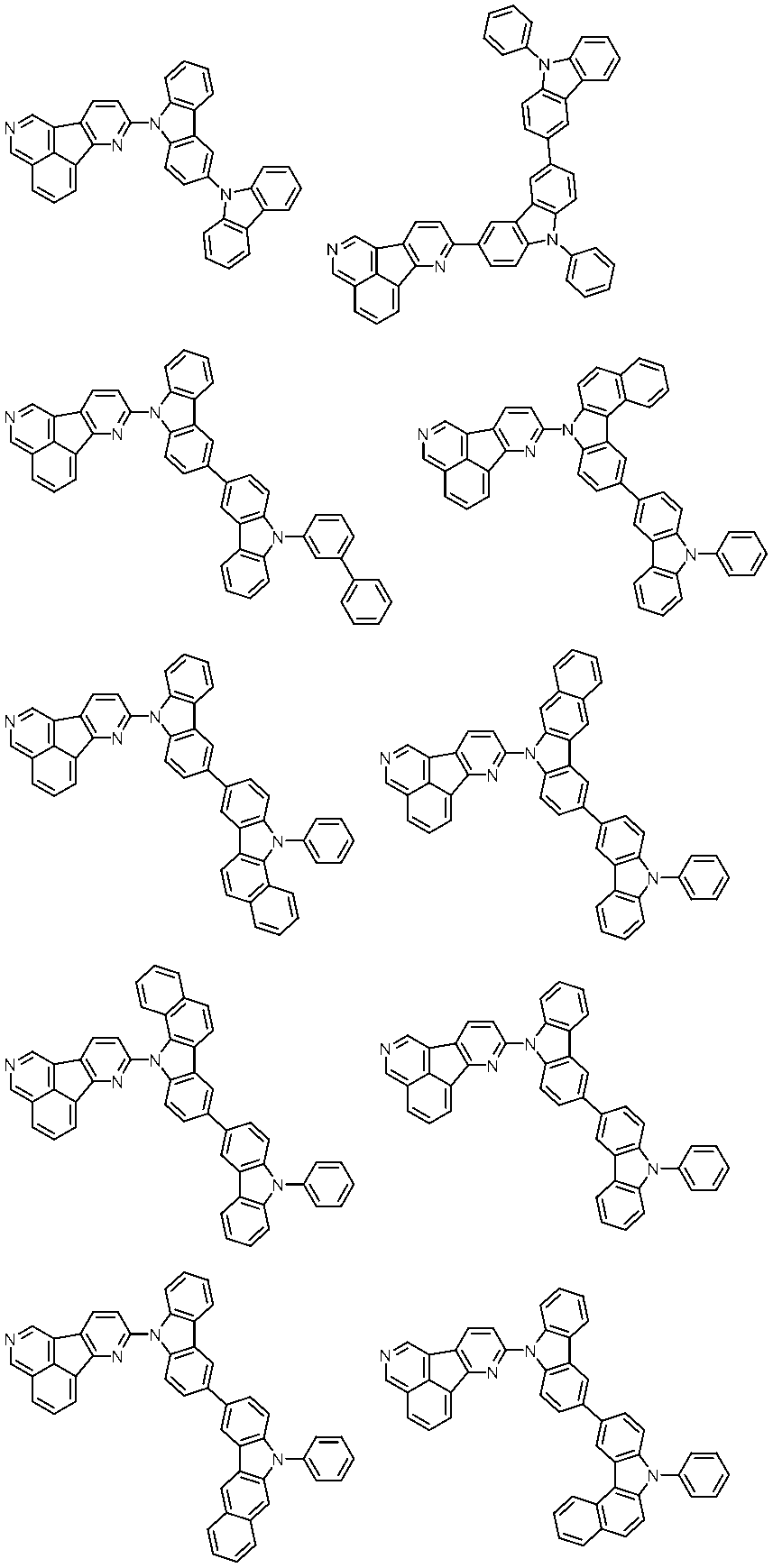
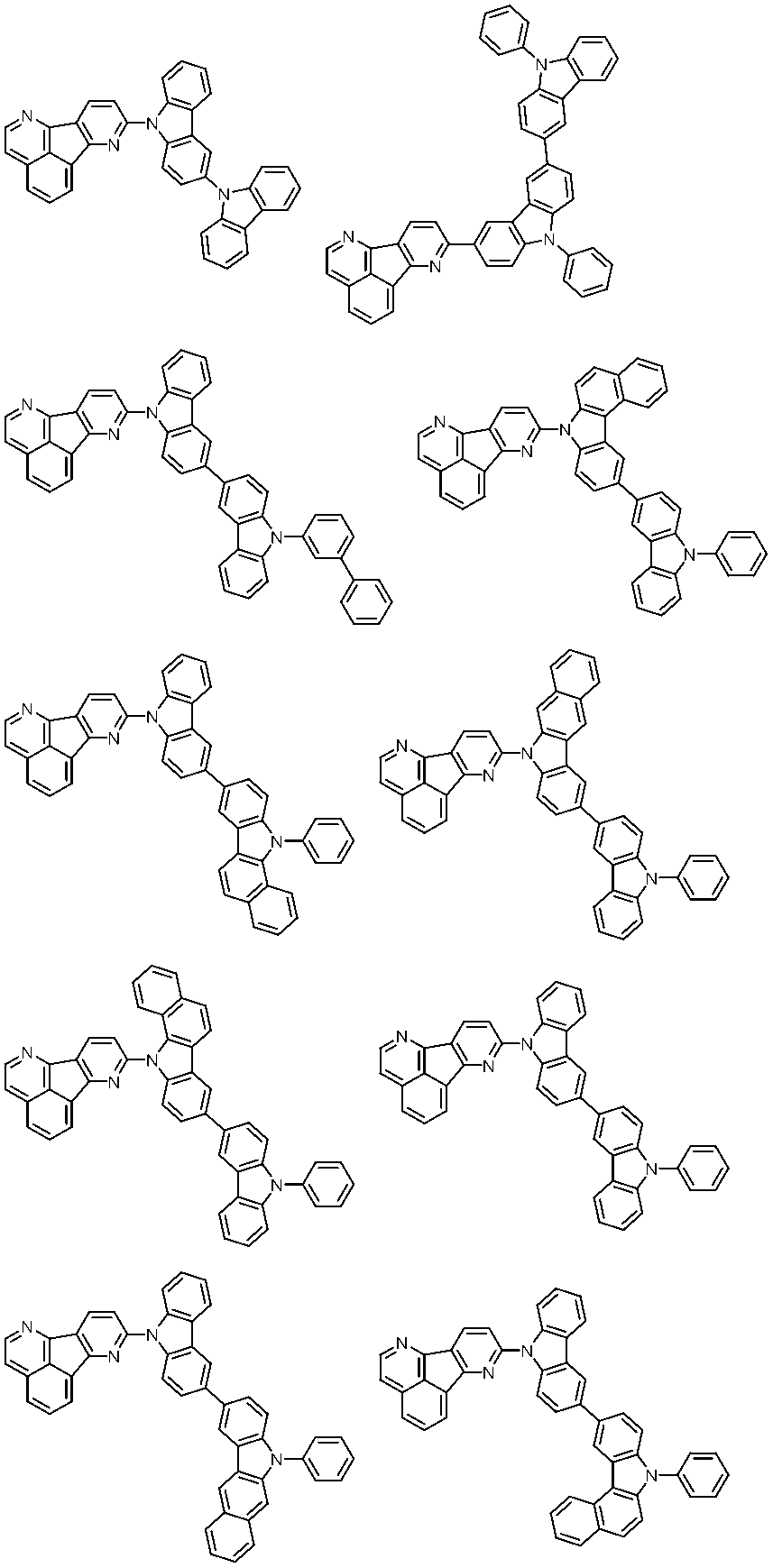
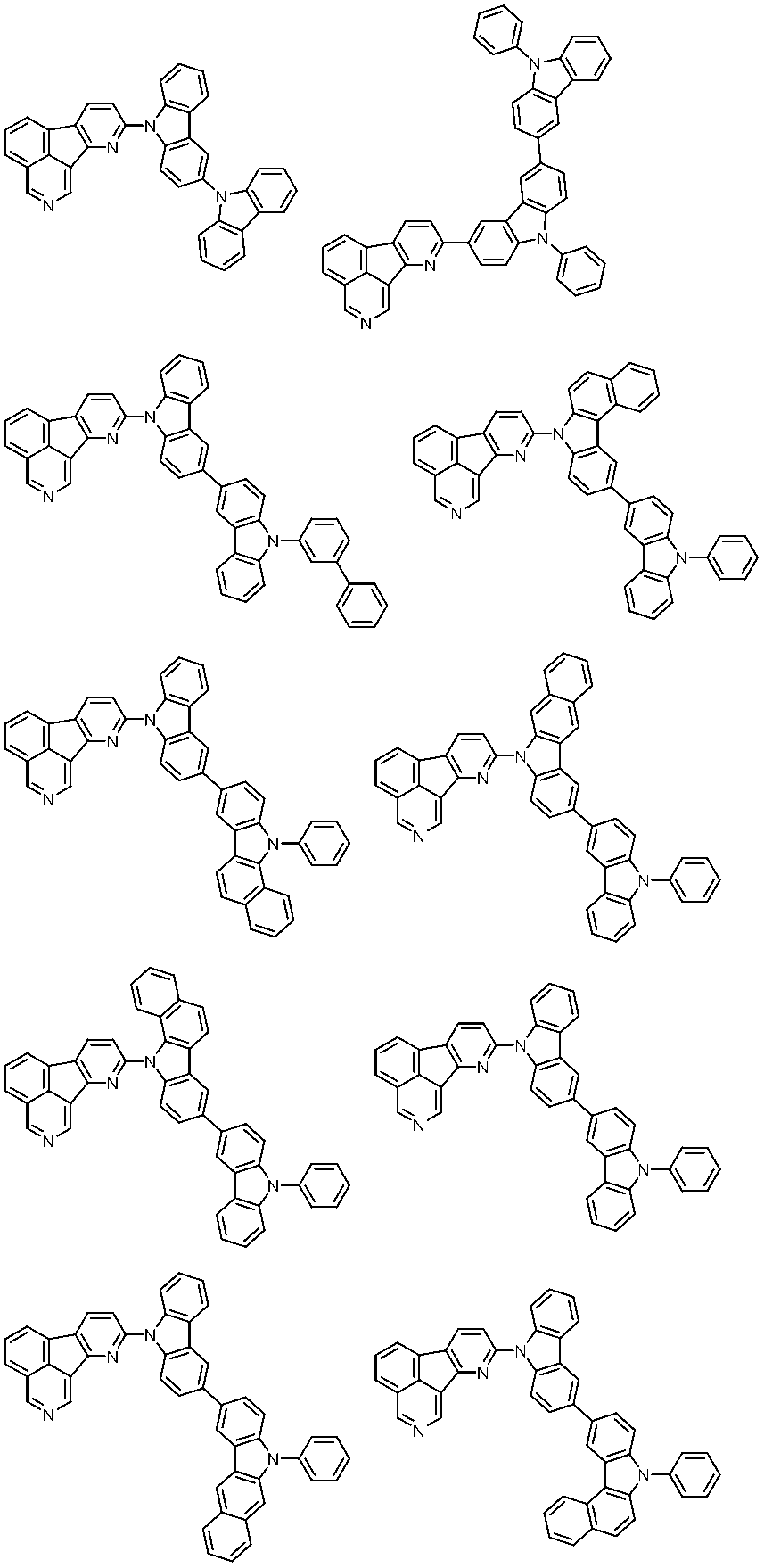


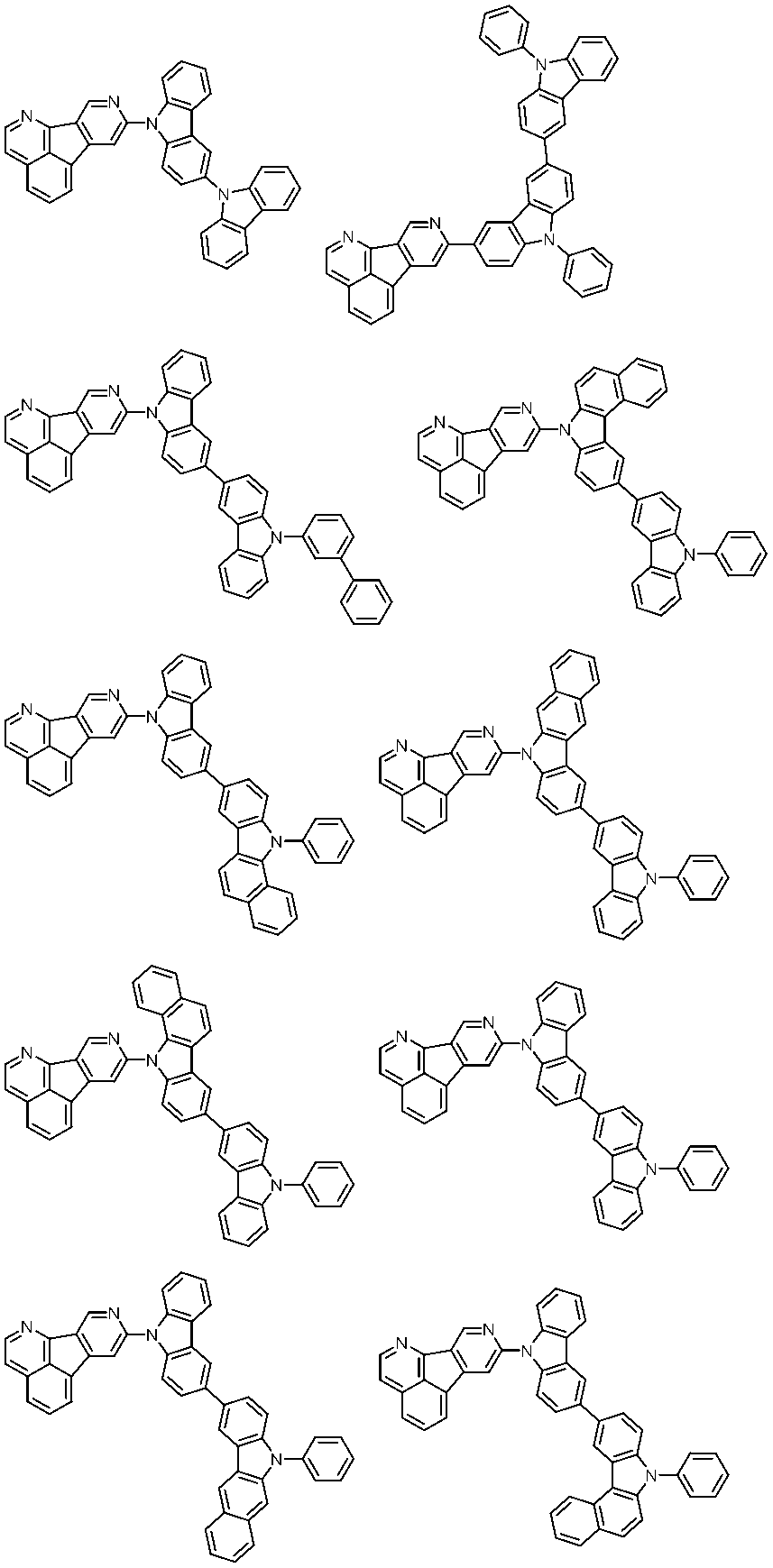


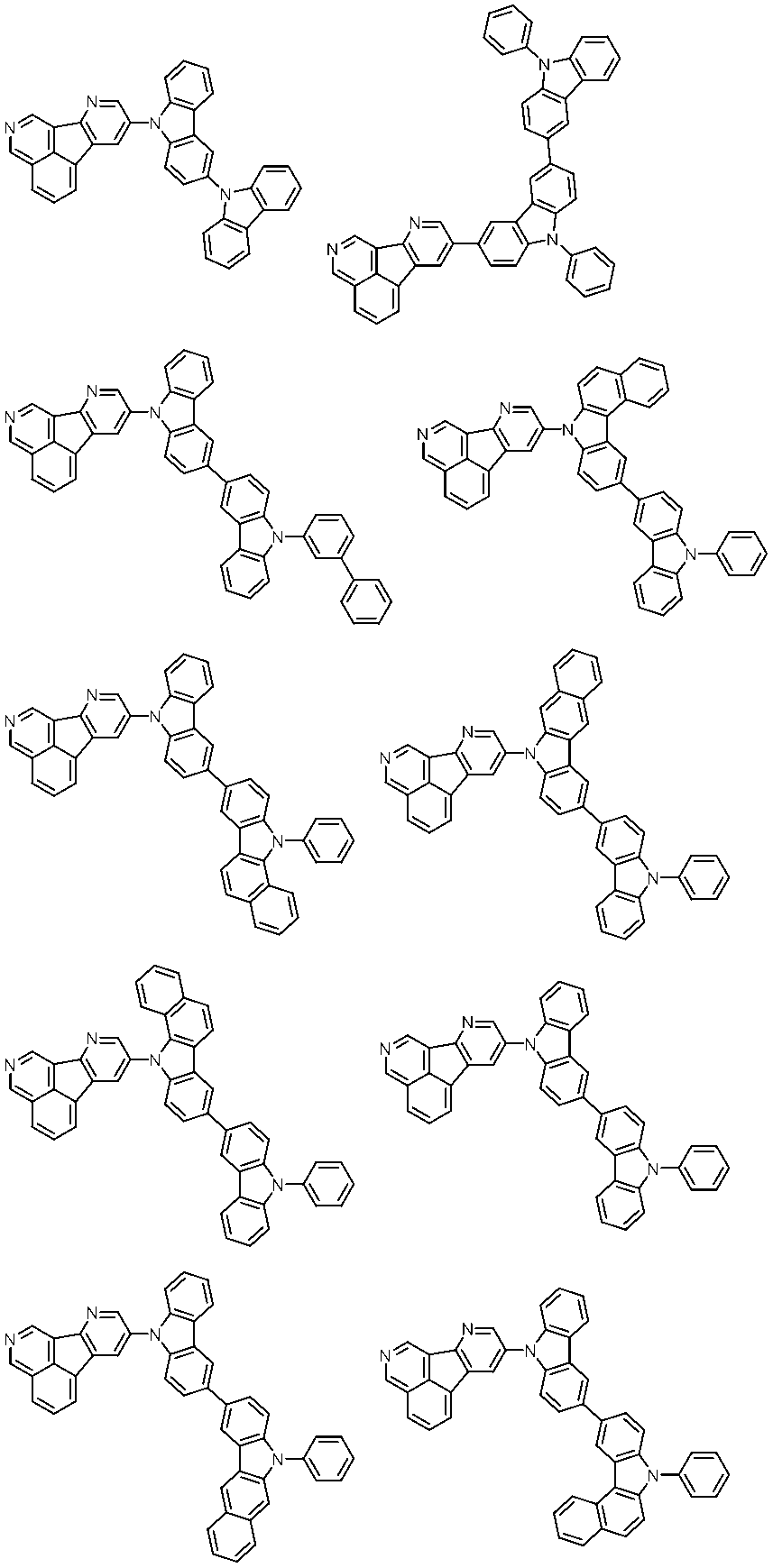
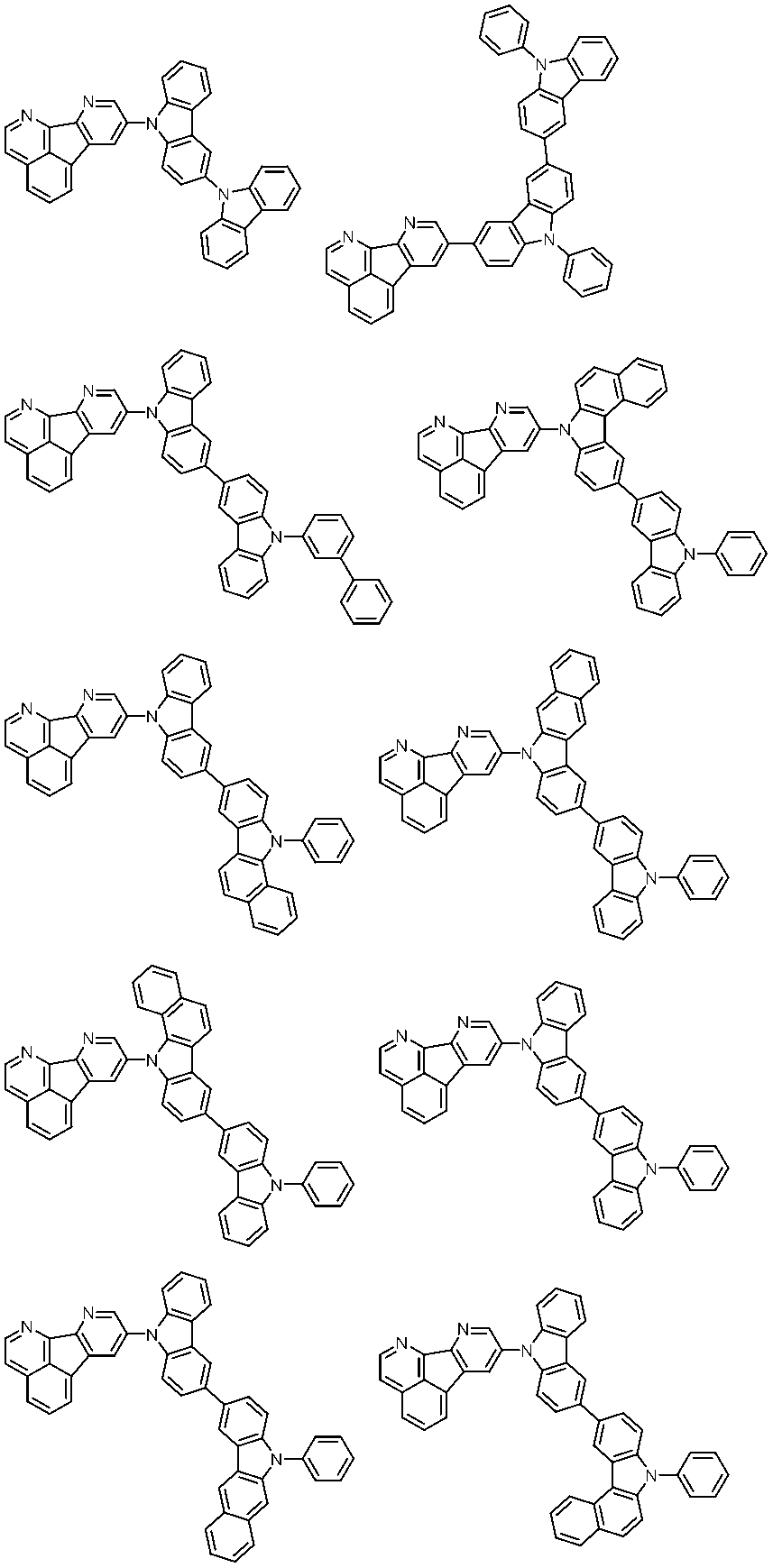
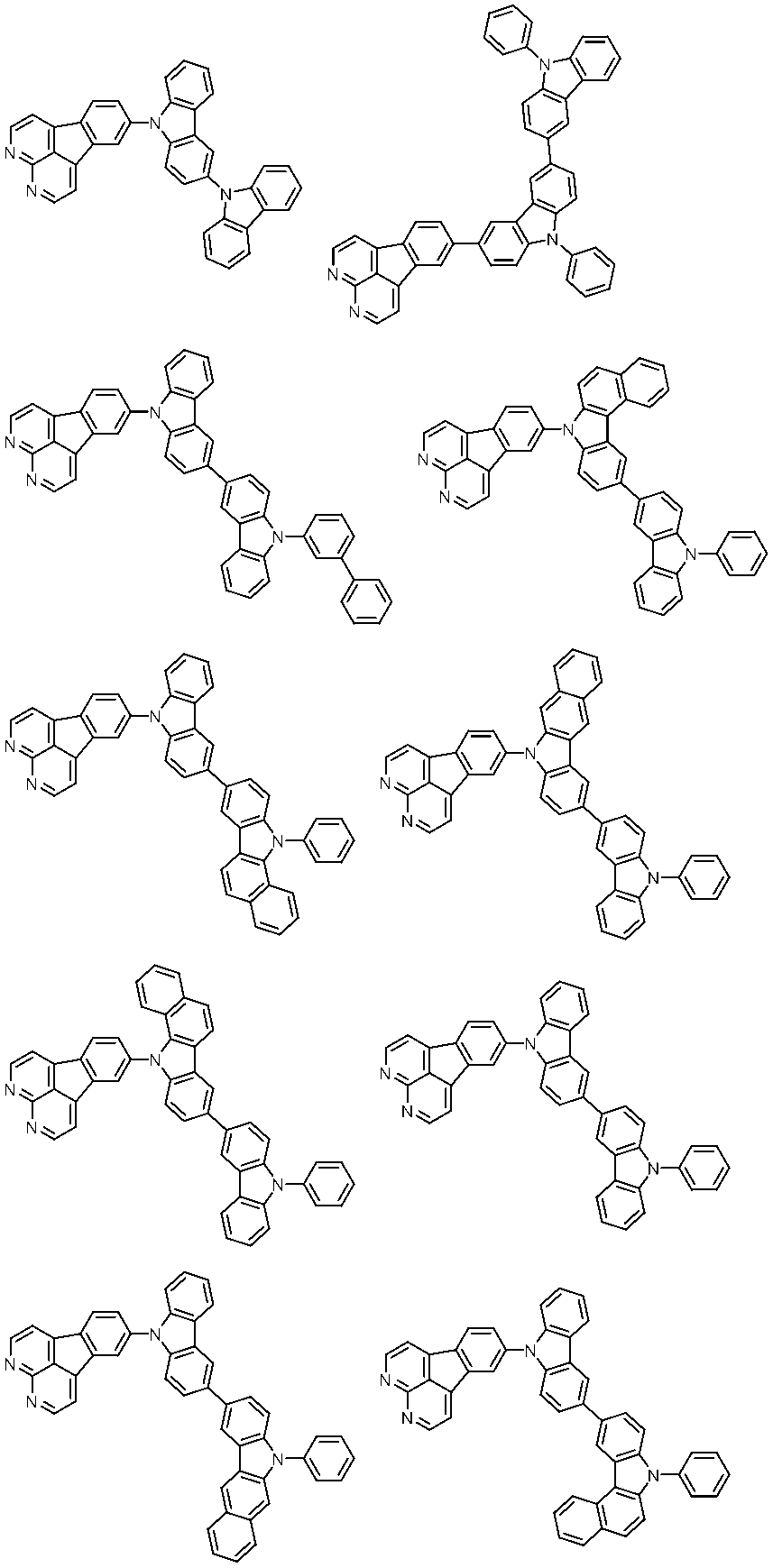
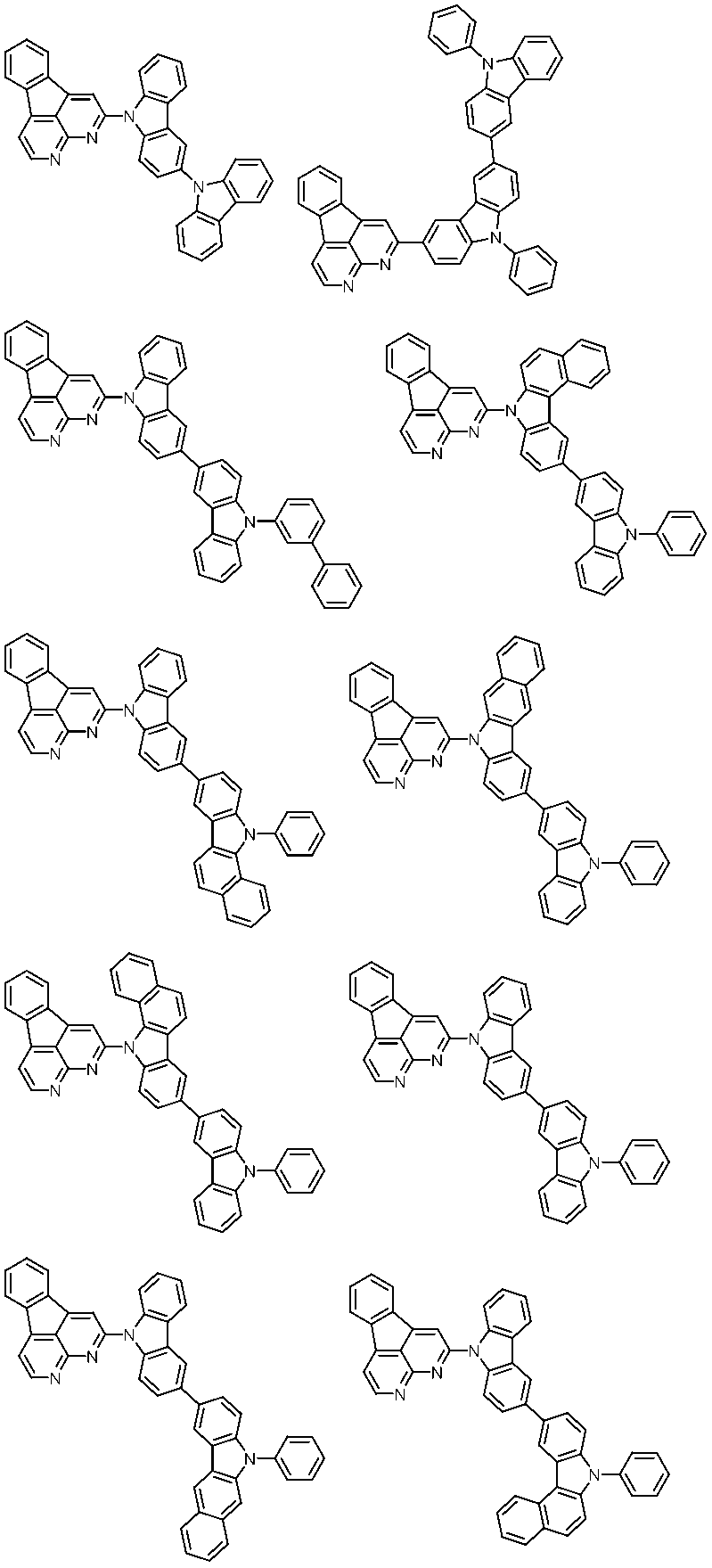
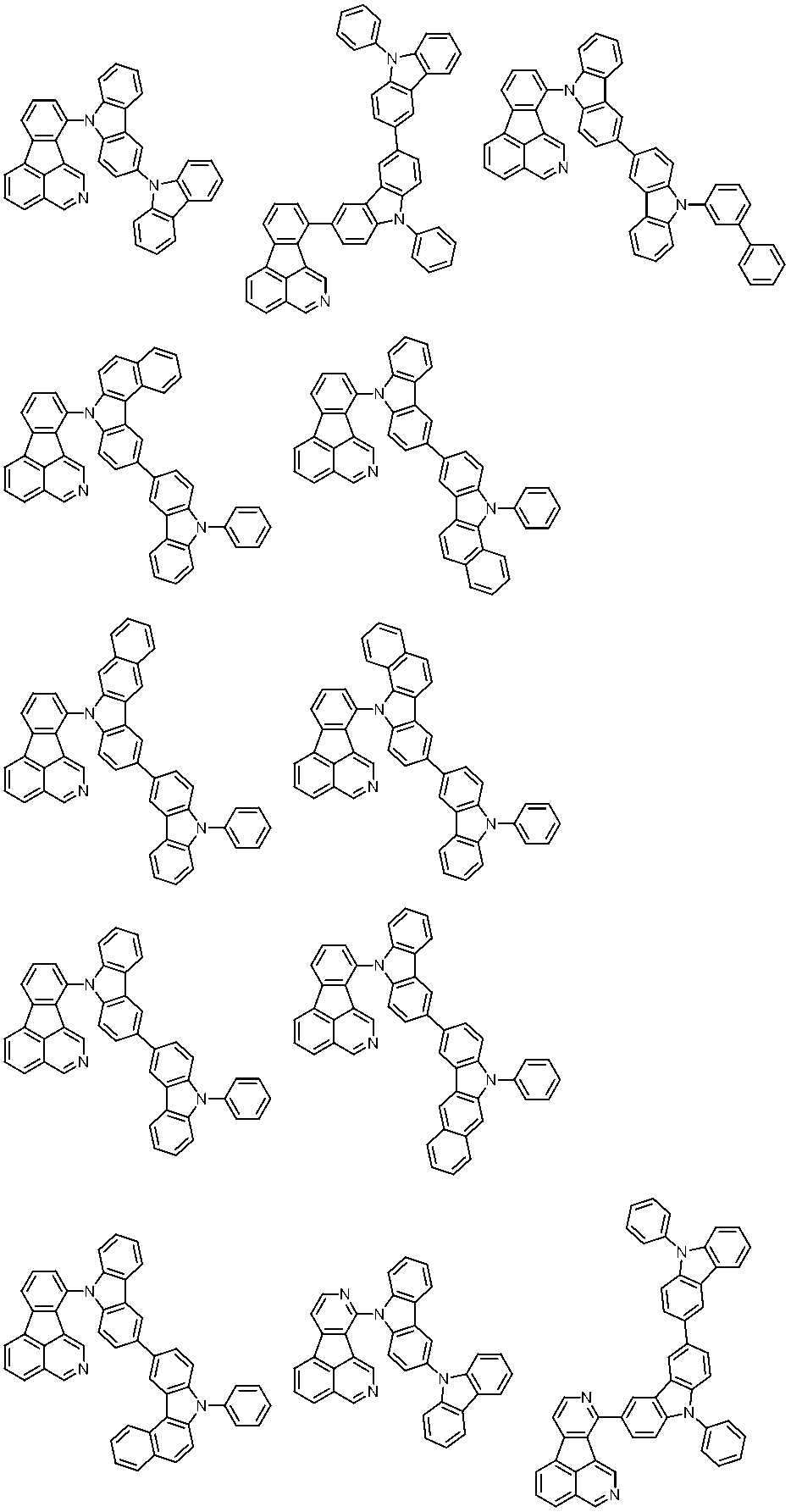

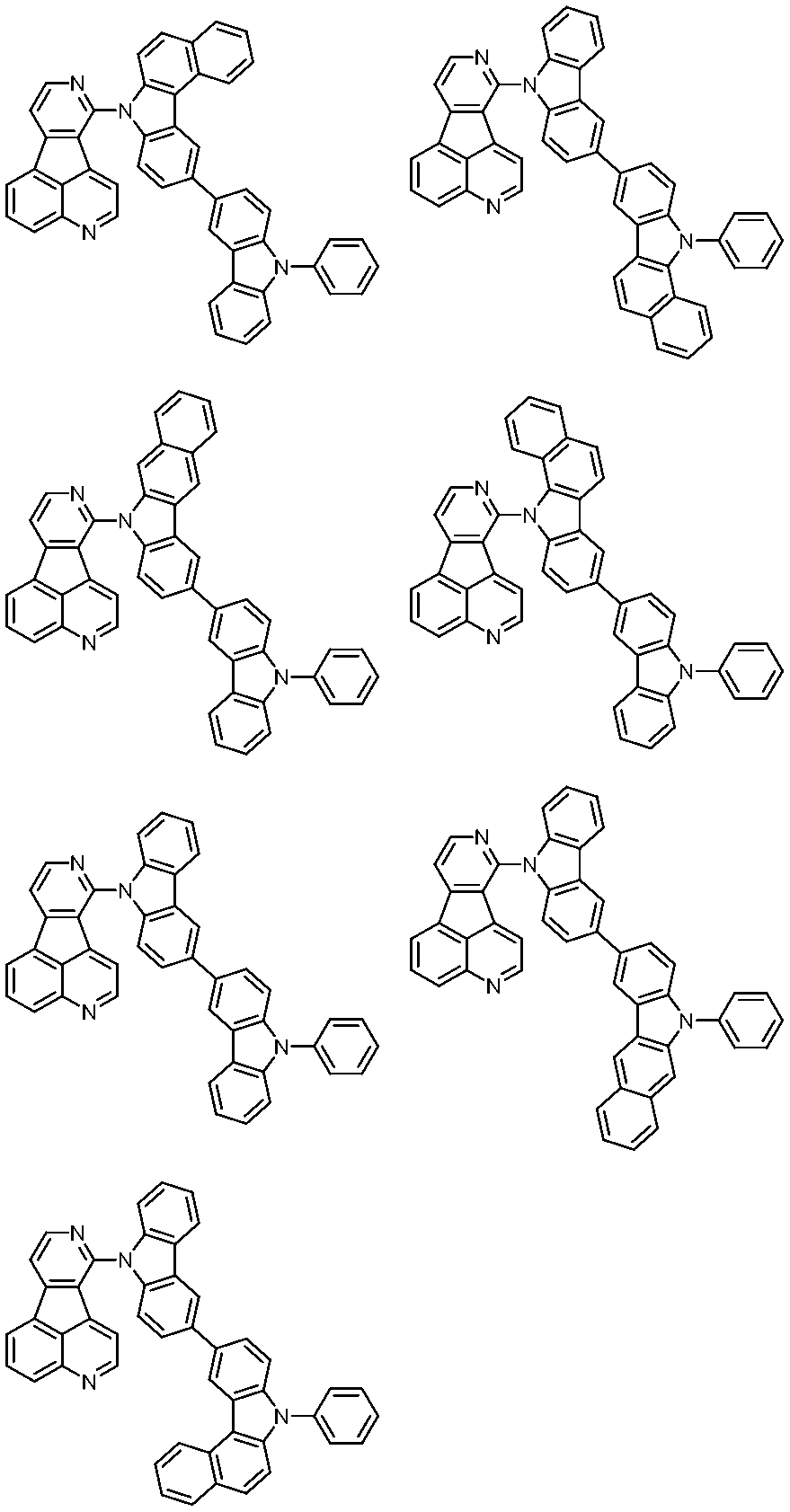


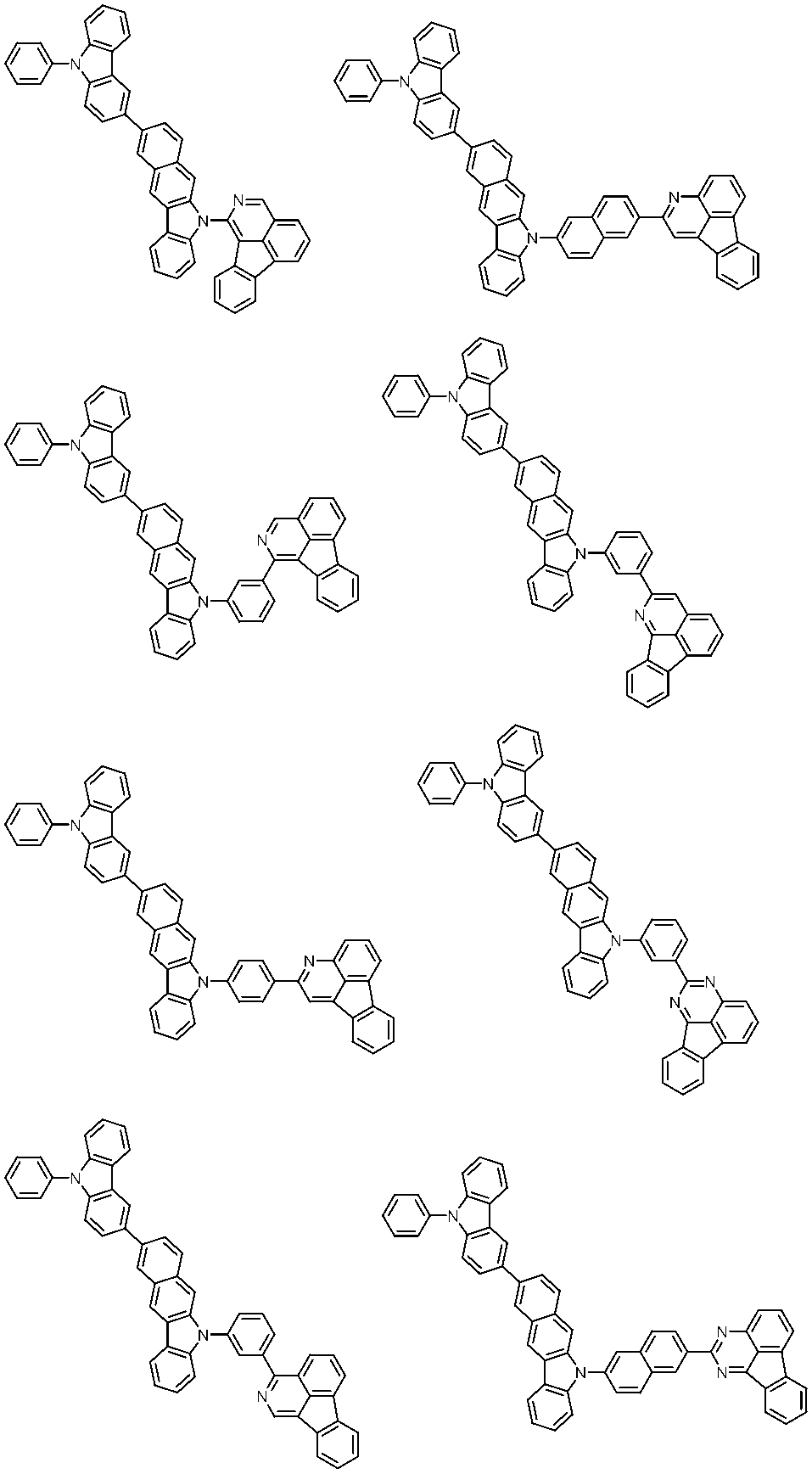
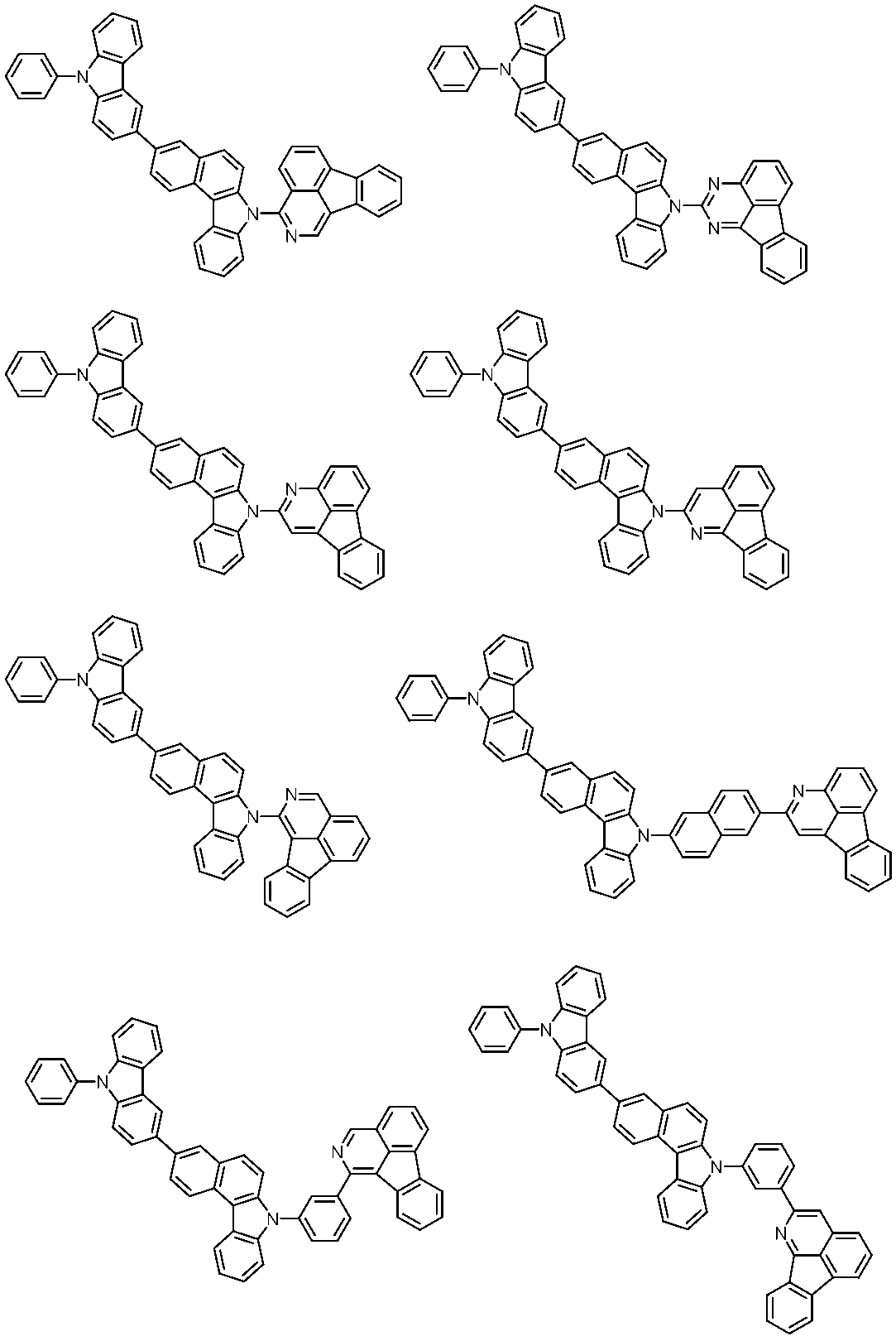
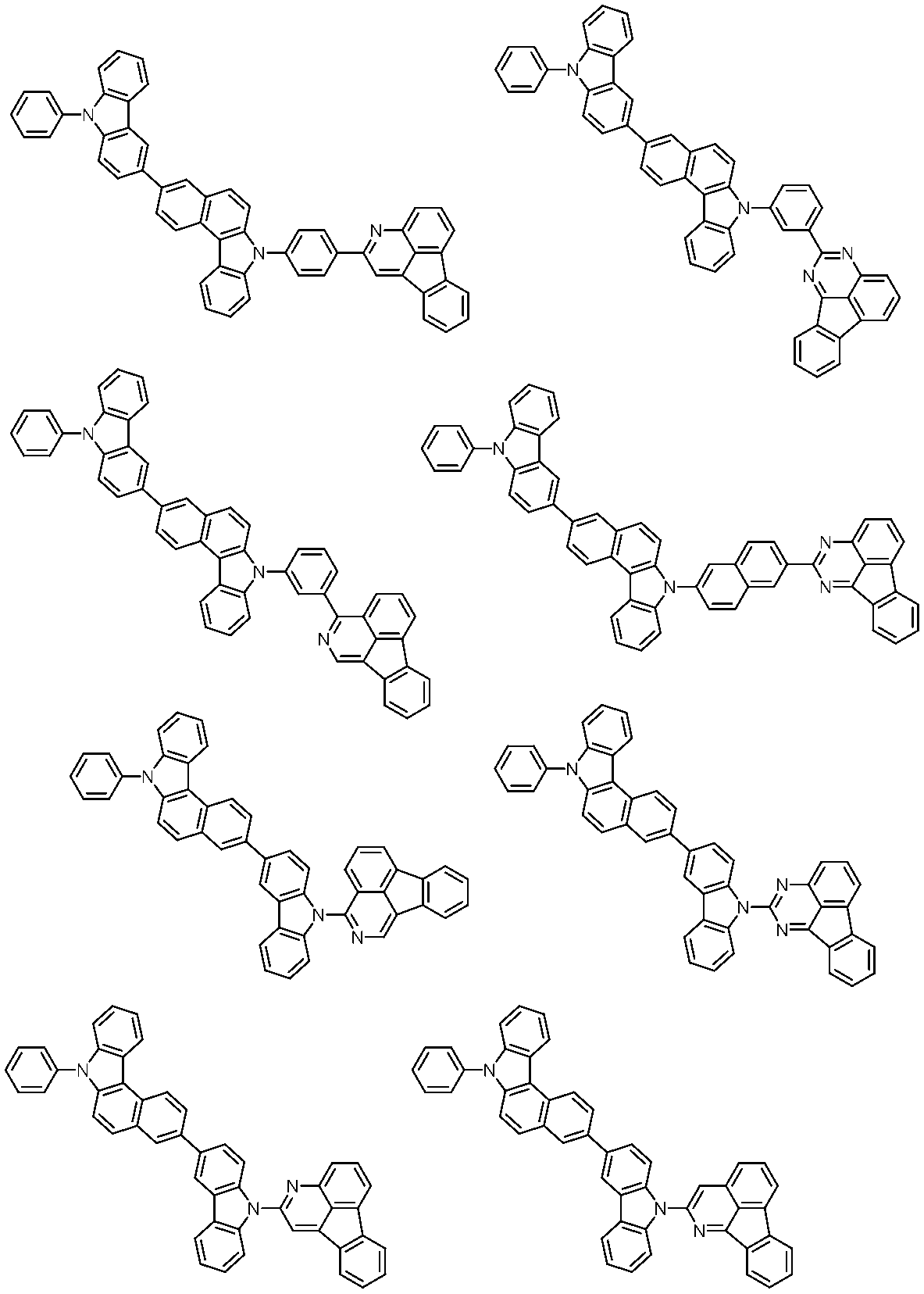
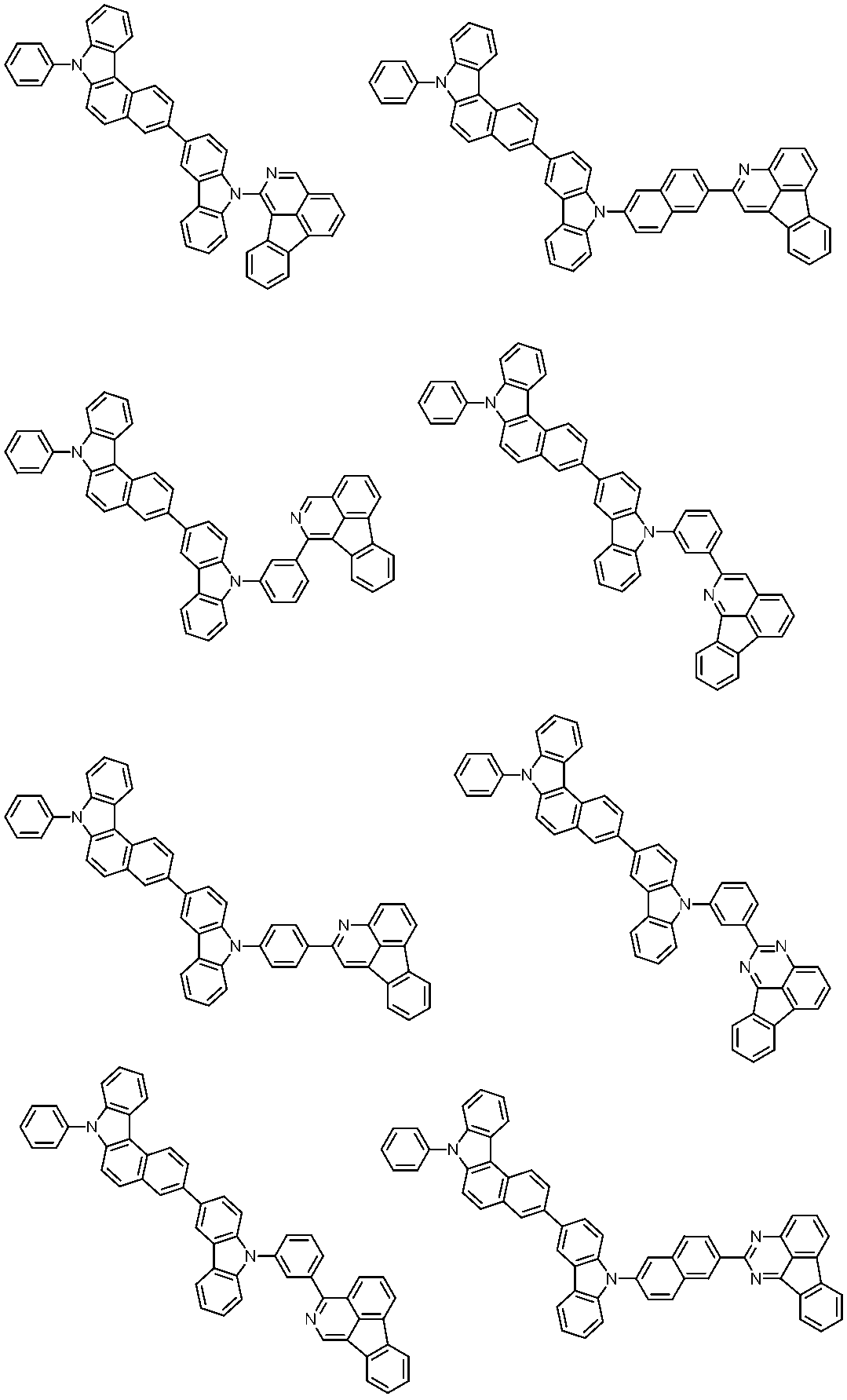
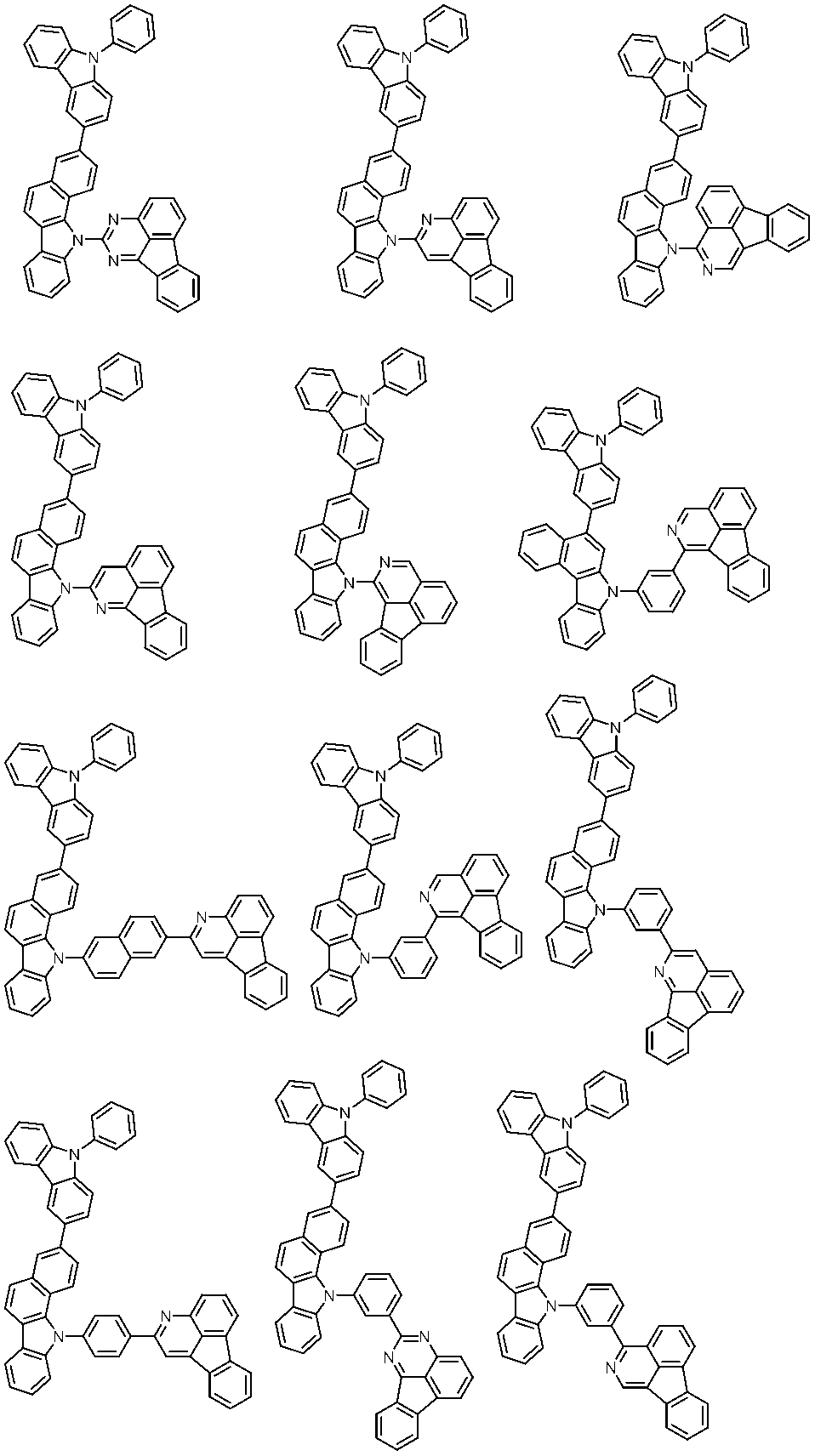


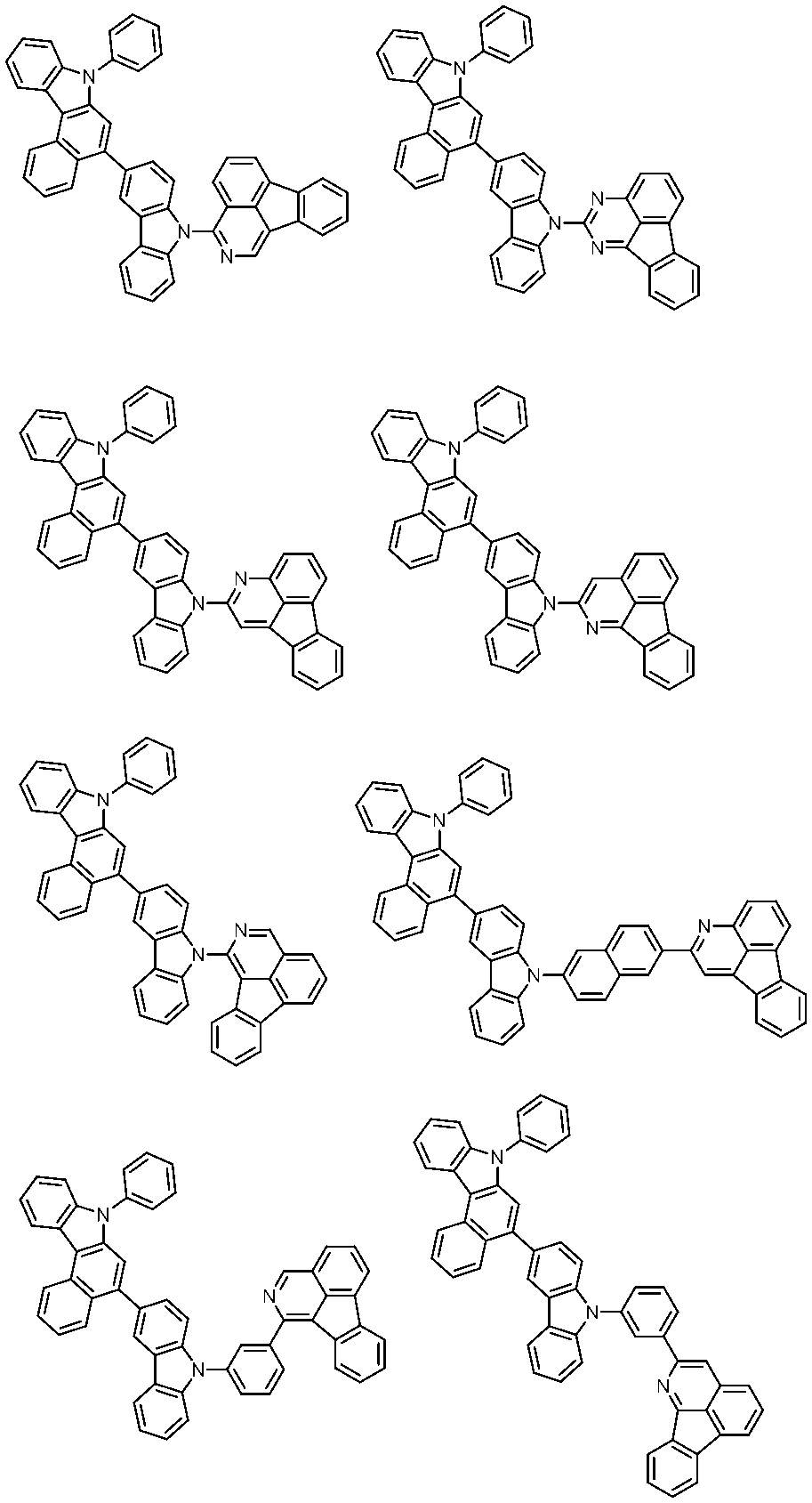


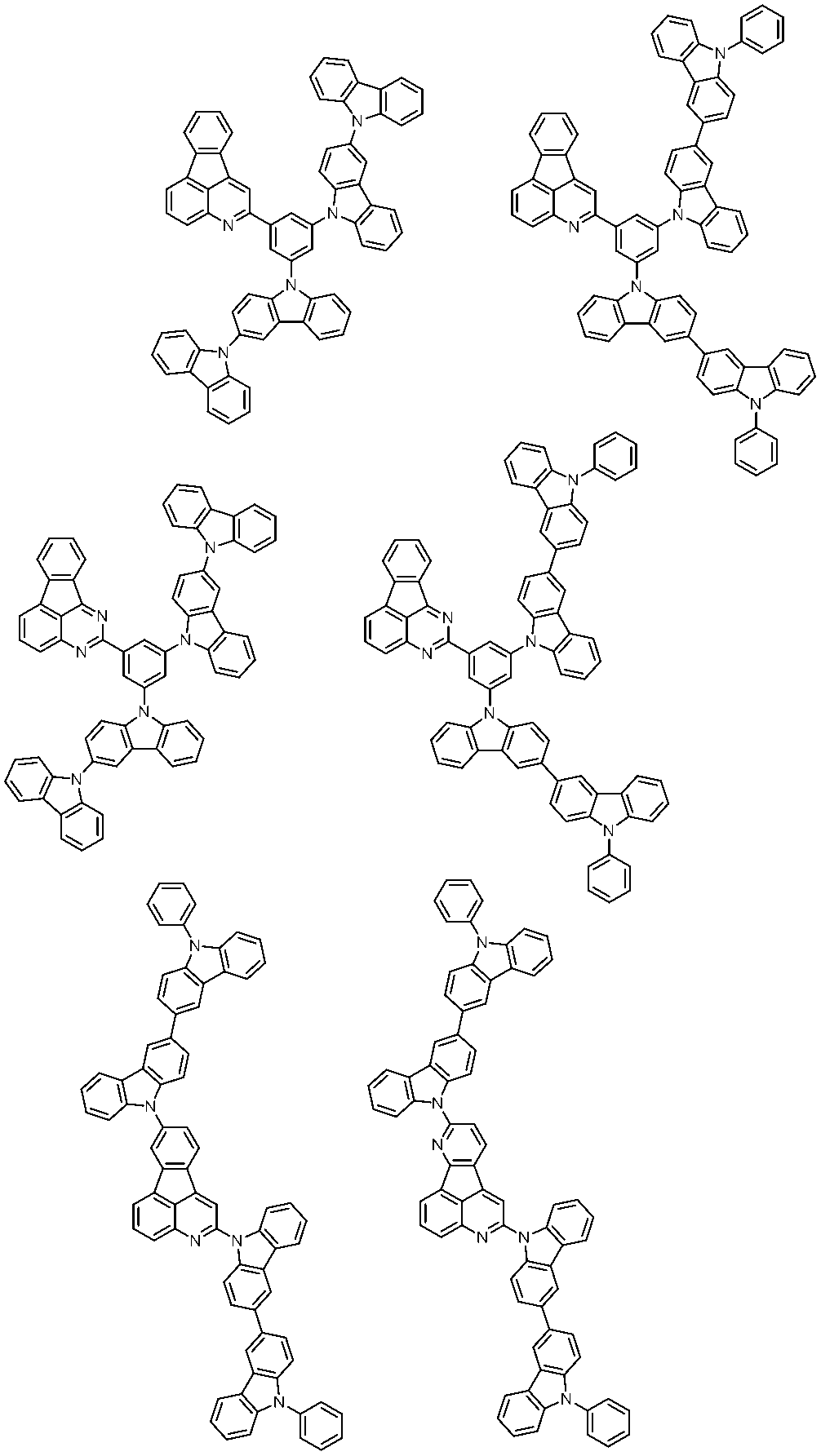
[有機エレクトロルミネッセンス素子(有機EL素子)]
次に、本発明の一態様の有機EL素子について説明する。
本発明の一実施態様の有機EL素子は、陰極、陽極、及び陰極と陽極間に挟持された一層又は複数層からなる有機薄膜層を含む有機エレクトロルミネッセンス素子において、該有機薄膜層は発光層を含み、該有機薄膜層の少なくとも1層が本発明の前記化合物〔前記式(1)で表される化合物、及び、それに包含される下位概念の前記各化合物、又は前記式(13)で表される化合物、及び、それに包含される下位概念の前記各化合物〕を含む。
本発明の前記化合物が含まれる有機薄膜層の例としては、陽極と発光層との間に設けられる陽極側有機薄膜層(正孔輸送層、正孔注入層等)、発光層、陰極と発光層との間に設けられる陰極側有機薄膜層(電子輸送層、電子注入層等)、スペース層、障壁層等が挙げられるが、これらに限定されるものではない。前記化合物(1)は、上記いずれの層に含まれていてもよく、例えば、蛍光発光ユニットの発光層におけるホスト材料やドーパント材料、燐光発光ユニットの発光層におけるホスト材料、発光ユニットの正孔輸送層材料、電子輸送層材料等として用いることができる。特に、発光層が本発明の前記化合物を含むことが好ましく、その場合、本発明の前記化合物はホスト材料として機能し得る。
次に、本発明の一態様の有機EL素子について説明する。
本発明の一実施態様の有機EL素子は、陰極、陽極、及び陰極と陽極間に挟持された一層又は複数層からなる有機薄膜層を含む有機エレクトロルミネッセンス素子において、該有機薄膜層は発光層を含み、該有機薄膜層の少なくとも1層が本発明の前記化合物〔前記式(1)で表される化合物、及び、それに包含される下位概念の前記各化合物、又は前記式(13)で表される化合物、及び、それに包含される下位概念の前記各化合物〕を含む。
本発明の前記化合物が含まれる有機薄膜層の例としては、陽極と発光層との間に設けられる陽極側有機薄膜層(正孔輸送層、正孔注入層等)、発光層、陰極と発光層との間に設けられる陰極側有機薄膜層(電子輸送層、電子注入層等)、スペース層、障壁層等が挙げられるが、これらに限定されるものではない。前記化合物(1)は、上記いずれの層に含まれていてもよく、例えば、蛍光発光ユニットの発光層におけるホスト材料やドーパント材料、燐光発光ユニットの発光層におけるホスト材料、発光ユニットの正孔輸送層材料、電子輸送層材料等として用いることができる。特に、発光層が本発明の前記化合物を含むことが好ましく、その場合、本発明の前記化合物はホスト材料として機能し得る。
本発明の一態様において、有機EL素子は、蛍光又は燐光発光型の単色発光素子であっても、蛍光/燐光ハイブリッド型の白色発光素子であってもよいし、単独の発光ユニットを有するシンプル型であっても、複数の発光ユニットを有するタンデム型であってもよく、中でも、燐光発光型であることが好ましい。ここで、「発光ユニット」とは、一層以上の有機層を含み、そのうちの一層が発光層であり、注入された正孔と電子が再結合することにより発光することができる最小単位をいう。
従って、シンプル型有機EL素子の代表的な素子構成としては、以下の素子構成を挙げることができる。
(1)陽極/発光ユニット/陰極
また、上記発光ユニットは、燐光発光層や蛍光発光層を複数有する積層型であってもよく、その場合、各発光層の間に、燐光発光層で生成された励起子が蛍光発光層に拡散することを防ぐ目的で、スペース層を有していてもよい。発光ユニットの代表的な層構成を以下に示す。
(a)正孔輸送層/発光層(/電子輸送層)
(b)正孔輸送層/第一燐光発光層/第二燐光発光層(/電子輸送層)
(c)正孔輸送層/燐光発光層/スペース層/蛍光発光層(/電子輸送層)
(d)正孔輸送層/第一燐光発光層/第二燐光発光層/スペース層/蛍光発光層(/電子輸送層)
(e)正孔輸送層/第一燐光発光層/スペース層/第二燐光発光層/スペース層/蛍光発光層(/電子輸送層)
(f)正孔輸送層/燐光発光層/スペース層/第一蛍光発光層/第二蛍光発光層(/電子輸送層)
(g)正孔輸送層/電子障壁層/発光層(/電子輸送層)
(h)正孔輸送層/発光層/正孔障壁層(/電子輸送層)
(i)正孔輸送層/蛍光発光層/トリプレット障壁層(/電子輸送層)
(1)陽極/発光ユニット/陰極
また、上記発光ユニットは、燐光発光層や蛍光発光層を複数有する積層型であってもよく、その場合、各発光層の間に、燐光発光層で生成された励起子が蛍光発光層に拡散することを防ぐ目的で、スペース層を有していてもよい。発光ユニットの代表的な層構成を以下に示す。
(a)正孔輸送層/発光層(/電子輸送層)
(b)正孔輸送層/第一燐光発光層/第二燐光発光層(/電子輸送層)
(c)正孔輸送層/燐光発光層/スペース層/蛍光発光層(/電子輸送層)
(d)正孔輸送層/第一燐光発光層/第二燐光発光層/スペース層/蛍光発光層(/電子輸送層)
(e)正孔輸送層/第一燐光発光層/スペース層/第二燐光発光層/スペース層/蛍光発光層(/電子輸送層)
(f)正孔輸送層/燐光発光層/スペース層/第一蛍光発光層/第二蛍光発光層(/電子輸送層)
(g)正孔輸送層/電子障壁層/発光層(/電子輸送層)
(h)正孔輸送層/発光層/正孔障壁層(/電子輸送層)
(i)正孔輸送層/蛍光発光層/トリプレット障壁層(/電子輸送層)
上記各燐光又は蛍光発光層は、それぞれ互いに異なる発光色を示すものとすることができる。具体的には、上記積層発光ユニット(d)において、正孔輸送層/第一燐光発光層(赤色発光)/第二燐光発光層(緑色発光)/スペース層/蛍光発光層(青色発光)/電子輸送層といった層構成等が挙げられる。
なお、各発光層と正孔輸送層あるいはスペース層との間には、適宜、電子障壁層を設けてもよい。また、各発光層と電子輸送層との間には、適宜、正孔障壁層を設けてもよい。電子障壁層や正孔障壁層を設けることで、電子又は正孔を発光層内に閉じ込めて、発光層における電荷の再結合確率を高め、発光効率を向上させることができる。
なお、各発光層と正孔輸送層あるいはスペース層との間には、適宜、電子障壁層を設けてもよい。また、各発光層と電子輸送層との間には、適宜、正孔障壁層を設けてもよい。電子障壁層や正孔障壁層を設けることで、電子又は正孔を発光層内に閉じ込めて、発光層における電荷の再結合確率を高め、発光効率を向上させることができる。
タンデム型有機EL素子の代表的な素子構成としては、以下の素子構成を挙げることができる。
(2)陽極/第一発光ユニット/中間層/第二発光ユニット/陰極
ここで、上記第一発光ユニット及び第二発光ユニットとしては、例えば、それぞれ独立に上述の発光ユニットと同様のものを選択することができる。
上記中間層は、一般的に、中間電極、中間導電層、電荷発生層、電子引抜層、接続層、中間絶縁層とも呼ばれ、第一発光ユニットに電子を、第二発光ユニットに正孔を供給する、公知の材料構成を用いることができる。
(2)陽極/第一発光ユニット/中間層/第二発光ユニット/陰極
ここで、上記第一発光ユニット及び第二発光ユニットとしては、例えば、それぞれ独立に上述の発光ユニットと同様のものを選択することができる。
上記中間層は、一般的に、中間電極、中間導電層、電荷発生層、電子引抜層、接続層、中間絶縁層とも呼ばれ、第一発光ユニットに電子を、第二発光ユニットに正孔を供給する、公知の材料構成を用いることができる。
図1に、前記有機EL素子の一例の概略構成を示す。有機EL素子1は、基板2、陽極3、陰極4、及び該陽極3と陰極4との間に配置された発光ユニット10とを有する。発光ユニット10は、燐光ホスト材料と燐光ドーパント(燐光発光材料)を含む少なくとも1つの燐光発光層を含む発光層5を有する。発光層5と陽極3との間に正孔注入・輸送層(陽極側有機薄膜層)6等、発光層5と陰極4との間に電子注入・輸送層(陰極側有機薄膜層)7等を形成してもよい。また、発光層5の陽極3側に電子障壁層(図示せず)を、発光層5の陰極4側に正孔障壁層(図示せず)を、それぞれ設けてもよい。これにより、電子や正孔を発光層5に閉じ込めて、発光層5における励起子の生成確率をさらに高めることができる。
なお、本発明において、蛍光ドーパント(蛍光発光材料)と組み合わされたホストを蛍光ホストと称し、燐光ドーパントと組み合わされたホストを燐光ホストと称する。蛍光ホストと燐光ホストは分子構造のみにより区分されるものではない。すなわち、燐光ホストとは、燐光ドーパントを含有する燐光発光層を形成する材料を意味し、蛍光発光層を形成する材料として利用できないことを意味しているわけではない。蛍光ホストについても同様である。
(基板)
基板は、発光素子の支持体として用いられる。基板としては、例えば、ガラス、石英、プラスチックなどを用いることができる。また、可撓性基板を用いてもよい。可撓性基板とは、折り曲げることができる(フレキシブル)基板のことであり、例えば、ポリカーボネート、ポリ塩化ビニルからなるプラスチック基板等が挙げられる。
基板は、発光素子の支持体として用いられる。基板としては、例えば、ガラス、石英、プラスチックなどを用いることができる。また、可撓性基板を用いてもよい。可撓性基板とは、折り曲げることができる(フレキシブル)基板のことであり、例えば、ポリカーボネート、ポリ塩化ビニルからなるプラスチック基板等が挙げられる。
(陽極)
基板上に形成される陽極には、仕事関数の大きい(具体的には4.0eV以上)金属、合金、電気伝導性化合物、およびこれらの混合物などを用いることが好ましい。具体的には、例えば、酸化インジウム-酸化スズ(ITO:Indium Tin Oxide)、珪素若しくは酸化珪素を含有した酸化インジウム-酸化スズ、酸化インジウム-酸化亜鉛、酸化タングステン、および酸化亜鉛を含有した酸化インジウム、グラフェン等が挙げられる。この他、金(Au)、白金(Pt)、または金属材料の窒化物(例えば、窒化チタン)等が挙げられる。
基板上に形成される陽極には、仕事関数の大きい(具体的には4.0eV以上)金属、合金、電気伝導性化合物、およびこれらの混合物などを用いることが好ましい。具体的には、例えば、酸化インジウム-酸化スズ(ITO:Indium Tin Oxide)、珪素若しくは酸化珪素を含有した酸化インジウム-酸化スズ、酸化インジウム-酸化亜鉛、酸化タングステン、および酸化亜鉛を含有した酸化インジウム、グラフェン等が挙げられる。この他、金(Au)、白金(Pt)、または金属材料の窒化物(例えば、窒化チタン)等が挙げられる。
(陰極)
陰極には、仕事関数の小さい(具体的には3.8eV以下)金属、合金、電気伝導性化合物、およびこれらの混合物などを用いることが好ましい。このような陰極材料の具体例としては、元素周期表の第1族または第2族に属する元素、すなわちリチウム(Li)やセシウム(Cs)等のアルカリ金属、およびマグネシウム(Mg)等のアルカリ土類金属、およびこれらを含む合金(例えば、MgAg、AlLi)等の希土類金属およびこれらを含む合金等が挙げられる。
陰極には、仕事関数の小さい(具体的には3.8eV以下)金属、合金、電気伝導性化合物、およびこれらの混合物などを用いることが好ましい。このような陰極材料の具体例としては、元素周期表の第1族または第2族に属する元素、すなわちリチウム(Li)やセシウム(Cs)等のアルカリ金属、およびマグネシウム(Mg)等のアルカリ土類金属、およびこれらを含む合金(例えば、MgAg、AlLi)等の希土類金属およびこれらを含む合金等が挙げられる。
(発光層のゲスト材料)
発光層は、発光性の高い物質を含む層であり、種々の材料を用いることができる。例えば、発光性の高い物質としては、蛍光を発光する蛍光性化合物や燐光を発光する燐光性化合物を用いることができる。蛍光性化合物は一重項励起状態から発光可能な化合物であり、燐光性化合物は三重項励起状態から発光可能な化合物である。
発光層は、発光性の高い物質を含む層であり、種々の材料を用いることができる。例えば、発光性の高い物質としては、蛍光を発光する蛍光性化合物や燐光を発光する燐光性化合物を用いることができる。蛍光性化合物は一重項励起状態から発光可能な化合物であり、燐光性化合物は三重項励起状態から発光可能な化合物である。
発光層に用いることができる青色系の蛍光発光材料として、ピレン誘導体、スチリルアミン誘導体、クリセン誘導体、フルオランテン誘導体、フルオレン誘導体、ジアミン誘導体、トリアリールアミン誘導体等が使用できる。具体的には、N,N'-ビス[4-(9H-カルバゾール-9-イル)フェニル]-N,N'-ジフェニルスチルベン-4,4'-ジアミン(略称:YGA2S)、4-(9H-カルバゾール-9-イル)-4'-(10-フェニル-9-アントリル)トリフェニルアミン(略称:YGAPA)、4-(10-フェニル-9-アントリル)-4'-(9-フェニル-9H-カルバゾール-3-イル)トリフェニルアミン(略称:PCBAPA)などが挙げられる。
発光層に用いることができる緑色系の蛍光発光材料として、芳香族アミン誘導体等を使用できる。具体的には、N-(9,10-ジフェニル-2-アントリル)-N,9-ジフェニル-9H-カルバゾール-3-アミン(略称:2PCAPA)、N-[9,10-ビス(1,1'-ビフェニル-2-イル)-2-アントリル]-N,9-ジフェニル-9H-カルバゾール-3-アミン(略称:2PCABPhA)、N-(9,10-ジフェニル-2-アントリル)-N,N',N'-トリフェニル-1,4-フェニレンジアミン(略称:2DPAPA)、N-[9,10-ビス(1,1'-ビフェニル-2-イル)-2-アントリル]-N,N',N'-トリフェニル-1,4-フェニレンジアミン(略称:2DPABPhA)、N-[9,10-ビス(1,1'-ビフェニル-2-イル)]-N-[4-(9H-カルバゾール-9-イル)フェニル]-N-フェニルアントラセン-2-アミン(略称:2YGABPhA)、N,N,9-トリフェニルアントラセン-9-アミン(略称:DPhAPhA)などが挙げられる。
発光層に用いることができる赤色系の蛍光発光材料として、テトラセン誘導体、ジアミン誘導体等が使用できる。具体的には、N,N,N',N'-テトラキス(4-メチルフェニル)テトラセン-5,11-ジアミン(略称:p-mPhTD)、7,14-ジフェニル-N,N,N',N'-テトラキス(4-メチルフェニル)アセナフト[1,2-a]フルオランテン-3,10-ジアミン(略称:p-mPhAFD)などが挙げられる。
発光層に用いることができる赤色系の蛍光発光材料として、テトラセン誘導体、ジアミン誘導体等が使用できる。具体的には、N,N,N',N'-テトラキス(4-メチルフェニル)テトラセン-5,11-ジアミン(略称:p-mPhTD)、7,14-ジフェニル-N,N,N',N'-テトラキス(4-メチルフェニル)アセナフト[1,2-a]フルオランテン-3,10-ジアミン(略称:p-mPhAFD)などが挙げられる。
発光層に用いることができる青色系の燐光発光材料として、イリジウム(Ir)、オスミウム(Os)、白金(Pt)から選択される金属原子のオルトメタル化錯体、すなわち、イリジウム錯体、オスミウム錯体、白金錯体等の金属錯体が使用される。具体的には、ビス[2-(4',6'-ジフルオロフェニル)ピリジナト-N,C2']イリジウム(III)テトラキス(1-ピラゾリル)ボラート(略称:FIr6)、ビス[2-(4',6'-ジフルオロフェニル)ピリジナト-N,C2']イリジウム(III)ピコリナート(略称:FIrpic)、ビス[2-(3',5'ビストリフルオロメチルフェニル)ピリジナト-N,C2']イリジウム(III)ピコリナート(略称:Ir(CF3ppy)2(pic))、ビス[2-(4',6'-ジフルオロフェニル)ピリジナト-N,C2']イリジウム(III)アセチルアセトナート(略称:FIracac)などが挙げられる。
発光層に用いることができる緑色系の燐光発光材料として、イリジウム錯体等が使用される。トリス(2-フェニルピリジナト-N,C2')イリジウム(III)(略称:Ir(ppy)3)、ビス(2-フェニルピリジナト-N,C2')イリジウム(III)アセチルアセトナート(略称:Ir(ppy)2(acac))、ビス(1,2-ジフェニル-1H-ベンゾイミダゾラト)イリジウム(III)アセチルアセトナート(略称:Ir(pbi)2(acac))、ビス(ベンゾ[h]キノリナト)イリジウム(III)アセチルアセトナート(略称:Ir(bzq)2(acac))などが挙げられる。
発光層に用いることができる緑色系の燐光発光材料として、イリジウム錯体等が使用される。トリス(2-フェニルピリジナト-N,C2')イリジウム(III)(略称:Ir(ppy)3)、ビス(2-フェニルピリジナト-N,C2')イリジウム(III)アセチルアセトナート(略称:Ir(ppy)2(acac))、ビス(1,2-ジフェニル-1H-ベンゾイミダゾラト)イリジウム(III)アセチルアセトナート(略称:Ir(pbi)2(acac))、ビス(ベンゾ[h]キノリナト)イリジウム(III)アセチルアセトナート(略称:Ir(bzq)2(acac))などが挙げられる。
発光層に用いることができる赤色系の燐光発光材料として、イリジウム錯体、白金錯体、テルビウム錯体、ユーロピウム錯体等の金属錯体が使用される。具体的には、ビス[2-(2'-ベンゾ[4,5-α]チエニル)ピリジナト-N,C3']イリジウム(III)アセチルアセトナート(略称:Ir(btp)2(acac))、ビス(1-フェニルイソキノリナト-N,C2')イリジウム(III)アセチルアセトナート(略称:Ir(piq)2(acac))、(アセチルアセトナト)ビス[2,3-ビス(4-フルオロフェニル)キノキサリナト]イリジウム(III)(略称:Ir(Fdpq)2(acac))、2,3,7,8,12,13,17,18-オクタエチル-21H,23H-ポルフィリン白金(II)(略称:PtOEP)等の有機金属錯体が挙げられる。
また、トリス(アセチルアセトナト)(モノフェナントロリン)テルビウム(III)(略称:Tb(acac)3(Phen)、)トリス(1,3-ジフェニル-1,3-プロパンジオナト)(モノフェナントロリン)ユーロピウム(III)(略称:Eu(DBM)3(Phen))、トリス[1-(2-テノイル)-3,3,3-トリフルオロアセトナト](モノフェナントロリン)ユーロピウム(III)(略称:Eu(TTA)3(Phen))等の希土類金属錯体は、希土類金属イオンからの発光(異なる多重度間の電子遷移)であるため、燐光性化合物として用いることができる。
イリジウム(Ir)、オスミウム(Os)、白金(Pt)から選択される金属原子のオルトメタル化錯体である燐光発光材料は、下記式(V)、(X)、(Y)又は(Z)で表される錯体であることが好ましい。
また、トリス(アセチルアセトナト)(モノフェナントロリン)テルビウム(III)(略称:Tb(acac)3(Phen)、)トリス(1,3-ジフェニル-1,3-プロパンジオナト)(モノフェナントロリン)ユーロピウム(III)(略称:Eu(DBM)3(Phen))、トリス[1-(2-テノイル)-3,3,3-トリフルオロアセトナト](モノフェナントロリン)ユーロピウム(III)(略称:Eu(TTA)3(Phen))等の希土類金属錯体は、希土類金属イオンからの発光(異なる多重度間の電子遷移)であるため、燐光性化合物として用いることができる。
イリジウム(Ir)、オスミウム(Os)、白金(Pt)から選択される金属原子のオルトメタル化錯体である燐光発光材料は、下記式(V)、(X)、(Y)又は(Z)で表される錯体であることが好ましい。
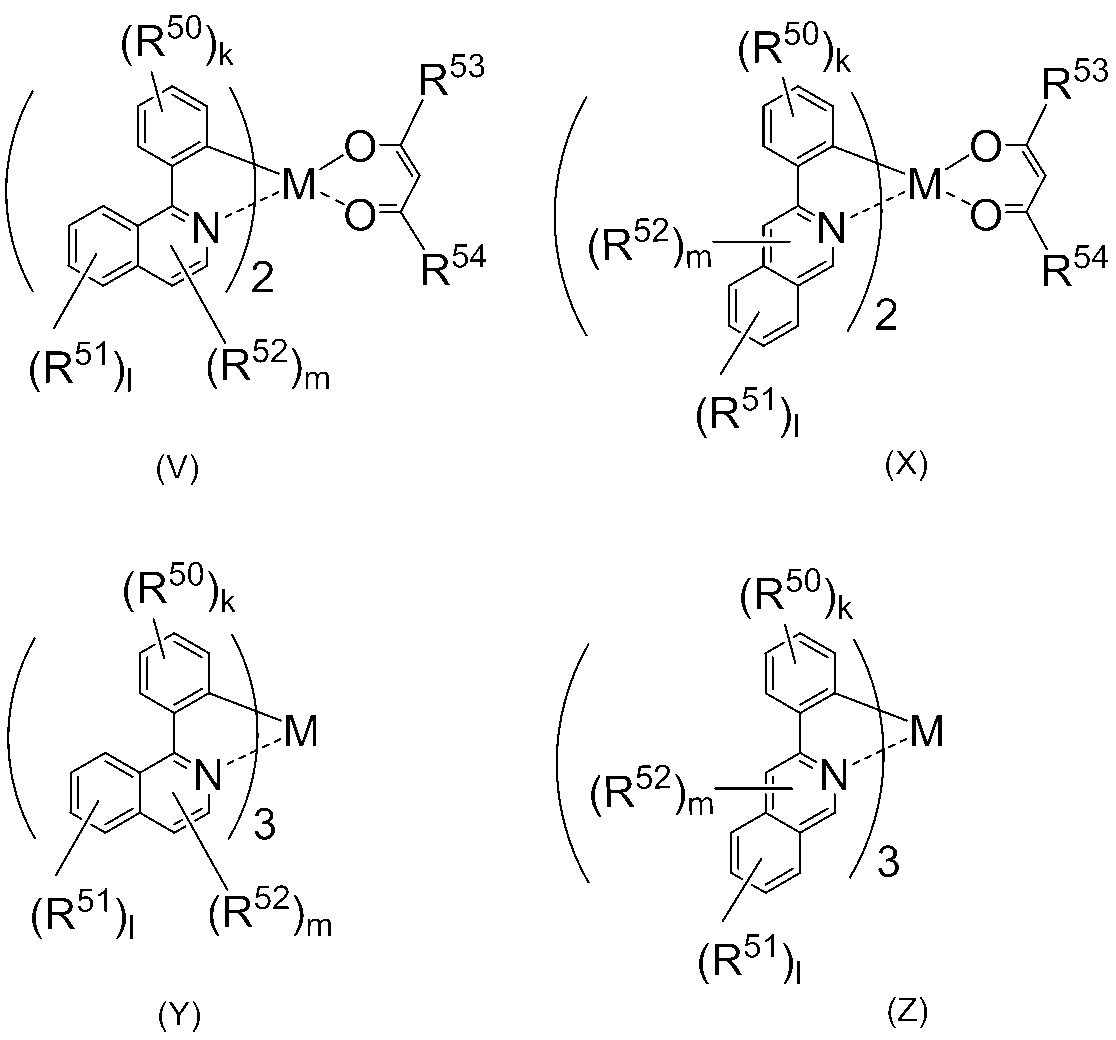
式(V)、(X)、(Y)又は(Z)において、R50~R54は、水素原子又は置換基、kは1~4の整数であり、lは1~4の整数であり、mは1~2の整数である。Mは、Ir、Os、又はPtである。
R50~R54の示す置換基としては、上記式(1)のR1で例示した置換基と同様のものが挙げられる。
式(V)は下記式(V-1)で表されることが好ましく、式(X)は下記式(X-1)又は式(X-2)で表されることが好ましい。下記式(X-1)、(X-1)、及び(X-1)において、R50、k及びMは、上記の、R50、k及びMと同じである。
R50~R54の示す置換基としては、上記式(1)のR1で例示した置換基と同様のものが挙げられる。
式(V)は下記式(V-1)で表されることが好ましく、式(X)は下記式(X-1)又は式(X-2)で表されることが好ましい。下記式(X-1)、(X-1)、及び(X-1)において、R50、k及びMは、上記の、R50、k及びMと同じである。

以下、好ましい金属錯体の具体例を、以下に示すが、特にこれらに制限されるものではない。
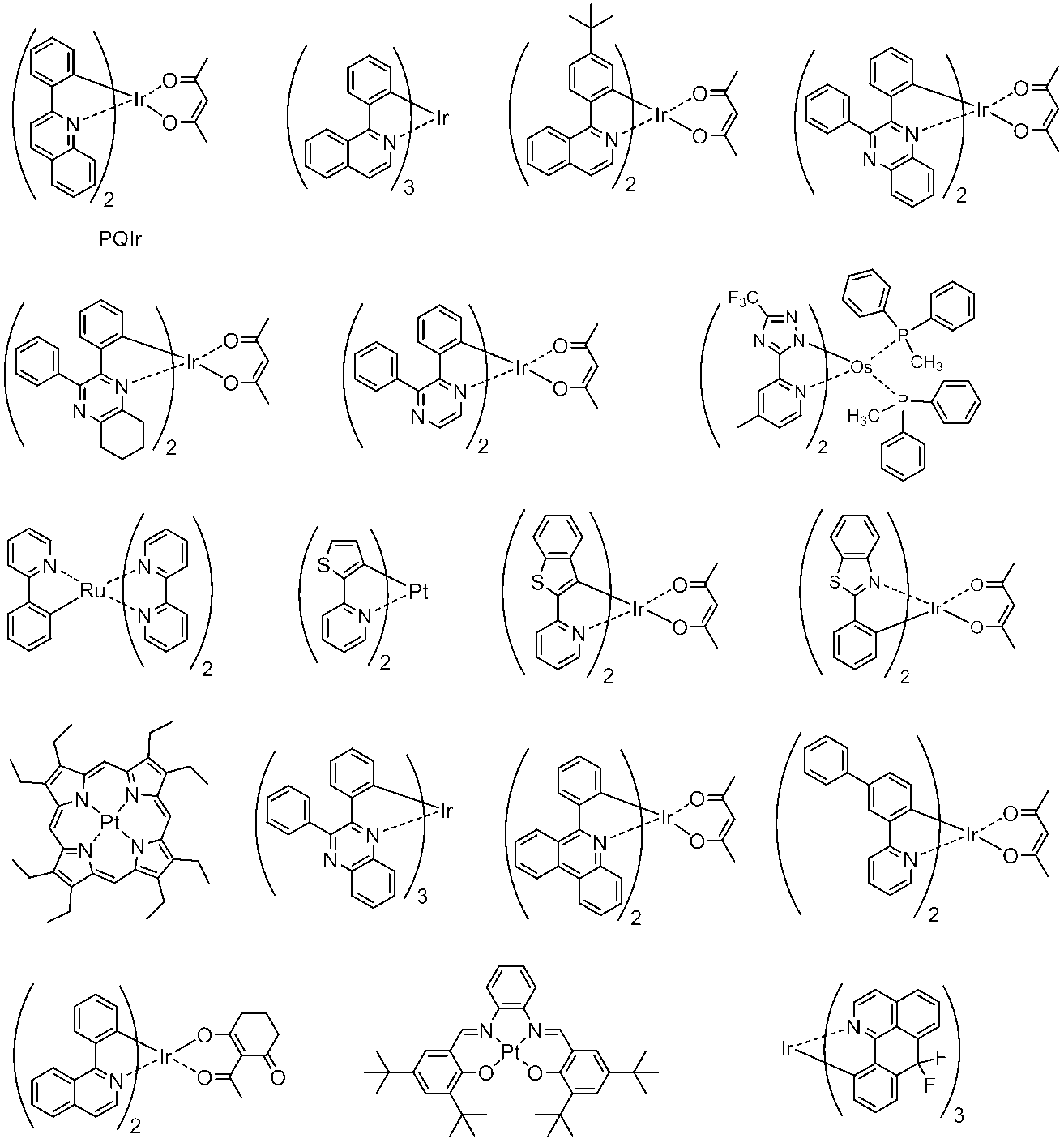

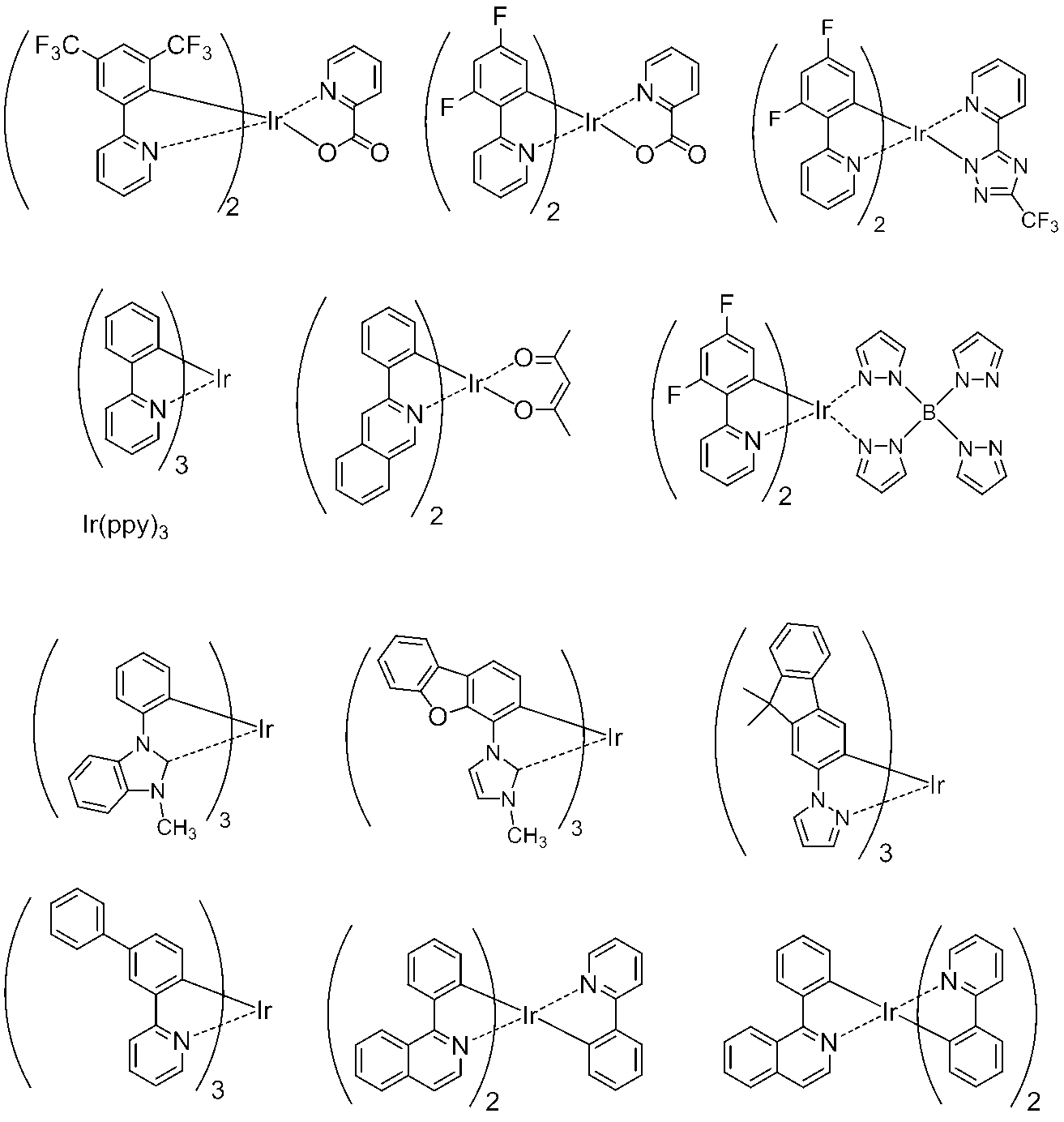
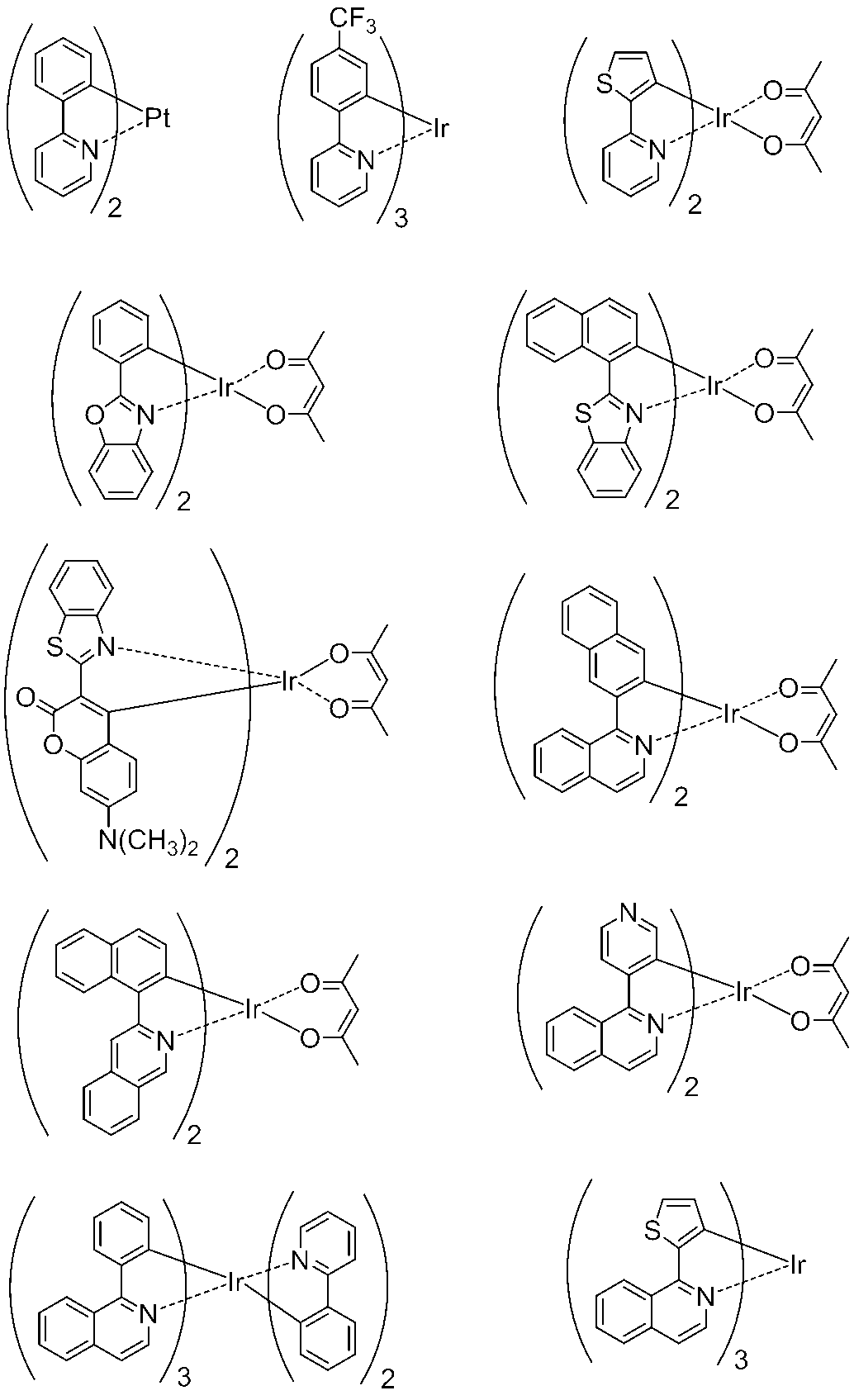
(発光層のホスト材料)
発光層としては、上述した発光性の高い物質(ゲスト材料)を他の物質(ホスト材料)に分散させた構成としてもよい。発光性の高い物質を分散させるための物質としては、各種のものを用いることができ、発光性の高い物質よりも最低空軌道準位(LUMO準位)が高く、最高被占有軌道準位(HOMO準位)が低い物質を用いることが好ましい。
発光性の高い物質を分散させるための物質(ホスト材料)としては、本発明の前記化合物が好ましい。本発明の前記化合物以外にも、例えば、1)アルミニウム錯体、ベリリウム錯体、若しくは亜鉛錯体等の金属錯体、2)オキサジアゾール誘導体、ベンゾイミダゾール誘導体、若しくはフェナントロリン誘導体等の複素環化合物、3)カルバゾール誘導体、アントラセン誘導体、フェナントレン誘導体、ピレン誘導体、若しくはクリセン誘導体等の縮合芳香族化合物、4)トリアリールアミン誘導体、若しくは縮合多環芳香族アミン誘導体等の芳香族アミン化合物を使用できる。より具体的には、トリス(8-キノリノラト)アルミニウム(III)(略称:Alq)、トリス(4-メチル-8-キノリノラト)アルミニウム(III)(略称:Almq3)、ビス(10-ヒドロキシベンゾ[h]キノリナト)ベリリウム(II)(略称:BeBq2)、ビス(2-メチル-8-キノリノラト)(4-フェニルフェノラト)アルミニウム(III)(略称:BAlq)、ビス(8-キノリノラト)亜鉛(II)(略称:Znq)、ビス[2-(2-ベンゾオキサゾリル)フェノラト]亜鉛(II)(略称:ZnPBO)、ビス[2-(2-ベンゾチアゾリル)フェノラト]亜鉛(II)(略称:ZnBTZ)などの金属錯体、2-(4-ビフェニリル)-5-(4-tert-ブチルフェニル)-1,3,4-オキサジアゾール(略称:PBD)、1,3-ビス[5-(p-tert-ブチルフェニル)-1,3,4-オキサジアゾール-2-イル]ベンゼン(略称:OXD-7)、3-(4-ビフェニリル)-4-フェニル-5-(4-tert-ブチルフェニル)-1,2,4-トリアゾール(略称:TAZ)、2,2',2''-(1,3,5-ベンゼントリイル)トリス(1-フェニル-1H-ベンゾイミダゾール)(略称:TPBI)、バソフェナントロリン(略称:BPhen)、バソキュプロイン(略称:BCP)などの複素環化合物や、9-[4-(10-フェニル-9-アントリル)フェニル]-9H-カルバゾール(略称:CzPA)、3,6-ジフェニル-9-[4-(10-フェニル-9-アントリル)フェニル]-9H-カルバゾール(略称:DPCzPA)、9,10-ビス(3,5-ジフェニルフェニル)アントラセン(略称:DPPA)、9,10-ジ(2-ナフチル)アントラセン(略称:DNA)、2-tert-ブチル-9,10-ジ(2-ナフチル)アントラセン(略称:t-BuDNA)、9,9'-ビアントリル(略称:BANT)、9,9'-(スチルベン-3,3'-ジイル)ジフェナントレン(略称:DPNS)、9,9'-(スチルベン-4,4'-ジイル)ジフェナントレン(略称:DPNS2)、3,3',3''-(ベンゼン-1,3,5-トリイル)トリピレン(略称:TPB3)、9,10-ジフェニルアントラセン(略称:DPAnth)、6,12-ジメトキシ-5,11-ジフェニルクリセンなどの縮合芳香族化合物、N,N-ジフェニル-9-[4-(10-フェニル-9-アントリル)フェニル]-9H-カルバゾール-3-アミン(略称:CzA1PA)、4-(10-フェニル-9-アントリル)トリフェニルアミン(略称:DPhPA)、N,9-ジフェニル-N-[4-(10-フェニル-9-アントリル)フェニル]-9H-カルバゾール-3-アミン(略称:PCAPA)、N,9-ジフェニル-N-{4-[4-(10-フェニル-9-アントリル)フェニル]フェニル}-9H-カルバゾール-3-アミン(略称:PCAPBA)、N-(9,10-ジフェニル-2-アントリル)-N,9-ジフェニル-9H-カルバゾール-3-アミン(略称:2PCAPA)、NPB(またはα-NPD)、TPD、DFLDPBi、BSPBなどの芳香族アミン化合物などを用いることができる。また、発光性の高い物質(ゲスト材料)を分散させるための物質(ホスト材料)は複数種用いることができる。
発光層としては、上述した発光性の高い物質(ゲスト材料)を他の物質(ホスト材料)に分散させた構成としてもよい。発光性の高い物質を分散させるための物質としては、各種のものを用いることができ、発光性の高い物質よりも最低空軌道準位(LUMO準位)が高く、最高被占有軌道準位(HOMO準位)が低い物質を用いることが好ましい。
発光性の高い物質を分散させるための物質(ホスト材料)としては、本発明の前記化合物が好ましい。本発明の前記化合物以外にも、例えば、1)アルミニウム錯体、ベリリウム錯体、若しくは亜鉛錯体等の金属錯体、2)オキサジアゾール誘導体、ベンゾイミダゾール誘導体、若しくはフェナントロリン誘導体等の複素環化合物、3)カルバゾール誘導体、アントラセン誘導体、フェナントレン誘導体、ピレン誘導体、若しくはクリセン誘導体等の縮合芳香族化合物、4)トリアリールアミン誘導体、若しくは縮合多環芳香族アミン誘導体等の芳香族アミン化合物を使用できる。より具体的には、トリス(8-キノリノラト)アルミニウム(III)(略称:Alq)、トリス(4-メチル-8-キノリノラト)アルミニウム(III)(略称:Almq3)、ビス(10-ヒドロキシベンゾ[h]キノリナト)ベリリウム(II)(略称:BeBq2)、ビス(2-メチル-8-キノリノラト)(4-フェニルフェノラト)アルミニウム(III)(略称:BAlq)、ビス(8-キノリノラト)亜鉛(II)(略称:Znq)、ビス[2-(2-ベンゾオキサゾリル)フェノラト]亜鉛(II)(略称:ZnPBO)、ビス[2-(2-ベンゾチアゾリル)フェノラト]亜鉛(II)(略称:ZnBTZ)などの金属錯体、2-(4-ビフェニリル)-5-(4-tert-ブチルフェニル)-1,3,4-オキサジアゾール(略称:PBD)、1,3-ビス[5-(p-tert-ブチルフェニル)-1,3,4-オキサジアゾール-2-イル]ベンゼン(略称:OXD-7)、3-(4-ビフェニリル)-4-フェニル-5-(4-tert-ブチルフェニル)-1,2,4-トリアゾール(略称:TAZ)、2,2',2''-(1,3,5-ベンゼントリイル)トリス(1-フェニル-1H-ベンゾイミダゾール)(略称:TPBI)、バソフェナントロリン(略称:BPhen)、バソキュプロイン(略称:BCP)などの複素環化合物や、9-[4-(10-フェニル-9-アントリル)フェニル]-9H-カルバゾール(略称:CzPA)、3,6-ジフェニル-9-[4-(10-フェニル-9-アントリル)フェニル]-9H-カルバゾール(略称:DPCzPA)、9,10-ビス(3,5-ジフェニルフェニル)アントラセン(略称:DPPA)、9,10-ジ(2-ナフチル)アントラセン(略称:DNA)、2-tert-ブチル-9,10-ジ(2-ナフチル)アントラセン(略称:t-BuDNA)、9,9'-ビアントリル(略称:BANT)、9,9'-(スチルベン-3,3'-ジイル)ジフェナントレン(略称:DPNS)、9,9'-(スチルベン-4,4'-ジイル)ジフェナントレン(略称:DPNS2)、3,3',3''-(ベンゼン-1,3,5-トリイル)トリピレン(略称:TPB3)、9,10-ジフェニルアントラセン(略称:DPAnth)、6,12-ジメトキシ-5,11-ジフェニルクリセンなどの縮合芳香族化合物、N,N-ジフェニル-9-[4-(10-フェニル-9-アントリル)フェニル]-9H-カルバゾール-3-アミン(略称:CzA1PA)、4-(10-フェニル-9-アントリル)トリフェニルアミン(略称:DPhPA)、N,9-ジフェニル-N-[4-(10-フェニル-9-アントリル)フェニル]-9H-カルバゾール-3-アミン(略称:PCAPA)、N,9-ジフェニル-N-{4-[4-(10-フェニル-9-アントリル)フェニル]フェニル}-9H-カルバゾール-3-アミン(略称:PCAPBA)、N-(9,10-ジフェニル-2-アントリル)-N,9-ジフェニル-9H-カルバゾール-3-アミン(略称:2PCAPA)、NPB(またはα-NPD)、TPD、DFLDPBi、BSPBなどの芳香族アミン化合物などを用いることができる。また、発光性の高い物質(ゲスト材料)を分散させるための物質(ホスト材料)は複数種用いることができる。
(電子輸送層)
電子輸送層は、電子輸送性の高い物質を含む層である。電子輸送層には、
1)アルミニウム錯体、ベリリウム錯体、亜鉛錯体等の金属錯体、
2)イミダゾール誘導体、ベンゾイミダゾール誘導体、アジン誘導体、カルバゾール誘導体、フェナントロリン誘導体等の複素芳香族化合物、
3)高分子化合物
を使用することができる。
電子輸送層は、電子輸送性の高い物質を含む層である。電子輸送層には、
1)アルミニウム錯体、ベリリウム錯体、亜鉛錯体等の金属錯体、
2)イミダゾール誘導体、ベンゾイミダゾール誘導体、アジン誘導体、カルバゾール誘導体、フェナントロリン誘導体等の複素芳香族化合物、
3)高分子化合物
を使用することができる。
(電子注入層)
電子注入層は、電子注入性の高い物質を含む層である。電子注入層には、リチウム(Li)、フッ化リチウム(LiF)、フッ化セシウム(CsF)、フッ化カルシウム(CaF2)、リチウム酸化物(LiOx)等のようなアルカリ金属、アルカリ土類金属、またはそれらの化合物を用いることができる。
また、陰極にアルミニウムを用いる場合は、電子注入性を高める点から、8-キノリノラトリチウム(略称:Liq)、Alq、トリス(4-メチル-8-キノリノラト)アルミニウム(略称:Almq3)、ビス(10-ヒドロキシベンゾ[h]キノリナト)ベリリウム(略称:BeBq2)、BAlq、Znq、ZnPBO、ZnBTZ等の有機金属錯体を用いることもできる。
電子注入層は、電子注入性の高い物質を含む層である。電子注入層には、リチウム(Li)、フッ化リチウム(LiF)、フッ化セシウム(CsF)、フッ化カルシウム(CaF2)、リチウム酸化物(LiOx)等のようなアルカリ金属、アルカリ土類金属、またはそれらの化合物を用いることができる。
また、陰極にアルミニウムを用いる場合は、電子注入性を高める点から、8-キノリノラトリチウム(略称:Liq)、Alq、トリス(4-メチル-8-キノリノラト)アルミニウム(略称:Almq3)、ビス(10-ヒドロキシベンゾ[h]キノリナト)ベリリウム(略称:BeBq2)、BAlq、Znq、ZnPBO、ZnBTZ等の有機金属錯体を用いることもできる。
(正孔注入層)
正孔注入層は、正孔注入性の高い物質を含む層である。正孔注入性の高い物質としては、モリブデン酸化物、チタン酸化物、バナジウム酸化物、レニウム酸化物、ルテニウム酸化物、クロム酸化物、ジルコニウム酸化物、ハフニウム酸化物、タンタル酸化物、銀酸化物、タングステン酸化物、マンガン酸化物、芳香族アミン化合物、又は高分子化合物(オリゴマー、デンドリマー、ポリマー等)等も使用できる。
正孔注入層は、正孔注入性の高い物質を含む層である。正孔注入性の高い物質としては、モリブデン酸化物、チタン酸化物、バナジウム酸化物、レニウム酸化物、ルテニウム酸化物、クロム酸化物、ジルコニウム酸化物、ハフニウム酸化物、タンタル酸化物、銀酸化物、タングステン酸化物、マンガン酸化物、芳香族アミン化合物、又は高分子化合物(オリゴマー、デンドリマー、ポリマー等)等も使用できる。
(正孔輸送層)
正孔輸送層は、正孔輸送性の高い物質を含む層である。正孔輸送層には、芳香族アミン化合物、カルバゾール誘導体、アントラセン誘導体等を使用する事ができる。ポリ(N-ビニルカルバゾール)(略称:PVK)やポリ(4-ビニルトリフェニルアミン)(略称:PVTPA)等の高分子化合物を用いることもできる。但し、電子よりも正孔の輸送性の高い物質であれば、これら以外のものを用いてもよい。なお、正孔輸送性の高い物質を含む層は、単層のものだけでなく、上記物質からなる層が二層以上積層したものとしてもよい。
正孔輸送層は、陽極と発光層との間に、第1の電荷輸送層として位置し、該第1の電荷輸送層が式(1)又は式(13)で表される化合物を含有するものであってもよいし、陰極と発光層との間に、第2の電荷輸送層として位置し、該第2の電荷輸送層が式(1)又は式(13)で表される化合物を含有するものであってもよい。
正孔輸送層は、正孔輸送性の高い物質を含む層である。正孔輸送層には、芳香族アミン化合物、カルバゾール誘導体、アントラセン誘導体等を使用する事ができる。ポリ(N-ビニルカルバゾール)(略称:PVK)やポリ(4-ビニルトリフェニルアミン)(略称:PVTPA)等の高分子化合物を用いることもできる。但し、電子よりも正孔の輸送性の高い物質であれば、これら以外のものを用いてもよい。なお、正孔輸送性の高い物質を含む層は、単層のものだけでなく、上記物質からなる層が二層以上積層したものとしてもよい。
正孔輸送層は、陽極と発光層との間に、第1の電荷輸送層として位置し、該第1の電荷輸送層が式(1)又は式(13)で表される化合物を含有するものであってもよいし、陰極と発光層との間に、第2の電荷輸送層として位置し、該第2の電荷輸送層が式(1)又は式(13)で表される化合物を含有するものであってもよい。
本発明の一態様において、有機EL素子の各層は従来公知の真空蒸着法、スピンコーティング法等により形成することができる。例えば、真空蒸着法、分子線蒸着法(MBE法)、あるいは、層を形成する化合物の溶液を用いた、ディッピング法、スピンコーティング法、キャスティング法、バーコート法、ロールコート法等の塗布法による公知の方法で形成することができる。
本発明の一実施態様である有機EL素子の各有機層の膜厚は特に制限されないが、一般に膜厚が薄すぎるとピンホール等の欠陥が生じやすく、逆に厚すぎると高い印加電圧が必要となり効率が悪くなるため、通常は数nmから1μmの範囲が好ましい。本発明の一実施態様である化合物を含有する層(特に発光層)を形成する方法としては、例えば、当該化合物及び必要に応じてドーパント等のその他の材料からなる溶液を成膜する方法が挙げられる。
本発明の一実施態様の有機EL素子用材料として、式(13)で表される化合物を含む有機EL素子用材料を用いる場合は、当該化合物を含む溶液を用いて成膜することが好ましい。
本発明の一実施態様の有機EL素子用材料として、式(13)で表される化合物を含む有機EL素子用材料を用いる場合は、当該化合物を含む溶液を用いて成膜することが好ましい。
成膜方法としては、公知の塗布法を有効に利用することができ、例えばスピンコート法、キャスティング法、マイクログラビアコート法、グラビアコート法、バーコート法、ロールコート法、スリットコート法、ワイアーバーコート法、ディップコート法、スプレーコート法、スクリーン印刷法、フレキソ印刷法、オフセット印刷法、インクジェット法、ノズルプリンティング法等が挙げられる。パターン形成をする場合には、スクリーン印刷法、フレキソ印刷法、オフセット印刷法、インクジェット印刷法が好ましい。これらの方法による成膜は、当業者に周知の条件により行うことができる。
成膜後は、真空下に加熱(上限250℃)乾燥して、溶媒を除去すればよく、光や250℃を超える高温加熱による重合反応は不要である。従って、光や250℃を超える高温加熱による素子の性能劣化の抑制が可能である。
成膜後は、真空下に加熱(上限250℃)乾燥して、溶媒を除去すればよく、光や250℃を超える高温加熱による重合反応は不要である。従って、光や250℃を超える高温加熱による素子の性能劣化の抑制が可能である。
成膜用溶液は、少なくとも1種類の本発明の一実施形態である化合物を含有していればよく、また他の正孔輸送材料、電子輸送材料、発光材料、アクセプター材料、溶媒、安定剤等の添加剤を含んでいてもよい。
成膜用溶液は、粘度及び/又は表面張力を調節するための添加剤、例えば、増粘剤(高分子量化合物等)、粘度降下剤(低分子量化合物等)、界面活性剤等を含有していてもよい。また、保存安定性を改善するために、フェノール系酸化防止剤、リン系酸化防止剤等、有機EL素子の性能に影響しない酸化防止剤を含有していてもよい。
上記成膜用溶液中の本発明の一実施形態である化合物の含有量は、成膜用溶液全体に対して0.1~15質量%が好ましく、0.5~10質量%がより好ましい。
成膜用溶液は、粘度及び/又は表面張力を調節するための添加剤、例えば、増粘剤(高分子量化合物等)、粘度降下剤(低分子量化合物等)、界面活性剤等を含有していてもよい。また、保存安定性を改善するために、フェノール系酸化防止剤、リン系酸化防止剤等、有機EL素子の性能に影響しない酸化防止剤を含有していてもよい。
上記成膜用溶液中の本発明の一実施形態である化合物の含有量は、成膜用溶液全体に対して0.1~15質量%が好ましく、0.5~10質量%がより好ましい。
増粘剤として使用可能な高分子量化合物としては、ポリスチレン、ポリカーボネート、ポリアリレート、ポリエステル、ポリアミド、ポリウレタン、ポリスルホン、ポリメチルメタクリレート、ポリメチルアクリレート、セルロース等の絶縁性樹脂及びそれらの共重合体、ポリ-N-ビニルカルバゾール、ポリシラン等の光導電性樹脂、ポリチオフェン、ポリピロール等の導電性樹脂が挙げられる。
成膜用溶液の溶媒としては、例えばクロロホルム、塩化メチレン、1,2-ジクロロエタン、1,1,2-トリクロロエタン、クロロベンゼン、o-ジクロロベンゼン等の塩素系溶媒;テトラヒドロフラン、ジオキサン、ジオキソラン、アニソール等のエーテル系溶媒;トルエン、キシレン等の芳香族炭化水素系溶媒;シクロへキサン、メチルシクロへキサン、n-ペンタン、n-へキサン、n-へプタン、n-オクタン、n-ノナン、n-デカン等の脂肪族炭化水素系溶媒;アセトン、メチルエチルケトン、シクロへキサノン、べンゾフェノン、アセトフェノン等のケトン系溶媒;酢酸エチル、酢酸ブチル、エチルセルソルブアセテート、安息香酸メチル、酢酸フェニル等のエステル系溶媒;エチレングリコール、エチレングリコールモノブチルエーテル、エチレングリコールモノエチルエーテル、エチレングリコールモノメチルエーテル、ジメトキシエタン、プロピレングリコール、ジエトキシメタン、トリエチレングリコールモノエチルエーテル、グリセリン、1,2-へキサンジオール等の多価アルコール及びその誘導体;メタノール、エタノール、プロパノール、イソプロパノール、シクロへキサノール等のアルコール系溶媒;ジメチルスルホキシド等のスルホキシド系溶媒;N-メチル-2-ピロリドン、N,N-ジメチルホルムアミド等のアミド系溶媒が挙げられる。また、これらの溶媒は、1種を単独で又は2種以上を併用することができる。
これらの溶媒のうち、溶解性、成膜の均一性及び粘度特性等の観点から、芳香族炭化水素系溶媒、エーテル系溶媒、脂肪族炭化水素系溶媒、エステル系溶媒、ケトン系溶媒が好ましく、トルエン、キシレン、エチルベンゼン、ジエチルベンゼン、トリメチルベンゼン、n-プロピルベンゼン、イソプロピルベンゼン、n-ブチルベンゼン、イソブチルベンゼン、5-ブチルベンゼン、n-へキシルベンゼン、シクロへキシルベンゼン、1-メチルナフタレン、テトラリン、1,3-ジオキサン、1,4-ジオキサン、1,3-ジオキソラン、アニソール、エトキシベンゼン、シクロへキサン、ビシクロへキシル、シクロヘキセニルシクロヘキサノン、n-ヘプチルシクロへキサン、n-へキシルシクロヘキサン、デカリン、安息香酸メチル、シクロへキサノン、2-プロピルシクロへキサノン、2-へプタノン、3-へプタノン、4-へプタノン、2-オクタノン、2-ノナノン、2-デカノン、ジシクロへキシルケトン、アセトフェノン、ベンゾフェノンがより好ましい。
本発明の一実施態様の有機エレクトロルミネッセンス素子は、有機ELパネルモジュール等の表示部品、テレビ、携帯電話、若しくはパーソナルコンピュータ等の表示装置、及び、照明、若しくは車両用灯具の発光装置等の電子機器に使用できる。
以下、本発明を実施例により具体的に説明するが、本発明はこれらにより何ら限定されるものではない。
本発明の一実施態様の化合物の合成に当たり、まず、中間体(A)及び(B)を合成した。中間体(A)及び(B)の合成方法は次のとおりである。
<中間体(A)の合成>
〔中間体(1)の合成〕
アルゴン雰囲気下、4-ブロモキノリン9.5g、2-ブロモフェニルボロン酸9.2g、テトラキス(トリフェニルホスフィン)パラジウム1.0g、2モルの炭酸ナトリウム水溶液50mL、DME200mLをフラスコに仕込み、4時間加熱還流撹拌した。
室温まで冷却した後、反応溶液を酢酸エチルで抽出した。得られた有機層を濃縮し、中間体(1)15.4gを得た。中間体(1)は精製することなく次の反応に付した。
マススペクトル分析の結果、中間体(1)の分子量283に対し、m/e=283であった。
〔中間体(1)の合成〕
アルゴン雰囲気下、4-ブロモキノリン9.5g、2-ブロモフェニルボロン酸9.2g、テトラキス(トリフェニルホスフィン)パラジウム1.0g、2モルの炭酸ナトリウム水溶液50mL、DME200mLをフラスコに仕込み、4時間加熱還流撹拌した。
室温まで冷却した後、反応溶液を酢酸エチルで抽出した。得られた有機層を濃縮し、中間体(1)15.4gを得た。中間体(1)は精製することなく次の反応に付した。
マススペクトル分析の結果、中間体(1)の分子量283に対し、m/e=283であった。

〔中間体(2)の合成〕
アルゴン雰囲気下、中間体(1)15.4g、ビス(トリフェニルホスフィン)パラジウム(II)ジクロリド3.2g、ジアザビシクロウンデセン9.8mL、DMF230mLをフラスコに仕込み、150℃にて60時間加熱撹拌した。室温まで冷却した後、反応溶液を酢酸エチル、トルエンで抽出した。得られた有機層を乾燥後濃縮し、得られた残渣をカラムクロマトグラフィーにて精製し中間体(2)9.2g、収率99%(2steps)を得た。
マススペクトル分析の結果、中間体(2)の分子量203に対し、m/e=203であった。
アルゴン雰囲気下、中間体(1)15.4g、ビス(トリフェニルホスフィン)パラジウム(II)ジクロリド3.2g、ジアザビシクロウンデセン9.8mL、DMF230mLをフラスコに仕込み、150℃にて60時間加熱撹拌した。室温まで冷却した後、反応溶液を酢酸エチル、トルエンで抽出した。得られた有機層を乾燥後濃縮し、得られた残渣をカラムクロマトグラフィーにて精製し中間体(2)9.2g、収率99%(2steps)を得た。
マススペクトル分析の結果、中間体(2)の分子量203に対し、m/e=203であった。
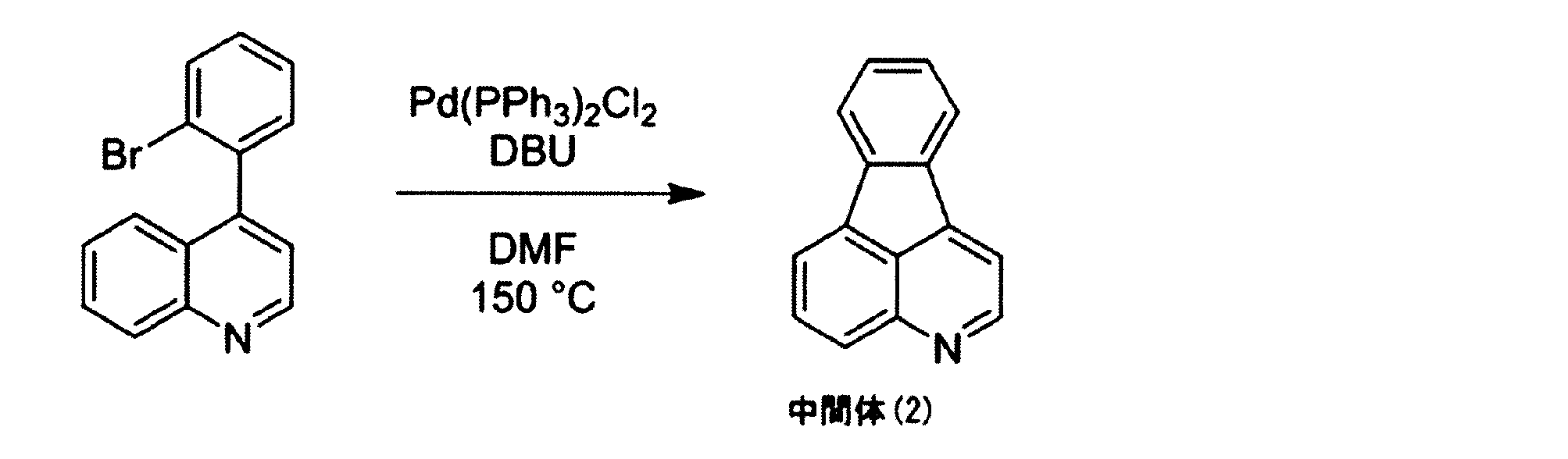
〔中間体(A)の合成〕
中間体(2)1.0g、メタクロロ過安息香酸(mCPBA)3.26g、ジクロロメタン50mLをフラスコに0℃で仕込み、室温にて30時間撹拌した。反応溶液をジクロロメタンで抽出し得られた有機層を乾燥、濃縮し褐色油状物のNオキシド体を得た。Nオキシド1.55gにオキシ塩化リン5.0mLを加え、130℃にて3時間加熱撹拌した。反応溶液をジクロロメタンにて抽出し有機層を乾燥、濃縮して得られた残渣をカラムクロマトグラフィーにて精製し中間体(A)767mg、収率66%(2 steps)を得た。
マススペクトル分析の結果、中間体(A)の分子量237に対し、m/e=237であった。
中間体(2)1.0g、メタクロロ過安息香酸(mCPBA)3.26g、ジクロロメタン50mLをフラスコに0℃で仕込み、室温にて30時間撹拌した。反応溶液をジクロロメタンで抽出し得られた有機層を乾燥、濃縮し褐色油状物のNオキシド体を得た。Nオキシド1.55gにオキシ塩化リン5.0mLを加え、130℃にて3時間加熱撹拌した。反応溶液をジクロロメタンにて抽出し有機層を乾燥、濃縮して得られた残渣をカラムクロマトグラフィーにて精製し中間体(A)767mg、収率66%(2 steps)を得た。
マススペクトル分析の結果、中間体(A)の分子量237に対し、m/e=237であった。

<中間体(B)の合成>
〔中間体(3)の合成〕
アルゴン雰囲気下、アセナフテン258g、酢酸3.5Lをフラスコに室温にて仕込み、40℃において2クロム酸ナトリウム2水和物498gを3分割にして添加した。この反応液を同温にて1時間撹拌し、放冷後氷水20Lを反応液へ注ぎ、得られた析出晶をろ取した。析出晶をクロロホルムとヘプタン混合溶媒にて熱溶解させシリカゲルクロマトグラフィーにて精製し、中間体(3)55.1g、収率19%を得た。
マススペクトル分析の結果、中間体(3)の分子量168に対し、m/e=168であった。
〔中間体(3)の合成〕
アルゴン雰囲気下、アセナフテン258g、酢酸3.5Lをフラスコに室温にて仕込み、40℃において2クロム酸ナトリウム2水和物498gを3分割にして添加した。この反応液を同温にて1時間撹拌し、放冷後氷水20Lを反応液へ注ぎ、得られた析出晶をろ取した。析出晶をクロロホルムとヘプタン混合溶媒にて熱溶解させシリカゲルクロマトグラフィーにて精製し、中間体(3)55.1g、収率19%を得た。
マススペクトル分析の結果、中間体(3)の分子量168に対し、m/e=168であった。
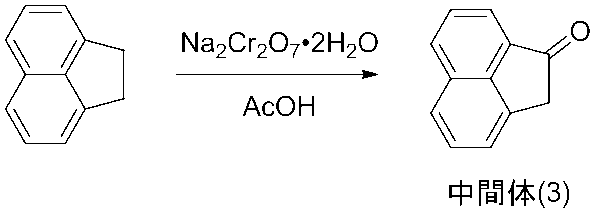
〔中間体(4)の合成〕
アルゴン雰囲気下、中間体(3)52.1g、塩化銅(II)2水和物5.28g、1-ブタノール900mL、プロパルギルアミン34.1gをフラスコに仕込み、112℃にて29時間加熱撹拌した。105℃にて塩化銅(II)2水和物0.25gを添加し再度112℃にて18時間撹拌し、さらに105℃にて塩化銅(II)2水和物0.25gを添加し112℃にて18時間撹拌した。室温まで放冷した後、反応溶液を常圧ろ過し、母液を濃縮乾固させた。得られた粗体をトルエンとクロロホルムに加熱溶解させカラムクロマトグラフィーにて精製し中間体(4)18.3g、収率29%を得た。
マススペクトル分析の結果、中間体(4)の分子量203に対し、m/e=203であった。
アルゴン雰囲気下、中間体(3)52.1g、塩化銅(II)2水和物5.28g、1-ブタノール900mL、プロパルギルアミン34.1gをフラスコに仕込み、112℃にて29時間加熱撹拌した。105℃にて塩化銅(II)2水和物0.25gを添加し再度112℃にて18時間撹拌し、さらに105℃にて塩化銅(II)2水和物0.25gを添加し112℃にて18時間撹拌した。室温まで放冷した後、反応溶液を常圧ろ過し、母液を濃縮乾固させた。得られた粗体をトルエンとクロロホルムに加熱溶解させカラムクロマトグラフィーにて精製し中間体(4)18.3g、収率29%を得た。
マススペクトル分析の結果、中間体(4)の分子量203に対し、m/e=203であった。

〔中間体(5)の合成〕
アルゴン雰囲気下、中間体(4)18.3g、クロロホルム360mLをフラスコに仕込み、5℃以下にて72質量%mCPBA53.9gをゆっくり添加した。反応溶液を室温に昇温させつつ一晩撹拌し氷冷した飽和重曹水400mLへ反応液を注ぎ30分撹拌した。有機層を飽和重曹水、水、飽和食塩水にて洗浄し、無水硫酸ナトリウムにて脱水した後、濃縮再結晶し中間体(5)を得た。中間体(5)はそのまま次の反応に付した。
アルゴン雰囲気下、中間体(4)18.3g、クロロホルム360mLをフラスコに仕込み、5℃以下にて72質量%mCPBA53.9gをゆっくり添加した。反応溶液を室温に昇温させつつ一晩撹拌し氷冷した飽和重曹水400mLへ反応液を注ぎ30分撹拌した。有機層を飽和重曹水、水、飽和食塩水にて洗浄し、無水硫酸ナトリウムにて脱水した後、濃縮再結晶し中間体(5)を得た。中間体(5)はそのまま次の反応に付した。
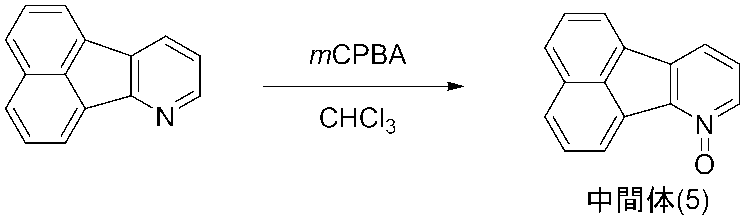
〔中間体(B)の合成〕
アルゴン雰囲気下、中間体(5)12.5g、塩化ホスホリル130mLをフラスコに仕込み、100℃において4時間撹拌した。反応液を濃縮し、残渣をクロロホルム200mLへ溶解させた後、氷冷した飽和重曹水1.5Lへ反応液を注ぎ1時間撹拌した。有機層を水、飽和食塩水にて洗浄し濃縮乾固させ粗体を得た。粗体をクロロホルムに溶解させシリカゲルクロマトグラフィーにて精製し、中間体(B)4.0g、収率19%(2工程)を得た。
マススペクトル分析の結果、中間体(B)の分子量237に対し、m/e=237であった。
アルゴン雰囲気下、中間体(5)12.5g、塩化ホスホリル130mLをフラスコに仕込み、100℃において4時間撹拌した。反応液を濃縮し、残渣をクロロホルム200mLへ溶解させた後、氷冷した飽和重曹水1.5Lへ反応液を注ぎ1時間撹拌した。有機層を水、飽和食塩水にて洗浄し濃縮乾固させ粗体を得た。粗体をクロロホルムに溶解させシリカゲルクロマトグラフィーにて精製し、中間体(B)4.0g、収率19%(2工程)を得た。
マススペクトル分析の結果、中間体(B)の分子量237に対し、m/e=237であった。

<合成例>
〔化合物1の合成〕
アルゴン雰囲気下、下記原料化合物(1)344mg、中間体(A)200mg、トリス(ジベンジリデンアセトン)ジパラジウム(0)15mg、トリ-t-ブチルホスホニウムテトラフルオロボレート19mg、ナトリウム-t-ブトキシド113mg、トルエン4mLをフラスコに仕込み、5時間加熱還流した。室温まで冷却した後、反応溶液をトルエンで抽出し有機層を乾燥後濃縮した。得られた残渣をカラムクロマトグラフィーにて精製し化合物1(294mg、収率37%)を得た。
マススペクトル分析の結果、化合物1の分子量609に対し、m/e=609であった。
〔化合物1の合成〕
アルゴン雰囲気下、下記原料化合物(1)344mg、中間体(A)200mg、トリス(ジベンジリデンアセトン)ジパラジウム(0)15mg、トリ-t-ブチルホスホニウムテトラフルオロボレート19mg、ナトリウム-t-ブトキシド113mg、トルエン4mLをフラスコに仕込み、5時間加熱還流した。室温まで冷却した後、反応溶液をトルエンで抽出し有機層を乾燥後濃縮した。得られた残渣をカラムクロマトグラフィーにて精製し化合物1(294mg、収率37%)を得た。
マススペクトル分析の結果、化合物1の分子量609に対し、m/e=609であった。
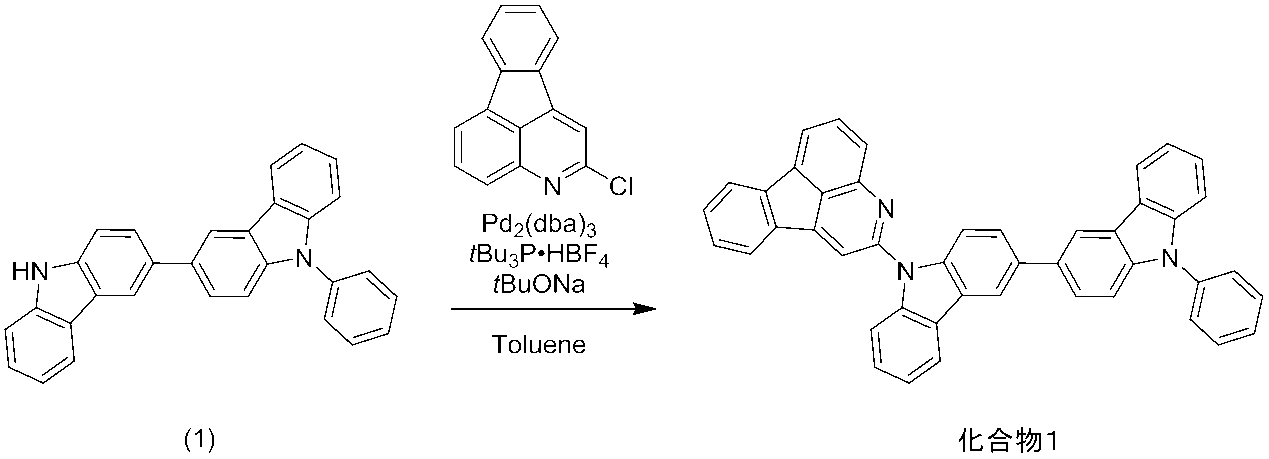
〔化合物2の合成〕
化合物1の合成において、原料化合物(1)の代わりに既知の方法で合成した下記原料化合物(2)を用いて同様の方法で化合物2を合成した。
マススペクトル分析の結果、化合物2の分子量685に対し、m/e=685であった。
化合物1の合成において、原料化合物(1)の代わりに既知の方法で合成した下記原料化合物(2)を用いて同様の方法で化合物2を合成した。
マススペクトル分析の結果、化合物2の分子量685に対し、m/e=685であった。
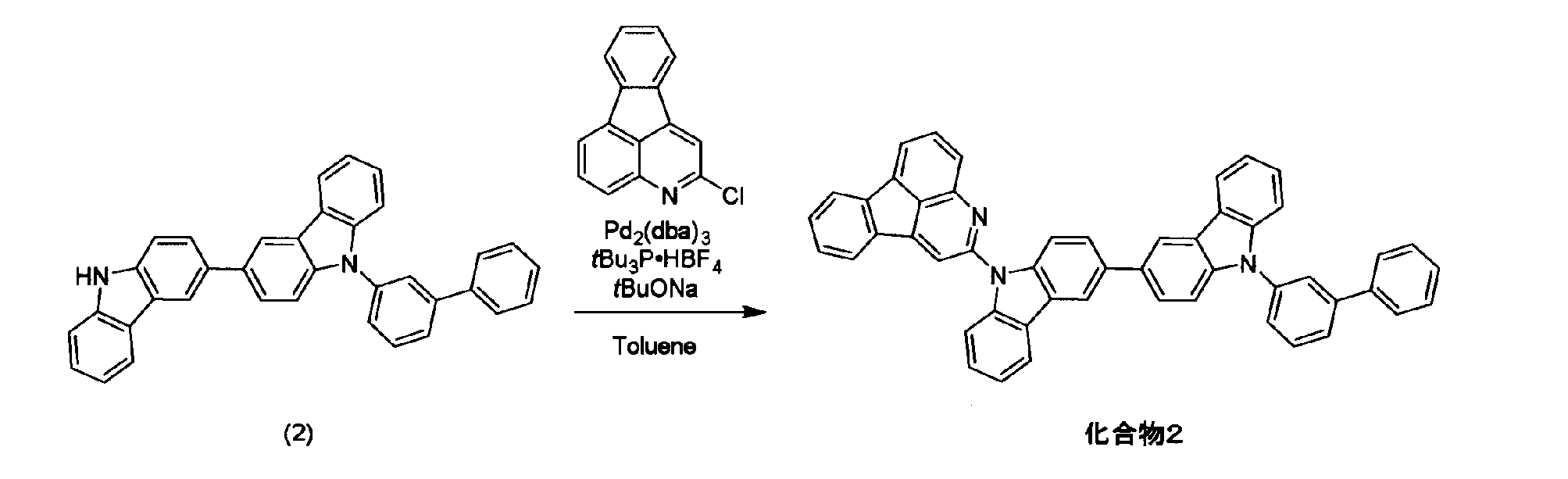
〔化合物3の合成〕
化合物1の合成において、原料化合物(1)の代わりに既知の方法で合成した下記原料化合物(3)を用いて同様の方法で化合物3を合成した。
マススペクトル分析の結果、化合物3の分子量685に対し、m/e=685であった。
化合物1の合成において、原料化合物(1)の代わりに既知の方法で合成した下記原料化合物(3)を用いて同様の方法で化合物3を合成した。
マススペクトル分析の結果、化合物3の分子量685に対し、m/e=685であった。

〔化合物4の合成〕
化合物1の合成において、原料化合物(1)の代わりに既知の方法で合成した下記原料化合物(4)を用いて同様の方法で化合物4を合成した。
マススペクトル分析の結果、化合物4の分子量685に対し、m/e=685であった。
化合物1の合成において、原料化合物(1)の代わりに既知の方法で合成した下記原料化合物(4)を用いて同様の方法で化合物4を合成した。
マススペクトル分析の結果、化合物4の分子量685に対し、m/e=685であった。
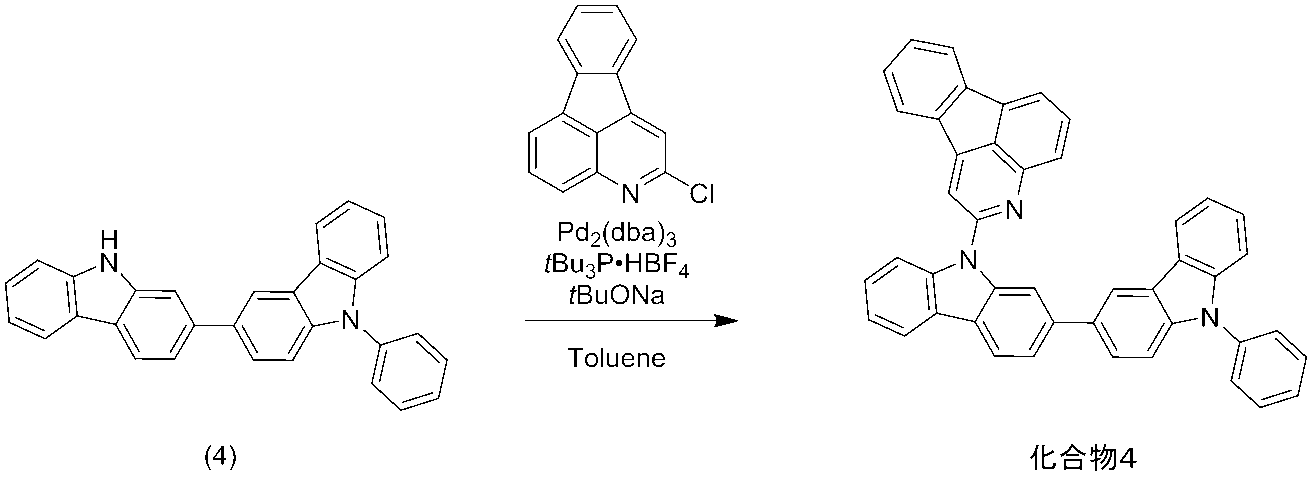
〔化合物5の合成〕
化合物1の合成において、原料化合物(1)の代わりに既知の方法で合成した下記原料化合物(5)を用いて同様の方法で化合物5を合成した。
マススペクトル分析の結果、化合物5の分子量534に対し、m/e=534であった。
化合物1の合成において、原料化合物(1)の代わりに既知の方法で合成した下記原料化合物(5)を用いて同様の方法で化合物5を合成した。
マススペクトル分析の結果、化合物5の分子量534に対し、m/e=534であった。

〔化合物6の合成〕
化合物1の合成において、原料化合物(1)の代わりに既知の方法で合成した下記原料化合物(6)を用いて同様の方法で化合物6を合成した。
マススペクトル分析の結果、化合物6の分子量659に対し、m/e=659であった。
化合物1の合成において、原料化合物(1)の代わりに既知の方法で合成した下記原料化合物(6)を用いて同様の方法で化合物6を合成した。
マススペクトル分析の結果、化合物6の分子量659に対し、m/e=659であった。
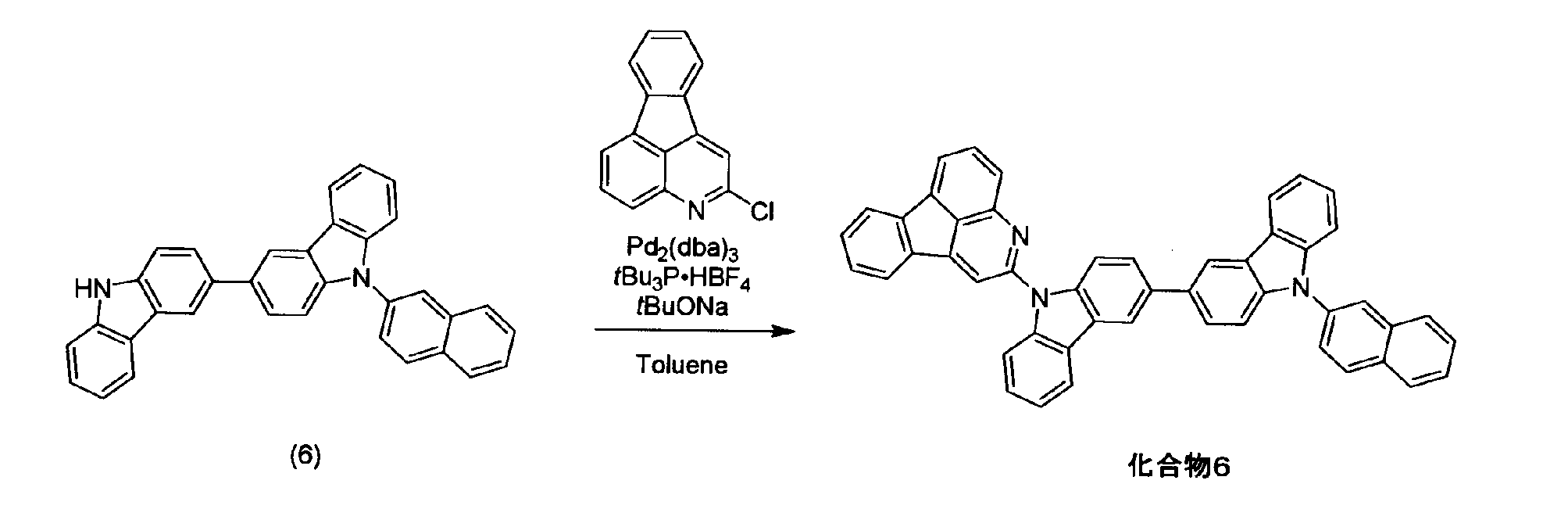
〔化合物7の合成〕
化合物1の合成において、原料化合物(1)の代わりに既知の方法で合成した下記原料化合物(7)を用いて同様の方法で化合物7を合成した。
マススペクトル分析の結果、化合物7の分子量659に対し、m/e=659であった。
化合物1の合成において、原料化合物(1)の代わりに既知の方法で合成した下記原料化合物(7)を用いて同様の方法で化合物7を合成した。
マススペクトル分析の結果、化合物7の分子量659に対し、m/e=659であった。
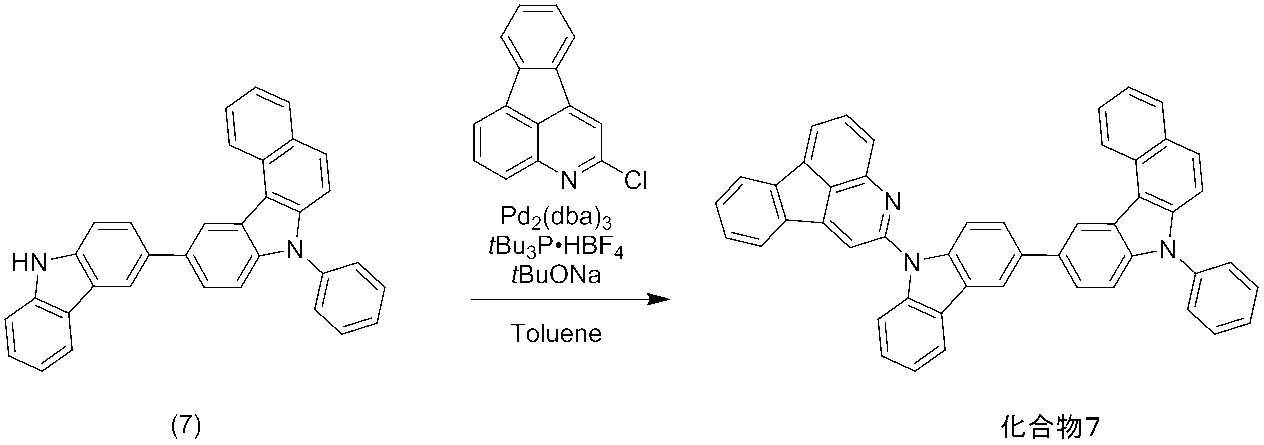
〔化合物8の合成〕
化合物1の合成において、原料化合物(1)の代わりに既知の方法で合成した下記原料化合物(8)を用いて同様の方法で化合物8を合成した。
マススペクトル分析の結果、化合物8の分子量659に対し、m/e=659であった。
化合物1の合成において、原料化合物(1)の代わりに既知の方法で合成した下記原料化合物(8)を用いて同様の方法で化合物8を合成した。
マススペクトル分析の結果、化合物8の分子量659に対し、m/e=659であった。

〔化合物9の合成〕
化合物1の合成において、原料化合物(1)の代わりに既知の方法で合成した下記原料化合物(9)を用いて同様の方法で化合物9を合成した。
マススペクトル分析の結果、化合物9の分子量659に対し、m/e=659であった。
化合物1の合成において、原料化合物(1)の代わりに既知の方法で合成した下記原料化合物(9)を用いて同様の方法で化合物9を合成した。
マススペクトル分析の結果、化合物9の分子量659に対し、m/e=659であった。
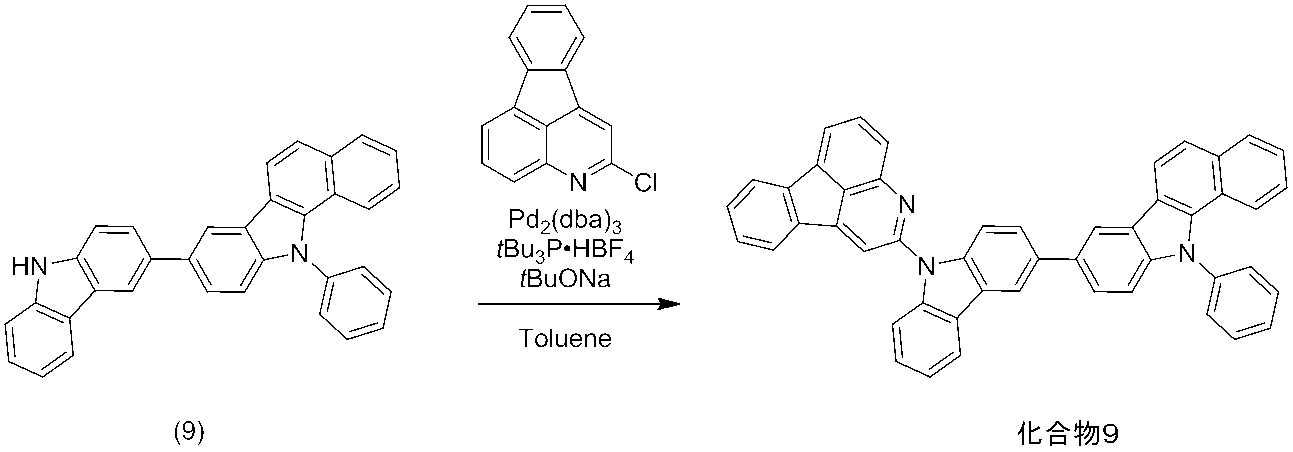
〔化合物10の合成〕
化合物1の合成において、原料化合物(1)の代わりに既知の方法で合成した下記原料化合物(10)を用いて同様の方法で化合物10を合成した。
マススペクトル分析の結果、化合物10の分子量659に対し、m/e=659であった。
化合物1の合成において、原料化合物(1)の代わりに既知の方法で合成した下記原料化合物(10)を用いて同様の方法で化合物10を合成した。
マススペクトル分析の結果、化合物10の分子量659に対し、m/e=659であった。

〔化合物11の合成〕
化合物1の合成において、原料化合物(1)の代わりに既知の方法で合成した下記原料化合物(11)を用いて同様の方法で化合物11を合成した。マススペクトル分析の結果、化合物11の分子量659に対し、m/e=659であった。
化合物1の合成において、原料化合物(1)の代わりに既知の方法で合成した下記原料化合物(11)を用いて同様の方法で化合物11を合成した。マススペクトル分析の結果、化合物11の分子量659に対し、m/e=659であった。
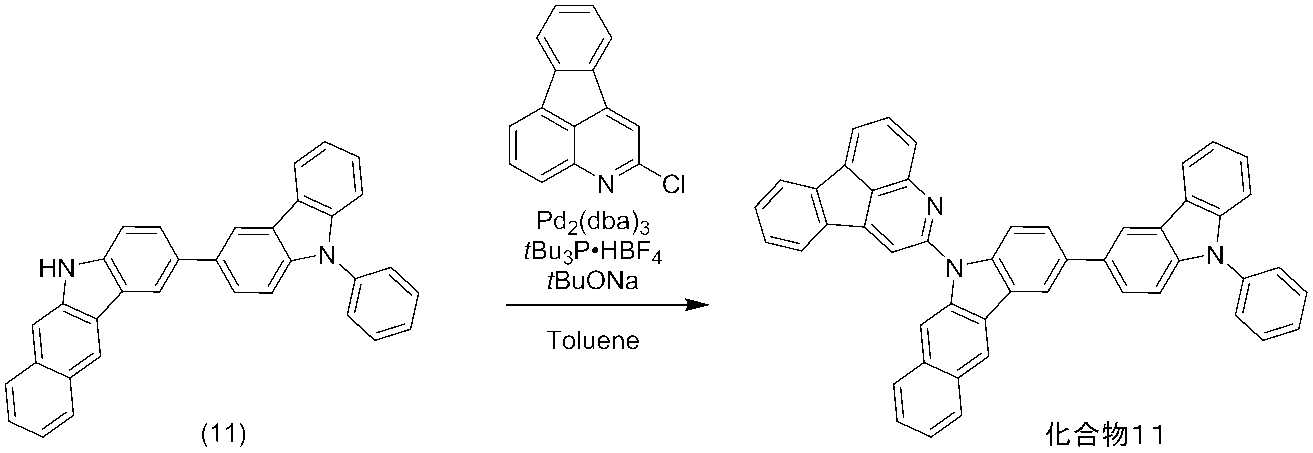
〔化合物12の合成〕
化合物1の合成において、原料化合物(1)の代わりに既知の方法で合成した下記原料化合物(12)を用いて同様の方法で化合物12を合成した。
マススペクトル分析の結果、化合物12の分子量659に対し、m/e=659であった。
化合物1の合成において、原料化合物(1)の代わりに既知の方法で合成した下記原料化合物(12)を用いて同様の方法で化合物12を合成した。
マススペクトル分析の結果、化合物12の分子量659に対し、m/e=659であった。

〔化合物13の合成〕
化合物1の合成において、中間体(A)の代わりに中間体(B)を用いて同様の方法で化合物13を合成した。
マススペクトル分析の結果、化合物13の分子量609に対し、m/e=609であった。
化合物1の合成において、中間体(A)の代わりに中間体(B)を用いて同様の方法で化合物13を合成した。
マススペクトル分析の結果、化合物13の分子量609に対し、m/e=609であった。
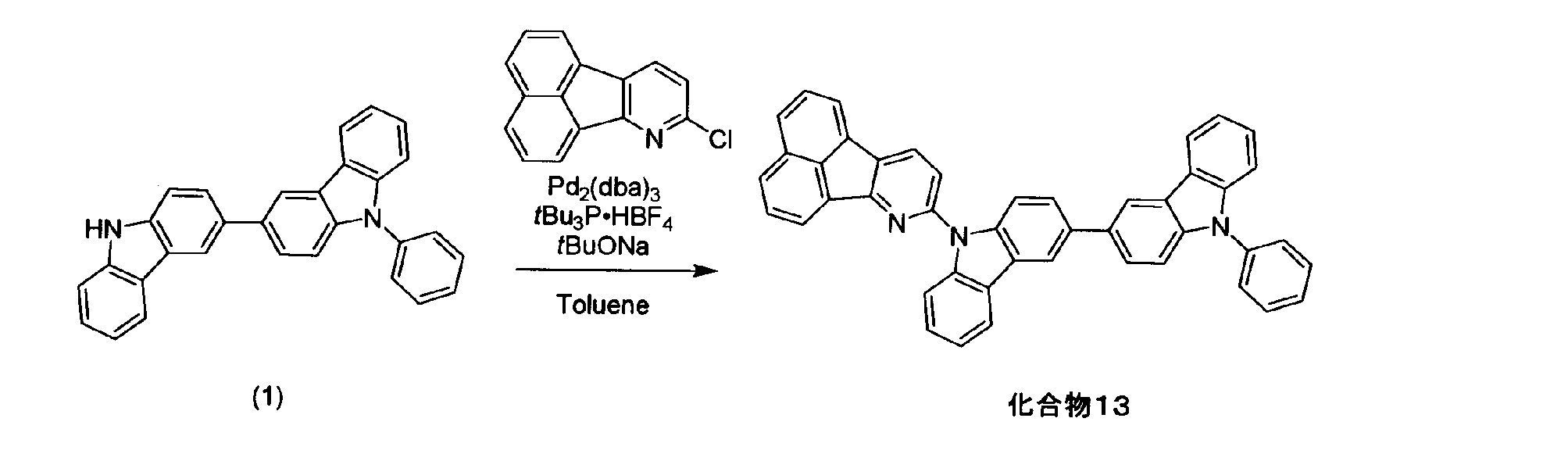
〔化合物14の合成〕
化合物13の合成において、原料化合物(1)の代わりに既知の方法で合成した下記原料化合物(2)を用いて同様の方法で化合物14を合成した。
マススペクトル分析の結果、化合物14の分子量685に対し、m/e=685であった。
化合物13の合成において、原料化合物(1)の代わりに既知の方法で合成した下記原料化合物(2)を用いて同様の方法で化合物14を合成した。
マススペクトル分析の結果、化合物14の分子量685に対し、m/e=685であった。
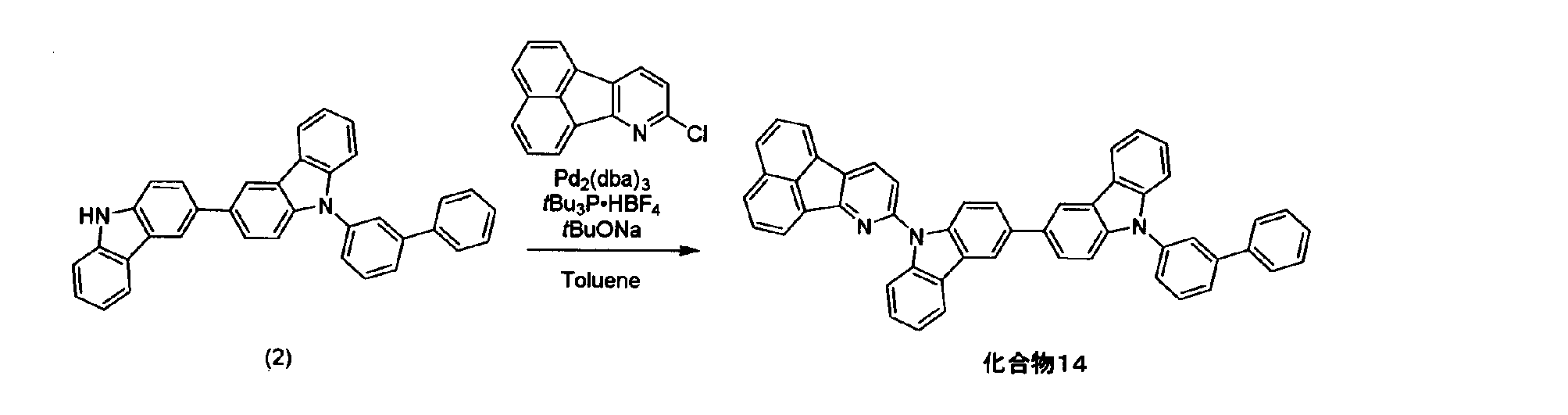
〔化合物15の合成〕
化合物13の合成において、原料化合物(1)の代わりに既知の方法で合成した下記原料化合物(5)を用いて同様の方法で化合物15を合成した。
マススペクトル分析の結果、化合物15の分子量534に対し、m/e=534であった。
化合物13の合成において、原料化合物(1)の代わりに既知の方法で合成した下記原料化合物(5)を用いて同様の方法で化合物15を合成した。
マススペクトル分析の結果、化合物15の分子量534に対し、m/e=534であった。
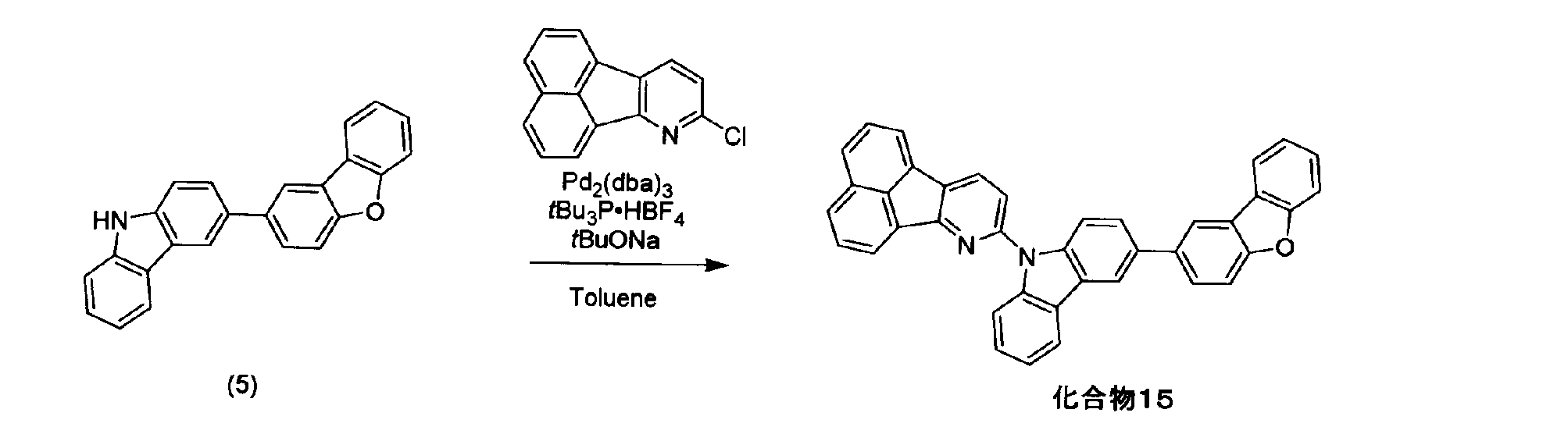
〔化合物16の合成〕
化合物13の合成において、原料化合物(1)の代わりに既知の方法で合成した下記原料化合物(6)を用いて同様の方法で化合物16を合成した。
マススペクトル分析の結果、化合物16の分子量659に対し、m/e=659であった。
化合物13の合成において、原料化合物(1)の代わりに既知の方法で合成した下記原料化合物(6)を用いて同様の方法で化合物16を合成した。
マススペクトル分析の結果、化合物16の分子量659に対し、m/e=659であった。

〔化合物17の合成〕
化合物13の合成において、原料化合物(1)の代わりに既知の方法で合成した下記原料化合物(7)を用いて同様の方法で化合物17を合成した。
マススペクトル分析の結果、化合物17の分子量659に対し、m/e=659であった。
化合物13の合成において、原料化合物(1)の代わりに既知の方法で合成した下記原料化合物(7)を用いて同様の方法で化合物17を合成した。
マススペクトル分析の結果、化合物17の分子量659に対し、m/e=659であった。
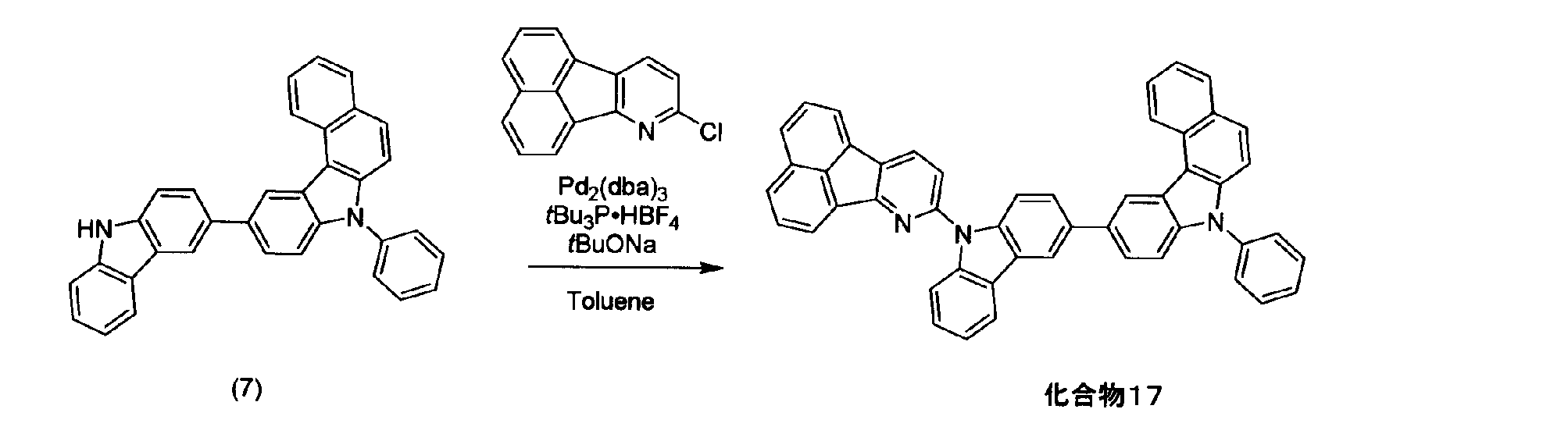
〔化合物18の合成〕
化合物13の合成において、原料化合物(1)の代わりに既知の方法で合成した下記原料化合物(8)を用いて同様の方法で化合物18を合成した。
マススペクトル分析の結果、化合物18の分子量659に対し、m/e=659であった。
化合物13の合成において、原料化合物(1)の代わりに既知の方法で合成した下記原料化合物(8)を用いて同様の方法で化合物18を合成した。
マススペクトル分析の結果、化合物18の分子量659に対し、m/e=659であった。
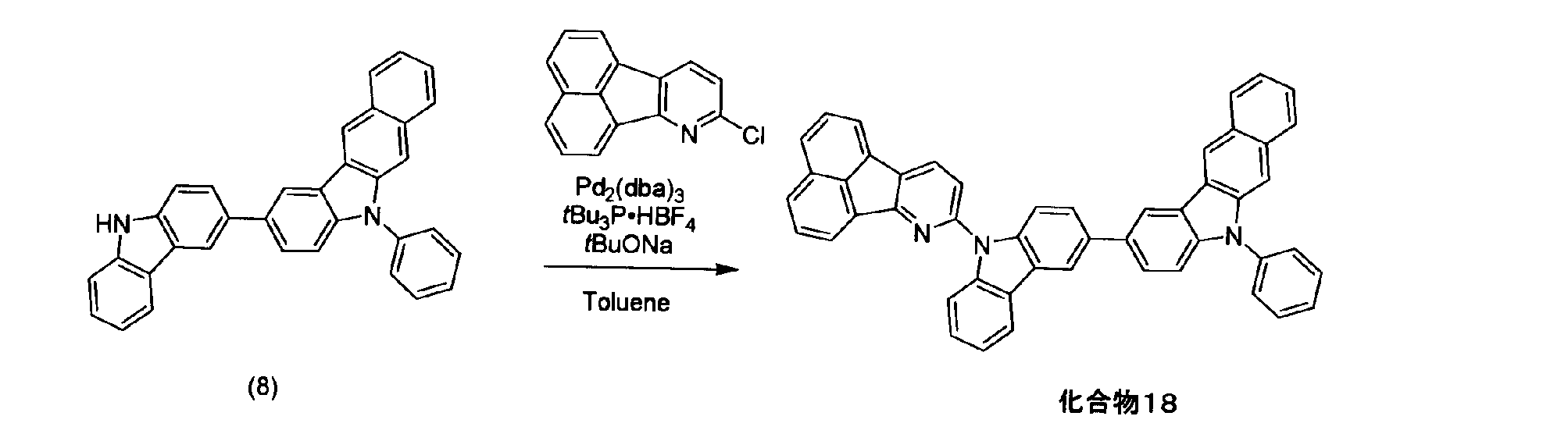
〔化合物19の合成〕
化合物13の合成において、原料化合物(1)の代わりに既知の方法で合成した下記原料化合物(9)を用いて同様の方法で化合物19を合成した。
マススペクトル分析の結果、化合物19の分子量659に対し、m/e=659であった。
化合物13の合成において、原料化合物(1)の代わりに既知の方法で合成した下記原料化合物(9)を用いて同様の方法で化合物19を合成した。
マススペクトル分析の結果、化合物19の分子量659に対し、m/e=659であった。
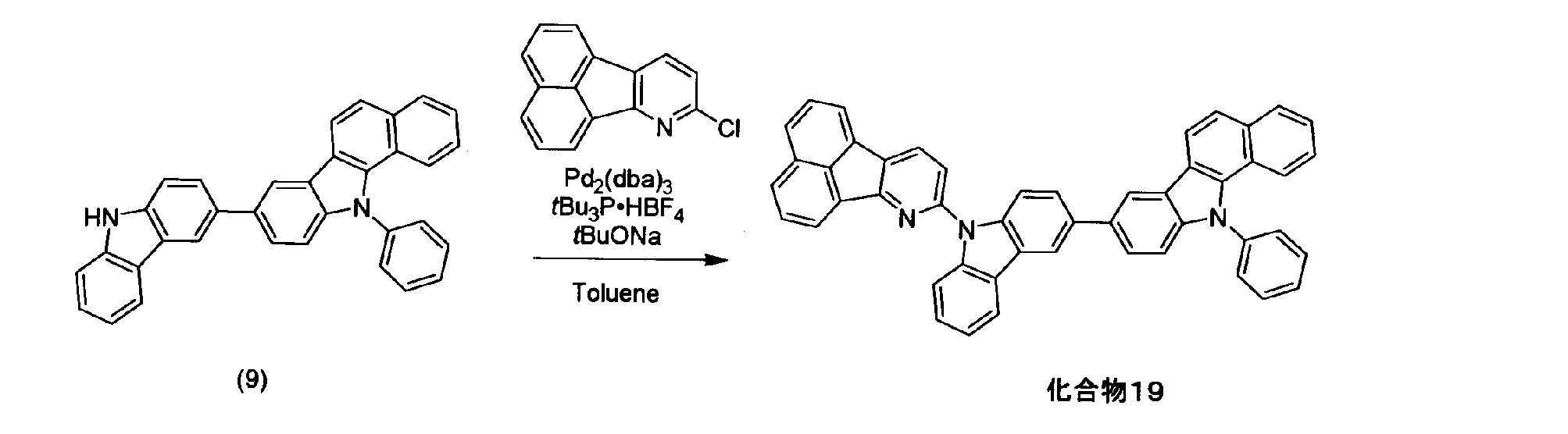
〔化合物20の合成〕
化合物13の合成において、原料化合物(1)の代わりに既知の方法で合成した下記原料化合物(10)を用いて同様の方法で化合物20を合成した。
マススペクトル分析の結果、化合物20の分子量659に対し、m/e=659であった。
化合物13の合成において、原料化合物(1)の代わりに既知の方法で合成した下記原料化合物(10)を用いて同様の方法で化合物20を合成した。
マススペクトル分析の結果、化合物20の分子量659に対し、m/e=659であった。

〔化合物21の合成〕
化合物13の合成において、原料化合物(1)の代わりに既知の方法で合成した下記原料化合物(11)を用いて同様の方法で化合物21を合成した。
マススペクトル分析の結果、化合物21の分子量659に対し、m/e=659であった。
化合物13の合成において、原料化合物(1)の代わりに既知の方法で合成した下記原料化合物(11)を用いて同様の方法で化合物21を合成した。
マススペクトル分析の結果、化合物21の分子量659に対し、m/e=659であった。
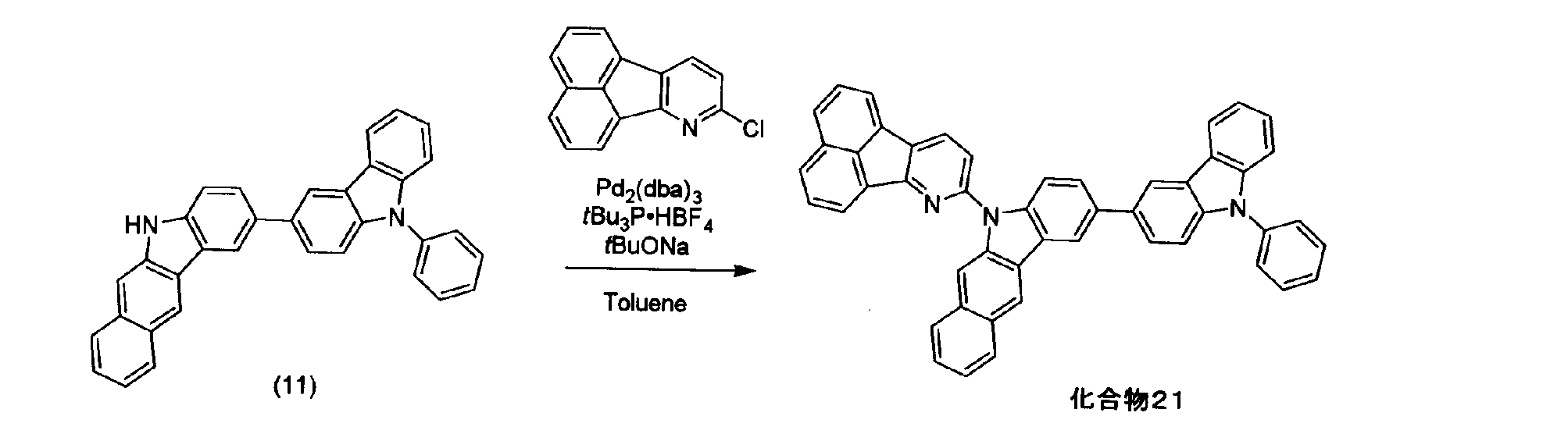
〔化合物22の合成〕
化合物13の合成において、原料化合物(1)の代わりに既知の方法で合成した下記原料化合物(12)を用いて同様の方法で化合物22を合成した。
マススペクトル分析の結果、化合物22の分子量659に対し、m/e=659であった。
化合物13の合成において、原料化合物(1)の代わりに既知の方法で合成した下記原料化合物(12)を用いて同様の方法で化合物22を合成した。
マススペクトル分析の結果、化合物22の分子量659に対し、m/e=659であった。
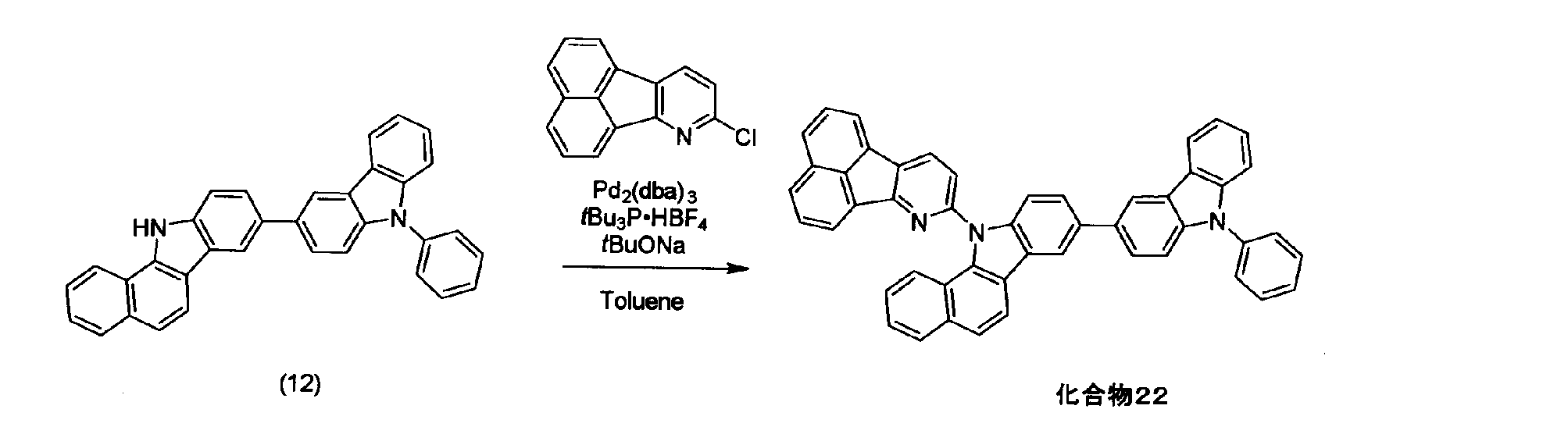
〔化合物23の合成〕
化合物13の合成において、原料化合物(1)の代わりに既知の方法で合成した下記原料化合物(13)を用いて同様の方法で化合物23を合成した。
マススペクトル分析の結果、化合物23の分子量584に対し、m/e=584であった。
化合物13の合成において、原料化合物(1)の代わりに既知の方法で合成した下記原料化合物(13)を用いて同様の方法で化合物23を合成した。
マススペクトル分析の結果、化合物23の分子量584に対し、m/e=584であった。

〔化合物24の合成〕
化合物13の合成において、原料化合物(1)の代わりに既知の方法で合成した下記原料化合物(14)を用いて同様の方法で化合物24を合成した。
マススペクトル分析の結果、化合物24の分子量584に対し、m/e=584であった。
化合物13の合成において、原料化合物(1)の代わりに既知の方法で合成した下記原料化合物(14)を用いて同様の方法で化合物24を合成した。
マススペクトル分析の結果、化合物24の分子量584に対し、m/e=584であった。
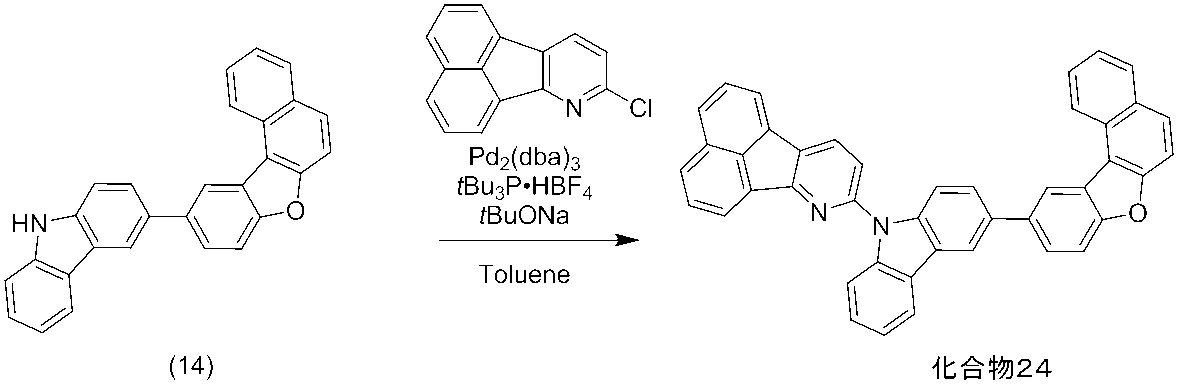
<実施例1>(有機EL素子の製造及び評価)
25mm×75mm×厚さ1.1mmのITO透明電極付きガラス基板(ジオマティック株式会社製)をイソプロピルアルコール中で超音波洗浄を5分間行なった後、UVオゾン洗浄を30分間行った。ITO透明電極の厚さは130nmとした。
洗浄後の透明電極ライン付きガラス基板を真空蒸着装置の基板ホルダーに装着し、まず透明電極ラインが形成されている面上に前記透明電極を覆うようにして下記アクセプター材料(HA)を蒸着し、膜厚5nmのアクセプター層を成膜した。このアクセプター層上に、下記芳香族アミン化合物HTを蒸着し、膜厚210nmの正孔輸送層を成膜した。
25mm×75mm×厚さ1.1mmのITO透明電極付きガラス基板(ジオマティック株式会社製)をイソプロピルアルコール中で超音波洗浄を5分間行なった後、UVオゾン洗浄を30分間行った。ITO透明電極の厚さは130nmとした。
洗浄後の透明電極ライン付きガラス基板を真空蒸着装置の基板ホルダーに装着し、まず透明電極ラインが形成されている面上に前記透明電極を覆うようにして下記アクセプター材料(HA)を蒸着し、膜厚5nmのアクセプター層を成膜した。このアクセプター層上に、下記芳香族アミン化合物HTを蒸着し、膜厚210nmの正孔輸送層を成膜した。
次に、正孔輸送層上に、合成例1で得た化合物1(ホスト材料)と下記化合物RD-1(ドーパント材料)を共蒸着し、膜厚40nmの共蒸着膜を成膜した。化合物RD-1の濃度は2.0質量%であった。この共蒸着膜は発光層として機能する。
そして、この発光層の上に、下記化合物ET(50質量%)及び電子供与性ドーパントであるLiq(50質量%)を二元蒸着して膜厚30nmのET膜を成膜し、電子輸送層を形成した。
そして、この発光層の上に、下記化合物ET(50質量%)及び電子供与性ドーパントであるLiq(50質量%)を二元蒸着して膜厚30nmのET膜を成膜し、電子輸送層を形成した。
次に、このET膜上に、Liqを成膜速度0.1オングストローム/minで蒸着して膜厚1nmのLiq膜を成膜し、電子注入性電極(陰極)を形成した。
そして、このLiq膜上に金属Alを蒸着して膜厚80nmの金属Al膜を成膜し、金属Al陰極を形成し、有機EL素子を製造した。
(有機EL素子の評価)
製造した有機EL素子を直流電流駆動により発光させ、電流密度1mA/cm2及び10mA/cm2における駆動電圧(V)を求めた。また、電子親和力(アフィニティ)を算出した。それぞれ、結果を表1に示す。
そして、このLiq膜上に金属Alを蒸着して膜厚80nmの金属Al膜を成膜し、金属Al陰極を形成し、有機EL素子を製造した。
(有機EL素子の評価)
製造した有機EL素子を直流電流駆動により発光させ、電流密度1mA/cm2及び10mA/cm2における駆動電圧(V)を求めた。また、電子親和力(アフィニティ)を算出した。それぞれ、結果を表1に示す。
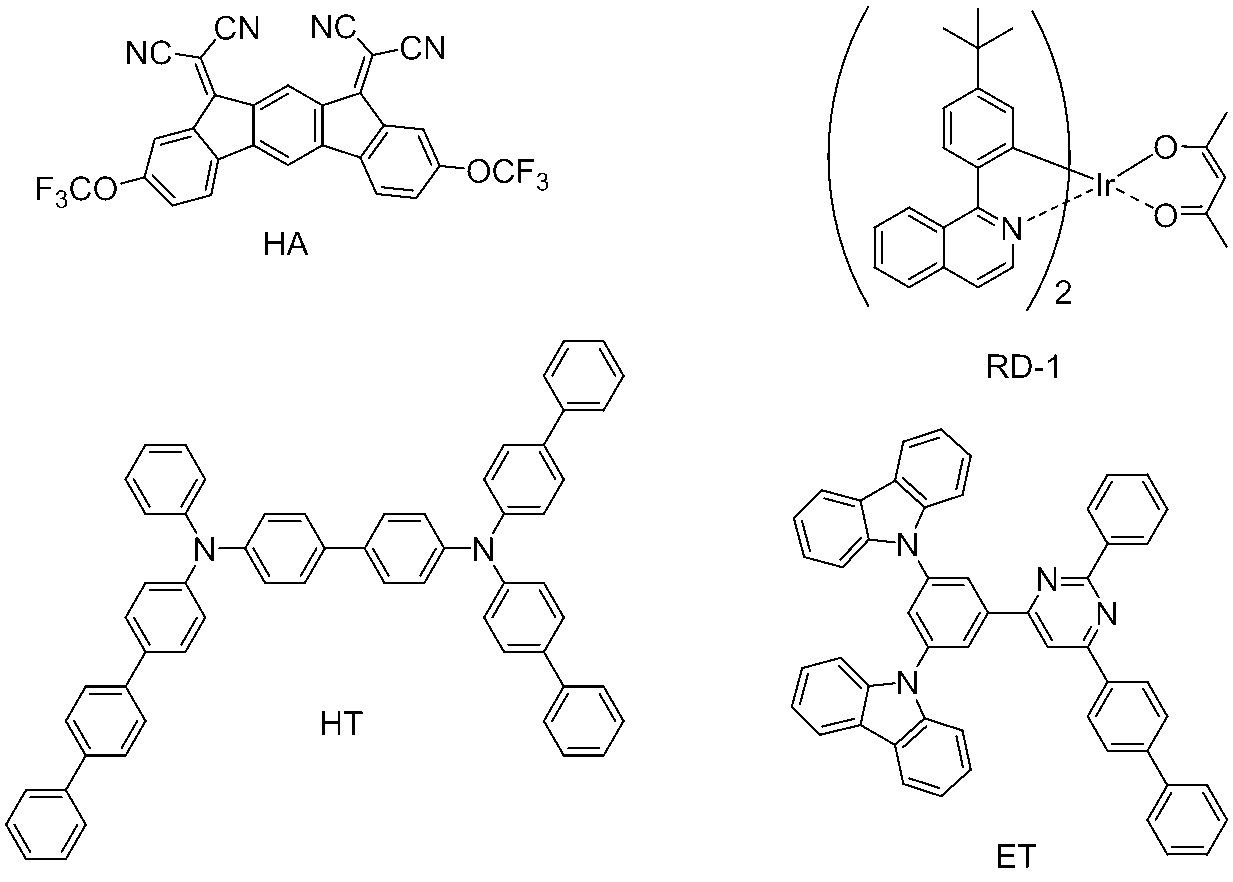
<比較例1>
実施例1において、化合物1を用いる代わりに比較化合物1を用いて発光層を形成した以外は実施例1と同様にして、有機EL素子を作製し、評価した。
駆動電圧の測定結果及び電子親和力(アフィニティ)の計算値を表1に示す。
実施例1において、化合物1を用いる代わりに比較化合物1を用いて発光層を形成した以外は実施例1と同様にして、有機EL素子を作製し、評価した。
駆動電圧の測定結果及び電子親和力(アフィニティ)の計算値を表1に示す。
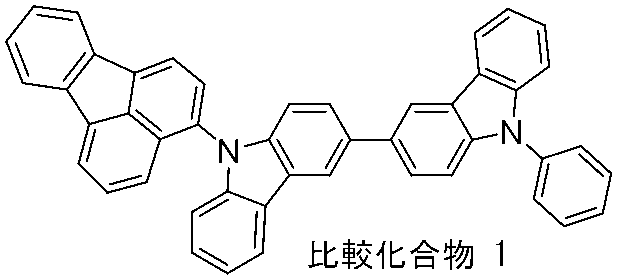

<実施例2>
実施例1において、化合物1を用いる代わりに化合物13を用いて発光層を形成した以外は実施例1と同様にして、有機EL素子を作製し、駆動電圧の評価をした。
駆動電圧の測定結果を表2に示す。
実施例1において、化合物1を用いる代わりに化合物13を用いて発光層を形成した以外は実施例1と同様にして、有機EL素子を作製し、駆動電圧の評価をした。
駆動電圧の測定結果を表2に示す。
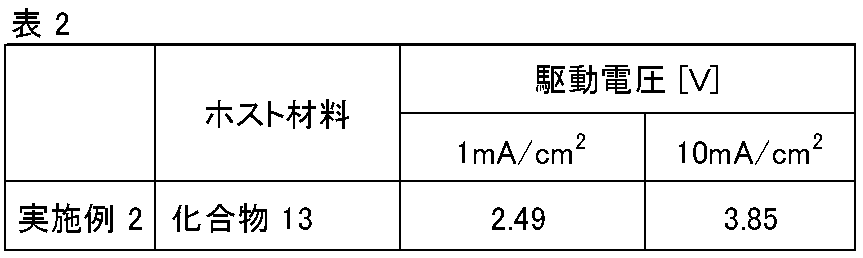
本発明の一実施形態であるアザフルオランテン骨格を有する化合物を用いることで、キャリアの注入性、とくに電子の注入性が向上する。アザフルオランテン骨格はフルオランテン骨格上に窒素原子を導入することにより、含窒素共役系が拡大し、フルオランテン骨格と比較してアフィニティが大きくなるため、と推測している。結果として、この化合物を用いた有機EL素子では、実施例1は比較例1と比較して、1mA/cm2のような低電流密度領域から10mA/cm2といった高電流密度領域において低電圧駆動を達成することができる。
また、実施例2においても、1mA/cm2のような低電流密度領域から10mA/cm2といった高電流密度領域において低電圧駆動を達成している。
また、実施例2においても、1mA/cm2のような低電流密度領域から10mA/cm2といった高電流密度領域において低電圧駆動を達成している。
1 有機EL素子
2 基板
3 陽極
4 陰極
5 発光層
6 陽極側有機薄膜層
7 陰極側有機薄膜層
10 発光ユニット
2 基板
3 陽極
4 陰極
5 発光層
6 陽極側有機薄膜層
7 陰極側有機薄膜層
10 発光ユニット
Claims (47)
- 下記式(1)で表される化合物。

〔式(1)において、
X1~X6及びZ1~Z4のいずれかn個はL1と結合する炭素原子を表し、X1~X6及びZ1~Z4がL1と結合する炭素原子を表さないとき、X1~X6及びZ1~Z4は、各々独立に、CR1又は窒素原子を表す。ただし、X1~X6の少なくとも1つは窒素原子である。
nは1~3の整数を表す。
R1は、各々独立に水素原子又は置換基を表す。
L1は、単結合、置換もしくは無置換の環形成炭素数6~50のアリーレン基、又は置換もしくは無置換の環形成原子数5~50のヘテロアリーレン基を表す。
Czは、下記式(2)で示される基を表す。〕
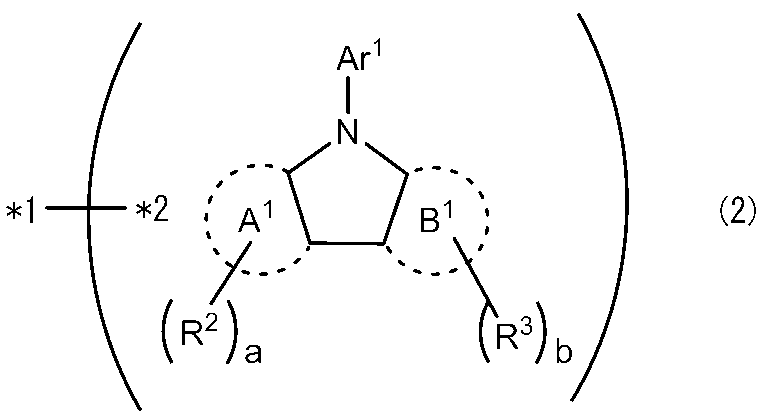
〔式(2)において、Ar1は、*2に結合する単結合又は1価の置換基を表す。
環A1及び環B1は、各々独立に、環形成炭素数5~50の芳香族炭化水素環、又は環形成原子数5~50の芳香族複素環を表す。
R2及びR3は、各々独立に、置換基を表す。
aとbは、各々独立に、0以上の整数であり、Ar1が*2に結合する単結合を表す場合、aとbとの合計は1以上である。
*1はL1との結合位置を表す。
*2は、環A1の1つの環形成炭素原子、環B1の1つの環形成炭素原子、及びAr1のいずれか1つと結合する。
Ar1、R2及びR3の少なくとも一つは、置換もしくは無置換の環形成炭素数6~50のアリール基又は置換もしくは無置換の環形成原子数5~50のヘテロアリール基である。〕 - 下記式(3)で表される請求項1に記載の化合物。
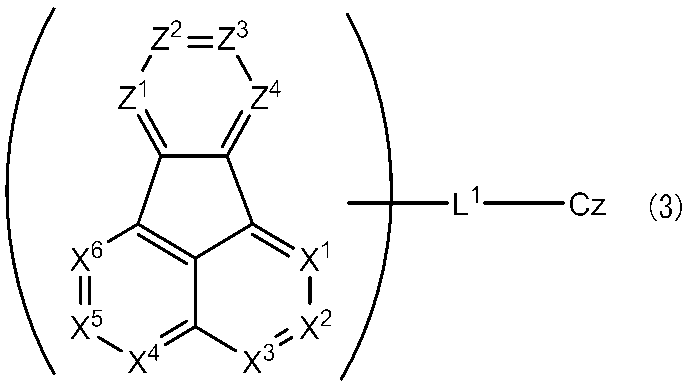
〔式(3)において、X1~X6及びZ1~Z4、L1及びCzは前記と同様である。〕 - 前記式(1)中の下記式(F)で表される縮合環と、前記L1との結合位置が、下記式(NL1)~(NL4)からなる群から選択されるいずれか1つに示される結合位置である請求項1又は2に記載の化合物。
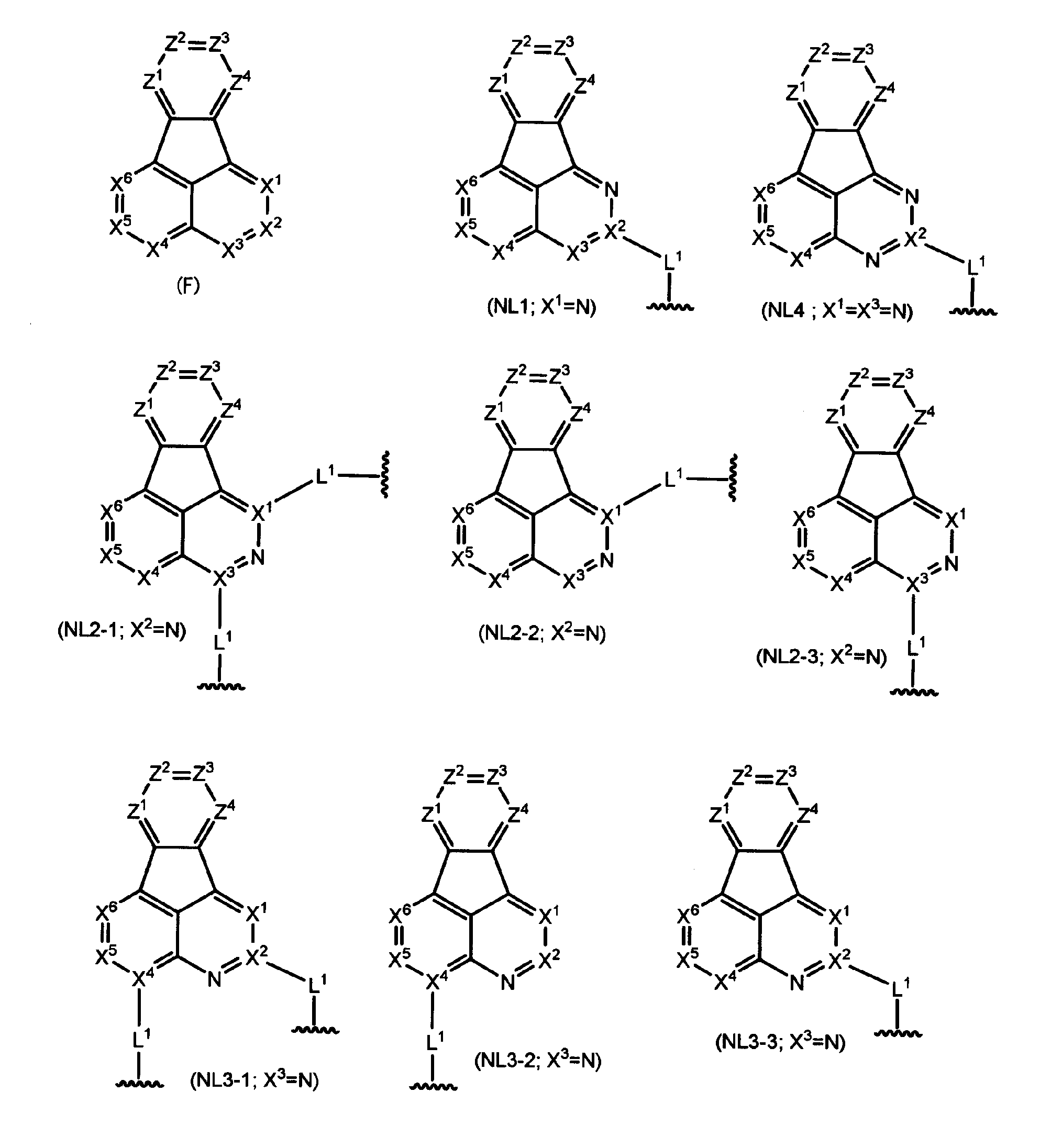
- 下記式(4)で表される請求項1~3のいずれか1項に記載の化合物。

〔式(4)において、L1及びCzは前記と同様であり、
Z1~Z4は、各々独立に、CR1又は窒素原子であり、
X1~X3のいずれか1つはL1と結合する炭素原子を表し、その他のX1~X3、及びX4~X6は、各々独立に、CR1又は窒素原子であり、少なくとも1つは窒素原子であり、
R1は前記と同様である。〕 - 前記R2及びR3の少なくとも一方が、下記式(5)で表される請求項1~4のいずれか1項に記載の化合物。

〔式(5)において、環A2及び環B2は、各々独立に、環形成炭素数5~50の芳香族炭化水素環、又は環形成原子数5~50の芳香族複素環を表す。
R4及びR5は、置換基を表し、c及びdは、0以上の整数を表す。
D1は、酸素原子、硫黄原子、CR6R7、又は、NR8を表す。
R6~R8は、各々独立に、水素原子、置換基、又は*4と結合する単結合を表す。
L2は、単結合、置換もしくは無置換の環形成炭素数6~50のアリーレン基、又は置換もしくは無置換の環形成原子数5~50のヘテロアリーレン基を表す。
*3は前記環A1又は環B1の環形成炭素原子に結合する。
*4は環A2の1つの環形成炭素原子、環B2の1つの環形成炭素原子、及びR6~R8のいずれか1つと結合する。〕 - 前記式(2)中の下記式(ABC)で表される縮合環が、下記構造(abc-1)~(abc-17)及び(abc-h1)~(abc-h26)からなる群から選択されるいずれか1つで示される請求項1~5のいずれか1項に記載の化合物。


〔構造(abc-1)~(abc-17)及び(abc-h1)~(abc-h26)中、**はAr1の結合位置を表す。また、構造(abc-h1)~(abc-h26)中、X及びYは、各々独立に、NR、酸素原子、又は硫黄原子を表し、Rは水素原子又は置換基を表す。〕 - 前記Czが、下記式(6)で表される請求項1~6のいずれか1項に記載の化合物。

〔式(6)において、
Y1~Y8は各々独立に、CR9又は窒素原子であり、
Y11~Y18は各々独立に、CR10又は窒素原子であり、
R9は各々独立に、水素原子、置換基、又は*2’と結合する単結合を表す。
R10は各々独立に、水素原子、置換基、又は*4’と結合する単結合を表す。
*1、Ar1、D1及びL2は前記と同様である。
*2’は、Ar1又はR9のいずれか1つが表す炭素原子に結合する。
*3’は複数のR9のいずれか1つに結合する。
*4’はR6~R8又は複数のR10のいずれか1つに結合する。〕 - 前記Czが、下記式(7)で表される請求項1~7のいずれか1項に記載の化合物。
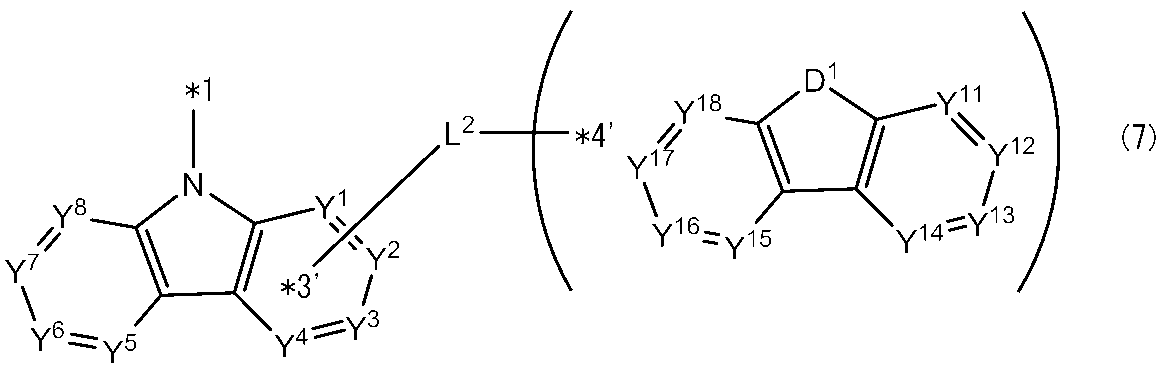
〔式(7)において、
*1、*3’、*4’、Y1~Y8、Y11~Y18、L2、及びD1は前記と同様である。〕 - 前記Czが、下記式(8)で表される請求項1~8のいずれか1項に記載の化合物。

〔式(8)において、
*1、*3’、Y1~Y8、Y11~Y18、L2、及びD1は前記と同様である。
*4”はY15~Y18のいずれか1つが表す炭素原子と結合し、その他のY15~Y18は各々独立にCR10又は窒素原子を表す。
R10は前記と同様である。〕 - 前記Czが、下記式(9)で表される請求項1~7のいずれか1項に記載の化合物。
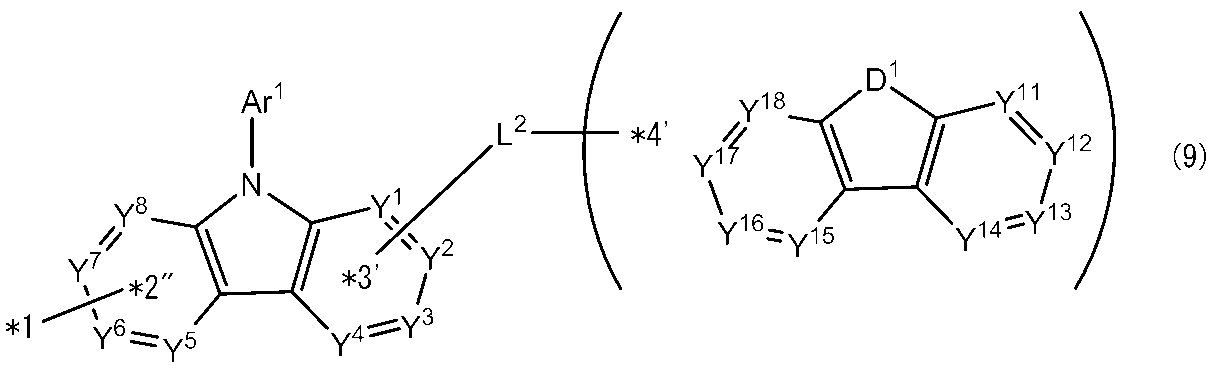
〔式(9)において、
*1、*3’、*4’、Y1~Y8、Y11~Y18、Ar1、L2、及びD1は前記と同様である。
*2”は、Y5~Y8のいずれか1つが表す炭素原子に結合し、その他のY5~Y8は各々独立にCR10又は窒素原子を表す。
R10は前記と同様である。〕 - 前記Czが、下記式(10)で表される請求項1~7及び10のいずれか1項に記載の化合物。
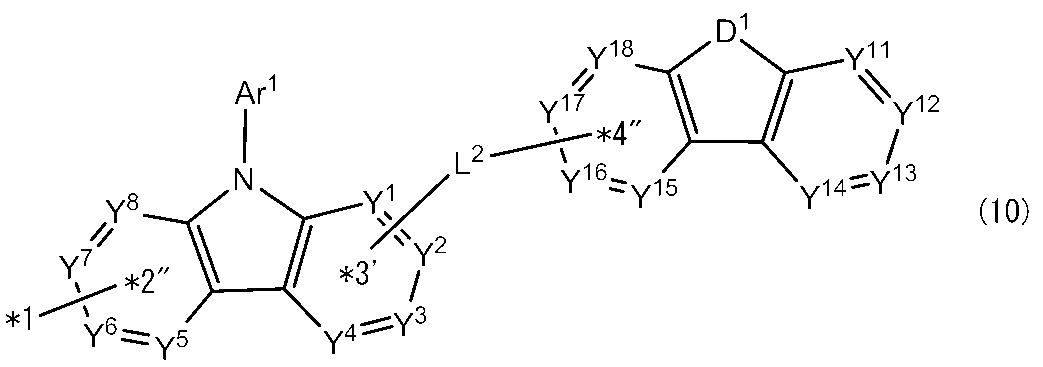
〔式(10)において、
*1、*2”、*3’、*4”、Y1~Y8、Y11~Y18、Ar1、L2、及びD1は前記と同様である。〕 - 下記式(11)で表される請求項1~9のいずれか1項に記載の化合物。

〔式(11)において、
X1~X6、Z1~Z4、L1、Y1~Y8、*3’、L2、*4’、Y11~Y18、及びD1は前記と同様である。〕 - 下記式(12)で表される請求項1~9及び12のいずれか1項に記載の化合物。
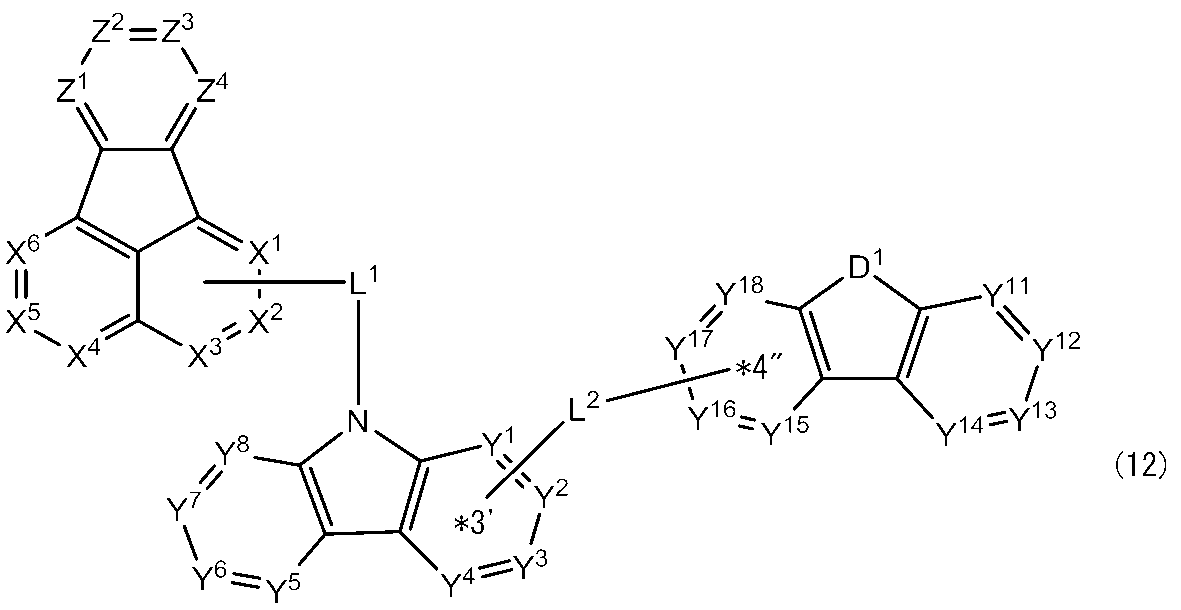
〔式(12)において、
X1~X6、Z1~Z4、L1、Y1~Y8、*3’、L2、*4”、Y11~Y18、及びD1は前記と同様である。〕 - 前記L1が、窒素原子を表すX1~X6に隣接する炭素原子に結合する請求項1~13のいずれか1項に記載の化合物。
- 前記X3が窒素原子である請求項1~14のいずれか1項に記載の化合物。
- 前記L1が、少なくとも、前記X2が表す炭素原子に結合する請求項1~15のいずれか1項に記載の化合物。
- 前記D1が、前記NR8である請求項5~16のいずれか1項に記載の化合物。
- 前記L2が、前記Y2及び前記Y13が表す2つの炭素原子、前記Y3及び前記Y12が表す2つの炭素原子、又は、前記Y3及び前記Y13が表す2つの炭素原子に結合する請求項7~17のいずれか1項に記載の化合物。
- 前記L1が、単結合、又は置換もしくは無置換の環形成炭素数6~50のアリーレン基を表す請求項1~18のいずれか1項に記載の化合物。
- 前記L2が、単結合、又は置換もしくは無置換の環形成炭素数6~50のアリーレン基を表す請求項5~19のいずれか1項に記載の化合物。
- 前記置換基が、置換もしくは無置換の炭素数1~50のアルキル基、置換もしくは無置換の環形成炭素数3~50のシクロアルキル基、置換もしくは無置換の環形成炭素数6~60のアリール基、置換もしくは無置換の炭素数7~61のアラルキル基、アミノ基、置換もしくは無置換の炭素数1~50のアルキル基及び置換もしくは無置換の環形成炭素数6~60のアリール基から選ばれる置換基を有するモノ置換又はジ置換アミノ基、置換もしくは無置換の炭素数1~50のアルコキシ基、置換もしくは無置換の環形成炭素数3~50のシクロアルコキシ基、置換もしくは無置換の環形成炭素数6~60のアリールオキシ基、置換もしくは無置換の炭素数1~50のアルキルチオ基、置換もしくは無置換の環形成炭素数6~60のアリールチオ基、置換もしくは無置換の炭素数1~50のアルキル基及び置換もしくは無置換の環形成炭素数6~60のアリール基から選ばれる置換基を有するモノ置換、ジ置換又はトリ置換シリル基、置換もしくは無置換の環形成原子数5~60のヘテロアリール基、置換もしくは無置換の炭素数1~50のハロアルキル基、ハロゲン原子、シアノ基、ニトロ基、置換もしくは無置換の炭素数1~50のアルキル基及び置換もしくは無置換の環形成炭素数6~60のアリール基から選ばれる置換基を有するスルフォニル基、置換もしくは無置換の炭素数1~50のアルキル基及び置換もしくは無置換の環形成炭素数6~60のアリール基から選ばれる置換基を有するジ置換ホスフォリル基、アルキルスルホニルオキシ基、アリールスルホニルオキシ基、アルキルカルボニルオキシ基、アリールカルボニルオキシ基、ホウ素含有基、亜鉛含有基、スズ含有基、ケイ素含有基、マグネシウム含有基、リチウム含有基、ヒドロキシ基、アルキル置換又はアリール置換カルボニル基、カルボキシル基、ビニル基、(メタ)アクリロイル基、エポキシ基、及びオキセタニル基からなる群から選ばれる基である請求項1~20のいずれか1項に記載の化合物。
- 前記置換基が、置換もしくは無置換のメチル基、置換もしくは無置換のエチル基、置換もしくは無置換のn-プロピル基、置換もしくは無置換のイソプロピル基、置換もしくは無置換のn-ブチル基、置換もしくは無置換のイソブチル基、置換もしくは無置換のs-ブチル基、置換もしくは無置換のt-ブチル基、置換もしくは無置換のペンチル基(異性体を含む)、置換もしくは無置換のヘキシル基(異性体を含む)、置換もしくは無置換のヘプチル基(異性体を含む)、置換もしくは無置換のオクチル基(異性体を含む)、置換もしくは無置換のノニル基(異性体を含む)、置換もしくは無置換のデシル基(異性体を含む)、置換もしくは無置換のウンデシル基(異性体を含む)、置換もしくは無置換のドデシル基(異性体を含む)、置換もしくは無置換のトリデシル基、置換もしくは無置換のテトラデシル基、置換もしくは無置換のオクタデシル基、
置換もしくは無置換のシクロペンチル基、置換もしくは無置換のシクロヘキシル基、
置換もしくは無置換のフェニル基、置換もしくは無置換のナフチル基、置換もしくは無置換のビフェニリル基、置換もしくは無置換のターフェニリル基、置換もしくは無置換のフェナントリル基、置換もしくは無置換のベンゾフェナントリル基、置換もしくは無置換のフルオレニル基、置換もしくは無置換の9,9’-スピロビフルオレニル基、置換もしくは無置換のベンゾフルオレニル基、置換もしくは無置換のジベンゾフルオレニル基、置換もしくは無置換のクリセニル基、置換もしくは無置換のベンゾクリセニル基、置換もしくは無置換のs-インダニル基、置換もしくは無置換のas-インダニル基、置換もしくは無置換のトリフェニレニル基、置換もしくは無置換のベンゾトリフェニレニル基、置換もしくは無置換のアントリル基、置換もしくは無置換の9,9-ジメチルフルオレニル基、置換もしくは無置換の9,9-ジフェニルフルオレニル基、
置換もしくは無置換のピリジル基、置換もしくは無置換のピリダジニル基、置換もしくは無置換のピリミジニル基、置換もしくは無置換のピラジニル基、置換もしくは無置換のトリアジニル基、置換もしくは無置換のイミダゾリル基、置換もしくは無置換のインドリル基、置換もしくは無置換のイソインドリル基、置換もしくは無置換のベンゾフラニル基、置換もしくは無置換のイソベンゾフラニル基、置換もしくは無置換のベンゾチオフェニル基、置換もしくは無置換のイソベンゾチオフェニル基、置換もしくは無置換のインドリジニル基、置換もしくは無置換のキノリジニル基、置換もしくは無置換のキノリル基、置換もしくは無置換のイソキノリル基、置換もしくは無置換のキナゾリニル基、置換もしくは無置換のキノキサリニル基、置換もしくは無置換のベンズイミダゾリル基、置換もしくは無置換のベンズオキサゾリル基、置換もしくは無置換のベンズチアゾリル基、置換もしくは無置換のベンズイソキサゾリル基、置換もしくは無置換のベンズイソチアゾリル基、置換もしくは無置換のジベンゾフラニル基、置換もしくは無置換のジベンゾチオフェニル基、置換もしくは無置換のカルバゾリル基、置換もしくは無置換のビカルバゾリル基、置換もしくは無置換のフェナントリジニル基、置換もしくは無置換のアクリジニル基、置換もしくは無置換のフェナントロリニル基、置換もしくは無置換のアザトリフェニレニル基、置換もしくは無置換のジアザトリフェニレニル基、置換もしくは無置換のキサンテニル基、置換もしくは無置換のアザカルバゾリル基、置換もしくは無置換のアザジベンゾフラニル基、置換もしくは無置換のアザジベンゾチオフェニル基、からなる群から選ばれる基である請求項1~20のいずれか1項に記載の化合物。 - 前記置換基が、置換もしくは無置換のメチル基、置換もしくは無置換のエチル基、置換もしくは無置換のn-プロピル基、置換もしくは無置換のイソプロピル基、置換もしくは無置換のn-ブチル基、置換もしくは無置換のイソブチル基、置換もしくは無置換のs-ブチル基、置換もしくは無置換のt-ブチル基、置換もしくは無置換のペンチル基(異性体を含む)、置換もしくは無置換のヘキシル基(異性体を含む)、置換もしくは無置換のヘプチル基(異性体を含む)、置換もしくは無置換のオクチル基(異性体を含む)、
置換もしくは無置換のフェニル基、置換もしくは無置換のビフェニリル基、置換もしくは無置換のターフェニリル基、置換もしくは無置換のナフチル基、置換もしくは無置換のフェナントリル基、置換もしくは無置換のフルオレニル基、置換もしくは無置換の9,9’-スピロビフルオレニル基、置換もしくは無置換のクリセニル基、置換もしくは無置換のトリフェニレニル基、置換もしくは無置換の9,9-ジメチルフルオレニル基、置換もしくは無置換の9,9-ジフェニルフルオレニル基、
置換もしくは無置換のピリジル基、置換もしくは無置換のピリミジニル基、置換もしくは無置換のトリアジニル基、置換もしくは無置換のベンゾフラニル基、置換もしくは無置換のイソベンゾフラニル基、置換もしくは無置換のキノリル基、置換もしくは無置換のイソキノリル基、置換もしくは無置換のキナゾリニル基、置換もしくは無置換のベンゾチオフェニル基、置換もしくは無置換のイソベンゾチオフェニル基、置換もしくは無置換のインドリジニル基、置換もしくは無置換のジベンゾフラニル基、置換もしくは無置換のジベンゾチオフェニル基、置換もしくは無置換のカルバゾリル基、置換もしくは無置換のビカルバゾリル基、置換もしくは無置換のアザトリフェニレニル基、置換もしくは無置換のジアザトリフェニレニル基、置換もしくは無置換のキサンテニル基、置換もしくは無置換のアザカルバゾリル基、置換もしくは無置換のアザジベンゾフラニル基、置換もしくは無置換のアザジベンゾチオフェニル基、からなる群から選ばれる基である請求項1~20のいずれか1項に記載の化合物。 - 請求項1~23のいずれかに記載の化合物を含有する有機エレクトロルミネッセンス素子用材料。
- 下記式(13)で表される化合物を含有する有機エレクトロルミネッセンス素子用材料。
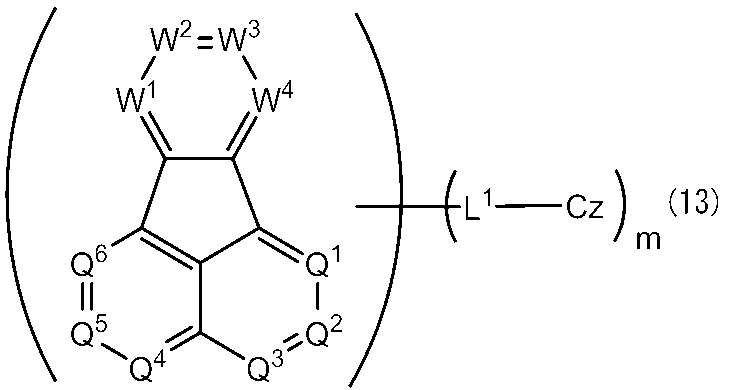
〔式(13)において、
Q1~Q6及びW1~W4のいずれかm個はL1と結合する炭素原子を表し、Q1~Q6及びW1~W4がL1と結合する炭素原子を表さないとき、W2及びW3は、各々独立に、CR11を表し、W1及びW4は、各々独立に、CR11又は窒素原子を表し、Q1~Q6は、各々独立に、CR11又は窒素原子を表す。ただし、W1及びW4の少なくとも1つは窒素原子である。
mは1~3の整数を表す。
R11は、各々独立に水素原子又は置換基を表す。
L1は、単結合、置換もしくは無置換の環形成炭素数6~50のアリーレン基、又は置換もしくは無置換の環形成原子数5~50のヘテロアリーレン基を表す。
Czは、下記式(2)で示される基を表す。〕
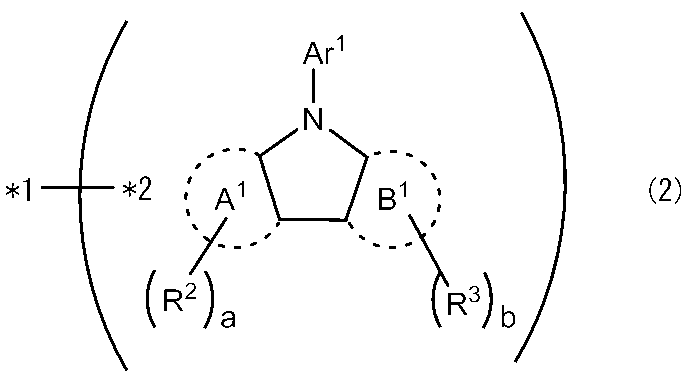
〔式(2)において、Ar1は、*2に結合する単結合又は1価の置換基を表す。
環A1及び環B1は、各々独立に、環形成炭素数5~50の芳香族炭化水素環、又は環形成原子数5~50の芳香族複素環を表す。
R2及びR3は、各々独立に、置換基を表す。
aとbは、各々独立に、0以上の整数であり、Ar1が*2に結合する単結合を表す場合、aとbとの合計は1以上である。
*1はL1との結合位置を表す。
*2は、環A1の1つの環形成炭素原子、環B1の1つの環形成炭素原子、及びAr1のいずれか1つと結合する。
Ar1、R2及びR3の少なくとも一つは、置換もしくは無置換の環形成炭素数6~50のアリール基又は置換もしくは無置換の環形成原子数5~50のヘテロアリール基である。〕 - 前記R2及びR3の少なくとも一方が、下記式(5)で表される請求項25に記載の有機エレクトロルミネッセンス素子用材料。
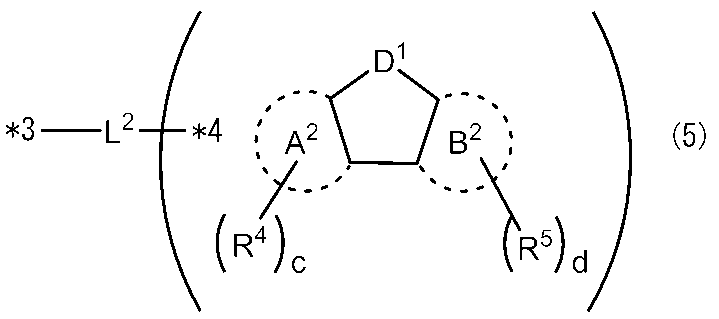
〔式(5)において、環A2及び環B2は、各々独立に、環形成炭素数5~50の芳香族炭化水素環、又は環形成原子数5~50の芳香族複素環を表す。
R4及びR5は、置換基を表し、c及びdは、0以上の整数を表す。
D1は、酸素原子、硫黄原子、CR6R7、又は、NR8を表す。
R6~R8は、各々独立に、水素原子、置換基、又は*4と結合する単結合を表す。
L2は、単結合、置換もしくは無置換の環形成炭素数6~50のアリーレン基、又は置換もしくは無置換の環形成原子数5~50のヘテロアリーレン基を表す。
*3は前記環A1又は環B1の環形成炭素原子に結合する。
*4は環A2の1つの環形成炭素原子、環B2の1つの環形成炭素原子、及びR6~R8のいずれか1つと結合する。〕 - 前記式(2)中の下記式(ABC)で表される縮合環が、下記構造(abc-1)~(abc-17)及び(abc-h1)~(abc-h26)からなる群から選択されるいずれか1つで示される請求項25又は26に記載の有機エレクトロルミネッセンス素子用材料。
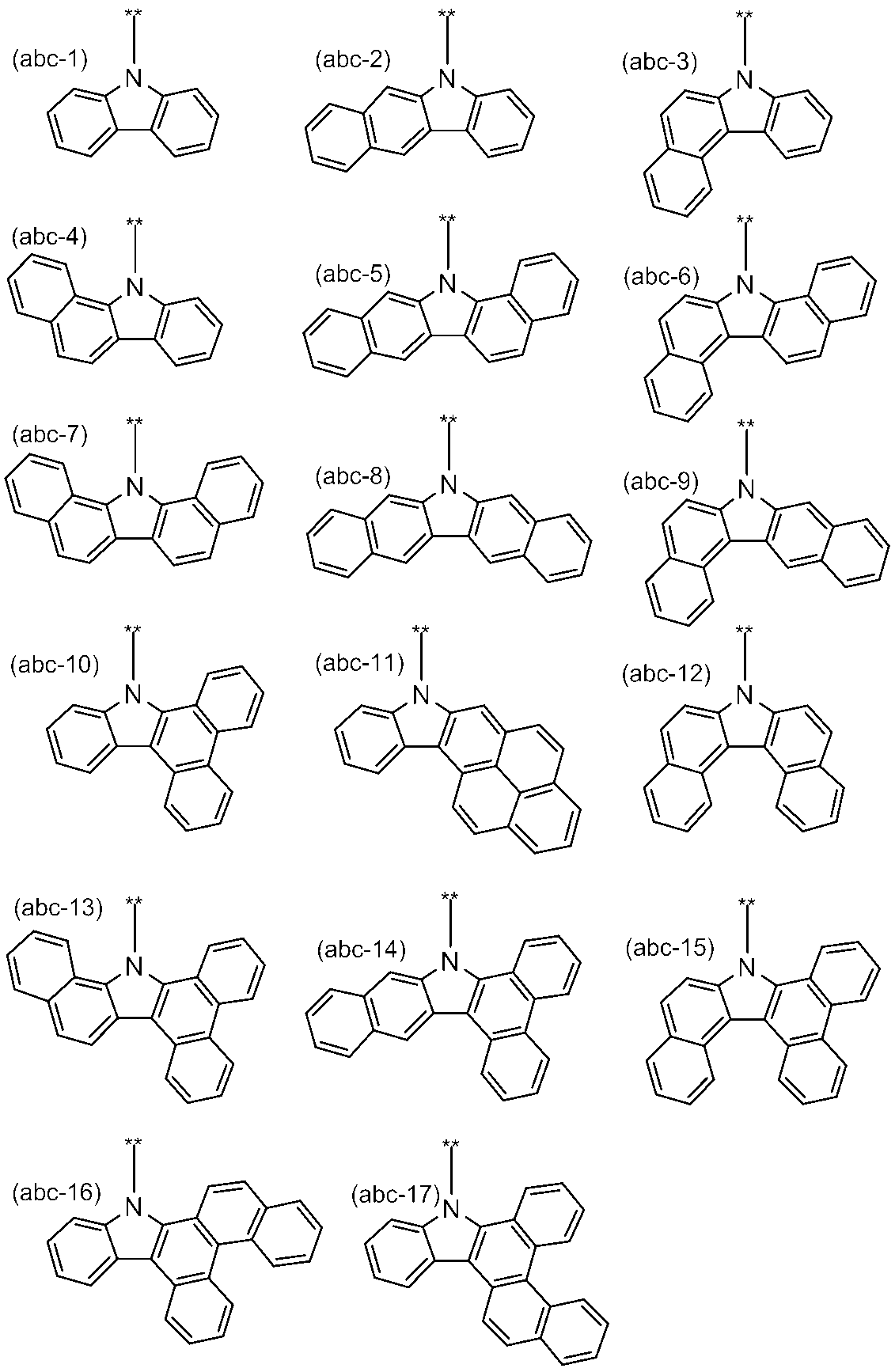
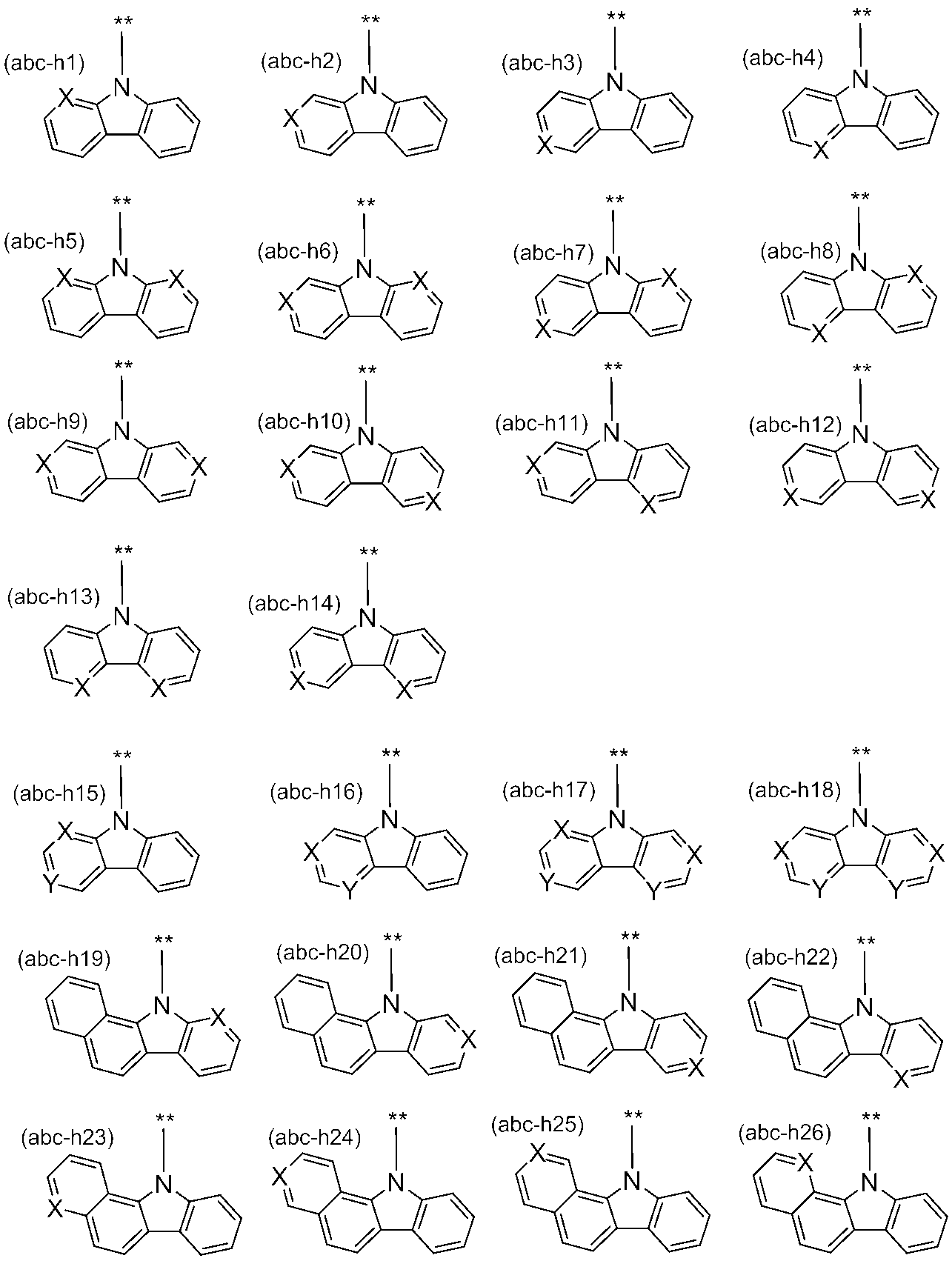
〔構造(abc-1)~(abc-17)及び(abc-h1)~(abc-h26)中、**はAr1の結合位置を表す。また、構造(abc-h1)~(abc-h26)中、X及びYは、各々独立に、NR、酸素原子、又は硫黄原子を表し、Rは水素原子又は置換基を表す。〕 - 前記Czが、下記式(6)で表される請求項25~27のいずれか1項に記載の有機エレクトロルミネッセンス素子用材料。

Y1~Y8は各々独立に、CR9又は窒素原子であり、
Y11~Y18は各々独立に、CR10又は窒素原子であり、
R9は各々独立に、水素原子、置換基、又は*2’と結合する単結合を表す。
R10は各々独立に、水素原子、置換基、又は*4’と結合する単結合を表す。
*1、Ar1、D1及びL2は前記と同様である。
*2’は、Ar1又はR9のいずれか1つが表す炭素原子に結合する。
*3’は複数のR9のいずれか1つに結合する。
*4’はR6~R8又は複数のR10のいずれか1つに結合する。〕 - 前記Czが、下記式(7)で表される請求項25~28のいずれか1項に記載の有機エレクトロルミネッセンス素子用材料。

*1、*3’、*4’、Y1~Y8、Y11~Y18、L2、及びD1は前記と同様である。〕 - 前記Czが、下記式(8)で表される請求項25~29のいずれか1項に記載の有機エレクトロルミネッセンス素子用材料。

〔式(8)において、
*1、*3’、Y1~Y8、Y11~Y18、L2、及びD1は前記と同様である。
*4”はY15~Y18のいずれか1つが表す炭素原子と結合し、その他のY15~Y18は各々独立にCR10又は窒素原子を表す。
R10は前記と同様である。〕 - 前記Czが、下記式(9)で表される請求項25~28のいずれか1項に記載の有機エレクトロルミネッセンス素子用材料。
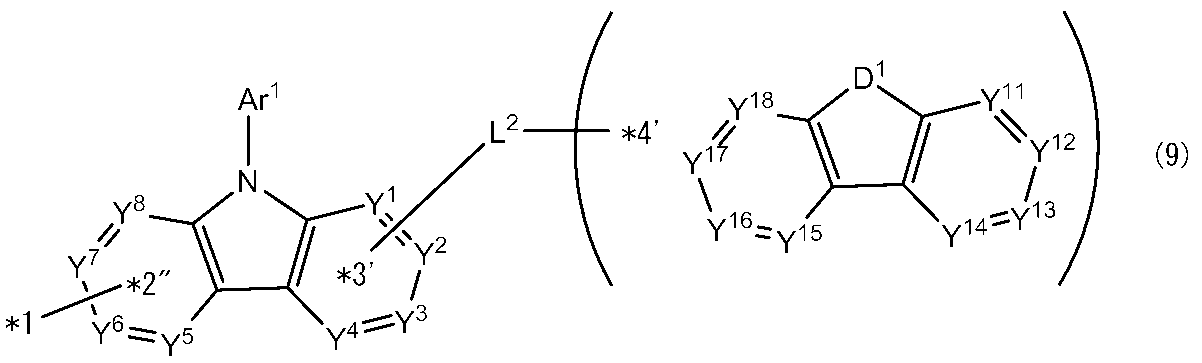
〔式(9)において、
*1、*3’、*4’、Y1~Y8、Y11~Y18、Ar1、L2、及びD1は前記と同様である。
*2”は、Y5~Y8のいずれか1つが表す炭素原子に結合し、その他のY5~Y8は各々独立にCR10又は窒素原子を表す。
R10は前記と同様である。〕 - 前記Czが、下記式(10)で表される請求項25~28及び31のいずれか1項に記載の有機エレクトロルミネッセンス素子用材料。
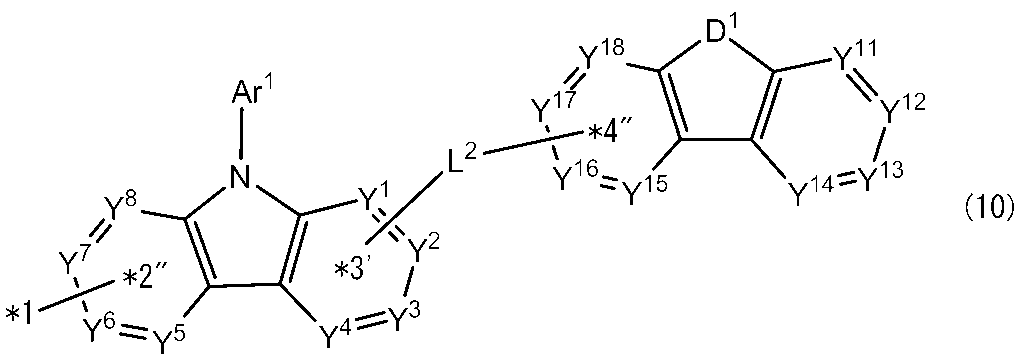
〔式(10)において、
*1、*2”、*3’、*4”、Y1~Y8、Y11~Y18、Ar1、L2、及びD1は前記と同様である。〕 - 前記W1が窒素原子である請求項25~32のいずれか1項に記載の有機エレクトロルミネッセンス素子用材料。
- 前記L1が、前記Q1~Q6及びW2~W4が表す炭素原子のいずれか1つ~3つに結合する請求項25~33のいずれか1項に記載の有機エレクトロルミネッセンス素子用材料。
- 前記置換基が、置換もしくは無置換の炭素数1~50のアルキル基、置換もしくは無置換の環形成炭素数3~50のシクロアルキル基、置換もしくは無置換の環形成炭素数6~60のアリール基、置換もしくは無置換の炭素数7~61のアラルキル基、アミノ基、置換もしくは無置換の炭素数1~50のアルキル基及び置換もしくは無置換の環形成炭素数6~60のアリール基から選ばれる置換基を有するモノ置換又はジ置換アミノ基、置換もしくは無置換の炭素数1~50のアルコキシ基、置換もしくは無置換の環形成炭素数3~50のシクロアルコキシ基、置換もしくは無置換の環形成炭素数6~60のアリールオキシ基、置換もしくは無置換の炭素数1~50のアルキルチオ基、置換もしくは無置換の環形成炭素数6~60のアリールチオ基、置換もしくは無置換の炭素数1~50のアルキル基及び置換もしくは無置換の環形成炭素数6~60のアリール基から選ばれる置換基を有するモノ置換、ジ置換又はトリ置換シリル基、置換もしくは無置換の環形成原子数5~60のヘテロアリール基、置換もしくは無置換の炭素数1~50のハロアルキル基、ハロゲン原子、シアノ基、ニトロ基、置換もしくは無置換の炭素数1~50のアルキル基及び置換もしくは無置換の環形成炭素数6~60のアリール基から選ばれる置換基を有するスルフォニル基、置換もしくは無置換の炭素数1~50のアルキル基及び置換もしくは無置換の環形成炭素数6~60のアリール基から選ばれる置換基を有するジ置換ホスフォリル基、アルキルスルホニルオキシ基、アリールスルホニルオキシ基、アルキルカルボニルオキシ基、アリールカルボニルオキシ基、ホウ素含有基、亜鉛含有基、スズ含有基、ケイ素含有基、マグネシウム含有基、リチウム含有基、ヒドロキシ基、アルキル置換又はアリール置換カルボニル基、カルボキシル基、ビニル基、(メタ)アクリロイル基、エポキシ基、及びオキセタニル基からなる群から選ばれる基である請求項25~34のいずれか1項に記載の有機エレクトロルミネッセンス素子用材料。
- 前記置換基が、置換もしくは無置換のメチル基、置換もしくは無置換のエチル基、置換もしくは無置換のn-プロピル基、置換もしくは無置換のイソプロピル基、置換もしくは無置換のn-ブチル基、置換もしくは無置換のイソブチル基、置換もしくは無置換のs-ブチル基、置換もしくは無置換のt-ブチル基、置換もしくは無置換のペンチル基(異性体を含む)、置換もしくは無置換のヘキシル基(異性体を含む)、置換もしくは無置換のヘプチル基(異性体を含む)、置換もしくは無置換のオクチル基(異性体を含む)、置換もしくは無置換のノニル基(異性体を含む)、置換もしくは無置換のデシル基(異性体を含む)、置換もしくは無置換のウンデシル基(異性体を含む)、置換もしくは無置換のドデシル基(異性体を含む)、置換もしくは無置換のトリデシル基、置換もしくは無置換のテトラデシル基、置換もしくは無置換のオクタデシル基、
置換もしくは無置換のシクロペンチル基、置換もしくは無置換のシクロヘキシル基、
置換もしくは無置換のフェニル基、置換もしくは無置換のナフチル基、置換もしくは無置換のビフェニリル基、置換もしくは無置換のターフェニリル基、置換もしくは無置換のフェナントリル基、置換もしくは無置換のベンゾフェナントリル基、置換もしくは無置換のフルオレニル基、置換もしくは無置換の9,9’-スピロビフルオレニル基、置換もしくは無置換のベンゾフルオレニル基、置換もしくは無置換のジベンゾフルオレニル基、置換もしくは無置換のクリセニル基、置換もしくは無置換のベンゾクリセニル基、置換もしくは無置換のs-インダニル基、置換もしくは無置換のas-インダニル基、置換もしくは無置換のトリフェニレニル基、置換もしくは無置換のベンゾトリフェニレニル基、置換もしくは無置換のアントリル基、置換もしくは無置換の9,9-ジメチルフルオレニル基、置換もしくは無置換の9,9-ジフェニルフルオレニル基、
置換もしくは無置換のピリジル基、置換もしくは無置換のピリダジニル基、置換もしくは無置換のピリミジニル基、置換もしくは無置換のピラジニル基、置換もしくは無置換のトリアジニル基、置換もしくは無置換のイミダゾリル基、置換もしくは無置換のインドリル基、置換もしくは無置換のイソインドリル基、置換もしくは無置換のベンゾフラニル基、置換もしくは無置換のイソベンゾフラニル基、置換もしくは無置換のベンゾチオフェニル基、置換もしくは無置換のイソベンゾチオフェニル基、置換もしくは無置換のインドリジニル基、置換もしくは無置換のキノリジニル基、置換もしくは無置換のキノリル基、置換もしくは無置換のイソキノリル基、置換もしくは無置換のキナゾリニル基、置換もしくは無置換のキノキサリニル基、置換もしくは無置換のベンズイミダゾリル基、置換もしくは無置換のベンズオキサゾリル基、置換もしくは無置換のベンズチアゾリル基、置換もしくは無置換のベンズイソキサゾリル基、置換もしくは無置換のベンズイソチアゾリル基、置換もしくは無置換のジベンゾフラニル基、置換もしくは無置換のジベンゾチオフェニル基、置換もしくは無置換のカルバゾリル基、置換もしくは無置換のビカルバゾリル基、置換もしくは無置換のフェナントリジニル基、置換もしくは無置換のアクリジニル基、置換もしくは無置換のフェナントロリニル基、置換もしくは無置換のアザトリフェニレニル基、置換もしくは無置換のジアザトリフェニレニル基、置換もしくは無置換のキサンテニル基、置換もしくは無置換のアザカルバゾリル基、置換もしくは無置換のアザジベンゾフラニル基、置換もしくは無置換のアザジベンゾチオフェニル基、からなる群から選ばれる基である請求項25~34のいずれか1項に記載の有機エレクトロルミネッセンス素子用材料。 - 前記置換基が、置換もしくは無置換のメチル基、置換もしくは無置換のエチル基、置換もしくは無置換のn-プロピル基、置換もしくは無置換のイソプロピル基、置換もしくは無置換のn-ブチル基、置換もしくは無置換のイソブチル基、置換もしくは無置換のs-ブチル基、置換もしくは無置換のt-ブチル基、置換もしくは無置換のペンチル基(異性体を含む)、置換もしくは無置換のヘキシル基(異性体を含む)、置換もしくは無置換のヘプチル基(異性体を含む)、置換もしくは無置換のオクチル基(異性体を含む)、
置換もしくは無置換のフェニル基、置換もしくは無置換のビフェニリル基、置換もしくは無置換のターフェニリル基、置換もしくは無置換のナフチル基、置換もしくは無置換のフェナントリル基、置換もしくは無置換のフルオレニル基、置換もしくは無置換の9,9’-スピロビフルオレニル基、置換もしくは無置換のクリセニル基、置換もしくは無置換のトリフェニレニル基、置換もしくは無置換の9,9-ジメチルフルオレニル基、置換もしくは無置換の9,9-ジフェニルフルオレニル基、
置換もしくは無置換のピリジル基、置換もしくは無置換のピリミジニル基、置換もしくは無置換のトリアジニル基、置換もしくは無置換のベンゾフラニル基、置換もしくは無置換のイソベンゾフラニル基、置換もしくは無置換のキノリル基、置換もしくは無置換のイソキノリル基、置換もしくは無置換のキナゾリニル基、置換もしくは無置換のベンゾチオフェニル基、置換もしくは無置換のイソベンゾチオフェニル基、置換もしくは無置換のインドリジニル基、置換もしくは無置換のジベンゾフラニル基、置換もしくは無置換のジベンゾチオフェニル基、置換もしくは無置換のカルバゾリル基、置換もしくは無置換のビカルバゾリル基、置換もしくは無置換のアザトリフェニレニル基、置換もしくは無置換のジアザトリフェニレニル基、置換もしくは無置換のキサンテニル基、置換もしくは無置換のアザカルバゾリル基、置換もしくは無置換のアザジベンゾフラニル基、置換もしくは無置換のアザジベンゾチオフェニル基、からなる群から選ばれる基である請求項25~34のいずれか1項に記載の有機エレクトロルミネッセンス素子用材料。 - 陰極、陽極、及び陰極と陽極間に挟持された一層又は複数層からなる有機薄膜層を含む有機エレクトロルミネッセンス素子において、該有機薄膜層は発光層を含み、該有機薄膜層の少なくとも1層が、請求項1~23のいずれか1項に記載の化合物を含有する有機エレクトロルミネッセンス素子。
- 陰極、陽極、及び陰極と陽極間に挟持された一層又は複数層からなる有機薄膜層を含む有機エレクトロルミネッセンス素子において、該有機薄膜層は発光層を含み、該有機薄膜層の少なくとも1層が、請求項25~37のいずれか1項に記載の化合物を含有する有機エレクトロルミネッセンス素子。
- 前記発光層が前記化合物を含有する請求項38又は39に記載の有機エレクトロルミネッセンス素子。
- 前記陽極と前記発光層との間に、さらに第1の電荷輸送層を有し、該第1の電荷輸送層が前記化合物を含有する請求項38~40のいずれか1項に記載の有機エレクトロルミネッセンス素子。
- 前記陰極と前記発光層との間に、さらに第2の電荷輸送層を有し、該第2の電荷輸送層が前記化合物を含有する請求項38~41のいずれか1項に記載の有機エレクトロルミネッセンス素子。
- 前記発光層が燐光発光材料を含有する請求項38~42のいずれか1項に記載の有機エレクトロルミネッセンス素子。
- 前記発光層が蛍光発光材料を含有する請求項38~43のいずれか1項に記載の有機エレクトロルミネッセンス素子。
- 前記燐光発光材料が、イリジウム(Ir)、オスミウム(Os)、白金(Pt)から選択される金属原子のオルトメタル化錯体である請求項43に記載の有機エレクトロルミネッセンス素子。
- 前記燐光発光材料が、下記式(V)、(X)、(Y)又は(Z)で表される錯体である請求項45に記載の有機エレクトロルミネッセンス素子。

[式(V)、(X)、(Y)又は(Z)において、R50~R54は、水素原子又は置換基、kは1~4の整数であり、lは1~4の整数であり、mは1~2の整数である。Mは、Ir、Os、又はPtである。] - 請求項38~46のいずれか1項に記載の有機エレクトロルミネッセンス素子を備える電子機器。
Priority Applications (1)
| Application Number | Priority Date | Filing Date | Title |
|---|---|---|---|
| US15/502,398 US10629821B2 (en) | 2015-04-08 | 2016-04-05 | Compound, material for organic electroluminescent elements using same, and organic electroluminescent element and electronic device each using same |
Applications Claiming Priority (2)
| Application Number | Priority Date | Filing Date | Title |
|---|---|---|---|
| JP2015079639 | 2015-04-08 | ||
| JP2015-079639 | 2015-04-08 |
Publications (1)
| Publication Number | Publication Date |
|---|---|
| WO2016163372A1 true WO2016163372A1 (ja) | 2016-10-13 |
Family
ID=57072624
Family Applications (1)
| Application Number | Title | Priority Date | Filing Date |
|---|---|---|---|
| PCT/JP2016/061176 Ceased WO2016163372A1 (ja) | 2015-04-08 | 2016-04-05 | 化合物、これを用いた有機エレクトロルミネッセンス素子用材料、及びこれを用いた有機エレクトロルミネッセンス素子並びに電子機器 |
Country Status (2)
| Country | Link |
|---|---|
| US (1) | US10629821B2 (ja) |
| WO (1) | WO2016163372A1 (ja) |
Cited By (2)
| Publication number | Priority date | Publication date | Assignee | Title |
|---|---|---|---|---|
| CN106543152A (zh) * | 2016-10-25 | 2017-03-29 | 上海道亦化工科技有限公司 | 基于萘并苯并呋喃的磷光主体化合物及其有机发光器件 |
| JP2023101374A (ja) * | 2022-01-07 | 2023-07-20 | 東ソー株式会社 | アザベンゾフルオランテン化合物、有機電界発光素子用材料、有機電界発光素子用電子輸送材料および有機電界発光素子 |
Families Citing this family (1)
| Publication number | Priority date | Publication date | Assignee | Title |
|---|---|---|---|---|
| JP6668152B2 (ja) * | 2015-12-28 | 2020-03-18 | 株式会社Kyulux | 化合物、発光材料および有機発光素子 |
Citations (25)
| Publication number | Priority date | Publication date | Assignee | Title |
|---|---|---|---|---|
| JP2002069044A (ja) * | 2000-08-25 | 2002-03-08 | Idemitsu Kosan Co Ltd | 有機エレクトロルミネッセンス素子 |
| JP2003212875A (ja) * | 2002-01-22 | 2003-07-30 | Petroleum Energy Center | アミノ基を有する新規アザ芳香族化合物及びそれを利用した有機エレクトロルミネッセンス素子 |
| JP2003238534A (ja) * | 2002-02-22 | 2003-08-27 | Idemitsu Kosan Co Ltd | 新規アントラセン化合物およびそれを用いた有機エレクトロルミネッセンス素子 |
| JP2005068367A (ja) * | 2003-08-27 | 2005-03-17 | Toyo Ink Mfg Co Ltd | 有機エレクトロルミネッセンス素子用材料および有機エレクトロルミネッセンス素子 |
| JP2008056658A (ja) * | 2006-08-04 | 2008-03-13 | Canon Inc | 縮合複素環化合物および有機発光素子 |
| JP2008156315A (ja) * | 2006-12-26 | 2008-07-10 | Canon Inc | ベンゾフルオランテン化合物及びこれを使用した有機発光素子 |
| JP2009256348A (ja) * | 2008-03-28 | 2009-11-05 | Semiconductor Energy Lab Co Ltd | アセナフトピリジン誘導体、発光素子用材料、発光素子、発光装置、及び電子機器 |
| JP2009256343A (ja) * | 2008-03-28 | 2009-11-05 | Semiconductor Energy Lab Co Ltd | アセナフトキノキサリン誘導体、発光素子、発光装置および電子機器 |
| JP2010111635A (ja) * | 2008-11-07 | 2010-05-20 | Canon Inc | 新規アザインデノクリセン誘導体および有機発光素子 |
| KR20120044523A (ko) * | 2010-10-28 | 2012-05-08 | 롬엔드하스전자재료코리아유한회사 | 신규한 유기 발광 화합물 및 이를 포함하는 유기 전계 발광 소자 |
| WO2012108388A1 (ja) * | 2011-02-07 | 2012-08-16 | 出光興産株式会社 | ビスカルバゾール誘導体及びそれを用いた有機エレクトロルミネッセンス素子 |
| JP2013103937A (ja) * | 2011-11-14 | 2013-05-30 | Universal Display Corp | トリフェニレンシランホスト |
| WO2013094921A1 (ko) * | 2011-12-19 | 2013-06-27 | 주식회사 두산 | 아자인데노안트라센 유도체 및 이를 이용한 유기 전계 발광 소자 |
| WO2013146942A1 (ja) * | 2012-03-28 | 2013-10-03 | 出光興産株式会社 | 新規化合物、有機エレクトロルミネッセンス素子用材料および有機エレクトロルミネッセンス素子 |
| WO2013187258A1 (ja) * | 2012-06-12 | 2013-12-19 | 東レ株式会社 | 発光素子材料および発光素子 |
| WO2014007287A1 (ja) * | 2012-07-05 | 2014-01-09 | 東レ株式会社 | 発光素子材料および発光素子 |
| KR20140083189A (ko) * | 2012-12-24 | 2014-07-04 | 주식회사 두산 | 신규 화합물 및 이를 포함하는 유기 전계 발광 소자 |
| WO2014157574A1 (ja) * | 2013-03-27 | 2014-10-02 | 出光興産株式会社 | 縮合フルオランテン化合物、これを用いた有機エレクトロルミネッセンス素子用材料、並びにこれを用いた有機エレクトロルミネッセンス素子及び電子機器 |
| WO2014178434A1 (ja) * | 2013-05-02 | 2014-11-06 | 出光興産株式会社 | 化合物、有機エレクトロルミネッセンス素子用材料、有機エレクトロルミネッセンス素子及び電子機器 |
| JP2014531419A (ja) * | 2011-09-01 | 2014-11-27 | ローム・アンド・ハース・エレクトロニック・マテリアルズ・コリア・リミテッド | 新規有機エレクトロルミネッセンス化合物およびこれを使用した有機エレクトロルミネッセンス素子 |
| CN104342126A (zh) * | 2013-11-11 | 2015-02-11 | 北京阿格蕾雅科技发展有限公司 | 有机电致发光材料和有机电致发光器件 |
| WO2015020217A1 (ja) * | 2013-08-09 | 2015-02-12 | 出光興産株式会社 | 有機エレクトロルミネッセンス用組成物、有機エレクトロルミネッセンス素子用材料、有機エレクトロルミネッセンス素子用材料溶液及び有機エレクトロルミネッセンス素子 |
| WO2015033894A1 (ja) * | 2013-09-04 | 2015-03-12 | 出光興産株式会社 | カルバゾール誘導体、これを用いた有機エレクトロルミネッセンス素子用材料、並びにこれを用いた有機エレクトロルミネッセンス素子及び電子機器 |
| WO2015050140A1 (ja) * | 2013-10-03 | 2015-04-09 | 出光興産株式会社 | 化合物、これを用いた有機エレクトロルミネッセンス素子用材料、及びこれを用いた有機エレクトロルミネッセンス素子並びに電子機器 |
| WO2015050173A1 (ja) * | 2013-10-03 | 2015-04-09 | 出光興産株式会社 | 化合物、有機エレクトロルミネッセンス素子及び電子機器 |
Family Cites Families (6)
| Publication number | Priority date | Publication date | Assignee | Title |
|---|---|---|---|---|
| US8034465B2 (en) | 2007-06-20 | 2011-10-11 | Global Oled Technology Llc | Phosphorescent oled having double exciton-blocking layers |
| US9196845B2 (en) | 2008-08-22 | 2015-11-24 | Lg Chem, Ltd. | Material for organic electronic device, and organic electronic device using same |
| WO2012108389A1 (ja) | 2011-02-07 | 2012-08-16 | 出光興産株式会社 | ビスカルバゾール誘導体及びそれを用いた有機エレクトロルミネッセンス素子 |
| KR102249279B1 (ko) * | 2014-03-25 | 2021-05-07 | 에스에프씨 주식회사 | 유기발광 화합물 및 이를 포함하는 유기전계발광소자 |
| WO2015156587A1 (en) | 2014-04-08 | 2015-10-15 | Rohm And Haas Electronic Materials Korea Ltd. | Multi-component host material and organic electroluminescent device comprising the same |
| US20180226601A1 (en) * | 2015-09-11 | 2018-08-09 | Idemitsu Kosan Co., Ltd. | Organic electroluminescent element, illumination device, display device, and mixed material |
-
2016
- 2016-04-05 WO PCT/JP2016/061176 patent/WO2016163372A1/ja not_active Ceased
- 2016-04-05 US US15/502,398 patent/US10629821B2/en active Active
Patent Citations (25)
| Publication number | Priority date | Publication date | Assignee | Title |
|---|---|---|---|---|
| JP2002069044A (ja) * | 2000-08-25 | 2002-03-08 | Idemitsu Kosan Co Ltd | 有機エレクトロルミネッセンス素子 |
| JP2003212875A (ja) * | 2002-01-22 | 2003-07-30 | Petroleum Energy Center | アミノ基を有する新規アザ芳香族化合物及びそれを利用した有機エレクトロルミネッセンス素子 |
| JP2003238534A (ja) * | 2002-02-22 | 2003-08-27 | Idemitsu Kosan Co Ltd | 新規アントラセン化合物およびそれを用いた有機エレクトロルミネッセンス素子 |
| JP2005068367A (ja) * | 2003-08-27 | 2005-03-17 | Toyo Ink Mfg Co Ltd | 有機エレクトロルミネッセンス素子用材料および有機エレクトロルミネッセンス素子 |
| JP2008056658A (ja) * | 2006-08-04 | 2008-03-13 | Canon Inc | 縮合複素環化合物および有機発光素子 |
| JP2008156315A (ja) * | 2006-12-26 | 2008-07-10 | Canon Inc | ベンゾフルオランテン化合物及びこれを使用した有機発光素子 |
| JP2009256348A (ja) * | 2008-03-28 | 2009-11-05 | Semiconductor Energy Lab Co Ltd | アセナフトピリジン誘導体、発光素子用材料、発光素子、発光装置、及び電子機器 |
| JP2009256343A (ja) * | 2008-03-28 | 2009-11-05 | Semiconductor Energy Lab Co Ltd | アセナフトキノキサリン誘導体、発光素子、発光装置および電子機器 |
| JP2010111635A (ja) * | 2008-11-07 | 2010-05-20 | Canon Inc | 新規アザインデノクリセン誘導体および有機発光素子 |
| KR20120044523A (ko) * | 2010-10-28 | 2012-05-08 | 롬엔드하스전자재료코리아유한회사 | 신규한 유기 발광 화합물 및 이를 포함하는 유기 전계 발광 소자 |
| WO2012108388A1 (ja) * | 2011-02-07 | 2012-08-16 | 出光興産株式会社 | ビスカルバゾール誘導体及びそれを用いた有機エレクトロルミネッセンス素子 |
| JP2014531419A (ja) * | 2011-09-01 | 2014-11-27 | ローム・アンド・ハース・エレクトロニック・マテリアルズ・コリア・リミテッド | 新規有機エレクトロルミネッセンス化合物およびこれを使用した有機エレクトロルミネッセンス素子 |
| JP2013103937A (ja) * | 2011-11-14 | 2013-05-30 | Universal Display Corp | トリフェニレンシランホスト |
| WO2013094921A1 (ko) * | 2011-12-19 | 2013-06-27 | 주식회사 두산 | 아자인데노안트라센 유도체 및 이를 이용한 유기 전계 발광 소자 |
| WO2013146942A1 (ja) * | 2012-03-28 | 2013-10-03 | 出光興産株式会社 | 新規化合物、有機エレクトロルミネッセンス素子用材料および有機エレクトロルミネッセンス素子 |
| WO2013187258A1 (ja) * | 2012-06-12 | 2013-12-19 | 東レ株式会社 | 発光素子材料および発光素子 |
| WO2014007287A1 (ja) * | 2012-07-05 | 2014-01-09 | 東レ株式会社 | 発光素子材料および発光素子 |
| KR20140083189A (ko) * | 2012-12-24 | 2014-07-04 | 주식회사 두산 | 신규 화합물 및 이를 포함하는 유기 전계 발광 소자 |
| WO2014157574A1 (ja) * | 2013-03-27 | 2014-10-02 | 出光興産株式会社 | 縮合フルオランテン化合物、これを用いた有機エレクトロルミネッセンス素子用材料、並びにこれを用いた有機エレクトロルミネッセンス素子及び電子機器 |
| WO2014178434A1 (ja) * | 2013-05-02 | 2014-11-06 | 出光興産株式会社 | 化合物、有機エレクトロルミネッセンス素子用材料、有機エレクトロルミネッセンス素子及び電子機器 |
| WO2015020217A1 (ja) * | 2013-08-09 | 2015-02-12 | 出光興産株式会社 | 有機エレクトロルミネッセンス用組成物、有機エレクトロルミネッセンス素子用材料、有機エレクトロルミネッセンス素子用材料溶液及び有機エレクトロルミネッセンス素子 |
| WO2015033894A1 (ja) * | 2013-09-04 | 2015-03-12 | 出光興産株式会社 | カルバゾール誘導体、これを用いた有機エレクトロルミネッセンス素子用材料、並びにこれを用いた有機エレクトロルミネッセンス素子及び電子機器 |
| WO2015050140A1 (ja) * | 2013-10-03 | 2015-04-09 | 出光興産株式会社 | 化合物、これを用いた有機エレクトロルミネッセンス素子用材料、及びこれを用いた有機エレクトロルミネッセンス素子並びに電子機器 |
| WO2015050173A1 (ja) * | 2013-10-03 | 2015-04-09 | 出光興産株式会社 | 化合物、有機エレクトロルミネッセンス素子及び電子機器 |
| CN104342126A (zh) * | 2013-11-11 | 2015-02-11 | 北京阿格蕾雅科技发展有限公司 | 有机电致发光材料和有机电致发光器件 |
Cited By (2)
| Publication number | Priority date | Publication date | Assignee | Title |
|---|---|---|---|---|
| CN106543152A (zh) * | 2016-10-25 | 2017-03-29 | 上海道亦化工科技有限公司 | 基于萘并苯并呋喃的磷光主体化合物及其有机发光器件 |
| JP2023101374A (ja) * | 2022-01-07 | 2023-07-20 | 東ソー株式会社 | アザベンゾフルオランテン化合物、有機電界発光素子用材料、有機電界発光素子用電子輸送材料および有機電界発光素子 |
Also Published As
| Publication number | Publication date |
|---|---|
| US20170237016A1 (en) | 2017-08-17 |
| US10629821B2 (en) | 2020-04-21 |
Similar Documents
| Publication | Publication Date | Title |
|---|---|---|
| CN109476626B (zh) | 化合物、有机电致发光元件用材料、有机电致发光元件和电子设备 | |
| CN106660940B (zh) | 化合物、有机电致发光元件用材料、有机电致发光元件、及电子设备 | |
| EP4242200A2 (en) | Compound, material for organic electroluminescent element, organic electroluminescent element, and electronic device | |
| EP3747876B1 (en) | Compound and organic electroluminescent element using same | |
| KR20210077690A (ko) | 유기 일렉트로루미네센스 소자 및 전자 기기 | |
| EP4129972A1 (en) | Compound, material for organic electroluminescent elements, organic electroluminescent element, and electronic device | |
| JP6446028B2 (ja) | 組成物、化合物、有機エレクトロルミネッセンス素子用材料、インク組成物、有機エレクトロルミネッセンス素子、及び電子機器 | |
| JP6419874B2 (ja) | 化合物、有機エレクトロルミネッセンス素子用材料、有機エレクトロルミネッセンス素子及び電子機器 | |
| WO2019163826A1 (ja) | 新規化合物及びそれを用いた有機エレクトロルミネッセンス素子 | |
| JP2017141167A (ja) | 化合物、これを用いた有機エレクトロルミネッセンス素子用材料、及びこれを用いた有機エレクトロルミネッセンス素子、照明装置並びに表示装置 | |
| JP6492385B2 (ja) | 化合物、有機エレクトロルミネッセンス素子用材料、インク組成物、有機エレクトロルミネッセンス素子、及び電子機器 | |
| CN114599637A (zh) | 化合物、有机电致发光元件用材料、有机电致发光元件和电子设备 | |
| JP2016127083A (ja) | 有機エレクトロルミネッセンス素子用材料、有機エレクトロルミネッセンス素子及び電子機器 | |
| EP4101847A1 (en) | Organic electroluminescent element and electronic device | |
| JP2018108941A (ja) | 化合物、これを用いた有機エレクトロルミネッセンス素子用材料、及びこれを用いた有機エレクトロルミネッセンス素子並びに電子機器 | |
| JP6431032B2 (ja) | 化合物、有機エレクトロルミネッセンス素子用材料、有機エレクトロルミネッセンス素子、及び電子機器 | |
| JPWO2016129694A1 (ja) | 化合物、有機エレクトロルミネッセンス素子用材料、インク組成物、有機エレクトロルミネッセンス素子、及び電子機器 | |
| JP2015019019A (ja) | 有機エレクトロルミネッセンス素子 | |
| JPWO2016204150A1 (ja) | 化合物、有機エレクトロルミネッセンス素子用材料、有機エレクトロルミネッセンス素子及び電子機器 | |
| CN114206837A (zh) | 化合物、有机电致发光元件用材料、有机电致发光元件和电子设备 | |
| WO2016163372A1 (ja) | 化合物、これを用いた有機エレクトロルミネッセンス素子用材料、及びこれを用いた有機エレクトロルミネッセンス素子並びに電子機器 | |
| JP2015019018A (ja) | 有機エレクトロルミネッセンス素子 | |
| JP6367061B2 (ja) | 化合物、有機エレクトロルミネッセンス素子用材料、有機エレクトロルミネッセンス素子、及び電子機器 | |
| JP2017208455A (ja) | 有機エレクトロルミネッセンス素子用材料、有機エレクトロルミネッセンス素子及び電子機器 |
Legal Events
| Date | Code | Title | Description |
|---|---|---|---|
| 121 | Ep: the epo has been informed by wipo that ep was designated in this application |
Ref document number: 16776538 Country of ref document: EP Kind code of ref document: A1 |
|
| NENP | Non-entry into the national phase |
Ref country code: DE |
|
| 122 | Ep: pct application non-entry in european phase |
Ref document number: 16776538 Country of ref document: EP Kind code of ref document: A1 |
|
| NENP | Non-entry into the national phase |
Ref country code: JP |