WO2016148277A1 - タイヤトレッド用ゴム組成物および空気入りタイヤ - Google Patents
タイヤトレッド用ゴム組成物および空気入りタイヤ Download PDFInfo
- Publication number
- WO2016148277A1 WO2016148277A1 PCT/JP2016/058697 JP2016058697W WO2016148277A1 WO 2016148277 A1 WO2016148277 A1 WO 2016148277A1 JP 2016058697 W JP2016058697 W JP 2016058697W WO 2016148277 A1 WO2016148277 A1 WO 2016148277A1
- Authority
- WO
- WIPO (PCT)
- Prior art keywords
- rubber
- group
- mass
- styrene
- carboxy
- Prior art date
- Legal status (The legal status is an assumption and is not a legal conclusion. Google has not performed a legal analysis and makes no representation as to the accuracy of the status listed.)
- Ceased
Links
Images
Classifications
-
- C—CHEMISTRY; METALLURGY
- C08—ORGANIC MACROMOLECULAR COMPOUNDS; THEIR PREPARATION OR CHEMICAL WORKING-UP; COMPOSITIONS BASED THEREON
- C08C—TREATMENT OR CHEMICAL MODIFICATION OF RUBBERS
- C08C19/00—Chemical modification of rubber
- C08C19/30—Addition of a reagent which reacts with a hetero atom or a group containing hetero atoms of the macromolecule
- C08C19/34—Addition of a reagent which reacts with a hetero atom or a group containing hetero atoms of the macromolecule reacting with oxygen or oxygen-containing groups
- C08C19/36—Addition of a reagent which reacts with a hetero atom or a group containing hetero atoms of the macromolecule reacting with oxygen or oxygen-containing groups with carboxy radicals
-
- B—PERFORMING OPERATIONS; TRANSPORTING
- B60—VEHICLES IN GENERAL
- B60C—VEHICLE TYRES; TYRE INFLATION; TYRE CHANGING; CONNECTING VALVES TO INFLATABLE ELASTIC BODIES IN GENERAL; DEVICES OR ARRANGEMENTS RELATED TO TYRES
- B60C1/00—Tyres characterised by the chemical composition or the physical arrangement or mixture of the composition
- B60C1/0016—Compositions of the tread
-
- C—CHEMISTRY; METALLURGY
- C08—ORGANIC MACROMOLECULAR COMPOUNDS; THEIR PREPARATION OR CHEMICAL WORKING-UP; COMPOSITIONS BASED THEREON
- C08C—TREATMENT OR CHEMICAL MODIFICATION OF RUBBERS
- C08C19/00—Chemical modification of rubber
- C08C19/22—Incorporating nitrogen atoms into the molecule
-
- C—CHEMISTRY; METALLURGY
- C08—ORGANIC MACROMOLECULAR COMPOUNDS; THEIR PREPARATION OR CHEMICAL WORKING-UP; COMPOSITIONS BASED THEREON
- C08K—Use of inorganic or non-macromolecular organic substances as compounding ingredients
- C08K3/00—Use of inorganic substances as compounding ingredients
- C08K3/02—Elements
- C08K3/04—Carbon
-
- C—CHEMISTRY; METALLURGY
- C08—ORGANIC MACROMOLECULAR COMPOUNDS; THEIR PREPARATION OR CHEMICAL WORKING-UP; COMPOSITIONS BASED THEREON
- C08K—Use of inorganic or non-macromolecular organic substances as compounding ingredients
- C08K5/00—Use of organic ingredients
- C08K5/16—Nitrogen-containing compounds
- C08K5/29—Compounds containing one or more carbon-to-nitrogen double bonds
-
- C—CHEMISTRY; METALLURGY
- C08—ORGANIC MACROMOLECULAR COMPOUNDS; THEIR PREPARATION OR CHEMICAL WORKING-UP; COMPOSITIONS BASED THEREON
- C08L—COMPOSITIONS OF MACROMOLECULAR COMPOUNDS
- C08L13/00—Compositions of rubbers containing carboxyl groups
-
- C—CHEMISTRY; METALLURGY
- C08—ORGANIC MACROMOLECULAR COMPOUNDS; THEIR PREPARATION OR CHEMICAL WORKING-UP; COMPOSITIONS BASED THEREON
- C08L—COMPOSITIONS OF MACROMOLECULAR COMPOUNDS
- C08L15/00—Compositions of rubber derivatives
-
- C—CHEMISTRY; METALLURGY
- C08—ORGANIC MACROMOLECULAR COMPOUNDS; THEIR PREPARATION OR CHEMICAL WORKING-UP; COMPOSITIONS BASED THEREON
- C08L—COMPOSITIONS OF MACROMOLECULAR COMPOUNDS
- C08L9/00—Compositions of homopolymers or copolymers of conjugated diene hydrocarbons
- C08L9/06—Copolymers with styrene
-
- B—PERFORMING OPERATIONS; TRANSPORTING
- B60—VEHICLES IN GENERAL
- B60C—VEHICLE TYRES; TYRE INFLATION; TYRE CHANGING; CONNECTING VALVES TO INFLATABLE ELASTIC BODIES IN GENERAL; DEVICES OR ARRANGEMENTS RELATED TO TYRES
- B60C11/00—Tyre tread bands; Tread patterns; Anti-skid inserts
- B60C11/0008—Tyre tread bands; Tread patterns; Anti-skid inserts characterised by the tread rubber
- B60C2011/0016—Physical properties or dimensions
- B60C2011/0025—Modulus or tan delta
Definitions
- the present invention relates to a rubber composition for a tire tread and a pneumatic tire.
- the pneumatic tire is composed of various members such as a tire tread portion, a bead portion, and a sidewall portion, and each member constituting the pneumatic tire is made of a rubber composition containing carbon black, a rubber component, or the like. Formed using.
- Patent Document 1 discloses a rubber composition containing styrene / butadiene copolymer rubber, carbon black, N, N′-diphenyl-p-phenylenedinitrone (nitrone compound) and the like. (See Example 2).
- Patent Document 2 discloses specific properties.
- a blend of 100 parts by weight of two types of solution-polymerized styrene butadiene rubber having a specific property and 80 to 150 parts by weight of carbon black having specific properties is disclosed.
- JP 2007-70439 A Japanese Patent No. 5088456
- the rubber constituting the tire tread portion is quickly heated to a high temperature state (for example, 80 It is required to reach about 120 ° C. Therefore, as shown in Patent Document 2, the rubber composition used for forming the tire tread of the tire for racing is more carbon black than the rubber composition used for the tire tread portion for general vehicles. There are cases where the blending amount of is increased. Under these circumstances, the present inventors examined the rubber composition described in Patent Document 2 and found that dry grip properties and rubber hardness at high temperature were sufficient, but 300% modulus at high temperature was insufficient. It became clear that there was a case.
- Patent Document 2 In order to further improve the performance of the rubber composition for a tire tread having a high carbon black content described in Patent Document 2, the present inventors have disclosed a nitrone compound as described in Patent Document 1 ( The use of styrene-butadiene rubber modified with (N, N′-diphenyl-p-phenylenedinitrone) was investigated. However, the resulting rubber composition may have insufficient dry grip properties when formed into a tire. Further, the rubber hardness at high temperature and the 300% modulus may be low.
- the present invention provides a rubber composition for a tire tread having excellent dry grip properties and high rubber hardness at high temperature and high 300% modulus when used as a tire, and a pneumatic tire using the same. With the goal.
- the inventor of the present invention is excellent in dry grip properties by using a carboxy-modified polymer obtained by modifying a styrene-butadiene rubber with a nitrone compound having a carboxy group, and has a rubber hardness at a high temperature and 300
- the present inventors have found that the% modulus is excellent and have reached the present invention. That is, the present inventor has found that the above problem can be solved by the following configuration.
- Carbon black and a diene rubber containing a carboxy-modified polymer The carbon black content is 80 to 150 parts by mass with respect to 100 parts by mass of the diene rubber.
- the carboxy-modified polymer is obtained by modifying styrene-butadiene rubber (A) with a nitrone compound (B) having a carboxy group, and the content of the carboxy-modified polymer in the diene rubber is 10 to 100 mass.
- the nitrone compound (B) having a carboxy group is N-phenyl- ⁇ - (4-carboxyphenyl) nitrone, N-phenyl- ⁇ - (3-carboxyphenyl) nitrone, N-phenyl- ⁇ - (2-carboxyl). Selected from the group consisting of phenyl) nitrone, N- (4-carboxyphenyl) - ⁇ -phenylnitrone, N- (3-carboxyphenyl) - ⁇ -phenylnitrone and N- (2-carboxyphenyl) - ⁇ -phenylnitrone
- the rubber composition for a tire tread according to the above [1] which is a compound to be obtained.
- a tire tread rubber composition having excellent dry grip properties, high rubber hardness at a high temperature and high 300% modulus when used as a tire, and a tire composition obtained by using the rubber composition are described below.
- a pneumatic tire can be provided.
- a numerical range expressed using “to” means a range including numerical values described before and after “to” as a lower limit value and an upper limit value.
- the rubber composition for tire treads of the present invention contains carbon black and a diene rubber containing a carboxy-modified polymer.
- the content of the carbon black is 80 to 150 parts by mass with respect to 100 parts by mass of the diene rubber.
- the carboxy-modified polymer is obtained by modifying the styrene-butadiene rubber (A) with a nitrone compound (B) having a carboxy group, and the content of the carboxy-modified polymer in the diene rubber is 10 to 10. 100% by mass.
- the rubber composition of the present invention contains a carboxy-modified polymer obtained by modifying a styrene-butadiene rubber (A) with a nitrone compound (B) having a carboxy group. Therefore, it is considered that the carboxy group at the nitrone-modified site in the carboxy-modified polymer interacts with the carbon black in the rubber composition to enhance the dispersibility of the carbon black. As a result, it is considered that the effect of improving the dry grip property of carbon black is enhanced.
- the carboxy group at the nitrone-modified site in the carboxy-modified polymer interacts with the carbon black in the composition, thereby forming a strong bond between the rubber component and the carbon black and increasing the number of crosslinking points.
- the increase in density it is considered that rubber hardness is excellent and a high 300% modulus can be exhibited even at high temperatures.
- the diene rubber contained in the rubber composition of the present invention contains a carboxy-modified polymer.
- the carboxy-modified polymer is obtained by modifying the styrene-butadiene rubber (A) with a nitrone compound (B) having a carboxy group.
- the content of the carboxy-modified polymer in the diene rubber is 10 to 100% by mass, preferably 50 to 90% by mass, and more preferably 60 to 80% by mass.
- the content of the carboxy-modified polymer is within the above range, the dry grip property is excellent, and the rubber hardness at high temperature and the 300% modulus are excellent.
- the content of the carboxy-modified polymer is less than 10% by mass, the dry grip property is lowered, or the rubber hardness at high temperature and the 300% modulus are lowered.
- the carboxy-modified polymer can be obtained by modifying the styrene-butadiene rubber (A) as described above.
- a styrene-butadiene rubber (A) can be produced using a styrene monomer and a butadiene monomer.
- the styrene monomer used for the production of the styrene-butadiene rubber (A) is not particularly limited, and examples thereof include styrene, ⁇ -methylstyrene, 2-methylstyrene, 3-methylstyrene, 4-methylstyrene, 2 -Ethylstyrene, 3-ethylstyrene, 4-ethylstyrene, 2,4-diisopropylstyrene, 2,4-dimethylstyrene, 4-t-butylstyrene, 5-t-butyl-2-methylstyrene, dimethylaminomethylstyrene And dimethylaminoethyl styrene.
- styrene, ⁇ -methylstyrene, and 4-methylstyrene are preferable, and styrene is more preferable.
- These styrene monomers can be used alone or in combination of two or more.
- the butadiene monomer used in the production of the styrene-butadiene rubber (A) is not particularly limited, and examples thereof include 1,3-butadiene, isoprene (2-methyl-1,3-butadiene), 2,3 -Dimethyl-1,3-butadiene, 2-chloro-1,3-butadiene and the like.
- 1,3-butadiene or isoprene is preferably used, and 1,3-butadiene is more preferably used.
- These butadiene monomers can be used alone or in combination of two or more.
- the production method (polymerization method) of the styrene-butadiene rubber (A) is not particularly limited, and examples thereof include solution polymerization and emulsion polymerization.
- the styrene-butadiene rubber (A) any of solution-polymerized styrene-butadiene rubber and emulsion polymerized styrene-butadiene rubber may be used. From the viewpoint of improving dry grip properties, etc., solution-polymerized styrene-butadiene rubber Is preferably used.
- the content of styrene units in the styrene-butadiene rubber (A) is 36% by mass or more, preferably 36 to 50% by mass, and more preferably 36 to 40% by mass.
- the content of the styrene unit is in the above range, dry grip properties, rubber hardness at high temperature, and 300% modulus are improved.
- the content of the styrene unit is less than 36% by mass, the rubber hardness at high temperature and the 300% modulus at high temperature are lowered, or the dry grip property is lowered.
- the amount of styrene is measured by infrared spectroscopic analysis (Hampton method).
- the weight average molecular weight (Mw) of the styrene-butadiene rubber (A) is preferably 100,000 to 1,800,000, and preferably 300,000 to 1,500,000, from the viewpoint of handleability. It is more preferable.
- the weight average molecular weight (Mw) is measured in terms of standard polystyrene by gel permeation chromatography (GPC) using tetrahydrofuran as a solvent.
- nitrone compound (B) having a carboxy group As described above, the carboxy-modified polymer of the present invention is modified using a nitrone compound (B) having a carboxy group (hereinafter also simply referred to as “carboxy nitrone” or “carboxy nitrone (B)”).
- the carboxy nitrone is not particularly limited as long as it is a nitrone having at least one carboxy group (—COOH).
- nitrone refers to a compound having a nitrone group represented by the following formula (1).
- the carboxy nitrone is preferably a compound represented by the following general formula (2).
- X and Y each independently represent an aliphatic hydrocarbon group, an aromatic hydrocarbon group, or an aromatic heterocyclic group which may have a substituent. However, at least one of X and Y has a carboxy group as a substituent.
- alkyl groups having 1 to 6 carbon atoms are more preferred.
- the cycloalkyl group include a cyclopropyl group, a cyclobutyl group, a cyclopentyl group, a cyclohexyl group, etc. Among them, a cycloalkyl group having 3 to 10 carbon atoms is preferable, and a cycloalkyl group having 3 to 6 carbon atoms is preferable. More preferred.
- alkenyl group include a vinyl group, a 1-propenyl group, an allyl group, an isopropenyl group, a 1-butenyl group, and a 2-butenyl group. Among them, an alkenyl group having 2 to 18 carbon atoms is preferable. An alkenyl group having 2 to 6 carbon atoms is more preferable.
- Examples of the aromatic hydrocarbon group represented by X or Y include an aryl group and an aralkyl group.
- the aryl group include a phenyl group, a naphthyl group, an anthryl group, a phenanthryl group, and a biphenyl group. Among them, an aryl group having 6 to 14 carbon atoms is preferable, and an aryl group having 6 to 10 carbon atoms is more preferable. A phenyl group and a naphthyl group are more preferable.
- Examples of the aralkyl group include a benzyl group, a phenethyl group, and a phenylpropyl group. Among them, an aralkyl group having 7 to 13 carbon atoms is preferable, an aralkyl group having 7 to 11 carbon atoms is more preferable, and a benzyl group is preferable. Further preferred.
- Examples of the aromatic heterocyclic group represented by X or Y include, for example, pyrrolyl group, furyl group, thienyl group, pyrazolyl group, imidazolyl group (imidazole group), oxazolyl group, isoxazolyl group, thiazolyl group, isothiazolyl group, pyridyl group (Pyridine group), furan group, thiophene group, pyridazinyl group, pyrimidinyl group, pyrazinyl group and the like. Of these, a pyridyl group is preferable.
- aromatic hydrocarbon group having such a substituent examples include an aryl group having a substituent such as a tolyl group and a xylyl group; and a substituent such as a methylbenzyl group, an ethylbenzyl group, and a methylphenethyl group.
- the compound represented by the general formula (2) is preferably a compound represented by the following general formula (b).
- m and n each independently represent an integer of 0 to 5, and the sum of m and n is 1 or more.
- the integer represented by m is preferably an integer of 0 to 2, more preferably an integer of 0 to 1, because the solubility in a solvent at the time of synthesizing carboxynitrone is improved and the synthesis is facilitated.
- the integer represented by n is preferably an integer of 0 to 2, more preferably an integer of 0 to 1, because the solubility in a solvent at the time of synthesizing carboxynitrone is improved and the synthesis is facilitated.
- the total of m and n (m + n) is preferably 1 to 4, and more preferably 1 to 2.
- Such carboxynitrones represented by the general formula (b) are not particularly limited, but N-phenyl- ⁇ - (4-carboxyphenyl) nitrones represented by the following formula (b1) and the following formula (b2): N-phenyl- ⁇ - (3-carboxyphenyl) nitrone represented, N-phenyl- ⁇ - (2-carboxyphenyl) nitrone represented by the following formula (b3), N represented by the following formula (b4) -(4-carboxyphenyl) - ⁇ -phenylnitrone, N- (3-carboxyphenyl) - ⁇ -phenylnitrone represented by the following formula (b5), and N- ( A compound selected from the group consisting of 2-carboxyphenyl) - ⁇ -phenylnitrone is preferred.
- the method for synthesizing carboxynitrone is not particularly limited, and a conventionally known method can be used.
- a compound having a hydroxyamino group (—NHOH) and a compound having an aldehyde group (—CHO) and a carboxy group have a molar ratio of hydroxyamino group to aldehyde group (—NHOH / —CHO) of 1.0.
- the reaction mechanism during the production of the carboxy-modified polymer is to react carboxynitrone (B) with the double bond of styrene-butadiene rubber (A).
- the method for producing the carboxy-modified polymer is not particularly limited.
- the styrene-butadiene rubber (A) and the carboxynitrone (B) are mixed at 100 to 200 ° C. for 1 to 30 minutes. A method is mentioned.
- the amount of the carboxynitrone (B) used to synthesize the carboxy-modified polymer by modifying the styrene-butadiene rubber (A) (hereinafter also referred to as “CPN amount converted value”) is the diene type.
- the amount is preferably 0.1 to 10 parts by weight, and more preferably 0.3 to 3 parts by weight with respect to 100 parts by weight of rubber.
- the CPN amount converted value is within the above range, the deformation stress at high temperature tends to be further improved.
- the charge amount (addition amount) of carboxynitrone (B) is not particularly limited, but is 0.1 to 20 parts by mass with respect to 100 parts by mass of styrene-butadiene rubber (A). It is preferably 1 to 5 parts by mass.
- the modification rate of the carboxy-modified polymer is 0.02 to 4.0 mol%, and more preferably 0.10 to 2.0 mol%.
- the lower limit value of the modification rate is preferably 0.20 mol% or more.
- the modification rate represents the ratio (mol%) modified by carboxynitrone (B) among all double bonds derived from butadiene (butadiene unit) of the styrene-butadiene rubber (A).
- the modification rate can be determined, for example, by performing NMR measurement of SBR before and after modification.
- a carboxy-modified polymer having a modification rate of 100 mol% also corresponds to a diene rubber.
- the diene rubber may contain a rubber component other than the carboxy-modified polymer (hereinafter also referred to as “other diene rubber”).
- Other diene rubbers are not particularly limited, but natural rubber (NR), isoprene rubber (IR), butadiene rubber (BR), aromatic vinyl-conjugated diene copolymer rubber (for example, unmodified SBR (styrene-butadiene) Rubber), SBR modified by other than nitrone compound having carboxy group (B)), acrylonitrile-butadiene copolymer rubber (NBR), butyl rubber (IIR), halogenated butyl rubber (Br-IIR, Cl-IIR), chloroprene rubber (CR).
- NR but natural rubber
- IR isoprene rubber
- BR butadiene rubber
- aromatic vinyl-conjugated diene copolymer rubber for example, unmodified SBR (styrene-butadiene) Rubber), SBR modified
- the rubber composition of the present invention contains carbon black.
- the content of carbon black is 80 to 150 parts by mass, preferably 90 to 140 parts by mass with respect to 100 parts by mass of the diene rubber.
- the tire tread portion can quickly reach a high temperature state (for example, about 100 ° C.), so that the dry grip property is exhibited well.
- the carbon black content is less than the above range, the dry grip property is lowered.
- the carbon black content exceeds the above range, the wear resistance is lowered, and the mechanical properties (rubber hardness and 300% modulus) of the rubber at high temperature are lowered.
- the nitrogen adsorption specific surface area (N 2 SA) of carbon black is not particularly limited, but is preferably 150 to 400 [m 2 / g], more preferably 200 to 400 [m 2 / g], 250 More preferably, it is ⁇ 390 [m 2 / g].
- the nitrogen adsorption specific surface area (N 2 SA) is determined according to JIS K6217-2: 2001 “Part 2: Determination of specific surface area—nitrogen adsorption method—single point method”. It is a measured value.
- the rubber composition of the present invention may contain a terpene resin.
- a terpene resin an aromatic-modified terpene resin is preferably used from the viewpoint that dry grip properties are further improved.
- the aromatic modified terpene resin is contained, the content is preferably 10 to 50 parts by mass with respect to 100 parts by mass of the diene rubber, from the viewpoint of further improving dry grip properties, More preferably, it is 45 mass parts.
- the rubber composition of the present invention may contain a cyclic polysulfide as a vulcanizing agent.
- a cyclic polysulfide As the cyclic polysulfide, it is preferable to use a cyclic polysulfide represented by the following general formula (s) from the viewpoint of further improving the rubber hardness and 300% modulus at high temperatures and improving the wear resistance.
- the carbon number of R is preferably 4 to 8, and more preferably 4 to 7.
- a substituent in R of the said Formula (s) a phenyl group, a benzyl group, a methyl group, an epoxy group, an isocyanate group, a vinyl group, a silyl group etc. are mentioned, for example.
- S represents sulfur.
- x is an average number of 3 to 5, and preferably an average number of 3.5 to 4.5.
- n is an integer of 1 to 5, and preferably an integer of 1 to 4.
- the cyclic polysulfide represented by the general formula (s) can be produced by an ordinary method, and examples thereof include a production method described in JP-A-2007-92086.
- the method for producing the rubber composition of the present invention is not particularly limited, and specific examples thereof include, for example, kneading the above-described components using a known method and apparatus (for example, a Banbury mixer, a kneader, a roll, etc.). The method of doing is mentioned.
- a known method and apparatus for example, a Banbury mixer, a kneader, a roll, etc.
- the method of doing is mentioned.
- the rubber composition of the present invention contains sulfur or a vulcanization accelerator, components other than sulfur and the vulcanization accelerator are first mixed at a high temperature (preferably 80 to 140 ° C.), cooled, and then sulfur. Or it is preferable to mix a vulcanization accelerator.
- the rubber composition of the present invention can be vulcanized or crosslinked under conventionally known vulcanization or crosslinking conditions.
- the rubber composition of the present invention is used for manufacturing a pneumatic tire. Especially, it uses suitably for the tire tread of a pneumatic tire (preferably, a pneumatic tire for competition (race)).
- the pneumatic tire of the present invention is a pneumatic tire manufactured by using the above-described rubber composition of the present invention for a tire tread.
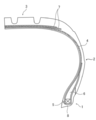
- FIG. 1 shows a schematic partial sectional view of a tire representing an example of an embodiment of the pneumatic tire of the present invention, but the pneumatic tire of the present invention is not limited to the embodiment shown in FIG.
- reference numeral 1 represents a bead portion
- reference numeral 2 represents a sidewall portion
- reference numeral 3 represents a tire tread portion.
- a carcass layer 4 in which fiber cords are embedded is mounted, and an end portion of the carcass layer 4 is folded around the bead core 5 and the bead filler 6 from the inside to the outside of the tire.
- a belt layer 7 is disposed over the circumference of the tire outside the carcass layer 4.
- a rim cushion 8 is disposed at a portion in contact with the rim.
- the tire tread portion 3 is formed of the above-described rubber composition of the present invention.
- the pneumatic tire of the present invention can be manufactured, for example, according to a conventionally known method. Moreover, as gas with which a tire is filled, inert gas, such as nitrogen, argon, helium other than the air which adjusted normal or the oxygen partial pressure, can be used.
- inert gas such as nitrogen, argon, helium other than the air which adjusted normal or the oxygen partial pressure
- the pneumatic tire of the present invention is excellent in dry grip properties, rubber hardness at high temperature and 300% modulus, it is suitable for racing tires (especially racing tires), particularly for racing tires used on dry road surfaces. It is.
- the SBR used (“Tuffden E581” manufactured by Asahi Kasei Chemicals Corporation) corresponds to “S-SBR2” described later, and the content of styrene units (styrene content) is 37% by mass.
- the obtained modified SBR1 was subjected to NMR measurement to obtain the modification rate.
- the modification rate of the modified SBR1 was 0.21 mol%.
- the modification rate was determined as follows. That is, for SBR before and after denaturation, the peak area around 8.08 ppm (attributed to two protons adjacent to the carboxy group) was determined by 1 H-NMR measurement (CDCl 3 , 400 MHz, TMS) using CDCl 3 as a solvent. The denaturation rate was determined by measurement.
- the 1 H-NMR measurement of the modified SBR1 was carried out using a sample dried under reduced pressure after repeating twice purification by dissolving the modified SBR1 in toluene and precipitating it in methanol.
- the SBR used (“Tuffden E581” manufactured by Asahi Kasei Chemicals Corporation) corresponds to “S-SBR2” described later, and the content of styrene units (styrene content) is 37% by mass.
- the obtained modified SBR2 was subjected to NMR measurement to obtain a modification rate.
- the modification rate of the modified SBR2 was 0.23 mol%.
- the method for obtaining the modification rate is as described above.
- ⁇ Preparation of rubber composition for tire tread> The components shown in Table 1 below were blended in the proportions (parts by mass) shown in Table 1 below. Specifically, first, components excluding sulfur and a vulcanization accelerator among the components shown in Table 1 below were mixed for 5 minutes with a Banbury mixer at 80 ° C. Next, using a roll, sulfur and a vulcanization accelerator were mixed to obtain each rubber composition for tire tread (hereinafter, “tire rubber composition for tire tread” is also simply referred to as “rubber composition”). .
- the nitrone amount converted value represents the mass part of the nitrone compound used for the synthesis of the modified polymer (modified SBR1 or modified SBR2) with respect to 100 parts by mass of the diene rubber.
- the nitrone amount converted value is synonymous with the above-described CPN amount converted value.
- the modification rate represents the modification rate of the above-described modified polymer (modified SBR1 or modified SBR2).
- the modification efficiency represents the ratio of the nitrone compound used in the reaction to the charged amount of the nitrone compound.
- the values in S-SBR1, S-SBR2, modified SBR1, and modified SBR2 are the contents (parts by mass) including the oil component, and the numbers in parentheses are the contents of the rubber components (mass). Part).
- S-SBR1 Solution-polymerized styrene butadiene rubber, styrene content: 36% by mass, weight average molecular weight (Mw): 1,470,000, Tg: ⁇ 13 ° C., containing 37.5 parts by mass of oil for 100 parts by mass of rubber component Oil exhibition, “Toughden E680” manufactured by Asahi Kasei Chemicals
- S-SBR2 solution-polymerized styrene butadiene rubber, styrene content: 37% by mass, weight average molecular weight (Mw): 1.26 million, Tg: ⁇ 27 ° C., containing 37.5 parts by mass of oil for 100 parts by mass of rubber component Oil exhibition, “Toughden E581” manufactured by Asahi Kasei Chemicals Modified SBR1: Modified SBR1 synthesized as described above (carboxynitrone modified SBR), an oil-extended product containing 37.5 parts
- Modified SBR2 Modified SBR2 synthesized as described above (diphenylnitrone) Modified SBR), oil-extended product containing 37.5 parts by mass of oil with respect to 100 parts by mass of rubber component, carbon black: “Toka Black # 5500” manufactured by Tokai Carbon Co., Ltd., nitrogen adsorption specific surface area of 225 m 2 / g ⁇
- Stearic acid Stearic acid YR (manufactured by NOF Corporation)
- -Terpene resin YS resin TO125 (manufactured by Yasuhara Chemical)
- Oil Extract No. 4 S (made by Showa Shell Sekiyu KK) ⁇
- Zinc flower Zinc flower No.
Landscapes
- Chemical & Material Sciences (AREA)
- Health & Medical Sciences (AREA)
- Chemical Kinetics & Catalysis (AREA)
- Medicinal Chemistry (AREA)
- Polymers & Plastics (AREA)
- Organic Chemistry (AREA)
- General Chemical & Material Sciences (AREA)
- Engineering & Computer Science (AREA)
- Mechanical Engineering (AREA)
- Compositions Of Macromolecular Compounds (AREA)
- Tires In General (AREA)
- Addition Polymer Or Copolymer, Post-Treatments, Or Chemical Modifications (AREA)
Abstract
本発明の課題は、タイヤにしたときに、高温時のゴム硬度および300%モジュラス、ならびにドライグリップ性に優れるタイヤトレッド用ゴム組成物、およびこれを使用した空気入りタイヤを提供することである。本発明のタイヤトレッド用ゴム組成物は、カーボンブラックと、カルボキシ変性ポリマーを含むジエン系ゴムと、を含有する。上記カーボンブラックの含有量は、上記ジエン系ゴム100質量部に対して、80~150質量部である。上記カルボキシ変性ポリマーは、スチレン-ブタジエンゴム(A)を、カルボキシ基を有するニトロン化合物(B)によって変性することで得られ、上記ジエン系ゴム中の上記カルボキシ変性ポリマーの含有量が10~100質量%である。上記スチレン-ブタジエンゴム(A)中のスチレン単位の含有量は、36質量%以上である。上記カルボキシ変性ポリマーの変性率は、0.02~4.0mol%である。
Description
本発明は、タイヤトレッド用ゴム組成物および空気入りタイヤに関する。
空気入りタイヤは、例えば、タイヤトレッド部、ビード部、サイドウォール部など種々の部材から構成されており、空気入りタイヤを構成する各部材は、カーボンブラックやゴム成分等を含有するゴム組成物を用いて形成される。
このようなゴム組成物として、特許文献1には、スチレン・ブタジエン共重合体ゴム、カーボンブラック、N,N’-ジフェニル-p-フェニレンジニトロン(ニトロン化合物)などを含有するゴム組成物が示されている(実施例2参照)。
このようなゴム組成物として、特許文献1には、スチレン・ブタジエン共重合体ゴム、カーボンブラック、N,N’-ジフェニル-p-フェニレンジニトロン(ニトロン化合物)などを含有するゴム組成物が示されている(実施例2参照)。
ところで、上記の空気入りタイヤは、一般車両に用いられるだけでなく、競技車両に用いられる場合がある。
このような競技車両に用いられるタイヤ(以下、単に「競技用タイヤ」または「レース用タイヤ」ともいう。)の形成に用いられるタイヤトレッド用ゴム組成物として、特許文献2には、特定の性質をもつ2種類の溶液重合スチレンブタジエンゴム100重量部と、特定の性質を持つカーボンブラック80~150重量部と、を配合したものが開示されている。
このような競技車両に用いられるタイヤ(以下、単に「競技用タイヤ」または「レース用タイヤ」ともいう。)の形成に用いられるタイヤトレッド用ゴム組成物として、特許文献2には、特定の性質をもつ2種類の溶液重合スチレンブタジエンゴム100重量部と、特定の性質を持つカーボンブラック80~150重量部と、を配合したものが開示されている。
上記のようなレース用タイヤは、一般車両の走行に使用する空気入りタイヤと比較して、より厳密に路面状態に適した性能を有することが求められる。例えば、競技時に路面が乾燥している場合には(ドライな路面である場合)、ドライな路面に適したグリップ性能を有する(ドライグリップ性に優れる)レース用タイヤが使用される。
また、レース用タイヤをサーキット走行向けに適用する場合には、ドライグリップ性能を短時間で発揮できるように、競技車両の走行開始後、タイヤトレッド部を構成するゴムが迅速に高温状態(例えば80~120℃程度)に達することができることを要求される。
そのため、特許文献2で示されているように、レース用タイヤのタイヤトレッドの形成に使用されるゴム組成物には、一般車両用のタイヤトレッド部に使用されるゴム組成物よりも、カーボンブラックの配合量を多くする場合がある。
このようななか、本発明者らが、特許文献2に記載のゴム組成物について検討したところ、ドライグリップ性や高温時のゴム硬度は十分であったが、高温時の300%モジュラスが不十分となる場合があることが明らかになった。
そのため、特許文献2で示されているように、レース用タイヤのタイヤトレッドの形成に使用されるゴム組成物には、一般車両用のタイヤトレッド部に使用されるゴム組成物よりも、カーボンブラックの配合量を多くする場合がある。
このようななか、本発明者らが、特許文献2に記載のゴム組成物について検討したところ、ドライグリップ性や高温時のゴム硬度は十分であったが、高温時の300%モジュラスが不十分となる場合があることが明らかになった。
本発明者らは、特許文献2に記載されているカーボンブラックの含有量が高いタイヤトレッド用ゴム組成物について、さらにその性能を向上させるべく、特許文献1に記載されているようなニトロン化合物(N,N’-ジフェニル-p-フェニレンジニトロン)で変性したスチレン-ブタジエンゴムを用いることを検討した。
しかしながら、得られるゴム組成物は、タイヤにしたときに、ドライグリップ性が不十分となる場合があった。また、高温時のゴム硬度や300%モジュラスが低いものとなる場合があった。
しかしながら、得られるゴム組成物は、タイヤにしたときに、ドライグリップ性が不十分となる場合があった。また、高温時のゴム硬度や300%モジュラスが低いものとなる場合があった。
そこで、本発明は、タイヤにしたときに、ドライグリップ性に優れ、かつ、高温時のゴム硬度および300%モジュラスが高いタイヤトレッド用ゴム組成物、およびこれを使用した空気入りタイヤを提供することを目的とする。
本発明者は、上記課題について鋭意検討した結果、カルボキシ基を有するニトロン化合物でスチレン-ブタジエンゴムを変性したカルボキシ変性ポリマーを用いることにより、ドライグリップ性に優れ、かつ、高温時のゴム硬度および300%モジュラスが優れたものとなることを見出し、本発明に至った。
すなわち、本発明者は、以下の構成により上記課題が解決できることを見出した。
すなわち、本発明者は、以下の構成により上記課題が解決できることを見出した。
[1]
カーボンブラックと、カルボキシ変性ポリマーを含むジエン系ゴムと、を含有し、
前記カーボンブラックの含有量が、前記ジエン系ゴム100質量部に対して、80~150質量部であり、
前記カルボキシ変性ポリマーが、スチレン-ブタジエンゴム(A)を、カルボキシ基を有するニトロン化合物(B)によって変性することで得られ、前記ジエン系ゴム中の前記カルボキシ変性ポリマーの含有量が10~100質量%であり、
前記スチレン-ブタジエンゴム(A)中のスチレン単位の含有量が、36質量%以上であり、
前記スチレン-ブタジエンゴム(A)の有するブタジエンに由来する全ての二重結合のうち、前記カルボキシ基を有するニトロン化合物(B)によって変性された割合(mol%)を変性率とした場合、前記カルボキシ変性ポリマーの変性率が0.02~4.0mol%である、タイヤトレッド用ゴム組成物。
[2]
前記カルボキシ基を有するニトロン化合物(B)が、N-フェニル-α-(4-カルボキシフェニル)ニトロン、N-フェニル-α-(3-カルボキシフェニル)ニトロン、N-フェニル-α-(2-カルボキシフェニル)ニトロン、N-(4-カルボキシフェニル)-α-フェニルニトロン、N-(3-カルボキシフェニル)-α-フェニルニトロンおよびN-(2-カルボキシフェニル)-α-フェニルニトロンからなる群より選択される化合物である、上記[1]に記載のタイヤトレッド用ゴム組成物。
[3]
前記カーボンブラックの窒素吸着比表面積が、150~400m2/gである、上記[1]または[2]に記載のタイヤトレッド用ゴム組成物。
[4]
前記スチレン-ブタジエンゴム(A)を変性する際に使用する前記カルボキシ基を有するニトロン化合物(B)の量が、前記ジエン系ゴム100質量部に対して、0.1~10質量部である、上記[1]~[3]のいずれか1つに記載のタイヤトレッド用ゴム組成物。
[5]
上記[1]~[4]のいずれか1つに記載のタイヤトレッド用ゴム組成物をタイヤトレッドに使用した空気入りタイヤ。
カーボンブラックと、カルボキシ変性ポリマーを含むジエン系ゴムと、を含有し、
前記カーボンブラックの含有量が、前記ジエン系ゴム100質量部に対して、80~150質量部であり、
前記カルボキシ変性ポリマーが、スチレン-ブタジエンゴム(A)を、カルボキシ基を有するニトロン化合物(B)によって変性することで得られ、前記ジエン系ゴム中の前記カルボキシ変性ポリマーの含有量が10~100質量%であり、
前記スチレン-ブタジエンゴム(A)中のスチレン単位の含有量が、36質量%以上であり、
前記スチレン-ブタジエンゴム(A)の有するブタジエンに由来する全ての二重結合のうち、前記カルボキシ基を有するニトロン化合物(B)によって変性された割合(mol%)を変性率とした場合、前記カルボキシ変性ポリマーの変性率が0.02~4.0mol%である、タイヤトレッド用ゴム組成物。
[2]
前記カルボキシ基を有するニトロン化合物(B)が、N-フェニル-α-(4-カルボキシフェニル)ニトロン、N-フェニル-α-(3-カルボキシフェニル)ニトロン、N-フェニル-α-(2-カルボキシフェニル)ニトロン、N-(4-カルボキシフェニル)-α-フェニルニトロン、N-(3-カルボキシフェニル)-α-フェニルニトロンおよびN-(2-カルボキシフェニル)-α-フェニルニトロンからなる群より選択される化合物である、上記[1]に記載のタイヤトレッド用ゴム組成物。
[3]
前記カーボンブラックの窒素吸着比表面積が、150~400m2/gである、上記[1]または[2]に記載のタイヤトレッド用ゴム組成物。
[4]
前記スチレン-ブタジエンゴム(A)を変性する際に使用する前記カルボキシ基を有するニトロン化合物(B)の量が、前記ジエン系ゴム100質量部に対して、0.1~10質量部である、上記[1]~[3]のいずれか1つに記載のタイヤトレッド用ゴム組成物。
[5]
上記[1]~[4]のいずれか1つに記載のタイヤトレッド用ゴム組成物をタイヤトレッドに使用した空気入りタイヤ。
以下に示すように、本発明によれば、タイヤにしたときに、ドライグリップ性に優れ、かつ、高温時のゴム硬度および300%モジュラスが高いタイヤトレッド用ゴム組成物、およびこれを用いて得られる空気入りタイヤを提供することができる。
以下に、本発明のタイヤトレッド用ゴム組成物、および、空気入りタイヤについて説明する。
なお、本発明において「~」を用いて表される数値範囲は、「~」の前後に記載される数値を下限値および上限値として含む範囲を意味する。
なお、本発明において「~」を用いて表される数値範囲は、「~」の前後に記載される数値を下限値および上限値として含む範囲を意味する。
[タイヤトレッド用ゴム組成物]
本発明のタイヤトレッド用ゴム組成物(以下、単に「ゴム組成物」ともいう。)は、カーボンブラックと、カルボキシ変性ポリマーを含むジエン系ゴムと、を含有する。
ここで、上記カーボンブラックの含有量は、上記ジエン系ゴム100質量部に対して、80~150質量部である。
また、上記カルボキシ変性ポリマーは、スチレン-ブタジエンゴム(A)を、カルボキシ基を有するニトロン化合物(B)によって変性することで得られ、上記ジエン系ゴム中の上記カルボキシ変性ポリマーの含有量が10~100質量%である。
また、上記スチレン-ブタジエンゴム(A)中のスチレン単位の含有量が、36質量%以上である。
さらに、上記スチレン-ブタジエンゴム(A)の有するブタジエンに由来する全ての二重結合のうち、上記カルボキシ基を有するニトロン化合物(B)によって変性された割合(mol%)を変性率とした場合、上記カルボキシ変性ポリマーの変性率が0.02~4.0mol%である。
本発明のゴム組成物は、このような構成をとるために、高温時のゴム硬度および300%モジュラスに優れ、かつドライグリップ性にも優れたタイヤトレッドを形成できる。
この理由の詳細は明らかになっていないが、以下の理由がその一因となっているものと推測される。
本発明のタイヤトレッド用ゴム組成物(以下、単に「ゴム組成物」ともいう。)は、カーボンブラックと、カルボキシ変性ポリマーを含むジエン系ゴムと、を含有する。
ここで、上記カーボンブラックの含有量は、上記ジエン系ゴム100質量部に対して、80~150質量部である。
また、上記カルボキシ変性ポリマーは、スチレン-ブタジエンゴム(A)を、カルボキシ基を有するニトロン化合物(B)によって変性することで得られ、上記ジエン系ゴム中の上記カルボキシ変性ポリマーの含有量が10~100質量%である。
また、上記スチレン-ブタジエンゴム(A)中のスチレン単位の含有量が、36質量%以上である。
さらに、上記スチレン-ブタジエンゴム(A)の有するブタジエンに由来する全ての二重結合のうち、上記カルボキシ基を有するニトロン化合物(B)によって変性された割合(mol%)を変性率とした場合、上記カルボキシ変性ポリマーの変性率が0.02~4.0mol%である。
本発明のゴム組成物は、このような構成をとるために、高温時のゴム硬度および300%モジュラスに優れ、かつドライグリップ性にも優れたタイヤトレッドを形成できる。
この理由の詳細は明らかになっていないが、以下の理由がその一因となっているものと推測される。
すなわち、本発明のゴム組成物は、スチレン-ブタジエンゴム(A)を、カルボキシ基を有するニトロン化合物(B)によって変性することで得られるカルボキシ変性ポリマーを含有する。そのため、カルボキシ変性ポリマー中のニトロン変性部位におけるカルボキシ基がゴム組成物中のカーボンブラックと相互作用し、カーボンブラックの分散性を高めたもの考えられる。その結果、カーボンブラックのドライグリップ性を向上する作用が高まったものと考えられる。
また、カルボキシ変性ポリマー中のニトロン変性部位におけるカルボキシ基が組成物中のカーボンブラックと相互作用することにより、ゴム成分とカーボンブラックとの強固な結合が形成されて架橋点が増加することで、架橋密度が増加する結果、高温時においても、ゴム硬度に優れ、高い300%モジュラスを発揮できるものと考えられる。
また、カルボキシ変性ポリマー中のニトロン変性部位におけるカルボキシ基が組成物中のカーボンブラックと相互作用することにより、ゴム成分とカーボンブラックとの強固な結合が形成されて架橋点が増加することで、架橋密度が増加する結果、高温時においても、ゴム硬度に優れ、高い300%モジュラスを発揮できるものと考えられる。
以下、本発明のゴム組成物に含まれる成分、および含まれ得る成分について詳述する。
〔ジエン系ゴム〕
本発明のゴム組成物に含有されるジエン系ゴムは、カルボキシ変性ポリマーを含む。
本発明のゴム組成物に含有されるジエン系ゴムは、カルボキシ変性ポリマーを含む。
<カルボキシ変性ポリマー>
カルボキシ変性ポリマーは、カルボキシ基を有するニトロン化合物(B)によってスチレン-ブタジエンゴム(A)を変性することで得られる。
カルボキシ変性ポリマーは、カルボキシ基を有するニトロン化合物(B)によってスチレン-ブタジエンゴム(A)を変性することで得られる。
上記ジエン系ゴム中のカルボキシ変性ポリマーの含有量は、10~100質量%であり、50~90質量%であることが好ましく、60~80質量%であることがより好ましい。カルボキシ変性ポリマーの含有量が上記範囲内にあることで、ドライグリップ性に優れ、かつ、高温時のゴム硬度および300%モジュラスに優れたものとなる。一方、カルボキシ変性ポリマーの含有量が10質量%未満であると、ドライグリップ性が低下したり、高温時のゴム硬度および300%モジュラスが低下したりする。
(スチレン-ブタジエンゴム(A))
上記のカルボキシ変性ポリマーは、上述のように、スチレン-ブタジエンゴム(A)を変性することで得られる。
このようなスチレン-ブタジエンゴム(A)は、スチレン単量体およびブタジエン単量体を用いて製造することができる。
スチレン-ブタジエンゴム(A)の製造に使用されるスチレン単量体としては、特に制限されないが、例えば、スチレン、α-メチルスチレン、2-メチルスチレン、3-メチルスチレン、4-メチルスチレン、2-エチルスチレン、3-エチルスチレン、4-エチルスチレン、2,4-ジイソプロピルスチレン、2,4-ジメチルスチレン、4-t-ブチルスチレン、5-t-ブチル-2-メチルスチレン、ジメチルアミノメチルスチレン、およびジメチルアミノエチルスチレンなどを挙げることができる。これらの中でも、スチレン、α-メチルスチレン、および4-メチルスチレンが好ましく、スチレンがより好ましい。これらのスチレン単量体は、それぞれ単独で、または2種以上を組み合わせて用いることができる。
上記スチレン-ブタジエンゴム(A)の製造に使用されるブタジエン単量体としては、特に制限されないが、例えば、1,3-ブタジエン、イソプレン(2-メチル-1,3-ブタジエン)、2,3-ジメチル-1,3-ブタジエン、2-クロロ-1,3-ブタジエンなどが挙げられる。これらの中でも、1,3-ブタジエン、またはイソプレンを用いることが好ましく、1,3-ブタジエンを用いることがより好ましい。これらのブタジエン単量体は、それぞれ単独で、または2種以上を組み合わせて用いることができる。
上記のカルボキシ変性ポリマーは、上述のように、スチレン-ブタジエンゴム(A)を変性することで得られる。
このようなスチレン-ブタジエンゴム(A)は、スチレン単量体およびブタジエン単量体を用いて製造することができる。
スチレン-ブタジエンゴム(A)の製造に使用されるスチレン単量体としては、特に制限されないが、例えば、スチレン、α-メチルスチレン、2-メチルスチレン、3-メチルスチレン、4-メチルスチレン、2-エチルスチレン、3-エチルスチレン、4-エチルスチレン、2,4-ジイソプロピルスチレン、2,4-ジメチルスチレン、4-t-ブチルスチレン、5-t-ブチル-2-メチルスチレン、ジメチルアミノメチルスチレン、およびジメチルアミノエチルスチレンなどを挙げることができる。これらの中でも、スチレン、α-メチルスチレン、および4-メチルスチレンが好ましく、スチレンがより好ましい。これらのスチレン単量体は、それぞれ単独で、または2種以上を組み合わせて用いることができる。
上記スチレン-ブタジエンゴム(A)の製造に使用されるブタジエン単量体としては、特に制限されないが、例えば、1,3-ブタジエン、イソプレン(2-メチル-1,3-ブタジエン)、2,3-ジメチル-1,3-ブタジエン、2-クロロ-1,3-ブタジエンなどが挙げられる。これらの中でも、1,3-ブタジエン、またはイソプレンを用いることが好ましく、1,3-ブタジエンを用いることがより好ましい。これらのブタジエン単量体は、それぞれ単独で、または2種以上を組み合わせて用いることができる。
上記スチレン-ブタジエンゴム(A)の製造方法(重合方法)としては、特に制限されず、例えば溶液重合や乳化重合等が挙げられる。上記スチレン-ブタジエンゴム(A)としては、溶液重合スチレン-ブタジエンゴムおよび乳化重合スチレン-ブタジエンゴムのいずれを用いてもよいが、ドライグリップ性などを向上するという観点から、溶液重合スチレン-ブタジエンゴムを用いることが好ましい。
上記スチレン-ブタジエンゴム(A)のスチレン単位の含有量は、36質量%以上であり、36~50質量%であることが好ましく、36~40質量%であることがより好ましい。スチレン単位の含有量が上記範囲にあることで、ドライグリップ性、ならびに高温時のゴム硬度および300%モジュラスが向上する。一方、スチレン単位の含有量が36質量%未満であると、高温時のゴム硬度や高温時の300%モジュラスが低下したり、ドライグリップ性が低下したりする。
なお、本発明において、スチレン量(スチレン単位の含有量)は赤外分光分析(ハンプトン法)により測定するものとする。
なお、本発明において、スチレン量(スチレン単位の含有量)は赤外分光分析(ハンプトン法)により測定するものとする。
上記スチレン-ブタジエンゴム(A)の重量平均分子量(Mw)は、取扱い性などの観点から、100,000~1,800,000であることが好ましく、300,000~1,500,000であることがより好ましい。なお、本明細書において、重量平均分子量(Mw)は、テトラヒドロフランを溶媒とするゲルパーミエーションクロマトグラフィー(GPC)により標準ポリスチレン換算により測定したものとする。
(カルボキシ基を有するニトロン化合物(B))
本発明のカルボキシ変性ポリマーは、上述のとおり、カルボキシ基を有するニトロン化合物(B)(以下、単に「カルボキシニトロン」または「カルボキシニトロン(B)」ともいう。)を用いて変性されたものである。
カルボキシニトロンは少なくとも1個のカルボキシ基(-COOH)を有するニトロンであれば特に限定されない。ここで、ニトロンとは、下記式(1)で表されるニトロン基を有する化合物を指す。
本発明のカルボキシ変性ポリマーは、上述のとおり、カルボキシ基を有するニトロン化合物(B)(以下、単に「カルボキシニトロン」または「カルボキシニトロン(B)」ともいう。)を用いて変性されたものである。
カルボキシニトロンは少なくとも1個のカルボキシ基(-COOH)を有するニトロンであれば特に限定されない。ここで、ニトロンとは、下記式(1)で表されるニトロン基を有する化合物を指す。

上記式(1)中、*は結合位置を表す。
上記カルボキシニトロンは、下記一般式(2)で表される化合物であることが好ましい。
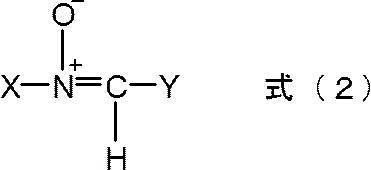
上記一般式(2)中、XおよびYは、それぞれ独立に、置換基を有してもよい、脂肪族炭化水素基、芳香族炭化水素基、または、芳香族複素環基を表す。ただし、XおよびYの少なくとも一方は、置換基としてカルボキシ基を有する。
XまたはYで表される脂肪族炭化水素基としては、例えば、アルキル基、シクロアルキル基、アルケニル基などが挙げられる。アルキル基としては、例えば、メチル基、エチル基、n-プロピル基、イソプロピル基、n-ブチル基、イソブチル基、sec-ブチル基、tert-ブチル基、n-ペンチル基、イソペンチル基、ネオペンチル基、tert-ペンチル基、1-メチルブチル基、2-メチルブチル基、1,2-ジメチルプロピル基、n-ヘキシル基、n-ヘプチル基、n-オクチル基などが挙げられ、なかでも、炭素数1~18のアルキル基が好ましく、炭素数1~6のアルキル基がより好ましい。シクロアルキル基としては、例えば、シクロプロピル基、シクロブチル基、シクロペンチル基、シクロヘキシル基などが挙げられ、なかでも、炭素数3~10のシクロアルキル基が好ましく、炭素数3~6のシクロアルキル基がより好ましい。アルケニル基としては、例えば、ビニル基、1-プロペニル基、アリル基、イソプロペニル基、1-ブテニル基、2-ブテニル基などが挙げられ、なかでも、炭素数2~18のアルケニル基が好ましく、炭素数2~6のアルケニル基がより好ましい。
XまたはYで表される芳香族炭化水素基としては、例えば、アリール基、アラルキル基などが挙げられる。
アリール基としては、例えば、フェニル基、ナフチル基、アントリル基、フェナントリル基、ビフェニル基などが挙げられ、なかでも、炭素数6~14のアリール基が好ましく、炭素数6~10のアリール基がより好ましく、フェニル基、ナフチル基がさらに好ましい。
アラルキル基としては、例えば、ベンジル基、フェネチル基、フェニルプロピル基などが挙げられ、なかでも、炭素数7~13のアラルキル基が好ましく、炭素数7~11のアラルキル基がより好ましく、ベンジル基がさらに好ましい。
アリール基としては、例えば、フェニル基、ナフチル基、アントリル基、フェナントリル基、ビフェニル基などが挙げられ、なかでも、炭素数6~14のアリール基が好ましく、炭素数6~10のアリール基がより好ましく、フェニル基、ナフチル基がさらに好ましい。
アラルキル基としては、例えば、ベンジル基、フェネチル基、フェニルプロピル基などが挙げられ、なかでも、炭素数7~13のアラルキル基が好ましく、炭素数7~11のアラルキル基がより好ましく、ベンジル基がさらに好ましい。
XまたはYで表される芳香族複素環基としては、例えば、ピロリル基、フリル基、チエニル基、ピラゾリル基、イミダゾリル基(イミダゾール基)、オキサゾリル基、イソオキサゾリル基、チアゾリル基、イソチアゾリル基、ピリジル基(ピリジン基)、フラン基、チオフェン基、ピリダジニル基、ピリミジニル基、ピラジニル基等が挙げられる。なかでも、ピリジル基が好ましい。
XおよびYで表される基は、上述したように少なくとも一方が置換基としてカルボキシ基を有していれば、カルボキシ基以外の置換基(以下、「他の置換基」ともいう。)を有していてもよい。
XまたはYで表される基が有してもよい他の置換基としては、特に限定されず、例えば、炭素数1~4のアルキル基、ヒドロキシ基、アミノ基、ニトロ基、スルホニル基、アルコキシ基、ハロゲン原子などが挙げられる。
なお、このような置換基を有する芳香族炭化水素基としては、例えば、トリル基、キシリル基などの置換基を有するアリール基;メチルベンジル基、エチルベンジル基、メチルフェネチル基などの置換基を有するアラルキル基;等が挙げられる。
XまたはYで表される基が有してもよい他の置換基としては、特に限定されず、例えば、炭素数1~4のアルキル基、ヒドロキシ基、アミノ基、ニトロ基、スルホニル基、アルコキシ基、ハロゲン原子などが挙げられる。
なお、このような置換基を有する芳香族炭化水素基としては、例えば、トリル基、キシリル基などの置換基を有するアリール基;メチルベンジル基、エチルベンジル基、メチルフェネチル基などの置換基を有するアラルキル基;等が挙げられる。
上記一般式(2)で表される化合物は、下記一般式(b)で表される化合物であることが好ましい。

一般式(b)中、mおよびnは、それぞれ独立に、0~5の整数を示し、mとnとの合計が1以上である。
mが示す整数としては、カルボキシニトロンを合成する際の溶媒への溶解度が良好になり合成が容易になるという理由から、0~2の整数が好ましく、0~1の整数がより好ましい。
nが示す整数としては、カルボキシニトロンを合成する際の溶媒への溶解度が良好になり合成が容易になるという理由から、0~2の整数が好ましく、0~1の整数がより好ましい。
また、mとnとの合計(m+n)は、1~4が好ましく、1~2がより好ましい。
mが示す整数としては、カルボキシニトロンを合成する際の溶媒への溶解度が良好になり合成が容易になるという理由から、0~2の整数が好ましく、0~1の整数がより好ましい。
nが示す整数としては、カルボキシニトロンを合成する際の溶媒への溶解度が良好になり合成が容易になるという理由から、0~2の整数が好ましく、0~1の整数がより好ましい。
また、mとnとの合計(m+n)は、1~4が好ましく、1~2がより好ましい。
このような一般式(b)で表されるカルボキシニトロンとしては特に制限されないが、下記式(b1)で表されるN-フェニル-α-(4-カルボキシフェニル)ニトロン、下記式(b2)で表されるN-フェニル-α-(3-カルボキシフェニル)ニトロン、下記式(b3)で表されるN-フェニル-α-(2-カルボキシフェニル)ニトロン、下記式(b4)で表されるN-(4-カルボキシフェニル)-α-フェニルニトロン、下記式(b5)で表されるN-(3-カルボキシフェニル)-α-フェニルニトロン、および、下記式(b6)で表されるN-(2-カルボキシフェニル)-α-フェニルニトロンからなる群より選択される化合物であることが好ましい。


カルボキシニトロンの合成方法は特に限定されず、従来公知の方法を用いることができる。例えば、ヒドロキシアミノ基(-NHOH)を有する化合物と、アルデヒド基(-CHO)およびカルボキシ基を有する化合物とを、ヒドロキシアミノ基とアルデヒド基とのモル比(-NHOH/-CHO)が1.0~1.5となる量で、有機溶媒(例えば、メタノール、エタノール、テトラヒドロフラン等)下で、室温で1~24時間撹拌することにより、両基が反応し、カルボキシ基とニトロン基とを有する化合物(カルボキシニトロン)を与える。
(カルボキシ変性ポリマーの製造方法)
本発明のカルボキシ変性ポリマーは、上述の通り、スチレン-ブタジエンゴム(A)を、カルボキシ基を有するニトロン化合物(B)で変性することにより得られる。
本発明のカルボキシ変性ポリマーは、上述の通り、スチレン-ブタジエンゴム(A)を、カルボキシ基を有するニトロン化合物(B)で変性することにより得られる。
カルボキシ変性ポリマーの製造時の反応機構は、スチレン-ブタジエンゴム(A)の二重結合に対して、カルボキシニトロン(B)を反応させるものである。カルボキシ変性ポリマー(カルボキシニトロン変性SBR)を製造する方法は特に制限されないが、例えば、上記スチレン-ブタジエンゴム(A)と上記カルボキシニトロン(B)とを、100~200℃で1~30分間混合する方法が挙げられる。
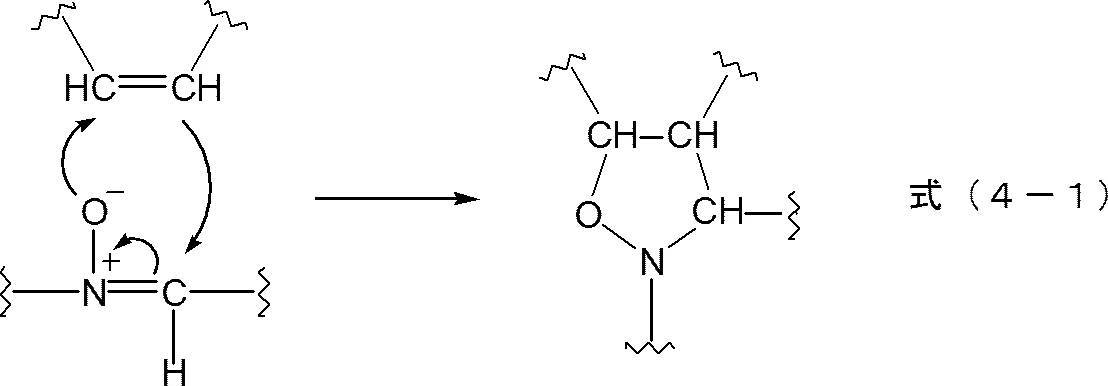
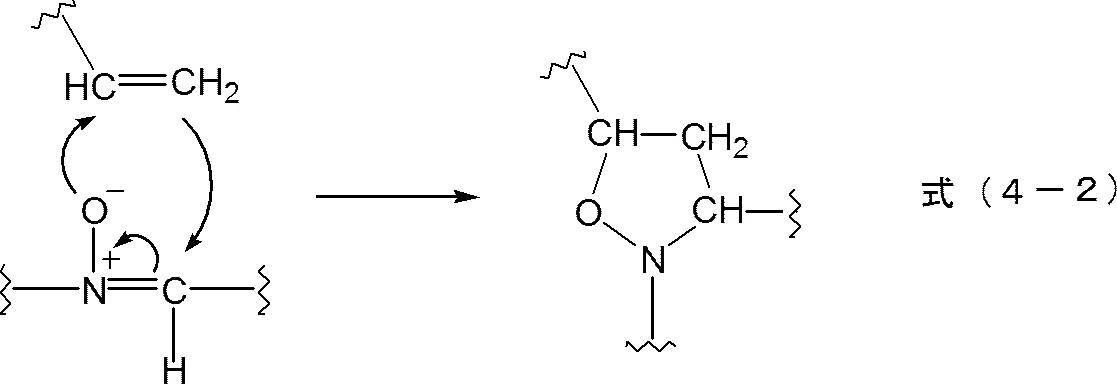
このとき、下記式(4-1)または下記式(4-2)に示すように、上記スチレン-ブタジエンゴム(A)が有するブタジエンに由来する二重結合と上記カルボキシニトロン(B)が有するニトロン基との間で、環化付加反応が起こり、五員環を与える。なお、下記式(4-1)は1,4-結合とニトロン基との反応を表し、下記式(4-2)は1,2-ビニル結合とニトロン基との反応を表す。また、式(4-1)および(4-2)はブタジエンが1,3-ブタジエンの場合の反応を表すものであるが、ブタジエンが1,3-ブタジエン以外の場合も同様の反応により五員環を与える。
このとき、下記式(4-1)または下記式(4-2)に示すように、上記スチレン-ブタジエンゴム(A)が有するブタジエンに由来する二重結合と上記カルボキシニトロン(B)が有するニトロン基との間で、環化付加反応が起こり、五員環を与える。なお、下記式(4-1)は1,4-結合とニトロン基との反応を表し、下記式(4-2)は1,2-ビニル結合とニトロン基との反応を表す。また、式(4-1)および(4-2)はブタジエンが1,3-ブタジエンの場合の反応を表すものであるが、ブタジエンが1,3-ブタジエン以外の場合も同様の反応により五員環を与える。
上記スチレン-ブタジエンゴム(A)を変性して、上記カルボキシ変性ポリマーを合成するために使用する上記カルボキシニトロン(B)の量(以下、「CPN量換算値」ともいう。)は、上記ジエン系ゴム100質量部に対して、0.1~10質量部であることが好ましく、0.3~3質量部であることが好ましい。CPN量換算値が上記範囲内にあることで、高温時の変形応力がより向上する傾向にある。
なお、例えば、100質量部のジエン系ゴム中に35質量部のカルボキシ変性ポリマーが含まれ、カルボキシ変性ポリマーが100質量部のSBRと1質量部のカルボキシニトロンとを反応させることで得られたものである場合、35質量部のカルボキシ変性ポリマーのうち、カルボキシ変性ポリマーの合成に使用されたカルボキシニトロン(B)は、0.35質量部(=35×(1/101))であるので、CPN量換算値は0.35質量部である。
なお、例えば、100質量部のジエン系ゴム中に35質量部のカルボキシ変性ポリマーが含まれ、カルボキシ変性ポリマーが100質量部のSBRと1質量部のカルボキシニトロンとを反応させることで得られたものである場合、35質量部のカルボキシ変性ポリマーのうち、カルボキシ変性ポリマーの合成に使用されたカルボキシニトロン(B)は、0.35質量部(=35×(1/101))であるので、CPN量換算値は0.35質量部である。
カルボキシ変性ポリマーの合成において、カルボキシニトロン(B)の仕込み量(添加量)は特に制限されないが、スチレン-ブタジエンゴム(A)100質量部に対して、0.1~20質量部であることが好ましく、1~5質量部であることがより好ましい。
(変性率)
カルボキシ変性ポリマーの変性率は、0.02~4.0mol%であり、0.10~2.0mol%であることがより好ましい。また、上記変性率の下限値は、0.20mol%以上であることが好ましい。
ここで、変性率とは、上記スチレン-ブタジエンゴム(A)が有するブタジエン(ブタジエン単位)に由来する全ての二重結合のうち、カルボキシニトロン(B)によって変性された割合(mol%)を表し、例えばブタジエンが1,3-ブタジエンであれば、カルボキシニトロンによる変性によって上記式(4-1)または上記式(4-2)の構造が形成された割合(mol%)を表す。変性率は、例えば、変性前後のSBRのNMR測定を行うことで求めることができる。
なお、本明細書において、変性率が100mol%のカルボキシ変性ポリマーもジエン系ゴムに該当するものとする。
カルボキシ変性ポリマーの変性率は、0.02~4.0mol%であり、0.10~2.0mol%であることがより好ましい。また、上記変性率の下限値は、0.20mol%以上であることが好ましい。
ここで、変性率とは、上記スチレン-ブタジエンゴム(A)が有するブタジエン(ブタジエン単位)に由来する全ての二重結合のうち、カルボキシニトロン(B)によって変性された割合(mol%)を表し、例えばブタジエンが1,3-ブタジエンであれば、カルボキシニトロンによる変性によって上記式(4-1)または上記式(4-2)の構造が形成された割合(mol%)を表す。変性率は、例えば、変性前後のSBRのNMR測定を行うことで求めることができる。
なお、本明細書において、変性率が100mol%のカルボキシ変性ポリマーもジエン系ゴムに該当するものとする。
(その他のジエン系ゴム)
上記ジエン系ゴムは、カルボキシ変性ポリマー以外のゴム成分(以下、「その他のジエン系ゴム」ともいう。)を含んでいてもよい。その他のジエン系ゴムとしては特に制限されないが、天然ゴム(NR)、イソプレンゴム(IR)、ブタジエンゴム(BR)、芳香族ビニル-共役ジエン共重合ゴム(例えば、未変性のSBR(スチレン-ブタジエンゴム)、カルボキシ基を有するニトロン化合物(B)以外によって変性されたSBR)、アクリロニトリル-ブタジエン共重合ゴム(NBR)、ブチルゴム(IIR)、ハロゲン化ブチルゴム(Br-IIR、Cl-IIR)、クロロプレンゴム(CR)などが挙げられる。これらの中でも、未変性のSBRを用いることが好ましい。このような未変性のSBRの好ましい態様は、上述したスチレン-ブタジエンゴム(A)と同様である。
上記ジエン系ゴムは、カルボキシ変性ポリマー以外のゴム成分(以下、「その他のジエン系ゴム」ともいう。)を含んでいてもよい。その他のジエン系ゴムとしては特に制限されないが、天然ゴム(NR)、イソプレンゴム(IR)、ブタジエンゴム(BR)、芳香族ビニル-共役ジエン共重合ゴム(例えば、未変性のSBR(スチレン-ブタジエンゴム)、カルボキシ基を有するニトロン化合物(B)以外によって変性されたSBR)、アクリロニトリル-ブタジエン共重合ゴム(NBR)、ブチルゴム(IIR)、ハロゲン化ブチルゴム(Br-IIR、Cl-IIR)、クロロプレンゴム(CR)などが挙げられる。これらの中でも、未変性のSBRを用いることが好ましい。このような未変性のSBRの好ましい態様は、上述したスチレン-ブタジエンゴム(A)と同様である。
〔カーボンブラック〕
本発明のゴム組成物は、カーボンブラックを含有する。
カーボンブラックの含有量は、上記ジエン系ゴム100質量部に対して、80~150質量部であり、90~140質量部であることが好ましい。カーボンブラックの含有量が上記範囲内にあることで、タイヤトレッド部が迅速に高温状態(例えば100℃程度)に達することができるため、ドライグリップ性が良好に発揮される。一方、カーボンブラックの含有量が上記範囲未満であると、ドライグリップ性が低下する。また、カーボンブラックの含有量が上記範囲を超えると、耐摩耗性が低下したり、高温時のゴムの機械的特性(ゴム硬度や300%モジュラス)が低下したりする。
本発明のゴム組成物は、カーボンブラックを含有する。
カーボンブラックの含有量は、上記ジエン系ゴム100質量部に対して、80~150質量部であり、90~140質量部であることが好ましい。カーボンブラックの含有量が上記範囲内にあることで、タイヤトレッド部が迅速に高温状態(例えば100℃程度)に達することができるため、ドライグリップ性が良好に発揮される。一方、カーボンブラックの含有量が上記範囲未満であると、ドライグリップ性が低下する。また、カーボンブラックの含有量が上記範囲を超えると、耐摩耗性が低下したり、高温時のゴムの機械的特性(ゴム硬度や300%モジュラス)が低下したりする。
カーボンブラックの窒素吸着比表面積(N2SA)は特に制限されないが、150~400[m2/g]であることが好ましく、200~400[m2/g]であることがより好ましく、250~390[m2/g]であることがさらに好ましい。
ここで、窒素吸着比表面積(N2SA)は、カーボンブラック表面への窒素吸着量をJIS K6217-2:2001「第2部:比表面積の求め方-窒素吸着法-単点法」にしたがって測定した値である。
ここで、窒素吸着比表面積(N2SA)は、カーボンブラック表面への窒素吸着量をJIS K6217-2:2001「第2部:比表面積の求め方-窒素吸着法-単点法」にしたがって測定した値である。
〔任意成分〕
本発明のゴム組成物は、テルペン系樹脂を含有してもよい。テルペン系樹脂としては、ドライグリップ性がより向上するという観点から、芳香族変性テルペン樹脂を用いることが好ましい。
芳香族変性テルペン樹脂を含有する場合の含有量は、ドライグリップ性をより一層向上するという点から、上記ジエン系ゴム100質量部に対して、10~50質量部であることが好ましく、20~45質量部であることがより好ましい。
本発明のゴム組成物は、テルペン系樹脂を含有してもよい。テルペン系樹脂としては、ドライグリップ性がより向上するという観点から、芳香族変性テルペン樹脂を用いることが好ましい。
芳香族変性テルペン樹脂を含有する場合の含有量は、ドライグリップ性をより一層向上するという点から、上記ジエン系ゴム100質量部に対して、10~50質量部であることが好ましく、20~45質量部であることがより好ましい。
芳香族変性テルペン樹脂は、テルペンと芳香族化合物とを重合することにより得られる。テルペンとしては、例えばα-ピネン、β-ピネン、ジペンテン、リモネンなどが例示される。芳香族化合物としては、例えばスチレン、α-メチルスチレン、ビニルトルエン、インデンなどが例示される。なかでも芳香族変性テルペン樹脂としてスチレン変性テルペン樹脂が好ましい。
本発明のゴム組成物は、加硫剤として、環状ポリスルフィドを含有してもよい。環状ポリスルフィドとしては、高温時のゴム硬度および300%モジュラスをより向上したり、耐摩耗性を向上したりするという観点から、下記一般式(s)で表される環状ポリスルフィドを用いることが好ましい。

上記式(s)中、Rは、置換もしくは非置換の炭素数4~8のアルキレン基、置換もしくは非置換の炭素数4~8のオキシアルキレン基(「-R1-O-」、R1は炭素数4~8のアルキレン基を表す。)、または、-R2-O-R3-(R2およびR3は、それぞれ独立に、炭素数1~7のアルキレン基を表す。)を表す。また、xは平均3~5の数を表す。また、nは1~5の整数を表す。
上記式(s)において、Rの炭素数は、4~8であることが好ましく、4~7であることがより好ましい。
また、上記式(s)のRにおける置換基としては、例えば、フェニル基、ベンジル基、メチル基、エポキシ基、イソシアネート基、ビニル基、シリル基などが挙げられる。
なお、上記式(s)において、Sは、硫黄を表す。
xは、平均3~5の数であり、平均3.5~4.5の数であることが好ましい。
nは、1~5の整数であり、1~4の整数であることが好ましい。
また、上記式(s)のRにおける置換基としては、例えば、フェニル基、ベンジル基、メチル基、エポキシ基、イソシアネート基、ビニル基、シリル基などが挙げられる。
なお、上記式(s)において、Sは、硫黄を表す。
xは、平均3~5の数であり、平均3.5~4.5の数であることが好ましい。
nは、1~5の整数であり、1~4の整数であることが好ましい。
一般式(s)で表される環状ポリスルフィドは、通常の方法で製造することができ、例えば、特開2007-92086号公報に記載の製造方法が挙げられる。
本発明のゴム組成物は、必要に応じて、その効果や目的を損なわない範囲でさらに添加剤を含有することができる。
上記添加剤としては、例えば、カーボンブラック以外の充填剤(例えば、シリカ)、シランカップリング剤、酸化亜鉛(亜鉛華)、ステアリン酸、接着用樹脂、素練り促進剤、老化防止剤、ワックス、加工助剤、アロマオイル、液状ポリマー、芳香族テルペン樹脂以外のテルペン系樹脂、熱硬化性樹脂、環状ポリスルフィド以外の加硫剤(例えば、硫黄)、加硫促進剤、などのゴム組成物に一般的に使用される各種添加剤が挙げられる。
上記添加剤としては、例えば、カーボンブラック以外の充填剤(例えば、シリカ)、シランカップリング剤、酸化亜鉛(亜鉛華)、ステアリン酸、接着用樹脂、素練り促進剤、老化防止剤、ワックス、加工助剤、アロマオイル、液状ポリマー、芳香族テルペン樹脂以外のテルペン系樹脂、熱硬化性樹脂、環状ポリスルフィド以外の加硫剤(例えば、硫黄)、加硫促進剤、などのゴム組成物に一般的に使用される各種添加剤が挙げられる。
<タイヤトレッド用ゴム組成物の製造方法>
本発明のゴム組成物の製造方法は特に限定されず、その具体例としては、例えば、上述した各成分を、公知の方法、装置(例えば、バンバリーミキサー、ニーダー、ロールなど)を用いて、混練する方法などが挙げられる。本発明のゴム組成物が硫黄または加硫促進剤を含有する場合は、硫黄および加硫促進剤以外の成分を先に高温(好ましくは80~140℃)で混合し、冷却してから、硫黄または加硫促進剤を混合するのが好ましい。
また、本発明のゴム組成物は、従来公知の加硫または架橋条件で加硫または架橋することができる。
本発明のゴム組成物の製造方法は特に限定されず、その具体例としては、例えば、上述した各成分を、公知の方法、装置(例えば、バンバリーミキサー、ニーダー、ロールなど)を用いて、混練する方法などが挙げられる。本発明のゴム組成物が硫黄または加硫促進剤を含有する場合は、硫黄および加硫促進剤以外の成分を先に高温(好ましくは80~140℃)で混合し、冷却してから、硫黄または加硫促進剤を混合するのが好ましい。
また、本発明のゴム組成物は、従来公知の加硫または架橋条件で加硫または架橋することができる。
〔用途〕
本発明のゴム組成物は空気入りタイヤの製造に用いられる。なかでも、空気入りタイヤ(好ましくは、競技用(レース用)の空気入りタイヤ)のタイヤトレッドに好適に用いられる。
本発明のゴム組成物は空気入りタイヤの製造に用いられる。なかでも、空気入りタイヤ(好ましくは、競技用(レース用)の空気入りタイヤ)のタイヤトレッドに好適に用いられる。
[空気入りタイヤ]
本発明の空気入りタイヤは、上述した本発明のゴム組成物をタイヤトレッドに使用して製造した空気入りタイヤである。
図1に、本発明の空気入りタイヤの実施態様の一例を表すタイヤの部分断面概略図を示すが、本発明の空気入りタイヤは図1に示す態様に限定されるものではない。
本発明の空気入りタイヤは、上述した本発明のゴム組成物をタイヤトレッドに使用して製造した空気入りタイヤである。
図1に、本発明の空気入りタイヤの実施態様の一例を表すタイヤの部分断面概略図を示すが、本発明の空気入りタイヤは図1に示す態様に限定されるものではない。
図1において、符号1はビード部を表し、符号2はサイドウォール部を表し、符号3はタイヤトレッド部を表す。
左右一対のビード部1間においては、繊維コードが埋設されたカーカス層4が装架されており、このカーカス層4の端部はビードコア5およびビードフィラー6の廻りにタイヤ内側から外側に折り返されて巻き上げられている。
タイヤトレッド部3においては、カーカス層4の外側に、ベルト層7がタイヤ1周に亘って配置されている。
ビード部1においては、リムに接する部分にリムクッション8が配置されている。
なお、タイヤトレッド部3は上述した本発明のゴム組成物により形成されている。
左右一対のビード部1間においては、繊維コードが埋設されたカーカス層4が装架されており、このカーカス層4の端部はビードコア5およびビードフィラー6の廻りにタイヤ内側から外側に折り返されて巻き上げられている。
タイヤトレッド部3においては、カーカス層4の外側に、ベルト層7がタイヤ1周に亘って配置されている。
ビード部1においては、リムに接する部分にリムクッション8が配置されている。
なお、タイヤトレッド部3は上述した本発明のゴム組成物により形成されている。
本発明の空気入りタイヤは、例えば、従来公知の方法に従って製造できる。また、タイヤに充填する気体としては、通常のまたは酸素分圧を調整した空気の他、窒素、アルゴン、ヘリウムなどの不活性ガスを使用できる。
本発明の空気入りタイヤは、ドライグリップ性、ならびに高温時のゴム硬度および300%モジュラスに優れるため、競技用タイヤ(レース用タイヤ)、特にドライな路面に対して使用される競技用タイヤに好適である。
以下、実施例により、本発明についてさらに詳細に説明する。ただし、本発明はこれらに限定されるものではない。
<カルボキシニトロンの合成>
2Lナスフラスコに、40℃に温めたメタノール(900mL)を入れ、ここに、下記式(b-1)で表されるテレフタルアルデヒド酸(30.0g)を加えて溶かした。この溶液に、下記式(a-1)で表されるフェニルヒドロキシアミン(21.8g)をメタノール(100mL)に溶かしたものを加え、室温で19時間撹拌した。撹拌終了後、メタノールからの再結晶により、下記式(c-1)で表されるニトロン化合物(カルボキシニトロン)を得た(41.7g)。収率は86%であった。
2Lナスフラスコに、40℃に温めたメタノール(900mL)を入れ、ここに、下記式(b-1)で表されるテレフタルアルデヒド酸(30.0g)を加えて溶かした。この溶液に、下記式(a-1)で表されるフェニルヒドロキシアミン(21.8g)をメタノール(100mL)に溶かしたものを加え、室温で19時間撹拌した。撹拌終了後、メタノールからの再結晶により、下記式(c-1)で表されるニトロン化合物(カルボキシニトロン)を得た(41.7g)。収率は86%であった。

<ジフェニルニトロンの合成>
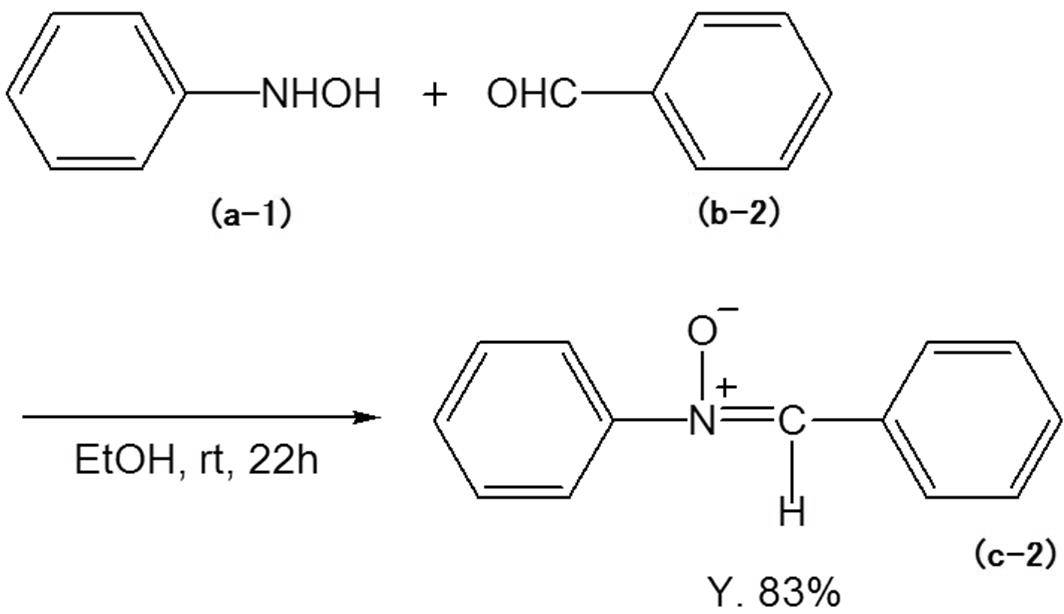
300mLナスフラスコに、下記式(b-2)で表されるベンズアルデヒド(42.45g)およびエタノール(10mL)を入れ、ここに、下記式(a-1)で表されるフェニルヒドロキシアミン(43.65g)をエタノール(70mL)に溶かしたものを加え、室温で22時間撹拌した。撹拌終了後、エタノールからの再結晶により、下記式(c-2)で表されるジフェニルニトロンを白色の結晶として得た(65.40g)。収率は83%であった。
<カルボキシニトロン変性SBR(変性SBR1)の合成>
120℃のバンバリーミキサーにSBR(旭化成ケミカルズ社製「タフデンE581」)を投入して2分間素練りを行った。その後、上述のとおり合成したカルボキシニトロンをSBR100質量部に対して1質量部投入し、160℃で5分間混合することで、SBRをカルボキシニトロンによって変性した。得られたカルボキシニトロン変性SBRを変性SBR1とする。
なお、使用したSBR(旭化成ケミカルズ社製「タフデンE581」)は、後述する「S-SBR2」に相当し、スチレン単位の含有量(スチレン量)が37質量%である。
得られた変性SBR1についてNMR測定を行い、変性率を求めたところ、変性SBR1の変性率は0.21mol%であった。変性率は、具体的には以下のとおり求めた。すなわち、変性前後のSBRについて、CDCl3を溶媒とした1H-NMR測定(CDCl3、400MHz、TMS)により、8.08ppm付近(カルボキシ基に隣接する2つのプロトンに帰属する)のピーク面積を測定し、変性率を求めた。なお、変性SBR1の1H-NMR測定は、変性SBR1をトルエンに溶解して、メタノールに沈殿させる精製を2回繰り返した後に、減圧下で乾燥したサンプルを用いて測定した。
120℃のバンバリーミキサーにSBR(旭化成ケミカルズ社製「タフデンE581」)を投入して2分間素練りを行った。その後、上述のとおり合成したカルボキシニトロンをSBR100質量部に対して1質量部投入し、160℃で5分間混合することで、SBRをカルボキシニトロンによって変性した。得られたカルボキシニトロン変性SBRを変性SBR1とする。
なお、使用したSBR(旭化成ケミカルズ社製「タフデンE581」)は、後述する「S-SBR2」に相当し、スチレン単位の含有量(スチレン量)が37質量%である。
得られた変性SBR1についてNMR測定を行い、変性率を求めたところ、変性SBR1の変性率は0.21mol%であった。変性率は、具体的には以下のとおり求めた。すなわち、変性前後のSBRについて、CDCl3を溶媒とした1H-NMR測定(CDCl3、400MHz、TMS)により、8.08ppm付近(カルボキシ基に隣接する2つのプロトンに帰属する)のピーク面積を測定し、変性率を求めた。なお、変性SBR1の1H-NMR測定は、変性SBR1をトルエンに溶解して、メタノールに沈殿させる精製を2回繰り返した後に、減圧下で乾燥したサンプルを用いて測定した。
<ジフェニルニトロン変性SBR(変性SBR2)の合成>
120℃のバンバリーミキサーにSBR(旭化成ケミカルズ社製「タフデンE581」)を投入して2分間素練りを行った。その後、上述のとおり合成したジフェニルニトロンをSBR100質量部に対して1質量部投入し、160℃で5分間混合することで、SBRをジフェニルニトロンによって変性した。得られたジフェニルニトロン変性SBRを変性SBR2とする。
なお、使用したSBR(旭化成ケミカルズ社製「タフデンE581」)は、後述する「S-SBR2」に相当し、スチレン単位の含有量(スチレン量)が37質量%である。
得られた変性SBR2についてNMR測定を行い、変性率を求めたところ、変性SBR2の変性率は0.23mol%であった。変性率の求め方は上述のとおりである。
120℃のバンバリーミキサーにSBR(旭化成ケミカルズ社製「タフデンE581」)を投入して2分間素練りを行った。その後、上述のとおり合成したジフェニルニトロンをSBR100質量部に対して1質量部投入し、160℃で5分間混合することで、SBRをジフェニルニトロンによって変性した。得られたジフェニルニトロン変性SBRを変性SBR2とする。
なお、使用したSBR(旭化成ケミカルズ社製「タフデンE581」)は、後述する「S-SBR2」に相当し、スチレン単位の含有量(スチレン量)が37質量%である。
得られた変性SBR2についてNMR測定を行い、変性率を求めたところ、変性SBR2の変性率は0.23mol%であった。変性率の求め方は上述のとおりである。
<タイヤトレッド用ゴム組成物の調製>
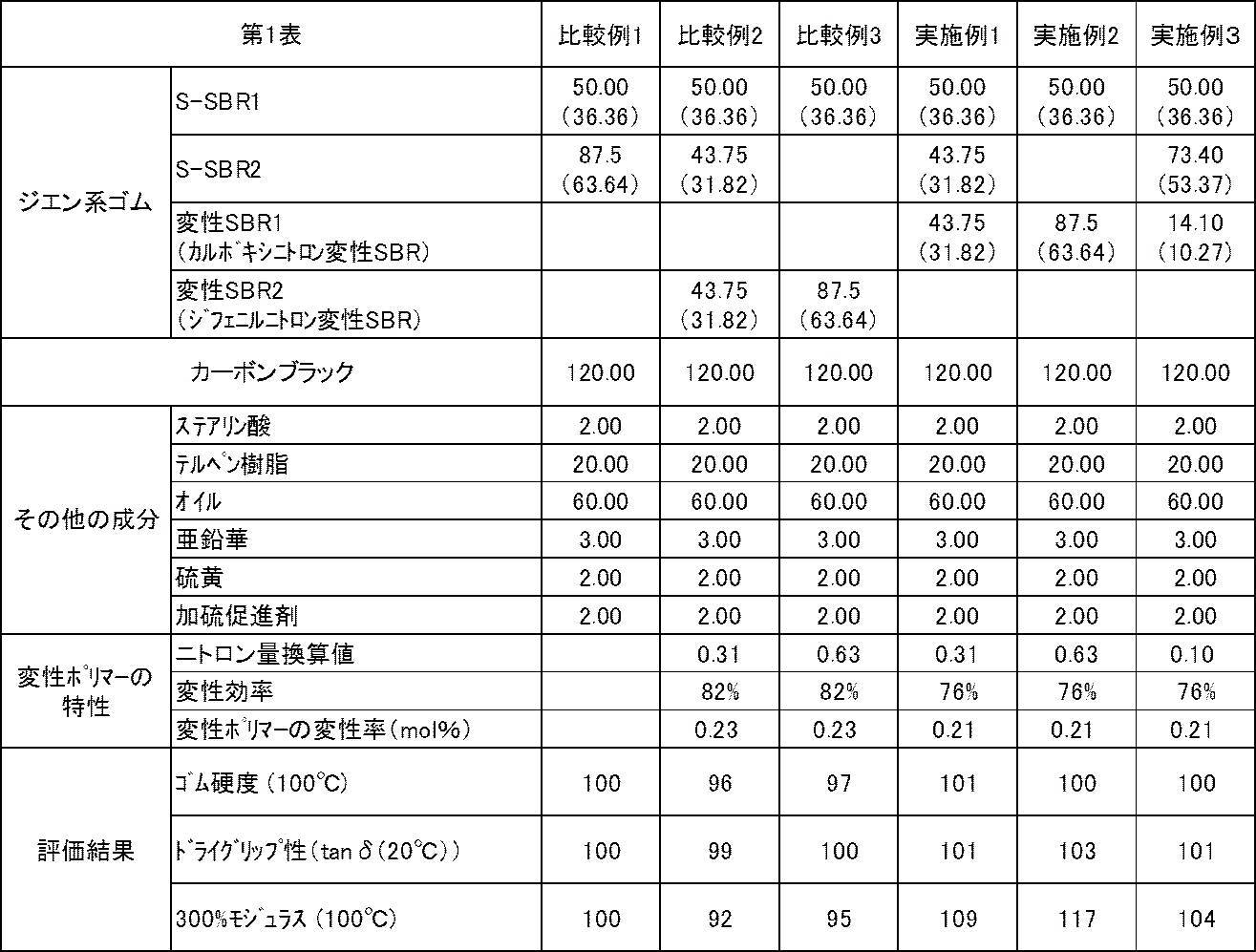
下記第1表に示される成分を、下記第1表に示される割合(質量部)で配合した。
具体的には、まず、下記第1表に示される成分のうち硫黄および加硫促進剤を除く成分を、80℃のバンバリーミキサーで5分間混合した。次に、ロールを用いて、硫黄および加硫促進剤を混合し、各タイヤトレッド用ゴム組成物(以下、「タイヤトレッド用ゴム組成物」を単に「ゴム組成物」ともいう。)を得た。
下記第1表に示される成分を、下記第1表に示される割合(質量部)で配合した。
具体的には、まず、下記第1表に示される成分のうち硫黄および加硫促進剤を除く成分を、80℃のバンバリーミキサーで5分間混合した。次に、ロールを用いて、硫黄および加硫促進剤を混合し、各タイヤトレッド用ゴム組成物(以下、「タイヤトレッド用ゴム組成物」を単に「ゴム組成物」ともいう。)を得た。
<加硫ゴムシートの作製>
得られた各ゴム組成物(未加硫)を、金型(15cm×15cm×0.2cm)中、160℃で15分間プレス加硫して、加硫ゴムシートを作製した。
得られた各ゴム組成物(未加硫)を、金型(15cm×15cm×0.2cm)中、160℃で15分間プレス加硫して、加硫ゴムシートを作製した。
<ゴム硬度の評価>
得られた各加硫ゴムシートについて、JIS K6253に準拠し、デュロメータのタイプAにより温度100℃で測定した。結果を第1表に示す(ゴム硬度)。結果は、比較例1の値を100とする指数で表した。この値が大きいほど、ゴム硬度が高く機械的特性が優れること、また、空気入りタイヤを長時間高速走行させたときの操縦安定性、グリップ性能に優れるものとして評価できる。
得られた各加硫ゴムシートについて、JIS K6253に準拠し、デュロメータのタイプAにより温度100℃で測定した。結果を第1表に示す(ゴム硬度)。結果は、比較例1の値を100とする指数で表した。この値が大きいほど、ゴム硬度が高く機械的特性が優れること、また、空気入りタイヤを長時間高速走行させたときの操縦安定性、グリップ性能に優れるものとして評価できる。
<ドライグリップ性の評価>
得られた各加硫ゴムシートについて、粘弾性スペクトロメーター(東洋精機製作所社製)により、初期歪み10%、振幅±2%、周波数20Hz、温度20℃の条件で、損失正接(tanδ(20℃))を測定した。結果を第1表に示す(ドライグリップ性)。結果は、比較例1のtanδ(20℃)を100とする指数で表した。この値が大きいほど、タイヤにしたときのドライグリップ性に優れるものとして評価できる。
得られた各加硫ゴムシートについて、粘弾性スペクトロメーター(東洋精機製作所社製)により、初期歪み10%、振幅±2%、周波数20Hz、温度20℃の条件で、損失正接(tanδ(20℃))を測定した。結果を第1表に示す(ドライグリップ性)。結果は、比較例1のtanδ(20℃)を100とする指数で表した。この値が大きいほど、タイヤにしたときのドライグリップ性に優れるものとして評価できる。
<300%モジュラスの評価>
得られた各加硫ゴムシートから3号ダンベル状の試験片を打ち抜き、引張速度500mm/分での引張試験をJIS K6251に準拠して行い、100℃における300%モジュラス(M300)を測定した。結果を第1表に示す(300%モジュラス)。結果は、比較例1の300%モジュラスを100とする指数で表した。この値が大きいほど、高温状態での引張り破断強度および剛性が大きく機械的特性が優れること、タイヤにしたときの操縦安定性、グリップ性能及び耐摩耗性に優れるものとして評価できる。
得られた各加硫ゴムシートから3号ダンベル状の試験片を打ち抜き、引張速度500mm/分での引張試験をJIS K6251に準拠して行い、100℃における300%モジュラス(M300)を測定した。結果を第1表に示す(300%モジュラス)。結果は、比較例1の300%モジュラスを100とする指数で表した。この値が大きいほど、高温状態での引張り破断強度および剛性が大きく機械的特性が優れること、タイヤにしたときの操縦安定性、グリップ性能及び耐摩耗性に優れるものとして評価できる。
第1表中、ニトロン量換算値は、ジエン系ゴム100質量部に対する、変性ポリマー(変性SBR1または変性SBR2)の合成に使用されたニトロン化合物の質量部を表す。なお、変性にカルボキシニトロンを用いた場合には、ニトロン量換算値は、上述したCPN量換算値と同義である。
また、変性率は、上述した変性ポリマー(変性SBR1または変性SBR2)の変性率を表す。変性効率は、ニトロン化合物の仕込み量に対する、反応に使用されたニトロン化合物の割合を表す。
また、第1表中、S-SBR1、S-SBR2、変性SBR1、変性SBR2における数値は、オイル分を含む含有量(質量部)であり、括弧内の数値は、ゴム成分の含有量(質量部)を表す。
また、変性率は、上述した変性ポリマー(変性SBR1または変性SBR2)の変性率を表す。変性効率は、ニトロン化合物の仕込み量に対する、反応に使用されたニトロン化合物の割合を表す。
また、第1表中、S-SBR1、S-SBR2、変性SBR1、変性SBR2における数値は、オイル分を含む含有量(質量部)であり、括弧内の数値は、ゴム成分の含有量(質量部)を表す。
上記第1表に示されている各成分の詳細は以下のとおりである。
・S-SBR1:溶液重合スチレンブタジエンゴム、スチレン量:36質量%、重量平均分子量(Mw):147万、Tg:-13℃、ゴム成分100質量部に対しオイル分37.5質量部を含む油展品、旭化成ケミカルズ社製「タフデンE680」
・S-SBR2:溶液重合スチレンブタジエンゴム、スチレン量:37質量%、重量平均分子量(Mw):126万、Tg:-27℃、ゴム成分100質量部に対しオイル分37.5質量部を含む油展品、旭化成ケミカルズ社製「タフデンE581」
・変性SBR1:上述の通り合成した変性SBR1(カルボキシニトロン変性SBR)、ゴム成分100質量部に対しオイル分37.5質量部を含む油展品
・変性SBR2:上述の通り合成した変性SBR2(ジフェニルニトロン変性SBR)、ゴム成分100質量部に対しオイル分37.5質量部を含む油展品
・カーボンブラック:東海カーボン社製「トーカブラック#5500」、窒素吸着比表面積225m2/g
・ステアリン酸:ステアリン酸YR(日油社製)
・テルペン樹脂:YSレジンTO125(ヤスハラケミカル社製)
・オイル:エキストラクト4号S(昭和シェル石油社製)
・亜鉛華:亜鉛華3号(正同化学社製)
・硫黄:油処理硫黄(軽井沢精錬所社製)
・加硫促進剤:ノクセラー CZ-G(大内新興化学工業社製)
・S-SBR1:溶液重合スチレンブタジエンゴム、スチレン量:36質量%、重量平均分子量(Mw):147万、Tg:-13℃、ゴム成分100質量部に対しオイル分37.5質量部を含む油展品、旭化成ケミカルズ社製「タフデンE680」
・S-SBR2:溶液重合スチレンブタジエンゴム、スチレン量:37質量%、重量平均分子量(Mw):126万、Tg:-27℃、ゴム成分100質量部に対しオイル分37.5質量部を含む油展品、旭化成ケミカルズ社製「タフデンE581」
・変性SBR1:上述の通り合成した変性SBR1(カルボキシニトロン変性SBR)、ゴム成分100質量部に対しオイル分37.5質量部を含む油展品
・変性SBR2:上述の通り合成した変性SBR2(ジフェニルニトロン変性SBR)、ゴム成分100質量部に対しオイル分37.5質量部を含む油展品
・カーボンブラック:東海カーボン社製「トーカブラック#5500」、窒素吸着比表面積225m2/g
・ステアリン酸:ステアリン酸YR(日油社製)
・テルペン樹脂:YSレジンTO125(ヤスハラケミカル社製)
・オイル:エキストラクト4号S(昭和シェル石油社製)
・亜鉛華:亜鉛華3号(正同化学社製)
・硫黄:油処理硫黄(軽井沢精錬所社製)
・加硫促進剤:ノクセラー CZ-G(大内新興化学工業社製)
第1表から分かるように、カルボキシニトロン変性SBRを含有する実施例1~3はいずれも、ドライグリップ性、ならびに高温時のゴム硬度および300%モジュラスに優れていた。
また、実施例1および2との対比において、ジエン系ゴム中におけるカルボキシニトロン変性SBRの含有量が50質量%以上であるものを用いると(実施例2)、高温時の300%モジュラスがより優れたものとなることが示された。
一方、カルボキシニトロン変性SBRを含有せず、ジフェニルニトロン変性SBRを含有する比較例2は、ドライグリップ性、ならびに高温時のゴム硬度および300%モジュラスが不十分であった。
また、カルボキシニトロン変性SBRを含有せず、ジフェニルニトロン変性SBRを含有する比較例3は、高温時のゴム硬度および300%モジュラスが不十分であった。
また、実施例1および2との対比において、ジエン系ゴム中におけるカルボキシニトロン変性SBRの含有量が50質量%以上であるものを用いると(実施例2)、高温時の300%モジュラスがより優れたものとなることが示された。
一方、カルボキシニトロン変性SBRを含有せず、ジフェニルニトロン変性SBRを含有する比較例2は、ドライグリップ性、ならびに高温時のゴム硬度および300%モジュラスが不十分であった。
また、カルボキシニトロン変性SBRを含有せず、ジフェニルニトロン変性SBRを含有する比較例3は、高温時のゴム硬度および300%モジュラスが不十分であった。
1 ビード部
2 サイドウォール部
3 タイヤトレッド部
4 カーカス層
5 ビードコア
6 ビードフィラー
7 ベルト層
8 リムクッション
2 サイドウォール部
3 タイヤトレッド部
4 カーカス層
5 ビードコア
6 ビードフィラー
7 ベルト層
8 リムクッション
Claims (5)
- カーボンブラックと、カルボキシ変性ポリマーを含むジエン系ゴムと、を含有し、
前記カーボンブラックの含有量が、前記ジエン系ゴム100質量部に対して、80~150質量部であり、
前記カルボキシ変性ポリマーが、スチレン-ブタジエンゴム(A)を、カルボキシ基を有するニトロン化合物(B)によって変性することで得られ、前記ジエン系ゴム中の前記カルボキシ変性ポリマーの含有量が10~100質量%であり、
前記スチレン-ブタジエンゴム(A)中のスチレン単位の含有量が、36質量%以上であり、
前記スチレン-ブタジエンゴム(A)の有するブタジエンに由来する全ての二重結合のうち、前記カルボキシ基を有するニトロン化合物(B)によって変性された割合(mol%)を変性率とした場合、前記カルボキシ変性ポリマーの変性率が0.02~4.0mol%である、タイヤトレッド用ゴム組成物。 - 前記カルボキシ基を有するニトロン化合物(B)が、N-フェニル-α-(4-カルボキシフェニル)ニトロン、N-フェニル-α-(3-カルボキシフェニル)ニトロン、N-フェニル-α-(2-カルボキシフェニル)ニトロン、N-(4-カルボキシフェニル)-α-フェニルニトロン、N-(3-カルボキシフェニル)-α-フェニルニトロンおよびN-(2-カルボキシフェニル)-α-フェニルニトロンからなる群より選択される化合物である、請求項1に記載のタイヤトレッド用ゴム組成物。
- 前記カーボンブラックの窒素吸着比表面積が、150~400m2/gである、請求項1または2に記載のタイヤトレッド用ゴム組成物。
- 前記スチレン-ブタジエンゴム(A)を変性する際に使用する前記カルボキシ基を有するニトロン化合物(B)の量が、前記ジエン系ゴム100質量部に対して、0.1~10質量部である、請求項1~3のいずれか1項に記載のタイヤトレッド用ゴム組成物。
- 請求項1~4のいずれか1項に記載のタイヤトレッド用ゴム組成物をタイヤトレッドに使用した空気入りタイヤ。
Priority Applications (3)
| Application Number | Priority Date | Filing Date | Title |
|---|---|---|---|
| DE112016001275.6T DE112016001275T5 (de) | 2015-03-19 | 2016-03-18 | Kautschukzusammensetzung Für Reifenlaufflächen und Luftreifen |
| CN201680010306.2A CN107250243A (zh) | 2015-03-19 | 2016-03-18 | 轮胎胎面用橡胶组合物及充气轮胎 |
| US15/557,998 US20180079834A1 (en) | 2015-03-19 | 2016-03-18 | Rubber composition for tire treads, and pneumatic tire |
Applications Claiming Priority (2)
| Application Number | Priority Date | Filing Date | Title |
|---|---|---|---|
| JP2015056656A JP5949987B1 (ja) | 2015-03-19 | 2015-03-19 | タイヤトレッド用ゴム組成物および空気入りタイヤ |
| JP2015-056656 | 2015-03-19 |
Publications (1)
| Publication Number | Publication Date |
|---|---|
| WO2016148277A1 true WO2016148277A1 (ja) | 2016-09-22 |
Family
ID=56375094
Family Applications (1)
| Application Number | Title | Priority Date | Filing Date |
|---|---|---|---|
| PCT/JP2016/058697 Ceased WO2016148277A1 (ja) | 2015-03-19 | 2016-03-18 | タイヤトレッド用ゴム組成物および空気入りタイヤ |
Country Status (5)
| Country | Link |
|---|---|
| US (1) | US20180079834A1 (ja) |
| JP (1) | JP5949987B1 (ja) |
| CN (1) | CN107250243A (ja) |
| DE (1) | DE112016001275T5 (ja) |
| WO (1) | WO2016148277A1 (ja) |
Families Citing this family (1)
| Publication number | Priority date | Publication date | Assignee | Title |
|---|---|---|---|---|
| CN110944851B (zh) * | 2017-08-01 | 2022-04-19 | 横滨橡胶株式会社 | 充气轮胎 |
Citations (4)
| Publication number | Priority date | Publication date | Assignee | Title |
|---|---|---|---|---|
| JP5088456B1 (ja) * | 2012-03-08 | 2012-12-05 | 横浜ゴム株式会社 | タイヤトレッド用ゴム組成物 |
| JP2014101400A (ja) * | 2012-11-16 | 2014-06-05 | Yokohama Rubber Co Ltd:The | 変性ポリマー |
| JP2015098591A (ja) * | 2013-10-18 | 2015-05-28 | 横浜ゴム株式会社 | ゴム組成物およびゴム製品 |
| JP5812155B1 (ja) * | 2014-05-16 | 2015-11-11 | 横浜ゴム株式会社 | タイヤリムクッションまたはガムフィニッシング用ゴム組成物および空気入りタイヤ |
Family Cites Families (4)
| Publication number | Priority date | Publication date | Assignee | Title |
|---|---|---|---|---|
| US6489389B1 (en) * | 1994-08-19 | 2002-12-03 | Bridgestone Corporation | Rubber composition for tire treads |
| JP2007070439A (ja) * | 2005-09-06 | 2007-03-22 | Bridgestone Corp | ゴム組成物及びそれを用いたタイヤ |
| JP5716850B1 (ja) * | 2014-01-31 | 2015-05-13 | 横浜ゴム株式会社 | 変性ポリマー、これを用いるゴム組成物及びタイヤ |
| US9752018B2 (en) * | 2014-05-14 | 2017-09-05 | The Yokohama Rubber Co., Ltd. | Rubber composition for conveyor belt, and conveyor belt |
-
2015
- 2015-03-19 JP JP2015056656A patent/JP5949987B1/ja not_active Expired - Fee Related
-
2016
- 2016-03-18 WO PCT/JP2016/058697 patent/WO2016148277A1/ja not_active Ceased
- 2016-03-18 US US15/557,998 patent/US20180079834A1/en not_active Abandoned
- 2016-03-18 DE DE112016001275.6T patent/DE112016001275T5/de not_active Ceased
- 2016-03-18 CN CN201680010306.2A patent/CN107250243A/zh not_active Withdrawn
Patent Citations (4)
| Publication number | Priority date | Publication date | Assignee | Title |
|---|---|---|---|---|
| JP5088456B1 (ja) * | 2012-03-08 | 2012-12-05 | 横浜ゴム株式会社 | タイヤトレッド用ゴム組成物 |
| JP2014101400A (ja) * | 2012-11-16 | 2014-06-05 | Yokohama Rubber Co Ltd:The | 変性ポリマー |
| JP2015098591A (ja) * | 2013-10-18 | 2015-05-28 | 横浜ゴム株式会社 | ゴム組成物およびゴム製品 |
| JP5812155B1 (ja) * | 2014-05-16 | 2015-11-11 | 横浜ゴム株式会社 | タイヤリムクッションまたはガムフィニッシング用ゴム組成物および空気入りタイヤ |
Also Published As
| Publication number | Publication date |
|---|---|
| JP5949987B1 (ja) | 2016-07-13 |
| JP2016175987A (ja) | 2016-10-06 |
| US20180079834A1 (en) | 2018-03-22 |
| CN107250243A (zh) | 2017-10-13 |
| DE112016001275T5 (de) | 2018-01-18 |
Similar Documents
| Publication | Publication Date | Title |
|---|---|---|
| JP6024781B2 (ja) | タイヤトレッド用ゴム組成物および空気入りタイヤ | |
| JP5691456B2 (ja) | タイヤトレッド用ゴム組成物 | |
| JP6070754B2 (ja) | ゴム組成物および空気入りタイヤ | |
| JP5761442B1 (ja) | 変性ポリマーおよびゴム組成物並びに空気入りタイヤ | |
| WO2015114996A1 (ja) | ゴム組成物および空気入りタイヤ | |
| US9803031B2 (en) | Modified polymer, rubber composition and pneumatic tire | |
| JP5812154B1 (ja) | アンダートレッド用ゴム組成物および空気入りタイヤ | |
| JP6350779B1 (ja) | タイヤトレッド用ゴム組成物及び空気入りタイヤ | |
| WO2015114845A1 (ja) | ゴム組成物、変性ポリマー及びタイヤ | |
| JP5949987B1 (ja) | タイヤトレッド用ゴム組成物および空気入りタイヤ | |
| JP5761443B1 (ja) | ゴム組成物及び空気入りタイヤ | |
| WO2015173992A1 (ja) | 繊維コード被覆用ゴム組成物および空気入りタイヤ | |
| JP5812155B1 (ja) | タイヤリムクッションまたはガムフィニッシング用ゴム組成物および空気入りタイヤ | |
| JP5838760B2 (ja) | タイヤトレッド用ゴム組成物 | |
| JP6112161B2 (ja) | 変性ポリマーの製造方法、変性ポリマー、ゴム組成物および空気入りタイヤ | |
| JP5812156B1 (ja) | サイドウォール用ゴム組成物および空気入りタイヤ | |
| JP5962809B1 (ja) | タイヤトレッド用ゴム組成物およびそれを用いた空気入りタイヤ | |
| WO2015173989A1 (ja) | タイヤリムクッションまたはガムフィニッシング用ゴム組成物および空気入りタイヤ | |
| WO2016167289A1 (ja) | ゴム組成物及びタイヤ | |
| JP5812157B1 (ja) | タイヤリムクッションまたはガムフィニッシング用ゴム組成物および空気入りタイヤ | |
| JP2025078453A (ja) | 変性ジエン系重合体及びゴム組成物 | |
| WO2015173994A1 (ja) | ビードフィラー用ゴム組成物および空気入りタイヤ | |
| JP5812153B1 (ja) | サイドウォール用ゴム組成物および空気入りタイヤ | |
| WO2015173988A1 (ja) | サイドウォール用ゴム組成物および空気入りタイヤ |
Legal Events
| Date | Code | Title | Description |
|---|---|---|---|
| 121 | Ep: the epo has been informed by wipo that ep was designated in this application |
Ref document number: 16765106 Country of ref document: EP Kind code of ref document: A1 |
|
| WWE | Wipo information: entry into national phase |
Ref document number: 15557998 Country of ref document: US |
|
| WWE | Wipo information: entry into national phase |
Ref document number: 112016001275 Country of ref document: DE |
|
| 122 | Ep: pct application non-entry in european phase |
Ref document number: 16765106 Country of ref document: EP Kind code of ref document: A1 |