WO2016143761A1 - セルロースの製造方法 - Google Patents
セルロースの製造方法 Download PDFInfo
- Publication number
- WO2016143761A1 WO2016143761A1 PCT/JP2016/057050 JP2016057050W WO2016143761A1 WO 2016143761 A1 WO2016143761 A1 WO 2016143761A1 JP 2016057050 W JP2016057050 W JP 2016057050W WO 2016143761 A1 WO2016143761 A1 WO 2016143761A1
- Authority
- WO
- WIPO (PCT)
- Prior art keywords
- cellulose
- peroxide
- treatment
- treatment liquid
- concentration
- Prior art date
- Legal status (The legal status is an assumption and is not a legal conclusion. Google has not performed a legal analysis and makes no representation as to the accuracy of the status listed.)
- Ceased
Links
Classifications
-
- C—CHEMISTRY; METALLURGY
- C08—ORGANIC MACROMOLECULAR COMPOUNDS; THEIR PREPARATION OR CHEMICAL WORKING-UP; COMPOSITIONS BASED THEREON
- C08B—POLYSACCHARIDES; DERIVATIVES THEREOF
- C08B15/00—Preparation of other cellulose derivatives or modified cellulose, e.g. complexes
- C08B15/08—Fractionation of cellulose, e.g. separation of cellulose crystallites
-
- D—TEXTILES; PAPER
- D21—PAPER-MAKING; PRODUCTION OF CELLULOSE
- D21C—PRODUCTION OF CELLULOSE BY REMOVING NON-CELLULOSE SUBSTANCES FROM CELLULOSE-CONTAINING MATERIALS; REGENERATION OF PULPING LIQUORS; APPARATUS THEREFOR
- D21C5/00—Other processes for obtaining cellulose, e.g. cooking cotton linters ; Processes characterised by the choice of cellulose-containing starting materials
Definitions
- the present invention relates to a method for producing cellulose.
- Cellulose is used in various applications such as foods, pharmaceuticals, and industrial applications.
- the addition of cellulose provides a thickening and dispersing effect, thus improving the texture.
- the water absorbency and oil absorbency are effective for improving the texture of fried foods.
- cellulose may be added to give excellent mechanical properties such as improving the welding workability of the coated arc welding rod.
- Cellulose is sometimes used as a base material for automobile friction materials as an alternative to asbestos.
- cellulose As a characteristic of cellulose used in the above-mentioned applications, it is required to be a white powder excellent in fluidity and disintegration. It is known that the fluidity and disintegration of cellulose are affected by the degree of polymerization.
- Patent Documents 1 to 3 and Non-Patent Document 1 are known.
- Patent Document 1 discloses a method for producing a cellulose product having a level-off polymerization degree by subjecting refined wood pulp or the like to hydrolysis treatment called mineralization, ferric chloride, or the like, which is called low polymerization treatment.
- Non-Patent Document 1 discloses a method for obtaining microcrystalline cellulose by subjecting high-purity natural cellulose to a treatment for reducing the degree of polymerization with a mineral acid, purifying and drying.
- Patent Document 2 discloses a method for producing microcrystalline cellulose having high whiteness using unbleached kraft pulp or bleached kraft pulp as a raw material. This method uses treatment with a peroxy acid rather than treatment with only a mineral acid such as hydrochloric acid or sulfuric acid.
- peroxymonosulfuric acid is produced by mixing sulfuric acid and hydrogen peroxide and is in equilibrium with sulfuric acid and hydrogen peroxide.
- the technology of this patent document generates high-concentration peroxymonosulfuric acid by mixing high-concentration sulfuric acid and hydrogen peroxide, and dilutes with water before reaching the equilibrium state, and is used to reduce the degree of polymerization of pulp. To do.
- the treatment liquid containing peroxymonosulfuric acid after separating the produced microcrystalline cellulose has been diluted and has already reached equilibrium. Even if high-concentration sulfuric acid or hydrogen peroxide is further added to such a solution, the concentration of newly produced peroxymonosulfuric acid is low and cannot be reused for the treatment for reducing the degree of polymerization of pulp.
- Patent Document 3 as a method for producing powdered cellulose, a mineral acid such as sulfuric acid is used, and when pulp cellulose is subjected to a low polymerization degree treatment, peroxide treatment such as ozone treatment or hydrogen peroxide is performed. A method is described. However, there is no description regarding the technique of reusing the mineral acid solution after the low polymerization degree treatment, and the method of Patent Document 3 cannot obtain crystalline cellulose having a polymerization degree of 350 or less.
- Patent Document 4 ozone generated by an ozone generator or ozone exhaust gas discharged from the ozone bleaching stage of the pulp bleaching process is added to the mineral acid solution used for the process of lowering the degree of polymerization of pulp, A method for regenerating a mineral acid solution is disclosed.
- Patent Document 5 discloses that the mineral acid solution is decolorized by adding ozone to the mineral acid solution that has been used for the degree-of-polymerization treatment while irradiating ultraviolet rays, and reused in the degree-of-polymerization treatment. A method is also disclosed. However, these methods require relatively large energy for ozone generation and are not suitable for producing cellulose on an industrial scale.
- Patent Document 2 an attempt was made to produce cellulose by reducing the degree of polymerization of unbleached kraft pulp or bleached pulp with active oxygen, and the following problems were found.
- active oxygen is derived from, for example, peroxy acid
- peroxy acid is obtained, for example, by reacting high concentration sulfuric acid with high concentration hydrogen peroxide.
- the concentration is required to be 50% or more.
- Hydrogen peroxide is distributed from a high concentration to a low concentration from the viewpoint of safety, transportability, storage stability, and the like. For this reason, it is inconvenient if various concentrations of hydrogen peroxide cannot be used.
- a high concentration of peroxyacid is recognized as corrosive to a stainless steel material, there is also a problem that a material generally used in preparing peroxyacid cannot be used.
- Patent Document 2 Further, the case where the active oxygen in Patent Document 2 is derived from peroxymonosulfuric acid, for example, was examined.
- Peroxymonosulfuric acid is present in an equilibrium mixture of sulfuric acid and hydrogen peroxide. If the treatment liquid containing peroxymonosulfuric acid used in the pulp lowering treatment in this patent document has an equilibrium composition, the concentration of sulfuric acid and hydrogen peroxide, which are raw materials for peroxymonosulfuric acid, is low. Only the concentration of sulfuric acid and hydrogen peroxide after dilution with water should affect the degree of polymerization treatment.
- the present inventors have examined that hydrogen peroxide solution of high concentration (for example, concentration of 50% or more) and concentrated sulfuric acid are reacted to produce peroxymonosulfuric acid, and then diluted with water. It was found that the composition of peroxymonosulfuric acid does not immediately become an equilibrium composition, and that the amount of peroxymonosulfuric acid produced increases as the concentration of the raw material hydrogen peroxide solution increases. That is, it has been found that the technique described in this patent document uses a high concentration of peroxymonosulfuric acid present in a non-equilibrium mixed solution for the treatment for reducing the degree of polymerization of pulp. Such a treatment solution containing a high concentration of peroxymonosulfuric acid has a drawback that it is difficult to produce stable cellulose because it gradually changes to an equilibrium composition.
- the treatment liquid used for lowering the degree of polymerization of pulp contains a high concentration of mineral acid, so it has to be neutralized with a large amount of an alkaline agent for disposal, which increases the production cost. There is. Therefore, it has been economically desired to reuse the treatment liquid.
- the methods of Patent Document 4 and Patent Document 5 are disclosed, As described above, a large amount of energy is required for ozone generation, which is not economical and economically advantageous.
- the problem to be solved by the present invention is a method for producing cellulose from chemical pulp using a treatment liquid comprising an aqueous solution containing a mineral acid and a peroxide, wherein the recovered used treatment liquid is reused.
- a treatment liquid comprising an aqueous solution containing a mineral acid and a peroxide
- the recovered used treatment liquid is reused.
- the present inventors reused the treated liquid as a regeneration treatment liquid, and Provided is a method for producing cellulose having an average degree of polymerization of 350 or less and a Hunter whiteness of 92 or more and high whiteness. That is, this application includes the following inventions.
- a method for producing cellulose from chemical pulp by a treatment solution comprising an aqueous solution containing a mineral acid and a peroxide comprising at least the following steps (a) to (c), wherein the regeneration prepared in step (c)
- a method for producing cellulose comprising reusing a treatment liquid as a treatment liquid in step (a).
- (b) Cellulose obtained in step (a) and treated solution
- ⁇ 6> The method for producing cellulose according to any one of ⁇ 1> to ⁇ 5>, wherein the peroxide is hydrogen peroxide.
- ⁇ 7> The method for producing cellulose according to any one of ⁇ 1> to ⁇ 6>, wherein the chemical pulp is bleached pulp.
- ⁇ 8> The method for producing cellulose according to any one of ⁇ 1> to ⁇ 7>, wherein the cellulose has an average degree of polymerization of 350 or less and a Hunter whiteness of 92 or more.
- a method for producing cellulose from chemical pulp using a treatment liquid comprising an aqueous solution containing a mineral acid and a peroxide, wherein the recovered spent treatment liquid is reused to obtain an average degree of polymerization can provide a method for producing cellulose having a whiteness of 350 or less.
- the method for producing cellulose according to the embodiment includes the following steps (a), (b) and (c), and further includes the following steps (d), (e), (f), (g) and (h): Either step may be included.
- the step of neutralizing the cellulose obtained in the step (e) The step of washing the obtained cellulose (f) The step of drying the obtained cellulose (g)
- the step of pulverizing the obtained cellulose (h) Step of classifying cellulose Recycled processing solution in which the mineral acid and peroxide concentrations are adjusted in step (c) is reused as the processing solution in step (a).
- ⁇ Raw materials> Mineral acids that can be used in the steps (a) and (c) include sulfuric acid, hydrochloric acid, nitric acid, sulfurous acid, phosphoric acid, etc., and one kind may be used alone, or 2 You may mix and use the mineral acid more than a kind. Of these, the preferred mineral acid is sulfuric acid.
- a method for producing sulfuric acid there are a production from sulfur dioxide, a nitric acid type production method, and a contact type production method, any of which may be used.
- Concentrated sulfuric acid with a concentration of 90 to 98% by weight and dilute sulfuric acid with a concentration of less than 90% by weight are available as sulfuric acid. If the concentration of sulfuric acid in the treatment liquid can be adjusted to a desired concentration, it can be used.
- the concentration of sulfuric acid to be used is not limited. In order to set the concentration of sulfuric acid in the treatment liquid to a predetermined concentration, commercially available sulfuric acid may be diluted and used. In addition, there exist industrial sulfuric acid and refined sulfuric acid in the distribution
- Peroxides that can be used in the steps (a) and (c) include hydrogen peroxide, peracetic acid, organic peroxides, monopersulfuric acid, chlorine peroxide and the like. May be used alone, or two or more peroxides may be mixed. Among these, a preferred peroxide is hydrogen peroxide.
- a method for producing hydrogen peroxide there are an organic method using anthraquinone or the like as a starting material, an electrolytic method using sulfuric acid as a raw material, and a direct method using oxygen and hydrogen. May be used in combination.
- the peroxide can be added in the form of an aqueous solution.
- hydrogen peroxide solution is generally distributed at a concentration of 30 to 70% by weight, but the concentration of hydrogen peroxide solution to be used is limited if the peroxide concentration in the treatment liquid can be adjusted to a desired concentration.
- commercially available hydrogen peroxide solution may be diluted and used.
- the distribution product of hydrogen peroxide water includes industrial use, electronic industry use, and food additive use, and any of them can be used, and a plurality of kinds can be used in combination. When a plurality of types are used in combination, the combination is not limited at all.
- Treatment liquid / treated liquid / regenerated treatment liquid contain mineral acid, peroxide and water. Refers to a mixture.
- an aqueous peroxide solution having a concentration of less than 50% by weight the amount of peroxide in the aqueous peroxide solution is less than 50% by weight.
- an aqueous peroxide solution of less than 50% by weight may be used, or an aqueous peroxide solution diluted to less than 50% by weight may be used.
- aqueous peroxide solution having a concentration of 20% by weight or more and less than 50% by weight, particularly preferably 30% by weight or more and less than 50% by weight.
- peroxyacid may be generated. Regardless of the concentration of peroxyacid, the mineral acid and peroxide concentration in the treatment liquid should be within the specified concentration range.
- the order of mixing the mineral acid, peroxide and water is not particularly limited. Moreover, there is no restriction
- the mixing temperature is in a range where heat is generated when mineral acid, peroxide, and water are mixed but does not boil.
- the mixing time is not limited as long as it can be uniformly mixed in an economical time.
- At least one of a mineral acid or a peroxide is added to the treated liquid recovered in the separation step after the degree of polymerization treatment, and the mineral acid and the peroxide are adjusted to a predetermined concentration range, and the regeneration treatment is performed.
- Prepare the solution It is preferable to use the same materials as the mineral acid and peroxide used in the preparation of the first treatment liquid as the mineral acid and peroxide added when preparing the regenerating treatment liquid.
- This regeneration treatment solution is used again for the treatment for reducing the degree of polymerization. That is, the regeneration processing solution prepared in the step (c) is reused as the processing solution in the step (a).
- Chemical pulp Chemical pulp is produced from pulp chips.
- the raw material of the pulp chip include conifers represented by radiata pine and spruce, and broad-leaved trees represented by eucalyptus and acacia. These coniferous and hardwood pulps can be used alone or in combination of two or more. When a plurality of types are used in combination, the combination is not limited at all.
- the chemical pulp is produced by using the above-mentioned pulp chip as a raw material, a sulfite cooking method, a kraft cooking method, or a combination of these methods.
- the chemical pulp produced by the above method may be either non-bleached pulp or bleached pulp, or a combination thereof.
- Chemical pulp includes papermaking pulp and high-precision dissolving pulp, both of which can be used, and these can also be used in combination.
- the chemical pulp may be used in a water-containing state after cooking or bleaching, and a dried plate-like pulp may be used.
- the chemical pulp used in the present invention may be any of the above types of pulp, but preferably bleached pulp produced by further performing at least one of an oxygen bleaching step or a bleaching step after cooking.
- step (a) chemical pulp as a raw material is subjected to a treatment for reducing the degree of polymerization with a treatment liquid to produce cellulose having a desired degree of polymerization.
- the treatment liquid is prepared from mineral acid, peroxide and water. Each of the mineral acid and the peroxide may be used alone or in combination of two or more.
- the mineral acid concentration in the treatment liquid is 0.05 to 35.0% by weight, preferably 1.0 to 30.0% by weight, more preferably 5.0 to 24.0% by weight, and particularly preferably 10.0. ⁇ 20.0% by weight.
- the peroxide concentration in the treatment liquid is 0.05 to 40.0% by weight, preferably 0.05 to 24.0% by weight, more preferably 0.05 to 10.0% by weight, and particularly preferably 0. .1 to 5.0% by weight.
- the concentration of the mineral acid and the peroxide means a ratio (% by weight) with respect to the whole treatment liquid as undiluted, that is, as 100% mineral acid and peroxide.
- the component excluding the mineral acid and peroxide in the treatment liquid is basically water.
- Mineral acid, peroxide and water may be mixed in the reaction tank used for the treatment for reducing the degree of polymerization, or after mixing in another tank, the mixture may be transferred to the reaction tank.
- the chemical pulp used for the low polymerization degree treatment may be put into the reaction tank after preparing the treatment liquid, or may be put into the reaction tank from the beginning, and the treatment liquid may be put there. Further, it can be added during the preparation of the treatment liquid, and may be added before or after the addition of any chemical.
- the initial concentration of peroxymonosulfuric acid is water, sulfuric acid, As well as the amount and concentration of hydrogen peroxide, it is affected by the mixing method. For example, when using at least one of a relatively high concentration sulfuric acid or a relatively high concentration hydrogen peroxide solution, and diluting with water after mixing sulfuric acid and hydrogen peroxide solution, the initial concentration of peroxymonosulfuric acid (That is, the concentration immediately after mixing) tends to be higher than the concentration of peroxymonosulfuric acid in the equilibrium solution.
- the initial concentration of peroxymonosulfuric acid is the peroxymonosulfuric acid in the equilibrium solution. It tends to be lower than the concentration of.
- the composition of these mixed solutions begins to change towards the equilibrium composition depending on subsequent processing conditions.
- the mixed solution is in an equilibrium state. For example, when the temperature of the mixed solution is 60 ° C., it is mixed for 10 to 180 minutes, when the temperature is 70 ° C., it is 10 to 120 minutes, and when the temperature is 90 ° C., it is mixed for 10 to 90 minutes. As a result, the mixed solution is in an equilibrium state.
- the pH of the treatment liquid containing water, mineral acid and peroxide is determined by the weight ratio of each component in the treatment liquid, but the pH is preferably 2 or less, more preferably 1 or less.
- the low polymerization degree treatment is a treatment for reducing the polymerization degree of pulp using a treatment liquid.
- the chemical pulp is treated at a predetermined temperature for a predetermined time at a predetermined temperature (for example, sulfuric acid: 0.05 to 35.0% by weight, hydrogen peroxide: 0.05 to 40.0% by weight).
- %, Water 50.0 to 94.0% by weight).
- a processing method is not specifically limited, For example, it can carry out by immersing a chemical pulp in a processing liquid at predetermined temperature for predetermined time.
- the proportion of the pulp in the reaction solution containing the treatment liquid and the pulp is preferably in the range of 0.1 to 20% by weight, more preferably 1 to 15% by weight. When it is higher than 20% by weight, the treatment liquid does not sufficiently penetrate into the pulp, which is not preferable. If it is lower than 0.1% by weight, the reaction efficiency is poor and there is an economical problem.
- the reaction temperature is preferably in the range of 20 ° C to 130 ° C, more preferably 50 ° C to 120 ° C, still more preferably 60 ° C to 110 ° C.
- the reaction time is preferably in the range of 5 minutes to 240 minutes, more preferably 15 minutes to 180 minutes, and even more preferably 30 to 120 minutes.
- the degree-of-polymerization treatment can be carried out using a continuous apparatus using a reaction tube or a tower, or a batch reaction tank.
- a stirring blade may be used so that the treatment liquid can be sufficiently circulated, and the treatment liquid may be circulated through the extraction line.
- a surfactant can be used as a penetrant.
- Surfactants include, but are not limited to, cationic, anionic, zwitterionic and nonionic. Any of these may be used alone or in combination.
- Step (b) Step is a step of separating the cellulose after the degree of polymerization treatment and the treated liquid, and the method is not particularly limited as long as they can be separated, but for example, filtration may be performed. it can. Specifically, in step (b), separation is performed using a centrifuge, a filter press, a belt press, an Oliver filter, a Young filter, or the like. The separated cellulose is sent to step (d), and the separated treated liquid is recovered and used in step (c).
- step (c) In step (c), at least one of the mineral acid or peroxide consumed in step (a) is added to the treated liquid separated in step (b) to prepare a reclaimed processing solution.
- step (c) mineral acid, peroxide and / or water exceeding the amount consumed in step (a) may be added as necessary.
- the mineral acid, peroxide and / or water consumed in the step (a) the mineral acid, peroxide and water in the treated liquid lost due to the separation from the cellulose in the step (b) are also included.
- it is for securing a necessary liquid amount in the second and subsequent steps (a).
- the ratio of the treated liquid in the regenerated liquid prepared in this step is 10% by weight or more, more preferably 50% by weight or more, still more preferably 70% by weight or more, and particularly preferably 80% by weight or more.
- the amount of the treated liquid recovered in the step is small, the amount of the chemical that must be newly added increases, which is not economical. Particularly important here is that the peroxide concentration in the treatment liquid used in step (a) is 0.05 to 40% by weight.
- step (c) in order to add an appropriate amount of mineral acid, peroxide and water, the mineral acid and peroxide concentrations in the treated liquid recovered in step (b) are analyzed.
- the mineral acid concentration can be calculated by performing neutralization titration with a sodium hydroxide standard solution
- the peroxide concentration can be calculated by oxidation-reduction titration with a potassium permanganate standard solution or by adding potassium iodide.
- the free iodine can be calculated by titrating with a sodium thiosulfate standard solution.
- step (D) Neutralization step Mineral acid and peroxide still remain in the cellulose obtained in step (b).
- a neutralization step is performed.
- This step is a step of neutralizing the acid remaining in the cellulose using an alkali agent.
- the alkali agent used for neutralization is preferably used in an aqueous solution concentration of 0.01 wt% to 50 wt%, more preferably 0.1 wt% to 25 wt%.
- the ratio of the cellulose to the total weight of the alkali agent aqueous solution and the cellulose to be neutralized is preferably 1 to 15% by weight.
- the alkaline agent inorganic alkaline substances such as NaOH, KOH, and ammonia water, and organic alkaline substances such as trimethylammonium hydroxide can be used, but inorganic alkaline substances are preferred because of the ease of treatment of the alkaline aqueous solution after neutralization treatment. used.
- the step (e) may be performed several times prior to this step.
- the (e) step is a step of removing the drug adhering to the cellulose by bringing the cellulose into contact with water.
- the apparatus which can be used is not specifically limited, For example, the stirring tank which has an impeller type stirrer can be used. You may wash
- (F) Drying step As a drying method, not only a method using a general dryer but also a method of substituting with a solvent can be used.
- a method using a dryer a hot air dryer, a steam tube dryer, an aeration dryer, a spray dryer, an air dryer, a drum dryer, a continuous fluidized bed dryer, an infrared dryer, a high-frequency heat dryer, a freezer
- Examples thereof include a method using a dryer, a rapid dryer, or the like.
- Examples of the method of replacing with a solvent include a method of replacing the moisture in cellulose with ethanol and then air drying.
- the drying temperature is preferably 30 to 220 ° C. When drying at a temperature exceeding 220 ° C., the thermal decomposition of cellulose may proceed, which is not preferable. Drying may be performed under pressure, normal pressure, or reduced pressure.
- the pulverization process is performed by a mechanical treatment, and can be performed by, for example, using at least one of an impact mill and an airflow mill, and further by performing the treatment multiple times with the same model.
- (H) Classification process A classification process is operation which classifies a cellulose according to a particle size by dry classification, wet classification, or a sieve classification method.
- the cellulose obtained in the step (g) can be classified and used as necessary.
- drying, refinement, and classification can be performed simultaneously.
- Hunter whiteness Hunter whiteness of the cellulose produced by the above method is 92 or more, more preferably 95 or more, and particularly preferably 97 or more.
- the average degree of polymerization of the cellulose produced by the method of the present invention is 350 or less, preferably 300 or less, particularly preferably 250 or less.
- the pH was measured using a main body (Horiba, D-51) and a pH electrode (Horiba, 9615-10D).
- the hydrogen peroxide contained in the treated liquid was quantified by an iodine reduction titration method. Specifically, 1 g of the recovered treated liquid after the low polymerization degree treatment was weighed and added to a 20 wt% sulfuric acid solution to make about 20 mL, and then potassium iodide powder was added to liberate iodine. . A 0.1 mol / L sodium thiosulfate standard solution was added dropwise thereto, and starch was used as an indicator, and the blue-purple color of the solution disappeared and became colorless, and the released iodine was quantified. From the iodine amount, the hydrogen peroxide amount was calculated.
- the sulfuric acid contained in the treated liquid was quantified by neutralization titration. After the polymerization degree-reducing treatment, 0.5 g of the collected treated solution was weighed and diluted with ion-exchanged water to about 10 mL, and then a few drops of an indicator phenolphthalein solution were added. The 0.1 mol / L sodium hydroxide standard solution was dripped there, and it titrated until the solution became reddish purple, and calculated the quantity of sulfuric acid.
- ⁇ Average degree of polymerization of cellulose> The average degree of polymerization was measured by a viscosity measurement method using copper ethylenediamine described in the 16th revised Japanese Pharmacopoeia Manual, crystalline cellulose confirmation test (3).
- Table 1 shows the treatment solution compositions of sulfuric acid / hydrogen peroxide / water used in the Examples and Comparative Examples.
- the values of sulfuric acid (wt%) and hydrogen peroxide (wt%) in Table 1 are the concentrations of sulfuric acid and hydrogen peroxide in the treatment solution containing sulfuric acid, hydrogen peroxide, and water, and are not diluted ( That is, the concentration as sulfuric acid and hydrogen peroxide (100%).
- Example 1 To 354.2 g of ion-exchanged water, 75.8 g of 95% by weight sulfuric acid (substantially sulfuric acid weight 72.0 g) and 20.0 g of 45% by weight hydrogen peroxide water (substantially hydrogen peroxide weight 9.0 g) were sequentially added. 450 g of a treatment liquid containing 16% by weight and 2.0% by weight of hydrogen peroxide was prepared. 30 g (absolute dry weight) of bleached softwood pulp (whiteness 95.1%, polymerization degree 1,566) chopped into 4 mm squares was added to this treatment solution, and the reaction vessel was placed in a 91 ⁇ 1 ° C. hot water bath.
- the cellulose washed with water as described above was dried at 70 ° C. and 13.3 kPa or less with a vacuum dryer, and then pulverized with an impact type small pulverizer (Osaka Chemical Co., Ltd. Wonder Blender) to obtain a cellulose powder. .
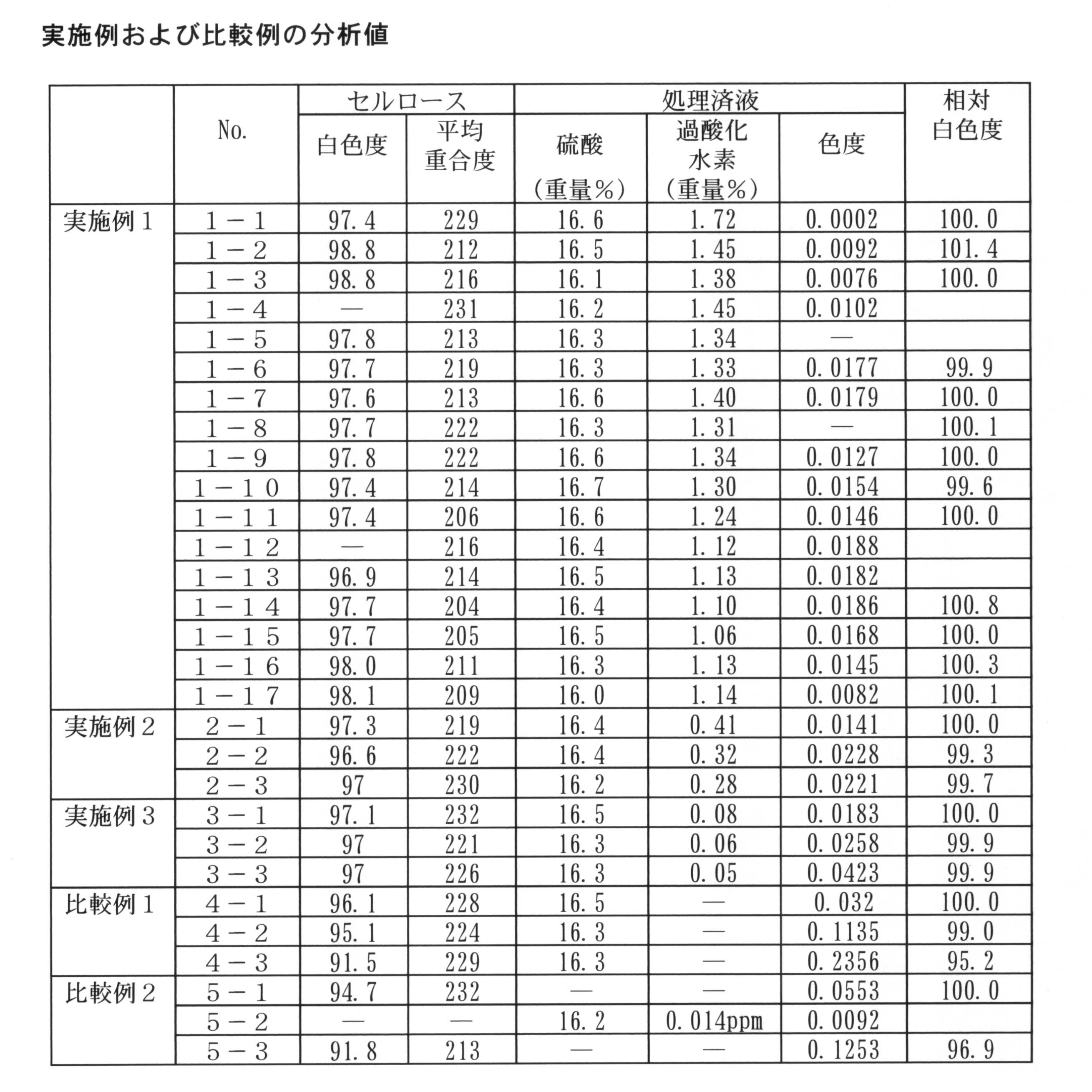
- Hunter whiteness and polymerization degree were measured for the obtained cellulose powder, and hydrogen peroxide concentration, sulfuric acid concentration and chromaticity were analyzed for the treated liquid, and the results are shown in Table 2 (No. 1-1).
- the cellulose obtained after filtration was washed three times with ion exchange water.
- 1% ammonia water was added dropwise to the suspension containing cellulose to adjust the pH of the suspension to 7.0 ⁇ 0.5, followed by suction filtration.
- the cellulose washed with water as described above was dried at 70 ° C. and 13.3 kPa or less with a vacuum dryer, and then pulverized with an impact type small pulverizer (Wonder Blender manufactured by Osaka Chemical Co., Ltd.) to obtain a cellulose powder.
- an impact type small pulverizer Wood Blender manufactured by Osaka Chemical Co., Ltd.
- the cellulose obtained by filtration was washed three times with ion exchange water.
- 1% ammonia water was added dropwise to the suspension containing cellulose to adjust the pH of the suspension to 7.0 ⁇ 0.5, followed by suction filtration.
- the cellulose washed with water as described above was dried at 70 ° C. and 13.3 kPa or less with a vacuum dryer, and then pulverized with an impact type small pulverizer (Osaka Chemical Co., Ltd. Wonder Blender) to obtain a cellulose powder. .
- an impact type small pulverizer Osaka Chemical Co., Ltd. Wonder Blender
- Example 2 To 369.2 g of ion-exchanged water, 75.8 g of 95% by weight sulfuric acid (substantially sulfuric acid weight 72.0 g) and 5.0 g of 45% by weight hydrogen peroxide water (substantially hydrogen peroxide weight 2.3 g) were sequentially added. 450 g of a treatment liquid containing 16% by weight and 0.5% by weight of hydrogen peroxide was prepared. The same treatment as in Example 1 was performed except that this treatment liquid was used. The repeated process was performed twice. Hunter whiteness and polymerization degree were measured for the obtained cellulose powder, and hydrogen peroxide concentration, sulfuric acid concentration and chromaticity analysis were performed on the treated liquid, and the results are shown in Table 2 (No. .2-1 to 2-3).
- Example 3 To 373.2 g of ion-exchange water, 75.8 g of 95% by weight sulfuric acid (substantially sulfuric acid weight 72.0 g) and 1.0 g of 45% by weight hydrogen peroxide water (substantially hydrogen peroxide weight 0.5 g) were sequentially added. 450 g of a treatment liquid containing 16% by weight and 0.1% by weight of hydrogen peroxide was prepared. The same treatment as in Example 1 was performed except that this treatment liquid was used. The repeated process was performed twice. Hunter whiteness and polymerization degree were measured for the obtained cellulose powder, and hydrogen peroxide concentration, acid concentration and chromaticity analysis were performed on the treated liquid, and the results are shown in Table 2 (No. .3-1 to 3-3).
- Table 2 shows the Hunter whiteness of cellulose (No. 1-1, No. 2-1, No. 3-1) produced using the first treatment liquid, that is, the treatment liquid not containing the regeneration treatment liquid.
- Cellulose No. 1-2 to No. 1-17, No. 2-2 and No. 2-3, No. 3-2 and The Hunter whiteness of No. 3-3) was shown as relative whiteness. From the results of Examples 1 to 3, it can be said that when the regenerated processing solution is used, the relative whiteness is not lowered and the processing solution can be used repeatedly.
- a solution containing 0.5% by weight of hydrogen peroxide is prepared by adding 5.0 g of 45% by weight hydrogen peroxide water (substantially hydrogen peroxide weight 2.3g) to 450g of the treated liquid (No. 5-1). did. This solution was heated at 90 ⁇ 1 ° C. for 120 minutes. In the treatment, a 500 mL separable flask with a stirrer was used as a container, and the stirring speed was 300 ⁇ 50 rpm. After the treatment, the solution was allowed to cool to room temperature, and then the hydrogen peroxide remaining in the solution was decomposed using platinum (the concentration of hydrogen peroxide in the solution after the decomposition treatment was 0.014 ppm). Further, the chromaticity of this solution was measured and shown in (No. 5-2) of Table 2.
- a 500 mL separable flask equipped with a stirrer was used as the reaction vessel, and the stirring speed was 700 ⁇ 50 rpm.
- the reaction vessel was cooled by immersion in an ice water bath for 30 minutes, and suction filtration was performed using a filter paper (No. 5C) with a Buchner funnel to recover 400 g of the treated liquid (No. 5-3).
- the cellulose obtained after filtration was washed 3 times with ion exchange water.
- 1% ammonia water was added dropwise to the suspension containing cellulose to adjust the pH of the suspension to 7.0 ⁇ 0.5, followed by suction filtration.
- the cellulose washed with water as described above was dried at 70 ° C.
Landscapes
- Chemical & Material Sciences (AREA)
- Analytical Chemistry (AREA)
- Crystallography & Structural Chemistry (AREA)
- Life Sciences & Earth Sciences (AREA)
- Engineering & Computer Science (AREA)
- Biochemistry (AREA)
- Materials Engineering (AREA)
- Health & Medical Sciences (AREA)
- Chemical Kinetics & Catalysis (AREA)
- Medicinal Chemistry (AREA)
- Polymers & Plastics (AREA)
- Organic Chemistry (AREA)
- Paper (AREA)
- Polysaccharides And Polysaccharide Derivatives (AREA)
Abstract
一実施形態によると、鉱酸および過酸化物を含む水溶液からなる処理液により化学パルプからセルロースを製造する方法であって、少なくとも以下の(a)~(c)工程を有し、(c)工程で調製された再生処理液を(a)工程の処理液として再利用することを特徴とするセルロースを製造する方法が提供される: (a)鉱酸および過酸化物を含む水溶液からなる処理液で化学パルプを加水分解により低重合度化処理してセルロースを得る工程 (b)(a)工程で得られたセルロースと処理済液を分離する工程 (c)(b)工程で分離した処理済液に、少なくとも鉱酸、又は過酸化物のいずれかを添加して再生処理液を調製する工程。
Description
本発明は、セルロースの製造方法に関するものである。
セルロースは、食品、医薬品、工業用途などの種々の用途に使用されている。
例えば、食品用途においては、セルロースを添加することにより増粘および分散効果が得られるため、食感が向上する。また、その吸水性および吸油性は、揚げ物等の食感改善にも有効である。
例えば、食品用途においては、セルロースを添加することにより増粘および分散効果が得られるため、食感が向上する。また、その吸水性および吸油性は、揚げ物等の食感改善にも有効である。
医薬品用途においては、錠剤、散剤(粉薬)、顆粒剤などの固形製剤に、成型、増量、希釈を目的とする賦形剤として添加される。
工業用途においては、スラリーに添加してろ過性を向上させるろ過助剤としても用いられている。
さらには、被覆アーク溶接棒の溶接作業性を改善する等、優れた機械的特性を与えるためにセルロースが添加されることもある。セルロースは、石綿の代替として自動車の摩擦材の基材等に利用されることもある。
さらには、被覆アーク溶接棒の溶接作業性を改善する等、優れた機械的特性を与えるためにセルロースが添加されることもある。セルロースは、石綿の代替として自動車の摩擦材の基材等に利用されることもある。
上記のような用途で使用されるセルロースの特徴として、流動性および崩壊性に優れた、白色状の粉末であることが求められる。セルロースの流動性および崩壊性は、重合度の影響を受けることが知られている。
セルロースの製造方法として、例えば特許文献1~3や非特許文献1に記載されている方法が公知となっている。
特許文献1には、精製木材パルプなどを鉱酸、塩化第二鉄などにより低重合度化処理と呼ばれる加水分解処理を行い、レベルオフ重合度のセルロース製品を製造する方法が開示されている。
非特許文献1には、高純度の天然セルロースを鉱酸により低重合度化処理し、精製および乾燥して、微結晶性セルロースを得る方法が開示されている。
特許文献2には、非漂白クラフトパルプ、又は漂白クラフトパルプを原料として使用した白色度の高い微結晶性セルロースの製造方法が開示されている。この方法は、塩酸や硫酸などの鉱酸のみによる処理ではなく、ペルオキシ酸による処理を利用している。例えば、ペルオキシ一硫酸は、硫酸と過酸化水素を混合することにより生成し、硫酸および過酸化水素と共に平衡状態となる。本特許文献の技術は、高濃度の硫酸と過酸化水素を混合することにより高濃度のペルオキシ一硫酸を生成させ、平衡状態に達する前に水で希釈してパルプの低重合度化処理に使用するものである。このような処理液を使用した場合、生成した微結晶性セルロースを分離した後のペルオキシ一硫酸を含む処理液は、希釈されている上、既に平衡に達している。そのような溶液に、高濃度の硫酸や過酸化水素をさらに添加しても、新たに生成するペルオキシ一硫酸の濃度は低く、パルプの低重合度化処理に再利用することはできない。
特許文献3には、粉末セルロースを製造する方法として、硫酸などの鉱酸を用い、パルプセルロースの低重合度化処理を行う際に、オゾン処理や過酸化水素等の過酸化物の添加を行う方法が記載されている。しかし、低重合度化処理後の鉱酸溶液を再利用する技術に関しては記載がなく、しかも、特許文献3の方法では重合度350以下の結晶セルロースを得ることはできない。
一方、特許文献4には、パルプの低重合度化処理に使用した鉱酸溶液に、オゾン発生装置で発生したオゾン、又はパルプ漂白工程のオゾン漂白段から排出されるオゾン排ガスを添加して、鉱酸溶液を再生する方法が開示されている。また、特許文献5には、低重合度化処理に使用した後の鉱酸溶液に、紫外線を照射しながらオゾンを添加することにより、鉱酸溶液を脱色し、低重合度化処理に再利用する方法も開示されている。しかし、これらの方法は、オゾン発生に比較的大きなエネルギーを必要とし、工業スケールでのセルロースの製造には不向きである。
紙パルプ技術タイムス、昭和60年8月、5ページ
特許文献2を参考に、非漂白クラフトパルプ、又は漂白パルプを活性酸素により低重合度化処理してセルロースの製造を試みたところ、次の様な問題があることがわかった。特許文献2の方法では、活性酸素は、例えばペルオキシ酸から誘導され、ペルオキシ酸は、例えば、高濃度の硫酸と高濃度の過酸化水素とを反応させることにより得られる。過酸化水素の希釈液を使用する場合、その濃度は50%以上であることが求められる。過酸化水素は、安全性、輸送性および保存性等の観点から、高濃度から低濃度のものまで流通している。そのため、種々の濃度の過酸化水素が利用できないと不便である。また、高濃度のペルオキシ酸は、ステンレス材質に対して腐食性が認められるため、ペルオキシ酸を調製する際に一般的に使用されている材質が利用できないという問題もある。
また、特許文献2における活性酸素が、例えばペルオキシ一硫酸に由来する場合について検討した。ペルオキシ一硫酸は、硫酸と過酸化水素の平衡混合物中に存在する。もし本特許文献においてパルプの低重合度化処理に使用しているペルオキシ一硫酸を含む処理液が平衡組成であるならば、ペルオキシ一硫酸の原料である硫酸や過酸化水素の濃度はパルプの低重合度化処理には影響を及ぼさず、水での希釈後の硫酸および過酸化水素の濃度のみが該処理に影響を及ぼすはずである。そこで、本発明者らが検討したところ、高濃度の(例えば、50%以上の濃度の)過酸化水素水と濃硫酸とを反応させてペルオキシ一硫酸を生成させ、その後水で希釈しても、直ちに平衡組成にならず、ペルオキシ一硫酸の生成量は、原料の過酸化水素水の濃度が高いほど向上することが分かった。すなわち、本特許文献記載の技術は、非平衡状態の混合溶液中に存在する高濃度のペルオキシ一硫酸をパルプの低重合度化処理に使用していることが分かった。このような高濃度のペルオキシ一硫酸を含む処理液は、徐々に平衡組成へと変化するため、安定したセルロースを製造しにくいという欠点を持つ。
また、低重合度化処理の間に平衡組成に達したペルオキシ一硫酸を含む処理液は、再利用することが難しいという問題がある。すなわち、特許文献2の方法においては、パルプの低重合度化処理に高濃度の過酸化物と高濃度の酸との反応によって得られる高濃度のペルオキシ酸が必要とされる。そして、そのような高濃度のペルオキシ酸を含む処理液は、水で希釈して使用され、使用後には平衡状態に達しているため、低重合度化処理において使用した後の処理液に再度高濃度の硫酸と高濃度の過酸化水素水を加えても、高濃度のペルオキシ一硫酸が生成せず、特許文献2に記載の低重合度化処理には再利用できない。再利用するには、低重合度化処理に使用した後のペルオキシ一硫酸を含む処理液から各成分を蒸留設備等で分離、回収し、それらを用いてペルオキシ一硫酸を含む処理液を再度調製する必要があり、経済的ではない。
一般的に、パルプの低重合度化処理に使用する処理液は高濃度の鉱酸を含むため、廃棄するために大量のアルカリ剤で中和しなければならず、製造コストが増大するという問題がある。そのため、処理液を再利用することが経済的に望まれていた。また、低重合度化処理後の処理液を再利用しようとすると、セルロース本来の白色度を維持できず着色してしまうことから、特許文献4や特許文献5の方法が開示されているが、上述したようにオゾン発生に大量のエネルギーが必要で経済的でなく、経済的に有利な処理液の再利用法が求められていた。
本発明が解決しようとする課題は、鉱酸および過酸化物を含む水溶液からなる処理液を用いて化学パルプからセルロースを製造する方法であって、回収された使用済みの処理液を再利用して、平均重合度が350以下で高白色度なセルロースを製造する方法を提供することである。
本発明者らは、鉱酸および過酸化物を含む水溶液からなる処理液により化学パルプを低重合度化処理してセルロースを製造する方法において、処理済液を再生処理液として再利用し、かつ平均重合度が350以下でハンター白色度が92以上と高白色度なセルロースを製造する方法を提供する。すなわち、本願は以下の発明を包含する。
<1>
鉱酸および過酸化物を含む水溶液からなる処理液により化学パルプからセルロースを製造する方法であって、少なくとも以下の(a)~(c)工程を有し、(c)工程で調製された再生処理液を(a)工程の処理液として再利用することを特徴とするセルロースを製造する方法。
(a)鉱酸および過酸化物を含む水溶液からなる処理液で化学パルプを加水分解により低重合度化処理してセルロースを得る工程
(b)(a)工程で得られたセルロースと処理済液を分離する工程
(c)(b)工程で分離した処理済液に、少なくとも鉱酸、又は過酸化物のいずれかを添加して再生処理液を調製する工程
<2>
処理液中の過酸化物の濃度が、0.05~40重量%未満である、<1>に記載のセルロースを製造する方法。
<3>
処理液中の鉱酸の濃度が0.05~35重量%である、<1>又は<2>に記載のセルロースを製造する方法。
<4>
前記鉱酸および過酸化物を含む水溶液は、鉱酸、50重量%未満の濃度の過酸化物水溶液、および水を混合することにより調製される、請求項1~3のいずれかに記載のセルロースを製造する方法。
<5>
上記鉱酸が硫酸である、<1>~<4>のいずれかに記載のセルロースを製造する方法。
<6>
上記過酸化物が過酸化水素である、<1>~<5>のいずれかに記載のセルロースを製造する方法。
<7>
上記化学パルプが漂白パルプである、<1>~<6>のいずれかに記載のセルロースを製造する方法。
<8>
上記セルロースの平均重合度が350以下であり、ハンター白色度が92以上である、<1>~<7>のいずれかに記載のセルロースを製造する方法。
<9>
さらに、以下の(d)~(h)の工程のいずれか1つ以上を含む、<1>~<8>のいずれかに記載のセルロースを製造する方法。
(d)得られたセルロースを中和する工程
(e)得られたセルロースを洗浄する工程
(f)得られたセルロースを乾燥する工程
(g)得られたセルロースを粉砕する工程
(h)得られたセルロースを分級する工程
<1>
鉱酸および過酸化物を含む水溶液からなる処理液により化学パルプからセルロースを製造する方法であって、少なくとも以下の(a)~(c)工程を有し、(c)工程で調製された再生処理液を(a)工程の処理液として再利用することを特徴とするセルロースを製造する方法。
(a)鉱酸および過酸化物を含む水溶液からなる処理液で化学パルプを加水分解により低重合度化処理してセルロースを得る工程
(b)(a)工程で得られたセルロースと処理済液を分離する工程
(c)(b)工程で分離した処理済液に、少なくとも鉱酸、又は過酸化物のいずれかを添加して再生処理液を調製する工程
<2>
処理液中の過酸化物の濃度が、0.05~40重量%未満である、<1>に記載のセルロースを製造する方法。
<3>
処理液中の鉱酸の濃度が0.05~35重量%である、<1>又は<2>に記載のセルロースを製造する方法。
<4>
前記鉱酸および過酸化物を含む水溶液は、鉱酸、50重量%未満の濃度の過酸化物水溶液、および水を混合することにより調製される、請求項1~3のいずれかに記載のセルロースを製造する方法。
<5>
上記鉱酸が硫酸である、<1>~<4>のいずれかに記載のセルロースを製造する方法。
<6>
上記過酸化物が過酸化水素である、<1>~<5>のいずれかに記載のセルロースを製造する方法。
<7>
上記化学パルプが漂白パルプである、<1>~<6>のいずれかに記載のセルロースを製造する方法。
<8>
上記セルロースの平均重合度が350以下であり、ハンター白色度が92以上である、<1>~<7>のいずれかに記載のセルロースを製造する方法。
<9>
さらに、以下の(d)~(h)の工程のいずれか1つ以上を含む、<1>~<8>のいずれかに記載のセルロースを製造する方法。
(d)得られたセルロースを中和する工程
(e)得られたセルロースを洗浄する工程
(f)得られたセルロースを乾燥する工程
(g)得られたセルロースを粉砕する工程
(h)得られたセルロースを分級する工程
本発明によると、鉱酸および過酸化物を含む水溶液からなる処理液を用いて化学パルプからセルロースを製造する方法であって、回収された使用済みの処理液を再利用して、平均重合度が350以下で高白色度なセルロースを製造する方法を提供することができる。
実施形態に係るセルロースを製造する方法は、下記(a)、(b)および(c)の工程を含み、さらに下記(d)、(e)、(f)、(g)および(h)のいずれかの工程を含んでも良い。
(a)鉱酸および過酸化物を含む水溶液からなる処理液で化学パルプを加水分解により低重合度化処理してセルロースを製造する工程
(b)(a)工程で得られたセルロースと処理済液とを分離する工程
(c)(b)工程で分離した処理済液に、少なくとも鉱酸、又は過酸化物のいずれか一方を添加して再生処理液を調製する工程
(d)(b)工程で得られたセルロースを中和する工程
(e)得られたセルロースを洗浄する工程
(f)得られたセルロースを乾燥する工程
(g)得られたセルロースを粉砕する工程
(h)得られたセルロースを分級する工程
(c)工程で鉱酸および過酸化物の濃度が調整された再生処理液を(a)工程の処理液として再利用する。
(a)鉱酸および過酸化物を含む水溶液からなる処理液で化学パルプを加水分解により低重合度化処理してセルロースを製造する工程
(b)(a)工程で得られたセルロースと処理済液とを分離する工程
(c)(b)工程で分離した処理済液に、少なくとも鉱酸、又は過酸化物のいずれか一方を添加して再生処理液を調製する工程
(d)(b)工程で得られたセルロースを中和する工程
(e)得られたセルロースを洗浄する工程
(f)得られたセルロースを乾燥する工程
(g)得られたセルロースを粉砕する工程
(h)得られたセルロースを分級する工程
(c)工程で鉱酸および過酸化物の濃度が調整された再生処理液を(a)工程の処理液として再利用する。
<原材料>
(1)鉱酸
(a)および(c)工程で用いることができる鉱酸は、硫酸、塩酸、硝酸、亜硫酸、リン酸などが挙げられ、1種を単独で使用してもよく、又は2種類以上の鉱酸を混ぜて用いても良い。中でも好ましい鉱酸は硫酸である。
(1)鉱酸
(a)および(c)工程で用いることができる鉱酸は、硫酸、塩酸、硝酸、亜硫酸、リン酸などが挙げられ、1種を単独で使用してもよく、又は2種類以上の鉱酸を混ぜて用いても良い。中でも好ましい鉱酸は硫酸である。
硫酸の製法としては、二酸化硫黄からの製造、硝酸式製造法、接触式製造法があり、いずれを使用しても構わない。
硫酸としては、濃度が90~98重量%の濃硫酸や濃度が90重量%未満の希硫酸が流通しているが、処理液中の硫酸の濃度を所望の濃度に調節することができれば、使用する硫酸の濃度は限定されない。処理液中の硫酸の濃度を所定の濃度とするために、市販の硫酸を希釈して使用しても良い。なお、硫酸の流通品には、工業用硫酸と精製硫酸があり、いずれを使用することもでき、またこれらの混合液も使用できる。
(2)過酸化物
(a)および(c)工程で用いることができる過酸化物は、過酸化水素、過酢酸、有機過酸化物、モノ過硫酸、過酸化塩素等が挙げられ、1種のみを単独で使用してもよく、又は2種類以上の過酸化物を混ぜても良い。中でも好ましい過酸化物は過酸化水素である。
(a)および(c)工程で用いることができる過酸化物は、過酸化水素、過酢酸、有機過酸化物、モノ過硫酸、過酸化塩素等が挙げられ、1種のみを単独で使用してもよく、又は2種類以上の過酸化物を混ぜても良い。中でも好ましい過酸化物は過酸化水素である。
過酸化水素の製法としては、アンスラキノン等を出発原料とした有機法、硫酸を原料とする電解法、酸素および水素を用いた直接法があるが、いずれを使用することもでき、複数の方法を組み合わせで使用しても良い。
過酸化物は、水溶液の状態で添加し得る。例えば、過酸化水素水は、一般に30~70重量%の濃度で流通しているが、処理液中の過酸化物の濃度を所望の濃度に調節できれば、使用する過酸化水素水の濃度は限定されない。処理液中の過酸化物の濃度を所定の濃度とするために、市販の過酸化水素水を希釈して使用しても良い。
なお、過酸化水素水の流通品には、工業用、電子工業用および食品添加物用などがあり、いずれを使用することもでき、複数種を組み合わせて使用することもできる。複数種を組み合わせて使用する場合、その組み合わせはなんら限定されるものではない。
なお、過酸化水素水の流通品には、工業用、電子工業用および食品添加物用などがあり、いずれを使用することもでき、複数種を組み合わせて使用することもできる。複数種を組み合わせて使用する場合、その組み合わせはなんら限定されるものではない。
(3)処理液・処理済液・再生処理液
本明細書における処理液、処理済液(すなわち、使用済みの処理液)、再生処理液とは、鉱酸、過酸化物および水を含有する混合液をいう。処理液の調製には、50重量%未満の濃度の過酸化物水溶液(過酸化物水溶液中の過酸化物の量が50重量%未満)を使用することが好ましい。もともと50重量%未満の過酸化物水溶液を使用してもよく、又は希釈して50重量%未満とした過酸化物水溶液を使用してもよい。より好ましくは20重量%以上50重量%未満、特に好ましくは30重量%以上50重量%未満の濃度の過酸化物水溶液である。鉱酸および過酸化物の濃度によってはペルオキシ酸が生成することもあるが、ペルオキシ酸濃度に関わらず、処理液中の鉱酸および過酸化物の濃度が所定の濃度範囲内になるように鉱酸および過酸化物を添加する。鉱酸、過酸化物および水を混合する順序は特に限られない。また、混合装置に特に制限はなく、槽型の容器に撹拌装置を使用して混合しても良いし、容器に外部循環装置を接続する外部循環方式でも良い。また、ラインミキサーを使用して混合しても良い。混合温度は、鉱酸、過酸化物、および水を混合した際に発熱するが、沸騰しない範囲とする。また、経済的な時間で均一に混合できれば、混合時間に制限はない。
本明細書における処理液、処理済液(すなわち、使用済みの処理液)、再生処理液とは、鉱酸、過酸化物および水を含有する混合液をいう。処理液の調製には、50重量%未満の濃度の過酸化物水溶液(過酸化物水溶液中の過酸化物の量が50重量%未満)を使用することが好ましい。もともと50重量%未満の過酸化物水溶液を使用してもよく、又は希釈して50重量%未満とした過酸化物水溶液を使用してもよい。より好ましくは20重量%以上50重量%未満、特に好ましくは30重量%以上50重量%未満の濃度の過酸化物水溶液である。鉱酸および過酸化物の濃度によってはペルオキシ酸が生成することもあるが、ペルオキシ酸濃度に関わらず、処理液中の鉱酸および過酸化物の濃度が所定の濃度範囲内になるように鉱酸および過酸化物を添加する。鉱酸、過酸化物および水を混合する順序は特に限られない。また、混合装置に特に制限はなく、槽型の容器に撹拌装置を使用して混合しても良いし、容器に外部循環装置を接続する外部循環方式でも良い。また、ラインミキサーを使用して混合しても良い。混合温度は、鉱酸、過酸化物、および水を混合した際に発熱するが、沸騰しない範囲とする。また、経済的な時間で均一に混合できれば、混合時間に制限はない。
また、低重合度化処理後の分離工程で回収される処理済液に、鉱酸又は過酸化物の少なくとも一方を添加して、鉱酸および過酸化物を所定の濃度範囲に合わせ、再生処理液を調製する。再生処理液を調製する際に添加する鉱酸および過酸化物は、最初の処理液調製で用いた鉱酸および過酸化物と同一の物質を使うのが好ましい。本再生処理液は再度低重合度化処理に利用する。すなわち、上記(c)工程で調製された再生処理液を上記(a)工程の処理液として再利用する。再利用の回数は、多いほど経済的に有利であり、特に制限は無いが、50回以上、好ましくは100回以上、さらに好ましくは1000回以上、再利用する。
(4)化学パルプ
化学パルプはパルプチップから製造される。パルプチップの原料としては、ラジアータパイン、スプルースに代表される針葉樹、ならびにユーカリ、アカシアに代表される広葉樹が挙げられる。これら針葉樹および広葉樹のパルプをそれぞれ単独で使用することもできるし、複数種を組み合わせて使用することもできる。複数種を組み合わせて使用する場合、その組み合わせはなんら限定されるものではない。
化学パルプはパルプチップから製造される。パルプチップの原料としては、ラジアータパイン、スプルースに代表される針葉樹、ならびにユーカリ、アカシアに代表される広葉樹が挙げられる。これら針葉樹および広葉樹のパルプをそれぞれ単独で使用することもできるし、複数種を組み合わせて使用することもできる。複数種を組み合わせて使用する場合、その組み合わせはなんら限定されるものではない。
化学パルプは、上記パルプチップを原料として、サルファイト蒸解法、又はクラフト蒸解法、あるいはこれら方法を組み合わせることにより製造される。
上記方法で製造された化学パルプは、非漂白パルプ、又は漂白パルプのいずれでも良く、これらの組み合わせであっても良い。
また、化学パルプには、製紙用パルプと製精度の高い溶解パルプがあるが、いずれも使用することができ、これらを組み合わせて使用することもできる。
上記方法で製造された化学パルプは、非漂白パルプ、又は漂白パルプのいずれでも良く、これらの組み合わせであっても良い。
また、化学パルプには、製紙用パルプと製精度の高い溶解パルプがあるが、いずれも使用することができ、これらを組み合わせて使用することもできる。
化学パルプは、蒸解、又は漂白後の含水状態で使用しても良く、乾燥された板状のパルプを使用しても良い。
本発明に使用される化学パルプは、上記のいずれの種類のパルプでも良いが、好ましくは蒸解後に酸素晒工程、又は漂白工程の少なくとも一方をさらに行って製造された漂白パルプが使用される。
本発明に使用される化学パルプは、上記のいずれの種類のパルプでも良いが、好ましくは蒸解後に酸素晒工程、又は漂白工程の少なくとも一方をさらに行って製造された漂白パルプが使用される。
<製造工程>
以下、製造工程(a)~(h)について、順に説明する。
(a)工程
(a)工程では、原材料である化学パルプを、処理液で低重合度化処理し、目的の重合度のセルロースを製造する。
以下、製造工程(a)~(h)について、順に説明する。
(a)工程
(a)工程では、原材料である化学パルプを、処理液で低重合度化処理し、目的の重合度のセルロースを製造する。
(1)処理液の組成
処理液は、鉱酸、過酸化物および水から調製される。鉱酸および過酸化物は、それぞれ1種を単独で使用してもよく、又は2種類以上を用いても良い。処理液中の鉱酸濃度は、0.05~35.0重量%、好ましくは1.0~30.0重量%、より好ましくは5.0~24.0重量%、特に好ましくは10.0~20.0重量%である。また処理液中の過酸化物濃度は、0.05~40.0重量%、好ましくは0.05~24.0重量%、より好ましくは0.05~10.0重量%、特に好ましくは0.1~5.0重量%である。ここで、鉱酸および過酸化物の濃度は、希釈されていない、すなわち100%の鉱酸および過酸化物としての、処理液全体に対する割合(重量%)を意味する。また、処理液中の鉱酸と過酸化物を除く成分は、基本的には水である。
処理液は、鉱酸、過酸化物および水から調製される。鉱酸および過酸化物は、それぞれ1種を単独で使用してもよく、又は2種類以上を用いても良い。処理液中の鉱酸濃度は、0.05~35.0重量%、好ましくは1.0~30.0重量%、より好ましくは5.0~24.0重量%、特に好ましくは10.0~20.0重量%である。また処理液中の過酸化物濃度は、0.05~40.0重量%、好ましくは0.05~24.0重量%、より好ましくは0.05~10.0重量%、特に好ましくは0.1~5.0重量%である。ここで、鉱酸および過酸化物の濃度は、希釈されていない、すなわち100%の鉱酸および過酸化物としての、処理液全体に対する割合(重量%)を意味する。また、処理液中の鉱酸と過酸化物を除く成分は、基本的には水である。
上記範囲の値で示されるような鉱酸および過酸化物の割合で調製された処理液を使用する場合、平均重合度が350以下で、ハンター白色度が92以上のセルロースを製造することができる。
(2)鉱酸、過酸化物および水を含む処理液の調製方法
処理液中の鉱酸および過酸化物の濃度が上述したような範囲になるように、鉱酸、過酸化物、および水を反応器に入れ、混合する。投入順序は特に限られない。混合温度は0~100℃以下で良く、好ましくは20~90℃である。
処理液中の鉱酸および過酸化物の濃度が上述したような範囲になるように、鉱酸、過酸化物、および水を反応器に入れ、混合する。投入順序は特に限られない。混合温度は0~100℃以下で良く、好ましくは20~90℃である。
鉱酸、過酸化物および水の混合は、低重合度化処理に用いる反応タンクで行っても良く、別のタンクで混合した後、反応タンクに移送しても良い。また、低重合度化処理に使用される化学パルプは、処理液を調製してから反応タンクに投入しても良く、最初から反応タンクに入れておき、そこに処理液を入れても良い。また、処理液の調製途中にも投入することができ、いずれかの薬品の添加前後に投入しても良い。
鉱酸として硫酸を使用し、過酸化物として過酸化水素を使用した場合において、硫酸および過酸化水素の混合により生成するペルオキシ一硫酸について追記すると、ペルオキシ一硫酸の初期濃度は、水、硫酸、および過酸化水素の使用量および濃度のみならず、混合方法によっても影響を受ける。例えば、比較的高濃度の硫酸、又は比較的高濃度の過酸化水素水の少なくとも一方を使用し、硫酸と過酸化水素水とを混合した後に水で希釈する場合は、ペルオキシ一硫酸の初期濃度(すなわち、混合直後の濃度)は、平衡溶液におけるペルオキシ一硫酸の濃度よりも高くなる傾向にある。一方、例えば、予め希釈した硫酸、又は予め希釈した過酸化水素水の少なくとも一方を使用して硫酸と過酸化水素水を混合した場合は、ペルオキシ一硫酸の初期濃度は、平衡溶液におけるペルオキシ一硫酸の濃度よりも低くなる傾向にある。これらの混合溶液の組成は、その後の処理条件によっては平衡組成に向けて変化し始める。十分な温度で十分な時間混合することにより、混合溶液は平衡状態になる。例えば、混合溶液の温度を60℃とした場合は、10~180分間、該温度を70℃とした場合は、10~120分間、該温度を90℃とした場合は、10~90分間混合することにより、混合溶液は平衡状態になる。
本発明の方法において、鉱酸として硫酸を、過酸化物として過酸化水素を用いた場合、生成するペルオキシ一硫酸の濃度にかかわらず実施することができる。
水、鉱酸および過酸化物を含む処理液のpHは、処理液中の各成分の重量比によって決定されるが、pHは2以下が好ましく、より好ましくは1以下である。
(3)低重合度化処理
低重合度化処理とは、処理液を用いて、パルプの重合度を低減する処理である。好ましくは、化学パルプを所定の時間、所定の温度で上述した範囲の組成を有する処理液(例えば、硫酸:0.05~35.0重量%、過酸化水素:0.05~40.0重量%、水:50.0~94.0重量%)で処理する。処理方法は特に限定されないが、例えば、化学パルプを所定の時間、所定の温度で処理液に浸漬することにより行うことができる。
低重合度化処理とは、処理液を用いて、パルプの重合度を低減する処理である。好ましくは、化学パルプを所定の時間、所定の温度で上述した範囲の組成を有する処理液(例えば、硫酸:0.05~35.0重量%、過酸化水素:0.05~40.0重量%、水:50.0~94.0重量%)で処理する。処理方法は特に限定されないが、例えば、化学パルプを所定の時間、所定の温度で処理液に浸漬することにより行うことができる。
処理液とパルプとを含む反応溶液中のパルプの割合は、0.1~20重量%の範囲が良く、より好ましくは1~15重量%である。20重量%よりも高い場合は、処理液がパルプに十分に浸透しないため好ましくない。0.1重量%よりも低い場合は、反応効率が悪く経済的に問題がある。
反応温度は、20℃~130℃の範囲が良く、より好ましくは50℃~120℃、更に好ましくは60℃~110℃である。
反応時間は、5分~240分の範囲が良く、より好ましくは15分~180分、さらに好ましくは30~120分である。
反応時間は、5分~240分の範囲が良く、より好ましくは15分~180分、さらに好ましくは30~120分である。
(設備)
低重合度化処理は、反応チューブやタワーを用いた連続装置、又はバッチでの反応槽を用いて実施することができる。処理液が十分に循環できるよう、撹拌翼を用いても良く、処理液を抜出ラインを経由して循環させても良い。
低重合度化処理は、反応チューブやタワーを用いた連続装置、又はバッチでの反応槽を用いて実施することができる。処理液が十分に循環できるよう、撹拌翼を用いても良く、処理液を抜出ラインを経由して循環させても良い。
(添加剤、その他)
処理液のパルプへの浸透を早めるため、浸透剤として界面活性剤を用いることができる。界面活性剤としては、カチオン性、アニオン性、双性、ノニオン性等があるが、特に限定されない。これらのいずれかを単独で使用しても良く、組み合わせて使用しても良い。
処理液のパルプへの浸透を早めるため、浸透剤として界面活性剤を用いることができる。界面活性剤としては、カチオン性、アニオン性、双性、ノニオン性等があるが、特に限定されない。これらのいずれかを単独で使用しても良く、組み合わせて使用しても良い。
(b)工程
(b)工程は、低重合度化処理後のセルロースと処理済液とを分離する工程であり、これらを分離できる限り、その方法は特に限定されないが、例えばろ過によって行うことができる。具体的には、(b)工程は、遠心分離機、フィルタープレス、ベルトプレス、オリバー型フィルター、ヤングフィルター等を使用して分離する。分離されたセルロースは(d)工程に送られ、分離した処理済液は回収され、(c)工程で使用される。
(b)工程は、低重合度化処理後のセルロースと処理済液とを分離する工程であり、これらを分離できる限り、その方法は特に限定されないが、例えばろ過によって行うことができる。具体的には、(b)工程は、遠心分離機、フィルタープレス、ベルトプレス、オリバー型フィルター、ヤングフィルター等を使用して分離する。分離されたセルロースは(d)工程に送られ、分離した処理済液は回収され、(c)工程で使用される。
(c)工程
(c)工程では、(b)工程で分離した処理済液に、(a)工程で消費された鉱酸、又は過酸化物の少なくとも一方を添加し、再生処理液を調製する。
(c)工程では、(b)工程で分離した処理済液に、(a)工程で消費された鉱酸、又は過酸化物の少なくとも一方を添加し、再生処理液を調製する。
また、(c)工程では、必要に応じて、(a)工程で消費された量を超える鉱酸、過酸化物および/または水を添加しても良い。これは、(a)工程で消費された鉱酸、過酸化物および/または水に加えて(b)工程でセルロースと分離できず失った処理済液中の鉱酸、過酸化物および水も補って、2回目以降の(a)工程で必要な液量を確保するためである。本工程で調製される再生処理液中の処理済液の割合は、10重量%以上、より好ましくは50重量%以上、さらに好ましくは70重量%以上、特に好ましくは80重量%以上である。(b)工程で回収された処理済液量が少ないと、新たに追加しなければならない薬剤量が増え、経済的でない。ここで特に重要なのは、(a)工程で使用する処理液中の過酸化物濃度が、0.05~40重量%になるようにすることである。
(c)工程で、適切な量の鉱酸、過酸化物および水を添加するために、(b)工程で回収された処理済液中の鉱酸および過酸化物濃度を分析しておくことが好ましい。例えば、鉱酸濃度は、水酸化ナトリウム標準溶液で中和滴定を行って算出することができ、過酸化物濃度は、過マンガン酸カリウム標準溶液で酸化還元滴定すること、又はヨウ化カリウムを加え、遊離したヨウ素をチオ硫酸ナトリウム標準溶液で滴定することにより算出できる。
(d)中和工程
(b)工程で得られたセルロース中には、まだ鉱酸および過酸化物が残留している。これらを除去するために、中和工程を行う。
本工程は、アルカリ剤を使用して、セルロース中に残留している酸を中和する工程である。中和で使用するアルカリ剤は、水溶液中の濃度として好ましくは0.01重量%~50重量%で使用するが、更に好ましくは0.1重量%~25重量%である。アルカリ剤水溶液と中和処理するセルロースの合計重量に対する該セルロースの割合は、1重量%~15重量%が好適である。アルカリ剤としては、NaOH、KOH、アンモニア水等の無機アルカリ性物質、トリメチルアンモニウムヒドロキサイド等の有機アルカリ性物質が使用できるが、中和処理後のアルカリ水溶液の処理の容易性から無機アルカリ性物質が好適に使用される。使用するアルカリ剤の量を低減するため、本工程に先立ち、(e)工程を数回行っても良い。
(b)工程で得られたセルロース中には、まだ鉱酸および過酸化物が残留している。これらを除去するために、中和工程を行う。
本工程は、アルカリ剤を使用して、セルロース中に残留している酸を中和する工程である。中和で使用するアルカリ剤は、水溶液中の濃度として好ましくは0.01重量%~50重量%で使用するが、更に好ましくは0.1重量%~25重量%である。アルカリ剤水溶液と中和処理するセルロースの合計重量に対する該セルロースの割合は、1重量%~15重量%が好適である。アルカリ剤としては、NaOH、KOH、アンモニア水等の無機アルカリ性物質、トリメチルアンモニウムヒドロキサイド等の有機アルカリ性物質が使用できるが、中和処理後のアルカリ水溶液の処理の容易性から無機アルカリ性物質が好適に使用される。使用するアルカリ剤の量を低減するため、本工程に先立ち、(e)工程を数回行っても良い。
(e)洗浄工程
(e)工程は、セルロースを水と接触させることにより、セルロースに付着している薬剤を除去する工程である。使用できる装置は特に限定されず、例えば、インペラー式撹拌機を有した撹拌槽を使用することができる。(d)工程を経ずに、(b)工程で得られたセルロースを直接洗浄しても良い。なお、遠心ろ過、オリバー型フィルター、ヤングフィルター等を用いることにより、脱水と同時に洗浄をすることもできる。洗浄工程は、繰り返し行っても良い。
(e)工程は、セルロースを水と接触させることにより、セルロースに付着している薬剤を除去する工程である。使用できる装置は特に限定されず、例えば、インペラー式撹拌機を有した撹拌槽を使用することができる。(d)工程を経ずに、(b)工程で得られたセルロースを直接洗浄しても良い。なお、遠心ろ過、オリバー型フィルター、ヤングフィルター等を用いることにより、脱水と同時に洗浄をすることもできる。洗浄工程は、繰り返し行っても良い。
(f)乾燥工程
乾燥方法としては、一般的な乾燥機を用いる方法だけでなく、溶媒で置換する方法が利用できる。乾燥機を用いる方法としては、熱風式乾燥機、スチーム・チューブドライヤー、通気型乾燥装置、噴霧乾燥機、気流乾燥装置、ドラムドライヤー、連続流動層乾燥装置、赤外線乾燥器、高周波加熱乾燥器、凍結乾燥機、ラピッドドライヤーなどを使用する方法が挙げられる。溶媒で置換する方法としては、例えば、セルロース中の水分をエタノールで置換した後、風乾する方法が挙げられる。
乾燥温度は30~220℃が好ましい。220℃を超える温度で乾燥を行うとセルロースの熱分解が進行する可能性があり好ましくない。乾燥は、加圧下、常圧下、減圧下のいずれで行っても良い。
乾燥方法としては、一般的な乾燥機を用いる方法だけでなく、溶媒で置換する方法が利用できる。乾燥機を用いる方法としては、熱風式乾燥機、スチーム・チューブドライヤー、通気型乾燥装置、噴霧乾燥機、気流乾燥装置、ドラムドライヤー、連続流動層乾燥装置、赤外線乾燥器、高周波加熱乾燥器、凍結乾燥機、ラピッドドライヤーなどを使用する方法が挙げられる。溶媒で置換する方法としては、例えば、セルロース中の水分をエタノールで置換した後、風乾する方法が挙げられる。
乾燥温度は30~220℃が好ましい。220℃を超える温度で乾燥を行うとセルロースの熱分解が進行する可能性があり好ましくない。乾燥は、加圧下、常圧下、減圧下のいずれで行っても良い。
(g)粉砕工程
粉砕工程は機械的処理で行われ、例えば、衝撃式ミル、又は気流式ミルの少なくとも一方を使用して、さらには、同機種で複数回処理することにより行うことができる。
粉砕工程は機械的処理で行われ、例えば、衝撃式ミル、又は気流式ミルの少なくとも一方を使用して、さらには、同機種で複数回処理することにより行うことができる。
(h)分級工程
分級工程とは、乾式分級、湿式分級、又はふるい分け分級方法により、セルロースを粒子径によって分別する操作である。(g)工程で得られたセルロースは、必要により分級して使用することができる。スプレードライヤーを使用すると、乾燥、微細化、および分級を同時に行うことができる。
分級工程とは、乾式分級、湿式分級、又はふるい分け分級方法により、セルロースを粒子径によって分別する操作である。(g)工程で得られたセルロースは、必要により分級して使用することができる。スプレードライヤーを使用すると、乾燥、微細化、および分級を同時に行うことができる。
<セルロース>
(1)ハンター白色度
上記方法で製造されるセルロースのハンター白色度は、92以上であり、より好ましくは95以上、特に好ましくは97以上である。
(1)ハンター白色度
上記方法で製造されるセルロースのハンター白色度は、92以上であり、より好ましくは95以上、特に好ましくは97以上である。
(2)平均重合度
本発明の方法で製造されるセルロースの平均重合度は、350以下であり、好ましくは300以下であり、特に好ましくは250以下である。
本発明の方法で製造されるセルロースの平均重合度は、350以下であり、好ましくは300以下であり、特に好ましくは250以下である。
以下に実施例、比較例および参考例をあげて本発明を具体的に説明するが、本発明はこれらの実施例に限定されるものではない。
(1)試験条件
<使用した水>
以下の実施例および比較例においては、ヤマト科学製超純水製造装置オートピュアWR-7000により得られたイオン交換水を使用した。イオン交換水の電気伝導度は18.2MΩ(25.0℃)、TOC含有量は5ppbであった。
<使用した水>
以下の実施例および比較例においては、ヤマト科学製超純水製造装置オートピュアWR-7000により得られたイオン交換水を使用した。イオン交換水の電気伝導度は18.2MΩ(25.0℃)、TOC含有量は5ppbであった。
<pH測定>
特に言及する場合を除き、pHは、本体(堀場製作所製、D-51)およびpH電極(堀場製作所製、9615-10D)を用いて測定した。
特に言及する場合を除き、pHは、本体(堀場製作所製、D-51)およびpH電極(堀場製作所製、9615-10D)を用いて測定した。
<過酸化水素の定量方法>
処理済液に含まれる過酸化水素の定量は、ヨウ素還元滴定法により行った。具体的には、低重合度化処理後、回収した処理済液を1g秤量し、20重量%硫酸溶液を加えて約20mLとした後、ヨウ化カリウムの粉末を加えて、ヨウ素を遊離させた。そこに0.1mol/Lチオ硫酸ナトリウム標準溶液を滴下し、指示薬にでんぷんを使用して液の青紫色が消失し無色となったところを終点として、遊離したヨウ素を定量した。そのヨウ素量から、過酸化水素量を算出した。
処理済液に含まれる過酸化水素の定量は、ヨウ素還元滴定法により行った。具体的には、低重合度化処理後、回収した処理済液を1g秤量し、20重量%硫酸溶液を加えて約20mLとした後、ヨウ化カリウムの粉末を加えて、ヨウ素を遊離させた。そこに0.1mol/Lチオ硫酸ナトリウム標準溶液を滴下し、指示薬にでんぷんを使用して液の青紫色が消失し無色となったところを終点として、遊離したヨウ素を定量した。そのヨウ素量から、過酸化水素量を算出した。
<硫酸の定量方法>
処理済液に含まれる硫酸の定量は中和滴定により行った。低重合度化処理後、回収した処理済液を0.5g秤量し、イオン交換水を加えて約10mLに希釈した後、指示薬であるフェノールフタレイン溶液を数滴加えた。そこに0.1mol/L水酸化ナトリウム標準溶液を滴下し、溶液が赤紫色となるまで滴定して硫酸の量を算出した。
処理済液に含まれる硫酸の定量は中和滴定により行った。低重合度化処理後、回収した処理済液を0.5g秤量し、イオン交換水を加えて約10mLに希釈した後、指示薬であるフェノールフタレイン溶液を数滴加えた。そこに0.1mol/L水酸化ナトリウム標準溶液を滴下し、溶液が赤紫色となるまで滴定して硫酸の量を算出した。
<処理済液の色度>
低重合度化処理後、回収した処理済液について、紫外可視分光光度計を用い、420nmの波長の吸光度を測定した。
(条件)
装置:UV-2450(島津製作所)
測光モード:吸光度
スリット幅:2.0mm
スキャンモード:高速
セル:石英セル10mm
参照セル:16重量%硫酸
試料セル:(b)工程で回収した処理済液
希釈率:1
低重合度化処理後、回収した処理済液について、紫外可視分光光度計を用い、420nmの波長の吸光度を測定した。
(条件)
装置:UV-2450(島津製作所)
測光モード:吸光度
スリット幅:2.0mm
スキャンモード:高速
セル:石英セル10mm
参照セル:16重量%硫酸
試料セル:(b)工程で回収した処理済液
希釈率:1
<セルロースのハンター白色度>
色差計を用い、実施例および比較例で得られたセルロースを粉体およびペースト用試料台上にのせて表面色を測定し、ハンター白色度を求めた。ハンター白色度の算出には、次式を使用した。
W(Lab)=100-[(100-L)2+a2+b2]1/2
W(Lab):セルロースのハンター白色度
L:明度指数
a:青-黄次元を示す色座標
b:緑-赤次元を示す色座標
色差計を用い、実施例および比較例で得られたセルロースを粉体およびペースト用試料台上にのせて表面色を測定し、ハンター白色度を求めた。ハンター白色度の算出には、次式を使用した。
W(Lab)=100-[(100-L)2+a2+b2]1/2
W(Lab):セルロースのハンター白色度
L:明度指数
a:青-黄次元を示す色座標
b:緑-赤次元を示す色座標
<セルロースの平均重合度>
平均重合度は、第16改正日本薬局方解説書、結晶セルロース確認試験(3)記載の銅エチレンジアミンを用いた粘度測定法により測定した。
平均重合度は、第16改正日本薬局方解説書、結晶セルロース確認試験(3)記載の銅エチレンジアミンを用いた粘度測定法により測定した。
(2)実施例および比較例
実施例および比較例で用いた硫酸/過酸化水素/水の処理液組成を表1に示す。表1における硫酸(重量%)および過酸化水素(重量%)の数値は、硫酸、過酸化水素、および水を含む処理液中の硫酸および過酸化水素の濃度であって、希釈されていない(すなわち100%の)硫酸および過酸化水素としての濃度を意味する。
実施例および比較例で用いた硫酸/過酸化水素/水の処理液組成を表1に示す。表1における硫酸(重量%)および過酸化水素(重量%)の数値は、硫酸、過酸化水素、および水を含む処理液中の硫酸および過酸化水素の濃度であって、希釈されていない(すなわち100%の)硫酸および過酸化水素としての濃度を意味する。
<実施例1>
イオン交換水354.2gに、95重量%硫酸75.8g(実質硫酸重量72.0g)と45重量%過酸化水素水20.0g(実質過酸化水素重量9.0g)を順次添加し、硫酸16重量%、過酸化水素2.0重量%を含む処理液を450g調製した。この処理液に、4mm角状に細断した漂白針葉樹パルプ(白色度95.1%、重合度1,566)30g(絶乾重量)を投入し、反応容器を91±1℃の湯浴に浸し、120分間加熱して低重合度化処理を行った。なお、該処理では、反応容器に攪拌機付500mLセパラブルフラスコを用い、撹拌速度は700±50rpmとした。該処理後、反応容器を氷水浴に30分間浸して冷し、ブフナー漏斗で濾紙(No.5C)を用いて吸引ろ過を行い、処理済液を400g回収した(No.1-1)。ろ過して得られたセルロースを、イオン交換水で3回洗浄した。なお、3回目の水洗では、セルロースを含む懸濁液中に1%アンモニア水を滴下して懸濁液のpHが7.0±0.5になるよう調整した後、吸引ろ過した。上述のように水洗したセルロースを、減圧乾燥器で、70℃、13.3kPa以下で乾燥した後、衝撃式小型粉砕機(大阪ケミカル株式会社製 ワンダーブレンダー)で粉砕して、セルロース粉末を得た。得られたセルロース粉末についてはハンター白色度と重合度を測定し、また、処理済液については、過酸化水素濃度、硫酸濃度および色度の分析を行い、その結果を表2に示した(No.1-1)。
イオン交換水354.2gに、95重量%硫酸75.8g(実質硫酸重量72.0g)と45重量%過酸化水素水20.0g(実質過酸化水素重量9.0g)を順次添加し、硫酸16重量%、過酸化水素2.0重量%を含む処理液を450g調製した。この処理液に、4mm角状に細断した漂白針葉樹パルプ(白色度95.1%、重合度1,566)30g(絶乾重量)を投入し、反応容器を91±1℃の湯浴に浸し、120分間加熱して低重合度化処理を行った。なお、該処理では、反応容器に攪拌機付500mLセパラブルフラスコを用い、撹拌速度は700±50rpmとした。該処理後、反応容器を氷水浴に30分間浸して冷し、ブフナー漏斗で濾紙(No.5C)を用いて吸引ろ過を行い、処理済液を400g回収した(No.1-1)。ろ過して得られたセルロースを、イオン交換水で3回洗浄した。なお、3回目の水洗では、セルロースを含む懸濁液中に1%アンモニア水を滴下して懸濁液のpHが7.0±0.5になるよう調整した後、吸引ろ過した。上述のように水洗したセルロースを、減圧乾燥器で、70℃、13.3kPa以下で乾燥した後、衝撃式小型粉砕機(大阪ケミカル株式会社製 ワンダーブレンダー)で粉砕して、セルロース粉末を得た。得られたセルロース粉末についてはハンター白色度と重合度を測定し、また、処理済液については、過酸化水素濃度、硫酸濃度および色度の分析を行い、その結果を表2に示した(No.1-1)。
上記処理済液(No.1-1)360g(硫酸重量59.8g、過酸化水素重量6.2gを含有)に、95重量%硫酸12.9g(実質硫酸重量12.3g)、45重量%過酸化水素水6.2g(実質過酸化水素重量2.8g)、イオン交換水70.9gを添加して、硫酸16重量%、過酸化水素2.0重量%を含む再生処理液450gを調製した。該再生処理液に、4mm角状に細断した漂白針葉樹パルプ(白色度95.1%、重合度1,566)30g(絶乾重量)を投入し、反応容器を91±1℃の湯浴に浸し、120分間加熱して低重合度化処理を行った。なお、該処理では、反応容器に攪拌機付500mLセパラブルフラスコを用い、撹拌速度は700±50rpmで行った。該処理後、反応容器を氷水浴に30分間浸して冷し、ブフナー漏斗で濾紙(No.5C)を用いて吸引ろ過を行い、処理済液を400g回収した(No.1-2)。ろ過した後に得られたセルロースを、イオン交換水で3回洗浄した。なお、3回目の水洗では、セルロースを含む懸濁液中に1%アンモニア水を滴下して懸濁液のpHが7.0±0.5になるよう調整した後、吸引ろ過した。上述のように水洗したセルロースを、減圧乾燥器で、70℃、13.3kPa以下で乾燥した後、衝撃式小型粉砕機(大阪ケミカル株式会社製 ワンダーブレンダー)で粉砕して、セルロース粉末を得た。得られたセルロースについてはハンター白色度と重合度を測定し、また、処理済液については、過酸化水素濃度、硫酸濃度および色度の分析を行って、その結果を表2に示した(No.1-2)。
上記処理済液(No.1-2)360g(硫酸重量59.4g、過酸化水素重量5.2gを含有)に、95重量%硫酸13.3g(実質硫酸重量12.6g)、45重量%過酸化水素水8.4g(実質過酸化水素重量3.8g)、イオン交換水68.3gを添加して、硫酸16重量%、過酸化水素2.0重量%を含む再生処理液450gを調製した。該再生処理液に、4mm角状に細断した漂白針葉樹パルプ(白色度95.1%、重合度1,566)30g(絶乾重量)を投入し、反応容器を91±1℃の湯浴に浸し、120分間加熱して低重合度化処理を行った。なお、該処理では、反応容器に攪拌機付500mLセパラブルフラスコを用い、撹拌速度は700±50rpmで行った。該処理後、反応容器を氷水浴に30分間浸して冷し、ブフナー漏斗で濾紙(No.5C)を用いて吸引ろ過を行い、処理済液を400g回収した(No.1-3)。ろ過して得られたセルロースを、イオン交換水で3回洗浄した。なお、3回目の水洗では、セルロースを含む懸濁液中に1%アンモニア水を滴下して懸濁液のpHが7.0±0.5になるよう調整した後、吸引ろ過した。上述のように水洗したセルロースを、減圧乾燥器で、70℃、13.3kPa以下で乾燥した後、衝撃式小型粉砕機(大阪ケミカル株式会社製 ワンダーブレンダー)で粉砕して、セルロース粉末を得た。得られたセルロースについてはハンター白色度と重合度を測定し、また、処理済液については、過酸化水素濃度、硫酸濃度および色度の分析を行って、その結果を表2に示した(No.1-3)。
さらに同様の操作を繰り返した(No.1-4~1-17)。
さらに同様の操作を繰り返した(No.1-4~1-17)。
<実施例2>
イオン交換水369.2gに、95重量%硫酸75.8g(実質硫酸重量72.0g)と45重量%過酸化水素水5.0g(実質過酸化水素重量2.3g)を順次添加し、硫酸16重量%、過酸化水素0.5重量%を含む処理液を450g調製した。この処理液を用いた以外は、実施例1と同様の処理を行った。なお、繰り返し処理は2回とした。得られたセルロース粉末についてはハンター白色度と重合度を測定し、また、処理済液については、過酸化水素濃度、硫酸濃度および色度分析を行って、その結果を表2に示した(No.2-1~2-3)。
イオン交換水369.2gに、95重量%硫酸75.8g(実質硫酸重量72.0g)と45重量%過酸化水素水5.0g(実質過酸化水素重量2.3g)を順次添加し、硫酸16重量%、過酸化水素0.5重量%を含む処理液を450g調製した。この処理液を用いた以外は、実施例1と同様の処理を行った。なお、繰り返し処理は2回とした。得られたセルロース粉末についてはハンター白色度と重合度を測定し、また、処理済液については、過酸化水素濃度、硫酸濃度および色度分析を行って、その結果を表2に示した(No.2-1~2-3)。
<実施例3>
イオン交換水373.2gに、95重量%硫酸75.8g(実質硫酸重量72.0g)と45重量%過酸化水素水1.0g(実質過酸化水素重量0.5g)を順次添加し、硫酸16重量%、過酸化水素0.1重量%を含む処理液を450g調製した。この処理液を用いた以外は、実施例1と同様の処理を行った。なお、繰り返し処理は2回とした。得られたセルロース粉末についてはハンター白色度と重合度を測定し、また、処理済液については、過酸化水素濃度、酸濃度および色度分析を行って、その結果を表2に示した(No.3-1~3-3)。
イオン交換水373.2gに、95重量%硫酸75.8g(実質硫酸重量72.0g)と45重量%過酸化水素水1.0g(実質過酸化水素重量0.5g)を順次添加し、硫酸16重量%、過酸化水素0.1重量%を含む処理液を450g調製した。この処理液を用いた以外は、実施例1と同様の処理を行った。なお、繰り返し処理は2回とした。得られたセルロース粉末についてはハンター白色度と重合度を測定し、また、処理済液については、過酸化水素濃度、酸濃度および色度分析を行って、その結果を表2に示した(No.3-1~3-3)。
表2には、最初の処理液、すなわち再生処理液を含まない処理液を用いて製造したセルロース(No.1-1、No.2-1、No.3-1)のハンター白色度を各々100とした場合の、再生処理液を処理液として使用して製造したセルロース(No.1-2~No.1-17、No.2-2およびNo.2-3、No.3-2およびNo.3-3)のハンター白色度を、相対白色度として示した。実施例1~3の結果から、再生処理液を使用した場合にも相対白色度の低下は認められず、処理液を繰り返し利用することができると言える。
<比較例1>
イオン交換水374.2gに、95重量%硫酸75.8g(実質硫酸重量72.0g)を添加し、過酸化水素を含まず、硫酸16重量%を含む処理液を450g調製した。この処理液を用いた以外は、実施例1と同様の処理を行った。なお、処理済液の再生には、硫酸のみ添加した。繰り返し処理は2回行った。得られたセルロース粉末についてはハンター白色度と重合度を測定し、また、処理済液については、酸濃度および色度分析を行って、その結果を表2に示した(No.4-1~4-3)。
イオン交換水374.2gに、95重量%硫酸75.8g(実質硫酸重量72.0g)を添加し、過酸化水素を含まず、硫酸16重量%を含む処理液を450g調製した。この処理液を用いた以外は、実施例1と同様の処理を行った。なお、処理済液の再生には、硫酸のみ添加した。繰り返し処理は2回行った。得られたセルロース粉末についてはハンター白色度と重合度を測定し、また、処理済液については、酸濃度および色度分析を行って、その結果を表2に示した(No.4-1~4-3)。
比較例1の相対白色度の結果から、過酸化物を添加しない再生処理液を処理液として繰り返し使用する場合、セルロースのハンター白色度が低下し、処理液を繰り返し使用することができないことが分かった。
<比較例2>
イオン交換水1497gに、95重量%硫酸303g(実質硫酸重量288g)を添加して、過酸化水素を含まず、硫酸16重量%を含む1800gの処理液を調製した。この処理液に、4mm角状に細断した漂白針葉樹パルプ(白色度95.1%、重合度1,566)120g(絶乾重量)を加え、反応容器を90±1℃の湯浴に浸して180分間加熱し、パルプの低重合度化処理を行った。該処理では、反応容器として攪拌機付2000mLセパラブルフラスコを用い、撹拌速度は700±50rpmで行った。加熱処理後、反応容器を氷水浴に30分間浸して冷し、ブフナー漏斗に濾紙(No.5C)を用いて吸引ろ過を行い、処理済液を1600g回収した(No.5-1)。セルロースを含むパルプ分解物に対して、イオン交換水での水洗と吸引ろ過の操作を2回繰返した。なお、2回目の水洗では、水洗中に1%アンモニア水を滴下してセルロースとイオン交換水を含む懸濁液のpHが7.0±0.5になるよう調整した後、吸引ろ過した。得られたセルロースを、減圧乾燥器で、70℃、13.3kPa以下で乾燥した後、衝撃式小型粉砕機(株式会社セイシン製、サンプルミル)で粉砕して、セルロース粉末を得た。得られたセルロース粉末についてはハンター白色度と重合度を測定し、また、処理済液については色度の分析を行い、その結果を表2に示した(No.5-1)。
イオン交換水1497gに、95重量%硫酸303g(実質硫酸重量288g)を添加して、過酸化水素を含まず、硫酸16重量%を含む1800gの処理液を調製した。この処理液に、4mm角状に細断した漂白針葉樹パルプ(白色度95.1%、重合度1,566)120g(絶乾重量)を加え、反応容器を90±1℃の湯浴に浸して180分間加熱し、パルプの低重合度化処理を行った。該処理では、反応容器として攪拌機付2000mLセパラブルフラスコを用い、撹拌速度は700±50rpmで行った。加熱処理後、反応容器を氷水浴に30分間浸して冷し、ブフナー漏斗に濾紙(No.5C)を用いて吸引ろ過を行い、処理済液を1600g回収した(No.5-1)。セルロースを含むパルプ分解物に対して、イオン交換水での水洗と吸引ろ過の操作を2回繰返した。なお、2回目の水洗では、水洗中に1%アンモニア水を滴下してセルロースとイオン交換水を含む懸濁液のpHが7.0±0.5になるよう調整した後、吸引ろ過した。得られたセルロースを、減圧乾燥器で、70℃、13.3kPa以下で乾燥した後、衝撃式小型粉砕機(株式会社セイシン製、サンプルミル)で粉砕して、セルロース粉末を得た。得られたセルロース粉末についてはハンター白色度と重合度を測定し、また、処理済液については色度の分析を行い、その結果を表2に示した(No.5-1)。
処理済液(No.5-1)450gに、45重量%過酸化水素水5.0g(実質過酸化水素重量2.3g)を添加し、過酸化水素0.5重量%を含む溶液を調製した。この溶液を90±1℃で120分間加熱した。該処理では、容器として攪拌機付500mLセパラブルフラスコを用い、撹拌速度は300±50rpmで行った。該処理後、室温まで放冷した後、白金を利用して該溶液に残留する過酸化水素を分解した(分解処理後の溶液中の過酸化水素濃度0.014ppm)。また、この溶液の色度を測定し、表2の(No.5-2)に示した。
該溶液(No.5-2)360gに95重量%硫酸14.4g(実質硫酸重量13.7g)及びイオン交換水75.6gを添加して、硫酸16重量%を含む再生処理液450gを調製した。この再生処理液を処理液として使用し、4mm角状に細断した漂白針葉樹パルプ(白色度95.1%、重合度1,566)30g(絶乾重量)を投入し、反応容器を91±1℃の湯浴に浸し、120分間加熱して低重合度化処理を行った。なお、該処理では、反応容器に攪拌機付500mLセパラブルフラスコを用い、撹拌速度は700±50rpmで行った。該処理後、反応容器を氷水浴に30分間浸して冷し、ブフナー漏斗で濾紙(No.5C)を用いて吸引ろ過を行い、処理済液を400g回収した(No.5-3)。ろ過後に得られたセルロースを、イオン交換水で3回洗浄した。なお、3回目の水洗では、セルロースを含む懸濁液中に1%アンモニア水を滴下して懸濁液のpHが7.0±0.5になるよう調整した後、吸引ろ過した。上述のように水洗したセルロースを、減圧乾燥器で、70℃、13.3kPa以下で乾燥した後、衝撃式小型粉砕機(大阪ケミカル株式会社製 ワンダーブレンダー)で粉砕して、セルロース粉末を得た。得られたセルロース粉末については、ハンター白色度と重合度を測定し、また、処理済液については、色度分析を行って、その結果を表2に示した(No.5-3)。
着色した処理済液を脱色しても、過酸化水素を添加しない再生処理液を処理液として再利用すると、相対白色度が低下し、処理液を繰り返し使用することができなかった。

Claims (9)
- 鉱酸および過酸化物を含む水溶液からなる処理液により化学パルプからセルロースを製造する方法であって、少なくとも以下の(a)~(c)工程を有し、(c)工程で調製された再生処理液を(a)工程の処理液として再利用することを特徴とするセルロースを製造する方法。
(a)鉱酸および過酸化物を含む水溶液からなる処理液で化学パルプを加水分解により低重合度化処理してセルロースを得る工程
(b)(a)工程で得られたセルロースと処理済液を分離する工程
(c)(b)工程で分離した処理済液に、少なくとも鉱酸、又は過酸化物のいずれかを添加して再生処理液を調製する工程 - 処理液中の過酸化物の濃度が、0.05~40重量%未満である、請求項1に記載のセルロースを製造する方法。
- 処理液中の鉱酸の濃度が0.05~35重量%である、請求項1又は2に記載のセルロースを製造する方法。
- 前記鉱酸および過酸化物を含む水溶液は、鉱酸、50重量%未満の濃度の過酸化物水溶液、および水を混合することにより調製される、請求項1~3のいずれかに記載のセルロースを製造する方法。
- 前記鉱酸が硫酸である、請求項1~4のいずれかに記載のセルロースを製造する方法。
- 前記過酸化物が過酸化水素である、請求項1~5のいずれかに記載のセルロースを製造する方法。
- 前記化学パルプが漂白パルプである、請求項1~6のいずれかに記載のセルロースを製造する方法。
- 前記セルロースの平均重合度が350以下であり、ハンター白色度が92以上である、請求項1~7いずれかに記載のセルロースを製造する方法。
- さらに、以下の(d)~(h)の工程のいずれか1つ以上を含む、請求項1~8のいずれかに記載のセルロースを製造する方法。
(d)得られたセルロースを中和する工程
(e)得られたセルロースを洗浄する工程
(f)得られたセルロースを乾燥する工程
(g)得られたセルロースを粉砕する工程
(h)得られたセルロースを分級する工程
Applications Claiming Priority (2)
| Application Number | Priority Date | Filing Date | Title |
|---|---|---|---|
| JP2015-045791 | 2015-03-09 | ||
| JP2015045791A JP2018070664A (ja) | 2015-03-09 | 2015-03-09 | セルロースの製造方法 |
Publications (1)
| Publication Number | Publication Date |
|---|---|
| WO2016143761A1 true WO2016143761A1 (ja) | 2016-09-15 |
Family
ID=56880250
Family Applications (1)
| Application Number | Title | Priority Date | Filing Date |
|---|---|---|---|
| PCT/JP2016/057050 Ceased WO2016143761A1 (ja) | 2015-03-09 | 2016-03-08 | セルロースの製造方法 |
Country Status (3)
| Country | Link |
|---|---|
| JP (1) | JP2018070664A (ja) |
| TW (1) | TW201641779A (ja) |
| WO (1) | WO2016143761A1 (ja) |
Citations (1)
| Publication number | Priority date | Publication date | Assignee | Title |
|---|---|---|---|---|
| JP2003504427A (ja) * | 1999-07-02 | 2003-02-04 | エドワード メンデル カンパニー | 微結晶セルロースを製造するためのパルプの処理 |
-
2015
- 2015-03-09 JP JP2015045791A patent/JP2018070664A/ja active Pending
-
2016
- 2016-03-08 TW TW105106961A patent/TW201641779A/zh unknown
- 2016-03-08 WO PCT/JP2016/057050 patent/WO2016143761A1/ja not_active Ceased
Patent Citations (1)
| Publication number | Priority date | Publication date | Assignee | Title |
|---|---|---|---|---|
| JP2003504427A (ja) * | 1999-07-02 | 2003-02-04 | エドワード メンデル カンパニー | 微結晶セルロースを製造するためのパルプの処理 |
Also Published As
| Publication number | Publication date |
|---|---|
| JP2018070664A (ja) | 2018-05-10 |
| TW201641779A (zh) | 2016-12-01 |
Similar Documents
| Publication | Publication Date | Title |
|---|---|---|
| Abdel-Halim | Chemical modification of cellulose extracted from sugarcane bagasse: Preparation of hydroxyethyl cellulose | |
| KR102033640B1 (ko) | 셀룰로오스 나노 파이버 | |
| Němec et al. | Alternative methods for cellulose preparation for AMS measurement | |
| WO2015037424A1 (ja) | セルロースの製造方法 | |
| KR101409213B1 (ko) | 옥수수 습식가공 부산물에 함유된 아황산의 저감방법 | |
| JP2005502740A (ja) | 粉砕及び乾燥したセルロースエーテルを酸−酸化分解することによって低粘度セルロースエーテルを製造する方法 | |
| AU2017210775B2 (en) | Production of crystalline cellulose | |
| KR100520813B1 (ko) | 미세결정성 셀룰로오즈를 제조하기 위한 펄프의 처리방법 | |
| EP0248252A2 (de) | Verfahren zur Herstellung von mikrokristalliner Cellulose | |
| RU2119986C1 (ru) | Способ получения микрокристаллической целлюлозы | |
| CN109434098A (zh) | 一种光催化木质素还原硝酸银制备银纳米颗粒的方法 | |
| JP2018070664A (ja) | セルロースの製造方法 | |
| JPWO2015105030A1 (ja) | セルロースの製造方法 | |
| JPH10503810A (ja) | リグノセルロースパルプ中の金属化合物の除去方法 | |
| RU2703467C2 (ru) | Способ снижения вязкости целлюлозы при производстве растворимой целлюлозы | |
| WO2016143760A1 (ja) | セルロースの製造方法 | |
| KR20220090723A (ko) | 면 린터 펄프 및 그 제조 방법 | |
| CN103173986B (zh) | 亚麻织物用漂白液及亚麻织物的漂白方法 | |
| RU2590882C1 (ru) | Способ получения целлюлозы | |
| KR20240095831A (ko) | 고점도 면 펄프의 제조방법 | |
| RU2163945C1 (ru) | Способ получения микрокристаллической целлюлозы | |
| CN103173991B (zh) | 桑蚕紬丝织物用漂白液及桑蚕紬丝织物的漂白方法 | |
| US20170114189A1 (en) | Cellulosic microsheets | |
| JP2002339282A (ja) | 改良された増白方法 | |
| Harding | Experiments on Wood Cellulose |
Legal Events
| Date | Code | Title | Description |
|---|---|---|---|
| 121 | Ep: the epo has been informed by wipo that ep was designated in this application |
Ref document number: 16761729 Country of ref document: EP Kind code of ref document: A1 |
|
| NENP | Non-entry into the national phase |
Ref country code: DE |
|
| 122 | Ep: pct application non-entry in european phase |
Ref document number: 16761729 Country of ref document: EP Kind code of ref document: A1 |
|
| NENP | Non-entry into the national phase |
Ref country code: JP |