WO2016143344A1 - 電気化学キャパシタ電極用スラリー組成物、電気化学キャパシタ用電極および電気化学キャパシタ - Google Patents
電気化学キャパシタ電極用スラリー組成物、電気化学キャパシタ用電極および電気化学キャパシタ Download PDFInfo
- Publication number
- WO2016143344A1 WO2016143344A1 PCT/JP2016/001310 JP2016001310W WO2016143344A1 WO 2016143344 A1 WO2016143344 A1 WO 2016143344A1 JP 2016001310 W JP2016001310 W JP 2016001310W WO 2016143344 A1 WO2016143344 A1 WO 2016143344A1
- Authority
- WO
- WIPO (PCT)
- Prior art keywords
- electrode
- electrochemical capacitor
- copolymer
- slurry composition
- mass
- Prior art date
- Legal status (The legal status is an assumption and is not a legal conclusion. Google has not performed a legal analysis and makes no representation as to the accuracy of the status listed.)
- Ceased
Links
Classifications
-
- H—ELECTRICITY
- H01—ELECTRIC ELEMENTS
- H01G—CAPACITORS; CAPACITORS, RECTIFIERS, DETECTORS, SWITCHING DEVICES, LIGHT-SENSITIVE OR TEMPERATURE-SENSITIVE DEVICES OF THE ELECTROLYTIC TYPE
- H01G11/00—Hybrid capacitors, i.e. capacitors having different positive and negative electrodes; Electric double-layer [EDL] capacitors; Processes for the manufacture thereof or of parts thereof
- H01G11/22—Electrodes
- H01G11/30—Electrodes characterised by their material
- H01G11/32—Carbon-based
- H01G11/38—Carbon pastes or blends; Binders or additives therein
-
- Y—GENERAL TAGGING OF NEW TECHNOLOGICAL DEVELOPMENTS; GENERAL TAGGING OF CROSS-SECTIONAL TECHNOLOGIES SPANNING OVER SEVERAL SECTIONS OF THE IPC; TECHNICAL SUBJECTS COVERED BY FORMER USPC CROSS-REFERENCE ART COLLECTIONS [XRACs] AND DIGESTS
- Y02—TECHNOLOGIES OR APPLICATIONS FOR MITIGATION OR ADAPTATION AGAINST CLIMATE CHANGE
- Y02E—REDUCTION OF GREENHOUSE GAS [GHG] EMISSIONS, RELATED TO ENERGY GENERATION, TRANSMISSION OR DISTRIBUTION
- Y02E60/00—Enabling technologies; Technologies with a potential or indirect contribution to GHG emissions mitigation
- Y02E60/13—Energy storage using capacitors
Definitions
- the present invention relates to a slurry composition for an electrochemical capacitor electrode, an electrode for an electrochemical capacitor, and an electrochemical capacitor.
- electrochemical capacitors such as electric double layer capacitors and lithium ion capacitors have been used for a wide range of applications.
- the electrochemical capacitor generally includes a plurality of electrodes and a separator that isolates these electrodes to prevent a short circuit.
- an electrode for electrochemical capacitors for example, an electrode comprising a current collector and an electrode mixture layer formed on the current collector is used, and the electrode mixture layer of the electrode is usually In addition, it is formed by binding constituent components such as an electrode active material through a binder.
- the electrode mixture layer of the electrode for an electrochemical capacitor is, for example, an electrode slurry in which an electrode active material and a binder, and a conductive material blended as necessary are dispersed in a dispersion medium. After the composition is applied on the current collector, the applied electrode slurry composition is dried. Therefore, in recent years, attempts have been made to improve the binder in the electrode slurry composition used for forming the electrode mixture layer in order to further improve the performance of the electrochemical capacitor.
- the electrode slurry composition described in the above-mentioned patent document it has been difficult for the electrode slurry composition described in the above-mentioned patent document to impart sufficiently excellent cycle characteristics to the electrochemical capacitor. Further, when an electrode formed using the electrode slurry composition was used, it was not possible to suppress a decrease in capacity due to long-time application of voltage, and it was not possible to ensure the float characteristics of the electrochemical capacitor. . Therefore, the conventional slurry composition for an electrode has room for further improvement in that the electrochemical capacitor exhibits excellent cycle characteristics and float characteristics.
- an object of this invention is to provide the slurry composition for electrochemical capacitor electrodes which can exhibit the cycling characteristics and the float characteristic which were excellent in the electrochemical capacitor.
- Another object of the present invention is to provide an electrode for an electrochemical capacitor that can exhibit excellent cycle characteristics and float characteristics of the electrochemical capacitor.
- An object of the present invention is to provide an electrochemical capacitor having excellent cycle characteristics and float characteristics.
- the present inventor has intensively studied for the purpose of solving the above problems. And this inventor has an ethylenically unsaturated bond which contains ethylenically unsaturated carboxylic acid and / or its salt in a predetermined ratio as a binder, and the solubility with respect to 100 g of water in 20 degreeC is 7 g or more.
- a slurry composition comprising a copolymer obtained by copolymerizing a monomer composition containing a copolymerizable compound and having a degree of electrolyte swelling within a specific range is used for forming an electrode.
- the present inventors have found that the cycle characteristics and float characteristics of an electrochemical capacitor provided with the electrodes are improved.
- the slurry composition for an electrochemical capacitor electrode of the present invention is an electrochemical capacitor comprising an electrode active material, a copolymer and a dispersion medium.
- the electrode slurry composition, wherein the copolymer has an ethylenically unsaturated carboxylic acid compound (A) composed of at least one of an ethylenically unsaturated carboxylic acid and a salt thereof, and a solubility of 7 g in 100 g of water at 20 ° C.
- the monomer composition contains the ethylene in all monomers.
- the ratio of the unsaturated carboxylic acid compound (A) is 20.0% by mass or more and 99.9% by mass or less, and the electrolyte solution swelling degree of the copolymer is less than 120% by mass.
- the monomer composition containing the ethylenically unsaturated carboxylic acid compound (A) and the compound (B) and having a content ratio of the ethylenically unsaturated carboxylic acid compound (A) within the above range is polymerized.
- a slurry composition containing a copolymer having a degree of swelling of an electrolyte solution of less than 120% by weight as a binder is used for forming an electrode, cycle characteristics and float excellent in an electrochemical capacitor including the electrode The characteristics can be exhibited.
- the monomer composition has a ratio of the compound (B) in the total monomers of 0.1% by mass or more and 80.0% by mass or less. It is preferable that If a copolymer is prepared using a monomer composition containing the compound (B) in the above proportion, the cycle characteristics of the electrochemical capacitor are further improved while improving the adhesion between the electrode mixture layer and the current collector. It is because it can be made.
- the monomer composition further includes a polyfunctional compound (C) having a polyoxyalkylene structure and two or more ethylenically unsaturated bonds
- the ratio of the polyfunctional compound (C) in the monomer is preferably 0.1% by mass or more and 10.0% by mass or less. This is because if the copolymer is prepared using the monomer composition containing the polyfunctional compound (C) in the above-described ratio, the cycle characteristics and float characteristics of the electrochemical capacitor can be further improved. Moreover, it is because it becomes possible to raise solid content concentration of a slurry composition and to improve productivity of an electrode by including a polyfunctional compound (C) in a monomer composition.
- the slurry composition for an electrochemical capacitor electrode of the present invention preferably contains 1 to 10 parts by mass of the copolymer per 100 parts by mass of the electrode active material. If an electrode is prepared using the slurry composition containing the copolymer in the above-mentioned blending amount, the adhesion between the electrode mixture layer and the current collector is improved, and the internal resistance of the electrochemical capacitor is reduced, while the cycle characteristics are increased. This is because the float characteristics can be further improved.
- the specific surface area of the electrode active material is preferably 500 m 2 / g or more and 2500 m 2 / g or less. This is because if the electrode active material having the above specific surface area is used, cycle characteristics and float characteristics can be further improved while reducing the internal resistance of the electrochemical capacitor.
- the electrode for electrochemical capacitors of this invention was prepared using the slurry composition for any one of the above-mentioned electrochemical capacitors.
- An electrode mixture layer is provided on the current collector.
- the electrode mixture layer is formed using any of the slurry compositions described above, an electrochemical capacitor electrode capable of exhibiting excellent cycle characteristics and float characteristics of the electrochemical capacitor is obtained. .
- the present invention aims to advantageously solve the above-mentioned problems, and the electrochemical capacitor of the present invention is characterized by comprising the above-described electrochemical capacitor electrode.
- the electrode for electrochemical capacitors described above is used, an electrochemical capacitor having excellent cycle characteristics and float characteristics can be provided.
- the slurry composition for electrochemical capacitor electrodes which can exhibit the cycling characteristics and the float characteristic which were excellent in the electrochemical capacitor can be provided.
- ADVANTAGE OF THE INVENTION According to this invention, the electrode for electrochemical capacitors which can exhibit the cycling characteristics and the float characteristic which were excellent in the electrochemical capacitor can be provided.
- an electrochemical capacitor having excellent cycle characteristics and float characteristics can be provided.
- the slurry composition for an electrochemical capacitor electrode of the present invention is used for forming an electrode of an electrochemical capacitor.
- the electrode for electrochemical capacitors of this invention can be manufactured using the slurry composition for electrochemical capacitor electrodes of this invention.
- the electrochemical capacitor of the present invention is characterized by using the electrode for an electrochemical capacitor of the present invention.
- the slurry composition for an electrochemical capacitor electrode of the present invention includes a copolymer as a binder, an electrode active material, and a dispersion medium. And a copolymer contains the ethylenically unsaturated carboxylic acid compound (A) which consists of at least one of ethylenically unsaturated carboxylic acid and its salt in a predetermined ratio, and the solubility with respect to 100 g of water in 20 degreeC is 7 g or more. It is obtained by polymerizing a monomer composition containing a copolymerizable compound (B) having an ethylenically unsaturated bond, and has an electrolyte solution swelling degree of less than 120% by mass.
- A ethylenically unsaturated carboxylic acid compound
- B copolymerizable compound having an ethylenically unsaturated bond
- the binder is an electrode manufactured by forming an electrode mixture layer on a current collector using the slurry composition for an electrochemical capacitor electrode of the present invention. It is a component that can be held so as not to be detached from the material layer.
- the binder used for the slurry composition for electrochemical capacitor electrodes of the present invention contains the ethylenically unsaturated carboxylic acid compound (A) and the compound (B), and contains the ethylenically unsaturated carboxylic acid compound (A). It is necessary to contain a copolymer obtained by polymerizing a monomer composition having a ratio within a predetermined range and having an electrolyte solution swelling degree of less than 120% by mass.
- the slurry composition for electrochemical capacitor electrodes of the present invention may optionally further contain a polymer other than the copolymer as a binder.
- the slurry composition for an electrochemical capacitor electrode of the present invention contains an ethylenically unsaturated carboxylic acid compound (A) and a compound (B), and the content ratio of the ethylenically unsaturated carboxylic acid compound (A) is predetermined. It contains a copolymer obtained by polymerizing a monomer composition within the range and having an electrolyte solution swelling degree of less than 120% by mass. Therefore, by using the slurry composition for the production of an electrode, it is possible to exhibit excellent cycle characteristics and float characteristics for an electrochemical capacitor.
- the copolymer suitably covers the electrode active material due to the contribution of the carboxyl group of the ethylenically unsaturated carboxylic acid compound (A), and the decomposition of the electrolytic solution on the surface of the electrode active material is suppressed. Thereby, it is surmised that the float characteristics can be improved because gas generation is suppressed.
- the compound (B) used for the preparation of the copolymer is a highly polar monomer having high solubility in water.
- the obtained copolymer has low affinity for the non-aqueous electrolyte solution usually used in electrochemical capacitors, and the resulting copolymer has moderate swelling (less than 120% by mass) in the electrolyte solution. It is suppressed. Therefore, it is assumed that the strength of the electrode plate is increased, the structure is maintained, and the cycle characteristics are improved. In addition, it is assumed that the coating layer of the copolymer formed on the surface of the electrode active material is very thin, but by using the copolymer, the internal resistance of the electrochemical capacitor is not excessively increased. In addition, the above-described improvement in cycle characteristics and float characteristics can be achieved.
- the copolymer used as a binder for the slurry composition for an electrochemical capacitor electrode of the present invention is obtained by polymerizing a monomer composition described in detail below. And this copolymer usually has a structural unit derived from a monomer contained in the monomer composition at a ratio similar to the abundance ratio of each monomer in the monomer composition. Contains.
- the monomer composition used for preparing the copolymer contains, for example, a monomer, an additive such as a polymerization initiator, and a polymerization solvent.
- the monomer composition has an ethylenically unsaturated carboxylic acid of 20.0% by mass or more and 99.9% by mass or less when the amount of all monomers in the monomer composition is 100% by mass.
- a compound (A) and a compound (B) are contained.
- the monomer composition may be composed of a monofunctional unsaturated carboxylic acid compound (A) and a polyfunctional compound (C) that can be copolymerized with the compound (B), and other compounds other than these. You may contain as a mer.
- ethylenically unsaturated carboxylic acid compound (A)- As the ethylenically unsaturated carboxylic acid compound (A), at least one of an ethylenically unsaturated carboxylic acid and a salt thereof can be used.
- the ethylenically unsaturated carboxylic acid include ethylenically unsaturated monocarboxylic acid and derivatives thereof, ethylenically unsaturated dicarboxylic acid and acid anhydrides thereof, and derivatives thereof.
- the ethylenically unsaturated carboxylate include sodium salts, potassium salts and lithium salts of ethylenically unsaturated carboxylic acids.
- ethylenically unsaturated carboxylic acid and its salt may be used individually by 1 type, and may be used combining two or more types by arbitrary ratios.
- examples of the ethylenically unsaturated monocarboxylic acid include acrylic acid, methacrylic acid, and crotonic acid.
- examples of the ethylenically unsaturated monocarboxylic acid derivatives include 2-ethylacrylic acid, isocrotonic acid, ⁇ -acetoxyacrylic acid, ⁇ -trans-aryloxyacrylic acid, ⁇ -chloro- ⁇ -E-methoxyacrylic. Acid, ⁇ -diaminoacrylic acid and the like.
- examples of the ethylenically unsaturated dicarboxylic acid include maleic acid, fumaric acid, itaconic acid and the like.
- Examples of acid anhydrides of ethylenically unsaturated dicarboxylic acids include maleic anhydride, diacrylic anhydride, methyl maleic anhydride, dimethyl maleic anhydride, and the like.
- examples of the ethylenically unsaturated dicarboxylic acid derivative include methylmaleic acid, dimethylmaleic acid, phenylmaleic acid, chloromaleic acid, dichloromaleic acid, and fluoromaleic acid.
- an ethylenically unsaturated carboxylate preferably a lithium salt of ethylenically unsaturated carboxylic acid is used.
- an ethylenically unsaturated carboxylate is used, the water solubility of the resulting copolymer can be increased, so when preparing the copolymer using water as the polymerization solvent, the monomer composition contains Even when the monomer concentration is high, it is possible to prevent inhomogeneous progress of polymerization due to precipitation of the copolymer.
- the polymerization can be progressed uniformly while increasing the productivity by using the monomer composition having a high monomer concentration.
- lithium carboxylate base —COOLi
- the cycle characteristics and float characteristics of the electrochemical capacitor can be further improved, and the internal resistance can be reduced.
- the ethylenically unsaturated carboxylic acid compound includes acrylic acid, methacrylic acid or a salt thereof. It is preferable to use acrylic acid or acrylate.
- the monomer which the monomer composition used for preparation of a copolymer has the ratio for which the ethylenically unsaturated carboxylic acid compound (A) accounts is 20.0 mass% or more and 99.9 mass% or less.
- the proportion of the ethylenically unsaturated carboxylic acid compound (A) in the monomer is preferably 21.0% by mass or more, more preferably 22.0% by mass or more, It is more preferably 26.0% by mass or more, preferably 80.0% by mass or less, more preferably 79.9% by mass or less, and further preferably 72.0% by mass or less. It is particularly preferably 50.0% by mass or less.
- the electrode active material When the proportion of the ethylenically unsaturated carboxylic acid compound (A) in the monomer is less than 20.0% by mass, the electrode active material is not sufficiently covered with the copolymer, and the float characteristics of the electrochemical capacitor deteriorate. To do. On the other hand, when the proportion of the ethylenically unsaturated carboxylic acid compound (A) in the monomer exceeds 99.9% by mass, the electrode active material is excessively covered with the copolymer, and the internal resistance of the electrochemical capacitor is reduced. descend.
- a compound having an ethylenically unsaturated bond and having a solubility in 100 g of water at 20 ° C. of 7 g or more can be used. This is because the structural unit derived from the compound (B) having such solubility has low swellability with respect to the electrolytic solution and high polymerizability when water is used as a polymerization solvent.
- the ethylenically unsaturated carboxylic acid and the salt thereof are not included in the compound (B) but are included in the ethylenically unsaturated carboxylic acid compound (A) even when the above-described solubility is satisfied.
- Examples of the compound (B) include 2-hydroxypropyl methacrylate (100 or more), 2-hydroxypropyl acrylate (100 or more), 2-hydroxyethyl methacrylate (100 or more), 2-hydroxyethyl acrylate (100 or more), 2- (methacryloyloxy) ethyl phosphate (100 or more), acrylamide (204), methacrylamide (100 or more), N-methylolacrylamide (100 or more), acrylonitrile (7.3), sodium styrenesulfonate (22), etc.
- the compound (B) includes 2-hydroxypropyl methacrylate, 2-hydroxypropyl acrylate, Hydroxyl group-containing ethylenically unsaturated carboxylic acid ester compounds such as -hydroxyethyl methacrylate and 2-hydroxyethyl acrylate, and amide group-containing compounds such as acrylamide, methacrylamide, and N-methylolacrylamide are preferred, and acrylamide is more preferred.
- the monomer which the monomer composition used for preparation of a copolymer accounts for the ratio for which the above-mentioned compound (B) accounts is preferably 0.1 mass% or more, and 20.0 mass% or more. Is more preferably 25.0% by mass or more, particularly preferably 50.0% by mass or more, most preferably 60.0% by mass or more, and 80.0% by mass. % Or less, more preferably 79.9% by mass or less, still more preferably 75.0% by mass or less, and particularly preferably 73.0% by mass or less.
- the proportion of the compound (B) in the monomer is 0.1% by mass or more, the cycle characteristics of the electrochemical capacitor can be further improved.
- the proportion of the compound (B) in the monomer is 80.0% by mass or less, the adhesion between the electrode mixture layer and the current collector can be ensured.
- divided the ratio of the ethylenically unsaturated carboxylic acid compound (A) in all the monomers by the ratio of the said compound (B) in all the monomers is 0.2 or more. Preferably, it is 0.3 or more, more preferably 0.35 or more, preferably 2.5 or less, more preferably 0.8 or less, and More preferably, it is 7 or less.
- a / B is within the above range, the cycle characteristics and float characteristics of the electrochemical capacitor can be improved in a balanced manner.
- the monomer composition preferably includes a polyfunctional compound (C) having a polyoxyalkylene structure and two or more ethylenically unsaturated bonds as a monomer.
- a polyfunctional compound (C) for the polymerization of the copolymer, it is possible to impart moderately high rigidity and flexibility to the copolymer. Therefore, it is possible to suppress the deterioration of the cycle characteristics by suppressing the swelling of the electrode due to charge / discharge.
- the polymerization of the copolymer is facilitated by the contribution of the ethylene oxide chain having a high affinity with water.
- the polyfunctional compound (C) in the monomer composition, it is possible to increase the solid content concentration of the slurry composition prepared using the binder composition of the present invention, thereby improving the productivity of the electrode. Can be made.
- an electrolytic solution containing a lithium salt such as LiPF 6 is used as the electrolyte, lithium ion conductivity is ensured and the internal resistance of the lithium ion capacitor can be reduced.
- the polyfunctional compound (C) is represented by the general formula: — (C m H 2m O) n — [wherein m is an integer of 1 or more and n is an integer of 2 or more].
- a compound having a polyoxyalkylene structure and two or more ethylenically unsaturated bonds can be used.
- the compound having a polyoxyalkylene structure and two or more ethylenically unsaturated bonds one type may be used alone, or two or more types may be used in combination at any ratio.
- a compound corresponding to the polyfunctional compound (C) is not included in the compound (B).
- the polyfunctional compound (C) is not particularly limited, and includes the following compounds (I) to (V).
- “(meth) acrylate” means acrylate And / or methacrylate.
- (I) The following general formula: [Wherein n is an integer of 2 or more] polyethylene glycol diacrylate represented by (II)
- the ethylenic property of the polyfunctional compound (C) is preferably 2 or more and 6 or less, and more preferably 2 or more and 4 or less.
- the polyfunctional compound (C) is preferably a bi- to hexa-functional polyacrylate, more preferably a bi- to tetra-functional polyacrylate.
- the polyoxyalkylene structure (— (C m H 2m O) n —) of the polyfunctional compound (C) is preferably 20 or less, more preferably 15 or less, particularly preferably 10 or less, and preferably 2 or more. This is because if the integer m is too large, the stability of the slurry composition may decrease. Moreover, when the integer m is too small, the rigidity of the copolymer becomes high, and the cycle characteristics of the electrochemical capacitor may be deteriorated.
- the integer n of the polyoxyalkylene structure (— (C m H 2m O) n —) of the polyfunctional compound (C) is preferably 20 or less, and preferably 15 or less. More preferably, it is particularly preferably 10 or less, more preferably 2 or more, further preferably 3 or more, and particularly preferably 4 or more. This is because if the integer n is too large, the stability of the slurry composition may decrease. Moreover, when the integer n is too small, the rigidity of the copolymer becomes high, and the cycle characteristics of the electrochemical capacitor may be deteriorated.
- the average value of integers n of the plurality of polyoxyalkylene structures is It is preferable to be included in the range, and it is more preferable that the integer n of all the polyoxyalkylene structures is included in the above range.
- the monomer contained in the monomer composition used for the preparation of the copolymer preferably has a ratio of the above-mentioned polyfunctional compound (C) of 0.1% by mass or more, and is 0.2% by mass. More preferably, it is more preferably 0.5% by mass or more, more preferably 10.0% by mass or less, more preferably 8.0% by mass or less, and 5.0% by mass. % Or less is more preferable.
- the proportion of the polyfunctional compound (C) in the monomer is 0.1% by mass or more, the cycle characteristics of the electrochemical capacitor can be further improved.
- the monomer composition used for the preparation of the copolymer includes known compounds copolymerizable with the above-mentioned ethylenically unsaturated carboxylic acid compound (A), compound (B) and polyfunctional compound (C). It may be.
- the monomer contained in the monomer composition used for preparing the copolymer preferably has a ratio of other compounds other than (A) to (C) of 20.0% by mass or less. It is more preferable that it is 10.0 mass% or less.
- Acrylic acid esters such as decyl acrylate, lauryl acrylate, n-tetradecyl acrylate, stearyl acrylate, perfluoroalkyl ethyl acrylate, phenyl acrylate, etc .; methyl methacrylate, ethyl methacrylate, n-propyl methacrylate, isopropyl methacrylate, n-butyl methacrylate, t-butyl methacrylate, pentyl methacrylate, hexyl methacrylate Methacrylic
- additives to be added to the monomer composition used for preparing the copolymer known additives that can be used for polymerization reactions such as polymerization initiators such as potassium persulfate and polymerization accelerators such as tetramethylethylenediamine Is mentioned.
- polymerization initiators such as potassium persulfate
- polymerization accelerators such as tetramethylethylenediamine Is mentioned.
- the kind and compounding quantity of an additive can be arbitrarily selected according to a polymerization method etc.
- polymerization solvent As the polymerization solvent to be blended in the monomer composition used for preparing the copolymer, a known solvent capable of dissolving or dispersing the above-described monomer can be used depending on the polymerization method and the like. Among these, water is preferably used as the polymerization solvent. As the polymerization solvent, an aqueous solution of an arbitrary compound or a mixed solution of a small amount of an organic medium and water may be used.
- the copolymer used as the binder of the slurry composition of the present invention is obtained by, for example, radical polymerization of a monomer composition obtained by mixing the above-described monomer, additive and polymerization solvent by a known method. Can be obtained.
- the solution containing the copolymer and the polymerization solvent obtained by polymerizing the monomer composition may be used as it is for the preparation of the slurry composition, solvent substitution, addition of optional components, etc. May be used to prepare a slurry composition.
- examples of the polymerization method include known polymerization methods such as aqueous solution polymerization, slurry polymerization, suspension polymerization, and emulsion polymerization.
- aqueous solution polymerization using water as a polymerization solvent is preferable.
- the monomer composition is adjusted to a predetermined concentration, and the dissolved oxygen in the reaction system is sufficiently replaced with an inert gas.
- a radical polymerization initiator is added, and if necessary, heating or ultraviolet rays are added. It is a method of performing a polymerization reaction by irradiating light.
- the pH of the aqueous solution should be adjusted to 8 or more and 9 or less after polymerization. Is preferred. If the resulting aqueous solution is neutralized and the pH is adjusted to 8-9, thixotropy is imparted to the slurry composition, and the stability of the slurry composition is enhanced. In addition, the cycle characteristics of the electrochemical capacitor can be further enhanced.
- a basic lithium compound is used when neutralizing the aqueous solution. It is preferable to use it. If a basic lithium compound is used, the carboxylic acid group in the copolymer becomes a lithium carboxylate base (—COOLi), which further improves the thixotropy and stability of the slurry composition, and the internal resistance of the electrochemical capacitor. This is because the cycle characteristics and float characteristics are improved.
- the basic lithium compound lithium carbonate (Li 2 CO 3 ) or lithium hydroxide (LiOH) can be used, and lithium hydroxide is preferably used.
- the copolymer prepared as described above needs to have an electrolyte swelling degree of less than 120% by mass, preferably less than 118% by mass, and more preferably less than 115% by mass. Moreover, it is preferable that it is more than 100 mass%, and it is more preferable that it is more than 105 mass%.
- the degree of swelling of the electrolyte in the copolymer is 120% by mass or more, the copolymer is excessively swollen in the electrolyte and the electrode plate structure cannot be maintained. Therefore, the float characteristic of the electrochemical capacitor is deteriorated and the cycle characteristic is also deteriorated.
- the degree of swelling of the electrolyte in the copolymer exceeds 100% by mass, the internal resistance of the electrochemical capacitor can be reduced.
- the electrolyte solution swelling degree of a copolymer can be measured by the method as described in the Example of this specification.
- the electrolyte solution swelling degree of a copolymer can be adjusted by changing the kind and quantity of the ethylenically unsaturated carboxylic acid compound (A) and compound (B) in a monomer composition, for example.
- the copolymer is preferably a water-soluble polymer.
- the polymer is “water soluble” means that a mixture obtained by adding 1 part by weight of polymer (corresponding to a solid content) and stirring with respect to 100 parts by weight of ion-exchanged water has a temperature of 20 ° C. or higher. Adjust to at least one of the conditions within the range of 70 ° C. or less and within the range of pH 3 to 12 (using NaOH aqueous solution and / or HCl aqueous solution for pH adjustment), and pass through a 250 mesh screen. This means that the solid content of the residue remaining on the screen without passing through the screen does not exceed 50 mass% with respect to the solid content of the added polymer.
- the amount of the copolymer described above is preferably 1 part by mass or more, more preferably 4 parts by mass or more, per 100 parts by mass of the electrode active material. Or less, and more preferably 6 parts by mass or less. If the blending amount of the copolymer in the slurry composition is 1 part by mass or more per 100 parts by mass of the electrode active material, the adhesion between the electrode mixture layer and the current collector can be secured, and the electrochemical capacitor Cycle characteristics and float characteristics can be further improved. On the other hand, if the blending amount of the copolymer in the slurry composition is 10 parts by mass or less, the internal resistance will not increase excessively.
- the slurry composition of the present invention containing the above-described copolymer as a binder may further contain a polymer other than the above-described copolymer as a binder.
- polymers other than the copolymer mentioned above known polymers, such as a particulate polymer dispersible in the dispersion medium of a slurry composition, are mentioned.
- the particulate polymer include diene polymers such as styrene-butadiene copolymer and acrylonitrile-butadiene copolymer, acrylic polymers, fluorine polymers, and silicon polymers.
- diene polymers such as styrene-butadiene copolymer and acrylonitrile-butadiene copolymer
- acrylic polymers fluorine polymers
- silicon polymers silicon polymers.
- styrene-butadiene copolymers and acrylic polymers are preferable from the viewpoint of improving the adhesion between the electrode mixture layer and the current collector.
- these polymers may be used individually by 1 type, and may be used combining two or more types by arbitrary ratios.
- the blending amount of the polymer is 0.1 parts by mass or more per 100 parts by mass of the electrode active material. It is preferably 0.5 parts by mass or more, more preferably 1 part by mass or more, further preferably 10 parts by mass or less, and more preferably 5 parts by mass or less. More preferably, it is 3 parts by mass or less. If the blending amount of the polymer (binder) other than the copolymer in the slurry composition is 0.1 parts by mass or more per 100 parts by mass of the electrode active material, the adhesion between the electrode mixture layer and the current collector is improved. Can be secured.
- the blending amount of the polymer (binder) other than the copolymer in the slurry composition is 10 parts by mass or less per 100 parts by mass of the electrode active material, the slurry composition is prepared due to excessive thickening. Will not be difficult. Further, the increase in internal resistance is suppressed, and the cycle characteristics of the electrochemical capacitor can be ensured.
- Electrode active material What is necessary is just to select the electrode active material used for the slurry composition for electrochemical capacitor electrodes of this invention according to the kind of electrochemical capacitor in which the electrode produced using the said slurry composition is used.
- an electrode active material may be used individually by 1 type, and may be used combining two or more types by arbitrary ratios.
- Electrode active material of electric double layer capacitor For example, as an electrode active material used for an electrode of an electric double layer capacitor, an allotrope of carbon can be cited.
- the carbon allotrope include activated carbon, polyacene, carbon whisker, and graphite.
- activated carbon is preferable, and specific examples include activated carbon made from phenol resin, rayon, acrylonitrile resin, pitch, coconut shell, and the like.
- the activated carbon is particularly preferably activated carbon activated with water vapor (water vapor activated activated carbon).
- the steam activated activated carbon can be obtained by repeatedly washing, filtering, and drying the activated carbon and steam gas as raw materials after heat treatment.
- non-porous carbon having a microcrystalline carbon similar to graphite and having an increased interlayer distance of the microcrystalline carbon can also be used.
- Such non-porous carbon is obtained by carbonizing graphitized carbon with microcrystals of a multilayer graphite structure developed at about 700 to 850 ° C., then heat-treating with caustic at about 800 to 900 ° C., and if necessary It can be obtained by removing residual alkali components with heated steam.
- Electrode active material of lithium ion capacitor [[Negative electrode active material]]
- Examples of the electrode active material (negative electrode active material) used for the negative electrode of the lithium ion capacitor include a carbon-based negative electrode active material, a metal-based negative electrode active material, and a negative electrode active material obtained by combining these.
- the carbon-based negative electrode active material refers to an active material having carbon as a main skeleton capable of inserting lithium (also referred to as “dope”).
- Examples of the carbon-based negative electrode active material include carbonaceous materials and graphite materials. Is mentioned.
- the carbonaceous material is a material having a low degree of graphitization (ie, low crystallinity) obtained by carbonizing a carbon precursor by heat treatment at 2000 ° C. or lower.
- the minimum of the heat processing temperature at the time of carbonizing is not specifically limited, For example, it can be 500 degreeC or more.
- the carbonaceous material examples include graphitizable carbon (e.g., coke, mesocarbon microbeads (MCMB), mesophase pitch-based carbon fiber, and pyrolytic vapor grown carbon fiber) that easily changes the carbon structure depending on the heat treatment temperature.
- graphitizable carbon e.g., coke, mesocarbon microbeads (MCMB), mesophase pitch-based carbon fiber, and pyrolytic vapor grown carbon fiber
- non-graphitizable carbon having a structure close to an amorphous structure (phenol resin fired body, polyacrylonitrile-based carbon fiber, pseudo-isotropic carbon, furfuryl alcohol resin fired body (PFA), hard carbon, etc.).
- the graphite material is a material having high crystallinity close to that of graphite obtained by heat-treating graphitizable carbon at 2000 ° C. or higher.
- the upper limit of heat processing temperature is not specifically limited, For example, it can be 5000 degrees C or less.
- the metal-based negative electrode active material is an active material containing a metal, and usually contains an element capable of inserting lithium in the structure, and the theoretical electric capacity per unit mass when lithium is inserted is 500 mAh / g or more.
- the metal active material include lithium metal and a single metal capable of forming a lithium alloy (for example, Ag, Al, Ba, Bi, Cu, Ga, Ge, In, Ni, P, Pb, Sb, Si, Sn). , Sr, Zn, Ti, etc.) and alloys thereof, and oxides, sulfides, nitrides, silicides, carbides, phosphides, and the like thereof.
- Electrode active material of an electric double layer capacitor can be used as an electrode active material (positive electrode active material) used for the positive electrode of a lithium ion capacitor.
- the specific surface area of the electrode active material is preferably 500 m 2 / g or more, more preferably 800 m 2 / g or more, still more preferably 1000 m 2 / g or more, and 1300 m 2 / g. It is especially preferable that it is above, and it is preferable that it is 2500 m ⁇ 2 > / g or less.
- the specific surface area of the electrode active material is 500 m 2 / g or more, an electrode in which the electrode active material is suitably dispersed can be formed. Therefore, the cycle characteristics can be further improved while reducing the internal resistance of the electrochemical capacitor.
- the “specific surface area” of the electrode active material is a BET specific surface area determined by a nitrogen adsorption method and can be measured according to ASTM D3037-81.
- the shape and particle size of the electrode active material are not particularly limited and can be the same as those of conventionally used electrode active materials.
- the dispersion medium of the slurry composition of the present invention is not particularly limited, and a known dispersion medium can be used. Among these, water is preferably used as the dispersion medium. In addition, at least a part of the dispersion medium of the slurry composition is not particularly limited, and can be a polymerization solvent contained in the monomer composition used when preparing the copolymer.
- the slurry composition of this invention may contain the known component which can be mix
- known components include thickeners such as carboxymethylcellulose, conductive materials, reinforcing materials, leveling agents, and electrolyte additives.
- the slurry composition of this invention can be prepared by mixing said each component. Specifically, at least the electrode active material and the copolymer are mixed using a ball mill, a sand mill, a bead mill, a pigment disperser, a grinder, an ultrasonic disperser, a homogenizer, a planetary mixer, a fill mix, or the like.
- a slurry composition can be prepared by dissolving and / or dispersing in the dispersion medium.
- the electrode for an electrochemical capacitor of the present invention has an electrode mixture layer obtained by using the slurry composition of the present invention (for example, the electrode mixture layer is made of a dried product of the slurry composition of the present invention). More specifically, the electrode for an electrochemical capacitor of the present invention includes a current collector and an electrode mixture layer formed on the current collector, and the electrode mixture layer includes at least an electrode mixture layer. In addition, a copolymer as an electrode active material and a binder is included. Each component contained in the electrode mixture layer was contained in the slurry composition for an electrochemical capacitor electrode, and a suitable abundance ratio of each component was for an electrochemical capacitor electrode. It is the same as the suitable abundance ratio of each component in the slurry composition. And since the said electrode for electrochemical capacitors is prepared using the slurry composition for electrochemical capacitor electrodes of this invention, the cycling characteristics and the float characteristic which were excellent in the electrochemical capacitor can be exhibited.
- the electrode for an electrochemical capacitor is, for example, a process for applying the above-described slurry composition for an electrochemical capacitor electrode on a current collector (application process), and an electrode for an electrochemical capacitor electrode coated on the current collector.
- the slurry composition is dried to produce an electrode mixture layer on the current collector (drying step).
- the method for applying the slurry composition onto the current collector is not particularly limited, and a known method can be used. Specifically, as a coating method, a doctor blade method, a dip method, a reverse roll method, a direct roll method, a gravure method, an extrusion method, a brush coating method, or the like can be used. At this time, the slurry composition may be applied to only one side of the current collector or may be applied to both sides. The thickness of the slurry film on the current collector after application and before drying can be appropriately set according to the thickness of the electrode mixture layer obtained by drying.
- an electrically conductive and electrochemically durable material is used as the current collector to which the slurry composition is applied.
- a current collector for example, a current collector made of iron, copper, aluminum, nickel, stainless steel, titanium, tantalum, gold, platinum, or the like can be used.
- an aluminum foil is particularly preferable as the current collector used for the electrode of the electric double layer capacitor and the positive electrode of the lithium ion capacitor.
- a collector used for the negative electrode of a lithium ion capacitor copper foil is particularly preferable.
- the said material may be used individually by 1 type, and may be used combining two or more types by arbitrary ratios.
- a method for drying the slurry composition on the current collector is not particularly limited, and a known method can be used. A drying method is mentioned. By drying the slurry composition on the current collector in this way, an electrode composite material layer is formed on the current collector, and an electrochemical capacitor electrode comprising the current collector and the electrode composite material layer can be obtained. it can.
- the electrode mixture layer may be subjected to pressure treatment using a die press or a roll press. By the pressure treatment, the adhesion between the electrode mixture layer and the current collector can be improved. Furthermore, when the electrode mixture layer includes a curable polymer, it is preferable to cure the polymer after the electrode mixture layer is formed.
- the electrochemical capacitor of the present invention includes the electrode for an electrochemical capacitor of the present invention.
- the electrochemical capacitor of the present invention includes a plurality of electrodes, an electrolytic solution, and a separator, and the electrochemical capacitor electrode of the present invention is used as at least one of the plurality of electrodes. It is. And since the said electrochemical capacitor uses the electrode for electrochemical capacitors of this invention, it is excellent in cycling characteristics and a float characteristic.
- the electrodes other than the above-described electrochemical capacitor electrodes that can be used in the electrochemical capacitor of the present invention are not particularly limited, and known electrodes used in the production of electrochemical capacitors may be used. it can. Specifically, as an electrode other than the electrode for an electrochemical capacitor described above, an electrode formed by forming an electrode mixture layer on a current collector using a known manufacturing method can be used.
- an electrolytic solution in which an electrolyte is dissolved in a solvent can be used.
- Solvents include organic solvents such as carbonates such as propylene boat, ethylene carbonate, butylene carbonate, dimethyl carbonate, diethyl carbonate, and ethyl methyl carbonate; lactones such as ⁇ -butyrolactone; sulfolanes; nitriles such as acetonitrile; Can be mentioned. Of these, carbonates are preferred.
- These solvents can be used alone or as a mixed solvent of two or more.
- the separator is not particularly limited, and a known separator used for manufacturing an electrochemical capacitor can be used.
- the electrochemical capacitor can be manufactured, for example, by stacking electrodes via a separator, winding the electrode as necessary, folding it into a container, and pouring the electrolyte into the container and sealing it. .
- an overcurrent prevention element such as a fuse or a PTC element, an expanded metal, a lead plate, or the like may be provided as necessary.
- the shape of the electrochemical capacitor may be any of a coin shape, a button shape, a sheet shape, a cylindrical shape, a square shape, a flat shape, and the like.
- ⁇ Electrolytic solution swelling> The aqueous solution containing the copolymer was dried in an environment of 50% humidity and a temperature of 23 to 25 ° C. to form a film having a thickness of 1 ⁇ 0.3 mm.
- the film formed was dried with a vacuum dryer at a temperature of 60 ° C. for 10 hours, then cut and weighed approximately 1 g.
- the mass of the obtained film piece is defined as W0.
- Electrolyte swelling degree (mass%) W1 / W0 ⁇ 100
- the electrolytic solution used for the measurement of the degree of swelling of the electrolytic solution is mainly used for a lithium ion capacitor, but is an electrolytic solution for an electric double layer capacitor (composition: concentration of 1.0 M (C 2 Even when measured using H 5 ) 4 NBF 4 solution (solvent is propylene carbonate), it was confirmed that the values of the degree of swelling of the electrolyte solution had the same tendency.
- ⁇ Adhesion between electrode mixture layer and current collector> The prepared electrode having an electrode mixture layer on both sides was cut into a rectangle having a width of 1.0 cm and a length of 10 cm to obtain a test piece.
- the surface by the side of one electrode compound-material layer side of a test piece was fixed on the stand, and the cellophane tape was affixed on the surface by the side of the other electrode compound-material layer side of a test piece.
- the cellophane tape defined in JIS Z1522 was used.
- the stress was measured when the cellophane tape was peeled from the one end of the test piece in the 180 ° direction (the other end side of the test piece) at a speed of 50 mm / min. The measurement was performed 10 times, the average value of the stress was determined, and this was regarded as the peel strength (N / m), and evaluated according to the following criteria.
- the discharge rate (current density) was set to 0.3 mA / cm 2 and the battery was discharged to the lower limit voltage (electric double layer capacitor: 0.0 V, lithium ion capacitor: 2.2 V). At this time, the voltage drop 0.1 seconds after the start of discharge is assumed to be ⁇ V. Further, these discharge rates (current density) were changed in the same manner except that the discharge rate (current density) was changed to 0.3, 1.0, 5.0, 20.0, 50.0, and 100 mA / cm 2. The voltage drop ⁇ V at was measured.
- the current value I (A) calculated from the current density of the discharge rate is plotted on the horizontal axis
- the measured voltage drop ⁇ V (V) is plotted on the vertical axis
- the slope of the obtained straight line is taken as the internal resistance, and evaluated according to the following criteria: did.
- a smaller internal resistance indicates an excellent electrochemical capacitor with excellent output.
- the produced electrochemical capacitor was held at a rated voltage (electric double layer capacitor: 2.7 V, lithium ion capacitor: 3.8 V) for 1000 hours (float) in an environment of 60 ° C., and then a constant current (current density: 0). Discharge was performed until the lower limit voltage (electric double layer capacitor: 0.0 V, lithium ion capacitor: 2.2 V) was reached at 3 mA / cm 2 .
- the evaluation was based on the following criteria.
- the capacitance before the float is measured in an environment of 25 ° C. It shows that an electrochemical capacitor is excellent in a withstand voltage, so that the capacity
- Capacity maintenance ratio is 95% or more
- the produced electrochemical capacitor was charged to a rated voltage (electric double layer capacitor: 2.7 V, lithium ion capacitor: 3.8 V) at a constant current at 25 ° C. and a charge rate (current density) of 3 mA / cm 2 , 10,000 charge / discharge cycles were carried out at 25 ° C.
- Capacity maintenance ratio is 95% or more
- B: Capacity maintenance ratio is 92% or more and less than 95%
- Example 1 ⁇ Preparation of aqueous solution containing copolymer> 720 g of ion-exchanged water was charged into a 1 L flask with a septum, heated to a temperature of 40 ° C., and the inside of the flask was replaced with nitrogen gas at a flow rate of 100 mL / min.
- the slurry composition for electric double layer capacitors was applied with a comma coater to the surface of an aluminum foil having a thickness of 20 ⁇ m as a current collector so that the amount applied was 8.0 mg / cm 2 .
- the obtained electrode original fabric was pressed with a roll press machine so that a density might be 0.59 g / cm ⁇ 3 >, and also the double-sided electrode was obtained by vacuum-drying for 12 hours at the temperature of 200 degreeC.
- the adhesion between the electrode mixture layer and the current collector was evaluated. The results are shown in Table 1.
- ⁇ Manufacture of electric double layer capacitors> In the double-sided electrode produced above, the portion where the electrode mixture layer is not formed remains 2 cm long ⁇ 2 cm wide, and the portion where the electrode mixture layer is formed is 5 cm long ⁇ 5 cm wide. Cut out (at this time, the portion where the electrode mixture layer is not formed is formed so as to extend one side of the square of the portion where the electrode mixture layer is formed).
- a cellulose separator manufactured by Nippon Kogyo Paper Industries Co., Ltd., TF4035 was cut out so as to have a length of 5.3 cm and a width of 5.3 cm.
- the 9 electrodes (4 positive electrodes and 5 negative electrodes) and 10 separators cut out in this way are overlapped by the portions of the positive electrode current collector and the negative electrode current collector where the electrode mixture layer is not formed.
- the positive electrode and the negative electrode were alternately arranged and the separators were arranged so as to be positioned between the positive electrode and the negative electrode. Further, the four sides of the uppermost layer and the lowermost layer were taped to obtain a laminate.
- an electrode laminate was prepared by ultrasonically welding a tab material made of aluminum having a length of 7 cm, a width of 1 cm, and a thickness of 0.02 cm to a portion where the electrode mixture layer of each of the positive and negative electrodes was not formed.
- the electrode laminate is placed inside a deep-drawn exterior film, and three sides are fused, and then an electrolytic solution (composition: (C 2 H 5 ) 4 NBF 4 solution having a concentration of 1.0 M (solvent is propylene carbonate), After impregnating with Kishida Chemical Co., Ltd.), the remaining side was fused under reduced pressure to produce an electric double layer capacitor. Using this electric double layer capacitor, internal resistance, float characteristics and cycle characteristics were evaluated. The results are shown in Table 1.
- Examples 2 to 7, 12 to 14 Copolymers were prepared in the same manner as copolymer A, except that the monomers shown in Table 1 were used in the proportions shown in the table. And except having used those copolymers instead of the copolymer A, it carried out similarly to Example 1, and carried out the slurry composition for electric double layer capacitor electrodes, the electrode for electric double layer capacitors, and the electric double layer capacitor. Manufactured. Various evaluations were performed in the same manner as in Example 1. The results are shown in Table 1. In the preparation of the copolymer, in Examples 12 and 13, acrylamide was not used as the compound (B), but 2-hydroxyethyl acrylate and acrylonitrile were used, respectively.
- Example 8 A slurry composition for an electric double layer capacitor electrode, an electrode for an electric double layer capacitor, and an electric double layer capacitor were produced in the same manner as in Example 1 except that the copolymer A was used in the amounts shown in Table 1, respectively. .
- Various evaluations were performed in the same manner as in Example 1. The results are shown in Table 1.
- Example 10 ⁇ Preparation of aqueous solution containing copolymer> A copolymer was prepared in the same manner as copolymer A except that the monomers shown in Table 1 were used in the proportions shown in the table, and the degree of swelling of the electrolyte was measured. The results are shown in Table 1.
- the aqueous dispersion containing the acrylic polymer thus obtained was adjusted to pH 7 by adding a 5% aqueous sodium hydroxide solution. Then, the unreacted monomer was removed by heating under reduced pressure. Furthermore, it cooled to the temperature of 30 degrees C or less after that, and obtained the water dispersion containing the particulate polymer which consists of an acrylic polymer.
- Example 11 An aqueous solution containing a copolymer, a slurry composition for an electric double layer capacitor electrode, an electric double layer, in the same manner as in Example 10, except that the amount of the particulate polymer made of the acrylic polymer was changed to 5.0 parts. Capacitor electrodes and electric double layer capacitors were manufactured. Various evaluations were performed in the same manner as in Example 1. The results are shown in Table 1.
- Example 15 Manufacture of positive electrode for lithium ion capacitor>
- activated carbon Y alkaline activated carbon using phenol resin as a raw material, manufactured by Kansai Thermochemical Co., Ltd., MSP-20S, specific surface area: 2300 m 2 / g
- the adhesion between the electrode mixture layer and the current collector was evaluated in the same manner as in Example 1. The results are shown in Table 1.
- the obtained negative electrode original fabric was pressed with the roll press machine so that a density might be set to 0.95 g / cm ⁇ 3 >, and also the double-sided negative electrode was obtained by vacuum-drying at 200 degreeC for 12 hours.
- the portion where the electrode mixture layer is not formed remains 2 cm long ⁇ 2 cm wide, and the portion where the electrode mixture layer is formed is 5.2 cm long ⁇ 5.2 cm wide. (At this time, the portion where the electrode mixture layer is not formed is formed so as to extend one side of the square of the portion where the electrode mixture layer is formed).
- An electrode laminate was prepared in the same manner as in Example 1 except that the negative electrode thus cut out was used and a tab material made of nickel was used as the tab material of the negative electrode.
- a tab material having a length of 7 cm, a width of 1 cm, and a thickness of 0.01 cm made of nickel was ultrasonically welded to the tab forming portion to prepare a lithium electrode for pre-doping.
- the obtained lithium electrode for pre-doping is opposed to the outermost separator (one side) of the electrode laminate, and the tab material of the lithium electrode for pre-doping protrudes on the opposite side of the positive electrode and negative electrode tab materials. Arranged to be.
- Example 16 ⁇ Preparation of aqueous solution containing copolymer> A copolymer was prepared in the same manner as copolymer A except that the monomers shown in Table 1 were used in the proportions shown in the table, and the degree of swelling of the electrolyte was measured. The results are shown in Table 1. ⁇ Preparation of slurry composition for positive electrode of lithium ion capacitor> Instead of copolymer A, 2.0 parts of the above-mentioned copolymer was added in an amount corresponding to the solid content, and then a particulate polymer made of an acrylic polymer (prepared in the same manner as in Example 10) was equivalent to the solid content.
- a slurry composition (slurry composition for a lithium ion capacitor positive electrode) was prepared in the same manner as in Example 15 except that 3.0 parts was added.
- Various evaluations were performed in the same manner as in Example 15. The results are shown in Table 1.
- Copolymers were prepared in the same manner as copolymer A, except that the monomers shown in Table 1 were used in the proportions shown in the table. And except having used those copolymers instead of the copolymer A, it carried out similarly to Example 1, and carried out the slurry composition for electric double layer capacitor electrodes, the electrode for electric double layer capacitors, and the electric double layer capacitor. Manufactured. Various evaluations were performed in the same manner as in Example 1. The results are shown in Table 1. In the preparation of the copolymer, in Comparative Example 3, methyl acrylate was used as the other compound.
- EDLC indicates an electric double layer capacitor
- LIC indicates a lithium ion capacitor
- AA indicates acrylic acid
- AAm indicates acrylamide
- 2-HEA represents 2-hydroxyethyl acrylate
- AN stands for acrylonitrile
- PEGDA indicates polyethylene glycol diacrylate
- MA represents methyl acrylate
- ACL indicates an acrylic polymer.
- the slurry composition for electrochemical capacitor electrodes which can exhibit the cycling characteristics and the float characteristic which were excellent in the electrochemical capacitor can be provided.
- ADVANTAGE OF THE INVENTION According to this invention, the electrode for electrochemical capacitors which can exhibit the cycling characteristics and the float characteristic which were excellent in the electrochemical capacitor can be provided.
- an electrochemical capacitor having excellent cycle characteristics and float characteristics can be provided.
Landscapes
- Engineering & Computer Science (AREA)
- Power Engineering (AREA)
- Chemical & Material Sciences (AREA)
- Materials Engineering (AREA)
- Microelectronics & Electronic Packaging (AREA)
- Electric Double-Layer Capacitors Or The Like (AREA)
- Battery Electrode And Active Subsutance (AREA)
- Secondary Cells (AREA)
Abstract
Description
したがって、上記従来の電極用スラリー組成物には、電気化学キャパシタに優れたサイクル特性およびフロート特性を発揮させるという点において、更なる改善の余地があった。
また、本発明は、電気化学キャパシタに優れたサイクル特性およびフロート特性を発揮させ得る電気化学キャパシタ用電極を提供することを目的とする。
そして、本発明は、サイクル特性およびフロート特性に優れる電気化学キャパシタを提供することを目的とする。
本発明によれば、電気化学キャパシタに優れたサイクル特性およびフロート特性を発揮させ得る電気化学キャパシタ用電極を提供することができる。
本発明によれば、サイクル特性およびフロート特性に優れる電気化学キャパシタを提供することができる。
ここで、本発明の電気化学キャパシタ電極用スラリー組成物は、電気化学キャパシタの電極の形成に用いる。そして、本発明の電気化学キャパシタ用電極は、本発明の電気化学キャパシタ電極用スラリー組成物を用いて製造することができる。また、本発明の電気化学キャパシタは、本発明の電気化学キャパシタ用電極を用いたことを特徴とする。
本発明の電気化学キャパシタ電極用スラリー組成物は、結着材としての共重合体と、電極活物質と、分散媒とを含む。そして、共重合体が、エチレン性不飽和カルボン酸およびその塩の少なくとも一方よりなるエチレン性不飽和カルボン酸化合物(A)を所定の割合で含み、かつ20℃における水100gに対する溶解度が7g以上であるエチレン性不飽和結合を有する共重合可能な化合物(B)を含む単量体組成物を重合して得られ、そして電解液膨潤度が120質量%未満であることを特徴とする。
結着材は、本発明の電気化学キャパシタ電極用スラリー組成物を使用して集電体上に電極合材層を形成することにより製造した電極において、電極合材層に含まれる成分が電極合材層から脱離しないように保持し得る成分である。
なお、本発明の電気化学キャパシタ電極用スラリー組成物は、任意に、上記共重合体以外の重合体を結着材として更に含有していてもよい。
まず、エチレン性不飽和カルボン酸化合物(A)のカルボキシル基の寄与により共重合体が電極活物質を好適に被覆し、電極活物質表面での電解液の分解が抑制される。それにより、ガス発生が抑制されるためフロート特性を向上させることできると推察される。一方、共重合体の調製に用いられる化合物(B)は水への溶解性が高い、すなわち極性の高い単量体である。よって、得られる共重合体は電気化学キャパシタで通常使用される非水系電解液に対する親和性が低く、結果として得られる共重合体の電解液中での膨潤が適度に(120質量%未満に)抑制される。そのため極板の強度が高まりその構造が維持され、サイクル特性が向上すると推察される。
なお、電極活物質表面に形成される共重合体の被覆層が非常に薄いためであると推察されるが、上記共重合体を用いることにより、電気化学キャパシタの内部抵抗を過度に上昇させずに、上述したサイクル特性およびフロート特性の向上を達成することができる。
本発明の電気化学キャパシタ電極用スラリー組成物の結着材として用いられる共重合体は、以下に詳細に説明する単量体組成物を重合して得られる。そして、通常、この共重合体は、単量体組成物中に含まれていた単量体に由来する構造単位を当該単量体組成物中の各単量体の存在比率と同様の比率で含有している。
共重合体の調製に用いる単量体組成物は、例えば、単量体と、重合開始剤などの添加剤と、重合溶媒とを含有する。そして、単量体組成物は、単量体組成物中の全単量体の量を100質量%とした際に、20.0質量%以上99.9質量%以下のエチレン性不飽和カルボン酸化合物(A)と、化合物(B)とを含有する。なお、単量体組成物は、任意に、エチレン性不飽和カルボン酸化合物(A)および化合物(B)と共重合可能な多官能化合物(C)や、更にこれらを除いたその他の化合物を単量体として含有していてもよい。
エチレン性不飽和カルボン酸化合物(A)としては、エチレン性不飽和カルボン酸およびその塩の少なくとも一方を用いることができる。そして、エチレン性不飽和カルボン酸としては、エチレン性不飽和モノカルボン酸およびその誘導体、エチレン性不飽和ジカルボン酸およびその酸無水物並びにそれらの誘導体などが挙げられる。また、エチレン性不飽和カルボン酸塩としては、エチレン性不飽和カルボン酸のナトリウム塩、カリウム塩、リチウム塩などが挙げられる。
なお、エチレン性不飽和カルボン酸およびその塩は、1種類を単独で用いてもよく、2種類以上を任意の比率で組み合わせて用いてもよい。
また、エチレン性不飽和ジカルボン酸の例としては、マレイン酸、フマル酸、イタコン酸などが挙げられる。そして、エチレン性不飽和ジカルボン酸の酸無水物の例としては、無水マレイン酸、ジアクリル酸無水物、メチル無水マレイン酸、ジメチル無水マレイン酸などが挙げられる。さらに、エチレン性不飽和ジカルボン酸の誘導体の例としては、メチルマレイン酸、ジメチルマレイン酸、フェニルマレイン酸、クロロマレイン酸、ジクロロマレイン酸、フルオロマレイン酸、などが挙げられる。
また、本発明のスラリー組成物を用いて作製した電極を備える電気化学キャパシタのフロート特性を更に向上させる観点からは、エチレン性不飽和カルボン酸化合物としては、アクリル酸、メタクリル酸またはそれらの塩を用いることが好ましく、アクリル酸またはアクリル酸塩を用いることがより好ましい。
化合物(B)としては、エチレン性不飽和結合を有する共重合可能な化合物であって、20℃における水100gに対する溶解度が、7g以上の化合物を用いることができる。このような溶解度を有する化合物(B)に由来する構造単位は、電解液に対する膨潤性が低いと共に、水を重合溶媒とした際の重合性が高いからである。なお、本発明においてエチレン性不飽和カルボン酸およびその塩は、前述の溶解度を満たす場合であっても、化合物(B)には含まれず、エチレン性不飽和カルボン酸化合物(A)に含まれるものとする。
そして化合物(B)としては、例えば、2-ヒドロキシプロピルメタクリレート(100以上)、2-ヒドロキシプロピルアクリレート(100以上)、2-ヒドロキシエチルメタクリレート(100以上)、2-ヒドロキシエチルアクリレート(100以上)、リン酸2-(メタクリロイルオキシ)エチル(100以上)、アクリルアミド(204)、メタクリルアミド(100以上)、N-メチロールアクリルアミド(100以上)、アクリロニトリル(7.3)、スチレンスルホン酸ナトリウム(22)などの、エチレン性不飽和結合を有し、かつ極性の高い官能基(水酸基、アミド基、ニトリル基、リン酸基、アミノ基など)を有する化合物や、エチレングリコールジメタクリレート(100以上)を挙げることができる。これらは1種類を単独で用いてもよく、2種類以上を任意の比率で組み合わせて用いてもよい。ここで、上記の括弧中の数値は、温度20℃における水溶解度(単位:g/100g)を示す。なお、温度20℃における水溶解度は、EPA法(EPA Chemical Fate testing Guideline CG-1500 Water Solubility)で測定することができる。
なお、上記化合物(B)に替えて、メチルアクリレート(6)、エチルアクリレート(2)、ブチルアクリレート(2)等の20℃における水溶解度が7g未満の化合物を用いて共重合体を調製すると、当該共重合体が電解液中において過度に膨潤し、極板の強度が低下し構造が維持できない。そのため、電気化学キャパシタのサイクル特性を確保することができない。
単量体組成物は、単量体として、ポリオキシアルキレン構造および2つ以上のエチレン性不飽和結合を有する多官能化合物(C)を含むことが好ましい。このような多官能化合物(C)を共重合体の重合に用いることで、共重合体に適度に高い剛性と柔軟性とを付与することができる。従って、充放電による電極の膨れを抑制する等によりサイクル特性の低下を抑制することができる。また、水との親和性が高いエチレンオキシド鎖の寄与により、共重合体の重合が容易となる。また、多官能化合物(C)を単量体組成物に含めることで、本発明のバインダー組成物を用いて調製したスラリー組成物の固形分濃度を高めることが可能となり、電極の生産性を向上させることができる。加えて、電解質としてLiPF6などのリチウム塩を含む電解液を使用した場合には、リチウムイオン伝導性が確保され、リチウムイオンキャパシタの内部抵抗を低減することができる。ここで、多官能化合物(C)としては、一般式:-(CmH2mO)n-[式中、mは1以上の整数であり、nは2以上の整数である]で表されるポリオキシアルキレン構造と、2つ以上のエチレン性不飽和結合とを有する化合物を用いることができる。
ポリオキシアルキレン構造と2つ以上のエチレン性不飽和結合とを有する化合物は、1種類を単独で用いてもよく、2種類以上を任意の比率で組み合わせて用いてもよい。
なお、本発明において、多官能化合物(C)に該当する化合物は、化合物(B)に含まれないものとする。
なお、本発明において、「(メタ)アクリレート」とは、アクリレートおよび/またはメタクリレートを指す。
(I)下記一般式:

(II)下記一般式:

(III)下記一般式:

(IV)下記一般式:
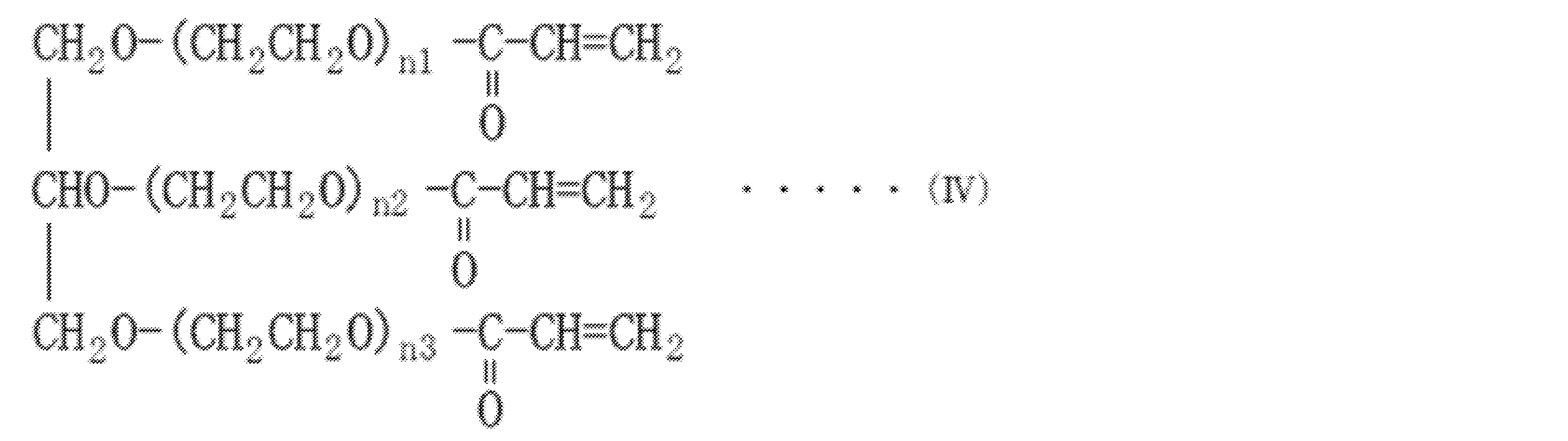
(V)下記一般式:
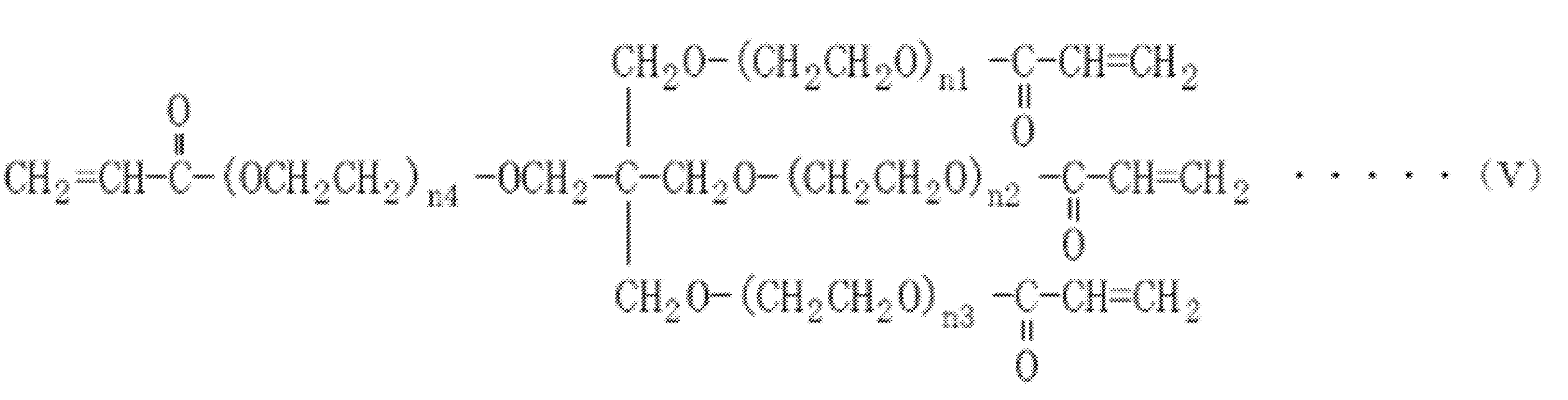
また、電極の生産性を更に高める観点からは、多官能化合物(C)は、2~6官能のポリアクリレートであることが好ましく、2~4官能のポリアクリレートであることが更に好ましい。
また、同様の理由により、多官能化合物(C)が有するポリオキシアルキレン構造(-(CmH2mO)n-)の整数nは、20以下であることが好ましく、15以下であることが更に好ましく、10以下であることが特に好ましく、2以上であることが好ましく、3以上であることが更に好ましく、4以上であることが特に好ましい。整数nが大きすぎる場合には、スラリー組成物の安定性が低下する虞があるからである。また、整数nが小さすぎる場合には、共重合体の剛性が高くなり、電気化学キャパシタのサイクル特性が低下する虞があるからである。なお、多官能化合物(C)が分子内に複数のポリオキシアルキレン構造(-(CmH2mO)n-)を有する場合には、複数のポリオキシアルキレン構造の整数nの平均値が上記範囲内に含まれることが好ましく、全てのポリオキシアルキレン構造の整数nが上記範囲内に含まれることが更に好ましい。
共重合体の調製に用いる単量体組成物には、上述したエチレン性不飽和カルボン酸化合物(A)、化合物(B)および多官能化合物(C)と共重合可能な既知の化合物が含まれていてもよい。そして、共重合体の調製に用いる単量体組成物が含む単量体は、これら(A)~(C)を除くその他の化合物が占める割合が20.0質量%以下であることが好ましく、10.0質量%以下であることがより好ましい。
より具体的には、その他の化合物としては、メチルアクリレート、エチルアクリレート、n-プロピルアクリレート、イソプロピルアクリレート、n-ブチルアクリレート、t-ブチルアクリレート、ペンチルアクリレート、ヘキシルアクリレート、ヘプチルアクリレート、オクチルアクリレート、ノニルアクリレート、デシルアクリレート、ラウリルアクリレート、n-テトラデシルアクリレート、ステアリルアクリレート、パーフルオロアルキルエチルアクリレート、フェニルアクリレート、などのアクリル酸エステル;メチルメタクリレート、エチルメタクリレート、n-プロピルメタクリレート、イソプロピルメタクリレート、n-ブチルメタクリレート、t-ブチルメタクリレート、ペンチルメタクリレート、ヘキシルメタクリレート、ヘプチルメタクリレート、オクチルメタクリレート、ノニルメタクリレート、デシルメタクリレート、ラウリルメタクリレート、n-テトラデシルメタクリレート、ステアリルメタクリレート、パーフルオロアルキルエチルメタクリレート、フェニルメタクリレート、などのメタクリル酸エステル;その他、酢酸ビニル、グリシジルメタクリレート、2-ビニルピリジン、等が挙げられる。
共重合体の調製に用いる単量体組成物に配合する添加剤としては、過硫酸カリウム等の重合開始剤や、テトラメチルエチレンジアミン等の重合促進剤などの重合反応に使用し得る既知の添加剤が挙げられる。なお、添加剤の種類および配合量は、重合方法等に応じて任意に選択することができる。
共重合体の調製に用いる単量体組成物に配合する重合溶媒としては、重合方法等に応じて、前述した単量体を溶解または分散可能な既知の溶媒を用いることができる。中でも、重合溶媒としては、水を用いることが好ましい。なお、重合溶媒としては、任意の化合物の水溶液や、少量の有機媒体と水との混合溶液などを用いてもよい。
本発明のスラリー組成物の結着材として用いられる共重合体は、上述した単量体、添加剤および重合溶媒を既知の方法で混合して得た単量体組成物を、例えばラジカル重合させることで得られる。なお、上記単量体組成物を重合して得られる、共重合体と重合溶媒とを含む溶液は、そのままスラリー組成物の調製に使用してもよいし、溶媒置換や任意の成分の添加などを行なった後にスラリー組成物の調製に使用してもよい。
ここで、エチレン性不飽和カルボン酸化合物(A)としてエチレン性不飽和カルボン酸を含む単量体組成物を使用した場合には、上記水溶液の中和を行なう際に、塩基性のリチウム化合物を使用することが好ましい。塩基性のリチウム化合物を使用すれば、共重合体中のカルボン酸基がカルボン酸リチウム塩基(-COOLi)となり、スラリー組成物のチクソ性および安定性が更に向上すると共に、電気化学キャパシタの内部抵抗が低減され、加えてサイクル特性およびフロート特性が向上するからである。なお、塩基性のリチウム化合物としては、炭酸リチウム(Li2CO3)や水酸化リチウム(LiOH)を用いることができ、水酸化リチウムを用いることが好ましい。
そして、上述のようにして調製した共重合体は、電解液膨潤度が120質量%未満であることが必要であり、118質量%未満であることが好ましく、115質量%未満であることがより好ましく、また、100質量%超であることが好ましく、105質量%超であることがより好ましい。共重合体の電解液膨潤度が120質量%以上であると、共重合体が電解液中で過度に膨潤して極板構造が維持できない。そのため電気化学キャパシタのフロート特性が低下し、またサイクル特性が低下する。一方、共重合体の電解液膨潤度が100質量%超であれば、電気化学キャパシタの内部抵抗を低減することができる。
なお、共重合体の電解液膨潤度は、本明細書の実施例に記載の方法で測定することができる。また、共重合体の電解液膨潤度は、例えば単量体組成物中のエチレン性不飽和カルボン酸化合物(A)や化合物(B)の種類や量を変更することにより調整することができる。
本発明のスラリー組成物において、上述した共重合体の配合量は、電極活物質100質量部当たり、1質量部以上であることが好ましく、4質量部以上であることがより好ましく、10質量部以下であることが好ましく、6質量部以下であることがより好ましい。スラリー組成物中の共重合体の配合量が電極活物質100質量部当たり1質量部以上であれば、電極合材層と集電体の密着性を確保することができ、また電気化学キャパシタのサイクル特性およびフロート特性を更に向上させることができる。一方、スラリー組成物中の共重合体の配合量が10質量部以下であれば、内部抵抗が過度に上昇することもない。
上述した共重合体を結着材として含有する本発明のスラリー組成物は、上述した共重合体以外の重合体を結着材として更に含有していてもよい。
なお、これらの重合体は、1種類を単独で用いてもよく、2種類以上を任意の比率で組み合わせて用いてもよい。
本発明の電気化学キャパシタ電極用スラリー組成物に用いる電極活物質は、当該スラリー組成物を用いて作製される電極が使用される電気化学キャパシタの種類に応じて選択すればよい。なお、電極活物質は1種類を単独で用いてもよく、2種類以上を任意の比率で組み合わせて用いてもよい。
例えば電気二重層キャパシタの電極に用いる電極活物質としては、炭素の同素体が挙げられる。そして炭素の同素体としては、活性炭、ポリアセン、カーボンウィスカおよびグラファイト等が挙げられる。これらの中でも好ましくは活性炭であり、具体的にはフェノール樹脂、レーヨン、アクリロニトリル樹脂、ピッチ、およびヤシ殻等を原料とする活性炭を挙げることができる。そして活性炭は、水蒸気で賦活した活性炭(水蒸気賦活活性炭)であることが特に好ましい。水蒸気賦活活性炭は、原料としての活性炭と水蒸気ガスとを加熱処理後に洗浄、ろ過、および乾燥を繰り返す等して得ることができる。
[[負極活物質]]
また例えばリチウムイオンキャパシタの負極に用いる電極活物質(負極活物質)としては、炭素系負極活物質、金属系負極活物質、およびこれらを組み合わせた負極活物質などが挙げられる。
炭素質材料は、炭素前駆体を2000℃以下で熱処理して炭素化させることによって得られる、黒鉛化度の低い(即ち、結晶性の低い)材料である。なお、炭素化させる際の熱処理温度の下限は特に限定されないが、例えば500℃以上とすることができる。そして、炭素質材料としては、例えば、熱処理温度によって炭素の構造を容易に変える易黒鉛性炭素(コークス、メソカーボンマイクロビーズ(MCMB)、メソフェーズピッチ系炭素繊維、熱分解気相成長炭素繊維など)、非晶質構造に近い構造を持つ難黒鉛性炭素(フェノール樹脂焼成体、ポリアクリロニトリル系炭素繊維、擬等方性炭素、フルフリルアルコール樹脂焼成体(PFA)、ハードカーボンなど)が挙げられる。
黒鉛質材料は、易黒鉛性炭素を2000℃以上で熱処理することによって得られる、黒鉛に近い高い結晶性を有する材料である。なお、熱処理温度の上限は、特に限定されないが、例えば5000℃以下とすることができる。そして、黒鉛質材料としては、例えば、天然黒鉛、人造黒鉛などが挙げられる。
そして、リチウムイオンキャパシタの正極に用いる電極活物質(正極活物質)としては、「電気二重層キャパシタの電極活物質」として上述したものを使用することができる。
ここで、電極活物質の比表面積は、500m2/g以上であることが好ましく、800m2/g以上であることがより好ましく、1000m2/g以上であることが更に好ましく、1300m2/g以上であることが特に好ましく、2500m2/g以下であることが好ましい。電極活物質の比表面積が500m2/g以上であれば、電極活物質が好適に分散した電極を形成可能となる。したがって、電気化学キャパシタの内部抵抗を低減しつつ、サイクル特性を更に向上させることができる。また電極活物質の比表面積が2500m2/g以下であれば、共重合体による電極活物質の均一な被覆が容易となり、フロート特性を更に向上させることができる。
なお、電極活物質の「比表面積」は、窒素吸着法によるBET比表面積のことであり、ASTM D3037-81に準拠して測定することができる。
本発明のスラリー組成物の分散媒としては、特に限定されることなく、既知の分散媒を用いることができる。中でも、分散媒としては、水を用いることが好ましい。なお、スラリー組成物の分散媒の少なくとも一部は、特に限定されることなく、共重合体を調製する際に使用した単量体組成物に含まれていた重合溶媒とすることができる。
本発明のスラリー組成物は、上述した成分に加え、任意に配合し得る既知の成分を含有していても良い。そのような既知の成分としてはカルボキシメチルセルロース等の増粘剤、導電材、補強材、レベリング剤、電解液添加剤などが挙げられる。
本発明のスラリー組成物は、上記各成分を混合することにより調製することができる。具体的には、少なくとも電極活物質および上記共重合体を、ボールミル、サンドミル、ビーズミル、顔料分散機、らい潰機、超音波分散機、ホモジナイザー、プラネタリーミキサー、フィルミックスなどの混合機を用いて上記分散媒に溶解および/または分散させることにより、スラリー組成物を調製することができる。
本発明の電気化学キャパシタ用電極は、本発明のスラリー組成物を用いて得られる電極合材層を有する(例えば、電極合材層は、本発明のスラリー組成物の乾燥物よりなる)。より具体的には、本発明の電気化学キャパシタ用電極は、集電体と、集電体上に形成された電極合材層とを備え、電極合材層は電極合材層には、少なくとも、電極活物質および結着材としての共重合体が含まれている。なお、電極合材層中に含まれている各成分は、上記電気化学キャパシタ電極用スラリー組成物中に含まれていたものであり、それら各成分の好適な存在比は、電気化学キャパシタ電極用スラリー組成物中の各成分の好適な存在比と同じである。
そして、上記電気化学キャパシタ用電極は、本発明の電気化学キャパシタ電極用スラリー組成物を使用して調製しているので、電気化学キャパシタに優れたサイクル特性およびフロート特性を発揮させることができる。
なお、上記電気化学キャパシタ用電極は、例えば、上述した電気化学キャパシタ電極用スラリー組成物を集電体上に塗布する工程(塗布工程)と、集電体上に塗布された電気化学キャパシタ電極用スラリー組成物を乾燥して集電体上に電極合材層を形成する工程(乾燥工程)とを経て製造される。
上記スラリー組成物を集電体上に塗布する方法としては、特に限定されず公知の方法を用いることができる。具体的には、塗布方法としては、ドクターブレード法、ディップ法、リバースロール法、ダイレクトロール法、グラビア法、エクストルージョン法、ハケ塗り法などを用いることができる。この際、スラリー組成物を集電体の片面だけに塗布してもよいし、両面に塗布してもよい。塗布後乾燥前の集電体上のスラリー膜の厚みは、乾燥して得られる電極合材層の厚みに応じて適宜に設定しうる。
集電体上のスラリー組成物を乾燥する方法としては、特に限定されず公知の方法を用いることができ、例えば温風、熱風、低湿風による乾燥、真空乾燥、赤外線や電子線などの照射による乾燥法が挙げられる。このように集電体上のスラリー組成物を乾燥することで、集電体上に電極合材層を形成し、集電体と電極合材層とを備える電気化学キャパシタ用電極を得ることができる。
さらに、電極合材層が硬化性の重合体を含む場合は、電極合材層の形成後に前記重合体を硬化させることが好ましい。
本発明の電気化学キャパシタは、本発明の電気化学キャパシタ用電極を備える。具体的には、本発明の電気化学キャパシタは、複数の電極と、電解液と、セパレータとを備え、前記複数の電極のうち少なくとも1つとして、本発明の電気化学キャパシタ用電極を用いたものである。そして、上記電気化学キャパシタは、本発明の電気化学キャパシタ用電極を用いているので、サイクル特性およびフロート特性に優れている。
溶媒としては、プロピレンカーボート、エチレンカーボネート、ブチレンカーボネート、ジメチルカーボネート、ジエチルカーボネート、エチルメチルカーボネートなどのカーボネート類;γ-ブチロラクトンなどのラクトン類;スルホラン類;アセトニトリルなどのニトリル類;などの有機溶媒が挙げられる。中でも、カーボネート類が好ましい。またこれらの溶媒は単独または二種以上の混合溶媒として使用することができる。
電解質としては、(C2H5)4NBF4、(C2H5)3(CH3)NBF4、(C2H5)4NPF6、LiClO4、LiAsF6、LiBF4、LiPF6、LiN(C2F5SO2)2、LiN(CF3SO2)2等の塩が挙げられる。
実施例および比較例において、共重合体の電解液膨潤度、電極合材層と集電体の密着性、並びに、電気化学キャパシタの内部抵抗、フロート特性およびサイクル特性は、それぞれ以下の方法を使用して評価した。
共重合体を含む水溶液を、湿度50%、温度23~25℃の環境下で乾燥させて、厚み1±0.3mmに成膜した。成膜したフィルムを、温度60℃の真空乾燥機で10時間乾燥させた後、裁断して約1gを精秤した。得られたフィルム片の質量をW0とする。このフィルム片を、温度60℃の環境下で、電解液(組成:濃度1.0MのLiPF6溶液(溶媒はエチレンカーボネート(EC)/エチルメチルカーボネート(EMC)=3/7(重量比)の混合溶媒))に3日間浸漬し、膨潤させた。その後、フィルム片を引き上げ、表面の電解液をキムワイプで拭いた後、質量を測定した。膨潤後のフィルム片の質量をW1とする。
そして、以下の計算式を用いて電解液膨潤度を算出した。
電解液膨潤度(質量%)=W1/W0×100
なお、本発明において上記電解液膨潤度の測定に用いる電解液は、主としてリチウムイオンキャパシタに使用されるものであるが、電気二重層キャパシタ用の電解液(組成:濃度1.0Mの(C2H5)4NBF4溶液(溶媒はプロピレンカーボネート))を用いて測定した場合でも、電解液膨潤度の値の大小が同一傾向であることを確認した。
<電極合材層と集電体の密着性>
作製した両面に電極合材層を有する電極を、幅1.0cm×長さ10cmの矩形に切って試験片とした。そして、試験片の一方の電極合材層側の表面を台上に固定し、試験片の他方の電極合材層側の表面にセロハンテープを貼り付けた。この際、セロハンテープはJIS Z1522に規定されるものを用いた。その後、試験片の一端からセロハンテープを50mm/分の速度で180°方向(試験片の他端側)に引き剥がしたときの応力を測定した。測定を10回行い、応力の平均値を求めて、これをピール強度(N/m)とし、下記の基準で評価した。ピール強度が大きいほど、電極合材層と集電体の密着性が優れていることを示す。
A:ピール強度が12N/m以上
B:ピール強度が9N/m以上12N/m未満
C:ピール強度が9N/m未満
<電気化学キャパシタの内部抵抗>
作製した電気化学キャパシタを、25℃で充電レート(電流密度)を0.3mA/cm2とし、定電流定電圧充電法にて、定格電圧(電気二重層キャパシタ:2.7V、リチウムイオンキャパシタ:3.8V)になるまで充電した。その後、25℃で放電レート(電流密度)を0.3mA/cm2とし下限電圧(電気二重層キャパシタ:0.0V、リチウムイオンキャパシタ:2.2V)まで放電した。この際に放電開始0.1秒後の電圧降下をΔVとする。更に、放電レート(電流密度)を0.3、1.0、5.0、20.0、50.0、および100mA/cm2と変化させた以外は同様の操作により、これら複数の放電レートにおける電圧降下ΔVを測定した。そして放電レートの電流密度から算出される電流値I(A)を横軸、測定した電圧降下ΔV(V)を縦軸としてプロットし、得られる直線の傾きを内部抵抗とし、下記の基準で評価した。内部抵抗が小さいほど、出力に優れる優れた電気化学キャパシタであることを示す。
A:内部抵抗が30mΩ未満
B:内部抵抗が30mΩ以上35mΩ未満
C:内部抵抗が35mΩ以上40mΩ未満
D:内部抵抗が40mΩ以上45mΩ未満
E:内部抵抗が45mΩ以上
<電気化学キャパシタのフロート特性>
作製した電気化学キャパシタを、60℃の環境下、定格電圧(電気二重層キャパシタ:2.7V、リチウムイオンキャパシタ:3.8V)で1000時間保持した(フロート)後に、定電流(電流密度:0.3mA/cm2)で下限電圧(電気二重層キャパシタ:0.0V、リチウムイオンキャパシタ:2.2V)に達するまで放電を行った。そして、フロート後の静電容量を算出し、フロート前の静電容量との変化から、容量維持率(%)(=フロート後の静電容量/フロート前の静電容量×100)を算出し、下記の基準で評価した。ここで、フロート前の静電容量は25℃の環境下で測定している。フロート特性評価における容量維持率が大きいほど、電気化学キャパシタが耐電圧に優れることを示す。
A:容量維持率が95%以上
B:容量維持率が90%以上95%未満
C:容量維持率が85%以上90%未満
D:容量維持率が80%以上85%未満
E:容量維持率が80%未満
<電気化学キャパシタのサイクル特性>
作製した電気化学キャパシタを、25℃で充電レート(電流密度)を3mA/cm2とした定電流で定格電圧(電気二重層キャパシタ:2.7V、リチウムイオンキャパシタ:3.8V)まで充電し、25℃で放電レート(電流密度)を3mA/cm2とした定電流で下限電圧(電気二重層キャパシタ:0.0V、リチウムイオンキャパシタ:2.2V)まで放電する充放電サイクルを10000サイクル実施した。そして、初期放電容量(1サイクル目の放電容量)と10000サイクル目の放電容量から、容量維持率(%)(=10000サイクル目の放電容量/初期放電容量×100)を算出し、下記の基準で評価した。サイクル特性評価における容量維持率が大きいほど、繰り返し充放電による電気化学キャパシタの容量減が少ないことを示す。
A:容量維持率が95%以上
B:容量維持率が92%以上95%未満
C:容量維持率が89%以上92%未満
D:容量維持率が89%未満
<共重合体を含む水溶液の調製>
セプタム付き1Lフラスコに、イオン交換水720gを投入して、温度40℃に加熱し、流量100mL/分の窒素ガスでフラスコ内を置換した。次に、イオン交換水10gと、エチレン性不飽和カルボン酸化合物(A)としてのアクリル酸11.0g(29.0%)と、化合物(B)としてのアクリルアミド26.6g(70.0%)と、多官能化合物(C)としてのポリエチレングリコールジアクリレート(共栄社化学(株)製、ライトアクリレート9EG-A、n=9の化合物(I)に相当、官能数=2)0.38g(1.0%)とを混合して、シリンジでフラスコ内に注入した。その後、重合開始剤としての過硫酸カリウムの2.5%水溶液8.0gをシリンジでフラスコ内に追加した。更に、その15分後に、重合促進剤としてのテトラメチルエチレンジアミンの2.0%水溶液40gをシリンジで追加した。4時間後、重合開始剤としての過硫酸カリウムの2.5%水溶液4.0gをフラスコ内に追加し、更に重合促進剤としてのテトラメチルエチレンジアミンの2.0%水溶液20gを追加して、温度を60℃に昇温し、重合反応を進めた。3時間後、フラスコを空気中に開放して重合反応を停止させ、生成物を温度80℃で脱臭し、残留モノマーを除去した。
その後、水酸化リチウムの10%水溶液を用いて生成物のpHを8に調整して、共重合体Aを含む水溶液を得た。そして、共重合体Aの電解液膨潤度を測定した。結果を表1に示す。
<電気二重層キャパシタ電極用スラリー組成物の調製>
プラネタリーミキサーに、電極活物質としての活性炭X(やしがらを原料とする水蒸気賦活活性炭、クラレケミカル社製、YP-50F、比表面積:1600m2/g)100部と、導電材としてのケッチェンブラック(ライオン社製、ECP)5部と、結着材としての共重合体Aを含む水溶液(固形分濃度:4.5%)を固形分相当で5.0部とを投入し、次いでイオン交換水にて固形分濃度が38%となるように希釈した。その後、回転速度40rpmで60分混練して、ペースト状のスラリーを得た。さらに、粘度が5000±500mPa・s(B型粘度計、60rpmで測定)となるようにイオン交換水を加え、電気二重層キャパシタ電極用スラリー組成物を調製した。
<電気二重層キャパシタ用電極の製造>
上記電気二重層キャパシタ用スラリー組成物を、コンマコーターで、集電体である厚さ20μmのアルミ箔の表面に、塗付量が8.0mg/cm2となるように塗布した。なおこの塗布は、乾燥後のアルミ箔上に電極合材層が形成されていない部分を確保すべく、スラリー組成物が塗布されない箇所を残すようにして実施した。この電気二重層キャパシタ電極用スラリー組成物が塗布されたアルミ箔を、0.3m/分の速度で、温度80℃のオーブン内を2分間、さらに温度110℃のオーブン内を2分間かけて搬送することにより、アルミ箔上のスラリー組成物を乾燥させた。その後、アルミ箔の裏側にも同様にしてスラリー組成物を塗布し、乾燥させて、電極原反を得た。
そして、得られた電極原反をロールプレス機にて密度が0.59g/cm3となるようプレスし、さらに、温度200℃、12時間真空乾燥することで両面電極を得た。この両面電極を用いて電極合材層と集電体の密着性を評価した。結果を表1に示す。
<電気二重層キャパシタの製造>
上記で作製された両面電極を、電極合材層が形成されていない部分が縦2cm×横2cm残るように、かつ電極合材層が形成されている部分が縦5cm×横5cmとなるように切り抜いた(この際、電極合材層が形成されていない部分は電極合材層が形成されている部分の正方形の一辺をそのまま延長するように形成される。)。また、セルロース製セパレータ(ニッポン高度紙工業社製、TF4035)を縦5.3cm×横5.3cmとなるように切り抜いた。このようにして切り抜かれた電極9枚(正極4枚および負極5枚とする)およびセパレータ10枚を、正極集電体、負極集電体の電極合材層が形成されていない部分がそれぞれ重なり合わないよう同方向に配置し、そして正極、負極が交互に配置されかつセパレータは正極と負極の間に位置するように配置してすべて積層した。さらに最上層と最下層の4辺をテープ留めし、積層体を得た。この際、得られた積層体の最上層と最下層(最外層)には何れもセパレータが配置されることとなり、最上層と最下層のセパレータには、何れも積層体内側から負極が接することとなる。次いでアルミからなる縦7cm×横1cm×厚み0.02cmのタブ材を、正負極それぞれの電極合材層が形成されていない部分に超音波溶接することで、電極積層体を作成した。
上記電極積層体を、深絞り外装フィルムの内部に配置し、三辺を融着後、電解液(組成:濃度1.0Mの(C2H5)4NBF4溶液(溶媒はプロピレンカーボネート)、キシダ化学社製)を真空含浸させた後、残り一辺を減圧下で融着させ、電気二重層キャパシタを作製した。この電気二重層キャパシタを用いて、内部抵抗、フロート特性およびサイクル特性を評価した。結果を表1に示す。
表1に示す単量体を当該表に示す割合で使用した以外は共重合体Aと同様にして、それぞれ共重合体を調製した。そしてそれらの共重合体を共重合体Aに替えて使用した以外は、実施例1と同様にして、電気二重層キャパシタ電極用スラリー組成物、電気二重層キャパシタ用電極、および電気二重層キャパシタを製造した。そして、実施例1と同様にして各種評価を行った。結果を表1に示す。
なお、共重合体の調製において、実施例12および13では、化合物(B)としてアクリルアミドを使用せず、それぞれ2-ヒドロキシエチルアクリレート、アクリロニトリルを使用した。
それぞれ表1に示す量で共重合体Aを使用した以外は、実施例1と同様にして、電気二重層キャパシタ電極用スラリー組成物、電気二重層キャパシタ用電極、および電気二重層キャパシタを製造した。そして、実施例1と同様にして各種評価を行った。結果を表1に示す。
<共重合体を含む水溶液の調製>
表1に示す単量体を当該表に示す割合で使用した以外は共重合体Aと同様にして、共重合体を調製し、電解液膨潤度を測定した。結果を表1に示す。
<アクリル重合体よりなる粒子状重合体を含む水分散液の調製>
攪拌機付き5MPa耐圧容器に、2-エチルヘキシルアクリレート80部、アクリロニトリル16部、イタコン酸4部、乳化剤としてのラウリル硫酸ナトリウム4部、溶媒としてのイオン交換水150部、および、重合開始剤としての過硫酸アンモニウム0.5部を投入し、十分に攪拌した後、温度80℃に加温して重合を開始した。
モノマー消費量が96.0%になった時点で冷却し、反応を停止した。こうして得られたアクリル重合体を含んだ水分散体に、5%水酸化ナトリウム水溶液を添加して、pHを7に調整した。その後、加熱減圧蒸留によって未反応単量体の除去を行った。さらにその後、温度30℃以下まで冷却し、アクリル重合体よりなる粒子状重合体を含む水分散液を得た。
<電気二重層キャパシタ電極用スラリー組成物の調製>
共重合体Aに替えて、上述した共重合体を固形分相当で2.0部添加し、さらにその後アクリル重合体よりなる粒子状重合体を固形分相当で3.0部添加した以外は、実施例1と同様にして電気二重層キャパシタ電極用スラリー組成物を調製した。
<電気二重層キャパシタ用電極および電気二重層キャパシタの製造>
上記得られたスラリー組成物を使用した以外は、実施例1と同様にして、電気二重層キャパシタ用電極および電気二重層キャパシタを製造した。そして、実施例1と同様にして各種評価を行った。結果を表1に示す。
アクリル重合体よりなる粒子状重合体の量を5.0部に変更した以外は、実施例10と同様にして、共重合体を含む水溶液、電気二重層キャパシタ電極用スラリー組成物、電気二重層キャパシタ用電極、および電気二重層キャパシタを製造した。そして、実施例1と同様にして各種評価を行った。結果を表1に示す。
<リチウムイオンキャパシタ用正極の製造>
電極活物質(正極活物質)として、活性炭Xに替えて活性炭Y(フェノール樹脂を原料とするアルカリ賦活炭、関西熱化学社製、MSP-20S、比表面積:2300m2/g)を使用した以外は、実施例1と同様にして両面電極を製造し、これをリチウムイオンキャパシタ用正極として用いた。そして、実施例1と同様にして電極合材層と集電体の密着性を評価した。結果を表1に示す。
<リチウムイオンキャパシタ用負極の製造>
プラネタリーミキサーに、負極活物質としてのハードカーボン(クレハ・バッテリー・マテリアルズ・ジャパン社製、カーボトロンP)100部と、導電材としてのアセチレンブラック(電気化学工業社製、「デンカブラック)3部と、増粘材としてのカルボキシメチルセルロース(日本製紙ケミカル社製、MAC200HC)1部と、実施例10と同様にして調製した結着材としてのアクリル重合体よりなる粒子状重合体3部(固形分相当)とを投入し、次いでイオン交換水にて固形分濃度が65%となるように希釈した。その後、回転速度40rpmで60分混練して、ペースト状のスラリーを得た。さらに、粘度が2000±200mPa・s(B型粘度計、60rpmで測定)となるようにイオン交換水を加え、リチウムイオンキャパシタ負極用スラリー組成物を調整した。
上記リチウムイオンキャパシタ負極用スラリー組成物を、コンマコーターで、集電体である厚さ15μmの銅箔の表面に、塗付量が7.0mg/cm2となるように塗布した。なおこの塗布は、乾燥後のアルミ箔上に電極合材層が形成されていない部分を確保すべく、スラリー組成物が塗布されない箇所を残すようにして実施した。このリチウムイオンキャパシタ負極用スラリー組成物が塗布された銅箔を、0.3m/分の速度で、温度80℃のオーブン内を2分間、さらに温度110℃のオーブン内を2分間かけて搬送することにより、銅箔上のスラリー組成物を乾燥させた。その後、銅箔の裏側も同様にしてスラリー組成物を塗布し、乾燥させて、負極原反を得た。
そして、得られた負極原反をロールプレス機にて密度が0.95g/cm3となるようプレスし、さらに、温度200℃、12時間真空乾燥することで両面負極を得た。
<リチウムイオンキャパシタの製造>
上記で作製された両面負極を、電極合材層が形成されていない部分が縦2cm×横2cm残るように、かつ電極合材層が形成されている部分が縦5.2cm×横5.2cmとなるように切り抜いた(この際、電極合材層が形成されていない部分は電極合材層が形成されている部分の正方形の一辺をそのまま延長するように形成される。)。このようにして切り抜いた負極を用い、そして負極のタブ材としてニッケルからなるタブ材を用いた以外は、実施例1と同様にして電極積層体を作成した。
次いで、リチウム貼り付け部が縦5cm×横5cm、タブ形成部が縦2cm×横2cmとなるように切り抜かれた厚さ100μmのステンレス網と、リチウム金属箔(厚み82μm、縦5cm×横5cm)を、リチウム金属箔がステンレス網のリチウム貼り付け部に配置されるように圧着した。さらにタブ形成部にはニッケルからなる縦7cm×横1cm×厚み0.01cmのタブ材を超音波溶接して、プレドープ用のリチウム極を作製した。得られたプレドープ用のリチウム極を、上記電極積層体の最外層のセパレータ(片側)と対向するように、かつ、プレドープ用のリチウム極のタブ材が、正極および負極タブ材の反対側に突出するように配置した。
得られたリチウム極付き電極積層体を、深絞り外装フィルムの内部に配置し、三辺を融着後、電解液(組成:濃度1.0MのLiPF6溶液(溶媒はEC/EMC=3/7(重量比)の混合溶媒)、キシダ化学社製)を真空含浸させた後、残り一辺を減圧下で融着させ、リチウムイオンキャパシタを作製した。このリチウムイオンキャパシタを用いて、内部抵抗、フロート特性およびサイクル特性を評価した。結果を表1に示す。
<共重合体を含む水溶液の調製>
表1に示す単量体を当該表に示す割合で使用した以外は共重合体Aと同様にして、共重合体を調製し、電解液膨潤度を測定した。結果を表1に示す。
<リチウムイオンキャパシタ正極用スラリー組成物の調製>
共重合体Aに替えて、上述した共重合体を固形分相当で2.0部添加し、さらにその後アクリル重合体よりなる粒子状重合体(実施例10と同様にして調製)を固形分相当で3.0部添加した以外は、実施例15と同様にしてスラリー組成物(リチウムイオンキャパシタ正極用スラリー組成物)を調製した。
<リチウムイオンキャパシタ用電極およびリチウムイオンキャパシタの製造>
上記得られたリチウムイオンキャパシタ正極用スラリー組成物を使用した以外は、実施例15と同様にして、リチウムイオンキャパシタ用正極、リチウムイオンキャパシタ用負極、およびリチウムイオンキャパシタを製造した。そして、実施例15と同様にして各種評価を行った。結果を表1に示す。
表1に示す単量体を当該表に示す割合で使用した以外は共重合体Aと同様にして、それぞれ共重合体を調製した。そしてそれらの共重合体を共重合体Aに替えて使用した以外は、実施例1と同様にして、電気二重層キャパシタ電極用スラリー組成物、電気二重層キャパシタ用電極、および電気二重層キャパシタを製造した。そして、実施例1と同様にして各種評価を行った。結果を表1に示す。
なお、共重合体の調製において、比較例3では、その他の化合物としてメチルアクリレートを使用した。
表1に示す単量体を当該表に示す割合で使用した以外は共重合体Aと同様にして、共重合体を調製した。そして当該共重合体を使用した以外は、実施例14と同様にして、リチウムイオンキャパシタ正極用スラリー組成物、リチウムイオンキャパシタ用正極、リチウムイオンキャパシタ用負極、およびリチウムイオンキャパシタを製造した。そして、実施例14と同様にして各種評価を行った。結果を表1に示す。
「EDLC」は電気二重層キャパシタを示し、
「LIC」はリチウムイオンキャパシタを示し、
「AA」は、アクリル酸を示し、
「AAm」は、アクリルアミドを示し、
「2-HEA」は、2-ヒドロキシエチルアクリレートを示し、
「AN」はアクリロニトリルを示し、
「PEGDA」はポリエチレングリコールジアクリレートを示し、
「MA」はメチルアクリレートを示し、
「ACL」はアクリル重合体を示す。

また、上述の表1の実施例1~7、12~14より、共重合体を調製する際の単量体の種類や配合割合を変更することにより、電極合材層と集電体の密着性を高め、そして電気二重層キャパシタの内部抵抗を低減しつつサイクル特性およびフロート特性を更に向上させうることがわかる。
そして、上述の表1の実施例8、9より、共重合体の配合量を調節することで、電極合材層と集電体の密着性を高め、そして電気二重層キャパシタの内部抵抗を低減し、またサイクル特性およびフロート特性を更に向上させうることがわかる。
加えて、上述の表1の実施例10、11より、結着材としてのアクリル重合体(粒子状重合体)の配合量を調節することで、電極合材層と集電体の密着性を高め、そして電気二重層キャパシタの内部抵抗を低減し、またサイクル特性を更に向上させうることがわかる。
本発明によれば、電気化学キャパシタに優れたサイクル特性およびフロート特性を発揮させ得る電気化学キャパシタ用電極を提供することができる。
本発明によれば、サイクル特性およびフロート特性に優れる電気化学キャパシタを提供することができる。
Claims (7)
- 電極活物質、共重合体および分散媒を含む電気化学キャパシタ電極用スラリー組成物であって、
前記共重合体は、
エチレン性不飽和カルボン酸およびその塩の少なくとも一方よりなるエチレン性不飽和カルボン酸化合物(A)と、
20℃における水100gに対する溶解度が7g以上であるエチレン性不飽和結合を有する共重合可能な化合物(B)と、
を含む単量体組成物を重合して得られ、
前記単量体組成物は、全単量体中の前記エチレン性不飽和カルボン酸化合物(A)の割合が20.0質量%以上99.9質量%以下であり、
そして前記共重合体の電解液膨潤度が120質量%未満である、
電気化学キャパシタ電極用スラリー組成物。 - 前記単量体組成物は、全単量体中の前記化合物(B)の割合が0.1質量%以上80.0質量%以下である、請求項1に記載の電気化学キャパシタ電極用スラリー組成物。
- 前記単量体組成物は、ポリオキシアルキレン構造および2つ以上のエチレン性不飽和結合を有する多官能化合物(C)をさらに含み、全単量体中の前記多官能化合物(C)の割合が0.1質量%以上10.0質量%以下である、請求項1または2に記載の電気化学キャパシタ電極用スラリー組成物。
- 前記電極活物質100質量部当たり、前記共重合体を1質量部以上10質量部以下含む、請求項1~3の何れかに記載の電気化学キャパシタ電極用スラリー組成物。
- 前記電極活物質の比表面積が、500m2/g以上2500m2/g以下である、請求項1~4の何れかに記載の電気化学キャパシタ電極用スラリー組成物。
- 請求項1~5の何れかに記載の電気化学キャパシタ電極用スラリー組成物を用いて調製した電極合材層を、集電体上に備える、電気化学キャパシタ用電極。
- 請求項6に記載の電気化学キャパシタ用電極を備える、電気化学キャパシタ。
Priority Applications (3)
| Application Number | Priority Date | Filing Date | Title |
|---|---|---|---|
| KR1020177024333A KR20170126885A (ko) | 2015-03-10 | 2016-03-09 | 전기 화학 커패시터 전극용 슬러리 조성물, 전기 화학 커패시터용 전극 및 전기 화학 커패시터 |
| JP2017504875A JP6904248B2 (ja) | 2015-03-10 | 2016-03-09 | 電気化学キャパシタ電極用スラリー組成物、電気化学キャパシタ用電極および電気化学キャパシタ |
| CN201680008059.2A CN107210143B (zh) | 2015-03-10 | 2016-03-09 | 电化学电容器电极用浆料组合物、电化学电容器用电极及电化学电容器 |
Applications Claiming Priority (2)
| Application Number | Priority Date | Filing Date | Title |
|---|---|---|---|
| JP2015047295 | 2015-03-10 | ||
| JP2015-047295 | 2015-03-10 |
Publications (1)
| Publication Number | Publication Date |
|---|---|
| WO2016143344A1 true WO2016143344A1 (ja) | 2016-09-15 |
Family
ID=56880422
Family Applications (1)
| Application Number | Title | Priority Date | Filing Date |
|---|---|---|---|
| PCT/JP2016/001310 Ceased WO2016143344A1 (ja) | 2015-03-10 | 2016-03-09 | 電気化学キャパシタ電極用スラリー組成物、電気化学キャパシタ用電極および電気化学キャパシタ |
Country Status (4)
| Country | Link |
|---|---|
| JP (1) | JP6904248B2 (ja) |
| KR (1) | KR20170126885A (ja) |
| CN (1) | CN107210143B (ja) |
| WO (1) | WO2016143344A1 (ja) |
Cited By (3)
| Publication number | Priority date | Publication date | Assignee | Title |
|---|---|---|---|---|
| WO2018135529A1 (ja) * | 2017-01-20 | 2018-07-26 | 株式会社Gsユアサ | 蓄電素子 |
| JP2019160690A (ja) * | 2018-03-15 | 2019-09-19 | 日立化成株式会社 | 電極用バインダー、電極合剤、エネルギーデバイス用電極及びエネルギーデバイス |
| JP2019160691A (ja) * | 2018-03-15 | 2019-09-19 | 日立化成株式会社 | 電極用バインダー、電極合剤、エネルギーデバイス用電極及びエネルギーデバイス |
Citations (2)
| Publication number | Priority date | Publication date | Assignee | Title |
|---|---|---|---|---|
| JP2011076916A (ja) * | 2009-09-30 | 2011-04-14 | Nippon Zeon Co Ltd | 二次電池電極用バインダー、二次電池電極および二次電池 |
| JP2011076824A (ja) * | 2009-09-30 | 2011-04-14 | Nippon Zeon Co Ltd | 電気化学素子用電極の製造方法及び製造装置並びに電気化学素子 |
Family Cites Families (9)
| Publication number | Priority date | Publication date | Assignee | Title |
|---|---|---|---|---|
| CN1195036C (zh) * | 2001-06-08 | 2005-03-30 | 成都茵地乐电源科技有限公司 | 锂离子二次电池电极材料水性粘合剂及其制备方法 |
| JP2003268053A (ja) * | 2002-03-13 | 2003-09-25 | Hitachi Chem Co Ltd | 電池用バインダ樹脂、これを含有する電極及び電池 |
| JP5232353B2 (ja) * | 2004-10-06 | 2013-07-10 | 日本ゼオン株式会社 | 非水電解質二次電池用電極組成物、これを用いた電極および電池 |
| JP4988967B2 (ja) * | 2010-07-16 | 2012-08-01 | 株式会社日本触媒 | 二次電池用水系電極バインダー |
| JP5943602B2 (ja) * | 2010-12-28 | 2016-07-05 | 三井化学株式会社 | 電気化学セル用アクリル系水分散体および水性ペースト、それからなる電極・電池の製造方法 |
| JP2012234703A (ja) * | 2011-04-28 | 2012-11-29 | Nippon Shokubai Co Ltd | 金属塩含有バインダー |
| JP5689769B2 (ja) * | 2011-09-12 | 2015-03-25 | 株式会社日本触媒 | 水系電極組成物用水分散体 |
| US9583278B2 (en) * | 2012-06-18 | 2017-02-28 | Jsr Corporation | Binder composition for electrical storage device electrodes, slurry for electrical storage device electrodes, electrical storage device electrode, and electrical storage device |
| PL3193397T3 (pl) * | 2014-09-08 | 2019-06-28 | Jsr Corporation | Kompozycja spoiwa do elektrody urządzenia do magazynowania, zawiesina do elektrody urządzenia do magazynowania, elektroda urządzenia do magazynowania i urządzenie do magazynowania |
-
2016
- 2016-03-09 WO PCT/JP2016/001310 patent/WO2016143344A1/ja not_active Ceased
- 2016-03-09 CN CN201680008059.2A patent/CN107210143B/zh not_active Expired - Fee Related
- 2016-03-09 KR KR1020177024333A patent/KR20170126885A/ko not_active Ceased
- 2016-03-09 JP JP2017504875A patent/JP6904248B2/ja active Active
Patent Citations (2)
| Publication number | Priority date | Publication date | Assignee | Title |
|---|---|---|---|---|
| JP2011076916A (ja) * | 2009-09-30 | 2011-04-14 | Nippon Zeon Co Ltd | 二次電池電極用バインダー、二次電池電極および二次電池 |
| JP2011076824A (ja) * | 2009-09-30 | 2011-04-14 | Nippon Zeon Co Ltd | 電気化学素子用電極の製造方法及び製造装置並びに電気化学素子 |
Cited By (7)
| Publication number | Priority date | Publication date | Assignee | Title |
|---|---|---|---|---|
| WO2018135529A1 (ja) * | 2017-01-20 | 2018-07-26 | 株式会社Gsユアサ | 蓄電素子 |
| JPWO2018135529A1 (ja) * | 2017-01-20 | 2019-11-07 | 株式会社Gsユアサ | 蓄電素子 |
| JP7240625B2 (ja) | 2017-01-20 | 2023-03-16 | 株式会社Gsユアサ | 蓄電素子 |
| JP2019160690A (ja) * | 2018-03-15 | 2019-09-19 | 日立化成株式会社 | 電極用バインダー、電極合剤、エネルギーデバイス用電極及びエネルギーデバイス |
| JP2019160691A (ja) * | 2018-03-15 | 2019-09-19 | 日立化成株式会社 | 電極用バインダー、電極合剤、エネルギーデバイス用電極及びエネルギーデバイス |
| JP7192223B2 (ja) | 2018-03-15 | 2022-12-20 | 昭和電工マテリアルズ株式会社 | 電極用バインダー、電極合剤、エネルギーデバイス用電極及びエネルギーデバイス |
| JP7192224B2 (ja) | 2018-03-15 | 2022-12-20 | 昭和電工マテリアルズ株式会社 | 電極用バインダー、電極合剤、エネルギーデバイス用電極及びエネルギーデバイス |
Also Published As
| Publication number | Publication date |
|---|---|
| JP6904248B2 (ja) | 2021-07-14 |
| KR20170126885A (ko) | 2017-11-20 |
| JPWO2016143344A1 (ja) | 2017-12-21 |
| CN107210143B (zh) | 2019-04-30 |
| CN107210143A (zh) | 2017-09-26 |
Similar Documents
| Publication | Publication Date | Title |
|---|---|---|
| JP6729385B2 (ja) | リチウムイオン二次電池負極用ペースト組成物、リチウムイオン二次電池負極用複合粒子、リチウムイオン二次電池負極用スラリー組成物、リチウムイオン二次電池用負極およびリチウムイオン二次電池 | |
| JP6197863B2 (ja) | 二次電池用バインダー組成物、二次電池用スラリー組成物、二次電池用負極、および、二次電池 | |
| EP2953193B1 (en) | Slurry for lithium ion secondary battery positive electrodes | |
| CN111656588B (zh) | 非水系二次电池电极用粘结剂组合物、浆料组合物、电极及二次电池 | |
| JP7003936B2 (ja) | 非水系二次電池負極用スラリー組成物及びその製造方法、非水系二次電池用負極、並びに非水系二次電池 | |
| JP6760074B2 (ja) | リチウムイオン二次電池正極用バインダー組成物、リチウムイオン二次電池正極用スラリー組成物、リチウムイオン二次電池用正極およびリチウムイオン二次電池 | |
| JP6645101B2 (ja) | リチウムイオン二次電池電極用スラリー組成物、リチウムイオン二次電池用電極およびリチウムイオン二次電池 | |
| JP6229290B2 (ja) | 二次電池用電極積層体及び二次電池 | |
| JP6398191B2 (ja) | 二次電池正極用スラリーの製造方法、二次電池用正極の製造方法、及び二次電池の製造方法 | |
| JP6428342B2 (ja) | リチウムイオン二次電池電極用バインダー組成物、リチウムイオン二次電池電極用スラリー組成物、リチウムイオン二次電池用電極およびリチウムイオン二次電池 | |
| WO2015186363A1 (ja) | リチウムイオン二次電池電極用バインダー組成物、リチウムイオン二次電池電極用スラリー組成物、リチウムイオン二次電池用電極およびリチウムイオン二次電池 | |
| WO2015098008A1 (ja) | リチウムイオン二次電池負極用バインダー組成物、リチウムイオン二次電池負極用スラリー組成物、リチウムイオン二次電池用負極およびリチウムイオン二次電池 | |
| JP6759589B2 (ja) | 電気化学素子用導電性組成物、電気化学素子電極用組成物、接着剤層付集電体及び電気化学素子用電極 | |
| JPWO2018180101A1 (ja) | 非水系二次電池電極用バインダー組成物、非水系二次電池電極用スラリー組成物、非水系二次電池用電極および非水系二次電池、並びに、非水系二次電池用電極の製造方法 | |
| JPWO2015133154A1 (ja) | リチウムイオン二次電池用バインダー組成物、リチウムイオン二次電池電極用スラリー組成物、リチウムイオン二次電池多孔膜用スラリー組成物、リチウムイオン二次電池用電極、及びリチウムイオン二次電池 | |
| JP2016171074A (ja) | リチウムイオン二次電池電極用バインダー組成物、リチウムイオン二次電池電極用スラリー組成物、リチウムイオン二次電池用電極およびリチウムイオン二次電池 | |
| JP6696534B2 (ja) | 二次電池正極用スラリーの製造方法、二次電池用正極の製造方法、及び二次電池の製造方法 | |
| JP6996504B2 (ja) | 非水系二次電池電極用バインダー組成物、非水系二次電池電極用スラリー組成物、非水系二次電池用電極および非水系二次電池 | |
| JP6904248B2 (ja) | 電気化学キャパシタ電極用スラリー組成物、電気化学キャパシタ用電極および電気化学キャパシタ | |
| JP6996503B2 (ja) | 非水系二次電池電極用バインダー組成物、非水系二次電池電極用スラリー組成物、非水系二次電池用電極および非水系二次電池 | |
| WO2024214640A1 (ja) | カーボンナノチューブを含む二次電池電極を備える二次電池の電極用バインダー及びその利用 | |
| WO2024181517A1 (ja) | リチウムイオン二次電池負極用バインダー組成物、リチウムイオン二次電池負極用スラリー組成物、リチウムイオン二次電池用負極及びリチウムイオン二次電池 |
Legal Events
| Date | Code | Title | Description |
|---|---|---|---|
| 121 | Ep: the epo has been informed by wipo that ep was designated in this application |
Ref document number: 16761317 Country of ref document: EP Kind code of ref document: A1 |
|
| ENP | Entry into the national phase |
Ref document number: 2017504875 Country of ref document: JP Kind code of ref document: A |
|
| ENP | Entry into the national phase |
Ref document number: 20177024333 Country of ref document: KR Kind code of ref document: A |
|
| NENP | Non-entry into the national phase |
Ref country code: DE |
|
| 122 | Ep: pct application non-entry in european phase |
Ref document number: 16761317 Country of ref document: EP Kind code of ref document: A1 |