WO2016140328A1 - 液晶配向剤、液晶配向膜及び液晶表示素子 - Google Patents
液晶配向剤、液晶配向膜及び液晶表示素子 Download PDFInfo
- Publication number
- WO2016140328A1 WO2016140328A1 PCT/JP2016/056665 JP2016056665W WO2016140328A1 WO 2016140328 A1 WO2016140328 A1 WO 2016140328A1 JP 2016056665 W JP2016056665 W JP 2016056665W WO 2016140328 A1 WO2016140328 A1 WO 2016140328A1
- Authority
- WO
- WIPO (PCT)
- Prior art keywords
- liquid crystal
- group
- carbon atoms
- aligning agent
- crystal aligning
- Prior art date
- Legal status (The legal status is an assumption and is not a legal conclusion. Google has not performed a legal analysis and makes no representation as to the accuracy of the status listed.)
- Ceased
Links
Classifications
-
- C—CHEMISTRY; METALLURGY
- C09—DYES; PAINTS; POLISHES; NATURAL RESINS; ADHESIVES; COMPOSITIONS NOT OTHERWISE PROVIDED FOR; APPLICATIONS OF MATERIALS NOT OTHERWISE PROVIDED FOR
- C09K—MATERIALS FOR MISCELLANEOUS APPLICATIONS, NOT PROVIDED FOR ELSEWHERE
- C09K19/00—Liquid crystal materials
- C09K19/52—Liquid crystal materials characterised by components which are not liquid crystals, e.g. additives with special physical aspect: solvents, solid particles
- C09K19/54—Additives having no specific mesophase characterised by their chemical composition
- C09K19/56—Aligning agents
-
- C—CHEMISTRY; METALLURGY
- C08—ORGANIC MACROMOLECULAR COMPOUNDS; THEIR PREPARATION OR CHEMICAL WORKING-UP; COMPOSITIONS BASED THEREON
- C08G—MACROMOLECULAR COMPOUNDS OBTAINED OTHERWISE THAN BY REACTIONS ONLY INVOLVING UNSATURATED CARBON-TO-CARBON BONDS
- C08G73/00—Macromolecular compounds obtained by reactions forming a linkage containing nitrogen with or without oxygen or carbon in the main chain of the macromolecule, not provided for in groups C08G12/00 - C08G71/00
- C08G73/06—Polycondensates having nitrogen-containing heterocyclic rings in the main chain of the macromolecule
- C08G73/10—Polyimides; Polyester-imides; Polyamide-imides; Polyamide acids or similar polyimide precursors
-
- C—CHEMISTRY; METALLURGY
- C07—ORGANIC CHEMISTRY
- C07D—HETEROCYCLIC COMPOUNDS
- C07D209/00—Heterocyclic compounds containing five-membered rings, condensed with other rings, with one nitrogen atom as the only ring hetero atom
- C07D209/02—Heterocyclic compounds containing five-membered rings, condensed with other rings, with one nitrogen atom as the only ring hetero atom condensed with one carbocyclic ring
- C07D209/44—Iso-indoles; Hydrogenated iso-indoles
- C07D209/48—Iso-indoles; Hydrogenated iso-indoles with oxygen atoms in positions 1 and 3, e.g. phthalimide
-
- C—CHEMISTRY; METALLURGY
- C08—ORGANIC MACROMOLECULAR COMPOUNDS; THEIR PREPARATION OR CHEMICAL WORKING-UP; COMPOSITIONS BASED THEREON
- C08G—MACROMOLECULAR COMPOUNDS OBTAINED OTHERWISE THAN BY REACTIONS ONLY INVOLVING UNSATURATED CARBON-TO-CARBON BONDS
- C08G73/00—Macromolecular compounds obtained by reactions forming a linkage containing nitrogen with or without oxygen or carbon in the main chain of the macromolecule, not provided for in groups C08G12/00 - C08G71/00
- C08G73/06—Polycondensates having nitrogen-containing heterocyclic rings in the main chain of the macromolecule
- C08G73/10—Polyimides; Polyester-imides; Polyamide-imides; Polyamide acids or similar polyimide precursors
- C08G73/1003—Preparatory processes
- C08G73/1007—Preparatory processes from tetracarboxylic acids or derivatives and diamines
- C08G73/1025—Preparatory processes from tetracarboxylic acids or derivatives and diamines polymerised by radiations
-
- C—CHEMISTRY; METALLURGY
- C08—ORGANIC MACROMOLECULAR COMPOUNDS; THEIR PREPARATION OR CHEMICAL WORKING-UP; COMPOSITIONS BASED THEREON
- C08L—COMPOSITIONS OF MACROMOLECULAR COMPOUNDS
- C08L79/00—Compositions of macromolecular compounds obtained by reactions forming in the main chain of the macromolecule a linkage containing nitrogen with or without oxygen or carbon only, not provided for in groups C08L61/00 - C08L77/00
- C08L79/04—Polycondensates having nitrogen-containing heterocyclic rings in the main chain; Polyhydrazides; Polyamide acids or similar polyimide precursors
- C08L79/08—Polyimides; Polyester-imides; Polyamide-imides; Polyamide acids or similar polyimide precursors
-
- G—PHYSICS
- G02—OPTICS
- G02F—OPTICAL DEVICES OR ARRANGEMENTS FOR THE CONTROL OF LIGHT BY MODIFICATION OF THE OPTICAL PROPERTIES OF THE MEDIA OF THE ELEMENTS INVOLVED THEREIN; NON-LINEAR OPTICS; FREQUENCY-CHANGING OF LIGHT; OPTICAL LOGIC ELEMENTS; OPTICAL ANALOGUE/DIGITAL CONVERTERS
- G02F1/00—Devices or arrangements for the control of the intensity, colour, phase, polarisation or direction of light arriving from an independent light source, e.g. switching, gating or modulating; Non-linear optics
- G02F1/01—Devices or arrangements for the control of the intensity, colour, phase, polarisation or direction of light arriving from an independent light source, e.g. switching, gating or modulating; Non-linear optics for the control of the intensity, phase, polarisation or colour
- G02F1/13—Devices or arrangements for the control of the intensity, colour, phase, polarisation or direction of light arriving from an independent light source, e.g. switching, gating or modulating; Non-linear optics for the control of the intensity, phase, polarisation or colour based on liquid crystals, e.g. single liquid crystal display cells
- G02F1/133—Constructional arrangements; Operation of liquid crystal cells; Circuit arrangements
- G02F1/1333—Constructional arrangements; Manufacturing methods
- G02F1/1337—Surface-induced orientation of the liquid crystal molecules, e.g. by alignment layers
-
- G—PHYSICS
- G02—OPTICS
- G02F—OPTICAL DEVICES OR ARRANGEMENTS FOR THE CONTROL OF LIGHT BY MODIFICATION OF THE OPTICAL PROPERTIES OF THE MEDIA OF THE ELEMENTS INVOLVED THEREIN; NON-LINEAR OPTICS; FREQUENCY-CHANGING OF LIGHT; OPTICAL LOGIC ELEMENTS; OPTICAL ANALOGUE/DIGITAL CONVERTERS
- G02F1/00—Devices or arrangements for the control of the intensity, colour, phase, polarisation or direction of light arriving from an independent light source, e.g. switching, gating or modulating; Non-linear optics
- G02F1/01—Devices or arrangements for the control of the intensity, colour, phase, polarisation or direction of light arriving from an independent light source, e.g. switching, gating or modulating; Non-linear optics for the control of the intensity, phase, polarisation or colour
- G02F1/13—Devices or arrangements for the control of the intensity, colour, phase, polarisation or direction of light arriving from an independent light source, e.g. switching, gating or modulating; Non-linear optics for the control of the intensity, phase, polarisation or colour based on liquid crystals, e.g. single liquid crystal display cells
- G02F1/133—Constructional arrangements; Operation of liquid crystal cells; Circuit arrangements
- G02F1/1333—Constructional arrangements; Manufacturing methods
- G02F1/1337—Surface-induced orientation of the liquid crystal molecules, e.g. by alignment layers
- G02F1/13378—Surface-induced orientation of the liquid crystal molecules, e.g. by alignment layers by treatment of the surface, e.g. embossing, rubbing or light irradiation
- G02F1/133784—Surface-induced orientation of the liquid crystal molecules, e.g. by alignment layers by treatment of the surface, e.g. embossing, rubbing or light irradiation by rubbing
Definitions
- the present invention relates to a liquid crystal aligning agent, a liquid crystal alignment film, and a liquid crystal display element that can be used for a liquid crystal display element of a vertical alignment type manufactured by irradiating ultraviolet rays with voltage applied to liquid crystal molecules.
- a liquid crystal display element of a method in which liquid crystal molecules aligned perpendicular to the substrate respond by an electric field also referred to as a vertical alignment (VA) method
- VA vertical alignment
- a photopolymerizable compound is previously added to the liquid crystal composition, and a polyimide-based vertical alignment film is used, and ultraviolet rays are applied while applying a voltage to the liquid crystal cell. Therefore, a technique for increasing the response speed of liquid crystal (PSA (Polymer Sustained Alignment) type element, for example, see Patent Document 1 and Non-Patent Document 1) is known.
- PSA Polymer Sustained Alignment
- the direction in which the liquid crystal molecules incline in response to an electric field is usually controlled by protrusions provided on the substrate or slits provided on the display electrode, but photopolymerization is performed in the liquid crystal composition.
- photopolymerization is performed in the liquid crystal composition.
- the solubility of the polymerizable compound added to the liquid crystal is low, and there is a problem that when the addition amount is increased, precipitation occurs at a low temperature. It cannot be obtained. Moreover, since the unreacted polymerizable compound remaining in the liquid crystal becomes an impurity (contamination) in the liquid crystal, there is a problem that the reliability of the liquid crystal display element is lowered.
- the UV irradiation treatment necessary for the PSA method generally irradiates light with a short wavelength including a wavelength around 313 nm. Therefore, if the irradiation amount is large, the components in the liquid crystal are decomposed and the reliability is lowered. cause.
- the subject of the present invention can improve the response speed of the liquid crystal display device obtained by using the step of reacting the polymerizable compound in the liquid crystal and / or the liquid crystal alignment film without the above-mentioned problems.
- Another object of the present invention is to provide a liquid crystal aligning agent, a liquid crystal aligning film, and a liquid crystal display element that have good reliability.
- the present invention has the following gist.
- a liquid crystal aligning agent comprising a polymer having a side chain structure represented by the following formula (I):
- the point means a bond to the main chain of the polymer
- Sp is a single bond, or an alkylene having 1 to 20 carbon atoms which may be unsubstituted or a part of hydrogen atoms may be replaced by fluorine atoms.
- the alkylene group may have an unsaturated bond, a branched chain, or a cyclic structure.
- X represents a single bond or a linking group.
- Cy represents a cyclic hydrocarbon group having 5 to 14 carbon atoms having at least one unsaturated bond which is necessarily bonded to the carbonyl carbon of the imide group, and a part of the carbon atoms constituting the cyclic hydrocarbon is heterogeneous.
- the hydrogen atom of the cyclic hydrocarbon may be replaced with a fluorine atom or a monovalent organic group having a molecular weight of 14 to 100.
- the polymer having a side chain structure represented by the formula (I) is composed of a polyimide precursor having a side chain structure represented by the formula (I) and a polyimide obtained by imidizing it.
- the liquid crystal aligning agent as described in said (I) which is at least 1 polymer chosen from these.
- a point means a bond to the main chain of the polymer
- n is an integer selected from 1 to 12
- X is a single bond, —O—, —COO—, —OCO—, — NHCO—, —CONH—, —NH—, —CH 2 O—, —N (CH 3 ) —, —CON (CH 3 ) —, or —N (CH 3 ) CO— is represented.
- Cy represents a cyclic hydrocarbon group having 5 to 14 carbon atoms having at least one unsaturated bond which is necessarily bonded to the carbonyl carbon of the imide group, and a part of the carbon atoms constituting the cyclic hydrocarbon is heterogeneous. It may be replaced by an atom.
- n is an integer of 1 to 6
- Cy is a cyclic hydrocarbon group shown below, and two points each represent a bond to imide carbonyl carbon (3) Liquid crystal aligning agent as described in.
- n is an integer of 1 to 6
- X represents —O—
- Cy is cyclohexene, benzene, naphthalene, or biphenylene. Liquid crystal aligning agent.
- liquid crystal aligning agent according to any one of (1) to (5), wherein the polymer further has a side chain for vertically aligning the liquid crystal.
- liquid crystal aligning agent according to the above (6), wherein the side chain for vertically aligning the liquid crystal is at least one selected from the following formulas (III-1) and (III-2).
- X 1 is a single bond, - (CH 2) a - (a is an integer of 1 ⁇ 15), - O - , - CH 2 O -, - COO- or -OCO- .
- X 2 representing a is Represents a single bond or (CH 2 ) b — (b is an integer of 1 to 15.)
- X 3 is a single bond, — (CH 2 ) c — (c is an integer of 1 to 15), Represents —O—, —CH 2 O—, —COO—, or —OCO—, wherein X 4 represents a divalent cyclic group selected from a benzene ring, a cyclohexane ring, and a heterocyclic ring;
- the hydrogen atom is substituted with an alkyl group having 1 to 3 carbon atoms, an alkoxyl group having 1 to 3 carbon atoms, a fluorine-containing alkyl group having 1 to 3 carbon
- X 4 is selected from an organic group having a carbon number of 17 to 51 having a steroid skeleton That may be a divalent organic group .
- X 5 represents a divalent cyclic group selected from benzene ring, cyclohexane ring and heterocyclic, any of hydrogen atoms on these cyclic groups, C 1 - 3 may be substituted with an alkyl group of 3, an alkoxyl group having 1 to 3 carbon atoms, a fluorine-containing alkyl group having 1 to 3 carbon atoms, a fluorine-containing alkoxyl group having 1 to 3 carbon atoms, or a fluorine atom.
- X 6 represents an alkyl group having 1 to 18 carbon atoms, a fluorine-containing alkyl group having 1 to 18 carbon atoms, an alkoxyl group having 1 to 18 carbon atoms, or a fluorine-containing alkoxyl group having 1 to 18 carbon atoms.
- X 7 is a single bond, —O—, —CH 2 O—, —CONH—, —NHCO—, —CON (CH 3 ) —, —N (CH 3 ) CO—, —COO— or —OCO—
- X 8 represents an alkyl group having 8 to 22 carbon atoms or a fluorine-containing alkyl group having 6 to 18 carbon atoms.
- liquid crystal aligning agent according to any one of (1) to (7), wherein the polymer further has a side chain containing a photoreactive group in the structure.
- R 8 is a single bond, —CH 2 —, —O—, —COO—, —OCO—, —NHCO—, —CONH—, —NH—, —CH 2 O—, —N (CH 3 ) — , —CON (CH 3 ) —, or —N (CH 3 ) CO—
- R 9 represents a single bond, an alkylene group having 1 to 20 carbon atoms which may be substituted with a fluorine atom, and an alkylene group —CH 2 — may be optionally substituted with —CF 2 — or —CH ⁇ CH—, and may be substituted with any of the following groups when they are not adjacent to each other: —O—, —COO—, —OCO—, —NHCO—, —CONH—, —NH—, a divalent carbocyclic or heterocyclic ring, and R 10 represents a photoreactive group selected from the following formulae. )
- Y 1 represents —CH 2 —, —O—, —CONH—, —NHCO—, —COO—, —OCO—, —NH—, or —CO—.
- Y 2 has 1 to 30 carbon atoms.
- An alkylene group, a divalent carbocycle or a heterocycle, and one or more hydrogen atoms of the alkylene group, divalent carbocycle or heterocycle may be substituted with a fluorine atom or an organic group.
- —CH 2 — when the following groups are not adjacent to each other, —CH 2 — may be substituted by these groups; —O—, —NHCO—, —CONH—, —COO—, —OCO—, — NH—, —NHCONH—, —CO—
- Y 3 represents —CH 2 —, —O—, —CONH—, —NHCO—, —COO—, —OCO—, —NH—, —CO—, or represents a bond .
- Y 4 is .
- Y 5 is a single bond representing a cinnamoyl group, 1 to 3 carbon atoms
- An alkylene group, a divalent carbocycle or a heterocycle, and one or more hydrogen atoms of the alkylene group, divalent carbocycle or heterocycle may be substituted with a fluorine atom or an organic group.
- Y 5 when the following groups are not adjacent to each other, —CH 2 — may be substituted with these groups; —O—, —NHCO—, —CONH—, —COO—, —OCO—, —NH—, —NHCONH—, —CO—, wherein Y 6 represents a photopolymerizable group which is an acryl group or a methacryl group.
- polymer contains at least one polymer of a polyimide precursor having a diamine component represented by the following formula (VI) as a structural unit and a polyimide obtained by imidizing the polyimide precursor.
- the liquid crystal aligning agent of any one of (9).
- the polymer further contains at least one polymer of a polyimide precursor having a diamine component containing a diamine represented by the following formula (VII) as a structural unit and a polyimide obtained by imidizing it.
- the liquid crystal aligning agent as described in said (10).
- the polymer further has at least one of a polyimide precursor obtained by imidizing a polyimide precursor having a diamine component containing a diamine represented by the following formula (VIII) or (IX) as a constituent unit: The liquid crystal aligning agent as described in said (10) or (11) containing a polymer.
- a polyimide precursor obtained by imidizing a polyimide precursor having a diamine component containing a diamine represented by the following formula (VIII) or (IX) as a constituent unit: The liquid crystal aligning agent as described in said (10) or (11) containing a polymer.
- liquid crystal aligning agent according to any one of (10) to (12), wherein the diamine represented by the formula (IV) is 10 mol% to 80 mol% of the total diamine component.
- the liquid crystal alignment agent for a liquid crystal display element obtained by reacting the polymerizable compound by irradiation with ultraviolet rays while applying a voltage, wherein the polymerizable compound is contained in the liquid crystal and / or the liquid crystal alignment film.
- the liquid crystal aligning agent according to any one of (1) to (13).
- a liquid crystal display device comprising the liquid crystal alignment film according to (15).
- n is an integer selected from 1 to 12
- X is a single bond, —O—, —COO—, —OCO—, —NHCO—, —CONH—. , -NH-, -CH 2 O-, -N (CH 3 )-, -CON (CH 3 )-, or -N (CH 3 ) CO-.
- Cy represents a cyclic hydrocarbon group having 5 to 14 carbon atoms having at least one unsaturated bond which is necessarily bonded to the carbonyl carbon of the imide group, and a part of the carbon atoms constituting the cyclic hydrocarbon is heterogeneous. It may be replaced by an atom.
- liquid crystal aligning agent suitable for a vertical alignment type liquid crystal display element having a high response speed, particularly a PSA type liquid crystal display element.
- a liquid crystal display element having a sufficiently improved response speed can be produced even when irradiated with long-wavelength ultraviolet rays.
- the liquid crystal aligning agent of the present invention contains at least one polymer having a structure represented by the above formula (I) in the side chain (hereinafter also referred to as a specific polymer) and a solvent.
- the liquid crystal alignment film is a solution for forming a liquid crystal alignment film, and the liquid crystal alignment film is a film for aligning liquid crystals in a predetermined direction.
- the polymer having a structure represented by the above formula (I) in the side chain includes a polyacrylate resin, a polymethacrylate resin, and a diamine component containing a diamine having the structure represented by the above formula (I) in the side chain. And a polyimide obtained by imidizing it, and at least one polymer can be used.
- the specific polymer contained in the liquid crystal aligning agent of this invention has the organic group shown to the said Formula (I) in a side chain. It is considered that this organic group is excited by ultraviolet irradiation to generate radicals, or has a function of chain-transferring radicals generated by other organic groups, and the intended effect can be achieved.
- Cy that is, a cyclic hydrocarbon group having at least one unsaturated bond
- a structure in which the bonds are directly connected is preferable.
- the greater the number of unsaturated bonds the higher the absorbance in the ultraviolet region and the longer the absorption wavelength, which is preferable when performing long wavelength exposure.
- an aromatic hydrocarbon group having 6 to 14 carbon atoms, a heterocyclic compound, and the like are more preferable.
- a cyclic hydrocarbon group containing no hetero atom is preferable.
- the number of carbon atoms forming the ring structure increases, the structure becomes more rigid and the solubility in the solvent becomes poor. Therefore, from the viewpoint of monomer synthesis and the ease of handling of the monomer, the number of carbon atoms is relatively high. Fewer cyclic hydrocarbon groups are preferred, and particularly preferred are cyclohexene, benzene, naphthalene, biphenylene and the like. More preferred is the following structure.
- the hydrogen atom of the cyclic hydrocarbon group directly connected to the imide ring may be replaced with a fluorine atom or the like, or an organic group may be substituted.
- the organic group to be substituted is not particularly limited, but introduction of an organic group having a strong electron donating property or electron accepting property is preferable because an effect of increasing the absorption wavelength is expected.
- a nitro group or an amino group may trap a generated radical
- a monovalent organic group having a molecular weight of 14 to 100 is preferable, for example, an organic group such as a hydroxy group or a hydroxyl group, An alkoxyl group or an alkyl group having a relatively small molecular weight can be mentioned, but since the introduced substituent may trap the generated radical, it is necessary to pay attention to the selection of the substituent. For the above reasons, it is most preferably unsubstituted.
- -X-Sp- represents a linking site with a polymer chain.
- the connecting site is not particularly limited.
- a bond, —O—, —COO—, —OCO—, —NHCO—, —CONH—, —NH—, —CH 2 O—, —N (CH 3 ) —, —CON (CH 3 ) —, or — N (CH 3 ) CO— and the like can be mentioned.
- —Sp— is preferably an alkylene having 1 to 12 carbon atoms, and the alkylene may have an unsaturated bond, a branched chain, or a cyclic structure, and a hydrogen atom in the alkylene may be replaced by fluorine. good.
- X is —O— as the most easily synthesized structure, and alkylene is a straight-chain alkylene having 1 to 6 carbon atoms.
- the means for introducing the side chain into the polymer is not particularly limited. Examples thereof include a method of obtaining a polymer by polymerization using a monomer having a side chain structure represented by the above formula (I), a method of introducing by polymer modification, and the like. Preferably, it is a method of introducing into a polymer using a monomer having an organic group represented by the above formula (I).
- the polymer contained in the liquid crystal aligning agent of the present invention preferably has a side chain for vertically aligning the liquid crystal in addition to the side chain represented by the above formula (I).
- the side chain for vertically aligning the liquid crystal is represented by the following formula (III-1) or formula (III-2).
- X 1 , X 2 , X 3 , X 4 , X 5 , and n are as defined above.
- X 1 is a single bond, — (CH 2 ) a — (a is an integer of 1 to 15), —O—, —CH 2 O, from the viewpoint of availability of raw materials and ease of synthesis.
- — Or —COO— is preferable, and more preferable is a single bond, — (CH 2 ) a — (a is an integer of 1 to 10), —O—, —CH 2 O— or —COO—.
- X 2 is preferably a single bond or (CH 2 ) b — (b is an integer of 1 to 10).
- X 3 is a single bond, — (CH 2 ) c — (c is an integer of 1 to 15), —O—, —CH 2 O—, or —COO—, among these, from the viewpoint of ease of synthesis. And more preferably a single bond, — (CH 2 ) c — (c is an integer of 1 to 10), —O—, —CH 2 O— or —COO—.
- X 4 is preferably an organic group having 17 to 51 carbon atoms having a benzene ring, a cyclohexane ring or a steroid skeleton from the viewpoint of ease of synthesis.
- X 5 is preferably a benzene ring or a cyclohexane ring.
- n is preferably 0 to 3 and more preferably 0 to 2 in view of availability of raw materials and ease of synthesis.
- X 6 is preferably an alkyl group having 1 to 18 carbon atoms, a fluorine-containing alkyl group having 1 to 10 carbon atoms, an alkoxyl group having 1 to 18 carbon atoms, or a fluorine-containing alkoxyl group having 1 to 10 carbon atoms. More preferably, it is an alkyl group having 1 to 12 carbon atoms or an alkoxyl group having 1 to 12 carbon atoms. Particularly preferred is an alkyl group having 1 to 9 carbon atoms or an alkoxyl group having 1 to 9 carbon atoms.
- the organic group having 17 to 51 carbon atoms having a steroid skeleton in the present invention has 12 to 20 carbon atoms having a steroid skeleton.
- An organic group having 12 to 25 carbon atoms having a steroid skeleton is to be read as an organic group having 17 to 51 carbon atoms having a steroid skeleton.
- (2-25) to (2-96), (2-145) to (2-168), (2-217) to (2-240), (2-268) to (2-315) , (2-364) to (2-387), (2-436) to (2-483), or (2-603) to (2-615) are preferred.
- Particularly preferred combinations are (2-49) to (2-96), (2-145) to (2-168), (2-217) to (2-240), (2-603) to (2- 606), (2-607) to (2-609), (2-611), (2-612) or (2-624).
- X 7 and X 8 are as defined above.
- X 7 is preferably a single bond, —O—, —CH 2 O—, —CONH—, —CON (CH 3 ) — or —COO—, and more preferably a single bond, —O—, — CONH- or -COO-.
- X 8 is preferably an alkyl group having 8 to 18 carbon atoms.
- the side chain for vertically aligning the liquid crystal it is preferable to use a structure represented by the formula [III-1] from the viewpoint that a high and stable vertical alignment of the liquid crystal can be obtained.
- the ability of a polymer having side chains for vertically aligning liquid crystals to align liquid crystals vertically varies depending on the structure of the side chains for vertically aligning liquid crystals, but in general, the side chains for vertically aligning liquid crystals. As the amount increases, the ability to align the liquid crystal vertically increases, and as the amount decreases, it decreases. Moreover, when it has a cyclic structure, compared with what does not have a cyclic structure, there exists a tendency for the capability to orientate a liquid crystal vertically.
- the polymer contained in the liquid crystal aligning agent of the present invention may have a photoreactive side chain in addition to the side chain represented by the above formula (I).
- the photoreactive side chain has a functional group (hereinafter also referred to as a photoreactive group) that can react by irradiation with light such as ultraviolet rays (UV) to form a covalent bond.
- the photoreactive side chain may be directly bonded to the main chain of the polymer, or may be bonded via a linking group.
- the photoreactive side chain is represented, for example, by the following formula (IV).
- R 8 , R 9 and R 10 are as defined above.
- R 8 is preferably a single bond, —O—, —COO—, —NHCO—, or —CONH—.
- R 9 can be formed by a common organic synthetic method, but from the viewpoint of ease of synthesis, a single bond or an alkylene group having 1 to 12 carbon atoms is preferable.
- Y 1 to Y 6 are as described above.
- specific examples of the divalent carbocycle or heterocycle for replacing any —CH 2 — in R 9 include the following.
- R 10 is preferably a methacryl group, an acryl group or a vinyl group from the viewpoint of photoreactivity.
- the amount of the photoreactive side chain is preferably within a range in which the response speed of the liquid crystal can be increased by reacting with ultraviolet irradiation to form a covalent bond. In order to further increase the response speed of the liquid crystal It is preferable that it is as many as possible within a range that does not affect other characteristics.
- a method for producing a polyimide precursor having a specific side chain and a polyimide obtained by imidizing the polyimide precursor is not particularly limited.
- a method of polymerizing a diamine having a specific side chain and a tetracarboxylic dianhydride, a method of polymerizing a diamine having a specific side chain and a tetracarboxylic acid diester, a tetracarboxylic dianhydride and a diamine containing a specific side chain examples include a method of polymerizing a compound, a method of polymerizing a tetracarboxylic dianhydride and a diamine, and then modifying a compound containing a specific side chain into a polymer by some kind of reaction.
- the polyimide precursor having a side chain and / or a photoreactive side chain for vertically aligning the liquid crystal and a method for producing a polyimide obtained by imidizing the polyimide precursor may be the same method as described above. Can be mentioned.
- the preferred method is to polymerize a diamine compound containing a side chain for vertically aligning liquid crystals and / or a diamine compound containing a photoreactive side chain, and a tetracarboxylic dianhydride or a tetracarboxylic acid diester. The method of making it preferable is.
- the diamine (hereinafter also referred to as a specific diamine) used in the production of the polymer forming the liquid crystal aligning agent of the present invention is excited by ultraviolet irradiation to generate radicals or chain transfer of radicals generated at other sites. It has the site
- the structure of the diamine can be represented by a diamine having an organic group represented by the formula (I) as a side chain, that is, the following formula (VI).
- the diaminobenzene in the formula (VI) may have a structure of any of o-phenylenediamine, m-phenylenediamine, and p-phenylenediamine, but m-phenylenediamine, Or p-phenylenediamine is preferred.
- a preferred structure of the formula (VI) is a diamine represented by the following formula (X),
- n is an integer from 1 to 6)
- the structure represented by the following formula (XI) is most preferable from the viewpoints of ease of synthesis, high versatility, characteristics, and the like.
- the specific diamine is a dinitro compound through each step, or a mononitro compound having an amino group with a protective group that can be removed in the reduction process, or a nitro group in a commonly used reduction reaction. Can be obtained by converting to an amino group or deprotecting the protecting group.
- a method of obtaining a diamine precursor by reacting an alcohol, alkylamine, alkyl halide or the like having a target imide structure with dinitrobenzene, or by reacting an alkylamine having dinitrobenzene already introduced with an acid anhydride examples thereof include a Mitsunobu reaction between an alcohol already introduced with dinitrobenzene and an N unsubstituted imide, and a method of condensing an alkyl halide already introduced with dinitrobenzene and an N unsubstituted imide in the presence of a base or a metal catalyst.
- the method for reducing the dinitro compound, which is a diamine precursor is not particularly limited. Usually, palladium carbon, platinum oxide, Raney nickel, platinum carbon, rhodium-alumina, platinum sulfide carbon, etc. are used as a catalyst, ethyl acetate, toluene, tetrahydrofuran. There is a method in which reduction is carried out with hydrogen gas, hydrazine, hydrogen chloride or the like in a solvent such as dioxane or alcohol. You may use an autoclave etc. as needed.
- an unsaturated bond site is included in the structure, if palladium carbon or platinum carbon is used, the unsaturated bond site may be reduced and become a saturated bond. Reduction conditions using a transition metal such as tin chloride, poisoned palladium carbon or platinum carbon, platinum carbon doped with iron or the like as a catalyst are preferable.
- the diamine of the present invention can be obtained by deprotecting the diaminobenzene derivative protected with a benzyl group or the like in the same reduction step.
- the specific diamine is preferably 10 to 80 mol%, more preferably 20 to 60 mol%, particularly preferably 30 to 50 mol% of the diamine component used for the synthesis of the polyamic acid.
- R 8 , R 9 and R 10 are as defined above.
- Y 1 to Y 6 are as described above.
- Specific examples of the specific side chain diamine include structures represented by the following formulas [2a-1] to [2a-31].
- R 1 represents —O—, —OCH 2 —, —CH 2 O—, —COOCH 2 — or —CH 2 OCO—
- R 2 represents a linear or branched alkyl group having 1 to 22 carbon atoms, A linear or branched alkoxyl group having 1 to 22 carbon atoms, a linear or branched, fluorine-containing alkyl group or fluorine-containing alkoxyl group having 1 to 22 carbon atoms.
- R 3 represents —COO—, —OCO—, —CONH—, —NHCO—, —COOCH 2 —, —CH 2 OCO—, —CH 2 O—, —OCH 2 — or —CH 2 —
- R 4 is a linear or branched alkyl group having 1 to 22 carbon atoms, a linear or branched alkoxyl group having 1 to 22 carbon atoms, a linear or branched alkyl group having 1 to 22 carbon atoms, or a fluorine-containing alkyl group. Group or fluorine-containing alkoxyl group).
- R 5 is —COO—, —OCO—, —CONH—, —NHCO—, —COOCH 2 —, —CH 2 OCO—, —CH 2 O—, —OCH 2 —, —CH 2 —, —O — Or —NH—, wherein R 6 is a fluorine group, a cyano group, a trifluoromethane group, a nitro group, an azo group, a formyl group, an acetyl group, an acetoxy group or a hydroxyl group.
- R 7 is a linear or branched alkyl group having 3 to 12 carbon atoms, and the cis-trans isomerism of 1,4-cyclohexylene is a trans isomer).
- R 8 is a linear or branched alkyl group having 3 to 12 carbon atoms, and the cis-trans isomerism of 1,4-cyclohexylene is a trans isomer).
- a 4 is a linear or branched alkyl group having 3 to 20 carbon atoms which may be substituted with a fluorine atom, and A 3 is a 1,4-cyclohexylene group or a 1,4-phenylene group.
- a 2 is an oxygen atom or COO- * (where a bond with “*” is bonded to A 3 ), and A 1 is an oxygen atom or COO— * (where “*” is a bond)
- the hand binds to (CH 2 ) a 2 ).
- a 1 is an integer of 0 or 1
- a 2 is an integer of 2 to 10
- a 3 is an integer of 0 or 1.
- examples of the diamine having the specific side chain structure represented by the formula [III-2] include diamines represented by the following formulas [2b-1] to [2b-10].
- a 1 represents an alkyl group having 1 to 22 carbon atoms or a fluorine-containing alkyl group).
- a 1 represents —COO—, —OCO—, —CONH—, —NHCO—, —CH 2 —, —O—, —CO— or —NH.
- a 2 represents a linear or branched alkyl group having 1 to 22 carbon atoms or a linear or branched fluorine-containing alkyl group having 1 to 22 carbon atoms.
- the above diamines can be used alone or in combination of two or more depending on the properties such as liquid crystal orientation, pretilt angle, voltage holding property, and accumulated charge when the liquid crystal alignment film is used.
- the diamine having a side chain for vertically aligning the liquid crystal is preferably used in an amount of 5 to 50 mol% of the diamine component used for the synthesis of the polyamic acid, more preferably 10 to 40 mol% of the diamine component, and particularly preferably. Is from 15 to 30 mol%.
- Use of a diamine having a side chain that orients the liquid crystal vertically is particularly excellent in terms of improving the response speed and aligning and fixing the liquid crystal.
- a diamine having a specific side chain structure As a method for introducing a side chain having photoreactivity into a polyimide polymer, it is preferable to use a diamine having a specific side chain structure as a part of the diamine component.
- the diamine having a photoreactive side chain is a diamine having a side chain represented by Formula [VIII] or Formula [IX].
- the bonding positions of the two amino groups (—NH 2 ) in Formula [VIII] and Formula [IX] are not limited. Specifically, with respect to the linking group of the side chain, 2, 3 position, 2, 4 position, 2, 5 position, 2, 6 position, 3, 4 position on the benzene ring, 3, 4 position, 5 positions. Among these, from the viewpoint of reactivity when synthesizing a polyamic acid, positions 2, 4, 2, 5, or 3, 5 are preferable. Considering the ease in synthesizing the diamine, the positions 2, 4 or 3, 5 are more preferable.
- diamine having a photoreactive side chain examples include, but are not limited to, the following.
- X 9 and X 10 are each independently a single bond, —O—, —COO—, —NHCO—, or —NH—, a linking group, and Y is a carbon atom which may be substituted with a fluorine atom. Represents an alkylene group of ⁇ 20.
- examples of the diamine having a photoreactive side chain include a diamine having a group causing a photodimerization reaction and a group causing a photopolymerization reaction represented by the following formula in the side chain.
- Y 1 represents —CH 2 —, —O—, —CONH—, —NHCO—, —COO—, —OCO—, —NH—, or —CO—.
- Y 2 is an alkylene group having 1 to 30 carbon atoms, a divalent carbocycle or a heterocycle, and one or more hydrogen atoms of the alkylene group, divalent carbocycle or heterocycle are fluorine atoms or organic It may be substituted with a group.
- Y 2 when the following groups are not adjacent to each other, —CH 2 — may be substituted with these groups; —O—, —NHCO—, —CONH—, —COO—, —OCO—, —NH—, —NHCONH—, —CO—.
- Y 3 represents —CH 2 —, —O—, —CONH—, —NHCO—, —COO—, —OCO—, —NH—, —CO—, or a single bond.
- Y 4 represents a cinnamoyl group.
- Y 5 is a single bond, an alkylene group having 1 to 30 carbon atoms, a divalent carbocycle or a heterocycle, and one or more hydrogen atoms of the alkylene group, divalent carbocycle or heterocycle are fluorine atoms Alternatively, it may be substituted with an organic group.
- —CH 2 — may be substituted with these groups; —O—, —NHCO—, —CONH—, —COO—, —OCO—, —NH—, —NHCONH—, —CO—.
- Y 6 represents a photopolymerizable group which is an acrylic group or a methacryl group.
- the diamine having a photoreactive side chain depends on the liquid crystal alignment property when it is used as a liquid crystal alignment film, the pretilt angle, the voltage holding property, the characteristics such as accumulated charge, the response speed of the liquid crystal when it is used as a liquid crystal display device, etc. 1 type or 2 types or more can be mixed and used.
- the diamine having a photoreactive side chain is preferably used in an amount of 10 to 70 mol%, more preferably 20 to 60 mol%, particularly preferably 30 to 50 mol% of the diamine component used for the synthesis of the polyamic acid. It is.
- Alicyclic diamines such as diamine, bis (4-aminocyclohexyl) methane, bis (4-amino-3-methylcyclohexyl) methane, 1,3 -Diaminopropane, 1,4-diaminobutane, 1,5-diaminopentane, 1,6-diaminohexane, 1,7-diaminoheptane, 1,8-diaminooctane, 1,9-diaminononane, 1,10- Examples thereof include aliphatic diamines such as diaminodecane, 1,11-diaminoundecane, and 1,12-diaminododecane.
- the above-mentioned other diamines can be used alone or in combination of two or more according to properties such as liquid crystal orientation, pretilt angle, voltage holding property, and accumulated charge when the liquid crystal alignment film is formed.
- the tetracarboxylic dianhydride component to be reacted with the diamine component is not particularly limited. Specifically, pyromellitic acid, 2,3,6,7-naphthalenetetracarboxylic acid, 1,2,5,6-naphthalenetetracarboxylic acid, 1,4,5,8-naphthalenetetracarboxylic acid, 2, 3,6,7-anthracenetetracarboxylic acid, 1,2,5,6-anthracenetetracarboxylic acid, 3,3 ′, 4,4′-biphenyltetracarboxylic acid, 2,3,3 ′, 4-biphenyltetra Carboxylic acid, bis (3,4-dicarboxyphenyl) ether, 3,3 ′, 4,4′-benzophenonetetracarboxylic acid, bis (3,4-dicarboxyphenyl) sulfone, bis (3,4-dicarboxy) Phen
- the liquid crystal aligning agent of the present invention may contain a polymerizable compound having a photopolymerizable or photocrosslinkable group at two or more terminals as required.
- a polymerizable compound is a compound having two or more terminals having a group that undergoes photopolymerization or photocrosslinking.
- the polymerizable compound having a photopolymerizable group is a compound having a functional group that causes polymerization upon irradiation with light.
- the compound having a photocrosslinking group is at least one selected from a polymer of a polymerizable compound, a polyimide precursor, and a polyimide obtained by imidizing the polyimide precursor by irradiating light. It is a compound having a functional group capable of reacting with the polymer and crosslinking with these polymers.
- a compound having a photocrosslinkable group also reacts with a compound having a photocrosslinkable group.
- the liquid crystal aligning agent of the present invention containing the polymerizable compound in a vertical alignment type liquid crystal display element such as an SC-PVA type liquid crystal display By using the liquid crystal aligning agent of the present invention containing the polymerizable compound in a vertical alignment type liquid crystal display element such as an SC-PVA type liquid crystal display, the side chain and the photoreactive property for aligning the liquid crystal vertically are used. Compared to the case of using a polymer having a side chain and this polymerizable compound alone, the response speed can be remarkably improved, and the response speed can be sufficiently improved even with a small amount of the polymerizable compound added. Can do.
- Examples of the group that undergoes photopolymerization or photocrosslinking include monovalent groups represented by the following formula (X).
- R 12 represents a hydrogen atom or an alkyl group having 1 to 4 carbon atoms.
- Z 1 is a divalent group optionally substituted by an alkyl group having 1 to 12 carbon atoms or an alkoxyl group having 1 to 12 carbon atoms.
- Z 2 represents a monovalent aromatic ring or heterocyclic ring optionally substituted by an alkyl group having 1 to 12 carbon atoms or an alkoxyl group having 1 to 12 carbon atoms.
- the polymerizable compound examples include a compound having a photopolymerizable group at each of two terminals represented by the following formula (XI), a terminal having a photopolymerizable group represented by the following formula (XII), and light.
- Examples thereof include a compound having a terminal having a cross-linking group and a compound having a photo-crosslinking group at each of two terminals represented by the following formula (XIII).
- R 12, Z 1 and Z 2 are the same as R 12, Z 1 and Z 2 in the formula (X), Q 1 is a divalent organic group is there.
- Q 1 has a ring structure such as a phenylene group (—C 6 H 4 —), a biphenylene group (—C 6 H 4 —C 6 H 4 —), a cyclohexylene group (—C 6 H 10 —), and the like. Preferably it is. This is because the interaction with the liquid crystal tends to increase.
- polymerizable compound represented by the formula (XI) include a polymerizable compound represented by the following formula (4).
- V and W are each represented by a single bond or —R 1 O—, and R 1 is a linear or branched alkylene group having 1 to 10 carbon atoms, preferably — R 1 is represented by R 1 O—, and R 1 is a linear or branched alkylene group having 2 to 6 carbon atoms.
- V and W may be the same or different, but synthesis is easy when they are the same.
- the photopolymerization or photocrosslinking group is a polymerizable compound having an acrylate group or a methacrylate group instead of an ⁇ -methylene- ⁇ -butyrolactone group
- the acrylate group or methacrylate group is a spacer such as an oxyalkylene group.
- the polymerizable compound having a structure bonded to a phenylene group via a can significantly improve the response speed particularly like the polymerizable compound having ⁇ -methylene- ⁇ -butyrolactone groups at both ends. .
- a polymerizable compound having a structure in which an acrylate group or a methacrylate group is bonded to a phenylene group through a spacer such as an oxyalkylene group has improved heat stability, and a high temperature, for example, a firing temperature of 200 ° C. or higher. Can withstand enough.
- the manufacturing method of the said polymeric compound is not specifically limited, For example, it can manufacture according to the following synthesis example.
- the polymerizable compound represented by the above formula (4) is a method proposed by Taraga and the like represented by the following reaction formula in P. Talaga, M. Schaeffer, C. Benezra and JLStampf, Synthesis, 530 (1990).
- Amberlyst 15 is a strongly acidic ion exchange resin manufactured by Rohm and Haas.
- R ′ represents a monovalent organic group.
- 2- (bromomethyl) acrylic acid is represented by the following reaction formula: K. Ramarajan, K. Kamalingam, DJO 'Donnell and KDBerlin, Organic Synthesis, vol.61, 56-59 (1983) Can be synthesized by the method proposed in
- ⁇ Synthesis of polyamic acid> In obtaining a polyamic acid by a reaction between a diamine component and tetracarboxylic dianhydride, a known synthesis method can be used. In general, a diamine component and a tetracarboxylic dianhydride component are reacted in an organic solvent. The reaction between the diamine component and tetracarboxylic dianhydride is advantageous in that it proceeds relatively easily in an organic solvent and no by-products are generated.
- the organic solvent used in the above reaction is not particularly limited as long as the generated polyamic acid is soluble. Furthermore, even if it is an organic solvent in which a polyamic acid does not melt
- organic solvent used in the above reaction examples include N, N-dimethylformamide, N, N-dimethylacetamide, N, N-diethylformamide, N-methylformamide, N-methyl-2-pyrrolidone, and N-ethyl-2.
- -Pyrrolidone 2-pyrrolidone, 1,3-dimethyl-2-imidazolidinone, 3-methoxy-N, N-dimethylpropanamide, N-methylcaprolactam, dimethylsulfoxide, tetramethylurea, pyridine, dimethylsulfone, hexamethyl Sulfoxide, ⁇ -butyrolactone, isopropyl alcohol, methoxymethylpentanol, dipentene, ethyl amyl ketone, methyl nonyl ketone, methyl ethyl ketone, methyl isoamyl ketone, methyl isopropyl ketone, methyl cellosolve, ethyl cellosolve, Tilcerosolve acetate, butylcellosolve acetate, ethylcellosolve acetate, butyl carbitol, ethyl carbitol, ethylene glycol, ethylene glycol
- the method of reacting a diamine component and a tetracarboxylic dianhydride component in an organic solvent is to stir a solution in which the diamine component is dispersed or dissolved in the organic solvent, and the tetracarboxylic dianhydride component as it is or an organic solvent.
- Dispersing or dissolving in a solution adding a diamine component to a solution obtained by dispersing or dissolving a tetracarboxylic dianhydride component in an organic solvent, alternating tetracarboxylic dianhydride component and diamine component Any of the methods of adding to In addition, when the diamine component or tetracarboxylic dianhydride component is composed of a plurality of types of compounds, they may be reacted in a premixed state, may be individually reacted sequentially, or may be further reacted individually. The body may be mixed and reacted to form a high molecular weight body.
- the temperature at which the diamine component and the tetracarboxylic dianhydride component are reacted is, for example, in the range of ⁇ 20 ° C. to 150 ° C., preferably ⁇ 5 ° C. to 100 ° C.
- the total concentration of the diamine component and the tetracarboxylic dianhydride component is preferably 1 to 50% by mass, and more preferably 5 to 30% by mass with respect to the reaction solution.
- the ratio of the total number of moles of the tetracarboxylic dianhydride component to the total number of moles of the diamine component can be selected according to the molecular weight of the polyamic acid to be obtained. Similar to the usual polycondensation reaction, the closer the molar ratio is to 1.0, the higher the molecular weight of the polyamic acid produced, and 0.8 to 1.2 if it shows a preferred range.
- the method for synthesizing the polyamic acid used in the present invention is not limited to the above-described method, and in the same manner as the general polyamic acid synthesis method, instead of the tetracarboxylic dianhydride, a tetracarboxylic acid having a corresponding structure is used.
- the corresponding polyamic acid can also be obtained by reacting by a known method using a tetracarboxylic acid derivative such as acid or tetracarboxylic acid dihalide.
- Examples of the method for imidizing the polyamic acid to obtain a polyimide include thermal imidization in which the polyamic acid solution is heated as it is, and catalytic imidization in which a catalyst is added to the polyamic acid solution.
- the imidation ratio from polyamic acid to polyimide is not necessarily 100%.
- the temperature at which the polyamic acid is thermally imidized in the solution is 100 ° C. to 400 ° C., preferably 120 ° C. to 250 ° C., and is preferably carried out while removing water generated by the imidization reaction from the outside of the system.
- the catalytic imidation of polyamic acid can be carried out by adding a basic catalyst and an acid anhydride to a polyamic acid solution and stirring at -20 to 250 ° C., preferably 0 to 180 ° C.
- the amount of the basic catalyst is 0.5 to 30 mol times, preferably 2 to 20 mol times of the amic acid group, and the amount of the acid anhydride is 1 to 50 mol times, preferably 3 to 30 mol of the amido acid group. Is double.
- the basic catalyst include pyridine, triethylamine, trimethylamine, tributylamine, trioctylamine and the like. Among them, pyridine is preferable because it has an appropriate basicity for proceeding with the reaction.
- Examples of the acid anhydride include acetic anhydride, trimellitic anhydride, pyromellitic anhydride, and the like. Among them, use of acetic anhydride is preferable because purification after completion of the reaction is facilitated.
- the imidization rate by catalytic imidation can be controlled by adjusting the amount of catalyst, reaction temperature, and reaction time.
- the polyamic acid ester is a reaction of a tetracarboxylic acid diester dichloride with a diamine similar to the synthesis of the polyamic acid, a suitable condensing agent with a diamine similar to the synthesis of the tetracarboxylic acid diester and the polyamic acid, It can be produced by reacting in the presence of a base or the like. It can also be obtained by previously synthesizing a polyamic acid by the above method and esterifying the carboxylic acid in the amic acid using a polymer reaction. Specifically, for example, tetracarboxylic acid diester dichloride and diamine in the presence of a base and an organic solvent at ⁇ 20 ° C.
- a polyamic acid ester By reacting for ⁇ 4 hours, a polyamic acid ester can be synthesized.
- the polyimide can also be obtained by heating the polyamic acid ester at a high temperature to promote dealcoholization and ring closure.
- the reaction solution may be poured into a poor solvent and precipitated.
- the poor solvent used for precipitation include methanol, acetone, hexane, butyl cellosolve, heptane, methyl ethyl ketone, methyl isobutyl ketone, ethanol, toluene, benzene, and water.
- the polymer precipitated in a poor solvent and collected by filtration can be dried by normal temperature or reduced pressure at room temperature or by heating.
- the operation of re-dissolving the recovered polymer in an organic solvent and repeating the reprecipitation recovery is repeated 2 to 10 times, impurities in the polymer can be reduced.
- the poor solvent at this time include alcohols, ketones, hydrocarbons and the like, and it is preferable to use three or more kinds of poor solvents selected from these because purification efficiency is further improved.
- the agent of the present invention contains at least one polymer having a structure represented by the above formula (I) in the side chain.
- the content of such a polymer is preferably 1 to 20% by mass, more preferably 3 to It is 15% by mass, particularly preferably 3 to 10% by mass.
- the content thereof is preferably 1 to 50 parts by mass with respect to 100 parts by mass of the polymer.
- the amount is preferably 5 to 30 parts by mass.
- the liquid crystal aligning agent of the present invention may contain a polymer other than the above polymer.
- the content of such other polymer in all the components of the polymer is preferably 0.5 to 80% by mass, more preferably 20 to 50% by mass.
- the molecular weight of the polymer of the liquid crystal aligning agent is GPC (Gel Permeation Chromatography) in consideration of the strength of the liquid crystal aligning film obtained by applying the liquid crystal aligning agent, workability when forming the coating film, and uniformity of the coating film. )
- the weight average molecular weight measured by the method is preferably 5,000 to 1,000,000, more preferably 10,000 to 150,000.
- the solvent contained in the liquid crystal aligning agent is not particularly limited.
- combination of said polyamic acid can be mentioned. Among them, N-methyl-2-pyrrolidone, ⁇ -butyrolactone, N-ethyl-2-pyrrolidone, 1,3-dimethyl-2-imidazolidinone and 3-methoxy-N, N-dimethylpropanamide are soluble. To preferred. Of course, two or more kinds of mixed solvents may be used.
- a solvent that improves the uniformity and smoothness of the coating film mixed with a solvent in which the components of the liquid crystal aligning agent are highly soluble examples include isopropyl alcohol, methoxymethylpentanol, methyl cellosolve, ethyl cellosolve, butyl cellosolve, methyl cellosolve acetate, butyl cellosolve acetate, ethyl cellosolve acetate, butyl carbitol, ethyl carbitol, ethyl carbitol acetate, ethylene glycol, Ethylene glycol monoacetate, ethylene glycol monoisopropyl ether, ethylene glycol monobutyl ether, propylene glycol, propylene glycol monoacetate, propylene glycol monomethyl ether, propylene glycol monobutyl ether, propylene glycol-tert-butyl ether, dipropylene glycol,
- the liquid crystal aligning agent may contain components other than those described above. Examples thereof include compounds that improve the film thickness uniformity and surface smoothness when a liquid crystal aligning agent is applied, and compounds that improve the adhesion between the liquid crystal aligning film and the substrate.
- Examples of compounds that improve film thickness uniformity and surface smoothness include fluorine-based surfactants, silicone-based surfactants, and nonionic surfactants. More specifically, for example, F-top EF301, EF303, EF352 (manufactured by Tochem Products), MegaFuck F171, F173, R-30 (manufactured by Dainippon Ink), Florard FC430, FC431 (manufactured by Sumitomo 3M) Asahi Guard AG710, Surflon S-382, SC101, SC102, SC103, SC104, SC105, SC106 (Asahi Glass Co., Ltd.) and the like.
- the use ratio of these surfactants is preferably 0.01 to 2 parts by mass, more preferably 0.01 to 1 part by mass with respect to 100 parts by mass of the total amount of the polymer contained in the liquid crystal aligning agent. .
- compounds that improve the adhesion between the liquid crystal alignment film and the substrate include functional silane-containing compounds and epoxy group-containing compounds.
- a phenol compound such as 2,2′-bis (4-hydroxy-3,5-dihydroxymethylphenyl) propane or tetra (methoxymethyl) bisphenol may be added.
- These compounds are preferably 0.1 to 30 parts by mass, more preferably 1 to 20 parts by mass with respect to 100 parts by mass of the total amount of the polymer contained in the liquid crystal aligning agent.
- liquid crystal aligning agent is added with a dielectric or conductive material for the purpose of changing the electrical properties such as the dielectric constant or conductivity of the liquid crystal aligning film as long as the effects of the present invention are not impaired. May be.
- liquid crystal aligning agent By applying this liquid crystal aligning agent on a substrate and baking it, a liquid crystal alignment film for vertically aligning liquid crystals can be formed.
- the response speed of the liquid crystal display element using the liquid crystal aligning film obtained can be made quick.
- the polymerizable compound that has two or more terminal groups that are photopolymerized or photocrosslinked, which may be contained in the liquid crystal aligning agent of the present invention is not contained in the liquid crystal aligning agent, or the liquid crystal aligning agent.
- the photoreaction becomes highly sensitive even in the so-called PSA mode, and a tilt angle can be imparted even with a small amount of ultraviolet irradiation.
- a cured film obtained by applying the liquid crystal aligning agent of the present invention to a substrate and then drying and baking as necessary can be used as a liquid crystal aligning film as it is.
- the cured film is rubbed, irradiated with polarized light or light of a specific wavelength, or treated with an ion beam, or a voltage is applied to the liquid crystal display element after filling the liquid crystal as a PSA alignment film It is also possible to irradiate with UV. In particular, it is useful to use as an alignment film for PSA.
- the substrate to be used is not particularly limited as long as it is a highly transparent substrate.
- Glass plate polycarbonate, poly (meth) acrylate, polyethersulfone, polyarylate, polyurethane, polysulfone, polyether, polyetherketone ,
- Plastic substrates such as trimethylpentene, polyolefin, polyethylene terephthalate, (meth) acrylonitrile, triacetyl cellulose, diacetyl cellulose, and acetate butyrate cellulose can be used.
- a substrate on which an ITO electrode or the like for driving liquid crystal is formed from the viewpoint of simplifying the process.
- an opaque material such as a silicon wafer can be used as long as the substrate is only on one side, and in this case, a material that reflects light such as aluminum can be used.
- the method for applying the liquid crystal aligning agent is not particularly limited, and examples thereof include printing methods such as screen printing, offset printing, flexographic printing, ink jet method, spray method, roll coating method, dip, roll coater, slit coater, and spinner. From the standpoint of productivity, the transfer printing method is widely used industrially, and is preferably used in the present invention.
- the coating film formed by applying the liquid crystal aligning agent by the above method can be baked to obtain a cured film.
- the drying process after applying the liquid crystal aligning agent is not necessarily required, but if the time from application to baking is not constant for each substrate, or if baking is not performed immediately after application, the drying process is performed. It is preferable.
- the drying is not particularly limited as long as the solvent is removed to such an extent that the shape of the coating film is not deformed by transporting the substrate or the like. For example, a method of drying on a hot plate at a temperature of 40 ° C. to 150 ° C., preferably 60 ° C. to 100 ° C., for 0.5 minutes to 30 minutes, preferably 1 minute to 5 minutes.
- the baking temperature of the coating film formed by applying the liquid crystal aligning agent is not limited, and is, for example, 100 to 350 ° C, preferably 120 to 300 ° C, and more preferably 150 ° C to 250 ° C.
- the firing time is 5 minutes to 240 minutes, preferably 10 minutes to 90 minutes, and more preferably 20 minutes to 90 minutes. Heating can be performed by a generally known method such as a hot plate, a hot air circulating furnace, an infrared furnace, or the like.
- the thickness of the liquid crystal alignment film obtained by firing is not particularly limited, but is preferably 5 to 300 nm, more preferably 10 to 100 nm.
- a liquid crystal cell can be produced by a known method after forming a liquid crystal alignment film on a substrate by the above method.
- the liquid crystal display element include two substrates disposed so as to face each other, a liquid crystal layer provided between the substrates, and a liquid crystal aligning agent provided between the substrate and the liquid crystal layer.
- a vertical alignment type liquid crystal display device comprising a liquid crystal cell having the above-described liquid crystal alignment film.
- the liquid crystal aligning agent of the present invention is applied onto two substrates and baked to form a liquid crystal aligning film, and the two substrates are arranged so that the liquid crystal aligning films face each other.
- a liquid crystal layer composed of liquid crystal is sandwiched between two substrates, that is, a liquid crystal layer is provided in contact with the liquid crystal alignment film, and ultraviolet rays are applied while applying a voltage to the liquid crystal alignment film and the liquid crystal layer.
- This is a vertical alignment type liquid crystal display device including a liquid crystal cell to be manufactured.
- the liquid crystal alignment film formed of the liquid crystal alignment agent of the present invention is used to irradiate ultraviolet rays while applying voltage to the liquid crystal alignment film and the liquid crystal layer to polymerize the polymerizable compound, and the photoreactive property of the polymer.
- the alignment of the liquid crystal is more efficiently fixed, and the liquid crystal display device is remarkably excellent in response speed.
- the substrate used in the liquid crystal display element of the present invention is not particularly limited as long as it is a highly transparent substrate, but is usually a substrate on which a transparent electrode for driving liquid crystal is formed.
- a substrate on which a transparent electrode for driving liquid crystal As a specific example, the thing similar to the board
- a substrate provided with a conventional electrode pattern or protrusion pattern may be used.
- the liquid crystal aligning agent of the present invention since the liquid crystal aligning agent of the present invention is used, a line of 1 to 10 ⁇ m, for example, is formed on one side substrate. / Slit electrode pattern is formed, and it is possible to operate even in the structure where slit pattern or projection pattern is not formed on the counter substrate.
- the liquid crystal display element of this structure can simplify the process at the time of manufacture and has high transmittance. Can be obtained.
- a high-performance element such as a TFT type element
- an element in which an element such as a transistor is formed between an electrode for driving a liquid crystal and a substrate is used.
- a substrate In the case of a transmissive liquid crystal display element, it is common to use a substrate as described above. However, in a reflective liquid crystal display element, if only one substrate is used, an opaque substrate such as a silicon wafer may be used. Is possible. At that time, a material such as aluminum that reflects light may be used for the electrode formed on the substrate.
- the liquid crystal material constituting the liquid crystal layer of the liquid crystal display element of the present invention is not particularly limited, and a liquid crystal material used in a conventional vertical alignment method, for example, a negative type such as MLC-6608 or MLC-6609 manufactured by Merck & Co., Inc. Liquid crystal can be used.
- a liquid crystal containing a polymerizable compound represented by the following formula can be used.
- a known method can be used as a method of sandwiching the liquid crystal layer between two substrates. For example, a pair of substrates on which a liquid crystal alignment film is formed is prepared, and spacers such as beads are dispersed on the liquid crystal alignment film on one substrate so that the surface on which the liquid crystal alignment film is formed is on the inside. Then, the other substrate is bonded, and liquid crystal is injected under reduced pressure to seal.
- a liquid crystal cell can also be produced by a method in which the other substrate is bonded to each other so as to be inside, and sealing is performed.
- the thickness of the spacer is preferably 1 to 30 ⁇ m, more preferably 2 to 10 ⁇ m.
- the step of producing a liquid crystal cell by irradiating ultraviolet rays while applying a voltage to the liquid crystal alignment film and the liquid crystal layer includes, for example, applying an electric field between the electrodes installed on the substrate to apply an electric field to the liquid crystal alignment film and the liquid crystal layer. And applying ultraviolet rays while maintaining this electric field.
- the voltage applied between the electrodes is, for example, 5 to 30 Vp-p, preferably 5 to 20 Vp-p.
- the irradiation amount of ultraviolet rays is, for example, 1 to 60 J, preferably 40 J or less, and the smaller the irradiation amount of ultraviolet rays, the lowering of reliability caused by the destruction of the members constituting the liquid crystal display element can be suppressed, and the irradiation time of ultraviolet rays can be reduced. This is preferable because the manufacturing efficiency is increased.
- the polymerizable compound when ultraviolet rays are irradiated while applying a voltage to the liquid crystal alignment film and the liquid crystal layer, the polymerizable compound reacts to form a polymer, and the direction in which the liquid crystal molecules are tilted is stored by this polymer.
- the response speed of the obtained liquid crystal display element can be increased.
- a polyimide precursor having a side chain for vertically aligning liquid crystal and a photoreactive side chain when irradiated with ultraviolet rays while applying a voltage to the liquid crystal alignment film and the liquid crystal layer, and the polyimide precursor as an imide Since the photoreactive side chains of at least one polymer selected from the polyimide obtained by the reaction or the photoreactive side chains of the polymer react with the polymerizable compound, the liquid crystal display element obtained The response speed can be increased.
- a 500 ml four-necked flask was equipped with a stirrer, a nitrogen inlet tube, and a Dean-Stark apparatus, and 1-cyclohexene-1,2-dicarboxylic anhydride (50.00 g: 328.6 mmol) was measured, and 500 g of toluene was added. Then, the mixture was dissolved by heating and stirring at 50 ° C. in a nitrogen atmosphere. Next, 2-ethanolamine (20.0 g: 328.6 mmol) was slowly added and stirred for 30 minutes, then heated to 120 ° C. and refluxed for 6 hours, and the generated water was removed to cause dehydration reaction.
- Second step Synthesis of 2- (2- (2,4-dinitrophenoxy) ethyl) -4,5,6,7-tetrahydro-1H-isoindole-1,3- (2H) -dione.
- a 500 ml four-necked flask was equipped with a stirrer, a nitrogen inlet tube, and a reflux tube, and 2,4-dinitrofluorobenzene (43.8 g: 235.6 mmol) and N- (2-hydroxyethyl)-obtained in the first step were used.
- 2,3,4,5-Tetrahydrophthalimide (46.0 g: 235.6 mmol) was weighed and dissolved in 500 g of THF, potassium carbonate (42.3 g: 306.3 mmol) was added, and the nitrogen atmosphere was at 60 ° C. The reaction was performed for 24 hours.
- a 2000 ml four-necked flask was attached with a nitrogen inlet tube, a reflux tube, and a mechanical stirrer, and the dinitro compound obtained in the second step (50.0 g: 138.0 mmol), toluene 500 g, reduced iron (77.3 g: 1) .38 mol), 500 g of 10% aqueous ammonium chloride solution was added, and the reaction was allowed to proceed for 24 hours at 60 ° C. in a nitrogen atmosphere.
- Second step Synthesis of 2- (2- (2,4-dinitrophenoxy) ethyl) isoindole-1,3-dione.
- a 500 ml four-necked flask was equipped with a stirrer, a nitrogen introducing tube, and a reflux tube, and 2- (2,4-dinitrophenoxy) bromoethane (50.0 g: 171.8 mmol) obtained in the first step, potassium phthalimide (31 8 g: 171.8 mmol), 300 ml of DMF was added, and the mixture was reacted at 80 ° C. for 3 hours under a nitrogen atmosphere.
- reaction solution was poured into a mixed solvent of water: methanol (1000 g: weight ratio: 1: 1) to precipitate a solid.
- methanol 1000 g: weight ratio: 1: 1
- the obtained crude product was collected by filtration, and 300 ml of methanol was added and washed by heating to obtain a milky white solid (57.1 g: 93% yield) as a target product.
- reaction solution was poured into 500 g of a mixed solvent of pure water and methanol (weight ratio: 1: 1) to precipitate a solid and stirred for a while. After filtration of the progenitor, it was heated and washed with 300 g of methanol, and the solid was vacuum-dried to obtain 30.0 g (124.4 mmol: 99% yield) of the intended pale yellow solid.
- Second step 2- (2- (2,4-dinitrophenoxy) ethyl) -1H-benzoisoquinoline-1,3-dione
- a stirrer, a nitrogen inlet tube and a reflux tube were attached to a 300 ml four-necked flask.
- Dinitrofluorobenzene (11.6 g: 62.2 mmol) and 2- (2-hydroxyethyl) -1H-benzoisoquinoline-1,3 (2H) -dione obtained in the first step (15.0 g: 62. 2 mmol) was measured, dissolved in 200 g of THF, triethylamine (9.4 g: 93.3 mmol) was added, and the mixture was refluxed for 24 hours under a nitrogen atmosphere.
- reaction solution was filtered to recover the original solid, which was heated and washed with 300 ml of methanol and vacuum dried to obtain 22.3 g (88.0) of the yellow solid as the target product. %).
- BODA bicyclo [3,3,0] octane-2,4,6,8-tetracarboxylic dianhydride
- CBDA 1,2,3,4-cyclobutanetetracarboxylic dianhydride
- PMDA pyromellitic anhydride
- TCA 2,3,5-tricarboxycyclopentylacetic acid-1,4,2,3-dianhydride
- the imidation rate is determined based on protons derived from structures that do not change before and after imidation as reference protons, and the peak integrated value of these protons and proton peaks derived from NH groups of amic acid appearing in the vicinity of 9.5 to 10.0 ppm. It calculated
- x is the proton peak integrated value derived from the NH group of the amic acid
- y is the peak integrated value of the reference proton
- ⁇ is the proton of the NH group of the amic acid in the case of polyamic acid (imidation rate is 0%). This is the ratio of the number of reference protons to one.
- Imidation rate (%) (1 ⁇ ⁇ x / y) ⁇ 100
- NMP (44.0 g) was added to the obtained polyimide powder (A) (6.0 g), and dissolved by stirring at 70 ° C. for 15 hours.
- 3AMP (1 wt% NMP solution) 6.0g, NMP (4.0g), and BCS (40.0g) were added to this solution, and the liquid crystal aligning agent (A1) was obtained by stirring at room temperature for 5 hours.
- NMP (44.0 g) was added to the obtained polyimide powder (B) (6.0 g) and dissolved by stirring at 70 ° C. for 15 hours.
- 6.0 g of 3AMP (1 wt% NMP solution), NMP (4.0 g), and BCS (40.0 g) were added and stirred at room temperature for 5 hours to obtain a liquid crystal aligning agent (B1).
- NMP (44.0 g) was added to the obtained polyimide powder (C) (6.0 g), and the mixture was stirred and dissolved at 70 ° C. for 15 hours.
- 3AMP (1 wt% NMP solution) 6.0g, NMP (4.0g), and BCS (40.0g) were added to this solution, and the liquid crystal aligning agent (C1) was obtained by stirring at room temperature for 5 hours.
- Example 4 BODA (1.5 g, 6 mmol), DBA (1.83, 12 mmol), 3AMPDA (2.18 g, 9 mmol), DA-6 (3.43 g, 9 mmol) were dissolved in NMP (35.7 g). After reacting at 4 ° C. for 4 hours, CBD (3.46 g, 17.6 mmol) and NMP (10.0 g) were added and reacted at 40 ° C. for 2 hours. Thereafter, PMDA (1.31 g, 0.06 mmol) and NMP (9.1 g) were added, and the mixture was stirred at room temperature for 10 hours to obtain a polyamic acid solution.
- NMP (44.0 g) was added to the obtained polyimide powder (D) (6.0 g), and the mixture was stirred and dissolved at 70 ° C. for 15 hours.
- 3AMP (1 wt% NMP solution) 6.0g, NMP (4.0g), and BCS (40.0g) were added to this solution, and the liquid crystal aligning agent (D1) was obtained by stirring at room temperature for 5 hours.
- liquid crystal aligning agent (B1) was mixed with 5.0 g of the liquid crystal aligning agent (D1), and the liquid crystal aligning agent (D2) was prepared by stirring for 3 hours.
- Example 5 TCA (3.4 g, 15.0 mmol), 3AMPDA (2.54 g, 10.5 mmol), DA-2 (3.57 g, 12.0 mmol), DA-8 (3.92 g, 7.5 mmol) were added to NMP ( 56.4 g), and after reacting at 80 ° C. for 5 hours, CBDA (2.89 g, 14.8 mmol) and NMP (8.8 g) were added and reacted at 40 ° C. for 10 hours to obtain a polyamic acid solution. Obtained.
- NMP (44.0 g) was added to the obtained polyimide powder (E) (6.0 g), and the mixture was dissolved by stirring at 70 ° C. for 15 hours.
- 3AMP (1 wt% NMP solution) 6.0g, NMP (4.0g), and BCS (40.0g) were added to this solution, and the liquid crystal aligning agent (E1) was obtained by stirring at room temperature for 5 hours.
- Example 6 BEM-S BODA (2.0 g, 8.0 mmol), DA-5 (1.6 g, 6.0 mmol), DA-2 (2.4 g, 8.0 mmol), DA-7 (2.6 g, 6.0 mmol).
- NMP 34.3 g
- CBDA 2.3 g, 11.8 mmol
- NMP 9.3 g
- NMP (22.0 g) was added to the obtained polyimide powder (F) (3.0 g), and dissolved by stirring at 50 ° C. for 5 hours.
- 3AMP (1 wt% NMP solution) 3.0g, NMP (2.0g), and BCS (20.0g) were added to this solution, and the liquid crystal aligning agent (F1) was obtained by stirring at room temperature for 5 hours.
- 0.06 g of polymerizable compound RM1 (10% by mass with respect to the solid content) is added to 10.0 g of the liquid crystal aligning agent (F1), and the mixture is dissolved by stirring for 3 hours at room temperature.
- Agent (F2) was prepared.
- NMP (22.0 g) was added to the obtained polyimide powder (G) (3.0 g), and dissolved by stirring at 70 ° C. for 15 hours.
- 3AMP (1 wt% NMP solution) 3.0g, NMP (2.0g), and BCS (20.0g) were added to this solution, and the liquid crystal aligning agent (G1) was obtained by stirring at room temperature for 5 hours.
- NMP (44.0 g) was added to the obtained polyimide powder (H) (6.0 g) and dissolved by stirring at 70 ° C. for 15 hours.
- 6.0 g of 3AMP (1 wt% NMP solution), NMP (4.0 g), and BCS (40.0 g) were added and stirred at room temperature for 5 hours to obtain a liquid crystal aligning agent (H1).
- NMP (44.0 g) was added to the obtained polyimide powder (I) (6.0 g) and dissolved by stirring at 70 ° C. for 15 hours.
- 3AMP (1 wt% NMP solution) 6.0g, NMP (4.0g), and BCS (40.0g) were added to this solution, and the liquid crystal aligning agent (I1) was obtained by stirring at room temperature for 5 hours.
- NMP (22.0 g) was added to the obtained polyimide powder (J) (3.0 g), and dissolved by stirring at 70 ° C. for 15 hours.
- 3AMP (1 wt% NMP solution) 3.0g, NMP (2.0g), and BCS (20.0g) were added to this solution, and the liquid crystal aligning agent (J1) was obtained by stirring at room temperature for 5 hours.
- NMP (22.0 g) was added to the obtained polyimide powder (K) (3.0 g) and dissolved by stirring at 70 ° C. for 15 hours.
- 3AMP (1 wt% NMP solution) 3.0g, NMP (2.0g), and BCS (20.0g) were added to this solution, and the liquid crystal aligning agent (K1) was obtained by stirring at room temperature for 5 hours.
- Example 8 Using the liquid crystal aligning agent (A1) obtained in Example 1, a liquid crystal cell was produced according to the procedure shown below.
- the liquid crystal aligning agent (A1) obtained in Example 1 was spin-coated on the ITO surface of an ITO electrode substrate on which an ITO electrode pattern having a pixel size of 100 ⁇ m ⁇ 300 ⁇ m and a line / space of 5 ⁇ m was formed, After drying for 90 seconds on this hot plate, baking was performed in a hot air circulation oven at 200 ° C. for 30 minutes to form a liquid crystal alignment film having a thickness of 100 nm.
- sealant solvent type thermosetting epoxy resin, Structbond XN-1500T made by Mitsui Chemicals
- the surface of the other substrate on which the liquid crystal alignment film was formed was faced inward and bonded to the previous substrate, and then the sealing agent was cured to produce an empty cell.
- Liquid crystal MLC-6608 (trade name, manufactured by Merck & Co., Inc.) was injected into this empty cell by a reduced pressure injection method to produce a liquid crystal cell.
- a liquid crystal cell was arranged between a pair of polarizing plates in a measuring device configured in the order of a backlight, a set of polarizing plates in a crossed Nicol state, and a light amount detector.
- the ITO electrode pattern in which the line / space was formed was at an angle of 45 ° with respect to the crossed Nicols.
- a rectangular wave with a voltage of ⁇ 6 V and a frequency of 1 kHz is applied to the liquid crystal cell, and the change until the luminance observed by the light quantity detector is saturated is captured by an oscilloscope.
- the luminance when no voltage is applied is obtained.
- a voltage of 0% and ⁇ 4 V was applied, the saturated luminance value was set to 100%, and the time taken for the luminance to change from 10% to 90% was defined as the response speed.
- Example 9 Comparative Examples 5 and 6
- Example 9 Comparative Examples 5 and 6
- the same operation as in Example 8 was performed except that the liquid crystal aligning agent shown in Table 1 was used to measure the response speed before and after UV irradiation and the pretilt angle. I did it.
- Example 15 Using the liquid crystal aligning agent (B2) obtained in Example 2, a liquid crystal cell was produced according to the procedure shown below.
- the liquid crystal aligning agent (B2) obtained in Example 1 was spin-coated on the ITO surface of an ITO electrode substrate on which an ITO electrode pattern having a pixel size of 100 ⁇ m ⁇ 300 ⁇ m and a line / space of 5 ⁇ m was formed, and the temperature was 80 ° C. After drying for 90 seconds on this hot plate, baking was performed in a hot air circulation oven at 200 ° C. for 30 minutes to form a liquid crystal alignment film having a thickness of 100 nm.
- sealant solvent type thermosetting epoxy resin, Structbond XN-1500T made by Mitsui Chemicals
- the surface of the other substrate on which the liquid crystal alignment film was formed was faced inward and bonded to the previous substrate, and then the sealing agent was cured to produce an empty cell.
- Liquid crystal MLC-6608 (trade name, manufactured by Merck & Co., Inc.) was injected into this empty cell by a reduced pressure injection method to produce a liquid crystal cell.
- Example 15 to 18, Comparative Examples 7 to 11 instead of the liquid crystal aligning agent (B2), the same operation as in Example 8 was performed except that the liquid crystal aligning agent shown in Table 1 was used to measure the response speed before and after UV irradiation and the pretilt angle. I did it. These results are summarized in Table 2.
- the polymerizable compound itself hardly absorbs 365 nm ultraviolet rays, so that in the liquid crystal aligning film having no radical generation site, sufficient radicals are generated to start the RM polymerization reaction. It was considered that the RM polymerization reaction could not be started in the same manner because the effect was small even if it had a radical generating group.
- the liquid crystal aligning agent of the examples sufficient radicals are generated even by irradiation with ultraviolet rays on the long wavelength side, and it is considered that the polymerizable compound was polymerized at the interface of the liquid crystal aligning film to form a tilt angle.
- Example 19 Using the liquid crystal aligning agent (A1) obtained in Example 1, a UV fluorescent lamp was applied to a liquid crystal cell prepared by irradiating 15 J of UV using a 365 nm bandpass filter from outside the liquid crystal cell by the method described above. Is irradiated for 30 minutes to sufficiently react the RM remaining in the liquid crystal cell, and then a voltage of 1V is applied for 60 ⁇ s at a temperature of 60 ° C., and the voltage is maintained by measuring the voltage after 1667 ms. It was calculated as voltage holding ratio. These results are shown in Table 3.
- Example 20 and 21 Comparative Examples 12 to 14
- the voltage holding ratio was measured in the same manner as in Example 19 except that the liquid crystal aligning agent shown in Table 3 was used. These results are summarized in Table 3.
Landscapes
- Chemical & Material Sciences (AREA)
- Physics & Mathematics (AREA)
- Organic Chemistry (AREA)
- Nonlinear Science (AREA)
- Polymers & Plastics (AREA)
- Medicinal Chemistry (AREA)
- Crystallography & Structural Chemistry (AREA)
- Health & Medical Sciences (AREA)
- Chemical Kinetics & Catalysis (AREA)
- Optics & Photonics (AREA)
- Spectroscopy & Molecular Physics (AREA)
- Mathematical Physics (AREA)
- General Physics & Mathematics (AREA)
- Materials Engineering (AREA)
- Engineering & Computer Science (AREA)
- Liquid Crystal (AREA)
- Macromolecular Compounds Obtained By Forming Nitrogen-Containing Linkages In General (AREA)
- Other In-Based Heterocyclic Compounds (AREA)
- Indole Compounds (AREA)
Abstract
Description
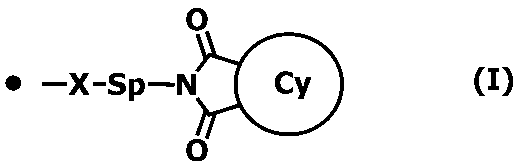
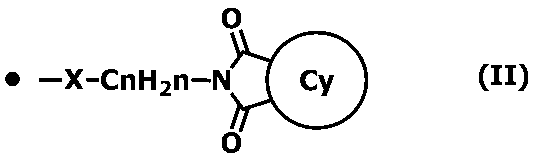




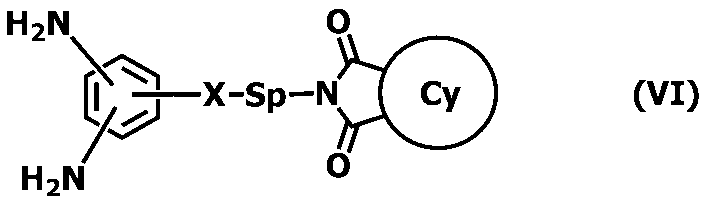
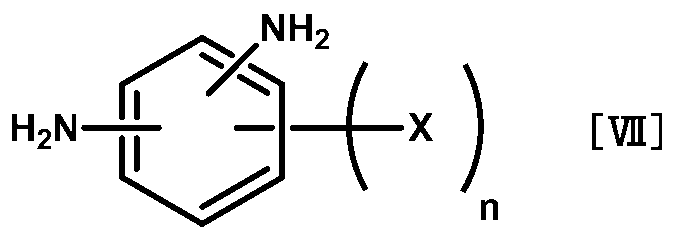
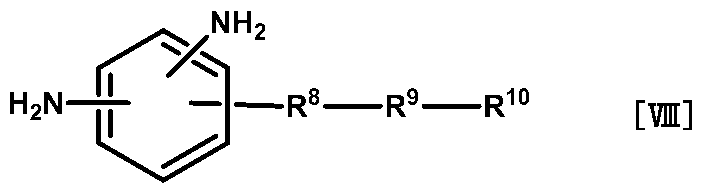
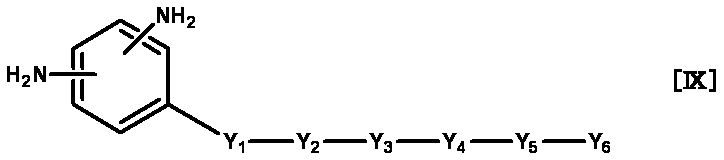
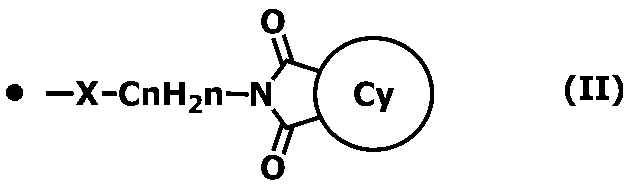

本発明の液晶配向剤に含有される特定重合体は、前記式(I)に示す有機基を側鎖に有する。この有機基が紫外線照射により励起し、ラジカルを発生させる、或いは、他の有機基が発生させたラジカルを連鎖移動させる機能を有すると考えられ、目的とする効果を達成することができる。
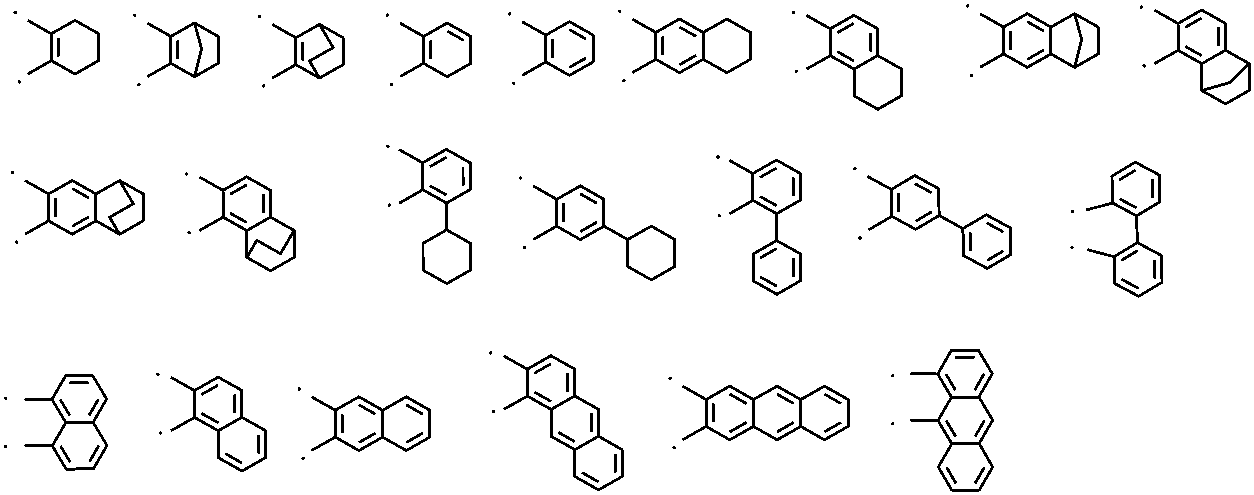
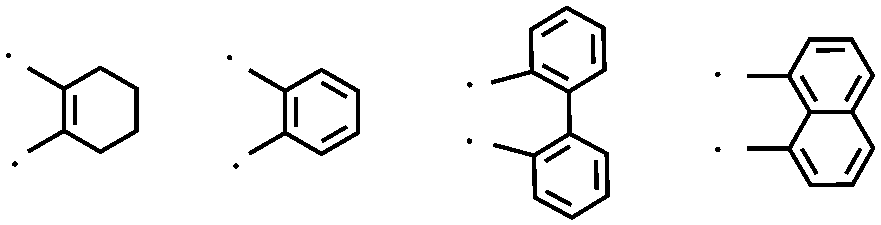
本発明の液晶配向剤に含有される重合体は、上記式(I)で表される側鎖以外に、液晶を垂直に配向させる側鎖を有するのが好ましい。液晶を垂直に配向させる側鎖は、下記式(III-1)又は式(III-2)で表される。


本発明の液晶配向剤に含有される重合体は、上記式(I)で表される側鎖以外に、光反応性の側鎖を有していてもよい。光反応性の側鎖は、紫外線(UV)等の光の照射によって反応し、共有結合を形成し得る官能基(以下、光反応性基ともいう。)を有する。


また、式[IV]中、R9の任意の-CH2-を置き換える二価の炭素環若しくは複素環は、具体的には以下のものが例示される。
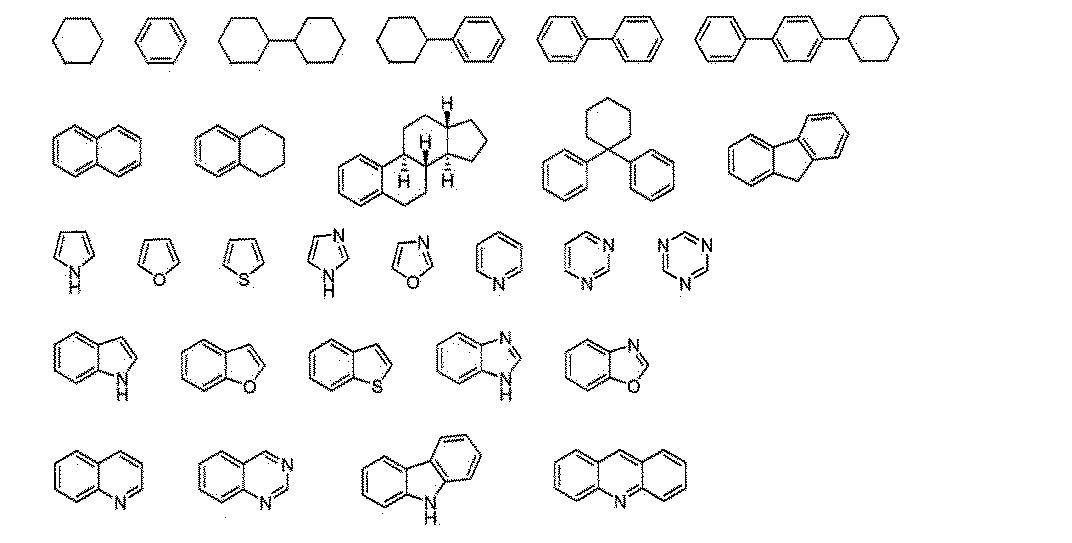
特定側鎖を有するポリイミド前駆体及び該ポリイミド前駆体をイミド化したポリイミドを製造する方法は特に限定されない。例えば、特定側鎖を有するジアミンとテトラカルボン酸二無水物を重合させる方法、特定側鎖を有するジアミンとテトラカルボン酸ジエステルを重合させる方法、特定側鎖を含有するテトラカルボン酸二無水物とジアミン化合物を重合させる方法、テトラカルボン酸二無水物とジアミンを重合させた後に、特定側鎖を含有する化合物を何らかの反応により重合体に修飾させる方法などが挙げられる。なかでも、製造の容易性の観点より、特定側鎖を含有するジアミン化合物とテトラカルボン酸二無水物、又はテトラカルボン酸ジエステルを重合させる方法が好ましい。
本発明の液晶配向剤を形成する上記の重合体の製造に使用されるジアミン(以下、特定ジアミンともいう。)は、紫外線照射により励起しラジカルが発生または他の部位で発生したラジカルを連鎖移動させる機能を有する部位を側鎖として有することを特徴とする。



本発明において、特定ジアミンは、各ステップを経てジニトロ体、或いは、還元工程で除去可能な保護基を施したアミノ基を有するモノニトロ体、或いは、ジアミンを合成し、通常用いる還元反応にてニトロ基をアミノ基に変換あるいは保護基を脱保護することにより得ることができる。

液晶を垂直に配向させる側鎖をポリイミド系重合体に導入する方法は、特定側鎖構造を有するジアミンをジアミン成分の一部に用いることが好ましい。

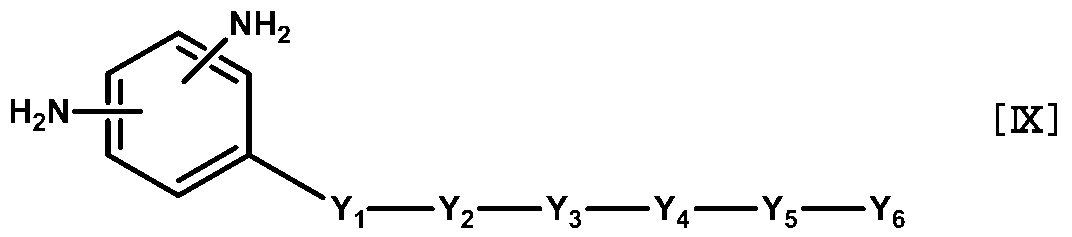


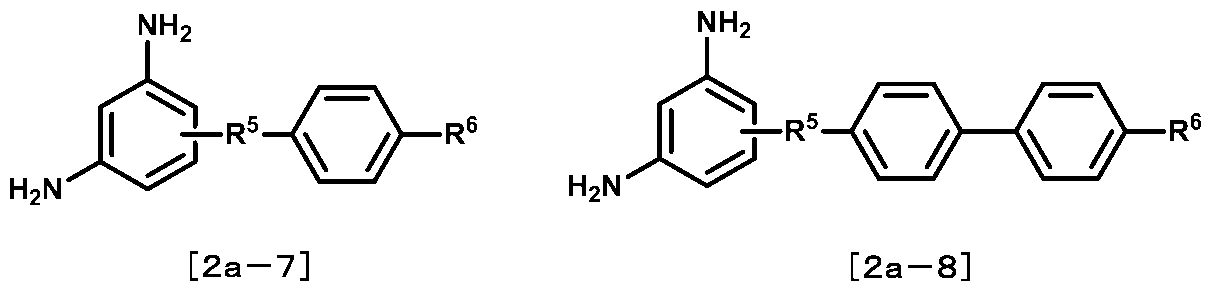


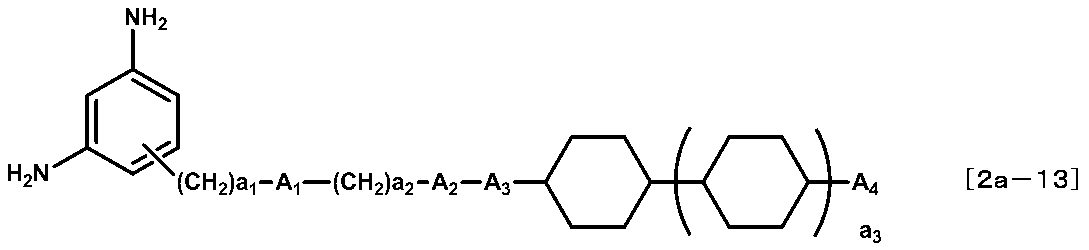


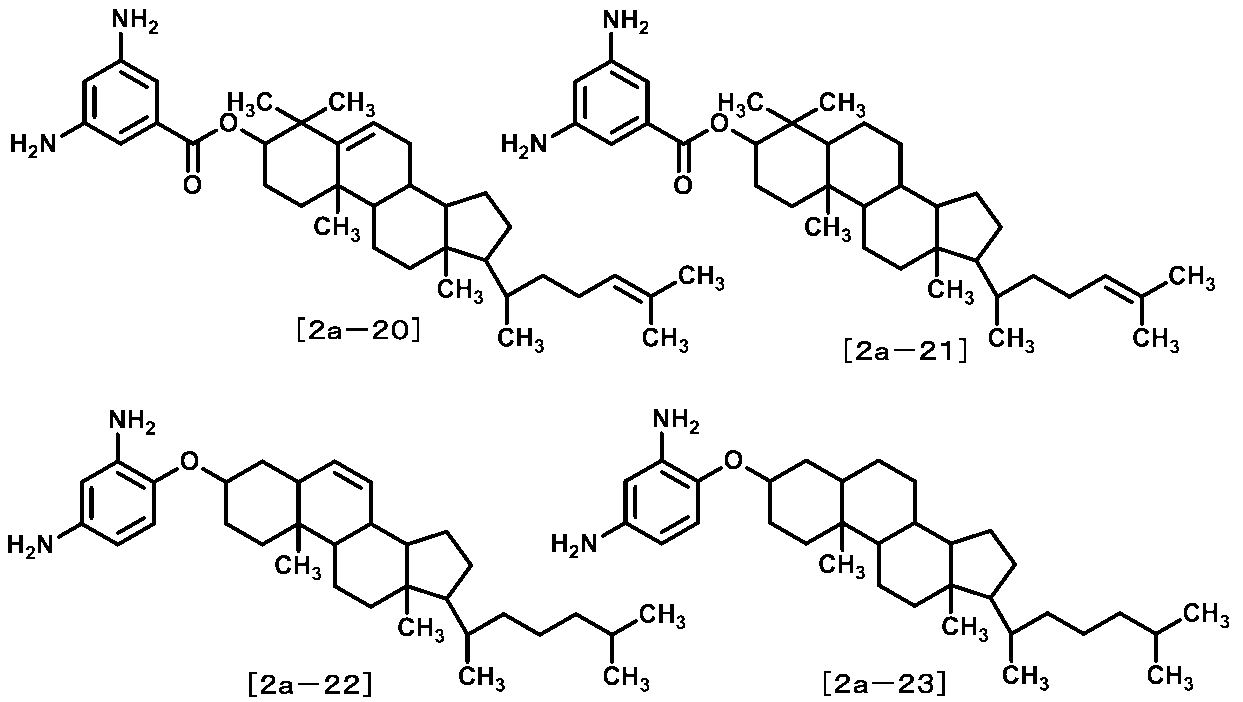

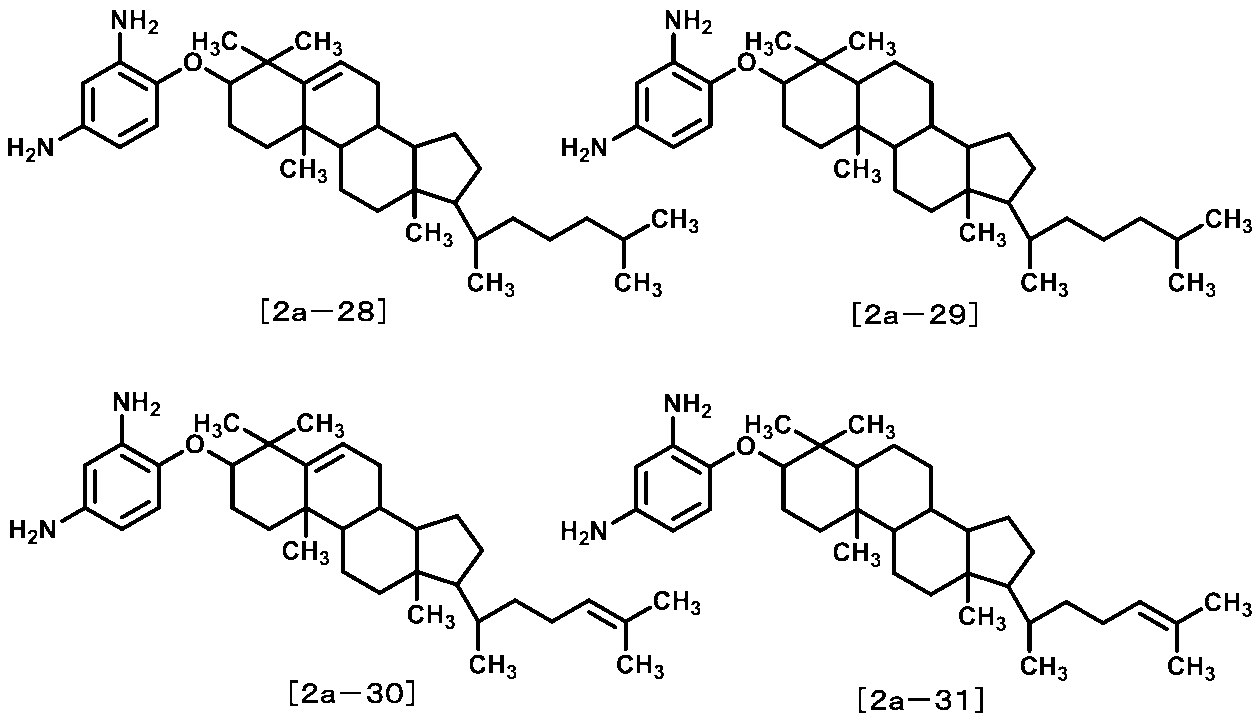
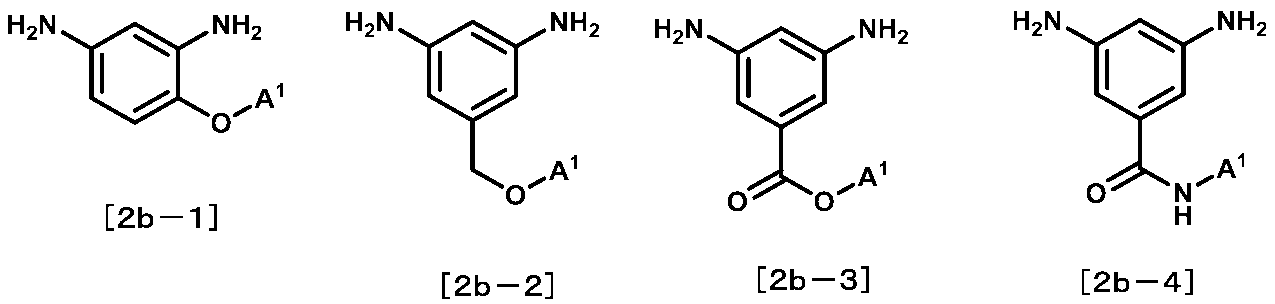
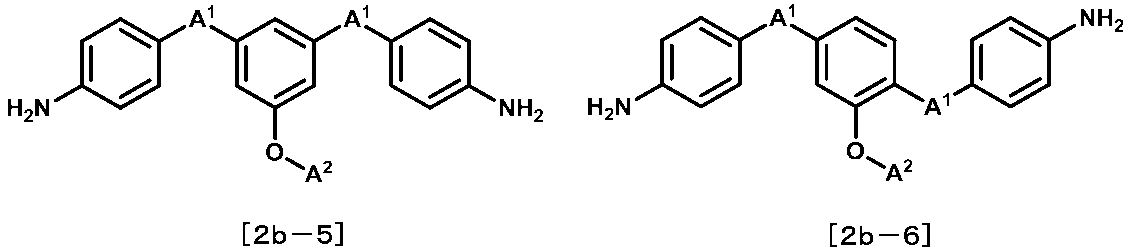

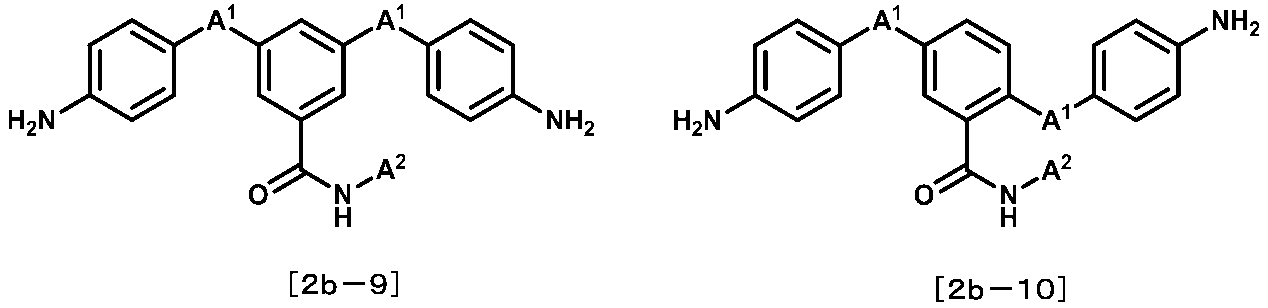
光反応性を有する側鎖をポリイミド系重合体に導入する方法は、特定側鎖構造を有するジアミンをジアミン成分の一部に用いることが好ましい。光反応性の側鎖を有するジアミンとしては、式[VIII]、又は式[IX]で表される側鎖を有するジアミンである。
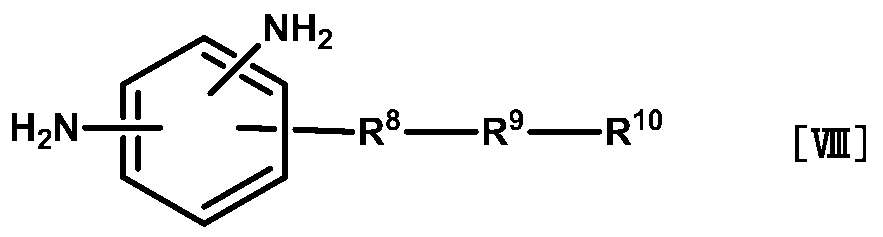


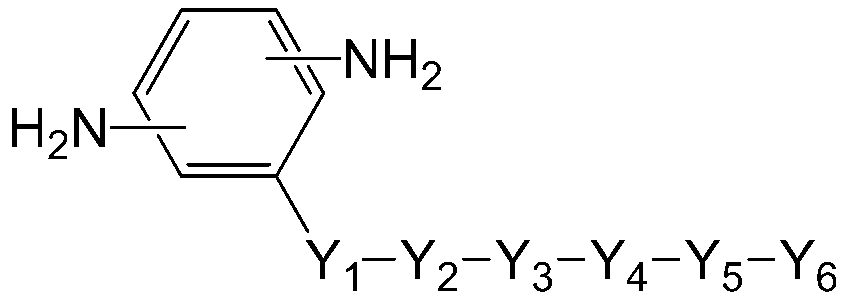
なお、ポリイミド前駆体及び/又は、ポリイミドを製造する場合、本発明の効果を損わない限りにおいて、上記したジアミン以外のその他のジアミンをジアミン成分として併用することができる。具体的には、例えば、p-フェニレンジアミン、2,3,5,6-テトラメチル-p-フェニレンジアミン、2,5-ジメチル-p-フェニレンジアミン、m-フェニレンジアミン、2,4-ジメチル-m-フェニレンジアミン、2,5-ジアミノトルエン、2,6-ジアミノトルエン、2,5-ジアミノフェノール、2,4-ジアミノフェノール、3,5-ジアミノフェノール、3,5-ジアミノベンジルアルコール、2,4-ジアミノベンジルアルコール、4,6-ジアミノレゾルシノール、4,4’-ジアミノビフェニル、3,3’-ジメチル-4,4’-ジアミノビフェニル、3,3’-ジメトキシ-4,4’-ジアミノビフェニル、3,3’-ジヒドロキシ-4,4’-ジアミノビフェニル、3,3’-ジカルボキシ-4,4’-ジアミノビフェニル、3,3’-ジフルオロ-4,4’-ビフェニル、3,3’-トリフルオロメチル-4,4’-ジアミノビフェニル、3,4’-ジアミノビフェニル、3,3’-ジアミノビフェニル、2,2’-ジアミノビフェニル、2,3’-ジアミノビフェニル、4,4’-ジアミノジフェニルメタン、3,3’-ジアミノジフェニルメタン、3,4’-ジアミノジフェニルメタン、2,2’-ジアミノジフェニルメタン、2,3’-ジアミノジフェニルメタン、4,4’-ジアミノジフェニルエーテル、3,3’-ジアミノジフェニルエーテル、3,4’-ジアミノジフェニルエーテル、2,2’-ジアミノジフェニルエーテル、2,3’-ジアミノジフェニルエーテル、4,4’-スルホニルジアニリン、3,3’-スルホニルジアニリン、ビス(4-アミノフェニル)シラン、ビス(3-アミノフェニル)シラン、ジメチル-ビス(4-アミノフェニル)シラン、ジメチル-ビス(3-アミノフェニル)シラン、4,4’-チオジアニリン、3,3’-チオジアニリン、4,4’-ジアミノジフェニルアミン、3,3’-ジアミノジフェニルアミン、3,4’-ジアミノジフェニルアミン、2,2’-ジアミノジフェニルアミン、2,3’-ジアミノジフェニルアミン、N-メチル(4,4’-ジアミノジフェニル)アミン、N-メチル(3,3’-ジアミノジフェニル)アミン、N-メチル(3,4’-ジアミノジフェニル)アミン、N-メチル(2,2’-ジアミノジフェニル)アミン、N-メチル(2,3’-ジアミノジフェニル)アミン、4,4’-ジアミノベンゾフェノン、3,3’-ジアミノベンゾフェノン、3,4’-ジアミノベンゾフェノン、1,4-ジアミノナフタレン、2,2’-ジアミノベンゾフェノン、2,3’-ジアミノベンゾフェノン、1,5-ジアミノナフタレン、1,6-ジアミノナフタレン、1,7-ジアミノナフタレン、1,8-ジアミノナフタレン、2,5-ジアミノナフタレン、2,6-ジアミノナフタレン、2,7-ジアミノナフタレン、2,8-ジアミノナフタレン、1,2-ビス(4-アミノフェニル)エタン、1,2-ビス(3-アミノフェニル)エタン、1,3-ビス(4-アミノフェニル)プロパン、1,3-ビス(3-アミノフェニル)プロパン、1,4-ビス(4-アミノフェニル)ブタン、1,4-ビス(3-アミノフェニル)ブタン、ビス(3,5-ジエチル-4-アミノフェニル)メタン、1,4-ビス(4-アミノフェノキシ)ベンゼン、1,3-ビス(4-アミノフェノキシ)ベンゼン、1,4-ビス(4-アミノフェニル)ベンゼン、1,3-ビス(4-アミノフェニル)ベンゼン、1,4-ビス(4-アミノベンジル)ベンゼン、1,3-ビス(4-アミノフェノキシ)ベンゼン、4,4’-[1,4-フェニレンビス(メチレン)]ジアニリン、4,4’-[1,3-フェニレンビス(メチレン)]ジアニリン、3,4’-[1,4-フェニレンビス(メチレン)]ジアニリン、3,4’-[1,3-フェニレンビス(メチレン)]ジアニリン、3,3’-[1,4-フェニレンビス(メチレン)]ジアニリン、3,3’-[1,3-フェニレンビス(メチレン)]ジアニリン、1,4-フェニレンビス[(4-アミノフェニル)メタノン]、1,4-フェニレンビス[(3-アミノフェニル)メタノン]、1,3-フェニレンビス[(4-アミノフェニル)メタノン]、1,3-フェニレンビス[(3-アミノフェニル)メタノン]、1,4-フェニレンビス(4-アミノベンゾエート)、1,4-フェニレンビス(3-アミノベンゾエート)、1,3-フェニレンビス(4-アミノベンゾエート)、1,3-フェニレンビス(3-アミノベンゾエート)、ビス(4-アミノフェニル)テレフタレート、ビス(3-アミノフェニル)テレフタレート、ビス(4-アミノフェニル)イソフタレート、ビス(3-アミノフェニル)イソフタレート、N,N’-(1,4-フェニレン)ビス(4-アミノベンズアミド)、N,N’-(1,3-フェニレン)ビス(4-アミノベンズアミド)、N,N’-(1,4-フェニレン)ビス(3-アミノベンズアミド)、N,N’-(1,3-フェニレン)ビス(3-アミノベンズアミド)、N,N’-ビス(4-アミノフェニル)テレフタルアミド、N,N’-ビス(3-アミノフェニル)テレフタルアミド、N,N’-ビス(4-アミノフェニル)イソフタルアミド、N,N’-ビス(3-アミノフェニル)イソフタルアミド、9,10-ビス(4-アミノフェニル)アントラセン、4,4’-ビス(4-アミノフェノキシ)ジフェニルスルホン、2,2’-ビス[4-(4-アミノフェノキシ)フェニル]プロパン、2,2’-ビス[4-(4-アミノフェノキシ)フェニル]ヘキサフルオロプロパン、2,2’-ビス(4-アミノフェニル)ヘキサフルオロプロパン、2,2’-ビス(3-アミノフェニル)ヘキサフルオロプロパン、2,2’-ビス(3-アミノ-4-メチルフェニル)ヘキサフルオロプロパン、2,2’-ビス(4-アミノフェニル)プロパン、2,2’-ビス(3-アミノフェニル)プロパン、2,2’-ビス(3-アミノ-4-メチルフェニル)プロパン、3,5-ジアミノ安息香酸、2,5-ジアミノ安息香酸、1,3-ビス(4-アミノフェノキシ)プロパン、1,3-ビス(3-アミノフェノキシ)プロパン、1,4-ビス(4-アミノフェノキシ)ブタン、1,4-ビス(3-アミノフェノキシ)ブタン、1,5-ビス(4-アミノフェノキシ)ペンタン、1,5-ビス(3-アミノフェノキシ)ペンタン、1,6-ビス(4-アミノフェノキシ)へキサン、1,6-ビス(3-アミノフェノキシ)へキサン、1,7-ビス(4-アミノフェノキシ)ヘプタン、1,7-(3-アミノフェノキシ)ヘプタン、1,8-ビス(4-アミノフェノキシ)オクタン、1,8-ビス(3-アミノフェノキシ)オクタン、1,9-ビス(4-アミノフェノキシ)ノナン、1,9-ビス(3-アミノフェノキシ)ノナン、1,10-(4-アミノフェノキシ)デカン、1,10-(3-アミノフェノキシ)デカン、1,11-(4-アミノフェノキシ)ウンデカン、1,11-(3-アミノフェノキシ)ウンデカン、1,12-(4-アミノフェノキシ)ドデカン、1,12-(3-アミノフェノキシ)ドデカンなどの芳香族ジアミン、ビス(4-アミノシクロヘキシル)メタン、ビス(4-アミノ-3-メチルシクロヘキシル)メタンなどの脂環式ジアミン、1,3-ジアミノプロパン、1,4-ジアミノブタン、1,5-ジアミノペンタン、1,6-ジアミノへキサン、1,7-ジアミノヘプタン、1,8-ジアミノオクタン、1,9-ジアミノノナン、1,10-ジアミノデカン、1,11-ジアミノウンデカン、1,12-ジアミノドデカンなどの脂肪族ジアミンが挙げられる。
上記のジアミン成分と反応させるテトラカルボン酸二無水物成分は特に限定されない。具体的には、ピロメリット酸、2,3,6,7-ナフタレンテトラカルボン酸、1,2,5,6-ナフタレンテトラカルボン酸、1,4,5,8-ナフタレンテトラカルボン酸、2,3,6,7-アントラセンテトラカルボン酸、1,2,5,6-アントラセンテトラカルボン酸、3,3’,4,4’-ビフェニルテトラカルボン酸、2,3,3’,4-ビフェニルテトラカルボン酸、ビス(3,4-ジカルボキシフェニル)エーテル、3,3’,4,4’-ベンゾフェノンテトラカルボン酸、ビス(3,4-ジカルボキシフェニル)スルホン、ビス(3,4-ジカルボキシフェニル)メタン、2,2-ビス(3,4-ジカルボキシフェニル)プロパン、1,1,1,3,3,3-ヘキサフルオロ-2,2-ビス(3,4-ジカルボキシフェニル)プロパン、ビス(3,4-ジカルボキシフェニル)ジメチルシラン、ビス(3,4-ジカルボキシフェニル)ジフェニルシラン、2,3,4,5-ピリジンテトラカルボン酸、2,6-ビス(3,4-ジカルボキシフェニル)ピリジン、3,3’,4,4’-ジフェニルスルホンテトラカルボン酸、3,4,9,10-ペリレンテトラカルボン酸、1,3-ジフェニル-1,2,3,4-シクロブタンテトラカルボン酸、オキシジフタルテトラカルボン酸、1,2,3,4-シクロブタンテトラカルボン酸、1,2,3,4-シクロペンタンテトラカルボン酸、1,2,4,5-シクロヘキサンテトラカルボン酸、1,2,3,4-テトラメチル-1,2,3,4-シクロブタンテトラカルボン酸、1,2-ジメチル-1,2,3,4-シクロブタンテトラカルボン酸、1,3-ジメチル-1,2,3,4-シクロブタンテトラカルボン酸、1,2,3,4-シクロヘプタンテトラカルボン酸、2,3,4,5-テトラヒドロフランテトラカルボン酸、3,4-ジカルボキシ-1-シクロへキシルコハク酸、2,3,5-トリカルボキシシクロペンチル酢酸、3,4-ジカルボキシ-1,2,3,4-テトラヒドロ-1-ナフタレンコハク酸、ビシクロ[3,3,0]オクタン-2,4,6,8-テトラカルボン酸、ビシクロ[4,3,0]ノナン-2,4,7,9-テトラカルボン酸、ビシクロ[4,4,0]デカン-2,4,7,9-テトラカルボン酸、ビシクロ[4,4,0]デカン-2,4,8,10-テトラカルボン酸、トリシクロ[6.3.0.0<2,6>]ウンデカン-3,5,9,11-テトラカルボン酸、1,2,3,4-ブタンテトラカルボン酸、4-(2,5-ジオキソテトラヒドロフラン-3-イル)-1,2,3,4-テトラヒドリナフタレン-1,2-ジカルボン酸、ビシクロ[2,2,2]オクト-7-エン-2,3,5,6-テトラカルボン酸、5-(2,5-ジオキソテトラヒドロフリル)-3-メチル-3-シクロへキサン-1,2-ジカルボン酸、テトラシクロ[6,2,1,1,0,2,7]ドデカ-4,5,9,10-テトラカルボン酸、3,5,6-トリカルボキシノルボルナン-2:3,5:6ジカルボン酸、1,2,4,5-シクロヘキサンテトラカルボン酸等が挙げられる。勿論、テトラカルボン酸二無水物も、液晶配向膜にした際の液晶配向性、電圧保持特性、蓄積電荷などの特性に応じて、1種類又は2種類以上併用してもよい。
本発明の液晶配向剤には、必要に応じ、2つ以上の末端に光重合又は光架橋する基を有する重合性化合物を含有しても良い。かかる重合性化合物は、光重合又は光架橋する基を有する末端を二つ以上持っている化合物である。ここで、光重合する基を有する重合性化合物とは、光を照射することにより重合を生じさせる官能基を有する化合物である。また、光架橋する基を有する化合物とは、光を照射することにより、重合性化合物の重合体や、ポリイミド前駆体、及び、このポリイミド前駆体をイミド化して得られるポリイミドから選択される少なくとも一種の重合体と反応してこれらと架橋することができる官能基を有する化合物である。なお、光架橋する基を有する化合物は、光架橋する基を有する化合物同士でも反応する。







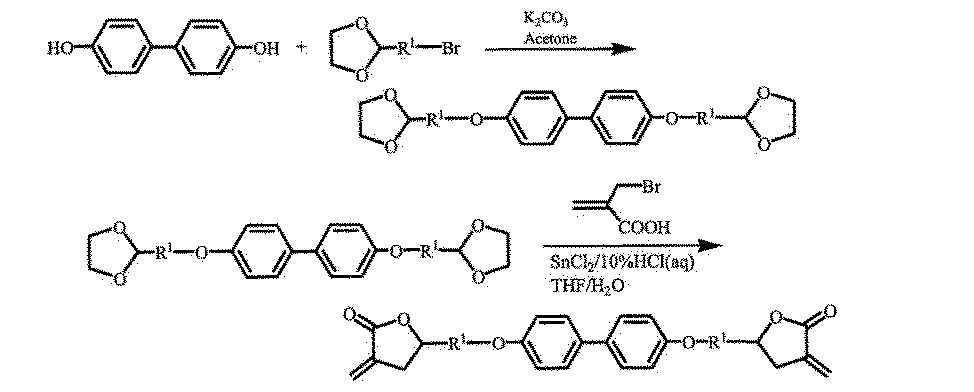
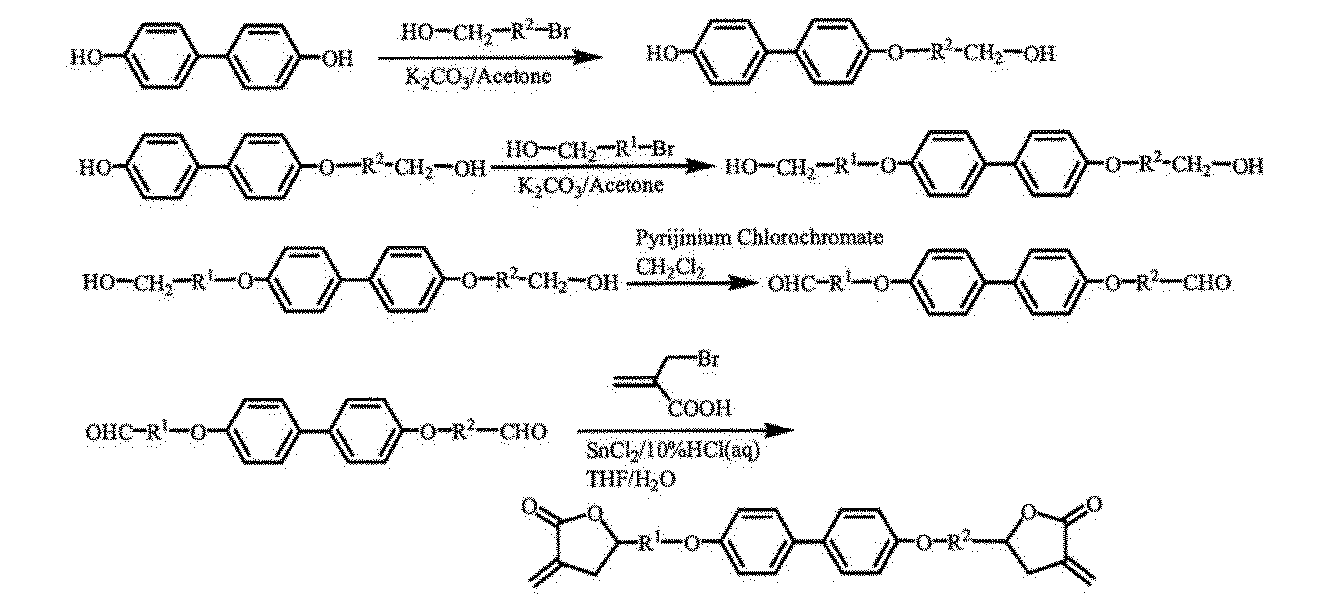

ジアミン成分とテトラカルボン酸二無水物との反応により、ポリアミック酸を得るにあたっては、公知の合成手法を用いることができる。一般的には、ジアミン成分とテトラカルボン酸二無水物成分とを有機溶媒中で反応させる方法である。ジアミン成分とテトラカルボン酸二無水物との反応は、有機溶媒中で比較的容易に進行し、かつ副生成物が発生しない点で有利である。
本発明の剤は上記式(I)で表される構造を側鎖に有する少なくとも1つの重合体を含有するが、かかる重合体の含有量は1~20質量%が好ましく、より好ましくは3~15質量%、特に好ましくは3~10質量%である。また、2つ以上の末端に光重合又は光架橋する基をそれぞれ有する重合性化合物を含有する場合、その含有量は、上記重合体100質量部に対して、1~50質量部が好ましく、さらに好ましくは5~30質量部である。
本発明の液晶表示素子は、上記の方法により、基板に液晶配向膜を形成した後、公知の方法で液晶セルを作製できる。液晶表示素子の具体例としては、対向するように配置された2枚の基板と、基板間に設けられた液晶層と、基板と液晶層との間に設けられ本発明の液晶配向剤により形成された上記液晶配向膜とを有する液晶セルを具備する垂直配向方式の液晶表示素子である。具体的には、本発明の液晶配向剤を2枚の基板上に塗布して焼成することにより液晶配向膜を形成し、この液晶配向膜が対向するように2枚の基板を配置し、この2枚の基板の間に液晶で構成された液晶層を挟持し、すなわち、液晶配向膜に接触させて液晶層を設け、液晶配向膜及び液晶層に電圧を印加しながら紫外線を照射することで作製される液晶セルを具備する垂直配向方式の液晶表示素子である。

(合成例1)2-(2-(2,4-ジアミノフェノキシ)エチル)-4,5,6,7-テトラヒドロ-1H-イソインドール-1,3-(2H)-ジオンの合成


500ml四口フラスコに撹拌子、窒素導入管、還流管を取り付け、2,4-ジニトロフルオロベンゼン(50.0g:268.73mmol)、2-ブロモエタノール(41.7g:322.4mmol)を測り取り、THF300gとトリエチルアミン(32.6g:322.4mmol)を加え、窒素雰囲気下60℃にて24時間反応させた。
500ml四口フラスコに撹拌子、窒素導入管、還流管を取り付け、第1工程にて得られた2-(2,4-ジニトロフェノキシ)ブロモエタン(50.0g:171.8mmol)、フタルイミドカリウム(31.8g:171.8mmol)を測り取り、DMF300mlを加え、窒素雰囲気下80℃にて3時間反応させた。
1000ml四口フラスコに三方コック、撹拌子を取り付け、第2工程で得られたジニトロ体(50.0g:140.0mmol)、10%パラジウムカーボンを5.0g測り取り、THFを500g加え、数回窒素置換を行い、更に水素ガス雰囲気にし、60℃にて24時間反応させた。
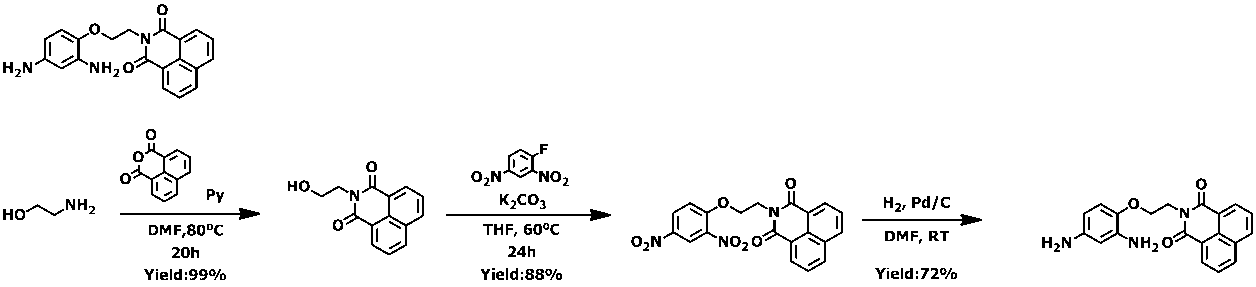
300mlの四口フラスコに撹拌子、窒素導入管、ディーン・スターク装置を設置し、ナフタレン-1,8-ジカルボン酸無水物(25.0g:126.2mmol)を測り取り、トルエンを200g加え、次に2-エタノールアミン(7.7g:126.2mmol)をゆっくり加え30分撹拌した後、ピリジン(5.0g:63.1mmol)を加え、20時間反応させた。
300ml四口フラスコに撹拌子、窒素導入管、還流管を取り付け、2,4-ジニトロフルオロベンゼン(11.6g:62.2mmol)と第1工程にて得た2-(2-ヒドロキシエチル)-1H-ベンゾイソキノリン-1,3(2H)-ジオン(15.0g:62.2mmol)を測り取り、THF200gにて溶解させ、トリエチルアミン(9.4g:93.3mmol)を加え、窒素雰囲気下で24時間還流させた。反応が進むに従い固体が析出してくる。原料消失を確認後、反応溶液をろ過することにより祖物固体を回収し、祖物固体をメタノール300mlにて加熱洗浄を行い、真空乾燥させることにより目的物として黄色固体22.3g(88.0%)を得た。
500mL四口フラスコに三方コック、撹拌子を取り付け、第2工程で得られたジニトロ体(20.0g:49.1mmol)、10%パラジウムカーボンを2.0g測り取り、DMFを300g加え、数回窒素置換を行い、更に水素ガス雰囲気にし、室温にて24時間反応させた。
以下における略号は以下のとおりである。
BODA:ビシクロ[3,3,0]オクタン-2,4,6,8-テトラカルボン酸二無水物
CBDA:1,2,3,4-シクロブタンテトラカルボン酸二無水物
PMDA:ピロメリット酸無水物
TCA:2,3,5-トリカルボキシシクロペンチル酢酸-1,4,2,3-二無水物
p-PDA:p-フェニレンジアミン
DBA:3,5-ジアミノ安息香酸
3AMPDA:3,5-ジアミノ-N-(ピリジン-3-イルメチル)ベンズアミド
4DABP:下記に示すベンゾフェノン骨格を有するジアミン
BABP:下記に示すベンゾフェノン骨格を有するジアミン


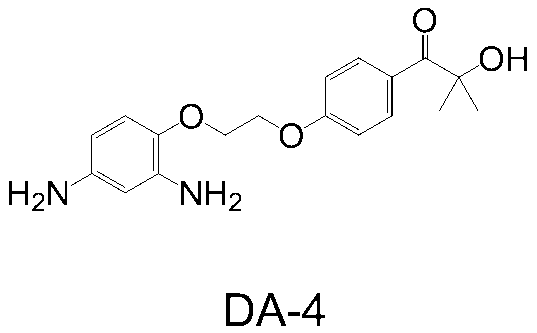
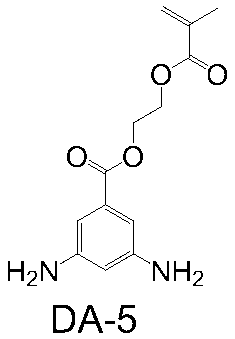
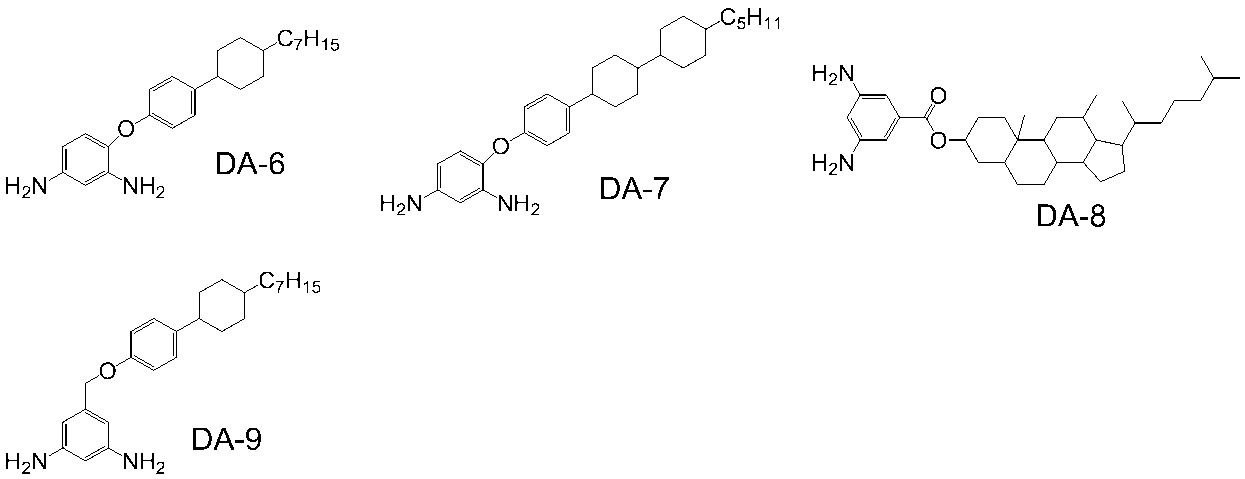
NMP:N-メチル-2-ピロリドン
BCS:ブチルセロソルブ
3AMP:3-ピコリルアミン
下記式RM1、RM2で表される重合性化合物

装置:センシュー科学社製 常温ゲル浸透クロマトグラフィー(GPC)装置(SSC-7200)、
カラム:Shodex社製カラム(KD-803、KD-805)
カラム温度:50℃
溶離液:N,N’-ジメチルホルムアミド(添加剤として、臭化リチウム-水和物(LiBr・H2O)が30mmol/L、リン酸・無水結晶(o-リン酸)が30mmol/L、テトラヒドロフラン(THF)が10ml/L)
流速:1.0ml/分
検量線作成用標準サンプル:東ソー社製 TSK 標準ポリエチレンオキサイド(分子量約9000,000、150,000、100,000、30,000)、及び、ポリマーラボラトリー社製 ポリエチレングリコール(分子量 約12,000、4,000、1,000)。
ポリイミド粉末20mgをNMRサンプル管(草野科学社製 NMRサンプリングチューブスタンダード φ5)に入れ、重水素化ジメチルスルホキシド(DMSO-d6、0.05%TMS混合品)1.0mlを添加し、超音波をかけて完全に溶解させた。この溶液を日本電子データム社製NMR測定器(JNW-ECA500)にて500MHzのプロトンNMRを測定した。イミド化率は、イミド化前後で変化しない構造に由来するプロトンを基準プロトンとして決め、このプロトンのピーク積算値と、9.5~10.0ppm付近に現れるアミック酸のNH基に由来するプロトンピーク積算値とを用い以下の式によって求めた。なお下記式において、xはアミック酸のNH基由来のプロトンピーク積算値、yは基準プロトンのピーク積算値、αはポリアミック酸(イミド化率が0%)の場合におけるアミック酸のNH基のプロトン1個に対する基準プロトンの個数割合である。
BODA(4.50g、18.0mmol)、p-PDA(0.97、9mmol)、DA-1(2.71g、9mmol)、DA-6(4.57g、12.0mmol)をNMP(51.0g)中に溶解し、60℃で4時間反応させた後、CBDA(2.31g、11.8mmol)とNMP(9.3g)を加え、40℃で10時間反応させポリアミック酸溶液を得た。
BODA(4.50g、18.0mmol)、p-PDA(0.97、9mmol)、DA-2(2.68g、9mmol)、DA-6(4.57g、12.0mmol)をNMP(51.3g)中に溶解し、60℃で4時間反応させた後、CBDA(2.31g、11.8mmol)とNMP(8.8g)を加え、40℃で10時間反応させポリアミック酸溶液を得た。
BODA(4.50g、18.0mmol)、p-PDA(0.97、9mmol)、DA-3(3.13g、9mmol)、DA-6(4.57g、12.0mmol)をNMP(52.6g)中に溶解し、60℃で4時間反応させた後、CBDA(2.31g、11.8mmol)とNMP(9.3g)を加え、40℃で10時間反応させポリアミック酸溶液を得た。
BODA(1.5g、6mmol)、DBA(1.83、12mmol)、3AMPDA(2.18g、9mmol)、DA-6(3.43g、9mmol)をNMP(35.7g)中に溶解し、60℃で4時間反応させた後、CBD(3.46g、17.6mmol)とNMP(10.0g)を加え、40℃で2時間反応させた。その後、PMDA(1.31g、0.06mmol)とNMP(9.1g)を加え、室温で10時間撹拌させポリアミック酸溶液を得た。
TCA(3.4g、15.0mmol)、3AMPDA(2.54g、10.5mmol)、DA-2(3.57g、12.0mmol)、DA-8(3.92g、7.5mmol)をNMP(56.4g)中で溶解し、80℃で5時間反応させたのち、CBDA(2.89g、14.8mmol)とNMP(8.8g)を加え、40℃で10時間反応させポリアミック酸溶液を得た。
BODA(2.0g、8.0mmol)、DA-5(1.6g、6.0mmol)、DA-2(2.4g、8.0mmol)、DA-7(2.6g、6.0mmol)をNMP(34.3g)中で溶解し、60℃で3時間反応させたのち、CBDA(2.3g、11.8mmol)とNMP(9.3g)を加え、室温で10時間反応させポリアミック酸溶液を得た。
BODA(3.5g、12.0mmol)、3AMPDA(1.2、5.0mmol)、DA-2(2.4g、8.0mmol)、DA-9(2.8g、7.0mmol)をNMP(37.6g)中に溶解し、60℃で4時間反応させた後、CBDA(3.0g、7.7mmol)とNMP(5.9g)を加え、40℃で10時間反応させポリアミック酸溶液を得た。
BODA(4.50g、18.0mmol)、p-PDA(1.95、18mmol)、DA-6(4.57g、12.0mmol)をNMP(44.0g)中に溶解し、40℃で3時間反応させた後、CBDA(2.28g、11.6mmol)とNMP(9.3g)を加え、40℃で10時間反応させポリアミック酸溶液を得た。
BODA(4.50g、18.0mmol)、p-PDA(0.97、9mmol)、DA-4(2.97、9mmol)、DA-6(4.57g、12.0mmol)をNMP(50.8g)中に溶解し、60℃で4時間反応させた後、CBDA(2.31g、11.8mmol)とNMP(10.5g)を加え、40℃で10時間反応させポリアミック酸溶液を得た。
BODA(3.5g、12.0mmol)、p-PDA(0.6g、6.0mmol)、4DABP(1.3g、6.0mmol)、DA-6(3.0g、8.0mmol)をNMP(32.0g)中に溶解し、60℃で4時間反応させた後、CBDA(1.5g、7.7mmol)とNMP(6.0g)を加え、40℃で10時間反応させポリアミック酸溶液を得た。
BODA(3.0g、12.0mmol)、p-PDA(0.7g、6.0mmol)、BABP(2.4g、6.0mmol)、DA-6(3.0g、8.0mmol)をNMP(32.0g)中に溶解し、60℃で4時間反応させた後、CBDA(1.5g、7.7mmol)とNMP(6.0g)を加え、40℃で10時間反応させポリアミック酸溶液を得た。
(実施例8)
実施例1で得られた液晶配向剤(A1)を用いて下記に示すような手順で液晶セルの作製を行った。実施例1で得られた液晶配向剤(A1)を、画素サイズが100μm×300μmでライン/スペースがそれぞれ5μmのITO電極パターンが形成されているITO電極基板のITO面にスピンコートし、80℃のホットプレートで90秒間乾燥した後、200℃の熱風循環式オーブンで30分間焼成を行い、膜厚100nmの液晶配向膜を形成した。
まず、バックライト、クロスニコルの状態にした一組の偏光版、光量検出器の順で構成される測定装置において、一組の偏光版の間に液晶セルを配置した。このときライン/スペースが形成されているITO電極のパターンがクロスニコルに対して45°の角度になるようにした。そして、上記の液晶セルに電圧±6V、周波数1kHzの矩形波を印加し、光量検出器によって観測される輝度が飽和するまでの変化をオシロスコープにて取り込み、電圧を印加していない時の輝度を0%、±4Vの電圧を印加し、飽和した輝度の値を100%として、輝度が10%から90%まで変化するのにかかる時間を応答速度とした。
名菱テクニカ社製LCDアナライザーLCA-LUV42Aを使用した。
液晶配向剤(A1)の代わりに、それぞれ、表1に示される液晶配向剤を用いた以外は実施例8と同様の操作を行って、UV照射前後での応答速度、及びプレチルト角の測定を行なった。これらの結果を表1にまとめて示す。
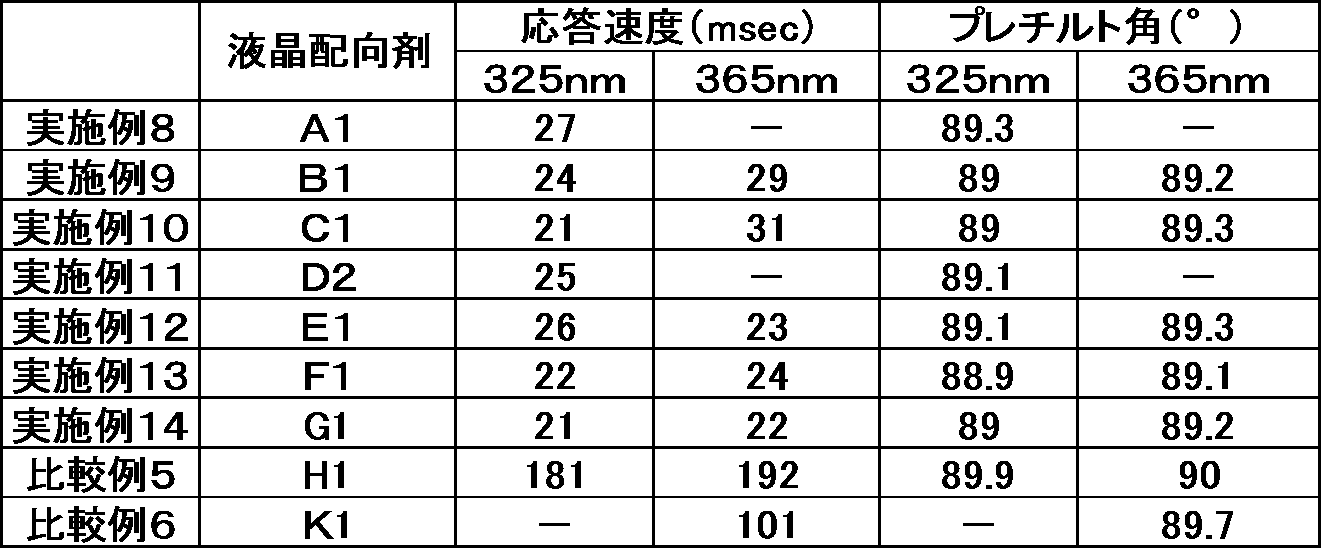
(実施例15)
実施例2で得られた液晶配向剤(B2)を用いて下記に示すような手順で液晶セルの作製を行った。実施例1で得られた液晶配向剤(B2)を、画素サイズが100μm×300μmでライン/スペースがそれぞれ5μmのITO電極パターンが形成されているITO電極基板のITO面にスピンコートし、80℃のホットプレートで90秒間乾燥した後、200℃の熱風循環式オーブンで30分間焼成を行い、膜厚100nmの液晶配向膜を形成した。
液晶配向剤(B2)の代わりに、それぞれ、表1に示される液晶配向剤を用いた以外は実施例8と同様の操作を行って、UV照射前後での応答速度、及びプレチルト角の測定を行なった。これらの結果を表2にまとめて示す。
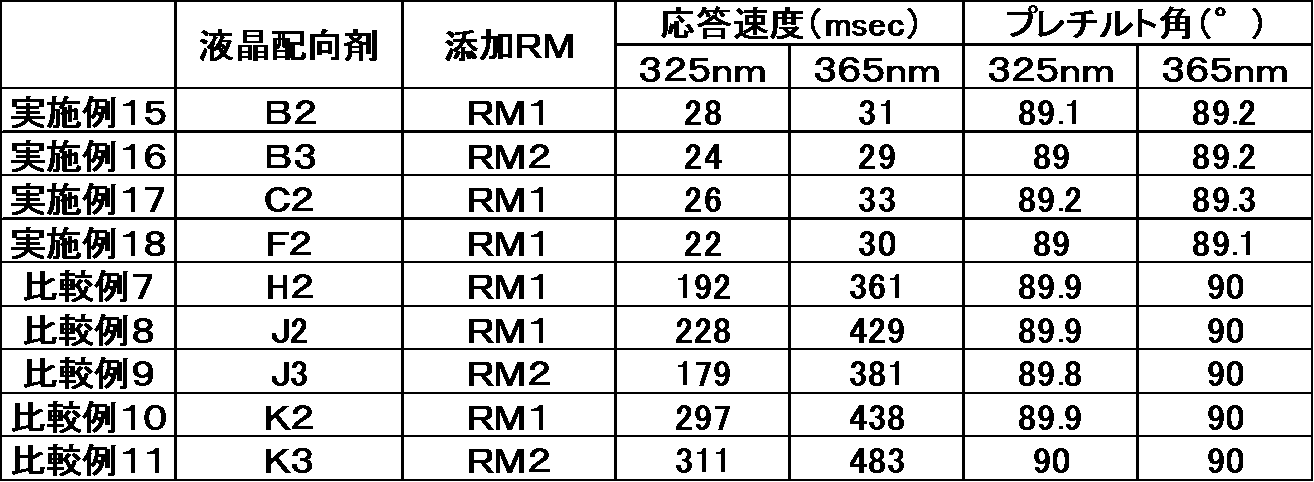
(実施例19)
実施例1で得られた液晶配向剤(A1)を用いて、上記に示す手法により、液晶セル外から365nmのバンドパスフィルターを用いてUVを15J照射して作成した液晶セルに、UV蛍光ランプを30分照射することにより、液晶セル中に残存するRMを十分反応させた後、60℃の温度下で1Vの電圧を60μs印加し、1667ms後の電圧を測定することで、電圧がどのくらい保持できているかを電圧保持率として計算した。これらの結果を表3に示す。
液晶配向剤(A1)の代わりに、それぞれ、表3に示される液晶配向剤を用いた以外は実施例19と同様の操作を行って、電圧保持率の測定を行なった。これらの結果を表3にまとめて示す。
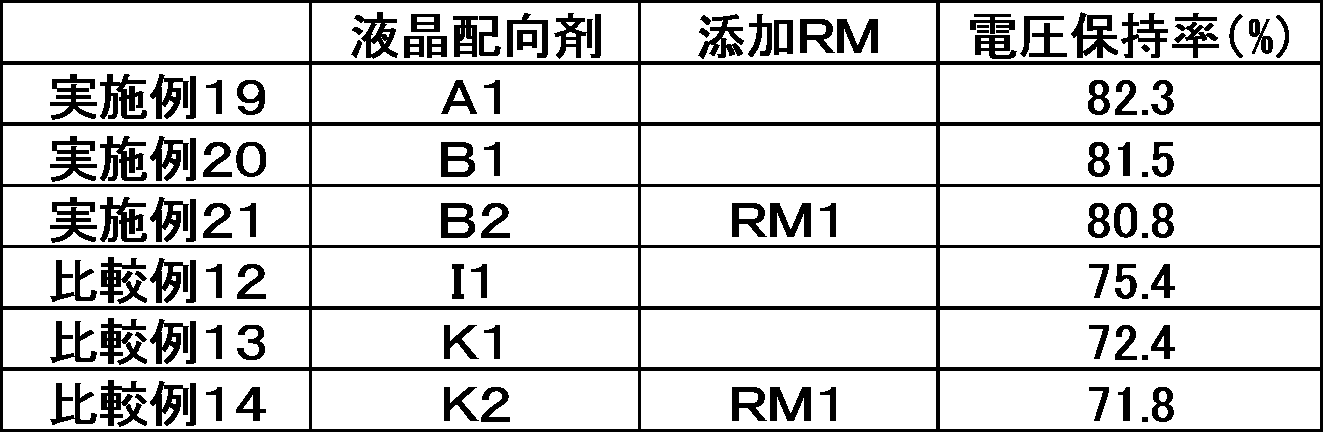
Claims (19)
- 下記式(I)で表される側鎖構造を有する重合体を含有することを特徴とする液晶配向剤。

- 前記式(I)で表される側鎖構造を有する重合体が、前記式(I)で表される側鎖構造を有するポリイミド前駆体及びそれをイミド化して得られるポリイミドからなる群から選ばれる少なくとも1つの重合体である請求項1に記載の液晶配向剤。
- 上記式(I)に記載の側鎖構造が下記式(II)で表される請求項1又は2に記載の液晶配向剤。
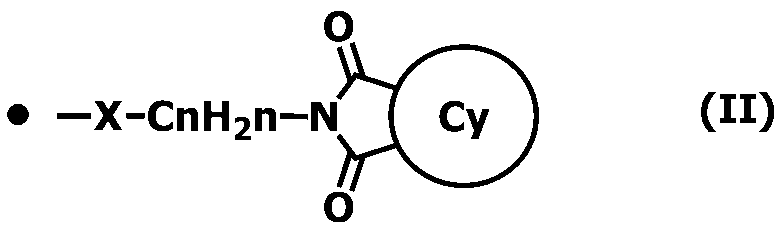
- 前記式(II)中のnが1~6の整数であり、Cyが以下に示す環状炭化水素基であって、2つの点はそれぞれイミドカルボニル炭素への結合を示す請求項3に記載の液晶配向剤。

- 前記式(II)中のnが1~6の整数であり、Xが-O-を表し、Cyがシクロヘキセン、ベンゼン、ナフタレン、ビフェニレンである請求項3又は請求項4に記載の液晶配向剤。
- 上記重合体が、液晶を垂直に配向させる側鎖を更に有する請求項1から請求項5のいずれか1項に記載の液晶配向剤。
- 上記液晶を垂直に配向させる側鎖が、下記式(III-1)及び(III-2)から選ばれる少なくとも1つである請求項6に記載の液晶配向剤。


- 上記重合体が、光反応性基を構造中に含む側鎖を更に有する請求項1から請求項7のいずれか1項に記載の液晶配向剤。
- 上記光反応性基を構造中に含む側鎖が、下記(IV)又は式(V)で表される請求項8に記載の液晶配向剤。



- 上記重合体が、下記式(VI)で表されるジアミン成分を構成単位として有するポリイミド前駆体及びそれをイミド化して得られるポリイミドのうち少なくとも1つの重合体を含有する請求項1から請求項9のいずれか1項に記載の液晶配向剤。

- 上記重合体が、さらに下記式(VII)で表されるジアミンを含有するジアミン成分を構成単位として有するポリイミド前駆体及びそれをイミド化して得られるポリイミドのうち少なくとも1つの重合体を含有する請求項10に記載の液晶配向剤。
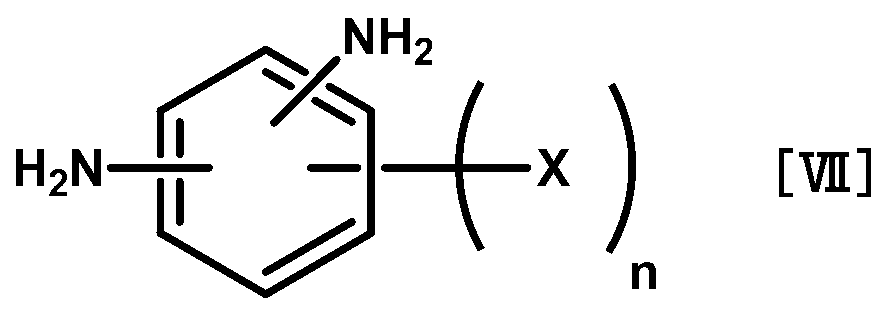
- 上記重合体が、さらに下記式(VIII)又は(IX)で表されるジアミンを含有するジアミン成分を構成単位として有するポリイミド前駆体及びそれをイミド化して得られるポリイミドのうち少なくとも1つの重合体を含有する請求項10または請求項11に記載の液晶配向剤。

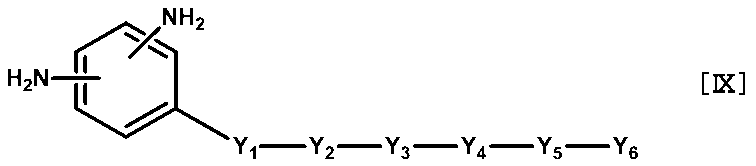
- 上記式(IV)で表されるジアミンが、全ジアミン成分の10モル%~80モル%である請求項10から請求項12のいずれか1項に記載の液晶配向剤。
- 液晶配向剤が、液晶中及び/又は液晶配向膜中に重合性化合物が含有し、電圧を印加しながら紫外線照射により上記重合性化合物が反応させて得られる液晶表示素子用である請求項1から請求項13のいずれか1項に記載の液晶配向剤。
- 請求項1から請求項14のいずれか1項に記載の液晶配向剤から得られる液晶配向膜。
- 請求項15に記載の液晶配向膜を具備する液晶表示素子。
- 液晶表示素子が、電圧を印加しながら紫外線照射により上記重合性化合物が反応させて得られる請求項16に記載の液晶表示素子。
- 下記式(II)で表される側鎖構造を含有するポリイミド前駆体及びそれをイミド化して得られるポリイミドのうち少なくとも1つの重合体。
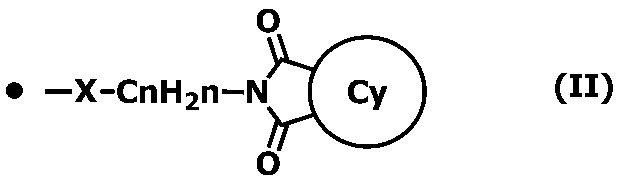
- 下記式で表されるジアミン。

Priority Applications (3)
| Application Number | Priority Date | Filing Date | Title |
|---|---|---|---|
| JP2017503719A JP6666598B2 (ja) | 2015-03-04 | 2016-03-03 | 液晶配向剤、液晶配向膜及び液晶表示素子 |
| KR1020177028126A KR102591733B1 (ko) | 2015-03-04 | 2016-03-03 | 액정 배향제, 액정 배향막 및 액정 표시 소자 |
| CN201680025666.XA CN107533260B (zh) | 2015-03-04 | 2016-03-03 | 液晶取向剂、液晶取向膜及液晶表示元件 |
Applications Claiming Priority (2)
| Application Number | Priority Date | Filing Date | Title |
|---|---|---|---|
| JP2015042877 | 2015-03-04 | ||
| JP2015-042877 | 2015-03-04 |
Publications (1)
| Publication Number | Publication Date |
|---|---|
| WO2016140328A1 true WO2016140328A1 (ja) | 2016-09-09 |
Family
ID=56848524
Family Applications (1)
| Application Number | Title | Priority Date | Filing Date |
|---|---|---|---|
| PCT/JP2016/056665 Ceased WO2016140328A1 (ja) | 2015-03-04 | 2016-03-03 | 液晶配向剤、液晶配向膜及び液晶表示素子 |
Country Status (5)
| Country | Link |
|---|---|
| JP (2) | JP6666598B2 (ja) |
| KR (1) | KR102591733B1 (ja) |
| CN (1) | CN107533260B (ja) |
| TW (1) | TWI596139B (ja) |
| WO (1) | WO2016140328A1 (ja) |
Cited By (4)
| Publication number | Priority date | Publication date | Assignee | Title |
|---|---|---|---|---|
| WO2018052105A1 (ja) * | 2016-09-16 | 2018-03-22 | 日産化学工業株式会社 | 液晶配向剤、液晶配向膜および液晶表示素子 |
| WO2018097155A1 (ja) * | 2016-11-22 | 2018-05-31 | 日産化学工業株式会社 | 液晶表示素子の製造方法並びに液晶表示素子用基板及び液晶表示素子組立体 |
| CN110770645A (zh) * | 2017-06-14 | 2020-02-07 | 日产化学株式会社 | 液晶取向剂、液晶取向膜及使用其的液晶表示元件以及该液晶取向膜的制造方法 |
| WO2021171939A1 (ja) * | 2020-02-26 | 2021-09-02 | 日産化学株式会社 | ポリイミドワニス |
Families Citing this family (4)
| Publication number | Priority date | Publication date | Assignee | Title |
|---|---|---|---|---|
| WO2019163904A1 (ja) * | 2018-02-23 | 2019-08-29 | 日産化学株式会社 | 液晶表示素子の製造方法 |
| CN108559528A (zh) * | 2018-04-20 | 2018-09-21 | 深圳市华星光电半导体显示技术有限公司 | 液晶介质混合物、液晶显示面板及液晶显示面板的制备方法 |
| CN109445194B (zh) * | 2018-11-21 | 2021-04-27 | 武汉华星光电技术有限公司 | 一种量子点液晶面板及其制备方法 |
| CN117467453B (zh) * | 2023-04-27 | 2025-12-16 | 广州华星光电半导体显示技术有限公司 | 液晶取向剂、液晶取向膜、液晶显示面板及液晶取向膜的制造方法 |
Citations (3)
| Publication number | Priority date | Publication date | Assignee | Title |
|---|---|---|---|---|
| JP2000230048A (ja) * | 1999-02-12 | 2000-08-22 | Ube Ind Ltd | 可溶性ポリイミドおよびその製造法 |
| JP2014112196A (ja) * | 2012-11-07 | 2014-06-19 | Jsr Corp | 液晶配向剤 |
| WO2015076219A1 (ja) * | 2013-11-25 | 2015-05-28 | Jsr株式会社 | 液晶表示素子および感放射線性樹脂組成物 |
Family Cites Families (15)
| Publication number | Priority date | Publication date | Assignee | Title |
|---|---|---|---|---|
| JPS5268184A (en) * | 1975-11-28 | 1977-06-06 | Mitsubishi Chem Ind Ltd | Preparation of 4,5-disulfornaphthalimides |
| JP2921760B2 (ja) * | 1997-05-21 | 1999-07-19 | 日本たばこ産業株式会社 | フタルイミド誘導体及びそれら誘導体を含んでなる医薬 |
| JP4168593B2 (ja) * | 1998-07-29 | 2008-10-22 | チッソ株式会社 | 新規なジアミノ化合物、ポリアミド酸、ポリイミド、該ポリイミド膜を用いた液晶配向膜、および該配向膜を用いた液晶表示素子 |
| US6808766B1 (en) * | 1998-08-26 | 2004-10-26 | Nissan Chemical Industries, Ltd. | Liquid crystal alignment agent and liquid crystal device using the liquid crystal alignment and method for alignment of liquid crystal molecules |
| JP4175826B2 (ja) | 2002-04-16 | 2008-11-05 | シャープ株式会社 | 液晶表示装置 |
| JP4415740B2 (ja) * | 2004-04-20 | 2010-02-17 | Jsr株式会社 | 垂直配向型の液晶配向剤および液晶表示素子 |
| KR100782437B1 (ko) * | 2005-12-30 | 2007-12-05 | 제일모직주식회사 | 액정 배향제 |
| JP5245329B2 (ja) * | 2006-09-15 | 2013-07-24 | Jnc株式会社 | 液晶配向剤、液晶配向膜および液晶表示素子 |
| JP4507024B2 (ja) * | 2007-10-24 | 2010-07-21 | Jsr株式会社 | 液晶配向剤、液晶配向膜の形成方法および液晶表示素子 |
| TWI427104B (zh) * | 2010-10-26 | 2014-02-21 | Chi Mei Corp | 液晶配向劑,液晶配向膜,及含有該液晶配向膜的液晶顯示元件 |
| JP6146577B2 (ja) * | 2011-12-28 | 2017-06-14 | 日産化学工業株式会社 | 液晶配向剤、液晶配向膜及び液晶表示素子 |
| KR101986398B1 (ko) * | 2011-12-28 | 2019-06-05 | 닛산 가가쿠 가부시키가이샤 | 액정 배향제, 액정 배향막, 액정 표시 소자 및 액정 표시 소자의 제조 방법 |
| KR102012060B1 (ko) * | 2012-02-03 | 2019-10-14 | 닛산 가가쿠 가부시키가이샤 | 액정 배향 처리제, 액정 배향막 및 액정 표시 소자 |
| WO2015022980A1 (ja) * | 2013-08-14 | 2015-02-19 | 日産化学工業株式会社 | 液晶表示素子 |
| JP5761428B2 (ja) * | 2014-06-05 | 2015-08-12 | 日産化学工業株式会社 | 新規なジアミン化合物 |
-
2016
- 2016-03-03 JP JP2017503719A patent/JP6666598B2/ja active Active
- 2016-03-03 WO PCT/JP2016/056665 patent/WO2016140328A1/ja not_active Ceased
- 2016-03-03 KR KR1020177028126A patent/KR102591733B1/ko active Active
- 2016-03-03 CN CN201680025666.XA patent/CN107533260B/zh active Active
- 2016-03-04 TW TW105106738A patent/TWI596139B/zh active
-
2019
- 2019-12-27 JP JP2019238670A patent/JP6864271B2/ja active Active
Patent Citations (3)
| Publication number | Priority date | Publication date | Assignee | Title |
|---|---|---|---|---|
| JP2000230048A (ja) * | 1999-02-12 | 2000-08-22 | Ube Ind Ltd | 可溶性ポリイミドおよびその製造法 |
| JP2014112196A (ja) * | 2012-11-07 | 2014-06-19 | Jsr Corp | 液晶配向剤 |
| WO2015076219A1 (ja) * | 2013-11-25 | 2015-05-28 | Jsr株式会社 | 液晶表示素子および感放射線性樹脂組成物 |
Cited By (13)
| Publication number | Priority date | Publication date | Assignee | Title |
|---|---|---|---|---|
| JP7022350B2 (ja) | 2016-09-16 | 2022-02-18 | 日産化学株式会社 | 液晶配向剤、液晶配向膜および液晶表示素子 |
| CN109716222A (zh) * | 2016-09-16 | 2019-05-03 | 日产化学株式会社 | 液晶取向剂、液晶取向膜和液晶表示元件 |
| JPWO2018052105A1 (ja) * | 2016-09-16 | 2019-06-27 | 日産化学株式会社 | 液晶配向剤、液晶配向膜および液晶表示素子 |
| CN109716222B (zh) * | 2016-09-16 | 2022-07-26 | 日产化学株式会社 | 液晶取向剂、液晶取向膜和液晶表示元件 |
| WO2018052105A1 (ja) * | 2016-09-16 | 2018-03-22 | 日産化学工業株式会社 | 液晶配向剤、液晶配向膜および液晶表示素子 |
| WO2018097155A1 (ja) * | 2016-11-22 | 2018-05-31 | 日産化学工業株式会社 | 液晶表示素子の製造方法並びに液晶表示素子用基板及び液晶表示素子組立体 |
| JPWO2018097155A1 (ja) * | 2016-11-22 | 2019-10-17 | 日産化学株式会社 | 液晶表示素子の製造方法並びに液晶表示素子用基板及び液晶表示素子組立体 |
| JP7227557B2 (ja) | 2016-11-22 | 2023-02-22 | 日産化学株式会社 | 液晶表示素子の製造方法 |
| CN110770645B (zh) * | 2017-06-14 | 2022-06-03 | 日产化学株式会社 | 液晶取向剂、液晶取向膜及使用其的液晶表示元件以及该液晶取向膜的制造方法 |
| CN110770645A (zh) * | 2017-06-14 | 2020-02-07 | 日产化学株式会社 | 液晶取向剂、液晶取向膜及使用其的液晶表示元件以及该液晶取向膜的制造方法 |
| JPWO2021171939A1 (ja) * | 2020-02-26 | 2021-09-02 | ||
| WO2021171939A1 (ja) * | 2020-02-26 | 2021-09-02 | 日産化学株式会社 | ポリイミドワニス |
| JP7729325B2 (ja) | 2020-02-26 | 2025-08-26 | 日産化学株式会社 | ポリイミドワニス |
Also Published As
| Publication number | Publication date |
|---|---|
| TWI596139B (zh) | 2017-08-21 |
| JP6864271B2 (ja) | 2021-04-28 |
| JPWO2016140328A1 (ja) | 2018-01-25 |
| TW201704295A (zh) | 2017-02-01 |
| JP2020073680A (ja) | 2020-05-14 |
| KR102591733B1 (ko) | 2023-10-19 |
| JP6666598B2 (ja) | 2020-03-18 |
| CN107533260B (zh) | 2020-12-25 |
| KR20170128414A (ko) | 2017-11-22 |
| CN107533260A (zh) | 2018-01-02 |
Similar Documents
| Publication | Publication Date | Title |
|---|---|---|
| JP6725885B2 (ja) | 液晶配向剤、液晶配向膜及び液晶表示素子 | |
| JP5828329B2 (ja) | 液晶配向剤 | |
| JP6864271B2 (ja) | 液晶配向剤、液晶配向膜及び液晶表示素子 | |
| JP6635272B2 (ja) | 液晶配向剤、液晶配向膜及び液晶表示素子 | |
| KR102607979B1 (ko) | 액정 배향제, 액정 표시 소자 및 액정 표시 소자의 제조 방법 | |
| WO2013099937A1 (ja) | 液晶配向剤、液晶配向膜、液晶表示素子及び液晶表示素子の製造方法 | |
| WO2012133820A1 (ja) | 液晶配向剤、液晶配向膜、液晶表示素子及び液晶表示素子の製造方法 | |
| JP7227557B2 (ja) | 液晶表示素子の製造方法 | |
| KR102600209B1 (ko) | 폴리이미드 전구체, 그리고 그 전구체를 갖는 액정 배향제, 액정 배향막 및 액정 표시 소자 |
Legal Events
| Date | Code | Title | Description |
|---|---|---|---|
| 121 | Ep: the epo has been informed by wipo that ep was designated in this application |
Ref document number: 16759020 Country of ref document: EP Kind code of ref document: A1 |
|
| ENP | Entry into the national phase |
Ref document number: 2017503719 Country of ref document: JP Kind code of ref document: A |
|
| NENP | Non-entry into the national phase |
Ref country code: DE |
|
| ENP | Entry into the national phase |
Ref document number: 20177028126 Country of ref document: KR Kind code of ref document: A |
|
| 122 | Ep: pct application non-entry in european phase |
Ref document number: 16759020 Country of ref document: EP Kind code of ref document: A1 |