WO2016136802A1 - 空気入りタイヤ - Google Patents
空気入りタイヤ Download PDFInfo
- Publication number
- WO2016136802A1 WO2016136802A1 PCT/JP2016/055415 JP2016055415W WO2016136802A1 WO 2016136802 A1 WO2016136802 A1 WO 2016136802A1 JP 2016055415 W JP2016055415 W JP 2016055415W WO 2016136802 A1 WO2016136802 A1 WO 2016136802A1
- Authority
- WO
- WIPO (PCT)
- Prior art keywords
- rubber
- weight
- rubber layer
- pneumatic tire
- parts
- Prior art date
- Legal status (The legal status is an assumption and is not a legal conclusion. Google has not performed a legal analysis and makes no representation as to the accuracy of the status listed.)
- Ceased
Links
Images

Classifications
-
- B—PERFORMING OPERATIONS; TRANSPORTING
- B60—VEHICLES IN GENERAL
- B60C—VEHICLE TYRES; TYRE INFLATION; TYRE CHANGING; CONNECTING VALVES TO INFLATABLE ELASTIC BODIES IN GENERAL; DEVICES OR ARRANGEMENTS RELATED TO TYRES
- B60C13/00—Tyre sidewalls; Protecting, decorating, marking, or the like, thereof
-
- B—PERFORMING OPERATIONS; TRANSPORTING
- B60—VEHICLES IN GENERAL
- B60C—VEHICLE TYRES; TYRE INFLATION; TYRE CHANGING; CONNECTING VALVES TO INFLATABLE ELASTIC BODIES IN GENERAL; DEVICES OR ARRANGEMENTS RELATED TO TYRES
- B60C1/00—Tyres characterised by the chemical composition or the physical arrangement or mixture of the composition
-
- B—PERFORMING OPERATIONS; TRANSPORTING
- B60—VEHICLES IN GENERAL
- B60C—VEHICLE TYRES; TYRE INFLATION; TYRE CHANGING; CONNECTING VALVES TO INFLATABLE ELASTIC BODIES IN GENERAL; DEVICES OR ARRANGEMENTS RELATED TO TYRES
- B60C1/00—Tyres characterised by the chemical composition or the physical arrangement or mixture of the composition
- B60C1/0025—Compositions of the sidewalls
-
- C—CHEMISTRY; METALLURGY
- C08—ORGANIC MACROMOLECULAR COMPOUNDS; THEIR PREPARATION OR CHEMICAL WORKING-UP; COMPOSITIONS BASED THEREON
- C08J—WORKING-UP; GENERAL PROCESSES OF COMPOUNDING; AFTER-TREATMENT NOT COVERED BY SUBCLASSES C08B, C08C, C08F, C08G or C08H
- C08J9/00—Working-up of macromolecular substances to porous or cellular articles or materials; After-treatment thereof
- C08J9/0061—Working-up of macromolecular substances to porous or cellular articles or materials; After-treatment thereof characterized by the use of several polymeric components
-
- C—CHEMISTRY; METALLURGY
- C08—ORGANIC MACROMOLECULAR COMPOUNDS; THEIR PREPARATION OR CHEMICAL WORKING-UP; COMPOSITIONS BASED THEREON
- C08J—WORKING-UP; GENERAL PROCESSES OF COMPOUNDING; AFTER-TREATMENT NOT COVERED BY SUBCLASSES C08B, C08C, C08F, C08G or C08H
- C08J9/00—Working-up of macromolecular substances to porous or cellular articles or materials; After-treatment thereof
- C08J9/0066—Use of inorganic compounding ingredients
-
- C—CHEMISTRY; METALLURGY
- C08—ORGANIC MACROMOLECULAR COMPOUNDS; THEIR PREPARATION OR CHEMICAL WORKING-UP; COMPOSITIONS BASED THEREON
- C08J—WORKING-UP; GENERAL PROCESSES OF COMPOUNDING; AFTER-TREATMENT NOT COVERED BY SUBCLASSES C08B, C08C, C08F, C08G or C08H
- C08J9/00—Working-up of macromolecular substances to porous or cellular articles or materials; After-treatment thereof
- C08J9/04—Working-up of macromolecular substances to porous or cellular articles or materials; After-treatment thereof using blowing gases generated by a previously added blowing agent
- C08J9/06—Working-up of macromolecular substances to porous or cellular articles or materials; After-treatment thereof using blowing gases generated by a previously added blowing agent by a chemical blowing agent
- C08J9/10—Working-up of macromolecular substances to porous or cellular articles or materials; After-treatment thereof using blowing gases generated by a previously added blowing agent by a chemical blowing agent developing nitrogen, the blowing agent being a compound containing a nitrogen-to-nitrogen bond
- C08J9/101—Agents modifying the decomposition temperature
-
- C—CHEMISTRY; METALLURGY
- C08—ORGANIC MACROMOLECULAR COMPOUNDS; THEIR PREPARATION OR CHEMICAL WORKING-UP; COMPOSITIONS BASED THEREON
- C08J—WORKING-UP; GENERAL PROCESSES OF COMPOUNDING; AFTER-TREATMENT NOT COVERED BY SUBCLASSES C08B, C08C, C08F, C08G or C08H
- C08J9/00—Working-up of macromolecular substances to porous or cellular articles or materials; After-treatment thereof
- C08J9/04—Working-up of macromolecular substances to porous or cellular articles or materials; After-treatment thereof using blowing gases generated by a previously added blowing agent
- C08J9/06—Working-up of macromolecular substances to porous or cellular articles or materials; After-treatment thereof using blowing gases generated by a previously added blowing agent by a chemical blowing agent
- C08J9/10—Working-up of macromolecular substances to porous or cellular articles or materials; After-treatment thereof using blowing gases generated by a previously added blowing agent by a chemical blowing agent developing nitrogen, the blowing agent being a compound containing a nitrogen-to-nitrogen bond
- C08J9/102—Azo-compounds
-
- C—CHEMISTRY; METALLURGY
- C08—ORGANIC MACROMOLECULAR COMPOUNDS; THEIR PREPARATION OR CHEMICAL WORKING-UP; COMPOSITIONS BASED THEREON
- C08J—WORKING-UP; GENERAL PROCESSES OF COMPOUNDING; AFTER-TREATMENT NOT COVERED BY SUBCLASSES C08B, C08C, C08F, C08G or C08H
- C08J9/00—Working-up of macromolecular substances to porous or cellular articles or materials; After-treatment thereof
- C08J9/04—Working-up of macromolecular substances to porous or cellular articles or materials; After-treatment thereof using blowing gases generated by a previously added blowing agent
- C08J9/06—Working-up of macromolecular substances to porous or cellular articles or materials; After-treatment thereof using blowing gases generated by a previously added blowing agent by a chemical blowing agent
- C08J9/10—Working-up of macromolecular substances to porous or cellular articles or materials; After-treatment thereof using blowing gases generated by a previously added blowing agent by a chemical blowing agent developing nitrogen, the blowing agent being a compound containing a nitrogen-to-nitrogen bond
- C08J9/107—Nitroso compounds
-
- C—CHEMISTRY; METALLURGY
- C08—ORGANIC MACROMOLECULAR COMPOUNDS; THEIR PREPARATION OR CHEMICAL WORKING-UP; COMPOSITIONS BASED THEREON
- C08K—Use of inorganic or non-macromolecular organic substances as compounding ingredients
- C08K3/00—Use of inorganic substances as compounding ingredients
- C08K3/02—Elements
- C08K3/04—Carbon
-
- C—CHEMISTRY; METALLURGY
- C08—ORGANIC MACROMOLECULAR COMPOUNDS; THEIR PREPARATION OR CHEMICAL WORKING-UP; COMPOSITIONS BASED THEREON
- C08K—Use of inorganic or non-macromolecular organic substances as compounding ingredients
- C08K5/00—Use of organic ingredients
- C08K5/16—Nitrogen-containing compounds
- C08K5/22—Compounds containing nitrogen bound to another nitrogen atom
- C08K5/23—Azo-compounds
-
- C—CHEMISTRY; METALLURGY
- C08—ORGANIC MACROMOLECULAR COMPOUNDS; THEIR PREPARATION OR CHEMICAL WORKING-UP; COMPOSITIONS BASED THEREON
- C08K—Use of inorganic or non-macromolecular organic substances as compounding ingredients
- C08K5/00—Use of organic ingredients
- C08K5/16—Nitrogen-containing compounds
- C08K5/32—Compounds containing nitrogen bound to oxygen
-
- C—CHEMISTRY; METALLURGY
- C08—ORGANIC MACROMOLECULAR COMPOUNDS; THEIR PREPARATION OR CHEMICAL WORKING-UP; COMPOSITIONS BASED THEREON
- C08L—COMPOSITIONS OF MACROMOLECULAR COMPOUNDS
- C08L101/00—Compositions of unspecified macromolecular compounds
-
- C—CHEMISTRY; METALLURGY
- C08—ORGANIC MACROMOLECULAR COMPOUNDS; THEIR PREPARATION OR CHEMICAL WORKING-UP; COMPOSITIONS BASED THEREON
- C08L—COMPOSITIONS OF MACROMOLECULAR COMPOUNDS
- C08L23/00—Compositions of homopolymers or copolymers of unsaturated aliphatic hydrocarbons having only one carbon-to-carbon double bond; Compositions of derivatives of such polymers
- C08L23/02—Compositions of homopolymers or copolymers of unsaturated aliphatic hydrocarbons having only one carbon-to-carbon double bond; Compositions of derivatives of such polymers not modified by chemical after-treatment
- C08L23/10—Homopolymers or copolymers of propene
- C08L23/12—Polypropene
-
- C—CHEMISTRY; METALLURGY
- C08—ORGANIC MACROMOLECULAR COMPOUNDS; THEIR PREPARATION OR CHEMICAL WORKING-UP; COMPOSITIONS BASED THEREON
- C08L—COMPOSITIONS OF MACROMOLECULAR COMPOUNDS
- C08L7/00—Compositions of natural rubber
-
- C—CHEMISTRY; METALLURGY
- C08—ORGANIC MACROMOLECULAR COMPOUNDS; THEIR PREPARATION OR CHEMICAL WORKING-UP; COMPOSITIONS BASED THEREON
- C08L—COMPOSITIONS OF MACROMOLECULAR COMPOUNDS
- C08L9/00—Compositions of homopolymers or copolymers of conjugated diene hydrocarbons
-
- C—CHEMISTRY; METALLURGY
- C09—DYES; PAINTS; POLISHES; NATURAL RESINS; ADHESIVES; COMPOSITIONS NOT OTHERWISE PROVIDED FOR; APPLICATIONS OF MATERIALS NOT OTHERWISE PROVIDED FOR
- C09K—MATERIALS FOR MISCELLANEOUS APPLICATIONS, NOT PROVIDED FOR ELSEWHERE
- C09K5/00—Heat-transfer, heat-exchange or heat-storage materials, e.g. refrigerants; Materials for the production of heat or cold by chemical reactions other than by combustion
- C09K5/08—Materials not undergoing a change of physical state when used
- C09K5/14—Solid materials, e.g. powdery or granular
-
- B—PERFORMING OPERATIONS; TRANSPORTING
- B60—VEHICLES IN GENERAL
- B60C—VEHICLE TYRES; TYRE INFLATION; TYRE CHANGING; CONNECTING VALVES TO INFLATABLE ELASTIC BODIES IN GENERAL; DEVICES OR ARRANGEMENTS RELATED TO TYRES
- B60C13/00—Tyre sidewalls; Protecting, decorating, marking, or the like, thereof
- B60C2013/005—Physical properties of the sidewall rubber
-
- B—PERFORMING OPERATIONS; TRANSPORTING
- B60—VEHICLES IN GENERAL
- B60C—VEHICLE TYRES; TYRE INFLATION; TYRE CHANGING; CONNECTING VALVES TO INFLATABLE ELASTIC BODIES IN GENERAL; DEVICES OR ARRANGEMENTS RELATED TO TYRES
- B60C13/00—Tyre sidewalls; Protecting, decorating, marking, or the like, thereof
- B60C2013/005—Physical properties of the sidewall rubber
- B60C2013/006—Modulus; Hardness; Loss modulus or "tangens delta"
-
- B—PERFORMING OPERATIONS; TRANSPORTING
- B60—VEHICLES IN GENERAL
- B60C—VEHICLE TYRES; TYRE INFLATION; TYRE CHANGING; CONNECTING VALVES TO INFLATABLE ELASTIC BODIES IN GENERAL; DEVICES OR ARRANGEMENTS RELATED TO TYRES
- B60C13/00—Tyre sidewalls; Protecting, decorating, marking, or the like, thereof
- B60C13/04—Tyre sidewalls; Protecting, decorating, marking, or the like, thereof having annular inlays or covers, e.g. white sidewalls
- B60C2013/045—Tyre sidewalls; Protecting, decorating, marking, or the like, thereof having annular inlays or covers, e.g. white sidewalls comprising different sidewall rubber layers
-
- C—CHEMISTRY; METALLURGY
- C08—ORGANIC MACROMOLECULAR COMPOUNDS; THEIR PREPARATION OR CHEMICAL WORKING-UP; COMPOSITIONS BASED THEREON
- C08J—WORKING-UP; GENERAL PROCESSES OF COMPOUNDING; AFTER-TREATMENT NOT COVERED BY SUBCLASSES C08B, C08C, C08F, C08G or C08H
- C08J2201/00—Foams characterised by the foaming process
- C08J2201/02—Foams characterised by the foaming process characterised by mechanical pre- or post-treatments
- C08J2201/026—Crosslinking before of after foaming
-
- C—CHEMISTRY; METALLURGY
- C08—ORGANIC MACROMOLECULAR COMPOUNDS; THEIR PREPARATION OR CHEMICAL WORKING-UP; COMPOSITIONS BASED THEREON
- C08J—WORKING-UP; GENERAL PROCESSES OF COMPOUNDING; AFTER-TREATMENT NOT COVERED BY SUBCLASSES C08B, C08C, C08F, C08G or C08H
- C08J2203/00—Foams characterized by the expanding agent
- C08J2203/04—N2 releasing, ex azodicarbonamide or nitroso compound
-
- C—CHEMISTRY; METALLURGY
- C08—ORGANIC MACROMOLECULAR COMPOUNDS; THEIR PREPARATION OR CHEMICAL WORKING-UP; COMPOSITIONS BASED THEREON
- C08J—WORKING-UP; GENERAL PROCESSES OF COMPOUNDING; AFTER-TREATMENT NOT COVERED BY SUBCLASSES C08B, C08C, C08F, C08G or C08H
- C08J2307/00—Characterised by the use of natural rubber
-
- C—CHEMISTRY; METALLURGY
- C08—ORGANIC MACROMOLECULAR COMPOUNDS; THEIR PREPARATION OR CHEMICAL WORKING-UP; COMPOSITIONS BASED THEREON
- C08J—WORKING-UP; GENERAL PROCESSES OF COMPOUNDING; AFTER-TREATMENT NOT COVERED BY SUBCLASSES C08B, C08C, C08F, C08G or C08H
- C08J2309/00—Characterised by the use of homopolymers or copolymers of conjugated diene hydrocarbons
-
- C—CHEMISTRY; METALLURGY
- C08—ORGANIC MACROMOLECULAR COMPOUNDS; THEIR PREPARATION OR CHEMICAL WORKING-UP; COMPOSITIONS BASED THEREON
- C08J—WORKING-UP; GENERAL PROCESSES OF COMPOUNDING; AFTER-TREATMENT NOT COVERED BY SUBCLASSES C08B, C08C, C08F, C08G or C08H
- C08J2407/00—Characterised by the use of natural rubber
-
- C—CHEMISTRY; METALLURGY
- C08—ORGANIC MACROMOLECULAR COMPOUNDS; THEIR PREPARATION OR CHEMICAL WORKING-UP; COMPOSITIONS BASED THEREON
- C08L—COMPOSITIONS OF MACROMOLECULAR COMPOUNDS
- C08L2205/00—Polymer mixtures characterised by other features
- C08L2205/03—Polymer mixtures characterised by other features containing three or more polymers in a blend
-
- C—CHEMISTRY; METALLURGY
- C08—ORGANIC MACROMOLECULAR COMPOUNDS; THEIR PREPARATION OR CHEMICAL WORKING-UP; COMPOSITIONS BASED THEREON
- C08L—COMPOSITIONS OF MACROMOLECULAR COMPOUNDS
- C08L25/00—Compositions of, homopolymers or copolymers of compounds having one or more unsaturated aliphatic radicals, each having only one carbon-to-carbon double bond, and at least one being terminated by an aromatic carbocyclic ring; Compositions of derivatives of such polymers
- C08L25/02—Homopolymers or copolymers of hydrocarbons
- C08L25/04—Homopolymers or copolymers of styrene
- C08L25/06—Polystyrene
-
- Y—GENERAL TAGGING OF NEW TECHNOLOGICAL DEVELOPMENTS; GENERAL TAGGING OF CROSS-SECTIONAL TECHNOLOGIES SPANNING OVER SEVERAL SECTIONS OF THE IPC; TECHNICAL SUBJECTS COVERED BY FORMER USPC CROSS-REFERENCE ART COLLECTIONS [XRACs] AND DIGESTS
- Y02—TECHNOLOGIES OR APPLICATIONS FOR MITIGATION OR ADAPTATION AGAINST CLIMATE CHANGE
- Y02T—CLIMATE CHANGE MITIGATION TECHNOLOGIES RELATED TO TRANSPORTATION
- Y02T10/00—Road transport of goods or passengers
- Y02T10/80—Technologies aiming to reduce greenhouse gasses emissions common to all road transportation technologies
- Y02T10/86—Optimisation of rolling resistance, e.g. weight reduction
Definitions
- the present invention relates to a pneumatic tire in which rolling resistance is reduced while ensuring the damage resistance of the sidewall portion.
- the sidewall portion is constituted by a specific foam rubber layer (for example, see Patent Document 1).
- a specific foam rubber layer for example, see Patent Document 1.
- the sidewall portion is formed of a foamed rubber layer, there has been a problem in that the damage resistance is deteriorated when it collides with a curbstone or the like. For this reason, it is required to reduce the rolling resistance to a level higher than the conventional level while ensuring the damage resistance of the sidewall portion.
- An object of the present invention is to provide a pneumatic tire in which rolling resistance is reduced while securing the damage resistance of the sidewall portion.
- a pneumatic tire according to the present invention that achieves the above object includes a pair of left and right bead portions, a sidewall portion that continues to the bead portion, and a tread portion that connects the sidewall portions, and a carcass between the left and right bead portions.
- a foamed rubber layer is disposed outside the carcass layer in the sidewall portion
- a side rubber layer is disposed outside the foamed rubber layer
- the density of the foamed rubber layer is 0.5 to 0 0.9 g / cm 3 , and tan ⁇ at 20 ° C.
- the rubber composition for a side wall forming the side rubber layer comprises 100 parts by weight of a diene rubber, 1 to 20 parts by weight of a thermoplastic resin, carbon It is characterized by containing 10 to 65 parts by weight of black.
- the sidewall portion is formed by laminating the side rubber layer on the foam rubber layer, the density of the foam rubber layer is 0.5 to 0.9 g / cm 3 , and the tan ⁇ at 20 ° C. is 0. .17 or less, and the rubber composition for a side wall forming the side rubber layer contains 1 to 20 parts by weight of thermoplastic resin and 10 to 65 parts by weight of carbon black in 100 parts by weight of the diene rubber.
- the rolling resistance can be reduced while securing the damage resistance of the sidewall portion.
- the ratio of the volume of the foamed rubber layer to the volume of the side rubber layer can be 1/1 to 10/1.
- the rubber composition for a sidewall may be blended with polystyrene and / or polypropylene as a thermoplastic resin. Further, 30 to 70% by weight of natural rubber and 70 to 30% by weight of butadiene rubber and / or styrene butadiene rubber may be contained in 100% by weight of diene rubber.
- the thermal conductivity of the foam rubber layer is preferably 0.05 to 0.2 W / mK.
- the foamable rubber composition constituting the foamed rubber layer may contain a nitroso foaming agent and / or an azo foaming agent.
- the foamable rubber composition may contain 0.1 to 20 parts by weight of urea with respect to 100 parts by weight of the diene rubber.
- FIG. 1 is a half sectional view showing an example of an embodiment of a pneumatic tire of the present invention.
- the sidewall portion means a “portion between the tread and the bead” defined in the JATMA automobile tire safety standard.
- a pneumatic tire 1 in FIG. 1, includes a pair of left and right bead portions 2, 2, sidewall portions 3, 3 connected to these bead portions 2, 2, and a tread portion connecting the sidewall portions 3, 3. 4 and a carcass layer 5 is mounted between the left and right bead portions 2 and 2.
- the foam rubber layer 6 is disposed outside the carcass layer 5 in the sidewall portion 3, and the side rubber layer 7 is disposed outside the foam rubber layer 6.
- the foamed rubber layer 6 is molded from a foamable rubber composition
- the side rubber layer 7 is molded from a sidewall rubber composition.
- the foamed rubber layer 6 constituting the pneumatic tire of the present invention has a density of 0.5 to 0.9 g / cm 3 and a tan ⁇ at 20 ° C. of 0.17 or less.
- 1 to 20 parts by weight of a thermoplastic resin and 10 to 65 parts by weight of carbon black are blended with 100 parts by weight of a diene rubber.
- ⁇ ⁇ Rubber composition for sidewalls uses diene rubber as its rubber component.
- diene rubber examples include natural rubber, isoprene rubber, butadiene rubber, styrene butadiene rubber, butyl rubber, ethylene propylene diene rubber, and chloroprene rubber. Of these, natural rubber, butadiene rubber, and styrene butadiene rubber are preferable. These diene rubbers can be used alone or in combination.
- the rubber composition for sidewalls is preferably 30 to 70% by weight of natural rubber and 70 to 30% by weight of butadiene rubber and / or styrene butadiene rubber in 100% by weight of diene rubber.
- the content of natural rubber is less than 30% by weight and the content of the butadiene rubber and the styrene butadiene rubber exceeds 70% by weight, the damage resistance is deteriorated.
- the content of natural rubber exceeds 70% by weight and the content of butadiene rubber and styrene butadiene rubber is less than 30% by weight, the bending fatigue property is deteriorated.
- the content of natural rubber is more preferably 35 to 60% by weight, and the content of butadiene rubber and / or styrene butadiene rubber is more preferably 40 to 65% by weight.
- the rubber composition for sidewalls increases the rigidity and improves the damage resistance by blending a thermoplastic resin.
- the blending amount of the thermoplastic resin is 1 to 20 parts by weight, preferably 2 to 15 parts by weight with respect to 100 parts by weight of the diene rubber. If the blending amount of the thermoplastic resin is less than 1 part by weight, the effect of improving the scratch resistance cannot be obtained. Moreover, when the compounding quantity of a thermoplastic resin exceeds 20 weight part, the energy loss of a compression set or the distortion deformation of rubber will increase. That is, the rubber composition for the sidewall is not preferable because it becomes plastic.
- thermoplastic resin examples include polyolefin resin, polystyrene resin, polyester resin, polyamide resin, polyvinyl alcohol resin, polyacrylonitrile resin, polyacrylic acid resin, polyether resin, polycarbonate resin, and polyurethane resin. Resins and the like are exemplified. These thermoplastic resins may be a homopolymer (homo), a block copolymer or a random copolymer. Of these, polystyrene, polypropylene, and polyethylene are preferable, and polystyrene and polypropylene are more preferable. As the polypropylene, any of homopolypropylene, random polypropylene, and block polypropylene may be used. The random polypropylene and block polypropylene may contain ⁇ -olefin having 4 or more carbon atoms such as 1-butene in addition to ethylene.
- carbon black is blended in an amount of 10 to 65 parts by weight, preferably 20 to 60 parts by weight, based on 100 parts by weight of the diene rubber.
- the blending amount of carbon black is less than 10 parts by weight, the hardness and rigidity of the rubber composition are insufficient, and the effect of improving the damage resistance cannot be obtained.
- the compounding quantity of carbon black exceeds 65 weight part, elongation at break will fall and the bending fatigue resistance by repeated deformation will also deteriorate.
- the rubber composition for sidewalls has a tensile stress when a 50 ⁇ 10 ⁇ 2 strip-like sheet is deformed by 10% in a tensile mode at 20 ° C. (hereinafter sometimes referred to as “10% tensile stress”). However, it is preferably 4.5 MPa or more, more preferably 5 to 15 MPa. By setting the 10% tensile stress of the rubber composition for sidewalls to 4.5 MPa or more, the damage resistance can be further improved.
- the tensile stress of the rubber composition for the sidewall can be adjusted by the kind and blending amount of the thermoplastic resin, the blending amount of carbon black, and the like. In this specification, the tensile stress of the rubber composition for sidewalls is measured under the conditions of prestrain 10% ⁇ 10%, 20 Hz, and 20 ° C. in accordance with JIS K7244-4.
- the foamed rubber layer 6 constituting the sidewall has a density of 0.5 to 0.9 g / cm 3 and a tan ⁇ at 20 ° C. of 0.17 or less. This reduces the rolling resistance by reducing the weight of the tire associated with the arrangement of the foamed rubber layer 6 and by reducing the tan ⁇ to a low temperature by insulating and storing the heat generated when the tire travels with the foamed rubber layer 6. be able to.
- the density of the foamed rubber layer 6 is 0.5 to 0.9 g / cm 3 , preferably 0.6 to 0.9 g / cm 3 .
- the density of the foamed rubber layer 6 is measured at 20 ° C. in accordance with JIS K6268. In the case of foamed rubber, the specific gravity is small, so that it is measured with an appropriate weight so that it does not float on water. The density of the foamed rubber layer 6 can be adjusted by the expansion ratio.
- the foam rubber layer 6 has a tan ⁇ at 20 ° C. of 0.17 or less, preferably 0.15 to 0.05. If the tan ⁇ at 20 ° C. of the foamed rubber layer 6 exceeds 0.17, the effect of reducing the rolling resistance cannot be obtained sufficiently.
- the tan ⁇ at 20 ° C. of the foamed rubber layer 6 is measured at 20 ° C. in a tensile deformation mode in which a 50 ⁇ 10 ⁇ 2 strip-like sheet is vibrated at 20 Hz in a tensile mode in accordance with JIS K7244-6. To do.
- the 20 ° C. tan ⁇ of the foam rubber layer 6 can be adjusted by the amount of the foaming agent and the vulcanization time.
- the foamed rubber layer 6 preferably has a thermal conductivity of 0.05 to 0.20 W / mK, more preferably 0.07 to 0.18 W / mK.
- the thermal conductivity of the foamed rubber layer 6 is less than 0.05 W / mK, it is necessary to increase the foaming ratio. Therefore, although advantageous in terms of weight reduction of the tire, It becomes difficult to ensure the trauma resistance.
- the thermal conductivity is more than 0.20 W / mK, heat generated during running of the tire is easily conducted, and it is difficult to reduce the rolling resistance of the foamed rubber layer due to the heat dissipation effect.
- the thermal conductivity of the foam rubber layer is measured based on ISO8301. The thermal conductivity can be adjusted by selecting a rubber component in the rubber composition constituting the foamed rubber layer 6 and a foaming agent and a foaming aid to be blended therein.
- the ratio of the volume of the foam rubber layer to the volume of the side rubber layer is preferably 1/1 to 10/1, more preferably 2/1 to 10/1. .
- the volume ratio (foam rubber layer / side rubber layer) is 1/1 or more, the rolling resistance can be reduced and the weight can be reduced. Further, by ensuring that the volume ratio (foamed rubber layer / side rubber layer) is 10/1 or less, it is possible to ensure the damage resistance of the sidewall portion.
- the specific gravity of the sidewall portion composed of the foam rubber layer and the side rubber layer is preferably 0.55 to 0.95 g / cm 3 , more preferably 0.60 to 0.90 g / cm 3 . Good.
- the foam rubber layer 6 is made of a foam rubber composition.
- the foamable rubber composition can be prepared by blending a normal rubber composition for a tire sidewall with a foaming agent, a foaming aid and the like. Therefore, in the rubber composition for a sidewall used in the present invention, a foaming agent, a foaming aid, etc. may be blended in place of the thermoplastic resin.
- the composition of the foamable rubber composition may be designed so as to be different from the basic composition of the rubber composition for the sidewall in consideration of the density and the value of tan ⁇ at 20 ° C.
- the foamable rubber composition for example, natural rubber, isoprene rubber, butadiene rubber, diene rubber such as styrene butadiene rubber, or olefin rubber such as ethylene propylene rubber is preferably used as the rubber component.
- These rubber components can be used alone or as any blend.
- natural rubber and butadiene rubber are preferably contained, and natural rubber is particularly preferable.
- Natural rubber may be contained in 100% by weight of the rubber component, preferably 20% by weight or more, more preferably 30 to 100% by weight. By setting the content of natural rubber in such a range, the rubber strength of the foamed rubber layer can be increased.
- the chemical foaming agent is preferably added in an amount of 0.1 to 20 parts by weight, more preferably 1.0 to 15 parts by weight, in 100 parts by weight of the diene rubber.
- the compounding amount of the chemical foaming agent is less than 0.1 parts by weight, foaming during vulcanization becomes insufficient, and the foaming ratio cannot be increased.
- the compounding amount of the chemical foaming agent exceeds 20 parts by weight, the effect of increasing the foaming ratio reaches a peak despite the increase in cost.
- Examples of the chemical foaming agent include nitroso-based foaming agents, azo-based foaming agents, carboxylic diamide-based foaming agents, sulfonyl hydrazide-based foaming agents, and azide-based foaming agents. Of these, nitroso foaming agents and / or azo foaming agents are preferred. These chemical foaming agents can be used alone or in admixture of two or more.
- nitroso foaming agent examples include N, N′-dinitrosopentamethylenetetramine (DPT), N, N′-dimethyl-N, N′-dinitrosotephthalamide and the like.
- azo foaming agent examples include azobisisobutyronitrile (AZBN), azobiscyclohexylnitrile, azodiaminobenzene, barium azodicarboxylate and the like.
- Azodicarbonamide (ADCA) and the like as the carbonodiamide-based blowing agent and benzene hydrazide (BSH), p, p'-oxybis (benzenesulfonylhydrazide) (OBSH), and toluenesulfonyl hydrazide (TSH) as the sulfonylhydrazide-based blowing agent.
- BSH benzene hydrazide
- OBSH p, p'-oxybis (benzenesulfonylhydrazide)
- TSH toluenesulfonyl hydrazide
- Diphenylsulfone-3,3′-disulfonylhydrazide etc.
- azide-based blowing agents include calcium azide, 4,4′-diphenyldisulfonyl azide, p-toluenesulfonyl azide and the like.
- the decomposition temperature of the chemical foaming agent is preferably 130 ° C. to 190 ° C., more preferably 150 ° C. to 170 ° C. By controlling the decomposition temperature of the chemical foaming agent within such a range, control of chemical foaming and vulcanization becomes easy.
- the decomposition temperature of the chemical blowing agent is a temperature determined by measuring the heat of decomposition and weight loss using thermal analysis selected from differential scanning calorimetry (DSC) and thermogravimetry (TGA). is there.
- the foamable rubber composition may contain urea together with the chemical foaming agent.
- Urea acts as a foaming aid.
- the blending amount of the urea foaming aid is preferably 0.1 to 20 parts by weight, more preferably 0.5 to 10 parts by weight, with respect to 100 parts by weight of the diene rubber.
- the thermal decomposition temperature of the chemical foaming agent cannot be adjusted sufficiently.
- the blending amount of the urea foaming aid is preferably 0.5 to 1.5 times the blending amount of the chemical foaming agent described above.
- the amount is less than 0.5 times, the effect as an auxiliary agent cannot be obtained.
- the amount is more than 1.5 times, the reaction does not react and becomes a foreign substance in the composition, resulting in a decrease in mechanical strength.
- the rubber strength of the foamable rubber composition is further increased by blending a filler.
- the blending amount of the filler is preferably 20 to 100 parts by weight, more preferably 40 to 80 parts by weight with respect to 100 parts by weight of the diene rubber.
- the blending amount of the filler is less than 20 parts by weight, the rubber strength of the foamable rubber composition cannot be sufficiently increased.
- the compounding quantity of a filler exceeds 100 weight part, the workability of a foaming rubber composition will fall.
- filler examples include carbon black, silica, calcium carbonate, clay, mica, diatomaceous earth, talc and the like. Of these, carbon black, silica, and calcium carbonate are preferable. Such fillers can be used alone or as any blend.
- the foamable rubber composition comprises a vulcanizing agent, a vulcanization accelerator, a vulcanization aid, a rubber reinforcing agent, a softening agent (plasticizer), an anti-aging agent, a processing aid, a foaming aid, a defoaming agent, and an activator.
- Mold release agents, heat stabilizers, weathering stabilizers, antistatic agents, colorants, lubricants, thickeners, and other industrial rubber compositions and compounding agents commonly used in rubber foams can be added.
- These compounding agents can be used in the usual compounding amounts as long as they do not contradict the object of the present invention, and can be added, kneaded or mixed by a usual preparation method.
- the obtained five types of rubber compositions for sidewalls (compounds A to E) were filled in a mold having a predetermined shape (length 100 mm, width 100 mm), heated at temperature 180 for 15 minutes, press vulcanized, and vulcanized. A test piece was molded. Using the obtained vulcanized test piece, 10% tensile stress was measured by the following method.
- the obtained four kinds of foamable rubber compositions (compounds F to I) were filled in a mold having a predetermined shape (length 100 mm, width 100 mm), heated at a temperature 180 for 15 minutes, and press vulcanized. Vulcanization and foaming proceeded simultaneously to form a foamed rubber molded product having a thickness of about 15 mm.
- the density, tan ⁇ at 20 ° C. and thermal conductivity were measured by the following methods.
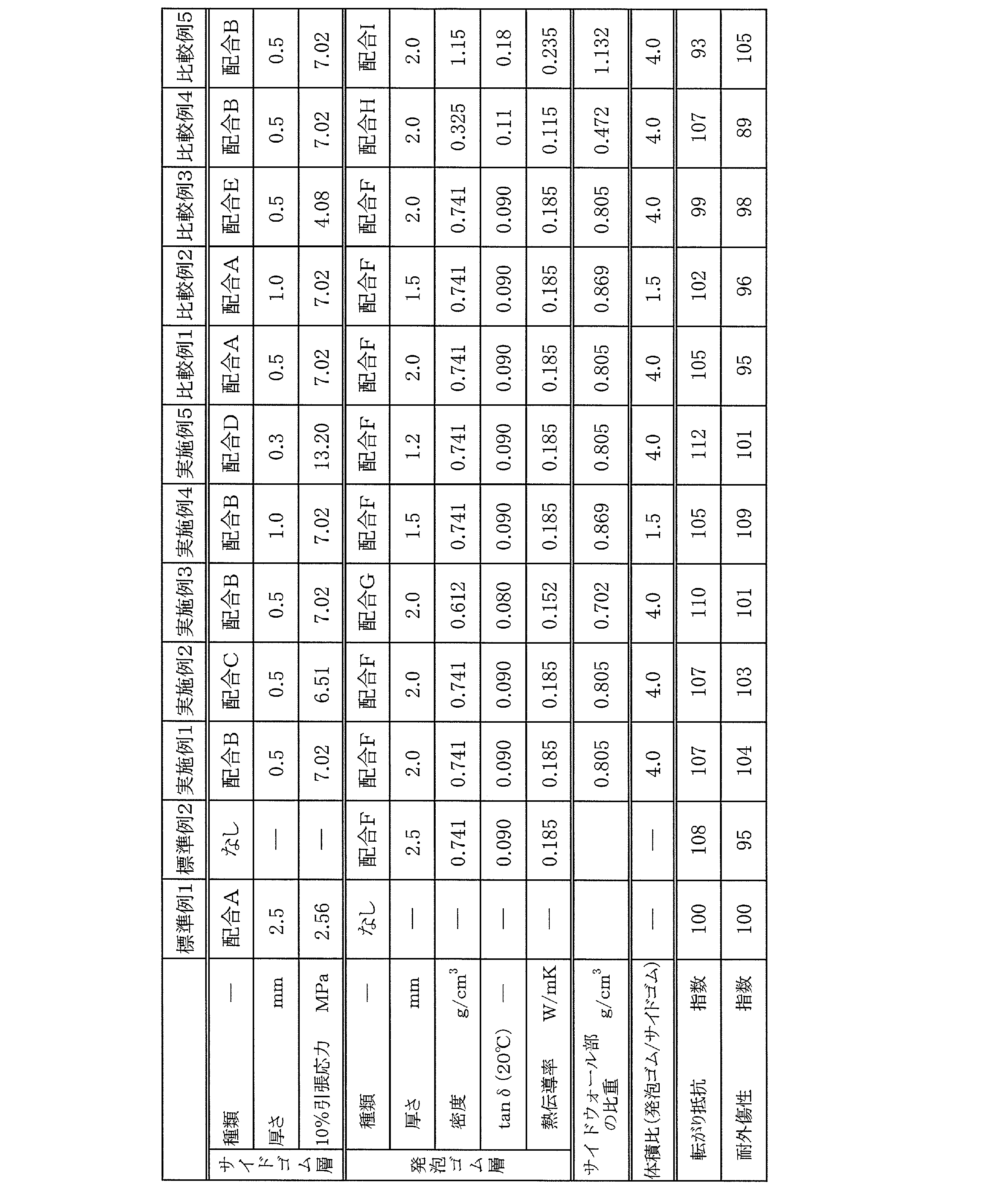
- Density The density of the foamed rubber molded product was measured at 20 ° C. according to JIS K-6268. In the case of foamed rubber, 2 g of a weight of iron whose volume was measured in advance was suspended and measured, and the volume and weight were calculated by subtracting the value to calculate the density. The obtained results are shown in the “density” column of Table 1. Further, the specific gravity of the side wall portion composed of the foamed rubber layer and the side rubber layer of the pneumatic tire was measured in the same manner, and the obtained results are shown in the column of “specific gravity of side wall portion” in Table 2.
- Thermal conductivity of the foamed rubber molded product was measured by a fine wire heating method (hot wire method) using a rapid thermal conductivity meter (QTM-500, manufactured by Kyoto Electronics Industry Co., Ltd.) in accordance with ISO8301. The obtained results are shown in the column of “thermal conductivity” in Table 1.
- ⁇ NR Natural rubber
- TSR20 BR Butadiene rubber
- Nippon Zeon BR1220 Carbon black FEF grade carbon black
- HTC-100 manufactured by Chubu Carbon Co.
- Zinc oxide 3 types of zinc oxide manufactured by Shodo Chemical Co., Ltd.
- Stearic acid Beads stearic acid YR manufactured by NOF Corporation
- Anti-aging agent SANTOFLEX 6PPD manufactured by FLEXSYS
- Wax Paraffin wax
- Oil Aroma oil, A-OMIX made by Sankyo Oil Chemical Co., Ltd.
- -PP Polypropylene, E-333GV manufactured by Prime Polymer
- ⁇ PS polystyrene, MW1C manufactured by Toyo Styrene Co., Ltd.
- Sulfur Tsurumi Chemical Co., Ltd. Jinhua stamp fine powder sulfur 150 mesh
- Vulcanization accelerator Noxeller NS-P manufactured by Ouchi Shinsei Chemical Industry Co., Ltd.
- Chemical foaming agent Nitroso-based foaming agent, Cellular CK # 54 manufactured by Eiwa Chemical Industry Co., Ltd.
- the tire size is 195 / 65R15, the basic structure of the tire is shown in FIG. 1, and the sidewall portion 3 is formed by laminating the rubber composition for the sidewall and the foamable rubber composition obtained above.
- Twelve types of pneumatic tires (Examples 1 to 5, Comparative Examples 1 to 5, and Standard Examples 1 and 2) were prepared so as to vary the average thickness as shown in Table 2.
- the twelve types of tires obtained were evaluated for rolling resistance and trauma resistance by the test methods described below, and the results are shown in Table 2.
- Trauma resistance When each tire is mounted on a rim (size: 15 ⁇ 6J), mounted on a vehicle with a displacement of 1800 cc, and the front tire is collided with a concrete curb with a height of 20 cm at a 5 ° penetration angle, The minimum speed at which damage occurred was measured. The results are shown in the “trauma resistance” column of Table 2 as an index with the value of standard example 1 being 100. The larger the index, the better the trauma resistance.
- the rubber composition for sidewalls is inferior in the resistance to trauma because it does not contain a thermoplastic resin.
Landscapes
- Chemical & Material Sciences (AREA)
- Chemical Kinetics & Catalysis (AREA)
- Organic Chemistry (AREA)
- Medicinal Chemistry (AREA)
- Polymers & Plastics (AREA)
- Health & Medical Sciences (AREA)
- Engineering & Computer Science (AREA)
- Materials Engineering (AREA)
- Mechanical Engineering (AREA)
- General Chemical & Material Sciences (AREA)
- Combustion & Propulsion (AREA)
- Thermal Sciences (AREA)
- Physics & Mathematics (AREA)
- Inorganic Chemistry (AREA)
- Tires In General (AREA)
- Manufacture Of Porous Articles, And Recovery And Treatment Of Waste Products (AREA)
- Compositions Of Macromolecular Compounds (AREA)
Abstract
Description
表1に示すゴム配合からなる5種類のサイドウォール用ゴム組成物(配合A~E)および4種類の発泡性ゴム組成物(配合F~I)について、それぞれ硫黄、加硫促進剤および化学発泡剤を除く配合成分を秤量し、1.7L密閉式バンバリーミキサーで5分間混練し、温度150℃でマスターバッチを放出し室温冷却した。その後このマスターバッチを加熱ロールに供し、硫黄、加硫促進剤および化学発泡剤を加えて混合し、サイドウォール用ゴム組成物および発泡性ゴム組成物を調製した。
得られた加硫試験片をJIS K7244-4に準拠して、スペクトロメーター(東洋精機製作所社製)にかけて、歪み10%±10%、周波数20Hzおよび20℃の測定条件で、10%変形時の引張り応力を測定した。得られた結果を表1の「10%の引張り応力」の欄に記載する。
発泡ゴム成形体の密度を、JIS K-6268に準拠して20℃で測定した。発泡ゴムの場合、予め体積を測定しておいた鉄のおもりを2gつるして測定し、その値を引く事によって体積と重さを算出し、密度を計算した。得られた結果を表1の「密度」の欄に記載する。また空気入りタイヤの発泡ゴム層およびサイドゴム層からなるサイドウォール部の比重も同様にして測定し、得られた結果を表2の「サイドウォール部の比重」の欄に記載する。
発泡ゴム成形体のtanδを、東洋精機製作所社製粘弾性スペクトロメーターを用いて、歪み10%±2%、周波数20Hz、雰囲気温度20℃で測定した。得られた結果を表1の「tanδ(20℃)」の欄に記載する。
発泡ゴム成形体の熱伝導率をISO8301に準拠し、迅速熱伝導率計(京都電子工業社製QTM-500)を使用して、細線加熱法(ホットワイヤ法)で測定した。得られた結果を表1の「熱伝導率」の欄に記載する。

・NR:天然ゴム、TSR20
・BR:ブタジエンゴム、日本ゼオン社製Nipol BR1220
・カーボンブラック:FEF級カーボンブラック、中部カーボン社製HTC-100
・酸化亜鉛:正同化学工業社製酸化亜鉛3種
・ステアリン酸:日油社製ビーズステアリン酸YR
・老化防止剤:FLEXSYS社製SANTOFLEX 6PPD
・ワックス:パラフィンワックス
・オイル:アロマ系オイル、三共油化工業社製A-OMIX
・PP:ポリプロピレン、プライムポリマー社製E-333GV
・PS:ポリスチレン、東洋スチレン社製MW1C
・硫黄: 鶴見化学社製金華印微粉硫黄150mesh
・加硫促進剤:大内新興化学工業社製ノクセラーNS-P
・化学発泡剤:ニトロソ系発泡剤、永和化成工業社製セルラーCK#54
タイヤサイズを195/65R15、タイヤの基本構造を図1、サイドウォール部3を上記で得られたサイドウォール用ゴム組成物および発泡性ゴム組成物を積層して構成し、その平均厚さを表2のように異ならせるようにして、12種類の空気入りタイヤ(実施例1~5、比較例1~5、標準例1,2)をそれぞれ作製した。得られた12種類のタイヤについて、以下に記載する試験方法により、転がり抵抗及び耐外傷性の評価を行い、その結果を表2に示した。
各タイヤをリム(サイズ:15×6J)に組み込み、空気圧230kPaを充填して、室内のドラム試験機(ドラム径:1707mm)を使用し、JIS D4234に準拠し荷重4.5kN、速度80km/時の条件における転がり抵抗値を測定した。その結果を標準例1の転がり抵抗値の逆数を100とする指数として、表2の「転がり抵抗」の欄にに記載した。この指数が大きいほど転がり抵抗が低いことを意味する。
各タイヤをリム(サイズ:15×6J)に組み込み、排気量1800ccの車両に装着し、前輪タイヤを、高さ20cmのコンクリート製縁石に5°の侵入角度で衝突させたとき、サイドウォール部が傷つく最低速度を計測した。その結果を標準例1の値を100とする指数として、表2の「耐外傷性」の欄に記載した。この指数が大きいほど耐外傷性が優れていることを意味する。
2 ビード部
3 サイドウォール部
4 トレッド部
5 カーカス層
6 発泡ゴム層
7 サイドゴム層
Claims (7)
- 左右一対のビード部と、該ビード部に連なるサイドウォール部と、該サイドウォール部を連結するトレッド部とを備え、左右のビード部間にカーカス層を装架した空気入りタイヤにおいて、
前記サイドウォール部におけるカーカス層の外側に発泡ゴム層、該発泡ゴム層の外側にサイドゴム層を配置するとともに、前記発泡ゴム層の密度が0.5~0.9g/cm3、かつ20℃のtanδが0.17以下であり、前記サイドゴム層を形成するサイドウォール用ゴム組成物がジエン系ゴム100重量部に、熱可塑性樹脂1~20重量部、カーボンブラック10~65重量部を配合したことを特徴とする空気入りタイヤ。 - 前記熱可塑性樹脂が、ポリスチレン、ポリプロピレンから選ばれることを特徴とする請求項1に記載の空気入りタイヤ。
- 前記発泡ゴム層の体積とサイドゴム層の体積の比(発泡ゴム層/サイドゴム層)が、1/1~10/1であることを特徴とする請求項1または2に記載の空気入りタイヤ。
- 前記サイドウォール用ゴム組成物が、ジエン系ゴム100重量%中、天然ゴムが30~70重量%、ブタジエンゴムおよび/またはスチレンブタジエンゴムが70~30重量%であることを特徴とする請求項1~3のいずれかに記載の空気入りタイヤ。
- 前記発泡ゴム層の熱伝導率が0.05~0.2W/mKであることを特徴とする請求項1~4のいずれかに記載の空気入りタイヤ。
- 前記発泡ゴム層を構成する発泡性ゴム組成物が、ニトロソ系発泡剤および/またはアゾ系発泡剤を含むことを特徴とする請求項1~5のいずれかに記載の空気入りタイヤ。
- 前記発泡ゴム層を構成する発泡性ゴム組成物が、ジエン系ゴム100重量部に対し、尿素を0.1~20重量部配合したことを特徴とする請求項1~6のいずれかに記載の空気入りタイヤ。
Priority Applications (4)
| Application Number | Priority Date | Filing Date | Title |
|---|---|---|---|
| DE112016000956.9T DE112016000956T9 (de) | 2015-02-27 | 2016-02-24 | Luftreifen |
| JP2017502420A JP6372610B2 (ja) | 2015-02-27 | 2016-02-24 | 空気入りタイヤ |
| CN201680006124.8A CN107207787A (zh) | 2015-02-27 | 2016-02-24 | 充气轮胎 |
| US15/553,962 US20180244112A1 (en) | 2015-02-27 | 2016-02-24 | Pneumatic Tire |
Applications Claiming Priority (2)
| Application Number | Priority Date | Filing Date | Title |
|---|---|---|---|
| JP2015-037566 | 2015-02-27 | ||
| JP2015037566 | 2015-02-27 |
Publications (1)
| Publication Number | Publication Date |
|---|---|
| WO2016136802A1 true WO2016136802A1 (ja) | 2016-09-01 |
Family
ID=56788662
Family Applications (1)
| Application Number | Title | Priority Date | Filing Date |
|---|---|---|---|
| PCT/JP2016/055415 Ceased WO2016136802A1 (ja) | 2015-02-27 | 2016-02-24 | 空気入りタイヤ |
Country Status (5)
| Country | Link |
|---|---|
| US (1) | US20180244112A1 (ja) |
| JP (1) | JP6372610B2 (ja) |
| CN (1) | CN107207787A (ja) |
| DE (1) | DE112016000956T9 (ja) |
| WO (1) | WO2016136802A1 (ja) |
Families Citing this family (1)
| Publication number | Priority date | Publication date | Assignee | Title |
|---|---|---|---|---|
| FR3123589B1 (fr) * | 2021-06-07 | 2023-06-09 | Michelin & Cie | Pneumatique avec des performances optimisées en résistance au roulement sans dégrader la performance industrielle |
Citations (6)
| Publication number | Priority date | Publication date | Assignee | Title |
|---|---|---|---|---|
| JPS63256636A (ja) * | 1987-04-15 | 1988-10-24 | Bridgestone Corp | ゴム組成物 |
| JPH0692112A (ja) * | 1992-09-14 | 1994-04-05 | Yokohama Rubber Co Ltd:The | 空気入りタイヤ |
| JPH06211007A (ja) * | 1993-01-14 | 1994-08-02 | Yokohama Rubber Co Ltd:The | 空気入りタイヤ |
| JPH1087900A (ja) * | 1996-09-10 | 1998-04-07 | Yokohama Rubber Co Ltd:The | ゴム組成物 |
| JP2010125891A (ja) * | 2008-11-25 | 2010-06-10 | Yokohama Rubber Co Ltd:The | 空気入りタイヤ |
| WO2011152188A1 (ja) * | 2010-06-04 | 2011-12-08 | 横浜ゴム株式会社 | 空気入りタイヤ |
Family Cites Families (4)
| Publication number | Priority date | Publication date | Assignee | Title |
|---|---|---|---|---|
| JPS62256636A (ja) * | 1986-04-30 | 1987-11-09 | Kanegafuchi Chem Ind Co Ltd | 車輌バンパ−用芯材の製造方法及び製造用金型 |
| US6646066B2 (en) * | 2002-03-14 | 2003-11-11 | The Goodyear Tire & Rubber Company | Rubber composition containing a thermoplastic polymer and tire sidewall component or tire support ring comprised of such rubber composition |
| KR101676625B1 (ko) * | 2010-03-25 | 2016-11-16 | 시티즌홀딩스 코리미티드 | 공작 기계 |
| JP5965155B2 (ja) * | 2012-02-09 | 2016-08-03 | 株式会社ブリヂストン | 空気入りタイヤ |
-
2016
- 2016-02-24 JP JP2017502420A patent/JP6372610B2/ja active Active
- 2016-02-24 US US15/553,962 patent/US20180244112A1/en not_active Abandoned
- 2016-02-24 WO PCT/JP2016/055415 patent/WO2016136802A1/ja not_active Ceased
- 2016-02-24 CN CN201680006124.8A patent/CN107207787A/zh active Pending
- 2016-02-24 DE DE112016000956.9T patent/DE112016000956T9/de not_active Expired - Fee Related
Patent Citations (6)
| Publication number | Priority date | Publication date | Assignee | Title |
|---|---|---|---|---|
| JPS63256636A (ja) * | 1987-04-15 | 1988-10-24 | Bridgestone Corp | ゴム組成物 |
| JPH0692112A (ja) * | 1992-09-14 | 1994-04-05 | Yokohama Rubber Co Ltd:The | 空気入りタイヤ |
| JPH06211007A (ja) * | 1993-01-14 | 1994-08-02 | Yokohama Rubber Co Ltd:The | 空気入りタイヤ |
| JPH1087900A (ja) * | 1996-09-10 | 1998-04-07 | Yokohama Rubber Co Ltd:The | ゴム組成物 |
| JP2010125891A (ja) * | 2008-11-25 | 2010-06-10 | Yokohama Rubber Co Ltd:The | 空気入りタイヤ |
| WO2011152188A1 (ja) * | 2010-06-04 | 2011-12-08 | 横浜ゴム株式会社 | 空気入りタイヤ |
Also Published As
| Publication number | Publication date |
|---|---|
| US20180244112A1 (en) | 2018-08-30 |
| DE112016000956T5 (de) | 2017-11-16 |
| JP6372610B2 (ja) | 2018-08-15 |
| CN107207787A (zh) | 2017-09-26 |
| JPWO2016136802A1 (ja) | 2017-09-21 |
| DE112016000956T9 (de) | 2018-01-18 |
Similar Documents
| Publication | Publication Date | Title |
|---|---|---|
| JP5252091B2 (ja) | 空気入りタイヤ | |
| JP6097750B2 (ja) | タイヤ | |
| CN102775651B (zh) | 一种含丁基再生胶的海绵轮胎海绵胶料 | |
| CN108137870A (zh) | 橡胶组合物以及由其获得的轮胎 | |
| JP6372610B2 (ja) | 空気入りタイヤ | |
| JP7172280B2 (ja) | タイヤ用ゴム組成物 | |
| JP2012025816A (ja) | タイヤ用ゴム発泡体の製造方法 | |
| JP6267517B2 (ja) | 空気入りタイヤ | |
| JP2017206580A (ja) | タイヤ用ゴム組成物の製造方法及びタイヤ用ゴム組成物 | |
| JP6332206B2 (ja) | 空気入りタイヤ | |
| JP5870507B2 (ja) | 発泡性ゴム組成物 | |
| JP5011737B2 (ja) | 発泡ゴム組成物 | |
| JP2004161898A (ja) | ゴム組成物及びこれを用いた空気入りタイヤ | |
| JP6562061B2 (ja) | 空気入りタイヤ | |
| CN108137844A (zh) | 橡胶组合物和轮胎 | |
| JP4898285B2 (ja) | ビードエイペックス用ゴム組成物およびそれを用いたビードエイペックスを有するタイヤ | |
| JPH08268006A (ja) | 空気入りタイヤ | |
| JP2013237222A (ja) | 空気入りタイヤの製造方法および空気入りタイヤ | |
| JP2010274531A (ja) | タイヤ | |
| JP2002241528A (ja) | タイヤ用ゴム組成物及び空気入りタイヤ | |
| JP6267444B2 (ja) | 空気入りタイヤ | |
| JP2017052831A (ja) | ゴム組成物 | |
| WO2017043463A1 (ja) | ゴム組成物 | |
| JPWO2020129829A1 (ja) | タイヤ用ゴム組成物、該ゴム組成物からなるタイヤ用トレッド、及び該トレッドを具備したタイヤ | |
| JP2017119747A (ja) | 発泡ゴム組成物およびその製造方法 |
Legal Events
| Date | Code | Title | Description |
|---|---|---|---|
| 121 | Ep: the epo has been informed by wipo that ep was designated in this application |
Ref document number: 16755546 Country of ref document: EP Kind code of ref document: A1 |
|
| ENP | Entry into the national phase |
Ref document number: 2017502420 Country of ref document: JP Kind code of ref document: A |
|
| WWE | Wipo information: entry into national phase |
Ref document number: 112016000956 Country of ref document: DE |
|
| WWE | Wipo information: entry into national phase |
Ref document number: 15553962 Country of ref document: US |
|
| 122 | Ep: pct application non-entry in european phase |
Ref document number: 16755546 Country of ref document: EP Kind code of ref document: A1 |