WO2016136581A1 - 穀類加工食品用ほぐれ改良剤 - Google Patents
穀類加工食品用ほぐれ改良剤 Download PDFInfo
- Publication number
- WO2016136581A1 WO2016136581A1 PCT/JP2016/054696 JP2016054696W WO2016136581A1 WO 2016136581 A1 WO2016136581 A1 WO 2016136581A1 JP 2016054696 W JP2016054696 W JP 2016054696W WO 2016136581 A1 WO2016136581 A1 WO 2016136581A1
- Authority
- WO
- WIPO (PCT)
- Prior art keywords
- gum
- processed
- foods
- loosening
- cereal
- Prior art date
- Legal status (The legal status is an assumption and is not a legal conclusion. Google has not performed a legal analysis and makes no representation as to the accuracy of the status listed.)
- Ceased
Links
Classifications
-
- A—HUMAN NECESSITIES
- A23—FOODS OR FOODSTUFFS; TREATMENT THEREOF, NOT COVERED BY OTHER CLASSES
- A23L—FOODS, FOODSTUFFS OR NON-ALCOHOLIC BEVERAGES, NOT OTHERWISE PROVIDED FOR; PREPARATION OR TREATMENT THEREOF
- A23L7/00—Cereal-derived products; Malt products; Preparation or treatment thereof
- A23L7/10—Cereal-derived products
-
- A—HUMAN NECESSITIES
- A23—FOODS OR FOODSTUFFS; TREATMENT THEREOF, NOT COVERED BY OTHER CLASSES
- A23L—FOODS, FOODSTUFFS OR NON-ALCOHOLIC BEVERAGES, NOT OTHERWISE PROVIDED FOR; PREPARATION OR TREATMENT THEREOF
- A23L7/00—Cereal-derived products; Malt products; Preparation or treatment thereof
- A23L7/10—Cereal-derived products
- A23L7/109—Types of pasta, e.g. macaroni or noodles
-
- A—HUMAN NECESSITIES
- A23—FOODS OR FOODSTUFFS; TREATMENT THEREOF, NOT COVERED BY OTHER CLASSES
- A23L—FOODS, FOODSTUFFS OR NON-ALCOHOLIC BEVERAGES, NOT OTHERWISE PROVIDED FOR; PREPARATION OR TREATMENT THEREOF
- A23L7/00—Cereal-derived products; Malt products; Preparation or treatment thereof
- A23L7/10—Cereal-derived products
- A23L7/109—Types of pasta, e.g. macaroni or noodles
- A23L7/113—Parboiled or instant pasta
Definitions
- the present invention relates to a fray improvement for processed cereal foods, and more particularly to a flaw improving agent for processed cereal foods such as noodles and cooked rice, and a processed cereal food having improved looseness by using this improver.
- Processed cereal foods such as noodles and cooked rice generally contain starch, and during processing and cooking, starch will flow out onto the surface of the food and the foods will be bound together.
- starch will flow out onto the surface of the food and the foods will be bound together.
- the portion where the noodles are bound is less likely to return to hot water.
- cooked rice products the whole rice cannot be fried uniformly with fried rice, and the rice grains are crushed by a rice ball molding machine. Such problems lead to a decrease in production efficiency and an increase in cost, and further, the resulting food is difficult to eat and is not delicious.
- Patent Document 1 a method of mixing oil or emulsified oil (Patent Document 1), a method of adding a sucrose fatty acid ester having a high HLB (Patent Document 2) ), A method of adding an organic acid (Patent Document 3), a method of using water-soluble hemicellulose (Patent Document 4), a method of using gum arabic, gati gum, and an emulsifier (Patent Document 5).
- Japanese Patent Laid-Open No. 3-175940 Japanese Patent Publication No. 60-8103 JP-A-61-181350 JP-A-6-121647 JP 2011-177120 A
- Patent Documents 1 to 5 have a problem that a sufficient unraveling effect cannot be obtained, and there is also a problem that when using an emulsifier alone as in Patent Document 2, the texture becomes worse. Furthermore, depending on the material used, when the surface treatment was performed, the treatment liquid flowed with time, leading to deterioration of the loosening. Therefore, the present invention suppresses quality deterioration such as deterioration of the looseness in storage than before, and a loosening improver for efficiently producing a delicious processed grain food and a processed grain food using the loosening improver. The purpose was to provide.
- the present inventors have found that as a water-soluble hemicellulose derived from beans and a viscosity modifier, guar gum, carrageenan, locust bean gum, tamarind, tara gum, cassia gum, xanthan gum, succinoglucan Containing one or more polysaccharides selected from the group consisting of pectin, carboxymethylcellulose, alginic acid and derivatives thereof, and having a solution viscosity of 100 to 2000 mPa ⁇ s at 20 ° C. when surface-treated or added. It has been found that the loosening property of processed cereal foods can be improved by adding a loosening improver for processed cereal foods characterized by the above, and the present invention has been completed.
- the present invention (1) A loosening improver for cereal processed foods, comprising the following (A) and (B), and having a solution viscosity of 100 to 2000 mPa ⁇ s at 20 ° C when surface-treated or added to cereal processed foods s, a loosening improver for processed cereal foods, (A); water-soluble hemicellulose derived from beans; (B); one or more polysaccharides selected from the group of guar gum, carrageenan, locust bean gum, tamarind, tara gum, cassia gum, xanthan gum, succinoglucan, pectin, carboxymethylcellulose, alginic acid and derivatives thereof as a viscosity modifier 2 or more types, (2) The loosening improver for processed grain foods according to (1), wherein the water-soluble hemicellulose derived from beans is a water-soluble hemicellulose derived from soybeans or peas, (3) The loosening improvement for cereal processed foods according to (1) or (2), wherein the viscosity
- the looseness of processed cereal foods such as noodles and cooked rice is improved, and binding of noodle strings and rice grains can be remarkably suppressed.
- the processed cereal food to which the loosening improver of the present invention has been added maintains its looseness even after refrigerated storage for 1 day after preparation, for example, and the binding between cooked rice and noodles is remarkably suppressed.
- the processed cereal food of the present invention refers to food obtained by primary processing or further secondary processing of cereal foods (rice, wheat, barley, rice bran, rice bran, etc.).
- Primary processed foods include cooked rice, barley rice, rice cakes, dried noodles, raw noodles, pasta, etc.
- Secondary processed foods include foods prepared by re-cooking primary processed foods, such as rice balls, sushi, pilaf, fried rice, and cooked There are rice, mixed rice, soba, udon, Chinese noodles, pasta, raw noodles, instant noodles and so on.
- processed cereal foods include processed foods of the final product type that are intended to be eaten on the spot, including those that are cooked at home, and semi-finished products that require cooking when eaten. Included are foods distributed in the market by methods such as ice temperature.
- the present loosening agent is (A): water-soluble hemicellulose derived from beans, (B); as viscosity modifier, guar gum, carrageenan, locust bean gum, tamarind, tara gum, cassia gum, xanthan gum, succinoglucan, pectin, carboxymethylcellulose , Including one or more polysaccharides selected from the group of alginic acid and derivatives thereof, and having a solution viscosity of 100 to 2000 mPa ⁇ s at 20 ° C. when surface-treated or added to processed cereal foods It is characterized by that.
- the form of the present loosening improver is not particularly limited.
- the loosening improver for processed cereal food of the present invention can impart good loosening properties when used in the processed cereal food.
- the bean-derived water-soluble hemicellulose can be obtained using soybeans, red beans, peas and the like as raw materials, but from the viewpoint of solubility and industrial properties, soybeans or peas are preferable, and those derived from cotyledons are more preferable.
- Bean-derived water-soluble hemicellulose can be obtained by a method of water extraction or hot water extraction from a raw material containing hemicellulose, a method of heat extraction under acid or alkali conditions, a method of extraction by enzymatic decomposition, or the like.
- a preferred example of a method for producing a bean-derived water-soluble hemicellulose is as follows.
- the raw material of beans is thermally decomposed under acidic or alkaline conditions, preferably at a pH near the isoelectric point of each protein, preferably 80 ° C. or higher and 130 ° C. or lower, more preferably higher than 100 ° C. and 130 ° C. or lower.
- the water-soluble fraction is fractionated by centrifugation, etc., it is dried as it is, or it is derived from beans by, for example, activated carbon treatment, resin adsorption treatment or ethanol precipitation treatment to remove hydrophobic substances or low molecular weight substances and dry them. Water-soluble hemicellulose can be obtained.
- Viscosity modifier As the viscosity modifier of the present invention, one or more selected from guar gum, carrageenan, locust bean gum, tamarind, tara gum, psyllium seed gum, cassia gum, xanthan gum, succinoglucan, pectin, carboxymethylcellulose, alginic acid and derivatives thereof. These thickeners can be used in combination. In particular, it is preferable to use guar gum, locust bean gum, xanthan gum, pectin and carboxymethyl cellulose, and it is more preferable to use guar gum, locust bean gum and xanthan gum.
- the measuring method of the viscosity in this application is as follows. A solution to be added or surface-treated is prepared, and the temperature is adjusted to 20 ° C. 200 g of the solution is placed in a 200 mL tall beaker and measured with a BM viscometer.
- the blending amount of the water-soluble hemicellulose derived from beans in the present loosening improver is preferably 0.01 to 20% by weight, more preferably 0.03 to 5% by weight as the amount of water-soluble hemicellulose added to the processed cereal food. It mix
- the blending amount of the viscosity modifier in the present loosening improver is preferably 0.001 to 30% by weight, more preferably 0.01 to 25% by weight as the amount of the viscosity modifier added to the processed cereal food. Blend as follows.
- the viscosity of the solution to be added or surface-treated is in the range of 100 to 2000 mPa ⁇ s, preferably in the range of 200 to 1000 mPa ⁇ s.
- the viscosity of the solution to be surface-treated When the viscosity of the solution to be surface-treated is too low, it tends to flow off from the surface of the processed grain food, and when it is too high, it is difficult to uniformly treat the surface. If the amount of the present loosening agent added to the processed cereal food is too small, sufficient loosening properties may not be imparted to the processed cereal food, and if too much, the flavor of the processed cereal food may be changed.
- the foam may be difficult to disappear when foamed.
- an antifoaming agent examples include silicon, various emulsifiers, and fats.
- the present loosening improver can be used in combination with other additives as long as it does not affect the effects of the present invention.
- Other additives include glycerin fatty acid esters, sorbitan fatty acid esters, stearoyl lactate, emulsifiers such as polysorbate, or oily substances such as general animal and vegetable oils and fat-soluble vitamins such as tocopherol, monosaccharides such as glucose and fructose, Oligosaccharides such as sucrose, maltose, fructose, raffinose, maltotriose, trehalose, stachyose, maltotetraose, and sugar alcohol, dextrin, seaweed, gelatin, whey and other albumins, sodium caseinate, soluble collagen, egg white, egg yolk
- protein substances such as soybean protein, salts such as calcium fortifier, and pH adjusters such as sodium acetate.
- polysaccharides such as various starches such as agar, furceleran, pullulan, gellan gum, hyaluronic acid, cyclodextrin, chitosan, and modified starch, and hydrolysates of these polysaccharides can also be used.
- This loosening improver is sold in a powdered state, emulsified or suspended with oils and fats, or as a solution such as water or saline, or in the form of a solution added to an organic acid solution such as acetic acid. can do.
- the method for surface-treating the present loosening improver on the processed cereal food is not particularly limited, there are the following methods.
- (1) When making processed cooked rice add this loosening improver to the rice and cook.
- the cooked rice is further processed.
- the present loosening improver is added in advance to the water or hot water when boiling noodles or pasta and boiled.
- Cooked rice, cooked rice, noodles cooked with rice cake, or pasta are entangled with an aqueous solution of the present loosening agent and surface treated.
- An aqueous solution of the present loosening improver is sprayed on cooked cooked rice, boiled noodles or pasta.
- the present loosening improver is dissolved in the seasoning liquid in advance, and the surface treatment is carried out by applying to pasta, noodles or cooked rice.
- the present loosening improver is mixed with a powder seasoning, and surface-treated by applying to rice, pasta and noodles. And the like. These methods are selected according to individual food characteristics such as production lines and sales forms.
- Grain processed foods such as noodles and cooked rice obtained by adding or surface-treating the present loosening improver to processed cereal foods have good loosening properties. Therefore, the processed cereal food obtained by the present invention is very easy to eat and can be tasted delicious. Moreover, for example, even after refrigerated storage for one day after preparation, the looseness is maintained, and the binding between cooked rice and noodles is remarkably suppressed. Moreover, it has excellent processing suitability, such as being easy to mix and difficult to crush in the production of processed cereal foods, by imparting good loosening properties.
- soybean-derived water-soluble soybean hemicellulose which is commercially available as “Soya Five Boo S” (manufactured by Fuji Oil Co., Ltd.), was used as the bean-derived water-soluble hemicellulose.
- Example 1 (Examination of surface treatment solution viscosity) (Examples 1 to 4, Comparative Examples 1 to 4)
- water-soluble soybean hemicellulose and guar gum (SUPERGEL CSA: manufactured by Sanki Co., Ltd.) were added to water and then dissolved by heating to prepare loosening improvers A to H.
- the noodles were evaluated for their looseness.
- 600 g of strong powder, 400 g of buckwheat flour, 10 g of salt and 300 g of water were mixed, kneaded with a mixer for 15 minutes, and rolled and cut out (incision # 22 corner, noodle string thickness 1.3 mm) according to a conventional method.
- Example 10 Evaluation of looseness of cooked rice
- Example 10 evaluation of looseness of cooked rice
- 500 g of Koshihikari was thoroughly boiled with water and soaked for 1 hour, then watered so that the total amount of water became 600 g, and rice was cooked using a household rice cooker.
- a comparative example 6 was prepared by adding 25 g of water to the cooked rice, mixing until uniform and allowing to cool to room temperature.
- Example 10 was obtained by the same treatment except that the loosening improver solution D was added to the cooked rice. Compared with Comparative Example 6, the looseness of the rice of Example 10 was significantly improved.
Landscapes
- Health & Medical Sciences (AREA)
- Nutrition Science (AREA)
- Life Sciences & Earth Sciences (AREA)
- Chemical & Material Sciences (AREA)
- Engineering & Computer Science (AREA)
- Food Science & Technology (AREA)
- Polymers & Plastics (AREA)
- Noodles (AREA)
- Cereal-Derived Products (AREA)
Abstract
【課題】本発明は、保存においてほぐれ性が悪くなるなどの品質低下を従来よりも抑制し、効率的に美味しい穀類加工食品を製造する為のほぐれ改良剤及びそのほぐれ改良剤を使用した穀類加工食品を提供することを目的とした。 【解決手段】豆類由来の水溶性ヘミセルロース及び粘度調整剤として、グアガム、カラギナン、ローカストビーンガム、タマリンド、タラガム、カシアガム、キサンタンガム、スクシノグルカン、ペクチン、カルボキシメチルセルロース、アルギン酸及びその誘導体の群から選択される多糖類を1種または2種以上を含有し、表面処理または添加する際の溶液粘度が20℃で100~2000mPa・sであることを特徴とする穀類加工食品用ほぐれ改良剤を添加することで、穀類加工食品のほぐれ性を改良することができる
Description
本発明は穀類加工食品用ほぐれ改良に関するものであり、詳しくは、麺類、米飯類等の穀類加工食品用ほぐれ改良剤、およびこの改良剤を用いることによりほぐれ性の改良された穀類加工食品に関する。
近年の食の多様化により、加工食品のニーズが増大している。特に麺、米飯といった穀類食品は、大量に加工・調理された製品が、コンビニエンスストア、スーパーマーケットなどで販売され、多くの消費者に食されるようになってきた。
これら流通・市販される加工食品において、特に問題となるのが加工の利便性と時間の経過による品質劣化である。
麺、米飯等の穀類加工食品は一般に澱粉を含んでおり、加工・調理の際、食品表面に澱粉質が流出し、食品同士が結着してしまう。その結果、麺製品であれば、麺同士の付着により、一食分に小分けしたり、喫食時に汁やソースと混ぜたりすることが困難になる。即席麺の場合は、麺が結着した部分が湯戻りしにくくなる。また、米飯製品の場合、チャーハンで全体が均一に炒められない、おにぎりの成型機で飯粒がつぶれてしまうということが起こる。こういった問題は、生産効率の低下、コストアップを招き、さらに、できあがった食品も喫食事に食べ辛く、美味しくないという結果を招く。
この食品同士の結着性をなくし、ほぐれ性を改善する従来の方法としては、油脂または乳化油脂を混合する方法(特許文献1)、HLBの高いショ糖脂肪酸エステルを添加する方法(特許文献2)、有機酸を添加する方法(特許文献3)、水溶性ヘミセルロースを使用する方法(特許文献4)、アラビアガム、ガティガム、乳化剤を使用する方法(特許文献5)などがある。
しかしながら、特許文献1~5の技術では、十分なほぐれ効果は得られないといった問題があり、また、特許文献2のように乳化剤単独で使用する場合、食感が悪くなるという問題もある。さらに使用する素材によっては表面処理を行う際、経時的に処理液が流れ落ち、ほぐれの悪化に繋がっていた。
そこで、本発明は、保存においてほぐれ性が悪くなるなどの品質低下を従来よりも抑制し、効率的に美味しい穀類加工食品を製造する為のほぐれ改良剤及びそのほぐれ改良剤を使用した穀類加工食品を提供することを目的とした。
そこで、本発明は、保存においてほぐれ性が悪くなるなどの品質低下を従来よりも抑制し、効率的に美味しい穀類加工食品を製造する為のほぐれ改良剤及びそのほぐれ改良剤を使用した穀類加工食品を提供することを目的とした。
本発明者らは、上記の課題に鑑み、鋭意研究を重ねた結果、豆類由来の水溶性ヘミセルロース及び粘度調整剤として、グアガム、カラギナン、ローカストビーンガム、タマリンド、タラガム、カシアガム、キサンタンガム、スクシノグルカン、ペクチン、カルボキシメチルセルロース、アルギン酸及びその誘導体の群から選択される多糖類を1種または2種以上を含有し、表面処理または添加する際の溶液粘度が20℃で100~2000mPa・sであることを特徴とする穀類加工食品用ほぐれ改良剤を添加することで、穀類加工食品のほぐれ性を改良することができることを見出し、本発明を完成するに至った。
すなわち本発明は、
(1)穀類加工食品用ほぐれ改良剤であって、次の(A)及び(B)、を含み、かつ、穀類加工食品に表面処理または添加する際の溶液粘度が20℃で100~2000mPa・sである、穀類加工食品用ほぐれ改良剤、
(A);豆類由来の水溶性ヘミセルロース、
(B);粘度調整剤として、グアガム、カラギナン、ローカストビーンガム、タマリンド、タラガム、カシアガム、キサンタンガム、スクシノグルカン、ペクチン、カルボキシメチルセルロース、アルギン酸及びその誘導体の群から選択される多糖類を1種または2種以上、
(2)豆類由来の水溶性ヘミセルロースが、大豆またはエンドウ豆由来の水溶性ヘミセルロースである、(1)記載の穀類加工食品用ほぐれ改良剤、
(3)粘度調整剤が、グアガム、ローカストビーンガム、キサンタンガム、ペクチン、カルボキシメチルセルロースの群から選択される1種または2種以上である、(1)または(2)記載の穀類加工食品用ほぐれ改良剤、
(4)該溶液粘度が20℃で200~1000mPa・sである、(1)~(3)の何れか1つに記載の穀類加工食品用ほぐれ改良剤、
(5)(1)~(4)の何れか1つに記載のほぐれ改良剤を添加又は該ほぐれ改良剤で表面処理してなる穀類加工食品、
である。
(1)穀類加工食品用ほぐれ改良剤であって、次の(A)及び(B)、を含み、かつ、穀類加工食品に表面処理または添加する際の溶液粘度が20℃で100~2000mPa・sである、穀類加工食品用ほぐれ改良剤、
(A);豆類由来の水溶性ヘミセルロース、
(B);粘度調整剤として、グアガム、カラギナン、ローカストビーンガム、タマリンド、タラガム、カシアガム、キサンタンガム、スクシノグルカン、ペクチン、カルボキシメチルセルロース、アルギン酸及びその誘導体の群から選択される多糖類を1種または2種以上、
(2)豆類由来の水溶性ヘミセルロースが、大豆またはエンドウ豆由来の水溶性ヘミセルロースである、(1)記載の穀類加工食品用ほぐれ改良剤、
(3)粘度調整剤が、グアガム、ローカストビーンガム、キサンタンガム、ペクチン、カルボキシメチルセルロースの群から選択される1種または2種以上である、(1)または(2)記載の穀類加工食品用ほぐれ改良剤、
(4)該溶液粘度が20℃で200~1000mPa・sである、(1)~(3)の何れか1つに記載の穀類加工食品用ほぐれ改良剤、
(5)(1)~(4)の何れか1つに記載のほぐれ改良剤を添加又は該ほぐれ改良剤で表面処理してなる穀類加工食品、
である。
本発明により、麺や米飯等の穀類加工食品のほぐれ性が改良され、麺線や飯粒の結着を著しく抑制することができる。また、本発明のほぐれ改良剤が添加された穀類加工食品は、例えば調製後1日冷蔵保存した後においてもそのほぐれ性が維持され、米飯同士、麺同士の結着が著しく抑制される。
(穀類加工食品)
本発明の穀類加工食品とは、穀類食品(米、小麦、大麦、稗、粟等)を1次加工又は更に2次加工した食品のことをいう。1次加工食品としては米飯、麦飯、粟餅、乾麺、生麺、パスタ等があり、2次加工食品としては1次加工食品を再調理した食品、例えば、おにぎり、寿司、ピラフ、チャーハン、炊き込みご飯、混ぜご飯、そば、うどん、中華麺、パスタ、素麺、即席麺等がある。
本発明の穀類加工食品とは、穀類食品(米、小麦、大麦、稗、粟等)を1次加工又は更に2次加工した食品のことをいう。1次加工食品としては米飯、麦飯、粟餅、乾麺、生麺、パスタ等があり、2次加工食品としては1次加工食品を再調理した食品、例えば、おにぎり、寿司、ピラフ、チャーハン、炊き込みご飯、混ぜご飯、そば、うどん、中華麺、パスタ、素麺、即席麺等がある。
これらの穀類加工食品には、家庭で調理されるものを始めその場で食べることを目的とする最終商品型の加工食品や食べる際に調理の必要な半製品が含まれ、常温、冷蔵、冷凍、氷温等の方法で市場に流通している食品が含まれる。
(ほぐれ改良剤)
本ほぐれ改良剤は、(A);豆類由来の水溶性ヘミセルロース、(B);粘度調整剤として、グアガム、カラギナン、ローカストビーンガム、タマリンド、タラガム、カシアガム、キサンタンガム、スクシノグルカン、ペクチン、カルボキシメチルセルロース、アルギン酸及びその誘導体の群から選択される多糖類を1種または2種以上、を含み、かつ、穀類加工食品に表面処理または添加する際の溶液粘度が20℃で100~2000mPa・sであることを特徴とする。
本ほぐれ改良剤の形態は、特に限定されない。例えば、水に、豆類由来の水溶性ヘミセルロース、及び増粘剤、その他の副剤を溶解した液体やペーストの状態、単にこれらを混合した粉末状のもの、さらに混合したものを造粒した顆粒状のものが例示される。
本発明の穀類加工食品用ほぐれ改良剤は、上記穀類加工食品に用いた場合に良好なほぐれ性を付与することができるものである。
本ほぐれ改良剤は、(A);豆類由来の水溶性ヘミセルロース、(B);粘度調整剤として、グアガム、カラギナン、ローカストビーンガム、タマリンド、タラガム、カシアガム、キサンタンガム、スクシノグルカン、ペクチン、カルボキシメチルセルロース、アルギン酸及びその誘導体の群から選択される多糖類を1種または2種以上、を含み、かつ、穀類加工食品に表面処理または添加する際の溶液粘度が20℃で100~2000mPa・sであることを特徴とする。
本ほぐれ改良剤の形態は、特に限定されない。例えば、水に、豆類由来の水溶性ヘミセルロース、及び増粘剤、その他の副剤を溶解した液体やペーストの状態、単にこれらを混合した粉末状のもの、さらに混合したものを造粒した顆粒状のものが例示される。
本発明の穀類加工食品用ほぐれ改良剤は、上記穀類加工食品に用いた場合に良好なほぐれ性を付与することができるものである。
(豆類由来の水溶性ヘミセルロース)
豆類由来の水溶性ヘミセルロースは、大豆,小豆,エンドウ豆等を原料として得られるが、溶解性や工業性の面から、大豆またはエンドウ豆が好ましく、中でも子葉由来のものがより好ましい。
豆類由来の水溶性ヘミセルロースは、ヘミセルロースを含む原料から水抽出や熱水抽出する方法、酸、アルカリ条件下で加熱抽出する方法、酵素分解により抽出する方法等により得ることができる。
豆類由来の水溶性ヘミセルロースの製造法の好ましい一例を示すと以下の通りである。豆類の原料を酸性乃至アルカリ性の条件下、好ましくは各々の蛋白質の等電点付近のpHで、好ましくは80℃以上130 ℃以下、より好ましくは100℃を超え、130 ℃以下にて加熱分解し、遠心分離等で水溶性画分を分画した後、そのまま乾燥するか、例えば活性炭処理或いは樹脂吸着処理或いはエタノール沈澱処理して疎水性物質あるいは低分子物質を除去し乾燥することによって、豆類由来の水溶性ヘミセルロースを得ることができる。
豆類由来の水溶性ヘミセルロースは、大豆,小豆,エンドウ豆等を原料として得られるが、溶解性や工業性の面から、大豆またはエンドウ豆が好ましく、中でも子葉由来のものがより好ましい。
豆類由来の水溶性ヘミセルロースは、ヘミセルロースを含む原料から水抽出や熱水抽出する方法、酸、アルカリ条件下で加熱抽出する方法、酵素分解により抽出する方法等により得ることができる。
豆類由来の水溶性ヘミセルロースの製造法の好ましい一例を示すと以下の通りである。豆類の原料を酸性乃至アルカリ性の条件下、好ましくは各々の蛋白質の等電点付近のpHで、好ましくは80℃以上130 ℃以下、より好ましくは100℃を超え、130 ℃以下にて加熱分解し、遠心分離等で水溶性画分を分画した後、そのまま乾燥するか、例えば活性炭処理或いは樹脂吸着処理或いはエタノール沈澱処理して疎水性物質あるいは低分子物質を除去し乾燥することによって、豆類由来の水溶性ヘミセルロースを得ることができる。
(粘度調整剤)
本発明の粘度調整剤として、グアガム、カラギナン、ローカストビーンガム、タマリンド、タラガム、サイリウムシードガム、カシアガム、キサンタンガム、スクシノグルカン、ペクチン、カルボキシメチルセルロース、アルギン酸及びその誘導体から選ばれる1種又は2種以上の増粘剤を組み合わせて用いることが出来る。特に、グアガム、ローカストビーンガム、キサンタンガム、ペクチン、カルボキシメチルセルロースを用いることが好ましく、グアガム、ローカストビーンガム、キサンタンガムを用いることがより好ましい。
本発明の粘度調整剤として、グアガム、カラギナン、ローカストビーンガム、タマリンド、タラガム、サイリウムシードガム、カシアガム、キサンタンガム、スクシノグルカン、ペクチン、カルボキシメチルセルロース、アルギン酸及びその誘導体から選ばれる1種又は2種以上の増粘剤を組み合わせて用いることが出来る。特に、グアガム、ローカストビーンガム、キサンタンガム、ペクチン、カルボキシメチルセルロースを用いることが好ましく、グアガム、ローカストビーンガム、キサンタンガムを用いることがより好ましい。
(粘度の測定方法)
本願における粘度の測定方法は以下のとおりである。添加または表面処理する溶液を調製し、20℃に温調する。200gの溶液を200mLのトールビーカーに入れ、BM型粘度計にて測定する。
本願における粘度の測定方法は以下のとおりである。添加または表面処理する溶液を調製し、20℃に温調する。200gの溶液を200mLのトールビーカーに入れ、BM型粘度計にて測定する。
豆類由来の水溶性ヘミセルロースの本ほぐれ改良剤中の配合量は、穀類加工食品に対する水溶性ヘミセルロースの添加量として、好ましくは0.01~20重量%、より好ましくは0.03~5重量%となるように配合する。また、粘度調整剤の本ほぐれ改良剤中の配合量は、穀類加工食品に対する粘度調整剤の添加量として、好ましくは0.001~30重量%、より好ましくは0.01~25重量%となるように配合する。
また、添加または表面処理する溶液の粘度としては、100~2000mPa・sの範囲であり、好ましくは200~1000mPa・sの範囲であることが望ましい。表面処理する溶液の粘度は、低すぎると穀類加工食品の表面から流れ落ちやすくなり、高すぎると均一に表面処理するのが困難になる。
穀類加工食品に対する本願ほぐれ剤の添加量が少なすぎると、穀類加工食品に対して十分なほぐれ性を付与できない場合があり、多すぎると穀類加工食品の風味を変化させてしまう場合がある。
また、添加または表面処理する溶液の粘度としては、100~2000mPa・sの範囲であり、好ましくは200~1000mPa・sの範囲であることが望ましい。表面処理する溶液の粘度は、低すぎると穀類加工食品の表面から流れ落ちやすくなり、高すぎると均一に表面処理するのが困難になる。
穀類加工食品に対する本願ほぐれ剤の添加量が少なすぎると、穀類加工食品に対して十分なほぐれ性を付与できない場合があり、多すぎると穀類加工食品の風味を変化させてしまう場合がある。
本ほぐれ改良剤は、通常のほぐれ剤に比べて粘度が高いため、起泡してしまうと泡が消えにくい場合がある。泡が消えにくい場合には、消泡剤を使用することが好ましい。消泡剤としては、シリコンや各種の乳化剤、油脂等が例示される。
本ほぐれ改良剤には、適宜、本発明の効果に影響を与えない範囲で、他の添加剤と併用することができる。他の添加剤としては、グリセリン脂肪酸エステル、ソルビタン脂肪酸エステル、ステアロイル乳酸塩、ポリソルベート等の乳化剤、或いは一般の動植物性油脂や脂溶性ビタミンであるトコフェロール等の油性物質、グルコース、フルクトース等の単糖類、蔗糖、マルトース、フラクトース、ラフィノース、マルトトリオース、トレハロ─ス、スタキオース、マルトテトラオース等の少糖類、及び糖アルコール、デキストリン、布海苔、ゼラチン、ホエー等のアルブミン、カゼインナトリウム、可溶性コラーゲン、卵白、卵黄末、大豆蛋白等の蛋白性物質や、カルシウム強化剤等の塩類、酢酸ソーダ等のpH調整剤が挙げられる。また、寒天、ファーセレラン、プルラン、ジェランガム、ヒアルロン酸、サイクロデキストリン、キトサン、加工澱粉など各種澱粉類等の多糖類やこれら多糖類の加水分解物等も使用することが出来る。
本ほぐれ改良剤は、粉末状態は勿論のこと、油脂との乳化状態または懸濁状態、あるいは水、食塩水等の溶液として、さらには酢酸等の有機酸溶液に添加した溶液の状態で流通販売することができる。
本ほぐれ改良剤を穀類加工食品に表面処理する方法は特に限定されないが、次のような方法がある。
(1)加工米飯を作る場合、米に本ほぐれ改良剤を添加して炊飯する。また、その米飯を更に加工する。(2)麺又はパスタを茹でる際の水又は熱湯に予め本ほぐれ改良剤を添加して茹でる。(3)炊飯、蒸煮後の米飯や茹で上がった麺又はパスタに本ほぐれ改良剤の水溶液を絡ませて表面処理する。(4)蒸煮後の米飯や茹で上がった麺又はパスタに本ほぐれ改良剤の水溶液を噴霧する。(5)予め調味液に本ほぐれ改良剤を溶解しておき、パスタ、麺又は米飯にまぶして表面処理する。(6)本ほぐれ改良剤を粉末調味料と混合し、米飯、パスタ、麺にまぶして表面処理する。等の方法が例示できる。これらの方法は製造ライン、販売形態等の個々の食品特性により選択される。
(1)加工米飯を作る場合、米に本ほぐれ改良剤を添加して炊飯する。また、その米飯を更に加工する。(2)麺又はパスタを茹でる際の水又は熱湯に予め本ほぐれ改良剤を添加して茹でる。(3)炊飯、蒸煮後の米飯や茹で上がった麺又はパスタに本ほぐれ改良剤の水溶液を絡ませて表面処理する。(4)蒸煮後の米飯や茹で上がった麺又はパスタに本ほぐれ改良剤の水溶液を噴霧する。(5)予め調味液に本ほぐれ改良剤を溶解しておき、パスタ、麺又は米飯にまぶして表面処理する。(6)本ほぐれ改良剤を粉末調味料と混合し、米飯、パスタ、麺にまぶして表面処理する。等の方法が例示できる。これらの方法は製造ライン、販売形態等の個々の食品特性により選択される。
本ほぐれ改良剤を穀類加工食品に添加または表面処理する方法により得られた、麺や米飯等の穀類加工食品は、良好なほぐれ性を有している。従って、本発明により得られた穀類加工食品は非常に食べやすく、おいしく感じることができる。また、例えば、調製後1日冷蔵保存した後においてもそのほぐれ性が維持され、米飯同士、麺同士の結着が著しく抑制されている。
また、良好なほぐれ性が付与されることにより、穀類加工食品の製造において混ぜやすい、潰れにくい等の優れた加工適正を有する。
また、良好なほぐれ性が付与されることにより、穀類加工食品の製造において混ぜやすい、潰れにくい等の優れた加工適正を有する。
以下、実施例を挙げて本発明をさらに説明するが、本発明はこれらの例示によって制限されるものではない。なお、例中の部および%は何れも重量基準を意味する。
以下に示す実施例において、豆類由来の水溶性ヘミセルロースとして、「ソヤファイブーS」(不二製油(株)製)として市販されている、大豆由来の水溶性大豆ヘミセルロースを使用した。
(表面処理溶液粘度の検討)(実施例1~4、比較例1~4)
表1の配合に基づき、水に水溶性大豆ヘミセルロース、グアガム(SUPERGEL CSA:三晶株式会社製)を添加した後加熱溶解することにより、ほぐれ改良剤A~Hを調製した。
それぞれについて麺のほぐれ性評価を行った。
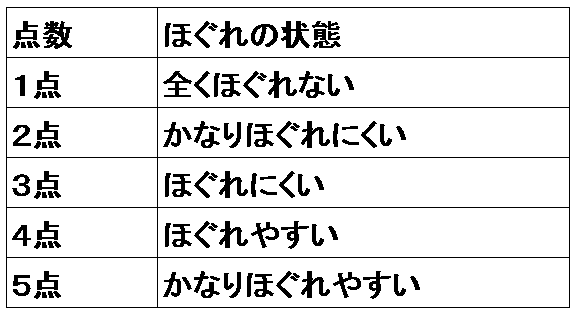
まず、強力粉600g、そば粉400g、食塩10g、水300gを配合し、ミキサーで15分間混捏し、常法に従って圧延、切り出し(切り歯#22角、麺線厚み1.3mm)を行って得られた麺を沸騰水中で3分間茹で上げ、流水で30秒水洗し、茹で麺を得た。次に、各ほぐれ改良剤を茹で麺200gあたり6g均一に噴霧し、容器に充填、密封し、1日冷蔵保存後のほぐれ性をパネラー10名で評価した。各パネラーは表2の基準に基づき1~5点で評価し、その平均点をほぐれ性評価とした。平均点が4点以上であれば、ほぐれ性が良好と判断した。また、表面処理を行う際、簡単に均一に処理できるものを○、均一にするのが難しいものを×とした。以上の評価結果を表1に示した。
表1の配合に基づき、水に水溶性大豆ヘミセルロース、グアガム(SUPERGEL CSA:三晶株式会社製)を添加した後加熱溶解することにより、ほぐれ改良剤A~Hを調製した。
それぞれについて麺のほぐれ性評価を行った。
まず、強力粉600g、そば粉400g、食塩10g、水300gを配合し、ミキサーで15分間混捏し、常法に従って圧延、切り出し(切り歯#22角、麺線厚み1.3mm)を行って得られた麺を沸騰水中で3分間茹で上げ、流水で30秒水洗し、茹で麺を得た。次に、各ほぐれ改良剤を茹で麺200gあたり6g均一に噴霧し、容器に充填、密封し、1日冷蔵保存後のほぐれ性をパネラー10名で評価した。各パネラーは表2の基準に基づき1~5点で評価し、その平均点をほぐれ性評価とした。平均点が4点以上であれば、ほぐれ性が良好と判断した。また、表面処理を行う際、簡単に均一に処理できるものを○、均一にするのが難しいものを×とした。以上の評価結果を表1に示した。
(表1)配合表(%)とほぐれ性評価結果

(表2)ほぐれ性評価基準
グアガムを加えて粘度が上がるにつれて、劇的にほぐれ性が改善された。しかし、粘度が上がりすぎると、麺に均一に表面処理するのが困難になり、作業性が落ちた。グアガムのみ溶解して表面処理しても、麺のほぐれ性は得られなかった。
(増粘剤の種類)(実施例5~8)
次に、様々な増粘剤を用いて表面処理をおこなった。表3の配合に基づき、水に水溶性大豆ヘミセルロース、各種増粘剤を添加した後加熱溶解することにより、ほぐれ改良剤I~Lを調製した。ローカストビーンガムには「ビストップD-2050」(三栄源エフ・エフ・アイ株式会社製)、キサンタンガムには「サンエース」(三栄源エフ・エフ・アイ株式会社製)、カルボキシメチルセルロースにはセロゲンF-SB(第一工業製薬株式会社製)、ペクチンにはGENU pectin type YM-150-LJ(三晶株式会社製)を用いた。ほぐれ性を実施例1と同様にして評価した。評価結果を表3に示した。
次に、様々な増粘剤を用いて表面処理をおこなった。表3の配合に基づき、水に水溶性大豆ヘミセルロース、各種増粘剤を添加した後加熱溶解することにより、ほぐれ改良剤I~Lを調製した。ローカストビーンガムには「ビストップD-2050」(三栄源エフ・エフ・アイ株式会社製)、キサンタンガムには「サンエース」(三栄源エフ・エフ・アイ株式会社製)、カルボキシメチルセルロースにはセロゲンF-SB(第一工業製薬株式会社製)、ペクチンにはGENU pectin type YM-150-LJ(三晶株式会社製)を用いた。ほぐれ性を実施例1と同様にして評価した。評価結果を表3に示した。
(表3)配合表(%)とほぐれ性評価結果
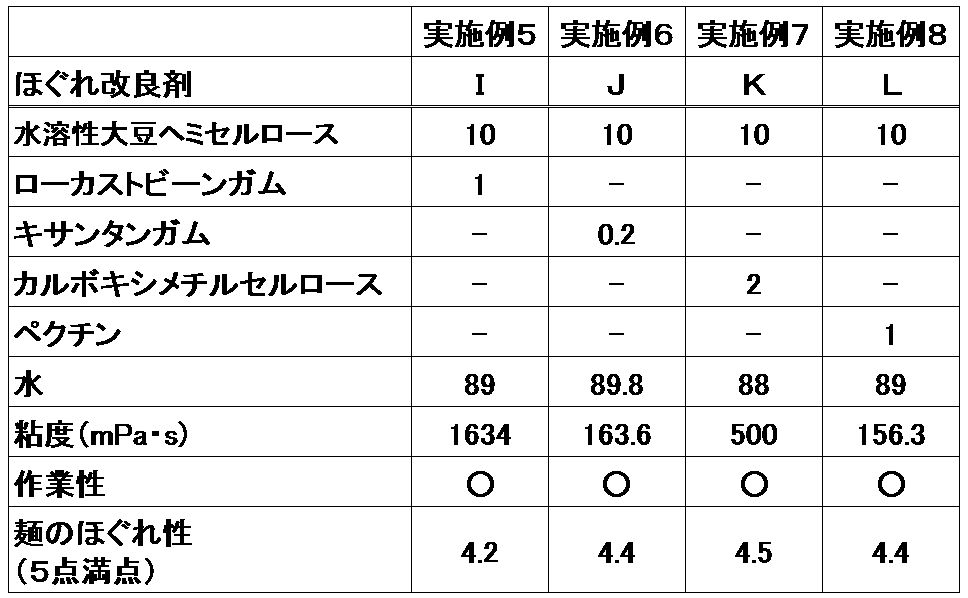
実施例5~8の結果より、グアガム以外の増粘剤として、ローカストビーンガム、キサンタンガム、カルボキシメチルセルロースまたはペクチンを用いた場合も麺のほぐれ性が良好になることが確認された。
(即席麺のほぐれ性評価)(実施例9、比較例5)
準強力粉600g、澱粉67g、食塩10g、炭酸ナトリウム1g、炭酸カリウム1g、水230gを配合し、ミキサーで15分間混捏し、常法に従って圧延、切り出し(切り歯#22、麺線厚み1.7mm)を行って得られた麺を、1玉80gとして蒸煮し、中華麺を調製した。
次に、表5の配合に従って、ほぐれ改良剤Dを対麺重5%添加し、よく麺に絡ませた後80℃で1時間乾燥させ、即席麺を調製した。得られた即席麺1玉に対して400gの熱湯を加えて8分間湯戻しし、ほぐれ性を○:ほぐれる、△:ほぐれにくい、×:ほぐれない、の3段階で評価した。ほぐれ性の評価結果を表4に示した。
準強力粉600g、澱粉67g、食塩10g、炭酸ナトリウム1g、炭酸カリウム1g、水230gを配合し、ミキサーで15分間混捏し、常法に従って圧延、切り出し(切り歯#22、麺線厚み1.7mm)を行って得られた麺を、1玉80gとして蒸煮し、中華麺を調製した。
次に、表5の配合に従って、ほぐれ改良剤Dを対麺重5%添加し、よく麺に絡ませた後80℃で1時間乾燥させ、即席麺を調製した。得られた即席麺1玉に対して400gの熱湯を加えて8分間湯戻しし、ほぐれ性を○:ほぐれる、△:ほぐれにくい、×:ほぐれない、の3段階で評価した。ほぐれ性の評価結果を表4に示した。
(表4)配合表(部)とほぐれ性評価結果

表4の結果のように、実施例9の本ほぐれ改良剤を添加した即席麺は、湯戻し後のほぐれ性が良好であった。
(米飯のほぐれ性評価)(実施例10、比較例6)
コシヒカリ500gをよく水でとぎ、1時間浸漬させた後、総加水量が600gとなるように加水して家庭用炊飯器を用いてご飯を炊いた。炊き上がったご飯に水を25g添加し、均一になるまで混ぜて室温になるまで放冷したものを比較例6とした。比較例6のうち、炊き上がったご飯にほぐれ改良剤溶液Dを添加する以外は同様の処理をして得られたものを実施例10とした。比較例6と比較して、実施例10のご飯は格段にほぐれ性が改良されていた。
コシヒカリ500gをよく水でとぎ、1時間浸漬させた後、総加水量が600gとなるように加水して家庭用炊飯器を用いてご飯を炊いた。炊き上がったご飯に水を25g添加し、均一になるまで混ぜて室温になるまで放冷したものを比較例6とした。比較例6のうち、炊き上がったご飯にほぐれ改良剤溶液Dを添加する以外は同様の処理をして得られたものを実施例10とした。比較例6と比較して、実施例10のご飯は格段にほぐれ性が改良されていた。
Claims (6)
- 穀類加工食品用ほぐれ改良剤であって、次の(A)及び(B)、を含み、かつ、穀類加工食品に表面処理または添加する際の溶液粘度が20℃で100~2000mPa・sである、穀類加工食品用ほぐれ改良剤。
(A);豆類由来の水溶性ヘミセルロース、
(B);粘度調整剤として、グアガム、カラギナン、ローカストビーンガム、タマリンド、タラガム、カシアガム、キサンタンガム、スクシノグルカン、ペクチン、カルボキシメチルセルロース、アルギン酸及びその誘導体の群から選択される多糖類を1種または2種以上。 - 豆類由来の水溶性ヘミセルロースが、大豆またはエンドウ豆由来の水溶性ヘミセルロースである、請求項1記載の穀類加工食品用ほぐれ改良剤。
- 粘度調整剤が、グアガム、ローカストビーンガム、キサンタンガム、ペクチン、カルボキシメチルセルロースの群から選択される1種または2種以上である、請求項1または2記載の穀類加工食品用ほぐれ改良剤。
- 粘度調整剤が、グアガム、ローカストビーンガム、キサンタンガムの群から選択される1種または2種以上である、請求項1または2記載の穀類加工食品用ほぐれ改良剤。
- 該溶液粘度が20℃で200~1000mPa・sである、請求項1~4の何れか1項に記載の穀類加工食品用ほぐれ改良剤。
- 請求項1~5の何れか1項に記載のほぐれ改良剤を添加又は該ほぐれ改良剤で表面処理してなる穀類加工食品。
Priority Applications (1)
| Application Number | Priority Date | Filing Date | Title |
|---|---|---|---|
| JP2017502310A JP6915534B2 (ja) | 2015-02-25 | 2016-02-18 | 穀類加工食品用ほぐれ改良剤 |
Applications Claiming Priority (2)
| Application Number | Priority Date | Filing Date | Title |
|---|---|---|---|
| JP2015-034929 | 2015-02-25 | ||
| JP2015034929 | 2015-02-25 |
Publications (1)
| Publication Number | Publication Date |
|---|---|
| WO2016136581A1 true WO2016136581A1 (ja) | 2016-09-01 |
Family
ID=56788445
Family Applications (1)
| Application Number | Title | Priority Date | Filing Date |
|---|---|---|---|
| PCT/JP2016/054696 Ceased WO2016136581A1 (ja) | 2015-02-25 | 2016-02-18 | 穀類加工食品用ほぐれ改良剤 |
Country Status (3)
| Country | Link |
|---|---|
| JP (1) | JP6915534B2 (ja) |
| TW (1) | TW201633929A (ja) |
| WO (1) | WO2016136581A1 (ja) |
Cited By (3)
| Publication number | Priority date | Publication date | Assignee | Title |
|---|---|---|---|---|
| WO2018037759A1 (ja) * | 2016-08-24 | 2018-03-01 | 不二製油グループ本社株式会社 | 澱粉含有食品用ほぐれ改良剤 |
| WO2022131209A1 (ja) * | 2020-12-18 | 2022-06-23 | 日清オイリオグループ株式会社 | 澱粉含有食品用ほぐれ剤 |
| JP2023127360A (ja) * | 2022-03-01 | 2023-09-13 | 日清オイリオグループ株式会社 | 澱粉含有食品用ほぐれ剤 |
Citations (5)
| Publication number | Priority date | Publication date | Assignee | Title |
|---|---|---|---|---|
| JPH06122647A (ja) * | 1992-10-13 | 1994-05-06 | Dainippon Ink & Chem Inc | インダンジオン誘導体 |
| JP2005013135A (ja) * | 2003-06-27 | 2005-01-20 | Okuno Chem Ind Co Ltd | 麺ほぐれ改良剤 |
| JP2005278406A (ja) * | 2004-03-26 | 2005-10-13 | Musashino Chemical Laboratory Ltd | 穀類用ほぐれ向上剤および該ほぐれ向上剤を添加した穀類加工食品 |
| WO2012099031A1 (ja) * | 2011-01-17 | 2012-07-26 | 不二製油株式会社 | 米飯品質改良剤 |
| JP2013162753A (ja) * | 2012-02-09 | 2013-08-22 | Fuji Oil Co Ltd | 穀類加工食品のほぐれ改良剤 |
Family Cites Families (3)
| Publication number | Priority date | Publication date | Assignee | Title |
|---|---|---|---|---|
| JP3207264B2 (ja) * | 1992-10-12 | 2001-09-10 | 三栄源エフ・エフ・アイ株式会社 | 穀類加工食品用ほぐれ改良剤 |
| JP3763308B2 (ja) * | 1997-11-13 | 2006-04-05 | 不二製油株式会社 | 米飯用保存性向上剤 |
| JP4566968B2 (ja) * | 2006-10-11 | 2010-10-20 | 株式会社日清製粉グループ本社 | 麺類用ほぐれ剤および麺類のほぐれ改善方法 |
-
2016
- 2016-02-17 TW TW105104526A patent/TW201633929A/zh unknown
- 2016-02-18 JP JP2017502310A patent/JP6915534B2/ja active Active
- 2016-02-18 WO PCT/JP2016/054696 patent/WO2016136581A1/ja not_active Ceased
Patent Citations (5)
| Publication number | Priority date | Publication date | Assignee | Title |
|---|---|---|---|---|
| JPH06122647A (ja) * | 1992-10-13 | 1994-05-06 | Dainippon Ink & Chem Inc | インダンジオン誘導体 |
| JP2005013135A (ja) * | 2003-06-27 | 2005-01-20 | Okuno Chem Ind Co Ltd | 麺ほぐれ改良剤 |
| JP2005278406A (ja) * | 2004-03-26 | 2005-10-13 | Musashino Chemical Laboratory Ltd | 穀類用ほぐれ向上剤および該ほぐれ向上剤を添加した穀類加工食品 |
| WO2012099031A1 (ja) * | 2011-01-17 | 2012-07-26 | 不二製油株式会社 | 米飯品質改良剤 |
| JP2013162753A (ja) * | 2012-02-09 | 2013-08-22 | Fuji Oil Co Ltd | 穀類加工食品のほぐれ改良剤 |
Cited By (5)
| Publication number | Priority date | Publication date | Assignee | Title |
|---|---|---|---|---|
| WO2018037759A1 (ja) * | 2016-08-24 | 2018-03-01 | 不二製油グループ本社株式会社 | 澱粉含有食品用ほぐれ改良剤 |
| WO2022131209A1 (ja) * | 2020-12-18 | 2022-06-23 | 日清オイリオグループ株式会社 | 澱粉含有食品用ほぐれ剤 |
| JPWO2022131209A1 (ja) * | 2020-12-18 | 2022-06-23 | ||
| JP7702062B2 (ja) | 2020-12-18 | 2025-07-03 | 日清オイリオグループ株式会社 | 澱粉含有食品用ほぐれ剤 |
| JP2023127360A (ja) * | 2022-03-01 | 2023-09-13 | 日清オイリオグループ株式会社 | 澱粉含有食品用ほぐれ剤 |
Also Published As
| Publication number | Publication date |
|---|---|
| JPWO2016136581A1 (ja) | 2017-11-30 |
| JP6915534B2 (ja) | 2021-08-04 |
| TW201633929A (zh) | 2016-10-01 |
Similar Documents
| Publication | Publication Date | Title |
|---|---|---|
| CN105555149B (zh) | 面条用松散改良剂的制造方法 | |
| JP6408732B1 (ja) | 麺類用穀粉組成物及び麺類の製造方法 | |
| JP2012254071A (ja) | アセチル化アジピン酸架橋タピオカ澱粉及びその製造方法 | |
| TWI730131B (zh) | 含有澱粉食品用的鬆動改良劑、含有澱粉食品以及含有澱粉食品的製造方法 | |
| TWI593362B (zh) | 穀類加工食品之疏鬆改良劑 | |
| JP4281364B2 (ja) | 穀類加工食品の品質改良 | |
| WO2016136581A1 (ja) | 穀類加工食品用ほぐれ改良剤 | |
| JP6796599B2 (ja) | ビーフン様米粉麺類の製造方法 | |
| JP6094045B2 (ja) | 穀類加工食品のほぐれ改良剤 | |
| WO2014083958A1 (ja) | 春巻皮の製造方法 | |
| JP2013162753A (ja) | 穀類加工食品のほぐれ改良剤 | |
| JP6463406B2 (ja) | 湯伸び抑制剤、及び湯伸び耐性麺の製造方法 | |
| JP6710164B2 (ja) | たこ焼き又はお好み焼き用ミックス | |
| CN112040789A (zh) | 食品用组合物 | |
| JP6995610B2 (ja) | フライ麺類の製造方法およびフライ麺類の吸油を低減させる方法 | |
| JP2025090018A (ja) | 澱粉含有食品用ほぐれ改良剤 | |
| JP6682305B2 (ja) | 中華麺の風味向上剤、中華麺の製造方法、及び中華麺の風味向上方法 | |
| JP2023094590A (ja) | 冷凍餃子及びその製造方法 |
Legal Events
| Date | Code | Title | Description |
|---|---|---|---|
| 121 | Ep: the epo has been informed by wipo that ep was designated in this application |
Ref document number: 16755328 Country of ref document: EP Kind code of ref document: A1 |
|
| ENP | Entry into the national phase |
Ref document number: 2017502310 Country of ref document: JP Kind code of ref document: A |
|
| NENP | Non-entry into the national phase |
Ref country code: DE |
|
| 122 | Ep: pct application non-entry in european phase |
Ref document number: 16755328 Country of ref document: EP Kind code of ref document: A1 |