WO2016121013A1 - 樹脂粉末材料、レーザ粉末造形方法及びその装置 - Google Patents
樹脂粉末材料、レーザ粉末造形方法及びその装置 Download PDFInfo
- Publication number
- WO2016121013A1 WO2016121013A1 PCT/JP2015/052254 JP2015052254W WO2016121013A1 WO 2016121013 A1 WO2016121013 A1 WO 2016121013A1 JP 2015052254 W JP2015052254 W JP 2015052254W WO 2016121013 A1 WO2016121013 A1 WO 2016121013A1
- Authority
- WO
- WIPO (PCT)
- Prior art keywords
- resin
- powder material
- laser
- resin powder
- polybutylene terephthalate
- Prior art date
- Legal status (The legal status is an assumption and is not a legal conclusion. Google has not performed a legal analysis and makes no representation as to the accuracy of the status listed.)
- Ceased
Links
Images



Classifications
-
- C—CHEMISTRY; METALLURGY
- C08—ORGANIC MACROMOLECULAR COMPOUNDS; THEIR PREPARATION OR CHEMICAL WORKING-UP; COMPOSITIONS BASED THEREON
- C08L—COMPOSITIONS OF MACROMOLECULAR COMPOUNDS
- C08L67/00—Compositions of polyesters obtained by reactions forming a carboxylic ester link in the main chain; Compositions of derivatives of such polymers
- C08L67/02—Polyesters derived from dicarboxylic acids and dihydroxy compounds
-
- B—PERFORMING OPERATIONS; TRANSPORTING
- B29—WORKING OF PLASTICS; WORKING OF SUBSTANCES IN A PLASTIC STATE IN GENERAL
- B29B—PREPARATION OR PRETREATMENT OF THE MATERIAL TO BE SHAPED; MAKING GRANULES OR PREFORMS; RECOVERY OF PLASTICS OR OTHER CONSTITUENTS OF WASTE MATERIAL CONTAINING PLASTICS
- B29B7/00—Mixing; Kneading
- B29B7/002—Methods
-
- B—PERFORMING OPERATIONS; TRANSPORTING
- B29—WORKING OF PLASTICS; WORKING OF SUBSTANCES IN A PLASTIC STATE IN GENERAL
- B29B—PREPARATION OR PRETREATMENT OF THE MATERIAL TO BE SHAPED; MAKING GRANULES OR PREFORMS; RECOVERY OF PLASTICS OR OTHER CONSTITUENTS OF WASTE MATERIAL CONTAINING PLASTICS
- B29B7/00—Mixing; Kneading
- B29B7/02—Mixing; Kneading non-continuous, with mechanical mixing or kneading devices, i.e. batch type
- B29B7/06—Mixing; Kneading non-continuous, with mechanical mixing or kneading devices, i.e. batch type with movable mixing or kneading devices
- B29B7/10—Mixing; Kneading non-continuous, with mechanical mixing or kneading devices, i.e. batch type with movable mixing or kneading devices rotary
- B29B7/12—Mixing; Kneading non-continuous, with mechanical mixing or kneading devices, i.e. batch type with movable mixing or kneading devices rotary with single shaft
-
- B—PERFORMING OPERATIONS; TRANSPORTING
- B29—WORKING OF PLASTICS; WORKING OF SUBSTANCES IN A PLASTIC STATE IN GENERAL
- B29B—PREPARATION OR PRETREATMENT OF THE MATERIAL TO BE SHAPED; MAKING GRANULES OR PREFORMS; RECOVERY OF PLASTICS OR OTHER CONSTITUENTS OF WASTE MATERIAL CONTAINING PLASTICS
- B29B7/00—Mixing; Kneading
- B29B7/30—Mixing; Kneading continuous, with mechanical mixing or kneading devices
- B29B7/58—Component parts, details or accessories; Auxiliary operations
- B29B7/72—Measuring, controlling or regulating
- B29B7/726—Measuring properties of mixture, e.g. temperature or density
-
- B—PERFORMING OPERATIONS; TRANSPORTING
- B29—WORKING OF PLASTICS; WORKING OF SUBSTANCES IN A PLASTIC STATE IN GENERAL
- B29C—SHAPING OR JOINING OF PLASTICS; SHAPING OF MATERIAL IN A PLASTIC STATE, NOT OTHERWISE PROVIDED FOR; AFTER-TREATMENT OF THE SHAPED PRODUCTS, e.g. REPAIRING
- B29C64/00—Additive manufacturing, i.e. manufacturing of three-dimensional [3D] objects by additive deposition, additive agglomeration or additive layering, e.g. by 3D printing, stereolithography or selective laser sintering
- B29C64/10—Processes of additive manufacturing
- B29C64/141—Processes of additive manufacturing using only solid materials
- B29C64/153—Processes of additive manufacturing using only solid materials using layers of powder being selectively joined, e.g. by selective laser sintering or melting
-
- B—PERFORMING OPERATIONS; TRANSPORTING
- B29—WORKING OF PLASTICS; WORKING OF SUBSTANCES IN A PLASTIC STATE IN GENERAL
- B29C—SHAPING OR JOINING OF PLASTICS; SHAPING OF MATERIAL IN A PLASTIC STATE, NOT OTHERWISE PROVIDED FOR; AFTER-TREATMENT OF THE SHAPED PRODUCTS, e.g. REPAIRING
- B29C64/00—Additive manufacturing, i.e. manufacturing of three-dimensional [3D] objects by additive deposition, additive agglomeration or additive layering, e.g. by 3D printing, stereolithography or selective laser sintering
- B29C64/30—Auxiliary operations or equipment
- B29C64/386—Data acquisition or data processing for additive manufacturing
- B29C64/393—Data acquisition or data processing for additive manufacturing for controlling or regulating additive manufacturing processes
-
- B—PERFORMING OPERATIONS; TRANSPORTING
- B29—WORKING OF PLASTICS; WORKING OF SUBSTANCES IN A PLASTIC STATE IN GENERAL
- B29C—SHAPING OR JOINING OF PLASTICS; SHAPING OF MATERIAL IN A PLASTIC STATE, NOT OTHERWISE PROVIDED FOR; AFTER-TREATMENT OF THE SHAPED PRODUCTS, e.g. REPAIRING
- B29C64/00—Additive manufacturing, i.e. manufacturing of three-dimensional [3D] objects by additive deposition, additive agglomeration or additive layering, e.g. by 3D printing, stereolithography or selective laser sintering
- B29C64/40—Structures for supporting 3D objects during manufacture and intended to be sacrificed after completion thereof
-
- B—PERFORMING OPERATIONS; TRANSPORTING
- B33—ADDITIVE MANUFACTURING TECHNOLOGY
- B33Y—ADDITIVE MANUFACTURING, i.e. MANUFACTURING OF THREE-DIMENSIONAL [3D] OBJECTS BY ADDITIVE DEPOSITION, ADDITIVE AGGLOMERATION OR ADDITIVE LAYERING, e.g. BY 3D PRINTING, STEREOLITHOGRAPHY OR SELECTIVE LASER SINTERING
- B33Y10/00—Processes of additive manufacturing
-
- B—PERFORMING OPERATIONS; TRANSPORTING
- B33—ADDITIVE MANUFACTURING TECHNOLOGY
- B33Y—ADDITIVE MANUFACTURING, i.e. MANUFACTURING OF THREE-DIMENSIONAL [3D] OBJECTS BY ADDITIVE DEPOSITION, ADDITIVE AGGLOMERATION OR ADDITIVE LAYERING, e.g. BY 3D PRINTING, STEREOLITHOGRAPHY OR SELECTIVE LASER SINTERING
- B33Y30/00—Apparatus for additive manufacturing; Details thereof or accessories therefor
-
- B—PERFORMING OPERATIONS; TRANSPORTING
- B33—ADDITIVE MANUFACTURING TECHNOLOGY
- B33Y—ADDITIVE MANUFACTURING, i.e. MANUFACTURING OF THREE-DIMENSIONAL [3D] OBJECTS BY ADDITIVE DEPOSITION, ADDITIVE AGGLOMERATION OR ADDITIVE LAYERING, e.g. BY 3D PRINTING, STEREOLITHOGRAPHY OR SELECTIVE LASER SINTERING
- B33Y50/00—Data acquisition or data processing for additive manufacturing
- B33Y50/02—Data acquisition or data processing for additive manufacturing for controlling or regulating additive manufacturing processes
-
- B—PERFORMING OPERATIONS; TRANSPORTING
- B33—ADDITIVE MANUFACTURING TECHNOLOGY
- B33Y—ADDITIVE MANUFACTURING, i.e. MANUFACTURING OF THREE-DIMENSIONAL [3D] OBJECTS BY ADDITIVE DEPOSITION, ADDITIVE AGGLOMERATION OR ADDITIVE LAYERING, e.g. BY 3D PRINTING, STEREOLITHOGRAPHY OR SELECTIVE LASER SINTERING
- B33Y70/00—Materials specially adapted for additive manufacturing
-
- C—CHEMISTRY; METALLURGY
- C08—ORGANIC MACROMOLECULAR COMPOUNDS; THEIR PREPARATION OR CHEMICAL WORKING-UP; COMPOSITIONS BASED THEREON
- C08G—MACROMOLECULAR COMPOUNDS OBTAINED OTHERWISE THAN BY REACTIONS ONLY INVOLVING UNSATURATED CARBON-TO-CARBON BONDS
- C08G63/00—Macromolecular compounds obtained by reactions forming a carboxylic ester link in the main chain of the macromolecule
- C08G63/02—Polyesters derived from hydroxycarboxylic acids or from polycarboxylic acids and polyhydroxy compounds
- C08G63/12—Polyesters derived from hydroxycarboxylic acids or from polycarboxylic acids and polyhydroxy compounds derived from polycarboxylic acids and polyhydroxy compounds
- C08G63/16—Dicarboxylic acids and dihydroxy compounds
- C08G63/18—Dicarboxylic acids and dihydroxy compounds the acids or hydroxy compounds containing carbocyclic rings
- C08G63/181—Acids containing aromatic rings
- C08G63/183—Terephthalic acids
-
- C—CHEMISTRY; METALLURGY
- C08—ORGANIC MACROMOLECULAR COMPOUNDS; THEIR PREPARATION OR CHEMICAL WORKING-UP; COMPOSITIONS BASED THEREON
- C08K—Use of inorganic or non-macromolecular organic substances as compounding ingredients
- C08K3/00—Use of inorganic substances as compounding ingredients
- C08K3/01—Use of inorganic substances as compounding ingredients characterized by their specific function
- C08K3/016—Flame-proofing or flame-retarding additives
-
- C—CHEMISTRY; METALLURGY
- C08—ORGANIC MACROMOLECULAR COMPOUNDS; THEIR PREPARATION OR CHEMICAL WORKING-UP; COMPOSITIONS BASED THEREON
- C08K—Use of inorganic or non-macromolecular organic substances as compounding ingredients
- C08K3/00—Use of inorganic substances as compounding ingredients
- C08K3/34—Silicon-containing compounds
- C08K3/36—Silica
-
- C—CHEMISTRY; METALLURGY
- C08—ORGANIC MACROMOLECULAR COMPOUNDS; THEIR PREPARATION OR CHEMICAL WORKING-UP; COMPOSITIONS BASED THEREON
- C08K—Use of inorganic or non-macromolecular organic substances as compounding ingredients
- C08K5/00—Use of organic ingredients
- C08K5/0008—Organic ingredients according to more than one of the "one dot" groups of C08K5/01 - C08K5/59
- C08K5/0066—Flame-proofing or flame-retarding additives
-
- C—CHEMISTRY; METALLURGY
- C08—ORGANIC MACROMOLECULAR COMPOUNDS; THEIR PREPARATION OR CHEMICAL WORKING-UP; COMPOSITIONS BASED THEREON
- C08K—Use of inorganic or non-macromolecular organic substances as compounding ingredients
- C08K7/00—Use of ingredients characterised by shape
- C08K7/02—Fibres or whiskers
- C08K7/04—Fibres or whiskers inorganic
- C08K7/14—Glass
-
- B—PERFORMING OPERATIONS; TRANSPORTING
- B29—WORKING OF PLASTICS; WORKING OF SUBSTANCES IN A PLASTIC STATE IN GENERAL
- B29B—PREPARATION OR PRETREATMENT OF THE MATERIAL TO BE SHAPED; MAKING GRANULES OR PREFORMS; RECOVERY OF PLASTICS OR OTHER CONSTITUENTS OF WASTE MATERIAL CONTAINING PLASTICS
- B29B9/00—Making granules
- B29B9/12—Making granules characterised by structure or composition
- B29B2009/125—Micropellets, microgranules, microparticles
-
- B—PERFORMING OPERATIONS; TRANSPORTING
- B29—WORKING OF PLASTICS; WORKING OF SUBSTANCES IN A PLASTIC STATE IN GENERAL
- B29B—PREPARATION OR PRETREATMENT OF THE MATERIAL TO BE SHAPED; MAKING GRANULES OR PREFORMS; RECOVERY OF PLASTICS OR OTHER CONSTITUENTS OF WASTE MATERIAL CONTAINING PLASTICS
- B29B7/00—Mixing; Kneading
- B29B7/02—Mixing; Kneading non-continuous, with mechanical mixing or kneading devices, i.e. batch type
- B29B7/06—Mixing; Kneading non-continuous, with mechanical mixing or kneading devices, i.e. batch type with movable mixing or kneading devices
-
- B—PERFORMING OPERATIONS; TRANSPORTING
- B29—WORKING OF PLASTICS; WORKING OF SUBSTANCES IN A PLASTIC STATE IN GENERAL
- B29K—INDEXING SCHEME ASSOCIATED WITH SUBCLASSES B29B, B29C OR B29D, RELATING TO MOULDING MATERIALS OR TO MATERIALS FOR MOULDS, REINFORCEMENTS, FILLERS OR PREFORMED PARTS, e.g. INSERTS
- B29K2067/00—Use of polyesters or derivatives thereof, as moulding material
- B29K2067/006—PBT, i.e. polybutylene terephthalate
-
- B—PERFORMING OPERATIONS; TRANSPORTING
- B29—WORKING OF PLASTICS; WORKING OF SUBSTANCES IN A PLASTIC STATE IN GENERAL
- B29K—INDEXING SCHEME ASSOCIATED WITH SUBCLASSES B29B, B29C OR B29D, RELATING TO MOULDING MATERIALS OR TO MATERIALS FOR MOULDS, REINFORCEMENTS, FILLERS OR PREFORMED PARTS, e.g. INSERTS
- B29K2105/00—Condition, form or state of moulded material or of the material to be shaped
- B29K2105/25—Solid
- B29K2105/251—Particles, powder or granules
-
- C—CHEMISTRY; METALLURGY
- C08—ORGANIC MACROMOLECULAR COMPOUNDS; THEIR PREPARATION OR CHEMICAL WORKING-UP; COMPOSITIONS BASED THEREON
- C08L—COMPOSITIONS OF MACROMOLECULAR COMPOUNDS
- C08L2201/00—Properties
- C08L2201/02—Flame or fire retardant/resistant
Definitions
- the present invention relates to a three-dimensional additive manufacturing technique for resin powder.
- 3D additive manufacturing is a method that does not use a mold, and therefore has the advantage that it can be prototyped in a short period of time, and has recently been increasingly used for prototypes for function confirmation.
- 3D additive manufacturing method has attracted attention.
- Patent Document 1 Japanese Patent Laid-Open No. 2011-68125
- Patent Document 1 states that “a composite material powder containing spherical carbon and resin powder as essential components is used, and a molded body manufactured by a powder sintering additive manufacturing method is heat resistant.
- a molded article impregnated with a functional resin see abstract
- the reason why the powder additive manufacturing method is attracting attention is that the resin that can be used in injection molding is a usable method, so the strength, reliability, and dimensional stability of the molded product are higher than those of other modeling methods. It is done.
- the powder additive manufacturing method is a method in which a powder material is laid out sequentially with a roller or blade in a modeling part, the powder material is selectively heated and sintered with a laser, etc., and a laminated product is produced by repeating them. is there.
- the surface temperature of the resin powder also referred to as powder resin
- the molded product are determined as the melting point of the resin by heating means installed at a modeling location or the like during modeling. Installation between the crystallization temperatures is essential.
- polyamide 12 (hereinafter referred to as PA12) having a melting point of about 185 ° C. is about 5 to 15 ° C. lower than the melting point of the resin. If the temperature is set and the heating state is not maintained within the temperature range, warping often occurs. In particular, when a large-sized product is formed, the influence becomes significant. This is because crystallization starts when the temperature decreases, and warpage occurs due to shrinkage of the resin.
- the upper limit value of the modeling temperature area of the apparatus is often set to about 200 ° C. In that case, a resin having a melting point higher than about 200 ° C. cannot be formed. Since it is necessary to maintain the temperature, sensors and mechanisms for monitoring the ambient temperature are designed to have a heat resistance of about 200 ° C.
- a resin having a melting point of 200 ° C. or less such as PA12 is a layered product (also referred to as a layered product or simply referred to as a molded product) or layered product (also referred to as a layered product) manufactured by layered modeling, or
- the continuous use temperature is simply 120 ° C. or lower.
- Patent Document 1 discloses a lamination using a composite material powder containing spherical carbon and polyamide 12 that is a resin powder as essential components. A shaped object is disclosed.
- the laminate model has a lower modulus of elasticity when the model 12 made of PA12 resin absorbs water in a humid environment. As a result, the strength also decreases. Therefore, there is a problem that it can be applied only to some products used in a low humidity environment.
- an object of the present invention is to provide a layered product that hardly absorbs moisture and has high heat resistance.
- PBT polybutylene terephthalate
- the present invention includes a plurality of means for solving the above-mentioned problems, and the following configuration is adopted as an example.
- An example of the present invention is a resin powder used in a powder additive manufacturing method, wherein the resin powder is a polybutylene terephthalate resin having a crystallization temperature lower than that of a homopolybutylene terephthalate resin.
- a layered object is manufactured by sequentially repeating a step of laying resin powder and a laser irradiation step of irradiating the laid resin powder with laser and sintering or melting the irradiated portion.
- the resin powder is a polybutylene terephthalate resin powder having a crystallization temperature lower than that of the homopolybutylene terephthalate resin.
- the present invention has a roller or blade and a laser light source, a step of laying resin powder with the roller or blade, a laser beam is irradiated to the laid resin powder from the laser light source, and the irradiated portion is
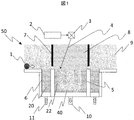
- the laser powder additive manufacturing apparatus 50 used in the present invention is installed by the roller 1 or the blade 1 that supplies the powder resin 20 for supply to the modeling area. It is installed almost uniformly so as to be flat.
- Laser light source 2 used to sinter or melt the installed resin powder 21 to laminate and bond
- Galvano mirror 3 for moving laser light 4 in the modeling area 8
- the storage container 6 for storing the powder material disposed on both sides of the modeling container 5, the modeling container 5, and the pistons 10 and 11, the modeling area 8, the modeling container 5 for storing the storage container 6 in the vertical direction, storage It is comprised from the heater (not shown) for hold
- the area temperature 9 of the container 6 for storing the powder material 20 is preferably set to be equal to or lower than the temperature in the modeling area 8. The reason is that if the temperature of the area temperature 9 becomes too high, it becomes difficult to install the powder material 20 in the modeling container 5 smoothly.
- the resin molding product 40 is three-dimensionally prepared by repeating the modeling process of installing the powder resin 22 and irradiating the laser beam 4.
- the laminated thickness of the powder spread with the roller 1 or the blade 1 is preferably at least 150 ⁇ m or less because thermal decomposition occurs if it is too thick.
- the resin molded product 40 is buried in the resin powder 22, and after being taken out of the resin powder 22, it is peeled from the molded product 40 by blasting or the like.
- the modeling area 8 is filled with nitrogen, argon, or the like and the oxygen concentration is lowered in order to suppress the deterioration of the powder.
- the laser light source 2 needs to be changed according to the absorption characteristics of the resin powder, but when the resin powder is a natural color, a CO 2 laser (wavelength 10.6 ⁇ m) is generally used. .
- the resin powder contains a material that absorbs infrared light such as black
- the intensity distribution of the laser beam 4 is usually Gaussian, but a higher-definition laser irradiation can be performed if the top hat shape is used. In this case, a high-precision product can be manufactured. From the viewpoint of accuracy, the spot size of the laser beam 4 is preferably small. However, since the modeling time is increased correspondingly, it is usually desirable to use 100 to 600 ⁇ m.
- control information of the laser powder additive manufacturing apparatus 50 is generated in advance from a 3D model or 3D CAD model of the object, and the laser beam 4 or the like is operated based on the generated control information.
- a work procedure to be performed in each process of laser irradiation conditions (laser power, speed, laser pitch, irradiation direction, number of times of irradiation, etc.) is set for each layer.
- This setting may be performed by a computer (not shown) used for design, a computer connected via a separate network or the like, and may take any form. Further, it may be set in the laser powder additive manufacturing apparatus 50.
- the 3D model or the like or information on the set work procedure is stored in the storage unit of the laser powder additive manufacturing apparatus 50, and additive manufacturing is performed using the stored information.
- it is possible to use means such as a network communication from another computer, or a separate storage device such as an optical disk such as a CD-ROM, MO, or flash memory. Information on work procedures may be input.
- the modeling temperature area 8 in the chamber in which the powder and the modeled product are placed is at the melting point of the resin powder 20 in order to ensure high modeling quality (particularly density) and suppress warping during modeling. On the other hand, it should be kept as low as 5-15 ° C.
- the powder laminating apparatus on the market has an upper limit temperature of 200, 200 in which resin powders and shaped articles are arranged from the viewpoint of heat resistance of the apparatus (particularly, sensors for temperature measurement). Often around °C. Therefore, when trying to use a PBT resin having a melting point of about 225 ° C. based on homo PBT used in injection molding or the like, modeling cannot be performed from the viewpoint of the holding temperature of the modeling temperature area 8.
- the polyamide material like PA12 material has a high water absorption rate by the inventors of the present application, the resin absorbs water unless the powder is handled in a state of being held in a dry environment. It was found that it greatly affects the variation of strength itself.
- the resin powder according to the present invention is a polybutylene terephthalate (hereinafter referred to as PBT) resin, a dicarboxylic acid component containing terephthalic acid or an ester-forming derivative thereof (such as a lower alcohol ester), and 1,4-butanediol or an ester thereof.
- PBT polybutylene terephthalate
- dicarboxylic acid component containing terephthalic acid or an ester-forming derivative thereof such as a lower alcohol ester
- 1,4-butanediol or an ester thereof 1,4-butanediol or an ester thereof.
- It is a polybutylene terephthalate resin obtained by polycondensation with a glycol component containing a forming derivative.
- a homo PBT pellet is prepared (S101).
- the melting point of homo PBT pellets, which are materials before being processed into resin powder, is 225 ° C.
- the crystallization temperature is 180 ° C.
- the intrinsic viscosity is 0.85 dl / g.
- the shape of the pellet may be, for example, a rice grain shape of about 2 mm ⁇ 1 mm ⁇ 1 mm or a columnar shape of about 2 mm ⁇ 1 mm (diameter). These shapes do not need to be miniaturized in a later process, but it is desirable to make them as small as possible in this process.
- the pellet of homo PBT is made into fine powder (S102).
- This fine pulverization process was performed in a state where the outside air temperature was set to room temperature (range from 0 ° C. to 35 ° C.) using a turbo mill manufactured by Freund Turbo.
- the temperature of the resin itself increases in the resin grinding step, and the yield tends to be poor when it is finely powdered.
- it may be pulverized under liquid nitrogen. By doing so, the shape of the powder is stabilized and the cost for mass production can be greatly reduced.
- a method for making fine powder from pellets there are many methods such as a turbo mill, a pin mill, and a hammer mill.
- a high-speed rotary mill that pulverizes by impact and shearing action may be used.
- a jet mill may be used. That is, any material that can perform pulverization with a predetermined particle diameter may be used.
- a method of cooling and precipitating after kneading with the pellet resin using a solvent or the like and then taking out the powder may be used.
- a solvent or the like since the strength of the molded article cannot be secured unless the solvent is volatilized once, it is necessary to include a drying step.
- the particle size of the homo-PBT powder finely powdered by S102 was 50% average particle size 83 ⁇ m.
- the refined resin powder was passed through an 106 ⁇ m mesh comb defined by JISZ8801-2000 using an air jet sheave manufactured by ALPINE (S103).
- the powder resin is 100% of the finer powder that passes through the mesh.
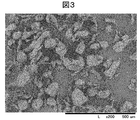
- the SEM image at this time is shown in FIG.
- the mesh comb used was 106 ⁇ m, but is not limited to this, and any mesh comb may be used as long as the average particle diameter can be adjusted to a predetermined value or less.
- the mesh comb may be 85 ⁇ m.
- the pellets of isophthalic acid copolymer PBT which is a material before being processed into resin powder, have a melting point of 208 ° C., a crystallization temperature of 153 ° C., and an intrinsic viscosity of 0.85-1.0 dl / g.
- pellets of isophthalic acid copolymerized PBT are prepared in the same manner as the homo PBT (S101).
- the particle size of the finely powdered isophthalic acid copolymer PBT powder was 50% average particle size 79 ⁇ m.
- the particle size of the isophthalic acid copolymer PBT powder finely powdered in S102 is filtered by a mesh comb (S103).
- SEM image at this time is shown in FIG.
- the physical properties were confirmed by performing differential scanning calorimetry (DSC) on the homo-PBT powder and the isophthalic acid copolymerized PBT powder, which are resin powders refined in the above-described steps S101 to S104.
- DSC differential scanning calorimetry
- the pellets are pulverized by applying impact and shearing force to the pellets.
- an impact and a shearing force are applied to the pellet, thereby changing the crystallization temperature.
- fumed silica having an average primary particle size of 12 nm and 1.0 wt% were added to the refined isophthalic acid copolymerized PBT powder.
- the addition of fumed silica may be performed before the fine powdering of S102.
- the particle diameter of fumed silica is smaller than that of finely powdered powder resin, it is desirable to add it after fine powdering.
- Laminated modeling was performed using the PBT resin powder material to which the above-described fumed silica was added.
- the three-dimensional additive manufacturing apparatus used Raphael 300 manufactured by Aspect Co., Ltd., and additive manufacturing was performed using the additive manufacturing method described above.
- the model 40 is warped by 0.1 mm or more at the time of laser irradiation, and when the roller 1 lays the powder resin of the next layer, warping occurs, and the warped model is contacted. End up. It was found that when the roller 1 comes into contact with a shaped product having a large amount of warpage, the shaped product cannot move or the powder resin cannot be laid smoothly, so that the modeling cannot be performed normally.
- the molded article using PA12 has a tensile strength of 45 MPa and a bending strength of 60 MPa, so that it can be said that the PBT resin shaped article of the present invention has higher strength.
- the powder resin is made of isophthalic acid copolymerized PBT, ⁇ T1 can be reduced. Therefore, compared to homo PBT, the robustness with respect to the molding temperature can be improved and the crystallization temperature can be lowered. There is a merit that warpage can be reduced. In addition, the residual stress can be reduced.
- the resin powder is irradiated with a laser beam and laminated by sintering and welding the powders.
- the melting of the resin by laser irradiation is controlled by laser energy.
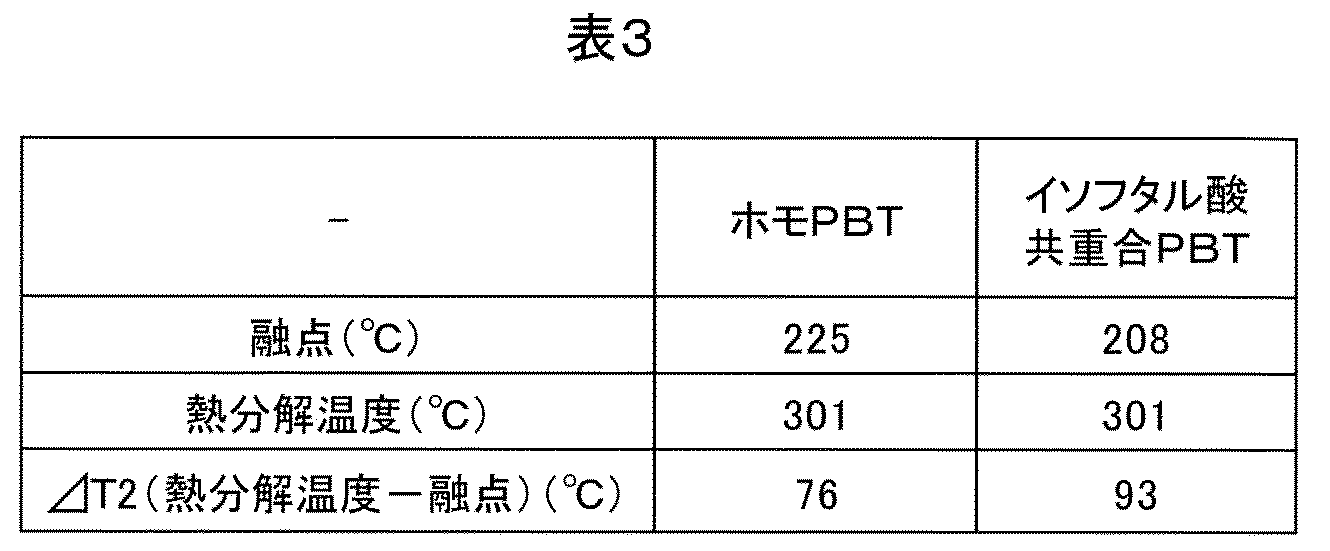
- the melting temperature of the resin becomes too high, bubbles are likely to be generated due to thermal decomposition of the resin, and as a result, voids remain in the molded article, resulting in a decrease in strength and reliability. Therefore, the robustness is higher when the difference ⁇ T2 between the melting point of the resin powder and the thermal decomposition temperature is increased.
- Table 3 shows the melting point and thermal decomposition temperature (temperature at which the weight was reduced by 1%) of the powder of homo PBT and isophthalic acid copolymer PBT. Even with isophthalic acid copolymerized PBT having a lowered melting point, the thermal decomposition temperature was the same as that of homo PBT.
- the PBT resin according to the present invention is a copolymerized PBT resin, which is terephthalic acid and 1,4-butanediol, and other dicarboxylic acids (or ester-forming derivatives thereof) or other diols copolymerizable therewith. (Or ester-forming derivatives thereof) are copolymerized.
- the other dicarboxylic acids include isophthalic acid, phthalic acid, 4,4′-diphenyl ether dicarboxylic acid, 5-sodium sulfoisophthalic acid, 2,6-naphthalenecarboxylic acid, azelaic acid, adipic acid, sebacic acid, and 1,3.
- -Cyclohexanedicarboxylic acid 1, -4-cyclohexanedicarboxylic acid, dimer acid and the like can be used.
- diol diethylene glycol, polyethyleneglycol, polypropylene glycol, polytetramethylene glycol etc. can be used.
- the proportion of the copolymerization monomer is too large, the heat resistance is significantly reduced. Therefore, it is desirable that it is 3-30 mol%. In particular, in the case of isophthalic acid copolymerization, it is preferably 5-15 mol%. In consideration of these copolymerization ratios, the melting point of PBT is preferably lowered by 10-25 ° C. to 200-215 ° C.
- the intrinsic viscosity of the copolymerized PBT resin is preferably 0.5 to 1.5 dl / g, and if it is smaller than that, the mechanical strength of the resin shaped article 40 is low, and if it is larger, it is unsintered during laser irradiation. Parts are easily generated, and the mechanical strength of the resin shaped article 40 is lowered.
- the 50% average particle diameter of the resin powder is about 80 ⁇ m, but it may be in the range of 10-100 ⁇ m. If the average particle size of the resin powder is less than 10 ⁇ m, the resin powder aggregates when the modeling area 8 is at a high temperature close to the modeling temperature, making it difficult to install with the roller 1 or the blade 1. It tends to occur. However, even in that case, it is desirable to use a resin powder that has passed at least a mesh comb having an opening of about 106 ⁇ m.
- the 50% average particle diameter of the powder is 30-80 ⁇ m. Within this range, the laying property is not significantly reduced by aggregation, and high quality modeling is possible.
- the repose angle is 50 ° or less
- the degree of compression is 40 ° or less
- the Hausner ratio is 1.60 or less. It is desirable to satisfy.
- the angle of repose is 40 ° or less
- the degree of compression is 25 ° or less
- the Hausner ratio is 1.34 or less.
- fumed silica or the like may be added to the resin powder 20 in an amount of 0.01% or more and less than 1.0%, and preferably 0.1% or more and 0.5% or less. If the amount is small, the fluidity does not improve so much, and if the amount is large, the lubricant itself aggregates and the fluidity does not improve.In addition, it acts as a core material during laser irradiation, warping occurs, and even modeling is performed. It becomes impossible.
- the lubrication material added to the PBT resin to improve the fluidity may be not only fumed silica but also an inorganic material such as alumina, and the average primary particle size is 50 nm or less. It is desirable.
- the lubricant is in a state of being mixed with PBT resin that has been refined by a mixer or the like in an aggregated state where at least 50% of the average particle diameter is 100 ⁇ m or less.
- the thickness of the resin powder layered for molding is preferably 0.05 mm to 0.15 mm.
- the pulverization process which is fine pulverization, for example, when pulverizing in a state kept at a low temperature with liquid nitrogen or the like, the elongation due to plastic deformation of the powder is small compared to pulverizing at room temperature, In many cases, the particle size distribution is uniform and the fluidity is excellent.
- the PBT resin according to the present invention may be alloyed with a resin containing an ester such as polyethylene terephthalate (PET) or polycarbonate (PC).
- a resin containing an ester such as polyethylene terephthalate (PET) or polycarbonate (PC).
- PET polyethylene terephthalate
- PC polycarbonate
- the alloying ratio of PET and PC is 5-40%.
- the pelletized alloy is preferably finely powdered by various pulverization methods to obtain the above resin powder characteristics.
- the transesterification occurs excessively, a decrease in molecular weight or the like may occur, resulting in a decrease in mechanical properties.
- an additive such as a phosphorus compound, for example, a phosphite compound or a phosphate stabilizer so that transesterification does not proceed excessively.
- the phosphorus-based stabilizer is preferably 0.003 to 0.03 parts by weight with respect to the alloyed resin.
- the PBT resin according to the present invention may contain a thermoplastic elastomer.
- the thermoplastic elastomer is preferably styrene, olefin, or polyester, and may be used in combination with the above alloy. In this case, it is possible to increase the impact strength of the resin shaped product.
- additives such as antioxidants, ultraviolet absorbers, heat stabilizers, mold release agents, antistatic agents, dyes and pigments, dispersants, plasticizers, etc. are added to the PBT resin powder. May be.
- the additive is contained, desirably, it is added at the stage of producing pellets and then pulverized. However, when the additive is added, the crystallization temperature often increases.
- the crystallization temperature may be controlled by increasing the copolymerization ratio or alloying as shown above.
- the amount is 1% by weight or less with respect to the amount of PBT resin material. Therefore, even when the above additives are added, it can be implemented by alloying.
- flame retardancy for example, when V0 of UL-94 is required, it is necessary to contain a relatively large amount of flame retardant compared to other additives.
- phosphate esters and hydrated metal compounds aluminum hydroxide, magnesium, etc.
- a brominated flame retardant added with a flame retardant aid such as antimony.
- brominated flame retardants brominated polystyrene, brominated phenoxy, brominated epoxy, etc. are effective, but in particular, when brominated epoxy with a relatively high decomposition temperature is used, resin powder can be recycled. It is effective. If V0 is to be satisfied, the total of these flame retardants and flame retardant aids requires 20-40% by weight based on the amount of PBT resin material.
- the flame retardant powder is added to the PBT resin powder. Rather than blending, it is desirable to knead the flame retardant in the form of pellets and then pulverize.
- the transmittance of the powder may be high depending on the material system and the lamination thickness. In that case, in the portion where the powder is present under the laser irradiation surface, the lower powder may be sintered or melted.
- adding the above additives may be effective in terms of adjusting the transmittance.
- the laser irradiation energy may be reduced only in a portion where the powder is below the laser irradiation surface, compared to a portion where the powder is placed on the model without adding the additive.
- the PBT resin powder may be a combination of homo PBT and copolymer PBT in a powder state, and at least one of the powders may be alloyed with PET or PC.
- the PBT resin which is a resin powder
- a short fiber material having a maximum size of 300 ⁇ m or less is preferably combined. This is because when the value exceeds that value, the roughness increases and the accuracy of the end portion becomes conspicuous.
- a spherical material may be used, and it is desirable that the 50% average particle diameter is 100 ⁇ m or less. This is because the particle size is less likely to agglomerate with the fine PBT resin and generation of voids during laser light irradiation can be suppressed.
- the inorganic filler needs to have a maximum size of 10 ⁇ m or more. The reason for this is that when 1% or more of an inorganic filler of less than 10 ⁇ m is contained as in the case of adding other additives, it functions as a core material and warpage occurs during modeling.
- the inorganic filler glass fiber, glass flake, glass bead, carbon fiber, mica, talc, calcium carbonate, magnesium hydroxide, boehmite, zinc oxide or the like can be used alone or in combination.
- the fiber refers to a fiber shape that is a cylindrical shape or a rectangular parallelepiped.
- the flake refers to a flat shape having a thickness.
- the bead means a substantially spherical shape, and is a concept including a substantially elliptical sphere.
- these inorganic fillers can be used in combination, and these inorganic fillers can be used as coupling agents such as organic silane compounds, epoxy compounds, isocyanate compounds, organic titanate compounds, and organic borane compounds. May be pre-processed and used. However, since the irradiated portion of the laser light in the installed resin powder 21 may be at least 300 ° C. or higher, it is necessary to use a material having high heat resistance of the coupling material.
- the adhesiveness of a PBT resin component and an inorganic filler may become a subject.
- the material surface such as surface modification of the inorganic material but also irradiation of a plurality of times by changing the energy of laser irradiation to one laminated portion is an effective means. is there.
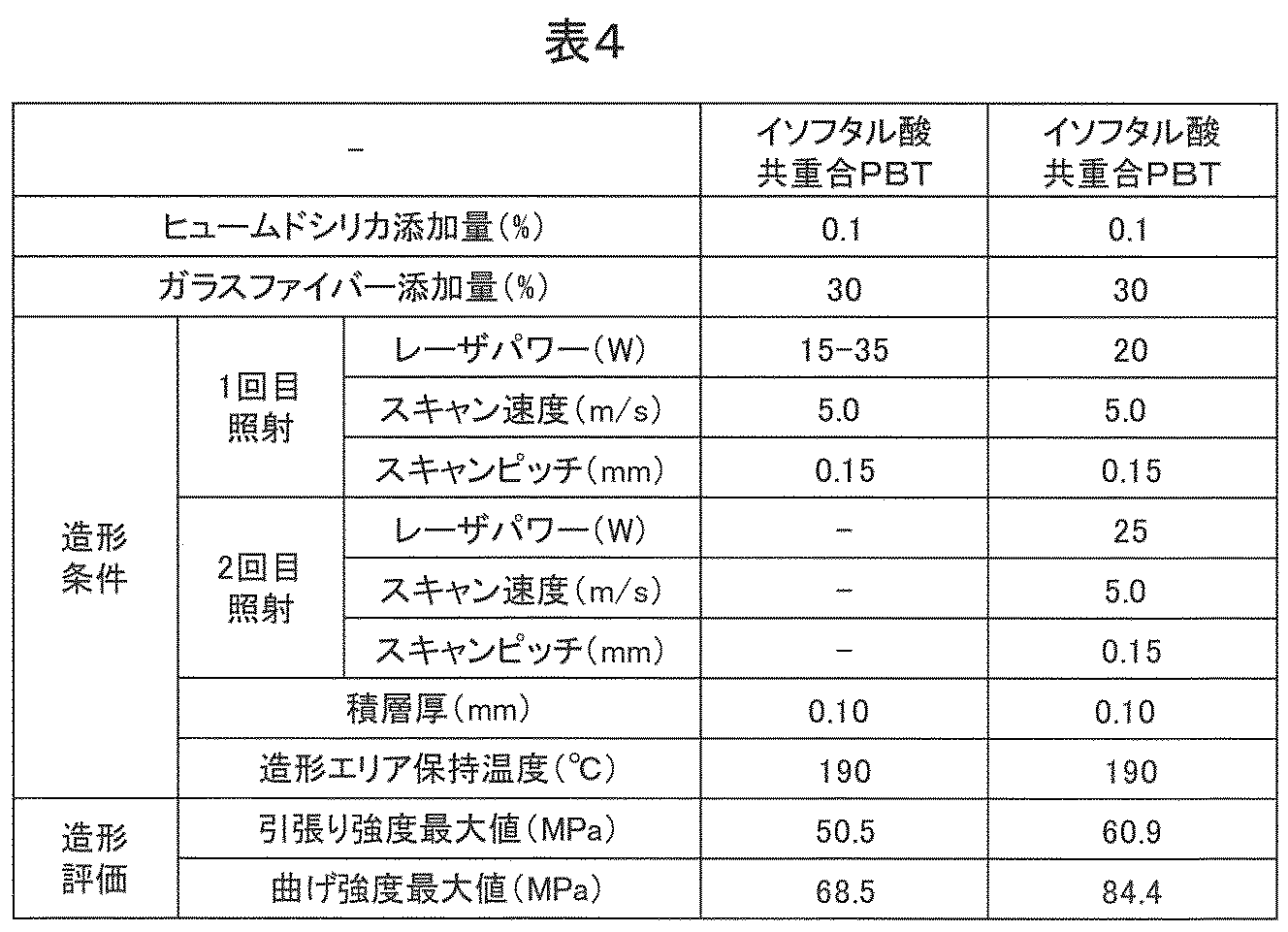
- a powder obtained by adding 0.1% fumed silica to isophthalic acid copolymerized PBT resin shown in Table 1 and containing 30% glass fiber having a silane-treated standard fiber diameter of 11 ⁇ m and an average fiber length of 100 ⁇ m is 1 The result when it is irradiated twice and twice is shown.
- the first irradiation was performed under the same conditions as shown in Table 2, and when the second irradiation was performed, the energy was changed so that the first time was 20 W and the second time was 25 W.
- the results are shown in Table 4.
- the strength was slightly reduced by adding glass fiber, whereas in the case of two irradiations, it was confirmed that the strength was greatly improved.
- the apparatus configuration uses the laser powder additive manufacturing apparatus 50 shown in FIG. Since the configuration in the apparatus is the same as that not described, the description thereof is omitted. As described above in the first embodiment, it is possible to form the shaped article 40 with the powder itself. However, depending on the product, only a part may be formed to constitute a part having complicated functionality. Such a case will be described.
- the PBT resin of the present invention is preferable to form on the other member 30.
- a bending test piece on an injection-molded PBT base (containing 30% glass fiber).
- the 4 mm-thick bending test piece (corresponding to ISO 178) itself could be modeled while being held at 205 ° C., but the cooling after the modeling was finished Sometimes peeling occurred between the PBT base and the bending specimen.
- the molding when the molding is performed at a temperature lower than the crystallization temperature of the PBT resin powder, the recyclability of the resin powders 20 and 22 is improved, and further, there is an advantage that the choice of materials that are relatively unstable with respect to heat is increased. .
- the adhesion between the resin shaped article 40 and the powder 22 is low, there is an advantage that the man-hours for peeling the resin shaped article 40 and the powder 22 can be greatly reduced.
- the use of the copolymerized PBT is an effective means because the difference ⁇ T2 between the thermal decomposition temperature and the melting point can be widened. Furthermore, in this case, it is a very effective method to change the laser irradiation energy and use a plurality of times of irradiation.
- the other member 30 when powder layered modeling is performed on another member 30 such as a molded product or metal of the same type and different materials, the other member 30 itself for modeling is the same member as the support member 24, and therefore, depending on the structure May contain a large amount of a material that becomes a core material.
- the other members 30 made of resin have higher rigidity than the PBT resin to be modeled. If the rigidity is low, the resin-made other member 30 is warped by the shrinkage force of the resin-molded article 40, and even the modeling cannot be performed.
- the support member 24 is once formed of PBT resin powder and finally removed. Further, it is desirable that the support member 24 has a lower density than the modeled object by reducing the laser energy so that it can be easily removed later.
- another member made of resin or metal may be considered as a substrate for the support member 24.
- the embodiments have been described separately. However, they are not irrelevant to each other, and one of them is related to some or all of the other modifications.
- the laser powder additive manufacturing method has been described as a target, the present invention can also be applied to a method in which resin powder is melted and sintered by heat other than laser.
- a specific absorbent in a powder resin may be mixed and selectively heated with light such as infrared rays that absorb the resin, or a material that absorbs light by ink jet or the like may be selectively discharged into the powder.
- an infrared lamp or the like may be physically moved and selectively heated.
- it is also effective for an additive manufacturing method in which molten resin is discharged from a nozzle and laminated.
Landscapes
- Chemical & Material Sciences (AREA)
- Engineering & Computer Science (AREA)
- Materials Engineering (AREA)
- Polymers & Plastics (AREA)
- Organic Chemistry (AREA)
- Health & Medical Sciences (AREA)
- Chemical Kinetics & Catalysis (AREA)
- Medicinal Chemistry (AREA)
- Manufacturing & Machinery (AREA)
- Mechanical Engineering (AREA)
- Physics & Mathematics (AREA)
- Optics & Photonics (AREA)
- Compositions Of Macromolecular Compounds (AREA)
- Polyesters Or Polycarbonates (AREA)
- Laminated Bodies (AREA)
Abstract
Description
これは、温度が下がると結晶化が開始し、樹脂の収縮による反りが起こるためである。
そのため、できるだけ耐熱性が高い積層造形品が望まれている。
そのため、積層造形前後では、乾燥環境下に保持する手間が大きくかかっていたことから製造方法が複雑であった。また、装置構成も複雑となっていた。
本願発明は、上記課題を解決する手段を複数含んでいるが、その一例として以下の構成を採用する。
本願発明の一例として、ローラまたはブレードとレーザ光源とを有しており、ローラまたはブレードによって樹脂粉末を敷設する工程と、敷設された樹脂粉末にレーザ光源からレーザを照射し、照射された箇所を焼結もしくは溶融させるレーザ照射工程と、を順次繰り返して積層造形物を作製するレーザ粉末造形方法であって、樹脂粉末は、結晶化温度がホモポリブチレンテレフタレート樹脂より低いポリブチレンテレフタレート樹脂粉末であることを特徴とする。
本発明に用いるレーザ粉末積層造形装置50は、供給用の粉末樹脂20を造形エリアに供給するローラ1もしくはブレード1で設置する。平面となるようにほぼ均一に設置される。設置された樹脂粉末21を焼結もしくは溶融させ積層接合するのに用いるレーザ光源2、造形エリア8内でレーザ光4を動かすためのガルバノミラー3、造形エリア8内の造形容器5、反射板7、前記造形容器5の両側に配置される粉末材料を保管する保管容器6、造形容器5と、保管容器6を上下方向に動作させるためのピストン10、11、造形エリア8、造形容器5、保管容器6を高温に保持するためのヒータ(図示せず)から構成される。なお、ヒータの配置や構造は適宜変更してよい。
この造形工程は、造形物の大きさやレーザ光4のスキャン速度にもよるが、大きな造形品や複数の造形品を製造する際には、最大10分程度の時間を要することがある。
粉末樹脂22を設置し、レーザ光4を照射する造形工程を繰り替えし行うことで3次元的に樹脂造形品40を作製する方法である。
なお、精度の観点では、レーザ光4のスポットサイズは小さくすると良いが、その分、造形時間が長くなるため、通常は、100-600μmを使用することが望ましい。
記憶部への上記作業手順の情報等を保存あるいは入力するには他の計算機からネットワーク等の通信を用いる手段や、別途CD-ROM等の光ディスク、MO、フラッシュメモリ等の記憶装置を使って上記作業手順の情報を入力してもよい。
粉末積層造形を行う場合、高い造形品質(特に密度)の確保及び造形中の反りを抑制するために、粉末や造形品が配置されるチャンバー内の造形温度エリア8は、樹脂粉末20の融点に対して5-15℃程度と低くしておくこととなる。
そのため、射出成形などで使用されているホモPBTをベースとした融点225℃程度のPBT樹脂を使用しようとすると、造形温度エリア8の保持温度の観点で造形ができなかった。
まず、ホモPBTのペレットを準備する(S101)。樹脂粉末に加工される前の材料であるホモPBTのペレットの融点は225℃、結晶化温度は180℃、固有粘度は0.85dl/gである。
特に、常温下で行わないと、樹脂粉砕の工程で樹脂自体の温度上昇が大きくなり、微細な粉末化をした時の収率が悪くなる傾向にある。なお、樹脂の物性によっては、液体窒素下で粉砕すると良い。そのようにすることで、粉末の形状が安定する上に、大量生産にする際のコストの大幅低減が可能となる。
S102によって微細粉末化されたホモPBT粉末の粒径サイズは、50%平均粒子径83μmであった。
樹脂粉末に加工される前の材料であるイソフタル酸共重合PBTのペレットの融点は208℃、結晶化温度は153℃、固有粘度は0.85-1.0dl/gである。

S102の工程でのペレットの微細粉末化は、ペレットに対して衝撃とせん断力を与えることで粉砕する。このペレットが粉砕される際に、ペレットには衝撃とせん断力がかかることで、結晶化温度が変化する。
ただし、微細粉末化された粉末樹脂よりもヒュームドシリカの粒子径が小さいため、微細粉末化後に添加することが望ましい。
これらの上述したヒュームドシリカが添加されたPBT樹脂粉末材料を用いて、積層造形を行った。
三次元積層造形装置は、アスペクト社製ラファエロ300を使用し、上述の積層造形方法を用いて積層造形を行った。
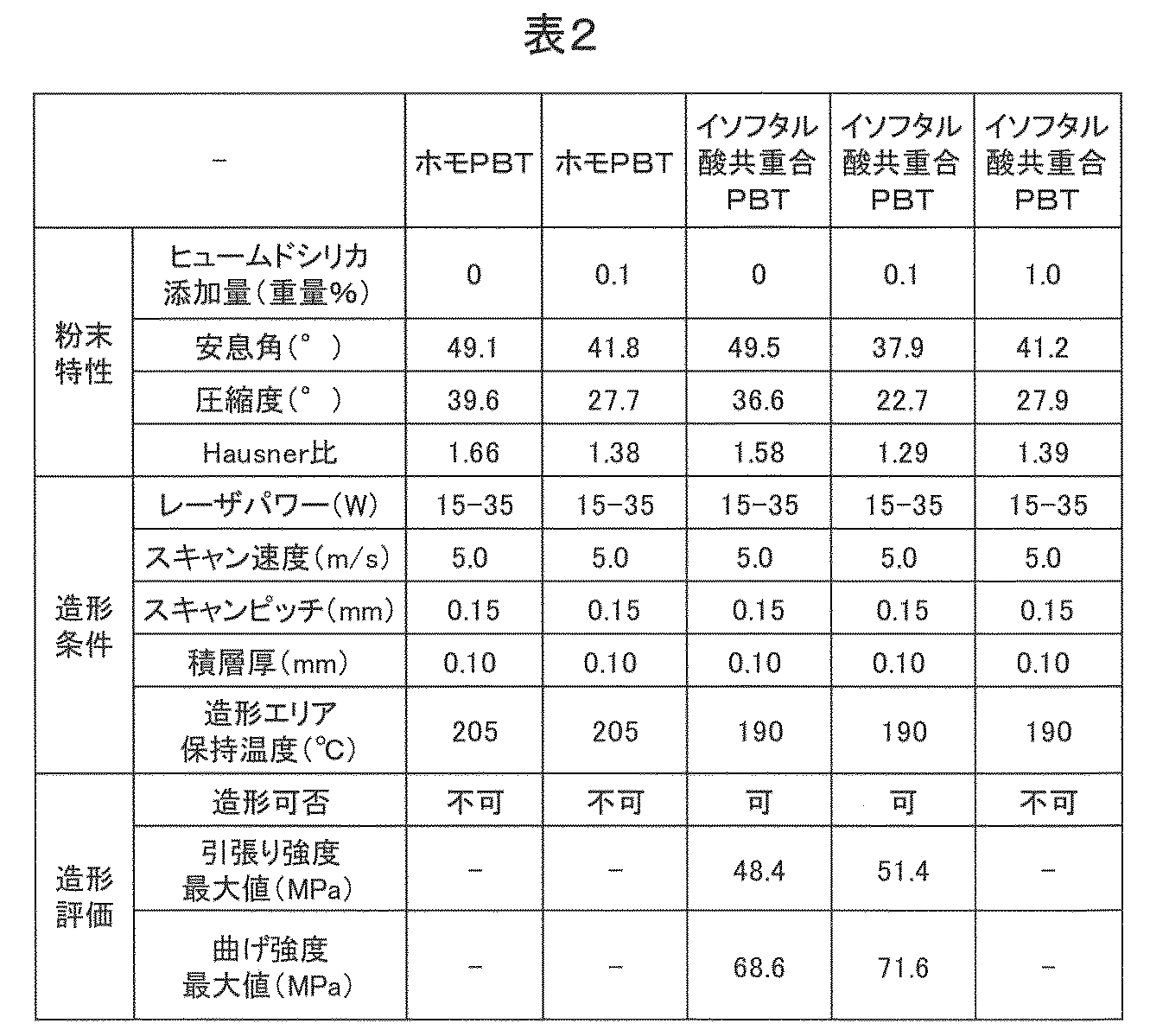
さらに、ホソカワミクロン製パウダテスタを用い、ヒュームドシリカの添加有無での粉末の流動特性(安息角、圧縮度、Hausner比)を評価した結果も表2に示す。
特に、樹脂の溶融温度が高くなりすぎると、樹脂の熱分解により、気泡が発生しやすくなり、その結果、造形物内にボイドとして残り、強度低下や信頼性の低下を起こす。そのため、樹脂粉末の融点と熱分解温度の差ΔT2を大きくした方がロバスト性は高い。
ただし、その場合であっても、少なくとも目開き106μm程度のメッシュ櫛を100%パスした樹脂粉末を使用することが望ましい。
この潤滑剤と混合されたPBT樹脂粉末の粒子径を考慮すると、造形にかかる樹脂粉末の積層厚みとしては、0.05mm-0.15mmとすると良い。
エステルを含む樹脂とアロイ化することで、エステル交換により、結晶化温度を低下できるメリットがある。特に、PCとのアロイでは、非結晶性であるPCを含むため、造形後の冷却時の反りを大幅に抑制できる。
この場合は、機械物性が低下するため、エステル交換を過度に進行させないように、リン系化合物、例えば、ホスファイト化合物、ホスフェート系安定剤などの添加剤を加えることも有効となる。リン系安定剤は、アロイ化された樹脂に対して、0.003~0.03重量部とすると良い。
特に、ハロゲンフリーの観点では、リン酸エステル系及び水和金属化合物(水酸化アルミニウムやマグネシウムなど)を用いると良いが、ハロゲンフリーの規定がない場合は、コスト・熱安定性・造形品質の観点で、臭素系難燃材に、アンチモンなどの難燃助剤を加えたものを使用すると良い。
なお、V0を満たそうとすると、それら難燃材及び難燃助剤の合計で、PBT樹脂材量に対して、20-40重量%は必要となる。
この場合、少なくとも無機充填材の99%以上は、最大サイズが10μm以上のものとする必要がある。その理由は、その他の添加剤を加える場合と同様に、10μm未満の無機充填材が1%以上含まれると、核材として働き、造形時に反りが起こってしまうためである。
ただし、設置された樹脂粉末21のうちレーザ光の照射部は少なくとも300℃以上となる可能性があるため、カップリング材の耐熱性が高い材料を用いる必要がある。
本発明の共重合PBT樹脂を用いて、共重合PBT樹脂と同種または異種材の成形品や金属など他の部材30に対して、粉末積層造形を行う方法を図5を用いて説明する。
5…造形容器、6…粉末保管容器、7…反射板、8…造形温度エリア
9…保管温度エリア、10…ピストン、11…ピストン、20…供給用樹脂粉末
21…樹脂粉末(ローラまたはブレードで設置された樹脂粉末)
22…樹脂粉末(造形容器5内に埋まった樹脂粉末)
23…レーザ焼結部、24…サポート部材、30…他の部材、40…樹脂造形品
50…レーザ粉末積層造形装置
Claims (20)
- 粉末積層造形方法に使用される樹脂粉末材料であって、
前記樹脂粉末は、結晶化温度がホモポリブチレンテレフタレート樹脂より低いポリブチレンテレフタレート樹脂であること
を特徴とする樹脂粉末材料。 - 請求項1に記載の樹脂粉末材料であって、
前記ポリブチレンテレフタレート樹脂は、融点が200-215℃であること
を特徴とする樹脂粉末材料。 - 請求項1に記載の樹脂粉末材料であって、
前記ポリブチレンテレフタレート樹脂は、共重合成分を含むポリブチレンテレフタレート共重合体を主成分としたこと
を特徴とする樹脂粉末材料。 - 請求項3に記載の樹脂粉末材料であって、
前記共重合ポリブチレンテレフタレートは、共重合成分が3から30mol%で構成されること
を特徴とする樹脂粉末材料。 - 請求項1に記載の樹脂粉末材料であって、
前記共重合ポリブチレンテレフタレートは、イソフタル酸成分が5から15mol%で構成されること
を特徴とする樹脂粉末材料。 - 請求項5に記載の樹脂粉末材料であって、
前記応力は、ポリブチレンテレフタレート樹脂組成からなるペレットに対して、少なくとも衝撃またはせん断作用のいずれかを与える方式で粉砕される工程によって与えられた応力であること
を特徴とする樹脂粉末材料。 - 請求項6に記載の樹脂粉末材料であって、
前記粉砕される工程は、前記ペレットを常温以下の温度で粉砕される工程であること
を特徴とする樹脂粉末材料。 - 請求項1に記載の樹脂粉末材料であって、
前記ポリブチレンテレフタレート樹脂は、ポリエチレンテレフタレート樹脂もしくはポリカーボネート樹脂を5-40重量%含んだことを特徴とする樹脂粉末材料。 - 請求項1に記載の樹脂粉末材料であって、
前記ポリブチレンテレフタレート樹脂は、平均1次粒子径が100nm以下の無機物を0.05以上1.0未満重量%含まれていること
を特徴とする樹脂粉末材料。 - 請求項1に記載の樹脂粉末材料であって、
前記ポリブチレンテレフタレート樹脂と、難燃材とが混合されていること
を特徴とする樹脂粉末材料。 - 請求項1に記載の樹脂粉末材料であって、
前記ポリブチレンテレフタレート樹脂と、長軸方向のサイズが300μm以下の無機物を5-40重量%とが混合されていること
を特徴とする樹脂粉末材料。 - 請求項1に記載の樹脂粉末材料であって、
前記ポリブチレンテレフタレート樹脂と、平均1次粒子径及び50%平均粒子径100μm以下の無機物ビーズを少なくとも5-40重量%とが混合されていること
を特徴とする樹脂粉末材料。 - 請求項1に記載の樹脂粉末材料であって、
前記ポリブチレンテレフタレート樹脂は、室温でのHausner比が1.34以下であること
を特徴とする樹脂粉末材料。 - 請求項1に記載の樹脂粉末材料であって、
前記ポリブチレンテレフタレート樹脂は、室温での安息角が40°以下であること
を特徴とする樹脂粉末材料。 - 樹脂粉末材料を敷設する工程と、敷設された前記樹脂粉末材料にレーザを照射し、前記レーザが照射された箇所を焼結もしくは溶融させるレーザ照射工程と、を有しており、前記敷設する工程と前記レーザ照射工程とを順次繰り返して積層造形物を作製するレーザ粉末造形方法であって、
前記樹脂粉末材料は、結晶化温度がホモポリブチレンテレフタレート樹脂より低いポリブチレンテレフタレート樹脂であること
を特徴とするレーザ粉末造形方法。 - 請求項15に記載のレーザ粉末造形方法において、
さらに、前記樹脂粉末材料の敷設前に他の部材を配置する工程と、
前記レーザ照射工程は、レーザ照射される箇所のうち下の層が前記樹脂粉末材料である場合には、前記他の部材上に前記樹脂粉末材料を敷設された箇所より低いエネルギーでレーザ照射すること
を特徴とするレーザ粉末造形方法。 - 請求項16に記載のレーザ粉末造形方法において、
前記他の部材は、樹脂もしくは金属で構成される部材であること
を特徴とするレーザ粉末造形方法。 - 請求項16に記載のレーザ粉末造形方法において、
前記樹脂粉末材料を敷設する箇所の温度を前記ポリブチレンテレフタレート樹脂の結晶化温度以下に保持すること
を特徴とするレーザ粉末造形方法。 - 請求項16に記載の造形方法において、
前記他の部材は、前記ポリブチレンテレフタレート樹脂の造形品よりも剛性が高いことを特徴とするレーザ粉末造形方法。 - ローラまたはブレードとレーザ光源とを有しており、前記ローラまたは前記ブレードを用いて樹脂粉末材料を敷設する工程と、敷設された前記樹脂粉末材料に前記レーザ光源からレーザを照射し、照射された箇所を焼結もしくは溶融させるレーザ照射工程と、を有しており、前記敷設する工程と前記レーザ照射工程とを順次繰り返して積層造形物を作製するレーザ粉末造形方法であって、
前記樹脂粉末材料は、結晶化温度がホモポリブチレンテレフタレート樹脂より低いポリブチレンテレフタレート樹脂であること
を特徴とするレーザ粉末造形装置。
Priority Applications (3)
| Application Number | Priority Date | Filing Date | Title |
|---|---|---|---|
| PCT/JP2015/052254 WO2016121013A1 (ja) | 2015-01-28 | 2015-01-28 | 樹脂粉末材料、レーザ粉末造形方法及びその装置 |
| JP2016543099A JP6033994B1 (ja) | 2015-01-28 | 2015-01-28 | 樹脂粉末材料、レーザ粉末造形方法及びその装置 |
| US15/312,991 US11634577B2 (en) | 2015-01-28 | 2015-01-28 | Resin powder material, laser powder molding method and device |
Applications Claiming Priority (1)
| Application Number | Priority Date | Filing Date | Title |
|---|---|---|---|
| PCT/JP2015/052254 WO2016121013A1 (ja) | 2015-01-28 | 2015-01-28 | 樹脂粉末材料、レーザ粉末造形方法及びその装置 |
Publications (1)
| Publication Number | Publication Date |
|---|---|
| WO2016121013A1 true WO2016121013A1 (ja) | 2016-08-04 |
Family
ID=56542670
Family Applications (1)
| Application Number | Title | Priority Date | Filing Date |
|---|---|---|---|
| PCT/JP2015/052254 Ceased WO2016121013A1 (ja) | 2015-01-28 | 2015-01-28 | 樹脂粉末材料、レーザ粉末造形方法及びその装置 |
Country Status (3)
| Country | Link |
|---|---|
| US (1) | US11634577B2 (ja) |
| JP (1) | JP6033994B1 (ja) |
| WO (1) | WO2016121013A1 (ja) |
Cited By (18)
| Publication number | Priority date | Publication date | Assignee | Title |
|---|---|---|---|---|
| JP2017127997A (ja) * | 2016-01-18 | 2017-07-27 | 国立研究開発法人産業技術総合研究所 | 造形用粉末 |
| JP2018058235A (ja) * | 2016-10-03 | 2018-04-12 | コニカミノルタ株式会社 | 粉末材料、立体造形物の製造方法および立体造形装置 |
| EP3415563A1 (en) * | 2017-06-13 | 2018-12-19 | Ricoh Company, Limited | Resin powder for solid freeform fabrication, device for fabricating solid freeform fabrication object, and resin powder |
| JP2019001154A (ja) * | 2017-06-13 | 2019-01-10 | 株式会社リコー | 立体造形用樹脂粉末、立体造形装置、立体造形物の製造方法、及び樹脂粉末 |
| JP2019094366A (ja) * | 2017-11-17 | 2019-06-20 | 三菱ケミカル株式会社 | ポリエステルの熱処理方法 |
| WO2019151380A1 (ja) * | 2018-02-02 | 2019-08-08 | 株式会社アスペクト | 粉末床溶融結合造形物の粉末材料及びその形成方法、並びに粉末床溶融結合造形物 |
| EP3616869A1 (en) | 2018-08-31 | 2020-03-04 | Ricoh Company, Ltd. | Resin powder, device and method of manufacturing a solid freeform object |
| WO2020090381A1 (ja) * | 2018-10-30 | 2020-05-07 | 東レ株式会社 | 粉粒体混合物およびその製造方法、ならびに粉粒体組成物および三次元造形物の製造方法 |
| JP2020093455A (ja) * | 2018-12-12 | 2020-06-18 | 三菱ケミカル株式会社 | 粉末積層造形法用共重合ポリブチレンテレフタレート |
| WO2020138188A1 (ja) | 2018-12-26 | 2020-07-02 | 三菱ケミカル株式会社 | 粉末積層造形法用粉末およびその製造方法 |
| WO2020158903A1 (ja) | 2019-01-30 | 2020-08-06 | 三菱エンジニアリングプラスチックス株式会社 | 粉末積層造形法用の樹脂組成物、ペレット、粉末、造形物の製造方法および造形物 |
| JP2022503962A (ja) * | 2018-10-26 | 2022-01-12 | コベストロ (ネザーランズ) ビー.ブイ. | ポリエステル粉末及び3次元印刷プロセスにおけるその使用 |
| WO2022009899A1 (ja) | 2020-07-06 | 2022-01-13 | 三菱ケミカル株式会社 | 粉末積層造形法用粉末、粉末積層造形法、および、造形品 |
| WO2022039158A1 (ja) | 2020-08-19 | 2022-02-24 | 三菱エンジニアリングプラスチックス株式会社 | 粉体積層造形法用の樹脂組成物、粉体、造形物の製造方法および造形物 |
| JP2022072580A (ja) * | 2020-10-30 | 2022-05-17 | セイコーエプソン株式会社 | 三次元造形装置 |
| JP2022072568A (ja) * | 2020-10-30 | 2022-05-17 | セイコーエプソン株式会社 | 三次元造形装置 |
| JP2022073099A (ja) * | 2020-10-30 | 2022-05-17 | セイコーエプソン株式会社 | 三次元造形装置 |
| WO2023139865A1 (ja) * | 2022-01-24 | 2023-07-27 | 株式会社日立製作所 | 樹脂材料、積層造形物の製造方法、及び再生樹脂のアップサイクル方法 |
Families Citing this family (10)
| Publication number | Priority date | Publication date | Assignee | Title |
|---|---|---|---|---|
| US8527101B2 (en) | 2010-04-16 | 2013-09-03 | Yale Security Inc. | Door closer assembly |
| WO2016121013A1 (ja) * | 2015-01-28 | 2016-08-04 | 株式会社日立製作所 | 樹脂粉末材料、レーザ粉末造形方法及びその装置 |
| DE102015202347A1 (de) * | 2015-02-10 | 2016-08-11 | Trumpf Laser- Und Systemtechnik Gmbh | Bestrahlungseinrichtung, Bearbeitungsmaschine und Verfahren zum Herstellen einer Schicht eines dreidimensionalen Bauteils |
| JP6825333B2 (ja) | 2016-11-28 | 2021-02-03 | 株式会社リコー | 立体造形物の製造方法、及び立体造形物の製造装置 |
| US20190047222A1 (en) * | 2017-08-14 | 2019-02-14 | Formlabs, Inc. | Techniques for producing thermal support structures in additive fabrication and related systems and methods |
| CN111183015A (zh) | 2017-10-04 | 2020-05-19 | 巴斯夫欧洲公司 | 用于生产成型体的包含矿物阻燃剂的烧结粉末 |
| JP6910977B2 (ja) | 2018-03-07 | 2021-07-28 | 株式会社日立製作所 | 粉末積層造形装置 |
| CN109880312B (zh) * | 2019-01-29 | 2021-10-29 | 五河县宜然知识产权服务有限公司 | 一种传感器外壳用改性聚丁二酸丁二醇酯复合材料的制备方法 |
| JP2021020386A (ja) * | 2019-07-29 | 2021-02-18 | 株式会社リコー | 立体造形用樹脂粉末、及び立体造形用樹脂粉末の製造方法 |
| JP7494705B2 (ja) * | 2020-10-30 | 2024-06-04 | セイコーエプソン株式会社 | 三次元造形装置 |
Citations (3)
| Publication number | Priority date | Publication date | Assignee | Title |
|---|---|---|---|---|
| JPH10505116A (ja) * | 1994-08-30 | 1998-05-19 | ディーティーエム・コーポレーション | 焼結性半晶質粉体及びこの粉体で形成した物品 |
| JP2010006057A (ja) * | 2008-05-20 | 2010-01-14 | Eos Gmbh Electro Optical Systems | 構造修飾されたポリマーの選択的焼結 |
| JP2012513319A (ja) * | 2008-12-22 | 2012-06-14 | ヴァルスパー・ソーシング・インコーポレーテッド | ポリエステル粉末組成物、方法、及び物品 |
Family Cites Families (6)
| Publication number | Priority date | Publication date | Assignee | Title |
|---|---|---|---|---|
| CA2526100A1 (en) * | 2003-05-21 | 2004-12-29 | Z Corporation | Thermoplastic powder material system for appearance models from 3d printing systems |
| US8247492B2 (en) | 2006-11-09 | 2012-08-21 | Valspar Sourcing, Inc. | Polyester powder compositions, methods and articles |
| US9466181B2 (en) * | 2008-07-16 | 2016-10-11 | Bradley Berman | Gaming method and apparatus with dynamic element function |
| JP2011068125A (ja) | 2009-08-27 | 2011-04-07 | Gun Ei Chem Ind Co Ltd | 耐熱成形物及びその製造方法 |
| CN102344554A (zh) * | 2010-08-04 | 2012-02-08 | 中国石油化工股份有限公司 | 一种低熔点pbt共聚酯的制备方法 |
| WO2016121013A1 (ja) * | 2015-01-28 | 2016-08-04 | 株式会社日立製作所 | 樹脂粉末材料、レーザ粉末造形方法及びその装置 |
-
2015
- 2015-01-28 WO PCT/JP2015/052254 patent/WO2016121013A1/ja not_active Ceased
- 2015-01-28 JP JP2016543099A patent/JP6033994B1/ja active Active
- 2015-01-28 US US15/312,991 patent/US11634577B2/en active Active
Patent Citations (3)
| Publication number | Priority date | Publication date | Assignee | Title |
|---|---|---|---|---|
| JPH10505116A (ja) * | 1994-08-30 | 1998-05-19 | ディーティーエム・コーポレーション | 焼結性半晶質粉体及びこの粉体で形成した物品 |
| JP2010006057A (ja) * | 2008-05-20 | 2010-01-14 | Eos Gmbh Electro Optical Systems | 構造修飾されたポリマーの選択的焼結 |
| JP2012513319A (ja) * | 2008-12-22 | 2012-06-14 | ヴァルスパー・ソーシング・インコーポレーテッド | ポリエステル粉末組成物、方法、及び物品 |
Cited By (29)
| Publication number | Priority date | Publication date | Assignee | Title |
|---|---|---|---|---|
| JP2017127997A (ja) * | 2016-01-18 | 2017-07-27 | 国立研究開発法人産業技術総合研究所 | 造形用粉末 |
| JP2018058235A (ja) * | 2016-10-03 | 2018-04-12 | コニカミノルタ株式会社 | 粉末材料、立体造形物の製造方法および立体造形装置 |
| US11052649B2 (en) | 2017-06-13 | 2021-07-06 | Ricoh Company, Ltd. | Resin powder for solid freeform fabrication, device for fabricating solid freeform fabrication object, and resin powder |
| EP3415563A1 (en) * | 2017-06-13 | 2018-12-19 | Ricoh Company, Limited | Resin powder for solid freeform fabrication, device for fabricating solid freeform fabrication object, and resin powder |
| JP2019001154A (ja) * | 2017-06-13 | 2019-01-10 | 株式会社リコー | 立体造形用樹脂粉末、立体造形装置、立体造形物の製造方法、及び樹脂粉末 |
| JP2019094366A (ja) * | 2017-11-17 | 2019-06-20 | 三菱ケミカル株式会社 | ポリエステルの熱処理方法 |
| JP7035473B2 (ja) | 2017-11-17 | 2022-03-15 | 三菱ケミカル株式会社 | 3次元物体のラピッドプロトタイピング装置の使用方法 |
| WO2019151380A1 (ja) * | 2018-02-02 | 2019-08-08 | 株式会社アスペクト | 粉末床溶融結合造形物の粉末材料及びその形成方法、並びに粉末床溶融結合造形物 |
| JP2019130854A (ja) * | 2018-02-02 | 2019-08-08 | 株式会社アスペクト | 粉末床溶融結合造形物の粉末材料及びその形成方法、並びに粉末床溶融結合造形物 |
| EP3616869A1 (en) | 2018-08-31 | 2020-03-04 | Ricoh Company, Ltd. | Resin powder, device and method of manufacturing a solid freeform object |
| US11241825B2 (en) | 2018-08-31 | 2022-02-08 | Ricoh Company, Ltd. | Resin powder, device for solid freeform fabrication object, and method of manufacturing solid freeform fabrication object |
| JP2022503962A (ja) * | 2018-10-26 | 2022-01-12 | コベストロ (ネザーランズ) ビー.ブイ. | ポリエステル粉末及び3次元印刷プロセスにおけるその使用 |
| JP7439369B2 (ja) | 2018-10-26 | 2024-02-28 | ストラタシス,インコーポレイテッド | ポリエステル粉末及び3次元印刷プロセスにおけるその使用 |
| WO2020090381A1 (ja) * | 2018-10-30 | 2020-05-07 | 東レ株式会社 | 粉粒体混合物およびその製造方法、ならびに粉粒体組成物および三次元造形物の製造方法 |
| JPWO2020090381A1 (ja) * | 2018-10-30 | 2021-09-24 | 東レ株式会社 | 粉粒体混合物およびその製造方法、ならびに粉粒体組成物および三次元造形物の製造方法 |
| JP7375547B2 (ja) | 2018-10-30 | 2023-11-08 | 東レ株式会社 | 三次元造形物の製造方法 |
| JP2020093455A (ja) * | 2018-12-12 | 2020-06-18 | 三菱ケミカル株式会社 | 粉末積層造形法用共重合ポリブチレンテレフタレート |
| JP7215129B2 (ja) | 2018-12-12 | 2023-01-31 | 三菱ケミカル株式会社 | 粉末積層造形法用共重合ポリブチレンテレフタレート |
| WO2020138188A1 (ja) | 2018-12-26 | 2020-07-02 | 三菱ケミカル株式会社 | 粉末積層造形法用粉末およびその製造方法 |
| WO2020158903A1 (ja) | 2019-01-30 | 2020-08-06 | 三菱エンジニアリングプラスチックス株式会社 | 粉末積層造形法用の樹脂組成物、ペレット、粉末、造形物の製造方法および造形物 |
| WO2022009899A1 (ja) | 2020-07-06 | 2022-01-13 | 三菱ケミカル株式会社 | 粉末積層造形法用粉末、粉末積層造形法、および、造形品 |
| WO2022039158A1 (ja) | 2020-08-19 | 2022-02-24 | 三菱エンジニアリングプラスチックス株式会社 | 粉体積層造形法用の樹脂組成物、粉体、造形物の製造方法および造形物 |
| JP2022072580A (ja) * | 2020-10-30 | 2022-05-17 | セイコーエプソン株式会社 | 三次元造形装置 |
| JP2022072568A (ja) * | 2020-10-30 | 2022-05-17 | セイコーエプソン株式会社 | 三次元造形装置 |
| JP2022073099A (ja) * | 2020-10-30 | 2022-05-17 | セイコーエプソン株式会社 | 三次元造形装置 |
| JP7600623B2 (ja) | 2020-10-30 | 2024-12-17 | セイコーエプソン株式会社 | 三次元造形装置 |
| JP7613053B2 (ja) | 2020-10-30 | 2025-01-15 | セイコーエプソン株式会社 | 三次元造形装置 |
| JP7661688B2 (ja) | 2020-10-30 | 2025-04-15 | セイコーエプソン株式会社 | 三次元造形装置 |
| WO2023139865A1 (ja) * | 2022-01-24 | 2023-07-27 | 株式会社日立製作所 | 樹脂材料、積層造形物の製造方法、及び再生樹脂のアップサイクル方法 |
Also Published As
| Publication number | Publication date |
|---|---|
| US11634577B2 (en) | 2023-04-25 |
| US20170190905A1 (en) | 2017-07-06 |
| JP6033994B1 (ja) | 2016-11-30 |
| JPWO2016121013A1 (ja) | 2017-04-27 |
Similar Documents
| Publication | Publication Date | Title |
|---|---|---|
| JP6033994B1 (ja) | 樹脂粉末材料、レーザ粉末造形方法及びその装置 | |
| JP6655714B2 (ja) | 樹脂造形物およびレーザ粉末積層造形装置 | |
| US10870232B2 (en) | Polyester powder compositions, methods and articles | |
| CN103980592B (zh) | 一种用于3d打印的高填充量微纳粉体/聚合物复合材料及其制备方法和制品 | |
| CN107674389B (zh) | 立体造型用树脂粉末、立体造型物的制造装置以及制造方法 | |
| US10544342B2 (en) | Thermally conductive resin composition | |
| EP3378886B1 (en) | Polyester powder compositions, methods and articles | |
| ES2806395T3 (es) | Uso de una composición de polvo polimérico termoendurecible | |
| CA3049188C (en) | Use of a thermosetting polymeric powder composition | |
| EP3738749A1 (en) | Thermoplastic resin powder, resin powder, resin powder for producing three-dimensional object, three-dimensional object and three-dimensional object producing method | |
| JP2018111304A (ja) | 立体造形用樹脂粉末、立体造形物及び立体造形物の製造方法 | |
| EP3524430B1 (en) | Powder for solid freeform fabrication, and method of manufacturing solid freeform fabrication object | |
| JP7279506B2 (ja) | 熱可塑性樹脂粉末、立体造形用樹脂粉末、立体造形物の製造装置、及び立体造形物の製造方法 | |
| JP2021146602A (ja) | 樹脂粉末及び立体造形用樹脂粉末、並びに立体造形物の製造方法及び立体造形物の製造装置 | |
| JP2020093515A (ja) | 立体造形用粉末、造形装置、造形方法、及び粉末 | |
| JP7172463B2 (ja) | 立体造形用樹脂粉末、造形装置、及び造形方法 | |
| JP2019137031A (ja) | 立体造形用粉末、立体造形物の製造装置、立体造形物の製造方法及び樹脂粉末 | |
| WO2019117016A1 (ja) | 立体造形物の製造方法、およびそれに用いる粉末材料 | |
| JP2021020386A (ja) | 立体造形用樹脂粉末、及び立体造形用樹脂粉末の製造方法 | |
| JP2019162846A (ja) | 立体造形用粉末、立体造形物の製造装置、立体造形物の製造方法及び粉末 | |
| JP2020040395A (ja) | 樹脂粉末及びその製造方法、立体造形物の製造方法、並びに立体造形物の製造装置 |
Legal Events
| Date | Code | Title | Description |
|---|---|---|---|
| ENP | Entry into the national phase |
Ref document number: 2016543099 Country of ref document: JP Kind code of ref document: A |
|
| 121 | Ep: the epo has been informed by wipo that ep was designated in this application |
Ref document number: 15879910 Country of ref document: EP Kind code of ref document: A1 |
|
| WWE | Wipo information: entry into national phase |
Ref document number: 15312991 Country of ref document: US |
|
| NENP | Non-entry into the national phase |
Ref country code: DE |
|
| 122 | Ep: pct application non-entry in european phase |
Ref document number: 15879910 Country of ref document: EP Kind code of ref document: A1 |