WO2016104121A1 - 銅ボンディングワイヤ - Google Patents
銅ボンディングワイヤ Download PDFInfo
- Publication number
- WO2016104121A1 WO2016104121A1 PCT/JP2015/084271 JP2015084271W WO2016104121A1 WO 2016104121 A1 WO2016104121 A1 WO 2016104121A1 JP 2015084271 W JP2015084271 W JP 2015084271W WO 2016104121 A1 WO2016104121 A1 WO 2016104121A1
- Authority
- WO
- WIPO (PCT)
- Prior art keywords
- mass
- copper
- bonding wire
- fab
- less
- Prior art date
- Legal status (The legal status is an assumption and is not a legal conclusion. Google has not performed a legal analysis and makes no representation as to the accuracy of the status listed.)
- Ceased
Links
Classifications
-
- H—ELECTRICITY
- H10—SEMICONDUCTOR DEVICES; ELECTRIC SOLID-STATE DEVICES NOT OTHERWISE PROVIDED FOR
- H10W—GENERIC PACKAGES, INTERCONNECTIONS, CONNECTORS OR OTHER CONSTRUCTIONAL DETAILS OF DEVICES COVERED BY CLASS H10
- H10W72/00—Interconnections or connectors in packages
- H10W72/50—Bond wires
-
- H—ELECTRICITY
- H10—SEMICONDUCTOR DEVICES; ELECTRIC SOLID-STATE DEVICES NOT OTHERWISE PROVIDED FOR
- H10W—GENERIC PACKAGES, INTERCONNECTIONS, CONNECTORS OR OTHER CONSTRUCTIONAL DETAILS OF DEVICES COVERED BY CLASS H10
- H10W72/00—Interconnections or connectors in packages
- H10W72/01—Manufacture or treatment
- H10W72/015—Manufacture or treatment of bond wires
-
- H—ELECTRICITY
- H10—SEMICONDUCTOR DEVICES; ELECTRIC SOLID-STATE DEVICES NOT OTHERWISE PROVIDED FOR
- H10W—GENERIC PACKAGES, INTERCONNECTIONS, CONNECTORS OR OTHER CONSTRUCTIONAL DETAILS OF DEVICES COVERED BY CLASS H10
- H10W72/00—Interconnections or connectors in packages
- H10W72/01—Manufacture or treatment
- H10W72/015—Manufacture or treatment of bond wires
- H10W72/01551—Changing the shapes of bond wires
-
- H—ELECTRICITY
- H10—SEMICONDUCTOR DEVICES; ELECTRIC SOLID-STATE DEVICES NOT OTHERWISE PROVIDED FOR
- H10W—GENERIC PACKAGES, INTERCONNECTIONS, CONNECTORS OR OTHER CONSTRUCTIONAL DETAILS OF DEVICES COVERED BY CLASS H10
- H10W72/00—Interconnections or connectors in packages
- H10W72/01—Manufacture or treatment
- H10W72/015—Manufacture or treatment of bond wires
- H10W72/01565—Thermally treating
-
- H—ELECTRICITY
- H10—SEMICONDUCTOR DEVICES; ELECTRIC SOLID-STATE DEVICES NOT OTHERWISE PROVIDED FOR
- H10W—GENERIC PACKAGES, INTERCONNECTIONS, CONNECTORS OR OTHER CONSTRUCTIONAL DETAILS OF DEVICES COVERED BY CLASS H10
- H10W72/00—Interconnections or connectors in packages
- H10W72/071—Connecting or disconnecting
- H10W72/075—Connecting or disconnecting of bond wires
- H10W72/07551—Connecting or disconnecting of bond wires characterised by changes in properties of the bond wires during the connecting
- H10W72/07555—Connecting or disconnecting of bond wires characterised by changes in properties of the bond wires during the connecting changes in materials
-
- H—ELECTRICITY
- H10—SEMICONDUCTOR DEVICES; ELECTRIC SOLID-STATE DEVICES NOT OTHERWISE PROVIDED FOR
- H10W—GENERIC PACKAGES, INTERCONNECTIONS, CONNECTORS OR OTHER CONSTRUCTIONAL DETAILS OF DEVICES COVERED BY CLASS H10
- H10W72/00—Interconnections or connectors in packages
- H10W72/50—Bond wires
- H10W72/531—Shapes of wire connectors
- H10W72/536—Shapes of wire connectors the connected ends being ball-shaped
-
- H—ELECTRICITY
- H10—SEMICONDUCTOR DEVICES; ELECTRIC SOLID-STATE DEVICES NOT OTHERWISE PROVIDED FOR
- H10W—GENERIC PACKAGES, INTERCONNECTIONS, CONNECTORS OR OTHER CONSTRUCTIONAL DETAILS OF DEVICES COVERED BY CLASS H10
- H10W72/00—Interconnections or connectors in packages
- H10W72/50—Bond wires
- H10W72/551—Materials of bond wires
- H10W72/552—Materials of bond wires comprising metals or metalloids, e.g. silver
-
- H—ELECTRICITY
- H10—SEMICONDUCTOR DEVICES; ELECTRIC SOLID-STATE DEVICES NOT OTHERWISE PROVIDED FOR
- H10W—GENERIC PACKAGES, INTERCONNECTIONS, CONNECTORS OR OTHER CONSTRUCTIONAL DETAILS OF DEVICES COVERED BY CLASS H10
- H10W72/00—Interconnections or connectors in packages
- H10W72/50—Bond wires
- H10W72/551—Materials of bond wires
- H10W72/552—Materials of bond wires comprising metals or metalloids, e.g. silver
- H10W72/5525—Materials of bond wires comprising metals or metalloids, e.g. silver comprising copper [Cu]
-
- H—ELECTRICITY
- H10—SEMICONDUCTOR DEVICES; ELECTRIC SOLID-STATE DEVICES NOT OTHERWISE PROVIDED FOR
- H10W—GENERIC PACKAGES, INTERCONNECTIONS, CONNECTORS OR OTHER CONSTRUCTIONAL DETAILS OF DEVICES COVERED BY CLASS H10
- H10W72/00—Interconnections or connectors in packages
- H10W72/90—Bond pads, in general
-
- H—ELECTRICITY
- H10—SEMICONDUCTOR DEVICES; ELECTRIC SOLID-STATE DEVICES NOT OTHERWISE PROVIDED FOR
- H10W—GENERIC PACKAGES, INTERCONNECTIONS, CONNECTORS OR OTHER CONSTRUCTIONAL DETAILS OF DEVICES COVERED BY CLASS H10
- H10W72/00—Interconnections or connectors in packages
- H10W72/90—Bond pads, in general
- H10W72/951—Materials of bond pads
- H10W72/952—Materials of bond pads comprising metals or metalloids, e.g. PbSn, Ag or Cu
-
- H—ELECTRICITY
- H10—SEMICONDUCTOR DEVICES; ELECTRIC SOLID-STATE DEVICES NOT OTHERWISE PROVIDED FOR
- H10W—GENERIC PACKAGES, INTERCONNECTIONS, CONNECTORS OR OTHER CONSTRUCTIONAL DETAILS OF DEVICES COVERED BY CLASS H10
- H10W72/00—Interconnections or connectors in packages
- H10W72/071—Connecting or disconnecting
- H10W72/075—Connecting or disconnecting of bond wires
- H10W72/07511—Treating the bonding area before connecting, e.g. by applying flux or cleaning
-
- H—ELECTRICITY
- H10—SEMICONDUCTOR DEVICES; ELECTRIC SOLID-STATE DEVICES NOT OTHERWISE PROVIDED FOR
- H10W—GENERIC PACKAGES, INTERCONNECTIONS, CONNECTORS OR OTHER CONSTRUCTIONAL DETAILS OF DEVICES COVERED BY CLASS H10
- H10W72/00—Interconnections or connectors in packages
- H10W72/50—Bond wires
- H10W72/551—Materials of bond wires
- H10W72/552—Materials of bond wires comprising metals or metalloids, e.g. silver
- H10W72/5522—Materials of bond wires comprising metals or metalloids, e.g. silver comprising gold [Au]
-
- H—ELECTRICITY
- H10—SEMICONDUCTOR DEVICES; ELECTRIC SOLID-STATE DEVICES NOT OTHERWISE PROVIDED FOR
- H10W—GENERIC PACKAGES, INTERCONNECTIONS, CONNECTORS OR OTHER CONSTRUCTIONAL DETAILS OF DEVICES COVERED BY CLASS H10
- H10W72/00—Interconnections or connectors in packages
- H10W72/50—Bond wires
- H10W72/551—Materials of bond wires
- H10W72/552—Materials of bond wires comprising metals or metalloids, e.g. silver
- H10W72/5528—Intermetallic compounds
Definitions
- the present invention relates to a copper bonding wire for connecting a semiconductor element electrode and a substrate electrode.
- a bonding wire used for connecting an electrode on a semiconductor element and an electrode on a substrate is very thin, and therefore a metal material having good conductivity and excellent workability is used.
- gold bonding wires made of gold (Au) have been used in the past because of their chemical stability and ease of handling in the atmosphere. Since it is expensive, it is desired to use a copper bonding wire made of less expensive copper (Cu).
- the copper bonding wire mixes hydrogen, which is a flammable gas, with nitrogen in order to form a well-shaped ball (FAB: Free Air Ball) with high sphericity when ball-bonding to an electrode of a semiconductor element. It is necessary to mold the FAB in the forming gas atmosphere, and a facility with sufficient safety considerations must be prepared.
- FAB Free Air Ball
- the Cl content is 2 mass ppm or less, and 2 mass% or more and 7.5 mass% or less.
- a copper bonding wire containing Au has been proposed (see, for example, Patent Document 1 below).
- the FAB formed at the tip of the bonding wire is pressed against the electrode in a forming gas atmosphere and crushed, and then the 1st bonding is performed by applying thermal energy and vibration energy. Accordingly, the fine pitch of the electrodes has been advanced, and it is required to prevent the short-circuit between adjacent electrodes by controlling the shape of the first joint formed when the FAB is pressed against the electrodes to be circular. ing.
- the copper bonding wire disclosed in Patent Document 1 has a problem in that it is difficult to control the shape of the first joint and it is difficult to cope with fine pitch.
- the present invention has been made in consideration of the above-mentioned problems, and can form a FAB having a good shape even when the atmosphere gas at the time of forming the FAB is nitrogen gas.
- An object of the present invention is to provide a copper bonding wire in which the shape of the first joint formed at the time can be a good circular shape.
- the copper bonding wire according to the present invention has a gold content of 0.5 mass% to 5.0 mass%, and a sulfur content of 1 massppm to 15 massppm, The balance is made of copper and inevitable impurities.
- the copper bonding wire of the present invention by containing 0.5% or more of gold, it is possible to obtain FAB with high sphericity even if the atmosphere at the time of FAB formation is only nitrogen gas, and a predetermined amount of sulfur. By adding, the shape of the 1st junction formed when the FAB is brought into contact with the electrodes and crushed can be made into a good circular shape, and even when the distance between the electrodes is small, the adjacent electrodes are not easily short-circuited. .
- Another copper bonding wire according to the present invention has a gold content of 0.5 mass% to 5.0 mass%, a sulfur content of 1 massppm to 15 massppm, and a silver content of 25 mass%. It is ppm or less, and the remainder consists of copper and inevitable impurities.
- Another copper bonding wire according to the present invention has a gold content of 0.5 mass% or more, a sulfur content of 1 massppm or more and 15 massppm or less, and further contains at least one of palladium and platinum.
- the total content of gold, palladium, and platinum is 5.0% by mass or less, and the balance is made of copper and inevitable impurities.
- the atmospheric gas at the time of FAB formation is nitrogen gas, it is possible to form a FAB having a good shape, and the shape of the 1st junction formed when the FAB is brought into contact with the electrode and crushed is good. It can be circular.
- the copper bonding wire of this embodiment contains 0.5 mass% or more and 5.0 mass% or less of gold and 1 massppm or more and 15 massppm or less of sulfur, and the balance is made of copper and inevitable impurities. .
- the wire diameter of the copper bonding wire according to the present embodiment may be various sizes depending on the application, but may be, for example, 10 to 50 ⁇ m.
- the gold content exceeds 5.0 mass%, the amount of expensive gold used increases and the electrical resistivity of the bonding wire also increases. However, if the gold content is 5.0 mass% or less, the gold content is high. The manufacturing cost of the bonding wire can be kept low, and the electrical resistivity is maintained in an appropriate range.
- the copper bonding wire contains 0.5% by mass or more and 5.0% by mass or less of gold, if the sulfur content is less than 1 ppm by mass, the work hardening at the time of plastic deformation is insufficient, so the FAB is used as an electrode. The FAB is easily crushed when it is pressed against, so that the shape of the first joint cannot be controlled to be circular. Further, the wire is heated by electric discharge to form FAB.
- the copper bonding wire contains gold in an amount of 0.5% by mass or more and 5.0% by mass or less, if the sulfur content exceeds 15 mass ppm, The wire is likely to be oxidized by heat at the time of FAB formation, and a bonding failure is likely to occur during the 2nd bonding performed after the 1st bonding.
- the copper bonding wire contains 0.5% by mass or more and 5.0% by mass or less of gold
- the sulfur content is 1 ppm or more and 15% by mass or less
- work hardening occurs during plastic deformation, which pushes the electrode. It becomes easy to control the shape of the 1st joint part when it is crushed to a circle, and the wire is not easily oxidized even when receiving heat when forming the FAB, and the joining property of the 2nd joint is improved. Therefore, it is preferable that the copper bonding wire which concerns on this embodiment contains gold 0.5 mass% or more and 5.0 mass% or less, and contains sulfur 1 mass ppm or more and 15 mass ppm or less.
- aluminum electrodes made of aluminum or aluminum alloys are mainly used as electrode materials.
- an intermetallic compound layer (Ag2) of silver contained in the copper bonding wire and aluminum in the electrode Al) is formed at the bonding interface.
- Ag2 Generation of Al can be suppressed, and deterioration of corrosion resistance in a humid environment can be suppressed.
- a rod-shaped ingot having a predetermined diameter is produced by a continuous casting method.
- the rod-shaped ingot is drawn to reduce the diameter until it reaches a predetermined diameter (for example, 10 to 50 ⁇ m) to obtain a copper bonding wire.
- a predetermined diameter for example, 10 to 50 ⁇ m
- tempering heat treatment continuous annealing is performed at 300 to 800 ° C. for 0.1 to 10 seconds in a nitrogen gas atmosphere.
- the copper bonding wire of the present embodiment contains 0.5% by mass or more and 5.0% by mass or less of gold in the copper bonding wire, a FAB having a high sphericity can be formed even in a nitrogen gas atmosphere. The corrosion resistance of the first joint can be improved.
- the copper bonding wire of this embodiment contains 1 mass ppm or more and 15 mass ppm or less sulfur in addition to 0.5 mass% or more and 5.0 mass% or less gold
- the shape of the FAB to be formed can be easily controlled to be circular, and the wire is not easily oxidized by the heat at the time of forming the FAB, and the bondability of the 2nd junction is improved.
- the copper bonding wire of this embodiment has a silver content of 25 ppm by mass or less, an intermetallic compound layer is formed at the bonding interface between the copper bonding wire and the electrode when bonding to an aluminum electrode. (Ag2 Al) can be prevented from being formed, and deterioration of corrosion resistance in a wet environment can be suppressed. (Example of change)
- the copper bonding wire containing gold and sulfur has been described. However, in addition to gold and sulfur, at least one of palladium and platinum may be further contained. By adding palladium and platinum in combination with 0.5% to 5.0% by weight of gold, the corrosion resistance of the 1st joint is improved.
- a copper alloy having a composition as shown in Table 1 below is dissolved, and a rod-shaped ingot having a diameter of 8 mm by a continuous casting method. was made.
- the produced rod-shaped ingot was drawn to reduce the diameter until the diameter reached 20 ⁇ m, and then subjected to a tempering heat treatment to form a copper bonding wire.
- Comparative Example 1 in which the gold content is less than 0.5% by mass, a FAB having a high sphericity cannot be formed in a nitrogen gas atmosphere, and the sphericity of the formed FAB is low. The shape of the joint could not be controlled to be circular. Further, in Comparative Example 1, in the highly accelerated life test performed under high temperature and high humidity conditions, the 1st joint was liable to deteriorate and there was a problem in corrosion resistance. In Comparative Example 2 in which the gold content exceeds 5.0% by mass, the amount of expensive noble metal used is increased and the wire becomes expensive.
- Comparative Example 3 in which the sulfur content is less than 1 mass ppm, the shape of the first joint cannot be controlled to be circular, and in Comparative Example 4 in which the sulfur content exceeds 15 mass ppm, There was a problem in the corrosion resistance of the wire because it was easily oxidized.
Landscapes
- Wire Bonding (AREA)
- Engineering & Computer Science (AREA)
- Manufacturing & Machinery (AREA)
Abstract
FAB形成時の雰囲気ガスを窒素ガスとした場合でも良好な形状のFABを形成することができるとともに、FABを電極に接触させ潰した時の形状を良好な円形とすることができる銅ボンディングワイヤを提供する。金の含有量が0.5質量%以上5.0質量%以下、硫黄の含有量が1質量ppm以上15質量ppm以下であり、残部が銅及び不可避不純物からなるものとする。
Description
本発明は、半導体素子の電極と基板の電極とを接続する銅ボンディングワイヤに関する。
一般に半導体素子上の電極と、基板の電極との結線に用いられるボンディングワイヤは非常に細いため、導電性が良く、加工性に優れた金属材料が用いられている。特に、化学的な安定性や大気中での取り扱いやすさから、従来は金(Au)製の金ボンディングワイヤが用いられているが、金ボンディングワイヤは重量の99%以上が金であり非常に高価であるため、より安価な銅(Cu)製の銅ボンディングワイヤの使用が望まれている。
しかしながら、銅ボンディングワイヤは、半導体素子の電極へボールボンディングする際に真球度の高い良好な形状のボール(FAB:Free Air Ball)を形成するために、可燃性ガスである水素を窒素に混合したフォーミングガス雰囲気でFABを成形する必要があり、十分安全性に配慮した施設を準備しなければならない。
これに対して、FAB形成時の雰囲気ガスを窒素ガスとした場合でも良好な形状のFABを形成するため、Clの含有量が2質量ppm以下であり2質量%以上7.5質量%以下のAuを含有する銅ボンディングワイヤが提案されている(例えば、下記特許文献1参照)。
ところで、ボールボンディングでは、フォーミングガス雰囲気でボンディングワイヤの先端に形成したFABを電極に押し当てて潰した後、熱エネルギー及び振動エネルギーを与えて1st接合を行うが、近年の半導体素子の高密度化に伴い、電極のファインピッチ化が進んでおり、FABを電極に押し当て潰した時に形成される1st接合部の形状を円形に制御して隣接する電極間での短絡を防止することが求められている。しかし、下記特許文献1の銅ボンディングワイヤでは、1st接合部の形状を制御しにくく、ファインピッチ化に対応しにくいという問題がある。
本発明は、上記の問題を考慮してなされたものであり、FAB形成時の雰囲気ガスを窒素ガスとした場合でも良好な形状のFABを形成することができるとともに、FABを電極に接触させ潰した時に形成される1st接合部の形状を良好な円形とすることができる銅ボンディングワイヤを提供することを目的とする。
上記課題を解決するため、本発明に係る銅ボンディングワイヤは、金の含有量が0.5質量%以上5.0質量%以下、硫黄の含有量が1質量ppm以上15質量ppm以下であり、残部が銅及び不可避不純物からなることを特徴とする。
上記した本発明の銅ボンディングワイヤでは、金を0.5%以上含有することにより、FAB形成時の雰囲気を窒素ガスのみとしても真球度の高いFABを得ることができるとともに、硫黄を所定量添加することで、FABを電極に接触させ潰した時に形成される1st接合部の形状を良好な円形とすることができ、電極間の距離が小さい場合であっても隣接する電極が短絡しにくい。
他の本発明に係る銅ボンディングワイヤは、金の含有量が0.5質量%以上5.0質量%以下、硫黄の含有量が1質量ppm以上15質量ppm以下、銀の含有量が25質量ppm以下であり、残部が銅及び不可避不純物からなることを特徴とする。
他の本発明に係る銅ボンディングワイヤは、金の含有量が0.5質量%以上、硫黄の含有量が1質量ppm以上15質量ppm以下、であり、更に、パラジウム及び白金の少なくとも一方を含有し、金、パラジウム、及び白金の含有量の合計が5.0質量%以下であり、残部が銅及び不可避不純物からなることを特徴とする。
本発明では、FAB形成時の雰囲気ガスを窒素ガスとした場合でも良好な形状のFABを形成することができるとともに、FABを電極に接触させ潰した時に形成される1st接合部の形状を良好な円形とすることができる。
以下、本発明の一実施形態について説明する。
本実施形態の銅ボンディングワイヤは、0.5質量%以上5.0質量%以下の金と、1質量ppm以上15質量ppm以下の硫黄を含有し、残部が銅及び不可避不純物からなるものである。なお、本実施形態に係る銅ボンディングワイヤの線径は、用途に応じて種々の大きさとしてよいが、例えば、10~50μmとすることができる。
具体的には、金を添加することにより、窒素ガス含有率の高い雰囲気でボールボンディングする際にも真球度の高い良好な形状のFABを形成することができる。高純度の銅からなるボンディングワイヤでは、窒素ガス雰囲気で真球度の高いFABを安定的に得るのが難しい。しかし、金を0.5質量%以上含有すれば、窒素ガス雰囲気においても真球度の高いFABが形成される。
また、高純度の銅からなるボンディングワイヤでは、高温高湿条件下で行う高度加速寿命試験(HAST:Highly Accelerated Temperature and Humidity Stress Test)において、1st接合部が劣化しやすく耐食性に問題があるが、金を0.5質量%以上含有することにより、1st接合部の耐食性が向上する。
一方、金の含有量が5.0質量%を越えると高価な金の使用量が多くなり、ボンディングワイヤの電気抵抗率も高くなるが、5.0質量%以下であれば金の含有量が低くボンディングワイヤの製造コストを抑えることができるとともに、電気抵抗率が適切な範囲に維持される。
硫黄を添加することにより、塑性変形時に加工硬化を起こりやすくすることができる。高純度の銅からなるボンディングワイヤでは、先端に形成したFABを電極に押し当てた時にFABが容易に押し潰されてしまい、潰した時の1st接合部の形状が定まりにくい。しかし、硫黄を含有する銅ボンディングワイヤでは、塑性変形時に加工硬化が起こり、電極に押し当て潰した時に形成される1st接合部の形状を円形に制御しやすくなる。
銅ボンディングワイヤが金を0.5質量%以上5.0質量%以下含有する場合に、硫黄の含有量が1質量ppm未満であると塑性変形時の加工硬化が不十分なため、FABを電極に押し当てた時にFABが容易に押し潰されてしまい1st接合部の形状を円形に制御することができない。また、FABを形成するためにワイヤを放電によって加熱するが、銅ボンディングワイヤが金を0.5質量%以上5.0質量%以下含有する場合に硫黄の含有量が15質量ppmを越えると、FAB形成時の熱によりワイヤが酸化しやすくなり、1st接合後に行う2nd接合時に接合不良が発生しやすくなる。
一方、銅ボンディングワイヤが金を0.5質量%以上5.0質量%以下含有する場合に、硫黄の含有量を1ppm以上15質量ppm以下とすると、塑性変形時に加工硬化が起こり、電極に押し当て潰した時の1st接合部の形状を円形に制御しやすくなるとともに、FABを形成する際に熱を受けてもワイヤが酸化しにくく、2nd接合の接合性が良好となる。よって、本実施形態に係る銅ボンディングワイヤは、金を0.5質量%以上5.0質量%以下含有し、硫黄を1質量ppm以上15質量ppm以下含有することが好ましい。
また、PBGA(Plastic Ball Grid Array package)やQFN(Quad Flat Non-lead package)等の半導体素子では、電極材料としてアルミニウムやアルミニウム合金からなるアルミニウム電極が主流であるが、このようなアルミニウム電極に対して銅ボンディングワイヤを適用する場合、銅ボンディングワイヤに含まれる銀と電極中のアルミニウムの金属間化合物層(Ag2
Al)が接合界面に形成される。この金属間化合物層が成長すると、湿潤環境下における耐食性が劣化する。そのため、銅ボンディングワイヤの銀の含有量は、少なければ少ないほどよいが、25質量ppm以下であればAg2
Alの生成が抑制でき、湿潤環境下における耐食性の劣化を抑えることができる。
Al)が接合界面に形成される。この金属間化合物層が成長すると、湿潤環境下における耐食性が劣化する。そのため、銅ボンディングワイヤの銀の含有量は、少なければ少ないほどよいが、25質量ppm以下であればAg2
Alの生成が抑制でき、湿潤環境下における耐食性の劣化を抑えることができる。
次に、このような構成のボンディングワイヤの製造方法の一例を説明する。
まず、純度99.99質量%以上であり、銀の含有量が25質量ppm以下の銅に、金を0.5~5.0質量%添加し、硫黄を1質量ppm~15質量ppm添加した銅合金を鋳造した後、連続鋳造法にて所定の径の棒状インゴットを作製する。
次いで、棒状インゴットを伸線加工して所定の直径(例えば、10~50μm)に達するまで縮径して銅ボンディングワイヤとする。なお、必要に応じて伸線加工の途中で軟化熱処理を行っても良い。
そして、所定の直径まで伸線加工を行った後、熱処理炉中を走行させて調質熱処理を行い、全ての熱処理を終了する。なお、調質熱処理の一例を挙げると、窒素ガス雰囲気において300~800℃で0.1~10秒間連続焼鈍する。
本実施形態の銅ボンディングワイヤは、銅ボンディングワイヤにおいて、0.5質量%以上5.0質量%以下の金を含有するため、窒素ガス雰囲気でも真球度の高いFABを形成することができるとともに、1st接合部の耐食性を向上させることができる。
しかも、本実施形態の銅ボンディングワイヤは、0.5質量%以上5.0質量%以下の金に加えて1質量ppm以上15質量ppm以下の硫黄を含有するため、電極に押し当て潰した時に形成されるFABの形状を円形に制御しやすくなるとともに、FABを形成する際の熱によりワイヤが酸化しにくく、2nd接合の接合性が良好となる。
また、本実施形態の銅ボンディングワイヤは、銀の含有量が25質量ppm以下に抑えられているため、アルミニウム電極に対してボンディングする場合に銅ボンディングワイヤと電極との接合界面に金属間化合物層(Ag2
Al)が形成されるのを抑制することができ、湿潤環境下における耐食性の劣化を抑えることができる。(変更例)
上記した実施形態では、金及び硫黄を含有する銅ボンディングワイヤについて説明したが、金及び硫黄に加えてパラジウム及び白金の少なくとも一方を更に含有してもよい。0.5質量%~5.0質量%の金とともにパラジウムや白金を複合して添加することで1st接合部の耐食性が向上する。
Al)が形成されるのを抑制することができ、湿潤環境下における耐食性の劣化を抑えることができる。(変更例)
上記した実施形態では、金及び硫黄を含有する銅ボンディングワイヤについて説明したが、金及び硫黄に加えてパラジウム及び白金の少なくとも一方を更に含有してもよい。0.5質量%~5.0質量%の金とともにパラジウムや白金を複合して添加することで1st接合部の耐食性が向上する。
金、パラジウム、及び白金の含有量の合計が5.0質量%を越えても耐食性は良好であるが、高価な貴金属であるので5.0質量%以下にすることによりボンディングワイヤの製造コストを抑えることができる。
以上、本発明の実施形態を説明したが、これらの実施形態は例として提示したものであり、発明の範囲を限定することを意図していない。これらの実施形態は、その他の様々な形態で実施されることが可能であり、発明の趣旨を逸脱しない範囲で、種々の省略、置き換え、変更を行うことができる。これらの実施形態やその変形は、発明の範囲や要旨に含まれると同様に、特許請求の範囲に記載された発明とその均等の範囲に含まれるものである。
以下、本発明を実施例によって更に具体的に説明するが、本発明はこれら実施例に限定されるものではない。
純度99.99質量%以上の銅原料及び純度99.9999質量%以上の銅原料を用いて、下記表1に示すような組成の銅合金を溶解し、連続鋳造法にて直径8mmの棒状インゴットを作製した。作製した棒状インゴットに対して伸線加工を施して直径20μmに達するまで縮径し、その後、調質熱処理を施して銅ボンディングワイヤを成形した。

作成した実施例1~21及び比較例1~4のボンディングワイヤについて、FAB形状の安定性、1st接合の真円性、ワイヤの耐食性(HTST:High Temperature Storage Test)、1st接合部の耐食性(HAST)、経済性、及び総合評価を評価した。それぞれの評価方法等は以下のとおりである。
(1)FAB形状の安定性
ワイヤボンダで線径の1.7倍の大きさのFABを窒素ガス雰囲気でそれぞれ100個作製し、FABのワイヤと平行な方向と直角な方向の直径を測定した。作製した100個のFAB全てにおいて、平行な方向と直角な方向の直径の差が2μm以下であれば真球に近いと考えて「A」、2μmを超え10μm以下のFABが1個でもあれば「B」、10μmを超えるか、球状にならないFABが1個でもあれば真球度が低いと考えて「D」とした。
ワイヤボンダで線径の1.7倍の大きさのFABを窒素ガス雰囲気でそれぞれ100個作製し、FABのワイヤと平行な方向と直角な方向の直径を測定した。作製した100個のFAB全てにおいて、平行な方向と直角な方向の直径の差が2μm以下であれば真球に近いと考えて「A」、2μmを超え10μm以下のFABが1個でもあれば「B」、10μmを超えるか、球状にならないFABが1個でもあれば真球度が低いと考えて「D」とした。
(2)1st接合部の真円性
ワイヤボンダで作製した100個のFABを電極に押し当てて1st接合部の直径がFABの直径の1.5倍の大きさになるようにボンディングを行い、1st接合部の直交する2方向の直径を測定した。100個のFAB全てにおいて1st接合部の2方向の直径の差が5μm以下であれば「A」、5μmを超えて15μm以下の1st接合部が1個でもあれば「B」、15μmを超える1st接合部が1個でもあれば真円性が低くファインピッチ用途に不適と考えて「D」とした。
ワイヤボンダで作製した100個のFABを電極に押し当てて1st接合部の直径がFABの直径の1.5倍の大きさになるようにボンディングを行い、1st接合部の直交する2方向の直径を測定した。100個のFAB全てにおいて1st接合部の2方向の直径の差が5μm以下であれば「A」、5μmを超えて15μm以下の1st接合部が1個でもあれば「B」、15μmを超える1st接合部が1個でもあれば真円性が低くファインピッチ用途に不適と考えて「D」とした。
(3)ワイヤの耐食性(HTST)
3本のボンディングワイヤを150℃の炉中で30秒間加熱し、加熱前後のワイヤの表面に存在する酸化銅の厚さをSERA法(連続電気化学還元法)で測定した。加熱後の3本のワイヤ表面に存在する酸化銅の厚さの平均値が加熱前の2倍以下であれば、耐食性が良好と考えて「A」、2倍を超えると耐食性に問題があると考えて「D」とした。
3本のボンディングワイヤを150℃の炉中で30秒間加熱し、加熱前後のワイヤの表面に存在する酸化銅の厚さをSERA法(連続電気化学還元法)で測定した。加熱後の3本のワイヤ表面に存在する酸化銅の厚さの平均値が加熱前の2倍以下であれば、耐食性が良好と考えて「A」、2倍を超えると耐食性に問題があると考えて「D」とした。
(4)1st接合部の耐食性(HAST)
10本のボンディングワイヤを電極へボンディングした後、温度130℃で湿度85%の試験槽中に168時間挿入し、168時間経過後のシェア強度SSaを初期のシェア強度SSbで除した割合R(=(SSa/SSb)×100)を用いて評価した。Rの平均値が70%以上なら耐食性があると考えて「A」、70%未満となれば耐食性に問題があると考えて「D」とした。
10本のボンディングワイヤを電極へボンディングした後、温度130℃で湿度85%の試験槽中に168時間挿入し、168時間経過後のシェア強度SSaを初期のシェア強度SSbで除した割合R(=(SSa/SSb)×100)を用いて評価した。Rの平均値が70%以上なら耐食性があると考えて「A」、70%未満となれば耐食性に問題があると考えて「D」とした。
(5)経済性
作製した各ボンディングワイヤの金、パラジウム、及び白金の含有量の合計が、5.0質量%以下であれば高価な貴金属の含有量が低くボンディングワイヤの製造コストを抑えることができると考えて「A」、5.0質量%を越えると高価な貴金属の使用量が多くなりワイヤが高価となるため「D」とした。
作製した各ボンディングワイヤの金、パラジウム、及び白金の含有量の合計が、5.0質量%以下であれば高価な貴金属の含有量が低くボンディングワイヤの製造コストを抑えることができると考えて「A」、5.0質量%を越えると高価な貴金属の使用量が多くなりワイヤが高価となるため「D」とした。
(6)総合評価
上記(1)~(5)の評価が、すべて「A」であれば「A」、ひとつでも「B」があると「B」、またひとつでも「D」があると「D」とした。
上記(1)~(5)の評価が、すべて「A」であれば「A」、ひとつでも「B」があると「B」、またひとつでも「D」があると「D」とした。
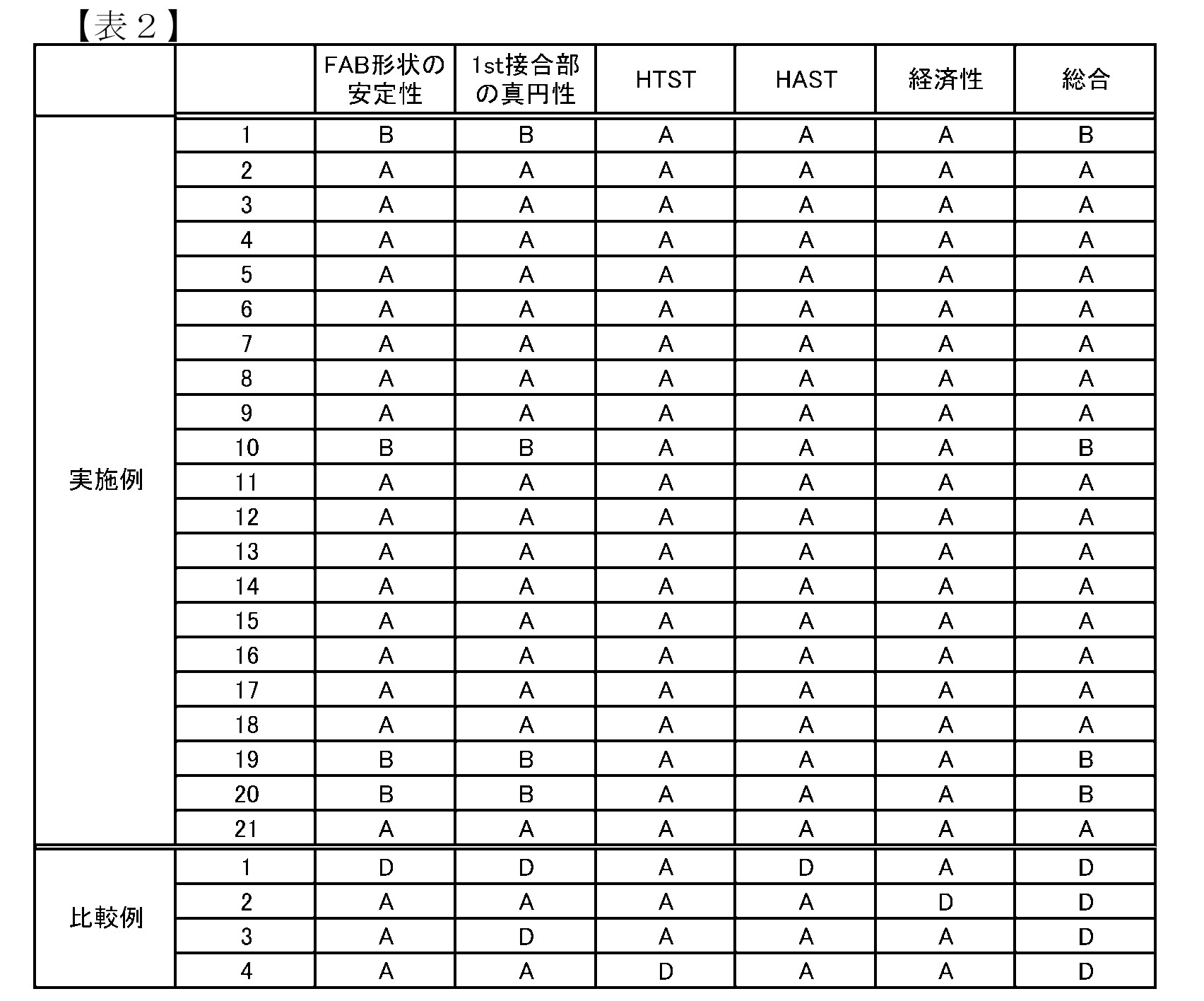
結果は、表2に示すとおりであり、実施例1~21では、FAB形状の安定性、1st接合の真円性、ワイヤの耐食性、1st接合部の耐食性、及び経済性について良好な結果が得られた。
一方、金の含有量が0.5質量%未満である比較例1では、窒素ガス雰囲気において真球度の高いFABを形成することができず、形成されたFABの真球度が低いため1st接合部の形状を円形に制御することができなかった。また、比較例1では、高温高湿条件下で行う高度加速寿命試験において、1st接合部が劣化しやすく耐食性に問題があった。金の含有量が5.0質量%を越える比較例2では、高価な貴金属の使用量が多くなりワイヤが高価となった。
また、硫黄の含有量が1質量ppm未満である比較例3では、1st接合部の形状を円形に制御することができず、硫黄の含有量が15質量ppmを越える比較例4では、熱によりワイヤが酸化しやすくワイヤの耐食性に問題があった。
本国際出願は、2015年12月24日に出願された日本国特許出願である特願2014-260900号に基づく優先権を主張するものであり、当該日本国特許出願である特願2014-260900号の全内容は、本国際出願に援用される。
このように、今回開示された実施の形態はすべての点で例示であって制限的なものではないと考えられるべきである。この発明の範囲は、特許請求の範囲によって示され、特許請求の範囲と均等の意味および範囲内でのすべての変更が含まれることが意図される。
Claims (4)
- 金の含有量が0.5質量%以上5.0質量%以下、硫黄の含有量が1質量ppm以上15質量ppm以下であり、残部が銅及び不可避不純物からなることを特徴とする銅ボンディングワイヤ。
- 金の含有量が0.5質量%以上5.0質量%以下、硫黄の含有量が1質量ppm以上15質量ppm以下、銀の含有量が25質量ppm以下であり、残部が銅及び不可避不純物からなることを特徴とする銅ボンディングワイヤ。
- 金の含有量が0.5質量%以上、硫黄の含有量が1質量ppm以上15質量ppm以下、であり、更に、パラジウム及び白金の少なくとも一方を含有し、金、パラジウム、及び白金の含有量の合計が5.0質量%以下であり、残部が銅及び不可避不純物からなることを特徴とする銅ボンディングワイヤ。
- 金の含有量が0.5質量%以上、硫黄の含有量が1質量ppm以上15質量ppm以下、銀の含有量が25質量ppm以下であり、更に、パラジウム及び白金の少なくとも一方を含有し、金、パラジウム、及び白金の含有量の合計が5.0質量%以下であり、残部が銅及び不可避不純物からなることを特徴とする銅ボンディングワイヤ。
Priority Applications (2)
| Application Number | Priority Date | Filing Date | Title |
|---|---|---|---|
| CN201580053821.4A CN107112252A (zh) | 2014-12-24 | 2015-12-07 | 铜焊线 |
| KR1020177019875A KR20170097141A (ko) | 2014-12-24 | 2015-12-07 | 구리 본딩 와이어 |
Applications Claiming Priority (2)
| Application Number | Priority Date | Filing Date | Title |
|---|---|---|---|
| JP2014260900A JP6422768B2 (ja) | 2014-12-24 | 2014-12-24 | 銅ボンディングワイヤの製造方法 |
| JP2014-260900 | 2014-12-24 |
Publications (1)
| Publication Number | Publication Date |
|---|---|
| WO2016104121A1 true WO2016104121A1 (ja) | 2016-06-30 |
Family
ID=56150151
Family Applications (1)
| Application Number | Title | Priority Date | Filing Date |
|---|---|---|---|
| PCT/JP2015/084271 Ceased WO2016104121A1 (ja) | 2014-12-24 | 2015-12-07 | 銅ボンディングワイヤ |
Country Status (5)
| Country | Link |
|---|---|
| JP (1) | JP6422768B2 (ja) |
| KR (1) | KR20170097141A (ja) |
| CN (1) | CN107112252A (ja) |
| TW (1) | TW201633483A (ja) |
| WO (1) | WO2016104121A1 (ja) |
Cited By (1)
| Publication number | Priority date | Publication date | Assignee | Title |
|---|---|---|---|---|
| EP3667709A4 (en) * | 2017-08-09 | 2021-06-09 | NIPPON STEEL Chemical & Material Co., Ltd. | CU ALLOY BOND WIRE FOR SEMICONDUCTOR COMPONENTS |
Citations (2)
| Publication number | Priority date | Publication date | Assignee | Title |
|---|---|---|---|---|
| JPS61163194A (ja) * | 1985-01-09 | 1986-07-23 | Toshiba Corp | 半導体素子用ボンデイング線 |
| JP2012222194A (ja) * | 2011-04-11 | 2012-11-12 | Sumitomo Metal Mining Co Ltd | 銅ボンディングワイヤ |
Family Cites Families (4)
| Publication number | Priority date | Publication date | Assignee | Title |
|---|---|---|---|---|
| JPH04184946A (ja) * | 1990-11-20 | 1992-07-01 | Mitsubishi Materials Corp | 半導体装置用銅合金極細線及び半導体装置 |
| JP5270467B2 (ja) * | 2009-06-18 | 2013-08-21 | タツタ電線株式会社 | Cuボンディングワイヤ |
| JP5219316B1 (ja) * | 2012-09-28 | 2013-06-26 | 田中電子工業株式会社 | 半導体装置接続用銅白金合金細線 |
| US20140302342A1 (en) * | 2013-04-04 | 2014-10-09 | Hitachi Metals, Ltd. | Copper wire and method of manufacturing the same |
-
2014
- 2014-12-24 JP JP2014260900A patent/JP6422768B2/ja active Active
-
2015
- 2015-12-07 KR KR1020177019875A patent/KR20170097141A/ko not_active Withdrawn
- 2015-12-07 CN CN201580053821.4A patent/CN107112252A/zh active Pending
- 2015-12-07 WO PCT/JP2015/084271 patent/WO2016104121A1/ja not_active Ceased
- 2015-12-15 TW TW104142165A patent/TW201633483A/zh unknown
Patent Citations (2)
| Publication number | Priority date | Publication date | Assignee | Title |
|---|---|---|---|---|
| JPS61163194A (ja) * | 1985-01-09 | 1986-07-23 | Toshiba Corp | 半導体素子用ボンデイング線 |
| JP2012222194A (ja) * | 2011-04-11 | 2012-11-12 | Sumitomo Metal Mining Co Ltd | 銅ボンディングワイヤ |
Cited By (1)
| Publication number | Priority date | Publication date | Assignee | Title |
|---|---|---|---|---|
| EP3667709A4 (en) * | 2017-08-09 | 2021-06-09 | NIPPON STEEL Chemical & Material Co., Ltd. | CU ALLOY BOND WIRE FOR SEMICONDUCTOR COMPONENTS |
Also Published As
| Publication number | Publication date |
|---|---|
| KR20170097141A (ko) | 2017-08-25 |
| TW201633483A (zh) | 2016-09-16 |
| CN107112252A (zh) | 2017-08-29 |
| JP2016122700A (ja) | 2016-07-07 |
| JP6422768B2 (ja) | 2018-11-14 |
Similar Documents
| Publication | Publication Date | Title |
|---|---|---|
| JP5616165B2 (ja) | 銀ボンディングワイヤ | |
| CN105830205B (zh) | 半导体装置用接合线 | |
| CN105392594B (zh) | 银合金接合线 | |
| CN109496347B (zh) | 半导体装置用铜合金接合线 | |
| CN102422404B (zh) | 半导体用接合线 | |
| CN102459668A (zh) | 半导体用铜合金接合线 | |
| CN105063407B (zh) | 一种led封装用银合金键合丝及其制造方法 | |
| WO2020059856A9 (ja) | 半導体装置用Cu合金ボンディングワイヤ | |
| CN110284023B (zh) | 一种铜合金键合丝及其制备方法和应用 | |
| WO2023112444A1 (ja) | ボンディングワイヤ及び半導体装置 | |
| JP6422768B2 (ja) | 銅ボンディングワイヤの製造方法 | |
| CN108701622B (zh) | 接合线 | |
| TWI714562B (zh) | 銅合金接合線 | |
| JPH10326803A (ja) | 半導体素子用金銀合金細線 | |
| JPS63235440A (ja) | 銅細線及びその製造方法 | |
| JP7146719B2 (ja) | 半導体装置 | |
| TWI643274B (zh) | Copper alloy thin wire for ball bonding | |
| CN104299954A (zh) | 一种用于半导体焊接的铜线 | |
| JP5840327B1 (ja) | 半導体装置用ボンディングワイヤ及びその製造方法 | |
| TWI802555B (zh) | 接合線 | |
| CN106475701A (zh) | 球焊用铜合金细线 | |
| JP2013110204A (ja) | 合金ワイヤおよび半導体装置 | |
| CN106129034A (zh) | 一种用于半导体焊接的铜键合线及其制备方法 |
Legal Events
| Date | Code | Title | Description |
|---|---|---|---|
| 121 | Ep: the epo has been informed by wipo that ep was designated in this application |
Ref document number: 15872690 Country of ref document: EP Kind code of ref document: A1 |
|
| NENP | Non-entry into the national phase |
Ref country code: DE |
|
| ENP | Entry into the national phase |
Ref document number: 20177019875 Country of ref document: KR Kind code of ref document: A |
|
| 122 | Ep: pct application non-entry in european phase |
Ref document number: 15872690 Country of ref document: EP Kind code of ref document: A1 |