WO2016017596A1 - 感光性樹脂組成物、感光性エレメント、レジストパターンの製造方法及びプリント配線板の製造方法 - Google Patents
感光性樹脂組成物、感光性エレメント、レジストパターンの製造方法及びプリント配線板の製造方法 Download PDFInfo
- Publication number
- WO2016017596A1 WO2016017596A1 PCT/JP2015/071287 JP2015071287W WO2016017596A1 WO 2016017596 A1 WO2016017596 A1 WO 2016017596A1 JP 2015071287 W JP2015071287 W JP 2015071287W WO 2016017596 A1 WO2016017596 A1 WO 2016017596A1
- Authority
- WO
- WIPO (PCT)
- Prior art keywords
- resin composition
- photosensitive resin
- mass
- meth
- component
- Prior art date
- Legal status (The legal status is an assumption and is not a legal conclusion. Google has not performed a legal analysis and makes no representation as to the accuracy of the status listed.)
- Ceased
Links
Images

Classifications
-
- C—CHEMISTRY; METALLURGY
- C08—ORGANIC MACROMOLECULAR COMPOUNDS; THEIR PREPARATION OR CHEMICAL WORKING-UP; COMPOSITIONS BASED THEREON
- C08F—MACROMOLECULAR COMPOUNDS OBTAINED BY REACTIONS ONLY INVOLVING CARBON-TO-CARBON UNSATURATED BONDS
- C08F293/00—Macromolecular compounds obtained by polymerisation on to a macromolecule having groups capable of inducing the formation of new polymer chains bound exclusively at one or both ends of the starting macromolecule
-
- G—PHYSICS
- G03—PHOTOGRAPHY; CINEMATOGRAPHY; ANALOGOUS TECHNIQUES USING WAVES OTHER THAN OPTICAL WAVES; ELECTROGRAPHY; HOLOGRAPHY
- G03F—PHOTOMECHANICAL PRODUCTION OF TEXTURED OR PATTERNED SURFACES, e.g. FOR PRINTING, FOR PROCESSING OF SEMICONDUCTOR DEVICES; MATERIALS THEREFOR; ORIGINALS THEREFOR; APPARATUS SPECIALLY ADAPTED THEREFOR
- G03F7/00—Photomechanical, e.g. photolithographic, production of textured or patterned surfaces, e.g. printing surfaces; Materials therefor, e.g. comprising photoresists; Apparatus specially adapted therefor
- G03F7/004—Photosensitive materials
-
- G—PHYSICS
- G03—PHOTOGRAPHY; CINEMATOGRAPHY; ANALOGOUS TECHNIQUES USING WAVES OTHER THAN OPTICAL WAVES; ELECTROGRAPHY; HOLOGRAPHY
- G03F—PHOTOMECHANICAL PRODUCTION OF TEXTURED OR PATTERNED SURFACES, e.g. FOR PRINTING, FOR PROCESSING OF SEMICONDUCTOR DEVICES; MATERIALS THEREFOR; ORIGINALS THEREFOR; APPARATUS SPECIALLY ADAPTED THEREFOR
- G03F7/00—Photomechanical, e.g. photolithographic, production of textured or patterned surfaces, e.g. printing surfaces; Materials therefor, e.g. comprising photoresists; Apparatus specially adapted therefor
- G03F7/004—Photosensitive materials
- G03F7/027—Non-macromolecular photopolymerisable compounds having carbon-to-carbon double bonds, e.g. ethylenic compounds
- G03F7/032—Non-macromolecular photopolymerisable compounds having carbon-to-carbon double bonds, e.g. ethylenic compounds with binders
- G03F7/033—Non-macromolecular photopolymerisable compounds having carbon-to-carbon double bonds, e.g. ethylenic compounds with binders the binders being polymers obtained by reactions only involving carbon-to-carbon unsaturated bonds, e.g. vinyl polymers
-
- H—ELECTRICITY
- H05—ELECTRIC TECHNIQUES NOT OTHERWISE PROVIDED FOR
- H05K—PRINTED CIRCUITS; CASINGS OR CONSTRUCTIONAL DETAILS OF ELECTRIC APPARATUS; MANUFACTURE OF ASSEMBLAGES OF ELECTRICAL COMPONENTS
- H05K3/00—Apparatus or processes for manufacturing printed circuits
- H05K3/02—Apparatus or processes for manufacturing printed circuits in which the conductive material is applied to the surface of the insulating support and is thereafter removed from such areas of the surface which are not intended for current conducting or shielding
- H05K3/06—Apparatus or processes for manufacturing printed circuits in which the conductive material is applied to the surface of the insulating support and is thereafter removed from such areas of the surface which are not intended for current conducting or shielding the conductive material being removed chemically or electrolytically, e.g. by photo-etch process
-
- H—ELECTRICITY
- H05—ELECTRIC TECHNIQUES NOT OTHERWISE PROVIDED FOR
- H05K—PRINTED CIRCUITS; CASINGS OR CONSTRUCTIONAL DETAILS OF ELECTRIC APPARATUS; MANUFACTURE OF ASSEMBLAGES OF ELECTRICAL COMPONENTS
- H05K3/00—Apparatus or processes for manufacturing printed circuits
- H05K3/10—Apparatus or processes for manufacturing printed circuits in which conductive material is applied to the insulating support in such a manner as to form the desired conductive pattern
- H05K3/18—Apparatus or processes for manufacturing printed circuits in which conductive material is applied to the insulating support in such a manner as to form the desired conductive pattern using precipitation techniques to apply the conductive material
Definitions
- the present invention relates to a photosensitive resin composition, a photosensitive element, a method for producing a resist pattern, and a method for producing a printed wiring board.
- a photosensitive resin composition is a photosensitive element (laminated layer) comprising a support and a layer (hereinafter also referred to as “photosensitive resin composition layer”) formed on the support using the photosensitive resin composition. Body).
- the printed wiring board is manufactured as follows, for example. First, a photosensitive element having a support and a photosensitive resin composition layer is prepared, and a photosensitive resin composition layer of the photosensitive element is formed on a circuit forming substrate (photosensitive layer forming step). Next, after peeling off and removing the support, the exposed portion is cured by irradiating a predetermined portion of the photosensitive resin composition layer with actinic rays (exposure step). Thereafter, by removing (developing) the unexposed portion from the substrate, a resist pattern, which is a cured product of the photosensitive resin composition (resist cured product, hereinafter also referred to as “cured resist”), is formed on the substrate. (Development process). The resulting resist pattern is etched or plated to form a circuit on the substrate (circuit formation process), and finally the resist pattern is peeled and removed to produce a printed wiring board (peeling process). .
- photosensitive layer forming step After peeling off and removing the support, the exposed
- DLP Digital Light Processing
- LDI Laser Direct Imaging
- This direct drawing exposure method has better alignment accuracy than an exposure method through a photomask, and a high-definition pattern can be obtained. Therefore, the direct drawing exposure method is being introduced for manufacturing a high-density package substrate.
- a photosensitive resin composition capable of forming a resist pattern with excellent resolution with excellent resolution (resolution).
- a photosensitive resin composition capable of forming a resist pattern having an L / S (line width / space width) of 10/10 (unit: ⁇ m) or less in the manufacture of a package substrate is required.
- Patent Documents 1 to 7 listed below disclose photosensitive resin compositions using a specific binder polymer, photopolymerizable compound, photopolymerization initiator, and sensitizing dye (see Patent Documents 1 to 7 below). .
- An object of the present invention is to provide a photosensitive resin composition capable of forming a resist pattern with excellent resolution, a photosensitive element using the same, a method for producing a resist pattern, and a method for producing a printed wiring board.
- the present inventor is a photosensitive resin composition
- a block polymer which is a specific (meth) acrylic polymer obtained by polymerizing a polymerizable monomer having three or more components, a photopolymerizable compound, and a photopolymerization initiator.
- the first aspect of the present invention contains a block polymer, a photopolymerizable compound, and a photopolymerization initiator, and the block polymer comprises a first polymer unit, a second polymer unit, (Meth) acrylic polymer, wherein the first polymer unit includes a structural unit derived from the first polymerizable monomer and a structural unit derived from the second polymerizable monomer,
- the present invention relates to a photosensitive resin composition in which a polymer unit includes a structural unit derived from the first polymerizable monomer and a structural unit derived from a third polymerizable monomer different from the second polymerizable monomer.
- a resist pattern with excellent resolution can be formed.
- a resist pattern having L / S (line width / space width) of 10/10 (unit: ⁇ m) or less can be formed.
- the photosensitive resin composition which concerns on the 1st aspect of this invention is excellent in the solubility to an alkali developing solution.
- membrane strength etc.) can be formed.
- the first polymerizable monomer is preferably (meth) acrylic acid.
- the second polymerizable monomer is preferably styrene.
- the third polymerizable monomer is preferably a (meth) acrylic acid ester.
- the photosensitive resin composition according to the first aspect of the present invention preferably has an aspect in which the second polymer unit is bonded to one end or both ends of the first polymer unit.
- the weight average molecular weight of the block polymer is preferably 10,000 to 200,000.
- a (meth) acrylic polymer can be easily produced by radical polymerization of a (meth) acrylic monomer, and depending on the purpose, several kinds of (meth) acrylic monomers can be copolymerized. Since the characteristics can be widely changed, they are widely manufactured industrially. In addition, bulk polymerization, solution polymerization, suspension polymerization, and the like are widespread as methods for producing (meth) acrylic polymers, and are selected in view of the molecular weight or cost of the (meth) acrylic polymer to be produced. Conventionally, since (meth) acrylic polymers are generally produced by free radical polymerization, (meth) acrylic polymers obtained from multi-component monomers are random copolymers and have a wide molecular weight distribution. On the other hand, the molecular weight dispersion of the block polymer in the photosensitive resin composition according to the first aspect of the present invention is preferably 1.2 to 4.0.
- a second aspect of the present invention includes a support and a photosensitive resin composition layer provided on the support, and the photosensitive resin composition layer is a photosensitive resin according to the first aspect.
- the present invention relates to a photosensitive element including a composition. By using such a photosensitive element, it is possible to efficiently form a resist pattern with excellent resolution.
- a third aspect of the present invention includes a step of forming a photosensitive resin composition layer on a substrate using the photosensitive resin composition according to the first aspect or the photosensitive element according to the second aspect; A step of irradiating at least a part of the photosensitive resin composition layer with actinic rays and photocuring the region to form a cured product region; and other than the cured product region of the photosensitive resin composition layer And a step of removing at least a part of the region from the substrate and forming a resist pattern as the cured product region on the substrate. According to such a method for producing a resist pattern, a resist pattern having excellent resolution can be efficiently formed.
- the wavelength of the actinic ray is preferably in the range of 340 nm to 430 nm.
- the fourth aspect of the present invention relates to a method for manufacturing a printed wiring board, comprising a step of etching or plating a substrate on which a resist pattern is formed by the method for manufacturing a resist pattern according to the third aspect.
- a printed wiring board manufacturing method a printed wiring board (such as a high-density package substrate) having high-density wiring can be efficiently manufactured with excellent accuracy and high productivity.
- a photosensitive resin composition capable of forming a resist pattern with excellent resolution, a photosensitive element using the same, a method for producing a resist pattern, and a method for producing a printed wiring board.
- the said photosensitive resin composition is excellent in the solubility to an alkali developing solution.
- a photosensitive resin composition capable of forming a resist pattern excellent in strength (resist strength, film strength, etc.), a photosensitive element using the same, a method for producing a resist pattern, and printed wiring A method for manufacturing a plate can be provided.
- (meth) acrylic acid means acrylic acid or methacrylic acid corresponding thereto.
- (meth) acrylic acid ester means acrylic acid or methacrylic acid corresponding thereto.
- a or B only needs to include either A or B, and may include both.
- the materials exemplified below can be used alone or in any combination of two or more unless otherwise specified.
- the “(poly) oxyethylene group” means at least one of an oxyethylene group and a polyoxyethylene group in which two or more ethylene groups are connected by an ether bond.
- the “oxyethylene group” is a group represented by (—CH 2 CH 2 —O—) and is also referred to as ethylene oxide.
- the “(poly) oxypropylene group” means at least one of an oxypropylene group and a polyoxypropylene group in which two or more propylene groups are connected by an ether bond.
- the “oxypropylene group” is a group represented by (—CHCH 3 CH 2 —O—), a group represented by (—CH 2 CHCH 3 —O—) or (—CH 2 CH 2 CH 2 —O -) And is also referred to as propylene oxide.
- EO-modified means a compound having a (poly) oxyethylene group
- PO-modified means a compound having a (poly) oxypropylene group
- “EO ⁇ PO” “Modified” means a compound having both a (poly) oxyethylene group and a (poly) oxypropylene group.
- the term “process” is not limited to an independent process, and is included in this term if the intended purpose of the process is achieved even when it cannot be clearly distinguished from other processes. It is.
- the numerical range indicated by using “to” indicates a range including the numerical values described before and after “to” as the minimum value and the maximum value, respectively.
- the content of each component in the composition means the total amount of the plurality of substances present in the composition unless there is a specific notice when there are a plurality of substances corresponding to each component in the composition.
- the term “layer” or “film” is observed as a plan view, the structure formed in a part is also included in addition to the structure formed in the entire surface.
- laminated indicates that the layers are stacked, two or more layers may be bonded, or two or more layers may be removable.
- the photosensitive resin composition of the present embodiment comprises (A) a block polymer (binder polymer; hereinafter referred to as “component (A)” in some cases) and (B) a photopolymerizable compound (hereinafter referred to as “(B)” in some cases. Component)) and (C) a photopolymerization initiator (hereinafter, sometimes referred to as “component (C)”).
- the photosensitive resin composition of this embodiment may further contain other components as needed.
- (D) a sensitizing dye (hereinafter, sometimes referred to as “(D) component”).
- a hydrogen donor hereinafter sometimes referred to as “component (E)”.
- the component is a (meth) acrylic polymer having a first polymer unit and a second polymer unit.
- the first polymer unit includes a structural unit derived from the first polymerizable monomer and a structural unit derived from the second polymerizable monomer.
- the second polymer unit includes a structural unit derived from the first polymerizable monomer and a structural unit derived from a third polymerizable monomer different from the second polymerizable monomer.
- the photosensitive resin composition of the present embodiment contains (A) component, (B) component and (C) component, so that it has high strength (film strength etc.) and can form a resist pattern with excellent resolution.
- a resin composition can be constituted.
- Free radical polymerization in which the arrangement of components in the block polymer (for example, the arrangement of components in the block polymer (binder polymer) obtained by reversible non-cleavable chain transfer polymerization (RAFT polymerization)) has been used.
- the resolution is improved by being different from the arrangement of the constituent components in the block polymer (binder polymer) obtained by the above, and by suppressing the permeability of the developer and the leakage of low molecular components during development.
- the strength of the resist is improved by taking an arrangement in which carboxyl groups derived from (meth) acrylic acid are dispersed in the entire chain of the block polymer, and the structure involved in the strength or flexibility is blocked.
- Component (A) component block polymer
- Component (A) is a (meth) acrylic polymer obtained by polymerizing three or more polymerizable monomers, and a structural unit derived from the first polymerizable monomer and a structural unit derived from the second polymerizable monomer.
- a first polymer unit comprising: a structural unit derived from the first polymerizable monomer; and a structural unit derived from a third polymerizable monomer different from the second polymerizable monomer. It has two polymer units.
- the second polymerizable monomer is different from the first polymerizable monomer.
- the third polymerizable monomer is different from the first polymerizable monomer.
- Component (A) is a multi-component copolymer polymer having three or more components, which is obtained by improving the block properties of other monomers so that the physical properties of the polymer due to the specific polymerizable monomer do not change due to the sequence of the polymer.
- the component (A) is a (meth) acrylic block polymer obtained by polymerizing at least three polymerizable monomers including at least a (meth) acrylic monomer (such as (meth) acrylic acid). It is a block polymer that can block a structural unit derived from a functional monomer (such as a polymerizable monomer other than (meth) acrylic acid) and has excellent solubility in a solvent and an alkaline aqueous solution.
- the component (A) has the first polymer unit as a block, and the second polymer unit is bound to one end (one end) or both ends of the first polymer unit as a block (first It is preferable to have a second polymer unit at one or both ends of the polymer unit).
- (meth) acrylic monomer refers to a monomer having an acryloyl group (CH ⁇ CH—CO—) or a methacryloyl group (CH ⁇ C (CH 3 ) —CO—).
- examples of (meth) acrylic monomers include (meth) acrylic acid esters and (meth) acrylamides.
- the “(meth) acrylic polymer” refers to a polymer (polymer having a structural unit derived from a (meth) acrylic monomer) obtained by polymerization using at least a part of the (meth) acrylic monomer having these groups.
- the polymerizable monomer can contain (meth) acrylic acid.
- the polymerizable monomer other than (meth) acrylic acid is not particularly limited as long as it is polymerizable with (meth) acrylic acid and is different from (meth) acrylic acid.
- Examples of polymerizable monomers other than (meth) acrylic acid include alkyl (meth) acrylate (that is, (meth) acrylic acid alkyl ester), (meth) acrylic acid cycloalkyl (that is, (meth) acrylic acid cycloalkyl ester), ( (Meth) acrylic acid hydroxyalkyl (ie, (meth) acrylic acid hydroxyalkyl ester), (meth) acrylic acid benzyl, (meth) acrylic acid furfuryl, (meth) acrylic acid tetrahydrofurfuryl, (meth) acrylic acid isobornyl, (meta ) Adamantyl acrylate, dicyclopentanyl (meth) acrylate, dimethylaminoe
- the component (A) preferably has a structural unit derived from styrene or ⁇ -methylstyrene from the viewpoint of improving adhesion and peeling properties.
- the content of the structural unit is based on the total mass of the structural unit of the component (A) from the viewpoint of further improving the adhesion. It is preferably 10% by mass or more, more preferably 15% by mass or more, and further preferably 20% by mass or more.
- the content is preferably 70% by mass or less, more preferably 60% by mass or less, and still more preferably 55% by mass or less from the viewpoint of further improving the peeling properties.
- the content is preferably from 10% by mass to 70% by mass, more preferably from 15% by mass to 60% by mass, and from 20% by mass to 55% by mass from the viewpoint of further excellent adhesion and peeling properties. More preferably.
- the component (A) preferably has a structural unit derived from alkyl (meth) acrylate, from the viewpoint of improving developability and peeling properties.
- alkyl (meth) acrylate an alkyl (meth) acrylate having an alkyl group having 1 to 12 carbon atoms is preferable, and an alkyl (meth) acrylate having an alkyl group having 1 to 8 carbon atoms is more preferable.
- alkyl (meth) acrylate include methyl (meth) acrylate, ethyl (meth) acrylate, propyl (meth) acrylate, butyl (meth) acrylate, pentyl (meth) acrylate, and (meth) acrylic.
- Alkyl (meth) acrylate can be used individually by 1 type or in combination of 2 or more types.
- the content of the structural unit is the total mass of the structural unit of the component (A) from the viewpoint of further excellent resolution and adhesion.
- it is preferably 30% by mass or less, more preferably 20% by mass or less, and still more preferably 10% by mass or less.
- the content is preferably 1% by mass or more, and more preferably 2% by mass or more, from the viewpoint of further excelling in peeling properties.
- the content is preferably 1% by mass to 30% by mass, more preferably 1% by mass to 20% by mass, and more preferably 2% by mass to 10% by mass, from the viewpoint of further improving resolution, adhesion, and peeling properties. More preferably, it is mass%.
- the component (A) is a (meth) acrylic polymer (a structural unit derived from a (meth) acrylic monomer and a structural unit derived from a styrenic monomer) using a (meth) acrylic monomer and a styrenic monomer as a polymerizable monomer.
- Polymer There is no restriction
- the first polymerizable monomer is preferably (meth) acrylic acid (acrylic acid or methacrylic acid).
- Preferred examples of the second polymerizable monomer and the third polymerizable monomer include (meth) acrylic monomers, styrene monomers, acrylonitrile and the like other than the first polymerizable monomers.
- the second polymerizable monomer is preferably styrene.
- the third polymerizable monomer is preferably a (meth) acrylic acid ester (acrylic acid ester or methacrylic acid ester).
- the first polymerizable monomer is (meth) acrylic acid
- the second and third polymerizable monomers are styrene
- examples include combinations such as benzyl (meth) acrylate, methyl (meth) acrylate, ethyl (meth) acrylate, propyl (meth) acrylate, butyl (meth) acrylate, lauryl (meth) acrylate, and the like.
- the ratio of each polymerizable monomer and the ratio of each polymer unit are not particularly limited, and various embodiments can be mentioned.
- the ratio of the first polymerizable monomer and the second polymerizable monomer in the component (A) is the former (first polymerizable monomer) / from the viewpoint of further excellent solubility control in the solvent, compatibility and the like.
- the molar ratio of the latter (second polymerizable monomer) may be 1/99 to 80/20, 3/97 to 70/30, or 5/95 to 60/40. Also good.
- the ratio of the first polymerizable monomer to the third polymerizable monomer is such that the former (first polymerizable monomer) / the latter (third The molar ratio of the polymerizable monomer) may be 1/99 to 80/20, 3/97 to 80/20, or 5/95 to 60/40.
- the ratio of the first polymer unit and the second polymer unit is the molar ratio of the former (first polymer unit) / the latter (second polymer unit) from the viewpoint of further improving elongation, strength, adhesiveness, and the like. It may be 10/90 to 90/10, 20/80 to 80/20, or 30/70 to 70/30.
- the amount of each polymerizable monomer in the above ratio is the total amount in the entire block polymer.
- the component (A) has, for example, a ratio of the first polymerizable monomer and the second polymerizable monomer in a molar ratio of the former (first polymerizable monomer) / the latter (second polymerizable monomer) of 1 / 99 to 80/20, and the ratio of the first polymerizable monomer to the third polymerizable monomer is the molar ratio of the former (first polymerizable monomer) / the latter (third polymerizable monomer). 1/99 to 80/20, and the ratio of the first polymer unit to the second polymer unit is 10 / in the molar ratio of the former (first polymer unit) / the latter (second polymer unit). It may be an embodiment that is 90 to 90/10.
- the component may further have a polymer unit different from the first polymer unit and the second polymer unit.
- the polymerizable monomer giving the polymer unit the polymerizable monomer used for obtaining the first polymer unit and the second polymer unit can be used.
- the component (A) may have a characteristic group in its molecule that is sensitive to light having a wavelength in the range of 340 nm to 430 nm, if necessary.
- the characteristic group include a group constituted by removing at least one hydrogen atom from a sensitizing dye described later.
- one type of block polymer may be used alone, or two or more types of block polymers may be used in any combination.
- the acid value of the component (A) is preferably 90 mgKOH / g or more, more preferably 100 mgKOH / g or more, further preferably 120 mgKOH / g or more, from the viewpoint of further shortening the development time. It is especially preferable that it is 130 mgKOH / g or more.
- the acid value of the component (A) is preferably 250 mgKOH / g or less, more preferably 240 mgKOH / g or less, more preferably 235 mgKOH / g from the viewpoint of further improving the adhesion of the cured product of the photosensitive resin composition. g or less is more preferable, and 230 mgKOH / g or less is particularly preferable.
- the acid value of the component (A) is preferably 90 mgKOH / g to 250 mgKOH / g, more preferably 100 mgKOH / g to 240 mgKOH / g, from the viewpoint of excellent balance between developability and adhesion. It is more preferably from g to 235 mgKOH / g, particularly preferably from 130 mgKOH / g to 230 mgKOH / g.
- the weight average molecular weight of the component (A) is not particularly limited, but is preferably 10,000 or more, more preferably 12,000 or more, further preferably 15000 or more, and particularly preferably 20000 or more from the viewpoint of further excellent strength, elongation, adhesiveness, and the like. Preferably, 25000 or more is very preferable, and 30000 or more is very preferable.
- the weight average molecular weight of the component (A) is preferably 200000 or less, more preferably 180000 or less, still more preferably 150,000 or less, particularly preferably 100000 or less, extremely preferably 80000 or less, and particularly preferably 50000 or less, from the viewpoint of further improving solubility and the like. Is highly preferred.
- the weight average molecular weight of the component (A) is preferably 10,000 to 200,000, more preferably 12,000 to 180000, still more preferably 15,000 to 150,000, particularly preferably 20,000 to 100,000, particularly preferably 25,000 to 80,000, and 30,000. ⁇ 50000 is very preferred.
- the molecular weight dispersity (weight average molecular weight Mw / number average molecular weight Mn) of the component (A) is preferably 1.2 or more, more preferably 1.23 or more, from the viewpoint of further improving elongation, strength, adhesiveness, and the like. .26 or more is more preferable.
- the molecular weight dispersity of the component (A) is preferably 4.0 or less, more preferably 3.0 or less, and still more preferably 2.0 or less, from the viewpoint of further excellent dispersibility, compatibility and the like. From these viewpoints, the molecular weight dispersity of the component (A) is preferably 1.2 to 4.0, more preferably 1.2 to 3.0, and still more preferably 1.2 to 2.0.
- molecular weight (weight average molecular weight Mw and number average molecular weight Mn) can be calculated
- the content of the component (A) in the photosensitive resin composition of the present embodiment is 100 parts by mass with respect to the total amount of the component (A) and the component (B) from the viewpoint of excellent film (photosensitive resin composition layer) formability.
- the content is preferably 30 parts by mass or more, more preferably 35 parts by mass or more, and still more preferably 40 parts by mass or more.
- the content of the component (A) is preferably 70 parts by mass or less, more preferably 65 parts by mass or less, and preferably 60 parts by mass or less from the viewpoint that the sensitivity and resolution can be sufficiently obtained. Is more preferable.
- the content of the component (A) is preferably 30 parts by mass to 70 parts by mass and more preferably 35 parts by mass to 65 parts by mass from the viewpoint of further improving film formability, sensitivity, and resolution. More preferably, it is 40 to 60 parts by mass.
- RAFT reversible addition-fragmentation chain transfer
- (meth) acrylic acid can be reacted without a protecting group, and copolymerization with various (meth) acrylic acid esters, styrene, etc. is possible (see Patent Documents 8 and 9). reference).
- the manufacturing method of component is not particularly limited.
- the component (A) is obtained by polymerizing the first polymerizable monomer and the second polymerizable monomer by living polymerization to obtain the first polymer unit, and then the first polymerizable monomer and the third polymerizable property. It can be obtained by adding a monomer to chain extend the second polymer unit.
- Living polymerization includes anion polymerization, atom transfer radical polymerization (ATRP), nitroxide living radical polymerization (NMP), reversible addition-fragmentation chain transfer (RAFT) polymerization, organic tellurium mediated living radical polymerization (TERP), reversible chain transfer catalytic polymerization. (RTCP) or the like can be used.
- ATRP atom transfer radical polymerization
- NMP nitroxide living radical polymerization
- RAFT reversible addition-fragmentation chain transfer
- TERP organic tellurium mediated living radical polymerization
- RTCP reversible chain transfer catalytic polymerization.
- RAFT reversible addition-fragmentation chain transfer polymerization
- a thioester as a protecting group which is a chain transfer agent
- it has many polymerizable monomer species and can directly copolymerize acrylic acid or methacrylic acid.
- a thiocarbonate compound having a structure represented by the following general formula (1) can be used as a chain transfer agent.
- R cumyl group, cyanopropyl group, phenylpropyl group, cyanophenylmethyl group, ethylcarboxypropyl group, 2,4,4-trimethylpentan-2-yl group, 1-cyanoethyl group, 1-phenyl Preferred examples include an ethyl group, a tert-butyl group, a cyanomethyl group, and a benzyl group.
- Z is preferably a phenyl group, methylthioyl group, pyrrole group, methyl group, phenoxy group, ethoxy group, dimethylamino group or the like.
- chain transfer agents include cumyl dithiobenzoate, 2-cyano-2-propylbenzothioate, 4-cyano-4 [(dodecylsulfanylthiocarbonyl) sulfanyl] pentanoic acid, cyanomethylmethyl (phenyl) Carbamodithioate, 4-cyano-4- (phenylcarbonothioylthio) pentanoic acid, 2-cyano-2-propyldodecyltrithiocarbonate, 2- (dodecylthiocarbonothioylthio) -2-methylpropionic acid, And cyanomethyldodecyl trithiocarbonate. Although these are marketed, a chain transfer agent is not limited to these.
- a thiocarbonate compound having a structure represented by the general formula (1) is used as a chain transfer agent, and a first polymerizable monomer (for example, acrylic acid or methacrylic acid) and a second polymerizable monomer are used.
- the first polymer unit is synthesized by living polymerization to synthesize the polymer. After the polymerization has progressed to some extent, the polymer to be the first polymer unit is recovered by reprecipitation or distillation under reduced pressure, and then the polymer is first polymerized.
- the block polymer of this embodiment can be obtained by chain-extending the second polymer unit by adding it together with the polymerizable monomer and the third polymerizable monomer. In this case, a small amount of radical initiator may be added.
- the first polymer unit is prepared by polymerizing the first polymerizable monomer and the second polymerizable monomer by living polymerization using the thiocarbonate compound having the structure represented by the general formula (1) as a chain transfer agent.
- the first polymer monomer and the third polymer monomer are added to the same reactor, and the second polymer unit is chain-extended.
- the block polymer can be obtained.
- RAFT polymerization in general, chain transfer from the acrylic growth terminal to the methacrylate monomer does not occur. Therefore, the monomer blending procedure or combination when copolymerizing a plurality of monomers is important. Therefore, when simultaneously charging a plurality of monomers, it is preferable to use a combination of only monomers having an acryloyl group or a combination of only monomers having a methacryloyl group.
- polymerization is performed with a combination of only monomers having an acryloyl group, or a monomer having a methacryloyl group is polymerized only with a combination of monomers having a methacryloyl group. Thereafter, it is preferable to polymerize a monomer having an acryloyl group.
- the molar ratio (chain transfer agent / radical initiator) between the chain transfer agent (the compound represented by the general formula (1) and the like) and the radical initiator is preferably 20/1 to 1/5. / 1 to 1/4 is more preferable. Since the ratio of the chain transfer agent (the compound represented by the general formula (1)) and the radical initiator is 20/1 or less, the polymerization reaction rate can be increased while maintaining monodispersity. Industrially preferable. On the other hand, when the ratio is 1/5 or more, chain transfer from the radical initiator directly to the monomer can be avoided, and various polymers (random polymers, first polymers different from the polymers used in this embodiment) can be avoided. It is possible to suppress a by-product of one polymer unit alone, a second polymer unit alone, or the like, and obtain a good block polymer.
- the temperature of the polymerization reaction varies depending on the decomposition temperature of the radical initiator to be used, and is not particularly limited.
- the half-life decomposition temperature is minus 2 ° C. to plus 20 ° C. (half-life decomposition temperature ⁇ 2 ° C. to half) (Phase decomposition temperature + 20 ° C.) is preferred.
- the radical initiator for synthesizing the component (A) includes benzoyl peroxide, acetyl peroxide, lauroyl peroxide, di-t-butyl peroxide, cumene hydroperoxide, t-butyl hydroperoxide, dicumyl peroxide and the like.
- examples thereof include oxide initiators; azo initiators such as AIBN (2,2′-azobisisobutyronitrile) and V-65 (azobisdimethylvaleronitrile). Of these, AIBN (2,2'-azobisisobutyronitrile) is preferable.
- the component (A) can be synthesized by solution polymerization, suspension polymerization, emulsion polymerization, solid phase polymerization, etc., but solution polymerization is preferred to obtain a resin having a weight average molecular weight of 2000 to 300,000, and the weight average molecular weight is obtained. Suspension polymerization is preferred to obtain a resin of 300000 to 1000000.
- the polymerization method is appropriately selected depending on the polarity or reactivity of the monomer used. As the polymerization method, when acrylic acid or methacrylic acid is used, solution polymerization is preferable from the viewpoint of excellent solubility of the (meth) acrylic polymer in a solvent.
- Solution polymerization is performed, for example, by dissolving a polymerizable monomer, a chain transfer agent, and a radical initiator in a solvent capable of dissolving the produced resin, and heating to a temperature determined by the radical initiator. At this time, the polymerization can be performed even under air, but the polymerization is preferably performed under nitrogen.
- the solvent used in the solution polymerization is not particularly limited as long as it can dissolve a polymerizable monomer, a chain transfer agent, a radical initiator, and a resin to be formed, but preferably has a boiling point equal to or higher than the temperature at which the polymerization is performed.
- the temperature at which the polymerization is carried out is higher than the boiling point of the solvent used, the polymerization can be carried out by a reaction under pressure.
- solvent to be used examples include methoxyethanol, ethoxyethanol, toluene, xylene, methyl ethyl ketone, methyl isobutyl ketone, cyclohexanol, cyclohexanone, butyl acetate, chlorobenzene, dioxane, propylene glycol monomethyl ether, and the like.
- a solvent can be used individually by 1 type or in combination of 2 or more types.
- the component (B) is not particularly limited as long as it can be photopolymerized.
- the component (B) is preferably a compound having an ethylenically unsaturated bond.
- the compound having an ethylenically unsaturated bond includes a compound having one ethylenically unsaturated bond in the molecule, a compound having two ethylenically unsaturated bonds in the molecule, and three ethylenically unsaturated bonds in the molecule. Examples thereof include the compounds described above.
- Examples of the compound having two ethylenically unsaturated bonds in the molecule include a bisphenol type di (meth) acrylate compound, a hydrogenated bisphenol A type di (meth) acrylate compound, and a di (meth) having a urethane bond in the molecule.
- Examples include acrylate compounds, polyalkylene glycol di (meth) acrylates having both (poly) oxyethylene groups and (poly) oxypropylene groups in the molecule, and trimethylolpropane di (meth) acrylate.
- the component (B) preferably contains at least one bisphenol di (meth) acrylate compound from the viewpoint of improving the adhesion of the resist pattern.
- the content of the compound is preferably in the following range.
- the content is preferably 1 part by mass or more, more preferably 5 parts by mass or more, and more preferably 10 parts by mass or more in 100 parts by mass of the total amount of the component (A) and the component (B). Is more preferable.
- the content is preferably 50 parts by mass or less, more preferably 45 parts by mass or less, in 100 parts by mass of the total amount of the component (A) and the component (B).
- the content is preferably 1 part by weight to 50 parts by weight, more preferably 5 parts by weight to 50 parts by weight, per 100 parts by weight of the total amount of the component (A) and the component (B). More preferably, the content is from 45 parts by mass.
- a bisphenol A type di (meth) acrylate compound for example, a bisphenol A type di (meth) acrylate compound can be used, and commercially available ones include 2,2-bis (4- (methacryloxydi). Ethoxy) phenyl) propane (Hitachi Chemical Co., Ltd., “FA-324M”, etc.), 2,2-bis (4- (methacryloxyethoxy) phenyl) propane (ethylene oxide average 10 mol adduct) (Hitachi Chemical Co., Ltd., “ FA-321M ", etc.), 2,2-bis (4- (methacryloxyethoxypropoxy) phenyl) propane (ethylene oxide average 12 mol and propylene oxide average 4 mol adduct) (Hitachi Chemical Co., Ltd.,” FA-3200MY "etc.) Etc.
- 2,2-bis (4- (methacryloxydi). Ethoxy) phenyl) propane (Hitachi Chemical Co., Ltd., “FA-324M”, etc.)
- the hydrogenated bisphenol A type di (meth) acrylate compound examples include 2,2-bis (4- (methacryloxypentaethoxy) cyclohexyl) propane.
- the content of the compound is preferably in the following range.
- the content is preferably 1 part by mass or more and more preferably 5 parts by mass or more in 100 parts by mass of the total amount of the component (A) and the component (B).
- the content is preferably 50 parts by mass or less, more preferably 40 parts by mass or less, in 100 parts by mass of the total amount of the component (A) and the component (B).
- the content is preferably 1 part by weight to 50 parts by weight, and more preferably 5 parts by weight to 40 parts by weight, per 100 parts by weight of the total amount of the components (A) and (B).
- the component (B) preferably contains at least one polyalkylene glycol di (meth) acrylate from the viewpoint of improving the flexibility of the resist pattern.
- the content of the compound is preferably in the following range.
- the content is preferably 5 parts by mass or more, more preferably 10 parts by mass or more, in 100 parts by mass of the total amount of the component (A) and the component (B).
- the content is preferably 30 parts by mass or less, more preferably 25 parts by mass or less, in 100 parts by mass of the total amount of the component (A) and the component (B).
- the content is preferably 5 to 30 parts by mass, more preferably 10 to 25 parts by mass, in 100 parts by mass of the total amount of the components (A) and (B).
- the polyalkylene glycol di (meth) acrylate compound is preferably a polyalkylene glycol di (meth) acrylate having both a (poly) oxyethylene group and a (poly) oxypropylene group in the molecule.
- the (poly) oxyethylene group and the (poly) oxypropylene group may be continuously present in blocks or randomly.
- the propylene group in the (poly) oxypropylene group may be either an n-propylene group or an isopropylene group.
- the secondary carbon of the propylene group may be bonded to an oxygen atom, or the primary carbon may be bonded to an oxygen atom.
- Polyalkylene glycol di (meth) acrylate includes (poly) n-butyleneoxy group, (poly) isobutyleneoxy group, (poly) n-pentyleneoxy group, (poly) hexyleneoxy group, structural isomers thereof, etc. And (poly) alkyleneoxy groups having about 4 to 6 carbon atoms.
- the content of the photopolymerizable compound is preferably within the following range.
- the content is preferably 5 parts by mass or more, more preferably 10 parts by mass or more, in 100 parts by mass of the total amount of the component (A) and the component (B).
- the content is preferably 60 parts by mass or less, more preferably 55 parts by mass or less, and 50 parts by mass or less in 100 parts by mass of the total amount of the component (A) and the component (B). Is more preferable.
- the content is preferably 5 parts by mass to 60 parts by mass, more preferably 5 parts by mass to 55 parts by mass, in 100 parts by mass of the total amount of the components (A) and (B). More preferably, it is 50 parts by mass.
- the component (B) may contain at least one photopolymerizable compound having three or more ethylenically unsaturated bonds in the molecule as the photopolymerizable compound.
- Examples of the compound having three or more ethylenically unsaturated bonds in the molecule include trimethylolpropane tri (meth) acrylate, EO-modified trimethylolpropane tri (meth) acrylate (the number of structural units of the oxyethylene group is 1 to 5).
- PO-modified trimethylolpropane tri (meth) acrylate PO-modified trimethylolpropane tri (meth) acrylate, EO / PO-modified trimethylolpropane tri (meth) acrylate, tetramethylolmethane tri (meth) acrylate and tetramethylolmethanetetra (meth) acrylate, pentaerythritol tri ( Examples include meth) acrylate, EO-modified pentaerythritol tetra (meth) acrylate, and dipentaerythritol hexa (meth) acrylate.
- a compound having three or more ethylenically unsaturated bonds can be used alone or in any combination of two or more.
- tetramethylol methane triacrylate Shin Nakamura Chemical Co., Ltd., “A-TMM-3”, etc.
- EO modified Trimethylolpropane trimethacrylate Hitachi Chemical Co., Ltd., “TMPT21E”, “TMPT30E”, etc.
- pentaerythritol triacrylate Sartomer Co., Ltd., “SR444”, etc.
- dipentaerythritol hexaacrylate Shin Nakamura Chemical Co., Ltd., “ A-DPH "and the like
- EO-modified pentaerythritol tetraacrylate Shin Nakamura Chemical Co., Ltd.
- ATM-35E EO-modified pentaerythritol tetraacrylate
- the content of the photopolymerizable compound is determined by resolution, adhesion, resist shape And from the viewpoint of improving the release characteristics after curing in a well-balanced manner, the following ranges are preferred.
- the content is preferably 3 parts by mass or more and more preferably 5 parts by mass or more in 100 parts by mass of the total amount of the component (A) and the component (B).
- the content is preferably 30 parts by mass or less, more preferably 25 parts by mass or less, and 20 parts by mass or less, in 100 parts by mass of the total amount of the component (A) and the component (B).
- the content is preferably 3 parts by mass to 30 parts by mass, more preferably 5 parts by mass to 25 parts by mass, in 100 parts by mass of the total amount of the component (A) and the component (B). More preferably, it is 20 to 20 parts by mass.
- Component (B) is an ethylenically unsaturated bond in the molecule as a photopolymerizable compound from the viewpoint of improving the resolution, adhesion, resist shape and release properties after curing in a balanced manner, or from the viewpoint of suppressing scum generation.
- the photopolymerizable compound which has one may be included.
- Examples of the photopolymerizable compound having one ethylenically unsaturated bond in the molecule include nonylphenoxy polyoxyethylene acrylate, phthalic acid compound, and (meth) acrylic acid alkyl ester.
- nonylphenoxy polyoxyethylene acrylate or a phthalic acid compound is preferable from the viewpoint of improving the resolution, adhesion, resist shape, and peeling property after curing in a well-balanced manner.
- the content of the photopolymerizable compound is preferably within the following range.
- the content is preferably 1 part by mass or more, more preferably 3 parts by mass or more, and more preferably 5 parts by mass or more in 100 parts by mass of the total amount of the component (A) and the component (B). Is more preferable.
- the content is preferably 20 parts by mass or less, more preferably 15 parts by mass or less, and more preferably 12 parts by mass or less, in 100 parts by mass of the total amount of the component (A) and the component (B). Is more preferable.
- the content is preferably 1 part by mass to 20 parts by mass, more preferably 3 parts by mass to 15 parts by mass, in 100 parts by mass of the total amount of the component (A) and the component (B). More preferably, the content is 12 parts by mass.
- the total content of the component (B) in the photosensitive resin composition is 30 in a total amount of 100 parts by mass of the component (A) and the component (B) from the viewpoint that sufficient sensitivity and resolution tend to be obtained.
- the amount is preferably at least part by mass, and more preferably at least 35 parts by mass.
- the content of the entire component (B) is the component (A) from the viewpoint that it tends to form a film (photosensitive resin composition layer) and the tendency that a good resist shape tends to be obtained.
- the total content of component (B) is preferably 30 parts by mass to 70 parts by mass, and preferably 35 parts by mass to 65 parts by mass in 100 parts by mass of the total amount of components (A) and (B). Is more preferably 35 parts by mass to 50 parts by mass.
- Component (C) Photopolymerization initiator
- the photosensitive resin composition contains at least one photopolymerization initiator as the component (C).
- benzophenone 2-benzyl-2-dimethylamino-1- (4-morpholinophenyl) -1-butanone, 2-methyl-1- [4- (methylthio) phenyl] -2-morpholino- Aromatic ketones such as 1-propanone; quinone compounds such as alkylanthraquinones; benzoin ether compounds such as benzoin alkyl ethers; benzoin compounds such as benzoin and alkylbenzoins; benzyl derivatives such as benzyldimethyl ketal; 2- (2-chlorophenyl)- 4,5-diphenylimidazole dimer (also known as 2,2′-bis (2-chlorophenyl) -4,4 ′, 5,5′-tetraphenylbiimidazole), 2- (2-fluorophenyl) -4 2,4,5-triarylimidazole such as 1,5-diphenylimidazole dimer Dimer; 9-pheny
- the component (C) preferably contains at least one 2,4,5-triarylimidazole dimer from the viewpoint of further improving sensitivity and adhesion, and 2- (2-chlorophenyl) -4,5 More preferably, it comprises a diphenylimidazole dimer.
- the 2,4,5-triarylimidazole dimer may be symmetric or asymmetric in structure.
- the content of the component (C) in the photosensitive resin composition is based on the tendency that good sensitivity, resolution, or adhesion tends to be obtained, with respect to 100 parts by mass of the total amount of the component (A) and the component (B). It is preferably 0.1 parts by mass or more, more preferably 1 part by mass or more, further preferably 2 parts by mass or more, and particularly preferably 3 parts by mass or more.
- the content of the component (C) is 10 parts by mass or less with respect to 100 parts by mass of the total amount of the component (A) and the component (B) from the viewpoint that a good resist shape tends to be obtained. It is preferably 7 parts by mass or less, more preferably 6 parts by mass or less, and particularly preferably 5 parts by mass or less.
- the content of the component (C) is preferably 0.1 parts by mass to 10 parts by mass with respect to 100 parts by mass of the total amount of the components (A) and (B). Is more preferably from 7 parts by mass, further preferably from 2 parts by mass to 6 parts by mass, and particularly preferably from 3 parts by mass to 5 parts by mass.
- (D) component Sensitizing dye It is preferable that the photosensitive resin composition contains at least 1 sort (s) of a sensitizing dye as (D) component.
- the sensitizing dye is preferably a compound that can effectively utilize the absorption wavelength of actinic rays used for exposure and has a maximum absorption wavelength of 340 nm to 420 nm.
- the component (D) examples include pyrazoline compounds, anthracene compounds, coumarin compounds, xanthone compounds, oxazole compounds, benzoxazole compounds, thiazole compounds, benzothiazole compounds, triazole compounds, stilbene compounds, triazine compounds, thiophene compounds, naphthalimide compounds, and the like. Can be mentioned.
- the component (D) preferably contains a pyrazoline compound or an anthracene compound from the viewpoint of further improving resolution, adhesion, and sensitivity.
- a component can be used individually by 1 type or in combination of 2 or more types arbitrarily.
- the content of the component (D) in the photosensitive resin composition is such that the sensitivity and resolution tend to be easily obtained, and the component (A) and ( It is preferable that it is 0.01 mass part or more with respect to 100 mass parts of total amounts of B) component, It is more preferable that it is 0.05 mass part or more, It is still more preferable that it is 0.1 mass part or more.
- the content of the component (D) is 10 parts by mass or less with respect to 100 parts by mass of the total amount of the components (A) and (B) from the viewpoint that a sufficiently good resist shape tends to be obtained. It is preferably 5 parts by mass or less, more preferably 3 parts by mass or less.
- the content of the component (D) is preferably 0.01 to 10 parts by mass with respect to 100 parts by mass as the total of the components (A) and (B). More preferred is 5 to 5 parts by mass, and still more preferred is 0.1 to 3 parts by mass.
- Component (E) Hydrogen donor
- the photosensitive resin composition has an excellent contrast (also referred to as “imaging property”) between the exposed portion (exposed portion) and the unexposed portion (unexposed portion).
- the component (E) include bis [4- (dimethylamino) phenyl] methane, bis [4- (diethylamino) phenyl] methane, and leuco crystal violet.
- a component can be used individually by 1 type or in combination of 2 or more types.
- the content of the component (E) in the photosensitive resin composition is such that sufficient sensitivity tends to be obtained, so that the component (A) and the component (B) )
- the total amount of components is preferably 0.01 parts by mass or more, more preferably 0.05 parts by mass or more, and still more preferably 0.1 parts by mass or more with respect to 100 parts by mass.
- the content of the component (E) is such that, after the film is formed, the excessive amount of the component (E) tends to be prevented from being precipitated as foreign matter, so that the total amount of the component (A) and the component (B) is 100 parts by mass.
- the content of the component (E) is preferably 0.01 to 10 parts by mass with respect to 100 parts by mass as the total of the components (A) and (B).
- the amount is more preferably 5 parts by mass to 5 parts by mass, and further preferably 0.1-2 parts by mass.
- the photosensitive resin composition of the present embodiment includes a photopolymerizable compound (such as an oxetane compound) having at least one cationically polymerizable cyclic ether group in the molecule; a cationic polymerization initiator; , Victoria Pure Blue, Brilliant Green, Methyl Violet, etc .; Photochromic agents such as tribromophenylsulfone, diphenylamine, benzylamine, triphenylamine, diethylaniline, 2-chloroaniline; Thermal coloring inhibitors; 4-Toluenesulfone Contains plasticizers such as amides; pigments; fillers; antifoaming agents; flame retardants; stabilizers; adhesion promoters; leveling agents; peeling accelerators; antioxidants; Also good.
- plasticizers such as amides; pigments; fillers; antifoaming agents; flame retardants; stabilizers; adhesion promoters; leveling agents; peeling accelerators; antioxidants
- the photosensitive resin composition contains these components, the content of these components is about 0.005 parts by mass to 20 parts by mass with respect to 100 parts by mass of the total amount of the components (A) and (B), respectively. It is preferable that
- the photosensitive resin composition of this embodiment may further contain at least one organic solvent in order to adjust the viscosity as necessary.
- Organic solvents include alcohol solvents such as methanol and ethanol; ketone solvents such as acetone and methyl ethyl ketone; glycol ether solvents such as methyl cellosolve, ethyl cellosolve, and propylene glycol monomethyl ether; aromatic hydrocarbon solvents such as toluene; N, N— And aprotic polar solvents such as dimethylformamide.
- An organic solvent can be used individually by 1 type or in combination of 2 or more types.
- the content of the organic solvent contained in the photosensitive resin composition can be appropriately selected depending on the purpose and the like.
- the photosensitive resin composition can be used as a solution having a solid content of about 30% by mass to 60% by mass.
- the photosensitive resin composition containing the organic solvent is also referred to as “coating liquid”.
- the photosensitive resin composition layer can be formed using the photosensitive resin composition by applying (for example, applying) the above coating liquid onto the surface of a support, a metal plate or the like, which will be described later, and drying. It does not restrict
- the metal plate include metal plates such as copper, copper-containing alloys, iron-containing alloys such as nickel, chromium, iron, and stainless steel.
- metal plates such as copper, a copper containing alloy, and an iron containing alloy, are mentioned.
- the thickness of the photosensitive resin composition layer to be formed is not particularly limited and can be appropriately selected depending on the application.
- the thickness after drying is preferably 1 ⁇ m to 100 ⁇ m.
- the surface of the photosensitive resin composition layer opposite to the metal plate may be covered with a protective layer.
- the protective layer include polymer films such as polyethylene and polypropylene.
- the photosensitive resin composition of the present embodiment can be applied to the formation of a photosensitive resin composition layer of a photosensitive element described later. That is, another embodiment of the present invention is an application of a photosensitive resin composition containing a component (A), a component (B) and a component (C) to a photosensitive element.
- the photosensitive resin composition of the present embodiment can be used in a method for producing a resist pattern described later. That is, another embodiment of the present invention is an application of a photosensitive resin composition containing a component (A), a component (B) and a component (C) to a method for producing a resist pattern.
- the photosensitive element of this embodiment is equipped with a support body and the photosensitive resin composition layer provided on the said support body.
- the photosensitive resin composition layer contains the photosensitive resin composition and is formed from the photosensitive resin composition.
- the photosensitive resin composition layer may be a coating film.
- the “coating film” referred to in the present specification is one in which the photosensitive resin composition is in an uncured state.
- the photosensitive element may have other layers, such as a protective layer, as needed.
- FIG. 1 shows an embodiment of a photosensitive element.
- the support body 2, the photosensitive resin composition layer 3 formed from the photosensitive resin composition, and the protective layer 4 are laminated
- the photosensitive element 1 can be obtained as follows, for example. A coating liquid (that is, a photosensitive resin composition containing an organic solvent) is applied on the support 2 to form a coating layer, which is dried to form the photosensitive resin composition layer 3. Next, the surface of the photosensitive resin composition layer 3 opposite to the support 2 is covered with a protective layer 4, thereby supporting the support 2 and the photosensitive resin composition layer 3 formed on the support 2. And the photosensitive element 1 of this embodiment provided with the protective layer 4 laminated
- the photosensitive element 1 does not necessarily have to include the protective layer 4.
- a polymer film having heat resistance and solvent resistance such as polyester such as polyethylene terephthalate; polyolefin such as polypropylene and polyethylene can be used.
- the thickness of the support is preferably 1 ⁇ m to 100 ⁇ m, more preferably 5 ⁇ m to 50 ⁇ m, and even more preferably 5 ⁇ m to 30 ⁇ m. It can suppress that a support body is torn when peeling a support body because the thickness of a support body is 1 micrometer or more. When the thickness of the support is 100 ⁇ m or less, a decrease in resolution is easily suppressed.
- the protective layer preferably has a lower adhesive strength to the photosensitive resin composition layer than the adhesive strength of the support to the photosensitive resin composition layer.
- a low fish eye film is preferred.
- fish eye means that when a material is heat-melted, kneaded, extruded, biaxially stretched, casting method, etc., foreign materials, undissolved materials, oxidatively deteriorated materials, etc. are present in the film. It means what was taken in. That is, the “low fish eye” means that there are few foreign matters in the film.
- a polymer film having heat resistance and solvent resistance such as polyester such as polyethylene terephthalate; polyolefin such as polypropylene and polyethylene, can be used as the protective layer.
- Commercially available products include polypropylene films such as Alphan MA-410 and E-200 manufactured by Oji Paper Co., Ltd., Shin-Etsu Film Co., Ltd., and polyethylene terephthalate films such as PS series (PS-25 etc.) manufactured by Teijin Limited. Can be mentioned.
- the protective layer 4 may be the same as the support 2.
- the thickness of the protective layer is preferably 1 ⁇ m to 100 ⁇ m, more preferably 5 ⁇ m to 50 ⁇ m, still more preferably 5 ⁇ m to 30 ⁇ m, and particularly preferably 15 ⁇ m to 30 ⁇ m.
- the thickness of the protective layer is 1 ⁇ m or more, the protective layer can be prevented from being broken when the photosensitive resin composition layer and the support are laminated on the substrate while peeling off the protective layer.
- the thickness of the protective layer is 100 ⁇ m or less, the handleability and the inexpensiveness are excellent.
- the photosensitive element of the present embodiment can be manufactured as follows, for example. A step of preparing a coating solution in which the component (A), the component (B) and the component (C) are dissolved in an organic solvent; and a step of forming (coating) the coating solution on a support to form a coating layer.
- the photosensitive element can be manufactured by a manufacturing method including drying the coating layer to form a photosensitive resin composition layer.
- photosensitive resin composition solution onto the support can be performed by a known method such as roll coating, comma coating, gravure coating, air knife coating, die coating, or bar coating.
- the drying of the coating layer is not particularly limited as long as at least a part of the organic solvent can be removed from the coating layer. For example, it is preferably dried at 70 to 150 ° C. for 5 to 30 minutes. After drying, the amount of the remaining organic solvent in the photosensitive resin composition layer is preferably 2% by mass or less from the viewpoint of preventing diffusion of the organic solvent in the subsequent step.
- the thickness of the photosensitive resin composition layer in the photosensitive element can be appropriately selected depending on the application.
- the thickness after drying is preferably 1 ⁇ m to 100 ⁇ m, more preferably 1 ⁇ m to 50 ⁇ m, and even more preferably 5 ⁇ m to 40 ⁇ m. Industrial coating becomes easy because the thickness of the photosensitive resin composition layer is 1 ⁇ m or more. When the thickness of the photosensitive resin composition layer is 100 ⁇ m or less, adhesion and resolution tend to be sufficiently obtained.
- the transmittance of the photosensitive resin composition layer with respect to ultraviolet rays is preferably 5% to 75%, more preferably 10% to 65%, and more preferably 15% to ultraviolet rays having a wavelength in the range of 350 nm to 420 nm. More preferably, it is -55%.
- the transmittance can be measured with a UV spectrometer. Examples of the UV spectrometer include a 228A type W beam spectrophotometer manufactured by Hitachi, Ltd.
- the photosensitive element may further have an intermediate layer such as a cushion layer, an adhesive layer, a light absorption layer, and a gas barrier layer.
- an intermediate layer such as a cushion layer, an adhesive layer, a light absorption layer, and a gas barrier layer.
- these intermediate layers for example, the intermediate layers described in JP-A-2006-098982 can be applied.
- the form of the obtained photosensitive element is not particularly limited.
- a sheet shape may be sufficient, and the shape wound up by the roll shape on the core may be sufficient. When it winds up in roll shape, it is preferable to wind up so that a support body may become an outer side.
- the core material include plastics such as polyethylene resin, polypropylene resin, polystyrene resin, polyvinyl chloride resin, ABS resin (acrylonitrile-butadiene-styrene copolymer).
- end face protection it is preferable to install an end face separator on the end face of the roll-shaped photosensitive element roll thus obtained, and it is preferable to install a moisture-proof end face separator from the standpoint of edge fusion resistance.
- As a packaging method it is preferable to wrap and package in a black sheet with low moisture permeability.
- the photosensitive element of this embodiment can be suitably used, for example, in a resist pattern manufacturing method described later.
- a resist pattern can be formed using the photosensitive resin composition.
- the resist pattern manufacturing method (resist pattern forming method) of this embodiment includes (i) photosensitive layer formation in which a photosensitive resin composition layer is formed on a substrate using the photosensitive resin composition or the photosensitive element. And (ii) an exposure step of irradiating at least a part of the photosensitive resin composition layer with actinic rays to photocure the region to form a cured product region; and (iii) the photosensitive property.
- the method for producing a resist pattern may further include other steps as necessary, and the photosensitive resin composition layer in the photosensitive layer forming step may be a coating film.
- the photosensitive resin composition layer is formed on a board
- a substrate circuit forming substrate
- a conductor layer formed on the insulating layer can be used.
- the photosensitive resin composition layer is formed on the substrate by removing the protective layer and then removing the photosensitive resin composition layer of the photosensitive element. This is done by pressure bonding to the substrate while heating. Thereby, the laminated body by which a board
- This photosensitive layer forming step is preferably performed under reduced pressure from the viewpoint of excellent adhesion and followability.
- Heating at least one of the photosensitive resin composition layer and the substrate at the time of pressure bonding is preferably performed at a temperature of 70 ° C. to 130 ° C., and about 0.1 MPa to 1.0 MPa (1 kgf / cm 2 to 10 kgf / cm 2). It is preferable to press-fit with a pressure of about). These conditions are not particularly limited, and are appropriately selected as necessary. Note that if the photosensitive resin composition layer is heated to 70 ° C. to 130 ° C., the substrate need not be preheated in advance. Adhesion and followability can be further improved by performing pre-heating of the substrate (circuit forming substrate or the like).
- Exposure step In the exposure step, the exposed portion irradiated with actinic rays is irradiated with actinic rays by irradiating at least a part of the photosensitive resin composition layer formed on the substrate as described above. It is photocured to form a latent image.
- actinic light can be irradiated through a support body.
- the photosensitive resin composition layer is irradiated with actinic rays after the support is removed.
- Examples of the exposure method include a method of irradiating actinic rays in an image form through a negative or positive mask pattern called an artwork (mask exposure method).
- a method of irradiating actinic rays in an image form by a direct drawing exposure method such as an LDI (Laser Direct Imaging) exposure method or a DLP (Digital Light Processing) exposure method may be employed.
- LDI Laser Direct Imaging
- DLP Digital Light Processing
- the light source for active light is not particularly limited, and a known light source can be used.
- a known light source can be used.
- a light source that emits light is used.
- the wavelength of the actinic ray is preferably in the range of 340 nm to 430 nm, and more preferably in the range of 350 nm to 420 nm, from the viewpoint of obtaining the effect of the present invention more reliably.
- development step In the development step, the uncured portion of the photosensitive resin composition layer is removed from the substrate (circuit forming substrate or the like) by a development treatment, whereby the photosensitive resin composition layer is cured by photocuring. A resist pattern which is an object is formed on the substrate. When a support is present on the photosensitive resin composition layer, the support is removed, and then removal (development) of the unexposed portion is performed. Development processing includes wet development and dry development, and wet development is widely used.
- development can be performed by a known development method using a developer corresponding to the photosensitive resin composition.
- the developing method include a method using a dipping method, a paddle method, a spray method, brushing, slapping, scrubbing, rocking immersion, and the like. From the viewpoint of further improving the resolution, a high pressure spray method is preferable. Development may be performed by combining two or more of these methods.
- the developer is appropriately selected according to the configuration of the photosensitive resin composition.
- the developer include an alkaline aqueous solution and an organic solvent developer.
- An alkaline aqueous solution is safe and stable when used as a developer, and has good operability.
- Examples of the base of the alkaline aqueous solution include alkali hydroxides such as lithium, sodium, or potassium hydroxide; alkali carbonates such as lithium, sodium, potassium, or ammonium carbonate or bicarbonate; potassium phosphate, sodium phosphate, and the like.
- Alkali metal phosphates alkali metal pyrophosphates such as sodium pyrophosphate and potassium pyrophosphate; borax (sodium tetraborate); sodium metasilicate; tetramethylammonium hydroxide; ethanolamine; ethylenediamine; diethylenetriamine; -2-hydroxymethyl-1,3-propanediol; 1,3-diamino-2-propanol; morpholine and the like are used.
- Examples of the alkaline aqueous solution used for development include a dilute solution of 0.1% by mass to 5% by mass of sodium carbonate, a dilute solution of 0.1% by mass to 5% by mass of potassium carbonate, and 0.1% by mass to 5% by mass of sodium hydroxide. A dilute solution of 0.1% by mass to 5% by mass of sodium tetraborate is preferred.
- the pH of the alkaline aqueous solution is preferably in the range of 9-11.
- the temperature of the alkaline aqueous solution is adjusted according to the alkali developability of the photosensitive resin composition layer.
- a surfactant, an antifoaming agent, a small amount of an organic solvent for promoting development, and the like may be mixed.
- the alkaline aqueous solution may contain one or more organic solvents.
- the organic solvent include acetone, ethyl acetate, alkoxyethanol having an alkoxy group having 1 to 4 carbon atoms, ethyl alcohol, isopropyl alcohol, butyl alcohol, diethylene glycol monomethyl ether, diethylene glycol monoethyl ether, diethylene glycol monobutyl ether, and the like.
- An organic solvent can be used individually by 1 type or in combination of 2 or more types.
- the content of the organic solvent is preferably 2% by mass to 90% by mass based on the total mass of the alkaline aqueous solution.
- the temperature can be adjusted according to alkali developability.
- a small amount of a surfactant, an antifoaming agent or the like may be mixed in the alkaline aqueous solution used for development.
- organic solvent used in the organic solvent developer examples include 1,1,1-trichloroethane, N-methylpyrrolidone, N, N-dimethylformamide, cyclohexanone, methyl isobutyl ketone, and ⁇ -butyrolactone.
- An organic solvent developer obtained by adding water in an amount of 1 to 20% by mass to these organic solvents in order to prevent ignition is preferable.
- the method for manufacturing a printed wiring board according to the present embodiment includes a step of etching or plating a substrate on which a resist pattern is formed by the above-described resist pattern manufacturing method.
- the printed wiring board manufacturing method according to the present embodiment includes, for example, the above-described resist pattern on the conductor layer of a substrate (circuit forming substrate or the like) including an insulating layer and a conductor layer formed on the insulating layer. It includes a step of forming a conductor pattern by etching or plating the substrate on which the resist pattern is formed by the manufacturing method.
- the manufacturing method of a printed wiring board may include other processes, such as a resist removal process, as needed.
- the etching process or plating process of the substrate is performed on the conductor layer of the substrate using the formed resist pattern as a mask.
- the conductor layer of the substrate (circuit forming substrate or the like) not covered with the cured resist is removed by etching to form a conductor pattern.
- the etching method is appropriately selected according to the conductor layer to be removed.
- the etching solution include a cupric chloride aqueous solution, a ferric chloride aqueous solution, an alkali etching solution, and a hydrogen peroxide etching solution. Among these, it is preferable to use a ferric chloride aqueous solution from the viewpoint of a good etch factor.
- the plating process copper, solder, etc. are plated on a conductor layer of a substrate (circuit forming substrate, etc.) that is not covered with the cured resist, using a resist pattern (cured resist) formed on the substrate as a mask. To do. After the plating treatment, the cured resist is removed, and the conductor layer covered with the cured resist is etched to form a conductor pattern.
- the plating process may be an electrolytic plating process or an electroless plating process.
- Plating treatment includes copper plating such as copper sulfate plating and copper pyrophosphate plating; solder plating such as high throw solder plating; watt bath (nickel sulfate-nickel chloride) plating, nickel plating such as nickel sulfamate; hard gold plating; soft Examples thereof include gold plating such as gold plating.
- the resist pattern on the substrate is removed (peeled).
- the removal of the resist pattern can be performed, for example, using a stronger alkaline aqueous solution than the alkaline aqueous solution used in the development step.
- a strong alkaline aqueous solution a 1% by mass to 10% by mass sodium hydroxide aqueous solution, a 1% by mass to 10% by mass potassium hydroxide aqueous solution, or the like is used.
- a 1% to 10% by weight sodium hydroxide aqueous solution or a 1% to 10% by weight potassium hydroxide aqueous solution is preferably used, and a 1% to 5% by weight sodium hydroxide aqueous solution or 1% to 5% by weight water is preferred. It is more preferable to use an aqueous potassium oxide solution.
- methods for applying a strong alkaline aqueous solution to the resist pattern include an immersion method and a spray method. These can be used alone or in any combination of two or more.
- the desired printed wiring board is manufactured by forming the conductor pattern by removing the conductor layer covered with the cured resist by etching. Can do.
- the etching method is appropriately selected according to the conductor layer to be removed. For example, the above-described etching solution can be applied.
- the method for manufacturing a printed wiring board according to the present embodiment can be applied not only to a single-layer printed wiring board but also to a multilayer printed wiring board.
- the method for manufacturing a printed wiring board according to the present embodiment is also applicable to manufacturing a printed wiring board having a small-diameter through hole.
- the photosensitive resin composition of the present embodiment can be suitably used for manufacturing a wiring board. That is, one of the preferred embodiments of the present invention is application of the photosensitive resin composition containing the component (A), the component (B) and the component (C) to the production of a printed wiring board.
- a more preferred embodiment is application of the photosensitive resin composition to the production of a high-density package substrate, and application of the photosensitive resin composition to a semi-additive construction method.
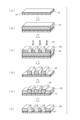
- an example of a manufacturing process of a wiring board by a semi-additive construction method will be described with reference to the drawings.
- a substrate (circuit forming substrate) in which the conductor layer 10 is formed on the insulating layer 15 is prepared.
- the conductor layer 10 is, for example, a metal copper layer.
- the photosensitive resin composition layer 32 is formed on the conductor layer 10 of the substrate by the photosensitive layer forming step.
- the mask 20 is arrange
- the resist pattern 30 which is a photocuring part is formed on a board
- the plating layer 42 is formed on the conductor layer 10 by plating using the resist pattern 30 that is a photocured portion as a mask.
- FIG. 2F after the resist pattern 30 as the photocured portion is peeled off with a strong alkaline aqueous solution, a part of the plating layer 42 and the conductor layer 10 masked by the resist pattern 30 are flash-etched. Then, the circuit pattern 40 is formed.
- the conductor layer 10 and the plating layer 42 may be made of the same material or different materials.
- reaction solution was reprecipitated with hexane and vacuum dried at 40 ° C. 50.0 g of the obtained solid, 46 g of a toluene / propylene glycol monomethyl ether (2/3 mass ratio) mixed solution, 15.5 g (181 mmol) of methacrylic acid (manufactured by Wako Pure Chemical Industries, Ltd.), and benzyl methacrylate (Hitachi) 42.0 g (238 mmol), manufactured by Kasei Co., Ltd., was added and stirred to dissolve the solid, and the temperature was raised to 70 ° C. and stirred.
- Comparative Synthesis Example 2 According to Comparative Synthesis Example 1 except that the monomers shown in Table 3 were used, styrene and methacrylic acid were polymerized, benzyl methacrylate was then added, and a mixed solution of acrylic polymer in toluene / propylene glycol monomethyl ether (2/3 mass ratio) Got.
- the weight average molecular weight (Mw) of the obtained polymer was 28800, the number average molecular weight (Mn) was 21,500, and the solid content of the varnish was 35% by mass.
- the number average molecular weight (Mn), weight average molecular weight (Mw), and Mw / Mn of the acrylic polymer were measured by GPC (gel permeation chromatography) by measuring the molecular weight distribution of the acrylic polymer, and elution of standard polystyrene at 25 ° C. Calculated from time.
- GPC gel permeation chromatography
- EcoSEC, HLC-8320GPC manufactured by Tosoh Corporation was used
- tetrahydrofuran was used as the eluent of GPC
- gel pack GL-A-150 and gel pack GL-A-10 A product directly connected to Hitachi High-Technologies Corporation, trade name
- x 10 ⁇ Vf ⁇ 56.1 / (Wp ⁇ I) ( ⁇ )
- x represents an acid value (mgKOH / g)
- Vf represents a titration amount (mL) of a 0.1N aqueous potassium hydroxide solution
- Wp represents the mass (g) of the measured resin solution.
- I indicates the ratio (mass%) of the non-volatile content in the measured resin solution.
- B-CIM 2,2′-bis (2-chlorophenyl) -4,4 ′, 5,5′-tetraphenylbiimidazole [alias: 2- (2-chlorophenyl) -4,5-diphenylimidazole dimer Body] (Hampford, “B-CIM”)
- DBA 9,10-dibutoxyanthracene (Kawasaki Chemical Industry Co., Ltd. “DBA”)
- ⁇ Production of photosensitive element> The solution of the photosensitive resin composition obtained above was applied on a 16 ⁇ m thick polyethylene terephthalate film (Toray Industries, Inc., “FB-40”) (support) so that the thickness was uniform. Next, a drying process was sequentially performed with a hot air convection dryer at 70 ° C. and 110 ° C. to form a photosensitive resin composition layer having a dried film thickness of 25 ⁇ m. A polypropylene film (Oji Paper Co., Ltd., “E-200K”) (protective layer) is laminated on the photosensitive resin composition layer, and a support, a photosensitive resin composition layer, and a protective layer are laminated in order. Each photosensitive element was obtained.
- FB-40 polyethylene terephthalate film
- a copper-clad laminate (Hitachi Chemical Co., Ltd., “MCL-E-679F”) (hereinafter referred to as “substrate”) having a glass epoxy material and copper foil (thickness 16 ⁇ m) formed on both sides thereof is heated. The temperature was raised to 80 ° C. Thereafter, using the photosensitive elements according to Examples 1 to 5 and Comparative Examples 1 and 2, a photosensitive resin composition layer was formed (laminated) on the copper surface of the substrate. Lamination was performed under conditions of a temperature of 120 ° C.
- the obtained laminated substrate was allowed to cool to 23 ° C.
- a 41-step tablet having a density region of 0.00 to 2.00, a density step of 0.05, a tablet size of 20 mm ⁇ 187 mm, and a size of each step of 3 mm ⁇ 12 mm on the support of the laminated substrate.
- the photosensitive resin composition layer was exposed through For measurement of illuminance, an ultraviolet illuminance meter (USHIO INC., “UIT-150”) using a 405 nm probe was used.
- ⁇ Evaluation of sensitivity> The sensitivity was evaluated for Examples 1 to 5 and Comparative Example 2. After the exposure, the support was peeled from the laminated substrate to expose the photosensitive resin composition layer, and developed by spraying a 1% by mass aqueous sodium carbonate solution at 30 ° C. for 60 seconds to remove unexposed portions. Thus, the resist pattern which is the hardened
- the sensitivity of the photosensitive resin composition was evaluated by measuring the number of remaining steps (step number) of the step tablet obtained as a resist pattern (cured film). The sensitivity is indicated by the number of step steps, and the higher the step number, the better the sensitivity. The results are shown in Table 6.
- the space portion (unexposed portion) is removed cleanly, and the line portion (exposed portion) of the line width / space width value of the resist pattern formed without causing defects such as meandering and chipping.
- the resolution was evaluated by the minimum value. The smaller this value, the better the resolution.
- the obtained resist pattern was confirmed to be defective by magnifying and observing at a magnification of 1000 times using a microscope. The results are shown in Table 6.
- the developability of the photosensitive resin composition layer was evaluated by measuring the shortest development time (minimum development time, unit: seconds) as follows.
- the laminated substrate was cut into 5 cm square to obtain a test piece for developing property evaluation.
- the unexposed photosensitive layer was spray-developed at a pressure of 0.15 MPa using a 1% by mass aqueous sodium carbonate solution at 30 ° C., and an unexposed area of 1 mm or more was removed.
- the shortest time that can be confirmed visually was defined as the shortest development time.
- a full cone type nozzle was used. The distance between the test piece and the nozzle tip was 6 cm, and the center of the test piece was aligned with the center of the nozzle.
- the shortest development time means that the shorter this time, the better the developability. The results are shown in Table 6.
- Acrylic polymer (Synthesis Examples 1 to 5, Comparative Synthesis Examples 1 and 2) 58 parts by mass (in terms of solid content), 2,2-bis (4- (methacryloxyethoxy) phenyl) propane (ethylene oxide average 10 mol adduct, Hitachi Chemical Co., Ltd. “FA-321M”) 27 parts by mass, (PO) (EO) (PO) modified dimethacrylate (ethylene oxide average 6 mol and propylene oxide average 12 mol adduct, Hitachi Chemical Co., Ltd.
- F-023M 10 parts by mass, 5 parts by mass of (2-hydroxy-3-chloro) propyl-2-methacryloyloxyethyl phthalate (Hitachi Chemical Co., Ltd. “FA-MECH”), azobisisobutyronitrile (AIBN, thermosetting initiator) 0.92 mass part was mix
- SYMBOLS 1 Photosensitive element, 2 ... Support body, 3 ... Photosensitive resin composition layer, 4 ... Protective layer, 10 ... Conductive layer, 15 ... Insulating layer, 20 ... Mask, 30 ... Resist pattern, 32 . Photosensitive resin composition Physical layer, 40 ... circuit pattern, 42 ... plating layer, 50 ... actinic ray.
Landscapes
- Engineering & Computer Science (AREA)
- Chemical & Material Sciences (AREA)
- Physics & Mathematics (AREA)
- Manufacturing & Machinery (AREA)
- Microelectronics & Electronic Packaging (AREA)
- General Physics & Mathematics (AREA)
- Chemical Kinetics & Catalysis (AREA)
- Organic Chemistry (AREA)
- Polymers & Plastics (AREA)
- Medicinal Chemistry (AREA)
- Health & Medical Sciences (AREA)
- Spectroscopy & Molecular Physics (AREA)
- Materials For Photolithography (AREA)
- Exposure And Positioning Against Photoresist Photosensitive Materials (AREA)
- Polymerisation Methods In General (AREA)
- Graft Or Block Polymers (AREA)
- Manufacturing Of Printed Circuit Boards (AREA)
- Manufacturing Of Printed Wiring (AREA)
Abstract
ブロックポリマと、光重合性化合物と、光重合開始剤と、を含有し、前記ブロックポリマが、第一のポリマユニットと、第二のポリマユニットと、を有する(メタ)アクリルポリマであり、前記第一のポリマユニットが、第一の重合性モノマに由来する構造単位と、第二の重合性モノマに由来する構造単位とを含み、前記第二のポリマユニットが、前記第一の重合性モノマに由来する構造単位と、前記第二の重合性モノマとは異なる第三の重合性モノマに由来する構造単位とを含む、感光性樹脂組成物。
Description
本発明は、感光性樹脂組成物、感光性エレメント、レジストパターンの製造方法及びプリント配線板の製造方法に関する。
プリント配線板の製造分野においては、エッチング処理又はめっき処理に用いられるレジスト材料として、感光性樹脂組成物が広く用いられている。感光性樹脂組成物は、支持体と、感光性樹脂組成物を用いて当該支持体上に形成された層(以下、「感光性樹脂組成物層」ともいう)とを備える感光性エレメント(積層体)において用いられることが多い。
プリント配線板は、例えば、以下のようにして製造される。まず、支持体及び感光性樹脂組成物層を有する感光性エレメントを準備し、感光体エレメントの感光性樹脂組成物層を回路形成用の基板上に形成する(感光層形成工程)。次に、支持体を剥離除去した後、感光性樹脂組成物層の所定部分に活性光線を照射して露光部を硬化させる(露光工程)。その後、未露光部を基板上から除去(現像)することにより、基板上に、感光性樹脂組成物の硬化物(レジスト硬化物。以下、「硬化レジスト」ともいう)であるレジストパターンが形成される(現像工程)。得られたレジストパターンに対しエッチング処理又はめっき処理を施して基板上に回路を形成した後(回路形成工程)、最終的にレジストパターンを剥離除去してプリント配線板が製造される(剥離工程)。
露光の方法としては、従来、水銀灯を光源としてフォトマスクを介して露光する方法が用いられている。また、近年、DLP(Digital Light Processing)又はLDI(Laser Direct Imaging)と呼ばれる、パターンのデジタルデータに基づいてフォトマスクを介さずに感光性樹脂組成物層に直接描画する直接描画露光法が提案されている。この直接描画露光法は、フォトマスクを介した露光法よりも位置合わせ精度が良好であり、且つ、高精細なパターンが得られることから、高密度パッケージ基板の作製のために導入されつつある。
近年のプリント配線板の高密度化に伴い、解像度(解像性)に優れたレジストパターンを形成可能な感光性樹脂組成物に対する要求が高まっている。特に、パッケージ基板の作製において、L/S(ライン幅/スペース幅)が10/10(単位:μm)以下のレジストパターンを形成することが可能な感光性樹脂組成物が求められている。
このような要求に対して、従来、種々の感光性樹脂組成物が検討されている。例えば、下記特許文献1~7には、特定のバインダーポリマ、光重合性化合物、光重合開始剤及び増感色素を用いる感光性樹脂組成物が開示されている(下記特許文献1~7参照)。
ところで、従来の感光性樹脂組成物においては、当該感光性樹脂組成物を用いて形成されるレジストパターンの解像度を改良する点で、未だ改善の余地がある。
本発明は、解像度に優れるレジストパターンを形成可能な感光性樹脂組成物、並びに、これを用いた感光性エレメント、レジストパターンの製造方法及びプリント配線板の製造方法を提供することを目的とする。
本発明者は、三成分以上の重合性モノマを重合してなる特定の(メタ)アクリルポリマであるブロックポリマと、光重合性化合物と、光重合開始剤と、を含有する感光性樹脂組成物を用いることにより、解像度に優れると共に強度(レジストの強度。膜強度等)が高いレジストパターンを形成可能であることを見出し、本発明を完成するに至った。
すなわち、本発明の第一の態様は、ブロックポリマと、光重合性化合物と、光重合開始剤と、を含有し、前記ブロックポリマが、第一のポリマユニットと、第二のポリマユニットと、を有する(メタ)アクリルポリマであり、前記第一のポリマユニットが、第一の重合性モノマに由来する構造単位と、第二の重合性モノマに由来する構造単位とを含み、前記第二のポリマユニットが、前記第一の重合性モノマに由来する構造単位と、前記第二の重合性モノマとは異なる第三の重合性モノマに由来する構造単位とを含む、感光性樹脂組成物に関する。
本発明の第一の態様に係る感光性樹脂組成物によれば、解像度に優れるレジストパターンを形成することができる。例えば、上記感光性樹脂組成物によれば、L/S(ライン幅/スペース幅)が10/10(単位:μm)以下のレジストパターンを形成することができる。また、本発明の第一の態様に係る感光性樹脂組成物は、アルカリ現像液への溶解性に優れる。さらに、本発明の第一の態様に係る感光性樹脂組成物によれば、強度(膜強度等)に優れるレジストパターンを形成することができる。
ところで、一般的に露光工程では、生産効率の向上のために露光時間を短縮することが望まれる。しかし、上述の直接描画露光法では、光源にレーザ等の単色光を用いるほか、基板を走査しながら光線を照射するため、従来のフォトマスクを介した露光方法と比べて多くの露光時間を要する傾向がある。そのため、露光時間を短縮して生産効率を高めるためには、従来よりも感光性樹脂組成物の感度を向上させる必要がある。これに対し、本発明の第一の態様に係る感光性樹脂組成物によれば、優れた感度を得ることもできる。
前記第一の重合性モノマは、(メタ)アクリル酸であることが好ましい。前記第二の重合性モノマは、スチレンであることが好ましい。前記第三の重合性モノマは、(メタ)アクリル酸エステルであることが好ましい。
本発明の第一の態様に係る感光性樹脂組成物は、前記第一のポリマユニットの片末端又は両末端に前記第二のポリマユニットが結合している態様が好ましい。
前記ブロックポリマの重量平均分子量は、10000~200000であることが好ましい。
ところで、(メタ)アクリルポリマは、(メタ)アクリルモノマをラジカル重合することで容易に製造することが可能であり、目的に応じて数種の(メタ)アクリルモノマを共重合することで樹脂の特性を幅広く変えることが可能であることから、広く工業的に製造されている。また、(メタ)アクリルポリマの製造方法は、塊状重合、溶液重合、懸濁重合等が普及しており、製造する(メタ)アクリルポリマの分子量又はコスト等を鑑み選択されている。従来、(メタ)アクリルポリマは、一般的にフリーラジカル重合で製造されているため、多成分モノマから得られる(メタ)アクリルポリマはランダム共重合体であり、広い分子量分布を有している。これに対し、本発明の第一の態様に係る感光性樹脂組成物における前記ブロックポリマの分子量分散度は、1.2~4.0であることが好ましい。
本発明の第二の態様は、支持体と、当該支持体上に設けられた感光性樹脂組成物層と、を備え、前記感光性樹脂組成物層が、第一の態様に係る感光性樹脂組成物を含む、感光性エレメントに関する。このような感光性エレメントを用いることにより、解像度に優れたレジストパターンを効率的に形成することができる。
本発明の第三の態様は、第一の態様に係る感光性樹脂組成物、又は、第二の態様に係る感光性エレメントを用いて感光性樹脂組成物層を基板上に形成する工程と、前記感光性樹脂組成物層の少なくとも一部の領域に活性光線を照射して、前記領域を光硬化させて硬化物領域を形成する工程と、前記感光性樹脂組成物層の前記硬化物領域以外の少なくとも一部の領域を前記基板上から除去して、前記硬化物領域であるレジストパターンを前記基板上に形成する工程と、を備える、レジストパターンの製造方法に関する。このようなレジストパターンの製造方法によれば、解像度に優れるレジストパターンを効率的に形成することができる。
前記活性光線の波長は、340nm~430nmの範囲内であることが好ましい。これにより、解像度、密着性、屈曲性及びレジスト形状がより良好なレジストパターンを、優れた感度及び現像性で更に効率的に形成することができる。
本発明の第四の態様は、第三の態様に係るレジストパターンの製造方法によりレジストパターンが形成された基板をエッチング処理又はめっき処理する工程を備える、プリント配線板の製造方法に関する。このようなプリント配線板の製造方法によれば、高密度化した配線を有するプリント配線板(高密度パッケージ基板等)を優れた精度で生産性よく効率的に製造することができる。
本発明によれば、解像度に優れるレジストパターンを形成可能な感光性樹脂組成物、並びに、これを用いた感光性エレメント、レジストパターンの製造方法及びプリント配線板の製造方法を提供することができる。また、前記感光性樹脂組成物は、アルカリ現像液への溶解性に優れる。さらに、本発明によれば、強度(レジストの強度。膜強度等)に優れるレジストパターンを形成可能な感光性樹脂組成物、並びに、これを用いた感光性エレメント、レジストパターンの製造方法及びプリント配線板の製造方法を提供することができる。
以下、本発明を実施するための形態について詳細に説明する。但し、本発明は以下の実施形態に限定されるものではない。
本明細書において、「(メタ)アクリル酸」とは、アクリル酸又はそれに対応するメタクリル酸を意味する。「(メタ)アクリル酸エステル」等の他の類似の表現においても同様である。「A又はB」とは、A及びBのどちらか一方を含んでいればよく、両方とも含んでいてもよい。以下で例示する材料は、特に断らない限り、1種類単独で又は2種類以上を任意に組み合わせて用いることができる。
「(ポリ)オキシエチレン基」とは、オキシエチレン基、及び、2以上のエチレン基がエーテル結合で連結したポリオキシエチレン基の少なくとも一方を意味する。「オキシエチレン基」とは、(-CH2CH2-O-)で表される基であり、エチレンオキシドともいう。「(ポリ)オキシプロピレン基」とは、オキシプロピレン基、及び、2以上のプロピレン基がエーテル結合で連結したポリオキシプロピレン基の少なくとも一方を意味する。「オキシプロピレン基」とは、(-CHCH3CH2-O-)で表される基、(-CH2CHCH3-O-)で表される基又は(-CH2CH2CH2-O-)で表される基であり、プロピレンオキシドともいう。「EO変性」とは、(ポリ)オキシエチレン基を有する化合物であることを意味し、「PO変性」とは、(ポリ)オキシプロピレン基を有する化合物であることを意味し、「EO・PO変性」とは、(ポリ)オキシエチレン基及び(ポリ)オキシプロピレン基の双方を有する化合物であることを意味する。
本明細書において、「工程」との語は、独立した工程だけではなく、他の工程と明確に区別できない場合であってもその工程の所期の目的が達成されれば、本用語に含まれる。「~」を用いて示された数値範囲は、「~」の前後に記載される数値をそれぞれ最小値及び最大値として含む範囲を示す。組成物中の各成分の含有量は、組成物中に各成分に該当する物質が複数存在する場合、特に断らない限り、組成物中に存在する当該複数の物質の合計量を意味する。「層」又は「膜」との語は、平面図として観察したときに、全面に形成されている形状の構造に加え、一部に形成されている形状の構造も包含される。「積層」との語は、層を積み重ねることを示し、二以上の層が結合されていてもよく、二以上の層が脱着可能であってもよい。
<感光性樹脂組成物>
本実施形態の感光性樹脂組成物は、(A)ブロックポリマ(バインダーポリマ。以下、場合により「(A)成分」という)と、(B)光重合性化合物(以下、場合により「(B)成分」という)と、(C)光重合開始剤(以下、場合により「(C)成分」という)と、を含有する。本実施形態の感光性樹脂組成物は、必要に応じて、その他の成分を更に含有してもよい。例えば、本実施形態の感光性樹脂組成物は、(A)成分、(B)成分及び(C)成分に加えて、(D)増感色素(以下、場合により「(D)成分」という)及び/又は(E)水素供与体(以下、場合により「(E)成分」という)を含有することが好ましい。
本実施形態の感光性樹脂組成物は、(A)ブロックポリマ(バインダーポリマ。以下、場合により「(A)成分」という)と、(B)光重合性化合物(以下、場合により「(B)成分」という)と、(C)光重合開始剤(以下、場合により「(C)成分」という)と、を含有する。本実施形態の感光性樹脂組成物は、必要に応じて、その他の成分を更に含有してもよい。例えば、本実施形態の感光性樹脂組成物は、(A)成分、(B)成分及び(C)成分に加えて、(D)増感色素(以下、場合により「(D)成分」という)及び/又は(E)水素供与体(以下、場合により「(E)成分」という)を含有することが好ましい。
(A)成分は、第一のポリマユニットと、第二のポリマユニットと、を有する(メタ)アクリルポリマである。前記第一のポリマユニットは、第一の重合性モノマに由来する構造単位と、第二の重合性モノマに由来する構造単位とを含む。前記第二のポリマユニットは、前記第一の重合性モノマに由来する構造単位と、前記第二の重合性モノマとは異なる第三の重合性モノマに由来する構造単位とを含む。
本実施形態の感光性樹脂組成物が(A)成分、(B)成分及び(C)成分を含有することで、強度(膜強度等)が高く、解像度に優れるレジストパターンを形成可能な感光性樹脂組成物を構成することができる。上記効果を奏する詳細な理由は必ずしも明らかではないが、以下のように考えることができる。前記ブロックポリマ中の構成成分の配列(例えば、可逆的不可開裂連鎖移動重合(RAFT重合)により得られるブロックポリマ(バインダーポリマ)中の構成成分の配列)が、以前から用いられていたフリーラジカル重合により得られるブロックポリマ(バインダーポリマ)中の構成成分の配列と異なることで、現像液の浸透性、現像時の低分子成分の染み出し等が抑制されることにより、解像度が向上すると推測される。特に、(メタ)アクリル酸由来のカルボキシル基がブロックポリマの鎖全体に分散した配置を取り、強度又は可とう性付与に関与する構造がブロック化することでレジストの強度が向上すると推測される。
(A)成分:ブロックポリマ
本実施形態で使用するブロックポリマ((A)成分)について説明する。(A)成分は、三成分以上の重合性モノマを重合してなる(メタ)アクリルポリマであり、第一の重合性モノマに由来する構造単位と、第二の重合性モノマに由来する構造単位とを含む第一のポリマユニット、及び、前記第一の重合性モノマに由来する構造単位と、前記第二の重合性モノマとは異なる第三の重合性モノマに由来する構造単位とを含む第二のポリマユニットを有する。前記第二の重合性モノマは、前記第一の重合性モノマとは異なる。前記第三の重合性モノマは、前記第一の重合性モノマとも異なる。
本実施形態で使用するブロックポリマ((A)成分)について説明する。(A)成分は、三成分以上の重合性モノマを重合してなる(メタ)アクリルポリマであり、第一の重合性モノマに由来する構造単位と、第二の重合性モノマに由来する構造単位とを含む第一のポリマユニット、及び、前記第一の重合性モノマに由来する構造単位と、前記第二の重合性モノマとは異なる第三の重合性モノマに由来する構造単位とを含む第二のポリマユニットを有する。前記第二の重合性モノマは、前記第一の重合性モノマとは異なる。前記第三の重合性モノマは、前記第一の重合性モノマとも異なる。
(A)成分は、三成分以上の多成分共重合ポリマにおいて、特定の重合性モノマに起因するポリマの物性がポリマのシークエンスにより変化しないように他のモノマのブロック性を高めたものである。具体的には、(A)成分は、少なくとも(メタ)アクリルモノマ((メタ)アクリル酸等)を含む三成分以上の重合性モノマを重合してなる(メタ)アクリルブロックポリマであって、重合性モノマ((メタ)アクリル酸以外の重合性モノマ等)由来の構造単位をブロック化でき、溶剤及びアルカリ性水溶液への溶解性に優れるブロックポリマである。
(A)成分は、第一のポリマユニットをブロックとして有し、第一のポリマユニットの片末端(一方の末端)又は両末端に第二のポリマユニットがブロックとして結合している(第一のポリマユニットの片末端又は両末端に第二のポリマユニットを有する)ことが好ましい。
本実施形態において、重合性モノマとしては、例えば、重合性炭素炭素不飽和二重結合(C=C)を有するモノマが挙げられ、具体的には、(メタ)アクリルモノマ、スチレン系モノマ、アクリロニトリル等が挙げられる。
ここで、「(メタ)アクリルモノマ」とは、アクリロイル基(CH=CH-CO-)又はメタクリロイル基(CH=C(CH3)-CO-)を有するモノマをさす。(メタ)アクリルモノマとしては、(メタ)アクリル酸エステル、(メタ)アクリルアミド等が挙げられる。「(メタ)アクリルポリマ」とは、これらの基を有する(メタ)アクリルモノマを少なくとも一部用いて重合して得られるポリマ((メタ)アクリルモノマに由来する構造単位を有するポリマ)をさす。
重合性モノマは、(メタ)アクリル酸を含むことができる。(メタ)アクリル酸以外の重合性モノマとしては、(メタ)アクリル酸と重合可能であり、(メタ)アクリル酸とは異なる重合性モノマであれば、特に制限はない。(メタ)アクリル酸以外の重合性モノマとしては、(メタ)アクリル酸アルキル(すなわち(メタ)アクリル酸アルキルエステル)、(メタ)アクリル酸シクロアルキル(すなわち(メタ)アクリル酸シクロアルキルエステル)、(メタ)アクリル酸ヒドロキシアルキル(すなわち(メタ)アクリル酸ヒドロキシアルキルエステル)、(メタ)アクリル酸ベンジル、(メタ)アクリル酸フルフリル、(メタ)アクリル酸テトラヒドロフルフリル、(メタ)アクリル酸イソボルニル、(メタ)アクリル酸アダマンチル、(メタ)アクリル酸ジシクロペンタニル、(メタ)アクリル酸ジメチルアミノエチル、(メタ)アクリル酸ジエチルアミノエチル、(メタ)アクリル酸グリシジル、2,2,2-トリフルオロエチル(メタ)アクリレート、2,2,3,3-テトラフルオロプロピル(メタ)アクリレート、(メタ)アクリル酸ジシクロペンテニルオキシエチル、(メタ)アクリル酸ジシクロペンタニルオキシエチル、(メタ)アクリル酸イソボルニルオキシエチル、(メタ)アクリル酸シクロヘキシルオキシエチル、(メタ)アクリル酸アダマンチルオキシエチル、(メタ)アクリル酸ジシクロペンテニルオキシプロピルオキシエチル、(メタ)アクリル酸ジシクロペンタニルオキシプロピルオキシエチル、(メタ)アクリル酸ジシクロペンテニルオキシプロピルオキシエチル、(メタ)アクリル酸アダマンチルオキシプロピルオキシエチル等の(メタ)アクリル酸エステル;スチレン、α-メチルスチレン等のスチレン系モノマ;ジアセトンアクリルアミド等のアクリルアミド;アクリロニトリルなどが挙げられる。(メタ)アクリル酸以外の重合性モノマは、1種類単独で又は2種類以上を任意に組み合わせて用いることができる。
(A)成分は、密着性及び剥離特性を向上させる観点から、スチレン又はα-メチルスチレンに由来する構造単位を有することが好ましい。
(A)成分が、スチレン又はα-メチルスチレンに由来する構造単位を有する場合、当該構造単位の含有量は、密着性に更に優れる観点から、(A)成分の構造単位の全質量を基準として、10質量%以上であることが好ましく、15質量%以上であることがより好ましく、20質量%以上であることが更に好ましい。前記含有量は、剥離特性に更に優れる観点から、70質量%以下であることが好ましく、60質量%以下であることがより好ましく、55質量%以下であることが更に好ましい。前記含有量は、密着性及び剥離特性に更に優れる観点から、10質量%~70質量%であることが好ましく、15質量%~60質量%であることがより好ましく、20質量%~55質量%であることが更に好ましい。
(A)成分は、現像性及び剥離特性を向上させる観点から、(メタ)アクリル酸アルキルに由来する構造単位を有することが好ましい。
(メタ)アクリル酸アルキルとしては、炭素数が1~12のアルキル基を有する(メタ)アクリル酸アルキルが好ましく、炭素数1~8のアルキル基を有する(メタ)アクリル酸アルキルがより好ましい。(メタ)アクリル酸アルキルとしては、例えば、(メタ)アクリル酸メチル、(メタ)アクリル酸エチル、(メタ)アクリル酸プロピル、(メタ)アクリル酸ブチル、(メタ)アクリル酸ペンチル、(メタ)アクリル酸ヘキシル、(メタ)アクリル酸ヘプチル、(メタ)アクリル酸オクチル、(メタ)アクリル酸2-エチルヘキシル、(メタ)アクリル酸ノニル、(メタ)アクリル酸デシル、(メタ)アクリル酸ウンデシル及び(メタ)アクリル酸ドデシル(別名:(メタ)アクリル酸ラウリル)が挙げられる。(メタ)アクリル酸アルキルは、1種類単独で又は2種類以上を任意に組み合わせて用いることができる。
(A)成分が、(メタ)アクリル酸アルキルに由来する構造単位を有する場合、当該構造単位の含有量は、解像度及び密着性に更に優れる観点から、(A)成分の構造単位の全質量を基準として、30質量%以下であることが好ましく、20質量%以下であることがより好ましく、10質量%以下であることが更に好ましい。前記含有量は、剥離特性に更に優れる観点から、1質量%以上であることが好ましく、2質量%以上であることがより好ましい。前記含有量は、解像度、密着性及び剥離特性に更に優れる観点から、1質量%~30質量%であることが好ましく、1質量%~20質量%であることがより好ましく、2質量%~10質量%であることが更に好ましい。
(A)成分は、(メタ)アクリルモノマ及びスチレン系モノマを重合性モノマとして用いた(メタ)アクリルポリマ((メタ)アクリルモノマに由来する構造単位、及び、スチレン系モノマに由来する構造単位を有するポリマ)が好ましい。第一の重合性モノマとしては、特に制限はなく、例えば、カルボキシル基を有するモノマが挙げられる。中でも、前記第一の重合性モノマは、(メタ)アクリル酸(アクリル酸又はメタクリル酸)であることが好ましい。
第二の重合性モノマ及び第三の重合性モノマとしては、前記第一の重合性モノマ以外の、(メタ)アクリルモノマ、スチレン系モノマ、アクリロニトリル等が好ましいものとして挙げられる。前記第二の重合性モノマは、スチレンであることが好ましい。前記第三の重合性モノマは、(メタ)アクリル酸エステル(アクリル酸エステル又はメタクリル酸エステル)であることが好ましい。
中でも、本実施形態において用いることが好適な重合性モノマの組合せとして、例えば、第一の重合性モノマが(メタ)アクリル酸であり、且つ、第二及び第三の重合性モノマがスチレン、(メタ)アクリル酸ベンジル、(メタ)アクリル酸メチル、(メタ)アクリル酸エチル、(メタ)アクリル酸プロピル、(メタ)アクリル酸ブチル、(メタ)アクリル酸ラウリル等である組合せが挙げられる。
(A)成分において、それぞれの重合性モノマの割合、及び、それぞれのポリマユニットの割合に特に制限はなく、様々な態様が挙げられる。
(A)成分における第一の重合性モノマと第二の重合性モノマとの割合は、溶媒への溶解性、相溶性の制御等に更に優れる観点から、前者(第一の重合性モノマ)/後者(第二の重合性モノマ)のモル比で、1/99~80/20であってもよく、3/97~70/30であってもよく、5/95~60/40であってもよい。第一の重合性モノマと第三の重合性モノマとの割合は、溶媒への溶解性、相溶性の制御等に更に優れる観点から、前者(第一の重合性モノマ)/後者(第三の重合性モノマ)のモル比で、1/99~80/20であってもよく、3/97~80/20であってもよく、5/95~60/40であってもよい。第一のポリマユニットと第二のポリマユニットとの割合は、伸び、強度、接着性等に更に優れる観点から、前者(第一のポリマユニット)/後者(第二のポリマユニット)のモル比で、10/90~90/10であってもよく、20/80~80/20であってもよく、30/70~70/30であってもよい。なお、上記割合における各重合性モノマの量は、ブロックポリマ全体における総量である。
(A)成分は、例えば、第一の重合性モノマと第二の重合性モノマとの割合が前者(第一の重合性モノマ)/後者(第二の重合性モノマ)のモル比で1/99~80/20であり、且つ、第一の重合性モノマと第三の重合性モノマとの割合が前者(第一の重合性モノマ)/後者(第三の重合性モノマ)のモル比で1/99~80/20であり、且つ、第一のポリマユニットと第二のポリマユニットとの割合が前者(第一のポリマユニット)/後者(第二のポリマユニット)のモル比で10/90~90/10である態様であってもよい。
(A)成分は、第一のポリマユニット及び第二のポリマユニットとは異なるポリマユニットを更に有していてもよい。当該ポリマユニットを与える重合性モノマとしては、第一のポリマユニット及び第二のポリマユニットを得るために用いる上記重合性モノマを用いることができる。
(A)成分は、必要に応じて、340nm~430nmの範囲内の波長を有する光に対して感光性を有する特性基をその分子内に有していてもよい。特性基としては、例えば、後述する増感色素から水素原子を少なくとも1つ取り除いて構成される基を挙げることができる。
(A)成分としては、1種類のブロックポリマを単独で使用してもよく、2種類以上のブロックポリマを任意に組み合わせて使用してもよい。
(A)成分の酸価は、現像時間を更に短縮する観点から、90mgKOH/g以上であることが好ましく、100mgKOH/g以上であることがより好ましく、120mgKOH/g以上であることが更に好ましく、130mgKOH/g以上であることが特に好ましい。(A)成分の酸価は、感光性樹脂組成物の硬化物の密着性を更に向上させる観点から、250mgKOH/g以下であることが好ましく、240mgKOH/g以下であることがより好ましく、235mgKOH/g以下であることが更に好ましく、230mgKOH/g以下であることが特に好ましい。(A)成分の酸価は、現像性及び密着性にバランスよく優れる観点から、90mgKOH/g~250mgKOH/gであることが好ましく、100mgKOH/g~240mgKOH/gであることがより好ましく、120mgKOH/g~235mgKOH/gであることが更に好ましく、130mgKOH/g~230mgKOH/gであることが特に好ましい。
(A)成分の重量平均分子量は、特に制限はないが、強度、伸び、接着性等に更に優れる観点から、10000以上が好ましく、12000以上がより好ましく、15000以上が更に好ましく、20000以上が特に好ましく、25000以上が極めて好ましく、30000以上が非常に好ましい。(A)成分の重量平均分子量は、溶解性等に更に優れる観点から、200000以下が好ましく、180000以下がより好ましく、150000以下が更に好ましく、100000以下が特に好ましく、80000以下が極めて好ましく、50000以下が非常に好ましい。これらの観点から、(A)成分の重量平均分子量は、10000~200000が好ましく、12000~180000がより好ましく、15000~150000が更に好ましく、20000~100000が特に好ましく、25000~80000が極めて好ましく、30000~50000が非常に好ましい。
(A)成分の分子量分散度(重量平均分子量Mw/数平均分子量Mn)は、伸び、強度、接着性等に更に優れる観点から、1.2以上が好ましく、1.23以上がより好ましく、1.26以上が更に好ましい。(A)成分の分子量分散度は、分散性、相溶性等に更に優れる観点から、4.0以下が好ましく、3.0以下がより好ましく、2.0以下が更に好ましい。これらの観点から、(A)成分の分子量分散度は、1.2~4.0が好ましく、1.2~3.0がより好ましく、1.2~2.0が更に好ましい。
なお、分子量(重量平均分子量Mw及び数平均分子量Mn)は、ゲルパーミエーションクロマトグラフィー法により測定し、標準ポリスチレン検量線を用いて換算することで求めることができる。
本実施形態の感光性樹脂組成物における(A)成分の含有量は、フィルム(感光性樹脂組成物層)の形成性に優れる観点から、(A)成分及び(B)成分の総量100質量部中に、30質量部以上であることが好ましく、35質量部以上であることがより好ましく、40質量部以上であることが更に好ましい。(A)成分の前記含有量は、感度及び解像度が充分に得られ易い観点から、70質量部以下であることが好ましく、65質量部以下であることがより好ましく、60質量部以下であることが更に好ましい。(A)成分の前記含有量は、フィルム形成性、感度及び解像度が更に向上する観点から、30質量部~70質量部であることが好ましく、35質量部~65質量部であることがより好ましく、40質量部~60質量部であることが更に好ましい。
近年、(メタ)アクリルポリマの高性能化又は高機能化を実現するため、ブロックポリマ、グラフトポリマ、星型ポリマ等の構造制御が可能なリビングラジカル重合が種々開発されている。(メタ)アクリルポリマのリビングラジカル重合方法として、可逆的付加開裂連鎖移動(RAFT)重合が開発されている。RAFT重合は、チオカーボネート構造を有する連鎖移動剤を用いることでポリマ成長末端が可逆的な付加開裂を起こしモノマへの連鎖移動を起こすことでリビング重合の挙動をとる。RAFT重合によれば、(メタ)アクリル酸を保護基なしで反応させることが可能であり、種々の(メタ)アクリル酸エステル、スチレン等との共重合が可能である(上記特許文献8及び9参照)。
(A)成分の製造方法は、特に制限されない。(A)成分は、第一の重合性モノマと第二の重合性モノマとをリビング重合により重合して第一のポリマユニットを得た後、前記第一の重合性モノマと第三の重合性モノマとを添加して第二のポリマユニットを鎖伸張させることにより得ることができる。
リビング重合としては、アニオン重合、原子移動ラジカル重合(ATRP)、ニトロキシドリビングラジカル重合(NMP)、可逆的付加開裂連鎖移動(RAFT)重合、有機テルル媒介リビングラジカル重合(TERP)、可逆連鎖移動触媒重合(RTCP)等が利用できる。
リビングラジカル重合では、ラジカル重合において、成長ラジカルを可逆的に保護し、保護基の脱保護(活性化)、モノマの付加(成長)、及び、保護(不活性化)の繰り返しにより分子鎖が少しずつ、ほぼ均等に成長し、分子量分布の狭い高分子が得られる。モノマが反応系から枯渇しても新たにモノマを供給することにより重合が開始され鎖伸張が起こる。中でも、連鎖移動剤である保護基としてチオエステルを用いる可逆的付加開裂連鎖移動重合(RAFT)は、重合可能なモノマ種が多く、アクリル酸又はメタクリル酸を直接、共重合できる点で好ましい。
このRAFT重合においては、下記一般式(1)で表される構造のチオカーボネート化合物を連鎖移動剤として用いることができる。

ここで、Rとしては、クミル基、シアノプロピル基、フェニルプロピル基、シアノフェニルメチル基、エチルカルボキシプロピル基、2,4,4-トリメチルペンタン-2-イル基、1-シアノエチル基、1-フェニルエチル基、tert-ブチル基、シアノメチル基、ベンジル基等が好ましいものとして挙げられる。
また、Zとしては、フェニル基、メチルチオイル基、ピロール基、メチル基、フェノキシ基、エトキシ基、ジメチルアミノ基等が好ましいものとして挙げられる。
これらの連鎖移動剤の具体例としては、クミルジチオベンゾエート、2-シアノ-2-プロピルベンゾチオエート、4-シアノ-4[(ドデシルスルファニルチオカルボニル)スルファニル]ペンタン酸、シアノメチルメチル(フェニル)カルバモジチオエート、4-シアノ-4-(フェニルカルボノチオイルチオ)ペンタン酸、2-シアノ-2-プロピルドデシルトリチオカーボネート、2-(ドデシルチオカルボノチオイルチオ)-2-メチルプロピオン酸、シアノメチルドデシルトリチオカーボネート等が挙げられる。これらは市販されているが、連鎖移動剤はこれらに限定されるものではない。
本実施形態において、前記一般式(1)で表される構造のチオカーボネート化合物を連鎖移動剤として用い、第一の重合性モノマ(例えばアクリル酸又はメタクリル酸)と第二の重合性モノマとをリビング重合により重合して第一のポリマユニットを合成し、重合がある程度進んだ時点で、第一のポリマユニットとなるポリマを再沈殿又は減圧留去により回収した後、前記ポリマを第一の重合性モノマと第三の重合性モノマと共に加えることで第二のポリマユニットを鎖伸張させることにより、本実施形態のブロックポリマを得ることができる。この場合、少量のラジカル開始剤を添加してもよい。
また、前記一般式(1)で表される構造のチオカーボネート化合物を連鎖移動剤として用い、第一の重合性モノマと第二の重合性モノマとをリビング重合により重合して第一のポリマユニットを合成し、重合がある程度進んだ時点で、同じ反応器に、第一の重合性モノマと第三の重合性モノマとを添加して第二のポリマユニットを鎖伸張させることで、本実施形態のブロックポリマを得ることができる。
RAFT重合では、一般的に、アクリル成長末端からメタクリレートモノマへの連鎖移動は起こらない。このため、複数のモノマを共重合するときのモノマの配合手順又は組合せは重要である。よって、複数のモノマを同時に仕込む場合には、アクリロイル基を有するモノマのみの組合せ、又は、メタクリロイル基を有するモノマのみの組合せで行うことが好ましい。
本実施形態において、ブロック重合で段階的にポリマを成長させるには、アクリロイル基を有するモノマのみの組合せで重合するか、又は、メタクリロイル基を有するモノマのみの組合せでメタクリロイル基を有するモノマを重合させた後にアクリロイル基を有するモノマを重合させることが好ましい。
最初に用いる第一の重合性モノマ、これと重合可能な第二の重合性モノマ、後から投入する第一の重合性モノマ、及び、これと重合可能な第三の重合性モノマのそれぞれの物質量(モル量)、及び、連鎖移動剤(例えば、一般式(1)で表されるチオカーボネート化合物)のモル比を制御することで、得られるブロックポリマの分子量、第一のポリマユニットの分子量(鎖長)、及び、第二のポリマユニットの分子量(鎖長)を調整することが可能である。
一般的に、連鎖移動剤(一般式(1)で表される化合物等)とラジカル開始剤とのモル比(連鎖移動剤/ラジカル開始剤)は、20/1~1/5が好ましく、10/1~1/4がより好ましい。連鎖移動剤(一般式(1)で表される化合物等)とラジカル開始剤との比率が20/1以下であることで、単分散性を保ちつつ重合反応速度を速めとすることができるので工業的に好ましい。一方、前記比率が1/5以上であることで、ラジカル開始剤から直接モノマへの連鎖移動が起こることを避けることができ、本実施形態で使用するポリマとは異なる各種ポリマ(ランダムポリマ、第一のポリマユニット単独、第二のポリマユニット単独等のポリマ)の副生を抑制し、良好なブロックポリマを得ることが可能である。
重合反応の温度は、使用するラジカル開始剤の分解温度により異なり、特に制限するものではないが、一般的に、半減期分解温度マイナス2℃からプラス20℃(半減期分解温度-2℃~半減期分解温度+20℃)が好ましい。温度を半減期分解温度に対してこの範囲に制御することにより、分子量分布を小さくでき、一般式(1)の構造を持たないポリマの副生によるブロック化の低下を抑制することができる。
(A)成分を合成するためのラジカル開始剤としては、過酸化ベンゾイル、過酸化アセチル、過酸化ラウロイル、過酸化ジt-ブチル、クメンヒドロペルオキシド、t-ブチルヒドロペルオキシド、ジクミルペルオキシド等の過酸化物開始剤;AIBN(2、2’-アゾビスイソブチロニトリル)、V-65(アゾビスジメチルバレロニトリル)等のアゾ開始剤などが挙げられる。中でもAIBN(2、2’-アゾビスイソブチロニトリル)が好ましい。
(A)成分は、溶液重合、懸濁重合、乳化重合、固相重合等で合成することが可能であるが、重量平均分子量2000~300000の樹脂を得るには溶液重合が好ましく、重量平均分子量300000~1000000の樹脂を得るには懸濁重合が好ましい。重合方法は、用いるモノマの極性又は反応性により適宜選択される。重合方法としては、アクリル酸又はメタクリル酸を用いる場合、(メタ)アクリルポリマの溶媒への溶解性に優れる観点から、溶液重合が好ましい。
溶液重合は、例えば、重合可能なモノマ、連鎖移動剤及びラジカル開始剤を、生成する樹脂を溶解可能な溶剤に溶かし、ラジカル開始剤によって決まる温度まで加温することで行われる。このとき空気下でも重合を行うことは可能であるが、窒素下で重合を行うことが好ましい。
溶液重合で使用する溶剤は、重合可能なモノマ、連鎖移動剤、ラジカル開始剤、及び、生成する樹脂を溶解可能であれば特に制限されないが、重合を行う温度以上の沸点を有することが好ましい。重合を行う温度が、使用する溶剤の沸点よりも高い場合には、加圧下での反応により行うことができる。
用いる溶剤(有機溶媒等)としては、メトキシエタノール、エトキシエタノール、トルエン、キシレン、メチルエチルケトン、メチルイソブチルケトン、シクロヘキサノール、シクロヘキサノン、酢酸ブチル、クロルベンゼン、ジオキサン、プロピレングリコールモノメチルエーテル等が挙げられ、特に制限されない。溶剤は、1種類単独で又は2種類以上を任意に組み合わせて用いることができる。
(B)成分:光重合性化合物
次に、光重合性化合物((B)成分)について説明する。(B)成分は、光重合が可能なものであれば特に制限はない。(B)成分は、エチレン性不飽和結合を有する化合物であることが好ましい。エチレン性不飽和結合を有する化合物としては、分子内にエチレン性不飽和結合を1つ有する化合物、分子内にエチレン性不飽和結合を2つ有する化合物、分子内にエチレン性不飽和結合を3つ以上有する化合物等が挙げられる。
次に、光重合性化合物((B)成分)について説明する。(B)成分は、光重合が可能なものであれば特に制限はない。(B)成分は、エチレン性不飽和結合を有する化合物であることが好ましい。エチレン性不飽和結合を有する化合物としては、分子内にエチレン性不飽和結合を1つ有する化合物、分子内にエチレン性不飽和結合を2つ有する化合物、分子内にエチレン性不飽和結合を3つ以上有する化合物等が挙げられる。
分子内にエチレン性不飽和結合を2つ有する化合物としては、例えば、ビスフェノール型ジ(メタ)アクリレート化合物、水添ビスフェノールA型ジ(メタ)アクリレート化合物、分子内にウレタン結合を有するジ(メタ)アクリレート化合物、分子内に(ポリ)オキシエチレン基及び(ポリ)オキシプロピレン基の双方を有するポリアルキレングリコールジ(メタ)アクリレート、トリメチロールプロパンジ(メタ)アクリレート等が挙げられる。
(B)成分は、レジストパターンの密着性を向上させる観点から、ビスフェノール型ジ(メタ)アクリレート化合物の少なくとも1種を含むことが好ましい。感光性樹脂組成物が(B)成分としてビスフェノール型ジ(メタ)アクリレート化合物を含む場合、当該化合物の含有量は、下記の範囲が好ましい。前記含有量は、(A)成分及び(B)成分の総量100質量部中に、1質量部以上であることが好ましく、5質量部以上であることがより好ましく、10質量部以上であることが更に好ましい。前記含有量は、(A)成分及び(B)成分の総量100質量部中に、50質量部以下であることが好ましく、45質量部以下であることがより好ましい。前記含有量は、(A)成分及び(B)成分の総量100質量部中に、1質量部~50質量部であることが好ましく、5質量部~50質量部であることがより好ましく、10質量部~45質量部であることが更に好ましい。
ビスフェノール型ジ(メタ)アクリレート化合物としては、例えば、ビスフェノールA型ジ(メタ)アクリレート化合物を用いることができ、商業的に入手可能なものとしては、2,2-ビス(4-(メタクリロキシジエトキシ)フェニル)プロパン(日立化成株式会社、「FA-324M」等)、2,2-ビス(4-(メタクリロキシエトキシ)フェニル)プロパン(エチレンオキサイド平均10mol付加物)(日立化成株式会社、「FA-321M」等)、2,2-ビス(4-(メタクリロキシエトキシプロポキシ)フェニル)プロパン(エチレンオキサイド平均12mol及びプロピレンオキサイド平均4mol付加物)(日立化成株式会社、「FA-3200MY」等)などが挙げられる。
水添ビスフェノールA型ジ(メタ)アクリレート化合物としては、2,2-ビス(4-(メタクリロキシペンタエトキシ)シクロヘキシル)プロパン等が挙げられる。感光性樹脂組成物が水添ビスフェノールA型ジ(メタ)アクリレート化合物を含む場合、当該化合物の含有量は、下記の範囲が好ましい。前記含有量は、(A)成分及び(B)成分の総量100質量部中に、1質量部以上であることが好ましく、5質量部以上であることがより好ましい。前記含有量は、(A)成分及び(B)成分の総量100質量部中に、50質量部以下であることが好ましく、40質量部以下であることがより好ましい。前記含有量は、(A)成分及び(B)成分の総量100質量部中に、1質量部~50質量部であることが好ましく、5質量部~40質量部であることがより好ましい。
(B)成分は、レジストパターンの屈曲性を向上させる観点から、ポリアルキレングリコールジ(メタ)アクリレートの少なくとも1種を含むことが好ましい。感光性樹脂組成物が(B)成分としてポリアルキレングリコールジ(メタ)アクリレートを含む場合、当該化合物の含有量は、下記の範囲が好ましい。前記含有量は、(A)成分及び(B)成分の総量100質量部中に、5質量部以上であることが好ましく、10質量部以上であることがより好ましい。前記含有量は、(A)成分及び(B)成分の総量100質量部中に、30質量部以下であることが好ましく、25質量部以下であることがより好ましい。
前記含有量は、(A)成分及び(B)成分の総量100質量部中に、5質量部~30質量部であることが好ましく、10質量部~25質量部であることがより好ましい。
前記含有量は、(A)成分及び(B)成分の総量100質量部中に、5質量部~30質量部であることが好ましく、10質量部~25質量部であることがより好ましい。
ポリアルキレングリコールジ(メタ)アクリレート化合物としては、分子内に(ポリ)オキシエチレン基及び(ポリ)オキシプロピレン基の双方を有するポリアルキレングリコールジ(メタ)アクリレートが好ましい。ポリアルキレングリコールジ(メタ)アクリレートの分子内において、(ポリ)オキシエチレン基及び(ポリ)オキシプロピレン基は、それぞれ連続してブロック的に存在してもよく、ランダムに存在してもよい。なお、(ポリ)オキシプロピレン基におけるプロピレン基は、n-プロピレン基又はイソプロピレン基のいずれであってもよい。また、イソプロピレン基を有する(ポリ)オキシプロピレン基において、プロピレン基の2級炭素が酸素原子に結合していてもよく、1級炭素が酸素原子に結合していてもよい。
ポリアルキレングリコールジ(メタ)アクリレートは、(ポリ)n-ブチレンオキシ基、(ポリ)イソブチレンオキシ基、(ポリ)n-ペンチレンオキシ基、(ポリ)ヘキシレンオキシ基、これらの構造異性体等である、炭素原子数4~6程度の(ポリ)アルキレンオキシ基を有していてもよい。
(B)成分が、光重合性化合物として、分子内にエチレン性不飽和結合を2つ有する光重合性化合物を含む場合、当該光重合性化合物の含有量は、下記の範囲が好ましい。前記含有量は、(A)成分及び(B)成分の総量100質量部中に、5質量部以上であることが好ましく、10質量部以上であることがより好ましい。前記含有量は、(A)成分及び(B)成分の総量100質量部中に、60質量部以下であることが好ましく、55質量部以下であることがより好ましく、50質量部以下であることが更に好ましい。前記含有量は、(A)成分及び(B)成分の総量100質量部中に、5質量部~60質量部であることが好ましく、5質量部~55質量部であることがより好ましく、10質量部~50質量部であることが更に好ましい。
(B)成分は、光重合性化合物として、分子内にエチレン性不飽和結合を3つ以上有する光重合性化合物の少なくとも1種を含んでいてもよい。
分子内にエチレン性不飽和結合を3つ以上有する化合物としては、例えば、トリメチロールプロパントリ(メタ)アクリレート、EO変性トリメチロールプロパントリ(メタ)アクリレート(オキシエチレン基の構造単位数が1~5のもの)、PO変性トリメチロールプロパントリ(メタ)アクリレート、EO・PO変性トリメチロールプロパントリ(メタ)アクリレート、テトラメチロールメタントリ(メタ)アクリレート及びテトラメチロールメタンテトラ(メタ)アクリレート、ペンタエリスリトールトリ(メタ)アクリレート、EO変性ペンタエリスリトールテトラ(メタ)アクリレート及びジペンタエリスリトールヘキサ(メタ)アクリレートが挙げられる。エチレン性不飽和結合を3つ以上有する化合物は、1種類単独で又は2種類以上を任意に組み合わせて用いることができる。
上記エチレン性不飽和結合を3つ以上有する化合物のうち、商業的に入手可能なものとしては、テトラメチロールメタントリアクリレート(新中村化学工業株式会社、「A-TMM-3」等)、EO変性トリメチロールプロパントリメタクリレート(日立化成株式会社、「TMPT21E」、「TMPT30E」等)、ペンタエリスリトールトリアクリレート(サートマー株式会社、「SR444」等)、ジペンタエリスリトールヘキサアクリレート(新中村化学工業株式会社、「A-DPH」等)、EO変性ペンタエリスリトールテトラアクリレート(新中村化学工業株式会社、「ATM-35E」等)などが挙げられる。
(B)成分が、光重合性化合物として、分子内にエチレン性不飽和結合を3つ以上有する光重合性化合物を含む場合、当該光重合性化合物の含有量は、解像度、密着性、レジスト形状及び硬化後の剥離特性をバランスよく向上させる観点から、下記の範囲が好ましい。前記含有量は、(A)成分及び(B)成分の総量100質量部中に、3質量部以上であることが好ましく、5質量部以上であることがより好ましい。前記含有量は、(A)成分及び(B)成分の総量100質量部中に、30質量部以下であることが好ましく、25質量部以下であることがより好ましく、20質量部以下であることが更に好ましい。前記含有量は、(A)成分及び(B)成分の総量100質量部中に、3質量部~30質量部であることが好ましく、5質量部~25質量部であることがより好ましく、5質量部~20質量部であることが更に好ましい。
(B)成分は、解像度、密着性、レジスト形状及び硬化後の剥離特性をバランスよく向上させる観点、又は、スカム発生を抑制する観点から、光重合性化合物として、分子内にエチレン性不飽和結合を1つ有する光重合性化合物を含んでもよい。
分子内にエチレン性不飽和結合を1つ有する光重合性化合物としては、例えば、ノニルフェノキシポリオキシエチレンアクリレート、フタル酸化合物及び(メタ)アクリル酸アルキルエステルが挙げられる。上記の中でも、解像度、密着性、レジスト形状及び硬化後の剥離特性をバランスよく向上させる観点から、ノニルフェノキシポリオキシエチレンアクリレート又はフタル酸化合物が好ましい。
(B)成分が、光重合性化合物として、分子内にエチレン性不飽和結合を1つ有する光重合性化合物を含む場合、当該光重合性化合物の含有量は、下記の範囲が好ましい。前記含有量は、(A)成分及び(B)成分の総量100質量部中に、1質量部以上であることが好ましく、3質量部以上であることがより好ましく、5質量部以上であることが更に好ましい。前記含有量は、(A)成分及び(B)成分の総量100質量部中に、20質量部以下であることが好ましく、15質量部以下であることがより好ましく、12質量部以下であることが更に好ましい。前記含有量は、(A)成分及び(B)成分の総量100質量部中に、1質量部~20質量部であることが好ましく、3質量部~15質量部であることがより好ましく、5質量部~12質量部であることが更に好ましい。
感光性樹脂組成物における(B)成分全体の含有量は、充分な感度及び解像度が得られ易くなる傾向がある観点から、(A)成分及び(B)成分の総量100質量部中に、30質量部以上であることが好ましく、35質量部以上であることがより好ましい。(B)成分全体の含有量は、フィルム(感光性樹脂組成物層)を形成し易くなる傾向がある観点、及び、良好なレジスト形状が得られ易くなる傾向がある観点から、(A)成分及び(B)成分の総量100質量部中に、70質量部以下であることが好ましく、65質量部以下であることがより好ましく、50質量部以下であることが更に好ましい。(B)成分全体の含有量は、(A)成分及び(B)成分の総量100質量部中に、30質量部~70質量部であることが好ましく、35質量部~65質量部であることがより好ましく、35質量部~50質量部であることが更に好ましい。
(C)成分:光重合開始剤
感光性樹脂組成物は、(C)成分として光重合開始剤の少なくとも1種を含む。(C)成分としては、特に制限はなく、通常用いられる光重合開始剤から適宜選択することができる。(C)成分としては、ベンゾフェノン、2-ベンジル-2-ジメチルアミノ-1-(4-モルホリノフェニル)-1-ブタノン,2-メチル-1-[4-(メチルチオ)フェニル]-2-モルホリノ-1-プロパノン等の芳香族ケトン;アルキルアントラキノン等のキノン化合物;ベンゾインアルキルエーテル等のベンゾインエーテル化合物;ベンゾイン、アルキルベンゾイン等のベンゾイン化合物;ベンジルジメチルケタール等のベンジル誘導体;2-(2-クロロフェニル)-4,5-ジフェニルイミダゾール二量体(別名:2,2’-ビス(2-クロロフェニル)-4,4’,5,5’-テトラフェニルビイミダゾール)、2-(2-フルオロフェニル)-4,5-ジフェニルイミダゾール二量体等の2,4,5-トリアリールイミダゾール二量体;9-フェニルアクリジン、1,7-(9,9’-アクリジニル)ヘプタン等のアクリジン誘導体などが挙げられる。(C)成分は、1種類単独で又は2種類以上を任意に組み合わせて用いることができる。
感光性樹脂組成物は、(C)成分として光重合開始剤の少なくとも1種を含む。(C)成分としては、特に制限はなく、通常用いられる光重合開始剤から適宜選択することができる。(C)成分としては、ベンゾフェノン、2-ベンジル-2-ジメチルアミノ-1-(4-モルホリノフェニル)-1-ブタノン,2-メチル-1-[4-(メチルチオ)フェニル]-2-モルホリノ-1-プロパノン等の芳香族ケトン;アルキルアントラキノン等のキノン化合物;ベンゾインアルキルエーテル等のベンゾインエーテル化合物;ベンゾイン、アルキルベンゾイン等のベンゾイン化合物;ベンジルジメチルケタール等のベンジル誘導体;2-(2-クロロフェニル)-4,5-ジフェニルイミダゾール二量体(別名:2,2’-ビス(2-クロロフェニル)-4,4’,5,5’-テトラフェニルビイミダゾール)、2-(2-フルオロフェニル)-4,5-ジフェニルイミダゾール二量体等の2,4,5-トリアリールイミダゾール二量体;9-フェニルアクリジン、1,7-(9,9’-アクリジニル)ヘプタン等のアクリジン誘導体などが挙げられる。(C)成分は、1種類単独で又は2種類以上を任意に組み合わせて用いることができる。
(C)成分は、感度及び密着性を更に向上させる観点から、2,4,5-トリアリールイミダゾール二量体の少なくとも1種を含むことが好ましく、2-(2-クロロフェニル)-4,5-ジフェニルイミダゾール二量体を含むことがより好ましい。2,4,5-トリアリールイミダゾール二量体は、その構造が対称であっても非対称であってもよい。
感光性樹脂組成物における(C)成分の含有量は、良好な感度、解像度又は密着性が得られ易くなる傾向がある観点から、(A)成分及び(B)成分の総量100質量部に対して、0.1質量部以上であることが好ましく、1質量部以上であることがより好ましく、2質量部以上であることが更に好ましく、3質量部以上であることが特に好ましい。(C)成分の含有量は、良好なレジスト形状を得られ易くなる傾向がある観点から、(A)成分及び(B)成分の総量100質量部に対して、10質量部以下であることが好ましく、7質量部以下であることがより好ましく、6質量部以下であることが更に好ましく、5質量部以下であることが特に好ましい。これらの観点から、(C)成分の含有量は、(A)成分及び(B)成分の総量100質量部に対して、0.1質量部~10質量部であることが好ましく、1質量部~7質量部であることがより好ましく、2質量部~6質量部であることが更に好ましく、3質量部~5質量部であることが特に好ましい。
(D)成分:増感色素
感光性樹脂組成物は、(D)成分として増感色素の少なくとも1種を含むことが好ましい。増感色素は、露光に用いる活性光線の吸収波長を有効に利用できるものであり、且つ、極大吸収波長が340nm~420nmである化合物が好ましい。
感光性樹脂組成物は、(D)成分として増感色素の少なくとも1種を含むことが好ましい。増感色素は、露光に用いる活性光線の吸収波長を有効に利用できるものであり、且つ、極大吸収波長が340nm~420nmである化合物が好ましい。
(D)成分としては、ピラゾリン化合物、アントラセン化合物、クマリン化合物、キサントン化合物、オキサゾール化合物、ベンゾオキサゾール化合物、チアゾール化合物、ベンゾチアゾール化合物、トリアゾール化合物、スチルベン化合物、トリアジン化合物、チオフェン化合物、ナフタルイミド化合物等が挙げられる。(D)成分は、特に、解像度、密着性及び感度を更に向上させることができる観点から、ピラゾリン化合物又はアントラセン化合物を含むことが好ましい。(D)成分は、1種類単独で又は2種類以上を任意に組み合わせて用いることができる。
感光性樹脂組成物が(D)成分を含有する場合、感光性樹脂組成物における(D)成分の含有量は、感度及び解像度が得られ易くなる傾向がある観点から、(A)成分及び(B)成分の総量100質量部に対して、0.01質量部以上であることが好ましく、0.05質量部以上であることがより好ましく、0.1質量部以上であることが更に好ましい。
(D)成分の含有量は、充分に良好なレジスト形状が得られ易くなる傾向がある観点から、(A)成分及び(B)成分の総量100質量部に対して、10質量部以下であることが好ましく、5質量部以下であることがより好ましく、3質量部以下であることが更に好ましい。これらの観点から、(D)成分の含有量は、(A)成分及び(B)成分の総量100質量部に対して、0.01質量部~10質量部であることが好ましく、0.05質量部~5質量部であることがより好ましく、0.1質量部~3質量部であることが更に好ましい。
(D)成分の含有量は、充分に良好なレジスト形状が得られ易くなる傾向がある観点から、(A)成分及び(B)成分の総量100質量部に対して、10質量部以下であることが好ましく、5質量部以下であることがより好ましく、3質量部以下であることが更に好ましい。これらの観点から、(D)成分の含有量は、(A)成分及び(B)成分の総量100質量部に対して、0.01質量部~10質量部であることが好ましく、0.05質量部~5質量部であることがより好ましく、0.1質量部~3質量部であることが更に好ましい。
(E)成分:水素供与体
感光性樹脂組成物は、露光部(露光部分)と未露光部(未露光部分)とのコントラスト(「イメージング性」ともいう)を良好にするため、(E)成分として、露光部の反応時に光重合開始剤に対して水素を与えることができる水素供与体の少なくとも1種を含有することが好ましい。(E)成分としては、ビス[4-(ジメチルアミノ)フェニル]メタン、ビス[4-(ジエチルアミノ)フェニル]メタン、ロイコクリスタルバイオレット等が挙げられる。(E)成分は、1種類単独で又は2種類以上を任意に組み合わせて用いることができる。
感光性樹脂組成物は、露光部(露光部分)と未露光部(未露光部分)とのコントラスト(「イメージング性」ともいう)を良好にするため、(E)成分として、露光部の反応時に光重合開始剤に対して水素を与えることができる水素供与体の少なくとも1種を含有することが好ましい。(E)成分としては、ビス[4-(ジメチルアミノ)フェニル]メタン、ビス[4-(ジエチルアミノ)フェニル]メタン、ロイコクリスタルバイオレット等が挙げられる。(E)成分は、1種類単独で又は2種類以上を任意に組み合わせて用いることができる。
感光性樹脂組成物が(E)成分を含む場合、感光性樹脂組成物における(E)成分の含有量は、充分な感度が得られ易くなる傾向がある観点から、(A)成分及び(B)成分の総量100質量部に対して、0.01質量部以上であることが好ましく、0.05質量部以上であることがより好ましく、0.1質量部以上であることが更に好ましい。(E)成分の含有量は、フィルム形成後、過剰な(E)成分が異物として析出することが抑制される傾向がある観点から、(A)成分及び(B)成分の総量100質量部に対して、10質量部以下であることが好ましく、5質量部以下であることがより好ましく、2質量部以下であることが更に好ましい。これらの観点から、(E)成分の含有量は、(A)成分及び(B)成分の総量100質量部に対して、0.01質量部~10質量部であることが好ましく、0.05質量部~5質量部であることがより好ましく、0.1質量部~2質量部であることが更に好ましい。
(その他の成分)
本実施形態の感光性樹脂組成物では、ブロックポリマ以外のその他のポリマをブロックポリマと共に用いてもよい。また、本実施形態の感光性樹脂組成物は、必要に応じて、分子内に少なくとも1つのカチオン重合可能な環状エーテル基を有する光重合性化合物(オキセタン化合物等);カチオン重合開始剤;マラカイトグリーン、ビクトリアピュアブルー、ブリリアントグリーン、メチルバイオレット等の染料;トリブロモフェニルスルホン、ジフェニルアミン、ベンジルアミン、トリフェニルアミン、ジエチルアニリン、2-クロロアニリン等の光発色剤;熱発色防止剤;4-トルエンスルホンアミド等の可塑剤;顔料;充填剤;消泡剤;難燃剤;安定剤;密着性付与剤;レベリング剤;剥離促進剤;酸化防止剤;香料;イメージング剤;熱架橋剤などを含有してもよい。これらは、1種類単独で又は2種類以上を任意に組み合わせて用いることができる。感光性樹脂組成物がこれらの成分を含む場合、これらの成分の含有量は、(A)成分及び(B)成分の総量100質量部に対して、それぞれ0.005質量部~20質量部程度であることが好ましい。
本実施形態の感光性樹脂組成物では、ブロックポリマ以外のその他のポリマをブロックポリマと共に用いてもよい。また、本実施形態の感光性樹脂組成物は、必要に応じて、分子内に少なくとも1つのカチオン重合可能な環状エーテル基を有する光重合性化合物(オキセタン化合物等);カチオン重合開始剤;マラカイトグリーン、ビクトリアピュアブルー、ブリリアントグリーン、メチルバイオレット等の染料;トリブロモフェニルスルホン、ジフェニルアミン、ベンジルアミン、トリフェニルアミン、ジエチルアニリン、2-クロロアニリン等の光発色剤;熱発色防止剤;4-トルエンスルホンアミド等の可塑剤;顔料;充填剤;消泡剤;難燃剤;安定剤;密着性付与剤;レベリング剤;剥離促進剤;酸化防止剤;香料;イメージング剤;熱架橋剤などを含有してもよい。これらは、1種類単独で又は2種類以上を任意に組み合わせて用いることができる。感光性樹脂組成物がこれらの成分を含む場合、これらの成分の含有量は、(A)成分及び(B)成分の総量100質量部に対して、それぞれ0.005質量部~20質量部程度であることが好ましい。
[感光性樹脂組成物の溶液]
本実施形態の感光性樹脂組成物は、必要に応じて、粘度を調整するために、有機溶剤の少なくとも1種を更に含んでいてもよい。有機溶剤としては、メタノール、エタノール等のアルコール溶剤;アセトン、メチルエチルケトン等のケトン溶剤;メチルセロソルブ、エチルセロソルブ、プロピレングリコールモノメチルエーテル等のグリコールエーテル溶剤;トルエン等の芳香族炭化水素溶剤;N,N-ジメチルホルムアミド等の非プロトン性極性溶剤などが挙げられる。有機溶剤は、1種類単独で又は2種類以上を任意に組み合わせて用いることができる。感光性樹脂組成物に含まれる有機溶剤の含有量は、目的等に応じて適宜選択することができる。例えば、感光性樹脂組成物は、固形分が30質量%~60質量%程度となる溶液として用いることができる。以下、有機溶剤を含む感光性樹脂組成物を「塗布液」ともいう。
本実施形態の感光性樹脂組成物は、必要に応じて、粘度を調整するために、有機溶剤の少なくとも1種を更に含んでいてもよい。有機溶剤としては、メタノール、エタノール等のアルコール溶剤;アセトン、メチルエチルケトン等のケトン溶剤;メチルセロソルブ、エチルセロソルブ、プロピレングリコールモノメチルエーテル等のグリコールエーテル溶剤;トルエン等の芳香族炭化水素溶剤;N,N-ジメチルホルムアミド等の非プロトン性極性溶剤などが挙げられる。有機溶剤は、1種類単独で又は2種類以上を任意に組み合わせて用いることができる。感光性樹脂組成物に含まれる有機溶剤の含有量は、目的等に応じて適宜選択することができる。例えば、感光性樹脂組成物は、固形分が30質量%~60質量%程度となる溶液として用いることができる。以下、有機溶剤を含む感光性樹脂組成物を「塗布液」ともいう。
上記塗布液を、後述する支持体、金属板等の表面上に付与(例えば塗布)し、乾燥させることにより、感光性樹脂組成物を用いて感光性樹脂組成物層を形成することができる。金属板としては特に制限されず、目的等に応じて適宜選択できる。金属板としては、銅、銅含有合金、ニッケル、クロム、鉄、ステンレス等の鉄含有合金などの金属板を挙げることができる。金属板として、好ましくは銅、銅含有合金、鉄含有合金等の金属板が挙げられる。
形成される感光性樹脂組成物層の厚みは、特に制限されず、その用途により適宜選択できる。例えば、乾燥後の厚みは、1μm~100μmであることが好ましい。金属板上に感光性樹脂組成物層を形成した場合、感光性樹脂組成物層の金属板とは反対側の表面を保護層で被覆してもよい。保護層としては、ポリエチレン、ポリプロピレン等の重合体フィルムなどが挙げられる。
本実施形態の感光性樹脂組成物は、後述する感光性エレメントの感光性樹脂組成物層の形成に適用することができる。すなわち、本発明の別の実施形態は、(A)成分、(B)成分及び(C)成分を含有する感光性樹脂組成物の感光性エレメントへの応用である。
また、本実施形態の感光性樹脂組成物は、後述するレジストパターンの製造方法に使用できる。すなわち、本発明の別の実施形態は、(A)成分、(B)成分及び(C)成分を含有する感光性樹脂組成物のレジストパターンの製造方法への応用である。
<感光性エレメント>
本実施形態の感光性エレメントは、支持体と、当該支持体上に設けられた感光性樹脂組成物層とを備える。感光性樹脂組成物層は、上記感光性樹脂組成物を含んでおり、上記感光性樹脂組成物から形成される。なお、前記感光性樹脂組成物層は塗膜であってもよい。本明細書でいう「塗膜」とは、感光性樹脂組成物が未硬化状態のものである。感光性エレメントは、必要に応じて保護層等のその他の層を有していてもよい。
本実施形態の感光性エレメントは、支持体と、当該支持体上に設けられた感光性樹脂組成物層とを備える。感光性樹脂組成物層は、上記感光性樹脂組成物を含んでおり、上記感光性樹脂組成物から形成される。なお、前記感光性樹脂組成物層は塗膜であってもよい。本明細書でいう「塗膜」とは、感光性樹脂組成物が未硬化状態のものである。感光性エレメントは、必要に応じて保護層等のその他の層を有していてもよい。
図1に、感光性エレメントの一実施形態を示す。図1に示す感光性エレメント1では、支持体2、感光性樹脂組成物から形成される感光性樹脂組成物層3、及び、保護層4がこの順に積層されている。感光性エレメント1は、例えば、以下のようにして得ることができる。支持体2上に、塗布液(すなわち、有機溶剤を含む感光性樹脂組成物)を塗布して塗布層を形成し、これを乾燥することで感光性樹脂組成物層3を形成する。次いで、感光性樹脂組成物層3の支持体2とは反対側の面を保護層4で被覆することにより、支持体2と、当該支持体2上に形成される感光性樹脂組成物層3と、当該感光性樹脂組成物層3上に積層される保護層4とを備える、本実施形態の感光性エレメント1が得られる。感光性エレメント1は、保護層4を必ずしも備えなくてもよい。
支持体としては、ポリエチレンテレフタレート等のポリエステル;ポリプロピレン、ポリエチレン等のポリオレフィンなどの、耐熱性及び耐溶剤性を有する重合体フィルムを用いることができる。
支持体(重合体フィルム等)の厚みは、1μm~100μmであることが好ましく、5μm~50μmであることがより好ましく、5μm~30μmであることが更に好ましい。支持体の厚みが1μm以上であることで、支持体を剥離する際に支持体が破れることを抑制できる。支持体の厚みが100μm以下であることで、解像度の低下が容易に抑制される。
保護層としては、感光性樹脂組成物層に対する接着力が、支持体の感光性樹脂組成物層に対する接着力よりも小さいものが好ましい。また、低フィッシュアイのフィルムが好ましい。ここで、「フィッシュアイ」とは、材料を熱溶融し、混練、押し出し、2軸延伸、キャスティング法等によりフィルムを製造する際に、材料の異物、未溶解物、酸化劣化物等がフィルム中に取り込まれたものを意味する。すなわち、「低フィッシュアイ」とは、フィルム中の異物等が少ないことを意味する。
具体的に、保護層としては、ポリエチレンテレフタレート等のポリエステル;ポリプロピレン、ポリエチレン等のポリオレフィンなどの、耐熱性及び耐溶剤性を有する重合体フィルムを用いることができる。市販のものとしては、王子製紙株式会社製のアルファンMA-410、E-200、信越フィルム株式会社等のポリプロピレンフィルム、帝人株式会社製のPSシリーズ(PS-25等)のポリエチレンテレフタレートフィルムなどが挙げられる。なお、保護層4は支持体2と同一のものでもよい。
保護層の厚みは、1μm~100μmであることが好ましく、5μm~50μmであることがより好ましく、5μm~30μmであることが更に好ましく、15μm~30μmであることが特に好ましい。保護層の厚みが1μm以上であると、保護層を剥がしながら、感光性樹脂組成物層及び支持体を基板上にラミネートする際、保護層が破れることを抑制できる。保護層の厚みが100μm以下であると、取扱い性及び廉価性に優れる。
本実施形態の感光性エレメントは、具体的には例えば、以下のようにして製造することができる。(A)成分、(B)成分及び(C)成分を有機溶剤に溶解した塗布液を準備する工程と、前記塗布液を支持体上に付与(例えば塗布)して塗布層を形成する工程と、前記塗布層を乾燥して感光性樹脂組成物層を形成する工程と、を含む製造方法で感光性エレメントを製造することができる。
感光性樹脂組成物の溶液の支持体上への塗布は、ロールコート、コンマコート、グラビアコート、エアーナイフコート、ダイコート、バーコート等の公知の方法により行うことができる。
塗布層の乾燥は、塗布層から有機溶剤の少なくとも一部を除去することができれば特に制限はなく、例えば、70℃~150℃、5分~30分間乾燥することが好ましい。乾燥後、感光性樹脂組成物層中の残存有機溶剤量は、後の工程での有機溶剤の拡散を防止する観点から、2質量%以下であることが好ましい。
感光性エレメントにおける感光性樹脂組成物層の厚みは、用途により適宜選択することができる。乾燥後の厚みは、1μm~100μmであることが好ましく、1μm~50μmであることがより好ましく、5μm~40μmであることが更に好ましい。感光性樹脂組成物層の厚みが1μm以上であることで、工業的な塗工が容易になる。感光性樹脂組成物層の厚みが100μm以下であると、密着性及び解像度が充分に得られる傾向がある。
感光性樹脂組成物層の紫外線に対する透過率は、波長350nm~420nmの範囲の紫外線に対して、5%~75%であることが好ましく、10%~65%であることがより好ましく、15%~55%であることが更に好ましい。この透過率が5%以上であると、充分な密着性が得られ易くなる傾向がある。前記透過率が75%以下であると、充分な解像度が得られ易くなる傾向がある。なお、透過率は、UV分光計により測定することができる。UV分光計としては、例えば、株式会社日立製作所の228A型Wビーム分光光度計が挙げられる。
感光性エレメントは、クッション層、接着層、光吸収層、ガスバリア層等の中間層などを更に有していてもよい。これらの中間層としては、例えば、特開2006-098982号公報に記載の中間層を適用することができる。
得られた感光性エレメントの形態は特に制限されない。例えば、シート状であってもよく、又は、巻芯にロール状に巻き取った形状であってもよい。ロール状に巻き取る場合、支持体が外側になるように巻き取ることが好ましい。巻芯の材料としては、ポリエチレン樹脂、ポリプロピレン樹脂、ポリスチレン樹脂、ポリ塩化ビニル樹脂、ABS樹脂(アクリロニトリル-ブタジエン-スチレン共重合体)等のプラスチックなどが挙げられる。このようにして得られたロール状の感光性エレメントロールの端面には、端面保護の見地から端面セパレータを設置することが好ましく、耐エッジフュージョンの見地から防湿端面セパレータを設置することが好ましい。梱包方法としては、透湿性の小さいブラックシートに包んで包装することが好ましい。
本実施形態の感光性エレメントは、例えば、後述するレジストパターンの製造方法に好適に用いることができる。
<レジストパターンの製造方法>
上記感光性樹脂組成物を用いてレジストパターンを形成することができる。本実施形態のレジストパターンの製造方法(レジストパターンの形成方法)は、(i)上記感光性樹脂組成物又は上記感光性エレメントを用いて感光性樹脂組成物層を基板上に形成する感光層形成工程と、(ii)前記感光性樹脂組成物層の少なくとも一部の領域に活性光線を照射して、前記領域を光硬化させて硬化物領域を形成する露光工程と、(iii)前記感光性樹脂組成物層の前記硬化物領域以外の少なくとも一部の領域を前記基板上から除去して、前記硬化物領域であるレジストパターンを前記基板上に形成する現像工程と、を有する。レジストパターンの製造方法は、必要に応じてその他の工程を更に有していてもよく、感光層形成工程における感光性樹脂組成物層は塗膜であってもよい。
上記感光性樹脂組成物を用いてレジストパターンを形成することができる。本実施形態のレジストパターンの製造方法(レジストパターンの形成方法)は、(i)上記感光性樹脂組成物又は上記感光性エレメントを用いて感光性樹脂組成物層を基板上に形成する感光層形成工程と、(ii)前記感光性樹脂組成物層の少なくとも一部の領域に活性光線を照射して、前記領域を光硬化させて硬化物領域を形成する露光工程と、(iii)前記感光性樹脂組成物層の前記硬化物領域以外の少なくとも一部の領域を前記基板上から除去して、前記硬化物領域であるレジストパターンを前記基板上に形成する現像工程と、を有する。レジストパターンの製造方法は、必要に応じてその他の工程を更に有していてもよく、感光層形成工程における感光性樹脂組成物層は塗膜であってもよい。
(i)感光層形成工程
まず、上記感光性樹脂組成物を用いて感光性樹脂組成物層を基板上に形成する。基板としては、絶縁層と、当該絶縁層上に形成される導体層とを備える基板(回路形成用基板)を用いることができる。
まず、上記感光性樹脂組成物を用いて感光性樹脂組成物層を基板上に形成する。基板としては、絶縁層と、当該絶縁層上に形成される導体層とを備える基板(回路形成用基板)を用いることができる。
感光性樹脂組成物層の基板上への形成は、例えば、上記感光性エレメントが保護層を有している場合には、保護層を除去した後、感光性エレメントの感光性樹脂組成物層を加熱しながら基板に圧着することにより行われる。これにより、基板と感光性樹脂組成物層と支持体とがこの順に積層される積層体が得られる。
この感光層形成工程は、密着性及び追従性に優れる観点から、減圧下で行うことが好ましい。圧着の際の感光性樹脂組成物層及び基板の少なくとも一方に対する加熱は、70℃~130℃の温度で行うことが好ましく、0.1MPa~1.0MPa程度(1kgf/cm2~10kgf/cm2程度)の圧力で圧着することが好ましい。これらの条件は、特に制限されず、必要に応じて適宜選択される。なお、感光性樹脂組成物層を70℃~130℃に加熱すれば、予め基板を予熱処理しなくともよい。基板(回路形成用基板等)の予熱処理を行うことで密着性及び追従性を更に向上させることができる。
(ii)露光工程
露光工程では、上記のようにして基板上に形成された感光性樹脂組成物層の少なくとも一部の領域に活性光線を照射することで、活性光線が照射された露光部が光硬化して、潜像が形成される。この際、感光性樹脂組成物層上に存在する支持体が活性光線に対して透明である場合には、支持体を通して活性光線を照射することができる。一方、支持体が活性光線に対して遮光性を示す場合には、支持体を除去した後に感光性樹脂組成物層に活性光線を照射する。
露光工程では、上記のようにして基板上に形成された感光性樹脂組成物層の少なくとも一部の領域に活性光線を照射することで、活性光線が照射された露光部が光硬化して、潜像が形成される。この際、感光性樹脂組成物層上に存在する支持体が活性光線に対して透明である場合には、支持体を通して活性光線を照射することができる。一方、支持体が活性光線に対して遮光性を示す場合には、支持体を除去した後に感光性樹脂組成物層に活性光線を照射する。
露光方法としては、例えば、アートワークと呼ばれるネガ又はポジマスクパターンを通して活性光線を画像状に照射する方法(マスク露光法)が挙げられる。また、LDI(Laser Direct Imaging)露光法又はDLP(Digital Light Processing)露光法等の直接描画露光法により活性光線を画像状に照射する方法を採用してもよい。
活性光線の光源としては特に制限されず、公知の光源を用いることができる。例えば、カーボンアーク灯;水銀蒸気アーク灯;高圧水銀灯;キセノンランプ;アルゴンレーザ等のガスレーザ;YAGレーザ等の固体レーザ;半導体レーザ;窒化ガリウム等の青紫色レーザ等の、紫外線、可視光等を有効に放射する光源が用いられる。
活性光線の波長(露光波長)としては、本発明の効果をより確実に得る観点から、340nm~430nmの範囲内であることが好ましく、350nm~420nmの範囲内であることがより好ましい。
(iii)現像工程
現像工程では、感光性樹脂組成物層の未硬化部分が基板(回路形成用基板等)上から現像処理により除去されることで、感光性樹脂組成物層が光硬化した硬化物であるレジストパターンが基板上に形成される。感光性樹脂組成物層上に支持体が存在している場合には、支持体を除去してから、未露光部の除去(現像)を行う。現像処理には、ウェット現像とドライ現像とがあるが、ウェット現像が広く用いられている。
現像工程では、感光性樹脂組成物層の未硬化部分が基板(回路形成用基板等)上から現像処理により除去されることで、感光性樹脂組成物層が光硬化した硬化物であるレジストパターンが基板上に形成される。感光性樹脂組成物層上に支持体が存在している場合には、支持体を除去してから、未露光部の除去(現像)を行う。現像処理には、ウェット現像とドライ現像とがあるが、ウェット現像が広く用いられている。
ウェット現像による場合、感光性樹脂組成物に対応した現像液を用いて、公知の現像方法により現像することができる。現像方法としては、例えば、ディップ方式、パドル方式、スプレー方式、ブラッシング、スラッピング、スクラッビング、揺動浸漬等を用いた方法が挙げられ、解像度が更に向上する観点から、高圧スプレー方式が好ましい。これらのうちの2種以上の方法を組み合わせて現像を行ってもよい。
現像液は、感光性樹脂組成物の構成に応じて適宜選択される。現像液としては、アルカリ性水溶液、有機溶剤現像液等が挙げられる。
アルカリ性水溶液は、現像液として用いられる場合、安全且つ安定であり、操作性が良好である。アルカリ性水溶液の塩基としては、リチウム、ナトリウム又はカリウムの水酸化物等の水酸化アルカリ;リチウム、ナトリウム、カリウム又はアンモニウムの炭酸塩又は重炭酸塩等の炭酸アルカリ;リン酸カリウム、リン酸ナトリウム等のアルカリ金属リン酸塩;ピロリン酸ナトリウム、ピロリン酸カリウム等のアルカリ金属ピロリン酸塩;ホウ砂(四ホウ酸ナトリウム);メタケイ酸ナトリウム;水酸化テトラメチルアンモニウム;エタノールアミン;エチレンジアミン;ジエチレントリアミン;2-アミノ-2-ヒドロキシメチル-1,3-プロパンジオール;1,3-ジアミノ-2-プロパノール;モルホリンなどが用いられる。
現像に用いるアルカリ性水溶液としては、0.1質量%~5質量%炭酸ナトリウムの希薄溶液、0.1質量%~5質量%炭酸カリウムの希薄溶液、0.1質量%~5質量%水酸化ナトリウムの希薄溶液、0.1質量%~5質量%四ホウ酸ナトリウムの希薄溶液等が好ましい。アルカリ性水溶液のpHは9~11の範囲であることが好ましい。アルカリ性水溶液の温度は、感光性樹脂組成物層のアルカリ現像性に合わせて調節される。アルカリ性水溶液中には、表面活性剤、消泡剤、現像を促進させるための少量の有機溶剤等を混入させてもよい。
アルカリ性水溶液は、1種以上の有機溶剤を含んでいてもよい。有機溶剤としては、アセトン、酢酸エチル、炭素原子数1~4のアルコキシ基をもつアルコキシエタノール、エチルアルコール、イソプロピルアルコール、ブチルアルコール、ジエチレングリコールモノメチルエーテル、ジエチレングリコールモノエチルエーテル、ジエチレングリコールモノブチルエーテル等が挙げられる。有機溶剤は、1種類単独で又は2種類以上を任意に組み合わせて用いることができる。アルカリ性水溶液が有機溶剤を含む場合、有機溶剤の含有量は、アルカリ性水溶液の全質量を基準として、2質量%~90質量%であることが好ましい。また、その温度は、アルカリ現像性に合わせて調整することができる。現像に用いるアルカリ性水溶液中には、界面活性剤、消泡剤等を少量混入していてもよい。
有機溶剤現像液に用いられる有機溶剤としては、1,1,1-トリクロロエタン、N-メチルピロリドン、N,N-ジメチルホルムアミド、シクロヘキサノン、メチルイソブチルケトン、γ-ブチロラクトン等が挙げられる。これらの有機溶剤に、引火防止のため、1質量%~20質量%の範囲で水を添加して得られる有機溶剤現像液が好ましい。
レジストパターンの製造方法では、未露光部を除去した後、必要に応じて60℃~250℃の加熱又は0.2J/cm2~10J/cm2のエネルギー量での露光を行うことにより、レジストパターンを更に硬化する工程を更に含んでもよい。
<プリント配線板の製造方法>
本実施形態のプリント配線板の製造方法は、上記レジストパターンの製造方法によりレジストパターンが形成された基板をエッチング処理又はめっき処理する工程を含む。本実施形態のプリント配線板の製造方法は、例えば、絶縁層と、当該絶縁層上に形成された導体層とを備える基板(回路形成用基板等)の当該導体層上に、上記レジストパターンの製造方法によりレジストパターンが形成された基板をエッチング処理又はめっき処理して、導体パターンを形成する工程を含む。プリント配線板の製造方法は、必要に応じてレジスト除去工程等のその他の工程を含んでいてもよい。基板のエッチング処理又はめっき処理は、形成されたレジストパターンをマスクとして用いて、基板の導体層等に対して行われる。
本実施形態のプリント配線板の製造方法は、上記レジストパターンの製造方法によりレジストパターンが形成された基板をエッチング処理又はめっき処理する工程を含む。本実施形態のプリント配線板の製造方法は、例えば、絶縁層と、当該絶縁層上に形成された導体層とを備える基板(回路形成用基板等)の当該導体層上に、上記レジストパターンの製造方法によりレジストパターンが形成された基板をエッチング処理又はめっき処理して、導体パターンを形成する工程を含む。プリント配線板の製造方法は、必要に応じてレジスト除去工程等のその他の工程を含んでいてもよい。基板のエッチング処理又はめっき処理は、形成されたレジストパターンをマスクとして用いて、基板の導体層等に対して行われる。
エッチング処理では、基板上に形成されたレジストパターン(硬化レジスト)をマスクとして用いて、硬化レジストによって被覆されていない基板(回路形成用基板等)の導体層をエッチング除去し、導体パターンを形成する。エッチング処理の方法は、除去すべき導体層に応じて適宜選択される。エッチング液としては、塩化第二銅水溶液、塩化第二鉄水溶液、アルカリエッチング溶液、過酸化水素エッチング液等が挙げられる。これらの中でも、エッチファクタが良好な観点から、塩化第二鉄水溶液を用いることが好ましい。
一方、めっき処理では、基板上に形成されたレジストパターン(硬化レジスト)をマスクとして用いて、硬化レジストによって被覆されていない基板(回路形成用基板等)の導体層上に銅、はんだ等をめっきする。めっき処理の後、硬化レジストを除去し、さらに、この硬化レジストによって被覆されていた導体層をエッチング処理して、導体パターンを形成する。めっき処理の方法は、電解めっき処理であってもよく、無電解めっき処理であってもよい。めっき処理としては、硫酸銅めっき、ピロリン酸銅めっき等の銅めっき;ハイスローはんだめっき等のはんだめっき;ワット浴(硫酸ニッケル-塩化ニッケル)めっき、スルファミン酸ニッケル等のニッケルめっき;ハード金めっき;ソフト金めっき等の金めっきなどが挙げられる。
エッチング処理及びめっき処理の後、基板上のレジストパターンは除去(剥離)される。レジストパターンの除去は、例えば、現像工程に用いたアルカリ性水溶液よりも更に強アルカリ性の水溶液を用いて行うことができる。この強アルカリ性の水溶液としては、1質量%~10質量%水酸化ナトリウム水溶液、1質量%~10質量%水酸化カリウム水溶液等が用いられる。中でも1質量%~10質量%水酸化ナトリウム水溶液又は1質量%~10質量%水酸化カリウム水溶液を用いることが好ましく、1質量%~5質量%水酸化ナトリウム水溶液又は1質量%~5質量%水酸化カリウム水溶液を用いることがより好ましい。強アルカリ性の水溶液のレジストパターンへの付与方式としては、浸漬方式、スプレー方式等が挙げられる。これらは1種類単独で又は2種類以上を任意に組み合わせて用いることができる。
めっき処理を施してからレジストパターンを除去した場合、さらに、エッチング処理によって、硬化レジストで被覆されていた導体層を除去することにより導体パターンを形成することで、所望のプリント配線板を製造することができる。エッチング処理の方法は、除去すべき導体層に応じて適宜選択される。例えば、上述のエッチング液を適用することができる。
本実施形態のプリント配線板の製造方法は、単層プリント配線板のみならず多層プリント配線板の製造にも適用可能である。また、本実施形態のプリント配線板の製造方法は、小径スルーホールを有するプリント配線板等の製造にも適用可能である。
本実施形態の感光性樹脂組成物は、配線板の製造に好適に使用することができる。すなわち、本発明の好適な実施形態の一つは、(A)成分、(B)成分及び(C)成分を含有する感光性樹脂組成物のプリント配線板の製造への応用である。
また、より好適な実施形態は、前記感光性樹脂組成物の高密度パッケージ基板の製造への応用であり、前記感光性樹脂組成物のセミアディティブ工法への応用である。以下、セミアディティブ工法による配線板の製造工程の一例について図面を参照しながら説明する。
図2(a)では、絶縁層15上に導体層10が形成された基板(回路形成用基板)を準備する。導体層10は、例えば、金属銅層である。図2(b)では、上記感光層形成工程により、基板の導体層10上に感光性樹脂組成物層32を形成する。図2(c)では、感光性樹脂組成物層32上にマスク20を配置し、上記露光工程により、活性光線50を感光性樹脂組成物層32に照射して、マスク20が配置された領域以外の領域を露光して、感光性樹脂組成物層32に光硬化部を形成する。図2(d)では、感光性樹脂組成物層32において光硬化部以外の領域を現像工程により基板上から除去することにより、光硬化部であるレジストパターン30を基板上に形成する。図2(e)では、光硬化部であるレジストパターン30をマスクとして用いためっき処理により、導体層10上にめっき層42を形成する。図2(f)では、光硬化部であるレジストパターン30を強アルカリの水溶液により剥離した後、フラッシュエッチング処理により、めっき層42の一部と、レジストパターン30でマスクされていた導体層10とを除去して回路パターン40を形成する。導体層10とめっき層42とでは、材質が同じであっても、異なっていてもよい。図2ではマスク20を用いてレジストパターン30を形成する方法について説明したが、マスク20を用いずに直接描画露光法によりレジストパターン30を形成してもよい。
以下、実施例を挙げて説明するが、本発明はこれらに限定されるものではない。なお、以下、特に断らない限り、「%」は「質量%」を意味する。
<アクリルポリマの合成>
(ブロックポリマの合成例1)
環流冷却器、温度計、撹拌器及び窒素導入管を備えた500mL(ミリリットル)のセパラブルフラスコにメタクリル酸(和光純薬株式会社製)25.0g(290mmol)、スチレン(和光純薬株式会社製)67.5g(648mmol)、クミルジチオベンゾエート1.46g(5.36mmol)、及び、2、2’-アゾビスイソブチロニトリル(和光純薬株式会社製、純度98%)0.45g(2.73mmol)を仕込んだ。次に、室温で窒素をバブリングし、30分間撹拌した。温度を65℃に上げ30分撹拌し、その後温度を70℃に上げた。反応液の粘度が上がったら、別途、窒素を30分間バブリングしておいたトルエン/プロピレングリコールモノメチルエーテル(2/3質量比)混合液を46g加えて更に撹拌した。80℃で2時間撹拌し、固形分と分子量とを測定した。固形分から換算した重合率は94%、スチレン/メタクリル酸ユニットの重量平均分子量(Mw)は12900、数平均分子量(Mn)は9200であった。この反応液にメタクリル酸(和光純薬株式会社製)15.5g(181mmol)、及び、メタクリル酸ベンジル(ベンジルメタクリレート、日立化成株式会社製、ファンクリルFA-BZM)42.0g(238mmol)を加えて更に70℃で撹拌を続けた。反応液の粘度が上がったら、別途、窒素を30分間バブリングしておいたトルエン/プロピレングリコールモノメチルエーテル(2/3質量比)混合液を46g加えて更に撹拌した。80℃で4時間撹拌し、固形分と分子量とを測定した。反応終了後、アクリルポリマのトルエン/プロピレングリコールモノメチルエーテル(2/3質量比)混合溶液を得た。得られたポリマの重量平均分子量(Mw)は21900、数平均分子量(Mn)は15100、ワニスの固形分は34質量%であった。
(ブロックポリマの合成例1)
環流冷却器、温度計、撹拌器及び窒素導入管を備えた500mL(ミリリットル)のセパラブルフラスコにメタクリル酸(和光純薬株式会社製)25.0g(290mmol)、スチレン(和光純薬株式会社製)67.5g(648mmol)、クミルジチオベンゾエート1.46g(5.36mmol)、及び、2、2’-アゾビスイソブチロニトリル(和光純薬株式会社製、純度98%)0.45g(2.73mmol)を仕込んだ。次に、室温で窒素をバブリングし、30分間撹拌した。温度を65℃に上げ30分撹拌し、その後温度を70℃に上げた。反応液の粘度が上がったら、別途、窒素を30分間バブリングしておいたトルエン/プロピレングリコールモノメチルエーテル(2/3質量比)混合液を46g加えて更に撹拌した。80℃で2時間撹拌し、固形分と分子量とを測定した。固形分から換算した重合率は94%、スチレン/メタクリル酸ユニットの重量平均分子量(Mw)は12900、数平均分子量(Mn)は9200であった。この反応液にメタクリル酸(和光純薬株式会社製)15.5g(181mmol)、及び、メタクリル酸ベンジル(ベンジルメタクリレート、日立化成株式会社製、ファンクリルFA-BZM)42.0g(238mmol)を加えて更に70℃で撹拌を続けた。反応液の粘度が上がったら、別途、窒素を30分間バブリングしておいたトルエン/プロピレングリコールモノメチルエーテル(2/3質量比)混合液を46g加えて更に撹拌した。80℃で4時間撹拌し、固形分と分子量とを測定した。反応終了後、アクリルポリマのトルエン/プロピレングリコールモノメチルエーテル(2/3質量比)混合溶液を得た。得られたポリマの重量平均分子量(Mw)は21900、数平均分子量(Mn)は15100、ワニスの固形分は34質量%であった。
(ブロックポリマの合成例2)
環流冷却器、温度計、撹拌器及び窒素導入管を備えた500mLのセパラブルフラスコにメタクリル酸(和光純薬株式会社製)25.0g(290mmol)、スチレン(和光純薬株式会社製)67.5g(648mmol)、クミルジチオベンゾエート0.68g(2.50mmol)、及び、2、2’-アゾビスイソブチロニトリル(和光純薬株式会社製、純度98%)0.21g(1.28mmol)を仕込んだ。次に、室温で窒素をバブリングし、30分間撹拌した。温度を65℃に上げ30分撹拌し、その後温度を70℃に上げた。反応液の粘度が上がったら、別途、窒素を30分間バブリングしておいたトルエン/プロピレングリコールモノメチルエーテル(2/3質量比)混合液を46g加えて更に撹拌した。80℃で2時間撹拌し、固形分と分子量とを測定した。固形分から換算した重合率は92%、スチレン/メタクリル酸ユニットの重量平均分子量(Mw)は21400、数平均分子量(Mn)は16900であった。この反応液にメタクリル酸(和光純薬株式会社製)15.5g(181mmol)、及び、メタクリル酸ベンジル(日立化成株式会社製、ファンクリルFA-BZM)42.0g(238mmol)を加えて更に70℃で撹拌を続けた。反応液の粘度が上がったら、別途、窒素を30分間バブリングしておいたトルエン/プロピレングリコールモノメチルエーテル(2/3質量比)混合液を46g加えて更に撹拌した。80℃で4時間撹拌し、固形分と分子量とを測定した。反応終了後、アクリルポリマのトルエン/プロピレングリコールモノメチルエーテル(2/3質量比)混合溶液を得た。得られたポリマの重量平均分子量(Mw)は40300、数平均分子量(Mn)は32000、ワニスの固形分は34質量%であった。
環流冷却器、温度計、撹拌器及び窒素導入管を備えた500mLのセパラブルフラスコにメタクリル酸(和光純薬株式会社製)25.0g(290mmol)、スチレン(和光純薬株式会社製)67.5g(648mmol)、クミルジチオベンゾエート0.68g(2.50mmol)、及び、2、2’-アゾビスイソブチロニトリル(和光純薬株式会社製、純度98%)0.21g(1.28mmol)を仕込んだ。次に、室温で窒素をバブリングし、30分間撹拌した。温度を65℃に上げ30分撹拌し、その後温度を70℃に上げた。反応液の粘度が上がったら、別途、窒素を30分間バブリングしておいたトルエン/プロピレングリコールモノメチルエーテル(2/3質量比)混合液を46g加えて更に撹拌した。80℃で2時間撹拌し、固形分と分子量とを測定した。固形分から換算した重合率は92%、スチレン/メタクリル酸ユニットの重量平均分子量(Mw)は21400、数平均分子量(Mn)は16900であった。この反応液にメタクリル酸(和光純薬株式会社製)15.5g(181mmol)、及び、メタクリル酸ベンジル(日立化成株式会社製、ファンクリルFA-BZM)42.0g(238mmol)を加えて更に70℃で撹拌を続けた。反応液の粘度が上がったら、別途、窒素を30分間バブリングしておいたトルエン/プロピレングリコールモノメチルエーテル(2/3質量比)混合液を46g加えて更に撹拌した。80℃で4時間撹拌し、固形分と分子量とを測定した。反応終了後、アクリルポリマのトルエン/プロピレングリコールモノメチルエーテル(2/3質量比)混合溶液を得た。得られたポリマの重量平均分子量(Mw)は40300、数平均分子量(Mn)は32000、ワニスの固形分は34質量%であった。
(ブロックポリマの合成例3)
環流冷却器、温度計、撹拌器及び窒素導入管を備えた500mLのセパラブルフラスコにメタクリル酸(和光純薬株式会社製)25.0g(290mmol)、スチレン(和光純薬株式会社製)67.5g(648mmol)、クミルジチオベンゾエート1.12g(4.11mmol)、及び、2、2’-アゾビスイソブチロニトリル(和光純薬株式会社製、純度98%)0.17g(1.01mmol)を仕込んだ。次に、室温で窒素をバブリングし、30分間撹拌した。温度を65℃に上げ30分撹拌し、その後温度を70℃に上げた。反応液の粘度が上がったら、別途、窒素を30分間バブリングしておいたトルエン/プロピレングリコールモノメチルエーテル(2/3質量比)混合液を46g加えて更に撹拌した。80℃で2時間撹拌し、固形分と分子量とを測定した。固形分から換算した重合率は92%、スチレン/メタクリル酸ユニットの重量平均分子量(Mw)は11300、数平均分子量(Mn)は9000であった。室温に冷却後、反応液をヘキサンで再沈殿し、40℃で真空乾燥した。得られた固形物50.0g、トルエン/プロピレングリコールモノメチルエーテル(2/3質量比)混合液46g、メタクリル酸(和光純薬株式会社製)15.5g(181mmol)、及び、メタクリル酸ベンジル(日立化成株式会社製、ファンクリルFA-BZM)42.0g(238mmol)を加えて撹拌し、固形物を溶解後、温度を70℃に上げ撹拌した。反応液の粘度が上がったら、別途、窒素を30分間バブリングしておいたトルエン/プロピレングリコールモノメチルエーテル(2/3質量比)混合液を46g加えて更に撹拌した。80℃で2時間撹拌し、固形分と分子量とを測定した。反応終了後、アクリルポリマのトルエン/プロピレングリコールモノメチルエーテル(2/3質量比)混合溶液を得た。メタクリル酸/メタクリル酸ベンジルのユニットを含めた最終のアクリルポリマの重量平均分子量(Mw)は30500、数平均分子量(Mn)は23800、ワニスの固形分は34質量%であった。
環流冷却器、温度計、撹拌器及び窒素導入管を備えた500mLのセパラブルフラスコにメタクリル酸(和光純薬株式会社製)25.0g(290mmol)、スチレン(和光純薬株式会社製)67.5g(648mmol)、クミルジチオベンゾエート1.12g(4.11mmol)、及び、2、2’-アゾビスイソブチロニトリル(和光純薬株式会社製、純度98%)0.17g(1.01mmol)を仕込んだ。次に、室温で窒素をバブリングし、30分間撹拌した。温度を65℃に上げ30分撹拌し、その後温度を70℃に上げた。反応液の粘度が上がったら、別途、窒素を30分間バブリングしておいたトルエン/プロピレングリコールモノメチルエーテル(2/3質量比)混合液を46g加えて更に撹拌した。80℃で2時間撹拌し、固形分と分子量とを測定した。固形分から換算した重合率は92%、スチレン/メタクリル酸ユニットの重量平均分子量(Mw)は11300、数平均分子量(Mn)は9000であった。室温に冷却後、反応液をヘキサンで再沈殿し、40℃で真空乾燥した。得られた固形物50.0g、トルエン/プロピレングリコールモノメチルエーテル(2/3質量比)混合液46g、メタクリル酸(和光純薬株式会社製)15.5g(181mmol)、及び、メタクリル酸ベンジル(日立化成株式会社製、ファンクリルFA-BZM)42.0g(238mmol)を加えて撹拌し、固形物を溶解後、温度を70℃に上げ撹拌した。反応液の粘度が上がったら、別途、窒素を30分間バブリングしておいたトルエン/プロピレングリコールモノメチルエーテル(2/3質量比)混合液を46g加えて更に撹拌した。80℃で2時間撹拌し、固形分と分子量とを測定した。反応終了後、アクリルポリマのトルエン/プロピレングリコールモノメチルエーテル(2/3質量比)混合溶液を得た。メタクリル酸/メタクリル酸ベンジルのユニットを含めた最終のアクリルポリマの重量平均分子量(Mw)は30500、数平均分子量(Mn)は23800、ワニスの固形分は34質量%であった。
(ブロックポリマの合成例4~5)
表2に示した成分(モノマ、RAFT化剤等)の組合せを用いたこと以外は、合成例1に従い、アクリルポリマを得た。
表2に示した成分(モノマ、RAFT化剤等)の組合せを用いたこと以外は、合成例1に従い、アクリルポリマを得た。
(比較合成例1)
環流冷却器、温度計、撹拌器及び窒素導入管を備えた500mLのセパラブルフラスコにスチレン(和光純薬株式会社製)63.0g(605mmol)、メタクリル酸ベンジル(日立化成株式会社製、ファンクリルFA-BZM)39.2g(222mmol)、クミルジチオベンゾエート1.34g(4.93mmol)、及び、2、2’-アゾビスイソブチロニトリル(和光純薬株式会社製、純度98%)0.184g(1.10mmol)を仕込んだ。次に、室温で窒素をバブリングし、30分間撹拌した。温度を65℃に上げ30分撹拌し、その後温度を70℃に上げ2時間撹拌し、更に80℃で2時間撹拌し、固形分と分子量とを測定した。固形分から換算した重合率は96%、スチレン/メタクリル酸ベンジルユニットの重量平均分子量(Mw)は14100、数平均分子量(Mn)は11300であった。この反応液にメタクリル酸(和光純薬株式会社製)37.8g(439mmol)、トルエン/プロピレングリコールモノメチルエーテル(2/3質量比)混合液46gを加えて70℃で撹拌を続けた。反応液の粘度が上がったら、別途、窒素を30分間バブリングしておいたプロピレングリコールモノメチルエーテルを46g加えて更に撹拌した。80℃で4時間撹拌し、固形分と分子量とを測定した。反応終了後、アクリルポリマのトルエン/プロピレングリコールモノメチルエーテル(2/3質量比)混合溶液を得た。得られたポリマの重量平均分子量(Mw)は20900、数平均分子量(Mn)は16000、ワニスの固形分は34質量%であった。
環流冷却器、温度計、撹拌器及び窒素導入管を備えた500mLのセパラブルフラスコにスチレン(和光純薬株式会社製)63.0g(605mmol)、メタクリル酸ベンジル(日立化成株式会社製、ファンクリルFA-BZM)39.2g(222mmol)、クミルジチオベンゾエート1.34g(4.93mmol)、及び、2、2’-アゾビスイソブチロニトリル(和光純薬株式会社製、純度98%)0.184g(1.10mmol)を仕込んだ。次に、室温で窒素をバブリングし、30分間撹拌した。温度を65℃に上げ30分撹拌し、その後温度を70℃に上げ2時間撹拌し、更に80℃で2時間撹拌し、固形分と分子量とを測定した。固形分から換算した重合率は96%、スチレン/メタクリル酸ベンジルユニットの重量平均分子量(Mw)は14100、数平均分子量(Mn)は11300であった。この反応液にメタクリル酸(和光純薬株式会社製)37.8g(439mmol)、トルエン/プロピレングリコールモノメチルエーテル(2/3質量比)混合液46gを加えて70℃で撹拌を続けた。反応液の粘度が上がったら、別途、窒素を30分間バブリングしておいたプロピレングリコールモノメチルエーテルを46g加えて更に撹拌した。80℃で4時間撹拌し、固形分と分子量とを測定した。反応終了後、アクリルポリマのトルエン/プロピレングリコールモノメチルエーテル(2/3質量比)混合溶液を得た。得られたポリマの重量平均分子量(Mw)は20900、数平均分子量(Mn)は16000、ワニスの固形分は34質量%であった。
(比較合成例2)
表3に示すモノマを用いたこと以外は比較合成例1に従い、スチレン及びメタクリル酸を重合した後にメタクリル酸ベンジルを添加し、アクリルポリマのトルエン/プロピレングリコールモノメチルエーテル(2/3質量比)混合溶液を得た。得られたポリマの重量平均分子量(Mw)は28800、数平均分子量(Mn)は21500、ワニスの固形分は35質量%であった。
表3に示すモノマを用いたこと以外は比較合成例1に従い、スチレン及びメタクリル酸を重合した後にメタクリル酸ベンジルを添加し、アクリルポリマのトルエン/プロピレングリコールモノメチルエーテル(2/3質量比)混合溶液を得た。得られたポリマの重量平均分子量(Mw)は28800、数平均分子量(Mn)は21500、ワニスの固形分は35質量%であった。
<アクリルポリマの評価>
反応液、及び、得られたアクリルポリマの評価は以下に従い行った。
反応液、及び、得られたアクリルポリマの評価は以下に従い行った。
(固形分及び重合率の測定)
反応液又はアクリルポリマワニスの固形分は、精秤したアルミシャーレに約1gを精秤し150℃で15分加熱した後に再度精秤し、以下の式により求めた。
固形分(%)=[加熱後の質量(g)-アルミシャーレの質量(g)]/アクリルポリマワニスの質量(g)×100
重合率(反応率)(%)=固形分(%)/[全仕込みアクリルモノマ(g)/全仕込み量(g)×100]
反応液又はアクリルポリマワニスの固形分は、精秤したアルミシャーレに約1gを精秤し150℃で15分加熱した後に再度精秤し、以下の式により求めた。
固形分(%)=[加熱後の質量(g)-アルミシャーレの質量(g)]/アクリルポリマワニスの質量(g)×100
重合率(反応率)(%)=固形分(%)/[全仕込みアクリルモノマ(g)/全仕込み量(g)×100]
(分子量の測定)
アクリルポリマの数平均分子量(Mn)、重量平均分子量(Mw)及びMw/Mnは、アクリルポリマの分子量分布のクロマトグラムをGPC(ゲルパーミエーションクロマトグラフィー)により測定し、25℃における標準ポリスチレンの溶離時間から換算して求めた。なお、測定装置としては、東ソー株式会社製EcoSEC、HLC-8320GPCを使用し、GPCの溶離液としては、テトラヒドロフランを使用し、カラムとしては、ゲルパックGL-A-150、ゲルパックGL-A-10(日立ハイテクノロジーズ株式会社製、商品名)を直結したものを使用した。なお、反応液中のポリマの分子量についても同様に測定した。
アクリルポリマの数平均分子量(Mn)、重量平均分子量(Mw)及びMw/Mnは、アクリルポリマの分子量分布のクロマトグラムをGPC(ゲルパーミエーションクロマトグラフィー)により測定し、25℃における標準ポリスチレンの溶離時間から換算して求めた。なお、測定装置としては、東ソー株式会社製EcoSEC、HLC-8320GPCを使用し、GPCの溶離液としては、テトラヒドロフランを使用し、カラムとしては、ゲルパックGL-A-150、ゲルパックGL-A-10(日立ハイテクノロジーズ株式会社製、商品名)を直結したものを使用した。なお、反応液中のポリマの分子量についても同様に測定した。
(アクリルポリマのモノマ組成解析)
アクリルポリマのモノマ組成は核磁気共鳴スペクトル(NMR)により求めた。なお、反応液中のポリマの組成についても同様に解析した。結果を下記表1~表3に示す。
アクリルポリマのモノマ組成は核磁気共鳴スペクトル(NMR)により求めた。なお、反応液中のポリマの組成についても同様に解析した。結果を下記表1~表3に示す。
(酸価の測定)
合成したアクリルポリマ約1gを三角フラスコに秤量し、混合溶剤(質量比:トルエン/メタノール=70/30)を加えて溶解した。その後、指示薬としてフェノールフタレイン溶液を適量添加し、0.1Nの水酸化カリウム水溶液で滴定した。そして、下記式(α)より酸価を測定した。
x=10×Vf×56.1/(Wp×I) …(α)
式(α)中、xは酸価(mgKOH/g)を示し、Vfは0.1Nの水酸化カリウム水溶液の滴定量(mL)を示し、Wpは測定した樹脂溶液の質量(g)を示し、Iは測定した樹脂溶液中の不揮発分の割合(質量%)を示す。
合成したアクリルポリマ約1gを三角フラスコに秤量し、混合溶剤(質量比:トルエン/メタノール=70/30)を加えて溶解した。その後、指示薬としてフェノールフタレイン溶液を適量添加し、0.1Nの水酸化カリウム水溶液で滴定した。そして、下記式(α)より酸価を測定した。
x=10×Vf×56.1/(Wp×I) …(α)
式(α)中、xは酸価(mgKOH/g)を示し、Vfは0.1Nの水酸化カリウム水溶液の滴定量(mL)を示し、Wpは測定した樹脂溶液の質量(g)を示し、Iは測定した樹脂溶液中の不揮発分の割合(質量%)を示す。
<感光性樹脂組成物の調製>
表4及び表5に示す(B)~(E)成分及び染料を、表4及び表5に示す配合量(単位:質量部)に従い配合及び溶解した。その後、(A)成分(合成例1~5、比較合成例1~2)58質量部(固形分換算)を配合し均一になるまで混合し、感光性樹脂組成物を得た。表4及び表5に示す(A)成分以外の各成分の詳細については、以下のとおりである。
表4及び表5に示す(B)~(E)成分及び染料を、表4及び表5に示す配合量(単位:質量部)に従い配合及び溶解した。その後、(A)成分(合成例1~5、比較合成例1~2)58質量部(固形分換算)を配合し均一になるまで混合し、感光性樹脂組成物を得た。表4及び表5に示す(A)成分以外の各成分の詳細については、以下のとおりである。
((B)光重合性化合物)
・FA-321M(70):2,2-ビス(4-(メタクリロキシエトキシ)フェニル)プロパン(エチレンオキサイド平均10mol付加物)のプロピレングリコールモノメチルエーテル70%溶液(日立化成株式会社、「FA-321M」)
・FA-023M:EO変性ポリプロピレングリコールジメタクリレート(日立化成株式会社、「FA-023M」)
・FA-MECH:(2-ヒドロキシ-3-クロロ)プロピル-2-メタクリロイルオキシエチルフタレート(日立化成株式会社、「FA-MECH」)
・FA-321M(70):2,2-ビス(4-(メタクリロキシエトキシ)フェニル)プロパン(エチレンオキサイド平均10mol付加物)のプロピレングリコールモノメチルエーテル70%溶液(日立化成株式会社、「FA-321M」)
・FA-023M:EO変性ポリプロピレングリコールジメタクリレート(日立化成株式会社、「FA-023M」)
・FA-MECH:(2-ヒドロキシ-3-クロロ)プロピル-2-メタクリロイルオキシエチルフタレート(日立化成株式会社、「FA-MECH」)
((C)光重合開始剤)
・B-CIM:2,2’-ビス(2-クロロフェニル)-4,4’,5,5’-テトラフェニルビイミダゾール[別名:2-(2-クロロフェニル)-4,5-ジフェニルイミダゾール二量体](Hampford社、「B-CIM」)
・B-CIM:2,2’-ビス(2-クロロフェニル)-4,4’,5,5’-テトラフェニルビイミダゾール[別名:2-(2-クロロフェニル)-4,5-ジフェニルイミダゾール二量体](Hampford社、「B-CIM」)
((D)増感色素)
・DBA:9,10-ジブトキシアントラセン(川崎化成工業株式会社「DBA」)
・DBA:9,10-ジブトキシアントラセン(川崎化成工業株式会社「DBA」)
((E)水素供与体)
・LCV:ロイコクリスタルバイオレット(山田化学株式会社、「LCV」)
・LCV:ロイコクリスタルバイオレット(山田化学株式会社、「LCV」)
(染料)
・MKG:マラカイトグリーン(大阪有機化学工業株式会社、「MKG」)
・MKG:マラカイトグリーン(大阪有機化学工業株式会社、「MKG」)
<感光性エレメントの作製>
上記で得られた感光性樹脂組成物の溶液を、それぞれ厚さ16μmのポリエチレンテレフタレートフィルム(東レ株式会社、「FB-40」)(支持体)上に厚みが均一になるように塗布した。次に、70℃及び110℃の熱風対流式乾燥器で順次乾燥処理して、乾燥後の膜厚が25μmである感光性樹脂組成物層を形成した。この感光性樹脂組成物層上にポリプロピレンフィルム(王子製紙株式会社、「E-200K」)(保護層)を貼り合わせ、支持体と、感光性樹脂組成物層と、保護層とが順に積層された感光性エレメントをそれぞれ得た。
上記で得られた感光性樹脂組成物の溶液を、それぞれ厚さ16μmのポリエチレンテレフタレートフィルム(東レ株式会社、「FB-40」)(支持体)上に厚みが均一になるように塗布した。次に、70℃及び110℃の熱風対流式乾燥器で順次乾燥処理して、乾燥後の膜厚が25μmである感光性樹脂組成物層を形成した。この感光性樹脂組成物層上にポリプロピレンフィルム(王子製紙株式会社、「E-200K」)(保護層)を貼り合わせ、支持体と、感光性樹脂組成物層と、保護層とが順に積層された感光性エレメントをそれぞれ得た。
<積層基板の作製>
ガラスエポキシ材と、その両面に形成された銅箔(厚さ16μm)とを有する銅張積層板(日立化成株式会社、「MCL-E-679F」)(以下、「基板」という。)を加熱して80℃に昇温させた。その後、実施例1~5及び比較例1~2に係る感光性エレメントを用いて、各々、基板の銅表面上に感光性樹脂組成物層を形成(ラミネート)した。ラミネートは、保護層を除去しながら、各感光性エレメントの感光性樹脂組成物層が基板の銅表面に密着するようにして、温度120℃、ラミネート圧力4kgf/cm2(0.4MPa)の条件下で行った。このようにして、基板の銅表面上に感光性樹脂組成物層及び支持体が積層された積層基板を得た。
ガラスエポキシ材と、その両面に形成された銅箔(厚さ16μm)とを有する銅張積層板(日立化成株式会社、「MCL-E-679F」)(以下、「基板」という。)を加熱して80℃に昇温させた。その後、実施例1~5及び比較例1~2に係る感光性エレメントを用いて、各々、基板の銅表面上に感光性樹脂組成物層を形成(ラミネート)した。ラミネートは、保護層を除去しながら、各感光性エレメントの感光性樹脂組成物層が基板の銅表面に密着するようにして、温度120℃、ラミネート圧力4kgf/cm2(0.4MPa)の条件下で行った。このようにして、基板の銅表面上に感光性樹脂組成物層及び支持体が積層された積層基板を得た。
得られた積層基板を23℃まで放冷した。次に、積層基板の支持体上に、濃度領域0.00~2.00、濃度ステップ0.05、タブレットの大きさ20mm×187mm、各ステップの大きさが3mm×12mmである41段ステップタブレットを有するフォトツールを配置した。波長405nmの青紫色レーザダイオードを光源とする直描露光機(日立ビアメカニクス株式会社、「DE-1UH」)を使用して、100mJ/cm2のエネルギー量(露光量)でフォトツール及び支持体を介して感光性樹脂組成物層に対して露光した。なお、照度の測定には、405nm対応プローブを適用した紫外線照度計(ウシオ電機株式会社、「UIT-150」)を用いた。
<感度の評価>
実施例1~5及び比較例2について感度の評価を行った。露光後、積層基板から支持体を剥離し、感光性樹脂組成物層を露出させ、30℃の1質量%炭酸ナトリウム水溶液を60秒間スプレーすることにより現像処理し、未露光部を除去した。このようにして、感光性樹脂組成物の硬化物であるレジストパターンを基板の銅表面上に形成した。レジストパターン(硬化膜)として得られたステップタブレットの残存段数(ステップ段数)を測定することにより、感光性樹脂組成物の感度を評価した。感度は、上記ステップ段数により示され、この段数が高いほど感度が良好であることを意味する。結果を表6に示す。
実施例1~5及び比較例2について感度の評価を行った。露光後、積層基板から支持体を剥離し、感光性樹脂組成物層を露出させ、30℃の1質量%炭酸ナトリウム水溶液を60秒間スプレーすることにより現像処理し、未露光部を除去した。このようにして、感光性樹脂組成物の硬化物であるレジストパターンを基板の銅表面上に形成した。レジストパターン(硬化膜)として得られたステップタブレットの残存段数(ステップ段数)を測定することにより、感光性樹脂組成物の感度を評価した。感度は、上記ステップ段数により示され、この段数が高いほど感度が良好であることを意味する。結果を表6に示す。
<解像度の評価>
ライン幅(L)/スペース幅(S)(以下、「L/S」と記す。)が3/3~30/30(単位:μm)である描画パターンを用いて、41段ステップタブレットの残存段数が15段となるエネルギー量で上記積層基板の感光性樹脂組成物層に対して露光(描画)を行った。露光後、上記感度の評価と同様の現像処理を行った。
ライン幅(L)/スペース幅(S)(以下、「L/S」と記す。)が3/3~30/30(単位:μm)である描画パターンを用いて、41段ステップタブレットの残存段数が15段となるエネルギー量で上記積層基板の感光性樹脂組成物層に対して露光(描画)を行った。露光後、上記感度の評価と同様の現像処理を行った。
現像後、スペース部分(未露光部)がきれいに除去され、且つ、ライン部分(露光部)が蛇行、欠け等の不良を生じることなく形成されたレジストパターンにおけるライン幅/スペース幅の値のうちの最小値により、解像度を評価した。この数値が小さいほど解像度が良好であることを意味する。なお、得られたレジストパターンは、顕微鏡を用いて、倍率1000倍で拡大して観察することで不良の有無を確認した。結果を表6に示す。
<現像性の評価>
感光性樹脂組成物層の現像性は、以下のようにして最短現像時間(最小現像時間。単位:秒)を測定することで評価した。上記積層基板を5cm四方に切断し、現像性評価用の試験片を得た。試験片から支持体を剥離した後、30℃の1質量%炭酸ナトリウム水溶液を用いて、露光していない感光層を0.15MPaの圧力でスプレー現像し、1mm以上の未露光部が除去されたことを目視で確認できる最短の時間を、最短現像時間とした。ノズルは、フルコーンタイプを使用した。上記試験片とノズル先端の距離は6cmであり、試験片の中心とノズルの中心が一致するように配置した。最短現像時間は、この時間が短いほど現像性が良好であることを意味する。結果を表6に示す。
感光性樹脂組成物層の現像性は、以下のようにして最短現像時間(最小現像時間。単位:秒)を測定することで評価した。上記積層基板を5cm四方に切断し、現像性評価用の試験片を得た。試験片から支持体を剥離した後、30℃の1質量%炭酸ナトリウム水溶液を用いて、露光していない感光層を0.15MPaの圧力でスプレー現像し、1mm以上の未露光部が除去されたことを目視で確認できる最短の時間を、最短現像時間とした。ノズルは、フルコーンタイプを使用した。上記試験片とノズル先端の距離は6cmであり、試験片の中心とノズルの中心が一致するように配置した。最短現像時間は、この時間が短いほど現像性が良好であることを意味する。結果を表6に示す。
<破断伸びの評価>
アクリルポリマ(合成例1~5、比較合成例1~2)58質量部(固形分換算)に、2,2-ビス(4-(メタクリロキシエトキシ)フェニル)プロパン(エチレンオキサイド平均10mol付加物、日立化成株式会社製「FA-321M」)27質量部、(PO)(EO)(PO)変性ジメタクリレート(エチレンオキサイド平均6mol及びプロピレンオキサイド平均12mol付加物、日立化成株式会社「FA-023M」)10質量部、(2-ヒドロキシ-3-クロロ)プロピル-2-メタクリロイルオキシエチルフタレート(日立化成株式会社「FA-MECH」)5質量部、アゾビスイソブチロニトリル(AIBN、熱硬化開始剤)0.92質量部を配合し、樹脂組成物ワニスを得た。
アクリルポリマ(合成例1~5、比較合成例1~2)58質量部(固形分換算)に、2,2-ビス(4-(メタクリロキシエトキシ)フェニル)プロパン(エチレンオキサイド平均10mol付加物、日立化成株式会社製「FA-321M」)27質量部、(PO)(EO)(PO)変性ジメタクリレート(エチレンオキサイド平均6mol及びプロピレンオキサイド平均12mol付加物、日立化成株式会社「FA-023M」)10質量部、(2-ヒドロキシ-3-クロロ)プロピル-2-メタクリロイルオキシエチルフタレート(日立化成株式会社「FA-MECH」)5質量部、アゾビスイソブチロニトリル(AIBN、熱硬化開始剤)0.92質量部を配合し、樹脂組成物ワニスを得た。
離型処理PET(ポリエチレンテレフタレート)フィルムに、バーコータを用い、乾燥後の厚みが100μmになるように前記樹脂組成物ワニスを塗布した後、60℃で20分間乾燥した。次に、110℃で2時間硬化した後、硬化物を離型処理PETフィルムから剥がして試料を得た。試料を幅10mm、長さ100mmに打ち抜いてテストピースとして使用した。テストピースをEZテスターにチャック間距離60mmでセッティングし、引張り速度50mm/分で長さ方向に引っ張り、破断したときの伸びを破断伸び(%)として、以下の式で算出した。結果を表7に示す。
破断伸び(%)=[(破断したときのチャック間距離-最初のチャック間距離(60mm))/最初のチャック間距離(60mm)]×100
破断伸び(%)=[(破断したときのチャック間距離-最初のチャック間距離(60mm))/最初のチャック間距離(60mm)]×100
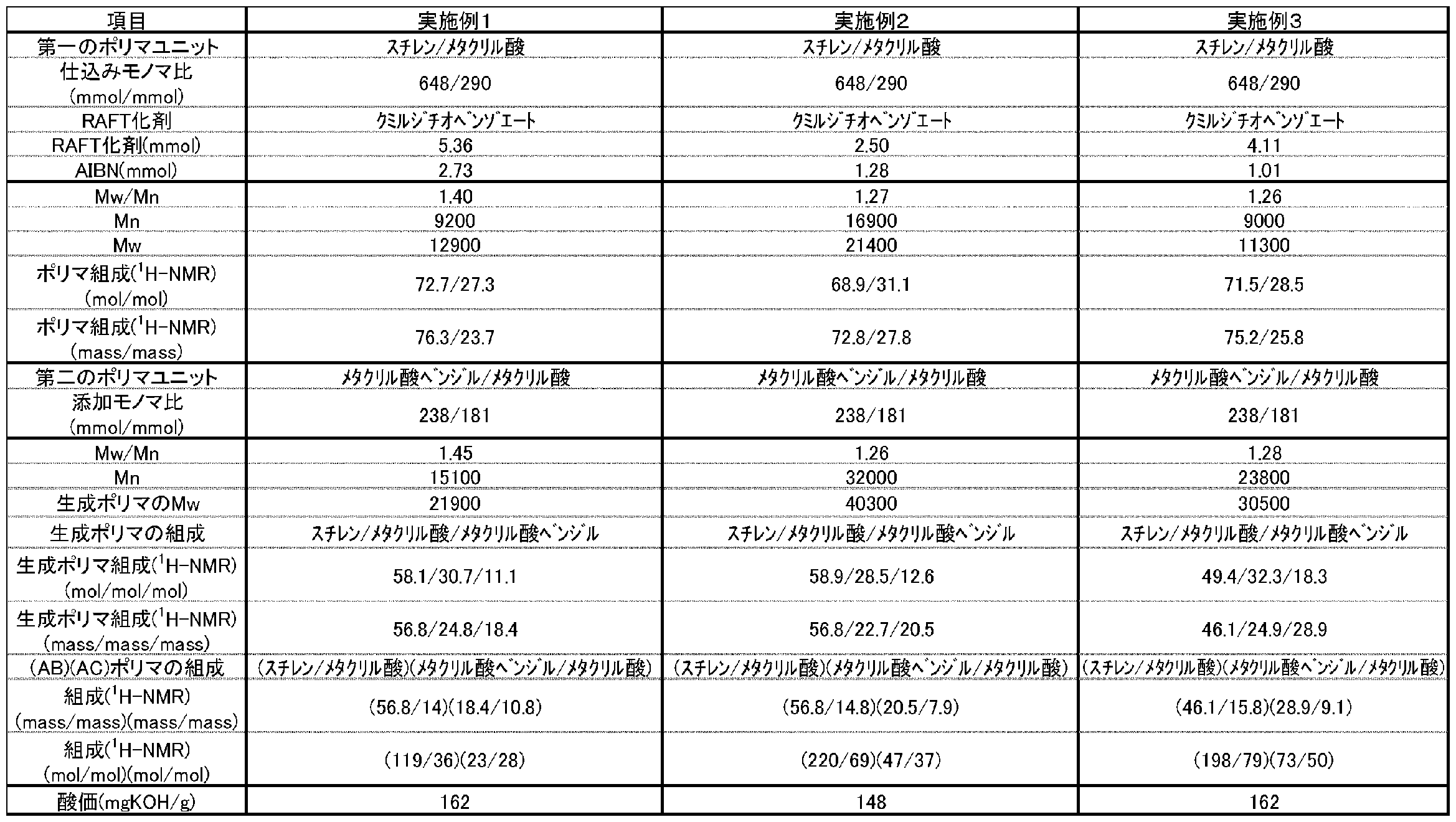
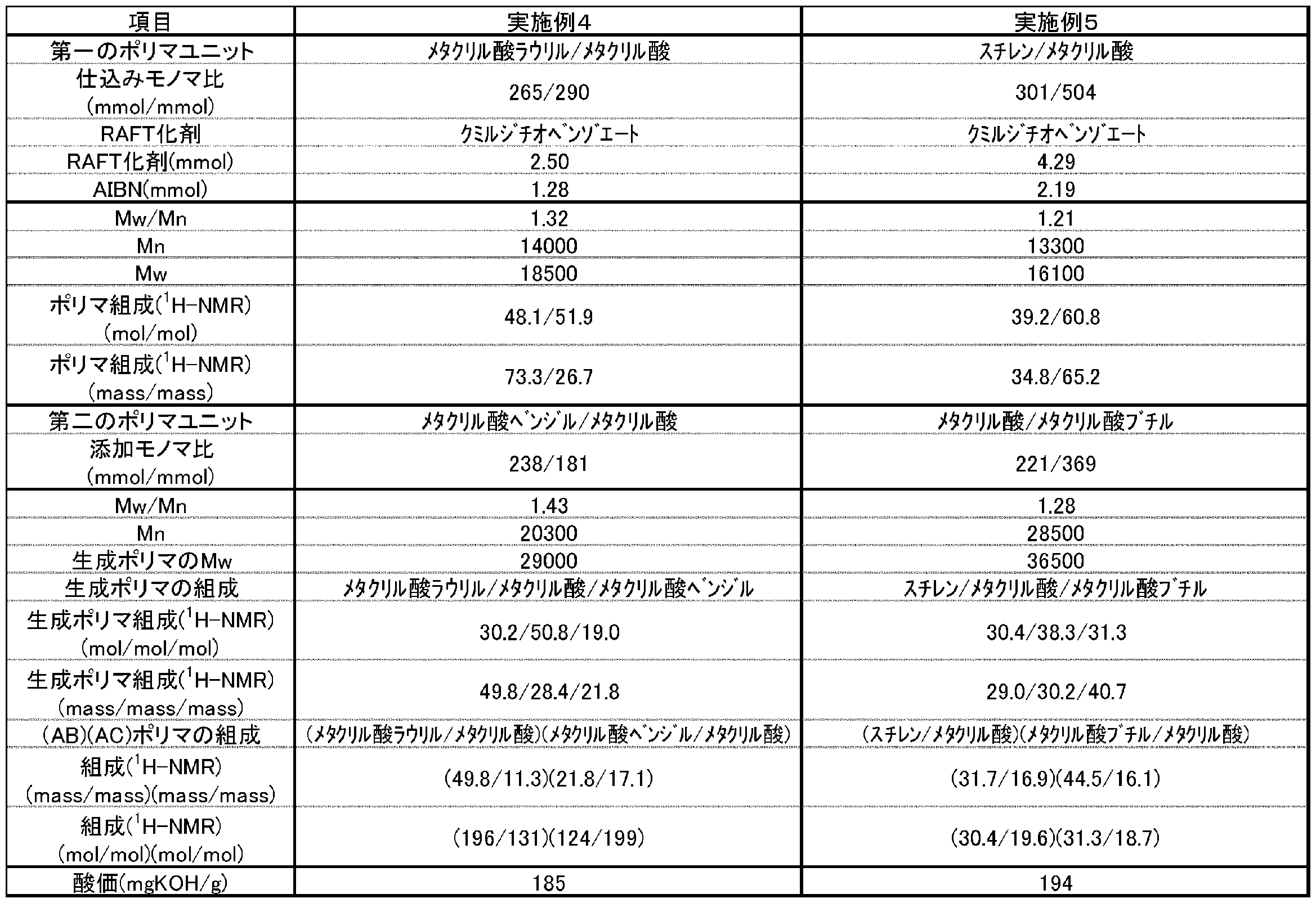
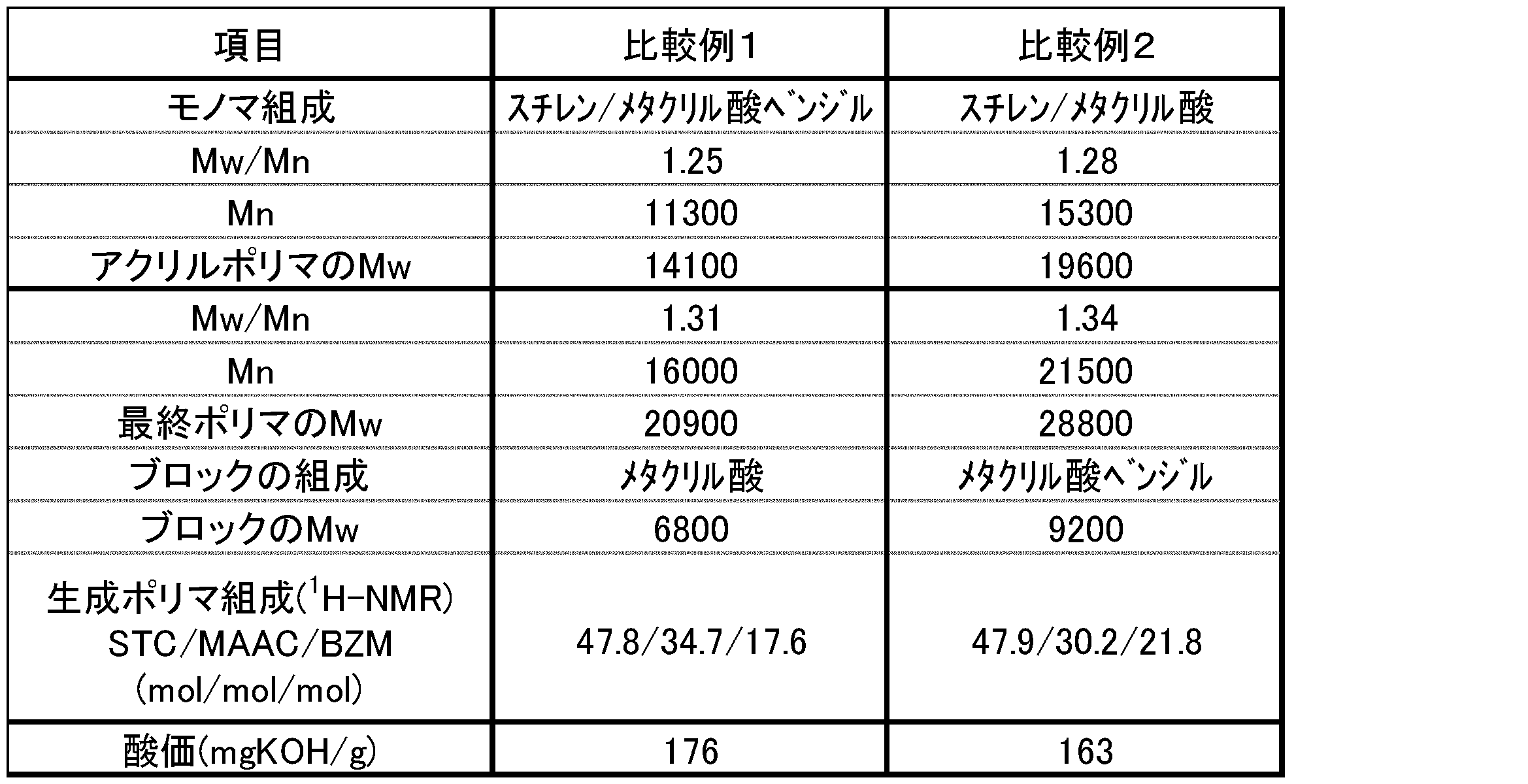
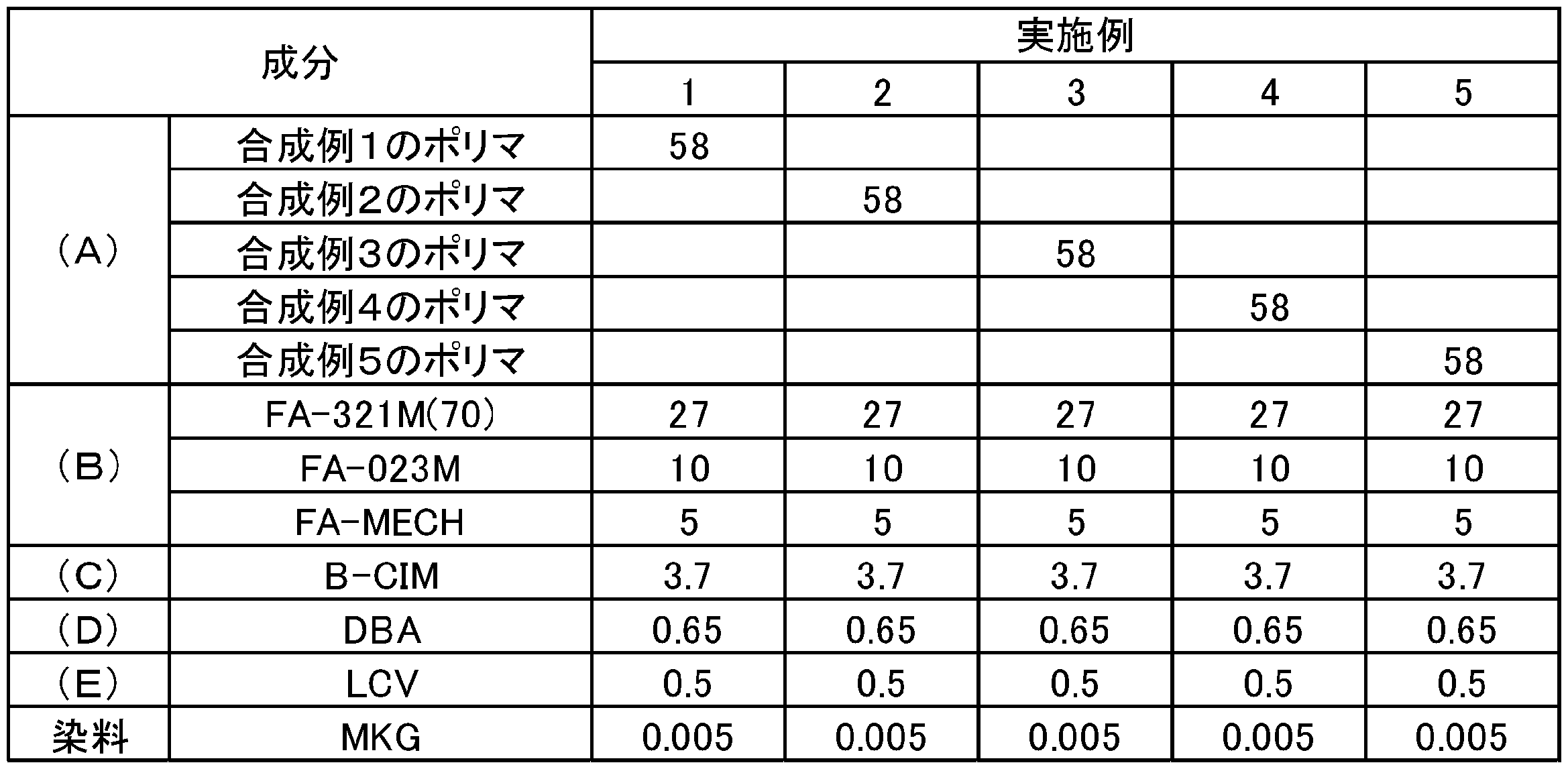



1…感光性エレメント、2…支持体、3…感光性樹脂組成物層、4…保護層、10…導体層、15…絶縁層、20…マスク、30…レジストパターン、32…感光性樹脂組成物層、40…回路パターン、42…めっき層、50…活性光線。
Claims (11)
- ブロックポリマと、光重合性化合物と、光重合開始剤と、を含有し、
前記ブロックポリマが、第一のポリマユニットと、第二のポリマユニットと、を有する(メタ)アクリルポリマであり、
前記第一のポリマユニットが、第一の重合性モノマに由来する構造単位と、第二の重合性モノマに由来する構造単位とを含み、
前記第二のポリマユニットが、前記第一の重合性モノマに由来する構造単位と、前記第二の重合性モノマとは異なる第三の重合性モノマに由来する構造単位とを含む、感光性樹脂組成物。 - 前記第一の重合性モノマが(メタ)アクリル酸である、請求項1に記載の感光性樹脂組成物。
- 前記第二の重合性モノマがスチレンである、請求項1又は2に記載の感光性樹脂組成物。
- 前記第三の重合性モノマが(メタ)アクリル酸エステルである、請求項1~3のいずれか一項に記載の感光性樹脂組成物。
- 前記第一のポリマユニットの片末端又は両末端に前記第二のポリマユニットが結合している、請求項1~4のいずれか一項に記載の感光性樹脂組成物。
- 前記ブロックポリマの重量平均分子量が10000~200000である、請求項1~5のいずれか一項に記載の感光性樹脂組成物。
- 前記ブロックポリマの分子量分散度が1.2~4.0である、請求項1~6のいずれか一項に記載の感光性樹脂組成物。
- 支持体と、当該支持体上に設けられた感光性樹脂組成物層と、を備え、
前記感光性樹脂組成物層が、請求項1~7のいずれか一項に記載の感光性樹脂組成物を含む、感光性エレメント。 - 請求項1~7のいずれか一項に記載の感光性樹脂組成物、又は、請求項8に記載の感光性エレメントを用いて感光性樹脂組成物層を基板上に形成する工程と、
前記感光性樹脂組成物層の少なくとも一部の領域に活性光線を照射して、前記領域を光硬化させて硬化物領域を形成する工程と、
前記感光性樹脂組成物層の前記硬化物領域以外の少なくとも一部の領域を前記基板上から除去して、前記硬化物領域であるレジストパターンを前記基板上に形成する工程と、を備える、レジストパターンの製造方法。 - 前記活性光線の波長が340nm~430nmの範囲内である、請求項9に記載のレジストパターンの製造方法。
- 請求項9又は10に記載のレジストパターンの製造方法によりレジストパターンが形成された基板をエッチング処理又はめっき処理する工程を備える、プリント配線板の製造方法。
Priority Applications (1)
| Application Number | Priority Date | Filing Date | Title |
|---|---|---|---|
| JP2016538346A JP6620747B2 (ja) | 2014-07-28 | 2015-07-27 | 感光性樹脂組成物、感光性エレメント、レジストパターンの製造方法及びプリント配線板の製造方法 |
Applications Claiming Priority (2)
| Application Number | Priority Date | Filing Date | Title |
|---|---|---|---|
| JP2014152830 | 2014-07-28 | ||
| JP2014-152830 | 2014-07-28 |
Publications (1)
| Publication Number | Publication Date |
|---|---|
| WO2016017596A1 true WO2016017596A1 (ja) | 2016-02-04 |
Family
ID=55217496
Family Applications (1)
| Application Number | Title | Priority Date | Filing Date |
|---|---|---|---|
| PCT/JP2015/071287 Ceased WO2016017596A1 (ja) | 2014-07-28 | 2015-07-27 | 感光性樹脂組成物、感光性エレメント、レジストパターンの製造方法及びプリント配線板の製造方法 |
Country Status (3)
| Country | Link |
|---|---|
| JP (1) | JP6620747B2 (ja) |
| TW (1) | TW201610577A (ja) |
| WO (1) | WO2016017596A1 (ja) |
Cited By (3)
| Publication number | Priority date | Publication date | Assignee | Title |
|---|---|---|---|---|
| WO2019244724A1 (ja) * | 2018-06-22 | 2019-12-26 | 旭化成株式会社 | 感光性樹脂組成物およびレジストパターンの形成方法 |
| JPWO2021029039A1 (ja) * | 2019-08-14 | 2021-02-18 | ||
| JPWO2021171718A1 (ja) * | 2020-02-28 | 2021-09-02 |
Families Citing this family (1)
| Publication number | Priority date | Publication date | Assignee | Title |
|---|---|---|---|---|
| JP6955486B2 (ja) * | 2016-04-19 | 2021-10-27 | 株式会社カネカ | プリント配線板の製造方法 |
Citations (5)
| Publication number | Priority date | Publication date | Assignee | Title |
|---|---|---|---|---|
| JPH03119014A (ja) * | 1989-10-03 | 1991-05-21 | Mitsubishi Petrochem Co Ltd | ネガ型ドライフィルムフォトレジスト組成物 |
| JP2000169531A (ja) * | 1998-12-03 | 2000-06-20 | Kansai Paint Co Ltd | ブロック共重合体の製造方法 |
| JP2008024915A (ja) * | 2006-06-23 | 2008-02-07 | Jsr Corp | スペーサー用感放射線性樹脂組成物ならびにスペーサーおよびその形成方法 |
| JP2008216489A (ja) * | 2007-03-01 | 2008-09-18 | Jsr Corp | 感放射線性樹脂組成物およびスペーサーの形成方法 |
| JP2008250273A (ja) * | 2006-05-24 | 2008-10-16 | Jsr Corp | 感放射線性樹脂組成物、スペーサーおよびその形成方法 |
-
2015
- 2015-07-27 WO PCT/JP2015/071287 patent/WO2016017596A1/ja not_active Ceased
- 2015-07-27 JP JP2016538346A patent/JP6620747B2/ja active Active
- 2015-07-28 TW TW104124407A patent/TW201610577A/zh unknown
Patent Citations (5)
| Publication number | Priority date | Publication date | Assignee | Title |
|---|---|---|---|---|
| JPH03119014A (ja) * | 1989-10-03 | 1991-05-21 | Mitsubishi Petrochem Co Ltd | ネガ型ドライフィルムフォトレジスト組成物 |
| JP2000169531A (ja) * | 1998-12-03 | 2000-06-20 | Kansai Paint Co Ltd | ブロック共重合体の製造方法 |
| JP2008250273A (ja) * | 2006-05-24 | 2008-10-16 | Jsr Corp | 感放射線性樹脂組成物、スペーサーおよびその形成方法 |
| JP2008024915A (ja) * | 2006-06-23 | 2008-02-07 | Jsr Corp | スペーサー用感放射線性樹脂組成物ならびにスペーサーおよびその形成方法 |
| JP2008216489A (ja) * | 2007-03-01 | 2008-09-18 | Jsr Corp | 感放射線性樹脂組成物およびスペーサーの形成方法 |
Cited By (14)
| Publication number | Priority date | Publication date | Assignee | Title |
|---|---|---|---|---|
| JPWO2019244724A1 (ja) * | 2018-06-22 | 2021-03-11 | 旭化成株式会社 | 感光性樹脂組成物およびレジストパターンの形成方法 |
| JP2024100770A (ja) * | 2018-06-22 | 2024-07-26 | 旭化成株式会社 | 感光性樹脂組成物およびレジストパターンの形成方法 |
| WO2019244724A1 (ja) * | 2018-06-22 | 2019-12-26 | 旭化成株式会社 | 感光性樹脂組成物およびレジストパターンの形成方法 |
| JP7169351B2 (ja) | 2018-06-22 | 2022-11-10 | 旭化成株式会社 | 感光性樹脂組成物およびレジストパターンの形成方法 |
| JP7327485B2 (ja) | 2019-08-14 | 2023-08-16 | 株式会社レゾナック | 感光性樹脂組成物、感光性エレメント、レジストパターンの形成方法及びプリント配線板の製造方法 |
| JPWO2021029039A1 (ja) * | 2019-08-14 | 2021-02-18 | ||
| WO2021029039A1 (ja) * | 2019-08-14 | 2021-02-18 | 昭和電工マテリアルズ株式会社 | 感光性樹脂組成物、感光性エレメント、レジストパターンの形成方法及びプリント配線板の製造方法 |
| CN114222766A (zh) * | 2019-08-14 | 2022-03-22 | 昭和电工材料株式会社 | 感光性树脂组合物、感光性元件、抗蚀剂图案的形成方法及印刷线路板的制造方法 |
| KR20220133933A (ko) * | 2020-02-28 | 2022-10-05 | 후지필름 가부시키가이샤 | 도전성 패턴의 제조 방법, 터치 센서, 전자파 실드, 안테나, 배선 기판, 도전성 가열 소자, 및 구조체 |
| JP7499840B2 (ja) | 2020-02-28 | 2024-06-14 | 富士フイルム株式会社 | 導電性パターンの製造方法、タッチセンサー、電磁波シールド、アンテナ、配線基板、導電性加熱素子、及び構造体 |
| JPWO2021171718A1 (ja) * | 2020-02-28 | 2021-09-02 | ||
| KR102809481B1 (ko) | 2020-02-28 | 2025-05-19 | 후지필름 가부시키가이샤 | 도전성 패턴의 제조 방법, 터치 센서, 전자파 실드, 안테나, 배선 기판, 도전성 가열 소자, 및 구조체 |
| TWI895303B (zh) * | 2020-02-28 | 2025-09-01 | 日商富士軟片股份有限公司 | 導電性圖案之製造方法及結構體 |
| US12426166B2 (en) | 2020-02-28 | 2025-09-23 | Fujifilm Corporation | Method of manufacturing conductive pattern, touch sensor, electromagnetic wave shield, antenna, wiring board, conductive heating element, and structure |
Also Published As
| Publication number | Publication date |
|---|---|
| TW201610577A (zh) | 2016-03-16 |
| JP6620747B2 (ja) | 2019-12-18 |
| JPWO2016017596A1 (ja) | 2017-04-27 |
Similar Documents
| Publication | Publication Date | Title |
|---|---|---|
| TWI689783B (zh) | 感光性樹脂組成物、感光性元件、抗蝕劑圖案的形成方法以及印刷電路板的製造方法 | |
| JP5626428B2 (ja) | 感光性樹脂組成物、並びにこれを用いた感光性エレメント、レジストパターンの形成方法及びプリント配線板の製造方法 | |
| CN103221887A (zh) | 感光性树脂组合物、感光性元件、抗蚀图案的形成方法以及印刷布线板的制造方法 | |
| JP5344034B2 (ja) | 感光性樹脂組成物、並びにこれを用いた感光性エレメント、レジストパターンの形成方法及びプリント配線板の製造方法 | |
| JPWO2012101908A1 (ja) | 感光性樹脂組成物、感光性エレメント、レジストパターンの製造方法及びプリント配線板の製造方法 | |
| JP6229256B2 (ja) | 感光性エレメント、レジストパターンの形成方法及びプリント配線板の製造方法 | |
| CN101568883A (zh) | 感光性树脂组合物、感光性元件、抗蚀图案的形成方法以及印刷电路板的制造方法 | |
| JP6358094B2 (ja) | 感光性樹脂組成物、感光性エレメント、レジストパターンの形成方法及びプリント配線板の製造方法 | |
| JP6690549B2 (ja) | プリント配線板の製造方法 | |
| JP2009003000A (ja) | 感光性樹脂組成物、これを用いた感光性エレメント、レジストパターンの形成方法、プリント配線板の製造方法及び光硬化物の除去方法 | |
| JP6690532B2 (ja) | 感光性樹脂組成物、感光性エレメント、レジストパターンの形成方法及びプリント配線板の製造方法 | |
| JP6673196B2 (ja) | 感光性樹脂組成物、感光性エレメント、レジストパターンの形成方法及びプリント配線板の製造方法 | |
| JP6620747B2 (ja) | 感光性樹脂組成物、感光性エレメント、レジストパターンの製造方法及びプリント配線板の製造方法 | |
| WO2009154194A1 (ja) | 感光性樹脂組成物、並びにこれを用いた感光性エレメント、レジストパターンの形成方法及びプリント配線板の製造法 | |
| JP2019028398A (ja) | 感光性樹脂組成物、感光性エレメント、レジストパターン付き基板の製造方法、及び、プリント配線板の製造方法 | |
| JP7044056B2 (ja) | 感光性樹脂組成物、感光性エレメント、レジストパターン付き基板の製造方法、及びプリント配線板の製造方法 | |
| CN103064254B (zh) | 感光性树脂组合物、感光性元件、抗蚀图形的形成方法以及印刷电路板的制造方法 | |
| JP6569199B2 (ja) | 感光性樹脂組成物、感光性エレメント、レジストパターンの形成方法及びプリント配線板の製造方法 | |
| JP5532551B2 (ja) | 感光性樹脂組成物、感光性エレメント、レジストパターンの形成方法及びプリント配線板の製造方法 | |
| JP2019008001A (ja) | 感光性樹脂組成物、感光性エレメント、レジストパターンの形成方法及びプリント配線板の製造方法 | |
| JP6136414B2 (ja) | 感光性樹脂組成物、感光性エレメント、レジストパターン付き基板の製造方法及びプリント配線板の製造方法 | |
| JP2010085605A (ja) | 感光性樹脂組成物、これを用いた感光性エレメント、レジストパターンの形成方法及びプリント配線板の製造方法 | |
| CN106796397A (zh) | 感光性树脂组合物、感光性元件、带有抗蚀剂图案的基板的制造方法以及印刷配线板的制造方法 | |
| JP2018128599A (ja) | 感光性樹脂組成物、それを用いた感光性エレメント、レジストパターン付き基板の製造方法、及びプリント配線板の製造方法 | |
| WO2018100640A1 (ja) | 感光性樹脂組成物、感光性エレメント、レジストパターン付き基板の製造方法、及び、プリント配線板の製造方法 |
Legal Events
| Date | Code | Title | Description |
|---|---|---|---|
| 121 | Ep: the epo has been informed by wipo that ep was designated in this application |
Ref document number: 15827036 Country of ref document: EP Kind code of ref document: A1 |
|
| ENP | Entry into the national phase |
Ref document number: 2016538346 Country of ref document: JP Kind code of ref document: A |
|
| NENP | Non-entry into the national phase |
Ref country code: DE |
|
| 122 | Ep: pct application non-entry in european phase |
Ref document number: 15827036 Country of ref document: EP Kind code of ref document: A1 |