WO2016013540A1 - ヒストンを除去する吸着材及び生体由来液浄化デバイス - Google Patents
ヒストンを除去する吸着材及び生体由来液浄化デバイス Download PDFInfo
- Publication number
- WO2016013540A1 WO2016013540A1 PCT/JP2015/070675 JP2015070675W WO2016013540A1 WO 2016013540 A1 WO2016013540 A1 WO 2016013540A1 JP 2015070675 W JP2015070675 W JP 2015070675W WO 2016013540 A1 WO2016013540 A1 WO 2016013540A1
- Authority
- WO
- WIPO (PCT)
- Prior art keywords
- adsorbent
- histone
- blood
- biological fluid
- polymer
- Prior art date
- Legal status (The legal status is an assumption and is not a legal conclusion. Google has not performed a legal analysis and makes no representation as to the accuracy of the status listed.)
- Ceased
Links
Images

Classifications
-
- A—HUMAN NECESSITIES
- A61—MEDICAL OR VETERINARY SCIENCE; HYGIENE
- A61M—DEVICES FOR INTRODUCING MEDIA INTO, OR ONTO, THE BODY; DEVICES FOR TRANSDUCING BODY MEDIA OR FOR TAKING MEDIA FROM THE BODY; DEVICES FOR PRODUCING OR ENDING SLEEP OR STUPOR
- A61M1/00—Suction or pumping devices for medical purposes; Devices for carrying-off, for treatment of, or for carrying-over, body-liquids; Drainage systems
- A61M1/02—Blood transfusion apparatus
- A61M1/0281—Apparatus for treatment of blood or blood constituents prior to transfusion, e.g. washing, filtering or thawing
-
- A—HUMAN NECESSITIES
- A61—MEDICAL OR VETERINARY SCIENCE; HYGIENE
- A61M—DEVICES FOR INTRODUCING MEDIA INTO, OR ONTO, THE BODY; DEVICES FOR TRANSDUCING BODY MEDIA OR FOR TAKING MEDIA FROM THE BODY; DEVICES FOR PRODUCING OR ENDING SLEEP OR STUPOR
- A61M1/00—Suction or pumping devices for medical purposes; Devices for carrying-off, for treatment of, or for carrying-over, body-liquids; Drainage systems
- A61M1/36—Other treatment of blood in a by-pass of the natural circulatory system, e.g. temperature adaptation, irradiation ; Extra-corporeal blood circuits
- A61M1/3679—Other treatment of blood in a by-pass of the natural circulatory system, e.g. temperature adaptation, irradiation ; Extra-corporeal blood circuits by absorption
-
- A—HUMAN NECESSITIES
- A61—MEDICAL OR VETERINARY SCIENCE; HYGIENE
- A61M—DEVICES FOR INTRODUCING MEDIA INTO, OR ONTO, THE BODY; DEVICES FOR TRANSDUCING BODY MEDIA OR FOR TAKING MEDIA FROM THE BODY; DEVICES FOR PRODUCING OR ENDING SLEEP OR STUPOR
- A61M1/00—Suction or pumping devices for medical purposes; Devices for carrying-off, for treatment of, or for carrying-over, body-liquids; Drainage systems
- A61M1/36—Other treatment of blood in a by-pass of the natural circulatory system, e.g. temperature adaptation, irradiation ; Extra-corporeal blood circuits
- A61M1/38—Removing constituents from donor blood and storing or returning remainder to body, e.g. for transfusion
-
- B—PERFORMING OPERATIONS; TRANSPORTING
- B01—PHYSICAL OR CHEMICAL PROCESSES OR APPARATUS IN GENERAL
- B01D—SEPARATION
- B01D15/00—Separating processes involving the treatment of liquids with solid sorbents; Apparatus therefor
- B01D15/08—Selective adsorption, e.g. chromatography
- B01D15/26—Selective adsorption, e.g. chromatography characterised by the separation mechanism
- B01D15/36—Selective adsorption, e.g. chromatography characterised by the separation mechanism involving ionic interaction, e.g. ion-exchange, ion-pair, ion-suppression or ion-exclusion
- B01D15/361—Ion-exchange
- B01D15/362—Cation-exchange
-
- B—PERFORMING OPERATIONS; TRANSPORTING
- B01—PHYSICAL OR CHEMICAL PROCESSES OR APPARATUS IN GENERAL
- B01J—CHEMICAL OR PHYSICAL PROCESSES, e.g. CATALYSIS OR COLLOID CHEMISTRY; THEIR RELEVANT APPARATUS
- B01J20/00—Solid sorbent compositions or filter aid compositions; Sorbents for chromatography; Processes for preparing, regenerating or reactivating thereof
- B01J20/02—Solid sorbent compositions or filter aid compositions; Sorbents for chromatography; Processes for preparing, regenerating or reactivating thereof comprising inorganic material
- B01J20/20—Solid sorbent compositions or filter aid compositions; Sorbents for chromatography; Processes for preparing, regenerating or reactivating thereof comprising inorganic material comprising free carbon; comprising carbon obtained by carbonising processes
-
- B—PERFORMING OPERATIONS; TRANSPORTING
- B01—PHYSICAL OR CHEMICAL PROCESSES OR APPARATUS IN GENERAL
- B01J—CHEMICAL OR PHYSICAL PROCESSES, e.g. CATALYSIS OR COLLOID CHEMISTRY; THEIR RELEVANT APPARATUS
- B01J20/00—Solid sorbent compositions or filter aid compositions; Sorbents for chromatography; Processes for preparing, regenerating or reactivating thereof
- B01J20/22—Solid sorbent compositions or filter aid compositions; Sorbents for chromatography; Processes for preparing, regenerating or reactivating thereof comprising organic material
- B01J20/26—Synthetic macromolecular compounds
- B01J20/261—Synthetic macromolecular compounds obtained by reactions only involving carbon to carbon unsaturated bonds
-
- B—PERFORMING OPERATIONS; TRANSPORTING
- B01—PHYSICAL OR CHEMICAL PROCESSES OR APPARATUS IN GENERAL
- B01J—CHEMICAL OR PHYSICAL PROCESSES, e.g. CATALYSIS OR COLLOID CHEMISTRY; THEIR RELEVANT APPARATUS
- B01J20/00—Solid sorbent compositions or filter aid compositions; Sorbents for chromatography; Processes for preparing, regenerating or reactivating thereof
- B01J20/28—Solid sorbent compositions or filter aid compositions; Sorbents for chromatography; Processes for preparing, regenerating or reactivating thereof characterised by their form or physical properties
- B01J20/28014—Solid sorbent compositions or filter aid compositions; Sorbents for chromatography; Processes for preparing, regenerating or reactivating thereof characterised by their form or physical properties characterised by their form
- B01J20/28016—Particle form
-
- B—PERFORMING OPERATIONS; TRANSPORTING
- B01—PHYSICAL OR CHEMICAL PROCESSES OR APPARATUS IN GENERAL
- B01J—CHEMICAL OR PHYSICAL PROCESSES, e.g. CATALYSIS OR COLLOID CHEMISTRY; THEIR RELEVANT APPARATUS
- B01J20/00—Solid sorbent compositions or filter aid compositions; Sorbents for chromatography; Processes for preparing, regenerating or reactivating thereof
- B01J20/28—Solid sorbent compositions or filter aid compositions; Sorbents for chromatography; Processes for preparing, regenerating or reactivating thereof characterised by their form or physical properties
- B01J20/28014—Solid sorbent compositions or filter aid compositions; Sorbents for chromatography; Processes for preparing, regenerating or reactivating thereof characterised by their form or physical properties characterised by their form
- B01J20/28023—Fibres or filaments
-
- B—PERFORMING OPERATIONS; TRANSPORTING
- B01—PHYSICAL OR CHEMICAL PROCESSES OR APPARATUS IN GENERAL
- B01J—CHEMICAL OR PHYSICAL PROCESSES, e.g. CATALYSIS OR COLLOID CHEMISTRY; THEIR RELEVANT APPARATUS
- B01J20/00—Solid sorbent compositions or filter aid compositions; Sorbents for chromatography; Processes for preparing, regenerating or reactivating thereof
- B01J20/28—Solid sorbent compositions or filter aid compositions; Sorbents for chromatography; Processes for preparing, regenerating or reactivating thereof characterised by their form or physical properties
- B01J20/28014—Solid sorbent compositions or filter aid compositions; Sorbents for chromatography; Processes for preparing, regenerating or reactivating thereof characterised by their form or physical properties characterised by their form
- B01J20/28033—Membrane, sheet, cloth, pad, lamellar or mat
-
- B—PERFORMING OPERATIONS; TRANSPORTING
- B01—PHYSICAL OR CHEMICAL PROCESSES OR APPARATUS IN GENERAL
- B01J—CHEMICAL OR PHYSICAL PROCESSES, e.g. CATALYSIS OR COLLOID CHEMISTRY; THEIR RELEVANT APPARATUS
- B01J20/00—Solid sorbent compositions or filter aid compositions; Sorbents for chromatography; Processes for preparing, regenerating or reactivating thereof
- B01J20/30—Processes for preparing, regenerating, or reactivating
- B01J20/32—Impregnating or coating ; Solid sorbent compositions obtained from processes involving impregnating or coating
- B01J20/3202—Impregnating or coating ; Solid sorbent compositions obtained from processes involving impregnating or coating characterised by the carrier, support or substrate used for impregnation or coating
- B01J20/3204—Inorganic carriers, supports or substrates
-
- B—PERFORMING OPERATIONS; TRANSPORTING
- B01—PHYSICAL OR CHEMICAL PROCESSES OR APPARATUS IN GENERAL
- B01J—CHEMICAL OR PHYSICAL PROCESSES, e.g. CATALYSIS OR COLLOID CHEMISTRY; THEIR RELEVANT APPARATUS
- B01J20/00—Solid sorbent compositions or filter aid compositions; Sorbents for chromatography; Processes for preparing, regenerating or reactivating thereof
- B01J20/30—Processes for preparing, regenerating, or reactivating
- B01J20/32—Impregnating or coating ; Solid sorbent compositions obtained from processes involving impregnating or coating
- B01J20/3202—Impregnating or coating ; Solid sorbent compositions obtained from processes involving impregnating or coating characterised by the carrier, support or substrate used for impregnation or coating
- B01J20/3206—Organic carriers, supports or substrates
- B01J20/3208—Polymeric carriers, supports or substrates
-
- B—PERFORMING OPERATIONS; TRANSPORTING
- B01—PHYSICAL OR CHEMICAL PROCESSES OR APPARATUS IN GENERAL
- B01J—CHEMICAL OR PHYSICAL PROCESSES, e.g. CATALYSIS OR COLLOID CHEMISTRY; THEIR RELEVANT APPARATUS
- B01J20/00—Solid sorbent compositions or filter aid compositions; Sorbents for chromatography; Processes for preparing, regenerating or reactivating thereof
- B01J20/30—Processes for preparing, regenerating, or reactivating
- B01J20/32—Impregnating or coating ; Solid sorbent compositions obtained from processes involving impregnating or coating
- B01J20/3231—Impregnating or coating ; Solid sorbent compositions obtained from processes involving impregnating or coating characterised by the coating or impregnating layer
- B01J20/3242—Layers with a functional group, e.g. an affinity material, a ligand, a reactant or a complexing group
- B01J20/3268—Macromolecular compounds
- B01J20/3276—Copolymers
-
- B—PERFORMING OPERATIONS; TRANSPORTING
- B01—PHYSICAL OR CHEMICAL PROCESSES OR APPARATUS IN GENERAL
- B01J—CHEMICAL OR PHYSICAL PROCESSES, e.g. CATALYSIS OR COLLOID CHEMISTRY; THEIR RELEVANT APPARATUS
- B01J20/00—Solid sorbent compositions or filter aid compositions; Sorbents for chromatography; Processes for preparing, regenerating or reactivating thereof
- B01J20/30—Processes for preparing, regenerating, or reactivating
- B01J20/32—Impregnating or coating ; Solid sorbent compositions obtained from processes involving impregnating or coating
- B01J20/3231—Impregnating or coating ; Solid sorbent compositions obtained from processes involving impregnating or coating characterised by the coating or impregnating layer
- B01J20/3242—Layers with a functional group, e.g. an affinity material, a ligand, a reactant or a complexing group
- B01J20/3268—Macromolecular compounds
- B01J20/328—Polymers on the carrier being further modified
-
- B—PERFORMING OPERATIONS; TRANSPORTING
- B01—PHYSICAL OR CHEMICAL PROCESSES OR APPARATUS IN GENERAL
- B01J—CHEMICAL OR PHYSICAL PROCESSES, e.g. CATALYSIS OR COLLOID CHEMISTRY; THEIR RELEVANT APPARATUS
- B01J20/00—Solid sorbent compositions or filter aid compositions; Sorbents for chromatography; Processes for preparing, regenerating or reactivating thereof
- B01J20/30—Processes for preparing, regenerating, or reactivating
- B01J20/32—Impregnating or coating ; Solid sorbent compositions obtained from processes involving impregnating or coating
- B01J20/3231—Impregnating or coating ; Solid sorbent compositions obtained from processes involving impregnating or coating characterised by the coating or impregnating layer
- B01J20/3289—Coatings involving more than one layer of same or different nature
-
- B—PERFORMING OPERATIONS; TRANSPORTING
- B01—PHYSICAL OR CHEMICAL PROCESSES OR APPARATUS IN GENERAL
- B01J—CHEMICAL OR PHYSICAL PROCESSES, e.g. CATALYSIS OR COLLOID CHEMISTRY; THEIR RELEVANT APPARATUS
- B01J47/00—Ion-exchange processes in general; Apparatus therefor
- B01J47/016—Modification or after-treatment of ion-exchangers
Definitions
- the present invention relates to an adsorbent that adsorbs histone in a biological fluid and a biological fluid purification device using the same.
- SIRS Systemic Inflammatory Response Syndrome
- Non-Patent Documents 1 and 2 More recently, research results have been disclosed that histone is very important as a pathogenic substance of SIRS (for example, see Non-Patent Documents 1 and 2).
- Histone is a major protein that constitutes eukaryotic chromatin, and since it contains many basic proteins, it has a positive charge, and the deoxyribonucleic acid (DNA) chain with a negative charge derived from a phosphate group is wound about twice, and is long. It has the role of folding DNA molecules and storing them in the nucleus. Histones are classified into four types, H2A, H2B, H3, and H4, and those in which DNA is wound around histone octamers that form two octamers each bonded together are called nucleosomes. On the other hand, histones that bind to DNA between nucleosomes (linker DNA) are called linker histones, and a typical one is called histone H1.
- histones originally have functions necessary for the living body, but in a pathological condition such as sepsis, the histone is a substance that is excessively released extracellularly to cause pathological deterioration and cause the living body to die.
- histones are the main proteins that make up eukaryotic chromatin, and have a very important role in folding DNA molecules and storing them in the nucleus.
- administration of a drug that inhibits histone activity may cause serious side effects on the living body. Therefore, a means for selectively removing extracellular histones that are undesirable for a living body from the body is desired.
- histone removal by extracorporeal circulation can be considered, there is a problem that it is difficult to efficiently remove histones in a state of good biocompatibility, that is, without thrombus formation.
- sulfated cellulose used in the adsorbent described in Patent Document 2 factor XII is activated due to its strong anionic property, and the blood coagulation cascade is activated, thereby causing thrombus formation. It is possible.
- hydroxyapatite used in the adsorbent described in Patent Document 3 is known for its strong protein adsorptivity, and it is thought that it can adsorb and remove even useful proteins in the blood. It may be caused.
- antithrombogenicity is essential as one of biocompatibility for medical materials used for blood purification applications.
- the adsorbents described in Patent Documents 2 and 3 are antithrombogenic. However, it is unsuitable for blood purification use and is not considered to have biocompatibility.
- the present inventors conducted extensive studies to provide a device for blood purification therapy that selectively adsorbs and removes histones in a biological fluid and has excellent biocompatibility. As a result, it was revealed that when the histone adsorbent has a biocompatible polymer, histones can be removed with good biocompatibility without inhibiting blood cell adhesion and without generating thrombus.
- a device for blood purification therapy having such a histone adsorbent can be used for treatment of SIRS or the like caused by histones.
- histones in the biological fluid can be adsorbed to the histone adsorbent with good biocompatibility, and histones can be removed from the biological fluid. Undesirable extracellular histones can be removed.
- the present invention is a histone adsorbent and a biological fluid purification device as shown in the following (1) to (15).
- An adsorbent that removes histone from a biological fluid comprising a water-insoluble carrier and a biocompatible polymer, wherein the carrier comprises activated carbon, polyester, polysulfone, or a cationic functional group.
- Adsorbent that is either.
- the adsorbent according to (1), wherein the biocompatible polymer has a cationic functional group.
- the adsorbent according to any one of (1) and (2), wherein the shape of the carrier is a particle shape, a nonwoven fabric shape, or a hollow fiber membrane shape.
- a biological fluid purification device that removes histone from biological fluid, the housing having a body fluid inlet and outlet, and the housing according to any one of (1) to (10) accommodated in the housing A biological fluid-purifying device comprising: an adsorbent; wherein histone is removed from the biological fluid by circulating the biological fluid in the housing.
- a histone adsorbent and a biological fluid purification device that can suppress thrombus formation and can remove histones.
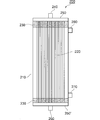
- FIG. 1 is a cross-sectional view illustrating one embodiment of a device.
- FIG. 6 is a cross-sectional view illustrating another embodiment of a device.
- the adsorbent according to the present embodiment is an adsorbent that removes histone from a biological fluid, and includes a water-insoluble carrier and a biocompatible polymer.
- the adsorbent carrier consists essentially of activated carbon, polyester, or polysulfone, or comprises cationic functional groups.
- the biological fluid purification device according to the present embodiment is a biological fluid purification device for removing histones from biological fluid, and includes a housing having an inlet and an outlet for biological fluid, and a housing. A biological fluid-purifying device that removes histone from the biological fluid when the biological fluid is circulated in the housing. .
- Water-insoluble carrier The carrier provided in the adsorbent according to the present embodiment is insoluble in water. Since the carrier is insoluble in water, it is possible to prevent the carrier from eluting into the blood when the adsorbent comes into contact with blood.
- water-insoluble means a weight loss of 10% after the adsorbent in a dried state dried for 24 hours is immersed in pure water for 24 hours and then taken out and dried at 60 ° C. for 24 hours. It means 0 wt% or less.
- activated carbon As materials for the carrier insoluble in water, activated carbon (simply referred to as “activated carbon”), polyester (simply referred to as “polyester”), and polysulfone (simply referred to as “polysulfone”) are used. It can be used. When activated carbon, polyester, and polysulfone are used, the productivity of industrial products tends to be excellent.
- the material of the carrier is activated carbon, styrene divinylbenzene, polyamide, polyester, polyurethane, polysulfone, polystyrene, polyethylene, polypropylene, cellulose Polymers, cellulose acetates, poly (meth) acrylates, celluloses, cellulose acetates, polyacrylonitriles, polymethylmethacrylates, ethylene vinyl alcohol copolymers and other vinyl compound polymers, cellulose gels Any known polymer that can have a porous structure, such as dextran gel, agarose gel, polyacrylamide gel, and porous glass, can be used as long as it is insoluble in water.
- polyester such as polyethylene terephthalate (PET), polysulfone, and styrene divinylbenzene (also simply referred to as “styrene divinylbenzene”) are used, the productivity of industrial products tends to be excellent. It is in.
- the polyester is a polycondensate of polyvalent carboxylic acid (dicarboxylic acid) and polyalcohol (diol).
- polyvalent carboxylic acid dicarboxylic acid
- diol polyalcohol
- PET polybutylene terephthalate
- PBT polytrimethylene terephthalate
- polyethylene naphthalate polyethylene naphthalate.
- PET and PBT are particularly preferable from the viewpoint of productivity of industrial products.
- the polysulfone-based polymer refers to a polyaryl ether sulfone polymer characterized by a structure including a repeating unit represented by the following chemical formula (1).
- a polymer composed of a repeating unit represented by the following chemical formula (1) and a polymer composed of a repeating unit represented by the following chemical formula (2) are exemplified as polysulfone.
- the styrene divinylbenzene system is a copolymer obtained by mixing and copolymerizing styrene and divinylbenzene, and is a styrene divinylbenzene copolymer having a styrene skeleton crosslinked by divinylbenzene.
- polymers composed of repeating units represented by the following chemical formulas (3) and (4) are exemplified as styrenedivinylbenzene.
- the shape of the carrier is not particularly limited, and may be any of a particle shape, a hollow fiber shape, a nonwoven fabric shape, a fiber shape, a sheet shape, and a sponge shape.
- the particulate carrier tends to have a good contact surface area with the biological fluid.
- the material for the particulate carrier all of the above carriers can be used, but activated carbon and styrene divinylbenzene beads are easy to control the pore size and surface area, and are resistant to sterilization when used as a medical device. Tend to ensure safety such as safety.
- the material for the non-woven carrier all of the above carriers can be used.
- the PET non-woven fabric and the PBT non-woven fabric are easy to ensure safety such as sterilization resistance when used as a medical device. As a result, productivity and the like tend to be good.
- the material for the hollow fiber carrier all of the above carriers can be used.
- the polysulfone, ethylene vinyl alcohol copolymer, and polymethyl methacrylate polymer are resistant to sterilization when used as a medical device. It is easy to ensure safety, etc., and the productivity as industrial products tends to be good.
- the particulate carrier preferably has an average particle size of 50 to 1500 ⁇ m in consideration of its specific surface area and the flowability of the biological fluid, and more preferably 100 to 1000 ⁇ m for the purpose of allowing whole blood to pass through.
- the particle diameter means the length of the longest straight line among straight lines connecting any two points on the outline of the carrier when observed with a microscope.
- the average particle diameter means an arithmetic average value of the particle diameters of 100 particulate carriers selected at random.
- the surface area is preferably at least 1 m 2 / g of the particle carrier, or 5 m 2 / g is particularly preferred.
- the surface area of the carrier can be measured after removing the coat polymer from the adsorbent, as will be described later.
- the surface area of the adsorbent was calculated using a BET (JIS Z 8830; method for measuring the specific surface area of powder (solid) by gas adsorption) analysis method after measuring the nitrogen adsorption isotherm at liquid nitrogen temperature (77K). Point to.
- BET JIS Z 8830; method for measuring the specific surface area of powder (solid) by gas adsorption) analysis method after measuring the nitrogen adsorption isotherm at liquid nitrogen temperature (77K). Point to.
- the inner diameter of the hollow fiber is preferably 10 to 1000 ⁇ m, more preferably 100 to 300 ⁇ m, from the viewpoint of flowing blood inside the hollow fiber.
- the hollow fiber inner diameter is an average diameter measured from a photograph obtained by sampling a part of the hollow fiber constituting the filter carrier and observing it with an electron microscope.
- the average fiber diameter can be 0.3 ⁇ m to 10 ⁇ m, preferably 0.3 ⁇ m to 3 ⁇ m, and more preferably 0.5 ⁇ m to 1.8 ⁇ m. .
- the average fiber diameter is 0.3 ⁇ m or more, the pressure loss when the blood is filtered tends to be moderate, and red blood cells tend not to be hemolyzed.
- the average fiber diameter is an average diameter measured from a photograph obtained by sampling a part from a nonwoven fabric or a woven fabric constituting the filter carrier and observing with an electron microscope.
- Examples of these carriers include Diaion (Mitsubishi Chemical Co., Ltd.), Asahi Kasei Microcarrier (Asahi Kasei Co., Ltd.), CM-Cellulofine (registered trademark).
- Cellulose-based carriers such as CH (exclusion limit protein molecular weight: about 3 ⁇ 10 6, sold by Seikagaku Corporation), a completely porous activated gel described in JP-B-1-44725, and CM-Toyopearl (registered trademark)
- Polyvinyl alcohol carrier such as 650C (exclusion limit protein molecular weight: 5 ⁇ 106, manufactured by Tosoh Corporation), CM-Trisacryl M (exclusion limit protein molecular weight: 1 ⁇ 107, Pharmacia-LKB, Sweden) (Manufactured by Pharmacia-LKB)] and other polyacrylamide carriers, Sepharose CL-4B (Seph arose CL-4B) [exclusion limit protein molecular weight: 2 ⁇ 107, manufactured by
- hollow fiber carriers examples include APS (manufactured by Asahi Kasei Medical Co., Ltd.), KF-C (manufactured by Asahi Kasei Medical Co., Ltd.), Trelite NV (manufactured by Toray Industries, Inc.), YHF (manufactured by Yuasa Membrane System Co., Ltd.), And Stella Pore (manufactured by Mitsubishi Rayon Aqua Solutions Co., Ltd.).
- APS manufactured by Asahi Kasei Medical Co., Ltd.
- KF-C manufactured by Asahi Kasei Medical Co., Ltd.
- Trelite NV manufactured by Toray Industries, Inc.
- YHF manufactured by Yuasa Membrane System Co., Ltd.
- And Stella Pore manufactured by Mitsubishi Rayon Aqua Solutions Co., Ltd.
- non-woven carriers examples include Sepacel (Asahi Kasei Medical Co., Ltd.), Benise (Asahi Kasei Fibers Co., Ltd.), Ertas (Asahi Kasei Fibers Co., Ltd.), Microweb (Asahi Kasei Fibers Co., Ltd.), and Axter (Toray Industries, Inc.) Clarex (manufactured by Kuraray Co., Ltd.), Delpore (manufactured by Sanki Co., Ltd.), and Shyfine (manufactured by Toyobo Co., Ltd.).
- the adsorbent surface has biocompatibility so as not to cause unnecessary reactions in the blood as much as possible.
- the adsorbent preferably has a biocompatible polymer coating layer.
- the biocompatibility means a state where blood does not recognize the adsorbent as a foreign substance, for example.
- the adsorbent of this embodiment has a carrier and a biocompatible polymer.
- the “biocompatible polymer” in the present embodiment refers to a polymer that improves the biocompatibility of the adsorbent by being present on the surface of the adsorbent carrier. More specifically, the anti-thrombosis of the carrier can be compared to the carrier before the biocompatible polymer is applied by physically coating or chemically bonding the biocompatible polymer to the carrier of the adsorbent. It refers to a polymer with improved properties.
- Whether or not at least a part of the polymer contained in the adsorbent is a biocompatible polymer can be evaluated by the following procedure.
- the contained polymer is dissolved in a suitable solvent such as dimethyl sulfoxide.
- a suitable solvent such as dimethyl sulfoxide.
- the polymer is removed from the adsorbent, and the obtained carrier is dried in a dryer at 60 ° C. for 1 hour or longer, and then left in a desiccator for 1 hour or longer. Thereafter, the antithrombogenicity of the carrier from which the polymer has been removed from the adsorbent is measured.
- Antithrombogenicity of adsorbent is a biocompatible polymer.
- the antithrombogenicity is measured by observing the surface of the adsorbent with the naked eye or a scanning electron microscope, and directly counting the number of platelets adhering to the adsorbent surface, or adhering to the adsorbent surface. It can be evaluated by a method of measuring LDH activity of blood cells.
- the polymer contained in the adsorbent is a biocompatible polymer.
- the polymer contained in the adsorbent is identified by conducting proton nuclear magnetic resonance ( 1 H-NMR) measurement after dissolving the polymer contained in the adsorbent in an appropriate solvent such as dimethyl sulfoxide.
- 1 H-NMR proton nuclear magnetic resonance
- a polymer that corresponds to the biocompatible polymer exemplified later it can also be determined as a biocompatible polymer.
- the method for identifying a polymer is not limited to 1 H-NMR, and all known identification methods can be used.
- the adsorbent is immersed in a strong acid and / or strong alkali for a certain time to remove the polymer. Whether the biocompatible polymer has been removed from the surface of the adsorbent can be confirmed by measuring the contact angle before and after the treatment, or by performing surface analysis such as X-ray photoelectron spectroscopy (XPS). it can.
- XPS X-ray photoelectron spectroscopy
- the polymer contained in the adsorbent is a biocompatible polymer.
- composition of the polymer can be estimated by comprehensively judging the results of XPS, time-of-flight mass spectrometer (TOF-SIMS), etc., but the measurement method is not limited to this.
- the adsorbent according to the present embodiment does not have a histone adsorptivity originally, as long as the adsorbent according to the present embodiment has a histone adsorbability after imparting a biocompatible polymer.
- those that express histone adsorption ability by adding a biocompatible polymer are also included.
- a method for producing an adsorbent containing a biocompatible polymer a known technique such as a method of imparting a biocompatible polymer to the surface of a carrier can be used.
- biocompatible polymers include monomers having a polyalkylene glycol chain, a polymer or graft copolymer, ethylene-vinyl alcohol, polyester, poly-2-methoxyethyl acrylate (p-MEA), and poly- Examples include 2-methacryloyloxyethyl phosphorylcholine (PMPC) and polyvinylpyrrolidone (PVP).
- PMPC 2-methacryloyloxyethyl phosphorylcholine
- PVP polyvinylpyrrolidone
- the HEMA system refers to a polymer containing HEMA in the polymer component, and any other component can be used as the other component.
- the biocompatible polymer contains 10 mol% or more of dimethylaminoethyl methacrylate as a monomer unit containing a basic nitrogen-containing moiety, the histone removal rate tends to increase.
- the biocompatible polymer preferably has a cationic functional group. The cationic functional group will be described later.
- Biocompatible polymer amount The amount of polymer contained in the adsorbent is calculated by the following procedure.
- the carrier before supporting the biocompatible polymer is dried in a drier set at 60 ° C. for 1 hour or longer, then left in a desiccator for 1 hour or longer, and the weight is measured.
- the carrier carrying the biocompatible polymer was dried in a dryer at 60 ° C. for 1 hour or longer and left in the desiccator for 1 hour or longer, the weight was measured.
- the unit of A and B is gram.
- the amount of polymer can also be calculated by the following procedure.
- the adsorbent is dried in a drier set at 60 ° C. for 1 hour or longer, then left in a desiccator for 1 hour or longer, and then the weight is measured.
- a suitable solvent such as dimethyl sulfoxide
- Is D The unit of C and D is gram.
- the molar ratio of each monomer unit contained in the biocompatible polymer containing multiple components is the peak of 1 H-NMR obtained after 1 H-NMR measurement after dissolving the coating polymer in an appropriate solvent such as dimethyl sulfoxide. It can be calculated from the ratio.
- Antithrombotic Antithrombogenicity can be examined by observing the surface of the adsorbent with the naked eye or a scanning electron microscope (SEM), and directly counting the number of platelets adhering to the adsorbent surface, or quantifying it by image analysis. .
- SEM scanning electron microscope
- antithrombogenicity can be evaluated by the following procedure. First, a healthy person's blood is circulated for a certain period of time using a peristaltic pump to a device including an adsorbent filled with physiological saline. Thereafter, the blood inside the device containing the adsorbent is washed with physiological saline, the device is disassembled, and the internal adsorbent is taken out. The adsorbent taken out is freeze-dried, and an SEM sample obtained by vapor deposition by ion sputtering is observed to evaluate antithrombogenicity.
- the antithrombogenicity can be measured using the amount of platelets adhering to the adsorbent surface as an index, for example, adhering to the adsorbent after contacting PRP (platelet-rich plasma) with the material for a certain period of time in vitro.
- PRP platelet-rich plasma
- the obtained platelets are treated with a surfactant, and the platelet lactate dehydrogenase (LDH) activity is measured. This is because there is a strong correlation between the number of platelets adhering to the material and the LDH activity, so that the number of adhering platelets can be measured by the LDH activity.
- the whole blood and the adsorbent are brought into contact with each other for a certain period of time, and then washed with a buffer such as physiological saline or PBS to remove red blood cell components and By treating the components other than the remaining red blood cells (mainly platelet and white blood cell components) with a surfactant, the eluted LDH activity can be measured, and the antithrombogenicity of the adsorbent can be measured.
- a buffer such as physiological saline or PBS
- mini-module refers to a small-scale module created on a scale such as 1/200 of the actual product in order to evaluate the adsorbent with a small blood volume.
- a 5 mL capacity laboratory column (Mobitech) filled with an adsorbent can be used.
- LDH produces lactic acid when pyruvic acid is used as a substrate in the presence of ⁇ -Nicotinamide adenine reduced reduced form ( ⁇ -NADH)
- ⁇ -NADH ⁇ -Nicotinamide adenine reduced reduced form
- mini-module means using a column or the like prepared by adhering both ends with an epoxy adhesive so that a hollow fiber adsorbent has an effective length of 15 cm and an inner surface area of 50 mm 2. it can. 2) Pass physiological saline through the mini-module and wash it. 3) After passing human blood with heparin added to the mini-module, it is washed with physiological saline. 4) The hollow fiber adsorbent is taken out from the washed minimodule, and LDH is eluted from platelets in a Triton-X100 solution as a surfactant.
- the adsorbent preferably has a cationic functional group on the surface.
- the carrier material may have a cationic functional group
- the biocompatible polymer may have a cationic functional group.
- the cationic functional group introduced on the surface of the carrier include functional groups such as a primary amino group, a secondary amino group, a tertiary amino group, an imino group, and a quaternary ammonium group. An ammonium group is used.
- the secondary amino group, the tertiary amino group, and the quaternary amino group are also referred to as a monoalkyl-substituted amino group, a dialkyl-substituted amino group, and a trialkyl-substituted amino group, respectively.
- the adsorbent surface may be rendered cationic by coating the carrier with a polymer containing the above cationic functional group.
- a carrier coated with a biocompatible polymer may be further coated with a polymer for introducing a cationic functional group, or a carrier coated with a polymer for introducing a cationic functional group may be further coated with a biocompatible polymer. May be coated. However, if it is coated in stages, it is possible that the coating polymer in one step will elute during the second coating, so coat the polymer with both biocompatibility and cationic functional group properties. Is preferred.
- amino group examples include aminohexane, monomethylaminohexane, aminooctane, aminododecane, aminodiphenylmethane, 1- (3-aminopropyl) imidazole, 3-amino-1-propene, aminopyridine, aminobenzenesulfonic acid, tris (2-aminoethyl) amine, dimethylamine or diaminoethane, diethylenetriamine, triethylenetetramine, tetraethylenepentamine, dipropylenetriamine, polyethyleneimine, N-methyl-2,2′-diaminodiethylamine, N-acetylethylenediamine, and Examples include amino groups derived from compounds such as 1,2-bis (2-aminoethoxyethane), and any amino group can be used.
- the quaternary ammonium group is a positively charged substituent represented as NR 4 +, and examples thereof include groups represented by the following chemical formulas (5) and (6).
- exchange capacity and zeta potential As one of the indicators showing the cationic strength, exchange capacity is used.
- the exchange capacity of the adsorbent having a cationic functional group is preferably 0.05 mEq or more, more preferably 0.5 mEq or more per mL of the water-insoluble carrier, from the viewpoint of obtaining high adsorption performance.
- a zeta potential can also be suitably used as a cationic evaluation index. When the zeta potential is used as an evaluation index, it may be 0 mV or more.
- the exchange capacity can be measured by the following procedure. First, the adsorbent is weighed, transferred to a filter tube with demineralized water, 1 mol / L-NaOH and demineralized water are sequentially flowed through the filter tube, the resin is regenerated and washed, and then 5% NaCl is flowed. Receive the solution in a 200 mL volumetric flask and make a constant volume. This can be determined by titrating with 0.1 mol / L-HCl using a methyl red / methylene blue mixed indicator, but the measurement method is not limited to this.
- the method of measuring the zeta potential on the surface of the adsorbent can be measured, for example, by the streaming potential measurement method, which is a method of filling a solid sample such as powder or fiber between a pair of streaming potential measurement electrodes.
- the zeta potential is obtained by measuring the potential difference generated between the electrodes when the fluid is permeated through the packed bed, that is, the streaming potential, but the measuring method is not limited to this.
- Histone Histone is a DNA-binding protein present in a biological fluid, and includes histone H1, histone H2A, histone H2B, histone H3, and histone H4. It is preferable that histone H3 and histone H4 are removed from the inside.
- the biological fluid includes all liquids derived from biological materials or liquids containing biological components, and specifically includes body fluids such as blood, plasma, serum, and ascites, cell culture fluid, and the like.
- adsorbent of the present invention Various forms of contact between the biological fluid and the adsorbent of the present invention can be considered.
- a method of adsorbing blood or ascites collected from a patient's blood in a blood bag filled with the adsorbent of the present invention, and adsorbing histones in the patient's blood or ascites, or blood in a device filled with the adsorbent of the present invention And a method of circulating the gas.
- the processed blood can be returned to the patient or stored in a blood bag or the like as needed.
- the collected culture solution is placed in a bag filled with the adsorbent of the present invention, in which the histone in the culture solution is adsorbed, and the adsorbent of the present invention is filled. And a method of circulating a culture solution through the device.
- the culture solution may be processed after the cells are separated.
- the treated culture solution can be used again for cell culture.
- FIG. 1 is a cross-sectional view illustrating one embodiment of a device.
- the device 100 is a module connected to, for example, an extracorporeal blood circuit.
- a cap 150 having an inlet port 140 is screw-fitted into an opening at one end of the cylinder 110 via a packing 130 with a filter 120 on the inside, and a filter 120 ′ is stretched on the inside at the other end opening of the cylinder 110.
- a cap 170 having an outlet port 160 is screwed through 130 'to form a container.
- the histone adsorbent layer 180 is formed by filling and holding the adsorbent in the gap between the filters 120 and 120 ′.
- the histone adsorbent layer 180 may be filled with the adsorbent according to the present embodiment alone, or may be mixed or laminated with other adsorbents.
- adsorbents for example, adsorbents of other malignant substances such as cytokines, adsorbents having a wide range of adsorption ability, and the like can be used. As a result, a wide range of clinical effects due to the synergistic effect of the adsorbent can be expected.
- the volume of the histone adsorption carrier layer 180 can be 5 mL to 3000 mL, but is preferably 50 mL to 1000 mL, more preferably 100 mL to 500 mL, from the viewpoint of histone adsorption capacity and extracorporeal blood volume during extracorporeal circulation of blood.
- the module connected to the blood extracorporeal circuit is disposed in the blood extracorporeal circuit so as to come into contact with the biological fluid to be treated, and can be used for the treatment of systemic inflammatory diseases and the like.
- FIG. 2 is a cross-sectional view showing another embodiment of the device.
- the device 200 is a module connected to, for example, a blood extracorporeal circuit.
- Hollow fiber adsorbents 220 are held by potting agents 230 at both ends of the cylinder 210. Both end faces of the hollow fiber-shaped adsorbent 220 are open.
- a cap 250 having an inlet port 240 and a cap 250 ′ having an outlet port 260 are fitted into the cylinder 210 to fill and hold the hollow-fiber adsorbent 220.
- a dialysate inlet 270 and a dialysate outlet 280 are provided on the side surface of the cylinder 210.
- blood derived from the body of the treatment target is introduced from the inlet port 240, passed through the hollow fiber-like adsorbent 220, and passed through the outlet port 260 through the body of the treatment target.
- the blood purification method by extracorporeal blood circulation can be performed by returning to the state.
- dialysis is performed during extracorporeal blood circulation by introducing the dialysate from the dialysate inlet 270, leading out the dialysate from the dialysate outlet 280, and circulating the dialysate in the device 200. Can do.
- dialysate may not be circulated, and the dialysate inlet 270 and the dialysate outlet 280 may be opened. In this case, blood is filtered. Further, by blocking the dialysate inlet 270 and the dialysate outlet 280 with a stopper or the like, it is possible to suppress blood filtration and perform a blood purification method by extracorporeal blood circulation.
- the adsorbent and the device according to the present embodiment described above can be effectively used for suppressing or treating systemic inflammation in a disease mediated by histones.
- Specific diseases include sepsis, septic shock, disseminated intravascular coagulation syndrome (DIC), toxin shock syndrome, ischemia reperfusion disorder, adult respiratory distress syndrome (ARDS), Paget's disease, osteoporosis, multiple bone marrow Tumor, acute and chronic myeloid leukemia, pancreatic beta cell destruction, inflammatory bowel disease, psoriasis, Crohn's disease, ulcerative colitis, anaphylaxis, contact dermatitis, asthma, myopathies, cachexia, Reiter syndrome, I Type II diabetes, bone resorption, graft-versus-host reaction, atherosclerosis, brain trauma, multiple sclerosis, cerebral malaria, fever, and muscle pain due to infection.
- DIC disseminated intravascular coagulation syndrome
- ischemia reperfusion disorder ischemia reperfusion disorder
- Method of treatment As a treatment method using the adsorbent and the biological fluid purification device according to the present embodiment, for example, the biological fluid purification device of the present invention and the patient are connected by a blood circuit, and blood taken out from the patient is treated according to the present invention.
- the systemic inflammatory response syndrome can be treated by passing it through a biological fluid purification device, reducing the histone content in the blood, and returning it to the patient.
- the separated plasma is passed through the biological fluid purification device of the present invention to reduce the histone content from the plasma.
- the systemic inflammatory response syndrome can be treated.
- adsorbent and device according to the present embodiment described above may be used in combination with other body fluid treatment methods and medical devices.
- Other bodily fluid treatment methods and medical devices include, for example, continuous slow blood filtration (CRRT), plasma exchange, peritoneal dialysis, plasma separator, hemofilter, heart-lung machine, and ECMO.
- CRRT continuous slow blood filtration
- plasma exchange plasma exchange
- peritoneal dialysis plasma separator
- hemofilter hemofilter
- heart-lung machine and ECMO
- the adsorbent and the device according to the present embodiment described above are suitably used in a processing method for allowing a biological fluid containing histone to pass therethrough and obtaining a biological fluid with reduced histone content discharged from the device outlet. be able to.
- Histone adsorption rate (%) (C 0 ⁇ C) / C 0 ⁇ 100
- C 0 histone concentration in the solution before treatment
- C histone concentration in the solution after treatment
- lipopolysaccharide (LPS) derived from Escherichia coli is added to blood collected from a healthy volunteer.
- LPS lipopolysaccharide
- PP polypropylene
- E As a method of contacting with a full module of the same scale as the product, E. Examples thereof include a method in which a lipopolysaccharide derived from E. coli is added and blood shaken using a shaker is circulated using a peristaltic pump to a device as shown in FIG. 1 filled with an adsorbent. At this time, in order to reduce the amount of blood used, it is preferable to reduce the capacity of the entire circulation circuit including the device.
- Example 1 Ultrafiltration (UF) water is added to a strongly basic anion exchange resin having a trimethylammonium group (diaion; manufactured by Mitsubishi Chemical Corporation) containing a styrenedivinylbenzene copolymer, heated to 95 ° C., 22 Washed with hot water for more than an hour.
- a coating solution of p-HEMA as a biocompatible polymer dissolved in ethanol so that the polymer concentration is 0.75% is immersed in a strongly basic anion exchange resin for 4 hours to perform primary coating. It was.
- the primary coating strongly basic anion exchange resin cooled by air blowing was subjected to a secondary coating with a p-HEMA coating solution in the same procedure as the primary coating.
- the strongly coated basic anion exchange resin subjected to the secondary coating was cooled by blowing to obtain an adsorbent A.
- Escherichia coli 0127 B8-derived lipopolysaccharide (LPS) (manufactured by Sigma-Aldrich) was added to blood collected from healthy volunteers to a concentration of 0.1 ⁇ g / ml, and the mixture was shaken for 24 hours. Shake at 39 ° C. Thereafter, the mixture was centrifuged at 2000 g for 10 minutes using a centrifuge, and the supernatant was obtained as a plasma sample. 3 ml of the obtained plasma sample and 0.5 ml of the adsorbent A were mixed in a polypropylene (PP) tube and shaken at 39 ° C. for 1 hour using a shaker. The PP tube after shaking was centrifuged at 2000 g for 1 minute using a centrifuge, and the supernatant was obtained as a plasma sample after contacting the carrier.
- PP polypropylene
- Histone H3 removal performance evaluation The histone H3 adsorption rate of the adsorbent A was calculated using the obtained plasma sample after contact with the carrier.
- Histone H3 adsorption rate (%) A adsorbent pretreatment histone H3 concentration C 0, the histone H3 concentration after the adsorbent treated as C A, it shows the histone H3 adsorption calculating equation below.
- the same histone H3 adsorption rate calculation formula was used.
- the concentration of histone H3 was measured using EpiQuik (registered trademark) Total Histone H3 Quantification Kit (manufactured by EPIENTEK). The results are shown in Table 1.
- Antithrombogenicity was determined using the amount of blood cells adhering to the adsorption carrier surface as an index. Specifically, the blood of a healthy person obtained by adding heparin to a final concentration of 1 IU / ml is added to 0.5 ml of a resin moistened with physiological saline, and then at 37 ° C. for 30 minutes. Then, the adsorbent was separated, washed with physiological saline, and then visually observed. The results are shown in Table 1.
- Example 2 (Synthesis of biocompatible polymers) Ethanol was used as a polymerization solvent, and an ethanol solution in which a polymerizable monomer and a diazo initiator were dissolved was dropped while stirring at 78 ° C. in a nitrogen atmosphere to carry out polymerization.
- the charge of each polymerizable monomer was as follows: methyl methacrylate (hereinafter abbreviated as “MMA”) 25 mol% as a hydrophobic polymerizable monomer, and dimethylaminoethyl methacrylate (hereinafter “DM”) as a polymerizable monomer containing a basic nitrogen-containing moiety.
- MMA methyl methacrylate
- DM dimethylaminoethyl methacrylate
- HEMA 2-hydroxyethyl methacrylate
- the polymerization solution was purified with excess water and dried under reduced pressure to obtain a synthetic polymer A.
- UF water was added to a strongly basic anion exchange resin (Diaion; manufactured by Mitsubishi Chemical Corporation), heated to 95 ° C., and washed with hot water for 22 hours or more.
- the synthetic polymer A coating solution was immersed in a strongly basic anion exchange resin for 4 hours to perform primary coating.
- Example 3 (Synthesis of biocompatible polymers) Polymerization, purification and drying were carried out under the same conditions as in Example 2 with the charge ratio of each polymerization monomer being 3 mol% DM and 97 mol% HEMA, and a synthetic polymer B was obtained.
- UF water was added to a strongly basic anion exchange resin (Diaion; manufactured by Mitsubishi Chemical Corporation), heated to 95 ° C., and washed with hot water for 22 hours or more.
- the synthetic polymer B coating solution was immersed in a strongly basic anion exchange resin for 4 hours to perform primary coating. Then, hot air drying was performed overnight at 70 ° C., and hot air heating crosslinking was performed at 120 ° C.
- Example 4 (Adsorbent preparation and evaluation) The beaded activated carbon (manufactured by Kureha Co., Ltd.) was washed with 0.1N hydrochloric acid, further washed with UF water, and then washed with warm water at 60 to 65 ° C. for 40 hours or more. Next, a p-HEMA coating solution dissolved in ethanol so that the polymer concentration was 0.75% was immersed in beaded activated carbon for 4 hours to perform primary coating. Then, hot air drying was performed overnight at 70 ° C., and hot air heating crosslinking was performed at 120 ° C. for 2 hours.
- Example 5 (Adsorbent preparation and evaluation)
- the beaded activated carbon (manufactured by Kureha Co., Ltd.) was washed with 0.1N hydrochloric acid, further washed with UF water, and then washed with warm water at 60 to 65 ° C. for 40 hours or more.
- the synthetic polymer A coating solution was immersed in beaded activated carbon for 4 hours to perform primary coating.
- hot air drying was performed overnight at 70 ° C., and hot air heating crosslinking was performed at 120 ° C. for 2 hours.
- the secondary coating of the synthetic polymer A coating solution was performed on the primary coating bead-like activated carbon cooled by air blowing in the same procedure as the primary coating.
- the secondary coated bead-shaped activated carbon was blown and cooled to obtain an adsorbent E.
- Table 1 shows the results of an adsorption experiment similar to that of Example 1 using this adsorbent E.
- Example 6> (Adsorbent preparation and evaluation)
- the beaded activated carbon (manufactured by Kureha Co., Ltd.) was washed with 0.1N hydrochloric acid, further washed with UF water, and then washed with warm water at 60 to 65 ° C. for 40 hours or more.
- the synthetic polymer B coating solution was immersed in beaded activated carbon for 4 hours to perform primary coating.
- hot air drying was performed overnight at 70 ° C., and hot air heating crosslinking was performed at 120 ° C. for 2 hours.
- the secondary coating of the synthetic polymer B coating solution was performed on the primary coating bead-like activated carbon cooled by blowing air in the same procedure as the primary coating.
- the secondary coated bead-shaped activated carbon was blown and cooled to obtain an adsorbent F.
- Table 1 shows the results of an adsorption experiment similar to Example 1 performed using this adsorbent F.
- Example 7 (Adsorbent preparation and evaluation) The synthetic polymer A was coated on a PET non-woven fabric having an average fiber diameter of 1.3 ⁇ m as a material to obtain an adsorbent G. Table 1 shows the results of the same adsorption test as in Example 1 using the adsorbent G.
- Example 8> Synthesis of biocompatible polymers
- Polymerization, purification, and drying were carried out under the same conditions as in Example 2 with MMA 30 mol%, DM 10 mol%, and HEMA 60 mol% as the charge ratio of each polymerization monomer, to obtain a synthetic polymer C.
- the synthetic polymer C was coated on a non-woven fabric made of polyethylene terephthalate (PET) as a raw material to obtain an adsorbent H.
- PET polyethylene terephthalate
- Table 1 shows the results of the same adsorption test as in Example 1 using the adsorbent H.
- Example 9 (Adsorbent preparation and evaluation)
- the synthetic polymer B was coated on a nonwoven fabric made of polyethylene terephthalate (PET) as a raw material to obtain an adsorbent I.
- PET polyethylene terephthalate
- Table 1 shows the results of the same adsorption test as in Example 1 using the adsorbent I.
- Table 1 shows the results of an adsorption test using the same adsorption carrier L as in Example 1 except that the same strongly basic anion exchange resin as in Example 1 was not coated with P-HEMA.
- Table 1 shows the results of an adsorption test using the same adsorption carrier M as in Example 4 except that the same beaded activated carbon as in Example 4 was not coated with P-HEMA.
- Table 1 shows the results of the adsorption test using the same adsorption carrier N as in Example 7 except that the same PET non-woven fabric as in Example 7 was not coated with the synthetic polymer A solution.
- Example 10> (Production and evaluation of hollow fiber adsorbent) A hollow fiber membrane made of polysulfone and polyvinylpyrrolidone with an effective length of 17 cm and an inner surface area of 100 mm 2 (100 filaments because a hollow fiber membrane with an inner diameter of 185 ⁇ m was used) was prepared by bonding both ends with an epoxy adhesive. did.
- the synthetic polymer A was circulated from the blood inlet port of this device at 5 [mL / min] for 20 seconds, and the inner surface of the hollow fiber was coated with the synthetic polymer A to produce a device including the adsorbent J.
- Escherichia coli 0127 B8-derived lipopolysaccharide (LPS) (manufactured by Sigma-Aldrich) was added to blood collected from healthy volunteers at a concentration of 0.1 ⁇ g / ml, and the mixture was shaken for 24 hours. And shaken at 39 ° C. Thereafter, the mixture was centrifuged at 2000 g for 10 minutes using a centrifuge, and the supernatant was obtained as a plasma sample. 10 ml of the obtained plasma sample was circulated through the device containing the adsorbent J at a flow rate of 1.2 ml / min for 60 minutes at 39 ° C. using a peristaltic pump. Thereafter, the circulated plasma was obtained as a plasma sample after contacting the carrier.
- LPS lipopolysaccharide
- the histone H3 adsorption rate (%) is A H
- the histone H3 concentration after treatment with the uncoated hollow fiber is C H0
- the histone H3 concentration after treatment with the coated hollow fiber is C HA and the histone H3 adsorption rate is calculated.
- the formula is shown below. In the following Example 11 and Comparative Examples 4 and 5, the same histone H3 adsorption rate calculation formula was used.
- the concentration of histone H3 was measured using EpiQuik (registered trademark) Total Histone H3 Quantification Kit (manufactured by EPIENTEK). The results are shown in Table 2.
- Antithrombogenicity was determined by the amount of blood cells attached to the hollow fiber carrier surface as an index.
- a peristaltic pump is used for a device including the adsorbent J in a state in which the blood of a healthy person obtained by adding heparin to a final concentration of 1 IU / ml is filled with physiological saline. Circulate at 37 ° C. for 60 minutes at a flow rate of 1.2 ml / min, then wash the blood inside the hollow fiber with physiological saline, disassemble the device, take out the hollow fiber inside and remove it to 2.5% glutaraldehyde It was immersed and blood cells were immobilized.
- the hollow fibers were sequentially immersed in 25%, 50%, 60%, 70%, 80%, 90%, 99% ethanol (manufactured by Wako Pure Chemical Industries), dehydrated, and then t- It was immersed in butyl alcohol (manufactured by Wako Pure Chemical Industries). After sufficiently removing t-butyl alcohol from the hollow fiber, it was frozen and lyophilized overnight. After this hollow fiber was sliced diagonally, vapor deposition by ion sputtering was performed to obtain a hollow fiber SEM sample. Thereafter, SEM observation was performed to evaluate blood cell adhesion. The results are shown in Table 2.
- Example 11 A hollow fiber membrane made of polysulfone and polyvinylpyrrolidone with an effective length of 17 cm and an inner surface area of 100 mm 2 (100 filaments because a hollow fiber membrane with an inner diameter of 185 ⁇ m was used) was prepared by bonding both ends with an epoxy adhesive. did.
- the synthetic polymer B was circulated from the blood inlet port of this device, and the inner surface of the hollow fiber was coated with the synthetic polymer B to produce a device including the adsorbent K.
- Table 2 shows the results of an adsorption test using a device including the adsorbent K.
- the device containing the adsorbents J and K coated with the biocompatible polymer on the carrier surface removed histone H3 with good antithrombotic properties.
- a device including the adsorbent O that is not coated with a biocompatible polymer has a lot of blood cell adhesion (low antithrombogenicity), and does not satisfy the minimum biocompatibility to be satisfied as a histone removal device.
- the device including the adsorbent P coated with PVP having no cationic functional group has high antithrombogenicity but does not adsorb histones.
- Example 12 Water-based histone H4 adsorption test
- 0.2 mL of a solution in which a standard product (histone H4 (initial concentration: 50 ⁇ g / mL) attached to EpiQuik (registered trademark) Total Histone H4 Quantification Kit (manufactured by EPIENTEK) was added to physiological saline was added to a PP tube.
- 0.1 mL of adsorbent A was added thereto, and the mixture was shaken using a shaker for 1 hour at 39 ° C. After the shake, the PP tube was 1 at 2000 g using a centrifuge. The supernatant was obtained as a plasma sample after contacting the carrier.
- the histone H4 adsorption rate of the adsorbent A was calculated using the obtained plasma sample after contact with the carrier.
- the histone H4 adsorption rate (%) is A 4
- the histone H3 concentration before adsorbent treatment is C 40
- the histone H3 concentration after adsorbent treatment is C 4A
- the histone H4 adsorption rate calculation formula is shown below.
- the same histone H4 adsorption rate calculation formula was used.
- the concentration of histone H4 was measured using EpiQuik (registered trademark) Total Histone H4 Quantification Kit (manufactured by EPIENTEK). The results are shown in Table 3.
- Table 3 shows the results of the same adsorption test as in Example 12 using the adsorbent D.
- Table 3 shows the results of the same adsorption test as in Example 12 using the adsorbent G.
- the adsorbent and the biological fluid purification device can remove histone H3 from the biological fluid with good biocompatibility, and can be used for treatment of diseases that develop or worsen due to histones typified by SIRS. Useful.
- This biological fluid purification device can be used to treat SIRS caused by histones.
- a biological fluid By contacting the adsorbent according to the present embodiment with a biological fluid, histones in the biological fluid can be adsorbed to the adsorbent with good biocompatibility, and histones can be removed from the biological fluid. It can be effectively used to suppress or treat systemic inflammation in diseases mediated by histones, since it can remove non-extracellular histones.
- Specific diseases include sepsis, septic shock, disseminated intravascular coagulation syndrome (DIC), toxin shock syndrome, ischemia reperfusion disorder, adult respiratory distress syndrome (ARDS), Paget's disease, osteoporosis, multiple bone marrow Tumor, acute and chronic myeloid leukemia, pancreatic beta cell destruction, inflammatory bowel disease, psoriasis, Crohn's disease, ulcerative colitis, anaphylaxis, contact dermatitis, asthma, myopathies, cachexia, Reiter syndrome, I Type II diabetes, bone resorption, graft-versus-host reaction, atherosclerosis, brain trauma, multiple sclerosis, cerebral malaria, fever, and muscle pain due to infection.
- SIRS systemic inflammatory response syndrome
- the adsorbent and the device according to the present embodiment described above are suitably used in a processing method for allowing a biological fluid containing histone to pass therethrough and obtaining a biological fluid with reduced histone content discharged from the device outlet. be able to.
- a method in which patient blood or ascites collected in a blood bag filled with the adsorbent of the present invention, and histones in the patient blood and ascites are adsorbed therein Even if the blood is not whole blood, the plasma may be processed after separating the plasma. The processed blood can be returned to the patient or stored in a blood bag or the like as needed.
- this biological fluid purification device can be suitably used for the purpose of removing histones having cytotoxicity from a cell culture solution.
- the culture solution collected in the bag filled with the adsorbent of the present invention is put, and the histone in the culture solution is adsorbed therein, the method of circulating the culture fluid to the device filled with the adsorbent of the present invention, Etc.
- the culture solution may be processed after the cells are separated.
- the treated culture solution can be used again for cell culture.
- the industrially applicable fields of the present invention are not limited to the above.
Landscapes
- Chemical & Material Sciences (AREA)
- Chemical Kinetics & Catalysis (AREA)
- Analytical Chemistry (AREA)
- Organic Chemistry (AREA)
- Health & Medical Sciences (AREA)
- Heart & Thoracic Surgery (AREA)
- Vascular Medicine (AREA)
- Animal Behavior & Ethology (AREA)
- Anesthesiology (AREA)
- Biomedical Technology (AREA)
- Hematology (AREA)
- Life Sciences & Earth Sciences (AREA)
- Engineering & Computer Science (AREA)
- General Health & Medical Sciences (AREA)
- Public Health (AREA)
- Veterinary Medicine (AREA)
- Inorganic Chemistry (AREA)
- Cardiology (AREA)
- Solid-Sorbent Or Filter-Aiding Compositions (AREA)
- External Artificial Organs (AREA)
- Apparatus Associated With Microorganisms And Enzymes (AREA)
- Medicines Containing Material From Animals Or Micro-Organisms (AREA)
- Treatment Of Liquids With Adsorbents In General (AREA)
- Peptides Or Proteins (AREA)
Abstract
Description
(1)生体由来液中よりヒストンを除去する吸着材であって、水不溶性の担体と、生体適合性ポリマーと、を備え、担体が、活性炭、ポリエステル、ポリスルホン、又はカチオン性官能基を備える担体のいずれかである吸着材。
(2)生体適合性ポリマーが、カチオン性官能基を備える、(1)に記載の吸着材。
(3)担体の形状が、粒子状、不織布状、又は中空糸膜状である、(1)又は(2)のいずれかに記載の吸着材。
(4)担体が、カチオン性官能基と、ポリエチレンテレフタレート又はスチレンジビニルベンゼン系共重合体のいずれかと、を備える、(1)に記載の吸着材。
(5)カチオン性官能基がアミノ基である、(4)に記載の吸着材。
(6)アミノ基が第4級アンモニウム基である、(5)に記載の吸着材。
(7)生体適合性ポリマーが親水性ポリマーである、(1)~(6)のいずれかに記載の吸着材。
(8)親水性ポリマーがヒドロキシエチルメタクリレート系重合体である、(7)に記載の吸着材。
(9)生体適合性ポリマーがジメチルアミノエチルメタクリレートを10モル%以上含むポリマーである、(1)~(7)のいずれかに記載の吸着材。
(10)ヒストンがヒストンH3である、(1)~(9)のいずれかに記載の吸着材。
(11)生体由来液中よりヒストンを除去する生体由来液浄化デバイスであって、体液入口、出口を備えたハウジングと、ハウジング内に収容された(1)~(10)のいずれかに記載の吸着材と、を備え、ハウジング内に生体由来液が流通されることにより、生体由来液からヒストンが除去される、生体由来液浄化デバイス。
(12)生体由来液が体液である、(11)に記載の生体由来液浄化デバイス。
(13)体液が血液である、(12)に記載の生体由来液浄化デバイス。
(14)(11)~(13)のいずれかに記載のデバイスを用いて生体由来液からヒストンを除去するヒストン除去方法。
(15)(11)~(13)のいずれかに記載のデバイスを用いて、血液あるいは血漿を通過させ、血液あるいは血漿中からヒストン含有量を減量させ、全身性炎症反応症候群を治療する治療方法。
本実施形態に係る吸着材が備える担体は、水に不溶性である。担体が水に不溶性であることにより、吸着材が血液に接触した際に担体が血液中へ溶出することを防止することができる。本実施形態において、「水不溶性」とは、24時間乾燥させた乾燥状態の吸着材を24時間、純水に浸漬させ、その後、取り出して、60℃で24時間乾燥した後の重量減が10.0wt%以下であることをいう。
水に不溶性の担体の材料としては、活性炭系(単に、「活性炭」ともいう。)、ポリエステル系(単に、「ポリエステル」ともいう。)、及びポリスルホン系(単に、「ポリスルホン」ともいう。)が使用可能である。活性炭系、ポリエステル系、及びポリスルホン系を用いると、工業製品の生産性等に優れる傾向にある。




担体の形状は特に限定されず、粒子状、中空糸状、不織布状、繊維状、シート状、及びスポンジ状のいずれでもよい。粒子状の担体は、生体由来液との接触表面積が良好な傾向にある。
血液浄化用途に用いる吸着材は、血液との接触を避けることができないため、極力、血液中の無用な反応を惹起してしまわないように、吸着材表面に生体適合性を有することが好ましく、吸着材が生体適合性ポリマーの被覆層を有することが好ましい。ここでいう生体適合性とは、例えば、血液が吸着材を異物として認識しない状態を意味する。吸着材の表面が生体適合性であると、例えば、血小板や白血球の付着などが抑制され、血栓が生成しづらいという効果を得られる。
吸着材の抗血栓性を測定した後、含まれるポリマーをジメチルスルホキシド等の適切な溶媒へ溶解させる。吸着材からポリマーを除去し、得られた担体を60℃の乾燥機中で1時間以上乾燥させた後、デシケーター内に1時間以上放置する。その後、吸着材からポリマーを除去した担体の抗血栓性を測定する。吸着材の抗血栓性と担体の抗血栓性を比較したとき、
吸着材の抗血栓性>吸着材からポリマーを除去した担体の抗血栓性
となる場合、吸着材に含まれるポリマーは、生体適合性ポリマーである。なお、抗血栓性の測定は、後述するように、吸着材表面を肉眼あるいは走査型電子顕微鏡により観察し、吸着材表面に付着した血小板付着数を直接カウントする、あるいは、吸着材表面に付着した血球のLDH活性を測定する方法等により、評価することができる。抗血栓性を測定できるいずれかの方法によって、担体よりも吸着材の抗血栓性が向上していると評価できる場合、当該吸着材に含まれるポリマーは生体適合性ポリマーである。
吸着材の抗血栓性を測定した後、例えば、強酸及び/又は強アルカリに吸着材を一定時間浸漬させ、ポリマーを除去する。生体適合性ポリマーが吸着材表面から除去されたかどうかは、処理の前後で接触角を測定したり、X線光電子分光(XPS)等の表面解析等を行ったりしたりすることで確認することができる。その後、上述の方法を用いて、抗血栓性を評価し、
吸着材の抗血栓性>吸着材からポリマーを除去した担体の抗血栓性
が成り立つ場合、吸着材に含まれるポリマーは、生体適合性ポリマーである。
吸着材に含まれるポリマーの量は、以下の手順により算出される。
生体適合性ポリマーを担持させる前の担体を60℃に設定した乾燥機中で1時間以上乾燥させた後、デシケーター内に1時間以上放置した後に重量を測定し、これをAとする。また、生体適合性ポリマーを担持させた担体を同様に60℃の乾燥機中で1時間以上乾燥させた後、デシケーター内に1時間以上放置した後に重量を測定し、これをBとする。AとBの単位はグラムである。ポリマー量は以下の算出式により算出される。
ポリマー量(mg/g担体)=(B-A)×1000/A
吸着材を60℃に設定した乾燥機中で1時間以上乾燥させた後、デシケーター内に1時間以上放置した後に重量を測定し、これをCとする。また、生体適合性ポリマーをジメチルスルホキシド等の適切な溶媒へ溶解後、同様に60℃の乾燥機中で1時間以上乾燥させた後、デシケーター内に1時間以上放置した後に重量を測定し、これをDとする。CとDの単位はグラムである。ポリマー量は以下の算出式により算出される。
ポリマー量(mg/g担体)=(C-D)×1000/D
抗血栓性は、吸着材表面を肉眼あるいは、走査型電子顕微鏡(SEM)により観察し、吸着材表面に付着した血小板付着数を直接カウントする、あるいは画像解析で定量化することによって調べることができる。
不織布、粒子状の吸着材の評価の場合は、
1)吸着材量をそろえたミニモジュールを複数作製する。ここで、「ミニモジュール」とは、少ない血液量で吸着材の評価をするために、実製品の1/200等のスケールで作成された、小スケールのモジュールを言い、例えば、内径9mmの2.5mL容量のラボラトリーカラム(モビテック)に吸着材を充填し作成した吸着材充填カラム等を用いることができる。
2)該ミニモジュールに生理食塩水を通液して洗浄する。
3)該ミニモジュールにヘパリンを加えたヒト血液を通液した後、生理食塩水で洗浄する。
4)洗浄後のミニモジュールから吸着材を取り出し、界面活性化剤であるTriton―X100溶液中で血小板からLDHを溶出させる。
5)LDHが、β―Nicotinamide adenine dinucleotide reduced form(β―NADH)の存在下でピルビン酸を基質とするとき乳酸を生成するので、この際のNADHの減少速度を吸光度変化から測定し、LDH活性を算出し血小板数に換算する。本方法では、この減少幅が大きいほどLDH活性が高い、すなわち吸着材表面への血球(主に血小板と白血球)の付着量が多いことを意味するものとして評価する。
1)膜内表面積をそろえたミニモジュールを複数作製する。ここで、「ミニモジュール」とは、中空糸の吸着材を、有効長15cm、膜内表面の面積が50mm2となるように両端をエポキシ接着剤で接着し、作成したカラム等を用いることができる。
2)該ミニモジュールに生理食塩水を通液して洗浄する。
3)該ミニモジュールにヘパリンを加えたヒト血液を通液した後、生理食塩水で洗浄する。
4)洗浄後のミニモジュールから中空糸状の吸着材を取り出し、界面活性化剤であるTriton―X100溶液中で血小板からLDHを溶出させる。
5)LDHが、β―Nicotinamide adenine dinucleotide reduced form(β―NADH)の存在下でピルビン酸を基質とするとき乳酸を生成するので、この際のNADHの減少速度を吸光度変化から測定し、LDH活性を算出し血小板数に換算する。本方法では、この減少幅が大きいほどLDH活性が高い、すなわち吸着材表面への血球(主に血小板と白血球)の付着量が多いことを意味するものとして評価する。
ヒストンはカチオン性であり、従来、アニオン性吸着材による分離精製ターゲットタンパク質の一つと考えられている。しかし、本発明者らは、カチオン性の材料にヒストンが吸着されることを見出した。そのため、吸着材はカチオン性の官能基を表面に有するのが好ましい。例えば、担体の材料がカチオン性の官能基を有していてもよいし、生体適合性ポリマーがカチオン性の官能基を有していてもよい。担体表面に導入されるカチオン性の官能基としては、1級アミノ基、2級アミノ基、3級アミノ基、イミノ基、4級アンモニウム基などの官能基が挙げられるが、好ましくは、4級アンモニウム基が用いられる。なお、2級アミノ基、3級アミノ基、及び4級アミノ基は、それぞれ、モノアルキル置換アミノ基、ジアルキル置換アミノ基、及びトリアルキル置換アミノ基ともいう。また、上記のカチオン性の官能基を含むポリマーを担体にコートすることによって吸着材表面にカチオン性を付与してもよい。生体適合性ポリマーをコートした担体に、さらにカチオン性官能基を導入するためのポリマーをコートしてもよいし、カチオン性官能基を導入するためのポリマーをコートした担体に、さらに生体適合性ポリマーをコートしてもよい。ただし、段階的にコートした場合、2段階目のコート時に、1段階のコートポリマーが溶出してしまうことが考えられるため、生体適合性とカチオン性官能基の両性質を有するポリマーをコートすることが好ましい。
アミノ基としては、例えば、アミノヘキサン、モノメチルアミノヘキサン、アミノオクタン、アミノドデカン、アミノジフェニルメタン、1-(3-アミノプロピル)イミダゾール、3-アミノ-1-プロペン、アミノピリジン、アミノベンゼンスルホン酸、トリス(2-アミノエチル)アミン、ジメチルアミン又はジアミノエタン、ジエチレントリアミン、トリエチレンテトラミン、テトラエチレンペンタミン、ジプロピレントリアミン、ポリエチレンイミン、N-メチル-2,2’-ジアミノジエチルアミン、N-アセチルエチレンジアミン、及び1,2-ビス(2-アミノエトキシエタン)等の化合物由来のアミノ基が挙げられるが、アミノ基であれば全て用いることができる。
第4級アンモニウム基とは、NR4 +と表される正電荷を持った置換基であり、例えば、下記化学式(5)、(6)で表される基等が挙げられる。


上記カチオン性の強度を示す指標の一つとして、交換容量が用いられる。カチオン性の官能基を有する吸着材の交換容量は、高い吸着性能を得る観点で、水不溶性担体1mL当たり0.05mEq以上が好ましく、0.5mEq以上がより好ましい。また、カチオン性の評価指標としてゼータ電位も好適に用いることができ、ゼータ電位を評価指標とする場合は0mV以上であればよい。
ヒストンとは、生体由来液中に存在するDNA結合タンパクであり、ヒストンH1,ヒストンH2A,ヒストンH2B,ヒストンH3,ヒストンH4が挙げられるが、SIRS等の治療を目的とする場合は、生体由来液中からヒストンH3及びヒストンH4が除去されることが好ましい。
生体由来液は、生体に由来する液体ないし生体由来成分を含む液体を全て包含し、具体的には血液、血漿、血清、及び腹水などの体液や、細胞培養液などを含む。
図1は、デバイスの一実施形態を示す断面図である。デバイス100は、例えば血液体外循環回路に接続するモジュールである。円筒110の一端開口部に、内側にフィルター120を張ったパッキン130を介して入口ポート140を有するキャップ150をネジ嵌合し、円筒110の他端開口部に内側にフィルター120’を張ったパッキン130’を介して出口ポート160を有するキャップ170をネジ嵌合して容器を形成している。さらに、フィルター120及び120’の間隙に吸着材を充填保持させて、ヒストン吸着材層180を形成している。
本実施形態に係る吸着材及び生体由来液浄化デバイスを用いた治療方法としては、例えば、本発明の生体由来液浄化デバイスと患者とを血液回路で接続し、患者から取り出した血液を本発明の生体由来液浄化デバイスに通過させ、血液中よりヒストン含有量を減量させ、これを患者に戻すことにより、全身性炎症反応症候群を治療することができる。
ヒストン吸着率(%)=(C0-C)/C0×100
C0: 処理前溶液中のヒストン濃度
C: 処理後溶液中のヒストン濃度
<実施例1>
(吸着材作製及び評価)
スチレンジビニルベンゼン系共重合体を含む、トリメチルアンモニウム基を有する強塩基性陰イオン交換樹脂(ダイヤイオン;三菱化学株式会社製)に限外ろ過(UF)水を加え、95℃に加熱し、22時間以上熱水洗浄を行った。次に、ポリマー濃度が0.75%になるようにエタノールに溶解した、生体適合性ポリマーとしてのp-HEMAのコート液を、強塩基性陰イオン交換樹脂に4時間浸漬させ、一次コーティングを行った。その後、70℃で一晩熱風乾燥を行い、120℃で2時間熱風加熱架橋を行った。送風冷却した一次コーティング強塩基性陰イオン交換樹脂に、一次コーティングと同様の手順で、p-HEMAコート液の二次コーティングを行った。二次コーティングした強塩基性陰イオン交換樹脂を、送風冷却し、吸着材Aとした。
健常ボランティアから採血した血液に、Escherichia coli0127:B8由来のリポポリサッカライド(LPS)(Sigma-Aldrich社製)を0.1μg/ml濃度になるように添加し、振とう機を用いて24時間、39℃で振とうさせた。その後、遠心機を用いて2000gで10分間遠心し、上清を血漿サンプルとして取得した。取得した血漿サンプル3mlと、吸着材A 0.5mlをポリプロピレン(PP)製のチューブ内で混合し、振とう機を用いて1時間、39℃で振とうさせた。振とうさせた後のPP製チューブを、遠心機を用いて2000gで1分間遠心し、上清を担体接触後血漿サンプルとして取得した。
取得した担体接触後血漿サンプルを用いて、吸着材AのヒストンH3吸着率を算出した。ヒストンH3吸着率(%)をA、吸着材処理前ヒストンH3濃度をC0、吸着材処理後ヒストンH3濃度をCAとして、ヒストンH3吸着率算出式を以下に示す。以下の実施例2から9及び比較例1から3においても、同一のヒストンH3吸着率算出式を用いた。ヒストンH3の濃度は、EpiQuik(登録商標) Total Histone H3 Quantification Kit(EPIGENTEK社製)を用いて測定した。結果を表1に示す。

抗血栓性は、血球の吸着担体表面への付着量を指標とした。具体的には、終濃度が1IU/mlになるようにヘパリンを添加して得た健常人の血液を、生理食塩水にて湿潤させた状態の樹脂0.5mlに添加し37℃で30分間放置し、その後、吸着材を分離し、生理食塩水で洗浄後、肉眼観察を行った。結果を表1に示す。
(生体適合性ポリマーの合成)
重合溶媒としてエタノールを用い、窒素雰囲気下、78℃で攪拌を行いながら、重合性モノマーとジアゾ系開始剤を溶解したエタノール溶液を滴下して、重合を行った。各重合性モノマーの仕込みは、疎水性重合性モノマーとしてメチルメタクリレート(以下、「MMA」と略す)25モル%、塩基性含窒素部分を含む重合性モノマーとしてジメチルアミノエチルメタクリレート(以下、「DM」と略す)13モル%、プロトン性中性親水性部分を含むモノマーとして2-ヒドロキシエチルメタアクリレート(以下、「HEMA」と略す)62モル%であった。重合液を過剰の水にて精製し、減圧乾燥し、合成ポリマーAとした。
(吸着材作製及び評価)
強塩基性陰イオン交換樹脂(ダイヤイオン;三菱化学株式会社製)にUF水を加え、95℃に加熱し、22時間以上熱水洗浄を行った。次に、上記合成ポリマーAコート液を、強塩基性陰イオン交換樹脂に4時間浸漬させ、一次コーティングを行った。その後、70℃で一晩熱風乾燥を行い、120℃で2時間熱風加熱架橋を行った。送風冷却した一次コーティング強塩基性陰イオン交換樹脂に、一次コーティングと同様の手順で、合成ポリマーAコート液の二次コーティングを行った。二次コーティングした強塩基性陰イオン交換樹脂を、送風冷却し、吸着材Bとした。この吸着材Bを用いて、実施例1と同様の吸着実験を行った結果を表1に示す。
(生体適合性ポリマーの合成)
各重合モノマーの仕込み比をDM3モル%、HEMA97モル%として実施例2と同様の条件で重合、精製、乾燥し、合成ポリマーBを得た。
(吸着材作製及び評価)
強塩基性陰イオン交換樹脂(ダイヤイオン;三菱化学株式会社製)にUF水を加え、95℃に加熱し、22時間以上熱水洗浄を行った。次に、上記合成ポリマーBコート液を、強塩基性陰イオン交換樹脂に4時間浸漬させ、一次コーティングを行った。その後、70℃で一晩熱風乾燥を行い、120℃で2時間熱風加熱架橋を行った。送風冷却した一次コーティング強塩基性陰イオン交換樹脂に、一次コーティングと同様の手順で、合成ポリマーBコート液の二次コーティングを行った。二次コーティングした強塩基性陰イオン交換樹脂を、送風冷却し、吸着材Cとした。この吸着材Cを用いて、実施例1と同様の吸着実験を行った結果を表1に示す。
(吸着材作製及び評価)
ビーズ状活性炭(株式会社クレハ社製)に0.1N塩酸で洗浄を行い、UF水でさらに洗浄を行った後、60-65℃の温水で40時間以上の洗浄を行った。次に、ポリマー濃度が0.75%になるようにエタノールに溶解したp-HEMAコート液を、ビーズ状活性炭に4時間浸漬させ、一次コーティングを行った。その後、70℃で一晩熱風乾燥を行い、120℃で2時間熱風加熱架橋を行った。送風冷却した一次コーティングビーズ状活性炭に、一次コーティングと同様の手順で、p-HEMAコート液の二次コーティングを行った。二次コーティングしたビーズ状活性炭を、送風冷却し、吸着材Dとした。この吸着材Dを用いて、実施例1と同様の吸着実験を行った結果を表1に示す。
(吸着材作製及び評価)
ビーズ状活性炭(株式会社クレハ社製)に0.1N塩酸で洗浄を行い、UF水でさらに洗浄を行った後、60-65℃の温水で40時間以上の洗浄を行った。次に、上記合成ポリマーAコート液を、ビーズ状活性炭に4時間浸漬させ、一次コーティングを行った。その後、70℃で一晩熱風乾燥を行い、120℃で2時間熱風加熱架橋を行った。送風冷却した一次コーティングビーズ状活性炭に、一次コーティングと同様の手順で、合成ポリマーAコート液の二次コーティングを行った。二次コーティングしたビーズ状活性炭を、送風冷却し、吸着材Eとした。この吸着材Eを用いて、実施例1と同様の吸着実験を行った結果を表1に示す。
(吸着材作製及び評価)
ビーズ状活性炭(株式会社クレハ社製)に0.1N塩酸で洗浄を行い、UF水でさらに洗浄を行った後、60-65℃の温水で40時間以上の洗浄を行った。次に、上記合成ポリマーBコート液を、ビーズ状活性炭に4時間浸漬させ、一次コーティングを行った。その後、70℃で一晩熱風乾燥を行い、120℃で2時間熱風加熱架橋を行った。送風冷却した一次コーティングビーズ状活性炭に、一次コーティングと同様の手順で、合成ポリマーBコート液の二次コーティングを行った。二次コーティングしたビーズ状活性炭を、送風冷却し、吸着材Fとした。この吸着材Fを用いて、実施例1と同様の吸着実験を行った結果を表1に示す。
(吸着材作製及び評価)
上記合成ポリマーAを、素材である平均繊維径1.3μmのPET製不織布にコーティングし、吸着材Gを得た。吸着材Gを用いて、実施例1と同様の吸着試験を行った結果を、表1に示す。
(生体適合性ポリマーの合成)
各重合モノマーの仕込み比をMMA30モル%、DM10モル%、HEMA60モル%として実施例2と同様の条件で重合、精製、乾燥し、合成ポリマーCを得た。
(吸着材作製及び評価)
上記合成ポリマーCを、素材であるポリエチレンテレフタレート(PET)製不織布にコーティングし、吸着材Hを得た。吸着材Hを用いて、実施例1と同様の吸着試験を行った結果を、表1に示す。
(吸着材作製及び評価)
上記合成ポリマーBを、素材であるポリエチレンテレフタレート(PET)製不織布にコーティングし、吸着材Iを得た。吸着材Iを用いて、実施例1と同様の吸着試験を行った結果を、表1に示す。
実施例1と同じ強塩基性陰イオン交換樹脂にP-HEMAコートを施していないこと以外は実施例1と同様の吸着担体Lを用いて吸着試験を行った結果を、表1に示す。
実施例4と同じビーズ状活性炭にP-HEMAコートを施していない以外は実施例4と同様の吸着担体Mを用いて吸着試験を行った結果を、表1に示す。
実施例7と同じPET製不織布に合成ポリマーA液コートを施していない事以外は実施例7と同様の吸着担体Nを用いて吸着試験を行った結果を、表1に示す。

(中空糸状の吸着材作製及び評価)
ポリスルホン及びポリビニルピロリドンからなる中空糸膜有効長17cm、膜内表面の面積が100mm2(内径185μmの中空糸膜を使用したため100フィラメント)となるように両端をエポキシ接着剤で接着してデバイスを作製した。このデバイスの血液の入口ポートより上記合成ポリマーAを5[mL/分]で20秒間流通させて、中空糸内表面に合成ポリマーAをコーティングし、吸着材Jを含むデバイスを作製した。
健常ボランティアから採血した血液に、Escherichia coli 0127:B8由来のリポポリサッカライド(LPS)(Sigma-Aldrich社製)を0.1μg/ml濃度になるように添加し、振とう機を用いて24時間、39℃で振とうさせた。その後、遠心機を用いて2000gで10分間遠心し、上清を血漿サンプルとして取得した。取得した血漿サンプル10mlを、ペリスタポンプを用いて、吸着材Jを含むデバイスに流速1.2ml/minで、60分間、39℃で循環させた。その後、循環させた血漿を担体接触後血漿サンプルとして取得した。
取得した担体接触後血漿サンプルを用いて、処理後のヒストンH3吸着率についてそれぞれ算出した。ヒストンH3吸着率(%)をAH、コーティングされていない中空糸で処理した後のヒストンH3濃度をCH0、コーティングした中空糸で処理した後ヒストンH3濃度をCHAとして、ヒストンH3吸着率算出式を以下に示す。以下の実施例11及び比較例4、5においても、同一のヒストンH3吸着率算出式を用いた。ヒストンH3の濃度は、EpiQuik(登録商標) Total Histone H3 Quantification Kit(EPIGENTEK社製)を用いて測定した。結果を表2に示す。

抗血栓性は、血球の中空糸担体表面への付着量を指標とした。具体的には、終濃度が1IU/mlになるようにヘパリンを添加して得た健常人の血液を、生理食塩水にて充填させた状態の吸着材Jを含むデバイスに、ペリスタポンプを用いて1.2ml/minの流速で、37℃で60分間循環させ、その後中空糸内部の血液を生理食塩水で洗浄後、デバイスを解体し、内部の中空糸を取り出し、2.5%グルタルアルデヒドに浸漬させ、血球の固定化を行った。その中空糸を、25%,50%,60%,70%,80%,90%,99%エタノール(和光純薬工業製)溶液に、順々に浸漬させ、脱水を行った後、t-ブチルアルコール(和光純薬工業製)に浸漬させた。中空糸からt-ブチルアルコールを十分に取り除いた後、凍結させ、一晩凍結乾燥させた。この中空糸を斜めにスライスした後、イオンスパッターによる蒸着を行い、中空糸SEMサンプルを得た。その後、SEM観察を行い、血球付着を評価した。結果を表2に示す。
ポリスルホン及びポリビニルピロリドンからなる中空糸膜有効長17cm、膜内表面の面積が100mm2(内径185μmの中空糸膜を使用したため100フィラメント)となるように両端をエポキシ接着剤で接着してデバイスを作製した。このデバイスの血液の入口ポートより上記合成ポリマーBを流通させて、中空糸内表面に合成ポリマーBをコーティングし、吸着材Kを含むデバイスを作製した。この吸着材Kを含むデバイスを用いて吸着試験を行った結果を、表2に示す。
(中空糸状の吸着材作製及び評価)
ポリスルホン及びポリビニルピロリドンからなる中空糸膜有効長17cm、膜内表面の面積が100mm2(内径185μmの中空糸膜を使用したため100フィラメント)となるように両端をエポキシ接着剤で接着してデバイスを作製した。この作製した吸着材Oを含むデバイスを用いて吸着試験を行った結果を、表2に示す。
(中空糸状の吸着材作製及び評価)
ポリスルホン及びポリビニルピロリドンからなる中空糸膜有効長17cm、膜内表面の面積が100mm2(内径185μmの中空糸膜を使用したため100フィラメント)となるように両端をエポキシ接着剤で接着してデバイスを作製した。この吸着材Pを含むデバイスを用いて吸着試験を行った結果を、表2に示す。

(水系ヒストンH4吸着試験)
生理用食塩水に、EpiQuik(登録商標) Total Histone H4 Quantification Kit(EPIGENTEK社製)付属の標準品(ヒストンH4(初期濃度:50μg/mL)を添加した溶液を、PP製チューブ内で0.2mL調整した。ここへ吸着材Aを0.1mL加え、振とう機を用いて1時間、39℃で振とうさせた。振とうさせた後のPP製チューブを、遠心機を用いて2000gで1分間遠心し、上清を担体接触後血漿サンプルとして取得した。
取得した担体接触後血漿サンプルを用いて、吸着材AのヒストンH4吸着率を算出した。ヒストンH4吸着率(%)をA4、吸着材処理前ヒストンH3濃度をC40、吸着材処理後ヒストンH3濃度をC4Aとして、ヒストンH4吸着率算出式を以下に示す。以下の実施例13、14及び比較例6においても、同一のヒストンH4吸着率算出式を用いた。ヒストンH4の濃度は、EpiQuik(登録商標) Total Histone H4 Quantification Kit(EPIGENTEK社製)を用いて測定した。結果を表3に示す。

吸着材Dを用いて、実施例12と同様の吸着試験を行った結果を表3に示す。
吸着材Gを用いて、実施例12と同様の吸着試験を行った結果を表3に示す。
(水系ヒストンH4吸着試験)
生理用食塩水に、EpiQuik(登録商標) Total Histone H4 Quantification Kit(EPIGENTEK社製)付属の標準品(ヒストンH4(初期濃度:50μg/mL)を添加した溶液を、PP製チューブ内で0.2mL調整した。ここに吸着材を加えずに、振とう機を用いて1時間、39℃で振とうさせた。振とうさせた後のPP製チューブを、遠心機を用いて2000gで1分間遠心し、上清を血漿サンプルとして取得した。
取得した血漿サンプルを用いて、処理後のヒストンH4吸着率についてそれぞれ算出した。ヒストンH4吸着率算出式を以下に示す。ヒストンH4の濃度は、EpiQuik(登録商標) Total Histone H4 Quantification Kit(EPIGENTEK社製)を用いて測定した。結果を表3に示す。

Claims (15)
- 生体由来液中よりヒストンを除去する吸着材であって、水不溶性の担体と、生体適合性ポリマーと、を備え、前記担体が、活性炭、ポリエステル、ポリスルホン、又はカチオン性官能基を備える担体のいずれかである吸着材。
- 前記生体適合性ポリマーが、カチオン性官能基を備える、請求項1に記載の吸着材。
- 前記担体の形状が、粒子状、不織布状、又は中空糸膜状である、請求項1又は2のいずれかに記載の吸着材。
- 前記担体が、前記カチオン性官能基と、ポリエチレンテレフタレート又はスチレンジビニルベンゼン系共重合体のいずれかと、を備える、請求項1に記載の吸着材。
- 前記カチオン性官能基がアミノ基である、請求項4に記載の吸着材。
- 前記アミノ基が第4級アンモニウム基である、請求項5に記載の吸着材。
- 前記生体適合性ポリマーが親水性ポリマーである、請求項1~6のいずれかに記載の吸着材。
- 前記親水性ポリマーがヒドロキシエチルメタクリレート系重合体である、請求項7に記載の吸着材。
- 前記生体適合性ポリマーがジメチルアミノエチルメタクリレートを10モル%以上含むポリマーである、請求項1~7のいずれかに記載の吸着材。
- 前記ヒストンがヒストンH3である、請求項1~9のいずれかに記載の吸着材。
- 生体由来液中よりヒストンを除去する生体由来液浄化デバイスであって、体液入口、出口を備えたハウジングと、前記ハウジング内に収容された請求項1~10のいずれかに記載の吸着材と、を備え、前記ハウジング内に前記生体由来液が流通されることにより、前記生体由来液から前記ヒストンが除去される、生体由来液浄化デバイス。
- 前記生体由来液が体液である、請求項11に記載の生体由来液浄化デバイス。
- 前記体液が血液である、請求項12に記載の生体由来液浄化デバイス。
- 請求項11~13のいずれかに記載のデバイスを用いて生体由来液からヒストンを除去するヒストン除去方法。
- 請求項11~13のいずれかに記載のデバイスを用いて、血液あるいは血漿を通過させ、血液あるいは血漿中からヒストン含有量を減量させ、全身性炎症反応症候群を治療する治療方法。
Priority Applications (4)
| Application Number | Priority Date | Filing Date | Title |
|---|---|---|---|
| EP15825043.1A EP3173145B1 (en) | 2014-07-22 | 2015-07-21 | Adsorbent for removing histone and purification device for liquid derived from living organism |
| US15/327,483 US10639405B2 (en) | 2014-07-22 | 2015-07-21 | Adsorbent for removing histone and purification device for liquid derived from living organism |
| CN201580032247.4A CN106457205B (zh) | 2014-07-22 | 2015-07-21 | 去除组蛋白的吸附材料和生物来源液体净化设备 |
| JP2016535932A JP6480447B2 (ja) | 2014-07-22 | 2015-07-21 | ヒストンを除去する吸着材及び生体由来液浄化デバイス |
Applications Claiming Priority (4)
| Application Number | Priority Date | Filing Date | Title |
|---|---|---|---|
| JP2014148771 | 2014-07-22 | ||
| JP2014-148771 | 2014-07-22 | ||
| JP2014189364 | 2014-09-17 | ||
| JP2014-189364 | 2014-09-17 |
Publications (1)
| Publication Number | Publication Date |
|---|---|
| WO2016013540A1 true WO2016013540A1 (ja) | 2016-01-28 |
Family
ID=55163065
Family Applications (1)
| Application Number | Title | Priority Date | Filing Date |
|---|---|---|---|
| PCT/JP2015/070675 Ceased WO2016013540A1 (ja) | 2014-07-22 | 2015-07-21 | ヒストンを除去する吸着材及び生体由来液浄化デバイス |
Country Status (5)
| Country | Link |
|---|---|
| US (1) | US10639405B2 (ja) |
| EP (1) | EP3173145B1 (ja) |
| JP (1) | JP6480447B2 (ja) |
| CN (1) | CN106457205B (ja) |
| WO (1) | WO2016013540A1 (ja) |
Cited By (5)
| Publication number | Priority date | Publication date | Assignee | Title |
|---|---|---|---|---|
| WO2018034213A1 (ja) * | 2016-08-18 | 2018-02-22 | 旭化成メディカル株式会社 | 血液処理フィルター用フィルター要素、血液処理フィルター及び白血球除去方法 |
| JP2020521539A (ja) * | 2017-05-23 | 2020-07-27 | サイトソーベンツ・コーポレーション | 外傷性脳損傷の治療法 |
| WO2020203927A1 (ja) * | 2019-03-29 | 2020-10-08 | 旭化成メディカル株式会社 | 血液浄化器 |
| WO2020203923A1 (ja) * | 2019-03-29 | 2020-10-08 | 旭化成メディカル株式会社 | 血液浄化器 |
| WO2021107123A1 (ja) | 2019-11-29 | 2021-06-03 | 富士フイルム株式会社 | 細胞培養方法、抗体製造方法、有機酸除去方法、及び、抗体 |
Families Citing this family (14)
| Publication number | Priority date | Publication date | Assignee | Title |
|---|---|---|---|---|
| GB2548548B (en) * | 2016-02-23 | 2020-12-09 | Sagetech Medical Equipment Ltd | Improvements in the capture and elution of halocarbons by supercritical fluids |
| WO2019053243A1 (en) * | 2017-09-18 | 2019-03-21 | Santersus Sa | METHOD AND DEVICE FOR PURIFYING BLOOD OF FREE CIRCULATING DNA |
| CN107649102B (zh) * | 2017-09-30 | 2020-06-05 | 宁波市中心血站 | 一种复合型中空纤维吸附树脂的制备方法 |
| JP7429343B2 (ja) | 2018-01-05 | 2024-02-08 | パス イーエックス,インク. | 流体からの疾患材料の捕捉および除去のためのデバイス |
| TWI724396B (zh) * | 2018-03-30 | 2021-04-11 | 日商旭化成醫療股份有限公司 | 血液淨化器及其製法 |
| JP6449513B1 (ja) * | 2018-08-30 | 2019-01-09 | 有限会社サンメンテナンス工機 | イオン交換樹脂袋およびイオン交換装置 |
| TWI845594B (zh) * | 2019-01-11 | 2024-06-21 | 瑞士商馬可控股股份有限公司 | 血漿解毒方法及系統 |
| CA3148773A1 (en) * | 2019-08-01 | 2021-02-04 | Sigyn Therapeutics, Inc. | Devices, systems and methods for the broad-spectrum reduction of pro-inflammatory cytokines in blood |
| WO2021101519A1 (en) * | 2019-11-19 | 2021-05-27 | Immunicom, Inc. | System and method for removal of immune inhibitors from biological fluids |
| TWI762833B (zh) * | 2019-11-19 | 2022-05-01 | 美商英謬免疫股份有限公司 | 自生物流體中移除免疫抑制劑之系統及方法 |
| US20210146029A1 (en) | 2019-11-19 | 2021-05-20 | Immunicom, Inc. | System and method for removal of immune inhibitors from biological fluids |
| CN113058566A (zh) * | 2021-03-22 | 2021-07-02 | 范宝莹 | 一种壳聚糖明胶复合的吸附剂球 |
| CN114225142A (zh) * | 2021-10-29 | 2022-03-25 | 南京国青血液净化科技有限公司 | 血液净化装置 |
| WO2023126672A1 (en) | 2021-12-27 | 2023-07-06 | Santersus Ag | Method and device for removal of circulating cell free dna |
Citations (5)
| Publication number | Priority date | Publication date | Assignee | Title |
|---|---|---|---|---|
| JPS6426656A (en) * | 1987-06-03 | 1989-01-27 | Pall Corp | Activated medium low in non-specific protein adsorbability |
| JP2005104908A (ja) * | 2003-09-30 | 2005-04-21 | Snow Brand Milk Prod Co Ltd | 骨吸収抑制剤 |
| JP2013523772A (ja) * | 2010-04-01 | 2013-06-17 | サイトソーベンツ・コーポレーション | 炎症を治療する方法 |
| WO2013146142A1 (ja) * | 2012-03-29 | 2013-10-03 | Hoya株式会社 | フッ素アパタイト、吸着装置および分離方法 |
| WO2013191280A1 (ja) * | 2012-06-22 | 2013-12-27 | 国立大学法人 東京大学 | 全身性炎症反応症候群の治療又は予防剤 |
Family Cites Families (18)
| Publication number | Priority date | Publication date | Assignee | Title |
|---|---|---|---|---|
| US4936998A (en) * | 1986-03-28 | 1990-06-26 | Asahi Medical Co., Ltd. | Filter medium for selectively removing leucocytes |
| JP2665526B2 (ja) * | 1987-11-06 | 1997-10-22 | 旭化成工業株式会社 | β2−ミクログロブリンの吸着材 |
| EP0319144A1 (en) * | 1987-11-06 | 1989-06-07 | Asahi Kasei Kogyo Kabushiki Kaisha | Adsorbent of beta 2-microglobulin |
| JPH0549694A (ja) | 1991-08-28 | 1993-03-02 | Asahi Medical Co Ltd | 造影剤の吸着体 |
| JP3192711B2 (ja) | 1991-10-09 | 2001-07-30 | 旭メディカル株式会社 | 造影剤用の吸着体 |
| JPH07289633A (ja) * | 1994-04-22 | 1995-11-07 | Asahi Medical Co Ltd | 除去器及び除去装置 |
| JP3216436B2 (ja) | 1994-09-06 | 2001-10-09 | 三菱マテリアル株式会社 | 塩基性タンパク質吸着剤 |
| US5904663A (en) * | 1997-07-30 | 1999-05-18 | Braverman; Andrew | Method of removing beta-2 microglobulin from blood |
| US20020146413A1 (en) * | 2001-04-10 | 2002-10-10 | James Brady | System for treating patient with bacterial infections |
| US20020159995A1 (en) | 1997-07-30 | 2002-10-31 | Renal Tech International | Devices, systems, and methods for reducing levels of pro-inflammatory or anti-inflammatory stimulators or mediators in the blood, generated as a result of extracorporeal blood processing |
| EP1273682A4 (en) | 2000-04-05 | 2003-04-16 | Nikko Materials Co Ltd | HOLE DRILLING BY LASER IN A COPPER T |
| US20020197252A1 (en) * | 2001-04-10 | 2002-12-26 | Renal Tech International | Selective adsorption devices and systems |
| US20060286084A1 (en) | 2003-09-30 | 2006-12-21 | Yoshikazu Morita | Agent for promoting osteogenesis and/or inhibiting bone resorption |
| JP5332090B2 (ja) | 2005-09-01 | 2013-11-06 | Jnc株式会社 | 球状硫酸化セルロース及びその製造方法 |
| DE102009037015A1 (de) * | 2009-08-07 | 2011-02-17 | Michael Hajek | Vorrichtung und Verfahren zur Eliminierung von bioschädlichen Stoffen aus Körperflüssigkeiten |
| TWI546122B (zh) * | 2011-02-25 | 2016-08-21 | 東麗股份有限公司 | 血液成分吸附用載體及血液成分吸附管柱 |
| CN102698717B (zh) * | 2012-05-11 | 2014-12-10 | 广州康盛生物科技有限公司 | 一种蛋白a吸附介质 |
| JP6156874B2 (ja) * | 2012-07-30 | 2017-07-05 | 国立研究開発法人物質・材料研究機構 | 生体不活性膜、コーティング液、およびその製造方法ならびに生体不活性処理済基材 |
-
2015
- 2015-07-21 JP JP2016535932A patent/JP6480447B2/ja active Active
- 2015-07-21 CN CN201580032247.4A patent/CN106457205B/zh active Active
- 2015-07-21 US US15/327,483 patent/US10639405B2/en active Active
- 2015-07-21 EP EP15825043.1A patent/EP3173145B1/en active Active
- 2015-07-21 WO PCT/JP2015/070675 patent/WO2016013540A1/ja not_active Ceased
Patent Citations (5)
| Publication number | Priority date | Publication date | Assignee | Title |
|---|---|---|---|---|
| JPS6426656A (en) * | 1987-06-03 | 1989-01-27 | Pall Corp | Activated medium low in non-specific protein adsorbability |
| JP2005104908A (ja) * | 2003-09-30 | 2005-04-21 | Snow Brand Milk Prod Co Ltd | 骨吸収抑制剤 |
| JP2013523772A (ja) * | 2010-04-01 | 2013-06-17 | サイトソーベンツ・コーポレーション | 炎症を治療する方法 |
| WO2013146142A1 (ja) * | 2012-03-29 | 2013-10-03 | Hoya株式会社 | フッ素アパタイト、吸着装置および分離方法 |
| WO2013191280A1 (ja) * | 2012-06-22 | 2013-12-27 | 国立大学法人 東京大学 | 全身性炎症反応症候群の治療又は予防剤 |
Cited By (22)
| Publication number | Priority date | Publication date | Assignee | Title |
|---|---|---|---|---|
| JPWO2018034213A1 (ja) * | 2016-08-18 | 2019-04-18 | 旭化成メディカル株式会社 | 血液処理フィルター用フィルター要素、血液処理フィルター及び白血球除去方法 |
| AU2017311836B2 (en) * | 2016-08-18 | 2020-04-30 | Asahi Kasei Medical Co., Ltd. | Filter element for blood processing filter, blood processing filter and leukocyte removal method |
| WO2018034213A1 (ja) * | 2016-08-18 | 2018-02-22 | 旭化成メディカル株式会社 | 血液処理フィルター用フィルター要素、血液処理フィルター及び白血球除去方法 |
| JP2023078459A (ja) * | 2017-05-23 | 2023-06-06 | サイトソーベンツ・コーポレーション | 外傷性脳損傷の治療法 |
| JP2020521539A (ja) * | 2017-05-23 | 2020-07-27 | サイトソーベンツ・コーポレーション | 外傷性脳損傷の治療法 |
| US12076474B2 (en) | 2017-05-23 | 2024-09-03 | Cytosorbents, Inc. | Method of treating traumatic brain injury |
| EP3630325A4 (en) * | 2017-05-23 | 2021-02-17 | Cytosorbents Corporation | METHODS FOR TREATMENT OF TRAUMATIC BRAIN INJURY |
| WO2020203923A1 (ja) * | 2019-03-29 | 2020-10-08 | 旭化成メディカル株式会社 | 血液浄化器 |
| TWI782263B (zh) * | 2019-03-29 | 2022-11-01 | 日商旭化成醫療股份有限公司 | 血液淨化器 |
| JPWO2020203923A1 (ja) * | 2019-03-29 | 2021-11-04 | 旭化成メディカル株式会社 | 血液浄化器 |
| CN113613776A (zh) * | 2019-03-29 | 2021-11-05 | 旭化成医疗株式会社 | 血液净化器 |
| JPWO2020203927A1 (ja) * | 2019-03-29 | 2021-11-25 | 旭化成メディカル株式会社 | 血液浄化器 |
| TWI776136B (zh) * | 2019-03-29 | 2022-09-01 | 日商旭化成醫療股份有限公司 | 血液淨化器 |
| US12268803B2 (en) | 2019-03-29 | 2025-04-08 | Asahi Kasei Medical Co., Ltd. | Blood purifier |
| WO2020203927A1 (ja) * | 2019-03-29 | 2020-10-08 | 旭化成メディカル株式会社 | 血液浄化器 |
| JP7397857B2 (ja) | 2019-03-29 | 2023-12-13 | 旭化成メディカル株式会社 | 血液浄化器 |
| CN113613776B (zh) * | 2019-03-29 | 2023-06-23 | 旭化成医疗株式会社 | 血液净化器 |
| JP7397856B2 (ja) | 2019-03-29 | 2023-12-13 | 旭化成メディカル株式会社 | 血液浄化器 |
| JP7352650B2 (ja) | 2019-11-29 | 2023-09-28 | 富士フイルム株式会社 | 細胞培養方法、抗体製造方法、有機酸除去方法、及び、抗体 |
| WO2021107123A1 (ja) | 2019-11-29 | 2021-06-03 | 富士フイルム株式会社 | 細胞培養方法、抗体製造方法、有機酸除去方法、及び、抗体 |
| JPWO2021107123A1 (ja) * | 2019-11-29 | 2021-06-03 | ||
| EP4067474A1 (en) | 2019-11-29 | 2022-10-05 | FUJIFILM Corporation | Cell culture method, antibody production method, organic acid removal method, and antibody |
Also Published As
| Publication number | Publication date |
|---|---|
| CN106457205B (zh) | 2020-09-22 |
| JP6480447B2 (ja) | 2019-03-13 |
| US20170173231A1 (en) | 2017-06-22 |
| EP3173145A1 (en) | 2017-05-31 |
| CN106457205A (zh) | 2017-02-22 |
| JPWO2016013540A1 (ja) | 2017-05-25 |
| US10639405B2 (en) | 2020-05-05 |
| EP3173145A4 (en) | 2017-08-09 |
| EP3173145B1 (en) | 2022-09-07 |
Similar Documents
| Publication | Publication Date | Title |
|---|---|---|
| JP6480447B2 (ja) | ヒストンを除去する吸着材及び生体由来液浄化デバイス | |
| CN108136112B (zh) | 多功能血液相容性多孔聚合物珠吸着剂 | |
| JP6105471B2 (ja) | サイズ選択的なポリマー系 | |
| US5547576A (en) | Pathogenic substance removing material and a blood filter containing the material | |
| JP2021045573A (ja) | 高流量を用いて血液から細菌を除去するための方法 | |
| EP1578526B1 (de) | Adsorbermaterial für blut-, blutplasma- und albuminreinigungsverfahren | |
| US20080061002A1 (en) | Hydrophilic substance and a production method thereof | |
| JP5199252B2 (ja) | 医学的な使用のための支持体を処理するための陽イオン性ポリマーのコロイド懸濁液の使用 | |
| JP2019107514A (ja) | 架橋ポリマー材料のための血液適合性改質剤 | |
| JP7459449B2 (ja) | 可溶性腫瘍壊死因子受容体の吸着材料 | |
| KR20090024219A (ko) | 혈액 제제로부터 이상 프리온을 제거하는 방법 | |
| JP6752605B2 (ja) | 生体由来液処理フィルター及びフィルターデバイス | |
| JP5332230B2 (ja) | 血液処理カラム | |
| JP7312030B2 (ja) | 血液処理用ビーズ | |
| JPH04187206A (ja) | 白血球分離装置及び白血球分離材料の製造方法 | |
| JP4983070B2 (ja) | 吸着材および体外循環用カラム | |
| JP2009167128A (ja) | プリオン除去機能を有するフィルター | |
| JP2023081326A (ja) | 血液浄化用担体及び血液浄化カラム | |
| JP2016077466A (ja) | ヒストンを除去する吸着材及び生体由来液浄化デバイス | |
| JP2009165667A (ja) | プリオン除去機能を有するフィルター | |
| Uzun et al. | Poly (hydroxyethyl methacrylate) based affinity membranes for in vitro removal of anti-dsDNA antibodies from SLE plasma | |
| WO2016052519A1 (ja) | ケモカイン、サイトカイン及びハイモビリティグループボックス1の吸着材、並びに吸着器 | |
| JP2005065711A (ja) | 吸着材料および吸着材料の製造方法 | |
| JP2011183384A (ja) | 吸着材料および吸着材料の製造方法 | |
| JPS5826819A (ja) | 多孔性ガラスからなる低密度リポ蛋白質吸着剤 |
Legal Events
| Date | Code | Title | Description |
|---|---|---|---|
| 121 | Ep: the epo has been informed by wipo that ep was designated in this application |
Ref document number: 15825043 Country of ref document: EP Kind code of ref document: A1 |
|
| ENP | Entry into the national phase |
Ref document number: 2016535932 Country of ref document: JP Kind code of ref document: A |
|
| WWE | Wipo information: entry into national phase |
Ref document number: 15327483 Country of ref document: US |
|
| REEP | Request for entry into the european phase |
Ref document number: 2015825043 Country of ref document: EP |
|
| WWE | Wipo information: entry into national phase |
Ref document number: 2015825043 Country of ref document: EP |
|
| NENP | Non-entry into the national phase |
Ref country code: DE |