WO2015190464A1 - 有機電界発光素子用の有機イリジウム錯体 - Google Patents
有機電界発光素子用の有機イリジウム錯体 Download PDFInfo
- Publication number
- WO2015190464A1 WO2015190464A1 PCT/JP2015/066570 JP2015066570W WO2015190464A1 WO 2015190464 A1 WO2015190464 A1 WO 2015190464A1 JP 2015066570 W JP2015066570 W JP 2015066570W WO 2015190464 A1 WO2015190464 A1 WO 2015190464A1
- Authority
- WO
- WIPO (PCT)
- Prior art keywords
- organic
- iridium complex
- mmol
- ligand
- diketone
- Prior art date
- Legal status (The legal status is an assumption and is not a legal conclusion. Google has not performed a legal analysis and makes no representation as to the accuracy of the status listed.)
- Ceased
Links
- 0 Cc1cc(C(CC(c2cc(**)cc(C*)c2)=O)=O)cc(C*)c1 Chemical compound Cc1cc(C(CC(c2cc(**)cc(C*)c2)=O)=O)cc(C*)c1 0.000 description 5
- OUUMGJQFTCHWAC-UHFFFAOYSA-N CCC(CC1(C)C)C(C)C(C2)C1=CC=C2C(CC(c1ccc(C(C)(C)CCC2(C)C)c2c1)=O)=O Chemical compound CCC(CC1(C)C)C(C)C(C2)C1=CC=C2C(CC(c1ccc(C(C)(C)CCC2(C)C)c2c1)=O)=O OUUMGJQFTCHWAC-UHFFFAOYSA-N 0.000 description 1
- NZZIMKJIVMHWJC-UHFFFAOYSA-N O=C(CC(c1ccccc1)=O)c1ccccc1 Chemical compound O=C(CC(c1ccccc1)=O)c1ccccc1 NZZIMKJIVMHWJC-UHFFFAOYSA-N 0.000 description 1
- UCVINTIEPYMTAQ-UHFFFAOYSA-N c(cc1)cc(c2ccc3)c1[o]c2c3-c1nc(cccc2)c2cc1 Chemical compound c(cc1)cc(c2ccc3)c1[o]c2c3-c1nc(cccc2)c2cc1 UCVINTIEPYMTAQ-UHFFFAOYSA-N 0.000 description 1
Images


Classifications
-
- C—CHEMISTRY; METALLURGY
- C07—ORGANIC CHEMISTRY
- C07F—ACYCLIC, CARBOCYCLIC OR HETEROCYCLIC COMPOUNDS CONTAINING ELEMENTS OTHER THAN CARBON, HYDROGEN, HALOGEN, OXYGEN, NITROGEN, SULFUR, SELENIUM OR TELLURIUM
- C07F15/00—Compounds containing elements of Groups 8, 9, 10 or 18 of the Periodic Table
- C07F15/0006—Compounds containing elements of Groups 8, 9, 10 or 18 of the Periodic Table compounds of the platinum group
- C07F15/0033—Iridium compounds
-
- C—CHEMISTRY; METALLURGY
- C09—DYES; PAINTS; POLISHES; NATURAL RESINS; ADHESIVES; COMPOSITIONS NOT OTHERWISE PROVIDED FOR; APPLICATIONS OF MATERIALS NOT OTHERWISE PROVIDED FOR
- C09K—MATERIALS FOR MISCELLANEOUS APPLICATIONS, NOT PROVIDED FOR ELSEWHERE
- C09K11/00—Luminescent materials, e.g. electroluminescent or chemiluminescent
- C09K11/02—Use of particular materials as binders, particle coatings or suspension media therefor
- C09K11/025—Use of particular materials as binders, particle coatings or suspension media therefor non-luminescent particle coatings or suspension media
-
- C—CHEMISTRY; METALLURGY
- C09—DYES; PAINTS; POLISHES; NATURAL RESINS; ADHESIVES; COMPOSITIONS NOT OTHERWISE PROVIDED FOR; APPLICATIONS OF MATERIALS NOT OTHERWISE PROVIDED FOR
- C09K—MATERIALS FOR MISCELLANEOUS APPLICATIONS, NOT PROVIDED FOR ELSEWHERE
- C09K11/00—Luminescent materials, e.g. electroluminescent or chemiluminescent
- C09K11/06—Luminescent materials, e.g. electroluminescent or chemiluminescent containing organic luminescent materials
-
- H—ELECTRICITY
- H10—SEMICONDUCTOR DEVICES; ELECTRIC SOLID-STATE DEVICES NOT OTHERWISE PROVIDED FOR
- H10K—ORGANIC ELECTRIC SOLID-STATE DEVICES
- H10K50/00—Organic light-emitting devices
-
- H—ELECTRICITY
- H10—SEMICONDUCTOR DEVICES; ELECTRIC SOLID-STATE DEVICES NOT OTHERWISE PROVIDED FOR
- H10K—ORGANIC ELECTRIC SOLID-STATE DEVICES
- H10K50/00—Organic light-emitting devices
- H10K50/10—OLEDs or polymer light-emitting diodes [PLED]
- H10K50/11—OLEDs or polymer light-emitting diodes [PLED] characterised by the electroluminescent [EL] layers
-
- H—ELECTRICITY
- H10—SEMICONDUCTOR DEVICES; ELECTRIC SOLID-STATE DEVICES NOT OTHERWISE PROVIDED FOR
- H10K—ORGANIC ELECTRIC SOLID-STATE DEVICES
- H10K85/00—Organic materials used in the body or electrodes of devices covered by this subclass
- H10K85/30—Coordination compounds
- H10K85/341—Transition metal complexes, e.g. Ru(II)polypyridine complexes
- H10K85/342—Transition metal complexes, e.g. Ru(II)polypyridine complexes comprising iridium
-
- C—CHEMISTRY; METALLURGY
- C09—DYES; PAINTS; POLISHES; NATURAL RESINS; ADHESIVES; COMPOSITIONS NOT OTHERWISE PROVIDED FOR; APPLICATIONS OF MATERIALS NOT OTHERWISE PROVIDED FOR
- C09K—MATERIALS FOR MISCELLANEOUS APPLICATIONS, NOT PROVIDED FOR ELSEWHERE
- C09K2211/00—Chemical nature of organic luminescent or tenebrescent compounds
- C09K2211/10—Non-macromolecular compounds
- C09K2211/1003—Carbocyclic compounds
- C09K2211/1007—Non-condensed systems
-
- C—CHEMISTRY; METALLURGY
- C09—DYES; PAINTS; POLISHES; NATURAL RESINS; ADHESIVES; COMPOSITIONS NOT OTHERWISE PROVIDED FOR; APPLICATIONS OF MATERIALS NOT OTHERWISE PROVIDED FOR
- C09K—MATERIALS FOR MISCELLANEOUS APPLICATIONS, NOT PROVIDED FOR ELSEWHERE
- C09K2211/00—Chemical nature of organic luminescent or tenebrescent compounds
- C09K2211/10—Non-macromolecular compounds
- C09K2211/1003—Carbocyclic compounds
- C09K2211/1011—Condensed systems
-
- C—CHEMISTRY; METALLURGY
- C09—DYES; PAINTS; POLISHES; NATURAL RESINS; ADHESIVES; COMPOSITIONS NOT OTHERWISE PROVIDED FOR; APPLICATIONS OF MATERIALS NOT OTHERWISE PROVIDED FOR
- C09K—MATERIALS FOR MISCELLANEOUS APPLICATIONS, NOT PROVIDED FOR ELSEWHERE
- C09K2211/00—Chemical nature of organic luminescent or tenebrescent compounds
- C09K2211/10—Non-macromolecular compounds
- C09K2211/1018—Heterocyclic compounds
- C09K2211/1025—Heterocyclic compounds characterised by ligands
- C09K2211/1029—Heterocyclic compounds characterised by ligands containing one nitrogen atom as the heteroatom
-
- C—CHEMISTRY; METALLURGY
- C09—DYES; PAINTS; POLISHES; NATURAL RESINS; ADHESIVES; COMPOSITIONS NOT OTHERWISE PROVIDED FOR; APPLICATIONS OF MATERIALS NOT OTHERWISE PROVIDED FOR
- C09K—MATERIALS FOR MISCELLANEOUS APPLICATIONS, NOT PROVIDED FOR ELSEWHERE
- C09K2211/00—Chemical nature of organic luminescent or tenebrescent compounds
- C09K2211/10—Non-macromolecular compounds
- C09K2211/1018—Heterocyclic compounds
- C09K2211/1025—Heterocyclic compounds characterised by ligands
- C09K2211/1088—Heterocyclic compounds characterised by ligands containing oxygen as the only heteroatom
-
- C—CHEMISTRY; METALLURGY
- C09—DYES; PAINTS; POLISHES; NATURAL RESINS; ADHESIVES; COMPOSITIONS NOT OTHERWISE PROVIDED FOR; APPLICATIONS OF MATERIALS NOT OTHERWISE PROVIDED FOR
- C09K—MATERIALS FOR MISCELLANEOUS APPLICATIONS, NOT PROVIDED FOR ELSEWHERE
- C09K2211/00—Chemical nature of organic luminescent or tenebrescent compounds
- C09K2211/10—Non-macromolecular compounds
- C09K2211/1018—Heterocyclic compounds
- C09K2211/1025—Heterocyclic compounds characterised by ligands
- C09K2211/1092—Heterocyclic compounds characterised by ligands containing sulfur as the only heteroatom
-
- C—CHEMISTRY; METALLURGY
- C09—DYES; PAINTS; POLISHES; NATURAL RESINS; ADHESIVES; COMPOSITIONS NOT OTHERWISE PROVIDED FOR; APPLICATIONS OF MATERIALS NOT OTHERWISE PROVIDED FOR
- C09K—MATERIALS FOR MISCELLANEOUS APPLICATIONS, NOT PROVIDED FOR ELSEWHERE
- C09K2211/00—Chemical nature of organic luminescent or tenebrescent compounds
- C09K2211/18—Metal complexes
- C09K2211/185—Metal complexes of the platinum group, i.e. Os, Ir, Pt, Ru, Rh or Pd
-
- H—ELECTRICITY
- H10—SEMICONDUCTOR DEVICES; ELECTRIC SOLID-STATE DEVICES NOT OTHERWISE PROVIDED FOR
- H10K—ORGANIC ELECTRIC SOLID-STATE DEVICES
- H10K2101/00—Properties of the organic materials covered by group H10K85/00
- H10K2101/10—Triplet emission
Definitions
- the present invention relates to a technique for providing an organic iridium complex suitable as a light emitting material for an organic electroluminescent (electroluminescence, EL) element, and particularly to an organic iridium complex useful as a red light emitting material.
- organic electroluminescent (electroluminescence, EL) element and particularly to an organic iridium complex useful as a red light emitting material.
- Organic EL elements are expected to develop technologies for next-generation displays and lighting. As features, it has advantages such as low power consumption, thinning, excellent response speed, and clear image display in both dark and bright places.
- a sandwich structure in which a single layer or a multilayer organic compound is sandwiched between a pair of electrodes is applied.
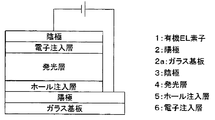
- a sandwich structure such as cathode / electron transport layer / light emitting layer / hole transport layer / anode / glass substrate is used as a main component, and a hole (electron) injection layer, buffer layer is used to further improve the characteristics.
- An element having a structure to which an interlayer insulating film or the like is appropriately added has been proposed.
- Various light-emitting materials are used for the light-emitting layer, which is the center of the sandwich structure. Its characteristics are that electrons and holes transported from the cathode and anode are easy to flow, light emission efficiency is excellent, and durability is high. It is required to have it.
- the generation probability of excited molecules is 1: 3 between the excited singlet and the excited triplet, so that the excited triplet state is obtained for the fluorescent material that emits light by the transition from the excited singlet to the ground state.
- Patent Document 1 discloses an organic iridium complex having a ligand (dibenzoylmethane) having two benzene rings as a ⁇ -diketone ligand (S02 of Patent Document 1). .
- Patent Document 2 discloses an organic platinum complex having a ligand (tetra-butoxydiphenyl diketone) having two butoxy-substituted benzene rings as a ⁇ -diketone ligand (patent).
- a ligand tetra-butoxydiphenyl diketone
- the luminous efficiency is improved by applying a ligand having a benzene ring as the ⁇ -diketone ligand.
- current efficiency (cd / A)” and “quantum efficiency (%)” are known as evaluation standards of the luminous efficiency of the organic EL element.
- Current efficiency is the luminance (or light intensity considering the visibility) per unit current
- quantum efficiency is the ratio of the number of photons that can be extracted as light energy to the power consumption (number of injected carriers). It is.
- quantum efficiency the amount of power consumed that cannot be emitted as light energy (for example, a loss due to resistance) can be eliminated. For this reason, it can be said that an evaluation close to the actual light emission efficiency in the organic EL element can be made in the quantum efficiency as compared with the current efficiency.
- Patent Documents 1 and 2 only evaluate the current efficiency and the light emission luminance described above, and no specific examination on thermal stability has been made.
- the present invention aims to provide an organometallic complex that realizes electroluminescence with high quantum efficiency as a light emitting material for an organic EL element, and particularly provides red electroluminescence with high quantum efficiency.
- the present invention provides an organometallic complex having higher heat resistance than conventional complexes.
- the present inventors have focused on organic iridium complexes having iridium as a central atom.
- a platinum complex As an organometallic complex, a platinum complex has also been developed as described in Patent Document 2.
- the platinum complex has high planarity, and there is a vacancy in the ligand of the platinum atom that is the central element, resulting in energy loss.
- Cheap Specifically, interactions between molecules such as association and excimer formation (so-called self-assembly), interactions with media such as solvent and matrix (base material), and further association with other coexisting molecules Influenced by various interactions.
- the organic iridium complex is a material with high quantum efficiency because the three ligands have a steric conformation and do not generate various interactions like the platinum complex described above, making it difficult to cause energy loss. I thought it was easy.
- PL quantum yield is one of the factors that determine the internal quantum efficiency when the quantum efficiency is roughly divided into “external quantum efficiency” and “internal quantum efficiency” as shown in the following equation. is there.
- Luminescent materials are required to have high internal quantum efficiency, and the influence of “exciton generation efficiency” and “PL quantum yield” is particularly large as a determinant of internal quantum efficiency.
- the “exciton generation efficiency” is determined depending on whether it is a fluorescent material or a phosphorescent material, and therefore, the high PL quantum yield is important for improving the internal quantum efficiency.
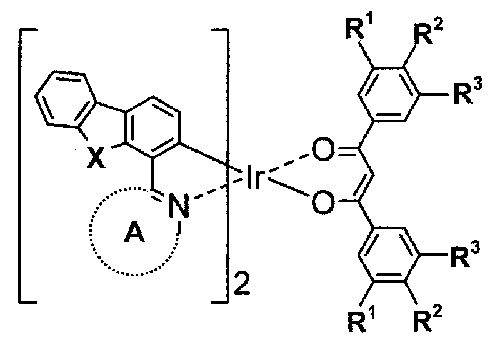
- the present invention relates to a CN ligand containing a substituent having a tricyclic structure in which a heterocyclic ring and two benzene rings are condensed, and two phenyl groups substituted with tert-butyl.
- the present invention relates to an organic iridium complex for an organic electroluminescence (EL) device, in which a ⁇ -diketone ligand composed of propane-1,3-dione is coordinated to an iridium atom.
- EL organic electroluminescence
- R 1 , R 2 and R 3 are a tert-butyl group or a hydrogen atom and have at least one tert-butyl group. When two tert-butyl groups are present, they are bonded to each other; A saturated hydrocarbon ring may be formed, A is a substituent having a nitrogen-containing heterocyclic ring, and X is a heteroatom.
- the present invention has the first feature in that a bulky substituent called a tert-butyl-substituted phenyl group is employed as the ⁇ -diketone.
- the —N ligand also adopts a specific structure. Specifically, a ligand including a tricyclic structure in which a heterocyclic ring and two benzene rings are condensed and a heterocyclic ring containing nitrogen is adopted as the CN ligand.
- the target emission color red, blue, green, etc.
- the luminous efficiency has been improved by changing the structure of ⁇ -diketone.
- a propane-1,3-dione having two tert-butyl-substituted phenyl groups is a ⁇ -diketone ligand, and a tricyclic structure in which a heterocycle and two benzene rings are condensed
- the present inventors have found that a high quantum efficiency can be realized by using an organic iridium complex having a skeleton including a nitrogen-containing heterocyclic ring as a CN ligand, and have arrived at the present invention.
- the organic iridium complex has higher heat resistance than the conventional complex.
- the organic iridium complex of the present invention comprises a trivalent iridium atom coordinated with two CN ligands and a ⁇ -diketone.
- the two CN ligands have the same structure, and the ⁇ -diketone ligand has a line-symmetric structure. Specific structures of the CN ligand and the ⁇ -diketone ligand will be described below.
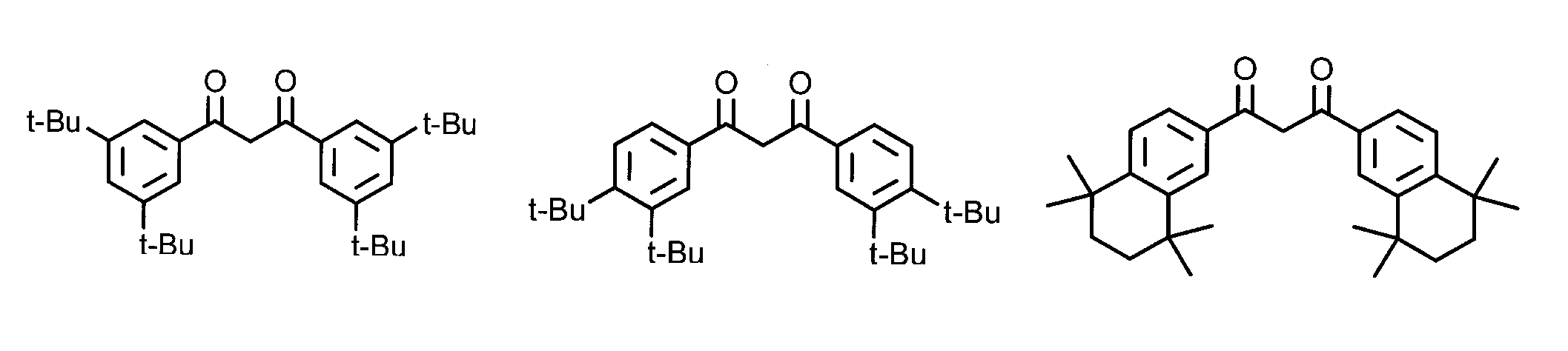
- the ⁇ -diketone ligand applied in the present invention is composed of propane-1,3-dione having two tert-butyl-substituted phenyl groups represented by the following formula.
- R 1 , R 2 and R 3 are a tert-butyl group or a hydrogen atom. It is preferable that one phenyl group has at least one tert-butyl group and two or more tert-butyl groups. Two tert-butyl groups may be bonded to each other to form a saturated hydrocarbon ring.
- t-Bu represents a tert-butyl group.
- the upper substituent has a tricyclic structure in which a heterocyclic ring and two benzene rings are condensed.
- X in this tricyclic structure is a heteroatom.
- X is preferably an oxygen atom (O) or a sulfur atom (S).
- the tricyclic structure is dibenzofuran (diphenylene oxide) or dibenzothiophene (diphenylene sulfide).
- a arranged below the CN ligand is a substituent having a nitrogen-containing heterocyclic ring.
- This heterocyclic ring is preferably a 5-membered ring or a 6-membered ring.
- A is preferably a structure in which a nitrogen-containing heterocyclic ring and a benzene ring are condensed.
- the heterocyclic ring or benzene ring of A may have an arbitrary substituent on the side chain, and the substituent may be either an electron donating group or an electron withdrawing group.
- substituents examples include an alkyl group (—R, carbon number 1 to 5), an alkoxy group (—OR, carbon number 1 to 3), a halogen atom (particularly a fluorine atom), a halogenated alkyl group (carbon number 1 to 1). 5) and the like.
- the heterocycle of A may further have a heteroatom other than nitrogen (N), and a preferable heteroatom other than nitrogen is a sulfur atom (S) or an oxygen atom (O).
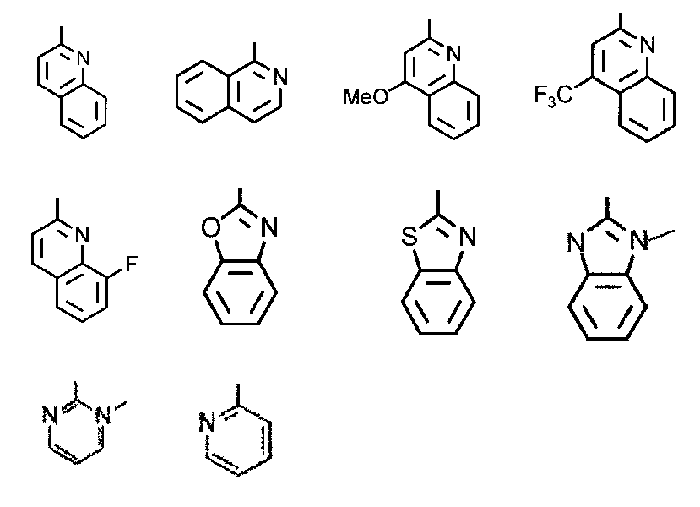
- the substituent A is particularly preferably any of the substituents shown in the following formula.
- the above-described organic iridium complex of the present invention becomes a higher luminous efficiency, when the 4 wt% doped in polymer thin film, high PL quantum yield [Phi PL (e.g., 0.4 or higher) tends.
- the organic iridium complex of the present invention has a high decomposition temperature and good thermal stability. As mentioned above, the organic iridium complex of this invention becomes a thing suitable for mounting of an organic EL element as a light emitting layer.
- a precursor is obtained by heating and reacting an iridium salt and a nitrogen-containing compound constituting a CN ligand, and then the precursor and a ⁇ -diketone compound are heated and reacted.
- the organic iridium complex of the present invention can also be synthesized by reacting a metal salt with a ⁇ -diketone compound and then reacting a nitrogen-containing compound.
- the heating reaction for obtaining the precursor is preferably performed at 80 ° C. to 130 ° C. for 12 to 24 hours, and the heating reaction with ⁇ -diketone is performed at 60 ° C. to 130 ° C. for 0.5 to 12 hours. Is preferred.
- the reaction is preferably performed in the presence of a solvent.
- the iridium salt used in the synthesis reaction is preferably chloride (IrCl 3 ). Further, as a form of use, a hydrate of chloride can be used.
- a light emitting layer can be formed by a method such as spin coating or vacuum deposition.
- the spin coating method enables simple and inexpensive element formation.
- the organic iridium complex of the present invention has higher PL quantum yield and heat resistance than conventional complexes, and is suitable as a light emitting material for organic EL devices.
- the thermal decomposition characteristic result of the organic iridium complex in embodiment The cross-sectional schematic diagram of the organic EL element produced in embodiment.
- each iridium complex will be outlined with reference to the synthesis method of complex 1-A.
- a ⁇ -diketone compound (A) and a CN ligand (1: 2- (dibenzo [b, d] furan-4-yl) quinoline) are synthesized, and the ligand (1) is reacted with iridium chloride.
- precursor (1) was synthesized.
- the iridium complex 1-A was obtained by reacting the precursor (1) with the ⁇ -diketone compound.
- ⁇ -diketone compound (B), ligands (2) to (4), and precursors (2) to (4) are synthesized, and each precursor and each ⁇ - It was obtained by reacting with a diketone compound.
- the starting materials and the reagents and solvents used in the synthesis were all commercially available reagent grades without purification.
- dry THF commercially available dehydrated THF was purchased and used as it was.
- spherical silica gel (neutral) manufactured by Kanto Chemical Co., Inc. was used as a filler used for column chromatography.
- Proton nuclear magnetic resonance ( 1 H NMR) spectrum and mass spectrometry (mass (MS) spectrum) were used for identification of the synthesized compound.
- 1 H NMR spectrum a Jeol JNM-ECX400 spectrophotometer (400 MHz) or a Jeol JNM-ECS400 spectrophotometer (400 MHz) was used.
- the MS spectrum was measured by time-of-flight (TOF) mass spectrometry of a sample ionized by matrix-assisted laser desorption / ionization (MALDI) using ⁇ -cyano-4-hydroxycinnamic acid (CHCA) as a matrix (MALDI).
- TOF-MS spectrum A Shimadzu-Kratos AXIMA-CFR PLUS TOF Mass mass spectrometer was used for the measurement. Elemental analysis was performed with a JM-10 elemental analyzer manufactured by J Science Lab using acetanilide as a standard substance.
- beta-diketone compound (A) was synthesized and (dibutyl benzoate) ethan-1-one, by the synthetic reaction using these two compounds, beta-diketone compound (A) Got.
- the organic layer was further washed with a saturated aqueous sodium hydrogen carbonate solution (50 mL) and saturated brine (50 mL), and then dried by adding an appropriate amount of anhydrous magnesium sulfate. After removing magnesium sulfate by filtration, the solvent was distilled off with an evaporator, and the residue was dried under reduced pressure in a desiccator to obtain methyl 3,5-di-tert-butylbenzoate. The obtained compound was a white solid, and the yield was 92% (2.92 g, 11.8 mmol).
- the characteristics ( 1 H NMR, TOF MS) of the compound synthesized as described above were as follows.
- Phenyl) propane-1,3-dione ( ⁇ -diketone A) was obtained.
- the obtained compound was an amber syrup-like substance and had a yield of 49% (2.12 g, 4.73 mmol).
- MALDI-TOF MS m / z 449 ([M + H] + ).
- a CN ligand (1) was reacted with iridium chloride to obtain a precursor (1).
- a mixture of 2- (dibenzo [b, d] furan-4-yl) quinoline (3.50 g, 11.9 mmol) and 2-ethoxyethanol (210 mL) was heated on an oil bath under a nitrogen atmosphere. When the temperature of the solution reached 100 ° C., a mixture of iridium chloride trihydrate (1.60 g, 4.54 mmol) and water (70 mL) was added and the resulting reaction mixture was stirred at 120 ° C. for 10 hours.
- CN ligand (2) was reacted with iridium chloride to obtain precursor (2).
- a mixture of 1- (dibenzo [b, d] furan-4-yl) isoquinoline (3.07 g, 10.4 mmol) and 2-ethoxyethanol (180 mL) was heated on an oil bath under a nitrogen atmosphere. When the temperature of the solution reached 100 ° C., a mixture of iridium chloride trihydrate (1.21 g, 4.04 mmol) and water (60 mL) was added and the resulting reaction mixture was stirred at 120 ° C. for 10 hours.
- the precursor (2) was a hardly soluble solid, it was used for the synthesis of the following iridium complex without further purification.
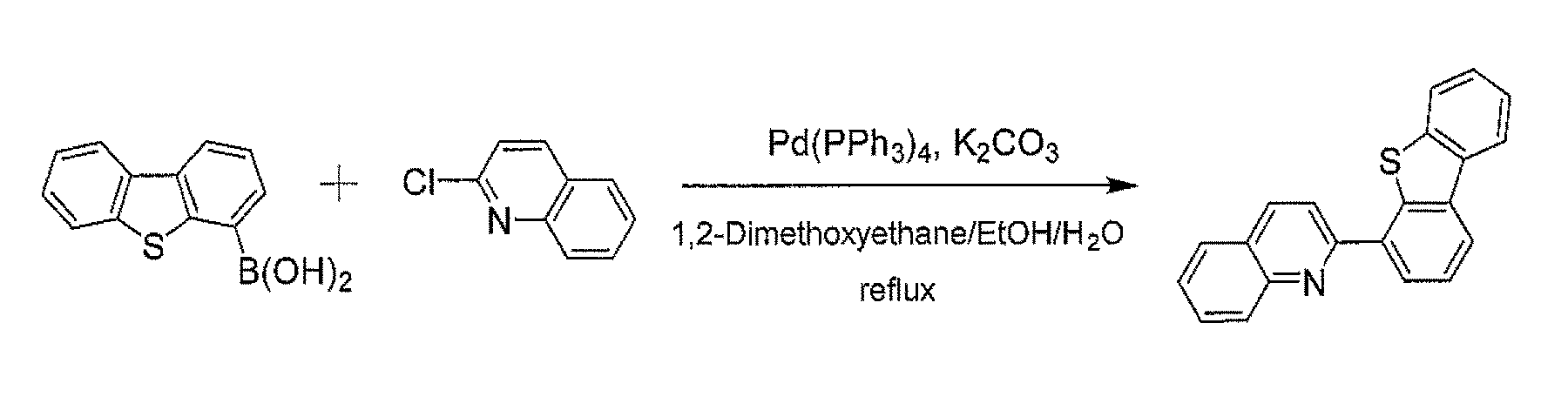
- Dibenzo [b, d] thiophen-4-yl boric acid (1.60 g, 7.01 mmol), 2-chloroquinoline (1.27 g, 7.76 mmol), tetrakis (triphenylphosphine) palladium (0.665 g, .01 mmol). 575 mmol) and a mixture of potassium carbonate (14.8 g, 107 mmol) in a mixed solvent of 1,2-dimethoxyethane (75 mL), ethanol (75 mL), and water (75 mL). The mixture was heated to reflux for 18 hours on the set oil bath. After standing to cool, the organic solvent was distilled off with an evaporator, and 100 mL of chloroform was added.
- Dibenzo [b, d] thiophen-4-yl boric acid (1.57 g, 6.88 mmol), 1-chloroisoquinoline (1.24 g, 7.58 mmol), tetrakis (triphenylphosphine) palladium (0.688 g, 0.88 mmol). 595 mmol) and potassium carbonate (14.7 g, 106 mmol) were placed in a mixed solvent of 1,2-dimethoxyethane (75 mL), ethanol (75 mL), and water (75 mL), and the mixture was heated to 100 ° C. under a nitrogen atmosphere. The mixture was heated to reflux for 18 hours on the set oil bath.
- Precursor (1) (0.482 g, 0.295 mmol), 1,3-bis (3,5-di-tert-butylphenyl) propane-1,3-dione (0.223 g, 0.497 mmol), and Sodium carbonate (0.382 g, 3.60 mmol) was placed in 2-ethoxyethanol (100 mL), and the mixture was stirred at 85 ° C. for 2 hours under a nitrogen atmosphere. After allowing to cool, the solvent was distilled off under reduced pressure, and chloroform was added to the residue. The resulting mixed solution was washed with water and saturated brine, and dried by adding an appropriate amount of sodium sulfate.
- Precursor (1) (0.981 g, 0.601 mmol), 1,3-bis (5,5,8,8-tetramethyl-5,6,7,8-tetrahydronaphthalen-2-yl) propane-1,3 Dione (0.537 g, 1.21 mmol) and sodium carbonate (0.796 g, 7.51 mmol) were placed in 2-ethoxyethanol (200 mL) and the mixture was stirred at 85 ° C. for 2 hours under a nitrogen atmosphere. After allowing to cool, the solvent was distilled off under reduced pressure, and chloroform was added to the residue. The obtained mixed solution was washed with water and saturated brine, and dried by adding an appropriate amount of sodium sulfate.
- iridium complex 1-X was obtained by reacting precursor (1) with ⁇ -diketone (X).
- Precursor (1) (0.534 g, 0.327 mmol), 1,3-diphenylpropane-1,3-dione (0.138 g, 0.615 mmol), and sodium carbonate (0.394 g, 3.72 mmol).
- 2-Ethoxyethanol 100 mL was stirred at 85 ° C. for 2 hours under a nitrogen atmosphere. After allowing to cool, the solvent was distilled off under reduced pressure, and chloroform was added to the residue. The obtained mixture was washed with water and saturated brine, dried by adding an appropriate amount of sodium sulfate. After removing sodium sulfate by filtration, the solvent of the filtrate was distilled off with an evaporator.
- the characteristics of the compound synthesized as described above were as follows.
- the iridium complex 2-A was obtained by reacting the precursor (2) with the ⁇ -diketone (A) according to the following formula.
- Precursor (2) (0.484 g, 0.296 mmol), 1,3-bis (3,5-di-tert-butylphenyl) propane-1,3-dione (0.249 g, 0.555 mmol), and Sodium carbonate (0.396 g, 3.74 mmol) was added to 2-ethoxyethanol (100 mL), and the mixture was stirred at 85 ° C. for 2 hours under a nitrogen atmosphere. After allowing to cool, the solvent was distilled off under reduced pressure, and chloroform was added to the residue. The obtained mixture was washed with water and saturated brine, dried by adding an appropriate amount of sodium sulfate.
- Precursor (1) (0.985 g, 0.603 mmol), 1,3-bis (5,5,8,8-tetramethyl-5,6,7,8-tetrahydronaphthalen-2-yl) propane-1,3 -Dione (0.532 g, 1.20 mmol) and sodium carbonate (0.791 g, 7.46 mmol) were placed in 2-ethoxyethanol (200 mL) and the mixture was stirred at 85 ° C for 2 hours under nitrogen atmosphere. After allowing to cool, the solvent was distilled off under reduced pressure, and chloroform was added to the residue. The obtained mixed solution was washed with water and saturated brine, and dried by adding an appropriate amount of sodium sulfate.
- iridium complex 2-X was obtained by reacting precursor (2) with ⁇ -diketone (X).
- Precursor (2) (0.979 g, 0.600 mmol), 1,3-diphenylpropane-1,3-dione (0.270 g, 1.20 mmol), and sodium carbonate (0.788 g, 7.43 mmol).
- 2-ethoxyethanol 200 mL
- the solvent was distilled off under reduced pressure, and chloroform was added to the residue.
- the obtained mixture was washed with water and saturated brine, dried by adding an appropriate amount of sodium sulfate. After removing sodium sulfate by filtration, the solvent of the filtrate was distilled off with an evaporator.
- the obtained residue was purified by alumina column chromatography (developing solvent; chloroform) and recrystallized from chloroform-methanol to obtain iridium complex 1-X in a yield of 5.7% (68.7 mg, 0.0684 mmol).
- the characteristics of the compound synthesized as described above were as follows.
- Precursor (3) (1.02 g, 0.601 mmol), 1,3-bis (3,5-di-tert-butylphenyl) propane-1,3-dione (0.536 g, 1.19 mmol), and Sodium carbonate (0.790 g, 7.45 mmol) was placed in 2-ethoxyethanol (200 mL), and the mixture was stirred at 85 ° C. for 2 hours under a nitrogen atmosphere. After allowing to cool, the solvent was distilled off under reduced pressure, and chloroform was added to the residue. The obtained mixed solution was washed with water and saturated brine, and dried by adding an appropriate amount of sodium sulfate.
- Precursor (3) (1.02 g, 0.601 mmol), 1,3-bis (5,5,8,8-tetramethyl-5,6,7,8-tetrahydronaphthalen-2-yl) propane-1,3 Dione (0.532 g, 1.20 mmol) and sodium carbonate (0.787 g, 7.43 mmol) were placed in 2-ethoxyethanol (200 mL) and the mixture was stirred at 85 ° C. for 2 hours under a nitrogen atmosphere. After allowing to cool, the solvent was distilled off under reduced pressure, and chloroform was added to the residue. The obtained mixed solution was washed with water and saturated brine, and dried by adding an appropriate amount of sodium sulfate.
- Precursor (3) (0.768 g, 0.453 mmol), 1,3-diphenylpropane-1,3-dione (0.271 g, 1.21 mmol), and sodium carbonate (0.592 g, 5.59 mmol).
- 2-ethoxyethanol 150 mL
- the solvent was distilled off under reduced pressure, and chloroform was added to the residue.
- the obtained mixed solution was washed with water and saturated brine, and dried by adding an appropriate amount of sodium sulfate. After removing sodium sulfate by filtration, the solvent of the filtrate was distilled off with an evaporator.
- Precursor (4) (0.548 g, 0.323 mmol), 1,3-bis (3,5-di-tert-butylphenyl) propane-1,3-dione (0.296 g, 0.660 mmol), and Sodium carbonate (0.454 g, 4.28 mmol) was placed in 2-ethoxyethanol (100 mL), and the mixture was stirred at 85 ° C. for 2 hours under a nitrogen atmosphere. After allowing to cool, the solvent was distilled off under reduced pressure, and chloroform was added to the residue. The obtained mixed solution was washed with water and saturated brine, and dried by adding an appropriate amount of sodium sulfate.
- Precursor (4) (1.02 g, 0.601 mmol), 1,3-bis (5,5,8,8-tetramethyl-5,6,7,8-tetrahydronaphthalen-2-yl) propane-1,3 -Dione (0.532 g, 1.20 mmol) and sodium carbonate (0.789 g, 7.44 mmol) were placed in 2-ethoxyethanol (200 mL) and the mixture was stirred at 85 ° C for 2 hours under nitrogen atmosphere. After allowing to cool, the solvent was distilled off under reduced pressure, and chloroform was added to the residue. The obtained mixed solution was washed with water and saturated brine, and dried by adding an appropriate amount of sodium sulfate.
- Precursor (4) (0.511 g, 0.301 mmol), 1,3-diphenylpropane-1,3-dione (0.139 g, 0.620 mmol), and sodium carbonate (0.405 g, 3.82 mmol).
- 2-ethoxyethanol 100 mL
- the solvent was distilled off under reduced pressure, and chloroform was added to the residue.
- the obtained mixed solution was washed with water and saturated brine, and dried by adding an appropriate amount of sodium sulfate. After removing sodium sulfate by filtration, the solvent of the filtrate was distilled off with an evaporator.
- Each iridium complex obtained above was evaluated for emission spectrum, PL quantum yield, and thermal decomposition characteristics. Moreover, the organic EL element using each iridium complex was produced, and the characteristic was evaluated.
- the solution sample was measured as a deoxygenated solution by sealing argon gas, and the polymer thin film sample was measured under a nitrogen atmosphere.
- the polymer thin film sample was measured by doping 4% by weight of each iridium complex in PMMA. The results are shown in the table below.
- the iridium complex having a phenyl group substituted with a ⁇ -diketone (A) or (B) is an iridium complex complex (1-X, 2- compared X, 3-X, 4- X) and became a high tendency PL quantum yield [Phi PL.
- TG Thermogravimetric analysis
- the thermal decomposition characteristics of the iridium complex were evaluated by thermogravimetric analysis (TG).
- TG thermogravimetric analysis
- the measurement results are shown in FIG.
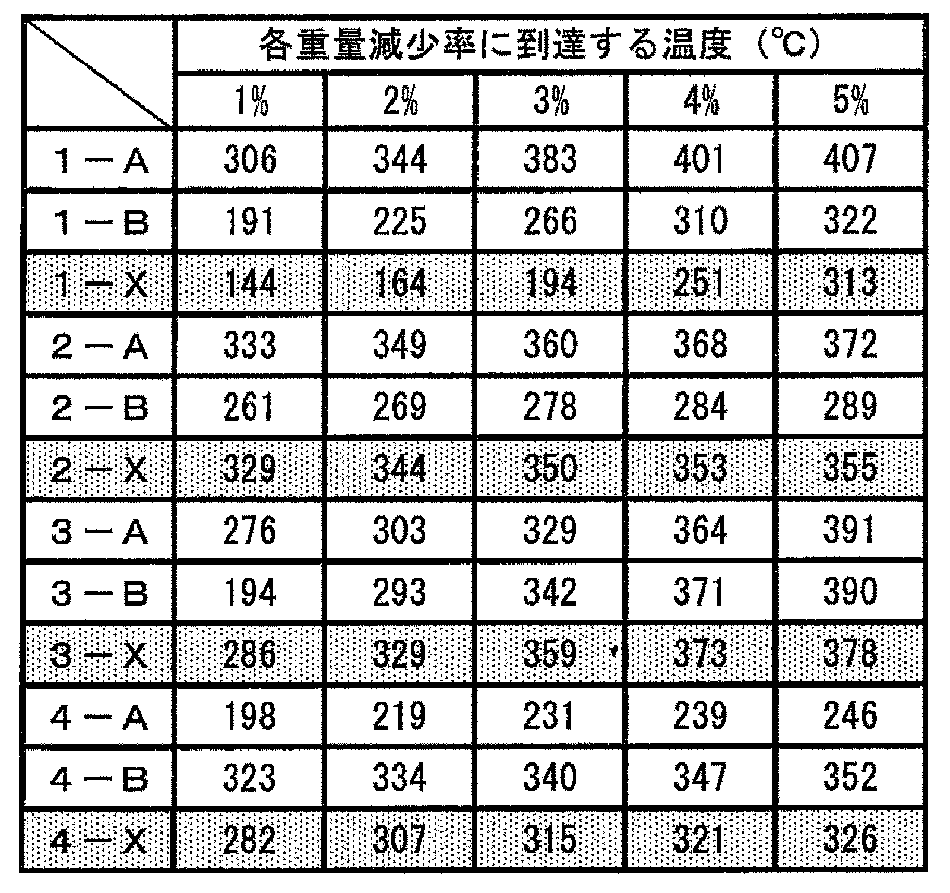
- the weight reduction rate in Table 2 was the weight reduction rate with respect to the initial weight.
- the iridium complex having a phenyl group substituted with ⁇ -diketone (A) or (B) is an iridium complex complex (1- Compared to X, 2-X, 3-X, 4-X), the thermal stability tended to be higher.
- the weight ratio of PVCz, PBD, and iridium complex was 10: 3.0: 1.0, and 0.7 ml of toluene was used as an ink solvent for 10 mg of PVCz.
- a film was formed on the hole injection layer (5) by a spin coating method and baked at 120 ° C. for 1 hour, whereby a light-emitting layer 4 having a thickness of 80 nm. Formed.
- each iridium complex (1-B, 1-X, 2-A, 2-B, 2-X, 3-A, 3-B, 3-X, 4-A, 4 -B, 4-X) was used to prepare each light emitting layer ink Ink.
- Each organic EL element EL was obtained in the same manner as described above except that this light emitting layer ink Ink was used.
- Luminous light distribution characteristic measuring device EL luminance characteristics
- EL luminance characteristics such as EL spectrum, maximum luminance L max (cd / m 2 ), maximum external quantum efficiency ⁇ ext, max (%) and CIE color system (x, y). It was measured by Hamamatsu Photonics C-9920-11).
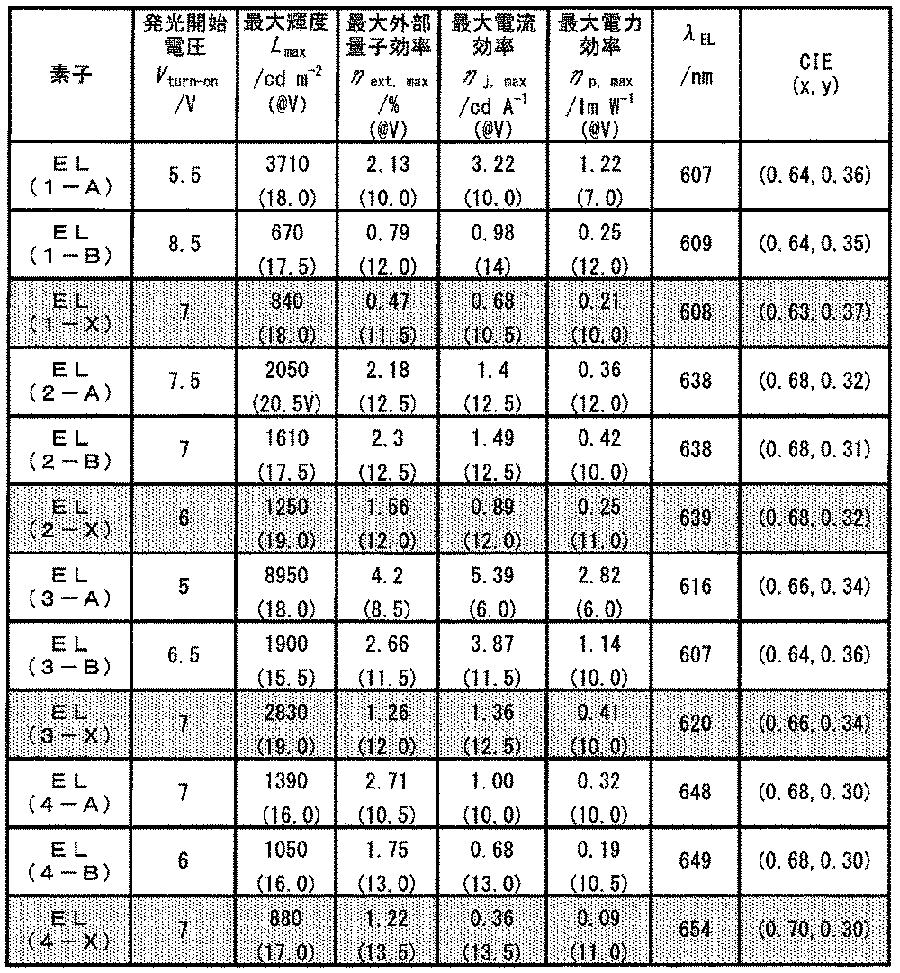
- Table 3 shows the peak wavelength ⁇ EL (nm), maximum luminance L max (cd / m 2 ), maximum external quantum efficiency ⁇ ext, max (%), maximum current efficiency ⁇ j, max ( cd / A), maximum power efficiency ⁇ p, max (lm / W) and CIE color system (x, y) are shown.
- L max and ⁇ ext, max the applied voltage (V) at the time of measurement is also shown in parentheses.
- the emission starting voltage V turn-on represents the voltage luminance reached 1 cd / m 2.
- FIG. 3 is an electroluminescence (EL) spectrum of each organic EL element. The EL spectrum was measured at the maximum brightness L max .
- the organic EL device produced using the complexes 1-A, 1-B, 2-A, 2-B, 3-A, 3-B, 4-A, 4-B is complex 1-X.
- 2-X, 3-X, and 4-X exhibited an organic EL characteristic equivalent to or better than that of an EL produced.
- the organic iridium complex of the present invention has high quantum efficiency and is suitable as a light emitting material for an organic EL element. Moreover, this complex has high heat resistance, and contributes to the lifetime extension of an organic EL element.
Landscapes
- Chemical & Material Sciences (AREA)
- Organic Chemistry (AREA)
- Engineering & Computer Science (AREA)
- Materials Engineering (AREA)
- Crystallography & Structural Chemistry (AREA)
- Inorganic Chemistry (AREA)
- Physics & Mathematics (AREA)
- Optics & Photonics (AREA)
- Electroluminescent Light Sources (AREA)
- Organic Low-Molecular-Weight Compounds And Preparation Thereof (AREA)
Abstract
Description

[量子効率]
外部量子効率=(光取出し効率)×内部量子効率
内部量子効率=(励起子生成効率)×(PL量子収率)×(キャリアバランス)

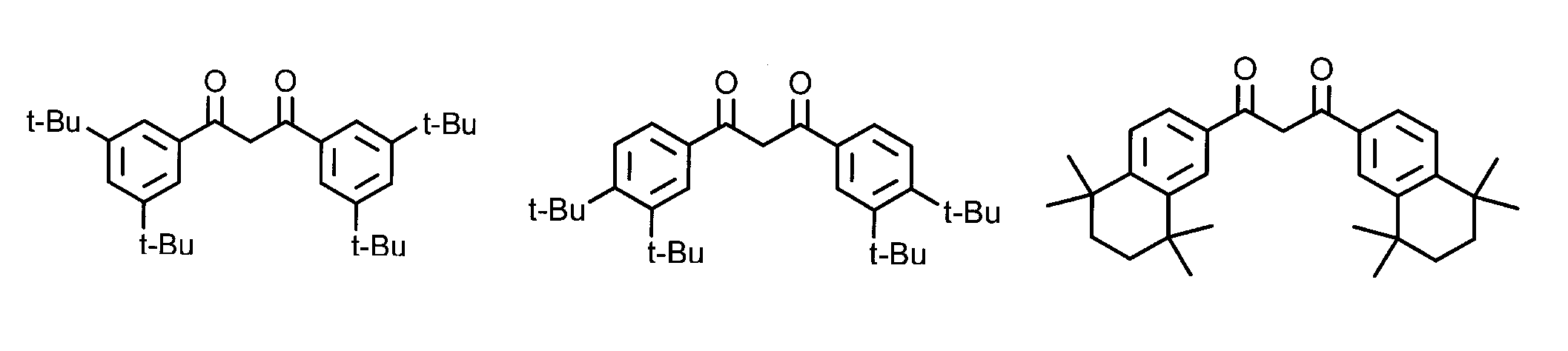


ジブチル安息香酸メチルと、(ジブチル安息香酸メチル)エタン-1-オンとを合成した後、これら2つの化合物を用いた合成反応により、β‐ジケトン化合物(A)を得た。
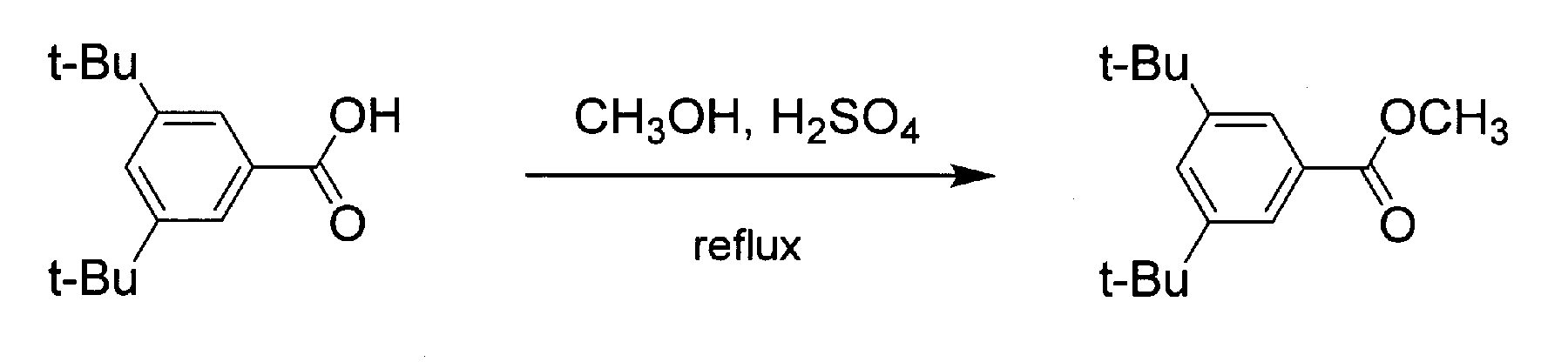
3,5-ジ-tert-ブチル安息香酸(3.00g,12.8mmol)とメタノール(9mL)の混合物に濃硫酸(0.9mL)を窒素雰囲気下、0℃にて滴下し、その後、撹拌しながら1時間加熱還流させた。放冷後、クロロホルム(100mL)を加え、さらに水(100mL)を加えて分液漏斗内で振とうし、有機層を分離した。この操作をもう一度繰り返した後、分離した有機層を一つに合わせた。この有機層をさらに、飽和炭酸水素ナトリウム水溶液(50mL)及び飽和食塩水(50mL)で洗浄した後、無水硫酸マグネシウムを適量加えて乾燥させた。ろ過により硫酸マグネシウムを除去した後、エバポレーターにて溶媒を留去し、残渣をデシケーター内で減圧下乾燥させることで3,5-ジ-tert-ブチル安息香酸メチルを得た。得られた化合物は白色固体であり、収率は92%であった(2.92g,11.8mmol)。以上により合成した化合物の特性(1H NMR、TOF MS)は、以下の通りであった。
1H NMR(CDCl3):d1.35(s,18H),3.91(s,3H),7.62(t,J=2.0Hz,1H),7.89(d,J=2.0Hz,2H).
MALDI-TOF MS:m/z 249([M+H]+).
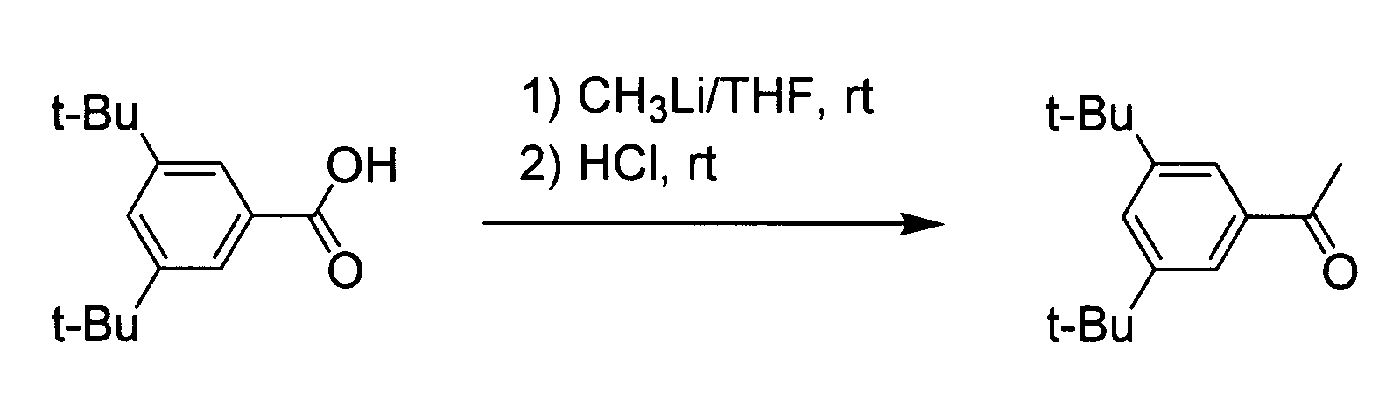
3,5-ジ-tert-ブチル安息香酸(3.00g,12.8mmol)を乾燥テトラヒドロフラン(120mL)に加え、窒素雰囲気下、0℃以下になるまで撹拌しながら冷却した。この混合物にメチルリチウムの3.0Mジエトキシメタン溶液(15mL)を滴下し、その後室温まで昇温して2時間撹拌した。この反応混合物に6M塩酸を加えて酸性にした後、クロロホルム(100mL×2)で抽出した。得られた有機層を一つに合わせ、水(50mL×2)、飽和炭酸水素ナトリウム水溶液(50mL)及び飽和食塩水(50mL)で洗浄した後、無水硫酸マグネシウムを適量加えて乾燥させた。ろ過により硫酸マグネシウムを除去した後、エバポレーターにて溶媒を留去し、残渣をシリカゲルカラムクロマトグラフィー(展開溶媒;クロロホルム)で精製することで1-(3,5-ジ-tert-ブチルフェニル)エタン-1-オンを得た。得られた化合物は、無色の液体であり、収率75%であった(2.23g,9.60mmol)。以上により合成した化合物の特性は、以下の通りであった。
1H NMR(CDCl3)d1.37(s,18H),2.60(s,3H),7.64(t,J=1.6Hz,1H),7.80(d,J=1.6Hz,2H).
MALDI-TOF MS:m/z 232(M+).
3,5-ジ-tert-ブチル安息香酸メチル(2.92g,11.8mmol)と水素化ナトリウム(60%油分散;1.27g,31.8mmol)を乾燥THF(23mL)に入れ、窒素雰囲気下、室温にて撹拌した。そこへ1-(3,5-ジ-tert-ブチルフェニル)エタン-1-オン(2.23g,9.60mmol)を乾燥THF(23mL)に溶かした溶液を30分かけて滴下した。その後、得られた反応混合物を60℃下、24時間撹拌した。放冷後、1M塩酸を加えて酸性にした後、クロロホルム(100mL×2)で抽出した。得られた有機層を一つに合わせ、水(50mL×2)、飽和炭酸水素ナトリウム水溶液(50mL)及び飽和食塩水(50mL)で洗浄した後、無水硫酸マグネシウムを適量加えて乾燥させた。ろ過により硫酸マグネシウムを除去した後、エバポレーターにて溶媒を留去し、残渣をシリカゲルカラムクロマトグラフィー(展開溶媒;クロロホルム)で精製することで1,3-ビス(3,5-ジ-tert-ブチルフェニル)プロパン-1,3-ジオン(β-ジケトンA)を得た。得られた化合物は、こはく色のシロップ状物質であり、収率49%であった(2.12g,4.73mmol)。以上により合成した化合物の特性は、以下の通りであった。
1H NMR(CDCl3)d1.38(s,36H),6.78(s,1H),7.63(t,J=2.0Hz,2H),7.78(d,J=2.0Hz,4H),16.9(brs,1H).
MALDI-TOF MS:m/z 449([M+H]+).

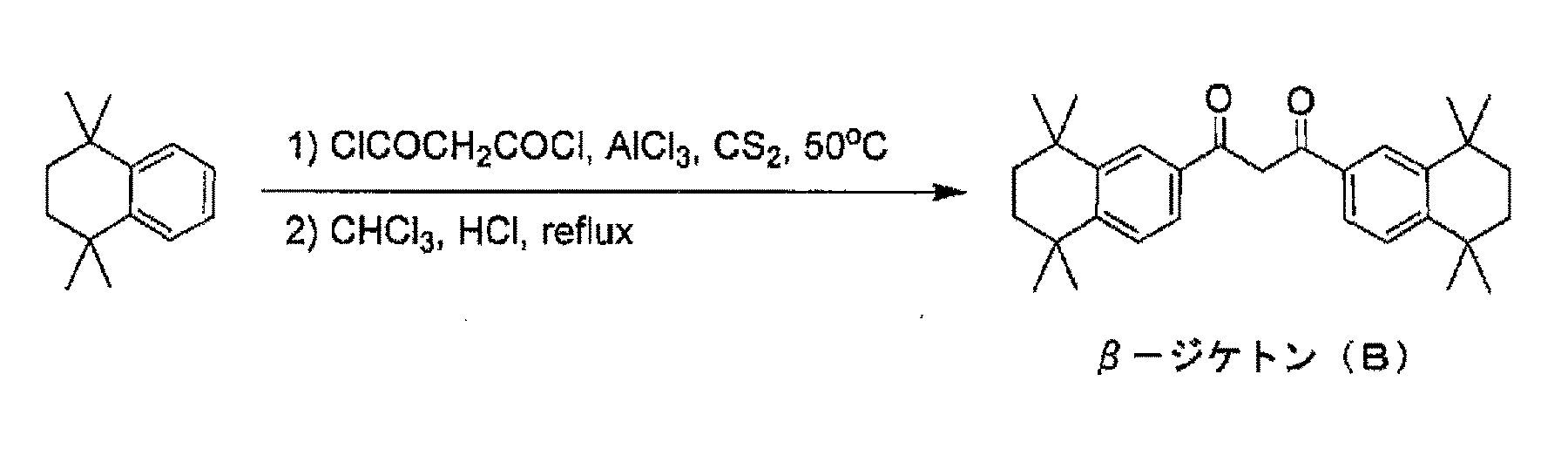
1,2,3,4-テトラヒドロ-1,1,4,4-テトラメチルナフタレンとマロニルクロリドを用いた合成反応により、β‐ジケトン化合物(B)を得た。
1,2,3,4-テトラヒドロ-1,1,4,4-テトラメチルナフタレン(5.00g,26.6mmol)、マロニルクロリド(1.35g、9.58mmol)及び塩化アルミニウム(5.51g、41.3mmol)を二硫化炭素(27mL)に入れ、50℃にて3時間加熱撹拌した。次に、放冷後、冷やした2mol/Lの塩酸(27mL)を加えて分液ロートに移し、クロロホルムで抽出した。有機層を更に水で洗浄し、エバポレーターで溶媒を留去した後、残渣に濃塩酸(3.5mL)とクロロホルム(35mL)を加え、9時間加熱還流させた。放冷後、混合物を分液ロートに移し、水及び飽和食塩水で洗浄した。有機層を無水硫酸マグネシウムで乾燥させた後、ロータリーエバポレーターで溶媒を留去した。残渣をシリカゲルカラムクロマトグラフィー(展開溶媒;酢酸エチル:ヘキサン=1:2(v/v))で精製することにより、β-ジケトン(B)を収率39%で得た(1.66g,3.74mmol)。以上により合成した化合物の特性は、以下の通りであった。
1H NMR(CDCl3):δ1.30(s,12H),1.34(s,12H),1.71(m,8H),6.76(s,1H),7.40(d,J=8.0Hz,2H),7.68(dd,J=8.0 and 2.0Hz,2H),7.94(d,J=2.0Hz,2H),16.96(brs,1H)
MALDI-TOF MS:m/z 445([M+H]+).
下記式に従い、C-N配位子(1)として2-(ジベンゾ[b,d]フラン-4-イル)キノリンを合成した。

1H NMR(CDCl3):δ7.39(t,J=7.6Hz,1H),7.48-7.53(m,1H),7.55-7.59(m,2H),7.66(d,J=8.7Hz,1H),7.76(dt,J=1.4and7.6Hz,1H),7.89(d,J=7.6Hz,1H),8.02(d,J=7.6Hz,1H),8.06(dd,J=1.4and7.6Hz,1H),8,23(d,J=8.7Hz,1H),8.34(d,J=8.7Hz,1H),8.43(dd,J=1.4and7.6Hz,1H),8.52(d,J=8.7Hz,1H).
MALDI-TOF MS:m/z 296([M+H]+).
下記式に従い、C-N配位子(1)と塩化イリジウムとを反応させて前駆体(1)を得た。2-(ジベンゾ[b,d]フラン-4-イル)キノリン(3.50g,11.9mmol)と2-エトキシエタノール(210mL)の混合物を窒素雰囲気下、油浴上で加熱した。溶液の温度が100℃に達したら、塩化イリジウム・三水和物(1.60g,4.54mmol)と水(70mL)の混合物を加え、得られた反応混合物を120℃で10時間撹拌した。放冷後、水(175mL)を反応混合物に加え、ろ過して沈殿を回収し、適量のメタノールで洗浄することによって、前駆体(1)を83%の収率で得た(3.08g,1.89mmol)。得られた化合物は難溶性の固体であった。さらなる精製は行わずに、下記イリジウム錯体の合成に用いた。

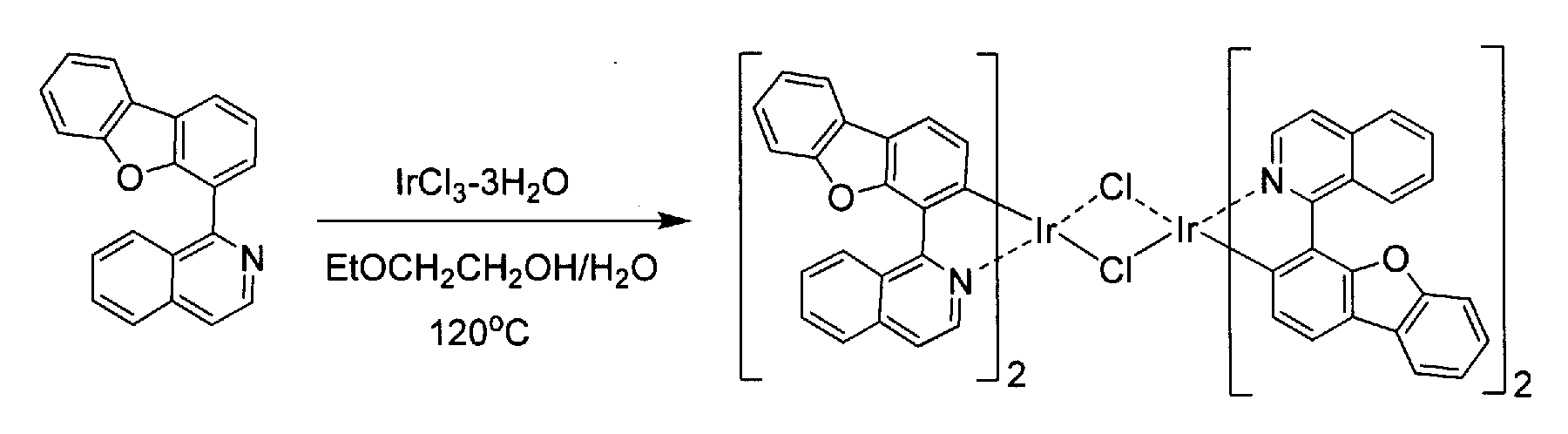
下記式に従い、C-N配位子(2)として1-(ジベンゾ[b,d]フラン-4-イル)イソキノリンを合成した。

1H NMR(CDCl3):d7.36-7.40(m,1H),7.41-7.42(m,2H),7.46-7.55(m,2H),7.67-7.74(m,2H),7.77(d,J=6.0Hz,1H),7.83(d,J=8.8Hz,1H),7.94(d,J=8.4Hz,1H),8.00-8.04(m,1H),8.11(dd,J=1.4Hz and 5.6Hz,1H)8.72(d,J=5.6Hz,1H)
MALDI-TOF MS:m/z 296([M+H]+).
下記式に従い、C-N配位子(2)と塩化イリジウムとを反応させて前駆体(2)を得た。1-(ジベンゾ[b,d]フラン-4-イル)イソキノリン(3.07g,10.4mmol)と2-エトキシエタノール(180mL)の混合物を窒素雰囲気下、油浴上で加熱した。溶液の温度が100℃に達したら、塩化イリジウム・三水和物(1.21g,4.04mmol)と水(60mL)の混合物を加え、得られた反応混合物を120℃で10時間撹拌した。放冷後、水(150mL)を反応混合物に加え、ろ過して沈殿を回収し、適量のメタノールで洗浄することによって、前駆体(2)を69%の収率で得た(2.28g,1.40mmol)。前駆体(2)は難溶性の固体のため、さらなる精製は行わずに、下記イリジウム錯体の合成に用いた。
下記式に従い、C-N配位子(3)として2-(ジベンゾ[b,d]チオフェン-4-イル)キノリンを合成した。
1H NMR(CDCl3):δ7.46-7.53(m,2H),7.58(dt,J=1.4 and 7.6Hz,1H),7.63(t,J=7.8Hz,1H),7.80(dt,J=1.4 and 7.6Hz,1H),7.86(d,J=7.8Hz,1H),7.99(m,1H),8.10(d,J=8.7Hz,1H),8.17(dd,J=1.4 and 7.6Hz,1H),8.21-8.24(m,1H),8.26(d,J=8.7Hz,1H),8.30(dd,J=0.9 and 7.8Hz,1H),8.42(d,J=7.8Hz,1H).
MALDI-TOF MS:m/z 311(M+).
下記式に従い、C-N配位子(3)と塩化イリジウムとを反応させて前駆体(3)を合成した。
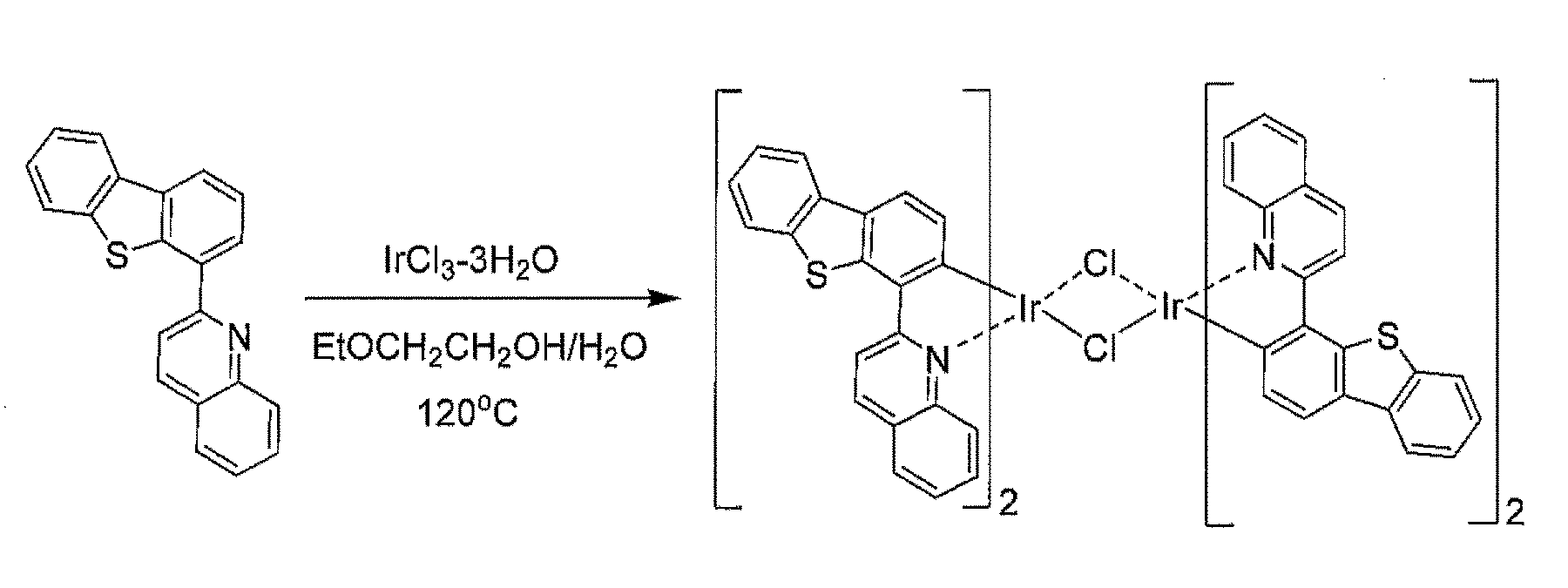
下記式に従い、C-N配位子(4)として1-(ジベンゾ[b,d]チオフェン-4-イル)イソキノリンを合成した。

1H NMR(CDCl3):δ7.44-7.53(m,3H),7.64(t,J=7.8Hz,1H),7.69-7.72(m,2H),7.74-7.79(m,2H),7.94(d,J=8.3Hz,1H),7.98(d,J=7.8Hz,1H),8.21-8.24(m,1H),8.29(dd,J=7.6Hz,1H),8.71(d,J=6.0Hz,1H).
MALDI-TOF MS:m/z 311(M+).
下記式に従い、C-N配位子(4)と塩化イリジウムとを反応させて前駆体(4)を合成した。
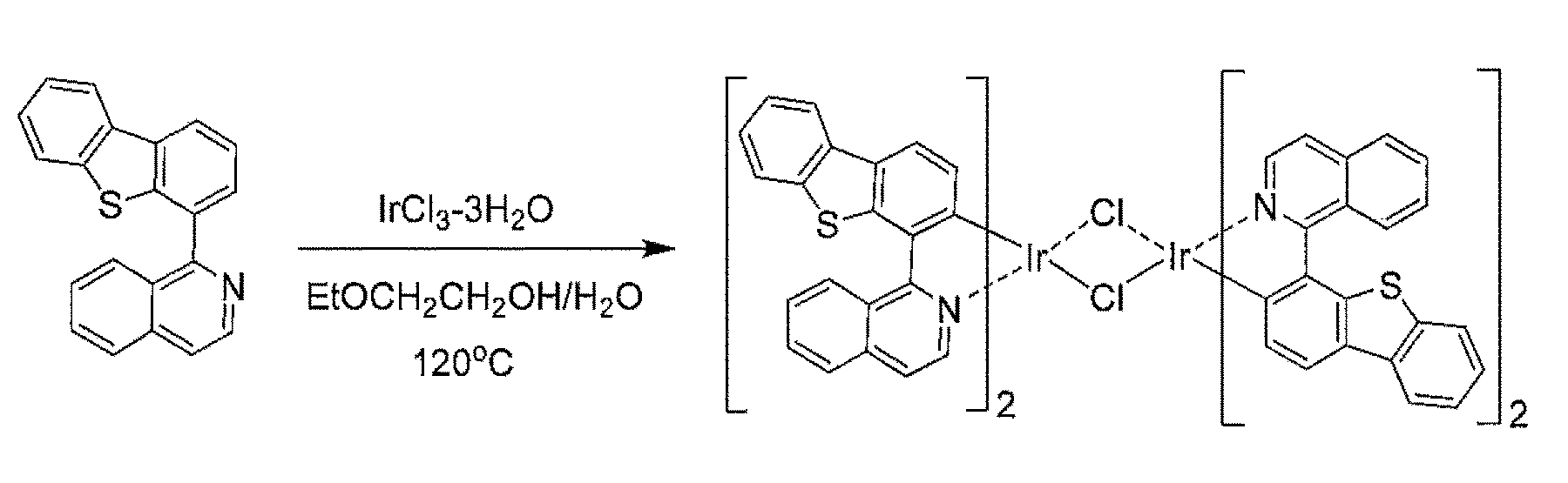
下記式に従い、前駆体(1)とβ‐ジケトン(A)を反応させてイリジウム錯体1-Aを得た。

1H NMR(CDCl3):δ1.17(s,36H),5.75(s,1H),6.67(d,J=8.2Hz,2H),7.06(d,J=1.8Hz,4H),7.19-7.23(m,4H),7.28(d,J=8.2Hz,2H),7.31(t,J=1.8Hz,2H),7.37-7.42(m,4H),7.69(d,J=8.2Hz,2H),7.77-7.81(m,4H),8.37(d,J=9.2Hz,2H),8.52(d,J=9.2Hz,2H),9.31(d,J=9.2Hz,2H).
MALDI-TOF MS:m/z 1229([M+H]+).
Anal. Calcd for C73H67IrN2O4: C,71.37;H,5.50;N,2.28. Found:C,71.74;H,5.84;N,2.13.
下記式に従い、前駆体(1)とβ-ジケトン(B)を反応させてイリジウム錯体(1-B)を得た。

1H NMR(CDCl3):δ1.08(s,6H),1.10(s,6H),1.16(s,6H),1.18(s,6H),1.57(m,8H),5.79(s,1H),6.65(d,J=8.2Hz,2H),7.09(d,J=8.2Hz,2H),7.13-7.18(m,4H),7.21-7.29(m,6H),7.34-7.43(m,4H),7.69(d,J=8.2Hz,2H),7.77-7.79(m,4H),8.34(d,J=8.3Hz,2H),8.50(d,J=8.3Hz,2H),9.29(d,J=8.2Hz,2H).
MALDI-TOF MS:m/z 1225([M+H]+).
Anal. Calcd for C73H63IrN2O4: C,71.60;H,5.19;N,2.29. Found:C,71.72;H,5.52;N,2.15.
下記式に従い、前駆体(1)とβ‐ジケトン(X)を反応させてイリジウム錯体1-Xを得た。

1H NMR(CDCl3):δ5.94(s,1H),6.64(d,J=8.2Hz,2H),7.12-7.23(m,8H),7.28-7.30(m,4H),7.35(t,J=7.8Hz,2H),7.41(t,J=7.8Hz,2H),7.48(d,J=7.3Hz,4H),7.70(d,J=8.2Hz,2H),7.77-7.80(m,4H),8.32(d,J=8.2Hz,2H),8.50(d,J=8.7Hz,2H),9.26(d,J=8.7Hz,2H).
MALDI-TOF MS:m/z 1004(M+).
下記式に従い、前駆体(2)とβ‐ジケトン(A)を反応させてイリジウム錯体2-Aを得た。

1H NMR(CDCl3):δ1.08(s,36H),6.42(s,1H),6.60(d,J=8.7Hz,2H),7.22-7.26(m,2H),7.30-7.34(m,10H),7.36(t,J=1.8Hz,2H),7.49-7.52(m,2H),7.71-7.79(m,6H),7.90(d,J=8.7Hz,2H),8.61(d,J=6.4Hz,2H),9.18(d,J=8.7Hz,2H).
MALDI-TOF MS:1228(M+).
Anal. Calcd for C73H67IrN2O4: C,71.37;H,5.50;N,2.28. Found:C,71.21;H,5.72;N,2.04.
下記式に従い、前駆体(2)とβ-ジケトン(B)を反応させてイリジウム錯体(2-B)を得た。
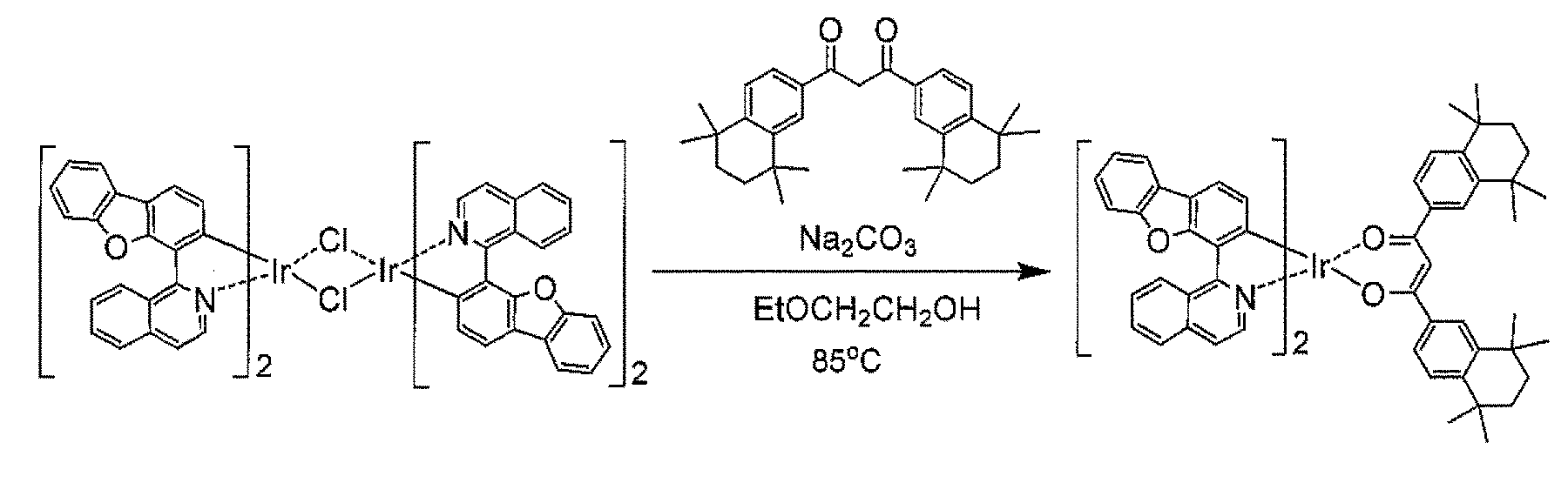
1H NMR(CDCl3):δ1.08(s,6H),1.15(s,6H),1.16(s,6H),1.18(s,6H),1.57(m,8H),6.47(s,1H),6.49(d,J=1.8Hz,2H),7.13(d,J=8.2Hz,2H),7.32-7.36(m,4H),7.41(dd,J=1.8 and 8.2Hz,2H),7.49-7.54(m,6H),7.71-7.79(m,6H),7.90-7.93(m,4H),8.59(d,J=6.4Hz,2H),9.15(d,J=8.2Hz,2H).
MALDI-TOF MS:m/z 1224(M+).
Anal. Calcd for C73H63IrN2O4: C,71.60;H,5.19;N,2.29. Found:C,71.72;H,5.45;N,2.11.
下記式に従い、前駆体(2)とβ‐ジケトン(X)を反応させてイリジウム錯体2-Xを得た。

1H NMR(CDCl3):δ6.44(d,J=8.2Hz,2H),6.57(s,1H),7.18-7.24(m,4H),7.30-7.38(m,8H),7.50(d,J=8.2Hz,2H),7.53(d,J=6.4Hz,2H),7.69(dd,J=1.3and 8.2Hz,4H),7.71-7.79(m,6H),7.91(d,J=8.2Hz,2H),8.58(d,J=6.4Hz,2H),9.15(d,J=8.2Hz,2H).
MALDI-TOF MS:1004(M+).
下記式に従い、前駆体(3)とβ-ジケトン(A)を反応させてイリジウム錯体(3-A)を得た。

1H NMR(CDCl3):δ1.18(s,36H),5.68(s,1H),6.87(d,J=8.2Hz,2H),7.01(d,J=1.8Hz,4H),7.19(dt,J=1.4 and 8.2Hz,2H),7.31(t,J=1.8Hz,2H),7.35-7.41(m,6H),7.46(d,J=8.2Hz,2H),7.81(d,J=6.8Hz,2H),7.92(dd,J=1.4 and 8.2Hz,2H),7.97(dd,J=1.4 and 6.9Hz,2H),8.43(d,J=8.7Hz,2H),8.46(d,J=8.7Hz,2H),8.83(d,J=8.7Hz,2H).
MALDI-TOF MS:m/z 1260(M+).
Anal. Calcd for C73H67IrN2O2S2: C,69.55;H,5.36;N,2.22. Found:C,69.55;H,5.36;N,2.54.
下記式に従い、前駆体(3)とβ-ジケトン(B)を反応させてイリジウム錯体(3-B)を得た。

1H NMR(CDCl3):δ1.08(s,6H),1.10(s,6H),1.16(s,6H),1.18(s,6H),1.57(m,8H),5.80(s,1H),6.65(d,J=8.2Hz,2H),7.09(d,J=8.2Hz,2H),7.13-7.16(m,4H),7.18-7.30(m,6H),7.34-7.42(m,4H),7.69(d,J=8.2Hz,2H),7.77-7.90(m,4H),8.34(d,J=8.7Hz,2H),8.50(d,J=8.7Hz,2H),9.29(d,J=8.7Hz,2H).
MALDI-TOF MS:m/z 1256(M+).
Anal. Calcd for C73H63IrN2O2S2: C,69.77;H,5.05;N,2.23. Found:C,69.49;H,5.25;N,2.54.
下記式に従い、前駆体(3)とβ-ジケトン(X)を反応させてイリジウム錯体(3-X)を得た。
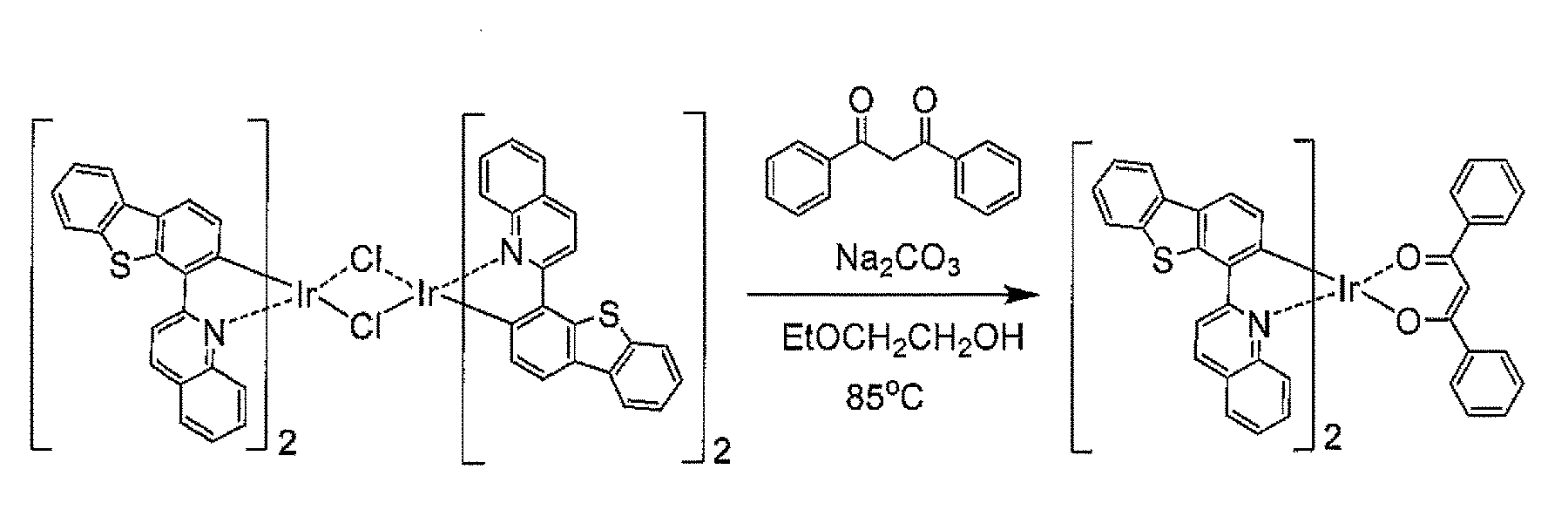
1H NMR(CDCl3):δ5.87(s,1H),6.85(d,J=8.2Hz,2H),7.10-7.20(m,6H),7.32-7.51(m,14H),7.78(dd,1.8 and 8.2Hz,2H),7.92(dd,J=1.4 and 6.9Hz,2H),7.99(dd,J=1.4 and 6.9Hz,2H),8.36(d,J=8.7Hz,2H),8.44(d,J=8.7Hz,2H),8.74(d,J=8.7Hz,2H).
MALDI-TOF MS:m/z 1036(M+).
Anal. Calcd for C57H35IrN2O2S2: C,66.07;H,3.40;N,2.70. Found:C,66.20;H,3.51;N,2.61.
下記式に従い、前駆体(4)とβ-ジケトン(A)を反応させてイリジウム錯体(4-A)を得た。

1H NMR(CDCl3):δ1.07(s,36H),6.41(s,1H),6.59(d,J=8.2Hz,2H),7.22-7.26(m,2H),7.29(d,J=1.8Hz,4H),7.31-7.35(m,6H),7.49-7.52(m,4H),7.71-7.77(m,6H),7.90(d,J=8.2Hz,2H),8.61(d,J=5.9Hz,2H),9.18(d,J=8.2Hz,2H).
MALDI-TOF MS:m/z 1261([M+H]+).
Anal. Calcd for C73H67IrN2O2S2: C,69.55;H,5.36;N,2.22. Found:C,69.38;H,5.33;N,2.37.
下記式に従い、前駆体(4)とβ-ジケトン(B)を反応させてイリジウム錯体(4-B)を得た。

1H NMR(CDCl3):δ0.96(s,6H),1.07(s,6H),1.14(s,6H),1.17(s,6H),6.47(d,J=7.7Hz,2H),6.48(s,1H),7.13(d,J=8.2Hz,2H),7,22-7.26(m,2H),7.31-7.35(m,4H),7.40(dd,J=1.8 and 8.7Hz,2H),7.49(d,J=6.8Hz,4H),7.53(d,J=1.8Hz,2H),7.70-7.78(m,6H),7.90(d,J=7.7Hz,2H),8.59(d,J=6.8Hz,2H),9.14(d,J=8.7Hz,2H).
MALDI-TOF MS:m/z 1256(M+).
Anal. Calcd for C73H63IrN2O2S2: C,69.77;H,5.05;N,2.23. Found:C,70.10;H,5.31;N,2.54.
下記式に従い、前駆体(4)とβ-ジケトンを反応させてイリジウム錯体(4-X)を得た。

1H NMR(CDCl3):δ6.45(d,J=7.7Hz,2H),6.58(s,1H),7.21(t,J=7.6Hz,4H),7.23-7.27(m,2H),7.32-7.37(m,6H),7.50(d,J=8.2Hz,2H),7.53(d,J=6.4Hz,2H),7.70(d,J=7.6Hz,4H),7.72-7.80(m,6H),7.92(dd,J=1.3 and 8.2Hz,2H),8.59(d,J=6.4Hz,2H),9.16(d,J=7.7Hz,2H).
MALDI-TOF MS:m/z 1036(M+).
Anal. Calcd for C57H35IrN2O2S2: C,66.07;H,3.40;N,2.70. Found:C,66.07;H,3.69;N,2.70.
上記で得られた各イリジウム錯体について、発光(PL)スペクトル及びPL量子収率ΦPLを測定した。PLスペクトルの測定では、堀場製作所社製Fluorolog-3分光光度計を用いた。PL量子収率の測定では、浜松ホトニクス社製C9920-12量子収率測定装置を用いた。これらPLスペクトル及びPL量子収率の評価は、媒質として、有機溶媒(ジクロロメタン(CH2Cl2))中、及び、高分子薄膜(ポリメタクリル酸メチル、PMMA)中の両方について行った。尚、溶液試料は、アルゴンガスを封入して脱酸素溶液として測定し、高分子薄膜試料については窒素雰囲気下で測定を行った。高分子薄膜試料については、PMMA中に各イリジウム錯体を4重量%ドープして測定を行った。結果を下記表に示す。

イリジウム錯体熱分解特性は、熱重量分析(TG)により評価した。TG測定装置として、リガク社製TG8120熱重量分析装置を用いて、窒素気流下(200mL/min)、2mgのイリジウム錯体を昇温速度10℃/minにて、約50℃から約450℃まで加熱した際の試料の重量変化を観察した。測定結果を、図1及び表2に示す。表2における重量減少率は、初期重量に対する重量減少率とした。
イリジウム錯体1‐A、2‐A、1‐X、及び2‐Xを用いて、下記の手順で、図2に示す有機EL素子(1)を作製し、特性評価を行った。
(a)ホール注入層(5)の形成
ITO-ガラス基板(三容真空工業製,ITO、膜厚150nm)にパターニング処理を施し、洗浄することにより陽極(2)を準備した。次いで、ITO薄膜を、オゾンにより表面処理した。表面処理後、速やかに、ホール注入材料をスピンコート法によりITO膜上に成膜し、120℃にて1時間焼成することにより、厚み40nmのホール注入層(5)を形成した。ホール注入材料としては、PEDOTとPSSとを含む導電性ポリマー(Heraeus Clevios製、P VP CH8000)を用いた。
脱水トルエンに、ポリ(9-ビニルカルバゾール)(PVCz、Sigma-Aldrich製、数平均分子量Mn,25000-50000、THF-メタノールから再沈殿により精製)、2-(4-ビフェニリル)-5-(4-tert-ブチルフェニル)-1,3,4-オキサジアゾール(PBD)、及びイリジウム錯体1-Aを溶解させ、メンブレンフィルター(メルクミリポア製、0.2μm Millex-FG)でろ過することにより、発光層用インクInk(1-A)を調製した。PVCz、PBD,及びイリジウム錯体の重量比を10:3.0:1.0とし、PVCz10mgに対して0.7mlのトルエンをインク溶媒として用いた。得られた発光層用インクInk(1-A)を用いて、ホール注入層(5)上に、スピンコート法により成膜し、120℃で一時間焼成することにより、厚み80nmの発光層4を形成した。
シャドウマスクを用いて、真空蒸着により、電子注入材料としてのフッ化セシウムの薄膜(電子注入層(6)、厚み1nm)を形成し、次いで、アルミニウムの薄膜(陰極(3)、厚み250nm)を作製した。このとき、発光部の面積が、10mm2(2mm×5mm)となるように、電子注入層(6)及び陰極(3)を作製した。このようにして、有機EL素子EL(1-A)を完成させた。
イリジウム錯体1-Aに代えて、各イリジウム錯体(1-B、1-X、2-A、2-B、2-X、3-A、3-B、3-X、4-A、4-B、4-X)を用いて、各発光層用インクInkを調製した。この発光層用インクInkを用いる以外は、上記の手順と同様にして、各有機EL素子ELを得た。
上記工程で得られた有機EL素子を、紫外線硬化樹脂を用いて、キャビティガラス中に封止し、有機EL特性評価用のサンプルを作製した。
ELスペクトル、最大輝度Lmax(cd/m2)、最大外部量子効率ηext,max(%)及びCIE表色系(x,y)等の有機EL素子特性を、輝度配光特性測定装置(浜松ホトニクス社製、C-9920-11)により測定した。
Claims (9)
- 下記式で示される、複素環と2つのベンゼン環が縮環した三環系構造の置換基を含むC-N配位子と、tert-ブチル置換されたフェニル基を2つ有するプロパン-1,3-ジオンからなるβ‐ジケトン配位子とが、イリジウム原子に配位してなる有機電界発光素子用の有機イリジウム錯体。

- β‐ジケトン配位子は、下記式に示す置換基のいずれかである請求項1に記載の有機イリジウム錯体。
- Aは、窒素を含む複素環とベンゼン環が縮環した構造からなる置換基である請求項1又は請求項2に記載の有機イリジウム錯体。
- Aの複素環又はベンゼン環は、フッ素又は酸素を含む置換基を有する請求項3に記載の有機イリジウム錯体。
- Aの複素環は、ヘテロ原子として、さらに硫黄原子(S)又は酸素原子(O)を含む請求項1~4のいずれかに記載の有機イリジウム錯体。
- Aは、下記式に示す置換基のいずれかである請求項1~請求項5のいずれかに記載の有機イリジウム錯体。
- C-N配位子のヘテロ原子Xは、酸素原子(O)又は硫黄原子(S)である請求項1~6のいずれかに記載の有機イリジウム錯体。
- 高分子薄膜中に4wt%ドープしたときのPL量子収率ΦPLが0.4以上である請求項1~7のいずれかに記載の有機イリジウム錯体。
- 請求項1~8のいずれかに記載された有機イリジウム錯体を含む発光層を備える有機電界発光素子。
Priority Applications (4)
| Application Number | Priority Date | Filing Date | Title |
|---|---|---|---|
| KR1020167035618A KR101895148B1 (ko) | 2014-06-13 | 2015-06-09 | 유기 전계 발광 소자용의 유기 이리듐 착체 |
| CN201580031640.1A CN106459114B (zh) | 2014-06-13 | 2015-06-09 | 用于有机电致发光元件的有机铱配合物 |
| US15/314,648 US9793499B2 (en) | 2014-06-13 | 2015-06-09 | Organic iridium complex for organic electroluminescent element |
| DE112015002807.2T DE112015002807T5 (de) | 2014-06-13 | 2015-06-09 | Organischer Iridium-Komplex für ein organisches Elektrolumineszenz-Element |
Applications Claiming Priority (4)
| Application Number | Priority Date | Filing Date | Title |
|---|---|---|---|
| JP2014-121997 | 2014-06-13 | ||
| JP2014121997 | 2014-06-13 | ||
| JP2015045467A JP5897171B2 (ja) | 2014-06-13 | 2015-03-09 | 有機電界発光素子用の有機イリジウム錯体 |
| JP2015-045467 | 2015-03-09 |
Publications (1)
| Publication Number | Publication Date |
|---|---|
| WO2015190464A1 true WO2015190464A1 (ja) | 2015-12-17 |
Family
ID=54833554
Family Applications (1)
| Application Number | Title | Priority Date | Filing Date |
|---|---|---|---|
| PCT/JP2015/066570 Ceased WO2015190464A1 (ja) | 2014-06-13 | 2015-06-09 | 有機電界発光素子用の有機イリジウム錯体 |
Country Status (7)
| Country | Link |
|---|---|
| US (1) | US9793499B2 (ja) |
| JP (1) | JP5897171B2 (ja) |
| KR (1) | KR101895148B1 (ja) |
| CN (1) | CN106459114B (ja) |
| DE (1) | DE112015002807T5 (ja) |
| TW (1) | TWI621621B (ja) |
| WO (1) | WO2015190464A1 (ja) |
Cited By (6)
| Publication number | Priority date | Publication date | Assignee | Title |
|---|---|---|---|---|
| EP3187503A4 (en) * | 2014-08-28 | 2018-02-28 | Tanaka Kikinzoku Kogyo K.K. | Organic iridium complex for organic electroluminescent elements |
| US10934319B2 (en) | 2017-03-23 | 2021-03-02 | Samsung Electronics Co., Ltd. | Organometallic compound, organic light-emitting device including the organometallic compound, and diagnostic composition including the organometallic compound |
| JP2021191744A (ja) * | 2020-05-19 | 2021-12-16 | 北京夏禾科技有限公司 | 有機発光材料 |
| US11744143B2 (en) | 2016-08-25 | 2023-08-29 | Samsung Electronics Co., Ltd. | Organometallic compound, organic light-emitting device including the organometallic compound, and diagnostic composition including the organometallic compound |
| DE112020000607B4 (de) * | 2019-01-30 | 2024-05-29 | Tanaka Kikinzoku Kogyo K.K. | Organoiridiumkomplex für organisches Elektrolumineszenzelement |
| US12421261B2 (en) | 2020-05-19 | 2025-09-23 | Beijing Summer Sprout Technology Co., Ltd. | Organic light emitting material |
Families Citing this family (10)
| Publication number | Priority date | Publication date | Assignee | Title |
|---|---|---|---|---|
| CN111377969B (zh) * | 2018-12-27 | 2020-12-04 | 广东阿格蕾雅光电材料有限公司 | 一种有机金属化合物及其应用 |
| US11239435B2 (en) * | 2019-01-21 | 2022-02-01 | Luminescence Technology Corp. | Iridium complex and organic electroluminescence device using the same |
| CN112830943B (zh) * | 2019-11-25 | 2022-12-23 | 广东阿格蕾雅光电材料有限公司 | 一种化合物及其应用 |
| CN111620910B (zh) * | 2020-06-03 | 2023-09-05 | 广东阿格蕾雅光电材料有限公司 | 一种金属络合物及其应用 |
| CN113831369A (zh) * | 2020-06-23 | 2021-12-24 | 广东阿格蕾雅光电材料有限公司 | 一种金属铱络合物及其应用 |
| CN114478637B (zh) * | 2020-10-23 | 2023-09-05 | 北京绿人科技有限责任公司 | 一种含1,3-二酮配体的化合物及其应用、一种有机致电发光器件 |
| JP7562863B2 (ja) | 2020-12-04 | 2024-10-07 | 広東阿格蕾雅光電材料有限公司 | イリジウム錯体及びその応用 |
| CN114591371A (zh) | 2020-12-04 | 2022-06-07 | 广东阿格蕾雅光电材料有限公司 | 一种金属络合物及其应用 |
| JP7761316B2 (ja) * | 2021-10-27 | 2025-10-28 | ヒューケムバイオ株式会社 | 新規三誘導体化合物およびその用途 |
| CN117126204B (zh) * | 2021-11-09 | 2026-03-20 | 广东阿格蕾雅光电材料有限公司 | 一种金属铱络合物及其应用 |
Citations (2)
| Publication number | Priority date | Publication date | Assignee | Title |
|---|---|---|---|---|
| JP2012077069A (ja) * | 2010-09-09 | 2012-04-19 | Osaka Prefecture Univ | ビス(アミノビフェニルエチニル)系化合物、青色蛍光色素および有機el素子 |
| WO2015056993A1 (en) * | 2013-10-18 | 2015-04-23 | Rohm And Haas Electronic Materials Korea Ltd. | Combination of a host compound and a dopant compound and organic electroluminescent device comprising the same |
Family Cites Families (5)
| Publication number | Priority date | Publication date | Assignee | Title |
|---|---|---|---|---|
| JP4307000B2 (ja) * | 2001-03-08 | 2009-08-05 | キヤノン株式会社 | 金属配位化合物、電界発光素子及び表示装置 |
| US8008418B2 (en) * | 2003-06-18 | 2011-08-30 | Hitachi Chemical Co., Ltd. | High-molecular copolymer containing metal coordination compound and organic electroluminescence element using the same |
| JP4484464B2 (ja) | 2003-07-16 | 2010-06-16 | 三洋電機株式会社 | 発光材料及び発光素子 |
| JP2008222635A (ja) | 2007-03-13 | 2008-09-25 | Osaka Prefecture Univ | 金属錯体化合物、色素および有機電界発光素子 |
| US8722205B2 (en) * | 2009-03-23 | 2014-05-13 | Universal Display Corporation | Heteroleptic iridium complex |
-
2015
- 2015-03-09 JP JP2015045467A patent/JP5897171B2/ja not_active Expired - Fee Related
- 2015-06-08 TW TW104118471A patent/TWI621621B/zh not_active IP Right Cessation
- 2015-06-09 KR KR1020167035618A patent/KR101895148B1/ko not_active Expired - Fee Related
- 2015-06-09 WO PCT/JP2015/066570 patent/WO2015190464A1/ja not_active Ceased
- 2015-06-09 US US15/314,648 patent/US9793499B2/en not_active Expired - Fee Related
- 2015-06-09 DE DE112015002807.2T patent/DE112015002807T5/de not_active Ceased
- 2015-06-09 CN CN201580031640.1A patent/CN106459114B/zh not_active Expired - Fee Related
Patent Citations (2)
| Publication number | Priority date | Publication date | Assignee | Title |
|---|---|---|---|---|
| JP2012077069A (ja) * | 2010-09-09 | 2012-04-19 | Osaka Prefecture Univ | ビス(アミノビフェニルエチニル)系化合物、青色蛍光色素および有機el素子 |
| WO2015056993A1 (en) * | 2013-10-18 | 2015-04-23 | Rohm And Haas Electronic Materials Korea Ltd. | Combination of a host compound and a dopant compound and organic electroluminescent device comprising the same |
Non-Patent Citations (1)
| Title |
|---|
| NOINE, K. ET AL.: "Red Phosphorescent Iridium Complexes having a Bulky Ancillary Ligand for Solution-processed Organic Light Emitting Diodes", JOURNAL OF PHOTOPOLYMER SCIENCE AND TECHNOLOGY, vol. 21, no. 2, 2008, pages 323 - 325, XP055242425 * |
Cited By (9)
| Publication number | Priority date | Publication date | Assignee | Title |
|---|---|---|---|---|
| EP3187503A4 (en) * | 2014-08-28 | 2018-02-28 | Tanaka Kikinzoku Kogyo K.K. | Organic iridium complex for organic electroluminescent elements |
| US11744143B2 (en) | 2016-08-25 | 2023-08-29 | Samsung Electronics Co., Ltd. | Organometallic compound, organic light-emitting device including the organometallic compound, and diagnostic composition including the organometallic compound |
| US12302746B2 (en) | 2016-08-25 | 2025-05-13 | Samsung Electronics Co., Ltd. | Organometallic compound, organic light-emitting device including the organometallic compound, and diagnosis composition including the organometallic compound |
| US10934319B2 (en) | 2017-03-23 | 2021-03-02 | Samsung Electronics Co., Ltd. | Organometallic compound, organic light-emitting device including the organometallic compound, and diagnostic composition including the organometallic compound |
| US11780867B2 (en) | 2017-03-23 | 2023-10-10 | Samsung Electronics Co., Ltd. | Organometallic compound, organic light-emitting device including the organometallic compound, and diagnostic composition including the organometallic compound |
| DE112020000607B4 (de) * | 2019-01-30 | 2024-05-29 | Tanaka Kikinzoku Kogyo K.K. | Organoiridiumkomplex für organisches Elektrolumineszenzelement |
| JP2021191744A (ja) * | 2020-05-19 | 2021-12-16 | 北京夏禾科技有限公司 | 有機発光材料 |
| JP7530645B2 (ja) | 2020-05-19 | 2024-08-08 | 北京夏禾科技有限公司 | 有機発光材料 |
| US12421261B2 (en) | 2020-05-19 | 2025-09-23 | Beijing Summer Sprout Technology Co., Ltd. | Organic light emitting material |
Also Published As
| Publication number | Publication date |
|---|---|
| US20170200907A1 (en) | 2017-07-13 |
| DE112015002807T5 (de) | 2017-03-02 |
| KR101895148B1 (ko) | 2018-09-04 |
| CN106459114A (zh) | 2017-02-22 |
| KR20170012344A (ko) | 2017-02-02 |
| US9793499B2 (en) | 2017-10-17 |
| JP2016015468A (ja) | 2016-01-28 |
| TWI621621B (zh) | 2018-04-21 |
| JP5897171B2 (ja) | 2016-03-30 |
| TW201602119A (zh) | 2016-01-16 |
| CN106459114B (zh) | 2019-08-27 |
Similar Documents
| Publication | Publication Date | Title |
|---|---|---|
| JP5897171B2 (ja) | 有機電界発光素子用の有機イリジウム錯体 | |
| RU2434836C2 (ru) | Конденсированное циклическое ароматическое соединение для органического светоизлучающего устройства и содержащее его органическое светоизлучающее устройство | |
| JP6196554B2 (ja) | 有機エレクトロルミネッセンス素子用材料及びそれを用いた有機エレクトロルミネッセンス素子 | |
| JP2013043846A (ja) | 縮合多環化合物およびそれを有する有機発光素子 | |
| TWI390007B (zh) | 三蝶烯衍生物及其在有機電子元件的應用 | |
| JP2003221579A (ja) | 有機発光材料 | |
| CN105481672A (zh) | 一系列荧光oled材料 | |
| CN110467590A (zh) | 杂芳族化合物及使用其的有机电激发光组件 | |
| US12245498B2 (en) | Organoiridium complex for organic electroluminescent elements | |
| JP6395843B2 (ja) | 有機電界発光素子用の有機イリジウム錯体 | |
| CN105693608A (zh) | 2,2-二甲基-1,3-茚二酮衍生物和基于其的有机电致发光器件 | |
| JP2012064453A (ja) | 有機発光素子 | |
| Valsange et al. | A new pyrene cored small organic molecule with a flexible alkyl spacer: a potential solution processable blue emitter with bright photoluminescence | |
| JP5586981B2 (ja) | 新規有機化合物および有機発光素子 | |
| CN105601570A (zh) | 一种含杂环配体的化合物及其制备方法、应用 | |
| CN104744516B (zh) | 有机金属化合物、包含其的有机发光装置及照明装置 | |
| JP2002249469A5 (ja) | ||
| JP4708732B2 (ja) | 発光素子用金属配位化合物及びそれを用いた発光素子 | |
| CN112110873A (zh) | 氰基芳烃类聚集发光材料的合成及其应用 | |
| TW200401822A (en) | Blue light emitting compound, stilbene blue light emitting compound with alkyl fluorideand light emitting device | |
| JP2014024769A (ja) | ジベンゾ[a,i]フルオレン化合物、それを有する有機発光素子、該有機発光素子を有する表示装置、画像情報処理装置、照明装置および画像形成装置 |
Legal Events
| Date | Code | Title | Description |
|---|---|---|---|
| 121 | Ep: the epo has been informed by wipo that ep was designated in this application |
Ref document number: 15807005 Country of ref document: EP Kind code of ref document: A1 |
|
| WWE | Wipo information: entry into national phase |
Ref document number: 15314648 Country of ref document: US |
|
| WWE | Wipo information: entry into national phase |
Ref document number: 112015002807 Country of ref document: DE |
|
| ENP | Entry into the national phase |
Ref document number: 20167035618 Country of ref document: KR Kind code of ref document: A |
|
| WWE | Wipo information: entry into national phase |
Ref document number: 1020167035618 Country of ref document: KR |
|
| 122 | Ep: pct application non-entry in european phase |
Ref document number: 15807005 Country of ref document: EP Kind code of ref document: A1 |