WO2015137156A1 - 2-シアノアクリレート系接着剤組成物 - Google Patents
2-シアノアクリレート系接着剤組成物 Download PDFInfo
- Publication number
- WO2015137156A1 WO2015137156A1 PCT/JP2015/055827 JP2015055827W WO2015137156A1 WO 2015137156 A1 WO2015137156 A1 WO 2015137156A1 JP 2015055827 W JP2015055827 W JP 2015055827W WO 2015137156 A1 WO2015137156 A1 WO 2015137156A1
- Authority
- WO
- WIPO (PCT)
- Prior art keywords
- adhesive composition
- cation
- cyanoacrylate
- bis
- fluorosulfonyl
- Prior art date
- Legal status (The legal status is an assumption and is not a legal conclusion. Google has not performed a legal analysis and makes no representation as to the accuracy of the status listed.)
- Ceased
Links
Classifications
-
- C—CHEMISTRY; METALLURGY
- C08—ORGANIC MACROMOLECULAR COMPOUNDS; THEIR PREPARATION OR CHEMICAL WORKING-UP; COMPOSITIONS BASED THEREON
- C08K—Use of inorganic or non-macromolecular organic substances as compounding ingredients
- C08K5/00—Use of organic ingredients
- C08K5/36—Sulfur-, selenium-, or tellurium-containing compounds
- C08K5/43—Compounds containing sulfur bound to nitrogen
-
- C—CHEMISTRY; METALLURGY
- C08—ORGANIC MACROMOLECULAR COMPOUNDS; THEIR PREPARATION OR CHEMICAL WORKING-UP; COMPOSITIONS BASED THEREON
- C08F—MACROMOLECULAR COMPOUNDS OBTAINED BY REACTIONS ONLY INVOLVING CARBON-TO-CARBON UNSATURATED BONDS
- C08F222/00—Copolymers of compounds having one or more unsaturated aliphatic radicals, each having only one carbon-to-carbon double bond, and at least one being terminated by a carboxyl radical and containing at least one other carboxyl radical in the molecule; Salts, anhydrides, esters, amides, imides, or nitriles thereof
- C08F222/30—Nitriles
- C08F222/32—Alpha-cyano-acrylic acid; Esters thereof
- C08F222/322—Alpha-cyano-acrylic acid ethyl ester, e.g. ethyl-2-cyanoacrylate
-
- C—CHEMISTRY; METALLURGY
- C08—ORGANIC MACROMOLECULAR COMPOUNDS; THEIR PREPARATION OR CHEMICAL WORKING-UP; COMPOSITIONS BASED THEREON
- C08K—Use of inorganic or non-macromolecular organic substances as compounding ingredients
- C08K5/00—Use of organic ingredients
- C08K5/16—Nitrogen-containing compounds
- C08K5/17—Amines; Quaternary ammonium compounds
- C08K5/19—Quaternary ammonium compounds
-
- C—CHEMISTRY; METALLURGY
- C08—ORGANIC MACROMOLECULAR COMPOUNDS; THEIR PREPARATION OR CHEMICAL WORKING-UP; COMPOSITIONS BASED THEREON
- C08K—Use of inorganic or non-macromolecular organic substances as compounding ingredients
- C08K5/00—Use of organic ingredients
- C08K5/16—Nitrogen-containing compounds
- C08K5/34—Heterocyclic compounds having nitrogen in the ring
- C08K5/3412—Heterocyclic compounds having nitrogen in the ring having one nitrogen atom in the ring
- C08K5/3432—Six-membered rings
-
- C—CHEMISTRY; METALLURGY
- C08—ORGANIC MACROMOLECULAR COMPOUNDS; THEIR PREPARATION OR CHEMICAL WORKING-UP; COMPOSITIONS BASED THEREON
- C08K—Use of inorganic or non-macromolecular organic substances as compounding ingredients
- C08K5/00—Use of organic ingredients
- C08K5/16—Nitrogen-containing compounds
- C08K5/34—Heterocyclic compounds having nitrogen in the ring
- C08K5/3442—Heterocyclic compounds having nitrogen in the ring having two nitrogen atoms in the ring
- C08K5/3445—Five-membered rings
-
- C—CHEMISTRY; METALLURGY
- C08—ORGANIC MACROMOLECULAR COMPOUNDS; THEIR PREPARATION OR CHEMICAL WORKING-UP; COMPOSITIONS BASED THEREON
- C08K—Use of inorganic or non-macromolecular organic substances as compounding ingredients
- C08K5/00—Use of organic ingredients
- C08K5/16—Nitrogen-containing compounds
- C08K5/34—Heterocyclic compounds having nitrogen in the ring
- C08K5/3442—Heterocyclic compounds having nitrogen in the ring having two nitrogen atoms in the ring
- C08K5/3462—Six-membered rings
-
- C—CHEMISTRY; METALLURGY
- C08—ORGANIC MACROMOLECULAR COMPOUNDS; THEIR PREPARATION OR CHEMICAL WORKING-UP; COMPOSITIONS BASED THEREON
- C08K—Use of inorganic or non-macromolecular organic substances as compounding ingredients
- C08K5/00—Use of organic ingredients
- C08K5/36—Sulfur-, selenium-, or tellurium-containing compounds
- C08K5/41—Compounds containing sulfur bound to oxygen
- C08K5/42—Sulfonic acids; Derivatives thereof
-
- C—CHEMISTRY; METALLURGY
- C09—DYES; PAINTS; POLISHES; NATURAL RESINS; ADHESIVES; COMPOSITIONS NOT OTHERWISE PROVIDED FOR; APPLICATIONS OF MATERIALS NOT OTHERWISE PROVIDED FOR
- C09J—ADHESIVES; NON-MECHANICAL ASPECTS OF ADHESIVE PROCESSES IN GENERAL; ADHESIVE PROCESSES NOT PROVIDED FOR ELSEWHERE; USE OF MATERIALS AS ADHESIVES
- C09J135/00—Adhesives based on homopolymers or copolymers of compounds having one or more unsaturated aliphatic radicals, each having only one carbon-to-carbon double bond, and at least one being terminated by a carboxyl radical, and containing at least another carboxyl radical in the molecule, or of salts, anhydrides, esters, amides, imides or nitriles thereof; Adhesives based on derivatives of such polymers
- C09J135/04—Homopolymers or copolymers of nitriles
-
- C—CHEMISTRY; METALLURGY
- C09—DYES; PAINTS; POLISHES; NATURAL RESINS; ADHESIVES; COMPOSITIONS NOT OTHERWISE PROVIDED FOR; APPLICATIONS OF MATERIALS NOT OTHERWISE PROVIDED FOR
- C09J—ADHESIVES; NON-MECHANICAL ASPECTS OF ADHESIVE PROCESSES IN GENERAL; ADHESIVE PROCESSES NOT PROVIDED FOR ELSEWHERE; USE OF MATERIALS AS ADHESIVES
- C09J2301/00—Additional features of adhesives in the form of films or foils
- C09J2301/40—Additional features of adhesives in the form of films or foils characterized by the presence of essential components
- C09J2301/408—Additional features of adhesives in the form of films or foils characterized by the presence of essential components additives as essential feature of the adhesive layer
-
- C—CHEMISTRY; METALLURGY
- C09—DYES; PAINTS; POLISHES; NATURAL RESINS; ADHESIVES; COMPOSITIONS NOT OTHERWISE PROVIDED FOR; APPLICATIONS OF MATERIALS NOT OTHERWISE PROVIDED FOR
- C09J—ADHESIVES; NON-MECHANICAL ASPECTS OF ADHESIVE PROCESSES IN GENERAL; ADHESIVE PROCESSES NOT PROVIDED FOR ELSEWHERE; USE OF MATERIALS AS ADHESIVES
- C09J2425/00—Presence of styrenic polymer
- C09J2425/006—Presence of styrenic polymer in the substrate
-
- C—CHEMISTRY; METALLURGY
- C09—DYES; PAINTS; POLISHES; NATURAL RESINS; ADHESIVES; COMPOSITIONS NOT OTHERWISE PROVIDED FOR; APPLICATIONS OF MATERIALS NOT OTHERWISE PROVIDED FOR
- C09J—ADHESIVES; NON-MECHANICAL ASPECTS OF ADHESIVE PROCESSES IN GENERAL; ADHESIVE PROCESSES NOT PROVIDED FOR ELSEWHERE; USE OF MATERIALS AS ADHESIVES
- C09J4/00—Adhesives based on organic non-macromolecular compounds having at least one polymerisable carbon-to-carbon unsaturated bond ; adhesives, based on monomers of macromolecular compounds of groups C09J183/00 - C09J183/16
Definitions
- the present invention relates to a 2-cyanoacrylate adhesive composition mainly composed of 2-cyanoacrylate.
- the 2-cyanoacrylate adhesive composition is polymerized by a weak anion such as a slight amount of water adhering to the surface of the adherend due to the unique anionic polymerization property of the main component 2-cyanoacrylate.
- a weak anion such as a slight amount of water adhering to the surface of the adherend due to the unique anionic polymerization property of the main component 2-cyanoacrylate.
- Various materials can be firmly bonded in a short time. Therefore, it is used as a so-called instantaneous adhesive in a wide range of fields such as industrial use, medical use and home use.
- the curing of the 2-cyanoacrylate adhesive composition proceeds by anionic polymerization, the anionic polymerization is inhibited in the case where the adherend is an acidic wood or a metal that easily forms an oxide film. As a result, there is a problem that the bonding speed becomes slow and sufficient bonding strength cannot be obtained.
- Patent Document 1 discloses an adhesive composition containing crown ethers
- Patent Document 2 discloses an adhesive composition containing polyalkylene oxides
- Patent Documents 3 and 4 disclose adhesive compositions containing calixarenes.
- Patent Document 5 describes that a phase transfer catalyst is used as a curing accelerator for a 2-cyanoacrylate composition.
- JP-A-53-129231 Japanese Unexamined Patent Publication No. 63-128088 JP-A-60-179482 JP 2000-44891 A British Patent Application No. 2228943
- the adhesive compositions disclosed in Patent Documents 1 to 4 can increase the bonding speed of various adherends, the adherend is required to be made of metal or metal while further improvement in productivity is required.
- the adhesion rate in the case of thermoplastic elastomers with low polarity was not satisfactory.
- the phase transfer catalyst specifically described in Patent Document 5 is used as a curing accelerator, the adhesion rate when the adherend is a metal or a thermoplastic elastomer having a low polarity is insufficient.
- the adhesive compositions disclosed in Patent Documents 1 and 2 containing crown ethers or polyalkylene oxides have a problem that the cured product becomes cloudy when the adherend is made of EPDM, methacrylic resin or the like. It was.
- the adhesive compositions disclosed in Patent Documents 3 to 4 containing calixarene derivatives have a problem that the cured product becomes cloudy similarly when the adherend is made of soft PVC.
- the present invention has been made in view of the above-described conventional situation, and provides an adhesive composition that exhibits an excellent adhesion rate with respect to a metal and a thermoplastic elastomer having low polarity and also has good storage stability.
- Another object of the present invention is to provide an adhesive composition that provides a cured product having an excellent appearance because it does not become cloudy over a wide range of adherends.
- the inventors By adding an onium salt having a specific structure to 2-cyanoacrylic acid ester, the inventors express an excellent adhesion rate to a metal and a thermoplastic elastomer having low polarity, The inventors have found that an adhesive composition having excellent storage stability can be obtained, and have completed the present invention.
- C + A - (1) [In Formula (1), C + is an onium cation, and A ⁇ is a bis (fluorosulfonyl) imide anion. ] 2.
- the cation of the onium salt (b) is at least one onium cation selected from the group consisting of a quaternary ammonium cation, an imidazolium cation, a pyridinium cation, and a tertiary sulfonium cation. Cyanoacrylate adhesive composition. 3. 3. The 2-cyanoacrylate adhesive composition according to 1 or 2 above, wherein the content of the onium salt (b) is 10 to 20000 ppm with respect to 100 parts by mass of the 2-cyanoacrylic acid ester (a).
- the 2-cyanoacrylate adhesive composition of the present invention contains 2-cyanoacrylate and an onium salt having a specific structure, it has an excellent adhesion rate for metals and thermoplastic elastomers with low polarity. It develops and has good storage stability. Furthermore, since the clouded product does not become cloudy even when a wide range of adherends are adhered, filled, or potted, a cured product having an excellent appearance can be obtained.
- the 2-cyanoacrylate adhesive composition of the present invention contains 2-cyanoacrylate (a) and an onium salt (b) having a specific structure.
- 2-cyanoacrylate esters generally used in this type of adhesive composition can be used without any particular limitation.
- 2-cyanoacrylic acid ester include methyl, ethyl, chloroethyl, n-propyl, i-propyl, allyl, propargyl, n-butyl, i-butyl, n-pentyl, n-hexyl of 2-cyanoacrylic acid, Cyclohexyl, phenyl, tetrahydrofurfuryl, heptyl, 2-ethylhexyl, n-octyl, 2-octyl, n-nonyl, oxononyl, n-decyl, n-dodecyl, methoxyethyl, methoxypropyl, methoxyisopropyl, methoxybutyl, ethoxyethyl ,
- 2-cyanoacrylic acid esters may be used alone or in combination of two or more.
- 2-cyanoacrylates having an alkyl group having 3 or less carbon atoms are preferred, and ethyl 2-cyanoacrylate is more preferred because of its excellent curability.
- the adhesive composition of the present invention contains “an onium salt (b) represented by the following general formula (1)”.
- This onium salt functions as a curing accelerator for the adhesive composition, and is a compound that improves the adhesion rate particularly to metals and thermoplastic elastomers.
- C + A - (1) [In Formula (1), C + is an onium cation, and A ⁇ is a bis (fluorosulfonyl) imide anion. ]
- the cation of the onium salt is not particularly limited as long as the onium salt can impart solubility to 2-cyanoacrylate.
- Examples thereof include an onium cation represented by the following general formula (2), an imidazolium cation, a pyridinium cation, and an onium cation represented by the general formula (3).
- R 3 ⁇ R 6 are each independently an unsubstituted or substituted alkyl group, a cycloalkyl group, an aryl group, an aralkyl group, an alkenyl group is a alkynyl group; or, R 3 ⁇ A part or all of R 6 together with the atom represented by A is an unsubstituted or substituted 3- to 10-membered ring (wherein the ring may contain a heteroatom such as O or S) R 3 to R 6 which are not involved in the formation of the ring are as defined above; and A represents a nitrogen atom or a phosphorus atom.
- Specific examples of the substituted alkyl group include an alkoxy group and an alkanoyl group.
- the unsubstituted or substituted alkyl group preferably has 1 to 20 carbon atoms, and more preferably 1 to 16 carbon atoms. Further, when a part of R 3 to R 6 forms a ring, usually 2 or 3 of R 3 to R 6 form a ring. Specific examples of the compound of the formula (2) in which two of R 3 to R 6 form a ring include piperidinium cation, morpholinium cation, pyrrolidinium cation and the like. ]
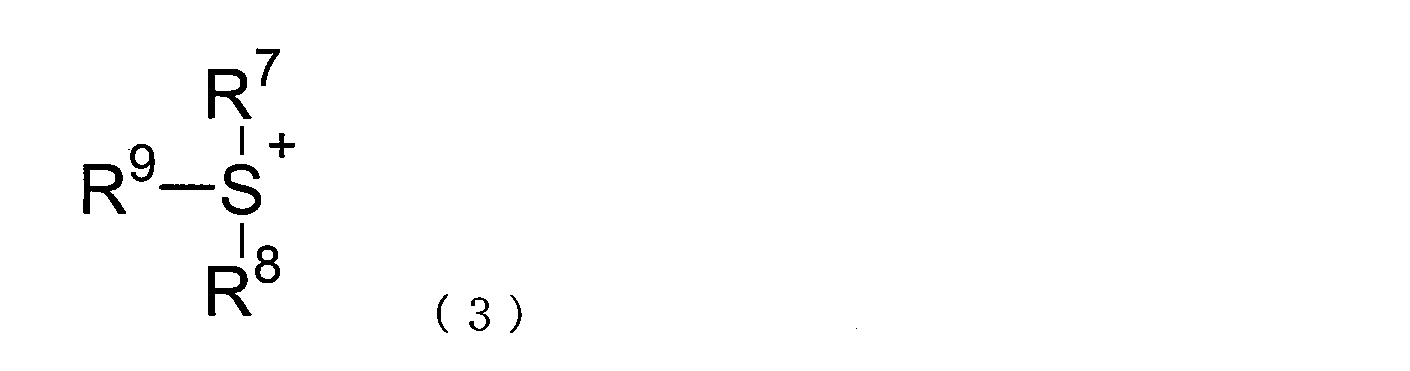
- R 7 ⁇ R 9 are each independently an unsubstituted or substituted alkyl group, a cycloalkyl group, an aryl group, an aralkyl group, an alkenyl group is a alkynyl group; or, R 7 ⁇ Part or all of R 9 together with the sulfur atom forms an unsubstituted or substituted 3- to 10-membered ring (wherein the ring may contain a hetero atom such as O or S).
- R 7 to R 9 not involved in the formation of the ring are as defined above.
- Specific examples of the substituted alkyl group include an alkoxy group and an alkanoyl group.
- the unsubstituted or substituted alkyl group preferably has 1 to 20 carbon atoms, and more preferably 1 to 16 carbon atoms.
- Typical examples of the onium cation represented by the general formula (2) include a quaternary ammonium cation and a quaternary phosphonium cation.
- quaternary ammonium cation examples include tetramethylammonium, ethyltrimethylammonium, diethyldimethylammonium, triethylmethylammonium, tetraethylammonium, tetra-n-butylammonium, trimethyl-n-propylammonium, trimethylisopropylammonium, n- Butyltrimethylammonium, isobutyltrimethylammonium, t-butyltrimethylammonium, n-hexyltrimethylammonium, dimethyldi-n-propylammonium, dimethyldiisopropylammonium, dimethyl-n-propylisopropylammonium, methyltri-n-propylammonium, methyltriisopropylammonium Methyldi-n-propylisopropylan Ni, methyl-n-propyldiisopropyl
- quaternary phosphonium cation examples include cations such as tetramethylphosphonium, triethylmethylphosphonium, and tetraethylphosphonium.
- imidazolium cation examples include 1,3-dimethylimidazolium, 1,2,3-trimethylimidazolium, 1-ethyl-3-methylimidazolium, 1-ethyl-2,3-dimethylimidazolium, 1 -Methyl-3-n-octylimidazolium, 1-hexyl-3-methylimidazolium, 1,3-diethylimidazolium, 1,2-diethyl-3-methylimidazolium, 1,3-diethyl-2-methyl Imidazolium, 1,2-dimethyl-3-n-propylimidazolium, 1-n-butyl-3-methylimidazolium, 1-n-butyl-2,3-dimethylimidazolium, 1,2,4-trimethyl -3-n-propylimidazolium, 1,2,3,4-tetramethylimidazolium, 1,2,3,4,5-pentame Louis imidazolium, 2-ethyl
- pyridinium cation examples include cations such as 1-methylpyridinium, 1-ethylpyridinium, 1-n-propylpyridinium, 1-isopropylpyridinium, 1-n-butylpyridinium, 1-n-butyl-3-methylpyridinium, and the like.
- tertiary sulfonium cation represented by the general formula (3) include cations such as trimethylsulfonium, triethylsulfonium, tripropylsulfonium, and triphenylsulfonium.
- quaternary ammonium cations, imidazolium cations, pyridinium cations are superior in terms of excellent solubility in 2-cyanoacrylate and the balance between curing acceleration ability and storage stability of the adhesive composition.
- a tertiary sulfonium cation is preferable, and a quaternary ammonium cation, an imidazolium cation, or a pyridinium cation is more preferable.
- the onium salt of the present invention can be produced by a known method.
- Martin Beran et al. Anorg. Allg. Chem. , 2005, 631, 55-59 a bis (fluorosulfonyl) imide anion is prepared from urea and fluorosulfonic acid, followed by Hiroyuki Ohno et al. Am. Chem. SOc. , 2005, 27, 2398-2399, or Peter Waserscheid et al., Green Chemistry, 2002, 4, 134-138, which can be reacted with the corresponding onium halide.
- the content of the onium salt (b) in the adhesive composition is preferably 10 to 20000 ppm, more preferably 25 to 15000 ppm with respect to 100 parts by mass of the 2-cyanoacrylate (a). More preferably, it is 50 to 10,000 ppm.
- the content is in the above range, the effect as a curing accelerator is sufficiently exhibited, and the storage stability of the adhesive composition is well maintained.
- the onium salt can improve the adhesion rate to metals and thermoplastic elastomers without adversely affecting the storage stability of the adhesive composition. Since the conjugate acid of the low nucleophilic anion that constitutes the onium salt is a strong acid, it reacts with the salt present on the surface of the adherend and has nucleophilicity to initiate polymerization of 2-cyanoacrylate. Liberates anions that can be agents. On the other hand, during storage in the absence of such a salt, the anion exchange reaction and subsequent release of a highly reactive anion do not occur, so that it is considered that the storage stability is also good.
- a curing accelerator other than the onium salt a curing accelerator that is conventionally used by blending with this type of adhesive composition can be blended.
- the agent include polyalkylene oxides, crown ethers, silacrown ethers, calixarenes, cyclodextrins, and pyrogallol cyclic compounds.
- polyalkylene oxides examples include polyalkylene oxides and derivatives thereof.
- calixarenes examples include those disclosed in JP-A-60-179482, JP-A-62-235379, JP-A-63-88152, and the like. Specifically, 5,11,17,23,29,35-hexa-tert-butyl-37,38,39,40,41,42-hexahydroxycalix [6] arene, 37,38,39, 40,41,42-hexahydroxyoxycalix [6] arene, 37,38,39,40,41,42-hexa- (2-oxo-2-ethoxy) -ethoxycalix [6] arene, 25,26, 27,28-tetra- (2-oxo-2-ethoxy) -ethoxycalix [4] arene, 4-tert-butylcalix [4] arene-0,0 ', 0' ', 0' '-tetraacetic acid Tetraethyl etc.
- Examples of cyclodextrins include those disclosed in JP-T-5-505835. Specific examples include ⁇ -, ⁇ -, and ⁇ -cyclodextrin.
- Examples of pyrogallol-based cyclic compounds include compounds disclosed in JP 2000-191600 A. Specifically, 3, 4, 5, 10, 11, 12, 17, 18, 19, 24, 25, 26-dodecaethoxycarbomethoxy-C-1, C-8, C-15, C-22 And tetramethyl [14] -metacyclophane. These curing accelerators may be used alone or in combination of two or more.
- a stabilizer in addition to the curing accelerator, a stabilizer, a plasticizer, and a thickener that are conventionally used by blending with an adhesive composition containing 2-cyanoacrylate ester.
- particles, colorants, fragrances, solvents, strength improvers, and the like can be blended in appropriate amounts within a range that does not impair the curability and adhesive strength of the adhesive composition.
- Stabilizers include (1) aliphatic sulfonic acids such as sulfur dioxide and methanesulfonic acid, aromatic sulfonic acids such as p-toluenesulfonic acid, trifluoride such as boron trifluoride methanol and boron trifluoride diethyl ether.
- Anionic polymerization inhibitors such as boron complexes, HBF 4 , and trialkyl borates, and (2) radical polymerization inhibitors such as hydroquinone, hydroquinone monomethyl ether, t-butylcatechol, catechol, and pyrogallol. These stabilizers may be used alone or in combination of two or more.
- tributyl acetyl citrate dimethyl adipate, dimethyl phthalate, 2-ethylhexyl benzoate, and dipropylene glycol have good compatibility with 2-cyanoacrylate and high plasticization efficiency.
- Dibenzoate is preferred.
- These plasticizers may be used alone or in combination of two or more.
- Example 1 40 ppm sulfur dioxide and 1000 ppm hydroquinone (100 parts by mass of ethyl 2-cyanoacrylate) are added to ethyl 2-cyanoacrylate, and 1-ethyl-3-methylimidazolium bis (fluorosulfonyl) imide is added thereto.
- Product name “Elexcel AS-110” manufactured by Dai-ichi Kogyo Seiyaku Co., Ltd.) was mixed at 100 ppm (see Table 1), and stirred and mixed at room temperature (15 to 30 ° C.) for 30 minutes to produce an adhesive composition.
- the adhesion speed, viscosity, storage stability, and cured product appearance to aluminum, iron and thermoplastic elastomer were evaluated. The results are shown in Table 2.
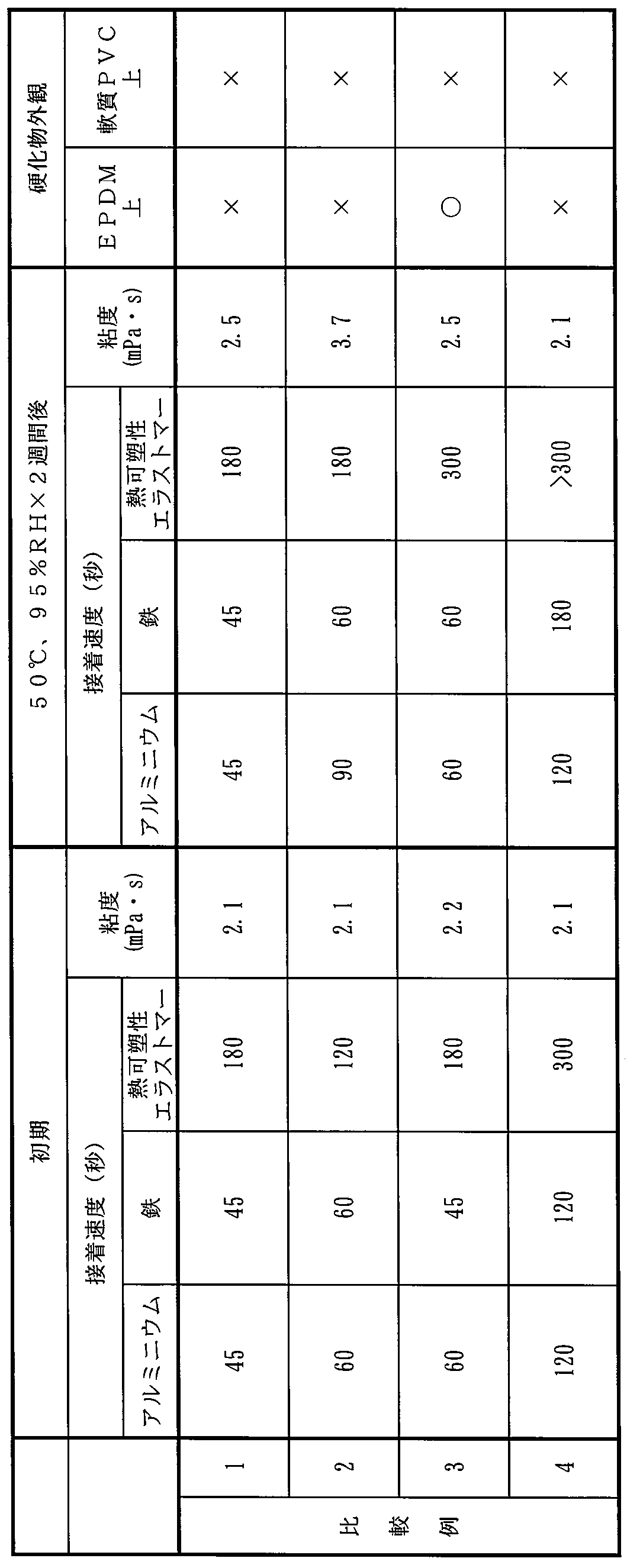
- Examples 2 to 10 and Comparative Examples 1 to 4 An adhesive composition was produced and evaluated in the same manner as in Example 1 except that the onium salt or the curing accelerator to be blended in the adhesive composition was changed as shown in Tables 1 and 3. The results are shown in Tables 2 and 4.
- the present invention contains 2-cyanoacrylic acid ester and can be used as a so-called instantaneous adhesive in a wide range of products and technical fields such as various households in addition to general household and medical fields. In particular, it is useful for applications requiring adhesion for a short time on a metal or a low-polarity adherend.
Landscapes
- Chemical & Material Sciences (AREA)
- Organic Chemistry (AREA)
- Health & Medical Sciences (AREA)
- Chemical Kinetics & Catalysis (AREA)
- Medicinal Chemistry (AREA)
- Polymers & Plastics (AREA)
- Adhesives Or Adhesive Processes (AREA)
Abstract
Description
また、クラウンエーテル類、又はポリアルキレンオキサイド類を含有する特許文献1~2に開示される接着剤組成物は、被着体をEPDM、メタクリル樹脂などとした場合、硬化物が白濁する問題があった。カリックスアレン誘導体を含有する特許文献3~4に開示される接着剤組成物は、被着体を軟質PVCとした場合には同様に硬化物が白濁する問題があった。
1.2-シアノアクリル酸エステル(a)と、下記一般式(1)で表されるオニウム塩(b)とを含有する2-シアノアクリレート系接着剤組成物。
C+A- (1)
[式(1)において、C+はオニウムカチオンであり、A-はビス(フルオロスルホニル)イミドアニオンである。]
2.前記オニウム塩(b)のカチオンが、第四級アンモニウムカチオン、イミダゾリウムカチオン、ピリジニウムカチオン、及び第三級スルホニウムカチオンからなる群より選択される少なくとも一つのオニウムカチオンである前記1に記載の2-シアノアクリレート系接着剤組成物。
3.前記オニウム塩(b)の含有量が、前記2-シアノアクリル酸エステル(a)100質量部に対して、10~20000ppmである前記1又は2に記載の2-シアノアクリレート系接着剤組成物。
本発明の接着剤組成物は、2-シアノアクリル酸エステル(a)と、特定の構造を有するオニウム塩(b)とを含有する。
C+A- (1)
[式(1)において、C+はオニウムカチオンであり、A-はビス(フルオロスルホニル)イミドアニオンである。]

(1)接着速度
JIS K 6861「α-シアノアクリレート系接着剤の試験方法」に準じて、23℃、60%RH環境下で接着速度を測定した。使用した試験片は次のとおりである。
・アルミニウム:日本テストパネル社製、アルミニウム試験片(材質:A1050P)
・鉄:日本テストパネル社製、鉄試験片(材質S10C)
・スチレン系熱可塑性エラストマー:リケンテクノス社製 商品名「アクティマー AE-2060S」
(2)粘度
E型粘度計を用い、25℃、100rpmの条件下にて測定した。
(3)貯蔵安定性
初期の接着速度及び粘度と、50℃、95%RH環境下で2週間保管後の接着速度及び粘度を比較して評価した。保管は、接着剤組成物1.5gを2gポリエチレン容器に密封して行った。
(4)硬化物外観
縦25mm×横50mm×厚さ3mmのEPDM(エチレンプロピレンゴム)板、及び軟質PVC(ポリ塩化ビニル)板の平面に、接着剤組成物を数滴垂らし、23℃、60%RH環境下で3日間放置し、硬化させた。その硬化物の外観を目視で観察し、評価結果は○×で表した。「○」は、硬化物に白濁及びシワがないことを、「×」は硬化物に白濁又はシワが見られることを示す。使用した試験片は次のとおりである。
・EPDM:中京ゴム社製、EPDM-5065/3t
・軟質PVC:日本ウェーブロック社製、商品名「タフニール Dブルー」
・実施例1
2-シアノアクリル酸エチルに、二酸化硫黄を40ppm、ハイドロキノンを1000ppm(2-シアノアクリル酸エチルを100質量部とする)配合し、これに1-エチル-3-メチルイミダゾリウムビス(フルオロスルホニル)イミド(第一工業製薬社製 商品名「エレクセルAS-110」)を100ppm(表1参照)配合して、室温(15~30℃)で30分間撹拌、混合して接着剤組成物を製造した。得られた接着剤組成物を用いて、アルミニウム、鉄及び熱可塑性エラストマーに対する接着速度、粘度、貯蔵安定性、並びに硬化物外観を評価した。結果は表2のとおりである。
接着剤組成物に配合するオニウム塩、又は硬化促進剤を表1、3のように代えた以外は、実施例1と同様にして接着剤組成物を製造して評価した。結果は表2、4のとおりである。


Claims (3)
- 2-シアノアクリル酸エステル(a)と、下記一般式(1)で表されるオニウム塩(b)とを含有する2-シアノアクリレート系接着剤組成物。
C+A- (1)
[式(1)において、C+はオニウムカチオンであり、A-はビス(フルオロスルホニル)イミドアニオンである。] - 前記オニウム塩(b)のカチオンが、第四級アンモニウムカチオン、イミダゾリウムカチオン、ピリジニウムカチオン、及び第三級スルホニウムカチオンからなる群より選択される少なくとも一つのオニウムカチオンである請求項1に記載の2-シアノアクリレート系接着剤組成物。
- 前記オニウム塩(b)の含有量が、前記2-シアノアクリル酸エステル(a)100質量部に対して、10~20000ppmである請求項1又は2に記載の2-シアノアクリレート系接着剤組成物。
Priority Applications (2)
| Application Number | Priority Date | Filing Date | Title |
|---|---|---|---|
| JP2016507449A JP6273538B2 (ja) | 2014-03-12 | 2015-02-27 | 2−シアノアクリレート系接着剤組成物 |
| US15/124,293 US9611378B2 (en) | 2014-03-12 | 2015-02-27 | 2-cyanoacrylate adhesive composition |
Applications Claiming Priority (2)
| Application Number | Priority Date | Filing Date | Title |
|---|---|---|---|
| JP2014-048607 | 2014-03-12 | ||
| JP2014048607 | 2014-03-12 |
Publications (1)
| Publication Number | Publication Date |
|---|---|
| WO2015137156A1 true WO2015137156A1 (ja) | 2015-09-17 |
Family
ID=54071604
Family Applications (1)
| Application Number | Title | Priority Date | Filing Date |
|---|---|---|---|
| PCT/JP2015/055827 Ceased WO2015137156A1 (ja) | 2014-03-12 | 2015-02-27 | 2-シアノアクリレート系接着剤組成物 |
Country Status (4)
| Country | Link |
|---|---|
| US (1) | US9611378B2 (ja) |
| JP (1) | JP6273538B2 (ja) |
| TW (1) | TWI655262B (ja) |
| WO (1) | WO2015137156A1 (ja) |
Cited By (1)
| Publication number | Priority date | Publication date | Assignee | Title |
|---|---|---|---|---|
| JP2023072131A (ja) * | 2021-11-12 | 2023-05-24 | 田岡化学工業株式会社 | 2-シアノアクリレート及びその製造方法 |
Families Citing this family (2)
| Publication number | Priority date | Publication date | Assignee | Title |
|---|---|---|---|---|
| US11970641B2 (en) * | 2017-03-02 | 2024-04-30 | Nitto Denko Corporation | Ionic compositions and related uses thereof |
| US11267707B2 (en) | 2019-04-16 | 2022-03-08 | Honeywell International Inc | Purification of bis(fluorosulfonyl) imide |
Citations (6)
| Publication number | Priority date | Publication date | Assignee | Title |
|---|---|---|---|---|
| JPS5889674A (ja) * | 1981-11-20 | 1983-05-28 | ミネソタ・マイニング・アンド・マニユフアクチユアリング・コンパニ− | 接着剤および接着法 |
| JPS62100567A (ja) * | 1985-10-26 | 1987-05-11 | Toagosei Chem Ind Co Ltd | 硬化性組成物 |
| GB2228943A (en) * | 1989-03-06 | 1990-09-12 | Loctite | Cyanoacrylate compositions for bonding porous or non-active substrates |
| JP2000516289A (ja) * | 1996-08-16 | 2000-12-05 | ロックタイト(アイルランド)リミテッド | 改良された熱的およびガラス結合性能を有するシアノアクリレート組成物 |
| JP2011529979A (ja) * | 2008-07-31 | 2011-12-15 | エシコン・インコーポレイテッド | シアノアクリレート処方の発熱制御 |
| WO2014042082A1 (ja) * | 2012-09-11 | 2014-03-20 | 東亞合成株式会社 | 2-シアノアクリレート系接着剤組成物 |
Family Cites Families (5)
| Publication number | Priority date | Publication date | Assignee | Title |
|---|---|---|---|---|
| JPS53129231A (en) | 1977-04-19 | 1978-11-11 | Toagosei Chem Ind Co Ltd | Adhesion composition |
| JPS60179482A (ja) | 1984-01-27 | 1985-09-13 | ロクタイト.(アイルランド).リミテッド | 瞬間接着剤組成物 |
| JPS63128088A (ja) | 1986-11-17 | 1988-05-31 | Koatsu Gas Kogyo Kk | α−シアノアクリレ−ト接着剤組成物 |
| JP4347437B2 (ja) | 1998-07-29 | 2009-10-21 | 高圧ガス工業株式会社 | 瞬間接着剤組成物 |
| US20080003196A1 (en) * | 2006-06-30 | 2008-01-03 | Jonn Jerry Y | Absorbable cyanoacrylate compositions |
-
2015
- 2015-02-27 JP JP2016507449A patent/JP6273538B2/ja active Active
- 2015-02-27 US US15/124,293 patent/US9611378B2/en active Active
- 2015-02-27 WO PCT/JP2015/055827 patent/WO2015137156A1/ja not_active Ceased
- 2015-03-02 TW TW104106432A patent/TWI655262B/zh active
Patent Citations (6)
| Publication number | Priority date | Publication date | Assignee | Title |
|---|---|---|---|---|
| JPS5889674A (ja) * | 1981-11-20 | 1983-05-28 | ミネソタ・マイニング・アンド・マニユフアクチユアリング・コンパニ− | 接着剤および接着法 |
| JPS62100567A (ja) * | 1985-10-26 | 1987-05-11 | Toagosei Chem Ind Co Ltd | 硬化性組成物 |
| GB2228943A (en) * | 1989-03-06 | 1990-09-12 | Loctite | Cyanoacrylate compositions for bonding porous or non-active substrates |
| JP2000516289A (ja) * | 1996-08-16 | 2000-12-05 | ロックタイト(アイルランド)リミテッド | 改良された熱的およびガラス結合性能を有するシアノアクリレート組成物 |
| JP2011529979A (ja) * | 2008-07-31 | 2011-12-15 | エシコン・インコーポレイテッド | シアノアクリレート処方の発熱制御 |
| WO2014042082A1 (ja) * | 2012-09-11 | 2014-03-20 | 東亞合成株式会社 | 2-シアノアクリレート系接着剤組成物 |
Cited By (2)
| Publication number | Priority date | Publication date | Assignee | Title |
|---|---|---|---|---|
| JP2023072131A (ja) * | 2021-11-12 | 2023-05-24 | 田岡化学工業株式会社 | 2-シアノアクリレート及びその製造方法 |
| JP7853059B2 (ja) | 2021-11-12 | 2026-04-28 | 田岡化学工業株式会社 | 2-シアノアクリレート及びその製造方法 |
Also Published As
| Publication number | Publication date |
|---|---|
| TWI655262B (zh) | 2019-04-01 |
| US20170015814A1 (en) | 2017-01-19 |
| TW201534675A (zh) | 2015-09-16 |
| JP6273538B2 (ja) | 2018-02-07 |
| US9611378B2 (en) | 2017-04-04 |
| JPWO2015137156A1 (ja) | 2017-04-06 |
Similar Documents
| Publication | Publication Date | Title |
|---|---|---|
| JP5556977B1 (ja) | 2−シアノアクリレート系接着剤組成物 | |
| JP6273536B2 (ja) | 接着剤組成物 | |
| TWI711680B (zh) | 黏著劑組成物 | |
| JP6273538B2 (ja) | 2−シアノアクリレート系接着剤組成物 | |
| CN107108771A (zh) | 二液型固化性组合物 | |
| JP5326556B2 (ja) | 接着剤組成物 | |
| JP6241375B2 (ja) | 着色された2−シアノアクリレート系接着剤組成物 | |
| JP2013112766A (ja) | 2−シアノアクリレート系接着剤組成物 | |
| JP6354836B2 (ja) | 2−シアノアクリレート系接着剤組成物 | |
| JP6032193B2 (ja) | 2−シアノアクリレート系接着剤組成物 | |
| JP6702415B2 (ja) | 2−シアノアクリレート系接着剤組成物 | |
| JP2020012060A (ja) | 2−シアノアクリレート系接着剤組成物 |
Legal Events
| Date | Code | Title | Description |
|---|---|---|---|
| 121 | Ep: the epo has been informed by wipo that ep was designated in this application |
Ref document number: 15760836 Country of ref document: EP Kind code of ref document: A1 |
|
| WWE | Wipo information: entry into national phase |
Ref document number: 15124293 Country of ref document: US |
|
| ENP | Entry into the national phase |
Ref document number: 2016507449 Country of ref document: JP Kind code of ref document: A |
|
| NENP | Non-entry into the national phase |
Ref country code: DE |
|
| 122 | Ep: pct application non-entry in european phase |
Ref document number: 15760836 Country of ref document: EP Kind code of ref document: A1 |