WO2015137127A1 - パンツタイプ使い捨ておむつ - Google Patents
パンツタイプ使い捨ておむつ Download PDFInfo
- Publication number
- WO2015137127A1 WO2015137127A1 PCT/JP2015/055557 JP2015055557W WO2015137127A1 WO 2015137127 A1 WO2015137127 A1 WO 2015137127A1 JP 2015055557 W JP2015055557 W JP 2015055557W WO 2015137127 A1 WO2015137127 A1 WO 2015137127A1
- Authority
- WO
- WIPO (PCT)
- Prior art keywords
- waist
- exterior body
- interior body
- width direction
- exterior
- Prior art date
- Legal status (The legal status is an assumption and is not a legal conclusion. Google has not performed a legal analysis and makes no representation as to the accuracy of the status listed.)
- Ceased
Links
Images








Classifications
-
- A—HUMAN NECESSITIES
- A61—MEDICAL OR VETERINARY SCIENCE; HYGIENE
- A61F—FILTERS IMPLANTABLE INTO BLOOD VESSELS; PROSTHESES; DEVICES PROVIDING PATENCY TO, OR PREVENTING COLLAPSING OF, TUBULAR STRUCTURES OF THE BODY, e.g. STENTS; ORTHOPAEDIC, NURSING OR CONTRACEPTIVE DEVICES; FOMENTATION; TREATMENT OR PROTECTION OF EYES OR EARS; BANDAGES, DRESSINGS OR ABSORBENT PADS; FIRST-AID KITS
- A61F13/00—Bandages or dressings; Absorbent pads
- A61F13/15—Absorbent pads, e.g. sanitary towels, swabs or tampons for external or internal application to the body; Supporting or fastening means therefor; Tampon applicators
- A61F13/45—Absorbent pads, e.g. sanitary towels, swabs or tampons for external or internal application to the body; Supporting or fastening means therefor; Tampon applicators characterised by the shape
- A61F13/49—Absorbent pads, e.g. sanitary towels, swabs or tampons for external or internal application to the body; Supporting or fastening means therefor; Tampon applicators characterised by the shape specially adapted to be worn around the waist, e.g. diapers or nappies
- A61F13/493—Absorbent pads, e.g. sanitary towels, swabs or tampons for external or internal application to the body; Supporting or fastening means therefor; Tampon applicators characterised by the shape specially adapted to be worn around the waist, e.g. diapers or nappies adjustable by adding or removing material, e.g. umbilical cord arrangements
-
- A—HUMAN NECESSITIES
- A61—MEDICAL OR VETERINARY SCIENCE; HYGIENE
- A61F—FILTERS IMPLANTABLE INTO BLOOD VESSELS; PROSTHESES; DEVICES PROVIDING PATENCY TO, OR PREVENTING COLLAPSING OF, TUBULAR STRUCTURES OF THE BODY, e.g. STENTS; ORTHOPAEDIC, NURSING OR CONTRACEPTIVE DEVICES; FOMENTATION; TREATMENT OR PROTECTION OF EYES OR EARS; BANDAGES, DRESSINGS OR ABSORBENT PADS; FIRST-AID KITS
- A61F13/00—Bandages or dressings; Absorbent pads
- A61F13/15—Absorbent pads, e.g. sanitary towels, swabs or tampons for external or internal application to the body; Supporting or fastening means therefor; Tampon applicators
- A61F13/45—Absorbent pads, e.g. sanitary towels, swabs or tampons for external or internal application to the body; Supporting or fastening means therefor; Tampon applicators characterised by the shape
- A61F13/49—Absorbent pads, e.g. sanitary towels, swabs or tampons for external or internal application to the body; Supporting or fastening means therefor; Tampon applicators characterised by the shape specially adapted to be worn around the waist, e.g. diapers or nappies
- A61F13/49007—Form-fitting, self-adjusting disposable diapers
- A61F13/49009—Form-fitting, self-adjusting disposable diapers with elastic means
- A61F13/49011—Form-fitting, self-adjusting disposable diapers with elastic means the elastic means is located at the waist region
-
- A—HUMAN NECESSITIES
- A61—MEDICAL OR VETERINARY SCIENCE; HYGIENE
- A61F—FILTERS IMPLANTABLE INTO BLOOD VESSELS; PROSTHESES; DEVICES PROVIDING PATENCY TO, OR PREVENTING COLLAPSING OF, TUBULAR STRUCTURES OF THE BODY, e.g. STENTS; ORTHOPAEDIC, NURSING OR CONTRACEPTIVE DEVICES; FOMENTATION; TREATMENT OR PROTECTION OF EYES OR EARS; BANDAGES, DRESSINGS OR ABSORBENT PADS; FIRST-AID KITS
- A61F13/00—Bandages or dressings; Absorbent pads
- A61F13/15—Absorbent pads, e.g. sanitary towels, swabs or tampons for external or internal application to the body; Supporting or fastening means therefor; Tampon applicators
- A61F13/45—Absorbent pads, e.g. sanitary towels, swabs or tampons for external or internal application to the body; Supporting or fastening means therefor; Tampon applicators characterised by the shape
- A61F13/49—Absorbent pads, e.g. sanitary towels, swabs or tampons for external or internal application to the body; Supporting or fastening means therefor; Tampon applicators characterised by the shape specially adapted to be worn around the waist, e.g. diapers or nappies
- A61F13/494—Absorbent pads, e.g. sanitary towels, swabs or tampons for external or internal application to the body; Supporting or fastening means therefor; Tampon applicators characterised by the shape specially adapted to be worn around the waist, e.g. diapers or nappies characterised by edge leakage prevention means
- A61F13/49406—Absorbent pads, e.g. sanitary towels, swabs or tampons for external or internal application to the body; Supporting or fastening means therefor; Tampon applicators characterised by the shape specially adapted to be worn around the waist, e.g. diapers or nappies characterised by edge leakage prevention means the edge leakage prevention means being at the crotch region
-
- A—HUMAN NECESSITIES
- A61—MEDICAL OR VETERINARY SCIENCE; HYGIENE
- A61F—FILTERS IMPLANTABLE INTO BLOOD VESSELS; PROSTHESES; DEVICES PROVIDING PATENCY TO, OR PREVENTING COLLAPSING OF, TUBULAR STRUCTURES OF THE BODY, e.g. STENTS; ORTHOPAEDIC, NURSING OR CONTRACEPTIVE DEVICES; FOMENTATION; TREATMENT OR PROTECTION OF EYES OR EARS; BANDAGES, DRESSINGS OR ABSORBENT PADS; FIRST-AID KITS
- A61F13/00—Bandages or dressings; Absorbent pads
- A61F13/15—Absorbent pads, e.g. sanitary towels, swabs or tampons for external or internal application to the body; Supporting or fastening means therefor; Tampon applicators
- A61F13/45—Absorbent pads, e.g. sanitary towels, swabs or tampons for external or internal application to the body; Supporting or fastening means therefor; Tampon applicators characterised by the shape
- A61F13/49—Absorbent pads, e.g. sanitary towels, swabs or tampons for external or internal application to the body; Supporting or fastening means therefor; Tampon applicators characterised by the shape specially adapted to be worn around the waist, e.g. diapers or nappies
- A61F13/496—Absorbent pads, e.g. sanitary towels, swabs or tampons for external or internal application to the body; Supporting or fastening means therefor; Tampon applicators characterised by the shape specially adapted to be worn around the waist, e.g. diapers or nappies in the form of pants or briefs
-
- A—HUMAN NECESSITIES
- A61—MEDICAL OR VETERINARY SCIENCE; HYGIENE
- A61F—FILTERS IMPLANTABLE INTO BLOOD VESSELS; PROSTHESES; DEVICES PROVIDING PATENCY TO, OR PREVENTING COLLAPSING OF, TUBULAR STRUCTURES OF THE BODY, e.g. STENTS; ORTHOPAEDIC, NURSING OR CONTRACEPTIVE DEVICES; FOMENTATION; TREATMENT OR PROTECTION OF EYES OR EARS; BANDAGES, DRESSINGS OR ABSORBENT PADS; FIRST-AID KITS
- A61F13/00—Bandages or dressings; Absorbent pads
- A61F13/15—Absorbent pads, e.g. sanitary towels, swabs or tampons for external or internal application to the body; Supporting or fastening means therefor; Tampon applicators
- A61F13/51—Absorbent pads, e.g. sanitary towels, swabs or tampons for external or internal application to the body; Supporting or fastening means therefor; Tampon applicators characterised by the outer layers of the pads
- A61F13/511—Topsheet, i.e. the permeable cover or layer facing the skin
- A61F13/51104—Topsheet, i.e. the permeable cover or layer facing the skin the top sheet having a three-dimensional cross-section, e.g. corrugations, embossments, recesses or projections
- A61F13/51108—Topsheet, i.e. the permeable cover or layer facing the skin the top sheet having a three-dimensional cross-section, e.g. corrugations, embossments, recesses or projections the top sheet having corrugations or embossments having one axis relatively longer than the other axis, e.g. forming channels or grooves in a longitudinal direction
-
- A—HUMAN NECESSITIES
- A61—MEDICAL OR VETERINARY SCIENCE; HYGIENE
- A61F—FILTERS IMPLANTABLE INTO BLOOD VESSELS; PROSTHESES; DEVICES PROVIDING PATENCY TO, OR PREVENTING COLLAPSING OF, TUBULAR STRUCTURES OF THE BODY, e.g. STENTS; ORTHOPAEDIC, NURSING OR CONTRACEPTIVE DEVICES; FOMENTATION; TREATMENT OR PROTECTION OF EYES OR EARS; BANDAGES, DRESSINGS OR ABSORBENT PADS; FIRST-AID KITS
- A61F13/00—Bandages or dressings; Absorbent pads
- A61F13/15—Absorbent pads, e.g. sanitary towels, swabs or tampons for external or internal application to the body; Supporting or fastening means therefor; Tampon applicators
- A61F13/51—Absorbent pads, e.g. sanitary towels, swabs or tampons for external or internal application to the body; Supporting or fastening means therefor; Tampon applicators characterised by the outer layers of the pads
- A61F13/514—Backsheet, i.e. the impermeable cover or layer furthest from the skin
- A61F13/51474—Backsheet, i.e. the impermeable cover or layer furthest from the skin characterised by its structure
- A61F13/51476—Backsheet, i.e. the impermeable cover or layer furthest from the skin characterised by its structure being three-dimensional, e.g. embossed, textured, pleated, or with three-dimensional features, like gathers or loops
-
- A—HUMAN NECESSITIES
- A61—MEDICAL OR VETERINARY SCIENCE; HYGIENE
- A61F—FILTERS IMPLANTABLE INTO BLOOD VESSELS; PROSTHESES; DEVICES PROVIDING PATENCY TO, OR PREVENTING COLLAPSING OF, TUBULAR STRUCTURES OF THE BODY, e.g. STENTS; ORTHOPAEDIC, NURSING OR CONTRACEPTIVE DEVICES; FOMENTATION; TREATMENT OR PROTECTION OF EYES OR EARS; BANDAGES, DRESSINGS OR ABSORBENT PADS; FIRST-AID KITS
- A61F13/00—Bandages or dressings; Absorbent pads
- A61F13/15—Absorbent pads, e.g. sanitary towels, swabs or tampons for external or internal application to the body; Supporting or fastening means therefor; Tampon applicators
- A61F13/53—Absorbent pads, e.g. sanitary towels, swabs or tampons for external or internal application to the body; Supporting or fastening means therefor; Tampon applicators characterised by the absorbing medium
- A61F13/534—Absorbent pads, e.g. sanitary towels, swabs or tampons for external or internal application to the body; Supporting or fastening means therefor; Tampon applicators characterised by the absorbing medium having an inhomogeneous composition through the thickness of the pad
-
- A—HUMAN NECESSITIES
- A61—MEDICAL OR VETERINARY SCIENCE; HYGIENE
- A61F—FILTERS IMPLANTABLE INTO BLOOD VESSELS; PROSTHESES; DEVICES PROVIDING PATENCY TO, OR PREVENTING COLLAPSING OF, TUBULAR STRUCTURES OF THE BODY, e.g. STENTS; ORTHOPAEDIC, NURSING OR CONTRACEPTIVE DEVICES; FOMENTATION; TREATMENT OR PROTECTION OF EYES OR EARS; BANDAGES, DRESSINGS OR ABSORBENT PADS; FIRST-AID KITS
- A61F13/00—Bandages or dressings; Absorbent pads
- A61F13/15—Absorbent pads, e.g. sanitary towels, swabs or tampons for external or internal application to the body; Supporting or fastening means therefor; Tampon applicators
- A61F13/53—Absorbent pads, e.g. sanitary towels, swabs or tampons for external or internal application to the body; Supporting or fastening means therefor; Tampon applicators characterised by the absorbing medium
- A61F13/539—Absorbent pads, e.g. sanitary towels, swabs or tampons for external or internal application to the body; Supporting or fastening means therefor; Tampon applicators characterised by the absorbing medium characterised by the connection of the absorbent layers with each other or with the outer layers
-
- A—HUMAN NECESSITIES
- A61—MEDICAL OR VETERINARY SCIENCE; HYGIENE
- A61F—FILTERS IMPLANTABLE INTO BLOOD VESSELS; PROSTHESES; DEVICES PROVIDING PATENCY TO, OR PREVENTING COLLAPSING OF, TUBULAR STRUCTURES OF THE BODY, e.g. STENTS; ORTHOPAEDIC, NURSING OR CONTRACEPTIVE DEVICES; FOMENTATION; TREATMENT OR PROTECTION OF EYES OR EARS; BANDAGES, DRESSINGS OR ABSORBENT PADS; FIRST-AID KITS
- A61F13/00—Bandages or dressings; Absorbent pads
- A61F13/15—Absorbent pads, e.g. sanitary towels, swabs or tampons for external or internal application to the body; Supporting or fastening means therefor; Tampon applicators
- A61F13/56—Supporting or fastening means
- A61F13/5622—Supporting or fastening means specially adapted for diapers or the like
- A61F13/565—Supporting or fastening means specially adapted for diapers or the like pants type diaper
- A61F13/5655—Supporting or fastening means specially adapted for diapers or the like pants type diaper adjustable pants type diapers
-
- A—HUMAN NECESSITIES
- A61—MEDICAL OR VETERINARY SCIENCE; HYGIENE
- A61F—FILTERS IMPLANTABLE INTO BLOOD VESSELS; PROSTHESES; DEVICES PROVIDING PATENCY TO, OR PREVENTING COLLAPSING OF, TUBULAR STRUCTURES OF THE BODY, e.g. STENTS; ORTHOPAEDIC, NURSING OR CONTRACEPTIVE DEVICES; FOMENTATION; TREATMENT OR PROTECTION OF EYES OR EARS; BANDAGES, DRESSINGS OR ABSORBENT PADS; FIRST-AID KITS
- A61F13/00—Bandages or dressings; Absorbent pads
- A61F13/15—Absorbent pads, e.g. sanitary towels, swabs or tampons for external or internal application to the body; Supporting or fastening means therefor; Tampon applicators
- A61F13/51—Absorbent pads, e.g. sanitary towels, swabs or tampons for external or internal application to the body; Supporting or fastening means therefor; Tampon applicators characterised by the outer layers of the pads
- A61F13/511—Topsheet, i.e. the permeable cover or layer facing the skin
- A61F13/513—Topsheet, i.e. the permeable cover or layer facing the skin characterised by its function or properties, e.g. stretchability, breathability, rewet, visual effect; having areas of different permeability
- A61F2013/51338—Topsheet, i.e. the permeable cover or layer facing the skin characterised by its function or properties, e.g. stretchability, breathability, rewet, visual effect; having areas of different permeability having improved touch or feeling, e.g. smooth film
-
- A—HUMAN NECESSITIES
- A61—MEDICAL OR VETERINARY SCIENCE; HYGIENE
- A61F—FILTERS IMPLANTABLE INTO BLOOD VESSELS; PROSTHESES; DEVICES PROVIDING PATENCY TO, OR PREVENTING COLLAPSING OF, TUBULAR STRUCTURES OF THE BODY, e.g. STENTS; ORTHOPAEDIC, NURSING OR CONTRACEPTIVE DEVICES; FOMENTATION; TREATMENT OR PROTECTION OF EYES OR EARS; BANDAGES, DRESSINGS OR ABSORBENT PADS; FIRST-AID KITS
- A61F13/00—Bandages or dressings; Absorbent pads
- A61F13/15—Absorbent pads, e.g. sanitary towels, swabs or tampons for external or internal application to the body; Supporting or fastening means therefor; Tampon applicators
- A61F13/51—Absorbent pads, e.g. sanitary towels, swabs or tampons for external or internal application to the body; Supporting or fastening means therefor; Tampon applicators characterised by the outer layers of the pads
- A61F13/511—Topsheet, i.e. the permeable cover or layer facing the skin
- A61F13/513—Topsheet, i.e. the permeable cover or layer facing the skin characterised by its function or properties, e.g. stretchability, breathability, rewet, visual effect; having areas of different permeability
- A61F2013/51355—Topsheet, i.e. the permeable cover or layer facing the skin characterised by its function or properties, e.g. stretchability, breathability, rewet, visual effect; having areas of different permeability for improving fluid flow
- A61F2013/51361—Topsheet, i.e. the permeable cover or layer facing the skin characterised by its function or properties, e.g. stretchability, breathability, rewet, visual effect; having areas of different permeability for improving fluid flow with pleats or folds
-
- A—HUMAN NECESSITIES
- A61—MEDICAL OR VETERINARY SCIENCE; HYGIENE
- A61F—FILTERS IMPLANTABLE INTO BLOOD VESSELS; PROSTHESES; DEVICES PROVIDING PATENCY TO, OR PREVENTING COLLAPSING OF, TUBULAR STRUCTURES OF THE BODY, e.g. STENTS; ORTHOPAEDIC, NURSING OR CONTRACEPTIVE DEVICES; FOMENTATION; TREATMENT OR PROTECTION OF EYES OR EARS; BANDAGES, DRESSINGS OR ABSORBENT PADS; FIRST-AID KITS
- A61F13/00—Bandages or dressings; Absorbent pads
- A61F13/15—Absorbent pads, e.g. sanitary towels, swabs or tampons for external or internal application to the body; Supporting or fastening means therefor; Tampon applicators
- A61F13/53—Absorbent pads, e.g. sanitary towels, swabs or tampons for external or internal application to the body; Supporting or fastening means therefor; Tampon applicators characterised by the absorbing medium
- A61F2013/530481—Absorbent pads, e.g. sanitary towels, swabs or tampons for external or internal application to the body; Supporting or fastening means therefor; Tampon applicators characterised by the absorbing medium having superabsorbent materials, i.e. highly absorbent polymer gel materials
-
- A—HUMAN NECESSITIES
- A61—MEDICAL OR VETERINARY SCIENCE; HYGIENE
- A61F—FILTERS IMPLANTABLE INTO BLOOD VESSELS; PROSTHESES; DEVICES PROVIDING PATENCY TO, OR PREVENTING COLLAPSING OF, TUBULAR STRUCTURES OF THE BODY, e.g. STENTS; ORTHOPAEDIC, NURSING OR CONTRACEPTIVE DEVICES; FOMENTATION; TREATMENT OR PROTECTION OF EYES OR EARS; BANDAGES, DRESSINGS OR ABSORBENT PADS; FIRST-AID KITS
- A61F13/00—Bandages or dressings; Absorbent pads
- A61F13/15—Absorbent pads, e.g. sanitary towels, swabs or tampons for external or internal application to the body; Supporting or fastening means therefor; Tampon applicators
- A61F13/53—Absorbent pads, e.g. sanitary towels, swabs or tampons for external or internal application to the body; Supporting or fastening means therefor; Tampon applicators characterised by the absorbing medium
- A61F13/534—Absorbent pads, e.g. sanitary towels, swabs or tampons for external or internal application to the body; Supporting or fastening means therefor; Tampon applicators characterised by the absorbing medium having an inhomogeneous composition through the thickness of the pad
- A61F2013/5349—Absorbent pads, e.g. sanitary towels, swabs or tampons for external or internal application to the body; Supporting or fastening means therefor; Tampon applicators characterised by the absorbing medium having an inhomogeneous composition through the thickness of the pad being a tissue-wrapped core
Definitions
- the present invention relates to a pants-type disposable diaper.
- both sides of the abdominal exterior body and both sides of the back exterior body are joined to form a cylindrical shape, and the center in the width direction of the inner surface of the abdominal exterior body To the central portion in the width direction of the inner surface of the back side exterior body, and an interior body that absorbs excrement, and the abdominal side exterior body and the back side exterior body are separated from each other without being continuous on the crotch side (For example, see Patent Documents 1 to 4).
- Such an exterior two-part type has the advantage that it is not necessary to punch out a leg opening for passing a leg, or even if it is punched out, a small area is required. That is, since the separation piece (hereinafter also referred to as trim) is disposed of, the waste of the material (hereinafter also referred to as trim loss) can be suppressed.
- the exterior body is configured to be able to extend to the crotch side, and the widthwise central part of the exterior body is extended to the crotch side with respect to both sides at the time of manufacture. It has been proposed that the edge of the leg opening located on the side of the interior body is obliquely upward toward the side edge, and the edge of the leg opening is shaped around the wearer's buttocks and the buttocks (See Patent Documents 3 and 4).
- the main problem of the present invention is to provide a pants-type disposable diaper of an exterior two-split type that can be manufactured without requiring an extension process of the exterior body, while being excellent in the fit of the edge around the leg. There is to do.
- the present invention that has solved the above problems is as follows.
- ⁇ Invention of Claim 1> An exterior having a ventral exterior body and a back exterior body, wherein a side edge of the abdominal exterior body and a side edge of the backside exterior body are joined on both sides in the width direction to form a waist opening.
- Body In a pants-type disposable diaper comprising: an interior body that extends from the center region in the width direction of the abdominal exterior body to the center region in the width direction of the back exterior body;
- the exterior body on at least one side of the abdominal exterior body and the back exterior body has an inner body joint portion formed by joining an edge on the crotch side of the central portion in the width direction to the interior body.
- the length in the front-rear direction on the waist side of the joint can be extended to the crotch side, With respect to the exterior body on the at least one side, a portion on the waist side from the interior body joint portion in the interior body is movable to the crotch side.
- a pants-type disposable diaper characterized by that.
- the front-rear direction length on the waist side of the exterior body joint portion of the exterior body is extended to the crotch side.
- the edge of the leg opening located on the side of the body is obliquely upward toward the side edge, and the edge of the leg opening is shaped along the circumference of the wearer's buttocks and the buttocks.
- Such deformation can be done by hand when using the product, or can be naturally performed as the diaper is pulled up to the waist and attached, or the force applied to the diaper after manufacture (for example, an elastic elastic member to improve fit) Can be carried out by the contraction force or the gravity applied to the interior body). Therefore, at least in the mounted state, the fit of the edge around the leg is excellent. Moreover, it becomes possible to manufacture without requiring an extension process of the outer package.
- the crotch side portion of the exterior body on at least one side is bent back and forth once or plural times in a zigzag manner, and both side edges thereof are fixed in a folded state, and the non-deployed portion is not
- a folded portion is formed as a fixed development part
- the inner body is joined to a portion on the tip side from the fold on the most tip side in the folded portion, and the inner body joint portion is formed,
- the folded portion is provided with an elongated oblique elastic elastic member that is fixed in an expanded state along the width direction in a state in which the entire width direction is folded, and becomes an oblique direction at the time of mounting.
- the extension structure of the exterior body is constituted by such a folded portion
- the edge of the leg opening located on the side of the exterior body in the exterior body when mounted is of course inclined upward toward the side edge. Since the contraction force of the oblique elastic elastic member acts along the edge, the edge of the leg opening fits well around the wearer's buttocks and along the buttocks without looseness.
- a separation portion including a slit or an elongated opening extending in the width direction from one side of the width direction center to the other side is provided,
- an elongated slanted elastic elastic member that is fixed in an expanded state along the width direction and that is slanted when mounted is provided. Due to the deformation that the crotch side portion of the spacing portion is separated to the crotch side with respect to the waist side portion, the length in the front-rear direction on the waist side relative to the interior body joint portion can be extended to the crotch side.
- the extension structure of the exterior body is constituted by such a separation portion
- the edge of the leg opening located on the side of the exterior body in the exterior body when mounted is of course inclined upward toward the side edge portion. Since the contraction force of the oblique elastic elastic member acts along the edge, the edge of the leg opening fits well around the wearer's buttocks and along the buttocks without looseness. Moreover, it is a very simple structure in which only a slit or the like is provided, there is no increase in material cost, and manufacturing is easy.
- the at least one side exterior body has at least a stretchability in the front-rear direction, so that the front-rear direction length on the waist side is extendable to the crotch side from the interior body joint portion.
- the extension structure of the exterior body is thus realized by the extensibility of the exterior body itself, the edge of the leg opening located on the side of the exterior body on the side of the exterior body at the time of wearing becomes obliquely upward toward the side edge.
- the edge of the leg opening fits well around the wearer's buttocks and along the buttocks. Moreover, it is realizable only by changing a sheet material.
- the structure with a short length on the back exterior body side of the interior body is suitable for products that do not require much back side absorption performance, such as toilet training pants for infants and incontinence pants for men.
- the interior body has a moving part extending to the waist side from the interior body joint portion in the exterior body on the at least one side, A portion that extends across the width of the interior body in the width direction from the interior body joint portion of the exterior body on the at least one side and extends in the width direction is fixed to portions located on both sides in the width direction of the moving part of the interior body.
- the pants-type disposable diaper according to any one of claims 1 to 4, further comprising a presser belt in which a portion passing through the moving portion of the interior body is not fixed.
- the moving part of the interior body can be pressed so as not to move unnecessarily or excessively, thereby preventing unintentional deformation such as bending or twisting of the moving part. it can.
- the interior body has a moving part extending to the waist side from the interior body joint portion in the exterior body on the at least one side, A portion extending on the waist side of the inner body joint portion in the at least one side outer body across the waist side end of the inner body in the width direction and located on both sides in the width direction of the moving portion of the inner body.
- the pants-type disposable diaper according to any one of claims 1 to 4, further comprising a connecting belt to which a waist side end of the interior body is connected.
- connection belt By providing such a connection belt, it is possible to prevent unnecessary or excessive movement by limiting the movement of the moving part of the interior body to a range allowed by loosening or bending of the connection belt, As a result, unintended deformations such as bending or twisting of the moving part can be prevented.
- the interior body has a moving part extending to the waist side from the interior body joint portion in the exterior body on the at least one side,
- the waist flap which protrudes from the inner surface of the waist edge part of the at least one side exterior body is provided, and the movement part of the interior body is extended to the waist flap, and is connected to the waist flap.
- the pants-type disposable diaper according to any one of 1 to 4.
- the interior body has a moving part extending to the waist side from the interior body joint portion in the exterior body on the at least one side, 5.
- a slip stopper that is weaker in the crotch direction than the shift stopper in the other direction is provided at a portion overlapping the moving portion in the exterior body on the at least one side.
- a pants-type disposable diaper according to item 1.
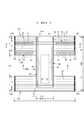
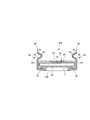
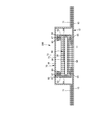
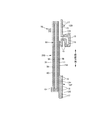
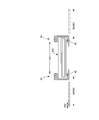
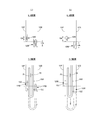
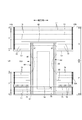
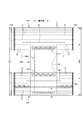
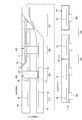
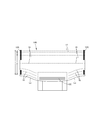
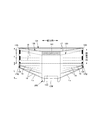
- FIG. 3 is a cross-sectional view taken along the line 3-3 in FIG. 1.
- FIG. 4 is a sectional view taken along line 4-4 of FIG.
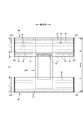
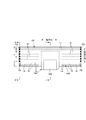
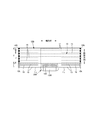
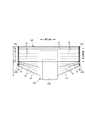
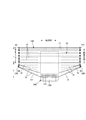
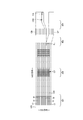
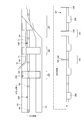
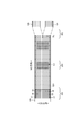
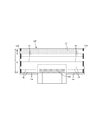
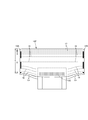
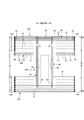
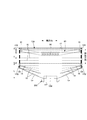
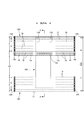
- FIG. 5 is a sectional view taken along the line 5-5 in FIG. It is sectional drawing which shows only the principal part of an underpants type disposable diaper with a dimension. It is a front view of the expansion state of a pants type disposable diaper. It is a rear view of the expansion state of a pants type disposable diaper.
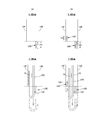
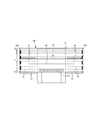
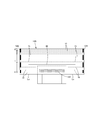
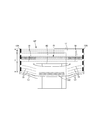
- FIG. 8 is a schematic view of a cross section taken along line 6-6 and line 7-7 in FIG. 7 in various forms.
- FIG. 8 is a schematic view of a cross section taken along line 6-6 and line 7-7 in FIG. 7 in various forms.
- FIG. 8 is a schematic view of a cross section taken along line 6-6 and line 7-7 in FIG. 7 in various forms.
- FIG. 5 is a sectional view taken along line 5-5 of FIG. It is a rear view of the expansion
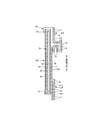
- FIG. 38 is a cross-sectional view along 8-8 in FIG. 37.
- FIG. 1 to FIG. 10 show an example of a pants-type disposable diaper.
- This pants-type disposable diaper has a cylindrical shape in which both side edges in the width direction of the abdominal exterior body 12F and both side edges in the width direction of the back side exterior body 12B are joined along the vertical direction by heat sealing, ultrasonic welding, or the like.
- the exterior bodies 12F and 12B are formed, and the front end portion of the interior body 200 is connected to the inner surface of the center portion in the width direction of the abdominal exterior body 12F in the exterior bodies 12F and 12B by a hot melt adhesive or the like.
- the rear end portion of the interior body 200 is connected to the inner surface of the center portion in the width direction of the body 12B by a hot melt adhesive or the like.
- Reference numeral 12A denotes a joint portion (side seal portion) between the ventral exterior body 12F and the back exterior body 12B.
- symbol Y has shown the full length (vertical direction length from the edge of the waist opening part of the front body F to the edge of the waist opening part of the back body B) in the expansion
- the interior body 200 is a part that absorbs and holds excrement such as urine
- the exterior bodies 12F and 12B are parts that support the interior body 200 with respect to the wearer's body.
- the dot pattern part in a figure has shown the hot-melt-adhesive agent which joins each structural member
- the welding means which joins by welding of a target member can also be used.
- Hot melt adhesive is applied in a pattern such as solid, bead, curtain, summit or spiral, and the fixed part of the elastic elastic member is used instead of or together with the outer peripheral surface of the elastic elastic member such as comb gun or sure wrap application. Application to can also be employed.
- the upper openings of the exterior bodies 12F and 12B serve as waist openings through which the wearer's torso passes, and the portions surrounded by the lower edges of the exterior bodies 12F and 12B and the side edges of the interior body 200 on both sides in the width direction of the interior body 200, respectively. It becomes a leg opening through which the leg passes.
- the intermediate portions in the front-rear direction are constricted as shown in FIGS.
- the interior body 200 extends from the back side through the crotch to cover the abdominal side, and is a part that receives the excrement and absorbs and holds the liquid, and the exterior bodies 12F and 12B are interior bodies. It is a part which supports 200 with respect to a wearer.
- the interior body 200 can take any shape, but is rectangular in the illustrated form. As shown in FIGS. 3 to 5, the interior body 200 includes a top sheet 30 on the body side, a liquid-impermeable sheet 11, and an absorbent element 50 interposed therebetween. Yes, it is the main body that takes up the absorption function.
- Reference numeral 40 denotes an intermediate sheet (second sheet) provided between the top sheet 30 and the absorbent element 50 in order to quickly transfer the liquid that has passed through the top sheet 30 to the absorbent element 50 and to prevent reversal.
- Reference numeral 60 denotes a three-dimensional gather 60 that is provided on both sides of the interior body 200 and stands on the body side in order to prevent excrement from leaking on both sides of the interior body 200.
- the top sheet 30 has a property of allowing liquid to pass through, and examples thereof include a porous or non-porous nonwoven fabric, a porous plastic sheet, and the like.
- the nonwoven fabric is not particularly limited as to what the raw fiber is.
- synthetic fibers such as olefins such as polyethylene and polypropylene, polyesters and polyamides, recycled fibers such as rayon and cupra, natural fibers such as cotton, and mixed fibers and composite fibers using two or more of them. Etc. can be illustrated.
- the nonwoven fabric may be manufactured by any processing.
- processing method examples include known methods such as a spunlace method, a spunbond method, a thermal bond method, a melt blown method, a needle punch method, an air through method, and a point bond method.
- spunlace method a spunlace method
- thermal bond method a melt blown method
- melt blown method a melt blown method
- needle punch method an air through method
- point bond method a point bond method.
- the spunbond method and spunlace method are preferable.
- the air-through method, point bond method, and thermal bond method are preferable processing methods. .
- the top sheet 30 may be composed of one sheet or may be composed of a laminated sheet obtained by bonding two or more sheets. Similarly, the top sheet 30 may be composed of one sheet or two or more sheets in the planar direction.
- both sides of the top sheet 30 pass between the liquid impermeable sheet 11 and the three-dimensional gather 60 to the back side of the absorbent element 50 to prevent liquid penetration. It is preferable to adhere to the impermeable sheet 11 and the three-dimensional gather 60 with a hot melt adhesive or the like.
- An intermediate sheet (also referred to as “second sheet”) 40 having a higher liquid permeation rate than the top sheet 30 can be provided in order to quickly transfer the liquid that has permeated through the top sheet 30 to the absorber.
- This intermediate sheet 40 not only improves the absorption performance by the absorbent by quickly transferring the liquid to the absorbent body, but also prevents the “reversed” phenomenon of the absorbed liquid from the absorbent body, so that the top sheet 30 is always dried. It can be made into the state which carried out.
- the intermediate sheet 40 can be omitted.
- the intermediate sheet 40 examples include the same materials as the top sheet 30, spunlace, spunbond, SMS, pulp nonwoven fabric, mixed sheet of pulp and rayon, point bond, or crepe paper.
- an air-through nonwoven fabric is preferable because it is bulky.
- the resin used for the core may be polypropylene (PP), but polyester (PET) having high rigidity is preferable.
- Basis weight is preferably 20 ⁇ 80g / m 2, more preferably 25 ⁇ 60g / m 2.
- the thickness of the raw fiber of the nonwoven fabric is preferably 2.2 to 10 dtex.
- the intermediate sheet 40 in the illustrated form is arranged in the center shorter than the width of the absorbent body 56, but may be provided over the entire width.
- the length of the intermediate sheet 40 in the longitudinal direction may be the same as the length of the absorbent body 56 or may be within a short length range centered on the region that receives the liquid.
- the material of the liquid-impermeable sheet 11 is not particularly limited.
- a plastic film made of an olefin resin such as polyethylene or polypropylene, a laminated nonwoven fabric provided with a plastic film on the surface of the nonwoven fabric, or a plastic film For example, a laminated sheet in which a nonwoven fabric or the like is laminated and bonded to each other can be exemplified.
- the liquid-impermeable sheet 11 it is preferable to use a liquid-impervious and moisture-permeable material that has been preferred in recent years from the viewpoint of preventing stuffiness.
- a microporous plastic film obtained by kneading an inorganic filler in an olefin resin such as polyethylene or polypropylene, forming a sheet, and then stretching in a uniaxial or biaxial direction.
- an olefin resin such as polyethylene or polypropylene
- non-woven fabric using micro-denier fibers leakproof reinforcement by reducing the voids of the fibers by applying heat or pressure, and methods such as applying a superabsorbent resin or hydrophobic resin or water repellent
- a sheet that is liquid-impermeable without using a plastic film can also be used as the liquid-impermeable sheet 11.
- liquid-impermeable sheet 11 extends to both sides of the side surface of the top sheet 30 of the absorbent element 50 so as to increase leakage prevention.
- the width of this extended portion is suitably about 5 to 20 mm on the left and right.
- an excretion indicator whose color is changed by absorption of the liquid component can be provided on the inner side of the liquid-impermeable sheet 11, particularly on the side of the absorber 56.
- the three-dimensional gather 60 is a belt-like member that extends over the entire front-rear direction along both side portions of the interior body 200, blocks urine and soft stool that move in the lateral direction along the top sheet 30, and prevents side leakage. It is provided for this purpose.
- the three-dimensional gather 60 of the present embodiment is provided so as to stand up from the side portion of the interior body 200, the base side portion rises obliquely toward the center in the width direction, and the tip side portion from the intermediate portion has a width. It stands up diagonally outward in the direction.
- the three-dimensional gather 60 folds the belt-shaped gather sheet 62 having a length equal to the length in the front-rear direction of the interior body 200 in the width direction and folds it into two.
- a plurality of elongated elastic elastic members 63 are fixed along the longitudinal direction at intervals in the width direction.
- a base end portion (an end portion on the side opposite to the sheet folding portion in the width direction) located on the opposite side to the front end portion of the three-dimensional gather 60 is an attachment portion 65 fixed to the back surface of the side edge portion of the interior body 200.
- a portion other than the attachment portion 65 is a protruding portion 66 (a portion on the folded portion side) protruding from the attachment portion 65.
- the projecting portion 66 includes a base side portion that extends toward the center in the width direction, and a tip side portion that is folded back outward in the width direction from the tip of the base side portion.
- This form is a surface contact type three-dimensional gather, but a line contact type three-dimensional gather (not shown) that is not folded outward in the width direction can also be employed.
- the intermediate portion in the front-rear direction is a non-fixed free part, and an elongated elastic member 63 along the front-rear direction is fixed to the free part in an extended state.
- the gather sheet 62 is made of a spunbond nonwoven fabric (SS, SSS, etc.), SMS nonwoven fabric (SMS, SSMMS, etc.), a melt-blown nonwoven fabric with excellent uniformity and concealment, and water repellent with silicon as necessary.
- a treated product can be suitably used, and the fiber basis weight is preferably about 10 to 30 g / m 2 .
- the elongated elastic elastic member 63 rubber thread or the like can be used. When spandex yarn rubber is used, the thickness is preferably 470 to 1240 dtex, more preferably 620 to 940 dtex.
- the elongation at the time of fixation is preferably 150 to 350%, more preferably 200 to 300%.
- a waterproof film 64 can be interposed between the gather sheets 62 folded in two.
- the number of the elongated elastic elastic members 63 provided in the free part of the three-dimensional gather 60 is preferably 2 to 6, and more preferably 3 to 5.
- the arrangement interval 60d is suitably 3 to 10 mm. If comprised in this way, in the range which has arrange
- the elongated elastic elastic member 63 may be disposed not only at the distal end side but also at the base side.
- the fixing target of the attachment portion 65 of the three-dimensional gather 60 can be an appropriate member such as the top sheet 30, the liquid-impermeable sheet 11, and the absorbent element 50 in the interior body 200.
- the contraction force of the elongated elastic elastic member 63 acts so that both ends in the front-rear direction are brought close to each other, but the both ends in the front-rear direction of the protruding portion 66 are fixed so as not to stand up.
- the free parts stand on the body side as shown in FIG.
- the attachment portion 65 is positioned on the back surface side of the interior body 200, the three-dimensional gather 60 stands up so as to open outward in the width direction at the crotch portion and in the vicinity thereof. It comes in contact, and the fit is improved.
- the dimensions of the three-dimensional gather 60 can be determined as appropriate.
- the standing height of the three-dimensional gather 60 (the length in the width direction of the protruding portion 66 in the unfolded state) W6 is It is preferably 15 to 60 mm, particularly 20 to 40 mm.
- the separation distance W3 between the folds located on the innermost side is preferably 60 to 190 mm, particularly preferably 70 to 140 mm.
- the three-dimensional gathers 60 may be provided in double (two rows) on the left and right sides of the interior body 200.
- the absorbent element 50 includes an absorbent body 56 and a packaging sheet 58 that wraps the entire absorbent body 56.
- the packaging sheet 58 can be omitted.
- the absorber 56 can be formed of an aggregate of fibers.
- This fiber assembly a filament assembly obtained by opening, as necessary, synthetic fiber tows (fiber bundles) such as cellulose acetate as well as short fibers such as cotton-like pulp and synthetic fibers Can also be used.
- the fiber basis weight can be, for example, about 100 to 300 g / m 2 when stacking cotton-like pulp or short fibers, and about 30 to 120 g / m 2 for filament aggregates, for example. Can do.
- the fineness in the case of synthetic fibers is, for example, 1 to 16 dtex, preferably 1 to 10 dtex, and more preferably 1 to 5 dtex.
- the filament may be a non-crimped fiber, but is preferably a crimped fiber.
- the crimped degree of the crimped fiber can be, for example, about 5 to 75, preferably 10 to 50, and more preferably about 15 to 50 per inch. Further, a crimped fiber that is uniformly crimped is often used. It is preferable to disperse and hold superabsorbent polymer particles in the absorber 56.
- the absorber 56 may have a rectangular shape, but as shown in FIG. 1, it has a shape having a front end portion, a rear end portion, and a constricted portion having a narrower width than the front end portion and the rear end portion. This is preferable because the fit of the absorber 56 itself and the three-dimensional gather 60 around the legs is improved.
- the size of the absorbent body 56 can be determined as appropriate, but it is preferable that the absorbent body 56 extends to the peripheral portion of the interior body or the vicinity thereof in the front-rear direction and the width direction.
- Reference numeral 56X indicates the width of the absorber 56.
- the absorber 56 can contain superabsorbent polymer particles in a part or all thereof.
- Superabsorbent polymer particles include “powder” in addition to “particles”.
- the superabsorbent polymer particles 54 those used for this type of absorbent article can be used as they are, for example, by sieving (shaking for 5 minutes) using a 500 ⁇ m standard sieve (JIS Z8801-1: 2006).
- the proportion of particles remaining on the sieve is preferably 30% by weight or less, and the proportion of particles remaining on the sieve by sieving (shaking for 5 minutes) using a 180 ⁇ m standard sieve (JIS Z8801-1: 2006). Is preferably 60% by weight or more.
- the material for the superabsorbent polymer particles can be used without any particular limitation, but those having a water absorption (JIS K7223-1996 “Test method for water absorption of superabsorbent resin”) of 40 g / g or more are suitable.
- Superabsorbent polymer particles include starch, cellulose and synthetic polymers, such as starch-acrylic acid (salt) graft copolymer, saponified starch-acrylonitrile copolymer, and sodium carboxymethylcellulose cross-link. Or an acrylic acid (salt) polymer can be used.
- As the shape of the superabsorbent polymer particles a commonly used granular material is suitable, but other shapes can also be used.
- the superabsorbent polymer particles those having a water absorption rate (JIS K7224-1996 water absorption rate test method of superabsorbent resin) of 40 seconds or less are preferably used.
- a water absorption rate JIS K7224-1996 water absorption rate test method of superabsorbent resin
- the water absorption speed exceeds 40 seconds, so-called reversion in which the liquid supplied into the absorber 56 returns to the outside of the absorber 56 is likely to occur.
- the superabsorbent polymer particles those having a gel strength of 1000 Pa or more are preferably used. Thereby, even if it is a case where it is set as the bulky absorber 56, the sticky feeling after liquid absorption can be suppressed effectively.
- the basis weight of the superabsorbent polymer particles can be appropriately determined according to the amount of absorption required for the use of the absorber 56. Therefore, although it cannot be generally stated, it can be 50 to 350 g / m 2 . If the amount of polymer is less than 50 g / m 2, it is difficult to secure the absorption amount. When it exceeds 350 g / m 2 , the effect is saturated.
- the superabsorbent polymer particles can adjust the spray density or spray amount in the plane direction of the absorber 56. For example, it is possible to increase the application amount of the liquid excretion site as compared to other sites. When gender differences are taken into account, men can increase the front spray density (amount), while women can increase the center spray density (amount). In addition, a portion where no polymer exists locally (for example, in a spot shape) in the planar direction of the absorber 56 can also be provided.
- tissue paper particularly crepe paper, non-woven fabric, polylaminated non-woven fabric, a sheet with small holes, or the like can be used.
- the superabsorbent polymer particles be a sheet that does not escape.
- a nonwoven fabric is used in place of the crepe paper, a hydrophilic SMS nonwoven fabric (SMS, SSMMS, etc.) is particularly suitable, and the material can be polypropylene, polyethylene / polypropylene composite material, or the like.
- the basis weight is preferably 5 to 40 g / m 2 , particularly 10 to 30 g / m 2 .
- the packaging form of the packaging sheet 58 can be determined as appropriate, but from the viewpoint of ease of manufacture and prevention of leakage of the superabsorbent polymer particles from the front and rear end edges, the cylinder is formed so as to surround the front and back surfaces and both side surfaces of the absorbent body 56. It is preferable that the front and rear edges of the absorbent body 56 are protruded from the front and back of the absorbent body 56, and the protruding portions are crushed in the front and back directions and joined by a joining means such as a hot melt adhesive.
- the crotch portion cover sheet 12M On the back surface of the liquid-impermeable sheet in the interior body 200, a part of the exposed portion of the interior body 200 (for example, the entire front-rear direction of the portion exposed between the ventral-side exterior body 12F and the back-side exterior body 12B, The crotch portion cover sheet 12M may be attached so as not to extend to the front and rear ends of the interior body 200 and to cover the entire width direction side edges so as not to reach both side edges of the interior body 200). As the crotch portion cover sheet 12M, the same material as that used for exterior bodies 12F and 12B described later can be used.
- the exterior bodies 12F and 12B have a waist portion T defined as a longitudinal range (a longitudinal range extending from the waist opening to the upper end of the leg opening) having the side seal portion 12A, and a front-rear direction of a portion forming the leg opening And an intermediate portion L defined as a range (between a longitudinal region having the side seal portion 12A of the ventral exterior body 12F and a longitudinal region having the side seal portion 12A of the back exterior body 12B).
- the waistline T can be divided into a “waist edge” W that conceptually forms the edge of the waist opening, and a “waist lower part” U that is a lower part than this.
- the length in the vertical direction varies depending on the size of the product and can be determined as appropriate.
- the waist edge W may be 15 to 40 mm, and the waist lower portion U may be 65 to 120 mm.
- the intermediate portion L can be omitted, and can be provided on both the abdominal exterior body 12F and the back exterior body 12B. However, in the illustrated embodiment, the intermediate portion L is provided only on the back exterior body 12B, The form which covers is adopted. If the edge Le on the leg side of the intermediate portion L is formed in a curved shape so as to follow the leg circumference, the fit with respect to the leg circumference becomes good.
- the exterior bodies 12F and 12B are composed of an abdominal exterior body 12F and a back exterior body 12B, and the abdominal exterior body 12F and the back exterior body 12B are not continuous on the leg side and are separated.
- This separation distance L8 can be about 150 to 250 mm.
- the outer bodies 12 and 13 are formed by attaching inner and outer layers made of the sheet materials 12S and 12H constituting the outer bodies 12 and 13 with an adhesive such as a hot melt adhesive.
- the back side exterior body 12B is formed by folding one sheet material 12S on the waist side to form an inner layer and an outer layer
- the abdominal side exterior body 12F is an inner sheet positioned inside.
- the material 12H extends only to the edge of the waist opening
- the outer sheet material 12S wraps around the edge of the inner sheet material 12H on the waist side and is folded back to the inner side. It extends so as to cover up to 200 on the waist end.
- the abdominal exterior body 12F may be formed by folding back one sheet material 12S in the same manner as the back side exterior body 12B, and conversely, the back side exterior body 12B may be formed as an outer sheet material in the same manner as the abdominal exterior body 12F.
- the sheet structure of 12S and the inner sheet material 12H may be bonded together, and the sheet structure of the ventral exterior body 12F and the sheet structure of the back exterior body 12B may be reversed.
- the sheet materials 12S and 12H can be used without particular limitation as long as they are in sheet form, but are preferably non-woven fabrics.
- the nonwoven fabric is not particularly limited as to what the raw fiber is.
- synthetic fibers such as olefins such as polyethylene and polypropylene, polyesters and polyamides, recycled fibers such as rayon and cupra, natural fibers such as cotton, and mixed fibers and composite fibers using two or more of them. Etc. can be illustrated.
- the nonwoven fabric may be manufactured by any processing. Examples of the processing method include known methods such as a spunlace method, a spunbond method, a thermal bond method, a melt blown method, a needle punch method, an air through method, and a point bond method.
- the basis weight is preferably about 10 to 30 g / m 2 .
- the belly side exterior body 12 ⁇ / b> F and the back side exterior body 12 ⁇ / b> B have a thread for improving fit to the waist between the inner and outer layers made of the sheet materials 12 ⁇ / b> S and 12 ⁇ / b> H.
- Elongated elastic members 15 to 19 such as rubber are provided at a predetermined elongation rate.
- elongated elastic elastic members 15 to 19 synthetic rubber or natural rubber may be used.
- hot melt bonding or heat sealing or ultrasonic bonding by various coating methods is used. be able to.
- the waist edge portion W is provided with a plurality of waist edge elastic elastic members 17 vertically spaced along the width direction at a predetermined elongation rate so as to be continuous over the entire width direction. It is fixed in the extended state.
- One or more of the waist edge elastic elastic members 17 disposed in the region adjacent to the waist lower portion U may overlap with the interior body 200, or may be overlapped with the interior body 200 in the width direction central portion. You may provide more to the side so that it may continue in the width direction.
- the waist edge elastic elastic member 17 has a thickness of 155 to 1880 dtex, particularly about 470 to 1240 dtex (in the case of synthetic rubber. In the case of natural rubber, the cross-sectional area is 0.05 to 1.5 mm 2 , particularly 0.1 to It is preferable to fix the thread rubber of about 1.0 mm 2 ) at an interval of 4 to 12 mm at about 3 to 22 pieces and an elongation of 150 to 400%, particularly about 220 to 320%. Further, the waist edge elastic elastic members 17 need not all have the same thickness and elongation rate. For example, the elastic elastic members may have different thicknesses and elongation rates at the upper and lower portions of the waist edge W. .
- the waist lower portion U includes a plurality of waist lower elastic elastic members 15 and 18 made of an elongated elastic elastic member continuous in the width direction on the upper side of the inner body 200 and on the side of the width direction central portion overlapping the inner body 200.
- the book is fixed in a state of being stretched along the width direction at a predetermined stretch rate with a space in the vertical direction.
- the waist lower elastic members 15 and 18 have a thickness of 155 to 1880 dtex, especially about 470 to 1240 dtex (in the case of synthetic rubber.
- the cross-sectional area is 0.05 to 1.5 mm 2 , especially 0.1 to the rubber thread of 1.0mm about 2), 1 ⁇ 15 mm, particularly 3 to intervals 5-30 present approximately 8 mm, respectively elongation 200-350%, preferably fixed in particular about 240-300%.
- the back side exterior body 12B is joined to the interior body 200 at the crotch-side edge at the center in the width direction to form the interior body joint 12Z, and more waist than the interior body joint 12Z.
- the length in the front-rear direction on the side can be extended to the crotch side, and a portion on the waist side of the interior body joint portion 12Z of the interior body 200 relative to the back side exterior body 12B can be moved to the crotch side.
- the structure in which the length in the front-rear direction on the waist side of the interior body joint portion 12Z can be extended to the crotch side is not particularly limited, but in the first embodiment, FIG.
- the crotch side portion of the backside exterior body 12B is folded back once in the front-rear direction or plural times in a zigzag manner, and both side edges thereof are folded back and fixed with a hot melt adhesive or the like
- the unfolded portion 12k, 12k is a non-fixed unfolded portion to form a folded portion 12W
- the inner body 200 is hot at a portion of the folded portion 12W that is more distal than the most distal fold.
- the interior body joint portion 12Z is formed by being joined by a melt adhesive or the like, and the length of the front-rear direction on the waist side from the interior body joint portion 12Z is increased by the development of the folded portion 12W. And it is capable of extending.
- the folded portion 12W is provided with an elongated oblique elastic elastic member 19 that is fixed in an expanded state along the width direction in a state in which the entire width direction is folded and becomes an oblique direction when mounted. Is provided.
- the oblique elastic expansion / contraction member 19 is provided on the side of the central portion in the width direction that overlaps the interior body 200, and extends along the width direction when the folded portion 12W is not deployed.
- the upper portion of the intermediate portion L has a plurality of intermediate elastic elastic members 16 made of an elongated elastic elastic member continuous in the width direction laterally from the central portion in the width direction overlapping the interior body 200, It is fixed in a state where it is extended along the width direction at a predetermined extension rate with an interval in the vertical direction.
- the folded-back portion 12W is expanded toward the crotch side toward the center in the width direction, and the length in the front-rear direction on the waist side with respect to the interior body joint portion 12Z of the backside exterior body 12B.
- the edge Le of the leg opening located on the side of the backside exterior body 12B from the interior body 200 is obliquely upward toward the side edge, and the edge Le of the leg opening is the wearer's edge.
- the edge Le of the leg opening located on the side of the backside exterior body 12B on the side of the interior body 200 at the time of wearing is obliquely upward toward the side edge, as well as along the edge.
- the contraction force of the diagonal elastic elastic member 19 acts, so that the edge Le of the leg opening fits well around the wearer's buttocks and along the buttocks without loosening.
- the oblique elastic elastic member 19 can be omitted.
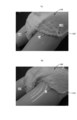
- FIG. 9 (a) shows a state in which a sample product fixed to the back exterior body 12B in a state where the interior body 200 is moved to the crotch side in the form shown in FIGS. 1 to 8 and 12 (a) is attached to the dummy doll.
- FIG. 9B is a photograph of a state in which a commercially available product having an exterior two-part structure that does not have the folded and unfolded structure and the oblique elastic elastic member 19 is mounted on the dummy doll.
- the edge Le of the leg opening in the backside exterior body 12B fits well against the swelling of the buttock, and the buttock is better than the commercially available product. It can be covered.
- the folded portion 12W is provided only on the backside exterior body 12B as shown in FIG. 12 (a), as well as the abdominal side exterior body 12F and the backside exterior body as shown in FIGS. 12 (b), 13 and 14. Although not shown in figure, it can also provide only in the ventral
- the folding direction of the folded portion 12W can be the inside of the diaper as shown in FIGS. 12, 13, and 14 (b), or the outside of the diaper as shown in FIG. 14 (a). . If the folded portion 12W is formed inside the diaper as in the former, the portion where the folded portion 12W is unfolded hardly floats from the skin and fits tightly to the skin. In particular, when the folded portion 12W is formed on the backside exterior body 12B, the portion where the folded portion 12W is developed has a three-dimensional shape that covers the roundness of the buttocks. On the other hand, when the folded portion 12W is formed outside the diaper as in the latter case, the portion where the folded portion 12W is developed comes to fit gently with a weak force against the skin.
- the number of times of folding of the folded portion 12W can be determined as appropriate, as shown in FIGS. 12, 13 (b) to 14, when the folded portion 12W is provided on the backside exterior body 12B, Since the part where the folding
- the side seal portion 12A can be formed including the folded portion 12W.
- the side seal portion 12A is formed by welding, the side seal portion
- the folded portion 12W preferably does not form the side seal portion 12A in the leg opening side region having the folded portion 12W.
- the dotted line in FIGS. 12 to 14 shows the lower end of the side seal portion 12A.
- the trunk periphery T corresponds to the side edge corresponding region of the present invention
- the lower portion (leg side portion) of the trunk periphery T corresponds to the lower portion of the side edge corresponding region of the present invention.
- the waistline portion T and the intermediate portion L are in the side edge corresponding region, and the lower end portion and the intermediate portion L of the waistline portion T are the side edges. This corresponds to the lower part of the part corresponding region.
- the dotted pattern portions in FIGS. 12 to 14 indicate the hot melt adhesive.
- the edge Le of the leg opening is inclined upward toward the side edge by the folding and unfolding structure.
- the ventral exterior body 12F and the back exterior body 12B are configured to be rectangular in shape so that they follow the leg circumference. In this case, trim loss in manufacturing the exterior bodies 12F and 12B can be completely eliminated, as can be seen from the manufacturing method described later.
- the middle elastic elastic member 16 and the oblique elastic elastic member 19 have a thickness of 155 to 1880 dtex, particularly about 470 to 1240 dtex (in the case of synthetic rubber.
- a cross-sectional area of 0.05 to 1.5 mm 2 In the case of natural rubber, a cross-sectional area of 0.05 to 1.5 mm 2 ,
- the thread rubber of about 0.1 to 1.0 mm 2 is fixed at 5 to 40 mm, particularly about 2 to 10 at intervals of 5 to 20 mm, with an elongation of 150 to 300%, particularly 180 to 260%. preferable.
- the waist lower elastic elastic members 15, 18, the intermediate elastic elastic members 16, and the diagonal elastic elastic members 19 are provided on both sides in the width direction except for the central portion in the width direction that overlaps the interior body 200. If this is the case, the interior body 200 will not shrink more than necessary in the width direction, so that it will not look bad or absorb well.
- the elastic stretchable member in addition to the form in which the elastic stretchable member exists only on both sides in the width direction, the elastic stretchable member exists from one side of the width direction to the other side across the interior body 200, but overlaps the interior body 200.
- the elastic expansion / contraction member is finely cut, and the contraction force does not act (substantially equivalent to not providing the elastic expansion / contraction member), and only the both sides in the width direction are configured as the contraction force acting portions.
- the arrangement of the waist lower elastic members 15, 18, the intermediate elastic members 16, and the diagonal elastic members 19 is not limited to the above example, and the elastic force acts on the entire width direction of the waist lower U.
- some or all of the waist lower elastic elastic members 15, 18, the intermediate elastic elastic members 16, and the diagonal elastic elastic members 19 can be provided across the interior body 200 from one side to the other side in the width direction.
- the portion on the waist side of the interior body joint portion 12Z in the interior body 200 as a moving portion, in the first embodiment, as shown in FIG.
- the entire portion is not fixed to other members including the backside exterior body 12B. Therefore, as shown in the illustrated embodiment, when the interior body 200 extends to the waist edge W side, a portion on the waist side of the interior body 200 relative to the interior body joint portion 12Z moves unnecessarily or excessively, resulting in a feeling of wearing. May lead to deterioration or leakage. Therefore, in the first embodiment, as shown in FIGS. 1 and 4, the interior body 200 is extended across the width direction on the interior body 200 on the waist side from the interior body joint portion 12Z in the back side exterior body 12B.
- a portion of the movable portion 200 located on both sides in the width direction is fixed to the backside exterior body 12B by a hot melt adhesive or the like, and a portion passing through the movable portion of the interior body 200 is unfixed.
- a fixing portion of the presser belt 70 with respect to the back side exterior body 12 ⁇ / b> B is denoted by reference numeral 71.
- the presser belt 70 may be formed of a material such as a non-stretchable sheet made of non-woven fabric or the like. Can be held so as not to move or hit. For this reason, the pressing belt 70 shown in the figure is formed by bonding two sheet materials 72 and 73 made of nonwoven fabric or the like (a two-layer structure may be formed by bi-folding or C-folding) and an elongated elastic elastic member 74 between the layers. Is used that is fixed in a stretched state along the width direction, but a material such as a rubber sheet or an elastic nonwoven fabric that elastically expands and contracts can also be used.
- the presser belt 70 is provided on both the abdominal exterior sheet and the back exterior sheet. be able to.
- FIG.16 and FIG.17 has shown an example of the manufacturing method of the underpants type disposable diaper of a 1st form.
- This production line has a transverse flow configuration in which the diaper width direction is the MD direction (machine direction, line flow direction), and here, the abdominal stretchable band 12f and the dorsal exterior body 12B become the abdominal exterior body 12F.
- the back side elastic band 12b is formed, and the interior body 200 manufactured by another line is attached to the abdominal side elastic band 12f and the back side elastic band 12b.
- members that are continuous in the manufacturing process are also denoted by the same reference numerals as those after manufacture.
- this production line includes an elastic member attaching step 301, an elastic member cutting step 302, a center slit step 303, a folding step 304, an interior body attaching step 305, a presser belt attaching step 306, a folding step 307, and a side.
- a part joining step 308 and a separation step 309 are included, and among these, the folding step 304 is a characteristic step as compared with the prior art.
- a belt-like sheet material 12H having a predetermined width is conveyed along the continuous direction, and an elongated shape such as a thread rubber is provided almost entirely with a gap in the CD direction in the sheet material 12H.
- the elastic members 15 to 19 are fixed in a state of being stretched in the MD direction, and a belt-like sheet material 12S having a predetermined width is further supplied and bonded along the continuous direction on the upper surface to form an elastic band.
- an elastic member cutting step 302 is performed on the formed elastic band as necessary, with a predetermined interval in the MD direction, and elastic elastic members 15, 16, which are located in a portion CT that overlaps the interior body 200 later. 18 and 19 are cut by a cutting device such as heat embossing so that the elastic force of the elastic elastic members 15, 16, 18 and 19 does not act on the portion CT.
- a slitter cuts a predetermined portion SL in the middle of the CD direction of the stretchable body along the MD direction, and divides it into the abdominal stretch band 12f and the back stretch band 12b.
- the distance between the ventral stretch band 12f and the back stretch band 12b is increased to a predetermined distance.
- at least one of the abdominal stretchable band 12f and the back stretchable band 12b can be cut off in the shape of a curve at the center edge on the CD side (the portion that becomes the edge Le of the leg opening). Such trimming is not performed when trim loss is completely eliminated.
- the edge Le of the leg opening can be formed along the oblique direction.
- the ventral elastic band 12f and the back elastic band 12b are formed as an integral elastic band and then divided separately in the cutting and dividing step 303.
- the ventral elastic band 12f and the dorsal elastic band are separated.
- 12b By forming 12b using separate sheet materials, it is possible to omit the cutting and dividing step 304. In that case, the two sheet materials are bonded together to hold the elastic elastic member, and one sheet. It is also possible to sandwich the elastic elastic member by folding the sheet material in half or C.
- the ventral side elastic band 12f and the back side elastic band 12b are transported in parallel in the CD direction with a gap therebetween, while the edge side part of the back side elastic band 12b on the side of the ventral side elastic band 12f is changed to CD.
- the folded portion 12W is formed by being bent once in a direction or plural times in a zigzag manner and fixed.
- the fixing portion 12k of the folded portion 12W can be formed by an appropriate joining means such as a hot melt adhesive or heat seal.
- the edge side portion on the back side stretchable band 12b side of the ventral stretchable band 12f is similarly folded once in the CD direction or multiple times zigzag. And fixed to form a folded portion.
- the interior body 200 manufactured in advance on a separate line is supplied with a predetermined interval in the MD direction, and the front side portion of the interior body 200 is joined to the abdominal stretchable band 12f.
- the rear part of the interior body 200 is joined only to the edge of the back side stretchable band 12b on the side of the abdominal stretchable body to form the interior body joint 12Z, thereby forming the interior assembly.
- These joining and fixing can be performed by appropriate means such as a hot melt adhesive or heat sealing.
- a separately formed continuous belt-like presser belt 70 is supplied so as to cross the interior body 200 along the MD direction, and intermittently in the MD direction at the site between the interior bodies 200. It fixes to the exterior body 12B.
- the fixed portion 71 can be formed by appropriate means such as a hot melt adhesive or heat seal.
- the presser belt attaching step 306 can be omitted.
- the interior assembly is folded at the center in the CD direction so that the attachment surface of the interior body 200 in the ventral elastic band 12f and the attachment surface of the interior body 200 in the back elastic band 12b overlap.
- the side part joining step 308 the ventral side elastic band 12f and the back side elastic band 12b are joined to form the side seal part 12A at the side portions of each diaper, and in the separating step 309, the ventral side elastic part.
- the band 12f and the back elastic band 12b are cut at the boundaries of the individual diapers to obtain individual diapers DP.
- the side bonding step 308 and the separation step 309 can be performed simultaneously.
- the disposable diaper DP similar to that of the first embodiment described above can be manufactured without an extending step of the backside exterior body 12B. Further, without using the swinging device, it is possible to provide the oblique elastic elastic member 19 that is in an oblique direction at least in the mounted state. In addition, it is not necessary to cut the leg openings, and there is no trim loss in the manufacture of the exterior bodies 12F and 12B.
- the extension structure described in Patent Document 3 is applied instead of the extension structure formed by the folded portion 12W in the first embodiment. That is, as shown in FIG. 18 to FIG. 22, the slit extending in the width direction from one side of the center in the width direction to the other side of the abdominal side exterior body 12F and the back side exterior body 12B on the waist side from the interior body joint portion 12Z.
- a spacing portion 80 formed of an elongated opening is provided, and as shown in FIG. 20 from the state shown in FIG. 19, the crotch side portion is separated from the waist side portion toward the crotch side with respect to the waist side portion.
- the front-back direction length of the waist side rather than the interior body junction part 12Z can be extended to the crotch side.
- an elongated oblique elastic elastic member 19 that is fixed in an extended state along the width direction and that becomes an oblique direction when mounted is provided on the crotch side of the separating portion 80.
- the spacing portion 80 is preferably wider than the width of the interior body 200, but may be narrow.
- the edge Le of the leg opening located on the side of the exterior body 12F and 12B in the exterior body 12F and 12B at the time of mounting is on the side edge.
- the contraction force of the diagonal elastic elastic member 19 acts along its edge, the leg Le of the leg opening is good without loosening around the wearer's buttocks and the buttocks To fit.
- it is a very simple structure in which only a slit or the like is provided, there is no increase in material cost, and manufacturing is easy.
- the second form is basically the same as that described in Patent Document 3 except that the portion on the waist side of the interior body joint portion 12Z of the interior body 200 is movable to the crotch side, and the separation portion Details of the size, shape, modification, and the like of 80 are the same as those of the separation portion described in Patent Document 3, and thus description thereof is omitted.
- an interior body movement prevention structure of a later-described fourth embodiment is adopted, and the length of the interior body 200 is shortened. The length can be the same as in the first embodiment.
- FIG. 23 and FIG. 24 show the manufacturing flow of the pants-type disposable diaper of the second embodiment.
- the folding step 304 in the manufacturing method of the first embodiment described above intermittently in the MD direction by a slitter device or the like.
- the interior body attaching step 305 the interior body 200 is located closer to the center in the CD direction than the spacing portion 80 with respect to the abdominal exterior body 12F and the back exterior body 12B. Are different from each other in that the interior joint portion 12Z is formed. Since others are the same as that of the 1st manufacturing method, description is abbreviate
- the extension structure described in Patent Document 4 is applied instead of the extension structure formed by the folded portion 12W in the first embodiment. That is, as shown in FIGS. 25 to 30, the back side and the abdomen side exterior body 12F are stretchable at least in the front-rear direction, so that the length in the front-rear direction on the waist side relative to the interior body joint portion 12Z is increased. The length can be extended to the crotch side.
- the edge Le of the leg opening located on the side of the interior body 200 in the exterior bodies 12F and 12B at the time of mounting is on the side edge.
- the leg Le of the leg opening portion fits well around the wearer's buttocks and along the buttocks.
- it is realizable only by the change of sheet material 12S, 12H.
- the contraction force acts along the edge Le of the leg opening in the oblique direction, so that the edge Le of the leg opening is Fits loosely around and around the buttocks.
- the elongated structure of the third form can also be adopted in combination with the first form or the second form.
- the third form is basically the same as that described in Patent Document 4 except that the waist side portion of the interior body 200 from the interior body joint portion 12Z can be moved to the crotch side. Details of the modified example and the like are the same as those described in Patent Document 4, and thus description thereof is omitted. Further, in the third embodiment, an interior body movement prevention structure of a later-described fourth embodiment is employed, and the length of the interior body 200 is shortened. The length can be the same as in the first embodiment.
- ⁇ Manufacturing method of the third embodiment> 23 and 31 show the manufacturing flow of the pants-type disposable diaper of the third embodiment, omitting the folding step 304 in the first embodiment, and in the elastic member attaching step 301, the belt-like sheet material 12H, In 12S, at least a material having extensibility in the CD direction is supplied, and in the interior body attaching step 305, the CD side center side in the CD direction of the back side exterior body 12B from the edge in the CD direction center side of the ventral side exterior body 12F. It is different in that a short interior body up to the edge is joined to form an interior body joint 12Z. Since others are the same as that of the 1st manufacturing method, description is abbreviate
- a net-like elastic elastic member may be supplied and sandwiched between the sheet materials 12H and 12S while being stretched in the MD direction and the CD direction. it can.
- the moving part of the interior body 200 is pressed by the presser belt 70.
- the back side of the second mode and the back side and the ventral side of the third mode are used.
- a configuration is also proposed in which the interior body 200 is extended only to the crotch side edges of the exterior bodies 12F and 12B on the exterior body 12F and 12B side having an elongated structure. In this way, unintended deformation such as bending or twisting of the moving part can also be prevented by shortening the moving part other than the interior joint part 12Z.
- the structure having a short length on the back side exterior body 12B side of the interior body 200 is suitable for products that do not require much back side absorption performance, such as toilet training pants for infants and incontinence pants for men.
- the moving portion of the inner body 200 is pressed by the presser belt 70.
- a connecting belt 90 having the same structure as the presser belt 70 is used.
- the waist side end of the inner body 200 is extended across the width direction, and the parts (preferably both ends) located on both sides in the width direction of the moving part of the interior body 200 are fixed to the back side exterior body 12B with a hot melt adhesive or the like.
- a form in which the waist side end of the moving part of the interior body 200 is connected to the connecting belt 90 by a hot melt adhesive or the like is also proposed.
- a fixed portion of the connecting belt 90 with respect to the back side exterior body 12B is denoted by reference numeral 91, and a fixed portion with respect to the interior body 200 is denoted by reference numeral 95.
- Reference numeral 95 denotes an elastic elastic member.
- the connecting belt 90 in the illustrated form is provided on the interior body 200, but may be passed between the moving part of the interior body 200 and the exterior bodies 12F and 12B.
- connection belt 90 bends downward as the moving portion of the interior body 200 moves to the crotch side as shown in FIG. Since the belt 90 is limited to a substantially center within a range allowed by loosening or bending of the belt 90, the moving part of the inner body 200 can be prevented from moving unnecessarily or excessively. Unintentional deformation such as bending or curling of the moving part can be prevented.
- connection belt 90 according to the fifth embodiment can be used in combination with the presser belt 70 according to the first embodiment.
- illustrated form assumes the application to the expansion
- the moving part of the interior body 200 is pressed by the pressing belt 70.
- the inner surface of the waist edge W of the backside exterior body 12B is also proposed in which a waist flap 100 protruding from the inner flap 200 is formed, and a moving portion of the interior body 200 is extended to the waist flap 100 and connected to the waist flap 100 by a hot melt adhesive or the like.
- a fixed portion of the waist flap 100 with respect to the interior body 200 is indicated by reference numeral 101.
- the waist flap 100 is formed by folding the outer sheet material 12S constituting the backside exterior body 12B inside the diaper at the waist edge W and unfolding the folded portion.
- the sheet materials 12S and 12H can be pasted.
- the interior body 200 moves in the mounted state as shown in FIG.
- the waist flap 100 is bent downward while the back side exterior body 12B is curled inward as the portion moves toward the crotch side, but the movement in the width direction is substantially within the range allowed by loosening or bending of the waist flap 100. Therefore, it is possible to prevent the moving part of the interior body 200 from moving unnecessarily or excessively, thereby preventing unintended deformation such as bending or twisting of the moving part of the interior body 200. Can do.
- the center in the width direction of the abdominal side portion of the waist flap 100 is bent downward while the moving portion of the interior body 200 moves toward the crotch side. Since the curved shape forms a curve along the lower side of the abdomen overhanging the infant, the feeling of wearing especially on the abdomen is clear.
- the sixth embodiment can be employed in combination with the presser belt 70 of the first embodiment and the connection belt 90 of the fifth embodiment.
- the illustrated form assumes the application to the expansion
- the moving part of the interior body 200 is configured to be pressed by the pressing belt 70, but instead of or together with this, as shown in FIGS. 37 and 38, the back side that can be extended to the crotch side.
- a slip stopper 110 that is weaker in the crotch direction than the shift stopper in the other direction is provided at a portion that overlaps the moving part in the exterior body 12B.
- misalignment stop 110 for example, a hook material (male material) of a mechanical fastener (surface fastener) in which a pin is inclined toward the crotch portion side can be used.
- a hook material male material
- surface fastener surface fastener
- the back side exterior body 12B can be extended, but the moving part of the interior body 200 can be pressed against unnecessary or excessive movement, thereby allowing the interior interior to be pressed. Unintentional deformation such as bending or twisting of the moving part of the body 200 can be prevented.
- the seventh embodiment can be used in combination with the presser belt 70 of the first embodiment, the connection belt 90 of the fifth embodiment, and the free edge portion of the sixth embodiment.
- the illustrated form assumes the application to the expansion
- the following terms in the specification have the following meanings unless otherwise specified in the specification.
- the “front-rear (vertical) direction” means the direction connecting the ventral side (front side) and the back side (rear side), and the “width direction” means the direction orthogonal to the front-rear direction (left-right direction).
- “Up and down direction” means the wearing state of the diaper, that is, the direction perpendicular to the waistline direction when the diaper is folded in two at the crotch so that both the front and back sides of the diaper overlap. For example, it means a direction connecting the waist opening side and the crotch side.
- Elongation rate means a value when the natural length is 100%.
- Gel strength is measured as follows. 49.0 g of artificial urine (urea: 20 wt%, salt: 8 wt%, calcium chloride dihydrate: 0.3 wt%, magnesium oxide heptahydrate: 0.8 wt%, pure water: 70.01 wt%), Add 1.0 g of superabsorbent polymer and stir with a stirrer. The produced gel is left in a constant temperature and humidity chamber of 40 ° C. ⁇ 60% RH for 3 hours and then returned to room temperature, and the gel strength is measured with a card meter (I.techno Engineering: Curdmeter-MAX ME-500).
- ⁇ “Weighing” is measured as follows. After the sample or test piece has been pre-dried, it is left in a test room or apparatus in a standard state (test location is temperature 20 ⁇ 5 ° C., relative humidity 65% or less) to obtain a constant weight. Pre-drying refers to making a sample or test piece constant in an environment where the relative humidity is 10 to 25% and the temperature does not exceed 50 ° C. In addition, it is not necessary to perform preliminary drying about the fiber whose official moisture content is 0.0%. A sample with a size of 200 mm ⁇ 250 mm ( ⁇ 2 mm) is cut out from the test piece in a constant weight using a rice-basis plate (200 mm ⁇ 250 mm, ⁇ 2 mm). Measure the weight of the sample, multiply it by 20, calculate the weight per square meter, and use it as the basis weight.
- Thickness is automatically measured using an automatic thickness measuring instrument (KES-G5 handy compression measurement program) under the conditions of load: 10 gf / cm 2 and pressure area: 2 cm 2 .
- test and measurement shall be performed in a test room or equipment in the standard condition (test location is temperature 20 ⁇ 5 °C, relative humidity 65% or less). .
- the present invention can be used in a pants-type disposable diaper.
- L Intermediate part
- Le Edge of leg opening, T ... Trunk circumference part, U ... Waist lower part, W ... Waist edge, 11 ... Liquid impervious sheet, 12A ... Side seal part, 12B ... Backside exterior body , 12F, 12B ... exterior body, 12F ... ventral side exterior body, 12H ... inner sheet material, 12M ... crotch cover sheet, 12S, 12H ... sheet material, 12S ... outer sheet material, 12W ... folded portion, 12Z ... interior body Joining part, 12b ... back side elastic band, 12c ... middle part in CD direction, 12d ... separation part, 12e ... edge sheet material, 12f ... ventral side elastic band, 12w ...
Landscapes
- Health & Medical Sciences (AREA)
- Epidemiology (AREA)
- Engineering & Computer Science (AREA)
- Biomedical Technology (AREA)
- Heart & Thoracic Surgery (AREA)
- Vascular Medicine (AREA)
- Life Sciences & Earth Sciences (AREA)
- Animal Behavior & Ethology (AREA)
- General Health & Medical Sciences (AREA)
- Public Health (AREA)
- Veterinary Medicine (AREA)
- Dermatology (AREA)
- Absorbent Articles And Supports Therefor (AREA)
- Orthopedics, Nursing, And Contraception (AREA)
Priority Applications (6)
| Application Number | Priority Date | Filing Date | Title |
|---|---|---|---|
| BR112016020525-1A BR112016020525B1 (pt) | 2014-03-12 | 2015-02-26 | Fralda descartável de tipo roupa íntima |
| US15/119,612 US10406041B2 (en) | 2014-03-12 | 2015-02-26 | Underpants-type disposable diaper |
| KR1020167025168A KR102306494B1 (ko) | 2014-03-12 | 2015-02-26 | 팬티형 일회용 기저귀 |
| CN201580008964.3A CN106029032B (zh) | 2014-03-12 | 2015-02-26 | 短裤型一次性尿布 |
| EP15762089.9A EP3117813B1 (en) | 2014-03-12 | 2015-02-26 | Pants-type disposable diaper |
| RU2016138568A RU2671060C2 (ru) | 2014-03-12 | 2015-02-26 | Одноразовый подгузник типа трусов |
Applications Claiming Priority (2)
| Application Number | Priority Date | Filing Date | Title |
|---|---|---|---|
| JP2014049110A JP6025215B2 (ja) | 2014-03-12 | 2014-03-12 | パンツタイプ使い捨ておむつ |
| JP2014-049110 | 2014-03-12 |
Publications (1)
| Publication Number | Publication Date |
|---|---|
| WO2015137127A1 true WO2015137127A1 (ja) | 2015-09-17 |
Family
ID=54071575
Family Applications (1)
| Application Number | Title | Priority Date | Filing Date |
|---|---|---|---|
| PCT/JP2015/055557 Ceased WO2015137127A1 (ja) | 2014-03-12 | 2015-02-26 | パンツタイプ使い捨ておむつ |
Country Status (8)
| Country | Link |
|---|---|
| US (1) | US10406041B2 (enExample) |
| EP (1) | EP3117813B1 (enExample) |
| JP (1) | JP6025215B2 (enExample) |
| KR (1) | KR102306494B1 (enExample) |
| CN (1) | CN106029032B (enExample) |
| BR (1) | BR112016020525B1 (enExample) |
| RU (1) | RU2671060C2 (enExample) |
| WO (1) | WO2015137127A1 (enExample) |
Cited By (1)
| Publication number | Priority date | Publication date | Assignee | Title |
|---|---|---|---|---|
| WO2018097771A1 (en) | 2016-11-23 | 2018-05-31 | Essity Hygiene And Health Aktiebolag | Absorbent article with folded edges to enclose elastic elements and method for manufacturing an absorbent article with folded edges |
Families Citing this family (31)
| Publication number | Priority date | Publication date | Assignee | Title |
|---|---|---|---|---|
| RU2661391C2 (ru) * | 2014-03-12 | 2018-07-16 | Дайо Пейпер Корпорейшн | Одноразовый подгузник типа трусов и способ его изготовления |
| EP3139886B1 (en) | 2014-05-08 | 2021-01-20 | The Procter and Gamble Company | Length to waist silhouettes of adult disposable absorbent articles and arrays |
| EP3139882B1 (en) | 2014-05-08 | 2021-10-27 | The Procter & Gamble Company | Length to side silhouettes of adult disposable absorbent articles and arrays |
| US10973709B2 (en) | 2014-05-08 | 2021-04-13 | The Procter & Gamble Company | Hip-to-waist silhouettes of adult disposable absorbent articles and arrays |
| EP3139884B1 (en) | 2014-05-08 | 2021-05-26 | The Procter & Gamble Company | Waist to side silhouettes of adult disposable absorbent articles and arrays |
| EP3139883B1 (en) | 2014-05-08 | 2021-04-07 | The Procter and Gamble Company | Hip to side silhouettes of adult disposable absorbent articles and arrays |
| JP6213877B2 (ja) * | 2014-09-29 | 2017-10-18 | 大王製紙株式会社 | パンツタイプ使い捨ておむつ |
| US10034801B2 (en) | 2014-10-03 | 2018-07-31 | The Procter & Gamble Company | Adult disposable absorbent articles and arrays comprising improved product lengths |
| CN112472426B (zh) | 2014-10-09 | 2022-06-21 | 宝洁公司 | 成人一次性吸收制品和系列的长度对侧部轮廓和髋部对腰部轮廓 |
| US10864117B2 (en) | 2014-10-09 | 2020-12-15 | The Procter & Gamble Company | Length-to-waist and hip-to-side silhouettes of adult disposable absorbent articles and arrays |
| CN117084866B (zh) | 2015-01-16 | 2026-07-21 | 宝洁公司 | 包括具有通道的吸收芯的成人一次性吸收制品的系列 |
| JP6633106B2 (ja) | 2015-06-25 | 2020-01-22 | ザ プロクター アンド ギャンブル カンパニーThe Procter & Gamble Company | 改善された容量プロファイルを備える成人用使い捨て吸収性物品及び該物品の群 |
| JP6415399B2 (ja) * | 2015-06-25 | 2018-10-31 | ユニ・チャーム株式会社 | 使い捨て着用物品 |
| US10292874B2 (en) * | 2015-10-20 | 2019-05-21 | The Procter & Gamble Company | Dual-mode high-waist foldover disposable absorbent pant |
| US10583054B2 (en) | 2015-11-06 | 2020-03-10 | The Procter & Gamble Company | Disposable absorbent article silhouettes and silhouette arrays |
| WO2017141808A1 (ja) * | 2016-02-16 | 2017-08-24 | 王子ホールディングス株式会社 | 使い捨ておむつ、および、使い捨ておむつの製造方法 |
| JP6229787B1 (ja) * | 2016-02-16 | 2017-11-15 | 王子ホールディングス株式会社 | 使い捨ておむつ、および、使い捨ておむつの製造方法 |
| JP6531687B2 (ja) * | 2016-03-17 | 2019-06-19 | 王子ホールディングス株式会社 | 使い捨ておむつ |
| JP6361716B2 (ja) * | 2016-10-18 | 2018-07-25 | 王子ホールディングス株式会社 | 吸収性物品 |
| JP6351686B2 (ja) * | 2016-10-21 | 2018-07-04 | 大王製紙株式会社 | パンツタイプ使い捨ておむつ |
| WO2018118414A1 (en) | 2016-12-20 | 2018-06-28 | The Procter & Gamble Company | Methods and apparatuses for making elastomeric laminates with elastic strands provided with a spin finish |
| JP6881016B2 (ja) * | 2017-05-17 | 2021-06-02 | 王子ホールディングス株式会社 | 成人男性用使い捨ておむつ |
| WO2018209629A1 (en) | 2017-05-18 | 2018-11-22 | The Procter & Gamble Company | Absorbent article with belt having profiled elasticity |
| EP3624745B1 (en) | 2017-05-18 | 2022-09-28 | The Procter & Gamble Company | Absorbent article with belt having zoned elasticity |
| EP3644926B1 (en) | 2017-06-30 | 2025-08-27 | The Procter & Gamble Company | Hip-to-side silhouettes for boxer brief type disposable absorbent articles |
| JP2020525085A (ja) * | 2017-06-30 | 2020-08-27 | ザ プロクター アンド ギャンブル カンパニーThe Procter & Gamble Company | 使い捨て吸収性物品の長さ対臀部及び長さ対腰部シルエット及び群 |
| WO2019006290A1 (en) * | 2017-06-30 | 2019-01-03 | The Procter & Gamble Company | SILHOUETTES LENGTH-ON-THE-SIDE OF DISPOSABLE ABSORBENT ARTICLES OF TYPE CALEÇON SHORT / BOYSHORT, AND LOTS |
| JP2020525082A (ja) | 2017-06-30 | 2020-08-27 | ザ プロクター アンド ギャンブル カンパニーThe Procter & Gamble Company | ビキニ型/ローライズブリーフ型の使い捨て吸収性物品及びアレイ用の臀部−側部シルエット及び腰部−側部シルエット |
| JP6442017B1 (ja) * | 2017-09-27 | 2018-12-19 | 大王製紙株式会社 | 使い捨て着用物品 |
| JP6553165B2 (ja) * | 2017-12-28 | 2019-07-31 | ユニ・チャーム株式会社 | 吸収性物品 |
| KR102631375B1 (ko) * | 2023-06-12 | 2024-02-01 | 주식회사 에이엠씨홀딩스 | 팬티형 기저귀 |
Citations (8)
| Publication number | Priority date | Publication date | Assignee | Title |
|---|---|---|---|---|
| JPH07163618A (ja) * | 1993-12-10 | 1995-06-27 | New Oji Paper Co Ltd | 立体パンツ型使いすておむつ |
| JP2005279077A (ja) * | 2004-03-30 | 2005-10-13 | Zuiko Corp | パンツタイプ着用物品の製造方法 |
| JP2008036019A (ja) * | 2006-08-03 | 2008-02-21 | Uni Charm Corp | パンツ型の着用物品 |
| JP2008178682A (ja) * | 2006-12-28 | 2008-08-07 | Daio Paper Corp | 紙おむつ |
| JP2010162277A (ja) * | 2009-01-19 | 2010-07-29 | Daio Paper Corp | パンツタイプ使い捨ておむつ及びその製造方法 |
| JP2010184134A (ja) * | 2010-05-31 | 2010-08-26 | Daio Paper Corp | 使い捨て紙おむつ |
| JP2012061167A (ja) * | 2010-09-16 | 2012-03-29 | Kao Corp | パンツ型吸収性物品 |
| JP2012239555A (ja) * | 2011-05-17 | 2012-12-10 | Oji Nepia Co Ltd | 使い捨ておむつ |
Family Cites Families (10)
| Publication number | Priority date | Publication date | Assignee | Title |
|---|---|---|---|---|
| JP3437419B2 (ja) * | 1997-09-29 | 2003-08-18 | ユニ・チャーム株式会社 | 使い捨ておむつ |
| JP3478722B2 (ja) * | 1998-01-30 | 2003-12-15 | ユニ・チャーム株式会社 | 使い捨ておむつ |
| JP3696114B2 (ja) * | 2001-04-02 | 2005-09-14 | ユニ・チャーム株式会社 | 使い捨て着用物品 |
| JP3875507B2 (ja) * | 2001-04-06 | 2007-01-31 | ユニ・チャーム株式会社 | 使い捨ておむつ |
| JP3696115B2 (ja) * | 2001-04-06 | 2005-09-14 | ユニ・チャーム株式会社 | 使い捨ておむつ |
| JP3811086B2 (ja) * | 2002-03-20 | 2006-08-16 | ユニ・チャーム株式会社 | パンツ型の使い捨て着用物品 |
| US7569039B2 (en) | 2003-11-19 | 2009-08-04 | The Procter & Gamble Company | Disposable pull-on garment |
| JP4966355B2 (ja) * | 2009-10-08 | 2012-07-04 | 花王株式会社 | パンツ型吸収性物品 |
| JP6014448B2 (ja) * | 2012-10-01 | 2016-10-25 | ユニ・チャーム株式会社 | 吸収性物品 |
| JP5740448B2 (ja) | 2013-10-18 | 2015-06-24 | 大王製紙株式会社 | 使い捨て紙おむつ |
-
2014
- 2014-03-12 JP JP2014049110A patent/JP6025215B2/ja not_active Expired - Fee Related
-
2015
- 2015-02-26 CN CN201580008964.3A patent/CN106029032B/zh active Active
- 2015-02-26 BR BR112016020525-1A patent/BR112016020525B1/pt active IP Right Grant
- 2015-02-26 RU RU2016138568A patent/RU2671060C2/ru active
- 2015-02-26 KR KR1020167025168A patent/KR102306494B1/ko active Active
- 2015-02-26 EP EP15762089.9A patent/EP3117813B1/en active Active
- 2015-02-26 WO PCT/JP2015/055557 patent/WO2015137127A1/ja not_active Ceased
- 2015-02-26 US US15/119,612 patent/US10406041B2/en active Active
Patent Citations (8)
| Publication number | Priority date | Publication date | Assignee | Title |
|---|---|---|---|---|
| JPH07163618A (ja) * | 1993-12-10 | 1995-06-27 | New Oji Paper Co Ltd | 立体パンツ型使いすておむつ |
| JP2005279077A (ja) * | 2004-03-30 | 2005-10-13 | Zuiko Corp | パンツタイプ着用物品の製造方法 |
| JP2008036019A (ja) * | 2006-08-03 | 2008-02-21 | Uni Charm Corp | パンツ型の着用物品 |
| JP2008178682A (ja) * | 2006-12-28 | 2008-08-07 | Daio Paper Corp | 紙おむつ |
| JP2010162277A (ja) * | 2009-01-19 | 2010-07-29 | Daio Paper Corp | パンツタイプ使い捨ておむつ及びその製造方法 |
| JP2010184134A (ja) * | 2010-05-31 | 2010-08-26 | Daio Paper Corp | 使い捨て紙おむつ |
| JP2012061167A (ja) * | 2010-09-16 | 2012-03-29 | Kao Corp | パンツ型吸収性物品 |
| JP2012239555A (ja) * | 2011-05-17 | 2012-12-10 | Oji Nepia Co Ltd | 使い捨ておむつ |
Cited By (3)
| Publication number | Priority date | Publication date | Assignee | Title |
|---|---|---|---|---|
| WO2018097771A1 (en) | 2016-11-23 | 2018-05-31 | Essity Hygiene And Health Aktiebolag | Absorbent article with folded edges to enclose elastic elements and method for manufacturing an absorbent article with folded edges |
| EP3544560A4 (en) * | 2016-11-23 | 2020-06-17 | Essity Hygiene and Health Aktiebolag | SUCTIONABLE ARTICLE WITH FOLDED EDGES TO ENCLOSE ELASTIC ELEMENTS AND METHOD FOR PRODUCING AN SUCTIONABLE ARTICLE WITH FOLDED EDGES |
| US10993844B2 (en) | 2016-11-23 | 2021-05-04 | Essity Hygiene And Health Aktiebolag | Absorbent article and method for manufacturing an absorbent article |
Also Published As
| Publication number | Publication date |
|---|---|
| EP3117813A4 (en) | 2017-08-23 |
| KR20160132845A (ko) | 2016-11-21 |
| BR112016020525A2 (pt) | 2017-08-15 |
| RU2016138568A (ru) | 2018-04-12 |
| BR112016020525B1 (pt) | 2021-12-28 |
| EP3117813B1 (en) | 2020-07-01 |
| CN106029032A (zh) | 2016-10-12 |
| EP3117813A1 (en) | 2017-01-18 |
| JP2015171502A (ja) | 2015-10-01 |
| JP6025215B2 (ja) | 2016-11-16 |
| KR102306494B1 (ko) | 2021-09-28 |
| US10406041B2 (en) | 2019-09-10 |
| CN106029032B (zh) | 2019-09-17 |
| US20170049637A1 (en) | 2017-02-23 |
| RU2671060C2 (ru) | 2018-10-29 |
| RU2016138568A3 (enExample) | 2018-06-26 |
Similar Documents
| Publication | Publication Date | Title |
|---|---|---|
| JP6025215B2 (ja) | パンツタイプ使い捨ておむつ | |
| JP2015171502A5 (enExample) | ||
| JP6032683B2 (ja) | パンツタイプ使い捨ておむつの製造方法、及びその製造方法により製造可能なパンツタイプ使い捨ておむつ | |
| JP6065290B2 (ja) | 吸収性物品の伸縮構造の形成方法、及び吸収性物品の伸縮構造 | |
| WO2015137130A1 (ja) | パンツタイプ使い捨ておむつ及びその製造方法 | |
| JP2015186563A5 (enExample) | ||
| JP5992568B1 (ja) | パンツタイプ使い捨ておむつ | |
| JP6057347B2 (ja) | パンツタイプ使い捨ておむつの製造方法、及びパンツタイプ使い捨ておむつ | |
| JP2016007347A5 (enExample) | ||
| JP6315337B2 (ja) | パンツタイプ使い捨ておむつの製造方法 | |
| JP5988398B2 (ja) | パンツタイプ使い捨ておむつ及びその製造方法 | |
| JP5904605B2 (ja) | パンツタイプ使い捨ておむつ及びその製造方法 | |
| JP2016054989A5 (enExample) | ||
| JP5902861B2 (ja) | 吸収性物品の伸縮構造の形成方法 | |
| JP2015171500A5 (enExample) | ||
| JP6376382B2 (ja) | パンツタイプ使い捨ておむつ | |
| JP6362261B2 (ja) | パンツタイプ使い捨ておむつ及びその製造方法 | |
| JP6163280B1 (ja) | パンツタイプ使い捨ておむつ | |
| JP6084330B2 (ja) | パンツタイプ使い捨ておむつ | |
| JP2016030031A5 (enExample) | ||
| JP2016067435A5 (enExample) | ||
| JP6122536B2 (ja) | パンツタイプ使い捨ておむつの製造方法 | |
| JP6576742B2 (ja) | パンツタイプ使い捨ておむつ |
Legal Events
| Date | Code | Title | Description |
|---|---|---|---|
| 121 | Ep: the epo has been informed by wipo that ep was designated in this application |
Ref document number: 15762089 Country of ref document: EP Kind code of ref document: A1 |
|
| WWE | Wipo information: entry into national phase |
Ref document number: 15119612 Country of ref document: US |
|
| ENP | Entry into the national phase |
Ref document number: 20167025168 Country of ref document: KR Kind code of ref document: A |
|
| NENP | Non-entry into the national phase |
Ref country code: DE |
|
| REEP | Request for entry into the european phase |
Ref document number: 2015762089 Country of ref document: EP |
|
| WWE | Wipo information: entry into national phase |
Ref document number: 2015762089 Country of ref document: EP |
|
| ENP | Entry into the national phase |
Ref document number: 2016138568 Country of ref document: RU Kind code of ref document: A |
|
| REG | Reference to national code |
Ref country code: BR Ref legal event code: B01A Ref document number: 112016020525 Country of ref document: BR |
|
| ENP | Entry into the national phase |
Ref document number: 112016020525 Country of ref document: BR Kind code of ref document: A2 Effective date: 20160905 |